WO2017168528A1 - 画像処理装置、画像処理方法および画像処理プログラム - Google Patents
画像処理装置、画像処理方法および画像処理プログラム Download PDFInfo
- Publication number
- WO2017168528A1 WO2017168528A1 PCT/JP2016/059971 JP2016059971W WO2017168528A1 WO 2017168528 A1 WO2017168528 A1 WO 2017168528A1 JP 2016059971 W JP2016059971 W JP 2016059971W WO 2017168528 A1 WO2017168528 A1 WO 2017168528A1
- Authority
- WO
- WIPO (PCT)
- Prior art keywords
- blur correction
- correction amount
- frame
- stable
- motion
- Prior art date
- Legal status (The legal status is an assumption and is not a legal conclusion. Google has not performed a legal analysis and makes no representation as to the accuracy of the status listed.)
- Ceased
Links
Images








Classifications
-
- A—HUMAN NECESSITIES
- A61—MEDICAL OR VETERINARY SCIENCE; HYGIENE
- A61B—DIAGNOSIS; SURGERY; IDENTIFICATION
- A61B1/00—Instruments for performing medical examinations of the interior of cavities or tubes of the body by visual or photographical inspection, e.g. endoscopes; Illuminating arrangements therefor
- A61B1/04—Instruments for performing medical examinations of the interior of cavities or tubes of the body by visual or photographical inspection, e.g. endoscopes; Illuminating arrangements therefor combined with photographic or television appliances
-
- H—ELECTRICITY
- H04—ELECTRIC COMMUNICATION TECHNIQUE
- H04N—PICTORIAL COMMUNICATION, e.g. TELEVISION
- H04N23/00—Cameras or camera modules comprising electronic image sensors; Control thereof
- H04N23/60—Control of cameras or camera modules
- H04N23/68—Control of cameras or camera modules for stable pick-up of the scene, e.g. compensating for camera body vibrations
- H04N23/682—Vibration or motion blur correction
- H04N23/683—Vibration or motion blur correction performed by a processor, e.g. controlling the readout of an image memory
-
- A—HUMAN NECESSITIES
- A61—MEDICAL OR VETERINARY SCIENCE; HYGIENE
- A61B—DIAGNOSIS; SURGERY; IDENTIFICATION
- A61B1/00—Instruments for performing medical examinations of the interior of cavities or tubes of the body by visual or photographical inspection, e.g. endoscopes; Illuminating arrangements therefor
- A61B1/00002—Operational features of endoscopes
- A61B1/00004—Operational features of endoscopes characterised by electronic signal processing
- A61B1/00006—Operational features of endoscopes characterised by electronic signal processing of control signals
-
- A—HUMAN NECESSITIES
- A61—MEDICAL OR VETERINARY SCIENCE; HYGIENE
- A61B—DIAGNOSIS; SURGERY; IDENTIFICATION
- A61B1/00—Instruments for performing medical examinations of the interior of cavities or tubes of the body by visual or photographical inspection, e.g. endoscopes; Illuminating arrangements therefor
- A61B1/00002—Operational features of endoscopes
- A61B1/00004—Operational features of endoscopes characterised by electronic signal processing
- A61B1/00009—Operational features of endoscopes characterised by electronic signal processing of image signals during a use of endoscope
- A61B1/000095—Operational features of endoscopes characterised by electronic signal processing of image signals during a use of endoscope for image enhancement
-
- A—HUMAN NECESSITIES
- A61—MEDICAL OR VETERINARY SCIENCE; HYGIENE
- A61B—DIAGNOSIS; SURGERY; IDENTIFICATION
- A61B1/00—Instruments for performing medical examinations of the interior of cavities or tubes of the body by visual or photographical inspection, e.g. endoscopes; Illuminating arrangements therefor
- A61B1/04—Instruments for performing medical examinations of the interior of cavities or tubes of the body by visual or photographical inspection, e.g. endoscopes; Illuminating arrangements therefor combined with photographic or television appliances
- A61B1/045—Control thereof
-
- G—PHYSICS
- G06—COMPUTING OR CALCULATING; COUNTING
- G06T—IMAGE DATA PROCESSING OR GENERATION, IN GENERAL
- G06T7/00—Image analysis
- G06T7/0002—Inspection of images, e.g. flaw detection
-
- G—PHYSICS
- G06—COMPUTING OR CALCULATING; COUNTING
- G06T—IMAGE DATA PROCESSING OR GENERATION, IN GENERAL
- G06T7/00—Image analysis
- G06T7/20—Analysis of motion
- G06T7/223—Analysis of motion using block-matching
-
- H—ELECTRICITY
- H04—ELECTRIC COMMUNICATION TECHNIQUE
- H04N—PICTORIAL COMMUNICATION, e.g. TELEVISION
- H04N23/00—Cameras or camera modules comprising electronic image sensors; Control thereof
- H04N23/10—Cameras or camera modules comprising electronic image sensors; Control thereof for generating image signals from different wavelengths
-
- H—ELECTRICITY
- H04—ELECTRIC COMMUNICATION TECHNIQUE
- H04N—PICTORIAL COMMUNICATION, e.g. TELEVISION
- H04N23/00—Cameras or camera modules comprising electronic image sensors; Control thereof
- H04N23/10—Cameras or camera modules comprising electronic image sensors; Control thereof for generating image signals from different wavelengths
- H04N23/12—Cameras or camera modules comprising electronic image sensors; Control thereof for generating image signals from different wavelengths with one sensor only
-
- H—ELECTRICITY
- H04—ELECTRIC COMMUNICATION TECHNIQUE
- H04N—PICTORIAL COMMUNICATION, e.g. TELEVISION
- H04N23/00—Cameras or camera modules comprising electronic image sensors; Control thereof
- H04N23/60—Control of cameras or camera modules
-
- H—ELECTRICITY
- H04—ELECTRIC COMMUNICATION TECHNIQUE
- H04N—PICTORIAL COMMUNICATION, e.g. TELEVISION
- H04N23/00—Cameras or camera modules comprising electronic image sensors; Control thereof
- H04N23/60—Control of cameras or camera modules
- H04N23/68—Control of cameras or camera modules for stable pick-up of the scene, e.g. compensating for camera body vibrations
- H04N23/681—Motion detection
- H04N23/6811—Motion detection based on the image signal
-
- H—ELECTRICITY
- H04—ELECTRIC COMMUNICATION TECHNIQUE
- H04N—PICTORIAL COMMUNICATION, e.g. TELEVISION
- H04N9/00—Details of colour television systems
- H04N9/64—Circuits for processing colour signals
- H04N9/646—Circuits for processing colour signals for image enhancement, e.g. vertical detail restoration, cross-colour elimination, contour correction, chrominance trapping filters
-
- G—PHYSICS
- G06—COMPUTING OR CALCULATING; COUNTING
- G06T—IMAGE DATA PROCESSING OR GENERATION, IN GENERAL
- G06T2207/00—Indexing scheme for image analysis or image enhancement
- G06T2207/10—Image acquisition modality
- G06T2207/10024—Color image
-
- G—PHYSICS
- G06—COMPUTING OR CALCULATING; COUNTING
- G06T—IMAGE DATA PROCESSING OR GENERATION, IN GENERAL
- G06T2207/00—Indexing scheme for image analysis or image enhancement
- G06T2207/10—Image acquisition modality
- G06T2207/10068—Endoscopic image
Definitions
- the present invention relates to an image processing apparatus, an image processing method, and an image processing program.
- a motion blur correction method for a moving image acquired by a frame sequential method is known (see, for example, Patent Documents 1 and 2).
- the frame sequential method red channel, green channel, and blue channel frames (R frame, G frame, and B frame) are captured in order, and R, G, and B frames that are continuous in the time axis direction are synchronized.
- One moving image frame in RGB format is generated.
- a motion amount that represents the magnitude of blurring of a moving image frame is calculated from the moving image frame, and a shake correction process is performed on the moving image frame based on the calculated motion amount.
- motion amounts of R, G, and B frames are calculated, and blur correction processing is performed on the R, G, and B frames based on the motion amounts before synchronization.
- the present invention has been made in view of the above-described circumstances, and is an image processing apparatus and image processing for a moving image of a frame sequential method that can reduce color misregistration caused by an error in blur correction amount between color channels. It is an object to provide a method and an image processing program.
- an image processing apparatus for a frame sequential type moving image that sequentially receives frames of a plurality of color channels and synthesizes a plurality of frames to generate a color moving image frame.
- a motion amount calculation unit that calculates a motion amount of a subject image between the latest frame and the past frame from the latest frame and the past frame of the color channel, and the motion amount calculation unit
- a blur correction amount calculation unit that calculates a blur correction amount for the latest frame based on a motion amount, and a stable blur correction for the latest frame based on the blur correction amount calculated by the blur correction amount calculation unit.
- a stable blur correction amount calculation unit that calculates an amount; a blur correction unit that performs a blur correction process on the latest frame based on the stable blur correction amount calculated by the stable blur correction amount calculation unit; and A storage unit that stores the blur correction amount calculated by the correction amount calculation unit, and the stable blur correction amount calculation unit is stored in the storage unit and the latest blur correction amount for the frame.
- the image processing apparatus calculates a stable blur correction amount for the latest frame based on a stable blur correction amount for a frame of a color channel different from the latest frame.
- the motion amount of the subject is calculated from the past frame of the same color channel as the latest frame, and the motion amount calculation unit calculates the motion amount of the subject based on the motion amount.
- the blur correction amount is calculated by the blur correction amount calculation unit.
- the stable blur correction amount for the latest frame is calculated by the stable blur correction amount calculation unit based on the blur correction amount, and the stable blur correction amount is stored in the storage unit.
- Frame blur correction processing is performed by the blur correction unit. Therefore, by combining frames of a plurality of color channels that have undergone blur correction processing, it is possible to generate a moving image frame of color that has undergone blur correction.
- the stable blur correction amount is calculated not only based on the latest frame blur correction amount but also on the basis of the stable blur correction amount for the past frame of a color channel different from the latest frame.
- the stable blur correction amounts for the frames of the plurality of color channels depend on each other, an error between the color channels that has occurred in the blur correction amount is reduced in the stable blur correction amount. Therefore, by using the stable blur correction amount for the blur correction process of the frame of each color channel, it is possible to reduce the color shift in the moving image frame.
- the stable blur correction amount calculation unit weights each of the latest blur correction amount for the latest frame and the stable blur correction amount for a frame of a color channel different from the latest frame,
- the weighted blur correction amount and the stable blur correction amount may be added to calculate the latest stable blur correction amount for the frame.
- the weight of the degree of contribution of the latest image stabilization amount for the latest frame and the amount of stable image stabilization for the frame of a color channel different from the latest frame to the stable amount of image stabilization for the latest frame is weighted. Can be adjusted easily.
- the motion amount calculating unit further calculates the reliability of the motion amount
- the stable blur correction amount calculating unit is based on the reliability of the motion amount calculated from the latest frame.
- the weight to be added to each of the blur correction amount for the latest frame and the stable blur correction amount for a frame of a color channel different from the latest frame may be determined. By doing so, it is possible to calculate the stable blur correction amount in which the influence of the motion amount with low calculation accuracy is suppressed.
- the plurality of color channels may be a red channel, a green channel, and a blue channel. In this way, a moving image frame in RGB format can be generated.
- a second aspect of the present invention is an image processing method for a moving image of a frame sequential method in which frames of a plurality of color channels are received in order and a frame of a plurality of color channels is synthesized to generate a color moving image frame.
- a motion amount calculating step for calculating a motion amount of a subject image between the latest frame and the past frame from the latest frame and the past frame of the same color channel, and in the motion amount calculating step, Based on the calculated amount of motion, a blur correction amount calculating step for calculating a blur correction amount for the latest frame, and for the latest frame based on the blur correction amount calculated in the blur correction amount calculating step.
- a stable blur correction amount calculating step for calculating a stable blur correction amount for the first image and a stable blur correction amount calculated in the stable blur correction amount calculating step.
- a storage step for storing the stable blur correction amount calculated in the stable blur correction amount calculating step.
- a third aspect of the present invention is an image processing program for a moving image of a frame sequential method that sequentially receives frames of a plurality of color channels and combines the frames of the plurality of color channels to generate a color moving image frame.
- a motion amount calculating step for calculating a motion amount of a subject image between the latest frame and the past frame from the latest frame and the past frame of the same color channel, and in the motion amount calculating step, Based on the calculated amount of motion, a blur correction amount calculating step for calculating a blur correction amount for the latest frame, and for the latest frame based on the blur correction amount calculated in the blur correction amount calculating step.
- the computer executes a blur correction step for performing blur correction processing on the latest frame and a storage step for storing the stable blur correction amount calculated in the stable blur correction amount calculation step, thereby calculating the stable blur correction amount.
- the latest frame An image processing program for calculating a stable blur correction amount.
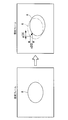
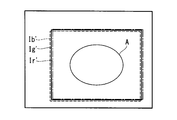
- FIG. 1 is an overall configuration diagram of an image processing apparatus according to a first embodiment of the present invention. It is a figure explaining the relationship between the frame input into the image processing apparatus of FIG. 1, and the moving image frame output from an image processing apparatus. It is a figure explaining the amount of motion computed by a motion amount calculation part. It is a figure explaining the blur correction process by a blur correction part.
- 2 is a flowchart illustrating an image processing method by the image processing apparatus of FIG. 1. It is a figure which shows an example of the trimming area
- the image processing apparatus 1 according to the first embodiment of the present invention will be described below with reference to FIGS.
- the image processing apparatus 1 according to the present embodiment is used by being connected to a frame sequential type moving image capturing apparatus and a display apparatus.
- the moving image photographing apparatus is, for example, an endoscope apparatus.
- Each of the moving image frames constituting the color moving image is composed of a plurality of color channel frames.
- the frame-sequential moving image capturing device sequentially irradiates a subject with a plurality of light beams having different colors and captures a subject illuminated with each color light, thereby sequentially acquiring frames of a plurality of color channels.
- the image processing apparatus 1 sequentially receives a plurality of color channel frames from the moving image capturing apparatus, and generates a single color moving image frame by simultaneously processing a plurality of color channel frames continuous in the time axis direction. Then, the generated moving image frame is transmitted to the display device at a constant frame rate. Thereby, a color moving image is displayed on the display device.
- the moving image shooting apparatus irradiates the subject with red (R), green (G), and blue (B) light in order, and R, G, and B channel frames (hereinafter, R frame, G frame, and B frame). And the acquired frames are transmitted to the image processing apparatus 1 in order. As shown in FIG. 2, the image processing apparatus 1 generates one moving image frame in RGB format from three R, G, and B frames that are continuous in the time axis direction.
- the image processing apparatus 1 calculates an amount of motion of the subject image A in each of the R, G, and B frames, and an input unit 2 that receives R, G, and B frames from the moving image capturing apparatus.
- a motion amount calculation unit 3 a motion amount storage unit 4 that stores the calculated motion amount for at least a certain period, and a shake correction amount calculation that calculates a shake correction amount for each of R, G, and B frames based on the motion amount
- a stable blur correction amount calculating unit 6 that calculates a stable blur correction amount for each of the R, G, and B frames based on the blur correction amount, and a stable blur correction amount that stores the stable blur correction amount for at least a fixed period.
- Storage unit 7 blur correction unit 8 that performs blur correction processing on each of the R, G, and B frames based on the stable blur correction amount, and synchronization processing of the R, G, and B frames that have undergone blur correction processing RGB type
- the input unit 2 repeatedly receives the R frame, the G frame, and the B frame in order from the moving image capturing apparatus.
- the input unit 2 sequentially transmits the latest received frame to the motion amount calculation unit 3 and the shake correction unit 8.
- the motion amount calculation unit 3 holds the frame received from the input unit 2 for a certain period.
- the motion amount calculation unit 3 calculates the motion amounts p [0] and q [0] of the subject image A in the latest frame (hereinafter referred to as “current frame”).
- the motion amount calculation unit 3 refers to the current frame and a frame immediately before the same color channel as the current frame (that is, a frame three frames before the current frame. Hereinafter, it is referred to as a “previous frame”.
- the motion amounts p [0] and q [0] from the immediately preceding frame of the subject image A in the current frame are calculated as shown in FIG.
- p [0] and q [0] are the motion amounts of the current frame in the horizontal direction (lateral direction) and vertical direction (vertical direction), respectively.
- the motion amount calculation unit 3 transmits the calculated motion amounts p [0] and q [0] to the motion amount storage unit 4 and the shake correction amount calculation unit 5.
- p [t] and q [t] are motion amounts of the subject image A in a frame t frames before the current frame.
- the motion amounts p [0] and q [0] are obtained by dividing the current frame into a plurality of block areas having a predetermined size, calculating local motion vectors for the immediately preceding frame of each block area, and performing local motion in all block areas. Calculated by weighted averaging of vectors.
- a known template matching process is used to calculate the local motion vector. That is, the immediately preceding frame is divided into a plurality of block areas in the same manner as the current frame. Next, for each block area of the current frame, a correlation value with each block area of the immediately preceding frame is calculated, a corresponding block area in the immediately preceding frame is specified based on the correlation value, and a position of the corresponding block area is determined. The difference is calculated as a local motion vector.
- the correlation value used in the template matching process for example, a value based on the SAD (Sum of Absolute Difference), the SSD (Sum of Square Difference), or the NCC (Normalized Cross Correlation) of the luminance value of the frame is used.
- the local motion vector calculation method is not limited to the template matching described above, and may be another known method. For example, a gradient method based on a luminance gradient in a frame or a matching method using an edge of luminance in a frame as a feature point may be used.
- the motion amount calculation unit 3 may use a frame to which various image filters such as an edge enhancement filter and a low-pass filter are applied for calculating the motion amount.
- the amount of movement of the subject image A between the current frame and the immediately preceding frame includes the amount of movement caused by the movement of the subject and the movement caused by the blur of the video shooting device.
- Amount blue amount
- the motion amount calculation unit 3 decomposes the motion amount of the subject image A between the current frame and the previous frame into a motion amount and a shake amount caused by the motion of the subject, and converts the shake amount into a final motion amount p [ 0] and q [0].
- the amount of movement due to the movement of the subject changes more slowly than the amount of blur. Therefore, for example, the time average of the amount of movement of the subject image A between the current frame and the immediately preceding frame is calculated as the amount of movement caused by the motion of the subject, and the movement of the subject image A between the current frame and the immediately preceding frame is calculated. The difference between the amount and the amount of movement caused by the movement of the subject is calculated as the amount of blur.
- the shake correction amount calculation unit 5 receives the motion amount p [t] of the frame 1 to N frames before the current frame.
- the blur correction amount calculation unit 5 is based on the following formulas (1. and 1.) based on the motion amounts p [0], q [0] and p [t], q [t] and the stable blur correction amounts U old and V old . From 1) and (1.2), blur correction amounts u new and v new for the current frame are calculated.
- the blur correction amount calculation unit 5 transmits the calculated blur correction amounts u new and v new to the stable blur correction amount calculation unit 6.
- u new and v new are the horizontal and vertical blur correction amounts for the current frame, respectively, and U old and V old are the horizontal of the immediately preceding frame, respectively. This is the amount of stable blur correction in the direction and the vertical direction.
- the blur correction process is continuously executed in the time direction from the start of the blur correction process.
- the correction amount for correcting the blur of the subject image A in the current frame is accumulated with respect to the stable blur correction amounts U old and V old for the immediately preceding frame. Represents that.
- the stable blur correction amount calculation unit 6 receives the blur correction amounts u new and v new from the blur correction amount calculation unit 5, the frame immediately before the color channel other than the color channel of the current frame is stored from the stable blur correction amount storage unit 7.
- the stable blur correction amounts U [t] and V [t] are read out.
- the stable blur correction amount calculation unit 6 weights and synthesizes the blur correction amounts u new and v new and the stable blur correction amounts U [t] and V [t], thereby stabilizing the stable blur correction amount for the current frame.
- U [0] and V [0] are calculated.
- the stable blur correction amount calculation unit 6 multiplies the blur correction amounts u new and v new by the weighting factor w [0] to stabilize
- the shake correction amounts U [t] and V [t] are multiplied by the weighting coefficient w [t], and the obtained products are added together.
- C-1 is the number of stable blur correction amounts used for weighted synthesis. In this example, C is assumed to be the number of color channels (ie, 3), but may be any other number.
- w [0] and w [t] are weighting coefficients, and the number of elements of the weighting coefficient is equal to C.
- the first term on the right side of equations (2.1) and (2.2) represents the degree of blur correction for the current frame. As w [0] is larger, the blur of the subject image A in the current frame is more accurately corrected. On the other hand, the second term on the right side of equations (2.1) and (2.2) has an effect of bringing the amount of blur correction between the color channels closer. As w [t] is larger, the difference in blur correction amount between R, G, and B frames (difference in the position of the trimming area) is reduced, and the effect of suppressing the occurrence of color misregistration in the moving image frame becomes stronger.
- the stable blur correction amount calculation unit 6 transmits the calculated stable blur correction amounts U [0] and V [0] to the stable blur correction amount storage unit 7 and the blur correction unit 8.
- the stable blur correction amount storage unit 7 stores the latest stable blur correction amounts U [t] and V [t] for a predetermined number of frames.
- the blur correction unit 8 Upon receiving the stable blur correction amounts U [0] and V [0] from the stable blur correction amount calculation unit 6, the blur correction unit 8 sets the current frame based on the stable blur correction amounts U [0] and V [0].
- the blur correction process is executed on the image.
- the camera shake correction process is an electronic camera shake correction process by adjusting the position of the trimming area. Any known method is used for the electronic camera shake correction process. For example, as shown in FIG. 4, the blur correction unit 8 sets a trimming region I ′ in the current frame I, and uses the trimming region I ′ as a reference by stable blur correction amounts U [0] and V [0].
- the position is moved in the horizontal direction and the vertical direction from the position of the trimming area (for example, the position of the trimming area at the start of blur correction), and the trimmed area I ′ after the movement is cut out from the current frame I.
- the blur correction unit 8 transmits the cut trimming area I ′ to the synchronization processing unit 9 as a blur correction frame.
- the blur correction frame I ′ [c] (x, y) is expressed by the following expression (3) using the current frame I [c] (x, y).
- x is the horizontal coordinate
- y is the vertical coordinate
- I [c] (x, y) and I ′ [c] (x, y) represent the luminance values of the pixels at the coordinates (x, y), respectively.
- the trimming area moves from frame to frame.
- the blur correction amount is expressed as an amount obtained by integrating the movement amounts of the trimming areas of all frames from the start of the blur correction to the current frame.
- the synchronization processing unit 9 temporarily holds the shake correction frame received from the shake correction unit 8.
- the synchronization processing unit 9 combines three blur correction frames generated from R, G, and B frames that are continuous in the time axis direction to generate a moving image frame in RGB format, and outputs the generated moving image frame to the output unit 10 to send.
- the output unit 10 transmits the moving image frame to the display device at a constant time interval. As a result, an RGB moving image having a fixed frame rate is displayed on the display device.
- the R frame, the G frame, and the B frame are repeatedly received in order from the moving image photographing apparatus (step S1).
- motion amounts p [0] and q [0] from the immediately preceding frame of the subject image A in the current frame are calculated (motion amount calculation step S2).
- the calculated motion amounts p [0] and q [0] of the current frame are stored in the motion amount storage unit 4 (step S3), and are used to calculate the blur correction amount of the frame that is subsequently input to the image processing apparatus 1. used.
- blur correction amounts u new and v new for the current frame are calculated (blur correction amount calculation step S6).
- the motion amounts p [t] and q [t] of the immediately preceding several frames are read from the motion amount storage unit 4 (step S4), and already with respect to the immediately preceding frame of the same color channel as the current frame.
- the stable blur correction amounts U old and V old calculated and stored are read from the stable blur correction amount storage unit 7 (step S5).
- stable blur correction amounts U [0] and V [0] for the current frame are calculated based on the blur correction amounts u new and v new calculated in step S6 (stable blur correction amount calculation step S8).
- the stable blur correction amounts U [t] and V [t] that have been calculated and stored for the frame immediately before the color channel different from the current frame are read from the stable blur correction amount storage unit 7. (Step S7).
- the stable shake correction amounts U [0] and V [0] Is calculated (step S8).
- the calculated stable blur correction amounts U [0] and V [0] for the current frame are stored in the stable blur correction amount storage unit 7 (storage step S9), and the frame to be input to the image processing apparatus 1 thereafter. It is used to calculate the shake correction amount and the stable shake correction amount.
- a blur correction process is performed on the current frame (blur correction step S10).
- a moving image frame is generated by synchronizing the blur correction frame generated in step S10 with the two blur correction frames generated immediately before (step S11).
- the generated moving image frame is output to the display device (step S12).
- the blur correction amount calculation unit 5 performs the motion amount p [t] of the past frame.
- Q [t] an initial value or a motion amount p [0], q [0] of the current frame is used.
- the blur correction amount calculation unit 5 and the stable blur correction amount calculation unit 6 uses an initially set value or blur correction amount instead of the stable blur correction amounts U old and V old or U [t] and V [t] for the past frame.
- the motion amounts p [0] and q [0] are calculated from two frames of the same color channel. This is because there is a difference in the subject image A between the R, G, and B frames acquired by the frame sequential moving image capturing apparatus. For example, an image of a red object is clear in the G and B frames, but is unclear in the R frame. Therefore, in order to calculate an accurate amount of movement of the subject image A, it is necessary to use frames of the same color channel.
- the stable blur correction amount U [0] that depends on the stable blur correction amounts U [t] and V [t] for a frame of a color channel different from that of the current frame is used for the current frame blur correction processing.
- V [0] are used.
- FIGS. 8 and 9 respectively show the amount of deviation of the actual trimming position with respect to the ideal trimming position of each of the R, G, and B frames when the blur correction process is performed using the blur correction amount and the stable blur correction amount.
- An example of time change is shown.
- the ideal trimming position is a trimming position when there is no error in the motion amount calculated by the motion amount calculation unit 3. 8 and 9, the difference in the amount of misalignment between the trimming positions between the R, G, and B frames at the same time means the occurrence of color misalignment in the moving image frame.
- weight coefficients w [0], w [1], and w [2] may be set such that the IIR filter has a characteristic of attenuating high frequency components.
- the data in FIG. 10 was obtained from the following simulation experiment. Assuming a scene in which a completely stationary subject is shot by hand using a video camera, a scene in which camera shake occurs as the amount of motion is set in the frame. Specifically, the scene was set to a scene that vibrates based on a random number generated according to a normal distribution with an average of zero and a standard deviation of 6. Furthermore, the motion amount is set to include an error based on a random number generated according to a normal distribution having an average of zero and a standard deviation of 2. Under such condition settings, the amount of motion shown in FIG. 11 was obtained. In FIG. 11, a solid line indicates the vibration of the scene, and a broken line indicates the amount of movement.
- the motion amount calculation unit 3 has the reliability of the motion amounts p [0] and q [0] in addition to the motion amounts p [0] and q [0].
- the stable blur correction amount calculation unit 6 determines the weights to be attached to the blur correction amounts u new and v new and the stable blur correction amounts U [t] and V [t] based on the reliability w rel. This is different from the first embodiment.
- the motion amount calculation unit 3 calculates the motion amounts p [0] and q [0] in step S ⁇ b> 2, and then the reliability of the motion amounts p [0] and q [0].
- w rel is calculated (step S3).
- the motion amounts p [0], q [0 ] May be reduced in accuracy.
- the motion amount calculation accuracy may be different for each color channel.
- the reliability w rel is a value representing the calculation accuracy of the motion amounts p [0] and q [0], and has a value of 0 or more and 1 or less.
- the reliability w rel is closer to 1 as the calculation accuracy of the motion amounts p [0] and q [0] is higher, and is closer to zero as the calculation accuracy of the motion amounts p [0] and q [0] is lower. It becomes.
- a method is used in which the reliability of each local motion vector is calculated, and the ratio of the number of local motion vectors whose reliability is equal to or higher than a predetermined threshold is calculated as the reliability w rel. .
- a known arbitrary method for example, a method described in JP 2010-41416 A
- the reliability w rel may be set for each color channel based on the information. Good. For example, it is effective to set the color channel reliability w rel that facilitates detection of useful features of the subject image A in the template matching process to be larger than the reliability of the other color channels.
- the stable blur correction amount calculation unit 6 stabilizes based on the following equations (4.1) and (4.2) instead of equations (2.1) and (2.2).
- the blur correction amounts U [t] and V [t] are calculated. That is, the stable blur correction amount calculation unit 6 increases the weight attached to the blur correction amounts u new and v new as the reliability w rel of the motion amounts p [0] and q [0] increases.
- the weights for the shake correction amounts u new and v new and the stable shake correction amounts U [t] and V [t] are set to the reliability w so that the weights attached to the correction amounts U [t] and V [t] are reduced. Adjust based on rel .
- the coefficient is adjusted. Thereby, the influence of the motion amounts p [0], q [0] having low calculation accuracy on the stable blur correction amounts U [0], V [0] is suppressed, and a more accurate stable blur correction amount U [0] is obtained. , V [0] can be calculated, and color misregistration within the moving image frame can be further reduced.
- the motion amount calculation unit 3 as a method of calculating the motion amounts p [0] and q [0] by the motion amount calculation unit 3, in order to facilitate explanation and understanding, motion vectors between frames are used. Although the method based on this has been described, the method for calculating the amount of motion is not limited to this. For example, the amount of motion may be calculated using an acceleration sensor.
- the motion vectors in the horizontal direction and the vertical direction are calculated as the motion amounts p [0] and q [0] calculated by the motion amount calculation unit 3.
- the magnification, rotation and distortion of the subject image A may be calculated as the amount of movement.
- These movement amounts can be expressed in a matrix (see, for example, the document “Full-frame video stabilization with motivation inpaining, PAMI2006, IEEE Transactions, Volume 28, Issue 7, pp. 1150-1163, Matsushita et al”). .)
- the electronic camera shake correction process is used as the camera shake correction process, but other camera shake correction processes may be used instead.
- an optical camera shake correction process may be used.
- the image processing apparatus 1 of the present embodiment is combined with a moving image shooting apparatus equipped with a camera shake correction lens, an image sensor, and a drive control unit, and the drive control unit calculates the stable blur calculated by the shake correction amount calculation unit 5.
- the camera shake correction lens and the image sensor may be relatively moved in the direction intersecting the optical axis based on the correction amount.
- the image processing apparatus 1 described above is configured by, for example, a dedicated or general-purpose processor.
- the processor includes a central processing unit (CPU), a main storage device such as a RAM, and an auxiliary storage device.
- the auxiliary storage device is a computer-readable non-transitory storage medium such as an HDD or various memories, and causes the CPU to execute the processes (steps S2 to S13) by the above-described units 3, 5, 6, 8, and 9 described above.
- An image processing program is stored. This image processing program is read from the auxiliary storage device to the main storage device and executed, whereby the above-described image processing is realized.
- the units 3, 5, 6, 8, and 9 of the image processing apparatus 1 may be realized by a dedicated circuit that executes the functions of the units 3, 5, 6, 8, and 9.
Landscapes
- Engineering & Computer Science (AREA)
- Health & Medical Sciences (AREA)
- Life Sciences & Earth Sciences (AREA)
- Surgery (AREA)
- Signal Processing (AREA)
- Multimedia (AREA)
- Physics & Mathematics (AREA)
- Heart & Thoracic Surgery (AREA)
- Molecular Biology (AREA)
- Biophysics (AREA)
- Nuclear Medicine, Radiotherapy & Molecular Imaging (AREA)
- Optics & Photonics (AREA)
- Pathology (AREA)
- Radiology & Medical Imaging (AREA)
- Veterinary Medicine (AREA)
- Biomedical Technology (AREA)
- Public Health (AREA)
- Medical Informatics (AREA)
- General Health & Medical Sciences (AREA)
- Animal Behavior & Ethology (AREA)
- Computer Vision & Pattern Recognition (AREA)
- General Physics & Mathematics (AREA)
- Theoretical Computer Science (AREA)
- Quality & Reliability (AREA)
- Studio Devices (AREA)
- Processing Of Color Television Signals (AREA)
- Endoscopes (AREA)
- Color Television Image Signal Generators (AREA)
Abstract
画像処理装置(1)は、同一の色チャネルの最新のフレームと過去のフレームとの間の被写体像の動き量を算出する動き量算出部(3)と、動き量に基づいて最新のフレーム用のブレ補正量を算出するブレ補正量算出部(5)と、最新のフレーム用の安定ブレ補正量を算出する安定ブレ補正量算出部(6)と、安定ブレ補正量に基づいて最新のフレームに対しブレ補正処理を行うブレ補正部(8)と、安定ブレ補正量を記憶する記憶部(7)とを備え、安定ブレ補正量算出部(6)が、最新のフレーム用のブレ補正量と、記憶部(7)に記憶されている最新のフレームとは異なる色チャネルのフレーム用の安定ブレ補正量とに基づいて最新のフレーム用の安定ブレ補正量を算出する。
Description
本発明は、画像処理装置、画像処理方法および画像処理プログラムに関するものである。
従来、面順次方式で取得される動画のブレ補正方法が知られている(例えば、特許文献1および2参照。)。面順次方式においては、赤チャネル、緑チャネルおよび青チャネルのフレーム(Rフレーム、GフレームおよびBフレーム)が順番に撮像され、時間軸方向に連続するR、GおよびBフレームを同時化することによって、1つのRGB形式の動画フレームが生成される。特許文献1では、動画フレームから該動画フレームのブレの大きさを表す動き量を算出し、算出された動き量に基づいて動画フレームに対してブレ補正処理を行っている。特許文献2では、R、GおよびBフレームの各々の動き量を算出し、同時化前にR、GおよびBフレームに対して各々の動き量に基づいてブレ補正処理を行っている。
しかしながら、面順次方式で撮像されたRフレーム、GフレームよびBフレームの動き量は、互いに異なり得る。したがって、特許文献1のように、同時化後の1フレームのRGB画像から算出した単一の動き量に基づくブレ補正処理では、R、GおよびBフレーム全てのブレを精度良く補正することが難しいという問題がある。
特許文献2のように、同時化前のR、GおよびBフレームの各々の動き量を算出する場合、動き量の算出誤差が色チャネル毎に独立に生じ、動き量の算出誤差が色チャネル毎に独立に蓄積されていく。このような動き量をR、GおよびBフレームのブレ補正処理に用いると、R、GおよびBフレーム間のブレ補正量に差異が生じ、その結果、動画フレームに色ズレが生じるという問題がある。動き量の算出誤差以外にも、例えば、ブレ補正量を算出する際の量子化誤差や、被写体の移動とブレとを分離する際の計算誤差のように、色チャネル毎に独立に生じる誤差が存在する。これらの誤差も、色チャネル間のブレ補正量の差異の発生および拡大に寄与し、動画フレームの色ズレの要因となる。
本発明は、上述した事情に鑑みてなされたものであって、色チャネル間のブレ補正量の誤差に起因する色ズレを低減することができる面順次方式の動画用の画像処理装置、画像処理方法および画像処理プログラムを提供することを目的とする。
上記目的を達成するため、本発明は以下の手段を提供する。
本発明の第1の態様は、複数の色チャネルのフレームを順番に受信し、複数のフレームを合成してカラーの動画フレームを生成する面順次方式の動画用の画像処理装置であって、同一の色チャネルの最新のフレームと過去のフレームとから、前記最新のフレームと前記過去のフレームとの間の被写体像の動き量を算出する動き量算出部と、該動き量算出部によって算出された動き量に基づいて、前記最新のフレーム用のブレ補正量を算出するブレ補正量算出部と、該ブレ補正量算出部によって算出されたブレ補正量に基づいて前記最新のフレーム用の安定ブレ補正量を算出する安定ブレ補正量算出部と、該安定ブレ補正量算出部によって算出された安定ブレ補正量に基づいて前記最新のフレームに対しブレ補正処理を行うブレ補正部と、前記ブレ補正量算出部によって算出された前記ブレ補正量を記憶する記憶部とを備え、前記安定ブレ補正量算出部が、前記最新のフレーム用のブレ補正量と、前記記憶部に記憶されている前記最新のフレームとは異なる色チャネルのフレーム用の安定ブレ補正量とに基づいて、前記最新のフレーム用の安定ブレ補正量を算出する画像処理装置である。
本発明の第1の態様は、複数の色チャネルのフレームを順番に受信し、複数のフレームを合成してカラーの動画フレームを生成する面順次方式の動画用の画像処理装置であって、同一の色チャネルの最新のフレームと過去のフレームとから、前記最新のフレームと前記過去のフレームとの間の被写体像の動き量を算出する動き量算出部と、該動き量算出部によって算出された動き量に基づいて、前記最新のフレーム用のブレ補正量を算出するブレ補正量算出部と、該ブレ補正量算出部によって算出されたブレ補正量に基づいて前記最新のフレーム用の安定ブレ補正量を算出する安定ブレ補正量算出部と、該安定ブレ補正量算出部によって算出された安定ブレ補正量に基づいて前記最新のフレームに対しブレ補正処理を行うブレ補正部と、前記ブレ補正量算出部によって算出された前記ブレ補正量を記憶する記憶部とを備え、前記安定ブレ補正量算出部が、前記最新のフレーム用のブレ補正量と、前記記憶部に記憶されている前記最新のフレームとは異なる色チャネルのフレーム用の安定ブレ補正量とに基づいて、前記最新のフレーム用の安定ブレ補正量を算出する画像処理装置である。
本態様によれば、最新のフレームを受信すると、該最新のフレームと同一の色チャネルの過去のフレームとから被写体の動き量が動き量算出部によって算出され、動き量に基づいて最新のフレーム用のブレ補正量がブレ補正量算出部によって算出される。さらに、ブレ補正量に基づいて最新のフレーム用の安定ブレ補正量が安定ブレ補正量算出部によって算出され、安定ブレ補正量が記憶部に記憶されるとともに、安定ブレ補正量に基づいて最新のフレームのブレ補正処理がブレ補正部によって行われる。したがって、ブレ補正処理された複数の色チャネルのフレーム同士を合成することによって、ブレ補正されたカラーの動画フレームを生成することができる。
この場合に、安定ブレ補正量は、最新のフレーム用のブレ補正量のみならず、最新フレームとは異なる色チャネルの過去のフレーム用の安定ブレ補正量に基づいて算出される。このように、複数の色チャネルのフレーム用の安定ブレ補正量を相互に依存させることによって、ブレ補正量に生じていた色チャネル間の誤差が、安定ブレ補正量においては低減される。したがって、安定ブレ補正量を各色チャネルのフレームのブレ補正処理に用いることによって、動画フレームにおける色ズレを低減することができる。
上記第1の態様においては、前記安定ブレ補正量算出部が、前記最新のフレーム用のブレ補正量および前記最新のフレームとは異なる色チャネルのフレーム用の安定ブレ補正量の各々に重み付けし、重み付けされた前記ブレ補正量と前記安定ブレ補正量とを加算して前記最新のフレーム用の安定ブレ補正量を算出してもよい。
このようにすることで、最新のフレーム用のブレ補正量および最新のフレームとは異なる色チャネルのフレーム用の安定ブレ補正量の、最新のフレーム用の安定ブレ補正量における寄与の度合いを、重みによって容易に調整することができる。
このようにすることで、最新のフレーム用のブレ補正量および最新のフレームとは異なる色チャネルのフレーム用の安定ブレ補正量の、最新のフレーム用の安定ブレ補正量における寄与の度合いを、重みによって容易に調整することができる。
上記第1の態様においては、前記動き量算出部が、前記動き量の信頼度をさらに算出し、前記安定ブレ補正量算出部が、最新のフレームから算出された動き量の信頼度に基づいて、前記最新のフレーム用のブレ補正量および前記最新のフレームとは異なる色チャネルのフレーム用の安定ブレ補正量の各々に付す重みを決定してもよい。
このようにすることで、算出精度の低い動き量の影響が抑制された安定ブレ補正量を算出することができる。
このようにすることで、算出精度の低い動き量の影響が抑制された安定ブレ補正量を算出することができる。
上記第1の態様においては、前記複数の色チャネルが、赤チャネル、緑チャネルおよび青チャネルであってもよい。
このようにすることで、RGB形式の動画フレームを生成することができる。
このようにすることで、RGB形式の動画フレームを生成することができる。
本発明の第2の態様は、複数の色チャネルのフレームを順番に受信し、複数の色チャネルのフレームを合成してカラーの動画フレームを生成する面順次方式の動画用の画像処理方法であって、同一の色チャネルの最新のフレームと過去のフレームとから、前記最新のフレームと前記過去のフレームとの間の被写体像の動き量を算出する動き量算出ステップと、該動き量算出ステップにおいて算出された動き量に基づいて、前記最新のフレーム用のブレ補正量を算出するブレ補正量算出ステップと、該ブレ補正量算出ステップにおいて算出されたブレ補正量に基づいて、前記最新のフレーム用の安定ブレ補正量を算出する安定ブレ補正量算出ステップと、該安定ブレ補正量算出ステップにおいて算出された安定ブレ補正量に基づいて、前記最新のフレームに対しブレ補正処理を行うブレ補正ステップと、前記安定ブレ補正量算出ステップにおいて算出された前記安定ブレ補正量を記憶する記憶ステップとを含み、前記安定ブレ補正量算出ステップにおいて、前記最新のフレーム用のブレ補正量と、前記記憶ステップに記憶されている前記最新のフレームとは異なる色チャネルのフレーム用の安定ブレ補正量とに基づいて、前記最新のフレーム用の安定ブレ補正量を算出する画像処理方法である。
本発明の第3の態様は、複数の色チャネルのフレームを順番に受信し、複数の色チャネルのフレームを合成してカラーの動画フレームを生成する面順次方式の動画用の画像処理プログラムであって、同一の色チャネルの最新のフレームと過去のフレームとから、前記最新のフレームと前記過去のフレームとの間の被写体像の動き量を算出する動き量算出ステップと、該動き量算出ステップにおいて算出された動き量に基づいて、前記最新のフレーム用のブレ補正量を算出するブレ補正量算出ステップと、該ブレ補正量算出ステップにおいて算出されたブレ補正量に基づいて、前記最新のフレーム用の安定ブレ補正量を算出する安定ブレ補正量算出ステップと、該安定ブレ補正量算出ステップにおいて算出された安定ブレ補正量に基づいて、前記最新のフレームに対しブレ補正処理を行うブレ補正ステップと、前記安定ブレ補正量算出ステップにおいて算出された前記安定ブレ補正量を記憶する記憶ステップとをコンピュータに実行させ、前記安定ブレ補正量算出ステップにおいて、前記最新のフレーム用のブレ補正量と、前記記憶ステップに記憶されている前記最新のフレームとは異なる色チャネルのフレーム用の安定ブレ補正量とに基づいて、前記最新のフレーム用の安定ブレ補正量を算出する画像処理プログラムである。
本発明によれば、チャネル間のブレ補正量の誤差に起因する色ズレを低減することができるという効果を奏する。
(第1の実施形態)
以下に、本発明の第1の実施形態に係る画像処理装置1について図1から図11を参照して説明する。
本実施形態に係る画像処理装置1は、図1に示されるように、面順次方式の動画撮影装置と表示装置とに接続して使用される。
動画撮影装置は、例えば、内視鏡装置である。カラー動画を構成する動画フレームの各々は、複数の色チャネルのフレームから構成される。面順次方式の動画撮影装置は、色の異なる複数の光を順番に被写体に照射し、各色の光で照明されている被写体を撮影することによって、複数の色チャネルのフレームを順番に取得する。
以下に、本発明の第1の実施形態に係る画像処理装置1について図1から図11を参照して説明する。
本実施形態に係る画像処理装置1は、図1に示されるように、面順次方式の動画撮影装置と表示装置とに接続して使用される。
動画撮影装置は、例えば、内視鏡装置である。カラー動画を構成する動画フレームの各々は、複数の色チャネルのフレームから構成される。面順次方式の動画撮影装置は、色の異なる複数の光を順番に被写体に照射し、各色の光で照明されている被写体を撮影することによって、複数の色チャネルのフレームを順番に取得する。
画像処理装置1は、動画撮影装置から複数の色チャネルのフレームを順番に受信し、時間軸方向に連続する複数の色チャネルのフレームを同時化処理することによって1枚のカラーの動画フレームを生成し、生成された動画フレームを一定のフレームレートで表示装置に送信する。これにより、表示装置にはカラー動画が表示される。
本実施形態においては、一例として、RGB形式の動画について説明する。したがって、動画撮影装置は、赤(R)、緑(G)および青(B)の光を順番に被写体に照射し、R、GおよびBチャネルのフレーム(以下、Rフレーム、GフレームおよびBフレームと言う。)を順番に繰り返し取得し、取得されたフレームを順番に画像処理装置1へ送信する。画像処理装置1は、図2に示されるように、時間軸方向に連続する3枚のR、GおよびBフレームからRGB形式の1つの動画フレームを生成する。
次に、画像処理装置1の詳細について説明する。
画像処理装置1は、図1に示されるように、動画撮影装置からR、GおよびBフレームを受信する入力部2と、R、GおよびBフレームの各々における被写体像Aの動き量を算出する動き量算出部3と、算出された動き量を少なくとも一定期間記憶する動き量記憶部4と、動き量に基づいてR、GおよびBフレームの各々用のブレ補正量を算出するブレ補正量算出部5と、ブレ補正量に基づいてR、GおよびBフレームの各々用の安定ブレ補正量を算出する安定ブレ補正量算出部6と、安定ブレ補正量を少なくとも一定期間記憶する安定ブレ補正量記憶部7と、安定ブレ補正量に基づいてR、GおよびBフレームの各々に対してブレ補正処理を実行するブレ補正部8と、ブレ補正処理されたR、GおよびBフレームを同時化処理してRGB形式の動画フレームを生成する同時化処理部9と、動画フレームを表示装置に出力する出力部10とを備えている。
画像処理装置1は、図1に示されるように、動画撮影装置からR、GおよびBフレームを受信する入力部2と、R、GおよびBフレームの各々における被写体像Aの動き量を算出する動き量算出部3と、算出された動き量を少なくとも一定期間記憶する動き量記憶部4と、動き量に基づいてR、GおよびBフレームの各々用のブレ補正量を算出するブレ補正量算出部5と、ブレ補正量に基づいてR、GおよびBフレームの各々用の安定ブレ補正量を算出する安定ブレ補正量算出部6と、安定ブレ補正量を少なくとも一定期間記憶する安定ブレ補正量記憶部7と、安定ブレ補正量に基づいてR、GおよびBフレームの各々に対してブレ補正処理を実行するブレ補正部8と、ブレ補正処理されたR、GおよびBフレームを同時化処理してRGB形式の動画フレームを生成する同時化処理部9と、動画フレームを表示装置に出力する出力部10とを備えている。
入力部2は、Rフレーム、GフレームおよびBフレームを順番に繰り返し動画撮影装置から受信する。入力部2は、受信した最新のフレームを順次、動き量算出部3およびブレ補正部8に送信する。
動き量算出部3は、入力部2から受信したフレームを一定期間保持する。動き量算出部3は、新たにフレームを受信すると、最新のフレーム(以下、「現在フレーム」という。)における被写体像Aの動き量p[0],q[0]を算出する。具体的には、動き量算出部3は、現在フレームと、該現在フレームと同一の色チャネルの直前のフレーム(すなわち、現在フレームよりも3つ前のフレーム。以下、「直前フレーム」と言う。)とを比較し、図3に示されるように、現在フレームにおける被写体像Aの直前フレームからの動き量p[0],q[0]を算出する。ここで、p[0]およびq[0]はそれぞれ、現在フレームの水平方向(横方向)および垂直方向(縦方向)における動き量である。
動き量算出部3は、算出された動き量p[0],q[0]を、動き量記憶部4およびブレ補正量算出部5に送信する。動き量記憶部4は、最新の所定の数の動き量p[t],q[t](t=1,2,…)を記憶する。p[t]およびq[t]は、現在フレームよりもtフレーム前のフレームにおける被写体像Aの動き量である。
動き量p[0],q[0]は、現在フレームを所定のサイズを有する複数のブロック領域に分割し、各ブロック領域の直前フレームに対するローカル動きベクトルを算出し、全てのブロック領域のローカル動きベクトルを加重平均することによって、算出される。
ローカル動きベクトルの算出には、公知のテンプレートマッチング処理が用いられる。すなわち、直前フレームを現在フレームと同様に複数のブロック領域に分割する。次に、現在フレームの各ブロック領域について、直前フレームの各ブロック領域との相関値を算出し、相関値に基づいて直前フレーム内の対応するブロック領域を特定し、対応するブロック領域との位置の差をローカル動きベクトルとして算出する。テンプレートマッチング処理に使用される相関値としては、例えば、フレームの輝度値のSAD(Sum of Absolute Difference)、SSD(Sum of Square Difference)、またはNCC(Normalized Cross Correlation)に基づく値が使用される。
ローカル動きベクトルの算出方法は、上記のテンプレートマッチングに限定されるものではなく、他の公知の方法であってもよい。例えば、フレーム内の輝度の勾配に基づく勾配法またはフレーム内の輝度のエッジを特徴点として用いるマッチング手法を用いてもよい。
動き量算出部3は、入力部2から受信した未処理のフレームに代えて、エッジ強調フィルタやローパスフィルタ等の各種画像フィルタを適用したフレームを、動き量の算出に用いてもよい。
動き量算出部3は、入力部2から受信した未処理のフレームに代えて、エッジ強調フィルタやローパスフィルタ等の各種画像フィルタを適用したフレームを、動き量の算出に用いてもよい。
ここで、動いている被写体を撮影しているときには、現在フレームと直前フレームとの間の被写体像Aの動き量には、被写体の動きに起因する動き量と動画撮影装置のブレに起因する動き量(ブレ量)とが含まれる。動き量算出部3は、現在フレームと直前フレームとの間の被写体像Aの動き量を、被写体の動きに起因する動き量とブレ量とに分解し、ブレ量を最終的な動き量p[0],q[0]として算出する。
被写体の動きに起因する動き量は、ブレ量に比べて緩やかに変化する。したがって、例えば、現在フレームと直前フレームとの間の被写体像Aの動き量の時間平均を、被写体の動きに起因する動き量として算出し、現在フレームと直前フレームとの間の被写体像Aの動き量と、被写体の動きに起因する動き量との差分を、ブレ量として算出する。
ブレ補正量算出部5は、動き量算出部3から現在フレームの動き量p[0],q[0]を受信すると、現在フレームよりも1からNフレーム前のフレームの動き量p[t],q[t](t=1,2,…,N)を動き量記憶部4から読み出し、現在フレームと同一の色チャネルの直前のフレーム(直前フレーム)用の安定ブレ補正量Uold,Voldを安定ブレ補正量記憶部7から読み出す。次に、ブレ補正量算出部5は、動き量p[0],q[0]およびp[t],q[t]ならびに安定ブレ補正量Uold,Voldに基づき、下式(1.1)および(1.2)から現在フレーム用のブレ補正量unew,vnewを算出する。ブレ補正量算出部5は、算出されたブレ補正量unew,vnewを安定ブレ補正量算出部6に送信する。

式(1.1)および(1.2)において、unewおよびvnewはそれぞれ、現在フレーム用の水平方向および垂直方向のブレ補正量であり、UoldおよびVoldはそれぞれ、直前フレームの水平方向および垂直方向の安定ブレ補正量である。paveおよびqaveはそれぞれ、現在フレームよりもt(t=1,2,…,N)フレーム前のフレームの動き量p[t],q[t]を積分加算することによって算出される水平方向および垂直方向の積算平均動き量である。Nは、積分加算するフレームの数である。動画フレームのブレ補正処理では、ブレ補正処理の開始時から時間方向に連続的にブレ補正処理が実行される。式(1.1)および(1.2)は、直前フレーム用の安定ブレ補正量Uold,Voldに対して、現在フレームにおける被写体像Aのブレを補正するための補正量が蓄積されることを表している。
安定ブレ補正量算出部6は、ブレ補正量算出部5からブレ補正量unew,vnewを受信すると、安定ブレ補正量記憶部7から、現在フレームの色チャネル以外の色チャネルの直前のフレーム用の安定ブレ補正量U[t],V[t]を読み出す。次に、安定ブレ補正量算出部6は、ブレ補正量unew,vnewと安定ブレ補正量U[t],V[t]とを重み付け合成することによって、現在フレーム用の安定ブレ補正量U[0],V[0]を算出する。すなわち、安定ブレ補正量算出部6は、下式(2.1)および(2.2)に示されるように、ブレ補正量unew,vnewに重み係数w[0]を乗算し、安定ブレ補正量U[t],V[t]に重み係数w[t]を乗算し、得られた積同士を加算する。
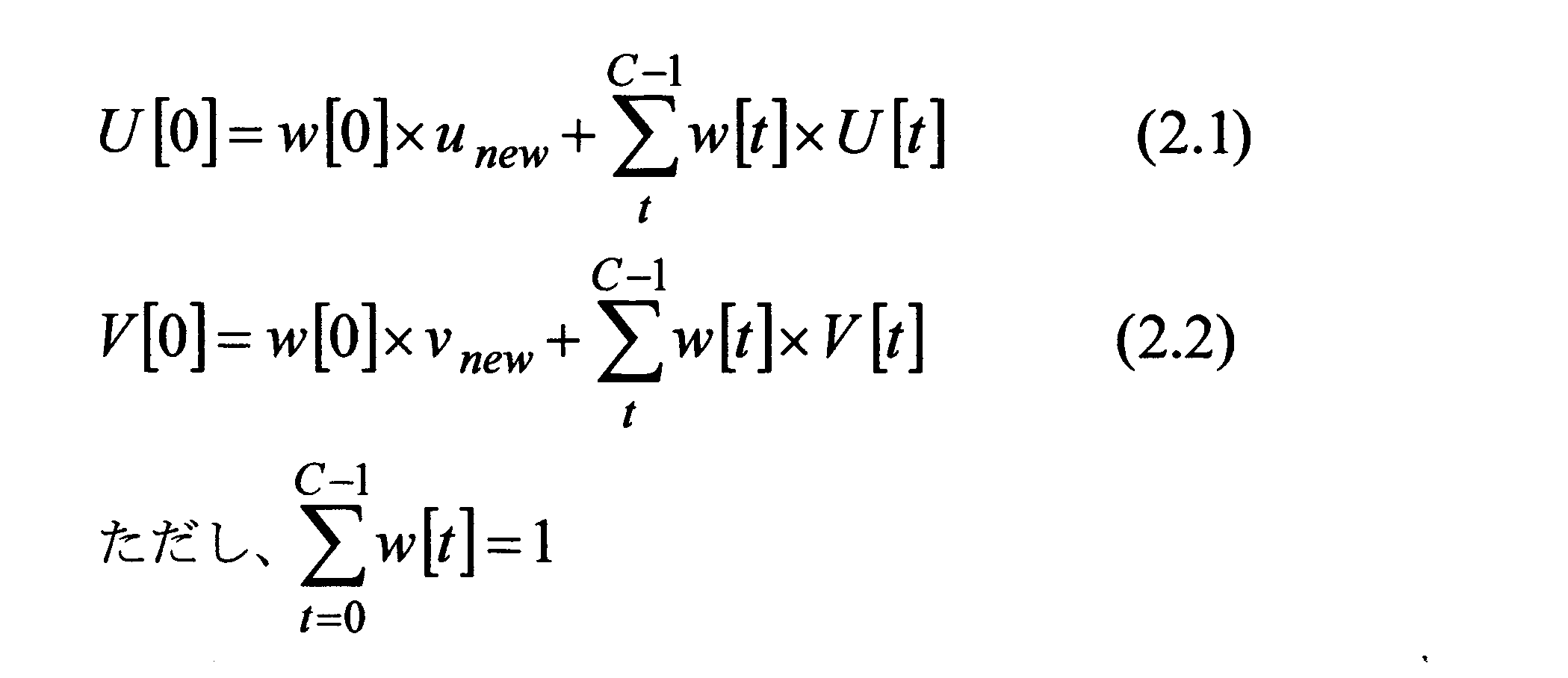
式(2.1)および(2.2)において、U[t]およびV[t]はそれぞれ、現在フレームよりもt(t=1,2,…,C)フレーム前のフレーム用の水平方向および垂直方向の安定ブレ補正量である。C-1は、重み付け合成に用いる安定ブレ補正量の数である。本例においては、Cは、色チャネルの数(すなわち、3)を想定しているが、他の数であってもよい。w[0]およびw[t]は重み係数であり、重み係数の要素数はCと等しい。
式(2.1)および(2.2)の右式の第1項は、現在フレームに対するブレ補正の程度を表わしている。w[0]が大きい程、現在フレームにおける被写体像Aのブレが正確に補正される。一方、式(2.1)および(2.2)の右式の第2項は、色チャネル間のブレ補正量を近付ける作用を有する。w[t]が大きい程、R、GおよびBフレーム間のブレ補正量の差異(トリミング領域の位置の差異)を低減し、動画フレーム内の色ズレの発生を抑制する効果が強くなる。
安定ブレ補正量算出部6は、算出された安定ブレ補正量U[0],V[0]を、安定ブレ補正量記憶部7およびブレ補正部8に送信する。
安定ブレ補正量記憶部7は、最新の所定の数のフレーム用の安定ブレ補正量U[t],V[t]を記憶する。
安定ブレ補正量記憶部7は、最新の所定の数のフレーム用の安定ブレ補正量U[t],V[t]を記憶する。
ブレ補正部8は、安定ブレ補正量算出部6から安定ブレ補正量U[0],V[0]を受信すると、安定ブレ補正量U[0],V[0]に基づいて現在フレームに対してブレ補正処理を実行する。ブレ補正処理は、トリミング領域の位置調整による電子式手ブレ補正処理である。電子式手ブレ補正処理には、公知の任意の方法が用いられる。例えば、ブレ補正部8は、図4に示されるように、現在フレームI内にトリミング領域I’を設定し、安定ブレ補正量U[0],V[0]だけトリミング領域I’を基準のトリミング領域の位置(例えば、ブレ補正開始時のトリミング領域の位置)から水平方向および垂直方向に移動させ、移動後のトリミング領域I’を現在フレームIから切り出す。ブレ補正部8は、切り出されたトリミング領域I’をブレ補正フレームとして同時化処理部9に送信する。
ブレ補正フレームI’[c](x,y)は、現在フレームI[c](x,y)を用いて下式(3)で表わされる。式(3)において、xは水平方向の座標であり、yは垂直方向の座標であり、c(=R,G,B)は現在フレームの色チャネルである。I[c](x,y)およびI’[c](x,y)は、座標(x,y)における画素の輝度値をそれぞれ表している。

上記のブレ補正処理においては、トリミング領域がフレーム毎に移動する。式(3)においては、ブレ補正開始時から現在フレームに至るまで全てのフレームのトリミング領域の移動量を積算した量として、ブレ補正量が表されている。
同時化処理部9は、ブレ補正部8から受信したブレ補正フレームを一時的に保持する。同時化処理部9は、時間軸方向に連続するR、GおよびBフレームから生成された3枚のブレ補正フレームを合成してRGB形式の動画フレームを生成し、生成された動画フレームを出力部10に送信する。
出力部10は、一定の時間間隔を空けて動画フレームを表示装置に送信する。これにより、表示装置には、一定のフレームレートのRGB形式の動画が表示される。
出力部10は、一定の時間間隔を空けて動画フレームを表示装置に送信する。これにより、表示装置には、一定のフレームレートのRGB形式の動画が表示される。
次に、このように構成された画像処理装置1の作用について説明する。
本実施形態に係る画像処理装置1によれば、図5に示されるように、動画撮影装置からRフレーム、GフレームおよびBフレームを順番に繰り返し受信する(ステップS1)。現在フレームが受信されると、現在フレーム内の被写体像Aの直前フレームからの動き量p[0],q[0]が算出される(動き量算出ステップS2)。
算出された現在フレームの動き量p[0],q[0]は、動き量記憶部4に記憶され(ステップS3)、この後に画像処理装置1に入力されるフレームのブレ補正量の算出に使用される。
本実施形態に係る画像処理装置1によれば、図5に示されるように、動画撮影装置からRフレーム、GフレームおよびBフレームを順番に繰り返し受信する(ステップS1)。現在フレームが受信されると、現在フレーム内の被写体像Aの直前フレームからの動き量p[0],q[0]が算出される(動き量算出ステップS2)。
算出された現在フレームの動き量p[0],q[0]は、動き量記憶部4に記憶され(ステップS3)、この後に画像処理装置1に入力されるフレームのブレ補正量の算出に使用される。
次に、ステップS2において算出された動き量p[0],q[0]に基づいて、現在フレーム用のブレ補正量unew,vnewが算出される(ブレ補正量算出ステップS6)。このときに、直前の数フレームの動き量p[t],q[t]が動き量記憶部4から読み出され(ステップS4)、現在フレームと同一の色チャネルの直前のフレームに対して既に算出されて記憶されている安定ブレ補正量Uold,Voldが安定ブレ補正量記憶部7から読み出される(ステップS5)。そして、現在フレームの動き量p[0],q[0]に加えて、ステップS4,S5において読み出された動き量p[t],q[t]および安定ブレ補正量Uold,Voldに基づいて、ブレ補正量unew,vnewが算出される(ステップS6)。
次に、ステップS6において算出されたブレ補正量unew,vnewに基づいて、現在フレーム用の安定ブレ補正量U[0],V[0]が算出される(安定ブレ補正量算出ステップS8)。このときに、現在フレームとは異なる色チャネルの直前のフレームに対して既に算出されて記憶されている安定ブレ補正量U[t],V[t]が安定ブレ補正量記憶部7から読み出される(ステップS7)。そして、ブレ補正量(u,v)に加えて、ステップS7において読み出された安定ブレ補正量U[t],V[t]に基づいて、安定ブレ補正量U[0],V[0]が算出される(ステップS8)。
算出された現在フレーム用の安定ブレ補正量U[0],V[0]は、安定ブレ補正量記憶部7に記憶され(記憶ステップS9)、この後に画像処理装置1に入力されるフレームのブレ補正量および安定ブレ補正量の算出に使用される。
次に、ステップS8において算出された安定ブレ補正量U[0],V[0]に基づいて、現在フレームに対してブレ補正処理が実行される(ブレ補正ステップS10)。次に、ステップS10において生成されたブレ補正フレームと直前に生成された2枚のブレ補正フレームとが同時化処理されることによって動画フレームが生成される(ステップS11)。生成された動画フレームは、表示装置に出力される(ステップS12)。
なお、必要な数の動き量p[t],q[t]が動き量記憶部4に蓄積されるまでの間は、ブレ補正量算出部5は、過去のフレームの動き量p[t],q[t]に代えて、初期設定された値または現在フレームの動き量p[0],q[0]を用いる。同様に、必要な数の安定ブレ補正量U[t],V[t]が安定ブレ補正量記憶部7に蓄積されるまでの間は、ブレ補正量算出部5および安定ブレ補正量算出部6は、過去のフレーム用の安定ブレ補正量Uold,VoldまたはU[t],V[t]に代えて、初期設定された値またはブレ補正量を用いる。
ここで、動き量p[0],q[0]は、同一の色チャネルの2枚のフレームから算出される。これは、面順次方式の動画撮影装置によって取得されるR、GおよびBフレーム間では、被写体像Aに差異が存在するからである。例えば、赤色の物体の像は、GおよびBフレーム内では明りょうであるが、Rフレーム内では不明りょうとなる。したがって、被写体像Aの正確な動き量を算出するためには、同一の色チャネルのフレームを使用する必要がある。
このように、動き量p[0],q[0]は色チャネル毎に独立に算出されるため、各色チャネルの動き量には互いに独立した誤差が生じる。したがって、1つの色チャネルの動き量のみに基づくブレ補正量を用いてブレ補正処理を実行すると、図6Aに示されるように、Rフレームのトリミング領域Ir’と、Gフレームのトリミング領域Ig’と、Bフレームのトリミング領域Ib’との間に位置の差異が生じる。その結果、図6Bに示されるように、動画フレームにおいて、Rフレーム内の被写体像Arと、Gフレーム内の被写体像Agと、Bフレーム内の被写体像Abとの間に位置の差異、すなわち色ズレが生じる。
本実施形態によれば、現在フレームのブレ補正処理に、現在フレームとは異なる色チャネルのフレーム用の安定ブレ補正量U[t],V[t]に依存する安定ブレ補正量U[0],V[0]が用いられる。このように、Rフレーム、GフレームおよびBフレーム用の安定ブレ補正量を相互に依存させることによって、図7Aに示されるように、トリミング領域Ir’,Ig’,Ib’間の位置の差異が低減される。その結果、図7Bに示されるように、動画フレームにおける色ズレを低減することができるという利点がある。
図8および図9はそれぞれ、ブレ補正量および安定ブレ補正量を用いてブレ補正処理を行ったときの、R、GおよびBフレームの各々の理想のトリミング位置に対する実際のトリミング位置のズレ量の時間変化の一例を表している。理想のトリミング位置とは、動き量算出部3によって算出される動き量に誤差が無い場合のトリミング位置である。図8および図9において、同一時刻でのR、GおよびBフレーム間のトリミング位置のズレ量の差異は、動画フレームにおける色ズレの発生を意味する。
図8に示されるように、ブレ補正量を用いてブレ補正処理を行った場合には、R、GおよびBフレーム間のトリミング位置のズレ量の差異が時間の経過に伴って増大しており、動画フレームにおいて色ズレが漸次増大する。これは、算出される動き量の誤差がチャネル毎に独立して累積し、その結果、ブレ補正量の色チャネル間の差異が次第に増大するからである。これに対し、図9に示されるように、安定ブレ補正量を用いてブレ補正処理を行った場合には、R、GおよびBフレームのトリミング位置のズレ量は略一致しており、動画フレームにおいて色ズレが解消されることが分かる。
式(2.1)および(2.2)における重みw[t]に関して、フレーム毎に算出されるブレ補正量の時系列データを考えたときに、式(2.1)および(2.2)は、IIR(無限インパルス応答)フィルタと見なすことができる。色ズレの抑制効果を得るためには、IIRフィルタが高周波成分を減衰させる特性を有するような重み係数w[0],w[1],w[2]を設定すればよい。図10は、好ましいIIRフィルタの特性の一例を示している。図10に示されるように、C=3であるときには、w[0]:w[1]:w[2]を6:1:1または3:3:2に設定することが、色ズレの低減に有効である。
図10のデータは、以下のシミュレーション実験から得た。
完全に静止している被写体を、ビデオカメラを用いて手持ちで撮影するシーンを想定し、フレームに、動き量として手ブレが発生するシーンを設定した。具体的には、シーンは、平均がゼロであり、標準偏差が6である正規分布に従って発生する乱数に基づいて振動するシーンに設定した。さらに、動き量には、平均がゼロであり、標準偏差が2である正規分布に従って発生する乱数に基づく誤差が含まれると設定した。このような条件設定の下で、図11に示される動き量が得られた。図11において、実線はシーンの振動を示し、破線は動き量を示している。
完全に静止している被写体を、ビデオカメラを用いて手持ちで撮影するシーンを想定し、フレームに、動き量として手ブレが発生するシーンを設定した。具体的には、シーンは、平均がゼロであり、標準偏差が6である正規分布に従って発生する乱数に基づいて振動するシーンに設定した。さらに、動き量には、平均がゼロであり、標準偏差が2である正規分布に従って発生する乱数に基づく誤差が含まれると設定した。このような条件設定の下で、図11に示される動き量が得られた。図11において、実線はシーンの振動を示し、破線は動き量を示している。
(第2の実施形態)
次に、本発明の第2の実施形態に係る画像処理装置について図12を参照して説明する。
第1の実施形態においては、安定ブレ補正量算出部6が、安定ブレ補正量の算出に所定の重み係数w[t](t=0,1,2,…,C)を使用することとした。これに対し、本実施形態に係る画像処理装置は、動き量算出部3が、動き量p[0],q[0]に加えて該動き量p[0],q[0]の信頼度wrelをさらに算出し、安定ブレ補正量算出部6が、ブレ補正量unew,vnewおよび安定ブレ補正量U[t],V[t]に付す重みを信頼度wrelに基づいて決定する点において、第1の実施形態と異なっている。
次に、本発明の第2の実施形態に係る画像処理装置について図12を参照して説明する。
第1の実施形態においては、安定ブレ補正量算出部6が、安定ブレ補正量の算出に所定の重み係数w[t](t=0,1,2,…,C)を使用することとした。これに対し、本実施形態に係る画像処理装置は、動き量算出部3が、動き量p[0],q[0]に加えて該動き量p[0],q[0]の信頼度wrelをさらに算出し、安定ブレ補正量算出部6が、ブレ補正量unew,vnewおよび安定ブレ補正量U[t],V[t]に付す重みを信頼度wrelに基づいて決定する点において、第1の実施形態と異なっている。
動き量算出部3は、図12に示されるように、ステップS2において動き量p[0],q[0]を算出した後に、続いて動き量p[0],q[0]の信頼度wrelを算出する(ステップS3)。R、GおよびBフレームにノイズが含まれている場合や、R、GおよびBフレーム中に動き量の算出に有効な輝度のエッジやテクスチャが少ない場合、動き量p[0],q[0]の算出精度が低下し得る。また、面順次方式においては、R、GおよびBフレーム間で輝度値が異なるため、動き量の算出精度が色チャネル毎に異なり得る。
信頼度wrelは、動き量p[0],q[0]の算出精度を表す値であり、0以上1以下の値を有する。信頼度wrelは、動き量p[0],q[0]の算出精度が高いほど1に近い値となり、動き量p[0],q[0]の算出精度が低いほどゼロに近い値となる。信頼度wrelの算出には、例えば、各ローカル動きベクトルの信頼度を算出し、信頼度が所定の閾値以上であるローカル動きベクトルの数の割合を信頼度wrelとして算出する方法が用いられる。ローカル動きベクトルの信頼度の算出方法としては、公知の任意の方法(例えば、特開2010-41416号公報に記載の方法)が用いられる。
あるいは、各色チャネルのフレームの動き量p[0],q[0]の算出精度について事前に情報が存在する場合には、その情報に基づいて色チャネル毎に信頼度wrelを設定してもよい。例えば、テンプレートマッチング処理において被写体像Aの有用な特徴を検出し易い色チャネルの信頼度wrelを、他の色チャネルの信頼度よりも大きく設定することが有効である。
本実施形態のステップS8において、安定ブレ補正量算出部6は、式(2.1)および(2.2)に代えて、下式(4.1)および(4.2)に基づいて安定ブレ補正量U[t],V[t]を算出する。すなわち、安定ブレ補正量算出部6は、動き量p[0],q[0]の信頼度wrelが大きい程、ブレ補正量unew,vnewに付される重みが大きくなり、安定ブレ補正量U[t],V[t]に付される重みが小さくなるように、ブレ補正量unew,vnewおよび安定ブレ補正量U[t],V[t]に対する重みを信頼度wrelに基づいて調整する。

このように、本実施形態によれば、動き量p[0],q[0]の信頼度wrelに基づいて安定ブレ補正量U[0],V[0]の算出に使用される重み係数が調整される。これにより、算出精度の低い動き量p[0],q[0]が安定ブレ補正量U[0],V[0]に与える影響を抑制してより正確な安定ブレ補正量U[0],V[0]を算出することができ、動画フレーム内の色ズレをさらに低減することができるという利点がある。
上記の第1および第2の実施形態においては、説明および理解を容易にするため、動き量算出部3による動き量p[0],q[0]の算出方法として、フレーム間の動きベクトルに基づく方法を説明したが、動き量の算出方法はこれに限定されるものではない。例えば、加速度センサを用いて動き量を算出してもよい。
上記の第1および第2の実施形態においては、動き量算出部3によって算出される動き量p[0],q[0]として、水平方向および垂直方向の動きベクトルを算出することとしたが、これに代えて、またはこれに加えて、被写体像Aの倍率、回転および歪みを動き量として算出してもよい。これらの動き量は、行列して表現することができる(例えば、文献「Full-frame video stabilization with motion inpainting、PAMI2006、IEEE Transactions、Volume 28、Issue 7、pp. 1150-1163、Matsushita et al」参照。)。
上記の第1および第2の実施形態においては、ブレ補正処理として電子式手ブレ補正処理を用いることとしたが、これに代えて、他のブレ補正処理を用いてもよい。例えば、光学式手ブレ補正処理を用いてもよい。具体的には、手ぶれ補正レンズ、撮像素子および駆動制御部を搭載した動画撮影装置に本実施形態の画像処理装置1を組み合わせ、駆動制御部が、ブレ補正量算出部5によって算出された安定ブレ補正量に基づいて手ブレ補正レンズおよび撮像素子を光軸に交差する方向に相対移動させるように構成してもよい。
上述した画像処理装置1は、例えば、専用または汎用のプロセッサから構成される。具体的には、プロセッサは、中央演算処理装置(CPU)と、RAMのような主記憶装置と、補助記憶装置とを備える。補助記憶装置は、HDDまたは各種メモリのようなコンピュータ読み取り可能な非一時的な記憶媒体であり、上述した各部3,5,6,8,9による処理(ステップS2~S13)をCPUに実行させるための画像処理プログラムを格納している。この画像処理プログラムが、補助記憶装置から主記憶装置に読み出され実行されることによって、上述した画像処理が実現されるようになっている。
あるいは、画像処理装置1の各部3,5,6,8,9は、各部3,5,6,8,9の機能を実行する専用の回路によって実現されてもよい。
あるいは、画像処理装置1の各部3,5,6,8,9は、各部3,5,6,8,9の機能を実行する専用の回路によって実現されてもよい。
1 画像処理装置
2 入力部
3 動き量算出部
4 動き量記憶部
5 ブレ補正量算出部
6 安定ブレ補正量算出部
7 安定ブレ補正量記憶部(記憶部)
8 ブレ補正部
9 同時化処理部
10 出力部
S2 動き量算出ステップ
S6 ブレ補正量算出ステップ
S8 安定ブレ補正量算出ステップ
S9 記憶ステップ
S10 ブレ補正ステップ
2 入力部
3 動き量算出部
4 動き量記憶部
5 ブレ補正量算出部
6 安定ブレ補正量算出部
7 安定ブレ補正量記憶部(記憶部)
8 ブレ補正部
9 同時化処理部
10 出力部
S2 動き量算出ステップ
S6 ブレ補正量算出ステップ
S8 安定ブレ補正量算出ステップ
S9 記憶ステップ
S10 ブレ補正ステップ
Claims (6)
- 複数の色チャネルのフレームを順番に受信し、複数の色チャネルのフレームを合成してカラーの動画フレームを生成する面順次方式の動画用の画像処理装置であって、
同一の色チャネルの最新のフレームと過去のフレームとから、前記最新のフレームと前記過去のフレームとの間の被写体像の動き量を算出する動き量算出部と、
該動き量算出部によって算出された動き量に基づいて、前記最新のフレーム用のブレ補正量を算出するブレ補正量算出部と、
該ブレ補正量算出部によって算出されたブレ補正量に基づいて、前記最新のフレーム用の安定ブレ補正量を算出する安定ブレ補正量算出部と、
該安定ブレ補正量算出部によって算出された安定ブレ補正量に基づいて、前記最新のフレームに対しブレ補正処理を行うブレ補正部と、
前記安定ブレ補正量算出部によって算出された前記安定ブレ補正量を記憶する記憶部とを備え、
前記安定ブレ補正量算出部が、前記最新のフレーム用のブレ補正量と、前記記憶部に記憶されている前記最新のフレームとは異なる色チャネルのフレーム用の安定ブレ補正量とに基づいて、前記最新のフレーム用の安定ブレ補正量を算出する画像処理装置。 - 前記安定ブレ補正量算出部が、前記最新のフレーム用のブレ補正量および前記最新のフレームとは異なる色チャネルのフレーム用の安定ブレ補正量の各々に重み付けし、重み付けされた前記ブレ補正量と前記安定ブレ補正量とを加算して前記最新のフレーム用の安定ブレ補正量を算出する請求項1に記載の画像処理装置。
- 前記動き量算出部が、前記最新のフレームの動き量の信頼度をさらに算出し、
前記安定ブレ補正量算出部が、前記動き量算出部によって算出された動き量の信頼度に基づいて、前記最新のフレーム用のブレ補正量および前記最新のフレームとは異なる色チャネルのフレーム用の安定ブレ補正量の各々に付す重みを決定する請求項2に記載の画像処理装置。 - 前記複数の色チャネルが、赤チャネル、緑チャネルおよび青チャネルである請求項1から請求項3のいずれかに記載の画像処理装置。
- 複数の色チャネルのフレームを順番に受信し、複数の色チャネルのフレームを合成してカラーの動画フレームを生成する面順次方式の動画用の画像処理方法であって、
同一の色チャネルの最新のフレームと過去のフレームとから、前記最新のフレームと前記過去のフレームとの間の被写体像の動き量を算出する動き量算出ステップと、
該動き量算出ステップにおいて算出された動き量に基づいて、前記最新のフレーム用のブレ補正量を算出するブレ補正量算出ステップと、
該ブレ補正量算出ステップにおいて算出されたブレ補正量に基づいて、前記最新のフレーム用の安定ブレ補正量を算出する安定ブレ補正量算出ステップと、
該安定ブレ補正量算出ステップにおいて算出された安定ブレ補正量に基づいて、前記最新のフレームに対しブレ補正処理を行うブレ補正ステップと、
前記安定ブレ補正量算出ステップにおいて算出された前記安定ブレ補正量を記憶する記憶ステップとを含み、
前記安定ブレ補正量算出ステップにおいて、前記最新のフレーム用のブレ補正量と、前記記憶ステップに記憶されている前記最新のフレームとは異なる色チャネルのフレーム用の安定ブレ補正量とに基づいて、前記最新のフレーム用の安定ブレ補正量を算出する画像処理方法。 - 複数の色チャネルのフレームを順番に受信し、複数の色チャネルのフレームを合成してカラーの動画フレームを生成する面順次方式の動画用の画像処理プログラムであって、
同一の色チャネルの最新のフレームと過去のフレームとから、前記最新のフレームと前記過去のフレームとの間の被写体像の動き量を算出する動き量算出ステップと、
該動き量算出ステップにおいて算出された動き量に基づいて、前記最新のフレーム用のブレ補正量を算出するブレ補正量算出ステップと、
該ブレ補正量算出ステップにおいて算出されたブレ補正量に基づいて、前記最新のフレーム用の安定ブレ補正量を算出する安定ブレ補正量算出ステップと、
該安定ブレ補正量算出ステップにおいて算出された安定ブレ補正量に基づいて、前記最新のフレームに対しブレ補正処理を行うブレ補正ステップと、
前記安定ブレ補正量算出ステップにおいて算出された前記安定ブレ補正量を記憶する記憶ステップとをコンピュータに実行させ、
前記安定ブレ補正量算出ステップにおいて、前記最新のフレーム用のブレ補正量と、前記記憶ステップに記憶されている前記最新のフレームとは異なる色チャネルのフレーム用の安定ブレ補正量とに基づいて、前記最新のフレーム用の安定ブレ補正量を算出する画像処理プログラム。
Priority Applications (3)
| Application Number | Priority Date | Filing Date | Title |
|---|---|---|---|
| JP2018507850A JP6730423B2 (ja) | 2016-03-28 | 2016-03-28 | 画像処理装置、画像処理方法および画像処理プログラム |
| PCT/JP2016/059971 WO2017168528A1 (ja) | 2016-03-28 | 2016-03-28 | 画像処理装置、画像処理方法および画像処理プログラム |
| US16/045,395 US10567658B2 (en) | 2016-03-28 | 2018-07-25 | Image processing device, image processing method, image processing program |
Applications Claiming Priority (1)
| Application Number | Priority Date | Filing Date | Title |
|---|---|---|---|
| PCT/JP2016/059971 WO2017168528A1 (ja) | 2016-03-28 | 2016-03-28 | 画像処理装置、画像処理方法および画像処理プログラム |
Related Child Applications (1)
| Application Number | Title | Priority Date | Filing Date |
|---|---|---|---|
| US16/045,395 Continuation US10567658B2 (en) | 2016-03-28 | 2018-07-25 | Image processing device, image processing method, image processing program |
Publications (1)
| Publication Number | Publication Date |
|---|---|
| WO2017168528A1 true WO2017168528A1 (ja) | 2017-10-05 |
Family
ID=59962698
Family Applications (1)
| Application Number | Title | Priority Date | Filing Date |
|---|---|---|---|
| PCT/JP2016/059971 Ceased WO2017168528A1 (ja) | 2016-03-28 | 2016-03-28 | 画像処理装置、画像処理方法および画像処理プログラム |
Country Status (3)
| Country | Link |
|---|---|
| US (1) | US10567658B2 (ja) |
| JP (1) | JP6730423B2 (ja) |
| WO (1) | WO2017168528A1 (ja) |
Cited By (1)
| Publication number | Priority date | Publication date | Assignee | Title |
|---|---|---|---|---|
| CN110858873A (zh) * | 2018-08-23 | 2020-03-03 | 北京小米移动软件有限公司 | 电子设备和拍摄方法 |
Families Citing this family (2)
| Publication number | Priority date | Publication date | Assignee | Title |
|---|---|---|---|---|
| US12593958B2 (en) * | 2020-08-12 | 2026-04-07 | Ttp Plc. | Endoscope |
| JP2022038252A (ja) * | 2020-08-26 | 2022-03-10 | オリンパス株式会社 | 内視鏡装置、内視鏡装置の作動方法、およびプログラム |
Citations (5)
| Publication number | Priority date | Publication date | Assignee | Title |
|---|---|---|---|---|
| JP2006149483A (ja) * | 2004-11-25 | 2006-06-15 | Olympus Corp | 電子内視鏡装置及び色ずれ補正装置 |
| JP2008541662A (ja) * | 2005-05-17 | 2008-11-20 | イーストマン コダック カンパニー | 二重経路画像シーケンス安定化 |
| JP2012055498A (ja) * | 2010-09-09 | 2012-03-22 | Olympus Corp | 画像処理装置、内視鏡装置、画像処理プログラム及び画像処理方法 |
| JP2012217579A (ja) * | 2011-04-07 | 2012-11-12 | Olympus Corp | 内視鏡装置及びブレ補正処理方法 |
| JP2013258468A (ja) * | 2012-06-11 | 2013-12-26 | Sony Corp | 撮像装置とその制御方法およびプログラム |
Family Cites Families (8)
| Publication number | Priority date | Publication date | Assignee | Title |
|---|---|---|---|---|
| JP3292538B2 (ja) | 1993-02-23 | 2002-06-17 | 富士写真光機株式会社 | 固体撮像素子を用いたカラー撮像装置 |
| US5614945A (en) * | 1993-10-19 | 1997-03-25 | Canon Kabushiki Kaisha | Image processing system modifying image shake correction based on superimposed images |
| JP3660731B2 (ja) | 1995-11-13 | 2005-06-15 | ペンタックス株式会社 | 電子内視鏡 |
| GB0229096D0 (en) * | 2002-12-13 | 2003-01-15 | Qinetiq Ltd | Image stabilisation system and method |
| JP2004329514A (ja) | 2003-05-07 | 2004-11-25 | Olympus Corp | 画像信号処理装置 |
| JP2007243335A (ja) | 2006-03-06 | 2007-09-20 | Fujifilm Corp | 手振れ補正方法、手振れ補正装置および撮像装置 |
| JP2010041416A (ja) | 2008-08-05 | 2010-02-18 | Olympus Corp | 画像処理装置、画像処理方法、画像処理プログラム、及び、撮像装置 |
| JP5562808B2 (ja) | 2010-11-11 | 2014-07-30 | オリンパス株式会社 | 内視鏡装置及びプログラム |
-
2016
- 2016-03-28 WO PCT/JP2016/059971 patent/WO2017168528A1/ja not_active Ceased
- 2016-03-28 JP JP2018507850A patent/JP6730423B2/ja active Active
-
2018
- 2018-07-25 US US16/045,395 patent/US10567658B2/en active Active
Patent Citations (5)
| Publication number | Priority date | Publication date | Assignee | Title |
|---|---|---|---|---|
| JP2006149483A (ja) * | 2004-11-25 | 2006-06-15 | Olympus Corp | 電子内視鏡装置及び色ずれ補正装置 |
| JP2008541662A (ja) * | 2005-05-17 | 2008-11-20 | イーストマン コダック カンパニー | 二重経路画像シーケンス安定化 |
| JP2012055498A (ja) * | 2010-09-09 | 2012-03-22 | Olympus Corp | 画像処理装置、内視鏡装置、画像処理プログラム及び画像処理方法 |
| JP2012217579A (ja) * | 2011-04-07 | 2012-11-12 | Olympus Corp | 内視鏡装置及びブレ補正処理方法 |
| JP2013258468A (ja) * | 2012-06-11 | 2013-12-26 | Sony Corp | 撮像装置とその制御方法およびプログラム |
Cited By (2)
| Publication number | Priority date | Publication date | Assignee | Title |
|---|---|---|---|---|
| CN110858873A (zh) * | 2018-08-23 | 2020-03-03 | 北京小米移动软件有限公司 | 电子设备和拍摄方法 |
| CN110858873B (zh) * | 2018-08-23 | 2021-06-29 | 北京小米移动软件有限公司 | 电子设备和拍摄方法 |
Also Published As
| Publication number | Publication date |
|---|---|
| JPWO2017168528A1 (ja) | 2019-01-31 |
| US20180332227A1 (en) | 2018-11-15 |
| JP6730423B2 (ja) | 2020-07-29 |
| US10567658B2 (en) | 2020-02-18 |
Similar Documents
| Publication | Publication Date | Title |
|---|---|---|
| CN111246089B (zh) | 抖动补偿方法和装置、电子设备、计算机可读存储介质 | |
| JP5744614B2 (ja) | 画像処理装置、画像処理方法、および、画像処理プログラム | |
| US9558543B2 (en) | Image fusion method and image processing apparatus | |
| US9288392B2 (en) | Image capturing device capable of blending images and image processing method for blending images thereof | |
| CN104247395B (zh) | 图像处理装置、图像处理方法 | |
| CN101998053B (zh) | 图像处理方法、图像处理设备和成像设备 | |
| US9247227B2 (en) | Correction of the stereoscopic effect of multiple images for stereoscope view | |
| JP5179398B2 (ja) | 画像処理装置、画像処理方法、画像処理プログラム | |
| WO2019013217A1 (ja) | 補正装置、撮像装置、補正装置の制御方法、および制御プログラム | |
| JP2017011327A (ja) | 画像処理装置、画像処理方法及びプログラム | |
| US20160044241A1 (en) | Image processing apparatus for generating wide-angle image by compositing plural images, image processing method, storage medium storing image processing program, and image pickup apparatus | |
| JP6730423B2 (ja) | 画像処理装置、画像処理方法および画像処理プログラム | |
| WO2017187691A1 (ja) | 画像処理装置、撮像装置、画像処理方法、および、プログラム | |
| JP6231816B2 (ja) | 撮像装置およびその制御方法、プログラム並びに記憶媒体 | |
| CN114449130A (zh) | 一种多摄像头的视频融合方法及系统 | |
| JP6732440B2 (ja) | 画像処理装置、画像処理方法、及びそのプログラム | |
| EP3605450B1 (en) | Image processing apparatus, image pickup apparatus, control method of image processing apparatus, and computer-program | |
| JP6245847B2 (ja) | 画像処理装置および画像処理方法 | |
| JP2019016893A (ja) | 画像処理装置およびその制御方法及びプログラム | |
| TWI504235B (zh) | 多視角影像的修正裝置及其方法 | |
| JP2019083407A (ja) | 像振れ補正装置およびその制御方法、撮像装置 | |
| JP6433154B2 (ja) | 画像処理装置および撮像装置 | |
| JP2016134631A (ja) | 画像処理装置、撮像装置、画像処理方法 | |
| US20250240399A1 (en) | Electronic device and control method of electronic device | |
| US20240404185A1 (en) | Passthrough Pipeline |
Legal Events
| Date | Code | Title | Description |
|---|---|---|---|
| WWE | Wipo information: entry into national phase |
Ref document number: 2018507850 Country of ref document: JP |
|
| NENP | Non-entry into the national phase |
Ref country code: DE |
|
| 121 | Ep: the epo has been informed by wipo that ep was designated in this application |
Ref document number: 16896748 Country of ref document: EP Kind code of ref document: A1 |
|
| 122 | Ep: pct application non-entry in european phase |
Ref document number: 16896748 Country of ref document: EP Kind code of ref document: A1 |