WO2017130456A1 - 工業用水の清澄化方法及び清澄化装置 - Google Patents
工業用水の清澄化方法及び清澄化装置 Download PDFInfo
- Publication number
- WO2017130456A1 WO2017130456A1 PCT/JP2016/077637 JP2016077637W WO2017130456A1 WO 2017130456 A1 WO2017130456 A1 WO 2017130456A1 JP 2016077637 W JP2016077637 W JP 2016077637W WO 2017130456 A1 WO2017130456 A1 WO 2017130456A1
- Authority
- WO
- WIPO (PCT)
- Prior art keywords
- water
- industrial water
- mfrac
- amount
- filtration
- Prior art date
- Legal status (The legal status is an assumption and is not a legal conclusion. Google has not performed a legal analysis and makes no representation as to the accuracy of the status listed.)
- Ceased
Links
Images







Classifications
-
- C—CHEMISTRY; METALLURGY
- C02—TREATMENT OF WATER, WASTE WATER, SEWAGE, OR SLUDGE
- C02F—TREATMENT OF WATER, WASTE WATER, SEWAGE, OR SLUDGE
- C02F1/00—Treatment of water, waste water, or sewage
- C02F1/52—Treatment of water, waste water, or sewage by flocculation or precipitation of suspended impurities
- C02F1/54—Treatment of water, waste water, or sewage by flocculation or precipitation of suspended impurities using organic material
- C02F1/56—Macromolecular compounds
-
- B—PERFORMING OPERATIONS; TRANSPORTING
- B01—PHYSICAL OR CHEMICAL PROCESSES OR APPARATUS IN GENERAL
- B01D—SEPARATION
- B01D21/00—Separation of suspended solid particles from liquids by sedimentation
- B01D21/01—Separation of suspended solid particles from liquids by sedimentation using flocculating agents
-
- C—CHEMISTRY; METALLURGY
- C02—TREATMENT OF WATER, WASTE WATER, SEWAGE, OR SLUDGE
- C02F—TREATMENT OF WATER, WASTE WATER, SEWAGE, OR SLUDGE
- C02F1/00—Treatment of water, waste water, or sewage
- C02F1/44—Treatment of water, waste water, or sewage by dialysis, osmosis or reverse osmosis
-
- B—PERFORMING OPERATIONS; TRANSPORTING
- B01—PHYSICAL OR CHEMICAL PROCESSES OR APPARATUS IN GENERAL
- B01D—SEPARATION
- B01D2311/00—Details relating to membrane separation process operations and control
- B01D2311/04—Specific process operations in the feed stream; Feed pretreatment
-
- B—PERFORMING OPERATIONS; TRANSPORTING
- B01—PHYSICAL OR CHEMICAL PROCESSES OR APPARATUS IN GENERAL
- B01D—SEPARATION
- B01D2311/00—Details relating to membrane separation process operations and control
- B01D2311/26—Further operations combined with membrane separation processes
- B01D2311/2642—Aggregation, sedimentation, flocculation, precipitation or coagulation
-
- B—PERFORMING OPERATIONS; TRANSPORTING
- B01—PHYSICAL OR CHEMICAL PROCESSES OR APPARATUS IN GENERAL
- B01D—SEPARATION
- B01D61/00—Processes of separation using semi-permeable membranes, e.g. dialysis, osmosis or ultrafiltration; Apparatus, accessories or auxiliary operations specially adapted therefor
- B01D61/02—Reverse osmosis; Hyperfiltration ; Nanofiltration
- B01D61/04—Feed pretreatment
-
- B—PERFORMING OPERATIONS; TRANSPORTING
- B01—PHYSICAL OR CHEMICAL PROCESSES OR APPARATUS IN GENERAL
- B01D—SEPARATION
- B01D61/00—Processes of separation using semi-permeable membranes, e.g. dialysis, osmosis or ultrafiltration; Apparatus, accessories or auxiliary operations specially adapted therefor
- B01D61/14—Ultrafiltration; Microfiltration
- B01D61/16—Feed pretreatment
-
- B—PERFORMING OPERATIONS; TRANSPORTING
- B01—PHYSICAL OR CHEMICAL PROCESSES OR APPARATUS IN GENERAL
- B01D—SEPARATION
- B01D61/00—Processes of separation using semi-permeable membranes, e.g. dialysis, osmosis or ultrafiltration; Apparatus, accessories or auxiliary operations specially adapted therefor
- B01D61/58—Multistep processes
-
- C—CHEMISTRY; METALLURGY
- C02—TREATMENT OF WATER, WASTE WATER, SEWAGE, OR SLUDGE
- C02F—TREATMENT OF WATER, WASTE WATER, SEWAGE, OR SLUDGE
- C02F1/00—Treatment of water, waste water, or sewage
- C02F1/44—Treatment of water, waste water, or sewage by dialysis, osmosis or reverse osmosis
- C02F1/441—Treatment of water, waste water, or sewage by dialysis, osmosis or reverse osmosis by reverse osmosis
-
- C—CHEMISTRY; METALLURGY
- C02—TREATMENT OF WATER, WASTE WATER, SEWAGE, OR SLUDGE
- C02F—TREATMENT OF WATER, WASTE WATER, SEWAGE, OR SLUDGE
- C02F1/00—Treatment of water, waste water, or sewage
- C02F1/44—Treatment of water, waste water, or sewage by dialysis, osmosis or reverse osmosis
- C02F1/444—Treatment of water, waste water, or sewage by dialysis, osmosis or reverse osmosis by ultrafiltration or microfiltration
-
- C—CHEMISTRY; METALLURGY
- C02—TREATMENT OF WATER, WASTE WATER, SEWAGE, OR SLUDGE
- C02F—TREATMENT OF WATER, WASTE WATER, SEWAGE, OR SLUDGE
- C02F2103/00—Nature of the water, waste water, sewage or sludge to be treated
- C02F2103/001—Runoff or storm water
Definitions
- the present invention relates to a method and apparatus for obtaining clarified water by coagulating and filtering industrial water.
- industrial water clarification is achieved by adding a small amount of a flocculant without using an inorganic flocculant, such as polyaluminum chloride (PAC), which is usually used in industrial water flocculation.
- PAC polyaluminum chloride
- the present invention relates to a purification method and a clarification device.
- industrial water is river water, lakes, dam lakes, ponds, and other surface water that is used as raw water for clarification such as agglomeration and filtration for industrial and drinking water. Also included is water supplied to the operator after agglomeration and filtration. Industrial water does not include well water and spring water.
- industrial water received at the factory is agglomerated and filtered with an inorganic aggregating agent such as PAC, aluminum sulfate, ferric chloride, etc. And used as factory water.
- an inorganic aggregating agent such as PAC, aluminum sulfate, ferric chloride, etc.
- Industrial water coagulated with PAC is subjected to primary solid-liquid separation with a sedimentation separator or a flotation separator, and then clarified by filtration with a gravity or pressure filtration device to obtain treated water.
- the primary solid-liquid separation by the precipitation separator or the floating separator may be omitted, and the water may be directly passed through the gravity or pressure filter. Many.
- MF microfiltration
- UF ultrafiltration
- the primary purpose of industrial water aggregation and filtration is to remove turbidity.
- the industrial water treatment equipment manufacturer's guarantee value of treated water turbidity is turbidity using a kaolin standard solution defined in JIS K0102, and is 1 degree or less or 0.5 degree or less. Actual turbidity may be 0.2 degrees or less and 0.1 degrees or less.
- ⁇ Turbidity and netNTU ⁇ The minimum absorbance of JIS K0102 at a wavelength of 660 nm, 50 mm cell is 0.001, and the turbidity coefficient is approximately 100 times, which corresponds to 0.1 degree. Assuming that the difference in absorbance is 0.002 is significant, the analysis accuracy is ⁇ 0.2 degrees. If the turbidity is less than 1.0 degree on the measurement certificate, 1 ⁇ (less than 1) is displayed.
- the turbidity in the experimental examples and examples in this specification was determined to 2 decimal places using 2100Q manufactured by HACH in order to measure a finer turbidity. Specifically, netNTU obtained by subtracting the measured value (blank value: usually 0.04 to 0.07) from the measured value (NTU) was employed. HACH 2100Q detects turbidity from two measured values of not only transmitted light but also 90 scattered light with high detection sensitivity, and can detect up to 0.01.
- the turbidity of JIS K0102 which corresponds to NTU 1.0, is not 1 degree, but is generally 0.6 to 0.7 degree.
- SDI Silicon Density Index
- ASTM D4189 as a method for determining the RO membrane contamination of RO membrane water supply due to extremely small turbidity that cannot be measured by turbidity.
- SDI is the same evaluation method as FI (Fouling Index) defined in JIS K3802.
- FI Frouling Index
- SDI (FI) (T 15 -T 0 ) / T 15 ⁇ 100/15 (min) (T 15 -T 0) / T 15 ⁇ 100 is a 15-minute water passage, it indicates filtration rate has decreased percentage. SDI (FI) divides this by 15 minutes, so it shows how much the filtration rate is reduced per minute.
- the SDI (FI) is the best value 0.00. If the MF membrane is blocked by 15 minutes of water flow and permeated water cannot be obtained, the SDI (FI) reaches the worst value of 6.67.
- RO membrane water supply is 3 to 4 or less, depending on RO membrane manufacturer and membrane brand.
- MFF Micro Filter Fouling Factor
- MFFs corresponding to SDI 4.0, 3.0, and 2.0 are 1.10, 1.06, and 1.025, respectively.
- Biopolymers which are soluble polymer substances that are metabolized by algae and the like in addition to fine particle pollution. Biopolymers also include undermicron microgels that are not measured as SS.
- Biopolymers are mainly composed of polysaccharides and often remain in treated water for industrial use. Biopolymers become membrane contaminants during RO membrane permeation and reduce membrane permeation flux.
- biopolymers in industrial water are removed by PAC aggregation.
- concentration of the biopolymer in the agglomerated treated water is as small as 10 to 100 ⁇ g / L, and there is no major problem in general use of the treated water.
- the molecular weight of the biopolymer reaches 10 million, so even if it exists in a small amount, it concentrates and adheres on the RO membrane surface, which becomes a major membrane contamination factor.
- SFF is an RO membrane contamination impact assessment method using biopolymers.
- SFF value is to determine the ratio T 1 / T 0 of the MF membrane permeation time T 1 of the MF membrane permeation time T 0 and the sample water based water micro viscosity of the biopolymer (clarified water).
- an MF film similar to the MF film used for the measurement of the SDI value and the MFF value specifically, a membrane filter having a diameter of 47 mm and a pore diameter of 0.45 ⁇ m is used.
- the SFF measures the reference water temperature and the sample water temperature in units of 0.1 ° C., and corrects the water temperature-viscosity of the water.
- As the reference water RO membrane permeated water that is free of fine particles and biopolymer and has an electric conductivity of about 1 to 5 mS / m (10 to 50 ⁇ S / m) is used. This index and measurement method are described in Non-Patent Document 1, including MFF.
- the best value of the fine particle index MFF is 1.00, whereas the best value of SFF is 0.970 to 0.975. That is, a phenomenon in which the MF membrane permeability is improved with respect to fine particles and biopolymer-free reference water is observed. This is thought to be due to the increase in water permeability on the nitrocellulose MF membrane due to the presence of salts.
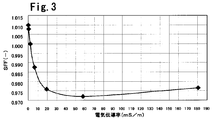
- FIG. 3 shows the results of measuring SFF by adding NaCl to ultrapure water to change the electrical conductivity.
- the electric conductivity of the RO membrane permeated water used as the reference water for T 0 measurement is 2.3 mS / m, and the electric conductivity of ultrapure water is less than 0.1 mS / m.
- ⁇ RO membrane water supply pollution index ⁇ Table 1 below shows the evaluation categories of the membrane contamination index of RO membrane water supply. This evaluation category is described in Non-Patent Document 1.
- the water quality required for RO membrane water supply is Category 4 or higher.
- the water quality required when supplying the ion exchange resin is Category 3 or higher.
- the required water quality for use in treated water that is not particularly limited is Category 1 or higher.
- MFRAC melamine / formaldehyde resin acid colloid solution used in the present invention
- MFRAC has been known as a flocculant for more than 40 years.
- MFRAC has been known as a flocculant for more than 40 years.
- formaldehyde is included as a reaction residue
- its use as a wastewater treatment flocculant has been extremely limited.
- there have been no examples or trials of application to water purification treatment that enters human mouth such as industrial water treatment and drinking water.
- MFRAC was initially used as a water-resistant additive for paper. Since then, MFRAC has been used as a non-adhesive agent for excess paint in automobile paint booth circulating water.
- the mechanism of the MFRAC effect in the surplus paint processing of the automobile painting booth is as follows.
- the paints to be agglomerated and non-adhesive in the automobile painting booth are specific ones in which fine particles of melamine skeleton such as alkyl melamine resin, polyester / melamine resin, acrylic / melamine resin are dispersed.
- MFRAC which is the same material as the paint, has a high affinity with these and contributes to the aggregation and non-adhesion of the aggregate.
- Patent Document 1 proposes use of a flocculant for wastewater treatment as a flocculant for wastewater containing water-soluble starch.
- MFRAC is effective as an aggregating agent for wastewater containing MFRAC because it has an aggregating property with respect to water-soluble starch and polyvinyl alcohol, which are difficult to agglomerate with PAC.
- the reaction of MFRAC with these aggregates exceeds 1: 1 by solids ratio.
- the required addition amount of MFRAC is 200 mg / L for the resin content and 10 mg for the resin content in MFRAC, and the product requires 2000 mg / L. .
- the amount of formaldehyde in the treated water becomes as high as 6 mg / L with the above addition amount.
- the processing cost is expensive.
- poly-DADMAC polydiallyldimethylammonium chloride
- PAC aluminum salts
- Poly-DADMAC has been approved by the EPA (United States Environmental Protection Agency) for use as a water treatment flocculant for drinking water supply.
- Poly-DADMAC is also widely used for industrial water treatment.
- Patent Document 2 proposes that a cationic flocculant such as poly-DADMAC is added to a wet coating booth circulating water containing a water-based paint to obtain a predetermined charge amount.
- both cationic coagulant and amino resin acid colloid are added to the booth circulating water of wet paint booth in which water-based paint and oil-based paint are mixed in Patent Document 3.
- a booth circulating water treatment method has been proposed in which the amount of cationic coagulant added is adjusted so that the amount of colloidal charge in the circulating water is ⁇ 50 to +100 ⁇ eq / L.
- the optimal amount of colloidal charge is zero.
- the appropriate amount of cationic organic coagulant is -50 to 100 ⁇ eq / L of colloidal charge after addition and reaction.
- this value is ⁇ 100 to 1000 ⁇ eq / L, and the appropriate range is narrower on the minus side with zero in between and is biased toward the plus side, but the zero point is still the appropriate point, Consistent with general theory.
- the agglomeration treatment with an aluminum salt mainly composed of PAC has the following problems. (1) It is difficult to obtain treated water suitable for RO membrane water supply that requires a high degree of clarity. (2) When the coagulation floc capacity is large and direct filtration is performed, the amount of addition is limited due to the load amount of the filter, and the clarification of treated water becomes insufficient. (3) With the addition amount normally used, aluminum hydroxide colloid passes through the filtration device and remains in the treated water. Specifically, in FIG. 4, clarified water is obtained from the filtered water netNTU (turbidity) at a PAC of 15 mg / L. At this time, the aluminum colloid of the filtered water is 100 ⁇ g / L or more. When the treated aluminum is supplied to the RO membrane for the desalting treatment, the residual aluminum in the treated water is caused by the aluminum hydroxide itself and the composite with silica blocking the RO membrane.
- the main purpose of industrial water aggregation and filtration is to remove turbidity.
- the turbidity is considerably higher than the above-described netNTU of less than 0.05, the residual aluminum present as aluminum hydroxide colloid in the filtered water increases from the industrial water before treatment.
- FIG. 4 shows the results of No. 1 after coagulating the industrial water in Ukishima area, Kawasaki City, Kanagawa Prefecture, with PAC.
- the Al content of clarified water measured for filtered water collected by filtering two sheets of 5A, 185 mm ⁇ filter paper (hereinafter sometimes referred to as “No. 5A two-layer filtered water”) and It is a graph which shows the relationship between netNTU (turbidity) and PAC addition amount.
- the fine particle capturing effect obtained by filtration of two No5A, 185 mm ⁇ filter papers is intermediate between two-layer gravity filtration with a filtration sand diameter of 0.45 mm and two-layer pressure filtration with a filtration sand diameter of 0.60 mm. .
- the necessary PAC addition amount is 10 to 12 mg / L.
- a phenomenon occurs in which the residual aluminum in the filtered water increases in proportion to the increase in the PAC addition amount.
- the inorganic flocculant is a ferric salt represented by ferric chloride, the iron hydroxide colloid remains in the treated water unless a sufficient amount is added.
- Aluminum hydroxide colloid is hardly detected as netNTU, whereas iron hydroxide colloid is easily detected by netNTU, and is observed as yellow or brown coloring of MF filter paper after SFF and MFF measurement.
- an object of the present invention is to provide a clarification method and a clarification apparatus for industrial water capable of obtaining treated water quality suitable for RO membrane treatment.
- the present invention can reduce the floc capacity because the addition amount of the flocculant is small, and without performing solid-liquid separation by the precipitation separator or the flotation separator, the MF membrane module, the UF membrane module, or the pressure type or gravity
- An object of the present invention is to provide a clarification method and a clarification device for industrial water that can be supplied to a water filtration device to obtain highly clarified treated water, and can solve the problem of an increase in residual aluminum. To do.
- the inventor of the present invention uses a melamine / formaldehyde resin acid colloid solution (MFRAC) as a flocculant for industrial water, so that it can be added in a much smaller amount than PAC. It has been found that 5A double-layer filtered water can provide good treated water of evaluation category 4 or higher in Table 1 above.
- MFRAC formaldehyde resin acid colloid solution
- the agglomeration treatment material in industrial water is firstly a fine particle clay mainly composed of silica, and secondly, a microgel-like powder that is soluble in microorganisms such as algae and passes through 1 ⁇ m pores equivalent to a two-layer gravity or pressure filtration device. It is a polysaccharide metabolite (biopolymer).
- MFRAC polysaccharide metabolite
- the gist of the present invention is as follows.
- a clarification method for industrial water that is filtered after adding a melamine / formaldehyde resin acid colloid solution to industrial water and coagulating it.
- the flocculated water is directly filtered by a pressure-type or gravity-type filtration device without performing solid-liquid separation by a precipitation separation device or a flotation separation device, according to any one of [1] to [5] Industrial water clarification method.
- a clarification device for industrial water having a coagulation treatment means for adding a melamine / formaldehyde resin acid colloidal solution to industrial water and a coagulation treatment, and a filtration means for filtering the coagulation treated water obtained by the coagulation treatment means.
- the amount of the cationic organic coagulant added in the coagulation treatment means is an amount that is 70% or less of the cation consumption of the cationic organic coagulant in the industrial water measured by a streaming potential method.
- the industrial water clarification device according to any one of [9] to [12], further including a pH adjusting unit that adjusts the pH of the aggregation processing unit to 7 or more by aeration processing or alkali addition of the industrial water.
- the filtration means is a pressure or gravity filtration apparatus, and the flocculated water is directly introduced into the filtration means without being subjected to solid-liquid separation by a precipitation apparatus or a flotation apparatus [9] Thru
- the filtration means is a microfiltration membrane module or an ultrafiltration membrane module, and the coagulated water is directly introduced into the filtration means without being subjected to solid-liquid separation by a precipitation device or a flotation device.
- the clarification apparatus for industrial water according to any one of [13].
- industrial water can be treated stably and efficiently based on the following effects by using MFRAC as a coagulant for the coagulation and filtration of industrial water.
- a high-clarity treated water can be obtained with a small amount of the flocculant capable of direct filtration of the agglomerated treated water. As a result, the floc volume caused by the flocculant can be reduced.
- High treated water clarification suitable for RO membrane water supply can be achieved.
- the above (1) and (2) can be achieved without using an aluminum flocculant. For this reason, the problem of generation and increase of hydroxide colloid in the treated water can be solved.
- Poly-DADMAC (“Zeta Ace P702” manufactured by Kurita Kogyo Co., Ltd.) is a graph showing the relationship between the amount of MFRAC added during filtration and filtration of SFF and MFF in industrial water I when 0.2 mg / L is added. is there. It is a graph which shows the relationship between the addition amount of Poly-DADMAC ("Zetaace P702" by Kurita Kogyo Co., Ltd.) and the SFF and MFF of filtered water in the aggregation and filtration of industrial water III when MFRAC is added at 10 mg / L.
- Poly-DADMAC (“Zeta Ace P702” manufactured by Kurita Kogyo Co., Ltd.) is a graph showing the relationship between the amount of MFRAC added in the aggregation and filtration of industrial water III with 0.7 mg / L addition, and the SFF and MFF of filtered water. is there. It is a graph which shows the relationship between SFF and MFF of the MFRAC addition amount in aggregation, filtration of Nogi-cho, Tochigi Prefecture, and filtration. It is a graph which shows the relationship between SFF and MFF of MFRC addition amount in filtration of MF membrane permeated water of Nogi-cho, Tochigi Prefecture tap water, and filtration.
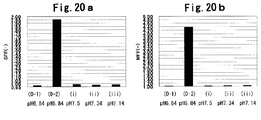
- FIG. 20a is a graph showing the relationship between the pH in aggregation and filtration and the SFF of filtered water by adding MFRAC 10 mg / L of Nogi-cho tap water in Tochigi Prefecture.
- FIG. 20b is a graph showing the relationship between the same pH and the MFF of filtered water.
- melamine / formaldehyde resin acid colloid solution MFRAC
- PAC and other inorganic flocculants are not used in industrial water flocculation and filtration.
- a cationic organic coagulant is added in combination as necessary.
- MFRAC has been used as a flocculant, it has not been used for agglomeration treatment of industrial water for the following reasons.
- the primary purpose of industrial water treatment is to reduce turbidity (netNTU), but the secondary reason is to reduce organic substances, specifically humic substances.
- the above (1) is as follows. As shown in FIGS. 7 and 8 obtained in Experimental Example 1 to be described later, with respect to the results of netNTU and ultraviolet absorbance, MFRAC has an effect equivalent to that of PAC on a product basis, and unit price is determined based on netNTU and ultraviolet absorbance. It can be said that the practical value is not recognized.
- netNTU is 0.10
- MFRAC can be expected to be about half the PAC as the amount of drug added, but considering that the unit price is 10 times or more, the value of conventional evaluation has not been recognized.
- MFRAC and PAC are aligned on the same line, and MFRAC and PAC have almost the same effect as shown in FIG.
- the treated water is lightly colored and the RO membrane is contaminated.
- the general industrial water in Japan does not aggregate and the ultraviolet absorbance of the filtered treated water does not exceed 0.300.
- the humic substance represented by the absorbance can be removed by RO membrane treatment or ion exchange treatment.
- the MFRAC used in the experimental examples and examples described later is “Kuri stack B100” manufactured by Kurita Kogyo Co., Ltd., which is a surplus paint treatment agent for automobile painting booths already on the market.
- the MFRAC resin component in B100 is about 9%, and the 105 ° C. dry solid content is 9.3%. Since the melamine resin has an ability to adsorb polysaccharides and silt fine particles, an acid colloid obtained by co-condensing amino resin such as urea other than melamine can be applied to this application. Similarly, alkyl melamine resin acid colloid can also be applied.
- condensing agent not only formaldehyde but also acid colloid using alkyl aldehyde, glyoxal and paraformaldehyde can be applied.
- MFRAC is a cationic colloid, but the neutralizing power of anionic colloid charge in industrial water is weak.
- Industrial water to be treated in the present invention is surface water such as river water, lakes, dam lakes, ponds, etc., which is raw water for clarification such as aggregation and filtration for industrial and drinking water. Also included is water supplied to the operator after agglomeration and filtration. Industrial water treated in the present invention does not include well water and spring water.
- the present invention is particularly effective for treating industrial water with a relatively high degree of contamination because of the large amount of PAC required for clarification.
- MFRAC Any commercially available product can be suitably used as the MFRAC. When manufacturing MFRAC, it can manufacture as follows, for example.
- MFRAC is produced by adding an acid to methylolmelamine obtained by reacting melamine and aldehyde. If necessary, an acid may be added to the methylol melamine further alkylated.
- aldehyde used in the reaction examples include formaldehyde, paraformaldehyde, acetaldehyde, propionaldehyde and the like. Of these, formaldehyde and paraformaldehyde are preferable in terms of reaction efficiency and handling.
- the charging ratio of melamine and aldehyde when producing methylolmelamine is 1 to 6 mol of aldehyde with respect to 1 mol of melamine. If the amount of aldehyde exceeds 2.5 moles with respect to 1 mole of melamine, the amount of free aldehyde increases when an acid colloid solution is formed. Therefore, the amount of aldehyde is preferably 2.5 moles or less with respect to 1 mole of melamine.
- Methylolmelamine does not dissolve in water, but dissolves in an acid solution in a colloidal form.
- the alkylated methylol melamine obtained by further alkylating methylol melamine is water-soluble and becomes colloidal when an acid is added.
- a monobasic acid is suitable.
- organic acids such as formic acid, acetic acid, lactic acid, and propionic acid in addition to mineral acids such as hydrochloric acid and nitric acid.
- Hydrochloric acid is particularly preferable because a stable colloidal solution can be obtained.
- the addition amount of monobasic acid, particularly hydrochloric acid is about 0.5 to 1.5 mol, preferably 0.7 to 1.3 mol, per 1 mol of melamine.
- the free aldehydes are reduced when left standing at room temperature for aging.
- the aging time is suitably 5 days to 3 months at room temperature and about 2 to 3 hours at 50 ° C. when heating.
- the content of the melamine / formaldehyde resin in the acid solution of the melamine / formaldehyde resin is usually 5 to 20% by weight and the pH is about 1.5 to 2.5.
- the molecular weight of the melamine / formaldehyde resin used in the present invention is preferably 400 to 10,000,000, particularly 1,000 to 100,000.
- the molecular weight of the melamine / formaldehyde resin is larger, the aggregation effect tends to be excellent.
- the solubility of the melamine / formaldehyde resin is lowered when an acid solution is obtained.
- the melamine / formaldehyde resin used in the present invention preferably has a colloidal particle diameter of 10 to 70 nm, particularly 20 to 50 nm when formed into an acid colloid solution.
- the larger the colloid particle size the better the agglomeration effect.
- the colloid particle size of the acid colloid solution of melamine / formaldehyde resin is measured by, for example, a dynamic light scattering method, and is obtained as an average value.
- the amount of MFRAC added to industrial water is not particularly limited as long as a good coagulation effect is obtained.
- the amount of MFRAC added to industrial water is 0.2 mg / L in terms of the amount of resin component added (hereinafter, the amount of MFRAC added as a resin component (mg / L) is referred to as “mg / LR”).
- the quality of industrial water type and concentration of pollutants (aggregation target substances)
- presence / absence of combined use of cationic organic coagulant treatment purpose
- the addition amount is preferably adjusted in the range of 0.2 to 2.0 mg / LR, particularly 0.3 to 1.3 mg / LR. .
- ⁇ Cationic organic coagulant> Prior to adding MFRAC to industrial water and aggregating it, adding a cationic organic coagulant to agglomerate can reduce the required amount of expensive MFRAC compared to PAC and reduce the processing cost. It is preferable in terms of reducing the amount of flocculated floc produced and reducing the filtration load in the case of direct filtration.
- DAM dimethylamino methacrylate
- DAA dimethylamino acrylate
- copolymer thereof synthesized by polymerization and polyvinylamine (polyacrylamide Hoffman degradation product) Can also be used.
- Methyl glycol chitosan (MGCh), a colloid titration reagent, is also excellent in the coagulation effect.
- MGCh Methyl glycol chitosan
- poly-DADMAC is the best of the two types of commercially available cationic organic coagulants.
- the molecular weight of the cationic organic coagulant is one that is used as a sludge dehydrating agent (DAM and DAA type) having an intrinsic viscosity in a 1 N sodium nitrate solution exceeding 4 dL / g and having a molecular weight of several millions or more. Since it is not preferable, the same cationic organic coagulant needs to have an intrinsic viscosity of about 1 dL / g or less.
- DAM and DAA type sludge dehydrating agent having an intrinsic viscosity in a 1 N sodium nitrate solution exceeding 4 dL / g and having a molecular weight of several millions or more. Since it is not preferable, the same cationic organic coagulant needs to have an intrinsic viscosity of about 1 dL / g or less.
- the condensation type cationic organic coagulant has an intrinsic viscosity of less than 0.5 dL / g as a molecular weight index due to the synthesis mechanism, and is an effective region in terms of molecular weight.
- the molecular weight of a cationic organic coagulant such as poly-DADMAC is preferably about 0.3 to 1.0 dL / g in terms of intrinsic viscosity in the 1N sodium nitrate solution.
- the amount of cationic organic coagulant such as poly-DADMAC is preferably 70% or less of the cation consumption of the cationic organic coagulant for industrial water measured by the streaming potential method.
- the appropriate amount is the amount of colloidal charge added.
- the present inventor has found that in the treatment of industrial water, the zero point of the colloidal charge amount is inappropriate, and the addition amount of the cationic organic coagulant smaller than the addition amount that becomes the zero point is appropriate.
- filtration membranes such as UF membranes and MF membranes that filter the agglomerated water are negatively charged, and the aggregates are likely to adhere to and contaminate the membrane with zero and positive charges.
- ⁇ Aggregation treatment method> When only MFRAC is added to industrial water for aggregation treatment, it is preferable to add the necessary amount of MFRAC to industrial water and stir for about 5 to 20 minutes for aggregation treatment. If the initial drug diffusion is sufficient, the residence condition without stirring is sufficient.
- the necessary amount of the cationic organic coagulant is added to industrial water and stirred for about 1 to 3 minutes. Aggregation treatment is preferably performed with stirring for about a minute.
- failure by excessive addition of MFRAC can be prevented and the favorable aggregating effect can be acquired as it is pH7 or more.
- the pH in the agglomeration system is 7 or more, for example, 7.0 to 8.2 due to the addition of alkali or the diffusion of carbon dioxide gas due to air aeration or the like. It is preferable to do so.
- the effectiveness of the present invention is particularly exerted on industrial water having a high PAC addition amount required for clarification and a relatively high degree of contamination.
- Industrial water with a high degree of contamination has a high alkalinity of 40 to 90 mg / L as properties, and a coagulation pH well above 7.
- Such industrial water is industrial water that can obtain a sufficient coagulation effect with 8 mg / L of MRRAC as shown in FIGS. 9 and 10 described later. Therefore, as shown in FIG. Since the amount of MFRAC added to zero is 128 mg / L, it is considered that a failure due to excessive addition of MFRAC does not usually occur.
- the amount of dry SS at 105 ° C. was 0.765 g (15.3% of PAC: 2% as water content). It was confirmed that the amount of dry SS coincided with the presence form of aluminum hydroxide (Al (OH) 3 ) and was not aluminum oxide (Al 2 O 3 : 10.2% in the PAC used).
- MFRAC evaporation residue 9.3%
- the amount of centrifugal concentrated floc was 7 times at 35 g with respect to 5 g of MFRAC.
- the amount of dry SS at 105 ° C. is 0.417 g (8.35% of MFRAC), which is not much different from the case of PAC, but this amount can be greatly reduced if the required addition amount is small.
- the volume is 10-50 ⁇ L / L (10-50 mg / L) This corresponds to 3 to 15 times 160 mg / L when PAC 20 mg / L is added.
- the inorganic flocculant is a ferric salt represented by ferric chloride
- the bulk of the iron hydroxide floc is considered to be slightly smaller than the PAC, that is, the density (concentration) is slightly higher. Since iron needs to be added in the same amount as PAC, the influence of the floc volume by the flocculant is as great as that of PAC.
- the MFRAC floc volume experimental value is not much different from PAC per product, but with MFRAC, the amount of addition itself required to obtain the desired treated water quality can be reduced. The load during direct filtration can be reduced.
- MFRAC or a cationic organic coagulant and MFRAC are added, and the flocculated water obtained by the flocculation treatment is filtered by a pressure type or gravity type filtration device, or an MF membrane module or UF membrane. Can be done with modules.
- the present invention it is possible to directly perform filtration with these filtration means without performing solid-liquid separation by a precipitation separator or a floating separator. Since the obtained filtered water is water with high clarity, it can be used as RO membrane water supply, and high-quality demineralized water can be obtained by RO membrane treatment.
- Industrial water subjected to the aggregation test is as follows.
- Industrial water I Mixed industrial water 2015.10.27 sampling of Chiba Prefecture Sakura Water Treatment Plant and Inba Marsh Water Purification Plant
- Industrial water II Mixed industrial water 2015.8.18 sampling of Chiba Prefecture Sakura Water Purification Plant and Inba Marsh Water Purification Plant
- Industrial water III Ibaraki Kashima water purification plant industrial water 2015.
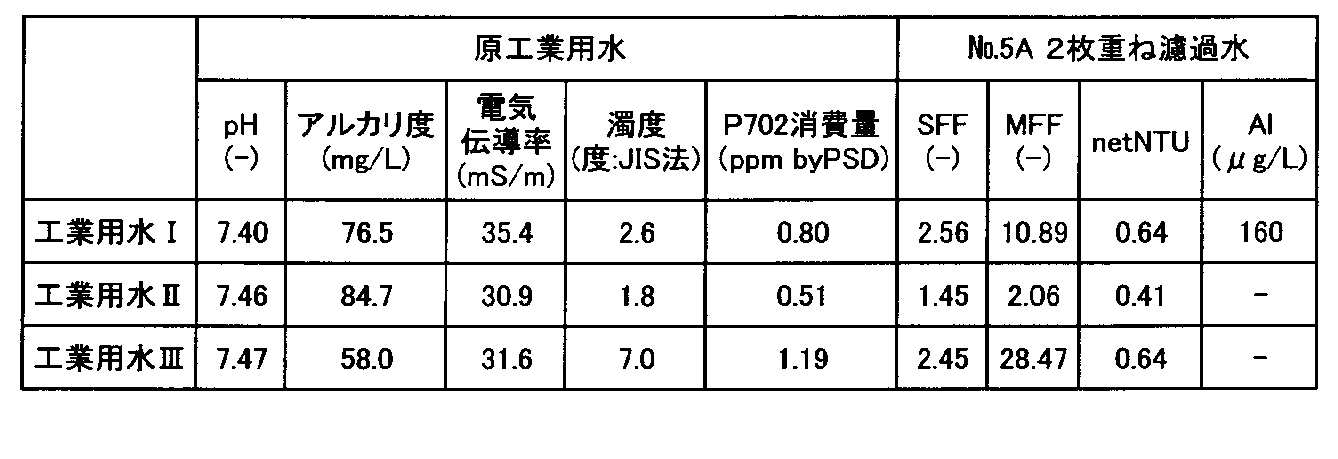
- the quality of each industrial water is as shown in Table 2 below.
- the drug addition amount indicates the addition amount as a product.
- MFRAC ⁇ Melamine / formaldehyde resin acid colloid solution
- MFRAC Kurita Kogyo's automobile paint booth circulating water surplus paint treatment agent, brand name “Chrystuck B100” Evaporation residue 9.3% (Aggregate solids generation 9% vs. product), formaldehyde content 3200mg / kg, colloid average particle size 35nm (Hereinafter referred to as “MFRAC”.)
- Epichlorohydrin / dialkylamine condensate “Zeta Ace C350” manufactured by Kurita Kogyo Co., Ltd. Polymer pure content (evaporation residue) 51%, colloid equivalent 6.80 meq / g (3.47 meq / g-product), intrinsic viscosity 0.1N dL / g in 1N sodium nitrate solution (Hereinafter referred to as “Zeta Ace C350” or “C350”.)
- Cliff Rock LC553 Dicyandiamide / formaldehyde condensate: “Cliff Rock LC553” manufactured by Kurita Kogyo Co., Ltd. (hereinafter referred to as “Cliff Rock LC553”)
- Methyl glycol chitosan Colloidal titration reagent manufactured by Wako Pure Chemical Industries
- the aggregation treatment was performed on 500 mL of sample water with a jar tester manufactured by Miyamoto Seisakusho with rapid stirring (150 rpm) for 6 minutes and then with slow stirring (50 rpm) for 6 minutes.
- MFRAC was first added at the time of rapid stirring of the cationic organic coagulant for 3 minutes.
- the entire amount of the coagulation treated water is No. made by Advantech. It was carried out with two sheets of 5A 185 mm ⁇ filter paper.
- the fine particle capturing effect obtained by this filtration is intermediate between a two-layer gravity filtration apparatus having a filtration sand diameter of 0.45 mm and a two-layer pressure filtration having a filtration sand diameter of 0.60 mm.
- the mechanism is not elucidated, but it is presumed that there is a hydration phenomenon like PAC.
- the floc density due to the flocculant actually reacting with the contaminants in industrial water is considered to be larger (the volume is smaller) than when the flocculant alone because some hydration is lost.
- the cationic organic coagulant has an amount of cation consumption required to make the flow potential zero of industrial water as 100, and the added amount is 70 or less. Therefore, all the cationic organic coagulants added are anionic colloids in industrial water. It reacts with the substance, becomes insoluble, and the degree of hydration is low. On the other hand, the anionic biopolymer that is part of the anionic colloid that is the reaction partner of the cationic organic coagulant significantly reduces the hydration status due to the formation of a polyion complex. This is common in the event of using a cationic dehydrating agent when coagulating and dewatering surplus sludge from biological treatment.
- the concentration is about 5%, but when it is properly aggregated with a cationic organic coagulant, the concentration is about 10%. Go up. This concentration (increased density) is attributed to the elimination of hydration of excess sludge mucilage composed of biopolymer gel (substance dissolved and extracted with 0.1% NaOH). As described above, the cationic organic coagulant has an increase in water accompanying itself and a decrease in the water content of the reaction partner. By analogy with the case of excess sludge dehydration, the absolute value of the latter is considered to be larger. Is reasonable. Therefore, it was assumed that the aggregate floc volume by the cationic organic coagulant was equal to the added solid content.
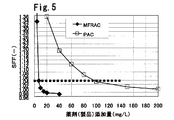
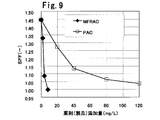
- Example 1 To industrial water I, MFRAC or PAC was added for aggregation treatment. No. of the obtained flocculated water. SFF and MFF were measured for 5A two-layer filtered water. The relationship between the amount of MFRAC or PAC added and SFF or MFF is shown in FIGS. The drug addition amount shown in FIGS. 5 and 6 is the drug addition amount as a product. 5 and 6, dotted lines or broken lines indicate the boundaries between evaluation categories 4 and 5 in Table 1.
- netNTU turbidity
- ultraviolet absorbance 260 nm, 50 mm cell
- MFRAC product
- the addition amount of MFRAC (product) that can make SFF 5 or more in the membrane contamination evaluation section of RO membrane water supply in Table 1 is 8 mg / L (dotted line and graph intersection).
- the amount of MFRAC (product) that can be evaluated as MFF 5 or higher is 10 mg / L.
- PAC about 100 mg / L is required for evaluation section 5 in SFF, and about 130 mg / L is required for evaluation section 5 in MFF, which is about 13 times that of MFRAC.
- the reaching effect is also superior to PAC especially in SFF and MFRAC.
- the amount of solids generated by the flocculant is PAC 15.6%, MFRAC 9%, and the flock volume assumption is PAC 8 times, MFRAC 7 times, and MFRAC is less than PAC. Therefore, the filtration load caused by the flocculant after aggregation can be reduced to 1/15.
- MFRAC In MFRAC, the absolute effect of SFF is excellent because MFRAC aggregates neutral polysaccharides that do not have a carboxyl group that is difficult to agglomerate with inorganic flocculants such as PAC among biopolymers, or neutral polysaccharides that have very little, It is judged that the effect of removing contributed.
- MFRAC has the same effect as PAC on a product basis when judged by netNTU (turbidity) and ultraviolet absorbance.
- MFRAC or PAC was added to industrial water II for aggregation treatment. No. of the obtained flocculated water. SFF and MFF were measured for 5A two-layer filtered water. The relationship between the amount of MFRAC or PAC added and SFF or MFF is shown in FIGS. The drug addition amount shown in FIGS. 9 and 10 is the drug addition amount as a product.
- SFF and MFF can be set to 5 or more (SFF1.04 ⁇ , MFF1.06 ⁇ ) in the RO membrane water supply membrane contamination assessment section of Table 1.
- the amount of MFRAC (product) added is 7-8 mg / L. is there.
- PAC requires an addition amount of over 120 mg / L, and the product addition amount is 16 times that of MFRAC. Therefore, in industrial water II, the filtration load caused by the coagulant after aggregation can be further reduced from 1/15 in the case of industrial water I.
- MFRAC or PAC was added to industrial water III for aggregation treatment. No. of the obtained flocculated water.
- SFF and MFF were measured for 5A two-layer filtered water.
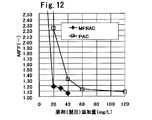
- 11 and 12 show the relationship between the amount of MFRAC or PAC added and SFF and MFF, respectively.
- the drug addition amount shown in FIGS. 11 and 12 is the drug addition amount as a product.
- the addition amount of MFRAC (product) that can make SFF and MFF 5 or more (SFF1.04 ⁇ , MFF1.06 ⁇ ) in the membrane contamination evaluation section of RO membrane water supply in Table 1 is 35 to 40 mg / L.
- PAC is about 120 mg / L, and the required amount of PAC is the same as that for industrial waters I and II, but MFRAC is increased 4 to 5 times that for industrial waters I and II.
- the amount of drug product added is 1/3 or less of PAC.
- the first reason why the amount of MFRAC added is large is that the cationic organic coagulant (P702) has a cation consumption of 1.19 mg / L by the streaming potential method, 0.80 mg / L for industrial water I, and 0 for industrial water II. It can be judged to be larger than .51 mg / L and to consume MFRAC.
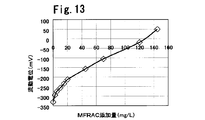
- the amount of MFRAC added at which the potential becomes zero is 128 mg / L.
- the MFRAC addition amount that can achieve the evaluation category 4 or higher in Table 1 is only about 8 mg / L from FIGS. 9 and 10, and the flow charge under the MFRAC addition amount condition is surely negative.
- the amount of anionic colloid charged in industrial water is large, the amount of MFRAC added necessary for the treatment is consumed and increased by the anionic colloid material.
- the amount of MFRAC added required for the evaluation category 4 or higher in industrial water III was 40 mg / L. Therefore, it is preferable to use a cationic organic coagulant in combination in order to consume a part of the anionic colloidal charge and enable treatment with a smaller amount of MFRAC added.
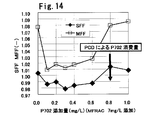
- the amount of P702 added in the case of using Zeta Ace P702 is 0.1 to 0.6 mg / L, which is significantly larger than the amount of P702 consumption 0.8 mg / L, which is zero flow charge by PCD. It is a small value. SFF and MFF increase (deteriorate) when the amount of addition of P702 that reaches zero flow charge approaches 0.8 mg / L.
- FIG. 16 shows the measurement results of SFF and MFF of 5A double-layer filtered water.
- the amount of addition in the case of using Zetaace P702 is 0.5 to 1.0 mg / L, which is considerably smaller than the P702 consumption of 1.19 mg / L with zero flow charge by PCD. It is. As in the case of industrial water I, SFF and MFF increase (deteriorate) when the amount of addition of P702, which is zero in fluid charge, approaches 1.2 mg / L.
- the appropriate addition amount in the case of using P702 together with industrial water I and III Assuming that the amount of P702 consumed in industrial water, that is, the amount of fluidized charge added by the streaming potential method (PCD) is zero, SFF and MFF are deteriorated and inappropriate.
- the appropriate addition amount range is about 15% (0.12 mg / L) to about 75% (0.6 mg / L) of P702 consumption of 0.8 mg / L, and P702 consumption of industrial water III. From about 40% (0.5 mg / L) to about 85% (about 1.0 mg / L).
- the lower limit of the addition amount of the cationic organic coagulant is not particularly defined (0%) because a sufficient effect can be obtained with MFRAC alone as the aggregation main agent, but the preferred addition amount range when used in combination is 20 to 20% of the consumption amount. 50%.
- the cationic group of the drug acts more effectively than poly-DAMAC, and if it is larger than 100, it indicates that there is a lot of waste.
- the colloid titration reagent methyl glycol chitosan (MGCh) was the best in the action efficiency of the cationic group.
- condensed cations such as epichlorohydrin / dialkylamine condensate and dicyandiamide / formaldehyde condensate had an added cation amount about twice that of poly-DADMAC.
- the cationic group of MGCh is located at the outermost part of the polymer chain, the distance between the cationic groups is far away, and since the polymer chain has a rigid structure, the cationic group is always exposed to the outside. It is presumed that it reacts with the anionic colloid in the target liquid and is efficient.
- the cationic group of Poly-DADMAC is present at the end of the polymer side chain and the side chain itself is large, so it is considered that the cationic group acts relatively effectively.
- the tap water used was Nogi-cho tap water in Tochigi Prefecture.
- the membrane contamination assessment category of RO membrane water supply shown in Table 1 above is 5 to S, which is very clear water, and the amount of anionic colloid is also Very few.
- FIG. 18 shows the relationship between SFF, MFF and MFRAC addition amount measured for 5A double-layer filtered water.
- FIG. 19 shows the results of examining the relationship between 5A two-layer filtered water SFF and MFF. As shown in FIG. 19, the contamination due to the MFRAC leak disappeared. In FIG. 19, 2 / 3MF means that the total permeated water at the time of measuring SFF and MFF is diluted to 2/3 of the original with 1 part of reference water.
- No. 5A double-layer filtered water has a clarity of evaluation category 4 or higher in Table 1.
- the solids increase due to the flocculant at this time is 0.7 to 1.4 mg / L, less than half of 3.1 mg / L when PAC 20 mg / L is added, and direct filtration without primary solid-liquid separation. Is a possible amount.
- the estimation of the flock capacity is also 50 to 100 ⁇ L / L, which is lower than 160 ⁇ g / L when PAC 20 mg / L is added.
- the Al concentration of 5A double-layered filtered water is from 160 ⁇ g / L to about 80 ⁇ g / L in Comparative Example 1 without addition of the drug.
- Al is 200 ⁇ g / L, which is higher than that without the drug.
- the normal PAC addition amount of 40 to 60 mg / L in the facility for performing primary solid-liquid separation does not reach 4 in the evaluation category of Table 1 (Comparative Examples 3 and 4). Also, the residual Al is increased as compared with the case of adding MFRAC.
- the recommended amount of P702 added in industrial water I is 15 to 50% of the cation consumption of P702.
- the MFRAC addition amount is 4 mg / L
- the epichlorohydrin / dialkylamine condensate (C350) is added in combination with 26% of the cation consumption, and the evaluation category is 5 and when 52% is added in combination, the evaluation category S is obtained (Example 9, 10).
- the former effect is comparable to the combined addition of P702 0.2 mg / L (25%) of Example 4 and MFRAC 4 mg / L.
- the filtered water SFF without addition of chemicals is 2.56 in the case of industrial water I, 1.45 in industrial water II, and 2.06 in the same way for MFF of 10.89. Less (Comparative Examples 1 and 9).
- P702 was added in combination with 0.2 mg / L corresponding to 39% of the cation consumption, MFRAC 2 mg / L added (Example 12), 4 mg / L added (Example 13), and 8 mg / L added (Example 14). Then, the evaluation category in Table 4 is improved from 4 to 5 to 5, and further from S to S. When the MFRAC of Comparative Example 14 is not added, the evaluation categories 1 and 2 indicate that the use of MFRAC is an absolute condition.
- the PAC addition amount of 20 mg / L in Comparative Example 17 capable of direct filtration of aggregates is Evaluation Category 1 in Table 1. Even with the double addition amount of 40 mg / L of Comparative Example 18, the numerical value is improved, but remains in Evaluation Category 1. In the case of PAC, the addition of 120 mg / L is necessary to achieve Evaluation Category 4 or higher (Comparative Example 20).
- Example 19 in which MFRAC 20 mg / L was added in combination, the solid matter generation amount was 2.5 mg / L, and the estimated flock volume was 141 ⁇ L / L, which is a directly filterable range.
- P702 is an evaluation category 1 in Table 1.
Landscapes
- Chemical & Material Sciences (AREA)
- Engineering & Computer Science (AREA)
- Water Supply & Treatment (AREA)
- Life Sciences & Earth Sciences (AREA)
- Hydrology & Water Resources (AREA)
- Environmental & Geological Engineering (AREA)
- Organic Chemistry (AREA)
- Chemical Kinetics & Catalysis (AREA)
- Separation Using Semi-Permeable Membranes (AREA)
- Separation Of Suspended Particles By Flocculating Agents (AREA)
- Nanotechnology (AREA)
Abstract
PAC、硫酸アルミニウム、塩化第二鉄など、清澄化に要する添加量が多い無機凝集剤を使用せずに、少量の凝集剤で工業用水を高度に清澄化し、特にRO膜処理に適した処理水質を得ることができる工業用水の清澄化方法及び清澄化装置を提供する。工業用水にメラミン・ホルムアルデヒド樹脂酸コロイド溶液を添加して凝集処理した後、濾過する工業用水の清澄化方法。凝集処理水を、沈殿分離装置または浮上分離装置による固液分離を行うことなく、直接、圧力式または重力式濾過装置、或いは、精密濾過膜モジュールまたは限外濾過膜モジュールで濾過することができる。
Description
本発明は、工業用水を、凝集、濾過して清澄水を得る方法及び装置に関する。本発明は、通常、工業用水の凝集処理で使用されるポリ塩化アルミニウム(PAC)等の無機凝集剤を用いずに、少量の凝集剤の添加で清澄度の高い処理水を得る工業用水の清澄化方法及び清澄化装置に関する。
本明細書において、工業用水とは、産業用および上水用に凝集、濾過等の清澄化を行う原水となる河川水、湖沼、ダム湖、溜池等の表流水であり、浄水場にて簡易な凝集、濾過を施した後、事業者に供給される水も含まれる。工業用水に井水、湧水は含まれない。
<工業用水の処理について>
日本の工業用水は、浄水場で、PACによる凝集処理後、凝集処理水を沈殿又は濾過等で濁度を濁度基準以下に低下させる処理を行った後、使用工場に供給される。
日本の工業用水は、浄水場で、PACによる凝集処理後、凝集処理水を沈殿又は濾過等で濁度を濁度基準以下に低下させる処理を行った後、使用工場に供給される。
工場で受け入れた工業用水を、浄水場での凝集処理の有無に関わらず、多くの場合、PAC、硫酸アルミニウム、塩化第二鉄などの無機凝集剤、一般的にはPACにより凝集、濾過処理して、工場内用水として使用する。
PACで凝集処理した工業用水は、沈殿分離装置、または浮上分離装置で一次固液分離した後、重力式または圧力式濾過装置で濾過して清澄化し、処理水を得る。
凝集処理に必要なPACの添加量が20mg/L以下で足りる場合は、沈殿分離装置または浮上分離装置による一次固液分離を省略して直接に重力式または圧力式濾過装置に通水する場合も多い。
低汚濁の工業用水に対して、PACによる凝集処理を省いて、または少量のPAC添加による凝集処理後に、精密濾過(MF)膜モジュールまたは限外濾過(UF)膜モジュールに通水して清澄水を得る方法も採用されている。
≪工業用水の処理目的≫
工業用水の凝集、濾過処理の第一の目的は濁度除去である。
処理水濁度の工業用水処理設備メーカー保障値は、JIS K0102に規定されるカオリン標準液を用いた濁度で、1度以下あるいは0.5度以下である。実際の濁度は0.2度以下で0.1度以下の場合もある。
工業用水の凝集、濾過処理の第一の目的は濁度除去である。
処理水濁度の工業用水処理設備メーカー保障値は、JIS K0102に規定されるカオリン標準液を用いた濁度で、1度以下あるいは0.5度以下である。実際の濁度は0.2度以下で0.1度以下の場合もある。
≪濁度とnetNTU≫
JIS K0102の波長660nm、50mmセルでの最小吸光度は0.001で、濁度係数が概ね100倍なので0.1度に相当する。
吸光度0.002の相違まで有意と仮定すると、分析精度は±0.2度である。
計量証明上は濁度1.0度に満たない場合1<(1未満)と表示される。
JIS K0102の波長660nm、50mmセルでの最小吸光度は0.001で、濁度係数が概ね100倍なので0.1度に相当する。
吸光度0.002の相違まで有意と仮定すると、分析精度は±0.2度である。
計量証明上は濁度1.0度に満たない場合1<(1未満)と表示される。
従って、本明細書の実験例、実施例の濁度は、より微少な濁度を計測するためHACH社製の2100Qを使用して少数点2桁まで判定した。
具体的には、計測値(NTU)から、超純水の計測値(ブランク値:通常0.04~0.07)を差し引いたnetNTUを採用した。
HACH社製の2100Qは、透過光だけでなく、検出感度が高い90散乱光の2つの測定値から濁度を検出するため、0.01まで検知できる。NTU 1.0に相当するJIS K0102の濁度は1度ではなく、概ね0.6~0.7度である。
具体的には、計測値(NTU)から、超純水の計測値(ブランク値:通常0.04~0.07)を差し引いたnetNTUを採用した。
HACH社製の2100Qは、透過光だけでなく、検出感度が高い90散乱光の2つの測定値から濁度を検出するため、0.01まで検知できる。NTU 1.0に相当するJIS K0102の濁度は1度ではなく、概ね0.6~0.7度である。
≪RO膜給水のnetNTU(濁度)要件≫
処理水を逆浸透(RO)膜に供給して脱塩水を得る場合に要求される清澄性は上記のものよりも厳しく、netNTUで言えば0.05以下が必須要件になる。
このような低濁度の検出はHACH社製の2100Qでも精度に欠ける。
このため、RO膜給水の清澄度(汚濁度)の計測にはSDIが世界的に採用されている。
微小懸濁物汚濁指標であるSDIについては、本発明で処理水の清澄度判断指標とした「RO膜給水の汚染性指標」を含めて後述する。
処理水を逆浸透(RO)膜に供給して脱塩水を得る場合に要求される清澄性は上記のものよりも厳しく、netNTUで言えば0.05以下が必須要件になる。
このような低濁度の検出はHACH社製の2100Qでも精度に欠ける。
このため、RO膜給水の清澄度(汚濁度)の計測にはSDIが世界的に採用されている。
微小懸濁物汚濁指標であるSDIについては、本発明で処理水の清澄度判断指標とした「RO膜給水の汚染性指標」を含めて後述する。
≪処理水清澄度の判定≫
工業用水の凝集処理において、処理水清澄度が最も要求されるのは、処理水をRO膜給水とする場合であり、次に、処理水をイオン交換処理して純水を製造する場合である。
工業用水の凝集処理において、処理水清澄度が最も要求されるのは、処理水をRO膜給水とする場合であり、次に、処理水をイオン交換処理して純水を製造する場合である。
以下に、処理水清澄度の評価、判定基準について説明する。
[SDI(Silt Density Index)]
濁度では計測不能の極微少濁度によるRO膜給水のRO膜汚染性を判定する方法として、SDIがASTM D4189に定義されている。
SDIは、JIS K3802に定義されるFI(Fouling Index)と同一の評価方法である。
SDIの具体的な測定方法は以下の通りである。
濁度では計測不能の極微少濁度によるRO膜給水のRO膜汚染性を判定する方法として、SDIがASTM D4189に定義されている。
SDIは、JIS K3802に定義されるFI(Fouling Index)と同一の評価方法である。
SDIの具体的な測定方法は以下の通りである。
0.2MPaの加圧下、試料水を最大孔径0.45μm、47mmφのMF膜を通水させ、最初の500mLの透過時間T0を測定し、15分通水後、次の500mLの透過水が得られる時間T15を測定し、この測定値から下記式でSDI(FI)を算出する。
SDI(FI)=(T15-T0)/T15×100/15(min)
(T15-T0)/T15×100は、15分の通水で、濾過速度が何%低下したかを示す。SDI(FI)は、これを15分で割るので、1分当たり、何%濾過速度が低下するかを示す。
SDI(FI)=(T15-T0)/T15×100/15(min)
(T15-T0)/T15×100は、15分の通水で、濾過速度が何%低下したかを示す。SDI(FI)は、これを15分で割るので、1分当たり、何%濾過速度が低下するかを示す。
汚染物が全くなければ、SDI(FI)は最良値0.00である。15分の通水でMF膜が閉塞し、透過水が得られない状況になると、SDI(FI)は最悪値6.67になる。
RO膜給水として推奨される値はRO膜メーカー、膜の銘柄にもよるが、3ないし4以下である。
[MFF(Micro Filter Fouling Factor)]
MFFは、最大孔径0.45μmのMF膜に試料水1Lを500mLずつに分けて、-67kPaの減圧条件で通水し、1回目の通水時間T1と2回目の通水時間T2の比=T2/T1で求める値である。
MFFは、SDIと同じく微少の微粒子汚濁を計測する方法である。
MFFは、最大孔径0.45μmのMF膜に試料水1Lを500mLずつに分けて、-67kPaの減圧条件で通水し、1回目の通水時間T1と2回目の通水時間T2の比=T2/T1で求める値である。
MFFは、SDIと同じく微少の微粒子汚濁を計測する方法である。
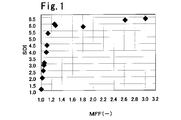
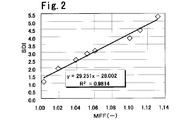
MFFとSDIの本発明者による実験結果の相関は図1、図2の通りである。
SDI4.0、3.0、2.0に相当するMFFは実験結果によればそれぞれ1.10、1.06、1.025である。最良値はMFF=1.00である。
SDI4.0、3.0、2.0に相当するMFFは実験結果によればそれぞれ1.10、1.06、1.025である。最良値はMFF=1.00である。
[SFF(Soluble Polymer Fouling Factor)]
工業用水中には、微粒子汚濁の他に藻類等により代謝される溶解性高分子物質であるバイオポリマーが存在する。バイオポリマーにはSSとして計測されないアンダーミクロンのミクロゲルも含む。
工業用水中には、微粒子汚濁の他に藻類等により代謝される溶解性高分子物質であるバイオポリマーが存在する。バイオポリマーにはSSとして計測されないアンダーミクロンのミクロゲルも含む。
バイオポリマーは多糖類を主体とし、しばしば工業用水の処理水に残存する。バイオポリマーはRO膜透過に際しては膜の汚染物質になり、膜の透過流束を低下させる。
工業用水中のバイオポリマーの多くはPAC凝集で除去される。凝集処理水中のバイオポリマー濃度は、10~100μg/Lと微量で、処理水の一般用途では大きな支障はない。しかし、処理水をRO膜に供給する場合には、バイオポリマーの分子量が1000万に達するため、微量の存在でもRO膜面で濃縮、付着し、大きな膜汚染要因となる。
処理水をイオン交換処理して純水を製造する場合、バイオポリマーが荷電を有しない中性多糖類であると除去できず、イオン交換処理水に残留する。
バイオポリマーによるRO膜汚染影響度評価法がSFFである。
SFF値はバイオポリマーの微小粘性を基準水(清澄水)のMF膜透過時間T0と試料水のMF膜透過時間T1との比T1/T0から判定するものである。
SFFの測定には、SDI値、及びMFF値の測定で使用するMF膜と同様のMF膜、具体的に、直径47mm、孔径0.45μmのメンブレンフィルターを使用する。
SFFは、MFF測定に先立ち、微粒子汚濁およびバイオポリマー汚濁フリーの基準水(通常はRO膜透過水)を通水してT0を計測し、SFF=T1/T0で求められる。
SFFの測定には、SDI値、及びMFF値の測定で使用するMF膜と同様のMF膜、具体的に、直径47mm、孔径0.45μmのメンブレンフィルターを使用する。
SFFは、MFF測定に先立ち、微粒子汚濁およびバイオポリマー汚濁フリーの基準水(通常はRO膜透過水)を通水してT0を計測し、SFF=T1/T0で求められる。
SFFは、基準水水温、試料水温を0.1℃単位で計測し、水の水温-粘度の補正を行う。
基準水としては、微粒子、バイオポリマーフリーで、電気伝導率1~5mS/m(10~50μS/m)程度のRO膜透過水を使用する。
この指標、測定法は、MFFを含めて、非特許文献1に記載されている。
基準水としては、微粒子、バイオポリマーフリーで、電気伝導率1~5mS/m(10~50μS/m)程度のRO膜透過水を使用する。
この指標、測定法は、MFFを含めて、非特許文献1に記載されている。
微粒子指標MFFの最良値が1.00になるのに対し、SFFの最良値は0.970~0.975を示す。
すなわち、微粒子およびバイオポリマーフリーの基準水に対してMF膜透水性が良くなる現象が観察される。
これは、塩類の存在によるニトロセルロース製MF膜に対する、水の浸透性の増加影響と考えられる。
すなわち、微粒子およびバイオポリマーフリーの基準水に対してMF膜透水性が良くなる現象が観察される。
これは、塩類の存在によるニトロセルロース製MF膜に対する、水の浸透性の増加影響と考えられる。
超純水にNaClを添加し電気伝導率を変化させ、SFFを測定した結果を図3に示す。
T0測定の基準水に使用したRO膜透過水の電気伝導率は2.3mS/m、超純水の電気伝導率は0.1mS/m未満である。
T0測定の基準水に使用したRO膜透過水の電気伝導率は2.3mS/m、超純水の電気伝導率は0.1mS/m未満である。
≪RO膜給水の汚染性指標≫
RO膜給水の膜汚染性指標の評価区分を下記表1に示す。この評価区分は非特許文献1に記載されている。
RO膜給水に求められる水質は区分4以上である。
イオン交換樹脂に供給する場合に求められる水質は区分3以上である。特に限定されない処理水用途での要求水質は区分1以上である。
RO膜給水の膜汚染性指標の評価区分を下記表1に示す。この評価区分は非特許文献1に記載されている。
RO膜給水に求められる水質は区分4以上である。
イオン交換樹脂に供給する場合に求められる水質は区分3以上である。特に限定されない処理水用途での要求水質は区分1以上である。

<メラミン・ホルムアルデヒド樹脂酸コロイド溶液について>
本発明で用いるメラミン・ホルムアルデヒド樹脂酸コロイド溶液(以下「MFRAC」と記載する場合がある。)は、通常8~10%の樹脂分濃度で、これを酸性下でプラス荷電のコロイド状に分散させたものである。
本発明で用いるメラミン・ホルムアルデヒド樹脂酸コロイド溶液(以下「MFRAC」と記載する場合がある。)は、通常8~10%の樹脂分濃度で、これを酸性下でプラス荷電のコロイド状に分散させたものである。
MFRACは40年以上前より凝集剤として公知である。しかし、効果・コストの総合評価、およびホルムアルデヒドを反応残留物として含むことが不可避であることから、排水処理凝集剤としての利用は極く限られていた。ましてや工業用水処理や飲料水など人の口に入る浄水処理への適用の事例や試みは皆無であった。
MFRACは上市当初は紙の耐水性付与添加剤として使用されていた。その後、MFRACは自動車の塗装ブース循環水の余剰塗料の不粘着剤として使用されている。
自動車塗装ブースの余剰塗料処理でのMFRAC効果のメカニズムは、以下の通りである。
自動車塗装ブースにおける凝集および不粘着化対象塗料は主としてアルキルメラミン樹脂、ポリエステル・メラミン樹脂、アクリル・メラミン樹脂といったメラミン骨格の微粒子樹脂が分散された特定のものである。自動車塗装ブース処理では、塗料と同物質であるMFRACがこれらと親和性が高く、その凝集と凝集物の不粘着化に寄与していると言える。
MFRACの自動車塗装ブース余剰塗料処理以外の用途として、排水処理用凝集剤の適用に関しては、特許文献1には、水溶化澱粉を含む廃水の凝集剤として用いることが提案されている。MFRACは、PACでは凝集処理が困難な水溶化澱粉やポリビニルアルコールに対する凝集性があるため、これを含む排水の凝集剤として有効である。
しかし、MFRACのこれらの被凝集物質との反応は、固形分比で1:1を上回る。
仮に、被凝集物質が100mg/Lで、反応比2:1と仮定すると、MFRACの必要添加量は、樹脂分で200mg/L、MFRAC中の樹脂分10%とすると製品として2000mg/Lを要する。
MFRAC中には3000mg/kg程度のホルムアルデヒドが残留するため、上記の添加量では処理水中のホルムアルデヒドが6mg/Lと高くなる。また、処理費用も高価になる。
仮に、被凝集物質が100mg/Lで、反応比2:1と仮定すると、MFRACの必要添加量は、樹脂分で200mg/L、MFRAC中の樹脂分10%とすると製品として2000mg/Lを要する。
MFRAC中には3000mg/kg程度のホルムアルデヒドが残留するため、上記の添加量では処理水中のホルムアルデヒドが6mg/Lと高くなる。また、処理費用も高価になる。
日本の水道水のホルムアルデヒド基準値は0.08mg/L以下、WHO勧告では0.9mg/L以下である。
そのため、MFRACは、排水処理凝集剤としての利用は極く限られていた。ましてや人の口に入る可能性もある工場内の工業用水処理や飲料水など上水処理へのMFRACの適用の事例や試みは皆無であった。
そのため、MFRACは、排水処理凝集剤としての利用は極く限られていた。ましてや人の口に入る可能性もある工場内の工業用水処理や飲料水など上水処理へのMFRACの適用の事例や試みは皆無であった。
自動車塗装ブースでMFRACを用いた場合、ブース循環水中にホルムアルデヒドが残留、蓄積するが、循環水を放流することはなく、循環水のブローに際しては生物処理などの適正な処理が行われるため問題にはならない。
<カチオン系有機凝結剤について>
海外では、直接、河川などから採水する場合を含めて、工業用水の凝集剤としてPAC等のアルミニウム塩以外に、カチオン系有機凝結剤であるポリジアリルジメチルアンモニウムクロリド(以下「poly-DADMAC」と記載する場合がある。)が使用されている。
米国ではpoly-DADMACが飲料水供給のための上水処理凝集剤として使用することがEPA(米国環境保護庁)により認められている。poly-DADMACは工業用水処理向けにも広く使用されている。
海外では、直接、河川などから採水する場合を含めて、工業用水の凝集剤としてPAC等のアルミニウム塩以外に、カチオン系有機凝結剤であるポリジアリルジメチルアンモニウムクロリド(以下「poly-DADMAC」と記載する場合がある。)が使用されている。
米国ではpoly-DADMACが飲料水供給のための上水処理凝集剤として使用することがEPA(米国環境保護庁)により認められている。poly-DADMACは工業用水処理向けにも広く使用されている。
特許文献2には、水性塗料を含む湿式塗装ブース循環水に、poly-DADMAC等のカチオン性凝集剤を添加して、所定の電荷量とすることが提案されている。
MFRACとカチオン系有機凝結剤の併用例としては、特許文献3に水性塗料と油性塗料とが混在している湿式塗装ブースのブース循環水に、カチオン性凝結剤とアミノ樹脂酸コロイドの両方を添加し、循環水中のコロイド荷電量が-50~+100μeq/Lとなるようにカチオン性凝結剤の添加量を調整するブース循環水の処理方法が提案されている。
ブース循環水の余剰塗料処理におけるMFRACとカチオン系有機凝結剤の併用の意味は、特許文献3にもあるように、マイナス帯電して安定化している塗料微粒子の荷電中和を行い、これを凝結させる効果である。
有機系カチオン系凝結剤の荷電中和の程度を判定する方法としては古くは指示薬を用いて色調変化をもって終点とするコロイド滴定法がある。近年では流動電位測定による滴定法が適用されている。
流動電位法では、PCD(particle charge detector)という装置で短時間に低濃度まで計測できる。具体的にはコロイド当量(コロイド荷電量)として0.1μeq/L(poly-DADMAC濃度としては0.02mg/L)程度の微量測定が可能である。
一般理論では、コロイド荷電量ゼロが最適凝結とされる。
特許文献3のブース循環水の処理では、カチオン系有機凝結剤の適正な添加量は、添加・反応後のコロイド荷電量が-50~100μeq/Lである。特許文献2ではこの値は-100~1000μeq/Lで、適正域はゼロを挟んでマイナス側が狭く、プラス側に偏る分布になっているものの、ゼロ点が適正点であることに変わりはなく、一般理論に合致する。
分離技術第45巻4号(2015)特集 固液分離の基礎と実際「逆浸透膜給水としての新たな膜汚染指標の提案」
PACを主体とするアルミニウム塩による凝集処理では、以下の課題がある。
(1) 高度の清澄度を要求されるRO膜給水に適合する処理水が得難い。
(2) 凝集フロック容量が多く、直接濾過する場合、濾過器の負荷量の関係からその添加量が制限され、処理水清澄度が不十分となる。
(3) 通常使用される添加量では、アルミニウム水酸化物コロイドが濾過装置を通過し処理水に残留する。具体的に、図4では濾過水のnetNTU(濁度)から、PAC15mg/Lで清澄水が得られるが、このとき濾過水のアルミニウムコロイドが100μg/L以上となる。
処理水中の残留アルミニウムは、処理水をRO膜に供給して脱塩処理する場合、アルミニウム水酸化物自体が、およびシリカと複合したものが、RO膜を閉塞させる原因になる。
(1) 高度の清澄度を要求されるRO膜給水に適合する処理水が得難い。
(2) 凝集フロック容量が多く、直接濾過する場合、濾過器の負荷量の関係からその添加量が制限され、処理水清澄度が不十分となる。
(3) 通常使用される添加量では、アルミニウム水酸化物コロイドが濾過装置を通過し処理水に残留する。具体的に、図4では濾過水のnetNTU(濁度)から、PAC15mg/Lで清澄水が得られるが、このとき濾過水のアルミニウムコロイドが100μg/L以上となる。
処理水中の残留アルミニウムは、処理水をRO膜に供給して脱塩処理する場合、アルミニウム水酸化物自体が、およびシリカと複合したものが、RO膜を閉塞させる原因になる。
以下に、PACを用いた凝集、濾過水の残留アルミニウムについて説明する。
工業用水の凝集、濾過処理の主目的は前述の通り濁度除去である。
しかし、濁度が前述のnetNTUで0.05未満という相当に高い清澄性が得られる条件でも、濾過水には水酸化アルミニウムコロイドとして存在する残留アルミニウムが、処理前の工業用水より増加する。
しかし、濁度が前述のnetNTUで0.05未満という相当に高い清澄性が得られる条件でも、濾過水には水酸化アルミニウムコロイドとして存在する残留アルミニウムが、処理前の工業用水より増加する。
図4は、神奈川県川崎市浮島地区工業用水をPACで凝集処理した後、No.5A、185mmφの濾紙を2枚重ねたもので濾過して採取した濾過水(以下、「No.5A 2枚重ね濾過水」と記載する場合がある。)について測定した清澄水のAl含有量及びnetNTU(濁度)とPAC添加量との関係を示すグラフである。
このNo5A、185mmφの濾紙の2枚重ねの濾過で得られる微粒子捕捉効果は、濾過砂径0.45mmの二層式重力濾過と、濾過砂径0.60mmの二層式圧力濾過の中間である。
このNo5A、185mmφの濾紙の2枚重ねの濾過で得られる微粒子捕捉効果は、濾過砂径0.45mmの二層式重力濾過と、濾過砂径0.60mmの二層式圧力濾過の中間である。
図4より以下のことが分かる。
濾過水netNTU(濁度)からは、PAC12mg/Lの添加で、netNTU0.03未満となり、一般的な工業用水の処理用途には十分な水質となる。
ところが、濾過水の残留アルミニウムは増加し、PAC12mg/Lの添加では、PAC凝集なし(PAC 0mg/L)の55μg/L(0.055mg/L)の2倍以上の120μg/L(0.12mg/L)と、最大値を示す。
PAC添加量を30mg/Lまで増量しても、濾過水の残留アルミニウムを処理前の工業用水の水準とすることはできない。
濾過水netNTU(濁度)からは、PAC12mg/Lの添加で、netNTU0.03未満となり、一般的な工業用水の処理用途には十分な水質となる。
ところが、濾過水の残留アルミニウムは増加し、PAC12mg/Lの添加では、PAC凝集なし(PAC 0mg/L)の55μg/L(0.055mg/L)の2倍以上の120μg/L(0.12mg/L)と、最大値を示す。
PAC添加量を30mg/Lまで増量しても、濾過水の残留アルミニウムを処理前の工業用水の水準とすることはできない。
このように、工業用水処理の主目的である低濁度(低netNTU)達成のために、必要なPAC添加量は、10~12mg/Lである。一方で、PAC添加量0mg/Lから12mg/Lに増量する過程で、濾過水の残留アルミニウムは、PAC添加量の増加に比例して増加する現象が起きる。
処理前の工業用水の残留アルミニウム水準に戻すためには、図4からは50mg/L程度以上のPAC添加が必要と推測される。これは、薬剤、汚泥処分のコスト面のみならず、フロック容積が増大して凝集処理水の直接濾過が不可能になる点においても問題である。
特に、処理水をRO膜給水とする場合は、残留アルミニウムが100μg/Lを超えるのは、大きなリスクとなる。
特に、処理水をRO膜給水とする場合は、残留アルミニウムが100μg/Lを超えるのは、大きなリスクとなる。
無機凝集剤が塩化第二鉄に代表される第二鉄塩でも、添加量を十分確保しないと、処理水に水酸化鉄コロイドが残留する。
アルミニウム水酸化物コロイドがnetNTUとしてほとんど検出されないのに対して、鉄水酸化物コロイドはnetNTUで検出され易く、SFF、MFF測定終了のMF濾紙の黄色ないし茶色の着色として観察される。
本発明は、PAC、硫酸アルミニウム、塩化第二鉄など、清澄化に要する添加量が多く必要な無機凝集剤を使用せずに、少量の凝集剤で工業用水を高度に清澄化することができ、特にRO膜処理に適した処理水質を得ることができる工業用水の清澄化方法及び清澄化装置を提供することを目的とする。
本発明はまた、凝集剤添加量が少ないため凝集フロック容量を低減でき、沈殿分離装置または浮上分離装置による固液分離を行うことなく、直接、MF膜モジュール、UF膜モジュール、或いは圧力式または重力式濾過装置に供給して高度に清澄化した処理水を得ることができ、残留アルミニウムの増加の問題をも解消することができる工業用水の清澄化方法及び清澄化装置を提供することを目的とする。
本発明はまた、凝集剤添加量が少ないため凝集フロック容量を低減でき、沈殿分離装置または浮上分離装置による固液分離を行うことなく、直接、MF膜モジュール、UF膜モジュール、或いは圧力式または重力式濾過装置に供給して高度に清澄化した処理水を得ることができ、残留アルミニウムの増加の問題をも解消することができる工業用水の清澄化方法及び清澄化装置を提供することを目的とする。
本発明者は、工業用水の凝集剤としてメラミン・ホルムアルデヒド樹脂酸コロイド溶液(MFRAC)を用いることにより、PACよりもはるかに少ない添加量で、No.5A 2枚重ね濾過水で前掲の表1の評価区分4以上の良好な処理水を得ることができることを見出した。
工業用水における凝集処理物質は、第一に、シリカ主体の微粒子粘土、第二に、藻類等微生物由来の溶解性、かつ二層式重力または圧力濾過装置相当の1μm細孔を通過するミクロゲル状の多糖類系代謝物(バイオポリマー)である。これらの凝集処理物質は、従来、MFRACが適用されている自動車塗装ブースの余剰塗料成分とは明らかに異なるものである。
従って、自動車塗装ブースの余剰塗料の処理にMFRACを適用する従来技術からは、工業用水の凝集処理にMFRACを適用する発想に到ることは不可能であり、従来においても工業用水の凝集にMFRACを適用した事例或いはその試みはなされていない。
従って、自動車塗装ブースの余剰塗料の処理にMFRACを適用する従来技術からは、工業用水の凝集処理にMFRACを適用する発想に到ることは不可能であり、従来においても工業用水の凝集にMFRACを適用した事例或いはその試みはなされていない。
本発明は、以下を要旨とする。
[1] 工業用水にメラミン・ホルムアルデヒド樹脂酸コロイド溶液を添加して凝集処理した後、濾過する工業用水の清澄化方法。
[2] 前記工業用水にカチオン系有機凝結剤を添加した後、前記メラミン・ホルムアルデヒド樹脂酸コロイド溶液を添加する[1]に記載の工業用水の清澄化方法。
[3] 前記カチオン系有機凝結剤の添加量を、流動電位法により計測される前記工業用水の前記カチオン系有機凝結剤のカチオン消費量の70%以下とする[2]に記載の工業用水の清澄化方法。
[4] 前記カチオン系有機凝結剤がポリジアリルジメチルアンモニウムクロリドである[2]又は[3]に記載の工業用水の清澄化方法。
[5] 前記工業用水の曝気処理あるいはアルカリ添加により、前記凝集処理時のpHを7以上とする[1]ないし[4]のいずれかに記載の工業用水の清澄化方法。
[6] 前記凝集処理水を、沈殿分離装置または浮上分離装置による固液分離を行うことなく、直接、圧力式または重力式濾過装置で濾過する[1]ないし[5]のいずれかに記載の工業用水の清澄化方法。
[7] 前記凝集処理水を、沈殿分離装置または浮上分離装置による固液分離を行うことなく、直接、精密濾過膜モジュールまたは限外濾過膜モジュールで濾過する[1]ないし[5]のいずれかに記載の工業用水の清澄化方法。
[8] 前記濾過して得られた濾過水を更に逆浸透膜処理する[1]ないし7のいずれかに記載の工業用水の清澄化方法。
[9] 工業用水にメラミン・ホルムアルデヒド樹脂酸コロイド溶液を添加して凝集処理する凝集処理手段と、該凝集処理手段で得られた凝集処理水を濾過する濾過手段とを有する工業用水の清澄化装置。
[10] 前記凝集処理手段が、前記工業用水にカチオン系有機凝結剤を添加した後、前記メラミン・ホルムアルデヒド樹脂酸コロイド溶液を添加する手段である[9]に記載の工業用水の清澄化装置。
[11] 前記凝集処理手段における前記カチオン系有機凝結剤の添加量が、流動電位法により計測される前記工業用水の前記カチオン系有機凝結剤のカチオン消費量の70%以下となる量である[10]に記載の工業用水の清澄化装置。
[12] 前記カチオン系有機凝結剤がポリジアリルジメチルアンモニウムクロリドである[10]又は[11]に記載の工業用水の清澄化装置。
[13] 前記工業用水の曝気処理あるいはアルカリ添加により、前記凝集処理手段におけるpHを7以上とするpH調整手段を有する[9]ないし[12]のいずれかに記載の工業用水の清澄化装置。
[14] 前記濾過手段が圧力式または重力式濾過装置であり、前記凝集処理水は、沈殿装置または浮上装置による固液分離がなされることなく、直接、該濾過手段に導入される[9]ないし[13]のいずれかに記載の工業用水の清澄化装置。
[15] 前記濾過手段が精密濾過膜モジュールまたは限外濾過膜モジュールであり、前記凝集処理水は、沈殿装置または浮上装置による固液分離がなされることなく、直接、該濾過手段に導入される[9]ないし[13]のいずれかに記載の工業用水の清澄化装置。
[16] 前記濾過手段で得られた濾過水を逆浸透膜処理する逆浸透膜モジュールを有する[9]ないし[15]のいずれかに記載の工業用水の清澄化装置。
本発明によれば、工業用水の凝集、濾過処理に当たり、凝集剤としてMFRACを用いることにより、以下の作用効果のもとに、工業用水を安定かつ効率的に処理することが可能となる。
(1) 凝集処理水の直接濾過が可能な少ない凝集剤量で、高い清澄度の処理水を得ることができる。結果として、凝集剤起因のフロック容積を減少させることができる。
(2) RO膜給水としても好適な高い処理水清澄度を達成できる。
(3) アルミニウム系凝集剤を使用せずに上記(1),(2)を達成できる。このため、処理水中の水酸化物コロイドの発生、増加の問題を解消できる。
(4) (3)より、RO膜に供給して脱塩水を得る時の、アルミニウムのリーク、およびイオン性シリカとの結合物によるスケール生成を抑止して安定処理を行える。
(2) RO膜給水としても好適な高い処理水清澄度を達成できる。
(3) アルミニウム系凝集剤を使用せずに上記(1),(2)を達成できる。このため、処理水中の水酸化物コロイドの発生、増加の問題を解消できる。
(4) (3)より、RO膜に供給して脱塩水を得る時の、アルミニウムのリーク、およびイオン性シリカとの結合物によるスケール生成を抑止して安定処理を行える。
以下に本発明の実施の形態を詳細に説明する。
本発明では、工業用水の凝集、濾過処理に当たり、凝集剤としてメラミン・ホルムアルデヒド樹脂酸コロイド溶液(MFRAC)を使用し、PAC、その他の無機凝集剤は使用しない。MFRACの必要添加量を低減するための助剤として、必要に応じてカチオン系有機凝結剤を併用添加する。
MFRACは、凝集剤として用いられてはいたが、以下の理由から、工業用水の凝集処理には使用されていなかった。
(1) 通常、無機凝集剤であるPACと同じような効果と認識されていた。
(2) コストはPACの概略10倍以上である。
(3) ホルムアルデヒドを3000mg/kg含有し、計算上267mg/Lの添加で、日本の水道水の基準値0.08mg/Lに達する。
(1) 通常、無機凝集剤であるPACと同じような効果と認識されていた。
(2) コストはPACの概略10倍以上である。
(3) ホルムアルデヒドを3000mg/kg含有し、計算上267mg/Lの添加で、日本の水道水の基準値0.08mg/Lに達する。
前述の通り、工業用水の処理目的の第一義は濁度(netNTU)低減であるが、第二義に有機物、具体的にはフミン系物質の低減が挙げられる。
上記(1)については、具体的には以下の通りである。
後述の実験例1で得られた図7,8に示されるように、netNTU及び紫外線吸光度の結果について、MFRACは製品ベースでPACと同等の効果であり、netNTU、および紫外吸光度で判定すると、単価の相違が大きく実用価値は認められないと言える。
後述の実験例1で得られた図7,8に示されるように、netNTU及び紫外線吸光度の結果について、MFRACは製品ベースでPACと同等の効果であり、netNTU、および紫外吸光度で判定すると、単価の相違が大きく実用価値は認められないと言える。
netNTUは0.10であれば、アルミニウムリークでの配管付着、ノズルなどの閉塞を除いて処理水の一般用途として支障はないと言える。
このため、薬剤添加量として、MFRACはPACの半減程度は望めるが、10倍以上の単価であることを考慮すると、従来の評価内容では価値は認められないとされていた。
このため、薬剤添加量として、MFRACはPACの半減程度は望めるが、10倍以上の単価であることを考慮すると、従来の評価内容では価値は認められないとされていた。
フミン系有機物指標である紫外吸光度は、図8のように、MFRACとPACは同一線上に並び、MFRACとPACはほぼ同じ効果であることが示される。
紫外吸光度は0.300程度以上では処理水の薄い着色や、RO膜汚染が生ずるが、日本の一般工業用水では凝集、濾過処理水の紫外吸光度が0.300を超えることはない。吸光度で示されるフミン系物質は、RO膜処理や、イオン交換処理で除去できる。
後述の実験例1で得られた図5,6の結果に示されるMFRACの効果は、本発明者がMFRACの性質を考察し、一方、RO膜に要求される高度の清澄性の詳細な評価方法を開発(前掲の表1)し、この両者を総合的に、かつ深く検討したことにより得られた成果である。
後述の実験例、実施例で用いたMFRACは、既に上市されている自動車塗装ブース余剰塗料処理剤である栗田工業(株)製「クリスタックB100」である。
B100中のMFRAC樹脂成分は約9%で、105℃乾燥固形分は9.3%である。
メラミン樹脂には多糖類及びシルト系微細粒子の吸着能が認められることから、樹脂骨格にはメラミン以外の尿素などのアミノ樹脂が共縮合した酸コロイドでも本用途に適用できる。同じく、アルキルメラミン樹脂酸コロイドも適用できる。
メラミン樹脂には多糖類及びシルト系微細粒子の吸着能が認められることから、樹脂骨格にはメラミン以外の尿素などのアミノ樹脂が共縮合した酸コロイドでも本用途に適用できる。同じく、アルキルメラミン樹脂酸コロイドも適用できる。
縮合剤としてはホルムアルデヒドに限らず、アルキルアルデヒド、グリオキザール、パラホルムアルデヒドを用いた酸コロイドでも適用できる。
MFRACはカチオン性コロイドであるが、工業用水中のアニオン性コロイド荷電の中和力は微弱である。
このことは、MFRAC処理で、液系が流動荷電ゼロあるいはプラスにならないため、凝集処理水をUF膜あるいはMF膜濾過する場合、および得られた濾過水をRO膜給水とするには有利な性質である。アニオンコロイド荷電の一部を潰し、より少ないMFRAC添加量での処理を可能にするためカチオン性有機凝結剤を併用することが好ましい。
<工業用水>
本発明で処理する工業用水とは、産業用および上水用に凝集、濾過等の清澄化を行う原水となる河川水、湖沼、ダム湖、溜池等の表流水であり、浄水場にて簡易な凝集、濾過を施した後、事業者に供給される水も含まれる。本発明で処理する工業用水には井水、湧水は含まれない。
本発明で処理する工業用水とは、産業用および上水用に凝集、濾過等の清澄化を行う原水となる河川水、湖沼、ダム湖、溜池等の表流水であり、浄水場にて簡易な凝集、濾過を施した後、事業者に供給される水も含まれる。本発明で処理する工業用水には井水、湧水は含まれない。
本発明は特に清澄化に要するPAC添加量が多く、汚染度の比較的高い工業用水の処理に有効である。
[MFRAC]
MFRACとしては、市販品をいずれも好適に用いることができる。MFRACを製造する場合、例えば以下のように製造することができる。
MFRACとしては、市販品をいずれも好適に用いることができる。MFRACを製造する場合、例えば以下のように製造することができる。
MFRACは、メラミンとアルデヒドを反応させて得られたメチロールメラミンにさらに酸を添加することで製造される。必要に応じて、メチロールメラミンをさらにアルキルエーテル化したものに酸を加えても良い。
反応に用いられるアルデヒドとしては、ホルムアルデヒド、パラホルムアルデヒド、アセトアルデヒド、プロピオンアルデヒドなどが挙げられる。中でも、ホルムアルデヒドやパラホルムアルデヒドが反応効率や取り扱い性の面で好ましい。
メチロールメラミンを製造する際のメラミンとアルデヒドとの仕込み割合は、メラミン1モルに対してアルデヒド1~6モルとするのが好ましい。メラミン1モルに対してアルデヒドが2.5モルを超えると酸コロイド溶液としたときに遊離のアルデヒド量が多くなるので、アルデヒドはメラミン1モルに対して2.5モル以下とするのが好ましい。
メチロールメラミンは水には溶解しないが、酸溶液にはコロイド状となって溶解する。メチロールメラミンをさらにアルキルエーテル化して得られるアルキル化メチロールメラミンは水溶性であり、酸を加えるとコロイド状になる。
酸としては、一塩基性酸が適している。具体的には、塩酸、硝酸等の鉱酸の他、蟻酸、酢酸、乳酸、プロピオン酸等の有機酸が挙げられる。とりわけ塩酸は安定したコロイド溶液が得られるので好ましい。
一塩基性酸、特に塩酸の添加量は、メラミン1モルに対し、0.5~1.5モル程度、好ましくは0.7~1.3モルが好適である。
コロイド溶液調製初期においては、遊離のアルデヒドが多く存在するが、調整後、室温で放置して熟成すると、遊離のアルデヒドが減少する。熟成時間は、室温の場合には5日~3ケ月、加熱する場合には50℃で2~3時間程度が適当である。
メラミン・ホルムアルデヒド樹脂(メラミン・アルデヒド縮合物)の酸溶液のメラミン・ホルムアルデヒド樹脂の含有量は、通常5~20重量%、pHは1.5~2.5程度である。
本発明で用いるメラミン・ホルムアルデヒド樹脂は、分子量が400~10,000,000、特に1,000~100,000の範囲であることが好ましい。メラミン・ホルムアルデヒド樹脂の分子量が大きい方が凝集効果に優れる傾向があるが、過度に大きいと、酸溶液とする際にメラミン・ホルムアルデヒド樹脂の溶解性が低下する。
本発明で用いるメラミン・ホルムアルデヒド樹脂は、酸コロイド溶液としたときのコロイド粒径が10~70nm、特に20~50nmであることが好ましい。このコロイド粒径が大きい方が凝集効果に優れるが、大き過ぎるものは添加したコロイドの総表面積が小さくなるため、効率が悪くなる。メラミン・ホルムアルデヒド樹脂の酸コロイド溶液のコロイド粒径は例えば動的光散乱法により測定し、その平均値として求める。
工業用水へのMFRACの添加量は、良好な凝集効果が得られる程度であればよく、特に制限はない。工業用水へのMFRACの添加量は、樹脂成分の添加量(以下、MFRACの樹脂成分としての添加量(mg/L)を「mg/L-R」と記載する。)で0.2mg/L-R以上、3.0mg/L-R以下の範囲で、工業用水の水質(汚染物質(凝集対象物質)の種類や濃度)やカチオン系有機凝結剤の併用の有無、処理目的(処理水をRO膜給水とするか否か)に応じて適宜決定することが好ましい。
MFRACの添加量が少な過ぎると十分な凝集効果を得ることができない。MFRACの添加量が多過ぎると凝集処理水の膜汚染性が高まるおそれがある。特に、MFRACとカチオン系有機凝結剤を併用する場合は、0.2~2.0mg/L-R、特に0.3~1.3mg/L-Rの範囲で添加量を調整することが好ましい。
<カチオン系有機凝結剤>
工業用水にMFRACを添加して凝集処理するに先立ち、カチオン系有機凝結剤を添加して凝集処理することにより、PACと比較して高価なMFRACの必要添加量を低減することができ、処理コスト、凝集フロック生成量の低減、直接濾過の場合の濾過負荷の低減の面で好ましい。
工業用水にMFRACを添加して凝集処理するに先立ち、カチオン系有機凝結剤を添加して凝集処理することにより、PACと比較して高価なMFRACの必要添加量を低減することができ、処理コスト、凝集フロック生成量の低減、直接濾過の場合の濾過負荷の低減の面で好ましい。
この場合、カチオン系有機凝結剤はすべて荷電中和、凝結力を有するので、種類を問わず使用することができる。
上市されているカチオン系有機凝結剤で、世界に普及しているものは、重合合成されるP702(poly-DADMAC)、縮合合成されるエピクロルヒドリン/ジアルキルミン縮合物の2タイプである。
カチオン系有機凝結剤として普及はしていないが、重合合成されるジメチルアミノメタアクリレート(DAM)、ジメチルアミノアクリレート(DAA)重合物およびその共重合物、および、ポリビニルアミン(ポリアクリルアミドホフマン分解物)も使用することができる。
コロイド滴定試薬であるメチルグリコールキトサン(MGCh)も凝結効果においては優れている。ただしMGChは分析試薬で高価なため実用的ではない。
カチオン系有機凝結剤の構造により、流動荷電ゼロにするための添加カチオン量の効率が異なり、市販のカチオン系有機凝結剤の前記2タイプの内ではpoly-DADMACが最も優れる。
カチオン系有機凝結剤の分子量は、1規定硝酸ナトリウム溶液中での固有粘度が4dL/gを超える分子量数百万以上の汚泥脱水剤として使用されるもの(DAMおよびDAA系)は反応性が鈍く好ましくないため、同系のカチオン系有機凝結剤は、固有粘度1dL/g程度以下である必要がある。
縮合型のカチオン系有機凝結剤は、合成のメカニズムから、分子量指標の固有粘度で0.5dL/g未満で、分子量の面から有効領域である。
poly-DADMAC等のカチオン系有機凝結剤の分子量は、上記1規定硝酸ナトリウム溶液中での固有粘度で0.3~1.0dL/g程度であることが好ましい。
poly-DADMAC等のカチオン系有機凝結剤の添加量は、流動電位法により計測される工業用水のカチオン系有機凝結剤のカチオン消費量の70%以下とすることが好ましい。
前述の通り、自動車塗装ブースにおける処理では、コロイド荷電量ゼロとなる添加量が適正点である。本発明者は、工業用水の処理においては、コロイド荷電量ゼロ点は不適当であり、ゼロ点となる添加量よりも少ないカチオン系有機凝結剤添加量が適正であることを見出した。
本発明では、PCD(particle charge detector)による測定によるカチオン消費量の70%以下、例えば20~50%に相当するカチオン系有機凝結剤添加量とすることで、以下の通り、良好な凝結効果を得ることができる。
カチオン系有機凝結剤を併用する場合の重要点は、凝集対象の工業用水のマイナス荷電をゼロまでに上昇させないことである。
具体的にはPCDで計測されるカチオン有機凝結剤の流動荷電ゼロに要する添加量(消費量)の70%以下、好ましくは20~50%量を併用する。
これは流動荷電ゼロ前後で適正凝集ができるという一般理論と大きく異なる。
具体的にはPCDで計測されるカチオン有機凝結剤の流動荷電ゼロに要する添加量(消費量)の70%以下、好ましくは20~50%量を併用する。
これは流動荷電ゼロ前後で適正凝集ができるという一般理論と大きく異なる。
荷電ゼロを十分下回るカチオン系有機凝結剤量とする理由の第一は、流動荷電ゼロに必要な添加量を大きく下回る量で十分な効果が得られ、逆に荷電ゼロ条件ではむしろ効果が悪化する事実が確認されたからである。
第二に凝集処理水を濾過するUF膜、MF膜等の濾過膜は膜がマイナス荷電で、ゼロ荷電、およびプラス荷電では凝集物が膜に付着、汚染し易いからである。
第三に、二層式重力濾過、あるいは二層式圧力濾過水をRO膜に供給する場合、濾過装置をリークした微少粒子、バイオポリマーミクロゲルのマイナス荷電と、未だ反応活性が残るカチオン系有機凝結剤反応物が会合してRO膜に付着し、透水阻害を起こすからである。カチオンの反応活性がなければ、これらがリークしても会合し難い。
<凝集処理方法>
工業用水にMFRACのみを添加して凝集処理する場合、工業用水にMFRACの必要量を添加して5~20分程度攪拌して凝集処理することが好ましい。初期の薬剤拡散が十分であれば、撹拌なしの滞留条件で良い。
工業用水にMFRACのみを添加して凝集処理する場合、工業用水にMFRACの必要量を添加して5~20分程度攪拌して凝集処理することが好ましい。初期の薬剤拡散が十分であれば、撹拌なしの滞留条件で良い。
カチオン系有機凝結剤とMFRACとを使用する場合は、工業用水にカチオン系有機凝結剤の必要量を添加して1~3分程度攪拌して凝集処理した後、MFRACを添加して5~20分程度攪拌して凝集処理することが好ましい。
<凝集処理時のpH条件>
凝集処理時のpH条件については特に制限はないが、pH7以上であると、MFRACの過剰添加による障害を防止して良好な凝集効果を得ることができる。
このような観点から、工業用水のpHが7未満の場合、アルカリ添加、或いは空気曝気等による炭酸ガスの気散等により、凝集系内のpHが7以上、例えば7.0~8.2となるようにすることが好ましい。
凝集処理時のpH条件については特に制限はないが、pH7以上であると、MFRACの過剰添加による障害を防止して良好な凝集効果を得ることができる。
このような観点から、工業用水のpHが7未満の場合、アルカリ添加、或いは空気曝気等による炭酸ガスの気散等により、凝集系内のpHが7以上、例えば7.0~8.2となるようにすることが好ましい。
前述の通り、本発明の有効性が特に発揮されるのは、清澄化に要するPAC添加量が多く、汚染度の比較的高い工業用水である。
汚染度の高い工業用水は、その性質としてアルカリ度も40~90mg/Lと高く、凝集pHも7を十分上回る。
このような工業用水は、後掲の図9,10に示されるように、MRRAC8mg/Lで十分な凝集効果が得られる工業用水であるので、後掲の図13に示されるように、流動荷電ゼロとなるMFRAC添加量が128mg/Lであることから、MFRACの添加過剰による障害は、通常は起こらないと考えられる。
汚染度の高い工業用水は、その性質としてアルカリ度も40~90mg/Lと高く、凝集pHも7を十分上回る。
このような工業用水は、後掲の図9,10に示されるように、MRRAC8mg/Lで十分な凝集効果が得られる工業用水であるので、後掲の図13に示されるように、流動荷電ゼロとなるMFRAC添加量が128mg/Lであることから、MFRACの添加過剰による障害は、通常は起こらないと考えられる。
しかし、平均アルカリ度10mg/L代でpH6代というアルカリ度の低い工業用水が存在し、この水のカチオン系凝結剤消費量は、非常に小さいものと想定される。
この場合でも、原工業用水の汚濁度に応じた、余剰にならないMFRAC添加を行えば、MFRACの成長不十分な凝集粒子の発生は防げるが、あらかじめpH7を十分上回るようにすることが処理安定のため好ましい。
この場合でも、原工業用水の汚濁度に応じた、余剰にならないMFRAC添加を行えば、MFRACの成長不十分な凝集粒子の発生は防げるが、あらかじめpH7を十分上回るようにすることが処理安定のため好ましい。
アルカリ度の高い、pH7を十分上回る工業用水でも、大雨時や前段の浄水場で多量のPAC処理を行った場合など、工業用水自体が非常に清澄で、pHが7を下回ることもある。このため、このような場合を想定して、pH調整のために、工業用水原水槽や、凝集反応槽にアルカリ添加設備、あるいは空気曝気配管を敷設しておくのが好ましい。
<凝集剤起因のフロック容積減少について>
従来のPAC凝集フロックは非常に嵩高く、凝集フロック容積が大きい。
従来のPAC凝集フロックは非常に嵩高く、凝集フロック容積が大きい。
本発明者が、PAC5g/0.5L(10000ppm)から生成させた水酸化アルミニウムを重力濃縮し、さらに卓上遠心分離器で、3000rpm、5分で遠心分離した時のスラッジ量は40gで、添加PAC量の8倍重量であった。
105℃での乾燥SS量は0.765g(PACの15.3%:含水率としては2%)であった。
乾燥SS量は水酸化アルミニウム(Al(OH)3)の存在形態が一致し、酸化アルミニウム(Al2O3:使用PAC中に10.2%)ではないことを確認した。
105℃での乾燥SS量は0.765g(PACの15.3%:含水率としては2%)であった。
乾燥SS量は水酸化アルミニウム(Al(OH)3)の存在形態が一致し、酸化アルミニウム(Al2O3:使用PAC中に10.2%)ではないことを確認した。
同一手法で、後述の評価試験に使用したMFRAC(蒸発残留物9.3%)では、5gのMFRACに対し遠心濃縮フロック量は35gで7倍であった。105℃での乾燥SS量は0.417g(MFRACの8.35%)であり、PACの場合と大差はないが、必要添加量が少なければ、この量を大幅に低減できる。
二層式重力濃縮や二層式重力濃縮でのPAC添加量上限の20mg/L添加時に、前記の遠心濃縮時のフロック容積が、実際の濾過層内存在密度と同じと仮定すると、
20×8=160μL/L(160mg/L)
のフロック容積となる。
これは工業用水のSS(濁度1~5度と等しいとして1~5mg/L)に対して非常に大きな量(容積)である。
工業用水中のSSが水和物として存在し、SSの10倍容積(濃度10%)で濾過層内で存在すると仮定しても、その容積は10~50μL/L(10~50mg/L)で、PAC20mg/L添加時の160mg/Lの3~15倍に相当する。
20×8=160μL/L(160mg/L)
のフロック容積となる。
これは工業用水のSS(濁度1~5度と等しいとして1~5mg/L)に対して非常に大きな量(容積)である。
工業用水中のSSが水和物として存在し、SSの10倍容積(濃度10%)で濾過層内で存在すると仮定しても、その容積は10~50μL/L(10~50mg/L)で、PAC20mg/L添加時の160mg/Lの3~15倍に相当する。
無機凝集剤が塩化第二鉄に代表される第二鉄塩の場合、水酸化鉄フロックの嵩の高さはPACよりやや小さい、すなわち密度(濃度)はやや高いと考えられるが、塩化第二鉄でもPACと同程度の添加量が必要なため、凝集剤によるフロック容積の影響はPACと同じく大きい。
これに対して、MFRACのフロック容積実験値は上記の通り、製品当りでPACと大差はないが、MFRACであれば、目的とする処理水質を得るために必要な添加量そのものを少なくできるため、直接濾過時の負荷を軽減することができる。
<濾過処理>
上記のようにして、MFRAC或いはカチオン系有機凝結剤とMFRACを添加して凝集処理して得られた凝集処理水の濾過は、圧力式または重力式濾過装置で、或いは、MF膜モジュールまたはUF膜モジュールで行うことができる。
上記のようにして、MFRAC或いはカチオン系有機凝結剤とMFRACを添加して凝集処理して得られた凝集処理水の濾過は、圧力式または重力式濾過装置で、或いは、MF膜モジュールまたはUF膜モジュールで行うことができる。
本発明では、沈殿分離装置または浮上分離装置による固液分離を行うことなく、直接、これらの濾過手段で濾過処理することができる。得られた濾過水は、清澄度の高い水であることから、これをRO膜給水とすることができ、RO膜処理により高水質の脱塩水を得ることができる。
以下に実験例、実施例及び比較例を挙げて本発明をより具体的に説明する。
<工業用水>
凝集試験に供した工業用水は、以下の通りである。
工業用水I:千葉県佐倉浄水場と印旛沼浄水場の混合工業用水 2015.10.27採水
工業用水II:千葉県佐倉浄水場と印旛沼浄水場の混合工業用水 2015.8.18採水
工業用水III:茨城県鹿島浄水場工業用水 2015.9.24採水
凝集試験に供した工業用水は、以下の通りである。
工業用水I:千葉県佐倉浄水場と印旛沼浄水場の混合工業用水 2015.10.27採水
工業用水II:千葉県佐倉浄水場と印旛沼浄水場の混合工業用水 2015.8.18採水
工業用水III:茨城県鹿島浄水場工業用水 2015.9.24採水
各工業用水の水質は下記表2に示す通りである。
佐倉浄水場と印旛沼浄水場の混合工業用水については、季節要因等で水質状況が異なるので2回実施した。
佐倉浄水場と印旛沼浄水場の混合工業用水については、季節要因等で水質状況が異なるので2回実施した。
<使用薬剤>
薬剤としては以下のものを用いた。以下において、薬剤添加量は、製品としての添加量を示す。
薬剤としては以下のものを用いた。以下において、薬剤添加量は、製品としての添加量を示す。
≪メラミン・ホルムアルデヒド樹脂酸コロイド溶液(MFRAC)≫
栗田工業製自動車塗装ブース循環水余剰塗料処理剤、商品名「クリスタックB100」
蒸発残留物9.3%(凝集物固形分発生量9%対製品)、ホルムアルデヒド含有量3200mg/kg、コロイドの平均粒径35nm
(以下、「MFRAC」と記載する。)
栗田工業製自動車塗装ブース循環水余剰塗料処理剤、商品名「クリスタックB100」
蒸発残留物9.3%(凝集物固形分発生量9%対製品)、ホルムアルデヒド含有量3200mg/kg、コロイドの平均粒径35nm
(以下、「MFRAC」と記載する。)
≪カチオン系有機凝結剤≫
Poly-DADMAC:栗田工業(株)製「ゼータエースP702」
ポリマー純分(蒸発残留物)92%、コロイド当量5.89meq/g(5.42meq/g-製品)、1N硝酸ナトリウム溶液での固有粘度0.75dL/g
(以下、「ゼータエースP702」又は「P702」と記載する。)
Poly-DADMAC:栗田工業(株)製「ゼータエースP702」
ポリマー純分(蒸発残留物)92%、コロイド当量5.89meq/g(5.42meq/g-製品)、1N硝酸ナトリウム溶液での固有粘度0.75dL/g
(以下、「ゼータエースP702」又は「P702」と記載する。)
エピクロルヒドリン/ジアルキルアミン縮合物:栗田工業(株)製「ゼータエースC350」
ポリマー純分(蒸発残留物)51%、コロイド当量6.80meq/g(3.47meq/g-製品)、1N硝酸ナトリウム溶液での固有粘度0.13dL/g
(以下、「ゼータエースC350」又は「C350」と記載する。)
ポリマー純分(蒸発残留物)51%、コロイド当量6.80meq/g(3.47meq/g-製品)、1N硝酸ナトリウム溶液での固有粘度0.13dL/g
(以下、「ゼータエースC350」又は「C350」と記載する。)
ジシアンジアミド/ホルムアルデヒド縮合物:栗田工業(株)製「クリフロックLC553」(以下、「クリフロックLC553」と記載する。)
メチルグリコールキトサン(MGCh):和光純薬社製 コロイド滴定試薬
≪ポリ塩化アルミニウム≫
PAC:多木化学製「PAC250A」(Al2O3 10.2%)
PAC:多木化学製「PAC250A」(Al2O3 10.2%)
<評価手順>
凝集、濾過は以下の手順で行った。
凝集、濾過は以下の手順で行った。
凝集処理は、試料水500mLに対して、宮本製作所製ジャーテスターにて、急速攪拌(150rpm)6分、その後、緩速攪拌(50rpm)6分で実施した。
MFRACとカチオン系有機凝結剤の併用による凝集処理では、最初にカチオン系有機凝結剤の急速攪拌3分時にMFRACを添加した。
濾過処理は、凝集処理水の全量をアドバンテック社製のNo.5A 185mmφの濾紙の2枚重ねで行った。この濾過で得られる微粒子捕捉効果は、濾過砂径0.45mmの二層式重力濾過装置と、濾過砂径0.60mmの二層式圧力濾過の中間である。
MFRACとカチオン系有機凝結剤の併用による凝集処理では、最初にカチオン系有機凝結剤の急速攪拌3分時にMFRACを添加した。
濾過処理は、凝集処理水の全量をアドバンテック社製のNo.5A 185mmφの濾紙の2枚重ねで行った。この濾過で得られる微粒子捕捉効果は、濾過砂径0.45mmの二層式重力濾過装置と、濾過砂径0.60mmの二層式圧力濾過の中間である。
<SFF、MFF、netNTUの測定>
前掲の[MFF(Micro Filter Fouling Factor)]、[SFF(Soluble Polymer Fouling Factor)]に示す方法で行った。
この時に使用したMF(マイクロフィルター)はメルクミリポア社のHAWP02500である。
通水は-67kPaで基準水150mL、試料水150mLを2回で行った。
SFF、MFFの評価は前掲の表1のRO膜汚染性評価基準の評価区分4に達するか否かで行った。処理水が高い清澄性であるとの判断は評価区分4以上とした。
netNTUは、HACH社製の2100Qを使用し、測定値から、超純水のブランク値(0.04~0.07)を差し引いてnet値とした。
前掲の[MFF(Micro Filter Fouling Factor)]、[SFF(Soluble Polymer Fouling Factor)]に示す方法で行った。
この時に使用したMF(マイクロフィルター)はメルクミリポア社のHAWP02500である。
通水は-67kPaで基準水150mL、試料水150mLを2回で行った。
SFF、MFFの評価は前掲の表1のRO膜汚染性評価基準の評価区分4に達するか否かで行った。処理水が高い清澄性であるとの判断は評価区分4以上とした。
netNTUは、HACH社製の2100Qを使用し、測定値から、超純水のブランク値(0.04~0.07)を差し引いてnet値とした。
<凝集剤による固形物発生量の計算>
各薬剤の凝集固形物発生量は、PACを除き、蒸発残留物基準で計算した。
P702:添加量(mg/L)の92%
C350:添加量(mg/L)の51%
MFRAC:添加量(mg/L)の9.3%
PACは凝集固形物形態がAl(OH)3であるため、10.2(%)×2Al(OH)3(Mw156)÷Al2O3(Mw102)の計算で15.6%とした。
各薬剤の凝集固形物発生量は、PACを除き、蒸発残留物基準で計算した。
P702:添加量(mg/L)の92%
C350:添加量(mg/L)の51%
MFRAC:添加量(mg/L)の9.3%
PACは凝集固形物形態がAl(OH)3であるため、10.2(%)×2Al(OH)3(Mw156)÷Al2O3(Mw102)の計算で15.6%とした。
<PACおよびMFRACの凝集フロック容積算定(1)>
前述の通り、PAC10000mg/Lを中和して水酸化アルミニウムとした場合の遠心沈降フロック容積はその8倍、同じくMFRACをアルカリ性として析出させた場合の遠心沈降フロック容積は7倍であった。
工業用水処理時の凝集フロック容積の参考値算定には、この値を使用した。
前述の通り、PAC10000mg/Lを中和して水酸化アルミニウムとした場合の遠心沈降フロック容積はその8倍、同じくMFRACをアルカリ性として析出させた場合の遠心沈降フロック容積は7倍であった。
工業用水処理時の凝集フロック容積の参考値算定には、この値を使用した。
<PACおよびMFRACの凝集フロック容積算定(2)>
PACの凝集フロック容積8倍は、固形物当りでは8÷0.156=51倍、密度にすると1÷51×1000=19.6(mg/kg)、濃度1.96%となる。
MFRACの7倍は固形物に対しては7÷0.093=75倍、密度にすると1÷75×1000=13.3(mg/kg)、濃度1.33%となる。
この数値は、凝集剤単独条件で、PACでは、相当量の水和があるために、密度が小さくなっている(フロック容積が大きくなっている)。MFRACについても、メカニズムは解明していないがPACと同じように水和的な現象があると推察される。
一方、実際に、工業用水中の汚濁物と反応した分の凝集剤によるフロック密度は、一部水和が外れるため、凝集剤単独時より大きくなる(容積は小さくなる)と考えられる。
PACの凝集フロック容積8倍は、固形物当りでは8÷0.156=51倍、密度にすると1÷51×1000=19.6(mg/kg)、濃度1.96%となる。
MFRACの7倍は固形物に対しては7÷0.093=75倍、密度にすると1÷75×1000=13.3(mg/kg)、濃度1.33%となる。
この数値は、凝集剤単独条件で、PACでは、相当量の水和があるために、密度が小さくなっている(フロック容積が大きくなっている)。MFRACについても、メカニズムは解明していないがPACと同じように水和的な現象があると推察される。
一方、実際に、工業用水中の汚濁物と反応した分の凝集剤によるフロック密度は、一部水和が外れるため、凝集剤単独時より大きくなる(容積は小さくなる)と考えられる。
<カチオン系有機凝結剤の凝集フロック容積仮定>
カチオン系有機凝結剤は、工業用水の流動電位ゼロとするのに要するカチオン消費量を100として、70以下の添加量とするため、添加したすべてのカチオン系有機凝結剤は工業用水中のアニオンコロイド物質と反応し、不溶化し、水和の程度は低くなっている。
一方、カチオン系有機凝結剤の反応相手であるアニオンコロイドの一部であるアニオン性バイオポリマーはポリイオンコンプレックスの形成で、水和状況が大きく減少する。
これは、生物処理余剰汚泥を凝集、脱水する際に、カチオン系脱水剤を使用する時の事象に共通する。
カチオン系有機凝結剤は、工業用水の流動電位ゼロとするのに要するカチオン消費量を100として、70以下の添加量とするため、添加したすべてのカチオン系有機凝結剤は工業用水中のアニオンコロイド物質と反応し、不溶化し、水和の程度は低くなっている。
一方、カチオン系有機凝結剤の反応相手であるアニオンコロイドの一部であるアニオン性バイオポリマーはポリイオンコンプレックスの形成で、水和状況が大きく減少する。
これは、生物処理余剰汚泥を凝集、脱水する際に、カチオン系脱水剤を使用する時の事象に共通する。
生物処理余剰汚泥を卓上遠心分離器で3000rpm、5分の濃縮を行うと、概ね濃度5%程度であるが、カチオン系有機凝結剤で適正に凝集を行うと、概ね10%程度に濃縮度が上がる。
この濃度(密度上昇)には、バイオポリマーゲルで構成されている余剰汚泥の粘質物(0.1%NaOHで溶解抽出される物質)の水和解消が寄与している。
以上のように、カチオン系有機凝結剤にはそれ自体が伴う水分増加と、反応相手の水分減少があり、余剰汚泥脱水の事例から類推するに、後者の絶対値の方が大きいと考えるのが合理的である。
よって、カチオン系有機凝結剤による凝集フロック容積は、添加固形分に等しいと仮定した。
この濃度(密度上昇)には、バイオポリマーゲルで構成されている余剰汚泥の粘質物(0.1%NaOHで溶解抽出される物質)の水和解消が寄与している。
以上のように、カチオン系有機凝結剤にはそれ自体が伴う水分増加と、反応相手の水分減少があり、余剰汚泥脱水の事例から類推するに、後者の絶対値の方が大きいと考えるのが合理的である。
よって、カチオン系有機凝結剤による凝集フロック容積は、添加固形分に等しいと仮定した。
<実験例1>
工業用水IにMFRAC又はPACを添加して凝集処理した。得られた凝集処理水のNo.5A 2枚重ね濾過水について、SFFとMFFを測定した。各々MFRAC又はPAC添加量とSFF、MFFとの関係を図5,6に示した。図5,6に示される薬剤添加量は製品としての薬剤添加量である。図5,6中、点線又は破線は表1の評価区分4と5の境界を示す。
工業用水IにMFRAC又はPACを添加して凝集処理した。得られた凝集処理水のNo.5A 2枚重ね濾過水について、SFFとMFFを測定した。各々MFRAC又はPAC添加量とSFF、MFFとの関係を図5,6に示した。図5,6に示される薬剤添加量は製品としての薬剤添加量である。図5,6中、点線又は破線は表1の評価区分4と5の境界を示す。
上記No.5A 2枚重ね濾過水について、netNTU(濁度)と260nm、50mmセルの紫外吸光度を測定した。薬剤添加量とnetNTU(濁度)、紫外吸光度との関係を図7,8に示した。
図5,6より以下のことが分かる。
SFFを表1のRO膜給水の膜汚染性評価区分で5以上とできるMFRAC(製品)の添加量は8mg/L(点線とグラフ交点)である。MFFを評価区分5以上とできるMFRAC(製品)の添加量は10mg/Lである。
これに対し、PACではSFFでの評価区分5には約100mg/L、MFFでの評価区分5には約130mg/LでMFRACの約13倍必要である。
到達効果も、特にSFFでMFRACはPACより優れる。
凝集剤による固形物発生量は対製品量でPAC15.6%、MFRAC9%、およびフロック容積想定はPAC8倍、MFRAC7倍と、MFRACがPACより少ない。
よって、凝集後の凝集剤に起因する濾過の負荷量は1/15まで軽減できる。
SFFを表1のRO膜給水の膜汚染性評価区分で5以上とできるMFRAC(製品)の添加量は8mg/L(点線とグラフ交点)である。MFFを評価区分5以上とできるMFRAC(製品)の添加量は10mg/Lである。
これに対し、PACではSFFでの評価区分5には約100mg/L、MFFでの評価区分5には約130mg/LでMFRACの約13倍必要である。
到達効果も、特にSFFでMFRACはPACより優れる。
凝集剤による固形物発生量は対製品量でPAC15.6%、MFRAC9%、およびフロック容積想定はPAC8倍、MFRAC7倍と、MFRACがPACより少ない。
よって、凝集後の凝集剤に起因する濾過の負荷量は1/15まで軽減できる。
MFRACで、SFFの絶対効果が優れるのは、バイオポリマーのうち、PAC等の無機凝集剤では凝集処理困難なカルボキシル基を持たないか、極く少ししか持たない中性多糖類をMFRACが凝集、除去する効果が寄与したと判断される。
図7,8より、netNTU(濁度)、および紫外吸光度で判定すると、MFRACは製品ベースでPACと同等の効果であることが分かる。
<実験例2>
工業用水IIにMFRAC又はPACを添加して凝集処理した。得られた凝集処理水のNo.5A 2枚重ね濾過水について、SFFとMFFを測定した。各々MFRAC又はPAC添加量とSFF、MFFとの関係を図9,10に示した。図9,10に示される薬剤添加量は製品としての薬剤添加量である。
工業用水IIにMFRAC又はPACを添加して凝集処理した。得られた凝集処理水のNo.5A 2枚重ね濾過水について、SFFとMFFを測定した。各々MFRAC又はPAC添加量とSFF、MFFとの関係を図9,10に示した。図9,10に示される薬剤添加量は製品としての薬剤添加量である。
図9,10より次のことが分かる。
MRRAC添加で、SFF、MFFを表1のRO膜給水の膜汚染性評価区分で5以上(SFF1.04<、MFF1.06<)とできるMFRAC(製品)の添加量は7~8mg/Lである。
これに対し、PACでは120mg/L強の添加量が必要で、製品添加量はMFRACの16倍である。
よって、工業用水IIでは、凝集後の凝集剤に起因する濾過の負荷量を工業用水Iの場合の1/15よりさらに削減できる。
MRRAC添加で、SFF、MFFを表1のRO膜給水の膜汚染性評価区分で5以上(SFF1.04<、MFF1.06<)とできるMFRAC(製品)の添加量は7~8mg/Lである。
これに対し、PACでは120mg/L強の添加量が必要で、製品添加量はMFRACの16倍である。
よって、工業用水IIでは、凝集後の凝集剤に起因する濾過の負荷量を工業用水Iの場合の1/15よりさらに削減できる。
<実験例3>
工業用水IIIにMFRAC又はPACを添加して凝集処理した。得られた凝集処理水のNo.5A 2枚重ね濾過水について、SFFとMFFを測定した。各々MFRAC又はPAC添加量とSFF、MFFとの関係を図11,12に示した。図11,12に示される薬剤添加量は製品としての薬剤添加量である。
工業用水IIIにMFRAC又はPACを添加して凝集処理した。得られた凝集処理水のNo.5A 2枚重ね濾過水について、SFFとMFFを測定した。各々MFRAC又はPAC添加量とSFF、MFFとの関係を図11,12に示した。図11,12に示される薬剤添加量は製品としての薬剤添加量である。
図11,12より次のことが分かる。
SFF、MFFを表1のRO膜給水の膜汚染性評価区分で5以上(SFF1.04<、MFF1.06<)とできるMFRAC(製品)の添加量は35~40mg/Lである。
これに対し、PACでは120mg/L程度で、PACの所要添加量は工業用水I、IIと変わらないが、MFRACは、工業用水I、IIの4~5倍に増加している。
ただし、この場合でも薬剤製品添加量はPACの1/3以下である。
MFRAC添加量が多くなる理由の第一はカチオン系有機凝結剤(P702)の流動電位法によるカチオン消費量が1.19mg/Lと、工業用水Iの0.80mg/L、工業用水IIの0.51mg/Lより大きく、MFRACを消費するためと判断できる。
SFF、MFFを表1のRO膜給水の膜汚染性評価区分で5以上(SFF1.04<、MFF1.06<)とできるMFRAC(製品)の添加量は35~40mg/Lである。
これに対し、PACでは120mg/L程度で、PACの所要添加量は工業用水I、IIと変わらないが、MFRACは、工業用水I、IIの4~5倍に増加している。
ただし、この場合でも薬剤製品添加量はPACの1/3以下である。
MFRAC添加量が多くなる理由の第一はカチオン系有機凝結剤(P702)の流動電位法によるカチオン消費量が1.19mg/Lと、工業用水Iの0.80mg/L、工業用水IIの0.51mg/Lより大きく、MFRACを消費するためと判断できる。
<実験例4>
工業用水IIにMFRACを添加した際に、流動電位法での流動電位がゼロとなるMFRAC添加量をPCDで滴定した結果を図13に示す。
工業用水IIにMFRACを添加した際に、流動電位法での流動電位がゼロとなるMFRAC添加量をPCDで滴定した結果を図13に示す。
図13に示されるように、電位ゼロとなるMFRAC添加量は128mg/Lである。一方、前掲の表1の評価区分4以上を達成できるMFRAC添加量は図9,10より僅か8mg/L程度であり、このMFRAC添加量条件での流動荷電は確実にマイナスとなる。
しかし、工業用水中のアニオンコロイド荷電量が多い場合に、処理に必要なMFRAC添加量はアニオンコロイド物質で消費されて増加する。具体的には、図11,12より、工業用水IIIで、評価区分4以上に要するMFRAC添加量は40mg/Lであった。
従って、アニオンコロイド荷電の一部を消費し、より少ないMFRAC添加量での処理を可能にするためカチオン性有機凝結剤を併用することが好ましい。
従って、アニオンコロイド荷電の一部を消費し、より少ないMFRAC添加量での処理を可能にするためカチオン性有機凝結剤を併用することが好ましい。
<実験例5>
工業用水Iについて、ゼータエースP702を用いて、PCDによりP702消費量を測定したところ、0.80mg/L(0.80×5.42=4.3μeq/L)であった。
工業用水Iについて、ゼータエースP702を用いて、PCDによりP702消費量を測定したところ、0.80mg/L(0.80×5.42=4.3μeq/L)であった。
工業用水Iで、MFRAC添加量7mg/Lの条件で、ゼータエースP702の添加量を変化させた時の凝集、No.5A 2枚重ね濾過水のSFF、MFFの計測結果は図14のようになった。
図14より、ゼータエースP702併用の場合のP702添加量は、0.1~0.6mg/Lが良く、これはPCDによる流動荷電ゼロとするP702消費量0.8mg/Lに対して大幅に少ない値である。流動荷電ゼロになるP702の添加量0.8mg/Lに近づくと、SFF、MFFは上昇(悪化)してくる。
図14より、ゼータエースP702の添加量は0.2mg/L程度で有効と認められたので、P702添加量0.2mg/L条件でMFRACの添加量を変化させて、凝集、No.5A 2枚重ね濾過水のSFF、MFFを計測したところ図15の結果が得られた。
図15よりゼータエースP702を添加しない場合において、MFRAC添加量10mg/Lの場合と同等の効果が、P702を0.2mg/Lを併用添加すれば、MFRAC添加量約3mg/Lで達成されることが分かる。
<実験例6>
工業用水IIIについて、ゼータエースP702を用い、PCDによりP702消費量を測定すると、1.19mg/L(1.20×5.42=6.5μeq/L)であった。
工業用水IIIについて、ゼータエースP702を用い、PCDによりP702消費量を測定すると、1.19mg/L(1.20×5.42=6.5μeq/L)であった。
工業用水IIIで、MFRAC添加量10mg/Lの条件で、ゼータエースP702の添加量を変化させた時の凝集、No.5A 2枚重ね濾過水のSFF、MFFの計測結果は図16のようになった。
図16より、ゼータエースP702併用の場合の添加量は0.5~1.0mg/Lが良く、これはPCDによる流動荷電ゼロとするP702消費量1.19mg/Lに対して、かなり少ない値である。
工業用水Iの場合と同様に、流動荷電ゼロになるP702の添加量1.2mg/Lに近づくと、SFF、MFFは上昇(悪化)してくる。
工業用水Iの場合と同様に、流動荷電ゼロになるP702の添加量1.2mg/Lに近づくと、SFF、MFFは上昇(悪化)してくる。
図16より、ゼータエースP702の添加量は0.7mg/L程度で有効と認められたので、P702添加量0.7mg/Lの条件でMFRACの添加量を変化させて、凝集、No.5A 2枚重ね濾過水のSFF、MFFを計測したところ図17の結果が得られた。
図17より、ゼータエースP702を添加しない場合において、MFRAC添加量40mg/Lの場合と同様の効果が、P702を0.7mg/L併用添加すれば、MFRAC添加量約10mg/Lで達成されることが分かる。
上記の実験例5,6より、工業用水I,IIIでのP702併用の場合の適正添加量に関して、以下のことが明らかとなった。当該工業用水のP702消費量、すなわち、流動電位法(PCD)による流動荷電ゼロになる添加量とすると、SFF、MFFが悪化に転じ不適切である。
適正添加量域は、工業用水Iでは、P702消費量0.8mg/Lの約15%(0.12mg/L)から約75%(0.6mg/L)、工業用水IIIではP702消費量の約40%(0.5mg/L)から約85%(約1.0mg/L)となる。
適正添加量域は、工業用水Iでは、P702消費量0.8mg/Lの約15%(0.12mg/L)から約75%(0.6mg/L)、工業用水IIIではP702消費量の約40%(0.5mg/L)から約85%(約1.0mg/L)となる。
カチオン系有機凝結剤を併用しなくても、MFRAC単独でその添加量を増やせば、表1のRO膜給水評価区分で4以上が得られること、およびカチオン有機凝結剤をその消費量を超えて添加することは、特にUF膜濾過、MF膜濾過、また濾過水をRO膜汚染リスクになることから、添加上限を消費量の70%以下にすることが適当である。
カチオン系有機凝結剤の添加量の下限は、凝集主剤であるMFRAC単独で十分な効果が得られることから特に定めない(0%)が、併用する場合の好ましい添加量範囲は消費量の20~50%である。
<実験例7>
工業用水より多くのアニオン性コロイドを有し、荷電中和評価のし易い有機排水の生物処理沈殿処理水について、構造の異なるカチオン系有機凝結剤で、PCDによるカチオン消費量の測定を行った。
工業用水より多くのアニオン性コロイドを有し、荷電中和評価のし易い有機排水の生物処理沈殿処理水について、構造の異なるカチオン系有機凝結剤で、PCDによるカチオン消費量の測定を行った。
消費量に当該凝結剤の製品コロイド当量を乗じて、μeq/L単位とし、構造による効率の相違をpoly-DADMACを100として評価した。
この結果を表3に示す。
この結果を表3に示す。
評価値が100より小さければ、当該薬剤のカチオン基がpoly-DAMACより有効に作用し、100より大きければ無駄が多いことを示す。
カチオン基の作用効率はコロイド滴定試薬のメチルグリコールキトサン(MGCh)が最も良かった。
次いで、poly-DADMAで、エピクロルヒドリン/ジアルキルアミン縮合物、ジシアンジアミド/ホルムアルデヒド縮合物といった縮合型カチオンはpoly-DADMACの2倍程度の添加カチオン量を有した。
カチオン基の作用効率はコロイド滴定試薬のメチルグリコールキトサン(MGCh)が最も良かった。
次いで、poly-DADMAで、エピクロルヒドリン/ジアルキルアミン縮合物、ジシアンジアミド/ホルムアルデヒド縮合物といった縮合型カチオンはpoly-DADMACの2倍程度の添加カチオン量を有した。
MGChのカチオン基は高分子鎖の最外部に位置し、カチオン基同士の距離が遠いこと、また高分子鎖が剛構造であるためカチオン基が常に外部に露出しており、カチオン基のすべてが対象液中のアニオン性コロイドと反応し、効率が良いと推察される。
一方、縮合型ではカチオン基が高分子主鎖内にあるため、カチオン基同士の距離が近く、また外部に露出し難いため、未反応の無駄なカチオン基が生じ、効率が悪くなると推察される。
これに対して、Poly-DADMACのカチオン基は高分子側鎖端に存在し、側鎖自体も大きいので、カチオン基が比較的有効に作用すると考えられる。
一方、縮合型ではカチオン基が高分子主鎖内にあるため、カチオン基同士の距離が近く、また外部に露出し難いため、未反応の無駄なカチオン基が生じ、効率が悪くなると推察される。
これに対して、Poly-DADMACのカチオン基は高分子側鎖端に存在し、側鎖自体も大きいので、カチオン基が比較的有効に作用すると考えられる。
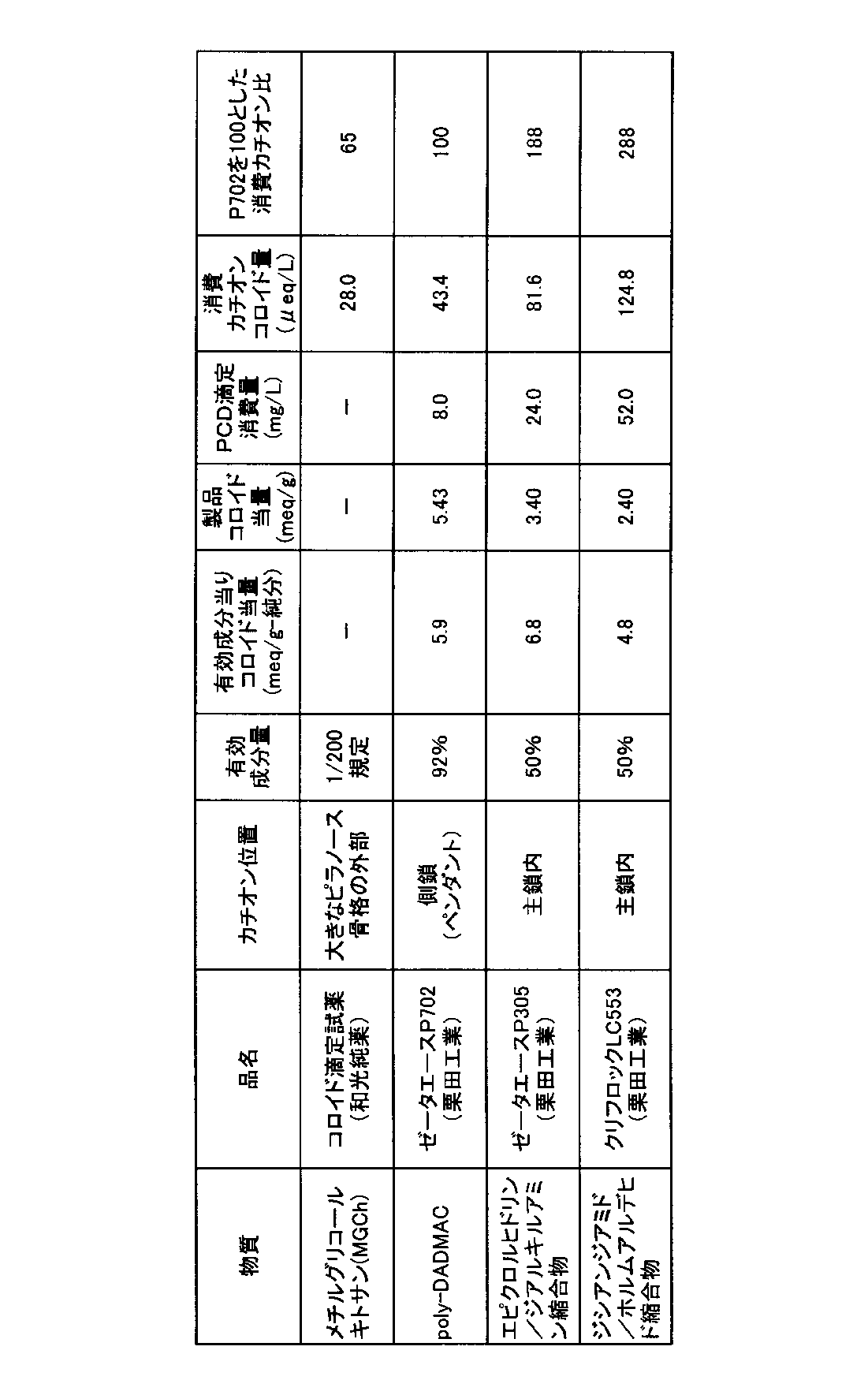
<実験例8>
工業用水自体が初めから非常に清澄な場合にMFRAC添加を行った場合、MFRAC自体による汚染が生じないかについて、水道水を用いて検証した。
工業用水自体が初めから非常に清澄な場合にMFRAC添加を行った場合、MFRAC自体による汚染が生じないかについて、水道水を用いて検証した。
使用した水道水は栃木県野木町水道水で、以下のように、前掲の表1に示すRO膜給水の膜汚染性評価区分は5ないしSで非常に清澄な水であり、アニオンコロイド量も非常に少ない。
≪栃木県野木町水道水水質≫
SFF:0.975
MFF:1.003
pH:6.84
アルカリ度:25.3mg/L
MGChによるコロイド荷電量:0.01μeq/L(poly-DAMAC(P702)換算消費量0.02mg/L)
SFF:0.975
MFF:1.003
pH:6.84
アルカリ度:25.3mg/L
MGChによるコロイド荷電量:0.01μeq/L(poly-DAMAC(P702)換算消費量0.02mg/L)
この栃木県野木町水道水にMFRACを添加して凝集処理した凝集処理水のNo.5A 2枚重ね濾過水について測定したSFF、MFFとMFRAC添加量との関係を図18に示す。
MFRAC添加量4mg/Lまでは極く微少のSFF、MFFの上昇(悪化)であるが、10mg/L添加では著しく悪化する。
栃木県野木町水道水を最大孔径0.45μmのMF膜で濾過した濾過水について、上記と同様にMFRAC添加量と凝集、No.5A 2枚重ね濾過水のSFF、MFFとの関係を調べた結果を図19に示す。図19の通り、MFRACリークによる汚染はなくなった。図19において、2/3MFとは、SFF、MFF測定時の全透過水は基準水1部で元の2/3に希釈されていることを意味する。
これらの結果から、以下のことが分かる。
(1) 非常に清澄な水にMFRACを添加すると少ない添加量では、清澄とは言え、MFRACの反応相手が存在するため、No.5A2枚重ね濾過(概ね1μm以上の微粒子を捕捉する)で、その凝集物は濾別される。
(2) MFRAC添加量が多くなると、MFRACだけの凝集になるが、凝集物は1μm以下の微粒子であるため、No.5A2枚重ね濾過を一部通過、リークする。
(3) (2)のリーク物質は最大孔径0.45μmのMF膜で捕捉されるので、その粒子径は0.5~1μmである。
(4) MFRACのコロイド粒子径は数10nm(0.02~0.05μm)で、前記のNo.2A2枚重ねを透過した粒子も元の20倍程度には凝集拡大している。
(1) 非常に清澄な水にMFRACを添加すると少ない添加量では、清澄とは言え、MFRACの反応相手が存在するため、No.5A2枚重ね濾過(概ね1μm以上の微粒子を捕捉する)で、その凝集物は濾別される。
(2) MFRAC添加量が多くなると、MFRACだけの凝集になるが、凝集物は1μm以下の微粒子であるため、No.5A2枚重ね濾過を一部通過、リークする。
(3) (2)のリーク物質は最大孔径0.45μmのMF膜で捕捉されるので、その粒子径は0.5~1μmである。
(4) MFRACのコロイド粒子径は数10nm(0.02~0.05μm)で、前記のNo.2A2枚重ねを透過した粒子も元の20倍程度には凝集拡大している。
<実験例9>
MFRACの自己凝集を促進するため、反応pHの上昇を試みた。
MFRACの自己凝集を促進するため、反応pHの上昇を試みた。
具体的には、栃木県野木町水道水について、以下の(i),(ii),(iii)の方法でpH7以上にpHを上昇させた後、MFRACを10mg/L添加して凝集処理した。凝集処理水のそのNo.5A 2枚重ね濾過水についてSFF、MFFを計測した。
(i) NaOH添加によりpH7.5に調整
(ii) 10分の空気曝気でpH7.34に調整
(iii) 液面開放20時間でpH7.14に調整
(i) NaOH添加によりpH7.5に調整
(ii) 10分の空気曝気でpH7.34に調整
(iii) 液面開放20時間でpH7.14に調整
結果を図20a及び20bに示す。
図20a、20bにおいて、(0-1)(pH6.84),(0-2)(pH6.84)はpH上昇を行っていない栃木県野木町水道水についての結果であり、(0-1)はMFRAC添加なし、(0-2)はMFRAC添加ありの場合である。
図20a、20bより、凝集処理に供する水のpHを7以上とすることにより、MFRACの自己凝集が促進され、MFRAC添加による汚染が防止されることが分かる。
<工業用水Iの凝集・濾過(実施例1~10、比較例1~8)>
工業用水Iに表4に示す薬剤を表4に示す添加量で添加して前述の方法で凝集、No.5A2枚重ね濾過を行った。この処理における評価結果を表4に示す。
工業用水Iに表4に示す薬剤を表4に示す添加量で添加して前述の方法で凝集、No.5A2枚重ね濾過を行った。この処理における評価結果を表4に示す。
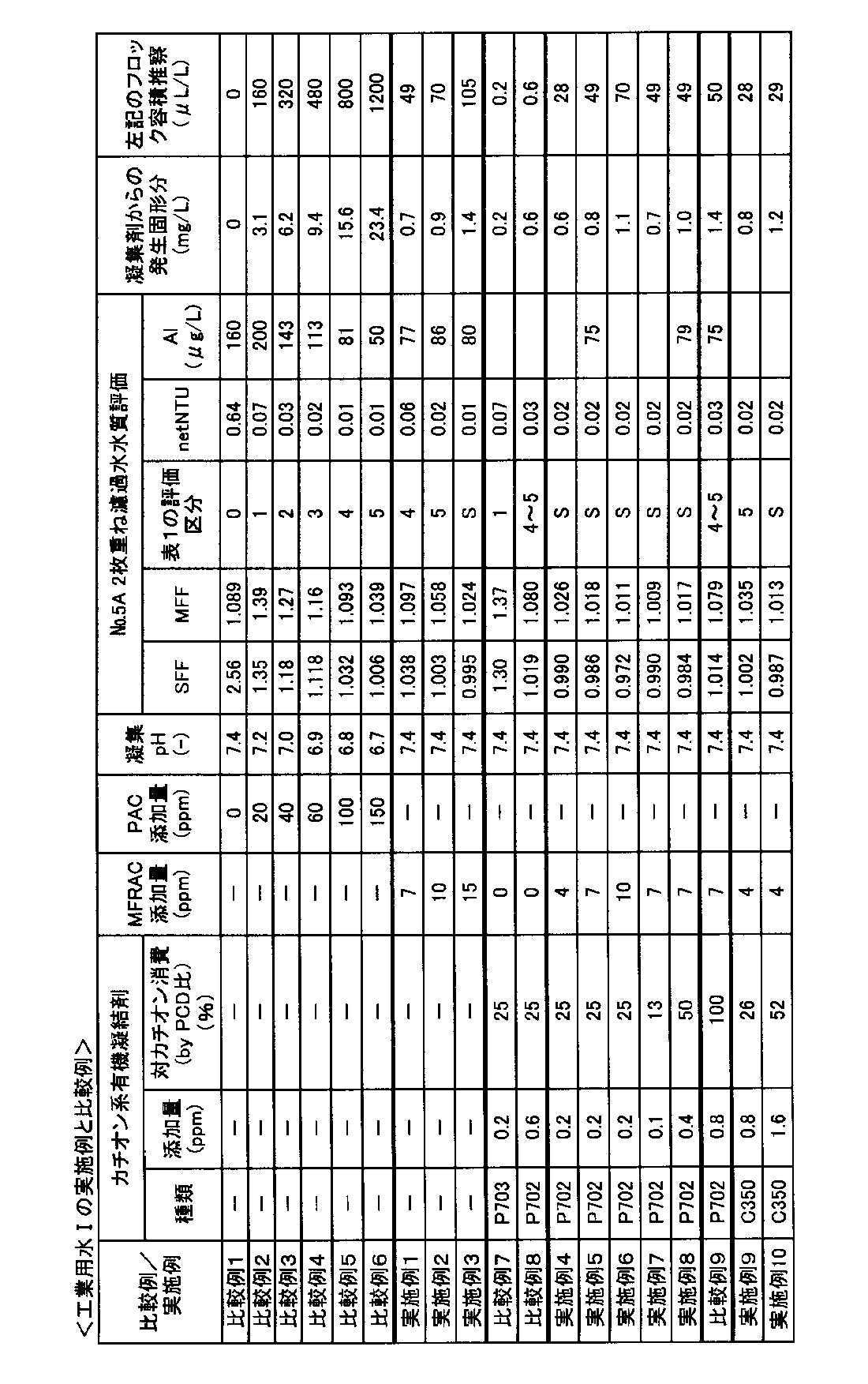
表4より以下のことが分かる。
実施例1~3よりMFRAC添加量7mg/L以上でNo.5A 2枚重ね濾過水は表1の評価区分4以上の清澄性が得られる。この時の凝集剤による固形物増加は0.7~1.4mg/Lで、PAC20mg/L添加時の3.1mg/Lの半分以下で、一次の固液分離を行わずに十分直接濾過処理が可能な量である。フロック容量の推察も50~100μL/LとPAC20mg/L添加時の160μg/Lを下回る。
比較例2の直接濾過可能なPAC20mg/L添加時の条件では表1の評価区分は1と良くない。
実施例1~3の凝集、No.5A 2枚重ね濾過水のAl濃度は比較例1の薬剤添加なしの160μg/Lから80μg/L前後となる。比較例2のPAC20mg/LではAl200μg/Lで薬剤なしより増加する。
凝集物の直接濾過ができるPAC20mg/L添加では、netNTU(濁度)は0.07と0.1未満で、外観透明な濾過水が得られるが、RO膜給水としては著しく不良である(比較例2)。
一次固液分離を行う設備での通常のPAC添加量40~60mg/L添加では、表1の評価区分で4に達しない(比較例3,4)。また残留AlもMFRAC添加の場合より多くなる。
PAC100mg/L添加の比較例5では表1の評価区分4で、残留Alも80μg/Lとなるが、凝集剤固形物発生量は15.6mg/Lで、MFRAC7mg/L添加時の20倍で、薬剤費用だけでなく、汚泥処分費用も増加する。
PAC150mg/L添加の比較例6では、No.5A 2枚重ね濾過水の残留AlがMFRAC添加の場合より下がり、表1の評価区分は5まで上昇するが、Sまでには至らず、当然のことながらPAC起因の固形物発生量が、推奨するP702(0.2mg/L)とMFRAC(4~7mg/L)併用添加の場合の40~30倍になる。
工業用水Iのカチオン系有機凝結剤の流動電位法でのカチオン消費量0.8mg/Lの25%に当る0.2mg/Lを併用すると、MFRAC4mg/LでNo.5A 2枚重ね濾過水の評価区分Sの最良が得られる。MFRACを7、10mg/Lと増やした場合も最良Sで、効果が落ちる傾向はない(実施例4~6)。
P702 0.2mg/L添加でMFRACを添加しない比較例7は評価区分1で劣る。
P702をカチオン消費量の75%の0.6mg/Lに増やすと、カチオン自体での凝結効果が高まり評価区分4~5となるが、わずかな工業用水の水質の変化で、流動荷電ゼロ付近になり、No.5A 2枚重ね濾過水のSFF、MFF悪化が起きるリスクが増加する(比較例8)。
MFRAC7mg/L添加条件でP702をそのカチオン消費量0.8mg/Lに対して0.1mg/L(13%)から0.4mg/L(50%)に変化させると(実施例5,7,8)、すべて評価区分SのNo.5A 2枚重ね濾過水が得られ、実施例1のP702 添加なしの評価区分4に対して2ランク良い、評価区分Sが得られる。
この結果から、工業用水Iで推奨されるP702添加量は、P702のカチオン消費量の15~50%であると言える。
MFRAC添加量4mg/L条件で、エピクロルヒドリン/ジアルキルアミン縮合物(C350)をカチオン消費量の26%を併用添加すると評価区分5、52%を併用添加すると評価区分Sが得られる(実施例9,10)。前者の効果は実施例4のP702 0.2mg/L(25%)とMFRAC4mg/Lの併用添加に匹敵する。
ただし、P702添加量純分0.2mg/L×0.92=0.18mg/Lであるのに対して、C350は0.8mg/L×0.51=0.41mg/Lと、P702に対して2倍以上となる。
ただし、P702添加量純分0.2mg/L×0.92=0.18mg/Lであるのに対して、C350は0.8mg/L×0.51=0.41mg/Lと、P702に対して2倍以上となる。
<工業用水IIの凝集・濾過(実施例11~16、比較例9~15)>
工業用水IIに表5に示す薬剤を表5に示す添加量で添加して前述の方法で凝集、No.5A2枚重ね濾過を行った。この処理における評価結果を表5に示す。
工業用水IIに表5に示す薬剤を表5に示す添加量で添加して前述の方法で凝集、No.5A2枚重ね濾過を行った。この処理における評価結果を表5に示す。

表5より以下のことが分かる。
工業用水IIではMFRAC添加量8mg/LでNo.5A 2枚重ね濾過水は表1の評価区分5の清澄性が得られる(実施例11)。
この時の凝集剤による固形物増加は0.7mg/Lで、PAC20mg/L添加時の3.1mg/L(比較例10)の1/4以下で、一次の固液分離を行わずに十分直接濾過処理が可能な量である。
この時の凝集剤による固形物増加は0.7mg/Lで、PAC20mg/L添加時の3.1mg/L(比較例10)の1/4以下で、一次の固液分離を行わずに十分直接濾過処理が可能な量である。
薬剤無添加の濾過水SFFは工業用水Iの場合の2.56に対して、工業用水IIでは1.45、MFFは同じく10.89に対して2.06で、原工業用水自体の汚れは少ない(比較例1,9)。
しかしPAC40mg/L添加時のSFFは1.18に対し1.13、MFFは1.27に対し1.23と表1の評価基準では評価区分2でPAC処理効果は芳しくなく、PAC120mg/L添加でようやく評価区分4となる(比較例11~13)。
P702をそのカチオン消費量の39%に当る0.2mg/L併用添加し、MFRAC2mg/L添加(実施例12)、4mg/L添加(実施例13)、8mg/L添加(実施例14)とすると、表4の評価区分は4~5から5へ、更にSからSへと向上する。比較例14のMFRACを添加しない場合は評価区分1~2で、MFRACの使用が絶対条件であることが示される。
MFRAC4mg/L添加の条件で、P702添加量をそのカチオン消費量の24%(0.12mg/L)、39%(0.2mg/L)、59%(0.3mg/L)、157%(0.8mg/L)とした時の表1の評価区分は5、5~S、5~S、4である(実施例15,13,16、比較例15)。
24~59%の範囲ではいずれも良好で変化は少なく、P702添加量はカチオン消費量の20~50%が適当であることが分かる。ただし、工業用水IIでは、P702なしでもMFRAC添加量を8mg/Lとすれば評価区分5の十分な効果が得られる。
一方、比較例15にようにP702添加量がカチオン消費量0.51mg/L超えると、明らかにNo.5A 2枚重ね濾過水の水質が悪化する。
<工業用水IIIの凝集・濾過(実施例17~20、比較例16~21)>
工業用水IIIに表6に示す薬剤を表6に示す添加量で添加して前述の方法で凝集、No.5A2枚重ね濾過を行った。この処理における評価結果を表6に示す。
工業用水IIIに表6に示す薬剤を表6に示す添加量で添加して前述の方法で凝集、No.5A2枚重ね濾過を行った。この処理における評価結果を表6に示す。

表6より以下のことが分かる。
工業用水の凝集、No.5A 2枚重ね濾過水のSFF/MFFは、工業用水Iが2.56/10.89、工業用水IIが1.45/2.06、工業用水IIIが2.45/28.47と、工業用水IIIのMFFが特に大きく、3つの工業用水の中では最も微粒子汚濁が大きい。
また、P702消費量も、工業用水IIIは、3つの工業用水の中では最大である。
また、P702消費量も、工業用水IIIは、3つの工業用水の中では最大である。
PAC添加量と表1における評価区分との関係は、実験例3の通り、工業用水I、IIと同じで、PACの凝集効果は相対的に工業用水I、IIより良い。
しかし、凝集物の直接濾過が可能な比較例17のPAC添加量20mg/Lでは表1の評価区分1である。2倍添加量の比較例18の40mg/Lでも、数値は改善するが評価区分1にとどまる。PACによる場合は、評価区分4以上を達成するには120mg/Lの添加が必要である(比較例20)。
これに対して、実施例17のMFRAC40mg/L添加では表1の評価区分5が得られる。しかし、直接濾過可能なPAC20mg/L添加時の固形物発生量3.1mg/L、フロック容積推定160μL/Lに対して、各々、3.7mg/L、280μL/Lと、これを上回っており、凝集物の直接濾過にはカチオン系凝結剤(P702)を併用する必要がある。
P702を流動電位法で計測されるカチオン消費量1.19mg/Lの59%に相当する0.7mg/Lを併用すると、実施例18のように、MFRACの10mg/Lの添加で評価区分5が得られる。この時の固形物発生量は1.6mg/L、フロック容積推察量は71μL/Lで、PAC20mg/L添加時相当の各々3.1mg/L、160μL/Lの1/2程度であり、十分に凝集水の直接濾過が可能である。
MFRAC20mg/Lを併用添加した実施例19でも、固形物発生量2.5mg/L、フロック容積推察量141μL/Lで直接濾過可能範囲である。
P702をカチオン消費量の59%に当る0.7mg/L添加し、MFRACを添加しない比較例21では、表1の評価区分1である。
P702の併用量をカチオン消費量の42%に当る0.5mg/LでMFRAC添加量を10mg/Lとした実施例20も、P702 0.7mg/L添加時に近い効果で評価区分は5である。
これらの結果から、工業用水IIIのP702及びMFRAC添加量の適性範囲は、工業用水I、工業用水IIの結果も踏まえて判断すると、主剤のMFRACは10~20mg/L、P702はカチオン消費量の30~70%と言える。
本発明を特定の態様を用いて詳細に説明したが、本発明の意図と範囲を離れることなく様々な変更が可能であることは当業者に明らかである。
本出願は、2016年1月29日付で出願された日本特許出願2016-016044に基づいており、その全体が引用により援用される。
本出願は、2016年1月29日付で出願された日本特許出願2016-016044に基づいており、その全体が引用により援用される。
Claims (16)
- 工業用水にメラミン・ホルムアルデヒド樹脂酸コロイド溶液を添加して凝集処理した後、濾過する工業用水の清澄化方法。
- 前記工業用水にカチオン系有機凝結剤を添加した後、前記メラミン・ホルムアルデヒド樹脂酸コロイド溶液を添加する請求項1に記載の工業用水の清澄化方法。
- 前記カチオン系有機凝結剤の添加量を、流動電位法により計測される前記工業用水の前記カチオン系有機凝結剤のカチオン消費量の70%以下とする請求項2に記載の工業用水の清澄化方法。
- 前記カチオン系有機凝結剤がポリジアリルジメチルアンモニウムクロリドである請求項2又は3に記載の工業用水の清澄化方法。
- 前記工業用水の曝気処理あるいはアルカリ添加により、前記凝集処理時のpHを7以上とする請求項1ないし4のいずれか1項に記載の工業用水の清澄化方法。
- 前記凝集処理水を、沈殿分離装置または浮上分離装置による固液分離を行うことなく、直接、圧力式または重力式濾過装置で濾過する請求項1ないし5のいずれか1項に記載の工業用水の清澄化方法。
- 前記凝集処理水を、沈殿分離装置または浮上分離装置による固液分離を行うことなく、直接、精密濾過膜モジュールまたは限外濾過膜モジュールで濾過する請求項1ないし5のいずれか1項に記載の工業用水の清澄化方法。
- 前記濾過して得られた濾過水を更に逆浸透膜処理する請求項1ないし7のいずれか1項に記載の工業用水の清澄化方法。
- 工業用水にメラミン・ホルムアルデヒド樹脂酸コロイド溶液を添加して凝集処理する凝集処理手段と、該凝集処理手段で得られた凝集処理水を濾過する濾過手段とを有する工業用水の清澄化装置。
- 前記凝集処理手段が、前記工業用水にカチオン系有機凝結剤を添加した後、前記メラミン・ホルムアルデヒド樹脂酸コロイド溶液を添加する手段である請求項9に記載の工業用水の清澄化装置。
- 前記凝集処理手段における前記カチオン系有機凝結剤の添加量が、流動電位法により計測される前記工業用水の前記カチオン系有機凝結剤のカチオン消費量の70%以下となる量である請求項10に記載の工業用水の清澄化装置。
- 前記カチオン系有機凝結剤がポリジアリルジメチルアンモニウムクロリドである請求項10又は11に記載の工業用水の清澄化装置。
- 前記工業用水の曝気処理あるいはアルカリ添加により、前記凝集処理手段におけるpHを7以上とするpH調整手段を有する請求項9ないし12のいずれか1項に記載の工業用水の清澄化装置。
- 前記濾過手段が圧力式または重力式濾過装置であり、前記凝集処理水は、沈殿装置または浮上装置による固液分離がなされることなく、直接、該濾過手段に導入される請求項9ないし13のいずれか1項に記載の工業用水の清澄化装置。
- 前記濾過手段が精密濾過膜モジュールまたは限外濾過膜モジュールであり、前記凝集処理水は、沈殿装置または浮上装置による固液分離がなされることなく、直接、該濾過手段に導入される請求項9ないし13のいずれか1項に記載の工業用水の清澄化装置。
- 前記濾過手段で得られた濾過水を逆浸透膜処理する逆浸透膜モジュールを有する請求項9ないし15のいずれか1項に記載の工業用水の清澄化装置。
Priority Applications (2)
| Application Number | Priority Date | Filing Date | Title |
|---|---|---|---|
| CN201680078703.3A CN108472559B (zh) | 2016-01-29 | 2016-09-20 | 工业用水的澄清化方法以及澄清化装置 |
| US16/064,860 US20180370825A1 (en) | 2016-01-29 | 2016-09-20 | Method and apparatus for clarifying industrial water |
Applications Claiming Priority (2)
| Application Number | Priority Date | Filing Date | Title |
|---|---|---|---|
| JP2016-016044 | 2016-01-29 | ||
| JP2016016044A JP6202115B2 (ja) | 2016-01-29 | 2016-01-29 | 工業用水の清澄化方法及び清澄化装置 |
Publications (1)
| Publication Number | Publication Date |
|---|---|
| WO2017130456A1 true WO2017130456A1 (ja) | 2017-08-03 |
Family
ID=59397551
Family Applications (1)
| Application Number | Title | Priority Date | Filing Date |
|---|---|---|---|
| PCT/JP2016/077637 Ceased WO2017130456A1 (ja) | 2016-01-29 | 2016-09-20 | 工業用水の清澄化方法及び清澄化装置 |
Country Status (4)
| Country | Link |
|---|---|
| US (1) | US20180370825A1 (ja) |
| JP (1) | JP6202115B2 (ja) |
| CN (1) | CN108472559B (ja) |
| WO (1) | WO2017130456A1 (ja) |
Cited By (1)
| Publication number | Priority date | Publication date | Assignee | Title |
|---|---|---|---|---|
| WO2019208532A1 (ja) * | 2018-04-25 | 2019-10-31 | 栗田工業株式会社 | 水処理方法及び水処理装置 |
Families Citing this family (3)
| Publication number | Priority date | Publication date | Assignee | Title |
|---|---|---|---|---|
| JP7229055B2 (ja) * | 2019-03-22 | 2023-02-27 | 伯東株式会社 | 湿式塗装ブース循環水処理剤及び処理方法 |
| WO2021030523A1 (en) * | 2019-08-13 | 2021-02-18 | Heritage Research Group | Compositions and methods for treating and reclaiming paint flush waste |
| JP7074156B2 (ja) | 2020-06-01 | 2022-05-24 | 栗田工業株式会社 | 水処理方法及び水処理装置 |
Citations (4)
| Publication number | Priority date | Publication date | Assignee | Title |
|---|---|---|---|---|
| JPH02169091A (ja) * | 1988-12-23 | 1990-06-29 | Yumiko Katsuragi | アルカリ性凝集法 |
| JP2006007208A (ja) * | 2004-05-26 | 2006-01-12 | Sanyo Chem Ind Ltd | 樹脂粒子含有廃水の処理方法 |
| JP2009226373A (ja) * | 2008-03-25 | 2009-10-08 | Kurita Water Ind Ltd | 有機物含有水の生物処理方法 |
| JP2014034006A (ja) * | 2012-08-09 | 2014-02-24 | Kobelco Eco-Solutions Co Ltd | 排水処理方法及び排水処理装置 |
Family Cites Families (5)
| Publication number | Priority date | Publication date | Assignee | Title |
|---|---|---|---|---|
| US4784776A (en) * | 1984-05-14 | 1988-11-15 | Pony Industries, Inc. | Process for treating aqueous suspension |
| JP3468784B2 (ja) * | 1992-08-25 | 2003-11-17 | 栗田工業株式会社 | 超純水製造装置 |
| US7338604B2 (en) * | 2002-11-01 | 2008-03-04 | Henkel Kommanditgesellschaft Auf Aktien | Process for recycling paint flush solution |
| JP5131005B2 (ja) * | 2008-04-09 | 2013-01-30 | 東レ株式会社 | 水処理方法及び水処理装置 |
| US20150197434A1 (en) * | 2014-01-14 | 2015-07-16 | Buckman Laboratories International, Inc. | Use Of Celluloses In Water Treatment |
-
2016
- 2016-01-29 JP JP2016016044A patent/JP6202115B2/ja active Active
- 2016-09-20 US US16/064,860 patent/US20180370825A1/en not_active Abandoned
- 2016-09-20 CN CN201680078703.3A patent/CN108472559B/zh active Active
- 2016-09-20 WO PCT/JP2016/077637 patent/WO2017130456A1/ja not_active Ceased
Patent Citations (4)
| Publication number | Priority date | Publication date | Assignee | Title |
|---|---|---|---|---|
| JPH02169091A (ja) * | 1988-12-23 | 1990-06-29 | Yumiko Katsuragi | アルカリ性凝集法 |
| JP2006007208A (ja) * | 2004-05-26 | 2006-01-12 | Sanyo Chem Ind Ltd | 樹脂粒子含有廃水の処理方法 |
| JP2009226373A (ja) * | 2008-03-25 | 2009-10-08 | Kurita Water Ind Ltd | 有機物含有水の生物処理方法 |
| JP2014034006A (ja) * | 2012-08-09 | 2014-02-24 | Kobelco Eco-Solutions Co Ltd | 排水処理方法及び排水処理装置 |
Cited By (2)
| Publication number | Priority date | Publication date | Assignee | Title |
|---|---|---|---|---|
| WO2019208532A1 (ja) * | 2018-04-25 | 2019-10-31 | 栗田工業株式会社 | 水処理方法及び水処理装置 |
| JP2019188337A (ja) * | 2018-04-25 | 2019-10-31 | 栗田工業株式会社 | 水処理方法及び水処理装置 |
Also Published As
| Publication number | Publication date |
|---|---|
| CN108472559A (zh) | 2018-08-31 |
| JP6202115B2 (ja) | 2017-09-27 |
| JP2017131871A (ja) | 2017-08-03 |
| CN108472559B (zh) | 2021-08-03 |
| US20180370825A1 (en) | 2018-12-27 |
Similar Documents
| Publication | Publication Date | Title |
|---|---|---|
| Norberg et al. | Surface characterization and performance evaluation of commercial fouling resistant low-pressure RO membranes | |
| Su et al. | Coagulation of surface water: Observations on the significance of biopolymers | |
| Edzwald et al. | Seawater pretreatment for reverse osmosis: Chemistry, contaminants, and coagulation | |
| CN103768947B (zh) | 膜分离方法 | |
| Pernitsky et al. | Selection of alum and polyaluminum coagulants: principles and applications | |
| Lee et al. | Optimizing the coagulant dose to control membrane fouling in combined coagulation/ultrafiltration systems for textile wastewater reclamation | |
| Farahani et al. | Recovery of cooling tower blowdown water for reuse: The investigation of different types of pretreatment prior nanofiltration and reverse osmosis | |
| CN103043821B (zh) | 一种膜法油墨废水深度处理方法 | |
| JP6202115B2 (ja) | 工業用水の清澄化方法及び清澄化装置 | |
| WO2007119479A1 (ja) | 水処理方法 | |
| CN111268819A (zh) | 一种钛白酸性废水中水回用工艺及装置 | |
| Wang et al. | Effect of aggregate characteristics under different coagulation mechanisms on microfiltration membrane fouling | |
| JP6287594B2 (ja) | 凝集処理方法および凝集処理装置 | |
| JP6738492B2 (ja) | 水処理方法および水処理装置 | |
| CN103508532B (zh) | 冷却水的排放水的处理方法和处理装置 | |
| CN102203018A (zh) | 膜分离处理方法 | |
| CN104023808B (zh) | 海水处理方法 | |
| Edzwald et al. | Polyaluminum coagulants for drinking water treatment: chemistry and selection | |
| TW201945294A (zh) | 水處理方法及水處理裝置 | |
| JP6648579B2 (ja) | 高アルカリ度水中のカルシウム除去方法 | |
| Chuang et al. | Improving the removal of anions by coagulation and dissolved air flotation in wastewater reclamation | |
| JP6848615B2 (ja) | 工業用水の清澄化方法 | |
| JP6015811B1 (ja) | 水処理方法及び水処理装置 | |
| WO2018173328A1 (ja) | 用水処理方法 | |
| JP2016093789A (ja) | 水処理方法及び水処理システム |
Legal Events
| Date | Code | Title | Description |
|---|---|---|---|
| 121 | Ep: the epo has been informed by wipo that ep was designated in this application |
Ref document number: 16888042 Country of ref document: EP Kind code of ref document: A1 |
|
| NENP | Non-entry into the national phase |
Ref country code: DE |
|
| 122 | Ep: pct application non-entry in european phase |
Ref document number: 16888042 Country of ref document: EP Kind code of ref document: A1 |