WO2017128672A1 - 用户设备和信息转发方法 - Google Patents
用户设备和信息转发方法 Download PDFInfo
- Publication number
- WO2017128672A1 WO2017128672A1 PCT/CN2016/092214 CN2016092214W WO2017128672A1 WO 2017128672 A1 WO2017128672 A1 WO 2017128672A1 CN 2016092214 W CN2016092214 W CN 2016092214W WO 2017128672 A1 WO2017128672 A1 WO 2017128672A1
- Authority
- WO
- WIPO (PCT)
- Prior art keywords
- information
- processor
- modem processor
- application service
- subscriber identity
- Prior art date
- Legal status (The legal status is an assumption and is not a legal conclusion. Google has not performed a legal analysis and makes no representation as to the accuracy of the status listed.)
- Ceased
Links
Images


Classifications
-
- H—ELECTRICITY
- H04—ELECTRIC COMMUNICATION TECHNIQUE
- H04W—WIRELESS COMMUNICATION NETWORKS
- H04W8/00—Network data management
- H04W8/18—Processing of user or subscriber data, e.g. subscribed services, user preferences or user profiles; Transfer of user or subscriber data
-
- H—ELECTRICITY
- H04—ELECTRIC COMMUNICATION TECHNIQUE
- H04L—TRANSMISSION OF DIGITAL INFORMATION, e.g. TELEGRAPHIC COMMUNICATION
- H04L45/00—Routing or path finding of packets in data switching networks
- H04L45/74—Address processing for routing
- H04L45/745—Address table lookup; Address filtering
-
- H—ELECTRICITY
- H04—ELECTRIC COMMUNICATION TECHNIQUE
- H04W—WIRELESS COMMUNICATION NETWORKS
- H04W40/00—Communication routing or communication path finding
- H04W40/02—Communication route or path selection, e.g. power-based or shortest path routing
-
- H—ELECTRICITY
- H04—ELECTRIC COMMUNICATION TECHNIQUE
- H04W—WIRELESS COMMUNICATION NETWORKS
- H04W60/00—Affiliation to network, e.g. registration; Terminating affiliation with the network, e.g. de-registration
- H04W60/04—Affiliation to network, e.g. registration; Terminating affiliation with the network, e.g. de-registration using triggered events
-
- H—ELECTRICITY
- H04—ELECTRIC COMMUNICATION TECHNIQUE
- H04W—WIRELESS COMMUNICATION NETWORKS
- H04W72/00—Local resource management
- H04W72/50—Allocation or scheduling criteria for wireless resources
- H04W72/51—Allocation or scheduling criteria for wireless resources based on terminal or device properties
-
- H—ELECTRICITY
- H04—ELECTRIC COMMUNICATION TECHNIQUE
- H04W—WIRELESS COMMUNICATION NETWORKS
- H04W88/00—Devices specially adapted for wireless communication networks, e.g. terminals, base stations or access point devices
- H04W88/02—Terminal devices
- H04W88/04—Terminal devices adapted for relaying to or from another terminal or user
-
- H—ELECTRICITY
- H04—ELECTRIC COMMUNICATION TECHNIQUE
- H04W—WIRELESS COMMUNICATION NETWORKS
- H04W4/00—Services specially adapted for wireless communication networks; Facilities therefor
- H04W4/20—Services signaling; Auxiliary data signalling, i.e. transmitting data via a non-traffic channel
-
- H—ELECTRICITY
- H04—ELECTRIC COMMUNICATION TECHNIQUE
- H04W—WIRELESS COMMUNICATION NETWORKS
- H04W88/00—Devices specially adapted for wireless communication networks, e.g. terminals, base stations or access point devices
- H04W88/02—Terminal devices
- H04W88/06—Terminal devices adapted for operation in multiple networks or having at least two operational modes, e.g. multi-mode terminals
Definitions
- the present invention relates to the field of communications technologies, and in particular, to a user equipment and an information forwarding method.
- 4G networks for example, networks based on the LTE standard (Long Term Evolution, a standard used by some "4G” networks) are being deployed worldwide. Due to the introduction of key technologies such as OFDM (Orthogonal Frequency Division Multiplexing) and MIMO (Multi-Input & Multi-Output), 4G correlation standards can significantly increase spectral efficiency and data transmission rate.
- OFDM Orthogonal Frequency Division Multiplexing
- MIMO Multi-Input & Multi-Output
- multi-mode user equipment user equipment with two subscriber identity cards, for example, dual-card dual-pass user equipment
- voice service standby the presence of multi-mode user equipment (user equipment with two subscriber identity cards, for example, dual-card dual-pass user equipment)
- voice service standby the presence of multi-mode user equipment (user equipment with two subscriber identity cards, for example, dual-card dual-pass user equipment)
- voice service standby the presence of multi-mode user equipment (user equipment with two subscriber identity cards, for example, dual-card dual-pass user equipment) enables the subscriber to implement voice service standby.
- data service links can be established.
- the existing user equipment generally includes a modem processor and an application service processor, wherein the modem processor is used to complete protocol processing, and is used for modulating and demodulating the transmitted and received communication data to implement communication with an external communication device, etc.
- the application service processor is used to handle complex logical operations and task assignments, providing users with interactive interfaces, running operating systems, and the like.
- the prior art has drawbacks and needs to be improved.
- the technical problem to be solved by the present invention is to provide a user for the above defects of the prior art.
- Device and information forwarding methods are provided.
- an information forwarding method for a user equipment including a first application service processor and a second application service processor, including the following steps:
- the second application service processor receives the information sent by the first application service processor, identifies the destination address included in the information, and forwards the information to the destination device according to the destination address.
- the destination device comprises: a modem processor coupled to the second application service processor, and a WIFI module coupled to the second application service processor.
- the destination address includes an IP address and a subnet mask.
- the WIFI module provides a WIFI data channel.
- the method further includes:
- the second application service processor receives the information sent by the first application service processor and forwards the information to the modem processor for data transmission according to the destination address;
- the second application service processor distributes the information to the modem processor and the WIFI module for concurrent data transmission according to the traffic distribution.
- the WIFI module acts as a hotspot.
- the second application service processor determines whether to send the information to the modem processor or to the WIFI module based on the subnet mask in the destination address.
- a user equipment including a first application service processor and a second application service processor;
- the first application service processor is configured to send information to the second application service processor
- the second application service processor is configured to receive information sent by the first application service processor, identify a destination address included in the information, and forward the information to the destination device according to the destination address.
- the destination device comprises: a modem processor coupled to the second application service processor, and a WIFI module coupled to the second application service processor.
- the destination address includes an IP address and a subnet mask.
- the WIFI module is configured to provide a WIFI data channel.
- the method further includes:
- the second application service processor is configured to receive information sent by the first application service processor, and forward the information to the modem processor for data transmission according to the destination address;
- the second application service processor is configured to receive information sent by the first application service processor, and forward the information to the WIFI module according to the destination address for data transmission;
- the second application service processor is configured to distribute the information to the modem processor and the WIFI module for concurrent data transmission according to the traffic distribution.
- the WIFI module is used as a hotspot.
- the second application service processor is configured to determine whether to send the information to the modem processor or to the WIFI module based on a subnet mask in the destination address.
- the user equipment further includes:
- the first subscriber identity card and the second subscriber identity card are both connected to the first modem processor, and the first modem processor is connected to the second modem processor;
- the first modem processor is configured to acquire information of the first user identification card, to communicate with the first 4G network based on the acquired information of the first user identification card, and perform voice service and data service;
- the first modem processor is further configured to acquire information about the second subscriber identity card, to perform voice service by communicating with the second 4G network based on the acquired information of the second subscriber identity card;
- the second modem processor is configured to acquire information of the second subscriber identity card from the first modem processor to communicate with the second 4G network based on the acquired information of the second subscriber identity card, Conduct data services.
- the first modem processor when the network is registered, is configured to acquire information of the first user identification card, and load the network parameter corresponding thereto according to the information of the first user identification card to start the network registration. So that the first subscriber identity card resides in the CS domain and the PS domain of the 4G network through the first modem processor.
- the first modem processor is configured to acquire information of the second user identification card, and load the network parameter corresponding thereto according to the information of the second user identification card, to perform network registration, so that the second user identifies
- the card resides in the CS domain of the 4G network through the first modem processor.
- the second modem processor is configured to perform a network registration based on information of the second subscriber identity card obtained from the first modem processor such that the second subscriber identity card is stationed through the second modem processor. Stay in the PS domain of the 4G network.
- the first modem processor includes a data interface
- the second modem processor includes a data interface coupled to the data interface of the first modem processor
- the second modem processor acquires information of the second subscriber identity card through the data interface.
- the user equipment further includes:
- the first application processor is coupled to the first modem processor for providing an interactive interface, receiving an operation instruction of the user, and transmitting the operation instruction to the first modem processor.
- the user equipment further includes:
- the second application processor is respectively connected to the second modem processor and the first application processor, and configured to receive the information sent by the first application processor and transparently transmit the information to the second modem processor.
- the first application server and the second application server are connected through a GPIO interface.
- the user equipment and information forwarding method embodying the present invention has the following beneficial effects: the second application service processor can implement a "routing" function to implement information from the first application service processor. Should be forwarded to make the WIFI module expandable, realize the function of the WIFI hotspot, or realize the function of adding a WIFI data channel to improve the user experience; on the other hand, through the interaction between the first modem processor and the second modem processor, The two user identification cards are supported on the 4G network, and the two 4G channels can be used for concurrent transmission of data services to improve transmission efficiency. In addition, when data services are transmitted, voice services can be transmitted to improve user experience. On the other hand, both subscriber identification cards are managed by the first modem processor, which improves management efficiency.
- FIG. 1 is a schematic structural diagram of hardware of a user equipment according to an embodiment of the present invention.
- FIG. 2 is a schematic structural diagram of hardware of a user equipment according to another embodiment of the present invention.
- FIG. 3 is a schematic diagram of interaction between a first modem processor and a second modem processor of a user equipment according to an embodiment of the present invention
- FIG. 4 is a schematic diagram of a format of a data packet according to an embodiment of the present invention.
- FIG. 5 is a flowchart of an information forwarding method according to an embodiment of the present invention.
- the LTE network is mainly described by a 4G network, and other types of 4G networks are also applicable to the present invention.
- the first 4G network and the second 4G network may be different networks of different operators, or the same or different networks of the same carrier.
- FIG. 1 is a schematic structural diagram of a user equipment according to an embodiment of the present invention.
- the user equipment includes a first application service processor 150, a second application service processor 160, a modem processor 1400, and a WIFI module 190.
- the WIFI module 190 can be one or more.
- the first application service processor 150 is configured to process complex logical operations and perform task assignment, provide an interactive interface for the user, and transmit operation instructions input by the user (for example, an operation instruction input by the user through the user interface regarding surfing or calling). Give other corresponding modules.
- the first application service processor 150 processor executes an operating system of the user device.
- the operating system is stored in a memory, and the operating system includes but is not limited to Windows, Linux, Unix, Mac OS X, IOS, Solaris, Android, and the like.
- the second application service processor 160 is configured to receive the information sent by the first application service processor 150, identify the destination address included in the information, and forward the information to the destination device according to the destination address.
- the destination device includes a second modem processor 140 and a WIFI module 190 that are respectively coupled to the second application service processor 160.
- the WIFI module 190 is configured to perform communication according to the WIFI method.
- the WIFI module can be used to provide a WIFI data channel or as a hotspot (ie, a WIFI hotspot AP).
- Second modem processor second modem processor.
- the data traffic can be transmitted through the WIFI module 190 and/or through the modem processor 1400.
- the destination address of the information transmitted by the first application service processor 150 includes an IP address and a subnet mask.
- the IP address is the address of the external Internet network, and the subnet mask at this time indicates that the IP address is a remote network.
- the second application service processor 160 can determine that the data service needs to be transmitted to the remote network based on the subnet mask in the destination address, and therefore, transmits the information to the WIFI module 190 and/or the modem processor that provides the data channel. 1400.
- data is transmitted through the radio frequency connected thereto.
- the WIFI module 190 processes the data and transmits it.
- the second application service processor 160 is configured to receive the information transmitted by the first application service processor 150 and forward the information to the modem processor 1400 for data transmission according to the destination address.
- the second application service processor 160 is configured to receive the information sent by the first application service processor 150, and forward the information to the WIFI module 190 according to the destination address for data transmission.
- the second application service processor 160 is configured to allocate information to the modem according to the traffic distribution.
- the processor 1400 and the WIFI module 190 perform data transmission concurrently.
- the WIFI module 190 functions as a hotspot, that is, the WIFI module 190 operates in an AP mode.
- the subnet mask indicates that the IP address is the remote network, and the subnet mask at this time is, for example, the format of 255.255. .
- the subnet mask is, for example, the format of 192.168. Thus, it is determined from the subnet mask whether information is to be sent to the modem processor 1400 or to the WIFI module 190.
- the user equipment further includes a first subscriber identity card 110, a second subscriber identity card 120, a first modem processor 130, a second modem processor 140, and a first application service processor. 150.
- the second application service processor 160 the first radio frequency 170, the second radio frequency 180, the digital signal processing chip 210, the codec 220, the earpiece 230, the microphone 240, and the like.
- the first user identification card 110 and the second user identification card 120 can manage different users associated with different or the same technical standards.
- the technical standards may be 2G communication technologies (eg, GSM, GPRS, EDGE), 3G communication technologies (eg, WCDMA, TDS-CDMA), 4G communication technologies (eg, LTE, TD-LTE) , or any other mobile communication technology (eg, 5G, 4.5G, etc.).
- the first subscriber identity card 110 maintains information for the first 4G network communication.
- the second subscriber identity card 120 holds information for the second 4G network communication.
- the subscriber identity card may store one or more of the following information: a unique serial number (ICCID), an International Mobile Subscriber Identity (IMSI), security authentication and encryption information, temporary information related to the local network, and user access.
- ICCID unique serial number
- IMSI International Mobile Subscriber Identity
- the first modem processor 130 is configured to perform protocol processing and to modulate and demodulate the transceived communication data to enable communication with an external communication device or the like.
- the second modem processor 140 is configured to perform protocol processing and to modulate the transceived communication data to enable communication with an external communication device or the like.
- the protocol processing includes performing a protocol stack that processes various network interfaces that interact with the network, for example, a protocol code specified in a communication standard such as LTE/WCDMA/GSM/TDSCDMA/1X/CDMA/EVDO. . These standard protocols are required for user equipment to interact with the carrier network (for example, by data traffic, by VOLTE, or by CS circuit domain).
- a protocol stack such as GSM.
- the first modem processor 130 includes one or more data interfaces, such as a general purpose I/O interface, a UART interface, a USB interface, an I2C interface, and the like.
- the second modem processor 140 also includes one or more data transfer interfaces, such as a general purpose I/O interface, a UART interface, a USB interface, an I2C interface, and the like.
- the high speed data transmission interface requires sufficient bandwidth and data transmission capability.
- the USB interface is a high-speed data transmission interface.
- the general purpose I/O interface acts as a state detection interface and is identified by the level of high/low or pulse.
- the first processing chip 200 can detect whether the second processing chip 300 is in a dead state by the level high/low state of the state detecting pin.
- the UART interface is a serial communication interface for transmitting basic information such as control signals and status signals.
- the first modem processor 130 can be respectively connected to the first user identification card 110 and the second user identification card 120 through the UART interface to acquire card information from the first user identification card 110 and the second user identification card 120, which will be described in detail later. The process of card information acquisition.
- the first modem processor 130 can be coupled to the second modem processor 140 via a UART interface to transmit card information to the second modem processor 140.
- the first modem processor 130 can be implemented by a modem chip
- the second modem processor 140 can be implemented by a modem chip.
- the network data is transmitted at a high speed through the high-speed USB data interface, and the number is satisfied.
- the low-power data interface is used to transmit information, thereby ensuring data transmission and saving power.
- the first modem processor 130 may perform operations such as network registration, authentication, and the like according to the acquired information.
- the first application service processor 150 and the second application service processor 160 are connected through a GPIO interface and a USB interface.
- the first radio frequency 170 and the second radio frequency 180 are used to perform up-conversion, down-conversion, filtering, amplification, transmission, reception, and the like of the signal.
- the radio access technologies involved in the first radio frequency 170 and the second radio frequency 180 may include LTE, GSM, GPRS, and the like.
- the first application service processor 150 receives the user instruction, and controls the first modem processor 130 to process the uplink data according to the user instruction; the first radio frequency 170 transmits the uplink data processed by the first modem processor 130 to the first 4G network.
- the first radio frequency 170 receives the downlink data from the first 4G network and transmits the data to the first modem processor 130 for processing; the first application service processor 150 outputs and stores the downlink data processed by the first modem processor 130. Wait for the operation.
- the first application service processor 150 receives the user instruction, and controls the second application service processor 150 to send the uplink data (the destination address is the external network address) to the second modem processor 140 according to the user instruction; the second modem processes The device 140 processes the uplink data; the second RF 180 transmits the uplink data processed by the second modem processor 140 to the second 4G network.
- the second radio frequency 180 receives the downlink data from the second 4G network and transmits the data to the second modem processor 140; the second modem processor 140 transparently transmits the processed downlink data to the second application service processor 160.
- the first application service processor 150 is thereby capable of performing operations such as output, storage, and the like.
- the WIFI module 190 since the WIFI module 190 is connected to the second application service processor 160, when the second application service processor 160 receives the data (information), it determines its flow direction according to its IP address and subnet mask. Therefore, the corresponding forwarding is performed, and the specific implementation process has been described above, and details are not described herein again.
- the same data service is simultaneously transmitted by the first subscriber identity card and the second subscriber identity card.
- traffic distribution is required, that is, the same data service is divided into different data blocks and transmitted by two data channels.
- the method can be implemented according to the equalization, or adjusting the traffic of the two channels according to the link quality (rate, delay, etc.).
- the digital signal processing chip 210 is used for audio signal processing, for example, audio signal processing such as echo suppression, noise suppression, etc. during a call.
- a codec 220 is used for A/D and D/A conversion.
- the earpiece 230 is for outputting a sound signal.
- the microphone 240 is used to acquire a voice signal.
- the first application service processor 150 transmits an operation instruction to the first modem processor 130, and sends an RRC connection request and the like to the first 4G network through the first radio frequency 170 to establish a voice with the called party. Communication connection.
- the voice uplink transmission process is: the microphone 240 collects the voice signal, and the codec 220 receives the collected voice signal and performs analog-to-digital conversion and transmits the signal to the digital signal processing chip 210; the digital signal processing chip 210 receives the received signal.
- the signal is audio processed and transmitted to the first modulation solution
- the voice downlink transmission process is: the first radio frequency 170 receives the downlink signal and transmits it to the first modem processor 130; the digital signal processing chip 210 performs audio processing on the signal processed by the first modem processor 130 and transmits the signal to the codec 220.
- the codec 220 performs analog-to-digital conversion on the received signal and transmits it to the earpiece 230.
- the process of establishing a voice communication connection is to receive a connection establishment request from the calling party to establish a voice communication connection with the calling party. Subsequent voice uplink transmission and downlink transmission processes are the same.
- the first application service processor 150 transmits an operation instruction to the first modem processor 130, and sends an RRC connection request and the like to the second 4G network through the first radio frequency 170 to establish a voice with the called party. Communication connection.
- the voice uplink transmission process is: the microphone 240 collects the voice signal, and the codec 220 receives the collected voice signal and performs analog-to-digital conversion and transmits the signal to the digital signal processing chip 210; the digital signal processing chip 210 receives the received signal.
- the signal is audio processed and transmitted to the first modem processor 130; the first radio frequency 170 transmits the signal processed by the first modem processor 130.
- the voice downlink transmission process is: the first radio frequency 170 receives the downlink signal and transmits it to the first modem processor 130; the digital signal processing chip 210 performs audio processing on the signal processed by the first modem processor 130 and transmits the signal to the codec 220.
- the codec 220 performs analog-to-digital conversion on the received signal and transmits it to the earpiece 230.
- the process of establishing a voice communication connection is to receive a connection establishment request from the calling party to establish a voice communication connection with the calling party. Subsequent voice uplink transmission and downlink transmission processes are the same.
- the first modem processor 130 also performs in-position detection of the first subscriber identity card 110 and the second subscriber identity card 120. specific:
- the first modem processor 130 communicates with the first subscriber identity card 110 and the second subscriber identity card 120 every predetermined time (e.g., 28 seconds) to confirm whether the subscriber identity card is in place to ensure normal communication. For example, the first modem processor 130 sends a null data to the first subscriber identity card 110 and the second subscriber identity card 120, respectively, and if so, confirms that the subscriber identity card is in place, otherwise the subscriber identity card is not in place.
- predetermined time e.g. 28 seconds
- the user equipment can use the data network of two user identification cards at the same time, and simultaneously download the data service to achieve the purpose of double data concurrent download acceleration. Therefore, the same user identification card needs to be processed by the first modem.
- the device 130 and the second modem processor 140 are accessed.
- the access referred to herein is information for obtaining a subscriber identity card to enable first subscription and network communication through association with the first subscriber identity card 110, and through a second subscription and network associated with the second subscriber identity card 120. Communication.
- the first modem processor 130 can be coupled to the first subscriber identity card 110 and the second subscriber identity card 120 via the UART data interface, thereby performing the first subscriber identity card 110 and the second subscriber identity card 120.
- Information read and write operations are performed.
- the acquisition of the information of the subscriber identity card by the second modem processor 140 needs to be acquired through interaction with the first modem processor 130.
- the first modem processor 130 and the second modem processor 140 pass through a data interface (eg, The UART data interface is connected to pass the information of the subscriber identity card to the second modem processor 140.
- the communication protocol between the first modem processor 130 and the second modem processor 140 is divided into a physical layer, a transport layer, and an application.
- the physical layer is used to transmit and receive data.
- the transport layer can extend multiple interfaces for different services corresponding to the application layer.
- the application layer is used to enable the service to perform the corresponding information acquisition function.
- the first modem processor 130 and the second modem processor 140 perform configuration of one or more ports, respectively.
- the port is a virtual logical port
- the configuration port includes a port number for which to be set, and the like.
- the port includes two types. The first one is used for the port corresponding to the service registered by the application layer, and the information acquired by the application layer service is transmitted to the transport layer; the second is used for the physical interface with the physical layer.
- Corresponding ports transmit information to the corresponding physical interface to enable the transmission (or reception) of information.
- the first modem processor 130 registers the service to perform the corresponding function.
- the service may be a preset service.
- the preset service is information for acquiring a user identification card.
- each service corresponds to a port, that is, the information acquired by the service will be transmitted through the port corresponding to the service.
- the port here refers to the first port described above.
- a plurality of ports are expandable, respectively corresponding to different services, and different transmission layers can be called according to actual communication transmission requirements to transmit information.
- the physical layer interface for example, USB interface, shared memory interface, etc.
- transport layer 1 For a first service, transport layer 1 is called for information transmission, and For a second service, transport layer 2 can be called for information transfer.
- the transport layer protocols used by different transport layers are different.
- the second modem processor 140 transmits a sync frame (synchronization frame) to the first modem processor 130; the first modem processor 130 is further configured to receive a sync frame and reply an acknowledgement frame (ACK) to the first modem processor 130.
- a connection is established with the second modem processor 140.
- the second modem processor 140 initiates a connection establishment process, that is, transmits a sync frame. Preset conditions can be initialized for power on, restart, etc.
- the first modem processor 130 and the second modem processor 140 establish a connection between sync and ACK, and the first modem processor 130 registers the service in no order.
- the first modem processor 130 registration service can be before or after the connection is established.
- the second modem processor 140 performs service discovery and registers a client corresponding to the service.
- the client registered by the second modem processor 140 corresponds to the service registered by the first modem processor 130.
- the client registered by the second modem processor 140 also corresponds to a corresponding port to transmit information to the transport layer through the port, and to the port via the transport layer to The corresponding physical interface.
- the first modem processor 130 and the second modem processor 140 can interact with the information.
- a data packet format as shown in FIG. 4 may be adopted. It includes the flag bit (header part), the length (the length of the entire packet), the control flag (the flag is the client or the server), the port number (local port), the service ID, the customer ID, the data ID, the control bit, the message ID, data length, data (data).
- the port number is the port number of the second port, which is used to mark which physical interface the data packet is transmitted to.
- the data packet can be correctly transmitted to the corresponding physical interface through the port number to implement interaction with the second modem processor 140.
- the port number field can be deleted, that is, the data packet transmitted to the opposite end does not include the port number field.
- the port numbers of different physical interfaces are different. Therefore, by specifying the port number in the data packet, the data packet can be correctly forwarded, so that the information acquired by the application layer registration service can be realized. Send through an accurate physical interface.
- the dual-core communication device of the embodiment of the present invention can support extending multiple physical interfaces (that is, extending multiple physical layer protocols).
- the service ID is the ID number of the registered service.
- the client ID is the ID number of the client corresponding to the service.
- the control bit is used to identify the data packet as a request packet, a reply packet, and the like.
- the data (data) adopts the type-len-value format, where type is used to indicate the type of the entire data block, len is used to indicate the size of the value area, and value is the data area.
- a service may need to send multiple data packets, whereby the message ID indicates the sequence number of the transmitted data packet.
- the data ID is used to distinguish the message type of the packet.
- a plurality of different types of data may be included in each data packet, whereby one message ID may correspond to multiple types. For example, information such as signal strength and network format can be transmitted as one data packet, and types of different data blocks are indicated by type in the data field, thereby implementing one data packet to transmit multiple information belonging to the same message type. .
- packet format shown in FIG. 4 is merely exemplary, and other similar formats may also be employed.
- the first modem processor 130 configures a first logical port corresponding to the preset service, and configures a second logical port corresponding to the physical interface of the first processor. .
- the information obtained by the preset service is transmitted to the second logical port through the first logical port to be transmitted to the second processor through the physical interface of the first processor.
- the second modem processor 140 configures a third logical port corresponding to the client and configures a fourth logical port corresponding to the physical interface of the second processor.
- the information received by the physical interface of the second processor is transmitted to the third logical port through the fourth logical port for transmission to the client.
- the second process 20 closes the client, port.
- the connection may be re-established with the first modem processor 130 by sending a synchronization frame (sync frame) to re-execute the registration service, register the client, and the like, and perform information interaction.
- the first modem processor 130 will shut down the corresponding service and port.
- the connection may be re-established with the second modem processor 140 by transmitting a synchronization frame (sync frame) to re-execute the registration service, register the client, etc., and perform information interaction.
- a C/S communication architecture is adopted between the first processor and the second processor to implement information sharing.
- the first modem processor 130 can share the acquired information to the second modem processor 140, that is, the second modem processor 140 can realize the instant acquisition of the information.
- different ports are registered for different services, corresponding transmissions can be extended, and multiple physical layer protocols can be extended.
- the user device includes a computer readable storage medium including a set of instructions that, when executed, cause at least one processor to perform operations including: controlling the first user identification card and the a second subscriber identity card is coupled to the first modem processor, the first modem processor being coupled to the second modem processor;
- the first modem processor is configured to acquire information of the first user identification card, to communicate with the first 4G network based on the acquired information of the first user identification card, and perform voice service and data service;
- the first modem processor is further configured to acquire information about the second subscriber identity card, to perform voice service by communicating with the second 4G network based on the acquired information of the second subscriber identity card;
- the second modem processor is configured to acquire information of the second subscriber identity card from the first modem processor to communicate with the second 4G network based on the acquired information of the second subscriber identity card, Conduct data services.
- the second modem processor obtains the user identification card information, in the search period of the search network:
- the first user identification card can be used as the primary card and the second user identification card.
- the first modem processor acquires the information of the first user identification card, and loads the network parameter corresponding to the first user identification card according to the acquired information, to register the first user identification card in the first network.
- CS voice service and PS data service acquires the information of the second subscriber identity card, and loads the network parameter corresponding to the second subscriber identity card according to the acquired information, to register the CS voice service of the second subscriber identity card in the first network.
- the computer storage medium includes a set of instructions that, when executed, cause the at least one processor to perform an operation comprising: controlling the first modem processor to acquire the first user identification card when the search is registered And loading the network parameters corresponding thereto according to the information of the first subscriber identity card to initiate the network registration, so that the first subscriber identity card resides in the CS domain and the PS domain of the 4G network through the first modem processor.
- the first modem processor also transmits the acquired information of the second subscriber identity card to the second modem processor.
- the second modem processor registers the PS data service of the second subscriber identity card in the second network according to the received information of the second subscriber identity card.
- the second modem processor can also perform read and write operations on the first subscriber identity card and/or the second subscriber identity card.
- the computer storage medium includes a set of instructions that, when executed, cause at least one processor to perform operations including: the first modem processor obtaining information of a second subscriber identity card, and based on the second subscriber identity card Information is loaded with its corresponding network parameters for registration, such that the second subscriber identity card resides in the CS domain of the 4G network through the first modem processor; and controls the second modem processor based on the slave modem
- the information of the second user identification card acquired at the processor is searched for, so that the second user identification card resides in the PS domain of the 4G network through the second modem processor.
- a computer storage medium configured to control the first modem processor to include a data interface
- the second modem processor includes a data interface coupled to the data interface of the first modem processor; and the second modem processor acquires the second user through the data interface Identify the card's information.
- the computer storage medium includes a set of instructions that, when executed, cause at least one processor to perform operations including: controlling a first application processor, providing an interactive interface with a first modem processor, and receiving a user's operational instructions And transmitting the operational command to the first modem processor.
- the user equipment further includes: a second application processor; the computer storage medium comprising a set of instructions that, when executed, cause the at least one processor to perform operations comprising: processing by the second application processor and the second modem And the first application processor is connected to receive information sent by the first application processor and transparently transmitted to the second modem processor.
- the second application service processor can implement the function of “routing”, and implements corresponding forwarding of information from the first application service processor, so that the WIFI module can be extended to implement the function of the WIFI hotspot. Or realize the function of adding a WIFI data channel to improve the user experience; on the other hand, through the interaction between the first modem processor and the second modem processor, two user identification cards are supported to reside on the 4G network, and the available Two 4G channels perform concurrent transmission of data services to improve transmission efficiency; in addition, when data services are transmitted, voice services can be transmitted to improve user experience; on the other hand, two subscriber identification cards are processed by the first modem. Management can improve management efficiency.
- 5 is a flowchart of an information forwarding method according to an embodiment of the present invention.
- the information forwarding method in the embodiment of the present invention includes:
- the second application service processor receives the information sent by the first application service processor.
- the second application service processor identifies the destination address included in the information, and forwards the information to the destination device according to the destination address.
- the destination device includes: a modem processor connected to the second application service processor, and a WIFI module connected to the second application service processor.
- the destination address includes the IP address and subnet mask.
- the WIFI module can be used to provide a WIFI data channel, or used as a WIFI hotspot. If the WIFI module is configured to provide a WIFI data channel (ie, working in STA mode), the second application service processor receives the information sent by the first application service processor, and sends a message according to the destination address. Forwarding to the modem processor for data transmission; or the second application service processor receives the information sent by the first application service processor and forwards the information to the WIFI module for data transmission according to the destination address; or the second application service processing Based on the traffic distribution, the information is distributed to the modem processor and the WIFI module for concurrent data transmission.
- the WIFI module is configured to provide a WIFI data channel (ie, working in STA mode)
- the second application service processor receives the information sent by the first application service processor, and sends a message according to the destination address. Forwarding to the modem processor for data transmission; or the second application service processor receives the information sent by the first application service processor and forwards the information to the WIFI module
- the second application service processor determines whether to send the information to the modem processor or to the WIFI module according to the subnet mask in the destination address. If sent to the WIFI module, the WIFI module provides a hotspot function.
- the second application service processor can implement the function of “routing”, and implements corresponding forwarding of information from the first application service processor, so that the WIFI module can be extended to implement WIFI.
- Hotspot function or realize the function of adding a WIFI data channel to improve user experience;
- the network can use two 4G channels for concurrent transmission of data services to improve transmission efficiency.
- voice services can be transmitted to improve user experience.
- two user identification cards are The first modem processor is managed to improve management efficiency.
- User equipment may include any mobile, portable computing or communication device, such as a cellular device, that is capable of being connected to a network.
- the user device can be a cellular telephone (mobile phone), a navigation system, a computing device, a camera, a PDA, a music device, a gaming device, or a handheld device with wireless connectivity.
- a plurality means two or more unless otherwise specified.
- the terms “first”, “second” and the like are used for descriptive purposes only and are not to be construed as indicating or implying relative importance.
- Any process or method description in the flowcharts or otherwise described in the embodiments of the invention may be understood to represent a step comprising one or more steps for implementing a particular logical function or process.
- Modules, segments or portions of code that perform the instructions, and the scope of the embodiments of the invention includes additional implementations, which may not be in the order shown or discussed, including in a substantially simultaneous manner or vice versa depending on the functionality involved.
- the functions are performed in order, which should be understood by those skilled in the art of the embodiments of the present invention.
- the disclosed apparatus and method may be implemented in other manners.
- the device embodiments described above are merely illustrative.
- the division of the unit is only a logical function division.
- there may be another division manner such as: multiple units or components may be combined, or Can be integrated into another system, or some features can be ignored or not executed.
- the coupling, or direct coupling, or communication connection of the components shown or discussed may be indirect coupling or communication through some interface, device or unit.
- the letter connection can be electrical, mechanical or other form.
- the units described above as separate components may or may not be physically separated, and the components displayed as the unit may or may not be physical units, that is, may be located in one place or distributed to multiple network units; Some or all of the units may be selected according to actual needs to achieve the purpose of the solution of the embodiment.
- each functional unit in each embodiment of the present invention may be integrated into one processing module, or each unit may be separately used as one unit, or two or more units may be integrated into one unit; the above integration
- the unit can be implemented in the form of hardware or in the form of hardware plus software functional units.
- the foregoing program may be stored in a computer readable storage medium, and the program is executed when executed.
- the foregoing storage device includes the following steps: the foregoing storage medium includes: a mobile storage device, a read-only memory (ROM), a random access memory (RAM), a magnetic disk, or an optical disk.
- ROM read-only memory
- RAM random access memory
- magnetic disk or an optical disk.
- optical disk A medium that can store program code.
- the present invention provides a user equipment and an information forwarding method.
- the second application service processor can implement a "routing" function, and implements corresponding forwarding of information from the first application service processor, so that the WIFI module can be expanded.
- Two 4G channels perform concurrent transmission of data services to improve transmission efficiency; in addition, when data services are transmitted, voice services can be transmitted to improve user experience; on the other hand, two subscriber identification cards are processed by the first modem. Management can improve management efficiency.
Landscapes
- Engineering & Computer Science (AREA)
- Computer Networks & Wireless Communication (AREA)
- Signal Processing (AREA)
- Databases & Information Systems (AREA)
- Telephonic Communication Services (AREA)
Abstract
本发明公开了一种用户设备和信息转发方法,所述信息转发方法应用于包括第一应用服务处理器和第二应用服务处理器的用户设备,包括以下步骤:第二应用服务处理器接收第一应用服务处理器发送的信息,并识别信息中包含的目的地址,以及根据目的地址将信息转发至目的设备。
Description
本发明涉及通信技术领域,更具体地说,涉及一种用户设备和信息转发方法。
随着移动通信技术的发展,先进的蜂窝网络(例如,基于LTE标准(长期演进,一些“4G”网络所使用的标准)的网络)正在全世界布署。由于引入了OFDM(Orthogonal Frequency Division Multiplexing,正交频分复用)和MIMO(Multi-Input&Multi-Output,多输入多输出)等关键技术,利用4G相关标准可显著增加频谱效率和数据传输速率。
另一方面,在提高网络速率和频段利用率的同时,多模用户设备(具有两个用户识别卡的用户设备,例如,双卡双通用户设备)的出现,使得用户在实现语音业务的待机同时,能建立数据业务链接。
现有的用户设备一般包括一个调制解调器处理器和一个应用服务处理器,其中,调制解调器处理器用于完成协议处理,以及用于对收发的通信数据进行调制解调,以实现与外部通信设备的通信等功能。应用服务处理器用于处理复杂的逻辑操作以及进行任务分配,为用户提供交互接口,运行操作系统等。
当为了扩展移动终端的通信功能,需要增加新的调制解调器处理器和应用服务处理器时,如何实现原有应用服务处理器和新增应用服务处理器之间的数据的传输和转发,以实现相应的通信功能,现有技术中并没有提出解决方案。
现有技术存在缺陷,需要改进。
发明内容
本发明要解决的技术问题在于,针对现有技术的上述缺陷,提供一种用户
设备和信息转发方法。
本发明解决其技术问题所采用的技术方案是:
第一方面,提供一种信息转发方法,应用于包括第一应用服务处理器和第二应用服务处理器的用户设备,包括以下步骤:
第二应用服务处理器接收第一应用服务处理器发送的信息,并识别信息中包含的目的地址,以及根据目的地址将信息转发至目的设备。
在一个实施例中,所述目的设备包括:与所述第二应用服务处理器连接的调制解调器处理器、与所述第二应用服务处理器连接的WIFI模块。
在一个实施例中,所述目的地址包括IP地址和子网掩码。
在一个实施例中,所述WIFI模块提供WIFI数据通道。
在一个实施例中,所述方法还包括:
第二应用服务处理器接收第一应用服务处理器发送的信息,并根据目的地址将信息转发至调制解调器处理器以进行数据传输;或,
第二应用服务处理器接收第一应用服务处理器发送的信息,并根据目的地址将信息转发至WIFI模块以进行数据传输;或,
第二应用服务处理器根据流量分配,将信息分配至调制解调器处理器和WIFI模块以并发进行数据传输。
在一个实施例中,所述WIFI模块作为热点。
在一个实施例中,所述第二应用服务处理器根据目的地址中的子网掩码决定将该信息发送给调制解调器处理器,还是发送给所述WIFI模块。
第二方面,提供一种用户设备,包括第一应用服务处理器和第二应用服务处理器;
所述第一应用服务处理器,配置为向所述第二应用服务处理器发送信息;
所述第二应用服务处理器用于接收所述第一应用服务处理器发送的信息,并识别信息中包含的目的地址,以及根据目的地址将信息转发至目的设备。
在一个实施例中,所述目的设备包括:与所述第二应用服务处理器连接的调制解调器处理器、与所述第二应用服务处理器连接的WIFI模块。
在一个实施例中,所述目的地址包括IP地址和子网掩码。
在一个实施例中,所述WIFI模块用于提供WIFI数据通道。
在一个实施例中,所述方法还包括:
第二应用服务处理器用于接收第一应用服务处理器发送的信息,并根据目的地址将信息转发至调制解调器处理器以进行数据传输;或,
第二应用服务处理器用于接收第一应用服务处理器发送的信息,并根据目的地址将信息转发至WIFI模块以进行数据传输;或,
第二应用服务处理器用于根据流量分配,将信息分配至调制解调器处理器和WIFI模块以并发进行数据传输。
在一个实施例中,所述WIFI模块用于作为热点。
在一个实施例中,所述第二应用服务处理器用于根据目的地址中的子网掩码决定将该信息发送给调制解调器处理器,还是发送给所述WIFI模块。
在一个实施例中,所述用户设备还包括:
第一用户识别卡;
第二用户识别卡;
第一调制解调器处理器;
第二调制解调器处理器;
所述第一用户识别卡和所述第二用户识别卡均与所述第一调制解调器处理器连接,所述第一调制解调器处理器与所述第二调制解调器处理器连接;
所述第一调制解调器处理器,用于获取所述第一用户识别卡的信息,以基于获取的所述第一用户识别卡的信息与第一4G网络通信,进行语音业务和数据业务;
所述第一调制解调器处理器,还用于获取所述第二用户识别卡的信息,以基于获取的所述第二用户识别卡的信息与第二4G网络通信,进行语音业务;
所述第二调制解调器处理器,用于从所述第一调制解调器处理器处获取所述第二用户识别卡的信息,以基于获取的所述第二用户识别卡的信息与第二4G网络通信,进行数据业务。
在一个实施例中,在搜网注册时,所述第一调制解调器处理器用于获取第一用户识别卡的信息,并根据第一用户识别卡的信息加载与其对应的网络参数,以启动搜网注册,使得第一用户识别卡通过第一调制解调器处理器驻留在4G网络的CS域和PS域。
在一个实施例中,所述第一调制解调器处理器用于获取第二用户识别卡的信息,并根据第二用户识别卡的信息加载与其对应的网络参数,以进行搜网注册,使得第二用户识别卡通过第一调制解调器处理器驻留在4G网络的CS域。
在一个实施例中,所述第二调制解调器处理器用于根据从第一调制解调器处理器处获取的第二用户识别卡的信息,进行搜网注册,使得第二用户识别卡通过第二调制解调器处理器驻留在4G网络的PS域。
在一个实施例中,第一调制解调器处理器包括数据接口,第二调制解调器处理器包括与所述第一调制解调器处理器的数据接口连接的数据接口;
第二调制解调器处理器通过数据接口获取第二用户识别卡的信息。
在一个实施例中,所述用户设备还包括:
第一应用处理器,与第一调制解调器处理器连接,用于提供交互接口,接收用户的操作指令,以及将操作指令传输给第一调制解调器处理器。
在一个实施例中,所述用户设备还包括:
第二应用处理器,分别与第二调制解调器处理器和第一应用处理器连接,用于接收第一应用处理器发送的信息,并透传给第二调制解调器处理器。
在一个实施例中,所述第一应用服务器和第二应用服务器间通过GPIO接口连接。
实施本发明的用户设备和信息转发方法,具有以下有益效果:第二应用服务处理器可实现“路由”的功能,实现将来自第一应用服务处理器的信息进行相
应的转发,使得可扩展WIFI模块,实现WIFI热点的功能,或实现增加一条WIFI数据通道的功能,提高用户体验;另一方面,通过第一调制解调器处理器和第二调制解调器处理器间的交互,实现支持两张用户识别卡均驻留在4G网络,可利用两条4G通道进行数据业务的并发传输,提高传输效率;此外,当进行数据业务传输时,还可进行语音业务传输,提高用户体验;另一方面,两张用户识别卡均由第一调制解调器处理器进行管理,可提高管理效率。
下面将结合附图及实施例对本发明作进一步说明,附图中:
图1是本发明一实施例的用户设备硬件结构示意图;
图2是本发明另一实施例的用户设备硬件结构示意图;
图3是本发明实施例的用户设备的第一调制解调器处理器和第二调制解调器处理器的交互示意图;
图4是本发明实施例的数据包的格式示意图;
图5是本发明实施例的信息转发方法的流程图。
为了对本发明的技术特征、目的和效果有更加清楚的理解,现对照附图详细说明本发明的具体实施方式。
在本发明的实施例中,主要以4G网络为LTE网络进行描述,其它类型的4G网络也同样适用于本发明。在本发明的后续实施例中,第一4G网络和第二4G网络可为不同运营商的不同网络,或为相同运营商的相同或不同网络。
实施例1
第一调制解调器处理器第二调制解调器处理器参见图1为本发明实施例的用户设备的结构示意图。在该实施例中,用户设备包括第一应用服务处理器150、第二应用服务处理器160、调制解调器处理器1400和WIFI模块190。在一些实施例中,WIFI模块190可为一个或多个。
第一应用服务处理器150用于处理复杂的逻辑操作以及进行任务分配,为用户提供交互接口,将用户输入的操作指令(例如,用户通过用户界面输入的有关上网或打电话的操作指令)传输给其它相应的模块。第一应用服务处理器150处理器执行用户设备的操作系统。操作系统存储于存储器中,操作系统包括但不限于Windows、Linux、Unix、Mac OS X、IOS、Solaris、Android等。第二应用服务处理器160用于接收第一应用服务处理器150发送的信息,并识别信息中包含的目的地址,以及根据目的地址将信息转发至目的设备。在本发明的实施例中,目的设备包括分别与第二应用服务处理器160连接的第二调制解调器处理器140和WIFI模块190。
WIFI模块190用于根据WIFI方法执行通信。在本发明的实施例中WIFI模块可用于提供WIFI数据通道或用作热点(即WIFI热点AP)。
第二调制解调器处理器第二调制解调器处理器。
在本发明的一实施例中,若WIFI模块190用于提供数据通道,则数据业务可通过WIFI模块190和/或通过调制解调器处理器1400传输。在此种情况下,第一应用服务处理器150发送的信息的目的地址包括IP地址和子网掩码。其中,IP地址为外部Internet网的地址,此时的子网掩码说明IP地址为远程网。由此,第二应用服务处理器160根据目的地址中的子网掩码可判定数据业务是需要传输到远程网的,因此,将信息发送给提供数据通道的WIFI模块190和/或调制解调器处理器1400。调制解调器处理器1400进行处理后,通过与其连接的射频进行数据发送。WIFI模块190对数据进行处理后进行发送。
具体的,可包括以下三种情况:
(1)第二应用服务处理器160用于接收第一应用服务处理器150发送的信息,并根据目的地址将信息转发至调制解调器处理器1400以进行数据传输。
(2)第二应用服务处理器160用于接收第一应用服务处理器150发送的信息,并根据目的地址将信息转发至WIFI模块190以进行数据传输。
(3)第二应用服务处理器160用于根据流量分配,将信息分配至调制解调
器处理器1400和WIFI模块190以并发进行数据传输。
在本发明的另一实施例中,WIFI模块190用作为热点,即WIFI模块190工作在AP模式。此时,第二应用服务处理器160接收的第一应用服务处理器150发送的信息的目的地址中的子网掩码会有两种情况。若信息是要通过调制解调器处理器1400的处理后发送到外网,则子网掩码说明IP地址为远程网,此时的子网掩码为,例如,255.255.......的格式。若信息是要发送给作为热点的WIFI模块190,则子网掩码为,例如,192.168.......的格式。由此,根据子网掩码即可确定要将信息发送给调制解调器处理器1400,还是WIFI模块190。
参见图2,在本发明一实施例中,用户设备还包括第一用户识别卡110、第二用户识别卡120、第一调制解调器处理器130、第二调制解调器处理器140、第一应用服务处理器150、第二应用服务处理器160、第一射频170、第二射频180、数字信号处理芯片210、编解码器220、听筒230、麦克风240等。
其中,第一用户识别卡110和第二用户识别卡120可管理与不同或相同的技术标准相关联的不同用户。在特定非限制性实例中,技术标准可为2G通信技术(例如,GSM、GPRS、EDGE)、3G通信技术(例如,WCDMA、TDS-CDMA)、4G通信技术(例如,LTE、TD-LTE),或任何其它移动通信技术(例如,5G、4.5G等等)。
在一个实施例中,第一用户识别卡110保存有用于第一4G网络通信的信息。第二用户识别卡120保存有用于第二4G网络通信的信息。具体的,用户识别卡可存储以下信息中的一个或多个:唯一序列号(ICCID)、国际移动用户标识(IMSI)、安全认证和加密信息、与本地网络相关的临时信息、用户接入的业务列表、个人身份号码(PIN)和用于PIN解锁的个人解锁码(PUK)。
在本发明的实施例中,第一调制解调器处理器130用于完成协议处理,以及用于对收发的通信数据进行调制解调,以实现与外部通信设备的通信等。
第二调制解调器处理器140用于完成协议处理,以及用于对收发的通信数据进行调制解调,以实现与外部通信设备的通信等。
在本发明的一实施例中,协议处理包括执行处理各种与网络交互的网络制式的协议栈,例如,LTE/WCDMA/GSM/TDSCDMA/1X/CDMA/EVDO等通信标准里规定好的协议代码。这些标准的协议是用户设备与运营商网络进行交互(例如,通过数据流量上网、通过VOLTE打电话或者通过CS电路域打电话等)所必须遵从的。在本发明的实施例中,由于第二调制解调器处理器140不进行语音业务的处理,因此,其可不执行处理如GSM的协议栈。
第一调制解调器处理器130包括一个或多个数据接口,例如,通用I/O接口、UART接口、USB接口、I2C接口等等。第二调制解调器处理器140同样包括一个或多个数据传输接口,例如,通用I/O接口、UART接口、USB接口、I2C接口等等。
考虑到4G网络的下行速率较快(150Mbps),为了能做到对第二调制解调器处理器140的数据的即收即送(无需缓冲),高速数据传输接口需要足够的带宽和数据传输能力。USB接口即为高速数据传输接口。
通用I/O接口作为状态侦测接口,通过电平的高/低或者脉冲来识别。例如,第一处理芯片200可通过状态侦测引脚的电平高/低状态,检测第二处理芯片300是否处于死机状态。
UART接口是一种串行通信接口,用于传输控制信号、状态信号等基本信息。
第一调制解调器处理器130可通过UART接口分别与第一用户识别卡110和第二用户识别卡120连接,以从第一用户识别卡110和第二用户识别卡120获取卡信息,后续将详细介绍卡信息获取的流程。
此外,第一调制解调器处理器130可通过UART接口与第二调制解调器处理器140连接,以将卡信息传输给第二调制解调器处理器140。
第一调制解调器处理器130可通过modem芯片实现,第二调制解调器处理器140可通过modem芯片实现。
在本发明的实施例中,通过高速USB数据接口高速传输网络数据,满足数
据传输需求,当没有网络数据需要传输时,使用低功耗的低速数据接口传输信息,从而既保证了数据传输又能节省功耗。
第一调制解调器处理器130通过数据接口获取第一用户识别卡110和第二用户识别卡120的信息后,第一调制解调器处理器130可根据获取的信息进行搜网注册、鉴权等操作。
参见图2,第一应用服务处理器150和第二应用服务处理器160间通过GPIO接口和USB接口连接。第一射频170和第二射频180用于完成信号的上变频、下变频、滤波、放大、发射、接收等。第一射频170和第二射频180所涉及的无线接入技术可以包括LTE、GSM、GPRS等等。
当用户设备进行数据业务传输时,分为以下情况:
(一)通过第一用户识别卡进行数据业务
上行:第一应用服务处理器150接收用户指令,并根据用户指令控制第一调制解调器处理器130对上行数据进行处理;第一射频170将第一调制解调器处理器130处理后的上行数据传输至第一4G网络。
下行:第一射频170接收来自第一4G网络的下行数据,并传输给第一调制解调器处理器130处理;第一应用服务处理器150将第一调制解调器处理器130处理后的下行数据进行输出、存储等操作。
(二)通过第二用户识别卡进行数据业务
上行:第一应用服务处理器150接收用户指令,并根据用户指令控制第二应用服务处理器150将上行数据(其目的地址是外网地址)发送给第二调制解调器处理器140;第二调制解调器处理器140对上行数据进行处理;第二射频180将第二调制解调器处理器140处理后的上行数据传输至第二4G网络。
下行:第二射频180接收来自第二4G网络的下行数据,并传输给第二调制解调器处理器140处理;第二调制解调器处理器140通过第二应用服务处理器160将处理后的下行数据透传给第一应用服务处理器150,由此可进行输出、存储等操作。
在本发明的实施例中,由于WIFI模块190与第二应用服务处理器160连接,当第二应用服务处理器160接收到数据(信息)时,根据其IP地址和子网掩码判断其流向,从而进行相应的转发,其具体实现过程上述已进行了描述,在此不再赘述。
(三)同时通过第一用户识别卡和第二用户识别卡进行数据业务
同时通过第一用户识别卡和第二用户识别卡进行数据业务时,可包括以下两种情况:
一是,分别通过第一用户识别卡和第二用户识别卡传输不同的数据业务。在该种情况下,通过两条数据通道分别传输不同的数据业务,可极大的提高传输效率。
二是,通过第一用户识别卡和第二用户识别卡同时传输同一数据业务。在这种情况下,需要进行流量的分配,即将同一数据业务分为不同的数据块分别由两个数据通道进行传输。应理解,可以按照均分,或者根据链路质量(速率、延时等)调整两个通道的流量等方式实现。
参见图2,在进行语音业务时,数字信号处理芯片210用于进行音频信号处理,例如,在通话过程中的回声抑制、噪声抑制等音频信号处理。编解码器(Codec)220用于进行A/D以及D/A转换。听筒230用于输出声音信号。麦克风240用于采集语音信号。
当用户设备进行语音业务传输时,分为以下情况:
(一)仅通过第一用户识别卡进行语音业务
首先,建立语音通信连接:第一应用服务处理器150将操作指令传输给第一调制解调器处理器130,通过第一射频170向第一4G网络发送RRC连接请求等流程以建立与被叫方的语音通信连接。
语音通信连接建立后,语音上行传输过程为:麦克风240采集语音信号,编解码器220接收采集的语音信号并进行模数转换后传输给数字信号处理芯片210;数字信号处理芯片210对接收到的信号进行音频处理并传输给第一调制解
调器处理器130;第一射频170将经第一调制解调器处理器130处理后的信号进行发送。语音下行传输过程为:第一射频170接收下行信号并传输给第一调制解调器处理器130;数字信号处理芯片210对经第一调制解调器处理器130处理后的信号进行音频处理并传输给编解码器220;编解码器220对接收到的信号进行模数转换后传输至听筒230。
应理解,若用户设备作为被叫方,则建立语音通信连接的过程为接收主叫方的连接建立请求,以与主叫方建立语音通信连接。后续的语音上行传输和下行传输过程相同。
(二)仅通过第二用户识别卡进行语音业务
首先,建立语音通信连接:第一应用服务处理器150将操作指令传输给第一调制解调器处理器130,通过第一射频170向第二4G网络发送RRC连接请求等流程以建立与被叫方的语音通信连接。
语音通信连接建立后,语音上行传输过程为:麦克风240采集语音信号,编解码器220接收采集的语音信号并进行模数转换后传输给数字信号处理芯片210;数字信号处理芯片210对接收到的信号进行音频处理并传输给第一调制解调器处理器130;第一射频170将经第一调制解调器处理器130处理后的信号进行发送。语音下行传输过程为:第一射频170接收下行信号并传输给第一调制解调器处理器130;数字信号处理芯片210对经第一调制解调器处理器130处理后的信号进行音频处理并传输给编解码器220;编解码器220对接收到的信号进行模数转换后传输至听筒230。
应理解,若用户设备作为被叫方,则建立语音通信连接的过程为接收主叫方的连接建立请求,以与主叫方建立语音通信连接。后续的语音上行传输和下行传输过程相同。
(三)通过第一用户识别卡进行语音业务的同时通过第二用户识别卡进行数据业务
在该情况下,按照上述通过第一用户识别卡进行语音业务过程和通过第二用户识别卡进行数据业务的过程同时进行,在此不再赘述。
(四)通过第二用户识别卡进行语音业务的同时通过第一用户识别卡进行数据业务
在该情况下,按照上述通过第二用户识别卡进行语音业务过程和通过第一用户识别卡进行数据业务的过程同时进行,在此不再赘述。
在本发明的实施例中,第一调制解调器处理器130还对第一用户识别卡110和第二用户识别卡120定时进行在位检测。具体的:
第一调制解调器处理器130与第一用户识别卡110和第二用户识别卡120之间每隔预设时间(例如,28秒)通信一次,以确认用户识别卡是否在位以保证通信的正常。例如,第一调制解调器处理器130分别向第一用户识别卡110和第二用户识别卡120发送一空数据,若得到响应则确认用户识别卡在位,否则用户识别卡不在位。
在本发明的实施例中,用户设备可同时使用两张用户识别卡的数据网络,同时下载数据业务,达到双数据并发下载加速的目的,因此,同一张用户识别卡需要能被第一调制解调器处理器130和第二调制解调器处理器140访问。这里所指的访问是获取用户识别卡的信息,以实现通过与第一用户识别卡110相关联的第一订阅与网络通信,以及通过与第二用户识别卡120相关联的第二订阅与网络通信。
参见图2,本发明实施例中,在硬件结构上,两张用户识别卡均与第一调制解调器处理器130连接。在一个实施例中,第一调制解调器处理器130可通过UART数据接口分别与第一用户识别卡110和第二用户识别卡120连接,从而对第一用户识别卡110和第二用户识别卡120进行信息读写操作。
而第二调制解调器处理器140对用户识别卡的信息的获取,需要通过与第一调制解调器处理器130的交互获取。具体的:在本发明的一实施例中,第一调制解调器处理器130与第二调制解调器处理器140通过数据接口(例如,
UART数据接口)进行连接,以将用户识别卡的信息传递给第二调制解调器处理器140。
为了实现第一调制解调器处理器130与第二调制解调器处理器140之间卡信息的交互,将第一调制解调器处理器130与第二调制解调器处理器140之间的通信协议划分为物理层、传输层和应用层。其中,物理层用于进行数据的发送和接收。传输层可扩展多个接口,分别用于对应应用层开启的不同的服务。应用层用于开启服务以执行相应的信息获取功能。
具体的,参见图3,首先,第一调制解调器处理器130和第二调制解调器处理器140分别进行一个或多个端口的配置。在本发明的实施例中,端口为虚拟逻辑端口,配置端口包括为其设置端口号等等。按照功能划分,端口包括两种,第一种是用于与应用层注册的服务相对应的端口,将应用层服务获取的信息传输至传输层;第二种是用于与物理层的物理接口相对应的端口,将信息传输至相应的物理接口,从而实现信息的发送(或接收)。
具体的,第一调制解调器处理器130注册服务以执行相应的功能。在本发明的实施例中,服务可为预设服务。例如,将获取卡的信息作为预设服务,则当满足预设条件时,第二处理器发送同步帧以和第一处理器建立连接后,第一处理器即可注册该预设服务,从而执行该预设服务的功能。在本发明的一实施例中,预设服务为获取用户识别卡的信息。
在本发明的实施例中,不同的服务的功能不相同,例如,可注册用于获取卡信息的服务。在本发明的实施例中还可注册其它类型的服务,例如,用于获取状态信息、控制信息等等的服务。每一服务和一端口相对应,即服务获取的信息将通过与该服务对应的端口进行传输。这里的端口指的是上述第一种端口。
因此,在本发明的实施例中,由于可扩展多个端口(上述第一种端口),分别与不同的服务相对应,且可根据实际通信传输需求,调用不同的传输层,以将信息传输至物理层接口(例如,USB接口、共享内存接口等),可支持扩展多个传输层协议。例如,对于一第一服务,调用传输层1以进行信息传输,而
对于一第二服务,可调用传输层2以进行信息传输。不同的传输层采用的传输层协议等不相同。
第二调制解调器处理器140发送sync帧(同步帧)给第一调制解调器处理器130;第一调制解调器处理器130还用于接收到sync帧后回复确认帧(ACK),以在第一调制解调器处理器130和第二调制解调器处理器140间建立连接。在本发明的实施例中,当满足预设条件时,第二调制解调器处理器140发起连接建立的过程,即发送sync帧。预设条件可为开机、重启等进行初始化的时候。
应理解,在本发明的实施例中,第一调制解调器处理器130和第二调制解调器处理器140之间通过sync和ACK建立连接、第一调制解调器处理器130注册服务并无先后顺序。第一调制解调器处理器130注册服务可在建立连接之前或之后。
第二调制解调器处理器140执行服务发现,并注册与服务相对应的客户端。在一个实施例中,第二调制解调器处理器140注册的客户端与第一调制解调器处理器130注册的服务是相对应的。且和第一调制解调器处理器130注册服务相同,第二调制解调器处理器140注册的客户端也与一相应的端口相对应,以通过该端口将信息传输至传输层,在经由传输层的端口传输至相应的物理接口。
当第二调制解调器处理器140注册了客户端后,第一调制解调器处理器130和第二调制解调器处理器140可进行信息的交互。具体的,在进行信息交互时,可采用如图4所示的数据包格式。其包括标志位(包头部分)、长度(整个数据包的长度)、控制标志(标志是客户端还是服务端)、端口号(本地port)、服务ID、客户ID、数据ID、控制位、消息ID、数据长度、数据(data)。
在本发明的一实施例中,端口号为上述的第二种端口的端口号,即用于标志数据包传输至哪一个物理接口。例如,物理接口包括USB接口和共享内存接口时,通过端口号可将数据包正确的传输至相应的物理接口,实现与第二调制解调器处理器140的交互。由此,当数据包传输至物理层时,端口号字段可被删除,即传输到对端的数据包中不包含端口号字段。
在本发明实施例中,不同的物理接口(硬件接口)的端口号不同,因此,通过在数据包中指定端口号,可实现数据包的正确转发,使得应用层注册的服务获取的信息可实现通过准确的物理接口进行发送。由此,本发明实施例的双核通信装置可支持扩展多个物理接口(即可扩展多个物理层协议)。
服务ID为注册的服务的ID号。客户端ID为与服务对应的客户端的ID号。控制位用于标识该数据包为请求包、回复包等。数据(data)采用type-len-value格式,其中,type用于表示整个数据块的类型,len用于表示value区的大小,value为数据区。
在本发明的实施例中,一个服务可能需要发送多个数据包,由此,消息ID表示发送数据包的序号。数据ID用于区分数据包的消息类型。每个数据包中可包括多个不同类型的数据,由此,一个消息ID可与多个type相对应。例如,可将信号强度、网络制式等信息作为一个数据包发送,在数据字段中通过type表示不同的数据块的类型,由此,实现一个数据包可将属于同一消息类型的多种信息进行发送。
应理解,图4所示的数据包格式仅为示例性的,还可采用其它类似的格式。
在本发明的一个实施例中,具体的,第一调制解调器处理器130配置一与预设服务相对应的第一逻辑端口,以及配置一与第一处理器的物理接口相对应的第二逻辑端口。预设服务得到的信息通过第一逻辑端口传输至第二逻辑端口,以通过第一处理器的物理接口传输给第二处理器。第二调制解调器处理器140配置一与客户端相对应的第三逻辑端口,以及配置一与第二处理器的物理接口相对应的第四逻辑端口。第二处理器的物理接口接收到的信息通过第四逻辑端口传输至第三逻辑端口,以传输给客户端。
在本发明的实施例中,当第二调制解调器处理器140关机,或发生异常重启时,第二处理20关闭客户端、端口。当其恢复正常时,可通过发送同步帧(sync帧)的方式与第一调制解调器处理器130重新建立连接,以重新执行注册服务、注册客户端等过程,进行信息交互。
同样的,若第一调制解调器处理器130关机或发生异常重启等情况时,第一调制解调器处理器130将关闭相应的服务、端口。当第一调制解调器处理器130其恢复正常时,可通过发送同步帧(sync帧)的方式与第二调制解调器处理器140重新建立连接,以重新执行注册服务、注册客户端等过程,进行信息交互。
本发明实施例的双核通信装置,第一处理器和第二处理器间采用C/S通信架构,实现对信息的共享。由此,第一调制解调器处理器130可将获取到的信息共享给第二调制解调器处理器140,即可实现第二调制解调器处理器140对信息的即时获取。且由于对于不同的服务注册不同的端口进行相应的传输,可支持扩展多个传输层协议;且支持扩展多个物理层协议。
所述用户设备包含有计算机可读存储介质,该计算机存储介质包括一组指令,当执行所述指令时,引起至少一个处理器执行包括以下的操作:控制所述第一用户识别卡和所述第二用户识别卡均与所述第一调制解调器处理器连接,所述第一调制解调器处理器与所述第二调制解调器处理器连接;
所述第一调制解调器处理器,用于获取所述第一用户识别卡的信息,以基于获取的所述第一用户识别卡的信息与第一4G网络通信,进行语音业务和数据业务;
所述第一调制解调器处理器,还用于获取所述第二用户识别卡的信息,以基于获取的所述第二用户识别卡的信息与第二4G网络通信,进行语音业务;
所述第二调制解调器处理器,用于从所述第一调制解调器处理器处获取所述第二用户识别卡的信息,以基于获取的所述第二用户识别卡的信息与第二4G网络通信,进行数据业务。
利用上述的用户识别卡信息共享方案,实现第二调制解调器处理器对用户识别卡信息的获取后,在搜网注册阶段:
在本发明的一实施例中,可将第一用户识别卡作为主卡,第二用户识别卡
作为副卡。则在搜网注册时,第一调制解调器处理器获取第一用户识别卡的信息,并根据获取的信息加载与第一用户识别卡相对应的网络参数,以在第一网络注册第一用户识别卡的CS语音业务和PS数据业务。且第一调制解调器处理器还获取第二用户识别卡的信息,并根据获取的信息加载与第二用户识别卡相对应的网络参数,以在第一网络注册第二用户识别卡的CS语音业务。
进一步地,该计算机存储介质包括一组指令,当执行所述指令时,引起至少一个处理器执行包括以下的操作:在搜网注册时控制所述第一调制解调器处理器获取第一用户识别卡的信息,并根据第一用户识别卡的信息加载与其对应的网络参数,以启动搜网注册,使得第一用户识别卡通过第一调制解调器处理器驻留在4G网络的CS域和PS域。
第一调制解调器处理器还将获取的第二用户识别卡的信息发送给第二调制解调器处理器。第二调制解调器处理器根据接收到的第二用户识别卡的信息在第二网络注册第二用户识别卡的PS数据业务。
此外,第二调制解调器处理器还可对第一用户识别卡和/或第二用户识别卡进行读写操作。
该计算机存储介质包括一组指令,当执行所述指令时,引起至少一个处理器执行包括以下的操作:所述第一调制解调器处理器获取第二用户识别卡的信息,并根据第二用户识别卡的信息加载与其对应的网络参数,以进行搜网注册,使得第二用户识别卡通过第一调制解调器处理器驻留在4G网络的CS域;以及控制所述第二调制解调器处理器根据从第一调制解调器处理器处获取的第二用户识别卡的信息,进行搜网注册,使得第二用户识别卡通过第二调制解调器处理器驻留在4G网络的PS域。
计算机存储介质,配置为控制第一调制解调器处理器包括数据接口,第二调制解调器处理器包括与所述第一调制解调器处理器的数据接口连接的数据接口;第二调制解调器处理器通过数据接口获取第二用户识别卡的信息。
该计算机存储介质包括一组指令,当执行所述指令时,引起至少一个处理器执行包括以下的操作:控制第一应用处理器,与第一调制解调器处理器连接提供交互接口,接收用户的操作指令,以及将操作指令传输给第一调制解调器处理器。
所述用户设备还包括:第二应用处理器;该计算机存储介质包括一组指令,当执行所述指令时,引起至少一个处理器执行包括以下的操作:第二应用处理器与第二调制解调器处理器和第一应用处理器连接,用于接收第一应用处理器发送的信息,并透传给第二调制解调器处理器。
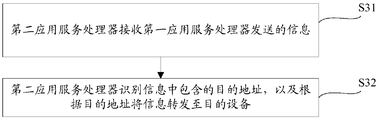
本发明实施例的用户设备,第二应用服务处理器可实现“路由”的功能,实现将来自第一应用服务处理器的信息进行相应的转发,使得可扩展WIFI模块,实现WIFI热点的功能,或实现增加一条WIFI数据通道的功能,提高用户体验;另一方面,通过第一调制解调器处理器和第二调制解调器处理器间的交互,实现支持两张用户识别卡均驻留在4G网络,可利用两条4G通道进行数据业务的并发传输,提高传输效率;此外,当进行数据业务传输时,还可进行语音业务传输,提高用户体验;另一方面,两张用户识别卡均由第一调制解调器处理器进行管理,可提高管理效率。参见图5为本发明实施例的信息转发方法的流程图,本发明实施例的信息转发方法包括:
S31、第二应用服务处理器接收第一应用服务处理器发送的信息;
S32、第二应用服务处理器识别信息中包含的目的地址,以及根据目的地址将信息转发至目的设备。
在本发明的实施例中,目的设备包括:与第二应用服务处理器连接的调制解调器处理器、与第二应用服务处理器连接的WIFI模块。目的地址包括IP地址和子网掩码。
在本发明实施例中,WIFI模块可用于提供WIFI数据通道,或用于作为WIFI热点。若WIFI模块用于提供WIFI数据通道(即工作在STA模式),则第二应用服务处理器接收第一应用服务处理器发送的信息,并根据目的地址将信
息转发至调制解调器处理器以进行数据传输;或第二应用服务处理器接收第一应用服务处理器发送的信息,并根据目的地址将信息转发至WIFI模块以进行数据传输;或第二应用服务处理器根据流量分配,将信息分配至调制解调器处理器和WIFI模块以并发进行数据传输。
若WIFI模块用于作为热点,则第二应用服务处理器根据目的地址中的子网掩码决定将该信息发送给调制解调器处理器,还是发送给WIFI模块。若发送给WIFI模块,则WIFI模块提供热点功能。
应理解,上述对于用户设备的描述中的细节和原理同样适用于该实施例的信息转发方法,在此不再赘述。
本发明实施例的用户设备和信息转发方法,第二应用服务处理器可实现“路由”的功能,实现将来自第一应用服务处理器的信息进行相应的转发,使得可扩展WIFI模块,实现WIFI热点的功能,或实现增加一条WIFI数据通道的功能,提高用户体验;另一方面,通过第一调制解调器处理器和第二调制解调器处理器间的交互,实现支持两张用户识别卡均驻留在4G网络,可利用两条4G通道进行数据业务的并发传输,提高传输效率;此外,当进行数据业务传输时,还可进行语音业务传输,提高用户体验;另一方面,两张用户识别卡均由第一调制解调器处理器进行管理,可提高管理效率。
用户设备可以包括能够与网络相连接的任意移动、便携计算或通信设备,例如蜂窝设备。例如,用户设备可以是蜂窝电话(手机)、导航系统、计算设备、照相机、PDA、音乐设备、游戏设备或具有无线连接能力的手持设备。
在本发明的实施例中,若没有特别说明,“多个”是指两个或两个以上。在本发明的描述中,需要理解的是,术语“第一”、“第二”等仅用于描述目的,而不能理解为指示或暗示相对重要性。
流程图中或在本发明的实施例中以其他方式描述的任何过程或方法描述可以被理解为,表示包括一个或更多个用于实现特定逻辑功能或过程的步骤的可
执行指令的代码的模块、片段或部分,并且本发明实施方式的范围包括另外的实现,其中可以不按所示出或讨论的顺序,包括根据所涉及的功能按基本同时的方式或按相反的顺序,来执行功能,这应被本发明的实施例所述技术领域的技术人员所理解。
出于解释的目的,前面的描述使用了特定的术语,以提供对本发明的透彻理解。然而,对本领域的技术人员来说显而易见的是,为了实践本发明并不需要具体的细节。本发明的具体实施例的前述描述是为了图示和说明的目的而呈现。它们并不意在详尽的或将本发明限于所公开的准确形式。鉴于上面的教义,许多修改和变化是可能的。为了最好地解释本发明的原理及其实际应用而示出并描述了这些实施例,从而使本领域的其他技术人员能够最好地利用本发明和具有适于预期的特定使用的各种修改的各种实施例。意在本发明的范围由随后的权利要求和其等同物来限定。
本领域普通技术人员可以理解,实现上述实施例方法中的全部或部分步骤可以通过程序来控制相关的硬件完成,所述的程序可以存储于一计算机可读取存储介质中,所述的存储介质可以是ROM/RAM、磁盘、光盘等。
应当理解的是,以上仅为本发明的优选实施例,不能因此限制本发明的专利范围,凡是利用本发明说明书及附图内容所作的等效结构或等效流程变换,或直接或间接运用在其他相关的技术领域,均同理包括在本发明的专利保护范围内。
在本申请所提供的几个实施例中,应该理解到,所揭露的设备和方法,可以通过其它的方式实现。以上所描述的设备实施例仅仅是示意性的,例如,所述单元的划分,仅仅为一种逻辑功能划分,实际实现时可以有另外的划分方式,如:多个单元或组件可以结合,或可以集成到另一个系统,或一些特征可以忽略,或不执行。另外,所显示或讨论的各组成部分相互之间的耦合、或直接耦合、或通信连接可以是通过一些接口,设备或单元的间接耦合或通
信连接,可以是电性的、机械的或其它形式的。
上述作为分离部件说明的单元可以是、或也可以不是物理上分开的,作为单元显示的部件可以是、或也可以不是物理单元,即可以位于一个地方,也可以分布到多个网络单元上;可以根据实际的需要选择其中的部分或全部单元来实现本实施例方案的目的。
另外,在本发明各实施例中的各功能单元可以全部集成在一个处理模块中,也可以是各单元分别单独作为一个单元,也可以两个或两个以上单元集成在一个单元中;上述集成的单元既可以采用硬件的形式实现,也可以采用硬件加软件功能单元的形式实现。
本领域普通技术人员可以理解:实现上述方法实施例的全部或部分步骤可以通过程序指令相关的硬件来完成,前述的程序可以存储于一计算机可读取存储介质中,该程序在执行时,执行包括上述方法实施例的步骤;而前述的存储介质包括:移动存储设备、只读存储器(ROM,Read-Only Memory)、随机存取存储器(RAM,Random Access Memory)、磁碟或者光盘等各种可以存储程序代码的介质。
以上所述,仅为本发明的具体实施方式,但本发明的保护范围并不局限于此,任何熟悉本技术领域的技术人员在本发明揭露的技术范围内,可轻易想到变化或替换,都应涵盖在本发明的保护范围之内。因此,本发明的保护范围应以所述权利要求的保护范围为准。
本发明提供了一种用户设备和信息转发方法,通过第二应用服务处理器可实现“路由”的功能,实现将来自第一应用服务处理器的信息进行相应的转发,使得可扩展WIFI模块,实现WIFI热点的功能,或实现增加一条WIFI数据通道的功能,提高用户体验;另一方面,通过第一调制解调器处理器和第二调制解调器处理器间的交互,实现支持两张用户识别卡均驻留在4G网络,可利用
两条4G通道进行数据业务的并发传输,提高传输效率;此外,当进行数据业务传输时,还可进行语音业务传输,提高用户体验;另一方面,两张用户识别卡均由第一调制解调器处理器进行管理,可提高管理效率。
Claims (20)
- 一种信息转发方法,应用于包括第一应用服务处理器和第二应用服务处理器的用户设备,包括以下步骤:通过第二应用服务处理器接收第一应用服务处理器发送的信息;识别信息中包含的目的地址,根据目的地址将信息转发至目的设备。
- 根据权利要求1所述的信息转发方法,其中,所述目的设备包括:与所述第二应用服务处理器连接的调制解调器处理器、与所述第二应用服务处理器连接的WIFI模块。
- 根据权利要求2所述的信息转发方法,其中,所述目的地址包括IP地址和子网掩码。
- 根据权利要求3所述的信息转发方法,其中,所述WIFI模块提供WIFI数据通道。
- 根据权利要求4所述的信息转发方法,其中,所述方法还包括:第二应用服务处理器接收第一应用服务处理器发送的信息,并根据目的地址将信息转发至调制解调器处理器以进行数据传输;或,第二应用服务处理器接收第一应用服务处理器发送的信息,并根据目的地址将信息转发至WIFI模块以进行数据传输;或,第二应用服务处理器根据流量分配,将信息分配至调制解调器处理器和WIFI模块以并发进行数据传输。
- 根据权利要求3所述的信息转发方法,其中,所述WIFI模块作为热点。
- 根据权利要求6所述的信息转发方法,其中,所述第二应用服务处理器根据目的地址中的子网掩码决定将该信息发送给调制解调器处理器,还是发送给所述WIFI模块。
- 一种用户设备,包括第一应用服务处理器和第二应用服务处理器; 其中,所述第一应用服务处理器,配置为向所述第二应用服务处理器发送信息;所述第二应用服务处理器,配置为接收所述第一应用服务处理器发送的信息,并识别信息中包含的目的地址,以及根据目的地址将信息转发至目的设备。
- 根据权利要求8所述的用户设备,其中,所述目的设备包括:与所述第二应用服务处理器连接的调制解调器处理器、与所述第二应用服务处理器连接的WIFI模块。
- 根据权利要求9所述的用户设备,其中,所述目的地址包括IP地址和子网掩码。
- 根据权利要求10所述的用户设备,其中,所述WIFI模块用于提供WIFI数据通道。
- 根据权利要求11所述的用户设备,其中,所述第二应用服务处理器,配置为执行以下处理至少之一:接收第一应用服务处理器发送的信息,并根据目的地址将信息转发至调制解调器处理器以进行数据传输;接收第一应用服务处理器发送的信息,并根据目的地址将信息转发至WIFI模块以进行数据传输;根据流量分配,将信息分配至调制解调器处理器和WIFI模块以并发进行数据传输。
- 根据权利要求8-12任一项所述的用户设备,其中,所述用户设备还包括:第一用户识别卡;第二用户识别卡;第一调制解调器处理器;第二调制解调器处理器;所述用户设备包含有计算机可读存储介质,该计算机存储介质包括一组指令,当执行所述指令时,引起执行以下的操作:所述第一用户识别卡和所述第二用户识别卡均与所述第一调制解调器处理器连接,所述第一调制解调器处理器与所述第二调制解调器处理器连接;所述第一调制解调器处理器,用于获取所述第一用户识别卡的信息,以基于获取的所述第一用户识别卡的信息与第一4G网络通信,进行语音业务和数据业务;所述第一调制解调器处理器,还用于获取所述第二用户识别卡的信息,以基于获取的所述第二用户识别卡的信息与第二4G网络通信,进行语音业务;所述第二调制解调器处理器,用于从所述第一调制解调器处理器处获取所述第二用户识别卡的信息,以基于获取的所述第二用户识别卡的信息与第二4G网络通信,进行数据业务。
- 根据权利要求13所述的用户设备,其中,计算机存储介质包括一组指令,当执行所述指令时,引起执行以下的操作:所述第一调制解调器处理器获取第一用户识别卡的信息,并根据第一用户识别卡的信息加载与其对应的网络参数,以启动搜网注册,使得第一用户识别卡通过第一调制解调器处理器驻留在4G网络的CS域和PS域。
- 根据权利要求13所述的用户设备,其中,计算机存储介质包括一组指令,当执行所述指令时,引起执行以下的操作:所述第一调制解调器处理器获取第二用户识别卡的信息,并根据第二用户识别卡的信息加载与其对应的网络参数,以进行搜网注册,使得第二用户识别卡通过第一调制解调器处理器驻留在4G网络的CS域。
- 根据权利要求13所述的用户设备,其中,计算机存储介质包括一组指令,当执行所述指令时,引起执行以下的操作:所述第二调制解调器处理器根据从第一调制解调器处理器处获取的第二用户识别卡的信息,进行搜网注册,使得第二用户识别卡通过第二调制解调器处理器驻留在4G网络的PS域。
- 根据权利要求13所述的用户设备,其中,计算机存储介质包括一组指令,当执行所述指令时,引起执行以下的操作:第一调制解调器处理器包括数据接口,第二调制解调器处理器包括与所述第一调制解调器处理器的数据接口连接的数据接口;第二调制解调器处理器通过数据接口获取第二用户识别卡的信息。
- 根据权利要求13所述的用户设备,其中,计算机存储介质包括一组指令,当执行所述指令时,引起执行以下的操作:第一应用处理器,与第一调制解调器处理器连接提供交互接口,接收用户的操作指令,以及将操作指令传输给第一调制解调器处理器。
- 根据权利要求13所述的用户设备,其中,所述用户设备还包括:第二应用处理器;计算机存储介质包括一组指令,当执行所述指令时,引起执行以下的操作:与第二调制解调器处理器和第一应用处理器连接,用于接收第一应用处理器发送的信息,并透传给第二调制解调器处理器。
- 根据权利要求13所述的用户设备,其中,所述第一应用服务器和第二应用服务器间通过GPIO接口连接。
Priority Applications (1)
| Application Number | Priority Date | Filing Date | Title |
|---|---|---|---|
| US16/073,053 US20190045476A1 (en) | 2016-01-27 | 2016-07-29 | User device and message forwarding method |
Applications Claiming Priority (2)
| Application Number | Priority Date | Filing Date | Title |
|---|---|---|---|
| CN201610058227.0 | 2016-01-27 | ||
| CN201610058227.0A CN105722058B (zh) | 2016-01-27 | 2016-01-27 | 用户设备和信息转发方法 |
Publications (1)
| Publication Number | Publication Date |
|---|---|
| WO2017128672A1 true WO2017128672A1 (zh) | 2017-08-03 |
Family
ID=56154363
Family Applications (1)
| Application Number | Title | Priority Date | Filing Date |
|---|---|---|---|
| PCT/CN2016/092214 Ceased WO2017128672A1 (zh) | 2016-01-27 | 2016-07-29 | 用户设备和信息转发方法 |
Country Status (3)
| Country | Link |
|---|---|
| US (1) | US20190045476A1 (zh) |
| CN (1) | CN105722058B (zh) |
| WO (1) | WO2017128672A1 (zh) |
Cited By (1)
| Publication number | Priority date | Publication date | Assignee | Title |
|---|---|---|---|---|
| CN115811748A (zh) * | 2021-09-13 | 2023-03-17 | 华为技术有限公司 | 通信方法、系统及电子设备 |
Families Citing this family (18)
| Publication number | Priority date | Publication date | Assignee | Title |
|---|---|---|---|---|
| CN105722058B (zh) * | 2016-01-27 | 2020-11-06 | 江苏知链科技有限公司 | 用户设备和信息转发方法 |
| CN105764124B (zh) * | 2016-01-27 | 2021-06-15 | 努比亚技术有限公司 | 降低终端功耗的方法及终端 |
| CN105682078A (zh) * | 2016-01-27 | 2016-06-15 | 努比亚技术有限公司 | 双核通信方法、装置、移动终端及通信方法 |
| CN107396342A (zh) * | 2017-07-31 | 2017-11-24 | 努比亚技术有限公司 | 数据传输系统、方法、外接设备和移动终端 |
| CN107466029A (zh) * | 2017-07-31 | 2017-12-12 | 努比亚技术有限公司 | 数据传输系统、方法、外接设备和移动终端 |
| CN107277859A (zh) * | 2017-07-31 | 2017-10-20 | 努比亚技术有限公司 | 数据传输系统、方法、外接设备和移动终端 |
| CN107396399A (zh) * | 2017-07-31 | 2017-11-24 | 努比亚技术有限公司 | 数据传输系统、方法、外接设备和移动终端 |
| CN107396400A (zh) * | 2017-07-31 | 2017-11-24 | 努比亚技术有限公司 | 数据传输系统、方法、外接设备和移动终端 |
| CN107318131A (zh) * | 2017-07-31 | 2017-11-03 | 努比亚技术有限公司 | 数据传输系统、方法、外接设备和移动终端 |
| CN107318108A (zh) * | 2017-07-31 | 2017-11-03 | 努比亚技术有限公司 | 数据传输系统、方法、外接设备和移动终端 |
| CN107371150A (zh) * | 2017-07-31 | 2017-11-21 | 努比亚技术有限公司 | 数据传输系统、方法、外接设备和移动终端 |
| CN107396343A (zh) * | 2017-07-31 | 2017-11-24 | 努比亚技术有限公司 | 数据传输系统、方法、外接设备和移动终端 |
| CN107466028A (zh) * | 2017-07-31 | 2017-12-12 | 努比亚技术有限公司 | 数据传输系统、方法、外接设备和移动终端 |
| CN107466027A (zh) * | 2017-07-31 | 2017-12-12 | 努比亚技术有限公司 | 数据传输系统、方法、外接设备和移动终端 |
| CN107318107A (zh) * | 2017-07-31 | 2017-11-03 | 努比亚技术有限公司 | 数据传输系统、方法、外接设备和移动终端 |
| CN107466070A (zh) * | 2017-07-31 | 2017-12-12 | 努比亚技术有限公司 | 数据传输系统、方法、外接设备和移动终端 |
| EP4489489A3 (en) * | 2019-10-11 | 2025-01-15 | Lenovo (Singapore) Pte. Ltd. | Paging for multiple sims |
| US11410659B1 (en) * | 2020-03-30 | 2022-08-09 | Amazon Technologies, Inc. | Dynamic skill endpoint |
Citations (5)
| Publication number | Priority date | Publication date | Assignee | Title |
|---|---|---|---|---|
| CN101213852A (zh) * | 2005-06-07 | 2008-07-02 | 阿尔卡特朗讯公司 | 服务会话期间自动选择无线接入网接口的多模移动终端 |
| WO2013007869A1 (en) * | 2011-07-13 | 2013-01-17 | Nokia Corporation | Dual or multiple sim standby and active using a single digital baseband |
| US20140029527A1 (en) * | 2012-07-27 | 2014-01-30 | Fujitsu Limited | Base station apparatus and wireless terminal apparatus |
| CN103888556A (zh) * | 2012-12-24 | 2014-06-25 | 华为终端有限公司 | 一种家庭终端设备及家庭终端设备的控制方法 |
| CN105722058A (zh) * | 2016-01-27 | 2016-06-29 | 努比亚技术有限公司 | 用户设备和信息转发方法 |
Family Cites Families (6)
| Publication number | Priority date | Publication date | Assignee | Title |
|---|---|---|---|---|
| CN100385982C (zh) * | 2005-07-22 | 2008-04-30 | 杭州斯达康通讯有限公司 | 双模通信终端及其控制方法 |
| CN201044441Y (zh) * | 2007-04-17 | 2008-04-02 | 深圳万利达移动通信设备有限公司 | 双卡双待手机 |
| CN101977412B (zh) * | 2010-07-23 | 2013-01-09 | 展讯通信(上海)有限公司 | 应用处理器、调制解调器及其之间的通信方法 |
| US9622291B2 (en) * | 2013-06-11 | 2017-04-11 | Samsung Electronics Co., Ltd | Wireless communication method and apparatus supporting multiple communication services |
| CN104298639B (zh) * | 2014-09-23 | 2017-03-15 | 天津国芯科技有限公司 | 主处理器与若干协处理器的嵌入式连接方法及连接接口 |
| CN105101164A (zh) * | 2015-07-23 | 2015-11-25 | 努比亚技术有限公司 | 双卡双待终端及数据通信方法 |
-
2016
- 2016-01-27 CN CN201610058227.0A patent/CN105722058B/zh not_active Expired - Fee Related
- 2016-07-29 WO PCT/CN2016/092214 patent/WO2017128672A1/zh not_active Ceased
- 2016-07-29 US US16/073,053 patent/US20190045476A1/en not_active Abandoned
Patent Citations (5)
| Publication number | Priority date | Publication date | Assignee | Title |
|---|---|---|---|---|
| CN101213852A (zh) * | 2005-06-07 | 2008-07-02 | 阿尔卡特朗讯公司 | 服务会话期间自动选择无线接入网接口的多模移动终端 |
| WO2013007869A1 (en) * | 2011-07-13 | 2013-01-17 | Nokia Corporation | Dual or multiple sim standby and active using a single digital baseband |
| US20140029527A1 (en) * | 2012-07-27 | 2014-01-30 | Fujitsu Limited | Base station apparatus and wireless terminal apparatus |
| CN103888556A (zh) * | 2012-12-24 | 2014-06-25 | 华为终端有限公司 | 一种家庭终端设备及家庭终端设备的控制方法 |
| CN105722058A (zh) * | 2016-01-27 | 2016-06-29 | 努比亚技术有限公司 | 用户设备和信息转发方法 |
Cited By (1)
| Publication number | Priority date | Publication date | Assignee | Title |
|---|---|---|---|---|
| CN115811748A (zh) * | 2021-09-13 | 2023-03-17 | 华为技术有限公司 | 通信方法、系统及电子设备 |
Also Published As
| Publication number | Publication date |
|---|---|
| CN105722058B (zh) | 2020-11-06 |
| CN105722058A (zh) | 2016-06-29 |
| US20190045476A1 (en) | 2019-02-07 |
Similar Documents
| Publication | Publication Date | Title |
|---|---|---|
| CN105722058B (zh) | 用户设备和信息转发方法 | |
| CN105744652B (zh) | 用户设备和通信方法 | |
| CN105792184B (zh) | 终端及通信方法 | |
| US12156114B2 (en) | Layer 2 UE to UE data forwarding | |
| CN112514522B (zh) | 用于恢复时挂起不活动和挂起时恢复不活动的方法 | |
| US20260101407A1 (en) | Methods, nodes and computer readable medium for relay connection establishment | |
| US20170105239A1 (en) | Methods and apparatus for a network-agnostic wireless router | |
| US10178689B2 (en) | Adaptive resource allocation for simultaneous operation of cellular and device to device communications | |
| CN107959983A (zh) | 利用上行链路信号快速激活多连接性的装置和方法 | |
| CN114631341B (zh) | 多sim装置的关系指示 | |
| EP3059993B1 (en) | Method, base station and terminal for controlling link in cooperative communication | |
| KR20150098633A (ko) | 와이파이 다이렉트 서비스 시스템에서 통신 설정 방법 및 이를 위한 장치 | |
| JP2016504788A (ja) | エヌエフシーを用いたワイファイダイレクトサービス方法およびそのための装置 | |
| CN114143871A (zh) | 网络连接方法、网络去连接方法及通信装置 | |
| CN109314918B (zh) | 通信系统中的寻呼系统和方法 | |
| US20180310359A1 (en) | User equipment, base station, and connection establishment method | |
| EP3393173B1 (en) | Terminal device and access network devices | |
| WO2017128660A1 (zh) | 双核通信方法、装置、移动终端、通信方法及存储介质 | |
| US20220312482A1 (en) | Methods of cca for frequencies between 52.6 ghz and 71 ghz | |
| US20190141575A1 (en) | Systems and Methods for Providing LTE-Based Backhaul | |
| WO2017078140A1 (ja) | ユーザ装置、基地局、及び接続確立方法 | |
| EP3448115B1 (en) | Ran server, wireless communication system, terminal attachment method | |
| CN116233957B (zh) | 一种数据传输的方法和通信装置 | |
| CN116155800B (zh) | 一种数据传输的方法和装置 | |
| EP4613039A1 (en) | Method for inter-plmn cell reselection in rrc_inactive without transition to rrc_connected or to rrc_idle |
Legal Events
| Date | Code | Title | Description |
|---|---|---|---|
| 121 | Ep: the epo has been informed by wipo that ep was designated in this application |
Ref document number: 16887550 Country of ref document: EP Kind code of ref document: A1 |
|
| NENP | Non-entry into the national phase |
Ref country code: DE |
|
| 122 | Ep: pct application non-entry in european phase |
Ref document number: 16887550 Country of ref document: EP Kind code of ref document: A1 |