WO2017119252A1 - イオン感応膜、イオン選択性電極、及びイオンセンサ - Google Patents
イオン感応膜、イオン選択性電極、及びイオンセンサ Download PDFInfo
- Publication number
- WO2017119252A1 WO2017119252A1 PCT/JP2016/087266 JP2016087266W WO2017119252A1 WO 2017119252 A1 WO2017119252 A1 WO 2017119252A1 JP 2016087266 W JP2016087266 W JP 2016087266W WO 2017119252 A1 WO2017119252 A1 WO 2017119252A1
- Authority
- WO
- WIPO (PCT)
- Prior art keywords
- ion
- sensitive membrane
- tyramine
- histamine
- electrode
- Prior art date
- Legal status (The legal status is an assumption and is not a legal conclusion. Google has not performed a legal analysis and makes no representation as to the accuracy of the status listed.)
- Ceased
Links
Images


Classifications
-
- G—PHYSICS
- G01—MEASURING; TESTING
- G01N—INVESTIGATING OR ANALYSING MATERIALS BY DETERMINING THEIR CHEMICAL OR PHYSICAL PROPERTIES
- G01N27/00—Investigating or analysing materials by the use of electric, electrochemical, or magnetic means
- G01N27/26—Investigating or analysing materials by the use of electric, electrochemical, or magnetic means by investigating electrochemical variables; by using electrolysis or electrophoresis
- G01N27/28—Electrolytic cell components
- G01N27/30—Electrodes, e.g. test electrodes; Half-cells
- G01N27/333—Ion-selective electrodes or membranes
-
- G—PHYSICS
- G01—MEASURING; TESTING
- G01N—INVESTIGATING OR ANALYSING MATERIALS BY DETERMINING THEIR CHEMICAL OR PHYSICAL PROPERTIES
- G01N27/00—Investigating or analysing materials by the use of electric, electrochemical, or magnetic means
- G01N27/26—Investigating or analysing materials by the use of electric, electrochemical, or magnetic means by investigating electrochemical variables; by using electrolysis or electrophoresis
- G01N27/403—Cells and electrode assemblies
- G01N27/414—Ion-sensitive or chemical field-effect transistors, i.e. ISFETS or CHEMFETS
Definitions
- the present invention relates to an ion-sensitive membrane capable of forming an ideal potential response behavior with non-volatile biogenic amines, particularly tyramine and / or histamine, and an ion-selective electrode and ion sensor comprising the ion-sensitive membrane.
- freshness evaluation of foods is performed by analyzing components such as biogenic amines such as a K value calculation method representing the freshness of foods.
- biogenic amines such as a K value calculation method representing the freshness of foods.
- fish meat can be evaluated by quantitative analysis of non-volatile biogenic amines (tyramine, histamine, etc.) due to spoilage.
- HPLC high performance liquid chromatography
- Patent Document 2 an enzyme electrode method using an enzymatic reaction
- a specific enzyme that reacts with a biogenic amine A method of using is used.
- JP-A-8-217921 Japanese Patent Publication No. 7-50069
- the analysis by the HPLC method can perform an accurate analysis, but the apparatus itself is expensive and the measurement time is long and it is difficult to analyze easily. Further, the analysis by the enzyme electrode method has a measurement time shorter than that of the HPLC method, but due to the property that the enzyme reacts, there is a problem that it is difficult to perform continuous measurement many times and is expensive.
- the ion-selective electrode method is also known as a component analysis method, and it is used for quantitative analysis of inorganic ions, but there are almost no ion-selective electrodes for measuring organic ions on the market. When used for the analysis of biogenic amines as described above, interference with inorganic ions occurred, and accurate quantitative analysis could not be performed.
- an object of the present invention is to provide an ion-sensitive membrane and an ion-selective membrane that can be used for an ion-selective electrode that is not disturbed by inorganic ions and exhibits an ideal potential response behavior to non-volatile biogenic amines, particularly tyramine and / or histamine.
- Providing an electrode is to provide an ion sensor that can be used for food freshness evaluation and a food freshness management method using the ion sensor.
- R 1 , R 2 and R 3 are a hydrogen atom and an alkyl group having 1 to 4 carbon atoms
- R 4 , R 5 and R 6 are a hydrogen atom, an alkyl group having 1 to 18 carbon atoms and a carbon atom. Any one of the ester groups of 1 to 18; An ion-sensitive membrane comprising a homooxacalix [3] arene derivative is provided.
- an ion-selective electrode comprising the ion-sensitive membrane and characterized in that it exhibits a potential response behavior to non-volatile biogenic amines, particularly tyramine and / or histamine.
- an ion sensor comprising a working electrode comprising the ion selective electrode and a reference electrode.
- an ion selective field effect type characterized in that the ion sensitive membrane is connected to a gate portion of a field effect type transistor, and exhibits a potential response behavior with respect to nonvolatile biogenic amines.
- a transistor is provided.
- an ion sensor comprising a working electrode comprising the ion selective field effect transistor and a reference electrode.
- a food freshness management method characterized by measuring the amount of tyramine and / or histamine in food using the ion sensor.
- the homooxacalix [3] arene derivative represented by the above formula (1) used as an ionophore is not disturbed by inorganic ions such as potassium ions, and is non-volatile such as tyramine and histamine. Since the monovalent cation (R—NH 3 + ) based on the primary amino group of the biogenic amines can be selectively captured and transferred to the membrane side, the ion sensitive membrane of the present invention can be used as an ion sensor.
- the sensor membrane potential is increased by forming a complex with a monovalent cation such as tyramine and / or histamine, and a positive potential response is generated, whereby tyramine and / or histamine
- the concentration can be measured quantitatively.
- the ion sensitive membrane of the present invention is easy to manufacture and handle, and also has excellent durability. Therefore, the ion sensitive membrane can be used as an ion selective electrode of an ion sensor for measuring nonvolatile biogenic amines such as tyramine and histamine. By using it, the concentration of tyramine and / or histamine in food can be measured easily and at low cost.
- the amount of tyramine and / or histamine in food can be easily measured from a low concentration in this way, it is possible to detect food spoilage at an early stage, and the freshness of food. It becomes possible to quantify the evaluation, it is possible to optimize the edible period together with the safety of food, and to reduce the amount of food waste.
- FIG. 1 It is a figure which shows an example of the ion selective electrode of this invention. It is a figure which shows an example of the ion sensor which used the ion selective electrode of this invention as a working electrode.
- the potential response obtained by the ion sensor by each ionophore and the potential response curve of the concentration of tyramine (A) and histamine (B) are represented.
- the potential response obtained by the ion sensor of the present invention and the potential response curve of the concentration of tyramine (represented by Ty) and histamine (represented by His in the diagram) are shown.
- ion sensitive membrane In the ion sensitive membrane of the present invention, it is important to use a homooxacalix [3] arene derivative represented by the above formula (1) as an ionophore.
- this ionophore is a potassium ion or sodium ion. It has been found that a stable complex can be selectively formed with R-NH 3 + ions of non-volatile biogenic amines having a primary amino group without being disturbed by non-volatile biogenic amines, particularly tyramine and / or histamine Used for quantitative analysis.
- R 1 , R 2 and R 3 are a hydrogen atom and an alkyl group having 1 to 4 carbon atoms
- R 4 , R 5 and R 6 are hydrogen Either an atom, an alkyl group having 1 to 18 carbon atoms or an ester group having 1 to 18 carbon atoms, preferably R 4 , R 5 and R 6 are C 4 H 9 .
- Non-volatile biogenic amines that can be selectively captured by the ion-sensitive membrane of the present invention can be exemplified by tyramine, histamine, putrescine, agmatine, ornithine, etc.
- the ionophore used in the present invention is an indicator of food spoilage in particular. Excellent selectivity for tyramine and / or histamine.
- the ion-sensitive membrane of the present invention can be obtained by forming a film using the above ionophore, membrane material, plasticizer, and optionally an anionic addition salt.
- the membrane material that can be used for the ion-sensitive membrane of the present invention include, but are not limited to, polyvinyl chloride, silicon rubber, polyvinylidene chloride, polyurethane urea, photoresist, lacquer, and the like. Vinyl chloride can be preferably used.
- the plasticizer is blended to plasticize the membrane material and dissolve the ionophore.
- plasticizers include, but are not limited to, 4-nitrophenyl phenyl ether, bis (1-butylpentyl) adipate, dibutyl sebacate, dibutyl phthalate, dioctyl phthalate, dioctyl phenyl phosphate, sebacic acid
- plasticizers include dioctyl, 2-nitrophenyl phenyl ether, 2-nitrophenyl octyl ether, dibenzyl ether, decanol, 2-nitrophenyl dodecyl ether, 2-fluoro-2′-nitrodiphenyl ether, and in particular, sebacic acid Dioctyl can be preferably used.
- the anionic additive salt is blended in order to improve the performance of the sensitive membrane by actively moving and distributing tyramine or histamine ions (R—NH 3 + ).
- tyramine or histamine ions R—NH 3 +
- those used in conventionally known ion-sensitive membranes can be used, but are not limited thereto, but include potassium tetrakis (4-chlorophenyl) borate, tetrakis (4-chlorophenyl).
- the ion-sensitive membrane of the present invention is prepared by mixing and dissolving the above-described components such as ionophore, membrane material, plasticizer, added salt and the like in an appropriate amount of solvent such as tetrahydrofuran.
- membrane of said each component changes with kinds of compound to be used and cannot be defined unconditionally, it is suitable that it is the following ranges. That is, the ionophore is preferably contained in an amount of 1 to 10 parts by weight, particularly 2 to 5 parts by weight, based on 100 parts by weight of the sensitive membrane.
- the membrane material is preferably contained in an amount of 20 to 40 parts by weight, particularly 25 to 35 parts by weight, based on 100 parts by weight of the sensitive film. If the amount of the membrane material is smaller than the above range, the strength of the ion-sensitive membrane cannot be sufficiently obtained, and the durability may be lowered. I cannot expect improvement.
- the plasticizer is preferably contained in an amount of 20 to 80 parts by weight, particularly 50 to 70 parts by weight, based on 100 parts by weight of the sensitive film.
- the film forming property is inferior and the ionophore is not sufficiently dissolved, and there is a possibility that satisfactory performance may not be obtained, while the amount of the plasticizer is smaller than the above range. If the amount is too large, the performance may be inferior rather than elution of the plasticizer.
- the anionic additive salt is preferably in the range of 0.1 to 2 parts by weight with respect to 100 parts by weight of the sensitive membrane. Furthermore, it is preferable from the viewpoint of film forming property that the amount of the solvent used as necessary is an amount that dissolves all of the above components.
- the prepared mixed solution is applied onto a substrate such as a glass plate by a conventionally known method such as a casting method, spray coating, sputtering method, dipping method, spin-off coating method, etc., and dried until the solvent is completely evaporated. Film.
- the drying conditions vary depending on the film material used and cannot be defined generally, but it is desirable to dry at a temperature of 25 to 40 ° C. for 8 to 16 hours.
- the formed ion-sensitive membrane can be removed from the substrate and used as an ion-sensitive membrane.
- a porous membrane such as a Teflon (registered trademark) porous membrane can be used as a substrate to which the mixed solution is applied, and used together with the porous membrane. May be.
- the prepared liquid mixture is applied to the gate portion of the field effect transistor to form an ion selective field effect transistor.
- the film thickness of the ion-sensitive film is not limited to this, but is preferably in the range of 100 to 1000 ⁇ m.
- the ion selective electrode using the ion sensitive membrane of the present invention comprises at least an ion sensitive membrane, an internal solution, and an internal electrode.
- the internal electrodes but are not limited to, Ag / AgCl, Hg / Hg 2 Cl 2, Hg / Hg is 2 SO 4 and the like can be exemplified, can be suitably used particularly Ag / AgCl.
- the internal solution include, but are not limited to, metal salt aqueous solutions such as silver nitrate aqueous solution, potassium chloride aqueous solution, and calcium nitrate aqueous solution, and mixed solutions of potassium chloride aqueous solution and other metal salt aqueous solutions.
- An aqueous solution can be suitably used.
- FIG. 1 is a diagram showing an example of an ion-selective electrode using the ion-sensitive membrane of the present invention. An ion sensitive membrane 4 is attached, and an internal electrode 5 is inserted into the internal solution 2.
- the ion sensor of the present invention can adopt the same configuration as a conventionally known ion sensor except that the ion selective electrode or the ion selective field effect transistor is used as a working electrode.
- FIG. 2 is a view showing an example of an ion sensor using the ion selective electrode 1 of the present invention as a working electrode.
- the ion selective electrode 1 of the present invention is used for one of the potentiometers 10 and the reference electrode 20 is used for the other. Are connected.
- a conventionally known reference electrode can be used.
- the outer support tube 22 provided with the porous membrane 21 at the tip is porous.
- the reference electrode 20 is provided with an inner support tube 24 on which a membrane 23 is placed.
- the outer support tube 22 is filled with an external solution 25, and the inner support tube 24 is filled with an internal solution 26.
- An internal electrode 27 is inserted into the inner support tube 24.
- the tips of the ion-selective electrode 1 and the reference electrode 20 which are the working electrodes are immersed in a sample solution 30 containing, for example, tyramine and / or histamine, so that tyramine and / or histamine ions (R ⁇ NH 3 + ) selectively passes through the ion-sensitive membrane to show a potential response behavior, and a potential response amount (mV) is shown by a potentiometer.
- the concentration can be measured using the Nernst equation (the following equation (2)).
- E E 0 + (0.059 (V) / n) logC (2)
- E potential (V)
- E 0 standard potential (V)
- n the number of charges
- C concentration (M).
- the potential response of tyramine is about 10 ⁇ 6 M and histamine is about 10 ⁇ 4 M, and the lower limit amount of tyramine in initial rotting of meat or the like. 10 ⁇ 4 M or more is secured, which indicates that a practical concentration range is secured.
- the ion sensor of the present invention can quantitatively measure the concentration of non-volatile biogenic amines such as tyramine. Therefore, the present invention provides tyramine that increases when food such as fish is spoiled. It is possible to evaluate food freshness by measuring using an ion sensor. Moreover, by measuring the amount of histamine using the ion sensor of the present invention, in addition to the evaluation of food freshness, evaluation for preventing histamine poisoning can be performed. Note that tyramine and histamine are ionized in the acidic to neutral region. However, since meat such as fish has increased lactic acid as it rots, the ion sensor of the present invention can be applied directly to fish even when tyramine and / or Alternatively, the concentration of histamine can be measured.
- ⁇ Ion-sensitive membrane and ion-selective electrode> The following materials were dissolved in 2 mL of tetrahydrofuran in a small glass bottle. 1. Ionophore 2mg 2. Dioctyl sebacate 66mg 3. Polyvinyl chloride 32mg This was gently spread on a petri dish having a diameter of 3 cm, left as it is at room temperature (about 25 degrees) for about 10 hours, and evaporated to produce a transparent ion-sensitive film. The film thickness of the ion sensitive film thus produced was about 800 ⁇ m.
- the produced ion-sensitive membrane was punched from a petri dish with a punch having a diameter of 7 mm and fixed to an ion-selective electrode (manufactured by Fluka). An 0.01M potassium chloride solution was added as an electrode internal solution to produce an ion selective electrode (see FIG. 1).
- ⁇ Ion sensor> The ion selective electrode and the reference electrode (manufactured by TOA / DKK, internal solution: saturated potassium chloride solution, external solution: 0.01 M Tris-HCl buffer solution pH 7.5) are connected to a potentiometer, respectively. Was made. The tips of the ion selective electrode and the reference electrode were immersed in the sample solution, and tyramine and histamine in the sample solution were measured (see FIG. 2).
- the strength of the potential response is 10-6 M indicating an ideal potential response, ⁇ 10 -4 M indicating an ideal potential response, and an ideal potential response was not obtained.
- a sample was marked with ⁇ , and a sample with little change in potential was marked with ⁇ .
- the ideal potential response is a behavior in which the potential response (mV) changes depending on the concentration and approximates the value obtained by the Nernst equation described above.
- the ionophores used were benzo-12-crown-4 (B12C4), benzo-15-crown-5 (B15C5), benzo-18-crown-6 (B18C6), dibenzo-18-crown-6 (DB18C6), calix [ 4] Allene ester derivative (CA [4]), calix [6] arene ester derivative (CA [6]) and homooxacalix [3] arene derivative (HCA [3]).
- Histamine was weighed so as to have a concentration range of 10 ⁇ 6 M to 10 ⁇ 2 M and dissolved in 0.01 M Tris-HCl buffer pH 7.5.
- the potential response to histamine was measured with the ion sensor prepared in Experimental Example 7. The results are shown in FIG.
- a potential response curve can be obtained by measuring the potential response of tyramine and histamine with an ion sensor produced from the ion sensitive membrane of the present invention. Therefore, it was confirmed that the concentration of tyramine and histamine can be easily quantitatively measured by using the ion sensor of the present invention.
- the ion-sensitive membrane of the present invention can selectively capture tyramine and / or histamine produced by rotting meat such as fish meat, the concentration of tyramine and / or histamine can be quantitatively analyzed easily and economically. It can be effectively applied to food freshness assessment or food management. In particular, red fish such as mackerel, tuna, bonito, swordfish, and yellowtail has significant production of tyramine and histamine due to spoilage. Therefore, the ion sensor of the present invention is useful for evaluating the freshness of these fish. In addition to these fish meats, it can be effectively applied to the management of fermented livestock foods such as cheese.
Landscapes
- Chemical & Material Sciences (AREA)
- Life Sciences & Earth Sciences (AREA)
- Health & Medical Sciences (AREA)
- Biochemistry (AREA)
- Chemical Kinetics & Catalysis (AREA)
- Electrochemistry (AREA)
- Physics & Mathematics (AREA)
- Analytical Chemistry (AREA)
- Molecular Biology (AREA)
- General Health & Medical Sciences (AREA)
- General Physics & Mathematics (AREA)
- Immunology (AREA)
- Pathology (AREA)
- Engineering & Computer Science (AREA)
- Microelectronics & Electronic Packaging (AREA)
- Heterocyclic Carbon Compounds Containing A Hetero Ring Having Oxygen Or Sulfur (AREA)
Abstract
イオン感応膜のイオノフォアとして、下記式(1)式中、R1,R2,R3は、水素原子、炭素数1~4のアルキル基であり、R4、R5,R6は、水素原子、炭素数1~18のアルキル基又は炭素数1~18のエステル基の何れかである、 で表されるホモオキサカリックス[3]アレン誘導体を含有することを特徴とし、無機イオンによる妨害がなく、チラミン及び/又はヒスタミンに対して電位応答挙動を示すイオン選択性電極に使用可能な感応膜及びイオン選択性電極を提供できる。
Description
本発明は、不揮発性生体アミン類、特にチラミン及び/又はヒスタミンと理想的な電位応答挙動を形成可能なイオン感応膜、このイオン感応膜から成るイオン選択性電極及びイオンセンサに関する。
近年、食品の安全性に対する消費者の意識が高まっており、食品の安全性を数値化(可視化)することによって、食品の鮮度評価による可食期間の延長、ひいては廃棄物を減量することが求められている。
従来より、食品の鮮度評価は、パネラーによる臭いや味覚変化を評価する官能評価法によって行われることが一般的であるが、この官能評価法では、パネラーの熟練度、体調或いは嗜好などに影響を受ける。また食品劣化の評価は、パネラーによる官能評価法では危険であることから実施することは困難である。
従来より、食品の鮮度評価は、パネラーによる臭いや味覚変化を評価する官能評価法によって行われることが一般的であるが、この官能評価法では、パネラーの熟練度、体調或いは嗜好などに影響を受ける。また食品劣化の評価は、パネラーによる官能評価法では危険であることから実施することは困難である。
このような観点から、食品の鮮度を表すK値算出法等、生体アミン等の成分分析を行うことによって食品の鮮度評価が行われている。例えば、魚肉は、腐敗により不揮発性生体アミン類(チラミン、ヒスタミン等)が増加することから、これらを定量分析することによって評価できる。
このような生体アミン類の成分分析には、高速液体クロマトグラフィー(HPLC)法(特許文献1)や、酵素反応を利用した酵素電極法(特許文献2)、或いは生体アミンと反応する特定の酵素を用いる方法等が行われている。
このような生体アミン類の成分分析には、高速液体クロマトグラフィー(HPLC)法(特許文献1)や、酵素反応を利用した酵素電極法(特許文献2)、或いは生体アミンと反応する特定の酵素を用いる方法等が行われている。
HPLC法による分析は、正確な分析が可能であるが、装置自体が高価であり、測定時間も長く手軽に分析することは困難である。また酵素電極法による分析は、HPLC法に比べ測定時間は短いが、酵素が反応するという性質上、多数回連続測定が難しく、高コストであるという問題がある。
一方、成分分析の方法としてイオン選択性電極法も知られており、無機イオンの定量分析に使用されているが、有機イオンを測定対象にしたイオン選択性電極はほとんど市場には出ておらず、上述したような生体アミン類の分析に使用すると、無機イオンによる妨害が発生し、正確な定量分析を行うことができなかった。
一方、成分分析の方法としてイオン選択性電極法も知られており、無機イオンの定量分析に使用されているが、有機イオンを測定対象にしたイオン選択性電極はほとんど市場には出ておらず、上述したような生体アミン類の分析に使用すると、無機イオンによる妨害が発生し、正確な定量分析を行うことができなかった。
従って本発明の目的は、無機イオンによる妨害がなく、不揮発性生体アミン類、特にチラミン及び/又はヒスタミンに対し理想的な電位応答挙動を示すイオン選択性電極に使用可能なイオン感応膜及びイオン選択性電極を提供することである。
本発明の他の目的は、食品の鮮度評価に使用可能なイオンセンサ及びこのイオンセンサを用いた食品鮮度管理方法を提供することである。
本発明の他の目的は、食品の鮮度評価に使用可能なイオンセンサ及びこのイオンセンサを用いた食品鮮度管理方法を提供することである。
本発明によれば、イオノフォアとして、下記式(1)
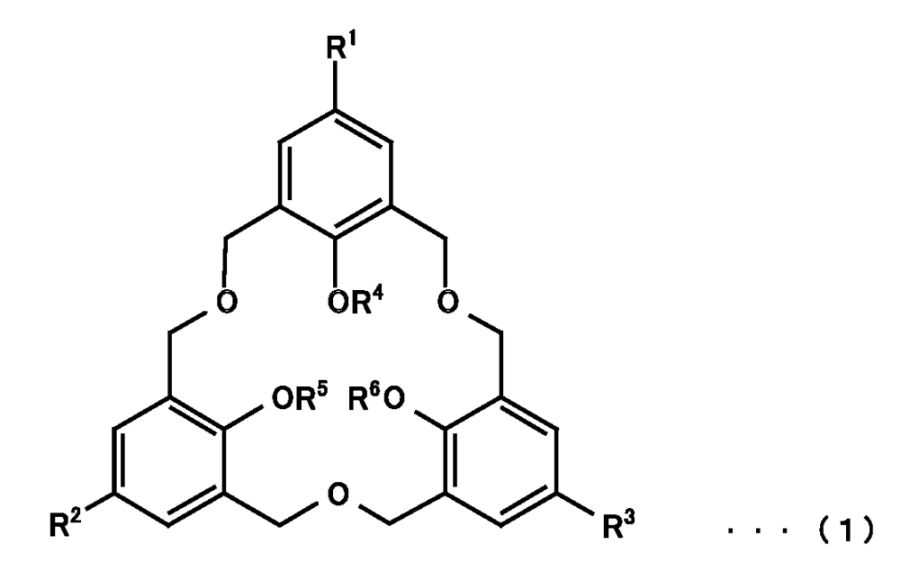
式中、R1,R2,R3は、水素原子、炭素数1~4のアルキル基であり、R4、R5,R6は、水素原子、炭素数1~18のアルキル基又は炭素数1~18のエステル基の何れかである、
ホモオキサカリックス[3]アレン誘導体を含有することを特徴とするイオン感応膜が提供される。
ホモオキサカリックス[3]アレン誘導体を含有することを特徴とするイオン感応膜が提供される。
本発明によればまた、上記イオン感応膜を使用して成り、不揮発性生体アミン類、特にチラミン及び/又はヒスタミンに対し電位応答挙動を示すことを特徴とするイオン選択性電極が提供される。
本発明によれば更に、上記イオン選択性電極から成る作用電極、及び参照電極を備えて成るイオンセンサが提供される。
本発明によれば更に、上記イオン選択性電極から成る作用電極、及び参照電極を備えて成るイオンセンサが提供される。
本発明によればまた、上記イオン感応膜を電界効果型のトランジスタのゲート部に接続して成り、不揮発性生体アミン類に対して電位応答挙動を示すことを特徴とするイオン選択性電界効果型トランジスタが提供される。
本発明によれば更に、上記イオン選択性電界効果型トランジスタから成る作用電極、及び参照電極を備えて成ることを特徴とするイオンセンサが提供される。
本発明によれば更に、上記イオン選択性電界効果型トランジスタから成る作用電極、及び参照電極を備えて成ることを特徴とするイオンセンサが提供される。
本発明によれば更に、上記イオンセンサを用いて、食品中のチラミン及び/又はヒスタミン量を測定することを特徴とする食品鮮度管理方法が提供される。
本発明のイオン感応膜においては、イオノフォアとして用いる上記式(1)で表されるホモオキサカリックス[3]アレン誘導体が、カリウムイオン等の無機イオンの妨害を受けることなく、チラミンやヒスタミン等の不揮発性生体アミン類が有する一級アミノ基に基づく1価の陽イオン(R-NH3
+)を選択的に捕捉して膜側に移動分配可能であることから、本発明のイオン感応膜をイオンセンサのイオン選択性電極として使用すると、チラミン及び/又はヒスタミン等の1価陽イオンと錯体を形成することによりセンサ膜電位が上昇して、正の電位応答が生じることにより、チラミン及び/又はヒスタミンの濃度を定量的に測定することが可能になる。
また本発明のイオン感応膜は、製造及び取扱いが容易であり、しかも耐久性にも優れているので、チラミンやヒスタミン等の不揮発性生体アミン類を測定するためのイオンセンサのイオン選択性電極に使用することにより、食品中のチラミン及び/又はヒスタミンの濃度を容易且つ低コストで測定することが可能になる。
またこのように食品中のチラミン及び/又はヒスタミン量を低濃度から容易に測定することが可能になったことで、食品の腐敗を初期の段階で検知することが可能であると共に、食品の鮮度評価を数値化することが可能になり、食品の安全性と共に可食期間の適正化を図ることが可能になり、食品廃棄物の減量を図ることができる。
また本発明のイオン感応膜は、製造及び取扱いが容易であり、しかも耐久性にも優れているので、チラミンやヒスタミン等の不揮発性生体アミン類を測定するためのイオンセンサのイオン選択性電極に使用することにより、食品中のチラミン及び/又はヒスタミンの濃度を容易且つ低コストで測定することが可能になる。
またこのように食品中のチラミン及び/又はヒスタミン量を低濃度から容易に測定することが可能になったことで、食品の腐敗を初期の段階で検知することが可能であると共に、食品の鮮度評価を数値化することが可能になり、食品の安全性と共に可食期間の適正化を図ることが可能になり、食品廃棄物の減量を図ることができる。
(イオン感応膜)
本発明のイオン感応膜は、イオノフォアとして上記式(1)で表されるホモオキサカリックス[3]アレン誘導体を用いることが重要な特徴であり、本発明においてはこのイオノフォアが、カリウムイオンやナトリウムイオン等の妨害を受けることなく、一級アミノ基を有する不揮発性生体アミン類のR-NH3 +イオンと選択的に安定な錯体を形成できることを見出し、不揮発性生体アミン類、特にチラミン及び/又はヒスタミンの定量分析に利用する。
上記式(1)で表されるホモオキサカリックスアレン誘導体におけるR1,R2,R3は、水素原子、炭素数1~4のアルキル基であり、R4、R5,R6は、水素原子、炭素数1~18のアルキル基又は炭素数1~18のエステル基の何れかであるが、好適には、R4,R5,R6はC4H9である。
本発明のイオン感応膜が選択的に捕捉可能な不揮発性生体アミン類としては、チラミン、ヒスタミン、プトレシン、アグマチン、オルニチン等を例示できるが、本発明に用いるイオノフォアは、特に食品腐敗の指標となるチラミン及び/又はヒスタミンに対して優れた選択性を有している。
本発明のイオン感応膜は、イオノフォアとして上記式(1)で表されるホモオキサカリックス[3]アレン誘導体を用いることが重要な特徴であり、本発明においてはこのイオノフォアが、カリウムイオンやナトリウムイオン等の妨害を受けることなく、一級アミノ基を有する不揮発性生体アミン類のR-NH3 +イオンと選択的に安定な錯体を形成できることを見出し、不揮発性生体アミン類、特にチラミン及び/又はヒスタミンの定量分析に利用する。
上記式(1)で表されるホモオキサカリックスアレン誘導体におけるR1,R2,R3は、水素原子、炭素数1~4のアルキル基であり、R4、R5,R6は、水素原子、炭素数1~18のアルキル基又は炭素数1~18のエステル基の何れかであるが、好適には、R4,R5,R6はC4H9である。
本発明のイオン感応膜が選択的に捕捉可能な不揮発性生体アミン類としては、チラミン、ヒスタミン、プトレシン、アグマチン、オルニチン等を例示できるが、本発明に用いるイオノフォアは、特に食品腐敗の指標となるチラミン及び/又はヒスタミンに対して優れた選択性を有している。
本発明のイオン感応膜は、上記イオノフォア、膜材料、可塑剤、及び必要に応じてアニオン性添加塩を用いて、製膜することにより得られる。
本発明のイオン感応膜に使用可能な膜材料としては、これに限定されないが、ポリ塩化ビニル、シリコンゴム、ポリ塩化ビニリデン、ポリウレタンウレア、フォトレジスト、漆等を例示することができるが、特にポリ塩化ビニルを好適に使用することができる。
また可塑剤は、膜材料を可塑化すると共に、イオノフォアを溶解するために配合する。このような可塑剤としては、これに限定されないが、4-ニトロフェニルフェニルエーテル、アジピン酸ビス(1-ブチルペンチル)、セバシン酸ジブチル、フタル酸ジブチル、フタル酸ジオクチル、ジオクチルフェニルリン酸、セバシン酸ジオクチル、2-ニトロフェニルフェニルエーテル、2-ニトロフェニルオクチルエーテル、ジベンジルエーテル、デカノール、2-ニトロフェニルドデシルエーテル、2-フルオロ-2’-ニトロジフェニルエーテル等を例示することができ、特に、セバシン酸ジオクチルを好適に使用することができる。
本発明のイオン感応膜に使用可能な膜材料としては、これに限定されないが、ポリ塩化ビニル、シリコンゴム、ポリ塩化ビニリデン、ポリウレタンウレア、フォトレジスト、漆等を例示することができるが、特にポリ塩化ビニルを好適に使用することができる。
また可塑剤は、膜材料を可塑化すると共に、イオノフォアを溶解するために配合する。このような可塑剤としては、これに限定されないが、4-ニトロフェニルフェニルエーテル、アジピン酸ビス(1-ブチルペンチル)、セバシン酸ジブチル、フタル酸ジブチル、フタル酸ジオクチル、ジオクチルフェニルリン酸、セバシン酸ジオクチル、2-ニトロフェニルフェニルエーテル、2-ニトロフェニルオクチルエーテル、ジベンジルエーテル、デカノール、2-ニトロフェニルドデシルエーテル、2-フルオロ-2’-ニトロジフェニルエーテル等を例示することができ、特に、セバシン酸ジオクチルを好適に使用することができる。
更にアニオン性添加塩は、チラミン又はヒスタミンイオン(R-NH3
+)を積極的に移動分配することで感応膜の性能を向上させるために配合する。このようなアニオン性添加塩としては、従来公知のイオン感応膜に使用されるものを使用することができ、これに限定されないが、テトラキス(4-クロロフェニル)ホウ酸カリウム、テトラキス(4-クロロフェニル)ホウ酸ナトリウム、テトラキス[3,5-ビス(トリフルオロメチル)フェニル]ホウ酸カリウム、テトラキス[3,5-ビス(トリフルオロメチル)フェニル]ホウ酸ナトリウム、テトラフェニルホウ酸カリウム、テトラフェニルホウ酸ナトリウム、テトラキス[3,5-ビス(1,1,1,3,3,3-ヘキサフルオロ-2-メトキシー2-プロピル)フェニル]ホウ酸ナトリウム等を例示することができる。
本発明のイオン感応膜は、上述したイオノフォア、膜材料、可塑剤、添加塩等の成分をテトラヒドロフラン等の適量の溶媒に混合、溶解して混合液とする。尚、上記各成分のイオン感応膜中の成分は、用いる化合物の種類によって異なり、一概に規定できないが、以下の範囲であることが好適である。
すなわち、イオノフォアは、感応膜100重量部に対して1~10重量部、特に2~5重量部で含有されることが好ましい。上記範囲よりもイオノフォアの量が少ないとイオン感応膜が目的のイオンを充分に捕捉することができず、感度が低下するおそれがあり、一方上記範囲よりも多くても経済性に劣るだけで更なる向上は望めない。また、膜材料は感応膜100重量部に対して20~40重量部、特に25~35重量部で含有されることが好ましい。上記範囲よりも膜材料の量が少ないとイオン感応膜の強度を充分に得ることができず、耐久性が低下するおそれがあり、一方上記範囲よりも多くても経済性に劣るだけで更なる向上は望めない。可塑剤は、感応膜100重量部に対して20~80重量部、特に50~70重量部の範囲で含有されていることが好ましい。上記範囲よりも可塑剤の量が少ない場合には、製膜性に劣ると共に、イオノフォアの溶解が不十分になり、満足する性能が得られないおそれがあり、一方上記範囲よりも可塑剤の量が多いと、可塑剤の溶出など却って性能が劣るおそれがある。またアニオン性添加塩は、感応膜100重量部に対して 0.1~2重量部の範囲にあることが好ましい。更に必要により使用される溶媒の量は、上記成分が全て溶解する量で使用することが、製膜性の点から好ましい。
すなわち、イオノフォアは、感応膜100重量部に対して1~10重量部、特に2~5重量部で含有されることが好ましい。上記範囲よりもイオノフォアの量が少ないとイオン感応膜が目的のイオンを充分に捕捉することができず、感度が低下するおそれがあり、一方上記範囲よりも多くても経済性に劣るだけで更なる向上は望めない。また、膜材料は感応膜100重量部に対して20~40重量部、特に25~35重量部で含有されることが好ましい。上記範囲よりも膜材料の量が少ないとイオン感応膜の強度を充分に得ることができず、耐久性が低下するおそれがあり、一方上記範囲よりも多くても経済性に劣るだけで更なる向上は望めない。可塑剤は、感応膜100重量部に対して20~80重量部、特に50~70重量部の範囲で含有されていることが好ましい。上記範囲よりも可塑剤の量が少ない場合には、製膜性に劣ると共に、イオノフォアの溶解が不十分になり、満足する性能が得られないおそれがあり、一方上記範囲よりも可塑剤の量が多いと、可塑剤の溶出など却って性能が劣るおそれがある。またアニオン性添加塩は、感応膜100重量部に対して 0.1~2重量部の範囲にあることが好ましい。更に必要により使用される溶媒の量は、上記成分が全て溶解する量で使用することが、製膜性の点から好ましい。
調製された混合液を、キャスト法、スプレー塗布、スパッタリング法、ディップ法、スピンオフコート法等、従来公知の方法でガラス板等の基板上に塗布し、溶媒が完全に揮発するまで乾燥させて製膜する。
乾燥条件は用いる膜材料などによって異なり、一概に規定できないが、25~40℃の温度で8~16時間乾燥することが望ましい。
製膜されたイオン感応膜は基板から取り外してイオン感応膜として使用できるが、混合液を塗布する基板としてテフロン(登録商標)の多孔質膜等の多孔質膜を用い、多孔質膜と共に使用してもよい。
同様にイオン感応膜をイオン選択性電界効果型トランジスタに使用する場合には、調製された混合液を電界効果型トランジスタのゲート部に塗布することにより、イオン選択性電界効果型トランジスタとすることができる。
イオン感応膜の膜厚は、これに限定されないが、100~1000μmの範囲にあることが好適である。
乾燥条件は用いる膜材料などによって異なり、一概に規定できないが、25~40℃の温度で8~16時間乾燥することが望ましい。
製膜されたイオン感応膜は基板から取り外してイオン感応膜として使用できるが、混合液を塗布する基板としてテフロン(登録商標)の多孔質膜等の多孔質膜を用い、多孔質膜と共に使用してもよい。
同様にイオン感応膜をイオン選択性電界効果型トランジスタに使用する場合には、調製された混合液を電界効果型トランジスタのゲート部に塗布することにより、イオン選択性電界効果型トランジスタとすることができる。
イオン感応膜の膜厚は、これに限定されないが、100~1000μmの範囲にあることが好適である。
(イオン選択性電極)
本発明のイオン感応膜を用いたイオン選択性電極は、少なくともイオン感応膜、内部溶液、内部電極から成っている。
内部電極としては、これに限定されないが、Ag/AgCl、Hg/Hg2Cl2,Hg/Hg2SO4等を例示できるが、特にAg/AgClを好適に使用できる。
また内部溶液としては、これに限定されないが、硝酸銀水溶液、塩化カリウム水溶液、硝酸カルシウム水溶液などの金属塩水溶液や、塩化カリウム水溶液と他の金属塩水溶液の混合溶液等を例示できるが、特に塩化カリウム水溶液を好適に使用できる。
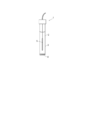
図1は、本発明のイオン感応膜を用いたイオン選択性電極の一例を示す図であり、全体を1で表すイオン選択性電極は、内部溶液2が満たされた支持管3の先端部にイオン感応膜4が取り付けられており、内部溶液2に内部電極5が挿入されている。
本発明のイオン感応膜を用いたイオン選択性電極は、少なくともイオン感応膜、内部溶液、内部電極から成っている。
内部電極としては、これに限定されないが、Ag/AgCl、Hg/Hg2Cl2,Hg/Hg2SO4等を例示できるが、特にAg/AgClを好適に使用できる。
また内部溶液としては、これに限定されないが、硝酸銀水溶液、塩化カリウム水溶液、硝酸カルシウム水溶液などの金属塩水溶液や、塩化カリウム水溶液と他の金属塩水溶液の混合溶液等を例示できるが、特に塩化カリウム水溶液を好適に使用できる。
図1は、本発明のイオン感応膜を用いたイオン選択性電極の一例を示す図であり、全体を1で表すイオン選択性電極は、内部溶液2が満たされた支持管3の先端部にイオン感応膜4が取り付けられており、内部溶液2に内部電極5が挿入されている。
(イオンセンサ)
本発明のイオンセンサは、上記イオン選択性電極やイオン選択性電界効果型トランジスタを作用電極として用いる以外は、従来公知のイオンセンサと同様の構成を採用することができる。
図2は本発明のイオン選択性電極1を作用電極として用いた、イオンセンサの一例を示す図であり、電位差計10の一方に本発明のイオン選択性電極1を用い、他方に参照電極20を連結する。
本発明のイオンセンサにおいては、従来公知の参照電極を使用することができ、図2に示す具体例においては、先端に多孔質膜21が設置された外側支持管22の中に、先端に多孔質膜23が設置された内側支持管24が配置された参照電極20であり、外側支持管22に外部溶液25が、内側支持管24に内部溶液26が満たされている。内側支持管24には、内部電極27が挿入されている。
上記作用電極であるイオン選択性電極1及び参照電極20の先端を、例えば、チラミン及び/又はヒスタミンを含有する試料液30に浸漬することにより、試料液中のチラミン及び/又はヒスタミンイオン(R-NH3 +)が選択的にイオン感応膜を通過することにより電位応答挙動を示し、電位差計によって電位応答量(mV)が示される。この電位応答量から、ネルンストの式(下記式(2))を用いて濃度が測定できる。
E=E0+(0.059(V)/n)logC …(2)
式中、Eは電位(V),E0は標準電位(V),nは電荷数、Cは濃度(M)をそれぞれ表す。
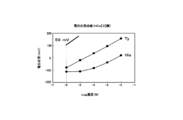
尚、図4に後述する実施例で作成されたイオンセンサにより測定された電位応答とチラミン(図中、「Ty」で表す)及びヒスタミン(図中、「His」で表す)の濃度の電位応答曲線を表す。この図4から明らかなように、本発明のイオンセンサにおいては、チラミンが10-6M程度から、ヒスタミンが10-4M程度から電位応答しており、食肉等の初期腐敗におけるチラミンの下限量である10-4M以上を確保しており、実用的な濃度範囲を確保していることがわかる。
本発明のイオンセンサは、上記イオン選択性電極やイオン選択性電界効果型トランジスタを作用電極として用いる以外は、従来公知のイオンセンサと同様の構成を採用することができる。
図2は本発明のイオン選択性電極1を作用電極として用いた、イオンセンサの一例を示す図であり、電位差計10の一方に本発明のイオン選択性電極1を用い、他方に参照電極20を連結する。
本発明のイオンセンサにおいては、従来公知の参照電極を使用することができ、図2に示す具体例においては、先端に多孔質膜21が設置された外側支持管22の中に、先端に多孔質膜23が設置された内側支持管24が配置された参照電極20であり、外側支持管22に外部溶液25が、内側支持管24に内部溶液26が満たされている。内側支持管24には、内部電極27が挿入されている。
上記作用電極であるイオン選択性電極1及び参照電極20の先端を、例えば、チラミン及び/又はヒスタミンを含有する試料液30に浸漬することにより、試料液中のチラミン及び/又はヒスタミンイオン(R-NH3 +)が選択的にイオン感応膜を通過することにより電位応答挙動を示し、電位差計によって電位応答量(mV)が示される。この電位応答量から、ネルンストの式(下記式(2))を用いて濃度が測定できる。
E=E0+(0.059(V)/n)logC …(2)
式中、Eは電位(V),E0は標準電位(V),nは電荷数、Cは濃度(M)をそれぞれ表す。
尚、図4に後述する実施例で作成されたイオンセンサにより測定された電位応答とチラミン(図中、「Ty」で表す)及びヒスタミン(図中、「His」で表す)の濃度の電位応答曲線を表す。この図4から明らかなように、本発明のイオンセンサにおいては、チラミンが10-6M程度から、ヒスタミンが10-4M程度から電位応答しており、食肉等の初期腐敗におけるチラミンの下限量である10-4M以上を確保しており、実用的な濃度範囲を確保していることがわかる。
(食品鮮度評価)
本発明のイオンセンサは、前述したとおり、チラミン等の不揮発性生体アミン類の濃度を定量的に測定することが可能であることから、魚肉等の食品が腐敗することにより増加するチラミンを本発明のイオンセンサを用いて測定することによって、食品鮮度を評価することが可能になる。また、ヒスタミン量を本発明のイオンセンサを用いて測定することによって、食品鮮度の評価に加え、ヒスタミン中毒を予防するための評価が可能になる。
尚、チラミン及びヒスタミンは、酸性~中性領域でイオン化されるが、魚肉等の食肉は、腐敗が進むと乳酸が増えるため、本発明のイオンセンサは直接魚肉に適用しても、チラミン及び/又はヒスタミンの濃度を測定することができる。
本発明のイオンセンサは、前述したとおり、チラミン等の不揮発性生体アミン類の濃度を定量的に測定することが可能であることから、魚肉等の食品が腐敗することにより増加するチラミンを本発明のイオンセンサを用いて測定することによって、食品鮮度を評価することが可能になる。また、ヒスタミン量を本発明のイオンセンサを用いて測定することによって、食品鮮度の評価に加え、ヒスタミン中毒を予防するための評価が可能になる。
尚、チラミン及びヒスタミンは、酸性~中性領域でイオン化されるが、魚肉等の食肉は、腐敗が進むと乳酸が増えるため、本発明のイオンセンサは直接魚肉に適用しても、チラミン及び/又はヒスタミンの濃度を測定することができる。
本発明を、次の実験例にて説明する。
<イオン感応膜およびイオン選択性電極>
下記の材料を小型ガラス瓶にて、テトラヒドロフラン2mLに溶解した。
1.イオノフォア 2mg
2.セバシン酸ジオクチル 66mg
3.ポリ塩化ビニル 32mg
これを直径3cmのシャーレに静かに展開し、そのまま室温(約25度)で約10時間放置し、揮発させることで透明なイオン感応膜を作製した。このようにして作製したイオン感応膜の膜厚は、約800μmであった。
作製したイオン感応膜をシャーレより直径7mmのパンチで打ち抜き、イオン選択性電極(Fluka社製)に固定した。電極内部溶液として0.01M塩化カリウム溶液を入れ、イオン選択性電極を作製した(図1参照)。
<イオン感応膜およびイオン選択性電極>
下記の材料を小型ガラス瓶にて、テトラヒドロフラン2mLに溶解した。
1.イオノフォア 2mg
2.セバシン酸ジオクチル 66mg
3.ポリ塩化ビニル 32mg
これを直径3cmのシャーレに静かに展開し、そのまま室温(約25度)で約10時間放置し、揮発させることで透明なイオン感応膜を作製した。このようにして作製したイオン感応膜の膜厚は、約800μmであった。
作製したイオン感応膜をシャーレより直径7mmのパンチで打ち抜き、イオン選択性電極(Fluka社製)に固定した。電極内部溶液として0.01M塩化カリウム溶液を入れ、イオン選択性電極を作製した(図1参照)。
<イオンセンサ>
作製したイオン選択性電極と、参照電極(TOA/DKK社製、内部液:飽和塩化カリウム溶液、外部液:0.01Mトリス塩酸緩衝液pH7.5)を、それぞれ電位差計に連結させ、イオンセンサを作製した。イオン選択性電極と参照電極の先端を試料液に浸漬させ、試料液のチラミン及びヒスタミンの測定を行った(図2参照)。
作製したイオン選択性電極と、参照電極(TOA/DKK社製、内部液:飽和塩化カリウム溶液、外部液:0.01Mトリス塩酸緩衝液pH7.5)を、それぞれ電位差計に連結させ、イオンセンサを作製した。イオン選択性電極と参照電極の先端を試料液に浸漬させ、試料液のチラミン及びヒスタミンの測定を行った(図2参照)。
〔実験例1~7〕
イオノフォアとして表1に示す材料を用いて、イオン感応膜、イオン選択性電極、イオンセンサを作製した。チラミン、ヒスタミン、カリウム、ナトリウム各試料液は、10-6Mから10-2Mの濃度範囲になるように秤量し、0.01Mトリス塩酸緩衝液pH7.5にて溶解し作製した。
各イオノフォアを含むイオンセンサにて、各試料溶液の各濃度に対する電位応答をイオンセンサにて測定した。測定結果を図3に示す。
また、この測定結果から電位応答の強さを、下記基準で判断し、結果を表1に示す。
電位応答の強さは、10-6Mから理想的な電位応答を示すものを◎、10-4M程度から理想的な電位応答を示すものを○、理想的な電位応答を得られなかったものを△、ほとんど電位の変化が見られなかったものを×とした。理想的な電位応答とは、濃度によって電位応答(mV)が変化し、上述したネルンストの式にて求める値と近似した挙動を示すものである。チラミンやヒスタミン以外の有機イオンや無機イオンに対して比較的低濃度側(10-4M程度)から電位応答を示すイオノフォアは、それらイオンがチラミン等と共存した場合、測定対象であるチラミンに対する電位応答を妨害することとなり、その電位応答は、ネルンストの式にて求める値とは大きく異なってしまい、電位応答の変化が小さかったり、電位の変化が見られない結果となってしまう。
尚、用いた各イオノフォアは、ベンゾー12-クラウン-4(B12C4)、ベンゾー15-クラウン-5(B15C5)、ベンゾー18-クラウン-6(B18C6)、ジベンゾー18-クラウン-6(DB18C6)、カリックス[4]アレンエステル誘導体(CA[4])、カリックス[6]アレンエステル誘導体(CA[6])及びホモオキサカリックス[3]アレン誘導体(HCA[3])である。
イオノフォアとして表1に示す材料を用いて、イオン感応膜、イオン選択性電極、イオンセンサを作製した。チラミン、ヒスタミン、カリウム、ナトリウム各試料液は、10-6Mから10-2Mの濃度範囲になるように秤量し、0.01Mトリス塩酸緩衝液pH7.5にて溶解し作製した。
各イオノフォアを含むイオンセンサにて、各試料溶液の各濃度に対する電位応答をイオンセンサにて測定した。測定結果を図3に示す。
また、この測定結果から電位応答の強さを、下記基準で判断し、結果を表1に示す。
電位応答の強さは、10-6Mから理想的な電位応答を示すものを◎、10-4M程度から理想的な電位応答を示すものを○、理想的な電位応答を得られなかったものを△、ほとんど電位の変化が見られなかったものを×とした。理想的な電位応答とは、濃度によって電位応答(mV)が変化し、上述したネルンストの式にて求める値と近似した挙動を示すものである。チラミンやヒスタミン以外の有機イオンや無機イオンに対して比較的低濃度側(10-4M程度)から電位応答を示すイオノフォアは、それらイオンがチラミン等と共存した場合、測定対象であるチラミンに対する電位応答を妨害することとなり、その電位応答は、ネルンストの式にて求める値とは大きく異なってしまい、電位応答の変化が小さかったり、電位の変化が見られない結果となってしまう。
尚、用いた各イオノフォアは、ベンゾー12-クラウン-4(B12C4)、ベンゾー15-クラウン-5(B15C5)、ベンゾー18-クラウン-6(B18C6)、ジベンゾー18-クラウン-6(DB18C6)、カリックス[4]アレンエステル誘導体(CA[4])、カリックス[6]アレンエステル誘導体(CA[6])及びホモオキサカリックス[3]アレン誘導体(HCA[3])である。
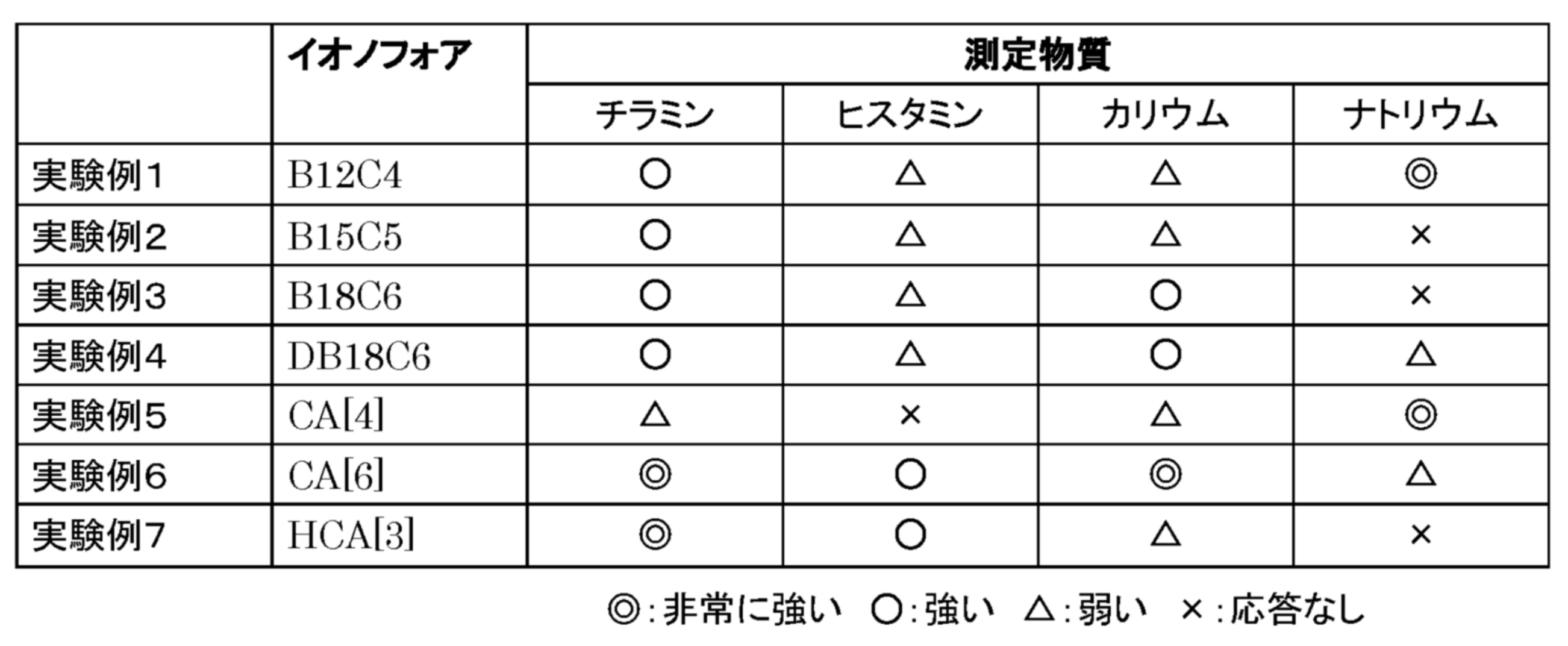
表1に示すように、HCA[3]をイオノフォアとして用いたイオンセンサは、妨害となる無機イオンの影響を受けず、チラミンに対して理想的な電位応答を得ることが確認できた。
<チラミン測定>
チラミンを10-6Mから10-2Mの濃度範囲になるように秤量し、0.01Mトリス塩酸緩衝液pH7.5にて溶解した。実験例7で作製したイオンセンサにてチラミンに対する電位応答を測定した。結果を図4に示す。
チラミンを10-6Mから10-2Mの濃度範囲になるように秤量し、0.01Mトリス塩酸緩衝液pH7.5にて溶解した。実験例7で作製したイオンセンサにてチラミンに対する電位応答を測定した。結果を図4に示す。
<ヒスタミン測定>
ヒスタミンを10-6Mから10-2Mの濃度範囲になるように秤量し、0.01Mトリス塩酸緩衝液pH7.5にて溶解した。実験例7で作製したイオンセンサにてヒスタミンに対する電位応答を測定した。結果を図4に示す。
ヒスタミンを10-6Mから10-2Mの濃度範囲になるように秤量し、0.01Mトリス塩酸緩衝液pH7.5にて溶解した。実験例7で作製したイオンセンサにてヒスタミンに対する電位応答を測定した。結果を図4に示す。
図4に示すように、本発明のイオン感応膜より作製したイオンセンサにて、チラミン及びヒスタミンの電位応答を測定することで、電位応答曲線を得ることができる。よって、本発明のイオンセンサを用いると、チラミン及びヒスタミンの濃度を容易に定量測定できることが確認できた。
本発明のイオン感応膜は、魚肉等の食肉の腐敗により生成されるチラミン及び/又はヒスタミンを選択的に捕捉できることから、チラミン及び/又はヒスタミンの濃度を容易且つ経済的に定量分析することができ、食品の鮮度評価或いは食品管理に有効に適用することができる。
特にサバ、マグロ、カツオ、カジキ、ブリ等の赤身の魚肉は腐敗によりチラミンやヒスタミンの生成が顕著であることから、本発明のイオンセンサはこれらの鮮度評価に有用である。またこれら魚肉以外にもチーズ等の発酵畜産食品の管理にも有効に適用することができる。
特にサバ、マグロ、カツオ、カジキ、ブリ等の赤身の魚肉は腐敗によりチラミンやヒスタミンの生成が顕著であることから、本発明のイオンセンサはこれらの鮮度評価に有用である。またこれら魚肉以外にもチーズ等の発酵畜産食品の管理にも有効に適用することができる。
1 イオン選択性電極、2 内部溶液、3 支持管、4 イオン感応膜、5 内部電極、10 電位差計、20 参照電極、30 試料液。
Claims (6)
- イオノフォアとして、下記式

で表されるホモオキサカリックス[3]アレン誘導体を含有することを特徴とするイオン感応膜。 - 請求項1記載のイオン感応膜を使用して成り、不揮発性生体アミン類に対して電位応答挙動を示すことを特徴とするイオン選択性電極。
- 請求項2記載のイオン選択性電極から成る作用電極、及び参照電極を備えて成ることを特徴とするイオンセンサ。
- 請求項1記載のイオン感応膜を電界効果型のトランジスタのゲート部に接続して成り、不揮発性生体アミン類に対して電位応答挙動を形成することを特徴とするイオン選択性電界効果型トランジスタ。
- 請求項4記載のイオン選択性電界効果型トランジスタから成る作用電極、及び参照電極を備えて成ることを特徴とするイオンセンサ。
- 請求項3又は請求項5記載のイオンセンサを用いて、食品中のチラミン及び/又はヒスタミン量を測定することを特徴とする食品管理方法。
Applications Claiming Priority (2)
| Application Number | Priority Date | Filing Date | Title |
|---|---|---|---|
| JP2016002344A JP2017122677A (ja) | 2016-01-08 | 2016-01-08 | イオン感応膜、イオン選択性電極、及びイオンセンサ |
| JP2016-002344 | 2016-01-08 |
Publications (1)
| Publication Number | Publication Date |
|---|---|
| WO2017119252A1 true WO2017119252A1 (ja) | 2017-07-13 |
Family
ID=59274446
Family Applications (1)
| Application Number | Title | Priority Date | Filing Date |
|---|---|---|---|
| PCT/JP2016/087266 Ceased WO2017119252A1 (ja) | 2016-01-08 | 2016-12-14 | イオン感応膜、イオン選択性電極、及びイオンセンサ |
Country Status (2)
| Country | Link |
|---|---|
| JP (1) | JP2017122677A (ja) |
| WO (1) | WO2017119252A1 (ja) |
Families Citing this family (2)
| Publication number | Priority date | Publication date | Assignee | Title |
|---|---|---|---|---|
| JP2020165847A (ja) | 2019-03-29 | 2020-10-08 | 株式会社島津製作所 | 食品の品質判定方法、及び、食品品質判定装置 |
| EP4310494A4 (en) * | 2021-03-19 | 2024-09-11 | Shimadzu Corporation | TRAINING DATA GENERATING METHOD AND TRAINING DATA GENERATING APPARATUS |
Citations (3)
| Publication number | Priority date | Publication date | Assignee | Title |
|---|---|---|---|---|
| JPH06201639A (ja) * | 1992-12-28 | 1994-07-22 | Res Dev Corp Of Japan | 光応答性カリックスアレーン誘導体を用いるイオン選択性電極 |
| JPH06273378A (ja) * | 1993-03-22 | 1994-09-30 | Olympus Optical Co Ltd | 電界効果型半導体センサ及びその製造方法 |
| JP2015187600A (ja) * | 2014-03-14 | 2015-10-29 | 国立大学法人山形大学 | トランジスタ型バイオセンサ |
-
2016
- 2016-01-08 JP JP2016002344A patent/JP2017122677A/ja active Pending
- 2016-12-14 WO PCT/JP2016/087266 patent/WO2017119252A1/ja not_active Ceased
Patent Citations (3)
| Publication number | Priority date | Publication date | Assignee | Title |
|---|---|---|---|---|
| JPH06201639A (ja) * | 1992-12-28 | 1994-07-22 | Res Dev Corp Of Japan | 光応答性カリックスアレーン誘導体を用いるイオン選択性電極 |
| JPH06273378A (ja) * | 1993-03-22 | 1994-09-30 | Olympus Optical Co Ltd | 電界効果型半導体センサ及びその製造方法 |
| JP2015187600A (ja) * | 2014-03-14 | 2015-10-29 | 国立大学法人山形大学 | トランジスタ型バイオセンサ |
Non-Patent Citations (3)
| Title |
|---|
| ARAKI, KOJI ET AL.: "Syntheses and ion binding properties of novel cage molecules derived from homooxacalix[3]arene", TETRAHEDRON LETTERS, vol. 41, no. 11, 2000, pages 1807 - 1810, XP004202276 * |
| KATSU, TAKASHI ET AL.: "Homooxacalix[3]arene Derivatives as Ionophores for Serotonin- Selective Membrane Electrodes", vol. 15, no. 4, 2003, pages 287 - 293, XP055397366 * |
| MARIA BOCHENSKA ET AL.: "Ion-selective electrodes based on p-tert-butyl- homooxacalixarene di(ethyl)amides", SUPRAMOLECULAR CHEMISTRY, vol. 21, no. 8, 2009, pages 732 - 737, XP055397404 * |
Also Published As
| Publication number | Publication date |
|---|---|
| JP2017122677A (ja) | 2017-07-13 |
Similar Documents
| Publication | Publication Date | Title |
|---|---|---|
| Mahajan et al. | A mercury (II) ion-selective electrode based on neutral salicylaldehyde thiosemicarbazone | |
| Mahajan et al. | Silver ion-selective electrodes employing Schiff base p-tert-butyl calix [4] arene derivatives as neutral carriers | |
| Mousavi et al. | Lead ion-selective membrane electrode based on 1, 10-dibenzyl-1, 10-diaza-18-crown-6 | |
| Rouhollahi et al. | Lead ion selective PVC membrane electrode based on 5, 5′-dithiobis-(2-nitrobenzoic acid) | |
| Arvand et al. | Ion-selective electrode for aluminum determination in pharmaceutical substances, tea leaves and water samples | |
| Timm et al. | Simultaneous determination of ammonia, dimethylamine, trimethylamine and trimethylamine-N-oxide in fish extracts by capillary electrophoresis with indirect UV-detection | |
| Isildak et al. | Silver (I)-selective PVC membrane potentiometric sensor based on 5, 10, 15, 20-tetra (4-pyridyl)-21 H, 23 H-porphine and potentiometric applications | |
| Mohamed et al. | Novel screen‐printed electrode for the determination of dodecyltrimethylammonium bromide in water samples | |
| Mashhadizadeh et al. | Nickel (II)-selective membrane potentiometric sensor using a recently synthesized Schiff base as neutral carrier | |
| Fakhari et al. | Zn (II)-selective membrane electrode based on tetra (2-aminophenyl) porphyrin | |
| Ali et al. | Modified screen-printed electrode for potentiometric determination of copper (II) in water samples | |
| Mahajan et al. | Mercury (II) ion-selective electrodes based on p-tert-butyl calix [4] crowns with imine units | |
| Birinci et al. | Rapid determination of trace level copper in tea infusion samples by solid contact ion selective electrode | |
| Frag et al. | Application of carbon sensors for potentiometric determination of copper (II) in water and biological fluids of Wilson disease patients. Studying the surface reaction using SEM, EDX, IR and DFT | |
| Eren et al. | Potentiometric monitoring of cobalt in beer sample by solid contact ion selective electrode | |
| Ganjali et al. | Cu (II)-all solid state sensor ion selective electrode (ASS-ISE) with a nano-molar detection limit and its use for the analysis of waste water samples | |
| Ali et al. | Modified screen-printed ion selective electrodes for potentiometric determination of sodium dodecylsulfate in different samples | |
| Mahajan et al. | Mercury (II) sensors based on calix [4] arene derivatives as receptor molecules | |
| Ganjali et al. | Novel monohydrogenphosphate sensor based on vanadyl salophen | |
| Arvand-Barmchi et al. | A PTEV-based zeolite membrane potentiometric sensor for cesium ion | |
| Boltia et al. | Development and greenness evaluation of a potentiometric method for lomefloxacin hydrochloride determination in urine and establishment of cumulative excretion pattern | |
| Mohamed et al. | A validated potentiometric method for the rapid determination of chromium ions content in food samples using a portable graphite sensor | |
| WO2017119252A1 (ja) | イオン感応膜、イオン選択性電極、及びイオンセンサ | |
| Zhang et al. | Comparison of different methods for determining the selectivity coefficient using a magnesium-selective electrode | |
| De Oliveira et al. | Novel all-solid-state copper (II) microelectrode based on a dithiomacrocycle as a neutral carrier |
Legal Events
| Date | Code | Title | Description |
|---|---|---|---|
| 121 | Ep: the epo has been informed by wipo that ep was designated in this application |
Ref document number: 16883752 Country of ref document: EP Kind code of ref document: A1 |
|
| NENP | Non-entry into the national phase |
Ref country code: DE |
|
| 122 | Ep: pct application non-entry in european phase |
Ref document number: 16883752 Country of ref document: EP Kind code of ref document: A1 |