WO2017104187A1 - タイヤ - Google Patents
タイヤ Download PDFInfo
- Publication number
- WO2017104187A1 WO2017104187A1 PCT/JP2016/075905 JP2016075905W WO2017104187A1 WO 2017104187 A1 WO2017104187 A1 WO 2017104187A1 JP 2016075905 W JP2016075905 W JP 2016075905W WO 2017104187 A1 WO2017104187 A1 WO 2017104187A1
- Authority
- WO
- WIPO (PCT)
- Prior art keywords
- tire
- elastomer
- resin composition
- mass
- acid
- Prior art date
- Legal status (The legal status is an assumption and is not a legal conclusion. Google has not performed a legal analysis and makes no representation as to the accuracy of the status listed.)
- Ceased
Links
Images

Classifications
-
- B—PERFORMING OPERATIONS; TRANSPORTING
- B60—VEHICLES IN GENERAL
- B60C—VEHICLE TYRES; TYRE INFLATION; TYRE CHANGING; CONNECTING VALVES TO INFLATABLE ELASTIC BODIES IN GENERAL; DEVICES OR ARRANGEMENTS RELATED TO TYRES
- B60C1/00—Tyres characterised by the chemical composition or the physical arrangement or mixture of the composition
-
- B—PERFORMING OPERATIONS; TRANSPORTING
- B60—VEHICLES IN GENERAL
- B60C—VEHICLE TYRES; TYRE INFLATION; TYRE CHANGING; CONNECTING VALVES TO INFLATABLE ELASTIC BODIES IN GENERAL; DEVICES OR ARRANGEMENTS RELATED TO TYRES
- B60C5/00—Inflatable pneumatic tyres or inner tubes
- B60C5/01—Inflatable pneumatic tyres or inner tubes without substantial cord reinforcement, e.g. cordless tyres, cast tyres
-
- C—CHEMISTRY; METALLURGY
- C08—ORGANIC MACROMOLECULAR COMPOUNDS; THEIR PREPARATION OR CHEMICAL WORKING-UP; COMPOSITIONS BASED THEREON
- C08L—COMPOSITIONS OF MACROMOLECULAR COMPOUNDS
- C08L77/00—Compositions of polyamides obtained by reactions forming a carboxylic amide link in the main chain; Compositions of derivatives of such polymers
Definitions
- the present invention relates to a tire.
- pneumatic tires made of rubber, organic fiber materials, steel members, and the like are used for vehicles such as passenger cars.
- Conventional rubber materials conventionally used for pneumatic tires have no problem in heat resistance.
- a plurality of processes such as kneading, sheeting, molding, and vulcanization are usually performed, and improvement in productivity has been demanded.
- thermoplastic resins particularly thermoplastic resins and thermoplastic elastomers
- These thermoplastic polymer materials have many advantages from the viewpoint of improving productivity, such as being capable of injection molding.
- thermoplastic polymer material a tire using a polyamide-based thermoplastic elastomer as the thermoplastic polymer material has been proposed (see JP 2012-46030 A).
- a tire using a thermoplastic polymer material is easier to manufacture and less expensive than a conventional rubber tire.
- thermoplastic polymer material while realizing this high production efficiency, it is possible to achieve a lower cost among tires using a polymer material, and a conventional rubber tire. It is required to achieve performance comparable to Specifically, it is required to satisfy both the low cost in manufacturing the tire and the difficulty of occurrence and development of cracks when the tire is continuously mounted and traveled.
- an embodiment of the present invention aims to provide a tire that is formed using a resin composition and has both low cost and crack resistance.
- An annular tire skeleton including a resin composition containing a polyamide resin and an elastomer is provided, and the content of the elastomer with respect to a total of 100 parts by mass of the polyamide resin and the elastomer contained in the resin composition is 5 parts by mass or more and 45 parts by mass or less, and the resin composition includes a sea phase containing the polyamide resin and an island phase containing the elastomer and having an average area of 0.05 ⁇ m 2 or more and 0.35 ⁇ m 2 or less.
- the resin composition has a tensile elastic modulus of 100 MPa to 1000 MPa.
- FIG. 1A is a perspective view illustrating a state where the tire according to the embodiment is cut along the tire rotation axis.
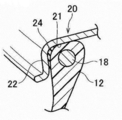
- FIG. 1B is a cross-sectional view of a bead portion in which the tire according to the embodiment is mounted on a rim.
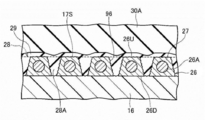
- FIG. 2 is a cross-sectional view along the tire width direction showing the periphery of the tire reinforcing layer.
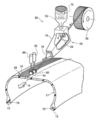
- FIG. 3 is an explanatory diagram for explaining an operation of embedding a reinforcing cord in a crown portion of a tire case using a cord heating device and rollers.
- a numerical range expressed using “to” means a range including numerical values described before and after “to” as a lower limit value and an upper limit value.
- the term “process” includes not only an independent process but also a process that can be clearly distinguished from other processes as long as the purpose is achieved. include.
- the “resin” is a concept including a thermoplastic resin and a thermosetting resin, and does not include a vulcanized rubber.
- the term “thermoplastic resin” means a polymer compound that softens and flows with increasing temperature and becomes relatively hard and strong when cooled, but does not have rubbery elasticity. This does not include elastomers.
- the amount of each component in the composition is the total amount of the plurality of substances present in the composition unless there is a specific indication when there are a plurality of substances corresponding to each component in the composition. Means.
- a tire according to an embodiment of the present invention includes an annular tire skeleton including a resin composition containing a polyamide resin and an elastomer, and a total of 100 masses of the polyamide resin and the elastomer contained in the resin composition.
- the elastomer content with respect to parts is 5 parts by mass or more and 45 parts by mass or less
- the resin composition contains a sea phase containing a polyamide resin and an elastomer and has an average area of 0.05 ⁇ m 2 or more and 0.35 ⁇ m 2. It has a sea-island structure including the following island phase, and the tensile modulus of the resin composition is 100 MPa or more and 1000 MPa or less.
- the tire having the above configuration can achieve both low cost and crack resistance.
- a polyamide resin and an elastomer are used in combination, for example, a cost can be reduced as compared with a case where a polyamide thermoplastic elastomer is used as a main component.
- tires using a resin composition in which a polyamide resin and an elastomer are used in combination have room for further improvement from the viewpoint of crack resistance.
- a resin composition using both a polyamide resin and an elastomer not only the durability of the resin composition itself is high, but also when the tire using the resin composition is used under a heavy load, it is cracked.
- the present inventors paid attention to the microstructure (ie, morphology) in a mixed state of the polyamide resin and the elastomer in addition to the tensile modulus of elasticity and the elastomer content of the resin composition.
- a co-continuous structure, an inverted sea-island structure in which the sea phase and the island phase are reversed that is, containing an elastomer
- a sea-island structure including a sea phase and an island phase containing a polyamide resin that is, containing an elastomer
- the content of the elastomer is within the above range
- the resin has the sea island structure and the average area of the island phase containing the elastomer within the above range
- the tensile elastic modulus is within the above range. It has been found that a tire using the composition is excellent in crack resistance.
- the “average area of the island phase” is measured, for example, as follows. Specifically, for example, first, the resin composition contained in the tire skeleton is cut, the obtained cut surface is observed with an atomic force microscope (AFM, manufactured by Agilent Technologies), and the AFM image is analyzed. Get the average area of the island phase. Examples of the observation conditions using an atomic force microscope include a tapping mode (ACAFM) and a visual field of 20 ⁇ m ⁇ 20 ⁇ m. The analysis of the AFM image is binarized by setting a threshold value so as to match the theoretical value of the volume fraction calculated from each content and each specific gravity of polyamide resin and elastomer, for example. Then, the areas of the two regions observed as the island phase of the sea-island structure are measured, and the average value is defined as “the average area of the island phase”.
- AFM atomic force microscope
- the “tensile modulus of the resin composition” is obtained by measurement based on JIS K7113: 1995. Specifically, for example, Shimadzu Autograph AGS-J (5KN) manufactured by Shimadzu Corporation is used, the tensile velocity is set to 200 mm / min, and the tensile elastic modulus is measured. As a measurement sample, for example, a test piece obtained by cutting a resin composition contained in a tire frame body is used.
- the tire may be composed only of a portion where the tire frame is formed of the above-described resin composition, and is composed of a portion formed of the above-described resin composition and a portion formed of another material. May be.
- part formed with the resin composition in a tire frame 50 mass% or more is mentioned, for example.
- the tire may include a member other than the tire skeleton as necessary.
- the resin composition contained in the tire frame will be described.
- the resin composition includes a polyamide resin.
- the polyamide resin include polyamide-based thermoplastic resins and polyamide-based thermosetting resins, but polyamide-based thermoplastic resins are preferable from the viewpoint of crack resistance.
- the “polyamide resin” is a concept that does not include a polyamide-based thermoplastic elastomer.
- polyamide-based thermoplastic resins include polyamide (amide 6) obtained by ring-opening polycondensation of ⁇ -caprolactam, polyamide (amide 11) obtained by ring-opening polycondensation of undecane lactam, and ring-opening polycondensation of lauryl lactam.
- the amide 6 can be represented by, for example, ⁇ CO— (CH 2 ) 5 —NH ⁇ n .
- the amide 11 can be represented by ⁇ CO— (CH 2 ) 10 —NH ⁇ n , for example.
- the amide 12 can be represented by, for example, ⁇ CO— (CH 2 ) 11 —NH ⁇ n .
- the amide 66 can be represented by ⁇ CO (CH 2 ) 4 CONH (CH 2 ) 6 NH ⁇ n , for example.
- Amide MX can be represented, for example, by the following structural formula (A-1). Here, n represents the number of repeating units.
- amide 6 As a commercially available product of amide 6, for example, “UBE nylon” series (for example, 1022B, 1011FB, etc.) manufactured by Ube Industries, Ltd. can be used.
- amide 11 for example, “Rilsan B” series manufactured by Arkema Co., Ltd. can be used.
- amide 12 As a commercially available product of amide 12, for example, “UBE nylon” series (for example, 3024U, 3020U, 3014U, etc.) manufactured by Ube Industries, Ltd. can be used.
- amide 66 for example, “UBE nylon” series (for example, 2020B, 2015B, etc.) manufactured by Ube Industries, Ltd. can be used.
- amide MX for example, “MX nylon” series (for example, S6001, S6021, S6011, etc.) manufactured by Mitsubishi Gas Chemical Co., Ltd. can be used.
- the polyamide-based thermoplastic resin may be a homopolymer formed only from the above structural unit, or may be a copolymer of the above structural unit and another monomer. In the case of a copolymer, it is preferable that the content rate of the said structural unit in each polyamide-type thermoplastic resin is 40 mass% or more.
- the number average molecular weight of the polyamide resin is preferably from 5,000 to 40,000 from the viewpoint of mechanical properties and processability, more preferably from 10,000 to 40,000, and even more preferably from 10,000 to 30,000 from the viewpoint of crack resistance.
- the tensile modulus of the polyamide resin is, for example, 1000 to 4000 MPa. From the viewpoint of crack resistance, 1000 to 3000 MPa is preferable, and 1000 to 2500 MPa is more preferable.
- the “tensile modulus of the polyamide resin” is obtained by measurement according to JIS K7113: 1995.
- the tensile elastic modulus of the polyamide resin contained in the resin composition can be measured by, for example, Shimadzu Corporation, Shimadzu Autograph AGS-J (5KN).
- 40 mass% or more and 95 mass% or less are mentioned, for example, 40 mass% or more and 90 mass% or less are preferable from a viewpoint of crack resistance, 40 mass% or more and 70 mass% % Or less is more preferable, and 40 mass% or more and 60 mass% or less are further more preferable.
- the resin composition includes an elastomer.
- the elastomer include thermoplastic elastomers and thermosetting elastomers, and thermoplastic elastomers are preferable from the viewpoint of crack resistance.
- thermoplastic elastomer examples include a copolymer having a hard segment and a soft segment.
- thermoplastic elastomer examples include a copolymer having a crystalline hard segment having a high melting point or a hard segment having a high cohesion and a non-crystalline polymer having a low glass transition temperature. Coalesce is mentioned.
- Thermoplastic elastomers for example, soften and flow with increasing temperature, become relatively hard and strong when cooled, and have rubber-like elasticity.
- the hard segment examples include a structure having a rigid group such as an aromatic group or alicyclic group in the main skeleton, or a structure enabling intermolecular packing by intermolecular hydrogen bonding or ⁇ - ⁇ interaction.
- the soft segment includes, for example, a segment having a long chain group (for example, a long chain alkylene group) in the main chain, a high degree of molecular rotation freedom, and a stretchable structure.
- thermoplastic elastomer examples include, for example, a polyamide-based thermoplastic elastomer (TPA), a polystyrene-based thermoplastic elastomer (TPS), a polyurethane-based thermoplastic elastomer (TPU), and an olefin-based thermoplastic elastomer (specified in JIS K6418).
- TPO polyamide-based thermoplastic elastomer
- TPS polystyrene-based thermoplastic elastomer
- TPU polyurethane-based thermoplastic elastomer
- TPZ thermoplastic elastomer
- thermoplastic elastomers other than polyamide-based thermoplastic elastomers are preferable from the viewpoint of low cost, and olefin-based thermoplastic elastomers (TPO) are more preferable from the viewpoint of achieving both low cost and crack resistance.
- TPO olefin-based thermoplastic elastomers
- thermoplastic elastomer for example, at least polyolefin is crystalline and a hard segment having a high melting point is formed, and other polymers (for example, the polyolefin, other polyolefins, polyvinyl compounds, etc.) are amorphous and have a glass transition temperature.
- the polyolefin forming the hard segment include polyethylene, polypropylene, isotactic polypropylene, polybutene, and the like.
- olefinic thermoplastic elastomers include olefin- ⁇ -olefin random copolymers, olefin block copolymers, and the like.
- propylene block copolymers ethylene-propylene copolymers, propylene- 1-hexene copolymer, propylene-4-methyl-1-pentene copolymer, propylene-1-butene copolymer, ethylene-1-hexene copolymer, ethylene-4-methyl-pentene copolymer, ethylene- 1-butene copolymer, 1-butene-1-hexene copolymer, 1-butene-4-methyl-pentene, ethylene-methacrylic acid copolymer, ethylene-methyl methacrylate copolymer, ethylene-ethyl methacrylate Copolymer, ethylene-butyl methacrylate copolymer, ethylene-methyl acrylate copolymer , Ethylene-
- thermoplastic elastomers include propylene block copolymers, ethylene-propylene copolymers, propylene-1-hexene copolymers, propylene-4-methyl-1-pentene copolymers, propylene-1- Butene copolymer, ethylene-1-hexene copolymer, ethylene-4-methyl-pentene copolymer, ethylene-1-butene copolymer, ethylene-methacrylic acid copolymer, ethylene-methyl methacrylate copolymer , Ethylene-ethyl methacrylate copolymer, ethylene-butyl methacrylate copolymer, ethylene-methyl acrylate copolymer, ethylene-ethyl acrylate copolymer, ethylene-butyl acrylate copolymer, propylene-methacrylic acid copolymer , Propylene-methyl methacrylate copolymer, pro Lene-e
- olefin resins such as ethylene and propylene may be used in combination.
- 50 mass% or more and 100 mass% or less of the olefin resin content rate in an olefin type thermoplastic elastomer are preferable.
- the number average molecular weight of the olefinic thermoplastic elastomer is preferably from 5,000 to 10,000,000, more preferably from 7,000 to 1,000,000 and even more preferably from 10,000 to 1,000,000 from the viewpoint of setting the average area of the island phase in the above range.
- the number average molecular weight can be measured by gel permeation chromatography (GPC).
- GPC gel permeation chromatography
- HLC-8320GPC EcoSEC manufactured by Tosoh Corporation can be used.
- the measuring method of a number average molecular weight it is the same also about another thermoplastic elastomer.
- the olefin-based thermoplastic elastomer can be synthesized by copolymerization by a known method.
- the acid-modified olefin type thermoplastic elastomer formed by acid-modifying a thermoplastic elastomer is preferable from a viewpoint of making the average area of an island phase into the said range.
- the “acid-modified olefin-based thermoplastic elastomer” refers to an olefin thermoplastic elastomer bonded with at least one of an unsaturated compound having an acidic group such as a carboxylic acid group, a sulfuric acid group, and a phosphoric acid group and an anhydride thereof. .
- Examples of bonding an unsaturated compound having an acidic group such as a carboxylic acid group, a sulfuric acid group, and a phosphoric acid group and an anhydride thereof to the olefin thermoplastic elastomer include, for example, an acidic group to the olefinic thermoplastic elastomer.
- bonding for example, graft polymerization
- unsaturated bond sites of the unsaturated carboxylic acid and at least one of the anhydride for example, maleic anhydride).
- an unsaturated compound having an acidic group an unsaturated compound having a carboxylic acid group which is a weak acid group and its anhydride are preferable from the viewpoint of suppressing deterioration of the olefin thermoplastic elastomer, and examples thereof include acrylic acid, methacrylic acid, and itacon. Examples include acids, crotonic acid, isocrotonic acid, maleic acid, and anhydrides thereof.
- thermoplastic elastomers examples include “Tuffmer” series (for example, A0550S, A1050S, A4050S, A1070S, A4070S, A35070S, A1085S, A4085S, A7090, A70090, MH7007, MH7010, manufactured by Mitsui Chemicals, Inc.
- Prime TPO made by prime polymers (for example, , E-2900H, F-3900H, E-2900, F-3900, J-5900, E-2910, F-3910, J-5910, E-2710, F 3710, J-5910, E-2740, F-3740, R110MP, R110E, can be used T310E, also M142E, etc.) and the like.
- the polyamide-based thermoplastic elastomer is, for example, a thermoplastic resin material comprising a copolymer having a crystalline polymer having a high melting point and a non-crystalline polymer having a low glass transition temperature. It means that having an amide bond (—CONH—) in the main chain of the polymer forming the hard segment.
- the polyamide-based thermoplastic elastomer for example, at least a polyamide is a crystalline hard crystalline segment with a high melting point, and other polymers (for example, polyester, polyether, etc.) are amorphous and have a soft glass transition temperature low soft segment. The material which forms is mentioned.
- the polyamide-based thermoplastic elastomer may be formed using a chain extender such as dicarboxylic acid in addition to the hard segment and the soft segment.
- a chain extender such as dicarboxylic acid
- Specific examples of polyamide-based thermoplastic elastomers include amide-based thermoplastic elastomers (TPA) defined in JIS K6418: 2007, polyamide-based elastomers described in JP-A No. 2004-346273, and the like. it can.
- examples of the polyamide forming the hard segment include polyamides produced by monomers represented by the following general formula (1) or general formula (2).
- R 1 represents a molecular chain of a hydrocarbon having 2 to 20 carbon atoms (for example, an alkylene group having 2 to 20 carbon atoms).
- R 2 represents a hydrocarbon molecular chain having 3 to 20 carbon atoms (for example, an alkylene group having 3 to 20 carbon atoms).
- R 1 is preferably a hydrocarbon molecular chain having 3 to 18 carbon atoms, such as an alkylene group having 3 to 18 carbon atoms, and a hydrocarbon molecular chain having 4 to 15 carbon atoms, such as carbon.
- An alkylene group having 4 to 15 carbon atoms is more preferable, and a molecular chain of a hydrocarbon having 10 to 15 carbon atoms, for example, an alkylene group having 10 to 15 carbon atoms is particularly preferable.
- R 2 is preferably a hydrocarbon molecular chain having 3 to 18 carbon atoms, for example, an alkylene group having 3 to 18 carbon atoms, and a hydrocarbon molecular chain having 4 to 15 carbon atoms,
- an alkylene group having 4 to 15 carbon atoms is more preferable
- a molecular chain of a hydrocarbon having 10 to 15 carbon atoms for example, an alkylene group having 10 to 15 carbon atoms is particularly preferable.
- the monomer represented by the general formula (1) or the general formula (2) include ⁇ -aminocarboxylic acid or lactam.
- the polyamide forming the hard segment include polycondensates of these ⁇ -aminocarboxylic acids or lactams, and co-condensation polymers of diamines and dicarboxylic acids.
- Examples of the ⁇ -aminocarboxylic acid include those having 5 to 20 carbon atoms such as 6-aminocaproic acid, 7-aminoheptanoic acid, 8-aminooctanoic acid, 10-aminocapric acid, 11-aminoundecanoic acid, 12-aminododecanoic acid and the like. Examples thereof include aliphatic ⁇ -aminocarboxylic acids.
- Examples of the lactam include aliphatic lactams having 5 to 20 carbon atoms such as lauryl lactam, ⁇ -caprolactam, udecan lactam, ⁇ -enantolactam, and 2-pyrrolidone.
- diamine examples include ethylene diamine, trimethylene diamine, tetramethylene diamine, hexamethylene diamine, heptamethylene diamine, octamethylene diamine, nonamethylene diamine, decamethylene diamine, undecamethylene diamine, dodecamethylene diamine, 2, 2, 4
- diamine compounds such as aliphatic diamines having 2 to 20 carbon atoms such as trimethylhexamethylenediamine, 2,4,4-trimethylhexamethylenediamine, 3-methylpentamethylenediamine, and metaxylenediamine.
- the dicarboxylic acid can be represented by HOOC- (R 3 ) m-COOH (R 3 : a hydrocarbon molecular chain having 3 to 20 carbon atoms, m: 0 or 1).
- R 3 a hydrocarbon molecular chain having 3 to 20 carbon atoms, m: 0 or 1.
- oxalic acid, succinic acid And aliphatic dicarboxylic acids having 2 to 20 carbon atoms such as glutaric acid, adipic acid, pimelic acid, suberic acid, azelaic acid, sebacic acid and dodecanedioic acid.
- a polyamide obtained by ring-opening polycondensation of lauryl lactam, ⁇ -caprolactam, or decane lactam can be preferably used.
- polyester, polyether, etc. are mentioned, for example, Polyethylene glycol, polypropylene glycol, polytetramethylene ether glycol, ABA type
- mold triblock polyether etc. are mentioned specifically ,. These can be used alone or in combination of two or more.
- polyether diamine etc. which are obtained by making ammonia etc. react with the terminal of polyether can also be used.
- the “ABA type triblock polyether” means a polyether represented by the following general formula (3).
- x and z represent an integer of 1 to 20.
- y represents an integer of 4 to 50.
- each of x and z is preferably an integer of 1 to 18, more preferably an integer of 1 to 16, still more preferably an integer of 1 to 14, and particularly preferably an integer of 1 to 12.
- y is preferably an integer of 5 to 45, more preferably an integer of 6 to 40, still more preferably an integer of 7 to 35, and particularly preferably an integer of 8 to 30.
- combinations of hard segment and soft segment include lauryl lactam ring-opening polycondensate / polyethylene glycol combination, lauryl lactam ring-opening polycondensate / polypropylene glycol combination, and lauryl lactam ring-opening polycondensation.
- the number average molecular weight of the polyamide-based thermoplastic elastomer is preferably from 5,000 to 10,000,000, more preferably from 7,000 to 1,000,000, and even more preferably from 10,000 to 1,000,000 from the viewpoint of setting the average area of the island phase in the above range.
- the polyamide-based thermoplastic elastomer can be synthesized by copolymerizing a polymer forming a hard segment and a polymer forming a soft segment by a known method.
- Examples of commercially available polyamide-based thermoplastic elastomers include “UBESTA XPA” series (for example, XPA9063X1, XPA9055X1, XPA9048X2, XPA9048X1, XPA9040X1, XPA9040X2XPA9044, etc.) from Daibe Eponic Corporation. Series (for example, E40-S3, E47-S1, E47-S3, E55-S1, E55-S3, EX9200, E50-R2, etc.) can be used.
- UESTA XPA for example, XPA9063X1, XPA9055X1, XPA9048X2, XPA9048X1, XPA9040X1, XPA9040X2XPA9044, etc.
- Series for example, E40-S3, E47-S1, E47-S3, E55-S1, E55-S3, EX9200, E50-R2, etc.
- polystyrene-based thermoplastic elastomer for example, at least polystyrene forms a hard segment, and other polymers (for example, polybutadiene, polyisoprene, polyethylene, hydrogenated polybutadiene, hydrogenated polyisoprene, etc.) are not. Examples thereof include materials that form a soft segment having a crystallinity and a low glass transition temperature.
- the polystyrene forming the hard segment for example, those obtained by a known radical polymerization method, ionic polymerization method and the like are preferably used, and specifically, polystyrene having anion living polymerization can be mentioned.
- the polymer that forms the soft segment include polybutadiene, polyisoprene, poly (2,3-dimethyl-butadiene), and the like.
- the combination of the hard segment and the soft segment mentioned above can be mentioned.
- the combination of the hard segment and the soft segment is preferably a combination of polystyrene / polybutadiene or a combination of polystyrene / polyisoprene.
- the soft segment is preferably hydrogenated.
- the number average molecular weight of the polystyrene-based thermoplastic elastomer is preferably from 5,000 to 10,000,000, more preferably from 7,000 to 1,000,000, and even more preferably from 10,000 to 1,000,000 from the viewpoint of setting the average area of the island phase in the above range.
- the polystyrene-based thermoplastic elastomer can be synthesized by copolymerizing a polymer forming a hard segment and a polymer forming a soft segment by a known method.
- polystyrene-based thermoplastic elastomers include styrene-butadiene copolymers [SBS (polystyrene-poly (butylene) block-polystyrene), SEBS (polystyrene-poly (ethylene / butylene) block-polystyrene)], styrene-isoprene.
- Copolymer polystyrene-polyisoprene block-polystyrene
- styrene-propylene copolymer [SEP (polystyrene- (ethylene / propylene) block), SEPS (polystyrene-poly (ethylene / propylene) block-polystyrene), SEEPS ( Polystyrene-poly (ethylene-ethylene / propylene) block-polystyrene), SEB (polystyrene (ethylene / butylene) block)] and the like.
- SEP polystyrene- (ethylene / propylene) block
- SEPS polystyrene-poly (ethylene / propylene) block-polystyrene
- SEEPS Polystyrene-poly (ethylene-ethylene / propylene) block-polystyrene
- SEB polystyrene (ethylene / butylene) block
- thermoplastic elastomer As a commercially available product of polystyrene-based thermoplastic elastomer, for example, “Tough Tech” series (for example, H1031, H1041, H1043, H1051, H1052, H1053, H1062, H1082, H1141, H1221, H1272, etc.) manufactured by Asahi Kasei Corporation, “SEBS” series (for example, 8007, 8076, etc.) and “SEPS” series (for example, 2002, 2063, etc.) manufactured by Kuraray Co., Ltd. can be used.
- Tough Tech for example, H1031, H1041, H1043, H1051, H1052, H1053, H1062, H1082, H1141, H1221, H1272, etc.
- SEBS for example, 8007, 8076, etc.
- SEPS for example, 2002, 2063, etc.
- thermoplastic elastomer As polyurethane-based thermoplastic elastomers, for example, at least polyurethane forms a hard segment in which pseudo-crosslinking is formed by physical aggregation, and other polymers form a soft segment with a low glass transition temperature that is amorphous. Material.
- Specific examples of the polyurethane-based thermoplastic elastomer include a polyurethane-based thermoplastic elastomer (TPU) defined in JIS K6418: 2007.
- TPU polyurethane-based thermoplastic elastomer
- the polyurethane-based thermoplastic elastomer can be represented as a copolymer including a soft segment including a unit structure represented by the following formula A and a hard segment including a unit structure represented by the following formula B.
- P represents a long-chain aliphatic polyether or a long-chain aliphatic polyester.
- R represents an aliphatic hydrocarbon, an alicyclic hydrocarbon, or an aromatic hydrocarbon.
- P ′ represents a short chain aliphatic hydrocarbon, an alicyclic hydrocarbon, or an aromatic hydrocarbon.
- the long-chain aliphatic polyether or long-chain aliphatic polyester represented by P for example, those having a molecular weight of 500 to 5000 can be used.
- P is derived from a diol compound containing a long-chain aliphatic polyether represented by P and a long-chain aliphatic polyester.
- diol compounds include polyethylene glycol, polypropylene glycol, polytetramethylene ether glycol, poly (butylene abido) diol, poly- ⁇ -caprolactone diol, poly (hexamethylene carbonate) having a molecular weight within the above range.
- Diol, ABA type triblock polyether and the like These can be used alone or in combination of two or more.
- R is a partial structure introduced using a diisocyanate compound containing an aliphatic hydrocarbon, an alicyclic hydrocarbon, or an aromatic hydrocarbon represented by R.
- the aliphatic diisocyanate compound containing an aliphatic hydrocarbon represented by R include 1,2-ethylene diisocyanate, 1,3-propylene diisocyanate, 1,4-butane diisocyanate, 1,6-hexamethylene diisocyanate, and the like.
- Examples of the diisocyanate compound containing an alicyclic hydrocarbon represented by R include 1,4-cyclohexane diisocyanate and 4,4-cyclohexane diisocyanate.
- examples of the aromatic diisocyanate compound containing an aromatic hydrocarbon represented by R include 4,4′-diphenylmethane diisocyanate and tolylene diisocyanate. These can be used alone or in combination of two or more.
- P ′ is derived from a diol compound containing a short-chain aliphatic hydrocarbon, alicyclic hydrocarbon, or aromatic hydrocarbon represented by P ′.
- Examples of the aliphatic diol compound containing a short-chain aliphatic hydrocarbon represented by P ′ include glycol and polyalkylene glycol.
- ethylene glycol, propylene glycol, trimethylene glycol, 1, 4 -Butanediol, 1,3-butanediol, 1,5-pentanediol, 1,6-hexanediol, 1,7-heptanediol, 1,8-octanediol, 1,9-nonanediol, 1,10- A decanediol etc. are mentioned.
- Examples of the alicyclic diol compound containing an alicyclic hydrocarbon represented by P ′ include cyclopentane-1,2-diol, cyclohexane-1,2-diol, cyclohexane-1,3-diol, Examples include cyclohexane-1,4-diol and cyclohexane-1,4-dimethanol.
- examples of the aromatic diol compound containing an aromatic hydrocarbon represented by P ′ include hydroquinone, resorcin, chlorohydroquinone, bromohydroquinone, methylhydroquinone, phenylhydroquinone, methoxyhydroquinone, phenoxyhydroquinone, 4,4′- Dihydroxybiphenyl, 4,4′-dihydroxydiphenyl ether, 4,4′-dihydroxydiphenyl sulfide, 4,4′-dihydroxydiphenylsulfone, 4,4′-dihydroxybenzophenone, 4,4′-dihydroxydiphenylmethane, bisphenol A, 1, Examples thereof include 1-di (4-hydroxyphenyl) cyclohexane, 1,2-bis (4-hydroxyphenoxy) ethane, 1,4-dihydroxynaphthalene, 2,6-dihydroxynaphthalene and the like. These can be used alone or in combination of two or more.
- the polyurethane-based thermoplastic elastomer can be synthesized by copolymerizing a polymer forming a hard segment and a polymer forming a soft segment by a known method.
- thermoplastic polyurethane described in JP-A-5-331256 can be used.
- thermoplastic elastomer specifically, a combination of a hard segment composed of an aromatic diol and an aromatic diisocyanate and a soft segment composed of a polycarbonate is preferable. More specifically, tolylene diisocyanate ( TDI) / polyester polyol copolymer, TDI / polyether polyol copolymer, TDI / caprolactone polyol copolymer, TDI / polycarbonate polyol copolymer, 4,4′-diphenylmethane diisocyanate (MDI) / polyester -Based polyol copolymer, MDI / polyether-based polyol copolymer, MDI / caprolactone-based polyol copolymer, MDI / polycarbonate-based polyol copolymer, and MDI + hydroquinone / polyhexamethy At least one selected from carbonate copolymers is preferable.
- TDI tolylene diisocyanate
- TDI / polyester polyol copolymer TDI / polyether polyol copolymer, MDI / polyester polyol copolymer, MDI / polyether polyol copolymer And at least one selected from MDI + hydroquinone / polyhexamethylene carbonate copolymer is more preferable.
- thermoplastic elastomers examples include, for example, “Elastollan” series (for example, ET680, ET880, ET690, ET890, etc.) manufactured by BASF, and “Clamiron U” series (for example, Kuraray Co., Ltd.) 2000 series, 3000 series, 8000 series, 9000 series, etc.) “Milactolan” series (for example, XN-2001, XN-2004, P390RSUP, P480RSUI, P26MRNAT, E490, E590, P890, etc.) manufactured by Japan Miraclan Etc. can be used.
- “Elastollan” series for example, ET680, ET880, ET690, ET890, etc.
- Clamiron U for example, Kuraray Co., Ltd. 2000 series, 3000 series, 8000 series, 9000 series, etc.
- Milactolan for example, XN-2001, XN-2004, P390RSUP, P480RS
- thermoplastic elastomer for example, at least a polyester is crystalline and a hard segment having a high melting point is formed, and another polymer (eg, polyester or polyether) is amorphous and has a low glass transition temperature.
- the polyester-based thermoplastic elastomer for example, at least a polyester is crystalline and a hard segment having a high melting point is formed, and another polymer (eg, polyester or polyether) is amorphous and has a low glass transition temperature. The material which forms is mentioned.
- An aromatic polyester can be used as the polyester forming the hard segment.
- the aromatic polyester can be formed, for example, from an aromatic dicarboxylic acid or an ester-forming derivative thereof and an aliphatic diol.
- the aromatic polyester is preferably polybutylene terephthalate derived from at least one of terephthalic acid and dimethyl terephthalate and 1,4-butanediol.
- the aromatic polyester includes, for example, isophthalic acid, phthalic acid, naphthalene-2,6-dicarboxylic acid, naphthalene-2,7-dicarboxylic acid, diphenyl-4,4′-dicarboxylic acid, diphenoxyethanedicarboxylic acid, 5
- a dicarboxylic acid component such as sulfoisophthalic acid or an ester-forming derivative thereof and a diol having a molecular weight of 300 or less (for example, ethylene glycol, trimethylene glycol, pentamethylene glycol, hexamethylene glycol, neopentyl glycol, decamethylene glycol, etc.
- Aliphatic diols such as: 1,4-cyclohexanedimethanol, tricyclodecane dimethylol and other alicyclic diols; xylylene glycol, bis (p-hydroxy) diphenyl, bis (p-hydroxyphenyl) propane, 2,2- Bi [4- (2-hydroxyethoxy) phenyl] propane, bis [4- (2-hydroxy) phenyl] sulfone, 1,1-bis [4- (2-hydroxyethoxy) phenyl] cyclohexane, 4,4′- Aromatic diols such as dihydroxy-p-terphenyl and 4,4′-dihydroxy-p-quarterphenyl; and the like, and polyesters derived from these, or a combination of two or more of these dicarboxylic acid components and diol components Polymerized polyester may also be used.
- polyester forming the hard segment examples include polyethylene terephthalate, polybutylene terephthalate, polymethylene terephthalate, polyethylene naphthalate, polybutylene naphthalate, and the like, and polybutylene terephthalate is preferable.
- Aliphatic polyethers include poly (ethylene oxide) glycol, poly (propylene oxide) glycol, poly (tetramethylene oxide) glycol, poly (hexamethylene oxide) glycol, copolymers of ethylene oxide and propylene oxide, poly (propylene oxide) And ethylene oxide addition polymer of glycol, and a copolymer of ethylene oxide and tetrahydrofuran.
- the aliphatic polyester include poly ( ⁇ -caprolactone), polyenantlactone, polycaprylolactone, polybutylene adipate, and polyethylene adipate.
- poly (tetramethylene oxide) glycol poly (propylene oxide) glycol are polymers that form soft segments from the viewpoint of the elastic properties of the resulting polyester block copolymer.
- Preferred are ethylene oxide adducts, poly ( ⁇ -caprolactone), polybutylene adipate, polyethylene adipate and the like.
- the number average molecular weight of the polyester-based thermoplastic elastomer is preferably from 5,000 to 10,000,000, more preferably from 7,000 to 1,000,000, and even more preferably from 10,000 to 1,000,000 from the viewpoint of setting the average area of the island phase in the above range.
- the combination of the hard segment and the soft segment described above examples include, for example, combinations of the hard segment and the soft segment mentioned above.
- the combination of the hard segment and the soft segment described above is preferably a combination in which the hard segment is polybutylene terephthalate, the soft segment is an aliphatic polyether, and the hard segment is polybutylene terephthalate. More preferred is a combination wherein is poly (ethylene oxide) glycol.
- polyester-based thermoplastic elastomers examples include “Hytrel” series (for example, 3046, 5557, 6347, 4047, 4767, etc.) manufactured by Toray DuPont Co., Ltd., and “Perprene” series manufactured by Toyobo Co., Ltd. (For example, P30B, P40B, P40H, P55B, P70B, P150B, P280B, P450B, P150M, S1001, S2001, S5001, S6001, S9001, etc.) can be used.
- Hytrel for example, 3046, 5557, 6347, 4047, 4767, etc.
- Perprene manufactured by Toyobo Co., Ltd.
- the polyester-based thermoplastic elastomer can be synthesized by copolymerizing a polymer that forms a hard segment and a polymer that forms a soft segment by a known method.
- the tensile elastic modulus of the elastomer is, for example, 1 to 800 MPa, and is preferably 1 to 50 MPa, more preferably 1 to 30 MPa from the viewpoint of elastic modulus and crack resistance.
- the “tensile elastic modulus of the elastomer” is obtained by measurement according to JIS K7113: 1995.
- the tensile elastic modulus of the elastomer contained in the resin composition can be measured by, for example, Shimadzu Corporation, Shimadzu Autograph AGS-J (5KN).
- the content of the elastomer in the resin composition is 5 parts by mass or more and 45 parts by mass or less with respect to 100 parts by mass in total of the polyamide resin and the elastomer, and 10 parts by mass or more and 45 parts by mass from the viewpoint of elastic modulus and crack resistance.
- Part or less preferably 30 parts by weight or more and 45 parts by weight or less, more preferably 30 parts by weight or more and 40 parts by weight or less.
- the resin composition may further contain a plasticizer in addition to the polyamide resin and the elastomer.
- the plasticizer is an additive that improves the plasticity of the resin composition, decreases the glass transition point, or decreases the elastic modulus when added to the resin composition.
- plasticizer examples include hydroxybenzoic acid alkyl esters, sulfonamides, polyols, lactams and the like, and only one kind may be used or two or more kinds may be used in combination.
- hydroxybenzoic acid alkyl esters include, for example, methyl o-hydroxybenzoate, methyl p-hydroxybenzoate, butyl o-hydroxybenzoate, butyl p-hydroxybenzoate, hexyl o-hydroxybenzoate, and p-hydroxybenzoic acid.
- sulfonamides examples include p-toluenesulfonamide, N-methyl-p-toluenesulfonamide, N-ethyl-p-toluenesulfonamide, N-cyclohexyl-p-toluenesulfonamide, N, N-diethyl- p-toluenesulfonamide, N, N-bis (2-hydroxyethyl) -p-toluenesulfonamide, o-toluenesulfonamide, N-ethyl-o-toluenesulfonamide, benzenesulfonamide, Nn-butylbenzene Sulfonamide, p-hydroxybenzenesulfonamide, o-nitrobenzenesulfonamide, p-nitrobenzenesulfonamide, sulfanilamide and the like can be mentioned.
- polyols examples include glycerin, diglycerin, propylene glycol, ethylene glycol, butylene glycol, pentylene glycol, cyclohexanedimethanol, hexanediol, polyethylene glycol (200 to 600), sorbitol, mannitol, lactitol, fructose, glucose, Examples include sucrose, maltose, lactose, ascorbic acid and the like.
- lactams examples include caprolactam and laurolactam.
- plasticizers include, for example, dimethyl phthalate, diethyl phthalate, di-n-butyl phthalate, di- (2-ethylhexyl) phthalate, diheptyl phthalate, diisodecyl phthalate, di-n phthalate Phthalic acid derivatives such as octyl, diisononyl phthalate, ditridecyl phthalate, octyldecyl phthalate, butylbenzyl phthalate, dicyclohexyl phthalate; isophthalic acid derivatives such as dimethyl isophthalate; di- (2-ethylhexyl) tetrahydrophthalic acid Tetrahydrophthalic acid derivatives such as: adipine such as dimethyl adipate, dibutyl adipate, di-n-hexyl adipate, di- (2-ethylhexyl) adipate, isononyl
- azelaic acid derivatives such as di-2-ethylhexyl azelate
- sebacic acid derivatives such as dibutyl sebacate
- dodecane-2-acid derivatives maleic acid derivatives such as dibutyl maleate and di-2-ethylhexyl maleate
- fumaric acid Fumaric acid derivatives such as dibutyl
- trimellitic acid derivatives such as tris-2-ethylhexyl trimellitic acid
- pyromellitic acid derivatives citric acid derivatives such as acetyltributyl citrate; itaconic acid derivatives
- oleic acid derivatives ricinoleic acid derivatives; stearic acid derivatives; Other fatty acid derivatives; sulfonic acid derivatives; phosphoric acid derivatives; glutaric acid derivatives; polyester plasticizers that are polymers of dibasic acids such as adipic acid, azelaic acid, and phthalic acid and
- plasticizers include Thiocol TP (manufactured by Morton), Adekasizer (registered trademark) O-130P, C-79, UL-100, P-200, RS-735 (manufactured by Asahi Denka). Can be mentioned.
- examples of other high molecular weight plasticizers include acrylic polymers, polypropylene glycol polymers, polytetrahydrofuran polymers, polyisobutylene polymers, and the like.
- the addition amount of the plasticizer is preferably 0.5 parts by mass or more and 30 parts by mass or less, more preferably 2 parts by mass or more and 30 parts by mass or less, with respect to 100 parts by mass in total of the polyamide resin and the elastomer. More preferably, it is 6 parts by mass or more and 27 parts by mass or less, and most preferably 12 parts by mass or more and 18 parts by mass or less.
- the resin composition may contain other components other than the polyamide resin, the elastomer, and the plasticizer as desired, as long as the effects of the present invention are not impaired.
- other components include rubber, various fillers (for example, silica, calcium carbonate, clay), anti-aging agent, oil, colorant, weathering agent, reinforcing material and the like.
- a resin composition contains another component, as content of the other component with respect to the whole resin composition, 50 mass% or less is mentioned, for example, 20 mass% or less is preferable and 10 mass% or less is more preferable.
- the resin composition has a sea-island structure including a sea phase containing a polyamide resin and an island phase containing an elastomer.
- the average area of the island phase is 0.05 ⁇ m 2 or more and 0.35 ⁇ m 2 or less, and from the viewpoint of crack resistance, 0.05 ⁇ m 2 or more and 0.30 ⁇ m 2 or less is preferable, and 0.05 ⁇ m 2 or more and 0.25 ⁇ m or less. 2 or less is more preferable, and 0.15 ⁇ m 2 or more and 0.25 ⁇ m 2 or less is more preferable.
- the resin composition is a known polyamide resin, elastomer, and, if necessary, a plasticizer and other components such as melt mixing (specifically, for example, biaxial extrusion continuous kneading, batch kneading, etc.). Obtained by mixing in a method.
- a method of controlling the average area of an island phase to the said range the method of controlling the average area of an island phase is mentioned by adjusting the kind of polyamide resin and an elastomer, content ratio, etc., for example.
- the tensile elastic modulus of the resin composition is 100 MPa or more and 1000 MPa or less, more preferably 200 MPa or more and 800 MPa or less, more preferably 200 MPa or more and 600 MPa or less, and more preferably 200 MPa or more and 500 MPa or less from the viewpoint of crack resistance and pressure resistance.
- the following are particularly preferred:
- the melting point (or softening point) of the entire resin composition is, for example, 100 ° C. to 350 ° C., preferably about 100 ° C. to 250 ° C., and more preferably about 120 ° C. to 250 ° C. from the viewpoint of tire productivity. 120 to 200 ° C. is more preferable.
- the tensile yield strength specified in JIS K7113: 1995 of the entire resin composition is preferably 5 MPa or more, preferably 5 MPa to 20 MPa, and more preferably 5 MPa to 17 MPa.
- the resin composition can withstand deformation against a load applied to the tire during traveling.
- the tensile yield elongation defined by JIS K7113: 1995 of the entire resin composition is preferably 10% or more, preferably 10% to 70%, and more preferably 15% to 60%.
- the tensile yield elongation of the resin composition is 10% or more, the elastic region is large and the air sealability can be improved.
- the tensile elongation at break specified in JIS K7113: 1995 of the entire resin composition is preferably 50% or more, preferably 100% or more, more preferably 150% or more, and particularly preferably 200% or more.
- the rim assembly property is good and it is possible to make it difficult to break against a collision.
- the deflection temperature under load (at 0.45 MPa load) specified in ISO 75-2 or ASTM D648 of the entire resin composition is preferably 50 ° C. or more, preferably 50 ° C. to 150 ° C., more preferably 50 ° C. to 130 ° C. .
- the deflection temperature under load of the resin composition is 50 ° C. or higher, deformation of the tire frame body can be suppressed even when vulcanization is performed in the manufacture of the tire.
- a tire according to an embodiment of the present invention includes an annular tire skeleton including the above-described resin composition.
- the thickness of the tire skeleton is not particularly limited, but from the viewpoint of crack resistance, it is preferably 0.5 mm or more and 3.5 mm or less, more preferably 1.0 mm or more and 3.0 mm or less, and 1.0 mm More preferably, it is 2.0 mm or less.
- the thickness of the tire skeleton means, for example, the thickness of the side skeleton when the tire skeleton has a bead portion, a side portion, and a crown portion.
- the thickness of the side portion in the radial central portion is defined as “the thickness of the tire frame”.
- side portion refers to a region from the bead portion to the end of the crown portion
- bead portion refers to 30% of the tire cross-section height from the tire radial direction inner end
- “Crown portion” refers to a region corresponding to a tread portion of a tire.
- the “tread part” of a tire means that the tire is mounted on a standard rim prescribed in JATMA YEAR BOOK (2014 edition, Japan Automobile Tire Association Standard) and the maximum size and ply rating applicable to JATMA YEAR BOOK. Fills 100% of the air pressure (maximum air pressure) corresponding to the load capacity (that is, the bold load in the internal pressure-load capacity correspondence table) as the internal pressure, and indicates the ground contact portion of the tire when the maximum load capacity is applied.
- the TRA standard or ETRTO standard is applied in the place of use or manufacturing, each standard is followed.
- the thickness of the tire frame body is an average value obtained by measuring 10 points in the circumferential direction of the side portion in the circumferential direction using a known device.
- the tire may include members other than the tire skeleton as necessary.
- the reinforcing member include a metal member such as a steel cord covered with a resin material.
- FIG. 1A is a perspective view showing a cross section of a part of the tire 10 of the present embodiment.
- FIG. 1B is a cross-sectional view of a bead portion when the tire 10 of the present embodiment is mounted on a rim.
- the tire 10 has substantially the same cross-sectional shape as a conventional rubber pneumatic tire.
- the tire 10 includes a pair of bead portions 12 that contact the bead seat 21 and the rim flange 22 of the rim 20 shown in FIG. 1B, and side portions 14 that extend outward from the bead portion 12 in the tire radial direction.
- a tire case 17 including a crown portion 16 (that is, an outer peripheral portion) that connects a tire radial direction outer end of one side portion 14 and a tire radial direction outer end of the other side portion 14 is provided.
- the tire case 17 corresponds to the tire skeleton described above, and is formed from the resin composition described above. In the present embodiment, the tire case 17 is entirely formed of the resin composition described above. However, the present invention is not limited to this configuration, and the tire case 17 is similar to a conventional rubber pneumatic tire. Different resin materials may be used for each part (specifically, the side part 14, the crown part 16, the bead part 12, etc.). In addition, in order to reinforce each part of the tire case 17, a reinforcing material (for example, a polymer material, a metal fiber, a cord, a nonwoven fabric, a woven fabric, or the like) may be embedded and disposed.
- a reinforcing material for example, a polymer material, a metal fiber, a cord, a nonwoven fabric, a woven fabric, or the like
- the tire case 17 of the present embodiment produces two tire case halves (that is, tire skeleton pieces) having a shape in which the tread width is equally divided along the circumferential direction of the tire case 17, and these are prepared as the equator of the tire. It is formed by bonding at the surface portion.
- the tire case 17 is not limited to the one formed by joining two members, and may be formed by joining three or more members.
- the tire case half can be produced by a method such as vacuum forming, pressure forming, injection molding, melt casting, or the like. For this reason, it is not necessary to perform vulcanization compared to the case where the tire case is molded with rubber as in the prior art, the manufacturing process can be greatly simplified, and the molding time can be omitted.
- an annular bead core 18 is embedded in the bead portion 12 shown in FIG. 1B in the same manner as a conventional general pneumatic tire.
- a steel cord is used as the bead core 18, but an organic fiber cord, a resin-coated organic fiber cord, a hard resin cord, or the like may be used.
- the bead core 18 can be omitted if the rigidity of the bead portion 12 is ensured and there is no problem in fitting with the rim 20.
- the portion that contacts the rim 20 of the bead portion 12 and at least the portion that contacts the rim flange 22 of the rim 20 are made of a material having a better sealing property than the resin composition constituting the tire case 17.
- An annular seal layer 24 is formed.
- the seal layer 24 may also be formed at a portion where the tire case 17 (specifically, the bead portion 12) and the bead sheet 21 are in contact with each other. Note that the sealing layer 24 may be omitted as long as the sealing property between the rim 20 and the resin composition constituting the tire case 17 can be secured.
- Examples of the material having better sealing performance than the resin composition constituting the tire case 17 include materials softer than the resin composition constituting the tire case 17, such as rubber, thermoplastic resin softer than the resin composition, and heat.
- a plastic elastomer is mentioned.
- Examples of the rubber include the same type of rubber as that used on the outer surface of the bead portion of a conventional general pneumatic tire made of rubber.
- Examples of the thermoplastic resins include polyamide resins, polyolefin resins, polystyrene resins, polyester resins, and the like, mixtures of these thermoplastic resins, mixtures of these thermoplastic resins and rubber or thermoplastic elastomer, and the like. .
- the thermoplastic elastomer includes polyester-based thermoplastic elastomer, polyamide-based thermoplastic elastomer, polystyrene-based thermoplastic elastomer, polyurethane-based thermoplastic elastomer, polyolefin-based thermoplastic elastomer, a mixture of these thermoplastic elastomers, and these thermoplastic elastomers. Examples thereof include a mixture with a thermoplastic resin or rubber.
- a reinforcing cord 26 having higher rigidity than the resin composition constituting the tire case 17 is wound around the crown portion 16 in the circumferential direction of the tire case 17.
- the reinforcing cord 26 is wound spirally in a state in which at least a part thereof is embedded in the crown portion 16 in a cross-sectional view along the axial direction of the tire case 17, thereby forming a reinforcing cord layer 28.
- the reinforcing cord 26 is in a state where a metal member 26A such as a steel cord is covered with a coating resin material 27 (ie, a coated cord member).
- a coating resin material 27 ie, a coated cord member.
- the same resin composition as the resin composition forming the tire case 17 is used as the coating resin material 27, but other thermoplastic resins or thermoplastic elastomers may be used.
- the reinforcing cord 26 is joined at a contact portion with the crown portion 16 by a method such as welding or bonding with an adhesive.
- the reinforcing cord 26 may be a steel cord or the like that is not covered with the covering resin material 27.
- the tensile elastic modulus of the coating resin material 27 is preferably set within a range of 0.1 to 10 times the tensile elastic modulus of the resin composition forming the tire case 17.
- the crown portion does not become too hard and rim assembly becomes easy.
- the tensile elastic modulus of the resin material 27 for coating is 0.1 times or more of the tensile elastic modulus of the resin composition forming the tire case 17, the resin constituting the reinforcing cord layer 28 is not too soft, and the in-plane shearing is performed. Excellent rigidity and improved cornering force.
- the reinforcing cord 26 has a substantially trapezoidal cross section.
- the upper surface (that is, the outer surface in the tire radial direction) of the reinforcing cord 26 is denoted by reference numeral 26U
- the lower surface (that is, the inner surface in the tire radial direction) is denoted by reference numeral 26D.
- the cross-sectional shape of the reinforcing cord 26 is a substantially trapezoidal shape, but the present invention is not limited to this configuration, and the cross-sectional shape is from the lower surface 26D side (ie, the tire radial direction inner side) to the upper surface 26U. Any shape may be used as long as the shape excluding the shape that becomes wider toward the side (that is, the outer side in the tire radial direction).
- the reinforcing cords 26 are arranged at intervals in the circumferential direction, a gap 28A is formed between adjacent reinforcing cords 26.
- the outer peripheral surface of the reinforcing cord layer 28 has a shape with irregularities, and the outer peripheral surface 17S of the tire case 17 in which the reinforcing cord layer 28 constitutes the outer peripheral portion also has an irregular shape.
- a fine roughened unevenness 96 is formed on the outer peripheral surface 17S (including the unevenness) of the tire case 17, and a cushion rubber 29 is bonded thereon via a bonding agent.
- the cushion rubber 29 flows into the contact surface with the reinforcing cord 26 so as to fill the rough unevenness 96.
- the above-mentioned tread 30 is joined on the cushion rubber 29 (that is, on the tire outer peripheral surface side).
- the tread 30 is formed with a tread pattern (not shown) including a plurality of grooves on the ground contact surface with the road surface in the same manner as a conventional rubber pneumatic tire.
- the joining portion of the tire case half is heated using the joining mold, but the present invention is not limited to this, for example, the joining portion is heated by a separately provided high-frequency heater or the like.
- the tire case halves may be joined by being softened or melted by irradiation with hot air, infrared rays, or the like, and pressurized by a joining mold.
- FIG. 3 is an explanatory diagram for explaining the operation of embedding the reinforcing cord 26 in the crown portion of the tire case 17 using a cord heating device and rollers.
- the cord supply device 56 is disposed on the reel 58 around which the reinforcing cord 26 is wound, the cord heating device 59 disposed on the downstream side of the reel 58 in the cord transport direction, and the downstream side of the reinforcing cord 26 in the transport direction.
- the first roller 60, the first cylinder device 62 that moves the first roller 60 in the direction of contacting and separating from the outer peripheral surface of the tire, and the downstream side in the conveying direction of the reinforcing cord 26 of the first roller 60 A second roller 64, and a second cylinder device 66 that moves the second roller 64 in a direction in which the second roller 64 comes into contact with and separates from the tire outer peripheral surface.
- the second roller 64 can be used as a metal cooling roller.
- the surface of the first roller 60 or the second roller 64 is subjected to a treatment (for example, fluororesin coating) for suppressing adhesion of the molten or softened coating resin material 27.
- the roller itself may be formed of a material to which the coating resin material 27 is difficult to adhere.
- the cord supply device 56 includes the two rollers of the first roller 60 or the second roller 64, but may include only one of the rollers.
- the cord heating device 59 includes a heater 70 and a fan 72 that generate hot air. Further, the cord heating device 59 includes a heating box 74 through which the reinforcing cord 26 passes through an internal space in which hot air is supplied, and a discharge port 76 for discharging the heated reinforcing cord 26.
- the temperature of the heater 70 of the cord heating device 59 is raised, and the ambient air heated by the heater 70 is sent to the heating box 74 by the wind generated by the rotation of the fan 72.
- the reinforcing cord 26 unwound from the reel 58 is sent and heated into a heating box 74 in which the internal space is heated with hot air.
- the heating temperature is set to a temperature at which the covering resin material 27 of the reinforcing cord 26 is melted or softened.
- the heated reinforcing cord 26 passes through the discharge port 76 and is wound spirally around the outer peripheral surface of the crown portion 16 of the tire case 17 rotating in the direction of arrow R in FIG. At this time, the lower surface 26 ⁇ / b> D of the reinforcing cord 26 contacts the outer peripheral surface of the crown portion 16.
- the coating resin material 27 melted or softened by heating spreads on the outer peripheral surface of the crown portion 16, and the reinforcing cord 26 is welded to the outer peripheral surface of the crown portion 16. Thereby, the joint strength between the crown portion 16 and the reinforcing cord 26 is improved.
- the reinforcing cord 26 is joined to the outer peripheral surface of the crown portion 16 as described above, but joining may be performed by other methods. For example, joining may be performed so that a part or the whole of the reinforcing cord 26 is embedded in the crown portion 16.
- a blasting device (not shown) emits a projection material at a high speed toward the outer peripheral surface 17S while rotating the tire case 17 side toward the outer peripheral surface 17S of the tire case 17.
- the ejected projection material collides with the outer peripheral surface 17S, and fine roughening unevenness 96 having an arithmetic average roughness Ra of 0.05 mm or more is formed on the outer peripheral surface 17S.
- the outer peripheral surface 17S becomes hydrophilic, and the wettability of the bonding agent described later improves.
- a bonding agent for bonding the cushion rubber 29 is applied to the outer peripheral surface 17S of the tire case 17 subjected to the roughening treatment.
- the bonding agent is not particularly limited, and a triazine thiol adhesive, a chlorinated rubber adhesive, a phenolic resin adhesive, an isocyanate adhesive, a halogenated rubber adhesive, a rubber adhesive, and the like can be used. It is preferable that the cushion rubber 29 reacts at a temperature at which vulcanization is possible (for example, 90 ° C. to 140 ° C.).
- the unvulcanized cushion rubber 29 is wound around the outer peripheral surface 17S to which the bonding agent has been applied for one round, and a bonding agent such as a rubber cement composition is applied onto the cushion rubber 29.
- a bonding agent such as a rubber cement composition
- the vulcanized or semi-cured tread rubber 30A is wound on the cushion rubber 29 to which the bonding agent has been applied for one round to form a raw tire case.
- the raw tire case is accommodated in a vulcanizing can or mold and vulcanized.
- the unvulcanized cushion rubber 29 flows into the roughened irregularities 96 formed on the outer peripheral surface 17S of the tire case 17 by the roughening treatment.
- the anchor rubber is exerted by the cushion rubber 29 flowing into the roughened unevenness 96, and the bonding strength between the tire case 17 and the cushion rubber 29 is improved. That is, the bonding strength between the tire case 17 and the tread 30 is improved via the cushion rubber 29.
- the tire according to one embodiment of the present invention includes a tire having the following aspect.
- An annular tire skeleton including a resin composition containing a polyamide resin and an elastomer is provided, and the content of the elastomer with respect to a total of 100 parts by mass of the polyamide resin and the elastomer contained in the resin composition is 5 parts by mass or more and 45 parts by mass or less, and the resin composition includes a sea phase containing the polyamide resin and an island phase containing the elastomer and having an average area of 0.05 ⁇ m 2 or more and 0.35 ⁇ m 2 or less.
- the resin composition has a tensile elastic modulus of 100 MPa to 1000 MPa.
- the resin composition further includes a plasticizer of 0.5 to 30 parts by mass with respect to a total of 100 parts by mass of the polyamide resin and the elastomer.
- the tire frame body has a thickness of 0.5 mm to 3.5 mm.
- the elastomer includes an olefin-based thermoplastic elastomer.
- the olefin-based thermoplastic elastomer is an acid-modified olefin-based thermoplastic elastomer.
- Tires of examples and comparative examples having the configurations shown in the above-described embodiments were produced by a known method.
- the tire size was 195/65 R15.
- the materials shown in Tables 1 to 3 below are mixed in the compositions (units: parts by mass) shown in Tables 1 to 3 below, and the resin material is kneaded with a Japanese steel twin-screw extruder “TEX40 ⁇ ” ( The mixing temperature was 180 to 250 ° C.) to obtain pellets.
- TEX40 ⁇ Japanese steel twin-screw extruder
- the obtained pellets were injection molded under conditions of a molding temperature of 220 ° C. and a mold temperature of 50 ° C. to obtain a tire case half.
- a tire was manufactured by the manufacturing method shown in the above embodiment.
- test sample was repeatedly pulled (20 Hz, constant strain 10%) using a servo pulsar device (manufactured by Shimadzu Corporation, product name: SERVO PULSER), and the number of times of endurance until the test sample fractured was recorded. did.
- the results (that is, the number of durability) are shown in Tables 1 to 3 below.
- the numerical value means the added amount (part by mass), and “ ⁇ ” means that the component is not included.
- “sea / island” means a sea-island structure including a sea phase containing polyamide resin and an island phase containing elastomer
- “co-continuous” means today's continuous structure of polyamide resin and elastomer. It means that.
- the components in the table are as follows.
- -TPA_1 polyamide-based thermoplastic elastomer (manufactured by Ube Industries, trade name “UBESTA XPA9055X1”, tensile modulus: 400 MPa)
- -TPA_2 polyamide-based thermoplastic elastomer (manufactured by Ube Industries, trade name “UBESTA XPA9063X1”, tensile modulus: 800 MPa)
- PA6 polyamide-based thermoplastic resin (manufactured by Ube Industries, trade name “UBE nylon 1013B”, tensile modulus: 2500 MPa)
- PA12 polyamide-based thermoplastic resin (manufactured by Ube Industries, trade name “3012U”, tensile modulus: 1400 MPa)
- Elastomer 1 Olefin-based thermoplastic elastomer (non-modified) (Mitsui Chemicals, trade name “Toughmer DF640”, tensile modulus: 5 MPa)
- Elastomer 2 Maleic anhydride-modified olefin-based thermoplastic elastomer (Mitsui Chemicals, trade name “Tuffmer MH7010”, tensile modulus: 10 MPa)
- Elastomer 3 Maleic anhydride modified olefin thermoplastic elastomer (Mitsui Chemicals, trade name “Tuffmer MH7020”, tensile modulus: 10 MPa)
Landscapes
- Engineering & Computer Science (AREA)
- Mechanical Engineering (AREA)
- Chemical & Material Sciences (AREA)
- Health & Medical Sciences (AREA)
- Chemical Kinetics & Catalysis (AREA)
- Medicinal Chemistry (AREA)
- Polymers & Plastics (AREA)
- Organic Chemistry (AREA)
- Tires In General (AREA)
- Compositions Of Macromolecular Compounds (AREA)
Abstract
ポリアミド樹脂とエラストマーとを含有する樹脂組成物を含む環状のタイヤ骨格体を備え、樹脂組成物に含まれるポリアミド樹脂とエラストマーとの合計100質量部に対するエラストマーの含有量が5質量部以上45質量部以下であり、樹脂組成物は前記ポリアミド樹脂を含有する海相と前記エラストマーを含有し平均面積が0.05μm2以上0.35μm2以下である島相とを含む海島構造を有し、樹脂組成物の引張弾性率が100MPa以上1000MPa以下である、タイヤ。
Description
本発明は、タイヤに関する。
従来、乗用車等の車両には、ゴム、有機繊維材料、スチール部材などから構成された空気入りタイヤが用いられている。従来空気入りタイヤに用いられている一般的なゴム材料は、耐熱性などには問題はない。しかし、タイヤ製造工程において、混練、シーティング、成形および加硫といった複数の工程を経るのが通常であり、生産性の向上が求められていた。
これに対し、近年では、軽量化や、成形の容易さ、リサイクルのしやすさから、樹脂材料、特に熱可塑性樹脂や熱可塑性エラストマーなどをタイヤ材料として用いることが検討されている。これら熱可塑性の高分子材料(すなわち熱可塑性樹脂)は、射出成形が可能であるなど、生産性の向上の観点から有利な点が多い。
また、前記熱可塑性の高分子材料としてポリアミド系熱可塑性エラストマーを用いたタイヤが提案されている(特開2012-46030号公報参照)。
熱可塑性の高分子材料を用いたタイヤは、ゴム製の従来タイヤと比べて、製造が容易で且つ低コストである。但し、熱可塑性の高分子材料を用いてタイヤを製造する場合には、この高い製造効率を実現しつつ、高分子材料を用いたタイヤの中でもさらに低コストを実現し、且つ従来のゴム製タイヤと比して遜色のない性能を実現することが求められる。具体的には、タイヤの製造における低コストと、タイヤを装着して走行し続けたときにおける亀裂の発生及び進展が起こりにくいことと、の両立が求められる。
本発明の一実施形態は、前記事情を踏まえ、樹脂組成物を用いて形成され、低コストと耐亀裂性とを両立したタイヤを提供することを目的とする。
[1] ポリアミド樹脂とエラストマーとを含有する樹脂組成物を含む環状のタイヤ骨格体を備え、前記樹脂組成物に含まれる前記ポリアミド樹脂と前記エラストマーとの合計100質量部に対する前記エラストマーの含有量が5質量部以上45質量部以下であり、前記樹脂組成物は、前記ポリアミド樹脂を含有する海相と、前記エラストマーを含有し平均面積が0.05μm2以上0.35μm2以下である島相と、を含む海島構造を有し、前記樹脂組成物の引張弾性率が100MPa以上1000MPa以下である、タイヤ。
本発明の一実施形態によれば、樹脂組成物を用いて形成され、低コストと耐亀裂性とを両立したタイヤを提供することができる。
以下、本発明の具体的な実施形態について詳細に説明するが、本発明は、以下の実施形態に何ら限定されるものではなく、本発明の目的の範囲内において、適宜変更を加えて実施することができる。
本明細書において「~」を用いて表される数値範囲は、「~」の前後に記載される数値を下限値及び上限値として含む範囲を意味する。
本明細書において「工程」との語には、独立した工程だけではなく、他の工程と明確に区別できない場合であっても、その目的が達成されるものであれば、当該工程も本用語に含まれる。
本明細書において「樹脂」とは、熱可塑性樹脂及び熱硬化性樹脂を含む概念であり、加硫ゴムはこれに含まれない。
本明細書において「熱可塑性樹脂」とは、温度上昇とともに材料が軟化、流動し、冷却すると比較的硬く強度のある状態になるが、ゴム状弾性を有しない高分子化合物を意味し、熱可塑性エラストマーはこれに含まれない。
本明細書において、組成物中の各成分の量は、各成分に該当する物質が組成物中に複数存在する場合には、特に断らない限り、組成物中に存在する複数の物質の合計量を意味する。
本明細書において「工程」との語には、独立した工程だけではなく、他の工程と明確に区別できない場合であっても、その目的が達成されるものであれば、当該工程も本用語に含まれる。
本明細書において「樹脂」とは、熱可塑性樹脂及び熱硬化性樹脂を含む概念であり、加硫ゴムはこれに含まれない。
本明細書において「熱可塑性樹脂」とは、温度上昇とともに材料が軟化、流動し、冷却すると比較的硬く強度のある状態になるが、ゴム状弾性を有しない高分子化合物を意味し、熱可塑性エラストマーはこれに含まれない。
本明細書において、組成物中の各成分の量は、各成分に該当する物質が組成物中に複数存在する場合には、特に断らない限り、組成物中に存在する複数の物質の合計量を意味する。
本発明の一実施形態に係るタイヤは、ポリアミド樹脂とエラストマーとを含有する樹脂組成物を含む環状のタイヤ骨格体を備え、前記樹脂組成物に含まれる前記ポリアミド樹脂と前記エラストマーとの合計100質量部に対する前記エラストマーの含有量が5質量部以上45質量部以下であり、前記樹脂組成物は、ポリアミド樹脂を含有する海相と、エラストマーを含有し平均面積が0.05μm2以上0.35μm2以下である島相と、を含む海島構造を有し、前記樹脂組成物の引張弾性率が100MPa以上1000MPa以下である。
本発明者らの検討の結果、上記構成を有するタイヤは、低コストと耐亀裂性とを両立できることが分かった。
具体的には、ポリアミド樹脂とエラストマーとを併用すると、例えばポリアミド系熱可塑性エラストマーを主成分として用いた場合に比べて、低コストを実現することができる。しかし、ポリアミド樹脂とエラストマーとを併用した樹脂組成物を用いたタイヤにおいては、耐亀裂性の観点からさらなる改良の余地があった。特に、ポリアミド樹脂とエラストマーとを併用した樹脂組成物では、樹脂組成物自体の耐久性が高いだけでなく、その樹脂組成物を用いたタイヤに大きな負荷をかけて使用し続けた場合でも、亀裂の進展による破壊が生じにくいことが求められる。
そこで、本発明者らは、樹脂組成物の引張弾性率及びエラストマーの含有量に加え、ポリアミド樹脂とエラストマーとの混合状態における微細構造(すなわちモルフォロジー)に着目した。
具体的には、ポリアミド樹脂とエラストマーとを併用すると、例えばポリアミド系熱可塑性エラストマーを主成分として用いた場合に比べて、低コストを実現することができる。しかし、ポリアミド樹脂とエラストマーとを併用した樹脂組成物を用いたタイヤにおいては、耐亀裂性の観点からさらなる改良の余地があった。特に、ポリアミド樹脂とエラストマーとを併用した樹脂組成物では、樹脂組成物自体の耐久性が高いだけでなく、その樹脂組成物を用いたタイヤに大きな負荷をかけて使用し続けた場合でも、亀裂の進展による破壊が生じにくいことが求められる。
そこで、本発明者らは、樹脂組成物の引張弾性率及びエラストマーの含有量に加え、ポリアミド樹脂とエラストマーとの混合状態における微細構造(すなわちモルフォロジー)に着目した。
上記微細構造としては、ポリアミド樹脂を含有する海相とエラストマーを含有する島相とを含む海島構造のほか、共連続構造、海相と島相とが逆転した逆海島構造(すなわちエラストマーを含有する海相とポリアミド樹脂を含有する島相とを含む海島構造)等が挙げられる。そして理由は定かではないが、エラストマーの含有量を前記範囲とし、上記海島構造を有した上でエラストマーを含有する島相の平均面積を前記範囲とし、かつ、引張弾性率を前記範囲とした樹脂組成物を用いたタイヤが、耐亀裂性に優れることを見出した。
ここで、上記「島相の平均面積」は、例えば以下のように測定される。
具体的には、例えば、まずタイヤ骨格体に含まれる樹脂組成物を切断し、得られた切断面を原子間力顕微鏡(AFM、アジレントテクノロジー社製)で観察し、AFM像を解析することで、島相の平均面積を得る。原子間力顕微鏡による観察の条件としては、例えば、タッピングモード(ACAFM)、視野20μm×20μm、が挙げられる。AFM像の解析は、例えば、ポリアミド樹脂及びエラストマーの各含有量及び各比重から算出された体積分率の理論値に合うように閾値を設定して二値化する。そして、海島構造の島相として観測された2個の領域について面積を測定し、平均した値を「島相の平均面積」とする。
具体的には、例えば、まずタイヤ骨格体に含まれる樹脂組成物を切断し、得られた切断面を原子間力顕微鏡(AFM、アジレントテクノロジー社製)で観察し、AFM像を解析することで、島相の平均面積を得る。原子間力顕微鏡による観察の条件としては、例えば、タッピングモード(ACAFM)、視野20μm×20μm、が挙げられる。AFM像の解析は、例えば、ポリアミド樹脂及びエラストマーの各含有量及び各比重から算出された体積分率の理論値に合うように閾値を設定して二値化する。そして、海島構造の島相として観測された2個の領域について面積を測定し、平均した値を「島相の平均面積」とする。
また、上記「樹脂組成物の引張弾性率」は、JIS K7113:1995に準拠した測定により得られる。
具体的には、例えば、島津製作所社製、島津オートグラフAGS-J(5KN)を用い、引張速度を200mm/minに設定し、引張弾性率の測定を行う。測定試料としては、例えば、タイヤ骨格体に含まれる樹脂組成物を切断して得られた試験片を用いる。
具体的には、例えば、島津製作所社製、島津オートグラフAGS-J(5KN)を用い、引張速度を200mm/minに設定し、引張弾性率の測定を行う。測定試料としては、例えば、タイヤ骨格体に含まれる樹脂組成物を切断して得られた試験片を用いる。
前記タイヤは、タイヤ骨格体が上述した樹脂組成物で形成された部位のみで構成されてもよく、上述した樹脂組成物で形成された部位と他の材料で形成された部位とで構成されていてもよい。タイヤ骨格体における樹脂組成物で形成された部位の割合は、例えば50質量%以上が挙げられる。
また、前記タイヤは、必要に応じてタイヤ骨格体以外の部材を含んでもよい。以下、タイヤ骨格体に含まれる樹脂組成物について説明する。
また、前記タイヤは、必要に応じてタイヤ骨格体以外の部材を含んでもよい。以下、タイヤ骨格体に含まれる樹脂組成物について説明する。
[樹脂組成物]
<ポリアミド樹脂>
樹脂組成物は、ポリアミド樹脂を含む。ポリアミド樹脂としては、ポリアミド系熱可塑性樹脂及びポリアミド系熱硬化性樹脂が挙げられるが、耐亀裂性の観点からポリアミド系熱可塑性樹脂が好ましい。
なお、本明細書において「ポリアミド樹脂」は、ポリアミド系熱可塑性エラストマーを含まない概念である。
<ポリアミド樹脂>
樹脂組成物は、ポリアミド樹脂を含む。ポリアミド樹脂としては、ポリアミド系熱可塑性樹脂及びポリアミド系熱硬化性樹脂が挙げられるが、耐亀裂性の観点からポリアミド系熱可塑性樹脂が好ましい。
なお、本明細書において「ポリアミド樹脂」は、ポリアミド系熱可塑性エラストマーを含まない概念である。
ポリアミド系熱可塑性樹脂としては、具体的には、ε-カプロラクタムを開環重縮合したポリアミド(アミド6)、ウンデカンラクタムを開環重縮合したポリアミド(アミド11)、ラウリルラクタムを開環重縮合したポリアミド(アミド12)、ジアミンと二塩基酸とを重縮合したポリアミド(アミド66)、メタキシレンジアミンを構成単位として有するポリアミド(アミドMX)等を例示することができる。
アミド6は、例えば、{CO-(CH2)5-NH}nで表すことができる。アミド11は、例えば、{CO-(CH2)10-NH}nで表すことができる。アミド12は、例えば、{CO-(CH2)11-NH}nで表すことができる。アミド66は、例えば、{CO(CH2)4CONH(CH2)6NH}nで表すことができる。アミドMXは、例えば、下記構造式(A-1)で表すことができる。ここで、nは繰り返し単位数を表す。
アミド6の市販品としては、例えば、宇部興産(株)製の「UBEナイロン」シリーズ(例えば、1022B、1011FB等)を用いることができる。アミド11の市販品としては、例えば、アルケマ(株)製の「Rilsan B」シリーズを用いることができる。アミド12の市販品としては、例えば、宇部興産(株)製の「UBEナイロン」シリーズ(例えば、3024U、3020U、3014U等)を用いることができる。アミド66の市販品としては、例えば、宇部興産(株)製の「UBEナイロン」シリーズ(例えば、2020B、2015B等)を用いることができる。アミドMXの市販品としては、例えば、三菱ガス化学(株)製の「MXナイロン」シリーズ(例えば、S6001、S6021、S6011等)を用いることができる。

ポリアミド系熱可塑性樹脂は、上記の構成単位のみで形成されるホモポリマーであってもよく、上記の構成単位と他のモノマーとのコポリマーであってもよい。コポリマーの場合、各ポリアミド系熱可塑性樹脂における上記構成単位の含有率は、40質量%以上であることが好ましい。
ポリアミド樹脂の数平均分子量としては、機械的物性及び加工性の観点から5000~40000が好ましく、耐亀裂性の観点から10000~40000がより好ましく、10000~30000がさらに好ましい。
また、ポリアミド樹脂の引張弾性率としては、例えば1000~4000MPaが挙げられ、耐亀裂性の観点から1000~3000MPaが好ましく、1000~2500MPaがより好ましい。
上記「ポリアミド樹脂の引張弾性率」は、JIS K7113:1995に準拠した測定により得られる。樹脂組成物に含有されるポリアミド樹脂の引張弾性率の測定は、例えば、島津製作所社製、島津オートグラフAGS-J(5KN)等により測定することができる。
上記「ポリアミド樹脂の引張弾性率」は、JIS K7113:1995に準拠した測定により得られる。樹脂組成物に含有されるポリアミド樹脂の引張弾性率の測定は、例えば、島津製作所社製、島津オートグラフAGS-J(5KN)等により測定することができる。
樹脂組成物全体に対するポリアミド樹脂の含有量としては、例えば、40質量%以上95質量%以下が挙げられ、耐亀裂性の観点から40質量%以上90質量%以下が好ましく、40質量%以上70質量%以下がより好ましく、40質量%以上60質量%以下がさらに好ましい。
<エラストマー>
樹脂組成物は、エラストマーを含む。エラストマーとしては、熱可塑性エラストマー及び熱硬化性エラストマーが挙げられるが、耐亀裂性の観点から熱可塑性エラストマーが好ましい。
樹脂組成物は、エラストマーを含む。エラストマーとしては、熱可塑性エラストマー及び熱硬化性エラストマーが挙げられるが、耐亀裂性の観点から熱可塑性エラストマーが好ましい。
熱可塑性エラストマーとしては、ハードセグメント及びソフトセグメントを有する共重合体が挙げられる。熱可塑性エラストマーとしては、例えば、結晶性で融点の高いハードセグメント又は高い凝集力のハードセグメントを構成するポリマーと、非晶性でガラス転移温度の低いソフトセグメントを構成するポリマーと、を有する共重合体が挙げられる。熱可塑性エラストマーは、例えば、温度上昇とともに材料が軟化、流動し、冷却すると比較的硬く強度のある状態になり、かつ、ゴム状弾性を有する。
上記ハードセグメントとしては、例えば、主骨格に芳香族基若しくは脂環式基等の剛直な基を有する構造、又は分子間水素結合若しくはπ-π相互作用による分子間パッキングを可能にする構造等のセグメントが挙げられる。また、ソフトセグメントは、例えば、主鎖に長鎖の基(例えば長鎖のアルキレン基等)を有し、分子回転の自由度が高く、伸縮性を有する構造のセグメントが挙げられる。
上記ハードセグメントとしては、例えば、主骨格に芳香族基若しくは脂環式基等の剛直な基を有する構造、又は分子間水素結合若しくはπ-π相互作用による分子間パッキングを可能にする構造等のセグメントが挙げられる。また、ソフトセグメントは、例えば、主鎖に長鎖の基(例えば長鎖のアルキレン基等)を有し、分子回転の自由度が高く、伸縮性を有する構造のセグメントが挙げられる。
熱可塑性エラストマーの具体例としては、例えば、JIS K6418に規定されるポリアミド系熱可塑性エラストマー(TPA)、ポリスチレン系熱可塑性エラストマー(TPS)、ポリウレタン系熱可塑性エラストマー(TPU)、オレフィン系熱可塑性エラストマー(TPO)、ポリエステル系熱可塑性エラストマー(TPEE)、熱可塑性ゴム架橋体(TPV)、若しくはその他の熱可塑性エラストマー(TPZ)等が挙げられる。その中でも、低コストの観点からポリアミド系熱可塑性エラストマー以外の熱可塑性エラストマーが好ましく、その中でも低コストと耐亀裂性との両立の観点から、オレフィン系熱可塑性エラストマー(TPO)がより好ましい。
-オレフィン系熱可塑性エラストマー-
オレフィン系熱可塑性エラストマーとしては、例えば、少なくともポリオレフィンが結晶性で融点の高いハードセグメントを形成し、他のポリマー(例えば、前記ポリオレフィン、他のポリオレフィン、ポリビニル化合物等)が非晶性でガラス転移温度の低いソフトセグメントを形成している材料が挙げられる。ハードセグメントを形成するポリオレフィンとしては、例えば、ポリエチレン、ポリプロピレン、アイソタクチックポリプロピレン、ポリブテン等が挙げられる。
オレフィン系熱可塑性エラストマーとしては、例えば、少なくともポリオレフィンが結晶性で融点の高いハードセグメントを形成し、他のポリマー(例えば、前記ポリオレフィン、他のポリオレフィン、ポリビニル化合物等)が非晶性でガラス転移温度の低いソフトセグメントを形成している材料が挙げられる。ハードセグメントを形成するポリオレフィンとしては、例えば、ポリエチレン、ポリプロピレン、アイソタクチックポリプロピレン、ポリブテン等が挙げられる。
オレフィン系熱可塑性エラストマーとしては、例えば、オレフィン-α-オレフィンランダム共重合体、オレフィンブロック共重合体等が挙げられ、具体的には、プロピレンブロック共重合体、エチレン-プロピレン共重合体、プロピレン-1-ヘキセン共重合体、プロピレン-4-メチル-1ペンテン共重合体、プロピレン-1-ブテン共重合体、エチレン-1-ヘキセン共重合体、エチレン-4-メチル-ペンテン共重合体、エチレン-1-ブテン共重合体、1-ブテン-1-ヘキセン共重合体、1-ブテン-4-メチル-ペンテン、エチレン-メタクリル酸共重合体、エチレン-メタクリル酸メチル共重合体、エチレン-メタクリル酸エチル共重合体、エチレン-メタクリル酸ブチル共重合体、エチレン-メチルアクリレート共重合体、エチレン-エチルアクリレート共重合体、エチレン-ブチルアクリレート共重合体、プロピレン-メタクリル酸共重合体、プロピレン-メタクリル酸メチル共重合体、プロピレン-メタクリル酸エチル共重合体、プロピレン-メタクリル酸ブチル共重合体、プロピレン-メチルアクリレート共重合体、プロピレン-エチルアクリレート共重合体、プロピレン-ブチルアクリレート共重合体、エチレン-酢酸ビニル共重合体、プロピレン-酢酸ビニル共重合体等が挙げられる。
これらの中でも、オレフィン系熱可塑性エラストマーとしては、プロピレンブロック共重合体、エチレン-プロピレン共重合体、プロピレン-1-ヘキセン共重合体、プロピレン-4-メチル-1ペンテン共重合体、プロピレン-1-ブテン共重合体、エチレン-1-ヘキセン共重合体、エチレン-4-メチル-ペンテン共重合体、エチレン-1-ブテン共重合体、エチレン-メタクリル酸共重合体、エチレン-メタクリル酸メチル共重合体、エチレン-メタクリル酸エチル共重合体、エチレン-メタクリル酸ブチル共重合体、エチレン-メチルアクリレート共重合体、エチレン-エチルアクリレート共重合体、エチレン-ブチルアクリレート共重合体、プロピレン-メタクリル酸共重合体、プロピレン-メタクリル酸メチル共重合体、プロピレン-メタクリル酸エチル共重合体、プロピレン-メタクリル酸ブチル共重合体、プロピレン-メチルアクリレート共重合体、プロピレン-エチルアクリレート共重合体、プロピレン-ブチルアクリレート共重合体、エチレン-酢酸ビニル共重合体、及びプロピレン-酢酸ビニル共重合体から選ばれる少なくとも1種が好ましく、エチレン-プロピレン共重合体、プロピレン-1-ブテン共重合体、エチレン-1-ブテン共重合体、エチレン-メタクリル酸メチル共重合体、エチレン-メチルアクリレート共重合体、エチレン-エチルアクリレート共重合体、及びエチレン-ブチルアクリレート共重合体から選ばれる少なくとも1種が更に好ましい。
また、エチレンとプロピレンといったように2種以上のオレフィン樹脂を組み合わせて用いてもよい。また、オレフィン系熱可塑性エラストマー中のオレフィン樹脂含有率は、50質量%以上100質量%以下が好ましい。
また、エチレンとプロピレンといったように2種以上のオレフィン樹脂を組み合わせて用いてもよい。また、オレフィン系熱可塑性エラストマー中のオレフィン樹脂含有率は、50質量%以上100質量%以下が好ましい。
オレフィン系熱可塑性エラストマーの数平均分子量は、5000~10000000であることが好ましく、島相の平均面積を前記範囲とする観点から7000~1000000がより好ましく、10000~1000000が更に好ましい。
上記数平均分子量は、ゲルパーミエーションクロマトグラフィー(GPC)により測定することができ、例えば、東ソー株式会社製の「HLC-8320GPC EcoSEC」等のGPC(ゲル浸透クロマトグラフィー)を用いることができる。
なお、数平均分子量の測定方法については、他の熱可塑性エラストマーについても同様である。
上記数平均分子量は、ゲルパーミエーションクロマトグラフィー(GPC)により測定することができ、例えば、東ソー株式会社製の「HLC-8320GPC EcoSEC」等のGPC(ゲル浸透クロマトグラフィー)を用いることができる。
なお、数平均分子量の測定方法については、他の熱可塑性エラストマーについても同様である。
オレフィン系熱可塑性エラストマーは、公知の方法によって共重合することで合成することができる。
また、オレフィン熱可塑性エラストマーとしては、島相の平均面積を前記範囲にする観点から、熱可塑性エラストマーを酸変性してなる酸変性オレフィン系熱可塑性エラストマーが好ましい。
「酸変性オレフィン系熱可塑性エラストマー」とは、オレフィン熱可塑性エラストマーに、カルボン酸基、硫酸基、燐酸基等の酸性基を有する不飽和化合物及びその無水物の少なくとも一種を結合させたものをいう。
「酸変性オレフィン系熱可塑性エラストマー」とは、オレフィン熱可塑性エラストマーに、カルボン酸基、硫酸基、燐酸基等の酸性基を有する不飽和化合物及びその無水物の少なくとも一種を結合させたものをいう。
オレフィン熱可塑性エラストマーに、カルボン酸基、硫酸基、燐酸基等の酸性基を有する不飽和化合物及びこれらの無水物の少なくとも一種を結合させることとしては、例えば、オレフィン系熱可塑性エラストマーに、酸性基を有する不飽和化合物及びその無水物の少なくとも一種として、不飽和カルボン酸及びその無水物の少なくとも一種(例えば、無水マレイン酸)の不飽和結合部位を結合(例えば、グラフト重合)させることが挙げられる。
酸性基を有する不飽和化合物としては、オレフィン熱可塑性エラストマーの劣化抑制の観点からは、弱酸基であるカルボン酸基を有する不飽和化合物及びその無水物が好ましく、例えば、アクリル酸、メタクリル酸、イタコン酸、クロトン酸、イソクロトン酸、マレイン酸、及びこれらの無水物等が挙げられる。
酸性基を有する不飽和化合物としては、オレフィン熱可塑性エラストマーの劣化抑制の観点からは、弱酸基であるカルボン酸基を有する不飽和化合物及びその無水物が好ましく、例えば、アクリル酸、メタクリル酸、イタコン酸、クロトン酸、イソクロトン酸、マレイン酸、及びこれらの無水物等が挙げられる。
オレフィン系熱可塑性エラストマーの市販品としては、例えば、三井化学(株)製の「タフマー」シリーズ(例えば、A0550S、A1050S、A4050S、A1070S、A4070S、A35070S、A1085S、A4085S、A7090、A70090、MH7007、MH7010、XM-7070、XM-7080、BL4000、BL2481、BL3110、BL3450、P-0275、P-0375、P-0775、P-0180、P-0280、P-0480、P-0680等)、三井・デュポンポリケミカル(株)製の「ニュクレル」シリーズ(例えば、AN4214C、AN4225C、AN42115C、N0903HC、N0908C、AN42012C、N410、N1050H、N1108C、N1110H、N1207C、N1214、AN4221C、N1525、N1560、N0200H、AN4228C、AN4213C、N035C)等、「エルバロイAC」シリーズ(例えば、1125AC、1209AC、1218AC、1609AC、1820AC、1913AC、2112AC、2116AC、2615AC、2715AC、3117AC、3427AC、3717AC等)、住友化学(株)の「アクリフト」シリーズ、「エバテート」シリーズ等、東ソー(株)製の「ウルトラセン」シリーズ等、プライムポリマー製の「プライムTPO」シリーズ(例えば、E-2900H、F-3900H、E-2900、F-3900、J-5900、E-2910、F-3910、J-5910、E-2710、F-3710、J-5910、E-2740、F-3740、R110MP、R110E、T310E、M142E等)等も用いることができる。
-ポリアミド系熱可塑性エラストマー-
ポリアミド系熱可塑性エラストマーは、例えば、結晶性で融点の高いハードセグメントを形成するポリマーと非晶性でガラス転移温度の低いソフトセグメントを形成するポリマーとを有する共重合体からなる熱可塑性の樹脂材料であって、ハードセグメントを形成するポリマーの主鎖にアミド結合(-CONH-)を有するものを意味する。
ポリアミド系熱可塑性エラストマーとしては、例えば、少なくともポリアミドが結晶性で融点の高いハードセグメントを形成し、他のポリマー(例えば、ポリエステル、ポリエーテル等)が非晶性でガラス転移温度の低いソフトセグメントを形成している材料が挙げられる。また、ポリアミド系熱可塑性エラストマーは、ハードセグメント及びソフトセグメントの他に、ジカルボン酸等の鎖長延長剤を用いて形成されてもよい。
ポリアミド系熱可塑性エラストマーとしては、具体的には、JIS K6418:2007に規定されるアミド系熱可塑性エラストマー(TPA)等や、特開2004-346273号公報に記載のポリアミド系エラストマー等を挙げることができる。
ポリアミド系熱可塑性エラストマーは、例えば、結晶性で融点の高いハードセグメントを形成するポリマーと非晶性でガラス転移温度の低いソフトセグメントを形成するポリマーとを有する共重合体からなる熱可塑性の樹脂材料であって、ハードセグメントを形成するポリマーの主鎖にアミド結合(-CONH-)を有するものを意味する。
ポリアミド系熱可塑性エラストマーとしては、例えば、少なくともポリアミドが結晶性で融点の高いハードセグメントを形成し、他のポリマー(例えば、ポリエステル、ポリエーテル等)が非晶性でガラス転移温度の低いソフトセグメントを形成している材料が挙げられる。また、ポリアミド系熱可塑性エラストマーは、ハードセグメント及びソフトセグメントの他に、ジカルボン酸等の鎖長延長剤を用いて形成されてもよい。
ポリアミド系熱可塑性エラストマーとしては、具体的には、JIS K6418:2007に規定されるアミド系熱可塑性エラストマー(TPA)等や、特開2004-346273号公報に記載のポリアミド系エラストマー等を挙げることができる。
ポリアミド系熱可塑性エラストマーにおいて、ハードセグメントを形成するポリアミドとしては、例えば、下記一般式(1)又は一般式(2)で表されるモノマーによって生成されるポリアミドを挙げることができる。

一般式(1)
[一般式(1)中、R1は、炭素数2~20の炭化水素の分子鎖(例えば炭素数2~20のアルキレン基)を表す。]
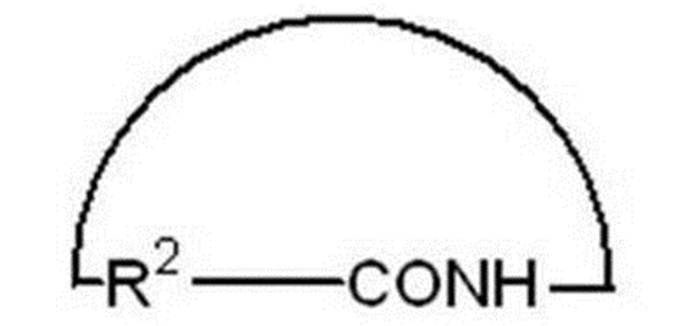
一般式(2)
[一般式(2)中、R2は、炭素数3~20の炭化水素の分子鎖(例えば炭素数3~20のアルキレン基)を表す。]
一般式(1)中、R1としては、炭素数3~18の炭化水素の分子鎖、例えば炭素数3~18のアルキレン基が好ましく、炭素数4~15の炭化水素の分子鎖、例えば炭素数4~15のアルキレン基が更に好ましく、炭素数10~15の炭化水素の分子鎖、例えば炭素数10~15のアルキレン基が特に好ましい。
また、一般式(2)中、R2としては、炭素数3~18の炭化水素の分子鎖、例えば炭素数3~18のアルキレン基が好ましく、炭素数4~15の炭化水素の分子鎖、例えば炭素数4~15のアルキレン基が更に好ましく、炭素数10~15の炭化水素の分子鎖、例えば炭素数10~15のアルキレン基が特に好ましい。
一般式(1)又は一般式(2)で表されるモノマーとしては、ω-アミノカルボン酸又はラクタムが挙げられる。また、ハードセグメントを形成するポリアミドとしては、これらω-アミノカルボン酸又はラクタムの重縮合体、ジアミンとジカルボン酸との共縮重合体等が挙げられる。
また、一般式(2)中、R2としては、炭素数3~18の炭化水素の分子鎖、例えば炭素数3~18のアルキレン基が好ましく、炭素数4~15の炭化水素の分子鎖、例えば炭素数4~15のアルキレン基が更に好ましく、炭素数10~15の炭化水素の分子鎖、例えば炭素数10~15のアルキレン基が特に好ましい。
一般式(1)又は一般式(2)で表されるモノマーとしては、ω-アミノカルボン酸又はラクタムが挙げられる。また、ハードセグメントを形成するポリアミドとしては、これらω-アミノカルボン酸又はラクタムの重縮合体、ジアミンとジカルボン酸との共縮重合体等が挙げられる。
ω-アミノカルボン酸としては、6-アミノカプロン酸、7-アミノヘプタン酸、8-アミノオクタン酸、10-アミノカプリン酸、11-アミノウンデカン酸、12-アミノドデカン酸等の炭素数5~20の脂肪族ω-アミノカルボン酸等を挙げることができる。また、ラクタムとしては、ラウリルラクタム、ε-カプロラクタム、ウデカンラクタム、ω-エナントラクタム、2-ピロリドン等の炭素数5~20の脂肪族ラクタム等を挙げることができる。
ジアミンとしては、例えば、エチレンジアミン、トリメチレンジアミン、テトラメチレンジアミン、ヘキサメチレンジアミン、ヘプタメチレンジアミン、オクタメチレンジアミン、ノナメチレンジアミン、デカメチレンジアミン、ウンデカメチレンジアミン、ドデカメチレンジアミン、2,2,4-トリメチルヘキサメチレンジアミン、2,4,4-トリメチルヘキサメチレンジアミン、3-メチルペンタメチレンジアミン、メタキシレンジアミン等の炭素数2~20の脂肪族ジアミン等のジアミン化合物を挙げることができる。
また、ジカルボン酸は、HOOC-(R3)m-COOH(R3:炭素数3~20の炭化水素の分子鎖、m:0又は1)で表すことができ、例えば、シュウ酸、コハク酸、グルタル酸、アジピン酸、ピメリン酸、スベリン酸、アゼライン酸、セバシン酸、ドデカン二酸等の炭素数2~20の脂肪族ジカルボン酸を挙げることができる。
ハードセグメントを形成するポリアミドとしては、ラウリルラクタム、ε-カプロラクタム、又はウデカンラクタムを開環重縮合したポリアミドを好ましく用いることができる。
ジアミンとしては、例えば、エチレンジアミン、トリメチレンジアミン、テトラメチレンジアミン、ヘキサメチレンジアミン、ヘプタメチレンジアミン、オクタメチレンジアミン、ノナメチレンジアミン、デカメチレンジアミン、ウンデカメチレンジアミン、ドデカメチレンジアミン、2,2,4-トリメチルヘキサメチレンジアミン、2,4,4-トリメチルヘキサメチレンジアミン、3-メチルペンタメチレンジアミン、メタキシレンジアミン等の炭素数2~20の脂肪族ジアミン等のジアミン化合物を挙げることができる。
また、ジカルボン酸は、HOOC-(R3)m-COOH(R3:炭素数3~20の炭化水素の分子鎖、m:0又は1)で表すことができ、例えば、シュウ酸、コハク酸、グルタル酸、アジピン酸、ピメリン酸、スベリン酸、アゼライン酸、セバシン酸、ドデカン二酸等の炭素数2~20の脂肪族ジカルボン酸を挙げることができる。
ハードセグメントを形成するポリアミドとしては、ラウリルラクタム、ε-カプロラクタム、又はウデカンラクタムを開環重縮合したポリアミドを好ましく用いることができる。
また、ソフトセグメントを形成するポリマーとしては、例えば、ポリエステル、ポリエーテル等が挙げられ、具体的には、ポリエチレングリコール、ポリプロピレングリコール、ポリテトラメチレンエーテルグリコール、ABA型トリブロックポリエーテル等が挙げられる。これらは単独で又は2種以上を組み合わせて用いることができる。また、ポリエーテルの末端にアンモニア等を反応させることによって得られるポリエーテルジアミン等も用いることができる。
ここで、「ABA型トリブロックポリエーテル」とは、下記一般式(3)に示されるポリエーテルを意味する。
ここで、「ABA型トリブロックポリエーテル」とは、下記一般式(3)に示されるポリエーテルを意味する。

一般式(3)
[一般式(3)中、x及びzは、1~20の整数を表す。yは、4~50の整数を表す。]
一般式(3)において、x及びzは、それぞれ、1~18の整数が好ましく、1~16の整数がより好ましく、1~14の整数が更に好ましく、1~12の整数が特に好ましい。また、一般式(3)において、yは、5~45の整数が好ましく、6~40の整数がより好ましく、7~35の整数が更に好ましく、8~30の整数が特に好ましい。
ハードセグメントとソフトセグメントとの組合せとしては、上述で挙げたハードセグメントとソフトセグメントとのそれぞれの組合せを挙げることができる。これらの中でも、ハードセグメントとソフトセグメントとの組合せとしては、ラウリルラクタムの開環重縮合体/ポリエチレングリコールの組合せ、ラウリルラクタムの開環重縮合体/ポリプロピレングリコールの組合せ、ラウリルラクタムの開環重縮合体/ポリテトラメチレンエーテルグリコールの組合せ、又はラウリルラクタムの開環重縮合体/ABA型トリブロックポリエーテルの組合せが好ましく、ラウリルラクタムの開環重縮合体/ABA型トリブロックポリエーテルの組合せがより好ましい。
ポリアミド系熱可塑性エラストマーの数平均分子量は、5000~10000000であることが好ましく、島相の平均面積を前記範囲とする観点から7000~1000000がより好ましく、10000~1000000が更に好ましい。
ポリアミド系熱可塑性エラストマーは、ハードセグメントを形成するポリマー及びソフトセグメントを形成するポリマーを公知の方法によって共重合することで合成することができる。
ポリアミド系熱可塑性エラストマーの市販品としては、例えば、宇部興産(株)の「UBESTA XPA」シリーズ(例えば、XPA9063X1、XPA9055X1、XPA9048X2、XPA9048X1、XPA9040X1、XPA9040X2XPA9044等)、ダイセル・エポニック(株)の「ベスタミド」シリーズ(例えば、E40-S3、E47-S1、E47-S3、E55-S1、E55-S3、EX9200、E50-R2等)等を用いることができる。
-ポリスチレン系熱可塑性エラストマー
ポリスチレン系熱可塑性エラストマーとしては、例えば、少なくともポリスチレンがハードセグメントを形成し、他のポリマー(例えば、ポリブタジエン、ポリイソプレン、ポリエチレン、水添ポリブタジエン、水添ポリイソプレン等)が非晶性でガラス転移温度の低いソフトセグメントを形成している材料が挙げられる。ハードセグメントを形成するポリスチレンとしては、例えば、公知のラジカル重合法、イオン性重合法等で得られるものが好ましく用いられ、具体的には、アニオンリビング重合を持つポリスチレンが挙げられる。また、ソフトセグメントを形成するポリマーとしては、例えば、ポリブタジエン、ポリイソプレン、ポリ(2,3-ジメチル-ブタジエン)等が挙げられる。
ポリスチレン系熱可塑性エラストマーとしては、例えば、少なくともポリスチレンがハードセグメントを形成し、他のポリマー(例えば、ポリブタジエン、ポリイソプレン、ポリエチレン、水添ポリブタジエン、水添ポリイソプレン等)が非晶性でガラス転移温度の低いソフトセグメントを形成している材料が挙げられる。ハードセグメントを形成するポリスチレンとしては、例えば、公知のラジカル重合法、イオン性重合法等で得られるものが好ましく用いられ、具体的には、アニオンリビング重合を持つポリスチレンが挙げられる。また、ソフトセグメントを形成するポリマーとしては、例えば、ポリブタジエン、ポリイソプレン、ポリ(2,3-ジメチル-ブタジエン)等が挙げられる。
ハードセグメントとソフトセグメントとの組合せとしては、上述で挙げたハードセグメントとソフトセグメントとのそれぞれの組合せを挙げることができる。これらの中でも、ハードセグメントとソフトセグメントとの組合せとしては、ポリスチレン/ポリブタジエンの組合せ、又はポリスチレン/ポリイソプレンの組合せが好ましい。また、熱可塑性エラストマーの意図しない架橋反応を抑制するため、ソフトセグメントは水素添加されていることが好ましい。
ポリスチレン系熱可塑性エラストマーの数平均分子量は、5000~10000000であることが好ましく、島相の平均面積を前記範囲とする観点から7000~1000000がより好ましく、10000~1000000が更に好ましい。
ポリスチレン系熱可塑性エラストマーは、ハードセグメントを形成するポリマー及びソフトセグメントを形成するポリマーを公知の方法によって共重合することで合成することができる。
ポリスチレン系熱可塑性エラストマーとしては、例えば、スチレン-ブタジエン系共重合体[SBS(ポリスチレン-ポリ(ブチレン)ブロック-ポリスチレン)、SEBS(ポリスチレン-ポリ(エチレン/ブチレン)ブロック-ポリスチレン)]、スチレン-イソプレン共重合体(ポリスチレン-ポリイソプレンブロック-ポリスチレン)、スチレン-プロピレン系共重合体[SEP(ポリスチレン-(エチレン/プロピレン)ブロック)、SEPS(ポリスチレン-ポリ(エチレン/プロピレン)ブロック-ポリスチレン)、SEEPS(ポリスチレン-ポリ(エチレン-エチレン/プロピレン)ブロック-ポリスチレン)、SEB(ポリスチレン(エチレン/ブチレン)ブロック)]等が挙げられる。
ポリスチレン系熱可塑性エラストマーとしては、例えば、スチレン-ブタジエン系共重合体[SBS(ポリスチレン-ポリ(ブチレン)ブロック-ポリスチレン)、SEBS(ポリスチレン-ポリ(エチレン/ブチレン)ブロック-ポリスチレン)]、スチレン-イソプレン共重合体(ポリスチレン-ポリイソプレンブロック-ポリスチレン)、スチレン-プロピレン系共重合体[SEP(ポリスチレン-(エチレン/プロピレン)ブロック)、SEPS(ポリスチレン-ポリ(エチレン/プロピレン)ブロック-ポリスチレン)、SEEPS(ポリスチレン-ポリ(エチレン-エチレン/プロピレン)ブロック-ポリスチレン)、SEB(ポリスチレン(エチレン/ブチレン)ブロック)]等が挙げられる。
ポリスチレン系熱可塑性エラストマーの市販品としては、例えば、旭化成(株)製の「タフテック」シリーズ(例えば、H1031、H1041、H1043、H1051、H1052、H1053、H1062、H1082、H1141、H1221、H1272等)、(株)クラレ製の「SEBS」シリーズ(例えば、8007、8076等)、「SEPS」シリーズ(例えば、2002、2063等)等を用いることができる。
-ポリウレタン系熱可塑性エラストマー-
ポリウレタン系熱可塑性エラストマーとしては、例えば、少なくともポリウレタンが物理的な凝集によって疑似架橋を形成しているハードセグメントを形成し、他のポリマーが非晶性でガラス転移温度の低いソフトセグメントを形成している材料が挙げられる。
ポリウレタン系熱可塑性エラストマーとしては、具体的には、JIS K6418:2007に規定されるポリウレタン系熱可塑性エラストマー(TPU)が挙げられる。ポリウレタン系熱可塑性エラストマーは、下記式Aで表される単位構造を含むソフトセグメントと、下記式Bで表される単位構造を含むハードセグメントとを含む共重合体として表すことができる。
ポリウレタン系熱可塑性エラストマーとしては、例えば、少なくともポリウレタンが物理的な凝集によって疑似架橋を形成しているハードセグメントを形成し、他のポリマーが非晶性でガラス転移温度の低いソフトセグメントを形成している材料が挙げられる。
ポリウレタン系熱可塑性エラストマーとしては、具体的には、JIS K6418:2007に規定されるポリウレタン系熱可塑性エラストマー(TPU)が挙げられる。ポリウレタン系熱可塑性エラストマーは、下記式Aで表される単位構造を含むソフトセグメントと、下記式Bで表される単位構造を含むハードセグメントとを含む共重合体として表すことができる。
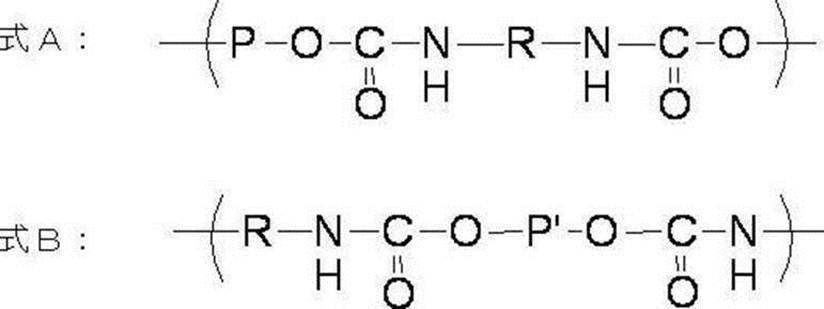
[式中、Pは、長鎖脂肪族ポリエーテル又は長鎖脂肪族ポリエステルを表す。Rは、脂肪族炭化水素、脂環族炭化水素、又は芳香族炭化水素を表す。P’は、短鎖脂肪族炭化水素、脂環族炭化水素、又は芳香族炭化水素を表す。]
式A中、Pで表される長鎖脂肪族ポリエーテル又は長鎖脂肪族ポリエステルとしては、例えば、分子量500~5000のものを使用することができる。Pは、Pで表される長鎖脂肪族ポリエーテル及び長鎖脂肪族ポリエステルを含むジオール化合物に由来する。このようなジオール化合物としては、例えば、分子量が前記範囲内にある、ポリエチレングリコール、ポリプロピレングリコール、ポリテトラメチレンエーテルグリコール、ポリ(ブチレンアジベート)ジオール、ポリ-ε-カプロラクトンジオール、ポリ(ヘキサメチレンカーボネート)ジオール、ABA型トリブロックポリエーテル等が挙げられる。
これらは、単独で又は2種以上を組み合わせて用いることができる。
これらは、単独で又は2種以上を組み合わせて用いることができる。
式A及び式B中、Rは、Rで表される脂肪族炭化水素、脂環族炭化水素、又は芳香族炭化水素を含むジイソシアネート化合物を用いて導入された部分構造である。Rで表される脂肪族炭化水素を含む脂肪族ジイソシアネート化合物としては、例えば、1,2-エチレンジイソシアネート、1,3-プロピレンジイソシアネート、1,4-ブタンジイソシアネート、1,6-ヘキサメチレンジイソシアネート等が挙げられる。
また、Rで表される脂環族炭化水素を含むジイソシアネート化合物としては、例えば、1,4-シクロヘキサンジイソシアネート、4,4-シクロヘキサンジイソシアネート等が挙げられる。さらに、Rで表される芳香族炭化水素を含む芳香族ジイソシアネート化合物としては、例えば、4,4’-ジフェニルメタンジイソシアネート、トリレンジイソシアネート等が挙げられる。
これらは、単独で又は2種以上を組み合わせて用いることができる。
また、Rで表される脂環族炭化水素を含むジイソシアネート化合物としては、例えば、1,4-シクロヘキサンジイソシアネート、4,4-シクロヘキサンジイソシアネート等が挙げられる。さらに、Rで表される芳香族炭化水素を含む芳香族ジイソシアネート化合物としては、例えば、4,4’-ジフェニルメタンジイソシアネート、トリレンジイソシアネート等が挙げられる。
これらは、単独で又は2種以上を組み合わせて用いることができる。
式B中、P’で表される短鎖脂肪族炭化水素、脂環族炭化水素、又は芳香族炭化水素としては、例えば、分子量500未満のものを使用することができる。また、P’は、P’で表される短鎖脂肪族炭化水素、脂環族炭化水素、又は芳香族炭化水素を含むジオール化合物に由来する。P’で表される短鎖脂肪族炭化水素を含む脂肪族ジオール化合物としては、例えば、グリコール及びポリアルキレングリコールが挙げられ、具体的には、エチレングリコール、プロピレングリコール、トリメチレングリコール、1,4-ブタンジオール、1,3-ブタンジオール、1,5-ペンタンジオール、1,6-ヘキサンジオール、1,7-ヘプタンジオール、1,8-オクタンジオール、1,9-ノナンジオール、1,10-デカンジオール等が挙げられる。
また、P’で表される脂環族炭化水素を含む脂環族ジオール化合物としては、例えば、シクロペンタン-1,2-ジオール、シクロヘキサン-1,2-ジオール、シクロヘキサン-1,3-ジオール、シクロヘキサン-1,4-ジオール、シクロヘキサン-1,4-ジメタノール等が挙げられる。
さらに、P’で表される芳香族炭化水素を含む芳香族ジオール化合物としては、例えば、ヒドロキノン、レゾルシン、クロロヒドロキノン、ブロモヒドロキノン、メチルヒドロキノン、フェニルヒドロキノン、メトキシヒドロキノン、フェノキシヒドロキノン、4,4’-ジヒドロキシビフェニル、4,4’-ジヒドロキシジフェニルエーテル、4,4’-ジヒドロキシジフェニルサルファイド、4,4’-ジヒドロキシジフェニルスルホン、4,4’-ジヒドロキシベンゾフェノン、4,4’-ジヒドロキシジフェニルメタン、ビスフェノールA、1,1-ジ(4-ヒドロキシフェニル)シクロヘキサン、1,2-ビス(4-ヒドロキシフェノキシ)エタン、1,4-ジヒドロキシナフタリン、2,6-ジヒドロキシナフタリン等が挙げられる。
これらは、単独で又は2種以上を組み合わせて用いることができる。
また、P’で表される脂環族炭化水素を含む脂環族ジオール化合物としては、例えば、シクロペンタン-1,2-ジオール、シクロヘキサン-1,2-ジオール、シクロヘキサン-1,3-ジオール、シクロヘキサン-1,4-ジオール、シクロヘキサン-1,4-ジメタノール等が挙げられる。
さらに、P’で表される芳香族炭化水素を含む芳香族ジオール化合物としては、例えば、ヒドロキノン、レゾルシン、クロロヒドロキノン、ブロモヒドロキノン、メチルヒドロキノン、フェニルヒドロキノン、メトキシヒドロキノン、フェノキシヒドロキノン、4,4’-ジヒドロキシビフェニル、4,4’-ジヒドロキシジフェニルエーテル、4,4’-ジヒドロキシジフェニルサルファイド、4,4’-ジヒドロキシジフェニルスルホン、4,4’-ジヒドロキシベンゾフェノン、4,4’-ジヒドロキシジフェニルメタン、ビスフェノールA、1,1-ジ(4-ヒドロキシフェニル)シクロヘキサン、1,2-ビス(4-ヒドロキシフェノキシ)エタン、1,4-ジヒドロキシナフタリン、2,6-ジヒドロキシナフタリン等が挙げられる。
これらは、単独で又は2種以上を組み合わせて用いることができる。
ポリウレタン系熱可塑性エラストマーは、ハードセグメントを形成するポリマー及びソフトセグメントを形成するポリマーを公知の方法によって共重合することで合成することができる。ポリウレタン系熱可塑性エラストマーとしては、例えば、特開平5-331256号公報に記載の熱可塑性ポリウレタンを用いることができる。
ポリウレタン系熱可塑性エラストマーとしては、具体的には、芳香族ジオールと芳香族ジイソシアネートとからなるハードセグメントと、ポリ炭酸エステルからなるソフトセグメントとの組合せが好ましく、より具体的には、トリレンジイソシアネート(TDI)/ポリエステル系ポリオール共重合体、TDI/ポリエーテル系ポリオール共重合体、TDI/カプロラクトン系ポリオール共重合体、TDI/ポリカーボネート系ポリオール共重合体、4,4’-ジフェニルメタンジイソシアネート(MDI)/ポリエステル系ポリオール共重合体、MDI/ポリエーテル系ポリオール共重合体、MDI/カプロラクトン系ポリオール共重合体、MDI/ポリカーボネート系ポリオール共重合体、及びMDI+ヒドロキノン/ポリヘキサメチレンカーボネート共重合体から選ばれる少なくとも1種が好ましく、TDI/ポリエステル系ポリオール共重合体、TDI/ポリエーテル系ポリオール共重合体、MDI/ポリエステルポリオール共重合体、MDI/ポリエーテル系ポリオール共重合体、及びMDI+ヒドロキノン/ポリヘキサメチレンカーボネート共重合体から選ばれる少なくとも1種が更に好ましい。
また、ポリウレタン系熱可塑性エラストマーの市販品としては、例えば、BASF社製の「エラストラン」シリーズ(例えば、ET680、ET880、ET690、ET890等)、(株)クラレ社製「クラミロンU」シリーズ(例えば、2000番台、3000番台、8000番台、9000番台等)、日本ミラクトラン(株)製の「ミラクトラン」シリーズ(例えば、XN-2001、XN-2004、P390RSUP、P480RSUI、P26MRNAT、E490、E590、P890等)等を用いることができる。
-ポリエステル系熱可塑性エラストマー-
ポリエステル系熱可塑性エラストマーとしては、例えば、少なくともポリエステルが結晶性で融点の高いハードセグメントを形成し、他のポリマー(例えば、ポリエステル又はポリエーテル等)が非晶性でガラス転移温度の低いソフトセグメントを形成している材料が挙げられる。
ポリエステル系熱可塑性エラストマーとしては、例えば、少なくともポリエステルが結晶性で融点の高いハードセグメントを形成し、他のポリマー(例えば、ポリエステル又はポリエーテル等)が非晶性でガラス転移温度の低いソフトセグメントを形成している材料が挙げられる。
ハードセグメントを形成するポリエステルとしては、芳香族ポリエステルを用いることができる。芳香族ポリエステルは、例えば、芳香族ジカルボン酸又はそのエステル形成性誘導体と脂肪族ジオールとから形成することができる。芳香族ポリエステルは、好ましくは、テレフタル酸及びジメチルテレフタレートの少なくとも1種と、1,4-ブタンジオールと、から誘導されるポリブチレンテレフタレートである。また、芳香族ポリエステルは、例えば、イソフタル酸、フタル酸、ナフタレン-2,6-ジカルボン酸、ナフタレン-2,7-ジカルボン酸、ジフェニル-4,4’-ジカルボン酸、ジフェノキシエタンジカルボン酸、5-スルホイソフタル酸、若しくはこれらのエステル形成性誘導体等のジカルボン酸成分と、分子量300以下のジオール(例えば、エチレングリコール、トリメチレングリコール、ペンタメチレングリコール、ヘキサメチレングリコール、ネオペンチルグリコール、デカメチレングリコール等の脂肪族ジオール;1,4-シクロヘキサンジメタノール、トリシクロデカンジメチロール等の脂環式ジオール;キシリレングリコール、ビス(p-ヒドロキシ)ジフェニル、ビス(p-ヒドロキシフェニル)プロパン、2,2-ビス[4-(2-ヒドロキシエトキシ)フェニル]プロパン、ビス[4-(2-ヒドロキシ)フェニル]スルホン、1,1-ビス[4-(2-ヒドロキシエトキシ)フェニル]シクロヘキサン、4,4’-ジヒドロキシ-p-ターフェニル、4,4’-ジヒドロキシ-p-クオーターフェニル等の芳香族ジオール;等)と、から誘導されるポリエステル、又はこれらのジカルボン酸成分及びジオール成分を2種以上併用した共重合ポリエステルであってもよい。また、3官能以上の多官能カルボン酸成分、多官能オキシ酸成分、多官能ヒドロキシ成分等を5モル%以下の範囲で共重合することも可能である。
ハードセグメントを形成するポリエステルとしては、例えば、ポリエチレンテレフタレート、ポリブチレンテレフタレート、ポリメチレンテレフタレート、ポリエチレンナフタレート、ポリブチレンナフタレート等が挙げられ、ポリブチレンテレフタレートが好ましい。
ハードセグメントを形成するポリエステルとしては、例えば、ポリエチレンテレフタレート、ポリブチレンテレフタレート、ポリメチレンテレフタレート、ポリエチレンナフタレート、ポリブチレンナフタレート等が挙げられ、ポリブチレンテレフタレートが好ましい。
また、ソフトセグメントを形成するポリマーとしては、例えば、脂肪族ポリエステル、脂肪族ポリエーテル等が挙げられる。
脂肪族ポリエーテルとしては、ポリ(エチレンオキシド)グリコール、ポリ(プロピレンオキシド)グリコール、ポリ(テトラメチレンオキシド)グリコール、ポリ(ヘキサメチレンオキシド)グリコール、エチレンオキシドとプロピレンオキシドとの共重合体、ポリ(プロピレンオキシド)グリコールのエチレンオキシド付加重合体、エチレンオキシドとテトラヒドロフランとの共重合体等が挙げられる。
脂肪族ポリエステルとしては、ポリ(ε-カプロラクトン)、ポリエナントラクトン、ポリカプリロラクトン、ポリブチレンアジペート、ポリエチレンアジペート等が挙げられる。
これらの脂肪族ポリエーテル及び脂肪族ポリエステルの中でも、得られるポリエステルブロック共重合体の弾性特性の観点から、ソフトセグメントを形成するポリマーとしては、ポリ(テトラメチレンオキシド)グリコール、ポリ(プロピレンオキシド)グリコールのエチレンオキシド付加物、ポリ(ε-カプロラクトン)、ポリブチレンアジペート、ポリエチレンアジペート等が好ましい。
脂肪族ポリエーテルとしては、ポリ(エチレンオキシド)グリコール、ポリ(プロピレンオキシド)グリコール、ポリ(テトラメチレンオキシド)グリコール、ポリ(ヘキサメチレンオキシド)グリコール、エチレンオキシドとプロピレンオキシドとの共重合体、ポリ(プロピレンオキシド)グリコールのエチレンオキシド付加重合体、エチレンオキシドとテトラヒドロフランとの共重合体等が挙げられる。
脂肪族ポリエステルとしては、ポリ(ε-カプロラクトン)、ポリエナントラクトン、ポリカプリロラクトン、ポリブチレンアジペート、ポリエチレンアジペート等が挙げられる。
これらの脂肪族ポリエーテル及び脂肪族ポリエステルの中でも、得られるポリエステルブロック共重合体の弾性特性の観点から、ソフトセグメントを形成するポリマーとしては、ポリ(テトラメチレンオキシド)グリコール、ポリ(プロピレンオキシド)グリコールのエチレンオキシド付加物、ポリ(ε-カプロラクトン)、ポリブチレンアジペート、ポリエチレンアジペート等が好ましい。
ポリエステル系熱可塑性エラストマーの数平均分子量は、5000~10000000であることが好ましく、島相の平均面積を前記範囲とする観点から7000~1000000がより好ましく、10000~1000000が更に好ましい。
上述のハードセグメントとソフトセグメントとの組合せとしては、例えば、上述で挙げたハードセグメントとソフトセグメントとのそれぞれの組合せを挙げることができる。これらの中でも、上述のハードセグメントとソフトセグメントとの組合せとしては、ハードセグメントがポリブチレンテレフタレートであり、ソフトセグメントが脂肪族ポリエーテルである組み合わせが好ましく、ハードセグメントがポリブチレンテレフタレートであり、ソフトセグメントがポリ(エチレンオキシド)グリコールである組み合わせが更に好ましい。
ポリエステル系熱可塑性エラストマーの市販品としては、例えば、東レ・デュポン(株)製の「ハイトレル」シリーズ(例えば、3046、5557、6347、4047、4767等)、東洋紡(株)製の「ペルプレン」シリーズ(例えば、P30B、P40B、P40H、P55B、P70B、P150B、P280B、P450B、P150M、S1001、S2001、S5001、S6001、S9001等)等を用いることができる。
ポリエステル系熱可塑性エラストマーは、ハードセグメントを形成するポリマー及びソフトセグメントを形成するポリマーを公知の方法によって共重合することで合成することができる。
-エラストマーの特性等-
エラストマーの引張弾性率としては、例えば1~800MPaが挙げられ、弾性率、耐亀裂性の観点から1~50MPaが好ましく、1~30MPaがより好ましい。
上記「エラストマーの引張弾性率」は、JIS K7113:1995に準拠した測定により得られる。樹脂組成物に含有されるエラストマーの引張弾性率の測定は、例えば、島津製作所社製、島津オートグラフAGS-J(5KN)等により測定することができる。
エラストマーの引張弾性率としては、例えば1~800MPaが挙げられ、弾性率、耐亀裂性の観点から1~50MPaが好ましく、1~30MPaがより好ましい。
上記「エラストマーの引張弾性率」は、JIS K7113:1995に準拠した測定により得られる。樹脂組成物に含有されるエラストマーの引張弾性率の測定は、例えば、島津製作所社製、島津オートグラフAGS-J(5KN)等により測定することができる。
樹脂組成物中におけるエラストマーの含有量は、ポリアミド樹脂とエラストマーとの合計100質量部に対して5質量部以上45質量部以下であり、弾性率、耐亀裂性の観点から10質量部以上45質量部以下が好ましく、30質量部以上45質量部以下がより好ましく、30質量部以上40質量部以下がさらに好ましい。
<可塑剤>
樹脂組成物は、ポリアミド樹脂及びエラストマーに加えて、さらに可塑剤を含んでもよい。可塑剤は、樹脂組成物に添加することで樹脂組成物の可塑性を向上させたり、ガラス転移点を低下させたり、弾性率を低下させる添加剤である。
樹脂組成物は、ポリアミド樹脂及びエラストマーに加えて、さらに可塑剤を含んでもよい。可塑剤は、樹脂組成物に添加することで樹脂組成物の可塑性を向上させたり、ガラス転移点を低下させたり、弾性率を低下させる添加剤である。
可塑剤としては、例えば、ヒドロキシ安息香酸アルキルエステル類、スルホンアミド類、ポリオール類、ラクタム類等が挙げられ、1種のみ用いてもよく、2種以上併用してもよい。
ヒドロキシ安息香酸アルキルエステル類としては、例えば、o-ヒドロキシ安息香酸メチル、p-ヒドロキシ安息香酸メチル、o-ヒドロキシ安息香酸ブチル、p-ヒドロキシ安息香酸ブチル、o-ヒドロキシ安息香酸ヘキシル、p-ヒドロキシ安息香酸ヘキシル、o-ヒドロキシ安息香酸n-オクチル、p-ヒドロキシ安息香酸n-オクチル、o-ヒドロキシ安息香酸デシル、p-ヒドロキシ安息香酸デシル、o-ヒドロキシ安息香酸ドデシル、p-ヒドロキシ安息香酸ドデシル、o-ヒドロキシ安息香酸エチルヘキシル、p-ヒドロキシ安息香酸エチルヘキシル、o-ヒドロキシ安息香酸ヘキシルデシル、p-ヒドロキシ安息香酸ヘキシルデシル、o-ヒドロキシ安息香酸エチルデシル、p-ヒドロキシ安息香酸エチルデシル、o-ヒドロキシ安息香酸オクチルオクチル、p-ヒドロキシ安息香酸オクチルオクチル、o-ヒドロキシ安息香酸デシルドデシル、p-ヒドロキシ安息香酸デシルドデシル等が挙げられる。
スルホンアミド類としては、例えば、p-トルエンスルホンアミド、N-メチル-p-トルエンスルホンアミド、N-エチル-p-トルエンスルホンアミド、N-シクロヘキシル-p-トルエンスルホンアミド、N,N-ジエチル-p-トルエンスルホンアミド、N,N-ビス(2-ヒドロキシエチル)-p-トルエンスルホンアミド、o-トルエンスルホンアミド、N-エチル-o-トルエンスルホンアミド、ベンゼンスルホンアミド、N-n-ブチルベンゼンスルホンアミド、p-ヒドロキシベンゼンスルホンアミド、o-ニトロベンゼンスルホンアミド、p-ニトロベンゼンスルホンアミド、スルファニルアミド等が挙げられる。
ポリオール類としては、例えば、グリセリン、ジグリセリン、プロピレングリコール、エチレングリコール、ブチレングリコール、ペンチレングリコール、シクロヘキサンジメタノール、ヘキサンジオール、ポリエチレングリコール(200~600)、ソルビトール、マニトール、ラクチトール、フルクトース、グルコース、スクロース、マルトース、ラクトース、アスコルビン酸等が挙げられる。
ラクタム類としては、例えば、カプロラクタム、ラウロラクタム等が挙げられる。
また、その他の可塑剤としては、例えば、フタル酸ジメチル、フタル酸ジエチル、フタル酸ジ-n-ブチル、フタル酸ジ-(2-エチルヘキシル)、フタル酸ジヘプチル、フタル酸ジイソデシル、フタル酸ジ-n-オクチル、フタル酸ジイソノニル、フタル酸ジトリデシル、フタル酸オクチルデシル、フタル酸ブチルベンジル、フタル酸ジシクロヘキシル等のフタル酸誘導体;ジメチルイソフタレートのようなイソフタル酸誘導体;ジ-(2-エチルヘキシル)テトラヒドロフタル酸のようなテトラヒドロフタル酸誘導体;アジピン酸ジメチル、アジピン酸ジブチル、アジピン酸ジ-n-ヘキシル、アジピン酸ジ-(2-エチルヘキシル)、アジピン酸イソノニル、アジピン酸ジイソデシル、アジピン酸ジブチルジグリコール等のアジピン酸誘導体;アゼライン酸ジ-2-エチルヘキシル等のアゼライン酸誘導体;セバシン酸ジブチル等のセバシン酸誘導体;ドデカン-2-酸誘導体;マレイン酸ジブチル、マレイン酸ジ-2-エチルヘキシル等のマレイン酸誘導体;フマル酸ジブチル等のフマル酸誘導体;トリメリト酸トリス-2-エチルヘキシル等のトリメリト酸誘導体;ピロメリト酸誘導体;クエン酸アセチルトリブチル等のクエン酸誘導体;イタコン酸誘導体;オレイン酸誘導体;リシノール酸誘導体;ステアリン酸誘導体;その他脂肪酸誘導体;スルホン酸誘導体;リン酸誘導体;グルタル酸誘導体;アジピン酸、アゼライン酸、フタル酸などの二塩基酸とグリコールおよび一価アルコールなどとのポリマーであるポリエステル系可塑剤、グルコール誘導体、グリセリン誘導体、塩素化パラフィン等のパラフィン誘導体、エポキシ誘導体ポリエステル系重合型可塑剤、ポリエーテル系重合型可塑剤、エチレンカーボネート、プロピレンカーボネート等のカーボネート誘導体等が挙げられる。本発明において可塑剤はこれらに限定されることはなく、種々の可塑剤を用いることができ、ゴム用可塑剤として広く市販されているものも用いることができる。
市販されている可塑剤としては、チオコールTP(モートン社製)、アデカサイザー(登録商標)O-130P、C-79、UL-100、P-200、RS-735(旭電化社製)などが挙げられる。これら以外の高分子量の可塑剤としては、アクリル系重合体、ポリプロピレングリコール系重合体、ポリテトラヒドロフラン系重合体、ポリイソブチレン系重合体などがあげられる。
可塑剤の添加量は、ポリアミド樹脂とエラストマーとの合計100質量部に対し、0.5質量部以上30質量部以下が好ましく、2質量部以上30質量部以下がより好ましく、5質量部以上30質量部以下がさらに好ましく、6質量部以上27質量部以下が特に好ましく、12質量部以上18質量部以下が最も好ましい。可塑剤の添加量を前記範囲とすることで、島相の平均面積と樹脂組成物の引張弾性率とを前記範囲内に調整しやすく、耐亀裂性に加え、リム組み性及び走行時の乗り心地にも優れたタイヤが得られる。
<その他の成分>
樹脂組成物は、所望に応じて、ポリアミド樹脂、エラストマー、及び可塑剤以外のその他の成分を本発明の効果を損なわない範囲で含んでもよい。その他の成分としては、例えば、ゴム、各種充填剤(例えば、シリカ、炭酸カルシウム、クレイ)、老化防止剤、オイル、着色剤、耐候剤、補強材等が挙げられる。樹脂組成物がその他の成分を含む場合、樹脂組成物全体に対するその他の成分の含有量としては、例えば50質量%以下が挙げられ、20質量%以下が好ましく、10質量%以下がより好ましい。
樹脂組成物は、所望に応じて、ポリアミド樹脂、エラストマー、及び可塑剤以外のその他の成分を本発明の効果を損なわない範囲で含んでもよい。その他の成分としては、例えば、ゴム、各種充填剤(例えば、シリカ、炭酸カルシウム、クレイ)、老化防止剤、オイル、着色剤、耐候剤、補強材等が挙げられる。樹脂組成物がその他の成分を含む場合、樹脂組成物全体に対するその他の成分の含有量としては、例えば50質量%以下が挙げられ、20質量%以下が好ましく、10質量%以下がより好ましい。
<樹脂組成物の構造及び特性>
樹脂組成物は、前述のように、ポリアミド樹脂を含有する海相とエラストマーを含有する島相とを含む海島構造を有する。
また、島相の平均面積は、0.05μm2以上0.35μm2以下であり、耐亀裂性の観点から、0.05μm2以上0.30μm2以下が好ましく、0.05μm2以上0.25μm2以下がより好ましく、0.15μm2以上0.25μm2以下がさらに好ましい。
樹脂組成物は、前述のように、ポリアミド樹脂を含有する海相とエラストマーを含有する島相とを含む海島構造を有する。
また、島相の平均面積は、0.05μm2以上0.35μm2以下であり、耐亀裂性の観点から、0.05μm2以上0.30μm2以下が好ましく、0.05μm2以上0.25μm2以下がより好ましく、0.15μm2以上0.25μm2以下がさらに好ましい。
樹脂組成物は、ポリアミド樹脂、エラストマー、並びに必要に応じて可塑剤及びその他の成分を、例えば溶融混合(具体的には、例えば、2軸押出し連続混練り、バッチ式練り等)等の公知の方法で混合することにより得られる。
なお、島相の平均面積を上記範囲に制御する方法としては、例えば、ポリアミド樹脂及びエラストマーの種類及び含有量比等を調整することで、島相の平均面積を制御する方法が挙げられる。
なお、島相の平均面積を上記範囲に制御する方法としては、例えば、ポリアミド樹脂及びエラストマーの種類及び含有量比等を調整することで、島相の平均面積を制御する方法が挙げられる。
樹脂組成物の引張弾性率は、前述のように、100MPa以上1000MPa以下であり、耐亀裂性及び耐圧性の観点から、200MPa以上800MPa以下がより好ましく、200MPa以上600MPa以下がさらに好ましく、200MPa以上500MPa以下が特に好ましい。
樹脂組成物全体の融点(または軟化点)としては、例えば100℃~350℃が挙げられ、好ましくは100℃~250℃程度であり、タイヤの生産性の観点から120℃~250℃程度がより好ましく、120℃~200℃がさらに好ましい。
樹脂組成物全体のJIS K7113:1995に規定される引張降伏強さは、5MPa以上が好ましく、5MPa~20MPaが好ましく、5MPa~17MPaがさらに好ましい。樹脂組成物の引張降伏強さが、5MPa以上であると、走行時などにタイヤにかかる荷重に対する変形に耐えることができる。
樹脂組成物全体のJIS K7113:1995に規定される引張降伏伸びは、10%以上が好ましく、10%~70%が好ましく、15%~60%がさらに好ましい。樹脂組成物の引張降伏伸びが、10%以上であると、弾性領域が大きく、エアシール性をよくすることができる。
樹脂組成物全体のJIS K7113:1995に規定される引張破断伸びとしては、50%以上が好ましく、100%以上が好ましく、150%以上がさらに好ましく、200%以上が特に好ましい。樹脂組成物の引張破断伸びが、50%以上であると、リム組み性がよく、衝突に対して破壊しにくくすることができる。
樹脂組成物全体のISO75-2またはASTM D648に規定される荷重たわみ温度(0.45MPa荷重時)としては、50℃以上が好ましく、50℃~150℃が好ましく、50℃~130℃がさらに好ましい。樹脂組成物の荷重たわみ温度が、50℃以上であると、タイヤの製造において加硫を行う場合であってもタイヤ骨格体の変形を抑制することができる。
[タイヤ]
本発明の一実施形態に係るタイヤは、上述の樹脂組成物を含む環状のタイヤ骨格体を備える。
タイヤ骨格体の厚みは特に限定されないが、耐亀裂性の観点から、0.5mm以上3.5mm以下であることが好ましく、1.0mm以上3.0mm以下であることがより好ましく、1.0mm以上2.0mm以下であることがさらに好ましい。
本発明の一実施形態に係るタイヤは、上述の樹脂組成物を含む環状のタイヤ骨格体を備える。
タイヤ骨格体の厚みは特に限定されないが、耐亀裂性の観点から、0.5mm以上3.5mm以下であることが好ましく、1.0mm以上3.0mm以下であることがより好ましく、1.0mm以上2.0mm以下であることがさらに好ましい。
ここで、「タイヤ骨格体の厚み」とは、例えばタイヤ骨格体がビード部と、サイド部と、クラウン部と、を有する場合、サイド部における厚みを意味する。また、サイド部における厚みが一様でない場合は、サイド部の径方向中央部(すなわち内径と外径とを平均した径に相当する領域)における厚みを「タイヤ骨格体の厚み」とする。
なお、本明細書において、「サイド部」とはビード部からクラウン部の端部までの領域をいい、「ビード部」とはタイヤ径方向内側端からタイヤ断面高さの30%までをいい、「クラウン部」とはタイヤのトレッド部に相当する領域をいう。また、タイヤの「トレッド部」とは、タイヤをJATMA YEAR BOOK(2014年度版、日本自動車タイヤ協会規格)に規定されている標準リムに装着し、JATMA YEAR BOOKでの適用サイズ・プライレーティングにおける最大負荷能力(すなわち内圧-負荷能力対応表の太字荷重)に対応する空気圧(最大空気圧)の100%を内圧として充填し、最大負荷能力を負荷したときのタイヤの接地部分を指す。使用地又は製造地においてTRA規格、ETRTO規格が適用される場合は各々の規格に従う。
また、タイヤ骨格体の厚みは、上記サイド部の径方向中央部を、公知の装置を用いて周方向に10点測定し、平均した値とする。
なお、本明細書において、「サイド部」とはビード部からクラウン部の端部までの領域をいい、「ビード部」とはタイヤ径方向内側端からタイヤ断面高さの30%までをいい、「クラウン部」とはタイヤのトレッド部に相当する領域をいう。また、タイヤの「トレッド部」とは、タイヤをJATMA YEAR BOOK(2014年度版、日本自動車タイヤ協会規格)に規定されている標準リムに装着し、JATMA YEAR BOOKでの適用サイズ・プライレーティングにおける最大負荷能力(すなわち内圧-負荷能力対応表の太字荷重)に対応する空気圧(最大空気圧)の100%を内圧として充填し、最大負荷能力を負荷したときのタイヤの接地部分を指す。使用地又は製造地においてTRA規格、ETRTO規格が適用される場合は各々の規格に従う。
また、タイヤ骨格体の厚みは、上記サイド部の径方向中央部を、公知の装置を用いて周方向に10点測定し、平均した値とする。
タイヤは、必要に応じてタイヤ骨格体以外の部材を含んでもよい。例えば、タイヤ骨格体の外周等に配置してタイヤ骨格体を補強するための補強部材を含んでもよい。補強部材としては、例えば、スチールコード等の金属部材を樹脂材料で被覆したものが挙げられる。
以下、図面を参照して本発明のタイヤの実施形態について説明する。
図1Aは、本実施形態のタイヤ10の一部の断面を示す斜視図である。図1Bは、本実施形態のタイヤ10をリムに装着したときのビード部の断面図である。図1Aに示すように、タイヤ10は、従来一般のゴム製の空気入りタイヤと略同様の断面形状を呈している。
図1Aに示すように、タイヤ10は、図1Bに示すリム20のビードシート21およびリムフランジ22に接触する1対のビード部12と、ビード部12からタイヤ径方向外側に延びるサイド部14と、一方のサイド部14のタイヤ径方向外側端と他方のサイド部14のタイヤ径方向外側端とを連結するクラウン部16(すなわち外周部)と、からなるタイヤケース17を備えている。
図1Aは、本実施形態のタイヤ10の一部の断面を示す斜視図である。図1Bは、本実施形態のタイヤ10をリムに装着したときのビード部の断面図である。図1Aに示すように、タイヤ10は、従来一般のゴム製の空気入りタイヤと略同様の断面形状を呈している。
図1Aに示すように、タイヤ10は、図1Bに示すリム20のビードシート21およびリムフランジ22に接触する1対のビード部12と、ビード部12からタイヤ径方向外側に延びるサイド部14と、一方のサイド部14のタイヤ径方向外側端と他方のサイド部14のタイヤ径方向外側端とを連結するクラウン部16(すなわち外周部)と、からなるタイヤケース17を備えている。
タイヤケース17は上述したタイヤ骨格体に相当し、上述した樹脂組成物から形成されている。本実施形態においてタイヤケース17は、その全体が上述した樹脂組成物で形成されているが、本発明はこの構成に限定されず、従来一般のゴム製の空気入りタイヤと同様に、タイヤケース17の各部位毎(具体的には、サイド部14、クラウン部16、ビード部12など)に異なる樹脂材料を用いてもよい。また、タイヤケース17の各部位を補強するために、補強材(例えば、高分子材料や金属製の繊維、コード、不織布、織布等)を埋設配置してもよい。
本実施形態のタイヤケース17は、タイヤケース17の周方向に沿ってトレッド幅を等分した状態の形状であるタイヤケース半体(すなわちタイヤ骨格片)を2つ作製し、これらをタイヤの赤道面部分で接合させて形成される。なお、タイヤケース17は、2つの部材を接合して形成するものに限らず、3以上の部材を接合して形成してもよい。
タイヤケース半体は、例えば、真空成形、圧空成形、インジェクション成形、メルトキャスティング等の方法で作製できる。このため、従来のようにゴムでタイヤケースを成形する場合に比較して、加硫を行う必要がなく、製造工程を大幅に簡略化でき、成形時間を省略することができる。
本実施形態において、図1Bに示すビード部12には、従来一般の空気入りタイヤと同様に、円環状のビードコア18が埋設されている。本実施形態ではビードコア18としてスチールコードを用いるが、有機繊維コード、樹脂被覆した有機繊維コード、硬質樹脂コード等を用いてもよい。なお、ビード部12の剛性が確保され、リム20との嵌合に問題がなければ、ビードコア18を省略することもできる。
本実施形態では、ビード部12のリム20と接触する部分や、少なくともリム20のリムフランジ22と接触する部分には、タイヤケース17を構成する樹脂組成物よりもシール性に優れた材料からなる円環状のシール層24が形成されている。シール層24は、タイヤケース17(具体的にはビード部12)とビードシート21とが接触する部分にも形成されていてよい。なお、タイヤケース17を構成する樹脂組成物のみでリム20との間のシール性が確保できれば、シール層24は省略してもよい。
タイヤケース17を構成する樹脂組成物よりもシール性に優れた材料としては、タイヤケース17を構成する樹脂組成物よりも軟質な材料、例えばゴム、樹脂組成物よりも軟質な熱可塑性樹脂及び熱可塑性エラストマーが挙げられる。
ゴムとしては、従来一般のゴム製の空気入りタイヤのビード部外面に用いられているゴムと同種のゴムが挙げられる。
熱可塑性樹脂としては、ポリアミド系樹脂、ポリオレフィン系樹脂、ポリスチレン系樹脂、ポリエステル樹脂等の樹脂、これらの熱可塑性樹脂の混合物、これらの熱可塑性樹脂とゴム又は熱可塑性エラストマーとの混合物等が挙げられる。
熱可塑性エラストマーとしては、ポリエステル系熱可塑性エラストマー、ポリアミド系熱可塑性エラストマー、ポリスチレン系熱可塑性エラストマー、ポリウレタン系熱可塑性エラストマー、ポリオレフィン系熱可塑性エラストマー、これらの熱可塑性エラストマーの混合物、これらの熱可塑性エラストマーと熱可塑性樹脂又はゴムとの混合物等が挙げられる。
タイヤケース17を構成する樹脂組成物よりもシール性に優れた材料としては、タイヤケース17を構成する樹脂組成物よりも軟質な材料、例えばゴム、樹脂組成物よりも軟質な熱可塑性樹脂及び熱可塑性エラストマーが挙げられる。
ゴムとしては、従来一般のゴム製の空気入りタイヤのビード部外面に用いられているゴムと同種のゴムが挙げられる。
熱可塑性樹脂としては、ポリアミド系樹脂、ポリオレフィン系樹脂、ポリスチレン系樹脂、ポリエステル樹脂等の樹脂、これらの熱可塑性樹脂の混合物、これらの熱可塑性樹脂とゴム又は熱可塑性エラストマーとの混合物等が挙げられる。
熱可塑性エラストマーとしては、ポリエステル系熱可塑性エラストマー、ポリアミド系熱可塑性エラストマー、ポリスチレン系熱可塑性エラストマー、ポリウレタン系熱可塑性エラストマー、ポリオレフィン系熱可塑性エラストマー、これらの熱可塑性エラストマーの混合物、これらの熱可塑性エラストマーと熱可塑性樹脂又はゴムとの混合物等が挙げられる。
図1Aに示すように、クラウン部16には、タイヤケース17を構成する樹脂組成物よりも剛性が高い補強コード26がタイヤケース17の周方向に巻回されている。補強コード26は、タイヤケース17の軸方向に沿った断面視で、少なくとも一部がクラウン部16に埋設された状態で螺旋状に巻回されており、補強コード層28を形成している。補強コード層28のタイヤ径方向外周側には、タイヤケース17を構成する樹脂組成物よりも耐摩耗性に優れた材料、例えばゴムからなるトレッド30が配置されている。
本実施形態では、図2に示すように、補強コード26はスチールコード等の金属部材26Aを被覆用樹脂材料27で被覆した状態(すなわち被覆コード部材)である。
本実施形態では、被覆用樹脂材料27としてタイヤケース17を形成する樹脂組成物と同じ樹脂組成物を用いているが、他の熱可塑性樹脂又は熱可塑性エラストマーを用いてもよい。補強コード26は、クラウン部16との接触部分において、溶接、接着剤による接着等の方法で接合されている。なお、補強コード26は、被覆用樹脂材料27で被覆されていない状態のスチールコード等であってもよい。
本実施形態では、被覆用樹脂材料27としてタイヤケース17を形成する樹脂組成物と同じ樹脂組成物を用いているが、他の熱可塑性樹脂又は熱可塑性エラストマーを用いてもよい。補強コード26は、クラウン部16との接触部分において、溶接、接着剤による接着等の方法で接合されている。なお、補強コード26は、被覆用樹脂材料27で被覆されていない状態のスチールコード等であってもよい。
被覆用樹脂材料27の引張弾性率は、タイヤケース17を形成する樹脂組成物の引張弾性率の0.1倍から10倍の範囲内に設定することが好ましい。被覆用樹脂材料27の引張弾性率がタイヤケース17を形成する樹脂組成物の引張弾性率の10倍以下であると、クラウン部が硬くなり過ぎず、リム組み性が容易になる。被覆用樹脂材料27の引張弾性率がタイヤケース17を形成する樹脂組成物の引張弾性率の0.1倍以上であると、補強コード層28を構成する樹脂が柔らかすぎず、ベルト面内せん断剛性に優れ、コーナリング力が向上する。
本実施形態では、図2に示すように、補強コード26は、断面形状が略台形状とされている。なお、以下では、補強コード26の上面(すなわちタイヤ径方向外側の面)を符号26Uで示し、下面(すなわちタイヤ径方向内側の面)を符号26Dで示す。また、本実施形態では、補強コード26の断面形状を略台形状とする構成としているが、本発明はこの構成に限定されず、断面形状が下面26D側(すなわちタイヤ径方向内側)から上面26U側(すなわちタイヤ径方向外側)へ向かって幅広となる形状を除いた形状であれば、いずれの形状でもよい。
図2に示すように、補強コード26は、周方向に間隔をあけて配置されていることから、隣接する補強コード26との間に隙間28Aが形成されている。このため、補強コード層28の外周面は、凹凸を有する形状となり、この補強コード層28が外周部を構成するタイヤケース17の外周面17Sも凹凸を有する形状となっている。
タイヤケース17の外周面17S(凹凸含む)には、微細な粗化凹凸96が形成され、その上に接合剤を介して、クッションゴム29が接合されている。クッションゴム29は、補強コード26との接触面において、粗化凹凸96を埋めるように流れ込んでいる。
クッションゴム29の上(すなわちタイヤ外周面側)には、上述したトレッド30が接合されている。トレッド30には、従来のゴム製の空気入りタイヤと同様に、路面との接地面に複数の溝からなるトレッドパターン(図示省略)が形成されている。
次に、本実施形態のタイヤの製造方法について説明する。
(タイヤケース成形工程)
まず、薄い金属の支持リングに支持されたタイヤケース半体同士を互いに向かい合わせる。次いで、タイヤケース半体の突き当て部分の外周面と接するように接合金型を設置する。接合金型は、タイヤケース半体の接合部(すなわち突き当て部分)周辺を所定の圧力で押圧するように構成されている。次いで、タイヤケース半体の接合部周辺を、タイヤケースを構成する樹脂組成物の融点以上の温度で押圧することで、接合部が溶融し、タイヤケース半体同士が融着して一体となり、タイヤケース17が形成される。
本実施形態では、接合金型を用いてタイヤケース半体の接合部を加熱したが、本発明はこれに限定されず、例えば、別に設けた高周波加熱機等によって接合部を加熱したり、予め熱風、赤外線の照射等によって軟化または溶融させ、接合金型によって加圧してタイヤケース半体を接合させてもよい。
(タイヤケース成形工程)
まず、薄い金属の支持リングに支持されたタイヤケース半体同士を互いに向かい合わせる。次いで、タイヤケース半体の突き当て部分の外周面と接するように接合金型を設置する。接合金型は、タイヤケース半体の接合部(すなわち突き当て部分)周辺を所定の圧力で押圧するように構成されている。次いで、タイヤケース半体の接合部周辺を、タイヤケースを構成する樹脂組成物の融点以上の温度で押圧することで、接合部が溶融し、タイヤケース半体同士が融着して一体となり、タイヤケース17が形成される。
本実施形態では、接合金型を用いてタイヤケース半体の接合部を加熱したが、本発明はこれに限定されず、例えば、別に設けた高周波加熱機等によって接合部を加熱したり、予め熱風、赤外線の照射等によって軟化または溶融させ、接合金型によって加圧してタイヤケース半体を接合させてもよい。
(補強コード部材巻回工程)
次に、補強コード26をタイヤケース17に巻回する巻回工程について、図3を用いて説明する。図3は、コード加熱装置、およびローラ類を用いてタイヤケース17のクラウン部に補強コード26を埋設する動作を説明するための説明図である。
図3において、コード供給装置56は、補強コード26を巻き付けたリール58と、リール58のコード搬送方向下流側に配置されたコード加熱装置59と、補強コード26の搬送方向下流側に配置された第1のローラ60と、第1のローラ60をタイヤ外周面に対して接離する方向に移動する第1のシリンダ装置62と、第1のローラ60の補強コード26の搬送方向下流側に配置される第2のローラ64と、第2のローラ64をタイヤ外周面に対して接離する方向に移動する第2のシリンダ装置66と、を備えている。第2のローラ64は、金属製の冷却用ローラとして利用することができる。
本実施形態において、第1のローラ60または第2のローラ64の表面は、溶融または軟化した被覆用樹脂材料27の付着を抑制するための処理(例えば、フッ素樹脂コーティング)が施されているが、ローラ自体を被覆用樹脂材料27が付着しにくい材料から形成してもよい。なお、本実施形態では、コード供給装置56は、第1のローラ60または第2のローラ64の2つのローラを有しているが、何れか一方のローラのみを有していてもよい。
次に、補強コード26をタイヤケース17に巻回する巻回工程について、図3を用いて説明する。図3は、コード加熱装置、およびローラ類を用いてタイヤケース17のクラウン部に補強コード26を埋設する動作を説明するための説明図である。
図3において、コード供給装置56は、補強コード26を巻き付けたリール58と、リール58のコード搬送方向下流側に配置されたコード加熱装置59と、補強コード26の搬送方向下流側に配置された第1のローラ60と、第1のローラ60をタイヤ外周面に対して接離する方向に移動する第1のシリンダ装置62と、第1のローラ60の補強コード26の搬送方向下流側に配置される第2のローラ64と、第2のローラ64をタイヤ外周面に対して接離する方向に移動する第2のシリンダ装置66と、を備えている。第2のローラ64は、金属製の冷却用ローラとして利用することができる。
本実施形態において、第1のローラ60または第2のローラ64の表面は、溶融または軟化した被覆用樹脂材料27の付着を抑制するための処理(例えば、フッ素樹脂コーティング)が施されているが、ローラ自体を被覆用樹脂材料27が付着しにくい材料から形成してもよい。なお、本実施形態では、コード供給装置56は、第1のローラ60または第2のローラ64の2つのローラを有しているが、何れか一方のローラのみを有していてもよい。
コード加熱装置59は、熱風を生じさせるヒーター70およびファン72を備えている。また、コード加熱装置59は、内部に熱風が供給される、内部空間を補強コード26が通過する加熱ボックス74と、加熱された補強コード26を排出する排出口76とを備えている。
本工程においては、まず、コード加熱装置59のヒーター70の温度を上昇させ、ヒーター70で加熱された周囲の空気をファン72の回転によって生じる風で加熱ボックス74へ送る。次に、リール58から巻き出した補強コード26を、熱風で内部空間が加熱された加熱ボックス74内へ送り加熱する。加熱の温度は、補強コード26の被覆用樹脂材料27が溶融または軟化した状態となる温度に設定する。
加熱された補強コード26は、排出口76を通り、図3の矢印R方向に回転するタイヤケース17のクラウン部16の外周面に一定のテンションをもって螺旋状に巻きつけられる。このとき、クラウン部16の外周面に、補強コード26の下面26Dが接触する。そして、加熱により溶融または軟化した状態の被覆用樹脂材料27がクラウン部16の外周面上に広がり、クラウン部16の外周面に補強コード26が溶着される。これにより、クラウン部16と補強コード26との接合強度が向上する。
本実施形態では、上述のようにしてクラウン部16の外周面に補強コード26を接合したが、他の方法で接合を行ってもよい。例えば、補強コード26の一部又は全体がクラウン部16に埋設されるように接合を行ってもよい。
(粗化処理工程)
次に、図示を省略するブラスト装置にて、タイヤケース17の外周面17Sに向け、タイヤケース17側を回転させながら、外周面17Sへ投射材を高速度で射出する。射出された投射材は、外周面17Sに衝突し、この外周面17Sに算術平均粗さRaが0.05mm以上となる微細な粗化凹凸96を形成する。タイヤケース17の外周面17Sに微細な粗化凹凸96が形成されることで、外周面17Sが親水性となり、後述する接合剤の濡れ性が向上する。
次に、図示を省略するブラスト装置にて、タイヤケース17の外周面17Sに向け、タイヤケース17側を回転させながら、外周面17Sへ投射材を高速度で射出する。射出された投射材は、外周面17Sに衝突し、この外周面17Sに算術平均粗さRaが0.05mm以上となる微細な粗化凹凸96を形成する。タイヤケース17の外周面17Sに微細な粗化凹凸96が形成されることで、外周面17Sが親水性となり、後述する接合剤の濡れ性が向上する。
(積層工程)
次に、粗化処理を行なったタイヤケース17の外周面17Sに、クッションゴム29を接合するための接合剤を塗布する。接合剤は特に制限されず、トリアジンチオール系接着剤、塩化ゴム系接着剤、フェノール系樹脂接着剤、イソシアネート系接着剤、ハロゲン化ゴム系接着剤、ゴム系接着剤等を用いることができるが、クッションゴム29が加硫できる温度(例えば90℃~140℃)で反応するものであることが好ましい。
次に、粗化処理を行なったタイヤケース17の外周面17Sに、クッションゴム29を接合するための接合剤を塗布する。接合剤は特に制限されず、トリアジンチオール系接着剤、塩化ゴム系接着剤、フェノール系樹脂接着剤、イソシアネート系接着剤、ハロゲン化ゴム系接着剤、ゴム系接着剤等を用いることができるが、クッションゴム29が加硫できる温度(例えば90℃~140℃)で反応するものであることが好ましい。
次に、接合剤が塗布された外周面17Sに未加硫状態のクッションゴム29を1周分巻き付け、クッションゴム29の上にゴムセメント組成物等の接合剤を塗布する。次いで、接合剤が塗布されたクッションゴム29の上に加硫済みまたは半加硫状態のトレッドゴム30Aを1周分巻き付けて、生タイヤケースの状態とする。
(加硫工程)
次に、生タイヤケースを加硫缶やモールドに収容して加硫する。このとき、粗化処理によってタイヤケース17の外周面17Sに形成された粗化凹凸96に未加硫のクッションゴム29が流れ込む。そして、加硫が完了すると、粗化凹凸96に流れ込んだクッションゴム29により、アンカー効果が発揮されて、タイヤケース17とクッションゴム29との接合強度が向上する。すなわち、クッションゴム29を介してタイヤケース17とトレッド30との接合強度が向上する。
次に、生タイヤケースを加硫缶やモールドに収容して加硫する。このとき、粗化処理によってタイヤケース17の外周面17Sに形成された粗化凹凸96に未加硫のクッションゴム29が流れ込む。そして、加硫が完了すると、粗化凹凸96に流れ込んだクッションゴム29により、アンカー効果が発揮されて、タイヤケース17とクッションゴム29との接合強度が向上する。すなわち、クッションゴム29を介してタイヤケース17とトレッド30との接合強度が向上する。
そして、タイヤケース17のビード部12に、上述したシール層24を接着剤等を用いて接着すれば、タイヤ10の完成となる。
以上、実施形態を挙げて本発明の実施の形態を説明したが、これらの実施形態は一例であり、要旨を逸脱しない範囲内で種々変更して実施できる。また、本発明の権利範囲がこれらの実施形態に限定されないことは言うまでもない。なお、本発明に適用可能な実施形態の詳細については、例えば、特開2012-46031号公報の記載を参照することができる。
なお、本発明の一実施形態に係るタイヤは、以下に示す態様のタイヤが含まれる。
[1] ポリアミド樹脂とエラストマーとを含有する樹脂組成物を含む環状のタイヤ骨格体を備え、前記樹脂組成物に含まれる前記ポリアミド樹脂と前記エラストマーとの合計100質量部に対する前記エラストマーの含有量が5質量部以上45質量部以下であり、前記樹脂組成物は、前記ポリアミド樹脂を含有する海相と、前記エラストマーを含有し平均面積が0.05μm2以上0.35μm2以下である島相と、を含む海島構造を有し、前記樹脂組成物の引張弾性率が100MPa以上1000MPa以下である、タイヤ。
[2] 前記樹脂組成物は、前記ポリアミド樹脂と前記エラストマーとの合計100質量部に対し、0.5質量部以上30質量部以下の可塑剤をさらに含む、前記[1]に記載のタイヤ。
[3] 前記タイヤ骨格体の厚みが0.5mm以上3.5mm以下である前記[1]または[2]に記載のタイヤ。
[4] 前記エラストマーがオレフィン系熱可塑性エラストマーを含む前記[1]~[3]のいずれかに記載のタイヤ。
[5] 前記オレフィン系熱可塑性エラストマーが酸変性オレフィン系熱可塑性エラストマーである前記[4]に記載のタイヤ。
[1] ポリアミド樹脂とエラストマーとを含有する樹脂組成物を含む環状のタイヤ骨格体を備え、前記樹脂組成物に含まれる前記ポリアミド樹脂と前記エラストマーとの合計100質量部に対する前記エラストマーの含有量が5質量部以上45質量部以下であり、前記樹脂組成物は、前記ポリアミド樹脂を含有する海相と、前記エラストマーを含有し平均面積が0.05μm2以上0.35μm2以下である島相と、を含む海島構造を有し、前記樹脂組成物の引張弾性率が100MPa以上1000MPa以下である、タイヤ。
[2] 前記樹脂組成物は、前記ポリアミド樹脂と前記エラストマーとの合計100質量部に対し、0.5質量部以上30質量部以下の可塑剤をさらに含む、前記[1]に記載のタイヤ。
[3] 前記タイヤ骨格体の厚みが0.5mm以上3.5mm以下である前記[1]または[2]に記載のタイヤ。
[4] 前記エラストマーがオレフィン系熱可塑性エラストマーを含む前記[1]~[3]のいずれかに記載のタイヤ。
[5] 前記オレフィン系熱可塑性エラストマーが酸変性オレフィン系熱可塑性エラストマーである前記[4]に記載のタイヤ。
以下、本発明について実施例を用いてより具体的に説明する。ただし、本発明はこれに限定されるものではない。
[タイヤの作製]
上述の実施形態に示した構成を有する実施例及び比較例のタイヤを、公知の方法により作製した。タイヤのサイズは195/65 R15とした。
上述の実施形態に示した構成を有する実施例及び比較例のタイヤを、公知の方法により作製した。タイヤのサイズは195/65 R15とした。
具体的には、下記表1~表3に示す材料を下記表1~表3に示す組成(単位:質量部)で混合し、日本製鋼製2軸押出し機「TEX40α」により樹脂材料を混練(混合温度180~250℃)し、ペレットを得た。
次に、得られたペレットを用いて、射出成形機として日本製鋼製「J1000AD」を用い、成形温度220℃、金型温度50℃、の条件で射出成形し、タイヤケース半体を得た。得られたタイヤケース半体を用いて、上述の実施形態に示した製造方法でタイヤを作製した。
次に、得られたペレットを用いて、射出成形機として日本製鋼製「J1000AD」を用い、成形温度220℃、金型温度50℃、の条件で射出成形し、タイヤケース半体を得た。得られたタイヤケース半体を用いて、上述の実施形態に示した製造方法でタイヤを作製した。
<樹脂組成物シートの耐久性試験>
得られたペレットを用いて、射出成形機として日精樹脂製「NEX50III」を用い、成形温度220℃、金型温度50℃、の条件で射出成形し、厚みが2mmの樹脂組成物シートを得た。
得られた樹脂組成物シートをJIS K 6251:2010に規定のダンベル状3号形に打ち抜き、予め中心部に亀裂起点を入れた試験サンプルを作製した。試験サンプルを、サーボパルサー装置(島津製作所製、商品名:SERVO PULSER)を用い、繰り返し引っ張り(20Hz、定歪10%)を行い、亀裂が進展して試験サンプルが破断するまでの耐久回数を記録した。結果(すなわち耐久回数)を下記表1~表3に示す。
得られたペレットを用いて、射出成形機として日精樹脂製「NEX50III」を用い、成形温度220℃、金型温度50℃、の条件で射出成形し、厚みが2mmの樹脂組成物シートを得た。
得られた樹脂組成物シートをJIS K 6251:2010に規定のダンベル状3号形に打ち抜き、予め中心部に亀裂起点を入れた試験サンプルを作製した。試験サンプルを、サーボパルサー装置(島津製作所製、商品名:SERVO PULSER)を用い、繰り返し引っ張り(20Hz、定歪10%)を行い、亀裂が進展して試験サンプルが破断するまでの耐久回数を記録した。結果(すなわち耐久回数)を下記表1~表3に示す。
<タイヤ骨格体の測定>
得られたタイヤのタイヤ骨格体に含まれる樹脂組成物について、微細構造(すなわちモルフォロジー)、島相の平均面積、及び引張弾性率を前述の方法で測定した。結果を下記表1~表3に示す。
また、得られたタイヤにおけるタイヤ骨格体の厚みも下記表1~表3に示す。なお、得られたタイヤにおけるタイヤ骨格体は、サイド部及びクラウン部ともに厚みが一様であった。
得られたタイヤのタイヤ骨格体に含まれる樹脂組成物について、微細構造(すなわちモルフォロジー)、島相の平均面積、及び引張弾性率を前述の方法で測定した。結果を下記表1~表3に示す。
また、得られたタイヤにおけるタイヤ骨格体の厚みも下記表1~表3に示す。なお、得られたタイヤにおけるタイヤ骨格体は、サイド部及びクラウン部ともに厚みが一様であった。
<タイヤの耐亀裂性の評価>
得られたタイヤを、25±2℃の室内で内圧3.0kg/cm2に調整した後、24時間放置した。その後、空気圧の再調整を行ない、JIS荷重の2倍荷重をタイヤに負荷して、直径約3mのドラム上で、速度60km/hにて最大2万km走行させた。そして、タイヤに亀裂が発生し、亀裂が進展して貫通することにより、タイヤが故障するまでに走行した距離を計測した。比較例1のタイヤにおける走行距離を100に換算したときの換算値を下記表に示す。なお、上記換算値は、大きいほどタイヤが故障するまでに走行した距離が長く、耐亀裂性が優れることを意味する。
得られたタイヤを、25±2℃の室内で内圧3.0kg/cm2に調整した後、24時間放置した。その後、空気圧の再調整を行ない、JIS荷重の2倍荷重をタイヤに負荷して、直径約3mのドラム上で、速度60km/hにて最大2万km走行させた。そして、タイヤに亀裂が発生し、亀裂が進展して貫通することにより、タイヤが故障するまでに走行した距離を計測した。比較例1のタイヤにおける走行距離を100に換算したときの換算値を下記表に示す。なお、上記換算値は、大きいほどタイヤが故障するまでに走行した距離が長く、耐亀裂性が優れることを意味する。

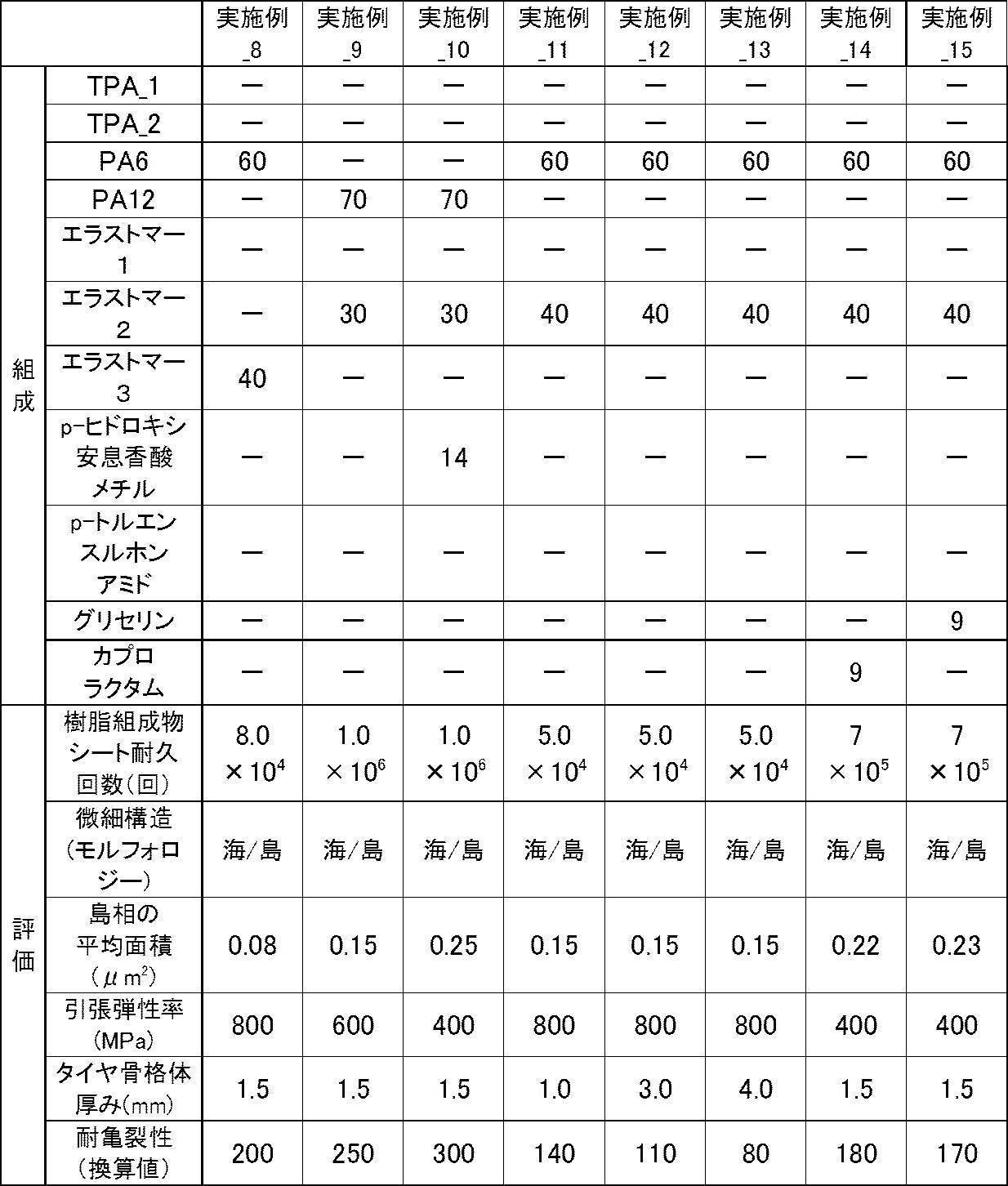

なお、表中の「組成」において、数値は添加量(質量部)を意味し、「-」はその成分を含まないことを意味する。
また、表中の「海/島」はポリアミド樹脂を含有する海相とエラストマーを含有する島相とを含む海島構造であることを意味し、「共連続」はポリアミド樹脂及びエラストマーの今日連続構造であることを意味する。
表中の成分は次の通りである。
また、表中の「海/島」はポリアミド樹脂を含有する海相とエラストマーを含有する島相とを含む海島構造であることを意味し、「共連続」はポリアミド樹脂及びエラストマーの今日連続構造であることを意味する。
表中の成分は次の通りである。
・TPA_1:ポリアミド系熱可塑性エラストマー
(宇部興産社製、商品名「UBESTA XPA9055X1」、引張弾性率:400MPa)
・TPA_2:ポリアミド系熱可塑性エラストマー
(宇部興産社製、商品名「UBESTA XPA9063X1」、引張弾性率:800MPa)
(宇部興産社製、商品名「UBESTA XPA9055X1」、引張弾性率:400MPa)
・TPA_2:ポリアミド系熱可塑性エラストマー
(宇部興産社製、商品名「UBESTA XPA9063X1」、引張弾性率:800MPa)
・PA6:ポリアミド系熱可塑性樹脂
(宇部興産社製、商品名「UBEナイロン 1013B」、引張弾性率:2500MPa)
・PA12:ポリアミド系熱可塑性樹脂
(宇部興産社製、商品名「3012U」、引張弾性率:1400MPa)
(宇部興産社製、商品名「UBEナイロン 1013B」、引張弾性率:2500MPa)
・PA12:ポリアミド系熱可塑性樹脂
(宇部興産社製、商品名「3012U」、引張弾性率:1400MPa)
・エラストマー1:オレフィン系熱可塑性エラストマー(非変性)
(三井化学社製、商品名「タフマー DF640」、引張弾性率:5MPa)
・エラストマー2:無水マレイン酸変性オレフィン系熱可塑性エラストマー
(三井化学社製、商品名「タフマー MH7010」、引張弾性率:10MPa)
・エラストマー3:無水マレイン酸変性オレフィン系熱可塑性エラストマー
(三井化学社製、商品名「タフマー MH7020」、引張弾性率:10MPa)
(三井化学社製、商品名「タフマー DF640」、引張弾性率:5MPa)
・エラストマー2:無水マレイン酸変性オレフィン系熱可塑性エラストマー
(三井化学社製、商品名「タフマー MH7010」、引張弾性率:10MPa)
・エラストマー3:無水マレイン酸変性オレフィン系熱可塑性エラストマー
(三井化学社製、商品名「タフマー MH7020」、引張弾性率:10MPa)
上記各表に示した評価結果から分かるように、本実施例では、比較例に比べ、タイヤの耐亀裂性に優れることが分かる。また本実施例では、比較例1及び比較例2で用いたポリアミド系熱可塑性エラストマーに比べて低コストの材料を用いており、低コストと耐亀裂性との両立が実現されていることが分かる。
2015年12月14日に出願された日本国特許出願2015-243288号の開示は、その全体が参照により本明細書に取り込まれる。
本明細書に記載された全ての文献、特許出願、および技術規格は、個々の文献、特許出願、および技術規格が参照により取り込まれることが具体的かつ個々に記された場合と同程度に、本明細書中に参照により取り込まれる。
本明細書に記載された全ての文献、特許出願、および技術規格は、個々の文献、特許出願、および技術規格が参照により取り込まれることが具体的かつ個々に記された場合と同程度に、本明細書中に参照により取り込まれる。
Claims (5)
- ポリアミド樹脂とエラストマーとを含有する樹脂組成物を含む環状のタイヤ骨格体を備え、
前記樹脂組成物に含まれる前記ポリアミド樹脂と前記エラストマーとの合計100質量部に対する前記エラストマーの含有量が5質量部以上45質量部以下であり、
前記樹脂組成物は、前記ポリアミド樹脂を含有する海相と、前記エラストマーを含有し平均面積が0.05μm2以上0.35μm2以下である島相と、を含む海島構造を有し、
前記樹脂組成物の引張弾性率が100MPa以上1000MPa以下である、
タイヤ。 - 前記樹脂組成物は、前記ポリアミド樹脂と前記エラストマーとの合計100質量部に対し、0.5質量部以上30質量部以下の可塑剤をさらに含む、請求項1に記載のタイヤ。
- 前記タイヤ骨格体の厚みが0.5mm以上3.5mm以下である請求項1または請求項2に記載のタイヤ。
- 前記エラストマーがオレフィン系熱可塑性エラストマーを含む請求項1~請求項3のいずれか一項に記載のタイヤ。
- 前記オレフィン系熱可塑性エラストマーが酸変性オレフィン系熱可塑性エラストマーである請求項4に記載のタイヤ。
Applications Claiming Priority (2)
| Application Number | Priority Date | Filing Date | Title |
|---|---|---|---|
| JP2015243288A JP2017110047A (ja) | 2015-12-14 | 2015-12-14 | タイヤ |
| JP2015-243288 | 2015-12-14 |
Publications (1)
| Publication Number | Publication Date |
|---|---|
| WO2017104187A1 true WO2017104187A1 (ja) | 2017-06-22 |
Family
ID=59055965
Family Applications (1)
| Application Number | Title | Priority Date | Filing Date |
|---|---|---|---|
| PCT/JP2016/075905 Ceased WO2017104187A1 (ja) | 2015-12-14 | 2016-09-02 | タイヤ |
Country Status (2)
| Country | Link |
|---|---|
| JP (1) | JP2017110047A (ja) |
| WO (1) | WO2017104187A1 (ja) |
Cited By (1)
| Publication number | Priority date | Publication date | Assignee | Title |
|---|---|---|---|---|
| JP7499978B1 (ja) * | 2023-03-28 | 2024-06-14 | 三菱電機株式会社 | ローラー及びその製造方法 |
Citations (5)
| Publication number | Priority date | Publication date | Assignee | Title |
|---|---|---|---|---|
| WO2013129628A1 (ja) * | 2012-02-29 | 2013-09-06 | 株式会社ブリヂストン | タイヤ |
| WO2013129525A1 (ja) * | 2012-02-29 | 2013-09-06 | 株式会社ブリヂストン | タイヤ |
| JP2013180616A (ja) * | 2012-02-29 | 2013-09-12 | Bridgestone Corp | タイヤ |
| JP2014111761A (ja) * | 2012-11-12 | 2014-06-19 | Kuraray Co Ltd | ポリアミド樹脂組成物 |
| WO2014133105A1 (ja) * | 2013-02-28 | 2014-09-04 | 株式会社ブリヂストン | タイヤ |
-
2015
- 2015-12-14 JP JP2015243288A patent/JP2017110047A/ja active Pending
-
2016
- 2016-09-02 WO PCT/JP2016/075905 patent/WO2017104187A1/ja not_active Ceased
Patent Citations (5)
| Publication number | Priority date | Publication date | Assignee | Title |
|---|---|---|---|---|
| WO2013129628A1 (ja) * | 2012-02-29 | 2013-09-06 | 株式会社ブリヂストン | タイヤ |
| WO2013129525A1 (ja) * | 2012-02-29 | 2013-09-06 | 株式会社ブリヂストン | タイヤ |
| JP2013180616A (ja) * | 2012-02-29 | 2013-09-12 | Bridgestone Corp | タイヤ |
| JP2014111761A (ja) * | 2012-11-12 | 2014-06-19 | Kuraray Co Ltd | ポリアミド樹脂組成物 |
| WO2014133105A1 (ja) * | 2013-02-28 | 2014-09-04 | 株式会社ブリヂストン | タイヤ |
Cited By (2)
| Publication number | Priority date | Publication date | Assignee | Title |
|---|---|---|---|---|
| JP7499978B1 (ja) * | 2023-03-28 | 2024-06-14 | 三菱電機株式会社 | ローラー及びその製造方法 |
| WO2024201723A1 (ja) * | 2023-03-28 | 2024-10-03 | 三菱電機株式会社 | ローラー及びその製造方法 |
Also Published As
| Publication number | Publication date |
|---|---|
| JP2017110047A (ja) | 2017-06-22 |
Similar Documents
| Publication | Publication Date | Title |
|---|---|---|
| JP6041859B2 (ja) | タイヤ | |
| WO2013129525A1 (ja) | タイヤ | |
| JP6057981B2 (ja) | タイヤ | |
| JP6086643B2 (ja) | タイヤ | |
| JP5818577B2 (ja) | タイヤ | |
| JP6138412B2 (ja) | タイヤ | |
| JP5847555B2 (ja) | タイヤ | |
| US10596853B2 (en) | Tire | |
| JP5818578B2 (ja) | タイヤ | |
| JP5911731B2 (ja) | タイヤ | |
| JP5778402B2 (ja) | タイヤ | |
| JP5627954B2 (ja) | タイヤ | |
| JP5905298B2 (ja) | タイヤ | |
| WO2017104187A1 (ja) | タイヤ | |
| JP5905289B2 (ja) | タイヤ | |
| JP5844173B2 (ja) | タイヤ | |
| JP6114498B2 (ja) | タイヤ | |
| JP6049273B2 (ja) | タイヤ | |
| JP5628002B2 (ja) | タイヤ、及びタイヤの製造方法 | |
| WO2017146038A1 (ja) | タイヤ | |
| JP6817879B2 (ja) | タイヤ | |
| JP6014714B2 (ja) | タイヤ及びその製造方法 | |
| WO2017104483A1 (ja) | タイヤ | |
| JP2022172715A (ja) | タイヤ及びタイヤ骨格体の製造方法 | |
| JP2019001358A (ja) | タイヤ |
Legal Events
| Date | Code | Title | Description |
|---|---|---|---|
| 121 | Ep: the epo has been informed by wipo that ep was designated in this application |
Ref document number: 16875173 Country of ref document: EP Kind code of ref document: A1 |
|
| NENP | Non-entry into the national phase |
Ref country code: DE |
|
| 122 | Ep: pct application non-entry in european phase |
Ref document number: 16875173 Country of ref document: EP Kind code of ref document: A1 |