WO2017101862A1 - 作为egfr抑制剂的5,8-二氢蝶啶-6,7-二酮衍生物及其应用 - Google Patents
作为egfr抑制剂的5,8-二氢蝶啶-6,7-二酮衍生物及其应用 Download PDFInfo
- Publication number
- WO2017101862A1 WO2017101862A1 PCT/CN2016/110437 CN2016110437W WO2017101862A1 WO 2017101862 A1 WO2017101862 A1 WO 2017101862A1 CN 2016110437 W CN2016110437 W CN 2016110437W WO 2017101862 A1 WO2017101862 A1 WO 2017101862A1
- Authority
- WO
- WIPO (PCT)
- Prior art keywords
- cancer
- compound
- group
- egfr
- alkyl
- Prior art date
- Legal status (The legal status is an assumption and is not a legal conclusion. Google has not performed a legal analysis and makes no representation as to the accuracy of the status listed.)
- Ceased
Links
- WSUUQWSGDOKKOY-UHFFFAOYSA-N CC(C)N(c1cnc(Nc(c(OC)c2)ccc2OCCN(C)C)nc1N(c1cc(NC(C=C)=O)ccc1)C1=O)C1=O Chemical compound CC(C)N(c1cnc(Nc(c(OC)c2)ccc2OCCN(C)C)nc1N(c1cc(NC(C=C)=O)ccc1)C1=O)C1=O WSUUQWSGDOKKOY-UHFFFAOYSA-N 0.000 description 1
- YMEJDHMQZBPDSJ-UHFFFAOYSA-N CC(C)N(c1cnc(Nc(cc2)cc(C)c2N2CCN(C)CC2)nc1N(c1cccc(NC(C=C)=O)c1)C1=O)C1=O Chemical compound CC(C)N(c1cnc(Nc(cc2)cc(C)c2N2CCN(C)CC2)nc1N(c1cccc(NC(C=C)=O)c1)C1=O)C1=O YMEJDHMQZBPDSJ-UHFFFAOYSA-N 0.000 description 1
- REYACJNTTOCQLS-UHFFFAOYSA-N CC(C)N(c1cnc(Nc(cc2)cc(OC)c2N2CCN(C)CC2)nc1N(c1cccc(NC(C=C)=O)c1)C1=O)C1=O Chemical compound CC(C)N(c1cnc(Nc(cc2)cc(OC)c2N2CCN(C)CC2)nc1N(c1cccc(NC(C=C)=O)c1)C1=O)C1=O REYACJNTTOCQLS-UHFFFAOYSA-N 0.000 description 1
- XHNCXRZZTZLAQB-UHFFFAOYSA-N CC(C)N(c1cnc(Nc(ccc(N(C)CCN(C)C)c2)c2OC)nc1N(c1cccc(NC(C=C)=O)c1)C1=O)C1=O Chemical compound CC(C)N(c1cnc(Nc(ccc(N(C)CCN(C)C)c2)c2OC)nc1N(c1cccc(NC(C=C)=O)c1)C1=O)C1=O XHNCXRZZTZLAQB-UHFFFAOYSA-N 0.000 description 1
- KNARRZQQMNVVEZ-UHFFFAOYSA-N CC(C)N(c1cnc(Nc(ccc(N(CC2)CCC2N2CCN(C)CC2)c2)c2OC)nc1N(c1cccc(NC(C=C)=O)c1)C1=O)C1=O Chemical compound CC(C)N(c1cnc(Nc(ccc(N(CC2)CCC2N2CCN(C)CC2)c2)c2OC)nc1N(c1cccc(NC(C=C)=O)c1)C1=O)C1=O KNARRZQQMNVVEZ-UHFFFAOYSA-N 0.000 description 1
- LDDDGIHXYBWEAR-UHFFFAOYSA-N CC(C)N(c1cnc(Nc(ccc(N2CCN(C)CC2)c2)c2OC)nc1N(c1cccc(NC(C=C)=O)c1)C1=O)C1=O Chemical compound CC(C)N(c1cnc(Nc(ccc(N2CCN(C)CC2)c2)c2OC)nc1N(c1cccc(NC(C=C)=O)c1)C1=O)C1=O LDDDGIHXYBWEAR-UHFFFAOYSA-N 0.000 description 1
- VNTCTQSZRPNAAH-UHFFFAOYSA-N CCCN(c1cnc(Nc(ccc(N2CCN(C)CC2)c2)c2OC)nc1N(c1cccc(NC(C=C)=O)c1)C1=O)C1=O Chemical compound CCCN(c1cnc(Nc(ccc(N2CCN(C)CC2)c2)c2OC)nc1N(c1cccc(NC(C=C)=O)c1)C1=O)C1=O VNTCTQSZRPNAAH-UHFFFAOYSA-N 0.000 description 1
- LKQWOHYTZVPINL-UHFFFAOYSA-N CCN(c1cnc(Nc(c(OC)c2)ccc2N2CCN(C)CC2)nc1N(c1cccc(NC(C=C)=O)c1)C1=O)C1=O Chemical compound CCN(c1cnc(Nc(c(OC)c2)ccc2N2CCN(C)CC2)nc1N(c1cccc(NC(C=C)=O)c1)C1=O)C1=O LKQWOHYTZVPINL-UHFFFAOYSA-N 0.000 description 1
- ZZHGYQVOTUDVEE-UHFFFAOYSA-N CN(CC1)CCN1c(cc1)cc(OC)c1Nc(nc1N(c2cccc(NC(C=C)=O)c2)C2=O)ncc1N(C)C2=O Chemical compound CN(CC1)CCN1c(cc1)cc(OC)c1Nc(nc1N(c2cccc(NC(C=C)=O)c2)C2=O)ncc1N(C)C2=O ZZHGYQVOTUDVEE-UHFFFAOYSA-N 0.000 description 1
- SJIJLSCJOWNMCN-UHFFFAOYSA-N CN(CC1)CCN1c(cc1)cc(OC)c1Nc(nc1N(c2cccc(NC(C=C)O)c2)C2=O)ncc1NC2=O Chemical compound CN(CC1)CCN1c(cc1)cc(OC)c1Nc(nc1N(c2cccc(NC(C=C)O)c2)C2=O)ncc1NC2=O SJIJLSCJOWNMCN-UHFFFAOYSA-N 0.000 description 1
Classifications
-
- A—HUMAN NECESSITIES
- A61—MEDICAL OR VETERINARY SCIENCE; HYGIENE
- A61K—PREPARATIONS FOR MEDICAL, DENTAL OR TOILETRY PURPOSES
- A61K31/00—Medicinal preparations containing organic active ingredients
- A61K31/33—Heterocyclic compounds
- A61K31/395—Heterocyclic compounds having nitrogen as a ring hetero atom, e.g. guanethidine or rifamycins
- A61K31/495—Heterocyclic compounds having nitrogen as a ring hetero atom, e.g. guanethidine or rifamycins having six-membered rings with two or more nitrogen atoms as the only ring heteroatoms, e.g. piperazine or tetrazines
- A61K31/505—Pyrimidines; Hydrogenated pyrimidines, e.g. trimethoprim
- A61K31/519—Pyrimidines; Hydrogenated pyrimidines, e.g. trimethoprim ortho- or peri-condensed with heterocyclic rings
-
- C—CHEMISTRY; METALLURGY
- C07—ORGANIC CHEMISTRY
- C07D—HETEROCYCLIC COMPOUNDS
- C07D475/00—Heterocyclic compounds containing pteridine ring systems
Definitions
- the present invention relates to the field of medicinal chemistry; in particular, the present invention relates to novel 5,8-dihydropteridin-6,7-dione derivatives, a synthetic method thereof and a medicament for preparing a tumor-related disease as an EGFR inhibitor Application in .
- Cancer also known as malignant tumor, is a large class of diseases characterized by abnormal cell proliferation and metastasis. It has the characteristics of high morbidity and high mortality, and is one of the malignant diseases that threaten human health and cause death.
- Research data shows that there were 12.7 million cancer patients worldwide in 2008, including more than 7 million deaths. In the world, 20% of new cancer patients are in China, and 24% of cancer patients are in China. If no effective measures are taken to prevent it or a better treatment plan, it is estimated that by 2030, there will be 26 million new cancer cases every year worldwide, and the number of cancer deaths will reach 17 million.
- lung cancer is the most common malignant tumor with morbidity and mortality worldwide, and non-small cell lung cancer (NSCLC) accounts for more than 80% of lung cancer patients.
- NSCLC non-small cell lung cancer
- WHO World Health Organization
- Protein tyrosine kinase is an important factor in the signal transduction process and participates in a series of cellular activities, which are closely related to cell growth, differentiation and proliferation. It catalyzes the transfer of the ⁇ -phosphate group of ATP to the tyrosine residues of many important proteins, phosphorylating the phenolic hydroxyl group, and transmitting signals.
- EGFR epidermal growth factor receptor tyrosine kinase
- EGFR is a constitutive expression component of many normal epithelial tissues (such as skin and hair follicles), and in most solid tumors, EGFR is overexpressed or highly expressed. For example, in lung cancer, the expression rate of EGFR reaches 40-80%. Therefore, selectively inhibiting EGFR and interfering with its signal transduction pathway can achieve the purpose of treating lung cancer, and opens up a feasible way for targeted treatment of lung cancer.
- the T790M mutation results in steric hindrance when the inhibitor binds to EGFR or increases the affinity of EGFR to ATP, making the anticancer effect of such reversible binding competitive inhibitors greatly diminished.
- the emergence of drug resistance not only reduces the patient's medication
- the sensitivity of the object also greatly reduces the quality of life of patients with cancer.
- a series of irreversible ATP competitive inhibitors (such as CI-1033, HKI-272, PF00299804, etc.) have entered the clinical research stage.
- the irreversible inhibitor contains a Michael acceptor fragment that forms a covalent bond with a conserved amino acid residue (Cys797) of the ATP binding site of EGFR, thereby obtaining a stronger EGFR binding affinity than the reversible inhibitor.
- Cys797 conserved amino acid residue
- Another object of the present invention is to provide a pharmaceutical composition comprising the above compound.
- Still another object of the present invention is to provide use of the above compounds for the preparation of a medicament for treating an EGFR-related disease or inhibiting EGFR.
- the invention provides a compound of formula I or a pharmaceutically acceptable salt thereof:
- A is a benzene ring, a five- or six-membered heterocyclic ring, or a C 3 -C 8 cycloalkyl group;
- R 1 is each independently selected from the group consisting of hydrogen, halogen, C 1 -C 3 alkoxy, C 1 -C 3 alkyl, C 1 -C 4 alkylamido, substituted piperazinyl, substituted homopiperazinyl, substituted?
- R 2 is each independently selected from the group consisting of:
- R 3 is selected from the group consisting of hydrogen, C 1 -C 10 alkyl, substituted C 1 -C 10 alkyl, optionally substituted C 3 -C 8 cycloalkyl, optionally substituted benzyl, optionally substituted Heterocyclic group;
- n is any integer from 0 to 7, preferably from 1 to 7.
- the compound is as shown in Formula II:
- R 1 , R 2 and R 3 are as defined in claim 1;
- n is an integer from 0 to 5, preferably from 1 to 5.
- the compound is as shown in Formula III:
- R 2 is selected from
- R 3 is selected from H, or C 1 -C 6 alkyl, preferably methyl or isopropyl;
- R 4 , R 5 , R 6 , R 7 and R 8 are independently selected from the group consisting of
- R 3 is selected from C 1 -C 6 alkyl, preferably methyl or isopropyl; R 5 , R 7 and R 8 are H; and R 4 and R 6 are independently selected from the group consisting of
- the invention provides a compound selected from the group consisting of: or a pharmaceutically acceptable salt thereof:
- the present invention provides a pharmaceutical composition
- a pharmaceutical composition comprising the compound of the first or second aspect of the present invention, or a pharmaceutically acceptable salt thereof, and a pharmaceutically acceptable carrier or excipient.
- the pharmaceutical composition is a dosage form suitable for oral administration, including but not limited to tablets, solutions, suspensions, capsules, granules, powders.
- the invention provides the use of a compound of the first or second aspect of the invention for the manufacture of a medicament for the treatment or prevention of an EGFR mediated disease, or inhibition of EGFR.
- the EGFR mediated disease is cancer.
- the cancer is selected from the group consisting of non-small cell lung cancer, small cell lung cancer, lung adenocarcinoma, lung squamous cell carcinoma, breast cancer, prostate cancer, glioma, ovarian cancer, head and neck Squamous cell carcinoma, cervical cancer, esophageal cancer, liver cancer, kidney cancer, pancreatic cancer, colon cancer, skin cancer, leukemia, lymphoma, gastric cancer, multiple myeloma and solid tumors.
- the present invention provides a method of treating or preventing an EGFR-mediated disease comprising administering a compound of the first or second aspect of the invention or the pharmaceutical composition of the third aspect of the invention to a need thereof Object.
- the EGFR-mediated disease is cancer; preferably, the cancer is selected from the group consisting of non-small cell lung cancer, small cell lung cancer, lung adenocarcinoma, lung squamous cell carcinoma, breast cancer, prostate cancer , glioma, ovarian cancer, head and neck squamous cell carcinoma, cervical cancer, esophageal cancer, liver cancer, kidney cancer, pancreatic cancer, colon cancer, skin cancer, leukemia, lymphoma, gastric cancer, multiple myeloma and solid tumor .
- the cancer is selected from the group consisting of non-small cell lung cancer, small cell lung cancer, lung adenocarcinoma, lung squamous cell carcinoma, breast cancer, prostate cancer , glioma, ovarian cancer, head and neck squamous cell carcinoma, cervical cancer, esophageal cancer, liver cancer, kidney cancer, pancreatic cancer, colon cancer, skin cancer, leukemia, lymphoma, gastric cancer, multiple myelo
- IC 50 value reaches the level of sub nM; IC 50 values of inhibitory activity against cancer cells (EGFR L858R / T790M mutation) proliferation levels reached nM.
- the present invention has been completed on this basis.
- the present inventors synthesized a candidate compound having EGFR inhibitory activity. Structural optimization of the candidate compounds was carried out, and a series of 5,8-dihydropteridin-6,7-dione compounds which were not reported in the literature were designed and synthesized and characterized. A series of compounds were tested for activity at the molecular and cellular levels, resulting in a batch of compounds that selectively inhibit the EGFR T790M mutation. Wherein the compound 005 pairs of EGFR T790M / L858 kinase inhibitory activity IC 50 of 0.3nM, H1975 (non-small cell lung cancer cells, EGFR L858R / T790M) cell proliferation inhibitory activity IC 50 of 18nM.
- IC 50 ratio of the difference toxic mutant of EGFR comprising greater than 100 means that the compound may have in vivo comprising the wild-type EGFR.
- the compound of the present invention has an IC 50 inhibitory activity against H1975 (non-small cell lung cancer cells, EGFR L858R/T790M ) cell proliferation, and the compound of the present invention also has excellent IC 50 ratio, wherein the above IC 50 ratio of compound 005 More than 400.
- alkyl refers to a saturated branched or straight-chain alkyl group having a carbon chain length of from 1 to 10 carbon atoms, and preferred alkyl groups include 2-8, 1-6, 1-4, 3-8 alkyl groups of 1-3 carbon atoms.
- alkyl groups include, but are not limited to, methyl, ethyl, n-propyl, isopropyl, n-butyl, isobutyl, heptyl, and the like.
- the alkyl group may be substituted by one or more substituents, for example by halogen or haloalkyl.
- the alkyl group may be an alkyl group substituted with 1 to 4 fluorine atoms, or the alkyl group may be an alkyl group substituted with a fluoroalkyl group.
- alkoxy refers to an oxy group substituted with an alkyl group.
- Preferred alkoxy groups are alkoxy groups having from 1 to 6 carbon atoms, more preferably alkoxy groups having from 1 to 4 carbon atoms. Examples of alkoxy groups include, but are not limited to, methoxy, ethoxy, propoxy, and the like.
- halogen refers to fluoro, chloro, bromo and iodo.
- heterocyclyl includes, but is not limited to, a 5- or 6-membered heterocyclic group containing from 1 to 3 heteroatoms selected from O, S or N, including but not limited to furyl, thienyl, pyrrolyl, Pyrrolidinyl, pyrazolyl, imidazolyl, triazolyl, oxazolyl, pyranyl, pyridyl, pyrimidinyl, pyrazinyl, piperidinyl, morpholinyl and the like.
- “amido” refers to a group of the formula "-R'-NH-C(O)-R", wherein R' may be selected from hydrogen or alkyl, and R may be selected from alkyl, alkenyl. , alkynyl, NR c R d is substituted alkyl, NR c R d is substituted alkenyl and NR c R d group substituted alkynyl, halogen substituted alkyl, alkenyl substituted with cyano group, Wherein R c and R d may be selected from the group consisting of alkyl and alkenyl.
- substituent to which it is modified may be optionally substituted with from 1 to 5 (eg, 1, 2, 3, 4 or 5) substituents selected from the group consisting of halogen, C. 1-4 aldehyde group, C 1-6 linear or branched alkyl group, cyano group, nitro group, amino group, hydroxyl group, hydroxymethyl group, halogen-substituted alkyl group (for example, trifluoromethyl group), halogen-substituted alkoxy group A group (e.g., trifluoromethoxy), a carboxyl group, a C 1-4 alkoxy group, an ethoxycarbonyl group, an N(CH 3 ) group, and a C 1-4 acyl group.
- substituents selected from the group consisting of halogen, C. 1-4 aldehyde group, C 1-6 linear or branched alkyl group, cyano group, nitro group, amino group, hydroxyl group, hydroxymethyl group, halogen-
- the compound of the present invention is a compound of the following formula I or a pharmaceutically acceptable salt thereof:
- A is a benzene ring, a five- or six-membered heterocyclic ring, or a C 3 -C 8 cycloalkyl group;
- R 1 is each independently selected from the group consisting of hydrogen, halogen, C 1 -C 3 alkoxy, C 1 -C 3 alkyl, C 1 -C 4 alkylamido, substituted piperazinyl, substituted homopiperazinyl, substituted?
- R 2 is each independently selected from the group consisting of:
- R 3 is selected from the group consisting of hydrogen, C 1 -C 10 alkyl, substituted C 1 -C 10 alkyl, optionally substituted C 3 -C 8 cycloalkyl, optionally substituted benzyl, optionally substituted Heterocyclic group;
- n is any integer from 0 to 7, preferably from 1 to 7.
- the A ring is a benzene ring such that the compound of the invention is as shown in Formula II below:
- R 1 , R 2 and R 3 are as defined above; and m is 0-5, preferably any integer of 1-5.
- the above benzene ring in the compound of the present invention may be substituted or unsubstituted, for example, the compound of the present invention may be as shown in the following formula III:
- R 2 is selected from
- R 3 is selected from H, or C 1 -C 6 alkyl, preferably methyl or isopropyl;
- R 4 , R 5 , R 6 , R 7 and R 8 are independently selected from the group consisting of
- the above benzene rings in the compounds of the invention may be substituted as ortho, meta and/or para.
- the above benzene rings in the compounds of the invention are ortho-, meta- and para-substituted.
- R 3 in the above formula III is selected from C 1 -C 6 alkyl, preferably methyl or isopropyl;
- R 5 , R 7 and R 8 are H;
- R 4 and R 6 Independent from the following group:
- the compound of the invention is a compound as shown below:
- the present invention provides a pharmaceutical composition
- a pharmaceutical composition comprising a therapeutically effective amount of a compound of the present invention or a pharmaceutically acceptable salt thereof, and a pharmaceutically acceptable carrier or excipient .
- Examples of pharmaceutically acceptable salts of the compounds of the invention include, but are not limited to, inorganic and organic acid salts such as the hydrochloride, hydrobromide, sulfate, citrate, lactate, tartrate, maleate salts. , fumarate, mandelate and oxalate; and inorganic and formed with bases such as sodium hydroxy, tris(hydroxymethyl)aminomethane (TRIS, tromethamine) and N-methyl glucosamine Organic base salt.
- inorganic and organic acid salts such as the hydrochloride, hydrobromide, sulfate, citrate, lactate, tartrate, maleate salts. , fumarate, mandelate and oxalate
- bases such as sodium hydroxy, tris(hydroxymethyl)aminomethane (TRIS, tromethamine) and N-methyl glucosamine Organic base salt.
- the compound of the present invention or a pharmaceutically acceptable salt thereof is orally administered to a mammal daily in an amount of from about 0.0025 to 50 mg/kg body weight. Preferably, however, it is about 0.01 to 10 mg per kilogram of oral administration.
- a unit oral dose can include from about 0.01 to 50 mg, preferably from about 0.1 to 10 mg, of a compound of the invention.
- the unit dose may be administered one or more times per day in one or more tablets, each tablet containing from about 0.1 to 50 mg, conveniently from about 0.25 to 10 mg of the compound of the invention or a solvate thereof.
- the pharmaceutical composition of the present invention can be formulated into a form suitable for various administration routes, including but not limited to being formulated for parenteral, subcutaneous, intravenous, intramuscular, intraperitoneal, transdermal, oral, intrathecal, intracranial A form of administration, intranasal or topical, for the treatment of tumors and other diseases.
- the amount administered is an amount effective to ameliorate or eliminate one or more conditions.
- an effective amount is an amount sufficient to ameliorate or in some way alleviate the symptoms associated with the disease.
- Such doses can be administered as a single dose or can be administered according to an effective therapeutic regimen.
- the amount administered may cure the disease, but administration is usually to improve the symptoms of the disease. Repeated administration is generally required to achieve the desired improvement in symptoms.
- the dosage of the drug will be determined by the age of the patient, the health and weight, the type of concurrent treatment, the frequency of treatment, and the desired therapeutic benefit.
- the pharmaceutical preparation of the present invention can be administered to any mammal as long as they can obtain the therapeutic effect of the compound of the present invention.
- the most important of these mammals is humans.
- the compounds of the invention or pharmaceutical compositions thereof are useful in the treatment of a variety of diseases mediated by epidermal growth factor receptor kinase (EGFR).
- EGFR epidermal growth factor receptor kinase
- the disease mediated by EGFR is various cancers.
- the cancer includes, but is not limited to, non-small cell lung cancer, small cell lung cancer, lung adenocarcinoma, lung squamous cell carcinoma, breast cancer, prostate cancer, glioma, ovarian cancer, head and neck squamous cell carcinoma, cervical cancer, esophagus Cancer, liver cancer, kidney cancer, pancreatic cancer, colon cancer, skin cancer, leukemia, lymphoma, gastric cancer, multiple myeloma and solid tumors.
- the pharmaceutical preparations of the invention can be made in a known manner. For example, it is manufactured by a conventional mixing, granulating, tableting, dissolving, or freeze drying process. In the manufacture of oral formulations, the mixture can be selectively milled by combining the solid adjuvant with the active compound. If necessary or necessary, after adding an appropriate amount of auxiliary agent, the mixture of particles is processed to obtain a tablet or tablet core.
- Suitable excipients are, in particular, fillers, such as sugars such as lactose or sucrose, mannitol or sorbitol; cellulose preparations or calcium phosphates, such as tricalcium phosphate or calcium hydrogen phosphate; and binders, such as starch pastes, including corn starch. , wheat starch, rice starch, potato starch, gelatin, tragacanth, methyl cellulose, hydroxypropyl methyl cellulose, sodium carboxymethyl cellulose, or polyvinylpyrrolidone.
- fillers such as sugars such as lactose or sucrose, mannitol or sorbitol
- cellulose preparations or calcium phosphates such as tricalcium phosphate or calcium hydrogen phosphate
- binders such as starch pastes, including corn starch. , wheat starch, rice starch, potato starch, gelatin, tragacanth, methyl cellulose, hydroxypropyl methyl cellulose, sodium carboxymethyl
- a disintegrating agent such as the above-mentioned starch, and carboxymethyl starch, crosslinked polyvinylpyrrolidone, agar, or alginic acid or a salt thereof such as sodium alginate may be added.
- Adjuvants are especially flow regulators and lubricants, for example, silica, talc, stearates such as calcium magnesium stearate, stearic acid or polyethylene glycol.
- the tablet core can be provided with a suitable coating that is resistant to gastric juice. For this purpose, a concentrated sugar solution can be applied.
- This solution may contain gum arabic, talc, polyvinylpyrrolidone, polyethylene glycol and/or titanium dioxide, a lacquer solution and a suitable organic solvent or solvent mixture.
- a suitable cellulose solution such as cellulose acetate phthalic acid or hydroxypropyl methylcellulose phthalic acid can be used.
- a dye or pigment can be added to the coating of the tablet or tablet core. For example, a combination for identifying or for characterizing the dosage of an active ingredient.
- the pharmaceutical compositions of the present invention are those suitable for oral administration, including, but not limited to, tablets, solutions, suspensions, capsules, granules, powders.
- the invention further provides a method of treating an EGFR mediated disease, the method comprising administering to a subject in need thereof a compound or pharmaceutical composition of the invention.
- Methods of administration include, but are not limited to, various methods of administration well known in the art, which can be determined based on the actual circumstances of the patient. These methods include, but are not limited to, parenteral, subcutaneous, intravenous, intramuscular, intraperitoneal, transdermal, buccal, intrathecal, intracranial, nasal or topical routes of administration.
- the invention also encompasses the use of a compound of the invention in the manufacture of a medicament for preventing or treating an EGFR mediated disease or inhibiting EGFR activity.
- the compound provided by the present invention is a novel structure of 5,8-dihydropteridin-6,7-dione;
- the compound provided by the present invention has excellent inhibitory activity against mutant EGFR or EGFR mutant cancer cells
- the compound provided by the present invention lays a foundation for the development of an EGFR-targeted drug capable of selectively inhibiting T790M mutation and can overcome clinical drug resistance, and has great industrialization and commercialization prospects as well as market value and significant economic benefits.
- Reagents and conditions (a) (Boc) 2 O, Et 3 N, CH 3 OH, room temperature, 24 h; (b) 2,4-dichloro-5-nitropyrimidine, Na 2 CO 3 , DMF, -70 °C, 1h; (c) arylamine, DIPEA, THF, room temperature, overnight; (d) H 2 , Pd / C, MeOH, room temperature, 10 h; (e) diethyl oxalate, triethylamine, EtOH, reflux 30h; (f) alkyl halide, Cs 2 CO 3 , DMF, room temperature, overnight; (g) trifluoroacetic acid, CH 2 Cl 2 , room temperature, 5 h; (h) acryloyl chloride, Et 3 N, CH 2 Cl 2 , 0 ° C to room temperature, overnight.
- 1,3-phenylenediamine (10.800 g, 100 mmol) and triethylamine (10.100 g, 100 mmol) were weighed in a 250 mL single-necked flask, dissolved in 100 mL of methanol, and stirred for 15 minutes under ice bath. Further, Boc-anhydride (21.800 g, 100 mmol) was dissolved in 40 mL of methanol, and added dropwise to the above reaction mixture. After the dropwise addition was completed, the mixture was stirred at room temperature for 24 hours. The TLC was used to carry out the conversion of the starting material, and the solvent was removed by rotary evaporation.
- the TLC was used to carry out the conversion of the starting material, and the mixture was neutralized with a saturated NaHCO 3 solution to be basic, and extracted with dichloromethane. The organic layer was collected, and the solvent was removed by rotary evaporation. The crude product was recrystallized from dichloromethane to give 8-(3-aminophenyl)-5. -ethyl-2-((2-methoxy-4-(4-methylpiperazinyl)phenyl)amino)-5,8-dihydropteridine-6,7-dione 185 mg, yield 55%, the product was used directly in the next step.
- the concentration of different kinases was determined by optimization experiments. The corresponding concentrations were: EGFR (PV3872, Invitrogen) 0.287 ⁇ g/ ⁇ L, EGFR-T790M (PV4803, Invitrogen) 0.174 ⁇ g/ ⁇ L, EGFR-L858R/T790M (PV4879, Yingjie Company) ) 0.055 ⁇ g / ⁇ L.
- the compound was diluted three times from 5.1 x 10 -9 M to 1 x 10 -4 M in DMSO. 4 ⁇ L of the compound was dissolved in 96 ⁇ L of water to obtain a 4x compound solution.
- kinase/peptide mixture contained 2x kinase, 4 ⁇ M tyrosine 4 peptide ready for use.
- the 10 ⁇ L kinase reaction included 2.5 ⁇ L of compound solution, 5 ⁇ L of kinase/peptide mixture, and 2.5 ⁇ L of ATP solution. 5 ⁇ L of phosphorylated peptide solution was used instead of the kinase/peptide mixture as a 100% phosphorylation control.
- H1975 non-small cell lung cancer cells, EGFR L858R/T790M
- A431 non-small cell lung cancer cells, EGFR wild type
- the cells were exposed to the treatment conditions for 72 hours, and the number of cells used in each cell of each cell was adjusted according to the absorbance value (absorbance value at 490 nm of 1.3-2.2).
- Six concentration gradients (0.1 nM - 10 [mu]M) were set for the compounds to be tested, and at least 6 sets of parallel controls were used for each concentration value.
- H1975, A431 cells were cultured in the corresponding medium, and the cells were passaged at least twice after resuscitation, and then used for experimental use. The log phase cells were trypsinized and resuspended in culture. H1975 (1000 cells per well), A431 (2000 cells per well) were seeded in 96-well plates in a volume of 100 ⁇ L; 6 sets of parallel and 7 columns were set. The plates were placed in an incubator at 37 ° C in a 5% carbon dioxide overnight.
- the compound was dissolved in DMSO to a concentration of 10 ⁇ M per liter, and then the compound concentration was gradually diluted to obtain a compound concentration of 10 ⁇ M, 1 ⁇ M, 0.1 ⁇ M, 0.01 ⁇ M, 0.001 ⁇ M, and 0.0001 ⁇ M per liter, respectively.
- 2 ⁇ L of the compound solution was added to 998 ⁇ L of the medium, and the mixture was thoroughly mixed. 100 ⁇ L of the mixture was added to a 96-well plate. 2 ⁇ L of DMSO was used instead of the compound solution as a 0% inhibition control. After incubation for 68 hours, 20 ⁇ L of MTT (5 mg/mL) was added.
- the inventors designed and synthesized a series of 5,8-dihydropteridin-6,7-dione compounds that have not been reported in the literature.
- the obtained compounds were subjected to molecular and cellular levels.
- the activity assay yielded a batch of compounds that selectively inhibited the EGFR T790M mutation.
- the present inventors have further found that the difference in proliferation inhibition ability of the compound of the present invention against EGFR mutant cancer cells (H1975) and EGFR wild type cancer cells (A431) is higher than that of mutant EGFR and wild type EGFR kinase activity.
- the compounds of the present invention may be a third-generation EGFR-targeted drug that selectively inhibits T790M mutations, overcomes clinical resistance, or is more active as a further modification and/or The basis for compounds that differ in toxicity.
Landscapes
- Chemical & Material Sciences (AREA)
- Organic Chemistry (AREA)
- Health & Medical Sciences (AREA)
- Medicinal Chemistry (AREA)
- Pharmacology & Pharmacy (AREA)
- Epidemiology (AREA)
- Life Sciences & Earth Sciences (AREA)
- Animal Behavior & Ethology (AREA)
- General Health & Medical Sciences (AREA)
- Public Health (AREA)
- Veterinary Medicine (AREA)
- Pharmaceuticals Containing Other Organic And Inorganic Compounds (AREA)
Abstract
本发明涉及作为EGFR抑制剂的嘧啶并嘧啶二酮衍生物及其应用。具体而言,本发明涉及式I所示化合物、含有式I化合物的药物组合物及所述化合物在制备治疗EGFR相关疾病或抑制EGFR的药物中的用途:
Description
本发明涉及药物化学领域;具体地说,本发明涉及新型的5,8-二氢蝶啶-6,7-二酮衍生物,其合成方法及其作为EGFR抑制剂在制备肿瘤相关疾病的药物中的应用。
癌症亦称恶性肿瘤,是以细胞异常增殖及转移为特点的一大类疾病,具有发病率高和死亡率高的特点,是威胁人类健康,导致死亡的恶性疾病之一。研究数据表明,2008年全球有1270万癌症患者,其中死亡人数高达700余万。而全世界20%的新发肿瘤病人在中国,24%的肿瘤死亡病人在中国。如果不采取有效措施预防,或拿出更优的治疗方案,预计到2030年,世界范围内每年将出现2600万新增癌症病例,癌症死亡人数将达到1700万。在现有的癌症中,肺癌是目前世界范围内发病率和死亡率最高的恶性肿瘤,其中非小细胞肺癌(NSCLC)占肺癌患者的80%以上。据世界卫生组织(WHO)预测,到2025年,我国每年新增肺癌病例将超过100万。一旦被确诊为肺癌,患者便只有渺茫的生存前景,5年生存率不到15%。
从20世纪80年代开始,随着肿瘤分子生物学研究的深入,肿瘤发生、发展的分子机制日益清晰。在诸多诱发癌症的因素中,癌细胞中由基因突变引起的高表达的某些蛋白激酶是导致其信号转导通路异常的主要因素之一。蛋白质酪氨酸激酶是信号传递过程中的重要因子,参与一系列细胞活动,与细胞生长、分化、增殖密切相关。它催化ATP的γ磷酸基转移到许多重要蛋白质的酪氨酸残基上,使酚羟基磷酸化,从而传递信号。因此,发展选择性的蛋白激酶抑制剂来阻断或者调控由于这些信号通路异常产生的疾病已经被视为抗肿瘤药物开发的一个有效的研究策略。在众多的酪氨酸激酶中,表皮生长因子受体酪氨酸激酶(epidermal growth factor receptor tyrosine kinase,EGFR)是不可或缺的重要组成部分。EGFR由1186个氨基酸组成,编码一个分子量为170-kDa的跨膜糖蛋白。EGFR能够介导多条信号转导通路,将胞外信号传递到胞内,对正常细胞和肿瘤细胞的增殖、分化和凋亡均发挥重要的调节作用(Cell,2000,100,113-127)。EGFR是许多正常上皮组织(如皮肤和毛囊)的组成性表达成分,而在大部分实体瘤中,EGFR存在过表达或者高表达。例如,在肺癌中,EGFR的表达率达到40~80%。因此选择性地抑制EGFR,干扰其介导的信号转导途径,可以达到治疗肺癌的目的,为靶向治疗肺癌开辟了一条可行之路。
临床治疗上,结合传统的放疗、化疗,以EGFR靶向药物如吉非替尼(Iressa)、厄洛替尼(Tarceva)等进行一线药物在肺癌治疗中被证明是非常有效的。然而,临床实践表明:大部分非小细胞肺癌患者在使用吉非替尼或厄洛替尼治疗之后,会在6-12月内出现获得性耐药。其中大约50%病例的耐药性与EGFR激酶结构域中一个氨基酸残基的突变(790位苏氨酸残基突变为甲硫氨酸,T790M)有关(The New England Journal of Medicine,2005,352,786-792)。T790M突变导致抑制剂与EGFR结合时产生空间位阻或者增加EGFR与ATP的亲和力,使得这类可逆性结合的竞争性抑制剂的抗癌效果大大减弱。耐药性的产生不但降低了病人对药
物的敏感性,也大大降低了肿瘤患者的生存质量。为了克服T790M突变引起的耐药性,一系列不可逆ATP竞争性抑制剂(如CI-1033、HKI-272、PF00299804等)已进入临床研究阶段。不可逆抑制剂含有一个迈克尔受体片段,能与EGFR的ATP结合位点的一个保守氨基酸残基(Cys797)形成共价键,从而获得了比可逆性抑制剂更强的EGFR结合亲和力。尽管如此,由于此类药物对野生型和突变型EGFR选择性较差,因此其最大耐受量(MTD)较低,临床实验效果并不明显。
因此,研究开发选择性抑制T790M突变,克服临床耐药的第三代EGFR靶向药物具有重大的临床意义和应用前景。
发明内容
本发明的目的是提供能够选择性抑制T790M突变的化合物作为EGFR抑制剂。
本发明的另一目的是提供包含上述化合物的药物组合物。
本发明还有一目的是提供上述化合物在制备治疗EGFR相关疾病或抑制EGFR的药物中的用途。
在第一方面,本发明提供通式I所示的化合物或其药学上可接受的盐:

式中,A为苯环、五元或六元杂环、C3-C8环烷基;
R1各自独立选自氢、卤素、C1-C3烷氧基、C1-C3烷基、C1-C4烷基酰胺基、取代哌嗪基、取代高哌嗪基、取代吗啉基、取代硫代吗啉基、4-N-甲基哌嗪基、4-N-乙酰基哌嗪基、4-N,N-二甲基哌啶基、取代哌啶基、N,N-二甲胺基乙基胺基,N,N-二甲胺基乙氧基,4-(4-N-甲基哌嗪基)哌啶基、-NRaRb,其中,Ra和Rb可选自烷基和含氮烷基;
B选自下组:

R2各自独立选自以下基团:

R3选自下组:氢、C1-C10烷基,取代的C1-C10烷基、任选取代的C3-C8环烷基、任选取代的苄基、任选取代的杂环基;
m为0-7,优选1-7的任一整数。
在具体的实施方式中,所述化合物如通式II所示:

式中,B、R1、R2、R3如权利要求1所限定;
m为0-5,优选1-5的整数。
在具体的实施方式中,所述化合物如通式III所示:

式中,
R2选自
R3选自H、或C1-C6烷基,优选甲基或异丙基;
R4、R5、R6、R7和R8独立选自下组:

在具体的实施方式中,R3选自C1-C6烷基,优选甲基或异丙基;R5、R7和R8为H;R4和R6独立选自下组:

在第二方面,本发明提供选自下组的化合物或其药学上可接受的盐:


在第三方面,本发明提供一种药物组合物,所述药物组合物含有本发明第一方面或第二方面所述的化合物或其药学上可接受的盐,以及药学上可接受的载体或赋形剂。
在优选的实施方式中,所述药物组合物是适于口服的剂型,包括但不限于片剂、溶液剂、混悬液、胶囊剂、颗粒剂、粉剂。
在第四方面,本发明提供本发明第一方面或第二方面所述的化合物在制备治疗或预防EGFR介导的疾病,或抑制EGFR的药物中的用途。
在具体的实施方式中,所述EGFR介导的疾病为癌症。
在具体的实施方式中,所述癌症选自下组:非小细胞肺癌、小细胞肺癌、肺腺癌、肺鳞癌、乳腺癌、前列腺癌、神经胶质细胞瘤、卵巢癌、头颈部鳞癌、宫颈癌、食管癌、肝癌、肾癌、胰腺癌、结肠癌、皮肤癌、白血病、淋巴瘤、胃癌、多发性骨髓癌和实体瘤。
在第五方面,本发明提供治疗或预防EGFR介导的疾病方法,包括将本发明第一方面或第二方面所述的化合物或本发明第三方面所述的药物组合物给予有此需要的对象。
在优选的实施方式中,所述EGFR介导的疾病为癌症;优选地,所述癌症选自下组:非小细胞肺癌、小细胞肺癌、肺腺癌、肺鳞癌、乳腺癌、前列腺癌、神经胶质细胞瘤、卵巢癌、头颈部鳞癌、宫颈癌、食管癌、肝癌、肾癌、胰腺癌、结肠癌、皮肤癌、白血病、淋巴瘤、胃癌、多发性骨髓癌和实体瘤。
应理解,在本发明范围内中,本发明的上述各技术特征和在下文(如实施例)中具体描述的各技术特征之间都可以互相组合,从而构成新的或优选的技术方案。限于篇幅,在此不再一一累述。
发明人经过广泛而深入的研究,出乎意料地发现一批结构全新的5,8-二氢蝶啶-6,7-二酮衍生物,这些衍生物能够选择性抑制EGFR T790M突变,对EGFRT790M/L858R激酶抑制活性的IC50值达到亚nM级别;对癌细胞(EGFRL858R/T790M突变)增殖的抑制活性IC50值也达到nM级别。在此基础上完成了本发明。
本发明人合成了具有EGFR抑制活性的候选化合物。对得到的候选化合物进行结构优化,设计并合成了一系列未见文献报道的5,8-二氢蝶啶-6,7-二酮类化合物,并进行了结构表征。对此系列化合物进行了分子水平和细胞水平的活性测试,得到一批具有选择性抑制EGFR T790M突变的化合物。其中化合物005对EGFRT790M/L858激酶抑制活性IC50为0.3nM,H1975(非小细胞肺癌细胞,EGFRL858R/T790M)细胞增殖抑制活性IC50为18nM。本领域公认,抑制包含野生型EGFR的细胞与抑制包含突变型EGFR的细胞的IC50之比大于100即意味着该化合物在体内可能具备非常优异的差异毒性。而本发明化合物对于H1975(非小细胞肺癌细胞,EGFRL858R/T790M)细胞增殖的抑制活性IC50已经达到nM级别,本发明化合物还具备优秀的上述IC50比值,其中化合物005的上述IC50比值超过400。
术语定义
本文中涉及到的一些基团定义如下:
本文中,“烷基”指碳链长度为1-10个碳原子的饱和的支链或直链烷基,优选的烷基包括长2-8个、1-6个、1-4个、3-8个、1-3个碳原子不等的烷基。烷基的例子包括但不限于:甲基、乙基、正丙基、异丙基、正丁基、异丁基、庚基等。烷基可以被1个或多个取代基取代,例如被卤素或卤代烷基取代。例如,烷基可以是被1-4个氟原子取代的烷基,或者烷基可以是被氟代烷基取代的烷基。
本文中,“烷氧基”指被烷基取代的氧基。优选的烷氧基是长1-6个碳原子的烷氧基,更优选为长1-4个碳原子的烷氧基。烷氧基的例子包括但不限于:甲氧基、乙氧基、丙氧基等。
本文中,“卤素”指氟、氯、溴和碘。
本文所用“杂环基”包括但不限于含有1-3个选自O、S或N的杂原子的5元或6元杂环基团,包括但不限于呋喃基、噻吩基、吡咯基、吡咯烷基、吡唑基、咪唑基、三唑基、噁唑基、吡喃基、吡啶基、嘧啶基、吡嗪基、哌啶基、吗啉基等。
本文中,“酰氨基”指结构式为“-R’-NH-C(O)-R”的基团,其中,R’可选自氢或烷基,R可选自烷基、链烯基、炔基、被NRcRd取代的烷基、被NRcRd取代的链烯基和NRcRd取代的炔基、被卤素取代的烷基、被氰基取代的链烯基,其中,Rc和Rd可选自烷基和链烯基。
本文中,“任选取代的”指其所修饰的取代基可任选地被1-5个(例如,1、2、3、4或5个)选自以下的取代基取代:卤素、C1-4醛基、C1-6直链或支链烷基、氰基、硝基、氨基、羟基、羟甲基、卤素取代的烷基(例如三氟甲基)、卤素取代的烷氧基(例如三氟甲氧基)、羧基、C1-4烷氧基、乙氧甲酰基、N(CH3)和C1-4酰基。
本发明的化合物
本发明的化合物是以下通式I所示的化合物或其药学上可接受的盐:

式中,A为苯环、五元或六元杂环、C3-C8环烷基;
R1各自独立选自氢、卤素、C1-C3烷氧基、C1-C3烷基、C1-C4烷基酰胺基、取代哌嗪基、取代高哌嗪基、取代吗啉基、取代硫代吗啉基、4-N-甲基哌嗪基、4-N-乙酰基哌嗪基、4-N,N-二甲基哌啶基、取代哌啶基、N,N,N'-三甲基乙二胺基、N,N-二甲基乙醇胺基、1-甲基-4-(哌啶)哌嗪基、-NRaRb,其中,Ra和Rb可选自烷基和含氮烷基;
B选自下组:

R2各自独立选自以下基团:
R3选自下组:氢、C1-C10烷基,取代的C1-C10烷基、任选取代的C3-C8环烷基、任选取代的苄基、任选取代的杂环基;
m为0-7,优选1-7的任一整数。
在具体的实施方式中,A环为苯环,从而本发明的化合物如以下通式II所示:

式中,B、R1、R2、R3如上所述;和m为0-5,优选1-5的任一整数。
在优选的实施方式中,本发明的化合物中的上述苯环可以是取代或未取代的,例如,本发明的化合物可以如以下通式III所示:

式中,
R2选自
R3选自H、或C1-C6烷基,优选甲基或异丙基;
R4、R5、R6、R7和R8独立选自下组:

在进一步的实施方式中,本发明的化合物中的上述苯环可以作邻位取代、间位取代和/或对位取代。在优选的实施方式中,本发明的化合物中的上述苯环是邻位取代、间位取代和对位取代的。在进一步优选的实施方式中,以上通式III中的R3选自C1-C6烷基,优选甲基或异丙基;R5、R7和R8为H;R4和R6独立选自下组:

本发明人合成得到了一系列结构未见文献报道的5,8-二氢蝶啶-6,7-二酮类化合物,具体的化合物如下所示:


在优选的实施方式中,本发明的化合物是如下所示的化合物:


在本发明的化合物的基础上,本发明提供一种药物组合物,该组合物含有治疗有效量的本发明的化合物或其药学上可接受的盐,以及药学上可接受的载体或赋形剂。
本发明化合物的药学上可接受的盐的例子包括但不限于无机和有机酸盐,例如盐酸盐、氢溴酸盐、硫酸盐、柠檬酸盐、乳酸盐、酒石酸盐、马来酸盐、富马酸盐、扁桃酸盐和草酸盐;以及与碱例如钠羟基、三(羟基甲基)胺基甲烷(TRIS,胺丁三醇)和N-甲基葡糖胺形成的无机和有机碱盐。
虽然每个人的需求各不相同,本领域技术人员可确定本发明药物组合物中每种活性成分的最佳剂量。一般情况下,本发明的化合物或其药学上可接受的盐,对哺乳动物每天口服给药,药量按照约0.0025到50毫克/公斤体重。但最好是每公斤口服给药约0.01到10毫克。例如,单位口服剂量可以包括约0.01到50毫克,最好是约0.1到10毫克的本发明化合物。单位剂量可给予一次或多次,每天为一片或多片,每片含有约0.1到50毫克,合宜地约0.25到10毫克的本发明化合物或其溶剂化物。
本发明的药物组合物可被配制成适合各种给药途径的制剂形式,包括但不限于被配制成用于肠外,皮下,静脉,肌肉,腹腔内,透皮,口腔,鞘内,颅内,鼻腔或外用途径给药的形式,用于治疗肿瘤和其他疾病。给药量是有效地改善或消除一个或多个病症的药量。对于特定疾病的治疗,有效量是足以改善或以某些方式减轻与疾病有关的症状的药量。这样的药量可作为单一剂量施用,或者可依据有效的治疗方案给药。给药量也许可治愈疾病,但是给药通常是为了改善疾病的症状。一般需要反复给药来实现所需的症状改善。药的剂量将根据病人的年龄,健康与体重,并行治疗的种类,治疗的频率,以及所需治疗效益来决定。
本发明的药物制剂可以给予任何哺乳动物,只要他们能获得本发明化合物的治疗效果。在这些哺乳动物中最为重要的是人类。
本发明的化合物或其药物组合物可用于治疗各种由表皮生长因子受体激酶(EGFR)介导的疾病。本文中,由EGFR介导的疾病为各种癌症。所述癌症包括但不限于:非小细胞肺癌、小细胞肺癌、肺腺癌、肺鳞癌、乳腺癌、前列腺癌、神经胶质细胞瘤、卵巢癌、头颈部鳞癌、宫颈癌、食管癌、肝癌、肾癌、胰腺癌、结肠癌、皮肤癌、白血病、淋巴瘤、胃癌、多发性骨髓癌及实体瘤。
本发明的药物制剂可用已知的方式制造。例如,由传统的混合,制粒,制锭,溶解,或冷冻干燥过程制造。制造口服制剂时,可结合固体辅料和活性化合物,选择性研磨混合物。如果需要或必要时加入适量助剂后,加工颗粒混合物,获得片剂或锭剂芯。
合适的辅料特别是填料,例如糖类如乳糖或蔗糖,甘露醇或山梨醇;纤维素制剂或钙磷酸盐,例如磷酸三钙或磷酸氢钙;以及粘结剂,例如淀粉糊,包括玉米淀粉,小麦淀粉,大米淀粉,马铃薯淀粉,明胶,黄芪胶,甲基纤维素,羟丙基甲基纤维素,羧甲基纤维素钠,或聚乙烯吡咯烷酮。如果需要,可增加崩解剂,比如上面提到的淀粉,以及羧甲基淀粉,交联聚乙烯吡咯烷酮,琼脂,或褐藻酸或其盐,如海藻酸钠。辅助剂特别是流动调节剂和润滑剂,例如,硅石,滑石,硬脂酸盐类,如镁硬脂酸钙,硬脂酸或聚乙二醇。如果需要,可以給锭剂核芯提供可以抵抗胃液的合适包衣。为此,可以应用浓缩糖类溶液。这个溶液可以含有阿拉伯树胶,滑石,聚乙烯吡咯烷酮,聚乙二醇和/或二氧化钛,漆溶液和合适的有机溶剂或溶剂混合物。为了制备耐胃液的包衣,可使用适当的纤维素溶液,例如醋酸纤维素邻苯二甲酸或羟丙基甲基纤维素邻苯二甲酸。可向药片或锭剂核芯的包衣加入染料或色素。例如,用于识别或为了表征活性成分剂量的组合。
本领域技术人员可以基于其专业知识以及实际需求,将本发明的药物组合物制备成任何剂型。例如,在具体的实施方式中,本发明的药物组合物是适于口服的剂型,包括但不限于片剂、溶液剂、混悬液、胶囊剂、颗粒剂、粉剂。
基于上述化合物和药物组合物,本发明进一步提供一种治疗EGFR介导的疾病的方法,该方法包括给予需要的对象以本发明的化合物或药物组合物。
给药方法包括但不限于本领域周知的各种给药方法,可根据患者的实际情况加以确定。这些方法包括但不限于肠外、皮下、静脉、肌肉、腹腔内、透皮、口腔、鞘内、颅内、鼻腔或外用途径给药。
本发明也包括本发明化合物在制备预防或治疗EGFR介导的疾病或抑制EGFR活性的药物中的用途。
本发明的优点:
1.本发明提供的化合物是一种结构全新的5,8-二氢蝶啶-6,7-二酮化合物;
2.本发明提供的化合物对突变型EGFR或EGFR突变的癌细胞具有优异的抑制活性;
3.本发明提供的化合物为开发能选择性抑制T790M突变的,能克服临床耐药的EGFR靶向药物奠定了基础,具备极大的产业化和商品化前景以及市场价值,经济效益显著。
以下结合具体实施案例对本发明的技术方案进一步描述,但以下实施案例不构成对本发明的限制,所有依据本发明的原理和技术手段采用的各种施用方法,均属于本发明范围。下列实施例中未注明具体条件的实验方法,通常按照常规条件,或按照制造厂商所建议的条件。除非另外说明,否则百分比和份数按重量计算。
材料与方法
本发明的5,8-二氢蝶啶-6,7-二酮类化合物的合成如下所示:

试剂和条件:(a)(Boc)2O,Et3N,CH3OH,室温,24h;(b)2,4-二氯-5-硝基嘧啶,Na2CO3,DMF,-70℃,1h;(c)芳基胺,DIPEA,THF,室温,过夜;(d)H2,Pd/C,MeOH,室温,10h;(e)草酸二乙酯,三乙胺,EtOH,回流,30h;(f)卤代烷,Cs2CO3,DMF,室温,过夜;(g)三氟乙酸,CH2Cl2,室温,5h;(h)丙烯酰氯,Et3N,CH2Cl2,0℃到室温,过夜。
实施例1
上述步骤a-h的具体合成方法如下:
1.(3-氨基苯基)氨基甲酸叔丁酯的合成

称取1,3-苯二胺(10.800g,100mmol)、三乙胺(10.100g,100mmol)于250mL单口烧瓶,加入100mL甲醇溶解,冰浴条件下搅拌15分钟。另取Boc-酸酐(21.800g,100mmol)溶于40mL甲醇,滴加到上述反应液中,滴加完成后,室温搅拌24小时。TLC跟踪原料转化,旋转蒸发除去溶剂,粗产品经硅胶柱层析(石油醚/乙酸乙酯=4:1,v/v)分离,得(3-氨基苯基)氨基甲酸叔丁酯白色固体13.312g,产率64%。1H NMR(400MHz,CDCl3)δ7.03(t,J=8.0Hz,1H),6.96(s,1H),6.55(dd,J=8.0Hz,J=1.2Hz,1H),6.43(s,1H),6.36(dd,J=8.0Hz,J=1.6Hz,1H),3.54(s,2H),1.51(s,9H).LC-MS:m/z:209.1(M+H)+.
2.(3-(2-氯-5-硝基嘧啶-4-氨基)苯基)氨基甲酸叔丁酯的合成

称取2,4-二氯-5-硝基嘧啶(1.940g,10mmol)、N,N-二异丙基乙胺(2.580g,20mmol)于100mL圆底烧瓶中,加入30mL DMF溶解,冰浴条件下搅拌10分钟。另取(3-氨基苯基)
氨基甲酸叔丁酯(2.080g,10.0mmol)溶于20mL DMF,缓慢滴加到上述反应液中,滴加完后,室温搅拌2小时。TLC跟踪原料完全转化,向反应液中加入冰水,析出固体,抽滤,水洗,干燥。粗品用CH2Cl2重结晶,得(3-(2-氯-5-硝基嘧啶-4-氨基)苯基)氨基甲酸叔丁酯橙色固体2.950g,产率81%。1H NMR(400MHz,CDCl3)δ10.19(s,1H),9.20(s,1H),7.84(s,1H),7.36(d,J=5.2Hz,2H),7.21-7.18(m,1H),6.63(s,1H),1.56(s,9H).LC-MS:m/z:366.1(M+H)+.
3.(3-((2-((2-甲氧基-4-(4-甲基哌嗪基)苯基)氨基)-5-硝基嘧啶-4-基)氨基)苯基)氨基甲酸叔丁酯的合成

称取(3-(2-氯-5-硝基嘧啶-4-氨基)苯基)氨基甲酸叔丁酯(2.920g,8mmol)、N,N-二异丙基乙胺(2.064g,16mmol)于100mL三口烧瓶中,加入30mL四氢呋喃溶解。另取2-甲氧基-4-(4-甲基哌嗪基)苯胺(1.768g,8mmol)溶于15mL四氢呋喃,氩气保护条件下缓慢滴入上述反应液中,滴加完后,升温回流过夜。TLC跟踪原料转化,旋转蒸发除去部分溶剂,析出固体,抽滤,四氢呋喃洗涤,干燥。粗品用CH2Cl2重结晶,得(3-((2-((2-甲氧基-4-(4-甲基哌嗪基)苯基)氨基)-5-硝基嘧啶-4-基)氨基)苯基)氨基甲酸叔丁酯红棕色固体3.340g,产率76%。1H NMR(400MHz,DMSO-d6)δ10.24(s,1H),9.42(s,1H),9.19(s,1H),9.03(s,1H),7.54(s,1H),7.39(d,J=8.4Hz,1H),7.22(t,J=8.8Hz,2H),7.09(t,J=8.0Hz,1H),6.61(d,J=1.6Hz,1H),6.34(d,J=8.8Hz,1H),3.76(s,3H),3.15(t,J=4.4Hz,4H),2.47(t,J=4.4Hz,4H),2.24(s,3H),1.47(s,9H).LC-MS:m/z:551.4(M+H)+.
4.(3-((5-氨基-2-((2-甲氧基-4-(4-甲基哌嗪基)苯基)氨基)嘧啶-4-基)氨基)苯基)氨基甲酸叔丁酯的合成

称取(3-((2-((2-甲氧基-4-(4-甲基哌嗪基)苯基)氨基)-5-硝基嘧啶-4-基)氨基)苯基)氨基甲酸叔丁酯(3.300g,6mmol)、钯碳催化剂(0.318g,0.3mmol,10%Pd)于250mL厚壁耐压瓶中,加入80mL甲醇溶解,通入氢气,室温反应6小时。TLC跟踪原料转化,抽滤,滤液旋干,粗品用乙醇重结晶,得(3-((5-氨基-2-((2-甲氧基-4-(4-甲基哌嗪基)苯基)氨基)嘧啶-4-基)氨基)苯基)氨基甲酸叔丁酯白色固体2.775g,产率89%。1H NMR(400MHz,DMSO-d6)
δ9.32(s,1H),8.17(s,1H),7.99(d,J=8.8Hz,1H),7.96(s,1H),7.59(s,1H),7.32(d,J=8.0Hz,1H),7.16(t,J=8.0Hz,1H),7.06(d,J=8.0Hz,1H),6.98(s,1H),6.60(d,J=2.4Hz,1H),6.38(dd,J=8.8Hz,J=2.4Hz,1H),4.39(s,2H),3.82(s,3H),3.07(t,J=4.4Hz,4H),2.48(t,J=4.4Hz,4H),2.25(s,3H),1.48(s,9H).LC-MS:m/z:521.3(M+H)+.
5.(3-(2-((2-甲氧基-4-(4-甲基哌嗪基)苯基)氨基)-6,7-二氧代-6,7-二氢蝶啶-8(5H))苯基)氨基甲酸叔丁酯的合成

称取(3-((5-氨基-2-((2-甲氧基-4-(4-甲基哌嗪基)苯基)氨基)嘧啶-4-基)氨基)苯基)氨基甲酸叔丁酯(2.600g,5mmol)、三乙胺(1.010g,10mmol)于100mL烧瓶中,加入40mL乙醇溶解。向反应液中加入草酸二乙酯(2.190g,15mmol),升温回流48小时。TLC跟踪原料转化,抽滤,乙醇洗涤滤饼,干燥。得(3-(2-((2-甲氧基-4-(4-甲基哌嗪基)苯基)氨基)-6,7-二氧代-6,7-二氢蝶啶-8(5H))苯基)氨基甲酸叔丁酯黄色固体2.155g,产率75%。1H NMR(400MHz,DMSO-d6)δ9.64(s,1H),8.14(s,1H),7.59(s,1H),7.57(s,1H),7.55(d,J=8.0Hz,1H),7.43(t,J=8.0Hz,1H),7.26(d,J=8.8Hz,1H),6.95(d,J=7.6Hz,1H),6.53(d,J=2.4Hz,1H),6.06(d,J=8.0Hz,1H),3.77(s,3H),3.03(t,J=4.4Hz,4H),2.44(t,J=4.4Hz,4H),2.22(s,3H),1.45(s,9H).HRMS(ESI):计算值C29H35N8O5(M+H)+575.2730,实验值575.2725.
6.N-(3-(2-((2-甲氧基-4-(4-甲基哌嗪基)苯基)氨基)-6,7-二氧代-6,7-二氢蝶啶-8-(5H))苯基)丙烯酰胺的合成(化合物001)

称取(3-(2-((2-甲氧基-4-(4-甲基哌嗪基)苯基)氨基)-6,7-二氧代-6,7-二氢蝶啶-8(5H))苯基)氨基甲酸叔丁酯(0.861g,1.5mmol)于50mL圆底烧瓶,加入10mL二氯甲烷溶解,缓慢滴入2mL三氟乙酸,室温搅拌过夜。TLC跟踪原料转化,加入饱和NaHCO3溶液中和至碱性,二氯甲烷萃取,收集有机层,旋转蒸发除去溶剂,得8-(3-氨基苯基)-2-((2-甲氧基-4-(4-甲基哌嗪基)苯基)氨基)-5,8-二氢蝶啶-6,7-二酮491mg,产率69%,产物未经纯化直接用于下步反应。
称取8-(3-氨基苯基)-2-((2-甲氧基-4-(4-甲基哌嗪基)苯基)氨基)-5,8-二氢蝶啶-6,7-二酮
(0.474g,1mmol),Et3N(0.152g,1.5mmol)于25mL烧瓶,加入10mL二氯甲烷溶解,冰浴条件下搅拌10分钟。另取丙烯酰氯(105μL,1.3mmol)溶于2mL二氯甲烷,缓慢加入上述反应液中,滴加完室温搅拌过夜。TLC跟踪原料转化,加入冰水,二氯甲烷萃取,收集有机层,旋转蒸发除去溶解,粗品经硅胶柱层析分离纯化(DCM/CH3OH=15:1,v/v)。得N-(3-(2-((2-甲氧基-4-(4-甲基哌嗪基)苯基)氨基)-6,7-二氧代-6,7-二氢蝶啶-8-(5H))苯基)丙烯酰胺124mg,产率23%。1H NMR(400MHz,DMSO-d6)δ10.69(s,1H),8.22(s,1H),7.51(d,J=8.0Hz,1H),7.76(s,1H),7.64(s,1H),7.52(t,J=8.0Hz,1H),7.28(d,J=8.8Hz,1H),7.08(d,J=8.0Hz,1H),6.59-6.52(m,2H),6.26(dd,J=16.8Hz,J=1.2Hz,1H),6.07(d,J=8.4Hz,1H),5.77(dd,J=10.0Hz,J=1.2Hz,1H),3.78(s,3H),3.31(t,J=4.4Hz,4H),3.20(t,J=4.4Hz,4H),2.74(s,3H).HRMS(ESI):计算值C31H39N8O5(M+H)+529.2312,实验值529.2312.
7.(3-(5-乙基-2-((2-甲氧基-4-(4-甲基哌嗪基)苯基)氨基)-6,7-二氧代-6,7-二氢蝶啶-8(5H))苯基)氨基甲酸叔丁酯的合成

称取(3-(2-((2-甲氧基-4-(4-甲基哌嗪基)苯基)氨基)-6,7-二氧代-6,7-二氢蝶啶-8(5H))苯基)氨基甲酸叔丁酯(0.861g,1.5mmol),Cs2CO3(0.587g,1.8mmol)于25mL烧瓶,加入10mLDMF溶解,滴加碘乙烷(180μL,2.25mmol),滴加完室温搅拌过夜。TLC跟踪原料转化,加入水,二氯甲烷萃取,收集有机层,旋转蒸发除去溶剂,粗品经硅胶柱层析分离纯化(DCM/CH3OH=20:1,v/v)。得(3-(5-乙基-2-((2-甲氧基-4-(4-甲基哌嗪基)苯基)氨基)-6,7-二氧代-6,7-二氢蝶啶-8(5H))苯基)氨基甲酸叔丁酯414mg,产率46%。1H NMR(400MHz,CDCl3)δ8.59(s,1H),7.69(s,1H),7.58(s,1H),7.54(d,J=8.0Hz,1H),7.50(t,J=8.0Hz,1H),7.44(s,1H),6.99(d,J=7.2Hz,1H),6.72(s,1H),6.45(d,J=2.4Hz,1H),6.17(d,J=6.8Hz,1H),4.55(q,J=7.2Hz,2H),3.83(s,3H),3.14(t,J=4.4Hz,4H),2.62(t,J=4.4Hz,4H),2.38(s,3H),1.51(t,J=6.8Hz,3H),1.48(s,9H).HRMS(ESI):计算值C31H39N8O5(M+H)+603.3043,实验值603.3043.
8.N-(3-(5-乙基-2-((2-甲氧基-4-(4-甲基哌嗪基)苯基)氨基)-6,7-二氧代-6,7-二氢蝶啶-8-(5H))苯基)丙烯酰胺的合成(化合物003)

称取(3-(5-乙基-2-((2-甲氧基-4-(4-甲基哌嗪基)苯基)氨基)-6,7-二氧代-6,7-二氢蝶啶-8(5H))苯基)氨基甲酸叔丁酯(0.400g,0.66mmol)于50mL圆底烧瓶,加入10mL二氯甲烷溶解,缓慢滴入2mL三氟乙酸,室温搅拌过夜。TLC跟踪原料转化,加入饱和NaHCO3溶液中和至碱性,二氯甲烷萃取,收集有机层,旋转蒸发除去溶剂,粗品用二氯甲烷重结晶,得8-(3-氨基苯基)-5-乙基-2-((2-甲氧基-4-(4-甲基哌嗪基)苯基)氨基)-5,8-二氢蝶啶-6,7-二酮185mg,产率55%,产物直接用于下步反应。
称取8-(3-氨基苯基)-5-乙基-2-((2-甲氧基-4-(4-甲基哌嗪基)苯基)氨基)-5,8-二氢蝶啶-6,7-二酮(0.180g,0.36mmol),Et3N(0.055g,0.54mmol)于25mL烧瓶,加入10mL二氯甲烷溶解,冰浴条件下搅拌10分钟。另取丙烯酰氯(38μL,0.47mmol)溶于1mL二氯甲烷,缓慢加入上述反应液中,滴加完室温搅拌过夜。TLC跟踪原料转化,加入冰水,二氯甲烷萃取,收集有机层,旋转蒸发除去溶解,粗品经硅胶柱层析分离纯化(DCM/CH3OH=15:1,v/v)。得N-(3-(5-乙基-2-((2-甲氧基-4-(4-甲基哌嗪基)苯基)氨基)-6,7-二氧代-6,7-二氢蝶啶-8-(5H))苯基)丙烯酰胺98mg,产率49%。1H NMR(400MHz,DMSO-d6)δ10.42(s,1H),8.57(s,1H),7.92(s,1H),7.89(s,1H),7.70(s,1H),7.53(t,J=8.0Hz,1H),7.32(d,J=8.8Hz,1H),7.10(d,J=7.6Hz,1H),6.53(d,J=2.4Hz,1H),6.45(dd,J=17.2Hz,J=10.4Hz,1H),6.26(dd,J=16.8Hz,J=1.6Hz,1H),6.06-6.04(m,1H),5.77(dd,J=10.0Hz,J=1.6Hz,1H),4.42(q,J=7.2Hz,2H),3.77(s,3H),3.02(t,J=4.4Hz,4H),2.45(t,J=4.4Hz,4H),2.23(s,3H),1.40(t,J=7.2Hz,3H).HRMS(ESI):计算值C29H33N8O4(M+H)+557.2625,实验值557.2615.
以下化合物均按照上述步骤a-g的方法合成得到:
N-(3-(2–((2-甲氧基-4-(4-甲基哌嗪-1-基)苯基)氨基)-5-甲基-6,7-二氧代-6,7-二氢蝶啶-8-(5H)-基)苯基)丙烯酰胺(化合物002)

1H NMR(400MHz,DMSO-d6)δ10.46(s,1H),8.48(s,1H),7.92(d,J=8.0Hz,1H),7.69(s,1H),
7.66(s,1H),7.53(t,J=8.0Hz,1H),7.22(d,J=8.8Hz,1H),7.07(d,J=8.0Hz,1H),6.53(d,J=1.6Hz,1H),6.46(dd,J=16.8Hz,J=10.0Hz,1H),6.26(dd,J=17.2Hz,J=1.6Hz,1H),6.02(d,J=8.4Hz,1H),5.77(dd,J=10.0Hz,J=1.2Hz,1H),3.77(s,3H),3.55-3.53(m,4H),3.06-3.02(m,4H),2.57(s,3H),2.32(s,3H).HRMS(ESI):计算值C28H31N8O4(M+H)+543.2468,实验值543.2470.
N-(3-(2–((2-甲氧基-4-(4-甲基哌嗪-1-基)苯基)氨基)-6,7-二氧代-5-丙基-6,7-二氢蝶啶-8-(5H)-基)苯基)丙烯酰胺(化合物004)

1H NMR(400MHz,DMSO-d6)δ10.70(s,1H),8.58(s,1H),7.97(s,1H),7.91(d,J=8.0Hz,1H),7.77(s,1H),7.53(t,J=8.0Hz,1H),7.35(d,J=8.8Hz,1H),7.11(d,J=8.0Hz,1H),6.59-6.52(m,2H),6.26(dd,J=16.8Hz,J=1.2Hz,1H),6.11-6.09(m,1H),5.77(dd,J=10.0Hz,J=1.6Hz,1H),4.32(t,J=6.8Hz,2H),3.78(s,3H),3.31-3.29(m,4H),3.16-3.14(m,4H),2.72(s,3H),1.85-1.77(m,2H),1.01(t,J=7.2Hz,3H).HRMS(ESI):计算值C30H35N8O4(M+H)+571.2781,实验值571.2780.
N-(3-(5-异丙基-2–((2-甲氧基-4-(4-甲基哌嗪-1-基)苯基)氨基)-6,7-二氧代-6,7-二氢蝶啶-8-(5H)-基)苯基)丙烯酰胺(化合物005)

1H NMR(400MHz,DMSO-d6)δ10.63(s,1H),8.57(s,1H),7.96(s,1H),7.90(d,J=8.4Hz,1H),7.75(s,1H),7.53(t,J=8.0Hz,1H),7.36(d,J=8.8Hz,1H),7.11(d,J=7.6Hz,1H),6.60(d,J=2.0Hz,1H),6.54(dd,J=16.8Hz,J=10.0Hz,1H),6.27(dd,J=16.8Hz,J=1.6Hz,1H),6.12-6.10(m,1H),5.77(dd,J=10.0Hz,J=1.6Hz,1H),5.38-5.30(m,1H),3.79(s,3H),3.31-3.29(m,4H),3.26-3.24(m,4H),2.79(s,3H),1.40(d,J=6.4Hz,6H).HRMS(ESI):计算值C30H35N8O4(M+H)+571.2781,实验值571.2780.
N-(3-(2-((3-甲基-4-(4-甲基哌嗪-1-基)苯基)氨基)-5-异丙基-6,7-二氧代-6,7-二氢蝶啶-8-(5H)-基)苯基)丙烯酰胺(化合物006)

1H NMR(400MHz,DMSO-d6)δ10.54(s,1H),9.61(s,1H),8.61(s,1H),7.91(d,J=8.0Hz,1H),7.76(s,1H),7.55(t,J=8.0Hz,1H),7.20(s,1H),7.13(d,J=8.0Hz,1H),6.69(d,J=8.8Hz,1H),6.50(dd,J=17.2Hz,J=10.4Hz,1H),6.26(dd,J=17.2Hz,J=2.0Hz,1H),5.76(dd,J=10.0Hz,J=1.6Hz,1H),5.37-5.31(m,1H),2.94-2.91(m,4H),2.85-2.82(m,4H),2.58(s,3H),1.99(s,3H),1.40(d,J=6.0Hz,6H).HRMS(ESI):计算值C30H35N8O3(M+H)+555.2832,实验值555.2833.
N-(3-(2–((3-甲氧基-4-(4-甲基哌嗪-1-基)苯基)氨基)-5-异丙基-6,7-二氧代-6,7-二氢蝶啶-8-(5H)-基)苯基)丙烯酰胺(化合物007)

1H NMR(400MHz,DMSO-d6)δ10.59(s,1H),9.57(s,1H),8.62(s,1H),7.90(d,J=8.4Hz,1H),7.75(s,1H),7.54(t,J=8.0Hz,1H),7.12(d,J=7.6Hz,1H),7.04-6.99(m,2H),6.55-6.49(m,2H),6.27(dd,J=17.2Hz,J=2.0Hz,1H),5.77(dd,J=10.0Hz,J=1.6Hz,1H),5.37-5.31(m,1H),3.57(s,3H),3.19-3.07(m,8H),2.74(s,3H),1.40(d,J=6.0Hz,6H).HRMS(ESI):计算值C30H35N8O4(M+H)+571.2781,实验值571.2782.
N-(3-(2-((4–((2-(二甲基氨基)乙基)(甲基)氨基)-2-甲氧基苯基)氨基)-5-异丙基-6,7-二氧代-6,7-二氢蝶啶-8-(5H)-基)苯基)丙烯酰胺(化合物008)

1H NMR(400MHz,CDCl3)δ8.69(s,1H),8.57(s,1H),7.75(s,1H),7.71(d,J=8.0Hz,1H),7.61(s,1H),7.44(t,J=8.0Hz,1H),6.98(d,J=8.0Hz,1H),6.35(dd,J=16.4Hz,J=0.8
Hz,1H),6.26-6.19(m,2H),5.92-5.90(m,1H),5.64(dd,J=10.0Hz,J=1.2Hz,1H),5.49-5.43(m,1H),3.80(s,3H),3.40(t,J=7.6Hz,2H),2.87(s,3H),2.50(t,J=7.6Hz,2H),2.35(s,6H),1.48(d,J=6.0Hz,6H).HRMS(ESI):计算值C30H37N8O4(M+H)+573.2938,实验值573.2939.
N-(3-(2-((4-(2-(二甲基氨基)乙氧基)-2-甲氧基苯基)氨基)-5-异丙基-6,7-二氧代-6,7-二氢蝶啶-8-(5H)-基)苯基)丙烯酰胺(化合物009)

1H NMR(400MHz,DMSO-d6)δ10.64(s,1H),8.57(s,1H),8.01(s,1H),7.87(d,J=8.4Hz,1H),7.78(s,1H),7.53(t,J=8.0Hz,1H),7.39(d,J=7.2Hz,1H),7.11(d,J=8.0Hz,1H),6.60(d,J=2.4Hz,1H),6.54(dd,J=17.2Hz,J=10.4Hz,1H),6.26(dd,J=17.2Hz,J=2.0Hz,1H),6.16-6.14(m,1H),5.76(dd,J=10.0Hz,J=1.6Hz,1H),5.37-5.31(m,1H),4.21(t,J=4.8Hz,2H),3.78(s,3H),3.26(t,J=4.8Hz,2H),2.69(s,6H),1.40(d,J=6.0Hz,6H).HRMS(ESI):计算值C29H34N7O5(M+H)+560.2621,实验值560.2625.
N-(3-(5-异丙基-2-((2-甲氧基-4-(4-(4-甲基哌嗪-1-基)哌啶-1-基)苯基)氨基)-6,7-二氧代-6,7-二氢蝶啶-8(5H)-基)苯基)丙烯酰胺(化合物010)

1H NMR(400MHz,DMSO-d6)δ10.58(s,1H),8.56(s,1H),7.94(d,J=8.0Hz,1H),7.91(s,1H),7.72(s,1H),7.53(t,J=8.0Hz,1H),7.32(d,J=8.8Hz,1H),7.11(d,J=8.4Hz,1H),6.55-6.48(m,2H),6.27(dd,J=17.2Hz,J=2.0Hz,1H),6.08-6.06(m,1H),5.78(dd,J=10.0Hz,J=1.6Hz,1H),5.36-5.30(m,1H),3.77(s,3H),3.62-3.60(m,2H),3.00-2.92(m,4H),2.69-2.67(m,2H),2.56(t,J=11.6Hz,3H),2.42-2.39(m,2H),1.82-1.81(m,2H),1.54-1.49(m,1H),1.39(d,J=6.4Hz,6H).HRMS(ESI):计算值C35H44N9O4(M+H)+654.3516,实验值654.3512.
实施例2.生物活性测试
本发明提供的化合物对EGFR激酶活性的体外抑制效果实验如下进行:
体外酶活性分析:野生型及各种突变型(T790M,L858/T790M)EGFR均购自于英杰公司。为所有的待测试化合物设置了从5.1×10-11mol/L到1.0×10-6mol/L的10个浓度梯度。
不同激酶的浓度由优化实验决定,相应的浓度为:EGFR(PV3872,英杰公司)0.287μg/μL,EGFR-T790M(PV4803,英杰公司)0.174μg/μL,EGFR-L858R/T790M(PV4879,英杰公司)0.055μg/μL。化合物在DMSO中从5.1x10-9M到1x10-4M稀释三倍。4μL化合物溶于96μL水,得到4x的化合物溶液。40μM ATP溶于1.33x激酶缓冲液,激酶/肽混合物包含2x激酶、4μM酪氨酸4肽准备好待用。10μL激酶反应包括2.5μL化合物溶液,5μL激酶/肽混合物,2.5μL ATP溶液。5μL磷酸化肽溶液代替激酶/肽混合物用作100%磷酸化对照。2.5μL 1.33x激酶缓冲液代替ATP溶液用作100%抑制对照,2.5μL 4%DMSO代替化合物溶液用作0%抑制对照。板内溶液充分混合后在室温下培养1.5小时。每孔加入5μL Development Solution后继续在室温下培养1小时,非磷酸化肽在此时间内被裂解。最后,加入5μL终止制剂(Stop Reagent)结束反应。孔板用EnVisionMultilabel Reader(珀金埃尔默公司)进行测量。实验数据使用GraphPad Prism version 4.0进行计算。每次实验均重复3次以上。
细胞增殖及生长抑制分析:H1975(非小细胞肺癌细胞,EGFRL858R/T790M)、A431(非小细胞肺癌细胞,EGFR野生型),细胞均从ATCC获得。细胞增殖活性采用MTS分析法进行评估。细胞暴露在处理条件下72小时,各细胞系每次实验所使用的细胞数根据吸光度值(490nm处的吸光度值为1.3-2.2)进行调整。为待测试化合物设置了6个浓度梯度(0.1nM-10μM),每个浓度值至少使用6组平行对照。
H1975、A431细胞在相应的培养基中培养,细胞在复苏后至少传代两次,然后用于实验使用。对数期的细胞受胰蛋白酶作用并在培养基中再悬浮。H1975(每孔1000细胞)、A431(每孔2000细胞)播种于96孔板中,体积100μL;设置6组平行及7列。孔板放于37℃ 5%二氧化碳的培养箱中过夜。将化合物溶于DMSO,配制浓度为每升10μM,随后将化合物浓度逐步稀释得到的化合物浓度分别为每升10μM、1μM、0.1μM、0.01μM、0.001μM、0.0001μM。2μL化合物溶液加到998μL的培养基中,混合物经充分混合。100μL的混合物加入96孔板中。2μL DMSO代替化合物溶液用作0%抑制对照。培养68小时之后,加入20μL MTT(5mg/mL)。4小时候,抛弃上清液并加入150μL DMSO。摇振10分钟之后,孔板用Synergy HT(Bio TeK)(OD490)读取数据。数据使用GraphPad Prism version 4.0进行计算,IC50值通过使用剂量反应曲线的非线性回归模型调整得到。
测试结果如下表1所示。
表1


>10.0表示对细胞的抑制作用较弱。
讨论:
发明人经过广泛而深入的研究,设计并合成得到了一系列未见文献报道的5,8-二氢蝶啶-6,7-二酮类化合物,对得到的化合物进行了分子水平和细胞水平的活性测试,得到一批能够选择性抑制EGFR T790M突变的化合物。本发明人进一步发现,本发明的化合物对EGFR突变型癌细胞(H1975)和EGFR野生型癌细胞(A431)的增殖抑制能力的差异高于对突变型EGFR和野生型EGFR激酶活性抑制能力的差异,从而提示本发明的化合物在体内有更好的差异毒性,有可能成为选择性抑制T790M突变,克服临床耐药的第三代EGFR靶向药物,或者作为经进一步修饰得到活性更佳和/或差异毒性更佳的化合物的基础。
在本发明提及的所有文献都在本申请中引用作为参考,就如同每一篇文献被单独引用作为参考那样。此外应理解,在阅读了本发明的上述讲授内容之后,本领域技术人员可以对本发明作各种改动或修改,这些等价形式同样落于本申请所附权利要求书所限定的范围。
Claims (10)
- 通式I所示的化合物或其药学上可接受的盐:
 式中,A为苯环、五元或六元杂环、C3-C8环烷基;R1各自独立选自氢、卤素、C1-C3烷氧基、C1-C3烷基、C1-C4烷基酰胺基、取代哌嗪基、取代高哌嗪基、取代吗啉基、取代硫代吗啉基、4-N-甲基哌嗪基、4-N-乙酰基哌嗪基、4-N,N-二甲基哌啶基、取代哌啶基、N,N-二甲胺基乙基胺基,N,N-二甲胺基乙氧基,4-(4-N-甲基哌嗪基)哌啶基、-NRaRb,其中,Ra和Rb可选自烷基和含氮烷基;B选自下组:
 R2各自独立选自以下基团:
 R3选自下组:氢、C1-C10烷基,取代的C1-C10烷基、任选取代的C3-C8环烷基、任选取代的苄基、任选取代的杂环基;m为0-7,优选1-7的任一整数。
 - 如权利要求1所述的化合物或其药学上可接受的盐,其特征在于,所述化合物如通式II所示:
 式中,B、R1、R2、R3如权利要求1所限定;m为0-5,优选1-5的整数。
 - 如权利要求2所述的化合物或其药学上可接受的盐,其特征在于,所述化合物如通式III所示:
 式中,R2选自
 R3选自H、或C1-C6烷基,优选甲基或异丙基;R4、R5、R6、R7和R8独立选自下组:
- 如权利要求3所述的化合物或其药学上可接受的盐,其特征在于,R3选自C1-C6烷基,优选甲基或异丙基;R5、R7和R8为H;R4和R6独立选自下组:

- 选自下组的化合物或其药学上可接受的盐:
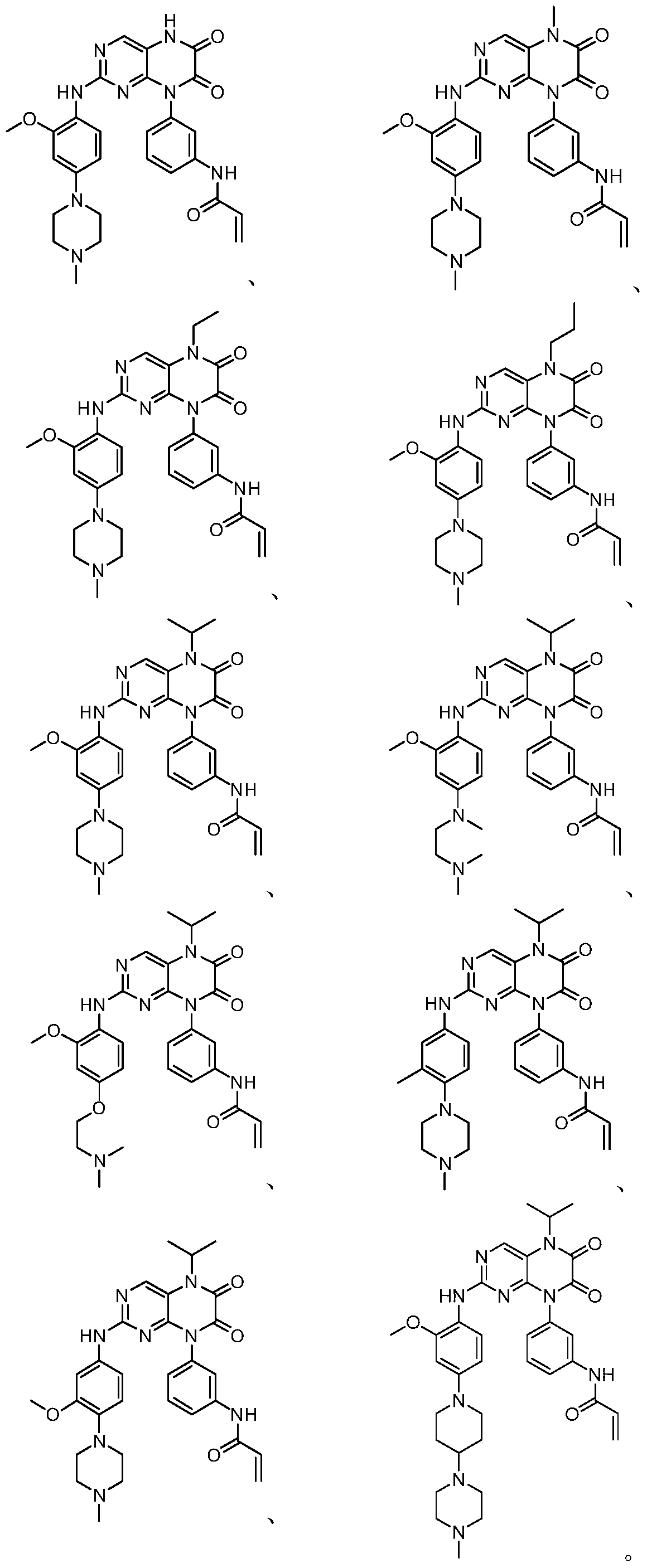
- 一种药物组合物,所述药物组合物含有权利要求1-5中任一项所述的化合物或其药学上可接受的盐,以及药学上可接受的载体或赋形剂。
- 权利要求1-5中任一项所述的化合物在制备治疗或预防EGFR介导的疾病,或抑制EGFR的药物中的用途。
- 如权利要求7所述的用途,其特征在于,所述EGFR介导的疾病为癌症。
- 如权利要求8所述的用途,其特征在于,所述癌症选自下组:非小细胞肺癌、小细胞肺癌、肺腺癌、肺鳞癌、乳腺癌、前列腺癌、神经胶质细胞瘤、卵巢癌、头颈部鳞癌、宫颈癌、食管癌、肝癌、肾癌、胰腺癌、结肠癌、皮肤癌、白血病、淋巴瘤、胃癌、多发性骨髓癌和实体瘤。
- 治疗或预防EGFR介导的疾病方法,包括将权利要求1-5中任一项所述的化合物或权利要求6所述的药物组合物给予有此需要的对象。
Applications Claiming Priority (2)
| Application Number | Priority Date | Filing Date | Title |
|---|---|---|---|
| CN201510960989.5 | 2015-12-18 | ||
| CN201510960989.5A CN106892922B (zh) | 2015-12-18 | 2015-12-18 | 作为egfr抑制剂的5,8-二氢蝶啶-6,7-二酮衍生物及其应用 |
Publications (1)
| Publication Number | Publication Date |
|---|---|
| WO2017101862A1 true WO2017101862A1 (zh) | 2017-06-22 |
Family
ID=59055804
Family Applications (1)
| Application Number | Title | Priority Date | Filing Date |
|---|---|---|---|
| PCT/CN2016/110437 Ceased WO2017101862A1 (zh) | 2015-12-18 | 2016-12-16 | 作为egfr抑制剂的5,8-二氢蝶啶-6,7-二酮衍生物及其应用 |
Country Status (2)
| Country | Link |
|---|---|
| CN (1) | CN106892922B (zh) |
| WO (1) | WO2017101862A1 (zh) |
Cited By (2)
| Publication number | Priority date | Publication date | Assignee | Title |
|---|---|---|---|---|
| WO2018192532A1 (zh) * | 2017-04-19 | 2018-10-25 | 华东理工大学 | 作为btk抑制剂的杂环化合物及其应用 |
| WO2023229375A1 (ko) * | 2022-05-25 | 2023-11-30 | 주식회사 엘지화학 | 다이아실글리세롤 키나아제 저해제로서 헤테로사이클 화합물 및 이의 용도 |
Families Citing this family (1)
| Publication number | Priority date | Publication date | Assignee | Title |
|---|---|---|---|---|
| CN110357885A (zh) * | 2019-07-24 | 2019-10-22 | 江南大学 | 一种蝶啶类化合物及其在药学上的应用 |
Citations (3)
| Publication number | Priority date | Publication date | Assignee | Title |
|---|---|---|---|---|
| CN1373763A (zh) * | 1999-09-15 | 2002-10-09 | 沃尼尔·朗伯公司 | 作为激酶抑制剂的蝶啶酮 |
| US20060047118A1 (en) * | 2004-08-26 | 2006-03-02 | Boehringer Ingelheim International Gmbh | New pteridinones as PLK inhibitors |
| WO2013071217A1 (en) * | 2011-11-10 | 2013-05-16 | OSI Pharmaceuticals, LLC | Dihydropteridinones |
Family Cites Families (1)
| Publication number | Priority date | Publication date | Assignee | Title |
|---|---|---|---|---|
| US9783504B2 (en) * | 2013-07-09 | 2017-10-10 | Dana-Farber Cancer Institute, Inc. | Kinase inhibitors for the treatment of disease |
-
2015
- 2015-12-18 CN CN201510960989.5A patent/CN106892922B/zh not_active Expired - Fee Related
-
2016
- 2016-12-16 WO PCT/CN2016/110437 patent/WO2017101862A1/zh not_active Ceased
Patent Citations (3)
| Publication number | Priority date | Publication date | Assignee | Title |
|---|---|---|---|---|
| CN1373763A (zh) * | 1999-09-15 | 2002-10-09 | 沃尼尔·朗伯公司 | 作为激酶抑制剂的蝶啶酮 |
| US20060047118A1 (en) * | 2004-08-26 | 2006-03-02 | Boehringer Ingelheim International Gmbh | New pteridinones as PLK inhibitors |
| WO2013071217A1 (en) * | 2011-11-10 | 2013-05-16 | OSI Pharmaceuticals, LLC | Dihydropteridinones |
Non-Patent Citations (1)
| Title |
|---|
| HAO, YONGJIA ET AL.: "Discovery and Structural Optimization of N5-Substituted 6, 7-Dioxo-6, 7-dihydropteridines as Potent and Selective Epidermal Growth Factor Receptor (EGFR) Inhibitors against L858R/T790M Resistance Mutation", JOURNAL OF MEDICINAL CHEMISTRY, vol. 59, 11 November 2016 (2016-11-11), pages 7111 - 7124, XP055392174 * |
Cited By (2)
| Publication number | Priority date | Publication date | Assignee | Title |
|---|---|---|---|---|
| WO2018192532A1 (zh) * | 2017-04-19 | 2018-10-25 | 华东理工大学 | 作为btk抑制剂的杂环化合物及其应用 |
| WO2023229375A1 (ko) * | 2022-05-25 | 2023-11-30 | 주식회사 엘지화학 | 다이아실글리세롤 키나아제 저해제로서 헤테로사이클 화합물 및 이의 용도 |
Also Published As
| Publication number | Publication date |
|---|---|
| CN106892922B (zh) | 2019-04-19 |
| CN106892922A (zh) | 2017-06-27 |
Similar Documents
| Publication | Publication Date | Title |
|---|---|---|
| CN107922417B (zh) | 蝶啶酮衍生物作为egfr抑制剂的应用 | |
| CN106008511B (zh) | 蝶啶酮衍生物及其作为egfr、blk、flt3抑制剂的应用 | |
| EP3434676B1 (en) | Substituted pyrrolopyrimidine cdk inhibitor, pharmaceutical composition containing same and use thereof | |
| CN107428763B (zh) | 作为egfr抑制剂的嘧啶并嘧啶二酮衍生物及其应用 | |
| KR101839915B1 (ko) | 아릴아미노 퓨린 유도체, 그의 제조 방법 및 약학적 용도 | |
| CN113801139A (zh) | 作为rsk抑制剂的嘧啶并恶嗪衍生物及其应用 | |
| CN108727382B (zh) | 作为btk抑制剂的杂环化合物及其应用 | |
| CN103421010A (zh) | 作为egfr抑制剂的蝶啶酮衍生物及其应用 | |
| CN107129506B (zh) | 作为EGFR抑制剂的嘧啶并[4,5-d][1,3]噁嗪-2-酮衍生物及其应用 | |
| WO2017101862A1 (zh) | 作为egfr抑制剂的5,8-二氢蝶啶-6,7-二酮衍生物及其应用 | |
| CN116829562B (zh) | 一种巨环化合物、药物组合物以及其用途 | |
| CN116354964A (zh) | 作为btk抑制剂的7(8h)-喋啶酮衍生物及其应用 | |
| CN113493436B (zh) | 胺基取代吡啶衍生物及其制法和药物组合物与用途 | |
| CN117384160A (zh) | 作为cdk抑制剂的化合物及其应用 | |
| WO2023046114A1 (zh) | 蝶啶酮衍生物及其应用 | |
| CN121226325A (zh) | 一种2-氧代-1,2-二氢吡啶-3-酰胺类化合物及其制备方法和用途 | |
| CN117720531A (zh) | 作为rsk抑制剂的吡啶酮并嘧啶衍生物及其应用 | |
| WO2024056090A1 (zh) | 作为rsk抑制剂的吡咯并嘧啶衍生物及其应用 |
Legal Events
| Date | Code | Title | Description |
|---|---|---|---|
| 121 | Ep: the epo has been informed by wipo that ep was designated in this application |
Ref document number: 16874919 Country of ref document: EP Kind code of ref document: A1 |
|
| NENP | Non-entry into the national phase |
Ref country code: DE |
|
| 122 | Ep: pct application non-entry in european phase |
Ref document number: 16874919 Country of ref document: EP Kind code of ref document: A1 |