WO2017094785A1 - 強光に耐性を示す緑藻突然変異体及びその利用 - Google Patents
強光に耐性を示す緑藻突然変異体及びその利用 Download PDFInfo
- Publication number
- WO2017094785A1 WO2017094785A1 PCT/JP2016/085585 JP2016085585W WO2017094785A1 WO 2017094785 A1 WO2017094785 A1 WO 2017094785A1 JP 2016085585 W JP2016085585 W JP 2016085585W WO 2017094785 A1 WO2017094785 A1 WO 2017094785A1
- Authority
- WO
- WIPO (PCT)
- Prior art keywords
- protein
- green algae
- light
- strain
- mutant
- Prior art date
- Legal status (The legal status is an assumption and is not a legal conclusion. Google has not performed a legal analysis and makes no representation as to the accuracy of the status listed.)
- Ceased
Links
- 0 *C(C(CN)N=O)C(C(*)*(*)*)O Chemical compound *C(C(CN)N=O)C(C(*)*(*)*)O 0.000 description 1
Images



Classifications
-
- C—CHEMISTRY; METALLURGY
- C12—BIOCHEMISTRY; BEER; SPIRITS; WINE; VINEGAR; MICROBIOLOGY; ENZYMOLOGY; MUTATION OR GENETIC ENGINEERING
- C12N—MICROORGANISMS OR ENZYMES; COMPOSITIONS THEREOF; PROPAGATING, PRESERVING, OR MAINTAINING MICROORGANISMS; MUTATION OR GENETIC ENGINEERING; CULTURE MEDIA
- C12N1/00—Microorganisms; Compositions thereof; Processes of propagating, maintaining or preserving microorganisms or compositions thereof; Processes of preparing or isolating a composition containing a microorganism; Culture media therefor
- C12N1/12—Unicellular algae; Culture media therefor
-
- C—CHEMISTRY; METALLURGY
- C07—ORGANIC CHEMISTRY
- C07K—PEPTIDES
- C07K14/00—Peptides having more than 20 amino acids; Gastrins; Somatostatins; Melanotropins; Derivatives thereof
- C07K14/405—Peptides having more than 20 amino acids; Gastrins; Somatostatins; Melanotropins; Derivatives thereof from algae
-
- C—CHEMISTRY; METALLURGY
- C12—BIOCHEMISTRY; BEER; SPIRITS; WINE; VINEGAR; MICROBIOLOGY; ENZYMOLOGY; MUTATION OR GENETIC ENGINEERING
- C12N—MICROORGANISMS OR ENZYMES; COMPOSITIONS THEREOF; PROPAGATING, PRESERVING, OR MAINTAINING MICROORGANISMS; MUTATION OR GENETIC ENGINEERING; CULTURE MEDIA
- C12N15/00—Mutation or genetic engineering; DNA or RNA concerning genetic engineering, vectors, e.g. plasmids, or their isolation, preparation or purification; Use of hosts therefor
- C12N15/09—Recombinant DNA-technology
- C12N15/63—Introduction of foreign genetic material using vectors; Vectors; Use of hosts therefor; Regulation of expression
- C12N15/79—Vectors or expression systems specially adapted for eukaryotic hosts
- C12N15/82—Vectors or expression systems specially adapted for eukaryotic hosts for plant cells, e.g. plant artificial chromosomes (PACs)
- C12N15/8241—Phenotypically and genetically modified plants via recombinant DNA technology
- C12N15/8242—Phenotypically and genetically modified plants via recombinant DNA technology with non-agronomic quality (output) traits, e.g. for industrial processing; Value added, non-agronomic traits
- C12N15/8243—Phenotypically and genetically modified plants via recombinant DNA technology with non-agronomic quality (output) traits, e.g. for industrial processing; Value added, non-agronomic traits involving biosynthetic or metabolic pathways, i.e. metabolic engineering, e.g. nicotine, caffeine
- C12N15/8247—Phenotypically and genetically modified plants via recombinant DNA technology with non-agronomic quality (output) traits, e.g. for industrial processing; Value added, non-agronomic traits involving biosynthetic or metabolic pathways, i.e. metabolic engineering, e.g. nicotine, caffeine involving modified lipid metabolism, e.g. seed oil composition
-
- C—CHEMISTRY; METALLURGY
- C12—BIOCHEMISTRY; BEER; SPIRITS; WINE; VINEGAR; MICROBIOLOGY; ENZYMOLOGY; MUTATION OR GENETIC ENGINEERING
- C12N—MICROORGANISMS OR ENZYMES; COMPOSITIONS THEREOF; PROPAGATING, PRESERVING, OR MAINTAINING MICROORGANISMS; MUTATION OR GENETIC ENGINEERING; CULTURE MEDIA
- C12N15/00—Mutation or genetic engineering; DNA or RNA concerning genetic engineering, vectors, e.g. plasmids, or their isolation, preparation or purification; Use of hosts therefor
- C12N15/09—Recombinant DNA-technology
- C12N15/63—Introduction of foreign genetic material using vectors; Vectors; Use of hosts therefor; Regulation of expression
- C12N15/79—Vectors or expression systems specially adapted for eukaryotic hosts
- C12N15/82—Vectors or expression systems specially adapted for eukaryotic hosts for plant cells, e.g. plant artificial chromosomes (PACs)
- C12N15/8241—Phenotypically and genetically modified plants via recombinant DNA technology
- C12N15/8261—Phenotypically and genetically modified plants via recombinant DNA technology with agronomic (input) traits, e.g. crop yield
- C12N15/8262—Phenotypically and genetically modified plants via recombinant DNA technology with agronomic (input) traits, e.g. crop yield involving plant development
- C12N15/8269—Photosynthesis
-
- C—CHEMISTRY; METALLURGY
- C12—BIOCHEMISTRY; BEER; SPIRITS; WINE; VINEGAR; MICROBIOLOGY; ENZYMOLOGY; MUTATION OR GENETIC ENGINEERING
- C12N—MICROORGANISMS OR ENZYMES; COMPOSITIONS THEREOF; PROPAGATING, PRESERVING, OR MAINTAINING MICROORGANISMS; MUTATION OR GENETIC ENGINEERING; CULTURE MEDIA
- C12N15/00—Mutation or genetic engineering; DNA or RNA concerning genetic engineering, vectors, e.g. plasmids, or their isolation, preparation or purification; Use of hosts therefor
- C12N15/09—Recombinant DNA-technology
- C12N15/63—Introduction of foreign genetic material using vectors; Vectors; Use of hosts therefor; Regulation of expression
- C12N15/79—Vectors or expression systems specially adapted for eukaryotic hosts
- C12N15/82—Vectors or expression systems specially adapted for eukaryotic hosts for plant cells, e.g. plant artificial chromosomes (PACs)
- C12N15/8241—Phenotypically and genetically modified plants via recombinant DNA technology
- C12N15/8261—Phenotypically and genetically modified plants via recombinant DNA technology with agronomic (input) traits, e.g. crop yield
- C12N15/8271—Phenotypically and genetically modified plants via recombinant DNA technology with agronomic (input) traits, e.g. crop yield for stress resistance, e.g. heavy metal resistance
-
- C—CHEMISTRY; METALLURGY
- C12—BIOCHEMISTRY; BEER; SPIRITS; WINE; VINEGAR; MICROBIOLOGY; ENZYMOLOGY; MUTATION OR GENETIC ENGINEERING
- C12P—FERMENTATION OR ENZYME-USING PROCESSES TO SYNTHESISE A DESIRED CHEMICAL COMPOUND OR COMPOSITION OR TO SEPARATE OPTICAL ISOMERS FROM A RACEMIC MIXTURE
- C12P7/00—Preparation of oxygen-containing organic compounds
- C12P7/64—Fats; Fatty oils; Ester-type waxes; Higher fatty acids, i.e. having at least seven carbon atoms in an unbroken chain bound to a carboxyl group; Oxidised oils or fats
-
- C—CHEMISTRY; METALLURGY
- C12—BIOCHEMISTRY; BEER; SPIRITS; WINE; VINEGAR; MICROBIOLOGY; ENZYMOLOGY; MUTATION OR GENETIC ENGINEERING
- C12P—FERMENTATION OR ENZYME-USING PROCESSES TO SYNTHESISE A DESIRED CHEMICAL COMPOUND OR COMPOSITION OR TO SEPARATE OPTICAL ISOMERS FROM A RACEMIC MIXTURE
- C12P7/00—Preparation of oxygen-containing organic compounds
- C12P7/64—Fats; Fatty oils; Ester-type waxes; Higher fatty acids, i.e. having at least seven carbon atoms in an unbroken chain bound to a carboxyl group; Oxidised oils or fats
- C12P7/6436—Fatty acid esters
- C12P7/6445—Glycerides
- C12P7/6463—Glycerides obtained from glyceride producing microorganisms, e.g. single cell oil
Definitions
- the present invention relates to a green algae mutant exhibiting resistance to strong light and use thereof.
- a photosynthetic organism that performs oxygen-generating photosynthesis has two photochemical systems, PSI and PSII.
- the photochemical reaction of PSII is initiated by the excitation of the chlorophyll a molecule at the reaction center of PSII and transfer of electrons to the initial electron acceptor (Q A ).
- Q A initial electron acceptor
- a thylakoid film has a structure in which a chlorophyll a / b-protein complex called an antenna dye surrounds the reaction center and efficiently passes the light energy captured by the antenna dye to the reaction center. Made on top. As the light intensity increases, the number of photons received by the antenna dye per unit time increases, and the photosynthetic rate increases accordingly.
- the photosynthesis rate is almost the maximum at the light intensity called the light saturation point, and even if the light intensity is increased further, the photosynthesis rate is Does not increase. Furthermore, when the light intensity is greatly increased, the photosynthesis rate is rather lowered. This decrease in the photosynthetic rate due to intense light is called photoinhibition.
- Photoinhibition is mainly caused by a decrease in PSII activity due to damage of D1 protein, which is one of the proteins constituting PSII.
- This D1 protein damage is caused by light energy absorbed by manganese in the manganese clusters that also make up PSII.
- This D1 protein damage response is also observed under low light.
- damaged D1 protein is quickly removed and replaced with newly synthesized D1 protein.
- active oxygen species such as singlet oxygen are produced by the excessive reducing power. It is considered that this reactive oxygen species inhibits the novel synthesis of D1 protein, thereby reducing the amount of active D1 protein and causing photoinhibition (Non-patent Document 1).
- Photosynthetic organisms have a mechanism (NPQ: non-photochemical quenching) that converts excess light energy into heat energy to prevent the generation of the above-mentioned excessive reducing power.
- NPQ non-photochemical quenching
- a protein called LHCSR plays a part in NPQ.
- LHCSR binds chlorophyll a / b and xanthophyll and is in contact with the antenna dye. Light energy absorbed by chlorophyll bound to LHCSR is transferred to xanthophyll and dissipated. LHCSR can also dissipate light energy received by nearby antenna dyes.
- the C-terminus of LHCSR is exposed in the lumen inside the thylakoid membrane.
- H + moves along with the outer side (lumen) of the thylakoid membrane, and passes through the ATP synthase localized in the chloroplast thylakoid membrane. Return to the stroma again. Under intense light irradiation, the H + flowing into the lumen along with photosynthetic electron transfer is more than the amount of H + excreted through the ATP synthase, and the pH of the lumen shifts to the acidic side.
- Non-Patent Document 2 When the C-terminal amino acid sequence of LHCSR is exposed to low pH, the activity of LHCSR increases and the efficiency of heat dissipation by LHCSR increases. Furthermore, the LHCSR gene is induced under strong light and the LHCSR content increases. In proportion to this increase in content, the ability of NPQ also increases. Under low light, the amount of LHCSR is small and the pH of the lumen is not low, so most of the light energy captured by the antenna dye is passed to the reaction center. However, under strong light, both the activity and amount of LHCSR increase, so that a considerable part of the light energy captured by the antenna dye is dissipated (Non-Patent Document 2).
- Microalgae has recently attracted attention as a raw material for biomass fuel. Unlike terrestrial organisms, microalgae live and multiply in water. Microalgae are also subject to strong light inhibition near the surface of summer sunlight. However, the light intensity which receives light inhibition changes with kinds of microalgae (nonpatent literature 3).
- Obi strain which is a unicellular green alga belonging to the class Trebouxiophyceae, can grow at a pH of 3.5 or less, Since it can culture
- COP1 protein present in Arabidopsis thaliana.
- LRS1 amino acid sequence sequence homology was high in the N-terminal and C-terminal domain portions, but no remarkable homology was observed in the central portion (Non-patent Document 7).
- COP1 forms a complex with a protein called SPA1, and together with proteins such as CUL4, RBX1, and DDB1, constitutes a ubiquitin transferase (E3 ubiquitin ligase).
- SPA1 has a kinase domain at the N-terminus and a WD40 domain at the C-terminus.
- Non-patent Document 8 The COP1 and SPA1 WD40 domains are thought to jointly recognize the target protein of ubiquitin transferase (Non-patent Document 8).
- SPA1 is a protein that constitutes ubiquitin transferase, but SPA1 itself is also ubiquitinated by many light signals and degraded by the proteasome (Non-patent Document 9). That is, the activity of the COP1 / SPA1 complex in Arabidopsis is involved in the transmission of many light signals through its own activity regulation. From this, it is expected that Chlamydomonas LRS1 is also a protein involved in signal transduction of intense light stress.
- an object of the present invention is to isolate a green algae mutant that has become resistant to strong light and provide it for outdoor cultivation in summer.
- a Response regulatory domain was present at the N-terminus of the LRS2 protein, and a WD40 domain was present at the C-terminus. Proteins with a Response regulatory domain at the N-terminus and a WD40 domain at the C-terminus could be detected in the UniProt database only 10 or less (described later). A protein showing homology over the entire length was found. From this, it is considered that proteins closely related to the LRS2 protein present in green algae and the like are a new protein family and have the same function as the LRS2 protein of the Obi strain. From this, it was found that a strong light-resistant strain can be obtained from the green algae by introducing a mutation into the LRS2 family protein present in the green algae, and the present invention has been completed.
- the present invention includes the following.
- a green algal mutant in which the function or expression of a protein having a Response regulatory domain at the N-terminus and a WD40 domain at the C-terminus (hereinafter referred to as RR-WD protein) is lower than that of the wild type strain.
- the green algae mutant exhibiting faster growth than a wild strain when cultured in any one of 1,000, 1,500, or 2,000 ⁇ mol photons m ⁇ 2 s ⁇ 1 , expressed by PAR (Photosynthetically Active Radiation).
- the green algal mutant according to (1) which synthesizes an RR-WD protein having an amino acid sequence different from that of the wild-type RR-WD protein.
- the present invention it is possible to produce a green algae with improved strong light resistance. Further, by culturing the mutant green algae according to the present invention, it becomes possible to improve the productivity of lipids used for biofuels in summer.
- Example 2 is a graph showing the growth of Obi strain and HL6 strain under strong light and low light in Example 2.
- the vertical axis represents the OD 750 of the culture solution, and the horizontal axis represents the culture time (h).
- LL is a weak light (200 ⁇ mol photons m ⁇ 2 s ⁇ 1 )
- HL is a strong light (2,000 ⁇ mol photons m ⁇ 2 s ⁇ 1 ).
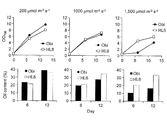
- It is a graph which shows the growth and lipid content of Obi strain
- FIG. The light intensity was 200, 1,000, 1,500 ⁇ mol photons m ⁇ 2 s ⁇ 1 .
- a protein in which a response regulatory domain is present at the N-terminus and a WD40 domain is present at the C-terminus (RR-WD protein) as compared to the wild strain, strong light resistance is obtained, Green algae mutation that grows faster than wild-type strains under strong light (for example, when the light intensity expressed by PAR (Photosynthetically Active Radiation) is 1,000, 1,500, or 2,000 ⁇ mol photons m -2 s -1 ) About the body.
- PAR Photosynthetically Active Radiation
- the present inventors deleted the function of the LRS2 protein (DNA base sequence: SEQ ID NO: 1, mRNA base sequence: SEQ ID NO: 2) consisting of the amino acid sequence shown in SEQ ID NO: 3 derived from the Obi strain, thereby The inventors have found that the proliferation under strong light is improved and have completed the present invention.
- the LRS2 protein represented by SEQ ID NO: 3 is a protein having a response-regulatory domain at the N-terminus and a WD40 domain at the C-terminus.
- the function “By Domain architecture” https://www.ebi.ac.uk/interpro/search/domain-organisation
- the motif defined in IPR001789 or IPR011006 may be used for detection of the response-regulatory domain.
- a motif defined by any of IPR001680, IPR015943, IPR017986, and IPR019775 may be used.
- the RR-WD protein includes at least 40%, preferably at least 45% of the amino acid sequence of the response regulatory domain shown in SEQ ID NO: 4 and the WD40 domain shown in SEQ ID NO: 5 in the LRS2 protein derived from the Obi strain, Particularly preferred is a protein consisting of an amino acid sequence having at least 50%, most preferably at least 60%, at least 70%, at least 80%, at least 90% of the same sequence and having RR-WD protein function.
- the gene encoding the RR-WD protein (hereinafter referred to as “RR-WD protein encoding gene”) is at least 40%, preferably at least 45%, particularly preferably at least 50% of the amino acid sequence shown in SEQ ID NO: 3. %, Most preferably, a gene encoding a protein consisting of an amino acid sequence having at least 60%, at least 70%, at least 80%, at least 90% sequence identity and having RR-WD protein function.
- examples of the RR-WD protein function include a function as a component of ubiquitin transferase.
- RR-WD protein-encoding genes for example, alleles, synonymous genes, etc., but in the present invention, at least one or more of these RR-WD protein-encoding genes Means.
- examples of the organisms belonging to the green algae include green algae belonging to the genus Chlorella and the genus Pseudococcomyxa belonging to the treboxya algae net.
- Specific strains belonging to the treboxya alga net include Obi strains (Accession No. FERM BP-10484; Patent No. 4748154 (in this patent, “Pseudochoricystis ellipsoidea Sekiguchi et Kurano gen. et sp. nov.) MBIC11204 strain ”))).
- the green algae mutant according to the present invention is a green algae mutant obtained by subjecting it to a method for reducing the function or expression of the RR-WD protein.
- the green alga having the RR-WD protein-encoding gene described above is subjected to a method for reducing the function or expression of the RR-WD protein encoded by the RR-WD protein-encoding gene.
- a green algae mutant according to the invention can be obtained.
- RR-WD protein-encoding gene sequence is substituted, and an RR-WD protein having a different amino acid sequence from the wild-type RR-WD protein, in which a part of the amino acid sequence is substituted; (2) represses transcription of the RR-WD protein-encoding gene and decreases the expression of the gene; (3) suppresses translation of the RR-WD protein-encoding gene and reduces the translation efficiency of the gene; A method is mentioned.
- a green algal mutant having a substitution in the RR-WD protein-encoding gene sequence is essentially a plurality of RRs such as alleles and synonymous genes. It means a green algal mutant having a -WD protein-encoding gene, but replacing at least one or more of the sequences of RR-WD protein-encoding genes.
- base substitution, deletion, insertion and / or addition may be performed on the DNA of the RR-WD protein-encoding gene region in the genomic DNA of green algae or the promoter region upstream thereof.
- the method of introducing the accompanying mutation is mentioned.
- a green algal mutant with reduced function or expression of the RR-WD protein according to the present invention can be produced according to the procedure shown in the Examples. That is, after a mutagen was acted on the parental green algae, mutants that became strong light-resistant were screened, and the resulting mutants had mutations in the RR-WD protein-coding gene sequence or expression. Can be created by confirming.
- the HL6 strain derived from the Obi strain shown in the examples was deposited on November 27, 2015 (National Institute of Technology and Evaluation) Deposited at the Center (NITE-IPOD) (room 2-5-8 120, Kazusa Kamashizu, Kisarazu City, Chiba Prefecture 292-0818, Japan) under the accession number FERM P-22299, and further under the Budapest Treaty under the accession number FERM BP-22299 Has been transferred to an international deposit.
- NITE-IPOD National Institute of Technology and Evaluation
- the present invention includes a lipid production method in which the green algae mutant according to the present invention described above is cultured (in a large amount) to produce lipid.
- the culture method described in Patent Document 1 (Title of Invention: Microalgae culture method and culture system) that has already been established can be used. Specifically, it is a method of culturing green algae using a culture solution having a pH of 4 or less and containing ammonia nitrogen. According to this culture method, since the pH of the solution is 4 or less, it is difficult for other green algae and protists to proliferate. In particular, when the culture solution contains ammonia nitrogen (for example, urea), other microalgae And protists are less prone to proliferation.
- ammonia nitrogen for example, urea
- lipids can be obtained from the culture by, for example, hexane extraction.
- Example 1 Isolation of intense light-resistant mutant strains Obi strains cultured in MA5 medium (Imamura et al., 2012, J Gen Appl Microbiol, 58, 1) were centrifuged to collect cells, and citrate buffer (pH 6 0.0). To this suspension, 500 ⁇ g / ml of NTG (1-methyl-3-nitro-1-nitrosoguanidine) as a mutagen was added and gently stirred for 1 hour.
- the treated cells were bubbled with 1% (v / v) CO 2 in MA5 medium for 1 week, and 50 ⁇ mol photons photons m -2 s -1 (hereinafter referred to as light intensity) under fluorescent light with PAR light intensity. Are all expressed as PAR values).
- the cells were coated on MA5 solid agar at 10 8 cells / plate and cultured for 2 weeks under strong light (2000 ⁇ mol photons m -2 s -1 ) using LED (455 nm, 660 nm) as the light source. did. Thereafter, this agar medium was transferred to a fluorescent lamp (50 ⁇ mol photons m ⁇ 2 s ⁇ 1 ) and further cultured for 1 week. In this way, 4 strains that were considered to be highly viable under strong light were isolated and named HL6 strain, HL7 strain, HL9 strain, and HL13 strain.
- Example 3 Evaluation of lipid productivity under different light conditions The isolated intense light-resistant mutant HL6 and its parent Obi strain were cultured under three different light intensities.
- the medium used was DENSO medium [2.38 mM (NH 2 ) 2 CO, 863 ⁇ M (NH 4 ) 2 SO 4 , 405 ⁇ M MgSO 4 , 265 ⁇ M KH 2 PO 4 , 264 ⁇ M K 2 HPO 4 , 61.2 ⁇ M CaCl 2 , 1.20 ⁇ M CuSO 4 , 1.13 ⁇ M H 3 BO 3 , 1.04 ⁇ M ZnSO 4 , 0.622 ⁇ M MnSO 4 , 0.294 ⁇ M CoCl 2 , 12.4 nM Na 2 MoO 4 , 0.4% (v / v) Fe solution (3 g / L citric acid, 4.9 g / L ammonium ferric citrate, 0.5 g / L EDTA-2Na)].
- the growth and lipid accumulation of Obi strain decreased with increasing light intensity. Although growth and a decrease in lipid accumulation were observed in the HL6 strain, the degree was significantly suppressed compared to the Obi strain.
- the Obi strain has higher lipid productivity, but under light conditions exceeding 1,000 ⁇ mol photons m -2 s -1 , the HL6 strain was superior at any time. (FIG. 2).
- NPQ size of NPQ can be evaluated by measuring chlorophyll fluorescence using a device called Dual-PAM-100 (Waltz, Germany).
- Obi and HL6 cells cultured for one week under fluorescent light 50 ⁇ mol photons m -2 s -1 ) were suspended in MA5 medium containing 5 mM NaHCO 3 to a chlorophyll concentration of 10 ⁇ g chl / ml. It became cloudy.
- adaptation was performed for 5 minutes in the dark, and then a very weak measurement light was irradiated with a pulse, and the change in the amount of fluorescence in response to the pulse was measured.
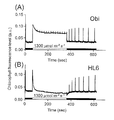
- FIG. 4 (A) shows the change in chlorophyll fluorescence in the Obi strain.
- the chlorophyll (antenna chlorophyll) that constitutes the antenna dye absorbs this pulsed light and passes the acquired excitation energy to the reaction center, but part of the excited antenna chlorophyll does not pass the excitation energy to the reaction center.
- the fluorescence is measured.
- excitation light (1,300 ⁇ mol photons m ⁇ 2 s ⁇ 1 ) was irradiated as continuous light.
- fluorescence quenching referred to as “FIG. 4 c”. Quenching is reduced by the flow of electrons to Q A or the dissipation energy of the antenna chlorophyll. The former is called photochemical quenching, and the latter is called non-photochemical quenching (NPQ).
- NPQ non-photochemical quenching
- FIG. 4 A fluorescence spike is seen in FIG. 4, which is the amount of fluorescence after irradiation with saturated pulsed light. Saturation light irradiation temporarily reduces all Q A , and as a result, photochemical quenching becomes zero first.
- the difference between the amount of fluorescence at the time of saturation pulse light irradiation and the amount of fluorescence before and after that is the magnitude of photochemical quenching.
- the amount of fluorescence in FIG. 4b minus the amount of fluorescence in FIG. 4c is the quenching that occurs during excitation light irradiation, and it can be seen that the proportion of photochemical quenching is small.
- FIG. 4 (B) shows the change in chlorophyll fluorescence in the HL6 strain.
- the fluorescence rapidly decreased within 30 seconds after the excitation light irradiation, that is, the NPQ increased rapidly, and a mechanism for efficiently dissipating excess excitation energy was observed. This efficient heat dissipation is thought to be the cause of the strong light resistance.
- xanthophyll cycle is a reaction in which three types of xanthophylls, which are auxiliary dyes for antenna dyes, interconvert.
- xanthophyll auxiliary dyes for antenna dyes
- Violaxanthin which has the lowest heat dissipation efficiency, has two epoxy rings, but is converted to antheraxanthin, which has the next lowest heat dissipation efficiency, by de-epoxidase. Furthermore, it is converted to zeaxanthin, which has the highest heat dissipation efficiency (deepoxidation).
- Deepoxidase is present in the lumen inside the thylakoid membrane, and the optimum pH is 5.0. Under strong light, the pH of the rumen becomes acidic for the reasons described above, and zeaxanthin with high heat dissipation efficiency accumulates. On the other hand, under low light, this reaction is suppressed, and conversely, violaxanthin with low heat dissipation efficiency is accumulated by epoxidase in the stroma outside the thylakoid membrane. We investigated whether there was a difference in the operation of this xanthophyll cycle between Obi and HL6 strains.
- Z is the content of zeaxanthin
- A is the content of anthaxanthin
- V is the content of violaxanthin.
- NPQ in Obi strain acclimated to strong light The Obi strain was cultured for 2 days at a light intensity of 1,000 ⁇ mol photons m ⁇ 2 s ⁇ 1 , and the size of NPQ was measured using the cells. Unlike the NPQ of the Obi strain cells cultured in low light (Fig. 4), the NPQ of the Obi strain cells acclimated to strong light is the same as that of the HL6 strain cultured for 2 days at a light intensity of 1,000 ⁇ mol photons m -2 s -1. It was close in size (Fig. 6).
- the change in chlorophyll fluorescence in FIGS. 4 and 6 can be interpreted as follows.
- the flow of electrons from the chlorophyll at the reaction center to Q A is restricted, so that the fluorescence increases rapidly.
- the action of the photosynthetic electron transfer system shifts the pH of the rumen to acidity and activates the deepoxidase.
- the concentration of zeaxanthin increases, and accordingly, NPQ also increases with time after the start of excitation light irradiation.
- LHCSR is not induced in a short time, NPQ is smaller than HL6 strain.
- Genomic analysis of intense light-resistant mutant strains Illumina HiSeq 2000 is the genome base sequence of the HL6 strain, HL7 strain, HL9 strain, and HL13 strain, which are mutants derived from the Obi strain exhibiting strong light resistance.
- mutation analysis was performed using Applied Biosystems 3730xl DNA analyzer.
- the LRS2 gene of the HL6 strain the coding base (CDS) 213 and 214 2 bases (C and T) are deleted, resulting in a frameshift mutation after the 72nd amino acid leucine (L). It was happening (c.213_214delCT, p.L72fs).
- RR-WD protein When searching for a protein with a response-regulatory domain at the N-terminus and a WD40 domain at the C-terminus (RR-WD protein), 6 proteins were hit and all of them were distributed among organisms belonging to the green alga. It was. From this, it was concluded that the RR-WD protein constitutes a very small protein family distributed in green algae and has an equivalent function.
- the Chlamydomonas genome we analyzed the Chlamydomonas genome in detail and found that the protein predicted to be made from the gene whose Gene ID is Cre13.g602700 is an RR-WD protein showing high homology with the amino acid sequence of the LRS2 protein. It was.
- Coccomyxa C-169 strain which is closely related to Pseudocomicosa, also contains a sequence encoding this RR-WD protein. It was divided and registered. In fact, it seems that RR-WD protein is also produced in C-169 strain.
- RR-WD proteins may be similar to that of Arabidopsis SPA1, forming a complex with COP1 and becoming a component of ubiquitin transferase.
- ubiquitin transferase is involved in the transmission of strong light signals through ubiquitination of the target protein.
- RR-WD protein Although the physiological function of RR-WD protein is unknown, it is possible to create a strong light-resistant strain by reducing the function or expression of this protein by mutation etc. in green algae with proteins belonging to this family. By culturing a strong light-resistant strain in an environment in which strong light falls, the present invention makes it possible to improve the productivity of lipids used for biofuels and the like.
Landscapes
- Health & Medical Sciences (AREA)
- Life Sciences & Earth Sciences (AREA)
- Genetics & Genomics (AREA)
- Chemical & Material Sciences (AREA)
- Engineering & Computer Science (AREA)
- Organic Chemistry (AREA)
- Biotechnology (AREA)
- Zoology (AREA)
- Wood Science & Technology (AREA)
- Bioinformatics & Cheminformatics (AREA)
- General Engineering & Computer Science (AREA)
- Biomedical Technology (AREA)
- Molecular Biology (AREA)
- General Health & Medical Sciences (AREA)
- Biochemistry (AREA)
- Microbiology (AREA)
- Cell Biology (AREA)
- Biophysics (AREA)
- Physics & Mathematics (AREA)
- Plant Pathology (AREA)
- Oil, Petroleum & Natural Gas (AREA)
- Medicinal Chemistry (AREA)
- Chemical Kinetics & Catalysis (AREA)
- General Chemical & Material Sciences (AREA)
- Botany (AREA)
- Tropical Medicine & Parasitology (AREA)
- Virology (AREA)
- Physiology (AREA)
- Nutrition Science (AREA)
- Gastroenterology & Hepatology (AREA)
- Proteomics, Peptides & Aminoacids (AREA)
- Preparation Of Compounds By Using Micro-Organisms (AREA)
- Micro-Organisms Or Cultivation Processes Thereof (AREA)
- Peptides Or Proteins (AREA)
Abstract
Description
(1)N-末端にResponse regulatoryドメインを有し、且つC-末端にWD40ドメインを有するタンパク質(以下RR-WDタンパク質と呼ぶ)の機能又は発現が野生株より低下した緑藻突然変異体であって、PAR(Photosynthetically Active Radiation)で表した光強度が1,000、1,500又は2,000 μmol photons m-2 s-1のいずれかで培養した時、野生株よりも速い増殖を示す、前記緑藻突然変異体。
(2)野生株のRR-WDタンパク質とは異なるアミノ酸配列を有するRR-WDタンパク質を合成する、(1)記載の緑藻突然変異体。
(3)RR-WDタンパク質をコードする遺伝子の発現を低下させることで、RR-WDタンパク質の機能を低下させた、(1)記載の緑藻突然変異体。
(4)RR-WDタンパク質をコードする遺伝子の翻訳効率を低下させることで、RR-WDタンパク質の活性を低下させた、(1)記載の緑藻突然変異体。
(5)トレボキシア藻網に属する、(1)~(4)のいずれか1記載の緑藻突然変異体。
(6)シュードコッコミクサ(Pseudococcomyxa)属に属する、(5)記載の緑藻突然変異体。
(7)(1)~(6)のいずれか1記載の緑藻突然変異体を培養する工程を含む、脂質生産方法。
(1) RR-WDタンパク質コード遺伝子配列を置換し、アミノ酸配列の一部が置換した、野生株のRR-WDタンパク質とは異なるアミノ酸配列を有するRR-WDタンパク質を合成させる;
(2) RR-WDタンパク質コード遺伝子の転写を抑制し、該遺伝子の発現を低下させる;
(3) RR-WDタンパク質コード遺伝子の翻訳を抑制し、該遺伝子の翻訳効率を低下させる;
方法が挙げられる。
本発明において、RR-WDタンパク質コード遺伝子配列に置換を持つ緑藻突然変異体とは、本来的には対立遺伝子、同義遺伝子等の複数のRR-WDタンパク質コード遺伝子を有するが、これらのうち少なくとも1つ又は複数のRR-WDタンパク質コード遺伝子の配列を置換した緑藻突然変異体を意味する。
RR-WDタンパク質コード遺伝子の転写を抑制する方法としては、対象となる緑藻における該遺伝子の転写プロモーター領域に変異を導入する方法が挙げられる。
RR-WDタンパク質コード遺伝子の翻訳を抑制する方法としては、いわゆるRNA干渉法(Cerutti H et al., 2011, Eukaryot Cell, 10, 1164)が挙げられる。
〔実施例1〕強光耐性変異株の分離
MA5培地(Imamura et al., 2012, J Gen Appl Microbiol, 58, 1)で培養したObi株を遠心して細胞を回収し、クエン酸緩衝液(pH6.0)に懸濁した。この懸濁液に、突然変異誘起剤であるNTG(1-methyl-3-nitro-1-nitrosoguanidine)を500 μg/ml加え、1時間、緩やかに攪拌した。この処理後、処理した細胞をMA5培地で1週間、1% (v/v) CO2をバブリングさせながら、蛍光灯下、PAR光強度で50 μmol photons photons m-2 s-1(以下光強度はすべてPAR値で示す)で培養した。その後、細胞をMA5固形寒天培地上に108 cells/plateで塗布し、LED(455 nm、660 nm)を光源とし、強光(2000 μmol photons m-2 s-1)下で2週間、培養した。その後、この寒天培地を蛍光灯下(50 μmol photons m-2s-1)に移し、さらに1週間培養した。このようにして、強光下での生存性の高いと思われる株を4株単離し、HL6株、HL7株、HL9株、HL13株と命名した。
HL6株、HL7株、HL9株およびHL13株を、MA5培地でOD750= 0.1に合わせ、2,000 μmol photons m-2 s-1の光強度下、1% (v/v) CO2をバブリングさせながら培養を行った。野生株であるObi株の生育は強光下で阻害されたが、分離した変異株はいずれも生育可能であった。HL6株について、200および2,000 μmol photons m-2 s-1の光強度における培養を定量的に評価した。200 μmol photons m-2 s-1の条件下ではObi株およびHL6株において生育の差は見られなかった。一方、2,000 μmol photons m-2 s-1においてはHL6株のみ生育可能であった(図1)。
分離した強光耐性変異株HL6とその親株であるObi株とを、3つの異なる光強度下で培養した。使用した培地は、DENSO培地[2.38 mM (NH2)2CO, 863 μM (NH4)2SO4, 405 μM MgSO4, 265 μM KH2PO4, 264 μM K2HPO4, 61.2 μM CaCl2, 1.20 μM CuSO4, 1.13 μM H3BO3, 1.04 μM ZnSO4, 0.622 μM MnSO4, 0.294 μM CoCl2, 12.4 nM Na2MoO4, 0.4% (v/v) Fe solution (3 g/L citric acid, 4.9 g/L ammonium ferric citrate, 0.5 g/L EDTA-2Na)]を2倍希釈した1/2 DENSO培地である。培養開始時の細胞密度はOD750 = 0.5とし、光強度は200、1,000、1,500 μmol photons m-2 s-1であった。その後、培養6日目および12日目でサンプリングを行った。Obi株は光強度の上昇とともにその生育および脂質蓄積量が減少した。HL6株においても増殖、脂質蓄積量の減少は見られるものの、その程度はObi株と比べ有意に抑えられていた。200 μmol photons m-2s-1ではObi株の方が脂質生産性は高いが、1,000 μmol photons m-2 s-1を超える光条件下ではいずれの時点においてもHL6株の方が上回っていた(図2)。
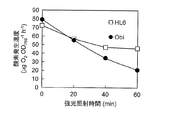
Obi株およびHL6株を、蛍光灯下(50 μmol photons m-2 s-1)、MA5培地中で一週間培養し、MA5培地にOD750 = 1.0に希釈した後、LED照射下(2,000 μmol photons m-2 s-1)で培養した。照射開始後、所定の時間ごとに光合成活性(酸素発生速度)を酸素電極で測定した。Obi株では照射時間が増すに従い光合成活性の低下がみられ、1 時間照射後では開始時のおよそ25%にまで低下した。一方、HL6では、同様の条件下で65%の光合成活性を保っていた(図3)。
Dual-PAM-100 (Waltz, Germany)という装置を用いてクロロフィル蛍光測定することにより、NPQの大きさを評価することができる。蛍光灯下(50 μmol photons m-2s-1)、一週間培養したObi株およびHL6株細胞を、クロロフィル濃度が10 μg chl/mlになるように5 mM NaHCO3を含んだMA5培地に懸濁した。測定開始前に5分間の暗所順応を行い、その後、ごく弱い測定光をパルス照射し、そのパルスに応答した蛍光量の変化を計測した。
NPQを形成する成分の一つとしてキサントフィルサイクル(xanthophyll cycle)が挙げられる。キサントフィルサイクルとは、アンテナ色素の補助色素である3種類のキサントフィル類が、相互変換する反応である。3種類のキサントフィルのうち最も熱放散効率の低いビオラキサンチン(Violaxanthin)は二つのエポキシ環を持つが、デエポキシダーゼ(de-epoxidase)によって次に熱放散効率が低いアンテラキサンチン(Antheraxanthin)に変換され、さらに最も熱放散効率の高いゼアキサンチン(Zeaxanthin)に変換される(脱エポキシ化)。デエポキシダーゼはチラコイド膜内側のルーメンに存在し、至適pHは5.0である。強光下では、前に述べた理由でルーメンのpHが酸性となり、熱放散効率の高いゼアキサンチンが蓄積される。一方、弱光下では、この反応は抑制され、逆に、チラコイド膜外側のストロマにあるエポキシダーゼによって、熱放散効率の低いビオラキサンチンが蓄積される。このキサントフィルサイクルの作動がObi株とHL6株との間で差があるかを検討した。
Obi株を1,000 μmol photons m-2 s-1の光強度で2日間培養し、その細胞を用いて、NPQの大きさを測定した。弱い光で培養したObi株細胞のNPQ(図4)と異なり、強光に馴化したObi株細胞のNPQは、同じく1,000 μmol photons m-2 s-1の光強度で2日間培養したHL6株に近い大きさであった(図6)。このことから、Obi株を強光で育てた時に誘導されるNPQ機構があり、HL6株ではこの機構が常に発現し作動していると結論した。クラミドモナスの研究から、この機構とはLHCSRであると考えられる。
強光耐性を示すObi株由来の突然変異体であるHL6株、HL7株、HL9株、HL13株、計4株のゲノム塩基配列をIllumina HiSeq 2000あるいはApplied Biosystems 3730xl DNA analyzerで決定し、変異解析を行った。HL6株のLRS2遺伝子では、コーディング領域(CDS)の213および214番目の2塩基(CとT)が欠失し、その結果、72番目のアミノ酸であるロイシン(L)以降でフレームシフト突然変異が起こっていた(c.213_214delCT, p.L72fs)。HL7株では、CDSの131番目で塩基置換(C→A)が起こり、その結果44番目のアミノ段であるセリン(S)がストップコドンに変化していた(c.131C>A, p.S44X)。HL9株では、CDSの129および130番目の2塩基(GとT)が欠失し、その結果、44番目のアミノ酸であるセリン(S)以降でフレームシフト突然変異が起こっていた(c.129_130delGT, p.S44fs)。HL13株では、第2エキソンの末端に位置する255番目の塩基の次の塩基(第2イントロンの最初の塩基)で塩基置換(G→A)が起こり、その結果正常なスプライシングができなくなったと考えられた(c.255+1G>A)(図7)。
FERM BP-22299
本明細書で引用した全ての刊行物、特許及び特許出願はそのまま引用により本明細書に組み入れられるものとする。
Claims (7)
- N-末端にResponse regulatoryドメインを有し、且つC-末端にWD40ドメインを有するタンパク質の機能又は発現が野生株より低下した緑藻突然変異体であって、PAR(Photosynthetically Active Radiation)で表した光強度が1,000、1,500又は2,000 μmol photons m-2 s-1のいずれかで培養した時、野生株よりも速い増殖を示す、前記緑藻突然変異体。
- 野生株の前記タンパク質とは異なるアミノ酸配列を有する前記タンパク質を合成する、請求項1記載の緑藻突然変異体。
- 前記タンパク質をコードする遺伝子の発現を低下させることで、前記タンパク質の機能を低下させた、請求項1記載の緑藻突然変異体。
- 前記タンパク質をコードする遺伝子の翻訳効率を低下させることで、前記タンパク質の活性を低下させた、請求項1記載の緑藻突然変異体。
- トレボキシア藻網に属する、請求項1~4のいずれか1項記載の緑藻突然変異体。
- シュードコッコミクサ(Pseudococcomyxa)属に属する、請求項5記載の緑藻突然変異体。
- 請求項1~6のいずれか1項記載の緑藻突然変異体を培養する工程を含む、脂質生産方法。
Priority Applications (2)
| Application Number | Priority Date | Filing Date | Title |
|---|---|---|---|
| US15/779,874 US10597631B2 (en) | 2015-12-01 | 2016-11-30 | Green algae mutant exhibiting resistance to intense light, and use thereof |
| AU2016361701A AU2016361701B2 (en) | 2015-12-01 | 2016-11-30 | Green algae mutant exhibiting resistance to intense light, and use thereof |
Applications Claiming Priority (2)
| Application Number | Priority Date | Filing Date | Title |
|---|---|---|---|
| JP2015-234736 | 2015-12-01 | ||
| JP2015234736A JP6589605B2 (ja) | 2015-12-01 | 2015-12-01 | 強光に耐性を示す緑藻突然変異体及びその利用 |
Publications (1)
| Publication Number | Publication Date |
|---|---|
| WO2017094785A1 true WO2017094785A1 (ja) | 2017-06-08 |
Family
ID=58797360
Family Applications (1)
| Application Number | Title | Priority Date | Filing Date |
|---|---|---|---|
| PCT/JP2016/085585 Ceased WO2017094785A1 (ja) | 2015-12-01 | 2016-11-30 | 強光に耐性を示す緑藻突然変異体及びその利用 |
Country Status (4)
| Country | Link |
|---|---|
| US (1) | US10597631B2 (ja) |
| JP (1) | JP6589605B2 (ja) |
| AU (1) | AU2016361701B2 (ja) |
| WO (1) | WO2017094785A1 (ja) |
Families Citing this family (3)
| Publication number | Priority date | Publication date | Assignee | Title |
|---|---|---|---|---|
| JP7295864B2 (ja) * | 2017-12-29 | 2023-06-21 | シンセティック ジェノミクス インコーポレーテッド | 成長を改善するための光合成生物の遺伝子調節方法 |
| CN110066323B (zh) * | 2019-05-06 | 2023-04-07 | 海南大学 | 微藻捕光蛋白NoHLR1基因及其应用 |
| CA3197572A1 (en) | 2020-11-05 | 2022-05-12 | Saheed IMAM | Recombinant algae having high lipid productivity |
Citations (2)
| Publication number | Priority date | Publication date | Assignee | Title |
|---|---|---|---|---|
| JP2015027287A (ja) * | 2013-07-05 | 2015-02-12 | 国立大学法人東京工業大学 | 微細藻類、培養物、及び油脂の製造方法 |
| WO2015075881A1 (ja) * | 2013-11-19 | 2015-05-28 | 株式会社デンソー | 緑藻の脂質蓄積変異体およびその利用 |
Family Cites Families (2)
| Publication number | Priority date | Publication date | Assignee | Title |
|---|---|---|---|---|
| BR112012005844B1 (pt) * | 2009-09-18 | 2019-11-26 | Phycoil Biotechnology International, Inc. | Método para cultivar microalgas capazes de crescimento heterotrófico, método para fabricar um material, e sistema de biorreator |
| JP6235210B2 (ja) | 2012-12-14 | 2017-11-22 | 株式会社デンソー | 微細藻類の培養方法 |
-
2015
- 2015-12-01 JP JP2015234736A patent/JP6589605B2/ja active Active
-
2016
- 2016-11-30 US US15/779,874 patent/US10597631B2/en active Active
- 2016-11-30 WO PCT/JP2016/085585 patent/WO2017094785A1/ja not_active Ceased
- 2016-11-30 AU AU2016361701A patent/AU2016361701B2/en not_active Ceased
Patent Citations (2)
| Publication number | Priority date | Publication date | Assignee | Title |
|---|---|---|---|---|
| JP2015027287A (ja) * | 2013-07-05 | 2015-02-12 | 国立大学法人東京工業大学 | 微細藻類、培養物、及び油脂の製造方法 |
| WO2015075881A1 (ja) * | 2013-11-19 | 2015-05-28 | 株式会社デンソー | 緑藻の脂質蓄積変異体およびその利用 |
Non-Patent Citations (3)
| Title |
|---|
| ANANDARAJAH KANDIAH ET AL.: "Characterization of microalga Nannochloropsis sp. mutants for improved production of biofuels", APPLIED ENERGY, vol. 96, 2012, pages 371 - 377, XP028509979 * |
| LEDFORD H. K. ET AL.: "Comparative profiling of lipid-soluble antioxidants and transcripts reveals two phases of photo-oxidative stress in a xanthophyll-deficient mutant of Chlamydomonas reinhardtii", MOL. GEN. GENOMICS, vol. 272, no. 4, 2004, pages 470 - 479, XP055389026 * |
| MUSSGNUG JAN H. ET AL.: "Engineering photosynthetic light capture: impacts on improved solar energy to biomass conversion", PLANT BIOTECHNOLOGY JOURNAL, vol. 5, 2007, pages 802 - 814, XP008143515 * |
Also Published As
| Publication number | Publication date |
|---|---|
| JP2017099327A (ja) | 2017-06-08 |
| US20180371401A1 (en) | 2018-12-27 |
| AU2016361701A1 (en) | 2018-07-12 |
| AU2016361701B2 (en) | 2020-03-05 |
| US10597631B2 (en) | 2020-03-24 |
| JP6589605B2 (ja) | 2019-10-16 |
Similar Documents
| Publication | Publication Date | Title |
|---|---|---|
| CN104837995B (zh) | 具有不易变化的高光适应表型的藻类突变体 | |
| US10590398B2 (en) | Productivity and bioproduct formation in phototropin knock/out mutants in microalgae | |
| CN103068966B (zh) | 光合作用产物的生产性得以提高的藻类、及其利用 | |
| JP2005516629A (ja) | 光合成的水素生成のための硫酸透過酵素の調節 | |
| AU2014232150A1 (en) | Chlorophyll deficient algal cell with improved growth and production | |
| US10087496B2 (en) | Green alga lipid-accumulating variant and use of the same | |
| JP6589605B2 (ja) | 強光に耐性を示す緑藻突然変異体及びその利用 | |
| CN107075551B (zh) | 7-脱氢胆固醇和维生素d3的制造法 | |
| Barati et al. | Gene expression profile of marine Chlorella strains from different latitudes: Stress and recovery under elevated temperatures | |
| Tinpranee et al. | Hydrogen production by unicellular green alga Chlorella sp. LSD-W2 isolated from seawater in Thailand | |
| JP7269580B2 (ja) | 油脂分解能が減少し、且つ油脂生産性が増加した緑藻変異体及びその利用 | |
| JP7692558B2 (ja) | 油脂生産性が増加した真核微細藻類変異体及びその利用 | |
| Xu et al. | Genome-wide RNAi-based knockdown mutant library of microalgae reveals a distinct high-light adaptation mechanism in Nannochloropsis | |
| WO2017038995A1 (ja) | 真核微細藻類のリパーゼ突然変異体 | |
| D’Adamo et al. | Evolutionary and Biotechnological Implications of Robust Hydrogenase Activity in | |
| Liu et al. | Rahul Prasad Singh, Priya Yadav, Ajay Kumar, Abeer Hashem 2, Al-Bandari Fahad Al-Arjani 2, Elsayed Fathi Abd_Allah 3, Angélica Rodríguez Dorantes 4 and Rajan Kumar Gupta | |
| Tillich et al. | The Optimal Mutagen Dosage to Induce Point-Mutations in Synechocystis sp | |
| Choi et al. | Study on the effect of irradiation on algae by proteomics | |
| JP2014103920A (ja) | 緑色硫黄細菌変異株及びそれを用いたバクテリオクロロフィルc同族体の製造方法 | |
| CN101671682A (zh) | 一种具有抗氧化功能的基因、其编码蛋白及应用 |
Legal Events
| Date | Code | Title | Description |
|---|---|---|---|
| 121 | Ep: the epo has been informed by wipo that ep was designated in this application |
Ref document number: 16870722 Country of ref document: EP Kind code of ref document: A1 |
|
| NENP | Non-entry into the national phase |
Ref country code: DE |
|
| ENP | Entry into the national phase |
Ref document number: 2016361701 Country of ref document: AU Date of ref document: 20161130 Kind code of ref document: A |
|
| 122 | Ep: pct application non-entry in european phase |
Ref document number: 16870722 Country of ref document: EP Kind code of ref document: A1 |