WO2017056760A1 - 赤外線吸収パターン形成用インクセット、及び、赤外線吸収パターン形成方法 - Google Patents
赤外線吸収パターン形成用インクセット、及び、赤外線吸収パターン形成方法 Download PDFInfo
- Publication number
- WO2017056760A1 WO2017056760A1 PCT/JP2016/073861 JP2016073861W WO2017056760A1 WO 2017056760 A1 WO2017056760 A1 WO 2017056760A1 JP 2016073861 W JP2016073861 W JP 2016073861W WO 2017056760 A1 WO2017056760 A1 WO 2017056760A1
- Authority
- WO
- WIPO (PCT)
- Prior art keywords
- ink
- infrared absorption
- absorption pattern
- infrared
- forming
- Prior art date
- Legal status (The legal status is an assumption and is not a legal conclusion. Google has not performed a legal analysis and makes no representation as to the accuracy of the status listed.)
- Ceased
Links
Images
Classifications
-
- B—PERFORMING OPERATIONS; TRANSPORTING
- B41—PRINTING; LINING MACHINES; TYPEWRITERS; STAMPS
- B41J—TYPEWRITERS; SELECTIVE PRINTING MECHANISMS, i.e. MECHANISMS PRINTING OTHERWISE THAN FROM A FORME; CORRECTION OF TYPOGRAPHICAL ERRORS
- B41J2/00—Typewriters or selective printing mechanisms characterised by the printing or marking process for which they are designed
- B41J2/005—Typewriters or selective printing mechanisms characterised by the printing or marking process for which they are designed characterised by bringing liquid or particles selectively into contact with a printing material
- B41J2/01—Ink jet
-
- B—PERFORMING OPERATIONS; TRANSPORTING
- B41—PRINTING; LINING MACHINES; TYPEWRITERS; STAMPS
- B41M—PRINTING, DUPLICATING, MARKING, OR COPYING PROCESSES; COLOUR PRINTING
- B41M5/00—Duplicating or marking methods; Sheet materials for use therein
-
- C—CHEMISTRY; METALLURGY
- C09—DYES; PAINTS; POLISHES; NATURAL RESINS; ADHESIVES; COMPOSITIONS NOT OTHERWISE PROVIDED FOR; APPLICATIONS OF MATERIALS NOT OTHERWISE PROVIDED FOR
- C09D—COATING COMPOSITIONS, e.g. PAINTS, VARNISHES OR LACQUERS; FILLING PASTES; CHEMICAL PAINT OR INK REMOVERS; INKS; CORRECTING FLUIDS; WOODSTAINS; PASTES OR SOLIDS FOR COLOURING OR PRINTING; USE OF MATERIALS THEREFOR
- C09D11/00—Inks
- C09D11/30—Inkjet printing inks
- C09D11/32—Inkjet printing inks characterised by colouring agents
- C09D11/324—Inkjet printing inks characterised by colouring agents containing carbon black
- C09D11/326—Inkjet printing inks characterised by colouring agents containing carbon black characterised by the pigment dispersant
-
- C—CHEMISTRY; METALLURGY
- C09—DYES; PAINTS; POLISHES; NATURAL RESINS; ADHESIVES; COMPOSITIONS NOT OTHERWISE PROVIDED FOR; APPLICATIONS OF MATERIALS NOT OTHERWISE PROVIDED FOR
- C09D—COATING COMPOSITIONS, e.g. PAINTS, VARNISHES OR LACQUERS; FILLING PASTES; CHEMICAL PAINT OR INK REMOVERS; INKS; CORRECTING FLUIDS; WOODSTAINS; PASTES OR SOLIDS FOR COLOURING OR PRINTING; USE OF MATERIALS THEREFOR
- C09D11/00—Inks
- C09D11/30—Inkjet printing inks
- C09D11/38—Inkjet printing inks characterised by non-macromolecular additives other than solvents, pigments or dyes
-
- C—CHEMISTRY; METALLURGY
- C09—DYES; PAINTS; POLISHES; NATURAL RESINS; ADHESIVES; COMPOSITIONS NOT OTHERWISE PROVIDED FOR; APPLICATIONS OF MATERIALS NOT OTHERWISE PROVIDED FOR
- C09D—COATING COMPOSITIONS, e.g. PAINTS, VARNISHES OR LACQUERS; FILLING PASTES; CHEMICAL PAINT OR INK REMOVERS; INKS; CORRECTING FLUIDS; WOODSTAINS; PASTES OR SOLIDS FOR COLOURING OR PRINTING; USE OF MATERIALS THEREFOR
- C09D11/00—Inks
- C09D11/50—Sympathetic, colour changing or similar inks
-
- C—CHEMISTRY; METALLURGY
- C09—DYES; PAINTS; POLISHES; NATURAL RESINS; ADHESIVES; COMPOSITIONS NOT OTHERWISE PROVIDED FOR; APPLICATIONS OF MATERIALS NOT OTHERWISE PROVIDED FOR
- C09D—COATING COMPOSITIONS, e.g. PAINTS, VARNISHES OR LACQUERS; FILLING PASTES; CHEMICAL PAINT OR INK REMOVERS; INKS; CORRECTING FLUIDS; WOODSTAINS; PASTES OR SOLIDS FOR COLOURING OR PRINTING; USE OF MATERIALS THEREFOR
- C09D11/00—Inks
- C09D11/54—Inks based on two liquids, one liquid being the ink, the other liquid being a reaction solution, a fixer or a treatment solution for the ink
Definitions
- the present invention relates to an infrared absorption pattern forming ink set and an infrared absorption pattern forming method.
- an ink containing an infrared absorber has been studied. For example, drying and fixing are performed by near-infrared irradiation, and the resin softens and can quickly fix the color material onto the substrate.
- a near-infrared absorber-containing resin comprising at least a coloring material, water, a water-soluble organic solvent, and a near-infrared absorber having a maximum absorption wavelength at 800 to 1200 nm, wherein the near-infrared absorber is adsorbed or encapsulated in resin fine particles.
- An aqueous inkjet recording ink dispersed in the form of fine particles is known (see, for example, JP-A-2013-189596).
- an ink containing water, an organic pigment, and a near-infrared-absorbing dye having a specific structure is known as an ink that suppresses paper cockle and hardly impairs the color of an image (for example, Japanese Patent Laid-Open No. 2014-2014). -47303).
- an ink made of a composition for forming near-infrared absorption images having excellent spectral characteristics an ink made of a composition for forming near-infrared absorption images containing a specific cyanine dye is known (for example, JP-A-2008 2008). -Ref.
- an ink set including ink and a reactive liquid that reacts with the ink has been studied.
- an ink set for inkjet printing which is a print area having high image strength, for example, high durability (for example, stain fastness)
- an ink containing a colorant and an organic solvent upon contact with the colorant
- An ink set for ink jet printing containing a reactive liquid containing a reactive cationic latex reactant is known (see, for example, JP-A-2004-58680).
- an infrared absorption pattern is formed by an inkjet method, and the infrared absorption pattern thus formed is irradiated with infrared rays. Reading technology is required.
- an infrared absorber-containing ink obtained by removing a colorant (coloring material) from the ink described in JP2013-189596A or JP2014-47303A, or JP2008-255323A.
- an object of the present invention is to provide an ink set for forming an infrared absorption pattern and an infrared absorption pattern forming method capable of forming an infrared absorption pattern having excellent readability when read by infrared irradiation.
- an infrared absorber having a cyanine skeleton, a solvent having a boiling point of 200 ° C. or higher and an SP value of 18 MPa 1/2 to 26 MPa 1/2 , and an infrared absorption pattern forming ink containing water;
- R 1 and R 2 each independently represents an alkyl group having 10 to 14 carbon atoms.
- ⁇ 2> Infrared absorption pattern forming ink according to ⁇ 1>, wherein the content of the solvent is 10 to 70 times on a mass basis with respect to the content of the infrared absorber. set. ⁇ 3> Infrared absorption according to ⁇ 1> or ⁇ 2>, wherein the content of the solvent in the infrared absorption pattern forming ink is 20 to 60 times on a mass basis with respect to the content of the infrared absorber. Ink set for pattern formation.
- the content of the compound represented by the formula (1) is 0.01 to 10.0 times on a mass basis with respect to the content of the cationic polymer ⁇ 1> to ⁇ 3
- the content of the compound represented by the formula (1) is 0.1 to 5.0 times on a mass basis with respect to the content of the cationic polymer ⁇ 1> to ⁇ 4
- the infrared absorber is a salt of a cation and an anion represented by the following formula (X), or a salt of an anion and a cation represented by the following formula (Y) ⁇ 1> to ⁇ 5
- Ar X1 and Ar X2 may each independently be substituted with a benzene ring which may be substituted with an alkoxy group having 1 to 6 carbon atoms or an alkoxy group with 1 to 6 carbon atoms. Represents a good naphthalene ring.
- L X1 and L X2 each independently represent a —C (CH 3 ) 2 — group or a —S— group.
- R X1 and R X2 each independently represent an alkylene group having 1 to 6 carbon atoms
- R X3 represents a — (CH 2 ) nx — group
- nx represents 2 or 3
- R X4 represents A halogen atom, an alkoxy group having 1 to 6 carbon atoms, a phenoxy group, an alkylthio group having 1 to 6 carbon atoms, or a phenylthio group is represented.
- Ar Y1 and Ar Y2 may each independently be substituted with a benzene ring which may be substituted with an alkoxy group having 1 to 6 carbon atoms or an alkoxy group with 1 to 6 carbon atoms.
- L Y1 and L Y2 each independently represent a —C (CH 3 ) 2 — group or a —S— group.
- R Y1 and R Y2 each independently represent an alkyl group having 1 to 6 carbon atoms
- R Y3 represents a — (CH 2 ) ny — group
- ny represents 2 or 3
- R Y4 represents A halogen atom, an alkoxy group having 1 to 6 carbon atoms, a phenoxy group, an alkylthio group having 1 to 6 carbon atoms, or a phenylthio group is represented.
- ⁇ 7> The infrared absorbing pattern forming ink according to any one of ⁇ 1> to ⁇ 6>, wherein the content of the infrared absorbing agent in the infrared absorbing pattern forming ink is 0.1% by mass to 3% by mass.
- Ink set. ⁇ 8> The ink set for forming an infrared absorption pattern according to any one of ⁇ 1> to ⁇ 7>, wherein the content of the cationic polymer in the treatment liquid is 1% by mass to 10% by mass.
- the content of the colorant in the infrared absorption pattern forming ink is less than 0.1% by mass
- the infrared ray absorbing pattern forming ink set according to any one of ⁇ 1> to ⁇ 10> is used, A treatment liquid application step of applying the treatment liquid onto the substrate; An ink application step of forming an infrared absorption pattern by applying an ink for forming an infrared absorption pattern to the surface of the substrate to which the treatment liquid is applied by an inkjet method; An infrared absorption pattern forming method comprising: ⁇ 12>
- the application amount per unit area of the cationic polymer is 1 to 70 times on a mass basis with respect to the application amount per unit area of the infrared absorber. Infrared absorption pattern forming method.
- the application amount per unit area of the cationic polymer is 2 to 50 times on a mass basis with respect to the application amount per unit area of the infrared absorber.
- an infrared absorption pattern forming ink set and an infrared absorption pattern forming method capable of forming an infrared absorption pattern excellent in readability when read by infrared irradiation.
- a numerical range indicated using “to” means a range including the numerical values described before and after “to” as the minimum value and the maximum value, respectively.
- the amount of each component in the composition is the amount that is present in the composition unless there is a specific indication when there are a plurality of substances corresponding to each component in the composition. It means the total amount of multiple substances.
- the term “process” is not limited to an independent process, and is included in this term if the intended purpose of the process is achieved even when it cannot be clearly distinguished from other processes. It is. In this specification, infrared rays may be referred to as “IR” (infrared).
- Infrared absorption pattern forming ink set The ink set for forming an infrared absorption pattern of the present invention (hereinafter, also simply referred to as “ink set”) Infrared absorber having a cyanine skeleton, a solvent having a boiling point of 200 ° C. or higher and an SP value of 18 MPa 1/2 to 26 MPa 1/2 , and an ink for forming an infrared absorption pattern (hereinafter, simply referred to as “ink”)
- R 1 and R 2 each independently represents an alkyl group having 10 to 14 carbon atoms.
- an infrared absorption pattern having excellent readability (IR readability) when reading by infrared irradiation can be formed.
- IR readability readability
- an infrared absorption having a cyanine skeleton in the ink is formed by forming an infrared absorption pattern (hereinafter, also simply referred to as “pattern”) by applying the treatment liquid and the ink on the base material.
- the infrared absorber is integrated with high density (that is, with high density in the pattern thickness direction). Thereby, the pattern density suitable for IR reading is ensured, and as a result, the IR reading property of the pattern is considered to be improved.
- the “pattern density” here corresponds to an image density (color density) in a colored image. Further, in the ink set of the present invention, the ink contains a solvent having a boiling point of 200 ° C.
- Ink ejection performance (hereinafter also referred to as “ink ejection performance”) is improved. Thereby, it is considered that the deterioration of the pattern shape, the deterioration of the pattern accuracy, the variation in the pattern density, and the like, which may occur when the ink discharge performance is poor, are suppressed. As a result, it is considered that the pattern shape suitable for IR reading, pattern accuracy, uniformity of pattern density, and the like are secured, and the IR reading property of the pattern is improved.
- the ink set of the present invention since the ink contains an infrared absorber having a cyanine skeleton (specific infrared absorber), the ink set is excellent in invisibility (that is, hardly visually recognized) and IR reading is performed.
- a pattern having excellent properties can be formed.
- a pattern excellent in invisibility and excellent in IR readability is suitable as a pattern for preventing forgery, for example.
- the pattern having excellent invisibility means a pattern that is difficult to be visually recognized. From the viewpoint of the invisibility of the pattern, it is preferable that there is no portion having an absorbance exceeding 0.3 in the wavelength region of 300 nm to 650 nm in the pattern.
- the content of the specific solvent (the solvent having a boiling point of 200 ° C. or more and the SP value of 18 MPa 1/2 to 26 MPa 1/2 ) with respect to the total amount of ink of the specific infrared absorber is It is preferably 10 to 70 times on a mass basis. That is, in the ink, the content ratio [specific solvent / specific infrared absorber] is preferably 10 to 70. When the contained mass ratio [specific solvent / specific infrared absorber] is 10 or more, the ink ejection properties are further improved. When the content mass ratio [specific solvent / specific infrared absorber] is 70 or less, the IR readability of the pattern is further improved.
- the content mass ratio [specific solvent / specific infrared absorber] is more preferably 20 to 60.
- the content of the compound represented by formula (1) with respect to the total amount of the treatment liquid is 0.01 to 10.0 times on a mass basis with respect to the content of the cationic polymer with respect to the total amount of the treatment liquid.
- the content mass ratio [compound represented by formula (1) / cationic polymer] is preferably 0.01 to 10.0.
- the content mass ratio (compound represented by formula (1) / cationic polymer) is 0.01 to 10.0, the pattern density is further improved and the IR readability of the pattern is further improved.
- the content mass ratio [compound represented by formula (1) / cationic polymer] is more preferably 0.1 to 5.0.
- the content of the specific infrared absorber in the ink is preferably 0.1% by mass to 3% by mass.
- the content of the specific infrared absorber is 0.1% by mass or more, the IR readability of the pattern is further improved.
- the content of the specific infrared absorber is 3% by mass or less, it is advantageous in terms of improving the invisibility of the pattern and reducing the production cost of the ink.
- the content of the specific infrared absorber in the ink is more preferably 0.3% by mass to 2% by mass, and particularly preferably 0.5% by mass to 1.5% by mass.
- the content of the cationic polymer in the treatment liquid is preferably 1% by mass to 10% by mass.
- the content of the cationic polymer is 1% by mass or more, the IR readability of the pattern is further improved.
- the content of the cationic polymer is 10% by mass or less, the viscosity of the treatment liquid can be further reduced, so that the applicability when applying the treatment liquid or the discharge ability when ejecting the treatment liquid from the inkjet head is obtained. More improved.
- the content of the cationic polymer in the treatment liquid is more preferably 2% by mass to 8% by mass.
- the content of the colorant in the ink is preferably less than 0.1% by mass. That is, the ink preferably does not substantially contain a colorant.
- the concept of “colorant” in the present specification includes general color pigments and color dyes, but does not include specific infrared absorbers (infrared absorbers having a cyanine skeleton).
- the content of the colorant in the treatment liquid is preferably less than 0.1% by mass. That is, it is preferable that the treatment liquid does not substantially contain a colorant. From the viewpoint of the invisibility of the pattern, it is particularly preferable that the content of the colorant in the ink is less than 0.1% by mass and the content of the colorant in the treatment liquid is less than 0.1% by mass.
- the ink that is, the ink for forming an infrared absorption pattern
- the treatment liquid contained in the ink set of the present invention will be described in more detail.
- the ink (that is, the ink for forming an infrared absorption pattern) includes a specific infrared absorber (that is, an infrared absorber having a cyanine skeleton), a specific solvent (that is, a boiling point of 200 ° C. or higher, and an SP value of 18 MPa 1/2 to 26 MPa 1. / 2 solvent), and water.
- the ink may contain other components as necessary.
- the ink contains at least one specific infrared absorber, that is, an infrared absorber having a cyanine skeleton.
- the specific infrared absorber is not particularly limited as long as it is an infrared absorber having a cyanine skeleton.
- the “cyanine skeleton” means a skeleton containing two nitrogen-containing heterocycles and a plurality of methine groups arranged between the two nitrogen-containing heterocycles.
- the “infrared absorber” refers to a substance having an absorbance of 0.3 or more at a wavelength of 850 nm when an aqueous solution having a concentration of 0.001% by mass is prepared.
- the absorbance at a wavelength of 850 nm of the aqueous solution is preferably 0.4 or more from the viewpoint of IR readability of the pattern.
- the absorbance of the above aqueous solution in the wavelength range of 300 nm to 650 nm is 0.3 or less. Preferably, it is 0.2 or less, more preferably 0.1 or less.
- a specific infrared absorber has water solubility.
- water-soluble refers to the property that the amount dissolved in 100 g of distilled water at 25 ° C. exceeds 1 g.
- the specific infrared absorber is a salt of a cation and an anion represented by the following formula (X), or an anion and the following formula (Y), from the viewpoint of further improving the invisibility of the pattern and the IR readability. It is preferable that it is a salt with the cation made.
- Ar X1 and Ar X2 may each independently be substituted with a benzene ring which may be substituted with an alkoxy group having 1 to 6 carbon atoms or an alkoxy group with 1 to 6 carbon atoms. Represents a good naphthalene ring.
- L X1 and L X2 each independently represent a —C (CH 3 ) 2 — group or a —S— group.
- R X1 and R X2 each independently represent an alkylene group having 1 to 6 carbon atoms
- R X3 represents a — (CH 2 ) nx — group
- nx represents 2 or 3
- R X4 represents A halogen atom, an alkoxy group having 1 to 6 carbon atoms, a phenoxy group, an alkylthio group having 1 to 6 carbon atoms, or a phenylthio group is represented.
- Ar Y1 and Ar Y2 may each independently be substituted with a benzene ring which may be substituted with an alkoxy group having 1 to 6 carbon atoms or an alkoxy group with 1 to 6 carbon atoms.
- L Y1 and L Y2 each independently represent a —C (CH 3 ) 2 — group or a —S— group.
- R Y1 and R Y2 each independently represent an alkyl group having 1 to 6 carbon atoms
- R Y3 represents a — (CH 2 ) ny — group
- ny represents 2 or 3
- R Y4 represents A halogen atom, an alkoxy group having 1 to 6 carbon atoms, a phenoxy group, an alkylthio group having 1 to 6 carbon atoms, or a phenylthio group is represented.
- the alkoxy group having 1 to 6 carbon atoms that can substitute the benzene ring or naphthalene ring is preferably a methoxy group or an ethoxy group, and particularly preferably a methoxy group.
- Ar X1 and Ar X2 are preferably an unsubstituted benzene ring or an unsubstituted naphthalene ring.
- L X1 and L X2 are preferably a —C (CH 3 ) 2 — group.
- R X4 is preferably a halogen atom.
- the halogen atom represented by R X4 is preferably a fluorine atom, a chlorine atom, a bromine atom, or an iodine atom, more preferably a chlorine atom or a bromine atom, and particularly preferably a chlorine atom.
- each group in formula (X) is that Ar X1 and Ar X2 are each independently an unsubstituted benzene ring or an unsubstituted naphthalene ring, and L X1 and L X2 are —C (CH 3 ).
- R X1 and R X2 are each independently an alkylene group having 1 to 6 carbon atoms
- R X3 is a- (CH 2 ) nx -group
- nx is 2 or 3 It is.
- Ar Y1 , Ar Y2 , L Y1 , L Y2 , and R Y4 in Formula (Y) are Ar X1 , Ar X2 , L X1 , L X2 , and R X4 in Formula (X), respectively. This is the same as the preferred range.
- each group in formula (Y) is that Ar Y1 and Ar Y2 are each independently an unsubstituted benzene ring or an unsubstituted naphthalene ring, and L Y1 and L Y2 are —C (CH 3 ).
- R Y1 and R Y2 are each independently an alkyl group having 1 to 6 carbon atoms
- R Y3 is a- (CH 2 ) ny -group
- ny is 2 or 3 It is.
- an ammonium cation having 0 to 12 (preferably 0 to 8, more preferably 2 to 6) carbon atoms is used.
- Inorganic metal cations for example, Al 3+ , Ca 2+ ), and the like.
- the specific infrared absorber is a salt of an anion and a cation represented by the formula (Y)
- examples of the anion include ClO 4 ⁇ , PF 6 ⁇ , R (Ph) SO 3 ⁇ [where R is An alkyl group having 1 to 6 carbon atoms which may be substituted by a halogen atom, or a halogen atom, Ph represents a phenylene group], COO ⁇ , PO 4 3 ⁇ , and the like.
- example compounds (IR-1) to (IR-14)) of the specific infrared absorber will be shown.
- the specific infrared absorber is not limited to the following specific examples.
- Specified infrared absorbers can be synthesized with reference to conventionally known synthesis methods. Moreover, as a specific infrared absorber, you may use a commercial item.
- the preferred content of the specific infrared absorber relative to the total amount of ink is as described above.
- the ink contains at least one specific solvent (that is, a solvent having a boiling point of 200 ° C. or higher and an SP value of 18 MPa 1/2 to 26 MPa 1/2 ).
- SP value in this specification means a Hansen solubility parameter.
- the Hansen solubility parameter is a three-dimensional space obtained by dividing the solubility parameter introduced by Hildebrand into three components: a dispersion term ⁇ d, a polar term ⁇ p, and a hydrogen bond term ⁇ h.
- the dispersion term ⁇ d, the polar term ⁇ p, and the hydrogen bond term ⁇ h are demanded by Hansen and its successors and are described in detail in Polymer Handbook (fourth edition), VII-698 to 711.
- Hansen solubility parameter values for many solvents have been investigated, and these values are described in, for example, Industrial Solvents Handbook by Wesley L. Archer.
- glycol solvent is synonymous with the diol solvent.
- Specific examples of the specific solvent include diethylene glycol (244 ° C., 25 MPa 1/2 ), dipropylene glycol (231 ° C., 21 MPa 1/2 ), 1,3-butanediol (208 ° C., 24 MPa 1/2 ), triethylene Examples thereof include glycol (287 ° C., 22 MPa 1/2 ), 1,5-pentanediol (242 ° C., 24 MPa 1/2 ), tetraethylene glycol (328 ° C., 20 MPa 1/2 ), and the like.
- the content of the specific solvent in the ink is not particularly limited.
- the preferred range of the mass ratio [specific solvent / specific infrared absorber] in the ink is as described above.
- the ink contains water.
- the water content in the ink is not particularly limited, but the water content is preferably 10% by mass or more, more preferably 20% by mass or more, and 30% by mass with respect to the total amount of the ink. It is still more preferable that it is above.
- the upper limit of water content is based also on content of a specific solvent and an infrared absorber, as an upper limit of water content, 90 mass% is preferable, 85 mass% is more preferable, and 80 mass% is More preferred.
- the ink preferably contains at least one surfactant.
- the surfactant a compound having a structure having both a hydrophilic part and a hydrophobic part in the molecule can be used effectively.
- Anionic surfactant, cationic surfactant, amphoteric surfactant, nonionic surfactant Either a surfactant or a betaine surfactant can be used.
- the surfactant is preferably a nonionic surfactant from the viewpoint of suppressing ink droplet ejection interference, and more preferably an acetylene glycol derivative (acetylene glycol-based surfactant).
- acetylene glycol surfactant examples include 2,4,7,9-tetramethyl-5-decyne-4,7-diol and 2,4,7,9-tetramethyl-5-decyne-4,7.
- -Alkylene oxide adducts of diols can be mentioned, and at least one selected from these is preferable.
- acetylene glycol surfactants examples include Surfinol series such as Surfinol 104PG manufactured by Nissin Chemical Industry Co., Ltd., and E Series such as Olphine E1010 manufactured by Nissin Chemical Industry Co., Ltd. .
- a fluorine surfactant is preferable.
- the fluorine surfactant include an anionic surfactant, a nonionic surfactant, and a betaine surfactant, and among these, an anionic surfactant is more preferable.
- anionic surfactants include Capstone FS-63, Capstone FS-61 (manufactured by Dupont), Footgent 100, Footent 110, Footent 150 (manufactured by Neos), CHEMGUARD S-760P (Chemguard) Inc.) and the like.
- the content of the surfactant in the ink is not particularly limited, but is 0.1% by mass or more based on the total amount of the ink. More preferably, it is 0.1 to 10% by mass, and further preferably 0.2 to 3% by mass.
- the ink may contain other components other than those described above.
- Other components include, for example, solid wetting agents, anti-fading agents, emulsion stabilizers, penetration enhancers, ultraviolet absorbers, preservatives, antifungal agents, pH adjusters, viscosity adjusters, rust preventives, chelating agents, Components known in the field of ink such as an antifoaming agent are included.
- other components can be appropriately selected from components described in known documents such as JP-A-2008-255223 and JP-A-2014-47303.
- the ink may contain a trace amount of a colorant as long as it does not affect the invisibility of the pattern. However, as described above, from the viewpoint of pattern invisibility, the ink preferably contains substantially no colorant.
- the ink may contain a solvent other than the specific solvent as long as it does not affect the ejection properties.
- the content of the solvent other than the specific solvent is preferably 5% by mass or less, more preferably 3% by mass or less, and more preferably 1% by mass or less with respect to the total amount of the ink. It is particularly preferred.
- the viscosity of the ink is preferably in the range of 0.5 mPa ⁇ s to 10 mPa ⁇ s, and more preferably in the range of 1 mPa ⁇ s to 7 mPa ⁇ s.
- the viscosity is measured under a condition of 30 ° C. using VISCOMETER TV-22 (manufactured by TOKI SANGYO CO. LTD).
- the surface tension of the ink at 25 ° C. is preferably 60 mN / m or less, more preferably 20 mN / m to 50 mN / m, and more preferably 25 mN / m to 45 mN / m. More preferably.
- the surface tension is measured by a plate method using an Automatic Surface Tensiometer CBVP-Z (manufactured by Kyowa Interface Science Co., Ltd.).
- the treatment liquid in the ink set of the present invention contains a cationic polymer, a compound represented by the formula (1), and water.
- R 1 and R 2 each independently represents an alkyl group having 10 to 14 carbon atoms.
- the treatment liquid contains at least one compound represented by the above formula (1).
- the preferred range of the content mass ratio [compound represented by formula (1) / cationic polymer] in the treatment liquid is as described above.
- the treatment liquid contains at least one cationic polymer.
- the cationic polymer is not particularly limited as long as it is a polymer having a cationic group.
- Examples of the cationic group of the cationic polymer include a primary amino group, a secondary amino group, a tertiary amino group, and a quaternary ammonium group.
- the weight average molecular weight of the cationic polymer is not particularly limited, but is preferably 0.3 ⁇ 10 4 to 100 ⁇ 10 4, more preferably 0.5 ⁇ 10 4 to 70 ⁇ 10 4 , and 1.0 ⁇ 10 4. More preferably, 70 ⁇ 10 4 .
- cationic polymers include poly (diallyldimethylammonium chloride), acrylamide-diallyldimethylammonium chloride copolymer, polymethacryloyloxyethyl- ⁇ -hydroxyethyldimethylammonium chloride, polyethyleneimine, polyallylamine and derivatives thereof (for example, poly (allylamine) Hydrochloride)), (meth) acrylic polymer having cationic group, urethane polymer having cationic group, polyamide-polyamine resin, cationized starch, dimethyl-2-hydroxypropylammonium salt polymer, polyamidine, polyvinylamine, dicyan Chaotic resin (eg dicyandiamide-formalin polycondensate, dicyanamide-diethylenetriamine polycondensate), polyamid System cationic resins, epichlorohydrin - dimethylamine addition polymer, dimethyl diamine chloride -SO 2 copolymers, diallylamine salt -SO 2 copo
- the cationic polymer may be dissolved or dispersed.
- the treatment liquid may be prepared using an aqueous solution of the cationic polymer.
- the treatment liquid may be prepared using an aqueous dispersion (latex) of the cationic polymer.
- the weight average molecular weight of the cationic polymer in the treatment liquid in a form in which the cationic polymer is dissolved is preferably 5.0 ⁇ 10 4 to 100 ⁇ 10 4, and more preferably 10 ⁇ 10 4 to 70 ⁇ 10 4 .
- the weight average molecular weight of the cationic polymer in the treatment liquid in a form in which the cationic polymer is dispersed is preferably 0.5 ⁇ 10 4 to 10 ⁇ 10 4 , and 1.0 ⁇ 10 4 to 4.0 ⁇ 10 4. More preferred.
- the preferred range of the content of the cationic polymer in the treatment liquid is as described above.
- the treatment liquid contains water.
- the content of water in the treatment liquid is not particularly limited, but the water content is preferably 10% by mass or more, more preferably 20% by mass or more, based on the total amount of the treatment liquid, 30 It is more preferably at least mass%, further preferably at least 40 mass%, particularly preferably at least 50 mass%.
- the upper limit of water content is based also on content of a specific solvent and an infrared absorber, 90 mass% is preferable as an upper limit of water content.
- the treatment liquid may contain at least one solvent.
- the treatment liquid When the treatment liquid is discharged from the inkjet head and applied to the substrate, the treatment liquid preferably contains at least one of the above-mentioned specific solvents from the viewpoint of dischargeability.
- the content of the solvent in the treatment liquid is preferably 0.1% by mass to 30% by mass with respect to the total amount of the treatment liquid, and is 1% by mass to 20% by mass. It is preferable.
- the treatment liquid may contain at least one surfactant.
- the surfactant that can be contained in the treatment liquid include the same surfactants that can be contained in the ink.
- the treatment liquid may contain other components other than those described above.
- examples of other components that can be contained in the treatment liquid include the same components as other components that can be contained in the ink.
- the treatment liquid may contain a trace amount of a colorant as long as it does not affect the invisibility of the pattern. However, as described above, from the viewpoint of pattern invisibility, it is preferable that the treatment liquid does not substantially contain a colorant.
- the ink set for forming an infrared absorption pattern of the present invention may contain two or more kinds of the ink for forming an infrared absorption pattern described above.
- the ink set for forming an infrared ray absorption pattern of the present invention may contain two or more kinds of the above-described treatment liquids.
- the ink set for forming an infrared absorption pattern of the present invention includes an ink other than the above-described ink for forming an infrared absorption pattern (for example, a colored image forming ink) and a processing liquid other than the above-described processing liquid (for example, a colored image). Treatment liquid used with the forming ink), and the like.
- Infrared absorption pattern forming method As a method for forming an infrared absorption pattern using the ink set of the present invention, a pattern is formed by applying the ink of the ink set of the present invention and a treatment liquid onto a substrate on which the infrared absorption pattern is to be formed. Can be used. As a method for forming an infrared absorption pattern using the ink set of the present invention, the infrared absorption pattern forming method of the present embodiment shown below is preferable.
- the ink set of the present invention described above is used, and the processing liquid applying step of applying the above-described processing liquid onto a substrate; And an ink application step of forming an infrared absorption pattern by applying the ink described above to the surface of the base material to which the treatment liquid has been applied by an inkjet method.
- the pattern formation method of this embodiment may have other processes as needed. In the pattern formation method of this embodiment, since the ink set of the present invention described above is used, an infrared absorption pattern having excellent IR readability can be formed.
- the application amount (g / m 2 ) per unit area of the cationic polymer is a unit of a specific infrared absorber (an infrared absorber having a cyanine skeleton). It is preferably 1 to 70 times on a mass basis with respect to the applied amount per area (g / m 2 ). That is, in the formed infrared absorption pattern, the applied mass ratio [cationic polymer / specific infrared absorber] is preferably 1 to 70.
- the applied mass ratio [cationic polymer / specific infrared absorber] is 1 or more, the specific infrared absorber is accumulated at a higher density in the thickness direction of the infrared absorption pattern. More improved. Moreover, since the pattern density
- the applied mass ratio [cationic polymer / specific infrared absorber] is particularly preferably 2 to 50.
- the application amount (g / m 2 ) per unit area of the specific infrared absorber is 0.05 g. / M 2 to 1.0 g / m 2 (more preferably 0.1 g / m 2 to 0.5 g / m 2 ).
- the substrate on which the infrared absorption pattern is formed is not particularly limited as long as the infrared absorption pattern can be formed, and examples thereof include paper, cloth, wood, a metal plate, and a plastic film.
- paper when paper is used as the base material, the effect of the combination of the specific infrared absorber in the ink, the cationic polymer in the treatment liquid, and the compound represented by the formula (1) in the treatment liquid ( The effect of improving the IR readability by securing the pattern density is particularly effective.
- paper is particularly preferable as the substrate.
- plain paper, recycled paper, coated paper, ink jet recording paper, and the like can be used without particular limitation.
- a process liquid provision process is a process of providing the process liquid mentioned above on a base material.
- the treatment liquid can be applied by applying a known method such as a coating method, an ink jet method, a printing method, or a dipping method.
- a coating method a method using a known coating device such as a bar coater, an extrusion die coater, an air doctor coater, a blade coater, a rod coater, a knife coater, a squeeze coater, a roll coater, or a bar coater can be applied. Details of the inkjet method will be described later.
- the treatment liquid on the substrate may be dried after the treatment liquid is applied on the substrate and before the ink composition is applied.
- the ink application step is a step of applying the above-described ink (infrared absorption pattern forming ink) to the surface of the base material to which the treatment liquid has been applied by an inkjet method.
- ink can be selectively applied on the substrate, and a desired infrared absorption pattern can be formed.
- the infrared absorption pattern which is an infrared absorption pattern which consists of several element patterns (for example, a dot pattern, a line pattern, etc.), ie, the collection of several element patterns.
- a pattern is preferred.
- the effect of the specific solvent is particularly high. Effectively demonstrated.
- the diameter of the dot pattern is preferably 25 ⁇ m to 70 ⁇ m, more preferably 30 ⁇ m to 60 ⁇ m.
- the inkjet method is not particularly limited, and is a known method, for example, a charge control method that ejects ink using electrostatic attraction, or a drop-on-demand method (pressure pulse method) that uses the vibration pressure of a piezo element.
- a charge control method that ejects ink using electrostatic attraction
- a drop-on-demand method that uses the vibration pressure of a piezo element.
- An acoustic ink jet method in which an electric signal is converted into an acoustic beam, and ink is ejected by using the radiation pressure, and an ink is ejected by using a radiation pressure
- a thermal ink jet bubble jet ( Registered trademark)
- Sho 54-59936 causes a sudden change in volume of the ink subjected to the action of thermal energy, and the ink is ejected from the nozzle by the action force caused by this state change.
- Ink jet method can be used effectively.
- the ink jet method the method described in paragraphs 0093 to 0105 of JP-A No. 2003-306623 can also be referred to.
- a short serial head As an ink jet head used in the ink jet method, a short serial head is used, and a recording method is arranged corresponding to a shuttle system in which recording is performed while the head is scanned in the width direction of the base material and the entire area of one side of the base material. And a line system using a line head.
- a pattern can be formed on the entire surface of the substrate by scanning the substrate in a direction intersecting the arrangement direction of the recording elements, and a transport system such as a carriage for scanning a short head is not necessary.
- complicated scanning control between the carriage and the base material is not necessary, and only the base material moves, so that the recording speed can be increased as compared with the shuttle system.
- the pattern forming method of the present embodiment can be applied to any of these, but the line method is preferable.
- the amount of ink droplets ejected from the inkjet head is preferably 1 pL (picoliter) to 10 pL, more preferably 1.5 pL to 6 pL from the viewpoint of obtaining a high-definition pattern.
- Example 1 An ink set of the following ink and the following treatment liquid was prepared.
- Treatment liquid having the following composition.
- AKD Alkyl ketene dimer
- R 1 and R 2 are both alkyl groups having 14 carbon atoms in the formula (1); for details, “Size Pine K-21” manufactured by Arakawa Chemical Industries, Ltd. ]
- DADMAC Poly (diallyldimethylammonium chloride)
- DPG Dipropylene glycol
- DPG Solvent
- an infrared absorption pattern was formed as follows. First, the ink was loaded into an ink tank of an ink jet recording apparatus (DMP-2831 manufactured by FUJIFILM DIMATIX). Next, the above treatment liquid was applied to plain paper (non-carbon pressure-sensitive paper for copying) as a substrate using a K hand coater (manufactured by RK Print Coat Instruments Ltd .; count # 0).
- treatment liquid application surface a 5.4 mm ⁇ 5.4 mm square area of the surface of the plain paper coated with the treatment liquid (hereinafter also referred to as “treatment liquid application surface”).
- treatment liquid application surface An infrared absorption pattern composed of a plurality of dot patterns was formed.
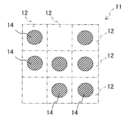
- FIG. 1 is a schematic plan view showing an example of the arrangement of dot patterns in one first lattice.
- a dot pattern 14 is formed at the center of each of the seven second gratings 12 out of the nine second gratings 12 in the first grating 11.
- the reference numeral “12” is attached only to a part of the second lattice
- the reference numeral “14” is attached only to a part of the dot patterns.
- the number of dot patterns (that is, the arrangement of dot patterns) is made different for each first lattice.
- the infrared absorption pattern formed in the present embodiment is a set of dot patterns described above.
- the amount of ink applied was such that the amount of the specific infrared absorber contained in the ink per unit area (g / m 2 ) was 0.20 g / m 2 . .
- the application amount of the treatment liquid is the application amount ratio [cationic polymer / specific infrared absorber] in each dot pattern (region where the ink is applied), that is, per unit area of the specific infrared absorber contained in the ink.
- amount of grant application amount per unit area of the cationic polymer contained in the treating solution for (g / m 2) (g / m 2) are shown in "application amount ratio [D / a]" column in Table 1 It was made to become a value.
- non-ejection nozzle number ratio (%) means the ratio (%) of the number of non-ejection nozzles to the total number of nozzles after 10 minutes of continuous ejection.
- A The ratio of the number of non-ejection nozzles is less than 8%.
- B The ratio of the number of non-ejection nozzles is 8% or more and less than 30%.
- C The ratio of the number of non-ejection nozzles is 30% or more.
- Ink storage stability Ink (Ink storage stability) Ink (25 g) was placed in a 30 mL polyethylene bottle, capped, and allowed to stand for 1 week in a thermostatic chamber (25 ° C.) condition. The viscosity of the ink was measured before and after this standing, the rate of increase in viscosity (%) after standing at 25 ° C. for 1 week was determined, and the storage stability of the ink was evaluated according to the following evaluation criteria. The viscosity of the ink was measured using a VISCOMETER RE-85L (manufactured by Toki Sangyo Co., Ltd.) as a viscometer at a liquid temperature of 25 ° C.
- A The rate of increase in viscosity due to standing at 25 ° C. for 1 week is less than 5%.
- B The rate of increase in viscosity due to standing at 25 ° C. for 1 week is 5% or more and less than 10%.
- C The increase rate of the viscosity after being allowed to stand at 25 ° C. for 1 week is 10% or more.
- Examples 2 to 23 and Comparative Examples 1 to 4 and 9 The type of specific infrared absorber (or comparative compound) in the ink; The type of solvent in the ink, Content ratio in the ink [solvent / infrared absorber] (“content ratio [B / A]” in Table 1), The type of cationic polymer in the treatment liquid, The type of compound of formula (1) (or comparative compound) in the treatment liquid, Content ratio in the treatment liquid [compound (1) compound / cationic polymer] (“content ratio [E / D]” in Table 1), and application ratio in the infrared absorption pattern [cationic polymer / specific infrared Absorbent] ("Grant ratio [D / A]” in Table 1)
- the same operation as in Example 1 was performed except that the combination was changed to the combination shown in Table 1. The results are shown in Table 1.
- Example 5 The same operation as in Example 1 was performed except that the infrared absorption pattern was formed using only ink without using the treatment liquid. The results are shown in Table 1.
- Example 6 The same operation as in Example 1 was carried out except that the compound of the formula (1) was changed to a compound other than the compound of the formula (1) (details are shown in Table 1). The results are shown in Table 1.
- Example 8 The same operation as in Example 1 was performed except that the treatment liquid was changed to an acid treatment liquid having the following composition. The results are shown in Table 1.
- IR-1 Exemplified compound (IR-1) [“Q084511” manufactured by QCR Solutions Co.]
- IR-2 Exemplified compound (IR-2) above [“T084621” manufactured by QCR Solutions Co.]
- IR-3 ... the above exemplified compound (IR-3)
- IR-4 Exemplified compound (IR-4)
- IR-5 Exemplified compound (IR-5)
- the “cationic polymer content” in this example is the amount of solids in the aqueous solution of the cationic polymer relative to the total amount of the treatment liquid, or the aqueous dispersion of the cationic polymer relative to the total amount of the treatment liquid. It means the amount of solid content in the liquid.
- the following product names are product names of aqueous solutions of cationic polymers or aqueous dispersions of cationic polymers.
- DADMAC Poly (diallyldimethylammonium chloride) [“Unisense FPA1002L” manufactured by Senka Co., Ltd.] Mw 50 ⁇ 10 4 Acrylic Lx: Acrylic polymer having a cationic group [“Acryt UW-319SX” (acrylic latex) manufactured by Taisei Fine Chemical Co., Ltd.] Mw 1.0 ⁇ 10 4 Urethane Lx: Urethane polymer having a cationic group [Madesei Chemical Co., Ltd.
- a specific infrared absorber an infrared absorber having a cyanine skeleton
- a specific solvent a solvent having a boiling point of 200 ° C. or higher and an SP value of 18 MPa 1/2 to 26 MPa 1/2
- water Examples 1 to 21 using an ink set comprising an ink containing an ink and a treatment liquid containing a cationic polymer, a compound of formula (1), and water are excellent in ink ejection properties and storage stability. It was excellent in IR readability and invisibility of the infrared absorption pattern.
- Comparative Examples 1 and 9 in which the specific infrared absorber in the ink was changed to a comparative compound (Ni complex, AB9), and Comparative Example 3 in which the cationic polymer in the treatment liquid was changed to a comparative polymer (PEG, PVA).
- Comparative Example 5 in which no treatment liquid was used, Comparative Examples 6 and 7 in which the compound of formula (1) in the treatment liquid was changed to a comparative compound (Abietic acid, ASA), and the treatment liquid contained a cationic polymer.
- Comparative Example 8 in which the acid treatment solution was changed to a non-acid treatment solution, IR readability of the infrared absorption pattern was lowered.
- IR readability of the infrared absorption pattern also decreased in Comparative Example 2 in which the solvent in the ink was changed to glycerin having an SP value of more than 26 MPa 1/2 .
- the reason why the IR readability of the infrared absorption pattern is decreased is considered to be that the dot pattern constituting the infrared absorption pattern varies (variation in shape, density, etc.) due to the decrease in the ink ejection performance.
Landscapes
- Chemical & Material Sciences (AREA)
- Life Sciences & Earth Sciences (AREA)
- Engineering & Computer Science (AREA)
- Materials Engineering (AREA)
- Wood Science & Technology (AREA)
- Organic Chemistry (AREA)
- Chemical Kinetics & Catalysis (AREA)
- Inks, Pencil-Leads, Or Crayons (AREA)
- Ink Jet Recording Methods And Recording Media Thereof (AREA)
- Ink Jet (AREA)
Abstract
シアニン骨格を有する赤外線吸収剤、沸点が200℃以上でありSP値が18MPa1/2~26MPa1/2である溶剤、及び水を含有する赤外線吸収パターン形成用インクと、カチオン性ポリマー、式(1)で表される化合物、及び水を含有する処理液と、を含むインクセット、並びに、赤外線吸収パターン形成方法。式(1)中、R1及びR2は、それぞれ独立に、炭素数10~14のアルキル基を表す。
Description
本発明は、赤外線吸収パターン形成用インクセット、及び、赤外線吸収パターン形成方法に関する。
従来より、赤外線吸収剤を含有するインクについて検討されている。
例えば、近赤外線の照射によって乾燥・定着が行われ、樹脂が軟化して素早く色材を基材上へ定着させることができ、擦過性、乾燥性、吐出性に優れた水性インクジェット記録用インクとして、少なくとも色材、水、水溶性有機溶剤、及び800~1200nmに最大吸収波長を持つ近赤外線吸収剤を含み、該近赤外線吸収剤が樹脂微粒子に吸着又は内包されて、近赤外線吸収剤含有樹脂微粒子の状態で分散している水性インクジェット記録用インクが知られている(例えば、特開2013-189596号公報参照)。
例えば、近赤外線の照射によって乾燥・定着が行われ、樹脂が軟化して素早く色材を基材上へ定着させることができ、擦過性、乾燥性、吐出性に優れた水性インクジェット記録用インクとして、少なくとも色材、水、水溶性有機溶剤、及び800~1200nmに最大吸収波長を持つ近赤外線吸収剤を含み、該近赤外線吸収剤が樹脂微粒子に吸着又は内包されて、近赤外線吸収剤含有樹脂微粒子の状態で分散している水性インクジェット記録用インクが知られている(例えば、特開2013-189596号公報参照)。
また、紙のカックルを抑制し、画像の色味を損ね難いインクとして、水と、有機顔料と、特定構造の近赤外線吸収色素と、を含有するインクが知られている(例えば、特開2014-47303号公報参照)。
また、分光特性に優れた近赤外吸収画像形成用組成物からなるインクとして、特定のシアニン色素を含む近赤外吸収画像形成用組成物からなるインクが知られている(例えば、特開2008-255323号公報参照)。
また、分光特性に優れた近赤外吸収画像形成用組成物からなるインクとして、特定のシアニン色素を含む近赤外吸収画像形成用組成物からなるインクが知られている(例えば、特開2008-255323号公報参照)。
一方、インクと、このインクと反応する反応性液体と、を含むインクセットについても検討されている。
例えば、高い像強度、例えば、高い永続性(例えば、汚れ堅牢性)を有するプリント領域とする、インクジェット印刷用のインクセットとして、着色剤と有機溶媒を含むインク、及び、上記着色剤と接触時に反応する陽イオンラテックス反応剤を含む反応性液体を含有するインクジェット印刷用のインクセットが知られている(例えば、特開2004-58680号公報参照)。
例えば、高い像強度、例えば、高い永続性(例えば、汚れ堅牢性)を有するプリント領域とする、インクジェット印刷用のインクセットとして、着色剤と有機溶媒を含むインク、及び、上記着色剤と接触時に反応する陽イオンラテックス反応剤を含む反応性液体を含有するインクジェット印刷用のインクセットが知られている(例えば、特開2004-58680号公報参照)。
ところで、近年、偽造防止などの観点から、赤外線吸収剤を含有するインクを用い、インクジェット法によって赤外線吸収パターンを形成し、形成された赤外線吸収パターンを、この赤外線吸収パターンに赤外線を照射することによって読み取る技術が求められている。
かかる技術に関し、特開2013-189596号公報、若しくは特開2014-47303号公報に記載されたインクから着色剤(色材)を除いた赤外線吸収剤含有インク、又は、特開2008-255323号公報に記載の近赤外線吸収画像形成用組成物からなるインクを用いて赤外線吸収パターンを形成した場合には、形成された赤外線吸収パターンの赤外線照射による読み取り性(以下、「IR読み取り性」ともいう)が不足する。
また、特開2004-58680号公報に記載されたインクセットにおいて、インク中の着色剤を赤外線吸収剤に置き換えたインクセットを用いて赤外線吸収パターンを形成した場合にも、やはり赤外線吸収パターンのIR読み取り性が不足する。
かかる技術に関し、特開2013-189596号公報、若しくは特開2014-47303号公報に記載されたインクから着色剤(色材)を除いた赤外線吸収剤含有インク、又は、特開2008-255323号公報に記載の近赤外線吸収画像形成用組成物からなるインクを用いて赤外線吸収パターンを形成した場合には、形成された赤外線吸収パターンの赤外線照射による読み取り性(以下、「IR読み取り性」ともいう)が不足する。
また、特開2004-58680号公報に記載されたインクセットにおいて、インク中の着色剤を赤外線吸収剤に置き換えたインクセットを用いて赤外線吸収パターンを形成した場合にも、やはり赤外線吸収パターンのIR読み取り性が不足する。
本発明は上記事情に鑑みなされたものであり、以下の目的を達成することを課題とする。
即ち、本発明の目的は、赤外線照射によって読み取る際の読み取り性に優れた赤外線吸収パターンを形成できる、赤外線吸収パターン形成用インクセット及び赤外線吸収パターン形成方法を提供することである。
即ち、本発明の目的は、赤外線照射によって読み取る際の読み取り性に優れた赤外線吸収パターンを形成できる、赤外線吸収パターン形成用インクセット及び赤外線吸収パターン形成方法を提供することである。
上記課題を解決するための具体的手段には、以下の態様が含まれる。
<1> シアニン骨格を有する赤外線吸収剤、沸点が200℃以上でありSP値が18MPa1/2~26MPa1/2である溶剤、及び水を含有する赤外線吸収パターン形成用インクと、
カチオン性ポリマー、式(1)で表される化合物、及び水を含有する処理液と、
を含む赤外線吸収パターン形成用インクセット。
カチオン性ポリマー、式(1)で表される化合物、及び水を含有する処理液と、
を含む赤外線吸収パターン形成用インクセット。
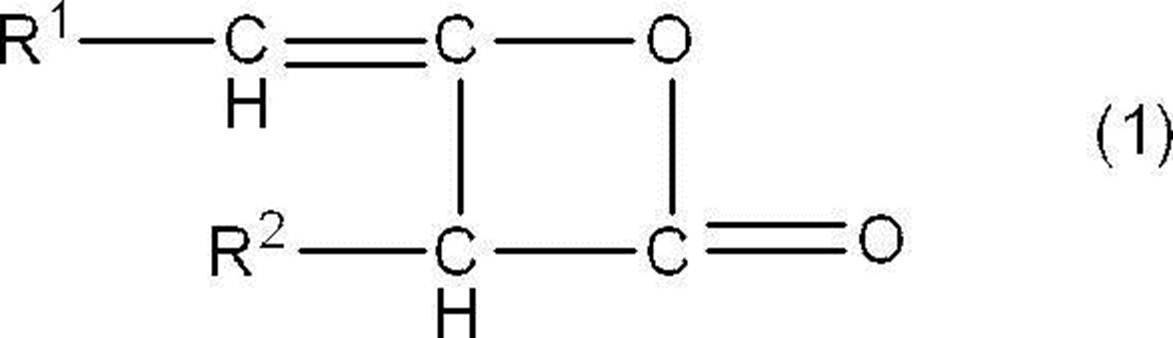
式(1)中、R1及びR2は、それぞれ独立に、炭素数10~14のアルキル基を表す。
<2> 赤外線吸収パターン形成用インクにおいて、上記溶剤の含有量が、上記赤外線吸収剤の含有量に対し、質量基準で10倍~70倍である<1>に記載の赤外線吸収パターン形成用インクセット。
<3> 赤外線吸収パターン形成用インクにおいて、上記溶剤の含有量が、上記赤外線吸収剤の含有量に対し、質量基準で20倍~60倍である<1>又は<2>に記載の赤外線吸収パターン形成用インクセット。
<4> 処理液において、式(1)で表される化合物の含有量が、カチオン性ポリマーの含有量に対し、質量基準で0.01倍~10.0倍である<1>~<3>のいずれか1つに記載の赤外線吸収パターン形成用インクセット。
<5> 処理液において、式(1)で表される化合物の含有量が、カチオン性ポリマーの含有量に対し、質量基準で0.1倍~5.0倍である<1>~<4>のいずれか1つに記載の赤外線吸収パターン形成用インクセット。
<6> 上記赤外線吸収剤が、カチオンと下記式(X)で表されるアニオンとの塩、又は、アニオンと下記式(Y)で表されるカチオンとの塩である<1>~<5>のいずれか1つに記載の赤外線吸収パターン形成用インクセット。
<3> 赤外線吸収パターン形成用インクにおいて、上記溶剤の含有量が、上記赤外線吸収剤の含有量に対し、質量基準で20倍~60倍である<1>又は<2>に記載の赤外線吸収パターン形成用インクセット。
<4> 処理液において、式(1)で表される化合物の含有量が、カチオン性ポリマーの含有量に対し、質量基準で0.01倍~10.0倍である<1>~<3>のいずれか1つに記載の赤外線吸収パターン形成用インクセット。
<5> 処理液において、式(1)で表される化合物の含有量が、カチオン性ポリマーの含有量に対し、質量基準で0.1倍~5.0倍である<1>~<4>のいずれか1つに記載の赤外線吸収パターン形成用インクセット。
<6> 上記赤外線吸収剤が、カチオンと下記式(X)で表されるアニオンとの塩、又は、アニオンと下記式(Y)で表されるカチオンとの塩である<1>~<5>のいずれか1つに記載の赤外線吸収パターン形成用インクセット。

式(X)中、ArX1及びArX2は、それぞれ独立に、炭素数1~6のアルコキシ基によって置換されていてもよいベンゼン環、又は炭素数1~6のアルコキシ基によって置換されていてもよいナフタレン環を表す。LX1及びLX2は、それぞれ独立に、-C(CH3)2-基又は-S-基を表す。RX1及びRX2は、それぞれ独立に、炭素数1~6のアルキレン基を表し、RX3は、-(CH2)nx-基を表し、nxは、2又は3を表し、RX4は、ハロゲン原子、炭素数1~6のアルコキシ基、フェノキシ基、炭素数1~6のアルキルチオ基、又はフェニルチオ基を表す。
式(Y)中、ArY1及びArY2は、それぞれ独立に、炭素数1~6のアルコキシ基によって置換されていてもよいベンゼン環、又は炭素数1~6のアルコキシ基によって置換されていてもよいナフタレン環を表す。LY1及びLY2は、それぞれ独立に、-C(CH3)2-基又は-S-基を表す。RY1及びRY2は、それぞれ独立に、炭素数1~6のアルキル基を表し、RY3は、-(CH2)ny-基を表し、nyは、2又は3を表し、RY4は、ハロゲン原子、炭素数1~6のアルコキシ基、フェノキシ基、炭素数1~6のアルキルチオ基、又はフェニルチオ基を表す。
式(Y)中、ArY1及びArY2は、それぞれ独立に、炭素数1~6のアルコキシ基によって置換されていてもよいベンゼン環、又は炭素数1~6のアルコキシ基によって置換されていてもよいナフタレン環を表す。LY1及びLY2は、それぞれ独立に、-C(CH3)2-基又は-S-基を表す。RY1及びRY2は、それぞれ独立に、炭素数1~6のアルキル基を表し、RY3は、-(CH2)ny-基を表し、nyは、2又は3を表し、RY4は、ハロゲン原子、炭素数1~6のアルコキシ基、フェノキシ基、炭素数1~6のアルキルチオ基、又はフェニルチオ基を表す。
<7> 赤外線吸収パターン形成用インクにおける上記赤外線吸収剤の含有量が、0.1質量%~3質量%である<1>~<6>のいずれか1つに記載の赤外線吸収パターン形成用インクセット。
<8> 処理液におけるカチオン性ポリマーの含有量が、1質量%~10質量%である<1>~<7>のいずれか1つに記載の赤外線吸収パターン形成用インクセット。
<9> 赤外線吸収パターン形成用インクにおける着色剤の含有量が0.1質量%未満であり、
処理液における着色剤の含有量が0.1質量%未満である<1>~<8>のいずれか1つに記載の赤外線吸収パターン形成用インクセット。
<10> 前記赤外線吸収パターン形成用インクが、更にアセチレングリコール系界面活性剤を含む、<1>~<9>のいずれか1項に記載の赤外線吸収パターン形成用インクセット。
<8> 処理液におけるカチオン性ポリマーの含有量が、1質量%~10質量%である<1>~<7>のいずれか1つに記載の赤外線吸収パターン形成用インクセット。
<9> 赤外線吸収パターン形成用インクにおける着色剤の含有量が0.1質量%未満であり、
処理液における着色剤の含有量が0.1質量%未満である<1>~<8>のいずれか1つに記載の赤外線吸収パターン形成用インクセット。
<10> 前記赤外線吸収パターン形成用インクが、更にアセチレングリコール系界面活性剤を含む、<1>~<9>のいずれか1項に記載の赤外線吸収パターン形成用インクセット。
<11> <1>~<10>のいずれか1つに記載の赤外線吸収パターン形成用インクセットが用いられ、
処理液を基材上に付与する処理液付与工程と、
基材の処理液が付与された面に赤外線吸収パターン形成用インクをインクジェット法によって付与することにより、赤外線吸収パターンを形成するインク付与工程と、
を有する赤外線吸収パターン形成方法。
<12> 赤外線吸収パターンにおいて、カチオン性ポリマーの単位面積当たりの付与量が、上記赤外線吸収剤の単位面積当たりの付与量に対し、質量基準で1倍~70倍である<11>に記載の赤外線吸収パターン形成方法。
<13> 赤外線吸収パターンにおいて、カチオン性ポリマーの単位面積当たりの付与量が、上記赤外線吸収剤の単位面積当たりの付与量に対し、質量基準で2倍~50倍である<11>又は<12>に記載の赤外線吸収パターン形成方法。
処理液を基材上に付与する処理液付与工程と、
基材の処理液が付与された面に赤外線吸収パターン形成用インクをインクジェット法によって付与することにより、赤外線吸収パターンを形成するインク付与工程と、
を有する赤外線吸収パターン形成方法。
<12> 赤外線吸収パターンにおいて、カチオン性ポリマーの単位面積当たりの付与量が、上記赤外線吸収剤の単位面積当たりの付与量に対し、質量基準で1倍~70倍である<11>に記載の赤外線吸収パターン形成方法。
<13> 赤外線吸収パターンにおいて、カチオン性ポリマーの単位面積当たりの付与量が、上記赤外線吸収剤の単位面積当たりの付与量に対し、質量基準で2倍~50倍である<11>又は<12>に記載の赤外線吸収パターン形成方法。
本発明によれば、赤外線照射によって読み取る際の読み取り性に優れた赤外線吸収パターンを形成できる、赤外線吸収パターン形成用インクセット及び赤外線吸収パターン形成方法が提供される。
以下、本発明の具体的な実施形態について詳細に説明するが、本発明は、以下の実施形態に何ら限定されるものではなく、本発明の目的の範囲内において、適宜、変更を加えて実施することができる。
本明細書において、「~」を用いて示された数値範囲は、「~」の前後に記載される数値をそれぞれ最小値及び最大値として含む範囲を意味する。
本明細書において、組成物(インク又は処理液)中の各成分の量は、組成物中に各成分に該当する物質が複数存在する場合は、特に断らない限り、組成物中に存在する当該複数の物質の合計量を意味する。
本明細書において、「工程」との用語は、独立した工程だけではなく、他の工程と明確に区別できない場合であってもその工程の所期の目的が達成されれば、本用語に含まれる。
本明細書において、赤外線を「IR」(infrared)と称することがある。
本明細書において、組成物(インク又は処理液)中の各成分の量は、組成物中に各成分に該当する物質が複数存在する場合は、特に断らない限り、組成物中に存在する当該複数の物質の合計量を意味する。
本明細書において、「工程」との用語は、独立した工程だけではなく、他の工程と明確に区別できない場合であってもその工程の所期の目的が達成されれば、本用語に含まれる。
本明細書において、赤外線を「IR」(infrared)と称することがある。
〔赤外線吸収パターン形成用インクセット〕
本発明の赤外線吸収パターン形成用インクセット(以下、単に「インクセット」ともいう)は、
シアニン骨格を有する赤外線吸収剤、沸点が200℃以上でありSP値が18MPa1/2~26MPa1/2である溶剤、及び水を含有する赤外線吸収パターン形成用インク(以下、単に「インク」ともいう)と、
カチオン性ポリマー、式(1)で表される化合物、及び水を含有する処理液と、
を含む。
本発明の赤外線吸収パターン形成用インクセット(以下、単に「インクセット」ともいう)は、
シアニン骨格を有する赤外線吸収剤、沸点が200℃以上でありSP値が18MPa1/2~26MPa1/2である溶剤、及び水を含有する赤外線吸収パターン形成用インク(以下、単に「インク」ともいう)と、
カチオン性ポリマー、式(1)で表される化合物、及び水を含有する処理液と、
を含む。
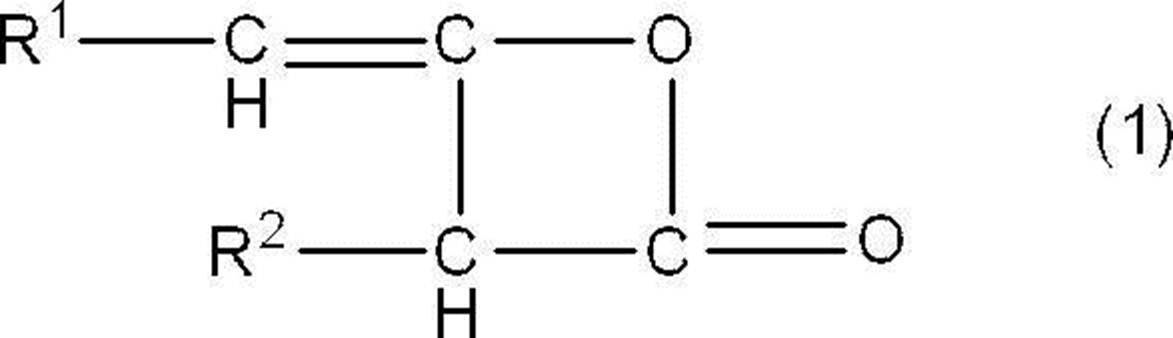
式(1)中、R1及びR2は、それぞれ独立に、炭素数10~14のアルキル基を表す。
本発明のインクセットによれば、赤外線照射によって読み取る際の読み取り性(IR読み取り性)に優れた赤外線吸収パターンを形成できる。
この理由は明らかではないが、以下のように推測される。
本発明のインクセットでは、基材上に処理液とインクとを重ねて付与して赤外線吸収パターン(以下、単に「パターン」ともいう)を形成することにより、インク中のシアニン骨格を有する赤外線吸収剤(以下、「特定赤外線吸収剤」ともいう)と、処理液中のカチオン性ポリマーと、処理液中の式(1)で表される化合物と、の組み合わせによって、基材の表面付近に特定赤外線吸収剤が高密度に(即ち、パターンの厚さ方向について高密度に)集積されると考えられる。これにより、IR読み取りに適したパターン濃度が確保され、その結果、パターンのIR読み取り性が向上すると考えられる。ここでいう「パターン濃度」は、着色画像でいう画像濃度(色濃度)に相当する。
更に、本発明のインクセットでは、インクが、沸点200℃以上でありSP値18MPa1/2~26MPa1/2である溶剤(以下、「特定溶剤」ともいう)を含むことにより、インクジェットヘッドからのインクの吐出性(以下、「インク吐出性」ともいう)が向上する。これにより、インク吐出性が悪い場合に生じることがある、パターン形状の悪化、パターン精度の悪化、パターン濃度のバラつき等が抑制されると考えられる。その結果、IR読み取りに適したパターン形状、パターン精度、パターン濃度の均一性等が確保され、パターンのIR読み取り性が向上すると考えられる。
この理由は明らかではないが、以下のように推測される。
本発明のインクセットでは、基材上に処理液とインクとを重ねて付与して赤外線吸収パターン(以下、単に「パターン」ともいう)を形成することにより、インク中のシアニン骨格を有する赤外線吸収剤(以下、「特定赤外線吸収剤」ともいう)と、処理液中のカチオン性ポリマーと、処理液中の式(1)で表される化合物と、の組み合わせによって、基材の表面付近に特定赤外線吸収剤が高密度に(即ち、パターンの厚さ方向について高密度に)集積されると考えられる。これにより、IR読み取りに適したパターン濃度が確保され、その結果、パターンのIR読み取り性が向上すると考えられる。ここでいう「パターン濃度」は、着色画像でいう画像濃度(色濃度)に相当する。
更に、本発明のインクセットでは、インクが、沸点200℃以上でありSP値18MPa1/2~26MPa1/2である溶剤(以下、「特定溶剤」ともいう)を含むことにより、インクジェットヘッドからのインクの吐出性(以下、「インク吐出性」ともいう)が向上する。これにより、インク吐出性が悪い場合に生じることがある、パターン形状の悪化、パターン精度の悪化、パターン濃度のバラつき等が抑制されると考えられる。その結果、IR読み取りに適したパターン形状、パターン精度、パターン濃度の均一性等が確保され、パターンのIR読み取り性が向上すると考えられる。
また、本発明のインクセットによれば、インクがシアニン骨格を有する赤外線吸収剤(特定赤外線吸収剤)を含有することにより、不可視性に優れ(即ち、目視で視認されにくく)、かつ、IR読み取り性に優れたパターンを形成できる。
不可視性に優れ、かつ、IR読み取り性に優れたパターンは、例えば偽造防止用のパターンとして好適である。
ここで、不可視性に優れたパターンとは、目視で視認されにくいパターンを意味する。
パターンの不可視性の観点から、パターン中に、300nm~650nmの波長領域における吸光度が0.3を超える箇所が存在しないことが好ましい。
不可視性に優れ、かつ、IR読み取り性に優れたパターンは、例えば偽造防止用のパターンとして好適である。
ここで、不可視性に優れたパターンとは、目視で視認されにくいパターンを意味する。
パターンの不可視性の観点から、パターン中に、300nm~650nmの波長領域における吸光度が0.3を超える箇所が存在しないことが好ましい。
インクにおいて、特定溶剤(沸点が200℃以上でありSP値が18MPa1/2~26MPa1/2である溶剤)のインク全量に対する含有量が、特定赤外線吸収剤のインク全量に対する含有量に対し、質量基準で10倍~70倍であることが好ましい。即ち、インクにおいて、含有質量比〔特定溶剤/特定赤外線吸収剤〕が10~70であることが好ましい。
含有質量比〔特定溶剤/特定赤外線吸収剤〕が10以上であると、インク吐出性がより向上する。
含有質量比〔特定溶剤/特定赤外線吸収剤〕が70以下であると、パターンのIR読み取り性がより向上する。
含有質量比〔特定溶剤/特定赤外線吸収剤〕として、より好ましくは20~60である。
含有質量比〔特定溶剤/特定赤外線吸収剤〕が10以上であると、インク吐出性がより向上する。
含有質量比〔特定溶剤/特定赤外線吸収剤〕が70以下であると、パターンのIR読み取り性がより向上する。
含有質量比〔特定溶剤/特定赤外線吸収剤〕として、より好ましくは20~60である。
処理液において、式(1)で表される化合物の処理液全量に対する含有量が、カチオン性ポリマーの処理液全量に対する含有量に対し、質量基準で0.01倍~10.0倍であることが好ましい。即ち、処理液において、含有質量比〔式(1)で表される化合物/カチオン性ポリマー〕が0.01~10.0であることが好ましい。
含有質量比〔式(1)で表される化合物/カチオン性ポリマー〕が0.01~10.0であると、パターン濃度がより向上し、パターンのIR読み取り性がより向上する。
含有質量比〔式(1)で表される化合物/カチオン性ポリマー〕として、より好ましくは0.1~5.0である。
含有質量比〔式(1)で表される化合物/カチオン性ポリマー〕が0.01~10.0であると、パターン濃度がより向上し、パターンのIR読み取り性がより向上する。
含有質量比〔式(1)で表される化合物/カチオン性ポリマー〕として、より好ましくは0.1~5.0である。
また、インクにおける特定赤外線吸収剤の含有量(インク全量に対する含有量)は、0.1質量%~3質量%であることが好ましい。
特定赤外線吸収剤の含有量が0.1質量%以上であると、パターンのIR読み取り性がより向上する。
特定赤外線吸収剤の含有量が3質量%以下であると、パターンの不可視性向上、及び、インクの製造コスト低減の点で有利である。
インクにおける特定赤外線吸収剤の含有量としては、0.3質量%~2質量%がより好ましく、0.5質量%~1.5質量%であることが特に好ましい。
特定赤外線吸収剤の含有量が0.1質量%以上であると、パターンのIR読み取り性がより向上する。
特定赤外線吸収剤の含有量が3質量%以下であると、パターンの不可視性向上、及び、インクの製造コスト低減の点で有利である。
インクにおける特定赤外線吸収剤の含有量としては、0.3質量%~2質量%がより好ましく、0.5質量%~1.5質量%であることが特に好ましい。
また、処理液におけるカチオン性ポリマーの含有量(処理液全量に対する含有量)は、1質量%~10質量%であることが好ましい。
カチオン性ポリマーの含有量が1質量%以上であると、パターンのIR読み取り性がより向上する。
カチオン性ポリマーの含有量が10質量%以下であると、処理液の粘度をより低減できるので、処理液を塗布する場合の塗布性、又は、処理液をインクジェットヘッドから吐出する場合の吐出性がより向上する。
処理液におけるカチオン性ポリマーの含有量としては、2質量%~8質量%がより好ましい。
カチオン性ポリマーの含有量が1質量%以上であると、パターンのIR読み取り性がより向上する。
カチオン性ポリマーの含有量が10質量%以下であると、処理液の粘度をより低減できるので、処理液を塗布する場合の塗布性、又は、処理液をインクジェットヘッドから吐出する場合の吐出性がより向上する。
処理液におけるカチオン性ポリマーの含有量としては、2質量%~8質量%がより好ましい。
また、パターンの不可視性の観点から、インクにおける着色剤の含有量(インク全量に対する含有量)は、0.1質量%未満であることが好ましい。即ち、インクは、着色剤を実質的に含有しないことが好ましい。
本明細書中における「着色剤」の概念には、一般的な着色顔料及び着色染料が包含されるが、特定赤外線吸収剤(シアニン骨格を有する赤外線吸収剤)は包含されない。
また、パターンの不可視性の観点から、処理液における着色剤の含有量(処理液全量に対する含有量)は、0.1質量%未満であることが好ましい。即ち、処理液も、着色剤を実質的に含有しないことが好ましい。
パターンの不可視性の観点から、インクにおける着色剤の含有量が0.1質量%未満であり、かつ、処理液における着色剤の含有量が0.1質量%未満であることが特に好ましい。
本明細書中における「着色剤」の概念には、一般的な着色顔料及び着色染料が包含されるが、特定赤外線吸収剤(シアニン骨格を有する赤外線吸収剤)は包含されない。
また、パターンの不可視性の観点から、処理液における着色剤の含有量(処理液全量に対する含有量)は、0.1質量%未満であることが好ましい。即ち、処理液も、着色剤を実質的に含有しないことが好ましい。
パターンの不可視性の観点から、インクにおける着色剤の含有量が0.1質量%未満であり、かつ、処理液における着色剤の含有量が0.1質量%未満であることが特に好ましい。
以下、本発明のインクセットに含まれるインク(即ち赤外線吸収パターン形成用インク)及び処理液について、更に詳細に説明する。
<インク>
インク(即ち赤外線吸収パターン形成用インク)は、特定赤外線吸収剤(即ち、シアニン骨格を有する赤外線吸収剤)、特定溶剤(即ち、沸点が200℃以上でありSP値が18MPa1/2~26MPa1/2である溶剤)、及び水を含有する。インクは、必要に応じその他の成分を含んでいてもよい。
インク(即ち赤外線吸収パターン形成用インク)は、特定赤外線吸収剤(即ち、シアニン骨格を有する赤外線吸収剤)、特定溶剤(即ち、沸点が200℃以上でありSP値が18MPa1/2~26MPa1/2である溶剤)、及び水を含有する。インクは、必要に応じその他の成分を含んでいてもよい。
(特定赤外線吸収剤)
インクは、特定赤外線吸収剤、即ち、シアニン骨格を有する赤外線吸収剤を少なくとも1種含有する。
特定赤外線吸収剤は、シアニン骨格を有する赤外線吸収剤であれば特に制限はない。
本明細書中において、「シアニン骨格」とは、2つの含窒素複素環と、2つの含窒素複素環間に配置される複数のメチン基と、を含む骨格を意味する。
また、本明細書中において、「赤外線吸収剤」とは、濃度0.001質量%の水溶液を調製したときに、この水溶液の波長850nmでの吸光度が、0.3以上である物質を指す。
上記水溶液(特定赤外線吸収剤の濃度0.001質量%の水溶液)の波長850nmでの吸光度は、パターンのIR読み取り性の観点から、0.4以上であることが好ましい。
インクは、特定赤外線吸収剤、即ち、シアニン骨格を有する赤外線吸収剤を少なくとも1種含有する。
特定赤外線吸収剤は、シアニン骨格を有する赤外線吸収剤であれば特に制限はない。
本明細書中において、「シアニン骨格」とは、2つの含窒素複素環と、2つの含窒素複素環間に配置される複数のメチン基と、を含む骨格を意味する。
また、本明細書中において、「赤外線吸収剤」とは、濃度0.001質量%の水溶液を調製したときに、この水溶液の波長850nmでの吸光度が、0.3以上である物質を指す。
上記水溶液(特定赤外線吸収剤の濃度0.001質量%の水溶液)の波長850nmでの吸光度は、パターンのIR読み取り性の観点から、0.4以上であることが好ましい。
また、パターンの不可視性をより向上させる観点からみると、上記水溶液(特定赤外線吸収剤の濃度0.001質量%の水溶液)の波長300nm~650nmの範囲での吸光度が、0.3以下であることが好ましく、0.2以下であることがより好ましく、0.1以下であることが特に好ましい。
また、特定赤外線吸収剤は、水溶性を有することが好ましい。
ここで、「水溶性」とは、25℃の蒸留水100g対する溶解量が1gを超える性質を指す。
ここで、「水溶性」とは、25℃の蒸留水100g対する溶解量が1gを超える性質を指す。
また、特定赤外線吸収剤は、パターンの不可視性及びIR読み取り性を更に向上させる観点から、カチオンと下記式(X)で表されるアニオンとの塩、又は、アニオンと下記式(Y)で表されるカチオンとの塩であることが好ましい。
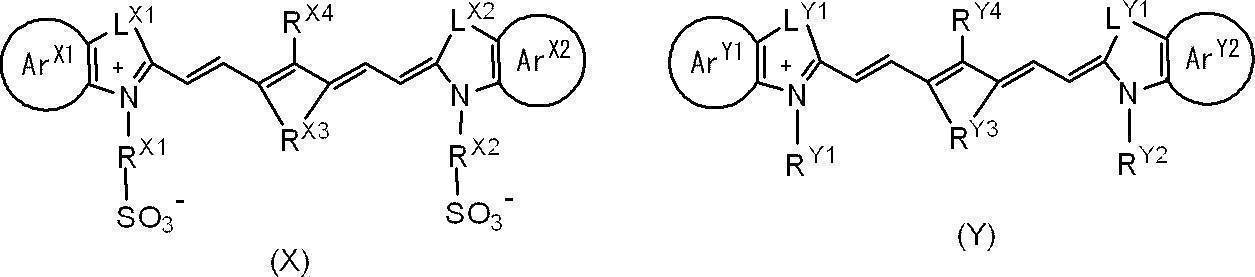
式(X)中、ArX1及びArX2は、それぞれ独立に、炭素数1~6のアルコキシ基によって置換されていてもよいベンゼン環、又は炭素数1~6のアルコキシ基によって置換されていてもよいナフタレン環を表す。LX1及びLX2は、それぞれ独立に、-C(CH3)2-基又は-S-基を表す。RX1及びRX2は、それぞれ独立に、炭素数1~6のアルキレン基を表し、RX3は、-(CH2)nx-基を表し、nxは、2又は3を表し、RX4は、ハロゲン原子、炭素数1~6のアルコキシ基、フェノキシ基、炭素数1~6のアルキルチオ基、又はフェニルチオ基を表す。
式(Y)中、ArY1及びArY2は、それぞれ独立に、炭素数1~6のアルコキシ基によって置換されていてもよいベンゼン環、又は炭素数1~6のアルコキシ基によって置換されていてもよいナフタレン環を表す。LY1及びLY2は、それぞれ独立に、-C(CH3)2-基又は-S-基を表す。RY1及びRY2は、それぞれ独立に、炭素数1~6のアルキル基を表し、RY3は、-(CH2)ny-基を表し、nyは、2又は3を表し、RY4は、ハロゲン原子、炭素数1~6のアルコキシ基、フェノキシ基、炭素数1~6のアルキルチオ基、又はフェニルチオ基を表す。
式(Y)中、ArY1及びArY2は、それぞれ独立に、炭素数1~6のアルコキシ基によって置換されていてもよいベンゼン環、又は炭素数1~6のアルコキシ基によって置換されていてもよいナフタレン環を表す。LY1及びLY2は、それぞれ独立に、-C(CH3)2-基又は-S-基を表す。RY1及びRY2は、それぞれ独立に、炭素数1~6のアルキル基を表し、RY3は、-(CH2)ny-基を表し、nyは、2又は3を表し、RY4は、ハロゲン原子、炭素数1~6のアルコキシ基、フェノキシ基、炭素数1~6のアルキルチオ基、又はフェニルチオ基を表す。
以下、式(X)の好ましい範囲について説明する。
ArX1及びArX2において、ベンゼン環又はナフタレン環を置換し得る炭素数1~6のアルコキシ基としては、メトキシ基又はエトキシ基が好ましく、メトキシ基が特に好ましい。
ArX1及びArX2としては、無置換のベンゼン環又は無置換のナフタレン環が好ましい。
LX1及びLX2は、-C(CH3)2-基であることが好ましい。
RX4は、ハロゲン原子であることが好ましい。
RX4で表されるハロゲン原子としては、フッ素原子、塩素原子、臭素原子、又はヨウ素原子が好ましく、塩素原子又は臭素原子がより好ましく、塩素原子が特に好ましい。
ArX1及びArX2において、ベンゼン環又はナフタレン環を置換し得る炭素数1~6のアルコキシ基としては、メトキシ基又はエトキシ基が好ましく、メトキシ基が特に好ましい。
ArX1及びArX2としては、無置換のベンゼン環又は無置換のナフタレン環が好ましい。
LX1及びLX2は、-C(CH3)2-基であることが好ましい。
RX4は、ハロゲン原子であることが好ましい。
RX4で表されるハロゲン原子としては、フッ素原子、塩素原子、臭素原子、又はヨウ素原子が好ましく、塩素原子又は臭素原子がより好ましく、塩素原子が特に好ましい。
式(X)における各基の特に好ましい組み合わせは、ArX1及びArX2が、それぞれ独立に、無置換のベンゼン環又は無置換のナフタレン環であり、LX1及びLX2が-C(CH3)2-基であり、RX1及びRX2が、それぞれ独立に、炭素数1~6のアルキレン基であり、RX3が-(CH2)nx-基であり、nxが2又は3である組み合わせである。
式(Y)中のArY1、ArY2、LY1、LY2、及びRY4の好ましい範囲は、それぞれ、式(X)中のArX1、ArX2、LX1、LX2、及びRX4の好ましい範囲と同様である。
式(Y)における各基の特に好ましい組み合わせは、ArY1及びArY2が、それぞれ独立に、無置換のベンゼン環又は無置換のナフタレン環であり、LY1及びLY2が-C(CH3)2-基であり、RY1及びRY2が、それぞれ独立に、炭素数1~6のアルキル基であり、RY3が-(CH2)ny-基であり、nyが2又は3である組み合わせである。
特定赤外線吸収剤が、カチオンと式(X)で表されるアニオンとの塩である場合におけるカチオンとしては、炭素数0~12(好ましくは0~8、より好ましくは2~6)のアンモニウムカチオン、無機金属カチオン(例えば、Al3+、Ca2+)、等が挙げられる。
特定赤外線吸収剤が、アニオンと式(Y)で表されるカチオンとの塩である場合におけるアニオンとしては、ClO4
-、PF6
-、R(Ph)SO3
-〔ここで、Rは、ハロゲン原子によって置換されていてもよい炭素数1~6のアルキル基、又はハロゲン原子を表し、Phはフェニレン基を表す〕、COO-、PO4
3-、等が挙げられる。
以下、特定赤外線吸収剤の具体例(例示化合物(IR-1)~(IR-14))を示す。但し、特定赤外線吸収剤は、以下の具体例には限定されない。
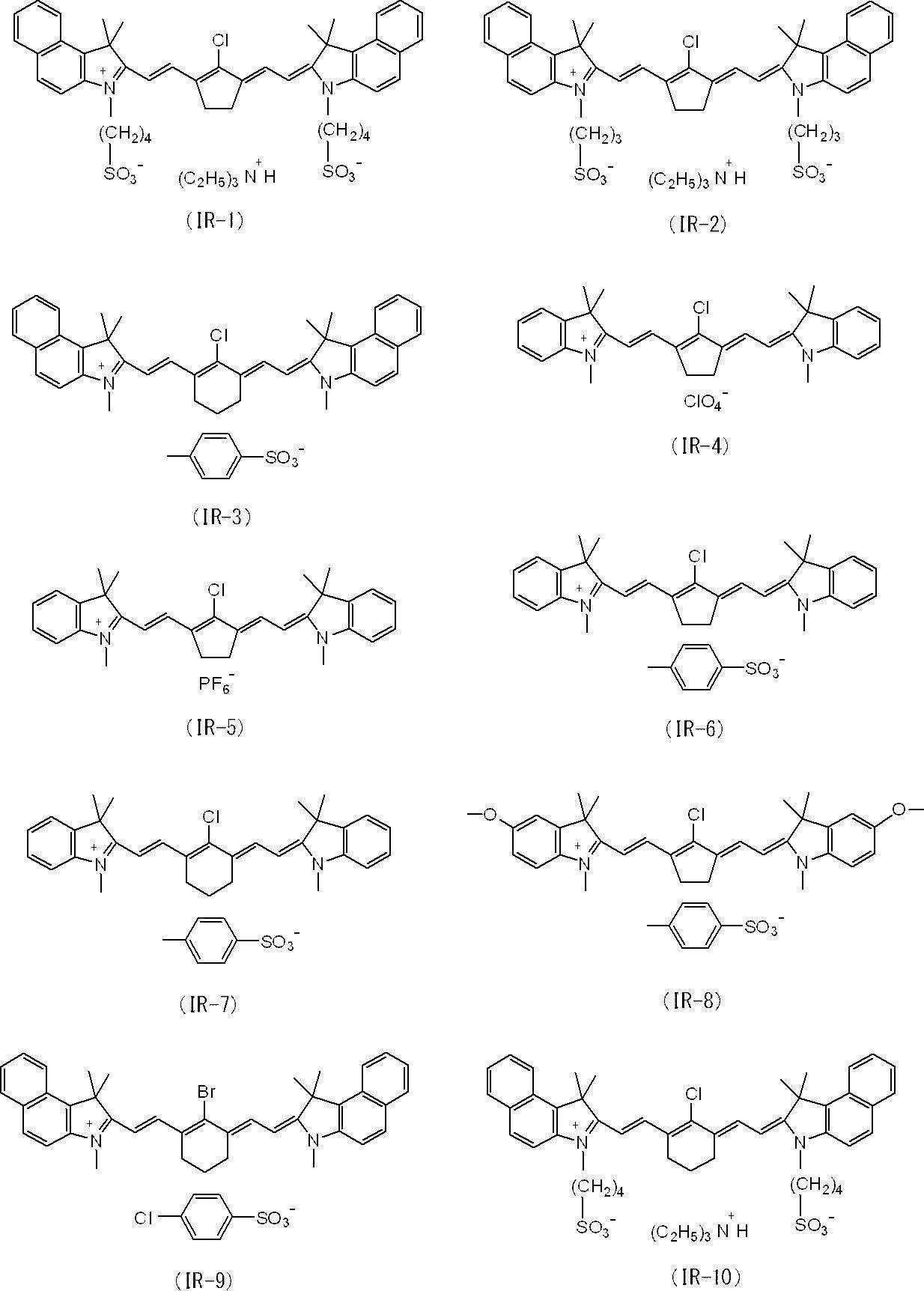

特定赤外線吸収剤は、従来から知られている合成方法を参照して合成できる。また、特定赤外線吸収剤としては、市販品を用いてもよい。
インク全量に対する特定赤外線吸収剤の好ましい含有量については前述のとおりである。
(特定溶剤)
インクは、特定溶剤(即ち、沸点が200℃以上でありSP値が18MPa1/2~26MPa1/2である溶剤)を少なくとも1種含有する。
インクは、特定溶剤(即ち、沸点が200℃以上でありSP値が18MPa1/2~26MPa1/2である溶剤)を少なくとも1種含有する。
本明細書におけるSP値は、ハンセン溶解度パラメータを意味する。
ハンセン(Hansen)溶解度パラメータは、ヒルデブランド(Hildebrand)によって導入された溶解度パラメータを、分散項δd、極性項δp、水素結合項δhの3成分に分割し、3次元空間に表したものである。
本明細書におけるSP値は、より詳細には、下記式を用いて算出されたδ[MPa1/2]を意味する。
δ[MPa1/2]=(δd2+δp2+δh2)1/2
なお、この分散項δd,極性項δp,水素結合項δhは、ハンセンやその研究後継者らにより多く求められており、Polymer Handbook (fourth edition)、VII-698~711に詳しく掲載されている。
また、多くの溶剤についてのハンセン溶解度パラメータの値が調べられており、例えば、Wesley L.Archer著、Industrial Solvents Handbookにこれらの値が記載されている。
ハンセン(Hansen)溶解度パラメータは、ヒルデブランド(Hildebrand)によって導入された溶解度パラメータを、分散項δd、極性項δp、水素結合項δhの3成分に分割し、3次元空間に表したものである。
本明細書におけるSP値は、より詳細には、下記式を用いて算出されたδ[MPa1/2]を意味する。
δ[MPa1/2]=(δd2+δp2+δh2)1/2
なお、この分散項δd,極性項δp,水素結合項δhは、ハンセンやその研究後継者らにより多く求められており、Polymer Handbook (fourth edition)、VII-698~711に詳しく掲載されている。
また、多くの溶剤についてのハンセン溶解度パラメータの値が調べられており、例えば、Wesley L.Archer著、Industrial Solvents Handbookにこれらの値が記載されている。
特定溶剤としては、グリコール溶剤が好ましい。
ここで、グリコール溶剤は、ジオール溶剤と同義である。
ここで、グリコール溶剤は、ジオール溶剤と同義である。
以下、特定溶剤の具体例を示す。なお、カッコ内の数値は、記載した順に、沸点(単位:℃)及びSP値(単位:MPa1/2)を示す。
特定溶剤の具体例としては、ジエチレングリコール(244℃、25MPa1/2)、ジプロピレングリコール(231℃、21MPa1/2)、1,3-ブタンジオール(208℃、24MPa1/2)、トリエチレングリコール(287℃、22MPa1/2)、1,5-ペンタンジオール(242℃、24MPa1/2)、テトラエチレングリコール(328℃、20MPa1/2)、等が挙げられる。
特定溶剤の具体例としては、ジエチレングリコール(244℃、25MPa1/2)、ジプロピレングリコール(231℃、21MPa1/2)、1,3-ブタンジオール(208℃、24MPa1/2)、トリエチレングリコール(287℃、22MPa1/2)、1,5-ペンタンジオール(242℃、24MPa1/2)、テトラエチレングリコール(328℃、20MPa1/2)、等が挙げられる。
インク中における特定溶剤の含有量は特に制限はない。
インクにおける含有質量比〔特定溶剤/特定赤外線吸収剤〕の好ましい範囲は前述したとおりである。
インクにおける含有質量比〔特定溶剤/特定赤外線吸収剤〕の好ましい範囲は前述したとおりである。
(水)
インクは、水を含有する。
インク中における水の含有量には特に制限はないが、水の含有量は、インク全量に対し、10質量%以上であることが好ましく、20質量%以上であることがより好ましく、30質量%以上であることが更に好ましい。
また、水の含有量の上限は、特定溶剤及び赤外線吸収剤の含有量にもよるが、水の含有量の上限としては、90質量%が好ましく、85質量%がより好ましく、80質量%がより好ましい。
インクは、水を含有する。
インク中における水の含有量には特に制限はないが、水の含有量は、インク全量に対し、10質量%以上であることが好ましく、20質量%以上であることがより好ましく、30質量%以上であることが更に好ましい。
また、水の含有量の上限は、特定溶剤及び赤外線吸収剤の含有量にもよるが、水の含有量の上限としては、90質量%が好ましく、85質量%がより好ましく、80質量%がより好ましい。
(界面活性剤)
インクは、界面活性剤を少なくとも1種含有することが好ましい。
界面活性剤としては、分子内に親水部と疎水部とを合わせ持つ構造を有する化合物を有効に使用することができ、アニオン性界面活性剤、カチオン性界面活性剤、両性界面活性剤、ノニオン性界面活性剤、及びベタイン系界面活性剤のいずれも使用することができる。
インクは、界面活性剤を少なくとも1種含有することが好ましい。
界面活性剤としては、分子内に親水部と疎水部とを合わせ持つ構造を有する化合物を有効に使用することができ、アニオン性界面活性剤、カチオン性界面活性剤、両性界面活性剤、ノニオン性界面活性剤、及びベタイン系界面活性剤のいずれも使用することができる。
界面活性剤としては、インクの打滴干渉抑制の観点から、ノニオン性界面活性剤が好ましく、中でもアセチレングリコール誘導体(アセチレングリコール系界面活性剤)がより好ましい。
アセチレングリコール系界面活性剤としては、例えば、2,4,7,9-テトラメチル-5-デシン-4,7-ジオール及び2,4,7,9-テトラメチル-5-デシン-4,7-ジオールのアルキレンオキシド付加物等を挙げることができ、これから選ばれる少なくとも1種であることが好ましい。
アセチレングリコール系界面活性剤の市販品としては、日信化学工業(株)製のサーフィノール104PGなどのサーフィノールシリーズ、日信化学工業(株)製のオルフィンE1010などのEシリーズを挙げることができる。
アセチレングリコール系界面活性剤以外の界面活性剤としては、フッ素系界面活性剤が好ましい。フッ素系界面活性剤としては、アニオン系界面活性剤、ノニオン系界面活性剤、ベタイン系界面活性剤が挙げられ、この中でアニオン系界面活性剤がより好ましい。アニオン系界面活性剤の例としては、Capstone FS-63、Capstone FS-61(Dupont社製)、フタージェント100、フタージェント110、フタージェント150(株式会社ネオス社製)、CHEMGUARD S-760P(Chemguard Inc.社製)等が挙げられる。
アセチレングリコール系界面活性剤としては、例えば、2,4,7,9-テトラメチル-5-デシン-4,7-ジオール及び2,4,7,9-テトラメチル-5-デシン-4,7-ジオールのアルキレンオキシド付加物等を挙げることができ、これから選ばれる少なくとも1種であることが好ましい。
アセチレングリコール系界面活性剤の市販品としては、日信化学工業(株)製のサーフィノール104PGなどのサーフィノールシリーズ、日信化学工業(株)製のオルフィンE1010などのEシリーズを挙げることができる。
アセチレングリコール系界面活性剤以外の界面活性剤としては、フッ素系界面活性剤が好ましい。フッ素系界面活性剤としては、アニオン系界面活性剤、ノニオン系界面活性剤、ベタイン系界面活性剤が挙げられ、この中でアニオン系界面活性剤がより好ましい。アニオン系界面活性剤の例としては、Capstone FS-63、Capstone FS-61(Dupont社製)、フタージェント100、フタージェント110、フタージェント150(株式会社ネオス社製)、CHEMGUARD S-760P(Chemguard Inc.社製)等が挙げられる。
インクが界面活性剤を含む場合、インクにおける界面活性剤の含有量(2種以上である場合には総含有量)には特に限定はないが、インクの全量に対し、0.1質量%以上が好ましく、より好ましくは0.1質量%~10質量%であり、さらに好ましくは0.2質量%~3質量%である。
(その他の成分)
インクは、上記以外のその他の成分を含んでいてもよい。
その他の成分としては、例えば、固体湿潤剤、褪色防止剤、乳化安定剤、浸透促進剤、紫外線吸収剤、防腐剤、防黴剤、pH調整剤、粘度調整剤、防錆剤、キレート剤、消泡剤、等のインクの分野において公知の成分が挙げられる。
また、その他の成分は、特開2008-255223号公報、特開2014-47303号公報等の公知文献に記載された成分の中から適宜選択することもできる。
インクは、上記以外のその他の成分を含んでいてもよい。
その他の成分としては、例えば、固体湿潤剤、褪色防止剤、乳化安定剤、浸透促進剤、紫外線吸収剤、防腐剤、防黴剤、pH調整剤、粘度調整剤、防錆剤、キレート剤、消泡剤、等のインクの分野において公知の成分が挙げられる。
また、その他の成分は、特開2008-255223号公報、特開2014-47303号公報等の公知文献に記載された成分の中から適宜選択することもできる。
また、インクは、パターンの不可視性に影響しない程度であれば、微量の着色剤を含有していてもよい。
しかし前述のとおり、パターンの不可視性の観点から、インクは着色剤を実質的に含有しないことが好ましい。
しかし前述のとおり、パターンの不可視性の観点から、インクは着色剤を実質的に含有しないことが好ましい。
また、インクは、吐出性に影響しない程度であれば、特定溶剤以外の溶剤を含有していてもよい。
しかし、吐出性の観点から、特定溶剤以外の溶剤を含有量は、インクの全量に対し、5質量%以下であることが好ましく、3質量%以下であることがより好ましく、1質量%以下であることが特に好ましい。
しかし、吐出性の観点から、特定溶剤以外の溶剤を含有量は、インクの全量に対し、5質量%以下であることが好ましく、3質量%以下であることがより好ましく、1質量%以下であることが特に好ましい。
(インクの好ましい物性)
インクの粘度としては、0.5mPa・s~10mPa・sの範囲が好ましく、1mPa・s~7mPa・sの範囲がより好ましい。
粘度は、VISCOMETER TV-22(TOKI SANGYO CO.LTD製)を用いて30℃の条件下で測定されるものである。
インクの粘度としては、0.5mPa・s~10mPa・sの範囲が好ましく、1mPa・s~7mPa・sの範囲がより好ましい。
粘度は、VISCOMETER TV-22(TOKI SANGYO CO.LTD製)を用いて30℃の条件下で測定されるものである。
また、インクの25℃(±1℃)における表面張力としては、60mN/m以下であることが好ましく、20mN/m~50mN/mであることがより好ましく、25mN/m~45mN/mであることがさらに好ましい。インクの表面張力が範囲内であると、基材におけるカールの発生が抑えられ有利である。表面張力は、Automatic Surface Tensiometer CBVP-Z(協和界面科学(株)製)を用い、プレート法によって測定されるものである。
<処理液>
本発明のインクセットにおける処理液は、カチオン性ポリマー、式(1)で表される化合物、及び水を含有する。
本発明のインクセットにおける処理液は、カチオン性ポリマー、式(1)で表される化合物、及び水を含有する。

式(1)中、R1及びR2は、それぞれ独立に、炭素数10~14のアルキル基を表す。
(式(1)で表される化合物)
処理液は、上記式(1)で表される化合物を少なくとも1種含有する。
処理液における含有質量比〔式(1)で表される化合物/カチオン性ポリマー〕の好ましい範囲は前述のとおりである。
処理液は、上記式(1)で表される化合物を少なくとも1種含有する。
処理液における含有質量比〔式(1)で表される化合物/カチオン性ポリマー〕の好ましい範囲は前述のとおりである。
(カチオン性ポリマー)
処理液は、カチオン性ポリマーを少なくとも1種含有する。
カチオン性ポリマーとしては、カチオン性基を有するポリマーであれば特に制限はない。
カチオン性ポリマーのカチオン性基としては、1級アミノ基、2級アミノ基、3級アミノ基、4級アンモニウム基等が挙げられる。
処理液は、カチオン性ポリマーを少なくとも1種含有する。
カチオン性ポリマーとしては、カチオン性基を有するポリマーであれば特に制限はない。
カチオン性ポリマーのカチオン性基としては、1級アミノ基、2級アミノ基、3級アミノ基、4級アンモニウム基等が挙げられる。
カチオン性ポリマーの重量平均分子量としては特に制限はないが、0.3×10⁴~100×104が好ましく、0.5×10⁴~70×104がより好ましく、1.0×10⁴~70×104が更に好ましい。
カチオン性ポリマーとして、ポリ(ジアリルジメチルアンモニウムクロライド)、アクリルアミド-ジアリルジメチルアンモニウムクロライド共重合体、ポリメタクリロイルオキシエチル-β-ヒドロキシエチルジメチルアンモニウムクロライド、ポリエチレンイミン、ポリアリルアミン及びその誘導体(例えば、ポリ(アリルアミンハイドロクロライド))、カチオン性基を有する(メタ)アクリルポリマー、カチオン性基を有するウレタンポリマー、ポリアミド-ポリアミン樹脂、カチオン化でんぷん、ジメチル-2-ヒドロキシプロピルアンモニウム塩重合物、ポリアミジン、ポリビニルアミン、ジシアン系カオチン樹脂(例えばジシアンジアミド-ホルマリン重縮合物、ジシアンアミド-ジエチレントリアミン重縮合物)、ポリアミン系カオチン樹脂、エピクロルヒドリン-ジメチルアミン付加重合物、ジメチルジアミンアンモニウムクロリド-SO2共重合物、ジアリルアミン塩-SO2共重合物、第4級アンモニウム塩基置換アルキル基を有するスチリル型ポリマー等のポリアミン、グアニジンポリマー、エピハロヒドリンポリマー、等が挙げられる。
ここで、「(メタ)アクリル」の概念には、アクリル及びメタクリルの両方が包含される。
ここで、「(メタ)アクリル」の概念には、アクリル及びメタクリルの両方が包含される。
処理液中において、カチオン性ポリマーは、溶解されていてもよいし、分散されていてもよい。
カチオン性ポリマーが溶解された形態の処理液を調製する際には、カチオン性ポリマーの水溶液を用いて処理液を調製してもよい。
また、カチオン性ポリマーが分散された形態の処理液を調製する際には、カチオン性ポリマーの水分散液(ラテックス)を用いて処理液を調製してもよい。
カチオン性ポリマーが溶解された形態の処理液を調製する際には、カチオン性ポリマーの水溶液を用いて処理液を調製してもよい。
また、カチオン性ポリマーが分散された形態の処理液を調製する際には、カチオン性ポリマーの水分散液(ラテックス)を用いて処理液を調製してもよい。
カチオン性ポリマーが溶解された形態の処理液におけるカチオン性ポリマーの重量平均分子量としては、5.0×10⁴~100×104が好ましく、10×104~70×104がより好ましい。
カチオン性ポリマーが分散された形態の処理液におけるカチオン性ポリマーの重量平均分子量としては、0.5×10⁴~10×104が好ましく、1.0×10⁴~4.0×10⁴がより好ましい。
カチオン性ポリマーが分散された形態の処理液におけるカチオン性ポリマーの重量平均分子量としては、0.5×10⁴~10×104が好ましく、1.0×10⁴~4.0×10⁴がより好ましい。
また、処理液におけるカチオン性ポリマーの含有量の好ましい範囲は前述のとおりである。
(水)
処理液は、水を含有する。
処理液中における水の含有量には特に制限はないが、水の含有量は、処理液全量に対し、10質量%以上であることが好ましく、20質量%以上であることがより好ましく、30質量%以上であることが更に好ましく、40質量%以上であることが更に好ましく、50質量%以上であることが特に好ましい。
また、水の含有量の上限は、特定溶剤及び赤外線吸収剤の含有量にもよるが、水の含有量の上限としては、90質量%が好ましい。
処理液は、水を含有する。
処理液中における水の含有量には特に制限はないが、水の含有量は、処理液全量に対し、10質量%以上であることが好ましく、20質量%以上であることがより好ましく、30質量%以上であることが更に好ましく、40質量%以上であることが更に好ましく、50質量%以上であることが特に好ましい。
また、水の含有量の上限は、特定溶剤及び赤外線吸収剤の含有量にもよるが、水の含有量の上限としては、90質量%が好ましい。
(溶剤)
処理液は、溶剤を少なくとも1種含有していてもよい。
処理液をインクジェットヘッドから吐出して基材に付与する場合には、吐出性の観点から、処理液は前述した特定溶剤を少なくとも1種含有することが好ましい。
処理液が溶剤を含有する場合、処理液中における溶剤の含有量は、処理液の全量に対し、0.1質量%~30質量%であることが好ましく、1質量%~20質量%であることが好ましい。
処理液は、溶剤を少なくとも1種含有していてもよい。
処理液をインクジェットヘッドから吐出して基材に付与する場合には、吐出性の観点から、処理液は前述した特定溶剤を少なくとも1種含有することが好ましい。
処理液が溶剤を含有する場合、処理液中における溶剤の含有量は、処理液の全量に対し、0.1質量%~30質量%であることが好ましく、1質量%~20質量%であることが好ましい。
(その他の成分)
処理液は、界面活性剤を少なくとも1種含有していてもよい。
処理液に含有され得る界面活性剤としては、インクに含有され得る界面活性剤と同様のものが挙げられる。
処理液は、界面活性剤を少なくとも1種含有していてもよい。
処理液に含有され得る界面活性剤としては、インクに含有され得る界面活性剤と同様のものが挙げられる。
また、処理液は、上記以外のその他の成分を含んでいてもよい。
処理液に含有され得るその他の成分としては、インクに含有され得るその他の成分と同様のものが挙げられる。
また、処理液は、パターンの不可視性に影響しない程度であれば、微量の着色剤を含有していてもよい。
しかし前述のとおり、パターンの不可視性の観点から、処理液は着色剤を実質的に含有しないことが好ましい。
処理液に含有され得るその他の成分としては、インクに含有され得るその他の成分と同様のものが挙げられる。
また、処理液は、パターンの不可視性に影響しない程度であれば、微量の着色剤を含有していてもよい。
しかし前述のとおり、パターンの不可視性の観点から、処理液は着色剤を実質的に含有しないことが好ましい。
本発明の赤外線吸収パターン形成用インクセットは、上述した赤外線吸収パターン形成用インクを2種以上含んでいてもよい。
また、本発明の赤外線吸収パターン形成用インクセットは、上述した処理液を2種以上含んでいてもよい。
更に、本発明の赤外線吸収パターン形成用インクセットは、上述した赤外線吸収パターン形成用インク以外のその他のインク(例えば、着色画像形成用インク)、上述した処理液以外の処理液(例えば、着色画像形成用インクとともに用いられる処理液)、等を含んでいてもよい。
また、本発明の赤外線吸収パターン形成用インクセットは、上述した処理液を2種以上含んでいてもよい。
更に、本発明の赤外線吸収パターン形成用インクセットは、上述した赤外線吸収パターン形成用インク以外のその他のインク(例えば、着色画像形成用インク)、上述した処理液以外の処理液(例えば、着色画像形成用インクとともに用いられる処理液)、等を含んでいてもよい。
〔赤外線吸収パターン形成方法〕
本発明のインクセットを用いた赤外線吸収パターンの形成方法としては、赤外線吸収パターンが形成される対象となる基材上に、本発明におけるインクセットのインクと処理液とを付与してパターンを形成する方法を用いることができる。
本発明のインクセットを用いた赤外線吸収パターンの形成方法としては、以下に示す、本実施形態の赤外線吸収パターン形成方法が好ましい。
本発明のインクセットを用いた赤外線吸収パターンの形成方法としては、赤外線吸収パターンが形成される対象となる基材上に、本発明におけるインクセットのインクと処理液とを付与してパターンを形成する方法を用いることができる。
本発明のインクセットを用いた赤外線吸収パターンの形成方法としては、以下に示す、本実施形態の赤外線吸収パターン形成方法が好ましい。
本実施形態の赤外線吸収パターン形成方法(以下、単に「パターン形成方法」ともいう)は、上述した本発明のインクセットが用いられ、上述した処理液を基材上に付与する処理液付与工程と、基材の上記処理液が付与された面に上述したインクをインクジェット法によって付与することにより、赤外線吸収パターンを形成するインク付与工程と、を有する。本実施形態のパターン形成方法は、必要に応じその他の工程を有していてもよい。
本実施形態のパターン形成方法では、上述した本発明のインクセットを用いるので、IR読み取り性に優れた赤外線吸収パターンを形成できる。
本実施形態のパターン形成方法では、上述した本発明のインクセットを用いるので、IR読み取り性に優れた赤外線吸収パターンを形成できる。
本実施形態のパターン形成方法では、形成される赤外線吸収パターンにおいて、カチオン性ポリマーの単位面積当たりの付与量(g/m2)が、特定赤外線吸収剤(シアニン骨格を有する赤外線吸収剤)の単位面積当たりの付与量(g/m2)に対し、質量基準で1倍~70倍であることが好ましい。即ち、形成される赤外線吸収パターンにおいて、付与質量比〔カチオン性ポリマー/特定赤外線吸収剤〕が1~70であることが好ましい。
付与質量比〔カチオン性ポリマー/特定赤外線吸収剤〕が1以上であると、赤外線吸収パターンの厚さ方向についてより高密度に特定赤外線吸収剤が集積されるので、赤外線吸収パターンのIR読み取り性がより向上する。
また、付与質量比〔カチオン性ポリマー/特定赤外線吸収剤〕が70以下であると、赤外線吸収パターンのパターン濃度がより向上するので、赤外線吸収パターンのIR読み取り性がより向上する。
付与質量比〔カチオン性ポリマー/特定赤外線吸収剤〕としては、2~50であることが特に好ましい。
付与質量比〔カチオン性ポリマー/特定赤外線吸収剤〕が1以上であると、赤外線吸収パターンの厚さ方向についてより高密度に特定赤外線吸収剤が集積されるので、赤外線吸収パターンのIR読み取り性がより向上する。
また、付与質量比〔カチオン性ポリマー/特定赤外線吸収剤〕が70以下であると、赤外線吸収パターンのパターン濃度がより向上するので、赤外線吸収パターンのIR読み取り性がより向上する。
付与質量比〔カチオン性ポリマー/特定赤外線吸収剤〕としては、2~50であることが特に好ましい。
また、本実施形態のパターン形成方法では、形成される赤外線吸収パターンにおいて、特定赤外線吸収剤(シアニン骨格を有する赤外線吸収剤)の単位面積当たりの付与量(g/m2)が、0.05g/m2~1.0g/m2(より好ましくは0.1g/m2~0.5g/m2)であることが好ましい。
以下、本実施形態の赤外線吸収パターン形成方法について、更に詳細に説明する。
赤外線吸収パターンが形成される基材としては、赤外線吸収パターンを形成し得るものであれば特に制限はなく、紙、布、木材、金属板、プラスチックフィルム、等が挙げられる。
中でも、基材として紙を用いた場合に、インク中の特定赤外線吸収剤と、処理液中のカチオン性ポリマーと、処理液中の式(1)で表される化合物と、の組み合わせによる効果(パターン濃度確保によるIR読み取り性向上の効果)が特に効果的に発揮される。かかる観点より、基材としては、紙が特に好ましい。
紙としては、普通紙、再生紙、コート紙、インクジェット記録用紙、等を特に制限なく用いることができる。
中でも、基材として紙を用いた場合に、インク中の特定赤外線吸収剤と、処理液中のカチオン性ポリマーと、処理液中の式(1)で表される化合物と、の組み合わせによる効果(パターン濃度確保によるIR読み取り性向上の効果)が特に効果的に発揮される。かかる観点より、基材としては、紙が特に好ましい。
紙としては、普通紙、再生紙、コート紙、インクジェット記録用紙、等を特に制限なく用いることができる。
<処理液付与工程>
処理液付与工程は、上述した処理液を基材上に付与する工程である。
処理液の付与は、塗布法、インクジェット法、印刷法、浸漬法などの公知の方法を適用して行なうことができる。
塗布法としては、バーコーター、エクストルージョンダイコーター、エアードクターコーター、ブレードコーター、ロッドコーター、ナイフコーター、スクイズコーター、ロールコーター、バーコーター等の公知の塗布装置を用いた方法を適用できる。
インクジェット法の詳細については、後述する。
処理液付与工程は、上述した処理液を基材上に付与する工程である。
処理液の付与は、塗布法、インクジェット法、印刷法、浸漬法などの公知の方法を適用して行なうことができる。
塗布法としては、バーコーター、エクストルージョンダイコーター、エアードクターコーター、ブレードコーター、ロッドコーター、ナイフコーター、スクイズコーター、ロールコーター、バーコーター等の公知の塗布装置を用いた方法を適用できる。
インクジェット法の詳細については、後述する。
また、本実施形態においては、処理液を基材上に付与した後、インク組成物が付与されるまでの間に、基材上の処理液を乾燥させてもよい。
<インク付与工程>
インク付与工程は、基材の上記処理液が付与された面に、上述したインク(赤外線吸収パターン形成用インク)をインクジェット法によって付与する工程である。
本工程では、基材上に選択的にインクを付与でき、所望の赤外線吸収パターンを形成できる。
インク付与工程は、基材の上記処理液が付与された面に、上述したインク(赤外線吸収パターン形成用インク)をインクジェット法によって付与する工程である。
本工程では、基材上に選択的にインクを付与でき、所望の赤外線吸収パターンを形成できる。
本工程で形成される赤外線吸収パターンとしては特に制限はないが、複数の要素パターン(例えば、ドットパターン、ラインパターン、等)からなる赤外線吸収パターン、言い換えれば複数の要素パターンの集合である赤外線吸収パターンが好ましい。
本工程において、複数の要素パターンからなる赤外線吸収パターンを形成する場合には、特に、特定溶剤による効果(パターン形状、パターン精度、及びパターン濃度の均一性向上によるIR読み取り性向上の効果)が特に効果的に発揮される。
ドットパターンの直径は、25μm~70μmが好ましく、30μm~60μmがより好ましい。
本工程において、複数の要素パターンからなる赤外線吸収パターンを形成する場合には、特に、特定溶剤による効果(パターン形状、パターン精度、及びパターン濃度の均一性向上によるIR読み取り性向上の効果)が特に効果的に発揮される。
ドットパターンの直径は、25μm~70μmが好ましく、30μm~60μmがより好ましい。
インクジェット法の方式には特に制限はなく、公知の方式、例えば、静電誘引力を利用してインクを吐出させる電荷制御方式、ピエゾ素子の振動圧力を利用するドロップオンデマンド方式(圧力パルス方式)、電気信号を音響ビームに変えインクに照射して放射圧を利用してインクを吐出させる音響インクジェット方式、及びインクを加熱して気泡を形成し、生じた圧力を利用するサーマルインクジェット(バブルジェット(登録商標))方式等のいずれであってもよい。
インクジェット法としては、特に、特開昭54-59936号公報に記載の方法で、熱エネルギーの作用を受けたインクが急激な体積変化を生じ、この状態変化による作用力によって、インクをノズルから吐出させるインクジェット法を有効に利用することができる。
また、インクジェット法については、特開2003-306623号公報の段落0093~0105に記載の方法も参照できる。
インクジェット法としては、特に、特開昭54-59936号公報に記載の方法で、熱エネルギーの作用を受けたインクが急激な体積変化を生じ、この状態変化による作用力によって、インクをノズルから吐出させるインクジェット法を有効に利用することができる。
また、インクジェット法については、特開2003-306623号公報の段落0093~0105に記載の方法も参照できる。
インクジェット法に用いるインクジェットヘッドとしては、短尺のシリアルヘッドを用い、ヘッドを基材の幅方向に走査させながら記録を行なうシャトル方式と、基材の1辺の全域に対応して記録素子が配列されているラインヘッドを用いたライン方式とが挙げられる。
ライン方式では、記録素子の配列方向と交差する方向に基材を走査させることで基材の全面にパターン形成を行なうことができ、短尺ヘッドを走査するキャリッジ等の搬送系が不要となる。
また、キャリッジの移動と基材との複雑な走査制御が不要になり、基材だけが移動するので、シャトル方式に比べて記録速度の高速化が実現できる。
本実施形態のパターン形成方法は、これらのいずれにも適用可能であるが、ライン方式が好ましい。
ライン方式では、記録素子の配列方向と交差する方向に基材を走査させることで基材の全面にパターン形成を行なうことができ、短尺ヘッドを走査するキャリッジ等の搬送系が不要となる。
また、キャリッジの移動と基材との複雑な走査制御が不要になり、基材だけが移動するので、シャトル方式に比べて記録速度の高速化が実現できる。
本実施形態のパターン形成方法は、これらのいずれにも適用可能であるが、ライン方式が好ましい。
インクジェットヘッドから吐出されるインクの液滴量としては、高精細なパターンを得る観点で、1pL(ピコリットル)~10pLが好ましく、1.5pL~6pLがより好ましい。
以下、本発明を実施例により具体的に説明するが、本発明はその主旨を越えない限り、以下の実施例に限定されるものではない。
以下において、「%」は、特に断りが無い限り、「質量%」を表す。
以下において、「式(1)化合物」は、式(1)で表される化合物を意味する。
以下において、「%」は、特に断りが無い限り、「質量%」を表す。
以下において、「式(1)化合物」は、式(1)で表される化合物を意味する。
〔実施例1〕
下記インクと下記処理液とのインクセットを準備した。
下記インクと下記処理液とのインクセットを準備した。
<インクの調製>
各成分を混合し、下記組成のインクを調製した。
-インクの組成-
・上記例示化合物(IR-1)〔特定赤外線吸収剤〕 … 1.0%
・ジプロピレングリコール〔DPG;特定溶剤〕 … 50%
・アセチレングリコール系界面活性剤〔日信化学工業(株)製「サーフィノール104PG」〕 … 0.3%
・トリイソプロパノールアミン〔pH調整剤〕 … 1.0%
・水 … 合計で100%となる残量
各成分を混合し、下記組成のインクを調製した。
-インクの組成-
・上記例示化合物(IR-1)〔特定赤外線吸収剤〕 … 1.0%
・ジプロピレングリコール〔DPG;特定溶剤〕 … 50%
・アセチレングリコール系界面活性剤〔日信化学工業(株)製「サーフィノール104PG」〕 … 0.3%
・トリイソプロパノールアミン〔pH調整剤〕 … 1.0%
・水 … 合計で100%となる残量
(特定赤外線吸収剤の吸光度)
上記例示化合物(IR-1)〔特定赤外線吸収剤〕を純水に溶解させて0.001質量%の濃度の水溶液を調製し、得られた水溶液の吸光度を分光光度計((株)島津製作所製「UV-3600」)で測定した。
得られた結果から、波長850nmにおける吸光度、及び、波長300nm~650nmの範囲での最大吸光度(吸光度の最大値)を求めた。
結果を表1に示す。
上記例示化合物(IR-1)〔特定赤外線吸収剤〕を純水に溶解させて0.001質量%の濃度の水溶液を調製し、得られた水溶液の吸光度を分光光度計((株)島津製作所製「UV-3600」)で測定した。
得られた結果から、波長850nmにおける吸光度、及び、波長300nm~650nmの範囲での最大吸光度(吸光度の最大値)を求めた。
結果を表1に示す。
<処理液の調製>
各成分を混合し、下記組成の処理液を調製した。
-処理液の組成-
・アルキルケテンダイマー〔AKD;式(1)中、R1及びR2が、いずれも炭素数14のアルキル基である化合物;詳細には、荒川化学工業(株)製「サイズパインK-21」〕 … 10%
・ポリ(ジアリルジメチルアンモニウムクロライド)〔DADMAC;Mw50万のカチオン性ポリマー;詳細には、センカ(株)製「ユニセンスFPA1002L」〕 … 5%
・ジプロピレングリコール〔DPG;溶剤〕 … 10%
・水 … 合計で100%となる残量
各成分を混合し、下記組成の処理液を調製した。
-処理液の組成-
・アルキルケテンダイマー〔AKD;式(1)中、R1及びR2が、いずれも炭素数14のアルキル基である化合物;詳細には、荒川化学工業(株)製「サイズパインK-21」〕 … 10%
・ポリ(ジアリルジメチルアンモニウムクロライド)〔DADMAC;Mw50万のカチオン性ポリマー;詳細には、センカ(株)製「ユニセンスFPA1002L」〕 … 5%
・ジプロピレングリコール〔DPG;溶剤〕 … 10%
・水 … 合計で100%となる残量
<赤外線吸収パターンの形成>
上記インクセット(即ち、上記インク及び上記処理液)を用い、以下のようにして赤外線吸収パターンの形成を行った。
まず、インクジェット記録装置(FUJIFILM DIMATIX社製DMP-2831)のインクタンクに、上記インクを装填した。
次に、基材としての普通紙(複写用ノンカーボン感圧紙)に、Kハンドコーター(RK Print Coat Instruments Ltd.製;番手#0)を用いて上記処理液を塗布した。
次に、普通紙の処理液が塗布された面(以下、「処理液塗布面」ともいう)の5.4mm×5.4mmの正方形領域に、インクジェット記録装置のインクジェットヘッドから上記インクを吐出し、複数のドットパターンからなる赤外線吸収パターンを形成した。
上記インクセット(即ち、上記インク及び上記処理液)を用い、以下のようにして赤外線吸収パターンの形成を行った。
まず、インクジェット記録装置(FUJIFILM DIMATIX社製DMP-2831)のインクタンクに、上記インクを装填した。
次に、基材としての普通紙(複写用ノンカーボン感圧紙)に、Kハンドコーター(RK Print Coat Instruments Ltd.製;番手#0)を用いて上記処理液を塗布した。
次に、普通紙の処理液が塗布された面(以下、「処理液塗布面」ともいう)の5.4mm×5.4mmの正方形領域に、インクジェット記録装置のインクジェットヘッドから上記インクを吐出し、複数のドットパターンからなる赤外線吸収パターンを形成した。
以下、上記で形成した赤外線吸収パターンの詳細について説明する。
処理液塗布面のうち5.4mm×5.4mmの正方形領域を、縦に9分割及び横に9分割し、合計81個の第1格子を想定する。更に、各々の第1格子を縦に3分割及び横に3分割し、第1格子1個当たりにつき9個の第2格子を想定する。5.4mm×5.4mmの正方形領域中、第2格子の数は729個(=81×9(個))である。
1個の第1格子に含まれる9個の第2格子のうち、任意の第2格子の中央部に直径50μmのドットパターンを形成する。1個の第1格子中のドットパターンの数は1個~9個とする。
図1は、1個の第1格子中のドットパターンの配置の一例を示す概略平面図である。
図1に示すように、この一例では、第1格子11中の9個の第2格子12のうち、7個の第2格子12の各々の中央部に、ドットパターン14が形成されている。なお、図1では、一部の第2格子にのみ符号「12」を付し、一部のドットパターンにのみ符号「14」を付している。
5.4mm×5.4mmの正方形領域において、ドットパターンの個数(即ち、ドットパターンの配置)は、第1格子ごとに異なるようにする。
本実施例において形成した赤外線吸収パターンは、上述したドットパターンの集合である。
処理液塗布面のうち5.4mm×5.4mmの正方形領域を、縦に9分割及び横に9分割し、合計81個の第1格子を想定する。更に、各々の第1格子を縦に3分割及び横に3分割し、第1格子1個当たりにつき9個の第2格子を想定する。5.4mm×5.4mmの正方形領域中、第2格子の数は729個(=81×9(個))である。
1個の第1格子に含まれる9個の第2格子のうち、任意の第2格子の中央部に直径50μmのドットパターンを形成する。1個の第1格子中のドットパターンの数は1個~9個とする。
図1は、1個の第1格子中のドットパターンの配置の一例を示す概略平面図である。
図1に示すように、この一例では、第1格子11中の9個の第2格子12のうち、7個の第2格子12の各々の中央部に、ドットパターン14が形成されている。なお、図1では、一部の第2格子にのみ符号「12」を付し、一部のドットパターンにのみ符号「14」を付している。
5.4mm×5.4mmの正方形領域において、ドットパターンの個数(即ち、ドットパターンの配置)は、第1格子ごとに異なるようにする。
本実施例において形成した赤外線吸収パターンは、上述したドットパターンの集合である。
なお、上記赤外線吸収パターンの形成において、インクの付与量は、インクに含まれる特定赤外線吸収剤の単位面積当たりの付与量(g/m2)が、0.20g/m2となる量とした。
また、処理液の付与量は、各ドットパターン(インクが付与された領域)において、付与量比〔カチオン性ポリマー/特定赤外線吸収剤〕、即ち、インクに含まれる特定赤外線吸収剤の単位面積当たりの付与量(g/m2)に対する処理液に含まれるカチオン性ポリマーの単位面積当たりの付与量(g/m2)が、表1中の「付与量比〔D/A〕」欄に示す値となるようにした。
また、処理液の付与量は、各ドットパターン(インクが付与された領域)において、付与量比〔カチオン性ポリマー/特定赤外線吸収剤〕、即ち、インクに含まれる特定赤外線吸収剤の単位面積当たりの付与量(g/m2)に対する処理液に含まれるカチオン性ポリマーの単位面積当たりの付与量(g/m2)が、表1中の「付与量比〔D/A〕」欄に示す値となるようにした。
<評価>
上記赤外線吸収パターンの形成において、以下の評価を行った。評価結果を下記表1に示す。
上記赤外線吸収パターンの形成において、以下の評価を行った。評価結果を下記表1に示す。
(インクの吐出性)
インクジェットヘッドからのインクの吐出中、インクジェットヘッドのインク吐出部を目視で観察し、下記評価基準に従ってインクの吐出性を評価した。
以下において、「不吐出ノズル数割合(%)」は、10分間の連続吐出を行った後の全ノズル数に対する不吐出ノズル数の割合(%)を意味する。
インクジェットヘッドからのインクの吐出中、インクジェットヘッドのインク吐出部を目視で観察し、下記評価基準に従ってインクの吐出性を評価した。
以下において、「不吐出ノズル数割合(%)」は、10分間の連続吐出を行った後の全ノズル数に対する不吐出ノズル数の割合(%)を意味する。
-インクの吐出性の評価基準-
A:不吐出ノズル数割合が8%未満である。
B:不吐出ノズル数割合が8%以上30%未満である。
C:不吐出ノズル数割合が30%以上である。
A:不吐出ノズル数割合が8%未満である。
B:不吐出ノズル数割合が8%以上30%未満である。
C:不吐出ノズル数割合が30%以上である。
(インクの保存安定性)
インク(25g)を30mLポリエチレン製ボトルに入れて蓋をし、恒温槽(25℃)条件下で1週間放置した。この放置の前後でインクの粘度を測定し、25℃で1週間放置したことによる粘度の上昇率(%)を求め、下記評価基準に従ってインクの保存安定性を評価した。
また、インクの粘度は、粘度計としてVISCOMETER RE-85L(東機産業(株)製)を用い、液温25℃の条件で測定した。
インク(25g)を30mLポリエチレン製ボトルに入れて蓋をし、恒温槽(25℃)条件下で1週間放置した。この放置の前後でインクの粘度を測定し、25℃で1週間放置したことによる粘度の上昇率(%)を求め、下記評価基準に従ってインクの保存安定性を評価した。
また、インクの粘度は、粘度計としてVISCOMETER RE-85L(東機産業(株)製)を用い、液温25℃の条件で測定した。
-インクの保存安定性の評価基準-
A:25℃で1週間放置したことによる粘度の上昇率が、5%未満である。
B:25℃で1週間放置したことによる粘度の上昇率が、5%以上10%未満である。
C:25℃で1週間放置したことによる粘度の上昇率が、10%以上である。
A:25℃で1週間放置したことによる粘度の上昇率が、5%未満である。
B:25℃で1週間放置したことによる粘度の上昇率が、5%以上10%未満である。
C:25℃で1週間放置したことによる粘度の上昇率が、10%以上である。
(赤外線吸収パターンのIR読み取り性)
赤外線読取装置「0.8mm Height Flat Top Infrared LED」(EVERLIGHT ELECTRONICS CO.,LTD.製)を用い、上記で形成した赤外線吸収パターンの読み取りを行い、下記評価基準に従って赤外線吸収パターンのIR読み取り性を評価した。
赤外線読取装置「0.8mm Height Flat Top Infrared LED」(EVERLIGHT ELECTRONICS CO.,LTD.製)を用い、上記で形成した赤外線吸収パターンの読み取りを行い、下記評価基準に従って赤外線吸収パターンのIR読み取り性を評価した。
-赤外線吸収パターンの読み取り性の評価基準-
A:赤外線読取装置を赤外線吸収パターン上にかざすと、3秒以内に読み取り音が鳴り、赤外線吸収パターンの読み取りが確認される。
B:赤外線読取装置を赤外線吸収パターン上にかざすと、3秒を超えて10秒以内に読み取り音が鳴り、赤外線吸収パターンの読み取りが確認される。
C:赤外線読取装置を赤外線吸収パターン上にかざしても、読み取り音が鳴らず、読み取りが確認されない。
A:赤外線読取装置を赤外線吸収パターン上にかざすと、3秒以内に読み取り音が鳴り、赤外線吸収パターンの読み取りが確認される。
B:赤外線読取装置を赤外線吸収パターン上にかざすと、3秒を超えて10秒以内に読み取り音が鳴り、赤外線吸収パターンの読み取りが確認される。
C:赤外線読取装置を赤外線吸収パターン上にかざしても、読み取り音が鳴らず、読み取りが確認されない。
(赤外線吸収パターンの不可視性)
上記で形成した赤外線吸収パターンについて、波長300nm~650nmの範囲での吸光度を測定し、この範囲での最大吸光度を求めた。
上記吸光度の測定は、分光光度計(JASCOエンジニアリング(株)製「V-570」)に積分球(JASCOエンジニアリング(株)製「ILN-472」)を取り付けた装置を用いて行った。
得られた結果に基づき、下記評価基準に従って赤外線吸収パターンの不可視性を評価した。
上記で形成した赤外線吸収パターンについて、波長300nm~650nmの範囲での吸光度を測定し、この範囲での最大吸光度を求めた。
上記吸光度の測定は、分光光度計(JASCOエンジニアリング(株)製「V-570」)に積分球(JASCOエンジニアリング(株)製「ILN-472」)を取り付けた装置を用いて行った。
得られた結果に基づき、下記評価基準に従って赤外線吸収パターンの不可視性を評価した。
-赤外線吸収パターンの不可視性の評価基準-
A:赤外線吸収パターン中に、波長300nm~650nmの範囲での最大吸光度が0.2を超える箇所が無かった。
B:赤外線吸収パターン中に、波長300nm~650nmの範囲での最大吸光度が0.3を超える箇所が無かった(但し、Aに該当する場合を除く)。
C:赤外線吸収パターン中に、波長300nm~650nmの範囲での最大吸光度が0.3を超える箇所があった。
A:赤外線吸収パターン中に、波長300nm~650nmの範囲での最大吸光度が0.2を超える箇所が無かった。
B:赤外線吸収パターン中に、波長300nm~650nmの範囲での最大吸光度が0.3を超える箇所が無かった(但し、Aに該当する場合を除く)。
C:赤外線吸収パターン中に、波長300nm~650nmの範囲での最大吸光度が0.3を超える箇所があった。
〔実施例2~23、並びに、比較例1~4及び9〕
インク中の特定赤外線吸収剤(又は比較化合物)の種類、
インク中の溶剤の種類、
インク中における含有質量比〔溶剤/赤外線吸収剤〕(表1中の「含有量比〔B/A〕」)、
処理液中のカチオン性ポリマーの種類、
処理液中の式(1)化合物(又は比較化合物)の種類、
処理液中における含有質量比〔式(1)化合物/カチオン性ポリマー〕(表1中の「含有量比〔E/D〕」)、及び
赤外線吸収パターンにおける付与量比〔カチオン性ポリマー/特定赤外線吸収剤〕(表1中の「付与量比〔D/A〕」)
の組み合わせを、表1に示す組み合わせに変更したこと以外は実施例1と同様の操作を行った。
結果を表1に示す。
インク中の特定赤外線吸収剤(又は比較化合物)の種類、
インク中の溶剤の種類、
インク中における含有質量比〔溶剤/赤外線吸収剤〕(表1中の「含有量比〔B/A〕」)、
処理液中のカチオン性ポリマーの種類、
処理液中の式(1)化合物(又は比較化合物)の種類、
処理液中における含有質量比〔式(1)化合物/カチオン性ポリマー〕(表1中の「含有量比〔E/D〕」)、及び
赤外線吸収パターンにおける付与量比〔カチオン性ポリマー/特定赤外線吸収剤〕(表1中の「付与量比〔D/A〕」)
の組み合わせを、表1に示す組み合わせに変更したこと以外は実施例1と同様の操作を行った。
結果を表1に示す。
これらの例のうち、インク中における含有質量比〔溶剤/赤外線吸収剤〕(表1中の「含有量比〔B/A〕」)を変更した例では、インク中において、特定赤外線吸収剤の含有量(質量%)は変更せず、溶剤の含有量(質量%)及び水の含有量(質量%)を変更することにより、上記含有質量比〔溶剤/赤外線吸収剤〕の変更を行った。
また、これらの例のうち、処理液中における含有質量比〔式(1)化合物/カチオン性ポリマー〕(表1中の「含有量比〔E/D〕」)を変更した例では、処理液中において、カチオン性ポリマーの含有量(質量%)は変更せず、式(1)化合物の含有量(質量%)及び水の含有量(質量%)を変更することにより、上記含有質量比〔式(1)化合物/カチオン性ポリマー〕の変更を行った。
また、これらの例のうち、赤外線吸収パターンにおける付与量比〔カチオン性ポリマー/特定赤外線吸収剤〕(表1中の「付与量比〔D/A〕」)を変更した例では、赤外線吸収パターンの形成において、インクの付与量は変更せず、処理液の付与量を変更することにより、上記付与量比の変更を行った。
また、これらの例のうち、処理液中における含有質量比〔式(1)化合物/カチオン性ポリマー〕(表1中の「含有量比〔E/D〕」)を変更した例では、処理液中において、カチオン性ポリマーの含有量(質量%)は変更せず、式(1)化合物の含有量(質量%)及び水の含有量(質量%)を変更することにより、上記含有質量比〔式(1)化合物/カチオン性ポリマー〕の変更を行った。
また、これらの例のうち、赤外線吸収パターンにおける付与量比〔カチオン性ポリマー/特定赤外線吸収剤〕(表1中の「付与量比〔D/A〕」)を変更した例では、赤外線吸収パターンの形成において、インクの付与量は変更せず、処理液の付与量を変更することにより、上記付与量比の変更を行った。
〔比較例5〕
処理液を用いずインクのみを用いて赤外線吸収パターンの形成を行ったこと以外は実施例1と同様の操作を行った。
結果を表1に示す。
処理液を用いずインクのみを用いて赤外線吸収パターンの形成を行ったこと以外は実施例1と同様の操作を行った。
結果を表1に示す。
〔比較例6及び7〕
式(1)化合物を、式(1)化合物以外の化合物(詳細は表1に示す)に変更したこと以外は実施例1と同様の操作を行った。
結果を表1に示す。
式(1)化合物を、式(1)化合物以外の化合物(詳細は表1に示す)に変更したこと以外は実施例1と同様の操作を行った。
結果を表1に示す。
〔比較例8〕
処理液を、下記組成の酸処理液に変更したこと以外は実施例1と同様の操作を行った。
結果を表1に示す。
処理液を、下記組成の酸処理液に変更したこと以外は実施例1と同様の操作を行った。
結果を表1に示す。
-酸処理液の組成-
・プロパントリカルボン酸 … 2%
・マロン酸 … 9%
・リンゴ酸 … 8%
・リン酸 … 7%
・水 … 合計で100%となる残量
・プロパントリカルボン酸 … 2%
・マロン酸 … 9%
・リンゴ酸 … 8%
・リン酸 … 7%
・水 … 合計で100%となる残量
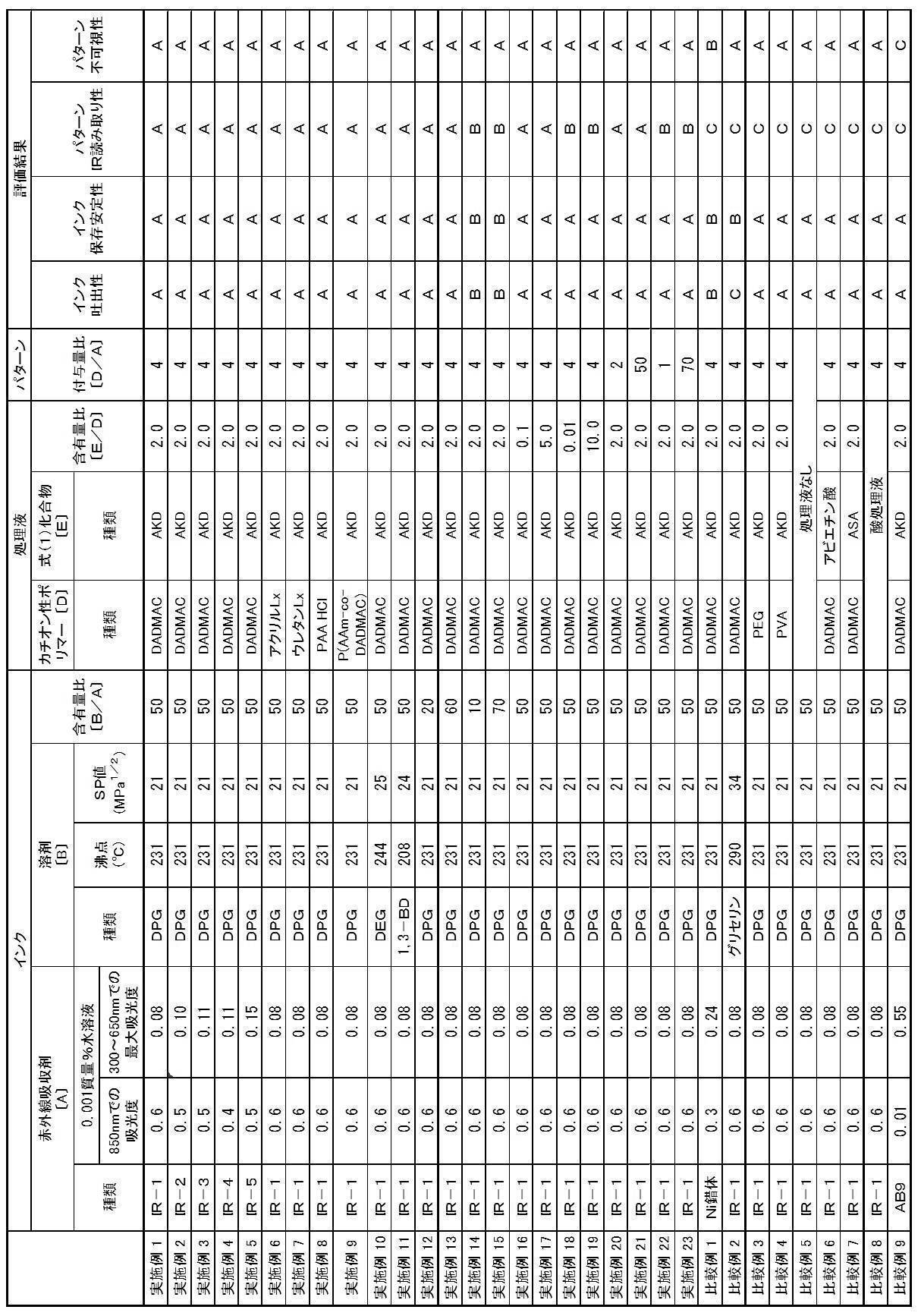
-表1中の特定赤外線吸収剤-
IR-1 … 上記例示化合物(IR-1)〔QCR Solutions Co.製「T084511」〕
IR-2 … 上記例示化合物(IR-2)〔QCR Solutions Co.製「T084621」〕
IR-3 … 上記例示化合物(IR-3)
IR-4 … 上記例示化合物(IR-4)
IR-5 … 上記例示化合物(IR-5)
IR-1 … 上記例示化合物(IR-1)〔QCR Solutions Co.製「T084511」〕
IR-2 … 上記例示化合物(IR-2)〔QCR Solutions Co.製「T084621」〕
IR-3 … 上記例示化合物(IR-3)
IR-4 … 上記例示化合物(IR-4)
IR-5 … 上記例示化合物(IR-5)
-表1中、「赤外線吸収剤」欄に示した比較化合物(比較例)-
Ni錯体 …下記の化合物〔SIGMA-ALDRICH社製〕
AB9 … Acid blue 9(東京化成(株)製、CAS番号3844-45-9)
Ni錯体 …下記の化合物〔SIGMA-ALDRICH社製〕
AB9 … Acid blue 9(東京化成(株)製、CAS番号3844-45-9)

-表1中の溶剤-
DPG … ジプロピレングリコール
DEG … ジエチレングリコール
1,3-BD … 1,3-ブタンジオール
DPG … ジプロピレングリコール
DEG … ジエチレングリコール
1,3-BD … 1,3-ブタンジオール
-表1中のカチオン性ポリマー-
本実施例では、処理液の調製に、カチオン性ポリマーの水溶液の市販品、又は、カチオン性ポリマーの水分散液(ラテックス)の市販品を用いた。言うまでもないが、本実施例における「カチオン性ポリマーの含有量」は、処理液の全量に対する、カチオン性ポリマーの水溶液中の固形分の量、又は、処理液の全量に対する、カチオン性ポリマーの水分散液中の固形分の量を意味する。
以下の製品名は、カチオン性ポリマーの水溶液又はカチオン性ポリマーの水分散液の製品名である。
本実施例では、処理液の調製に、カチオン性ポリマーの水溶液の市販品、又は、カチオン性ポリマーの水分散液(ラテックス)の市販品を用いた。言うまでもないが、本実施例における「カチオン性ポリマーの含有量」は、処理液の全量に対する、カチオン性ポリマーの水溶液中の固形分の量、又は、処理液の全量に対する、カチオン性ポリマーの水分散液中の固形分の量を意味する。
以下の製品名は、カチオン性ポリマーの水溶液又はカチオン性ポリマーの水分散液の製品名である。
DADMAC … ポリ(ジアリルジメチルアンモニウムクロライド)〔センカ(株)製「ユニセンスFPA1002L」〕Mw50×104
アクリルLx … カチオン性基を有するアクリルポリマー〔大成ファインケミカル(株)製「アクリットUW-319SX」(アクリルラテックス)〕Mw1.0×104
ウレタンLx … カチオン性基を有するウレタンポリマー〔明成化学工業(株)製「パスコールJK-870」(ウレタンラテックス))Mw1.0×104
PAA HCL … ポリ(アリルアミンハイドロクロライド)〔ニットーボーメディカル(株)製「PAA-HCL-10L」〕Mw30×104
P(AAm-co-DADMAC)… アクリルアミド-ジアリルジメチルアンモニウムクロライド共重合体〔センカ(株)製「コスモートVH VHL」〕Mw50×104
アクリルLx … カチオン性基を有するアクリルポリマー〔大成ファインケミカル(株)製「アクリットUW-319SX」(アクリルラテックス)〕Mw1.0×104
ウレタンLx … カチオン性基を有するウレタンポリマー〔明成化学工業(株)製「パスコールJK-870」(ウレタンラテックス))Mw1.0×104
PAA HCL … ポリ(アリルアミンハイドロクロライド)〔ニットーボーメディカル(株)製「PAA-HCL-10L」〕Mw30×104
P(AAm-co-DADMAC)… アクリルアミド-ジアリルジメチルアンモニウムクロライド共重合体〔センカ(株)製「コスモートVH VHL」〕Mw50×104
-表1中、「カチオン性ポリマー」欄に示した比較ポリマー(比較例)-
PEG … ポリエチレングリコール〔東京化成工業(株)製「Polyethylene Glycol 6000」〕Mw50×104
PVA … ポリビニルアルコール〔東京化成工業(株)製「Poly(vinyl Alcohol) n≒2,000」〕Mw50×104
PEG … ポリエチレングリコール〔東京化成工業(株)製「Polyethylene Glycol 6000」〕Mw50×104
PVA … ポリビニルアルコール〔東京化成工業(株)製「Poly(vinyl Alcohol) n≒2,000」〕Mw50×104
-表1中の式(1)化合物-
AKD … アルキルケテンダイマー〔式(1)中、R1及びR2が、いずれも炭素数14のアルキル基である化合物;荒川化学工業(株)製「サイズパインK-921」〕
AKD … アルキルケテンダイマー〔式(1)中、R1及びR2が、いずれも炭素数14のアルキル基である化合物;荒川化学工業(株)製「サイズパインK-921」〕
-表1中、「式(1)化合物」欄に示した比較化合物(比較例)-
ASA … アルケニル無水コハク酸〔比較化合物;荒川化学工業(株)製「サイズパインSA-864」〕
ASA … アルケニル無水コハク酸〔比較化合物;荒川化学工業(株)製「サイズパインSA-864」〕
表1に示すように、特定赤外線吸収剤(シアニン骨格を有する赤外線吸収剤)、特定溶剤(沸点が200℃以上でありSP値が18MPa1/2~26MPa1/2である溶剤)、及び水を含有するインクと、カチオン性ポリマー、式(1)化合物、及び水を含有する処理液と、を含むインクセットを用いた実施例1~21は、インクの吐出性及び保存安定性に優れ、赤外線吸収パターンのIR読み取り性及び不可視性に優れていた。
これに対し、インク中の特定赤外線吸収剤を比較化合物(Ni錯体、AB9)に変更した比較例1及び9、処理液中のカチオン性ポリマーを比較ポリマー(PEG、PVA)に変更した比較例3及び4、処理液を用いなかった比較例5、処理液中の式(1)化合物を比較化合物(アビエチン酸、ASA)に変更した比較例6及び7、並びに、処理液をカチオン性ポリマーを含まない酸処理液に変更した比較例8では、いずれも赤外線吸収パターンのIR読み取り性が低下した。
また、インク中の溶剤を、SP値が26MPa1/2超であるグリセリンに変更した比較例2でも、赤外線吸収パターンのIR読み取り性が低下した。赤外線吸収パターンのIR読み取り性が低下した理由は、インクの吐出性が低下したことにより、赤外線吸収パターンを構成するドットパターンにバラつき(形状、濃度等のバラつき)が生じたためと考えられる。
また、インク中の溶剤を、SP値が26MPa1/2超であるグリセリンに変更した比較例2でも、赤外線吸収パターンのIR読み取り性が低下した。赤外線吸収パターンのIR読み取り性が低下した理由は、インクの吐出性が低下したことにより、赤外線吸収パターンを構成するドットパターンにバラつき(形状、濃度等のバラつき)が生じたためと考えられる。
2015年9月30日出願の日本特許出願第2015-195139号公報は、その開示全体がここに参照文献として組み込まれるものである。
本明細書に記述された全ての刊行物や特許出願、並びに技術標準は、それら個々の刊行物や特許出願、並びに技術標準が引用文献として特別に、そして個々に組み込むことが指定されている場合には、該引用文献と同じ限定範囲においてここに組み込まれるものである。本発明の範囲は下記特許請求の範囲及びその等価物に拠って決定されることを企図するものである。
本明細書に記述された全ての刊行物や特許出願、並びに技術標準は、それら個々の刊行物や特許出願、並びに技術標準が引用文献として特別に、そして個々に組み込むことが指定されている場合には、該引用文献と同じ限定範囲においてここに組み込まれるものである。本発明の範囲は下記特許請求の範囲及びその等価物に拠って決定されることを企図するものである。
Claims (13)
- シアニン骨格を有する赤外線吸収剤、沸点が200℃以上でありSP値が18MPa1/2~26MPa1/2である溶剤、及び水を含有する赤外線吸収パターン形成用インクと、
カチオン性ポリマー、式(1)で表される化合物、及び水を含有する処理液と、
を含む赤外線吸収パターン形成用インクセット。

式(1)中、R1及びR2は、それぞれ独立に、炭素数10~14のアルキル基を表す。 - 前記赤外線吸収パターン形成用インクにおいて、前記溶剤の含有量が、前記赤外線吸収剤の含有量に対し、質量基準で10倍~70倍である請求項1に記載の赤外線吸収パターン形成用インクセット。
- 前記赤外線吸収パターン形成用インクにおいて、前記溶剤の含有量が、前記赤外線吸収剤の含有量に対し、質量基準で20倍~60倍である請求項1又は請求項2に記載の赤外線吸収パターン形成用インクセット。
- 前記処理液において、前記式(1)で表される化合物の含有量が、前記カチオン性ポリマーの含有量に対し、質量基準で0.01倍~10.0倍である請求項1~請求項3のいずれか1項に記載の赤外線吸収パターン形成用インクセット。
- 前記処理液において、前記式(1)で表される化合物の含有量が、前記カチオン性ポリマーの含有量に対し、質量基準で0.1倍~5.0倍である請求項1~請求項4のいずれか1項に記載の赤外線吸収パターン形成用インクセット。
- 前記赤外線吸収剤が、カチオンと下記式(X)で表されるアニオンとの塩、又は、アニオンと下記式(Y)で表されるカチオンとの塩である請求項1~請求項5のいずれか1項に記載の赤外線吸収パターン形成用インクセット。
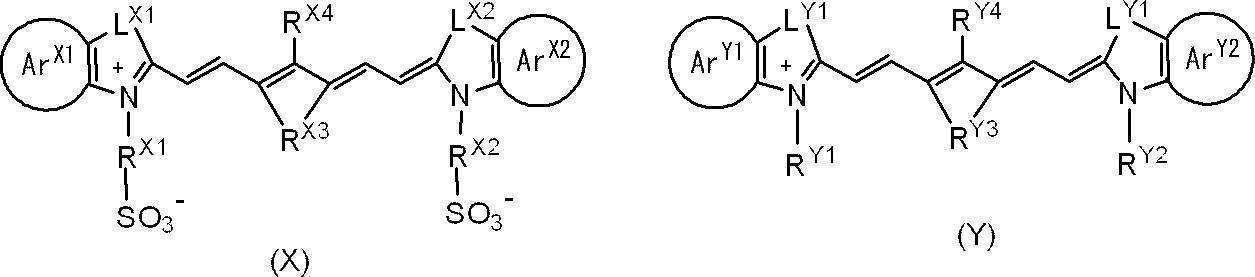
式(X)中、ArX1及びArX2は、それぞれ独立に、炭素数1~6のアルコキシ基によって置換されていてもよいベンゼン環、又は炭素数1~6のアルコキシ基によって置換されていてもよいナフタレン環を表す。LX1及びLX2は、それぞれ独立に、-C(CH3)2-基又は-S-基を表す。RX1及びRX2は、それぞれ独立に、炭素数1~6のアルキレン基を表し、RX3は、-(CH2)nx-基を表し、nxは、2又は3を表し、RX4は、ハロゲン原子、炭素数1~6のアルコキシ基、フェノキシ基、炭素数1~6のアルキルチオ基、又はフェニルチオ基を表す。
式(Y)中、ArY1及びArY2は、それぞれ独立に、炭素数1~6のアルコキシ基によって置換されていてもよいベンゼン環、又は炭素数1~6のアルコキシ基によって置換されていてもよいナフタレン環を表す。LY1及びLY2は、それぞれ独立に、-C(CH3)2-基又は-S-基を表す。RY1及びRY2は、それぞれ独立に、炭素数1~6のアルキル基を表し、RY3は、-(CH2)ny-基を表し、nyは、2又は3を表し、RY4は、ハロゲン原子、炭素数1~6のアルコキシ基、フェノキシ基、炭素数1~6のアルキルチオ基、又はフェニルチオ基を表す。 - 前記赤外線吸収パターン形成用インクにおける前記赤外線吸収剤の含有量が、0.1質量%~3質量%である請求項1~請求項6のいずれか1項に記載の赤外線吸収パターン形成用インクセット。
- 前記処理液における前記カチオン性ポリマーの含有量が、1質量%~10質量%である請求項1~請求項7のいずれか1項に記載の赤外線吸収パターン形成用インクセット。
- 前記赤外線吸収パターン形成用インクにおける着色剤の含有量が0.1質量%未満であり、
前記処理液における着色剤の含有量が0.1質量%未満である請求項1~請求項8のいずれか1項に記載の赤外線吸収パターン形成用インクセット。 - 前記赤外線吸収パターン形成用インクが、更にアセチレングリコール系界面活性剤を含む、請求項1~請求項9のいずれか1項に記載の赤外線吸収パターン形成用インクセット。
- 請求項1~請求項10のいずれか1項に記載の赤外線吸収パターン形成用インクセットが用いられ、
前記処理液を基材上に付与する処理液付与工程と、
前記基材の前記処理液が付与された面に前記赤外線吸収パターン形成用インクをインクジェット法によって付与することにより、赤外線吸収パターンを形成するインク付与工程と、
を有する赤外線吸収パターン形成方法。 - 前記赤外線吸収パターンにおいて、前記カチオン性ポリマーの単位面積当たりの付与量が、前記赤外線吸収剤の単位面積当たりの付与量に対し、質量基準で1倍~70倍である請求項11に記載の赤外線吸収パターン形成方法。
- 前記赤外線吸収パターンにおいて、前記カチオン性ポリマーの単位面積当たりの付与量が、前記赤外線吸収剤の単位面積当たりの付与量に対し、質量基準で2倍~50倍である請求項11又は請求項12に記載の赤外線吸収パターン形成方法。
Applications Claiming Priority (2)
| Application Number | Priority Date | Filing Date | Title |
|---|---|---|---|
| JP2015-195139 | 2015-09-30 | ||
| JP2015195139 | 2015-09-30 |
Publications (1)
| Publication Number | Publication Date |
|---|---|
| WO2017056760A1 true WO2017056760A1 (ja) | 2017-04-06 |
Family
ID=58423179
Family Applications (1)
| Application Number | Title | Priority Date | Filing Date |
|---|---|---|---|
| PCT/JP2016/073861 Ceased WO2017056760A1 (ja) | 2015-09-30 | 2016-08-15 | 赤外線吸収パターン形成用インクセット、及び、赤外線吸収パターン形成方法 |
Country Status (1)
| Country | Link |
|---|---|
| WO (1) | WO2017056760A1 (ja) |
Cited By (5)
| Publication number | Priority date | Publication date | Assignee | Title |
|---|---|---|---|---|
| WO2020202774A1 (ja) | 2019-03-29 | 2020-10-08 | 富士フイルム株式会社 | 赤外線吸収画像形成用インクジェットインク、赤外線吸収画像形成方法、及び記録物 |
| CN112739545A (zh) * | 2018-09-28 | 2021-04-30 | 富士胶片株式会社 | 喷墨记录方法 |
| CN113165008A (zh) * | 2018-12-07 | 2021-07-23 | 花王株式会社 | 涂膜的形成方法 |
| CN113337170A (zh) * | 2020-02-18 | 2021-09-03 | 东京应化工业株式会社 | 固化性组合物、固化物、近红外线吸收滤光器及其制造方法 |
| US11434383B2 (en) | 2018-02-21 | 2022-09-06 | Fujifilm Corporation | Ink composition for ink jet printing, image forming method, and recorded material |
Citations (5)
| Publication number | Priority date | Publication date | Assignee | Title |
|---|---|---|---|---|
| JPH04325286A (ja) * | 1991-04-25 | 1992-11-13 | Fuji Photo Film Co Ltd | 感熱記録材料 |
| JP2004058680A (ja) * | 2002-07-30 | 2004-02-26 | Hewlett-Packard Development Co Lp | インクジェット印刷用のインクセット |
| JP2012111845A (ja) * | 2010-11-24 | 2012-06-14 | Ricoh Co Ltd | インクジェット用前処理液、並びに、インクジェット記録方法及びインクジェット記録物 |
| JP2014047303A (ja) * | 2012-08-31 | 2014-03-17 | Fujifilm Corp | インク組成物および画像形成方法 |
| WO2015050098A1 (ja) * | 2013-10-04 | 2015-04-09 | 王子ホールディングス株式会社 | 感熱記録体 |
-
2016
- 2016-08-15 WO PCT/JP2016/073861 patent/WO2017056760A1/ja not_active Ceased
Patent Citations (5)
| Publication number | Priority date | Publication date | Assignee | Title |
|---|---|---|---|---|
| JPH04325286A (ja) * | 1991-04-25 | 1992-11-13 | Fuji Photo Film Co Ltd | 感熱記録材料 |
| JP2004058680A (ja) * | 2002-07-30 | 2004-02-26 | Hewlett-Packard Development Co Lp | インクジェット印刷用のインクセット |
| JP2012111845A (ja) * | 2010-11-24 | 2012-06-14 | Ricoh Co Ltd | インクジェット用前処理液、並びに、インクジェット記録方法及びインクジェット記録物 |
| JP2014047303A (ja) * | 2012-08-31 | 2014-03-17 | Fujifilm Corp | インク組成物および画像形成方法 |
| WO2015050098A1 (ja) * | 2013-10-04 | 2015-04-09 | 王子ホールディングス株式会社 | 感熱記録体 |
Cited By (10)
| Publication number | Priority date | Publication date | Assignee | Title |
|---|---|---|---|---|
| US11434383B2 (en) | 2018-02-21 | 2022-09-06 | Fujifilm Corporation | Ink composition for ink jet printing, image forming method, and recorded material |
| CN112739545A (zh) * | 2018-09-28 | 2021-04-30 | 富士胶片株式会社 | 喷墨记录方法 |
| US20210206175A1 (en) * | 2018-09-28 | 2021-07-08 | Fujifilm Corporation | Ink jet recording method |
| US12097714B2 (en) * | 2018-09-28 | 2024-09-24 | Fujifilm Corporation | Ink jet recording method |
| CN113165008A (zh) * | 2018-12-07 | 2021-07-23 | 花王株式会社 | 涂膜的形成方法 |
| CN113165008B (zh) * | 2018-12-07 | 2022-12-23 | 花王株式会社 | 涂膜的形成方法 |
| US11866600B2 (en) | 2018-12-07 | 2024-01-09 | Kao Corporation | Method for forming coating film |
| WO2020202774A1 (ja) | 2019-03-29 | 2020-10-08 | 富士フイルム株式会社 | 赤外線吸収画像形成用インクジェットインク、赤外線吸収画像形成方法、及び記録物 |
| CN113337170A (zh) * | 2020-02-18 | 2021-09-03 | 东京应化工业株式会社 | 固化性组合物、固化物、近红外线吸收滤光器及其制造方法 |
| CN113337170B (zh) * | 2020-02-18 | 2024-04-05 | 东京应化工业株式会社 | 固化性组合物、固化物、近红外线吸收滤光器及其制造方法 |
Similar Documents
| Publication | Publication Date | Title |
|---|---|---|
| WO2017056760A1 (ja) | 赤外線吸収パターン形成用インクセット、及び、赤外線吸収パターン形成方法 | |
| WO2011021591A1 (en) | Image forming method, and image formed matter | |
| JP7145356B1 (ja) | 前処理インク及びこれを含むインクセット | |
| CN116635240B (zh) | 喷墨用处理液、使用该处理液的墨液组以及印花方法 | |
| US6585365B1 (en) | Paper coating for ink jet printing | |
| EP2199096A1 (en) | Image forming method | |
| US9862850B2 (en) | Ink composition, and recorded matter, recording method and recording apparatus using the same | |
| JP2020138454A (ja) | 印刷物の製造方法 | |
| JP7169481B1 (ja) | 水性インク及びこれを含むインクセット | |
| JP2024054184A (ja) | インクジェット用処理液、及び、インクジェット捺染装置 | |
| US6528119B1 (en) | Paper coating for ink jet printing | |
| WO2026048906A1 (ja) | インク用分散体、インク、インクセット、及びインクの製造方法 | |
| CN114302812A (zh) | 印刷方法 | |
| US12281232B2 (en) | Treatment liquid and recording method | |
| JPWO2020179301A1 (ja) | インクセット及び画像記録方法 | |
| JP6031815B2 (ja) | インクジェット記録装置 | |
| WO2023276973A1 (ja) | オーバーコートインク及びこれを含むインクセット | |
| JP2011231294A (ja) | インクジェットインク | |
| WO2020235367A1 (ja) | インクジェットインク組成物、およびインクジェット記録方法 | |
| US10759192B2 (en) | Pre-treatment fixing fluid | |
| JP7471457B2 (ja) | カチオン性重合体ナノ粒子 | |
| JP2015227460A (ja) | インクジェット記録用水性インクセット、インクジェット記録方法及びインクジェット記録装置 | |
| JP2025076978A (ja) | インクジェット用水性顔料分散体、及び、水性インクジェットインキ | |
| JP2024099341A (ja) | インクジェットインク組成物及び記録方法 | |
| JP2012207061A (ja) | インクジェット記録用水性インクセット、インクジェット記録方法及びインクジェット記録装置 |
Legal Events
| Date | Code | Title | Description |
|---|---|---|---|
| 121 | Ep: the epo has been informed by wipo that ep was designated in this application |
Ref document number: 16850937 Country of ref document: EP Kind code of ref document: A1 |
|
| NENP | Non-entry into the national phase |
Ref country code: DE |
|
| 122 | Ep: pct application non-entry in european phase |
Ref document number: 16850937 Country of ref document: EP Kind code of ref document: A1 |
|
| NENP | Non-entry into the national phase |
Ref country code: JP |