WO2017034022A1 - カプセル剤及び構造物 - Google Patents
カプセル剤及び構造物 Download PDFInfo
- Publication number
- WO2017034022A1 WO2017034022A1 PCT/JP2016/074986 JP2016074986W WO2017034022A1 WO 2017034022 A1 WO2017034022 A1 WO 2017034022A1 JP 2016074986 W JP2016074986 W JP 2016074986W WO 2017034022 A1 WO2017034022 A1 WO 2017034022A1
- Authority
- WO
- WIPO (PCT)
- Prior art keywords
- capsule
- liquid
- outer shell
- expansion
- central portion
- Prior art date
- Legal status (The legal status is an assumption and is not a legal conclusion. Google has not performed a legal analysis and makes no representation as to the accuracy of the status listed.)
- Ceased
Links
Images


Classifications
-
- C—CHEMISTRY; METALLURGY
- C04—CEMENTS; CONCRETE; ARTIFICIAL STONE; CERAMICS; REFRACTORIES
- C04B—LIME, MAGNESIA; SLAG; CEMENTS; COMPOSITIONS THEREOF, e.g. MORTARS, CONCRETE OR LIKE BUILDING MATERIALS; ARTIFICIAL STONE; CERAMICS; REFRACTORIES; TREATMENT OF NATURAL STONE
- C04B20/00—Use of materials as fillers for mortars, concrete or artificial stone according to more than one of groups C04B14/00 - C04B18/00 and characterised by shape or grain distribution; Treatment of materials according to more than one of the groups C04B14/00 - C04B18/00 specially adapted to enhance their filling properties in mortars, concrete or artificial stone; Expanding or defibrillating materials
- C04B20/10—Coating or impregnating
- C04B20/1018—Coating or impregnating with organic materials
- C04B20/1029—Macromolecular compounds
- C04B20/1037—Macromolecular compounds obtained otherwise than by reactions only involving carbon-to-carbon unsaturated bonds
-
- C—CHEMISTRY; METALLURGY
- C04—CEMENTS; CONCRETE; ARTIFICIAL STONE; CERAMICS; REFRACTORIES
- C04B—LIME, MAGNESIA; SLAG; CEMENTS; COMPOSITIONS THEREOF, e.g. MORTARS, CONCRETE OR LIKE BUILDING MATERIALS; ARTIFICIAL STONE; CERAMICS; REFRACTORIES; TREATMENT OF NATURAL STONE
- C04B20/00—Use of materials as fillers for mortars, concrete or artificial stone according to more than one of groups C04B14/00 - C04B18/00 and characterised by shape or grain distribution; Treatment of materials according to more than one of the groups C04B14/00 - C04B18/00 specially adapted to enhance their filling properties in mortars, concrete or artificial stone; Expanding or defibrillating materials
- C04B20/10—Coating or impregnating
- C04B20/1018—Coating or impregnating with organic materials
- C04B20/1029—Macromolecular compounds
- C04B20/1033—Macromolecular compounds obtained by reactions only involving carbon-to-carbon unsaturated bonds
-
- C—CHEMISTRY; METALLURGY
- C04—CEMENTS; CONCRETE; ARTIFICIAL STONE; CERAMICS; REFRACTORIES
- C04B—LIME, MAGNESIA; SLAG; CEMENTS; COMPOSITIONS THEREOF, e.g. MORTARS, CONCRETE OR LIKE BUILDING MATERIALS; ARTIFICIAL STONE; CERAMICS; REFRACTORIES; TREATMENT OF NATURAL STONE
- C04B20/00—Use of materials as fillers for mortars, concrete or artificial stone according to more than one of groups C04B14/00 - C04B18/00 and characterised by shape or grain distribution; Treatment of materials according to more than one of the groups C04B14/00 - C04B18/00 specially adapted to enhance their filling properties in mortars, concrete or artificial stone; Expanding or defibrillating materials
- C04B20/10—Coating or impregnating
- C04B20/1051—Organo-metallic compounds; Organo-silicon compounds, e.g. bentone
-
- C—CHEMISTRY; METALLURGY
- C04—CEMENTS; CONCRETE; ARTIFICIAL STONE; CERAMICS; REFRACTORIES
- C04B—LIME, MAGNESIA; SLAG; CEMENTS; COMPOSITIONS THEREOF, e.g. MORTARS, CONCRETE OR LIKE BUILDING MATERIALS; ARTIFICIAL STONE; CERAMICS; REFRACTORIES; TREATMENT OF NATURAL STONE
- C04B28/00—Compositions of mortars, concrete or artificial stone, containing inorganic binders or the reaction product of an inorganic and an organic binder, e.g. polycarboxylate cements
- C04B28/02—Compositions of mortars, concrete or artificial stone, containing inorganic binders or the reaction product of an inorganic and an organic binder, e.g. polycarboxylate cements containing hydraulic cements other than calcium sulfates
-
- C—CHEMISTRY; METALLURGY
- C04—CEMENTS; CONCRETE; ARTIFICIAL STONE; CERAMICS; REFRACTORIES
- C04B—LIME, MAGNESIA; SLAG; CEMENTS; COMPOSITIONS THEREOF, e.g. MORTARS, CONCRETE OR LIKE BUILDING MATERIALS; ARTIFICIAL STONE; CERAMICS; REFRACTORIES; TREATMENT OF NATURAL STONE
- C04B2103/00—Function or property of ingredients for mortars, concrete or artificial stone
- C04B2103/0045—Polymers chosen for their physico-chemical characteristics
- C04B2103/0051—Water-absorbing polymers, hydrophilic polymers
-
- C—CHEMISTRY; METALLURGY
- C04—CEMENTS; CONCRETE; ARTIFICIAL STONE; CERAMICS; REFRACTORIES
- C04B—LIME, MAGNESIA; SLAG; CEMENTS; COMPOSITIONS THEREOF, e.g. MORTARS, CONCRETE OR LIKE BUILDING MATERIALS; ARTIFICIAL STONE; CERAMICS; REFRACTORIES; TREATMENT OF NATURAL STONE
- C04B2111/00—Mortars, concrete or artificial stone or mixtures to prepare them, characterised by specific function, property or use
- C04B2111/72—Repairing or restoring existing buildings or building materials
Definitions
- the present invention relates to a capsule that exerts a function by utilizing the expansibility to a liquid, and a structure using the capsule.
- a cement composition containing bentonite is used to prevent the occurrence of cracks and the like before hardening of mortar or concrete (see, for example, Patent Document 1).
- This bentonite is a material that swells (swells) significantly by absorbing water.
- the present inventor solves the above-mentioned problems by coating a material capable of expanding with respect to the liquid using a material capable of inducing expansion with respect to the liquid. I found it to be done.
- the capsule according to one embodiment of the present invention has a core including a material that expands with respect to the liquid, and a surface covering the core and the liquid And a shell comprising a material capable of inducing an expansion of the central portion with respect to the
- the structure of an embodiment of the present invention comprises a structural material and one or more capsules.
- the capsule comprises a core comprising a material which expands with respect to the liquid, and an outer shell which covers the surface of the core and which is capable of inducing expansion of the core with respect to the liquid.
- a material that expands with respect to a liquid is a material that has the property of expanding itself with respect to a liquid. That is, the materials described herein are materials that can increase their volume due to contact with a liquid.
- a material capable of inducing the expansion of the central part to the liquid refers to the liquid that covers the material expanding with respect to the liquid by utilizing any phenomenon (cause) involving the outer shell part
- a material capable of inducing the expansion of the expanding material is not particularly limited, but, for example, expansion, melting (melting), cracking (cleavage), deformation, swelling, dissolution and liquid caused by heat, friction, pressure and contact with liquid, etc. Dispersion or the like of any one or two or more.
- the central part contains a material that expands with respect to the liquid, and the shell covering the central part can induce expansion of the central part with respect to the liquid Contains materials that are. Therefore, the function utilizing the expansivity to liquid can be exhibited effectively.
- the structure of the present invention comprises a structural material and one or more capsules having the same structure as that of the above-mentioned capsule of the present invention. Therefore, it is possible to effectively exhibit the function of the capsule that utilizes the expansibility to liquid.
- Capsule agent 1-1 Configuration 1-2. Function 1-3. Manufacturing method 1-4. Action and effect 2.
- Capsule agent> The capsule of one embodiment of the present invention will be described.
- the capsule agent described here is a restorative agent having a function of repairing breakage of the structure by being used in a state of being contained in any structure. Thereby, the structure containing the capsule will have a so-called self-repairing function by utilizing the reparing function of the capsule.
- the above-mentioned "structure” is an object that needs to be maintained so that its physical properties do not deteriorate too much after manufacturing for some purpose, and the physical properties are, for example, shape and strength etc. is there.
- Frailure of the structure means, for example, that a crack (such as a crack) or the like occurs in the vicinity of the surface of the structure due to one or both of the internal stress and the external stress. As the physical properties of the structure are degraded due to this failure, as described above, the structure needs to be repaired by the capsule.
- the structure contains one or more capsules.
- the plurality of capsules be dispersed in the structure. This is because the capsule is likely to exert the repair function independently of the position of breakage of the structure. That is, if a plurality of capsules are dispersedly disposed in the structure, the possibility of utilizing the repairing function of the capsule is high, regardless of where the structure breaks.
- the application of the capsule agent is not particularly limited as long as it is an application that requires repair of breakage in the middle of use of the structure after the structure is manufactured.
- the application of the capsule is mainly determined according to the application of the structure and the like.
- capsules are used in construction applications, revetment applications and the like.
- the capsule is contained in the structural material used to manufacture the structure, as described below.
- the structure including the capsule in the structural material has the function of self-repairing utilizing the repair function of the capsule, as described above.
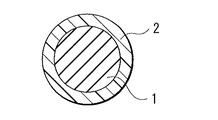
- FIG. 1 shows the cross-sectional configuration of the capsule.
- the capsule comprises a central portion 1 and an outer portion 2. That is, the capsule has a structure (capsule structure) in which a main body (central portion 1) which substantially exerts a repairing function is accommodated inside the hollow structure (outer shell portion 2).
- the shape of the capsule preparation is not particularly limited, and is, for example, spherical, plate-like, massive or the like.
- FIG. 1 shows, for example, the case where the shape of the capsule is spherical.
- the dimensions of the capsule are not particularly limited.
- the average particle size (volume average particle size) of the capsule is about 50 ⁇ m to 50 mm.
- the central portion 1 is a core of a so-called capsule, and contains any one kind or two or more kinds of a material that expands with respect to a liquid (hereinafter, referred to as “expansive material”).
- this "expansible material” is a material having the property of expanding itself to liquid, and more specifically, increases its volume due to contact with liquid. It is a material that can At the time of use of this capsule, as described later, the outer shell 2 induces expansion of the central portion 1 (intumescent material) with respect to the liquid, whereby the expandable material can be expanded. Thereby, the reparative function of the capsule is exhibited by utilizing the expansion phenomenon of the expandable material.
- the type of liquid described above is not particularly limited as long as it is any one type or two or more types of the liquid capable of expanding the expandable material.
- the type of liquid is mainly determined according to the application of the structure including the capsule.
- the liquid in the case where the capsule is contained in a structure such as a building application and a revetment application is, for example, water and the like.
- the “water” described here is, for example, water that may come in contact with a structure, and specifically, is rainwater, seawater, or the like.
- the intumescent material will, for example, expand with respect to water.
- the intumescent material may be a material that absorbs liquid (liquid absorbing material), a material that chemically reacts with liquid (reactive material), or a material that utilizes other phenomena. It may be a mixture of any two or more of those materials.
- the volume of the liquid-absorbent material is increased compared to the state before the liquid is absorbed.
- the volume of the reactive material increases compared to the state prior to reacting chemically with the liquid.
- the type of chemical reaction that induces this expansion is not particularly limited, and examples thereof include a foaming reaction and a hydration reaction.
- the expandable material is preferably a liquid-absorbent material. This is because the volume of the intumescent material is sufficiently increased by using a simple liquid absorption phenomenon. In addition, because the chemical reaction is not used, the capsule and the structure are not affected by the chemical reaction.
- the type of liquid absorbent material is not particularly limited as long as it is a material that can expand due to absorption of liquid.
- the liquid-absorbent material water-absorbent material
- the liquid-absorbent material that expands due to absorption of the water is, for example, water-absorbent (water-expandable) clay and water-absorbent high It contains molecular compounds and the like.
- the water-absorbing clay is, for example, bentonite.
- This bentonite is a generic term for clay containing montmorillonite as a main component.
- the type of bentonite is not particularly limited, and examples thereof include sodium bentonite (sodium bentonite) and calcium bentonite (calcium bentonite).
- the water-absorbing polymer compound includes, for example, polyalkylene oxide, polyacrylic acid, polyacrylamide, polyvinyl alcohol, polysaccharides, water-swellable rubber, starch, cellulose, maleic anhydride, polysulfonic acid, polyaspartic acid, polyglutamic acid, polyalginic acid And their salts etc.
- the polyalkylene oxide is, for example, polyethylene oxide or the like.
- polysaccharides are, for example, guar gum and diutan gum.
- the water-absorbing polymer compound may be any one or more of the above-described series of water-absorbing polymer compounds and one or more of the other polymer compounds. It may be a copolymer of
- the water absorbing material is preferably bentonite.
- bentonite has a very high affinity to water. This allows bentonite to absorb several times its own dry weight of water, so its bentonite volume increases significantly due to the absorption of water.
- bentonite has high thermal stability. Thereby, bentonite is less likely to be thermally degraded even when used in a high temperature environment.
- bentonite has high viscosity and tackiness when it is absorbed water. Thereby, bentonite is likely to be attached (fixed) to the surface or the like of the structure including the capsule agent in the expanded state due to the absorption of water.
- the shape of the central portion 1 is not particularly limited, and is, for example, spherical, plate-like, or massive.
- FIG. 1 shows, for example, the case where the shape of the central portion 1 is spherical.
- the dimensions of the central portion 1 are not particularly limited.
- the average particle diameter (volume average particle diameter) of the central portion 1 is about 10 ⁇ m to 30 mm.
- the outer shell 2 is a so-called capsule shell and covers the surface of the central portion 1.
- the outer shell 2 may be a single layer or a multilayer.
- the outer shell 2 preferably covers the entire surface of the central portion 1 in order to accommodate the central portion 1 inside the hollow structure as described above.
- the central portion 1 is preferably not exposed because it is completely covered by the outer shell 2.
- the structure is broken during a period when the structure is not yet broken, ie, from the start of the production of the structure to the start of use.
- the period up to time is called the "period before breakage”.
- the period after the structure is broken is referred to as "the period after breakage”.
- the “pre-failure period” means that the outer shell 2 has a central portion 1 (expansion of liquid) due to the initial covering state (immediately after production of the capsule) by the outer shell 2 being substantially maintained. It is a time during which the expandable material can not substantially expand, since it has not yet induced expansion of the material. As a result, in the pre-breaking period, the capsule can not exert a repair function utilizing the expansion of the expandable material.
- the “post-failure period” means that the outer shell 2 induces the expansion of the central portion 1 (expansible material) with respect to the liquid due to the change in the covering state by the outer shell 2. It is a time during which the intumescent material can substantially expand. Thereby, in the post-failure period, the capsule can exhibit a repairing function utilizing the expansion of the expandable material.
- the structure of the capsule is not immediately exerted from the manufacturing stage of the structure (period before breakage), but the structure It is desirable for the capsule to exert its reparative function only when it is broken after manufacture (period of failure). This is because, for example, when the capsule is used to repair the breakage of the structure, the capsule may come into contact with the liquid in both the pre-breaking period and the post-breaking period, but in the pre-breaking period. It is meaningless that the capsule has already exhibited the repair function, and it is necessary for the capsule to exhibit the repair function only after the breakage.
- concrete is mentioned as an example of a structural material used to manufacture a structure.
- a cement liquid green concrete
- the cement liquid is solidified (hardened).
- the intumescent material has water absorbability, the intumescent material absorbs water in the preparation step and during use (duration before breakage) of the cement liquid, and therefore the swelling material is already intumescent in the period before breakage.
- the material expands. This makes it possible to use the capsule repair function at the time of breakage of the concrete (the post-failure period), since the capsule agent exerts a repair function unintentionally during use, not during use of concrete. It disappears.
- the expansive material expands in the cement liquid, which makes it difficult to produce concrete using the cement liquid.
- the central portion 1 when the entire surface of the central portion 1 is covered with the outer shell 2, the central portion 1 is not yet exposed in the preparation of the cement liquid.
- the intumescent material has water absorbency, the intumescent material does not absorb water during the preparation process and use (period before breakage) of the cement liquid, so it is unintentional in the period before breakage Expansion of the intumescent material is prevented.
- the repairing function of the capsule agent can be maintained until the concrete is broken (period before breakage).
- the expansible material does not expand in the cement solution, so that concrete can be manufactured without problems using the cement solution.
- the outer shell portion 2 expands using a phenomenon that occurs due to the contact between the capsule agent and the rainwater or the like. Induces swelling of the sexual material.
- the outer shell 2 dissolves or swells at the time of breakage of the concrete (time period after breakage) after the start of use of the concrete, the expansible material expands because the expandable material first contacts with water. This makes it possible to utilize the capsule repair function when concrete breaks.
- the capsule repair function can be utilized at an appropriate timing such as when concrete breaks.
- the outer shell 2 is any one or two kinds of materials (hereinafter referred to as “expansion-inducing material”) capable of inducing expansion of the central portion 1 (intumescent material) with respect to the liquid. Includes the above.
- expansion-inducing material induces the expansion of the intumescent material to the liquid while covering the intumescent material by utilizing any phenomenon (cause) involving the outer shell 2 (control ) Is a material that can be
- the covering state of the outer shell 2 is not particularly limited. That is, since the outer shell portion 2 still covers the entire surface of the central portion 1, the central portion 1 may not be exposed. Alternatively, since the shell 2 covers only a part of the surface of the central portion 1, the central portion 1 may be partially exposed. Alternatively, since the outer shell 2 has completely disappeared, the entire surface of the central portion 1 may be exposed.
- the type of the expansion inducing material is not particularly limited as long as it is a material capable of inducing the expansion of the expandable material to the liquid.
- the type of phenomenon (hereinafter referred to as “expansion-inducing phenomenon") utilized by this expansion-inducing material to induce expansion of the intumescent material is not particularly limited, and may be a physical phenomenon or a chemical phenomenon. Both may be sufficient.
- the swelling-induced phenomenon is, for example, any one or more of any state change caused by any external source.
- Any source is, for example, heat, friction, pressure and contact with a liquid (eg, water etc.).
- the "arbitrary state change" is expansion, melting (melting), cracking (cleavage), deformation, cleavage, swelling, dissolution, dispersion in liquid, and the like.
- the expansion inducing material is, for example, any one or more kinds of polymer compounds (resins) capable of inducing expansion of the expandable material with respect to the liquid.
- the polymer compound may be a natural resin, a synthetic resin, or both.
- the expansion inducing material is, for example, a copolymer of styrene and butadiene (SBR resin), a copolymer of acrylonitrile, butadiene and styrene (ABS resin), a copolymer of acrylonitrile and styrene (AS resin) ), Polyethylene, polypropylene, polystyrene, polyalkylene oxide, polyalkylene glycol, polyvinyl alcohol, vinyl chloride resin, methacrylic resin, acrylic resin, polyacrylamide, polyamide, polycarbonate, polyacetal, polyester, polyphenylene ether, phenol resin, epoxy resin, melamine Resin, urea resin, alkyd resin, polyurethane resin, polytetrafluoroethylene (PTFE), copolymer of tetrafluoroethylene and perfluoroalkyl vinyl ether PFA), copolymer of tetrafluoroethylene and hexafluoropropylene
- the physical properties and the like of the respective polymer compounds may be made different.
- the physical property is, for example, one or more of molecular weight and hydrophilicity.
- the outer shell portion 2 mainly has four properties described below, in order to emphasize the role of the outer shell portion 2 described above.
- the shell 2 protects the central portion 1 even if the capsule is contained in the solution. It is desirable to continue. By protecting the central portion 1 with the outer shell 2 in the pre-breaking period, it is intended to prevent the intumescent material from expanding unintentionally.
- the “solution” described here is, for example, the above-described cement liquid or the like.
- the shell 2 fully induce the expansion of the core 1 (intumescent material) to the liquid when the structure breaks. This is for intentionally and positively expanding the central portion 1 (intumescent material) in the post-failure period.
- the extent to which the shell 2 induces the expansion of the central part 1 to the liquid is controlled according to any one or two or more conditions of the liquid temperature etc. It is desirable to be easy. This is because, depending on the type of the expansion-induced phenomenon, the induction speed of the shell 2 and the like are susceptible to the temperature of the liquid and the like.
- the time required for inducing the outer shell 2 may be influenced by, for example, the forming material of the outer shell 2 and the average thickness.
- the outer shell 2 is unlikely to inhibit the expansion phenomenon of the expandable material after inducing the expansion of the center 1 with respect to the liquid. If the expansion phenomenon of the intumescent material is inhibited, it is difficult to repair the breakage of the structure in the post-failure period.
- the average thickness of the outer shell 2 is not particularly limited, and is, for example, about 10 ⁇ m to 200 ⁇ m.
- the “average thickness” described here is, for example, an average value of the thickness of the outer shell 2 measured at any ten places after observing the cross section of the capsule using a microscope.
- the type of the microscope is not particularly limited, and is, for example, one or more of a scanning electron microscope (SEM) and the like.
- the outer shell 2 may further include one or more of other materials.
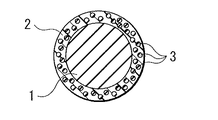
- FIG. 2 shows another cross-sectional configuration of the capsule, and corresponds to FIG.
- the other material is, for example, any one kind or two or more kinds of the plurality of particulate substances 3. It is because aggregation of particles in the middle of granulation is suppressed in a manufacturing process of capsule medicine (formation of outer shell part 2).
- the outer shell 2 includes a plurality of particulate substances 3, for example, since the plurality of particulate substances 3 are dispersed in the expansion inducing material, the dispersion inducing material disperses the plurality of particulate substances 3. It is maintained.
- the plurality of particulate substances 3 are so-called fillers, and include, for example, any one or two or more of inorganic materials and the like.
- the inorganic material is, for example, silicon oxide, talc, aluminum oxide and zeolite. Among them, silicon oxide and talc are preferable. This is because particles in the middle of granulation are less likely to aggregate.
- the plurality of particulate substances 3 are preferably dispersed, for example, in the outer shell 2.
- the shape of the plurality of particulate substances 3 is not particularly limited, and is, for example, one or more of spherical, plate-like, and block-like.
- FIG. 2 shows, for example, the case where the shapes of the plurality of particulate substances 3 are spherical.
- the dimensions of the plurality of particulate substances 3 are not particularly limited.
- the average particle diameter (volume average particle diameter) of the plurality of particulate materials 3 is about 0.1 ⁇ m to 100 ⁇ m.
- the content of the plurality of particulate substances 3 in the outer shell 2 is not particularly limited, but is preferably not extremely high. Specifically, the content of the plurality of particulate substances 3 in the outer shell 2 is, for example, about 10% by weight to 30% by weight. If the content of the plurality of particulate materials 3 is too large, the dissolution rate and the swelling rate of the shell 2 may be adversely affected.
- This additive is, for example, a film forming aid, an antiblocking agent, a coloring material, an antioxidant and a stabilizer.
- the film forming aid mainly plays a role of adjusting resin film formation.
- the antiblocking agent mainly has a function (antiblocking function) which suppresses aggregation of capsules.
- the colorant mainly plays a role of adjusting the color tone of the capsule, and includes, for example, any one or more of a pigment, a pigment and the like.
- the antioxidant mainly plays a role of improving the storage stability of the capsule.
- the stabilizer is, for example, an ultraviolet light absorber.
- This capsule functions as follows by being used in a state of being contained in a structure.
- the function of the capsule shown in FIG. 1 will be described.
- FIG. 3 shows a cross-sectional configuration corresponding to FIG. 1 in order to explain the function of the capsule.
- the central portion 1 (expandable material) is covered by the outer shell 2.
- the expandable material does not yet expand because the shell 2 (expansion-inducing material) can not induce the expansion of the expandable material to the liquid.
- the capsule repair function is maintained.
- the capsule may come in contact with the liquid (the solvent of the solution) in the solution. Even if the contact time between the capsule and the liquid is short, the outer shell 2 does not dissolve or swell until the core 1 actually contacts the liquid. In this way, the expandable material still does not expand, so that the capsule repair function is maintained. Moreover, even if the solution contains capsules, the capsules do not adversely affect the process of producing a structure using the solution.
- the shell 2 can induce expansion of the expandable material relative to the liquid so that the expandable material can expand.
- the swelling-inducing phenomenon is dissolution or swelling
- the outer shell 2 expansion-induced As part or all of the material dissolves or swells
- the central portion 1 comes in contact with the liquid.
- FIG. 3 shows, for example, the case where the entire outer shell 2 is dissolved.
- the expansible material expands, and the capsule repair function is exhibited.
- the capsule repair function is used to repair structure breakage.
- how long it takes for the capsule to take a repair function is, for example, the extent to which the outer shell 2 induces the expansion of the expandable material to the liquid, as described above. Therefore, it is determined according to one or more conditions of the temperature of the liquid or the like. This is because this condition affects the induction speed of the outer shell 2 and the like.
- the above-mentioned capsule is produced, for example, by the following procedure.
- the central portion 1 containing the intumescent material and the processing solution used to form the shell 2 are prepared.
- a treatment solution for example, after mixing an expansion inducing material, a solvent for dissolving the expansion inducing material, and a plurality of particulate substances 3 and the like as needed, the mixture is stirred. This results in a treatment solution as the expansion-inducing material is dissolved in the solvent or dispersed in the solvent so as to form an emulsion.
- the solvent is, for example, one or more of an aqueous solvent and an organic solvent, and is determined according to the type of the expansion inducing material and the like.
- the aqueous solvent is, for example, water and alcohol.
- the organic solvent is, for example, toluene, styrene, ethyl acetate, butyl acetate and hexane.
- the treatment solution is supplied to the surface of the central portion 1, the treatment solution is dried. Thereby, an outer shell 2 including an expansion inducing material is formed to cover the surface of the central portion 1.
- the process of forming the outer shell 2 may be repeated twice or more.
- the plurality of particulate substances 3 may be contained in the treatment solution, or the plurality of particulate substances 3 may not be contained in the treatment solution.
- the treatment solution is supplied to the surface of the central portion 1.
- the plurality of particulate materials 3 are separately charged into the treatment solution.
- the number of times of charging of the plurality of particulate substances 3 may be one or two or more.
- the method of forming the outer shell 2 is not particularly limited. Specifically, the method of supplying the treatment solution is, for example, any one or two or more of a coating method and a spray method.
- the type of apparatus used to form the outer shell 2 is not particularly limited, and is, for example, any one or more of high-speed mixer, spray-dry and fluidized bed granulation coating apparatus, etc. .
- the fluidized granular bed coating apparatus is preferably a rolling fluidized bed coating apparatus, a swirling fluidized bed coating apparatus, or the like.
- This fluidized bed granulation coating apparatus sprays a treatment solution on the surface of the central part 1 using a spray nozzle while flowing the central part 1 to be coated in a swirling manner inside the cylindrical rolling fluidized bed. It is an apparatus.
- the central portion 1 since the wind flows from the bottom to the top inside the rolling fluidized bed, the central portion 1 is wound up, so that the central portion 1 is given a movement in the vertical direction.
- the central portion 1 since the central portion 1 is rotated by rotation of the rotary plate, a lateral movement is given to the central portion 1.
- the central portion 1 flows in a swirling manner.
- the outer shell 2 is formed to have a uniform thickness.
- the average thickness of the shell 2 is tightly controlled, as the amount of application is easily and accurately controlled.
- the dimensions (volume average particle diameter etc.) of the capsule are also strictly controlled.
- the outer shell 2 containing the expansion inducing material covers the surface of the central part 1 containing the expandable material.
- the central portion 1 (expandable material) Is covered by the shell 2.
- the expandable material can not be expanded yet, and the capsule repair function is maintained when the capsule-containing structure is used.
- the outer shell 2 (expansion inducing material) induces the expansion of the expandable material to the liquid, so the expansion thereof Material expands.
- the capsule exerts a repair function, and the structure is repaired using the capsule repair function at an appropriate timing such as at the time of breakage of the structure.
- the outer shell 2 exerts the function of the central portion 1 at appropriate timing.
- the function of the capsule that utilizes the expansibility to liquid is utilized at an appropriate timing, the function of the capsule can be effectively exhibited.
- the capsule is used in a wide range of applications where it may come into contact with the liquid during use, so that the function of the capsule It can be exhibited effectively.
- the intumescent material contains one or both of the water-absorbing clay and the water-absorbing polymer compound, more specifically, if the intumescent material contains bentonite, the intumescent material is to water. A higher effect can be obtained because of the necessary and sufficient expansion.
- the structure is self-healing using the repair function of the capsule during use (at the time of breakage) of the structure. Be done. Therefore, the restoration function of the capsule can be effectively exhibited. Details of this will be described later.
- the application of the capsule preparation is not particularly limited, as described above, as long as it is required to be repaired in order to prevent deterioration of the structure or the like due to the breakage when the structure is broken.
- the application of the structure containing the capsule is an application in which the structure may come in contact with the liquid at the time of use Is preferred.
- the “structure” described here is a structure manufactured using a structural material such as concrete to be described later, and is, for example, a house or a building.
- FIG. 4 shows the cross-sectional structure of a structure using the capsule preparation of the present invention.
- the structure comprises a structural material 11 and one or more capsules 12.
- FIG. 4 the case where the number of the capsule agent 12 is two or more is shown. Further, in FIG. 4, in order to simplify the contents of the drawing, the case where the shape of the structural material is rectangular is shown, and the capsule 12 is schematically shown. However, the shape of the structure is not particularly limited.
- the structural material 11 is a main component of a structure, and includes, for example, any one or more kinds of materials generally used to produce a structure.
- the structural material 11 contains, for example, one or both of mortar and concrete.
- the mortar and concrete are formed, for example, by solidifying (hardening) a solution (cement fluid) containing cement.
- the capsule 12 has the same configuration as the capsule of the present invention described above. That is, as shown in FIGS. 1 and 2, the capsule 12 includes a central portion 1 containing an expandable material and an outer portion 2 containing an expansion inducing material.
- the number of capsules 12 may be one or two or more, and among them, two or more is preferable, and a sufficiently large number is more preferable. This is because the capsule 12 is likely to exert a repair function independently of the position of breakage of the structure.
- the two or more capsules 12 are preferably dispersed in the structural material 11. This is because the capsule 12 is more likely to exert the repair function, regardless of the position of breakage of the structure.
- the content of the capsule agent 12 in the structural material 11 is not particularly limited, it is easy to use the repair function of the capsule agent 12 while securing the physical characteristics (for example, strength etc.) of the structure. It is preferable to set.
- the content of the capsule 12 is preferably set so as to be compatible with the restoration probability of the structure by the capsule material 12 and the securing of the physical characteristics of the structure.
- the structure may further include one or more of other materials, depending on, for example, the type of the structural material 11 and the like.
- Additives in the case where the structural material 11 is mortar and concrete are, for example, a coagulant, a quick curing agent, a curing retarder, a dehydration reducing agent, a dispersing agent, a water reducing agent, a pH adjuster, and the like.
- the other material is, for example, another structural material (excluding the material corresponding to the structural material 11).
- Other structural materials in the case where the structural material 11 is concrete are, for example, gravel and reinforcing bars.
- the structure After manufacturing the structure, the structure is installed, for example, outdoors. At the time of use of this structure (period before breakage), as shown in FIG. 4, there is a possibility that the structure comes in contact with the liquid, since the plurality of encapsulants 12 are embedded in the structural material 11 Even the capsule 12 can not contact with the liquid.
- the liquid with which this structure may come in contact is, for example, rain water. In this case, even if the structure is exposed to rainwater or the like, the capsule material 12 can not come in contact with rainwater or the like, so that the capsule agent 12 can not yet exhibit the repairing function. Thereby, the reparative function of the capsule 12 is maintained in the pre-failure period.
- a crack 13 is generated in the vicinity of the surface of the structure, so that the structure is broken.
- the factors which exert external stress on this structure are, for example, drying, water pressure, heat, carbon dioxide and earthquakes.
- the part of the capsule 12 can come into contact with rain water or the like.
- FIG. 5 the case where the two capsule agents 12 are exposed to the inside of the crack 13 is shown, for example.
- the capsule 12 When the capsule 12 continues to be in contact with rain water or the like, the capsule 12 exerts the same function (see FIGS. 1 and 3) as the above-described capsule of the present invention. That is, for example, when the swelling-inducing phenomenon is dissolution in water, the shell 2 (swelling-inducing material) dissolves, so the central portion 1 (swelling material) which has been covered by the shell 2 is exposed. Do. As a result, the expandable material expands, and as shown in FIG. 6, the inside of the crack 13 is filled with the inflating material 14 of the expandable material.
- the structure self-repairs using the repairing function of the capsule 12, even if the crack 13 occurs, the rainwater and the like are prevented from continuing to enter the inside of the crack 13. Thereby, it is prevented that a structure is eroded by the rain water etc. due to the rain water etc. continuing to infiltrate into the inside of the crack 13.
- the structure be self-repaired using the repairing function of the capsule 12? It depends on whether the capsule 12 is exposed inside the crack 13 or not. Therefore, in order to increase the possibility of self-repairing of the structure, the number of the capsules 12 contained in the structural material 11 is sufficiently increased, and the capsules 12 are sufficiently dispersed in the structural material 11. Is preferred.
- one or more capsules 12 are included, and the capsules 12 have the same configuration as that of the capsule of the present invention described above.
- the repair function of the capsule 12 is maintained at the time of use of the structure (period before breakage), and at the time of failure of the structure (period after breakage) The repair function is exhibited.
- the repair function of the capsule 12 can be used to self repair the breakage of the structure.
- the capsule agent 12 exerts a repairing function by using the expansivity to rain water etc., and the structure of the structure is attributed to the rain water etc. It is possible to effectively prevent the progress of deterioration (erosion).
- a capsule agent is used for the structure (for example, buildings etc.) for building use
- the kind of structure in which a capsule agent is used is not specifically limited as mentioned above.
- the structures of uses other than the building use are, for example, structures for revetment use (for example, tetrapods, breakwaters, etc.).
- structures for other applications are, for example, tunnels, roads, dams, wells and the like
- the wells are, for example, water wells, oil wells, gas wells, geothermal wells, steam wells and the like.
- the capsule may be used, for example, as a filler (an anti-soiling agent) of a crack that occurs in a drilling wall when a well is drilled.
- the expandable material sodium bentonite
- the outer shell 2 was formed by drying while spraying the treatment solution on the surface of the central portion 1 using a rolling fluidized bed coating apparatus (LABO type manufactured by Freund Corporation).
- the structures of the capsule and non-capsule are as shown in Table 1.
- FIG. 7 shows the correlation between the weight increase rate of capsules and the like and the elapsed time. That is, the horizontal axis shows the elapsed time (time) after the capsule agent etc. is put into warm water, and the vertical axis shows the weight increase ratio of capsule etc. calculated by the following equation (1) %) Is shown.
- Weight increase rate (%) [(weight after injection of capsule etc.-weight before injection of capsule etc.) / Weight before injection of capsule etc.] ⁇ 100 (1)
- the solid line L1 corresponds to Experimental Example 1 (capsule agent)
- the broken line L2 corresponds to Experimental Example 2 (non-capsule agent).
- the weight increase rate is short when the non-capsule preparation is put in warm water It increased rapidly in time. More specifically, the weight gain rate far exceeded 200% in only a few tens of minutes.
- the center part 1 (expansible in the cement liquid) is prepared. Because the material is in sufficient contact with water, the expandable material may expand unintentionally. Thus, after the manufacture of concrete, the capsule repair function can not be maintained until the concrete breaks.
- the weight increase rate according to the passage of time Gradually increased. More specifically, the weight gain gradually increased to about 140% after about 175 hours.
- the expansible material does not expand in the cement solution, so that the capsule repair function is maintained.
- the capsule does not adversely affect the process of producing concrete using the cement solution.
- the capsule agent comes in sufficient contact with rainwater etc. due to the occurrence of a crack during use (during breakage) of the concrete, depending on the swelling of the outer shell 2 (expansion inducing material) Since the central portion 1 (intumescent material) is in sufficient contact with rain water or the like, the intumescent material gradually expands to fill the cracks. It is apparent from the gradual inclination of the solid line L1 shown in FIG. 7 that the expansible material in this way expands gradually without expanding rapidly with the passage of time. Therefore, after the manufacture of the concrete, the repairing function of the capsule is exhibited when the concrete breaks, so that the concrete can be self-healed by utilizing the repairing function of the capsule.
- the outer shell 2 swells with the passage of time, so it is also considered that the capsule may exhibit a repairing function unintentionally in cement liquid.
- the capsule is not limited to the structure of the above-mentioned application, and may be applied to the structure of other applications. Also in this case, the same effect can be obtained if it is necessary to exhibit a function utilizing the expansivity to liquid during use of the structure. Also, the capsule does not have to be introduced into the inside of the structure at the completion of the structure, but may be introduced into the inside of the structure after the completion of the structure .
Landscapes
- Chemical & Material Sciences (AREA)
- Engineering & Computer Science (AREA)
- Ceramic Engineering (AREA)
- Materials Engineering (AREA)
- Structural Engineering (AREA)
- Organic Chemistry (AREA)
- Chemical Kinetics & Catalysis (AREA)
- Inorganic Chemistry (AREA)
- Compositions Of Macromolecular Compounds (AREA)
- Working Measures On Existing Buildindgs (AREA)
- Building Environments (AREA)
Abstract
Description
1.カプセル剤
1-1.構成
1-2.機能
1-3.製造方法
1-4.作用及び効果
2.カプセル剤の用途(構造物)
2-1.構成
2-2.機能
2-3.作用及び効果
本発明の一実施形態のカプセル剤に関して説明する。
まず、カプセル剤の構成に関して説明する。
中心部1は、いわゆるカプセル剤のコアであり、液体に対して膨張する材料(以下、「膨張性材料」と呼称する。)のうちのいずれか1種類又は2種類以上を含んでいる。
外郭部2は、いわゆるカプセル剤のシェルであり、中心部1の表面を被覆している。なお、外郭部2は、単層でもよいし、多層でもよい。
なお、外郭部2は、更に、他の材料のうちのいずれか1種類又は2種類以上を含んでいてもよい。
このカプセル剤は、構造物中に含まれた状態で用いられることにより、以下のように機能する。ここでは、例えば、図1に示したカプセル剤の機能に関して説明する。図3は、カプセル剤の機能を説明するために、図1に対応する断面構成を表している。
上記したカプセル剤は、例えば、以下の手順により製造される。
本発明のカプセル剤によれば、膨張誘発材料を含む外郭部2により、膨張性材料を含む中心部1の表面が被覆されている。
次に、上記したカプセル剤の用途に関して説明する。
図4は、本発明のカプセル剤を用いた構造物の断面構成を表している。この構造物は、構造材料11と、1又は2以上のカプセル剤12とを含んでいる。
構造材料11は、構造物の主成分であり、例えば、一般的に構造物を製造するために用いられる材料のうちのいずれか1種類又は2種類以上を含んでいる。
カプセル剤12は、上記した本発明のカプセル剤と同様の構成を有している。即ち、カプセル剤12は、図1及び図2に示したように、膨張性材料を含む中心部1と、膨張誘発材料を含む外郭部2とを備えている。
なお、構造物は、例えば、構造材料11の種類等に応じて、更に、他の材料のうちのいずれか1種類又は2種類以上を含んでいてもよい。
この構造物は、以下のように機能する。図5及び図6は、構造物の機能を説明するために、図4に対応する断面構成を表している。
本発明の構造物によれば、1又は2以上のカプセル剤12を含んでおり、そのカプセル剤12が上記した本発明のカプセル剤の構成と同様の構成を有している。この場合には、上記したように、構造物の使用時(破損前期間)にはカプセル剤12の修復機能が維持されると共に、その構造物の破損時(破損後期間)においてカプセル剤12の修復機能が発揮される。よって、カプセル剤12の修復機能を利用して、構造物の破損を自己修復することができる。
1.カプセル剤等の製造
2.カプセル剤等の評価
(実験例1)
以下の手順により、膨張誘発現象として水に対する膨潤を利用するカプセル剤(図1参照)を製造した。
比較のために、外郭部2を形成しなかったことを除いて、上記した実験例1と同様の手順により、非カプセル剤(中心部1)を得た。

カプセル剤等の性能(修復機能)を簡易的に評価するために、温水(温度=75℃)中にカプセル剤等10gを投入した後、そのカプセル剤等の重量変化を追跡したところ、図7に示した結果が得られた。なお、冷水ではなく温水を用いているのは、温水を用いると外郭部2(膨張誘発材料)が膨潤しやすくなる傾向を利用して、いわゆる加速試験を行うためである。
Claims (4)
- 液体に対して膨張する材料を含む中心部と、
その中心部の表面を被覆すると共に前記液体に対する前記中心部の膨張を誘発可能である材料を含む外郭部と
を備えた、カプセル剤。 - 構造物を製造するために用いられる構造材料中に含まれる、
請求項1記載のカプセル剤。 - 構造材料と、
液体に対して膨張する材料を含む中心部と、その中心部の表面を被覆すると共に前記液体に対する前記中心部の膨張を誘発可能である材料を含む外郭部と、を備えた1又は2以上のカプセル剤と
を含む、構造物。 - 前記構造材料は、モルタル及びコンクリートのうちの少なくとも一方を含む、
請求項3記載の構造物。
Priority Applications (4)
| Application Number | Priority Date | Filing Date | Title |
|---|---|---|---|
| CA2995168A CA2995168A1 (en) | 2015-08-26 | 2016-08-26 | Encapsulated agent and constructional object |
| RU2018106545A RU2018106545A (ru) | 2015-08-26 | 2016-08-26 | Инкапсулированная добавка и строительный объект |
| AU2016311975A AU2016311975A1 (en) | 2015-08-26 | 2016-08-26 | Encapsulated agent and constructional object |
| US15/755,154 US20180215665A1 (en) | 2015-08-26 | 2016-08-26 | Encapsulated agent and constructional object |
Applications Claiming Priority (2)
| Application Number | Priority Date | Filing Date | Title |
|---|---|---|---|
| JP2015-167126 | 2015-08-26 | ||
| JP2015167126A JP2017043960A (ja) | 2015-08-26 | 2015-08-26 | カプセル剤及び構造物 |
Publications (1)
| Publication Number | Publication Date |
|---|---|
| WO2017034022A1 true WO2017034022A1 (ja) | 2017-03-02 |
Family
ID=58100419
Family Applications (1)
| Application Number | Title | Priority Date | Filing Date |
|---|---|---|---|
| PCT/JP2016/074986 Ceased WO2017034022A1 (ja) | 2015-08-26 | 2016-08-26 | カプセル剤及び構造物 |
Country Status (6)
| Country | Link |
|---|---|
| US (1) | US20180215665A1 (ja) |
| JP (1) | JP2017043960A (ja) |
| AU (1) | AU2016311975A1 (ja) |
| CA (1) | CA2995168A1 (ja) |
| RU (1) | RU2018106545A (ja) |
| WO (1) | WO2017034022A1 (ja) |
Families Citing this family (1)
| Publication number | Priority date | Publication date | Assignee | Title |
|---|---|---|---|---|
| JP7383868B2 (ja) * | 2019-12-03 | 2023-11-21 | 株式会社竹中工務店 | コンクリート添加剤、コンクリート組成物及びコンクリート硬化体の自己修復方法 |
Citations (4)
| Publication number | Priority date | Publication date | Assignee | Title |
|---|---|---|---|---|
| JPH06321595A (ja) * | 1993-05-13 | 1994-11-22 | Nippon Kayaku Co Ltd | 接着剤内包微粒子、それを含む組成物及び自己修復型材料 |
| JP2008075338A (ja) * | 2006-09-21 | 2008-04-03 | Taketoku Mori | コンクリート構造物のひび割れ補修材及びひび割れ補修方法 |
| JP2009263164A (ja) * | 2008-04-25 | 2009-11-12 | Denki Kagaku Kogyo Kk | マスコンクリート用のセメント混和材及びセメント組成物 |
| US20100283171A1 (en) * | 2008-05-20 | 2010-11-11 | Feng Xing | Self-Repairing Concrete Having Carbamide Resin Polymer Micro-Capsules and Method for Fabricating Same |
Family Cites Families (6)
| Publication number | Priority date | Publication date | Assignee | Title |
|---|---|---|---|---|
| JPS56141374A (en) * | 1980-04-05 | 1981-11-05 | Hayakawa Rubber Co Ltd | Water cut-off material composition |
| JPH044225A (ja) * | 1990-04-23 | 1992-01-08 | Isuzu Motors Ltd | カプセル状樹脂材料 |
| WO2003048526A2 (en) * | 2001-12-03 | 2003-06-12 | Wyo-Ben, Inc. | Composition for use in sealing a porous subterranean formation, and methods of making and using |
| JP2003327751A (ja) * | 2002-05-10 | 2003-11-19 | Sumitomo Rubber Ind Ltd | ゴム組成物 |
| US7867613B2 (en) * | 2005-02-04 | 2011-01-11 | Oxane Materials, Inc. | Composition and method for making a proppant |
| US9120963B2 (en) * | 2006-11-08 | 2015-09-01 | Schlumberger Technology Corporation | Delayed water-swelling materials and methods of use |
-
2015
- 2015-08-26 JP JP2015167126A patent/JP2017043960A/ja active Pending
-
2016
- 2016-08-26 US US15/755,154 patent/US20180215665A1/en not_active Abandoned
- 2016-08-26 AU AU2016311975A patent/AU2016311975A1/en not_active Abandoned
- 2016-08-26 WO PCT/JP2016/074986 patent/WO2017034022A1/ja not_active Ceased
- 2016-08-26 CA CA2995168A patent/CA2995168A1/en not_active Abandoned
- 2016-08-26 RU RU2018106545A patent/RU2018106545A/ru not_active Application Discontinuation
Patent Citations (4)
| Publication number | Priority date | Publication date | Assignee | Title |
|---|---|---|---|---|
| JPH06321595A (ja) * | 1993-05-13 | 1994-11-22 | Nippon Kayaku Co Ltd | 接着剤内包微粒子、それを含む組成物及び自己修復型材料 |
| JP2008075338A (ja) * | 2006-09-21 | 2008-04-03 | Taketoku Mori | コンクリート構造物のひび割れ補修材及びひび割れ補修方法 |
| JP2009263164A (ja) * | 2008-04-25 | 2009-11-12 | Denki Kagaku Kogyo Kk | マスコンクリート用のセメント混和材及びセメント組成物 |
| US20100283171A1 (en) * | 2008-05-20 | 2010-11-11 | Feng Xing | Self-Repairing Concrete Having Carbamide Resin Polymer Micro-Capsules and Method for Fabricating Same |
Also Published As
| Publication number | Publication date |
|---|---|
| JP2017043960A (ja) | 2017-03-02 |
| US20180215665A1 (en) | 2018-08-02 |
| CA2995168A1 (en) | 2017-03-02 |
| RU2018106545A3 (ja) | 2019-12-23 |
| RU2018106545A (ru) | 2019-08-22 |
| AU2016311975A1 (en) | 2018-03-01 |
Similar Documents
| Publication | Publication Date | Title |
|---|---|---|
| CA2524966C (en) | Compositions and methods for treating lost circulation | |
| CN103965847B (zh) | 可固结防漏失封堵剂 | |
| CN102443383A (zh) | 一种高失水、可硬化、成塞堵漏剂 | |
| EP3405549A1 (en) | Methods and materials for controlled release of desired chemistries | |
| CN105645802B (zh) | 一种水环境下混凝土自溶型微胶囊自修复系统 | |
| CN109575893B (zh) | 碳酸盐岩酸压转向用暂堵流体 | |
| CN105524600A (zh) | 一种油基钻井液用随钻堵漏剂及其制备方法 | |
| CN112625667B (zh) | 疏水改性核壳结构环保型缓/控释暂堵剂及其制备方法 | |
| AU2013344453A1 (en) | Expandable coating for solid particles and associated methods of use in subterranean treatments | |
| CN106082893A (zh) | 渗漏自修复防水砂浆及其制备方法 | |
| CN105969143B (zh) | 自修复的反应型聚合物水泥防水涂料及其制备方法 | |
| CN103601415B (zh) | 一种混凝土碱性调节微胶囊及其制备方法 | |
| CN106833575B (zh) | 一种核壳结构的复合聚合物微球及其制备方法 | |
| CN115651421B (zh) | 一种缓释可控的注浆堵水材料及其制备方法和应用 | |
| CN110452672A (zh) | 一种油气井井筒暂堵用可溶胶囊暂堵剂及制备和施工方法 | |
| KR102184247B1 (ko) | 이차 손상 방지 기능을 가진 자기치유 보호코팅재 | |
| CN116042192B (zh) | 一种超分子凝胶封堵剂及其应用 | |
| US12460121B2 (en) | Composition, preparation method for and application of composition, and self-healing method for well cementing in oil/gas field | |
| MX2014005011A (es) | Particulas hinchables, retrasadas para la prevencion de migracion de fluido a traves de revestimientos de cemento dañados. | |
| US20140290533A1 (en) | Self-repairing composites | |
| Parmar et al. | Smart Crosslinked Polymer Gels for Water Shutoff in Oil Reservoir: A Comprehensive Review on Materials, Mechanisms, and Field Applications | |
| JP2017043960A (ja) | カプセル剤及び構造物 | |
| Golonka et al. | Microcapsules in self-healing materials: a review | |
| US7726400B2 (en) | Compositions and methods for treating lost circulation | |
| CN116333701A (zh) | 适用于硬脆性地层防漏堵漏的堵漏剂以及水泥浆体系 |
Legal Events
| Date | Code | Title | Description |
|---|---|---|---|
| 121 | Ep: the epo has been informed by wipo that ep was designated in this application |
Ref document number: 16839369 Country of ref document: EP Kind code of ref document: A1 |
|
| ENP | Entry into the national phase |
Ref document number: 2995168 Country of ref document: CA |
|
| WWE | Wipo information: entry into national phase |
Ref document number: 2018106545 Country of ref document: RU |
|
| WWE | Wipo information: entry into national phase |
Ref document number: 15755154 Country of ref document: US |
|
| NENP | Non-entry into the national phase |
Ref country code: DE |
|
| ENP | Entry into the national phase |
Ref document number: 2016311975 Country of ref document: AU Date of ref document: 20160826 Kind code of ref document: A |
|
| 122 | Ep: pct application non-entry in european phase |
Ref document number: 16839369 Country of ref document: EP Kind code of ref document: A1 |