WO2017010251A1 - ポリビニルアルコール系フィルム、及び偏光膜 - Google Patents
ポリビニルアルコール系フィルム、及び偏光膜 Download PDFInfo
- Publication number
- WO2017010251A1 WO2017010251A1 PCT/JP2016/068599 JP2016068599W WO2017010251A1 WO 2017010251 A1 WO2017010251 A1 WO 2017010251A1 JP 2016068599 W JP2016068599 W JP 2016068599W WO 2017010251 A1 WO2017010251 A1 WO 2017010251A1
- Authority
- WO
- WIPO (PCT)
- Prior art keywords
- film
- polyvinyl alcohol
- polarizing film
- polarizing
- water
- Prior art date
- Legal status (The legal status is an assumption and is not a legal conclusion. Google has not performed a legal analysis and makes no representation as to the accuracy of the status listed.)
- Ceased
Links
Classifications
-
- C—CHEMISTRY; METALLURGY
- C08—ORGANIC MACROMOLECULAR COMPOUNDS; THEIR PREPARATION OR CHEMICAL WORKING-UP; COMPOSITIONS BASED THEREON
- C08J—WORKING-UP; GENERAL PROCESSES OF COMPOUNDING; AFTER-TREATMENT NOT COVERED BY SUBCLASSES C08B, C08C, C08F, C08G or C08H
- C08J5/00—Manufacture of articles or shaped materials containing macromolecular substances
- C08J5/18—Manufacture of films or sheets
-
- C—CHEMISTRY; METALLURGY
- C08—ORGANIC MACROMOLECULAR COMPOUNDS; THEIR PREPARATION OR CHEMICAL WORKING-UP; COMPOSITIONS BASED THEREON
- C08L—COMPOSITIONS OF MACROMOLECULAR COMPOUNDS
- C08L29/00—Compositions of homopolymers or copolymers of compounds having one or more unsaturated aliphatic radicals, each having only one carbon-to-carbon double bond, and at least one being terminated by an alcohol, ether, aldehydo, ketonic, acetal or ketal radical; Compositions of hydrolysed polymers of esters of unsaturated alcohols with saturated carboxylic acids; Compositions of derivatives of such polymers
- C08L29/02—Homopolymers or copolymers of unsaturated alcohols
- C08L29/04—Polyvinyl alcohol; Partially hydrolysed homopolymers or copolymers of esters of unsaturated alcohols with saturated carboxylic acids
-
- G—PHYSICS
- G02—OPTICS
- G02B—OPTICAL ELEMENTS, SYSTEMS OR APPARATUS
- G02B5/00—Optical elements other than lenses
- G02B5/30—Polarising elements
-
- G—PHYSICS
- G02—OPTICS
- G02B—OPTICAL ELEMENTS, SYSTEMS OR APPARATUS
- G02B5/00—Optical elements other than lenses
- G02B5/30—Polarising elements
- G02B5/3025—Polarisers, i.e. arrangements capable of producing a definite output polarisation state from an unpolarised input state
- G02B5/3033—Polarisers, i.e. arrangements capable of producing a definite output polarisation state from an unpolarised input state in the form of a thin sheet or foil, e.g. Polaroid
-
- G—PHYSICS
- G02—OPTICS
- G02F—OPTICAL DEVICES OR ARRANGEMENTS FOR THE CONTROL OF LIGHT BY MODIFICATION OF THE OPTICAL PROPERTIES OF THE MEDIA OF THE ELEMENTS INVOLVED THEREIN; NON-LINEAR OPTICS; FREQUENCY-CHANGING OF LIGHT; OPTICAL LOGIC ELEMENTS; OPTICAL ANALOGUE/DIGITAL CONVERTERS
- G02F1/00—Devices or arrangements for the control of the intensity, colour, phase, polarisation or direction of light arriving from an independent light source, e.g. switching, gating or modulating; Non-linear optics
- G02F1/01—Devices or arrangements for the control of the intensity, colour, phase, polarisation or direction of light arriving from an independent light source, e.g. switching, gating or modulating; Non-linear optics for the control of the intensity, phase, polarisation or colour
- G02F1/13—Devices or arrangements for the control of the intensity, colour, phase, polarisation or direction of light arriving from an independent light source, e.g. switching, gating or modulating; Non-linear optics for the control of the intensity, phase, polarisation or colour based on liquid crystals, e.g. single liquid crystal display cells
- G02F1/133—Constructional arrangements; Operation of liquid crystal cells; Circuit arrangements
- G02F1/1333—Constructional arrangements; Manufacturing methods
- G02F1/1335—Structural association of cells with optical devices, e.g. polarisers or reflectors
-
- C—CHEMISTRY; METALLURGY
- C08—ORGANIC MACROMOLECULAR COMPOUNDS; THEIR PREPARATION OR CHEMICAL WORKING-UP; COMPOSITIONS BASED THEREON
- C08J—WORKING-UP; GENERAL PROCESSES OF COMPOUNDING; AFTER-TREATMENT NOT COVERED BY SUBCLASSES C08B, C08C, C08F, C08G or C08H
- C08J2329/00—Characterised by the use of homopolymers or copolymers of compounds having one or more unsaturated aliphatic radicals, each having only one carbon-to-carbon double bond, and at least one being terminated by an alcohol, ether, aldehydo, ketonic, acetal, or ketal radical; Hydrolysed polymers of esters of unsaturated alcohols with saturated carboxylic acids; Derivatives of such polymer
- C08J2329/02—Homopolymers or copolymers of unsaturated alcohols
- C08J2329/04—Polyvinyl alcohol; Partially hydrolysed homopolymers or copolymers of esters of unsaturated alcohols with saturated carboxylic acids
Definitions
- the present invention relates to a polyvinyl alcohol film useful as a raw film for manufacturing a polarizing film. More specifically, the present invention relates to a polyvinyl alcohol film suitable for producing a wide, long and thin polarizing film with few defects such as scratches, and a polarizing film obtained using the polyvinyl alcohol film.
- liquid crystal display devices In recent years, the development of liquid crystal display devices has been remarkable, and they are widely used in smartphones, tablets, personal computers, liquid crystal televisions, projectors, in-vehicle panels, and the like.
- a liquid crystal display device uses a polarizing film.
- the polarizing film a film obtained by adsorbing and orienting iodine or a dichroic dye on a polyvinyl alcohol film is mainly used.
- the increase in screen definition, brightness, size, and thickness there is a need for a wide, long, thin polarizing film that has fewer display defects than conventional products.
- the polarizing film is made of, for example, a polyvinyl alcohol film swelled with water (including warm water), dyed with iodine, stretched to arrange iodine molecules, and boric acid to keep the stretched state. It is manufactured by cross-linking with a cross-linking agent and drying. Such production is performed underwater while transporting the film in the horizontal direction using a drive roll or a nip roll.
- a cross-linking agent Such production is performed underwater while transporting the film in the horizontal direction using a drive roll or a nip roll.
- it is important not only to reduce the defects of the polyvinyl alcohol film but also to avoid the defects that occur during the production of the polarizing film. In particular, scratches generated when the film comes into contact with the roll lowers the polarization degree and light transmittance of the polarizing film and causes polarization unevenness, and thus must be avoided.
- a polarizing film manufacturing method that focuses on the coefficient of static friction of a roll in contact with a polyvinyl alcohol film has been proposed (see Patent Document 1). Further, the coefficient of dynamic friction with respect to the stainless steel roll is 0.03 or less, the content of the surfactant is 0.01 to 3% by weight with respect to the polyvinyl alcohol resin, and the surface roughness (Ra) is 0.05 ⁇ m.
- the following polyvinyl alcohol film for polarizing films has been proposed (see Patent Document 2).
- Such a phenomenon is particularly remarkable in the production of a long, wide and thin polarizing film, and further improvement has been demanded.
- the above-mentioned rubbing scratches are often about several millimeters in length in the flow direction (MD direction) of the polarizing film, and usually those having a width of several microns or more and a depth of submicron or more have been a problem.
- a polyvinyl alcohol film capable of obtaining a polarizing film having very few scratches under such a background, and a polarizing film having few display defects using such a polyvinyl alcohol film and having excellent polarizing performance are provided. To do.
- the present inventors have focused on the Young's modulus of the film surface in water at 25 ° C. with respect to a polyvinyl alcohol film having a thickness of 5 to 60 ⁇ m and set the value as a specific range. As a result, it has been found that a polarizing film can be produced which is less likely to be scratched when the polarizing film is produced using the polyvinyl alcohol-based film, has few display defects, and has excellent polarizing performance.
- the gist of the present invention is a polyvinyl alcohol film having a thickness of 5 to 60 ⁇ m, and the Young's modulus of the film surface is 15 when a nanoindentation test is performed in water at 25 ° C. using a scanning probe microscope.
- the present invention also provides a polarizing film obtained using the polyvinyl alcohol film.
- the polyvinyl alcohol film of the present invention can reduce scratches during the production of a polarizing film, and can produce a polarizing film having few display defects and excellent polarizing performance.
- the polyvinyl alcohol film of the present invention is characterized in that the Young's modulus of the film surface is 15 to 40 MPa when a nanoindentation test is performed in 25 ° C. water using a scanning probe microscope.
- the nanoindentation test in the present invention is a test for measuring a displacement amount when a minute probe (cantilever probe) is pushed into a minute region on the surface of a test piece.
- the Young's modulus (E) of the film surface can be calculated from the relationship between the load and the amount of displacement.
- the calculation formula is as shown in the following formula (1).
- E (2 / ⁇ ) ⁇ (k ⁇ d / ⁇ ) ⁇ ⁇ (1- ⁇ 2 ) / a ⁇ (Where E: Young's modulus, k: spring constant, d: deflection amount of cantilever, ⁇ : indentation amount, ⁇ : Poisson's ratio, a: contact area radius)
- Such a nanoindentation test can be performed using a commercially available scanning probe microscope, and can be performed both in water and in the air.
- the Young's modulus of the film surface is measured in the air, but the measured value of the polyvinyl alcohol film varies greatly depending on the thickness and the temperature and humidity of the environment.
- water by making the measurement after the surface of the polyvinyl alcohol film is sufficiently swollen with water, a relatively stable measurement value can be obtained. Considering what is performed in water, the measurement result in water can be said to be an evaluation that is more realistic.
- the polyvinyl alcohol film is immersed in water for 2 hours or more and sufficiently swollen, and then a nanoindentation test is performed.
- the immersion conditions are preferably 0.1 to 10 hours, more preferably 1 to 3 hours.
- the polyvinyl alcohol film of the present invention reduces scratching scratches with the roll, but the degree of occurrence of such scratches also depends on the surface roughness of the roll used for conveyance and stretching.
- Such a roll is generally mirror-finished so that the surface roughness Rz is 1 ⁇ m or less, but even a projection having a height of about submicron is present on the surface and damages the film. Therefore, it is necessary to measure the characteristics of the film surface layer using a small indenter and adjust the Young's modulus optimal for the production of the polarizing film. Brinell, Rockwell, Vickers, etc. that push a relatively large indenter into a relatively large area with a relatively large load is difficult to accurately evaluate, and the nanoindentation test implemented in the present invention is more effective. Is the method.
- the polyvinyl alcohol-based film of the present invention has a Young's modulus of the film surface of 15 to 40 MPa, preferably 16 to 16 when a nanoindentation test in 25 ° C. water is performed using the scanning probe microscope described above. 35 MPa, particularly preferably 17 to 30 MPa.
- the Young's modulus of the film surface in water at 25 ° C. is less than the lower limit value, the scratches on the roll increase and the object of the present invention cannot be achieved. And the scratches are increased and the object of the present invention cannot be achieved.
- the special point of the present invention is that it is generally considered that the higher the Young's modulus of the film surface is, the harder it is to be scratched, but in practice, the film surface should be soft enough to ensure adhesion to the roll. It is a point that I found out. If the surface is too hard, the film simply slides on the roll, and smooth conveyance in accordance with the rotation of the roll is not performed, and the damage tends to increase.
- a remarkable effect of the present invention is a wound self-repair function.
- Such a self-repair function is a function in which the polymer chain of the polyvinyl alcohol resin moves to a recessed portion and is flattened.
- the dent is deep, it is difficult to completely repair the dent, but for example, a shallow scratch having a depth of about submicron is repaired.
- the Young's modulus of the surface of the polyvinyl alcohol film in water at 25 ° C. is less than 15 MPa, deep scratches are likely to occur, so self-healing does not occur.
- the film surface has the Young's modulus in the specific range described above, effective self There is a tendency to develop a repair function.
- a method for controlling the Young's modulus of the film surface in water at 25 ° C. a method for adjusting the chemical structure and molecular weight of the polyvinyl alcohol resin, a method for adjusting the components and blending amount of the polyvinyl alcohol resin aqueous solution, polyvinyl Examples thereof include a method for adjusting the film forming conditions of the alcohol film and a method for adjusting the heat treatment conditions of the polyvinyl alcohol film.
- a method for adjusting the additive component and blending amount of the polyvinyl alcohol resin aqueous solution preferably a method for adjusting the blending amount of glycerin
- a heat treatment condition of the polyvinyl alcohol film are adjusted.
- the method of adjusting the heat treatment temperature is more preferable from the viewpoint of accurate control of the Young's modulus of the film surface.
- the amount (ratio) of glycerin is 5 to 15% by weight based on the polyvinyl alcohol resin. Preferably, it is 6 to 12% by weight. If the amount of glycerin is too small, the Young's modulus of the film surface in 25 ° C water tends to increase, and if too large, the Young's modulus of the surface in 25 ° C water tends to decrease.
- the heat treatment temperature for controlling the Young's modulus of the film surface in 25 ° C. water under the above heat treatment conditions is preferably 80 to 150 ° C., particularly preferably 80 to 140 ° C., and more preferably 90 to 140 ° C. If the heat treatment temperature is too low, the surface Young's modulus in 25 ° C water tends to decrease, and if it is too high, the Young's modulus of the film surface in 25 ° C water becomes too high, and the stretchability at the time of producing a polarizing film decreases. Tend to.
- Examples of the heat treatment method include a method in which hot air is blown with a floating dryer, a method in which near infrared rays are irradiated with an infrared lamp, and the like.
- the heat treatment time is usually 0.1 to 60 minutes.
- the polyvinyl alcohol film of the present invention preferably has a Young's modulus of the film surface of 100 to 1,000 MPa when subjected to a nanoindentation test using a scanning probe microscope in air at 25 ° C. and 60% RH. Particularly preferred is 200 to 700 MPa. If the Young's modulus of the film surface in the atmosphere is too low or too high, it becomes difficult to control the Young's modulus of the film surface in water.
- the polyvinyl alcohol film of the present invention preferably has a surface roughness Ra of 3 nm or less, particularly preferably 2 nm or less, and more preferably 1 nm or less when measured with a scanning probe microscope in water at 25 ° C. It is. If the surface roughness Ra in water is too large, scratches during the production of the polarizing film tend to increase.
- the surface roughness Ra is a value obtained when a 10 ⁇ m square is measured in 25 ° C. water using a scanning probe microscope.
- the polyvinyl alcohol film of the present invention is produced by forming a polyvinyl alcohol resin as a raw material.
- an unmodified polyvinyl alcohol resin that is, a resin produced by saponifying polyvinyl acetate obtained by polymerizing vinyl acetate is usually used. If necessary, a resin obtained by saponifying a copolymer of vinyl acetate and a small amount (usually 10 mol% or less, preferably 5 mol% or less) of a copolymerizable component with vinyl acetate may be used. it can.
- components copolymerizable with vinyl acetate include unsaturated carboxylic acids (including salts, esters, amides, nitriles, etc.), and olefins having 2 to 30 carbon atoms (eg, ethylene, propylene, n-butene). , Isobutene, etc.), vinyl ethers, unsaturated sulfonates and the like.
- the modified polyvinyl alcohol-type resin obtained by chemically modifying the hydroxyl group after saponification can also be used.
- a polyvinyl alcohol resin having a 1,2-diol structure in the side chain can be used as the polyvinyl alcohol resin.
- a polyvinyl alcohol resin having a 1,2-diol structure in the side chain includes, for example, (i) a method of saponifying a copolymer of vinyl acetate and 3,4-diacetoxy-1-butene, and (ii) acetic acid.
- the weight average molecular weight of the polyvinyl alcohol resin is preferably 100,000 to 300,000, particularly preferably 110,000 to 280,000, and more preferably 120,000 to 260,000. If the weight average molecular weight is too small, sufficient optical performance tends not to be obtained when the polyvinyl alcohol resin is used as an optical film, and if it is too large, it is difficult to stretch the polyvinyl alcohol film during the production of a polarizing film. There is.
- the weight average molecular weight of the polyvinyl alcohol resin is a weight average molecular weight measured by GPC-MALS method.
- the average saponification degree of the polyvinyl alcohol resin used in the present invention is usually preferably 98 mol% or more, particularly preferably 99 mol% or more, further preferably 99.5 mol% or more, and particularly preferably 99.mol%. It is 8 mol% or more. If the average degree of saponification is too small, there is a tendency that sufficient optical performance cannot be obtained when a polyvinyl alcohol film is used as a polarizing film.
- the average saponification degree in the present invention is measured according to JIS K 6726.
- polyvinyl alcohol resin used in the present invention two or more kinds having different modified species, modified amount, weight average molecular weight, average saponification degree, etc. may be used in combination.
- the polyvinyl alcohol film of the present invention prepares a polyvinyl alcohol resin aqueous solution using the above polyvinyl alcohol resin, and discharges and casts the aqueous solution into a rotating casting mold using the polyvinyl alcohol resin aqueous solution. Then, it can be continuously produced by forming and drying the film by a casting method, and for example, it can be produced by the following steps.
- a step of forming a film by a casting method The process of heating and drying the formed film.
- C A step of slitting both ends of the dried film and then winding it on a roll.
- examples of the cast mold include a cast drum (drum mold roll), an endless belt, and the like.
- the cast mold is preferably performed from the viewpoint of widening, lengthening, and film thickness uniformity.
- a case where the cast mold is a cast drum will be described.
- step (A) will be described.
- the polyvinyl alcohol-based resin described above is washed with water and dehydrated using a centrifuge to obtain a polyvinyl alcohol-based resin wet cake having a water content of 50% by weight or less. It is preferable. When the water content is too large, it tends to be difficult to obtain a desired aqueous solution concentration. Such polyvinyl alcohol resin wet cake is dissolved in warm water or hot water to prepare a polyvinyl alcohol resin aqueous solution.
- the method for preparing the polyvinyl alcohol-based resin aqueous solution is not particularly limited.
- the polyvinyl alcohol resin aqueous solution may be prepared using a heated multi-screw extruder.
- the polyvinyl alcohol-based resin wet cake thus prepared is charged and water vapor is blown into the can to prepare an aqueous solution having a desired concentration and dissolution.
- the polyvinyl alcohol-based resin aqueous solution contains a commonly used plasticizer such as glycerin, and a surfactant composed of at least one of nonionic, anionic, and cationic. Is preferable in terms of the film-forming property of the polyvinyl alcohol film.
- the content of the plasticizer such as glycerin and the surfactant is preferably 1 to 20% by weight, and more preferably 5 to 15% by weight with respect to the polyvinyl alcohol resin.
- the resin concentration of the aqueous polyvinyl alcohol resin solution thus obtained is preferably 15 to 60% by weight, particularly preferably 17 to 55% by weight, and further preferably 20 to 50% by weight. If the resin concentration of such an aqueous solution is too low, the drying load increases and the production capacity tends to decrease. If it is too high, the viscosity becomes too high and uniform dissolution tends to be difficult.
- the obtained polyvinyl alcohol resin aqueous solution is defoamed.
- the defoaming method include static defoaming and defoaming by a multi-screw extruder having a vent.
- a multi-screw extruder having a vent a twin-screw extruder having a vent is usually used.
- the polyvinyl alcohol-based resin aqueous solution is introduced into a T-shaped slit die by a certain amount, discharged and cast on a rotating cast drum, and formed into a film by a casting method.
- the temperature of the polyvinyl alcohol resin aqueous solution at the exit of the T-type slit die is preferably 80 to 100 ° C., and particularly preferably 85 to 98 ° C. If the temperature of the aqueous polyvinyl alcohol resin solution is too low, it tends to cause poor flow, and if it is too high, it tends to foam.
- the viscosity of the aqueous polyvinyl alcohol resin solution is preferably 50 to 200 Pa ⁇ s, particularly preferably 70 to 150 Pa ⁇ s, at the time of discharge.
- the viscosity of the aqueous solution is too low, the flow tends to be poor, and when it is too high, casting tends to be difficult.
- the discharge speed of the aqueous polyvinyl alcohol resin solution discharged from the T-type slit die onto the cast drum is preferably 0.2 to 5 m / min, particularly preferably 0.4 to 4 m / min, and more preferably 0.8. 6-3 m / min. If the discharge speed is too slow, the productivity tends to decrease, and if it is too fast, casting tends to be difficult.
- the diameter of the cast drum is preferably 2 to 5 m, particularly preferably 2.4 to 4.5 m, and more preferably 2.8 to 4 m. If the diameter is too small, the drying length is insufficient and the speed tends not to be obtained, and if it is too large, the transportability tends to decrease.
- the width of the cast drum is preferably 4 m or more, particularly preferably 4.5 m or more, more preferably 5 m or more, and particularly preferably 5 to 6 m. If the width of the cast drum is too small, the productivity tends to decrease.
- the rotational speed of such a cast drum is preferably 3 to 50 m / min, particularly preferably 4 to 40 m / min, and further preferably 5 to 35 m / min. If the rotational speed is too slow, the productivity tends to decrease, and if it is too fast, drying tends to be insufficient.
- the surface temperature of such a cast drum is preferably 40 to 99 ° C., particularly preferably 60 to 95 ° C. If the surface temperature is too low, drying tends to be poor, and if it is too high, foaming tends to occur.
- a process (B) is a process of heating and drying the formed film.
- the film formed on the cast drum is dried by alternately bringing the front and back surfaces of the film into contact with a plurality of metal heating rolls.
- the surface temperature of the metal heating roll is usually 40 to 150 ° C., preferably 50 to 130 ° C., particularly preferably 60 to 110 ° C. If the surface temperature is too low, drying tends to be poor. If the surface temperature is too high, drying tends to be excessive, and appearance defects such as undulation tend to be caused.
- the metal heating roll is, for example, a roll having a diameter of 0.2 to 2 m, whose surface is hard chrome plated or mirror-finished, and is usually dried using 2 to 30 rolls, preferably 10 to 25 rolls. Is preferred.
- Step (C) is a step in which both ends of the film are slit and wound on a roll.
- drum-type roll rotating cast drum
- the thickness of the polyvinyl alcohol film is required to be 5 to 60 ⁇ m from the viewpoint of thinning the polarizing film, and preferably from 5 to 30 ⁇ m from the viewpoint of further thinning. From the viewpoint of the relationship between the characteristics of the invention (Young's modulus of the film surface) and thinning, it is particularly preferably 10 to 30 ⁇ m.
- the thickness of the polyvinyl alcohol film can be adjusted by adjusting the resin concentration in the polyvinyl alcohol resin aqueous solution, the discharge amount (discharge speed) of the polyvinyl alcohol resin aqueous solution onto the cast drum, the rotation speed of the cast drum, and the like.
- the width of the polyvinyl alcohol film is preferably 4 m or more, more preferably 4.5 m or more from the viewpoint of increasing the area, and particularly preferably 4.5 to 6 m from the viewpoint of avoiding breakage.
- the length of the polyvinyl alcohol film is preferably 4 km or more, more preferably 4.5 km or more from the viewpoint of increasing the area, and particularly preferably 4.5 to 50 km from the viewpoint of transport weight.
- a roll-like polyvinyl alcohol film is obtained by winding a polyvinyl alcohol film having a width of 4 m or more and a length of 4 km or more on a roll.
- Such a polyvinyl alcohol film has an appropriate surface Young's modulus, is suitably used as an optical polyvinyl alcohol film, and is particularly preferably used as a raw material for a polarizing film.
- the polarizing film of the present invention is produced through steps such as swelling, dyeing, boric acid crosslinking, stretching, washing, and drying by unwinding the polyvinyl alcohol film from a roll and transferring it in the horizontal direction.
- the swelling process is performed before the dyeing process.
- water is usually used as the treatment liquid.
- the treatment solution may contain a small amount of an iodide compound, an additive such as a surfactant, alcohol, or the like.
- the temperature of the swelling bath is usually about 10 to 45 ° C., and the immersion time in the swelling bath is usually about 0.1 to 10 minutes. Moreover, you may perform extending
- the dyeing step is performed by bringing the film into contact with a liquid containing iodine or a dichroic dye.
- a liquid containing iodine or a dichroic dye usually, an iodine-potassium iodide aqueous solution is used.
- the iodine concentration is suitably 0.1-2 g / L, and the potassium iodide concentration is 1-100 g / L.
- the dyeing time is practically about 30 to 500 seconds.
- the temperature of the treatment bath is preferably 5 to 50 ° C.
- the aqueous solution may contain a small amount of an organic solvent compatible with water in addition to the aqueous solvent. Moreover, you may perform extending
- the boric acid crosslinking step is performed using a boron compound such as boric acid or borax.
- the boron compound is used in the form of an aqueous solution or a water-organic solvent mixture at a concentration of about 10 to 100 g / L, and it is preferable that potassium iodide coexists in the solution from the viewpoint of stabilizing the polarization performance.
- the temperature during the treatment is preferably about 30 to 70 ° C., and the treatment time is preferably about 0.1 to 20 minutes. If necessary, the stretching operation may be performed during the treatment.
- the stretching step it is preferable to stretch 3 to 10 times, preferably 3.5 to 6 times in a uniaxial direction.
- a slight stretching may be performed in a direction perpendicular to the stretching direction.
- the temperature during stretching is preferably 30 to 170 ° C.
- the draw ratio may be finally set within the above range, and the drawing operation may be performed not only in one stage but also in any stage of the manufacturing process.
- the washing step is performed, for example, by immersing a polyvinyl alcohol film in an aqueous solution of iodide such as water or potassium iodide, thereby removing deposits generated on the surface of the film.
- iodide such as water or potassium iodide
- the concentration of potassium iodide may be about 1 to 80 g / L.
- the temperature during the washing treatment is usually 5 to 50 ° C., preferably 10 to 45 ° C.
- the treatment time is usually 1 to 300 seconds, preferably 10 to 240 seconds.
- the drying process may be performed in the atmosphere at 40 to 80 ° C. for 1 to 10 minutes.
- the polarization degree of the polarizing film is preferably 99.5% or more, more preferably 99.8% or more. If the degree of polarization is too low, there is a tendency that the contrast in the liquid crystal display cannot be secured.
- the degree of polarization is generally the light transmittance (H 11 ) measured at the wavelength ⁇ in the state where two polarizing films are overlapped so that their orientation directions are the same direction, and the two polarizing films. It is calculated according to the following equation from the light transmittance (H 1 ) measured at the wavelength ⁇ in a state where the films are superposed so that the orientation directions are orthogonal to each other. [(H 11 ⁇ H 1 ) / (H 11 + H 1 )] 1/2
- the single transmittance of the polarizing film of the present invention is preferably 42% or more. If the single transmittance is too low, it tends to be impossible to achieve high brightness of the liquid crystal display.
- the single transmittance is a value obtained by measuring the light transmittance of a single polarizing film using a spectrophotometer.
- the polarizing film of the present invention is obtained, the polarizing film of the present invention is suitable for producing a polarizing plate with little polarization unevenness.
- the manufacturing method of the polarizing plate of this invention is demonstrated.
- the polarizing film of the present invention is bonded to one side or both sides of an optically isotropic resin film as a protective film via an adhesive to form a polarizing plate.
- protective films include films of cellulose triacetate, cellulose diacetate, polycarbonate, polymethyl methacrylate, cycloolefin polymer, cycloolefin copolymer, polystyrene, polyethersulfone, polyarylene ester, poly-4-methylpentene, polyphenylene oxide, and the like. Or a sheet.
- the bonding method is performed by a known method. For example, after a liquid adhesive composition is uniformly applied to a polarizing film, a protective film, or both, the two are bonded and pressure-bonded, and heated or activated. This is done by irradiating energy rays.
- a curable resin such as urethane resin, acrylic resin, urea resin or the like is applied to one side or both sides of the protective film and cured to obtain a polarizing plate.
- the polarizing film and polarizing plate obtained by the present invention have few display defects and uneven color, and are excellent in in-plane uniformity of polarization performance, such as portable information terminals, personal computers, televisions, projectors, signage, electronic desk calculators, electronic Watches, word processors, electronic paper, game consoles, videos, cameras, photo albums, thermometers, audio, liquid crystal display devices such as cars and machinery instruments, sunglasses, anti-glare glasses, stereoscopic glasses, wearable displays, display elements ( CRT, LCD, organic EL, electronic paper, etc.) for use in antireflection layers, optical communication equipment, medical equipment, building materials, toys and the like.
- portable information terminals personal computers, televisions, projectors, signage, electronic desk calculators, electronic Watches, word processors, electronic paper, game consoles, videos, cameras, photo albums, thermometers, audio, liquid crystal display devices such as cars and machinery instruments, sunglasses, anti-glare glasses, stereoscopic glasses, wearable displays, display elements ( CRT, LCD, organic
- ⁇ Measurement conditions (1) Young's modulus (MPa) of the film surface in an underwater nanoindentation test A 1 cm ⁇ 1 cm test piece was cut out from the obtained polyvinyl alcohol film, and the test piece was immersed in ion exchange water at 25 ° C. for 2 hours, and then a scanning probe microscope (“MFP-3D stand-alone” manufactured by ASYLUM RESEARCH) was used. Using, the Young's modulus (MPa) of the film surface in 25 degreeC water was measured. Detailed measurement conditions are as follows.
- Measurement mode Force mode Cantilever: TR800PSA (S) (resonance frequency: 73 kHz, spring constant: 0.57 N / m) Scanning range: 1 ⁇ m ⁇ 1 ⁇ m Number of captured data: 16 x 16 Indentation speed: 1.98 ⁇ m / s Maximum pushing amount: 200nm The average value of the obtained 256 points of data was defined as the Young's modulus (MPa) of the film surface in water.
- the preconditions for calculating the Young's modulus of the film surface are as follows.
- Cantilever tip shape Punch (cylinder), radius 9.00 nm Poisson's ratio: 0.4
- Measurement mode Force mode Cantilever: AC160TS (resonance frequency: 300 kHz, spring constant: 26 N / m) Scanning range: 1 ⁇ m ⁇ 1 ⁇ m Number of captured data: 16 x 16 Indentation speed: 1.98 ⁇ m / s Maximum pushing amount: 20nm The average value of the obtained 256 points of data was defined as the Young's modulus (MPa) of the film surface in the atmosphere.
- the preconditions for calculating the Young's modulus of the film surface are as follows.
- Cantilever tip shape Punch (cylinder), radius 9.00 nm Poisson's ratio: 0.4
- Measurement mode Dynamic force mode (DFM) Cantilever: TR800PSA (S) (resonance frequency: 73 kHz, spring constant: 0.57 N / m) Scanning range: 10 ⁇ m ⁇ 10 ⁇ m Number of captured data: 256 x 256 Scanning speed: 0.5Hz
- Polarization degree (%), single transmittance (%) A specimen having a length of 4 cm and a width of 4 cm was cut out from the obtained polarizing film, and the degree of polarization (%) and the single transmittance (%) were measured using an automatic polarizing film measuring device (manufactured by JASCO Corporation: VAP7070). did.
- Example 1 Manufacture of polyvinyl alcohol film
- 2,000 kg of a polyvinyl alcohol resin having a weight average molecular weight of 142,000 and a saponification degree of 99.8 mol%, 4,500 kg of water, and 200 kg of glycerin as a plasticizer (10 wt% with respect to the polyvinyl alcohol resin) are stirred. While raising the temperature to 140 ° C., the resin concentration was adjusted to 25% to obtain a uniformly dissolved polyvinyl alcohol-based resin aqueous solution.
- the polyvinyl alcohol-based resin aqueous solution was supplied to a twin-screw extruder having a vent and defoamed, and the aqueous solution temperature was set to 90 ° C., and a discharge speed of 2.5 m / second was discharged from the T-type slit die discharge port to the cast drum. Cast in minutes to form a film.
- the film was peeled off from the cast drum and dried while the front and back surfaces of the film were alternately brought into contact with a plurality of metal heating rolls.
- the temperature of the metal heating roll was 80 to 120 ° C. Furthermore, after performing heat treatment by blowing hot air at 120 ° C.
- the obtained polyvinyl alcohol film was unwound from a roll and stretched 1.7 times in the flow direction while being swelled by being immersed in a water bath at a water temperature of 30 ° C. while being conveyed in the horizontal direction. Next, the film was stretched 1.6 times in the flow direction while being immersed and dyed in a 30 ° C.
- Example 2 A polyvinyl alcohol film and a polarizing film were obtained in the same manner as in Example 1 except that the amount of glycerin was 120 kg (6% by weight based on the polyvinyl alcohol resin). The properties of the obtained polyvinyl alcohol film and polarizing film are as shown in Table 1.
- Example 3 A polyvinyl alcohol film and a polarizing film were obtained in the same manner as in Example 1 except that the temperature of the hot air was 140 ° C. The properties of the obtained polyvinyl alcohol film and polarizing film are as shown in Table 1.
- Example 4 Example 1 except that the discharge speed was 1.3 m / min, the film thickness of the polyvinyl alcohol film was 30 ⁇ m, the amount of glycerin was 120 kg (6 wt% with respect to the polyvinyl alcohol resin), and the temperature of the hot air was 100 ° C. Similarly, a polyvinyl alcohol film and a polarizing film were obtained. The properties of the obtained polyvinyl alcohol film and polarizing film are as shown in Table 1.
- Example 5 A polyvinyl alcohol system was the same as in Example 1 except that the discharge speed was 1.3 m / min, the film thickness of the polyvinyl alcohol film was 30 ⁇ m, and the amount of glycerin was 120 kg (6 wt% with respect to the polyvinyl alcohol resin). A film and a polarizing film were obtained. The properties of the obtained polyvinyl alcohol film and polarizing film are as shown in Table 1.
- Example 6 Example 1 except that the discharge speed was 1.3 m / min, the film thickness of the polyvinyl alcohol film was 30 ⁇ m, the amount of glycerin was 200 kg (10 wt% with respect to the polyvinyl alcohol resin), and the hot air temperature was 140 ° C. Similarly, a polyvinyl alcohol film and a polarizing film were obtained. The properties of the obtained polyvinyl alcohol film and polarizing film are as shown in Table 1.
- Example 7 Example 1 except that the discharge speed was 0.8 m / min, the film thickness of the polyvinyl alcohol film was 20 ⁇ m, the amount of glycerin was 160 kg (8 wt% with respect to the polyvinyl alcohol resin), and the hot air temperature was 120 ° C. Similarly, a polyvinyl alcohol film and a polarizing film were obtained. The properties of the obtained polyvinyl alcohol film and polarizing film are as shown in Table 1.
- Example 1 A polyvinyl alcohol film and a polarizing film were obtained in the same manner as in Example 1 except that the amount of glycerin was 160 kg (8 wt% with respect to the polyvinyl alcohol resin) and the temperature of the hot air was 150 ° C.
- the properties of the obtained polyvinyl alcohol film and polarizing film are as shown in Table 1.
- Example 2 A polyvinyl alcohol film and a polarizing film were obtained in the same manner as in Example 1 except that the discharge speed was 1.3 m / min, the film thickness of the polyvinyl alcohol film was 30 ⁇ m, and the temperature of the hot air was 100 ° C. After manufacturing the polarizing film, the dirt in each bath was visually confirmed, and shavings were confirmed. The properties of the obtained polyvinyl alcohol film and polarizing film are as shown in Table 1.
- the Young's modulus of the film surface in water at 25 ° C. in the nanoindentation test is within the specific range of the present invention. A polarizing film with a small amount was obtained.
- the polyvinyl alcohol films of Comparative Examples 1 and 2 have a Young's modulus outside the specific range of the present invention. Therefore, the polarizing film obtained using the films has many scratches. It can be seen that the polarizing properties of the polarizing films obtained from the respective polyvinyl alcohol-based films are better in Examples 1 to 7 than in Comparative Examples 1 and 2.
- the polarizing film and polarizing plate obtained by the present invention have few display defects and uneven color, and are excellent in in-plane uniformity of polarization performance, such as portable information terminals, personal computers, televisions, projectors, signage, electronic desk calculators, electronic Watches, word processors, electronic paper, game consoles, videos, cameras, photo albums, thermometers, audio, liquid crystal display devices such as cars and machinery instruments, sunglasses, anti-glare glasses, stereoscopic glasses, wearable displays, display elements ( CRT, LCD, organic EL, electronic paper, etc.) for use in antireflection layers, optical communication equipment, medical equipment, building materials, toys and the like.
- portable information terminals personal computers, televisions, projectors, signage, electronic desk calculators, electronic Watches, word processors, electronic paper, game consoles, videos, cameras, photo albums, thermometers, audio, liquid crystal display devices such as cars and machinery instruments, sunglasses, anti-glare glasses, stereoscopic glasses, wearable displays, display elements ( CRT, LCD, organic
Landscapes
- Physics & Mathematics (AREA)
- Chemical & Material Sciences (AREA)
- Engineering & Computer Science (AREA)
- Manufacturing & Machinery (AREA)
- Nonlinear Science (AREA)
- General Physics & Mathematics (AREA)
- Optics & Photonics (AREA)
- Medicinal Chemistry (AREA)
- Chemical Kinetics & Catalysis (AREA)
- Polymers & Plastics (AREA)
- Organic Chemistry (AREA)
- Health & Medical Sciences (AREA)
- Crystallography & Structural Chemistry (AREA)
- Mathematical Physics (AREA)
- Materials Engineering (AREA)
- Manufacture Of Macromolecular Shaped Articles (AREA)
- Polarising Elements (AREA)
Abstract
Description
偏光膜に比較的広い面積のこすれ傷が発生した場合には、偏光度が低下し色ムラが生じていた。また、こすれ傷に伴って発生した削りカスは、偏光膜に異物として付着し、表示欠点を増加させるばかりか、偏光膜製造ラインを汚染し、製造の歩留りを大きく低下させる原因となっていた。かかる現象は、特に、長尺幅広薄型の偏光膜の製造において顕著であり、更なる改良が求められていた。なお、上述したこすれ傷は、偏光膜の流れ方向(MD方向)に長さ数mm程度のものが多く、通常、幅数ミクロン以上、深さサブミクロン以上のものが問題となっていた。
即ち、本発明の要旨は、厚さ5~60μmのポリビニルアルコール系フィルムであって、25℃の水中で走査型プローブ顕微鏡を用いてナノインデンテーション試験を行なった際のフィルム表面のヤング率が15~40MPaであることを特徴とするポリビニルアルコール系フィルムである。
本発明におけるナノインデンテーション試験は、試験片表面の微小領域に、微小な探針(カンチレバー探針)を押し込んだ時の変位量を測定する試験である。
このとき、フィルム表面のヤング率(E)は、荷重と変位量の関係から計算することができる。計算式は下式(1)のとおりである。
式(1):E=(2/π)×(k×d/σ)×{(1-ν2)/a}
(ここで、E:ヤング率、k:バネ定数、d:カンチレバーのたわみ量、σ:押し込み量、ν:ポアソン比、a:接触面積半径)
かかる25℃水中でのフィルム表面のヤング率が、下限値未満では、ロールとのこすれ傷が増加し本発明の目的を達成することができず、上限値を超えても、フィルムとロールとの密着性が低下し、こすれ傷が増加し本発明の目的を達成することができない。
本発明の特筆すべき点は、一般的には、フィルム表面のヤング率が高くて硬いほど傷付きにくいと考えられがちだが、実際には、ロールとの密着性が確保される程度に柔らかくなければならないことを見出した点である。表面が硬すぎると、フィルムはロール上を滑るだけで、ロールの回転に合わせたスムーズな搬送は行われず傷が増加する傾向にある。
かかる自己修復機能とは、ポリビニルアルコール系樹脂の高分子鎖が、へこんだ部位に移動して平坦化する機能である。へこみが深い場合には完全に修復されることは難しいが、例えば、深さサブミクロン程度の浅い傷であれば修復される。ポリビニルアルコール系フィルムの25℃水中でのフィルム表面のヤング率が、15MPa未満では深い傷が生じやすいため自己修復に至らないが、フィルム表面が上述した特定範囲のヤング率を有する場合、有効な自己修復機能が発現する傾向にある。
これらの中でも、制御範囲の点で、ポリビニルアルコール系樹脂水溶液の添加剤の成分や配合量を調節する手法(好ましくはグリセリンの配合量を調節する手法)と、ポリビニルアルコール系フィルムの熱処理条件を調節する手法が好ましく、より好ましくは、フィルム表面のヤング率の正確な制御の点から熱処理温度を調節する手法である。
かかる水中における表面粗さRaが大きすぎると、偏光膜製造時の傷が増加する傾向にある。
なお、かかる表面粗さRaは、走査型プローブ顕微鏡を用いて25℃水中において10μm角を測定した時の値である。
ここで、本発明における平均ケン化度は、JIS K 6726に準じて測定されるものである。
(A)キャスト法により製膜する工程。
(B)製膜されたフィルムを加熱して乾燥する工程。
(C)乾燥されたフィルムの両端部をスリットした後、ロールに巻き取る工程。
以下、キャスト型がキャストドラムの場合について説明する。
かかるポリビニルアルコール系樹脂ウェットケーキを温水や熱水に溶解して、ポリビニルアルコール系樹脂水溶液を調製する。
かかるポリビニルアルコール系樹脂水溶液の温度が低すぎると流動不良となる傾向があり、高すぎると発泡する傾向がある。
かかる水溶液の粘度が、低すぎると流動不良となる傾向があり、高すぎると流延が困難となる傾向がある。
かかる吐出速度が遅すぎると生産性が低下する傾向があり、速すぎると流延が困難となる傾向がある。
かかる直径が小さすぎると乾燥長が不足し速度が出にくい傾向があり、大きすぎると輸送性が低下する傾向がある。
キャストドラムの幅が小さすぎると生産性が低下する傾向がある。
かかる回転速度が遅すぎると生産性が低下する傾向があり、速すぎると乾燥が不充分となる傾向がある。
かかる表面温度が低すぎると乾燥不良となる傾向があり、高すぎると発泡してしまう傾向がある。
また、金属加熱ロールは、例えば、表面をハードクロムメッキ処理又は鏡面処理した、直径0.2~2mのロールであり、通常2~30本、好ましくは10~25本を用いて乾燥を行うことが好ましい。
なお、偏光度は、一般的に2枚の偏光膜を、その配向方向が同一方向になるように重ね合わせた状態で、波長λにおいて測定した光線透過率(H11)と、2枚の偏光膜を、配向方向が互いに直交する方向になる様に重ね合わせた状態で、波長λにおいて測定した光線透過率(H1)より、下式にしたがって算出される。
〔(H11-H1)/(H11+H1)〕1/2
単体透過率は、分光光度計を用いて偏光膜単体の光線透過率を測定して得られる値である。
以下、本発明の偏光板の製造方法について説明する。
尚、例中「部」、「%」とあるのは、重量基準を意味する。
各物性について、次のようにして測定を行った。
(1)水中ナノインデンテーション試験でのフィルム表面のヤング率(MPa)
得られたポリビニルアルコール系フィルムから1cm×1cmの試験片を切り出し、試験片を25℃のイオン交換水中に2時間浸漬した後、走査型プローブ顕微鏡(ASYLUM RESEARCH社製「MFP-3Dスタンドアロン」)を用いて、25℃水中でのフィルム表面のヤング率(MPa)を測定した。詳細な測定条件は以下のとおりである。
測定モード:フォースモード
カンチレバー:TR800PSA(S)(共振周波数:73kHz、バネ定数:0.57N/m)
走査範囲:1μm×1μm
取り込みデータ数:16×16
押し込み速度:1.98μm/s
最大押し込み量:200nm
得られた256点のデータの平均値を、水中でのフィルム表面のヤング率(MPa)とした。なお、フィルム表面のヤング率を算出する時の前提条件は以下のとおりである。
カンチレバー先端形状:Punch(円柱)、半径9.00nm
ポアソン比:0.4
上記と同じポリビニルアルコール系フィルムから1cm×1cmの試験片を切り出し、試験片を25℃60%RHの環境下で1日状態調整し、走査型プローブ顕微鏡(ASYLUM RESEARCH社製「MFP-3Dスタンドアロン」)を用いて25℃60%RHの大気中でのフィルム表面のヤング率(MPa)を測定した。詳細な測定条件は以下のとおりである。
測定モード:フォースモード
カンチレバー:AC160TS(共振周波数:300kHz、バネ定数:26N/m)
走査範囲:1μm×1μm
取り込みデータ数:16×16
押し込み速度:1.98μm/s
最大押し込み量:20nm
得られた256点のデータの平均値を、大気中でのフィルム表面のヤング率(MPa)とした。なお、フィルム表面のヤング率を算出する時の前提条件は以下のとおりである。
カンチレバー先端形状:Punch(円柱)、半径9.00nm
ポアソン比:0.4
得られたポリビニルアルコール系フィルムから1cm×1cmの試験片を切り出し、試験片を25℃のイオン交換水中に2時間浸漬した後、走査型プローブ顕微鏡(ASYLUM RESEARCH社製「MFP-3Dスタンドアロン」)を用いて、25℃の水中で10μm×10μmの範囲を測定した。詳細な測定条件は以下のとおりである。
測定モード:ダイナミックフォースモード(DFM)
カンチレバー:TR800PSA(S)(共振周波数:73kHz、バネ定数:0.57N/m)
走査範囲:10μm×10μm
取り込みデータ数:256×256
走査速度:0.5Hz
得られた偏光膜から1cm×1cmの試験片を10枚切り出し、キーエンス社製レーザーフォーカス顕微鏡VK-9700(対物レンズ:50倍)を用いて、幅10μm以上の傷の有無を観察し、以下の基準で評価した。
(評価基準)
○:すべての試験片に傷がなかった。
△:いずれかの試験片に傷があった。
×:すべての試験片に傷があった。
得られた偏光膜から、長さ4cm×幅4cmの試験片を切り出し、自動偏光フィルム測定装置(日本分光社製:VAP7070)を用いて、偏光度(%)と単体透過率(%)を測定した。
得られた偏光膜から、長さ30cm×幅30cmの試験片を切り出し、クロスニコル状態の2枚の偏光板(単体透過率43.5%、偏光度99.9%)の間に45°の角度で挟んだのちに、表面照度14,000lxのライトボックスを用いて、透過モードで光学的な色ムラを観察し、以下の基準で評価した。
(評価基準)
○:色ムラなし。
△:かすかに色ムラあり。
×:色ムラあり。
(ポリビニルアルコール系フィルムの製造)
重量平均分子量142,000、ケン化度99.8モル%のポリビニルアルコール系樹脂2,000kg、水4,500kg、可塑剤としてグリセリン200kg(ポリビニルアルコール系樹脂に対して10重量%)を入れ、撹拌しながら140℃まで昇温して、樹脂濃度25%に濃度調整を行い、均一に溶解したポリビニルアルコール系樹脂水溶液を得た。次に該ポリビニルアルコール系樹脂水溶液を、ベントを有する2軸押出機に供給して脱泡した後、水溶液温度を90℃にし、T型スリットダイ吐出口よりキャストドラムに、吐出速度2.5m/分で流延して製膜した。キャストドラムからフィルムを剥離し、フィルムの表面と裏面とを複数の金属加熱ロールに交互に接触させながら乾燥を行った。金属加熱ロールの温度は、80~120℃であった。更に、フローティングドライヤーを用いて、フィルム両面から120℃の熱風を1分間吹き付けて熱処理を行なった後、両端部をスリットしてロールに巻き取り、幅4.8m、厚さ60μm、長さ5kmのポリビニルアルコール系フィルムを得た。得られたポリビニルアルコール系フィルムの特性を表1に示す。
得られたポリビニルアルコール系フィルムをロールから巻き出し、水平方向に搬送しながら、水温30℃の水槽に浸漬して膨潤させながら、流れ方向へ1.7倍に延伸した。次に、ヨウ素0.5g/L、ヨウ化カリウム30g/Lよりなる30℃の水溶液中に浸漬して染色しながら、流れ方向へ1.6倍に延伸し、ついでホウ酸40g/L、ヨウ化カリウム30g/Lの組成の水溶液(50℃)に浸漬してホウ酸架橋しながら、流れ方向へ2.1倍に一軸延伸した。最後に、ヨウ化カリウム水溶液で洗浄を行い、その後50℃で2分間乾燥して総延伸倍率5.7倍の偏光膜を得た。得られた偏光膜の特性は表1に示される通りであった。
グリセリン量を120kg(ポリビニルアルコール系樹脂に対して6重量%)とした以外は実施例1と同様にして、ポリビニルアルコール系フィルムと偏光膜を得た。得られたポリビニルアルコール系フィルムと偏光膜の特性は、表1に示される通りである。
熱風の温度を140℃とした以外は実施例1と同様にして、ポリビニルアルコール系フィルムと偏光膜を得た。得られたポリビニルアルコール系フィルムと偏光膜の特性は、表1に示される通りである。
吐出速度を1.3m/分、ポリビニルアルコール系フィルムの膜厚を30μm、グリセリン量を120kg(ポリビニルアルコール系樹脂に対して6重量%)、熱風の温度を100℃とした以外は実施例1と同様にして、ポリビニルアルコール系フィルムと偏光膜を得た。得られたポリビニルアルコール系フィルムと偏光膜の特性は、表1に示される通りである。
吐出速度を1.3m/分、ポリビニルアルコール系フィルムの膜厚を30μm、グリセリン量を120kg(ポリビニルアルコール系樹脂に対して6重量%)とした以外は実施例1と同様にして、ポリビニルアルコール系フィルムと偏光膜を得た。得られたポリビニルアルコール系フィルムと偏光膜の特性は、表1に示される通りである。
吐出速度を1.3m/分、ポリビニルアルコール系フィルムの膜厚を30μm、グリセリン量を200kg(ポリビニルアルコール系樹脂に対して10重量%)、熱風の温度を140℃とした以外は実施例1と同様にして、ポリビニルアルコール系フィルムと偏光膜を得た。得られたポリビニルアルコール系フィルムと偏光膜の特性は、表1に示される通りである。
吐出速度を0.8m/分、ポリビニルアルコール系フィルムの膜厚を20μm、グリセリン量を160kg(ポリビニルアルコール系樹脂に対して8重量%)、熱風の温度を120℃とした以外は実施例1と同様にして、ポリビニルアルコール系フィルムと偏光膜を得た。得られたポリビニルアルコール系フィルムと偏光膜の特性は、表1に示される通りである。
グリセリン量を160kg(ポリビニルアルコール系樹脂に対して8重量%)、熱風の温度を150℃とした以外は実施例1と同様にして、ポリビニルアルコール系フィルムと偏光膜を得た。得られたポリビニルアルコール系フィルムと偏光膜の特性は、表1に示される通りである。
吐出速度を1.3m/分、ポリビニルアルコール系フィルムの膜厚を30μm、熱風の温度を100℃とした以外は実施例1と同様にして、ポリビニルアルコール系フィルムと偏光膜を得た。偏光膜製造後に、各浴槽内の汚れを目視で確認したところ、削りカスが確認された。得られたポリビニルアルコール系フィルムと偏光膜の特性は、表1に示される通りである。
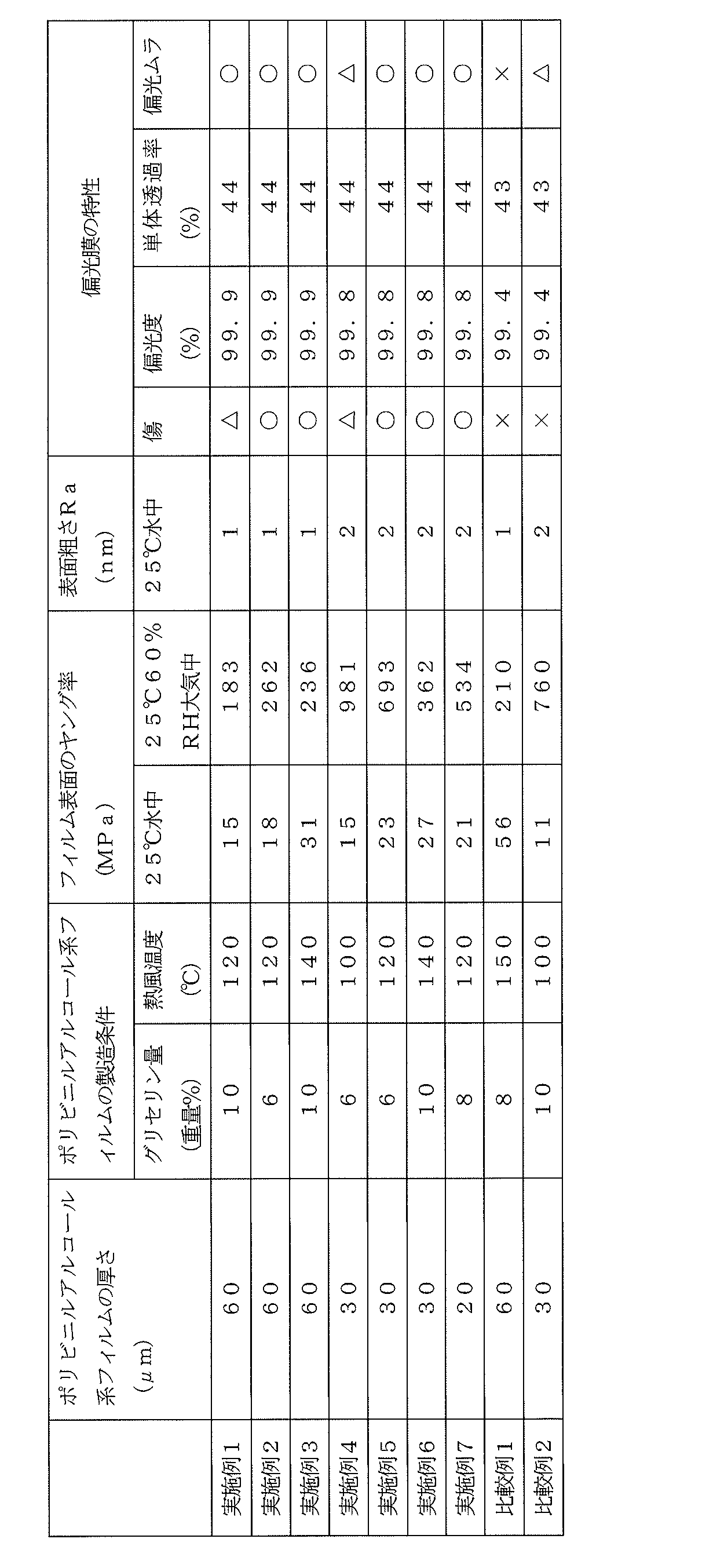
そして、各々のポリビニルアルコール系フィルムから得られる偏光膜の偏光特性は、実施例1~7の方が比較例1および2よりも優れるものであることがわかる。
Claims (5)
- 厚さ5~60μmのポリビニルアルコール系フィルムであって、25℃の水中で走査型プローブ顕微鏡を用いてナノインデンテーション試験を行なった際のフィルム表面のヤング率が15~40MPaであることを特徴とするポリビニルアルコール系フィルム。
- 25℃60%RH大気中で走査型プローブ顕微鏡を用いてナノインデンテーション試験を行った際のフィルム表面のヤング率が、100~1,000MPaであることを特徴とする請求項1記載のポリビニルアルコール系フィルム。
- 25℃の水中で走査型プローブ顕微鏡を用いて測定した際のフィルムの表面粗さRaが3nm以下であることを特徴する請求項1または2記載のポリビニルアルコール系フィルム。
- ポリビニルアルコール系フィルムが幅4m以上、長さ4km以上のロール状ポリビニルアルコール系フィルムであることを特徴とする請求項1~3いずれか記載のポリビニルアルコール系フィルム。
- 請求項1~4いずれか記載のポリビニルアルコール系フィルムを用いて得られることを特徴とする偏光膜。
Priority Applications (3)
| Application Number | Priority Date | Filing Date | Title |
|---|---|---|---|
| JP2016542788A JPWO2017010251A1 (ja) | 2015-07-16 | 2016-06-23 | ポリビニルアルコール系フィルム、及び偏光膜 |
| CN201680040993.2A CN107850716B (zh) | 2015-07-16 | 2016-06-23 | 聚乙烯醇系薄膜和偏光膜 |
| KR1020187000997A KR102475404B1 (ko) | 2015-07-16 | 2016-06-23 | 폴리비닐 알코올계 필름 및 편광막 |
Applications Claiming Priority (2)
| Application Number | Priority Date | Filing Date | Title |
|---|---|---|---|
| JP2015141759 | 2015-07-16 | ||
| JP2015-141759 | 2015-07-16 |
Publications (1)
| Publication Number | Publication Date |
|---|---|
| WO2017010251A1 true WO2017010251A1 (ja) | 2017-01-19 |
Family
ID=57757921
Family Applications (1)
| Application Number | Title | Priority Date | Filing Date |
|---|---|---|---|
| PCT/JP2016/068599 Ceased WO2017010251A1 (ja) | 2015-07-16 | 2016-06-23 | ポリビニルアルコール系フィルム、及び偏光膜 |
Country Status (5)
| Country | Link |
|---|---|
| JP (2) | JPWO2017010251A1 (ja) |
| KR (1) | KR102475404B1 (ja) |
| CN (1) | CN107850716B (ja) |
| TW (1) | TWI692487B (ja) |
| WO (1) | WO2017010251A1 (ja) |
Cited By (1)
| Publication number | Priority date | Publication date | Assignee | Title |
|---|---|---|---|---|
| JP2019101341A (ja) * | 2017-12-07 | 2019-06-24 | 日東電工株式会社 | 偏光フィルムの製造方法及び偏光フィルムの製造装置 |
Families Citing this family (1)
| Publication number | Priority date | Publication date | Assignee | Title |
|---|---|---|---|---|
| KR20240087665A (ko) * | 2021-10-25 | 2024-06-19 | 주식회사 쿠라레 | 폴리비닐알코올 필름 |
Citations (5)
| Publication number | Priority date | Publication date | Assignee | Title |
|---|---|---|---|---|
| JP2003170456A (ja) * | 2001-12-10 | 2003-06-17 | Kuraray Co Ltd | ビニルアルコール系重合体フィルムの製造法および偏光フィルム |
| JP2011245872A (ja) * | 2004-11-02 | 2011-12-08 | Nippon Synthetic Chem Ind Co Ltd:The | ポリビニルアルコール系フィルムの製造方法、偏光膜、および偏光板 |
| JP2012032789A (ja) * | 2010-07-02 | 2012-02-16 | Nippon Synthetic Chem Ind Co Ltd:The | ポリビニルアルコール系フィルム、ポリビニルアルコール系フィルムの製造方法、偏光フィルム及び偏光板 |
| JP2012042929A (ja) * | 2010-07-21 | 2012-03-01 | Nippon Synthetic Chem Ind Co Ltd:The | ポリビニルアルコール系フィルムの製造方法、ポリビニルアルコール系フィルム、偏光フィルム及び偏光板 |
| JP2012066572A (ja) * | 2010-08-27 | 2012-04-05 | Nippon Synthetic Chem Ind Co Ltd:The | ポリビニルアルコール系フィルムの製造方法、ポリビニルアルコール系フィルム、偏光フィルム及び偏光板 |
Family Cites Families (12)
| Publication number | Priority date | Publication date | Assignee | Title |
|---|---|---|---|---|
| JP3796198B2 (ja) | 2002-06-12 | 2006-07-12 | 株式会社クラレ | 偏光フィルムの製造法 |
| JP5348823B2 (ja) | 2004-11-02 | 2013-11-20 | 日本合成化学工業株式会社 | 偏光膜用ポリビニルアルコール系フィルム、偏光膜、および偏光板 |
| JP4740604B2 (ja) * | 2005-01-21 | 2011-08-03 | 富士フイルム株式会社 | 光学補償フィルム、その製造方法、偏光板および液晶表示装置 |
| EP1849821B1 (en) * | 2005-02-17 | 2010-08-04 | Toray Industries, Inc. | Aromatic polyamide porous film, process for producing the same and secondary battery |
| KR101226399B1 (ko) * | 2005-06-21 | 2013-01-24 | 니폰 제온 가부시키가이샤 | 편광판용 보호필름 |
| CN101460306B (zh) * | 2006-03-31 | 2012-07-18 | 日本瑞翁株式会社 | 偏振片、液晶显示装置以及保护膜 |
| JP2009037223A (ja) * | 2007-07-12 | 2009-02-19 | Sumitomo Chemical Co Ltd | 偏光板及び光学部材 |
| KR20110042481A (ko) * | 2009-10-19 | 2011-04-27 | 동우 화인켐 주식회사 | 광학필름 적층체의 절단방법 |
| KR101930958B1 (ko) * | 2011-02-08 | 2018-12-19 | 닛토덴코 가부시키가이샤 | 다층 적층 필름의 제조 방법 |
| KR101974478B1 (ko) * | 2012-01-09 | 2019-08-26 | 삼성디스플레이 주식회사 | 투명 적층체, 표시장치용 윈도우 패널 및 이를 포함하는 표시 장치 |
| JP5743291B2 (ja) * | 2013-04-09 | 2015-07-01 | 住友化学株式会社 | 切削加工方法 |
| JP5932749B2 (ja) * | 2013-10-03 | 2016-06-08 | 住友化学株式会社 | 偏光板のセット及び前面板一体型液晶表示パネル |
-
2016
- 2016-06-23 WO PCT/JP2016/068599 patent/WO2017010251A1/ja not_active Ceased
- 2016-06-23 KR KR1020187000997A patent/KR102475404B1/ko active Active
- 2016-06-23 JP JP2016542788A patent/JPWO2017010251A1/ja active Pending
- 2016-06-23 TW TW105119655A patent/TWI692487B/zh active
- 2016-06-23 CN CN201680040993.2A patent/CN107850716B/zh active Active
-
2020
- 2020-09-11 JP JP2020152668A patent/JP2021002061A/ja active Pending
Patent Citations (5)
| Publication number | Priority date | Publication date | Assignee | Title |
|---|---|---|---|---|
| JP2003170456A (ja) * | 2001-12-10 | 2003-06-17 | Kuraray Co Ltd | ビニルアルコール系重合体フィルムの製造法および偏光フィルム |
| JP2011245872A (ja) * | 2004-11-02 | 2011-12-08 | Nippon Synthetic Chem Ind Co Ltd:The | ポリビニルアルコール系フィルムの製造方法、偏光膜、および偏光板 |
| JP2012032789A (ja) * | 2010-07-02 | 2012-02-16 | Nippon Synthetic Chem Ind Co Ltd:The | ポリビニルアルコール系フィルム、ポリビニルアルコール系フィルムの製造方法、偏光フィルム及び偏光板 |
| JP2012042929A (ja) * | 2010-07-21 | 2012-03-01 | Nippon Synthetic Chem Ind Co Ltd:The | ポリビニルアルコール系フィルムの製造方法、ポリビニルアルコール系フィルム、偏光フィルム及び偏光板 |
| JP2012066572A (ja) * | 2010-08-27 | 2012-04-05 | Nippon Synthetic Chem Ind Co Ltd:The | ポリビニルアルコール系フィルムの製造方法、ポリビニルアルコール系フィルム、偏光フィルム及び偏光板 |
Cited By (2)
| Publication number | Priority date | Publication date | Assignee | Title |
|---|---|---|---|---|
| JP2019101341A (ja) * | 2017-12-07 | 2019-06-24 | 日東電工株式会社 | 偏光フィルムの製造方法及び偏光フィルムの製造装置 |
| JP7177590B2 (ja) | 2017-12-07 | 2022-11-24 | 日東電工株式会社 | 偏光フィルムの製造方法及び偏光フィルムの製造装置 |
Also Published As
| Publication number | Publication date |
|---|---|
| KR102475404B1 (ko) | 2022-12-07 |
| JPWO2017010251A1 (ja) | 2018-05-10 |
| TWI692487B (zh) | 2020-05-01 |
| CN107850716B (zh) | 2021-01-08 |
| KR20180030520A (ko) | 2018-03-23 |
| JP2021002061A (ja) | 2021-01-07 |
| CN107850716A (zh) | 2018-03-27 |
| TW201708269A (zh) | 2017-03-01 |
Similar Documents
| Publication | Publication Date | Title |
|---|---|---|
| CN109416424B (zh) | 偏光膜用聚乙烯醇系薄膜和其制造方法、以及使用该偏光膜用聚乙烯醇系薄膜的偏光膜 | |
| JP6883990B2 (ja) | ポリビニルアルコール系フィルム、ポリビニルアルコール系フィルムの製造方法、及び偏光膜 | |
| CN107405806B (zh) | 聚乙烯醇系薄膜、聚乙烯醇系薄膜的制造方法和偏光膜 | |
| WO2012002194A1 (ja) | ポリビニルアルコール系フィルム、ポリビニルアルコール系フィルムの製造方法、偏光フィルム及び偏光板 | |
| JP6642434B2 (ja) | ポリビニルアルコール系フィルム、およびそれを用いてなる偏光膜 | |
| JPWO2018199141A1 (ja) | ポリビニルアルコール系フィルム、偏光膜および偏光板、ならびにポリビニルアルコール系フィルムの製造方法 | |
| JP2021002061A (ja) | ポリビニルアルコール系フィルム、及び偏光膜 | |
| WO2016148160A1 (ja) | ポリビニルアルコール系フィルム、ポリビニルアルコール系フィルムの製造方法、偏光フィルム及び偏光板 | |
| JP2017008298A (ja) | ポリビニルアルコール系フィルム、ポリビニルアルコール系フィルムの製造方法、及び偏光膜 | |
| JP2016224410A (ja) | ポリビニルアルコール系フィルム及び偏光膜、ならびにポリビニルアルコール系フィルムの製造方法 | |
| JP7412081B2 (ja) | 偏光膜製造用ポリビニルアルコール系フィルム、及びそれを用いて得られる偏光膜、ならびにポリビニルアルコール系樹脂水溶液 | |
| JP2016203623A (ja) | ポリビニルアルコール系フィルムの製造方法、ポリビニルアルコール系フィルム、及び偏光膜 | |
| WO2017006769A1 (ja) | ポリビニルアルコール系偏光フィルム、及び偏光板 | |
| JP7192198B2 (ja) | 偏光膜用ポリビニルアルコール系フィルム、およびその製造方法、ならびに偏光膜、およびその製造方法 | |
| JP2016172851A (ja) | ポリビニルアルコール系フィルム、ポリビニルアルコール系フィルムの製造方法、偏光フィルム及び偏光板 | |
| WO2024181331A1 (ja) | ポリビニルアルコール系フィルム、偏光膜 | |
| WO2025115240A1 (ja) | ポリビニルアルコール系フィルム、偏光膜 | |
| WO2026048839A1 (ja) | ポリビニルアルコール系フィルム、およびそれを用いた偏光膜、ならびに偏光板 |
Legal Events
| Date | Code | Title | Description |
|---|---|---|---|
| ENP | Entry into the national phase |
Ref document number: 2016542788 Country of ref document: JP Kind code of ref document: A |
|
| 121 | Ep: the epo has been informed by wipo that ep was designated in this application |
Ref document number: 16824231 Country of ref document: EP Kind code of ref document: A1 |
|
| ENP | Entry into the national phase |
Ref document number: 20187000997 Country of ref document: KR Kind code of ref document: A |
|
| NENP | Non-entry into the national phase |
Ref country code: DE |
|
| 122 | Ep: pct application non-entry in european phase |
Ref document number: 16824231 Country of ref document: EP Kind code of ref document: A1 |