WO2017005773A1 - Use of catenin- beta 1-targeting micrornas for treating liver cancer - Google Patents
Use of catenin- beta 1-targeting micrornas for treating liver cancer Download PDFInfo
- Publication number
- WO2017005773A1 WO2017005773A1 PCT/EP2016/065938 EP2016065938W WO2017005773A1 WO 2017005773 A1 WO2017005773 A1 WO 2017005773A1 EP 2016065938 W EP2016065938 W EP 2016065938W WO 2017005773 A1 WO2017005773 A1 WO 2017005773A1
- Authority
- WO
- WIPO (PCT)
- Prior art keywords
- mir
- hsa
- mirna
- subject
- catenin
- Prior art date
- Legal status (The legal status is an assumption and is not a legal conclusion. Google has not performed a legal analysis and makes no representation as to the accuracy of the status listed.)
- Ceased
Links
Classifications
-
- C—CHEMISTRY; METALLURGY
- C12—BIOCHEMISTRY; BEER; SPIRITS; WINE; VINEGAR; MICROBIOLOGY; ENZYMOLOGY; MUTATION OR GENETIC ENGINEERING
- C12N—MICROORGANISMS OR ENZYMES; COMPOSITIONS THEREOF; PROPAGATING, PRESERVING, OR MAINTAINING MICROORGANISMS; MUTATION OR GENETIC ENGINEERING; CULTURE MEDIA
- C12N15/00—Mutation or genetic engineering; DNA or RNA concerning genetic engineering, vectors, e.g. plasmids, or their isolation, preparation or purification; Use of hosts therefor
- C12N15/09—Recombinant DNA-technology
- C12N15/11—DNA or RNA fragments; Modified forms thereof; Non-coding nucleic acids having a biological activity
- C12N15/113—Non-coding nucleic acids modulating the expression of genes, e.g. antisense oligonucleotides; Antisense DNA or RNA; Triplex- forming oligonucleotides; Catalytic nucleic acids, e.g. ribozymes; Nucleic acids used in co-suppression or gene silencing
-
- A—HUMAN NECESSITIES
- A61—MEDICAL OR VETERINARY SCIENCE; HYGIENE
- A61K—PREPARATIONS FOR MEDICAL, DENTAL OR TOILETRY PURPOSES
- A61K33/00—Medicinal preparations containing inorganic active ingredients
- A61K33/24—Heavy metals; Compounds thereof
- A61K33/243—Platinum; Compounds thereof
-
- A—HUMAN NECESSITIES
- A61—MEDICAL OR VETERINARY SCIENCE; HYGIENE
- A61K—PREPARATIONS FOR MEDICAL, DENTAL OR TOILETRY PURPOSES
- A61K31/00—Medicinal preparations containing organic active ingredients
- A61K31/13—Amines
- A61K31/135—Amines having aromatic rings, e.g. ketamine, nortriptyline
- A61K31/138—Aryloxyalkylamines, e.g. propranolol, tamoxifen, phenoxybenzamine
-
- A—HUMAN NECESSITIES
- A61—MEDICAL OR VETERINARY SCIENCE; HYGIENE
- A61K—PREPARATIONS FOR MEDICAL, DENTAL OR TOILETRY PURPOSES
- A61K31/00—Medicinal preparations containing organic active ingredients
- A61K31/33—Heterocyclic compounds
- A61K31/395—Heterocyclic compounds having nitrogen as a ring hetero atom, e.g. guanethidine or rifamycins
- A61K31/40—Heterocyclic compounds having nitrogen as a ring hetero atom, e.g. guanethidine or rifamycins having five-membered rings with one nitrogen as the only ring hetero atom, e.g. sulpiride, succinimide, tolmetin, buflomedil
- A61K31/407—Heterocyclic compounds having nitrogen as a ring hetero atom, e.g. guanethidine or rifamycins having five-membered rings with one nitrogen as the only ring hetero atom, e.g. sulpiride, succinimide, tolmetin, buflomedil condensed with other heterocyclic ring systems, e.g. ketorolac, physostigmine
-
- A—HUMAN NECESSITIES
- A61—MEDICAL OR VETERINARY SCIENCE; HYGIENE
- A61K—PREPARATIONS FOR MEDICAL, DENTAL OR TOILETRY PURPOSES
- A61K31/00—Medicinal preparations containing organic active ingredients
- A61K31/33—Heterocyclic compounds
- A61K31/395—Heterocyclic compounds having nitrogen as a ring hetero atom, e.g. guanethidine or rifamycins
- A61K31/435—Heterocyclic compounds having nitrogen as a ring hetero atom, e.g. guanethidine or rifamycins having six-membered rings with one nitrogen as the only ring hetero atom
- A61K31/44—Non condensed pyridines; Hydrogenated derivatives thereof
-
- A—HUMAN NECESSITIES
- A61—MEDICAL OR VETERINARY SCIENCE; HYGIENE
- A61K—PREPARATIONS FOR MEDICAL, DENTAL OR TOILETRY PURPOSES
- A61K31/00—Medicinal preparations containing organic active ingredients
- A61K31/33—Heterocyclic compounds
- A61K31/555—Heterocyclic compounds containing heavy metals, e.g. hemin, hematin, melarsoprol
-
- A—HUMAN NECESSITIES
- A61—MEDICAL OR VETERINARY SCIENCE; HYGIENE
- A61K—PREPARATIONS FOR MEDICAL, DENTAL OR TOILETRY PURPOSES
- A61K31/00—Medicinal preparations containing organic active ingredients
- A61K31/70—Carbohydrates; Sugars; Derivatives thereof
- A61K31/7028—Compounds having saccharide radicals attached to non-saccharide compounds by glycosidic linkages
- A61K31/7034—Compounds having saccharide radicals attached to non-saccharide compounds by glycosidic linkages attached to a carbocyclic compound, e.g. phloridzin
- A61K31/704—Compounds having saccharide radicals attached to non-saccharide compounds by glycosidic linkages attached to a carbocyclic compound, e.g. phloridzin attached to a condensed carbocyclic ring system, e.g. sennosides, thiocolchicosides, escin, daunorubicin
-
- A—HUMAN NECESSITIES
- A61—MEDICAL OR VETERINARY SCIENCE; HYGIENE
- A61K—PREPARATIONS FOR MEDICAL, DENTAL OR TOILETRY PURPOSES
- A61K31/00—Medicinal preparations containing organic active ingredients
- A61K31/70—Carbohydrates; Sugars; Derivatives thereof
- A61K31/7042—Compounds having saccharide radicals and heterocyclic rings
- A61K31/7052—Compounds having saccharide radicals and heterocyclic rings having nitrogen as a ring hetero atom, e.g. nucleosides, nucleotides
- A61K31/706—Compounds having saccharide radicals and heterocyclic rings having nitrogen as a ring hetero atom, e.g. nucleosides, nucleotides containing six-membered rings with nitrogen as a ring hetero atom
- A61K31/7064—Compounds having saccharide radicals and heterocyclic rings having nitrogen as a ring hetero atom, e.g. nucleosides, nucleotides containing six-membered rings with nitrogen as a ring hetero atom containing condensed or non-condensed pyrimidines
- A61K31/7068—Compounds having saccharide radicals and heterocyclic rings having nitrogen as a ring hetero atom, e.g. nucleosides, nucleotides containing six-membered rings with nitrogen as a ring hetero atom containing condensed or non-condensed pyrimidines having oxo groups directly attached to the pyrimidine ring, e.g. cytidine, cytidylic acid
-
- A—HUMAN NECESSITIES
- A61—MEDICAL OR VETERINARY SCIENCE; HYGIENE
- A61K—PREPARATIONS FOR MEDICAL, DENTAL OR TOILETRY PURPOSES
- A61K31/00—Medicinal preparations containing organic active ingredients
- A61K31/70—Carbohydrates; Sugars; Derivatives thereof
- A61K31/7088—Compounds having three or more nucleosides or nucleotides
- A61K31/7105—Natural ribonucleic acids, i.e. containing only riboses attached to adenine, guanine, cytosine or uracil and having 3'-5' phosphodiester links
-
- A—HUMAN NECESSITIES
- A61—MEDICAL OR VETERINARY SCIENCE; HYGIENE
- A61K—PREPARATIONS FOR MEDICAL, DENTAL OR TOILETRY PURPOSES
- A61K45/00—Medicinal preparations containing active ingredients not provided for in groups A61K31/00 - A61K41/00
- A61K45/06—Mixtures of active ingredients without chemical characterisation, e.g. antiphlogistics and cardiaca
-
- A—HUMAN NECESSITIES
- A61—MEDICAL OR VETERINARY SCIENCE; HYGIENE
- A61P—SPECIFIC THERAPEUTIC ACTIVITY OF CHEMICAL COMPOUNDS OR MEDICINAL PREPARATIONS
- A61P35/00—Antineoplastic agents
-
- C—CHEMISTRY; METALLURGY
- C12—BIOCHEMISTRY; BEER; SPIRITS; WINE; VINEGAR; MICROBIOLOGY; ENZYMOLOGY; MUTATION OR GENETIC ENGINEERING
- C12N—MICROORGANISMS OR ENZYMES; COMPOSITIONS THEREOF; PROPAGATING, PRESERVING, OR MAINTAINING MICROORGANISMS; MUTATION OR GENETIC ENGINEERING; CULTURE MEDIA
- C12N2310/00—Structure or type of the nucleic acid
- C12N2310/10—Type of nucleic acid
- C12N2310/14—Type of nucleic acid interfering nucleic acids [NA]
- C12N2310/141—MicroRNAs, miRNAs
-
- C—CHEMISTRY; METALLURGY
- C12—BIOCHEMISTRY; BEER; SPIRITS; WINE; VINEGAR; MICROBIOLOGY; ENZYMOLOGY; MUTATION OR GENETIC ENGINEERING
- C12N—MICROORGANISMS OR ENZYMES; COMPOSITIONS THEREOF; PROPAGATING, PRESERVING, OR MAINTAINING MICROORGANISMS; MUTATION OR GENETIC ENGINEERING; CULTURE MEDIA
- C12N2330/00—Production
- C12N2330/10—Production naturally occurring
Definitions
- the present invention relates to the field of oncology.
- it provides miRNAs useful for detecting and/or treating cancer.
- Hepatoblastoma is an uncommon malignant liver neoplasm occurring in infants and children (1% of pediatric cancers, 0.02% of all cancers and around 3,500 new cases by year worldwide) with a 10-year survival of 61 % (Allan B et al, HPB 2013 , 15 :741 -46) .
- miR- 34a (recently renamed miR-34a-5p in the last version of miRBase) is currently tested in phase I clinical trial for unresectable primary liver cancer or solid cancers with liver involvement (e.g. metastasis) in adults.
- miR-34a regulates several key oncogenic targets including CTNNB 1, BCL2, E2F3, HDAC1, MET, MAK1, CDK4/6, PDGFR-a, WINT1/3 and NOTCH-1 (Bader, Front. Genet., 120, 1-9, Li Z and Rana TM, Nat Rev Drug Disc 2014) .
- the inventors identified 5 new miRNAs (i.e., hsa-miR-548z, hsa-miR-624-5p, hsa-let-7i-3p, miR-885- 5p, miR-449b-3p) decreasing the level of the oncoprotein catenin beta 1 (CTNNB1) in HBL cell lines.
- Hsa-miR-548z, hsa-miR-624-5p, hsa-let-7i-3p, miR-885-5p and miR-449b-3p are down-regulated in HBL tumors and inhibit in vitro HBL cell growth.
- miR-34a the miRNA currently tested in phase-I clinical trial
- PDX Patient-Derived Xenograft
- the present invention relates to a molecule selected from the group consisting of hsa-miR-624-5p, hsa- miR-548z, hsa-let-7i-3p, hsa-miR-885-5p, hsa-miR-449b-3p or any combination thereof or a DNA or RNA encoding for said miRNA for use for treating a hepatoblastoma cancer.
- the present invention also relates to the use of a molecule selected from the group consisting of hsa-miR-624-5p, hsa-miR-548z, hsa-let-7i-3p, hsa-miR-885-5p, hsa-miR-449b-3p or any combination thereof or a DNA or RNA encoding for said miRNA for the manufacture of a medicament for treating a liver cancer, particularly hepatoblastoma.
- a molecule selected from the group consisting of hsa-miR-624-5p, hsa-miR-548z, hsa4et-7i-3p, hsa-miR-885-5p, hsa-miR-449b-3p or any combination thereof or a DNA or RNA encoding for said miRNA to said patient.
- the molecule is selected from the group consisting of hsa-miR-624-5p, hsa-miR-548z, hsa-let-7i-3p, hsa-miR-449b-3p or any combination thereof or a DNA or RNA encoding for said miRNA.
- the molecule is to be used in combination with one or more therapeutic agents, preferably another antitumor therapy, and in particular with cisplatin, doxorubicin, 5-Fluoro-uracil, sorafenib, gemcitabine, oxaliplatin, mitomycin C, tamoxifen, MSC2156119J, foretinib, refametinib, cabozantinib and tivantinib, or any combination thereof, preferably with doxorubicin, cisplatin, gemcitabine, oxaliplatin, carboplatin, mitomycin C, tamoxifen, sorafenib or any combination thereof.
- the molecule is to be used in combination with cisplatin and/or doxorubicin for use in the treatment of HBL.
- the molecule is to be used in combination with another antitumor therapy and a drug lowering the toxicity and side effects of the antitumor therapy.
- drug lowering the toxicity and side effects of the antitumor therapy can be sodium thiosulfate or N-acetyl cysteine.
- the therapeutic agent can be an immunotherapeutic agent such as drugs targeting immune system checkpoints such as PD- 1 or PD-L 1.
- the molecule is to be used in combination with one or more immunotherapeutic agents, and in particular with monoclonal antibodies binding antigens on cancer cells or targeting immune system checkpoints (e.g. immune checkpoint inhibitors) and especially drugs targeting PD-1 or PD-L1 such as for example pembrolizumab, nivolumab, atezolizumab.
- the molecule is to be used in combination with resection, radiofrequency ablation and/or percutaneous ethanol injection.
- the molecule is to be used after or before resection, radiofrequency ablation and/or percutaneous ethanol injection.
- the molecule is for use as neo-adjuvant therapy or adjuvant therapy.
- the subject does not respond to the first line treatment and/or is not suitable for tumor resection or ablation and/or not suitable for liver transplantation.
- the subject has a miRNA selected from the group consisting of hsa-miR-624-5p, hsa-miR-548z, hsa4et-7i-3p, hsa-miR-885-5p, hsa-miR-449b-3p or any combination thereof, preferably selected from the group consisting of hsa-miR- 624-5p, hsa-miR-548z, hsa-let-7i-3p, hsa-miR-449b-3p or any combination thereof, which is under- expressed in comparison with a healthy or non-tumoral control.
- the present invention further relates to a method for selecting a subject suitable for a treatment by miRNA as disclosed herein comprising determining the level of a miRNA selected from the group consisting of hsa-miR-624-5p, hsa-miR-548z, hsa-let-7i-3p, hsa-miR-449b-3p or of a combination thereof in a biological sample from the subject, and selecting the subject if at least one of the miRNA is under-expressed in comparison with a healthy or non-tumoral control.
- the present invention further relates to a method for selecting a subject suitable for a treatment by miRNA as disclosed herein comprising determining the level of CTNNB 1 thereof in a biological sample from the subject, and selecting the subject if CTNNB 1 is upper-expressed or overexpressed in comparison with a healthy or non-tumoral control.
- the present invention also relates to the use of a miRNA selected from the group consisting of hsa-miR- 624-5p, hsa-miR-548z, hsa-let-7i-3p, hsa-miR-449b-3p or of any combination thereof as a marker for detecting a hepatoblastoma cancer or a susceptibility to develop a hepatoblastoma cancer.
- said miRNA can be used in combination with hsa-miR-885-5p.
- the present invention relates to a method for detecting a hepatoblastoma cancer or a susceptibility to develop a hepatoblastoma cancer in a subject, comprising determining the level of a miRNA selected from the group consisting of hsa-miR-624-5p, hsa-miR-548z, hsa-let-7i-3p, hsa-miR-449b-3p or of any combination thereof in a biological sample from the subject, an under-expression of at least one of the miRNA in comparison with a healthy or non-tumoral control being indicative of a hepatoblastoma cancer or a susceptibility to develop a hepatoblastoma cancer.
- said miRNA can be used in combination with hsa-miR-885-5p.
- the present invention also relates to the use of a miRNA selected from the group consisting of hsa-miR- 624-5p, hsa-miR-548z, hsa-let-7i-3p, hsa-miR-449b-3p or of any combination thereof as a marker for the prognosis in a subject having a hepatoblastoma cancer.
- the present invention also relates to a method for determining the prognosis in a subject having a hepatoblastoma cancer, comprising determining the level of a miRNA selected from the group consisting of hsa-miR-548z, hsa-miR-624-5p, hsa-let-7i-3p, hsa-miR-449b-3p or of a combination thereof in a biological sample from the subject, the level of expression of said at least one of the miRNA being correlated with the clinical prognosis.
- said miRNA can be used in combination with hsa-miR-885-5p.
- the present invention relates to a kit or analytical tool for detecting a hepatoblastoma cancer or a susceptibility to develop a hepatoblastoma cancer in a subject or for selecting a subject suitable for a treatment by a molecule as disclosed herein or for determining the prognosis in a subject having a hepatoblastoma cancer, the kit comprising detection means specific for at least one miRNA selected from the group consisting of hsa-miR-624-5p, hsa-miR-548z, hsa-let-7i-3p, hsa-miR-449b-3p or for any combination thereof.
- said kit further comprises detection means specific for hsa-miR- 885-5p.
- FIG. 4 Effect of the nine miRNAs on the relative expression of wild-type (WT Exon 3; A) and exon 3-deleted ( ⁇ 3; B) beta-catenin proteins in a HBL patient-derived xenograft cell line.
- HBL-214-J cells were transfected by the corresponding small RNA or miRNA (as shown).
- FIG. 5 Relative expression of miR-34a-5p and 6 beta-catenin-regulating miRNAs in 34 normal liver (NL) and 40 HBL tumors. Non-parametric two-tailed Mann-Whitney test for unpaired data: ** p ⁇ 0.01, *** p ⁇ 0.001.
- FIG. 10 Apoptosis of HuH6 cells at Day 3 following transfection by the corresponding small RNA or miRNA (Tetramethylrhodamine, methyl ester - TMRM - assay).
- siCtrl RNA and etoposide (ETO) were used as negative and positive controls, respectively, si -cat: siRNA against ⁇ -catenine.
- ANOVA test: p ⁇ 0.001 (n 3); Bonferroni's multiple comparisons test: ** p ⁇ 0.01 ; *** p ⁇ 0.001.
- FIG. 11 Percentage of HuH6 cells in senescence at Day 3 following transfection by the corresponding small RNA or miRNA (beta-galactosidase staining assay).
- siCtrl negative control RNA.
- si -cat siRNA against ⁇ -catenine.
- MiR-624-5p directly interacts with the 3 beta-catenin mRNA variants through the 3'-UTR.
- A Predicted interaction site between beta-catenin 3'-UTR and miR-624-5p. The two point mutations inserted in beta-catenin 3'-UTR are as shown.
- FIG. 1 Schematic representation of the three beta-catenin mRNA variants and localization of the predicted miR-624-5p site (thick line).
- MiR-624-5p inhibits several genes associated with the Wnt/beta-catenin signaling pathway.
- Huh6 cells were transfected with a control RNA (Ctrl), miR-624-5p or siRNA against ⁇ -catenine (si- ⁇ - catenin) and the relative expression of Wnt signaling-associated mRNA genes was measured. Genes down- (A, Top panel) or up- (B) regulated by miR-624-5p in Huh6 cells are as shown.
- FIG. 14 MiR-624-5p inhibits HBL tumor development in vivo.
- Huh6 cells were transfected with a control RNA (Ctrl)or miR-624-5p. 24 hours later, cells were collected and grafted on the chick CAM at day 10. The tumor growth was monitored from day 11 to day 16.
- Catenin-beta 1 (CTNNB l) is described in Uniprot under ID P35222 and has a Reference Sequence of mRNA NM_001098209 and a Reference Sequence of protein NP_001091679.
- identity refers to a relationship between the sequences of two or more nucleic acid molecules, as determined by comparing the sequences. In the art, “identity” also means the degree of sequence relatedness between amino acid or nucleic acid molecule sequences, as the case may be, as determined by the match between strings of nucleotide or amino acid sequences. “Identity” measures the percent of identical matches between two or more sequences with gap alignments addressed by a particular mathematical model or computer programs (i.e., "algorithms").
- Non-limiting methods for determining identity are designed to give the largest match between the sequences tested. Methods to determine identity are codified in publicly available computer programs. Preferred computer program methods to determine identity between two sequences include, but are not limited to, the GCG program package, including GAP (Devereux, et al., Nucleic Acids Research 12:387 [1984] ; Genetics Computer Group, University of Wisconsin, Madison, Wis.), BLASTN, and FASTA (Atschul et al., J. Molec. Biol. 215:403-410 [1990]).
- the BLAST X program is publicly available from the National Center for Biotechnology Information (NCBI) and other sources (BLAST Manual, Altschul] et al., NCB NLM NIH Bethesda, Md. 20894; Altschul et al., J. Mol. Biol. 215:403-410 [1990]).
- NCBI National Center for Biotechnology Information
- the well-known Smith Waterman algorithm may also be used to determine identity.
- the GAP program is also useful with the above parameters.
- the aforementioned parameters are the default parameters for nucleic acid molecule comparisons.
- gap opening penalties can be used by those of skill in the art, including those set forth in the Program Manual, Wisconsin Package, Version 9, September 1997.
- the particular choices to be made will depend on the specific comparison to be made, such as DNA to DNA or RNA to DNA; and additionally, whether the comparison is between given pairs of sequences (in which case GAP or BestFit are generally preferred) or between one sequence and a large database of sequences (in which case FASTA or BLASTA are preferred).
- the inventors identified miR-548z as a therapeutic agent against cancer, especially hepatoblastoma cancer.
- the inventors identified miR-624-5p as a therapeutic agent against cancer, especially hepatoblastoma cancer.
- let-7i-3p as a therapeutic agent against cancer, especially hepatoblastoma cancer.
- let-7i-3p The seed sequence of let-7i-3p is encompassed in the sequence shown in bold highlighting.
- the mature let-7i-3p is underlined.
- the inventors identified miR-449b-3p as a therapeutic agent against cancer, especially hepatoblastoma cancer.
- the inventors identified miR-885-5p as a therapeutic agent against cancer, especially hepatoblastoma cancer.
- the seed sequence of miR-885-5p is encompassed in the sequence shown in bold highlighting.
- the mature miR-885-5p is underlined.
- microRNAs are well-known in the art and a person skilled in the art would understand that they include the conventional naturally occurring sequences (provided herein) but also any chemically modified versions and sequence homologues thereof. Chemically modified versions and sequence homologues of miRNAs are generally called miRNA mimic, analog or derivative. The miRNA mimic, analog or derivative has retained or enhanced activity of the original miRNA.
- the miRNA can be mature miRNA, precursor (pre)-miRNA, primary (pri)-miRNA, a miRNA mimic, analog or derivative thereof.
- prefix “hsa” indicates Homo sapiens or human. Even in its absence, all miRNA of the invention are human.
- miRNA and microRNA can be identical and are substitutable.
- the miRNA is a single-stranded nucleic acid molecule, especially a RNA molecule, of no more than 30 nucleotides in length, preferably no more than 25 bases in length, and generally about 21-23 nucleotides in length. It comprises a sequence which is identical or substantially identical to the seed sequence. By “substantially identical” is meant that at most 1 or 2 substitutions or deletions are allowed. In a preferred embodiment, it comprises a sequence identical to the seed sequence.
- the seed sequence usually corresponds to a sequence located between position 2 and position 9 of the mature miRNA. For instance, the seed sequence may consist in the sequence between position 2 and position 7, 8 or 9 of the mature miRNA.
- the miRNA comprises, essentially consists in or consists in a sequence which is at least 80%, 85%, 90%, 95% or 99% identical to the respective full length sequence of the mature miRNA.
- the mature miRNA sequence is selected in the group consisting of SEQ ID Nos 1, 3, 5, 7 and 9, preferably selected in the group consisting of SEQ ID Nos 1, 3, 5, and 7.
- the miRNA comprises, essentially consists in or consists in a sequence which is at least 80%, 85%, 90%, 95% or 99% identical to the respective full length sequence of the mature miRNA and comprises a sequence identical to the seed sequence.
- the miRNAs as pre-miRNA has a stem-loop sequence and comprises a guide strand comprising the mature miRNA, and more specifically the seed sequence, and a passenger strand which is complementary or substantially complementary to the seed sequence of the guide strand.
- an alternative miRNA can be a double-stranded molecule comprising two separate strands as defined before instead of the stem-loop structure.
- the guide strand comprises a sequence which is identical or substantially identical to the seed sequence.
- substantially identical is meant that at most 1 or 2 substitutions or deletions are allowed.
- the guide strand comprises a sequence which is at least 80%, 85%, 90%, 95% or 99% identical to the respective full length sequence of the mature miRNA.
- the mature miRNA sequence is selected in the group consisting of SEQ ID Nos 1, 3, 5, 7 and 9, preferably selected in the group consisting of SEQ ID Nos 1, 3, 5, and 7.
- the guide strand of the miRNA comprises a sequence which is at least 80%, 85%, 90%, 95% or 99% identical to the guide strand of pre-miRNA as disclosed in a sequence selected in the group consisting of SEQ ID Nos 2, 4, 6, 8 and 10, preferably selected in the group consisting of SEQ ID Nos 2, 4, 6, and 8.
- the guide strand of the miRNA comprises, essentially consists in or consists in a sequence of the guide strand of pre-miRNA as disclosed in a sequence selected in the group consisting of SEQ ID Nos 2, 4, 6, 8 and 10, preferably selected in the group consisting of SEQ ID Nos 2, 4, 6, and 8.
- the passenger strand comprises a sequence which is at least 60%, 65%, 70%, 75%, 80%, 85%, 90% or 95% identical to the complement of the respective full length sequence of the mature miRNA.
- the mature miRNA sequence is selected among the SEQ ID Nos 1, 3, 5, 7 and 9, preferably selected in the group consisting of SEQ ID Nos 1, 3, 5, and 7.
- the passenger strand of the miRNA comprises a sequence which is at least 80%, 85%, 90%, 95% or 99% identical to the passenger strand of pre-miRNA as disclosed in a sequence selected in the group consisting of SEQ ID Nos 2, 4, 6, 8 and 10, preferably selected in the group consisting of SEQ ID Nos 2, 4, 6, and 8.
- the passenger strand of the miRNA comprises, essentially consists in or consists in a sequence of the passenger strand of pre-miRNA as disclosed in a sequence selected in the group consisting of SEQ ID Nos 2, 4, 6, 8 and 10, preferably selected in the group consisting of SEQ ID Nos 2, 4, 6, and 8.
- the miRNA is between 17 and 30 nucleotides in length, preferably 22-23 nucleotides in length, and comprises (i) a microRNA region having a sequence from 5' to 3' that is at least 80 % identical to at least one of SEQ ID Nos 1, 3, 5, 7 and 9, preferably SEQ ID Nos 1, 3, 5, and 7; and (ii) a complementary region having a sequence from 5' to 3' that is 60-100 % complementary to the microRNA region.
- the microRNA region has a sequence that is at least 80, 85, 90, 95 or 100 % identical to at least one of SEQ ID Nos 1, 3, 5, 7 and 9, preferably SEQ ID Nos 1, 3, 5, and 7.
- the miRNA comprises a hairpin structure.
- the miRNA is between 17 and 30 nucleotides in length, preferably 22-23 nucleotides in length, and comprises (i) a first polynucleotide having a sequence from 5' to 3' that is at least 80 % identical to at least one of SEQ ID Nos 1, 3, 5, 7 and 9, preferably SEQ ID Nos 1, 3, 5, and 7; and (ii) a second separate polynucleotide having a sequence that is 60-100 % complementary to the first polynucleotide.
- the microRNA region has a sequence that is at least 80, 85, 90, 95 or 100 % identical to at least one of SEQ ID Nos 1, 3, 5, 7 and 9, preferably SEQ ID Nos 1, 3, 5, and 7.
- the miRNA can include some chemical modifications, in particular for increasing its stability, resistance to degradation and/or its cellular uptake.
- microRNA molecules may be modified to stabilize the miRNAs against degradation, to enhance half -life, or to otherwise improve efficacy. Desirable modifications are described, for example, in US20070213292, US20060287260, US20060035254, US20060008822, WO2015131115, US2016053264, WO2010144485 and US20050288244, each of which is hereby incorporated by reference in its entirety.
- the miRNA can include 5' cap, 3' cap, backbone modifications, ribose modifications, mismatch, as well as nucleobase modifications.
- Ribose modifications include 2'-0-methyl, 2'-0-methoxy, 2'-0-fluorine, 2'-0-methoxyethyl, 2'-0- aminopropyl, 2'-amino.
- Backbone modifications include phosphorothioate linkages or morpholinos.
- the 5' cap refers to at least one modified nucleotide that block 5 ⁇ or 5' phosphate at the 5' terminus.
- the modification can be selected among an amine group, biotin, a lower alkylamine group, NHCOCH3, an acetyl group, 2' oxygen-methyl (2'OMe), 4'thionucleotide, phosphorothioate linkage, abasic residue, inverted nucleotide or inverted abasic moiety, phosphorodithioate monophosphate and methylphosphonate moiety.
- Modified bases include other synthetic and natural nucleobases such as 5-methylcytosine (5-me-C), 5- hydroxymethyl cytosine, xanthine, hypoxanthine, 2-aminoadenine, 6-methyl and other alkyl derivatives of adenine and guanine, 2-propyl and other alkyl derivatives of adenine and guanine, 2-thiouracil, 2- thiothymine and 2-thiocytosine, 5-halouracil and cytosine, 5-propynyl uracil and cytosine and other alkynyl derivatives of pyrimidine bases, 6-azo uracil, cytosine and thymine, 5-uracil (pseudouracil), 4- thiouracil, 8-halo, 8-amino, 8-thiol, 8-thioalkyl, 8-hydroxyl and other 8-substituted adenines and guanines, 5-halo (including 5-brom
- the guide strand of pre-miRNA or mature miRNA can include 2'-fluorine modifications while the passenger strand can include 2'-0-methyl modifications.
- the miRNA comprises one or more of the following (i) a replacement group for phosphate or hydroxyl of the nucleotide at the 5' terminus of the complementary strand or passenger strand (5' cap); (ii) one or more sugar modifications in the first or last 1-6 residues of the complementary strand or passenger strand; or (iii) non-complementarity between one or more nucleotides in the last 1 - 5 residues at the 3' end of the complementary strand or passenger strand and the corresponding nucleotides of the microRNA region or guide strand.
- the miRNA comprises a fully complementary passenger strand comprising (i) modified nucleotides in the first and last two nucleotides of the passenger strand, and/or (ii) a terminal modification of the nucleotide at the 5 'end.
- the passenger strand comprises modified nucleotides and fewer than half of the total number of nucleotides in the passenger are modified nucleotides. For instance, 2-10, 4-8 or 5-7 nucleotides in the passenger are modified nucleotides. In a particular embodiment, the modified nucleotides are selected from the group consisting of the two-three first and the two last nucleotides of the passenger strand.
- the guide strand comprises at least one or two modified nucleotides.
- the guide strand does not comprise modified nucleotides in the first two positions at the 5' end of the guide strand and/or in the last two positions at the 3' end of the guide strand.
- the microRNA molecules may comprise alternate stretches or portions of nucleotides with 2' -O-methyl modifications and stretches or portions of nucleotides without the modification.
- alternate stretches or portions it is meant that, when considering the double-stranded RNA molecule, for each pair of nucleotides, at least one nucleotide of the pair, preferably only one, has a 2' -O-methyl modification.
- the length of the stretches/portions can vary from 1 to 7 consecutive nucleotides. Accordingly, just for illustrating this aspect, the mature miRNA may present one of the following structures:
- N refers to a nucleotide having 2' -O-methyl modification.
- the microRNA molecules may comprise stretches or portions of nucleotides with 2' -O-methyl modifications.
- both nucleotide of the pair have 2' -O-methyl modifications.
- the length of the stretches/portions can vary from 1 to 7 consecutive nucleotides.
- N refers to a nucleotide having 2' -O-methyl modification.
- the miRNA can present a modification at one or both 3' ends, preferable a modified sugar.
- modified sugar is Triantennary N-acetyl galactosamine (GalNAC 3 ).
- GalNAC 3 Triantennary N-acetyl galactosamine
- the miRNA may be linked to a moiety allowing the targeting of the liver.
- the disclosure provides a nucleic acid molecule or any modified molecule derivatives encoding or leading to a miRNA as disclosed above and a recombinant expression vector comprising a recombinant nucleic acid sequence operatively linked to an expression control sequence, wherein expression of the recombinant nucleic acid sequence provides a miRNA sequence, a precursor miRNA sequence, or a primary miRNA sequence as described herein.
- the resulting sequence e.g., primary or precursor miRNAs
- the recombinant expression vector comprises at least one sequence selected from the group consisting of SEQ ID Nos 1-10, preferably of SEQ ID Nos 1-8.
- any suitable expression vector can be used such as, for example, a DNA vector (e.g., viral vector, plasmid, etc.).
- the expression vector is selected for expression in a eukaryotic cell such as, for example, a mammalian cell.
- a eukaryotic cell such as, for example, a mammalian cell.
- the expression cassette is comprised in a viral vector, or plasmid DNA vector or other therapeutic nucleic acid vector or delivery vehicle, including liposomes and the like. miRNA therapeutic uses.
- the miRNA miR-548z, miR-624-5p, let-7i-3p, miR-449b-3p, miR-885-5p and any combination thereof as disclosed above can be used for treating a hepatoblastoma.
- the present disclosure also relates a pharmaceutical composition comprising miR-548z, miR-624-5p, let-7i-3p, miR-449b-3p, miR-885-5p and any combination thereof.
- the miRNA can be selected in the group consisting of miR-548z, miR-624-5p, let-7i-3p, miR-449b-3p, miR-885-5p and any combination of two, three, four or five miRNA.
- the miRNA can be selected in the group consisting of miR-548z, miR-624-5p, let-7i-3p, miR- 449b-3p, and any combination of two, three, or four miRNA.
- the combination may include at least miR-548z and 1-4 miRNA selected among miR-624- 5p, let-7i-3p, miR-449b-3p, and miR-885-5p, e.g., miR-548z and miR-624-5p; miR-548z and let-7i-3p; miR-548z and miR-449b-3p; miR-548z and miR-885-5p; miR-548z, miR-624-5p, and let-7i-3p; miR- 548z, miR-624-5p, and miR-449b-3p; miR-548z, miR-624-5p, and miR-885-5p; miR-548z, let-7i-3p, and miR-449b-3p; miR-548z, let-7i-3p, and miR-885-5p; miR-548z, miR-449b-3p; miR-885-5p; miR-548z, miR-449b-3p; miR-548z, let-7
- the combination can further comprise an additional miRNA, for instance miR-34a.
- the combination may include at least miR-624-5p and 1-4 miRNA selected among miR-548z, let-7i-3p, miR-449b-3p, and miR-885-5p, e.g., miR-624-5p and let-7i-3p; miR-624- 5p and miR-449b-3p; miR-624-5p and miR-885-5p; miR-624-5p, let-7i-3p and miR-449b-3p; miR-624- 5p, let-7i-3p and miR-885-5p; miR-624-5p, miR-449b-3p and miR-885-5p; and miR-624-5p, let-7i-3p, miR-449b-3p and miR-885-5p.
- the combination can further comprise an additional miRNA, for instance miR-34a.
- the combination may include at least let-7i-3p and 1 -4 miRNA selected among miR-548z, miR-624-5p, miR-449b-3p, and miR-885-5p, e.g., let-7i-3p and miR-449b-3p; let-7i- 3p and miR-885-5p; and let-7i-3p, miR-449b-3p and miR-885-5p.
- the combination may include at least miR-449b-3p and 1-4 miRNA selected among miR-548z, miR-624-5p, let-7i-3p, and miR-885-5p, e.g., miR-449b-3p and miR-885- 5p.
- the combination can further comprise an additional miRNA, for instance miR-34a.
- the combination may include at least miR-885-5p and 1-4 miRNA selected among miR-548z, miR-624-5p, let-7i-3p, and miR-449b-3p.
- the combination can further comprise an additional miRNA, for instance miR-34a.
- the miRNA and any combination thereof can be used for treating a hepatoblastoma.
- Their use for the treatment of other specific solid cancers with or without liver involvement can also be contemplated, in particular breast, colorectal, esophageal, lung, melanoma, pancreatic, stomach, ovaries, neuroendocrine, uterus, CNS (central nervous system) and brain cancer.
- the subject can be a child.
- the liver cancer is a hepatoblastoma and the subject is a child.
- the subject does not respond to the first line treatment and/or is not suitable for tumor resection or ablation.
- the miRNA or combination thereof can be used in combination with one or more therapeutic agents, especially any antitumor treatment.
- the miRNA is to be used in combination with resection, radioirequency ablation and/or percutaneous ethanol injection.
- the molecule is to be used after or before resection, radioirequency ablation and/or percutaneous ethanol injection.
- the miRNA is to be used in combination with a chemotherapy.
- the present invention relates to a pharmaceutical composition
- a pharmaceutical composition comprising one or several miRNA selected from the group consisting of hsa-miR-548z, hsa-miR-624-5p, hsa-let-7i-3p, hsa-miR-449b-3p, hsa-miR-885-5p or any combination thereof and another drug, in particular an antitumor drug.
- a product comprising one or several miRNA selected from the group consisting of hsa-miR-548z, hsa-miR-624- 5p, hsa-let-7i-3p, hsa-miR-449b-3p, hsa-miR-885-5p or combination thereof and another drug, in particular an antitumor drug, as a combined preparation for simultaneous, separate or sequential use, preferably for treating a solid cancer, in particular a hepatoblastoma.
- the miRNA can be selected in the group consisting of miR-548z, miR-624-5p, let-7i-3p, miR-449b-3p, and any combination of two, three, or four miRNA.
- the antitumor drug can selected from the group consisting of an inhibitor of topoisomerases I or II, a DNA crosslinker, a DNA alkylating agent, an anti-metabolic agent and inhibitors of the mitotic spindles. It can also be an immunotherapy.
- doxorubicin doxorubicin, cisplatin, carboplatin, gemcitabine, oxaliplatin, mitomycin C, tamoxifen, paclitaxel, larotaxel, taxol, lapatinib, docetaxel, methotrexate, capecitabine, vinorelbine, cyclophosphamide, gemcitabine, amrubicin, cytarabine, etoposide, camptothecin, dexamethasone, dasatinib, tipifarnib, bevacizumab, sirolimus, temsirolimus, everolimus, lonafarnib, cetuximab, erlotinib, gefitinib, imatinib mesylate, rituximab, trastuzumab, nocodazole, sorafenib, sunitinib, bortezomib, MSC2156
- the molecule is to be used in combination with another antitumor therapy and a drug lowering/decreasing the toxicity and side effects of the antitumor therapy.
- the drug lowering the toxicity and side effects of the antitumor therapy can be sodium thiosulfate or N-acetyl cysteine.
- the molecule is to be used in combination with cisplatin and, sodium thiosulfate or N-acetyl cysteine.
- the molecule is to be used in combination with doxorubicin and, sodium thiosulfate or N-acetyl cysteine.
- Inhibitors of topoisomerases I and/or II include, but are not limited to, etoposide, topotecan, camptothecin, irinotecan, amsacrine, intoplicin and anthracyclines such as doxorubicin, epirubicin, daunorubicin, idarubicin and mitoxantrone.
- Inhibitors of Topoisomerase I and II include, but are not limited to, intoplicin.
- DNA crosslinkers include, but are not limited to, cisplatin, carboplatin and oxaliplatin. In a preferred embodiment, the DNA crosslinker is cisplatin.
- Anti-metabolic agents block the enzymes responsible for nucleic acid synthesis or become incorporated into DNA, which produces an incorrect genetic code and leads to apoptosis.
- Non-exhaustive examples thereof include, without limitation, folic acid antagonists, pyrimidine analogs, purine analogs and adenosine deaminase inhibitors, and more particularly Methotrexate, Floxuridine, Cytarabine, 6- Mercaptopurine, 6- Thioguanine, Fludarabine phosphate, Pentostatine, 5-fluorouracil, gemcitabine and capecitabine.
- the DNA-damaging anti-tumoral agent can be alkylating agents including, without limitation, nitrogen mustards, ethylenimine derivatives, alkyl sulfonates, nitrosoureas, metal salts and triazenes.
- alkylating agents including, without limitation, nitrogen mustards, ethylenimine derivatives, alkyl sulfonates, nitrosoureas, metal salts and triazenes.
- Non- exhaustive examples thereof include Uracil mustard, Chlormethine, Cyclophosphamide (CYTOXAN(R)), Ifosfamide, Melphalan, Chlorambucil, Pipobroman, Triethylenemelamine, Triethylenethiophosphor amine, Busulfan, Carmustine, Lomustine, cisplatin, carboplatin, oxaliplatin, thiotepa, Streptozocin, dacarbazine, and Temozolomide.
- the therapeutic agent can also be an immunotherapeutic drug.
- immunotherapeutic drug refers to a cancer therapeutic treatment with therapeutic antibodies.
- antibodies are directed against specific antigens such as the unusual antigens that are presented on the surface of tumors or targeting immune system checkpoints (e.g. immune checkpoint inhibitors).
- immune system checkpoints e.g. immune checkpoint inhibitors.
- therapeutic antibodies functions to deplete tumor cells in a patient.
- therapeutic antibodies specifically bind to antigens present on the surface of the tumor cells, e.g. tumor specific antigens present predominantly or exclusively on tumor cells.
- therapeutic antibodies may also prevent tumor growth by blocking specific cell receptors.
- the immunotherapeutic drug may target multiple elements of the immune pathway: a therapy that enhances tumor antigen presentation; a therapy that inhibits negative immune regulation e.g., by inhibiting CTLA-4 and/or PD1/PD-L1/PD-L2 pathway and/or depleting or blocking Tregs or other immune suppressing cells; a therapy that stimulates positive immune regulation, e.g., with agonists that stimulate the CD- 137, OX-40, and/or GITR pathway and/or stimulate T cell effector function; a therapy that increases systemically the frequency of anti-tumor T cells; a therapy that depletes or inhibits Tregs, such as Tregs in the tumor, e.g., using an antagonist of CD25 (e.g., daclizumab) or by ex vivo anti-CD25 bead depletion; a therapy that impacts the function of suppressor myeloid cells in the tumor; a therapy that enhances immunogenicity of tumor cells (e.g., anthracyclines); adopt
- the immunotherapeutic drug is a drug targeting PD-1 or PD-L1.
- the PD- 1/PD-Ll agent is preferably selected from the group consisting of Nivolumab (Opdivo, Bristol-Myers Squibb), Pembrolizumab (Keytruda, MK-3475, Merck), Pidilizumab (CT-011, Cure Tech), BMS 936559 (Bristol Myers Squibb), atezolizumab or MPDL3280A (Roche), and a combination thereof.
- the combined association of one or several miRNA as disclosed herein with another antitumor drug can allow the use of a lower/decreased amount of the other antitumor drug that could result in a reduction of the adverse effects and toxicity.
- the amount of the other antitumor drug can be a sub-therapeutic amount. More specifically, the other antitumor drug is used at lower dosage than the conventional dosage used in chemotherapy for the same indication and the same administration route when it is used alone (i.e., an amount equal to or preferably lower than the one used in conventional chemotherapy), also called herein a sub-therapeutic amount.
- the amount can be for instance 90, 80, 70, 60, 50, 40, 30, 20 or 10 % of the conventional therapeutic dosage (in particular for the same indication and the same administration route).
- the conventional therapeutic dosages are those acknowledged by the drug approvals agencies (e.g., FDA or EMEA) and can be found in reference Manuals such as Merck Manuals (www.merck.com/mmpe/lexicomp/).
- the administration frequency of the other antitumor drug or its treatment period can be reduced.
- the treatment period may be reduced, for instance by 90, 80, 70, 60 or 50%.
- the interval between treatments with the other antitumor drug can be increased, for instance by 10, 20, 30, 40, 50, 60, 70, 80, 90 or 100% or by 1.5, 2, 2.5 or 3 fold.
- the present invention relates to a method of treating a patient with a hepatoblastoma cancer comprising (a) administering to the patient a therapeutically effective amount of a molecule selected from the group consisting of hsa-miR-548z, hsa-miR-624-5p, hsa-let-7i-3p, hsa-miR-449b-3p, hsa-miR-885-5p or any combination thereof or a DNA or RNA encoding for said miRNA; and (b) administering a second therapy, wherein the molecule sensitizes the patient to the second therapy.
- the second therapy is another antitumor drug.
- the other antitumor drug is cisplatin or doxorubicin.
- the other antitumor drug is administered in a sub-therapeutic amount.
- the miRNA can be selected in the group consisting of miR-548z, miR-624-5p, let-7i-3p, miR-449b-3p, and any combination of two, three, or four miRNA.
- miRNAs, pharmaceutical compositions, or products of the invention can be used in humans with existing cancer or tumour, including at early or late stages of progression of the cancer.
- the miRNAs, pharmaceutical compositions, or products of the invention will not necessarily cure the patient who has the cancer but will delay or slow the progression or prevent further progression of the disease, ameliorating thereby the patients' condition or survival.
- the miRNAs, pharmaceutical compositions, or products of the invention reduce the development of tumors, reduce tumor burden, produce tumor regression in a mammalian host and/or prevent metastasis occurrence and cancer relapse.
- the pharmaceutical composition of the invention is administered in a therapeutically effective amount.
- the term “treatment”, “treat” or “treating” refers to any act intended to ameliorate the health status of patients such as therapy, prevention, prophylaxis and retardation of the disease.
- such term refers to the amelioration or eradication of a disease or symptoms associated with a disease.
- this term refers to minimizing the spread or worsening of the disease resulting from the administration of one or more therapeutic agents to a subject with such a disease.
- the treatment may reduce the development of tumors, reduce tumor burden, produce tumor regression in a mammalian host and/or prevent metastasis occurrence and cancer relapse.
- the effective amount or “therapeutically effective” it is meant the quantity of the pharmaceutical composition of the invention which prevents, removes or reduces the deleterious effects of the treated disease in mammals, including humans. It is understood that the administered dose may be adapted by those skilled in the art according to the patient, the pathology, the mode of administration, etc.
- the effective amount can be the amount necessary for decreasing or repressing the expression of CTNNB 1 gene, e.g., by at least 10, 20, 30, 40 or 50 % in comparison to the expression in a normal tissue.
- the effective amount can be the amount necessary for decreasing the tumour growth, inducing tumour regression, decreasing, slowing or preventing the occurrence of metastasis and/or cancer relapse, and/or reducing the development of tumors.
- a miRNA may be administered in dosages between about 0.01 and 100 mg/kg of body weight (e.g., 1, 5, 10, 20, 25, 50, 75, and 100 mg/kg). In other embodiments, the dosage ranges from between about 10 and 500 mg/m 2 /day.
- the miRNA can be administered 1, 2, 3, 4, 5, 6, or 7 times by week.
- the pharmaceutical composition of the invention can comprise a pharmaceutically acceptable carrier.
- Pharmaceutically acceptable carriers are covalently or non-covalently bound, admixed, encapsulated, conjugated, operably-linked, or otherwise associated with the miRNA such that the pharmaceutically acceptable carrier increases the cellular uptake, stability, solubility, half-life, binding efficacy, specificity, targeting, distribution, absorption, or renal clearance of the miRNA.
- Pharmaceutically acceptable carriers of the invention are viral and non- viral miRNA delivery systems/mechanisms that increase uptake of the miRNA by targeted cells.
- pharmaceutically acceptable carriers of the invention are liposomes, lipids, for example cationic lipids, anionic lipids, amphoteric lipids or uncharged lipids, cationic polymers, polymers, hydrogels, micro- or nano-capsules (biodegradable), microspheres (optionally bioadhesive), cyclodextrins, proteinaceous vectors, or any combination of the preceding elements.
- pharmaceutically acceptable carriers that increase cellular uptake can be modified with cell-specific proteins or other elements such as receptors, ligands, antibodies to specifically target cellular uptake to a chosen cell type.
- the person skilled in the art has several delivery means available as shown for instance by Zhang et al (2013, J Control Release, 172, 962-974), Garzon et al (2010, Nat Rev Drg Discov, 9, 775-789), and Zhao et al (2009, Exp. Opin. Drug Deliv. 6:673-686).
- the delivery system can be selected among the lipid-based delivery system, the PEI (polyethylenimine)-based delivery system, dendrimers, PLGA (poly(lactide-co-glycolide)) particles, WO 15023775, and the like.
- the pharmaceutically acceptable carriers will protect the miRNA against rapid elimination from the body, such as a controlled release formulation, including implants and microencapsulated delivery systems.
- a controlled release formulation including implants and microencapsulated delivery systems.
- Biodegradable, biocompatible polymers can be used, such as ethylene vinyl acetate, poly anhydrides, polyglycolic acid, collagen, polyorthoesters, and polylactic acid. Methods for preparation of such formulations will be apparent to those skilled in the art. The materials can also be obtained commercially from Alza Corporation and Nova Pharmaceuticals, Inc.
- Examples of materials which can form hydrogels include polylactic acid, polyglycolic acid, PLGA polymers, alginates and alginate derivatives, gelatin, collagen, agarose, natural and synthetic polysaccharides, polyamino acids such as polypeptides particularly poly (lysine), polyesters such as polyhydroxybutyrate and poly- epsilon.-caprolactone, poly anhydrides; polyphosphazines, poly(vinyl alcohols), poly(alkylene oxides) particularly poly(ethylene oxides), poly(allylamines)(PAM), poly(acrylates), modified styrene polymers such as poly(4-aminomethylstyrene), pluronic polyols, polyoxamers, poly(uronic acids), poly(vinylpyrrolidone) and copolymers of the above, including graft copolymers.
- polyamino acids such as polypeptides particularly poly (lysine)
- polyesters such as polyhydroxybutyrate
- Liposomal suspensions can also be used as pharmaceutically acceptable carriers. These can be prepared according to methods known to those skilled in the art, for example, as described in U.S. Pat. No. 4,522,811.
- exemplary cationic lipids include, but are not limited to, 1-dialkenoyl-sn-glycero-S- ethylphosphocholines (EPCs), such as 1 - dioleoyl-sn-glycero-S-ethylphosphocholine, l,2-distearoyl-sn-glycero-3-ethylphosphocholine, 1,2- dipalmitoyl-sn-glycero-3-ethylphosphocholine, pharmaceutically acceptable salts thereof, and mixtures thereof.
- EPCs 1-dialkenoyl-sn-glycero-S- ethylphosphocholines
- Exemplary polycationic lipids include, but are not limited to, tetramethyltetrapalmitoyl spermine (TMTPS), tetramethyltetraoleyl spermine (TMTOS), tetramethlytetralauryl spermine (TMTLS), tetramethyltetramyristyl spermine (TMTMS), tetramethyldioleyl spermine (TMDOS), pharmaceutically acceptable salts thereof, and mixtures thereof.
- TTPS tetramethyltetrapalmitoyl spermine
- TTOS tetramethyltetraoleyl spermine
- TTLS tetramethlytetralauryl spermine
- TTMTMS tetramethyltetramyristyl spermine
- TMDOS tetramethyldioleyl spermine
- polycationic lipids include, but are not limited to, 2,5-bis(3-aminopropylamino)-N-(2-(dioctadecylamino)-2- oxoethyl)pentanamide (DOGS); 2,5-bis(3-aminopropylamino)-N-(2-(di(Z)-octadeca-9-dienylamino)-2-oxoethyl) pentanamide (DOGS- 9-en); 2,5-bis(3-aminopropylamino)-N-(2-(di(9Z,12Z)-octadeca-9,12-dienylamino)-2- oxoethyl)pentanamide (DLinGS); 3-beta-(N4-(N 1, Nd-dicarbobenzoxyspermidinearbamoychole-sterol (GL-67); l,3-dioleoy
- cationic lipids examples include U.S. Pat. Nos. 4,897,355; 5,279,833; 6,733,777; 6,376,248; 5,736,392; 5,334,761 ; 5,459,127; 2005/0064595; U.S. Pat. Nos. 5,208,036; 5,264,618; 5,279,833; 5,283,185; 5,753,613; and 5,785,992.
- Non-cationic lipids such as neutral, zwitterionic, and anionic lipids.
- exemplary non-cationic lipids include, but are not limited to, 1,2- Dilauroyl-sn-glycerol (DLG); 1 ,2-Dimyristoyl-snglycerol (DMG); 1,2- Dipalmitoyl-sn-glycerol (DPG); 1 ,2-Distearoyl-sn-glycerol (DSG); l,2-Dilauroyl-sn-glycero-3- phosphatidic acid (sodium salt; DLPA); l,2-Dimyristoyl-snglycero-3-phosphatidic acid (sodium salt; DMPA); l,2-Dipalmitoyl-sn-glycero-3- phosphatidic acid (sodium salt; DPP A); l,2-Distearoyl-sn-glycero-3-phosphatedic acid (sodium
- non-cationic lipids include, but are not limited to, polymeric compounds and polymer-lipid conjugates or polymeric lipids, such as pegylated lipids, including polyethyleneglycols, N-(Carbonylmethoxypolyethyleneglycol-2000)-l,2- dimyristoyl-sn-glycero-3-phosphoethanolamine (sodium salt; DMPE-MPEG-2000); N-(Carbonyl- methoxypolyethyleneglycol-5000)-l,2- dimyristoyl-sn-glycero-3-phosphoethanolamine (sodium salt; DMPE-MPEG-5000) ; NtCarbonyl-methoxypolyethyleneglycol 2000)-l,2-dipalmitoyl-sn-glycero-3 - phosphoethanolamine (sodium salt; DPPE-MPEG-2000); N-(Carbonyl-methoxypolyethyleneglycol 500O)-l,2-dipalmito
- non- cationic lipids include, but are not limited to, dioleoylphosphatidylethanolamine (DOPE), diphytanoylphosphatidylethanolamine (DPhPE), 1,2- Dioleoyl-sn-Glycero-3- Phosphocholine (DOPC), l,2-Diphytanoyl-sn-Glycero-3-Phosphocholine (DPhPC), cholesterol, and mixtures thereof.
- DOPE dioleoylphosphatidylethanolamine
- DPhPE diphytanoylphosphatidylethanolamine
- DOPC 1,2- Dioleoyl-sn-Glycero-3- Phosphocholine
- DPhPC 1,2- Dioleoyl-sn-Glycero-3-Phosphocholine
- cholesterol and mixtures thereof.
- Pharmaceutically-acceptable carriers of the invention further include anionic lipids.
- anionic lipids include, but are not limited to, phosphatidylserine, phosphatidic acid, phosphatidylcholine, platelet-activation factor (PAF), phosphatidylethanolamine, phosphatidyl- DL-glycerol, phosphatidylinositol, phosphatidylinositol (pi(4)p, pi(4,5)p2), cardiolipin (sodium salt), lysophosphatides, hydrogenated phospholipids, sphingoplipids, gangliosides, phytosphingosine, sphinganines, pharmaceutically acceptable salts thereof, and mixtures thereof.
- nucleic acid molecules for use herein are described, e.g., in Akhtar, et al., Trends Cell Bio. 2: 139, 1992; Delivery Strategies for Antisense Oligonucleotide Therapeutics, ed. Akhtar, 1995; Maurer, et al., Mol. Membr. Biol. 16: 129-140, 1999; Hofland and Huang, Handb. Exp. Pharmacol. 137: 165-192, 1999; and Lee, et al., ACS Symp. Ser. 752: 184-192, 2000. Sullivan, et al., International PCT Publication No. WO 94/02595, further describes general methods for delivery of enzymatic nucleic acid molecules.
- Amphoteric liposomes can also be used as pharmaceutically acceptable carriers such as those disclosed in US 8,580,297 (the disclosure thereof being incorporated herein by reference).
- the materials can also be obtained commercially from Marina Biotech (Smarticles ® ).
- the miRNA and pharmaceutical composition can be administered by local or systemic routes.
- the miRNA and pharmaceutical composition can be administered or suitable for being administered by enteral routes, parenteral routes (including subcutaneous, intravenous, intramuscular, intratumoral, or intraperitoneal), or by rectal, topical, transdermal, or oral routes.
- the nucleic acid molecules of the present invention may be alternatively delivered into a target cell using a viral vector.
- the viral vector may be any virus which can serve as a viral vector. Suitable viruses are those which infect the target cells, can be propagated in vitro, and can be modified by recombinant nucleotide technology known in the art.
- Viral vectors expressing nucleic acids of the invention can be constructed based on viral backbones including, but not limited to, a retrovirus, lentivirus, adenovirus, adeno-associated virus, pox virus or alphavirus.
- Adenovirus-associated vectors are an appealing method since they have acceptable toxicity profiles and have been successfully used to restore miRNA expression.
- the viral vector is a non-replicating viral vector.
- the viral vector is a non-integrative viral vector, in particular for preventing any oncogenic effect associated with the knock-down of tumor suppressor gene by insertional mutation.
- the viral vector is a non-replicating non-integrative viral vector.
- the non-replicating poxvirus vector is selected from: a Modified Vaccinia virus Ankara (MVA) vector, a NYVAC vaccinia virus vector, a canarypox (ALVAC) vector, and a fowlpox (FPV) vector.
- the adenovirus vector is a non- replicating adenovirus vector (wherein non-replicating is defined as above).
- Adenoviruses can be rendered non- replicating by deletion of the El or both the El and E3 gene regions.
- an adenovirus may be rendered non-replicating by alteration of the El or of the El and E3 gene regions such that said gene regions are rendered non- functional.
- a non-replicating adenovirus may lack a functional El region or may lack functional El and E3 gene regions.
- the adenovirus vector is selected from: a human adenovirus vector, a simian adenovirus vector, a group B adenovirus vector, a group C adenovirus vector, a group E adenovirus vector, an adenovirus 6 vector, a PanAd3 vector, an adenovirus C3 vector, a ChAdY25 vector, an AdC68 vector, and an Ad5 vector.
- One or several miRNA selected from the group consisting of miR-548z, miR-624-5p, let-7i-3p, miR- 449b-3p, can be used as a biomarker. More specifically, they can be used as a biomarker of a hepatoblastoma. In addition, they can be used as a biomarker of the outcome of a hepatoblastoma. Their expression can be correlated with the good or bad prognosis. Therefore, they can be used for detecting a hepatoblastoma cancer or a predisposal or susceptibility to develop a hepatoblastoma cancer or for predicting clinical prognosis of a hepatoblastoma cancer.
- the present invention relates to kits and methods for providing information useful for detecting a hepatoblastoma cancer or a predisposal or susceptibility to develop a hepatoblastoma cancer, or for predicting clinical prognosis or outcome of a hepatoblastoma cancer or for selecting a subject suitable for a treatment by a miRNA as disclosed above.
- the present invention also relates to a kit for detecting a hepatoblastoma cancer or a susceptibility to develop a hepatoblastoma cancer in a subject or for selecting a subject suitable for a treatment by a miRNA as disclosed above or for determining the prognosis of a subject having a hepatoblastoma cancer, the kit comprising detection means for at least one miRNA selected from the group consisting of miR-548z, miR-624-5p, let-7i-3p, miR-449b-3p or for any combination thereof.
- the kit comprises detection means specific for at least 2, 3, 4 or 5 of miR-548z, miR-624-5p, let-7i-3p, miR- 449b-3p and miR-885-5p.
- the kit does not comprise detection means specific for more than 10 miRNAs.
- Detection means are preferably primers or probes specific for miR-548z, miR-624-5p, let-7i-3p, miR- 449b-3p or miR-885-5p.
- the one or several miRNA are selected from the group consisting of miR-548z, miR-624-5p, let-7i-3p, and miR-449b-3p.
- the kit may comprises detection means specific for one of the following combination: miR-624-5p, let-7i-3p, miR-449b-3p, and miR-885-5p, e.g., miR- 548z and miR-624-5p; miR-548z and let-7i-3p; miR-548z and miR-449b-3p; miR-548z and miR-885- 5p; miR-548z, miR-624-5p, and let-7i-3p; miR-548z, miR-624-5p, and miR-449b-3p; miR-548z, miR- 624-5p, and miR-885-5p; miR-548z, let-7i-3p, and miR-449b-3p; miR-548z, let-7i-3p, and miR-885- 5p; miR-548z, miR-449b-3p, and miR-885- 5p; miR-548z, miR-449b-3p, and miR-885- 5p
- the present invention also relates to the use of the kit for detecting a hepatoblastoma cancer or a susceptibility to develop a hepatoblastoma cancer in a subject or for selecting a subject suitable for a treatment by a miRNA as disclosed above or for determining the prognosis or clinical outcome in a subject having a hepatoblastoma cancer.
- an under-expression of the miRNA as disclosed herein is indicative of a hepatoblastoma cancer, a predisposition to develop a hepatoblastoma cancer or a suitability to be treated with the miRNA as disclosed herein.
- the under-expression of the miRNAs as disclosed herein is indicative of a hepatoblastoma.
- the present invention relates to a method for determining if a subject has or is predisposed to a hepatoblastoma cancer, comprising determining the level of one or several miRNA selected from the group consisting of miR-548z, miR-624-5p, let-7i-3p, and miR-449b-3p in the biological sample from the subject, and wherein the subject has or is predisposed to a hepatoblastoma cancer if the level of one of said one or several miRNA is decreased when compared to a non-tumoral control or healthy subject.
- the method may comprise an initial step of providing a biological sample from the subject.
- the method may further comprise determining the level of miR- 885-5p.
- the method may further comprise determining the expression level of catenin-beta 1 , an increased level of expression when compared to a healthy or non-tumoral control being indicative of a hepatoblastoma, a predisposition to develop a hepatoblastoma.
- the present invention also relates to a method for selecting a subject suitable for a treatment by a miRNA selected from the group consisting of miR-548z, miR-624-5p, let-7i-3p, miR-449b-3p and miR-885-5p or any combination thereof, comprising determining the level of one or several miRNA selected from the group consisting of miR- 548z, miR-624-5p, let-7i-3p, miR-449b-3p and miR-885-5p in the biological sample from the subject, and selecting the subject if at least one of said miRNA is under-expressed in comparison with a healthy or non-tumoral control.
- the method may comprise an initial step of providing a biological sample from the subject.
- the biological sample from the subject is a tumor sample.
- the present invention also relates to a method for selecting a subject suitable for a treatment by a miRNA selected from the group consisting of miR- 548z, miR-624-5p, let-7i-3p and miR-449b-3p or any combination thereof, determining the level of catenin-beta 1 thereof in a biological sample from the subject, and selecting the subject if catenin-beta 1 is upper-expressed or overexpressed in comparison with a healthy or non-tumoral control.
- the biological sample from the subject is a tumor sample.
- the method may further comprise administering an effective amount of a miRNA selected from the group consisting of miR-548z, miR-624-5p, let-7i-3p, miR-449b-3p and miR-885-5p or any combination thereof to said subject.
- the present invention further relates to a method for determining a clinical prognosis or outcome in a subject having a hepatoblastoma. The method comprises determining the level of one or several miRNA selected from the group consisting of miR-624-5p miR-548z, , let-7i-3p and miR-449b-3p in the biological sample from the subject. The clinical prognosis is correlated with the level of expression of the miRNA.
- the method may further comprise determining the level of miR-885-5p.
- the level of miRNA can be determined by any method available to the one skilled in the art such as Northern blot analysis, RT-PCR, quantitative RT-PCR, microarray, in situ hybridization, RNA sequencing. miRNA expression can be quantified in a two-step polymerase chain reaction process of modified RT-PCR followed by quantitative PCR. miRNA expression can be quantified by hybridization on a microarray, RNA sequencing, slides or chips. For instance, probes or primers may be coupled to a support. Such supports are well known to those of ordinary skill in the art and include, but are not limited to glass, plastic, metal, or latex. The support can be planar or in the form of a bead or other geometric shapes or configurations known in the art.
- the determination of the expression level can be carried out by forming a preparation comprising nucleic acid from said biological samples, an oligonucleotide probe or probes adapted to anneal to one or several miRNA selected from the group consisting of miR-548z, miR-624-5p, let-7i- 3p, miR-449b-3p or miR-885-5p, a thermostable DNA polymerase, deoxynucleotide triphosphates and co-factors; providing polymerase chain reaction conditions sufficient to amplify all or part of said nucleic acid molecule; analyzing the amplified products of said polymerase chain reaction for the presence of miRNA; and optionally comparing the amplified product with a normal matched control.
- a preparation comprising nucleic acid from said biological samples, an oligonucleotide probe or probes adapted to anneal to one or several miRNA selected from the group consisting of miR-548z, miR-624-5p, let-7i- 3p,
- the method can further comprise one or more of the steps including: (a) obtaining a sample from the patient, (b) isolating nucleic acids from the sample, (c) labeling the nucleic acids isolated from the sample, and (d) hybridizing the labeled nucleic acids to one or more probes.
- the levels of miRNA are considered as under-expressed when decreased by at least 1.5 or 2 fold when compared to a normal control. More particularly, the levels are decreased by 3, 4, 5, 6, 7, 8, 9 or at least 10-fold compared to a normal control level.
- the biological sample from the subject can be a sample from blood, blood plasma or serum, lymph fluid, spinal or cerebrospinal fluid, saliva, sputum, lavage, urine, feces, bronchoaveolar lavage, or human tissue biopsy, especially a tumor sample.
- the sample is a blood sample, a liver sample or a liver tumor sample.
- a normal, non-tumoral or healthy control is the miRNA in a sample from a histologically matched sample, for instance a subject which has no cancer or the miRNA in a normal or non-tumoral or healthy tissue taken at a reasonable distance of the tumor in a patient with a cancer.
- Beta-catenin is an oncogene, especially in liver, and actively participates in HBL (hepatoblastoma) by sustaining tumoral cell proliferation, dedifferentiation and sternness (Armengol et al, 2011, Int J Biochem Cell Biol, 43, 265-270; Cairo et al, 2008, Cancer Cell, 14, 471-484).
- HBL hepatoblastoma
- the inventors' project aims at identifying miRNAs negatively regulating beta-catenin in HBL cells and blocking its oncogenic effect.
- DFS-FunREG Dual Fluorescence-FunREG
- UTRs beta-catenin 5'+3' untranslated regions
- Tomato transgene a library of 1712 miRNA mimics (Qiagen, miRBase V17.0). 26 miRNAs decreasing the eGFP/Tomato ratio equal to or below an arbitrary threshold fold change value of -0.78 were pre-selected as candidates.
- the inventors found miR-483-3p, a miRNA already known to target beta-catenin (Veronese et al, 2011, 108, 4840-4845) and miR-885-5p, which is down-regulated in HBL tumors compared to normal liver (NL) (Magrelli et al, 2009, 2, 157-163).
- a secondary screen using HuH6 cells expressing an eGFP transgene lacking beta-catenin 5 '+3 '-UTRs and the Tomato was performed with the 26 miRNA candidates. Following this step, no false positive hit was found. Therefore the 26 miRNA candidates were retained for further analyses.
- the inventors then studied if these 9 beta-catenin-repressing miRNAs regulate mRNA level. As shown in Figure 2, 7 out of 9 beta-catenin-repressing miRNAs also decreased the amount of mRNA. miR-1205 had no effect and unexpectedly, miR-492 slightly induced beta-catenin mRNA expression by a mechanism that remains to be determined.
- mutated beta-catenin was more resistant to miRNA-mediated silencing, with only 4 out of the 9 miRNAs inducing a significant decrease of its expression in HepG2 cells and 3 (miR-548z, miR-5095 and miR- 1205) having a tendency to repress mutated beta-catenin expression.
- the inventors identified and validated 9 new beta-catenin-inhibiting miRNAs in HBL-derived HuH6 and HepG2 cells.
- the inventors also tested another childhood liver cancer cell line derived from a patient xenograft cell line, named HB-214-J, which also carry CTNNB1 deletion in exon 3 in one allele.
- HB-214-J a patient xenograft cell line
- all miRNAs had a negative effect on wild-type beta-catenin, except miR-885-5p and miR-449b-3p ( Figure
- miR-34a-5p the miRNA currently tested in clinic for the treatment of patients with liver cancer (see www.mirnatherapeutics.com) (Bader et al, 2012, Front Genet, 3, 120), was not deregulated in HBL tumors compared to NL ( Figure
- the inventors also tested two other childhood liver cancer cell lines, HepG2 and HB-214-J.
- the four miRNAs showed similar cell growth inhibition pattern (Figure 8) despite some differences in the inhibition of wild-type or exon 3-deleted beta-catenin protein.
- let- 7i-3p modestly inhibited the growth of these cells while it was particularly efficient in Huh6 cells ( Figure 7).
- miR-449b-3p efficiently inhibited the growth of HepG2 and HB-214-J cells, while it had a modest effect on Huh6 cell growth (Figure 7).
- the inventors To explain the negative effect of the 5 miRNAs on HuH6 cell growth, the inventors first measured the number of cells in the different phases of the cell cycle. As shown in Figure 9, the 5 miRNAs reduced HuH6 cell cycling by lengthening G0/G1 phase and shortening S phase. Here again miR-548z, miR- 624-5p and let-7i-3p were the most potent, thereby explaining the strong inhibitory effect previously observed with these 3 miRNAs on HBL cell growth in Figures 7 and 8. These 3 miRNAs blocked HuH6 cell cycling as effectively as a specific siRNA targeting beta-catenin, but much more efficiently than miR-34a-5p. The inventors then measured the rate of cell death after miRNA transfection.
- the inventors identified 9 new miRNAs that down-regulate beta-catenin expression in the two HBL-derived cell lines Huh6 and HepG2 (Table 1). Five of them (miR-548z, miR-624-5p and let- 7i-3p, miR-885-5p and miR-449b-3p) were significantly less expressed in tumors compared to NL suggesting their involvement in the up-regulation of beta-catenin and its role in HBL. Table 1: Main results summary
- miR-548z, miR-624-5p, Let-7i-3p, miR-885-5p and miR-449b-3p are potent tumor suppressors in HBL (miR-548z, miR-624-5p being more effective than Let-7i-3p, miR- 34a-5p, miR-885-5p and miR-449b-3p) and mediate their antitumor effect through the down-regulation of beta-catenin and likely of other (onco)genes that remain to be identified.
- the present data strongly support the finding that in vitro miR-624-5p, miR-548z, and Let-7i-3p, miR-885-5p and miR-449b-3p act as powerful tumor suppressors in HBL.
- MiR-624-5p directly targets the 3 '-UTR of the three beta-catenin mRNA variants
- the inventors aimed at determining how miR-624-5p regulates beta-catenin through its 3'-UTR.
- miR-624-5p regulates beta-catenin through its 3'-UTR.
- various prediction algorithms miRDB, RNA22-HSA, TargetMiner and Miranda
- 16B sequence is common to the three beta-catenin mRNA variants ( Figure 12B).
- MiR-624-5p inhibits the transcriptional activity of Wnt pathway oncogenes
- miR-624-5p inhibits Wnt/beta-catenin pathway activity
- the inventors investigated the consequence of this inhibition on the downstream targets and Wnt pathway-associated genes by measuring the expression of numerous Wnt/beta-catenin pathway-related genes in Huh6 cells transfected with miR-624-5p, si- -catenin or a control RNA.
- the genes down-regulated by miR-624-5p (NRP1, SIX1, BIRC5, ABCB1, CCND1 and FGF9) have a role in cell proliferation, cell cycle progression, cell survival, migration, tumor growth and/or drug resistance (Table 3 and Figure 13 A).
- AXIN2 a direct target of beta-catenin/TCF4/LEF transcription complex and a member of the GSK- 3/APC/AXIN2 beta-catenin degradation complex, was also highly inhibited by miR-624-5p.
- MiR-624- 5p also caused the up-regulation of genes ( Figure 13B).
- MiR-624-5p inhibits HBL tumor growth in vivo
- the tumor CAM model is a simple and robust xenograft model that recapitulates major stages of tumor progression including cell proliferation, angiogenesis and tumor cell-host interactions and that has been previously used for testing small non- coding RNA-mediated gene knockdown on tumor growth. Since HuH6 tumors grow inside the CAM, no macroscopic difference was visible at day 13 and 16 ( Figure 14A, row 1). However, after formalin- fixation we observed that grafted Huh6 cells formed a vascularized tissue mass, which was clearly smaller with miR-624-5p compared to control ( Figure 14A, row 2).
- the lentiviral pL-GFP and pL-Tomato plasmids were designed as previously described (Maurel, M., et al, 2013).
- the lentiviral pL-5'UTR-Bcat-GFP was obtained by inserting the full 5 'UTR sequence of the beta-catenin mRNA in the BamH I site of the pL-GFP plasmid.
- the lentiviral pL-GFP-3'UTR-Bcat was obtained by inserting the full 3 'UTR sequence, with the exception of the last 23nt, between the Nde I- Kpn I sites in the pL-GFP plasmid.
- the pL-5'UTR-Bcat-GFP-3'UTR-Bcat construct was obtained by inserting both 5' and 3'UTR in the pL-GFP as described.
- the 5'UTR-Bcat and 3'UTR-Bcat sequences used for these clonings are derived from the reference sequence NM_001904.3. All constructions were verified by sequencing.
- hepatoblastoma (HB)-derived HuH6 andHepG2 cell lines were grown in DMEM medium (Invitrogen) containing respectively 1 or 4.5 g/L of D-glucose supplemented with 10% FCS and 1% penicillin/streptomycin antibiotics at 37°C in a 5% C02 -humidified atmosphere.
- HBL-214-J cell line were grown in Advanced DMEM/F-12 (Invitrogen) supplemented with 8% FCS, 1% penicillin/streptomycin antibiotics and 2mM L-Glutamine.
- Lentiviral particles were added to the target cells and incubated for 72 h. Then the cells were washed twice in PBS and grown in the presence of complete medium for a week before use. Cells were washed in PBS, detached with trypsin/EDTA, collected and analyzed by FACS using a BD LSRFortessa (BD Biosciences, San Jose, CA, USA) and the BD FACSDiva software as described previously (Laloo, B., et al, 2009).
- RNAs Small interfering RNAs, miRNA mimics, Cell transfection and Cisplatin treatment
- Human miScript miRNA Mimic 96 Set miRBase V17.0
- the miRNA mimics and the 1027281 negative siRNA control (si Ctrl) were from Qiagen. Hairpin inhibitors were from Dharmacon.
- the siRNA against beta-catenin (si ⁇ -catenin) was 5' ACCAGTTGTGGTTAAGCTCTT 3' (SEQ ID No 11).
- Small non-coding RNAs or hairpin inhibitors were transferred into the target cells by reverse transfection using Lipofectamine RNAi Max (Invitrogen) according to manufacturer's instructions at a final concentration of 15 nM. Then transfected cells were grown from 3 to 6 days before analysis. DF-FunREG screening
- DF-FunREG screening was performed as previously described (Maurel M. et al, Hepatology 2013) with few modifications. 15,000 Tomato/eGFP Huh6 cells were plated per well of 96-well microplates and reverse transfected by each miRNA mimic of the miScript set. Three days after transfection, cells were washed in PBS and fluorescence signals were measured using the Envision multiplate reader (Perkin Elmer). Finally the eGFP/Tomato ratios were calculated and compared to the ratio obtained by the transfection of 1027281 negative siRNA control.
- liver samples 36 HBL and 33 normal liver [NL] samples including 27 pairs of tumor and adjacent NL
- SIOPEL Liver Tumor and Tissue Banking www.siopel.org
- Samples were obtained with written informed consent and the study protocol was approved by the ethic committees of SIOPEL and of the French Government (HEPATOBIO project: N°ID-RCB-A00180-49; CPP N°CO-15-003; CNIL N°915640; CCTIRS N°15.700; MESR N° DC2009-939).
- Liver samples were clinically, histologically, and genetically characterized (Supplementary Table SI). Liver tissues were immediately frozen in liquid nitrogen and stored at -80°C until used for molecular studies.
- Sybergreen microRNA assays (miScript PCR System, Qiagen) were used to quantify the absolute expression of mature miRNAs in liver samples or in cell lines.
- Blocker and Odyssey infrared imaging system were from LI-COR Biosciences (ScienceTec, Les Ulis, France). Specific protein signal was normalized to the house-keeping protein GAPDH.
- the mouse monoclonal anti-beta-catenin (610154) antibody was from BD Biosciences and the rabbit polyclonal anti-GAPDH (FL-335) antibody was from Santa Cruz.
- PCRs were done as described previously (Laloo B. et al, MCP 2009; Jalvy-Delvaille S. et al, NAR 2012) with the exception of cDNA synthesis which were done with the Maxima Reverse Transcriptase (Thermo Scientific).
- Primers used in Real time quantitative PCR amplifications were: Forward beta- catenin: 5'- TCTTACACCCACCATCCCAC-3' (SEQ ID No 12); Reverse beta-catenin: 5'- GCACGAAC AAGC AACTGAAC-3 ' (SEQ ID No 13) Forward RNA 18s: 5'- GGATCC ATTGGAGGGC AAGT-3 ' (SEQ ID No 14); Reverse RNA 18s: 5'- CCGCTCCCAAGATCCAACTA-3' (SEQ ID No 15).
- TMRM tetramethylrhodamine methyl ester
- Caspase-Glo® 3/7 Assay System Promega
- Cell cycle was studied with the APC/BrdU flow kit from BD Pharmingen according to manufacturer' s instructions. Briefly, 2.10 5 cells were transfected and seeded into 6-well plates in a volume of 2 iriL. Three days later, BrdU was added in each well 45 minutes before harvesting the cells and incorporated into newly synthesized DNA by cells entering and progressing through the S phase of the cell cycle. The incorporated BrdU was stained with an APC anti-BrdU fluorescent antibody and the levels of cell- associated BrdU were then measured by flow cytometry on the FACS CANTO II (BD Bioscience). Cell senescence assay
- Huh6 cells transfection and eggs implantation Six days after eggs opening, Huh6 cells are transfected with either 1027281 negative siRNA control or miR-624-5p from Qiagen at a final concentration of 15 nM by forward transfection using Lipofectamine RNAi Max (Invitrogen) according to manufacturer's instructions. One day later, cells are washed in PBS, detached with trypsin/EDTA and collected.
- Tumour growth monitoring, fixation and CAM collection Pictures of the growth tumour are done every day until 6 days using the stereomicroscope (SMZ745T) and camera (DS-Fi2) from Nikon and then analysed with the NSI Element D software. Tumours are fixed with Neutral Buffered Formalin (Diapath) at 3 days and 6 days after implantation and included in paraffin.
Landscapes
- Health & Medical Sciences (AREA)
- Life Sciences & Earth Sciences (AREA)
- Chemical & Material Sciences (AREA)
- General Health & Medical Sciences (AREA)
- Animal Behavior & Ethology (AREA)
- Pharmacology & Pharmacy (AREA)
- Medicinal Chemistry (AREA)
- Public Health (AREA)
- Veterinary Medicine (AREA)
- Epidemiology (AREA)
- Molecular Biology (AREA)
- Engineering & Computer Science (AREA)
- Genetics & Genomics (AREA)
- Biomedical Technology (AREA)
- Organic Chemistry (AREA)
- Wood Science & Technology (AREA)
- Zoology (AREA)
- General Engineering & Computer Science (AREA)
- Inorganic Chemistry (AREA)
- Bioinformatics & Cheminformatics (AREA)
- Biochemistry (AREA)
- Biotechnology (AREA)
- Biophysics (AREA)
- Microbiology (AREA)
- Physics & Mathematics (AREA)
- Chemical Kinetics & Catalysis (AREA)
- General Chemical & Material Sciences (AREA)
- Nuclear Medicine, Radiotherapy & Molecular Imaging (AREA)
- Plant Pathology (AREA)
- Pharmaceuticals Containing Other Organic And Inorganic Compounds (AREA)
Abstract
The present invention relates to miRNAs targeting catenin-beta 1 (CTNNBl) for use in the treatment of hepatoblastoma.
Description
Use of catenin- beta 1 -targeting microRNAs for treating liver cancer
Field of the Invention
The present invention relates to the field of oncology. In particular, it provides miRNAs useful for detecting and/or treating cancer.
Background of the Invention
Hepatoblastoma (HBL) is an uncommon malignant liver neoplasm occurring in infants and children (1% of pediatric cancers, 0.02% of all cancers and around 3,500 new cases by year worldwide) with a 10-year survival of 61 % (Allan B et al, HPB 2013 , 15 :741 -46) .
Several therapeutic strategies are available, the most effective being the surgical resection of the tumor or liver transplantation. However, the surgical resection or liver transplantation is possible only in about 70% of HBL.
Therefore, new strategies are also under development. For instance, numerous teams around the world keep trying to identify miRNAs which could be used for treating liver cancers. At this time, only miR- 34a (recently renamed miR-34a-5p in the last version of miRBase) is currently tested in phase I clinical trial for unresectable primary liver cancer or solid cancers with liver involvement (e.g. metastasis) in adults. miR-34a regulates several key oncogenic targets including CTNNB 1, BCL2, E2F3, HDAC1, MET, MAK1, CDK4/6, PDGFR-a, WINT1/3 and NOTCH-1 (Bader, Front. Genet., 120, 1-9, Li Z and Rana TM, Nat Rev Drug Disc 2014) .
A therapeutic solution remains urgently needed for HBL, in particular for patients who are unable to benefit of treatment by surgery or by liver transplantation, fail to properly respond to the first line treatments, already have unresectable metastasis or in case of relapses. Summary of the Invention
The inventors identified 5 new miRNAs (i.e., hsa-miR-548z, hsa-miR-624-5p, hsa-let-7i-3p, miR-885- 5p, miR-449b-3p) decreasing the level of the oncoprotein catenin beta 1 (CTNNB1) in HBL cell lines. Hsa-miR-548z, hsa-miR-624-5p, hsa-let-7i-3p, miR-885-5p and miR-449b-3p are down-regulated in HBL tumors and inhibit in vitro HBL cell growth. Some of them have been demonstrated to be more effective than miR-34a (the miRNA currently tested in phase-I clinical trial) or as effective as this microRNA for blocking the growth of HBL-derived HuH6 and/or HepG2 cells and/or Patient-Derived Xenograft (PDX) cells.
The present invention relates to a molecule selected from the group consisting of hsa-miR-624-5p, hsa- miR-548z, hsa-let-7i-3p, hsa-miR-885-5p, hsa-miR-449b-3p or any combination thereof or a DNA or RNA encoding for said miRNA for use for treating a hepatoblastoma cancer. The present invention also relates to the use of a molecule selected from the group consisting of hsa-miR-624-5p, hsa-miR-548z, hsa-let-7i-3p, hsa-miR-885-5p, hsa-miR-449b-3p or any combination thereof or a DNA or RNA
encoding for said miRNA for the manufacture of a medicament for treating a liver cancer, particularly hepatoblastoma. It further relates to a method for treating a liver cancer in a subject, comprising administering a therapeutically effective amount of a molecule selected from the group consisting of hsa-miR-624-5p, hsa-miR-548z, hsa4et-7i-3p, hsa-miR-885-5p, hsa-miR-449b-3p or any combination thereof or a DNA or RNA encoding for said miRNA to said patient. Preferably, the molecule is selected from the group consisting of hsa-miR-624-5p, hsa-miR-548z, hsa-let-7i-3p, hsa-miR-449b-3p or any combination thereof or a DNA or RNA encoding for said miRNA.
Optionally, the molecule is to be used in combination with one or more therapeutic agents, preferably another antitumor therapy, and in particular with cisplatin, doxorubicin, 5-Fluoro-uracil, sorafenib, gemcitabine, oxaliplatin, mitomycin C, tamoxifen, MSC2156119J, foretinib, refametinib, cabozantinib and tivantinib, or any combination thereof, preferably with doxorubicin, cisplatin, gemcitabine, oxaliplatin, carboplatin, mitomycin C, tamoxifen, sorafenib or any combination thereof. In a preferred embodiment, the molecule is to be used in combination with cisplatin and/or doxorubicin for use in the treatment of HBL.
Optionally, the molecule is to be used in combination with another antitumor therapy and a drug lowering the toxicity and side effects of the antitumor therapy. For instance, drug lowering the toxicity and side effects of the antitumor therapy can be sodium thiosulfate or N-acetyl cysteine.
Alternatively, the therapeutic agent can be an immunotherapeutic agent such as drugs targeting immune system checkpoints such as PD- 1 or PD-L 1. More particularly, the molecule is to be used in combination with one or more immunotherapeutic agents, and in particular with monoclonal antibodies binding antigens on cancer cells or targeting immune system checkpoints (e.g. immune checkpoint inhibitors) and especially drugs targeting PD-1 or PD-L1 such as for example pembrolizumab, nivolumab, atezolizumab.
Optionally, the molecule is to be used in combination with resection, radiofrequency ablation and/or percutaneous ethanol injection. Optionally, the molecule is to be used after or before resection, radiofrequency ablation and/or percutaneous ethanol injection. Optionally, the molecule is for use as neo-adjuvant therapy or adjuvant therapy.
Optionally, the subject does not respond to the first line treatment and/or is not suitable for tumor resection or ablation and/or not suitable for liver transplantation. Optionally, the subject has a miRNA selected from the group consisting of hsa-miR-624-5p, hsa-miR-548z, hsa4et-7i-3p, hsa-miR-885-5p, hsa-miR-449b-3p or any combination thereof, preferably selected from the group consisting of hsa-miR- 624-5p, hsa-miR-548z, hsa-let-7i-3p, hsa-miR-449b-3p or any combination thereof, which is under- expressed in comparison with a healthy or non-tumoral control.
The present invention further relates to a method for selecting a subject suitable for a treatment by miRNA as disclosed herein comprising determining the level of a miRNA selected from the group consisting of hsa-miR-624-5p, hsa-miR-548z, hsa-let-7i-3p, hsa-miR-449b-3p or of a combination
thereof in a biological sample from the subject, and selecting the subject if at least one of the miRNA is under-expressed in comparison with a healthy or non-tumoral control.
The present invention further relates to a method for selecting a subject suitable for a treatment by miRNA as disclosed herein comprising determining the level of CTNNB 1 thereof in a biological sample from the subject, and selecting the subject if CTNNB 1 is upper-expressed or overexpressed in comparison with a healthy or non-tumoral control.
The present invention also relates to the use of a miRNA selected from the group consisting of hsa-miR- 624-5p, hsa-miR-548z, hsa-let-7i-3p, hsa-miR-449b-3p or of any combination thereof as a marker for detecting a hepatoblastoma cancer or a susceptibility to develop a hepatoblastoma cancer. Optionally, said miRNA can be used in combination with hsa-miR-885-5p.
The present invention relates to a method for detecting a hepatoblastoma cancer or a susceptibility to develop a hepatoblastoma cancer in a subject, comprising determining the level of a miRNA selected from the group consisting of hsa-miR-624-5p, hsa-miR-548z, hsa-let-7i-3p, hsa-miR-449b-3p or of any combination thereof in a biological sample from the subject, an under-expression of at least one of the miRNA in comparison with a healthy or non-tumoral control being indicative of a hepatoblastoma cancer or a susceptibility to develop a hepatoblastoma cancer. Optionally, said miRNA can be used in combination with hsa-miR-885-5p.
The present invention also relates to the use of a miRNA selected from the group consisting of hsa-miR- 624-5p, hsa-miR-548z, hsa-let-7i-3p, hsa-miR-449b-3p or of any combination thereof as a marker for the prognosis in a subject having a hepatoblastoma cancer. The present invention also relates to a method for determining the prognosis in a subject having a hepatoblastoma cancer, comprising determining the level of a miRNA selected from the group consisting of hsa-miR-548z, hsa-miR-624-5p, hsa-let-7i-3p, hsa-miR-449b-3p or of a combination thereof in a biological sample from the subject, the level of expression of said at least one of the miRNA being correlated with the clinical prognosis. Optionally, said miRNA can be used in combination with hsa-miR-885-5p.
Finally, the present invention relates to a kit or analytical tool for detecting a hepatoblastoma cancer or a susceptibility to develop a hepatoblastoma cancer in a subject or for selecting a subject suitable for a treatment by a molecule as disclosed herein or for determining the prognosis in a subject having a hepatoblastoma cancer, the kit comprising detection means specific for at least one miRNA selected from the group consisting of hsa-miR-624-5p, hsa-miR-548z, hsa-let-7i-3p, hsa-miR-449b-3p or for any combination thereof. It relates to the use of the kit for detecting a hepatoblastoma cancer or a susceptibility to develop a hepatoblastoma cancer in a subject or for selecting a subject suitable for a treatment by a miRNA as disclosed herein or for determining the prognosis in a subject having a hepatoblastoma cancer. Optionally, said kit further comprises detection means specific for hsa-miR- 885-5p.
Brief Description of the Drawings
Figure 1. Nine miRNAs negatively control beta-catenin protein expression in HBL cells. HuH6 cells were transfected by the corresponding small RNA or miRNA (as shown) and beta-catenin protein expression was measured by western blotting 3 days later. 9 (bars in light grey) out of 26 selected miRNAs significantly decreased beta-catenin protein expression (ANOVA: p<0.0001 ; n=3 to 6). Previous beta-catenin-regulating miR-200a-3p and miR-34a-5p (middle grey bars on the right) were also tested as a comparison. In this figure and the following, siCtrl RNA and si -cat (siRNA against β- catenin) were used as negative and positive controls, respectively. Bars represent means, error bars represent standard error of the mean (SEM). The ANOVA test was followed by a Bonferroni's multiple comparison post-test: *p<0.05; **p<0.01; ***p<0.001.
Figure 2. Seven miRNAs inhibit and one induces beta-catenin mRNA expression in HBL cells. HuH6 cells were transfected by the corresponding small RNA or miRNA (as shown) and beta-catenin mRNA expression was measured by RT-qPCR 3 days later. 8 miRNAs significantly modulated beta-catenin protein expression (ANOVA: p<0.0001 ; n=3 to 6). Bars represent means, error bars represent standard error of the mean (SEM). Bonferroni's multiple comparison post-test: *p<0.05; **p<0.01 ; ***p<0.001. Figure 3. The nine miRNAs negatively control beta-catenin protein expression in a second HBL cell line. HepG2 cells were transfected by the corresponding small RNA or miRNA (as shown). Then wild- type (WT Exon 3; A) and exon-3 deleted (ΔΕχοη3; B) beta-catenin protein expression was measured by western blotting 3 days later. The 9 miRNAs significantly and strongly decreased wild-type beta-catenin protein (Panel A; ANOVA: p<0.001 ; n=3), while only 4 significantly decreased mutated beta-catenin protein (Panel B; ANOVA: p<0.001 ; n=3). Previous beta-catenin-regulating miR-200a-3p and miR- 34a-5p (middle grey bars on the right) were also tested as a comparison. Bars represent means, error bars represent standard error of the mean (SEM). Bonferroni's multiple comparison post-test: **p<0.01 ; ***p<0.001.
Figure 4. Effect of the nine miRNAs on the relative expression of wild-type (WT Exon 3; A) and exon 3-deleted (ΔΕχοη 3; B) beta-catenin proteins in a HBL patient-derived xenograft cell line. HBL-214-J cells were transfected by the corresponding small RNA or miRNA (as shown). 6 miRNAs significantly and strongly decrease wild-type beta-catenin protein, 1 increases it and one has no effect (Panel A; ANOVA: p<0.001; n=3). None of the 9 miRNAs modulate mutated beta-catenin protein expression (Panel B; ANOVA: p<0.001 ; n=3). Previous beta-catenin-regulating miR-200a-3p and miR-34a-5p (middle grey bars on the right) were also tested as a comparison and none had an effect on wild-type and mutated beta-catenin proteins. Bars represent means + SEM. Bonferroni's multiple comparison post- test: *p<0.05, **p<0.01, ***p<0.001.
Figure 5. (A) Relative expression of miR-34a-5p and 6 beta-catenin-regulating miRNAs in 34 normal liver (NL) and 40 HBL tumors. Non-parametric two-tailed Mann-Whitney test for unpaired data: ** p<0.01, *** p<0.001. (B) Relative expression of miR-34a-5p and 6 beta-catenin-regulating miRNAs in
33 normal liver (NL) and 36 HBL tumors. Non-parametric two-tailed Mann-Whitney test for unpaired data: ** p<0.01, *** p<0.001.
Figure 6. Relative expression of miR-34a-5p and 6 beta-catenin-repressing miRNAs in 27 pairs of adjacent NL/HBL tumors. Non-parametric Wilcoxon matched-pairs signed rank test for paired data: * p<0.05; ** p<0.01*** p<0.001.
Figure 7. Growth of HuH6 cells at Day 6 following transfection by the corresponding small RNA or miRNA (Sulforhodamine B cell growth assay). Bars represent means + SEM. See Figure 1 for controls. ANOVA test: p<0.001 (n=4); Bonferroni's multiple comparisons test: * p<0.05; ** p<0.01; *** p<0.001.
Figure 8. Growth of HepG2 (left panel) or HBL-214-J (right panel) cells at Day 6 following transfection by the indicated small RNAs (Sulforhodamine B cell growth assay) Bars represent means + SEM. See Figure 1 for controls. ANOVA test: p<0.001 (n=3). Bonferroni's multiple comparison post-test: ** p<0.01; *** p<0.001.
Figure 9. Cycling of HuH6 cells at Day 3 following transfection by the corresponding small RNA or miRNA (APC/BrdU Flow cell cycle assay). Bars represent means + SEM. See Figure 1 for controls. ANOVA test: p<0.001 (n=3); Bonferroni's multiple comparisons test: * p<0.05; ** p<0.01; *** p<0.001.
Figure 10. Apoptosis of HuH6 cells at Day 3 following transfection by the corresponding small RNA or miRNA (Tetramethylrhodamine, methyl ester - TMRM - assay). siCtrl RNA and etoposide (ETO) were used as negative and positive controls, respectively, si -cat: siRNA against β-catenine. ANOVA test: p<0.001 (n=3); Bonferroni's multiple comparisons test: ** p<0.01 ; *** p<0.001.
Figure 11. Percentage of HuH6 cells in senescence at Day 3 following transfection by the corresponding small RNA or miRNA (beta-galactosidase staining assay). siCtrl: negative control RNA. si -cat: siRNA against β-catenine. ANOVA test: p<0.001 (n=4); Bonferroni's multiple comparisons test: *** p<0.001. Figure 12. MiR-624-5p directly interacts with the 3 beta-catenin mRNA variants through the 3'-UTR. (A) Predicted interaction site between beta-catenin 3'-UTR and miR-624-5p. The two point mutations inserted in beta-catenin 3'-UTR are as shown. (B) Schematic representation of the three beta-catenin mRNA variants and localization of the predicted miR-624-5p site (thick line). (C) Huh6 cells expressing the GFP transgene bearing the wild-type (WT) or mutated (MUT) beta-catenin variant 3 3'-UTR were transfected with a control RNA (Ctrl) or miR-624-5p. GFP expression was analyzed using the FunREG system (n=3, ANOVA p<0.001). (D) Relative expression of total beta-catenin mRNA and of each variant after Huh6 cells transfection with the indicated small RNAs (n=3, ANOVA p<0.001). Bars represent means ± SEM. Bonferroni's multiple comparisons test: *p<0.05, **p<0.01, ***p<0.001. Figure 13. MiR-624-5p inhibits several genes associated with the Wnt/beta-catenin signaling pathway. Huh6 cells were transfected with a control RNA (Ctrl), miR-624-5p or siRNA against β-catenine (si-β- catenin) and the relative expression of Wnt signaling-associated mRNA genes was measured. Genes down- (A, Top panel) or up- (B) regulated by miR-624-5p in Huh6 cells are as shown. Genes' variations
in miR-624-5p-transfected Huh6 cells were compared to those observed in si-P-catenin-transfected Huh6 cells. Data are presented as Log2 fold-change ratio between miR-624-5p- or si- -catenin- and Ctrl-transfected cells. Bars represented means ± SEM (n=3, ANOVA p<0.001). Bonferroni's multiple comparisons test: *p<0.05, **p<0.01, ***p<0.001.
Figure 14. MiR-624-5p inhibits HBL tumor development in vivo. Huh6 cells were transfected with a control RNA (Ctrl)or miR-624-5p. 24 hours later, cells were collected and grafted on the chick CAM at day 10. The tumor growth was monitored from day 11 to day 16. (Figure 14A) Lanes 1 and 2: Representative pictures of tumors having grown on CAM (top panels; scale bars = 3mm) and after resection and formalin fixation (lane 2 panels; scale bars = 3mm) at days 13 and 16. Lane 3: Tumor sections stained by Hematoxylin eosin safran (HES, middle panels; scale bars = ΙΟΟμιη). Lanes 4 and 5: Ki67- (lane 4 panels) and beta-catenin- (bottom panels) immunostainings (scale bars = ΙΟΟμιη). (Figure 14B) One, 3 and 6 days after miR-624-5p- or Ctrl-transfected Huh6 cells implantation, tumors were resected and weighed. Bars represented means ± SEM (n=3, ANOVA p<0.001). The total number of eggs analyzed in each group is indicated in brackets in graph bars. Bonferroni's multiple comparisons test: ***p<0.001.
Detailed Description of the Invention
The present invention relates to the identification of miRNAs repressing catenin-beta 1 (CTNNBl) expression and being useful for the treatment of pediatric liver cancer and/or for diagnosis of pediatric liver cancer and/or for prognosis of pediatric liver cancer.
Definition
Catenin-beta 1 (CTNNB l) is described in Uniprot under ID P35222 and has a Reference Sequence of mRNA NM_001098209 and a Reference Sequence of protein NP_001091679.
The term "identity" refers to a relationship between the sequences of two or more nucleic acid molecules, as determined by comparing the sequences. In the art, "identity" also means the degree of sequence relatedness between amino acid or nucleic acid molecule sequences, as the case may be, as determined by the match between strings of nucleotide or amino acid sequences. "Identity" measures the percent of identical matches between two or more sequences with gap alignments addressed by a particular mathematical model or computer programs (i.e., "algorithms").
Identity of related nucleic acid molecules can be readily calculated by known methods, including but not limited to those described in Computational Molecular Biology, Lesk, A. M., ed., Oxford University Press, New York, 1988; Biocomputing: Informatics and Genome Projects, Smith, D. W., ed., Academic Press, New York, 19933; Computer Analysis of Sequence Data, Part 1, Griffin, A. M., and Griffin, H. G., eds., Humana Press, New Jersey, 1994; Sequence Analysis in Molecular Biology, von Heinje, G., Academic Press, 1987; and Sequence Analysis Primer, Gribskov, M. and Devereux, J., eds., M. Stockton Press, New York, 1991 ; and Carillo, H., and Lipman, D., SIAM J. Applied Math., 48: 1073 (1988).
Non-limiting methods for determining identity are designed to give the largest match between the sequences tested. Methods to determine identity are codified in publicly available computer programs. Preferred computer program methods to determine identity between two sequences include, but are not limited to, the GCG program package, including GAP (Devereux, et al., Nucleic Acids Research 12:387 [1984] ; Genetics Computer Group, University of Wisconsin, Madison, Wis.), BLASTN, and FASTA (Atschul et al., J. Molec. Biol. 215:403-410 [1990]). The BLAST X program is publicly available from the National Center for Biotechnology Information (NCBI) and other sources (BLAST Manual, Altschul] et al., NCB NLM NIH Bethesda, Md. 20894; Altschul et al., J. Mol. Biol. 215:403-410 [1990]). The well-known Smith Waterman algorithm may also be used to determine identity.
Exemplary parameters for nucleic acid molecule sequence comparison include the following: Algorithm: Needleman and Wunsch, J. Mol Biol. 48:443-453 (1970); Comparison matrix: matches=+10, mismatch=0; Gap Penalty: 50; Gap Length Penalty: 3. The GAP program is also useful with the above parameters. The aforementioned parameters are the default parameters for nucleic acid molecule comparisons.
Other exemplary algorithms, gap opening penalties, gap extension penalties, comparison matrices, thresholds of similarity, etc. can be used by those of skill in the art, including those set forth in the Program Manual, Wisconsin Package, Version 9, September 1997. The particular choices to be made will depend on the specific comparison to be made, such as DNA to DNA or RNA to DNA; and additionally, whether the comparison is between given pairs of sequences (in which case GAP or BestFit are generally preferred) or between one sequence and a large database of sequences (in which case FASTA or BLASTA are preferred).
Identified miRNAs
hsa-miR-548z
The inventors identified miR-548z as a therapeutic agent against cancer, especially hepatoblastoma cancer.
Mature sequence of miR-548z: CAAAAACCGCAAUUACUUUUGCA (MIMAT0018446) (SEQ ID No 1)
Stem-loop pre-miRNA of miR-548z:
AAGUAUUAAGUUGGUGCAAAAGUAAUUGAGAUUUUUGCUACUGAAAGUAAUGGCAAA AACCGCAAUUACUUUUGCACCAACCUAAUAGAUGCCAAUG (MI0016688) (SEQ ID No 2) The seed sequence of miR-548z is encompassed in the sequence shown in bold highlighting. The mature miR-548z is underlined.
hsa-miR-624-5p
The inventors identified miR-624-5p as a therapeutic agent against cancer, especially hepatoblastoma cancer.
Mature sequence of miR-624-5p: UAGUACCAGUACCUUGUGUUCA (MIMAT0003293) (SEQ ID No 3)
Stem-loop pre-miRNA of miR-624-5p:
AAUGCUGUUUCAAGGUAGUACCAGUACCUUGUGUUCAGUGGAACCAAGGUAAACACA AGGUAUUGGUAUUACCUUGAGAUAGCAUUACACCUAAGUG (MI0003638) (SEQ ID No 4) The seed sequence of miR-624-5p is encompassed in the sequence shown in bold highlighting. The mature miR-624-5p is underlined.
hsa-let-7i-3p
The inventors identified let-7i-3p as a therapeutic agent against cancer, especially hepatoblastoma cancer.
Mature sequence of let-7i-3p: CUGCGCAAGCUACUGCCUUGCU (MIMAT0004585) (SEQ ID No 5)
Stem-loop pre-miRNA of let-7i-3p:
CUGGCUGAGGUAGUAGUUUGUGCUGUUGGUCGGGUUGUGACAUUGCCCGCUGUGGAG AUAACUGCGCAAGCUACUGCCUUGCUA (MI0000434) (SEQ ID No 6)
The seed sequence of let-7i-3p is encompassed in the sequence shown in bold highlighting. The mature let-7i-3p is underlined.
hsa-miR-449b-3p
The inventors identified miR-449b-3p as a therapeutic agent against cancer, especially hepatoblastoma cancer.
Mature sequence of miR-449b-3p: CAGCCACAACUACCCUGCCACU (MIMAT0009203) (SEQ ID No 7)
Stem-loop pre-miRNA of miR-449b-3p:
UGACCUGAAUCAGGUAGGCAGUGUAUUGUUAGCUGGCUGCUUGGGUCAAGUCAGCAG CCACAACUACCCUGCCACUUGCUUCUGGAUAAAUUCUUCU (MI0003673) (SEQ ID No 8) The seed sequence of miR-449b-3p is encompassed in the sequence shown in bold highlighting. The mature miR-449b-3p is underlined.
hsa-miR-885-5p
The inventors identified miR-885-5p as a therapeutic agent against cancer, especially hepatoblastoma cancer.
Mature sequence of miR-885-5p: UCCAUUACACUACCCUGCCUCU (MIMAT0004947) (SEQ ID No 9)
Stem-loop pre-miRNA of miR-885-5p:
CCGCACUCUCUCCAUUACACUACCCUGCCUCUUCUCCAUGAGAGGCAGCGGGGUGUAG UGGAUAGAGCACGGGU (MI0005560) (SEQ ID No 10)
The seed sequence of miR-885-5p is encompassed in the sequence shown in bold highlighting. The mature miR-885-5p is underlined.
The Accession numbers MI and MIMAT make reference to the miRBASE (www.mirbase.org/).
The microRNAs are well-known in the art and a person skilled in the art would understand that they include the conventional naturally occurring sequences (provided herein) but also any chemically modified versions and sequence homologues thereof. Chemically modified versions and sequence homologues of miRNAs are generally called miRNA mimic, analog or derivative. The miRNA mimic, analog or derivative has retained or enhanced activity of the original miRNA.
In one embodiment, the miRNA can be mature miRNA, precursor (pre)-miRNA, primary (pri)-miRNA, a miRNA mimic, analog or derivative thereof. As used herein, the prefix "hsa" indicates Homo sapiens or human. Even in its absence, all miRNA of the invention are human. Similarly, "miRNA" and "microRNA" can be identical and are substitutable.
The miRNA is a single-stranded nucleic acid molecule, especially a RNA molecule, of no more than 30 nucleotides in length, preferably no more than 25 bases in length, and generally about 21-23 nucleotides in length. It comprises a sequence which is identical or substantially identical to the seed sequence. By "substantially identical" is meant that at most 1 or 2 substitutions or deletions are allowed. In a preferred embodiment, it comprises a sequence identical to the seed sequence. The seed sequence usually corresponds to a sequence located between position 2 and position 9 of the mature miRNA. For instance, the seed sequence may consist in the sequence between position 2 and position 7, 8 or 9 of the mature miRNA. Preferably, the miRNA comprises, essentially consists in or consists in a sequence which is at least 80%, 85%, 90%, 95% or 99% identical to the respective full length sequence of the mature miRNA. In particular, the mature miRNA sequence is selected in the group consisting of SEQ ID Nos 1, 3, 5, 7 and 9, preferably selected in the group consisting of SEQ ID Nos 1, 3, 5, and 7. Optionally, the miRNA comprises, essentially consists in or consists in a sequence which is at least 80%, 85%, 90%, 95% or 99% identical to the respective full length sequence of the mature miRNA and comprises a sequence identical to the seed sequence.
The miRNAs as pre-miRNA, a precursor of mature miRNA, has a stem-loop sequence and comprises a guide strand comprising the mature miRNA, and more specifically the seed sequence, and a passenger strand which is complementary or substantially complementary to the seed sequence of the guide strand. Optionally, an alternative miRNA can be a double-stranded molecule comprising two separate strands as defined before instead of the stem-loop structure.
More particularly, the guide strand comprises a sequence which is identical or substantially identical to the seed sequence. By "substantially identical" is meant that at most 1 or 2 substitutions or deletions are allowed. Preferably, the guide strand comprises a sequence which is at least 80%, 85%, 90%, 95% or 99% identical to the respective full length sequence of the mature miRNA. In particular, the mature miRNA sequence is selected in the group consisting of SEQ ID Nos 1, 3, 5, 7 and 9, preferably selected in the group consisting of SEQ ID Nos 1, 3, 5, and 7. Optionally, the guide strand of the miRNA comprises a sequence which is at least 80%, 85%, 90%, 95% or 99% identical to the guide strand of pre-miRNA as disclosed in a sequence selected in the group consisting of SEQ ID Nos 2, 4, 6, 8 and 10, preferably selected in the group consisting of SEQ ID Nos 2, 4, 6, and 8. In a particular embodiment,
the guide strand of the miRNA comprises, essentially consists in or consists in a sequence of the guide strand of pre-miRNA as disclosed in a sequence selected in the group consisting of SEQ ID Nos 2, 4, 6, 8 and 10, preferably selected in the group consisting of SEQ ID Nos 2, 4, 6, and 8.
By "substantially complementary" is intended that at most 1 or 2 mismatches and/or deletions are allowed. Preferably, the passenger strand comprises a sequence which is at least 60%, 65%, 70%, 75%, 80%, 85%, 90% or 95% identical to the complement of the respective full length sequence of the mature miRNA. In particular, the mature miRNA sequence is selected among the SEQ ID Nos 1, 3, 5, 7 and 9, preferably selected in the group consisting of SEQ ID Nos 1, 3, 5, and 7. Optionally, the passenger strand of the miRNA comprises a sequence which is at least 80%, 85%, 90%, 95% or 99% identical to the passenger strand of pre-miRNA as disclosed in a sequence selected in the group consisting of SEQ ID Nos 2, 4, 6, 8 and 10, preferably selected in the group consisting of SEQ ID Nos 2, 4, 6, and 8. In a particular embodiment, the passenger strand of the miRNA comprises, essentially consists in or consists in a sequence of the passenger strand of pre-miRNA as disclosed in a sequence selected in the group consisting of SEQ ID Nos 2, 4, 6, 8 and 10, preferably selected in the group consisting of SEQ ID Nos 2, 4, 6, and 8.
In some embodiments, the miRNA is between 17 and 30 nucleotides in length, preferably 22-23 nucleotides in length, and comprises (i) a microRNA region having a sequence from 5' to 3' that is at least 80 % identical to at least one of SEQ ID Nos 1, 3, 5, 7 and 9, preferably SEQ ID Nos 1, 3, 5, and 7; and (ii) a complementary region having a sequence from 5' to 3' that is 60-100 % complementary to the microRNA region. Preferably, the microRNA region has a sequence that is at least 80, 85, 90, 95 or 100 % identical to at least one of SEQ ID Nos 1, 3, 5, 7 and 9, preferably SEQ ID Nos 1, 3, 5, and 7. Preferably, the miRNA comprises a hairpin structure.
Alternatively, the miRNA is between 17 and 30 nucleotides in length, preferably 22-23 nucleotides in length, and comprises (i) a first polynucleotide having a sequence from 5' to 3' that is at least 80 % identical to at least one of SEQ ID Nos 1, 3, 5, 7 and 9, preferably SEQ ID Nos 1, 3, 5, and 7; and (ii) a second separate polynucleotide having a sequence that is 60-100 % complementary to the first polynucleotide. Preferably, the microRNA region has a sequence that is at least 80, 85, 90, 95 or 100 % identical to at least one of SEQ ID Nos 1, 3, 5, 7 and 9, preferably SEQ ID Nos 1, 3, 5, and 7.
The miRNA can include some chemical modifications, in particular for increasing its stability, resistance to degradation and/or its cellular uptake.
If desired, microRNA molecules may be modified to stabilize the miRNAs against degradation, to enhance half -life, or to otherwise improve efficacy. Desirable modifications are described, for example, in US20070213292, US20060287260, US20060035254, US20060008822, WO2015131115, US2016053264, WO2010144485 and US20050288244, each of which is hereby incorporated by reference in its entirety. For increased nuclease resistance and/or binding affinity to the target, the miRNA can include 5' cap, 3' cap, backbone modifications, ribose modifications, mismatch, as well as nucleobase modifications.
Ribose modifications include 2'-0-methyl, 2'-0-methoxy, 2'-0-fluorine, 2'-0-methoxyethyl, 2'-0- aminopropyl, 2'-amino.
Backbone modifications include phosphorothioate linkages or morpholinos.
The inclusion of pyranose sugars in the oligonucleotide backbone can also decrease endonucleolytic cleavage. In another alternative, the 3 '-terminus can be blocked with an aminoalkyl group. Other 3' conjugates can inhibit 3'-5' exonucleolytic cleavage. While not being bound by theory, a 3' may inhibit exonucleolytic cleavage by sterically blocking the exonuclease from binding to the 3' end of the oligonucleotide. Even small alkyl chains, aryl groups, or heterocyclic conjugates or modified sugars (D- ribose, deoxyribose, glucose etc.) can block 3'-5'-exonucleases.
The 5' cap refers to at least one modified nucleotide that block 5ΌΗ or 5' phosphate at the 5' terminus. Preferably, the modification can be selected among an amine group, biotin, a lower alkylamine group, NHCOCH3, an acetyl group, 2' oxygen-methyl (2'OMe), 4'thionucleotide, phosphorothioate linkage, abasic residue, inverted nucleotide or inverted abasic moiety, phosphorodithioate monophosphate and methylphosphonate moiety..
Modified bases include other synthetic and natural nucleobases such as 5-methylcytosine (5-me-C), 5- hydroxymethyl cytosine, xanthine, hypoxanthine, 2-aminoadenine, 6-methyl and other alkyl derivatives of adenine and guanine, 2-propyl and other alkyl derivatives of adenine and guanine, 2-thiouracil, 2- thiothymine and 2-thiocytosine, 5-halouracil and cytosine, 5-propynyl uracil and cytosine and other alkynyl derivatives of pyrimidine bases, 6-azo uracil, cytosine and thymine, 5-uracil (pseudouracil), 4- thiouracil, 8-halo, 8-amino, 8-thiol, 8-thioalkyl, 8-hydroxyl and other 8-substituted adenines and guanines, 5-halo (including 5-bromo, 5-trifluoromethyl and other 5-substituted uracils and cytosines), 7-methylguanine and 7-methyladenine, 2-F-adenine, 2-amino-adenine, 8-azaguanine and 8-azaadenine, 7-deazaguanine and 7-deazaadenine and 3-deazaguanine and 3-deazaadenine.
More preferably, the guide strand of pre-miRNA or mature miRNA can include 2'-fluorine modifications while the passenger strand can include 2'-0-methyl modifications.
In some embodiments, the miRNA comprises one or more of the following (i) a replacement group for phosphate or hydroxyl of the nucleotide at the 5' terminus of the complementary strand or passenger strand (5' cap); (ii) one or more sugar modifications in the first or last 1-6 residues of the complementary strand or passenger strand; or (iii) non-complementarity between one or more nucleotides in the last 1 - 5 residues at the 3' end of the complementary strand or passenger strand and the corresponding nucleotides of the microRNA region or guide strand.
In some specific embodiments, the miRNA comprises a fully complementary passenger strand comprising (i) modified nucleotides in the first and last two nucleotides of the passenger strand, and/or (ii) a terminal modification of the nucleotide at the 5 'end.
In some specific embodiments, the passenger strand comprises modified nucleotides and fewer than half of the total number of nucleotides in the passenger are modified nucleotides. For instance, 2-10, 4-8 or 5-7 nucleotides in the passenger are modified nucleotides. In a particular embodiment, the modified
nucleotides are selected from the group consisting of the two-three first and the two last nucleotides of the passenger strand.
In some specific embodiments, the guide strand comprises at least one or two modified nucleotides. Preferably, the guide strand does not comprise modified nucleotides in the first two positions at the 5' end of the guide strand and/or in the last two positions at the 3' end of the guide strand.
In a particular embodiment of the present invention, the microRNA molecules may comprise alternate stretches or portions of nucleotides with 2' -O-methyl modifications and stretches or portions of nucleotides without the modification. By "alternate stretches or portions" it is meant that, when considering the double-stranded RNA molecule, for each pair of nucleotides, at least one nucleotide of the pair, preferably only one, has a 2' -O-methyl modification. The length of the stretches/portions can vary from 1 to 7 consecutive nucleotides. Accordingly, just for illustrating this aspect, the mature miRNA may present one of the following structures:
Sens 5' NNNNNNNNNN NNNNNNNNNN 3'
Antisense 3' NNNNNNNNNNNNNNNNNNNNNN 5'
or
Sens 5' NNNNNNNNNNNNNNNNNNNNNN 3'
Antisense 3' NNNNNNNNNNNNNNNNNNNNNN 5'
or
Sens 5' NNNNNNNNNNNNNNNNNNNNNN 3'
Antisense 3' NNNNNNNNNNNNNNNNNNNNNN 5'
wherein N refers to a nucleotide having 2' -O-methyl modification.
In an alternative embodiment of the present invention, the microRNA molecules may comprise stretches or portions of nucleotides with 2' -O-methyl modifications. In this embodiment, when considering the double-stranded RNA molecule, both nucleotide of the pair have 2' -O-methyl modifications. The length of the stretches/portions can vary from 1 to 7 consecutive nucleotides. Accordingly, just for illustrating this aspect, the mature miRNA may present one of the following structures:
Sens 5' NNNNNNNNNNNNNNNNNNNNNN 3'
Antisense 3' NNNNNNNNNNNNNNNNNNNNNN 5'
or
Sens 5' NNNNNNNNNNNNNNNNNNNNNN 3'
Antisense 3' NNNNNNNNNNNNNNNNNNNNNN 5'
or
Sens 5' NNNNNNNNNNNNNNNNNNNNNN 3'
Antisense 3' NNNNNNNNNNNNNNNNNNNNNN 5'
wherein N refers to a nucleotide having 2' -O-methyl modification.
In addition, the miRNA can present a modification at one or both 3' ends, preferable a modified sugar. A specific example of modified sugar is Triantennary N-acetyl galactosamine (GalNAC3).
Preferably, when a molecule increasing the cellular uptake such as cholesterol or tocopherol is linked to the miRNA, the molecule is linked to the passenger strand of the pre -miRNA. In addition, the miRNA may be linked to a moiety allowing the targeting of the liver.
In another aspect, the disclosure provides a nucleic acid molecule or any modified molecule derivatives encoding or leading to a miRNA as disclosed above and a recombinant expression vector comprising a recombinant nucleic acid sequence operatively linked to an expression control sequence, wherein expression of the recombinant nucleic acid sequence provides a miRNA sequence, a precursor miRNA sequence, or a primary miRNA sequence as described herein. The resulting sequence (e.g., primary or precursor miRNAs) can optionally be further processed to provide the miRNA sequence. In embodiments, the recombinant expression vector comprises at least one sequence selected from the group consisting of SEQ ID Nos 1-10, preferably of SEQ ID Nos 1-8. Any suitable expression vector can be used such as, for example, a DNA vector (e.g., viral vector, plasmid, etc.). In some embodiments the expression vector is selected for expression in a eukaryotic cell such as, for example, a mammalian cell. One of skill in the art will be able to select an appropriate vector based on the particular application and/or expression system to be employed. In a further aspect, the expression cassette is comprised in a viral vector, or plasmid DNA vector or other therapeutic nucleic acid vector or delivery vehicle, including liposomes and the like. miRNA therapeutic uses.
The miRNA miR-548z, miR-624-5p, let-7i-3p, miR-449b-3p, miR-885-5p and any combination thereof as disclosed above can be used for treating a hepatoblastoma. The present disclosure also relates a pharmaceutical composition comprising miR-548z, miR-624-5p, let-7i-3p, miR-449b-3p, miR-885-5p and any combination thereof.
For instance, the miRNA can be selected in the group consisting of miR-548z, miR-624-5p, let-7i-3p, miR-449b-3p, miR-885-5p and any combination of two, three, four or five miRNA. In a particular aspect, the miRNA can be selected in the group consisting of miR-548z, miR-624-5p, let-7i-3p, miR- 449b-3p, and any combination of two, three, or four miRNA.
In particular, the combination may include at least miR-548z and 1-4 miRNA selected among miR-624- 5p, let-7i-3p, miR-449b-3p, and miR-885-5p, e.g., miR-548z and miR-624-5p; miR-548z and let-7i-3p; miR-548z and miR-449b-3p; miR-548z and miR-885-5p; miR-548z, miR-624-5p, and let-7i-3p; miR- 548z, miR-624-5p, and miR-449b-3p; miR-548z, miR-624-5p, and miR-885-5p; miR-548z, let-7i-3p, and miR-449b-3p; miR-548z, let-7i-3p, and miR-885-5p; miR-548z, miR-449b-3p and miR-885-5p; miR-548z, miR-624-5p, let-7i-3p and miR-449b-3p; miR-548z, miR-624-5p, let-7i-3p and miR-885-5p; miR-548z, let-7i-3p, miR-449b-3p and miR-885-5p; and miR-548z, miR-624-5p, let-7i-3p, miR-449b- 3p and miR-885-5p. The combination can further comprise an additional miRNA, for instance miR-34a. In another particular aspect, the combination may include at least miR-624-5p and 1-4 miRNA selected among miR-548z, let-7i-3p, miR-449b-3p, and miR-885-5p, e.g., miR-624-5p and let-7i-3p; miR-624-
5p and miR-449b-3p; miR-624-5p and miR-885-5p; miR-624-5p, let-7i-3p and miR-449b-3p; miR-624- 5p, let-7i-3p and miR-885-5p; miR-624-5p, miR-449b-3p and miR-885-5p; and miR-624-5p, let-7i-3p, miR-449b-3p and miR-885-5p. The combination can further comprise an additional miRNA, for instance miR-34a.
In an additional particular aspect, the combination may include at least let-7i-3p and 1 -4 miRNA selected among miR-548z, miR-624-5p, miR-449b-3p, and miR-885-5p, e.g., let-7i-3p and miR-449b-3p; let-7i- 3p and miR-885-5p; and let-7i-3p, miR-449b-3p and miR-885-5p.
In a further particular aspect, the combination may include at least miR-449b-3p and 1-4 miRNA selected among miR-548z, miR-624-5p, let-7i-3p, and miR-885-5p, e.g., miR-449b-3p and miR-885- 5p. The combination can further comprise an additional miRNA, for instance miR-34a.
In a further particular aspect, the combination may include at least miR-885-5p and 1-4 miRNA selected among miR-548z, miR-624-5p, let-7i-3p, and miR-449b-3p. The combination can further comprise an additional miRNA, for instance miR-34a.
The miRNA and any combination thereof can be used for treating a hepatoblastoma. Their use for the treatment of other specific solid cancers with or without liver involvement can also be contemplated, in particular breast, colorectal, esophageal, lung, melanoma, pancreatic, stomach, ovaries, neuroendocrine, uterus, CNS (central nervous system) and brain cancer.
The subject can be a child. Preferably, the liver cancer is a hepatoblastoma and the subject is a child. In a particular aspect, the subject does not respond to the first line treatment and/or is not suitable for tumor resection or ablation.
Optionally, the miRNA or combination thereof can be used in combination with one or more therapeutic agents, especially any antitumor treatment. Optionally, the miRNA is to be used in combination with resection, radioirequency ablation and/or percutaneous ethanol injection. Optionally, the molecule is to be used after or before resection, radioirequency ablation and/or percutaneous ethanol injection. Optionally, the miRNA is to be used in combination with a chemotherapy. Accordingly, the present invention relates to a pharmaceutical composition comprising one or several miRNA selected from the group consisting of hsa-miR-548z, hsa-miR-624-5p, hsa-let-7i-3p, hsa-miR-449b-3p, hsa-miR-885-5p or any combination thereof and another drug, in particular an antitumor drug. It also relates to a product comprising one or several miRNA selected from the group consisting of hsa-miR-548z, hsa-miR-624- 5p, hsa-let-7i-3p, hsa-miR-449b-3p, hsa-miR-885-5p or combination thereof and another drug, in particular an antitumor drug, as a combined preparation for simultaneous, separate or sequential use, preferably for treating a solid cancer, in particular a hepatoblastoma. In a particular aspect, the miRNA can be selected in the group consisting of miR-548z, miR-624-5p, let-7i-3p, miR-449b-3p, and any combination of two, three, or four miRNA.
The antitumor drug can selected from the group consisting of an inhibitor of topoisomerases I or II, a DNA crosslinker, a DNA alkylating agent, an anti-metabolic agent and inhibitors of the mitotic spindles. It can also be an immunotherapy. It can be selected among doxorubicin, cisplatin, carboplatin,
gemcitabine, oxaliplatin, mitomycin C, tamoxifen, paclitaxel, larotaxel, taxol, lapatinib, docetaxel, methotrexate, capecitabine, vinorelbine, cyclophosphamide, gemcitabine, amrubicin, cytarabine, etoposide, camptothecin, dexamethasone, dasatinib, tipifarnib, bevacizumab, sirolimus, temsirolimus, everolimus, lonafarnib, cetuximab, erlotinib, gefitinib, imatinib mesylate, rituximab, trastuzumab, nocodazole, sorafenib, sunitinib, bortezomib, MSC2156119J, alemtuzumab, gemtuzumab, tositumomab or ibritumomab or any combination thereof. In a preferred embodiment, the antitumor drug is cisplatin or doxorubicin, in particular for use in the treatment of a hepatoblastoma.
Optionally, the molecule is to be used in combination with another antitumor therapy and a drug lowering/decreasing the toxicity and side effects of the antitumor therapy. For instance, the drug lowering the toxicity and side effects of the antitumor therapy can be sodium thiosulfate or N-acetyl cysteine. In a specific aspect, the molecule is to be used in combination with cisplatin and, sodium thiosulfate or N-acetyl cysteine. In a specific aspect, the molecule is to be used in combination with doxorubicin and, sodium thiosulfate or N-acetyl cysteine.
Inhibitors of topoisomerases I and/or II include, but are not limited to, etoposide, topotecan, camptothecin, irinotecan, amsacrine, intoplicin and anthracyclines such as doxorubicin, epirubicin, daunorubicin, idarubicin and mitoxantrone. Inhibitors of Topoisomerase I and II include, but are not limited to, intoplicin.
DNA crosslinkers include, but are not limited to, cisplatin, carboplatin and oxaliplatin. In a preferred embodiment, the DNA crosslinker is cisplatin.
Anti-metabolic agents block the enzymes responsible for nucleic acid synthesis or become incorporated into DNA, which produces an incorrect genetic code and leads to apoptosis. Non-exhaustive examples thereof include, without limitation, folic acid antagonists, pyrimidine analogs, purine analogs and adenosine deaminase inhibitors, and more particularly Methotrexate, Floxuridine, Cytarabine, 6- Mercaptopurine, 6- Thioguanine, Fludarabine phosphate, Pentostatine, 5-fluorouracil, gemcitabine and capecitabine.
The DNA-damaging anti-tumoral agent can be alkylating agents including, without limitation, nitrogen mustards, ethylenimine derivatives, alkyl sulfonates, nitrosoureas, metal salts and triazenes. Non- exhaustive examples thereof include Uracil mustard, Chlormethine, Cyclophosphamide (CYTOXAN(R)), Ifosfamide, Melphalan, Chlorambucil, Pipobroman, Triethylenemelamine, Triethylenethiophosphor amine, Busulfan, Carmustine, Lomustine, cisplatin, carboplatin, oxaliplatin, thiotepa, Streptozocin, Dacarbazine, and Temozolomide.
The therapeutic agent can also be an immunotherapeutic drug. The term "immunotherapy" or "immunotherapeutic drug" refers to a cancer therapeutic treatment with therapeutic antibodies. In particular, antibodies are directed against specific antigens such as the unusual antigens that are presented on the surface of tumors or targeting immune system checkpoints (e.g. immune checkpoint inhibitors). Preferably, therapeutic antibodies functions to deplete tumor cells in a patient. In particular, therapeutic antibodies specifically bind to antigens present on the surface of the tumor cells, e.g. tumor
specific antigens present predominantly or exclusively on tumor cells. Alternatively, therapeutic antibodies may also prevent tumor growth by blocking specific cell receptors.
The immunotherapeutic drug may target multiple elements of the immune pathway: a therapy that enhances tumor antigen presentation; a therapy that inhibits negative immune regulation e.g., by inhibiting CTLA-4 and/or PD1/PD-L1/PD-L2 pathway and/or depleting or blocking Tregs or other immune suppressing cells; a therapy that stimulates positive immune regulation, e.g., with agonists that stimulate the CD- 137, OX-40, and/or GITR pathway and/or stimulate T cell effector function; a therapy that increases systemically the frequency of anti-tumor T cells; a therapy that depletes or inhibits Tregs, such as Tregs in the tumor, e.g., using an antagonist of CD25 (e.g., daclizumab) or by ex vivo anti-CD25 bead depletion; a therapy that impacts the function of suppressor myeloid cells in the tumor; a therapy that enhances immunogenicity of tumor cells (e.g., anthracyclines); adoptive T cell or NK cell transfer including genetically modified cells, e.g., cells modified by chimeric antigen receptors (CAR-T therapy); a therapy that inhibits a metabolic enzyme such as indoleamine dioxigenase (IDO), dioxigenase, arginase, or nitric oxide synthetase; a therapy that reverses/prevents T cell anergy or exhaustion; a therapy that triggers an innate immune activation and/or inflammation at a tumor site; administration of immune stimulatory cytokines; or blocking of immunorepressive cytokines.
In a preferred embodiment, the immunotherapeutic drug is a drug targeting PD-1 or PD-L1. The PD- 1/PD-Ll agent is preferably selected from the group consisting of Nivolumab (Opdivo, Bristol-Myers Squibb), Pembrolizumab (Keytruda, MK-3475, Merck), Pidilizumab (CT-011, Cure Tech), BMS 936559 (Bristol Myers Squibb), atezolizumab or MPDL3280A (Roche), and a combination thereof.
In a particular aspect of the present invention, the combined association of one or several miRNA as disclosed herein with another antitumor drug can allow the use of a lower/decreased amount of the other antitumor drug that could result in a reduction of the adverse effects and toxicity. In particular, the amount of the other antitumor drug can be a sub-therapeutic amount. More specifically, the other antitumor drug is used at lower dosage than the conventional dosage used in chemotherapy for the same indication and the same administration route when it is used alone (i.e., an amount equal to or preferably lower than the one used in conventional chemotherapy), also called herein a sub-therapeutic amount. More particularly, the amount can be for instance 90, 80, 70, 60, 50, 40, 30, 20 or 10 % of the conventional therapeutic dosage (in particular for the same indication and the same administration route). The conventional therapeutic dosages are those acknowledged by the drug approvals agencies (e.g., FDA or EMEA) and can be found in reference Manuals such as Merck Manuals (www.merck.com/mmpe/lexicomp/). Alternatively, instead of lowering the amount or dosage of the other antitumor drug, the administration frequency of the other antitumor drug or its treatment period can be reduced. For instance, the treatment period may be reduced, for instance by 90, 80, 70, 60 or 50%. Alternatively, the interval between treatments with the other antitumor drug can be increased, for instance by 10, 20, 30, 40, 50, 60, 70, 80, 90 or 100% or by 1.5, 2, 2.5 or 3 fold.
The present invention relates to a method of treating a patient with a hepatoblastoma cancer comprising (a) administering to the patient a therapeutically effective amount of a molecule selected from the group consisting of hsa-miR-548z, hsa-miR-624-5p, hsa-let-7i-3p, hsa-miR-449b-3p, hsa-miR-885-5p or any combination thereof or a DNA or RNA encoding for said miRNA; and (b) administering a second therapy, wherein the molecule sensitizes the patient to the second therapy. Preferably, the second therapy is another antitumor drug. Preferably, the other antitumor drug is cisplatin or doxorubicin. Optionally, the other antitumor drug is administered in a sub-therapeutic amount. Optionally, the miRNA can be selected in the group consisting of miR-548z, miR-624-5p, let-7i-3p, miR-449b-3p, and any combination of two, three, or four miRNA.
miRNAs, pharmaceutical compositions, or products of the invention can be used in humans with existing cancer or tumour, including at early or late stages of progression of the cancer. The miRNAs, pharmaceutical compositions, or products of the invention will not necessarily cure the patient who has the cancer but will delay or slow the progression or prevent further progression of the disease, ameliorating thereby the patients' condition or survival. In particular, the miRNAs, pharmaceutical compositions, or products of the invention reduce the development of tumors, reduce tumor burden, produce tumor regression in a mammalian host and/or prevent metastasis occurrence and cancer relapse. In treating the cancer, the pharmaceutical composition of the invention is administered in a therapeutically effective amount. Accordingly, as used herein, the term "treatment", "treat" or "treating" refers to any act intended to ameliorate the health status of patients such as therapy, prevention, prophylaxis and retardation of the disease. In certain embodiments, such term refers to the amelioration or eradication of a disease or symptoms associated with a disease. In other embodiments, this term refers to minimizing the spread or worsening of the disease resulting from the administration of one or more therapeutic agents to a subject with such a disease. More particularly, the treatment may reduce the development of tumors, reduce tumor burden, produce tumor regression in a mammalian host and/or prevent metastasis occurrence and cancer relapse.
By "effective amount" or "therapeutically effective" it is meant the quantity of the pharmaceutical composition of the invention which prevents, removes or reduces the deleterious effects of the treated disease in mammals, including humans. It is understood that the administered dose may be adapted by those skilled in the art according to the patient, the pathology, the mode of administration, etc. For instance, the effective amount can be the amount necessary for decreasing or repressing the expression of CTNNB 1 gene, e.g., by at least 10, 20, 30, 40 or 50 % in comparison to the expression in a normal tissue. Alternatively, the effective amount can be the amount necessary for decreasing the tumour growth, inducing tumour regression, decreasing, slowing or preventing the occurrence of metastasis and/or cancer relapse, and/or reducing the development of tumors. For example, a miRNA may be administered in dosages between about 0.01 and 100 mg/kg of body weight (e.g., 1, 5, 10, 20, 25, 50, 75, and 100 mg/kg). In other embodiments, the dosage ranges from between about 10 and 500 mg/m2/day. The miRNA can be administered 1, 2, 3, 4, 5, 6, or 7 times by week.
The pharmaceutical composition of the invention can comprise a pharmaceutically acceptable carrier. Pharmaceutically acceptable carriers are covalently or non-covalently bound, admixed, encapsulated, conjugated, operably-linked, or otherwise associated with the miRNA such that the pharmaceutically acceptable carrier increases the cellular uptake, stability, solubility, half-life, binding efficacy, specificity, targeting, distribution, absorption, or renal clearance of the miRNA. Pharmaceutically acceptable carriers of the invention are viral and non- viral miRNA delivery systems/mechanisms that increase uptake of the miRNA by targeted cells. For example, pharmaceutically acceptable carriers of the invention are liposomes, lipids, for example cationic lipids, anionic lipids, amphoteric lipids or uncharged lipids, cationic polymers, polymers, hydrogels, micro- or nano-capsules (biodegradable), microspheres (optionally bioadhesive), cyclodextrins, proteinaceous vectors, or any combination of the preceding elements. Moreover, pharmaceutically acceptable carriers that increase cellular uptake can be modified with cell-specific proteins or other elements such as receptors, ligands, antibodies to specifically target cellular uptake to a chosen cell type. The person skilled in the art has several delivery means available as shown for instance by Zhang et al (2013, J Control Release, 172, 962-974), Garzon et al (2010, Nat Rev Drg Discov, 9, 775-789), and Zhao et al (2009, Exp. Opin. Drug Deliv. 6:673-686). More preferably, the delivery system can be selected among the lipid-based delivery system, the PEI (polyethylenimine)-based delivery system, dendrimers, PLGA (poly(lactide-co-glycolide)) particles, WO 15023775, and the like.
In one aspect, the pharmaceutically acceptable carriers will protect the miRNA against rapid elimination from the body, such as a controlled release formulation, including implants and microencapsulated delivery systems. Biodegradable, biocompatible polymers can be used, such as ethylene vinyl acetate, poly anhydrides, polyglycolic acid, collagen, polyorthoesters, and polylactic acid. Methods for preparation of such formulations will be apparent to those skilled in the art. The materials can also be obtained commercially from Alza Corporation and Nova Pharmaceuticals, Inc. Examples of materials which can form hydrogels include polylactic acid, polyglycolic acid, PLGA polymers, alginates and alginate derivatives, gelatin, collagen, agarose, natural and synthetic polysaccharides, polyamino acids such as polypeptides particularly poly (lysine), polyesters such as polyhydroxybutyrate and poly- epsilon.-caprolactone, poly anhydrides; polyphosphazines, poly(vinyl alcohols), poly(alkylene oxides) particularly poly(ethylene oxides), poly(allylamines)(PAM), poly(acrylates), modified styrene polymers such as poly(4-aminomethylstyrene), pluronic polyols, polyoxamers, poly(uronic acids), poly(vinylpyrrolidone) and copolymers of the above, including graft copolymers.
Liposomal suspensions (including liposomes targeted to infected cells with monoclonal antibodies to viral antigens) can also be used as pharmaceutically acceptable carriers. These can be prepared according to methods known to those skilled in the art, for example, as described in U.S. Pat. No. 4,522,811.
Pharmaceutically acceptable carriers are cationic lipids that are bound or associated with miRNA. Alternatively, or in addition, miRNAs are encapsulated or surrounded in cationic lipids, e.g. lipsosomes,
for in vivo delivery. Exemplary cationic lipids include, but are not limited to, N-[l-(2,3- dioleyloxy)propylJ-N,N,N-trimethylammonium chloride (DOTMA); l,2-bis(oleoyloxy)-3-3- (trimethylammonium)propane (DOT AP) , l,2-bis(dimyrstoyloxy)-3 -3 -(trimethylammonia)propane (DMTAP); l,2-dimyristyloxypropyl-3-dimethylhydroxyethylammonium bromide (DMRIE); dimethyldioctadecylammonium bromide (DDAB); 3-(N-(N',N'- dimethylarninoethane)carbamoyl)cholesterol (DC-Choi); 3 beta-[N',N'-diguanidinoethyl- aminoethane)carbamoyl cholesterol (BGTC); 2-(2-(3-(bis(3- aminopropyl)amino)propylamino)acetamido)-N,N-ditetradecyla-cetamide (RPR209120) ; pharmaceutically acceptable salts thereof, and mixtures thereof. Further exemplary cationic lipids include, but are not limited to, 1-dialkenoyl-sn-glycero-S- ethylphosphocholines (EPCs), such as 1 - dioleoyl-sn-glycero-S-ethylphosphocholine, l,2-distearoyl-sn-glycero-3-ethylphosphocholine, 1,2- dipalmitoyl-sn-glycero-3-ethylphosphocholine, pharmaceutically acceptable salts thereof, and mixtures thereof.
Exemplary polycationic lipids include, but are not limited to, tetramethyltetrapalmitoyl spermine (TMTPS), tetramethyltetraoleyl spermine (TMTOS), tetramethlytetralauryl spermine (TMTLS), tetramethyltetramyristyl spermine (TMTMS), tetramethyldioleyl spermine (TMDOS), pharmaceutically acceptable salts thereof, and mixtures thereof. Further examplary polycationic lipids include, but are not limited to, 2,5-bis(3-aminopropylamino)-N-(2-(dioctadecylamino)-2- oxoethyl)pentanamide (DOGS); 2,5-bis(3-aminopropylamino)-N-(2-(di(Z)-octadeca-9-dienylamino)-2-oxoethyl) pentanamide (DOGS- 9-en); 2,5-bis(3-aminopropylamino)-N-(2-(di(9Z,12Z)-octadeca-9,12-dienylamino)-2- oxoethyl)pentanamide (DLinGS); 3-beta-(N4-(N 1, Nd-dicarbobenzoxyspermidinearbamoychole-sterol (GL-67); l,3-dioleoyloxy-2-(6-carboxyspermyl)-propyl amide (DOSPER); N-(2-{ [N(2),N(5)-bis(3- aminopropyl)ornithyl]amino}ethyl)-N,N-dimethyl-2,3-bis[(9Z)-octadec-9-en-l-yloxy]propan-l- aminium trifluoroacetate (DOSPA); pharmaceutically acceptable salts thereof, and mixtures thereof. Examples of cationic lipids are described in U.S. Pat. Nos. 4,897,355; 5,279,833; 6,733,777; 6,376,248; 5,736,392; 5,334,761 ; 5,459,127; 2005/0064595; U.S. Pat. Nos. 5,208,036; 5,264,618; 5,279,833; 5,283,185; 5,753,613; and 5,785,992.
Pharmaceutically acceptable carriers of the invention also include non-cationic lipids, such as neutral, zwitterionic, and anionic lipids. Exemplary non-cationic lipids include, but are not limited to, 1,2- Dilauroyl-sn-glycerol (DLG); 1 ,2-Dimyristoyl-snglycerol (DMG); 1,2- Dipalmitoyl-sn-glycerol (DPG); 1 ,2-Distearoyl-sn-glycerol (DSG); l,2-Dilauroyl-sn-glycero-3- phosphatidic acid (sodium salt; DLPA); l,2-Dimyristoyl-snglycero-3-phosphatidic acid (sodium salt; DMPA); l,2-Dipalmitoyl-sn-glycero-3- phosphatidic acid (sodium salt; DPP A); l,2-Distearoyl-sn-glycero-3-phosphatidic acid (sodium salt; DSPA); l,2-Diarachidoyl-sn-glycero-3-phosphocholine (DAPC); l,2-Dilauroyl-sn-glycero-3- phosphocholine (DLPC); 1 ,2-Dimyristoyl- sn-glycero-3- phosphocholine (DMPC); 1,2-Dipalmitoyl-sn- glycero-0-ethyl-3- phosphocholine (chloride or triflate; DPePC); l,2-Dipalmitoyl-sn-glycero-3- phosphocholine (DPPC); l,2-Distearoyl-sn-glycero-3 -phosphocholine (DSPC); 1,2-Dilauroyl-sn-
glycero-3- phosphoethanolamine (DLPE); l,2-Dimyristoyl-sn-glycero-3-phosphoethanolarnine (DMPE); l,2-Dipalmitoyl-sn-glycero-3-phosphoethanolamine (DPPE); l,2-Distearoylsn-glycero-3- phosphoethanolamine (DSPE); l,2-Dilauroyl-sn-glycero-3-phosphoglycerol (sodium salt; DLPG); 1,2- Dimyristoyl-sn-glycero-3-phosphoglycerol (sodium salt; DMPG); 1 ,2-Dimyristoyl-sn- glycero-3- phospho-sn-l-glycerol (ammonium salt; DMP-snl -G); 1 ,2-Dipalmitoyl-sn-glycero- 3-phosphoglycerol (sodium salt; DPPG); 1,2- Distearoyl-sn-glycero-S-phosphoglycero (sodium salt; DSPG); 1,2- Distearoyl-snglycero-3-phospho-sn-l-glycerol (sodium salt; DSP- sn-l-G); l,2-Dipalmitoyl-snglycero-3- phospho-L-serine (sodium salt; DPP S); l-Palmitoyl-2-linoleoyl-sn-glycero-3-phosphocholine (PLinoPC); l-Palmitoyl-2-oleoyl-sn-glycero-3- phosphocholine (POPC); l-Palmitoyl-2-oleoyl-sn- glycero-3 -phosphoglycerol (sodium salt; POPG); l-Palmitoyl-2- oleoyl-sn-glycero-3-phosphoglycerol (sodium salt; POPG); l-Palmitoyl-2-oleoyl- snglycero-3-phosphoglycerol (ammonium salt; POPG); 1- Palmitoyl-2-4o-sn-glycero-3- phosphocholine (P-lyso-PC); l-Stearoyl-2-lyso-sn-glycero-3- phosphocholine (S-lysoPC); and mixtures thereof. Further exemplary non-cationic lipids include, but are not limited to, polymeric compounds and polymer-lipid conjugates or polymeric lipids, such as pegylated lipids, including polyethyleneglycols, N-(Carbonylmethoxypolyethyleneglycol-2000)-l,2- dimyristoyl-sn-glycero-3-phosphoethanolamine (sodium salt; DMPE-MPEG-2000); N-(Carbonyl- methoxypolyethyleneglycol-5000)-l,2- dimyristoyl-sn-glycero-3-phosphoethanolamine (sodium salt; DMPE-MPEG-5000) ; NtCarbonyl-methoxypolyethyleneglycol 2000)-l,2-dipalmitoyl-sn-glycero-3 - phosphoethanolamine (sodium salt; DPPE-MPEG-2000); N-(Carbonyl-methoxypolyethyleneglycol 500O)-l,2-dipalmitoyl-sn-glycero-3-phosphoethanolamine (sodium salt; DPPE-MPEG-5000); N- (Carbonyl-methoxypolyethyleneglycol 750)- 1,2- distearoyl-sn- glycero-3 -phosphoethanolamine (sodium salt; DSPE-MPEG-750); N(Carbonyl- methoxypolyethyleneglycol 2000)-l,2-distearoyl-sn- glycero-3- phosphoethanolamine (sodium salt; DSPE-MPEG-2000); N- (Carbonylmethoxypolyethyleneglycol 5000)-l,2-distearoyl-sn- glycero-3 -phosphoethanolamine (sodium salt; DSPE-MPEG-5000); sodium cholesteryl sulfate (SCS); pharmaceutically acceptable salts thereof, and mixtures thereof. Examples of non- cationic lipids include, but are not limited to, dioleoylphosphatidylethanolamine (DOPE), diphytanoylphosphatidylethanolamine (DPhPE), 1,2- Dioleoyl-sn-Glycero-3- Phosphocholine (DOPC), l,2-Diphytanoyl-sn-Glycero-3-Phosphocholine (DPhPC), cholesterol, and mixtures thereof.
Pharmaceutically-acceptable carriers of the invention further include anionic lipids. Exemplary anionic lipids include, but are not limited to, phosphatidylserine, phosphatidic acid, phosphatidylcholine, platelet-activation factor (PAF), phosphatidylethanolamine, phosphatidyl- DL-glycerol, phosphatidylinositol, phosphatidylinositol (pi(4)p, pi(4,5)p2), cardiolipin (sodium salt), lysophosphatides, hydrogenated phospholipids, sphingoplipids, gangliosides, phytosphingosine, sphinganines, pharmaceutically acceptable salts thereof, and mixtures thereof. [107] Supplemental or complementary methods for delivery of nucleic acid molecules for use herein are described, e.g., in Akhtar, et al., Trends Cell Bio. 2: 139, 1992; Delivery Strategies for Antisense Oligonucleotide
Therapeutics, ed. Akhtar, 1995; Maurer, et al., Mol. Membr. Biol. 16: 129-140, 1999; Hofland and Huang, Handb. Exp. Pharmacol. 137: 165-192, 1999; and Lee, et al., ACS Symp. Ser. 752: 184-192, 2000. Sullivan, et al., International PCT Publication No. WO 94/02595, further describes general methods for delivery of enzymatic nucleic acid molecules.
Amphoteric liposomes can also be used as pharmaceutically acceptable carriers such as those disclosed in US 8,580,297 (the disclosure thereof being incorporated herein by reference). The materials can also be obtained commercially from Marina Biotech (Smarticles®).
The miRNA and pharmaceutical composition can be administered by local or systemic routes. The miRNA and pharmaceutical composition can be administered or suitable for being administered by enteral routes, parenteral routes (including subcutaneous, intravenous, intramuscular, intratumoral, or intraperitoneal), or by rectal, topical, transdermal, or oral routes.
The nucleic acid molecules of the present invention may be alternatively delivered into a target cell using a viral vector. The viral vector may be any virus which can serve as a viral vector. Suitable viruses are those which infect the target cells, can be propagated in vitro, and can be modified by recombinant nucleotide technology known in the art. Viral vectors expressing nucleic acids of the invention can be constructed based on viral backbones including, but not limited to, a retrovirus, lentivirus, adenovirus, adeno-associated virus, pox virus or alphavirus. Adenovirus-associated vectors (AAV) are an appealing method since they have acceptable toxicity profiles and have been successfully used to restore miRNA expression. Different AAV serotypes can successfully target different neuronal tissue. In a preferred embodiment, the viral vector is a non-replicating viral vector. In a preferred embodiment, the viral vector is a non-integrative viral vector, in particular for preventing any oncogenic effect associated with the knock-down of tumor suppressor gene by insertional mutation. In a most preferred embodiment, the viral vector is a non-replicating non-integrative viral vector. In one embodiment, the non-replicating poxvirus vector is selected from: a Modified Vaccinia virus Ankara (MVA) vector, a NYVAC vaccinia virus vector, a canarypox (ALVAC) vector, and a fowlpox (FPV) vector. MVA and NYVAC are both attenuated derivatives of vaccinia virus. In another embodiment, the adenovirus vector is a non- replicating adenovirus vector (wherein non-replicating is defined as above). Adenoviruses can be rendered non- replicating by deletion of the El or both the El and E3 gene regions. Alternatively, an adenovirus may be rendered non-replicating by alteration of the El or of the El and E3 gene regions such that said gene regions are rendered non- functional. For example, a non-replicating adenovirus may lack a functional El region or may lack functional El and E3 gene regions. In this way the adenoviruses are rendered replication incompetent in most mammalian cell lines and do not replicate in immunized mammals. Most preferably, both El and E3 gene region deletions are present in the adenovirus, thus allowing a greater size of transgene to be inserted. This is particularly important to allow larger antigens to be expressed, or when multiple antigens are to be expressed in a single vector, or when a large promoter sequence, such as the CMV promoter, is used. Deletion of the E3 as well as the El region is particularly favored for recombinant Ad5 vectors. Optionally, the E4 region can also be engineered. In
one embodiment, the adenovirus vector is selected from: a human adenovirus vector, a simian adenovirus vector, a group B adenovirus vector, a group C adenovirus vector, a group E adenovirus vector, an adenovirus 6 vector, a PanAd3 vector, an adenovirus C3 vector, a ChAdY25 vector, an AdC68 vector, and an Ad5 vector.
Diagnostic and/or prognostic uses of miRNA.
One or several miRNA selected from the group consisting of miR-548z, miR-624-5p, let-7i-3p, miR- 449b-3p, can be used as a biomarker. More specifically, they can be used as a biomarker of a hepatoblastoma. In addition, they can be used as a biomarker of the outcome of a hepatoblastoma. Their expression can be correlated with the good or bad prognosis. Therefore, they can be used for detecting a hepatoblastoma cancer or a predisposal or susceptibility to develop a hepatoblastoma cancer or for predicting clinical prognosis of a hepatoblastoma cancer. They can also be used for selecting patient suitable for a treatment by one of these miRNA or any combination thereof. More generally, the present invention relates to kits and methods for providing information useful for detecting a hepatoblastoma cancer or a predisposal or susceptibility to develop a hepatoblastoma cancer, or for predicting clinical prognosis or outcome of a hepatoblastoma cancer or for selecting a subject suitable for a treatment by a miRNA as disclosed above.
The present invention also relates to a kit for detecting a hepatoblastoma cancer or a susceptibility to develop a hepatoblastoma cancer in a subject or for selecting a subject suitable for a treatment by a miRNA as disclosed above or for determining the prognosis of a subject having a hepatoblastoma cancer, the kit comprising detection means for at least one miRNA selected from the group consisting of miR-548z, miR-624-5p, let-7i-3p, miR-449b-3p or for any combination thereof. Preferably, the kit comprises detection means specific for at least 2, 3, 4 or 5 of miR-548z, miR-624-5p, let-7i-3p, miR- 449b-3p and miR-885-5p. Optionally, the kit does not comprise detection means specific for more than 10 miRNAs.
Detection means are preferably primers or probes specific for miR-548z, miR-624-5p, let-7i-3p, miR- 449b-3p or miR-885-5p. Preferably the one or several miRNA are selected from the group consisting of miR-548z, miR-624-5p, let-7i-3p, and miR-449b-3p. The kit may comprises detection means specific for one of the following combination: miR-624-5p, let-7i-3p, miR-449b-3p, and miR-885-5p, e.g., miR- 548z and miR-624-5p; miR-548z and let-7i-3p; miR-548z and miR-449b-3p; miR-548z and miR-885- 5p; miR-548z, miR-624-5p, and let-7i-3p; miR-548z, miR-624-5p, and miR-449b-3p; miR-548z, miR- 624-5p, and miR-885-5p; miR-548z, let-7i-3p, and miR-449b-3p; miR-548z, let-7i-3p, and miR-885- 5p; miR-548z, miR-449b-3p and miR-885-5p; miR-548z, miR-624-5p, let-7i-3p and miR-449b-3p; miR-548z, miR-624-5p, let-7i-3p and miR-885-5p; miR-548z, let-7i-3p, miR-449b-3p and miR-885-5p; miR-548z, miR-624-5p, let-7i-3p, miR-449b-3p and miR-885-5p; miR-548z, let-7i-3p, miR-449b-3p, and miR-885-5p, e.g., miR-624-5p and let-7i-3p; miR-624-5p and miR-449b-3p; miR-624-5p and miR- 885-5p; miR-624-5p, let-7i-3p and miR-449b-3p; miR-624-5p, let-7i-3p and miR-885-5p; miR-624-5p,
miR-449b-3p and miR-885-5p; miR-624-5p, let-7i-3p, miR-449b-3p and miR-885-5p; miR-548z, miR- 624-5p, miR-449b-3p, and miR-885-5p, e.g., let-7i-3p and miR-449b-3p; let-7i-3p and miR-885-5p; let- 7i-3p, miR-449b-3p and miR-885-5p; miR-548z, miR-624-5p, let-7i-3p, and miR-885-5p, e.g., miR- 449b-3p and miR-885-5p.
The present invention also relates to the use of the kit for detecting a hepatoblastoma cancer or a susceptibility to develop a hepatoblastoma cancer in a subject or for selecting a subject suitable for a treatment by a miRNA as disclosed above or for determining the prognosis or clinical outcome in a subject having a hepatoblastoma cancer.
An under-expression of the miRNA as disclosed herein is indicative of a hepatoblastoma cancer, a predisposition to develop a hepatoblastoma cancer or a suitability to be treated with the miRNA as disclosed herein. In a preferred embodiment, the under-expression of the miRNAs as disclosed herein is indicative of a hepatoblastoma. The present invention relates to a method for determining if a subject has or is predisposed to a hepatoblastoma cancer, comprising determining the level of one or several miRNA selected from the group consisting of miR-548z, miR-624-5p, let-7i-3p, and miR-449b-3p in the biological sample from the subject, and wherein the subject has or is predisposed to a hepatoblastoma cancer if the level of one of said one or several miRNA is decreased when compared to a non-tumoral control or healthy subject. Optionally, the method may comprise an initial step of providing a biological sample from the subject. Optionally, the method may further comprise determining the level of miR- 885-5p. Optionally, the method may further comprise determining the expression level of catenin-beta 1 , an increased level of expression when compared to a healthy or non-tumoral control being indicative of a hepatoblastoma, a predisposition to develop a hepatoblastoma. The present invention also relates to a method for selecting a subject suitable for a treatment by a miRNA selected from the group consisting of miR-548z, miR-624-5p, let-7i-3p, miR-449b-3p and miR-885-5p or any combination thereof, comprising determining the level of one or several miRNA selected from the group consisting of miR- 548z, miR-624-5p, let-7i-3p, miR-449b-3p and miR-885-5p in the biological sample from the subject, and selecting the subject if at least one of said miRNA is under-expressed in comparison with a healthy or non-tumoral control. Optionally, the method may comprise an initial step of providing a biological sample from the subject. Preferably, the biological sample from the subject is a tumor sample.
Alternatively or in combination with the previous method, the present invention also relates to a method for selecting a subject suitable for a treatment by a miRNA selected from the group consisting of miR- 548z, miR-624-5p, let-7i-3p and miR-449b-3p or any combination thereof, determining the level of catenin-beta 1 thereof in a biological sample from the subject, and selecting the subject if catenin-beta 1 is upper-expressed or overexpressed in comparison with a healthy or non-tumoral control. Preferably, the biological sample from the subject is a tumor sample.
The method may further comprise administering an effective amount of a miRNA selected from the group consisting of miR-548z, miR-624-5p, let-7i-3p, miR-449b-3p and miR-885-5p or any combination thereof to said subject.
The present invention further relates to a method for determining a clinical prognosis or outcome in a subject having a hepatoblastoma. The method comprises determining the level of one or several miRNA selected from the group consisting of miR-624-5p miR-548z, , let-7i-3p and miR-449b-3p in the biological sample from the subject. The clinical prognosis is correlated with the level of expression of the miRNA. More particularly, when compared with a non-tumoral control or a healthy subject, an under-expression of one of several of these miRNA is associated with a poor prognosis. A patient may be considered to have a "poor prognosis" or "bad prognosis" where, for example, the survival rate associated with the cancer subtype is less than the survival rate associated with other related cancer subtypes. Optionally, the method may further comprise determining the level of miR-885-5p.
The level of miRNA can be determined by any method available to the one skilled in the art such as Northern blot analysis, RT-PCR, quantitative RT-PCR, microarray, in situ hybridization, RNA sequencing. miRNA expression can be quantified in a two-step polymerase chain reaction process of modified RT-PCR followed by quantitative PCR. miRNA expression can be quantified by hybridization on a microarray, RNA sequencing, slides or chips. For instance, probes or primers may be coupled to a support. Such supports are well known to those of ordinary skill in the art and include, but are not limited to glass, plastic, metal, or latex. The support can be planar or in the form of a bead or other geometric shapes or configurations known in the art.
For instance, the determination of the expression level can be carried out by forming a preparation comprising nucleic acid from said biological samples, an oligonucleotide probe or probes adapted to anneal to one or several miRNA selected from the group consisting of miR-548z, miR-624-5p, let-7i- 3p, miR-449b-3p or miR-885-5p, a thermostable DNA polymerase, deoxynucleotide triphosphates and co-factors; providing polymerase chain reaction conditions sufficient to amplify all or part of said nucleic acid molecule; analyzing the amplified products of said polymerase chain reaction for the presence of miRNA; and optionally comparing the amplified product with a normal matched control. Alternatively, the method can further comprise one or more of the steps including: (a) obtaining a sample from the patient, (b) isolating nucleic acids from the sample, (c) labeling the nucleic acids isolated from the sample, and (d) hybridizing the labeled nucleic acids to one or more probes.
The levels of miRNA are considered as under-expressed when decreased by at least 1.5 or 2 fold when compared to a normal control. More particularly, the levels are decreased by 3, 4, 5, 6, 7, 8, 9 or at least 10-fold compared to a normal control level.
The biological sample from the subject can be a sample from blood, blood plasma or serum, lymph fluid, spinal or cerebrospinal fluid, saliva, sputum, lavage, urine, feces, bronchoaveolar lavage, or human tissue biopsy, especially a tumor sample. Preferably, the sample is a blood sample, a liver sample or a liver tumor sample.
A normal, non-tumoral or healthy control is the miRNA in a sample from a histologically matched sample, for instance a subject which has no cancer or the miRNA in a normal or non-tumoral or healthy tissue taken at a reasonable distance of the tumor in a patient with a cancer.
Further aspects and advantages of the present invention will be disclosed in the following experimental section, which should be regarded as illustrative and not limiting the scope of the present application. A number of references are cited in the present specification; each of these cited references is incorporated herein by reference.
Examples
The inventors have focused their study on beta-catenin (CTNNBl), a Wnt signaling pathway-associated gene. Beta-catenin is an oncogene, especially in liver, and actively participates in HBL (hepatoblastoma) by sustaining tumoral cell proliferation, dedifferentiation and sternness (Armengol et al, 2011, Int J Biochem Cell Biol, 43, 265-270; Cairo et al, 2008, Cancer Cell, 14, 471-484). The inventors' project aims at identifying miRNAs negatively regulating beta-catenin in HBL cells and blocking its oncogenic effect.
Results
To exhaustively identify miRNAs targeting beta-catenin, the inventors used a screening approach, named Dual Fluorescence-FunREG (DF-FunREG) (Maurel et al, 2013, Hepatology, 57, 1, 195-204). Using a HBL HuH6 cell line expressing an eGFP transgene carrying beta-catenin 5'+3' untranslated regions (UTRs) and the Tomato transgene as a reference, they screened a library of 1712 miRNA mimics (Qiagen, miRBase V17.0). 26 miRNAs decreasing the eGFP/Tomato ratio equal to or below an arbitrary threshold fold change value of -0.78 were pre-selected as candidates.
Amongst the 26 selected candidates, the inventors found miR-483-3p, a miRNA already known to target beta-catenin (Veronese et al, 2011, 108, 4840-4845) and miR-885-5p, which is down-regulated in HBL tumors compared to normal liver (NL) (Magrelli et al, 2009, 2, 157-163). A secondary screen using HuH6 cells expressing an eGFP transgene lacking beta-catenin 5 '+3 '-UTRs and the Tomato was performed with the 26 miRNA candidates. Following this step, no false positive hit was found. Therefore the 26 miRNA candidates were retained for further analyses. The inventors then assessed the ability of these miRNAs to repress beta-catenin expression in HuH6 cells. Results from western blot experiments showed that 9 out of 26 miRNAs significantly down-regulate beta-catenin expression (Figure 1). In the same condition two previously described beta-catenin-regulating miRNAs [miR-200a-3p (Saydam et al, 2009, Mol Cell Biol, 29, 5923-5940) and miR-34a-5p (Kim et al, 2011, Sci Signal, 4, ra71)] had no effect (Figure 1; middle grey bars on the right side). None of these 9 miRNAs have been shown to regulate beta-catenin before. The inventors then studied if these 9 beta-catenin-repressing miRNAs regulate mRNA level. As shown in Figure 2, 7 out of 9 beta-catenin-repressing miRNAs also decreased the amount of mRNA. miR-1205 had no effect and unexpectedly, miR-492 slightly induced beta-catenin mRNA expression by a mechanism that remains to be determined.
To further support the relevance of these data, the inventors tested the potential of these 9 miRNAs to repress beta-catenin in a second HBL cell line using HepG2 cells, which carry CTNNBl deletion in exon
3 in one allele. As shown in Figure 3A, all iniRNAs significantly decreased wild-type beta-catenin expression in these cells after 3 days, while its expression only tended to decrease in presence of miR- 34a-5p and miR-200a-3p. However in agreement with previous data (Veronese A et al, PNAS 2011), mutated beta-catenin was more resistant to miRNA-mediated silencing, with only 4 out of the 9 miRNAs inducing a significant decrease of its expression in HepG2 cells and 3 (miR-548z, miR-5095 and miR- 1205) having a tendency to repress mutated beta-catenin expression. Altogether the inventors identified and validated 9 new beta-catenin-inhibiting miRNAs in HBL-derived HuH6 and HepG2 cells.
The inventors also tested another childhood liver cancer cell line derived from a patient xenograft cell line, named HB-214-J, which also carry CTNNB1 deletion in exon 3 in one allele. In this cell line, all miRNAs had a negative effect on wild-type beta-catenin, except miR-885-5p and miR-449b-3p (Figure
4) . However, none was efficient in inhibiting exon 3-deleted beta-catenin protein in HB-214-J cells (Figure 4, lower panel). Such miRNA-silencing resistance of deleted beta-catenin was described for miR-483-3p without providing any explanation for this phenomenon (Veronese et al, 2011, 108, 4840- 4845). The inventors speculate that a much longer protein half-life could be a reason for a lesser inhibitory effect, since exon 3 deletion allows beta-catenin to escape from proteosomal degradation and increases its stability. Altogether these data lead to the identification of nine miRNAs regulating beta- catenin in HBL cells. However, the efficacy of miRNA-based beta-catenin silencing seems decreased in HBL cells harboring the CTNNB1 exon 3 deletion.
To evaluate the pathophysiological relevance of these 9 miRNAs in beta-catenin-associated HBL carcinogenesis, the inventors measured their expression in tumors and NL by RT-qPCR (40 and 36 tumors in figure 5A and 5B, respectively; 34 and 33 NL in figure 5A and 5B, respectively). Three out of 9 beta-catenin-regulating miRNAs were not detected in liver tissues (miR-581, miR-1205 and miR- 492), miR-5095 was not deregulated in tumors compared to NL (figures 5 A and 5B), and 5 were significantly decreased (Figures 5A and 5B). However, miR-548z was not found significantly deregulated in a second analysis with a lower number of sample (figure 5B). miR-34a-5p, the miRNA currently tested in clinic for the treatment of patients with liver cancer (see www.mirnatherapeutics.com) (Bader et al, 2012, Front Genet, 3, 120), was not deregulated in HBL tumors compared to NL (Figure
5) . By focusing on adjacent tumor/NL samples (n=27; Figure 6), the inventors found fairly similar results, with the exception of miR-548z, which was now unchanged in tumors compared to NL, and of miR-34a-5p, which was now significantly increased in HBL. Altogether these data clearly demonstrated that beta-catenin overexpression in HBL is directly associated with a decrease of 5 miRNAs (miR-548z, miR-624-5p, Let-7i-3p, miR-885-5p, miR-449b-3p) negatively controlling its expression.
Using small synthetic RNAs and cell transfection, the inventors next tested the capacity of these 5 beta- catenin-regulating miRNAs to block HBL cell growth and induce apoptotic death in vitro. Results show that the 5 beta-catenin-regulating miRNAs significantly inhibited HuH6 cell growth at Day 6 (Figure 7). miR-548z, miR-624-5p and let-7i-3p were the most potent (> 70% inhibition) and miR-200a-3p had no effect on the growth of HuH6 cells. While these miRNAs were less active than a small interfering
(si)RNA against beta-catenin, they were clearly more active than miR-34a-5p (Figure 7) demonstrating their relevance as inhibitors of HBL cell growth.
The inventors also tested two other childhood liver cancer cell lines, HepG2 and HB-214-J. In HepG2 and HB-214-J cells, the four miRNAs showed similar cell growth inhibition pattern (Figure 8) despite some differences in the inhibition of wild-type or exon 3-deleted beta-catenin protein. Noticeably, let- 7i-3p modestly inhibited the growth of these cells while it was particularly efficient in Huh6 cells (Figure 7). Inversely, miR-449b-3p efficiently inhibited the growth of HepG2 and HB-214-J cells, while it had a modest effect on Huh6 cell growth (Figure 7). Moreover, it did not affect the expression of exon 3- deleted beta-catenin although it is the main form of the protein in these two cell lines suggesting it likely targets other unknown oncogenic factors in HBL cells. Finally, miR-885-5p and miR-624-5p were very potent in inhibiting the growth of the three HBL cell lines independently of CTNNBl gene status (Figures 7 and 8) further suggesting the regulation of other oncogenes by these miRNAs.
To explain the negative effect of the 5 miRNAs on HuH6 cell growth, the inventors first measured the number of cells in the different phases of the cell cycle. As shown in Figure 9, the 5 miRNAs reduced HuH6 cell cycling by lengthening G0/G1 phase and shortening S phase. Here again miR-548z, miR- 624-5p and let-7i-3p were the most potent, thereby explaining the strong inhibitory effect previously observed with these 3 miRNAs on HBL cell growth in Figures 7 and 8. These 3 miRNAs blocked HuH6 cell cycling as effectively as a specific siRNA targeting beta-catenin, but much more efficiently than miR-34a-5p. The inventors then measured the rate of cell death after miRNA transfection. While the specific knock-down of beta-catenin had a slight apoptotic effect, none of the beta-catenin-regulating miRNAs, including miR-34a and miR-200a-3p, had an apoptotic effect (Figure 10). As a positive control, etoposide, an inhibitor of topo-isomerase II, induced HuH6 apoptosis (Figure 10). Similar results were obtained by measuring the caspase 3/7 activity (not shown). Finally, the inventors tested the ability of these miRNAs to induce cell senescence. As shown in Figure 11, only miR-624-5p significantly induced the senescence of HuH6 cells; the other miRNAs being ineffective. Unexpectedly miR-34a-5p also induced HuH6 cell senescence, thereby partly explaining its negative impact on HBL cell growth in vitro (Figures 7 and 9).
In conclusion, the inventors identified 9 new miRNAs that down-regulate beta-catenin expression in the two HBL-derived cell lines Huh6 and HepG2 (Table 1). Five of them (miR-548z, miR-624-5p and let- 7i-3p, miR-885-5p and miR-449b-3p) were significantly less expressed in tumors compared to NL suggesting their involvement in the up-regulation of beta-catenin and its role in HBL.
Table 1: Main results summary

By testing their effect on HuH6 cell in vitro, the inventors found that miR-624-5p, miR-548z, Let-7i- 3p, miR-885-5p and miR-449b-3p inhibit HBL cell growth (Figure 7) by blocking cell proliferation and S phase progression, as well as by arresting HBL cell in G0/G1 phase (Figure 9). Amongst the 5 miRNAs miR-624-5p, miR-548z, and let-7i-3p were the most potent and reduced HuH6 cell proliferation by more than 70%. With few exceptions (see miR-449b-3p and miR-885-5p in figure 4B), all these nine miRNAs efficiently reduced wild-type beta-catenin expression in the three pediatric liver cancer cell lines we tested. However, exon 3 deletion in HepG2 and HB-214-J cells made beta-catenin partially resistant to most of these miRNAs confirming previous data with miR-483-3p (Veronese et al, 2011, 108, 4840- 4845). This resistant phenotype is likely due to an increased half -life of the deleted beta-catenin protein following the loss of casein kinase loc/glycogen synthase kinase 3β phosphorylation sites, which tag beta-catenin for proteosomal degradation. Indeed, several of these miRNAs inhibited total beta-catenin mRNA in HepG2 cells (data not shown). Unexpectedly none of these miRNAs induced HuH6 cell apoptosis and only miR-624-5p induced HBL cell senescence suggesting that these miRNAs act mainly by inducing cell proliferation arrest and quiescence. More interestingly miR-548z, miR-624-5p and Let- 7i-3p inhibited HBL cell growth as efficiently as the specific depletion of beta-catenin, and all were more potent than miR-34a-5p (Figures 7 and 9), the miRNA currently tested in clinic for the treatment of adult patients with liver cancer (www.mirnatherapeutics.com).
Altogether these data show that miR-548z, miR-624-5p, Let-7i-3p, miR-885-5p and miR-449b-3p are potent tumor suppressors in HBL (miR-548z, miR-624-5p being more effective than Let-7i-3p, miR- 34a-5p, miR-885-5p and miR-449b-3p) and mediate their antitumor effect through the down-regulation of beta-catenin and likely of other (onco)genes that remain to be identified. In conclusion, the present
data strongly support the finding that in vitro miR-624-5p, miR-548z, and Let-7i-3p, miR-885-5p and miR-449b-3p act as powerful tumor suppressors in HBL.
Table 2: In vitro and in silico data summary using Huh6 cells
miR-548z miR-624-5p Let-7i-3p miR-885-5p miR-449b-3p miR-34a-5p
Cell growth inhibition +++ +++ +++ ++ + + Cell cycle arrest +++ +++ +++ + + +
Apoptosis
Cell senescence ++ miRNA/beta-catenin 5 TR/3'
3' UTR 3' UTR 3' UTR 3' UTR 3'UTR mRNA binding specificity UTR
Prognosis interest o f miRNAs
Relating miRNAs expression to the clinical information the inventors noticed that Let-7i-3p expression was associated with an increase in serum AFP level after chemotherapy and low expression of miR- 885-5p was correlated with the presence of multiple nodules and an advanced stage of the disease (see Table below) suggesting this miRNA expression could be a prognostic factor. Surprisingly, while miR- 34a-5p was globally unchanged in HBL tumors, its expression was decreased in patients with high AFP levels. Moreover miR-34a-5p expression was inversely correlated with macrovascular tumor invasion, metastasis, advanced disease and class C2 tumors supporting its anti-tumoral and anti-metastatic role. -trait relationshi s
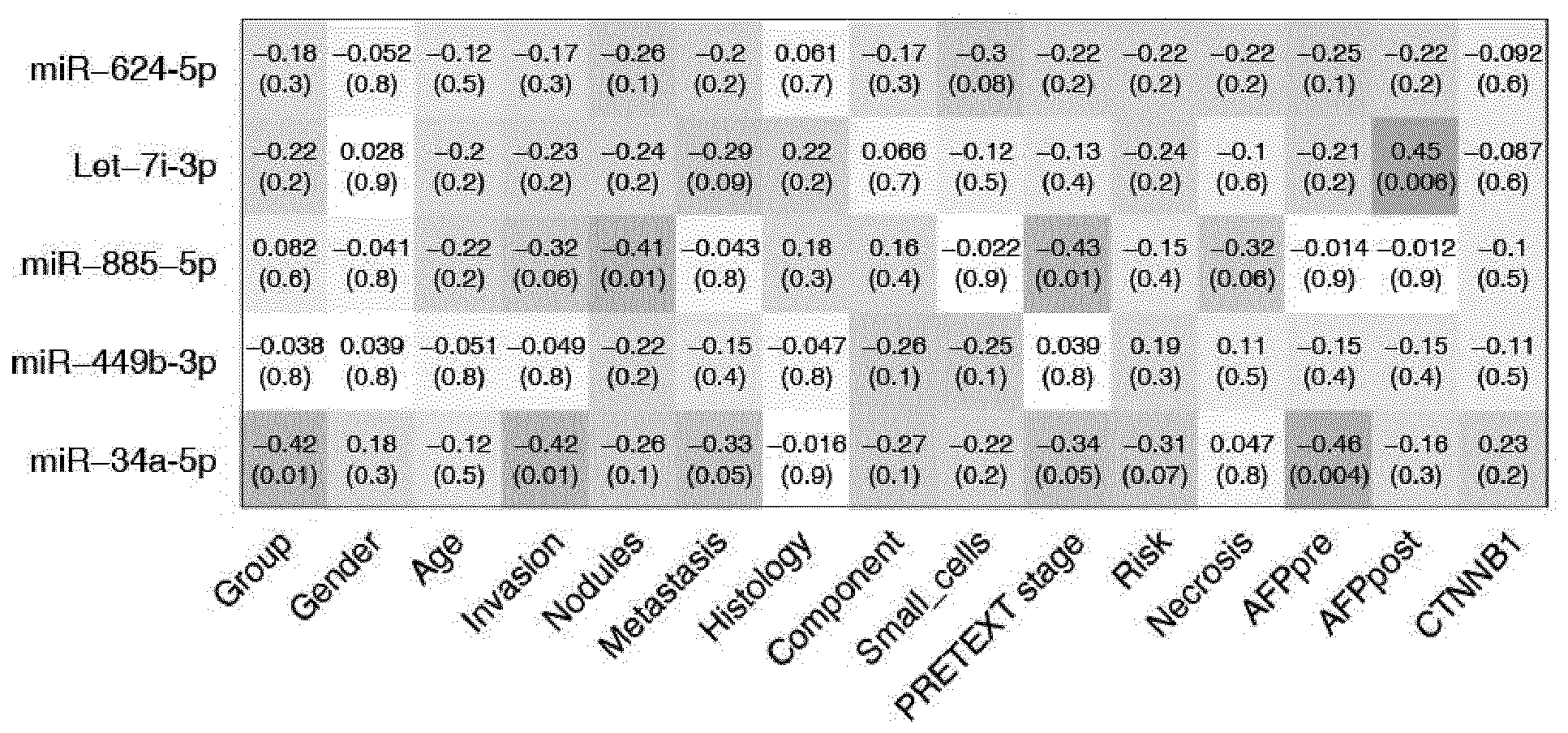
let-7i-3p AFP_post 0.45 0.0065
miR-885-5p Nodules -0.41 0.0121
miR-885-5p Stage -0.43 0.0096
miR-34a-5p Group -0.42 0.0103
miR-34a-5p Invasion -0.42 0.0114
miR-34a-5p Metastasis -0.33 0.0479
miR-34a-5p Stage -0.34 0.0453
miR-34a-5p AFP_pre -0.46 0.0043
MiR-624-5p directly targets the 3 '-UTR of the three beta-catenin mRNA variants
The inventors aimed at determining how miR-624-5p regulates beta-catenin through its 3'-UTR. Using various prediction algorithms (miRDB, RNA22-HSA, TargetMiner and Miranda) they localized a miR- 624-5p binding site at position 613-619 in the exon 16B of the 3'-UTR beta-catenin mRNA (Figures 12A). Noticeably, 16B sequence is common to the three beta-catenin mRNA variants (Figure 12B). To assess the relevance of this site, two point mutations (r.614G>C and r.618C>G) were inserted in the beta-catenin variant V3 3'-UTR (Figure 12B) and functional analyses were re-performed using a reporter system. The post-transcriptional regulation of beta-catenin by miR-624-5p was completely abrogated when the predicted site was mutated (Figure 12C). Moreover, the overexpression of miR- 624-5p in Huh6 cells decreased the expression of all beta-catenin mRNA variants (Figure 12D). Altogether these data demonstrated that miR-624-5p directly binds beta-catenin 3'-UTR and decreases its expression by targeting the three mRNA variants.
MiR-624-5p inhibits the transcriptional activity of Wnt pathway oncogenes
Having showed that miR-624-5p inhibits Wnt/beta-catenin pathway activity the inventors investigated the consequence of this inhibition on the downstream targets and Wnt pathway-associated genes by measuring the expression of numerous Wnt/beta-catenin pathway-related genes in Huh6 cells transfected with miR-624-5p, si- -catenin or a control RNA. The genes down-regulated by miR-624-5p (NRP1, SIX1, BIRC5, ABCB1, CCND1 and FGF9) have a role in cell proliferation, cell cycle progression, cell survival, migration, tumor growth and/or drug resistance (Table 3 and Figure 13 A). AXIN2, a direct target of beta-catenin/TCF4/LEF transcription complex and a member of the GSK- 3/APC/AXIN2 beta-catenin degradation complex, was also highly inhibited by miR-624-5p. MiR-624- 5p also caused the up-regulation of genes (Figure 13B). Some are known as tumor suppressors (LRPl, EGRl), modulators of tumor growth (FNl) and Wnt pathway (AHR) or safeguard against uncontrolled cellular proliferation (FST; Table 4). Others are oncogenes or known to be involved in cancer cell proliferation and invasion (CDHl, EGFR, MMP7, CTGF, PLAUR, CCND2; Table 4), transcription (RUNX2), immune reaction (B2M) or vitamin signaling (CUBN). Therefore, we can speculate that
following miR-624-5p-induced Wnt pathway inactivation, Huh6 cells activate specific mechanisms in order to compensate for the loss of this key oncogenic pathway and survive. For instance, CCND1 down- regulation was counterbalanced by CCND2 increase (Figure 13B). When Huh6 cells were transfected by a si- -catenin, 23 genes were up-regulated and 21 genes were down-regulated including the six genes significantly down-regulated by miR-624-5p (Figures 13A). These last data mean that miR-624-5p partly mimics siRNA-mediated beta-catenin silencing explaining the very similar cell phenotypes observed with this miRNA and the si- -catenin in vitro (Figure 7-11). Altogether these data demonstrate that miR-624-5p counterbalances the oncogenic function of the Wnt/beta-catenin pathway and targets other genes involved in liver carcinogenesis leading to cell growth inhibition, cell division arrest and senescence.
Table 3: Down-regulated gene by at least 50 % by miR624-5p

MiR-624-5p inhibits HBL tumor growth in vivo
Having clearly demonstrated the tumor suppressive role of miR-624-5p in vitro, the inventors investigated its effect in vivo using chicken embryos. The tumor CAM model is a simple and robust xenograft model that recapitulates major stages of tumor progression including cell proliferation, angiogenesis and tumor cell-host interactions and that has been previously used for testing small non- coding RNA-mediated gene knockdown on tumor growth. Since HuH6 tumors grow inside the CAM, no macroscopic difference was visible at day 13 and 16 (Figure 14A, row 1). However, after formalin- fixation we observed that grafted Huh6 cells formed a vascularized tissue mass, which was clearly smaller with miR-624-5p compared to control (Figure 14A, row 2). This observation was further confirmed by weighting resected tumors (Figure 14B). Indeed, while control tumor volume increased
over time, miR-624-5p-derived tumors were significantly smaller and did not grow (Figure 14B). Comparable results were obtained with tumors deriving from Huh6 cells transfected with si- -catenin (data not shown). At days 13 and 16 hemalun-eosine-safran (HES) staining (Figure 14A, row 3) and Ki67 immunostaining (Figure 14A, row 4) showed that tumor cells were less abundant and proliferated less in miR-624-5p tumors compared to control tumors, confirming the inhibitory effect of miR-624-5p on HBL development. The decrease of beta-catenin staining in miR-624-5p tumor compare to control (Ctrl) further validated the tumor suppressor activity of miR-624-5p in this animal model (Figure 14A, row 5). Altogether these results demonstrated the potent tumor suppressive function of the beta-catenin- targeting miR-624-5p in vivo.
Materials and Methods
Plasmids construction
The lentiviral pL-GFP and pL-Tomato plasmids were designed as previously described (Maurel, M., et al, 2013). The lentiviral pL-5'UTR-Bcat-GFP was obtained by inserting the full 5 'UTR sequence of the beta-catenin mRNA in the BamH I site of the pL-GFP plasmid. The lentiviral pL-GFP-3'UTR-Bcat was obtained by inserting the full 3 'UTR sequence, with the exception of the last 23nt, between the Nde I- Kpn I sites in the pL-GFP plasmid. The pL-5'UTR-Bcat-GFP-3'UTR-Bcat construct was obtained by inserting both 5' and 3'UTR in the pL-GFP as described. The 5'UTR-Bcat and 3'UTR-Bcat sequences used for these clonings are derived from the reference sequence NM_001904.3. All constructions were verified by sequencing.
Cells lines
The hepatoblastoma (HB)-derived HuH6 andHepG2 cell lines were grown in DMEM medium (Invitrogen) containing respectively 1 or 4.5 g/L of D-glucose supplemented with 10% FCS and 1% penicillin/streptomycin antibiotics at 37°C in a 5% C02 -humidified atmosphere. HBL-214-J cell line were grown in Advanced DMEM/F-12 (Invitrogen) supplemented with 8% FCS, 1% penicillin/streptomycin antibiotics and 2mM L-Glutamine. Huh6 stable cell lines co-expressing the pL- Tomato and pL-GFP transgenes, as well as the pL-Tomato and pL-GFP transgenes bearing either the beta-catenin 3'UTR, 5 'UTR or both were developed by lentiviral transduction [multiplicity(ies) of infection (m.o.i.) = 1] and cell sorting. During transfections, all cell lines were grown in complete medium without antibiotics.
Lentiviral production, Titration, Cell transduction and Cytometry analysis
Production and titration of infectious lentiviral particles, as well as biosafety considerations, procedures and policies have been described previously (Laloo, B., et al, 2009). Lentiviral particles were added to the target cells and incubated for 72 h. Then the cells were washed twice in PBS and grown in the presence of complete medium for a week before use. Cells were washed in PBS, detached with trypsin/EDTA, collected and analyzed by FACS using a BD LSRFortessa (BD Biosciences, San Jose, CA, USA) and the BD FACSDiva software as described previously (Laloo, B., et al, 2009).
Small interfering RNAs, miRNA mimics, Cell transfection and Cisplatin treatment The Human miScript miRNA Mimic 96 Set (miRBase V17.0), the miRNA mimics and the 1027281 negative siRNA control (si Ctrl) were from Qiagen. Hairpin inhibitors were from Dharmacon. The siRNA against beta-catenin (si β-catenin) was 5' ACCAGTTGTGGTTAAGCTCTT 3' (SEQ ID No 11). Small non-coding RNAs or hairpin inhibitors were transferred into the target cells by reverse transfection using Lipofectamine RNAi Max (Invitrogen) according to manufacturer's instructions at a final concentration of 15 nM. Then transfected cells were grown from 3 to 6 days before analysis. DF-FunREG screening
DF-FunREG screening was performed as previously described (Maurel M. et al, Hepatology 2013) with few modifications. 15,000 Tomato/eGFP Huh6 cells were plated per well of 96-well microplates and reverse transfected by each miRNA mimic of the miScript set. Three days after transfection, cells were washed in PBS and fluorescence signals were measured using the Envision multiplate reader (Perkin Elmer). Finally the eGFP/Tomato ratios were calculated and compared to the ratio obtained by the transfection of 1027281 negative siRNA control.
Liver Samples and Clinical Data
All patients were recruited in accordance with European and French law and institutional ethical guidelines. A set of 69 liver samples (36 HBL and 33 normal liver [NL] samples including 27 pairs of tumor and adjacent NL) was collected from 42 patients treated at French University Hospitals or from the SIOPEL Liver Tumor and Tissue Banking (www.siopel.org). Samples were obtained with written informed consent and the study protocol was approved by the ethic committees of SIOPEL and of the French Government (HEPATOBIO project: N°ID-RCB-A00180-49; CPP N°CO-15-003; CNIL N°915640; CCTIRS N°15.700; MESR N° DC2009-939). Liver samples were clinically, histologically, and genetically characterized (Supplementary Table SI). Liver tissues were immediately frozen in liquid nitrogen and stored at -80°C until used for molecular studies.
Biological and clinical features of HBL samples. The percentage of tumor samples displaying annotated features is indicated in brackets.
Patient features Features Number of cases (%)
Gender Male Female 23/13 (63.89/36,11)
Age (month) Mean (min, max) 2.76 (0.60, 15.97)
Invasion Yes 14 (38.89)
Nodules Single nodule 18 (50)
Multiple nodules 17 (47.22)
Metastasis Yes 7 (19.44)
Histology Epithelial 14 (38.89)
Mesenchymal 20 (55.56)
Component Foetal 25 (69.44)
Foetal-embryonal 3 (8.33)
Embryonal-Fcetal atypic 3 (8.33)
Mensenchymal 4 (11.11)
Small cells Yes 15 (41.67)
PRETEXT stage I 3 (8.33)
II 14 (38.89)
HI 7 (19.44)
1ΠΙ 5 (13.89)
Risk Standard risk 18 (50)
High risk 13 (36.11)
Group CI 25 (69.44)
C2 11 (30.56)
Necrosis (%) Mean (min, max) 35 (10, 0)
AFP level preoperative (ng mL) Mean (min, max) 478738 (300,2355000)
AFP level post-operative (ng mL) Mean (min, max) 183201 (4,347000)
CTNNBl Non-mutated 5 (13.89)
Mutated 10 (27.78)
Deleted 14 (38.89) miRNA quantification
Sybergreen microRNA assays (miScript PCR System, Qiagen) were used to quantify the absolute expression of mature miRNAs in liver samples or in cell lines.
Quantification of beta-catenin expression
Western blotting
2.105 cells were transfected and seeded into 6-well plates in a volume of 2 niL. Three days later whole cell extracts were prepared by treating cells with RIPA buffer (Sigma) containing a protease inhibitor cocktail. Proteins were separated by SDS-PAGE and transferred onto nitrocellulose membrane (Protran, Whatman). Then membranes were saturated in PBS-BSA 2% and successively incubated with the indicated primary antibodies and adequate InfraRed-labeled secondary antibody (either IRDye-680 or - 800 conjugated secondary antibodies) following manufacturer's instructions. Fluorescence signals were detected and quantified using the Odyssey infrared imaging system. Blocker and Odyssey infrared imaging system were from LI-COR Biosciences (ScienceTec, Les Ulis, France). Specific protein signal was normalized to the house-keeping protein GAPDH. The mouse monoclonal anti-beta-catenin (610154) antibody was from BD Biosciences and the rabbit polyclonal anti-GAPDH (FL-335) antibody was from Santa Cruz.
Real time quantitative PCR and RT-PCR
PCRs were done as described previously (Laloo B. et al, MCP 2009; Jalvy-Delvaille S. et al, NAR 2012) with the exception of cDNA synthesis which were done with the Maxima Reverse Transcriptase
(Thermo Scientific). Primers used in Real time quantitative PCR amplifications were: Forward beta- catenin: 5'- TCTTACACCCACCATCCCAC-3' (SEQ ID No 12); Reverse beta-catenin: 5'- GCACGAAC AAGC AACTGAAC-3 ' (SEQ ID No 13) Forward RNA 18s: 5'- GGATCC ATTGGAGGGC AAGT-3 ' (SEQ ID No 14); Reverse RNA 18s: 5'- CCGCTCCCAAGATCCAACTA-3' (SEQ ID No 15).
Cell growth and proliferation assays
Cell growth was measured with the In vitro Toxicology assay kit (Sigma), which uses sulforhodamine B to measure the total cellular proteins, according to the manufacturer's instructions. Briefly 3,500 Huh6 cells, 4,500 HepG2 or 10,000 HB-214-J cells were transfected and seeded into 96-well microplates in a volume of 100 μΕ. One day, three days and six days later, cell growth was stopped by the addition of cold trichloroacetic acid, then Sulforhodamine B staining was performed, staining was released by the addition of Tris (lOmM) and absorbance was measured at 565 nm using the CLARIOstar multiplate reader (BMG Labtech).
Cell death assays
Cell apoptosis was analysed using tetramethylrhodamine methyl ester (TMRM; Invitrogen), which detects the loss of mitochondrial membrane potential, and using the Caspase-Glo® 3/7 Assay System (Promega), which measures caspase-3/7 activities. Prior to cell apoptosis detection with TMRM, 2.105 cells were transfected and seeded into 6-well plates in a volume of 2 iriL. Three days later, total cells were collected, washed twice in PBS, resuspended in ΙΟΟμΕ of TMRM staining solution (150nM) and incubated 20 minutes at 37°C. After the addition of 500μΕ of PBS cell apoptosis was analysed by FACS using a BD FACSCanto II (BD Biosciences). Prior to cell apoptosis detection with Caspase-Glo Assay, 15,000 cells were transfected and seeded into 96-well plates in a total volume of ΙΟΟμΕ. Three days later, the caspase-3/7 activities were measured according to the manufacturer's instructions and the luminescence was analyzed using the Envision multiplate reader (Perkin Elmer).
Cell cycle assay
Cell cycle was studied with the APC/BrdU flow kit from BD Pharmingen according to manufacturer' s instructions. Briefly, 2.105 cells were transfected and seeded into 6-well plates in a volume of 2 iriL. Three days later, BrdU was added in each well 45 minutes before harvesting the cells and incorporated into newly synthesized DNA by cells entering and progressing through the S phase of the cell cycle. The incorporated BrdU was stained with an APC anti-BrdU fluorescent antibody and the levels of cell- associated BrdU were then measured by flow cytometry on the FACS CANTO II (BD Bioscience). Cell senescence assay
Cell senescence was studied with the Senescence beta-Galactosidase Staining kit from Cell Signalling according to manufacturer's instructions. Briefly, 2.105 cells were transfected and seeded into 6-well plates on coverslips in a volume of 2 iriL. Three days later, cells were fixed and beta-galactosidase activity was revealed by the addition of X-gal and staining solution. Then cells were stained with Eosin
0.5% and observed under microscope. Cells undergoing senescence showed a blue staining and were quantified.
In vivo Chick Chorioallantoic Membrane ( CAM) assays and immunohistological studies
Eggs opening: All eggs are received at the stage of segmentation and then incubated at 37.4°C for recovery development. Three days after, eggs are opened on the top and a plaster is placed on the gap. Huh6 cells transfection and eggs implantation: Six days after eggs opening, Huh6 cells are transfected with either 1027281 negative siRNA control or miR-624-5p from Qiagen at a final concentration of 15 nM by forward transfection using Lipofectamine RNAi Max (Invitrogen) according to manufacturer's instructions. One day later, cells are washed in PBS, detached with trypsin/EDTA and collected. Cells are mixed in 50% DMEM 50% Matrigel (Corning) at a concentration of 1 million Huh6 per 40μΕ, and 40μΕ^Γορ were formed and incubated at 37°C for polymerization. Then, the egg plaster is removed and each drop of Huh6 cells is placed on the CAM of one egg. Finally the plaster is put back on the gap and eggs are re-incubated.
Tumour growth monitoring, fixation and CAM collection: Pictures of the growth tumour are done every day until 6 days using the stereomicroscope (SMZ745T) and camera (DS-Fi2) from Nikon and then analysed with the NSI Element D software. Tumours are fixed with Neutral Buffered Formalin (Diapath) at 3 days and 6 days after implantation and included in paraffin.
Statistical analyses
Graphs and statistical analyses were done using GraphPad Prism 5.0 or 6.03 software. As the different groups of values did not followed a Gaussian distribution (data from D'Agostino & Pearson omnibus and Shapiro-Wilk normality tests), the non-parametric Mann-Whitney test was used for the comparison of two groups of unmatched values and the parametric Paired t test for the comparison of two groups of matched values. When experiment contained three groups of values or more, regular one-way analysis of variance (ANOVA) was used for the comparison of multiple means. For each experiment, the ANOVA P value is as indicated in brackets. As indicated in the Figure legends the ANOVA test was followed by a Bonferroni's or Holm-Sidak's multiple-comparison post-test and selected pairs of data were compared. The P value is indicated at the bottom of each Figure legend. Means were considered significantly different when P<0.05. Significant variations were represented by asterisks above the corresponding bar when comparing the test with the control condition or above the line when comparing the two indicated conditions.
Claims
Claims
1- A molecule selected from the group consisting of hsa-miR-624-5p, hsa-miR-548z, hsa-let-7i- 3p, hsa-miR-885-5p, hsa-miR-449b-3p or combination thereof or a DNA or RNA encoding for said miRNA for use for treating a hepatoblastoma cancer.
2- The miRNA for use according to claim 1, wherein the molecule is selected from the group consisting of hsa-miR-624-5p, hsa-miR-548z, hsa-let-7i-3p, hsa-miR-449b-3p or a combination thereof.
3- The miRNA for use according to any one of claims 1 to 2, wherein the molecule is to be used in combination with one or more therapeutic agents.
4- The miRNA for use according to claim 3, wherein the therapeutic agent is another antitumor therapy, in particular with doxorubicin, cisplatin, gemcitabine, oxaliplatin, carboplatin, mitomycin C, tamoxifen, sorafenib or any combination thereof, preferably cisplatin and/or doxorubicin.
5- The miRNA for use according to claim 3, wherein the therapeutic agent is an immunotherapeutic agent such as drugs targeting immune system checkpoints such as PD-1 or PD-L1.
6- The miRNA for use according to any one of claims 1 to 5, wherein the molecule is to be used before or after resection, radiofrequency ablation and/or percutaneous ethanol injection.
7- The miRNA for use according to any one of claims 1 to 6, wherein the molecule is for use as neo-adjuvant therapy or adjuvant therapy.
8- The miRNA for use according to any one of claims 1 to 7, wherein the subject does not respond to the first line treatment and/or is not suitable for tumor resection or ablation.
9- The miRNA for use according to any one of claims 1 to 8, wherein the subject has a miRNA selected from the group consisting of hsa-miR-548z, hsa-miR-624-5p, hsa4et-7i-3p, hsa-miR- 449b-3p or combination thereof which is under-expressed in tumor in comparison with a healthy or non-tumoral control.
10- Use of a miRNA selected from the group consisting of hsa-miR-624-5p, hsa-miR-548z, hsa-let- 7i-3p, hsa-miR-449b-3p or of a combination thereof as a marker for detecting a hepatoblastoma cancer or a susceptibility to develop a hepatoblastoma cancer.
11- The use according to claim 10, wherein the miRNA is used in combination with hsa-miR-885- 5p.
12- A method for detecting a hepatoblastoma cancer or a susceptibility to develop a hepatoblastoma cancer in a subject, comprising determining the level of a miRNA selected from the group consisting of hsa-miR-548z, hsa-miR-624-5p, hsa-let-7i-3p, hsa-miR-449b-3p or of a combination thereof in a biological sample from the subject, an under-expression of at least one
of the miRNA in comparison with a healthy or non-tumoral control being indicative of a hepatoblastoma cancer or a susceptibility to develop a hepatoblastoma cancer.
13- A method for selecting a subject suitable for a treatment by a molecule as disclosed in claim 1 comprising determining the level of a miRNA selected from the group consisting of hsa-miR- 624-5p, hsa-miR-548z, hsa-let-7i-3p, hsa-miR-449b-3p or of a combination thereof in a biological sample from the subject, and selecting the subject if at least one of the miRNA is under-expressed in comparison with a healthy or non-tumoral control.
14- A method for determining the prognosis in a subject having a hepatoblastoma cancer comprising determining the level of a miRNA selected from the group consisting of hsa-miR-624-5p, hsa- miR-548z, hsa-miR-624-5p, hsa-let-7i-3p, hsa-miR-449b-3p or of a combination thereof in a biological sample from the subject, the level of expression of said at least one of the miRNA being correlated with the clinical prognosis.
15- Use of a kit according to claim 14 for detecting a hepatoblastoma cancer or a susceptibility to develop a hepatoblastoma cancer in a subject or for selecting a subject suitable for a treatment by a molecule as disclosed in claim 1, or for determining the prognosis in a subject having a hepatoblastoma cancer, wherein the kit comprising a detection means for at least one miRNA selected from the group consisting of hsa-miR-624-5p, hsa-miR-548z, hsa-let-7i-3p, hsa-miR- 449b-3p or for a combination thereof..
Applications Claiming Priority (2)
| Application Number | Priority Date | Filing Date | Title |
|---|---|---|---|
| EP15306113 | 2015-07-07 | ||
| EP15306113.0 | 2015-07-07 |
Publications (1)
| Publication Number | Publication Date |
|---|---|
| WO2017005773A1 true WO2017005773A1 (en) | 2017-01-12 |
Family
ID=53673043
Family Applications (1)
| Application Number | Title | Priority Date | Filing Date |
|---|---|---|---|
| PCT/EP2016/065938 Ceased WO2017005773A1 (en) | 2015-07-07 | 2016-07-06 | Use of catenin- beta 1-targeting micrornas for treating liver cancer |
Country Status (1)
| Country | Link |
|---|---|
| WO (1) | WO2017005773A1 (en) |
Cited By (6)
| Publication number | Priority date | Publication date | Assignee | Title |
|---|---|---|---|---|
| WO2019014398A1 (en) | 2017-07-11 | 2019-01-17 | Actym Therapeutics, Inc. | Engineered immunostimulatory bacterial strains and uses thereof |
| WO2020014543A2 (en) | 2018-07-11 | 2020-01-16 | Actym Therapeutics, Inc. | Engineered immunostimulatory bacterial strains and uses thereof |
| WO2020030750A1 (en) * | 2018-08-08 | 2020-02-13 | Theramir Ltd | Microrna-based therapy targeted against lcp-1 positive cancers |
| WO2020047161A2 (en) | 2018-08-28 | 2020-03-05 | Actym Therapeutics, Inc. | Engineered immunostimulatory bacterial strains and uses thereof |
| CN111154870A (en) * | 2019-08-05 | 2020-05-15 | 江苏省肿瘤医院 | Biomarker for nasopharyngeal carcinoma metastasis diagnosis and/or prognosis evaluation |
| JP2020515618A (en) * | 2017-03-28 | 2020-05-28 | ディセルナ ファーマシューティカルズ インコーポレイテッド | Enhances immunotherapy by decreasing beta-catenin expression |
Citations (1)
| Publication number | Priority date | Publication date | Assignee | Title |
|---|---|---|---|---|
| WO2008073923A2 (en) * | 2006-12-08 | 2008-06-19 | Asuragen, Inc. | Mirna regulated genes and pathways as targets for therapeutic intervention |
-
2016
- 2016-07-06 WO PCT/EP2016/065938 patent/WO2017005773A1/en not_active Ceased
Patent Citations (1)
| Publication number | Priority date | Publication date | Assignee | Title |
|---|---|---|---|---|
| WO2008073923A2 (en) * | 2006-12-08 | 2008-06-19 | Asuragen, Inc. | Mirna regulated genes and pathways as targets for therapeutic intervention |
Non-Patent Citations (6)
| Title |
|---|
| ARMANDO MAGRELLI ET AL: "Altered microRNA Expression Patterns in Hepatoblastoma Patients", TRANSLATIONAL ONCOLOGY, vol. 2, no. 3, 18 August 2009 (2009-08-18), United States, pages 157 - 163, XP055239293, ISSN: 1936-5233, DOI: 10.1593/tlo.09124 * |
| CAIRO S ET AL: "Hepatic Stem-like Phenotype and Interplay of Wnt/beta-Catenin and Myc Signaling in Aggressive Childhood Liver Cancer", CANCER CELL, CELL PRESS, US, vol. 14, no. 6, 9 December 2008 (2008-12-09), pages 471 - 484, XP002508978, ISSN: 1535-6108, DOI: 10.1016/J.CCR.2008.11.002 * |
| GYUGOS MÓNIKA ET AL: "microRNA expression might predict prognosis of epithelial hepatoblastoma", VIRCHOWS ARCHIV, SPRINGER INTERNATIONAL, BERLIN, DE, vol. 464, no. 4, 26 February 2014 (2014-02-26), pages 419 - 427, XP035373127, ISSN: 0945-6317, [retrieved on 20140226], DOI: 10.1007/S00428-014-1549-Y * |
| M. J. MURRAY ET AL: "Solid Tumors of Childhood Display Specific Serum microRNA Profiles", CANCER EPIDEMIOLOGY, BIOMARKERS AND PREVENTION., vol. 24, no. 2, 21 November 2014 (2014-11-21), US, pages 350 - 360, XP055255104, ISSN: 1055-9965, DOI: 10.1158/1055-9965.EPI-14-0669 * |
| PEZ FLORIANE ET AL: "Wnt signaling and hepatocarcinogenesis: Molecular targets for the development of innovative anticancer drugs", JOURNAL OF HEPATOLOGY, vol. 59, no. 5, 29 July 2009 (2009-07-29), pages 1107 - 1117, XP028755494, ISSN: 0168-8278, DOI: 10.1016/J.JHEP.2013.07.001 * |
| SURASAK SANGKHATHAT ET AL: "In vitro RNA interference against [beta]-catenin inhibits the proliferation of pediatric hepatic tumors", INTERNATIONAL JOURNAL OF ONCOLOGY, 1 March 2006 (2006-03-01), GR, XP055255259, ISSN: 1019-6439, DOI: 10.3892/ijo.28.3.715 * |
Cited By (21)
| Publication number | Priority date | Publication date | Assignee | Title |
|---|---|---|---|---|
| JP2023073256A (en) * | 2017-03-28 | 2023-05-25 | ディセルナ ファーマシューティカルズ インコーポレイテッド | Reducing beta-catenin expression to enhance immunotherapy |
| JP7295804B2 (en) | 2017-03-28 | 2023-06-21 | ディセルナ ファーマシューティカルズ インコーポレイテッド | Reducing beta-catenin expression to enhance immunotherapy |
| US11572559B2 (en) | 2017-03-28 | 2023-02-07 | Dicerna Pharmaceuticals, Inc. | Reducing beta-catenin expression to potentiate immunotherapy |
| EP3600423A4 (en) * | 2017-03-28 | 2021-01-13 | Dicerna Pharmaceuticals, Inc. | Reducing beta-catenin expression to potentiate immunotherapy |
| JP2020515618A (en) * | 2017-03-28 | 2020-05-28 | ディセルナ ファーマシューティカルズ インコーポレイテッド | Enhances immunotherapy by decreasing beta-catenin expression |
| WO2019014398A1 (en) | 2017-07-11 | 2019-01-17 | Actym Therapeutics, Inc. | Engineered immunostimulatory bacterial strains and uses thereof |
| US12553047B2 (en) | 2017-07-11 | 2026-02-17 | Actym Therapeutics, Inc. | Engineered immunostimulatory bacterial strains and uses thereof |
| US11168326B2 (en) | 2017-07-11 | 2021-11-09 | Actym Therapeutics, Inc. | Engineered immunostimulatory bacterial strains and uses thereof |
| US12357661B2 (en) | 2018-07-11 | 2025-07-15 | Actym Therapeutics, Inc. | Engineered immunostimulatory bacterial strains and uses thereof |
| US12226439B2 (en) | 2018-07-11 | 2025-02-18 | Actym Therapeutics, Inc. | Engineered immunostimulatory bacterial strains and uses thereof |
| WO2020014543A2 (en) | 2018-07-11 | 2020-01-16 | Actym Therapeutics, Inc. | Engineered immunostimulatory bacterial strains and uses thereof |
| US12201653B2 (en) | 2018-07-11 | 2025-01-21 | Actym Therapeutics, Inc. | Engineered immunostimulatory bacterial strains and uses thereof |
| WO2020030750A1 (en) * | 2018-08-08 | 2020-02-13 | Theramir Ltd | Microrna-based therapy targeted against lcp-1 positive cancers |
| US12133860B2 (en) | 2018-08-08 | 2024-11-05 | Theramir Limited | MicroRNA-based therapy targeted against LCP-1 positive cancers |
| EP4424380A3 (en) * | 2018-08-08 | 2024-11-20 | Theramir Ltd | Microrna-based therapy targeted against lcp-1 positive cancers |
| US12012600B2 (en) | 2018-08-28 | 2024-06-18 | Actym Therapeutics, Inc. | Engineered immunostimulatory bacterial strains and uses thereof |
| US11242528B2 (en) | 2018-08-28 | 2022-02-08 | Actym Therapeutics, Inc. | Engineered immunostimulatory bacterial strains and uses thereof |
| WO2020047161A2 (en) | 2018-08-28 | 2020-03-05 | Actym Therapeutics, Inc. | Engineered immunostimulatory bacterial strains and uses thereof |
| US11779612B2 (en) | 2019-01-08 | 2023-10-10 | Actym Therapeutics, Inc. | Engineered immunostimulatory bacterial strains and uses thereof |
| CN111154870A (en) * | 2019-08-05 | 2020-05-15 | 江苏省肿瘤医院 | Biomarker for nasopharyngeal carcinoma metastasis diagnosis and/or prognosis evaluation |
| CN111154870B (en) * | 2019-08-05 | 2023-06-23 | 江苏省肿瘤医院 | A biomarker for the diagnosis and/or prognosis evaluation of nasopharyngeal carcinoma metastasis |
Similar Documents
| Publication | Publication Date | Title |
|---|---|---|
| EP2847333B1 (en) | Bi-functional short-hairpin rna (bi-shrna) specific for single-nucleotide kras mutations | |
| US9683237B2 (en) | Multiple targeted RNAI for the treatment of cancers | |
| WO2016106405A1 (en) | Rna interference compositions and methods for malignant tumors | |
| JP2019512489A (en) | MicroRNA and method of using the same | |
| CN106661576A (en) | Multiple targeted rnai for the treatment of cancers | |
| JP2016064989A (en) | Pharmaceutical composition for treating cancer, and method for evaluating sensitivity to treatment by pd-1 inhibitor | |
| US12516323B2 (en) | Methods and compositions for sensitization of tumor cells to immune therapy | |
| WO2017005771A1 (en) | Use of glypican-3-targeting micrornas for treating liver cancer | |
| WO2020081585A1 (en) | The long non-coding rna inca1 and homo sapiens heterogeneous nuclear ribonucleoprotein h1 (hnrnph1) as therapeutic targets for immunotherapy | |
| US20130281513A1 (en) | siRNA FOR INHIBITION OF Hif1alpha EXPRESSION AND ANTICANCER COMPOSITION CONTAINING THE SAME | |
| US20250277215A1 (en) | Long Non-Coding RNA 122 (Lnc122) for Treatment Cancer | |
| JP5887413B2 (en) | Methods of reducing cancer cell radiation resistance and proliferation, metastasis and invasion by modulating TM4SF4 expression or activity in non-small cell lung cancer | |
| CA3163139A1 (en) | Compositions and methods for treating cancer | |
| WO2023086552A2 (en) | Lncrna transcripts in melanomagenesis | |
| WO2020198488A1 (en) | Therapeutic targets for oncogenic kras-dependent cancers | |
| WO2015038593A1 (en) | Targeting microrna-26a/b for the treatment of neurodegenerative disease | |
| Clark | Effect of morpholino-mediated knockdowns of oncofetal RNA-binding proteins on cancer cell biology. | |
| WO2024003350A1 (en) | Combination therapy for melanoma | |
| US11168327B2 (en) | STEAP2 inhibitors for the treatment of liver cancers | |
| WO2025256564A9 (en) | iRNA COMPOSITION AND METHOD OF USING SAME | |
| US10011877B2 (en) | Treatment of bladder cancer to overcome chemoresistance | |
| KR20160022273A (en) | Novel marker for diagnosing cancer and and anti-cancer drug using thereof | |
| WO2022032017A2 (en) | Human xist antisense oligonucleotides for x reactivation therapy | |
| CA2680058A1 (en) | Induction of apoptosis and inhibition of cell proliferation through modulation of carnitine palmitoyltransferase 1c activity |
Legal Events
| Date | Code | Title | Description |
|---|---|---|---|
| 121 | Ep: the epo has been informed by wipo that ep was designated in this application |
Ref document number: 16736433 Country of ref document: EP Kind code of ref document: A1 |
|
| NENP | Non-entry into the national phase |
Ref country code: DE |
|
| 122 | Ep: pct application non-entry in european phase |
Ref document number: 16736433 Country of ref document: EP Kind code of ref document: A1 |