WO2016199801A1 - アミノ酸修飾核酸とその利用 - Google Patents
アミノ酸修飾核酸とその利用 Download PDFInfo
- Publication number
- WO2016199801A1 WO2016199801A1 PCT/JP2016/067025 JP2016067025W WO2016199801A1 WO 2016199801 A1 WO2016199801 A1 WO 2016199801A1 JP 2016067025 W JP2016067025 W JP 2016067025W WO 2016199801 A1 WO2016199801 A1 WO 2016199801A1
- Authority
- WO
- WIPO (PCT)
- Prior art keywords
- trna
- ribozyme
- codon
- nba
- seq
- Prior art date
- Legal status (The legal status is an assumption and is not a legal conclusion. Google has not performed a legal analysis and makes no representation as to the accuracy of the status listed.)
- Ceased
Links
Images



Classifications
-
- C—CHEMISTRY; METALLURGY
- C12—BIOCHEMISTRY; BEER; SPIRITS; WINE; VINEGAR; MICROBIOLOGY; ENZYMOLOGY; MUTATION OR GENETIC ENGINEERING
- C12N—MICROORGANISMS OR ENZYMES; COMPOSITIONS THEREOF; PROPAGATING, PRESERVING, OR MAINTAINING MICROORGANISMS; MUTATION OR GENETIC ENGINEERING; CULTURE MEDIA
- C12N15/00—Mutation or genetic engineering; DNA or RNA concerning genetic engineering, vectors, e.g. plasmids, or their isolation, preparation or purification; Use of hosts therefor
- C12N15/09—Recombinant DNA-technology
- C12N15/11—DNA or RNA fragments; Modified forms thereof; Non-coding nucleic acids having a biological activity
- C12N15/113—Non-coding nucleic acids modulating the expression of genes, e.g. antisense oligonucleotides; Antisense DNA or RNA; Triplex- forming oligonucleotides; Catalytic nucleic acids, e.g. ribozymes; Nucleic acids used in co-suppression or gene silencing
-
- C—CHEMISTRY; METALLURGY
- C12—BIOCHEMISTRY; BEER; SPIRITS; WINE; VINEGAR; MICROBIOLOGY; ENZYMOLOGY; MUTATION OR GENETIC ENGINEERING
- C12N—MICROORGANISMS OR ENZYMES; COMPOSITIONS THEREOF; PROPAGATING, PRESERVING, OR MAINTAINING MICROORGANISMS; MUTATION OR GENETIC ENGINEERING; CULTURE MEDIA
- C12N15/00—Mutation or genetic engineering; DNA or RNA concerning genetic engineering, vectors, e.g. plasmids, or their isolation, preparation or purification; Use of hosts therefor
- C12N15/09—Recombinant DNA-technology
- C12N15/63—Introduction of foreign genetic material using vectors; Vectors; Use of hosts therefor; Regulation of expression
- C12N15/67—General methods for enhancing the expression
-
- C—CHEMISTRY; METALLURGY
- C12—BIOCHEMISTRY; BEER; SPIRITS; WINE; VINEGAR; MICROBIOLOGY; ENZYMOLOGY; MUTATION OR GENETIC ENGINEERING
- C12N—MICROORGANISMS OR ENZYMES; COMPOSITIONS THEREOF; PROPAGATING, PRESERVING, OR MAINTAINING MICROORGANISMS; MUTATION OR GENETIC ENGINEERING; CULTURE MEDIA
- C12N9/00—Enzymes; Proenzymes; Compositions thereof; Processes for preparing, activating, inhibiting, separating or purifying enzymes
-
- C—CHEMISTRY; METALLURGY
- C12—BIOCHEMISTRY; BEER; SPIRITS; WINE; VINEGAR; MICROBIOLOGY; ENZYMOLOGY; MUTATION OR GENETIC ENGINEERING
- C12P—FERMENTATION OR ENZYME-USING PROCESSES TO SYNTHESISE A DESIRED CHEMICAL COMPOUND OR COMPOSITION OR TO SEPARATE OPTICAL ISOMERS FROM A RACEMIC MIXTURE
- C12P21/00—Preparation of peptides or proteins
- C12P21/02—Preparation of peptides or proteins having a known sequence of two or more amino acids, e.g. glutathione
-
- C—CHEMISTRY; METALLURGY
- C07—ORGANIC CHEMISTRY
- C07K—PEPTIDES
- C07K2319/00—Fusion polypeptide
- C07K2319/50—Fusion polypeptide containing protease site
-
- C—CHEMISTRY; METALLURGY
- C07—ORGANIC CHEMISTRY
- C07K—PEPTIDES
- C07K2319/00—Fusion polypeptide
- C07K2319/60—Fusion polypeptide containing spectroscopic/fluorescent detection, e.g. green fluorescent protein [GFP]
-
- C—CHEMISTRY; METALLURGY
- C12—BIOCHEMISTRY; BEER; SPIRITS; WINE; VINEGAR; MICROBIOLOGY; ENZYMOLOGY; MUTATION OR GENETIC ENGINEERING
- C12N—MICROORGANISMS OR ENZYMES; COMPOSITIONS THEREOF; PROPAGATING, PRESERVING, OR MAINTAINING MICROORGANISMS; MUTATION OR GENETIC ENGINEERING; CULTURE MEDIA
- C12N2310/00—Structure or type of the nucleic acid
- C12N2310/10—Type of nucleic acid
- C12N2310/11—Antisense
- C12N2310/111—Antisense spanning the whole gene, or a large part of it
-
- C—CHEMISTRY; METALLURGY
- C12—BIOCHEMISTRY; BEER; SPIRITS; WINE; VINEGAR; MICROBIOLOGY; ENZYMOLOGY; MUTATION OR GENETIC ENGINEERING
- C12N—MICROORGANISMS OR ENZYMES; COMPOSITIONS THEREOF; PROPAGATING, PRESERVING, OR MAINTAINING MICROORGANISMS; MUTATION OR GENETIC ENGINEERING; CULTURE MEDIA
- C12N2310/00—Structure or type of the nucleic acid
- C12N2310/10—Type of nucleic acid
- C12N2310/12—Type of nucleic acid catalytic nucleic acids, e.g. ribozymes
Definitions
- the present invention relates to a method and a protein synthesis system for synthesizing a protein in which a nucleobase amino acid (NBA) is introduced at a desired position.
- NBA nucleobase amino acid
- Genome editing is the identification of target genes using artificial nucleases (such as ZFN and TALEN) that can recognize and cleave any target sequence in the DNA strand and RNA-derived nucleases (such as CRISPR / Cas). This is a technique for introducing a mutation into a site (Non-patent Document 1).
- artificial nucleases such as ZFN and TALEN
- RNA-derived nucleases such as CRISPR / Cas
- RNA binding domain that specifically recognizes the target sequence and a DNA cleavage domain of the restriction enzyme FokI are linked
- guide RNA A small RNA molecule called (gRNA) recognizes the target sequence
- Cas9 an RNA-dependent DNA nuclease
- PNA peptide nucleic acids
- PNA is a non-natural nucleic acid analog that is artificially made to have similar properties to DNA and RNA, and is a molecule in which the deoxyribose-phosphate backbone in DNA is replaced by a peptide backbone.
- PNA has the following advantages. (1) PNA has no negative charge due to phosphate groups present in DNA or RNA and is neutral. Therefore, PNA / DNA duplex or PNA / RNA duplex is not affected by pH or salt concentration. Can be formed stably.
- Non-Patent Documents 2 to 7 PNAs having various peptide skeletons have been developed (Non-Patent Documents 2 to 7).
- Non-patent Document 8 a DNA double strand adjacent to a target site is interrupted with a PNA oligomer, the DNA double strand of the target site is unwound, and the target site that has become a single strand is cleaved with cerium ions. Since PNA has a very high recognition specificity of the base sequence, it is specifically inserted into the target site.
- cerium ions may cleave not only single-stranded DNA formed by insertion of PNA but also other single-stranded DNA, resulting in poor specificity. It becomes a problem. Therefore, if a nuclease moiety consisting of a protein and a target DNA binding moiety consisting of PNA can be fused, an artificial nuclease having high specificity for an arbitrary target sequence can be easily developed, making it a useful genome editing tool. Expected to gain.
- the PNA oligomer is synthesized by condensing monomers protected by Boc, Cbz, Fmoc, etc. by solid phase synthesis similar to peptide synthesis and repeating deprotection. Therefore, in the case of solid-phase synthesis, even if the efficiency of a single condensation reaction is 90%, the yield of 10-mer oligomers is limited to about 35%, and long-chain PNA must be produced efficiently. Has the problem of being extremely difficult. Furthermore, even when chemically synthesized PNA is fused to a protein, there are problems such as insufficient fusion with PNA or excessive PNA fusion depending on the properties of the protein.
- puromycin and blasticidin are known as naturally-occurring NBA or its analogs, but these inhibit the translation process by binding to ribosomes and inhibit protein synthesis. in use. For this reason, it has been conventionally considered that it is difficult to synthesize a protein introduced with PNA having NBA as a structural unit by a ribosome translation system.
- the present invention aims to solve the problems of the prior art and provide a method for synthesizing a protein into which NBA is introduced.
- the present inventors have confirmed for the first time that a tRNA acylated with NBA is incorporated into a ribosome and a protein into which NBA has been introduced is synthesized by ribosome translation. It is a surprising finding that overturns the conventional assumption that tRNA acylated with NBA is incorporated into ribosomes without inhibiting the translation process and a protein into which NBA is introduced is synthesized. Based on this novel discovery, the present inventors have succeeded in establishing a method for synthesizing a protein in which NBA is introduced at a desired position by a ribosome translation system.
- the present invention provides a step of preparing an mRNA having a modified codon inserted at a desired position downstream of an initiation codon, a tRNA that recognizes the modified codon, and comprises a nucleobase amino acid (NBA And a method of synthesizing a protein in which NBA is introduced at a desired position, which comprises the step of translating the mRNA into a protein in the presence of tRNA acylated in (1).
- the method preferably further includes the step of preparing the tRNA acylated with the NBA by a ribozyme that catalyzes the aminoacylation reaction of tRNA.
- a nucleobase amino acid NBA
- a tRNA that recognizes a modified codon
- a ribozyme that catalyzes the aminoacylation reaction of the tRNA.
- the present invention provides a cell-free protein synthesis system for synthesizing a protein having NBA introduced at a desired position.
- the ribozyme is preferably an enhanced flexizyme.
- the ribozyme is preferably composed of an RNA molecule having no phosphate group at the 5 'end.
- the ribozyme is preferably composed of two RNA molecules.
- the two RNA molecules are preferably (1) GGAUCGAAAGAUUUCCGCGGCCCCG (SEQ ID NO: 4) and (2) CGGGGAUUAGCGUUAGGU (SEQ ID NO: 5).
- the modified codon is preferably an amber codon.
- the present invention comprises the following two RNA molecules: (1) GGAUCGAAAGAUUUCCGCGGCCCCG (SEQ ID NO: 4) and (2) CGGGGAUUAGCGUUAGGU (SEQ ID NO: 5), or the RNA of (1) above
- the present invention provides a ribozyme comprising two RNA molecules in which 1 to 3 bases are substituted, deleted or added at the 3 ′ end of the molecule and / or the 5 ′ end of the RNA molecule of the above (2).
- the present invention comprises the following two RNA molecules: (3) GGAUCGAAAGAUUUCCGCAUCCCCG (SEQ ID NO: 7) and (4) CGGGUACAUGGCGUUAGGU (SEQ ID NO: 8), or the RNA of (3) above
- the present invention provides a ribozyme comprising two RNA molecules in which 1 to 3 bases are substituted, deleted or added at the 3 ′ end of the molecule and / or the 5 ′ end of the RNA molecule of (4).
- the 5 ′ end and / or the 3 ′ end of the two RNA molecules are preferably biotinylated.
- the protein synthesis method and the cell-free protein synthesis system according to the present invention make it possible to easily and efficiently synthesize a protein in which a nucleobase amino acid (NBA) is introduced at a desired position.
- NBA nucleobase amino acid
- the ribozyme that catalyzes the aminoacylation reaction of tRNA according to the present invention is useful because it consists of two RNA molecules and can be easily and inexpensively prepared by chemical synthesis. Furthermore, since the ribozyme catalyzing the aminoacylation reaction of tRNA according to the present invention can be chemically synthesized, it can be easily biotinylated, thereby improving the purification efficiency of the aminoacylation reaction product.
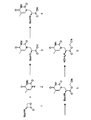
- FIG. 3 is a diagram showing a synthesis scheme of alanyl-thymine cyanomethyl ester derivative (AlaT-CME).
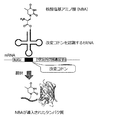
- FIG. 3 is a diagram showing a synthesis scheme of a cyanomethyl ester derivative (HalT-CME) of homoalanyl-thymine. It is a figure which shows the chemical structure of aminoacylated tRNA. It is a figure which shows the chemical structure of tRNA aminoacylated with the nucleobase amino acid (NBA).
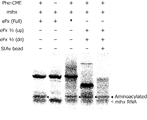
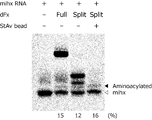
- FIG. 3 is a diagram confirming the aminoacylation reaction of tRNA by split eFx. It is the figure which confirmed the synthesis
- the present invention provides a step of preparing an mRNA having a modified codon inserted at a desired position downstream of an initiation codon, a tRNA that recognizes the modified codon, and comprising a nucleobase amino acid (NBA And a method of synthesizing a protein in which NBA is introduced at a desired position, which comprises the step of translating the mRNA into a protein in the presence of tRNA acylated in (1).
- NBA nucleobase amino acid
- NBA a method of synthesizing a protein in which NBA is introduced at a desired position
- a modified codon inserted at a desired position of mRNA encoding the target protein is prepared and used.
- the “mRNA” in the present embodiment includes a sequence encoding a target protein and a sequence necessary for the ribosome to initiate protein translation (eg, Shine-Dalgarno (SD) sequence, Kozak sequence, internal ribosome introduction site (IRES ) Etc.).
- the target protein may be any protein, and may be, for example, a nuclease, recombinase, integrase, deaminase, methyltransferase, sulftransferase, glycosylase, and the like.
- the mRNA into which the modified codon has been inserted can be prepared by preparing a DNA encoding the mRNA and inserting the modified codon, and then transcribing the DNA into mRNA with RNA polymerase. Insertion of the modified codon into the DNA can be performed by a known gene recombination technique such as PCR.
- the “modified codon” in the present embodiment includes three types of stop codons, an amber codon, an ocher codon, and an opal codon that are not assigned amino acids in nature, a 4-base codon, or a 5-base codon (Hosaka et al., Nucl. Acids). Res., Vol. 29, pp. 3646-3651, 2001), artificial codons using unnatural bases such as sy and Ds-Px (Hirao et al., Nat. Biotech., Vol. 20, pp. 177 -182, 2002; Hirao, TCI mail, Vol. 148, pp. 2-15,) 2010) can be used.
- leucine, serine, or arginine is encoded by six types of codons, some of them can be assigned to modified codons.
- a plurality of different modified codons selected from the above can be used in combination (Rodrigez et al., Proc. Natl. Acad. Sci., Vol. 103, pp. 8650-8655, 2006). It is possible to introduce multiple types of NBA into the target protein.
- One or more modified codons may be inserted at any one or more positions downstream of the start codon of the mRNA.
- the modified codon is preferably a stop codon, particularly preferably an amber codon.
- a tRNA an amber suppressor tRNA having an anticodon (CUA) for the amber codon is any amino acid.
- CUA anticodon
- the amber codon can be modified to a codon defining NBA, and a desired protein of the target protein can be obtained. It is possible to synthesize a protein having NBA introduced at the position.
- tRNA that recognizes the modified codon and is acylated with a nucleobase amino acid (NBA) is prepared.
- tRNA in the present embodiment, a natural tRNA derived from any organism may be used, or a modified tRNA constructed so as to have an anticodon with respect to an artificially modified codon may be used.
- the modified tRNA can be prepared by preparing a DNA encoding the modified tRNA and performing in vitro transcription thereof in the same manner as the mRNA with the modified codon inserted therein.
- nucleobase amino acid in the present embodiment, any amino acid can be used as long as it is an amino acid having a nucleobase as a side chain.
- nucleobase constituting the NBA of this embodiment adenine (A), guanine (G), cytosine (C), thymine (T), uracil (U), and derivatives thereof can be used.
- nucleobase derivatives include 5-methylcytosine, 5-hydroxymethylcytosine, 7-deazaguanine, 4-thiouracil, 2-aminopurine, hypoxanthine, 8-oxoguanine and the like.
- a preferred nucleobase in this embodiment is thymine (T) or uracil (U).
- amino acids and their derivatives can be used as the amino acids constituting the NBA of this embodiment.
- amino acid derivatives include homoalanine, alanine, norvaline, ⁇ -alanine, ⁇ -aminobutyric acid, aminoethylglycine, aminomalonic acid, aspartic acid, glutamic acid, and the like.
- a preferred amino acid in this embodiment is alanine or homoalanine.
- the NBA in this embodiment can be synthesized by a conventionally known chemical synthesis method, a chemical synthesis method described in the following examples, and a chemical synthesis method equivalent thereto.
- the NBA in this embodiment can be biosynthesized using an enzyme such as serine acetyltransferase or acetylserine sulfhydrylase.
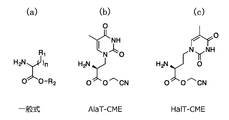
- R 1 is a nucleobase or a derivative thereof
- R 2 is RNA
- n is the number of atoms of the linker, an integer of 1 to 10, preferably an integer of 1 to 5 Particularly preferably, it is an integer of 1 to 3.
- the atom constituting the linker may be carbon, nitrogen, oxygen, sulfur, phosphorus, boron, etc., preferably carbon or nitrogen.
- tRNA acylated with NBA is similar to tRNA acylated with a natural amino acid, and either 2′-OH or 3′-OH of ribose in tRNA is acylated with NBA. It may be.
- FIG. 4 shows tRNA in which 3′-OH is aminoacylated.
- the tRNA acylated with NBA in the present embodiment is preferably prepared using flexizyme. Flexizyme recognizes only the 3 'end region of tRNA and does not interact with anticodon region, D arm region, T ⁇ C region, etc. (Xiao et al.,. Nature, Vol. 454, pp. 358-361, 2008) Use of tRNAs from a wider range of species, including tRNAs lacking the D-arm region and T ⁇ C region (Martins & Schimmel, tRNA, ASM Press, Soll and RajBhandary (Eds.), Pp, 349-370, 1995) Is possible.
- flexizyme examples include, in addition to the original flexizyme (Fx), dinitrobenzyl flexizyme (dFx), enhanced flexizyme (eFx), and aminoflexizyme (aFx). Although it can be used, eFx (SEQ ID NO: 1) is preferable.
- flexizyme is a ribozyme, it can be prepared by in vitro transcription or by chemical synthesis in the same manner as mRNA and tRNA. From the results of X-ray crystallographic analysis, it was thought that the interaction between the phosphate group at the 5 ′ end of flexizyme and magnesium ions was important for the aminoacylation activity of flexizyme (Xiao et al., Nature, Vol. 454, pp. 358-361, 2008; Suga et al., Met. Ion Life Sci., Vol. 9, pp. 175-196, 2011). It was.
- the ribozyme in this embodiment is preferably prepared by chemical synthesis, that is, it is preferably composed of an RNA molecule that does not have a 5'-terminal phosphate group.
- the flexizyme When chemically synthesizing flexizyme, the flexizyme is preferably composed of two RNA molecules. Flexizyme consists of about 45 base RNA, but it is more efficient by dividing it into a first RNA molecule consisting of about 25 bases and a second RNA molecule consisting of about 20 bases. In addition, it can be prepared at low cost.
- eFx when eFx is split into two RNA molecules, the double-stranded structure formed by eFx 22-24th cytosine (C22-C24) and 29-31st guanine (G29-G31) is maintained. Can be cut between C24 and G29. Since this double-stranded structure is common to all flexizymes, dFx and aFx can be similarly divided by cleaving at the corresponding position between C24 and G29 of eFx. It is.
- the flexizyme in the present embodiment is preferably composed of a first RNA molecule consisting of GGAUCGAAAGAUUUCCGCGGCCCCG (SEQ ID NO: 4) and a second RNA molecule consisting of CGGGGAUUAGCGUUAGGU (SEQ ID NO: 5).
- the flexizyme is limited to 1 to 3 ′ of the first RNA molecule and / or the 5 ′ end of the second RNA molecule, as long as the double-stranded structure of the flexizyme is preserved.
- Several bases may be substituted, deleted or added.
- “1 to several” is preferably “1 to 3”, “1 or 2”, or “1”.
- the 3 'end of the first RNA molecule and / or the 5' end of the second RNA molecule may be modified with a labeling compound such as biotin.
- the mRNA into which the modified codon is inserted is translated into a protein in the presence of tRNA acylated with NBA.
- Translation of mRNA into protein can be performed by an in vitro cell-free protein synthesis system or a protein synthesis system by living cells. Translation of the mRNA of this embodiment into a protein is preferably performed by a cell-free protein synthesis system.
- Translation in vitro using a cell-free protein synthesis system consists of a cell-free protein synthesis system in which various factors necessary for translation such as ribosomes and translation factors are mixed and reconstituted with aminoacylated tRNA and mRNA with a modified codon inserted.
- the cell-free protein synthesis system can be prepared from an extract of prokaryotic cells such as E. coli or eukaryotic cells such as rabbit reticulocytes by a conventionally known method.
- Cell-free protein synthesis systems are also commercially available as kits, and such commercially available kits may be used. Examples of commercially available kits include PUREsystem (New (England Biolab).
- a cell-free protein synthesis system that does not include RF1 as a translation termination factor, or an anti-RF1 antibody (Agafonov et al., FEBS Lett., Vol. 579, pp. 2156-2160 , 2005) or a cell-free protein synthesis system to which an aptamer that binds to RF1 (Sando et al., Bioorg. Med. Chem. Lett., Vol. 17, pp. 1216-1220,2202007) may be used. .
- RF1 as a translation termination factor
- an anti-RF1 antibody Agafonov et al., FEBS Lett., Vol. 579, pp. 2156-2160 , 2005
- a cell-free protein synthesis system to which an aptamer that binds to RF1 Sando et al., Bioorg. Med. Chem. Lett., Vol. 17, pp. 1216-1220,2202007
- Ribo-Q is a ribosome modified to prefer a 4-base codon as a ribosome (Neumann et al., Nature, Vol. 464, pp. 441-444, 2010)
- a cell-free protein synthesis system to which is added may be used.
- the cell extract is prepared by the immobilized probe method (Tsurui et al., Anal. Biochem., Vol. 221, pp. 166 -172, 1994) to remove or isolate specific tRNAs to prepare a cell-free protein synthesis system.
- the target protein When translating using a protein synthesis system by living cells, for example, by injecting aminoacylated tRNA and mRNA containing a modified codon into living cells such as Xenopus laevis oocytes and mammalian cells by microinjection or By introducing by lipofection, the target protein can be synthesized (Nowak et al., Science, Vol. 268, pp. 439-442, 1995).
- the present invention includes (1) a nucleobase amino acid (NBA), (2) a tRNA that recognizes a modified codon, and (3) a ribozyme that catalyzes an aminoacylation reaction of tRNA.
- NBA nucleobase amino acid
- tRNA that recognizes a modified codon
- ribozyme that catalyzes an aminoacylation reaction of tRNA.
- the above (1) to (3) are added to a cell-free protein synthesis solution reconstructed by mixing various factors necessary for translation such as ribosomes and translation factors.
- the “cell-free protein synthesis solution” means a solution capable of synthesizing the protein by adding mRNA or DNA of a gene encoding the target protein.
- the cell-free protein synthesis solution may be prepared from a prokaryotic or eukaryotic cell extract by a conventionally known method, or a cell-free protein synthesis solution contained in a commercially available cell-free protein synthesis kit may be used. May be.
- NBA nucleobase amino acid
- tRNA recognizing modified codon tRNA recognizing modified codon
- ribozyme catalyzing aminoacylation reaction of tRNA mRNA with modified codon inserted
- enhanced flexizyme eFx
- eFx enhanced flexizyme
- GGAUCGAAAGAUUUCCGCGGCCCCG SEQ ID NO: 4
- eFx consisting of a first RNA molecule consisting of
- a second RNA molecule consisting of CGGGGAUUAGCGUUAGGU (SEQ ID NO: 5).
- the flexizyme contains 1 to several of the 3 ′ end of the first RNA molecule and / or the 5 ′ end of the second RNA molecule, as long as the double-stranded structure of the flexizyme is conserved. Of these bases may be substituted, deleted or added.
- “1 to several” is preferably “1 to 3”, “1 or 2”, or “1”.
- the 5 'end and / or the 3' end of the RNA molecule may be modified with a labeling compound such as biotin.
- three types of stop codons such as amber codon, ocher codon, and opal codon can be used as modified codons.
- a 5-base codon, an artificial codon using a non-natural base, or the like can be used.
- some of the codons encoding leucine, serine or arginine can be assigned to modified codons.
- the modified codon in this embodiment is preferably a stop codon, and particularly preferably an amber codon.
- the components of the cell-free protein synthesis solution can be appropriately changed and optimized according to the modified codon used.
- the cell-free protein synthesis system of the present embodiment can be combined with an appropriate configuration such as an expression vector, a nucleic acid, an amino acid, an energy source, a buffer, a container used for protein synthesis, and an instruction manual. It can also be provided as a kit.
- the cell-free protein synthesis system of this embodiment is provided as a cell-free protein synthesis kit, (1) a nucleobase amino acid (NBA), (2) a tRNA that recognizes a modified codon, and (3) an aminoacyl of the tRNA
- NBA nucleobase amino acid
- the ribozyme that catalyzes the oxidization reaction may be in a state of being added in advance to the cell-free protein synthesis solution, or prepared so that the above (1) to (3) can be added to the cell-free protein synthesis solution at the time of use. May be.
- the protein synthesis method in the first embodiment and the cell-free protein synthesis system in the second embodiment make it possible to easily and efficiently synthesize a protein having a nucleobase that has been difficult to synthesize in the past. .
- the present invention is a ribozyme that catalyzes the aminoacylation reaction of tRNA, and comprises the following two RNA molecules: (1) GGAUCGAAAGAUUUCCGCGGCCCCG (SEQ ID NO: 4) and (2) CGGGGAUUAGCGUUAGGU (SEQ ID NO: 5).
- the present invention also relates to a ribozyme that catalyzes the aminoacylation reaction of tRNA according to the fourth embodiment, and comprises the following two RNA molecules: (3) GGAUCGAAAGAUUUCCGCAUCCCCG (SEQ ID NO: 7) and (4) CGGGUACAUGGCGUUAGGU ( It is a ribozyme consisting of SEQ ID NO: 8).
- the ribozymes of the third and fourth embodiments are not limited to those consisting of the above-mentioned specific sequences, and the first RNA molecule ((1) or ( 1) to several bases may be substituted, deleted or added at the 3 ′ end of 3)) and / or the 5 ′ end of the second RNA molecule ((2) or (4)).
- “1 to several” is preferably “1 to 3”, “1 or 2”, or “1”.
- the ribozymes of the third and fourth embodiments may be prepared by in vitro transcription or by chemical synthesis. Since the ribozyme in this embodiment is composed of two short RNAs, it can be easily and inexpensively prepared by chemical synthesis, and is preferably prepared by chemical synthesis.
- the ribozymes of the third and fourth embodiments are preferably those in which the 5 'end and / or the 3' end of the two RNA molecules are modified with a labeling compound such as biotin.
- a labeling compound such as biotin.
- the 3 'end of the first RNA molecule ((1) or (3)) and / or the 5' end of the second RNA molecule ((2) or (4)) is biotinylated. Biotinylation can be performed by a conventionally known method.
- the ribozyme of the present embodiment can be used for all aminoacylation reactions of tRNA, and can be used not only for aminoacylation of tRNA with NBA but also for aminoacylation of tRNA with any natural or unnatural amino acid.
- the ribozyme of this embodiment is useful because it can be easily and inexpensively prepared by chemical synthesis. Moreover, the introduction of a labeling compound is easy, which can improve the purification efficiency after the aminoacylation reaction of tRNA.
- the reaction solution was returned to room temperature and stirred for 2.5 hours.
- a saturated aqueous ammonium chloride solution (50 mL) was added to the reaction solution, and then ethyl acetate (100 mL) was added to separate the layers.
- the organic layer was washed with water (50 mL) and saturated brine (50 mL), and dried over sodium sulfate.
- the solution was concentrated under reduced pressure, and the resulting residue was purified by silica gel column chromatography (elution solvent: hexane-ethyl acetate) to obtain 1.38 g (74%) of the title compound (Compound 8) as a white solid substance.
- eFx is a ribozyme that condenses phenylalanine to a tRNA having an ACCA or GCCA sequence at the 3 ′ end using a cyanomethyl ester derivative of phenylalanine (hereinafter referred to as “Phe-CME”) as a substrate (Murakami et al. Nat. Meth., Vol. 3, pp. 357-359, 2006).
- Phe-CME cyanomethyl ester derivative of phenylalanine
- mihx tRNA analog microhelix
- eFx tRNA analog microhelix
- AGU 3 ′ end of eFx
- GCCA 3 ′ terminal sequence
- tRNA CUA (SEQ ID NO: 2): (where cua is an anticodon to the amber codon)
- eFx, tRNA CUA and mihx were all synthesized by in vitro transcription.
- 250 nM template DNA, 40 mM Tris (pH 8.0), 2 mM spermidine, 30 mM MgCl 2 , 10 mM dithiothreitol, each 25 mM ribonucleotide triphosphate, and 1 ⁇ g / ml T7 RNA polymerase was mixed with 1 mL of aqueous solution to prepare a reaction solution (all at final concentration).
- the above reaction solution was added with guanosine monophosphate having a final concentration of 20 mM. After incubation at 37 ° C.
- RNA band synthesized from the gel after electrophoresis was cut out, RNA was eluted from the gel piece cut with TE buffer (10 mM Tris-HCl pH 8.0, 1 mM EDTA), and RNA was purified by ethanol precipitation. .
- the purified RNA was dissolved in purified water and prepared to be 250 ⁇ M in all cases.
- mihx-AlaT Purified mihx-AlaT was dissolved in 1 ⁇ L of 10 mM sodium acetate (pH 5.3).
- Aminoacylation of mihx using HalT-CME Aminoacylation product of mihx with HalT was performed in the same manner as in (1) above except that HalT-CME was used instead of AlaT-CME. (Hereinafter referred to as “mihx-HalT”).
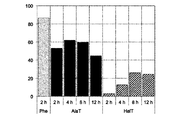
- mihx-AlaT, mihx-HalT, and mihx-Phe with polyacrylamide gel (6M urea, 20% acrylamide-bisacrylamide, 50 mM sodium acetate ⁇ ⁇ pH ⁇ ⁇ 5.3) and 50 mM sodium acetate pH 5.3 under acidic conditions Electrophoresis was performed. After electrophoresis, the acrylamide gel was stained with ethidium bromide, and then RNA bands were photographed and quantified using GelDoc (BioRad).
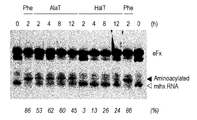
- FIG. 6 shows the result of electrophoresis.
- the numbers at the top of each lane indicate the time of aminoacylation reaction.
- the numbers at the bottom of each lane indicate the aminoacylation efficiency calculated from the ratio of the unreacted mihx band (white arrow) to the aminoacylated mihx band (black arrow).
- mihx white arrow
- the band shifts up (black arrow) due to the increase in molecular weight.
- the band observed on the upper side is due to eFx or a decomposition product thereof.
- FIG. 7 is a graph showing the aminoacylation efficiency calculated from the results of FIG. From these results, it was shown that tRNA can be aminoacylated with eFx by either AlaT or HalT NBA, although the efficiency is lower than that of natural amino acids.
- split eFx The full-length eFx and eFx (hereinafter referred to as “split eFx”) composed of the following two RNA molecules were chemically synthesized. Furthermore, for split eFx, the 3 ′ end of the upstream-split eFx and the 5 ′ end of the downstream-split eFx were biotinylated.
- Upstream-split eFx (SEQ ID NO: 4):
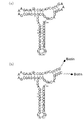
- Fig. 8 (a) shows a schematic diagram of the full length eFx
- Fig. 8 (b) shows a schematic diagram of the split eFx.
- the part surrounded by a frame indicates mihx.
- dinitrobenzyl flexizyme is also a dFx consisting of two RNA molecules, upstream-split dFx (GGAUCGAAAGAUUUCCGCAUCCCCG: SEQ ID NO: 7) and downstream-split dFx (CGGGUACAUGGCGUUAGGU: SEQ ID NO: 8).
- dFx dinitrobenzyl flexizyme
- FIG. 11A is a schematic diagram of the full length dFx
- FIG. 11B is a schematic diagram of the split dFx. The part surrounded by a frame indicates mihx.
- the full-length dFx was prepared by in vitro transcription, and the split dFx was prepared by chemical synthesis. Same as 2-3 except that full length dFx (SEQ ID NO: 9) and split dFx were used instead of full length eFx and split eFx, and dinitrobenzyl ester derivative of phenylalanine (Phe-DBE) was used instead of Phe-CME Then, aminoacylation reaction of mihx with phenylalanine (Phe) was performed.
- flexizyme has aminoacylation activity regardless of the presence or absence of a phosphate group at its 5 ′ end, and can be easily and inexpensively prepared by chemical synthesis by splitting flexizyme into two RNA molecules. It was done. Furthermore, it was confirmed that a flexizyme composed of two RNA molecules can be easily introduced with a biotin modification by chemical synthesis, thereby improving the purification efficiency after the aminoacylation reaction.
- tRNA CUA is used instead of mihx
- aminoacylation products of tRNA CUA with AlaT or Hal-T hereinafter referred to as “tRNA-AlaT” and “tRNA-HalT”, respectively
- tRNA-AlaT aminoacylation products of tRNA CUA with AlaT or Hal-T
- a gene (SEQ ID NO: 6) in which an amber codon was inserted upstream of the green fluorescent protein (GFP) gene was prepared. As shown below, this gene is upstream from the T7 promoter (underlined), SD sequence (double underline), start codon (single line frame), amber codon (double line frame), HRV3C protease cleavage sequence (dashed line) Frame), GFP gene sequence (dotted line frame), and ocher codon (shaded frame), one glycine codon between start codon and amber codon, and between amber codon and HRV3C protease cleavage sequence Contains two glycine codons.
- a double-stranded DNA of the gene was prepared as a template DNA to a concentration of 0.04 ⁇ g / ⁇ L and used for the following ribosome translation reaction.
- Total tRNA derived, deoxyribonucleotide triphosphate, and the like are included, and the target protein can be synthesized by mixing with template DNA. After the reaction at 37 ° C. for 3 hours, 9 ⁇ L of the reaction solution was transferred to a 384 well plate (Greiner), and the fluorescence of the synthesized GFP was measured with a plate reader (TECAN).
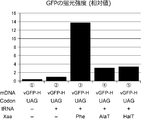
- the graph shows (1) Addition of template DNA only (negative control), (2) Addition of template DNA and non-aminoacylated tRNA CUA (negative control), (3) Aminoacylation with template DNA and Phe Added tRNA CUA (positive control), (4) template DNA and tRNA-AlaT added, (5) GFP fluorescence intensity when reaction was performed with template DNA and tRNA-HalT added ((2) and Relative value).
- the GFP fluorescence intensity of (4) and (5) is clearly increased compared to the negative control, ie, suppression was caused by both tRNA-AlaT and tRNA-HalT, and AlaT or HalT was incorporated. It was confirmed that GFP was synthesized.
- the GFP fluorescence intensity is lower than that in (3).
- Differences in aminoacylation efficiency of tRNA by each amino acid, differences in uptake efficiency of aminoacylated tRNA into ribosome, etc. Is understood to have a complex influence.
Landscapes
- Life Sciences & Earth Sciences (AREA)
- Health & Medical Sciences (AREA)
- Genetics & Genomics (AREA)
- Engineering & Computer Science (AREA)
- Chemical & Material Sciences (AREA)
- Organic Chemistry (AREA)
- Zoology (AREA)
- Wood Science & Technology (AREA)
- Biomedical Technology (AREA)
- Bioinformatics & Cheminformatics (AREA)
- General Engineering & Computer Science (AREA)
- Biotechnology (AREA)
- Molecular Biology (AREA)
- Microbiology (AREA)
- Biochemistry (AREA)
- General Health & Medical Sciences (AREA)
- Plant Pathology (AREA)
- Biophysics (AREA)
- Physics & Mathematics (AREA)
- Medicinal Chemistry (AREA)
- Proteomics, Peptides & Aminoacids (AREA)
- Chemical Kinetics & Catalysis (AREA)
- General Chemical & Material Sciences (AREA)
- Preparation Of Compounds By Using Micro-Organisms (AREA)
- Enzymes And Modification Thereof (AREA)
- Micro-Organisms Or Cultivation Processes Thereof (AREA)
Abstract
Description
以下に示す手順により、アラニル-チミン(AlaT)のシアノメチルエステル誘導体(化合物6)とホモアラニル-チミン(HalT)のシアノメチルエステル誘導体を得た。それぞれの合成スキームを図2および図3に示す。
(1)(S)-N-tert-ブトキシカルボニル-β-(N3-ベンゾイル-1-チミニル)アラニン(化合物3)の合成
アルゴン雰囲気下、N3-ベンゾイルチミン(化合物2)(1.84 g, 8.0 mmol)をジメチルホルムアミド(80 mL)に溶解し、室温で攪拌しながらジアザビシクロウンデセン(DBU, 1.20 mL, 8.0 mmol)をゆっくり滴下した。反応液を室温で10分間攪拌した後、N-tert-ブトキシカルボニルセリン β-ラクトン(化合物1)(1.43 g, 7.64 mmol)のジメチルホルムアミド溶液(40 mL)をゆっくりと滴下した。反応液を室温でさらに2.5時間攪拌した後、酢酸(0.46 mL, 8.0 mmol)を加えた。反応液を減圧下濃縮し、残渣をトルエンで2回共沸した。得られた残渣をシリカゲルカラムクロマトグラフィー(溶出溶媒:クロロホルム-エタノール)により精製して、標記化合物(化合物3)2.36 g(74%)を白色泡状物質として得た。
1H NMR (500 MHz, DMSO-d6) δ:13.17 (br s, 1 H, COOH), 8.02 (d, 2 H, Bz, J = 7.6 Hz), 7.79 (m, 1 H, Bz), 7.59-7.56 (m, 3 H, H-6, Bz), 7.26 (br d, 1 H, NH, J = 9.1 Hz), 4.42 (m, 1 H, CH), 4.31 (m, 1 H, CH2a), 3.62 (m, 1 H, CH2b), 1.80 (s, 3 H, CH3), 1.37 (s, 9 H, t-Bu).
化合物3(2.34 g, 5.60 mmol)をメタノール(40 mL)に溶解し、 28%アンモニア水(30 mL)を加えて密封し、室温で2時間撹拌した。反応液を濃縮した後、アセトニトリルと水の混合溶液(3:1, 60 mL)に溶解し、イオン交換樹脂(プロトンフォーム)により中和した。イオン交換樹脂を濾過により除いた後、溶液を減圧下濃縮した。得られた残渣をエーテル(50 mL)に懸濁して濾取することで、標記化合物(化合物4)1.52 g(86%)を白色粉末状物質として得た。
1H NMR (500 MHz, DMSO-d6) δ:13.00 (br s, 1 H, COOH), 11.25 (s, 1 H, 3-NH), 7.31 (s, 1 H, H-6), 7.14 (d, 1 H, NH, J = 9.0 Hz), 4.31 (ddd, 1 H, CH, J = 4.8, 9.0, 10.2 Hz), 4.20 (dd, 1 H, CH2a, J = 4.8, 13.7 Hz), 3.54 (dd, 1 H, CH2b, J = 10.2, 13.7 Hz), 1.72 (s, 3 H, CH3), 1.32 (s, 9 H, t-Bu).
アルゴン雰囲気下、化合物4(313 mg, 1.0 mmol)をアセトニトリル(15 mL)に溶解して氷冷し、トリエチルアミン(0.56 mL, 4.0 mmol)およびクロロアセトニトリル(0.25 mL, 4.0 mmol)を加えた。反応液を室温に戻した後、22時間攪拌した。反応液を減圧下濃縮した後、残渣を酢酸エチル(70 mL)に溶解し、水(30 mL)で2回、飽和食塩水(30 mL)で1回洗浄し、有機層を硫酸ナトリウムにより乾燥した。溶液を減圧下濃縮し、得られた残渣をシリカゲルカラムクロマトグラフィー(溶出溶媒:クロロホルム-エタノール)により精製して標記化合物(化合物5)205 mg(58%)を白色固体状物質として得た。
1H NMR (500 MHz, DMSO-d6) δ:11.31 (s, 1 H, 3-NH), 7.50 (d, 1 H, NH, J = 8.6 Hz), 7.34 (s, 1 H, H-6), 5.05 (d, 1 H, CH2aCN, J = 16.0 Hz), 5.01 (d, 1 H, CH2bCN, J = 16.0 Hz), 4.47 (ddd, 1 H, CH, J = 5.2, 9.5, 8.6 Hz), 4.16 (dd, 1 H, CH2a, J = 5.2, 13.8 Hz), 3.70 (dd, 1 H, CH2b, J = 9.5, 13.8 Hz), 1.73 (s, 3 H, CH3), 1.34 (s, 9 H, t-Bu).
アルゴン雰囲気下、化合物5(200 mg, 0.57 mmol)をジクロロメタン(10 mL)に溶解して氷冷し、トリエチルシラン(0.46 mL, 2.9 mmol)およびトリフルオロ酢酸(0.64 mL, 8.6 mmol)を加えた。反応液を室温に戻して4時間攪拌した。反応液を減圧下濃縮した後、残渣をトルエンで3回共沸した。続いて、残渣に塩酸/酢酸エチル溶液(1N, 5.0 mL)を加えて、減圧下溶液を濃縮する作業を5回繰り返し、トリフルオロ酢酸塩を塩酸塩へと交換した。得られた白色固体を0.5N塩酸水溶液(8.0 mL)に溶解し、逆相シリカゲルカラムクロマトグラフィー(Waters社、Sep-Pac Vac C-18 10g、溶出溶媒:水-アセトニトリル)により精製し、凍結乾燥することで標記化合物(化合物6)129 mg(78%)を白色固体状物質として得た。
1H NMR (500 MHz, DMSO-d6) δ:11.42 (s, 1 H, 3-NH), 8.49 (br s, 3 H, NH3), 7.38 (d, 1 H, H-6, J = 1.2 Hz), 5.12 (s, 2 H, CNCH2), 4.50 (dd, 1 H, CH, J = 5.8, 6.5 Hz), 4.11 (dd, 1 H, CH2a, J = 5.8, 14.7 Hz), 4.05 (dd, 1 H, CH2b, J = 6.5, 14.7 Hz), 1.75 (s, 3 H, CH3).
(1)(S)-N-tert-ブトキシカルボニル-γ-ヒドロキシ-ホモアラニン ベンジル エステル(化合物8)の合成
アルゴン雰囲気下、化合物7(1.94 g, 6.00 mmol)をテトラヒドロフラン(50 mL)に溶解して氷冷し、BH3-THF/THF溶液(1.1 mol/L, 16.4 mL, 18.0 mmol)をゆっくり滴下した。反応液を室温に戻して2.5時間攪拌した。反応液に飽和塩化アンモニウム水溶液(50 mL)を加えた後、酢酸エチル(100 mL)を加えて分液した。有機層を水(50 mL)および飽和食塩水(50 mL)で洗浄し、硫酸ナトリウムにより乾燥した。溶液を減圧下濃縮し、得られた残渣をシリカゲルカラムクロマトグラフィー(溶出溶媒:ヘキサン-酢酸エチル)により精製して標記化合物(化合物8)1.38 g(74%)を白色固体状物質として得た。
1H NMR (500 MHz, DMSO-d6) δ:7.37-7.32 (m, 5 H, Ph), 7.23 (d, 1 H, NH, J = 7.7 Hz), 5.15 (d, 1 H, PhCH2a, J = 12.7 Hz), 5.07 (d, 1 H, PhCH2b, J = 12.7 Hz), 4.59 (t, 1 H, OH, J = 5.0 Hz), 4.14 (m, 1 H, CH), 3.46-3.38 (m, 2 H, CH2OH), 1.81 (m, 1 H, CH2a), 1.72 (m, 1 H, CH2b), 1.37 (s, 9 H, t-Bu).
アルゴン雰囲気下、化合物8(890 mg, 2.88 mmol)をジクロロメタン(40 mL)に溶解して氷冷し、トリフェニルフォスフィン(980 mg, 3.74 mmol)とN-ブロモスクシンイミド(670 mg, 3.74 mmol)を同時に加えて、氷冷下で10分、室温に戻してさらに1.5時間攪拌した。反応液に飽和炭酸水素ナトリウム水溶液(50 mL)を加えた後、クロロホルム(70 mL)を加えて分液した。有機層を水(50 mL)および飽和食塩水(50 mL)で洗浄し、硫酸ナトリウムにより乾燥した。溶液を減圧下濃縮し、得られた残渣をシリカゲルカラムクロマトグラフィー(溶出溶媒:ヘキサン-酢酸エチル)により精製して標記化合物(化合物9)700 mg(65%)を白色結晶として得た。
1H NMR (500 MHz, DMSO-d6) δ:7.41 (d, 1 H, NH, J = 8.0 Hz), 7.37-7.32 (m, 5 H, Ph), 5.16 (d, 1 H, PhCH2a, J = 12.5 Hz), 5.10 (d, 1 H, PhCH2b, J = 12.5 Hz), 4.18 (m, 1 H, CH), 3.56 (m, 1 H, BrCH2a), 3.49 (m, 1 H, BrCH2b), 2.20-2.,12 (m, 2 H, CH2), 1.37 (s, 9 H, t-Bu).
アルゴン雰囲気下、化合物9(610 mg, 1.64 mmol)とN3-ベンゾイルチミン(化合物2)(566 mg, 2.46 mmol)をジメチルホルムアミド(25 mL)に溶解し、炭酸カリウム粉末(340 mg, 2.46 mmol)およびヨウ化テトラブチルアンモニウム(59 mg, 0.16 mmol)を加え、80℃で30分加熱攪拌した。反応液を室温まで冷却した後、酢酸エチル(150 mL)を加え、有機層を水(50 mL)で4回、および飽和食塩水(50 mL)で1回洗浄し、硫酸ナトリウムにより乾燥した。溶液を減圧下濃縮し、得られた残渣をシリカゲルカラムクロマトグラフィー(溶出溶媒:ヘキサン-酢酸エチル)により精製して標記化合物(化合物10)726 mg(85%)を白色泡物質として得た。
1H NMR (500 MHz, DMSO-d6) δ:7.94 (m, 2 H, Bz), 7.78 (m, 1 H, Bz), 7.68 (s, 1 H, H-6), 7.58 (m, 2 H, Bz), 7.45 (br d, 1 H, NH, J = 8.1 Hz), 7.36-7.32 (m, 5 H, Bn), 5.14 (d, 1 H, PhCH2a, J = 12.6 Hz), 5.10 (d, 1 H, PhCH2b, J = 12.6 Hz), 4.10 (m, 1 H, CH), 3.82 (m, 1 H, CH2a), 3.76 (m, 1 H, CH2b), 2.13 (m, 1 H, CH2a), 1.96 (m, 1 H, CH2b), 1.81 (s, 3 H, CH3), 1.37 (s, 9 H, t-Bu).
化合物10(720 mg, 1.38 mmol)をジオキサン-水の混合溶液(3:2, 30 mL)に溶解し、1N水酸化ナトリウム水溶液(6.9 mL)を加えて室温で20時間撹拌した。反応液をイオン交換樹脂(プロトンフォーム)により中和した後、イオン交換樹脂を濾過により除き、溶液を減圧下濃縮した。残渣をトルエンで3回共沸し、得られた残渣をシリカゲルカラムクロマトグラフィー(溶出溶媒:クロロホルム-エタノール)により精製して標記化合物(化合物11)441 mg(98%)を白色固体状物質として得た。
1H NMR (500 MHz, DMSO-d6) δ:12.64 (br s, 1 H, COOH), 11.23 (s, 1 H, 3-NH), 7.41 (s, 1 H, H-6), 7.19 (br d, 1 H, NH, J = 8.0 Hz), 3.87 (m, 1 H, CH), 3.70-3.63 (m, 2 H, CH2), 2.02 (m, 1 H, CH2a), 1.83 (m, 1 H, CH2b), 1.73 (s, 3 H, CH3), 1.39 (s, 9 H, t-Bu).
アルゴン雰囲気下、化合物11(430 mg, 1.31 mmol)をアセトニトリル(20 mL)に溶解して氷冷し、トリエチルアミン(1.09 mL, 7.86 mmol)およびクロロアセトニトリル(0.25 mL, 3.93 mmol)を加えた。反応液を室温に戻した後、18時間攪拌した。反応液を減圧下濃縮した後、残渣を酢酸エチル(100 mL)に溶解し、水(35 mL)で2回、飽和食塩水(35 mL)で1回洗浄し、有機層を硫酸ナトリウムにより乾燥した。溶液を減圧下濃縮し、得られた残渣をシリカゲルカラムクロマトグラフィー(溶出溶媒:クロロホルム-エタノール)により精製して標記化合物(化合物12)266 mg(55%)を白色泡状物質として得た。
1H NMR (500 MHz, DMSO-d6) δ:11.23 (s, 1 H, 3-NH), 7.52 (br d, 1 H, NH, J = 7.8 Hz), 7.41 (s, 1 H, H-6), 5.00 (s, 2 H, CH2CN), 4.06 (m, 1 H, CH), 3.69 (m, 2 H, CH2), 2.06 (m, 1 H, CH2a), 1.87 (m, 1 H, CH2b), 1.74 (s, 3 H, CH3), 1.40 (s, 9 H, t-Bu).
アルゴン雰囲気下、化合物12(264 mg, 0.72 mmol)をジクロロメタン(8.0 mL)に溶解して氷冷し、トリエチルシラン(0.35 mL, 2.16 mmol)およびトリフルオロ酢酸(0.53 mL, 7.2 mmol)を加えた。反応液を室温に戻して3時間攪拌した。反応液を減圧下濃縮した後、残渣をトルエンで3回共沸した。続いて、残渣に塩酸の酢酸エチル溶液(1N, 5.0 mL)加えて、減圧下溶液を濃縮する作業を5回繰り返し、トリフルオロ酢酸塩を塩酸塩へと交換した。得られた白色固体を0.5N塩酸水溶液(8.0 mL)に溶解し、逆相シリカゲルカラムクロマトグラフィー(Waters社、Sep-Pac Vac C-18 10g、溶出溶媒:水-アセトニトリル)により精製し、凍結乾燥することで標記化合物(化合物13)133 mg(61%)を白色泡状物質として得た。
1H NMR (500 MHz, DMSO-d6) δ:11.32 (br s, 1 H, 3-NH), 8.50 (br s, 3 H, NH3), 7.48 (d, 1 H, H-6, J = 1.3 Hz), 5.16 (d, 1 H, CH2aCN, J = 16.0 Hz), 5.12 (d, 1 H, CH2bCN, J = 16.0 Hz), 4.22 (t, 1 H, CH, J = 6.7 Hz), 3.79 (m, 2 H, CH2), 2.17 (m, 1 H, CH2a), 2.06 (m, 1 H, CH2b), 1.76 (s, 3 H, CH3).
上記1で合成したAlaTシアノメチルエステル誘導体(以下「AlaT-CME」と記載する)およびHalTシアノメチルエステル誘導体(以下「HalT-CME」と記載する)を用いて、アミノアシル化tRNAの調製を行った。アミノアシル化反応は、アミノアシル化反応を触媒するリボザイムにより行った。以下にその手順および結果を詳述する。
アミノアシル化反応を触媒するリボザイムには、エンハンスドフレキシザイムeFxを使用した。eFxは、フェニルアラニンのシアノメチルエステル誘導体(以下「Phe-CME」と記載する)を基質とし、3’末端にACCAまたはGCCAの配列を有するtRNAに対してフェニルアラニンを縮合するリボザイムである(Murakami et al., Nat. Meth., Vol. 3, pp. 357-359, 2006)。tRNAには、アンバーコドン(TAG)に対するアンチコドン(CUA)を持つtRNACUAを使用した。なお、アミノアシル化反応の効率評価は、tRNACUAに代えて、tRNAアナログであるmicrohelix(以下「mihx」と記載する)を使用して行った。mihxは、アミノアシル化反応に際してeFxの3’末端(AGGU、下線)が作用するtRNAの3’末端部分のみを模倣したeFxのモデル基質であり、tRNAの3’末端配列(ACCA、下線)と同様の作用を有する3’末端配列(GCCA、下線)を有し、tRNAと同様にアミノアシル化される。



次いで、アミノアシル化反応を行った。
(1)AlaT-CMEを用いたmihxのアミノアシル化
25 μMのeFx、25 μMのmihx、50 mMのHEPES (pH 7.5)、600 mMのMgCl2、および50 mMのAlaT-CMEを40 μLの水溶液中に混合した(すべて最終濃度)。氷上で1~12時間反応させた後、エタノール沈澱により精製し、mihxのAlaTによるアミノアシル化生成物(以下「mihx-AlaT」と記載する)を得た。精製したmihx-AlaTは、1 μLの10 mM 酢酸ナトリウム(pH 5.3)に溶解させた。
(2)HalT-CMEを用いたmihxのアミノアシル化
AlaT-CMEに代えてHalT-CMEを用いた以外は、上記(1)と同様にしてアミノアシル化反応を行い、mihxのHalTによるアミノアシル化生成物(以下「mihx-HalT」と記載する)を得た。
(3)Phe-CMEを用いたmihxのアミノアシル化(陽性対照)
AlaT-CMEに代えてPhe-CMEを用いた以外は、上記(1)と同様にしてアミノアシル化反応を行い、mihxのフェニルアラニン(Phe)によるアミノアシル化生成物(以下「mihx-Phe」と記載する)を得た。
上記2-2において、インビトロ転写により調製したeFxに代えて、化学合成したeFxを用いた場合に同様のアミノアシル化反応が行えるかどうか試験した。全長eFxおよび以下の2つのRNA分子からなるeFx(以下「スプリットeFx」と記載する)を化学合成した。さらに、スプリットeFxについては、上流-スプリットeFxの3’末端および下流-スプリットeFxの5’末端をビオチン化した。


eFx以外のフレキシザイムとして、ジニトロベンジルフレキシザイム(dFx)についても、上流-スプリットdFx(GGAUCGAAAGAUUUCCGCAUCCCCG:配列番号7)および下流-スプリットdFx(CGGGUACAUGGCGUUAGGU:配列番号8)の2つのRNA分子からなるdFx(以下「スプリットdFx」と記載する)を化学合成し、アミノアシル化活性を試験した。図11(a)に全長dFxの、図11(b)にスプリットdFxの模式図を示す。なお、枠で囲まれた部分はmihxを示す。
上記2-2(1)において、mihxに代えてtRNACUAを用いて、tRNACUAのAlaTまたはHal-Tによるアミノアシル化生成物(以下、それぞれ「tRNA-AlaT」、「tRNA-HalT」と記載する)を調製し、NBAでアシル化されたtRNAが、天然アミノ酸でアシル化された通常のtRNAと同様にリボソームに取り込まれるかどうかを試験した。
緑色蛍光タンパク質(GFP)遺伝子の上流にアンバーコドンを挿入した遺伝子(配列番号6)を作製した。以下に示すように、この遺伝子は、上流より、T7プロモーター(下線)、SD配列(二重下線)、開始コドン(一重線枠)、アンバーコドン(二重線枠)、HRV3Cプロテアーゼ切断配列(破線枠)、GFP遺伝子配列(一点鎖線枠)、およびオーカーコドン(網掛け枠)を含み、開始コドンとアンバーコドンの間に1個のグリシンのコドン、および、アンバーコドンとHRV3Cプロテアーゼ切断配列の間に2個のグリシンのコドンを含む。当該遺伝子の二本鎖DNAを鋳型DNAとして0.04 μg/μLの濃度となるように調製し、以下のリボソームによる翻訳反応に用いた。

PURExpressキット(New England Biolab社)に添付された4 μLのA液、3 μLのB液、1 μLの精製水、1 μLのtRNA-AlaTまたはtRNA-HalT溶液、および1 μlの0.04 μg/μlの鋳型DNAを混合して10 μLとし、翻訳反応を行った。上記のA液およびB液には、転写・翻訳・エネルギー再生に必要な翻訳開始因子、翻訳伸長因子、翻訳終結因子、アミノアシル化tRNA合成酵素、T7 RNAポリメラーゼ、リボソーム、20種類の天然アミノ酸、大腸菌由来の全tRNA、デオキシリボヌクレオチド三リン酸などが含まれており、鋳型DNAと混合することにより目的タンパク質を合成することができる。37℃で3時間の反応後、384ウェルプレート(グライナー社)に9 μLの反応液を移し、合成されたGFPの蛍光をプレートリーダー(TECAN社)にて測定した。
Claims (16)
- 開始コドンの下流の所望の位置に改変コドンを挿入したmRNAを準備するステップと、
前記改変コドンを認識するtRNAであって、核酸塩基アミノ酸(NBA)でアシル化されたtRNAの存在下で、前記mRNAをタンパク質に翻訳するステップと
を含む、所望の位置にNBAが導入されたタンパク質を合成する方法。 - tRNAのアミノアシル化反応を触媒するリボザイムにより、前記NBAでアシル化されたtRNAを調製するステップをさらに含む、請求項1に記載の方法。
- 前記リボザイムがエンハンスドフレキシザイムである、請求項2に記載の方法。
- 前記リボザイムが5’末端のリン酸基を有しないRNA分子からなる、請求項2または3に記載の方法。
- 前記リボザイムが2つのRNA分子からなる、請求項2~4のいずれか1項に記載の方法。
- 前記リボザイムが以下の2つのRNA分子:
(1)GGAUCGAAAGAUUUCCGCGGCCCCG(配列番号4)、および
(2)CGGGGAUUAGCGUUAGGU(配列番号5)
からなる、請求項5に記載の方法。 - 前記改変コドンがアンバーコドンである、請求項1~6のいずれか1項に記載の方法。
- (1)核酸塩基アミノ酸(NBA)と、
(2)改変コドンを認識するtRNAと、
(3)前記tRNAのアミノアシル化反応を触媒するリボザイムと
を含む、所望の位置にNBAが導入されたタンパク質を合成するための無細胞タンパク質合成系。 - 前記リボザイムがエンハンスドフレキシザイムである、請求項8に記載の無細胞タンパク質合成系。
- 前記リボザイムが5’末端のリン酸基を有しないRNA分子からなる、請求項8または9に記載の無細胞タンパク質合成系。
- 前記リボザイムが2つのRNA分子からなる、請求項8~10のいずれか1項に記載の無細胞タンパク質合成系。
- 前記2つのRNA分子が、
(1)GGAUCGAAAGAUUUCCGCGGCCCCG(配列番号4)、および
(2)CGGGGAUUAGCGUUAGGU(配列番号5)
である、請求項11に記載の無細胞タンパク質合成系。 - 前記改変コドンがアンバーコドンである、請求項8~12のいずれか1項に記載の無細胞タンパク質合成系。
- tRNAのアミノアシル化反応を触媒するリボザイムであって、以下の2つのRNA分子:
(1)GGAUCGAAAGAUUUCCGCGGCCCCG(配列番号4)、および
(2)CGGGGAUUAGCGUUAGGU(配列番号5)
からなるリボザイム、または、前記(1)のRNA分子の3’末端および/もしくは前記(2)のRNA分子の5’末端において、1~3個の塩基が置換、欠失または付加された2つのRNA分子からなるリボザイム。 - tRNAのアミノアシル化反応を触媒するリボザイムであって、以下の2つのRNA分子:
(3)GGAUCGAAAGAUUUCCGCAUCCCCG(配列番号7)、および
(4)CGGGUACAUGGCGUUAGGU(配列番号8)
からなるリボザイム、または、前記(3)のRNA分子の3’末端および/もしくは前記(4)のRNA分子の5’末端において、1~3個の塩基が置換、欠失または付加された2つのRNA分子からなるリボザイム。 - 前記2つのRNA分子の5’末端および/または3’末端がビオチン化されている、請求項14または15に記載のリボザイム。
Priority Applications (3)
| Application Number | Priority Date | Filing Date | Title |
|---|---|---|---|
| JP2017523668A JP6618534B2 (ja) | 2015-06-09 | 2016-06-08 | アミノ酸修飾核酸とその利用 |
| EP16807507.5A EP3309250A4 (en) | 2015-06-09 | 2016-06-08 | AMINO ACID MODIFIED NUCLEIC ACID AND USE THEREOF |
| US15/579,841 US10711273B2 (en) | 2015-06-09 | 2016-06-08 | Amino acid-modified nucleic acid and utilization thereof |
Applications Claiming Priority (2)
| Application Number | Priority Date | Filing Date | Title |
|---|---|---|---|
| JP2015-116992 | 2015-06-09 | ||
| JP2015116992 | 2015-06-09 |
Publications (1)
| Publication Number | Publication Date |
|---|---|
| WO2016199801A1 true WO2016199801A1 (ja) | 2016-12-15 |
Family
ID=57504053
Family Applications (1)
| Application Number | Title | Priority Date | Filing Date |
|---|---|---|---|
| PCT/JP2016/067025 Ceased WO2016199801A1 (ja) | 2015-06-09 | 2016-06-08 | アミノ酸修飾核酸とその利用 |
Country Status (4)
| Country | Link |
|---|---|
| US (1) | US10711273B2 (ja) |
| EP (1) | EP3309250A4 (ja) |
| JP (1) | JP6618534B2 (ja) |
| WO (1) | WO2016199801A1 (ja) |
Cited By (1)
| Publication number | Priority date | Publication date | Assignee | Title |
|---|---|---|---|---|
| US11814621B2 (en) | 2018-06-01 | 2023-11-14 | Northwestern University | Expanding the chemical substrates for genetic code reprogramming |
Families Citing this family (2)
| Publication number | Priority date | Publication date | Assignee | Title |
|---|---|---|---|---|
| JP2025538039A (ja) * | 2022-11-09 | 2025-11-21 | ニュークレオストリーム,インコーポレーテッド | 核酸塩基アミノ酸ポリマーのリボソーム合成および核酸へのそれらの変換のための新規組成物および方法 |
| JP2026519275A (ja) * | 2023-04-28 | 2026-06-15 | ユナイテッド キングダム リサーチ アンド イノベーション | tRNAに基づく方法及び関連組成物 |
Citations (4)
| Publication number | Priority date | Publication date | Assignee | Title |
|---|---|---|---|---|
| JP2004537984A (ja) * | 2001-04-19 | 2004-12-24 | ザ スクリップス リサーチ インスティテュート | 直交tRNA−アミノアシルtRNAシンテターゼ対を生産するための方法及び組成物 |
| WO2007066627A1 (ja) * | 2005-12-06 | 2007-06-14 | The University Of Tokyo | 多目的アシル化触媒とその用途 |
| JP2009504182A (ja) * | 2005-08-18 | 2009-02-05 | アンブルックス,インコーポレイテッド | tRNA組成物、およびその使用 |
| WO2012026566A1 (ja) * | 2010-08-27 | 2012-03-01 | 国立大学法人 東京大学 | 新規人工翻訳合成系 |
Family Cites Families (2)
| Publication number | Priority date | Publication date | Assignee | Title |
|---|---|---|---|---|
| US9113747B2 (en) | 2009-10-30 | 2015-08-25 | Adrian Rivera | Single and multi-cup coffee maker |
| JP6206943B2 (ja) * | 2010-12-03 | 2017-10-04 | 国立大学法人 東京大学 | ペプチドライブラリーの製造方法、ペプチドライブラリー、及びスクリーニング方法 |
-
2016
- 2016-06-08 EP EP16807507.5A patent/EP3309250A4/en not_active Withdrawn
- 2016-06-08 WO PCT/JP2016/067025 patent/WO2016199801A1/ja not_active Ceased
- 2016-06-08 US US15/579,841 patent/US10711273B2/en not_active Expired - Fee Related
- 2016-06-08 JP JP2017523668A patent/JP6618534B2/ja not_active Expired - Fee Related
Patent Citations (4)
| Publication number | Priority date | Publication date | Assignee | Title |
|---|---|---|---|---|
| JP2004537984A (ja) * | 2001-04-19 | 2004-12-24 | ザ スクリップス リサーチ インスティテュート | 直交tRNA−アミノアシルtRNAシンテターゼ対を生産するための方法及び組成物 |
| JP2009504182A (ja) * | 2005-08-18 | 2009-02-05 | アンブルックス,インコーポレイテッド | tRNA組成物、およびその使用 |
| WO2007066627A1 (ja) * | 2005-12-06 | 2007-06-14 | The University Of Tokyo | 多目的アシル化触媒とその用途 |
| WO2012026566A1 (ja) * | 2010-08-27 | 2012-03-01 | 国立大学法人 東京大学 | 新規人工翻訳合成系 |
Non-Patent Citations (4)
| Title |
|---|
| MASAHIKO SHISHIDO: "An Approach towards Synthetic Micro-organism from Bio- Macromolecular Chemistry", KOBUNSHI, vol. 51, 2002, pages 438 - 441, XP055503161 * |
| See also references of EP3309250A4 * |
| WANG L ET AL.: "Addition of the keto functional group to the genetic code of Escherichia coli", PROC NATL ACAD SCI USA, vol. 100, no. 1, 7 January 2003 (2003-01-07), pages 56 - 61, XP003019022 * |
| WATANABE S ET AL.: "Interactions Between Petides Containing Nucleobase Amino Acids and T7 Phages Displaying S. cerevisiae Proteins", BIOPOLYMERS, vol. 88, no. 2, 2007, pages 131 - 140, XP055333601, ISSN: 1097-0282 * |
Cited By (1)
| Publication number | Priority date | Publication date | Assignee | Title |
|---|---|---|---|---|
| US11814621B2 (en) | 2018-06-01 | 2023-11-14 | Northwestern University | Expanding the chemical substrates for genetic code reprogramming |
Also Published As
| Publication number | Publication date |
|---|---|
| JP6618534B2 (ja) | 2019-12-11 |
| US10711273B2 (en) | 2020-07-14 |
| JPWO2016199801A1 (ja) | 2018-04-12 |
| US20180251759A1 (en) | 2018-09-06 |
| EP3309250A4 (en) | 2019-06-19 |
| EP3309250A1 (en) | 2018-04-18 |
Similar Documents
| Publication | Publication Date | Title |
|---|---|---|
| JP7728181B2 (ja) | 半合成生物における複製、転写および翻訳のための試薬ならびに方法 | |
| JP2023021170A (ja) | 無細胞翻訳系におけるペプチドの合成方法 | |
| JP2026036689A (ja) | 非天然ポリペプチドのインビボ合成のための組成物および方法 | |
| JP7692900B2 (ja) | 真核生物の半合成生物 | |
| US20240200070A1 (en) | Expanding the chemical substrates for genetic code reprogramming | |
| Sisido et al. | Four-base codon/anticodon strategy and non-enzymatic aminoacylation for protein engineering with non-natural amino acids | |
| JP6618534B2 (ja) | アミノ酸修飾核酸とその利用 | |
| JP2025165960A (ja) | 遺伝暗号の再プログラミングのため、長鎖炭素と環状アミノ酸が包含されるよう化学的基質を拡張する | |
| Kwiatkowski et al. | Facile synthesis of N-acyl-aminoacyl-pCpA for preparation of mischarged fully ribo tRNA | |
| Zhang et al. | Facilitated synthesis of proteins containing modified dipeptides | |
| US20220306677A1 (en) | Compositions and methods for making hybrid polypeptides | |
| WO2022175863A1 (en) | A protein translation system | |
| WO2003059926A2 (en) | METHODS AND COMPOSITIONS FOR AMINOACYL-tRNA SYNTHESIS | |
| KR20250151188A (ko) | 비천연 아미노산 도입 단백질의 효율적인 합성을 위한 유전체 가공 균주 및 세포 파쇄액 제작 방법 | |
| Her | Lanthanum-mediated Biomimetic Aminoacylation | |
| HK40087096A (en) | Expanding the chemical substrates for genetic code reprogramming to include long chain carbon and cyclic amino acids | |
| EA048299B1 (ru) | Эукариотические полусинтетические организмы | |
| CA3296778A1 (en) | Novel modified trinucleotide capping derivative, and mrna into which capping derivative is introduced | |
| CN113801877A (zh) | 一种蛋白表达方法 | |
| Ahadi | Ribosomal Synthesis of N-methylated peptides | |
| Nangreave | Novel Strategies for Producing Proteins with Non-proteinogenic Amino Acids |
Legal Events
| Date | Code | Title | Description |
|---|---|---|---|
| 121 | Ep: the epo has been informed by wipo that ep was designated in this application |
Ref document number: 16807507 Country of ref document: EP Kind code of ref document: A1 |
|
| WWE | Wipo information: entry into national phase |
Ref document number: 15579841 Country of ref document: US |
|
| ENP | Entry into the national phase |
Ref document number: 2017523668 Country of ref document: JP Kind code of ref document: A |
|
| NENP | Non-entry into the national phase |
Ref country code: DE |
|
| WWE | Wipo information: entry into national phase |
Ref document number: 2016807507 Country of ref document: EP |