WO2016195094A1 - 通信方法及び通信機 - Google Patents
通信方法及び通信機 Download PDFInfo
- Publication number
- WO2016195094A1 WO2016195094A1 PCT/JP2016/066654 JP2016066654W WO2016195094A1 WO 2016195094 A1 WO2016195094 A1 WO 2016195094A1 JP 2016066654 W JP2016066654 W JP 2016066654W WO 2016195094 A1 WO2016195094 A1 WO 2016195094A1
- Authority
- WO
- WIPO (PCT)
- Prior art keywords
- data
- complex
- code
- periodic function
- function code
- Prior art date
- Legal status (The legal status is an assumption and is not a legal conclusion. Google has not performed a legal analysis and makes no representation as to the accuracy of the status listed.)
- Ceased
Links
Images




Classifications
-
- H—ELECTRICITY
- H04—ELECTRIC COMMUNICATION TECHNIQUE
- H04B—TRANSMISSION
- H04B1/00—Details of transmission systems, not covered by a single one of groups H04B3/00 - H04B13/00; Details of transmission systems not characterised by the medium used for transmission
- H04B1/69—Spread spectrum techniques
- H04B1/707—Spread spectrum techniques using direct sequence modulation
-
- H—ELECTRICITY
- H04—ELECTRIC COMMUNICATION TECHNIQUE
- H04J—MULTIPLEX COMMUNICATION
- H04J13/00—Code division multiplex systems
- H04J13/10—Code generation
Definitions
- the present invention relates to communication using an approximately periodic function code.
- the approximate periodic function is obtained by generalizing the Fourier series expansion. Specifically, for example, it is configured as a sum of signals having a frequency that is a 1/2 power of the mth prime number p (m). In this case, since the prime power of 1/2 is temporarily independent on the rational number field, these signals cannot be periodic. Although such a signal has never been used in communication, the present inventor proposed non-patent document 1 for the first time to apply to communication.
- the spreading code length N is increased excessively, the signal processing load increases and the transmission rate decreases, so it is difficult to dramatically increase the number of accessible users.
- APSS Almost Periodic Spreading Sequence
- the present invention provides a more specific method for communication using an almost periodic function code.
- One aspect of the present invention is a communication method including transmitting a signal generated by modulating data with a code, wherein the code is an approximately periodic function code, and the data is real part data. And complex data having imaginary part data, and the modulation includes an operation of multiplying the complex data by the approximate periodic function code.
- the communication is meant to include broadcasting.
- Another aspect of the present invention is a communication device.
- the communication apparatus includes a modulation unit that modulates data with a code, the code is an approximately periodic function code, the data is complex number data having real part data and imaginary part data, and the modulation part is Arithmetic processing for applying an approximate periodic function code to complex data is performed.
- a communication method includes transmitting a signal generated by modulating data with a code, wherein the code is an approximately periodic function code, and the data includes real part data and imaginary part.
- Complex data having data, and the modulation includes an operation of multiplying the complex data by the approximate periodic function code.
- the operation of multiplying the complex data by the approximate periodic function code preferably includes complex multiplication of the complex data by the approximate periodic function code represented by a complex number.
- N represents the code length of the approximate periodic function code
- j is an integer of 1 to N
- a j represents the approximate periodic function code of code length N
- d represents the complex data
- the operation of multiplying the complex number data by the approximate periodic function code preferably includes performing a complex multiplication indicated by da j for each j of 1 to N.
- N the code length of the approximate periodic function code
- j is an integer of 1 to N
- a j the approximate periodic function code of code length N
- d the complex data
- the operation of multiplying the complex data by the approximate periodic function code preferably includes calculating the sum of N da j .
- the modulation further includes complex-multiplying the complex data by a complex code different from the approximate periodic function code, and the complex code is a code having a constant power on a complex plane. preferable.
- the modulation may be spread spectrum modulation using the approximate periodic function code.
- the communication method may further include receiving and demodulating the signal, and the demodulating may include reproducing the data by multiplying the received signal by a complex conjugate of the approximate periodic function. preferable.
- the modulation may be quasi-orthogonal multiplex modulation using the approximate periodic function code. By applying an almost periodic function code to the data, a quasi-orthogonal multiple modulation signal is obtained.
- the pseudo orthogonal multiplexing modulation has a size of K data sequences.
- the method includes complex multiplication of a K ⁇ N matrix, and the matrix preferably has K number of the substantially periodic function codes having a code length of N.
- the communication method further includes receiving and demodulating the signal, and the demodulation includes reproducing the data by multiplying the inverse matrix of the matrix used for the quasi-orthogonal multiple modulation. preferable.
- the communication device includes a modulation unit that modulates data with a code, the code is an approximately periodic function code, and the data is complex data having real part data and imaginary part data.
- the modulation unit performs arithmetic processing for multiplying the complex data by an approximate periodic function code.
- An almost periodic function code is a code based on an almost periodic function.
- the approximate periodic function is obtained by generalizing the Fourier series expansion, and is, for example, the sum of signals whose frequency is the square root of a prime number.
- the almost periodic function is aperiodic because it is clearly linearly independent on the advantageous number field.
- the approximate periodic function code a j is given by the following equation (1), for example.
- the almost periodic function code is a code with constant power on the complex plane, similar to a chaotic spreading code with constant power on the complex plane.
- the constant power on the complex plane means that the code value is located on a single circumference on the IQ constellation of the code.
- An almost periodic function code such as the expression (1) is represented by a complex number expression.
- N and K are preferably 2 powers.
- ⁇ k is a prime number given to user k or channel k, and takes a different value for each user k or channel k.
- I is an Image unit.
- m is the mth root, and is an integer or a real number.
- ⁇ k is an arbitrary real number and may be zero.
- the approximate periodic function code can be configured infinitely. Strictly speaking, the almost periodic function code is not an orthogonal code such as a PN code. However, when the code length is infinite, it has the property of being orthogonal. Therefore, if the code length of the almost periodic function code is sufficiently large (for example, N is 100 or more or 1000 or more), it can be treated as being orthogonal (pseudo-orthogonal).
- the number of users K that can ensure sufficient quality is O (N 2 ), and ultra-high density multiple access communication is possible.
- N 2 the number of users K that can ensure sufficient quality
- 1000 to 1000 devices can be connected at the same time, and a plurality of devices can be connected at the same time to the extent that 8K and 16K terrestrial broadcasting is possible.
- FIG. 1 shows a communication system 10 for spread spectrum communication using an approximately periodic function code.
- the communication system 10 includes a communication device (transmitter) 20 that performs transmission and a communication device (receiver) 30 that performs reception.
- Each of the communication devices 20 and 30 has a transmission / reception function.
- the transmitter 20 includes a modulation unit 21.
- the modulation unit 21 performs spread spectrum modulation on the transmission data d and outputs a transmission signal s that is a modulated signal.
- the modulation unit 21 performs spread spectrum modulation by applying the approximate periodic function codes (a 1 , a 2 ,... A N ⁇ 1 , a N ) that are pseudo orthogonal codes to the transmission data d.
- the receiver 30 includes a demodulator 31.
- the demodulator 31 despreads the received signal r and demodulates the received signal r to obtain reproduction data of the transmission data d.
- the demodulator 31 includes complex conjugates (a 1 * , a 2 * ,... A N ⁇ ) of the approximate periodic function codes (a 1 , a 2 ,... A N ⁇ 1 , a N ) used for transmission. 1 * , aN * ) to demodulate. Note that a * represents a complex conjugate of a.
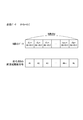
- the transmission data d is N pieces of data d 1 to d N according to the code length N as shown in FIG.
- the N data d 1 to d N all have the same value as the data d, and each is complex data. .
- the N periodic data codes (a 1 , a 2 ,... A N ⁇ 1 , a N ) having a code length N are applied to the N pieces of data d 1 to d N.
- the approximate periodic function codes (a 1 , a 2 ,... A N ⁇ 1 , a N ) of the same user or the same channel are generated using the same prime number ⁇ k .
- Different approximate periodic function codes are generated using different prime numbers for each user or channel.
- the transmission data d is modulated by complex multiplication of the approximate periodic function code with respect to the complex data d using the fact that the transmission data d is complex data and the approximate periodic function code is a complex code.
- the complex multiplication can be collectively modulate the real part data d R and the imaginary part data d I constituting the complex data. Therefore, according to this embodiment, it is not necessary to modulate the real part data d R and the imaginary part data d I in separate codes. Therefore, according to the present embodiment, the calculation load is reduced. Moreover, according to this embodiment, the number of codes required for modulation can be reduced.
- the modulation unit 21 multiplies complex data by an approximate periodic function code.
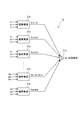
- the modulation unit 21 may include a plurality (N) of complex multiplication units 21 a and an adder 21 b that adds outputs of the plurality of complex multiplication units 21 a.
- Each complex multiplier 21a performs complex multiplication of d j that is a complex number and a j that is also a complex number.
- the adder 21b outputs the sum of d j a j from 1 to N.
- d j a j When the value of dj is the same value d in 1 to N, d j a j can also be expressed as da j .
- the sum total of d j a j is output from the modulation unit 21 as a transmission signal (modulation signal).
- the arithmetic expressions of the complex multiplication d j a j by each complex multiplier 21a are as shown in the following expressions (2-1) to (2-3).
- the modulation unit 21 not only multiplies complex data d j by an approximate periodic function code a j but also different types of complex data d from the approximate periodic function code a j.
- the complex code b j may be complex multiplied. In this case, when the complex multiplication by the modulation unit 21 is expressed by an equation, d j a j b j .
- the complex multiplication d j a j b j performed by the modulation unit 21 may be (d j a j ) and then (d j a j ) multiplied by b j or (d j b j ) may be performed, and then (d j b j ) may be subjected to complex multiplication by a j . In both cases, the result is the same.
- a complex code b j of a type different from the approximate periodic function code a j is multiplied by d j to the complex number data, so that the preferable property of the code b j is reflected in the modulation signal, and a more suitable modulation signal is obtained. Easy to get.
- the complex code b j of a type different from the approximate periodic function code a j is, for example, a code with constant power on the complex plane. Be multiplied by a constant power code b j to constant power almost periodic function code a j, it is advantageous because the power does not vary.
- the code b j with constant power on the complex plane is, for example, a chaotic spreading code or Gold code with constant power on the complex plane. Chaotic spreading codes or Gold codes have good correlation characteristics.
- the modulation unit 21 can improve the correlation characteristics of the modulation signal d j a j b j by multiplying the data d j by the chaotic spreading code or the Gold code.
- IQ constellation code transition diagram
- the square of the radius from the origin to the outer circle corresponds to the power of the code.
- all codes exist on a single circle (outer circle), and the power is constant.
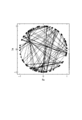
- FIG. 6 shows an IQ constellation of a chaotic spreading code with constant power.
- the black circles in the constellation of FIG. As is clear from FIG. 6, in the chaotic spreading code with constant power, all the codes exist on a single circle and the power is constant.
- FIG. 7 shows the demodulator 31.
- the demodulator 31 divides the received signal r into N chips to obtain N chip data r 1 , r 2 ,..., R N, and N chip data r 1 , r 2 ,.
- a separating portion 31a which separates each r N real part data r R and imaginary part data r I I, the real part data r R and imaginary part data r I each chip data r 1 comprised of I, r 2, .., R N , complex conjugates (a 1 * , a 2 * ,...) Of the approximate periodic function codes (a 1 , a 2 ,... A N ⁇ 1 , a N ) used for transmission.
- the arithmetic unit 31b performs complex multiplication on the chip data r 1 , r 2 ,..., R N by complex conjugates (a 1 * , a 2 * ,... A N ⁇ 1 * , a N * ). To do.
- Calculation unit 31 performs calculation according to the following formula (3-1), reproduction data d consisting of d R and d I I.
- the demodulation unit 31 When the modulation unit 21 is applied with a complex code b j of a type different from the approximate periodic function code a j , the demodulation unit 31 generates codes (b 1 , b 2 ,... B N ⁇ 1 , b N complex conjugate (b 1 * a), b 2 *, ⁇ b N-1 *, the b N *), each chip data r 1, r 2, ⁇ , complex multiplication with respect to r N. In this case, the calculation unit 31 performs a calculation according to the equation (3-2) to obtain reproduction data d.
- Complex conjugate (b 1 *, b 2 * , ⁇ b N-1 *, b N *) the chip data r 1, r 2, ⁇ ⁇ ⁇ , a complex conjugate with respect to r N (a 1 *, a 2 *, ⁇ a N- 1 *, a N *) is may be complex multiplication after being complex multiplication, complex conjugate with respect to the chip data r 1, r 2, ⁇ , r N Complex multiplication may be performed before (a 1 * , a 2 * ,..., A N ⁇ 1 * , a N * ) are complex multiplied.
- the transmission data d to which the approximate periodic function code is applied is complex data, so it can take multiple values, and the transmission efficiency is higher than when the transmission data is binary binary data. Is good.
- the demodulator 31 can obtain complex number data as reproduction data by demodulation processing.
- FIG. 8 shows a communication device 100 that performs pseudo-orthogonal multiplex communication using an approximately periodic function code.
- the communication device 20 can transmit and receive pseudo-orthogonal multiplexed signals.
- the 8 includes a converter 101 and a quasi-orthogonal multiplex modulator 102 for transmission.
- the converter 101 is, for example, a serial / parallel converter, and converts serial transmission data into a data string (parallel data string) for each channel (user).
- the number of channels or the number of users is K.
- the data length (symbol length) of the data string is N.
- N is the code length of the almost periodic function code.
- d j k indicating a data symbol indicates the j-th data symbol (transmission code) for the k-th channel (or k-th user). 1 ⁇ k ⁇ K and 1 ⁇ j ⁇ N. Each d j k is complex number data.
- the data string of the first channel (first user) is (d 1 1 , d 2 1 ,..., D N 1 )
- the data string of the second channel (second user) is (d 1 2, d 2 2, ⁇ , a d N 2)
- a data row of the k-th channel (the k-th user) can be a (d 1 k, d 2 k , ⁇ , d N k)
- the data string of the K-1th channel (K-1th user) is (d 1 K ⁇ 1 , d 2 K ⁇ 1 ,..., D N K ⁇ 1 )
- the Kth channel (Kth) The data string of (user) is (d 1 K , d 2 K ,..., D N K ).
- N ⁇ K data symbols d j k are given to the quasi-orthogonal multiplex modulation section 102 and output a quasi-orthogonal multiplex signal y.
- a quasi-orthogonal multiplexed signal (transmission signal) y generated from N ⁇ K data symbols d j k is a signal for K channels ⁇ K symbols.
- y i j indicating the transmission symbol of each channel indicates the j-th symbol in the i-th channel. 1 ⁇ i, j ⁇ K.
- the transmission symbol sequence of the first channel is (y 1 1 , y 1 2 ,..., Y 1 K ⁇ 1 , y 1 K )
- the transmission symbol sequence of the second channel is , (Y 2 1 , y 2 2 ,..., Y 2 K ⁇ 1 , y 2 K )
- the transmission symbol string of the k-th channel is (y k 1 , y k 2 ,..., Y k K ⁇ 1 , y k K )
- the transmission symbol sequence of the K ⁇ 1th channel is (y K ⁇ 1 1 , y K ⁇ 1 2 ,..., y K ⁇ 1 K ⁇ 1 , y K).
- the transmission symbol string of the Kth channel is (y K 1 , y K 2 ,..., Y K K ⁇ 1 , y K K ).
- the quasi-orthogonal multiplex modulator 102 performs quasi-orthogonal multiplex modulation processing on the N ⁇ K data symbols d j k according to the following equation (4), and outputs a quasi-orthogonal multiplex signal y.
- a calculation is performed by multiplying N ⁇ K data symbols d j k by a matrix (modulation matrix) A having a size of K ⁇ N to obtain a quasi-orthogonal multiplex signal y. That is, the quasi-orthogonal multiplex modulator 102 complex-multiplies the matrix A by a matrix composed of K data strings.
- Complex multiplication for a matrix corresponds to performing N ⁇ K complex multiplications of a j k d j k .
- the matrix A is obtained by arranging K pieces of approximately periodic function codes (a 1 k , a 2 k ,..., A N ⁇ 1 k , a N k ) having a code length N.
- 1 ⁇ k ⁇ K The K approximate periodic function codes are generated from K different prime numbers ⁇ k corresponding to the number of channels (number of users) K.
- the approximate periodic function code a j k generated from the prime number ⁇ k is expressed by the following equation (5). Note that 1 ⁇ j ⁇ N.
- the transmitted N ⁇ K data symbols d j k can be reproduced by demodulation processing.
- an inverse matrix A ⁇ 1 of the matrix A is used.
- a signal y for K symbols (a signal corresponding to the left side in Equation (4) shown in [Expression 4]) is acquired from the received pseudo orthogonal multiplexed signal, and an inverse matrix is obtained for the signal y for K symbols.
- A- 1 By multiplying by A- 1 , it is possible to obtain N ⁇ K reproduced data symbols d j k .
- K ⁇ N so that demodulation can be performed.
- the inverse matrix A ⁇ 1 of the matrix A may be obtained by transposing the matrix A and taking the complex conjugate of each matrix element a j k .
- the operation of multiplying the inverse matrix A ⁇ 1 for data reproduction is performed by complex multiplication.
Landscapes
- Engineering & Computer Science (AREA)
- Computer Networks & Wireless Communication (AREA)
- Signal Processing (AREA)
- Transmitters (AREA)
Abstract
概周期関数符号を用いた通信方法を提供する。通信方法は、データを符号で変調して生成された信号を送信することを含む。符号は、概周期関数符号である。データは、実部データと虚部データを有する複素数データである。変調は、複素数データに対して概周期関数符号をかける演算を含む。
Description
本発明は、概周期関数符号を用いた通信に関するものである。
概周期関数は、フーリエ級数展開を一般化することによって得られる。具体的には、例えば、m番目の素数p(m)の1/2乗を周波数とする信号の和として構成される。この場合、素数の1/2乗は有理数体上一時独立なので、これらの信号は周期的であり得ない。このような信号は、通信で用いられたことはなかったが、本発明者は、非特許文献1によって通信への適用を初めて提案した。
ここで、スペクトル拡散通信を基本原理とするCDMA方式では、ある程度の通信品質を確保しつつ、多重アクセス通信を達成しようとすると、アクセス可能なユーザ数Kは、拡散符号長Nに比例する(K=O(N))。しかし、拡散符号長Nをむやみに増加させると、信号処理負荷が増加するとともに伝送レートが低下するため、アクセス可能なユーザ数の劇的な増加は困難である。
非特許文献1では、概周期関数に基づく拡散符号(概周期拡散符号:APSS(Almost Periodic Spreading Sequence)によって、多重アクセス可能なユーザ数K=O(N2)となり、超高密度多重アクセス通信が可能となることが示されている。
梅野健、"概周期関数に基づくスペクトル拡散通信について-概周期とカオスとの違いについて-"、信学技報、vol.114,no.250 NLP2014-64, pp.87-90(2014),一般社団法人電子情報通信学会
本発明は、概周期関数符号を用いた通信に関して、より具体的な手法を提供するものである。
本発明の一の態様は、通信方法であって、データを符号で変調して生成された信号を送信することを含み、前記符号は、概周期関数符号であり、前記データは、実部データと虚部データを有する複素数データであり、前記変調は、前記複素数データに対して前記概周期関数符号をかける演算を含む。なお、ここでは、通信は、放送を含む意である。本発明の他の態様は、通信機である。通信機は、データを符号で変調する変調部を備え、前記符号は、概周期関数符号であり、前記データは、実部データと虚部データを有する複素数データであり、前記変調部は、前記複素数データに対して概周期関数符号をかける演算処理を行う。
以下、本発明の好ましい実施形態について添付図面を参照しながら説明する。
[1.実施形態の概要]
(1)実施形態に係る通信方法は、データを符号で変調して生成された信号を送信することを含み、前記符号は、概周期関数符号であり、前記データは、実部データと虚部データを有する複素数データであり、前記変調は、前記複素数データに対して前記概周期関数符号をかける演算を含む。
(2)前記複素数データに対して前記概周期関数符号をかける演算は、前記複素数データに対して複素数で表される前記概周期関数符号を複素乗算することを含むのが好ましい。
(3)Nが前記概周期関数符号の符号長を表し、jが1以上N以下の整数であり、ajが符号長Nの前記概周期関数符号を表し、dが前記複素数データを表すときに、前記複素数データに対して前記概周期関数符号をかける演算は、1~Nまでのそれぞれのjについて、dajで示される複素乗算をすることを含むのが好ましい。
(4)Nが前記概周期関数符号の符号長を表し、jが1以上N以下の整数であり、ajが符号長Nの前記概周期関数符号を表し、dが前記複素数データを表すときに、前記複素数データに対して前記概周期関数符号をかける演算は、N個のdajの総和を算出することを含むのが好ましい。
(5)前記変調は、前記複素数データに対して、前記概周期関数符号とは異なる複素符号を複素乗算することを更に含み、前記複素符号は、複素平面上でパワー一定の符号であるのが好ましい。
(6)前記変調は、前記概周期関数符号を用いたスペクトル拡散変調とすることができる。
(7)通信方法は、前記信号を受信して復調することを更に含み、前記復調は、受信した前記信号に前記概周期関数の複素共役をかけて、前記データを再生することを含むのが好ましい。
(8)前記変調は、前記概周期関数符号を用いた擬似直交多重変調とすることができる。データに対して概周期関数符号をかけることで、擬似直交多数変調信号が得られる。
(9)Kが、チャネル数又はユーザ数を表し、Nが、データ列を構成する複素数データの数を表すときに、前記疑似直交多重変調は、K個のデータ列に対して、大きさがK×Nの行列を複素乗算することを含み、前記行列は、符号長Nの前記概周期関数符号をK個有するのが好ましい。
(10)通信方法は、前記信号を受信して復調することを更に含み、前記復調は、擬似直交多重変調に用いられた行列の逆行列をかけて、前記データを再生することを含むのが好ましい。
(11)実施形態に係る通信機は、データを符号で変調する変調部を備え、前記符号は、概周期関数符号であり、前記データは、実部データと虚部データを有する複素数データであり、前記変調部は、前記複素数データに対して概周期関数符号をかける演算処理を行う。
[2.実施形態の詳細]
[2.1 概周期関数符号]
概周期関数符号とは、概周期関数に基づく符号である。概周期関数は、フーリエ級数展開を一般化することによって得られるものであり、例えば、素数の平方根を周波数とする信号の和である。概周期関数は、有利数体上で明らかに一次独立であるため、非周期的である。
[2.1 概周期関数符号]
概周期関数符号とは、概周期関数に基づく符号である。概周期関数は、フーリエ級数展開を一般化することによって得られるものであり、例えば、素数の平方根を周波数とする信号の和である。概周期関数は、有利数体上で明らかに一次独立であるため、非周期的である。
概周期関数符号ajは、例えば、以下の式(1)で与えられる。概周期関数符号は、複素平面上でパワー一定のカオス拡散符号と同様に、複素平面上でパワー一定の符号である。複素平面上でパワー一定とは、符号のIQコンスタレーション上において、符号の値が単一の円周上に位置することである。式(1)のような概周期関数符号は、複素数表現で示される。ただし、概周期関数符号の形式は、式(1)に限られない。

ここで、
N,Kは、2の冪であるのが好ましい。
ρkは、ユーザk又はチャネルkに与えられた素数であり、ユーザk又はチャネルk毎に異なる値をとる。
Iは、Imaginary単位である。
mは、m乗根であり、整数又は実数である。
θkは、任意の実数でありゼロであってもよい。
N,Kは、2の冪であるのが好ましい。
ρkは、ユーザk又はチャネルkに与えられた素数であり、ユーザk又はチャネルk毎に異なる値をとる。
Iは、Imaginary単位である。
mは、m乗根であり、整数又は実数である。
θkは、任意の実数でありゼロであってもよい。
素数は、無限に存在するため、概周期関数符号は無限に構成することができる。概周期関数符号は、厳密には、PN符号などのように直交する符号ではない。ただし、符号長無限では直交するという性質を有する。したがって、概周期関数符号の符号長を十分に大きく(例えば、Nが100以上又は1000以上)すれば、直交しているものとして扱うことができる(擬似直交)。
スペクトル拡散通信において、概周期関数符号を用いると、十分な品質を担保できるユーザ数KはO(N2)となり、超高密度多重アクセス通信が可能となる。例えば、1000-1000のデバイスが同時に接続可能となり、また、8K、16Kの地上波による放送が可能となる程度に同時に複数接続可能となる。
[2.2 概周期関数符号を用いたスペクトル拡散通信]
図1は、概周期関数符号を用いたスペクトル拡散通信のための通信システム10を示している。この通信システム10は、送信を行う通信機(送信機)20と、受信を行う通信機(受信機)30と、を含んでいる。なお、各通信機20,30は、送受信機能を有するものである。
図1は、概周期関数符号を用いたスペクトル拡散通信のための通信システム10を示している。この通信システム10は、送信を行う通信機(送信機)20と、受信を行う通信機(受信機)30と、を含んでいる。なお、各通信機20,30は、送受信機能を有するものである。
送信機20は、変調部21を備えている。変調部21は、送信データdに対してスペクトル拡散変調を行い、変調信号である送信信号sを出力する。変調部21は、送信データdに対して、擬似直交符号である概周期関数符号(a1,a2,・・・aN-1,aN)をかけることで、スペクトル拡散変調を行う。
受信機30は、復調部31を備えている。復調部31は、受信信号rに対して、逆拡散を行い、受信信号rを復調して、送信データdの再生データを得る。復調部31は、送信に用いられた概周期関数符号(a1,a2,・・・aN-1,aN)の複素共役(a1
*,a2
*,・・・aN-1
*,aN
*)をかけることで、復調する。なお、a*は、aの複素共役を示す。
図2及び図3は、変調部21による変調の仕方を示している。本実施形態において、送信データdは、実部データdRと虚部データdIを有する複素数データである。すなわち、送信データd=dR+dIIである。送信データdは、図2に示すように、符号長NにあわせてN個のデータd1~dNとされる。ここで、d=d1=d2=・・・=dN-1=dNであり、N個のデータd1~dNは全てデータdと同じ値をもち、それぞれが複素数データである。
N個のデータd1~dNに対して、符号長Nの概周期関数符号(a1,a2,・・・aN-1,aN)がかけられる。なお、同一ユーザ又は同一チャネルの概周期関数符号(a1,a2,・・・aN-1,aN)は、同一の素数ρkを用いて生成される。また、ユーザ又はチャネル毎に異なる素数を用いて異なる概周期関数符号が生成される。
本実施形態では、送信データdが複素数データであるとともに、概周期関数符号が複素符号であることを利用して、複素数データdに対する概周期関数符号を複素乗算することで、送信データdを変調する。複素乗算を行うことで、複素数データを構成する実部データdRと虚部データdIとを一括して変調できる。したがって、本実施形態によれば、実部データdRと虚部データdIとを別々の符号で変調する必要がない。したがって、本実施形態によれば、演算負荷が低下する。また、本実施形態によれば、変調に必要な符号の数を少なくできる。
変調部21は、複素数データに対して概周期関数符号を複素乗算する。変調部21により生成される送信信号(変調信号)sは、s=d1a1+d2a2+d3a3+・・・+dN-1aN-1+dNaNである。図3に示すように、変調部21は、複数(N個)の複素乗算部21aと、複数の複素乗算部21aの出力を加算する加算器21bと、を含んで構成することができる。各複素乗算部21aは、複素数であるdjと、同じく複素数であるajと、の複素乗算を行う。加算器21bは、1からNまでのdjajの総和を出力する。1~Nにおいてdjの値が同じ値dである場合、djajを、dajと表すこともできる。djajの総和が、変調部21から送信信号(変調信号)として出力される。各複素乗算部21aによる複素乗算djajの演算式は、以下の式(2-1)~(2-3)のとおりである。
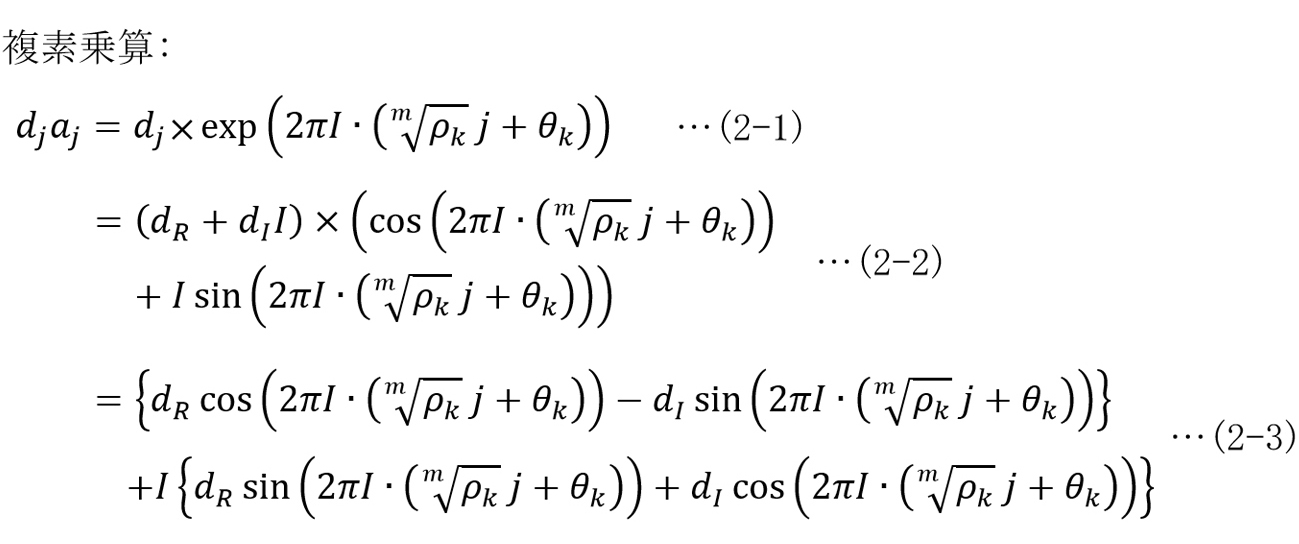
図4に示すように、変調部21は、複素数データdjに対して概周期関数符号ajを複素乗算するだけでなく、複素データdに対して、概周期関数符号ajとは異なる種類の複素符号bjを複素乗算してもよい。この場合、変調部21による複素乗算を式で表すと、djajbjとなる。変調部21による複素乗算djajbjは、(djaj)を行ってから、(djaj)に対してbjを複素乗算することであってもよいし、(djbj)を行ってから、(djbj)に対してajを複素乗算することであってもよい。いずれも結果は同じである。
概周期関数符号ajとは異なる種類の複素符号bjが複素数データにdjに乗じられていることで、符号bjが有する好ましい性質を変調信号に反映させて、より好適な変調信号を得るのが容易となる。概周期関数符号ajとは異なる種類の複素符号bjは、例えば、複素平面上でパワー一定の符号であるのが好ましい。パワー一定の概周期関数符号ajにパワー一定の符号bjを乗じても、パワーが変動しないので有利である。複素平面上でパワー一定の符号bjは、例えば、複素平面上でパワー一定のカオス拡散符号又はGold符号である。カオス拡散符号又はGold符号は、良好な相関特性を有する。変調部21が、カオス拡散符号又はGold符号をデータdjに乗じることで、変調信号djajbjの相関特性を向上させることができる。
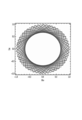
図5は、符号長N=100,ρk=3,θρk=0としたときの周期関数符号のIQコンスタレーション(符号遷移図)を示している。図5に示すIQコンスタレーションでは、外円と内円とに囲まれた領域が形成され、原点を含む内円内の領域は、空白となる。コンスタレーションが原点を通らないことは通信にとって有利である。なお、図5において、原点から外円までの半径の二乗が符号のパワーに相当する。図5から明らかなように、概周期関数符号においては、符号が全て単一の円(外円)上に存在し、パワー一定である。
図6は、パワー一定のカオス拡散符号のIQコンスタレーションを示している。図6から明らかなように、図6のコンスタレーション中の黒丸が符号を示している。図6から明らかなように、パワー一定のカオス拡散符号においては、符号が全て単一の円上に存在し、パワー一定である。
図7は、復調部31を示している。復調部31は、受信信号rを、Nチップに分割して、N個のチップデータr1,r2,・・・,rNとし、N個のチップデータr1,r2,・・・,rNそれぞれを実部データrRと虚部データrIIに分離する分離部31aと、実部データrRと虚部データrIIで構成される各チップデータr1,r2,・・・,rNに対して、送信に用いられた概周期関数符号(a1,a2,・・・aN-1,aN)の複素共役(a1
*,a2
*,・・・aN-1
*,aN
*)をかける演算部31bと、を備えている。演算部31bは、チップデータr1,r2,・・・,rNに対して、複素共役(a1
*,a2
*,・・・aN-1
*,aN
*)を複素乗算する。演算部31は、以下の式(3-1)に従った演算を行い、dRとdIIからなる再生データdを得る。

変調部21にて概周期関数符号ajとは異なる種類の複素符号bjがかけられている場合、復調部31は、符号(b1,b2,・・・bN-1,bN)の複素共役(b1
*,b2
*,・・・bN-1
*,bN
*)を、各チップデータr1,r2,・・・,rNに対して複素乗算する。この場合、演算部31は、式(3-2)に従った演算を行い、再生データdを得る。複素共役(b1
*,b2
*,・・・bN-1
*,bN
*)は、チップデータr1,r2,・・・,rNに対して複素共役(a1
*,a2
*,・・・aN-1
*,aN
*)が複素乗算された後に複素乗算してもよいし、チップデータr1,r2,・・・,rNに対して複素共役(a1
*,a2
*,・・・aN-1
*,aN
*)が複素乗算される前に複素乗算してもよい。
本実施形態では、概周期関数符号がかけられる送信データdは、複素数データであるので、多値をとることが可能であり、送信データが2値のバイナリデータである場合に比べて、送信効率が良い。また、復調器31では、復調処理によって、再生データとして複素数データを得ることができる。なお、複素数データdにおいて、dR=dIでもよいし、dIまたdRの一方はゼロでもよい。
[2.3 概周期関数符号を用いた擬似直交多重通信]
図8は、概周期関数符号を用いた擬似直交多重通信を行う通信機100を示している。この通信機20は、擬似直交多重信号の送受信が可能である。
図8は、概周期関数符号を用いた擬似直交多重通信を行う通信機100を示している。この通信機20は、擬似直交多重信号の送受信が可能である。
図8の通信機は、送信のため、変換器101と、擬似直交多重変調器102と、を備えている。変換器101は、例えば、シリアルパラレル変換器であり、シリアルの送信データを、チャネル(ユーザ)毎のデータ列(パラレルデータ列)に変換する。ここでは、チャネル数又はユーザ数をKとする。データ列のデータ長(シンボル長)はNである。Nは、概周期関数符号の符号長である。
図8及び以下の説明において、データシンボルを示すdj
kは、k番目のチャネル(又はk番目のユーザ)のための、j番目のデータシンボル(送信符号)を示す。1≦k≦Kであり、1≦j≦Nである。なお、各dj
kは、複素数データである。
つまり、第1チャネル(第1ユーザ)のデータ列は、(d1
1,d2
1,・・・,dN
1)であり、第2チャネル(第2ユーザ)のデータ列は、(d1
2,d2
2,・・・,dN
2)であり、第kチャネル(第kユーザ)のデータ列は、(d1
k,d2
k,・・・,dN
k)であり、第K-1チャネル(第K-1ユーザ)のデータ列は、(d1
K-1,d2
K-1,・・・,dN
K-1)であり、第Kチャネル(第Kユーザ)のデータ列は、(d1
K,d2
K,・・・,dN
K)である。
これらのN×K個のデータシンボルdj
kは、擬似直交多重変調部102に与えられ、擬似直交多重信号yを出力する。N×K個のデータシンボルdj
kから生成される擬似直交多重信号(送信信号)yは、Kチャネル×Kシンボル分の信号である。
図8及び以下の説明において、各チャネルの送信シンボルを示すyi
jは、i番目のチャネルにおける、j番目のシンボルを示す。1≦i,j≦Kである。
つまり、送信信号yにおいて、第1チャネルの送信シンボル列は、(y1
1、y1
2,・・・,y1
K-1,y1
K)であり、第2チャネルの送信シンボル列は、(y2
1、y2
2,・・・,y2
K-1,y2
K)であり、第kチャネルの送信シンボル列は、(yk
1、yk
2,・・・,yk
K-1,yk
K)であり、第K-1チャネルの送信シンボル列は、(yK-1
1、yK-1
2,・・・,yK-1
K-1,yK-1
K)であり、第Kチャネルの送信シンボル列は、(yK
1、yK
2,・・・,yK
K-1,yK
K)である。
擬似直交多重変調器102は、以下の式(4)に従って、N×K個のデータシンボルdj
kに対して、擬似直交多重変調処理を行い、擬似直交多重信号yを出力する。

擬似直交多重変調処理は、N×K個のデータシンボルdj
kに対して、大きさがK×Nである行列(変調行列)Aをかける演算を行い、擬似直交多重信号yを得る。すなわち、擬似直交多重変調器102は、K個のデータ列からなる行列に対して、行列Aを複素乗算する。行列のための複素乗算は、aj
kdj
kの複素乗算をN×K回行うことに相当する。行列Aは、符号長Nの概周期関数符号(a1
k,a2
k,・・・,aN-1
k,aN
k)をK個並べたものである。ここで、1≦k≦Kである。K個の概周期関数符号は、チャネル数(ユーザ数)Kに対応して、K種類の異なる素数ρkから生成される。
素数ρkから生成される概周期関数符号aj
kは、次の式(5)で表される。なお、1≦j≦Nである。

擬似直交多重信号yの受信側では、復調処理によって、送信されたN×K個のデータシンボルdj
kを再生することができる。復調処理には、行列Aの逆行列A-1が用いられる。復調処理では、受信した擬似直交多重信号からKシンボル分の信号y([数4]で示す式(4)における左辺に相当する信号)を取得し、Kシンボル分の信号yに対して逆行列A-1をかけることで、再生されたN×K個のデータシンボルdj
kを得ることができる。ここでは、復調が行えるようにK≧Nとする。行列Aの逆行列A-1は、行列Aを転置し、各行列要素aj
kの複素共役をとればよい。データ再生のために逆行列A-1をかける演算は、複素乗算によって行われる。
10 通信機
20 送信機
21 変調部
30 受信機
31 復調部
100 通信機
101 変換部
102 擬似直交多重変調部
20 送信機
21 変調部
30 受信機
31 復調部
100 通信機
101 変換部
102 擬似直交多重変調部
Claims (11)
- 通信方法であって、
データを符号で変調して生成された信号を送信することを含み、
前記符号は、概周期関数符号であり、
前記データは、実部データと虚部データを有する複素数データであり、
前記変調は、前記複素数データに対して前記概周期関数符号をかける演算を含む
通信方法。 - 前記複素数データに対して前記概周期関数符号をかける演算は、前記複素数データに対して複素数で表される前記概周期関数符号を複素乗算することを含む
請求項1に記載の通信方法。 - Nが前記概周期関数符号の符号長を表し、jが1以上N以下の整数であり、ajが符号長Nの前記概周期関数符号を表し、dが前記複素数データを表すときに、
前記複素数データに対して前記概周期関数符号をかける演算は、1~Nまでのそれぞれのjについて、dajで示される複素乗算をすることを含む
請求項1又は2に記載の通信方法。 - Nが前記概周期関数符号の符号長を表し、jが1以上N以下の整数であり、ajが符号長Nの前記概周期関数符号を表し、dが前記複素数データを表すときに、
前記複素数データに対して前記概周期関数符号をかける演算は、N個のdajの総和を算出することを含む
請求項1~3のいずれか1項に記載の通信方法。 - 前記変調は、前記複素数データに対して、前記概周期関数符号とは異なる複素符号を複素乗算することを更に含み、
前記複素符号は、複素平面上でパワー一定の符号である
請求項2~4のいずれか1項に記載の通信方法。 - 前記変調は、前記概周期関数符号を用いたスペクトル拡散変調である
請求項1~5のいずれか1項に記載の通信方法。 - 前記信号を受信して復調することを更に含み、
前記復調は、受信した前記信号に前記概周期関数の複素共役をかけて、前記データを再生することを含む
請求項6記載の通信方法。 - 前記変調は、前記概周期関数符号を用いた擬似直交多重変調である
請求項1記載の通信方法。 - Kが、チャネル数又はユーザ数を表し、Nが、データ列を構成する複素数データの数を表すときに、
前記疑似直交多重変調は、K個のデータ列に対して、大きさがK×Nの行列を複素乗算することを含み、
前記行列は、符号長Nの前記概周期関数符号をK個有する
請求項8記載の通信方法。 - 前記信号を受信して復調することを更に含み、
前記復調は、擬似直交多重変調に用いられた行列の逆行列をかけて、前記データを再生することを含む
請求項8又は9記載の通信方法。 - 通信機であって、
データを符号で変調する変調部を備え、
前記符号は、概周期関数符号であり、
前記データは、実部データと虚部データを有する複素数データであり、
前記変調部は、前記複素数データに対して概周期関数符号をかける演算処理を行う
通信機。
Applications Claiming Priority (2)
| Application Number | Priority Date | Filing Date | Title |
|---|---|---|---|
| JP2015-113389 | 2015-06-03 | ||
| JP2015113389 | 2015-06-03 |
Publications (1)
| Publication Number | Publication Date |
|---|---|
| WO2016195094A1 true WO2016195094A1 (ja) | 2016-12-08 |
Family
ID=57441367
Family Applications (1)
| Application Number | Title | Priority Date | Filing Date |
|---|---|---|---|
| PCT/JP2016/066654 Ceased WO2016195094A1 (ja) | 2015-06-03 | 2016-06-03 | 通信方法及び通信機 |
Country Status (1)
| Country | Link |
|---|---|
| WO (1) | WO2016195094A1 (ja) |
Citations (4)
| Publication number | Priority date | Publication date | Assignee | Title |
|---|---|---|---|---|
| JP2003198500A (ja) * | 2001-10-19 | 2003-07-11 | Matsushita Electric Ind Co Ltd | スペクトル拡散通信システムおよび方法 |
| JP2005033674A (ja) * | 2003-07-10 | 2005-02-03 | Matsushita Electric Ind Co Ltd | 拡散コード生成方法、cdma送信及び受信装置 |
| JP2009044663A (ja) * | 2007-08-10 | 2009-02-26 | Nippon Telegr & Teleph Corp <Ntt> | Cdm通信システム、cdm送信装置およびcdm受信装置 |
| JP2010028668A (ja) * | 2008-07-23 | 2010-02-04 | Chaosware Inc | 拡散符号計算装置、通信システム、送信装置、受信装置、ならびに、プログラム |
-
2016
- 2016-06-03 WO PCT/JP2016/066654 patent/WO2016195094A1/ja not_active Ceased
Patent Citations (4)
| Publication number | Priority date | Publication date | Assignee | Title |
|---|---|---|---|---|
| JP2003198500A (ja) * | 2001-10-19 | 2003-07-11 | Matsushita Electric Ind Co Ltd | スペクトル拡散通信システムおよび方法 |
| JP2005033674A (ja) * | 2003-07-10 | 2005-02-03 | Matsushita Electric Ind Co Ltd | 拡散コード生成方法、cdma送信及び受信装置 |
| JP2009044663A (ja) * | 2007-08-10 | 2009-02-26 | Nippon Telegr & Teleph Corp <Ntt> | Cdm通信システム、cdm送信装置およびcdm受信装置 |
| JP2010028668A (ja) * | 2008-07-23 | 2010-02-04 | Chaosware Inc | 拡散符号計算装置、通信システム、送信装置、受信装置、ならびに、プログラム |
Non-Patent Citations (1)
| Title |
|---|
| TOMOYA NAOHARA ET AL.: "Performance Analysis of Super Dense Multiple Access(SDMA) Communications Systems Using Almost Periodic Function Codes", IEICE TECHNICAL REPORT, vol. 114, no. 348, 26 November 2014 (2014-11-26), pages 11 - 16 * |
Similar Documents
| Publication | Publication Date | Title |
|---|---|---|
| US6178158B1 (en) | Method and apparatus for transmission and reception | |
| JP4771646B2 (ja) | ゴレイ相補系列変調によるスペクトラム拡散ディジタル通信方法、送信機および受信機 | |
| CN1868152B (zh) | 用于ofdm通信系统中的发射和接收的方法和装置 | |
| JPH08331095A (ja) | 通信システム | |
| US8897119B2 (en) | Mobile station, base station, communication system, and communication method | |
| TWI405429B (zh) | 使用載體傳輸資料的設備和方法 | |
| US10873361B2 (en) | Communication system and methods using multiple-in-multiple-out (MIMO) antennas within unitary braid divisional multiplexing (UBDM) | |
| KR100899747B1 (ko) | 직교주파수분할다중 시스템의 첨두대평균 전력비 저감을위한 장치 및 방법 | |
| US20030138031A1 (en) | Spread spectrum transmitter and spread spectrum receiver | |
| US20180138939A1 (en) | Reliable orthogonal spreading codes in wireless communications | |
| US6980539B2 (en) | Mobile communication system in multi-carrier CDMA scheme using short code and long code | |
| CN1836382A (zh) | 通信设备和通信方法 | |
| WO2006102403A2 (en) | Orthogonal frequency division multiplexing code division multiple access system | |
| KR20000053310A (ko) | 직접적인 시퀀스 확산 스펙트럼 통신신호의 역확산 | |
| US6411645B1 (en) | Modulation apparatus of multicarrier direct sequence spread spectrum communication system | |
| JP2003234719A (ja) | 通信システム用のプリディストーション方法及びmc−cdma通信システムの携帯端末用の送信機 | |
| JP2012165252A (ja) | 送信機、受信機および通信システム | |
| JP2734955B2 (ja) | 無線データ通信装置 | |
| US7620115B2 (en) | Space code block coding and spreading apparatus and method for transmission diversity and CDMA diversity transmitter and CDMA mobile station receiver using the same | |
| KR20040036821A (ko) | 다중반송파 코드분할 다중접속에서의 확산/역확산 시스템및 그 방법 | |
| US20070268843A1 (en) | Segmented Code Division Multiple Access | |
| CN105407066A (zh) | 一种选择最佳导频序列抑制水声ofdm信号峰平比的方法 | |
| JP2713269B2 (ja) | 符号多重化通信装置 | |
| KR100612647B1 (ko) | 직교시퀀스를 이용한 채널 추정 시스템 및 그 방법 | |
| JPH05227125A (ja) | スペクトラム拡散方式通信装置 |
Legal Events
| Date | Code | Title | Description |
|---|---|---|---|
| 121 | Ep: the epo has been informed by wipo that ep was designated in this application |
Ref document number: 16803525 Country of ref document: EP Kind code of ref document: A1 |
|
| NENP | Non-entry into the national phase |
Ref country code: DE |
|
| 122 | Ep: pct application non-entry in european phase |
Ref document number: 16803525 Country of ref document: EP Kind code of ref document: A1 |
|
| NENP | Non-entry into the national phase |
Ref country code: JP |