WO2016152675A1 - 加工性に優れた高強度鋼板 - Google Patents
加工性に優れた高強度鋼板 Download PDFInfo
- Publication number
- WO2016152675A1 WO2016152675A1 PCT/JP2016/058311 JP2016058311W WO2016152675A1 WO 2016152675 A1 WO2016152675 A1 WO 2016152675A1 JP 2016058311 W JP2016058311 W JP 2016058311W WO 2016152675 A1 WO2016152675 A1 WO 2016152675A1
- Authority
- WO
- WIPO (PCT)
- Prior art keywords
- steel sheet
- less
- strength
- ferrite
- present
- Prior art date
- Legal status (The legal status is an assumption and is not a legal conclusion. Google has not performed a legal analysis and makes no representation as to the accuracy of the status listed.)
- Ceased
Links
Images

Classifications
-
- C—CHEMISTRY; METALLURGY
- C22—METALLURGY; FERROUS OR NON-FERROUS ALLOYS; TREATMENT OF ALLOYS OR NON-FERROUS METALS
- C22C—ALLOYS
- C22C38/00—Ferrous alloys, e.g. steel alloys
-
- C—CHEMISTRY; METALLURGY
- C22—METALLURGY; FERROUS OR NON-FERROUS ALLOYS; TREATMENT OF ALLOYS OR NON-FERROUS METALS
- C22C—ALLOYS
- C22C38/00—Ferrous alloys, e.g. steel alloys
- C22C38/06—Ferrous alloys, e.g. steel alloys containing aluminium
-
- C—CHEMISTRY; METALLURGY
- C22—METALLURGY; FERROUS OR NON-FERROUS ALLOYS; TREATMENT OF ALLOYS OR NON-FERROUS METALS
- C22C—ALLOYS
- C22C38/00—Ferrous alloys, e.g. steel alloys
- C22C38/18—Ferrous alloys, e.g. steel alloys containing chromium
- C22C38/40—Ferrous alloys, e.g. steel alloys containing chromium with nickel
- C22C38/58—Ferrous alloys, e.g. steel alloys containing chromium with nickel with more than 1.5% by weight of manganese
-
- C—CHEMISTRY; METALLURGY
- C21—METALLURGY OF IRON
- C21D—MODIFYING THE PHYSICAL STRUCTURE OF FERROUS METALS; GENERAL DEVICES FOR HEAT TREATMENT OF FERROUS OR NON-FERROUS METALS OR ALLOYS; MAKING METAL MALLEABLE, e.g. BY DECARBURISATION OR TEMPERING
- C21D9/00—Heat treatment, e.g. annealing, hardening, quenching or tempering, adapted for particular articles; Furnaces therefor
- C21D9/46—Heat treatment, e.g. annealing, hardening, quenching or tempering, adapted for particular articles; Furnaces therefor for sheet metals
Definitions
- the present invention relates to a high-strength steel sheet excellent in workability, and in particular, to a high-strength steel sheet with improved strength-elongation balance and stretch flangeability.
- the steel plate types of the high-strength steel plates according to the present invention include cold-rolled steel plates as well as various plated steel plates such as hot-dip galvanized steel plates and galvannealed steel plates.
- High-strength steel plates are used for automobile frame parts.
- Steel sheets used as frame parts for automobiles are required to be cold-rolled steel sheets and alloyed hot-dip galvanized steel sheets with increased strength for the purpose of improving fuel efficiency by reducing the weight of the vehicle body.
- excellent workability is also required in order to form a complex shaped part.
- a hot rolled coil having a component composition similar to that of the high-strength steel sheet according to the present invention and a structure mainly composed of bainite and martensite is held for 1 hour or more in the range of 550 ° C. to Ac1 point.
- Batch hot-rolled sheet annealing step, cold-rolled step, and cold-rolled plate are heated to Ac1-Ac3 temperature at an average heating rate of Ac1 point to Ac1 point + 50 ° C) at 5 ° C / s or higher and held for 5 seconds or longer
- This high-strength cold-rolled steel sheet is common to the high-strength steel sheet according to the present invention in that a batch hot-rolled sheet annealing step (corresponding to the preliminary annealing treatment of the present invention) is performed in the manufacturing method.
- the cooling stop temperature when quenching from the two-phase region temperature to the austempering temperature is 350 to 500 ° C., which is higher than 50 ° C. or more and less than 350 ° C. of the present invention.
- the ferrite fraction in the final structure is 70% or more, and contains more ferrite (corresponding to the polygonal ferrite of the present invention) than the maximum value of polygonal ferrite in the present invention: 65% or less. This is clearly different from the high-strength steel sheet according to the present invention.
- Patent Document 2 has a component composition that is similar to that of the present invention, and in volume fraction, ferrite phase: 40 to 70%, bainite phase: 15 to 35%, tempered martensite phase: 5 to 25% and retained austenite phase: 2 to 20%, and the ratio of the martensite phase with the major axis length ⁇ 10 ⁇ m in the total volume fraction of the tempered martensite phase is 30% or less.
- a high-strength cold-rolled steel sheet having a tensile strength TS of 1180 MPa or more with improved workability such as stretch flangeability and bendability is disclosed.
- the high-strength cold-rolled steel sheet is a high-strength steel sheet according to the present invention in that the first annealing (corresponding to the pre-annealing treatment of the present invention) is performed in the temperature range of 400 to 800 ° C. after the hot rolling in the manufacturing method. And in common.
- the cooling stop temperature is 300 to 500 ° C. (380 to 500 ° C. in the invention example of the embodiment), which is 50 ° C. or more of the present invention. It is higher than less than 350 ° C.
- the fresh martensite fraction is lowered, and the formed fresh martensite is all tempered by the third annealing (corresponding to the tempering treatment of the present invention) to become only tempered martensite, and the final structure is not yet.
- the third annealing corresponding to the tempering treatment of the present invention
- the object of the present invention is that the tensile strength (TS) is 980 MPa or more, the tensile strength-elongation balance (TS ⁇ EL) is 25000 MPa ⁇ % or more, the yield strength (YS) is 550 MPa or more, and the stretch flangeability ( ⁇ ) is An object of the present invention is to provide a high-strength steel sheet excellent in workability and capable of securing 20% or more.
- the high-strength steel sheet excellent in workability according to the first invention of the present invention is % By mass C: 0.05 to 0.50%, Si: 1.0 to 3.0%, Mn: 1.0 to 5.0%, Al: 0.001 to 0.10% Each
- the balance consists of iron and inevitable impurities, Among the inevitable impurities, P, S, and N are P: 0.1% or less, S: 0.01% or less, N: 0.01% or less
- P 0.1% or less
- S 0.01% or less
- N 0.01% or less
- Polygonal ferrite + bainitic ferrite: 70% or less in total Has an organization consisting of The Mn concentration in the MA is
- the high-strength steel sheet excellent in workability according to the second invention of the present invention is in the first invention, Ingredient composition is further mass%, Cr: 0.05 to 1.0%, Mo: 0.05 to 1.0%, Ni: 0.05 to 1.0%, B: 0.0001 to 0.002% Any one or more of Is.
- the high-strength steel sheet excellent in workability according to the third invention of the present invention is in the first or second invention, Ingredient composition is further mass%, Ti: 0.01 to 0.15%, Nb: 0.01 to 0.15%, V: 0.01 to 0.15% Any 1 type or 2 types or more of these are included.
- a soft polygonal ferrite is used as a main phase, a predetermined amount of bainitic ferrite is introduced, and Mn is further concentrated in the MA to ensure elongation while maintaining the elongation in the MA.
- a predetermined amount of tempered martensite is introduced to improve the strength (tensile strength, yield strength) and stretch flangeability due to the presence of the tempered martensite and bainitic ferrite.
- the tensile strength (TS) is 980 MPa or more
- the tensile strength-elongation balance (TS ⁇ EL is 25000 MPa ⁇ % or more
- the yield strength (YS) is 550 MPa or more
- the stretch flangeability ( ⁇ ) is 20%. It was possible to provide a high-strength steel sheet excellent in workability that can secure the above.
- the steel sheet of the present invention the structure that characterizes the high-strength steel sheet excellent in workability according to the present invention.
- the steel sheet of the present invention is characterized in that the parent phase is polygonal ferrite, and tempered martensite and bainitic ferrite are partially introduced into this, and further MA containing Mn is added. It is what.
- Polygonal ferrite is a soft phase and is an effective structure for enhancing the ductility of a steel sheet.
- the content of polygonal ferrite with respect to the entire structure needs to be 40% or more, preferably 45% or more, and more preferably 50% or more in terms of area ratio in order to ensure the ductility of the steel sheet.
- the upper limit of polygonal ferrite is set in relation to the conditions of “Bainitic ferrite: 5% or more” and “Polygonal ferrite + Bainitic ferrite: 70% or less in total” as specified separately. 65%.
- the “polygonal ferrite” in the present invention is a general term for the polygonal ferrite structure and the quasi-polygonal ferrite structure described in “Basic Steel Research Group published by the Japan Iron and Steel Institute”. Is.
- ⁇ Tempered martensite 10% or more>
- stretch flangeability can be improved while maintaining tensile strength.
- the tempered martensite content in the entire structure needs to be 10% or more, preferably 12% or more, and more preferably 14% or more in terms of area ratio in order to ensure stretch flangeability.
- bainitic ferrite 5% or more>
- the content of bainitic ferrite with respect to the entire structure needs to be 5% or more, preferably 7% or more, more preferably 9% or more in terms of area ratio in order to ensure a tensile strength-elongation balance.
- “bainitic ferrite” means that the bainite structure has a lower structure having a lath-like structure with a high dislocation density, and has no carbide in the structure.
- MA 5% or more>
- the MA content in the entire structure needs to be 5% or more, preferably 7% or more, and more preferably 9% or more in terms of area ratio in order to ensure the yield strength and tensile strength-elongation balance.
- “MA” in the present invention is a mixed structure of fresh martensite and retained austenite, and it is difficult to separate (discriminate) fresh martensite and retained austenite by microscopic observation.
- Fresh martensite refers to a state in which untransformed austenite is martensitic transformed in the process of cooling the steel sheet from the heating temperature to the MS point or less, and is distinguished from tempered martensite after tempering.
- Polygonal ferrite + Bainitic ferrite 70% or less in total> If the total amount of polygonal ferrite and bainitic ferrite is too large, the amounts of tempered martensite and MA are insufficient, and at least one of yield strength, tensile strength-elongation balance, and stretch flangeability cannot be secured.
- the total content of polygonal ferrite and bainitic ferrite with respect to the entire structure must be limited to 70% or less, preferably 69% or less, and more preferably 68% or less in terms of area ratio.
- ⁇ Mn concentration in MA 1.2 times or more of Mn content of whole steel plate>
- the area ratios of polygonal ferrite, MA, and tempered martensite were measured as follows. That is, the steel plate was mirror-polished and corroded with 3% nital solution to reveal the metal structure, and then a secondary electron image of a field emission scanning electron microscope (FE-SEM) for approximately 5 fields of 24 ⁇ m ⁇ 18 ⁇ m region. It was observed (magnification 5000 times). An example of the observation photograph is shown in FIG.
- FE-SEM field emission scanning electron microscope
- the region that does not contain cementite and appears concave due to corrosion is polygonal ferrite
- the region that does not contain cementite and appears to be convex on the polygonal ferrite is MA
- the region that contains cementite They were identified as tempered martensite and the respective area ratios were calculated.
- a Mn concentration distribution in MA was measured using a field emission electron beam microanalyzer (FE-EPMA), and the average value was taken as the Mn concentration in MA.
- FE-EPMA field emission electron beam microanalyzer
- C 0.05 to 0.50% C is an important element for improving the strength of the steel sheet. In order to exhibit the effect of improving the strength effectively, it is necessary to contain C 0.05% or more, preferably 0.08% or more, more preferably 0.12% or more. However, when the amount of C is excessive, coarse carbides are likely to precipitate during tempering, and the stretch flangeability is deteriorated and the weldability is also adversely affected. Therefore, the amount of C is preferably 0.50% or less, preferably Is 0.45% or less, more preferably 0.40% or less.
- Si 1.0 to 3.0% Si is a useful element that has the effect of suppressing the coarsening of carbide particles during tempering, contributes to improvement in stretch flangeability, and also contributes to an increase in yield strength of the steel sheet as a solid solution strengthening element.
- it is necessary to contain Si by 1.0% or more, preferably 1.1% or more, and more preferably 1.2% or more.
- the Si amount is 3.0% or less, preferably 2.9% or less, and more preferably 2.8% or less.
- Mn 1.0 to 5.0% Mn, like Si, has an effect of suppressing the coarsening of cementite during tempering, contributes to the improvement of stretch flangeability, and is a useful element that also contributes to an increase in the yield strength of the steel sheet as a solid solution strengthening element. is there. Moreover, it has the effect of suppressing the ferrite transformation at the time of cooling by improving hardenability. In order to effectively exhibit such an action, it is necessary to contain Mn at 1.0% or more, preferably 1.1% or more, and more preferably 1.2% or more. However, if the amount of Mn becomes excessive, the amount of MA in the final structure becomes excessive, and conversely the stretch flangeability is lowered. Therefore, the amount of Mn is 5.0% or less, preferably 4.8% or less. Preferably it is 4.6% or less.
- Al 0.001 to 0.10%
- Al is a useful element added as a deoxidizer. In order to effectively exhibit the action as a deoxidizer, it is necessary to contain Al 0.001% or more, preferably 0.003% or more, and more preferably 0.005% or more. However, if the amount of Al is excessive, the cleanliness of the steel is deteriorated, so the amount of Al is 0.10% or less, preferably 0.08% or less, and more preferably 0.06% or less.
- the steel sheet of the present invention contains the above elements as essential components, and the balance is iron and unavoidable impurities (P, S, N, O, etc.).
- unavoidable impurities P, S, and N are as follows: It can be contained up to each allowable range.
- P 0.1% or less P is unavoidably present as an impurity element, and contributes to an increase in strength by solid solution strengthening, but segregates at the prior austenite grain boundaries and makes the grain boundaries brittle, thereby improving the bendability. Since it deteriorates, the amount of P is limited to 0.1% or less, preferably 0.05% or less, and more preferably 0.03% or less.
- S 0.01% or less S is also unavoidably present as an impurity element, and forms MnS inclusions and becomes a starting point of a crack at the time of bending deformation, thereby lowering the bendability. Therefore, the amount of S is 0.01% or less, preferably 0.8. It is limited to 005% or less, more preferably 0.003% or less.
- N 0.01% or less N is also unavoidably present as an impurity element and lowers the workability of the steel sheet by strain aging, so the N content is 0.01% or less, preferably 0.005% or less, more preferably 0.003% or less. Restrict.
- Cr, Mo, Ti, Nb, V, B, Ni, Cu, Zr, and the like can be included as allowable components within the range not impairing the action of the present invention.
- Cr, Mo Ni, B, Ti, Nb and V are recommended to be contained within the following permissible ranges.
- Cr 0.05 to 1.0%
- Mo 0.05 to 1.0%
- Ni 0.05 to 1.0%
- B 0.0001 to 0.002% Any one or two or more of these elements are useful for enhancing the hardenability and improving the strength of the steel sheet.
- the Cr, Mo, and Ni contents are each 0.05% or more, more preferably 0.1% or more
- the B content is 0.0001% or more, more preferably Is recommended to be 0.0002% or more.
- the content is desirably limited to 0.002% or less, more preferably 0.001% or less.
- steel having the above component composition is melted and made into a slab (steel material) by ingot forming or continuous casting, and then hot-rolled (hot rolled) at a finishing temperature of 900 ° C. or less (preferably 880 ° C. or less).
- the coiling temperature after hot rolling is set to 600 to 700 ° C., and then cooled to room temperature to obtain a hot rolled sheet.
- the hot-rolled sheet has a bainite or pearlite single-phase structure or a two-phase structure containing ferrite.
- a tempering parameter ⁇ calculated by the following equation (1) is set to 16 at a pre-annealing temperature Tpa (unit: ° C.) of 500 ° C. to Ac 1 (preferably 510 ° C. to [Ac 1-10 ° C.]).
- Tpa a pre-annealing temperature
- Ac 1 a pre-annealing temperature
- tpa unit: h
- ⁇ (Tpa + 273) ⁇ ⁇ log (tpa) +20 ⁇ / 1000
- this pre-annealed material After removing the scale from this pre-annealed material by pickling or the like, it is subjected to cold rolling (cold rolling) to obtain a cold rolled sheet.
- cold rolling for this cold-rolled sheet, for example, using a continuous annealing line (CAL), Ac1 to Ac3 (preferably [Ac1 + 10 ° C.] to [Ac3-10 ° C.]) that are two-phase region temperatures in which polygonal ferrite and austenite are mixed.
- the carbide is austenitized by performing an annealing treatment under a condition that the annealing heating temperature is maintained for an annealing holding time of 50 s or more (preferably 55 s or more).
- austenite having a high Mn concentration can be formed because Mn is concentrated by the preliminary annealing treatment.
- a supercooling stop temperature 50 ° C. or more and less than 350 ° C. (preferably 100 to 300 ° C.) at a cooling rate of 10 to 50 ° C./s.
- the annealed material is further subjected to an austempering treatment at austempering temperature of 400 to 500 ° C. (preferably 410 to 490 ° C.) for 30 to 1200 s (preferably 40 to 600 s) for austenating time.
- the steel sheet of the present invention (cold rolled steel sheet) is obtained.
- bainite is formed and a part of the fresh martensite formed by the rapid cooling is tempered to form tempered martensite.
- the balance of strength, ductility, and stretch flangeability can be improved.
- by improving the stability of retained austenite constituting the MA by concentrating Mn in the final structure so that the Mn concentration is 1.2 times or more of the Mn content of the entire steel sheet.
- the tensile strength-elongation balance can be improved.
- the steel sheet of the present invention may be a plated steel sheet by performing a plating process on the annealed material after the annealing process and then performing the austempering process.
- Test steels having the respective component compositions shown in Table 1 below were vacuum-melted to form a slab having a thickness of 30 mm, the slab was soaked to 1150 ° C., hot-rolled at a finishing temperature of 880 ° C., and then 600 ° C. Was rolled to prepare a hot-rolled sheet having a thickness of 2.5 mm.
- This hot-rolled sheet was pre-annealed under the conditions shown in Table 2 below using a batch furnace. After pickling this pre-annealed material, it was cold-rolled to a thickness of 1.5 mm, and further subjected to annealing treatment and austempering treatment under the conditions shown in Table 2 to produce a test steel sheet (cold rolled steel sheet) did.
- N content was abbreviate
- the yield strength YS, the tensile strength TS, and the elongation (total elongation) EL were measured by a tensile test, and the stretch flangeability ⁇ was measured by a hole expansion test.
- the tensile test was carried out in accordance with JIS Z 2241 by preparing a No. 5 test piece described in JIS Z 2201 with the long axis in a direction perpendicular to the rolling direction.
- the hole expansion test was performed in accordance with the iron standard JFST001, the hole expansion rate was measured, and this was defined as stretch flangeability ⁇ .
- the mechanical properties (hereinafter, also simply referred to as “characteristics”) of the test steel sheet are tensile strength (TS) of 980 MPa or more, YS: 550 MPa or more, TS ⁇ EL: 25000 MPa ⁇ % or more, ⁇ : 20% Those satisfying all of the above were accepted ( ⁇ ), and those not satisfying at least one were rejected (x).
- TS tensile strength
- steel No. which is an invention steel (evaluation is ⁇ ). 1 to 3, 7, 11, 17, 21, 22, and 25 satisfy the requirements of the organization provision of the present invention as a result of being manufactured using the steel grade that satisfies the requirements of the composition provision of the present invention under the recommended production conditions. It is an invented steel and its characteristics satisfy the acceptance criteria.
- steel No. which is a comparative steel (evaluation of x). 4 to 6, 8 to 10, 12 to 16, 18 to 20, 23, 24, 26, and 27 do not satisfy at least one of the component provision and the structure provision of the present invention, and the characteristics satisfy the acceptance criteria Not.
- No. 4-6, 8-10, 12-16, 18, and 23 are manufactured using conditions that deviate from the recommended manufacturing conditions, although the steel types satisfying the requirements of the component provisions of the present invention are used.
- the organization regulations are not met and the characteristics are inferior.
- the high strength steel sheet of the present invention has a tensile strength (TS) of 980 MPa or more, a tensile strength-elongation balance (TS ⁇ EL) of 25,000 MPa ⁇ % or more, a yield strength (YS) of 550 MPa or more, and stretch flangeability ( ⁇ ).
- TS tensile strength
- TS ⁇ EL tensile strength-elongation balance
- YiS yield strength
- stretch flangeability ⁇
- it is excellent in workability by securing 20% or more, and is particularly useful for a framework part for automobiles.
Landscapes
- Chemical & Material Sciences (AREA)
- Engineering & Computer Science (AREA)
- Materials Engineering (AREA)
- Mechanical Engineering (AREA)
- Metallurgy (AREA)
- Organic Chemistry (AREA)
- Heat Treatment Of Sheet Steel (AREA)
Abstract
C、Si、Mn、Alをそれぞれ特定量含み、残部が鉄および不可避的不純物であり、ポリゴナルフェライト、焼戻しマルテンサイト、ベイニティックフェライト、フレッシュマルテンサイトと残留オーステナイトの混合組織(MA)、ポリゴナルフェライトとベイニティックフェライトの合計がそれぞれ特定の面積率であり、MA中のMn濃度が鋼板全体のMn含有量の1.2倍以上である高強度鋼板。
Description
本発明は、加工性に優れた高強度鋼板に関し、詳細には、強度-伸びバランスおよび伸びフランジ性の高められた高強度鋼板に関するものである。本発明に係る高強度鋼板の鋼板種類としては、冷延鋼板のほか、溶融亜鉛めっき鋼板、合金化溶融亜鉛めっき鋼板などの各種めっき鋼板をも含むものとする。
高強度鋼板は、自動車用の骨格部品に使用されている。自動車用の骨格部品として用いられる鋼板には、車体軽量化による燃費向上を目的として高強度化した冷延鋼板や合金化溶融亜鉛めっき鋼板が求められている。一方で、複雑な形状の部品に成形するために、優れた加工性も要求されている。
このため、高い強度を有しつつ、伸び(全伸び;EL)と伸びフランジ性(穴拡げ率;λ)がともに高められた高強度鋼板の提供が切望されており、例えば引張強度(TS)が980MPa級の鋼板に対しては、TS×ELが25000MPa・%以上、降伏強度(YS)が550MPa以上、かつλが20%以上のものが要望されている。
上記要望に答えるべく、鋼板材料として種々の材料が提案されている。
たとえば、特許文献1には、本発明に係る高強度鋼板と近似する成分組成と、ベイナイトとマルテンサイトを主体とする組織とを有する熱延コイルに、550℃~Ac1点の範囲に1h以上保持するバッチ熱延板焼鈍工程と、冷延工程と、冷延板にAc1点~Ac1点+50℃)の平均昇温速度を5℃/s以上としてAc1~Ac3の温度まで加熱し、5s以上保持する連続再結晶焼鈍と、ついで5℃/s以上の冷却速度で350~500℃まで冷却し、該温度に10~600s保持するオーステンパ処理とを施す再結晶焼鈍工程と、を順次施すことで、主相として体積率で70%以上のフェライトと、少なくとも体積率で3%以上の残留オーステナイトを含む平均粒径が3μm以下の第二相とからなる複合組織を有し、r値が1.1以上でかつ強度-延性バランスTS×ELが22000MPa・%以上である高強度冷延鋼板が得られることが開示されている。
この高強度冷延鋼板は、その製造方法においてバッチ熱延板焼鈍工程(本発明の予備焼鈍処理に相当)を施す点で、本発明に係る高強度鋼板と共通する。
しかしながら、2相域温度からオーステンパ温度に急冷する際のその冷却停止温度が350~500℃と、本発明の50℃以上350℃未満よりも高い。
このため、最終組織におけるフェライト分率は70%以上と、本発明におけるポリゴナルフェライトの最大値:65%以下よりも多くのフェライト(本発明のポリゴナルフェライトに相当)を含んでいるので、少なくともこの点で本発明に係る高強度鋼板と明確に相違している。
また、特許文献2には、成分組成が本発明と近似する成分組成を有し、体積分率で、フェライト相:40~70%、ベイナイト相:15~35%、焼戻しマルテンサイト相:5~25%および残留オーステナイト相:2~20%を含み、かつ焼戻しマルテンサイト相の総体積分率に占める長軸長≧10μmのマルテンサイト相の割合が30%以下を満足する組織とすることで、伸び、伸びフランジ性および曲げ性などの加工性を向上させた引張強度TSが1180MPa以上の高強度冷延鋼板が開示されている。
この高強度冷延鋼板は、その製造方法において熱間圧延後に400~800℃の温度域で1回目の焼鈍(本発明の予備焼鈍処理に相当)を施す点で、本発明に係る高強度鋼板と共通する。
しかしながら、2回目の焼鈍である2相域温度から冷却停止温度まで急冷する際のその冷却停止温度が300~500℃(実施例の発明例では380~500℃)と、本発明の50℃以上350℃未満よりも高い。
このため、フレッシュマルテンサイト分率が低くなり、その形成されたフレッシュマルテンサイトは3回目の焼鈍(本発明の焼戻し処理に相当)によって全て焼き戻されて焼戻しマルテンサイトのみとなり、最終組織には未焼戻しのフレッシュマルテンサイトは存在せず、したがってMAも存在しないので、少なくともこの点で本発明に係る高強度鋼板と明確に相違している。
そこで本発明の目的は、引張強度(TS)が980MPa以上、引張強度-伸びバランス(TS×EL)が25000MPa・%以上、降伏強度(YS)が550MPa以上で、かつ伸びフランジ性(λ)が20%以上を確保しうる、加工性に優れた高強度鋼板を提供することにある。
本発明の第1発明に係る加工性に優れた高強度鋼板は、
質量%で、
C :0.05~0.50%、
Si:1.0~3.0%、
Mn:1.0~5.0%、
Al:0.001~0.10%
をそれぞれ含み、
残部が鉄および不可避的不純物からなり、
前記不可避的不純物のうち、P、S、Nが、
P:0.1%以下、
S:0.01%以下、
N:0.01%以下
にそれぞれ制限される成分組成を有し、
全組織に対する面積率で、
ポリゴナルフェライト:40%以上、
焼戻しマルテンサイト:10%以上、
ベイニティックフェライト:5%以上、
フレッシュマルテンサイトと残留オーステナイトの混合組織(以下、この混合組織を「MA」という。):5%以上、
前記ポリゴナルフェライト+前記ベイニティックフェライト:合計で70%以下
からなる組織を有し、
前記MA中のMn濃度が、鋼板全体のMn含有量の1.2倍以上である
ことを特徴とするものである。
質量%で、
C :0.05~0.50%、
Si:1.0~3.0%、
Mn:1.0~5.0%、
Al:0.001~0.10%
をそれぞれ含み、
残部が鉄および不可避的不純物からなり、
前記不可避的不純物のうち、P、S、Nが、
P:0.1%以下、
S:0.01%以下、
N:0.01%以下
にそれぞれ制限される成分組成を有し、
全組織に対する面積率で、
ポリゴナルフェライト:40%以上、
焼戻しマルテンサイト:10%以上、
ベイニティックフェライト:5%以上、
フレッシュマルテンサイトと残留オーステナイトの混合組織(以下、この混合組織を「MA」という。):5%以上、
前記ポリゴナルフェライト+前記ベイニティックフェライト:合計で70%以下
からなる組織を有し、
前記MA中のMn濃度が、鋼板全体のMn含有量の1.2倍以上である
ことを特徴とするものである。
本発明の第2発明に係る加工性に優れた高強度鋼板は、
上記第1発明において、
成分組成が、さらに、質量%で、
Cr:0.05~1.0%、
Mo:0.05~1.0%、
Ni:0.05~1.0%、
B :0.0001~0.002%
のいずれか1種または2種以上を含む
ものである。
上記第1発明において、
成分組成が、さらに、質量%で、
Cr:0.05~1.0%、
Mo:0.05~1.0%、
Ni:0.05~1.0%、
B :0.0001~0.002%
のいずれか1種または2種以上を含む
ものである。
本発明の第3発明に係る加工性に優れた高強度鋼板は、
上記第1または第2発明において、
成分組成が、さらに、質量%で、
Ti:0.01~0.15%、
Nb:0.01~0.15%、
V :0.01~0.15%
のいずれか1種または2種以上を含むものである。
上記第1または第2発明において、
成分組成が、さらに、質量%で、
Ti:0.01~0.15%、
Nb:0.01~0.15%、
V :0.01~0.15%
のいずれか1種または2種以上を含むものである。
本発明によれば、軟質なポリゴナルフェライトを主相とするとともに、ベイニティックフェライトを所定量導入し、さらにMA中へMnを濃化させることで、伸びを確保しつつ、前記MA中の硬質なフレッシュマルテンサイトに加えてさらに焼戻しマルテンサイトを所定量導入することで、強度(引張強度、降伏強度)を向上させ、かつ前記焼き戻しマルテンサイトと前記ベイニティックフェライトの存在によって伸びフランジ性を向上させることにより、引張強度(TS)が980MPa以上、引張強度-伸びバランス(TS×ELが25000MPa・%以上、降伏強度(YS)が550MPa以上で、かつ伸びフランジ性(λ)が20%以上を確保しうる、加工性に優れた高強度鋼板を提供できるようなった。
以下、本発明をさらに詳細に説明する。
まず本発明に係る加工性に優れた高強度鋼板(以下、「本発明鋼板」ともいう。)を特徴づける組織について説明する。
〔本発明鋼板の組織〕
本発明鋼板は、上述したように、母相をポリゴナルフェライトとし、これに、焼戻しマルテンサイトとベイニティックフェライトをそれぞれ一部導入し、さらにMnを濃化させたMAを含有させることを特徴とするものである。
本発明鋼板は、上述したように、母相をポリゴナルフェライトとし、これに、焼戻しマルテンサイトとベイニティックフェライトをそれぞれ一部導入し、さらにMnを濃化させたMAを含有させることを特徴とするものである。
<ポリゴナルフェライト:40%以上>
ポリゴナルフェライトは軟質相であり、鋼板の延性を高めるのに有効な組織である。全組織に対するポリゴナルフェライトの含有量は、鋼板の延性を確保するため面積率で40%以上、好ましくは45%以上、さらに好ましくは50%以上が必要である。また、別途規定している「ベイニティックフェライト:5%以上」、「前記ポリゴナルフェライト+前記ベイニティックフェライト:合計で70%以下」との条件との関係上、ポリゴナルフェライトの上限は65%となる。
なお、本発明における「ポリゴナルフェライト」とは、『日本鉄鋼協会 基礎研究会 発行「鋼のベイナイト写真集-1」』に記載されている、ポリゴナルフェライト組織と準ポリゴナルフェライト組織を総称したものである。
ポリゴナルフェライトは軟質相であり、鋼板の延性を高めるのに有効な組織である。全組織に対するポリゴナルフェライトの含有量は、鋼板の延性を確保するため面積率で40%以上、好ましくは45%以上、さらに好ましくは50%以上が必要である。また、別途規定している「ベイニティックフェライト:5%以上」、「前記ポリゴナルフェライト+前記ベイニティックフェライト:合計で70%以下」との条件との関係上、ポリゴナルフェライトの上限は65%となる。
なお、本発明における「ポリゴナルフェライト」とは、『日本鉄鋼協会 基礎研究会 発行「鋼のベイナイト写真集-1」』に記載されている、ポリゴナルフェライト組織と準ポリゴナルフェライト組織を総称したものである。
<焼戻しマルテンサイト:10%以上>
焼戻しマルテンサイトを一部導入することで、引張強度を維持しつつ伸びフランジ性を向上させることができる。全組織に対する焼戻しマルテンサイトの含有量は、伸びフランジ性を確保するため面積率で10%以上、好ましくは12%以上、さらに好ましくは14%以上必要である。
焼戻しマルテンサイトを一部導入することで、引張強度を維持しつつ伸びフランジ性を向上させることができる。全組織に対する焼戻しマルテンサイトの含有量は、伸びフランジ性を確保するため面積率で10%以上、好ましくは12%以上、さらに好ましくは14%以上必要である。
<ベイニティックフェライト:5%以上>
ベイニティックフェライトを一部導入することで、引張強度-伸びバランスを向上させることができる。全組織に対するベイニティックフェライトの含有量は、引張強度-伸びバランスを確保するため面積率で5%以上、好ましくは7%以上、さらに好ましくは9%以上必要である。
なお、本発明における「ベイニティックフェライト」とは、ベイナイト組織が転位密度の高いラス状組織を持った下部組織を有しており、組織内に炭化物を有していない点で、ベイナイト組織とは明らかに異なり、また、転位密度がないかあるいは極めて少ない下部組織を有するポリゴナルフェライト組織、あるいは細かいサブグレイン等の下部組織を持った準ポリゴナルフェライト組織とも異なっている(日本鉄鋼協会 基礎研究会 発行「鋼のベイナイト写真集-1」参照)。
ベイニティックフェライトを一部導入することで、引張強度-伸びバランスを向上させることができる。全組織に対するベイニティックフェライトの含有量は、引張強度-伸びバランスを確保するため面積率で5%以上、好ましくは7%以上、さらに好ましくは9%以上必要である。
なお、本発明における「ベイニティックフェライト」とは、ベイナイト組織が転位密度の高いラス状組織を持った下部組織を有しており、組織内に炭化物を有していない点で、ベイナイト組織とは明らかに異なり、また、転位密度がないかあるいは極めて少ない下部組織を有するポリゴナルフェライト組織、あるいは細かいサブグレイン等の下部組織を持った準ポリゴナルフェライト組織とも異なっている(日本鉄鋼協会 基礎研究会 発行「鋼のベイナイト写真集-1」参照)。
<MA:5%以上>
MAを一部導入することで、降伏強度と引張強度-伸びバランスを向上させることができる。全組織に対するMAの含有量は、降伏強度と引張強度-伸びバランスを確保するため面積率で5%以上、好ましくは7%以上、さらに好ましくは9%以上必要である。
なお、本発明における「MA」とは、フレッシュマルテンサイトと残留オーステナイトの混合組織であって、顕微鏡観察ではフレッシュマルテンサイトと残留オーステナイトを分離(判別)することが困難な組織である。フレッシュマルテンサイトとは、鋼板を加熱温度からMS点以下まで冷却する過程で未変態オーステナイトがマルテンサイト変態した状態のものをいい、焼戻し処理後の焼戻しマルテンサイトとは区別している。
MAを一部導入することで、降伏強度と引張強度-伸びバランスを向上させることができる。全組織に対するMAの含有量は、降伏強度と引張強度-伸びバランスを確保するため面積率で5%以上、好ましくは7%以上、さらに好ましくは9%以上必要である。
なお、本発明における「MA」とは、フレッシュマルテンサイトと残留オーステナイトの混合組織であって、顕微鏡観察ではフレッシュマルテンサイトと残留オーステナイトを分離(判別)することが困難な組織である。フレッシュマルテンサイトとは、鋼板を加熱温度からMS点以下まで冷却する過程で未変態オーステナイトがマルテンサイト変態した状態のものをいい、焼戻し処理後の焼戻しマルテンサイトとは区別している。
<前記ポリゴナルフェライト+前記ベイニティックフェライト:合計で70%以下>
ポリゴナルフェライトとベイニティックフェライトの合計量が多くなりすぎると、焼戻しマルテンサイトとMAの量が不足し、降伏強度、引張強度-伸びバランス、伸びフランジ性の少なくともいずれかが確保できなくなる。全組織に対するポリゴナルフェライトとベイニティックフェライトの合計含有量は、面積率で70%以下、好ましくは69%以下、さらに好ましくは68%以下に制限する必要がある。
ポリゴナルフェライトとベイニティックフェライトの合計量が多くなりすぎると、焼戻しマルテンサイトとMAの量が不足し、降伏強度、引張強度-伸びバランス、伸びフランジ性の少なくともいずれかが確保できなくなる。全組織に対するポリゴナルフェライトとベイニティックフェライトの合計含有量は、面積率で70%以下、好ましくは69%以下、さらに好ましくは68%以下に制限する必要がある。
<前記MA中のMn濃度:鋼板全体のMn含有量の1.2倍以上>
MA中にMnを濃化することで、MAを構成する残留オーステナイトが安定化し、より高いひずみ領域で加工誘起変態できるようになり、高ひずみ領域での加工硬化度合が高まるため、延性が向上する。このような作用を有効に発揮させるためには、前記MA中のMn濃度は、鋼板全体のMn含有量の1.2倍以上、好ましくは1.25倍以上、さらに好ましくは1.3倍以上とする。
MA中にMnを濃化することで、MAを構成する残留オーステナイトが安定化し、より高いひずみ領域で加工誘起変態できるようになり、高ひずみ領域での加工硬化度合が高まるため、延性が向上する。このような作用を有効に発揮させるためには、前記MA中のMn濃度は、鋼板全体のMn含有量の1.2倍以上、好ましくは1.25倍以上、さらに好ましくは1.3倍以上とする。
〔各相の面積率およびMA中のMn濃度の各測定方法〕
ここで、各相の面積率およびMA中のMn濃度の各測定方法について説明する。
ここで、各相の面積率およびMA中のMn濃度の各測定方法について説明する。
ポリゴナルフェライト、MAおよび焼戻しマルテンサイトの面積率は、以下のようにして測定した。すなわち、鋼板を鏡面研磨し、3%ナイタール液で腐食して金属組織を顕出させた後、概略24μm×18μm領域5視野について電界放出型走査電子顕微鏡(FE-SEM)の2次電子像で観察(倍率5000倍)した。観察写真の一例を図1に示す。
そして、画像解析により、セメンタイトを含まず腐食により凹んでいるように見える領域をポリゴナルフェライト、セメンタイトを含まずポリゴナルフェライト上に凸になっているように見える領域をMA、セメンタイトを含む領域を焼戻しマルテンサイトと同定し、それぞれの面積率を算出した。
そして、画像解析により、セメンタイトを含まず腐食により凹んでいるように見える領域をポリゴナルフェライト、セメンタイトを含まずポリゴナルフェライト上に凸になっているように見える領域をMA、セメンタイトを含む領域を焼戻しマルテンサイトと同定し、それぞれの面積率を算出した。
そして、「ポリゴナルフェライト」、「MA」および「焼戻しマルテンサイト」以外の残部組織をベイニティックフェライトとして、100%からポリゴナルフェライト、MAおよび焼戻しマルテンサイトの合計面積率を差し引くことにより、ベイニティックフェライトの面積率を算出した。
MA中のMn濃度については、電界放出型電子線マイクロアナライザ(FE-EPMA)を用いて、MA中のMn濃度分布を測定し、その平均値をMA中のMn濃度とした。
〔本発明鋼板の成分組成〕
つぎに、本発明鋼板を構成する成分組成について説明する。以下、化学成分の単位はすべて質量%である。また、各成分の「含有量」を単に「量」と記載することもある。
つぎに、本発明鋼板を構成する成分組成について説明する。以下、化学成分の単位はすべて質量%である。また、各成分の「含有量」を単に「量」と記載することもある。
C:0.05~0.50%
Cは、鋼板の強度を向上させるのに重要な元素である。強度向上作用を有効に発揮させるためには、Cを0.05%以上、好ましくは0.08%以上、さらに好ましくは0.12%以上含有させる必要がある。ただし、C量が過剰になると、焼戻し時に粗大な炭化物が析出しやすくなり、伸びフランジ性を低下させるとともに、溶接性にも悪影響を及ぼすようになるので、C量は0.50%以下、好ましくは0.45%以下、さらに好ましくは0.40%以下とする。
Cは、鋼板の強度を向上させるのに重要な元素である。強度向上作用を有効に発揮させるためには、Cを0.05%以上、好ましくは0.08%以上、さらに好ましくは0.12%以上含有させる必要がある。ただし、C量が過剰になると、焼戻し時に粗大な炭化物が析出しやすくなり、伸びフランジ性を低下させるとともに、溶接性にも悪影響を及ぼすようになるので、C量は0.50%以下、好ましくは0.45%以下、さらに好ましくは0.40%以下とする。
Si:1.0~3.0%
Siは、焼戻し時における炭化物粒子の粗大化を抑制する効果を有し、伸びフランジ性向上に寄与するとともに、固溶強化元素として鋼板の降伏強度上昇にも寄与する有用な元素である。このような作用を有効に発揮させるためには、Siを1.0%以上、好ましくは1.1%以上、さらに好ましくは1.2%以上含有させる必要がある。ただし、Si量が過剰になると、溶接性を著しく低下させるようになるので、Si量は3.0%以下、好ましくは2.9%以下、さらに好ましくは2.8%以下とする。
Siは、焼戻し時における炭化物粒子の粗大化を抑制する効果を有し、伸びフランジ性向上に寄与するとともに、固溶強化元素として鋼板の降伏強度上昇にも寄与する有用な元素である。このような作用を有効に発揮させるためには、Siを1.0%以上、好ましくは1.1%以上、さらに好ましくは1.2%以上含有させる必要がある。ただし、Si量が過剰になると、溶接性を著しく低下させるようになるので、Si量は3.0%以下、好ましくは2.9%以下、さらに好ましくは2.8%以下とする。
Mn:1.0~5.0%
Mnは、上記Siと同様、焼戻し時におけるセメンタイトの粗大化を抑制する効果を有し、伸びフランジ性向上に寄与するとともに、固溶強化元素として鋼板の降伏強度上昇にも寄与する有用な元素である。また、焼入れ性を高めることで、冷却時のフェライト変態を抑制する効果もある。このような作用を有効に発揮させるためには、Mnを1.0%以上、好ましくは1.1%以上、さらに好ましくは1.2%以上含有させる必要がある。ただし、Mn量が過剰になると、最終組織中のMA量が過剰となり、逆に伸びフランジ性を低下させるようになるので、Mn量は5.0%以下、好ましくは4.8%以下、さらに好ましくは4.6%以下とする。
Mnは、上記Siと同様、焼戻し時におけるセメンタイトの粗大化を抑制する効果を有し、伸びフランジ性向上に寄与するとともに、固溶強化元素として鋼板の降伏強度上昇にも寄与する有用な元素である。また、焼入れ性を高めることで、冷却時のフェライト変態を抑制する効果もある。このような作用を有効に発揮させるためには、Mnを1.0%以上、好ましくは1.1%以上、さらに好ましくは1.2%以上含有させる必要がある。ただし、Mn量が過剰になると、最終組織中のMA量が過剰となり、逆に伸びフランジ性を低下させるようになるので、Mn量は5.0%以下、好ましくは4.8%以下、さらに好ましくは4.6%以下とする。
Al:0.001~0.10%
Alは、脱酸材として添加される有用な元素である。脱酸材としての作用を有効に発揮させるためには、Alを0.001%以上、好ましくは0.003%以上、さらに好ましくは0.005%以上含有させる必要がある。ただし、Al量が過剰になると、鋼の清浄度を悪化させるので、Al量は0.10%以下、好ましくは0.08%以下、さらに好ましくは0.06%以下とする。
Alは、脱酸材として添加される有用な元素である。脱酸材としての作用を有効に発揮させるためには、Alを0.001%以上、好ましくは0.003%以上、さらに好ましくは0.005%以上含有させる必要がある。ただし、Al量が過剰になると、鋼の清浄度を悪化させるので、Al量は0.10%以下、好ましくは0.08%以下、さらに好ましくは0.06%以下とする。
本発明鋼板は上記元素を必須の成分として含有し、残部は鉄および不可避的不純物(P、S、N、O等)であるが、不可避的不純物のうちP、S、Nは下記のように各許容範囲まで含有させることができる。
P:0.1%以下
Pは、不純物元素として不可避的に存在し、固溶強化により強度の上昇に寄与するが、旧オーステナイト粒界に偏析し、粒界を脆化させることで曲げ性を劣化させるので、P量は0.1%以下、好ましくは0.05%以下、さらに好ましくは0.03%以下に制限する。
Pは、不純物元素として不可避的に存在し、固溶強化により強度の上昇に寄与するが、旧オーステナイト粒界に偏析し、粒界を脆化させることで曲げ性を劣化させるので、P量は0.1%以下、好ましくは0.05%以下、さらに好ましくは0.03%以下に制限する。
S:0.01%以下
Sも、不純物元素として不可避的に存在し、MnS介在物を形成して、曲げ変形時に亀裂の起点となることで曲げ性を低下させるので、S量は0.01%以下、好ましくは0.005%以下、さらに好ましくは0.003%以下に制限する。
Sも、不純物元素として不可避的に存在し、MnS介在物を形成して、曲げ変形時に亀裂の起点となることで曲げ性を低下させるので、S量は0.01%以下、好ましくは0.005%以下、さらに好ましくは0.003%以下に制限する。
N:0.01%以下
Nも、不純物元素として不可避的に存在し、ひずみ時効により鋼板の加工性を低下させるので、N量は0.01%以下、好ましくは0.005%以下、さらに好ましくは0.003%以下に制限する。
Nも、不純物元素として不可避的に存在し、ひずみ時効により鋼板の加工性を低下させるので、N量は0.01%以下、好ましくは0.005%以下、さらに好ましくは0.003%以下に制限する。
その他、本発明の作用を損なわない範囲で、許容成分としてCr、Mo、Ti、Nb、V、B、Ni、Cu、Zr等を含有させることができるが、これらの許容成分のうちCr、Mo、Ni、B、Ti、Nb、Vについては、下記の各許容範囲内で含有させることが推奨される。
Cr:0.05~1.0%、
Mo:0.05~1.0%、
Ni:0.05~1.0%、
B:0.0001~0.002%
のいずれか1種または2種以上
これらの元素は、焼入れ性を高めて鋼板の強度を向上させるのに有用である。焼入れ性を有効に発揮させるためには、Cr、Mo、Niの含有量はそれぞれ、0.05%以上、より好ましくは0.1%以上、Bの含有量は0.0001%以上、より好ましくは0.0002%以上とすることが推奨される。ただし、これらの元素は過剰に含有させると加工性が劣化するとともに高コストとなるので、Cr、Mo、Niの含有量はそれぞれ、1.0%以下、さらには0.8%以下、Bの含有量は0.002%以下、より好ましくは0.001%以下に制限するのが望ましい。
Mo:0.05~1.0%、
Ni:0.05~1.0%、
B:0.0001~0.002%
のいずれか1種または2種以上
これらの元素は、焼入れ性を高めて鋼板の強度を向上させるのに有用である。焼入れ性を有効に発揮させるためには、Cr、Mo、Niの含有量はそれぞれ、0.05%以上、より好ましくは0.1%以上、Bの含有量は0.0001%以上、より好ましくは0.0002%以上とすることが推奨される。ただし、これらの元素は過剰に含有させると加工性が劣化するとともに高コストとなるので、Cr、Mo、Niの含有量はそれぞれ、1.0%以下、さらには0.8%以下、Bの含有量は0.002%以下、より好ましくは0.001%以下に制限するのが望ましい。
Ti:0.01~0.15%、
Nb:0.01~0.15%、
V :0.01~0.15%
のいずれか1種または2種以上
これらの元素は、鋼の析出強化元素として有用である。析出強化作用を有効に発揮させるためには、これらの元素の含有量はそれぞれ、0.01%以上、より好ましくは0.02%以上とすることが推奨される。ただし、これらの元素は過剰に含有させると加工性が劣化するので、これらの元素の含有量は0.15%以下、さらには0.10%以下に、それぞれ制限するのが望ましい。
Nb:0.01~0.15%、
V :0.01~0.15%
のいずれか1種または2種以上
これらの元素は、鋼の析出強化元素として有用である。析出強化作用を有効に発揮させるためには、これらの元素の含有量はそれぞれ、0.01%以上、より好ましくは0.02%以上とすることが推奨される。ただし、これらの元素は過剰に含有させると加工性が劣化するので、これらの元素の含有量は0.15%以下、さらには0.10%以下に、それぞれ制限するのが望ましい。
次に、上記本発明鋼板を得るための好ましい製造条件を以下に説明する。
〔本発明鋼板の好ましい製造方法〕
まず、上記成分組成を有する鋼を溶製し、造塊または連続鋳造によりスラブ(鋼材)としてから、仕上げ温度900℃以下(好ましくは880℃以下)の条件で熱間圧延(熱延)を行い、熱延後の巻取り温度を600~700℃とし、その後、常温まで冷却して熱延板とする。このようにして、熱延板の組織をベイナイトもしくはパーライト単相組織、またはフェライトを含むような2相組織とする。
まず、上記成分組成を有する鋼を溶製し、造塊または連続鋳造によりスラブ(鋼材)としてから、仕上げ温度900℃以下(好ましくは880℃以下)の条件で熱間圧延(熱延)を行い、熱延後の巻取り温度を600~700℃とし、その後、常温まで冷却して熱延板とする。このようにして、熱延板の組織をベイナイトもしくはパーライト単相組織、またはフェライトを含むような2相組織とする。
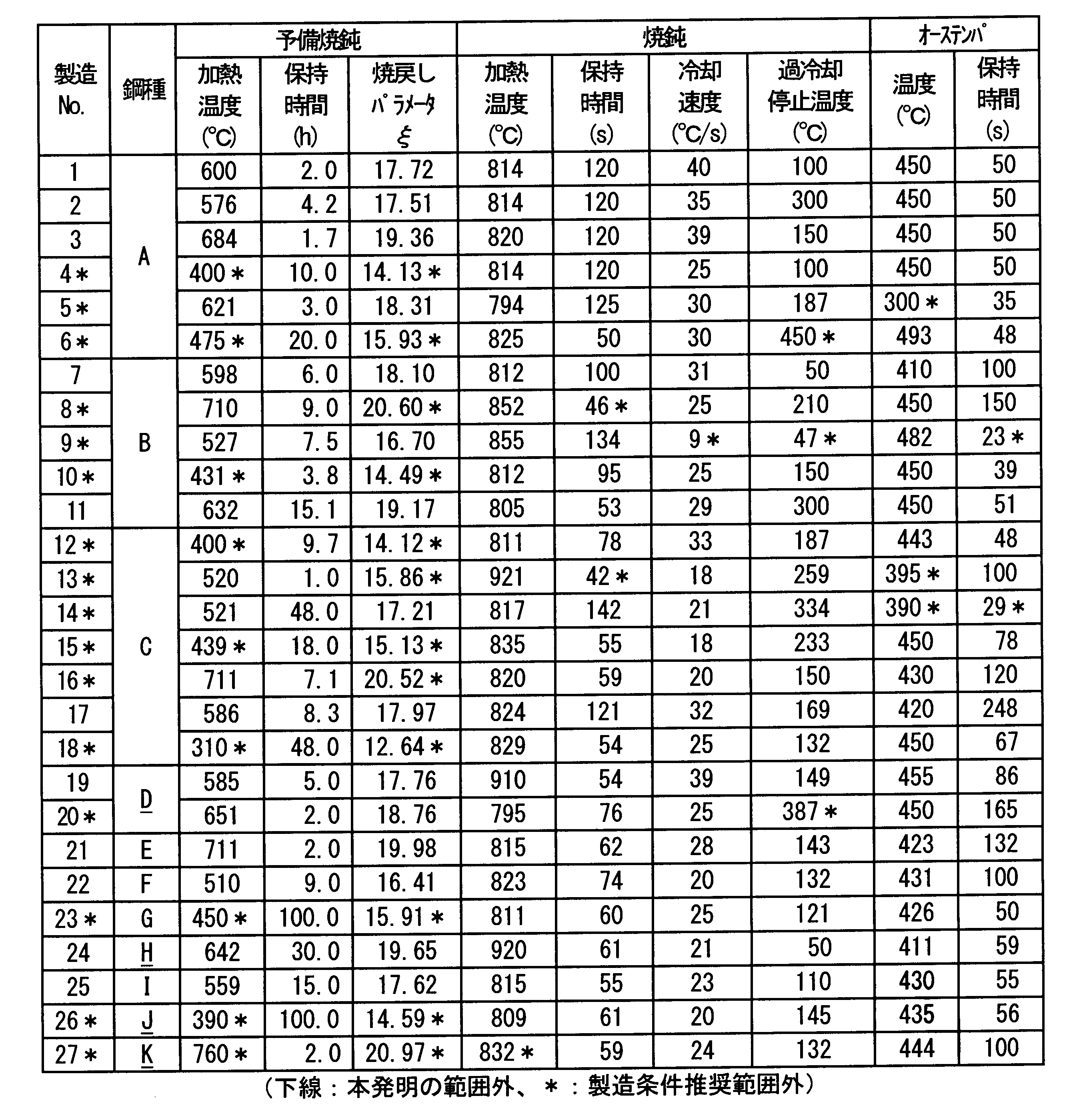
引き続きこの熱延板に、500℃~Ac1(好ましくは510℃~[Ac1-10℃])の予備焼鈍温度Tpa(単位:℃)で、下記式(1)で算出される焼戻しパラメータξが16~20(好ましくは16.5~19.5)となる予備焼鈍保持時間tpa(単位:h)保持する条件で、バッチ炉やUAD(United Annealing Department)炉などを用いて予備焼鈍処理を施す。
ξ=(Tpa+273)・{log(tpa)+20}/1000・・・式(1)
この予備焼鈍処理によって、炭化物を粗大化させるとともに、該炭化物中にMnを濃化させる。
ξ=(Tpa+273)・{log(tpa)+20}/1000・・・式(1)
この予備焼鈍処理によって、炭化物を粗大化させるとともに、該炭化物中にMnを濃化させる。
次いでこの予備焼鈍材を、酸洗等によりスケールを除去した後、冷間圧延(冷延)を施し冷延板とする。この冷延板に、例えば連続焼鈍ライン(CAL)を用いて、ポリゴナルフェライトとオーステナイトが混在する2相域温度であるAc1~Ac3(好ましくは[Ac1+10℃]~[Ac3-10℃])の焼鈍加熱温度で50s以上(好ましくは55s以上)の焼鈍保持時間だけ保持する条件で焼鈍処理を施すことによって上記炭化物をオーステナイト化する。この炭化物には、上記予備焼鈍処理によってMnが濃化しているため、Mn濃度が高いオーステナイトが形成できる。
このポリゴナルフェライトとオーステナイトの2相域温度(焼鈍加熱温度)から、10~50℃/sの冷却速度で50℃以上350℃未満(好ましくは100~300℃)の過冷却停止温度まで急冷することによって、Mnが濃化した、フレッシュマルテンサイトと残留オーステナイトの混合組織(MA)が形成された焼鈍材とする。
この焼鈍材に、さらに、400~500℃(好ましくは410~490℃)のオーステンパ温度で30~1200s(好ましくは40~600s)のオーステンパ保持時間だけ保持する条件にてオーステンパ処理を施すことで、本発明鋼板(冷延鋼板)が得られる。このオーステンパ処理により、ベイナイトを形成するとともに、上記急冷によって形成されたフレッシュマルテンサイトの一部を焼き戻して焼戻しマルテンサイトを形成させる。これにより、強度と延性、および伸びフランジ性のバランスを向上させることができる。さらに、最終組織中のMAに、鋼板全体のMn含有量の1.2倍以上のMn濃度となるようにMnを濃化させることによって、MAを構成する残留オーステナイトの安定度を向上させることで、引張強度-伸びバランスを向上させることができる。
なお、本発明鋼板は、上記焼鈍処理後の焼鈍材にめっき処理を施し、その後に上記オーステンパ処理を施すことで、めっき鋼板としてもよい。
以下、実施例を挙げて本発明をより具体的に説明するが、本発明はもとより下記実施例によって制限を受けるものではなく、前・後記の趣旨に適合し得る範囲で適当に変更を加えて実施することももちろん可能であり、それらはいずれも本発明の技術的範囲に包含される。
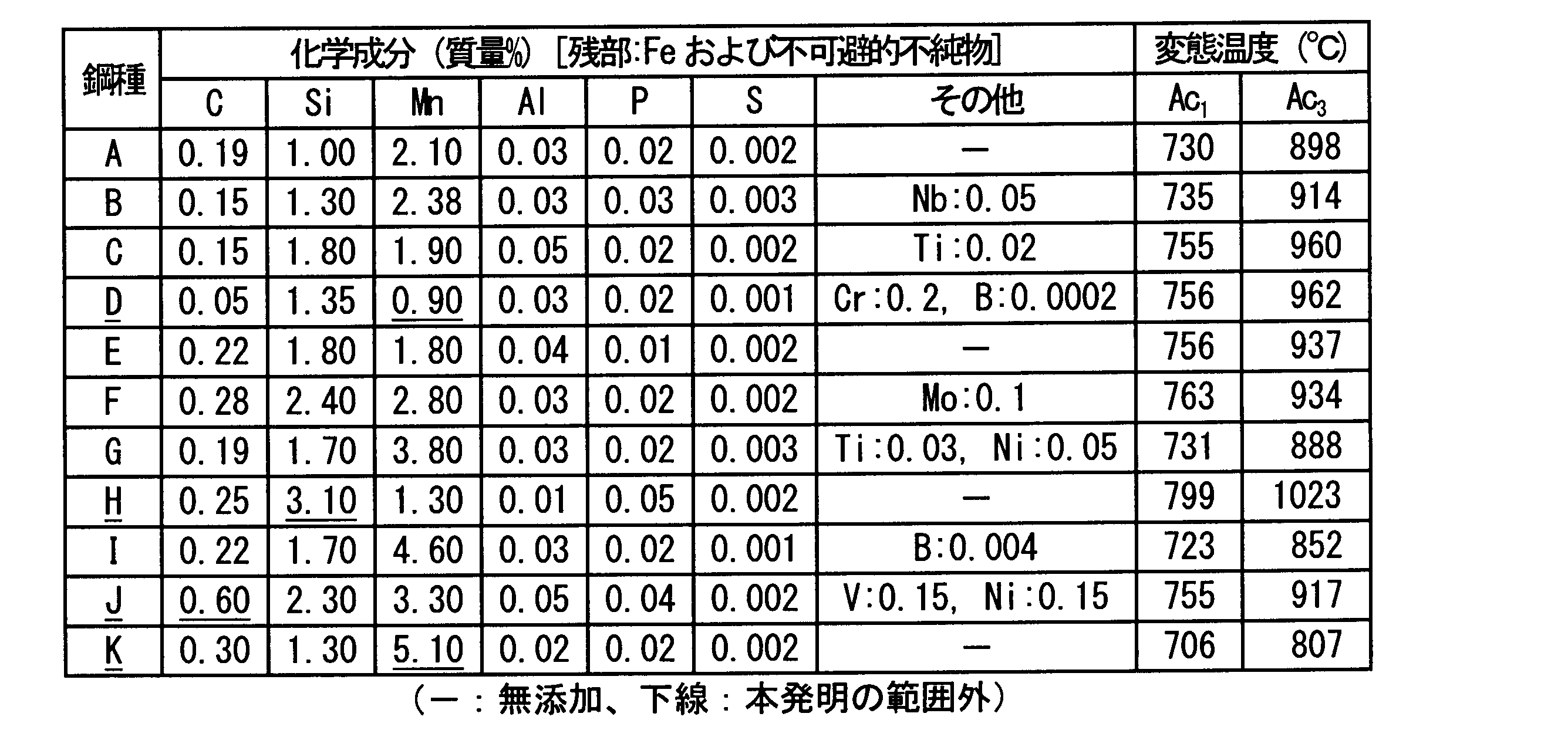
下記表1に示す各成分組成からなる供試鋼を真空溶製し、板厚30mmのスラブとした後、このスラブを1150℃に均熱し、仕上げ温度880℃で熱間圧延した後、600℃で巻取りして板厚2.5mmの熱延板を作製した。この熱延板に、バッチ炉を用いて下記表2に示す各条件で予備焼鈍処理を施した。この予備焼鈍材を酸洗した後、板厚1.5mmに冷間圧延した後、さらに同表2に示す各条件で、焼鈍処理およびオーステンパ処理を施して供試鋼板(冷延鋼板)を作製した。
なお、下記表1ではN含有量の記載を省略したが、全ての鋼種においてN含有量は0.01%以下の不純物レベルであった。
また、表1中のAc1およびAc3は下記式(1)および(2)を用いて求めた(幸田成康監訳,「レスリー鉄鋼材料学」,丸善株式会社,1985年,p.273参照)。
Ac1(℃)=723+29.1[Si]-10.7[Mn]+16.9[Cr]-16.9[Ni]・・・式(1)
Ac3(℃)=910-203√[C]+44.7[Si]-30[Mn]+700[P]+400[Al]+400[Ti]+104[V]-11[Cr]+31.5[Mo]-20[Cu]-15.2[Ni]・・・式(2)
ただし、[ ]は、各元素の含有量(質量%)を示す。
Ac3(℃)=910-203√[C]+44.7[Si]-30[Mn]+700[P]+400[Al]+400[Ti]+104[V]-11[Cr]+31.5[Mo]-20[Cu]-15.2[Ni]・・・式(2)
ただし、[ ]は、各元素の含有量(質量%)を示す。
上記各供試鋼板について、上記[発明を実施するための形態]の項で説明した各測定方法により、各相の面積率およびMA中のMn濃度を測定した。
また、上記各供試鋼板について、強度と加工性を評価するために、引張試験により、降伏強度YS、引張強度TSおよび伸び(全伸び)ELを測定し、穴広げ試験により、伸びフランジ性λを測定した。なお、引張試験は、圧延方向と直角な方向に長軸をとってJIS Z 2201に記載の5号試験片を作製し、JIS Z 2241に従って実施した。また、穴広げ試験は、鉄連規格JFST001に準拠して実施し、穴広げ率を測定してこれを伸びフランジ性λとした。
測定結果を下記表3に示す。同表において、供試鋼板の機械的特性(以下、単に「特性」ともいう。)が引張強度(TS)が980MPa以上、YS:550MPa以上、TS×EL:25000MPa・%以上、λ:20%以上の全てを満たすものを合格(○)とし、1つでも満たさないものを不合格(×)とした。
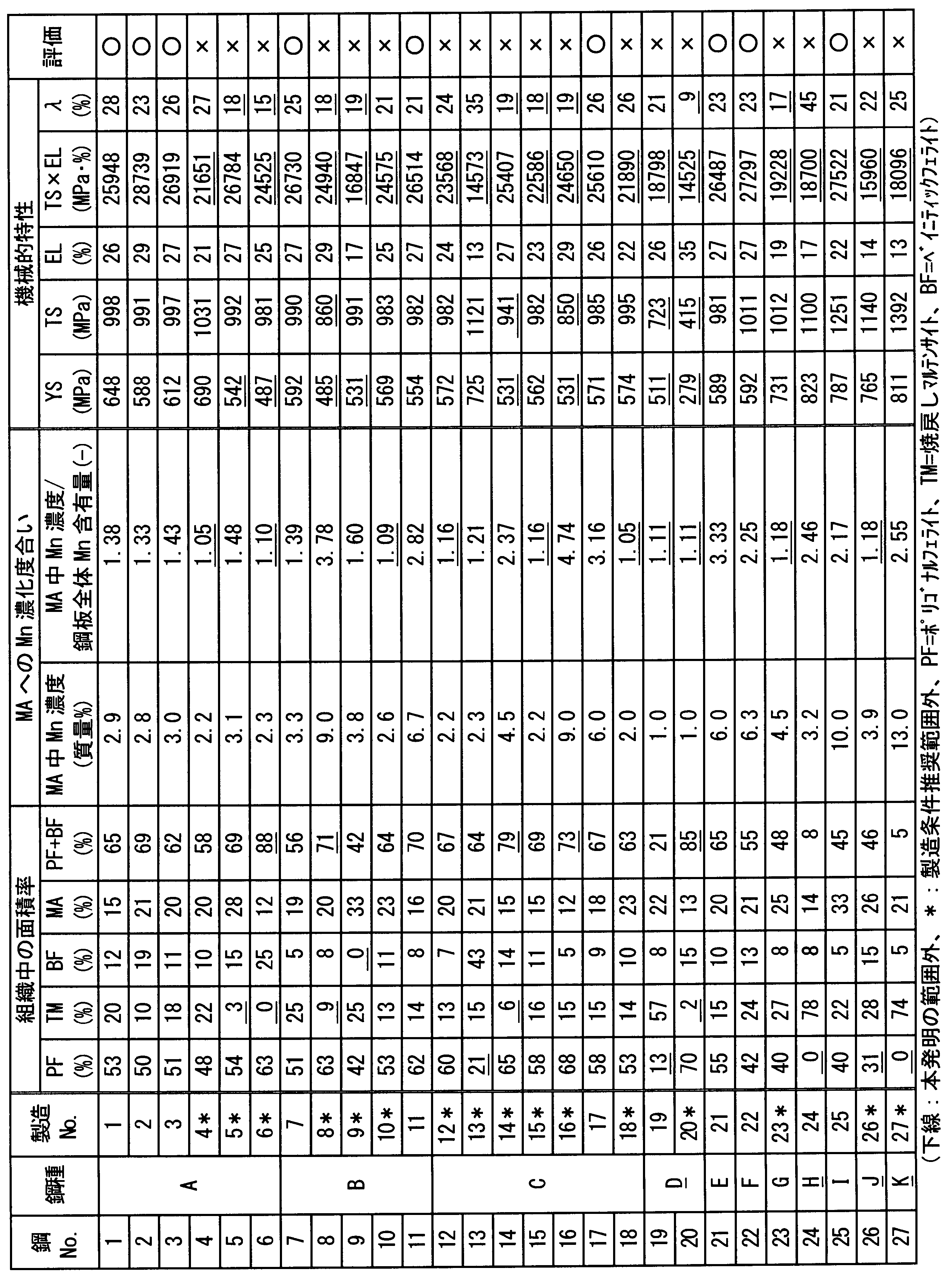
上記表3に示すように、発明鋼(評価が○のもの)である鋼No.1~3、7、11、17、21、22、25は、本発明の成分規定の要件を満足する鋼種を用い、推奨の製造条件で製造した結果、本発明の組織規定の要件を充足する発明鋼であり、特性が合格基準を満たしている。
これに対して、比較鋼(評価が×のもの)である鋼No.4~6、8~10、12~16、18~20、23、24、26、27は、本発明の成分規定および組織規定の要件の少なくともいずれかを充足せず、特性が合格基準を満たしていない。
すなわち、No.4~6、8~10、12~16、18、23は、本発明の成分規定の要件を満足する鋼種を用いているものの、推奨の製造条件を一部外れる条件で製造しているため、組織規定の要件を充足せず、特性が劣っている。
一方、鋼No.19、24は、推奨の製造条件で製造しているものの、本発明の成分規定の要件を一部外れる鋼種を用いているため、組織規定の要件を充足せず、特性が劣っている。
以上の結果より、本発明の適用性が確認された。
本発明を詳細にまた特定の実施態様を参照して説明したが、本発明の精神と範囲を逸脱することなく様々な変更や修正を加えることができることは当業者にとって明らかである。
本出願は、2015年3月23日出願の日本特許出願(特願2015-060140)に基づくものであり、その内容はここに参照として取り込まれる。
本出願は、2015年3月23日出願の日本特許出願(特願2015-060140)に基づくものであり、その内容はここに参照として取り込まれる。
本発明の高強度鋼板は、引張強度(TS)が980MPa以上、引張強度-伸びバランス(TS×EL)が25000MPa・%以上、降伏強度(YS)が550MPa以上で、かつ伸びフランジ性(λ)が20%以上を確保して加工性に優れ、特に自動車用の骨格部品に有用である。
Claims (2)
- 質量%で、
C :0.05~0.50%、
Si:1.0~3.0%、
Mn:1.0~5.0%、
Al:0.001~0.10%
をそれぞれ含み、
残部が鉄および不可避的不純物からなり、
前記不可避的不純物のうち、P、S、Nが、
P:0.1%以下、
S:0.01%以下、
N:0.01%以下
にそれぞれ制限される成分組成を有し、
全組織に対する面積率で、
ポリゴナルフェライト:40%以上、
焼戻しマルテンサイト:10%以上、
ベイニティックフェライト:5%以上、
フレッシュマルテンサイトと残留オーステナイトの混合組織(以下、この混合組織を「MA」という。):5%以上、
前記ポリゴナルフェライト+前記ベイニティックフェライト:合計で70%以下
からなる組織を有し、
前記MA中のMn濃度が、鋼板全体のMn含有量の1.2倍以上である
ことを特徴とする加工性に優れた高強度鋼板。 - 成分組成が、さらに、下記(a)及び(b)の少なくとも一方を含む請求項1に記載の加工性に優れた高強度鋼板。
(a)質量%で、Cr:0.05~1.0%、Mo:0.05~1.0%、Ni:0.05~1.0%、B:0.0001~0.002%のいずれか1種または2種以上
(b)質量%で、Ti:0.01~0.15%、Nb:0.01~0.15%、V:0.01~0.15%のいずれか1種または2種以上
Applications Claiming Priority (2)
| Application Number | Priority Date | Filing Date | Title |
|---|---|---|---|
| JP2015060140A JP6434348B2 (ja) | 2015-03-23 | 2015-03-23 | 加工性に優れた高強度鋼板 |
| JP2015-060140 | 2015-03-23 |
Publications (1)
| Publication Number | Publication Date |
|---|---|
| WO2016152675A1 true WO2016152675A1 (ja) | 2016-09-29 |
Family
ID=56978025
Family Applications (1)
| Application Number | Title | Priority Date | Filing Date |
|---|---|---|---|
| PCT/JP2016/058311 Ceased WO2016152675A1 (ja) | 2015-03-23 | 2016-03-16 | 加工性に優れた高強度鋼板 |
Country Status (2)
| Country | Link |
|---|---|
| JP (1) | JP6434348B2 (ja) |
| WO (1) | WO2016152675A1 (ja) |
Families Citing this family (5)
| Publication number | Priority date | Publication date | Assignee | Title |
|---|---|---|---|---|
| KR102020411B1 (ko) | 2017-12-22 | 2019-09-10 | 주식회사 포스코 | 가공성이 우수한 고강도 강판 및 이의 제조방법 |
| KR102379444B1 (ko) * | 2020-07-22 | 2022-03-28 | 주식회사 포스코 | 성형성 및 가공경화율이 우수한 강판 |
| JP7461840B2 (ja) | 2020-09-07 | 2024-04-04 | 株式会社神戸製鋼所 | 高強度鋼板、電気亜鉛めっき鋼板、溶融亜鉛めっき鋼板及び合金化溶融亜鉛めっき鋼板、並びにそれらの製造方法 |
| CN117344213A (zh) * | 2022-06-28 | 2024-01-05 | 宝山钢铁股份有限公司 | 一种900MPa级超低碳中锰高强度热轧钢板及其制造方法 |
| KR20240098492A (ko) * | 2022-12-21 | 2024-06-28 | 주식회사 포스코 | 성형성이 우수한 초고강도 열연 강판 및 그 제조방법 |
Citations (4)
| Publication number | Priority date | Publication date | Assignee | Title |
|---|---|---|---|---|
| WO2013018741A1 (ja) * | 2011-07-29 | 2013-02-07 | 新日鐵住金株式会社 | 形状凍結性に優れた高強度鋼板、高強度亜鉛めっき鋼板およびそれらの製造方法 |
| WO2013018740A1 (ja) * | 2011-07-29 | 2013-02-07 | 新日鐵住金株式会社 | 耐衝撃特性に優れた高強度鋼板およびその製造方法、高強度亜鉛めっき鋼板およびその製造方法 |
| JP2015113504A (ja) * | 2013-12-12 | 2015-06-22 | Jfeスチール株式会社 | 加工性に優れた高強度溶融亜鉛めっき鋼板およびその製造方法 |
| WO2016021198A1 (ja) * | 2014-08-07 | 2016-02-11 | Jfeスチール株式会社 | 高強度鋼板およびその製造方法、ならびに高強度亜鉛めっき鋼板の製造方法 |
Family Cites Families (1)
| Publication number | Priority date | Publication date | Assignee | Title |
|---|---|---|---|---|
| JP5632947B2 (ja) * | 2012-12-12 | 2014-11-26 | 株式会社神戸製鋼所 | 加工性と低温靭性に優れた高強度鋼板およびその製造方法 |
-
2015
- 2015-03-23 JP JP2015060140A patent/JP6434348B2/ja active Active
-
2016
- 2016-03-16 WO PCT/JP2016/058311 patent/WO2016152675A1/ja not_active Ceased
Patent Citations (4)
| Publication number | Priority date | Publication date | Assignee | Title |
|---|---|---|---|---|
| WO2013018741A1 (ja) * | 2011-07-29 | 2013-02-07 | 新日鐵住金株式会社 | 形状凍結性に優れた高強度鋼板、高強度亜鉛めっき鋼板およびそれらの製造方法 |
| WO2013018740A1 (ja) * | 2011-07-29 | 2013-02-07 | 新日鐵住金株式会社 | 耐衝撃特性に優れた高強度鋼板およびその製造方法、高強度亜鉛めっき鋼板およびその製造方法 |
| JP2015113504A (ja) * | 2013-12-12 | 2015-06-22 | Jfeスチール株式会社 | 加工性に優れた高強度溶融亜鉛めっき鋼板およびその製造方法 |
| WO2016021198A1 (ja) * | 2014-08-07 | 2016-02-11 | Jfeスチール株式会社 | 高強度鋼板およびその製造方法、ならびに高強度亜鉛めっき鋼板の製造方法 |
Also Published As
| Publication number | Publication date |
|---|---|
| JP6434348B2 (ja) | 2018-12-05 |
| JP2016180138A (ja) | 2016-10-13 |
Similar Documents
| Publication | Publication Date | Title |
|---|---|---|
| US11111553B2 (en) | High-strength steel sheet and method for producing the same | |
| TWI412605B (zh) | 高強度鋼板及其製造方法 | |
| JP5352793B2 (ja) | 耐遅れ破壊特性に優れた高強度溶融亜鉛めっき鋼板およびその製造方法 | |
| JP5958667B1 (ja) | 高強度溶融亜鉛めっき鋼板およびその製造方法 | |
| JP6223905B2 (ja) | 降伏強度と加工性に優れた高強度合金化溶融亜鉛めっき鋼板 | |
| WO2013129049A1 (ja) | 温間成形性に優れた高強度鋼板およびその製造方法 | |
| WO2012067159A1 (ja) | 成形性に優れた高強度鋼板、温間加工方法、および温間加工された自動車部品 | |
| US20130259734A1 (en) | Highly formable high-strength steel sheet, warm working method, and warm-worked automobile part | |
| JP7006849B1 (ja) | 鋼板、部材及びそれらの製造方法 | |
| JP6472692B2 (ja) | 成形性に優れた高強度鋼板 | |
| JP6473022B2 (ja) | 成形性に優れた高強度鋼板 | |
| KR20170103905A (ko) | 항복비와 가공성이 우수한 초고강도 강판 | |
| JP6434348B2 (ja) | 加工性に優れた高強度鋼板 | |
| US12331379B2 (en) | Cold-rolled steel sheet and manufacturing method thereof | |
| WO2021172299A1 (ja) | 鋼板、部材及びそれらの製造方法 | |
| JP6290074B2 (ja) | 加工性に優れた高強度冷延鋼板および高強度合金化溶融亜鉛めっき鋼板 | |
| JP2019002078A (ja) | 降伏比と加工性に優れた超高強度鋼板 | |
| JP7020594B2 (ja) | 鋼板、部材及びそれらの製造方法 | |
| JP2011080106A (ja) | 伸びと伸びフランジ性のバランスに優れた高強度冷延鋼板 | |
| JPWO2013051714A1 (ja) | 鋼板及びその製造方法 | |
| JP6037087B1 (ja) | 高強度冷延鋼板およびその製造方法 | |
| KR20250004889A (ko) | 냉간 압연된 마르텐사이트 강 및 그 마르텐사이트 강의 방법 | |
| US11248275B2 (en) | Warm-workable high-strength steel sheet and method for manufacturing the same | |
| JP5446900B2 (ja) | 高い焼付硬化性と優れた伸びフランジ性を有する高張力熱延鋼板およびその製造方法 | |
| WO2022190959A1 (ja) | 冷延鋼板及びその製造方法 |
Legal Events
| Date | Code | Title | Description |
|---|---|---|---|
| 121 | Ep: the epo has been informed by wipo that ep was designated in this application |
Ref document number: 16768578 Country of ref document: EP Kind code of ref document: A1 |
|
| NENP | Non-entry into the national phase |
Ref country code: DE |
|
| 122 | Ep: pct application non-entry in european phase |
Ref document number: 16768578 Country of ref document: EP Kind code of ref document: A1 |