WO2016147942A1 - 急速進行型孤発性alsの検査方法、検査キット、及び医薬のスクリーニング方法 - Google Patents
急速進行型孤発性alsの検査方法、検査キット、及び医薬のスクリーニング方法 Download PDFInfo
- Publication number
- WO2016147942A1 WO2016147942A1 PCT/JP2016/057071 JP2016057071W WO2016147942A1 WO 2016147942 A1 WO2016147942 A1 WO 2016147942A1 JP 2016057071 W JP2016057071 W JP 2016057071W WO 2016147942 A1 WO2016147942 A1 WO 2016147942A1
- Authority
- WO
- WIPO (PCT)
- Prior art keywords
- als
- progression
- titin
- expression level
- onset
- Prior art date
- Legal status (The legal status is an assumption and is not a legal conclusion. Google has not performed a legal analysis and makes no representation as to the accuracy of the status listed.)
- Ceased
Links
Images

Classifications
-
- C—CHEMISTRY; METALLURGY
- C12—BIOCHEMISTRY; BEER; SPIRITS; WINE; VINEGAR; MICROBIOLOGY; ENZYMOLOGY; MUTATION OR GENETIC ENGINEERING
- C12Q—MEASURING OR TESTING PROCESSES INVOLVING ENZYMES, NUCLEIC ACIDS OR MICROORGANISMS; COMPOSITIONS OR TEST PAPERS THEREFOR; PROCESSES OF PREPARING SUCH COMPOSITIONS; CONDITION-RESPONSIVE CONTROL IN MICROBIOLOGICAL OR ENZYMOLOGICAL PROCESSES
- C12Q1/00—Measuring or testing processes involving enzymes, nucleic acids or microorganisms; Compositions therefor; Processes of preparing such compositions
- C12Q1/68—Measuring or testing processes involving enzymes, nucleic acids or microorganisms; Compositions therefor; Processes of preparing such compositions involving nucleic acids
- C12Q1/6876—Nucleic acid products used in the analysis of nucleic acids, e.g. primers or probes
- C12Q1/6883—Nucleic acid products used in the analysis of nucleic acids, e.g. primers or probes for diseases caused by alterations of genetic material
-
- C—CHEMISTRY; METALLURGY
- C07—ORGANIC CHEMISTRY
- C07K—PEPTIDES
- C07K14/00—Peptides having more than 20 amino acids; Gastrins; Somatostatins; Melanotropins; Derivatives thereof
- C07K14/435—Peptides having more than 20 amino acids; Gastrins; Somatostatins; Melanotropins; Derivatives thereof from animals; from humans
- C07K14/46—Peptides having more than 20 amino acids; Gastrins; Somatostatins; Melanotropins; Derivatives thereof from animals; from humans from vertebrates
- C07K14/47—Peptides having more than 20 amino acids; Gastrins; Somatostatins; Melanotropins; Derivatives thereof from animals; from humans from vertebrates from mammals
- C07K14/4701—Peptides having more than 20 amino acids; Gastrins; Somatostatins; Melanotropins; Derivatives thereof from animals; from humans from vertebrates from mammals not used
- C07K14/4716—Muscle proteins, e.g. myosin, actin
-
- G—PHYSICS
- G01—MEASURING; TESTING
- G01N—INVESTIGATING OR ANALYSING MATERIALS BY DETERMINING THEIR CHEMICAL OR PHYSICAL PROPERTIES
- G01N33/00—Investigating or analysing materials by specific methods not covered by groups G01N1/00 - G01N31/00
- G01N33/48—Biological material, e.g. blood, urine; Haemocytometers
- G01N33/50—Chemical analysis of biological material, e.g. blood, urine; Testing involving biospecific ligand binding methods; Immunological testing
- G01N33/5005—Chemical analysis of biological material, e.g. blood, urine; Testing involving biospecific ligand binding methods; Immunological testing involving human or animal cells
- G01N33/5008—Chemical analysis of biological material, e.g. blood, urine; Testing involving biospecific ligand binding methods; Immunological testing involving human or animal cells for testing or evaluating the effect of chemical or biological compounds, e.g. drugs, cosmetics
- G01N33/5044—Chemical analysis of biological material, e.g. blood, urine; Testing involving biospecific ligand binding methods; Immunological testing involving human or animal cells for testing or evaluating the effect of chemical or biological compounds, e.g. drugs, cosmetics involving specific cell types
- G01N33/5047—Cells of the immune system
-
- G—PHYSICS
- G01—MEASURING; TESTING
- G01N—INVESTIGATING OR ANALYSING MATERIALS BY DETERMINING THEIR CHEMICAL OR PHYSICAL PROPERTIES
- G01N33/00—Investigating or analysing materials by specific methods not covered by groups G01N1/00 - G01N31/00
- G01N33/48—Biological material, e.g. blood, urine; Haemocytometers
- G01N33/50—Chemical analysis of biological material, e.g. blood, urine; Testing involving biospecific ligand binding methods; Immunological testing
- G01N33/53—Immunoassay; Biospecific binding assay; Materials therefor
-
- G—PHYSICS
- G01—MEASURING; TESTING
- G01N—INVESTIGATING OR ANALYSING MATERIALS BY DETERMINING THEIR CHEMICAL OR PHYSICAL PROPERTIES
- G01N33/00—Investigating or analysing materials by specific methods not covered by groups G01N1/00 - G01N31/00
- G01N33/48—Biological material, e.g. blood, urine; Haemocytometers
- G01N33/50—Chemical analysis of biological material, e.g. blood, urine; Testing involving biospecific ligand binding methods; Immunological testing
- G01N33/68—Chemical analysis of biological material, e.g. blood, urine; Testing involving biospecific ligand binding methods; Immunological testing involving proteins, peptides or amino acids
- G01N33/6893—Chemical analysis of biological material, e.g. blood, urine; Testing involving biospecific ligand binding methods; Immunological testing involving proteins, peptides or amino acids related to diseases not provided for elsewhere
- G01N33/6896—Neurological disorders, e.g. Alzheimer's disease
-
- C—CHEMISTRY; METALLURGY
- C12—BIOCHEMISTRY; BEER; SPIRITS; WINE; VINEGAR; MICROBIOLOGY; ENZYMOLOGY; MUTATION OR GENETIC ENGINEERING
- C12Q—MEASURING OR TESTING PROCESSES INVOLVING ENZYMES, NUCLEIC ACIDS OR MICROORGANISMS; COMPOSITIONS OR TEST PAPERS THEREFOR; PROCESSES OF PREPARING SUCH COMPOSITIONS; CONDITION-RESPONSIVE CONTROL IN MICROBIOLOGICAL OR ENZYMOLOGICAL PROCESSES
- C12Q2600/00—Oligonucleotides characterized by their use
- C12Q2600/112—Disease subtyping, staging or classification
-
- C—CHEMISTRY; METALLURGY
- C12—BIOCHEMISTRY; BEER; SPIRITS; WINE; VINEGAR; MICROBIOLOGY; ENZYMOLOGY; MUTATION OR GENETIC ENGINEERING
- C12Q—MEASURING OR TESTING PROCESSES INVOLVING ENZYMES, NUCLEIC ACIDS OR MICROORGANISMS; COMPOSITIONS OR TEST PAPERS THEREFOR; PROCESSES OF PREPARING SUCH COMPOSITIONS; CONDITION-RESPONSIVE CONTROL IN MICROBIOLOGICAL OR ENZYMOLOGICAL PROCESSES
- C12Q2600/00—Oligonucleotides characterized by their use
- C12Q2600/118—Prognosis of disease development
-
- C—CHEMISTRY; METALLURGY
- C12—BIOCHEMISTRY; BEER; SPIRITS; WINE; VINEGAR; MICROBIOLOGY; ENZYMOLOGY; MUTATION OR GENETIC ENGINEERING
- C12Q—MEASURING OR TESTING PROCESSES INVOLVING ENZYMES, NUCLEIC ACIDS OR MICROORGANISMS; COMPOSITIONS OR TEST PAPERS THEREFOR; PROCESSES OF PREPARING SUCH COMPOSITIONS; CONDITION-RESPONSIVE CONTROL IN MICROBIOLOGICAL OR ENZYMOLOGICAL PROCESSES
- C12Q2600/00—Oligonucleotides characterized by their use
- C12Q2600/156—Polymorphic or mutational markers
-
- C—CHEMISTRY; METALLURGY
- C12—BIOCHEMISTRY; BEER; SPIRITS; WINE; VINEGAR; MICROBIOLOGY; ENZYMOLOGY; MUTATION OR GENETIC ENGINEERING
- C12Q—MEASURING OR TESTING PROCESSES INVOLVING ENZYMES, NUCLEIC ACIDS OR MICROORGANISMS; COMPOSITIONS OR TEST PAPERS THEREFOR; PROCESSES OF PREPARING SUCH COMPOSITIONS; CONDITION-RESPONSIVE CONTROL IN MICROBIOLOGICAL OR ENZYMOLOGICAL PROCESSES
- C12Q2600/00—Oligonucleotides characterized by their use
- C12Q2600/158—Expression markers
-
- G—PHYSICS
- G01—MEASURING; TESTING
- G01N—INVESTIGATING OR ANALYSING MATERIALS BY DETERMINING THEIR CHEMICAL OR PHYSICAL PROPERTIES
- G01N2800/00—Detection or diagnosis of diseases
- G01N2800/28—Neurological disorders
-
- G—PHYSICS
- G01—MEASURING; TESTING
- G01N—INVESTIGATING OR ANALYSING MATERIALS BY DETERMINING THEIR CHEMICAL OR PHYSICAL PROPERTIES
- G01N2800/00—Detection or diagnosis of diseases
- G01N2800/56—Staging of a disease; Further complications associated with the disease
Definitions
- the present invention categorizes the progression of amyotrophic lateral sclerosis (hereinafter sometimes referred to as ALS), and provides genetic polymorphisms found in rapidly progressing patient groups.
- the present invention relates to a test method, a test kit, and a pharmaceutical screening method used.
- gene polymorphism analysis revealed that expression of striated muscle protein titin was reduced in rapidly progressive patient groups. Therefore, test methods, test kits, and drug screening methods using titin expression as an index. About.
- ALS is a progressive neurodegenerative disease that causes severe muscle atrophy and muscle weakness, and is a type of motor neuron disease. ALS is extremely fast and causes respiratory paralysis, dysphagia, and limb paralysis, and in the latter half of the onset, death or respiratory attachment occurs in 3 to 5 years. According to a recent report from Japan, about 2.2 people per 100,000 people develop each year, and the prevalence is estimated to be 9.9 / 100,000. Although it is not a rare disease, an effective treatment for healing has not been established.
- Non-patent Document 1 5-10% of ALS is familial and many are said to be sporadic.
- familial ALS that develops due to a single gene mutation has been discovered one after another.
- sporadic ALS elucidation of the pathophysiology and cause has been delayed (Non-patent Document 1).
- Some sporadic ALS can find mutations in genes found in familial ALS, but many sporadic ALS are thought to be involved in multiple factors, and the cause is It has not been revealed.
- Non-Patent Document 2 Genome-wide association studies (Genome Wide Association Study, GWAS) using single nucleotide polymorphisms (hereinafter sometimes referred to as SNPs) as markers for genetic studies involving sporadic ALS.
- SNPs single nucleotide polymorphisms
- the related polymorphisms reported have a low odds ratio of about 1.5, which is insufficient for constructing a disease model for sporadic ALS, and is not reproducible. (Non-patent Document 3).
- the object of the present invention is to develop a therapeutic agent and a therapeutic method for inhibiting the progression of disease by elucidating the pathology and pathogenesis of ALS, particularly sporadic ALS patients. It is an object of the present invention to provide a test method for categorizing the pathological condition of a sporadic ALS patient and determining rapidly progressing ALS in which symptoms rapidly deteriorate, and a screening method for a therapeutic agent for rapidly progressing ALS.
- the present invention relates to a method for examining the type of progression after onset of an ALS patient shown below, and a method for screening a drug that suppresses the progression of rapid progression ALS.
- the titin expression level is determined by measuring mRNA expression by quantitative PCR.
- a method for examining the type of progression after onset of an ALS patient according to (3) The method for examining titin expression is characterized in that protein expression is measured with an anti-titin antibody.
- a method for examining the type of progression after onset of an ALS patient according to any one of (1) to (5) A test method characterized by testing using lymphocytes obtained from a patient.
- a kit for testing whether ALS patients are classified as rapidly advanced ALS Reference SNP ID numbers: rs12052983, rs231114582, rs2303537, rs4894020, rs6453709, rs64000176, rs957875, a PCR primer for detecting at least one single nucleotide polymorphism, a quantitative PCR primer for analyzing the expression level of titin, and chitin
- a test kit comprising at least one of antibodies for quantifying the expression level.
- a method for screening a drug that suppresses the progression of rapid progression ALS Bringing the test substance into contact with the cultured cells, A screening method comprising selecting an increase in the expression level of titin as an index.
- a method for screening a drug for suppressing the progression of rapid progression ALS according to (8) A screening method, wherein the cultured cells are minor homoalleles of reference SNP ID numbers: rs12052983, rs231114582, rs2303537, rs4894020, rs6453709, rs6403936, rs957875.
- the screening method according to any one of (8) to (10), The above-mentioned titin expression is based on measuring mRNA and / or protein.
- the present inventors conducted a cohort study and classified the progression of sporadic ALS into four types: rapid progression, monotonic progression, sigmoid, and slow progression. Furthermore, genome-wide association analysis was performed, and seven SNPs highly related to rapidly progressing pathological conditions were found. Furthermore, it was revealed by analysis that the seven SNPs are in a strong linkage disequilibrium state. Therefore, by analyzing any one or more of the above seven SNPs, it is possible to determine the risk of following a rapid progress type course.
- the risk of sporadic ALS patients being rapidly progressive by analyzing any one or more of the 7 SNPs due to their strong linkage disequilibrium and examining whether they are minor or major alleles Can be inspected.
- SNP detection method a known method such as Invader method, TaqMan PCR method, single nucleotide extension method, pyrosequencing method, exonuclease cycling assay method, or the like can be used.
- Primers necessary to detect the seven SNPs can be prepared by a known method.
- the PCR primer set may be designed while obtaining the sequence information of the gene region containing 7 SNPs from the database and analyzing the mutation of the single nucleotide sequence using the software Primer3.
- Non-Patent Documents 6 to 8 it has become clear from the SNP information database that SNPs associated with rapidly progressing pathological conditions cause a decrease in titin expression.
- Titin is a huge protein with a molecular weight of 3 million and is a structural protein of striated muscle that forms skeletal muscle. It is known that titin extends from the Z line of the striated muscle to the vicinity of the M line and is involved in muscle extensibility and elasticity (Non-Patent Documents 6 to 8). Further, it has been reported that the titin mutation is involved in congenital muscular diseases such as limb girdle muscular dystrophy, tibial muscular dystrophy, and congenital myopathy with early respiratory disorder (Non-Patent Documents 9 to 11).
- Non-patent Document 12 the expression of titin affects the progression of the pathology of ALS.
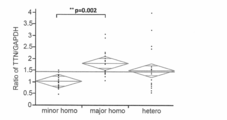
- the expression level of titin was significantly higher than that obtained from a patient with a major allele homozygote. It was low.
- the risk of following a rapid progression can be determined by typing 7 SNPs and / or measuring titin expression.
- the titin expression level may be measured by measuring mRNA or protein.
- Quantitative PCR may be used when measuring titin mRNA.
- a known method such as SYBR Green method, TaqMan probe method, RT-PCR method or the like can be used.
- the protein can be quantified by a known method such as ELISA, RIA, Western blot using a known anti-titin antibody (Patent Document 1). By measuring mRNA and protein, titin expression can be quantified with high sensitivity.
- the amount of titin is significantly lower than the control, it can be judged that the risk of rapid progression is high.
- a control a sample obtained from a healthy person or a group in which the following 7 SNPs are major homoalleles can be used.
- the threshold value can be determined as appropriate. For example, the average value of a group in which the seven SNPs are major homoalleles may be set as the threshold value to determine the risk.
- any sample may be used as long as cells such as blood and tissue are contained, but it is preferable to use peripheral blood because the physical burden on the patient is small.
- the present inventors have shown that rapid progression and titin expression correlate among the types of sporadic ALS pathologies. Therefore, it is possible to screen for therapeutic agents that suppress the pathology of rapidly advanced ALS using titin expression as an index.
- titin is a protein that constitutes skeletal muscle
- the drugs obtained by screening are not only rapidly advanced ALS but also other types of ALS, familial ALS, and other neurodegenerative diseases that cause muscle atrophy. May also be applicable.
- mRNA or protein is measured by the above-mentioned known methods, and a substance that increases its expression can be selected to screen a drug that suppresses the pathological condition of rapidly advanced ALS.
- a library compound may be added to cells having a low titin expression level, and changes in the titin expression level may be analyzed before and after the addition of the compound.
- Any compound that can increase the expression level of titin can be a candidate for a drug that suppresses the pathology of rapidly advanced ALS.
- Any cell may be used as a cell having a low titin expression level, but the cell lines of the genotype in which the seven SNPs are minor allele homozygotes have a low titin expression level.
- the library compound is added to the culture solution to analyze the expression level of titin.
- a lymphocyte cell line in which seven SNPs established from sporadic ALS patients are minor allele homozygotes.
- the increase in titin expression can be detected with high sensitivity, particularly by using cell lines with low titin expression.
- iPS cells established from cells of sporadic ALS patients can be used.
- the present inventors have already established iPS cells derived from 65 cases of patients and have induced differentiation into motor neurons. Using these patient cell-derived lymphocyte cell lines and iPS cells having specific genotypes, it is possible to screen for drugs that increase the expression level of titin and to verify the effects.
- the substance to be screened may be any substance as long as it is a drug candidate, such as a low molecular weight compound, a natural product, or an antibody.
- the expression level of titin can be measured by quantifying mRNA or protein.
- ALS patients diagnosed according to the revised El Escorial diagnostic criteria are registered in the anonymized database with consent. Registered patients are assigned unique patient numbers, and clinical data is anonymous information at each participating facility. Data is sent to the Clinical Data Center of Nagoya University School of Medicine and stored in the JaCALS database. ALS patients are examined by a neurologist at each clinic at the time of registration and blood is collected, and genomic DNA and lymphocytes immortalized by the EB virus are stored.
- ALSFRS-R ALS Functional Rating Scale-Revised
- ALSFRS-R is an evaluation scale for grasping the daily life of ALS patients. It evaluates 12 items such as language, swallowing, personal movement, and breathing in 5 stages from 4 to 0. Assess patient function. The lower the score, the better the pathology and the lower the function.
- Non-patent Document 13 Accumulation of ALS FRS-R data by telephone survey is a reliable method, and it is highly correlated with ALS FRS-R by doctor's examination (in-class correlation coefficient 0.97, 95% CI 0.94- 0.98) has already been confirmed (Non-patent Document 13). In addition, in order to standardize the survey methods at each facility participating in the study, three doctors visited each facility and confirmed the evaluation method.
- Respiratory or patient death is the endpoint, and patients without a respiratory are defined as “survival”.
- the analysis was performed with the observation period as the end point or 5 years from the onset of illness.
- the disease duration at the time of registration was 1.1 to 60 months, and the average follow-up period was 2.5 years (SD, 2.0 years). In addition, 37 patients (8.0%) withdrew from follow-up. The average time to ventilator was 45 months (range 5.0-60.0 months).
- the IBD estimate uses the PLINK option '--genome', PCA uses SMARTPCA, 103,363 SNPs excluding linkage disequilibrium (LD), that is, large scale high LD region
- LD linkage disequilibrium
- the calculation was performed using SNPs excluding the call rate ⁇ 0.98, MAF (minor allele frequency) ⁇ 0.01, and HWE (Hardy-Weinberg equilibrium) P ⁇ 1 ⁇ 10 ⁇ 6 .
- MAF minimum allele frequency
- HWE Hardy-Weinberg equilibrium
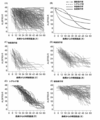
- FIG. 1A is a plot of the ALS function evaluation scale at 476 time points of 465 patients over time for each patient. It can be seen that the progression of ALS patients after onset is extremely diverse. Since the diversity of pathological conditions seems to make it difficult to analyze genes and molecules that are therapeutic targets, we attempted to classify the progression of patient pathologies.
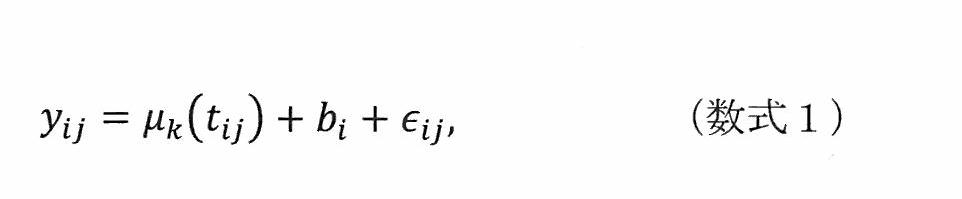
- ⁇ k is an averaged non-linear curve
- b i is a random effect according to a normal distribution with mean 0 and variance ⁇ 2 b
- ⁇ ij is an error according to mean 0 and variance ⁇ 2 .
- the parameter ⁇ k is modeled so as to fit the 4-parameter logistic model of Equation 2 below.
- ⁇ 1, k is a parameter that determines the shape of the mean curve
- ⁇ 2 k is half of the ALSFRS-R of cluster k, that is, 24.
- K is the assumed total number of clusters
- Normal ( ⁇ k , ⁇ ) is a normal distribution of mean ⁇ k and composite symmetric covariance matrix ⁇ . Parameters were calculated by the Bayesian method using the ALSFRS-R data for each patient and the no-information prior distribution. The number of clusters was determined from the Bayesian information criteria (BIC) and clinical viewpoint. Using the post-estimated values of the parameters, the degree of membership ( mi, k ) for each cluster of each patient was determined, and the patients were classified into clusters having the highest degree of belonging among the K clusters. The degree of attribution takes a value between 0 and 1, and is given by the following formula 4.
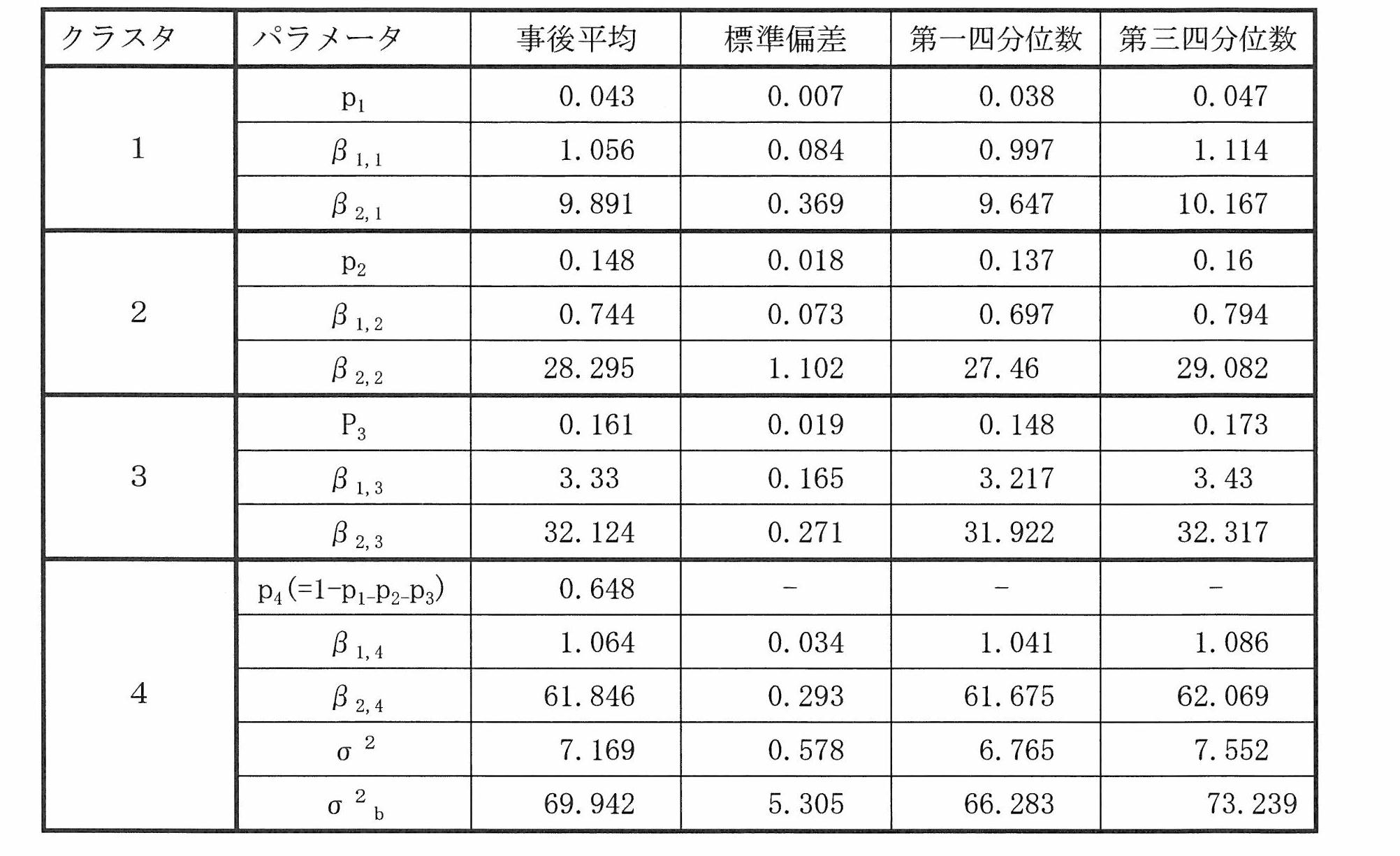
- Table 2 lists the parameter estimates of the nonlinear mixed effect model.
- the parameters are estimated based on the Bayesian method, but a uniform prior distribution is applied in the parameter estimation. Specifically, uniform distribution taking the value 1 from 0.01 to p k (hereinafter, referred to as Uniform (0.01,1)), ⁇ 1 , k in Uniform (0,5), ⁇ 2, Uniform ( 1 , 100) was assumed for k, and vague priors using inverse gamma distribution for ⁇ 2 b and ⁇ 2 were assumed.
- Uniform (0.01,1) uniform distribution taking the value 1 from 0.01 to p k (hereinafter, referred to as Uniform (0.01,1)), ⁇ 1 , k in Uniform (0,5), ⁇ 2, Uniform ( 1 , 100) was assumed for k, and vague priors using inverse gamma distribution for ⁇ 2 b and ⁇ 2 were assumed.
- the posterior average of parameter ⁇ was estimated based on the random walk Metropolis algorithm. As the software, PROC MCMC of SAS, version 9.3 (SAS Institute Inc.) was used. The posterior distribution was estimated with 2000 samples extracted from 10,000 samples at intervals of 5 samples with 1000 burn-in times.
- Cluster 1 rapid progression type (FIG. 1C) is a group of patients whose ALS FRS-R score decreases rapidly from the onset to 24 months.
- the monotonic progression type of cluster 2 (FIG. 1D) is a group of patients whose score gradually decreases, and the sigmoid type of cluster 3 (FIG. 1E) is the group of patients whose score decreases to a sigmoid type, cluster 4
- the slow progression type (FIG. 1F) includes a group of patients whose score decreases very slowly or hardly changes from the time of onset.
- the proportion of patients in each cluster was estimated to be 4% rapid progression type, 15% monotonic progression type, 16% sigmoid type, and 65% slow progression type.
- the relationship between the course from the onset of individual patients and ALSFRS-R is shown in FIGS. 1C to 1F.
- cluster 1 After calculating the membership value of each cluster and classifying 465 patients, 59 (13%) are in cluster 1, 113 (24%) are in cluster 2, 72 (15%) are in cluster 3, 221 (48%) were classified as cluster 4.
- the allele frequencies were compared between the rapid progression type and the other three types, the slow progression type and the other three types, and SNPs associated with the progression of the disease state were identified.
- allele frequencies were compared between the two groups using a dominant model, a recessive model, and an additive model. The results are shown in Table 3.
- the significance level based on the Bonferroni method was 8.73 ⁇ 10 ⁇ 8 , and this value was used as a threshold value.
- 2 SNPs rs2114582 and exm2269183 in Table 3
- All of the SNPs have a high odds ratio (odds ratio 5.5 to 5.84), indicating that the rapid progression type and these seven SNPs are highly related.
- SNPs related to the slowly progressive type could not be found.
- FIG. 2A is a Manhattan plot in which the smallest value among the P values calculated by the dominant / inferiority / additive model of each SNP is plotted on the vertical axis and the position on the chromosome is plotted on the horizontal axis. Seven SNPs that are highly related to the rapid progression type circled in the figure are located on chromosome 2.
- FIG. 2B is a diagram showing the P value by further enlarging the vicinity of eight SNPs on chromosome 2. Since it is in linkage disequilibrium with rs4894020 that showed the lowest P value, the vicinity of the seven SNPs also shows a high P value.
- the homozygosity of minor alleles and major alleles in all seven SNPs genotypes is 30% and 60%, respectively, accounting for 90% of all haplotypes.
- eQTL expression quantitative trait loci analysis
- HGVD Human Genetic Variation Database
- ALS patients in order to confirm that the LD block containing 7 SNPs affects the expression, age for each genotype (minor homozygote, major homozygote, heterozygote), and The expression of titin in lymphocytes of patients with matched gender was measured.
- a cell line that was immortalized by infecting B lymphocytes of peripheral blood obtained from all ALS patients at the time of registration with EB virus was established and stored using a liquid nitrogen tank. From the obtained immortalized cell line, using the LD block of 7 SNPs that are thought to be involved in the progression of ALS pathology, the genotypes of minor homozygote, major homozygote and heterozygote were determined. The titin gene expression was analyzed for each of the 19 cell lines. In these three groups, as shown in Table 5, there was no significant difference in age and sex.
- the amount ratio of each transcript was determined by drawing a standard curve of Ct values using serial dilutions of cDNA samples and normalizing with GAPDH levels. For real-time quantitative PCR, triple experiments were performed using iQ SYBR Green Supermix (BioRad). The following primers were used as the primer set.
- Table 5 shows the clinical characteristics of the patients subjected to the gene expression test, and FIG. 4 shows the gene expression of titin.
Landscapes
- Health & Medical Sciences (AREA)
- Life Sciences & Earth Sciences (AREA)
- Chemical & Material Sciences (AREA)
- Engineering & Computer Science (AREA)
- Immunology (AREA)
- Molecular Biology (AREA)
- Biomedical Technology (AREA)
- Hematology (AREA)
- Urology & Nephrology (AREA)
- Proteomics, Peptides & Aminoacids (AREA)
- Organic Chemistry (AREA)
- Analytical Chemistry (AREA)
- General Health & Medical Sciences (AREA)
- Biochemistry (AREA)
- Microbiology (AREA)
- Biotechnology (AREA)
- Medicinal Chemistry (AREA)
- Pathology (AREA)
- Physics & Mathematics (AREA)
- Cell Biology (AREA)
- Food Science & Technology (AREA)
- General Physics & Mathematics (AREA)
- Zoology (AREA)
- Genetics & Genomics (AREA)
- Toxicology (AREA)
- Biophysics (AREA)
- Wood Science & Technology (AREA)
- Bioinformatics & Cheminformatics (AREA)
- Neurosurgery (AREA)
- General Engineering & Computer Science (AREA)
- Neurology (AREA)
- Tropical Medicine & Parasitology (AREA)
- Gastroenterology & Hepatology (AREA)
- Measuring Or Testing Involving Enzymes Or Micro-Organisms (AREA)
- Investigating Or Analysing Biological Materials (AREA)
Abstract
ALS、特に孤発性ALS患者の病態、病因を解明することにより、病気の進行を抑止する治療薬、治療方法を開発することを課題とする。孤発性ALS患者を発症後の病態進行により類型化し、4つの類型に分類した。ゲノムワイド関連解析を行い、4つの類型のうち急速に増悪化する急速進行型と関連する7つのSNPsを見出した。これらSNPsはチチン発現に関連していることも明らかとなった。これらSNPsやチチン発現を急速進行型ALSのマーカーとし、さらに、これらマーカーを用いて病態抑止治療予防法の開発を行うことができる。
Description
本発明は、筋萎縮性側索硬化症(amyotrophic lateral sclerosis;以下、ALSと記載することがある。)の進行を類型化し、急速に進行する急速進行型の患者群に見られる遺伝子多型を用いた検査方法、検査キット、及び医薬のスクリーニング方法に関する。また、遺伝子多型の解析より、急速進行型の患者群では横紋筋の構造タンパク質チチンの発現低下が明らかとなったことから、チチン発現を指標とする検査方法、検査キット、医薬のスクリーニング方法に関する。
ALSは、重篤な筋肉の萎縮と筋力低下をきたす進行性の神経変性疾患で、運動ニューロン病の一種である。ALSは、極めて進行が速く、呼吸麻痺、嚥下障害、四肢麻痺をきたし、発症後半数ほどが3年から5年で死亡もしくは呼吸器装着に至る。我が国からの最近の報告では1年間に人口10万人あたり2.2人程度が発症し、有病率は9.9人/10万人と推計されている。稀な疾患ではないものの治癒のための有効な治療法は現在確立されていない。
ALSの5~10%が家族性であり、多くが孤発性であるといわれている。単一の遺伝子の変異により発症する家族性ALSは、近年、新規遺伝子の発見が相次いでいるものの、孤発性ALSに関しては、病態、原因の解明は遅れている(非特許文献1)。孤発性ALSの中にも、家族性ALSで発見された遺伝子の突然変異が見出せるものもあるが、多くの孤発性ALSは多因子が関与していると考えられており、その原因は明らかにされていない。
一塩基多型(single nucleotide polymorphisms, 以下、SNPsと記載することもある。)をマーカーとしたゲノムワイド関連解析(Genome Wide Association Study, GWAS)が孤発性ALSに関与する遺伝子研究のために行われてきた(非特許文献2)。しかしながら、報告されている関連遺伝子多型は、オッズ比が1.5程度と低く、孤発性ALSの疾患モデルを構築するのには不十分であったり、また、再現性に欠けるとされている(非特許文献3)。
また、ALSの治療については、多くの臨床試験が試みられているが、いまだに効果のあるものがなく、進行を抑制させる疾患修飾療法も満足のいくものがないのが現状である。ALS患者の機能低下の経過は個々で大きく異なることが報告されており(非特許文献4、5)、病気の進行の多様性がALSの臨床試験の解析結果を困難にし、効果的な治療法を見出せない原因となっている。
Finsters, J. & Burgunder, J.M., 2014, Eur. J. Med. Genet.,Vol.57(2-3), pp.103-112
Renton, A. E., et al., 2014, Nature Neuroscience, Vol.17(1),pp.17-23
Iida, A., et al., 2011, Neurobiology of aging, Vol.32(4), 757e13-14
Qureshi, M. M. et al., 2006, Amyotroph. Lateral Scler., Vol.7(3),pp.173-82
Gomeni, R., & Fava, M., 2014, Amyotrophic lateral sclerosis& frontotemporal degeneration, Vol.15(1-2), pp.119-129
Granzier, H.L. & Labeit, S., 2004, Circulation research,Vol.94(3), pp.284-295
Gregorio, C.C. et al., 1999, Current opinion in cell biology,Vol.11(1), pp.18-25
Trinick, J., 1994, Trends in biochemical sciences, Vol.19(10),pp.405-409
Udd, B., et al., 2005, Neurology, Vol.64(4), pp.636-642
Hackman, O., et al., 2002, American Journal of human genetics,Vol.71(3), pp.492-500
Ohlson, M., et al., 2012, Brain: a journal of neurology, Vol.135(pt6), pp.1682-1694
Udaka, J., et al., 2008, Journal of general physiology, Vol.131(1),pp.33-41
Atsuta, N., et al., 2011, Brain and Nerve=Shinkei kenkyuno shinpo, Vol.63(5), pp.491-496
Ma, et al., 2006, Nucleic Acids Research, Vol.34(4), pp.1261-1269
本発明は、ALS、特に孤発性ALS患者の病態、病因を解明することにより、病気の進行を抑止する治療薬、治療方法を開発することを課題とする。孤発性ALS患者の病態を類型化し、急激に症状が悪化する急速進行型ALSを判定する検査方法、及び急速進行型ALSの治療薬のスクリーニング方法を提供することを課題とする。
本発明は以下に示すALS患者の発症後の進行の類型を検査する方法、及び急速進行型ALSの進行を抑制する医薬をスクリーニングする方法に関する。
(1)ALS患者の発症後の進行の類型を検査する方法であって、
ALS患者のリファレンスSNP ID番号:rs12052983、rs23114582、rs2303537、rs4894020、rs6453709、rs600176、rs957875の少なくともいずれか1つの一塩基多型を検査し、
前記一塩基多型がマイナーアレルである場合に急速進行型のリスクが高いと判定することを特徴とする検査方法。
(2)ALS患者の発症後の進行の類型を検査する方法であって、
ALS患者のチチンの発現量を測定し、
チチン発現量が閾値より低い場合、急速進行型に進行するリスクが高いと判定することを特徴とする検査方法。
(3)(2)に記載のALS患者の発症後の進行の類型を検査する方法であって、
前記チチンの発現量は、mRNA及び/又はタンパク質発現量を測定することを特徴とする検査方法。
(4)(3)に記載のALS患者の発症後の進行の類型を検査する方法であって、
前記チチン発現量はmRNA発現を定量的PCRで測定することを特徴とする検査方法。
(5)(3)に記載のALS患者の発症後の進行の類型を検査する方法であって、
前記チチンの発現量はタンパク質発現を抗チチン抗体によって測定することを特徴とする検査方法。
(6)(1)~(5)いずれかに記載のALS患者の発症後の進行の類型を検査する方法であって、
患者から得られたリンパ球を用いて検査することを特徴とする検査方法。
(7)ALS患者が急速進行型ALSに分類されるかを検査するキットであって、
リファレンスSNP ID番号:rs12052983、rs23114582、rs2303537、rs4894020、rs6453709、rs600176、rs957875の少なくともいずれか1つの一塩基多型を検出するためのPCRプライマー、チチン発現量を解析するための定量的PCRプライマー、チチン発現量を定量するための抗体の少なくともいずれか1つを含むことを特徴とする検査キット。
(8)急速進行型ALSの進行を抑制する医薬をスクリーニングする方法であって、
被験物質を培養細胞に接触させ、
チチン発現量の増加を指標として選択することを特徴とするスクリーニング方法。
(9)(8)記載の急速進行型ALSの進行を抑制する医薬をスクリーニングする方法であって、
前記培養細胞がリファレンスSNP ID番号:rs12052983、rs23114582、rs2303537、rs4894020、rs6453709、rs600176、rs957875がマイナーホモアレルであることを特徴とするスクリーニング方法。
(10)(8)又は(9)記載のスクリーニング方法であって、
上記培養細胞が急速進行型ALS患者の末梢血から樹立したリンパ球細胞株であることを特徴とするスクリーニング方法。
(11)(8)~(10)いずれかに記載のスクリーニング方法であって、
前記チチン発現は、mRNA及び/又はタンパク質を測定することによることを特徴とするスクリーニング方法。
(1)ALS患者の発症後の進行の類型を検査する方法であって、
ALS患者のリファレンスSNP ID番号:rs12052983、rs23114582、rs2303537、rs4894020、rs6453709、rs600176、rs957875の少なくともいずれか1つの一塩基多型を検査し、
前記一塩基多型がマイナーアレルである場合に急速進行型のリスクが高いと判定することを特徴とする検査方法。
(2)ALS患者の発症後の進行の類型を検査する方法であって、
ALS患者のチチンの発現量を測定し、
チチン発現量が閾値より低い場合、急速進行型に進行するリスクが高いと判定することを特徴とする検査方法。
(3)(2)に記載のALS患者の発症後の進行の類型を検査する方法であって、
前記チチンの発現量は、mRNA及び/又はタンパク質発現量を測定することを特徴とする検査方法。
(4)(3)に記載のALS患者の発症後の進行の類型を検査する方法であって、
前記チチン発現量はmRNA発現を定量的PCRで測定することを特徴とする検査方法。
(5)(3)に記載のALS患者の発症後の進行の類型を検査する方法であって、
前記チチンの発現量はタンパク質発現を抗チチン抗体によって測定することを特徴とする検査方法。
(6)(1)~(5)いずれかに記載のALS患者の発症後の進行の類型を検査する方法であって、
患者から得られたリンパ球を用いて検査することを特徴とする検査方法。
(7)ALS患者が急速進行型ALSに分類されるかを検査するキットであって、
リファレンスSNP ID番号:rs12052983、rs23114582、rs2303537、rs4894020、rs6453709、rs600176、rs957875の少なくともいずれか1つの一塩基多型を検出するためのPCRプライマー、チチン発現量を解析するための定量的PCRプライマー、チチン発現量を定量するための抗体の少なくともいずれか1つを含むことを特徴とする検査キット。
(8)急速進行型ALSの進行を抑制する医薬をスクリーニングする方法であって、
被験物質を培養細胞に接触させ、
チチン発現量の増加を指標として選択することを特徴とするスクリーニング方法。
(9)(8)記載の急速進行型ALSの進行を抑制する医薬をスクリーニングする方法であって、
前記培養細胞がリファレンスSNP ID番号:rs12052983、rs23114582、rs2303537、rs4894020、rs6453709、rs600176、rs957875がマイナーホモアレルであることを特徴とするスクリーニング方法。
(10)(8)又は(9)記載のスクリーニング方法であって、
上記培養細胞が急速進行型ALS患者の末梢血から樹立したリンパ球細胞株であることを特徴とするスクリーニング方法。
(11)(8)~(10)いずれかに記載のスクリーニング方法であって、
前記チチン発現は、mRNA及び/又はタンパク質を測定することによることを特徴とするスクリーニング方法。
本発明者らは、コホート研究を行い、孤発性ALSの病態の進行を急速進行型、単調進行型、シグモイド型、緩徐進行型の4つの類型に分類した。さらに、ゲノムワイド関連解析を行い、急速進行型の病態と関連の高い7つのSNPsを見出した。さらに、上記7つのSNPsは、強い連鎖不平衡状態にあることが解析によって明らかとなった。したがって、上記7つのSNPsのいずれか1つ以上を解析することによって、急速進行型の経過をたどるリスクを判定することができる。
強い連鎖不平衡を示すことから7つのSNPsのうちいずれか1つ以上を解析し、マイナーアレルであるか、メジャーアレルであるかを調べることによって、孤発性ALS患者が急速進行型であるリスクを検査することができる。SNPの検出方法としては、Invader法、TaqMan PCR法、一塩基伸長法、Pyrosequencing法、Exonuclease Cycling Assay法等、公知の方法を用いることができる。上記7つのSNPsを検出するのに必要なプライマーは公知の方法で作成することができる。具体的には7つのSNPsを含む遺伝子領域の配列情報をデータベースから得て、ソフトウェアPrimer3を用いて、一塩基配列の変異が解析できることに留意しながらPCRプライマーセットの設計を行えばよい。
また、上記4つの類型のうち、病態が急速に進行する急速進行型と関連するSNPsはチチン発現の低下をもたらすことがSNP情報のデータベースより明らかになった。チチンは、分子量300万という巨大なタンパク質であり、骨格筋を形成する横紋筋の構造タンパク質である。チチンは、横紋筋のZ線からM線付近まで伸長しており、筋肉の伸展性と弾性に関与していることが知られている(非特許文献6~8)。また、チチンの突然変異は、肢帯筋ジストロフィー、脛骨筋ジストロフィー、早期の呼吸器障害を伴う先天的ミオパチー等の先天的な筋疾患に関与していることが報告されている(非特許文献9~11)。また、動物モデルにおいても、長期の廃用により、骨格筋のチチン量が選択的に減少し、サルコメアの構造が変化することが報告されている(非特許文献12)。これら疾患との関連性を鑑みると、チチン発現がALSの病態の進行に影響を与えていることは十分に可能性がある。
実際に上記7つのSNPsが急速進行型と関連のあるマイナーアレルホモ接合体の患者から得られたリンパ球細胞株では、チチン発現量がメジャーアレルホモ接合体の患者から得られた細胞株より有意に低かった。したがって、ALS患者において、7つのSNPsのタイピングを行うこと、及び/又はチチン発現量を測定することによって急速進行型の経過をたどるリスクを判定することができる。チチン発現量の測定は、mRNAを測定してもタンパク質を測定してもよい。
チチンmRNAを測定する場合には、定量的PCRを用いればよい。定量的PCR法は、SYBR Green法、TaqManプローブ法、RT-PCR法等、公知の方法を用いることができる。また、タンパク質は公知の抗チチン抗体(特許文献1)を用いて、ELISA法、RIA法、Western blot法等公知の方法によって定量することができる。mRNA、タンパク質を測定することにより、感度よくチチン発現を定量することができる。
チチン量がコントロールと比較して有意に低値であれば、急速進行型のリスクが高いと判断することが可能である。コントロールとしては、健常者、あるいは、以下に示す7つのSNPsがメジャーホモアレルである群から得たサンプルを用いることができる。測定方法によって、適宜閾値は定めることができるが、例えば、7つのSNPsがメジャーホモアレルである群の平均値を閾値と定め、リスクを判断してもよい。
患者試料としては血液、組織等、細胞が含まれていればどのような試料を用いてもよいが、末梢血を用いれば、患者の身体的負担が少ないことから好ましい。
本発明者らは孤発性ALSの病態の類型のうち、急速進行型とチチン発現が相関することを示した。したがって、チチン発現を指標として、急速進行型ALSの病態を抑制する治療薬をスクリーニングすることができる。また、チチンは骨格筋を構成するタンパク質であることから、スクリーニングにより得られた医薬は、急速進行型ALSだけではなく、他の類型のALSや家族性ALS、筋萎縮をもたらす他の神経変性疾患にも適用できる可能性がある。
チチン発現の指標として、mRNAやタンパク質を上述の公知の方法で測定し、その発現が増加するような物質を選択することにより、急速進行型ALSの病態を抑制する医薬をスクリーニングすることができる。
具体的には、チチン発現量の低い細胞にライブラリー化合物を添加して、化合物添加前後で、チチン発現量の変化を解析すればよい。チチン発現量を増加させることができる化合物であれば、急速進行型ALSの病態を抑制する医薬の候補となり得る。チチン発現量の低い細胞としては、どのようなものを用いても良いが、前記7つのSNPsがマイナーアレルホモ接合体である遺伝子型の細胞株はチチン発現量が低いことから、これらの細胞株を用い、培養液中にライブラリー化合物を添加してチチンの発現量を解析すればよい。
具体的な細胞株としては、孤発性ALS患者から樹立した7つのSNPsがマイナーアレルホモ接合体であるリンパ球細胞株を用いるのが好ましい。樹立した細胞株のうち、特にチチン発現が低い細胞株を使うことによって、感度よくチチン発現の増加を捉えることができる。また、孤発性ALS患者の細胞から樹立したiPS細胞を用いることができる。本発明者らは、すでに65症例の患者由来のiPS細胞を樹立し、運動ニューロンへの分化誘導を行っている。これら特定の遺伝子型を持った患者細胞由来のリンパ球細胞株、iPS細胞を用いてチチン発現量を増加させる薬剤のスクリーニングおよび、効果の検証を行うことができる。
スクリーニングする物質としては、低分子化合物、天然物、抗体等、医薬の候補となる物質であればどのようなものであってもよい。チチンの発現量は、mRNA,あるいはタンパク質を定量することによって測定することができる。
本発明では、孤発性ALSの病気の進行に関与する遺伝子変異を探索するために、孤発性ALS患者のゲノムワイド関連解析を行うとともに、孤発性ALS患者の機能低下の進行パターンを分類し、病気の進行と関連する遺伝子の解析を行った。その結果、孤発性ALSの進行を左右する新しい関連遺伝子を見出すことができた。以下、本発明についてデータを示しながら詳述する。
≪多施設共同ALS患者コホート研究、JaCALS≫
ALSは現在のところ病態は明らかではなく、有効な治療法がない。そのためALSの病態解明、治療法開発が望まれている。そこで、多施設共同ALS患者コホートが構築され、全国で30施設が参加し、2015年1月現在、ALS患者1007例、コントロール300例を登録し、病態解明、病態抑止治療予防法の開発、診療・患者支援の向上を目的として調査・研究を行っている。多施設共同ALS患者コホート研究(Japanese Consortium for ALS research, 以下、JaCALSと記載することもある。)では登録されたALS患者の前向き臨床像を把握していくとともに、患者の遺伝子、不死化細胞等のリソースを蓄積していき、病態の解明や治療薬の開発研究を進めている。
ALSは現在のところ病態は明らかではなく、有効な治療法がない。そのためALSの病態解明、治療法開発が望まれている。そこで、多施設共同ALS患者コホートが構築され、全国で30施設が参加し、2015年1月現在、ALS患者1007例、コントロール300例を登録し、病態解明、病態抑止治療予防法の開発、診療・患者支援の向上を目的として調査・研究を行っている。多施設共同ALS患者コホート研究(Japanese Consortium for ALS research, 以下、JaCALSと記載することもある。)では登録されたALS患者の前向き臨床像を把握していくとともに、患者の遺伝子、不死化細胞等のリソースを蓄積していき、病態の解明や治療薬の開発研究を進めている。
JaCALSに参加している上記30施設において、改訂エルエスコリアル(El Escorial)診断基準により診断されたALS患者は、同意のうえ匿名化されたデータベースに登録される。登録された患者は、固有の患者番号を割り当てられ、臨床データは各参加施設において匿名情報とされる。データは名古屋大学医学部のクリニカルデータセンターに送られ、JaCALSデータベースに蓄積される。ALS患者は、登録時に各診療施設において神経内科医によって診察を受けるとともに採血が行われ、ゲノムDNA、及びEBウイルスによって不死化したリンパ球が保管される。
発病時期は各患者が、筋力の低下、嚥下障害、言語障害、呼吸困難等の症状に初めて気づいたときとする。登録された患者は、臨床研究コーディネーターによる電話調査、医師の診断によって3ヶ月毎に病気の進行を判定する。判定には、ALS患者の総合的な重症度、病態進行の評価として用いられているALS機能評価スケール改訂版(ALS Functional Rating Scale-Revised, 以下、ALSFRS-Rと記載することもある。)を使用して、患者の病態の把握及び進行の程度の把握を行う。
ALSFRS-Rとは、ALS患者の日常生活を把握するための評価尺度であって、言語、嚥下、身の回りの動作、呼吸等の12項目を、4~0までの5段階で評価して、ALS患者の機能を評価する。スコアが低いほど、病態が進み、機能が低下していることを示している。
電話調査によるALSFRS-Rデータの蓄積が信頼のおける方法であることは、医師の診察によるALSFRS-Rとの間に高い相関(級内相関係数0.97、95%CIで0.94-0.98)があることによってすでに確認している(非特許文献13)。また、研究に参加する各施設での調査方法等を標準化するために、3名の医師が各施設を訪問し、評価方法の確認を行った。
呼吸器装着、又は患者の死亡をエンドポイントとし、呼吸器未装着の患者を「生存、survival」と定義する。観察期間はエンドポイント、又は発病から5年までとして解析を行った。
≪孤発性ALS患者の選択≫
2006年1月から2012年12月までにJaCALSに合計652人の孤発性ALS患者が登録された。このうち9名の患者は、家族性ALSの研究によりALSを引き起こす責任遺伝子として報告されているSOD1(superoxide dismutase-1)(7名)、TDP-43(trans-active response DNA-binding protein 43kDa)(1名)、TFG(TRK-fused gene)(1名)の突然変異を有していることがわかったため、解析からは除外した。したがって、合計643名の患者について以下に記載するゲノムワイドのジェノタイプ解析を行った。
2006年1月から2012年12月までにJaCALSに合計652人の孤発性ALS患者が登録された。このうち9名の患者は、家族性ALSの研究によりALSを引き起こす責任遺伝子として報告されているSOD1(superoxide dismutase-1)(7名)、TDP-43(trans-active response DNA-binding protein 43kDa)(1名)、TFG(TRK-fused gene)(1名)の突然変異を有していることがわかったため、解析からは除外した。したがって、合計643名の患者について以下に記載するゲノムワイドのジェノタイプ解析を行った。
ジェノタイプ解析を行った643名の孤発性ALS患者のうち、73名はエルエスコリアル診断に基づくALS疑い(suspected ALS)、30名の患者は登録時すでに呼吸器を装着していたので解析から除外した。また、34名の患者は登録時に罹病期間が5年以上経過しており、また、41名の患者は発症から5年までのALSFRS-R推移データが3点以上得られておらず除外した。したがって、最終的に465名の患者を孤発性ALSとして解析した。2012年7月以前に、エンドポイントを迎えることなく、継続調査ができなくなった場合に調査の喪失(loss)として扱った。表1に465名の患者の臨床所見を示す。
登録時の罹病期間は1.1~60ヶ月であり、経過観察平均期間は2.5年(SD,2.0年)であった。また、37名の患者(8.0%)が経過観察から離脱した。呼吸器装着までの平均期間は45ヶ月(5.0~60.0ヶ月の範囲)であった。

≪ゲノムワイド遺伝子型決定による解析≫
JaCALSに登録している上記643名の患者のゲノムワイド遺伝子型解析をHumanOmniExpressExome BeadChip(Illumina社製)を用いて70万SNPsと25万のエクソームについて行った。サンプルの精度管理(quality control, QC)上、コールレートが98%未満の7サンプルと、報告された性別と遺伝子型により決定した性別の間に矛盾を有する1サンプルを解析から除外した。また、全ゲノムの家系同一性(identity-by-descent, 以下、IBDと記載することもある。)>0.1875である検体のペアを特定し、サンプルの重複や、血縁関係にあるサンプルを検出した。主成分分析(principal component analysis, 以下、PCAと記載することもある。)を集団の外れ値を同定するために用いた。IBD推定値はPLINKオプション‘--genome’を、PCAはSMARTPCAを用いて、連鎖不平衡(LD)を除いた103,363のSNPs、すなわち、連鎖不平衡の高い領域(large scale high LD region)、コールレート<0.98、MAF(minor allele frequency)<0.01, HWE(Hardy-Weinberg equilibrium)P<1×10⁻⁶を除いたSNPsを用いて算出した。10の主成分に基づいて、4つの外れ値の集団が同定され、続く解析からは除外された。精度管理の結果13例が除外された。
JaCALSに登録している上記643名の患者のゲノムワイド遺伝子型解析をHumanOmniExpressExome BeadChip(Illumina社製)を用いて70万SNPsと25万のエクソームについて行った。サンプルの精度管理(quality control, QC)上、コールレートが98%未満の7サンプルと、報告された性別と遺伝子型により決定した性別の間に矛盾を有する1サンプルを解析から除外した。また、全ゲノムの家系同一性(identity-by-descent, 以下、IBDと記載することもある。)>0.1875である検体のペアを特定し、サンプルの重複や、血縁関係にあるサンプルを検出した。主成分分析(principal component analysis, 以下、PCAと記載することもある。)を集団の外れ値を同定するために用いた。IBD推定値はPLINKオプション‘--genome’を、PCAはSMARTPCAを用いて、連鎖不平衡(LD)を除いた103,363のSNPs、すなわち、連鎖不平衡の高い領域(large scale high LD region)、コールレート<0.98、MAF(minor allele frequency)<0.01, HWE(Hardy-Weinberg equilibrium)P<1×10⁻⁶を除いたSNPsを用いて算出した。10の主成分に基づいて、4つの外れ値の集団が同定され、続く解析からは除外された。精度管理の結果13例が除外された。
孤発性ALSとして臨床解析が行われた465名の患者のうち、11名の患者はSNPタイピングの精度管理によって除外されたため、最終的に454名の患者について臨床所見と遺伝子型の関連(clinico-genotype association)について解析が行われた。
951,117SNPsのうち、コールレートが<0.98、MAF<0.01、又はHWE P<1×10⁻⁶のSNPsを除外した。残りの572,983の常染色体のSNPsについてゲノムワイド関連解析(Genome Wide Association Study, GWAS)を行った。
≪患者のALSFRS-Rの推移・進行の類型化≫
孤発性ALSと診断された465名の患者のALSFRS-Rの推移を図1Aに示す。図1Aは465名の患者の2,476の時点のALS機能評価スケールを各患者ごとに時間経過に沿ってプロットしたものである。発症後のALS患者の進行は極めて多様であることがわかる。病態の多様性が治療標的となる遺伝子、分子の解析を困難にしていると考えられるため、患者の病態の進行を類型化することを試みた。
孤発性ALSと診断された465名の患者のALSFRS-Rの推移を図1Aに示す。図1Aは465名の患者の2,476の時点のALS機能評価スケールを各患者ごとに時間経過に沿ってプロットしたものである。発症後のALS患者の進行は極めて多様であることがわかる。病態の多様性が治療標的となる遺伝子、分子の解析を困難にしていると考えられるため、患者の病態の進行を類型化することを試みた。
患者を病態別に類型しクラスタ化する方法について述べる。ALSFRS-Rに対して非線形混合効果モデルを仮定し、モデルパラメータをベイズ法によって推定し、患者の類型化を行った。クラスタk(k=1,…,K)に属する患者iの時点j(j=1,…,T)で測定されたALSFRS-R(yij)は以下の数式(1)で表される。

クラスタの数がいくつあるかは一般的には不明であるから、ALSFRS-Rの推移はKクラスタの混合であると仮定した。つまり、全集団のALSFRS-Rに、K個の正規分布を混合させた混合正規分布を仮定する。すなわち、以下の数式3を仮定する。


上記パラメータはベイズ法に基づいて推定されているが、パラメータ推定においては、一様事前分布を適用している。具体的には、pkに0.01から1の値をとる一様分布(以下、Uniform(0.01、1)と表す)、β1、kにUniform(0、5)、β2、kにUniform(1、100)、またσ2
bとσ2に逆ガンマ分布(inverse gamma distribution)を用いた無情報事前分布(vague priors)をそれぞれ仮定した。
パラメータθの事後平均は、ランダム ウォーク メトロポリスアルゴリズム基づいて推定した。ソフトウェアは、SAS、version9.3(SAS Institute Inc.,)のPROC MCMCを用いた。なお、事後分布は、バーンイン回数を1000回とし、10,000のサンプルから5サンプル間隔で抽出した2000サンプルで推定した。
上記解析から、クラスタ数は4つが尤もらしいと判断した。ALSFRS-Rを縦軸とする4つのクラスタの平均曲線を図1Bに示す。急速進行型、単調進行型、シグモイド型、緩徐進行型の4つのクラスタが同定された。465名の患者のALSFRS-Rデータの推移から、変量効果を有する4パラメータロジスティックモデルを仮定した混合正規モデルによってクラスタを同定した。また、各患者の測定時におけるALSFRS-Rは正規分布していると推定した。
クラスタ1の急速進行型(図1C)は、ALSFRS-Rのスコアが発病期から24ヶ月までに急速に減少する患者群である。クラスタ2の単調進行型(図1D)は、スコアが、徐々に減少していく患者群、クラスタ3のシグモイド型(図1E)はスコアの減少がシグモイド型に減少していく患者群、クラスタ4の緩徐進行型(図1F)は、スコアの減少が非常に緩やかであるか、発病時期からほとんど変わらない患者群を含んでいる。
各クラスタの患者の比率は急速進行型4%、単調進行型15%、シグモイド型16%、緩徐進行型65%であると推定された。個々の患者の発症からの経過とALSFRS-Rとの関係を図1C~図1Fに示す。
各クラスタのメンバーシップ値を計算し、465名の患者を分類すると59名(13%)がクラスタ1に、113名(24%)がクラスタ2に、72名(15%)がクラスタ3に、221名(48%)がクラスタ4に分類された。
患者の発症年齢、性別、発症部位等の臨床的因子と上記ALSFRS-Rスコア変化の類型との間には有意な関連を認めなかった。
≪急速進行型ALSと関連するSNPsの同定≫
孤発性ALSの進行に関連のある遺伝子の解析を行った。特に、ALSFRS-Rで分類した結果、急速に進行する急速進行型(クラスタ1)及び緩徐進行型(クラスタ4)は臨床的意義が大きいことから、関連する遺伝子の解明を行った。
孤発性ALSの進行に関連のある遺伝子の解析を行った。特に、ALSFRS-Rで分類した結果、急速に進行する急速進行型(クラスタ1)及び緩徐進行型(クラスタ4)は臨床的意義が大きいことから、関連する遺伝子の解明を行った。
急速進行型と他の3類型、緩徐進行型と他の3類型でアレル頻度を比較し、病態の進行と関連するSNPsを同定した。解析を行った454名の患者において、優性モデル(dominant model)、劣性モデル(recessive model)、相加モデル(additive model)を用いて、2つのグループ間でアレル頻度を比較した。結果を表3に示す。
ボンフェローニ(Bonferroni)法に基づく有意水準は8.73×10⁻⁸であり、この値を閾値として用いた。劣性モデルにおいては、急速進行型に関与する表3の8つのSNPsを同定した(P=3.47×10⁻⁸~8.34×10⁻⁸)。8つのSNPsのうち2つのSNPs(表3中のrs2114582とexm2269183)は重複していたことから、7つのSNPsが急速進行型ALSFRS-Rのクラスタに関連していることが明らかとなった。いずれのSNPsもオッズ比が高く(オッズ比5.5~5.84)、急速進行型とこれら7つのSNPsが高い関連を有することを示している。一方、緩徐進行型に関連するSNPsは見出せなかった。
表3において、Chr:chromosome; A:メジャーアレル; a:マイナーアレル;*:クラスタ2の患者の一人の遺伝型が欠失していることを示す。
関連解析の結果を図2に示す。図2Aは各SNPの優勢・劣性・相加モデルにより算出したP値の中で最も小さい値を縦軸に、染色体上の位置を横軸にとったマンハッタンプロットである。図中○で囲んだ急速進行型と関連の高い7つのSNPsは、2番染色体に位置している。図2Bは、2番染色体上の8つのSNPsの近傍をさらに拡大して、P値を示した図である。最も低いP値を示したrs4894020と連鎖不平衡状態にあるため、7つのSNPs近傍も高いP値を示している。
≪連鎖不平衡解析≫
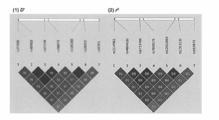
表3で同定した7つのSNPs間の連鎖不平衡関係を調査するため、連鎖不平衡解析を実施した。連鎖不平衡の指標として、連鎖不平衡係数を標準化した値D´とピアソンの相関係数の2乗値であるr2の2種類の指標を採用し、SNPのペア毎にこれらの指標を計算した。計算用ソフトウェアとしてHaploview4.2を使用した。連鎖不平衡解析の結果、7つのSNPs間ほぼ全てで強い連鎖不平衡(r2≧0.8)を示したことから、これらのSNP及び近傍領域は連鎖不平衡(LD)ブロックを形成していることが明らかとなった(図3)。
表3で同定した7つのSNPs間の連鎖不平衡関係を調査するため、連鎖不平衡解析を実施した。連鎖不平衡の指標として、連鎖不平衡係数を標準化した値D´とピアソンの相関係数の2乗値であるr2の2種類の指標を採用し、SNPのペア毎にこれらの指標を計算した。計算用ソフトウェアとしてHaploview4.2を使用した。連鎖不平衡解析の結果、7つのSNPs間ほぼ全てで強い連鎖不平衡(r2≧0.8)を示したことから、これらのSNP及び近傍領域は連鎖不平衡(LD)ブロックを形成していることが明らかとなった(図3)。
7つのSNPs遺伝型すべてにおけるマイナーアレルとメジャーアレルのホモ接合性は各々30%と60%であり、全ハプロタイプの90%を占める。これらのSNPsの少なくともいずれか1つを解析することによって、発病初期のALS患者についても急速進行型ALSであるリスクが高いかを診断することが可能である。
≪eQTL(expression quantitative trait loci)解析≫
eQTL情報をHuman Genetic Variation Database(HGVD)から入手した(HGVD リリースバージョン1.41)。HGVDは日本の5拠点から出されたデータベースであり、日本人1208人のエクソームと3248人のSNPsの解析結果が含まれている。
eQTL情報をHuman Genetic Variation Database(HGVD)から入手した(HGVD リリースバージョン1.41)。HGVDは日本の5拠点から出されたデータベースであり、日本人1208人のエクソームと3248人のSNPsの解析結果が含まれている。
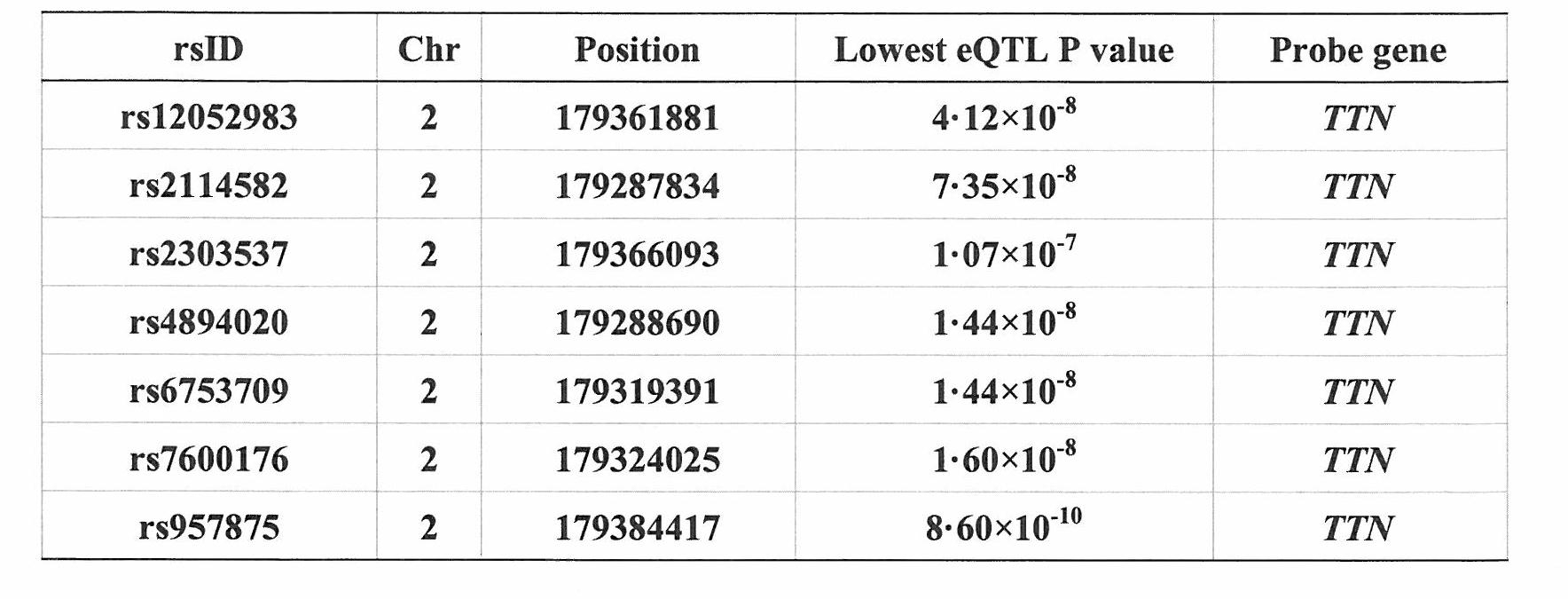
HGVDのeQTLマッピングによれば、上記7つのSNPsは、リンパ球においてTTN(チチン、Titin)遺伝子の発現に影響を与えることが示されている(表4)。
そこで、ALS患者において、7つのSNPsを含むLDブロックが発現に影響を与えていることを確認するために、各遺伝子型(マイナーホモ接合体、メジャーホモ接合体、ヘテロ接合体)について年齢、及び性別が適合した患者のリンパ球でのチチン発現を測定した。
登録時にALS患者全員から得た末梢血のBリンパ球にEBウイルスを感染させることにより不死化した細胞株を樹立し、液体窒素タンクを用いて保存した。得られた不死化細胞株から、ALSの病態の進行に関与していると考えられる7つのSNPsのLDブロックを用いて、マイナーホモ接合体、メジャーホモ接合体、ヘテロ接合体の各遺伝子型を有する19例ずつの細胞株について、チチン遺伝子発現の解析を行った。これらの3群では表5に示すように年齢、性別の有意な違いはなかった。
チチンmRNAの発現レベルは、以下の定量RT-PCRにより測定した。RNAをリンパ球からRNeasy Mini Kit(Qiagen社製)を用いて精製し、1μgのトータルRNAからOligo-dTプライマーを用いて逆転写した。サーマルサイクラーCFX96システム(BioRad社製)を用いて95℃3分に続き、95℃10秒、55℃30秒の40サイクルでDNA増幅を行った。
各転写産物の量比は、cDNAサンプルの段階希釈液を用いてCt値の標準曲線を引き、GAPDHレベルにより正規化して求めた。リアルタイム定量的PCRはiQ SYBR Green Supermix(BioRad社製)を用い三重実験を行った。プライマーセットとしては以下のプライマーを用いた。
ヒトGAPDH;ACAGTCAGCCGCATCTTCTT(配列番号1)
ACGACCAAATCCGTTGACTC(配列番号2)
TTN; TGACACAACTGGAAAGCTCA(配列番号3)
ACTTTGCCTTCATCAATGCTG(配列番号4)
遺伝子発現試験を行った患者の臨床特性を表5に、チチンの遺伝子発現を図4に示す。
ヒトGAPDH;ACAGTCAGCCGCATCTTCTT(配列番号1)
ACGACCAAATCCGTTGACTC(配列番号2)
TTN; TGACACAACTGGAAAGCTCA(配列番号3)
ACTTTGCCTTCATCAATGCTG(配列番号4)
遺伝子発現試験を行った患者の臨床特性を表5に、チチンの遺伝子発現を図4に示す。

図4に示されるように、チチン遺伝子の発現量は、マイナーアレル遺伝子型の患者のリンパ球では、メジャーアレル遺伝子型の患者に比べて、有意に低いことが示された(P=0.002、一元配置分散分析、及びテューキー検定)。上記結果から、ALS患者の末梢血を用いて、チチン発現量を解析することにより、急速進行型であるリスクを評価することができる。
孤発性ALS病態解明の基礎となるだけではなく、TTN発現を指標として急速に進行するALSの病態を抑止する治療薬の開発することが可能となる。また、治験を行う際に、今回見出されたSNPsを割り付け因子として活用することができるため、治験薬の評価をより正確に行うことが可能となる。また、経過やその背景となる病態を予測することができるため、介護、ケアサポートプランを作成する際に、より適切なケアを行うことが可能となる。
Claims (11)
- ALS患者の発症後の進行の類型を検査する方法であって、
ALS患者のリファレンスSNP ID番号:rs12052983、rs23114582、rs2303537、rs4894020、rs6453709、rs600176、rs957875の少なくともいずれか1つの一塩基多型を検査し、
前記一塩基多型がマイナーアレルである場合に急速進行型のリスクが高いと判定することを特徴とする検査方法。 - ALS患者の発症後の進行の類型を検査する方法であって、
ALS患者のチチンの発現量を測定し、
チチン発現量が閾値より低い場合、急速進行型に進行するリスクが高いと判定することを特徴とする検査方法。 - 請求項2に記載のALS患者の発症後の進行の類型を検査する方法であって、
前記チチンの発現量は、mRNA及び/又はタンパク質発現量を測定することを特徴とする検査方法。 - 請求項3に記載のALS患者の発症後の進行の類型を検査する方法であって、
前記チチン発現量はmRNA発現を定量的PCRで測定することを特徴とする検査方法。 - 請求項3に記載のALS患者の発症後の進行の類型を検査する方法であって、
前記チチンの発現量はタンパク質発現を抗チチン抗体によって測定することを特徴とする検査方法。 - 請求項1~5いずれか1項記載のALS患者の発症後の進行の類型を検査する方法であって、
患者から得られたリンパ球を用いて検査することを特徴とする検査方法。 - ALS患者が急速進行型ALSに分類されるかを検査するキットであって、
リファレンスSNP ID番号:rs12052983、rs23114582、rs2303537、rs4894020、rs6453709、rs600176、rs957875の少なくともいずれか1つの一塩基多型を検出するためのPCRプライマー、チチン発現量を解析するための定量的PCRプライマー、チチン発現量を定量するための抗体の少なくともいずれか1つを含むことを特徴とする検査キット。 - 急速進行型ALSの進行を抑制する医薬をスクリーニングする方法であって、
被験物質を培養細胞に接触させ、
チチン発現量の増加を指標として選択することを特徴とするスクリーニング方法。 - 請求項8に記載の急速進行型ALSの進行を抑制する医薬をスクリーニングする方法であって、
前記培養細胞がリファレンスSNP ID番号:rs12052983、rs23114582、rs2303537、rs4894020、rs6453709、rs600176、rs957875がマイナーホモアレルであることを特徴とするスクリーニング方法。 - 請求項8又は9に記載のスクリーニング方法であって、
上記培養細胞が急速進行型ALS患者の末梢血から樹立したリンパ球細胞株であることを特徴とするスクリーニング方法。 - 請求項8~10いずれか1項記載のスクリーニング方法であって、
前記チチン発現は、mRNA及び/又はタンパク質を測定することによることを特徴とするスクリーニング方法。
Priority Applications (1)
| Application Number | Priority Date | Filing Date | Title |
|---|---|---|---|
| JP2017506465A JP6761613B2 (ja) | 2015-03-13 | 2016-03-08 | 急速進行型孤発性alsの検査方法、検査キット、及び医薬のスクリーニング方法 |
Applications Claiming Priority (2)
| Application Number | Priority Date | Filing Date | Title |
|---|---|---|---|
| JP2015-051093 | 2015-03-13 | ||
| JP2015051093 | 2015-03-13 |
Publications (1)
| Publication Number | Publication Date |
|---|---|
| WO2016147942A1 true WO2016147942A1 (ja) | 2016-09-22 |
Family
ID=56920093
Family Applications (1)
| Application Number | Title | Priority Date | Filing Date |
|---|---|---|---|
| PCT/JP2016/057071 Ceased WO2016147942A1 (ja) | 2015-03-13 | 2016-03-08 | 急速進行型孤発性alsの検査方法、検査キット、及び医薬のスクリーニング方法 |
Country Status (2)
| Country | Link |
|---|---|
| JP (1) | JP6761613B2 (ja) |
| WO (1) | WO2016147942A1 (ja) |
Families Citing this family (1)
| Publication number | Priority date | Publication date | Assignee | Title |
|---|---|---|---|---|
| US11139051B2 (en) * | 2018-10-02 | 2021-10-05 | Origent Data Sciences, Inc. | Systems and methods for designing clinical trials |
Citations (2)
| Publication number | Priority date | Publication date | Assignee | Title |
|---|---|---|---|---|
| WO2015016392A1 (ja) * | 2013-08-02 | 2015-02-05 | 国立大学法人東京大学 | 筋萎縮性側索硬化症の新規病因遺伝子 |
| WO2015072438A1 (ja) * | 2013-11-12 | 2015-05-21 | 国立大学法人名古屋大学 | Als疾患関連遺伝子配列解析用の補足pcrプライマーセット、als疾患関連遺伝子配列の解析方法、及びals疾患の検査方法 |
-
2016
- 2016-03-08 WO PCT/JP2016/057071 patent/WO2016147942A1/ja not_active Ceased
- 2016-03-08 JP JP2017506465A patent/JP6761613B2/ja active Active
Patent Citations (2)
| Publication number | Priority date | Publication date | Assignee | Title |
|---|---|---|---|---|
| WO2015016392A1 (ja) * | 2013-08-02 | 2015-02-05 | 国立大学法人東京大学 | 筋萎縮性側索硬化症の新規病因遺伝子 |
| WO2015072438A1 (ja) * | 2013-11-12 | 2015-05-21 | 国立大学法人名古屋大学 | Als疾患関連遺伝子配列解析用の補足pcrプライマーセット、als疾患関連遺伝子配列の解析方法、及びals疾患の検査方法 |
Non-Patent Citations (4)
| Title |
|---|
| FOGH ISABELLA ET AL.: "A genome-wide association meta-analysis indentifies a novel locus at 17q11.2 associated with sporadic amyotrophic lateral sclerosis", HUMAN MOLECULAR GENETICS, vol. 23, no. 8, 2014, pages 2220 - 2231, XP055311220 * |
| MATSUMURA KIICHIRO ET AL.: "Degradation of connectin (titin) in Fukuyama type congenital muscular dystrophy: immunochemical study with monoclonal antibodies", JOURNAL OF THE NEUROLOGICAL SCIENCE, vol. 98, no. 2-3, 1990, pages 155 - 162, XP025462509 * |
| MATSUMURA KIICHIRO ET AL.: "Immunochemical study of connectin (titin) in neuromuscular diseases using a monoclonal antibody: connectin is degraded extensively in Duchenne muscular dystrophy", JOURNAL OF THE NEUROLOGICAL SCIENCES, vol. 93, no. 2-3, 1989, pages 147 - 156, XP024302381 * |
| WILLIAM XIAOWEI ET AL.: "Biomaker-Based Predictive Models for Prognosis in Amyotrophic Lateral Sclerosis", JAMA NEUROLOGY, vol. 70, no. 12, 2013, pages 1505 - 1511, XP055311219 * |
Also Published As
| Publication number | Publication date |
|---|---|
| JP6761613B2 (ja) | 2020-09-30 |
| JPWO2016147942A1 (ja) | 2017-12-21 |
Similar Documents
| Publication | Publication Date | Title |
|---|---|---|
| Bandres‐Ciga et al. | The genetic architecture of Parkinson disease in Spain: characterizing population‐specific risk, differential haplotype structures, and providing etiologic insight | |
| Akiyama et al. | Genome-wide association study identifies 112 new loci for body mass index in the Japanese population | |
| Ebbert et al. | Population-based analysis of Alzheimer’s disease risk alleles implicates genetic interactions | |
| Iossifov et al. | The contribution of de novo coding mutations to autism spectrum disorder | |
| Saksens et al. | Rare genetic variants associated with development of age-related macular degeneration | |
| JP6931125B2 (ja) | 標的遺伝子発現の数学的モデル化を使用する、jak−stat1/2細胞シグナル伝達経路活性の評価 | |
| US11776661B2 (en) | Determination of MAPK-AP-1 pathway activity using unique combination of target genes | |
| Li et al. | Replication of TCF4 through association and linkage studies in late-onset Fuchs endothelial corneal dystrophy | |
| Kim et al. | Influence of genetic variation on plasma protein levels in older adults using a multi-analyte panel | |
| Chan et al. | Genome-wide rare variant score associates with morphological subtypes of autism spectrum disorder | |
| Ho et al. | Association of high myopia with crystallin beta A4 (CRYBA4) gene polymorphisms in the linkage-identified MYP6 locus | |
| Jokubaitis et al. | Genotype and phenotype in multiple sclerosis—potential for disease course prediction? | |
| Jonas et al. | Apolipoprotein E-ε4 allele predicts escalation of psychotic symptoms in late adulthood | |
| Paracchini et al. | Genetics of human handedness and laterality | |
| Carrion-Castillo et al. | Whole-genome sequencing identifies functional noncoding variation in SEMA3C that cosegregates with dyslexia in a multigenerational family | |
| Chu et al. | TOMM40 poly-T repeat lengths, age of onset and psychosis risk in Alzheimer disease | |
| Cirulli | The increasing importance of gene-based analyses | |
| Gusev | Germline mechanisms of immunotherapy toxicities in the era of genome‐wide association studies | |
| Perini et al. | Candidate biomarkers from the integration of methylation and gene expression in discordant autistic sibling pairs | |
| JP6761613B2 (ja) | 急速進行型孤発性alsの検査方法、検査キット、及び医薬のスクリーニング方法 | |
| Reimann et al. | The cord blood insulin and mitochondrial DNA content related methylome | |
| US20190002981A1 (en) | Method of Testing for Preeclampsia and Treatment Therefor | |
| Huang et al. | Two novel SNPs in the PLCL2 gene associated with large artery atherosclerotic stroke identified by fine-mapping | |
| JP7599676B2 (ja) | Als患者の予後予測の検査方法、検査キット及び医薬のスクリーニング方法 | |
| Middleton et al. | Integrating genetic, functional genomic, and bioinformatics data in a systems biology approach to complex diseases: application to schizophrenia |
Legal Events
| Date | Code | Title | Description |
|---|---|---|---|
| 121 | Ep: the epo has been informed by wipo that ep was designated in this application |
Ref document number: 16764772 Country of ref document: EP Kind code of ref document: A1 |
|
| ENP | Entry into the national phase |
Ref document number: 2017506465 Country of ref document: JP Kind code of ref document: A |
|
| NENP | Non-entry into the national phase |
Ref country code: DE |
|
| 122 | Ep: pct application non-entry in european phase |
Ref document number: 16764772 Country of ref document: EP Kind code of ref document: A1 |