WO2016143868A1 - 高分子遷移金属錯体、その製造方法及びその利用 - Google Patents
高分子遷移金属錯体、その製造方法及びその利用 Download PDFInfo
- Publication number
- WO2016143868A1 WO2016143868A1 PCT/JP2016/057632 JP2016057632W WO2016143868A1 WO 2016143868 A1 WO2016143868 A1 WO 2016143868A1 JP 2016057632 W JP2016057632 W JP 2016057632W WO 2016143868 A1 WO2016143868 A1 WO 2016143868A1
- Authority
- WO
- WIPO (PCT)
- Prior art keywords
- group
- formula
- transition metal
- bisphosphine
- unsubstituted
- Prior art date
- Legal status (The legal status is an assumption and is not a legal conclusion. Google has not performed a legal analysis and makes no representation as to the accuracy of the status listed.)
- Ceased
Links
- 0 C(*c1ccccc1)c1ccccc1 Chemical compound C(*c1ccccc1)c1ccccc1 0.000 description 2
- KURMRVCZWHURDF-XJTKIWSRSA-N CC(C)CC(C)[C@H](C1C2C(C)CCCCCCC2)C1c1ccccc1 Chemical compound CC(C)CC(C)[C@H](C1C2C(C)CCCCCCC2)C1c1ccccc1 KURMRVCZWHURDF-XJTKIWSRSA-N 0.000 description 1
- YXFVVABEGXRONW-UHFFFAOYSA-N Cc1ccccc1 Chemical compound Cc1ccccc1 YXFVVABEGXRONW-UHFFFAOYSA-N 0.000 description 1
Images


Classifications
-
- B—PERFORMING OPERATIONS; TRANSPORTING
- B01—PHYSICAL OR CHEMICAL PROCESSES OR APPARATUS IN GENERAL
- B01J—CHEMICAL OR PHYSICAL PROCESSES, e.g. CATALYSIS OR COLLOID CHEMISTRY; THEIR RELEVANT APPARATUS
- B01J31/00—Catalysts comprising hydrides, coordination complexes or organic compounds
- B01J31/16—Catalysts comprising hydrides, coordination complexes or organic compounds containing coordination complexes
- B01J31/24—Phosphines, i.e. phosphorus bonded to only carbon atoms, or to both carbon and hydrogen atoms, including e.g. sp2-hybridised phosphorus compounds such as phosphabenzene, phosphole or anionic phospholide ligands
-
- C—CHEMISTRY; METALLURGY
- C08—ORGANIC MACROMOLECULAR COMPOUNDS; THEIR PREPARATION OR CHEMICAL WORKING-UP; COMPOSITIONS BASED THEREON
- C08F—MACROMOLECULAR COMPOUNDS OBTAINED BY REACTIONS ONLY INVOLVING CARBON-TO-CARBON UNSATURATED BONDS
- C08F12/00—Homopolymers and copolymers of compounds having one or more unsaturated aliphatic radicals, each having only one carbon-to-carbon double bond, and at least one being terminated by an aromatic carbocyclic ring
- C08F12/02—Monomers containing only one unsaturated aliphatic radical
- C08F12/04—Monomers containing only one unsaturated aliphatic radical containing one ring
- C08F12/06—Hydrocarbons
-
- C—CHEMISTRY; METALLURGY
- C08—ORGANIC MACROMOLECULAR COMPOUNDS; THEIR PREPARATION OR CHEMICAL WORKING-UP; COMPOSITIONS BASED THEREON
- C08F—MACROMOLECULAR COMPOUNDS OBTAINED BY REACTIONS ONLY INVOLVING CARBON-TO-CARBON UNSATURATED BONDS
- C08F12/00—Homopolymers and copolymers of compounds having one or more unsaturated aliphatic radicals, each having only one carbon-to-carbon double bond, and at least one being terminated by an aromatic carbocyclic ring
- C08F12/34—Monomers containing two or more unsaturated aliphatic radicals
Definitions
- the present invention relates to a polymer transition metal complex, a production method thereof and use thereof.
- This application claims the priority of Japanese Patent Application No. 2015-046761 filed on Mar. 10, 2015, the entire description of which is hereby specifically incorporated by reference.
- the organic polymer-supported phosphine-transition metal catalyst is an organic synthesis means with a low environmental impact because it is excellent in separation and reusability from the reaction mixture, and is expected to be used in industry.
- the existing method for preparing organic polymer-supported phosphine is a copolymerization method using a ligand unit having a single polymerization reaction point, a monomer, and a cross-linking agent. The problem is that it acts as a steric hindrance to the center and is often less active than the corresponding homogeneous catalyst.
- the catalyst design utilizing the solid surface environment is difficult due to the flexibility of the flexible polymer chain.
- Patent Document 1 WO2014 / 136909
- Patent Document 2 CN10395386A The entire description of Patent Documents 1 and 2 is specifically incorporated herein by reference.
- Non-Patent Document 1 Sawamura, M. et al. Angew. Chem. Int. Ed. 2013, 52, 12322
- Non-Patent Document 2 Brunkan, N. M .; Gagne M. R., J. Am. Chem. Soc. 2000, 122, 6217.
- Non-Patent Document 3 Humphrey, S. M. et al. J. Am. Chem. Soc. 2013, 135, 16038. The entire descriptions of Non-Patent Documents 1 to 3 are specifically incorporated herein by reference.
- the present invention provides an organic polymer capable of strong chelate coordination to various transition metal species including the first transition series metal, and an organic material including various transition metal species including the first transition series metal.
- An object is to provide a polymer complex, and further to provide a catalyst using these organic polymer complexes.
- the present inventors have made various studies to achieve the above object, and as a result, a polymer-supported bisphosphine obtained by using bisphosphine as an organic polymer four-point crosslinking agent and copolymerizing it with styrenes, Discovering that the present invention is capable of strong chelate coordination to various transition metal species including the first transition series metal and that the resulting complex exhibits excellent catalytic activity in various reactions. Completed.
- crosslinking bisphosphine There is an organic polymer-supported bisphosphine-metal complex using a complex in which 1,2-bis [bis (4-styryl) phosphino] ethane is coordinated to a transition metal such as platinum or palladium as a four-point cross-linking agent.
- the polymer complex described in this document is formed by polymerizing a bisphosphine-containing monomer coordinated with a transition metal such as platinum.
- Patent Document 2 Although it is not an example of a metal complex, there is a document disclosing a monomer for producing an organic polymer four-point crosslinked bisphosphine and its homopolymerization (Patent Document 2). However, Patent Document 2 does not describe an example in which complexation to a transition metal and its immobilized metal complex are used for a catalytic reaction. Furthermore, it is different from the production method of the present invention in which a polymer is synthesized by copolymerization with a styrene monomer.
- formula (2) Is an unsubstituted or substituted aromatic hydrocarbon group, or an unsubstituted or substituted aromatic heterohydrocarbon group (provided having 1 to 3 heteroatoms, the heteroatoms being nitrogen atoms, Selected from an oxygen atom and a sulfur atom),
- R 1 , R 2 , R 3 and R 4 are each a linear or cross-linked polystyrene chain formed independently with a phenylene group to which R 1 , R 2 , R 3 and R 4 are bonded
- the crosslinked polystyrene chain may include at least one bisphosphine unit represented by the formula (3),
- formula (3) Is synonymous with formula (2),
- the phenyl group of the polystyrene chain is unsubstituted, or at least a part of the phenyl group of the polystyrene chain has a substituent
- M is a transition metal or a transition metal
- the transition metal or transition metal ion is at least one metal selected from the group consisting of a first transition element (3d transition element), a second transition element (4d transition element), and a third transition element (5d transition element) or The complex according to [1], which is a metal ion.
- R 1 , R 2 , R 3 and R 4 are each a linear or cross-linked polystyrene chain formed independently with a phenylene group to which R 1 , R 2 , R 3 and R 4 are bonded,
- the crosslinked polystyrene chain may include at least one bisphosphine unit represented by the formula (4),
- formula (4) Is synonymous with formula (1),
- the phenyl group of the polystyrene chain is unsubstituted or at least a part of the phenyl group of the polystyrene chain has a substituent.
- R 1 , R 2 , R 3 , and R 4 are the same as those defined in the general formula (1) except that R 1 , R 2 , R 3 , and R 4 are each formed with a phenylene group to which each is bonded.
- the bisphosphine unit that the polystyrene chain can contain at least one is represented by the formula (3):
- M is a transition metal or a transition metal ion that can have a ligand.
- an organic polymer four-point bridged bisphosphine capable of strong chelate coordination to various transition metal species including the first transition series metal.
- an organic polymer complex containing various transition metal species including the first transition series metal can be provided.
- a catalyst for coupling reaction using these organic polymer complexes can be provided.
- FIG. 3 shows 31 P CP / MAS NMR of [PdCl 2 (3)].
- FIG. 3 shows 31 P CP / MAS NMR of [Rh (3) (cod)] BF 4 .
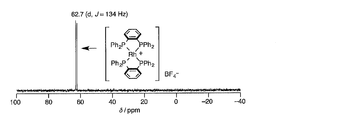
- FIG. 3 shows 31 P NMR (CDCl 3 ) of [Rh (dppbz) 2 ] BF 4 .
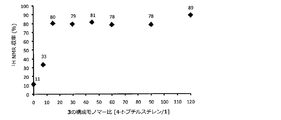
- the test result of the effect of the phosphorus content of a polystyrene four-point bridged bisphosphine is shown.
- M is a metal or metal ion that can have a ligand.
- the polymer transition metal complex is obtained by bonding a polymer compound represented by the following general formula (1) and M.
- I an unsubstituted or substituted aromatic hydrocarbon group, or an unsubstituted or substituted aromatic heterohydrocarbon group.
- bonded with two phosphorus atoms P which exist is a carbon atom, respectively, and is an adjacent carbon atom.
- aromatic hydrocarbon group examples include aromatic hydrocarbon groups which contain 6 to 14 carbon atoms and may be condensed.
- the monocyclic aromatic hydrocarbon group is, for example, a substituted or unsubstituted phenylene group.
- the polycyclic aromatic hydrocarbon group is, for example, a substituted or unsubstituted naphthalene group.
- aromatic heterohydrocarbon group for example, a 5- to 14-membered aromatic heterohydrocarbon group which contains 1 to 3 atoms selected from the group consisting of a sulfur atom, an oxygen atom and a nitrogen atom and may be condensed Is mentioned.
- Examples of the monocyclic aromatic heterohydrocarbon group include a substituted or unsubstituted azole group, oxol group, thiol group, pyridine group, pyrylium ion group, thiopyrylium ion group, azepine group, oxepin group, thiepine group, and imidazole.
- Examples of the polycyclic (fused) aromatic heterohydrocarbon group include a substituted or unsubstituted indole group, isoindole group, benzimidazole group, quinoline group, isoquinoline group, quinazoline group, phthalazine group, pteridine group, Examples include a coumarin group, a chromone group, 1,4-benzodiazepine, a benzofuran group, an acridine group, a phenoxazine group, and a phenothiazine group.
- the substituent that the aromatic hydrocarbon group and the aromatic heterohydrocarbon group may have is not particularly limited, and examples thereof include a C1-6 alkyl group, a C1-6 perfluoroalkyl group, an alkoxy group, a siloxy group, A dialkylamino group etc. are mentioned.
- Examples of the C1-6 alkyl group include methyl, ethyl, propyl, isopropyl, butyl, isobutyl, sec-butyl, tert-butyl, pentyl, hexyl and the like.
- Examples of the C1-6 perfluoroalkyl group include trifluoromethyl, pentafluoroethyl, heptafluoropropyl, tridecafluorohexyl and the like.
- Examples of the siloxy group include trimethylsiloxy, triethylsiloxy, triisopropylsiloxy, tert-butyldimethylsiloxy and the like.
- Examples of the alkoxy group include a C1-6 alkoxy group. Examples of the C1-6 alkoxy group include a methoxy group, an ethoxy group, and a hexyloxy group.
- Examples of the dialkylamino group include dimethylamino and diethylamino. The substitution position of the substituent and the number of substituents are not particularly limited.
- R 1 , R 2 , R 3 and R 4 are independently a linear or cross-linked polystyrene chain formed together with a phenylene group to which R 1 , R 2 , R 3 and R 4 are bonded.
- Each crosslinked polystyrene chain can contain at least one bisphosphine unit represented by the formula (4), and a crosslinked structure is formed by including the bisphosphine unit represented by the formula (4).
- the polystyrene chain containing no bisphosphine unit represented by the formula (4) is a linear polystyrene. Bind to any position of the four phenyl groups in formula (4) Is an ethylene group formed by a polymerization reaction of a vinyl group.
- the phenyl group of the polystyrene chain is unsubstituted unless it contains a repeating unit represented by formula (4), or at least a part of the phenyl group of the polystyrene chain has a substituent R.
- substituents include a C1-6 alkyl group, a C1-6 alkoxy group, and a polar functional group.
- the C1-6 alkyl group include methyl, ethyl, propyl, isopropyl, butyl, isobutyl, sec-butyl, tert-butyl, pentyl, hexyl and the like.
- Examples of the C1-6 alkoxy group include a methoxy group, an ethoxy group, and a hexyloxy group.
- Examples of the polar functional group include a hydroxyl group, a polyether group, an acetoxy group, an ester group, and an amide group.
- a polyether group the oligomer or polymer chain which has an ethylene glycol unit can be mentioned, for example, The number of ethylene glycol units can be 2 or more and 100 or less, for example. More specifically, the polyether group is, for example, a tetraethylene glycol monomethyl ether group.
- ester group examples include an ester group with a lower alkyl group having 1 to 6 carbon atoms, and specific examples include a methyl ester group and an ethyl ester group.
- substituent of the acyl group of the amide group examples include a lower alkyl group having 1 to 6 carbon atoms, and specific examples include a methylamide group and an ethylamide group.
- the substituent R having a high catalytic activity improving effect is, for example, a methyl group or a t-butyl group.
- the number of substituents contained in one phenyl group is, for example, in the range of 1 to 5, preferably 1 to 3.
- the polymer compound represented by the general formula (1) is, for example, a copolymer obtained by copolymerizing a compound represented by the following general formula (5) with styrene or styrene having a substituent R.
- This copolymer is a copolymer represented by the general formula (1) and includes at least one bisphosphine unit represented by the general formula (4).
- the bisphosphine monomer of the above general formula (5) As the copolymerization monomer, it is introduced into the polystyrene chain. Since the bisphosphine monomer of the general formula (5) is tetrafunctional, each vinyl group is When introduced into different polystyrene chains, a copolymer in which one bisphosphine unit is contained as a copolymerized unit in four polystyrene chains can be obtained. Thereby, a styrene 4-point cross-linking phosphine unit is formed.
- the amount of the bisphosphine unit introduced into the copolymer of the present invention is not particularly limited, but for example, the styrene unit can be in the range of 10 to 1000 in an equivalent ratio to the bisphosphine unit 1.
- the copolymer of the present invention is used as a ligand of the metal complex described later, the phosphorus of the bisphosphine unit becomes a site coordinated to the metal, and the resulting metal complex is used as a catalyst. Therefore, from the viewpoint that a relatively high catalytic activity per unit amount can be obtained, the amount of bisphosphine units is preferably relatively high.
- the styrene unit of each polystyrene chain of R 1 , R 2 , R 3 , R 4 in an equivalent ratio with respect to the bisphosphine unit 1 is in the range of 1 to 200, preferably 5 to 150. And more preferably in the range of 10 to 100.
- the preferable range of the said equivalent ratio changes also with the kind of R of styrene which has the substituent R.
- the polymer compound represented by the general formula (1) is: Is an unsubstituted phenylene group, and R 1 , R 2 , R 3 and R 4 are independently formed with a phenylene group to which R 1 , R 2 , R 3 and R 4 are respectively bonded.
- a type polystyrene chain it can be represented by the following schematic chemical formula.
- PS can be a linear polystyrene chain or a crosslinked polystyrene chain containing a bisphosphine unit represented by formula (4).
- the polymer compound represented by the general formula (1) functions as a ligand for a transition metal and can be used as a ligand.
- R is a substituent or a hydrogen atom.
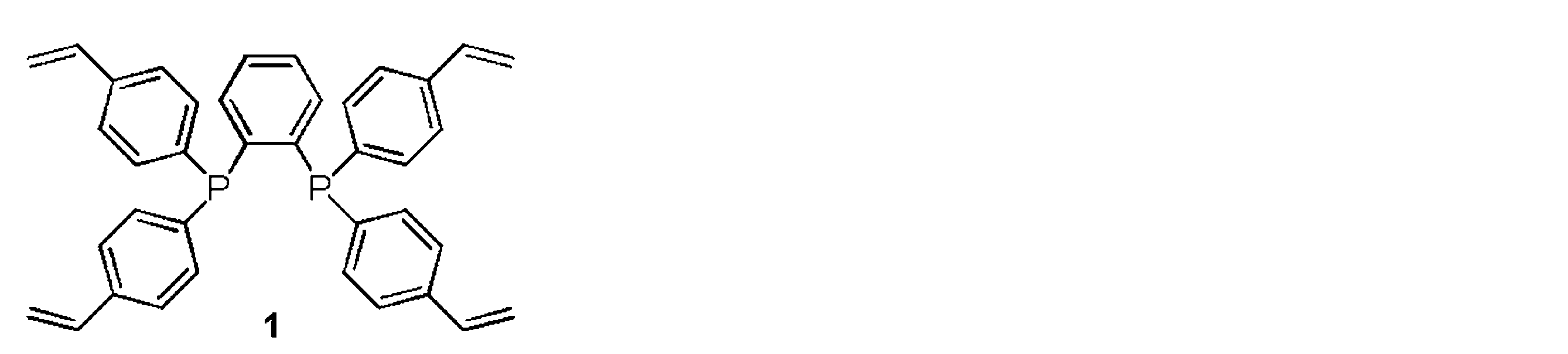
- the polymer compound represented by the general formula (1) in which is an unsubstituted phenylene group can be obtained by copolymerizing the compound represented by the following 1 with styrene and / or styrene having a substituent.
- the compound represented by 1 below is described in detail in Examples, but can be synthesized using p-bromostyrene and 1,2-bis (dichlorophosphino) benzene as raw materials.
- the raw material monomer of the polymer compound represented by the general formula (1) can be synthesized by the same method.
- polystyrene unit chain PS in the copolymerization component is described independently, but each polystyrene unit chain PS can be an independent chain even in a portion where the chain is omitted. It may be linked to other polystyrene unit chains PS shown in FIG.
- each styrene unit of the polystyrene chain PS has R as a substituent.
- each styrene unit of the polystyrene chain PS has at least two of R as a hydrogen atom, a lower alkyl group having 1 to 6 carbon atoms, a lower alkoxy group having 1 to 6 carbon atoms, and a polar functional group. You can also.
- the different R sequences in that case can be random.
- the introduction of bisphosphine units into the polystyrene unit chain PS is random. Therefore, the copolymer of the present invention is a random copolymer.
- the copolymer of the present invention by introducing a residue other than a hydrogen atom as a substituent R on the phenyl ring of the styrene unit, when a complex with a transition metal using this copolymer is used as a catalyst, The catalytic activity can also be improved.
- the lower alkyl group having 1 to 6 carbon atoms is a lower alkoxy group having 1 to 6 carbon atoms and a polar functional group.
- the substituent R having a high catalytic activity improving effect is, for example, a methyl group or a t-butyl group.
- the plurality of polystyrene chains in the copolymer of the present invention can include crosslinking by divinylbenzene units.
- crosslinking by divinylbenzene units By introducing a cross-link by divinylbenzene units into the copolymer of the present invention, the strength of the copolymer can be adjusted and the moldability can also be improved.
- the bisphosphine unit also has a function of crosslinking the polystyrene chain, it does not include crosslinking by the divinylbenzene unit, and the copolymer strength can be adjusted and the moldability can be improved only by introducing the bisphosphine unit.
- the amount of divinylbenzene units introduced can be determined as appropriate.
- the amount of crosslinking by the divinylbenzene unit can be appropriately determined in consideration of the quantitative ratio between the styrene unit and the bisphosphine unit. For example, when 60 equivalents of styrene units are copolymerized with respect to 1 equivalent of bisphosphine units shown in the examples, and divinylbenzene units are further copolymerized, the equivalent ratio of divinylbenzene units is, for example, 0 In the range of 1 to 5, it can be appropriately selected, and it can also be in the range of 0.2 to 4. As described above, if the amount of divinylbenzene units introduced is increased, the strength of the copolymer can be increased or the moldability can be improved.
- the equivalent ratio of bisphosphine units, styrene units and divinylbenzene units is, for example, generally in the range of 1:10 to 1000: 0.1 to 20. Can do. The range is preferably 1:20 to 200: 0.1 to 10, more preferably 1:30 to 200: 0.1 to 10, and still more preferably 1:40 to 200: 0.1 to 10.
- the divinylbenzene can be, for example, m-divinylbenzene, p-divinylbenzene, or a mixture thereof.
- divinylbenzene may contain ethyl vinylbenzene as an impurity for manufacturing reasons, and the one containing this impurity as divinylbenzene can also be used.
- the divinylbenzene unit it may contain an ethylvinylbenzene unit.
- the polymer compound (copolymer) represented by the general formula (1) is a crosslinked polymer compound (copolymer), it is technically difficult to specify the molecular weight. Instead of molecular weight or degree of polymerization, the swelling volume in organic solvent is displayed.
- the polymer compound (copolymer) represented by the general formula (1) is, for example, hexane, dichloromethane, toluene, t-butyl methyl ether, tetrahydrofuran, cyclopentyl methyl ether, diethyl ether, acetone, ethyl acetate,
- the swelling volume in dimethylformamide and methanol is in the range of 2.0 to 7.0 ⁇ mL / g.
- the swelling volume in toluene or cyclopentyl methyl ether is in the range of 2.0 to 7.0 mL / g, more preferably in the range of 3.0 to 7.0 mL / g.
- the copolymer of the present invention comprises a random copolymerization of a bisphosphine styrene monomer represented by the general formula (3), styrene and / or a styrene having a substituent R, and a bisphosphine styrene monomer represented by the general formula (3).
- Styrene and / or styrene having a substituent R and divinylbenzene can be synthesized by random copolymerization.
- the bisphosphine styrene monomer (compound 1) represented by the general formula (3) is a compound reported in Patent Document 1. However, this document does not describe spectral data. In the Examples, Synthesis Example is shown as Compound 1.
- Styrene and divinylbenzene containing R are commercially available.
- the substituent R of the styrene having the substituent R is the same as that described for the styrene unit having the substituent R, and R is a hydrogen atom, a lower alkyl group having 1 to 6 carbon atoms, or 1 to 6 carbon atoms. A lower alkoxy group or a polar functional group.
- the copolymer can be synthesized by, for example, suspension polymerization of the above two to four types of monomers at a predetermined ratio using a known polymerization initiator.
- the suspension polymerization can be carried out, for example, at 50 to 100 ° C. for 1 to 72 hours. However, it is not intended to be limited to this range, and can be appropriately determined according to the type and ratio of the monomer used as the raw material, the type and amount of the polymerization initiator used, the conditions for suspension polymerization, and the like.
- the complex of the present invention is a polymer transition metal complex represented by the following general formula (2), and includes a polymer compound (copolymer) represented by the above general formula (1) and a transition metal M.
- transition metal examples include a first transition element (3d transition element), a second transition element (4d transition element), and a third transition element (5d transition element).
- first transition element scandium (Sc), titanium (Ti), vanadium (V), chromium (Cr), manganese (Mn), iron (Fe), cobalt (Co), nickel (Ni), copper (Cu ) And zinc (Zn).
- Second transition elements include yttrium (Y), zirconium (Zr), niobium (Nb), molybdenum (Mo), technetium (Tc), ruthenium (Ru), rhodium (Rh), palladium (Pd), silver (Ag ) And cadmium (Cd).
- transition element examples include tungsten (W), rhenium (Re), osmium (Os), iridium (Ir), platinum (Pt), gold (Au), and lead (Pb).
- transition metals are, for example, palladium (Pd), iridium (Ir), rhodium (Rh), platinum (Pt), ruthenium (Ru), cobalt (Co), nickel (Ni), copper ( Cu) or the like is preferable.
- the complex of the present invention contains the copolymer of the present invention as a ligand.
- the copolymer represented by the general formula (2) includes a bisphosphine unit represented by the general formula (3), and includes two phosphorus (P ) Coordinates to the transition metal. Therefore, even when the transition metal is the first transition element (3d transition element), a stable complex can be formed.
- formula (3) Is synonymous with formula (2), and is bonded to any position of the four phenyl groups. Is an ethylene group formed by a polymerization reaction of a vinyl group.
- the complex of the present invention includes, for example, alkenes (for example, aliphatic alkenes and alicyclic alkenes (cycloalkenes), which are widely used as ligands for transition metal complexes.
- alkenes for example, aliphatic alkenes and alicyclic alkenes (cycloalkenes)
- aliphatic alkenes ethylene
- alicyclic alkenes 1,5-cyclooctadiene
- halogen fluorine, chlorine, bromine, iodine
- carbonyl ester, aldehyde, ketone, amide
- Groups can further be included.
- the type and number of these ligands are appropriately determined according to the type of transition metal.
- the complex of the present invention is obtained by mixing a complex composed of a transition metal and one or more of the above ligands and a polymer compound (copolymer) represented by the general formula (1) in an organic solvent. Can be prepared.
- the organic solvent to be used can be appropriately selected from, for example, toluene used in the examples and an organic solvent for measuring the swelling volume of the polymer compound (copolymer) of the present invention.
- the equivalent ratio of the bisphosphine unit and the transition metal in the polymer compound (copolymer) of the present invention is 1: 1. That is, one bisphosphine unit (including two phosphorus) per metal forms a complex.
- a metal complex is formed in at least a part of the bisphosphine unit in the polymer compound (copolymer). From the viewpoint that the complex of the present invention is used in the catalyst described later and the catalytic reaction activity per unit mass is high, it is represented by the general formula (3) in the polymer compound (copolymer) forming the metal complex.
- the more bisphosphine units the better. For example, 50 to 100%, preferably 70 to 100%, more preferably 90 to 100% of the bisphosphine units in the copolymer form a metal complex.
- the present invention relates to a coupling reaction catalyst containing the complex of the present invention.
- the coupling reaction means a reaction in which a new bond is generated between carbon of an organic compound and carbon of the organic compound, or between carbon of the organic compound and a hetero atom of the organic compound.
- Examples of the coupling reaction include a C—C coupling reaction, a C—N coupling reaction, a C—H / C—O coupling reaction, and the like.
- Representative couplings include the Suzuki-Miyaura coupling, and preferably a diaryl derivative, an alkenyl aryl derivative or 1 by a condensation reaction between an aryl halide or an alkenyl halide and an aryl boron derivative or an alkenyl boron derivative. , 3-dienes.
- a reaction in which a halogenated benzene and phenylboronic acid are condensed to form biphenyl can be mentioned.
- the halogen of the organic halide includes a chlorine atom, a bromine atom, or an iodine atom.
- the aryl group of the halogenated aryl include a carbocyclic aromatic group and a heterocyclic aromatic group.
- the carbocyclic aromatic group include monocyclic, polycyclic or condensed cyclic carbocyclic aromatic groups having 6 to 36 carbon atoms, preferably 6 to 18 carbon atoms and 6 to 12 carbon atoms. It is done.
- Examples of such carbocyclic aromatic groups include a phenyl group, a naphthyl group, a biphenyl group, a phenanthryl group, and an anthryl group.
- the heterocyclic aromatic group is 1 to 4, preferably 1 to 3, or 1 to 3 or 3 to 8 members containing a hetero atom consisting of a nitrogen atom, an oxygen atom or a sulfur atom,
- a monocyclic, polycyclic or condensed heterocyclic group having a 5- to 8-membered ring is preferable.
- Examples of such a heterocyclic group include a furyl group, a thienyl group, a pyrrolyl group, a pyridyl group, an indole group, and a benzoimidazolyl group.
- These aryl groups may further have a substituent, and such a substituent is not particularly limited as long as it does not adversely affect the reaction.
- the alkenyl group of the halogenated alkenyl is a substituted or unsubstituted vinyl group
- the substituent of the vinyl group is a substituted or unsubstituted alkyl group having 1 to 20 carbon atoms, preferably 1 to 10 carbon atoms
- Preferred examples include 7 to 12 alkynyl groups.
- Examples of the boron derivative include mono-, di- or triesters of orthoboric acid or derivatives thereof, but are not necessarily limited to orthoboric acid or derivatives thereof.
- Examples of the aryl group of the aryl boron derivative include aromatic rings such as a substituted or unsubstituted phenyl group, naphthyl group, pyridine group, and furyl group, and these substituents are particularly those that do not adversely affect the reaction.
- a halogen atom such as a chlorine atom, a bromine atom or an iodine atom
- alkenyl group of the alkenyl boron derivative include a substituted or unsubstituted vinyl group, and these substituents are not particularly limited as long as they do not adversely influence the reaction.
- the coupling reaction is the Mizorogi-Heck reaction. This reaction is a reaction for producing an aryl alkene or 1,3-diene by a condensation reaction between an alkene and an aryl halide or alkenyl halide.
- the above alkenes include ethylene derivatives having at least one hydrogen atom.
- Preferred are ethylene derivatives in which at least one hydrogen atom of ethylene is substituted with a keto group, a substituted or unsubstituted alkoxycarbonyl group, and / or a substituted or unsubstituted aryl group.
- the aryl group include the carbocyclic aromatic group and the heterocyclic aromatic group described above. These substituents are not particularly limited as long as they do not adversely influence the reaction, and examples thereof include the above-described substituents.
- More preferable alkenes include substituted or unsubstituted 3-ketoalkenes, substituted or unsubstituted styrene derivatives, substituted or unsubstituted (meth) acrylic acid esters, and the like.
- ester residue of the acrylate esters include substituted or unsubstituted alkyl groups having 1 to 20 carbon atoms, preferably 1 to 10 carbon atoms, and these substituents are not particularly limited as long as they do not adversely influence the reaction. There is no.
- alkenes examples include, for example, acrylic esters such as methyl acrylate, 3-ketoalkenes such as 3-ketobutene, and styrene derivatives such as styrene, but are not limited to these compounds. .
- the halogen of the organic halide includes a chlorine atom, a bromine atom, or an iodine atom.
- the aryl or alkenyl group may be an aliphatic or aromatic substituent, and examples thereof include a substituted or unsubstituted vinyl group and a substituted or unsubstituted aryl group.
- the aryl group includes the carbocyclic aromatic group described above. And aromatic aromatic groups. These substituents are not particularly limited as long as they do not adversely influence the reaction.
- Stille coupling can also be mentioned.
- Specific examples include biaryls, arylalkenes or 1,3-dienes by a condensation reaction between an aryl or alkenyl tin compound and an aryl halide or alkenyl halide.
- the substituent that the tin compound has include an aryl group, for example, an aromatic ring such as a substituted or unsubstituted phenyl group, naphthyl group, pyridine group, and furyl group, and these substituents have an adverse effect on the reaction.
- a halogen atom such as a chlorine atom, a bromine atom or an iodine atom, a substituted or unsubstituted alkyl group having 1 to 20, preferably 1 to 10, carbon atoms, substituted or unsubstituted And an alkoxy group having 1 to 20 carbon atoms, preferably 1 to 10 carbon atoms.
- tin compounds having an alkenyl group may be used, and examples of the alkenyl group include substituted or unsubstituted vinyl groups, and these substituents are not particularly limited as long as they do not adversely influence the reaction.
- ⁇ Sono coupling can also be mentioned as a coupling reaction. Specifically, the reaction which produces
- substituent of the alkynes examples include a substituted or unsubstituted phenyl group, naphthyl group, pyridyl group, furyl group and the like, and these substituents are not limited if they do not adversely affect the reaction.
- a halogen atom such as a chlorine atom, bromine atom or iodine atom
- a substituted or unsubstituted carbon number of 1 to 20 Preferred examples include 1 to 10 alkoxy groups.
- a substituent of alkynes a substituted or unsubstituted vinyl group is mentioned, There is no restriction
- halogen of the organic halide examples include a chlorine atom, a bromine atom, and an iodine atom.
- the aryl group or alkenyl group may be an aliphatic or aromatic substituent, and examples thereof include a substituted or unsubstituted vinyl group and a substituted or unsubstituted aryl group.
- the aryl group includes the carbocyclic group described above. Aromatic and heterocyclic aromatic groups are exemplified. These substituents are not particularly limited as long as they do not adversely influence the reaction.
- Examples of the coupling reaction include Buchwald-Hartwig coupling. Specifically, for example, amines having one or more alkyl groups or aryl groups and aryl halides or alkenyl halides using a carbon-oxygen or carbon-sulfur, more preferably carbon-nitrogen bond-forming reaction, This is a production reaction of substituted amines by the condensation reaction of
- substituent of the amines include a substituted or unsubstituted alkyl group having 1 to 20 carbon atoms, preferably 1 to 10 carbon atoms, or a substituted or unsubstituted phenyl group, naphthyl group, pyridyl group, furyl group, and the like. These substituents are not particularly limited as long as they do not adversely affect the reaction.
- a halogen atom such as a chlorine atom, a bromine atom or an iodine atom, a substituted or unsubstituted carbon number of 1
- halogen of the organic halide examples include a chlorine atom, a bromine atom, and an iodine atom.
- the aryl group or alkenyl group may be an aliphatic or aromatic substituent, and examples thereof include a substituted or unsubstituted vinyl group and a substituted or unsubstituted aryl group.
- the aryl group includes the carbocyclic group described above. Aromatic and heterocyclic aromatic groups are exemplified. These substituents are not particularly limited as long as they do not adversely influence the reaction.
- the reaction conditions can be appropriately determined according to the type of raw material.
- the reaction temperature can be appropriately selected within a range from room temperature to the boiling point of the solvent, for example.
- the reaction vessel was heated, vacuum-cooled and dried, and the reaction was carried out in an argon or nitrogen atmosphere. Stirring of the reaction solution was performed using a magnetic stirrer coated with Teflon (registered trademark).
- Bis (1,5-cyclooctadiene) nickel (0) (Ni (cod) 2 ) was purchased from Kanto Chemical Co. and recrystallized from toluene / 1,5-cyclooctadiene.
- Cobalt iodide (99.999%) was purchased from Aldrich, 1,2-bis (dichlorophosphino) benzene from Wako Pure Chemical Industries, and 4-bromostyrene from Tokyo Chemical Industry. Pinacol borane was purchased from Tokyo Chemical Industry and purified by vacuum distillation.
- Styrene, 4- (t-butyl) styrene and divinylbenzene were purchased from Tokyo Chemical Industry and purified through an activated alumina column.
- the solvent used was a Kanto Chemical dehydration grade, which was further degassed by the coagulation-melting method and dehydrated using molecular sieve 4A.
- JEOL ECX-400 1 H; 399.8 MHz, 13 C; 100.5 MHz, 31 P; 161.8 MHz
- Bruker MSL-300 13 C; 75.5 MHz, 31 P; 121.5 MHz
- CP / MAS NMR measurement solid.
- Various NMR chemical shifts were referred to tetramethylsilane ( 1 H; 0 ppm), deuterated chloroform ( 13 C; 77.0 ppm), and 85% phosphoric acid ( 31 P; 0 ppm).
- the obtained polymer beads were sieved, and those having a particle size of 250-710 ⁇ m were used for the catalytic reaction.
- the composition ratio of the polymer was calculated to be equal to the charging ratio assuming that the respective reactants were polymerized with the same reactivity (estimated bisphosphine content [PP] 0.15 mmol / g).
- the peak derived from the vinyl group of compound 1 was not observed, indicating that the title four-point bridged bisphosphine 2 was produced.
- Compound data for polystyrene 4-point bridged bisphosphine 2 31 P CP / MAS NMR: ⁇ -17.
- 13 C CP / MAS NMR ⁇ 33-60 (br), 130, 148.
- the composition ratio of the polymer was calculated to be equal to the charging ratio assuming that the polymerization of each reactant was progressed with the same reactivity (estimated bisphosphine content [PP] 0.10 mmol / g).
- the peak derived from the vinyl group of compound 1 was not observed, indicating that the title four-point bridged bisphosphine 3 was produced. To be judged.
- Polystyrene four-point cross-linked bisphosphine ⁇ ⁇ ⁇ 3 ([PP] 0.05-0.57 mmol / g) with different bisphosphine content is 1,2-bis [bis (4-styryl) phosphino] benzene and 4- (t-butyl) styrene These were synthesized by changing the charging ratio of each as shown in Table 1 (1: 120 to 1: 7.5).
- an organic polymer 4 [P-P] 1.8 mmol / g) obtained by homopolymerization of 1,2-bis [bis (4-styryl) phosphino] benzene was synthesized.
- the bisphosphine content was estimated to be 0.07 mmol / g.
- the substance amount was calculated using the estimated bisphosphine content calculated from the charge ratio of raw material monomers in polymer synthesis (see Tables 4 to 7).
- Rh [cod] 2 BF 4 and 3 complexation experiment (Rh / 3 1: 2):
- the 31 P CP / MAS NMR measurement signal (53 ppm) is almost identical to the 31 P NMR signal (58.0 ppm) of the compound [Rh (dppbz) (cod)] BF 4 having a similar structure. It is judged that the compound [Rh (3) (cod)] BF 4 was produced.
- Rh [cod] 2 BF 4 and dppbz complexation experiment (Rh / dppbz 1: 2):
- Nickel-catalyzed CH / CO coupling reaction between azoles and phenol derivatives In a cross-coupling reaction, generally, a reaction that forms a carbon-carbon (heteroelement) bond in the presence of a noble metal catalyst such as palladium using an organometallic reactant that is a nucleophile and a halide that is an electrophile. Widely used. In 2012, Itami et al. Reported that the CH / CO coupling reaction between azoles and phenol derivatives proceeded in the presence of a nickel catalyst to yield (hetero) biaryls (references; Itami, K. et. al. J. Am. Chem. Soc. 2012, 134, 169.).
- Non-Patent Document 1 polystyrene three-point bridged triarylphosphine 5
- Non-Patent Document 3 1,2-bis (diphenylphosphino) benzene
- Table 5 shows the results of the effect of the phosphorus content of polystyrene four-point crosslinked bisphosphine.
- ligand 4 With ligand 4, the reaction proceeded, but the target product remained in low yield.
- ligand 3 When ligand 3 was used, the desired product was obtained in good yield when the ratio of [4-t-butylstyrene / 1] was> 15. It is clear that copolymerization with an appropriate amount of styrene monomer is important for the expression of high catalytic activity by the polystyrene four-point bridged bisphosphine ligand. (See Figure 4)
- Nickel-catalyzed cross-coupling reaction between aryl chlorides and primary amines The Buchwald-Hartwig amination reaction of aryl halides is useful for the synthesis of aromatic amines contained in pharmaceuticals and functional electronic materials.
- palladium catalysts are frequently used.
- toxicity and performance degradation due to residual palladium in the product are often problematic, and alternatives to other metals are sought.
- Hartwig et al. Reported that a nickel catalyst with 2,2'-bis (diphenylphosphino) -1,1'-binaphthyl (binap) was used for the cross-coupling reaction between aryl chlorides and primary amines.
- nickel-binap 1: 1 type complexes are catalytically active species.
- polystyrene four-point bridged bisphosphine is advantageous for the formation of metal-ligand 1: 1 type complexes based on the spatial isolation of metal coordination points.
- the immobilized nickel catalyst prepared in the reaction system from bisphosphine and Ni (cod) 2 was found to be effective for the cross-coupling reaction of aryl chlorides and primary amines.
- Experiment Number 45 Compound data for 4-methoxy-N- (1,1,3,3-tetramethylbutyl) -aniline: 1 H NMR (400 MHz, CDCl 3 ): ⁇ 1.03 (s, 9H), 1.29 (s, 6H), 1.61 (s, 2H), 3.07 (broad s, 1H), 3.75 (s, 3H), 6.71- 6.76 (m, 4H). 13 C NMR (100.5 MHz, CDCl 3 ): ⁇ 30.09, 31.73, 54.32, 55.54, 55.75, 114.15, 121.10, 140.06, 153.35. HRMS-ESI (m / z): [M + H] + cacld for C 15 H 26 ON, 236.20089; found, 236.20118.
- Cobalt-catalyzed hydroboration of alkenes The hydroboration reaction of alkenes is a useful technique for obtaining alkyl boronic acid derivatives widely used as synthetic intermediates.
- noble metals such as rhodium and iridium have been used as catalysts, but in recent years, the use of cheaper and abundant base metal catalysts has been demanded.
- Huang et al. Reported that cobalt complex catalysts with optically active iminopyridine-oxazoline-type tridentate ligands are effective for asymmetric hydroboration of alkenes (reference: Huang, Z. et al. J. Am. Chem. Soc. 2014, 136, 15501.).
- the present inventor has found that a cobalt complex catalyst having polystyrene four-point cross-linked bisphosphine is effective for hydroboration of alkenes in the presence of a catalytic amount of sodium triethylborohydride as an additive. Since the reaction hardly progresses with the polystyrene three-point bridged triarylphosphine 5 and 1,2-bis (diphenylphosphino) benzene, which are the inventors' prior inventions, the improvement of the catalytic activity by the fixation of bisphosphine is clear. is there.
- a magnetic stir bar Under a nitrogen atmosphere, a magnetic stir bar, a ligand (0.003 mmol) and a solution of cobalt iodide (0.002 mmol) in tetrahydrofuran (0.4 mL) were added to a 10 mL screw test tube, and the mixture was stirred at room temperature for 5 minutes. Thereafter, sodium triethylborohydride (10 ⁇ L, 1 M THF solution, 0.01 mmol) was added, and the mixture was further stirred at room temperature for 10 minutes.
- the present invention is useful in technical fields related to transition metal complexes.
Landscapes
- Chemical & Material Sciences (AREA)
- Chemical Kinetics & Catalysis (AREA)
- Organic Chemistry (AREA)
- Health & Medical Sciences (AREA)
- Medicinal Chemistry (AREA)
- Polymers & Plastics (AREA)
- Inorganic Chemistry (AREA)
- Engineering & Computer Science (AREA)
- Materials Engineering (AREA)
- Addition Polymer Or Copolymer, Post-Treatments, Or Chemical Modifications (AREA)
- Catalysts (AREA)
Abstract
本発明は、下記一般式(2)で示される高分子遷移金属錯体、その製造方法及びその触媒としての利用に関する。式(2)中、(A)は、芳香族炭化水素基又は芳香族ヘテロ炭化水素基であり、R1、R2、R3、R4は、直鎖又は架橋型ポリスチレン鎖であり、架橋型ポリスチレン鎖は、式(3)で示されるビスホスフィン単位を少なくとも1つ含むことができる。Mは、配位子を有することができる遷移金属又は遷移金属イオンである。
Description
本発明は、高分子遷移金属錯体、その製造方法及びその利用に関する。
関連出願の相互参照
本出願は、2015年3月10日出願の日本特願2015-046761号の優先権を主張し、その全記載は、ここに特に開示として援用される。
関連出願の相互参照
本出願は、2015年3月10日出願の日本特願2015-046761号の優先権を主張し、その全記載は、ここに特に開示として援用される。
有機高分子担持ホスフィン-遷移金属触媒は、反応混合物からの分離や再利用性に優れていることから環境負荷の少ない有機合成手段であり、産業界での利用が期待されている。しかし、既存の有機高分子担持ホスフィンの作製法は、重合反応点を一つ持つ配位子ユニットとモノマーおよび架橋剤を用いた共重合法であり、この方法による調製では、高分子鎖が活性中心への立体障害として働き、対応する均一系触媒と比較してしばしば低活性であることが問題となる。加えて、柔軟な高分子鎖の運動性のために、固体表面環境を活かした触媒設計が困難である。
このような状況の下、本発明者らはこれまで、三つの重合部位を有するホスフィン化合物を架橋剤とした有機高分子三点架橋トリアリールホスフィン(下式参照)を開発した。この有機高分子は、金属配位点を空間的に孤立させることができ、この構造に基づき、種々の遷移金属への金属-リン1:1型錯体の選択的な形成を可能とした。その結果、触媒反応系中において高活性な配位不飽和錯体が優先的に形成することを見出している(特許文献1、非特許文献1)。

特許文献1:WO2014/136909
特許文献2:CN103965386A
特許文献1~2の全記載は、ここに特に開示として援用される。
特許文献2:CN103965386A
特許文献1~2の全記載は、ここに特に開示として援用される。
非特許文献1:Sawamura, M. et al. Angew. Chem. Int. Ed. 2013, 52, 12322
非特許文献2:Brunkan, N. M.; Gagne M. R., J. Am. Chem. Soc. 2000, 122, 6217.
非特許文献3:Humphrey, S. M. et al. J. Am. Chem. Soc. 2013, 135, 16038.
非特許文献1~3の全記載は、ここに特に開示として援用される。
非特許文献2:Brunkan, N. M.; Gagne M. R., J. Am. Chem. Soc. 2000, 122, 6217.
非特許文献3:Humphrey, S. M. et al. J. Am. Chem. Soc. 2013, 135, 16038.
非特許文献1~3の全記載は、ここに特に開示として援用される。
一方、元素戦略の観点から、地球上に比較的豊富に存在するコバルトやニッケル等の第一遷移系列金属を触媒とする反応の開発が近年求められている。そこで本発明者らは、前記有機高分子三点架橋トリアリールホスフィンを用いた第一遷移系列金属の錯体の形成について検討した。検討の結果、前記有機高分子三点架橋トリアリールホスフィンの単座ホスフィンの配位力は、第一遷移系列金属に対しては改善の余地がある場合があった。
そこで本発明は、第一遷移系列金属を含む様々な遷移金属種に対して強固なキレート配位が可能な有機高分子を提供し、第一遷移系列金属を含む様々な遷移金属種を含む有機高分子錯体を提供すること、さらにこれら有機高分子錯体を用いた触媒を提供することを目的とする。
本発明者らは、上記目的を達成すべく種々検討し、その結果、ビスホスフィンを有機高分子四点架橋剤とし、これをスチレン類と共重合させることで得られる高分子担持ビスホスフィンが、第一遷移系列金属を含む様々な遷移金属種に対して強固なキレート配位可能であること、及び得られた錯体が、種々の反応において優れた触媒活性を示すことを見出して、本発明を完成させた。
尚、類似した有機高分子四点架橋ビスホスフィンを含む金属錯体の例としては、以下のものが挙げられる。白金やパラジウムなどの遷移金属に1,2-ビス[ビス(4-スチリル)ホスフィノ]エタンが配位した錯体を四点架橋剤として用いた有機高分子担持ビスホスフィン-金属錯体がある(非特許文献2)。しかし、この文献記載の高分子錯体は、白金等の遷移金属を配位したビスホスフィン含有モノマーを重合して形成したものである。重合後の高分子錯体中の白金等の遷移金属を他の金属種に交換した例の記載はない。尚、この理由としては、高分子化した四点架橋ビスホスフィンにおいては、高分子鎖による立体障害等があることから、他の金属種への配位(金属の交換)は困難が予想されることが挙げられる。また、カルボキシ基が導入された1,2-ビス(ジフェニルホスフィノ)ベンゼン型配位子を有するパラジウムおよび白金錯体を主要な構成要素とする多孔性配位高分子も報告されている(非特許文献3)。この文献においても、重合の出発原料(モノマー)は予め調製したビスホスフィン-金属錯体に限定されており、多孔性配位高分子を構築後に、高分子錯体に白金等以外の金属種を配位させること(金属の交換)も記載されていない。
金属錯体の例ではないが、有機高分子四点架橋ビスホスフィンの製造のためのモノマーおよびその単独重合について開示する文献がある(特許文献2)。しかし、特許文献2には、遷移金属への錯化およびその固定化金属錯体を触媒反応へ利用した例の記載はない。さらに、スチレンモノマーとの共重合によってポリマーを合成する本発明の製造法とも異なる。
本発明は以下の通りである。
[1]
下記一般式(2)で示される高分子遷移金属錯体。

式(2)中、

は、無置換若しくは置換基を有する芳香族炭化水素基、又は無置換若しくは置換基を有する芳香族ヘテロ炭化水素基(但し、1~3個のヘテロ原子を有し、ヘテロ原子は、窒素原子、酸素原子及び硫黄原子から選ばれる)であり、
R1、R2、R3、R4は、独立に、R1、R2、R3、R4がそれぞれ結合するフェニレン基と共に形成する、直鎖又は架橋型ポリスチレン鎖であり、
前記架橋型ポリスチレン鎖は、式(3)で示されるビスホスフィン単位を少なくとも1つ含むことができ、
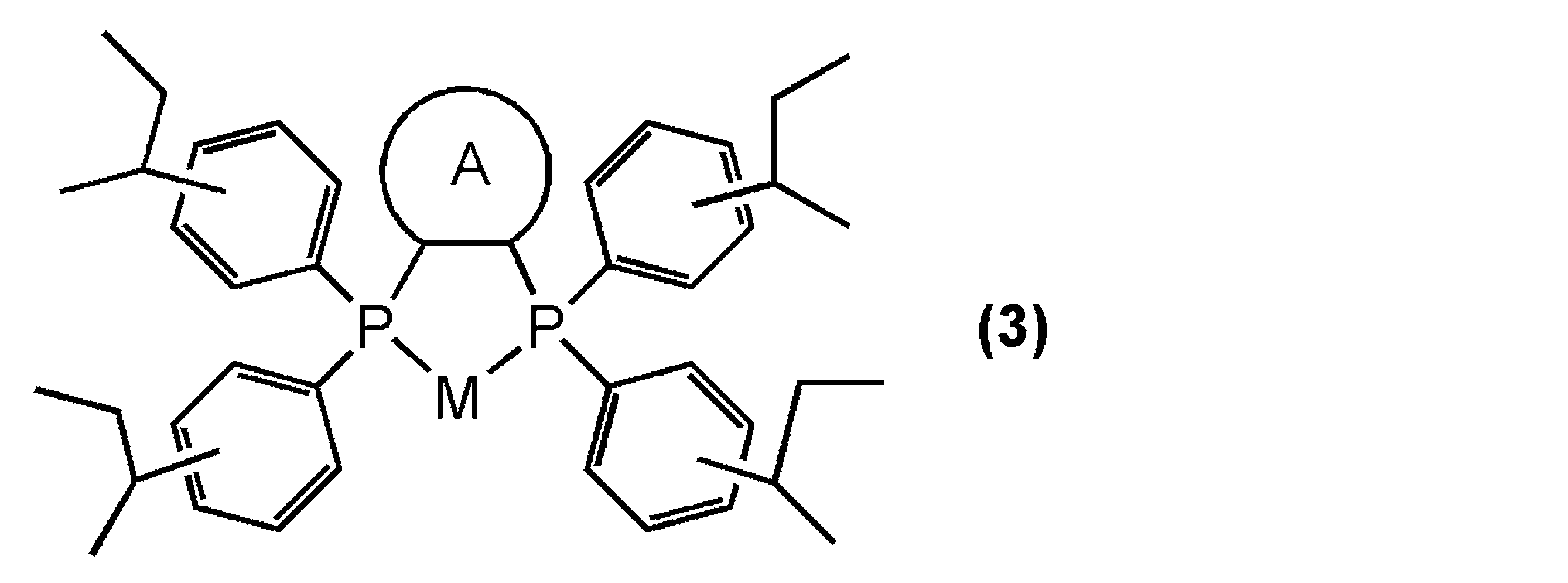
式(3)中、

は、式(2)と同義であり、
前記ポリスチレン鎖のフェニル基は無置換であるか、又は前記ポリスチレン鎖のフェニル基の少なくとも一部は置換基を有し、
Mは、配位子を有することができる遷移金属又は遷移金属イオンである。
[2]
前記遷移金属又は遷移金属イオンは、第一遷移元素(3d遷移元素)、第二遷移元素(4d遷移元素)及び第三遷移元素(5d遷移元素)から成る群から選ばれる少なくとも1種の金属又は金属イオンである、[1]に記載の錯体。
[3]
前記芳香族炭化水素基はアリール基であり、前記芳香族ヘテロ炭化水素基はヘテロアリール基である、[1]又は[2]に記載の錯体。
[4]
前記芳香族炭化水素基、前記芳香族ヘテロ炭化水素基、前記ポリスチレン鎖のフェニレン基が有する置換基は、炭素数1~6のアルキル基である、[1]~[3]のいずれか1項に記載の錯体。
[5]
一般式(3)で示されるビスホスフィン単位および前記R1、R2、R3、R4で示されるポリスチレン鎖中のスチレン単位の当量比は1:10~1000の範囲である[1]~[4]のいずれか1項に記載の錯体。
[6]
Mが有することができる配位子は、アルケン、ハロゲン、カルボニル、ヒドロキシ、ニトロ、アミノ、スルホニル、またはシアノである[1]~[5]のいずれか1項に記載の錯体。
[7]
下記一般式(1)で示される高分子化合物と遷移金属Mを含有する化合物を混合して、下記式(2)で示される高分子遷移金属錯体を得る工程、を含む高分子遷移金属錯体の製造方法。
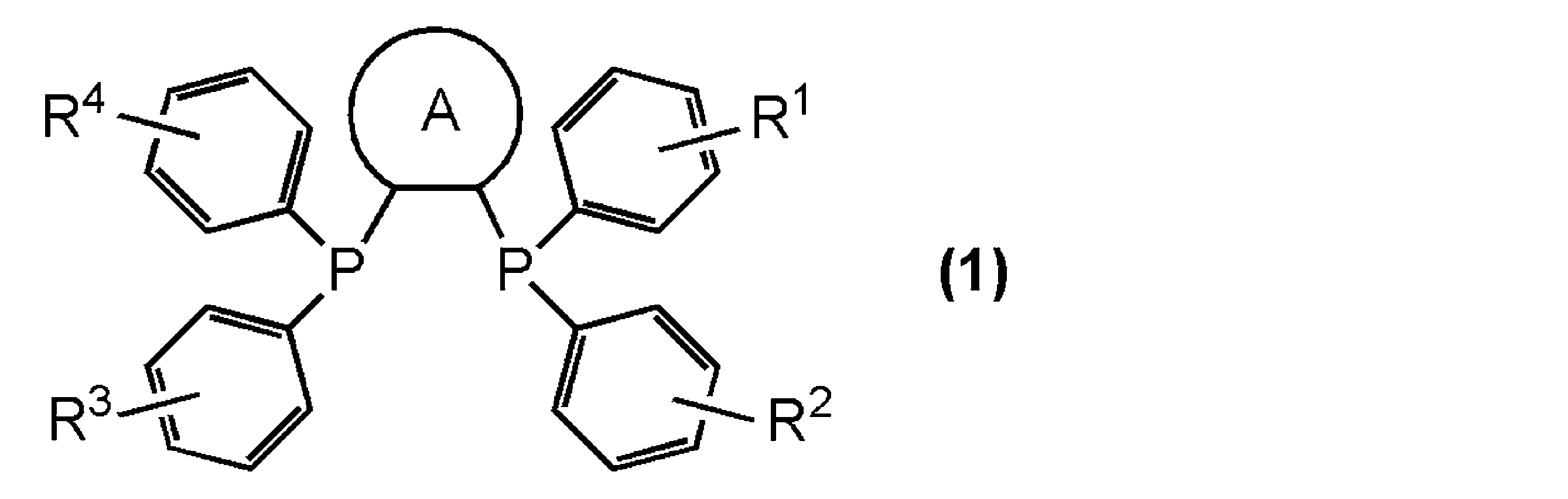
式(1)中、

は、無置換若しくは置換基を有する芳香族炭化水素基、又は無置換若しくは置換基を有する芳香族ヘテロ炭化水素基(但し、1~3個のヘテロ原子を有し、ヘテロ原子は、窒素原子、酸素原子及び硫黄原子から選ばれる)であり、
R1、R2、R3、R4は、独立に、R1、R2、R3、R4がそれぞれ結合するフェニレン基と共に形成する、直鎖又は架橋型ポリスチレン鎖であり、
前記架橋型ポリスチレン鎖は、式(4)で示されるビスホスフィン単位を少なくとも1つ含むことができ、

式(4)中、

は、式(1)と同義であり、
前記ポリスチレン鎖のフェニル基は無置換であるか、又は前記ポリスチレン鎖のフェニル基の少なくとも一部は置換基を有する。

式中の

R1、R2、R3、R4の定義は、一般式(1)における定義と同じであり、但し、R1、R2、R3、R4がそれぞれ結合するフェニレン基と共に形成する、ポリスチレン鎖が少なくとも1つ含むことができるビスホスフィン単位は、式(3)で示され、
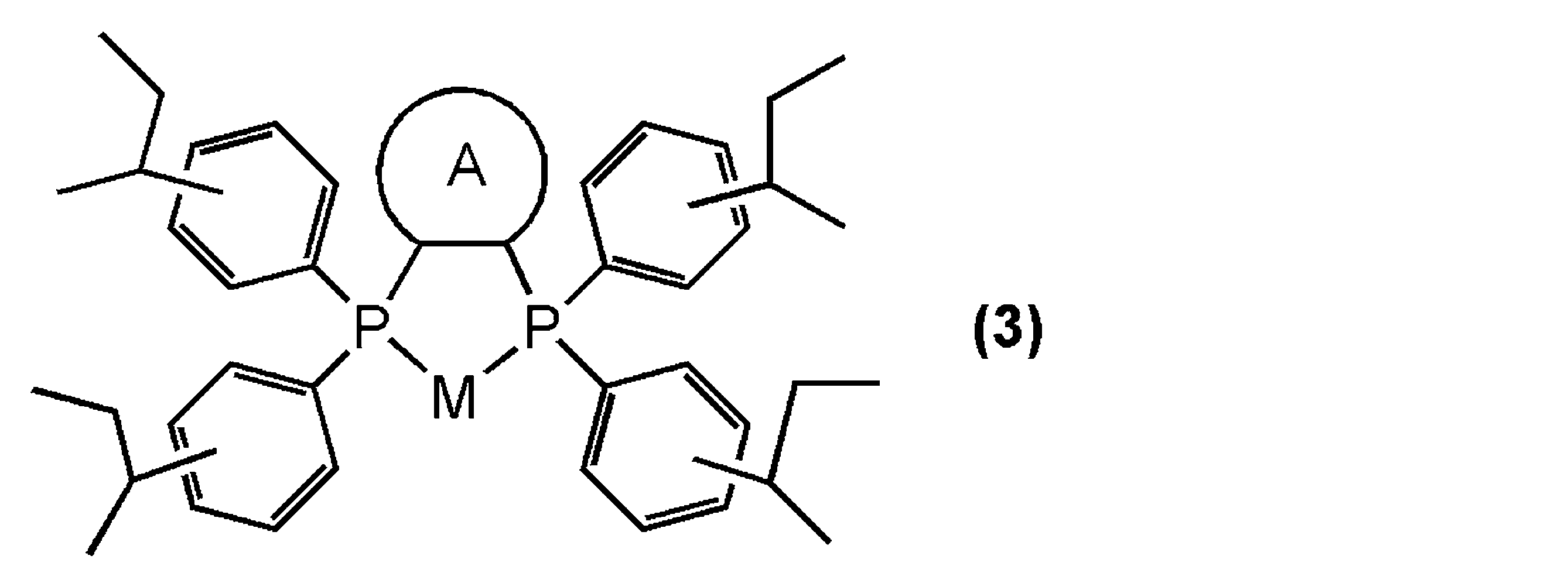
式(3)中、

は、式(2)と同義であり、
Mは、配位子を有することができる遷移金属又は遷移金属イオンである。
[8]
前記芳香族炭化水素基はアリール基であり、前記芳香族ヘテロ炭化水素基はヘテロアリール基である[7]に記載の製造方法。
[9]
前記芳香族炭化水素基、前記芳香族ヘテロ炭化水素基、前記ポリスチレン鎖のフェニレン基が有する置換基は、炭素数1~6のアルキル基である[7]又は[8]に記載の製造方法。
[10]
遷移金属Mを含有する化合物は、Mが有することができる配位子を含み、前記配位子は、アルケン、ハロゲン、カルボニル、ヒドロキシ、ニトロ、アミノ、スルホニル、またはシアノである[7]~[9]のいずれか1項に記載の製造方法。
[11]
[1]~[6]のいずれかに記載の高分子遷移金属錯体を含む有機化合物カップリング反応用触媒。
[12]
前記有機化合物カップリング反応がC-H/C-Oカップリング反応である[11]に記載の触媒。
[13]
前記有機化合物カップリング反応がC-Nクロスカップリング反応である[11]に記載の触媒。
[14]
[1]~[6]に記載の高分子遷移金属錯体を含むヒドロホウ素化反応用触媒。
[1]
下記一般式(2)で示される高分子遷移金属錯体。
R1、R2、R3、R4は、独立に、R1、R2、R3、R4がそれぞれ結合するフェニレン基と共に形成する、直鎖又は架橋型ポリスチレン鎖であり、
前記架橋型ポリスチレン鎖は、式(3)で示されるビスホスフィン単位を少なくとも1つ含むことができ、
前記ポリスチレン鎖のフェニル基は無置換であるか、又は前記ポリスチレン鎖のフェニル基の少なくとも一部は置換基を有し、
Mは、配位子を有することができる遷移金属又は遷移金属イオンである。
[2]
前記遷移金属又は遷移金属イオンは、第一遷移元素(3d遷移元素)、第二遷移元素(4d遷移元素)及び第三遷移元素(5d遷移元素)から成る群から選ばれる少なくとも1種の金属又は金属イオンである、[1]に記載の錯体。
[3]
前記芳香族炭化水素基はアリール基であり、前記芳香族ヘテロ炭化水素基はヘテロアリール基である、[1]又は[2]に記載の錯体。
[4]
前記芳香族炭化水素基、前記芳香族ヘテロ炭化水素基、前記ポリスチレン鎖のフェニレン基が有する置換基は、炭素数1~6のアルキル基である、[1]~[3]のいずれか1項に記載の錯体。
[5]
一般式(3)で示されるビスホスフィン単位および前記R1、R2、R3、R4で示されるポリスチレン鎖中のスチレン単位の当量比は1:10~1000の範囲である[1]~[4]のいずれか1項に記載の錯体。
[6]
Mが有することができる配位子は、アルケン、ハロゲン、カルボニル、ヒドロキシ、ニトロ、アミノ、スルホニル、またはシアノである[1]~[5]のいずれか1項に記載の錯体。
[7]
下記一般式(1)で示される高分子化合物と遷移金属Mを含有する化合物を混合して、下記式(2)で示される高分子遷移金属錯体を得る工程、を含む高分子遷移金属錯体の製造方法。
R1、R2、R3、R4は、独立に、R1、R2、R3、R4がそれぞれ結合するフェニレン基と共に形成する、直鎖又は架橋型ポリスチレン鎖であり、
前記架橋型ポリスチレン鎖は、式(4)で示されるビスホスフィン単位を少なくとも1つ含むことができ、
前記ポリスチレン鎖のフェニル基は無置換であるか、又は前記ポリスチレン鎖のフェニル基の少なくとも一部は置換基を有する。
Mは、配位子を有することができる遷移金属又は遷移金属イオンである。
[8]
前記芳香族炭化水素基はアリール基であり、前記芳香族ヘテロ炭化水素基はヘテロアリール基である[7]に記載の製造方法。
[9]
前記芳香族炭化水素基、前記芳香族ヘテロ炭化水素基、前記ポリスチレン鎖のフェニレン基が有する置換基は、炭素数1~6のアルキル基である[7]又は[8]に記載の製造方法。
[10]
遷移金属Mを含有する化合物は、Mが有することができる配位子を含み、前記配位子は、アルケン、ハロゲン、カルボニル、ヒドロキシ、ニトロ、アミノ、スルホニル、またはシアノである[7]~[9]のいずれか1項に記載の製造方法。
[11]
[1]~[6]のいずれかに記載の高分子遷移金属錯体を含む有機化合物カップリング反応用触媒。
[12]
前記有機化合物カップリング反応がC-H/C-Oカップリング反応である[11]に記載の触媒。
[13]
前記有機化合物カップリング反応がC-Nクロスカップリング反応である[11]に記載の触媒。
[14]
[1]~[6]に記載の高分子遷移金属錯体を含むヒドロホウ素化反応用触媒。
本発明によれば、第一遷移系列金属を含む様々な遷移金属種に対して強固なキレート配位が可能な有機高分子四点架橋ビスホスフィンを提供することができ、さらに、この有機高分子四点架橋ビスホスフィンを用いて、第一遷移系列金属を含む様々な遷移金属種を含む有機高分子錯体を提供することができる。さらに、これら有機高分子錯体を用いたカップリング反応用等の触媒を提供することができる。
下記一般式(2)で示される高分子遷移金属錯体。
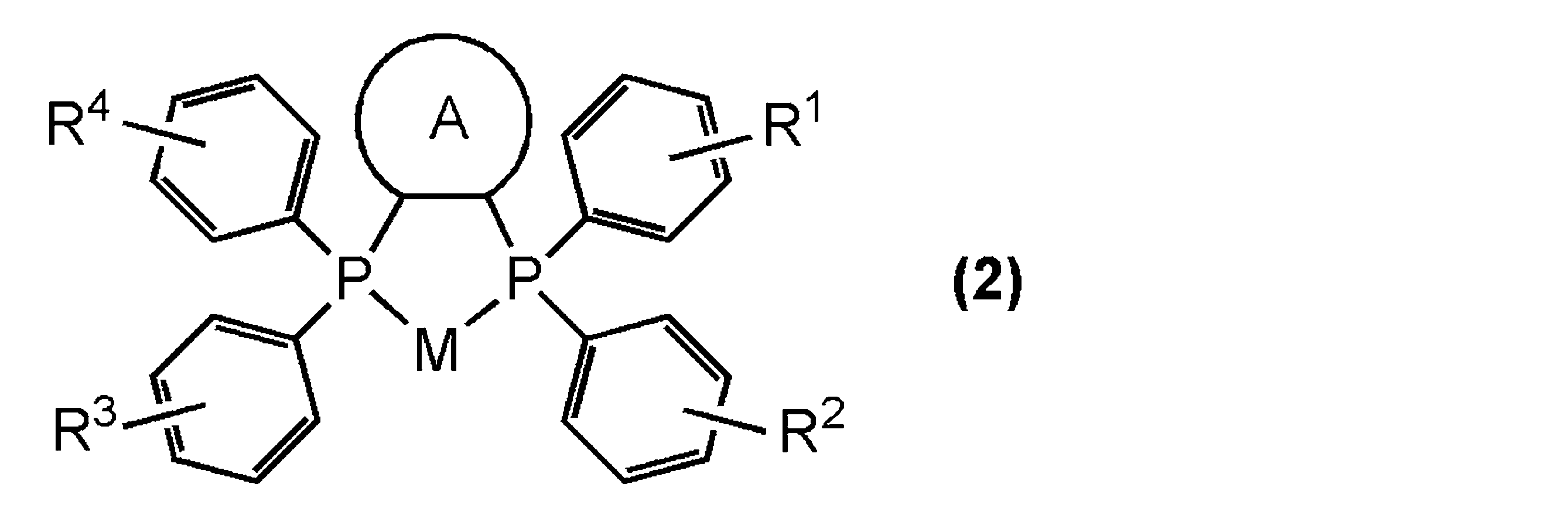
Mは、配位子を有することができる金属又は金属イオンである。
上記高分子遷移金属錯体は、下記一般式(1)で示される高分子化合物とMとが結合することで得られる。
<一般式(1)で示される高分子化合物>
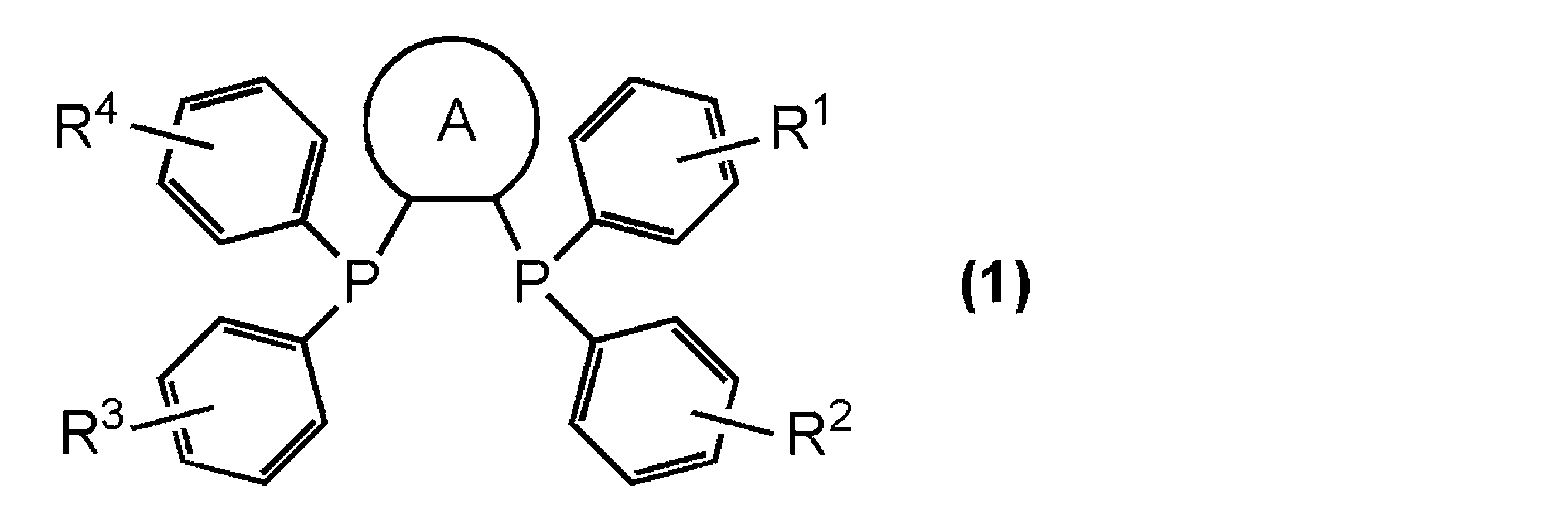
式中、

は、無置換若しくは置換基を有する芳香族炭化水素基、又は無置換若しくは置換基を有する芳香族ヘテロ炭化水素基である。但し、2つ存在するリン原子Pと結合する原子はそれぞれ炭素原子であり、かつ隣り合う炭素原子である。
芳香族炭化水素基としては、例えば、炭素原子を6~14個含み、縮環していてもよい芳香族炭化水素基が挙げられる。単環の芳香族炭化水素基は、例えば、置換又は無置換のフェニレン基である。多環の芳香族炭化水素基は、例えば、置換又は無置換のナフタレン基である。
芳香族ヘテロ炭化水素基としては、例えば、硫黄原子、酸素原子及び窒素原子からなる群から選ばれる原子を1~3個含み、縮環していてもよい5~14員芳香族ヘテロ炭化水素基が挙げられる。
単環の芳香族ヘテロ炭化水素基としては、例えば、置換又は無置換のアゾール基、オキソール基、チオール基、ピリジン基、ピリリウムイオン基、チオピリリウムイオン基、アゼピン基、オキセピン基、チエピン基、イミダゾール基、ピラゾール基、オキサゾール基、チアゾール基、イミダゾリン基、ピラジン基、及びチアジン基を挙げることができる。
多環の(縮環した)芳香族ヘテロ炭化水素基としては、例えば、置換又は無置換のインドール基、イソインドール基、ベンゾイミダゾール基、キノリン基、イソキノリン基、キナゾリン基、フタラジン基、プテリジン基、クマリン基、クロモン基、1,4-ベンゾジアゼピン、ベンゾフラン基、アクリジン基、フェノキサジン基、フェノチアジン基等を挙げることができる。
芳香族炭化水素基及び芳香族ヘテロ炭化水素基が有してもよい置換基としては、特に限定されず、例えばC1-6アルキル基、C1-6ぺルフルオロアルキル基、アルコキシ基、シロキシ基、ジアルキルアミノ基等が挙げられる。C1-6アルキル基としては、例えば、メチル、エチル、プロピル、イソプロピル、ブチル、イソブチル、sec-ブチル、tert-ブチル、ペンチル、ヘキシル等が挙げられる。C1-6ぺルフルオロアルキル基としては、例えば、トリフルオロメチル、ペンタフルオロエチル、ヘプタフルオロプロピル、トリデカフルオロヘキシル等が挙げられる。シロキシ基としては、トリメチルシロキシ、トリエチルシロキシ、トリイソプロピルシロキシ、tert-ブチルジメチルシロキシ等を例示できる。アルコキシ基としては、例えば、C1-6アルコキシ基が挙げられる。C1-6アルコキシ基としては、メトキシ基、エトキシ基、ヘキシルオキシ基等を例示できる。ジアルキルアミノ基としては、ジメチルアミノ、ジエチルアミノ等を例示できる。置換基の置換位置及び置換基の数は、特に限定されない。
R1、R2、R3、R4は、独立に、R1、R2、R3、R4がそれぞれ結合するフェニレン基と共に形成する、直鎖又は架橋型ポリスチレン鎖である。
各架橋型ポリスチレン鎖は、式(4)で示されるビスホスフィン単位を少なくとも1つ含むことができ、式(4)で示されるビスホスフィン単位を含むことで、架橋構造が形成される。式(4)で示されるビスホスフィン単位を含まないポリスチレン鎖は、直鎖のポリスチレンである。
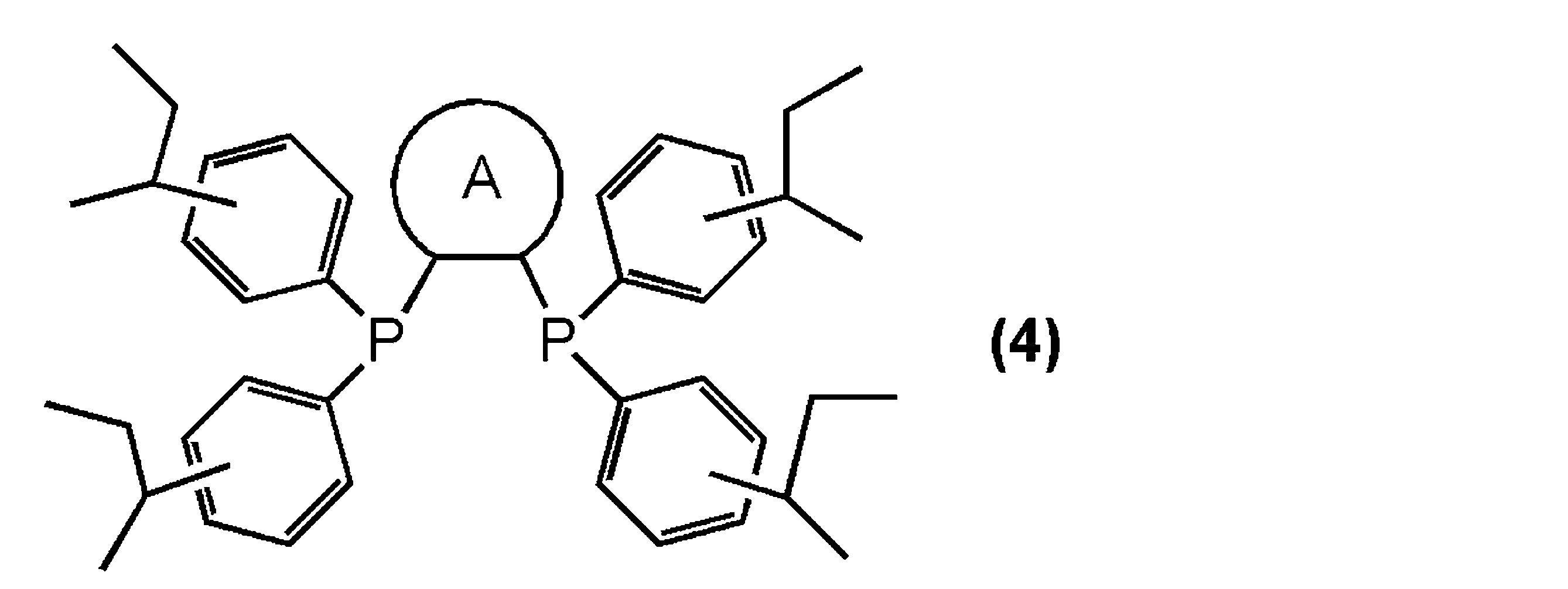
式(4)中の4つのフェニル基の任意の位置にそれぞれ結合する

は、ビニル基の重合反応により形成されるエチレン基である。
各架橋型ポリスチレン鎖は、式(4)で示されるビスホスフィン単位を少なくとも1つ含むことができ、式(4)で示されるビスホスフィン単位を含むことで、架橋構造が形成される。式(4)で示されるビスホスフィン単位を含まないポリスチレン鎖は、直鎖のポリスチレンである。
ポリスチレン鎖のフェニル基は、式(4)で示される繰返単位を含む場合以外は、無置換であるか、又は前記ポリスチレン鎖のフェニル基の少なくとも一部は置換基Rを有する。置換基は、例えば、C1-6アルキル基、C1-6アルコキシ基及び極性官能基を挙げることができる。C1-6アルキル基としては、例えば、メチル、エチル、プロピル、イソプロピル、ブチル、イソブチル、sec-ブチル、tert-ブチル、ペンチル、ヘキシル等が挙げられる。C1-6アルコキシ基としては、メトキシ基、エトキシ基、ヘキシルオキシ基等を例示できる。極性官能基としては、例えば、ヒドロキシル基、ポリエーテル基、アセトキシ基、エステル基、アミド基などを挙げることができる。ポリエーテル基としては、例えばエチレングリコール単位を有するオリゴマーまたはポリマー鎖を挙げることができ、エチレングリコール単位の数は、例えば、2以上、100以下であることができる。ポリエーテル基は、より具体的には、例えば、テトラエチレングリコールモノメチルエーテル基などである。エステル基としては、炭素数1~6の低級アルキル基とのエステル基を例示することができ、具体的には、例えば、メチルエステル基、エチルエステル基などである。アミド基のアシル基の置換基としては、炭素数1~6の低級アルキル基を挙げることができ、具体的には、例えば、メチルアミド基、エチルアミド基などである。触媒活性向上効果の高い置換基Rは、例えば、メチル基やt-ブチル基である。1つのフェニル基が有する置換基の数は、例えば、1~5、好ましくは1~3の範囲である。
一般式(1)で示される高分子化合物は、例えば、下記一般式(5)で示される化合物をスチレン又は置換基Rを有するスチレンと共重合することで得られる共重合体である。この共重合体は、一般式(1)で示される共重合体であり、一般式(4)で示されるビスホスフィン単位を少なくとも1つ含む。


共重合用モノマーとして上記一般式(5)のビスホスフィンモノマーを用いることで、ポリスチレン鎖に導入され、一般式(5)のビスホスフィンモノマーは4官能性であることから、各ビニル基が、それぞれ異なるポリスチレン鎖に導入されて、4本のポリスチレン鎖に1つのビスホスフィン単位が共重合単位として含有された共重合体を得ることができる。これによって、スチレン4点架橋型ホスフィン単位が形成される。
本発明の共重合体におけるビスホスフィン単位の導入量は、特に制限はないが、例えば、ビスホスフィン単位1に対して当量比で、スチレン単位を10~1000の範囲とすることができる。但し、本発明の共重合体を、後述する金属錯体の配位子として用いる場合、ビスホスフィン単位のリンが金属に対して配位する部位になること、および得られる金属錯体は触媒として使用することから、単量当たり比較的高い触媒活性が得られるという観点から、ビスホスフィン単位の量は比較的高い方が好ましい。但し、ビスホスフィン単位の量が過剰になると、ビスホスフィン単位が接近しすぎて、立体障害により共重合反応が進みにくくなり、また得られた共重合体の架橋比率が高まり、取扱が困難になる可能性がある。このような観点を考慮して、ビスホスフィン単位1に対して当量比で、R1、R2、R3、R4の各ポリスチレン鎖のスチレン単位を1~200の範囲、好ましくは5~150の範囲、より好ましくは10~100の範囲とすることができる。尚、上記当量比の好ましい範囲は、置換基Rを有するスチレンのRの種類によっても変化する。
一般式(1)で示される高分子化合物は、

が無置換のフェニレン基であり、R1、R2、R3、R4が、独立に、R1、R2、R3、R4がそれぞれ結合するフェニレン基と共に形成する、直鎖又は架橋型ポリスチレン鎖である場合、下記の模式的な化学式で示すことができる。式中、PSは、直鎖のポリスチレン鎖であるか、又は式(4)で示されるビスホスフィン単位を含む架橋型のポリスチレン鎖であることができる。一般式(1)で示される高分子化合物は、遷移金属に対する配位子として機能し、配位子として用いることができる。Rは、置換基であるか、水素原子である。
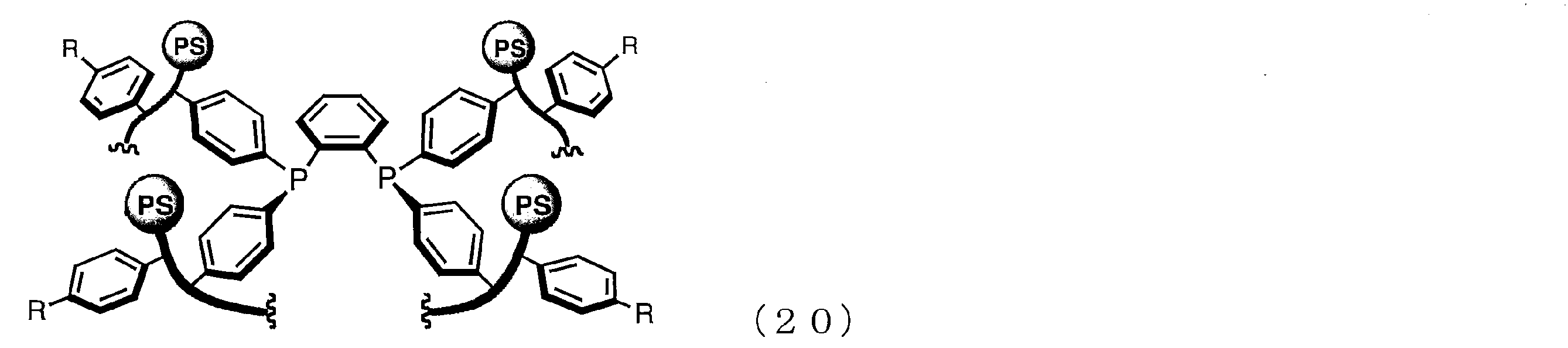


前記式(20)では共重合成分中のポリスチレン単位鎖PSは、独立に記載されているが、鎖を省略した部分においても、各ポリスチレン単位鎖PSは独立した鎖であることもできるし、式中で示される他のポリスチレン単位鎖PSと連結している場合もあり得る。
上記式(20)の共重合体におけるポリスチレン単位鎖PSは、Rが水素原子の場合には、共重合単位がビスホスフィン単位以外の部分はスチレン単位からなる。Rが水素原子以外の場合には、ポリスチレン鎖PSの各スチレン単位は、Rを置換基として有するものである。あるいは、ポリスチレン鎖PSの各スチレン単位は、Rとして水素原子、炭素数1~6の低級アルキル基、炭素数1~6の低級アルコキシ基及び極性官能基のいずれか少なくとも2種類を有するものであることもできる。その場合の異なるRの配列はランダムであることができる。さらに、ポリスチレン単位鎖PSへのビスホスフィン単位の導入はランダムである。従って、本発明の共重合体はランダム共重合体である。
本発明の共重合体においては、スチレン単位のフェニル環上に置換基Rとして水素原子以外の残基を導入することによって、この共重合体を用いた遷移金属との錯体を触媒として用いる場合、触媒活性を向上させる事もできる。Rの例は、前述のように炭素数1~6の低級アルキル基は、炭素数1~6の低級アルコキシ基及び極性官能基である。触媒活性向上効果の高い置換基Rは、例えば、メチル基やt-ブチル基である。
本発明の共重合体における複数のポリスチレン鎖は、ジビニルベンゼン単位による架橋を含むことができる。本発明の共重合体にジビニルベンゼン単位による架橋を導入することで、共重合体の強度を調整することができ、成形性を向上させることもできる。但し、ビスホスフィン単位もポリスチレン鎖を架橋する機能を有するので、ジビニルベンゼン単位による架橋を含まず、ビスホスフィン単位の導入のみで、共重合体強度調整および成形性向上は可能である。ビスホスフィン単位の導入量と所望の共重合体強度および成形性を考慮して、ジビニルベンゼン単位の導入量は適宜決定することができる。
ジビニルベンゼン単位による架橋量は、スチレン単位とビスホスフィン単位との量比を考慮して適宜決定できる。例えば、実施例において示したビスホスフィン単位1当量に対してスチレン単位60当量を共重合させる場合であってジビニルベンゼン単位をさらに共重合させる場合には、ジビニルベンゼン単位の当量比は、例えば、0.1~5の範囲で適宜選択することができ、0.2~4の範囲とすることもできる。上述のようにジビニルベンゼン単位の導入量が多くなれば、共重合体の強度を高め、あるいは成形性を向上させることができる。
ジビニルベンゼン単位を含む共重合体の場合、より一般的には、ビスホスフィン単位、スチレン単位およびジビニルベンゼン単位の当量比は、例えば、1:10~1000:0.1~20の範囲とすることができる。好ましくは1:20~200:0.1~10、より好ましくは1:30~200:0.1~10、さらに好ましくは1:40~200:0.1~10の範囲とする。ジビニルベンゼンは、例えば、m-ジビニルベンゼン, p-ジビニルベンゼンまたはそれらの混合物であることができる。さらに、ジビニルベンゼンは製法上の理由により、エチルビニルベンゼンを不純物として含むことがあり、ジビニルベンゼンとしてこの不純物を含有するものを用いることも出来、その場合、得られる本発明の共重合体は、ジビニルベンゼン単位に加えてやエチルビニルベンゼン単位を含むものであることもできる。
一般式(1)で示される高分子化合物(共重合体)は、架橋高分子化合物(共重合体)であることから分子量の特定は技術的に困難である。分子量または重合度に代わって有機溶媒中における膨潤容積を表示する。一般式(1)で示される高分子化合物(共重合体)は、有機溶媒中、例えば、ヘキサン、ジクロロメタン、トルエン、t-ブチルメチルエーテル、テトラヒドロフラン、シクロペンチルメチルエーテル、ジエチルエーテル、アセトン、酢酸エチル、ジメチルホルムアミド、メタノールにおける膨潤容積が、2.0~7.0 mL/gの範囲である。好ましくは3.0~7.0 mL/gの範囲である。特に好ましくはトルエンまたはシクロペンチルメチルエーテルにおける膨潤容積が、2.0~7.0 mL/gの範囲、さらに好ましくは3.0~7.0 mL/gの範囲である。
本発明の共重合体は、一般式(3)で示されるビスホスフィンスチレンモノマー、スチレン及び/又は置換基Rを有するスチレンをランダム共重合すること、一般式(3)で示されるビスホスフィンスチレンモノマー、スチレン及び/又は置換基Rを有するスチレン並びにジビニルベンゼンをランダム共重合することで合成できる。一般式(3)で示されるビスホスフィンスチレンモノマー(化合物1)は、特許文献1に報告がある化合物である。但し、この文献には、スペクトルデータは記載されていない。実施例において化合物1として合成例を示す。Rを含むスチレンおよびジビニルベンゼンは市販品として入手できる。置換基Rを有するスチレンの置換基Rは、前記置換基Rを有するスチレン単位において説明したものと同様であり、Rは、水素原子、炭素数1~6の低級アルキル基、炭素数1~6の低級アルコキシ基または極性官能基である。置換基Rが異なる少なくとも2種類のスチレンを用いることで、2種類の置換基Rを有するスチレン単位を含む共重合体を得ることもできる。
共重合体は、上記2種類~4種類のモノマーを所定の比率で、公知の重合開始剤を用いて、例えば、懸濁重合させることで合成できる。懸濁重合は、例えば、50~100℃で1~72時間の範囲で実施できる。但し、この範囲に限定される意図はなく、原料として用いるモノマーの種類や比率、使用する重合開始剤の種類や量、懸濁重合の条件などに応じて適宜決定することができる。
<錯体>
本発明の錯体は、下記一般式(2)で示される高分子遷移金属錯体であり、上記一般式(1)で示される高分子化合物(共重合体)と遷移金属Mとを含む。

本発明の錯体は、下記一般式(2)で示される高分子遷移金属錯体であり、上記一般式(1)で示される高分子化合物(共重合体)と遷移金属Mとを含む。
遷移金属としては、例えば第一遷移元素(3d遷移元素)、第二遷移元素(4d遷移元素)及び第三遷移元素(5d遷移元素)を挙げることができる。第一遷移元素としては、スカンジウム(Sc)、チタン(Ti)、バナジウム(V)、クロム(Cr)、マンガン(Mn)、鉄(Fe)、コバルト(Co)、ニッケル(Ni)、銅(Cu)、及び亜鉛(Zn)を例示できる。第二遷移元素としては、イットリウム(Y)、ジルコニウム(Zr)、ニオブ(Nb)、モリブデン(Mo)、テクネチウム(Tc)、ルテニウム(Ru)、ロジウム(Rh)、パラジウム(Pd)、銀(Ag)、及びカドミウム(Cd)を例示できる。第三遷移元素(5d遷移元素)としては、タングステン(W)、レニウム(Re)、オスミウム(Os)、イリジウム(Ir)、白金(Pt)、金(Au)、鉛(Pb)を例示できる。遷移金属は、触媒活性という観点からは、例えば、パラジウム(Pd)、イリジウム(Ir)、ロジウム(Rh)、白金(Pt)、ルテニウム(Ru)、コバルト(Co)、ニッケル(Ni)、銅(Cu)等であることが好ましい。但し、これらの元素に限定される意図ではない。本発明の錯体は、上記本発明の共重合体を配位子として含有する。
本発明の錯体では、一般式(2)で示される共重合体は、一般式(3)で示されるビスホスフィン単位を含み、一般式(3)で示されるビスホスフィン単位の2つのリン(P)が遷移金属に配位する。そのため、遷移金属が第一遷移元素(3d遷移元素)の場合であっても、安定な錯体を形成し得る。
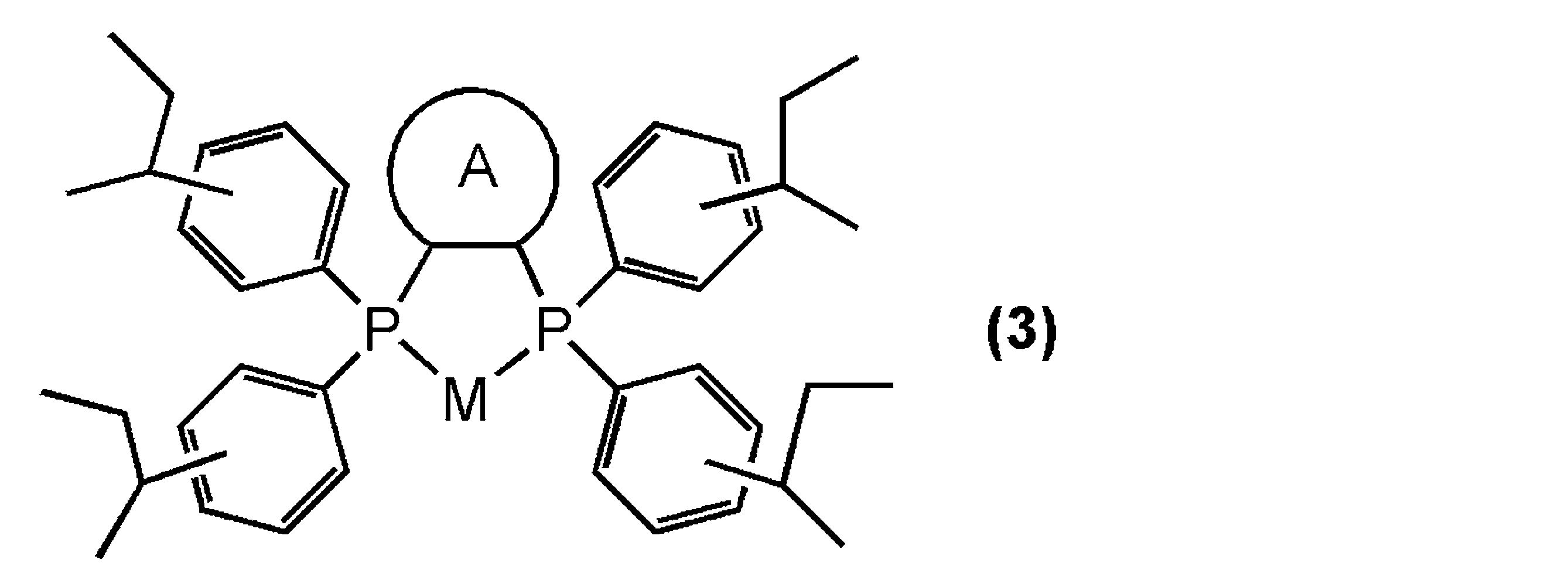
式(3)中、

は、式(2)と同義であり、4つのフェニル基の任意の位置にそれぞれ結合する

は、ビニル基の重合反応により形成されるエチレン基である。
本発明の錯体は、遷移金属錯体の配位子として汎用される、例えば、アルケン(例えば、脂肪族アルケンおよび脂環式アルケン(シクロアルケン)を挙げることができる。脂肪族アルケンの例:エチレン、脂環式アルケンの例:1,5-シクロオクタジエン)、ハロゲン(フッ素、塩素、臭素、ヨウ素)、カルボニル(エステル、アルデヒド、ケトン、アミド)、ヒドロキシ、ニトロ、アミノ、スルホニル、シアノ等の官能基をさらに含むことができる。これら配位子の種類及び数(1個の遷移金属に配位子する数)は、遷移金属の種類に応じて適宜決定される。本発明の錯体は、遷移金属と前記配位子の1種または2種以上とからなる錯体と一般式(1)で示される高分子化合物(共重合体)と有機溶媒中で混合することにより調製することができる。用いる有機溶媒は、例えば、実施例で用いたトルエン、および前記本発明の高分子化合物(共重合体)の膨潤容積測定用有機溶媒の中から適宜選択することができる。
本発明の錯体における、上記本発明の高分子化合物(共重合体)中のビスホスフィン単位と遷移金属との当量比は、1:1である。即ち、1つの金属に対して1つのビスホスフィン単位(2つのリンを含む)が錯体を形成する。本発明の錯体は、高分子化合物(共重合体)中のビスホスフィン単位の少なくとも一部において金属錯体が形成されているものである。本発明の錯体を後述する触媒に用い、単位質量当たりの触媒反応活性が高いという観点からは、金属錯体を形成している高分子化合物(共重合)体中の一般式(3)で示されるビスホスフィン単位が多いほど好ましい。例えば、共重合体中のビスホスフィン単位の50~100%、好ましくは70~100%、より好ましくは90~100%が金属錯体を形成する。
<触媒>
本発明は、上記本発明の錯体を含むカップリング反応用触媒に関する。カップリング反応とは、有機化合物の炭素と有機化合物の炭素、又は有機化合物の炭素と有機化合物のヘテロ原子との間に新たな結合を生じさせる反応を意味する。カップリング反応としては、例えば、C-Cカップリング反応、C-Nカップリング反応、C-H/C-Oカップリング反応などを挙げることができる。
本発明は、上記本発明の錯体を含むカップリング反応用触媒に関する。カップリング反応とは、有機化合物の炭素と有機化合物の炭素、又は有機化合物の炭素と有機化合物のヘテロ原子との間に新たな結合を生じさせる反応を意味する。カップリング反応としては、例えば、C-Cカップリング反応、C-Nカップリング反応、C-H/C-Oカップリング反応などを挙げることができる。
代表的なカップリングとして鈴木-宮浦カップリングを挙げることができ、好ましくは、ハロゲン化アリール又はハロゲン化アルケニルと、アリールボロン誘導体又はアルケニルボロン誘導体との縮合反応によって、ジアリール誘導体、アルケニルアリール誘導体又は1,3-ジエン類を生成する反応である。具体例としては、例えば、ハロゲン化ベンゼンとフェニルボロン酸とを縮合させてビフェニルを生成する反応を挙げられる。
上記有機ハロゲン化物のハロゲンとしては、塩素原子、臭素原子、又はヨウ素原子などが挙げられる。ハロゲン化アリールのアリール基としては、炭素環式芳香族基や複素環式芳香族基が挙げられる。炭素環式芳香族基としては、炭素数6~36、好ましくは炭素数6~18、炭素数6~12の単環式、多環式、又は縮合環式の炭素環式芳香族基が挙げられる。このような炭素環式芳香族基としては、例えば、フェニル基、ナフチル基、ビフェニル基、フェナントリル基、アントリル基などが挙げられる。また、複素環式芳香族基としは、1個~4個、好ましくは1~3個又は1~2個の窒素原子、酸素原子、又は硫黄原子からなる異種原子を含有する3~8員、好ましくは5~8員の環を有する単環式、多環式、又は縮合環式の複素環基が挙げられる。このような複素環基としては、例えば、フリル基、チエニル基、ピロリル基、ピリジル基、インドール基、ベンゾイミダゾリル基などが挙げられる。これらのアリール基はさらに置換基を有していても良く、このような置換基としては反応に悪影響を与えないものであれば特に制限はなく、例えば、前記したハロゲン原子、ニトロ基、置換又は非置換の炭素数1~20好ましくは1~10のアルキル基、置換又は非置換の炭素数1~20、好ましくは1~10のアルコキシ基、置換又は非置換の炭素数1~20、好ましくは1~10のアルコキシカルボニル基などが挙げられる。また、ハロゲン化アルケニルのアルケニル基としては、置換又は非置換のビニル基であり、当該ビニル基の置換基としては、置換又は非置換の炭素数1~20、好ましくは1~10のアルキル基、置換又は非置換の炭素数1~20、好ましくは1~10のアルケニル基、置換又は非置換の炭素数6~20好ましくは6~10のアリール基、置換又は非置換の炭素数7~20、好ましくは7~12のアルキニル基などが挙げられる。これらの置換基としては反応に悪影響を与えないものであれば特に制限はない。
上記ボロン誘導体としては、オルトホウ酸のモノ、ジ若しくはトリエステル又はこれらの誘導体が挙げられるが、必ずしもオルトホウ酸又はこの誘導体に限定されるものではない。アリールボロン誘導体のアリール基としては、置換又は非置換のフェニル基、ナフチル基、ピリジン基、フリル基などの芳香環が挙げられ、これらの置換基としては反応に悪影響を与えないものであれば特に制限なく、例えば、塩素原子、臭素原子又はヨウ素原子などのハロゲン原子、置換又は非置換の炭素数1~20、好ましくは1~10のアルキル基、置換又は非置換の炭素数1~20、好ましくは1~10のアルコキシ基などが挙げられる。アルケニルボロン誘導体のアルケニル基としては、置換又は非置換ビニル基が挙げられ、これらの置換基としては反応に悪影響を与えないものであれば特に制限はない。
カップリング反応の例としては、溝呂木-Heck反応を挙げることができる。この反応は、アルケン類と、ハロゲン化アリール又はハロゲン化アルケニルとの縮合反応によるアリールアルケン類又は1,3-ジエンを生成する反応である。
上記アルケン類としては、少なくとも1個の水素原子を有するエチレン誘導体が挙げられる。好ましくはエチレンの少なくとも1個の水素原子がケト基、置換又は非置換のアルコキシカルボニル基、及び/又は、置換又は非置換のアリール基が置換したエチレン誘導体が挙げられる。当該アリール基としては前記した炭素環式芳香族基、複素環式芳香族基が挙げられる。これらの置換基としては、反応に悪影響を与えないものであれば特に制限はなく、例えば、前記した置換基などが挙げられる。より好ましいアルケン類としては、置換又は非置換の3-ケトアルケン類、置換又は非置換のスチレン誘導体、置換又は非置換の(メタ)アクリル酸エステル類などが挙げられる。当該アクリル酸エステル類のエステル残基としては、置換又は非置換の炭素数1~20、好ましくは1~10のアルキル基が挙げられ、これらの置換基としては反応に悪影響を及ぼさない限り特に制限はない。好ましいアルケン類の例としては、例えば、アクリル酸メチルなどのアクリル酸エステル類、3-ケトブテンなどの3-ケトアルケン類、スチレンなどのスチレン誘導体が挙げられるが、これらの化合物に限定されるものではない。
上記有機ハロゲン化物のハロゲンとしては、塩素原子、臭素原子、又はヨウ素原子などが挙げられる。アリールまたはアルケニル基としては、脂肪族または芳香族置換基であればよく、例えば、置換又は非置換のビニル基、置換又は非置換のアリール基が挙げられ、アリール基としては前記した炭素環式芳香族や複素環式芳香族基などが挙げられる。また、これらの置換基としては反応に悪影響を与えないものであれば特に制限はない。
カップリング反応の例としては、Stilleカップリングを挙げることもできる。具体例としては、アリール又はアルケニルスズ化合物と、ハロゲン化アリール又はハロゲン化アルケニルとの縮合反応によるビアリール類、アリールアルケン類または、1,3-ジエンの生成反応を挙げることができる。
上記スズ化合物の有する置換基としては、アリール基が挙げられ、例えば置換又は非置換のフェニル基、ナフチル基、ピリジン基、フリル基などの芳香環が挙げられ、これらの置換基としては反応に悪影響を与えないものであれば特に制限なく、例えば、塩素原子、臭素原子又はヨウ素原子などのハロゲン原子、置換又は非置換の炭素数1~20、好ましくは1~10のアルキル基、置換又は非置換の炭素数1~20、好ましくは1~10のアルコキシ基などが挙げられる。また、アルケニル基を有するスズ化合物でもよく、そのアルケニル基としては、置換又は非置換ビニル基が挙げられ、これらの置換基としては反応に悪影響を与えないものであれば特に制限はない。
カップリング反応としては、園頭カップリングを挙げることもできる。具体的には、アルキン類とハロゲン化アリール又はハロゲン化アルケニルとの縮合反応によるアリールアルキン類又はアルケニルアルキンを生成する反応を挙げることができる。
上記アルキン類の置換基としては、置換又は非置換のフェニル基、ナフチル基、ピリジル基、フリル基などの芳香族基が挙げられ、これらの置換基としては反応に悪影響を与えないものであれば特に制限はなく、例えば、塩素原子、臭素原子又はヨウ素原子などのハロゲン原子、置換又は非置換の炭素数1~20、好ましくは1~10のアルキル基、置換又は非置換の炭素数1~20、好ましくは1~10のアルコキシ基などが挙げられる。また、アルキン類の置換基としては、置換又は非置換ビニル基が挙げられ、これらの置換基としては反応に悪影響を与えないものであれば特に制限はない。
上記有機ハロゲン化物のハロゲンとしては、塩素原子、臭素原子又はヨウ素原子などが挙げられる。アリール基またはアルケニル基としては、脂肪族または芳香族置換基であればよく、例えば、置換又は非置換のビニル基、置換又は非置換のアリール基が挙げられ、アリール基としては前記した炭素環式芳香族や複素環式芳香族基などが挙げられる。また、これらの置換基としては反応に悪影響を与えないものであれば特に制限はない。
カップリング反応としては、Buchwald-Hartwigカップリングを挙げることもできる。具体的には、炭素-酸素又は炭素-硫黄、より好ましくは炭素-窒素の結合形成反応を利用した、例えば1つ以上のアルキル基又はアリール基をもつアミン類とハロゲン化アリール又はハロゲン化アルケニルとの縮合反応による置換アミン類の生成反応である。
上記アミン類の置換基としては、置換又は非置換の炭素数1~20、好ましくは1~10のアルキル基、或いは、置換又は非置換のフェニル基、ナフチル基、ピリジル基、フリル基などの芳香族基が挙げられ、これらの置換基としては反応に悪影響を与えないものであれば特に制限はなく、例えば、塩素原子、臭素原子又はヨウ素原子などのハロゲン原子、置換又は非置換の炭素数1~20、好ましくは1~10のアルキル基、置換又は非置換の炭素数1~20、好ましくは1~10のアルコキシ基などが挙げられる。
上記有機ハロゲン化物のハロゲンとしては、塩素原子、臭素原子又はヨウ素原子などが挙げられる。アリール基またはアルケニル基としては、脂肪族または芳香族置換基であればよく、例えば、置換又は非置換のビニル基、置換又は非置換のアリール基が挙げられ、アリール基としては前記した炭素環式芳香族や複素環式芳香族基などが挙げられる。また、これらの置換基としては反応に悪影響を与えないものであれば特に制限はない。
本発明の触媒を用いるカップリング反応は、原料の種類等に応じて反応条件(溶媒、温度、時間など)は適宜決定できる。反応温度としては、例えば、室温から溶媒の沸点温度までの範囲で適宜選択できる。
以下、本発明を実施例に基づいて更に詳細に説明する。但し、実施例は本発明の例示であって、本発明は実施例に限定される意図ではない。
反応容器は加熱-真空-冷却して乾燥させたものを使用し、アルゴンあるいは窒素雰囲気下で反応を行なった。反応液の撹拌にはテフロン(登録商標)コートされた磁気撹拌子を用いて行った。ビス(1,5-シクロオクタジエン)ニッケル(0)(Ni(cod)2)は関東化学社から購入し、トルエン/1,5-シクロオクタジエンから再結晶したものを使用した。ヨウ化コバルト(99.999%)はアルドリッチ社、1,2-ビス(ジクロロホスフィノ)ベンゼンは和光純薬工業社、4-ブロモスチレンは東京化成工業からそれぞれ購入したものを使用した。ピナコールボランは東京化成工業から購入し、減圧蒸留にて精製したものを使用した。スチレン、4-(t-ブチル)スチレン及びジビニルベンゼンは東京化成工業から購入し、活性アルミナカラムを通して精製したものを使用した。使用溶媒は関東化学社の脱水級を購入し、これをさらに凝固-融解法により脱気し、モレキュラーシーブ4Aを用いて脱水して使用した。NMR測定(液体)にはJEOL ECX-400 (1H; 399.8 MHz, 13C; 100.5 MHz, 31P; 161.8 MHz) を使用した。CP/MAS NMR測定(固体)にはBruker MSL-300(13C; 75.5 MHz, 31P; 121.5 MHz)を使用した。各種NMRの化学シフトはテトラメチルシラン(1H; 0 ppm)、重クロロホルム(13C; 77.0 ppm)、85%リン酸(31P; 0 ppm)を参照した。
1,2-ビス[ビス(4-スチリル)ホスフィノ]ベンゼン (化合物1) の合成
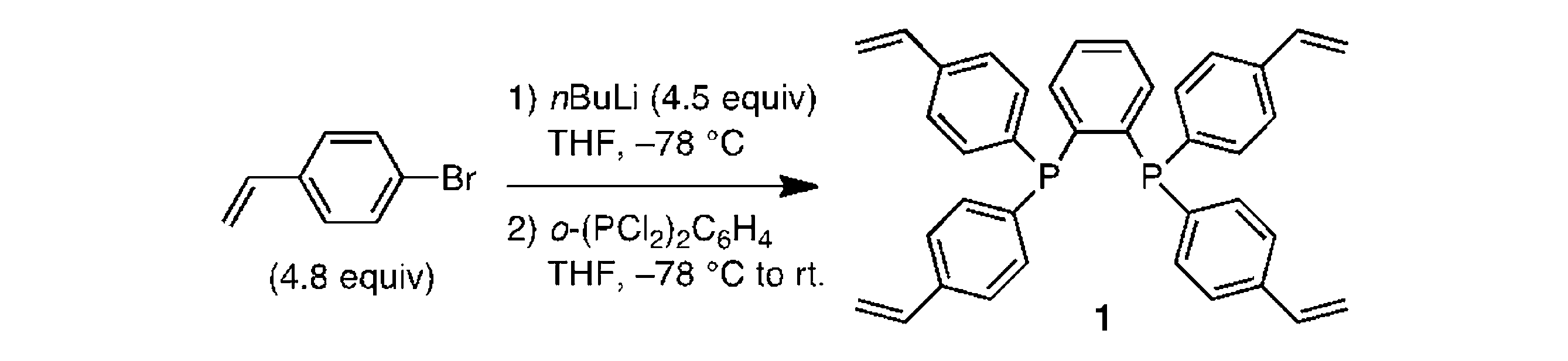
化合物1は特許文献2に報告がある。しかし、スペクトルデータは記載されていない。
300 mLの二口ナス型フラスコに磁気撹拌子を入れ、アルゴン雰囲気下、テトラヒドロフラン(72 mL)と4-ブロモスチレン(2.6 g, 14.4 mmol)を順次加えた。反応溶液を-78℃まで冷却後、n-ブチルリチウム(8.5 mL, 1.6 M へキサン溶液, 13.6 mmol)を滴下し、-78℃で2時間撹拌し、対応する有機リチウム試薬を調製した。さらに-78℃で1,2-ビス(ジクロロホスフィノ)ベンゼン(0.84 g, 3.0 mmol)を加え、徐々に室温まで昇温して4時間撹拌した。反応混合物にメタノールを加えた後、減圧下で有機溶媒を留去した。この粗生成物をシリカゲルカラムクロマトグラフィー(ヘキサン:酢酸エチル = 97 : 3)により精製し、化合物1を単離した。収量 0.98 g, 収率 59%
300 mLの二口ナス型フラスコに磁気撹拌子を入れ、アルゴン雰囲気下、テトラヒドロフラン(72 mL)と4-ブロモスチレン(2.6 g, 14.4 mmol)を順次加えた。反応溶液を-78℃まで冷却後、n-ブチルリチウム(8.5 mL, 1.6 M へキサン溶液, 13.6 mmol)を滴下し、-78℃で2時間撹拌し、対応する有機リチウム試薬を調製した。さらに-78℃で1,2-ビス(ジクロロホスフィノ)ベンゼン(0.84 g, 3.0 mmol)を加え、徐々に室温まで昇温して4時間撹拌した。反応混合物にメタノールを加えた後、減圧下で有機溶媒を留去した。この粗生成物をシリカゲルカラムクロマトグラフィー(ヘキサン:酢酸エチル = 97 : 3)により精製し、化合物1を単離した。収量 0.98 g, 収率 59%
1の化合物データ:
M.p.: 69-71℃
1H NMR (CDCl3): δ 5.23 (d, J = 11.2 Hz, 4H), 5.72 (d, J = 18.0 Hz, 4H), 6.64 (dd, J = 11.2, 18.0 Hz, 4H), 7.08-7.13 (m, 10H), 7.19-7.27 (m, 10H).
13C NMR (CDCl3): δ 114.42, 126.07 (t, J = 3 Hz), 129.08, 133.50-134.35 (m), 136.34, 136.44, 137.59, 143.57 (t, J = 10 Hz).
31P NMR (CDCl3): δ-14.4.
HRMS-EI (m/z): [M]+ calcd for C38H32P2, 550.19792; found, 550.19617.
M.p.: 69-71℃
1H NMR (CDCl3): δ 5.23 (d, J = 11.2 Hz, 4H), 5.72 (d, J = 18.0 Hz, 4H), 6.64 (dd, J = 11.2, 18.0 Hz, 4H), 7.08-7.13 (m, 10H), 7.19-7.27 (m, 10H).
13C NMR (CDCl3): δ 114.42, 126.07 (t, J = 3 Hz), 129.08, 133.50-134.35 (m), 136.34, 136.44, 137.59, 143.57 (t, J = 10 Hz).
31P NMR (CDCl3): δ-14.4.
HRMS-EI (m/z): [M]+ calcd for C38H32P2, 550.19792; found, 550.19617.
ポリスチレン四点架橋ビスホスフィンの合成 (2)
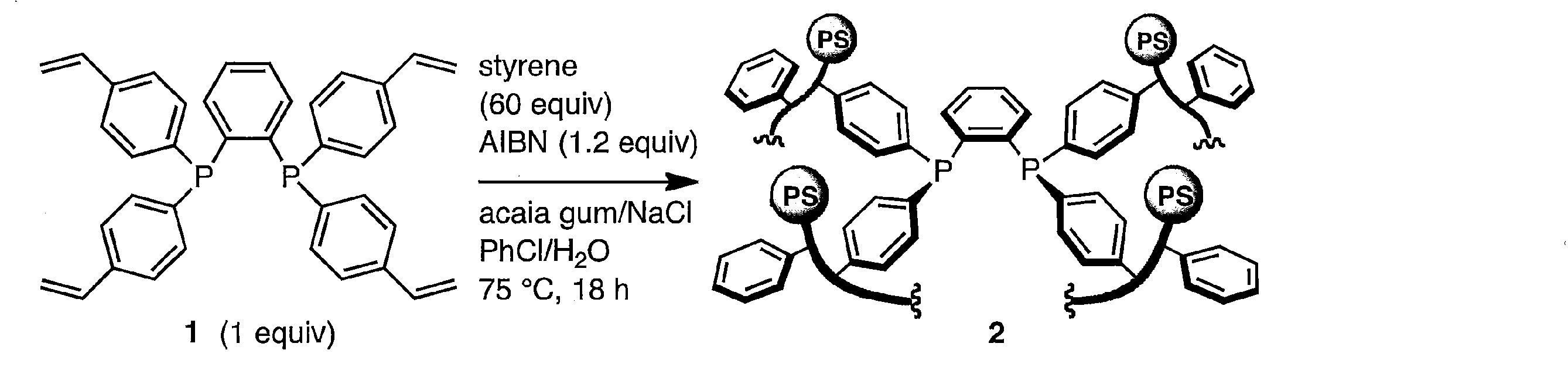
300 mLの3口ナス型フラスコに撹拌子を入れ、アルゴン雰囲気下、塩化ナトリウム(3 g)、アカシアゴム(2.4 g)および水(60 mL; アルゴンバブリングしもの)を順次加えて均一な溶液とし、さらにアルゴンガスを60分間通気した。この溶液に1,2-ビス[ビス(4-スチリル)ホスフィノ]ベンゼン(1当量, 0.25 mmol)、スチレン(60当量, 15 mmol)およびアゾビスイソブチロニトリル(1.2 当量, 0.3 mmol)のクロロベンゼン溶液(3 mL)を加え、75℃に加熱しながら18時間撹拌し、懸濁重合を行った。反応物を室温まで冷却後、不溶物をろ取し、水、メタノール、トルエン-メタノール混合溶媒、テトラヒドロフラン、メタノールで順次洗浄後、100℃で真空乾燥し、ポリスチレン四点架橋ビスホスフィン(2)を白色のビーズ状固体として得た(1.07 g, 63 wt%)。得られたポリマービーズはふるいにかけ、粒径250-710μmのものを触媒反応に使用した。
本反応にて得られるポリマーは不溶性固体であるため、詳細な分子量や重合度を精密に決定することは困難である。ポリマーの組成比は、各々の反応剤が同等の反応性をもって重合が進行していると仮定し、その仕込み比に等しいと算出した(推定ビスホスフィン含有量 [P-P] 0.15 mmol/g)。また、生成物の13C CP/MAS NMR測定の結果より、化合物1のビニル基に由来するピーク(115 ppm付近)が観測されなかったことから、表題の四点架橋ビスホスフィン 2 が生成したと判断される。
ポリスチレン四点架橋ビスホスフィン 2 の化合物データ:
31P CP/MAS NMR: δ -17.
13C CP/MAS NMR: δ 33-60 (br), 130, 148.
ポリスチレン四点架橋ビスホスフィン 2 の化合物データ:
31P CP/MAS NMR: δ -17.
13C CP/MAS NMR: δ 33-60 (br), 130, 148.
ポリスチレン四点架橋ビスホスフィンの合成 (3)

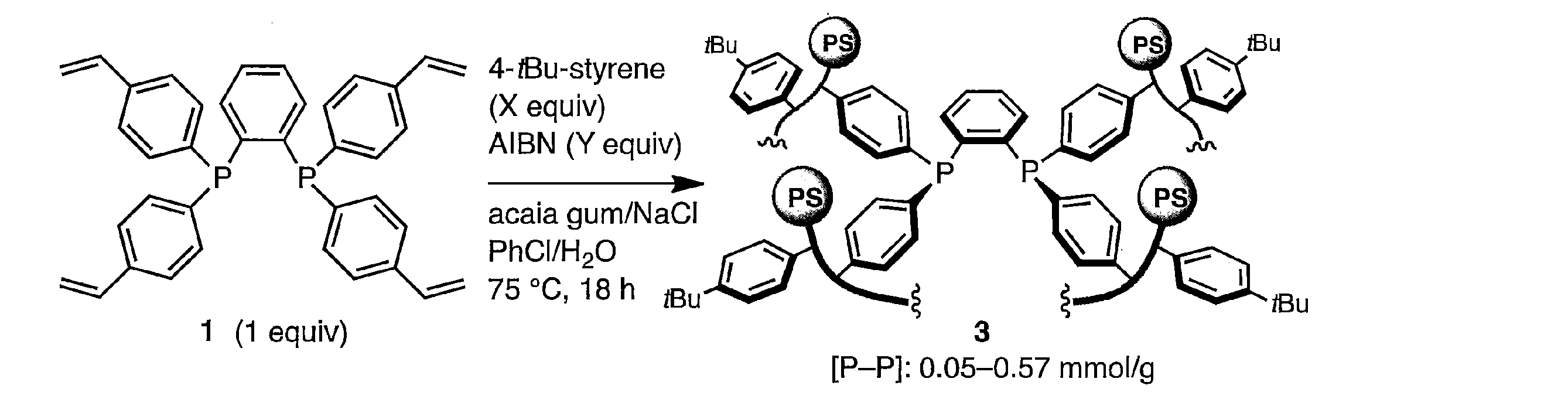
300 mLの3口ナス型フラスコに撹拌子を入れ、アルゴン雰囲気下、塩化ナトリウム(3 g)、アカシアゴム(2.4 g)および水(60 mL; アルゴンバブリングしもの)を順次加えて均一な溶液とし、さらにアルゴンガスを60分間通気した。この溶液に1,2-ビス[ビス(4-スチリル)ホスフィノ]ベンゼン(1当量, 0.25 mmol)、4-(t-ブチル)スチレン(60当量, 15 mmol)およびアゾビスイソブチロニトリル(1.2 当量, 0.3 mmol)のクロロベンゼン溶液(3 mL)を加え、75℃に加熱しながら18時間撹拌し、懸濁重合を行った。反応物を室温まで冷却後、不溶物をろ取し、水、メタノール、トルエン-メタノール混合溶媒、テトラヒドロフラン、メタノールで順次洗浄後、100℃で真空乾燥し、ポリスチレン四点架橋ビスホスフィン(3)を白色のビーズ状固体として得た(2.3 g, 90 wt%)。得られたポリマービーズはふるいにかけ、250-710μmの粒径のものを触媒反応に使用した。
本反応にて得られるポリマーは不溶性固体であるため、詳細な分子量や重合度を精密に決定することは困難である。ポリマーの組成比は、各々の反応剤が同等の反応性をもって重合が進行していると仮定し、その仕込み比に等しいと算出した(推定ビスホスフィン含有量 [P-P] 0.10 mmol/g)。また、生成物の13C CP/MAS NMR測定の結果より、化合物1のビニル基に由来するピーク(115 ppm付近)が観測されなかったことから、表題の四点架橋ビスホスフィン 3 が生成したと判断される。
ポリスチレン四点架橋ビスホスフィン 3 の化合物データ:
31P CP/MAS NMR: δ -17.
13C CP/MAS NMR: δ 34, 36, 37-59 (br), 120-139 (br), 145, 150.
31P CP/MAS NMR: δ -17.
13C CP/MAS NMR: δ 34, 36, 37-59 (br), 120-139 (br), 145, 150.
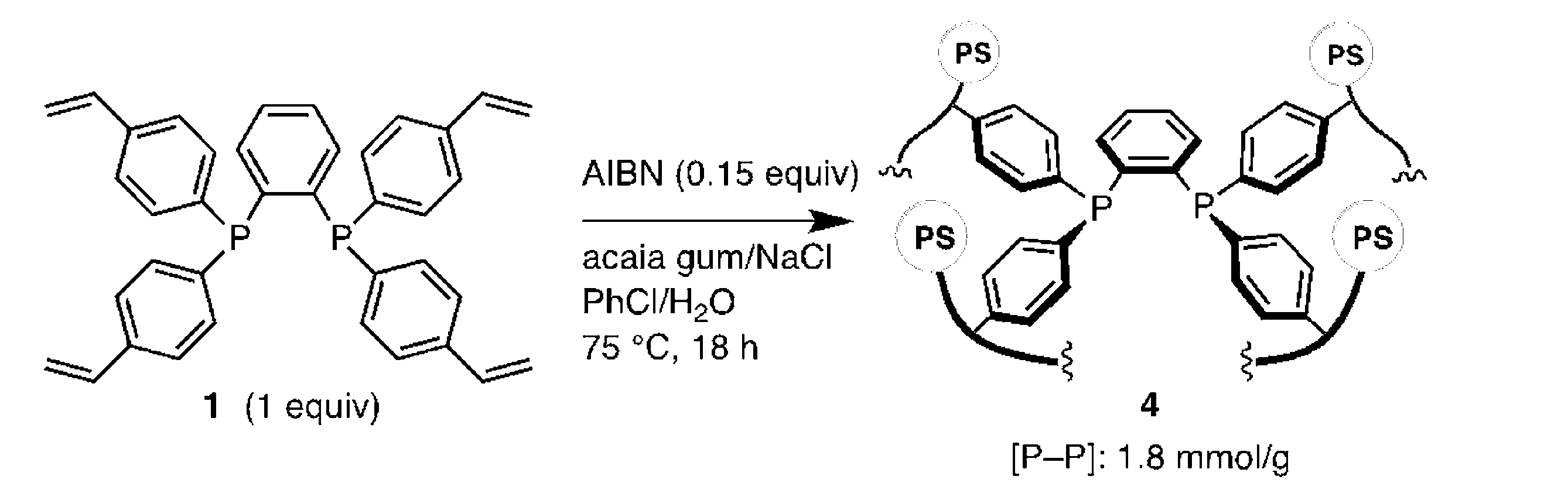
ビスホスフィン含有量の異なるポリスチレン四点架橋ビスホスフィン 3 ([P-P] 0.05-0.57 mmol/g)は、1,2-ビス[ビス(4-スチリル)ホスフィノ]ベンゼンと4-(t-ブチル)スチレンの仕込み比をそれぞれ表1に示すように変更することで合成した(1:120 ~ 1:7.5)。また、1,2-ビス[ビス(4-スチリル)ホスフィノ]ベンゼンの単独重合により得られる有機高分子 4 ([P-P] 1.8 mmol/g)を合成した。

ポリスチレン四点架橋ビスホスフィンの膨潤特性評価:
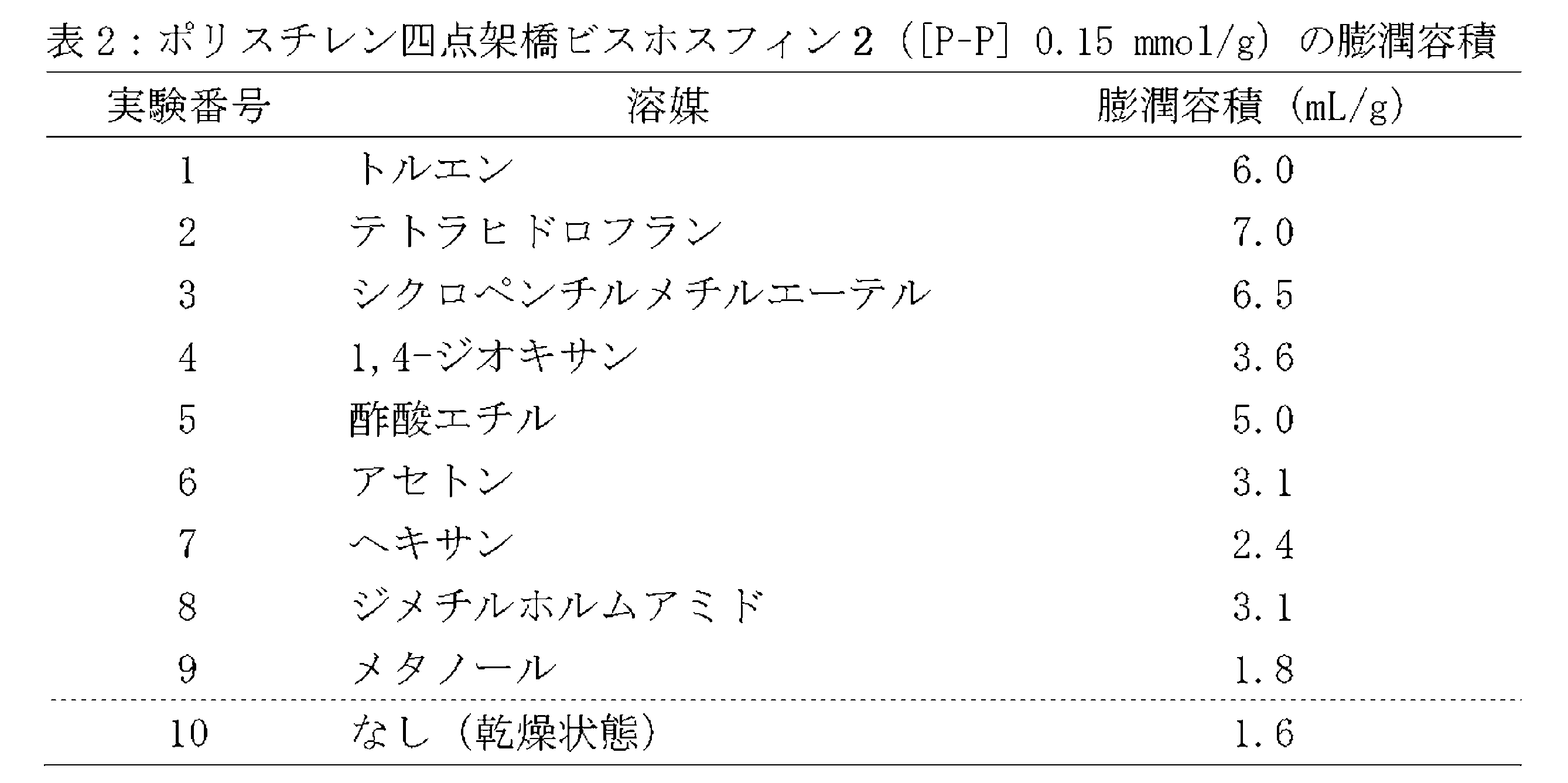
ろ紙を敷いた目盛り付き1.0 mLシリンジにポリスチレン四点架橋ビスホスフィン 100 mg(粒径250-500μm)を入れ、適当な有機溶媒を1.0 mL加えて15分間静置した。過剰の溶媒を除き、膨潤したポリマーの容積を測定した結果を表2および表3に示す。
ろ紙を敷いた目盛り付き1.0 mLシリンジにポリスチレン四点架橋ビスホスフィン 100 mg(粒径250-500μm)を入れ、適当な有機溶媒を1.0 mL加えて15分間静置した。過剰の溶媒を除き、膨潤したポリマーの容積を測定した結果を表2および表3に示す。

PdCl
2
(cod)と3の錯化実験:

10 mLのねじ口試験管に撹拌子、ポリスチレン四点架橋型ホスフィン 3(0.2 g, [P-P] 0.10 mmol/g)、PdCl2(cod)(11.3 mg、0.04 mmol)およびテトラヒドロフラン (4 mL) を加え、室温下1時間撹拌した。反応物をろ取し、ジクロロメタンで洗浄後、60℃で真空乾燥し、[PdCl2(3)]を得た(0.2 g)。減圧下でろ液の有機溶媒を留去した後、未反応のPdCl2(cod)(7.0 mg)を回収した。3のビスホスフィン部位がパラジウムと1:1で反応していると仮定すると、ビスホスフィン含有量は0.07 mmol/gと見積もられた。尚、以降に記載の触媒反応の実施例は、ポリマー合成における原料のモノマーの仕込み比から算出された推定ビスホスフィン含有量を用いて物質量を算出した(表4~7参照)。
[PdCl2(3)]の化合物データ(図1参照):
31P CP/MAS NMR: δ 60.
13C CP/MAS NMR: δ 34, 36, 38-60 (br), 117-137 (br), 145, 149.
31P CP/MAS NMR測定のシグナル(60 ppm)が、類似の構造を有する既知化合物PdCl2(dppbz) (dppbz = 1,2-(ジフェニルホスフィノ)ベンゼン)の31P NMRシグナル(63.8 ppm: McFarlane, H. C. E.; McFarlane, W. Polyhedron 1999, 18, 2117.)とほぼ一致することから、表題の化合物PdCl2(3)が生成したと判断される。
31P CP/MAS NMR: δ 60.
13C CP/MAS NMR: δ 34, 36, 38-60 (br), 117-137 (br), 145, 149.
31P CP/MAS NMR測定のシグナル(60 ppm)が、類似の構造を有する既知化合物PdCl2(dppbz) (dppbz = 1,2-(ジフェニルホスフィノ)ベンゼン)の31P NMRシグナル(63.8 ppm: McFarlane, H. C. E.; McFarlane, W. Polyhedron 1999, 18, 2117.)とほぼ一致することから、表題の化合物PdCl2(3)が生成したと判断される。
Rh[cod]2BF4と3の錯化実験(Rh/3 1:2):

5 mLのねじ口試験管に攪拌子、ポリスチレン四点架橋型ホスフィン3(0.2 g, [P-P] 0.10 mmol/g, 0.02 mmol)、[Rh(cod)2]BF4 (0.01 mmol)およびジクロロメタン (2 mL) を加え、室温下2時間攪拌した。反応物をろ取し、ジクロロメタンとジエチルエーテルで洗浄後、得られた固体を真空乾燥した。このものの31P CP/MAS NMR測定(図2)から、未反応のビスホスフィン3(-17 ppm)に加え、[Rh(3)(cod)]BF4(53 ppm)の生成を確認した。
31P CP/MAS NMR測定のシグナル(53 ppm)が、類似の構造を有する化合物[Rh(dppbz)(cod)]BF4の31P NMRシグナル(58.0 ppm)とほぼ一致することから、表題の化合物[Rh(3)(cod)]BF4が生成したと判断される。
[Rh(dppbz)(cod)]BF4の化合物データ:
M.p.: 175 ℃ (decomp.).
1H NMR (CDCl3): δ 2.30-2.50 (m, 8H), 5.08 (br-s, 4H), 7.47-7.58 (m, 20H), 7.58-7.61 (m, 4H).
13C NMR (CDCl3): δ 29.95, 103.15, 129.48-129.80 (m), 129.95-130.80 (m), 131.82, 132.50-132.95 (m), 133.13, 141.40-142.45 (m).
31P NMR (CDCl3): δ 58.0 (d, JP-Rh = 152 Hz).
HRMS-ESI (m/z) Calcd for [M-BF4]+ C38H36P2Rh, 657.13473; found 657.13495.
M.p.: 175 ℃ (decomp.).
1H NMR (CDCl3): δ 2.30-2.50 (m, 8H), 5.08 (br-s, 4H), 7.47-7.58 (m, 20H), 7.58-7.61 (m, 4H).
13C NMR (CDCl3): δ 29.95, 103.15, 129.48-129.80 (m), 129.95-130.80 (m), 131.82, 132.50-132.95 (m), 133.13, 141.40-142.45 (m).
31P NMR (CDCl3): δ 58.0 (d, JP-Rh = 152 Hz).
HRMS-ESI (m/z) Calcd for [M-BF4]+ C38H36P2Rh, 657.13473; found 657.13495.
Rh[cod]2BF4とdppbzの錯化実験(Rh/dppbz 1:2):

5 mLのねじ口試験管に攪拌子、dppbz(0.02 mmol)、[Rh(cod)2]BF4 (0.01 mmol)および重クロロホルム (1 mL) を加え、室温下10分間攪拌した。このものの31P NMR測定(図3)から、[Rh(dppbz)2]BF4(62.7 ppm)の生成を確認した。この際、未反応のdppbz(-13.8 ppm; Kyba, E. P.; Kerby, M. C.; Rines, S. P. Organometallics 1986, 5, 1189.)および[Rh(dppbz)(cod)]BF4(-58.0 ppm)のシグナルは観測されなかった。以上の結果は、ポリスチレン四点架橋型ホスフィンが遷移金属の配位数制御に有効であることを示すものである。
[Rh(dppbz)2]BF4の化合物データ:
M.p.: >200 ℃.
1H NMR (CDCl3): δ 6.80-6.90 (m, 16H), 7.07-7.12 (m, 16H), 7.37-7.42 (m, 16H).
13C NMR (CDCl3): δ 128.68, 130.77, 131.45-132.05 (m), 132.93, 142.70-144.10 (m).
31P NMR (CDCl3): δ 62.9 (d, JP-Rh = 134 Hz).
HRMS-ESI (m/z) Calcd for [M-BF4]+ C60H48P4Rh, 995.17615; found 995.17544.
M.p.: >200 ℃.
1H NMR (CDCl3): δ 6.80-6.90 (m, 16H), 7.07-7.12 (m, 16H), 7.37-7.42 (m, 16H).
13C NMR (CDCl3): δ 128.68, 130.77, 131.45-132.05 (m), 132.93, 142.70-144.10 (m).
31P NMR (CDCl3): δ 62.9 (d, JP-Rh = 134 Hz).
HRMS-ESI (m/z) Calcd for [M-BF4]+ C60H48P4Rh, 995.17615; found 995.17544.
ニッケル触媒によるアゾール類とフェノール誘導体とのC-H/C-Oカップリング反応:
クロスカップリング反応では一般に、求核剤である有機金属反応剤と求電子剤であるハロゲン化物等を用いて、パラジウムなどの貴金属触媒存在下、炭素-炭素(ヘテロ元素)結合を形成する反応が広く利用されている。2012年に伊丹らは、アゾール類とフェノール誘導体のC-H/C-Oカップリング反応が、ニッケル触媒存在下で進行し、(ヘテロ)ビアリール類が得られることを報告した(参考文献;Itami, K. et al. J. Am. Chem. Soc. 2012, 134, 169.)。本反応では電子豊富かつ立体的に嵩高い1,2-ビス(ジシクロヘキシルホスフィノ)エタン配位子が特異的に有効であり、C-O結合のニッケルへの酸化的付加の促進と、酸化的付加錯体の安定化に寄与していると考えられている(参考文献;Yamaguchi, J.; Lei, A.; Itami, K. et al. J. Am. Chem. Soc. 2013, 135, 16384.)。本発明者は、1,2-ビス(ジシクロヘキシルホスフィノ)エタンに比べて電子供与能および立体的嵩高さの乏しい1,2-ビス(ジフェニルホスフィノ)ベンゼンを基本骨格とするポリスチレン四点架橋ビスホスフィンが、本ニッケル触媒C-H/C-Oカップリング反応に有効であることを見いだした。発明者らの先行発明であるポリスチレン三点架橋トリアリールホスフィン5(特許文献1、非特許文献1)や1,2-ビス(ジフェニルホスフィノ)ベンゼンで(非特許文献3)では、反応はほとんど進行しないことから、ビスホスフィン配位子の固定化による触媒活性の向上は明らかである。
クロスカップリング反応では一般に、求核剤である有機金属反応剤と求電子剤であるハロゲン化物等を用いて、パラジウムなどの貴金属触媒存在下、炭素-炭素(ヘテロ元素)結合を形成する反応が広く利用されている。2012年に伊丹らは、アゾール類とフェノール誘導体のC-H/C-Oカップリング反応が、ニッケル触媒存在下で進行し、(ヘテロ)ビアリール類が得られることを報告した(参考文献;Itami, K. et al. J. Am. Chem. Soc. 2012, 134, 169.)。本反応では電子豊富かつ立体的に嵩高い1,2-ビス(ジシクロヘキシルホスフィノ)エタン配位子が特異的に有効であり、C-O結合のニッケルへの酸化的付加の促進と、酸化的付加錯体の安定化に寄与していると考えられている(参考文献;Yamaguchi, J.; Lei, A.; Itami, K. et al. J. Am. Chem. Soc. 2013, 135, 16384.)。本発明者は、1,2-ビス(ジシクロヘキシルホスフィノ)エタンに比べて電子供与能および立体的嵩高さの乏しい1,2-ビス(ジフェニルホスフィノ)ベンゼンを基本骨格とするポリスチレン四点架橋ビスホスフィンが、本ニッケル触媒C-H/C-Oカップリング反応に有効であることを見いだした。発明者らの先行発明であるポリスチレン三点架橋トリアリールホスフィン5(特許文献1、非特許文献1)や1,2-ビス(ジフェニルホスフィノ)ベンゼンで(非特許文献3)では、反応はほとんど進行しないことから、ビスホスフィン配位子の固定化による触媒活性の向上は明らかである。
窒素雰囲気下、10 mLのねじ口試験管に磁気撹拌子、配位子(0.006 mmol)およびビス(1,5-シクロオクタジエン)ニッケル(0.005 mmol)の1,4-ジオキサン溶液(0.5 mL)を加え、室温下10分間撹拌した。続いて、ベンゾオキサゾール(0.1 mmol)、ビバル酸 2-ナフチル(0.15 mmol)、炭酸セシウム(0.2 mmol)および1,4-ジオキサン(0.5 mL)を順次加え、テフロン(登録商標)製パッキン付キャップで試験管を閉じ、120℃に加熱しながら24時間撹拌した。目的のカップリング生成物である2-(2-ナフチル)ベンゾオキサゾールの収率は、1,1,2,2-テトラクロロエタンを内部標準とする1H NMR測定により算出した。配位子効果の結果を表4に示す。さらに、粗生成物をシリカゲルカラムクロマトグラフィー(ヘキサン:酢酸エチル = 95 : 5)により精製し、カップリング生成物を単離した。実験番号21:収量19.2 mg、収率78%
2-(2-ナフチル)ベンゾオキサゾールの化合物データ:
1H NMR (CDCl3): δ 7.35-7.40 (m, 2H), 7.55-7.60 (m, 2H), 7.60-7.65 (m, 1H), 7.78-7.83 (m, 1H), 7.87-7.92 (m, 1H), 7.96-8.01 (m, 2H), 8.32 (dd, J = 1.6 Hz, 8.4 Hz 1H), 8.79 (s, 1H).
13C NMR (CDCl3): δ 110.58, 120.01, 123.94, 124.38, 124.63, 125.16, 126.89, 127.78, 127.90, 128.12, 128.76, 128.94, 132.95, 134.72, 142.21, 150.85, 163.18.
1H NMR (CDCl3): δ 7.35-7.40 (m, 2H), 7.55-7.60 (m, 2H), 7.60-7.65 (m, 1H), 7.78-7.83 (m, 1H), 7.87-7.92 (m, 1H), 7.96-8.01 (m, 2H), 8.32 (dd, J = 1.6 Hz, 8.4 Hz 1H), 8.79 (s, 1H).
13C NMR (CDCl3): δ 110.58, 120.01, 123.94, 124.38, 124.63, 125.16, 126.89, 127.78, 127.90, 128.12, 128.76, 128.94, 132.95, 134.72, 142.21, 150.85, 163.18.

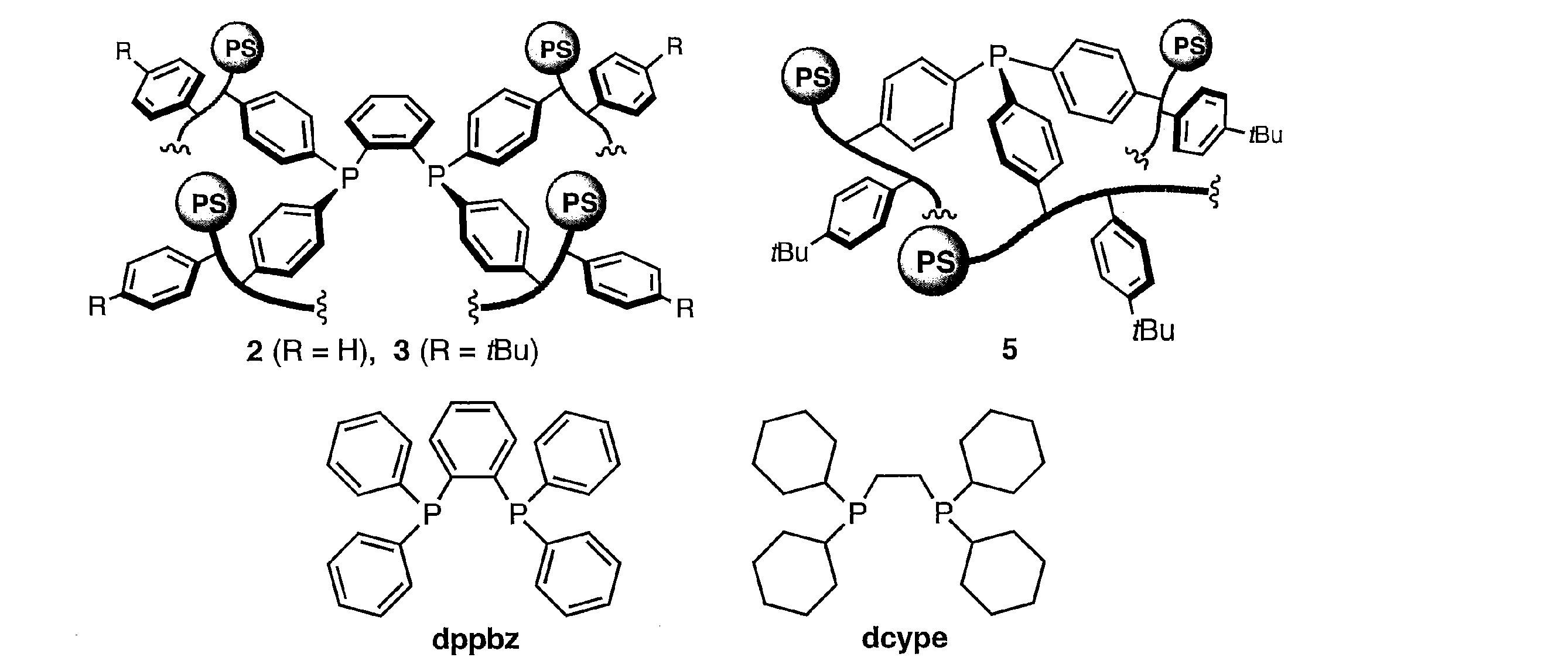
ポリスチレン四点架橋ビスホスフィンのリン原子含有量効果:
窒素雰囲気下、10 mLのねじ口試験管に磁気撹拌子、配位子(0.006 mmol)およびビス(1,5-シクロオクタジエン)ニッケル(Ni(cod)2)(0.005 mmol)の1,4-ジオキサン溶液(0.5 mL)を加え、室温下10分間撹拌した。続いて、ベンゾオキサゾール(0.1 mmol)、ビバル酸 2-ナフチル(0.15 mmol)、炭酸セシウム(0.2 mmol)および1,4-ジオキサン(0.5 mL)を順次加え、テフロン(登録商標)製パッキン付キャップで試験管を閉じ、120℃に加熱しながら24時間撹拌した。目的のカップリング生成物である2-(2-ナフチル)ベンゾオキサゾールの収率は、1,1,2,2-テトラクロロエタンを内部標準とする1H NMR測定により算出した。
窒素雰囲気下、10 mLのねじ口試験管に磁気撹拌子、配位子(0.006 mmol)およびビス(1,5-シクロオクタジエン)ニッケル(Ni(cod)2)(0.005 mmol)の1,4-ジオキサン溶液(0.5 mL)を加え、室温下10分間撹拌した。続いて、ベンゾオキサゾール(0.1 mmol)、ビバル酸 2-ナフチル(0.15 mmol)、炭酸セシウム(0.2 mmol)および1,4-ジオキサン(0.5 mL)を順次加え、テフロン(登録商標)製パッキン付キャップで試験管を閉じ、120℃に加熱しながら24時間撹拌した。目的のカップリング生成物である2-(2-ナフチル)ベンゾオキサゾールの収率は、1,1,2,2-テトラクロロエタンを内部標準とする1H NMR測定により算出した。
ポリスチレン四点架橋ビスホスフィンのリン含有量の効果の結果を表5に示す。配位子4では、反応は進行するものの、目的物は低収率に留まった。配位子3を用いた場合、[4-t-ブチルスチレン/1]の比が>15の場合に、良好な収率で目的物が得られた。ポリスチレン四点架橋ビスホスフィン配位子による高い触媒活性の発現には、適切な量のスチレンモノマーとの共重合が重要なことは明らかである。(図4参照)

ニッケル触媒による塩化アリール類と第一級アミン類のクロスカップリング反応:
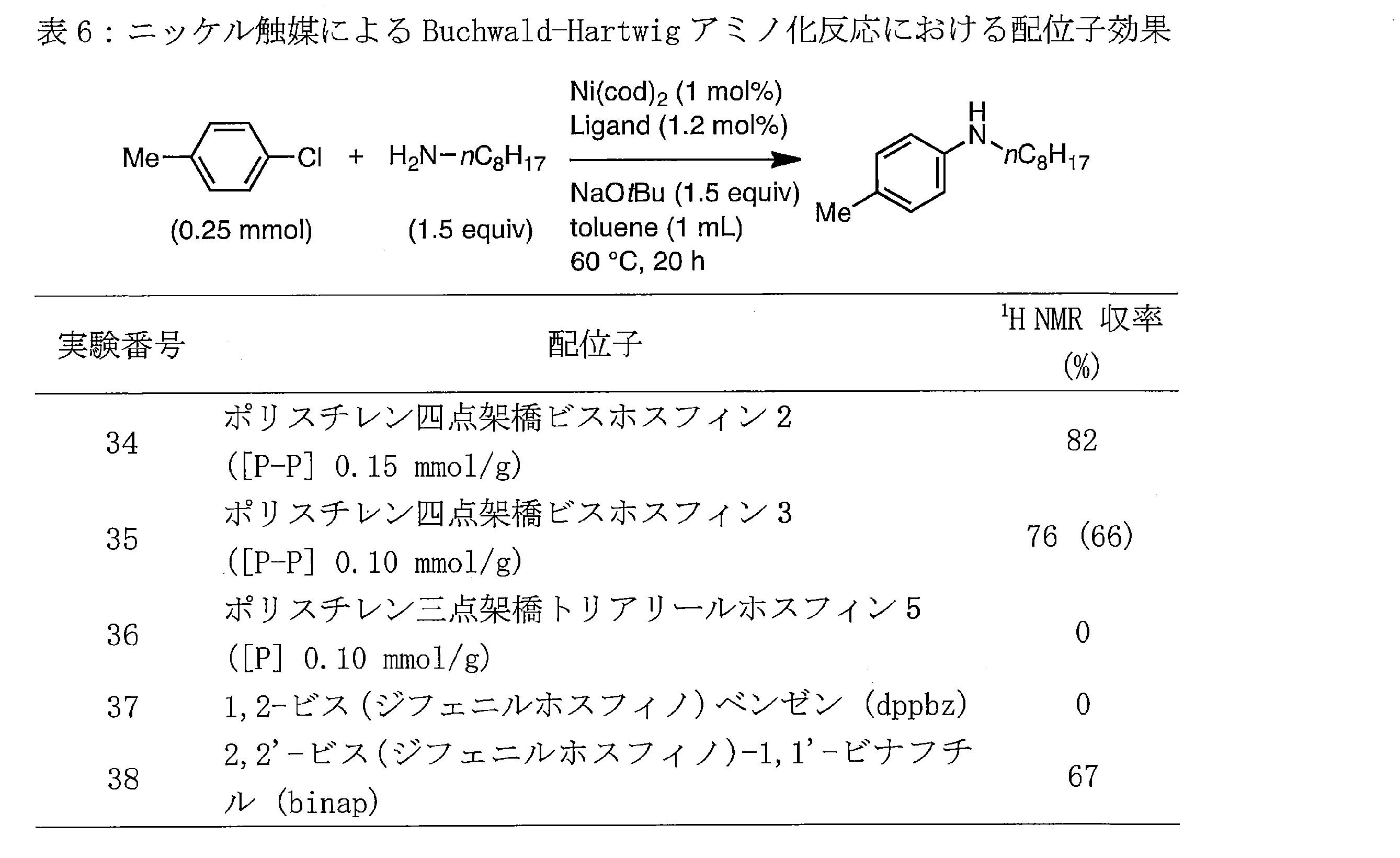
ハロゲン化アリール類のBuchwald-Hartwigアミノ化反応は、医薬品や機能性電子材料に含まれる芳香族アミン類の合成に有用であり、現在ではパラジウム触媒が多用されている。しかし、生成物中への残存パラジウムによる毒性や性能低下がしばしば問題となり、他の金属への代替が求められている。2014年にHartwigらは、2,2'-ビス(ジフェニルホスフィノ)-1,1'-ビナフチル(binap)を有するニッケル触媒が、塩化アリール類と第一級アミン類とのクロスカップリング反応に有効であることを報告した(参考文献;Hartwig, J. F. et al. J. Am. Chem. Soc. 2014, 136, 1617.)。この反応では、ニッケル-binap 1:1型錯体が触媒活性種であることが提案されている。本発明者は、ポリスチレン四点架橋ビスホスフィンが金属配位点の空間的孤立化に基づき、金属-配位子1:1型錯体の形成に有利であるという考えのもと、ポリスチレン四点架橋ビスホスフィンとNi(cod)2から反応系中で調製した固定化ニッケル触媒が塩化アリール類と第一級アミン類のクロスカップリング反応に有効であることを見いだした。発明者らの先行発明であるポリスチレン三点架橋トリアリールホスフィン5や1,2-ビス(ジフェニルホスフィノ)ベンゼンでは反応はほとんど進行しないことから、ビスホスフィンの固定化による触媒活性の向上は明らかである。
ハロゲン化アリール類のBuchwald-Hartwigアミノ化反応は、医薬品や機能性電子材料に含まれる芳香族アミン類の合成に有用であり、現在ではパラジウム触媒が多用されている。しかし、生成物中への残存パラジウムによる毒性や性能低下がしばしば問題となり、他の金属への代替が求められている。2014年にHartwigらは、2,2'-ビス(ジフェニルホスフィノ)-1,1'-ビナフチル(binap)を有するニッケル触媒が、塩化アリール類と第一級アミン類とのクロスカップリング反応に有効であることを報告した(参考文献;Hartwig, J. F. et al. J. Am. Chem. Soc. 2014, 136, 1617.)。この反応では、ニッケル-binap 1:1型錯体が触媒活性種であることが提案されている。本発明者は、ポリスチレン四点架橋ビスホスフィンが金属配位点の空間的孤立化に基づき、金属-配位子1:1型錯体の形成に有利であるという考えのもと、ポリスチレン四点架橋ビスホスフィンとNi(cod)2から反応系中で調製した固定化ニッケル触媒が塩化アリール類と第一級アミン類のクロスカップリング反応に有効であることを見いだした。発明者らの先行発明であるポリスチレン三点架橋トリアリールホスフィン5や1,2-ビス(ジフェニルホスフィノ)ベンゼンでは反応はほとんど進行しないことから、ビスホスフィンの固定化による触媒活性の向上は明らかである。
窒素雰囲気下、10 mLのねじ口試験管に磁気撹拌子、配位子(0.003 mmol)およびビス(1,5-シクロオクタジエン)ニッケル(Ni(cod)2)(0.0025 mmol)のトルエン溶液(0.5 mL)を加え、室温下5分間撹拌した。4-クロロトルエン(0.25 mmol)、n-オクチルアミン(0.375 mmol)、ナトリウム tert-ブトキシド(0.375 mmol)およびトルエン(0.5 mL)を順次加え、テフロン(登録商標)製パッキン付キャップで試験管を閉じ、60℃に加熱しながら20時間撹拌した。目的のカップリング生成物である4-メチル-N-オクチルアニリンの収率は、1,1,2,2-テトラクロロエタンを内部標準とする1H NMR測定により算出した。配位子効果の結果を表6に示す。さらに、粗生成物をシリカゲルカラムクロマトグラフィー(ヘキサン:酢酸エチル = 90 : 10)により精製し、カップリング生成物を単離した。実験番号35:収量36.3 mg、収率66%
4-メチル-N-オクチルアニリンの化合物データ:
1H NMR (CDCl3): δ 0.87 (t, J = 7.2 Hz, 3H), 1.20-1.42 (m, 10H), 1.55-1.62 (m, 2H), 2.22 (s, 3H), 3.06 (t, J = 7.2 Hz, 2H), 3.44 (br-s, 1H), 6.50-6.54 (m, 2H), 6.97 (d, J = 8.0 Hz, 2H).
13C NMR (CDCl3): δ 14.08, 20.35, 22.64, 27.17, 29.25, 29.41, 29.60, 31.82, 44.35, 112.85, 126.22, 129.66, 146.29.
1H NMR (CDCl3): δ 0.87 (t, J = 7.2 Hz, 3H), 1.20-1.42 (m, 10H), 1.55-1.62 (m, 2H), 2.22 (s, 3H), 3.06 (t, J = 7.2 Hz, 2H), 3.44 (br-s, 1H), 6.50-6.54 (m, 2H), 6.97 (d, J = 8.0 Hz, 2H).
13C NMR (CDCl3): δ 14.08, 20.35, 22.64, 27.17, 29.25, 29.41, 29.60, 31.82, 44.35, 112.85, 126.22, 129.66, 146.29.
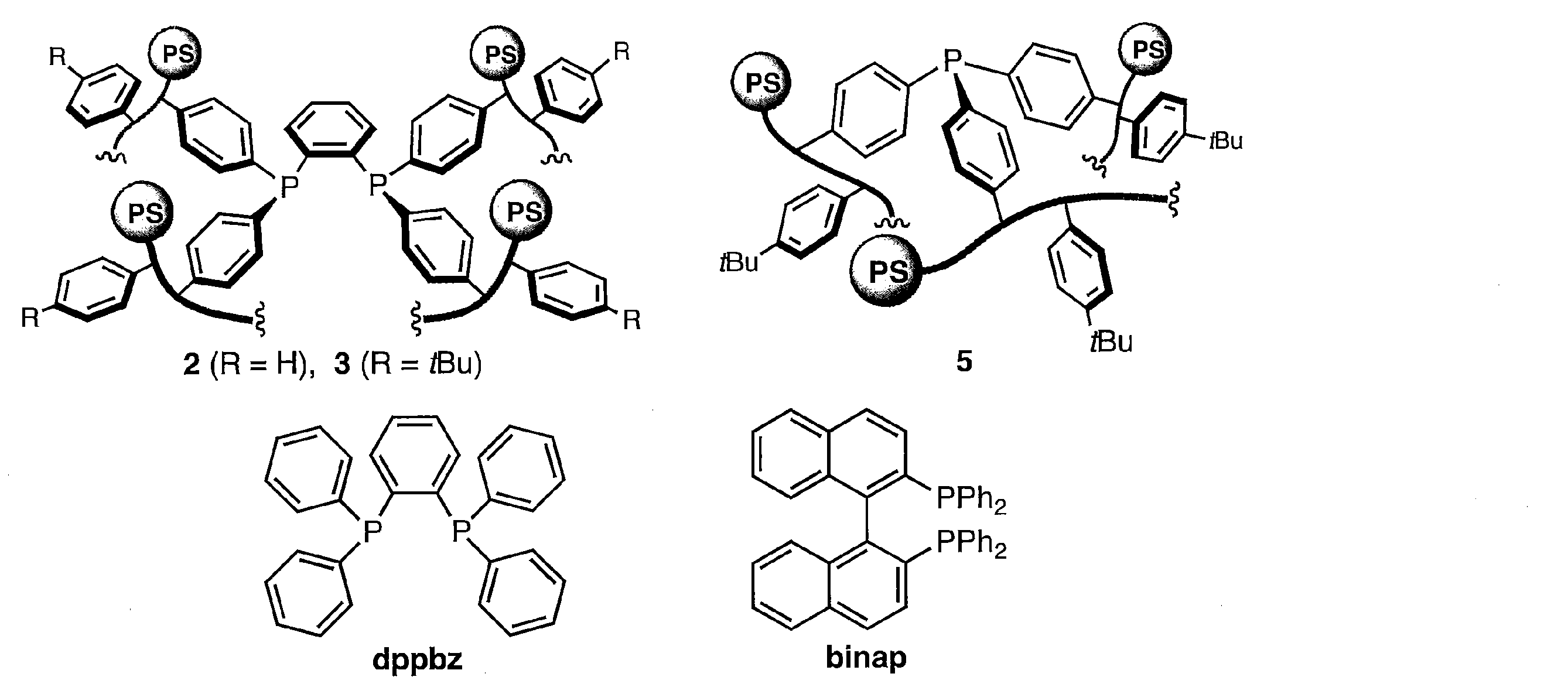
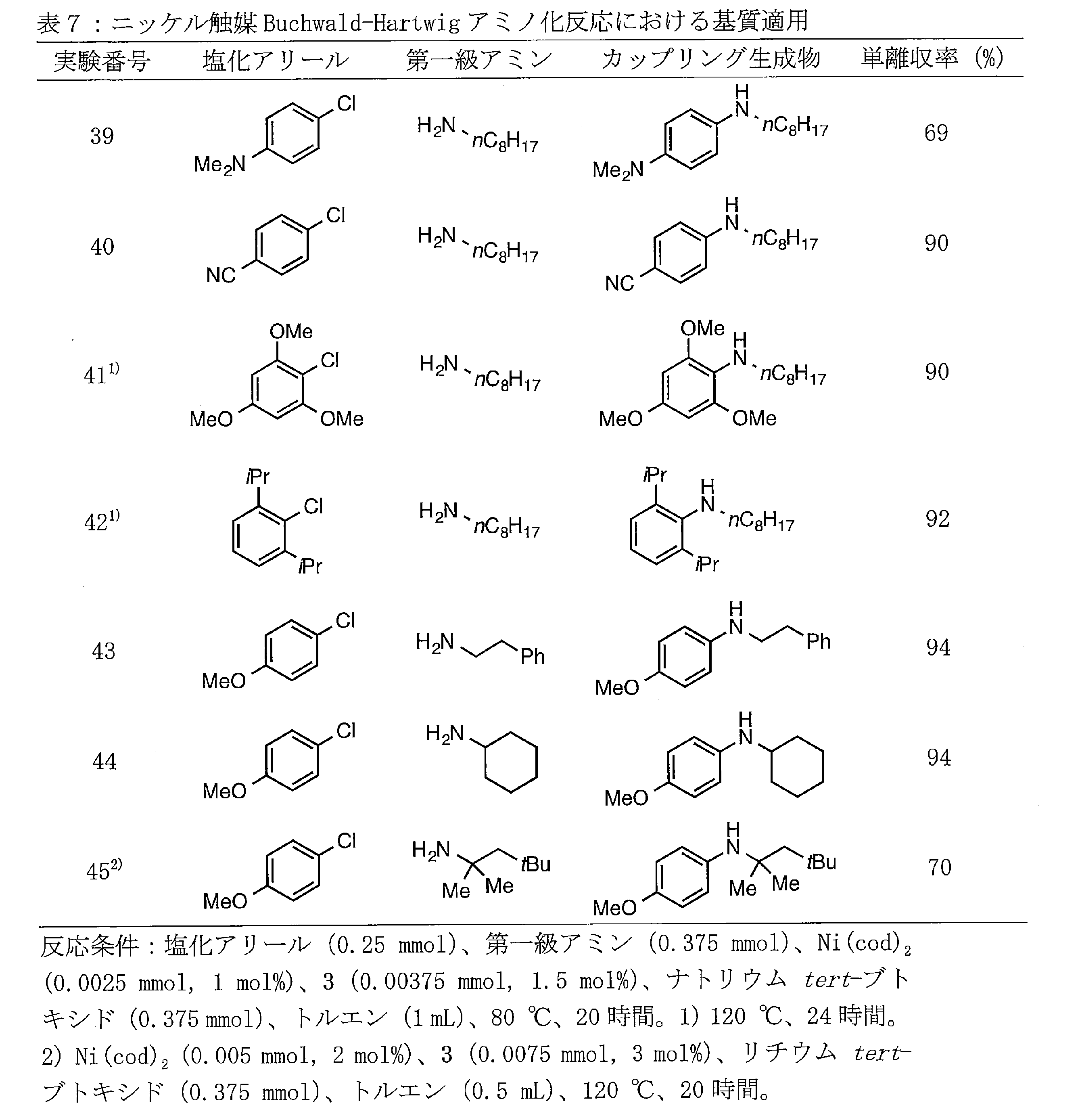
ポリスチレン四点架橋ビスホスフィン3とNi(cod)2から系中で調製した固定化触媒を用いて、Buchwald-Hartwigアミノ化反応における塩化アリール類および第一級アミン類の基質適用範囲の検討を行い、表7に示すカップリング生成物を得た。塩化アリール類として、ベンゼン環のパラ位に電子供与基または電子求引基を有している化合物も適用可能である(実験番号39,40)。本触媒系は、反応点周りの立体障害に対する許容性にも優れている(実験番号41, 42)。第一級または第二級アルキル基が置換したアミン類では、反応が効率良く進行し、対応するカップリング生成物を与えた(実験番号43,44)。第三級アルキル基を有するアミンに対しては、塩基としてリチウムtert-ブトキシドを用いて反応を実施すると、良好な収率で目的生成物が得られた(実験番号45)。
実験番号39: N,N-ジメチル-N-オクチルベンゼン-1,4-ジアミンの化合物データ:
1H NMR (CDCl3): δ 0.88 (t, J = 6.8 Hz, 3H), 1.28-1.38 (m, 10H), 1.59 (quint, J = 7.6 Hz, 2H), 2.81 (s, 6H), 3.05 (broad s, 2H), 3.15 (broad s, 1H), 6.61 (d, J = 8.0 Hz, 2H), 6.74 (d, J = 8.0 Hz, 2H).
13C NMR (CDCl3): δ 14.10, 22.64, 27.21, 29.26, 29.43, 29.75, 31.82, 42.35, 45.11, 114.22, 115.98, 141.21, 143.95.
HRMS-ESI (m/z): [M]+ cacld for C16H28O2, 248.22470; found, 248.22509.
1H NMR (CDCl3): δ 0.88 (t, J = 6.8 Hz, 3H), 1.28-1.38 (m, 10H), 1.59 (quint, J = 7.6 Hz, 2H), 2.81 (s, 6H), 3.05 (broad s, 2H), 3.15 (broad s, 1H), 6.61 (d, J = 8.0 Hz, 2H), 6.74 (d, J = 8.0 Hz, 2H).
13C NMR (CDCl3): δ 14.10, 22.64, 27.21, 29.26, 29.43, 29.75, 31.82, 42.35, 45.11, 114.22, 115.98, 141.21, 143.95.
HRMS-ESI (m/z): [M]+ cacld for C16H28O2, 248.22470; found, 248.22509.
実験番号40: 4-(オクチルアミノ)-ベンゾニトリルの化合物データ:
1H NMR (CDCl3): δ 0.88 (t, J = 6.4 Hz, 3H), 1.28-1.39 (m, 10H), 1.62 (quint, J = 7.2 Hz, 2H), 3.13 (t, J = 6.8 Hz, 2H), 4.22 (broad s, 1H), 6.54 (d, J = 5.2 Hz, 2H), 7.40 (d, J = 6.8 Hz, 2H).
13C NMR (CDCl3): δ 14.04, 22.59, 26.97, 29.08, 29.16, 29.25, 31.73, 43.16, 98.14, 111.95, 120.57, 133.63, 151.41.
EI-MS (m/z): 230 ([M]+).
1H NMR (CDCl3): δ 0.88 (t, J = 6.4 Hz, 3H), 1.28-1.39 (m, 10H), 1.62 (quint, J = 7.2 Hz, 2H), 3.13 (t, J = 6.8 Hz, 2H), 4.22 (broad s, 1H), 6.54 (d, J = 5.2 Hz, 2H), 7.40 (d, J = 6.8 Hz, 2H).
13C NMR (CDCl3): δ 14.04, 22.59, 26.97, 29.08, 29.16, 29.25, 31.73, 43.16, 98.14, 111.95, 120.57, 133.63, 151.41.
EI-MS (m/z): 230 ([M]+).
実験番号41: 2,4,6-トリメトキシ-N-オクチルアミンの化合物データ:
1H NMR (CDCl3): δ 0.88 (t, J = 6.4 Hz, 3H), 1.27-1.35 (m, 10H), 1.49 (quint, J = 7.6 Hz, 2H), 3.05 (t, J = 6.8 Hz, 2H), 3.43 (broad s, 1H), 3.77 (s, 3H), 3.83 (s, 6H), 6.15 (s, 2H).
13C NMR (CDCl3): δ 14.03, 22.61, 27.02, 29.25, 29.42, 30.51, 31.80, 48.05, 55.46, 55.79, 91.39, 121.08, 152.15, 154.57.
HRMS-ESI (m/z): [M+H]+ cacld for C17H30O3N, 296.22202; found, 296.22220.
1H NMR (CDCl3): δ 0.88 (t, J = 6.4 Hz, 3H), 1.27-1.35 (m, 10H), 1.49 (quint, J = 7.6 Hz, 2H), 3.05 (t, J = 6.8 Hz, 2H), 3.43 (broad s, 1H), 3.77 (s, 3H), 3.83 (s, 6H), 6.15 (s, 2H).
13C NMR (CDCl3): δ 14.03, 22.61, 27.02, 29.25, 29.42, 30.51, 31.80, 48.05, 55.46, 55.79, 91.39, 121.08, 152.15, 154.57.
HRMS-ESI (m/z): [M+H]+ cacld for C17H30O3N, 296.22202; found, 296.22220.
実験番号42: 2,6-ジイソプロピル-N-オクチルアニリンの化合物データ:
1H NMR (CDCl3): δ 0.89 (t, J = 6.4 Hz, 3H), 1.23-1.40 (m, 22H), 1.63 (quint, J = 6.8 Hz, 2H), 2.84-2.90 (m, 3H), 3.26 (septet, J = 6.8 Hz, 2H), 7.02-7.10 (m, 3H).
13C NMR (CDCl3): δ 14.10, 22.65, 24.26, 27.22, 27.64, 29.28, 29.51, 31.03, 31.84, 52.11, 123.46, 142.22, 143.69.
HRMS-ESI (m/z): [M+H]+ cacld for C20H36N, 290.28423; found, 290.28420.
1H NMR (CDCl3): δ 0.89 (t, J = 6.4 Hz, 3H), 1.23-1.40 (m, 22H), 1.63 (quint, J = 6.8 Hz, 2H), 2.84-2.90 (m, 3H), 3.26 (septet, J = 6.8 Hz, 2H), 7.02-7.10 (m, 3H).
13C NMR (CDCl3): δ 14.10, 22.65, 24.26, 27.22, 27.64, 29.28, 29.51, 31.03, 31.84, 52.11, 123.46, 142.22, 143.69.
HRMS-ESI (m/z): [M+H]+ cacld for C20H36N, 290.28423; found, 290.28420.
実験番号43: 4-メトキシ-N-フェネチルアニリンの化合物データ:
1H NMR (CDCl3): δ 2.90 (t, J = 7.2 Hz, 2H), 3.35 (t + broad s, J = 6.8 Hz, 2H+1H), 3.74 (s, 3H), 6.58 (d, J = 9.2 Hz, 2H), 6.78 (d, J = 9.2 Hz, 2H), 7.20-7.33 (m, 5H).
13C NMR (CDCl3): δ 35.52, 45.97, 55.73, 114.32, 114.84, 126.33, 128.53, 128.74, 139.35, 142.16, 152.10.
EI-MS (m/z): 227 ([M]+).
1H NMR (CDCl3): δ 2.90 (t, J = 7.2 Hz, 2H), 3.35 (t + broad s, J = 6.8 Hz, 2H+1H), 3.74 (s, 3H), 6.58 (d, J = 9.2 Hz, 2H), 6.78 (d, J = 9.2 Hz, 2H), 7.20-7.33 (m, 5H).
13C NMR (CDCl3): δ 35.52, 45.97, 55.73, 114.32, 114.84, 126.33, 128.53, 128.74, 139.35, 142.16, 152.10.
EI-MS (m/z): 227 ([M]+).
実験番号44: N-シクロヘキシル-4-メトキシアニリンの化合物データ:
1H NMR (CDCl3): δ 1.06-1.40 (m, 5H), 1.62-1.67 (m, 1H), 1.72-1.77 (m, 2H), 2.02-2.06 (m, 2H), 3.12-3.19 (m, 2H), 3.74 (s, 3H), 6.57 (d, J = 9.2 Hz, 2H), 6.76 (d, J = 8.8 Hz, 2H).
13C NMR (CDCl3): δ 25.04, 25.94, 33.59, 52.72, 55.76, 114.75, 114.84, 141.57, 151.77.
EI-MS (m/z): 205 ([M]+).
1H NMR (CDCl3): δ 1.06-1.40 (m, 5H), 1.62-1.67 (m, 1H), 1.72-1.77 (m, 2H), 2.02-2.06 (m, 2H), 3.12-3.19 (m, 2H), 3.74 (s, 3H), 6.57 (d, J = 9.2 Hz, 2H), 6.76 (d, J = 8.8 Hz, 2H).
13C NMR (CDCl3): δ 25.04, 25.94, 33.59, 52.72, 55.76, 114.75, 114.84, 141.57, 151.77.
EI-MS (m/z): 205 ([M]+).
実験番号45: 4-メトキシ-N-(1,1,3,3-テトラメチルブチル)-アニリンの化合物データ:
1H NMR (400 MHz, CDCl3): δ 1.03 (s, 9H), 1.29 (s, 6H), 1.61 (s, 2H), 3.07 (broad s, 1H), 3.75 (s, 3H), 6.71-6.76 (m, 4H).
13C NMR (100.5 MHz, CDCl3): δ 30.09, 31.73, 54.32, 55.54, 55.75, 114.15, 121.10, 140.06, 153.35.
HRMS-ESI (m/z): [M+H]+ cacld for C15H26ON, 236.20089; found, 236.20118.
1H NMR (400 MHz, CDCl3): δ 1.03 (s, 9H), 1.29 (s, 6H), 1.61 (s, 2H), 3.07 (broad s, 1H), 3.75 (s, 3H), 6.71-6.76 (m, 4H).
13C NMR (100.5 MHz, CDCl3): δ 30.09, 31.73, 54.32, 55.54, 55.75, 114.15, 121.10, 140.06, 153.35.
HRMS-ESI (m/z): [M+H]+ cacld for C15H26ON, 236.20089; found, 236.20118.
コバルト触媒によるアルケン類のヒドロホウ素化反応:
アルケン類のヒドロホウ素化反応は、合成中間体として広く利用されているアルキルボロン酸誘導体を得る有用な手法である。これまでにロジウムやイリジウムなどの貴金属類が触媒として用いられてきたが、近年ではより安価で豊富なベースメタル触媒の利用が求められている。2014年にHuangらは、光学活性イミノピリジン-オキサゾリン型三座配位子を有するコバルト錯体触媒がアルケン類の不斉ヒドロホウ素化反応に有効であることを報告した(参考文献;Huang, Z. et al. J. Am. Chem. Soc. 2014, 136, 15501.)。本発明者は、ポリスチレン四点架橋ビスホスフィンを有するコバルト錯体触媒が、添加剤として触媒量の水素化トリエチルホウ素ナトリウム存在下、アルケン類のヒドロホウ素化反応に有効であることを見いだした。発明者らの先行発明であるポリスチレン三点架橋トリアリールホスフィン5や1,2-ビス(ジフェニルホスフィノ)ベンゼンでは反応はほとんど進行しないことから、ビスホスフィンの固定化による触媒活性の向上は明らかである。
アルケン類のヒドロホウ素化反応は、合成中間体として広く利用されているアルキルボロン酸誘導体を得る有用な手法である。これまでにロジウムやイリジウムなどの貴金属類が触媒として用いられてきたが、近年ではより安価で豊富なベースメタル触媒の利用が求められている。2014年にHuangらは、光学活性イミノピリジン-オキサゾリン型三座配位子を有するコバルト錯体触媒がアルケン類の不斉ヒドロホウ素化反応に有効であることを報告した(参考文献;Huang, Z. et al. J. Am. Chem. Soc. 2014, 136, 15501.)。本発明者は、ポリスチレン四点架橋ビスホスフィンを有するコバルト錯体触媒が、添加剤として触媒量の水素化トリエチルホウ素ナトリウム存在下、アルケン類のヒドロホウ素化反応に有効であることを見いだした。発明者らの先行発明であるポリスチレン三点架橋トリアリールホスフィン5や1,2-ビス(ジフェニルホスフィノ)ベンゼンでは反応はほとんど進行しないことから、ビスホスフィンの固定化による触媒活性の向上は明らかである。
窒素雰囲気下、10 mLのねじ口試験管に磁気撹拌子、配位子(0.003 mmol)およびヨウ化コバルト(0.002 mmol)のテトラヒドロフラン溶液(0.4 mL)を加え、室温下5分間撹拌した。その後、水素化トリエチルホウ素ナトリウム(10μL, 1 M THF溶液, 0.01 mmol)を加え、さらに室温下10分間撹拌した。α-メチルスチレン(0.2 mmol)とピナコールボラン(0.24 mmol)を順次加え、テフロン(登録商標)製パッキン付キャップで試験管を閉じ、25℃で16時間撹拌した。目的のヒドロホウ素化生成物である(2-フェニルプロピル)ボロン酸ピナコールエステルの収率は、1,1,2,2-テトラクロロエタンを内部標準とする1H NMR測定により算出した。配位子効果の結果を表8に示す。さらに、粗生成物をシリカゲルカラムクロマトグラフィー(ヘキサン:酢酸エチル = 95 : 5)により精製し、カップリング生成物を単離した。実験番号47:収量31.0 mg、収率63%
(2-フェニルプロピル)ボロン酸ピナコールエステルの化合物データ:
1H NMR (CDCl3): δ 1.12-1.17 (m, 14H), 1.26 (d, J = 6.9 Hz, 3H), 2.97-3.06 (m, 1H), 7.11-7.15 (m, 1H), 7.23-7.30 (m, 4H).
13C NMR (CDCl3): δ 21.21 (br), 24.65, 24.72, 24.87, 35.76, 82.92, 125.63, 126.57, 128.12, 149.17.
1H NMR (CDCl3): δ 1.12-1.17 (m, 14H), 1.26 (d, J = 6.9 Hz, 3H), 2.97-3.06 (m, 1H), 7.11-7.15 (m, 1H), 7.23-7.30 (m, 4H).
13C NMR (CDCl3): δ 21.21 (br), 24.65, 24.72, 24.87, 35.76, 82.92, 125.63, 126.57, 128.12, 149.17.
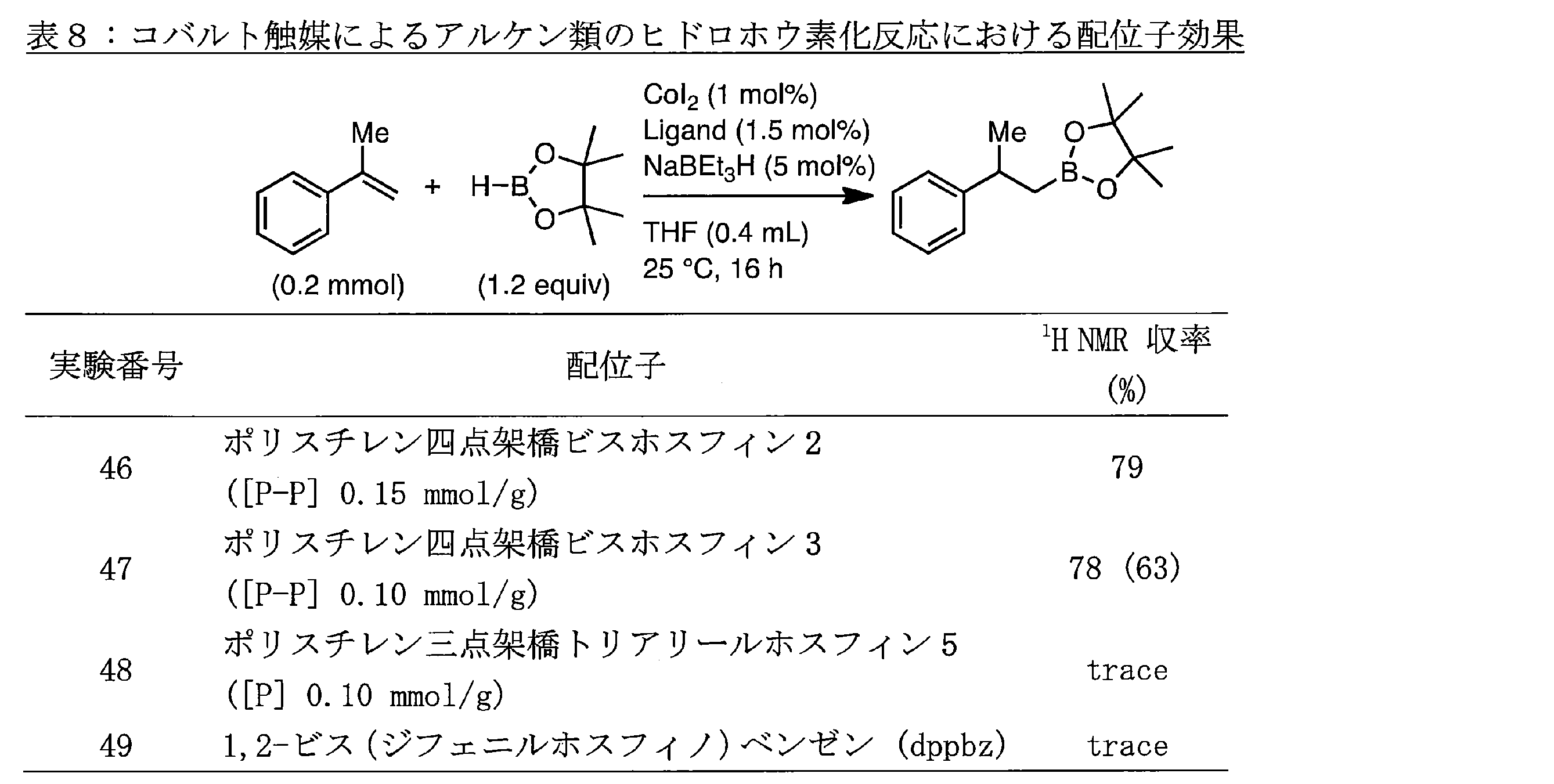
反応条件:α-メチルスチレン(0.2 mmol)、ピナコールボラン(0.24 mmol)、ヨウ化コバルト (0.002 mmol, 1 mol%)、配位子(0.003 mmol, 1.5 mol%)、水素化トリエチルホウ素ナトリウム(0.01 mmol)、テトラヒドロフラン(0.4 mL)、25℃、16時間。
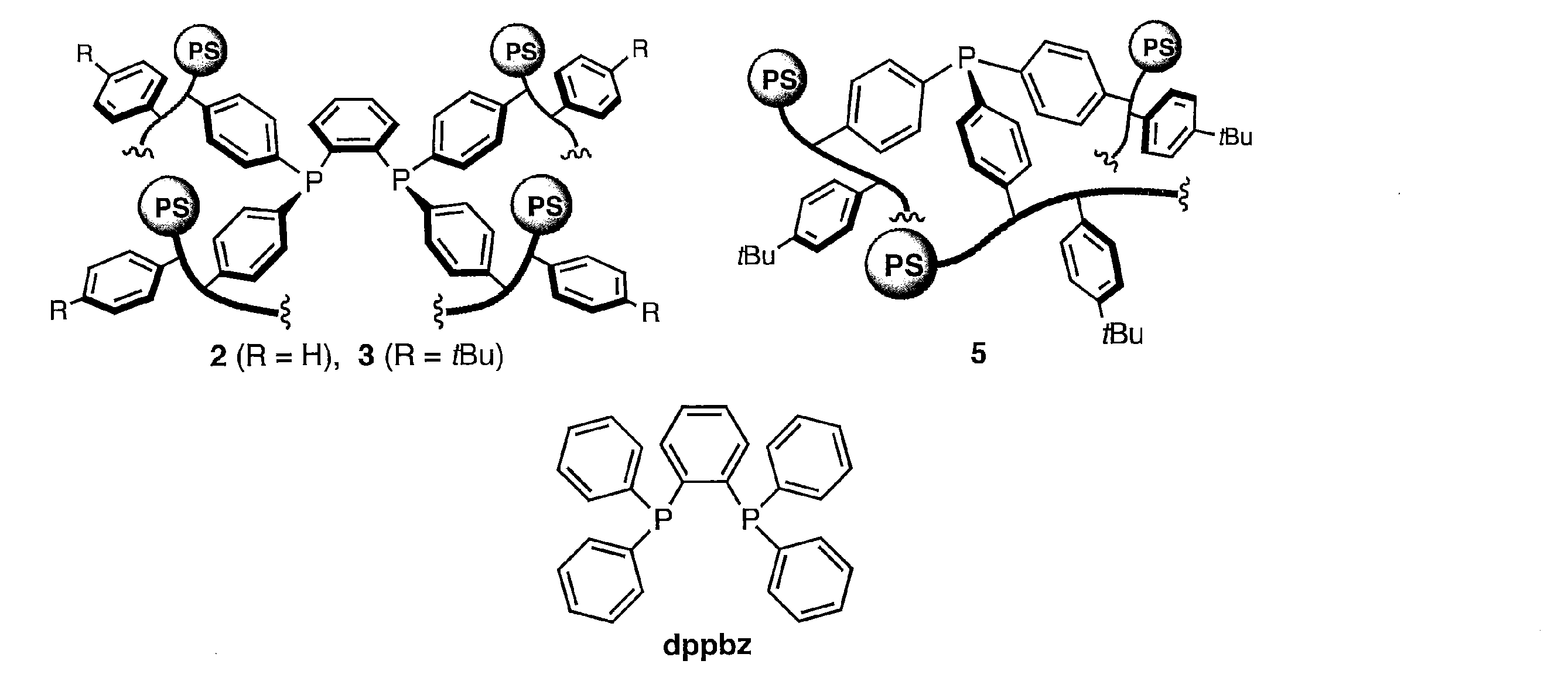
本発明は、遷移金属錯体が関係する技術分野において有用である。
Claims (14)
- 下記一般式(2)で示される高分子遷移金属錯体。


R1、R2、R3、R4は、独立に、R1、R2、R3、R4がそれぞれ結合するフェニレン基と共に形成する、直鎖又は架橋型ポリスチレン鎖であり、
前記架橋型ポリスチレン鎖は、式(3)で示されるビスホスフィン単位を少なくとも1つ含むことができ、


前記ポリスチレン鎖のフェニル基は無置換であるか、又は前記ポリスチレン鎖のフェニル基の少なくとも一部は置換基を有し、
Mは、配位子を有することができる遷移金属又は遷移金属イオンである。 - 前記遷移金属又は遷移金属イオンは、第一遷移元素(3d遷移元素)、第二遷移元素(4d遷移元素)及び第三遷移元素(5d遷移元素)から成る群から選ばれる少なくとも1種の金属又は金属イオンである、請求項1に記載の錯体。
- 前記芳香族炭化水素基はアリール基であり、前記芳香族ヘテロ炭化水素基はヘテロアリール基である、請求項1又は2に記載の錯体。
- 前記芳香族炭化水素基、前記芳香族ヘテロ炭化水素基、前記ポリスチレン鎖のフェニレン基が有する置換基は、炭素数1~6のアルキル基である、請求項1~3のいずれか1項に記載の錯体。
- 一般式(3)で示されるビスホスフィン単位および前記R1、R2、R3、R4で示されるポリスチレン鎖中のスチレン単位の当量比は1:10~1000の範囲である請求項1~4のいずれか1項に記載の錯体。
- Mが有することができる配位子は、アルケン、ハロゲン、カルボニル、ヒドロキシ、ニトロ、アミノ、スルホニル、またはシアノである請求項1~5のいずれか1項に記載の錯体。
- 下記一般式(1)で示される高分子化合物と遷移金属Mを含有する化合物を混合して、下記式(2)で示される高分子遷移金属錯体を得る工程、を含む高分子遷移金属錯体の製造方法。
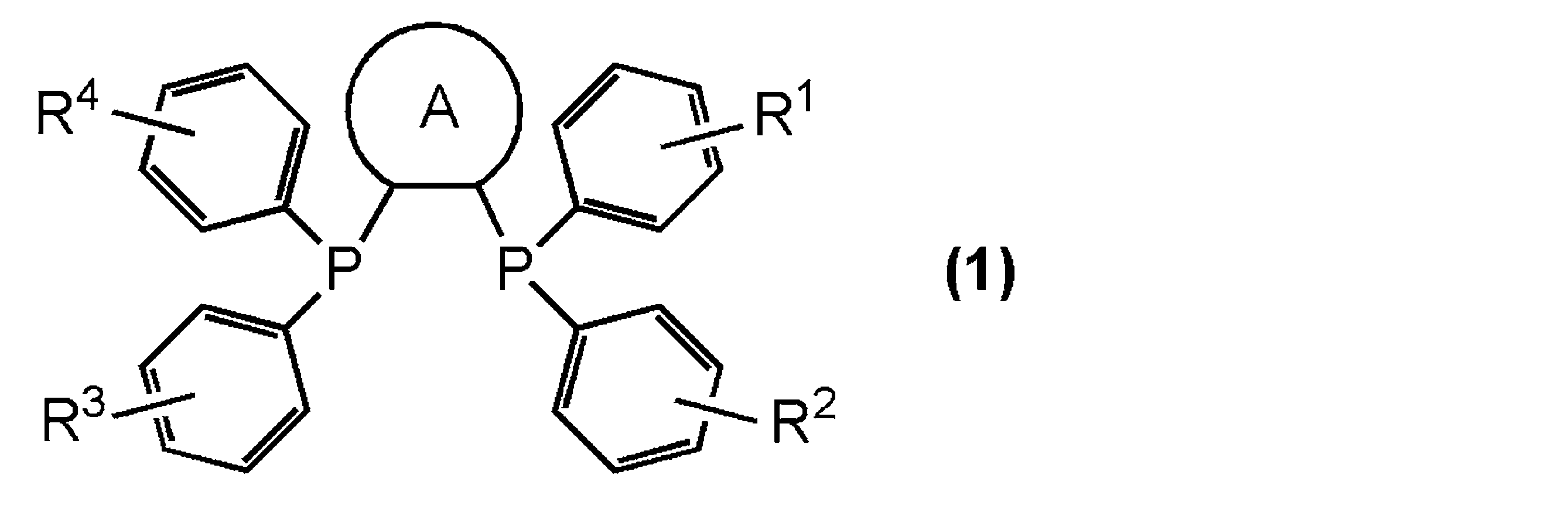

R1、R2、R3、R4は、独立に、R1、R2、R3、R4がそれぞれ結合するフェニレン基と共に形成する、直鎖又は架橋型ポリスチレン鎖であり、
前記架橋型ポリスチレン鎖は、式(4)で示されるビスホスフィン単位を少なくとも1つ含むことができ、
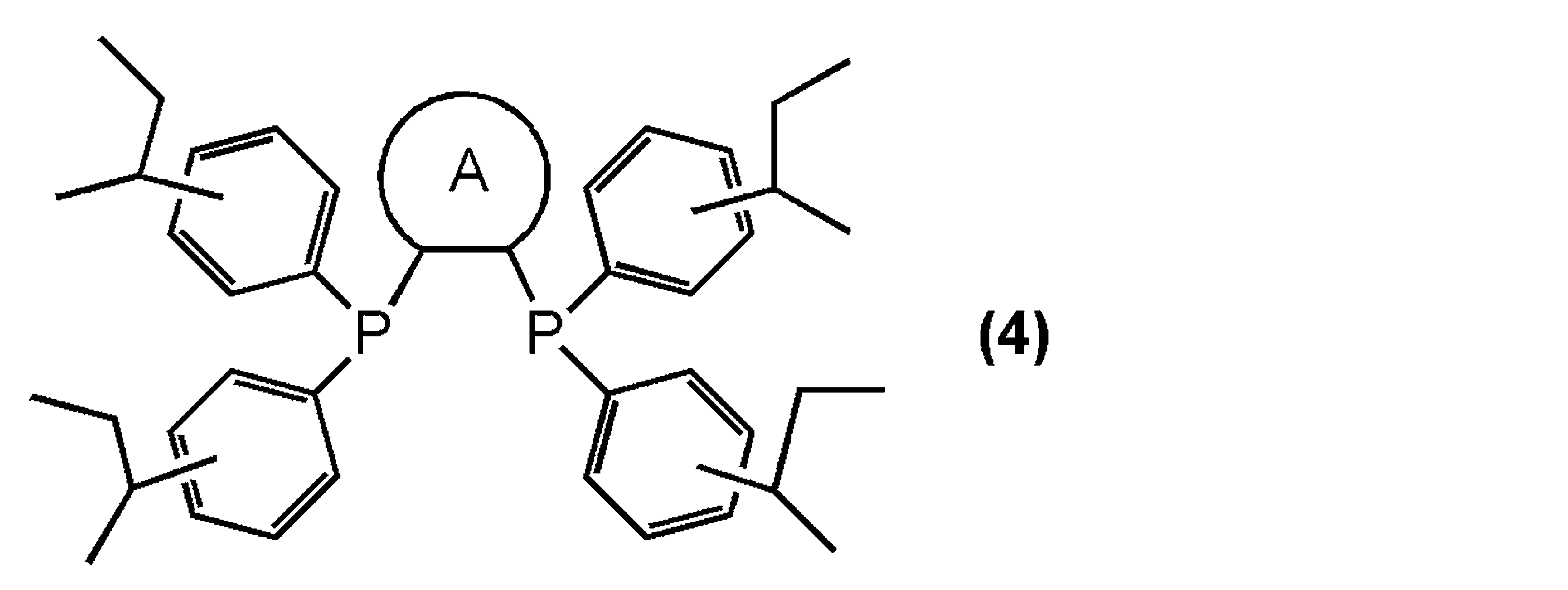

前記ポリスチレン鎖のフェニル基は無置換であるか、又は前記ポリスチレン鎖のフェニル基の少なくとも一部は置換基を有する。




Mは、配位子を有することができる遷移金属又は遷移金属イオンである。 - 前記芳香族炭化水素基はアリール基であり、前記芳香族ヘテロ炭化水素基はヘテロアリール基である請求項7に記載の製造方法。
- 前記芳香族炭化水素基、前記芳香族ヘテロ炭化水素基、前記ポリスチレン鎖のフェニレン基が有する置換基は、炭素数1~6のアルキル基である請求項7又は8に記載の製造方法。
- 遷移金属Mを含有する化合物は、Mが有することができる配位子を含み、前記配位子は、アルケン、ハロゲン、カルボニル、ヒドロキシ、ニトロ、アミノ、スルホニル、またはシアノである請求項7~9のいずれか1項に記載の製造方法。
- 請求項1~6のいずれかに記載の高分子遷移金属錯体を含む有機化合物カップリング反応用触媒。
- 前記有機化合物カップリング反応がC-H/C-Oカップリング反応である請求項11に記載の触媒。
- 前記有機化合物カップリング反応がC-Nクロスカップリング反応である請求項11に記載の触媒。
- 請求項1~6に記載の高分子遷移金属錯体を含むヒドロホウ素化反応用触媒。
Priority Applications (1)
| Application Number | Priority Date | Filing Date | Title |
|---|---|---|---|
| JP2017505406A JP6650644B2 (ja) | 2015-03-10 | 2016-03-10 | 高分子遷移金属錯体、その製造方法及びその利用 |
Applications Claiming Priority (2)
| Application Number | Priority Date | Filing Date | Title |
|---|---|---|---|
| JP2015046761 | 2015-03-10 | ||
| JP2015-046761 | 2015-03-10 |
Publications (1)
| Publication Number | Publication Date |
|---|---|
| WO2016143868A1 true WO2016143868A1 (ja) | 2016-09-15 |
Family
ID=56879538
Family Applications (1)
| Application Number | Title | Priority Date | Filing Date |
|---|---|---|---|
| PCT/JP2016/057632 Ceased WO2016143868A1 (ja) | 2015-03-10 | 2016-03-10 | 高分子遷移金属錯体、その製造方法及びその利用 |
Country Status (2)
| Country | Link |
|---|---|
| JP (1) | JP6650644B2 (ja) |
| WO (1) | WO2016143868A1 (ja) |
Cited By (3)
| Publication number | Priority date | Publication date | Assignee | Title |
|---|---|---|---|---|
| JP2021529207A (ja) * | 2018-07-04 | 2021-10-28 | メルク パテント ゲーエムベーハー | アリールアミンを製造するための方法 |
| CN114534782A (zh) * | 2022-01-17 | 2022-05-27 | 中国科学院大连化学物理研究所 | 一种多孔有机离子聚合物、其负载单原子Rh催化剂及其制备方法与应用 |
| CN114773136A (zh) * | 2022-04-02 | 2022-07-22 | 陕西师范大学 | 一种合成芳胺的方法 |
Citations (2)
| Publication number | Priority date | Publication date | Assignee | Title |
|---|---|---|---|---|
| CN103965386A (zh) * | 2014-05-05 | 2014-08-06 | 浙江大学 | 多孔聚双膦配体材料的制备方法 |
| WO2014136909A1 (ja) * | 2013-03-07 | 2014-09-12 | 国立大学法人北海道大学 | 有機高分子三点架橋型ホスフィン、それを配位子とする遷移金属錯体および触媒 |
-
2016
- 2016-03-10 JP JP2017505406A patent/JP6650644B2/ja not_active Expired - Fee Related
- 2016-03-10 WO PCT/JP2016/057632 patent/WO2016143868A1/ja not_active Ceased
Patent Citations (2)
| Publication number | Priority date | Publication date | Assignee | Title |
|---|---|---|---|---|
| WO2014136909A1 (ja) * | 2013-03-07 | 2014-09-12 | 国立大学法人北海道大学 | 有機高分子三点架橋型ホスフィン、それを配位子とする遷移金属錯体および触媒 |
| CN103965386A (zh) * | 2014-05-05 | 2014-08-06 | 浙江大学 | 多孔聚双膦配体材料的制备方法 |
Non-Patent Citations (8)
Cited By (5)
| Publication number | Priority date | Publication date | Assignee | Title |
|---|---|---|---|---|
| JP2021529207A (ja) * | 2018-07-04 | 2021-10-28 | メルク パテント ゲーエムベーハー | アリールアミンを製造するための方法 |
| CN114534782A (zh) * | 2022-01-17 | 2022-05-27 | 中国科学院大连化学物理研究所 | 一种多孔有机离子聚合物、其负载单原子Rh催化剂及其制备方法与应用 |
| CN114534782B (zh) * | 2022-01-17 | 2023-08-08 | 中国科学院大连化学物理研究所 | 一种多孔有机离子聚合物、其负载单原子Rh催化剂及其制备方法与应用 |
| CN114773136A (zh) * | 2022-04-02 | 2022-07-22 | 陕西师范大学 | 一种合成芳胺的方法 |
| CN114773136B (zh) * | 2022-04-02 | 2023-06-16 | 陕西师范大学 | 一种合成芳胺的方法 |
Also Published As
| Publication number | Publication date |
|---|---|
| JP6650644B2 (ja) | 2020-02-19 |
| JPWO2016143868A1 (ja) | 2017-12-21 |
Similar Documents
| Publication | Publication Date | Title |
|---|---|---|
| Daugulis et al. | Polymerization of Ethylene with Cationic Palladium and Nickel Catalysts Containing Bulky Nonenolizable Imine− Phosphine Ligands | |
| Iwai et al. | A polystyrene-cross-linking bisphosphine: controlled metal monochelation and ligand-enabled first-row transition metal catalysis | |
| Yuan et al. | N‐Heterocyclic Carbene–Ytterbium Amide as a Recyclable Homogeneous Precatalyst for Hydrophosphination of Alkenes and Alkynes | |
| US20070073055A1 (en) | Transition metal complexes of N-heterocyclic carbenes, method of preparation and use in transition metal catalyzed organic transformations | |
| JP2004505091A (ja) | アダマンチル基を有するホスファンリガンド、その製造および接触反応におけるその使用 | |
| Dharani et al. | Tetranuclear palladacycles of 3-acetyl-7-methoxy-2 H-chromen-2-one derived Schiff bases: Efficient catalysts for Suzuki–Miyaura coupling in an aqueous medium | |
| Ok et al. | Novel half‐sandwich η5‐Cp*–rhodium (III) and η5‐Cp*–ruthenium (II) complexes bearing bis (phosphino) amine ligands and their use in the transfer hydrogenation of aromatic ketones | |
| Lu et al. | Monoalkyllanthanide Complexes with New β-Diketiminato Derivative Dianionic Ligands | |
| JP4519498B2 (ja) | リン含有α−メチルスチレン共重合体を配位子とする新規なポリマー担持遷移金属錯体及び該錯体からなる触媒 | |
| Wang et al. | Synthesis, structure and catalytic properties of CNN pincer palladium (II) and ruthenium (II) complexes with N-substituted-2-aminomethyl-6-phenylpyridines | |
| Aleksanyan et al. | Extending the application scope of organophosphorus (V) compounds in palladium (II) pincer chemistry | |
| Seva et al. | Palladium biphenyl N-heterocyclic carbene complexes: Synthesis, structure and their catalytic efficiency in water mediated Suzuki–Miyaura cross-coupling reaction | |
| JP6650644B2 (ja) | 高分子遷移金属錯体、その製造方法及びその利用 | |
| Doherty et al. | Polymer-supported phosphoramidites: highly efficient and recyclable catalysts for asymmetric hydrogenation of dimethylitaconate and dehydroamino acids and esters | |
| Hu et al. | Preparation of New Buchwald-Type Secondary Phosphine Oxide Ligands and Applications in Suzuki− Miyaura Reactions | |
| JP6274202B2 (ja) | 有機高分子三点架橋型ホスフィン、それを配位子とする遷移金属錯体および触媒 | |
| Sheokand et al. | Cationic and Neutral PdII and PtII Pincer Complexes of Phosphinamino-Triazolyl-Pyridine [PN (H) N]: Pincer Ligand-Stabilized Palladium Nanoparticles and Their Catalytic Annulation of Internal Alkynes to Indenones | |
| Li et al. | Construction of Bulky Ligand Libraries by Ru (II)-Catalyzed P (III)-Assisted ortho-C–H Secondary Alkylation | |
| Aydemir et al. | trans-and cis-Ru (II) aminophosphine complexes: Syntheses, X-ray structures and catalytic activity in transfer hydrogenation of acetophenone derivatives | |
| Aydemir et al. | Synthesis and characterization of transition metal complexes of thiophene‐2‐methylamine: X‐ray crystal structure of palladium (II) and platinum (II) complexes and use of palladium (II) complexes as pre‐catalyst in Heck and Suzuki cross‐coupling reactions | |
| Alonso‐Moreno et al. | Well‐Defined Regioselective Iminopyridine Rhodium Catalysts for Anti‐Markovnikov Addition of Aromatic Primary Amines to 1‐Octyne | |
| Sánchez et al. | Bis (imidate) palladium (II) complexes with labile ligands. Mimics of classical precursors? | |
| JP2007302859A (ja) | p−ホスフィン基含有スチレン−スチレン系共重合体を配位子とする新規なポリマー担持遷移金属錯体及び該錯体からなる触媒 | |
| JP6556912B2 (ja) | ヘテロアレーンを有するアルキンのカルボニル化のためのマルコフニコフ選択的パラジウム触媒 | |
| CN107903290A (zh) | 一种联苯芳香化合物取代的膦磺酸镍配合物的制备方法和应用 |
Legal Events
| Date | Code | Title | Description |
|---|---|---|---|
| 121 | Ep: the epo has been informed by wipo that ep was designated in this application |
Ref document number: 16761834 Country of ref document: EP Kind code of ref document: A1 |
|
| ENP | Entry into the national phase |
Ref document number: 2017505406 Country of ref document: JP Kind code of ref document: A |
|
| NENP | Non-entry into the national phase |
Ref country code: DE |
|
| 122 | Ep: pct application non-entry in european phase |
Ref document number: 16761834 Country of ref document: EP Kind code of ref document: A1 |