WO2016129584A1 - 偏光フィルム、粘着剤層付偏光フィルム並びに画像表示装置およびその連続製造方法 - Google Patents
偏光フィルム、粘着剤層付偏光フィルム並びに画像表示装置およびその連続製造方法 Download PDFInfo
- Publication number
- WO2016129584A1 WO2016129584A1 PCT/JP2016/053768 JP2016053768W WO2016129584A1 WO 2016129584 A1 WO2016129584 A1 WO 2016129584A1 JP 2016053768 W JP2016053768 W JP 2016053768W WO 2016129584 A1 WO2016129584 A1 WO 2016129584A1
- Authority
- WO
- WIPO (PCT)
- Prior art keywords
- polarizing film
- film
- polarizer
- transparent resin
- polyvinyl alcohol
- Prior art date
- Legal status (The legal status is an assumption and is not a legal conclusion. Google has not performed a legal analysis and makes no representation as to the accuracy of the status listed.)
- Ceased
Links
Images


Classifications
-
- B—PERFORMING OPERATIONS; TRANSPORTING
- B32—LAYERED PRODUCTS
- B32B—LAYERED PRODUCTS, i.e. PRODUCTS BUILT-UP OF STRATA OF FLAT OR NON-FLAT, e.g. CELLULAR OR HONEYCOMB, FORM
- B32B27/00—Layered products comprising a layer of synthetic resin
- B32B27/30—Layered products comprising a layer of synthetic resin comprising vinyl (co)polymers; comprising acrylic (co)polymers
-
- C—CHEMISTRY; METALLURGY
- C09—DYES; PAINTS; POLISHES; NATURAL RESINS; ADHESIVES; COMPOSITIONS NOT OTHERWISE PROVIDED FOR; APPLICATIONS OF MATERIALS NOT OTHERWISE PROVIDED FOR
- C09J—ADHESIVES; NON-MECHANICAL ASPECTS OF ADHESIVE PROCESSES IN GENERAL; ADHESIVE PROCESSES NOT PROVIDED FOR ELSEWHERE; USE OF MATERIALS AS ADHESIVES
- C09J7/00—Adhesives in the form of films or foils
- C09J7/20—Adhesives in the form of films or foils characterised by their carriers
-
- G—PHYSICS
- G02—OPTICS
- G02B—OPTICAL ELEMENTS, SYSTEMS OR APPARATUS
- G02B5/00—Optical elements other than lenses
- G02B5/30—Polarising elements
-
- G—PHYSICS
- G02—OPTICS
- G02F—OPTICAL DEVICES OR ARRANGEMENTS FOR THE CONTROL OF LIGHT BY MODIFICATION OF THE OPTICAL PROPERTIES OF THE MEDIA OF THE ELEMENTS INVOLVED THEREIN; NON-LINEAR OPTICS; FREQUENCY-CHANGING OF LIGHT; OPTICAL LOGIC ELEMENTS; OPTICAL ANALOGUE/DIGITAL CONVERTERS
- G02F1/00—Devices or arrangements for the control of the intensity, colour, phase, polarisation or direction of light arriving from an independent light source, e.g. switching, gating or modulating; Non-linear optics
- G02F1/01—Devices or arrangements for the control of the intensity, colour, phase, polarisation or direction of light arriving from an independent light source, e.g. switching, gating or modulating; Non-linear optics for the control of the intensity, phase, polarisation or colour
- G02F1/13—Devices or arrangements for the control of the intensity, colour, phase, polarisation or direction of light arriving from an independent light source, e.g. switching, gating or modulating; Non-linear optics for the control of the intensity, phase, polarisation or colour based on liquid crystals, e.g. single liquid crystal display cells
- G02F1/133—Constructional arrangements; Operation of liquid crystal cells; Circuit arrangements
- G02F1/1333—Constructional arrangements; Manufacturing methods
- G02F1/1335—Structural association of cells with optical devices, e.g. polarisers or reflectors
Definitions
- the present invention relates to a polarizing film. Moreover, this invention relates to the polarizing film with an adhesive layer using the said polarizing film.
- the polarizing film or the polarizing film with the pressure-sensitive adhesive layer can form an image display device such as a liquid crystal display device (LCD) or an organic EL display device alone or as an optical film in which the polarizing film is laminated.
- LCD liquid crystal display device
- organic EL display device alone or as an optical film in which the polarizing film is laminated.
- polarizing films In a liquid crystal display device, it is indispensable to dispose polarizing films on both sides of a glass substrate that forms the surface of a liquid crystal panel because of its image forming method.
- a polarizing film in which a protective film is bonded to one or both sides of a polarizer made of a dichroic material such as a polyvinyl alcohol film and iodine with a polyvinyl alcohol adhesive or the like is used. .
- the polarizing film is prone to cracks in the entire absorption axis direction of the polarizer due to a change in the contraction stress of the polarizer under a severe environment of thermal shock (for example, a high temperature test at 95 ° C. for 250 hours). There is. That is, the polarizing film did not have sufficient crack resistance due to thermal shock in the harsh environment.
- a polarizing film with an adhesive layer in which a protective layer having a tensile modulus of 100 MPa or more is provided on a single protective polarizing film and an adhesive layer is further provided on the protective layer has been proposed.
- Patent Document 1 Moreover, it has a protective layer made of a cured product of the curable resin composition on one side of a polarizer having a thickness of 25 ⁇ m or less, a protective film on the other side of the polarizer, and an adhesive layer outside the protective layer
- Patent Document 2 proposes a polarizing film with a pressure-sensitive adhesive layer.
- Patent Document 3 The polarizing film with the pressure-sensitive adhesive layer described in Patent Documents 1 and 2 is effective from the viewpoint of suppressing the occurrence of cracks.
- a protective layer made of a water-soluble film-forming composition (polyvinyl alcohol-based resin composition) is provided on at least one surface of the polarizer from the viewpoint of thinning and weight reduction. It has been proposed (Patent Document 3).
- the protective layer can suppress the shrinkage of the front polarizer in the absorption axis direction to some extent, and the generation of the cracks can be suppressed.
- a forming material containing a polyvinyl alcohol-based resin is preferable in terms of adhesion to a polarizer, coating stability, productivity, and the like.
- the protective layer containing a polyvinyl alcohol-based resin has a problem that the reduction rate of optical characteristics is large in the heating and humidification test.
- the suppression of the crack by the protective layer is better as the thickness of the protective layer is larger, but as the thickness of the protective layer is larger, the reduction rate of the optical characteristics in the heating and humidifying test is larger.
- the present invention provides a polarizing film having a transparent resin layer on at least one surface of a polarizer, having crack resistance, and capable of suppressing a decrease in optical properties in a heating and humidification test. With the goal. Moreover, this invention aims at providing the polarizing film with an adhesive layer using the said polarizing film. Furthermore, this invention aims at providing the image display apparatus which has the said polarizing film or the polarizing film with an adhesive layer, and also providing the continuous manufacturing method.
- the present invention is a polarizing film having a transparent resin layer on at least one side of a polarizer containing a polyvinyl alcohol resin,
- the transparent resin layer has a thickness of 0.2 ⁇ m or more
- the transparent resin layer is formed of a forming material containing a polyvinyl alcohol resin having a saponification degree of 96 mol% or more
- the polarizing film is characterized in that the total content of sodium acetate and potassium acetate contained in the transparent resin layer is less than 1% by weight.
- the total content of sodium acetate and potassium acetate contained in the transparent resin layer is preferably 0.5% by weight or less. Furthermore, the total content is preferably 0.3% by weight or less.
- the polyvinyl alcohol resin in the transparent resin layer preferably has a saponification degree of 99 mol% or more. Further, the polyvinyl alcohol resin preferably has a saponification degree of 99.3 mol% or more.
- the polyvinyl alcohol resin in the transparent resin layer preferably has an average degree of polymerization of 2000 or more.
- the transparent resin layer preferably has a thickness of 0.4 ⁇ m or more.
- the transparent resin layer preferably has a thickness of 6 ⁇ m or less.
- the polarizer has a thickness of 15 ⁇ m or less.
- the polarizer preferably contains boric acid at 20% by weight or less based on the total amount of the polarizer.
- the polarizer has an optical property represented by the following formula: P> ⁇ (10 0.929T-42.4 ⁇ 1) ⁇ 100 (where T ⁇ 42.3) or It is preferably in the range represented by P ⁇ 99.9 (however, T ⁇ 42.3).
- the polarizing film can have a protective film.
- this invention relates to the polarizing film with an adhesive layer characterized by having the said polarizing film and an adhesive layer.
- a separator can be laminated on the pressure-sensitive adhesive layer.
- the piece protective polarizing film with an adhesive layer provided with the separator can be used as a wound body.
- the present invention also relates to an image display device having the polarizing film or the polarizing film with an adhesive layer.
- the present invention provides the adhesive protective layer-attached piece protective polarizing film fed out from the wound body of the adhesive protective layer-attached piece protective polarizing film and transported by the separator of the image display panel via the adhesive layer.
- the present invention relates to a continuous manufacturing method of an image display device including a step of continuously bonding to a surface.
- the polarizing film of the present invention can suppress the occurrence of cracks by providing the transparent resin layer on a polarizer containing a polyvinyl alcohol-based resin.
- the transparent resin layer in the polarizing film of the present invention contains a polyvinyl alcohol resin.
- the polyvinyl alcohol resin is obtained by subjecting polyvinyl acetate to a saponification step using sodium hydroxide (or potassium hydroxide). In the saponification step, sodium acetate (or potassium acetate) is generated as an impurity. It has been found that when the content of sodium acetate (or potassium acetate) in the transparent resin layer increases, the degree of crystallization of the polyvinyl alcohol resin in the transparent resin layer decreases or the crystallization speed decreases. .
- the sodium acetate increases the water absorption rate of the transparent resin layer and easily contains moisture. From these results, it was found that by providing a transparent resin layer containing a polyvinyl alcohol-based resin, the heat and moisture resistance and water resistance deteriorate, and the optical reliability deteriorates.
- a polyvinyl alcohol resin in the transparent resin layer having a high saponification degree of 96 mol% or more is used, and the total content of sodium acetate and potassium acetate in the transparent resin layer is controlled to be less than 1% by weight.
- the deterioration of the optical characteristics in the heating and humidifying test can be suppressed to a small level.
- the combination of the polyvinyl alcohol resin having a high saponification degree and low impurities sodium acetate and potassium acetate
- the optical reliability is satisfied if the saponification degree of the polyvinyl alcohol-based resin is less than 96% by mole. Can not.
- the saponification degree of the polyvinyl alcohol-based resin in the transparent resin layer is 96 mol% or more, the optical reliability is obtained when the total content of sodium acetate and potassium acetate in the transparent resin layer is 1 wt% or more. Can not be satisfied.
- the heating and humidification test is performed. It is considered that the deterioration of the optical characteristics in can be minimized.
- the polarizing film of the present invention is suitable when a thin polarizer (for example, when the thickness is 15 ⁇ m or less) is used.
- the thin polarizer has a small change in the contraction stress of the polarizer, but the polarizer itself has been thinned, so that the crack resistance is not sufficient.
- the polarizing film of the present invention even when a thin polarizer is used, crack resistance can be improved due to the transparent resin layer.
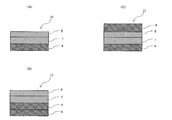
- the polarizing films 10 and 11 of the present invention will be described with reference to FIGS. 1 and 2.
- the transparent resin layer 2 formed of a forming material containing a polyvinyl alcohol-based resin is (directly) provided on the polarizer 1.
- FIG. 1 (A) only the polarizer 1 and the transparent resin layer 2 are shown.
- FIG. 1 (B) on the side of the polarizer 1 in FIG. A material 3 may be provided.
- the resin base material 3 for example, a resin base material used when the thin polarizer 1 is manufactured may be mentioned.
- the protective film 4 is provided in the polarizing film 10 of FIG. 1 (A).
- the protective film 4 can be provided on one side or both sides of the polarizing film of the polarizing film 10 in FIG.
- the protective film 4 is provided only on the polarizer 1 side, but the protective film 4 can also be provided only on the transparent resin layer 2 side.
- protective films 4 are provided on both sides of the polarizing film 10 of FIG.
- the protective film 4 can also be laminated
- FIG. 2C shows a case where two protective films 4 are laminated on one side of the polarizer 1.
- the polarizer 1 or the transparent resin layer 2 and the protective film 4 are laminated via intervening layers such as an adhesive layer, an adhesive layer, and an undercoat layer (primer layer).
- the easy-adhesion layer and the adhesive layer can be laminated by providing the protective film 4 with an easy-adhesion layer or applying an activation treatment.
- the polarizing films 10 and 11 of the present invention can be provided with an adhesive layer.
- a separator can be provided in the pressure-sensitive adhesive layer.
- a surface protective film can be provided in the polarizing films 10 and 11 (especially when it has the protective film 4) of this invention.
- the polarizing film with an adhesive layer having at least a separator (and further having a surface protective film) can be used as a wound body, for example, the polarized light with an adhesive layer fed out from the wound body and conveyed by the separator.
- an image display device Can be produced continuously.
- polarizer using a polyvinyl alcohol-based resin is used.
- polarizers include dichroic iodine and dichroic dyes on hydrophilic polymer films such as polyvinyl alcohol films, partially formalized polyvinyl alcohol films, and ethylene / vinyl acetate copolymer partially saponified films.
- hydrophilic polymer films such as polyvinyl alcohol films, partially formalized polyvinyl alcohol films, and ethylene / vinyl acetate copolymer partially saponified films.
- examples thereof include polyene-based oriented films such as those obtained by adsorbing substances and uniaxially stretched, polyvinyl alcohol dehydrated products and polyvinyl chloride dehydrochlorinated products.
- a polarizer composed of a polyvinyl alcohol film and a dichroic material such as iodine is preferable.
- the thickness of these polarizers is not particularly limited, but is generally 2 to 25 ⁇ m.
- a polarizer obtained by dyeing a polyvinyl alcohol film with iodine and uniaxially stretching it can be produced, for example, by dyeing polyvinyl alcohol in an aqueous iodine solution and stretching it 3 to 7 times the original length. If necessary, it may contain boric acid, zinc sulfate, zinc chloride, or the like, or may be immersed in an aqueous solution such as potassium iodide. Further, if necessary, the polyvinyl alcohol film may be immersed in water and washed before dyeing.
- Stretching may be performed after dyeing with iodine, may be performed while dyeing, or may be dyed with iodine after stretching.
- the film can be stretched even in an aqueous solution such as boric acid or potassium iodide or in a water bath.
- a thin polarizer having a thickness of 15 ⁇ m or less can be used.
- the thickness of the polarizer is preferably 12 ⁇ m or less from the viewpoint of thinning and crack resistance due to thermal shock, more preferably 10 ⁇ m or less, further 8 ⁇ m or less, further 7 ⁇ m or less, and further preferably 6 ⁇ m or less.
- the thickness of the polarizer is preferably 2 ⁇ m or more, and more preferably 3 ⁇ m or more.
- Such a thin polarizer has less thickness unevenness, excellent visibility, and less dimensional change, and therefore excellent durability against thermal shock.
- the polarizer can contain boric acid from the viewpoint of stretching stability and optical durability.
- the content of boric acid contained in the polarizer is preferably 20% by weight or less, more preferably 18% by weight or less, more preferably 18% by weight or less, from the viewpoint of suppressing cracks such as through cracks. It is preferably 16% by weight or less.
- the content of boric acid contained in the polarizer exceeds 20% by weight, it is preferable because even if the thickness of the polarizer is controlled to 15 ⁇ m or less, the contraction stress of the polarizer is increased and a through crack is easily generated. Absent.
- the boric acid content with respect to the total amount of the polarizer is preferably 10% by weight or more, and more preferably 12% by weight or more.
- Patent No. 4751486 Japanese Patent No. 4751481, Patent No. 4815544, Patent No. 5048120, Japanese Patent No. 5587517, International Publication No. 2014/077599 pamphlet, International Publication No. 2014/077636 Pamphlet, Or the like, or a thin polarizing film (polarizer) obtained from the production method described therein.
- the polarizer has an optical characteristic expressed by a single transmittance T and a polarization degree P of the following formula P> ⁇ (10 0.929T-42.4 ⁇ 1) ⁇ 100 (where T ⁇ 42.3), Or It is preferably configured to satisfy the condition of P ⁇ 99.9 (however, T ⁇ 42.3).
- a polarizing film configured so as to satisfy the above-described conditions uniquely has performance required as a display for a liquid crystal television using a large display element. Specifically, the contrast ratio is 1000: 1 or more and the maximum luminance is 500 cd / m 2 or more. As other uses, for example, it is bonded to the viewing side of the organic EL display device.
- Patent No. 4751486, Patent in that the polarizing performance can be improved at a high magnification.
- stretching in a boric-acid aqueous solution as described in the 4751481 specification and the patent 4815544 specification is preferable, and it describes especially in the patent 4751481 specification and the patent 4815544 specification.
- stretching in the boric-acid aqueous solution which has this is preferable.
- These thin polarizing films can be obtained by a production method including a step of stretching a polyvinyl alcohol-based resin (hereinafter also referred to as PVA-based resin) layer and a stretching resin base material in a laminated state and a step of dyeing.
- PVA-based resin polyvinyl alcohol-based resin
- a stretching resin base material in a laminated state
- dyeing a step of dyeing
- thermoplastic resins can be used as the material for forming the resin base material.
- the thermoplastic resin include ester resins such as polyethylene terephthalate resins, cycloolefin resins such as norbornene resins, olefin resins such as polypropylene, polyamide rheo resins, polycarbonate resins, and copolymer resins thereof. Can be mentioned. Of these, ester resins are preferred from the viewpoint of ease of production and cost reduction.
- an amorphous ester-based thermoplastic resin substrate or a crystalline ester-based thermoplastic resin substrate can be used as the ester-based thermoplastic resin substrate.
- a material excellent in transparency, mechanical strength, thermal stability, moisture barrier property, isotropy and the like is preferable.
- polyester polymers such as polyethylene terephthalate and polyethylene naphthalate
- cellulose polymers such as diacetyl cellulose and triacetyl cellulose
- acrylic polymers such as polymethyl methacrylate
- styrene such as polystyrene and acrylonitrile / styrene copolymer (AS resin)
- AS resin acrylonitrile / styrene copolymer
- polyethylene, polypropylene, polyolefins having a cyclo or norbornene structure, polyolefin polymers such as ethylene / propylene copolymers, vinyl chloride polymers, amide polymers such as nylon and aromatic polyamide, imide polymers, sulfone polymers , Polyether sulfone polymer, polyether ether ketone polymer, polyphenylene sulfide polymer, vinyl alcohol polymer, vinylidene chloride polymer, vinyl butyral polymer, arylate polymer, polyoxymethylene polymer, epoxy polymer, or the above Polymer blends and the like can also be mentioned as examples of the polymer forming the protective film.
- thermoplastic resin in the protective film is preferably 50 to 100% by weight, more preferably 50 to 99% by weight, still more preferably 60 to 98% by weight, and particularly preferably 70 to 97% by weight.
- content of the said thermoplastic resin in a protective film is 50 weight% or less, there exists a possibility that the high transparency etc. which a thermoplastic resin originally has cannot fully be expressed.
- a retardation film As the protective film, a retardation film, a brightness enhancement film, and a diffusion film can be used.
- the retardation film include those having a front retardation of 40 nm or more and / or a retardation having a thickness direction retardation of 80 nm or more.
- the front phase difference is usually controlled in the range of 40 to 200 nm
- the thickness direction phase difference is usually controlled in the range of 80 to 300 nm.
- the retardation film functions also as a polarizer protective film, so that the thickness can be reduced.
- the retardation film examples include a birefringent film obtained by uniaxially or biaxially stretching a thermoplastic resin film.
- the stretching temperature, stretching ratio, and the like are appropriately set depending on the retardation value, film material, and thickness.
- the thickness of the protective film can be determined as appropriate, but is generally about 1 to 500 ⁇ m from the viewpoints of workability such as strength and handleability, and thin layer properties. In particular, it is preferably 1 to 300 ⁇ m, more preferably 5 to 200 ⁇ m, and further preferably 5 to 150 ⁇ m, particularly 20 to 100 ⁇ m.
- a functional layer such as a hard coat layer, an antireflection layer, an antisticking layer, a diffusion layer or an antiglare layer can be provided on the surface of the protective film on which the polarizer is not adhered (particularly, the embodiment shown in FIG. 1).
- the hard coat layer, the antireflection layer, the antisticking layer, the diffusion layer, the antiglare layer, and other functional layers can be provided on the protective film itself, or can be provided separately from the protective film. it can.
- the protective film and the polarizer are laminated via an intervening layer such as an adhesive layer, an adhesive layer, and an undercoat layer (primer layer). At this time, it is desirable that the both are laminated without an air gap by an intervening layer.
- an intervening layer such as an adhesive layer, an adhesive layer, and an undercoat layer (primer layer).
- the adhesive layer is formed with an adhesive.
- the type of the adhesive is not particularly limited, and various types can be used.
- the adhesive layer is not particularly limited as long as it is optically transparent. Examples of the adhesive include water-based, solvent-based, hot-melt-based, active energy ray-curable types, and the like. Or an active energy ray hardening-type adhesive agent is suitable.
- water-based adhesives examples include isocyanate-based adhesives, polyvinyl alcohol-based adhesives, gelatin-based adhesives, vinyl-based latex systems, and water-based polyesters.
- the water-based adhesive is usually used as an adhesive composed of an aqueous solution, and usually contains 0.5 to 60% by weight of solid content.
- the active energy ray curable adhesive is an adhesive that cures by an active energy ray such as an electron beam or ultraviolet rays (radical curable type, cationic curable type), for example, in an electron beam curable type or an ultraviolet curable type. Can be used.
- an active energy ray such as an electron beam or ultraviolet rays (radical curable type, cationic curable type), for example, in an electron beam curable type or an ultraviolet curable type.
- an active energy ray curable adhesive for example, a photo radical curable adhesive can be used.
- the photo radical curable active energy ray curable adhesive is used as an ultraviolet curable adhesive, the adhesive contains a radical polymerizable compound and a photo polymerization initiator.
- the adhesive coating method is appropriately selected depending on the viscosity of the adhesive and the target thickness.
- coating methods include reverse coaters, gravure coaters (direct, reverse and offset), bar reverse coaters, roll coaters, die coaters, bar coaters, rod coaters and the like.
- a method such as a dapping method can be appropriately used.
- the adhesive is preferably applied so that the finally formed adhesive layer has a thickness of 30 to 300 nm.
- the thickness of the adhesive layer is more preferably 60 to 250 nm.
- the thickness of the adhesive layer is preferably 0.1 to 200 ⁇ m. More preferably, it is 0.5 to 50 ⁇ m, and still more preferably 0.5 to 10 ⁇ m.
- an easily bonding layer can be provided between a protective film and an adhesive bond layer.
- the easy adhesion layer can be formed of, for example, various resins having a polyester skeleton, a polyether skeleton, a polycarbonate skeleton, a polyurethane skeleton, a silicone-based, a polyamide skeleton, a polyimide skeleton, a polyvinyl alcohol skeleton, and the like. These polymer resins can be used alone or in combination of two or more. Moreover, you may add another additive for formation of an easily bonding layer. Specifically, a stabilizer such as a tackifier, an ultraviolet absorber, an antioxidant, and a heat resistance stabilizer may be used.
- the easy-adhesion layer is usually provided in advance on a protective film, and the easy-adhesion layer side of the protective film and the polarizer are laminated with an adhesive layer.
- the easy-adhesion layer is formed by applying and drying a material for forming the easy-adhesion layer on a protective film by a known technique.
- the material for forming the easy adhesion layer is usually prepared as a solution diluted to an appropriate concentration in consideration of the thickness after drying, the smoothness of coating, and the like.
- the thickness of the easy-adhesion layer after drying is preferably 0.01 to 5 ⁇ m, more preferably 0.02 to 2 ⁇ m, and still more preferably 0.05 to 1 ⁇ m. Note that a plurality of easy-adhesion layers can be provided, but also in this case, the total thickness of the easy-adhesion layers is preferably in the above range.
- the pressure-sensitive adhesive layer is formed from a pressure-sensitive adhesive.
- Various pressure-sensitive adhesives can be used as the pressure-sensitive adhesive, such as rubber-based pressure-sensitive adhesives, acrylic pressure-sensitive adhesives, silicone-based pressure-sensitive adhesives, urethane-based pressure-sensitive adhesives, vinyl alkyl ether-based pressure-sensitive adhesives, polyvinylpyrrolidone-based pressure-sensitive adhesives, Examples include acrylamide-based adhesives and cellulose-based adhesives.
- An adhesive base polymer is selected according to the type of the adhesive.
- acrylic pressure-sensitive adhesives are preferably used because they are excellent in optical transparency, exhibit appropriate wettability, cohesiveness, and adhesive pressure-sensitive adhesive properties, and are excellent in weather resistance and heat resistance.
- the undercoat layer (primer layer) is formed to improve the adhesion between the polarizer and the protective film.
- the material constituting the primer layer is not particularly limited as long as the material exhibits a certain degree of strong adhesion to both the base film and the polyvinyl alcohol-based resin layer.
- a thermoplastic resin excellent in transparency, thermal stability, stretchability, etc. is used.
- the thermoplastic resin include an acrylic resin, a polyolefin resin, a polyester resin, a polyvinyl alcohol resin, or a mixture thereof.
- the transparent resin layer is formed from a forming material containing a polyvinyl alcohol-based resin.
- the polyvinyl alcohol resin forming the transparent resin layer may be the same as or different from the polyvinyl alcohol resin contained in the polarizer as long as it is a “polyvinyl alcohol resin”.
- the transparent resin layer can be formed by applying the forming material to, for example, a polarizer.
- the transparent resin layer is provided on at least one surface of the polarizer.
- the thickness of the transparent resin layer is 0.2 ⁇ m or more, and the occurrence of cracks can be suppressed by the transparent resin layer having the thickness.
- the thickness of the transparent resin layer is preferably 0.4 ⁇ m or more, more preferably 0.5 ⁇ m or more, and further preferably 0.7 ⁇ m or more.
- the thickness of the transparent resin layer is preferably 6 ⁇ m or less, more preferably 5 ⁇ m or less, and further preferably 3 ⁇ m or less. .
- the total content of sodium acetate and potassium acetate contained in the transparent resin layer of the present invention is controlled to be less than 1% by weight from the viewpoint of optical reliability in the heating and humidification test.
- the total content of sodium acetate and potassium acetate is preferably 0.5% by weight or less, more preferably 0.3% by weight or less, and further preferably 0.05% by weight or less.
- the total content of sodium acetate and potassium acetate is controlled by using a polyvinyl alcohol-based resin as a forming material used for forming the transparent resin layer, and having a small ratio of the total content of sodium acetate and potassium acetate, for example, polyvinyl alcohol. It can be controlled by using a resin composition having a total content of sodium acetate and potassium acetate of less than 1% by weight.
- polyvinyl alcohol resin examples include polyvinyl alcohol.
- Polyvinyl alcohol is obtained by saponifying polyvinyl acetate.
- polyvinyl alcohol-based resin examples include a saponified product of a copolymer of vinyl acetate and a monomer having copolymerizability.
- the copolymerizable monomer is ethylene
- an ethylene-vinyl alcohol copolymer is obtained.
- the copolymerizable monomer include unsaturated carboxylic acids such as (anhydrous) maleic acid, fumaric acid, crotonic acid, itaconic acid, (meth) acrylic acid, and esters thereof; ethylene, propylene, etc.
- ⁇ -olefin (meth) allylsulfonic acid (soda), sulfonic acid soda (monoalkylmalate), disulfonic acid soda alkylmalate, N-methylolacrylamide, acrylamide alkylsulfonic acid alkali salt, N-vinylpyrrolidone, N- Examples include vinyl pyrrolidone derivatives.
- These polyvinyl alcohol resins can be used alone or in combination of two or more. From the viewpoint of satisfying the heat and moisture resistance and water resistance, polyvinyl alcohol obtained by saponifying polyvinyl acetate is preferable.
- the saponification degree of the polyvinyl alcohol resin is, for example, 96 mol% or more. From the viewpoint of satisfying the heat and moisture resistance and water resistance, the saponification degree is preferably 99 mol% or more, more preferably 99.3 mol% or more, and further preferably 99.7 mol% or more.
- the degree of saponification represents the proportion of units that are actually saponified to vinyl alcohol units among the units that can be converted to vinyl alcohol units by saponification, and the residue is a vinyl ester unit.
- the saponification degree can be determined according to JIS K 6726-1994.
- the average degree of polymerization of the polyvinyl alcohol-based resin can be, for example, 500 or more. From the viewpoint of satisfying the heat and moisture resistance and water resistance, the average degree of polymerization is preferably 1000 or more, and more preferably 1500 or more. Is preferable, and 2000 or more is more preferable. The average degree of polymerization of the polyvinyl alcohol resin is measured according to JIS-K6726.
- a modified polyvinyl alcohol resin having a hydrophilic functional group in the side chain of the polyvinyl alcohol or a copolymer thereof can be used.
- the hydrophilic functional group include an acetoacetyl group and a carbonyl group.
- modified polyvinyl alcohol obtained by acetalization, urethanization, etherification, grafting, phosphoric esterification or the like of a polyvinyl alcohol resin can be used.
- the transparent resin layer of the present invention is controlled so that the total content of sodium acetate and potassium acetate is less than 1% by weight.
- the control can be performed, for example, by washing sodium acetate and potassium acetate from a polyvinyl alcohol-based resin that forms a transparent resin layer as described below.
- the polyvinyl alcohol resin is produced by polymerizing a vinyl acetate monomer and saponifying the obtained polyvinyl acetate, and sodium acetate (or potassium acetate) is contained in the production process.
- a method for washing sodium acetate (or potassium acetate) in the polyvinyl alcohol resin a known method can be used. For example, the methods described in JP-A No. 2002-301715, JP-A No. 2002-60495, JP-A No. 2007-245432, WO 2011/108152 can be employed.
- the washing method may wash sodium acetate (or potassium acetate) by any means, but in order to obtain the effect of the present invention, washing is performed until sodium acetate (or potassium acetate) has a target content. It is preferable to repeat the process a plurality of times.
- the transparent resin layer can be formed from a forming material that does not contain a curable component.
- a forming material that does not contain a curable component.
- it can be formed from a forming material containing the polyvinyl alcohol resin (PVA resin) as a main component.
- PVA resin polyvinyl alcohol resin
- the forming material containing the polyvinyl alcohol-based resin as a main component can contain a curable component (crosslinking agent) and the like.
- the proportion of the polyvinyl alcohol-based resin in the transparent resin layer or the forming material (solid content) is preferably 80% by weight or more, more preferably 90% by weight or more, and further preferably 95% by weight or more.
- the forming material does not contain a curable component (crosslinking agent).
- a compound having at least two functional groups having reactivity with the polyvinyl alcohol resin can be used.
- alkylenediamine having two alkylene groups and two amino groups such as ethylenediamine, triethylenediamine, hexamethylenediamine; tolylene diisocyanate, hydrogenated tolylene diisocyanate, trimethylolpropane tolylene diisocyanate adduct, triphenylmethane triisocyanate, methylene bis (4-Phenylmethane triisocyanate, isophorone diisocyanate and isocyanates such as ketoxime block product or phenol block product thereof; ethylene glycol diglycidyl ether, polyethylene glycol diglycidyl ether, glycerin di or triglycidyl ether, 1,6-hexane Diol diglycidyl ether, trimethylolpropane triglycidyl ether, di Epoxies
- hardenable component crosslinking agent
- the ratio is 20 weight part or less, 10 weight part or less, 5 weight part with respect to 100 weight part of polyvinyl alcohol-type resin. It is preferable that:
- the forming material is prepared as a solution in which the polyvinyl alcohol resin is dissolved in a solvent.
- the solvent include water, dimethyl sulfoxide, dimethylformamide, dimethylacetamide N-methylpyrrolidone, various glycols, polyhydric alcohols such as trimethylolpropane, and amines such as ethylenediamine and diethylenetriamine. These may be used alone or in combination of two or more. Among these, it is preferable to use it as an aqueous solution using water as a solvent.
- the concentration of the polyvinyl alcohol-based resin in the forming material is not particularly limited, but is 0.1 to 15% by weight, preferably 0.5%, in consideration of coating properties and storage stability. ⁇ 10% by weight.
- a plasticizer for example, polyhydric alcohols such as ethylene glycol and glycerin.
- the surfactant include nonionic surfactants.
- coupling agents such as silane coupling agents and titanium coupling agents, various tackifiers, ultraviolet absorbers, antioxidants, heat stabilizers, hydrolysis stabilizers, and other stabilizers can be added.
- the transparent resin layer can be formed by applying and drying the forming material on the other surface of the polarizer (the surface not having the protective film).
- the forming material is applied so that the thickness after drying is 0.2 ⁇ m or more.
- the application operation is not particularly limited, and any appropriate method can be adopted.
- various means such as a roll coating method, a spin coating method, a wire bar coating method, a dip coating method, a die coating method, a curtain coating method, a spray coating method, a knife coating method (comma coating method, etc.) can be employed.
- the drying temperature of the coated forming material is usually preferably 60 to 120 ° C., more preferably 70 to 100 ° C.
- the drying time is preferably 10 to 300 seconds, more preferably 20 to 120 seconds.
- the polarizing film can be used as a polarizing film with an adhesive layer by providing an adhesive layer.
- the pressure-sensitive adhesive layer can be provided on the side of the transparent resin layer or polarizer of the polarizing film, or in the case of having a protective film on the protective film.
- a separator can be provided in the pressure-sensitive adhesive layer of the polarizing film with the pressure-sensitive adhesive layer.
- an appropriate pressure-sensitive adhesive can be used, and the type thereof is not particularly limited.
- Adhesives include rubber adhesives, acrylic adhesives, silicone adhesives, urethane adhesives, vinyl alkyl ether adhesives, polyvinyl alcohol adhesives, polyvinyl pyrrolidone adhesives, polyacrylamide adhesives, Examples thereof include cellulose-based pressure-sensitive adhesives.
- pressure-sensitive adhesives those having excellent optical transparency, suitable wettability, cohesiveness, and adhesive pressure characteristics, and excellent weather resistance and heat resistance are preferably used.
- An acrylic pressure-sensitive adhesive is preferably used as one exhibiting such characteristics.
- FIGS. As a method for forming the pressure-sensitive adhesive layer, for example, the pressure-sensitive adhesive is applied to a separator having been subjected to a release treatment, and after the polymerization solvent and the like are removed by drying to form a pressure-sensitive adhesive layer, FIGS.
- FIGS. In the embodiment of FIG. 2, a method of transferring to a transparent resin layer or a protective film (or a protective film in the embodiment of FIG. 2C), or in the embodiments of FIGS. 2A and 2B, a transparent resin layer or a protective film (or FIG. 2).
- the pressure-sensitive adhesive is applied to the protective film), and the polymerization solvent is dried and removed to form a pressure-sensitive adhesive layer on the polarizer.
- one or more solvents other than the polymerization solvent may be added as appropriate.
- a silicone release liner is preferably used as the release-treated separator.
- an appropriate method may be adopted as appropriate according to the purpose.
- a method of heating and drying the coating film is used.
- the heating and drying temperature is preferably 40 ° C to 200 ° C, more preferably 50 ° C to 180 ° C, and particularly preferably 70 ° C to 170 ° C.
- the drying time is preferably 5 seconds to 20 minutes, more preferably 5 seconds to 10 minutes, and particularly preferably 10 seconds to 5 minutes.
- Various methods are used as a method for forming the pressure-sensitive adhesive layer. Specifically, for example, roll coat, kiss roll coat, gravure coat, reverse coat, roll brush, spray coat, dip roll coat, bar coat, knife coat, air knife coat, curtain coat, lip coat, die coater, etc. Examples thereof include an extrusion coating method.
- the thickness of the pressure-sensitive adhesive layer is not particularly limited and is, for example, about 1 to 100 ⁇ m.
- the thickness is preferably 2 to 50 ⁇ m, more preferably 2 to 40 ⁇ m, and still more preferably 5 to 35 ⁇ m.
- the pressure-sensitive adhesive layer When the pressure-sensitive adhesive layer is exposed, the pressure-sensitive adhesive layer may be protected with a peeled sheet (separator) until practical use.
- constituent material of the separator examples include, for example, plastic films such as polyethylene, polypropylene, polyethylene terephthalate, and polyester films, porous materials such as paper, cloth, and nonwoven fabric, nets, foam sheets, metal foils, and laminates thereof.
- plastic films such as polyethylene, polypropylene, polyethylene terephthalate, and polyester films
- porous materials such as paper, cloth, and nonwoven fabric, nets, foam sheets, metal foils, and laminates thereof.
- a thin film can be used, but a plastic film is preferably used because of its excellent surface smoothness.
- the plastic film is not particularly limited as long as it can protect the pressure-sensitive adhesive layer.
- a polyethylene film, a polypropylene film, a polybutene film, a polybutadiene film, a polymethylpentene film, a polyvinyl chloride film, and a vinyl chloride co-polymer are used.
- examples thereof include a polymer film, a polyethylene terephthalate film, a polybutylene terephthalate film, a polyurethane film, and an ethylene-vinyl acetate copolymer film.
- the thickness of the separator is usually about 5 to 200 ⁇ m, preferably about 5 to 100 ⁇ m.
- mold release and antifouling treatment with a silicone type, fluorine type, long chain alkyl type or fatty acid amide type release agent, silica powder, etc., coating type, kneading type, vapor deposition type It is also possible to carry out antistatic treatment such as.
- the release property from the pressure-sensitive adhesive layer can be further improved by appropriately performing a release treatment such as silicone treatment, long-chain alkyl treatment, or fluorine treatment on the surface of the separator.
- a surface protective film can be provided on the polarizing film.
- the surface protective film usually has a base film and an adhesive layer, and protects the polarizer via the adhesive layer.
- a film material having isotropic property or close to isotropic property is selected from the viewpoints of inspection property and manageability.
- film materials include polyester resins such as polyethylene terephthalate film, cellulose resins, acetate resins, polyether sulfone resins, polycarbonate resins, polyamide resins, polyimide resins, polyolefin resins, acrylic resins, and the like. Examples thereof include transparent polymers such as resins. Of these, polyester resins are preferred.
- the base film can be used as a laminate of one kind or two or more kinds of film materials, and a stretched product of the film can also be used.
- the thickness of the base film is generally 500 ⁇ m or less, preferably 10 to 200 ⁇ m.
- the pressure-sensitive adhesive that forms the pressure-sensitive adhesive layer of the surface protective film includes a (meth) acrylic polymer, a silicone-based polymer, a polyester, a polyurethane, a polyamide, a polyether, a fluorine-based or a rubber-based pressure-sensitive adhesive. Can be appropriately selected and used. From the viewpoints of transparency, weather resistance, heat resistance and the like, an acrylic pressure-sensitive adhesive having an acrylic polymer as a base polymer is preferable.
- the thickness (dry film thickness) of the pressure-sensitive adhesive layer is determined according to the required adhesive force. Usually, it is about 1 to 100 ⁇ m, preferably 5 to 50 ⁇ m.
- the surface protective film can be provided with a release treatment layer on the surface opposite to the surface on which the pressure-sensitive adhesive layer is provided on the base film, using a low adhesion material such as silicone treatment, long-chain alkyl treatment, or fluorine treatment. .
- the polarizing film of the present invention can be used as an optical film laminated with another optical layer in practical use.
- the optical layer is not particularly limited.
- a liquid crystal display device such as a reflection plate, a semi-transmission plate, a retardation plate (including wavelength plates such as 1/2 and 1/4), and a viewing angle compensation film.
- One or more optical layers that may be used can be used.
- a reflective polarizing film or semi-transmissive polarizing film in which a polarizing plate or a semi-transmissive reflecting plate is further laminated on the polarizing film of the present invention an elliptical polarizing film or circularly polarizing film in which a retardation film is further laminated on a polarizing film.
- a wide viewing angle polarizing film obtained by further laminating a viewing angle compensation film on a film or a polarizing film, or a polarizing film obtained by further laminating a brightness enhancement film on the polarizing film is preferred.
- An optical film obtained by laminating the above optical layer on a polarizing film can be formed by a method of sequentially laminating separately in the manufacturing process of a liquid crystal display device or the like. It is excellent in stability and assembly work, and has the advantage of improving the manufacturing process of a liquid crystal display device and the like.
- an appropriate adhesive means such as a pressure-sensitive adhesive layer can be used.
- their optical axes can be set at an appropriate arrangement angle in accordance with the target retardation characteristics.
- the polarizing film or optical film of the present invention can be preferably used for forming various devices such as a liquid crystal display device.
- the liquid crystal display device can be formed according to the conventional method. That is, a liquid crystal display device is generally formed by appropriately assembling components such as a liquid crystal cell, a polarizing film or an optical film, and an illumination system as necessary, and incorporating a drive circuit. There is no limitation in particular except the point which uses a polarizing film or an optical film by invention, and it can apply according to the former.
- the liquid crystal cell any type such as IPS type and VA type can be used.
- liquid crystal display devices such as a liquid crystal display device in which a polarizing film or an optical film is disposed on one side or both sides of a liquid crystal cell, or a backlight or a reflector used in an illumination system can be formed.
- the polarizing film or optical film by this invention can be installed in the one side or both sides of a liquid crystal cell.
- polarizing film or an optical film on both sides they may be the same or different.
- a single layer or a suitable part such as a diffusing plate, an antiglare layer, an antireflection film, a protective plate, a prism array, a lens array sheet, a light diffusing plate, a backlight, etc.
- a diffusing plate for example, a diffusing plate, an antiglare layer, an antireflection film, a protective plate, a prism array, a lens array sheet, a light diffusing plate, a backlight, etc.
- a protective plate such as a prism array, a lens array sheet, a light diffusing plate, a backlight, etc.
- a prism array such as a prism array, a lens array sheet, a light diffusing plate, a backlight, etc.
- IPA copolymerized PET amorphous isophthalic acid copolymerized polyethylene terephthalate (IPA copolymerized PET) film (thickness: 100 ⁇ m) having a water absorption of 0.75% and Tg of 75 ° C. is subjected to corona treatment.
- Alcohol polymerization degree 4200, saponification degree 99.2 mol%) and acetoacetyl-modified PVA (polymerization degree 1200, acetoacetyl modification degree 4.6%, saponification degree 99.0 mol% or more, manufactured by Nippon Synthetic Chemical Industry Co., Ltd.
- aqueous solution containing 9: 1 ratio of the trade name “Gosefimer Z200”) was applied and dried at 25 ° C. to form a PVA-based resin layer having a thickness of 11 ⁇ m, thereby preparing a laminate.
- the obtained laminate was uniaxially stretched in the longitudinal direction (longitudinal direction) 2.0 times between rolls having different peripheral speeds in an oven at 120 ° C. (air-assisted stretching process).
- the laminate was immersed in an insolubilization bath (a boric acid aqueous solution obtained by blending 4 parts by weight of boric acid with respect to 100 parts by weight of water) for 30 seconds (insolubilization treatment).
- boric acid aqueous solution obtained by blending 3 parts by weight of potassium iodide and 3 parts by weight of boric acid with respect to 100 parts by weight of water.
- Crosslinking treatment Thereafter, the laminate was immersed in a boric acid aqueous solution (an aqueous solution obtained by blending 4 parts by weight of boric acid and 5 parts by weight of potassium iodide with respect to 100 parts by weight of water) at a liquid temperature of 70 ° C.
- uniaxial stretching was performed between rolls having different peripheral speeds in the longitudinal direction (longitudinal direction) so that the total stretching ratio was 5.5 times (in-water stretching treatment).
- an optical film laminate A0 including a polarizer having a thickness of 5 ⁇ m was obtained.
- the optical film laminate A1 was prepared in the same manner as the production method of the optical film laminate A0 except that boric acid blended in the boric acid aqueous solution in the underwater stretching treatment was changed to 3.5 parts by weight. Got. The thickness of the obtained polarizer was 5 ⁇ m.
- the optical film laminate A2 was produced in the same manner as the production method of the optical film laminate A0 except that boric acid blended in the boric acid aqueous solution in the underwater stretching treatment was changed to 4.5 parts by weight. Got. The thickness of the obtained polarizer was 5 ⁇ m.
- optical film laminate B In the production of the optical film laminate A0, an optical film laminate B was obtained in the same manner as the production method of the optical film laminate A0 except that a PVA resin layer having a thickness of 15 ⁇ m was formed. The thickness of the obtained polarizer was 7 ⁇ m.
- Protective film A (meth) acrylic resin film having a lactone ring structure with a thickness of 40 ⁇ m was subjected to corona treatment on the easy adhesion treated surface.
- An ultraviolet curable adhesive was prepared by mixing 40 parts by weight of N-hydroxyethylacrylamide (HEAA), 60 parts by weight of acryloylmorpholine (ACMO), and 3 parts by weight of a photoinitiator “IRGACURE 819” (manufactured by BASF).
- HEAA N-hydroxyethylacrylamide
- ACMO acryloylmorpholine
- UVGACURE 819 a photoinitiator
- This washing process was repeated a plurality of times until the sodium acetate content reached the target value.
- a polyvinyl alcohol resin having a polymerization degree of 2500, a saponification degree of 99.8 mol%, and a sodium acetate content of 0.03% by weight was obtained.
- the obtained polyvinyl alcohol resin was dissolved in pure water to prepare an aqueous solution having a solid content concentration of 4% by weight.
- Example 15 as an additive, 5 parts of methylol melamine (manufactured by DIC, trade name “Watersol: S-695”) is blended with 100 parts by weight of a polyvinyl alcohol resin to obtain a solid content concentration. A 4% by weight aqueous solution (Forming Material I) was prepared.
- active energy ray irradiation As an active energy ray, visible light (gallium filled metal halide lamp) Irradiation device: Fusion UV Systems, Inc. Light HAMMER10 bulb: V bulb Peak illuminance: 1600 mW / cm 2 , integrated irradiation amount 1000 / mJ / cm 2 (wavelength 380 ⁇ 440 nm) was used. The illuminance of visible light was measured using a Sola-Check system manufactured by Solatell.
- Comparative Example 1 ⁇ Production of single-protective polarizing film>
- the protective film is bonded to the surface of the polarizing film of the optical film laminate A0 while applying the ultraviolet curable adhesive so that the thickness of the adhesive layer after curing is 0.5 ⁇ m, and then active. Energy rays were irradiated to cure the adhesive. Subsequently, the amorphous PET base material was peeled off to produce a piece protective polarizing film using a thin polarizing film.
- the optical properties of the obtained piece-protecting polarizing film were a transmittance of 42.8% and a degree of polarization of 99.99%.
- Example 1 Preparation of a single protective polarizing film with a transparent resin layer: corresponding to FIG. 2 (A)>
- the polyvinyl alcohol-based forming material A adjusted to 25 ° C. is wired. After coating with a bar coater so that the thickness after drying was 1.5 ⁇ m, it was dried with hot air at 60 ° C. for 1 minute to produce a piece protective polarizing film with a transparent resin layer.
- the optical properties of the obtained piece-protecting polarizing film with a transparent resin layer were a transmittance of 42.8% and a degree of polarization of 99.99%.
- Example 2 the type of polarizer, the type of transparent resin layer forming material (polyvinyl alcohol resin saponification degree, polymerization degree, presence of additives are as shown in Table 1), and the thickness of the transparent resin layer are shown in Table 1.
- a piece protective polarizing film with a transparent resin layer was produced in the same manner as in Example 1 except for the change as shown.
- the optical properties of the obtained piece-protecting polarizing film with a transparent resin layer were a transmittance of 42.8% and a degree of polarization of 99.99%.
- FTIR Fourier transform infrared spectrophotometer
- SPECTRUM2000 the total reflection attenuation spectroscopy using the polarized light as the measurement light for the polarizers obtained in the examples and comparative examples
- the intensity of the boric acid peak (665 cm ⁇ 1 ) and the intensity of the reference peak (2941 cm ⁇ 1 ) were measured by ATR) measurement.
- the boric acid content index was calculated from the obtained boric acid peak intensity and the reference peak intensity by the following formula, and the boric acid content (% by weight) was determined from the calculated boric acid index by the following formula.
- the acrylic pressure-sensitive adhesive solution is uniformly applied to the surface of a polyethylene terephthalate film (separator film) treated with a silicone-based release agent with a fountain coater and dried in an air circulation type thermostatic oven at 155 ° C. for 2 minutes. Then, an adhesive layer having a thickness of 20 ⁇ m was formed on the surface of the separator film.
- Total content of sodium acetate and potassium acetate in the transparent resin layer > (1) For the total content of sodium acetate and potassium acetate in the transparent resin layer, the amount of sodium (derived from sodium acetate) or the amount of potassium (derived from potassium acetate) in the transparent resin layer was measured by TOF-SIMS. (2) Polyvinyl alcohol resin (sodium acetate content: 0.39% by weight, 2.38% by weight, 4.87% by weight) whose sodium acetate content is known in advance is applied to a PET substrate and has a thickness of 5 ⁇ m. Three types of calibration curve measurement films were prepared.
- the sodium acetate content was calculated from the line.
- a film in which the content of potassium acetate is similarly known is prepared, the horizontal ionic strength of K 2 OH is plotted on the horizontal axis, and the vertical axis is plotted.
- a calibration curve of potassium acetate content (% by weight) was prepared, and the potassium acetate content was calculated.
- both sodium hydroxide and potassium hydroxide were used when saponifying the polyvinyl alcohol resin, calibration curves for sodium acetate and potassium acetate were prepared, and the total content was calculated. .
- the degree of polarization P is the transmittance when two identical polarizing films are overlapped so that their transmission axes are parallel (parallel transmittance: Tp), and overlapped so that their transmission axes are orthogonal to each other. It is calculated
- Polarization degree P (%) ⁇ (Tp ⁇ Tc) / (Tp + Tc) ⁇ 1/2 ⁇ 100
- Each transmittance is represented by a Y value obtained by correcting visibility with a two-degree field of view (C light source) of JIS Z8701, with 100% of the completely polarized light obtained through the Granteller prism polarizer.
- Table 1 describes the rate of change in the degree of polarization, and the rate of change was determined according to the following criteria.
- X Change rate of polarization degree is over 1.5%.
- ⁇ Crack resistance> The obtained polarizing film with an adhesive layer was cut into a size of 400 mm long ⁇ 708 mm wide (absorption axis direction is 400 mm) and 708 mm long ⁇ 400 mm wide (absorption axis direction is 708 mm), 402 mm long ⁇ 710 mm wide ⁇
- a sample was prepared by pasting both sides of a non-alkali glass having a thickness of 1.3 mm in the crossed Nicols direction. The sample was put into an oven at 95 ° C. for 250 hours, and then taken out, and it was visually confirmed whether or not a crack was generated in the polarizing film with the pressure-sensitive adhesive layer. This test was carried out 10 times per sample, and the number of samples with cracks was counted.
- WS indicates methylolmelamine: watersol S-695 (manufactured by DIC)).
Landscapes
- Physics & Mathematics (AREA)
- Chemical & Material Sciences (AREA)
- General Physics & Mathematics (AREA)
- Optics & Photonics (AREA)
- Nonlinear Science (AREA)
- Organic Chemistry (AREA)
- Mathematical Physics (AREA)
- Crystallography & Structural Chemistry (AREA)
- Polarising Elements (AREA)
Abstract
Description
前記透明樹脂層は、厚み0.2μm以上であり、
前記透明樹脂層は、ケン化度が96モル%以上のポリビニルアルコール系樹脂を含有する形成材から形成されており、かつ、
前記透明樹脂層中に含まれる酢酸ナトリウムおよび酢酸カリウムの合計含有量が1重量%未満であることを特徴とする偏光フィルム、に関する。
P>-(100.929T-42.4-1)×100(ただし、T<42.3)、又は、
P≧99.9(ただし、T≧42.3)表される範囲にあることが好ましい。
偏光子は、ポリビニルアルコール系樹脂を用いたものが使用される。偏光子としては、例えば、ポリビニルアルコール系フィルム、部分ホルマール化ポリビニルアルコール系フィルム、エチレン・酢酸ビニル共重合体系部分ケン化フィルム等の親水性高分子フィルムに、ヨウ素や二色性染料の二色性物質を吸着させて一軸延伸したもの、ポリビニルアルコールの脱水処理物やポリ塩化ビニルの脱塩酸処理物等ポリエン系配向フィルム等が挙げられる。これらの中でも、ポリビニルアルコール系フィルムとヨウ素などの二色性物質からなる偏光子が好適である。これらの偏光子の厚さは特に制限されないが、一般的には2~25μmである。
特許第4751486号明細書、
特許第4751481号明細書、
特許第4815544号明細書、
特許第5048120号明細書、
特許第5587517号明細書、
国際公開第2014/077599号パンフレット、
国際公開第2014/077636号パンフレット、
等に記載されている薄型偏光膜(偏光子)またはこれらに記載の製造方法から得られる薄型偏光膜(偏光子)を挙げることができる。
P>-(100.929T-42.4-1)×100(ただし、T<42.3)、又は、
P≧99.9(ただし、T≧42.3)の条件を満足するように構成されたことが好ましい。前記条件を満足するように構成された偏光膜は、一義的には、大型表示素子を用いた液晶テレビ用のディスプレイとして求められる性能を有する。具体的にはコントラスト比1000:1以上かつ最大輝度500cd/m2以上である。他の用途としては、例えば有機EL表示装置の視認側に貼り合される。
なお、図1(B)に示した樹脂基材(延伸用樹脂基材)は、前記薄型偏光膜の製造に適用されたものを用いることができる。樹脂基材の形成材料としては、各種の熱可塑性樹脂を用いることができる。熱可塑性樹脂としては、例えば、ポリエチレンテレフタレート系樹脂等のエステル系樹脂、ノルボルネン系樹脂等のシクロオレフィン系樹脂、ポリプロピレン等のオレフィン系樹脂、ポリアミドレオ樹脂、ポリカーボネート系樹脂、これらの共重合樹脂等が挙げられる。これらのなかでも製造のしやすさ及びコスト軽減の点から、エステル系樹脂が好ましい。エステル系熱可塑性樹脂基材は、非晶性エステル系熱可塑性樹脂基材または結晶性エステル系熱可塑性樹脂基材を用いることができる。
前記保護フィルムを構成する材料としては、透明性、機械的強度、熱安定性、水分遮断性、等方性などに優れるものが好ましい。例えば、ポリエチレンテレフタレートやポリエチレンナフタレートなどのポリエステル系ポリマー、ジアセチルセルロースやトリアセチルセルロースなどのセルロース系ポリマー、ポリメチルメタクリレートなどのアクリル系ポリマー、ポリスチレンやアクリロニトリル・スチレン共重合体(AS樹脂)などのスチレン系ポリマー、ポリカーボネート系ポリマー等が挙げられる。また、ポリエチレン、ポリプロピレン、シクロ系ないしはノルボルネン構造を有するポリオレフィン、エチレン・プロピレン共重合体の如きポリオレフィン系ポリマー、塩化ビニル系ポリマー、ナイロンや芳香族ポリアミドなどのアミド系ポリマー、イミド系ポリマー、スルホン系ポリマー、ポリエーテルスルホン系ポリマー、ポリエーテルエーテルケトン系ポリマー、ポリフェニレンスルフィド系ポリマー、ビニルアルコール系ポリマー、塩化ビニリデン系ポリマー、ビニルブチラール系ポリマー、アリレート系ポリマー、ポリオキシメチレン系ポリマー、エポキシ系ポリマー、または上記ポリマーのブレンド物なども上記保護フィルムを形成するポリマーの例として挙げられる。
前記保護フィルムと偏光子は接着剤層、粘着剤層、下塗り層(プライマー層)などの介在層を介して積層される。この際、介在層により両者を空気間隙なく積層することが望ましい。
透明樹脂層は、ポリビニルアルコール系樹脂を含有する形成材から形成される。透明樹脂層を形成するポリビニルアルコール系樹脂は、「ポリビニルアルコール系樹脂」である限り、偏光子が含有するポリビニルアルコール系樹脂と同一でも異なってもいてもよい。
ポリビニルアルコール樹脂は、酢酸ビニルモノマーを重合し、得られたポリ酢酸ビニルを鹸化することにより製造されるが、その製造過程において酢酸ナトリウム(または酢酸カリウム)が含有される。このポリビニルアルコール樹脂中の酢酸ナトリウム(または酢酸カリウム)の洗浄方法としては、公知の方法を用いることができる。たとえば、特開2002-301715号公報、特開2002-60495号公報、特開2007-245432号公報、国際公開第2011/108152号パンフレットなどに記載の方法を採用することができる。なお、洗浄方法は、いかなる手段で酢酸ナトリウム(または酢酸カリウム)を洗浄してもよいが、本発明の効果を得るためには、酢酸ナトリウム(または酢酸カリウム)が目的の含有量になるまで洗浄工程を複数回繰り返して行うことが好ましい。
前記偏光フィルムには粘着剤層を設けて、粘着剤層付偏光フィルムとして用いることができる。粘着剤層は、偏光フィルムの透明樹脂層または偏光子の側に、また、保護フィルムを有する場合には保護フィルムに設けることができる。粘着剤層付偏光フィルムの粘着剤層にはセパレータを設けることができる。
偏光フィルムには、表面保護フィルムを設けることができる。表面保護フィルムは、通常、基材フィルムおよび粘着剤層を有し、当該粘着剤層を介して偏光子を保護する。
本発明の偏光フィルムは、実用に際して他の光学層と積層した光学フィルムとして用いることができる。その光学層については特に限定はないが、例えば反射板や半透過板、位相差板(1/2や1/4などの波長板を含む)、視角補償フィルムなどの液晶表示装置などの形成に用いられることのある光学層を1層または2層以上用いることができる。特に、本発明の偏光フィルムに更に反射板または半透過反射板が積層されてなる反射型偏光フィルムまたは半透過型偏光フィルム、偏光フィルムに更に位相差板が積層されてなる楕円偏光フィルムまたは円偏光フィルム、偏光フィルムに更に視角補償フィルムが積層されてなる広視野角偏光フィルム、あるいは偏光フィルムに更に輝度向上フィルムが積層されてなる偏光フィルムが好ましい。
吸水率0.75%、Tg75℃の非晶質のイソフタル酸共重合ポリエチレンテレフタレート(IPA共重合PET)フィルム(厚み:100μm)基材の片面に、コロナ処理を施し、このコロナ処理面に、ポリビニルアルコール(重合度4200、ケン化度99.2モル%)およびアセトアセチル変性PVA(重合度1200、アセトアセチル変性度4.6%、ケン化度99.0モル%以上、日本合成化学工業社製、商品名「ゴーセファイマーZ200」)を9:1の比で含む水溶液を25℃で塗布および乾燥して、厚み11μmのPVA系樹脂層を形成し、積層体を作製した。
得られた積層体を、120℃のオーブン内で周速の異なるロール間で縦方向(長手方向)に2.0倍に自由端一軸延伸した(空中補助延伸処理)。
次いで、積層体を、液温30℃の不溶化浴(水100重量部に対して、ホウ酸を4重量部配合して得られたホウ酸水溶液)に30秒間浸漬させた(不溶化処理)。
次いで、液温30℃の染色浴に、偏光板が所定の透過率となるようにヨウ素濃度、浸漬時間を調整しながら浸漬させた。本実施例では、水100重量部に対して、ヨウ素を0.2重量部配合し、ヨウ化カリウムを1.0重量部配合して得られたヨウ素水溶液に60秒間浸漬させた(染色処理)。
次いで、液温30℃の架橋浴(水100重量部に対して、ヨウ化カリウムを3重量部配合し、ホウ酸を3重量部配合して得られたホウ酸水溶液)に30秒間浸漬させた(架橋処理)。
その後、積層体を、液温70℃のホウ酸水溶液(水100重量部に対して、ホウ酸を4重量部配合し、ヨウ化カリウムを5重量部配合して得られた水溶液)に浸漬させながら、周速の異なるロール間で縦方向(長手方向)に総延伸倍率が5.5倍となるように一軸延伸を行った(水中延伸処理)。
その後、積層体を液温30℃の洗浄浴(水100重量部に対して、ヨウ化カリウムを4重量部配合して得られた水溶液)に浸漬させた(洗浄処理)。
以上により、厚み5μmの偏光子を含む光学フィルム積層体A0を得た。
光学フィルム積層体A0の作製において、水中延伸処理におけるホウ酸水溶液に配合したホウ酸を3.5重量部に変えたこと以外は光学フィルム積層体A0の作製方法と同様にして光学フィルム積層体A1を得た。得られた偏光子の厚みは5μmであった。
光学フィルム積層体A0の作製において、水中延伸処理におけるホウ酸水溶液に配合したホウ酸を4.5重量部に変えたこと以外は光学フィルム積層体A0の作製方法と同様にして光学フィルム積層体A2を得た。得られた偏光子の厚みは5μmであった。
光学フィルム積層体A0の作製において、厚み15μmのPVA系樹脂層を形成したこと以外は光学フィルム積層体A0の作製方法と同様にして光学フィルム積層体Bを得た。得られた偏光子の厚みは7μmであった。
平均重合度2400、ケン化度99.9モル%の厚み30μmのポリビニルアルコールフィルムを、30℃の温水中に60秒間浸漬し膨潤させた。次いで、ヨウ素/ヨウ化カリウム(重量比=0.5/8)の濃度0.3%の水溶液に浸漬し、3.5倍まで延伸させながらフィルムを染色した。その後、65℃のホウ酸エステル水溶液中で、総延伸倍率が6倍となるように延伸を行った。延伸後に、40℃のオーブンにて3分間乾燥を行い、PVA系偏光子Cを得た。得られた偏光子の厚みは12μmであった。
平均重合度2400、ケン化度99.9モル%の厚み75μmのポリビニルアルコールフィルムを、30℃の温水中に60秒間浸漬し膨潤させた。次いで、ヨウ素/ヨウ化カリウム(重量比=0.5/8)の濃度0.3%の水溶液に浸漬し、3.5倍まで延伸させながらフィルムを染色した。その後、65℃のホウ酸エステル水溶液中で、総延伸倍率が6倍となるように延伸を行った。延伸後に、40℃のオーブンにて3分間乾燥を行い、PVA系偏光子Dを得た。得られた偏光子の厚みは23μmであった。
保護フィルム:厚み40μmのラクトン環構造を有する(メタ)アクリル樹脂フィルムの易接着処理面にコロナ処理を施して用いた。
N-ヒドロキシエチルアクリルアミド(HEAA)40重量部とアクリロイルモルホリン(ACMO)60重量部と光開始剤「IRGACURE 819」(BASF社製)3重量部を混合し、紫外線硬化型接着剤を調製した。
ポリビニルアルコール樹脂の重合度、ケン化度、粉末時の酢酸ナトリウム含有量はJISK6726に従って測定した。
ポリビニルアルコール樹脂(重合度2500,ケン化度99.8モル%,酢酸ナトリウム含有量1.5重量%)を2Lのビーカーに250gを投入し、そこに、メタノールを250g添加して2日間静置することで固形分50%のゲル状ポリビニルアルコール樹脂500gを得た。次いでビーカーにメタノール500gを加え、攪拌機を用いて20分間攪拌(60回転/分)し、その後、濾過および乾燥してメタノールを除去することにより洗浄した。この洗浄工程を複数回繰り返し、酢酸ナトリウムの含有量が目的の値になるまで繰り返した。上記洗浄方法により、重合度2500、ケン化度99.8モル%、酢酸ナトリウム含有量0.03重量%のポリビニルアルコール樹脂を得た。得られたポリビニルアルコール樹脂を純水に溶解し、固形分濃度4重量%の水溶液を調製した。
ポリビニルアルコール系形成材Aの調製において、用いるポリビニルアルコール樹脂の種類(重合度,ケン化度,酢酸ナトリウム含有量)を変更したこと、また、ポリビニルアルコール樹脂中の酢酸ナトリウムの含有量が目的の値になるまで洗浄を繰り返したこと以外は、ポリビニルアルコール系形成材Aの調製と同様の操作により、ポリビニルアルコール系形成材B乃至Jを調製した。
なお、実施例15では、添加剤として、ポリビニルアルコール系樹脂100重量部に対して、メチロールメラミン(DIC社製、商品名「ウォーターゾル:S-695」)5部を配合して、固形分濃度4重量%の水溶液(形成材I)を調製した。
活性エネルギー線として、可視光線(ガリウム封入メタルハライドランプ) 照射装置:Fusion UV Systems,Inc社製Light HAMMER10 バルブ:Vバルブ ピーク照度:1600mW/cm2、積算照射量1000/mJ/cm2(波長380~440nm)を使用した。なお、可視光線の照度は、Solatell社製Sola-Checkシステムを使用して測定した。
<片保護偏光フィルムの作製>
上記光学フィルム積層体A0の偏光膜の表面に、上記紫外線硬化型接着剤を硬化後の接着剤層の厚みが0.5μmとなるように塗布しながら、上記保護フィルムを貼合せたのち、活性エネルギー線を照射し、接着剤を硬化させた。次いで、非晶性PET基材を剥離し、薄型偏光膜を用いた片保護偏光フィルムを作製した。得られた片保護偏光フィルムの光学特性は、透過率42.8%、偏光度99.99%であった。
<透明樹脂層付の片保護偏光フィルムの作製:図2(A)に対応>
比較例1で得られた、上記片保護偏光フィルムの偏光膜(偏光子)の面(保護フィルムが設けられていない偏光子面)に、25℃に調整した上記ポリビニルアルコール系形成材Aをワイヤーバーコーターで乾燥後の厚みが1.5μmになるように塗布した後、60℃で1分間熱風乾燥して、透明樹脂層付の片保護偏光フィルムを作製した。得られた透明樹脂層付の片保護偏光フィルムの光学特性は、透過率42.8%、偏光度99.99%であった。
実施例1において、偏光子の種類、透明樹脂層の形成材の種類(ポリビニルアルコール樹脂のケン化度、重合度、添加剤の有無は表1のとおり)、透明樹脂層の厚みを表1に示すように変えたこと以外は、実施例1と同様にして、透明樹脂層付の片保護偏光フィルムを作製した。得られた透明樹脂層付の片保護偏光フィルムの光学特性は、いずれも透過率42.8%、偏光度99.99%であった。
実施例および比較例で得られた偏光子について、フーリエ変換赤外分光光度計(FTIR)(Perkin Elmer社製、商品名「SPECTRUM2000」)を用いて、偏光を測定光とする全反射減衰分光(ATR)測定によりホウ酸ピーク(665cm-1)の強度および参照ピーク(2941cm-1)の強度を測定した。得られたホウ酸ピーク強度および参照ピーク強度からホウ酸量指数を下記式により算出し、さらに、算出したホウ酸量指数から下記式によりホウ酸含有量(重量%)を決定した。
(ホウ酸量指数)=(ホウ酸ピーク665cm-1の強度)/(参照ピーク2941cm-1の強度)
(ホウ酸含有量(重量%))=(ホウ酸量指数)×5.54+4.1
攪拌羽根、温度計、窒素ガス導入管、冷却器を備えた4つ口フラスコに、ブチルアクリレート99部およびアクリル酸4-ヒドロキシブチル1部を含有するモノマー混合物を仕込んだ。さらに、前記モノマー混合物(固形分)100部に対して、重合開始剤として2,2´-アゾビスイソブチロニトリル0.1部を酢酸エチルと共に仕込み、緩やかに攪拌しながら窒素ガスを導入して窒素置換した後、フラスコ内の液温を60℃付近に保って7時間重合反応を行った。その後、得られた反応液に、酢酸エチルを加えて、固形分濃度30%に調整した、重量平均分子量140万のアクリル系ポリマーの溶液を調製した。
上記アクリル系ポリマー溶液の固形分100部に対して、トリメチロールプロパンキシリレンジイソシアネート(三井化学社製:タケネートD110N)0.1部と、ジベンゾイルパーオキサイド0.3部と、γ-グリシドキシプロピルメトキシシラン(信越化学工業社製:KBM-403)0.075部を配合して、アクリル系粘着剤溶液を調製した。
次いで、上記アクリル系粘着剤溶液を、シリコーン系剥離剤で処理されたポリエチレンテレフタレートフィルム(セパレータフィルム)の表面に、ファウンテンコータで均一に塗工し、155℃の空気循環式恒温オーブンで2分間乾燥し、セパレータフィルムの表面に厚さ20μmの粘着剤層を形成した。
次いで、各例で得られた偏光フィルムの透明樹脂層(但し、比較例1では偏光子側)に、上記離型シート(セパレータ)の剥離処理面に形成した粘着剤層を貼り合わせて、粘着剤層付偏光フィルムを作製した。
(1)透明樹脂層中の酢酸ナトリウムおよび酢酸カリウムの合計含有量は、透明樹脂層中のナトリウム量(酢酸ナトリウム由来)またはカリウム量(酢酸カリウム由来)を、TOF-SIMSで測定した。
(2)予め酢酸ナトリウム含有量が判明しているポリビニルアルコール樹脂(酢酸ナトリウム含有量:0.39重量%、2.38重量%、4.87重量%)をPET基材に塗布し厚さ5μmの検量線測定用フィルムを3種類作製した。
前記3種類のフィルムについて、TOF-SIMS測定を行い、横軸にNa2OHの2次イオン強度、縦軸に酢酸ナトリウム含有量(重量%)をプロットし、近似直線から検量線を作成した(図3)。
・サンプルのスパッタイオン源:C60
・一次イオン源:Bi
・測定装置:TOF-SIMS5(ION-TOF社製)
・測定モード:高質量分解能
・測定面積:200μm角
・検出イオン:正
(3)各例の偏光フィルムの透明樹脂層について、検量線作成時と同様の測定条件でTOF-SIMSを測定し、検量線から酢酸ナトリウム含有量を算出した。
ポリビニルアルコール樹脂をケン化する際に水酸化カリウムを使用する場合には、同様に酢酸カリウムの含有量が判明しているフィルムを作製し、横軸にK2OHの2次イオン強度、縦軸に酢酸カリウム含有量(重量%)の検量線を作成して、酢酸カリウム含有量を算出した。また、ポリビニルアルコール樹脂のケン化をする際に、水酸化ナトリウムと水酸化カリウムのいずれも使用している場合には、酢酸ナトリウムと酢酸カリウムの検量線を各々作成し、合計含有量を算出した。
得られた粘着剤付片保護偏光フィルムを25mm×50mmのサイズ(吸収軸方向が50mm)に裁断した。当該片保護偏光フィルム(サンプル)を、85℃/85%RHの恒温恒湿機に150時間投入した。投入前と投入後の片保護偏光フィルムの偏光度を、積分球付き分光透過率測定器(村上色彩技術研究所のDot-3c)を用いて測定し、
偏光度の変化率(%)=(1-(投入後の偏光度/投入前の偏光度))、を求めた。
なお、偏光度Pは、2枚の同じ偏光フィルムを両者の透過軸が平行となるように重ね合わせた場合の透過率(平行透過率:Tp)および、両者の透過軸が直交するように重ね合わせた場合の透過率(直交透過率:Tc)を以下の式に適用することにより求められるものである。偏光度P(%)={(Tp-Tc)/(Tp+Tc)}1/2×100
各透過率は、グランテラープリズム偏光子を通して得られた完全偏光を100%として、JIS Z8701の2度視野(C光源)により視感度補整したY値で示したものである。
表1には、偏光度の変化率を記載するとともに、当該変化率を下記の基準で判断した。
◎:偏光度の変化率が0.1%以下。
〇:偏光度の変化率が0.1%超0.5%以下。
△:偏光度の変化率が0.5%超1.0%以下。
△×:偏光度の変化率が1.0%超1.5%以下。
×::偏光度の変化率が1.5%超。
得られた粘着剤層付偏光フィルムを、縦400mm×横708mmのサイズ(吸収軸方向が400mm)と縦708mm×横400mmのサイズ(吸収軸方向が708mm)に裁断し、縦402mm×横710mm×厚み1.3mmの無アルカリガラスの両面にクロスニコルの方向に貼り合せてサンプルを作製した。当該サンプルを、95℃のオーブンに250時間投入した後に、取り出して粘着剤層付偏光フィルムにクラックが発生しているか否かを目視にて確認した。この試験を1サンプルにつき10枚行い、クラックが発生したサンプルの枚数をカウントした。

2 透明樹脂層
3 樹脂基材
4 保護フィルム
10 偏光フィルム
11 偏光フィルム
Claims (17)
- ポリビニルアルコール系樹脂を含有する偏光子の少なくとも片面に、透明樹脂層を有する偏光フィルムであって、
前記透明樹脂層は、厚み0.2μm以上であり、
前記透明樹脂層は、ケン化度が96モル%以上のポリビニルアルコール系樹脂を含有する形成材から形成されており、かつ、
前記透明樹脂層中に含まれる酢酸ナトリウムおよび酢酸カリウムの合計含有量が1重量%未満であることを特徴とする偏光フィルム。 - 前記透明樹脂層中に含まれる酢酸ナトリウムおよび酢酸カリウムの合計含有量が0.5重量%以下であることを特徴とする請求項1記載の偏光フィルム。
- 前記透明樹脂層中に含まれる酢酸ナトリウムおよび酢酸カリウムの合計含有量が0.3重量%以下であることを特徴とする請求項1記載の偏光フィルム。
- 前記透明樹脂層におけるポリビニルアルコール系樹脂は、ケン化度が99モル%以上であることを特徴とする請求項1~3のいずれかに記載の偏光フィルム。
- 前記透明樹脂層におけるポリビニルアルコール系樹脂は、ケン化度が99.5モル%以上であることを特徴とする請求項1~3のいずれかに記載の偏光フィルム。
- 前記透明樹脂層におけるポリビニルアルコール系樹脂は、平均重合度が2000以上であることを特徴とする請求項1~5のいずれかに記載の偏光フィルム。
- 前記透明樹脂層は、厚みが0.4μm以上であることを特徴とする請求項1~6のいずれかに記載の偏光フィルム。
- 前記透明樹脂層は、厚みが6μm以下であることを特徴とする請求項1~7のいずれかに記載の偏光フィルム。
- 前記偏光子は、厚みが15μm以下であることを特徴とする請求項1~8のいずれかに記載の偏光フィルム。
- 前記偏光子は、偏光子全量に対してホウ酸を20重量%以下で含有することを特徴とする請求項1~9のいずれかに記載の偏光フィルム。
- 前記偏光子は、単体透過率T及び偏光度Pによって表される光学特性が、下記式
P>-(100.929T-42.4-1)×100(ただし、T<42.3)、又は、
P≧99.9(ただし、T≧42.3)の条件を満足するように構成されたことを特徴とする請求項1~10のいずれかに記載の偏光フィルム。 - 保護フィルムを有することを特徴とする請求項1~11のいずれかに記載の偏光フィルム。
- 請求項1~12のいずれかに記載の偏光フィルム、および粘着剤層を有することを特徴とする粘着剤層付偏光フィルム。
- 前記粘着剤層には、セパレータが積層されていることを特徴とする請求項13記載の粘着剤層付偏光フィルム。
- 巻回体であることを特徴とする請求項14記載の粘着剤層付片保護偏光フィルム。
- 請求項1~12のいずれかに記載の偏光フィルムまたは請求項13記載の粘着剤層付偏光フィルムを有する画像表示装置。
- 請求項15記載の前記粘着剤層付片保護偏光フィルムの巻回体から繰り出され、前記セパレータにより搬送された前記粘着剤層付片保護偏光フィルムを、前記粘着剤層を介して画像表示パネルの表面に連続的に貼り合せる工程を含む画像表示装置の連続製造方法。
Priority Applications (3)
| Application Number | Priority Date | Filing Date | Title |
|---|---|---|---|
| US15/549,788 US10345500B2 (en) | 2015-02-13 | 2016-02-09 | Polarizing film, pressure-sensitive-adhesive-layer-attached polarizing film, and image display device and method for continuously producing same |
| CN201680009480.5A CN107250852B (zh) | 2015-02-13 | 2016-02-09 | 偏振膜、带粘合剂层的偏振膜、以及图像显示装置及其连续制造方法 |
| KR1020177021943A KR102551734B1 (ko) | 2015-02-13 | 2016-02-09 | 편광 필름, 점착제층 부착 편광 필름 및 화상 표시 장치 및 그 연속 제조 방법 |
Applications Claiming Priority (4)
| Application Number | Priority Date | Filing Date | Title |
|---|---|---|---|
| JP2015026602 | 2015-02-13 | ||
| JP2015-026602 | 2015-02-13 | ||
| JP2016020970A JP6125061B2 (ja) | 2015-02-13 | 2016-02-05 | 偏光フィルム、粘着剤層付偏光フィルム並びに画像表示装置およびその連続製造方法 |
| JP2016-020970 | 2016-02-05 |
Publications (1)
| Publication Number | Publication Date |
|---|---|
| WO2016129584A1 true WO2016129584A1 (ja) | 2016-08-18 |
Family
ID=56615351
Family Applications (1)
| Application Number | Title | Priority Date | Filing Date |
|---|---|---|---|
| PCT/JP2016/053768 Ceased WO2016129584A1 (ja) | 2015-02-13 | 2016-02-09 | 偏光フィルム、粘着剤層付偏光フィルム並びに画像表示装置およびその連続製造方法 |
Country Status (1)
| Country | Link |
|---|---|
| WO (1) | WO2016129584A1 (ja) |
Cited By (2)
| Publication number | Priority date | Publication date | Assignee | Title |
|---|---|---|---|---|
| CN115298585A (zh) * | 2020-03-27 | 2022-11-04 | 日东电工株式会社 | 偏振膜、图像显示装置及偏振膜的制造方法 |
| CN115685434A (zh) * | 2018-11-12 | 2023-02-03 | 日东电工株式会社 | 偏光膜、偏振膜、层叠偏振膜、图像显示面板、以及图像显示装置 |
Citations (6)
| Publication number | Priority date | Publication date | Assignee | Title |
|---|---|---|---|---|
| JPH10325907A (ja) * | 1997-05-23 | 1998-12-08 | Nippon Synthetic Chem Ind Co Ltd:The | ポリビニルアルコール系位相差フィルム |
| JP2001311828A (ja) * | 2000-05-02 | 2001-11-09 | Kuraray Co Ltd | 偏光フィルム用ポリビニルアルコールフィルムとその製造法および偏光フィルム |
| JP2004226707A (ja) * | 2003-01-23 | 2004-08-12 | Kuraray Co Ltd | 偏光フィルム |
| JP2009280784A (ja) * | 2007-08-31 | 2009-12-03 | Nippon Synthetic Chem Ind Co Ltd:The | 架橋剤、架橋高分子、およびそれらの用途 |
| JP2013068804A (ja) * | 2011-09-22 | 2013-04-18 | Sumitomo Chemical Co Ltd | 延伸フィルムおよびその製造方法 |
| JP2013254072A (ja) * | 2012-06-06 | 2013-12-19 | Nitto Denko Corp | 偏光板、光学フィルムおよび画像表示装置 |
-
2016
- 2016-02-09 WO PCT/JP2016/053768 patent/WO2016129584A1/ja not_active Ceased
Patent Citations (6)
| Publication number | Priority date | Publication date | Assignee | Title |
|---|---|---|---|---|
| JPH10325907A (ja) * | 1997-05-23 | 1998-12-08 | Nippon Synthetic Chem Ind Co Ltd:The | ポリビニルアルコール系位相差フィルム |
| JP2001311828A (ja) * | 2000-05-02 | 2001-11-09 | Kuraray Co Ltd | 偏光フィルム用ポリビニルアルコールフィルムとその製造法および偏光フィルム |
| JP2004226707A (ja) * | 2003-01-23 | 2004-08-12 | Kuraray Co Ltd | 偏光フィルム |
| JP2009280784A (ja) * | 2007-08-31 | 2009-12-03 | Nippon Synthetic Chem Ind Co Ltd:The | 架橋剤、架橋高分子、およびそれらの用途 |
| JP2013068804A (ja) * | 2011-09-22 | 2013-04-18 | Sumitomo Chemical Co Ltd | 延伸フィルムおよびその製造方法 |
| JP2013254072A (ja) * | 2012-06-06 | 2013-12-19 | Nitto Denko Corp | 偏光板、光学フィルムおよび画像表示装置 |
Cited By (2)
| Publication number | Priority date | Publication date | Assignee | Title |
|---|---|---|---|---|
| CN115685434A (zh) * | 2018-11-12 | 2023-02-03 | 日东电工株式会社 | 偏光膜、偏振膜、层叠偏振膜、图像显示面板、以及图像显示装置 |
| CN115298585A (zh) * | 2020-03-27 | 2022-11-04 | 日东电工株式会社 | 偏振膜、图像显示装置及偏振膜的制造方法 |
Similar Documents
| Publication | Publication Date | Title |
|---|---|---|
| JP6125061B2 (ja) | 偏光フィルム、粘着剤層付偏光フィルム並びに画像表示装置およびその連続製造方法 | |
| JP6077620B2 (ja) | 片保護偏光フィルム、粘着剤層付偏光フィルム、画像表示装置およびその連続製造方法 | |
| CN106796318B (zh) | 偏振膜、带粘合剂层的偏振膜及图像显示装置 | |
| JP6491789B2 (ja) | 偏光子、片保護偏光フィルム、粘着剤層付偏光フィルム並びに画像表示装置およびその連続製造方法 | |
| KR102199874B1 (ko) | 광학 필름, 박리 방법 및 광학 표시 패널의 제조 방법 | |
| JP6018276B2 (ja) | 偏光フィルム、粘着剤層付偏光フィルムおよび画像表示装置 | |
| KR102230636B1 (ko) | 편보호 편광 필름, 점착제층 부착 편광 필름, 화상 표시 장치 및 그 연속 제조 방법 | |
| JP6636367B2 (ja) | 透明樹脂層付の片保護偏光フィルムの製造方法、粘着剤層付偏光フィルムの製造方法、及び画像表示装置の製造方法 | |
| WO2016129584A1 (ja) | 偏光フィルム、粘着剤層付偏光フィルム並びに画像表示装置およびその連続製造方法 | |
| JP6566993B2 (ja) | 偏光フィルムおよび画像表示装置 | |
| CN107924016B (zh) | 单侧保护偏振膜、带粘合剂层的偏振膜及图像显示装置 | |
| KR20210099593A (ko) | 편광 필름, 그의 제조 방법 및 화상 표시 장치 | |
| TWI597531B (zh) | A polarizing film, a polarizing film with an adhesive layer, and an image display device | |
| WO2016052540A1 (ja) | 偏光フィルム、粘着剤層付偏光フィルムおよび画像表示装置 | |
| WO2016052536A1 (ja) | 片保護偏光フィルム、粘着剤層付偏光フィルム、画像表示装置およびその連続製造方法 | |
| JP2020091488A (ja) | 片保護偏光フィルム、粘着剤層付偏光フィルムおよび画像表示装置 |
Legal Events
| Date | Code | Title | Description |
|---|---|---|---|
| 121 | Ep: the epo has been informed by wipo that ep was designated in this application |
Ref document number: 16749228 Country of ref document: EP Kind code of ref document: A1 |
|
| ENP | Entry into the national phase |
Ref document number: 20177021943 Country of ref document: KR Kind code of ref document: A |
|
| WWE | Wipo information: entry into national phase |
Ref document number: 15549788 Country of ref document: US |
|
| NENP | Non-entry into the national phase |
Ref country code: DE |
|
| 122 | Ep: pct application non-entry in european phase |
Ref document number: 16749228 Country of ref document: EP Kind code of ref document: A1 |