WO2016120166A1 - Squaraine-based molecules as material for organic photoelectric conversion layers in organic photodiodes - Google Patents

Squaraine-based molecules as material for organic photoelectric conversion layers in organic photodiodes Download PDF

Info

Publication number
WO2016120166A1
WO2016120166A1 PCT/EP2016/051336 EP2016051336W WO2016120166A1 WO 2016120166 A1 WO2016120166 A1 WO 2016120166A1 EP 2016051336 W EP2016051336 W EP 2016051336W WO 2016120166 A1 WO2016120166 A1 WO 2016120166A1
Authority
WO
WIPO (PCT)
Prior art keywords
cyclobut
hydroxy
enone
molecule
phenyl
Prior art date
Legal status (The legal status is an assumption and is not a legal conclusion. Google has not performed a legal analysis and makes no representation as to the accuracy of the status listed.)
Ceased
Application number
PCT/EP2016/051336
Other languages
French (fr)
Inventor
Silvia Rosselli
David Danner
Ameneh Bamedi Zilai
Gabriele Nelles
Tzenka Miteva
Gerda Fuhrmann
Current Assignee (The listed assignees may be inaccurate. Google has not performed a legal analysis and makes no representation or warranty as to the accuracy of the list.)
Sony Deutschland GmbH
Sony Corp
Original Assignee
Sony Deutschland GmbH
Sony Corp
Priority date (The priority date is an assumption and is not a legal conclusion. Google has not performed a legal analysis and makes no representation as to the accuracy of the date listed.)
Filing date
Publication date
Application filed by Sony Deutschland GmbH, Sony Corp filed Critical Sony Deutschland GmbH
Priority to JP2017539597A priority Critical patent/JP2018510845A/en
Priority to KR1020177023497A priority patent/KR20170108068A/en
Priority to US15/544,923 priority patent/US11352500B2/en
Priority to EP16701456.2A priority patent/EP3250642B1/en
Publication of WO2016120166A1 publication Critical patent/WO2016120166A1/en
Anticipated expiration legal-status Critical
Ceased legal-status Critical Current

Links

Classifications

    • CCHEMISTRY; METALLURGY
    • C09DYES; PAINTS; POLISHES; NATURAL RESINS; ADHESIVES; COMPOSITIONS NOT OTHERWISE PROVIDED FOR; APPLICATIONS OF MATERIALS NOT OTHERWISE PROVIDED FOR
    • C09BORGANIC DYES OR CLOSELY-RELATED COMPOUNDS FOR PRODUCING DYES, e.g. PIGMENTS; MORDANTS; LAKES
    • C09B57/00Other synthetic dyes of known constitution
    • C09B57/007Squaraine dyes
    • CCHEMISTRY; METALLURGY
    • C09DYES; PAINTS; POLISHES; NATURAL RESINS; ADHESIVES; COMPOSITIONS NOT OTHERWISE PROVIDED FOR; APPLICATIONS OF MATERIALS NOT OTHERWISE PROVIDED FOR
    • C09BORGANIC DYES OR CLOSELY-RELATED COMPOUNDS FOR PRODUCING DYES, e.g. PIGMENTS; MORDANTS; LAKES
    • C09B23/00Methine or polymethine dyes, e.g. cyanine dyes
    • C09B23/0008Methine or polymethine dyes, e.g. cyanine dyes substituted on the polymethine chain
    • C09B23/0025Methine or polymethine dyes, e.g. cyanine dyes substituted on the polymethine chain the substituent being bound through an oxygen atom
    • CCHEMISTRY; METALLURGY
    • C09DYES; PAINTS; POLISHES; NATURAL RESINS; ADHESIVES; COMPOSITIONS NOT OTHERWISE PROVIDED FOR; APPLICATIONS OF MATERIALS NOT OTHERWISE PROVIDED FOR
    • C09BORGANIC DYES OR CLOSELY-RELATED COMPOUNDS FOR PRODUCING DYES, e.g. PIGMENTS; MORDANTS; LAKES
    • C09B23/00Methine or polymethine dyes, e.g. cyanine dyes
    • C09B23/0008Methine or polymethine dyes, e.g. cyanine dyes substituted on the polymethine chain
    • C09B23/005Methine or polymethine dyes, e.g. cyanine dyes substituted on the polymethine chain the substituent being a COOH and/or a functional derivative thereof
    • C09B23/0058Methine or polymethine dyes, e.g. cyanine dyes substituted on the polymethine chain the substituent being a COOH and/or a functional derivative thereof the substituent being CN
    • CCHEMISTRY; METALLURGY
    • C09DYES; PAINTS; POLISHES; NATURAL RESINS; ADHESIVES; COMPOSITIONS NOT OTHERWISE PROVIDED FOR; APPLICATIONS OF MATERIALS NOT OTHERWISE PROVIDED FOR
    • C09BORGANIC DYES OR CLOSELY-RELATED COMPOUNDS FOR PRODUCING DYES, e.g. PIGMENTS; MORDANTS; LAKES
    • C09B23/00Methine or polymethine dyes, e.g. cyanine dyes
    • C09B23/0066Methine or polymethine dyes, e.g. cyanine dyes the polymethine chain being part of a carbocyclic ring,(e.g. benzene, naphtalene, cyclohexene, cyclobutenene-quadratic acid)
    • CCHEMISTRY; METALLURGY
    • C09DYES; PAINTS; POLISHES; NATURAL RESINS; ADHESIVES; COMPOSITIONS NOT OTHERWISE PROVIDED FOR; APPLICATIONS OF MATERIALS NOT OTHERWISE PROVIDED FOR
    • C09BORGANIC DYES OR CLOSELY-RELATED COMPOUNDS FOR PRODUCING DYES, e.g. PIGMENTS; MORDANTS; LAKES
    • C09B23/00Methine or polymethine dyes, e.g. cyanine dyes
    • C09B23/0075Methine or polymethine dyes, e.g. cyanine dyes the polymethine chain being part of an heterocyclic ring
    • CCHEMISTRY; METALLURGY
    • C09DYES; PAINTS; POLISHES; NATURAL RESINS; ADHESIVES; COMPOSITIONS NOT OTHERWISE PROVIDED FOR; APPLICATIONS OF MATERIALS NOT OTHERWISE PROVIDED FOR
    • C09BORGANIC DYES OR CLOSELY-RELATED COMPOUNDS FOR PRODUCING DYES, e.g. PIGMENTS; MORDANTS; LAKES
    • C09B23/00Methine or polymethine dyes, e.g. cyanine dyes
    • C09B23/02Methine or polymethine dyes, e.g. cyanine dyes the polymethine chain containing an odd number of >CH- or >C[alkyl]- groups
    • C09B23/04Methine or polymethine dyes, e.g. cyanine dyes the polymethine chain containing an odd number of >CH- or >C[alkyl]- groups one >CH- group, e.g. cyanines, isocyanines, pseudocyanines
    • CCHEMISTRY; METALLURGY
    • C09DYES; PAINTS; POLISHES; NATURAL RESINS; ADHESIVES; COMPOSITIONS NOT OTHERWISE PROVIDED FOR; APPLICATIONS OF MATERIALS NOT OTHERWISE PROVIDED FOR
    • C09BORGANIC DYES OR CLOSELY-RELATED COMPOUNDS FOR PRODUCING DYES, e.g. PIGMENTS; MORDANTS; LAKES
    • C09B57/00Other synthetic dyes of known constitution
    • CCHEMISTRY; METALLURGY
    • C09DYES; PAINTS; POLISHES; NATURAL RESINS; ADHESIVES; COMPOSITIONS NOT OTHERWISE PROVIDED FOR; APPLICATIONS OF MATERIALS NOT OTHERWISE PROVIDED FOR
    • C09BORGANIC DYES OR CLOSELY-RELATED COMPOUNDS FOR PRODUCING DYES, e.g. PIGMENTS; MORDANTS; LAKES
    • C09B57/00Other synthetic dyes of known constitution
    • C09B57/008Triarylamine dyes containing no other chromophores
    • GPHYSICS
    • G02OPTICS
    • G02BOPTICAL ELEMENTS, SYSTEMS OR APPARATUS
    • G02B5/00Optical elements other than lenses
    • G02B5/20Filters
    • G02B5/208Filters for use with infrared or ultraviolet radiation, e.g. for separating visible light from infrared and/or ultraviolet radiation
    • HELECTRICITY
    • H10SEMICONDUCTOR DEVICES; ELECTRIC SOLID-STATE DEVICES NOT OTHERWISE PROVIDED FOR
    • H10KORGANIC ELECTRIC SOLID-STATE DEVICES
    • H10K19/00Integrated devices, or assemblies of multiple devices, comprising at least one organic element specially adapted for rectifying, amplifying, oscillating or switching, covered by group H10K10/00
    • H10K19/20Integrated devices, or assemblies of multiple devices, comprising at least one organic element specially adapted for rectifying, amplifying, oscillating or switching, covered by group H10K10/00 comprising components having an active region that includes an inorganic semiconductor
    • HELECTRICITY
    • H10SEMICONDUCTOR DEVICES; ELECTRIC SOLID-STATE DEVICES NOT OTHERWISE PROVIDED FOR
    • H10KORGANIC ELECTRIC SOLID-STATE DEVICES
    • H10K30/00Organic devices sensitive to infrared radiation, light, electromagnetic radiation of shorter wavelength or corpuscular radiation
    • H10K30/80Constructional details
    • H10K30/81Electrodes
    • H10K30/82Transparent electrodes, e.g. indium tin oxide [ITO] electrodes
    • HELECTRICITY
    • H10SEMICONDUCTOR DEVICES; ELECTRIC SOLID-STATE DEVICES NOT OTHERWISE PROVIDED FOR
    • H10KORGANIC ELECTRIC SOLID-STATE DEVICES
    • H10K39/00Integrated devices, or assemblies of multiple devices, comprising at least one organic radiation-sensitive element covered by group H10K30/00
    • H10K39/30Devices controlled by radiation
    • H10K39/32Organic image sensors
    • HELECTRICITY
    • H10SEMICONDUCTOR DEVICES; ELECTRIC SOLID-STATE DEVICES NOT OTHERWISE PROVIDED FOR
    • H10KORGANIC ELECTRIC SOLID-STATE DEVICES
    • H10K85/00Organic materials used in the body or electrodes of devices covered by this subclass
    • H10K85/40Organosilicon compounds, e.g. TIPS pentacene
    • HELECTRICITY
    • H10SEMICONDUCTOR DEVICES; ELECTRIC SOLID-STATE DEVICES NOT OTHERWISE PROVIDED FOR
    • H10KORGANIC ELECTRIC SOLID-STATE DEVICES
    • H10K85/00Organic materials used in the body or electrodes of devices covered by this subclass
    • H10K85/60Organic compounds having low molecular weight
    • H10K85/615Polycyclic condensed aromatic hydrocarbons, e.g. anthracene
    • HELECTRICITY
    • H10SEMICONDUCTOR DEVICES; ELECTRIC SOLID-STATE DEVICES NOT OTHERWISE PROVIDED FOR
    • H10KORGANIC ELECTRIC SOLID-STATE DEVICES
    • H10K85/00Organic materials used in the body or electrodes of devices covered by this subclass
    • H10K85/60Organic compounds having low molecular weight
    • H10K85/615Polycyclic condensed aromatic hydrocarbons, e.g. anthracene
    • H10K85/626Polycyclic condensed aromatic hydrocarbons, e.g. anthracene containing more than one polycyclic condensed aromatic rings, e.g. bis-anthracene
    • HELECTRICITY
    • H10SEMICONDUCTOR DEVICES; ELECTRIC SOLID-STATE DEVICES NOT OTHERWISE PROVIDED FOR
    • H10KORGANIC ELECTRIC SOLID-STATE DEVICES
    • H10K85/00Organic materials used in the body or electrodes of devices covered by this subclass
    • H10K85/60Organic compounds having low molecular weight
    • H10K85/631Amine compounds having at least two aryl rest on at least one amine-nitrogen atom, e.g. triphenylamine
    • HELECTRICITY
    • H10SEMICONDUCTOR DEVICES; ELECTRIC SOLID-STATE DEVICES NOT OTHERWISE PROVIDED FOR
    • H10KORGANIC ELECTRIC SOLID-STATE DEVICES
    • H10K85/00Organic materials used in the body or electrodes of devices covered by this subclass
    • H10K85/60Organic compounds having low molecular weight
    • H10K85/649Aromatic compounds comprising a hetero atom
    • H10K85/654Aromatic compounds comprising a hetero atom comprising only nitrogen as heteroatom
    • HELECTRICITY
    • H10SEMICONDUCTOR DEVICES; ELECTRIC SOLID-STATE DEVICES NOT OTHERWISE PROVIDED FOR
    • H10KORGANIC ELECTRIC SOLID-STATE DEVICES
    • H10K85/00Organic materials used in the body or electrodes of devices covered by this subclass
    • H10K85/60Organic compounds having low molecular weight
    • H10K85/649Aromatic compounds comprising a hetero atom
    • H10K85/655Aromatic compounds comprising a hetero atom comprising only sulfur as heteroatom
    • HELECTRICITY
    • H10SEMICONDUCTOR DEVICES; ELECTRIC SOLID-STATE DEVICES NOT OTHERWISE PROVIDED FOR
    • H10KORGANIC ELECTRIC SOLID-STATE DEVICES
    • H10K85/00Organic materials used in the body or electrodes of devices covered by this subclass
    • H10K85/60Organic compounds having low molecular weight
    • H10K85/649Aromatic compounds comprising a hetero atom
    • H10K85/656Aromatic compounds comprising a hetero atom comprising two or more different heteroatoms per ring
    • HELECTRICITY
    • H10SEMICONDUCTOR DEVICES; ELECTRIC SOLID-STATE DEVICES NOT OTHERWISE PROVIDED FOR
    • H10KORGANIC ELECTRIC SOLID-STATE DEVICES
    • H10K85/00Organic materials used in the body or electrodes of devices covered by this subclass
    • H10K85/60Organic compounds having low molecular weight
    • H10K85/649Aromatic compounds comprising a hetero atom
    • H10K85/657Polycyclic condensed heteroaromatic hydrocarbons
    • HELECTRICITY
    • H10SEMICONDUCTOR DEVICES; ELECTRIC SOLID-STATE DEVICES NOT OTHERWISE PROVIDED FOR
    • H10KORGANIC ELECTRIC SOLID-STATE DEVICES
    • H10K85/00Organic materials used in the body or electrodes of devices covered by this subclass
    • H10K85/60Organic compounds having low molecular weight
    • H10K85/649Aromatic compounds comprising a hetero atom
    • H10K85/657Polycyclic condensed heteroaromatic hydrocarbons
    • H10K85/6572Polycyclic condensed heteroaromatic hydrocarbons comprising only nitrogen in the heteroaromatic polycondensed ring system, e.g. phenanthroline or carbazole
    • HELECTRICITY
    • H10SEMICONDUCTOR DEVICES; ELECTRIC SOLID-STATE DEVICES NOT OTHERWISE PROVIDED FOR
    • H10KORGANIC ELECTRIC SOLID-STATE DEVICES
    • H10K85/00Organic materials used in the body or electrodes of devices covered by this subclass
    • H10K85/60Organic compounds having low molecular weight
    • H10K85/649Aromatic compounds comprising a hetero atom
    • H10K85/657Polycyclic condensed heteroaromatic hydrocarbons
    • H10K85/6576Polycyclic condensed heteroaromatic hydrocarbons comprising only sulfur in the heteroaromatic polycondensed ring system, e.g. benzothiophene
    • HELECTRICITY
    • H10SEMICONDUCTOR DEVICES; ELECTRIC SOLID-STATE DEVICES NOT OTHERWISE PROVIDED FOR
    • H10KORGANIC ELECTRIC SOLID-STATE DEVICES
    • H10K30/00Organic devices sensitive to infrared radiation, light, electromagnetic radiation of shorter wavelength or corpuscular radiation
    • H10K30/10Organic devices sensitive to infrared radiation, light, electromagnetic radiation of shorter wavelength or corpuscular radiation comprising heterojunctions between organic semiconductors and inorganic semiconductors
    • HELECTRICITY
    • H10SEMICONDUCTOR DEVICES; ELECTRIC SOLID-STATE DEVICES NOT OTHERWISE PROVIDED FOR
    • H10KORGANIC ELECTRIC SOLID-STATE DEVICES
    • H10K30/00Organic devices sensitive to infrared radiation, light, electromagnetic radiation of shorter wavelength or corpuscular radiation
    • H10K30/20Organic devices sensitive to infrared radiation, light, electromagnetic radiation of shorter wavelength or corpuscular radiation comprising organic-organic junctions, e.g. donor-acceptor junctions
    • HELECTRICITY
    • H10SEMICONDUCTOR DEVICES; ELECTRIC SOLID-STATE DEVICES NOT OTHERWISE PROVIDED FOR
    • H10KORGANIC ELECTRIC SOLID-STATE DEVICES
    • H10K30/00Organic devices sensitive to infrared radiation, light, electromagnetic radiation of shorter wavelength or corpuscular radiation
    • H10K30/30Organic devices sensitive to infrared radiation, light, electromagnetic radiation of shorter wavelength or corpuscular radiation comprising bulk heterojunctions, e.g. interpenetrating networks of donor and acceptor material domains
    • HELECTRICITY
    • H10SEMICONDUCTOR DEVICES; ELECTRIC SOLID-STATE DEVICES NOT OTHERWISE PROVIDED FOR
    • H10KORGANIC ELECTRIC SOLID-STATE DEVICES
    • H10K30/00Organic devices sensitive to infrared radiation, light, electromagnetic radiation of shorter wavelength or corpuscular radiation
    • H10K30/40Organic devices sensitive to infrared radiation, light, electromagnetic radiation of shorter wavelength or corpuscular radiation comprising a p-i-n structure, e.g. having a perovskite absorber between p-type and n-type charge transport layers
    • HELECTRICITY
    • H10SEMICONDUCTOR DEVICES; ELECTRIC SOLID-STATE DEVICES NOT OTHERWISE PROVIDED FOR
    • H10KORGANIC ELECTRIC SOLID-STATE DEVICES
    • H10K85/00Organic materials used in the body or electrodes of devices covered by this subclass
    • H10K85/30Coordination compounds
    • H10K85/311Phthalocyanine
    • HELECTRICITY
    • H10SEMICONDUCTOR DEVICES; ELECTRIC SOLID-STATE DEVICES NOT OTHERWISE PROVIDED FOR
    • H10KORGANIC ELECTRIC SOLID-STATE DEVICES
    • H10K85/00Organic materials used in the body or electrodes of devices covered by this subclass
    • H10K85/60Organic compounds having low molecular weight
    • H10K85/615Polycyclic condensed aromatic hydrocarbons, e.g. anthracene
    • H10K85/621Aromatic anhydride or imide compounds, e.g. perylene tetra-carboxylic dianhydride or perylene tetracarboxylic di-imide
    • YGENERAL TAGGING OF NEW TECHNOLOGICAL DEVELOPMENTS; GENERAL TAGGING OF CROSS-SECTIONAL TECHNOLOGIES SPANNING OVER SEVERAL SECTIONS OF THE IPC; TECHNICAL SUBJECTS COVERED BY FORMER USPC CROSS-REFERENCE ART COLLECTIONS [XRACs] AND DIGESTS
    • Y02TECHNOLOGIES OR APPLICATIONS FOR MITIGATION OR ADAPTATION AGAINST CLIMATE CHANGE
    • Y02EREDUCTION OF GREENHOUSE GAS [GHG] EMISSIONS, RELATED TO ENERGY GENERATION, TRANSMISSION OR DISTRIBUTION
    • Y02E10/00Energy generation through renewable energy sources
    • Y02E10/50Photovoltaic [PV] energy
    • Y02E10/549Organic PV cells

Definitions

  • the field of the DISCLOSURE lies in active materials for organic image sensors.
  • the present disclosure relates to squaraine and thiophene-based active materials and their use in photoelectric conversion layer(s) and/or an organic image sensor and methods for their synthesis.
  • the present disclosure also relates to photoelectric conversion layer(s) comprising an active material according to the present disclosure, to a device, comprising active material(s) according to the present disclosure or photoelectric conversion layer(s) according to the present disclosure.
  • the present disclosure relates to an organic image sensor comprising photoelectric conversion layer(s) according to the present disclosure.
  • Image sensors which are semiconductor devices for converting an optical image into an electric signal, include a light-sensing unit for sensing light and a logic circuit unit for processing the sensed light into an electrical signal to store data.
  • the light-sensing unit includes a color filter and a photoelectric conversion film, a semiconductor p-n junction, such as silicon.
  • the color filter separates light according to colors, but reduces the spatial resolution and light collection and utilization efficiency.
  • photoelectric conversion units capable of detecting light of different wavelengths are stacked in a longitudinal direction.
  • photoelectrical conversion unit is an organic photoelectric conversion layer based on p-n junction or bulk heterojunction.
  • the photoelectric conversion efficiency of such a unit depends strongly on the type of material used in the layer. With the organic materials available so far, low conversion efficiencies and high dark currents are reported.
  • an organic layer is used that is capable to absorb in the IR reagion but not in the visible reagion, that could be combined with a complementary metal oxide semiconductor (CMOS) based imager part for the visible range or with an organic based imager part that could absorb in the visible range.
  • CMOS complementary metal oxide semiconductor
  • white ligth is collected and filter have to be used to get the BGR pixel resolution.
  • filter have to be used to get the BGR pixel resolution.
  • light is separated according to colors but the spatial resolution and light collection and utilization efficiency is reduced.
  • a and B are the same or different and are, at each occurrence, independently selected from
  • pyrazole thiazole, imidazole, indole, quinoline, benzothiophene, benzothiazole, benzothiadiazole, benzofuran, oxazole, benzoxazole, pyridine, diazine, triazine, selenophene, naphthalene, anthracene or pyrene, any of which can optionally be substituted,
  • D is S or O
  • W is selected from H, alkyl, aryl
  • X is selected from the group comprising H, OH, SH, NH 2 , NHR, NR 2 , N0 2 , alkyl, alkoxy, aryl, aryloxy, halogen, such as F, CI, Br, I;
  • Y is selected from O, S, Nil, NR, NC - CN , NC ⁇ COOH HOOC ⁇ COOH indanedione, barbituric acid or thiobarbituric acid;
  • Z is selected from OH, SH, NH 2 , NR 2 ;
  • the present disclosure provides a (thiophene-based) molecule represented by a formula selected from formula II, III, IV, V and VI
  • X is selected from the group comprising S, Se, N-R 1 , S0 2 , CR J 2 , cyclopentane, cyclohexane, SiR ⁇ ;
  • R 1 is selected from aryl, alkyl
  • R is selected from H, aryl, substituted aryl, alkyl, thiophene, alkyl-substituted thiophene;
  • the present disclosure provides the use of a molecule according to the present disclosure in an absorption layer, in a filter and/or in a photoelectric conversion layer and/or in an organic and/or hybrid module for optoelectronic application.
  • the present disclosure provides a photoelectric conversion layer comprising a molecule according to the present disclosure.
  • the present disclosure provides an absorption layer comprising a molecule according to the present disclosure.
  • the present disclosure provides a filter comprising a molecule according to the present disclosure.
  • the present disclosure provides a device comprising molecule(s) according to the present disclosure or a photoelectric conversion layer(s) according to the present disclosure.
  • the present disclosure provides an organic image sensor, comprising an organic photoelectric conversion unit comprising photoelectric conversion layer(s) according to the present disclosure.
  • the present disclosure provides a hybrid Silicon-organic image sensor, comprising an organic photoelectric conversion unit comprising photoelectric conversion layer(s) according to the present disclosure.
  • the present disclosure provides a method for synthesis of a (squaraine) molecule according to the present disclosure.
  • the present disclosure provides a method for synthesis of a (thiophene-based) molecule according to the present disclosure.
  • Figure 1 shows a CMOS image sensor.
  • Figure 2 shows a schematic representation of the hybrid silicon-organic image sensor.
  • Figure 3 shows a schematic representation of the organic based photoelectrical conversion unit with the different layers.
  • Figure 4 shows the squaraine molecule of Example 1 and its absorption in solution (left) and in the solid state (right).
  • Figure 5 shows the External Quantum Efficiency (EQE) of a photoelectric conversion layer wherein the squaraine molecule of Example 1 was used as donor material in
  • Figure 6 shows the thiophene-based molecule of Example 2 and its absorption in solution (left) and in the solid state (right).
  • Figure 7 shows the squaraine molecule of Example 3 and its absorption in solution (left) and in the solid state (right).
  • Figure 8 shows the External Quantum Efficiency (EQE) of a photoelectric conversion layer wherein the squaraine molecule of Example 3 was used as donor material in
  • Figure 9 shows the thiophene-based molecule of Example 4 and its absorption in solution (left); and the External Quantum Efficiency (EQE) of a photoelectric conversion layer wherein the thiophene molecule of Example 4 was used as donor material in
  • Figure 10 shows the thiophene-based molecule of Example 5 and its absorption in solution.
  • Figure 11 shows the thiophene-based molecule of Example 6 and its absorption in solution.
  • Figure 12 shows the thiophene-based molecule of Example 7 and its absorption in solution.
  • a and B are the same or different and are, at each occurrence, independently selected from pyrazole, thiazole, imidazole, indole, quinoline, benzothiophene, benzothiazole, benzothiadiazole, benzofuran, oxazole, benzoxazole, pyridine, diazine, triazine, selenophene, naphthalene, anthracene or pyrene, any of which can optionally be substituted,
  • D is S or O
  • W is selected from H, alkyl, aryl
  • X is selected from the group comprising H, OH, SH, NH 2 , NHR, NR 2 , N0 2 , alkyl, alkoxy, aryl, aryloxy, halogen, such as F, CI, Br, I;
  • Y is selected from O, S, NH, NR, , , , indanedione, barbituric acid or thiobarbituric acid;
  • Z is selected from OH, SH, NH 2 , NR 2 ;
  • the squaraine molecule comprisies a spacer, such as a double bond, e.g. in an embodiment, where A and/or B is indole).
  • the squaraine molecule is represented by formula la wherein X, Y and Z are as defined above.
  • the squaraine molecule is represented by any of structures
  • any of the above depicted substituents attached to the squaraine core can be used in combination with other substituent(s) in order to form asymmetric substituted squaraine molecules.
  • the squaraine molecule is represented by any one of
  • D is S or O
  • the squaraine molecule is represented by any of structures
  • any of the above depicted substituents attached to the squaraine core can be used in combination with other substituent(s) in order to form asymmetric substituted squaraine molecules.
  • the squaraine molecule is represented by any one of
  • the squaraine molecule is represented by any of structures
  • the squaraine molecule is represented by any of structures
  • the squaraine molecule is an asymmetrical molecule, with any of the shown substituents attached to the squaraine core in combination with any other substituent.
  • the present disclosure provides a thiophene-based molecule represented by a formula selected from formula II, III, IV, V and VI
  • X is selected from the group comprising S, Se, N-R 1 , S0 2 , CR ⁇ , cyclopentane, cyclohexane, SiR ⁇ ;
  • R 1 is selected from aryl, alkyl
  • R is selected from H, aryl, substituted aryl, alkyl, thiophene, alkyl-substituted thiophene;
  • R is selected from H, aryl, substituted aryl, alkyl, thiophene, alkyl-substituted thiophene.
  • the thiophene-based molecule is a spiro-dimer selected from
  • R is the same as the R defined above.
  • the thiophene-based molecule is represented by any of structures
  • a molecule according to the present disclosure preferably exhibits absorption in the visible wavelength range (about 400 to about 700 nm), preferably in the range from 400 nm to 700 nm, or a sub-range thereof, preferably 400 nm to 500 nm, or 500 nm to 600 nm, or 600 nm to 700 nm.
  • a squaraine molecule represented by formula I according to the present invention preferably exhibits absorption in the visible wavelength range (about 400 to about 700 nm) and exhibits no absorption in the IR range (above 700 nm).
  • a thiophene molecule represented by formula II, III, IV, V or VI according to the present invention preferably exhibits absorption in the visible wavelength range (about 400 to about 700 nm) and, optionally, exhibits also absorption in the IR range (above 700 nm).
  • the molecules of the present disclosure absorb in the blue absorption range.
  • the molecules of the present disclosure absorb in the green absorption range.
  • the molecules of the present disclosure absorb in the red absorption range.
  • the molecules absorb less than 20% (more preferably less than 5%) of the maximum absorption outside of their main range of absorption, such as, at wavelengths shorter than 500 and longer than 600nm when absorption peak is between 500 and 600nm.
  • a molecule according to the present disclosure preferably shows an extinction coefficient of > 10 4 Lmol ⁇ cm "1 , more preferably of > 10 5 Lmoi ⁇ cm "1 . [0057] A molecule according to the present disclosure preferably allows furthermore:
  • Films prepared from the molecules of the present disclosure preferably show
  • those films are homogeneous (on the nm to ⁇ scale) and even more preferably amorphous.
  • a molecule according to the present disclosure preferably exhibits a high
  • photoelectric conversion efficiency of more than 15%, preferably of more than 50% and more preferably more than 80%.
  • the present disclosure provides the use of a molecule according to the present disclosure in an absorption layer.
  • the molecule according to the present invention when used in an absorption layer, the molecule (encompassing the squaraine molecules represented by formula I according to the present invention and the thiophene molecules represented by formula II, III, IV, V or VI according to the present invention) preferably exhibits absorption in the visible wavelength range (about 400 to about 700 nm) and, optionally, exhibits also absorption in the IR range (above 700 nm).
  • the present disclosure provides the use of a molecule according to the present disclosure in a filter.
  • the molecule according to the present invention when used as/in a filter, the molecule (encompassing the squaraine molecules represented by formula I according to the present invention and the thiophene molecules represented by formula II, III, IV, V or VI according to the present invention) preferably exhibits absorption in the visible wavelength range (about 400 to about 700 nm) and, optionally, exhibits also absorption in the IR range (above 700 nm).
  • the present disclosure provides the use of a molecule according to the present disclosure in a photoelectric conversion layer and/or in an organic and/or hybrid module for optoelectronic application, such as image sensor, photodiode, organic
  • photovoltaics comprising organic photoelectric conversion layer(s), OLED and OTFT organic modules.
  • the present disclosure provides a photoelectric conversion layer comprising at least one molecule according to the present disclosure.
  • the molecule of the present invention when the molecule of the present invention is the squaraine molecule represented by formula I according to the present invention, the molecule preferably exhibits absorption in the visible wavelength range (about 400 to about 700 nm) and exhibits no absorption in the IR range (above 700 nm).
  • the molecule of the present invention when the molecule of the present invention is the thiophene molecule represented by formula II, III, IV, V or VI according to the present invention, the molecule preferably exhibits absorption in the visible wavelength range (about 400 to about 700 nm) and, optionally, exhibits also absorption in the IR range (above 700 nm).
  • the application of the molecule(s) of the present disclosure is as active layer/component of a photoelectric conversion layer.
  • the photoelectric conversion layer comprises further molecule(s).
  • the present disclosure provides an absorption layer or filter comprising at least one molecule according to the present disclosure.
  • the present disclosure provides a filter comprising at least one molecule according to the present disclosure.
  • the molecule according to the present invention when the molecule according to the present invention is comprised in an absorption layer or filter, the molecule (encompassing the squaraine molecules represented by formula I according to the present invention and the thiophene molecules represented by formula II, III, IV, V or VI according to the present invention) preferably exhibits absorption in the visible wavelength range (about 400 to about 700 nm) and, optionally, exhibits also absorption in the IR range (above 700 nm).
  • the application of the molecule(s) of the present disclosure is as filter only, i.e. the films of molecules according to this disclosure are used only to absorb the light in the specific wavelength region (without to contribute to photoelectric conversion).
  • the absorption layer or filter comprises further molecule(s).
  • Absorption layers (or filters) according to the present disclosure preferably exhibits absorption in the visible wavelength range (about 400 to about 700 nm) and possibly also absorption in the UV-Vis wavelength range (below 400 nm) and possibly also in the IR wavelength range (above 700 nm).
  • Absorption layers of the present disclosure absorb in the wavelength range of visible light, preferably in the range from 400 nm to 700 nm, or a sub-range thereof, preferably 400 nm to 500 nm, or 500 nm to 600 nm, or 600nm to 700 nm.
  • the absorption layers of the present disclosure absorb in the blue absorption range.
  • the absorption layers of the present disclosure absorb in the green absorption range.
  • the absorption layers of the present disclosure absorb in the red absorption range.
  • the absorption layers absorb less than 20% (more preferably less than 5%) of the maximum absorption outside of their main range of absorption, such as, at wavelengths shorter than 500 and longer than 600 nm when absorption peak is between 500 and 600 nm.
  • the photoelectric conversion layer comprises further
  • the molecule according to the present disclosure is the donor and the further molecule is the acceptor, wherein in another embodiment the molecule according to the present disclosure is the acceptor and one further molecule is the acceptor.
  • the photoelectric conversion layer can comprise different components (dyes) and combinations thereof.
  • the photoelectric conversion layer and/or the absorption layer comprises further n and p type materials (molecules) that can be used together with the thiophene and or squaraine molecules(s) of the present disclosure, such as
  • phthalocyanine Pc
  • subphthalocyanine SubPc
  • MC merocyanine
  • DPP diketopyrrolopyrroles
  • BODIPY borondipyrromethene
  • ID isoindigo
  • PDI perylene diimides
  • QD quinacridone fused acenes, such as pentacene and tetracene and triphenylamine (TP A) as donor;
  • fullerenes fullerenes, rylene diimides, phthalocyanines and subphthalocyanines and
  • said photoelectric (PE) conversion layer exhibits photo response in the visible absorption range.
  • the PE conversion layers according to the present disclosure preferably exhibits absorption in the visible wavelength range (about 400 to about 700 nm) and possibly also absorption in the UV-Vis wavelength range (below 400 nm) and in the IR wavelength range (above 700 nm).
  • the PE conversion layers of the present disclosure absorb in the wavelength range of visible light, preferably in the range from 400 nm to 700 nm, or a sub-range thereof, preferably 400 nm to 500 nm, or 500 nm to 600 nm, or 600nm to 700 nm.
  • the PE layers of the present disclosure absorb in the blue absorption range (e.g.400-500nm).
  • the molecules of the present disclosure absorb in the green absorption range (e.g. 500-600nm).
  • the molecules of the present disclosure absorb in the red absorption range (e.g. 600-700nm).
  • the PE layers absorb less than 20% (more preferably less than 5%) of the maximum absorption outside of their main range of absorption, such as, at wavelengths shorter than 500 and longer than 600nm when absorption peak is between 500 and 600nm.
  • the present disclosure provides a device, comprising molecule(s) according to the present disclosure or photoelectric conversion layer(s) according to the present disclosure.
  • Said device of the present disclosure can be an organic image sensor, organic photovoltaics, organic photodiode, organic light-emitting diode (OLED), organic thin-film transistor (OTFT).
  • OLED organic light-emitting diode
  • OFT organic thin-film transistor
  • the present disclosure provides an organic image sensor, comprising photoelectric conversion layer(s) according to the present disclosure.
  • the organic image sensor of the present disclosure preferably comprises
  • the organic image sensor does not comprise color filter(s).
  • the substrate can be silicon, quartz, glass, polymer, such as PMMA, PC, PS, COP, COP, PVA, PVP, PES, PET, PEN, mica, or combinations thereof.
  • polymer such as PMMA, PC, PS, COP, COP, PVA, PVP, PES, PET, PEN, mica, or combinations thereof.
  • the substrate can also be other photoelectric conversion unit(s) (e.g. blue 400- 500nm and red 600-500nm conversion devices in case the organic conversion layer according to this disclosure is green 500-600nm conversion device).
  • photoelectric conversion unit(s) e.g. blue 400- 500nm and red 600-500nm conversion devices in case the organic conversion layer according to this disclosure is green 500-600nm conversion device.
  • a device of this disclosure can comprise (i) two inorganic units with one organic unit, (ii) one inorganic unit with two organic units, or (iii) three organic units combined with each other in the organic image sensor. Any of the organic units can contain molecules/lay ers/devices according to this disclosure.
  • an organic image sensor consists of three organic conversion units containing molecules in layers as of this disclosure (in devices, each with transparent electrodes), combined with each other and operating each in one of the ranges 400nm to 500 run, 500nm to 600 nm and 600 nm to700nm. [00105] Combined units can be realized either by vertical and/or horizontal stacking of the organic-organic or organic-inorganic units.
  • the electrode material can be any organic compound.
  • ITO indium tin oxide
  • IFO fluorine-doped indium oxide
  • FTO fluorine-doped tin oxide
  • ATO antimonium-doped tin oxide
  • ZO zinc oxide
  • IZO indium oxide-zinc oxide
  • Ti0 2 titanium oxide
  • non transparent or semitransparent metal or alloy or conductive polymer such as Au, Ag, Cr, Ni, Pd, AlSiCu, or any metal or metal alloy or metal combination with suitable workfunction; PEDOT/PSS, PANI or PANI/PSS, graphene.
  • the present disclosure provides a hybrid Silicon-organic image sensor or organic image sensor, comprising
  • photoelectric conversion layer(s) comprising the molecule(s) of the present disclosure
  • said organic photoelectric conversion unit of the image sensors of the present disclosure comprises different layers within the organic based photoelectrical conversion unit(s), such as
  • n material and p material co-deposited in one layer thereof.
  • the organic image sensor of the present disclosure can have the structure:
  • the organic image sensor of the present disclosure can comprise different layer structures, in particular regarding the position of the n and p material with respect to the CMOS part.
  • the organic photoconversion unit can be used in combination with a Si based photoelectrical conversion unit where different layers absorb different color (BGR) in a hybrid silicon-organic image sensor (see Figure 2) or can be used without Si based
  • the organic photoconversion unit has the capability of absorbing different color (BGR) (see Figure 3).
  • the BGR ranges are 400-500 nm, 500-600 nm and 600-700nm and the absorption outside of the range is preferably less than 20%, more preferably less than 10 and 5%.
  • the substrate can also be other photoelectric conversion unit(s) (e.g. blue 400-500nm and red 600-500nm conversion devices in case the organic conversion layer according to this disclosure is green 500-600nm conversion device).
  • photoelectric conversion unit(s) e.g. blue 400-500nm and red 600-500nm conversion devices in case the organic conversion layer according to this disclosure is green 500-600nm conversion device.
  • a device of this disclosure can comprise (i) two inorganic units with one organic unit, (ii) one inorganic unit with two organic units, or (iii) three organic units combined with each other in the organic image sensor. Any of the organic units can contain molecules/layers/devices according to this disclosure.
  • the deposition methods to produce the organic photoelectrical conversion layer are PVD, CVD, spin coating, dipping coating, casting process, inkjet printing, screen printing, spray coating, offset printing.
  • Said method comprises the following step(s) (in embodiments wherein the squaraine molecule has a symmetric structure):
  • step(s) in embodiments wherein the squaraine molecule has an asymmetric structure:
  • the present disclosure provides a method for synthesis of a thiophene-based molecule according to the present disclosure.
  • Said method comprises the following step(s): dithieno thiophenes, dithienopyrroles and dithienosiloles are reacted by condensation reaction or metal catalyzed with the desired group.
  • a and B are the same or different and are, at each occurrence, independently selected from
  • pyrazole thiazole, imidazole, indole, quinoline, benzothiophene, benzothiazole, benzothiadiazole, benzofuran, oxazole, benzoxazole, pyridine, diazine, triazine, selenophene, naphthalene, anthracene or pyrene, any of which can optionally be substituted,
  • a spacer such as a double bond (e.g. in an embodiment, where A and/or B is indole),
  • D is S or O
  • W is selected from H, alkyl, aryl
  • X is selected from the group including H, OH, SH, NH 2 , NHR, NR 2 , N0 2 , alkyl, alkoxy, aryl, aryloxy, halogen, such as F, CI, Br, I;
  • Z is selected from OH, SH, N3 ⁇ 4, NR 2 ;
  • R at each occurrence, is independently selected from H or any straight or branched alkyl chain of general formula -C n H 2n+1 , or -COOR 1 , -OR 1 , -SR 1 , -NR ⁇ , or F, CI, Br, I, O, N, N0 2 , CN, CF 3 , wherein R 1 is H or any straight or branched alkyl chain of general formula - C n H 2n+1 , or any substituted or non-substituted phenyl or biphenyl, heteroaryl, n - 0-12, preferably 0-6.
  • X is selected from the group including S, Se, N-R 1 , S0 2 , CR ⁇ , cyclopentane, cyclohexane, SiR ⁇ ;
  • R 1 is selected from aryl, alkyl
  • R is selected from H, aryl, substituted aryl, alkyl, thiophene, alkyl-substituted thiophene;
  • Y is selected from
  • R is selected from H, aryl, substituted aryl, alkyl, thiophene, alkyl-substituted thiophene.
  • R is the same as the R / as defined in embodiment (9).
  • the molecule preferably exhibits absorption in the visible wavelength range (about 400 to about 700 nm) and, optionally, exhibits also absorption in the IR range (above 700 nm).
  • the molecule preferably exhibits absorption in the visible wavelength range (about 400 to about 700 nm) and, optionally, exhibits also absorption in the IR range (above 700 nm).
  • a filter including a molecule according to any one of embodiments (1) to (14), optionally including further molecule(s),
  • the molecule preferably exhibits absorption in the visible wavelength range (about 400 to about 700 nm) and, optionally, exhibits also absorption in the IR range (above 700 nm).
  • a device including molecule(s) according to any one of embodiments (1) to (14) or photoelectric conversion layer(s) according to embodiment (18),
  • said device is preferably an organic image sensor, an hybrid image sensor, photodiode, organic photovoltaics, organic light-emitting diode (OLED), organic thin-film transistor (OTFT).
  • OLED organic light-emitting diode
  • OTFT organic thin-film transistor
  • a hybrid Silicon-organic image sensor or organic image sensor including
  • n-type material such as n-type material, p-type material, n-buffer layer and/or p-buffer layer or combinations or mixtures thereof.
  • squaraine molecule or “squaraine-based molecule”, as used herein, refers to a molecule having one or several aromatic ring systems attached to a squaraine core, which aromatic ring systems, if there are several such ring systems, may be identical (symmetric dye) or different (asymmetric dye).
  • thiophene molecule or "thiophene-based molecule”, as used herein, refers to a molecule having at least two thiophene molecules directly connected to each other, and the term “spiro-thiophene molecule”, as used herein, refers to a molecule having at least three condensate ring in which at least two are thiophene rings
  • the term "absorption in the visible wavelength range” or "dye exhibiting absorption in the visible wavelength range”, as used herein, is meant to refer to a molecule/dye that is able to absorb light in only one or several parts of the entire range indicated or over the total range.
  • a molecule may only absorb in the range of from 500 - 700 nm, whereas another molecule may absorb in the range of from 400— 700 nm or 500— 600 nm, whereas a third molecule may absorb over the range of from 400 - 500 nm (or the above described subranges of preferably 400 nm to 500 nm, or 500 nm to 600 nm, or 600 nm to 700 nm). All these scenarios are meant to be encompassed by such wording.
  • no absorption in the IR range or "dye exhibiting no absorption in the IR range”, as used herein, is meant to refer to a molecule/dye that is able to absorb light in wavelength ranges until but not above 700 nm.
  • narrow absorption band is meant to refer to / means that the width of the absorption band at 0 intensity is 200 nm , more preferably 150 nm, more preferably 100 nm.
  • intense absorption band is meant to refer to / means that the extinction coefficient ⁇ > 10 4 Lmol ⁇ cm "1 .
  • Electrode refers to an electrical lead to apply voltage.
  • An electrode may be "interdigitated”, meaning that it has a comb-like shape with two combs lying opposite each other and the respective figures of the combs engaging with each other.
  • an electrode may be a non-interdigitated.
  • An electrode may be transparent or non-transparent.
  • a transparent electrode may, for example, be formed from indium tin oxide (ITO) or from fluorinated tin oxide (FTO).
  • a non-transparent electrode may be reflective and may, for example, be formed from silver (Ag) or gold (Au).
  • the present inventors have found novel squaraines and thiophene based dyes / molecules which are highly suitable as active materials for organic photoelectric conversion layers with improved conversion efficiency and response speed in organic photodiodes for vertically-integrated (VI) CMOS image sensors application.
  • V vertically-integrated
  • the present disclosure relates to squaraine dyes / molecules and thiophene base dyes / molecules with specific molecular formulas that absorb in the visible range (400-700nm) and their use as active materials for use in bulk heteroj unction or PN or PiN junction as photoelectric conversion layer.
  • the squaraine dyes / molecules of the present disclosure can be used as active materials for the organic photoconversion unit.
  • the organic photoconversion unit can be used in combination with a Si based photoelectrical conversion unit where different layer absorbed different colour (BGR) in a hybrid Silicon-organic image sensor or can be used without Si based photoelectrical conversion unit. In this case the organic photoconversion unit having the capability of absorbing different colour (BGR).
  • BGR layer absorbed different colour
  • the squaraine dyes / molecules of the present disclosure have a donor-acceptor- donor structure, wherein A and B are donor group (electron donating groups), while the central part (squaraine core) is the acceptor part (electron withdrawing group).
  • the absorption and energy levels of the squaraine dyes / molecules of the present disclosure are tunable by the type of donor attached to the squaric acid/squaraine core.
  • squaraine dyes are known to form aggregates in thin films that cause a broadening of the absorption peak.
  • the molecular packing and the morphology of the solid state thin film can be tuned varying the substituent groups X in the donor moieties A and B. This makes the squaraine dyes / molecules of the present disclosure a very versatile dye / molecule to be used in the organic photoelectric conversion layer.
  • the absorption, energy levels and morphology of the thiophene-based dyes / molecules of the present disclosure can be tuned by molecular structure variation.
  • the spiro- unit narrows the absorption band width by reducing the degree of vibrational freedom in the thiophene conjugated chain.
  • different molecular dye / molecule structures different components and combination of the photoelectric conversion layer (list of possible electrodes, list of other possible n and p type materials that could be used together with the thiophene and or squaraine, list of different n and p type buffer layer), different layer structures (position of the n and p material with respect to the electrodes) and different process temperature for processing the layer (from 150 to 245°Celsius) are described herein.
  • the inventors used a specific asymmetrical ⁇ , ⁇ -diarylanilino squarylium molecule (DAASQ) (SQ3) as n-type material, green absorer as part of the organic photoelectric conversion unit.
  • DAASQ asymmetrical ⁇ , ⁇ -diarylanilino squarylium molecule
  • the squaraine molecule SQ3 was used as donor material in combination with subphthalocyanine fluoride (SubPcF) as acceptor in the following configuration: ITO / SQ3 30nm / SubPcF 30nm / BPhen 3.5nm / AlSiCu lOOnm / LiF lOOnm.
  • the layer gave an External Quantum Efficiency (EQE) of 5.6% at 585nm and at 0V ( Figure 5).
  • the inventors used of a specific spiro thiophene derivative (Spiro-4T) as p-type material, green absorer as part of the photoelectric conversion layer in an organic image sensor module.
  • Spiro-4T specific spiro thiophene derivative
  • the thiophene derivate Spiro-4T was used as donor material in combination with subphthalocyanine chloride (SubPc-Cl) as acceptor in the following configuration: ITO/lOnm Spiro-4T/Spiro-4T &SubPc-Cl 120nm/10nm SubPc-Cl /AlSiCu lOOnm/LiF lOOnm.
  • the device gave an EQE (535nm LED) of 0.5% at OVand 2% at -IV.
  • EXAMPLE 3 Squaraine molecule [00153] A futher squaraine derivative was used, called 4-Diphenylamino-2-(4- diphenylamino-2,6-dihydroxy-phenyl)-3-hydroxy-cyclobut-2-enone (SQ8).
  • SubPc-Cl subphthalocyanine chloride
  • the device showed and EQE of 0.7 % at 0V and 2% at -IV ( Figure 8).
  • a further thiophene molecule derivative was used, called N-(di-tert-butylphenyl)- (tricyanovinyl)-dithienopyrrole (DTP).
  • DTP N-(di-tert-butylphenyl)- (tricyanovinyl)-dithienopyrrole
  • the thiophene molecule derivative was used as donor material in combination with subphthalocyanine chloride (SubPc-Cl) as acceptor in the following configuration: ITO/5nm Mo03/5nm HGOl/lOnm DTP-3/100nm DTP-3 &SubPc-Cl/10nm SubPc-Cl/3.5nm NBPhen /lOOnm AlSiCu /lOOnm LiF.
  • the device showed and EQE of 6 % at 0V and 12% at - IV ( Figure 9).
  • DTP6 N-(di-tert-butylphenyl)- dithienopyrrole-thiophene indandione

Landscapes

  • Chemical & Material Sciences (AREA)
  • Physics & Mathematics (AREA)
  • Engineering & Computer Science (AREA)
  • Materials Engineering (AREA)
  • Spectroscopy & Molecular Physics (AREA)
  • Organic Chemistry (AREA)
  • Health & Medical Sciences (AREA)
  • Toxicology (AREA)
  • General Physics & Mathematics (AREA)
  • Optics & Photonics (AREA)
  • Inorganic Chemistry (AREA)
  • Electromagnetism (AREA)
  • Light Receiving Elements (AREA)
  • Plural Heterocyclic Compounds (AREA)
  • Solid State Image Pick-Up Elements (AREA)
  • Heterocyclic Carbon Compounds Containing A Hetero Ring Having Oxygen Or Sulfur (AREA)
  • Indole Compounds (AREA)
  • Nitrogen Condensed Heterocyclic Rings (AREA)
  • Pyrrole Compounds (AREA)
  • Heterocyclic Compounds Containing Sulfur Atoms (AREA)
  • Quinoline Compounds (AREA)
  • Thiazole And Isothizaole Compounds (AREA)
  • Heterocyclic Carbon Compounds Containing A Hetero Ring Having Nitrogen And Oxygen As The Only Ring Hetero Atoms (AREA)
  • Optical Filters (AREA)
  • Nitrogen And Oxygen Or Sulfur-Condensed Heterocyclic Ring Systems (AREA)
  • Organic Low-Molecular-Weight Compounds And Preparation Thereof (AREA)
  • Photovoltaic Devices (AREA)

Abstract

The field of the DISCLOSURE lies in active materials for organic image sensors. The present disclosure relates to squaraine and thiophene-based active materials and their use in photoelectric conversion layer(s) and/or an organic image sensor and methods for their synthesis. The present disclosure also relates to photoelectric conversion layer(s) comprising an active material according to the present disclosure, to a device, comprising active material(s) according to the present disclosure or photoelectric conversion layer(s) according to the present disclosure. Moreover, the present disclosure relates to an organic image sensor comprising photoelectric conversion layer(s) according to the present disclosure.

Description

SQUARAINE-BASED MOLECULES AS MATERIAL FOR ORGANIC PHOTOELECTRIC
CONVERSION LAYERS IN ORGANIC PHOTODIODES
BACKGROUND
[0001] The field of the DISCLOSURE lies in active materials for organic image sensors.
[0002] The present disclosure relates to squaraine and thiophene-based active materials and their use in photoelectric conversion layer(s) and/or an organic image sensor and methods for their synthesis.
[0003] The present disclosure also relates to photoelectric conversion layer(s) comprising an active material according to the present disclosure, to a device, comprising active material(s) according to the present disclosure or photoelectric conversion layer(s) according to the present disclosure.
[0004] Moreover, the present disclosure relates to an organic image sensor comprising photoelectric conversion layer(s) according to the present disclosure.
DESCRIPTION OF THE RELATED ART
[0005] The "background" description provided herein is for the purpose of generally presenting the context of the disclosure. Work of the presently named inventors, to the extent it is described in this background section, as well as aspects of the description which may not otherwise qualify as prior art at the time of filing, are neither expressly or impliedly admitted as prior art against the present disclosure.
[0006] Image sensors, which are semiconductor devices for converting an optical image into an electric signal, include a light-sensing unit for sensing light and a logic circuit unit for processing the sensed light into an electrical signal to store data.
[0007] In the state of the art, the light-sensing unit includes a color filter and a photoelectric conversion film, a semiconductor p-n junction, such as silicon. The color filter separates light according to colors, but reduces the spatial resolution and light collection and utilization efficiency.
[0008] In order to overcome this problem geometries are reported where photoelectric conversion units capable of detecting light of different wavelengths are stacked in a longitudinal direction. In particular such photoelectrical conversion unit is an organic photoelectric conversion layer based on p-n junction or bulk heterojunction. The photoelectric conversion efficiency of such a unit depends strongly on the type of material used in the layer. With the organic materials available so far, low conversion efficiencies and high dark currents are reported.
[0009] In another solution, an organic layer is used that is capable to absorb in the IR reagion but not in the visible reagion, that could be combined with a complementary metal oxide semiconductor (CMOS) based imager part for the visible range or with an organic based imager part that could absorb in the visible range. In both cases white ligth is collected and filter have to be used to get the BGR pixel resolution. In this case, as well as in the case of color filter, light is separated according to colors but the spatial resolution and light collection and utilization efficiency is reduced.
SUMMARY
[0010] The present disclosure provides a (squaraine) molecule represented by formula I
Figure imgf000003_0001
(I)
wherein
A and B are the same or different and are, at each occurrence, independently selected from
Figure imgf000003_0002
pyrazole, thiazole, imidazole, indole, quinoline, benzothiophene, benzothiazole, benzothiadiazole, benzofuran, oxazole, benzoxazole, pyridine, diazine, triazine, selenophene, naphthalene, anthracene or pyrene, any of which can optionally be substituted,
D is S or O;
W is selected from H, alkyl, aryl;
X is selected from the group comprising H, OH, SH, NH2, NHR, NR2, N02, alkyl, alkoxy, aryl, aryloxy, halogen, such as F, CI, Br, I;
Y is selected from O, S, Nil, NR, NC - CN , NC^COOH HOOC^COOH indanedione, barbituric acid or thiobarbituric acid;
Z is selected from OH, SH, NH2, NR2;
R, at each occurrence, is independently selected from H or any straight or branched alkyl chain of general formula -CnH2n+1, or -COOR1, -OR1, -SR1, -NR^, or F, CI, Br, I, O, N, N02, CN, CF3, wherein R1 is H or any straight or branched alkyl chain of general formula - CnH2n+l3 or any substituted or non-substituted phenyl or biphenyl, heteroaryl, n = 0-12, preferably 0-6.
[0011] The present disclosure provides a (thiophene-based) molecule represented by a formula selected from formula II, III, IV, V and VI
Figure imgf000004_0001
Figure imgf000004_0002
Figure imgf000005_0001
(VI)
wherein
X is selected from the group comprising S, Se, N-R1, S02, CRJ 2, cyclopentane, cyclohexane, SiR^;
R1 is selected from aryl, alkyl;
R is selected from H, aryl, substituted aryl, alkyl, thiophene, alkyl-substituted thiophene;
Y is selected fro
Figure imgf000005_0002
carbazole, diarylamine, pyrrole, pyrazole, thieno[3,4-b]pyrazine, imidazole, thiazole, fluorine, tricyanovinyl, indole, quinolone, benzothiadiazole, indanedione, barbituric acid or thiobarbituric acid, rhodanine, thiazolinedione derivatives as for example:
Figure imgf000005_0003
[0012] The present disclosure provides the use of a molecule according to the present disclosure in an absorption layer, in a filter and/or in a photoelectric conversion layer and/or in an organic and/or hybrid module for optoelectronic application. [0013] The present disclosure provides a photoelectric conversion layer comprising a molecule according to the present disclosure. The present disclosure provides an absorption layer comprising a molecule according to the present disclosure. The present disclosure provides a filter comprising a molecule according to the present disclosure.
[0014] The present disclosure provides a device comprising molecule(s) according to the present disclosure or a photoelectric conversion layer(s) according to the present disclosure.
[0015] The present disclosure provides an organic image sensor, comprising an organic photoelectric conversion unit comprising photoelectric conversion layer(s) according to the present disclosure.
[0016] The present disclosure provides a hybrid Silicon-organic image sensor, comprising an organic photoelectric conversion unit comprising photoelectric conversion layer(s) according to the present disclosure.
[0017] The present disclosure provides a method for synthesis of a (squaraine) molecule according to the present disclosure.
[0018] The present disclosure provides a method for synthesis of a (thiophene-based) molecule according to the present disclosure.
[0019] The foregoing paragraphs have been provided by way of general introduction, and are not intended to limit the scope of the following claims. The described embodiments, together with further advantages, will be best understood by reference to the following detailed description taken in conjunction with the accompanying drawings.
BRIEF DESCRIPTION OF THE DRAWINGS
[0020] A more complete appreciation of the disclosure and many of the attendant advantages thereof will be readily obtained as the same becomes better understood by reference to the following detailed description when considered in connection with the accompanying drawings, wherein:
[0021] Figure 1 shows a CMOS image sensor.
[0022] Figure 2 shows a schematic representation of the hybrid silicon-organic image sensor.
[0023] Figure 3 shows a schematic representation of the organic based photoelectrical conversion unit with the different layers.
[0024] Figure 4 shows the squaraine molecule of Example 1 and its absorption in solution (left) and in the solid state (right). [0025] Figure 5 shows the External Quantum Efficiency (EQE) of a photoelectric conversion layer wherein the squaraine molecule of Example 1 was used as donor material in
combination with subphthalocyanine fluoride as acceptor.
[0026] Figure 6 shows the thiophene-based molecule of Example 2 and its absorption in solution (left) and in the solid state (right).
[0027] Figure 7 shows the squaraine molecule of Example 3 and its absorption in solution (left) and in the solid state (right).
[0028] Figure 8 shows the External Quantum Efficiency (EQE) of a photoelectric conversion layer wherein the squaraine molecule of Example 3 was used as donor material in
combination with subphthalocyanine chloride as acceptor.
[0029] Figure 9 shows the thiophene-based molecule of Example 4 and its absorption in solution (left); and the External Quantum Efficiency (EQE) of a photoelectric conversion layer wherein the thiophene molecule of Example 4 was used as donor material in
combination with subphthalocyanine chloride as acceptor (right).
[0030] Figure 10 shows the thiophene-based molecule of Example 5 and its absorption in solution.
[0031] Figure 11 shows the thiophene-based molecule of Example 6 and its absorption in solution.
[0032] Figure 12 shows the thiophene-based molecule of Example 7 and its absorption in solution.
DETAILED DESCRIPTION OF THE EMBODIMENTS
[0033] As discussed above, the present disclosure provides a squaraine molecule represented by formula I
Figure imgf000007_0001
formula I
wherein
A and B are the same or different and are, at each occurrence, independently selected from
Figure imgf000008_0001
pyrazole, thiazole, imidazole, indole, quinoline, benzothiophene, benzothiazole, benzothiadiazole, benzofuran, oxazole, benzoxazole, pyridine, diazine, triazine, selenophene, naphthalene, anthracene or pyrene, any of which can optionally be substituted,
D is S or O;
W is selected from H, alkyl, aryl;
X is selected from the group comprising H, OH, SH, NH2, NHR, NR2, N02, alkyl, alkoxy, aryl, aryloxy, halogen, such as F, CI, Br, I;
Y is selected from O, S, NH, NR, , , , indanedione, barbituric acid or thiobarbituric acid;
Z is selected from OH, SH, NH2, NR2;
R, at each occurrence, is independently selected from H or any straight or branched alkyl chain of general formula -CnH2n+1, or -COOR1, -OR1, -SR1, -NR ¾ or F, CI, Br, I, O, N, N02, CN, CF3, wherein R1 is H or any straight or branched alkyl chain of general formula - CnH2n+i, or any substituted or non-substituted phenyl or biphenyl, heteroaryl, n = 0-12, preferably 0-6.
[0034] In one embodiment, the squaraine molecule comprisies a spacer, such as a double bond, e.g. in an embodiment, where A and/or B is indole).
[0035] Mono-, di-, tri-, tetra- and penta-substitution with X is possible.
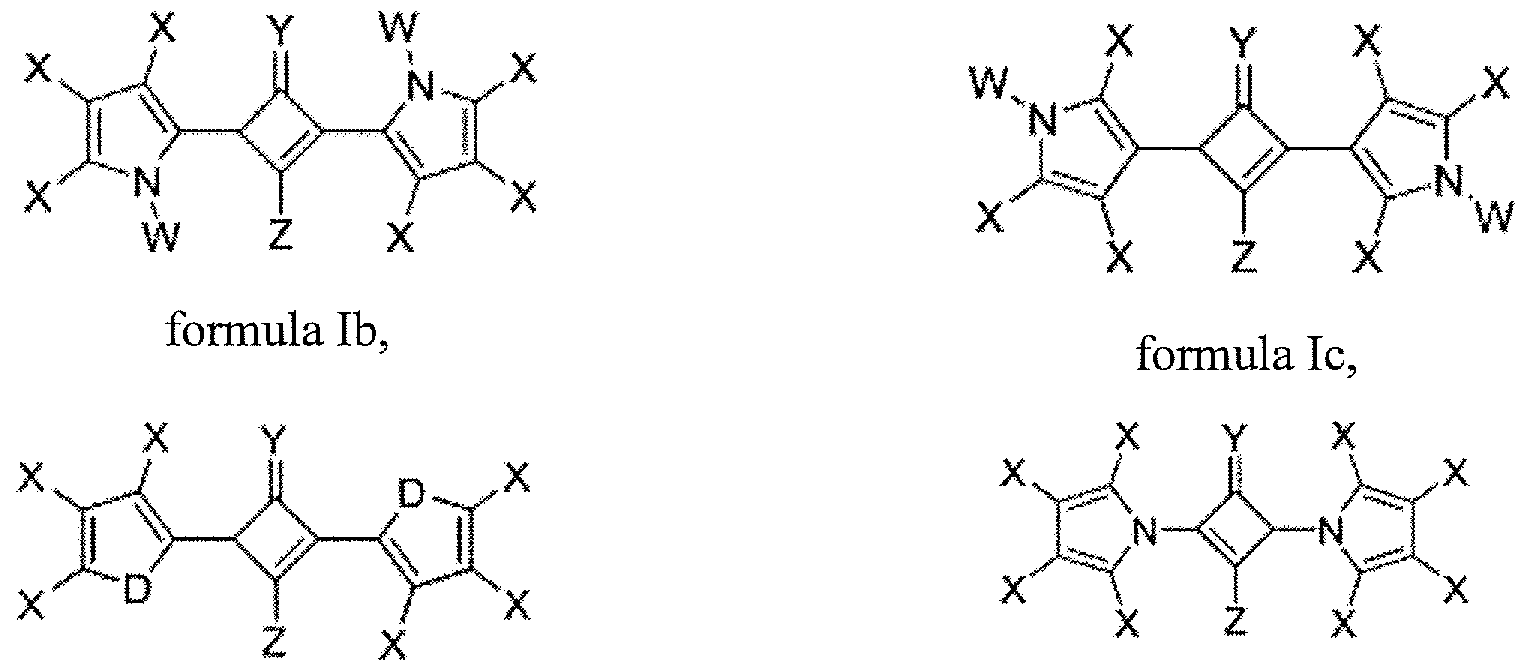
[0036] In a preferred embodiment, the squaraine molecule is represented by formula la
Figure imgf000009_0001
wherein X, Y and Z are as defined above.
[0037] In one embodiment, the squaraine molecule is represented by any of structures
Figure imgf000009_0002
3,5-Dihydroxy-4-[2-hydroxy-4-oxo-3-(2,4,6- 3-Hydroxy-2,4-bis-(2,4,6-trihydroxy-phenyl)- trihydroxy-phenyl)-cyclobut-2 -enylidene] - cyclobut-2-enone
cyclohexa-2, 5 -dienone
Figure imgf000009_0003
2,4-Bis-(2,6-dihydroxy-4-oxo-cyclohexa-2,5- 4-(2,6-Dihydroxy-4-oxo-cyclohexa-2,5- dienylidene)-cyclobutane- 1 ,3 -dione dienylidene)-3-oxo-2-(2,4,6-trihydroxy-phenyl)- cyclobut-l-enol anion
Figure imgf000009_0004
Figure imgf000009_0005
2,4-Bis-(2,6-dihydrox -4-methoxy-phenyl)-3-hydrox - 2,4-Bis-(2,6-dihydroxy-4-methyl-phenyl)-3-hydroxy- cyclobut-2-enone cyclobut-2-enone
Figure imgf000010_0001
3-Hydroxy-2,4-bis-(4-methoxy-phenyl)- 3-Hydroxy-2,4-bis-(2,4,6-trimethyl- cyclobut-2-enone phenyl)-cyclobut-2-enone
Figure imgf000010_0002
3-Hydroxy-2,4-bis-(2,4,6-trimethoxy- 2,4-Bis-(3,5-di-fert-butyI-2,6-dihydroxy-phenyl)- phenyl)-cyclobut-2-ertone 3-hydroxy-cyclobut-2-enone
Figure imgf000010_0003
2,4-Bis-(2 ,6-d i hyd roxy-phenyl)- 2,4-Bis-(1 ,3-dihydroxy-naphthalen-2-yl)- 3- hyd roxy-cyclobut-2-e no n e 3-hydroxy-cyclobut-2-enone
3-Hyd
Figure imgf000010_0004
roxy-2,4-bis-(2,4,6-trifluoro-phenyl)- cyclobut-2-enone
2,4-Bis-(4-fluora-2,6-dimethoxy-phenyl)- 3-hydroxy-cyclobut-2-enone
Figure imgf000010_0005
,4-Bis-(3-chloro-2,6-bis-methylsulfanyl-phenyl)- 2,4-Bis-(2,6-dimercapto-phenyl)-3- 3-hydroxy-cyclobut-2-enone h droxy-cyclobut-2-enone
2,4
Figure imgf000010_0006
3-mercapto-cyolobut-2-enone
3-Hydroxy-2,4-bis-(2,3,5,6-tetrakis- isopropylsulfanyl-phenyl)-cyclobut-2- enone
Figure imgf000010_0007
[2,4-Bis-(2,6-dihydroxy-4-methoxy-phenyl)- 2,4-Bis-(2,6-dihydroxy-4-methoxy-phenyl)- 3-hydroxy-cyclobut-2-enylidene]- 3-hydroxy-cyclobut-2-enylidene-cyanamide nitro-acetic acid ethyl ester 2-(4-
Figure imgf000011_0001
Ethyl-2,6-dihydroxy-phenyl)-3-hydroxy-4- (2,4,6-trihydroxy-phenyl)-cyclobut-2-enone
3-lsopropoxy-4-(4-methoxy-phenyl)- 2-phenyl-cyclobut-2-enone
[0038] In one embodiment, any of the above depicted substituents attached to the squaraine core can be used in combination with other substituent(s) in order to form asymmetric substituted squaraine molecules.
[0039] In a preferred embodiment, the squaraine molecule is represented by any one of
Figure imgf000011_0002
wherein D is S or O,
Figure imgf000011_0003
formula If.
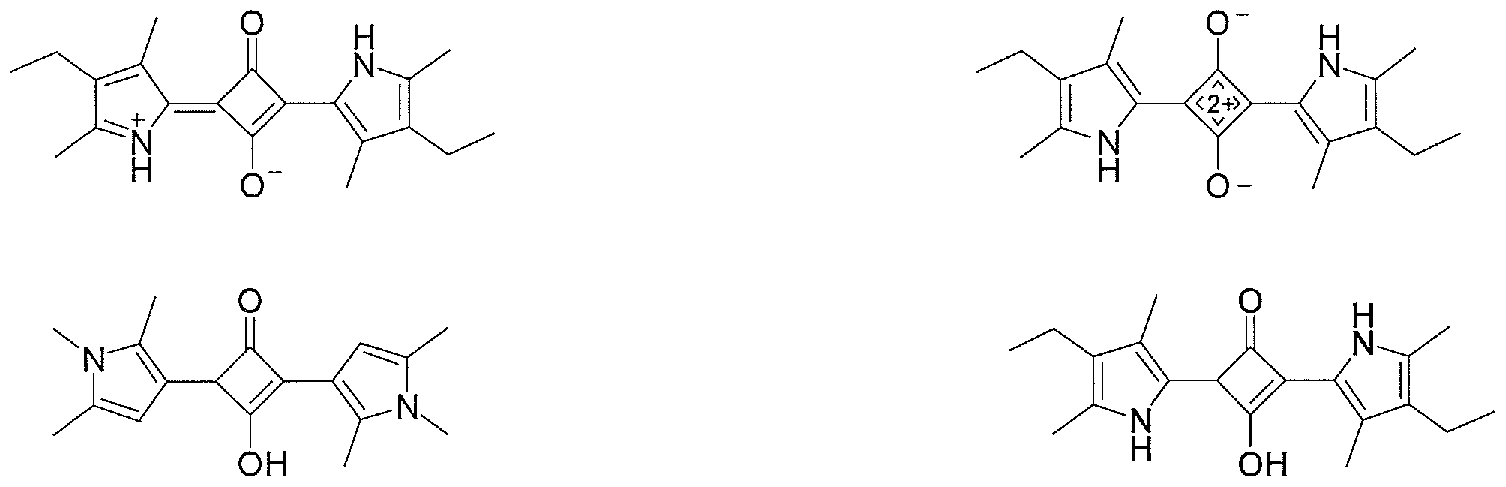
[0040] In one embodiment, the squaraine molecule is represented by any of structures
Figure imgf000012_0001
2-(4-Ethyl-3,5-dimethyl-1W-pyrrol-2-yl)-4-(4-ethyl-3,5- 2,4-Bis-(4-ethyl-3,5-dimethyl-1H-pyrrol-2-yl)- dimethyl-pyrrol-2-ylidene)-3-hydroxy-cyclobut-2-enone 3-hydroxy-cyclobut-2-enone
Figure imgf000012_0002
-Oxo-2-(1 ,2,5-trimethyl-1 H-pyrrol-3-yl)-4-(1 ,2,5-trimethyl- 2,4-Bis-(4-ethy!-3,5-dimethy]-1 H-pyrrol-2-yl)-3-hydroxy- pyrrol-3-ylidene)-cyclobut-1-enol anion cyclobut-2-enone
Figure imgf000012_0003
3-Hydroxy-2,4-bis-(2H-pyrazol-3-yl)- 3-Hydroxy-2,4-bis-(3H-imidazol-4- cyclobut-2-enone yl)-cyclobut-2-enone
Figure imgf000012_0004
3-Hydroxy-2,4-bis-(1H-pyrazol-3-yl)- 3-Hydroxy-2,4-bis-(1H-imidazol-4- cyclobut-2-enone yl)-cyclobut-2-enone
Figure imgf000012_0005
3-Hydroxy-2,4-bis-thiazol-5- 3-Hy d roxy-2 ,4-bis-oxazol-5- yl-cyclobut-2-enone yl-cyclobut-2-enone
Figure imgf000012_0006
3-Hyd roxy-2 , 4-b is-(3- hyd roxy- benzo[£)]thiophen-2-yl)-cyclobut-2- 3-Hydroxy-2,4-bis-indoI-1-yl-cyclobut-2- enone enone
Figure imgf000012_0007
2,4-Bis-dithieno[3,2-/ ;2',3'- d|pyrrol-4-yl-3-hydroxy- cyclobut-2-enone [0041] In one embodiment, any of the above depicted substituents attached to the squaraine core can be used in combination with other substituent(s) in order to form asymmetric substituted squaraine molecules.
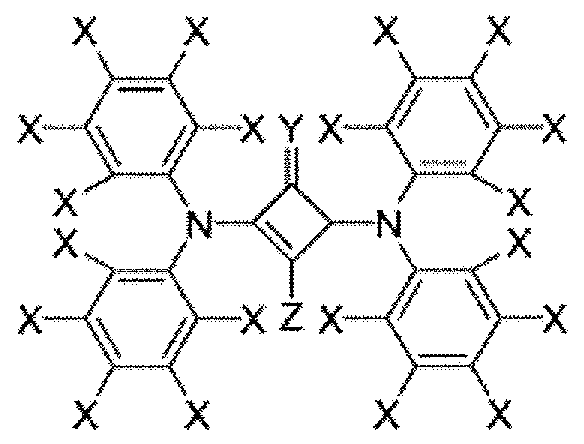
[0042] In a preferred embodiment, the squaraine molecule is represented by any one of
Figure imgf000013_0001
formula Ii, or formula Ij.
[0043] In one embodiment, the squaraine molecule is represented by any of structures
Figure imgf000013_0002
2-(4-Diisobutylamino-2,6-dihydroxy-phenyl)-4- diphenylamino-3-hydroxy-cyclobut-2-enone
Figure imgf000013_0003
Figure imgf000014_0001
4-Diphenylamino-2-(4-diphenylamino- 2-(8,10-Dihydroxy-2,3,6,7-tetrahydro-1 H.5H- 2,6-dihydroxy-phenyl)-3- ydroxy-cyclobut-2-enone pyrido[3,2,1-(/]quinolin-9-yl)-4-diphenylamino- 3-hydroxy-cyclobut-2-enone
Figure imgf000014_0002
4-[Bis-(2- ydroxy-p enyl)-amino]-2- 4-Carbazol-9-yl-2-(4-diisobutylamino- (4-diisobutylamino-2,6-dihydroxy-phenyl)-3- ydroxy-cyolobut-2-( 2,6-di ydroxy-phenyl)-3-hydroxy-cyclobut-2-enone
Figure imgf000014_0003
2-(4-Diisobutylamino-2,6-dlhydroxy-phenyl)- 3- ydroxy-4-(naphthalen-1 -yl- phenyl-amlno)-cycIobut-2-enone
4-D
Figure imgf000014_0004
ibutylamino-2-(4-diphenylamino-2,6- dihydroxy-phenyl)-3-hydroxy-cyclobut-2-enone
4-[Bis-(4-ethoxy-p eny[)-amino]-2- (4-diisobutylamino-2,6-di ydroxy-phenyl)- 3-hydroxy-cyclob -2-enone
Figure imgf000014_0005
2-(4-Carbazol-9-yI-2,6-dihydroxy-phenyl)-4-diphenylamino-3- 2-[4-Diphenylamino-3-hydroxy-2- hydroxy-cyclobut-2-enone (2,4,6-trihydroxy-phenyl)-cyclobut-
2-enylidene]-maIononitri le
Figure imgf000014_0006
4-Dithieno[3,2-jb;2',3'-c(]pyrrol-4-yl-3-hydroxy-2- (2,4,6-trihydroxy-phenyl)-cycIobut-2-enone
2-(4-Diisobutylamino-2,6-dihydroxy-p enyl)- 4-(di-thiophen-2-yl-amino)-3-hydroxy-cyclobut-2-enone 2
Figure imgf000015_0001
-(2,6-Dihydroxy-4-pentyl-p enyl)-4- (4-ethyl-3,5-dimethyl-1H-pyrrol-2-yi)-
4-Diphenylarnino-2-(4-dit ieno[3,2-/j;2',3'-i¾pyrrol-4-yl- 3-hydroxy-cyclobut-2-enone
2,6-dihydroxy-p enyl)-3-hydroxy-cyclobut-2-enone
Figure imgf000015_0002
3-Hydroxy-2-(2,4,6-trihydroxy-phenyl)-4- (1,2,5-trimethyl-1H-pyrrol-3-yl)-cyclobut-2-enone In one embodiment, the squaraine molecule is represented by any of structures
-
Figure imgf000015_0003
2-enylidene]-malononitrile
2-(1-Butyl-3,3-dimethyl-1 ,3-dihydro-indol-2- ylidenemet yl)-3-hydroxy-4-thiophen-2-yl- cyclobut-2-enone
-3-yl)-4-
Figure imgf000015_0004
nitrile
Figure imgf000016_0001
2-(3-Benzothiazol-2-yl-2-hydroxy-4-oxo-cyclobut-2- 2-(1 -Butyl-1 rt-indol-2-yl)-4- enylidene)-malononitrile
(1 -ethyl-1 H-pyrrol-2-yl)-3- hydroxy-cyclobut-2-enone
-
Figure imgf000016_0002
[0045] In one embodiment, the squaraine molecule is an asymmetrical molecule, with any of the shown substituents attached to the squaraine core in combination with any other substituent.
[0046] As discussed above, the present disclosure provides a thiophene-based molecule represented by a formula selected from formula II, III, IV, V and VI
Figure imgf000016_0003
formula IV
Figure imgf000016_0004
wherein X is selected from the group comprising S, Se, N-R1, S02, CR^, cyclopentane, cyclohexane, SiR^;
R1 is selected from aryl, alkyl;
R is selected from H, aryl, substituted aryl, alkyl, thiophene, alkyl-substituted thiophene;
Y is selected fro
Figure imgf000017_0001
carbazole, diarylamine, pyrrole, pyrazole, thieno[3,4-b]pyrazine, imidazole, thiazole, fluorine, tricyanovinyl, indole, quinolone, benzothiadiazole, indanedione, barbituric acid or thiobarbituric acid, rhodanine, thiazolinedione derivatives as for example:
Figure imgf000017_0002
R is selected from H, aryl, substituted aryl, alkyl, thiophene, alkyl-substituted thiophene.
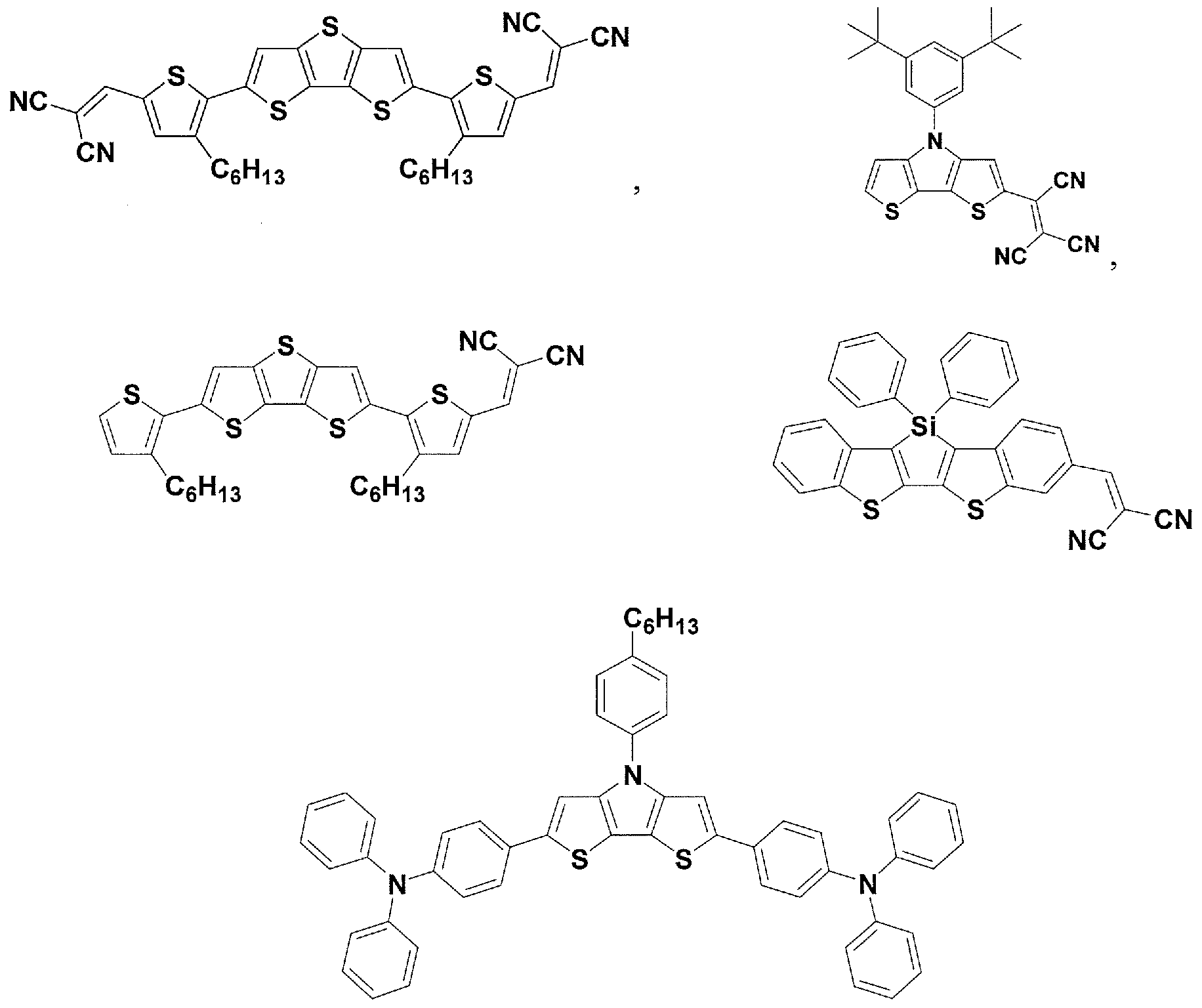
[0047] In a preferred embodiment, the thiophene-based molecule is a spiro-dimer selected from
Figure imgf000017_0003
R is the same as the R defined above.
[0048] In a preferred ambodiment, the thiophene-based molecule is represented by any of structures
Figure imgf000018_0001
Figure imgf000018_0002
Figure imgf000019_0001
[0049] A molecule according to the present disclosure preferably exhibits absorption in the visible wavelength range (about 400 to about 700 nm), preferably in the range from 400 nm to 700 nm, or a sub-range thereof, preferably 400 nm to 500 nm, or 500 nm to 600 nm, or 600 nm to 700 nm.
[0050] A squaraine molecule represented by formula I according to the present invention preferably exhibits absorption in the visible wavelength range (about 400 to about 700 nm) and exhibits no absorption in the IR range (above 700 nm).
[0051] A thiophene molecule represented by formula II, III, IV, V or VI according to the present invention preferably exhibits absorption in the visible wavelength range (about 400 to about 700 nm) and, optionally, exhibits also absorption in the IR range (above 700 nm).
[0052] In one embodiment, the molecules of the present disclosure absorb in the blue absorption range.
[0053] In one embodiment, the molecules of the present disclosure absorb in the green absorption range.
[0054] In one embodiment, the molecules of the present disclosure absorb in the red absorption range.
[0055] Preferably, the molecules absorb less than 20% (more preferably less than 5%) of the maximum absorption outside of their main range of absorption, such as, at wavelengths shorter than 500 and longer than 600nm when absorption peak is between 500 and 600nm.
[0056] A molecule according to the present disclosure preferably shows an extinction coefficient of > 104 Lmol^cm"1, more preferably of > 105 Lmoi^cm"1. [0057] A molecule according to the present disclosure preferably allows furthermore:
[0058] easy alteration of HOMO and LUMO energies,
[0059] tuning of the absorbion maximum (optical band gap) and shape over a broad range, [0060] tuning of the molecular packing in films.
[0061] Films prepared from the molecules of the present disclosure preferably show
[0062] high electrons and holes mobilities,
[0063] high exciton diffution efficiencies,
[0064] more preferably up to 99%.
[0065] Preferably those films are homogeneous (on the nm to μιη scale) and even more preferably amorphous.
[0066] A molecule according to the present disclosure preferably exhibits a high
photoelectric conversion efficiency of more than 15%, preferably of more than 50% and more preferably more than 80%.
[0067] As discussed above, the present disclosure provides the use of a molecule according to the present disclosure in an absorption layer.
[0068] In this embodiment, when the molecule according to the present invention is used in an absorption layer, the molecule (encompassing the squaraine molecules represented by formula I according to the present invention and the thiophene molecules represented by formula II, III, IV, V or VI according to the present invention) preferably exhibits absorption in the visible wavelength range (about 400 to about 700 nm) and, optionally, exhibits also absorption in the IR range (above 700 nm).
[0069] As discussed above, the present disclosure provides the use of a molecule according to the present disclosure in a filter.
[0070] In this embodiment, when the molecule according to the present invention is used as/in a filter, the molecule (encompassing the squaraine molecules represented by formula I according to the present invention and the thiophene molecules represented by formula II, III, IV, V or VI according to the present invention) preferably exhibits absorption in the visible wavelength range (about 400 to about 700 nm) and, optionally, exhibits also absorption in the IR range (above 700 nm). [0071] As discussed above, the present disclosure provides the use of a molecule according to the present disclosure in a photoelectric conversion layer and/or in an organic and/or hybrid module for optoelectronic application, such as image sensor, photodiode, organic
photovoltaics, comprising organic photoelectric conversion layer(s), OLED and OTFT organic modules.
[0072] As discussed above, the present disclosure provides a photoelectric conversion layer comprising at least one molecule according to the present disclosure.
[0073] In the embodiments, where the molecule according to the present invention is used or comprised in a photoelectric conversion layer,
- when the molecule of the present invention is the squaraine molecule represented by formula I according to the present invention, the molecule preferably exhibits absorption in the visible wavelength range (about 400 to about 700 nm) and exhibits no absorption in the IR range (above 700 nm).
- when the molecule of the present invention is the thiophene molecule represented by formula II, III, IV, V or VI according to the present invention, the molecule preferably exhibits absorption in the visible wavelength range (about 400 to about 700 nm) and, optionally, exhibits also absorption in the IR range (above 700 nm).
Here the application of the molecule(s) of the present disclosure is as active layer/component of a photoelectric conversion layer.
[0074] In one embodiment, the photoelectric conversion layer comprises further molecule(s).
[0075] As discussed above, the present disclosure provides an absorption layer or filter comprising at least one molecule according to the present disclosure.
[0076] As discussed above, the present disclosure provides a filter comprising at least one molecule according to the present disclosure.
[0077] In this embodiment, when the molecule according to the present invention is comprised in an absorption layer or filter, the molecule (encompassing the squaraine molecules represented by formula I according to the present invention and the thiophene molecules represented by formula II, III, IV, V or VI according to the present invention) preferably exhibits absorption in the visible wavelength range (about 400 to about 700 nm) and, optionally, exhibits also absorption in the IR range (above 700 nm). Here the application of the molecule(s) of the present disclosure is as filter only, i.e. the films of molecules according to this disclosure are used only to absorb the light in the specific wavelength region (without to contribute to photoelectric conversion).
[0078] In one embodiment, the absorption layer or filter comprises further molecule(s).
[0079] Absorption layers (or filters) according to the present disclosure preferably exhibits absorption in the visible wavelength range (about 400 to about 700 nm) and possibly also absorption in the UV-Vis wavelength range (below 400 nm) and possibly also in the IR wavelength range (above 700 nm).
[0080] Absorption layers of the present disclosure absorb in the wavelength range of visible light, preferably in the range from 400 nm to 700 nm, or a sub-range thereof, preferably 400 nm to 500 nm, or 500 nm to 600 nm, or 600nm to 700 nm.
[0081] In one embodiment, the absorption layers of the present disclosure absorb in the blue absorption range.
[0082] In one embodiment, the absorption layers of the present disclosure absorb in the green absorption range.
[0083] In one embodiment, the absorption layers of the present disclosure absorb in the red absorption range.
[0084] Preferably, the the absorption layers absorb less than 20% (more preferably less than 5%) of the maximum absorption outside of their main range of absorption, such as, at wavelengths shorter than 500 and longer than 600 nm when absorption peak is between 500 and 600 nm.
[0085] In one embodiment, the photoelectric conversion layer comprises further
molecules(s), wherein in one embodiment the molecule according to the present disclosure is the donor and the further molecule is the acceptor, wherein in another embodiment the molecule according to the present disclosure is the acceptor and one further molecule is the acceptor.
[0086] The photoelectric conversion layer can comprise different components (dyes) and combinations thereof. [0087] In one embodiment, the photoelectric conversion layer and/or the absorption layer comprises further n and p type materials (molecules) that can be used together with the thiophene and or squaraine molecules(s) of the present disclosure, such as
phthalocyanine (Pc), subphthalocyanine (SubPc), merocyanine (MC),
diketopyrrolopyrroles (DPP), borondipyrromethene (BODIPY), isoindigo (ID), perylene diimides (PDI), and quinacridone (QD), fused acenes, such as pentacene and tetracene and triphenylamine (TP A) as donor;
and/or
fullerenes, rylene diimides, phthalocyanines and subphthalocyanines and
cyanopentacenes as acceptor.
[0088] In a preferred embodiment, said photoelectric (PE) conversion layer exhibits photo response in the visible absorption range.
[0089] The PE conversion layers according to the present disclosure preferably exhibits absorption in the visible wavelength range (about 400 to about 700 nm) and possibly also absorption in the UV-Vis wavelength range (below 400 nm) and in the IR wavelength range (above 700 nm).
[0090] The PE conversion layers of the present disclosure absorb in the wavelength range of visible light, preferably in the range from 400 nm to 700 nm, or a sub-range thereof, preferably 400 nm to 500 nm, or 500 nm to 600 nm, or 600nm to 700 nm.
[0091] In one embodiment, the PE layers of the present disclosure absorb in the blue absorption range (e.g.400-500nm).
[0092] In one embodiment, the molecules of the present disclosure absorb in the green absorption range (e.g. 500-600nm).
[0093] In one embodiment, the molecules of the present disclosure absorb in the red absorption range (e.g. 600-700nm).
[0094] Preferably, the PE layers absorb less than 20% (more preferably less than 5%) of the maximum absorption outside of their main range of absorption, such as, at wavelengths shorter than 500 and longer than 600nm when absorption peak is between 500 and 600nm.
[0095] [0096] As discussed above, the present disclosure provides a device, comprising molecule(s) according to the present disclosure or photoelectric conversion layer(s) according to the present disclosure.
[0097] Said device of the present disclosure can be an organic image sensor, organic photovoltaics, organic photodiode, organic light-emitting diode (OLED), organic thin-film transistor (OTFT).
[0098] As discussed above, the present disclosure provides an organic image sensor, comprising photoelectric conversion layer(s) according to the present disclosure.
[0099] The organic image sensor of the present disclosure preferably comprises
(a) an organic photoconversion unit comprising photoelectric conversion layer(s) according to the present disclosure,
(b) at least one electrode,
(c) a substrate,
(d) optionally, a second electrode on top of said photoelectric conversion layer(s).
[00100] In a preferred embodiment, the organic image sensor does not comprise color filter(s).
[00101] The substrate can be silicon, quartz, glass, polymer, such as PMMA, PC, PS, COP, COP, PVA, PVP, PES, PET, PEN, mica, or combinations thereof.
[00102] The substrate can also be other photoelectric conversion unit(s) (e.g. blue 400- 500nm and red 600-500nm conversion devices in case the organic conversion layer according to this disclosure is green 500-600nm conversion device).
[00103] This means, a device of this disclosure can comprise (i) two inorganic units with one organic unit, (ii) one inorganic unit with two organic units, or (iii) three organic units combined with each other in the organic image sensor. Any of the organic units can contain molecules/lay ers/devices according to this disclosure.
[00104] In a preferred embodiment, an organic image sensor consists of three organic conversion units containing molecules in layers as of this disclosure (in devices, each with transparent electrodes), combined with each other and operating each in one of the ranges 400nm to 500 run, 500nm to 600 nm and 600 nm to700nm. [00105] Combined units can be realized either by vertical and/or horizontal stacking of the organic-organic or organic-inorganic units.
[00106] The electrode material can be
- transparent metal oxide, such as indium tin oxide (ITO), fluorine-doped indium oxide (IFO), tin oxide, fluorine-doped tin oxide (FTO), antimonium-doped tin oxide (ATO), zinc oxide (including Al, B and Ga doped zinc Oxide), indium oxide-zinc oxide (IZO), Ti02,
- non transparent or semitransparent metal or alloy or conductive polymer, such as Au, Ag, Cr, Ni, Pd, AlSiCu, or any metal or metal alloy or metal combination with suitable workfunction; PEDOT/PSS, PANI or PANI/PSS, graphene.
[00107] As discussed above, the present disclosure provides a hybrid Silicon-organic image sensor or organic image sensor, comprising
(a) an organic photoelectric conversion unit or units comprising
photoelectric conversion layer(s) according to the present disclosure (comprising the molecule(s) of the present disclosure),
(b) optionally, a Si based photoelectric conversion unit,
(c) metal wiring,
(d) a (CMOS) substrate,
(e) insulating layer(s), preferably oxide.
[00108] In one embodiment, said organic photoelectric conversion unit of the image sensors of the present disclosure comprises different layers within the organic based photoelectrical conversion unit(s), such as
- n-type material,
- p-type material,
- n-buffer layer,
- p-buffer layer,
or combinations and/or mixtures (e.g. n material and p material co-deposited in one layer) thereof.
[00109] For example, the organic image sensor of the present disclosure can have the structure:
- substrate/first electrode/n-buffer layer/n-material/p-material/p buffer layer/second electrode; - substrate/first electrode/n-buffer layer/n-material/mixture of n- and p- material/ p-material/p buffer layer/second electrode;
- substrate/first electrode/n-buffer layer/n-material/mixture of n- and p- material/ p buffer layer/second electrode;
- substrate/first electrode/p-buffer layer/p-material/n-material/n buffer layer/second electrode.
- substrate/first electrode/p-buffer layer/p-material/ mixture of n- and p- material /n-material/n buffer layer/second electrode.
- substrate/first electrode/p-buffer layer/p-material/ mixture of n- and p- material /n buffer layer/second electrode.
[00110] The organic image sensor of the present disclosure can comprise different layer structures, in particular regarding the position of the n and p material with respect to the CMOS part.
[00111] The organic photoconversion unit can be used in combination with a Si based photoelectrical conversion unit where different layers absorb different color (BGR) in a hybrid silicon-organic image sensor (see Figure 2) or can be used without Si based
photoelectrical conversion unit. In this case the organic photoconversion unit has the capability of absorbing different color (BGR) (see Figure 3).
[00112] The BGR ranges are 400-500 nm, 500-600 nm and 600-700nm and the absorption outside of the range is preferably less than 20%, more preferably less than 10 and 5%.
[00113] As discussed above, the substrate can also be other photoelectric conversion unit(s) (e.g. blue 400-500nm and red 600-500nm conversion devices in case the organic conversion layer according to this disclosure is green 500-600nm conversion device).
[00114] As discussed above, a device of this disclosure can comprise (i) two inorganic units with one organic unit, (ii) one inorganic unit with two organic units, or (iii) three organic units combined with each other in the organic image sensor. Any of the organic units can contain molecules/layers/devices according to this disclosure.
[00115] The deposition methods to produce the organic photoelectrical conversion layer are PVD, CVD, spin coating, dipping coating, casting process, inkjet printing, screen printing, spray coating, offset printing.
[00116] Different process temperatures for processing the layer are possible, namely from 150 to 245°Celsius. [00117] As discussed above, the present disclosure provides a method for synthesis of a squaraine molecule according to the present disclosure.
[00118] Said method comprises the following step(s) (in embodiments wherein the squaraine molecule has a symmetric structure):
Attaching the donor group to the core by reacting the appropriate reagent with squaric acid in a refluxing azeotropic water removal mixture;
[00119] or said method comprises the following step(s) (in embodiments wherein the squaraine molecule has an asymmetric structure):
Attaching the first donor group to the core by reacting the appropriate reagent with diethyl squarate in the presence of alkylamine as catalyst, and
After deprotecting the ester with aqueous NaOH, reacting the semiquarate precursor with the second donor molecule in a refluxing azeotropic water removal mixture.
[00120] As discussed above, the present disclosure provides a method for synthesis of a thiophene-based molecule according to the present disclosure.
[00121] Said method comprises the following step(s): dithieno thiophenes, dithienopyrroles and dithienosiloles are reacted by condensation reaction or metal catalyzed with the desired group.
[00122] Note that the present technology can also be configured as described below. (1) A (squaraine) molecule represented by formula I
Figure imgf000027_0001
(I)
wherein
A and B are the same or different and are, at each occurrence, independently selected from
Figure imgf000028_0001
pyrazole, thiazole, imidazole, indole, quinoline, benzothiophene, benzothiazole, benzothiadiazole, benzofuran, oxazole, benzoxazole, pyridine, diazine, triazine, selenophene, naphthalene, anthracene or pyrene, any of which can optionally be substituted,
optionally comprising a spacer, such as a double bond (e.g. in an embodiment, where A and/or B is indole),
D is S or O;
W is selected from H, alkyl, aryl;
X is selected from the group including H, OH, SH, NH2, NHR, NR2, N02, alkyl, alkoxy, aryl, aryloxy, halogen, such as F, CI, Br, I;
Λ Y/ i .s se ,lect .ed , f ,rom Λ O, c S, λ NιHυ, OT NR, NC. N , NC. ,COOH 5
Figure imgf000028_0002
indanedione, barbituric acid or thiobarbituric acid;
Z is selected from OH, SH, N¾, NR2;
R, at each occurrence, is independently selected from H or any straight or branched alkyl chain of general formula -CnH2n+1, or -COOR1, -OR1, -SR1, -NR^, or F, CI, Br, I, O, N, N02, CN, CF3, wherein R1 is H or any straight or branched alkyl chain of general formula - CnH2n+1, or any substituted or non-substituted phenyl or biphenyl, heteroaryl, n - 0-12, preferably 0-6.
(2) The molecule according to embodiment (1), wherein the molecule is represented by formula la
Figure imgf000029_0001
wherein X, Y and Z are as defined in embodiment (1).
(3) The molecule according to embodiment (1) represented by any of structures
Figure imgf000029_0002
3 ,5 -Dihydroxy-4- [2-hydroxy-4-oxo-3 -(2,4,6- 3-Hydroxy-2,4-bis-(2,4,6-trihydroxy-phenyl)- trihydroxy-phenyl)-cyclobut-2-enylidene]- cyclobut-2-enone
cyclohexa-2,5-dienone
Figure imgf000029_0003
2,4-Bis-(2,6-dihydroxy-4-oxo-cyclohexa-2,5- 4-(2,6-Dihydroxy-4-oxo-cyclohexa-2,5- dienylidene)-cyclobutane- 1 ,3 -dione dienylidene)-3 -oxo-2-(2,4, 6-trihydroxy-phenyl)- cyclobut-l-enol anion
Figure imgf000029_0004
2,4-Bis-(2,6-dihydroxy-4-methoxy-phenyl)-3-hydroxy- 2,4-Bis-(2,6-dihydroxy-4-methyl-phenyI)-3-hydroxy- cyclobut-2-enone cyclobut-2-enone
Figure imgf000029_0005
3-Hydroxy-2,4-bis-(4-methoxy-phenyl)- 3-Hydroxy-2,4-bis-(2,4,6-trimethyl- cyclobut-2-enone phenyl)-cyclobut-2-enone
Figure imgf000030_0001
3-Hydroxy-2,4-bis-(2,4,6-trimethoxy- 2,4-Bis-(3,5-di-fert-butyl-2,6-dihydroxy-phenyl)- phenyl)-cyclobut-2-enone 3-hydroxy-cyclobut-2-enone
Figure imgf000030_0002
2,4-Bis-(2,6-dihydroxy-phenyl)- 2,4-Bis-(1 ,3-dihydroxy-naphthalen-2-yl)- 3- ydroxy-cyclobut-2-enone 3-hydroxy-cyclobut-2-enone
3-H
Figure imgf000030_0003
cyclobut-2-enone
2,4-Bis-(4-fluoro-2,6-dimet oxy-phenyl)- 3-hydroxy-cyclobut-2-enone
Figure imgf000030_0004
,4-Bis-(3-chloro-2,6-bis-methylsulfanyl-phenyl)- 3-hydroxy-cyclobut-2-enone
2,4-Bis-(2,6-dihydroxy-4-methoxy-phenyl)-
Figure imgf000030_0005
3-mercapto-cyclobut-2-enone
3-Hydroxy-2,4-bis-(2,3,5,6-tetrakis- lsopropylsulfanyl-phenyl)-cyclobut-2- enone
Figure imgf000030_0006
[2,4-Bis-(2,6-dihydroxy-4-methoxy-phenyl)- 2,4-Bis-(2,6-dihydroxy-4-methoxy-phenyl)- 3-hydroxy-cyclobut-2-enylidene]- 3-hydroxy-cyclobut-2-enylidene-cyanamide nitro-acetic acid ethyl ester
Figure imgf000030_0007
2-(4-Ethyl-2,6-dihydroxy-phenyl)-3-hydroxy-4- (2,4,6-trihydroxy-phenyl)-cyclobut-2-enone
Figure imgf000031_0001
3-lsopropoxy-4-(4-methoxy-phenyl)- 2-phenyl-cyclobut-2-enone
The molecule according to embodiment (1), wherein the molecule is represented by one o
Figure imgf000031_0002
formula Id, formula Ie, or wherein D is S or O,
Figure imgf000031_0003
formula If.
The molecule according to embodiment (3) represented by any of structures
Figure imgf000031_0004
2-(4-Ethyl-3,5-dimethy!-1H-pyrrol-2-yl)-4-(4-ethyl-3,5- 2,4-Bis-(4-ethy]-3,5-dimethy!-1H-pyrrol-2-yl)- dimethyl-pyrrol-2-ylidene)-3-hydroxy-cyclobut-2-enone 3-hydroxy-oyclobut-2-enone
Figure imgf000031_0005
Figure imgf000032_0001
3-Oxo-2-(1 ,2,5-trimethyH H-pyrrol-3-yl)-4-(1 ,2,5-trimethyi- 2,4-Bis-(4-ethyl-3,5-dimethyl-1 W-pyrrol-2-yl)-3-hydroxy- pyrrol-3-ylidene)-cyclobut-1-enol anion cyclobut-2-enone
Figure imgf000032_0002
3-Hydroxy-2,4-bis-(2H-pyrazol-3-yl)- 3-Hydraxy-2,4-bis-(3H-imidazol-4- cyclobut-2-enone yl)-cyclobut-2-enone
Figure imgf000032_0003
3-Hydroxy-2,4-bis-(1H-pyrazol-3-yl)- 3-Hydroxy-2,4-bis-(1 H-imidazol-4- cyclobut-2-enone yl)-cyclobut-2-enone
Figure imgf000032_0004
3-Hydroxy-2,4-bis-thiazol-5- 3-Hydroxy-2,4-bis-oxazol-5- yl-cyclobut-2-enone yl-cyclobut-2-enone
Figure imgf000032_0005
3-Hydroxy-2,4-bis-(3-hydroxy- benzo[b]thiophen-2-yl)-cyclobut-2- 3-Hydroxy-2,4-bis-indol-1-yl-cyclobut-2- enone enone
Figure imgf000032_0006
2,4-Bis-dithieno[3,2-i>;2',3'- d|pyrrol-4-yl-3-hydroxy- cyclobut-2-enone
The molecule according to embodiment (1), wherein the molecule is represented by any one of
Figure imgf000032_0007
formula Ig, formula Ih,
Figure imgf000033_0001
The molecule according to embodiment (6) represented by any of structures
Figure imgf000033_0002
2-(4-Diisobutylamino-2,6-dihydroxy-phenyl)-4- diphenyIamino-3-hydroxy-cyclobut-2-enone
2-(4-Diisobutylamino-2,6-dihydroxy-phenyl)-4- diphenylamino-3-hydroxy-cyclobut-2-enone
Figure imgf000033_0003
4-Diphenylamino-2-(4-diphenylamino- 2-(8 , 10-Dihydroxy-2, 3,6,7-tetrahydro-l H, 5H- 2,6-dihydroxy-phenyl)-3-hydroxy-cyclobut-2-enone pyrido[3,2,1-/)]quinolin-9-yl)-4-diphenylamino- 3-hydroxy-cyclobut-2-enone
Figure imgf000033_0004
4-[Bis-(2-hydroxy-phenyi)-amino]-2- 4-Carbazol-9-yl-2-(4-diisobutylamino- (4-diisobutylamino-2,6-dihydroxy-phenyl)-3-hydroxy-cyclobut-2-enone 2,6-dihydroxy-phenyl)-3-hydroxy-cyclobut-2-enone
Figure imgf000033_0005
2-(4-Diisobutylamino-2,6-dihydroxy-phenyl)- 3-hydroxy-4-(naphthalen-1 -yl- phenyl-amino)-oyclobut-2-enone 4-D
Figure imgf000034_0001
ibutylamino-2-(4-diphenylamino-2,6- dlhydroxy-phenyl)-3-hydroxy-cyclobut-2-enone
4-[Bis-(4-ethoxy-phenyl)-amino]-2- (4-diisobutylamino-2,6-dihydroxy-phenyl)- 3-hydroxy-cyclobut-2-enone
Figure imgf000034_0002
-(4-Carbazol-9-yl-2,6-di ydroxy-phenyl)-4-dlp enylamino-3- 2-[4-DIphenylamino-3-hydroxy-2- hydroxy-cyclobut-2-enone (2,4,6-trihydroxy-phenyl)-cyclobut- 2-enylidene]-malononitrile
Figure imgf000034_0003
4-Dithieno[3,2-i3;2',3'-cf]pyrrol-4-yI-3-hydroxy-2- (2,4,6-trihydroxy-phenyl)-cyclobut-2-enone
2-(4-Diisobutylamino-2,6-dihydroxy-phenyl)- 4-(di-thiophen-2-yl-amino)-3-hydroxy-cydobut-2-enone
2
Figure imgf000034_0004
-(2,6-Di ydroxy-4-pentyl-phenyl)-4- (4-ethyl-3,5-dimethyI-1H-pyirol-2-yl)-
4-Diphenylamino-2-(4-dithieno[3,2-b;2\3'-cflpyrrol-4-yl- 3-hydroxy-cyclobut-2-enone
2,6-dihydroxy-phenyl)-3-hydroxy-cyclobut-2-enone
Figure imgf000034_0005
3-Hydroxy-2-(2,4,6-trihydroxy-phenyl)-4- (1 ,2,5-trimethyl-1 H-pyrrol-3-yl)-cyclobut-2-enone
The molecule according to embodiment (1) represented by any of structures
Figure imgf000034_0006
Figure imgf000035_0001
-{3-[1-HexyI-5-(5-hexyl-thiophen-2-yl)-3,3-dimethyl- 2-[3-(3,3-Dimethyl-1-propyl-1 ,3-dihydro- 1 ,3-dihydro-indol-2-ylidenemethyl]-2-hydroxy- indol-2-ylidenemethyi)-2-hydroxy-4-oxo- 4-oxo-cyclobut-2-enylidene}-malononitrile cyclobut-2-enylidene]-malononitrile
Figure imgf000035_0002
2-(1-Butyl-3,3-dimethyl-1 ,3-dihydro-indol-2- ylidenemethyl)-3-hydroxy-4-thiophen-2-yl- cyclobut-2-enone
l)-4- e
Figure imgf000035_0003
-(3-Benzothiazol-2-yl-2-hydroxy-4-oxo-cyclobut-2- 2-(1-Butyl-1 H-indol-2-yl)-4- enylidene)-malononitrile (1 -ethyl- 1 H-pyrrol-2-y l)-3- hydroxy-cyclobut-2-enone
-
Figure imgf000035_0004
A (thiophene-based) molecule represented by a formula selected from formula II, III, and VI
Figure imgf000035_0005
Figure imgf000036_0001
(VI) wherein
X is selected from the group including S, Se, N-R1, S02, CR^, cyclopentane, cyclohexane, SiR^;
R1 is selected from aryl, alkyl;
R is selected from H, aryl, substituted aryl, alkyl, thiophene, alkyl-substituted thiophene;
Y is selected from
Figure imgf000036_0002
carbazole, diarylamine, pyrrole, pyrazole, thieno[3,4-b]pyrazine, imidazole, thiazole, fluorine, tricyanovinyl, indole, quinolone, benzothiadiazole, indanedione, barbituric acid or thiobarbituric acid, rhodanine, thiazolinedione derivatives as for example:
Figure imgf000036_0003
R is selected from H, aryl, substituted aryl, alkyl, thiophene, alkyl-substituted thiophene.
(10) The molecule according to embodiment (9) which is a spiro-dimer selected from
Figure imgf000037_0001
wherein R is the same as the R / as defined in embodiment (9).
The molecule according to embodiment (9) represented by any of
Figure imgf000037_0002
Figure imgf000038_0001
2.Cyano-3-||6^2,2-dicyam>-v^
Figure imgf000038_0002
aecytortiiiiie
Figure imgf000038_0003
(12) The molecule according to any one of embodiments (1) to (8), wherein the molecule
- exhibits absorption in the visible wavelength range (about 400 to about 700 nm) and exhibits no absorption in the IR range (above 700 nm).
(13) The molecule according to any one of embodiments (9) to (11), wherein the molecule
- exhibits absorption in the visible wavelength range (about 400 to about 700 nm) and
- optionally, exhibits also absorption in the IR range (above 700 nm).
(14) The molecule according to any one of embodiments (1) to (13), wherein furthermore the molecule
- absorbs in the blue absorption range or absorbs in the green absorption range or absorbs in the red absorption range,
- preferably shows an extinction coefficient of > 104 Lmoi^cm"1,
- absorbs less than 20% (more preferably less than 5%) of the maximum absorption outside of its main range of absorption.
and/or - exhibits a high photoelectric conversion efficiency of more than 15%, preferably of more than 50% and more preferably more than 80%.
(15) Use of a molecule according to any of embodiments (1) to (14) in an absorption layer, wherein the molecule preferably exhibits absorption in the visible wavelength range (about 400 to about 700 nm) and, optionally, exhibits also absorption in the IR range (above 700 nm).
(16) Use of a molecule according to any of embodiments (1) to (14) in a filter,
wherein the molecule preferably exhibits absorption in the visible wavelength range (about 400 to about 700 nm) and, optionally, exhibits also absorption in the IR range (above 700 nm).
(17) Use of a molecule according to any of embodiments (1) to (14) in a photoelectric conversion layer and/or in an organic and/or hybrid module for optoelectronic application, such as image sensor, photodiode, organic photovoltaics, including organic photoelectric conversion layer(s), OLED and OTFT organic modules.
(18) A photoelectric conversion layer including a molecule according to any one of embodiments (1) to (14),
optionally including further molecule(s).
(19) An absorption layer including a molecule according to any one of embodiments (1) to (14),
optionally including further molecule(s),
wherein the molecule preferably exhibits absorption in the visible wavelength range (about 400 to about 700 nm) and, optionally, exhibits also absorption in the IR range (above 700 nm).
(20) A filter including a molecule according to any one of embodiments (1) to (14), optionally including further molecule(s),
wherein the molecule preferably exhibits absorption in the visible wavelength range (about 400 to about 700 nm) and, optionally, exhibits also absorption in the IR range (above 700 nm).
(21) A device, including molecule(s) according to any one of embodiments (1) to (14) or photoelectric conversion layer(s) according to embodiment (18),
wherein said device is preferably an organic image sensor, an hybrid image sensor, photodiode, organic photovoltaics, organic light-emitting diode (OLED), organic thin-film transistor (OTFT). (22) The device according to embodiment (21), wherein said photoelectric conversion layer exhibits photo response in the visible absorption range.
(23) The device according embodiment (21) or (22), including molecule(s) according to any one of embodiments (1) to (14) or photoelectric conversion layer(s) according to embodiment (18),
and/or including further molecule(s).
(24) An organic image sensor, including
(a) an organic photoelectric conversion unit including photoelectric conversion layer(s) according to embodiment (18),
(b) at least one electrode,
(c) a substrate,
(d) optionally, a second electrode on top of said photoelectric conversion layer(s), preferably not including color filter(s).
(25) A hybrid Silicon-organic image sensor or organic image sensor, including
(a) an organic photoelectric conversion unit or units including photoelectric conversion layer(s) according to embodiment (18),
(b) optionally, a Si based photoelectric conversion unit,
(c) metal wiring,
(d) a (CMOS) substrate,
(e) insulating layer(s), preferably oxide.
(26) The organic image sensor according to embodiment (24) or embodiment (25), wherein said organic photoelectric conversion unit includes different layers,
such as n-type material, p-type material, n-buffer layer and/or p-buffer layer or combinations or mixtures thereof.
(27) A method for synthesis of a molecule according to any one of embodiments (1) to (8), including the following step(s):
Attaching the donor group to the core by reacting the appropriate reagent with squaric acid in a refluxing azeotropic water removal mixture, or including the following step(s):
Attaching the first donor group to the core by reacting the appropriate reagent with diethyl squarate in the presence of alkylamine as catalyst, and
After deprotecting the ester with aqueous NaOH, reacting the semiquarate precursor with the second donor molecule in a refluxing azeotropic water removal mixture. (28) A method for synthesis of a molecule according to any one of embodiments (9) to (11), including the following step(s):
Reacting dithieno thiophenes, dithienopyrroles and dithienosiloles by condensation reaction or metal catalyzing with the desired group.
[00123] The term "squaraine molecule" or "squaraine-based molecule", as used herein, refers to a molecule having one or several aromatic ring systems attached to a squaraine core, which aromatic ring systems, if there are several such ring systems, may be identical (symmetric dye) or different (asymmetric dye).
[00124] The term "thiophene molecule" or "thiophene-based molecule", as used herein, refers to a molecule having at least two thiophene molecules directly connected to each other, and the term "spiro-thiophene molecule", as used herein, refers to a molecule having at least three condensate ring in which at least two are thiophene rings
[00125] The term "absorption in the visible wavelength range" or "dye exhibiting absorption in the visible wavelength range", as used herein, is meant to refer to a molecule/dye that is able to absorb light in only one or several parts of the entire range indicated or over the total range. For example a molecule may only absorb in the range of from 500 - 700 nm, whereas another molecule may absorb in the range of from 400— 700 nm or 500— 600 nm, whereas a third molecule may absorb over the range of from 400 - 500 nm (or the above described subranges of preferably 400 nm to 500 nm, or 500 nm to 600 nm, or 600 nm to 700 nm). All these scenarios are meant to be encompassed by such wording.
[00126] The term "no absorption in the IR range" or "dye exhibiting no absorption in the IR range", as used herein, is meant to refer to a molecule/dye that is able to absorb light in wavelength ranges until but not above 700 nm.
[00127] The term "narrow absorption band", as used herein, is meant to refer to / means that the width of the absorption band at 0 intensity is 200 nm , more preferably 150 nm, more preferably 100 nm.
[00128] The term "intense absorption band", as used herein, is meant to refer to / means that the extinction coefficient ε > 104 Lmol^cm"1.
[00129] In accordance with the present disclosure, the term "electrode" refers to an electrical lead to apply voltage. An electrode may be "interdigitated", meaning that it has a comb-like shape with two combs lying opposite each other and the respective figures of the combs engaging with each other. Alternatively, an electrode may be a non-interdigitated. An electrode may be transparent or non-transparent. A transparent electrode may, for example, be formed from indium tin oxide (ITO) or from fluorinated tin oxide (FTO). A non-transparent electrode may be reflective and may, for example, be formed from silver (Ag) or gold (Au).
[00130] The requirements of a photoelectric conversion layer to be used in image sensors are demanding and can be summarised as followed:
(i) narrow absorption band;
(ii) high extinction coefficient, ε > 104 Lmol^cm"1 (for high sensitivity in thin film);
(iii) heat resistant;
(iv) high photoelectric conversion efficiency (EQE);
(v) high-speed responsivity / high charge carrier mobility;
(vi) low dark-current in device;
(vii) thin film by thermal vapour deposition (Tvp < Tdec).
[00131] The present inventors have found novel squaraines and thiophene based dyes / molecules which are highly suitable as active materials for organic photoelectric conversion layers with improved conversion efficiency and response speed in organic photodiodes for vertically-integrated (VI) CMOS image sensors application. The advantages of those materials with respect to the requirements, the different type of possible molecular structures and example of molecules for use as photoelectrical conversion layer are reported herein.
[00132] The present disclosure relates to squaraine dyes / molecules and thiophene base dyes / molecules with specific molecular formulas that absorb in the visible range (400-700nm) and their use as active materials for use in bulk heteroj unction or PN or PiN junction as photoelectric conversion layer.
[00133] The squaraine dyes / molecules of the present disclosure can be used as active materials for the organic photoconversion unit.
[00134] The organic photoconversion unit can be used in combination with a Si based photoelectrical conversion unit where different layer absorbed different colour (BGR) in a hybrid Silicon-organic image sensor or can be used without Si based photoelectrical conversion unit. In this case the organic photoconversion unit having the capability of absorbing different colour (BGR).
[00135] The general structure of the resulting hybrid image sensor device as well as the details of the organic based photoelectrical conversion unit are schematic represented in the Figure 2 and 3.
[00136] The squaraine dyes / molecules of the present disclosure have a donor-acceptor- donor structure, wherein A and B are donor group (electron donating groups), while the central part (squaraine core) is the acceptor part (electron withdrawing group).
[00137] The main advantages of the squaraine dyes / molecules of the present disclosure for the application in photoelectrical conversion layers are as follows:
(1) narrow and intense absorption bands (extinction coefficient ε > 10 5 Lmol" 1 cm"1 );
(2) high photoelectric conversion efficiencies (xerographic applications);
(3) processability already proven for organic photovoltaics (OPV), photodetectors and organic imager as IR absorber (absorption >700 nm) (for this dye type)
[00138] The absorption and energy levels of the squaraine dyes / molecules of the present disclosure are tunable by the type of donor attached to the squaric acid/squaraine core.
Moreover, squaraine dyes are known to form aggregates in thin films that cause a broadening of the absorption peak. The molecular packing and the morphology of the solid state thin film can be tuned varying the substituent groups X in the donor moieties A and B. This makes the squaraine dyes / molecules of the present disclosure a very versatile dye / molecule to be used in the organic photoelectric conversion layer.
[00139] The main advantages of the thiophene-based dyes / molecules of the present disclosure for the application in photoelectrical conversion layer are as follow:
(1) absorption range in the required wavelength range with intense absorption bands (extinction coefficient ε > 104 Lmol^cm"1);
(2) excellent charge transport properties;
(3) thermally stable, thermal vapour deposition possible;
(4) processability already proven for application in organic photovoltaics (OPV) (for this dye type). [00140] The absorption, energy levels and morphology of the thiophene-based dyes / molecules of the present disclosure can be tuned by molecular structure variation. The spiro- unit narrows the absorption band width by reducing the degree of vibrational freedom in the thiophene conjugated chain.
[00141] In specific embodiments, different molecular dye / molecule structures, different components and combination of the photoelectric conversion layer (list of possible electrodes, list of other possible n and p type materials that could be used together with the thiophene and or squaraine, list of different n and p type buffer layer), different layer structures (position of the n and p material with respect to the electrodes) and different process temperature for processing the layer (from 150 to 245°Celsius) are described herein.
[00142] The dyes / molecules of the present disclosure and their use in photoelectric conversion layers have the following advantages:
(1) no color filter(s) is/are needed and therefore no moire and shading;
(2) no color filter (s) is/are needed and therefore higher brightness;
(3) less process steps and therefore cost reduction;
(4) high color reproducibility (less false color);
(5) high sensitivity and pixel resolution;
(6) new IP and thefore less cost reduction;
(7) dyes with high extinction coefficient - less material needed.
EXAMPLES
EXAMPLE 1 : Squaraine molecule
[00143] The inventors used a specific asymmetrical Ν,Ν-diarylanilino squarylium molecule (DAASQ) (SQ3) as n-type material, green absorer as part of the organic photoelectric conversion unit.
Figure imgf000044_0001
[00144] The absorption of the molecule in solution and in the solid state fits perfectly with the requirements (see Figure 4).
[00145] Furthermore, no broadening of the absorption peak occurred even after annealing at higher temperature (130°C for lh, 180°C for 5min, 245°C for 5 min) , often needed during the processing of the image sensor device.
[00146] The thermal properties are also in line with the requirements, s T evaporation = 210°C (3*10-7 mbar) < T decomposition = 310°C.
[00147] The squaraine molecule SQ3 was used as donor material in combination with subphthalocyanine fluoride (SubPcF) as acceptor in the following configuration: ITO / SQ3 30nm / SubPcF 30nm / BPhen 3.5nm / AlSiCu lOOnm / LiF lOOnm. The layer gave an External Quantum Efficiency (EQE) of 5.6% at 585nm and at 0V (Figure 5).
EXAMPLE 2: Thiophene molecule
[00148] The inventors used of a specific spiro thiophene derivative (Spiro-4T) as p-type material, green absorer as part of the photoelectric conversion layer in an organic image sensor module.
Figure imgf000045_0001
[00149] The absorption of the molecule in solution and in the solid state fits perfectly with the requirements (see Figure 6).
[00150] The absorption in thin film stays constant even after annealing at higher temperature (130°C for lh, 180°C for 5min, 245°C for 5 min), often needed during the processmg of the image sensor device.
[00151] The thermal properties are also in line with the requirements T evaporation = 210°C (3*10-7 mbar) < T decomposition = 350°C.
[00152] The thiophene derivate Spiro-4T was used as donor material in combination with subphthalocyanine chloride (SubPc-Cl) as acceptor in the following configuration: ITO/lOnm Spiro-4T/Spiro-4T &SubPc-Cl 120nm/10nm SubPc-Cl /AlSiCu lOOnm/LiF lOOnm. The device gave an EQE (535nm LED) of 0.5% at OVand 2% at -IV.
EXAMPLE 3: Squaraine molecule [00153] A futher squaraine derivative was used, called 4-Diphenylamino-2-(4- diphenylamino-2,6-dihydroxy-phenyl)-3-hydroxy-cyclobut-2-enone (SQ8).
Figure imgf000046_0001
[00154] The absorption of the dye in solution and in the solid state fits perfectly with the requirements (see Figure 7).
[00155] The squaraine SQ8 was used as donor material in combination with
subphthalocyanine chloride (SubPc-Cl) as acceptor in the following configuration: ITO /SQ8 50nm/ SubPc-Cl 50nm /NBPhen 3,5 nm /AlSiCu 100 nm /LiF lOOnm. The device showed and EQE of 0.7 % at 0V and 2% at -IV (Figure 8).
EXAMPLE 4: Thiophene molecule
[00156] A further thiophene molecule derivative was used, called N-(di-tert-butylphenyl)- (tricyanovinyl)-dithienopyrrole (DTP
Figure imgf000046_0002
[00157] The absorption of the molecule in solution fits with the requirements (see Figure 9).
[00158] The thiophene molecule derivative was used as donor material in combination with subphthalocyanine chloride (SubPc-Cl) as acceptor in the following configuration: ITO/5nm Mo03/5nm HGOl/lOnm DTP-3/100nm DTP-3 &SubPc-Cl/10nm SubPc-Cl/3.5nm NBPhen /lOOnm AlSiCu /lOOnm LiF. The device showed and EQE of 6 % at 0V and 12% at - IV (Figure 9).
EXAMPLE 5: Thiophene molecule
[00159] A further thiophene molecule derivative was used, called N-(di-tert-butylphenyl)- dithienopyrrole-thiophene indandione (DTP6)
Figure imgf000047_0001
[00160] The absorption of the molecule in solution fits with the requirements (see Figure
EXAMPLE 6: Thiophene molecule
[00161] A further thiophene molecule derivative was used, called methyl bithieno- thienothiophene indandione (m-BT-TT)
Figure imgf000047_0002
[00162] The absorption of the molecule in solution fits with the requirements (see Figure 11). EXAMPLE 7: Thiophene molecule
[00163] A further thiophene molecule derivative was used, called benzodithieno-thiphene - indandione (Th-1)
Figure imgf000047_0003
[00164] The absorption of the molecule in solution fits with the requirements (see Figure 12).
[00165] Thus, the foregoing discussion discloses and describes merely exemplary
embodiments of the present disclosure. As will be understood by those skilled in the art, the present disclosure may be embodied in other specific forms without departing from the spirit or essential characteristics thereof. Accordingly, the disclosure of the present disclosure is intended to be illustrative, but not limiting of the scope of the disclosure, as well as other claims. The disclosure, including any readily discernible variants of the teachings herein, define, in part, the scope of the foregoing claim terminology such that no inventive subject matter is dedicated to the public.

Claims

A (squaraine) molecule represented by formula I
Figure imgf000049_0001
(I)
wherein
A and B are the same or different and are, at each occurrence, independently selected
Figure imgf000049_0002
pyrazole, thiazole, imidazole, indole, quinoline, benzothiophene, benzothiazole, benzothiadiazole, benzofuran, oxazole, benzoxazole, pyridine, diazine, triazine, selenophene, naphthalene, anthracene or pyrene, any of which can optionally be substituted,
D is S or O;
W is selected from H, alkyl, aryl;
X is selected from the group comprising H, OH, SH, N¾, NHR, NR2, N02, alkyl, alkoxy, aryl, aryloxy, halogen, such as F, CI, Br, I; Y is selected from O, S, NH, NR. NC^CN , NC^COOH , HOOC^COOH ^ indanedione, barbituric acid or thiobarbituric acid;
Z is selected from OH, SH, NH2, NR2;
R, at each occurrence, is independently selected from H or any straight or branched alkyl chain of general formula -CnH2n+i, or -COOR1, -OR1, -SR1, -NR^, or F, CI, Br, I, O, N, N02, CN, CF3, wherein R1 is H or any straight or branched alkyl chain of general formula - CnH2n+1, or any substituted or non-substituted phenyl or biphenyl, heteroaryl, n = 0-12, preferably 0-6.
2. The molecule according to claim 1, wherein the molecule is represented by formula la
Figure imgf000050_0001
wherein X, Y and Z are as defined in claim 1.
The molecule according to claim 1 represented by any of structures
Figure imgf000050_0002
3,5-Dihydroxy-4-[2-hydroxy-4-oxo-3-(2,4,6- 3-Hydroxy-2,4-bis-(2,4,6-trihydroxy-phenyl)- trihydroxy-phenyl)-cyclobut-2-enylidene]- cyclobut-2-enone
cyclohexa-2,5-dienone
Figure imgf000050_0003
2,4-Bis-(2,6-dihydroxy-4-oxo-cyclohexa-2,5- 4-(2,6-Dihydroxy-4-oxo-cyclohexa-2,5- dienylidene)-cyclobutane- 1 ,3 -dione dienylidene)-3-oxo-2-(2,4,6-trihydroxy-phenyl)- cyclobut-l-enol anion
Figure imgf000051_0001
,4-Bis-(2,6-dihydroxy-4-methoxy-p enyl)-3-hydroxy- 2,4-Bis-(2,6-dihydroxy-4-methyl-phenyl)-3-hydroxy- cyclobut-2-enone cyclobut-2-enone
Figure imgf000051_0002
3-Hydroxy-2,4-bis-(4-methoxy-phenyl)- 3-Hydroxy-2,4-bis-(2,4,6-trimethy[- cyclobut-2-enone phenyl)-cyclobut-2-enone
Figure imgf000051_0003
3-Hydroxy-2,4-bis-(2,4,6-trimethoxy- 2,4-Bis-(3,5-di-ferf-buty[-2,6-dihydroxy-phenyl)- phenyl)-cyclobut-2-enone 3-hydroxy-cyclobut-2-enone
Figure imgf000051_0004
2,4-Bis-(2,6-dihydroxy-phenyl)- 2,4-Bis-(1 ,3-dihydroxy-naphthalen-2-yl)- 3-hydroxy-cyclobut-2-enone 3-hydroxy-cyclobut-2-enone
3-Hy
Figure imgf000051_0005
cyclobut-2-enone
2,4-Bis-(4-fluoro-2,6-dimethoxy-phenyl)- 3-hydroxy-cyclobut-2-enone
Figure imgf000051_0006
2,4-Bis-(3-c loro-2,6-bis-methylsulfanyl-phenyl)- 2,4-Bis-(2,6-dimercapto-phenyl)-3- 3-hydroxy-cyclobut-2-enone hydroxy-cyclobut-2-enone 2,4
Figure imgf000052_0001
3-mercapto-cyclobut-2-enone
3-Hydroxy-2,4-bis-(2,3,5,6-tetrakis- isopropylsulfanyl-phenyl)-cyclobut-2-
Figure imgf000052_0002
[2,4-Bis-(2,6-dihydroxy-4-methoxy-phenyl)- 2,4-Bis-(2,6-dihydroxy-4-methoxy-phenyl)- 3-hydroxy-cyclobut-2-enylidene]- 3-hydroxy-cyclobut-2-enylidene-cyanamide nitro-acetic acid ethyl ester
-(4-
Figure imgf000052_0003
Ethyl-2,6-dihydroxy-phenyl)-3-hydroxy-4- (2,4,6-trihydroxy-phenyl)-cyclobut-2-enone 3-lsopropoxy-4-(4-methoxy-phenyl)- 2-phenyl-cyclobut-2-enone one
Figure imgf000052_0004
formula Id, formula Ie, or wherein D is S or O,
Figure imgf000053_0001
formula If.
5. The molecule according to claim 3 represented by any of structures
Figure imgf000053_0002
2-(4-Ethyl-3,5-dimethyl-1W-pyrrol-2-yl)-4-(4-ethyl-3,5- 2,4-Bis-(4-ethyl-3,5-dimethyl-1 H-pyrrol-2-yl)- dimethyl-pyrrol-2-ylidene)-3-hydroxy-cycIobut-2-enone 3-hydroxy-cyclobut-2-enone
Figure imgf000053_0003
3-Oxo-2-(1 ,2,5-trimethyl-l W-pyrrol-3-yl)-4-(1 ,2,5-trimethyl- 2,4-Bis-(4-ethyl-3,5-dimethyl-1 H-pyrrol-2-yl)-3-hydroxy- pyrrol-3-ylidene)-cyclobut-1-enol anion cyclobut-2-enone
Figure imgf000053_0004
3-Hydroxy-2,4-bis-(2H-pyrazol-3-yl)- 3-Hydroxy-2,4-bis-(3H-imidazol-4- cyclobut-2-enone yl)-cyclobut-2-enone
Figure imgf000053_0005
3-Hydroxy-2,4-bis-(1 H-pyrazol-3-y[)- 3-Hyd roxy-2 ,4-bis-(1 H-i midazol-4- cyclobut-2-enone yl)-cyclobut-2-enone
Figure imgf000053_0006
3-Hyd roxy-2 ,4-b is-th iazol-5- 3-Hyd roxy-2 ,4-bis-oxazol-5- yl-cyclobut-2-enone yl-cyclobut-2-enone
Figure imgf000054_0001
benzo[b]thiophen-2-yl)-cyclobut-2- 3-Hydroxy-2,4-bis-indol-1-yI-cyclobut-2- enone enone
Figure imgf000054_0002
2,4-Bis-dithieno[3,2-fc;2',3'- d]pyrrol-4-yl-3-hydroxy- cyclobut-2-enone
6. The molecule according to claim 1 , wherein the molecule is represented by any one
Figure imgf000054_0003
formula Ii, or formula Ij.
7. The molecule according to claim 6 represented by any of structures
Figure imgf000054_0004
2-(4-Diisobutylamino-2,6-dihydroxy-phenyl)-4- diphenylamino-3-hydroxy-cyclobut-2 -enone -
Figure imgf000055_0001
4-Diphenylamino-2-(4-diphenyiamino- 2-(8,10-Dihydroxy-2,3,6,7-tetrahydro-1 H.5H- 2,6-dihydroxy-phenyl)-3-hydroxy-oyolobut-2-enone pyrido[3,2,1-/]quinoIin-9-yI)-4-dip enylamino- 3-hydroxy-cyclobut-2-enone
Figure imgf000055_0002
4-[Bis-(2-hydroxy-phenyl)-amino]-2- 4-Carbazol-9-yl-2-(4-diisobutylamino- (4-diisobutylamino-2,6-dihydroxy-phenyl)-3-hydroxy-cyclobut-2-enone 2,6-dihydroxy-phenyl)-3-hydroxy-cyclobut-2-enone
Figure imgf000055_0003
2-(4-Diisobutylamino-2,6-dihydroxy-phen 3-hydroxy-4-(naphthalen-1-yl- p enyl-amino)-cyclobut-2-enone
dih
l)-
Figure imgf000055_0004
2-(4-Carbazol-9-yl-2,6-dihydroxy-phenyI)-4-diphenyIamino-3- 2-[4-Diphenylamino-3-hydroxy-2- ydroxy-cyclobut-2-enone (2,4,6-trihydroxy-phenyl)-cycIobut- 2-enylidene]-malononitrile
Figure imgf000056_0001
4-(di- op en- -y -am no - - y roxy-cyco ut-2-enone
2-
Figure imgf000056_0002
(2,6-Dihydroxy-4-pentyl-p enyl)-4- (4-ethyl-3,5-dimethyl-1H-pyrrol-2-yl)-
4-Diphenylamino-2-(4-dithleno[3,2-b;2l,3'-ii|pyrrol-4-yl- 3-hydroxy-cyclobut-2-enone
2,6-dihydroxy-phenyl)-3-hydroxy-cyoiobut-2-enone
Figure imgf000056_0003
3-Hydroxy-2-(2,4,6-trihydroxy-phenyl)-4- (1 ,2,5-trimethyl-1 H-pyrrol-3-yl)-cyclobut-2-enone
8. The molecule according to claim 1 represented by any of structures
Figure imgf000056_0004
2-{3-[1-Hexyl-5-(5-hexyl-thiophen-2-yl)-3,3-dimethyl- 2-[3-(3,3-DimethyI-1-propyl-1 ,3-dihydro- 1 ,3-dihydro-indol-2-ylidenemethyl]-2-hydroxy- indol-2-ylidenemethyl)-2-hydroxy-4-oxo- 4-oxo-cyclobut-2-enylidene}-malononitrile cyclobut-2-enylidene]-malononitrile
ethyl)-
Figure imgf000056_0005
2-enylidene]-malononitrile
2-(1-Butyl-3,3-dimethyl-1 ,3-dihydro-indol-2- ylidenemethyl)-3-hydroxy-4-thiophen-2-yl- cyclobut-2-enone 2-(2- 4-oxo-cyc
Figure imgf000057_0001
lobut-2-enylidene)-malononitrile
2-[3-Hydroxy-2-(6-methyl-1H-indazol-3-yl)-4-oxo- cyclobut-2-enylidene]-malononitrile
Figure imgf000057_0002
-(3-Benzothiazol-2-yl-2-hydroxy-4-oxo-cyclobut-2- 2-(1-Butyl-1 H-indol-2-yl)-4- enylidene)-malononitrile
(1 -ethyl-1 H-pyrrol-2-y l)-3- hydroxy-cyclobut-2-enone
-
Figure imgf000057_0003
Figure imgf000057_0004
Figure imgf000057_0005
wherein
X is selected from the group comprising S, Se, N-R1, S02, CR^, cyclopentane, cyclohexane, SiR^;
R1 is selected from aryl, alkyl;
R is selected from H, aryl, substituted aryl, alkyl, thiophene, alkyl- substituted thiophene;
Y is selected fro
Figure imgf000058_0001
carbazole, diarylamine, pyrrole, pyrazole, thieno[3,4-b]pyrazine, imidazole, thiazole, fluorine, tricyanovinyl, indole, quinolone, benzothiadiazole, indanedione, barbituric acid or thiobarbituric acid, rhodanine, thiazolinedione derivatives as for example:
Figure imgf000058_0002
Figure imgf000058_0003
11. The molecule according to claim 9 represented by any of structures
Figure imgf000059_0001
Figure imgf000060_0001
Figure imgf000060_0002
12. The molecule according to any one of claims 1 to 8, wherein the molecule
- exhibits absorption in the visible wavelength range (about 400 to about 700 nm) and exhibits no absorption in the IR range (above 700 nm).
13. The molecule according to any one of claims 9 to 11, wherein the molecule
- exhibits absorption in the visible wavelength range (about 400 to about 700 nm) and
- optionally, exhibits also absorption in the IR range (above 700 nm).
14. The molecule according to any one of claims 1 to 13, wherein furthermore the molecule
- absorbs in the blue absorption range or absorbs in the green absorption range or absorbs in the red absorption range,
- preferably shows an extinction coefficient of > 104 Lmol^cm"1,
- absorbs less than 20% (more preferably less than 5%) of the maximum absorption outside of its main range of absorption.
and/or
- exhibits a high photoelectric conversion efficiency of more than 15%, preferably of more than 50% and more preferably more than 80%.
15. Use of a molecule according to any of claims 1 to 14 in an absorption layer, wherein the molecule preferably exhibits absorption in the visible wavelength range (about 400 to about 700 nm) and, optionally, exhibits also absorption in the IR range (above 700 nm).
16. Use of a molecule according to any of claims 1 to 14 in a filter,
wherein the molecule preferably exhibits absorption in the visible wavelength range (about 400 to about 700 nm) and, optionally, exhibits also absorption in the IR range (above 700 nm).
17. Use of a molecule according to any of claims 1 to 14 in a photoelectric conversion layer and/or in an organic and/or hybrid module for optoelectronic application, such as image sensor, photodiode, organic photovoltaics, comprising organic photoelectric conversion layer(s), OLED and OTFT organic modules.
18. A photoelectric conversion layer comprising a molecule according to any one of claims 1 to 14,
optionally comprising further molecule(s).
19. An absorption layer comprising a molecule according to any one of claims 1 to 14, optionally comprising further molecule(s),
wherein the molecule preferably exhibits absorption in the visible wavelength range (about 400 to about 700 nm) and, optionally, exhibits also absorption in the IR range (above 700 nm).
20. A filter comprising a molecule according to any one of claims 1 to 14,
optionally comprising further molecule(s),
wherein the molecule preferably exhibits absorption in the visible wavelength range (about 400 to about 700 nm) and, optionally, exhibits also absorption in the IR range (above 700 nm).
21. A device, comprising molecule(s) according to any one of claims 1 to 14 or photoelectric conversion layer (s) according to claim 18, wherein said device is preferably an organic image sensor, an hybrid image sensor, photodiode, organic photovoltaics, organic light-emitting diode (OLED), organic thin-film transistor (OTFT).
22. The device according to claim 21, wherein said photoelectric conversion layer exhibits photo response in the visible absorption range.
23. The device according claim 21 or 22, comprising molecule(s) according to any one of claims 1 to 14 or photoelectric conversion layer(s) according to claim 18,
and/or comprising further molecule(s).
24. An organic image sensor, comprising
(a) an organic photoelectric conversion unit comprising photoelectric conversion layer(s) according to claim 18,
(b) at least one electrode,
(c) a substrate,
(d) optionally, a second electrode on top of said photoelectric conversion layer(s), preferably not comprising color filter(s).
25. A hybrid Silicon-organic image sensor or organic image sensor, comprising
(a) an organic photoelectric conversion unit or units comprising photoelectric conversion layer(s) according to claim 18,
(b) optionally, a Si based photoelectric conversion unit,
(c) metal wiring,
(d) a (CMOS) substrate,
(e) insulating layer(s), preferably oxide.
26. The organic image sensor according to claim 24 or 25, wherein said organic photoelectric conversion unit comprises different layers,
such as n-type material, p-type material, n-buffer layer and/or p-buffer layer or combinations or mixtures thereof.
27. A method for synthesis of a molecule according to any one of claims 1 to 8, comprising the following step(s):
Attaching the donor group to the core by reacting the appropriate reagent with squaric acid in a refluxing azeotropic water removal mixture, or comprising the following step(s): Attaching the first donor group to the core by reacting the appropriate reagent with diethyl squarate in the presence of alkylamine as catalyst, and
After deprotecting the ester with aqueous NaOH, reacting the semiquarate precursor with the second donor molecule in a refluxing azeotropic water removal mixture.
28. A method for synthesis of a molecule accordmg to any one of claims 9 to 11, comprising the following step(s):
Reactmg dithieno thiophenes, dithienopyrroles and dithienosiloles by condensation reaction or metal catalyzing with the desired group.
PCT/EP2016/051336 2015-01-27 2016-01-22 Squaraine-based molecules as material for organic photoelectric conversion layers in organic photodiodes Ceased WO2016120166A1 (en)

Priority Applications (4)

Application Number Priority Date Filing Date Title
JP2017539597A JP2018510845A (en) 2015-01-27 2016-01-22 Squaline and thiophene-based molecules as materials for organic photoelectric conversion layers in organic photodiodes
KR1020177023497A KR20170108068A (en) 2015-01-27 2016-01-22 A squaraine molecule as a material for an organic photoelectric conversion layer in an organic photodiode
US15/544,923 US11352500B2 (en) 2015-01-27 2016-01-22 Squaraine-based molecules as material for organic photoelectric conversion layers in organic photodiodes
EP16701456.2A EP3250642B1 (en) 2015-01-27 2016-01-22 Squaraine-based molecules as material for organic photoelectric conversion layers in organic photodiodes

Applications Claiming Priority (2)

Application Number Priority Date Filing Date Title
EP15152662.1 2015-01-27
EP15152662 2015-01-27

Publications (1)

Publication Number Publication Date
WO2016120166A1 true WO2016120166A1 (en) 2016-08-04

Family

ID=52394194

Family Applications (1)

Application Number Title Priority Date Filing Date
PCT/EP2016/051336 Ceased WO2016120166A1 (en) 2015-01-27 2016-01-22 Squaraine-based molecules as material for organic photoelectric conversion layers in organic photodiodes

Country Status (5)

Country Link
US (1) US11352500B2 (en)
EP (1) EP3250642B1 (en)
JP (1) JP2018510845A (en)
KR (1) KR20170108068A (en)
WO (1) WO2016120166A1 (en)

Cited By (15)

* Cited by examiner, † Cited by third party
Publication number Priority date Publication date Assignee Title
CN106432265A (en) * 2016-10-17 2017-02-22 中国科学院长春应用化学研究所 Thiophene compound, preparation method and application thereof and perovskite solar battery
WO2018105269A1 (en) * 2016-12-07 2018-06-14 富士フイルム株式会社 Photoelectric conversion element, optical sensor, and imaging element
WO2018159662A1 (en) * 2017-02-28 2018-09-07 国立大学法人九州大学 Compound, light emitting material and organic light emitting element
WO2018227145A1 (en) * 2017-06-09 2018-12-13 Nitto Denko Corporation Squarylium compounds for use in display devices
WO2019164054A1 (en) * 2018-02-26 2019-08-29 한국화학연구원 Novel compound, method for manufacturing same, and organic electronic element using same
JP2020523314A (en) * 2017-06-08 2020-08-06 日東電工株式会社 BODIPY compounds for use in display devices
US10854832B2 (en) 2018-01-05 2020-12-01 Samsung Electronics Co., Ltd. Photoelectric devices and image sensors and electronic devices
WO2020241535A1 (en) 2019-05-31 2020-12-03 富士フイルム株式会社 Optical sensor and sensing device
WO2022131191A1 (en) 2020-12-16 2022-06-23 富士フイルム株式会社 Composition, membrane, optical filter, solid image pickup element, image display apparatus, and infrared ray sensor
WO2022130773A1 (en) 2020-12-17 2022-06-23 富士フイルム株式会社 Composition, film, optical filter, solid-state imaging element, image display device, and infrared sensor
US11422403B2 (en) 2017-11-29 2022-08-23 Nitto Denko Corporation Squarylium compounds for use in display devices
WO2023234096A1 (en) 2022-06-01 2023-12-07 富士フイルム株式会社 Light detection element, image sensor and method for producing light detection element
WO2023234094A1 (en) 2022-06-01 2023-12-07 富士フイルム株式会社 Photodetector element, image sensor, and method for manufacturing photodetector element
WO2023234095A1 (en) 2022-06-01 2023-12-07 富士フイルム株式会社 Photodetection element, image sensor, and manufacturing method of photodetection element
KR20240046541A (en) 2021-09-17 2024-04-09 후지필름 가부시키가이샤 Photoelectric conversion elements, imaging elements, optical sensors, compounds

Families Citing this family (16)

* Cited by examiner, † Cited by third party
Publication number Priority date Publication date Assignee Title
EP2673321A2 (en) * 2011-02-09 2013-12-18 Stephen R. Forrest Organic photosensitive devices comprising aryl squaraines and methods of making the same
JP6671599B2 (en) * 2016-05-20 2020-03-25 株式会社リコー Organic materials and photoelectric conversion elements
KR102285797B1 (en) * 2017-09-05 2021-08-03 삼성전자주식회사 Organic photoelectronic device and image sensor and electronic device
TWI643328B (en) * 2017-10-13 2018-12-01 英屬開曼群島商錼創科技股份有限公司 Display device
CN110099908B (en) 2017-10-23 2022-09-13 株式会社Lg化学 Heterocyclic compound and organic electronic device comprising the same
KR102462420B1 (en) * 2017-12-06 2022-11-03 삼성디스플레이 주식회사 Condensed-cyclic compound and organic light emitting device comprising the same
WO2020022135A1 (en) * 2018-07-23 2020-01-30 住友化学株式会社 Optical filter and display device
CN113711376B (en) * 2019-04-17 2024-07-12 株式会社日本显示器 Detection device
JP7535383B2 (en) * 2019-04-26 2024-08-16 住友化学株式会社 Color filter and display device
CN115516655A (en) 2020-04-30 2022-12-23 富士胶片株式会社 Photoelectric conversion element, imaging element, photosensor, and compound
CN114478393B (en) * 2020-10-26 2024-02-02 中国石油化工股份有限公司 A kind of high exciton utilization organic light-emitting material and its preparation method and application
WO2024062871A1 (en) 2022-09-20 2024-03-28 富士フイルム株式会社 Photoelectric conversion device, imaging device, photosensor, and compound
CN116003432B (en) * 2022-12-01 2026-03-17 浙江爱旭太阳能科技有限公司 An intermediate for an A-D-D′-A type non-fused ring electron acceptor material and its preparation method
CN116768752B (en) * 2023-05-15 2025-04-25 北京化工大学 Temperature-sensitive organic luminescent molecule, organic luminescent molecule doped film, and preparation method and application thereof
CN116987094B (en) * 2023-05-26 2025-10-21 西北工业大学 A P-type photosensitive field-effect transistor material containing a semi-thioindigo structure
CN117343084B (en) * 2023-09-25 2026-04-14 徐州工程学院 Non-condensed ring n-type organic semiconductor material, preparation method and application thereof

Citations (4)

* Cited by examiner, † Cited by third party
Publication number Priority date Publication date Assignee Title
US3511879A (en) * 1966-10-19 1970-05-12 Union Carbide Corp Cyclobutene imines and allene amidines and preparation thereof
WO2005122320A1 (en) * 2004-06-09 2005-12-22 Kyowa Hakko Chemical Co., Ltd. Photoelectric conversion material, photoelectric converter and photoelectrochemical cell
EP1970959A2 (en) * 2007-03-12 2008-09-17 FUJIFILM Corporation Photoelectric conversion element and solid-state imaging device
US8614440B2 (en) * 2009-09-29 2013-12-24 Siemens Aktiengesellschaft Material for a photoactive layer in organic photodiodes, use therefor, and an organic photodiode

Family Cites Families (17)

* Cited by examiner, † Cited by third party
Publication number Priority date Publication date Assignee Title
US4585884A (en) * 1984-05-23 1986-04-29 Xerox Corporation Silylated compositions, and deuterated hydroxyl squaraine compositions and processes
US6538129B1 (en) * 1999-04-07 2003-03-25 Ewald A. Terpetschnig Luminescent compounds
JP2000285978A (en) 1999-03-31 2000-10-13 Fuji Photo Film Co Ltd Coloring agent, photoelectric conversion element, and photoelectrochemical battery
JPWO2005121098A1 (en) 2004-06-09 2008-04-10 協和発酵ケミカル株式会社 SQUARYLIUM COMPOUND AND PHOTOELECTRIC CONVERSION MATERIAL, PHOTOELECTRIC CONVERSION ELEMENT AND PHOTOELECTROCHEMICAL CELL USING THE SAME
JPWO2005121127A1 (en) * 2004-06-09 2008-04-10 協和発酵ケミカル株式会社 SQUARYLIUM COMPOUND AND PHOTOELECTRIC CONVERSION MATERIAL, PHOTOELECTRIC CONVERSION ELEMENT AND PHOTOELECTROCHEMICAL CELL USING THE SAME
JP2006063034A (en) 2004-08-27 2006-03-09 Kyowa Hakko Chemical Co Ltd Photoelectric conversion material, photoelectric conversion element and photoelectrochemical cell
JP4677314B2 (en) 2005-09-20 2011-04-27 富士フイルム株式会社 Sensor and organic photoelectric conversion element driving method
JP4945146B2 (en) 2006-02-27 2012-06-06 富士フイルム株式会社 Photoelectric conversion device and solid-state imaging device
WO2008023489A1 (en) 2006-08-21 2008-02-28 National Institute Of Advanced Industrial Science And Technology Squaric acid derivative compound, protein detection reagent comprising the compound, and protein detection method using the reagent
JP2008145480A (en) * 2006-12-06 2008-06-26 Konica Minolta Holdings Inc Composition for optical filter, optical filter and front filter for display
JP5270114B2 (en) 2007-06-15 2013-08-21 富士フイルム株式会社 Solid-state image sensor
US8440840B2 (en) * 2007-10-25 2013-05-14 Sony Corporation Dye including an anchoring group in its molecular structure
JP5376963B2 (en) 2008-01-25 2013-12-25 富士フイルム株式会社 Photoelectric conversion element and imaging element
JP5591604B2 (en) 2010-06-30 2014-09-17 富士フイルム株式会社 Colored curable composition, color filter, method for producing color filter, solid-state imaging device, and liquid crystal display device
EP2673321A2 (en) 2011-02-09 2013-12-18 Stephen R. Forrest Organic photosensitive devices comprising aryl squaraines and methods of making the same
JP5646426B2 (en) * 2011-09-30 2014-12-24 富士フイルム株式会社 Colored photosensitive composition, color filter, method for producing the same, and liquid crystal display device
EP2797635B1 (en) * 2011-12-30 2020-05-20 University of Washington Through Its Center for Commercialization Chromophoric polymer dots with narrow-band emission

Patent Citations (4)

* Cited by examiner, † Cited by third party
Publication number Priority date Publication date Assignee Title
US3511879A (en) * 1966-10-19 1970-05-12 Union Carbide Corp Cyclobutene imines and allene amidines and preparation thereof
WO2005122320A1 (en) * 2004-06-09 2005-12-22 Kyowa Hakko Chemical Co., Ltd. Photoelectric conversion material, photoelectric converter and photoelectrochemical cell
EP1970959A2 (en) * 2007-03-12 2008-09-17 FUJIFILM Corporation Photoelectric conversion element and solid-state imaging device
US8614440B2 (en) * 2009-09-29 2013-12-24 Siemens Aktiengesellschaft Material for a photoactive layer in organic photodiodes, use therefor, and an organic photodiode

Non-Patent Citations (8)

* Cited by examiner, † Cited by third party
Title
G..J.ASHWELL ET AL: "Aggregation-induced linear and non-linear optical properties of four-substituted analogues of 2,4-bis[4-(dibutylamino)phenyl]squaraine", AUST.J.CHEM, vol. 51, 1998, pages 599 - 604, XP002756793 *
GRIFFITHS J ET AL: "Facile preparative redox chemistry of bis(4-dialkylaminophenyl)squaraine dyes", TETRAHEDRON LETTERS, PERGAMON, GB, vol. 43, no. 43, 21 October 2002 (2002-10-21), pages 7669 - 7671, XP004385648, ISSN: 0040-4039, DOI: 10.1016/S0040-4039(02)01857-9 *
HOUK R J T ET AL: "A colorimetric chemodosimeter for Pd(II): a method for detecting residual palladium in cross-coupling reactions", TETRAHEDRON, ELSEVIER SCIENCE PUBLISHERS, AMSTERDAM, NL, vol. 64, no. 36, 1 September 2008 (2008-09-01), pages 8271 - 8278, XP023315786, ISSN: 0040-4020, [retrieved on 20080430], DOI: 10.1016/J.TET.2008.04.105 *
J.E.BALDWIN ET AL: "Structure and Rearrangment of Neutral Phenylketene Dimer", J.AM.CHEM.SOC., vol. 85, 1963, pages 2444 - 2445, XP002756796 *
JEREMIAH J. GASSENSMITH ET AL: "Self-Assembly of Fluorescent Inclusion Complexes in Competitive Media Including the Interior of Living Cells", JOURNAL OF THE AMERICAN CHEMICAL SOCIETY, vol. 129, no. 48, 1 December 2007 (2007-12-01), pages 15054 - 15059, XP055067880, ISSN: 0002-7863, DOI: 10.1021/ja075567v *
N.SCHULTE ET AL: "N,N-Bis(trimethylsilyl)ynamines: Cycloaddition Reactions with Dimethyl Acetylenedicarboxylate and Ketenes", CHEM.BER., vol. 127, 1994, pages 1287 - 1293, XP002756795 *
R.FUKS: "Alkylation, protonation and bromination of ynamines", BULL.SOC.CHIM.BELG., vol. 86, no. 3, 1977, pages 219 - 235, XP002756794 *
ZHAO W ET AL: "Study on squarylium cyanine dyes for photoelectric conversion", SOLAR ENERGY MATERIALS AND SOLAR CELLS, ELSEVIER SCIENCE PUBLISHERS, AMSTERDAM, NL, vol. 58, no. 2, 1 June 1999 (1999-06-01), pages 173 - 183, XP004177953, ISSN: 0927-0248, DOI: 10.1016/S0927-0248(98)00201-3 *

Cited By (21)

* Cited by examiner, † Cited by third party
Publication number Priority date Publication date Assignee Title
CN106432265B (en) * 2016-10-17 2018-06-01 中国科学院长春应用化学研究所 Thiophenes, its preparation method and application, perovskite solar cell
CN106432265A (en) * 2016-10-17 2017-02-22 中国科学院长春应用化学研究所 Thiophene compound, preparation method and application thereof and perovskite solar battery
KR102214877B1 (en) * 2016-12-07 2021-02-09 후지필름 가부시키가이샤 Photoelectric conversion elements, optical sensors and imaging elements
WO2018105269A1 (en) * 2016-12-07 2018-06-14 富士フイルム株式会社 Photoelectric conversion element, optical sensor, and imaging element
KR20190062531A (en) * 2016-12-07 2019-06-05 후지필름 가부시키가이샤 Photoelectric conversion element, optical sensor and image pickup element
JPWO2018105269A1 (en) * 2016-12-07 2019-10-24 富士フイルム株式会社 Photoelectric conversion element, optical sensor, and imaging element
US11024813B2 (en) 2016-12-07 2021-06-01 Fujifilm Corporation Photoelectric conversion element, optical sensor, and imaging element
WO2018159662A1 (en) * 2017-02-28 2018-09-07 国立大学法人九州大学 Compound, light emitting material and organic light emitting element
CN110520421A (en) * 2017-02-28 2019-11-29 国立大学法人九州大学 Compound, light-emitting material and organic light-emitting element
JP2020523314A (en) * 2017-06-08 2020-08-06 日東電工株式会社 BODIPY compounds for use in display devices
WO2018227145A1 (en) * 2017-06-09 2018-12-13 Nitto Denko Corporation Squarylium compounds for use in display devices
US11422403B2 (en) 2017-11-29 2022-08-23 Nitto Denko Corporation Squarylium compounds for use in display devices
US10854832B2 (en) 2018-01-05 2020-12-01 Samsung Electronics Co., Ltd. Photoelectric devices and image sensors and electronic devices
WO2019164054A1 (en) * 2018-02-26 2019-08-29 한국화학연구원 Novel compound, method for manufacturing same, and organic electronic element using same
WO2020241535A1 (en) 2019-05-31 2020-12-03 富士フイルム株式会社 Optical sensor and sensing device
WO2022131191A1 (en) 2020-12-16 2022-06-23 富士フイルム株式会社 Composition, membrane, optical filter, solid image pickup element, image display apparatus, and infrared ray sensor
WO2022130773A1 (en) 2020-12-17 2022-06-23 富士フイルム株式会社 Composition, film, optical filter, solid-state imaging element, image display device, and infrared sensor
KR20240046541A (en) 2021-09-17 2024-04-09 후지필름 가부시키가이샤 Photoelectric conversion elements, imaging elements, optical sensors, compounds
WO2023234096A1 (en) 2022-06-01 2023-12-07 富士フイルム株式会社 Light detection element, image sensor and method for producing light detection element
WO2023234094A1 (en) 2022-06-01 2023-12-07 富士フイルム株式会社 Photodetector element, image sensor, and method for manufacturing photodetector element
WO2023234095A1 (en) 2022-06-01 2023-12-07 富士フイルム株式会社 Photodetection element, image sensor, and manufacturing method of photodetection element

Also Published As

Publication number Publication date
EP3250642B1 (en) 2021-09-22
JP2018510845A (en) 2018-04-19
KR20170108068A (en) 2017-09-26
US11352500B2 (en) 2022-06-07
EP3250642A1 (en) 2017-12-06
US20180273760A1 (en) 2018-09-27

Similar Documents

Publication Publication Date Title
EP3250642B1 (en) Squaraine-based molecules as material for organic photoelectric conversion layers in organic photodiodes
JP7559851B2 (en) Methods for the synthesis of thiophene- or selenophene-based materials
EP3277684B1 (en) Specific n and p active materials for organic photoelectric conversion layers in organic photodiodes
EP3126470B1 (en) Perylene-based materials for organic photoelectric conversion layers
US11968895B2 (en) N and P active materials for organic photoelectric conversion layers in organic photodiodes
KR101878426B1 (en) Organic semiconductive component
WO2011105624A1 (en) Photoelectric conversion device, imaging device and production methods thereof
JP5938028B2 (en) PHOTOELECTRIC CONVERSION ELEMENT AND METHOD OF USING THE SAME, OPTICAL SENSOR
WO2015016155A1 (en) Photoelectric conversion material, photoelectric conversion element, optical sensor, and imaging element
WO2018020871A1 (en) Photoelectric conversion element, imaging element, optical sensor, and compound
EP4314166A1 (en) Indacenetetrone-based dyes as photoactive material for organic photoelectric conversion layers in organic photodiodes
KR102143726B1 (en) Photoelectric conversion element, imaging element, optical sensor, compound
WO2024199762A1 (en) 4,4-difluoro-4-bora-3a,4a-diaza-s-indacene-based dyes as photoactive material for organic photoelectric conversion layers in organic photodiodes
WO2023179986A1 (en) Aza-boron-diquinomethene-based dyes as photoactive material for organic photoelectric conversion layers in organic photodiodes

Legal Events

Date Code Title Description
121 Ep: the epo has been informed by wipo that ep was designated in this application

Ref document number: 16701456

Country of ref document: EP

Kind code of ref document: A1

WWE Wipo information: entry into national phase

Ref document number: 15544923

Country of ref document: US

ENP Entry into the national phase

Ref document number: 2017539597

Country of ref document: JP

Kind code of ref document: A

NENP Non-entry into the national phase

Ref country code: DE

ENP Entry into the national phase

Ref document number: 20177023497

Country of ref document: KR

Kind code of ref document: A

REEP Request for entry into the european phase

Ref document number: 2016701456

Country of ref document: EP