WO2016111215A1 - 情報処理装置、カロリー管理システム、カロリー収支推定方法及びプログラム - Google Patents
情報処理装置、カロリー管理システム、カロリー収支推定方法及びプログラム Download PDFInfo
- Publication number
- WO2016111215A1 WO2016111215A1 PCT/JP2015/086456 JP2015086456W WO2016111215A1 WO 2016111215 A1 WO2016111215 A1 WO 2016111215A1 JP 2015086456 W JP2015086456 W JP 2015086456W WO 2016111215 A1 WO2016111215 A1 WO 2016111215A1
- Authority
- WO
- WIPO (PCT)
- Prior art keywords
- calorie
- acetone concentration
- user
- calorie balance
- unit
- Prior art date
- Legal status (The legal status is an assumption and is not a legal conclusion. Google has not performed a legal analysis and makes no representation as to the accuracy of the status listed.)
- Ceased
Links
Images


Classifications
-
- A—HUMAN NECESSITIES
- A61—MEDICAL OR VETERINARY SCIENCE; HYGIENE
- A61B—DIAGNOSIS; SURGERY; IDENTIFICATION
- A61B5/00—Measuring for diagnostic purposes; Identification of persons
- A61B5/08—Measuring devices for evaluating the respiratory organs
- A61B5/083—Measuring rate of metabolism by using breath test, e.g. measuring rate of oxygen consumption
-
- A—HUMAN NECESSITIES
- A61—MEDICAL OR VETERINARY SCIENCE; HYGIENE
- A61B—DIAGNOSIS; SURGERY; IDENTIFICATION
- A61B5/00—Measuring for diagnostic purposes; Identification of persons
- A61B5/08—Measuring devices for evaluating the respiratory organs
- A61B5/082—Evaluation by breath analysis, e.g. determination of the chemical composition of exhaled breath
-
- A—HUMAN NECESSITIES
- A61—MEDICAL OR VETERINARY SCIENCE; HYGIENE
- A61B—DIAGNOSIS; SURGERY; IDENTIFICATION
- A61B5/00—Measuring for diagnostic purposes; Identification of persons
- A61B5/48—Other medical applications
- A61B5/4866—Evaluating metabolism
-
- G—PHYSICS
- G01—MEASURING; TESTING
- G01N—INVESTIGATING OR ANALYSING MATERIALS BY DETERMINING THEIR CHEMICAL OR PHYSICAL PROPERTIES
- G01N33/00—Investigating or analysing materials by specific methods not covered by groups G01N1/00 - G01N31/00
- G01N33/48—Biological material, e.g. blood, urine; Haemocytometers
- G01N33/483—Physical analysis of biological material
- G01N33/497—Physical analysis of biological material of gaseous biological material, e.g. breath
-
- G—PHYSICS
- G01—MEASURING; TESTING
- G01N—INVESTIGATING OR ANALYSING MATERIALS BY DETERMINING THEIR CHEMICAL OR PHYSICAL PROPERTIES
- G01N33/00—Investigating or analysing materials by specific methods not covered by groups G01N1/00 - G01N31/00
- G01N33/48—Biological material, e.g. blood, urine; Haemocytometers
- G01N33/483—Physical analysis of biological material
- G01N33/497—Physical analysis of biological material of gaseous biological material, e.g. breath
- G01N33/4975—Physical analysis of biological material of gaseous biological material, e.g. breath other than oxygen, carbon dioxide or alcohol, e.g. organic vapours
-
- G—PHYSICS
- G16—INFORMATION AND COMMUNICATION TECHNOLOGY [ICT] SPECIALLY ADAPTED FOR SPECIFIC APPLICATION FIELDS
- G16H—HEALTHCARE INFORMATICS, i.e. INFORMATION AND COMMUNICATION TECHNOLOGY [ICT] SPECIALLY ADAPTED FOR THE HANDLING OR PROCESSING OF MEDICAL OR HEALTHCARE DATA
- G16H20/00—ICT specially adapted for therapies or health-improving plans, e.g. for handling prescriptions, for steering therapy or for monitoring patient compliance
- G16H20/30—ICT specially adapted for therapies or health-improving plans, e.g. for handling prescriptions, for steering therapy or for monitoring patient compliance relating to physical therapies or activities, e.g. physiotherapy, acupressure or exercising
-
- G—PHYSICS
- G16—INFORMATION AND COMMUNICATION TECHNOLOGY [ICT] SPECIALLY ADAPTED FOR SPECIFIC APPLICATION FIELDS
- G16H—HEALTHCARE INFORMATICS, i.e. INFORMATION AND COMMUNICATION TECHNOLOGY [ICT] SPECIALLY ADAPTED FOR THE HANDLING OR PROCESSING OF MEDICAL OR HEALTHCARE DATA
- G16H20/00—ICT specially adapted for therapies or health-improving plans, e.g. for handling prescriptions, for steering therapy or for monitoring patient compliance
- G16H20/60—ICT specially adapted for therapies or health-improving plans, e.g. for handling prescriptions, for steering therapy or for monitoring patient compliance relating to nutrition control, e.g. diets
-
- Y—GENERAL TAGGING OF NEW TECHNOLOGICAL DEVELOPMENTS; GENERAL TAGGING OF CROSS-SECTIONAL TECHNOLOGIES SPANNING OVER SEVERAL SECTIONS OF THE IPC; TECHNICAL SUBJECTS COVERED BY FORMER USPC CROSS-REFERENCE ART COLLECTIONS [XRACs] AND DIGESTS
- Y10—TECHNICAL SUBJECTS COVERED BY FORMER USPC
- Y10S—TECHNICAL SUBJECTS COVERED BY FORMER USPC CROSS-REFERENCE ART COLLECTIONS [XRACs] AND DIGESTS
- Y10S128/00—Surgery
- Y10S128/92—Computer assisted medical diagnostics
- Y10S128/921—Diet management
Definitions
- the present invention relates to a technique for managing consumption or intake of calories (that is, energy) by a user.
- control of calorie balance is considered to be important for preventing or controlling obesity.
- the calorie balance is the difference between the calories consumed and the calories consumed, which is also called calorie balance.
- the calorie consumption includes those due to basal metabolism and those due to physical activity (exercise etc.).
- the calorie balance is negative (ie, the calorie consumption is greater than the calorie intake).
- the basal metabolism can be calculated from the body weight in the calorie balance, the user needs to record the calories ingested by meals and calories consumed by physical activities one by one. Therefore, it is often difficult for the user to continuously manage the calorie balance.
- Patent Document 1 describes that an oxygen intake is estimated from a heart rate (which can be measured relatively easily from an oxygen intake), and a calorie consumption is estimated based on the oxygen intake.
- Patent Document 2 in a meal management system for deriving meal management data (such as calories) corresponding to an input dish name, even if a set menu that is not registered is input, the set menu is supported. It is described to estimate dietary management data.
- Patent Documents 1 and 2 contribute to the estimation of one of consumed calories and intake calories, respectively, but cannot estimate the calorie balance. Therefore, in order to estimate the calorie balance according to the inventions described in Patent Documents 1 and 2, one of consumption calories and intake calories is obtained by estimation, and the other is recorded by the user himself, or a combination of estimations by each is used. There is a need. Then, an object of this invention is to provide the technique which makes management of the calorie balance by a user easier than before.
- the present invention obtains a calorie balance corresponding to the acquired acetone concentration based on a correlation between the acquisition unit that acquires the acetone concentration of the gas component released from the user and a predetermined acetone concentration and calorie balance.
- An information processing apparatus includes an estimation unit that estimates and a process execution unit that executes a predetermined process using an estimation result obtained by the estimation unit.
- the estimation unit may estimate at least one of a value, a range, and a positive / negative value of a calorie balance from when the acetone concentration of the user is measured to a predetermined time before.
- the estimation unit converts the value of the measured acetone concentration into a value of acetone concentration at a predetermined time before the time when the value was measured, and for one day with the predetermined time as an end.
- the calorie balance value, range, and / or positive / negative may be estimated.
- the information processing apparatus includes a calculation unit that calculates the correlation according to the user based on the acetone concentration and calorie balance actually measured over the predetermined period for the user, and the estimation unit includes The calorie balance of the user may be estimated using the calculated correlation.
- the information processing apparatus includes a correction unit that corrects the correlation based on the acetone concentration and calorie balance measured for the user or a plurality of users including the user, and the estimation unit is corrected.
- the user's calorie balance may be estimated using the correlation.
- the acquisition unit acquires the user's calorie consumption or intake calorie together with the acetone concentration, and the estimation unit estimates the intake calorie based on the acquired consumption calorie and acetone concentration, or the acquired
- the calorie consumption may be estimated based on the calorie intake and the acetone concentration.
- the gas may include a gas component emitted from the skin or mucous membrane and an exhaled gas component.
- the present invention provides a calorie balance corresponding to the measured acetone concentration based on a measurement unit that measures the acetone concentration of a gas component released from a user and a correlation between a predetermined acetone concentration and a calorie balance.
- a calorie management system is provided that includes an estimation unit that estimates the amount of information and a notification unit that notifies information according to the estimated calorie balance.
- the present invention also measures the acetone concentration of the gas component released from the user, and estimates the calorie balance corresponding to the measured acetone concentration based on the correlation between the acetone concentration determined in advance and the calorie balance.
- a calorie balance estimation method for notifying information according to the estimated calorie balance is provided.
- the present invention is based on the first step of acquiring the acetone concentration of the gas component emitted from the user and measured by the computer, and the acquired correlation based on the correlation between the acetone concentration and the calorie balance determined in advance.
- a program for executing a second step of estimating a calorie balance corresponding to the acetone concentration and a third step of executing a predetermined process using the estimation result in the second step is provided.
- the block diagram which shows the structure of the calorie management system 10 The block diagram which shows the hardware constitutions of the measuring apparatus 100
- the block diagram which shows the hardware constitutions of the calculation apparatus 200 Functional block diagram of the configuration of the calorie management system 10 Sequence chart showing the operation of the calorie management system 10
- the block diagram which shows the modification of the calorie management system 10 The block diagram which shows the modification of the calorie management system 10
- the main feature of the present invention is that the calorie balance is estimated based on the concentration of acetone contained in the gas released from the human body (hereinafter also simply referred to as “acetone concentration”).
- acetone concentration concentration of acetone contained in the gas released from the human body
- the inventors of the present invention have studied a means for solving the problem of facilitating the management of the calorie balance, and have found that there is a correlation between the acetone concentration and the calorie balance.
- the gas released from the human body includes gas emitted from the skin or mucous membrane and exhaled air, and is also referred to as biological gas.
- Acetone is a metabolite produced by burning and decomposing body fat in the living body. Acetone is known to be released from the body as a biogas through lungs, skin, mucous membranes and the like after being released into the blood by metabolism. Therefore, it can be said that measuring the acetone concentration in the biogas is useful for grasping the burning state of body fat. It is known that there is a correlation between the acetone concentration of exhaled gas and the concentration of acetone in skin gas (for example, C.CTurner et al., Rapid Communications in Mass Spectrometry, vol.22, pp.526 -532, 2008).
- the inventors of the present invention measured the concentration of exhaled gas acetone, the diet and the body of tens of healthy adult subjects. An experiment was conducted in which the amount of activity was recorded over 60 days. In addition, although the measurement of the acetone concentration of the expiration gas may be performed at an arbitrary timing, it is most preferable to be performed immediately after getting up and before breakfast. In addition, during the experimental period, the subject calculated calorie intake by recording all the contents and amount of food and drink, and calorie consumption by constantly carrying an activity meter. The basal metabolic rate was calculated using the formula [weight] ⁇ [basic metabolic standard value] according to “Japanese dietary intake standards (2015 version)” by the Ministry of Health, Labor and Welfare (see Table 1).
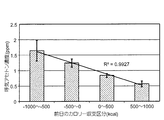
- FIG. 1 is a graph (calibration curve) showing a typical example of the experimental results.
- This graph is a graph showing the relationship between the acetone concentration of exhaled gas when the subject wakes up and the calorie balance of the previous day.
- the calorie balance is “[calorie intake] ⁇ ([basal metabolic rate] + [calorie consumption by physical activity]]”.
- the calorie balance is divided every 500 kcal and the average value of each category. Expressed.
- the calorie balance is estimated to be 338 kcal when the measured value is substituted into this linear function.
- the measured value of the calorie balance calculated based on the meal and physical activity actually recorded by the subject was 297 kcal. Therefore, it was confirmed that the estimated value and the actual measurement value of the calorie balance are classified into 0 to 500 kcal.
- the range shown in FIG. 1 is merely an example.
- the range of the calorie balance division may be a wider range or a narrower range, and may be divided every 300 kcal, for example.
- the correlation between the acetone concentration and the calorie balance is not necessarily linearly approximated, and may be curved.
- FIG. 2 is a block diagram illustrating a configuration of the calorie management system 10 according to an embodiment of the present invention.
- the calorie management system 10 is a system that includes a measurement device 100 and a calculation device 200 and has a configuration in which these are connected to each other via a network 300.
- the measuring device 100 is a device for measuring the acetone concentration of biological gas released from a user.
- the calculation device 200 is a device for estimating the calorie balance based on the correlation between the acetone concentration of the biological gas and the calorie balance.
- the network 300 is a communication network for transmitting and receiving data between the measuring apparatus 100 and the computing apparatus 200, and may include the Internet or a mobile communication network.
- the calorie management system 10 may include a plurality of measuring devices 100. That is, the calorie management system 10 may be configured to estimate the calorie balance of each user based on each acetone concentration measured by a plurality of users.
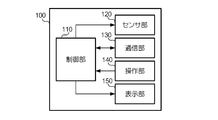
- FIG. 3 is a block diagram showing a hardware configuration of the measuring apparatus 100.
- the measuring device 100 is a device that measures the acetone concentration and displays information according to the calorie balance estimation result.
- the measuring apparatus 100 may be either a portable type or a stationary type.
- the measuring apparatus 100 may be comprised using general purpose electronic devices (communication terminal), such as a smart phone and a tablet computer, or an exclusive measuring apparatus (a gas chromatography apparatus, an ion mobility spectrometer, etc.). It may be.
- the measuring apparatus 100 includes a control unit 110, a sensor unit 120, a communication unit 130, an operation unit 140, and a display unit 150.
- the control unit 110 is means for controlling the operation of each unit of the measurement apparatus 100.
- the control unit 110 includes an arithmetic processing device such as a CPU (Central Processing Unit) and volatile and nonvolatile memories, and controls the operation of each unit of the measurement device 100 by executing a predetermined program.
- arithmetic processing device such as a CPU (Central Processing Unit) and volatile and nonvolatile memories
- the sensor unit 120 is a means for measuring the concentration of a specific component contained in the biological gas.
- the sensor unit 120 has at least a function of measuring the acetone concentration.
- the sensor unit 120 may be configured by a relatively small sensor such as a semiconductor gas sensor, but is not limited thereto.
- the communication unit 130 is means for transmitting / receiving data to / from the computing device 200.
- the communication unit 130 includes, for example, a baseband processor and an antenna for wireless communication, and transmits and receives data by performing modulation and demodulation according to the network 300.
- the communication unit 130 may be wired to the network 300.
- the operation unit 140 is a means for receiving user operations.
- the operation unit 140 is, for example, a keyboard (keypad), a mouse, a switch, or the like.
- the operation unit 140 may include a touch screen display.
- the display unit 150 is a means for displaying information.
- the display unit 150 is a liquid crystal display, for example, but may be one using a display element other than liquid crystal. Further, as described above, the display unit 150 may be configured as a touch screen display, that is, to have the function of the operation unit 140.
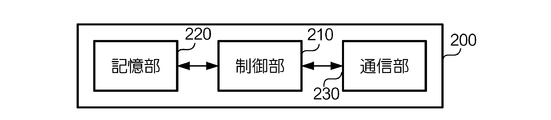
- FIG. 4 is a block diagram showing a hardware configuration of the computing device 200.
- the calculation device 200 is a server device having a function of estimating a calorie balance, for example.
- the computing device 200 includes a control unit 210, a storage unit 220, and a communication unit 230.
- the control unit 210 is a means for controlling the operation of each unit of the computing device 200. Moreover, the control part 210 has a function which analyzes data and estimates a user's calorie balance.
- the control unit 210 includes an arithmetic processing unit such as a CPU and volatile and nonvolatile memories, and executes data analysis and the like by executing a predetermined program.
- the storage unit 220 is means for storing data.
- the storage unit 220 includes a storage medium such as a hard disk, and stores data (such as a program) used by the control unit 210.
- the storage unit 220 stores user data.
- the user data is information registered in advance by the user or information associated with the user.
- the user data includes the acetone concentration measured by the measurement device 100.
- the user data includes an identifier (ID) for identifying the user, the measurement date and time of the acetone concentration, the user's sex, age, height, weight, body mass index (BMI), body fat percentage, physical activity.
- ID identifier
- BMI body mass index
- the amount, basal metabolism, blood glucose level, HbA1c value, and the like may be included, and further, the user's schedule registered in the electronic scheduler and the history of eating and drinking and exercise (ie, calorie intake and consumption history) may be included.
- the user's schedule registered in the electronic scheduler and the history of eating and drinking and exercise ie, calorie intake and consumption history
- medical information such as a user's medical history is available as electronic data (so-called electronic medical record)
- this may be included in the user data.
- the storage unit 220 stores correlation data indicating the correlation between the acetone concentration and the calorie balance.
- the correlation data is, for example, data representing the calibration curve shown in FIG.
- the correlation data may be a table for outputting a calorie balance corresponding to the input acetone concentration, but the data expression format is not particularly limited.
- the correlation data may be different for each user as will be described later. In this case, the correlation data may be a part of user data.
- the communication unit 230 is a means for transmitting and receiving data to and from the measuring apparatus 100.
- the communication unit 230 includes, for example, a NIC (Network Interface Controller) and the like, and exchanges data with the measurement apparatus 100 via the network 300. Note that the communication by the communication unit 230 may be wireless communication.
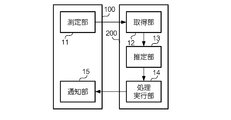
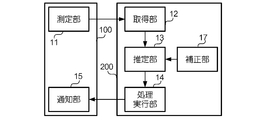
- FIG. 5 is a block diagram functionally showing the configuration of the calorie management system 10.
- the calorie management system 10 can function as the measurement unit 11, the acquisition unit 12, the estimation unit 13, the process execution unit 14, and the notification unit 15 by causing the measurement device 100 and the calculation device 200 to execute predetermined programs, respectively. .
- the measuring unit 11 is a means for measuring the acetone concentration of the biological gas released from the user.
- the sensor unit 120 corresponds to the measurement unit 11.
- the measurement unit 11 may be configured separately from the measurement device 100, that is, connected to the measurement device 100 in a wired or wireless manner.
- Communication means in this configuration include wireless communication means such as wireless LAN (Local Area Network), Bluetooth (registered trademark), ZigBee (registered trademark), and various cables such as USB (Universal Serial Bus) cable. Can be used.
- the acquisition unit 12 is a means for acquiring the acetone concentration measured by the measurement unit 11.
- the acquisition unit 12 acquires the acetone concentration via the network 300 in this embodiment.
- the acquisition unit 12 can receive data indicating the acetone concentration via the network 300, and acquire and specify the acetone concentration based on the received data.
- the estimation unit 13 is a means for estimating the calorie balance.
- the estimation unit 13 estimates a calorie balance corresponding to the acquired acetone concentration based on the acetone concentration acquired by the acquisition unit 12 and the correlation data stored in the storage unit 220.
- the calorie balance estimated at this time is a calorie balance from the time when the acetone concentration is measured to a predetermined time before, for example, the day before the acetone concentration measurement day (that is, from the time when the acetone concentration is measured to 24 hours before the measurement). ) Calorie balance.
- the “estimation” referred to here may be a value for calculating the calorie balance itself, but may be a more approximate or abstract value.
- the estimation unit 13 may divide the calorie balance value into predetermined ranges (levels) and estimate which range the user's calorie balance belongs to. Alternatively, the estimation unit 13 may only estimate the calorie balance. Even if the user only has a positive or negative calorie balance, the user can know which calorie intake or calorie consumption is dominant.
- the process execution unit 14 is a means for executing a process according to the estimation result by the estimation unit 13.
- the process execution unit 14 generates data including characters and images representing the estimation result by the estimation unit 13 and transmits the data to the measurement apparatus 100. This data is hereinafter referred to as “notification data”.
- the process execution part 14 may produce
- FIG. For example, when the user's calorie balance is positive (that is, when calorie intake is dominant), the process execution unit 14 notifies a hint or advice that contributes to weight loss, or according to the user's calorie balance, It is also possible to recommend exercise menus.
- the notification unit 15 is a means for notifying the user's calorie balance.
- the notification unit 15 receives the notification data generated and transmitted by the computing device 200 and causes the display unit 150 to display information (characters or images) corresponding to the received notification data.
- the “notification” here is not limited to the display of information, and may be performed by playing back sound.
- the specific format of the notification data is not particularly limited, and may be e-mail or SMS (Short Message Service), for example.
- the overall configuration of the calorie management system 10 is as described above.
- the user can know his own calorie balance by measuring the acetone concentration in the biological gas using the calorie management system 10 having such a configuration.
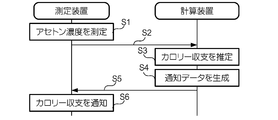
- FIG. 6 is a sequence chart showing the operation of the calorie management system 10 in the present embodiment.
- the user measures the acetone concentration. As described above, it is desirable to measure the acetone concentration immediately after getting up.
- the measuring device 100 transmits the measured value to the calculating device 200 (step S2).
- the calculation device 200 When receiving the measurement value of the acetone concentration, the calculation device 200 estimates the calorie balance using the correlation data (step S3). Moreover, the calculation apparatus 200 produces
- FIG. 7 is a block diagram showing a modification of the calorie management system 10.
- the configuration example illustrated in FIG. 7 is different from the configuration illustrated in FIG. 5 in that the calculation unit 16 is provided, and is common in other points.
- the calculation unit 16 is a means for calculating the correlation between the acetone concentration and the calorie balance. Specifically, the calculation unit 16 calculates correlation data corresponding to the user based on the acetone concentration and the calorie balance actually measured over a predetermined period for the specific user. For example, the user records the acetone concentration and the calorie balance for about one week and uses this as the learning period. The calculation unit 16 calculates a calibration curve unique to the user based on the acetone concentration and the calorie balance during the learning period.
- the calculation unit 16 may acquire a record of the learning period via the acquisition unit 12, but may also acquire other means.
- the estimation unit 13 estimates the calorie balance using the correlation data calculated by the calculation unit 16. In this way, it is possible to estimate with higher accuracy in consideration of individual differences compared to the case of using correlation data common to statistically obtained users.
- FIG. 8 is a block diagram showing another modification of the calorie management system 10.
- the configuration example shown in FIG. 8 differs from the configuration shown in FIG. 5 in that the correction unit 17 is provided, and is common in other points.
- the correction unit 17 is a means for calculating the correlation between the acetone concentration and the calorie balance. Specifically, the correction unit 17 corrects the correlation data obtained in advance based on the measured values of acetone concentration and calorie balance. For example, the correction unit 17 may correct the intercept of the calibration curve based on the actual measurement value without changing the slope of the calibration curve, or may correct the slope of the calibration curve.
- the correction may be to prepare correlation data for each user and correct each correlation data based on the actual measurement value of each user, or prepare common correlation data for each user.
- the correlation data may be corrected based on the actual measurement values of all users.
- the correction unit 17 may perform correction using information other than the acetone concentration. Specifically, the correction unit 17 can correct the correlation data using the user data described above. For example, a diabetic patient tends to have a higher acetone concentration of exhaled gas, and thus the tendency may be different from a general calibration curve (that is, a calibration curve of a person who is not a diabetic patient). In such a case, the correction unit 17 can determine the presence / absence of diabetes and the degree of progression with reference to a blood glucose level or an electronic medical record in the user data, and can correct the calibration curve according to the determination result. is there. Alternatively, the correction unit 17 may correct the calibration curve based on the user's BMI. This is because the higher the BMI, the more difficult the acetone is discharged. Thus, various data can be considered as parameters used for correction by the correction unit 17.
- the timing of measuring acetone is preferably immediately after getting up, but may be measured at other timings. For example, when waking up in the morning and measuring in the evening, the calorie balance from the time of the measurement in the evening to about 24 hours ago is directly substituted into the calibration curve indicating the correlation between the acetone concentration and the calorie balance. May be estimated.
- the acetone concentration value measured in the evening is a value at a predetermined time (for example, immediately after getting up).
- the conversion value may be substituted into a calibration curve indicating the correlation between the acetone concentration and the calorie balance, and the calorie balance for one day starting from the predetermined time point may be estimated and obtained.
- a calorie balance based on a predetermined time, that is, a fixed time.
- “one day” does not have to be exactly 24 hours, and may be expressed in round numbers by rounding (or rounding up or down) the minute unit, for example.
- the calorie intake or calorie consumption can be estimated.
- the calorie intake or calorie consumption can be estimated. For example, when the user measures the acetone concentration and records the calorie consumption, it is possible to estimate (inversely calculate) the calorie intake based on the estimated calorie balance and the calorie consumption.
- the calorie consumption can be estimated based on the estimated calorie balance and the calorie intake. In this way, it is possible to estimate the calorie consumption even if the user does not carry an activity meter or the like, or to estimate the calorie intake even if the user does not record the contents of the meal.
- the calorie management system 10 may notify the estimation result to a user different from the user who measured the acetone concentration.
- the calorie management system 10 can also notify the estimation result to other users who have a specific relationship (such as parent and child) with the user who is the subject. That is, in the present invention, the user who is the subject and the user who is the notification target are not necessarily the same.
- the configuration for carrying out the present invention is not limited to the configuration shown in FIG.
- the present invention can be implemented by an apparatus in which a function corresponding to the measurement apparatus 100 and a function corresponding to the calculation apparatus 200 are integrated without being separated. In this way, it is not necessary to transmit / receive data via the network.
- the computing device 200 may be configured such that the configuration corresponding to the sensor unit 120 is configured separately from the other configurations and exchanges data with each other by wired or wireless communication.
- the system of the present invention is based on the acquisition unit that acquires the concentration of acetone contained in the gas component released from the user and the predetermined correlation between the acetone concentration and the calorie balance. What is necessary is just to provide the estimation part which estimates the calorie balance corresponding to a density
- the present invention provides a calorie management system including the information processing apparatus, a program for causing a computer (CPU or the like) to function as the information processing apparatus, and a calorie balance estimation method. It can also be provided in the form of The program can also be provided in a form recorded on a recording medium such as an optical disk, or in a form that can be downloaded to a predetermined device via a network such as the Internet and used by installing the program.
Landscapes
- Health & Medical Sciences (AREA)
- Life Sciences & Earth Sciences (AREA)
- Engineering & Computer Science (AREA)
- General Health & Medical Sciences (AREA)
- Molecular Biology (AREA)
- Physics & Mathematics (AREA)
- Biomedical Technology (AREA)
- Biophysics (AREA)
- Public Health (AREA)
- Medical Informatics (AREA)
- Pathology (AREA)
- Animal Behavior & Ethology (AREA)
- Veterinary Medicine (AREA)
- Surgery (AREA)
- Heart & Thoracic Surgery (AREA)
- Chemical & Material Sciences (AREA)
- Obesity (AREA)
- Physiology (AREA)
- Pulmonology (AREA)
- Epidemiology (AREA)
- Primary Health Care (AREA)
- Urology & Nephrology (AREA)
- Hematology (AREA)
- General Physics & Mathematics (AREA)
- Biochemistry (AREA)
- Analytical Chemistry (AREA)
- Emergency Medicine (AREA)
- Medicinal Chemistry (AREA)
- Immunology (AREA)
- Food Science & Technology (AREA)
- Nutrition Science (AREA)
- Physical Education & Sports Medicine (AREA)
- Medical Treatment And Welfare Office Work (AREA)
- Investigating Or Analysing Biological Materials (AREA)
- Measurement Of The Respiration, Hearing Ability, Form, And Blood Characteristics Of Living Organisms (AREA)
Abstract
Description
そこで、本発明は、ユーザによるカロリー収支の管理を従来よりも容易にする技術を提供することを目的とする。
また、前記推定部は、前記測定されたアセトン濃度の値を、当該値が測定された時点よりも前の所定時点のアセトン濃度の値に変換し、当該所定時点を終期とする1日分のカロリー収支の値、範囲及び正負の少なくともいずれかを推定してもよい。
また、前記情報処理装置は、前記ユーザについて所定の期間に渡って実測されたアセトン濃度とカロリー収支とに基づいて、当該ユーザに応じた前記相関関係を算出する算出部を備え、前記推定部は、前記算出された相関関係を用いて前記ユーザのカロリー収支を推定してもよい。
また、前記情報処理装置は、前記ユーザ又は当該ユーザを含む複数のユーザについて実測されたアセトン濃度とカロリー収支とに基づいて前記相関関係を補正する補正部を備え、前記推定部は、前記補正された相関関係を用いて前記ユーザのカロリー収支を推定してもよい。
また、前記取得部は、前記ユーザの消費カロリー又は摂取カロリーをアセトン濃度とともに取得し、前記推定部は、前記取得された消費カロリー及びアセトン濃度に基づいて摂取カロリーを推定し、又は前記取得された摂取カロリー及びアセトン濃度に基づいて消費カロリーを推定してもよい。
また、前記ガスは、皮膚又は粘膜から発せられるガス成分と呼気のガス成分とを含んでもよい。
本発明の主たる特徴は、人体から放出される気体に含まれるアセトンの濃度(以下単に「アセトン濃度」ともいう。)に基づいてカロリー収支を推定する点にある。本発明の発明者らは、カロリー収支の管理を容易にするという課題を解決するための手段を検討した結果、アセトン濃度とカロリー収支との間に相関関係があることを発見した。ここにおいて、人体から放出される気体とは、皮膚又は粘膜から発せられるガスや呼気を含み、生体ガスなどともいう。

図2は、本発明の一実施例に係るカロリー管理システム10の構成を示すブロック図である。カロリー管理システム10は、測定装置100と、計算装置200とを備え、これらをネットワーク300を介して互いに接続した構成を有するシステムである。測定装置100は、ユーザから放出される生体ガスのアセトン濃度を測定するための装置である。また、計算装置200は、生体ガスのアセトン濃度とカロリー収支の相関関係に基づいてカロリー収支を推定するための装置である。ネットワーク300は、測定装置100と計算装置200との間でデータを送受信するための通信ネットワークであり、インターネットや移動体通信網を含み得る。
性のメモリとを備え、所定のプログラムを実行することによって測定装置100の各部の動作を制御する。
活動量、基礎代謝、血糖値、HbA1c値などを含んでもよく、さらには電子スケジューラに登録されたユーザの予定や飲食及び運動の履歴(すなわちカロリーの摂取及び消費の履歴)を含んでもよい。また、ユーザの既往歴などの医療情報が電子データ(いわゆる電子カルテ)として入手可能である場合には、これをユーザデータに含んでもよい。
なお、相関データは、後述するようにユーザ毎に異なっていてもよい。この場合、相関データは、ユーザデータの一部としてもよい。
上述した実施例は、本発明の実施の一態様である。本発明は、この実施例の態様に限らず、以下に示す他の態様でも実施することが可能である。なお、以下に示す変形例は、必要に応じて、各々を組み合わせることも可能である。
要するに、本発明のシステムは、ユーザから放出されたガス成分に含まれるアセトンの濃度を取得する取得部と、予め定められた、アセトン濃度とカロリー収支との相関関係に基づき、前記取得されたアセトン濃度に対応するカロリー収支を推定する推定部と、前記推定の結果を用いて所定の処理を実行する処理実行部とを備えていればよい。
Claims (10)
- ユーザから放出されたガスに含まれるアセトンの濃度を取得する取得部と、 あらかじめ決定された、アセトン濃度とカロリー収支との相関関係に基づき、前記取得されたアセトンの濃度に対応するカロリー収支を推定する推定部と、
前記推定部による推定結果を用いて所定の処理を実行する処理実行部と
を備える情報処理装置。 - 前記推定部は、前記アセトン濃度が測定された時点から所定時間前までのカロリー収支の値、範囲及び正負の少なくともいずれかを推定する
ことを特徴とする請求項1に記載の情報処理装置。 - 前記推定部は、前記アセトン濃度の値を、当該値が測定された時点よりも前の所定時点のアセトン濃度の値に変換し、当該所定時点を終期とする1日分のカロリー収支の値、範囲及び正負の少なくともいずれかを推定する
ことを特徴とする請求項1に記載の情報処理装置。 - 前記ユーザについて所定の期間に渡って実測されたアセトン濃度とカロリー収支とに基づいて、当該ユーザに応じた前記相関関係を算出する算出部を備え、
前記推定部は、前記算出された相関関係を用いて前記ユーザのカロリー収支を推定する
ことを特徴とする請求項1ないし3のいずれか1項に記載の情報処理装置。 - 前記ユーザ又は当該ユーザを含む複数のユーザについて実測されたアセトン濃度とカロリー収支とに基づいて前記相関関係を補正する補正部を備え、
前記推定部は、前記補正された相関関係を用いて前記ユーザのカロリー収支を推定する
ことを特徴とする請求項1ないし3のいずれか1項に記載の情報処理装置。 - 前記取得部は、前記ユーザの消費カロリー又は摂取カロリーをアセトン濃度とともに取得し、
前記推定部は、前記取得された消費カロリー及びアセトン濃度に基づいて摂取カロリーを推定し、又は前記取得された摂取カロリー及びアセトン濃度に基づいて消費カロリーを推定する
ことを特徴とする請求項1ないし5のいずれか1項に記載の情報処理装置。 - 前記ガスは、皮膚又は粘膜から発せられるガス成分と呼気のガス成分とを含む
ことを特徴とする請求項1ないし6のいずれか1項に記載の情報処理装置。 - ユーザから放出されるガスに含まれるアセトンの濃度を測定する測定部と、
あらかじめ決定された、アセトン濃度とカロリー収支との相関関係に基づき、前記測定されたアセトン濃度に対応するカロリー収支を推定する推定部と、
前記推定されたカロリー収支に応じた情報を通知する通知部と
を備えるカロリー管理システム。 - ユーザから放出されるガス成分のアセトン濃度を測定し、
あらかじめ求められたアセトン濃度とカロリー収支との相関関係に基づき、前記測定されたアセトン濃度に対応するカロリー収支を推定し、
前記推定されたカロリー収支に応じた情報を通知する
カロリー収支推定方法。 - コンピュータに、
ユーザから放出されて測定されたガス成分のアセトン濃度を取得する第1ステップと、
あらかじめ求められたアセトン濃度とカロリー収支との相関関係に基づき、前記取得されたアセトン濃度に対応するカロリー収支を推定する第2ステップと、
前記第2ステップにおける推定結果を用いて所定の処理を実行する第3ステップと
を実行させるためのプログラム。
Priority Applications (3)
| Application Number | Priority Date | Filing Date | Title |
|---|---|---|---|
| CN201580072578.0A CN107111855A (zh) | 2015-01-07 | 2015-12-28 | 信息处理装置、卡路里管理系统、卡路里收支估计方法和程序 |
| US15/541,616 US20180000377A1 (en) | 2015-01-07 | 2015-12-28 | Information processing device, calorie management system, caloric balance estimation method, and program |
| JP2016568342A JP6609573B2 (ja) | 2015-01-07 | 2015-12-28 | 情報処理装置、カロリー管理システム、カロリー収支推定方法及びプログラム |
Applications Claiming Priority (2)
| Application Number | Priority Date | Filing Date | Title |
|---|---|---|---|
| JP2015-001760 | 2015-01-07 | ||
| JP2015001760 | 2015-01-07 |
Publications (1)
| Publication Number | Publication Date |
|---|---|
| WO2016111215A1 true WO2016111215A1 (ja) | 2016-07-14 |
Family
ID=56355909
Family Applications (1)
| Application Number | Title | Priority Date | Filing Date |
|---|---|---|---|
| PCT/JP2015/086456 Ceased WO2016111215A1 (ja) | 2015-01-07 | 2015-12-28 | 情報処理装置、カロリー管理システム、カロリー収支推定方法及びプログラム |
Country Status (4)
| Country | Link |
|---|---|
| US (1) | US20180000377A1 (ja) |
| JP (1) | JP6609573B2 (ja) |
| CN (1) | CN107111855A (ja) |
| WO (1) | WO2016111215A1 (ja) |
Cited By (4)
| Publication number | Priority date | Publication date | Assignee | Title |
|---|---|---|---|---|
| JP2018155511A (ja) * | 2017-03-15 | 2018-10-04 | 株式会社タニタ | 体組成変化予測装置、方法、及びプログラム |
| CN110506211A (zh) * | 2017-04-06 | 2019-11-26 | 株式会社明治 | 用于监测生酮饮食的有效状态的装置 |
| JP2019215797A (ja) * | 2018-06-14 | 2019-12-19 | 株式会社Nttドコモ | カロリー収支推定装置、カロリー収支推定方法、及びカロリー収支推定プログラム |
| JP2022057643A (ja) * | 2020-09-30 | 2022-04-11 | 国立大学法人東海国立大学機構 | 情報処理装置、情報処理システムおよびプログラム |
Families Citing this family (2)
| Publication number | Priority date | Publication date | Assignee | Title |
|---|---|---|---|---|
| CN106980015B (zh) * | 2017-04-05 | 2019-03-15 | 京东方科技集团股份有限公司 | 一种生物排放气体的检测系统 |
| CN121621939A (zh) * | 2024-08-30 | 2026-03-10 | 深圳市零一联合科技有限公司 | 基于分析物浓度数据的处理装置及相关方法 |
Citations (2)
| Publication number | Priority date | Publication date | Assignee | Title |
|---|---|---|---|---|
| JP2001349888A (ja) * | 2000-06-08 | 2001-12-21 | Matsushita Electric Ind Co Ltd | 体脂肪燃焼量測定装置および有酸素運動器具 |
| JP2014033868A (ja) * | 2012-08-09 | 2014-02-24 | Tanita Corp | 消費エネルギー推定装置 |
Family Cites Families (6)
| Publication number | Priority date | Publication date | Assignee | Title |
|---|---|---|---|---|
| US4970172A (en) * | 1986-12-22 | 1990-11-13 | Abbott Laboratories | Method and device for ketone measurements |
| JPH084584B2 (ja) * | 1992-09-29 | 1996-01-24 | コンビ株式会社 | 体力測定方法と体力測定装置の評価方法 |
| WO2001026535A2 (en) * | 1999-10-08 | 2001-04-19 | Healthetech, Inc. | Monitoring caloric expenditure rate and caloric diet |
| US6609068B2 (en) * | 2000-02-22 | 2003-08-19 | Dow Global Technologies Inc. | Personal computer breath analyzer for health-related behavior modification and method |
| US8994947B2 (en) * | 2001-03-19 | 2015-03-31 | Pranalytica, Inc. | Diagnostic method for high sensitivity detection of component concentrations in human gas emissions |
| WO2013038959A1 (ja) * | 2011-09-14 | 2013-03-21 | 株式会社 エヌ・ティ・ティ・ドコモ | ダイエット支援システムおよびダイエット支援方法 |
-
2015
- 2015-12-28 JP JP2016568342A patent/JP6609573B2/ja active Active
- 2015-12-28 CN CN201580072578.0A patent/CN107111855A/zh active Pending
- 2015-12-28 WO PCT/JP2015/086456 patent/WO2016111215A1/ja not_active Ceased
- 2015-12-28 US US15/541,616 patent/US20180000377A1/en not_active Abandoned
Patent Citations (2)
| Publication number | Priority date | Publication date | Assignee | Title |
|---|---|---|---|---|
| JP2001349888A (ja) * | 2000-06-08 | 2001-12-21 | Matsushita Electric Ind Co Ltd | 体脂肪燃焼量測定装置および有酸素運動器具 |
| JP2014033868A (ja) * | 2012-08-09 | 2014-02-24 | Tanita Corp | 消費エネルギー推定装置 |
Non-Patent Citations (1)
| Title |
|---|
| SATOSHI HIYAMA: "Bio Chip Keitai' no Jitsugen ni Muketa Portable Koki Acetone Sokutei Sochi no Kaihatsu to Oyo", PERSONAL·HEALTHCARE, 23 October 2013 (2013-10-23), pages 165 - 171, ISBN: 978-4-86469-080-5 * |
Cited By (6)
| Publication number | Priority date | Publication date | Assignee | Title |
|---|---|---|---|---|
| JP2018155511A (ja) * | 2017-03-15 | 2018-10-04 | 株式会社タニタ | 体組成変化予測装置、方法、及びプログラム |
| CN110506211A (zh) * | 2017-04-06 | 2019-11-26 | 株式会社明治 | 用于监测生酮饮食的有效状态的装置 |
| JP2019215797A (ja) * | 2018-06-14 | 2019-12-19 | 株式会社Nttドコモ | カロリー収支推定装置、カロリー収支推定方法、及びカロリー収支推定プログラム |
| JP7117167B2 (ja) | 2018-06-14 | 2022-08-12 | 株式会社Nttドコモ | カロリー収支推定装置、カロリー収支推定方法、及びカロリー収支推定プログラム |
| JP2022057643A (ja) * | 2020-09-30 | 2022-04-11 | 国立大学法人東海国立大学機構 | 情報処理装置、情報処理システムおよびプログラム |
| JP7627477B2 (ja) | 2020-09-30 | 2025-02-06 | 国立大学法人東海国立大学機構 | 情報処理装置、情報処理システムおよびプログラム |
Also Published As
| Publication number | Publication date |
|---|---|
| CN107111855A (zh) | 2017-08-29 |
| JPWO2016111215A1 (ja) | 2017-10-12 |
| US20180000377A1 (en) | 2018-01-04 |
| JP6609573B2 (ja) | 2019-11-20 |
Similar Documents
| Publication | Publication Date | Title |
|---|---|---|
| JP6609573B2 (ja) | 情報処理装置、カロリー管理システム、カロリー収支推定方法及びプログラム | |
| JP5696222B2 (ja) | ダイエット支援システムおよびダイエット支援方法 | |
| JP7127086B2 (ja) | ヘルストラッキングデバイス | |
| US20180232492A1 (en) | Artificial intelligence to edit health care plans | |
| EP4108170A1 (en) | Sensor array calibration | |
| CN103415250B (zh) | 活动量计 | |
| US20170242971A1 (en) | Characteristic evaluation apparatus, characteristic evaluation system, characteristic evaluation method, and characteristic evaluation program | |
| WO2013009589A1 (en) | Personalized nutritional and wellness assistant | |
| CN108024720A (zh) | 使用可穿戴设备确定代谢参数 | |
| CN107077523A (zh) | 健康风险指标确定 | |
| US20190357819A1 (en) | Meal advice provision system and analysis apparatus | |
| CN105303027A (zh) | 身体状况提示装置和系统、及提示信息输出方法 | |
| CN104799813A (zh) | 节食支持装置以及方法 | |
| JP2017116415A (ja) | 減量支援装置、方法及びプログラム | |
| JP6960849B2 (ja) | 生体情報処理装置、生体情報処理システム、生体情報処理方法及びプログラム | |
| WO2021199324A1 (ja) | 臨床検査項目決定装置、健康行動支援装置、臨床検査項目決定方法、健康行動支援方法及びコンピュータプログラム | |
| JP6721408B2 (ja) | 判定装置 | |
| Jovanov et al. | Sensors and systems for obesity care and research | |
| JP6719942B2 (ja) | 運動支援システム | |
| JP2016075533A (ja) | 脂肪燃焼量提示装置、脂肪燃焼量提示方法、及び、脂肪燃焼量提示プログラム | |
| JP2015162009A (ja) | 摂取食事量提示装置、方法、及びプログラム | |
| Sugita et al. | A method for estimating hunger degree based on meal and exercise logs | |
| JP2025094493A (ja) | 生活習慣改善システム、制御方法、及び、プログラム | |
| JP2025166363A (ja) | 健康支援装置および献立提供方法 | |
| Takahashi et al. | Relationship between health behavior and social support for the prevention of lifestyle-related diseases |
Legal Events
| Date | Code | Title | Description |
|---|---|---|---|
| 121 | Ep: the epo has been informed by wipo that ep was designated in this application |
Ref document number: 15877087 Country of ref document: EP Kind code of ref document: A1 |
|
| ENP | Entry into the national phase |
Ref document number: 2016568342 Country of ref document: JP Kind code of ref document: A |
|
| WWE | Wipo information: entry into national phase |
Ref document number: 15541616 Country of ref document: US |
|
| NENP | Non-entry into the national phase |
Ref country code: DE |
|
| 122 | Ep: pct application non-entry in european phase |
Ref document number: 15877087 Country of ref document: EP Kind code of ref document: A1 |