WO2016104322A1 - 粘着シート - Google Patents
粘着シート Download PDFInfo
- Publication number
- WO2016104322A1 WO2016104322A1 PCT/JP2015/085354 JP2015085354W WO2016104322A1 WO 2016104322 A1 WO2016104322 A1 WO 2016104322A1 JP 2015085354 W JP2015085354 W JP 2015085354W WO 2016104322 A1 WO2016104322 A1 WO 2016104322A1
- Authority
- WO
- WIPO (PCT)
- Prior art keywords
- meth
- sensitive adhesive
- pressure
- adhesive sheet
- acrylate
- Prior art date
- Legal status (The legal status is an assumption and is not a legal conclusion. Google has not performed a legal analysis and makes no representation as to the accuracy of the status listed.)
- Ceased
Links
Images
Classifications
-
- C—CHEMISTRY; METALLURGY
- C09—DYES; PAINTS; POLISHES; NATURAL RESINS; ADHESIVES; COMPOSITIONS NOT OTHERWISE PROVIDED FOR; APPLICATIONS OF MATERIALS NOT OTHERWISE PROVIDED FOR
- C09J—ADHESIVES; NON-MECHANICAL ASPECTS OF ADHESIVE PROCESSES IN GENERAL; ADHESIVE PROCESSES NOT PROVIDED FOR ELSEWHERE; USE OF MATERIALS AS ADHESIVES
- C09J7/00—Adhesives in the form of films or foils
- C09J7/20—Adhesives in the form of films or foils characterised by their carriers
-
- B—PERFORMING OPERATIONS; TRANSPORTING
- B32—LAYERED PRODUCTS
- B32B—LAYERED PRODUCTS, i.e. PRODUCTS BUILT-UP OF STRATA OF FLAT OR NON-FLAT, e.g. CELLULAR OR HONEYCOMB, FORM
- B32B27/00—Layered products comprising a layer of synthetic resin
-
- B—PERFORMING OPERATIONS; TRANSPORTING
- B32—LAYERED PRODUCTS
- B32B—LAYERED PRODUCTS, i.e. PRODUCTS BUILT-UP OF STRATA OF FLAT OR NON-FLAT, e.g. CELLULAR OR HONEYCOMB, FORM
- B32B27/00—Layered products comprising a layer of synthetic resin
- B32B27/30—Layered products comprising a layer of synthetic resin comprising vinyl (co)polymers; comprising acrylic (co)polymers
-
- C—CHEMISTRY; METALLURGY
- C09—DYES; PAINTS; POLISHES; NATURAL RESINS; ADHESIVES; COMPOSITIONS NOT OTHERWISE PROVIDED FOR; APPLICATIONS OF MATERIALS NOT OTHERWISE PROVIDED FOR
- C09J—ADHESIVES; NON-MECHANICAL ASPECTS OF ADHESIVE PROCESSES IN GENERAL; ADHESIVE PROCESSES NOT PROVIDED FOR ELSEWHERE; USE OF MATERIALS AS ADHESIVES
- C09J201/00—Adhesives based on unspecified macromolecular compounds
-
- H—ELECTRICITY
- H10—SEMICONDUCTOR DEVICES; ELECTRIC SOLID-STATE DEVICES NOT OTHERWISE PROVIDED FOR
- H10P—GENERIC PROCESSES OR APPARATUS FOR THE MANUFACTURE OR TREATMENT OF DEVICES COVERED BY CLASS H10
- H10P52/00—Grinding, lapping or polishing of wafers, substrates or parts of devices
-
- C—CHEMISTRY; METALLURGY
- C09—DYES; PAINTS; POLISHES; NATURAL RESINS; ADHESIVES; COMPOSITIONS NOT OTHERWISE PROVIDED FOR; APPLICATIONS OF MATERIALS NOT OTHERWISE PROVIDED FOR
- C09J—ADHESIVES; NON-MECHANICAL ASPECTS OF ADHESIVE PROCESSES IN GENERAL; ADHESIVE PROCESSES NOT PROVIDED FOR ELSEWHERE; USE OF MATERIALS AS ADHESIVES
- C09J2203/00—Applications of adhesives in processes or use of adhesives in the form of films or foils
- C09J2203/326—Applications of adhesives in processes or use of adhesives in the form of films or foils for bonding electronic components such as wafers, chips or semiconductors
Definitions
- the present invention relates to an adhesive sheet that is affixed to an adherend such as a semiconductor wafer and used to protect the adherend, and particularly relates to a back grind sheet.
- an intermediate layer may be provided between the base material and the pressure-sensitive adhesive layer in order to embed bumps and absorb and alleviate the height difference on the surface of the semiconductor wafer.
- the intermediate layer has a low storage elastic modulus at a high temperature at room temperature in order to improve the embedding property of the bump at room temperature, to improve the holding performance of the wafer surface at room temperature, and to improve the shape stability when it is made into a roll.
- an energy ray curable resin that is high below is used.
- the intermediate layer may be excessively softened at the application temperature, and the intermediate layer may ooze out during application. May not be absorbed.
- an intermediate layer in which a heat-meltable resin having crystallinity is dispersed in a matrix resin made of an energy ray-curable resin is also known.
- Patent Document 1 when a hot-melt resin having crystallinity is dispersed in the intermediate layer, the film formability of the intermediate layer may deteriorate. Therefore, there is a need for an intermediate layer that can bury bumps appropriately and sufficiently reduce the height difference without using a heat-meltable resin, and can prevent bleeding at the time of sticking.
- the present invention has been made in view of the above-described problems, and when the intermediate layer is not attached to a heat-melting resin having crystallinity, it is attached when attached to an adherend such as a semiconductor wafer. It is an object of the present invention to provide a pressure-sensitive adhesive sheet capable of preventing bleeding of an intermediate layer at the time of sticking while improving the embedding property with respect to unevenness formed on a body.
- a pressure-sensitive adhesive sheet comprising a base material, an intermediate layer, and a pressure-sensitive adhesive layer in this order, The intermediate layer composition, wherein the intermediate layer contains a polyfunctional compound having at least two polymerizable functional groups and a monofunctional monomer containing at least a crystalline monomer having a linear carbon chain having 14 to 22 carbon atoms.
- the pressure-sensitive adhesive sheet contains the polyfunctional compound in an amount of more than 25% by mass with respect to the monofunctional monomer.
- the polyfunctional compound is at least one selected from the group consisting of a urethane (meth) acrylate oligomer, an acrylic polymer, and a butadiene polymer.
- the adhesive sheet as described.
- the present invention provides a pressure-sensitive adhesive sheet capable of preventing bleeding of an intermediate layer at the time of sticking while improving the embedding property with respect to the unevenness of the adherend when the pressure-sensitive adhesive sheet is attached to an adherend such as a semiconductor wafer. be able to.
- weight average molecular weight (Mw) is a value in terms of polystyrene measured by gel permeation chromatography (GPC) method, specifically based on the method described in the examples. It is a measured value.
- GPC gel permeation chromatography
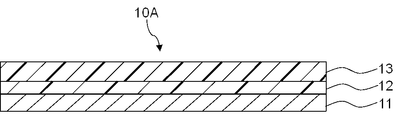
- the pressure-sensitive adhesive sheet of the present invention is particularly limited as long as it is provided with an intermediate layer 12 on the base material 11 and further provided with a pressure-sensitive adhesive layer 13 on the intermediate layer 12 like the pressure-sensitive adhesive sheet 10A shown in FIG. There is no.
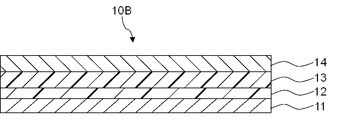
- the pressure-sensitive adhesive sheet may be composed of these three layers, or another layer may be provided. For example, like the adhesive sheet 10B shown in FIG. 2, you may have the peeling material 14 on the adhesive layer 13 further.
- the intermediate layer comprises an intermediate layer composition containing a polyfunctional compound having at least two polymerizable functional groups and a monofunctional monomer containing at least a crystalline monomer having a linear carbon chain having 14 to 22 carbon atoms. It is hardened.
- the composition for an intermediate layer forming the intermediate layer contains a polyfunctional compound and a monofunctional monomer, and at least a part of the monofunctional monomer is a crystalline monomer.
- the intermediate layer composition is formed by polymerizing a polyfunctional compound and a monofunctional monomer to form an intermediate layer. It is preferable that the composition for intermediate
- an energy ray has an energy quantum in electromagnetic waves or a charged particle beam, refers to active light such as ultraviolet rays or an electron beam, and preferably uses ultraviolet rays.
- the polyfunctional compound is contained in the intermediate layer composition in an amount of more than 25% by mass based on the total amount of the monofunctional monomer.
- the content of the polyfunctional compound is preferably 30% by mass or more, more preferably 50% by mass or more.
- the upper limit of the content is preferably 250% by mass or less, and more preferably 200% by mass or less in order to secure the content of the monofunctional monomer to some extent.
- the polymerizable functional group contained in the polyfunctional compound is preferably a group having an ethylenic double bond.
- the polyfunctional compound can be cured by energy rays such as ultraviolet rays.
- specific examples of the group having an ethylenic double bond include a (meth) acryloyl group and a vinyl group, and a (meth) acryloyl group is preferable.
- the polyfunctional compound may be either a polyfunctional monomer or a polyfunctional oligomer. However, since the interaction with the crystalline monomer becomes stronger when cured, it is preferable to use a polyfunctional oligomer.
- polyfunctional compound 1 type may be used independently and 2 or more types may be used in combination.
- polyfunctional compounds either one of the polyfunctional monomer and the polyfunctional oligomer may be used, or both the polyfunctional monomer and the polyfunctional oligomer may be used.
- the polyfunctional oligomer has a weight average molecular weight of preferably 3000 to 60000, and more preferably 5000 to 50000. By setting the weight average molecular weight in the above range, it is easy to prevent the intermediate layer from exuding while improving the embedding property of the intermediate layer. In addition, while the polyfunctional oligomer is in a liquid state, the viscosity is in an appropriate range, and the film formability is easily improved.
- Specific examples of the polyfunctional oligomer that can be used in the intermediate layer include urethane (meth) acrylate oligomers, acrylic polymers, butadiene polymers, and polyisoprene.
- urethane (meth) acrylate oligomers acrylic polymers, and butadiene polymers are preferable.
- a monofunctional oligomer having only one polymerizable functional group is also known.
- the intermediate layer becomes too soft at high temperatures. This makes it difficult to prevent the intermediate layer from seeping out.
- the urethane (meth) acrylate oligomer, acrylic polymer, and butadiene polymer that can be used for the polyfunctional oligomer will be specifically described.
- a urethane (meth) acrylate oligomer is a compound having at least a (meth) acryloyl group and a urethane bond, and has a property of being polymerized by irradiation with energy rays.
- the number of (meth) acryloyl groups (that is, polymerizable functional groups) in the urethane (meth) acrylate oligomer may be two, or three or more, but is preferably two.
- the urethane (meth) acrylate oligomer can be obtained, for example, by reacting a hydroxyl group-containing (meth) acrylate with a terminal isocyanate urethane prepolymer obtained by reacting a polyol compound and a polyvalent isocyanate compound.
- polyol compound A polyol compound is a compound having two or more hydroxy groups, and specific polyol compounds include, for example, polyether-type polyols, polyester-type polyols, and polycarbonate-type polyols. Ether type polyols are preferred.
- the polyol compound may be a bifunctional diol, a trifunctional triol, or a tetrafunctional or higher polyol, but a bifunctional diol is preferred.
- the polyether type polyol is preferably a compound represented by the following formula (1).
- R is a divalent hydrocarbon group, preferably an alkylene group, more preferably an alkylene group having 1 to 6 carbon atoms.
- alkylene groups having 1 to 6 carbon atoms an ethylene group, a propylene group, and a tetramethylene group are preferable, and a propylene group and a tetramethylene group are more preferable.
- N is the number of repeating units of alkylene oxide, and is usually 10 to 250, preferably 25 to 205, more preferably 40 to 185. If n is the said range, the urethane bond density
- polyethylene glycol, polypropylene glycol, and polytetramethylene glycol are preferable, and polypropylene glycol and polytetramethylene glycol are more preferable.
- the polyester type polyol is obtained by polycondensation of a polyol component and a polybasic acid component.
- the polyol component include ethylene glycol, diethylene glycol, triethylene glycol, 1,2-propanediol, 1,3-propanediol, 1,3-butanediol, 1,4-butanediol, neopentyl glycol, pentanediol, 3-methyl-1,5-pentanediol, 2,2,4-trimethyl-1,3-pentanediol, hexanediol, octanediol, 2,2-diethyl-1,3-propanediol, 2-ethyl-2 -Known various glycols such as butyl-1,3-propanediol, 1,4-cyclohexanedimethanol, ethylene glycol or propylene glycol adduct of bisphenol A, and the like.
- polybasic acid component used for the production of the polyester type polyol a compound generally known as a polybasic acid component of polyester can be used.
- the polybasic acid component include aliphatic dibasic acids such as adipic acid, maleic acid, succinic acid, oxalic acid, fumaric acid, malonic acid, glutaric acid, pimelic acid, azelaic acid, sebacic acid, and suberic acid.
- Acids dibasic acids such as phthalic acid, isophthalic acid, terephthalic acid, 2,6-naphthalenedicarboxylic acid, aromatic polybasic acids such as polybasic acids such as trimellitic acid and pyromellitic acid, and anhydrides corresponding thereto And its derivatives, dimer acid, hydrogenated dimer acid and the like.
- the polycarbonate type polyol is not particularly limited, but polyalkylene carbonate diol is exemplified.
- Polyalkylene carbonate diol is polytetramethylene carbonate diol, polypentamethylene carbonate diol, polyhexamethylene carbonate diol, or a copolymer having two or more mixed alkylene chains selected from tetramethylene, pentamethylene and hexamethylene. Examples thereof include those having a linear alkylene group having about 4 to 8 carbon atoms exemplified as a combination as a repeating unit.
- polyvalent isocyanate compound examples include aliphatic polyisocyanates such as tetramethylene diisocyanate, hexamethylene diisocyanate, and trimethylhexamethylene diisocyanate; isophorone diisocyanate, norbornane diisocyanate, dicyclohexylmethane-4,4′-diisocyanate, Alicyclic diisocyanates such as dicyclohexylmethane-2,4′-diisocyanate and ⁇ , ⁇ ′-diisocyanate dimethylcyclohexane; 4,4′-diphenylmethane diisocyanate, tolylene diisocyanate, xylylene diisocyanate, tolidine diisocyanate, tetramethylene xylylene diene Aromatic diisocyanates such as isocyanate and naphthalene-1,5-diisocyanate The
- (Meth) acrylate having hydroxy group Urethane (meth) acrylate oligomer by reacting (meth) acrylate having hydroxy group with terminal isocyanate urethane prepolymer obtained by reacting the above-mentioned polyol compound and polyvalent isocyanate compound Can be obtained.
- the (meth) acrylate having a hydroxy group is not particularly limited as long as it is a compound having a hydroxy group and a (meth) acryloyl group in at least one molecule.
- the (meth) acrylate having a hydroxy group examples include 2-hydroxyethyl (meth) acrylate, 2-hydroxypropyl (meth) acrylate, 4-hydroxybutyl (meth) acrylate, and 4-hydroxycyclohexyl (meth).
- Acrylate 5-hydroxycyclooctyl (meth) acrylate, 2-hydroxy-3-phenyloxypropyl (meth) acrylate, pentaerythritol tri (meth) acrylate, polyethylene glycol mono (meth) acrylate, polypropylene glycol mono (meth) acrylate, etc.
- Hydroxy-alkyl (meth) acrylates hydroxy-group-containing (meth) acrylamides such as N-methylol (meth) acrylamide; vinyl alcohol, vinyl phenol, bisphenol
- the reaction product obtained by the diglycidyl ester of Nord A (meth) acrylic acid is reacted, and the like.
- hydroxyalkyl (meth) acrylate is preferable, and 2-hydroxyethyl (meth) acrylate is more preferable.
- acrylic polymer used as the polyfunctional compound examples include those obtained by polymerizing (meth) acrylic acid esters, preferably having 1 to 10 carbon atoms in the alkyl group, more preferably 3 to 3 carbon atoms in the alkyl group. And those obtained by polymerizing 8 alkyl (meth) acrylates.
- the alkyl group in the alkyl (meth) acrylate may be branched or linear.
- alkyl (meth) acrylate examples include methyl (meth) acrylate, ethyl (meth) acrylate, n-propyl (meth) acrylate, isopropyl (meth) acrylate, n-butyl (meth) acrylate, isobutyl (meth) acrylate, t- Examples include butyl (meth) acrylate, n-pentyl (meth) acrylate, n-hexyl (meth) acrylate, and 2-ethylhexyl (meth) acrylate.
- the acrylic polymer has a polymerizable functional group at both ends, and the polymerizable functional group is usually a (meth) acryloyl group.
- butadiene-based polymer examples include those having two or more vinyl groups in the side chain.
- the vinyl group in the side chain becomes a polymerizable functional group and can be cured by reacting with a monofunctional monomer.
- the butadiene polymer is obtained by polymerizing butadiene as a monomer unit, and usually contains 1,4 bond units and 1,2 vinyl bond units.
- polyfunctional monomer examples include a (meth) acrylic acid polyfunctional monomer.
- the (meth) acrylic acid polyfunctional monomer is a pentaerythritol tri (meth) acrylate.
- a monofunctional monomer is a monomer having one ethylenic double bond.
- the monofunctional monomer contained in the intermediate layer composition contains at least a crystalline monomer.
- the crystalline monomer has a linear carbon chain having 14 to 22 carbon atoms, and imparts crystallinity to the side chain of the obtained polymer when the intermediate layer composition is polymerized by a curing reaction. It is.
- the intermediate layer composition contains a crystalline monomer, so that the intermediate layer is deformed due to a decrease in elastic modulus at the time of heating and sticking, and the embedding property is easily improved.
- the crystalline monomer is a monomer having an ethylenic double bond and having a crystallinity in a side chain by the above-described linear carbon chain having 14 to 22 carbon atoms when formed into a polymer.
- the monofunctional monomer contained in the intermediate layer composition is a crystalline monomer.
- the elastic modulus is more favorable at the time of heating and sticking, and the embedding property is improved while preventing the exudation of the intermediate layer when sticking the adhesive sheet. It becomes possible to do.
- the monofunctional monomer is more preferably 45 to 100% by mass of a crystalline monomer, and more preferably 77 to 100% by mass of a crystalline monomer. As described above, when the content of the crystalline monomer in the monofunctional monomer is increased, a decrease in the elastic modulus of the intermediate layer at the time of heating and sticking becomes remarkable, so that better embedding can be achieved. Thus, it is possible to suppress the seepage of the resin from the intermediate layer of the pressure-sensitive adhesive sheet during storage.
- the crystalline monomer has one ethylenic double bond. Specifically, it preferably has a (meth) acryloyl group or a vinyl group as a functional group, and more preferably has a (meth) acryloyl group. preferable. Since the crystalline monomer has an ethylenic double bond, it can be easily polymerized by irradiation with energy rays. Moreover, it becomes easy to advance hardening reaction easily by having a (meth) acryloyl group.
- the crystalline monomer preferably has a linear alkyl group having 14 to 22 carbon atoms.
- the straight chain alkyl group preferably has 16 to 20 carbon atoms.
- the crystalline monomer examples include alkyl (meth) acrylate having a linear alkyl group having 14 to 22 carbon atoms, alkyl vinyl ether having a linear alkyl group having 14 to 22 carbon atoms, and the like.
- Alkyl (meth) acrylates having 22 straight chain alkyl groups are preferred. By using alkyl (meth) acrylate, it becomes easy to advance the curing reaction well.
- alkyl (meth) acrylate having a linear alkyl group having 14 to 22 carbon atoms examples include myristyl (meth) acrylate, palmityl (meth) acrylate, stearyl (meth) acrylate, arakinyl (meth) acrylate, behenyl (meth) ) Acrylate, among them, stearyl (meth) acrylate is preferable from the viewpoint of availability.
- alkyl vinyl ether having a linear alkyl group having 14 to 22 carbon atoms include myristyl vinyl ether, palmityl vinyl ether, stearyl vinyl ether, arakinyl vinyl ether, and behenyl vinyl ether.
- the crystalline monomer is preferably contained in an amount of 25 to 70% by mass, more preferably 40 to 60% by mass, based on the total amount of the intermediate layer composition.
- the content is 25% by mass or more, the portion having crystallinity in the intermediate layer is increased, the elastic modulus of the intermediate layer is lowered when the temperature is raised, and the embedding property is easily improved. Moreover, it becomes easy to ensure the softness
- the monofunctional monomer contained in the intermediate layer composition may consist of only the crystalline monomer described above, but may contain a monofunctional monomer other than the crystalline monomer.
- the monofunctional monomer other than the crystalline monomer contains a group having an ethylenic double bond such as a (meth) acryloyl group or a vinyl group, and specifically, a (meth) acrylate having an alicyclic structure.
- Examples of (meth) acrylates having an alicyclic structure include isobornyl (meth) acrylate, dicyclopentenyl (meth) acrylate, dicyclopentanyl (meth) acrylate, dicyclopentenyloxy (meth) acrylate, and cyclohexyl (meth) acrylate. And adamantane (meth) acrylate, among which isobornyl (meth) acrylate is preferred.
- Examples of the functional group used in the functional group-containing (meth) acrylate include a hydroxyl group, an amino group, and an epoxy group.
- Specific examples of the functional group-containing (meth) acrylate include 2-hydroxyethyl (meth) acrylate, 2-hydroxypropyl (meth) acrylate, 3-hydroxypropyl (meth) acrylate, 2-hydroxybutyl (meth) acrylate, 3 Hydroxyl group-containing (meth) acrylates such as hydroxybutyl (meth) acrylate, 4-hydroxybutyl (meth) acrylate and 2-hydroxy-3-phenoxypropyl (meth) acrylate; primary amino group-containing (meth) acrylate, Amino group-containing (meth) acrylates such as secondary amino group-containing (meth) acrylates and tertiary amino group-containing (meth) acrylates; Epoxy groups such as glycidyl (meth) acrylate, methyl glycidyl (meth
- alkyl (meth) acrylate having an alkyl group with less than 14 carbon atoms examples include methyl (meth) acrylate, ethyl (meth) acrylate, n-propyl (meth) acrylate, isopropyl (meth) acrylate, and n-butyl (meth) acrylate.
- Isobutyl (meth) acrylate, t-butyl (meth) acrylate, n-pentyl (meth) acrylate, n-hexyl (meth) acrylate, 2-ethylhexyl (meth) acrylate, n-octyl (meth) acrylate, n-nonyl (Meth) acrylate, n-decyl (meth) acrylate and the like can be mentioned.
- Examples of amide group-containing compounds include (meth) acrylamide, N, N-dimethyl (meth) acrylamide, N-butyl (meth) acrylamide, N-methylol (meth) acrylamide, N-methylolpropane (meth) acrylamide, and N-methoxy.
- Examples include (meth) acrylamide compounds such as methyl (meth) acrylamide and N-butoxymethyl (meth) acrylamide.
- Examples of the (meth) acrylate having an aromatic structure include benzyl (meth) acrylate.
- Examples of the (meth) acrylate having a heterocyclic structure include tetrahydrofurfuryl (meth) acrylate and morpholine acrylate.
- Other vinyl compounds include styrene, hydroxyethyl vinyl ether, hydroxybutyl vinyl ether, N-vinylformamide, N-vinyl pyrrolidone, N-vinyl caprolactam
- middle layers contains a photoinitiator so that active light, such as an ultraviolet-ray, may be irradiated and it can harden
- the photopolymerization initiator include photopolymerization initiators such as a benzoin compound, an acetophenone compound, an acyl phosphinoxide compound, a titanocene compound, a thioxanthone compound, a peroxide compound, and more specifically, for example, 1 -Hydroxycyclohexyl phenyl ketone, 2-hydroxy-2-methyl-1-phenyl-propan-1-one, benzoin, benzoin methyl ether, benzoin ethyl ether, benzoin isopropyl ether, 2,4,6-trimethylbenzoyl-diphenyl-phos
- Examples include fin oxide.
- aromatic diazonium salt, aromatic halonium salt, onium salt of aromatic sulfonium salt, nitrobenzyl ester, sulfonic acid derivative, phosphoric acid ester, sulfonic acid It is also possible to use a cationic photopolymerization initiator such as a derivative or an anionic photopolymerization initiator such as a catalyst system of alkoxytitanium and p-chlorophenyl-o-nitrobenzyl ether.
- a photoinitiator can be used individually or in combination of 2 or more types.
- the content of the photopolymerization initiator is preferably 0.05 to 15 parts by mass, more preferably 0.1 to 10 parts by mass, and still more preferably 100 parts by mass in total of the polyfunctional compound and the monofunctional monomer. 0.3 to 5 parts by mass.
- the intermediate layer composition may contain a photosensitizer such as amine or quinone.
- the intermediate layer composition may contain other additives as long as the effects of the present invention are not impaired.
- additives include antioxidants, antistatic agents, softeners (plasticizers), fillers, rust inhibitors, pigments, and dyes.
- middle layers does not contain a heat-meltable resin substantially.
- the composition for an intermediate layer of the present invention contains a crystalline monomer component, so that even if it does not substantially contain a heat-meltable resin, it prevents embedding of the intermediate layer at the time of sticking and has an embedding property. Can be good.
- the heat-meltable resin is one in which a clear and sharp melting peak is observed in DSC measurement. Specifically, the difference between the melting start temperature and the melting peak temperature (melting point (Tm)) is 8 ° C. or less. For example, the melting point (Tm) is 45 to 90 ° C.
- the heat-meltable resin examples include an acrylic polymer that becomes a wax at room temperature, and an ⁇ -olefin polymer having 14 to 30 carbon atoms.
- substantially not containing a heat-meltable resin means that the composition for an intermediate layer may contain a heat-meltable resin to the extent that it does not affect the film formability of the intermediate layer, For example, it means that it may be contained in an amount of less than about 2% by mass with respect to the total amount of the intermediate layer composition, but the content is preferably less than 1% by mass and more preferably not contained.
- substantially not containing the heat-meltable resin it is possible to suppress the occurrence of aggregation and increase in viscosity due to the solid polymer material in the intermediate layer composition.
- the intermediate layer composition is usually composed mainly of the above-described polyfunctional compound and a monofunctional monomer, and the total amount thereof is usually 70% by mass or more, preferably with respect to the total amount of the intermediate layer composition. Is 80% by mass or more, more preferably 90% by mass or more. Further, these total amounts may be 100% by mass or less with respect to the total amount of the composition for the intermediate layer, but preferably 99.9% by mass or less in order to incorporate additives such as a photopolymerization initiator. Preferably, it is 99.7% by mass or less.
- the total amount of the intermediate layer composition is an amount excluding volatile components such as the diluting solvent when the composition is diluted with a solvent or the like that is volatilized in the manufacturing process.
- the thickness of the intermediate layer is appropriately adjusted according to the height of the pump to be protected, but is preferably 150 to 700 ⁇ m, more preferably 200 to 300 ⁇ m. If the thickness of the intermediate layer is 150 ⁇ m or more, even an adherend such as a wafer having a high pump and a relatively high level difference can be appropriately protected. Moreover, if the said thickness is 700 micrometers or less, the distortion which arises when an adhesive sheet bends can be reduced.
- the base material used for an adhesive sheet is not specifically limited, It is preferable that it is a resin film. Resin films are preferable because they are less likely to generate dust than paper and non-woven fabrics, are suitable for processed parts of electronic parts, and are easily available.
- the substrate may be a single layer film made of one resin film or a multilayer film in which a plurality of resin films are laminated.
- the resin film used as the base material include polyolefin film, vinyl halide polymer film, acrylic resin film, rubber film, cellulose film, polyester film, polycarbonate film, polystyrene film, and polyphenylene sulfide. Examples thereof include a system film and a cycloolefin polymer film.
- a polyester film is preferable, and among the polyester films, From the viewpoint of easy availability and high thickness accuracy, a polyethylene terephthalate film is preferred.
- the thickness of the substrate is not particularly limited, but is preferably 10 to 250 ⁇ m, more preferably 20 to 200 ⁇ m.
- the base material which laminated
- the base material may contain a filler, a colorant, an antistatic agent, an antioxidant, an organic lubricant, a catalyst, and the like as long as the effects of the present invention are not impaired.
- the substrate may be transparent or opaque.
- the pressure-sensitive adhesive constituting the pressure-sensitive adhesive layer and the intermediate layer composition are of the energy ray curable type, it is preferable that the base material transmits energy rays.
- Examples of the pressure-sensitive adhesive forming the pressure-sensitive adhesive layer include an acrylic pressure-sensitive adhesive, a rubber-based pressure-sensitive adhesive, a silicone-based pressure-sensitive adhesive, a polyvinyl ether-based pressure-sensitive adhesive, and a urethane-based pressure-sensitive adhesive. Agents are preferred.
- examples of the pressure-sensitive adhesive include an energy ray curable type, an energy ray foaming type pressure sensitive adhesive, a heating foam type, and a water swelling type, and among these, an energy ray such as an ultraviolet ray curable type or an electron beam curable type is used.
- a curable adhesive is preferred, and an ultraviolet curable adhesive is more preferred.
- the pressure sensitive adhesive sheet is securely bonded to the semiconductor wafer before irradiation with the energy ray, and the adherend such as the semiconductor wafer can be reliably protected.
- the adhesive sheet it is possible to irradiate energy rays to reduce the adhesive strength of the adhesive layer, so that the adherend such as a semiconductor wafer is not damaged, and the adhesive is not used.
- the adhesive sheet can be peeled from the adherend without leaving it on the adherend.
- the energy beam curable pressure sensitive adhesive may be an additive type energy beam curable pressure sensitive adhesive including a base polymer such as an acrylic copolymer and an energy beam curable resin.
- a so-called internal energy ray-curable pressure-sensitive adhesive using a polymer having a heavy bond in a polymer side chain or in a main chain or at a main chain terminal as a base polymer such as an acrylic copolymer may be used.
- the pressure-sensitive adhesive contains a cross-linking agent, a photopolymerization initiator and the like as necessary in addition to a base polymer such as an acrylic copolymer.
- the thickness of the pressure-sensitive adhesive layer is adjusted according to the height difference of the surface of an adherend such as a semiconductor wafer and the performance required for the pressure-sensitive adhesive sheet, and is usually 3 to 200 ⁇ m, preferably 7 to 150 ⁇ m, more preferably 10 to 100 ⁇ m. It is.
- release material As the release material constituting the pressure-sensitive adhesive sheet and the release material used in the manufacturing method described later, a release sheet subjected to a single-sided release process, a release sheet subjected to a double-sided release process, and the like are used. The thing etc. which apply
- the release material substrate include polyester film such as polyethylene terephthalate resin, polybutylene terephthalate resin, polyethylene naphthalate resin, and plastic film such as polyolefin resin film such as polypropylene resin and polyethylene resin.
- the release agent examples include rubber elastomers such as silicone resins, olefin resins, isoprene resins, and butadiene resins, long chain alkyl resins, alkyd resins, and fluorine resins.
- the thickness of the release material is not particularly limited, but is preferably 5 to 200 ⁇ m, more preferably 10 to 120 ⁇ m.
- An adhesive sheet can be manufactured by a well-known method.
- the intermediate layer can be formed by directly applying the intermediate layer composition on one surface of the base material to form a coating film, followed by curing treatment.
- the intermediate layer may be formed by directly applying the intermediate layer composition on the release treatment surface of the release material, performing a curing treatment, and bonding a base material on the coating film.
- the release material may be appropriately peeled off after the curing process, for example.
- the intermediate layer is preferably cured by polymerizing and curing the formed coating film by irradiating energy rays such as ultraviolet rays.
- the irradiation amount of the energy beam is appropriately changed depending on the type of the energy beam, the thickness of the coating film, and the like.
- the illuminance of the irradiated ultraviolet rays is preferably 50 to 500 mW / cm 2 .
- the amount of ultraviolet light is preferably 100 to 2500 mJ / cm 2 .
- the pressure-sensitive adhesive layer can be formed, for example, by directly applying the pressure-sensitive adhesive composition on the intermediate layer formed as described above and drying it.
- the pressure-sensitive adhesive composition is applied to the release treatment surface of the release material, dried to form an adhesive layer on the release material, and then the adhesive layer and the intermediate layer on the release material are bonded together.
- An adhesive sheet provided with an intermediate layer, an adhesive layer, and a release material may be formed on the substrate. Thereafter, the release material in the pressure-sensitive adhesive sheet may be peeled off as necessary.
- an organic solvent may be further added to the intermediate layer composition or the pressure-sensitive adhesive composition to form a diluted solution of the intermediate layer composition or the pressure-sensitive adhesive composition.
- the organic solvent to be used include methyl ethyl ketone, acetone, ethyl acetate, tetrahydrofuran, dioxane, cyclohexane, n-hexane, toluene, xylene, n-propanol, isopropanol and the like.
- middle layers or an adhesive composition may be used as it is, or 1 or more types of organic solvents other than that may be used. May be added.
- the intermediate layer composition or the pressure-sensitive adhesive composition can be applied by a known application method.
- the coating method include spin coating, spray coating, bar coating, knife coating, roll coating, blade coating, die coating, and gravure coating.
- blends the organic solvent after apply
- the pressure-sensitive adhesive sheet of the present invention can be used for various applications, but is preferably used as a tape for protecting a semiconductor wafer by being attached to a semiconductor wafer.
- the adhesive sheet is more preferably used as a bag grind tape that is attached to the surface of a semiconductor wafer and protects a circuit formed on the wafer surface during subsequent grinding of the wafer back surface.
- the pressure-sensitive adhesive sheet of the present invention has good embedding property even if there is a difference in height due to bumps or the like on the wafer surface, so that the protection performance of the wafer surface is good. Further, when the adhesive sheet is attached to the wafer, the adhesive sheet is heated, but even if the adhesive sheet is applied by heating, the intermediate layer does not exude.
- the height of the bump formed on the wafer surface is not particularly limited, but the embedding property of the bump of various heights is good by appropriately selecting the thickness of the intermediate layer and the pressure-sensitive adhesive layer of the pressure-sensitive adhesive sheet of the present invention. It is possible to Further, the temperature of the pressure-sensitive adhesive sheet when the pressure-sensitive adhesive sheet is attached to a semiconductor wafer is, for example, about 40 to 80 ° C., and preferably 50 to 60 ° C. In addition, an adhesive sheet is not limited to a back grind sheet, It can also be used for another use. For example, the adhesive sheet may be attached to the back surface of the wafer and used as a dicing sheet that protects the back surface of the wafer when dicing the wafer.
- the measurement method and evaluation method in the present invention are as follows. [Weight average molecular weight (Mw)] Using a gel permeation chromatograph (product name “HLC-8020”, manufactured by Tosoh Corporation), measurement was performed under the following conditions, and values measured in terms of standard polystyrene were used. (Measurement condition) Column: “TSK guard column HXL-H” “TSK gel GMHXL ( ⁇ 2)” “TSK gel G2000HXL” (both manufactured by Tosoh Corporation) Column temperature: 40 ° C.
- the diameter of the circular void generated around the bump from the substrate side was measured using a digital optical microscope (product name “VHX-1000”, manufactured by KEYENCE Inc.). It shows that the embedding property with respect to the bump by an adhesive sheet is so high that the diameter of a space
- the embedding property of bumps was evaluated based on the following criteria. The results are shown in Table 1.
- C Bubbles are connected to adjacent bumps. [Exudation evaluation] An adhesive sheet of 25 mm ⁇ 50 mm was laminated on the silicon mirror wafer. Lamination conditions were the same as those used for evaluation of embedding properties. After laminating, the sample was visually observed, and A was assigned when the resin in the intermediate layer did not exude, and C was assigned when exudation was confirmed.
- Example 1 (Formation of intermediate layer) 40 parts by mass (solid content ratio) of bifunctional urethane acrylate oligomer (product name “CN9018”, manufactured by Arkema Co., Ltd., weight average molecular weight 45000) as a polyfunctional compound, and 60 parts by mass (solid) of a stearyl acrylate (STA) as a crystalline monomer And 2,4,6-trimethylbenzoyl-diphenyl-phosphine oxide (product name “Darocur TPO”, manufactured by BASF) as a photopolymerization initiator, and 2.0 parts by mass (solid content ratio) A UV curable intermediate layer composition was obtained.
- STA stearyl acrylate
- 2,4,6-trimethylbenzoyl-diphenyl-phosphine oxide product name “Darocur TPO”, manufactured by BASF
- This intermediate layer composition is formed on a polyethylene terephthalate (PET) film-based release film (product name “SP-PET 381031”, manufactured by Lintec Corporation, thickness 38 ⁇ m) by a fountain die method, and the thickness after curing becomes 200 ⁇ m.
- PET polyethylene terephthalate
- SP-PET 381031 manufactured by Lintec Corporation, thickness 38 ⁇ m
- a coating film was formed.
- the coating film side is irradiated with ultraviolet rays to cure the coating film, and a base material made of a polyethylene terephthalate (PET) film having a thickness of 50 ⁇ m is laminated on the coating film, and an intermediate thickness of 200 ⁇ m is formed on the base material.
- a layer was formed.
- a belt conveyor type ultraviolet irradiation device (product name “ECS-401GX”, manufactured by Eye Graphics Co., Ltd.) is used as the ultraviolet irradiation device, and a high-pressure mercury lamp (product name “H04-L41” is used as the ultraviolet light source.
- ECS-401GX a belt conveyor type ultraviolet irradiation device
- H04-L41 a high-pressure mercury lamp
- Imagics Co., Ltd.” was used, and the irradiation conditions were an illuminance of 190 mW / cm 2 with a light wavelength of 365 nm, and a light intensity of 113 mJ / cm 2 Measured under the conditions of
- Example 2 The same procedure as in Example 1 was conducted except that a liquid butadiene polymer having a plurality of vinyl groups in the side chain (product name “Ricon 154”, manufactured by Clay Valley, weight average molecular weight 5200) was used as the polyfunctional compound. A sheet was obtained.
- a liquid butadiene polymer having a plurality of vinyl groups in the side chain product name “Ricon 154”, manufactured by Clay Valley, weight average molecular weight 5200
- Example 3 The same operation as in Example 1 was performed except that a bifunctional polyalkyl acrylate having a polymerizable functional group at both ends (product name “RC100C”, manufactured by Kaneka Corporation, weight average molecular weight 20000) was used as the polyfunctional compound. .
- a bifunctional polyalkyl acrylate having a polymerizable functional group at both ends product name “RC100C”, manufactured by Kaneka Corporation, weight average molecular weight 20000
- Examples 4 to 6 It implemented like Example 1 except having changed the kind of polyfunctional compound, the polyfunctional compound, and the mass part of the monofunctional monomer as shown in Table 1.
- Example 7 to 9 In addition to stearyl acrylate as a monofunctional monomer, isobornyl acrylate (IBXA) or 2-hydroxy-3-phenoxypropyl acrylate (HPPA) is blended in the composition for the intermediate layer, and a polyfunctional compound and a monofunctional monomer are blended. The same procedure as in Example 1 was performed except that the amount was changed as shown in Table 1.
- Example 1 As shown in Table 1, the same procedure as in Example 1 was performed except that a monofunctional acrylate resin (product name “MM110C”, manufactured by Kaneka Corporation, weight average molecular weight 9930) was used instead of the bifunctional urethane acrylate. did.
- a monofunctional acrylate resin product name “MM110C”, manufactured by Kaneka Corporation, weight average molecular weight 9930
- Example 2 It was carried out in the same manner as in Example 1 except that stearyl acrylate was not blended in the intermediate layer composition, and the blending amounts of the bifunctional urethane acrylate oligomer and the photopolymerization initiator were changed as shown in Table 1.
- Multifunctional compound UA bifunctional urethane acrylate oligomer (product name “CN9018”, manufactured by Arkema)
- PB Liquid butadiene polymer (Product name “Ricon154”, manufactured by Clay Valley)
- PAA Bifunctional polyalkyl acrylate (product name “RC100C”, manufactured by Kaneka Corporation)
- Monofunctional A Monofunctional acrylate resin (Product name “MM110C”, manufactured by Kaneka Corporation)
- HPPA 2-hydroxy-3-phenoxypropyl acrylate
- the composition for the intermediate layer contains at least a polyfunctional compound and a crystalline monomer, the content of the polyfunctional compound is more than 25% by mass with respect to the monofunctional monomer, and the monofunctional monomer. 40% or more by weight of the crystalline monomer allows the bumps formed on the wafer surface to be properly embedded in the adhesive sheet and does not cause bleeding when the adhesive sheet is attached to the wafer. It was.
- Comparative Example 1 although the composition for the intermediate layer contained a crystalline monomer, since the monofunctional acrylate resin was used instead of the polyfunctional compound, the embedding property to the bump was sufficient. It was not possible to prevent the seepage of the layer. Further, as in Comparative Examples 2 to 4, when no monofunctional monomer was blended and the content of the polyfunctional compound was small, the embedding property to the bump was insufficient.
Landscapes
- Chemical & Material Sciences (AREA)
- Organic Chemistry (AREA)
- Adhesive Tapes (AREA)
- Adhesives Or Adhesive Processes (AREA)
- Laminated Bodies (AREA)
- Mechanical Treatment Of Semiconductor (AREA)
Abstract
Description
また、近年では、高さ30~100μm程度のはんだ等からなるバンプが、ウエハ表面に形成され、凹凸を有する半導体ウエハの裏面が研削されることがある。このようなバンプ付き半導体ウエハが裏面研削される場合、バンプ部分を保護するために、バンプが形成されたウエハ表面に、バックグラインドシートと呼ばれる粘着シートが貼付される。
しかし、エネルギー線硬化型樹脂が用いられただけでは、貼付温度で中間層が過度に軟化して、貼付時に中間層の染み出しが発生することがあるとともに、中間層によりバンプの高低差を十分に吸収できないこともある。これら問題を解決するために、特許文献1に開示されるように、エネルギー線硬化型樹脂からなるマトリックス樹脂に、結晶性を有する熱溶融性樹脂を分散させた中間層も知られている。
(1)基材、中間層、及び粘着剤層をこの順に備える粘着シートであって、
前記中間層が、重合性官能基を少なくとも2つ有する多官能化合物と、直鎖の炭素数14~22の炭素鎖を有する結晶性モノマーを少なくとも含む単官能モノマーとを含有する中間層用組成物を硬化したものであり、
前記中間層用組成物において、前記多官能化合物が前記単官能モノマーに対して25質量%より多く含有される粘着シート。
(2)前記単官能モノマーの40質量%以上が前記結晶性モノマーである上記(1)に記載の粘着シート。
(3)前記多官能化合物は、重量平均分子量が3000~60000の多官能オリゴマーである上記(1)又は(2)に記載の粘着シート。
(4)前記多官能化合物の重合性官能基が、エチレン性二重結合を有する基である上記(1)~(3)のいずれかに記載の粘着シート。
(5)前記多官能化合物が、ウレタン(メタ)アクリレートオリゴマー、アクリル系重合体、及びブタジエン系重合体からなる群から選択される少なくとも1種である上記(1)~(4)のいずれかに記載の粘着シート。
(6)前記結晶性モノマーが、前記中間層用組成物全量に対して、25~70質量%含有される上記(1)~(5)のいずれかに記載の粘着シート。
(7)前記中間層用組成物が、エネルギー線硬化型である上記(1)~(6)のいずれかに記載の粘着シート。
(8)前記中間層の厚みが、150~700μmである上記(1)~(7)のいずれかに記載の粘着シート。
(9)半導体ウエハ保護用テープである上記(1)~(8)のいずれかに記載の粘着シート。
また、本明細書中の記載において、例えば「(メタ)アクリレート」とは、「アクリレート」及び「メタクリレート」の双方を示す語として用いており、他の類似用語についても同様である。
[中間層]
中間層は、重合性官能基を少なくとも2つ有する多官能化合物と、直鎖の炭素数14~22の炭素鎖を有する結晶性モノマーを少なくとも含む単官能モノマーとを含有する中間層用組成物を硬化したものである。
本発明では、中間層を形成する中間層用組成物が、多官能化合物と単官能モノマーとを含有し、かつ単官能モノマーの少なくとも一部が結晶性モノマーであることで、粘着シートは、半導体ウエハのバンプ等、被着体表面の凹凸に対する埋め込み性を良好にすることができる。また、半導体ウエハ等の被着体に粘着シートを高温下で貼付する際、中間層の染み出しを防止することも可能になる。
中間層用組成物は、多官能化合物及び単官能モノマーが重合することで硬化して中間層を形成するものである。中間層用組成物は、エネルギー線により硬化するエネルギー線硬化型であることが好ましい。なお、エネルギー線とは、電磁波または荷電粒子線の中でエネルギー量子を有するものであり、紫外線などの活性光または電子線などを指すが、紫外線を使用することが好ましい。
多官能化合物は、中間層用組成物において、単官能モノマー全量に対して25質量%より多く含有されるものである。多官能化合物は、上記含有量が25質量%以下となると、埋め込み性を確保することが難しくなる。また、多官能化合物の上記含有量は、好ましくは30質量%以上、より好ましくは50質量%以上である。含有量が30質量%以上となると、埋め込み性をより良好にしやすくなる。なお、この含有量の上限値は、単官能モノマーの含有量をある程度確保するために、好ましくは250質量%以下、より好ましくは200質量%以下である。
多官能化合物は、多官能モノマー、多官能オリゴマーのいずれでもよいが、硬化した際に結晶性モノマーとの相互作用がより強いものとなるため、多官能オリゴマーを使用することが好ましい。多官能化合物としては、1種を単独で使用してもよいし、2種以上を組み合わせて使用してもよい。多官能化合物を2種以上使用する場合には、多官能モノマー及び多官能オリゴマーのいずれか一方を2種使用してもよいし、多官能モノマーと多官能オリゴマーの両方を使用してもよい。
多官能オリゴマーは、その重量平均分子量が3000~60000であることが好ましく、5000~50000であることがより好ましい。重量平均分子量を以上の範囲とすることで、中間層の埋め込み性をより良好にしつつ、中間層の染み出しも防止しやすくなる。また、多官能オリゴマーを液状としつつその粘度が適度な範囲となり、成膜性を良好にしやすくなる。
中間層に使用可能な多官能オリゴマーとしては、具体的には、ウレタン(メタ)アクリレートオリゴマー、アクリル系重合体、ブタジエン系重合体、ポリイソプレン等が挙げられる。これらの中では、ウレタン(メタ)アクリレートオリゴマー、アクリル系重合体、及びブタジエン系重合体が好ましい。なお、オリゴマーとしては、重合性官能基を1つのみ有する単官能オリゴマーも知られているが、本発明では多官能オリゴマーの代わりに単官能オリゴマーを使用すると、高温下において中間層が軟化しすぎて、中間層の染み出しを防止しにくくなる。
以下、多官能オリゴマーに使用可能なウレタン(メタ)アクリレートオリゴマー、アクリル系重合体、及びブタジエン系重合体について具体的に説明する。
ウレタン(メタ)アクリレートオリゴマーは、少なくとも(メタ)アクリロイル基及びウレタン結合を有する化合物であり、エネルギー線照射により重合する性質を有するものである。
ウレタン(メタ)アクリレートオリゴマー中の(メタ)アクリロイル基(すなわち、重合性官能基)の数は、2つ、又は3つ以上でもよいが、2つであることが好ましい。ウレタン(メタ)アクリレートオリゴマーは、例えば、ポリオール化合物と、多価イソシアネート化合物とを反応させて得られる末端イソシアネートウレタンプレポリマーに、ヒドロキシル基を有する(メタ)アクリレートを反応させて得ることができる。
なお、ウレタン(メタ)アクリレートオリゴマーは、単独で又は2種以上を組み合わせて用いてもよい。
ポリオール化合物は、ヒドロキシ基を2つ以上有する化合物であり、具体的なポリオール化合物としては、例えば、ポリエーテル型ポリオール、ポリエステル型ポリオール、ポリカーボネート型ポリオール等が挙げられるが、これらの中ではポリエーテル型ポリオールが好ましい。なお、ポリオール化合物としては、2官能のジオール、3官能のトリオール、4官能以上のポリオールのいずれであってもよいが、2官能のジオールが好ましい。

上記式(1)中、Rは、2価の炭化水素基であるが、アルキレン基が好ましく、炭素数1~6のアルキレン基がより好ましい。炭素数1~6のアルキレン基の中でも、エチレン基、プロピレン基、テトラメチレン基が好ましく、プロピレン基、テトラメチレン基がより好ましい。
上記式(1)で表される化合物の中でも、ポリエチレングリコール、ポリプロピレングリコール、ポリテトラメチレングリコールが好ましく、ポリプロピレングリコール、ポリテトラメチレングリコールがより好ましい。
ポリエステル型ポリオールの製造に用いられる多塩基酸成分としては、一般にポリエステルの多塩基酸成分として知られている化合物を使用することができる。
具体的な多塩基酸成分としては、例えば、アジピン酸、マレイン酸、コハク酸、シュウ酸、フマル酸、マロン酸、グルタル酸、ピメリン酸、アゼライン酸、セバシン酸、スベリン酸等の脂肪族二塩基酸;フタル酸、イソフタル酸、テレフタル酸、2,6-ナフタレンジカルボン酸等の二塩基酸や、トリメリット酸、ピロメリット酸等の多塩基酸等の芳香族多塩基酸、これらに対応する無水物やその誘導体及びダイマー酸、水添ダイマー酸等が挙げられる。
多価イソシアネート化合物としては、例えば、テトラメチレンジイソシアネート、ヘキサメチレンジイソシアネート、トリメチルヘキサメチレンジイソシアネート等の脂肪族系ポリイソシアネート類;イソホロンジイソシアネート、ノルボルナンジイソシアネート、ジシクロヘキシルメタン-4,4’-ジイソシアネート、ジシクロヘキシルメタン-2,4’-ジイソシアネート、ω,ω’-ジイソシアネートジメチルシクロヘキサン等の脂環族系ジイソシアネート類;4,4’-ジフェニルメタンジイソシアネート、トリレンジイソシアネート、キシリレンジイソシアネート、トリジンジイソシアネート、テトラメチレンキシリレンジイソシアネート、ナフタレン-1,5-ジイソシアネート等の芳香族系ジイソシアネート類等が挙げられる。
これらの中でも、取り扱い性の観点から、イソホロンジイソシアネート、ヘキサメチレンジイソシアネート、キシリレンジイソシアネートが好ましい。
上述のポリオール化合物と、多価イソシアネート化合物とを反応させて得られる末端イソシアネートウレタンプレポリマーに、ヒドロキシ基を有する(メタ)アクリレートを反応させてウレタン(メタ)アクリレートオリゴマーを得ることができる。
ヒドロキシ基を有する(メタ)アクリレートとしては、少なくとも1分子中にヒドロキシ基及び(メタ)アクリロイル基を有する化合物であれば、特に限定されない。
これらの中でも、ヒドロキシアルキル(メタ)アクリレートが好ましく、2-ヒドロキシエチル(メタ)アクリレートがより好ましい。
多官能化合物として使用されるアクリル系重合体は、(メタ)アクリル酸エステルを重合したものが挙げられ、好ましくはアルキル基の炭素数が1~10、より好ましくはアルキル基の炭素数が3~8のアルキル(メタ)アクリレートを重合したものが挙げられる。
ここで、アルキル(メタ)アクリレートにおけるアルキル基は、分岐でも直鎖でもよい。アルキル(メタ)アクリレートとしては、メチル(メタ)アクリレート、エチル(メタ)アクリレート、n-プロピル(メタ)アクリレート、イソプロピル(メタ)アクリレート、n-ブチル(メタ)アクリレート、イソブチル(メタ)アクリレート、t-ブチル(メタ)アクリレート、n-ペンチル(メタ)アクリレート、n-ヘキシル(メタ)アクリレート、2-エチルヘキシル(メタ)アクリレート等が挙げられる。アクリル系重合体は、両末端に重合性官能基を有するものであり、その重合性官能基は、通常、(メタ)アクリロイル基である。
ブタジエン系重合体としては、側鎖にビニル基を2つ以上有するものが挙げられる。このブタジエン系重合体は、側鎖のビニル基が重合性官能基となり、単官能モノマーと反応して硬化することが可能なものである。ブタジエン系重合体は、ブタジエンをモノマー単位として重合したものであり、通常、1,4結合単位と、1,2ビニル結合単位とを含むものである。
また、上記多官能化合物として使用可能な多官能モノマーとしては、例えば、(メタ)アクリル酸系多官能モノマーが挙げられ、(メタ)アクリル酸系多官能モノマーは具体的にはペンタエリスリトールトリ(メタ)アクリレート、トリメチロールプロパントリ(メタ)アクリレート、ジトリメチロールプロパンテトラ(メタ)アクリレート、ペンタエリスリトールテトラ(メタ)アクリレート、ジペンタエリスリトールヘキサ(メタ)アクリレート、エチレンオキシド付加グリセリン(メタ)アクリレート、ジプロピレングリコールジ(メタ)アクリレート等である。
(結晶性モノマー)
単官能モノマーは、エチレン性二重結合を1つ有するモノマーである。中間層用組成物に含有される単官能モノマーは、結晶性モノマーを少なくとも含む。結晶性モノマーは、直鎖の炭素数14~22の炭素鎖を有するものであり、中間層用組成物を硬化反応により重合した際、得られた重合体の側鎖に結晶性を付与するものである。本発明では、中間層用組成物が結晶性モノマーを含有することで、中間層が加熱貼付時に弾性率が低下して変形し、埋め込み性を良好にしやすくなる。なお、結晶性モノマーとは、エチレン性二重結合を有し、かつ重合体とした場合に上記直鎖の炭素数14~22の炭素鎖により側鎖に結晶性を有するモノマーである。
また、単官能モノマーは、その45~100質量%が結晶性モノマーであることがより好ましく、77~100質量%が結晶性モノマーであることがさらに好ましい。このように、単官能モノマー中の結晶性モノマーの含有量を多くすると、加熱貼付時における中間層の弾性率の低下が顕著になるため、より良好な埋め込み性を発現することが可能であるとともに、保管時の粘着シートの中間層からの樹脂の染み出しを抑制することが可能となる。
結晶性モノマーは、炭素数14~22の直鎖アルキル基を有することが好ましい。結晶性モノマーは、このような炭素鎖の長い直鎖アルキル基を有することで、中間層用組成物を硬化して得られる重合体の側鎖に結晶性を付与することが可能になる。なお、直鎖アルキル基の炭素数は16~20であることがより好ましい。
上記炭素数14~22の直鎖アルキル基を有するアルキル(メタ)アクリレートとしては、ミリスチル(メタ)アクリレート、パルミチル(メタ)アクリレート、ステアリル(メタ)アクリレート、アラキニル(メタ)アクリレート、ベへニル(メタ)アクリレートが挙げられるが、これらの中では、入手容易性等の観点から、ステアリル(メタ)アクリレートが好ましい。
また、炭素数14~22の直鎖アルキル基を有するアルキルビニルエーテルとしては、ミリスチルビニルエーテル、パルミチルビニルエーテル、ステアリルビニルエーテル、アラキニルビニルエーテル、ベへニルビニルエーテル等が挙げられる。
中間層用組成物に含有される単官能モノマーは、上記した結晶性モノマーのみからなってもよいが、結晶性モノマー以外の単官能モノマーを含有していてもよい。
結晶性モノマー以外の単官能モノマーは、(メタ)アクリロイル基、ビニル基等のエチレン性二重結合を有する基を含有するものであり、具体的には、脂環式構造を有する(メタ)アクリレート、官能基含有(メタ)アクリレート、アルキル基の炭素数が14未満のアルキル(メタ)アクリレート、アミド基含有化合物、芳香族構造を有する(メタ)アクリレート、複素環式構造を有する(メタ)アクリレート、その他のビニル化合物等が挙げられるが、これらの中では、脂環式構造を有する(メタ)アクリレート及び官能基含有(メタ)アクリレートの少なくともいずれかを使用することが好ましい。
芳香族構造を有する(メタ)アクリレートとしては、例えば、ベンジル(メタ)アクリレート等が挙げられる。複素環式構造を有する(メタ)アクリレートとしては、例えば、テトラヒドロフルフリル(メタ)アクリレート、モルホリンアクリレート等が挙げられる。また、その他のビニル化合物としては、スチレン、ヒドロキシエチルビニルエーテル、ヒドロキシブチルビニルエーテル、N-ビニルホルムアミド、N-ビニルピロリドン、N-ビニルカプロラクタム等が挙げられる。
中間層用組成物は、紫外線などの活性光が照射されて、容易に硬化できるように光重合開始剤を含有することが好ましい。
光重合開始剤としては、例えば、ベンゾイン化合物、アセトフェノン化合物、アシルフォスフィノキサイド化合物、チタノセン化合物、チオキサントン化合物、パーオキサイド化合物等の光重合開始剤が挙げられ、より具体的には、例えば、1-ヒドロキシシクロヘキシルフェニルケトン、2-ヒドロキシ-2-メチル-1-フェニル-プロパン-1-オン、ベンゾイン、ベンゾインメチルエーテル、ベンゾインエチルエーテル、ベンゾインイソプロピルエーテル、2,4,6-トリメチルベンゾイル-ジフェニル-フォスフィンオキサイド等が挙げられる。また、多官能化合物や単官能モノマーの種類によっては、上記以外にも芳香族ジアゾニウム塩、芳香族ハロニウム塩、芳香族スルホニウム塩のオニウム塩、ニトロベンジルエステル、スルホン酸誘導体、リン酸エステル、スルホン酸誘導体等のカチオン系光重合開始剤、アルコキシチタンとp-クロロフェニル-o-ニトロベンジルエーテルの触媒系等のアニオン系光重合開始剤を使用することも可能である。光重合開始剤は、単独で又は2種以上を組み合わせて用いることができる。
光重合開始剤の含有量は、上記多官能化合物と単官能モノマーの合計100質量部に対して、好ましくは0.05~15質量部、より好ましくは0.1~10質量部、更に好ましくは0.3~5質量部である。さらに、中間層用組成物は、アミンやキノン等の光増感剤等を含んでいてもよい。
なお、熱溶融性樹脂を実質的に含有しないとは、中間層の成膜性に影響を与えない程度に、中間層用組成物が熱溶融性樹脂を含有してもよいことを意味し、例えば、中間層用組成物全量に対して、2質量%未満程度で含有してもよいことを意味するが、その含有量は1質量%未満であることが好ましく、含有しないことがより好ましい。熱溶融性樹脂を実質的に含有しないことで、中間層用組成物における固体状の高分子材料による凝集の発生や粘度上昇を抑えることが可能になる。
中間層用組成物は、通常、上記した多官能化合物と、単官能モノマーとを主成分とするものであり、これらの合計量が中間層用組成物全量に対して通常70質量%以上、好ましくは80質量%以上、より好ましくは90質量%以上となるものである。また、これら合計量は、中間層用組成物全量に対して100質量%以下であればよいが、光重合開始剤等の添加剤を配合するために、好ましくは99.9質量%以下、より好ましくは99.7質量%以下となるものである。なお、中間層用組成物全量とは、その製造過程で揮発させられる溶媒等により組成物が希釈される場合には、その希釈溶媒等の揮発成分を除いた量である。
粘着シートに使用される基材は、特に限定はされないが、樹脂フィルムであることが好ましい。樹脂フィルムは、紙や不織布と比べて塵芥発生が少ないために電子部品の加工部材に好適であり、入手が容易であるため好ましい。基材は、1つの樹脂フィルムからなる単層フィルムであってもよく、複数の樹脂フィルムが積層した複層フィルムであってもよい。
基材として用いられる樹脂フィルムとしては、例えば、ポリオレフィン系フィルム、ハロゲン化ビニル重合体系フィルム、アクリル樹脂系フィルム、ゴム系フィルム、セルロース系フィルム、ポリエステル系フィルム、ポリカーボネート系フィルム、ポリスチレン系フィルム、ポリフェニレンサルファイド系フィルム、シクロオレフィンポリマー系フィルム等が挙げられる。
これらの中でも、ウエハを極薄にまで研削する際にウエハを安定して保持できるという観点、並びに厚みの精度が高いフィルムであるとの観点から、ポリエステル系フィルムが好ましく、ポリエステル系フィルムの中でも、入手が容易で、厚み精度が高いとの観点から、ポリエチレンテレフタレートフィルムが好ましい。
また、基材の厚みは、特に限定されないが、好ましくは10~250μm、より好ましくは20~200μmである。
基材は、透明なものであっても、不透明なものであってもよい。ただし、粘着剤層を構成する粘着剤や中間層用組成物がエネルギー線硬化型である場合には、基材はエネルギー線を透過するものが好ましい。
粘着剤層を形成する粘着剤は、例えば、アクリル系粘着剤、ゴム系粘着剤、シリコーン系粘着剤、ポリビニルエーテル系粘着剤、ウレタン系粘着剤等が挙げられるが、これらの中ではアクリル系粘着剤が好ましい。また、粘着剤としては、エネルギー線硬化型、エネルギー線発泡型粘着剤、加熱発泡型、水膨潤型ものを挙げることもでき、これらの中では、紫外線硬化型又は電子線硬化型等のエネルギー線硬化型の粘着剤が好ましく、紫外線硬化型の粘着剤がより好ましい。
なお、粘着剤は、アクリル系共重合体等のベースポリマーに加えて、さらに必要に応じて架橋剤、光重合開始剤等を含むものである。
粘着剤層の厚みは、半導体ウエハ等の被着体表面の高低差や粘着シートに要求される性能等に応じて調整され、通常3~200μm、好ましくは7~150μm、より好ましくは10~100μmである。
粘着シートを構成する上記剥離材や、後述する製造方法の工程で使用される剥離材は、片面剥離処理された剥離シートや、両面剥離処理された剥離シート等が用いられ、剥離材用の基材上に剥離剤を塗布したもの等が挙げられる。
剥離材用基材としては、例えば、ポリエチレンテレフタレート樹脂、ポリブチレンテレフタレート樹脂、ポリエチレンナフタレート樹脂等のポリエステル樹脂フィルム、ポリプロピレン樹脂、ポリエチレン樹脂等のポリオレフィン樹脂フィルム等のプラスチックフィルム等が挙げられる。
剥離剤としては、例えば、シリコーン系樹脂、オレフィン系樹脂、イソプレン系樹脂、ブタジエン系樹脂等のゴム系エラストマー、長鎖アルキル系樹脂、アルキド系樹脂、フッ素系樹脂等が挙げられる。
また、剥離材の厚みは、特に限定されないが、好ましくは5~200μm、より好ましくは10~120μmである。
本発明の粘着シートの製造方法は、特に制限はなく、粘着シートは、公知の方法により製造することができる。
例えば、中間層は、基材の一方の面に、中間層用組成物を直接塗布し塗布膜を形成した後、硬化処理を行って形成できる。また、中間層は、剥離材の剥離処理面に、中間層用組成物を直接塗布し、硬化処理を行い、かつその塗布膜の上に基材を貼り合わせて形成してもよい。この際、剥離材は、例えば硬化処理が終わった後等に適宜剥離するとよい。なお、中間層の硬化は、形成した塗布膜に、紫外線等のエネルギー線を照射して、重合硬化させることが好ましい。この際、エネルギー線の照射量は、エネルギー線の種類や、塗布膜の厚み等によって適宜変更される。例えば、紫外線を用いる場合、照射する紫外線の照度は、好ましくは50~500mW/cm2である。また、紫外線の光量は、好ましくは100~2500mJ/cm2である。
また、粘着剤層は、例えば、上述のように形成した中間層の上に、粘着剤組成物を直接塗布し、乾燥させて形成させることができる。また、剥離材の剥離処理面に、粘着剤組成物を塗布し、乾燥させて剥離材上に粘着剤層を形成し、その後、その剥離材上の粘着剤層と中間層とを貼り合わせて、基材上に、中間層、粘着剤層、剥離材が設けられた粘着シートを形成してもよい。この後、粘着シートにおける剥離材は必要に応じて剥離してもよい。
用いる有機溶媒としては、例えば、メチルエチルケトン、アセトン、酢酸エチル、テトラヒドロフラン、ジオキサン、シクロヘキサン、n-ヘキサン、トルエン、キシレン、n-プロパノール、イソプロパノール等が挙げられる。
なお、これらの有機溶媒は、中間層用組成物もしくは粘着剤組成物中に含まれる各成分の合成時に使用された有機溶媒をそのまま用いてもよいし、それ以外の1種以上の有機溶媒を加えてもよい。
また、中間層用組成物もしくは粘着剤組成物が有機溶媒を配合したものである場合は、これを塗布した後、加熱して乾燥処理を行うことが好ましい。
本発明の粘着シートは、各種用途に使用可能であるが、半導体ウエハに貼付して半導体ウエハ保護用テープとして使用することが好ましい。また、粘着シートは、半導体ウエハ表面に貼付して、その後のウエハ裏面研削時に、ウエハ表面に形成された回路を保護するバッググラインドテープとして使用することがより好ましい。
本発明の粘着シートは、ウエハ表面にバンプ等により高低差があっても埋め込み性が良好であるため、ウエハ表面の保護性能が良好となる。また、粘着シートをウエハに貼付する際に、粘着シートが加熱されるが、加熱して貼付しても中間層の染み出しが生じたりすることもない。
なお、ウエハ表面に形成されたバンプの高さは特に限定はされないが、本発明の粘着シートの中間層や粘着剤層の厚みを適宜選定することによりさまざまな高さのバンプの埋め込み性を良好にすることが可能である。
また、粘着シートを半導体ウエハに貼付するときの粘着シートの温度は、例えば、40~80℃程度であり、好ましくは50~60℃である。
なお、粘着シートは、バックグラインドシートに限定されず、その他の用途に使用することも可能である。例えば、粘着シートは、ウエハ裏面に貼付し、ウエハをダイシングする際にウエハ裏面を保護するダイシングシートとして使用してもよい。
[重量平均分子量(Mw)]
ゲル浸透クロマトグラフ装置(製品名「HLC-8020」、東ソー株式会社製)を用いて、下記の条件下で測定し、標準ポリスチレン換算にて測定した値を用いた。
(測定条件)
カラム:「TSK guard column HXL-H」「TSK gel GMHXL(×2)」「TSK gel G2000HXL」(いずれも東ソー株式会社製)
カラム温度:40℃ 展開溶媒:テトラヒドロフラン 流速:1.0mL/min
[埋め込み性評価]
バンプ高さ80μm、ピッチ200μm、直径100μmのバンプ付きウエハ(Waltz製8インチウエハ)に実施例及び比較例で作製した粘着シートを、剥離材を剥離した後、リンテック株式会社製ラミネーターRAD-3510F/12を用いて貼付した。なお、貼付する際、装置のラミネートテーブルは60℃、ラミネートロールは60℃とした。ラミネート後、デジタル光学顕微鏡(製品名「VHX-1000」、株式会社KEYENCE製)を用いて基材側からバンプ周辺に生じた円形の空隙の直径を測定した。空隙の直径が小さいほど、粘着シートによるバンプに対する埋め込み性が高いことを示す。以下の基準より、バンプの埋め込み性を評価した。結果を表1に示す。
A:空隙の直径が120μm未満である。
B:空隙の直径が120μm~130μmである。
C:気泡が隣接するバンプと繋がっている。
[染み出し評価]
シリコンミラーウエハ上に25mm×50mmの粘着シートをラミネートした。ラミネート条件は埋め込み性評価時と同じ条件を用いた。ラミネート後、目視で観察を行い、中間層の樹脂の染み出しがない場合をA、染み出しが確認された場合をCとした。
(中間層の形成)
多官能化合物として2官能ウレタンアクリレートオリゴマー(製品名「CN9018」、アルケマ社製、重量平均分子量45000)を40質量部(固形分比)、結晶性モノマーとしてステアリルアクリレート(STA)を60質量部(固形分比)、及び光重合開始剤として2,4,6-トリメチルベンゾイル-ジフェニル-フォスフィンオキサイド(製品名「ダロキュアTPO」、BASF社製)を2.0質量部(固形分比)配合し、UV硬化型の中間層用組成物を得た。この中間層用組成物を、ポリエチレンテレフタレート(PET)フィルム系の剥離フィルム(製品名「SP-PET381031」、リンテック株式会社製、厚み38μm)上にファウンテンダイ方式で、硬化後の厚みが200μmとなるように塗布し塗膜を形成した。
そして、塗膜側から紫外線を照射して塗膜を硬化し、かつ塗膜の上に、厚み50μmのポリエチレンテレフタレート(PET)フィルムからなる基材をラミネートして、基材上に厚み200μmの中間層を形成した。なお、紫外線照射は、紫外線照射装置として、ベルトコンベア式紫外線照射装置(製品名「ECS-401GX」、アイグラフィックス株式会社製)を用い、紫外線源として、高圧水銀ランプ(製品名「H04-L41」、アイグラフィクス株式会社製)を使用し、照射条件として光波長365nmの照度190mW/cm2、光量113mJ/cm2(紫外線光量計(製品名「UVPF-A1」、アイグラフィックス株式会社製)にて測定)の条件下にて行った。
2-エチルヘキシルアクリレート94質量%と、2-ヒドロキシエチルアクリレート6質量%とを共重合した共重合体(Mw:130万)に、全水酸基に対して、2-イソシアナトエチルメタクリレートを50モル%反応させて得たアクリル系共重合体100質量部(固形分比)と、TDI系イソシアネート架橋剤(製品名「BHS-8515」、トーヨーケム株式会社製)0.19質量部(固形分比)と、光重合開始剤(製品名「IRGACURE 184」、BASF社製)0.748質量部(固形分比)とを溶剤中で混合し、アクリル系粘着剤塗工液を調液した。
これを剥離フィルムに塗工し、加熱乾燥して剥離フィルム上に厚み10μmの粘着剤層を得た。これを上記で得た中間層に貼り合わせることにより粘着シートを得た。
多官能化合物として、側鎖にビニル基を複数有する液状ブタジエン重合体(製品名「Ricon154」、クレイバレー社製、重量平均分子量5200)を使用した以外は、実施例1と同様に実施し、粘着シートを得た。
多官能化合物として、両末端に重合性官能基を有する2官能ポリアルキルアクリレート(製品名「RC100C」、株式会社カネカ製、重量平均分子量20000)を使用した以外は、実施例1と同様に実施した。
多官能化合物の種類、及び多官能化合物と、単官能モノマーの質量部を表1に示すように変更した以外は、実施例1と同様に実施した。
単官能モノマーとしてステアリルアクリレートに加えて、イソボルニルアクリレート(IBXA)又は2-ヒドロキシ-3-フェノキシプロピルアクリレート(HPPA)を中間層用組成物に配合し、かつ多官能化合物及び単官能モノマーの配合量を表1に示すように変更した点を除いて実施例1と同様に実施した。
表1に示すように、2官能ウレタンアクリレートの代わりに、単官能アクリレート樹脂 (製品名「MM110C」、株式会社カネカ製、重量平均分子量9930)を使用した点を除いて実施例1と同様に実施した。
中間層用組成物にステアリルアクリレートを配合せず、また、2官能ウレタンアクリレートオリゴマー、及び光重合開始剤の配合量を表1のように変更した以外は実施例1と同様に実施した。
単官能モノマーとしてステアリルアクリレートに加えて、イソボルニルアクリレート(IBXA)を中間層用組成物に配合し、かつ多官能化合物及び単官能モノマーの配合量を表1に示すように変更した点を除いて実施例1と同様に実施した。
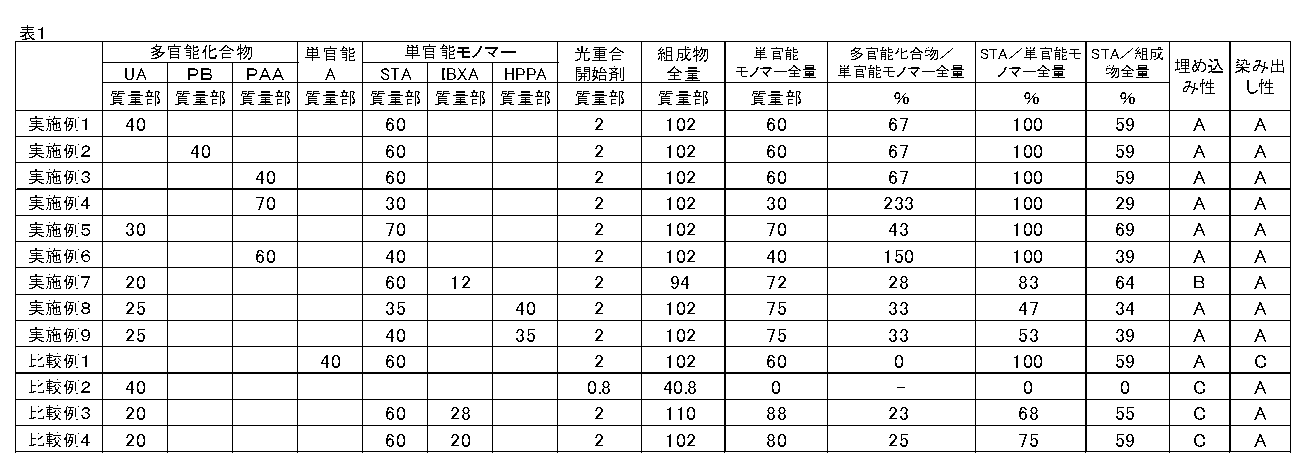
※表中の各化合物は、以下のとおりである。
(1)多官能化合物
UA:2官能ウレタンアクリレートオリゴマー(製品名「CN9018」、アルケマ社製)
PB:液状ブタジエン重合体(製品名「Ricon154」、クレイバレー社製)
PAA:2官能ポリアルキルアクリレート(製品名「RC100C」、株式会社カネカ製)
(2)単官能A
単官能アクリレート樹脂 (製品名「MM110C」、株式会社カネカ製)
(3)単官能モノマー
STA:ステアリルアクリレート
IBXA:イソボルニルアクリレート
HPPA:2-ヒドロキシ-3-フェノキシプロピルアクリレート
それに対して、比較例1では、中間層用組成物が結晶性モノマーを含有するものの、多官能化合物の代わりに、単官能アクリレート樹脂を使用したため、バンプに対する埋め込み性が十分であったが、中間層の染み出しを防止することができなかった。また、比較例2~4のように、単官能モノマーが配合されず、また、多官能化合物の含有量が少ない場合には、バンプに対する埋め込み性が不十分であった。
11 基材
12 中間層
13 粘着剤層
14 剥離材
Claims (9)
- 基材、中間層、及び粘着剤層をこの順に備える粘着シートであって、
前記中間層が、重合性官能基を少なくとも2つ有する多官能化合物と、直鎖の炭素数14~22の炭素鎖を有する結晶性モノマーを少なくとも含む単官能モノマーとを含有する中間層用組成物を硬化したものであり、
前記中間層用組成物において、前記多官能化合物が前記単官能モノマーに対して25質量%より多く含有される粘着シート。 - 前記単官能モノマーの40質量%以上が前記結晶性モノマーである請求項1に記載の粘着シート。
- 前記多官能化合物は、重量平均分子量が3000~60000の多官能オリゴマーである請求項1又は2に記載の粘着シート。
- 前記多官能化合物の重合性官能基が、エチレン性二重結合を有する基である請求項1~3のいずれか1項に記載の粘着シート。
- 前記多官能化合物が、ウレタン(メタ)アクリレートオリゴマー、アクリル系重合体、及びブタジエン系重合体からなる群から選択される少なくとも1種である請求項1~4のいずれか1項に記載の粘着シート。
- 前記結晶性モノマーが、前記中間層用組成物全量に対して、25~70質量%含有される請求項1~5のいずれか1項に記載の粘着シート。
- 前記中間層用組成物が、エネルギー線硬化型である請求項1~6のいずれか1項に記載の粘着シート。
- 前記中間層の厚みが、150~700μmである請求項1~7のいずれか1項に記載の粘着シート。
- 半導体ウエハ保護用テープである請求項1~8のいずれか1項に記載の粘着シート。
Priority Applications (3)
| Application Number | Priority Date | Filing Date | Title |
|---|---|---|---|
| KR1020177007114A KR102460037B1 (ko) | 2014-12-24 | 2015-12-17 | 점착 시트 |
| CN201580064807.4A CN107001872B (zh) | 2014-12-24 | 2015-12-17 | 粘合片 |
| JP2016566171A JP6717484B2 (ja) | 2014-12-24 | 2015-12-17 | 粘着シート |
Applications Claiming Priority (2)
| Application Number | Priority Date | Filing Date | Title |
|---|---|---|---|
| JP2014-260561 | 2014-12-24 | ||
| JP2014260561 | 2014-12-24 |
Publications (1)
| Publication Number | Publication Date |
|---|---|
| WO2016104322A1 true WO2016104322A1 (ja) | 2016-06-30 |
Family
ID=56150343
Family Applications (1)
| Application Number | Title | Priority Date | Filing Date |
|---|---|---|---|
| PCT/JP2015/085354 Ceased WO2016104322A1 (ja) | 2014-12-24 | 2015-12-17 | 粘着シート |
Country Status (5)
| Country | Link |
|---|---|
| JP (1) | JP6717484B2 (ja) |
| KR (1) | KR102460037B1 (ja) |
| CN (1) | CN107001872B (ja) |
| TW (1) | TWI697537B (ja) |
| WO (1) | WO2016104322A1 (ja) |
Families Citing this family (4)
| Publication number | Priority date | Publication date | Assignee | Title |
|---|---|---|---|---|
| JP7340323B2 (ja) * | 2017-12-27 | 2023-09-07 | 株式会社レゾナック・パッケージング | 蓄電デバイス用外装材及び蓄電デバイス |
| KR102786675B1 (ko) * | 2019-03-22 | 2025-03-27 | 린텍 가부시키가이샤 | 워크 가공용 점착 시트 및 그 제조 방법 |
| KR102944694B1 (ko) * | 2020-09-23 | 2026-03-31 | 주식회사 엘지화학 | 반도체 웨이퍼 표면 보호용 점착필름 |
| KR102857703B1 (ko) * | 2021-02-04 | 2025-09-12 | 주식회사 엘지화학 | 반도체 웨이퍼 표면 보호용 점착필름 |
Citations (4)
| Publication number | Priority date | Publication date | Assignee | Title |
|---|---|---|---|---|
| JP2001203255A (ja) * | 2000-01-21 | 2001-07-27 | Nitto Denko Corp | 半導体ウエハ保持保護用粘着シート |
| JP2005048039A (ja) * | 2003-07-28 | 2005-02-24 | Furukawa Electric Co Ltd:The | 半導体ウエハ面保護用粘着テープ |
| JP2006282794A (ja) * | 2005-03-31 | 2006-10-19 | Furukawa Electric Co Ltd:The | ウエハダイシング用粘着テープ |
| JP2013087131A (ja) * | 2011-10-13 | 2013-05-13 | Lintec Corp | 粘着シートおよびその使用方法 |
Family Cites Families (2)
| Publication number | Priority date | Publication date | Assignee | Title |
|---|---|---|---|---|
| CN1137028C (zh) * | 1998-11-20 | 2004-02-04 | 琳得科株式会社 | 压敏粘合片及其使用方法 |
| JP5100902B1 (ja) * | 2012-03-23 | 2012-12-19 | 古河電気工業株式会社 | 半導体ウエハ表面保護用粘着テープ |
-
2015
- 2015-12-17 CN CN201580064807.4A patent/CN107001872B/zh active Active
- 2015-12-17 JP JP2016566171A patent/JP6717484B2/ja active Active
- 2015-12-17 WO PCT/JP2015/085354 patent/WO2016104322A1/ja not_active Ceased
- 2015-12-17 KR KR1020177007114A patent/KR102460037B1/ko active Active
- 2015-12-22 TW TW104143166A patent/TWI697537B/zh active
Patent Citations (4)
| Publication number | Priority date | Publication date | Assignee | Title |
|---|---|---|---|---|
| JP2001203255A (ja) * | 2000-01-21 | 2001-07-27 | Nitto Denko Corp | 半導体ウエハ保持保護用粘着シート |
| JP2005048039A (ja) * | 2003-07-28 | 2005-02-24 | Furukawa Electric Co Ltd:The | 半導体ウエハ面保護用粘着テープ |
| JP2006282794A (ja) * | 2005-03-31 | 2006-10-19 | Furukawa Electric Co Ltd:The | ウエハダイシング用粘着テープ |
| JP2013087131A (ja) * | 2011-10-13 | 2013-05-13 | Lintec Corp | 粘着シートおよびその使用方法 |
Also Published As
| Publication number | Publication date |
|---|---|
| TWI697537B (zh) | 2020-07-01 |
| CN107001872A (zh) | 2017-08-01 |
| KR102460037B1 (ko) | 2022-10-27 |
| KR20170101183A (ko) | 2017-09-05 |
| CN107001872B (zh) | 2020-04-07 |
| JP6717484B2 (ja) | 2020-07-01 |
| JPWO2016104322A1 (ja) | 2017-10-05 |
| TW201629174A (zh) | 2016-08-16 |
Similar Documents
| Publication | Publication Date | Title |
|---|---|---|
| KR102357444B1 (ko) | 점착 시트 | |
| TWI778939B (zh) | 工件加工用黏著膠帶 | |
| JP6566365B2 (ja) | 半導体加工用粘着シート | |
| JP6235893B2 (ja) | バックグラインドシート | |
| JP5588575B1 (ja) | バックグラインドシート | |
| JPWO2017061132A1 (ja) | 半導体加工用シート | |
| KR101893937B1 (ko) | 기재(基材) 필름 및 그 기재 필름을 구비한 점착 시트 | |
| KR20180034699A (ko) | 기재(基材) 필름 및 그 기재 필름을 구비한 점착 시트 | |
| JP2016192488A (ja) | 半導体加工用粘着シート | |
| US10224230B2 (en) | Surface protective sheet | |
| JP6717484B2 (ja) | 粘着シート | |
| TW202003737A (zh) | 黏著膠帶及半導體裝置的製造方法 | |
| JP5904809B2 (ja) | シートおよび該シートを用いた粘着シート | |
| JP5898445B2 (ja) | 基材フィルムおよび該基材フィルムを備えた粘着シート | |
| JP2024143342A (ja) | ワーク加工用保護シートおよびワーク個片化物の製造方法 |
Legal Events
| Date | Code | Title | Description |
|---|---|---|---|
| 121 | Ep: the epo has been informed by wipo that ep was designated in this application |
Ref document number: 15872891 Country of ref document: EP Kind code of ref document: A1 |
|
| ENP | Entry into the national phase |
Ref document number: 2016566171 Country of ref document: JP Kind code of ref document: A |
|
| ENP | Entry into the national phase |
Ref document number: 20177007114 Country of ref document: KR Kind code of ref document: A |
|
| NENP | Non-entry into the national phase |
Ref country code: DE |
|
| 122 | Ep: pct application non-entry in european phase |
Ref document number: 15872891 Country of ref document: EP Kind code of ref document: A1 |