WO2016021149A1 - 高発現プロモーター - Google Patents
高発現プロモーター Download PDFInfo
- Publication number
- WO2016021149A1 WO2016021149A1 PCT/JP2015/003793 JP2015003793W WO2016021149A1 WO 2016021149 A1 WO2016021149 A1 WO 2016021149A1 JP 2015003793 W JP2015003793 W JP 2015003793W WO 2016021149 A1 WO2016021149 A1 WO 2016021149A1
- Authority
- WO
- WIPO (PCT)
- Prior art keywords
- sequence
- promoter
- yeast
- ycluc
- seq
- Prior art date
- Legal status (The legal status is an assumption and is not a legal conclusion. Google has not performed a legal analysis and makes no representation as to the accuracy of the status listed.)
- Ceased
Links
Images


Classifications
-
- C—CHEMISTRY; METALLURGY
- C12—BIOCHEMISTRY; BEER; SPIRITS; WINE; VINEGAR; MICROBIOLOGY; ENZYMOLOGY; MUTATION OR GENETIC ENGINEERING
- C12N—MICROORGANISMS OR ENZYMES; COMPOSITIONS THEREOF; PROPAGATING, PRESERVING, OR MAINTAINING MICROORGANISMS; MUTATION OR GENETIC ENGINEERING; CULTURE MEDIA
- C12N15/00—Mutation or genetic engineering; DNA or RNA concerning genetic engineering, vectors, e.g. plasmids, or their isolation, preparation or purification; Use of hosts therefor
- C12N15/09—Recombinant DNA-technology
-
- C—CHEMISTRY; METALLURGY
- C12—BIOCHEMISTRY; BEER; SPIRITS; WINE; VINEGAR; MICROBIOLOGY; ENZYMOLOGY; MUTATION OR GENETIC ENGINEERING
- C12P—FERMENTATION OR ENZYME-USING PROCESSES TO SYNTHESISE A DESIRED CHEMICAL COMPOUND OR COMPOSITION OR TO SEPARATE OPTICAL ISOMERS FROM A RACEMIC MIXTURE
- C12P21/00—Preparation of peptides or proteins
- C12P21/02—Preparation of peptides or proteins having a known sequence of two or more amino acids, e.g. glutathione
Definitions
- the present invention relates to a promoter for high expression of a target gene in yeast, and more particularly, a promoter for high expression of a target gene in yeast, comprising a promoter sequence of yeast TDH3 or GAL10 gene, yeast
- yeast The present invention relates to a promoter which is sequentially provided with an intron sequence of a somal protein gene.
- Yeast is used as a production host for enzymes and pharmaceutical proteins, and the use of a high expression promoter is indispensable to increase the productivity of these proteins.
- various high expression promoters have been used to highly express proteins in yeast. Examples of such a promoter include a constant high expression TDH3 gene promoter (hereinafter also referred to as “TDH3 promoter”), a PGK1 gene promoter, an ADH1 gene promoter, an inducible high expression GAL1 gene promoter, and a GAL10 gene promoter ( (Hereinafter also referred to as “GAL10 promoter”), CUP1 gene promoter, PHO5 gene promoter, etc. Among them, those that can be expected to have a strong expression level are TDH3 gene promoter, PGK gene promoter, etc. Glycogen promoters are preferred.
- a promoter that is located upstream of the PIR1 gene in the chromosome of Kluyveromyces marxianus and controls the expression of the PIR1 gene is provided.
- a method of using (see Patent Document 1), or a method of using a DNA fragment comprising a non-translated region 5 ′ upstream of the 5 ′ upstream 150 base pairs of the start codon of the TDH3 gene and a foreign heterologous gene (patent) 2), a gene expression method characterized by introducing a target gene into the genome under the control of a yeast pyruvate decarboxylase gene (PDC) promoter (see Patent Document 3), an artificial intron-like A method (see Non-Patent Document 1) for highly expressing the sequence has been proposed.
- PDC yeast pyruvate decarboxylase gene
- JP 2013-179899 A Japanese Patent Laid-Open No. 08-168380 JP 2003-164295 A
- An object of the present invention is to provide a promoter with higher expression than the TDH3 promoter and the GAL10 promoter.
- the present inventors came to pay attention to the fact that introns have an effect of enhancing expression ability from genome-wide analysis using yeast gene disruption strains.
- an intron was present upstream of the start codon, it was considered that overexpression was possible without manipulating the structural gene. Therefore, a promoter sequence containing an intron upstream from the start codon or near the start codon region was searched from the genome.
- the promoter sequence of a ribosomal protein gene which is a gene encoding several ribosomal proteins (hereinafter also referred to as “RPS”), has high activity.
- the expression ability was further increased by replacing the enhancer regions of these promoter sequences with the enhancer regions of the general high expression promoter TDH3 promoter and the inducible high expression promoter GAL10 promoter. Therefore, when the TDH3 promoter sequence was placed at various positions upstream of the intron sequence of the promoter of the ribosomal protein gene using the secreted luciferase gene as a reporter gene, the expression was examined. The TDH3 promoter sequence was immediately upstream of the intron sequence. It was revealed that the luciferase activity was the highest when the was placed.
- a galactose-inducible high-expression promoter GAL10 promoter sequence is located upstream of the intron sequence of a ribosomal protein gene promoter and has a high galactose-inducible luciferase activity.
- a promoter for highly expressing a target gene in yeast comprising a yeast TDH3 or GAL10 promoter sequence and an intron sequence of a yeast ribosomal protein gene in sequence, and the yeast ribosomal A promoter, wherein the intron sequence of the protein gene is any one of the following sequences (a) to (c): (A) the nucleotide sequences shown in SEQ ID NOs: 1 to 4; (B) a sequence in which one or several bases are deleted, substituted, added or inserted in the base sequences shown in SEQ ID NOs: 1 to 4; (C) a sequence having 90% or more identity with the base sequence shown in SEQ ID NOs: 1 to 4; (2) The promoter according to (1) above, wherein the yeast is Saccharomyces cerevisiae. (3) A recombinant vector comprising the promoter according to (1) or (2) above. (4) A yeast transformant into which the recombinant vector according to (3) is introduced.
- the promoter of the present invention has a high expression ability of 15 times or more of the TDH3 promoter and 10 times or more of the GAL10 promoter. Use of such a promoter makes it possible to efficiently produce useful substances such as enzymes and pharmaceutical proteins in yeast.
- FIG. 3 shows the results of culturing TDH3 promoter sequence-RPS intron sequence-yCLuc strain and examining the relative expression level of luciferase (RLU / ( ⁇ l ⁇ OD)) in the culture medium.
- GAL10 promoter sequence-RPS25A intron sequence-yCLuc strain and TDH3 promoter sequence-RPS25A intron sequence-yCLuc strain were cultured, and the relative expression level (RLU / ( ⁇ l ⁇ OD)) of luciferase in the culture was examined.
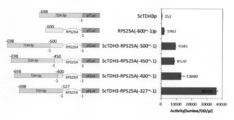
- FIG. 7 is a diagram showing the results of culturing TDH3 promoter sequence-RPS25A promoter sequence having different lengths-yCLuc strains and examining the relative expression level (RLU / ( ⁇ l ⁇ OD)) of luciferase in the culture medium.
- the promoter of the present invention is a promoter for high expression of a target gene in yeast, comprising a yeast TDH3 or GAL10 gene promoter sequence and a yeast ribosomal protein gene intron sequence in sequence.
- the promoter is not particularly limited as long as the intron sequence of the yeast ribosomal protein gene is any one of the following sequences (a) to (c): Is a base sequence of a region that can control the expression of a gene located downstream by binding to RNA polymerase, and includes an enhancer region.
- the sequence of the promoter of the present invention is not a natural product because it is a combination of the promoter sequence of the yeast TDH3 or GAL10 gene and the intron sequence of the yeast ribosomal protein gene as described above. .
- A the nucleotide sequences shown in SEQ ID NOs: 1 to 4;
- B a sequence in which one or several bases are deleted, substituted, added or inserted in the base sequences shown in SEQ ID NOs: 1 to 4;
- C a sequence having 90% or more identity with the base sequence shown in SEQ ID NOs: 1 to 4;
- the base sequence shown in SEQ ID NO: 1 is the intron sequence of ribosomal protein gene 24A (RPS24A), the base sequence shown in SEQ ID NO: 2 is the intron sequence of ribosomal protein gene 25A (RPS25A), and SEQ ID NO: 3.
- the base sequence shown is the intron sequence of ribosomal protein gene 26A (RPS26A), and the base sequence shown in SEQ ID NO: 4 is the intron sequence of ribosomal protein gene 26B (RPS26B).
- sequence in which one or several bases are deleted, substituted, added or inserted in the above (b) is 1 to 10, preferably 1 to 5, more preferably 1 to 3, more preferably 1 Examples include sequences in which ⁇ 2, most preferably 1 base has been deleted, substituted, added or inserted.
- sequence having 90% or more identity with the nucleotide sequence shown in SEQ ID NOs: 1 to 4 in (c) is preferably 93% or more, more preferably 95% or more, and still more preferably 98% or more.
- the yeast is not particularly limited, and examples include yeasts belonging to the genus Saccharomyces, Candida, Kluyveromyces, Pichia, and Schizosaccharomyces. Yeast belonging to the genus Saccharomyces can be preferably mentioned, and Saccharomyces cerevisiae can be more preferably mentioned.
- the target gene may be a full-length gene or a part of it depending on the application.
- the origin may be a gene isolated from any organism or an artificial gene produced by genetic engineering.
- high expression of a target gene means, for example, 15 times or more, preferably 35 times or more, more preferably 35 times or more of a target gene arranged downstream of the promoter sequence as compared with the case where a TDH3 promoter sequence is used.
- the target gene is expressed by transforming a transformant obtained by introducing a recombinant polynucleotide operably linked with a secreted luciferase (CLuc) gene downstream of a promoter sequence into Saccharomyces cerevisiae.
- CLuc secreted luciferase
- a medium 1% yeast extract, 2% peptone, 2% glucose
- the yeast TDH3 or GAL10 promoter sequence in the present invention is not limited to the full-length sequence, but is 1 to 10, more preferably 1 to 5, more preferably 1 to 3, and most preferably the full-length sequence. Is a sequence in which 1 to 2, especially 1 base is deleted, substituted, added or inserted, or 90% or more, preferably 93% or more, more preferably 95% or more, more preferably 98% of the full-length sequence. Sequences with% identity or greater are also included.
- the yeast TDH3 promoter sequence or GAL10 promoter sequence can be amplified by PCR using a yeast chromosome or a commercially available vector containing the yeast TDH3 promoter sequence or GAL10 sequence as a template, or these chromosomes and vectors can be used as restriction enzymes. It can be obtained by processing.
- the yeast TDH3 or GAL10 gene promoter sequence and the yeast ribosomal protein gene intron sequence are sequentially provided as follows: the yeast TDH3 or GAL10 promoter sequence downstream of the yeast ribosomal protein gene intron There is no particular limitation as long as a sequence (hereinafter also simply referred to as “RPS intron sequence”) is operably incorporated, and an arbitrary base sequence is inserted between the yeast TDH3 or GAL10 promoter sequence and the yeast RPS intron sequence.
- the length of such an arbitrary base sequence may be 200 base pairs or less, preferably 100 base pairs or less, more preferably 50 base pairs or less, and 0 base pairs, that is, arbitrary The yeast TDH3 or GAL10 promoter sequence, It is most preferred that the the RPS intron sequences are connected directly.
- the vector used for the recombinant vector of the present invention is not particularly limited as long as it contains the promoter of the present invention and can express the target gene operably incorporated downstream of the promoter, and may be linear or cyclic. Those that are capable of autonomous replication or those that can be integrated into a chromosome are preferred, and those that contain a regulatory sequence such as a terminator or a selection marker may be used.
- the yeast transformant into which the recombinant vector of the present invention has been introduced is a yeast transformant into which the recombinant vector of the present invention has been introduced, and the yeast is preferably a yeast of the genus Saccharomyces, S. cerevisiae is more preferred.
- the method for introducing the recombinant vector of the present invention into yeast is not particularly limited, and is a chemical method such as lithium acetate method, lipofection method, calcium phosphate coprecipitation method, liposome method, DEAE dextran method; A known method such as a method using a specific receptor, a biological method such as a cell fusion method, a physical method such as an electroporation method, a microinjection method, a gene gun method, or an ultrasonic gene transfer method. It can be illustrated.
- the target gene product can be efficiently produced by culturing yeast transformants containing the recombinant vector of the present invention.
- a culture method it can be carried out according to a usual method used for culturing yeast.
- the yeast introduced with the recombinant vector of the present invention is Saccharomyces cerevisiae
- it can be cultured under aerobic conditions such as about 30 ° C., about pH 6, and shaking culture or aeration-agitation culture.
- the target gene product can be recovered from the culture broth or crushed yeast.
- Such a recovery method includes a known protein recovery method such as centrifugation, followed by gel filtration, ion exchange, affinity chromatography, etc. A method of collecting can be mentioned.
- RPS intron sequence-yCLuc strain construction (Construction of RPS24Ap (-730 ⁇ + 469) -yCLuc strain) URA3-5 ′ by PCR using URA3-290 (SEQ ID NO: 5) and URA-290c (SEQ ID NO: 6) as primers from the chromosomal DNA of RAK4333 strain (Fukunaga T et al. Yeast 30: 243-253 (2013)) -TDH3p-yCLuc-URA3 was amplified and introduced into ⁇ snt309 strain (Giaever G et al., Nature 418: 387-391 (2002)) to obtain RAK6164 strain.
- yCLuc-URA3 was amplified using chromosomal DNA of RAK6164 as a template and yCLuc + 1 (SEQ ID NO: 9) and URA3-310c (SEQ ID NO: 10) as primers.
- ScURA3-5'40-RPS24Ap-yCLuc + 30 and yCLuc-URA3 using these DNA fragments as templates, ScURA3-5'40-ScRPS24A-730 (SEQ ID NO: 7) PCR was performed using URA3-310c (SEQ ID NO: 10) as a primer to amplify ScURA3-5′40-RPS24Ap-yCLuc-URA3. This was introduced into the S.uracerevisiae ⁇ BY4743 strain (Brachmann CB et al., Yeast 14: 115-132 (1998)) at the position of ura3 ⁇ 0 by the following method.
- YPD liquid medium 1% yeast extract, 2% peptone, 2% glucose
- 9 ml of YPD liquid medium was placed in a 15 ml tube, and 1 ml of the culture solution cultured overnight was added thereto, followed by stationary culture at 28 ° C. for 5 hours.
- the mixture was centrifuged at 8,000 rpm at room temperature for 1 minute, the supernatant was discarded, 5 ml of sterilized water was added, the mixture was centrifuged again under the same conditions, the supernatant was discarded, and the cells were suspended in the remaining solution.
- SD-Ura agar medium 0.17% Yeast Nitrogen Base, 0.5% ammonium sulfate, 2% glucose, 0.0024% adenine sulfate , 0.01% L-Histidine HCl, 0.02% L-Leucine, 0.01% L-Lysine HCl, 0.01% L-Methionene, 0.01% L-Tryptphan, 2% agar powder
- the culture was allowed to stand at 28 ° C. for 3 days to obtain transformant colonies.
- ScURA3-5'40-RPS25Ap-yCLuc + 30 and yCLuc-URA3 using these DNA fragments as templates, ScURA3-5'40-ScRPS25A-1598 (SEQ ID NO: 11) and PCR was performed using URA3-310c (SEQ ID NO: 10) as a primer to amplify ScURA3-5'40-RPS25Ap-yCLuc-URA3.
- This DNA fragment was introduced into S. cerevisiae BY4743 by the method described above.
- a transformant (RAK8424) obtained by introducing ScURA3-5′40-RPS25Ap-yCLuc-URA3 into S. cerevisiae BY4743 strain has the genotype ura3 ⁇ 0 :: RPS25Ap-yCLuc-URA3.
- yCLuc-URA3 was amplified using chromosomal DNA of RAK6164 as a template and yCLuc + 1 (SEQ ID NO: 9) and URA3-310c (SEQ ID NO: 10) as primers.
- yCLuc + 1 SEQ ID NO: 9
- URA3-310c SEQ ID NO: 10
- PCR was performed using URA3-310c (SEQ ID NO: 10) as a primer to amplify ScURA3-5'40-RPS26Ap-yCLuc-URA3. This was introduced into S. cerevisiae BY4743 strain by the method described above.
- a transformant (RAK8426) obtained by introducing ScURA3-5′40-RPS26Ap-yCLuc-URA3 into S. cerevisiae BY4743 strain has a genotype of ura3 ⁇ 0 :: RPS26Ap-yCLuc-URA3.
- yCLuc-URA3 was amplified using chromosomal DNA of RAK6164 as a template and yCLuc + 1 (SEQ ID NO: 9) and URA3-310c (SEQ ID NO: 10) as primers.
- ScURA3-5'40-RPS26Bp-yCLuc + 30 and yCLuc-URA3 using these DNA fragments as templates, ScURA3-5'40-ScRPS26B-1505 (SEQ ID NO: 15) PCR was performed using URA3-310c (SEQ ID NO: 10) as a primer to amplify ScURA3-5'40-RPS26Bp-yCLuc-URA3. This was introduced into S. cerevisiae BY4743 strain by the method described above.
- a transformant (RAK8428) obtained by introducing ScURA3-5′40-RPS26Bp-yCLuc-URA3 into S. cerevisiae BY4743 strain has a genotype of ura3 ⁇ 0 :: RPS26Bp-yCLuc-URA3.
- PCR was performed with the combinations of primers shown in Table 1 below, and a 40-base upstream sequence of TDH3 coding sequence known as a high-expression promoter (part of TDH3 promoter sequence), an RPS intron sequence, The DNA fragment of yCLuc-URA3, which has, in order, was amplified.
- Each of the amplified DNA fragments was introduced into the RAK5125 strain (MATa ade2 ⁇ 0A ⁇ his3 ⁇ 1 leu2 ⁇ 0 met15 ⁇ 0 ura3 ⁇ 0 :: ScTDH3p-yGLuc-LEU2) by the above method to obtain transformants.
- Each of the obtained transformants has the following genotype.
- ura3 ⁇ 0 :: TDH3p-RPS24A (+ 1_ + 469) -yCLuc-URA3 ura3 ⁇ 0 :: TDH3p-RPS25A (-327_-1) -yCLuc-URA3 ura3 ⁇ 0 :: TDH3p-RPS26A (-378_-1) -yCLuc-URA3 ura3 ⁇ 0 :: TDH3p-RPS26B (-361_-1) -yCLuc-URA3
- TDH3p in these genotypes is a sequence of 698 bases upstream of the TDH3 coding sequence.
- RPS24A (+ 1_ + 469), RPS25A (-327_-1), RPS26A (-378_-1) and RPS26B (-361_-1) are intron sequences of the respective PRS genes.
- a transformant in which the TDH3p-yCLuc-URA3 gene was introduced into the RAK5125 strain was also prepared.
- Such a transformant has a genotype of ura3 ⁇ 0 :: TDH3p-yCLuc-URA3.
- results are shown in FIG. As shown in FIG. 1, compared with the case where only the TDH3 promoter sequence is used, when the TDH3 promoter sequence and the intron sequence of PRS24A are used, 40 times, when the TDH3 promoter sequence and the intron sequence of PRS25A are used. Was found to be 49 times higher, 39 times higher when using the TDH3 promoter sequence and PRS26A intron sequence, and 17 times higher when using the TDH3 promoter sequence and PRS26B intron sequence.
- GAL10 promoter sequence-RPS intron sequence-construction of yCLuc strain (GAL10 promoter sequence-intron sequence of RPS25A-construction of yCLuc strain)
- the mechanism of inducible expression is indispensable for the production of proteins that adversely affect cells.
- the inducible promoter with the highest expression ability is the GAL10 promoter. Therefore, an inducible promoter having higher expression ability than the GAL10 promoter was attempted by connecting an intron sequence of PRS downstream of the GAL10 promoter sequence.
- a promoter in which 511 bp upstream of the GAL10 coding sequence was used as a galactose promoter and an intron sequence (-327 to -1) of RPS25A was connected downstream thereof was constructed on the Saccharomyces cerevisiae chromosome. The construction method is shown below.
- the obtained fusion DNA fragment TDH3p40-yCLuc-LEU2-URA3-3 ' was introduced into the RAK4314 strain and selected on SD-Leu agar medium to obtain a transformant.
- This transformant (RAK4920) has a genotype of ura3 ⁇ 0 :: TDH3p-yCLuc-LEU2.
- PCR was performed using the yeast RAK4920 chromosome having the genotype of ura3 ⁇ 0 :: TDH3p-yCLuc-LEU2 as a template, yCLuc + 21 (SEQ ID NO: 27) and URA3-280c (SEQ ID NO: 21) as primers, and most of yCLuc was upstream.
- the LEU2 marker possessed by was amplified.
- the URA3 marker of RAK10635 was replaced with this LEU2 marker to construct ura3 ⁇ 0 :: ScRPS25A-600-yCLuc-LEU2 (RAK12003).
- Chromosomes were prepared from this yeast strain, and using this as a template, PCR was performed using ScGAL10p-40 (40) -RPS25A-327 (SEQ ID NO: 28) and URA3-280c (SEQ ID NO: 21) as primers, and GAL10p-40 (40) -RPS25A (-327_-1) -yCLuc-LEU2-URA3-3 ′ was amplified.
- This DNA fragment was introduced into the RAK4315 strain (ura3 ⁇ 0 :: GAL10p-URA3) by the above method, and SD-Leu agar medium (0.17% Yeast Nitrogen Base, 0.5% ammonium sulfate, 2% glucose, 0.003% adenine) sulfate, 0.01% Uracil, 0.01% L-Histidine HCl, 0.01% L-Lysine HCl, 0.01% L-Methionene, 0.01% L-Tryptphan, 2% agar powder) Strains were selected to obtain transformants. The obtained transformant has the genotype of ura3 ⁇ 0 :: GAL10p-RPS25A (-327_-1) -yCLuc-LEU2.
- a strain in which GAL10p-yCLuc-LEU2 was inserted into URA3 ⁇ 0 was constructed as follows. PCR using GAL10p40-yCLuc + 1 (SEQ ID NO: 29) and URA3-280c (SEQ ID NO: 21) as primers using the chromosome of RAK12003 as a template, and ScGAL10-40 (40) -yCLuc-LEU2-URA3-3 ' Amplified. This was introduced into RAK4315 (ura3 ⁇ 0 :: GAL10p-URA3), and a transformant was obtained using SD-Leu agar medium. The obtained transformant has a genotype of ura3 ⁇ 0 :: GAL10p-yCLuc-LEU2.
- ScRPS25A (-500 to -1) -yCLuc-URA3, ScTDH3p (40) -ScRPS25A (-450 to -1) -yCLuc-URA3, ScTDH3p (40) -ScRPS25A (-400 to -1) -yCLuc-URA3 DNA
- the fragment was amplified.
- Each DNA fragment was introduced into RAK5125 by the method described above, and ura3 ⁇ 0 :: ScTDH3p-ScRPS25A (-500 to -1) -yCLuc-URA3, ura3 ⁇ 0 :: ScTDH3p-ScRPS25A (-450 to -1) -yCLuc, respectively.
- a transformant having a genotype of -URA3, ura3 ⁇ 0 :: ScTDH3p-ScRPS25A (-400 to -1) -yCLuc-URA3 was obtained.
- the obtained transformant was composed of an RPS25A promoter sequence (RPS25A -500 to -328 (SEQ ID NO: 33) and an intron sequence of RPS25A -327 to -1 (sequence) including introns and different lengths downstream of the TDH3 promoter. No. 2), from -450 to -328 (SEQ ID NO: 34) of RPS25A and -327 to -1 (SEQ ID NO: 2) of RPS25A, or from -400 to -328 (SEQ ID NO: 35) of RPS25A and -327 of RPS25A. -1 (SEQ ID NO: 2)).
- the promoter of the present invention Since the promoter of the present invention has a high expression ability, it can be used in the field of protein production such as enzymes, vaccines and antibodies. It can also be applied to the field of ethanol production from xylose and cellulose. Furthermore, since the yeast's own sequence is used and self-cloning, it is highly safe and can be used in the food field.
Landscapes
- Health & Medical Sciences (AREA)
- Life Sciences & Earth Sciences (AREA)
- Engineering & Computer Science (AREA)
- Genetics & Genomics (AREA)
- Wood Science & Technology (AREA)
- Biomedical Technology (AREA)
- Organic Chemistry (AREA)
- Biotechnology (AREA)
- General Engineering & Computer Science (AREA)
- Chemical & Material Sciences (AREA)
- Zoology (AREA)
- Bioinformatics & Cheminformatics (AREA)
- Biophysics (AREA)
- Microbiology (AREA)
- Plant Pathology (AREA)
- Molecular Biology (AREA)
- Biochemistry (AREA)
- General Health & Medical Sciences (AREA)
- Physics & Mathematics (AREA)
- Micro-Organisms Or Cultivation Processes Thereof (AREA)
- Preparation Of Compounds By Using Micro-Organisms (AREA)
Abstract
TDH3プロモーターやGAL10プロモーターよりも高発現のプロモーターを提供することを課題とする。 酵母において目的遺伝子を高発現させるためのプロモーターであって、酵母のTDH3又はGAL10プロモーター配列と、酵母のリボソーマルタンパク質遺伝子のイントロン配列とを順次備えており、前記酵母のリボソーマルタンパク質遺伝子のイントロン配列が、(a)配列番号1~4に示す塩基配列;(b)配列番号1~4に示す塩基配列において、1又は数個の塩基が欠失、置換、付加若しくは挿入された配列;(c)配列番号1~4に示す塩基配列と90%以上の同一性を有する配列;の(a)~(c)のいずれかの配列であるプロモーターを作製する。
Description
本発明は、酵母において目的遺伝子を高発現させるためのプロモーターに関し、より詳しくは、酵母において目的遺伝子を高発現させるためのプロモーターであって、酵母のTDH3又はGAL10遺伝子のプロモーター配列と、酵母のリボソーマルタンパク質遺伝子のイントロン配列とを順次備えたプロモーターに関する。
酵母は酵素や医薬品用タンパク質の生産宿主として利用されており、これらタンパク質の生産性を高めるには高発現プロモーターの利用は不可欠である。これまでに酵母においてタンパク質を高発現させるために、様々な高発現プロモーターが利用されている。かかるプロモーターとしては、恒常的高発現のTDH3遺伝子のプロモーター(以下、「TDH3プロモーター」ともいう)、PGK1遺伝子のプロモーター、ADH1遺伝子のプロモーター、誘導的高発現のGAL1遺伝子のプロモーター、GAL10遺伝子のプロモーター(以下、「GAL10プロモーター」ともいう)、CUP1遺伝子のプロモーター、PHO5遺伝子のプロモーターなどがあり、中でも恒常的に発現量の強さが期待できるものとして、TDH3遺伝子のプロモーターやPGK遺伝子のプロモーターなど、解糖系遺伝子のプロモーターが好んで利用されている。
また、さらなるタンパク質の生産性向上を求めて、例えば、クルイベロマイセス・マルキシアヌス(Kluyveromyces marxianus)の染色体におけるPIR1遺伝子の上流に位置し、当該PIR1遺伝子の発現を制御している領域からなるプロモーターを利用する方法(特許文献1参照)や、TDH3遺伝子の開始コドンの5’側上流150塩基対よりさらに5’側上流の非翻訳領域と外来の異種遺伝子とから成るDNA断片を利用する方法(特許文献2参照)や、酵母のピルビン酸デカルボキシラーゼ遺伝子(PDC)のプロモーターの制御下に目的遺伝子をゲノムに導入することを特徴とする遺伝子発現方法(特許文献3参照)や、人工的なイントロン様配列によって高発現させる方法(非特許文献1参照)が提案されている。
しかしながら、上記プロモーターを用いても、絶対的な発現量は古くから用いられているTDH3プロモーターやGAL10プロモーターなどからほとんど改善されていないのが現状であり、より高い発現能力を有するプロモーターの開発が求められていた。
L. Li et al., Letters in Applied Microbiology 40:347-352 (2005)
本発明の課題は、TDH3プロモーターやGAL10プロモーターよりも高発現のプロモーターを提供することにある。
本発明者らは、酵母遺伝子破壊株を用いたゲノムワイド解析から、イントロンに発現能力を高める作用があることに着目するに至った。また、開始コドン上流にイントロンがあれば、構造遺伝子を操作することなく過剰発現可能であると考えた。そこで、開始コドンより上流、又は開始コドン領域近くにイントロンを含むプロモーター配列をゲノム上から探した。その結果、いくつかのリボソーマルタンパク質(以下、「RPS」ともいう)をコードする遺伝子であるリボソーマルタンパク質遺伝子のプロモーター配列が高い活性を持つことを明らかにした。
さらに、これらのプロモーター配列のエンハンサー領域を、一般的高発現プロモーターであるTDH3プロモーター及び誘導型高発現プロモーターであるGAL10プロモーターのエンハンサー領域に置換することでより発現能力が高まると考えた。そこで、分泌性ルシフェラーゼ遺伝子をレポーター遺伝子として、リボソーマルタンパク質遺伝子のプロモーターのイントロン配列の上流の様々な位置にTDH3プロモーター配列を配置して発現を調べたところ、イントロン配列のすぐ上流にTDH3プロモーター配列を配置した時に最もルシフェラーゼ活性が高いことが明らかとなった。さらにガラクトース誘導性の高発現プロモーターであるGAL10プロモーター配列をリボソーマルタンパク質遺伝子プロモーターのイントロン配列の上流に配置したプロモーターではガラクトース誘導的にルシフェラーゼ活性が高いことを見いだし、本発明を完成した。
すなわち、本発明は以下に開示されるとおりのものである。
(1)酵母において目的遺伝子を高発現させるためのプロモーターであって、酵母のTDH3又はGAL10プロモーター配列と、酵母のリボソーマルタンパク質遺伝子のイントロン配列とを順次備えており、前記酵母のリボソーマルタンパク質遺伝子のイントロン配列が、以下に示す(a)~(c)のいずれかの配列であることを特徴とするプロモーター。
(a)配列番号1~4に示す塩基配列;
(b)配列番号1~4に示す塩基配列において、1又は数個の塩基が欠失、置換、付加、若しくは挿入された配列;
(c)配列番号1~4に示す塩基配列と90%以上の同一性を有する配列;
(2)酵母が、サッカロマイセス・セレビシエであることを特徴とする上記(1)記載のプロモーター。
(3)上記(1)又は(2)記載のプロモーターを含む組換えベクター。
(4)上記(3)記載の組換えベクターが導入された酵母の形質転換体。
(1)酵母において目的遺伝子を高発現させるためのプロモーターであって、酵母のTDH3又はGAL10プロモーター配列と、酵母のリボソーマルタンパク質遺伝子のイントロン配列とを順次備えており、前記酵母のリボソーマルタンパク質遺伝子のイントロン配列が、以下に示す(a)~(c)のいずれかの配列であることを特徴とするプロモーター。
(a)配列番号1~4に示す塩基配列;
(b)配列番号1~4に示す塩基配列において、1又は数個の塩基が欠失、置換、付加、若しくは挿入された配列;
(c)配列番号1~4に示す塩基配列と90%以上の同一性を有する配列;
(2)酵母が、サッカロマイセス・セレビシエであることを特徴とする上記(1)記載のプロモーター。
(3)上記(1)又は(2)記載のプロモーターを含む組換えベクター。
(4)上記(3)記載の組換えベクターが導入された酵母の形質転換体。
本発明のプロモーターは、TDH3プロモーターの15倍以上、GAL10プロモーターの10倍以上もの高発現能力を有する。かかるプロモーターを用いることで、酵母における酵素や医薬品用タンパク質などの有用物質を効率よく生産することが可能となる。
本発明のプロモーターとしては、酵母において目的遺伝子を高発現させるためのプロモーターであって、酵母のTDH3又はGAL10遺伝子のプロモーター配列と、酵母のリボソーマルタンパク質遺伝子のイントロン配列とを順次備えており、前記酵母のリボソーマルタンパク質遺伝子のイントロン配列が以下に示す(a)~(c)のいずれかの配列であることを特徴とするプロモーターであれば特に制限されず、プロモーターとは、目的遺伝子配列の上流に配置され、RNAポリメラーゼが結合することにより、下流に配置された遺伝子の発現を制御することができる領域の塩基配列を意味し、エンハンサー領域も含まれる。なお、本発明のプロモーターが備える配列は、上述のように酵母のTDH3又はGAL10遺伝子のプロモーター配列と、酵母のリボソーマルタンパク質遺伝子のイントロン配列とを組み合わせた配列であることから、自然産物ではない。
(a)配列番号1~4に示す塩基配列;
(b)配列番号1~4に示す塩基配列において、1又は数個の塩基が欠失、置換、付加若しくは挿入された配列;
(c)配列番号1~4に示す塩基配列と90%以上の同一性を有する配列;
(a)配列番号1~4に示す塩基配列;
(b)配列番号1~4に示す塩基配列において、1又は数個の塩基が欠失、置換、付加若しくは挿入された配列;
(c)配列番号1~4に示す塩基配列と90%以上の同一性を有する配列;
なお、配列番号1に示す塩基配列は、リボソーマルタンパク質遺伝子24A(RPS24A)のイントロン配列、配列番号2に示す塩基配列は、リボソーマルタンパク質遺伝子25A(RPS25A)のイントロン配列、配列番号3に示す塩基配列は、リボソーマルタンパク質遺伝子26A(RPS26A)のイントロン配列、配列番号4に示す塩基配列は、リボソーマルタンパク質遺伝子26B(RPS26B)のイントロン配列である。
上記(b)における1又は数個の塩基が欠失、置換、付加若しくは挿入された配列としては、1~10個、好ましくは1~5個、より好ましくは1~3個、さらに好ましくは1~2個、最も好ましくは1個の塩基が欠失、置換、付加若しくは挿入された配列を挙げることができる。
上記(c)における配列番号1~4に示す塩基配列と90%以上の同一性を有する配列としては、好ましくは93%以上、より好ましくは95%以上、さらに好ましくは98%以上の同一性を有する配列を挙げることができる。
酵母としては特に制限されず、サッカロマイセス属(Saccharomyces)、キャンディダ属(Candida)、クルイベロマイセス属(Kluyveromyces)ピキア属(Pichia)、及びシゾサッカロマイセス属(Schizosaccharomyces)に属する酵母を挙げることができ、サッカロマイセス属に属する酵母を好適に挙げることができ、サッカロマイセス・セレビシエをより好適に挙げることができる。
上記目的遺伝子としては、用途に合わせて全長の遺伝子でも、その一部でもよい。また、その由来はいかなる生物から単離された遺伝子でも、遺伝子工学的に作製された人工的な遺伝子でもよい。
本発明において、目的遺伝子を高発現させるとは、例えば、TDH3プロモーター配列を用いた場合と比較して、プロモーター配列の下流に配置した目的遺伝子を15倍以上、好ましくは35倍以上、より好ましくは40倍以上発現させることや、GAL10プロモーター配列を用いた場合と比較して、プロモーター配列の下流に配置した目的遺伝子を8倍以上、好ましくは10倍以上発現させることを挙げることができる。
目的遺伝子の発現は、たとえば、プロモーター配列の下流に、分泌型のルシフェラーゼ(CLuc)遺伝子を作動可能に連結した組換えポリヌクレオチドをサッカロマイセス・セレビシエに導入して得られた形質転換体を、YPD液体培地(1%酵母エキス、2%ペプトン、2%グルコース)にて28℃、150rpmで24時間培養したときの培養液中のルシフェラーゼの相対発現量(RLU/(μl・OD))を測定することによって求めることができる。
本発明における酵母のTDH3又はGAL10プロモーター配列としては、その全長の配列だけでなく、全長の配列に対して1~10個、より好ましくは1~5個、さらに好ましくは1~3個、最も好ましくは1~2個、中でも1個の塩基が欠失、置換、付加若しくは挿入された配列や、全長の配列と90%以上、好ましくは93%以上、より好ましくは95%以上、さらに好ましくは98%以上の同一性を有する配列も含まれる。なお、酵母のTDH3プロモーター配列又はGAL10プロモーター配列は、酵母の染色体や、酵母のTDH3プロモーター配列又はGAL10配列を含有する市販のベクターをテンプレートとしてPCRにより増幅することや、これらの染色体やベクターを制限酵素処理することによって得ることができる。
酵母のTDH3又はGAL10遺伝子のプロモーター配列と、酵母のリボソーマルタンパク質遺伝子のイントロン配列とを順次備えているとは、酵母のTDH3又はGAL10プロモーター配列の下流に、酵母のリボソーマルタンパク質遺伝子のイントロン配列(以下、単に「RPSイントロン配列」ともいう)が作動可能に組み込んでいれば特に制限されず、酵母のTDH3又はGAL10プロモーター配列と、酵母のRPSイントロン配列との間には任意の塩基配列を含んでいてもよいが、かかる任意の塩基配列の長さとしては、200塩基対以下、好ましくは100塩基対以下、より好ましくは50塩基対以下を挙げることができ、0塩基対、即ち、任意の塩基配列を含まず、酵母のTDH3又はGAL10プロモーター配列と、酵母のRPSイントロン配列とが直接つながっていることが最も好ましい。
本発明の組換えベクターに用いるベクターとしては、本発明のプロモーターを含み、該プロモーターの下流に作動可能に組み込んだ目的遺伝子を発現できるものであれば特に制限されず、直鎖状でも環状でもよく、自立複製可能であるものや、あるいは染色体中へ組込み可能であるものが好ましく、また、ターミネーターなどの制御配列や選択マーカーを含有しているものを用いてもよい。
本発明の組換えベクターが導入された酵母の形質転換体としては、本発明の組換えベクターが導入された酵母の形質転換体であって、酵母としては、サッカロマイセス属の酵母が好ましく、サッカロマイセス・セレビシエがより好ましい。
本発明の組換えベクターの酵母への導入方法としては、特に制限されず、酢酸リチウム法、リポフェクション法、リン酸カルシウム共沈殿法、リポソーム法、DEAEデキストラン法などの化学的方法;ウイルスベクターを利用する方法、特異的受容体を利用する方法、細胞融合法などの生物学的方法;エレクトロポレーション法、マイクロインジェクション法、遺伝子銃法、超音波遺伝子導入法などの物理的方法;などの公知の方法を例示することができる。
本発明の組換えベクターを含む酵母の形質転換体を培養することで、目的遺伝子産物を効率よく生産することができる。培養方法としては酵母の培養に用いられる通常の方法に従って行うことができる。例えば、本発明の組換えベクターが導入された酵母がサッカロマイセス・セレビシエの場合は、30℃前後、pH6前後、及び、振とう培養又は通気攪拌培養などの好気的条件下で培養することができる。目的遺伝子産物は培養液又は破砕した酵母から回収することができ、かかる回収する方法としては、公知のタンパク質の回収方法、例えば、遠心分離、次いで、ゲルろ過、イオン交換、アフィニティなどのクロマトグラフィーにより回収する方法を挙げることができる。
サッカロマイセス・セレビシエのゲノム配列から、コーディング配列上流、あるいは開始コドンATG直後に配置されたイントロン配列を探索したところ、RPS24A、RPS25A、RPS26A、RPS26Bのイントロン配列が見つかった。そこで、TDH3プロモーター配列の下流にRPS24A、RPS25A、RPS26A、RPS26Bのイントロン配列を配置した人工プロモーターを構築し、TDH3プロモーター配列の発現能力と比較した。
[RPSイントロン配列-yCLuc株の構築]
(RPS24Ap(-730~+469)-yCLuc株の構築)
RAK4333株(Fukunaga T et al. Yeast 30: 243-253 (2013))の染色体DNAからURA3-290(配列番号5)とURA-290c(配列番号6)をプライマーに用いてPCRによりURA3-5’-TDH3p-yCLuc-URA3を増幅し、Δsnt309株(Giaever G et al., Nature 418: 387-391 (2002))に導入しRAK6164株を得た。
(RPS24Ap(-730~+469)-yCLuc株の構築)
RAK4333株(Fukunaga T et al. Yeast 30: 243-253 (2013))の染色体DNAからURA3-290(配列番号5)とURA-290c(配列番号6)をプライマーに用いてPCRによりURA3-5’-TDH3p-yCLuc-URA3を増幅し、Δsnt309株(Giaever G et al., Nature 418: 387-391 (2002))に導入しRAK6164株を得た。
作製したRAK6164の染色体DNAをテンプレートに、プライマーにScURA3-5’40-ScRPS24A-730(配列番号7)とyCLuc+30cNoATG-ScRPS24A+469c(配列番号8)を用いて、PCRによりRPS24Aの-730から+469まで(開始コドンATGのAの位置を+1とする)のDNA断片(ScURA3-5’40-RPS24Ap-yCLuc+30)を増幅した。同じくRAK6164の染色体DNAをテンプレートに、yCLuc+1(配列番号9)とURA3-310c(配列番号10)をプライマーとしてyCLuc-URA3を増幅した。ScURA3-5’40-RPS24Ap-yCLuc+30とyCLuc-URA3の2種のDNA断片を融合させるために、これらのDNA断片をテンプレートとし、ScURA3-5’40-ScRPS24A-730(配列番号7)とURA3-310c(配列番号10)をプライマーに用いてPCRを行い、ScURA3-5’40-RPS24Ap-yCLuc-URA3を増幅した。これをS. cerevisiae BY4743株(Brachmann CB et al., Yeast 14:115-132 (1998))のura3Δ0の位置に次の方法で導入した。
試験管にYPD液体培地(1%酵母エキス、2%ペプトン、2%グルコース)を2ml入れ、酵母を植菌し、28℃で一晩振とう培養した。15mlチューブに9mlのYPD液体培地を入れ、そこに1晩培養した培養液1mlを加え、28℃で5時間静置培養した。次に8、000rpm、室温で1分間遠心し、上澄みを捨て、5mlの滅菌水を加えて、再び同じ条件で遠心し上澄みを捨て、残った液で細胞を懸濁した。形質転換液(54%ポリエチレングリコール3350、120mM酢酸リチウム、750μg/mlサケ精巣DNA)135μlに、細胞懸濁液61μl、PCRで増幅したDNA溶液4μlを加え十分混合した。これを42℃の温浴中に40分間置いた後、100μlの滅菌水を加えSD-Ura寒天培地(0.17%Yeast Nitrogen Base、0.5%硫酸アンモニウム、2%グルコース、0.0024%adenine sulfate、0.01%L-Histidine HCl、0.02%L-Leucine、0.01%L-Lysine HCl、0.01%L-Methionene、0.01%L-Tryptphan、2%寒天末)に広げ、28℃で3日間静置培養し、形質転換体のコロニーを得た。
ScURA3-5’40-RPS24Ap-yCLuc-URA3をS. cerevisiae BY4743株に導入した上記形質転換体(RAK8422)はura3Δ0::RPS24Ap-yCLuc-URA3の遺伝子型を持つ。
(RPS25Ap(-1598~-1)-yCLuc株の構築)
RAK6164の染色体DNAをテンプレートに、プライマーにScURA3-5’40-ScRPS25A-1598(配列番号11)とyCLuc+30c-ScRPS25A-1c(配列番号12)を用いて、PCRによりRPS25Aの-1598から-1までのDNA断片(ScURA3-5’40-RPS25Ap-yCLuc+30)を増幅した。同じくRAK6164の染色体DNAをテンプレートに、yCLuc+1(配列番号9)とURA3-310c(配列番号10)をプライマーとしてyCLuc-URA3を増幅した。ScURA3-5’40-RPS25Ap-yCLuc+30とyCLuc-URA3の2種のDNA断片を融合させるために、これらのDNA断片をテンプレートとし、ScURA3-5’40-ScRPS25A-1598(配列番号11)とURA3-310c(配列番号10)をプライマーに用いてPCRを行い、ScURA3-5’40-RPS25Ap-yCLuc-URA3を増幅した。このDNA断片をS. cerevisiae BY4743株に上記の方法で導入した。
RAK6164の染色体DNAをテンプレートに、プライマーにScURA3-5’40-ScRPS25A-1598(配列番号11)とyCLuc+30c-ScRPS25A-1c(配列番号12)を用いて、PCRによりRPS25Aの-1598から-1までのDNA断片(ScURA3-5’40-RPS25Ap-yCLuc+30)を増幅した。同じくRAK6164の染色体DNAをテンプレートに、yCLuc+1(配列番号9)とURA3-310c(配列番号10)をプライマーとしてyCLuc-URA3を増幅した。ScURA3-5’40-RPS25Ap-yCLuc+30とyCLuc-URA3の2種のDNA断片を融合させるために、これらのDNA断片をテンプレートとし、ScURA3-5’40-ScRPS25A-1598(配列番号11)とURA3-310c(配列番号10)をプライマーに用いてPCRを行い、ScURA3-5’40-RPS25Ap-yCLuc-URA3を増幅した。このDNA断片をS. cerevisiae BY4743株に上記の方法で導入した。
ScURA3-5’40-RPS25Ap-yCLuc-URA3をS. cerevisiae BY4743株に導入した形質転換体(RAK8424)はura3Δ0::RPS25Ap-yCLuc-URA3の遺伝子型を持つ。
(RPS26Ap(-1115~-1)-yCLuc株の構築)
RAK6164の染色体DNAをテンプレートに、プライマーにScURA3-5’40-ScRPS26A-1115(配列番号13)とyCLuc+30c-ScRPS26A-1c(配列番号14)を用いて、PCRによりRPS26Aの-1115から-1までのDNA断片(ScURA3-5’40-RPS26Ap-yCLuc+30)を増幅した。同じくRAK6164の染色体DNAをテンプレートに、yCLuc+1(配列番号9)とURA3-310c(配列番号10)をプライマーとしてyCLuc-URA3を増幅した。ScURA3-5’40-RPS26Ap-yCLuc+30とyCLuc-URA3の2種のDNA断片を融合させるために、これらのDNA断片をテンプレートとし、ScURA3-5’40-ScRPS26A-1115(配列番号13)とURA3-310c(配列番号10)をプライマーに用いてPCRを行い、ScURA3-5’40-RPS26Ap-yCLuc-URA3を増幅した。これをS. cerevisiae BY4743株に上記の方法で導入した。
RAK6164の染色体DNAをテンプレートに、プライマーにScURA3-5’40-ScRPS26A-1115(配列番号13)とyCLuc+30c-ScRPS26A-1c(配列番号14)を用いて、PCRによりRPS26Aの-1115から-1までのDNA断片(ScURA3-5’40-RPS26Ap-yCLuc+30)を増幅した。同じくRAK6164の染色体DNAをテンプレートに、yCLuc+1(配列番号9)とURA3-310c(配列番号10)をプライマーとしてyCLuc-URA3を増幅した。ScURA3-5’40-RPS26Ap-yCLuc+30とyCLuc-URA3の2種のDNA断片を融合させるために、これらのDNA断片をテンプレートとし、ScURA3-5’40-ScRPS26A-1115(配列番号13)とURA3-310c(配列番号10)をプライマーに用いてPCRを行い、ScURA3-5’40-RPS26Ap-yCLuc-URA3を増幅した。これをS. cerevisiae BY4743株に上記の方法で導入した。
ScURA3-5’40-RPS26Ap-yCLuc-URA3をS. cerevisiae BY4743株に導入した形質転換体(RAK8426)はura3Δ0::RPS26Ap-yCLuc-URA3の遺伝子型を持つ。
(RPS26Bp(-1505~-1)-yCLuc株の構築)
RAK6164の染色体DNAをテンプレートに、プライマーにScURA3-5’40-ScRPS26B-1505(配列番号15)とyCLuc+30c-ScRPS26B-1c(配列番号16)を用いて、PCRによりRPS26Bの-1505から-1までのDNA断片(ScURA3-5’40-RPS26Bp-yCLuc+30)を増幅した。同じくRAK6164の染色体DNAをテンプレートに、yCLuc+1(配列番号9)とURA3-310c(配列番号10)をプライマーとしてyCLuc-URA3を増幅した。ScURA3-5’40-RPS26Bp-yCLuc+30とyCLuc-URA3の2種のDNA断片を融合させるために、これらのDNA断片をテンプレートとし、ScURA3-5’40-ScRPS26B-1505(配列番号15)とURA3-310c(配列番号10)をプライマーに用いてPCRを行い、ScURA3-5’40-RPS26Bp-yCLuc-URA3を増幅した。これをS. cerevisiae BY4743株に上記の方法で導入した。
RAK6164の染色体DNAをテンプレートに、プライマーにScURA3-5’40-ScRPS26B-1505(配列番号15)とyCLuc+30c-ScRPS26B-1c(配列番号16)を用いて、PCRによりRPS26Bの-1505から-1までのDNA断片(ScURA3-5’40-RPS26Bp-yCLuc+30)を増幅した。同じくRAK6164の染色体DNAをテンプレートに、yCLuc+1(配列番号9)とURA3-310c(配列番号10)をプライマーとしてyCLuc-URA3を増幅した。ScURA3-5’40-RPS26Bp-yCLuc+30とyCLuc-URA3の2種のDNA断片を融合させるために、これらのDNA断片をテンプレートとし、ScURA3-5’40-ScRPS26B-1505(配列番号15)とURA3-310c(配列番号10)をプライマーに用いてPCRを行い、ScURA3-5’40-RPS26Bp-yCLuc-URA3を増幅した。これをS. cerevisiae BY4743株に上記の方法で導入した。
ScURA3-5’40-RPS26Bp-yCLuc-URA3をS. cerevisiae BY4743株に導入した形質転換体(RAK8428)はura3Δ0::RPS26Bp-yCLuc-URA3の遺伝子型を持つ。
[TDH3プロモーター配列-RPSイントロン配列-yCLuc株の構築]
上記のとおり構築したura3Δ0::RPS24Ap-yCLuc-URA3、ura3Δ0::RPS25Ap-yCLuc-URA3、ura3Δ0::RPS26Ap-yCLuc-URA3、ura3Δ0:: RPS26Bp-yCLuc-URA3のそれぞれの遺伝子型を持つ酵母株から染色体を調製した。これらの染色体をテンプレートとし、下記の表1に示すプライマーの組合せでPCRを行い、高発現プロモーターとして知られているTDH3コーディング配列上流配列40塩基(TDH3プロモーター配列の一部)と、RPSイントロン配列とを順次上流に持つyCLuc-URA3のDNA断片を増幅した。
上記のとおり構築したura3Δ0::RPS24Ap-yCLuc-URA3、ura3Δ0::RPS25Ap-yCLuc-URA3、ura3Δ0::RPS26Ap-yCLuc-URA3、ura3Δ0:: RPS26Bp-yCLuc-URA3のそれぞれの遺伝子型を持つ酵母株から染色体を調製した。これらの染色体をテンプレートとし、下記の表1に示すプライマーの組合せでPCRを行い、高発現プロモーターとして知られているTDH3コーディング配列上流配列40塩基(TDH3プロモーター配列の一部)と、RPSイントロン配列とを順次上流に持つyCLuc-URA3のDNA断片を増幅した。

増幅したDNA断片をそれぞれ、RAK5125株(MATa ade2Δ0AΔhis3Δ1 leu2Δ0 met15Δ0 ura3Δ0::ScTDH3p-yGLuc-LEU2)に上記の方法で導入して形質転換体を得た。得られた形質転換体はそれぞれ下記の遺伝子型を持つ。
ura3Δ0::TDH3p-RPS24A(+1_+469)-yCLuc-URA3
ura3Δ0::TDH3p-RPS25A(-327_-1)-yCLuc-URA3
ura3Δ0::TDH3p-RPS26A(-378_-1)-yCLuc-URA3
ura3Δ0::TDH3p-RPS26B(-361_-1)-yCLuc-URA3
ura3Δ0::TDH3p-RPS24A(+1_+469)-yCLuc-URA3
ura3Δ0::TDH3p-RPS25A(-327_-1)-yCLuc-URA3
ura3Δ0::TDH3p-RPS26A(-378_-1)-yCLuc-URA3
ura3Δ0::TDH3p-RPS26B(-361_-1)-yCLuc-URA3
これらの遺伝子型におけるTDH3pはTDH3コーディング配列上流698塩基の配列である。また、RPS24A(+1_+469)、RPS25A(-327_-1)、RPS26A(-378_-1)及びRPS26B(-361_-1)は、それぞれのPRS遺伝子のイントロン配列である。
また、コントロールとして、TDH3p-yCLuc-URA3遺伝子をRAK5125株に導入した形質転換体も作製した。かかる形質転換体はura3Δ0::TDH3p-yCLuc-URA3の遺伝子型を持つ。
[ルシフェラーゼ活性の測定]
24-wellマルチウェルプレートの各ウェルにYPD液体培地を1ml入れ、上記で作製した形質転換体を植菌し、28℃、150rpmで24時間培養した。得られた培養液10μlを、YPD液体培地1mlを入れた24-wellマルチウェルプレートの各ウェルに植菌した。これを28℃、150rpmで24時間培養した。培養液の600nmの濁度(OD600)を分光光度計で測定した。ルシフェラーゼ測定キット(アトー社製)とルミノメータ(Glo Max20/20n Luminometer:Promega社製)を用いて培養液中のルシフェラーゼの相対発現量(RLU/(μl・OD))をルシフェラーゼ活性として算出することでプロモーターの発現能力を評価した。
24-wellマルチウェルプレートの各ウェルにYPD液体培地を1ml入れ、上記で作製した形質転換体を植菌し、28℃、150rpmで24時間培養した。得られた培養液10μlを、YPD液体培地1mlを入れた24-wellマルチウェルプレートの各ウェルに植菌した。これを28℃、150rpmで24時間培養した。培養液の600nmの濁度(OD600)を分光光度計で測定した。ルシフェラーゼ測定キット(アトー社製)とルミノメータ(Glo Max20/20n Luminometer:Promega社製)を用いて培養液中のルシフェラーゼの相対発現量(RLU/(μl・OD))をルシフェラーゼ活性として算出することでプロモーターの発現能力を評価した。
結果を図1に示す。図1に示すように、TDH3プロモーター配列のみを用いた場合と比較して、TDH3プロモーター配列とPRS24Aのイントロン配列を用いた場合には40倍、TDH3プロモーター配列とPRS25Aのイントロン配列を用いた場合には49倍、TDH3プロモーター配列とPRS26Aのイントロン配列を用いた場合には39倍、TDH3プロモーター配列とPRS26Bのイントロン配列を用いた場合には17倍も高い発現能力を有することが明らかとなった。
[GAL10プロモーター配列-RPSイントロン配列-yCLuc株の構築]
(GAL10プロモーター配列-RPS25Aのイントロン配列-yCLuc株の構築)
細胞に悪影響を与えるタンパク質の生産では誘導型発現の仕組みは欠かせない。現在、最も発現能力の高い誘導型プロモーターはGAL10プロモーターである。そこで、GAL10プロモーター配列の下流にPRSのイントロン配列をつなげることで、GAL10プロモーターよりも発現能力の高い誘導型プロモーターの作製を試みた。具体的には、GAL10コーディング配列上流511bpをガラクトースプロモーターとして用い、その下流にRPS25Aのイントロン配列(-327~-1)をつなげたプロモーターをサッカロマイセス・セレビシエ染色体上に構築した。以下にその構築方法を示す。
(GAL10プロモーター配列-RPS25Aのイントロン配列-yCLuc株の構築)
細胞に悪影響を与えるタンパク質の生産では誘導型発現の仕組みは欠かせない。現在、最も発現能力の高い誘導型プロモーターはGAL10プロモーターである。そこで、GAL10プロモーター配列の下流にPRSのイントロン配列をつなげることで、GAL10プロモーターよりも発現能力の高い誘導型プロモーターの作製を試みた。具体的には、GAL10コーディング配列上流511bpをガラクトースプロモーターとして用い、その下流にRPS25Aのイントロン配列(-327~-1)をつなげたプロモーターをサッカロマイセス・セレビシエ染色体上に構築した。以下にその構築方法を示す。
ura3Δ0::RPS25Ap-yCLuc-URA3を持つ酵母株(RAK8424)の染色体をテンプレートに、ScURA3-5'40-ScRPS25A-600(配列番号22)とURA3-280c(配列番号21)をプライマーに用いてPCRを行い、ScURA3-5'40-ScRPS25A-600-yCLuc-URA3を増幅した。このDNA断片をRAK3600(Fukunaga T et al. Yeast 30: 243-253 (2013))へ上記の方法で導入し、形質転換体(RAK10635)を得た。
RAK4296(Fukunaga T et al. Yeast 30: 243-253 (2013))の染色体DNAをテンプレートにTDH3p40yCLuc+1(配列番号23)と15G-yCLuc+1662c(配列番号24)をプライマーに用いて、PCRによりTDH3p40-yCLuc-15Cを増幅した。また、RAK3625の染色体DNAをテンプレートに15C-LEU2-1(配列番号25)とURA3-300c(配列番号26)をプライマーに用いて、PCRにより15G-LEU2-URA3-3’を増幅した。これら2つのDNA断片を15C(連続するシトシン15塩基)配列を介してPCRで融合させた。得られた融合DNA断片TDH3p40-yCLuc-LEU2-URA3-3’をRAK4314株に導入しSD-Leu寒天培地で選択し、形質転換体を得た。この形質転換体(RAK4920)はura3Δ0::TDH3p-yCLuc-LEU2の遺伝子型を持つ。
ura3Δ0::TDH3p-yCLuc-LEU2の遺伝子型を持つ酵母RAK4920の染色体をテンプレートに、yCLuc+21(配列番号27)とURA3-280c(配列番号21)をプライマーとしてPCRし、yCLucの大部分を上流に持つLEU2マーカーを増幅した。RAK10635のURA3マーカーをこのLEU2マーカーを用いて置換し、ura3Δ0:: ScRPS25A-600-yCLuc-LEU2を構築した(RAK12003)。この酵母株から染色体を調製し、これをテンプレートとして、ScGAL10p-40(40)-RPS25A-327(配列番号28)とURA3-280c(配列番号21)をプライマーに用いてPCRを行い、GAL10p-40(40)-RPS25A(-327_-1)-yCLuc-LEU2-URA3-3’を増幅した。このDNA断片をRAK4315株(ura3Δ0::GAL10p-URA3)に上記の方法で導入しSD-Leu寒天培地(0.17%Yeast Nitrogen Base、0.5%硫酸アンモニウム、2%グルコース、0.003%adenine sulfate、0.01%Uracil、0.01%L-Histidine HCl、0.01%L-Lysine HCl、0.01%L-Methionene、0.01%L-Tryptphan、2%寒天末)で増殖した株を選択して形質転換体を得た。得られた形質転換体はura3Δ0::GAL10p-RPS25A(-327_-1)-yCLuc-LEU2の遺伝子型を持つ。
(GAL10プロモーター配列-yCLuc株の構築)
コントロールとして、GAL10p-yCLuc-LEU2をURA3Δ0に挿入した株を次のように構築した。RAK12003株の染色体をテンプレートにGAL10p40-yCLuc+1(配列番号29)とURA3-280c(配列番号21)をプライマーに用いてPCRし、ScGAL10-40(40)-yCLuc -LEU2-URA3-3’を増幅した。これをRAK4315(ura3Δ0::GAL10p-URA3)に導入してSD-Leu寒天培地を用いて形質転換体を得た。得られた形質転換体はura3Δ0::GAL10p-yCLuc-LEU2の遺伝子型を持つ。
コントロールとして、GAL10p-yCLuc-LEU2をURA3Δ0に挿入した株を次のように構築した。RAK12003株の染色体をテンプレートにGAL10p40-yCLuc+1(配列番号29)とURA3-280c(配列番号21)をプライマーに用いてPCRし、ScGAL10-40(40)-yCLuc -LEU2-URA3-3’を増幅した。これをRAK4315(ura3Δ0::GAL10p-URA3)に導入してSD-Leu寒天培地を用いて形質転換体を得た。得られた形質転換体はura3Δ0::GAL10p-yCLuc-LEU2の遺伝子型を持つ。
(ルシフェラーゼ活性の測定方法)
24-wellマルチウェルプレートの各ウェルにYPD液体培地を1ml入れ、上記で作製したura3Δ0::GAL10p-RPS25A(-327_-1)-yCLuc-LEU2、ura3Δ0::GAL10p-yCLuc-LEU2の遺伝子型を持つ形質転換体、及び実施例1で作製したura3Δ0::TDH3p-RPS25A(-327_-1)-yCLuc-URA3、ura3Δ0::TDH3p-yCLuc-URA3の遺伝子型を持つ形質転換体を植菌し、28℃、150rpmで24時間培養した。得られた培養液10μlを、非誘導条件のYPD培地又は誘導条件(ガラクトース条件)のYPGal液体培地(1%酵母エキス、2%ペプトン、2%ガラクトース)1mlを入れた24-wellマルチウェルプレートの各ウェルに植菌した。これを28℃、150rpmで24時間培養した。培養液の600nmの濁度(OD600)を分光光度計で測定し、上記と同様の方法でプロモーターの発現能力を評価した。
24-wellマルチウェルプレートの各ウェルにYPD液体培地を1ml入れ、上記で作製したura3Δ0::GAL10p-RPS25A(-327_-1)-yCLuc-LEU2、ura3Δ0::GAL10p-yCLuc-LEU2の遺伝子型を持つ形質転換体、及び実施例1で作製したura3Δ0::TDH3p-RPS25A(-327_-1)-yCLuc-URA3、ura3Δ0::TDH3p-yCLuc-URA3の遺伝子型を持つ形質転換体を植菌し、28℃、150rpmで24時間培養した。得られた培養液10μlを、非誘導条件のYPD培地又は誘導条件(ガラクトース条件)のYPGal液体培地(1%酵母エキス、2%ペプトン、2%ガラクトース)1mlを入れた24-wellマルチウェルプレートの各ウェルに植菌した。これを28℃、150rpmで24時間培養した。培養液の600nmの濁度(OD600)を分光光度計で測定し、上記と同様の方法でプロモーターの発現能力を評価した。
結果を図2に示す。図2に示すように、ガラクトース条件において、GAL10プロモーター配列のみを用いた場合と比較して、GAL10プロモーター配列とPRS25Aのイントロン配列を用いた場合には11倍も高い発現能力を有することが明らかとなった。さらに、GAL10プロモーターとPRS25Aのイントロン配列を用いた場合でも、グルコース培地では発現が抑制され、ガラクトース培地で発現が1255倍向上していた。GAL10プロモーター配列のみを用いた場合の誘導倍率が150倍程度であることを考えると、GAL10プロモーター配列とPRS25Aのイントロン配列を用いた場合には非常にガラクトース誘導性が高いことが明らかとなった。
さらに、極めて高い発現能力を有するTDH3プロモーター配列とPRS25Aのイントロン配列を用いた場合と比較しても70%近くもの発現能力を有しており、GAL10プロモーター配列とPRS25Aのイントロン配列を用いると、誘導性及び発現能力が高いプロモーターとなることが明らかとなった。
[TDH3プロモーター配列-長さの異なるRPS25Aプロモーター-yCLuc株の構築]
RAK10635の染色体DNAをテンプレートとし、ScTDH3(-40~-1)-RPS25Ap-500(配列番号30)とURA3-280c(配列番号21)、ScTDH3p-40(40)-RPS25Ap-450(配列番号31)とURA3-280c(配列番号21)、又は、ScTDH3p-40(40)-RPS25Ap-400(配列番号32)とURA3-280c(配列番号21)の組合せでPCRを行い、それぞれ、ScTDH3p(40)-ScRPS25A(-500~-1)-yCLuc-URA3、ScTDH3p(40)-ScRPS25A(-450~-1)-yCLuc-URA3、ScTDH3p(40)-ScRPS25A(-400~-1)-yCLuc-URA3のDNA断片を増幅した。それぞれのDNA断片をRAK5125に上記記載の方法で導入し、それぞれ、ura3Δ0::ScTDH3p-ScRPS25A(-500~-1)-yCLuc-URA3、ura3Δ0::ScTDH3p-ScRPS25A(-450~-1)-yCLuc-URA3、ura3Δ0::ScTDH3p-ScRPS25A(-400~-1)-yCLuc-URA3の遺伝子型を持つ形質転換体を得た。
RAK10635の染色体DNAをテンプレートとし、ScTDH3(-40~-1)-RPS25Ap-500(配列番号30)とURA3-280c(配列番号21)、ScTDH3p-40(40)-RPS25Ap-450(配列番号31)とURA3-280c(配列番号21)、又は、ScTDH3p-40(40)-RPS25Ap-400(配列番号32)とURA3-280c(配列番号21)の組合せでPCRを行い、それぞれ、ScTDH3p(40)-ScRPS25A(-500~-1)-yCLuc-URA3、ScTDH3p(40)-ScRPS25A(-450~-1)-yCLuc-URA3、ScTDH3p(40)-ScRPS25A(-400~-1)-yCLuc-URA3のDNA断片を増幅した。それぞれのDNA断片をRAK5125に上記記載の方法で導入し、それぞれ、ura3Δ0::ScTDH3p-ScRPS25A(-500~-1)-yCLuc-URA3、ura3Δ0::ScTDH3p-ScRPS25A(-450~-1)-yCLuc-URA3、ura3Δ0::ScTDH3p-ScRPS25A(-400~-1)-yCLuc-URA3の遺伝子型を持つ形質転換体を得た。
得られた形質転換体は、TDH3プロモーター下流に、イントロンを含み長さの異なるRPS25Aプロモーター配列(RPS25Aの-500から-328(配列番号33)とRPS25Aのイントロン配列である-327から-1(配列番号2)、RPS25Aの-450から-328(配列番号34)とRPS25Aの-327から-1(配列番号2)、又は、RPS25Aの-400から-328(配列番号35)とRPS25Aの-327から-1(配列番号2))を持つ。これらの形質転換体、及び実施例1で作製したura3Δ0::TDH3p-yCLuc-URA3の遺伝子型を持つ形質転換体を上記と同様の方法で培養し、ルシフェラーゼ活性測定、及び培養液の濁度測定を行い、発現能力を評価した。
結果を図3に示す。図3に示すように、TDH3プロモーター配列と、RPS25Aイントロン配列の間にRPS25Aイントロン配列の上流の配列を173塩基対、123塩基対、73塩基対含む場合においても、TDH3プロモーター配列のみを用いた場合と比較して、37倍、24倍、27倍高い発現能力を示すことが明らかとなった。また、TDH3プロモーター配列と、RPS25Aイントロン配列とが直接つながっていれば、TDH3プロモーター配列のみを用いた場合と比較して、103倍も高い発現能力を示すことが明らかとなった。すなわち、TDH3プロモーターとRPS25Aイントロン配列の間にRPS25Aイントロン配列の上流の配列の一部を含んでいても高い発現能力を示すが、TDH3プロモーター配列と、RPS25Aイントロン配列とが直接つながっているほうが、より高い発現能力を有することが明らかとなった。
本発明のプロモーターは高発現能力を有することから、酵素や、ワクチン、抗体などのタンパク質生産分野において利用可能である。また、キシロースやセルロースからのエタノール生産の分野にも応用することが可能である。さらに、酵母自身の配列を使用しており、セルフクローニングであることから、安全性が高く、食品分野でも利用可能である。
Claims (4)
- 酵母において目的遺伝子を高発現させるためのプロモーターであって、酵母のTDH3又はGAL10遺伝子のプロモーター配列と、酵母のリボソーマルタンパク質遺伝子のイントロン配列とを順次備えており、前記酵母のリボソーマルタンパク質遺伝子のイントロン配列が、以下に示す(a)~(c)のいずれかの配列であることを特徴とするプロモーター。
(a)配列番号1~4に示す塩基配列;
(b)配列番号1~4に示す塩基配列において、1又は数個の塩基が欠失、置換、付加、若しくは挿入された配列;
(c)配列番号1~4に示す塩基配列と90%以上の同一性を有する配列; - 酵母が、サッカロマイセス・セレビシエであることを特徴とする請求項1記載のプロモーター。
- 請求項1又は2記載のプロモーターを含む組換えベクター。
- 請求項3記載の組換えベクターが導入された酵母の形質転換体。
Priority Applications (1)
| Application Number | Priority Date | Filing Date | Title |
|---|---|---|---|
| JP2016539830A JPWO2016021149A1 (ja) | 2014-08-04 | 2015-07-29 | 高発現プロモーター |
Applications Claiming Priority (2)
| Application Number | Priority Date | Filing Date | Title |
|---|---|---|---|
| JP2014-158646 | 2014-08-04 | ||
| JP2014158646 | 2014-08-04 |
Publications (1)
| Publication Number | Publication Date |
|---|---|
| WO2016021149A1 true WO2016021149A1 (ja) | 2016-02-11 |
Family
ID=55263445
Family Applications (1)
| Application Number | Title | Priority Date | Filing Date |
|---|---|---|---|
| PCT/JP2015/003793 Ceased WO2016021149A1 (ja) | 2014-08-04 | 2015-07-29 | 高発現プロモーター |
Country Status (2)
| Country | Link |
|---|---|
| JP (1) | JPWO2016021149A1 (ja) |
| WO (1) | WO2016021149A1 (ja) |
-
2015
- 2015-07-29 WO PCT/JP2015/003793 patent/WO2016021149A1/ja not_active Ceased
- 2015-07-29 JP JP2016539830A patent/JPWO2016021149A1/ja active Pending
Non-Patent Citations (6)
| Title |
|---|
| DATABASE GenBank [o] 29 July 2014 (2014-07-29), GOFFEAU A ET AL.: "Definition: TPA_inf: Saccharomyces cerevisiae S288c chromosome V, complete sequence", Database accession no. BK006939 * |
| JUNEAU K ET AL.: "High-density yeast-tiling array reveals previously undiscovered introns and extensive regulation of meiotic splicing", PROCEEDINGS OF THE NATIONAL ACADEMY OF SCIENCES OF THE UNITED STATES OF AMERICA, vol. 104, 23 January 2007 (2007-01-23), pages 1522 - 1527, Retrieved from the Internet <URL:http://www.pnas.org/content/104/5/1522.long> [retrieved on 20150928] * |
| JUNEAU K ET AL.: "Introns regulate RNA and protein abundance in yeast", GENETICS, vol. 174, 2 July 2006 (2006-07-02), pages 511 - 518, Retrieved from the Internet <URL:http://www.genetics.org/content/174/1/511.long> [retrieved on 20150928] * |
| MASAKI KONDO ET AL.: "Enhanced protein production by using intron sequences in the yeast Saccharomyces cerevisiae", ABSTRACTS OF THE 66TH ANNUAL MEETING OF THE SOCIETY FOR BIOTECHNOLOGY, 5 August 2014 (2014-08-05), Japan, pages 19, Retrieved from the Internet <URL:http://ci.nii.ac.jp/naid/110009906091> [retrieved on 20150925] * |
| MASAKI KONDO ET AL.: "Saccharomyces cerevisiae ni Okeru Intron Hairetsu o Riyo shita Tanpakushitsu no Kohatsugen", 2014 NENDO JAPAN SOCIETY FOR BIOSCIENCE, BIOTECHNOLOGY, AND AGROCHEMISTRY, 5 March 2014 (2014-03-05), Retrieved from the Internet <URL:http://www.jsbba.or.jp/MeetingofJSBBA/2014/MeetingofJSBBA2014.pdf> [retrieved on 20150925] * |
| NIEUWINT RTM ET AL.: "The gene for yeast ribosomal protein S31 contains an intron in the leader sequence", CURRENT GENETICS, vol. 10, 1985, pages 1 - 5 * |
Also Published As
| Publication number | Publication date |
|---|---|
| JPWO2016021149A1 (ja) | 2017-05-18 |
Similar Documents
| Publication | Publication Date | Title |
|---|---|---|
| Masloff et al. | The pro1+ gene from Sordaria macrospora encodes a C6 zinc finger transcription factor required for fruiting body development | |
| KR102253479B1 (ko) | 프로모터 변이체 | |
| Sherwood et al. | Convergent evolution of a fused sexual cycle promotes the haploid lifestyle | |
| Branduardi et al. | The yeast Zygosaccharomyces bailii: a new host for heterologous protein production, secretion and for metabolic engineering applications | |
| KR102418515B1 (ko) | 단백질 합성 효율을 향상시킬 수 있는 탠덤 dna 요소 | |
| JP2020528760A (ja) | 新規融合タンパク質の調製およびそのタンパク質合成の向上における使用 | |
| CN102839165A (zh) | 基因突变型重组蛋白酶k及其工业化生产方法 | |
| KR20190108180A (ko) | 일종의 시험관 내 단백질 합성을 위한 단백질 합성시스템, 키트 및 이의 제조방법 | |
| Kazemi Seresht et al. | Modulating heterologous protein production in yeast: the applicability of truncated auxotrophic markers | |
| Tone et al. | A vacuolar membrane protein Avt7p is involved in transport of amino acid and spore formation in Saccharomyces cerevisiae | |
| Panasenko et al. | Ribosome association and stability of the nascent polypeptide-associated complex is dependent upon its own ubiquitination | |
| Zhang et al. | Key regulatory elements of a strong constitutive promoter, P GCW14, from Pichia pastoris | |
| Hartmann et al. | Expression of eukaryotic membrane proteins in Pichia pastoris | |
| Milne et al. | Cassettes for PCR‐mediated gene tagging in Candida albicans utilizing nourseothricin resistance | |
| KR20170105079A (ko) | 천연 또는 가공된 진핵 세포의 생리에 긍정적으로 영향을 미치는 박테리아 샤페론의 조합물 | |
| Kaur et al. | Methods for controlled protein depletion to study protein function during meiosis | |
| de Ruijter et al. | Screening for novel genes of Saccharomyces cerevisiae involved in recombinant antibody production | |
| Hohnholz et al. | Impact of plasmid architecture on stability and yEGFP3 reporter gene expression in a set of isomeric multicopy vectors in yeast | |
| Erpapazoglou et al. | The product of the SHR3 orthologue of Aspergillus nidulans has restricted range of amino acid transporter targets | |
| Spitzner et al. | The proline-dependent transcription factor Put3 regulates the expression of the riboflavin transporter MCH5 in Saccharomyces cerevisiae | |
| WO2016021149A1 (ja) | 高発現プロモーター | |
| Wang et al. | Construction of a flocculating yeast for fuel ethanol production | |
| CN106399352A (zh) | 调节目标蛋白表达的折叠因子及其应用 | |
| CN103917648B (zh) | 用于通过同源重组转化和选择酵母转化体的盒和方法 | |
| Hernandez et al. | Hap2-3-5-Gln3 determine transcriptional activation of GDH1 and ASN1 under repressive nitrogen conditions in the yeast Saccharomyces cerevisiae |
Legal Events
| Date | Code | Title | Description |
|---|---|---|---|
| 121 | Ep: the epo has been informed by wipo that ep was designated in this application |
Ref document number: 15830067 Country of ref document: EP Kind code of ref document: A1 |
|
| ENP | Entry into the national phase |
Ref document number: 2016539830 Country of ref document: JP Kind code of ref document: A |
|
| NENP | Non-entry into the national phase |
Ref country code: DE |
|
| 122 | Ep: pct application non-entry in european phase |
Ref document number: 15830067 Country of ref document: EP Kind code of ref document: A1 |