WO2016009464A1 - データ通信装置、プログラム及び衛星通信システム - Google Patents
データ通信装置、プログラム及び衛星通信システム Download PDFInfo
- Publication number
- WO2016009464A1 WO2016009464A1 PCT/JP2014/003779 JP2014003779W WO2016009464A1 WO 2016009464 A1 WO2016009464 A1 WO 2016009464A1 JP 2014003779 W JP2014003779 W JP 2014003779W WO 2016009464 A1 WO2016009464 A1 WO 2016009464A1
- Authority
- WO
- WIPO (PCT)
- Prior art keywords
- voice communication
- satellite
- communication
- band
- bandwidth
- Prior art date
- Legal status (The legal status is an assumption and is not a legal conclusion. Google has not performed a legal analysis and makes no representation as to the accuracy of the status listed.)
- Ceased
Links
Images



Classifications
-
- H—ELECTRICITY
- H04—ELECTRIC COMMUNICATION TECHNIQUE
- H04W—WIRELESS COMMUNICATION NETWORKS
- H04W72/00—Local resource management
- H04W72/04—Wireless resource allocation
- H04W72/044—Wireless resource allocation based on the type of the allocated resource
- H04W72/0453—Resources in frequency domain, e.g. a carrier in FDMA
-
- H—ELECTRICITY
- H04—ELECTRIC COMMUNICATION TECHNIQUE
- H04B—TRANSMISSION
- H04B7/00—Radio transmission systems, i.e. using radiation field
- H04B7/14—Relay systems
- H04B7/15—Active relay systems
- H04B7/185—Space-based or airborne stations; Stations for satellite systems
- H04B7/1851—Systems using a satellite or space-based relay
- H04B7/18515—Transmission equipment in satellites or space-based relays
-
- H—ELECTRICITY
- H04—ELECTRIC COMMUNICATION TECHNIQUE
- H04B—TRANSMISSION
- H04B7/00—Radio transmission systems, i.e. using radiation field
- H04B7/14—Relay systems
- H04B7/15—Active relay systems
- H04B7/185—Space-based or airborne stations; Stations for satellite systems
- H04B7/1853—Satellite systems for providing telephony service to a mobile station, i.e. mobile satellite service
- H04B7/18539—Arrangements for managing radio, resources, i.e. for establishing or releasing a connection
- H04B7/18543—Arrangements for managing radio, resources, i.e. for establishing or releasing a connection for adaptation of transmission parameters, e.g. power control
-
- H—ELECTRICITY
- H04—ELECTRIC COMMUNICATION TECHNIQUE
- H04W—WIRELESS COMMUNICATION NETWORKS
- H04W84/00—Network topologies
- H04W84/02—Hierarchically pre-organised networks, e.g. paging networks, cellular networks, WLAN [Wireless Local Area Network] or WLL [Wireless Local Loop]
- H04W84/04—Large scale networks; Deep hierarchical networks
- H04W84/06—Airborne or Satellite Networks
Definitions
- the present invention relates to a data communication device, a program, and a satellite communication system.
- One of a plurality of portable wireless LAN access points constituting a temporary telephone network is an SIP server, the SIP server is connected to a satellite mobile phone, and the temporary telephone network is connected to another public network via satellite communication using the satellite mobile phone.
- a mobile phone network system connected to the Internet for example, see Patent Document 1.
- a data communication apparatus that communicates via a satellite, for a voice communication via a satellite, a band necessary for current voice communication performed via the satellite, An allocation control unit that preallocates a band larger than a predetermined band is provided.
- the predetermined bandwidth may be a bandwidth necessary for one-line voice communication via a satellite.
- the allocation control unit may preallocate a band larger than a predetermined band in both the upstream and downstream directions for voice communication via the satellite.
- the allocation control unit When the bandwidth required for the current voice communication is reduced, the allocation control unit has a bandwidth that is greater than the bandwidth required for the voice communication via the satellite than the bandwidth required for the current voice communication after the reduction.
- the bandwidth allocated to the voice communication via the satellite may be reduced so that the allocated state is achieved.
- the allocation control unit may increase the difference between the band allocated in advance for the voice communication via the satellite and the band required for the current voice communication as the band required for the current voice communication is larger.
- the allocation control unit is configured in advance for the voice communication via the satellite so that the ratio of the band pre-allocated for the voice communication via the satellite to the band required for the current voice communication exceeds a predetermined threshold.
- the allocated bandwidth may be adjusted.
- the allocation control unit When the allocation control unit detects a packet for voice communication from a packet transmitted through the satellite in a state where no band is allocated to voice communication via the satellite, the allocation control unit A bandwidth greater than that required for voice communication over the line may be allocated.
- the program causes a computer to function as the data communication device.
- a satellite communication system includes the data communication device and the satellite.
- FIG. 1 schematically illustrates a communication system 2 in one embodiment.
- An example of a functional block configuration of the modem 100 is schematically shown.
- An example of the time change of the band dynamically allocated with respect to voice communication is shown typically.
- An example of the time change of the band dynamically allocated with respect to data communication is shown typically. It is a flowchart which shows the process which the allocation control part 140 performs.
- FIG. 1 schematically shows a communication system 2 according to an embodiment.
- the communication system 2 includes a satellite communication system 4, a terrestrial communication system 7, and a terrestrial communication system 8.
- the satellite communication system 4 connects the ground communication system 7 and the ground communication system 8 to the ground communication system 6 via the communication satellite 50.
- the terrestrial communication system 7 and the terrestrial communication system 8 are communication systems in non-populated areas such as remote islands and mountainous areas, for example.
- the capacity per base station is larger than the capacity per base station in the ground communication system 7 and the ground communication system 8.
- the terrestrial communication system 6, the terrestrial communication system 7, and the terrestrial communication system 8 communicate with each other via the satellite communication system 4.
- the satellite communication system 4 includes a satellite communication device 10, an IF conversion device 20, a satellite communication device 11, an IF conversion device 21, a communication satellite 50, a satellite communication device 12, and an IF conversion device 22.
- the satellite communication device 10 includes a modem 100 and an antenna 190.
- the satellite communication device 11 includes a modem 101 and an antenna 191.
- the terrestrial communication system 6 includes a base station 32, a base station control device 60, a mobile communication switching center 62, a public switched telephone network 66 and a user terminal 42.
- the ground communication system 7 includes a base station 30, a user terminal 40, and a user terminal 43.
- the ground communication system 8 includes a base station 31 and a user terminal 41.
- the user terminal 40, the user terminal 41, the user terminal 42, and the user terminal 43 have a voice communication function.
- the user terminal 40, the user terminal 41, the user terminal 42, and the user terminal 43 have a data communication function.
- the user terminal 40, the user terminal 41, the user terminal 42, and the user terminal 43 are, for example, mobile phones such as smartphones.
- the base station 30 and the base station 31 are each provided in a non-populated place or the like.
- the base station 30 receives traffic from the user terminal 40 and the user terminal 43 and outputs the traffic to the IF conversion apparatus 20.
- the traffic from the user terminal 40 and the user terminal 43 includes voice communication traffic, data communication traffic, and the like.
- the IF conversion device 20 is provided between the base station 30 and the satellite communication device 10. Specifically, IF conversion apparatus 20 is provided between base station 30 and modem 100.
- the IF converter 20 converts the traffic received from the base station 30 into a packet such as an IP packet and outputs the packet to the modem 100.
- the IF conversion device 20 converts the packet output from the modem 100 into traffic for the base station 30 and outputs the traffic to the base station 30.
- the base station 30 communicates with the user terminal 40 and the user terminal 43 according to traffic.
- the modem 100 is an example of a data communication device that communicates via the communication satellite 50.
- the modem 100 modulates the packet signal from the IF converter 20 and outputs the obtained modulated signal to the antenna 190.
- the antenna 190 outputs the modulation signal output from the modem 100 as a radio wave.
- the radio wave output from the antenna 192 is received by the antenna 192 via the communication satellite 50.
- the antenna 190 generates a reception signal based on the radio wave received from the communication satellite 50 and outputs it to the modem 100.
- the modem 100 demodulates the reception signal output from the antenna 190 and outputs the obtained packet to the IF conversion device 20.
- the communication satellite 50 relays radio waves between the antenna 190 and the antenna 192.
- the antenna 192 generates a reception signal based on the radio wave received from the communication satellite 50 and outputs it to the modem 102.
- the modem 102 demodulates the received signal output from the antenna 190 and outputs the obtained packet to the IF converter 22.
- the modem 100 modulates the packet signal acquired from the IF converter 22 and outputs the obtained modulated signal to the antenna 192.
- the antenna 192 outputs the modulation signal output from the modem 102 as a radio wave.
- the radio wave output from the antenna 192 is received by the antenna 190 via the communication satellite 50.
- the IF conversion device 22 is provided between the base station control device 60 and the satellite communication device 12. Specifically, the IF conversion device 22 is provided between the base station control device 60 and the modem 102. The IF converter 22 converts the packet output from the modem 102 into traffic for the base station controller 60 and outputs the traffic to the base station controller 60. The IF converter 22 converts the traffic received from the base station controller 60 into a packet such as an IP packet and outputs the packet to the modem 102.
- the base station control device 60 is connected to the base station 32.
- the base station controller 60 is connected to the mobile communication switching center 62.
- the base station controller 60 outputs the traffic acquired from the IF converter 22 to the base station 32 or the mobile communication switching center 62 according to the traffic destination. For example, when the destination of the traffic is the user terminal 42, the base station control device 60 sends the traffic to the base station 32 to which the user terminal 42 is wirelessly connected.
- the base station control device 60 receives traffic related to the user terminal 42 from the base station 32 and relays the traffic to the communication switching center that is the target of the traffic. For example, the base station control device 60 outputs traffic addressed to the user terminal 40 to the IF conversion device 22. In addition, the base station control device 60 outputs traffic addressed to the terminal connected to the public switched telephone network 66 to the mobile communication switching station 62 that is a switching center of the public switched telephone network 66.
- the traffic from the user terminal 42 includes voice communication traffic, data communication traffic, and the like.
- the ground communication system 8 has the same configuration as the ground communication system 7. Specifically, the base station 31 has the same function as the base station 30. Further, the user terminal 41 has the same functions as the user terminal 40 and the user terminal 43. In the satellite communication system 4, the IF conversion device 21 has the same function as the IF conversion device 20. The satellite communication device 11 has the same function and configuration as the satellite communication device 10. Specifically, the modem 101 has the same function and configuration as the modem 100. The antenna 191 has the same function and configuration as the antenna 190. Therefore, description of the operation of each part of the ground communication system 8, the IF conversion device 21, and the satellite communication device 11 is omitted. In the description of this embodiment, the function of the modem 100 will be mainly described.
- the modem 100 requests the satellite communication device 12 that is the earth station on the control side to allocate a band.
- the modem 100 dynamically requests the satellite communication device 12 to allocate a band based on the amount of packets to be transmitted per unit time acquired from the IF conversion device 20.
- the band of satellite communication via the communication satellite 50 can be shared between the ground communication system 7 and the ground communication system 8. Therefore, the utilization efficiency of the band for satellite communication can be increased.
- the modem 100 requests a bandwidth having a width substantially matching the current packet amount per unit time output from the IF converter 20 for data communication.
- the modem 100 requests an extra band for the band corresponding to the number of calls compared to the band that should be reserved for calls that have already been made.
- the bandwidth can be used to transmit voice communication packets for new calls. Therefore, it can suppress that the voice quality of the existing call using the user terminal 40 falls by the newly generated call.
- the modem 100 requesting band allocation may be simply referred to as “band allocation” or the like.
- FIG. 2 schematically shows an example of a functional block configuration of the modem 100.
- the modem 100 includes a detection unit 120, an allocation control unit 140, and a transmission / reception unit 180.
- the transmission / reception unit 180 generates a signal transmitted via the communication satellite 50. Specifically, the transmission / reception unit 180 generates a transmission signal transmitted through the communication satellite 50. In addition, the transmission / reception unit 180 generates a transmission signal transmitted via the IF conversion device 20.
- the transmission / reception unit 180 receives, from the IF converter 20, packets transmitted via the communication satellite 50, such as voice communication packets and data communication packets.
- the transmission / reception unit 180 performs modulation processing, amplification processing, and the like on the packet signal acquired from the IF conversion device 20 and outputs the result to the antenna 190.
- the antenna 190 transmits the signal output from the transmission / reception unit 180.
- the transmission / reception unit 180 transmits a packet obtained by performing demodulation processing or the like to the signal acquired from the antenna 190 to the IF conversion device 20.
- the detecting unit 120 detects a packet for voice communication from a packet transmitted via the communication satellite 50. For example, the detection unit 120 detects that the transmitted packet is a voice communication packet by analyzing the transmitted packet. The detection unit 120 detects the occurrence of voice communication based on the content of the transmitted packet. In addition, the detection unit 120 detects the amount of data necessary for voice communication currently being performed based on the amount of voice communication packets transmitted within a predetermined time.
- the detection unit 120 determines that the packet to be transmitted is voice communication when a value indicating that the packet is for voice communication is stored in a predetermined field in the packet transmitted to the communication satellite 50. It is determined that the packet is for use. As an example, a ToS field in an IP header in an IP packet can be applied as a predetermined field in the packet.
- the allocation control unit 140 controls a band allocated to the modem 100 for communication via the communication satellite 50.
- the allocation control unit 140 is a band larger than a band required for voice communication via the communication satellite 50 by a predetermined band or more than a band necessary for current voice communication performed via the communication satellite 50. Are assigned in advance.
- the allocation control unit 140 allocates a band larger than a predetermined band in advance in both the upstream and downstream directions for voice communication via the communication satellite 50.
- the predetermined band may be a band necessary for one-line voice communication via the communication satellite 50.
- the allocation control unit 140 sets a bandwidth of (M + 1) ⁇ Nbp, where M is the number of lines where voice communication is currently occurring. Assign for voice communication.
- the allocation control unit 140 When voice communication via the communication satellite 50 occurs in a state where voice communication via the communication satellite 50 does not occur, the allocation control unit 140 performs two-line voice communication with respect to voice communication via the communication satellite 50. Allocate more bandwidth than necessary. Specifically, when the allocation control unit 140 detects a packet for voice communication from a packet transmitted via the communication satellite 50 in a state where no band is assigned to voice communication via the communication satellite 50, For voice communication via the communication satellite 50, a band more than the band necessary for two-line voice communication is allocated. As described above, the voice communication packet is detected by the detection unit 120.
- the allocation control unit 140 increases the difference between the band allocated in advance for the voice communication via the communication satellite 50 and the band required for the current voice communication as the band required for the current voice communication is larger. You can do it.
- the allocation control unit 140 sets the communication satellite 50 so that the ratio of the band allocated in advance for voice communication via the communication satellite 50 to the band required for the current voice communication exceeds a predetermined threshold. The bandwidth allocated in advance for the voice communication through may be adjusted.
- the allocation control unit 140 is predetermined for the voice communication via the communication satellite 50 from the bandwidth required for the current voice communication after the reduction.
- the band allocated to the voice communication via the communication satellite 50 is reduced so that a band larger than the band is allocated. In this way, the allocation control unit 140 releases unnecessary bands except for predetermined bands that should be reserved in advance.
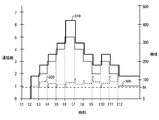
- FIG. 3 schematically shows an example of a time change of a band dynamically allocated to the modem 100 for voice communication.
- FIG. 3 shows the time evolution of the number of voice communication occurrences 300 via the communication satellite 50, the band 310 allocated to the modem 100, and the band 320 per line.
- no bandwidth is allocated for voice communication.
- the allocation control unit 140 performs voice communication for two lines. Allocate the bandwidth required for communication.
- a bandwidth of 64 kbps per line is set exclusively for voice communication
- the allocation control unit 140 allocates a bandwidth of 128 kbps to voice communication according to the occurrence of voice communication for one line.
- the 64 kbps band is used for transmission of the data of the current voice communication detected at time t2.
- the remaining bandwidth of 64 kbps is not used for transmission of data of the current voice communication detected at time t2.
- This remaining band of 64 kbps is an extra band allocated in advance for voice communication so that it can be used when voice communication further occurs in the future.
- the allocation control unit 140 allocates a bandwidth necessary for voice communication for one line to the voice communication. Assign additional. As a result, a bandwidth of 192 kbps is allocated for voice communication.
- the additional voice communication detected at time t3 can be transmitted using a band of 64 kbps previously allocated after time t2. Therefore, the 128 kbps band of the allocated 192 kbps band is used for data transmission of the existing current voice communication detected at time t2 and the additional voice communication detected at time t3.
- the remaining bandwidth of 64 kbps is not used for data transmission of the existing current voice communication and additional voice communication.
- the remaining bandwidth of 64 kbps is a bandwidth allocated in advance for voice communication so that it can be used when voice communication further occurs in the future.
- the current bandwidth per voice communication line temporarily decreases from 128 kbps to 64 kbps.
- the current bandwidth per voice communication line does not fall below 64 kbps to be set per voice communication line. For this reason, the call quality of the existing voice communication is not deteriorated due to the additional voice communication.
- a prompt call can be provided for additional voice communication.
- the allocation control unit 140 increases the bandwidth required for voice communication for one line. Allocate additional for voice communication. As a result, a bandwidth of 320 kbps is assigned to the voice communication for four lines by the bandwidth assignment at time t5.
- the allocation control unit 140 determines that the bandwidth required for voice communication for two lines is Allocate additional communication. Thereby, it is possible to maintain the ratio of the bandwidth that is redundantly allocated to the voice communication with respect to the bandwidth necessary for the current voice communication to be higher than a predetermined rate (for example, a margin rate of 20%).
- a margin rate exceeding 20% can be obtained by allocating an extra band for one line to the current voice communication. Therefore, the allocation control unit 140 allocates an extra band for one line for the current voice communication as described above.
- the allocation control unit 140 additionally allocates the bandwidth for two lines, which is the minimum bandwidth capable of obtaining a margin rate of 20%, to the voice communication.
- the allocation control unit 140 allocates a bandwidth necessary for voice communication for two lines to the voice communication. Release from existing band. As a result, a minimum bandwidth that can obtain a margin rate of 20% is maintained. Similarly, at times t8, t9, t10, t11, t12, etc., every time the detection unit 120 detects that voice communication for one additional line has occurred or ended, the bandwidth allocated to the voice communication is set. Increase or decrease. The allocation control unit 140 increases or decreases the bandwidth allocated to the voice communication so that a predetermined margin rate can be obtained for the current voice communication.
- the detection unit 120 detects that additional voice communication has occurred when the amount of voice communication packets transmitted per unit time has increased by a predetermined amount or more. In addition, the detection unit 120 detects that the voice communication has ended when the amount of voice communication packets transmitted per unit time has decreased by a predetermined amount or more.
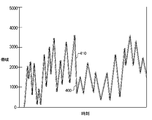
- FIG. 4 schematically shows an example of a time change of a band dynamically allocated to the modem 100 for data communication.
- FIG. 4 shows the time evolution of each of the band 400 required for data communication via the communication satellite 50 and the band 410 allocated to the modem 100.
- the allocation control unit 140 allocates a bandwidth necessary for data communication that is currently occurring for data communication. As described above, the allocation control unit 140 performs control to allocate an extra band for voice communication, but does not perform control to allocate an extra band to data communication. Therefore, the allocation control unit 140 dynamically allocates a bandwidth that substantially matches the bandwidth required for the current data communication for data communication. Although a delay occurs between the time when the allocation control unit 140 requests bandwidth allocation and the bandwidth is actually allocated to the modem 100, the quality of the data itself transmitted by data communication is not substantially degraded by the delay.
- the modem 100 performs so-called on-demand bandwidth allocation for data communication.
- the detection unit 120 transmits a packet to be transmitted when a value indicating that the packet is for voice communication is not stored in a predetermined field in the header of the packet transmitted to the communication satellite 50. It is determined that the packet is for data communication.
- the allocation control unit 140 calculates a bandwidth necessary for data communication from the number of packets per unit time determined to be a data communication packet.
- FIG. 5 is a flowchart showing processing executed by the allocation control unit 140. The process of this flowchart is started when the power of the modem 100 is turned on.
- step S502 the allocation control unit 140 determines whether a packet for voice communication exists in the packet transmitted toward the communication satellite 50. For example, the allocation control unit 140 determines whether or not a voice communication packet has been detected by the detection unit 120 within a predetermined time.
- step S502 If it is determined in step S502 that no voice communication packet exists, the allocation control unit 140 performs bandwidth allocation in accordance with the transmission amount of the packet (step S504). Specifically, the allocation control unit 140 allocates a band corresponding to the amount of non-voice communication packets transmitted per unit time. When the process of step S504 ends, the process proceeds to step S502.
- step S502 If it is determined in step S502 that there is a voice communication packet, the allocation control unit 140 performs control to allocate a band larger than the transmission amount of the voice communication packet, and further assigns the voice communication packet. It is set in the upper queue of data communication packets (steps S512 to S524).
- step S512 the allocation control unit 140 determines whether or not the margin rate of the voice communication packet is 20% or less. If it is determined in step S512 that the voice communication packet margin rate is 20% or less, the minimum bandwidth necessary for the margin rate to exceed 20% is additionally allocated to voice communication ( The process proceeds to step S514) and step S502.
- step S512 If it is determined in step S512 that the margin rate for voice communication packets is not less than 20%, the allocation control unit 140 may reduce the bandwidth allocated for voice communication by one line or more in step S522. Then, it is determined whether or not the margin rate exceeds 20%. If it is determined in step S522 that the margin ratio exceeds 20% even if the bandwidth is reduced by one line or more, the allocation control unit 140 is the maximum number of lines that can maintain the margin ratio exceeding 20%. The bandwidth is released from the bandwidth allocated for voice communication (step S524), and the process proceeds to step S502. If it is determined in step S522 that the margin rate is 20% or less when the bandwidth is reduced by one line, the process proceeds to step S502.
- the band can be shared between the terrestrial communication system 7 and the terrestrial communication system 8 by dynamically allocating the band to the communication via the communication satellite 50.
- the modem 100 when a bandwidth is dynamically allocated, an extra bandwidth is secured in advance for voice communication in advance, so that the communication quality of voice communication that has already been started is newly set. It is possible to suppress a drop due to the generated voice communication.
- the bandwidth is secured in advance or the bandwidth is secured on demand. For this reason, bandwidth can be allocated in advance and communication quality can be maintained for communications that have a high possibility of packet delay, delay fluctuation, order reversal, and loss, such as voice communication. You can also set a cue. Such control can be applied to communication on a communication line with limited bandwidth, such as satellite communication.
- the case where a predetermined bandwidth such as 64 kbps is set for one line is mainly taken up for voice communication.
- the bandwidth set per line is not limited to a specific value such as 64 kbps.
- the band set per line may be different for each base station 30 and base station 31.
- the margin ratio is not limited to a specific ratio such as 20%.
- the margin rate may be varied according to the bandwidth required for the current voice communication.
- the margin rate may be varied according to the number of voice communication lines currently occurring.
- a different ratio may be applied to each of the base station 30 and the base station 31 as the margin rate.
- the allocation control unit 140 may determine an extra bandwidth, a margin rate, or the like reserved in advance for voice communication based on the history of voice communication occurrence in the past.
- the allocation control unit 140 may determine, for each time zone, an extra bandwidth, a margin rate, or the like reserved in advance for the voice communication based on the history of voice communication occurrence in each past time zone. Further, the allocation control unit 140 may determine, for each season, an extra bandwidth, a margin rate, or the like reserved in advance for voice communication based on the history of voice communication occurrence in each past season.
- the case where the detection unit 120 detects the occurrence of voice communication is mainly taken up.
- the base station 30 may notify the modem 100 that the voice communication has newly occurred.
- the allocation control unit 140 performs the same control as when the detection unit 120 detects the occurrence of the voice communication, An extra band may be secured for voice communication.
- the base station 30 may request the modem 100 to transmit a voice communication packet so that an extra bandwidth is secured in the modem 100.
- the modem 100 may notify the base station 30 that a further band allocation cannot be performed.
- the base station 30 may restrict new voice communication when notified from the modem 100 that further band allocation cannot be performed. For example, the base station 30 may restrict new calls.
- voice communication in which voice traffic is converted into IP packets at the base station 30, VoIP realized on 3G line or other communication lines, Voice that realizes voice communication on Long Term Evolution (LTE). Over LTE etc. can be applied.
- LTE Long Term Evolution
- the user terminal 40, the user terminal 41, the user terminal 42, and the user terminal 43 may be a mobile information terminal such as a tablet terminal as well as a mobile phone such as a so-called smartphone.
- various electronic devices having a call function such as a so-called fixed telephone or a computer having a call function can be applied as the user terminal.
- each part of the modem 100 may be realized by hardware or may be realized by software. Further, it may be realized by a combination of hardware and software. Further, the computer may function as the modem 100 by executing the program.
- the program may be installed in a computer constituting at least a part of the modem 100 from a computer-readable medium or a storage device connected to a network.
- a program that is installed in a computer and causes the computer to function as the modem 100 according to the present embodiment works on the MPU or the like to cause the computer to function as each part of the modem 100.
- Information processing described in these programs functions as a specific means in which software and hardware resources of the modem 100 cooperate by being read by a computer.
- the computer has various memories such as MPU, ROM, RAM, and EEPROM (registered trademark), a communication bus, and an interface.
- the MPU reads out the processing programs stored in the ROM as firmware in advance and sequentially executes them. May function as
Landscapes
- Engineering & Computer Science (AREA)
- Computer Networks & Wireless Communication (AREA)
- Signal Processing (AREA)
- Physics & Mathematics (AREA)
- Astronomy & Astrophysics (AREA)
- General Physics & Mathematics (AREA)
- Aviation & Aerospace Engineering (AREA)
- Radio Relay Systems (AREA)
- Mobile Radio Communication Systems (AREA)
- Telephonic Communication Services (AREA)
Abstract
衛星通信を介する音声通信に対して帯域を動的に割り当てる場合、新たに生じた音声通信が、既存の音声通信の通信品質に悪影響を与える場合がある。衛星を介して通信するデータ通信装置であって、衛星を介する音声通信に対して、衛星を介して行われている現在の音声通信に必要な帯域より、予め定められた帯域以上大きい帯域を予め割り当てる割当制御部を備える。プログラムは、コンピュータを、上記データ通信装置として機能させる。衛星通信システムは、上記データ通信装置と、上記衛星とを備える。
Description
本発明は、データ通信装置、プログラム及び衛星通信システムに関する。
仮設通話網を構成する複数の可搬型の無線LANアクセスポイントの一つをSIPサーバとし、SIPサーバを衛星携帯電話に接続し、仮設通話網を衛星携帯電話による衛星通信経由で他の公衆回線網に接続する携帯電話網システムが知られている(例えば、特許文献1参照)。
[先行技術文献]
[特許文献]
[特許文献1]特開2008-263282号公報
[先行技術文献]
[特許文献]
[特許文献1]特開2008-263282号公報
衛星通信を介する音声通信に対して帯域を動的に割り当てる場合、新たに生じた音声通信が、既存の音声通信の通信品質に悪影響を与える場合がある。
本発明の第1の態様においては、衛星を介して通信するデータ通信装置であって、衛星を介する音声通信に対して、衛星を介して行われている現在の音声通信に必要な帯域より、予め定められた帯域以上大きい帯域を予め割り当てる割当制御部を備える。
予め定められた帯域は、衛星を介する1回線の音声通信に必要な帯域であってよい。
割当制御部は、衛星を介する音声通信に対して、上り方向及び下り方向の双方について予め定められた帯域以上大きい帯域を予め割り当ててよい。
割当制御部は、現在の音声通信に必要な帯域が減少した場合に、減少した後の現在の音声通信に必要な帯域より、衛星を介する音声通信に対して予め定められた帯域以上大きい帯域が割り当てられた状態になるよう、衛星を介する音声通信に対して割り当てている帯域を減少させてよい。
割当制御部は、現在の音声通信に必要な帯域が大きいほど、衛星を介する音声通信に対して予め割り当てている帯域と、現在の音声通信に必要な帯域との差を大きくしてよい。
割当制御部は、現在の音声通信に必要な帯域に対する、衛星を介する音声通信に対して予め割り当てている帯域の比率が、予め定められた閾値を超えるよう、衛星を介する音声通信に対して予め割り当てる帯域を調整してよい。
割当制御部は、衛星を介する音声通信に対して帯域を割り当てていない状態で、衛星を介して送信するパケットから音声通信用のパケットを検出した場合に、衛星を介する音声通信に対して、2回線の音声通信に必要な帯域以上の帯域を割り当ててよい。
本発明の第2の態様においては、プログラムは、コンピュータを、上記データ通信装置として機能させる。
本発明の第3の態様においては、衛星通信システムは、上記データ通信装置と、上記衛星とを備える。
なお、上記の発明の概要は、本発明の必要な特徴の全てを列挙したものではない。また、これらの特徴群のサブコンビネーションもまた、発明となりうる。
以下、発明の実施の形態を通じて本発明を説明するが、以下の実施形態は請求の範囲にかかる発明を限定するものではない。また、実施形態の中で説明されている特徴の組み合わせの全てが発明の解決手段に必須であるとは限らない。
図1は、一実施形態における通信システム2を概略的に示す。通信システム2は、衛星通信システム4、地上通信システム7及び地上通信システム8を備える。衛星通信システム4は、地上通信システム7及び地上通信システム8を、通信衛星50を介して、地上通信システム6に接続する。
地上通信システム7及び地上通信システム8は、例えば、離島や山間部等、人口非密集地等における通信システムである。地上通信システム6は、例えば1基地局あたりの収容人数が、地上通信システム7及び地上通信システム8における1基地局あたりの収容人数より多い。地上通信システム6、地上通信システム7及び地上通信システム8は、衛星通信システム4を介して、相互に通信する。
衛星通信システム4は、衛星通信装置10と、IF変換装置20と、衛星通信装置11と、IF変換装置21と、通信衛星50と、衛星通信装置12と、IF変換装置22とを備える。衛星通信装置10は、モデム100と、アンテナ190とを有する。衛星通信装置11は、モデム101と、アンテナ191とを有する。
地上通信システム6は、基地局32と、基地局制御装置60、移動通信交換局62、公衆電話交換回線網66及びユーザ端末42を備える。地上通信システム7は、基地局30と、ユーザ端末40と、ユーザ端末43とを備える。地上通信システム8は、基地局31と、ユーザ端末41とを備える。
ユーザ端末40、ユーザ端末41、ユーザ端末42及びユーザ端末43は、音声通信機能を有する。また、ユーザ端末40、ユーザ端末41、ユーザ端末42及びユーザ端末43は、データ通信機能を有する。ユーザ端末40、ユーザ端末41、ユーザ端末42及びユーザ端末43は、例えば、スマートフォン等の携帯電話機である。
衛星通信システム4において、基地局30及び基地局31は、それぞれ人口非密集地等に設けられる。基地局30は、ユーザ端末40、ユーザ端末43からのトラフィックを受け取って、IF変換装置20にトラフィックを出力する。ユーザ端末40及びユーザ端末43からのトラフィックには、音声通信のトラフィック及びデータ通信のトラフィック等が含まれる。
IF変換装置20は、基地局30と衛星通信装置10との間に設けられる。具体的には、IF変換装置20は、基地局30と、モデム100との間に設けられる。IF変換装置20は、基地局30から受け取ったトラフィックをIPパケット等のパケットに変換して、モデム100に出力する。また、IF変換装置20は、モデム100から出力されたパケットを、基地局30向けのトラフィックに変換して、基地局30に出力する。基地局30は、トラフィックに応じてユーザ端末40及びユーザ端末43と通信する。
モデム100は、通信衛星50を介して通信するデータ通信装置の一例である。モデム100は、IF変換装置20からのパケットの信号を変調して、得られた変調信号をアンテナ190に出力する。アンテナ190は、モデム100から出力された変調信号を電波として出力する。アンテナ192から出力された電波は、通信衛星50を介してアンテナ192によって受信される。また、アンテナ190は、通信衛星50から受信した電波に基づいて受信信号を生成して、モデム100に出力する。モデム100は、アンテナ190から出力された受信信号を復調して、得られたパケットをIF変換装置20に出力する。
通信衛星50は、アンテナ190とアンテナ192との間で電波を中継する。アンテナ192は、通信衛星50から受信した電波に基づいて受信信号を生成して、モデム102に出力する。モデム102は、アンテナ190から出力された受信信号を復調して、得られたパケットをIF変換装置22に出力する。また、モデム100は、IF変換装置22から取得したパケットの信号を変調して、得られた変調信号をアンテナ192に出力する。アンテナ192は、モデム102から出力された変調信号を電波として出力する。アンテナ192から出力された電波は、通信衛星50を介してアンテナ190によって受信される。
IF変換装置22は、基地局制御装置60と衛星通信装置12との間に設けられる。具体的には、IF変換装置22は、基地局制御装置60と、モデム102との間に設けられる。IF変換装置22は、モデム102から出力されたパケットを、基地局制御装置60向けのトラフィックに変換して、基地局制御装置60に出力する。また、IF変換装置22は、基地局制御装置60から受け取ったトラフィックをIPパケット等のパケットに変換して、モデム102に出力する。
基地局制御装置60は、基地局32と接続される。また、基地局制御装置60は、移動通信交換局62と接続とされる。基地局制御装置60は、IF変換装置22から取得したトラフィックを、トラフィックの宛先に応じて、基地局32又は移動通信交換局62に出力する。例えば、基地局制御装置60は、トラフィックの宛先がユーザ端末42である場合、ユーザ端末42が無線接続される基地局32へそのトラフィックを送る。
また、基地局制御装置60は、基地局32からユーザ端末42に関するトラフィックを受け、トラフィックの対象となる通信交換局へそのトラフィックを中継する。例えば、基地局制御装置60は、ユーザ端末40宛のトラフィックを、IF変換装置22に出力する。また、基地局制御装置60は、公衆電話交換回線網66に接続されている端末宛のトラフィックを、公衆電話交換回線網66の交換局である移動通信交換局62に出力する。なお、ユーザ端末42からのトラフィックには、音声通信のトラフィック及びデータ通信のトラフィック等が含まれる。
なお、地上通信システム8は、地上通信システム7と同様の構成を有する。具体的には、基地局31は、基地局30と同様の機能を有する。また、ユーザ端末41は、ユーザ端末40及びユーザ端末43と同様の機能を有する。また、衛星通信システム4において、IF変換装置21は、IF変換装置20と同様の機能を有する。また、衛星通信装置11は、衛星通信装置10と同様の機能及び構成を有する。具体的には、モデム101は、モデム100と同様の機能及び構成を有する。また、アンテナ191は、アンテナ190と同様の機能及び構成を有する。そのため、地上通信システム8、IF変換装置21及び衛星通信装置11の各部の動作については、説明を省略する。本実施形態の説明では主として、モデム100の機能を取り上げて説明する。
衛星通信システム4において、モデム100は、制御側の地球局である衛星通信装置12に、帯域の割り当てを要求する。この場合、モデム100は、IF変換装置20から取得した単位時間あたりに送信するべきパケット量に基づき、衛星通信装置12に動的に帯域の割り当てを要求する。これにより、例えば、地上通信システム7と地上通信システム8との間で、通信衛星50を介する衛星通信の帯域を共有することができる。そのため、衛星通信の帯域の利用効率を高めることができる。
ここで、モデム100は、データ通信に対して、IF変換装置20から出力される現在の単位時間あたりのパケット量に略合致した幅の帯域を要求する。一方、モデム100は、音声通信に対しては、既に行われている通話に対して確保されるべき帯域より、1通話数に対応する帯域分、帯域を余分に要求する。これにより、例えば、ユーザ端末40を用いて通話中に、ユーザ端末41から新たな呼が発生した場合、新たな呼に対して帯域が実際に割り当てられる前に、既に割り当てを受けていた余分の帯域を使って、新たな呼に関する音声通信のパケットを送信できる。そのため、ユーザ端末40を用いた既存の通話の音声品質が、新たに発生した呼によって低下することを抑制できる。なお、説明を簡潔にすることを目的として、モデム100が帯域の割り当てを要求することを、単に「帯域を割り当てる」等と呼ぶ場合がある。
図2は、モデム100の機能ブロック構成の一例を模式的に示す。モデム100は、検出部120、割当制御部140及び送受信部180を有する。
送受信部180は、通信衛星50を介して伝送される信号を生成する。具体的には、送受信部180は、通信衛星50を通じて送信される送信信号を生成する。また、送受信部180は、IF変換装置20を介して送信される送信信号を生成する。
具体的には、送受信部180は、音声通信用のパケットやデータ通信用のパケット等、通信衛星50を介して送信されるパケットを、IF変換装置20から受信する。送受信部180は、IF変換装置20から取得したパケットの信号に変調処理、増幅処理等を施して、アンテナ190に出力する。アンテナ190は、送受信部180から出力された信号を送信する。また、送受信部180は、アンテナ190から取得した信号に復調処理等を施すことによって得られたパケットを、IF変換装置20に送信する。
検出部120は、通信衛星50を介して送信するパケットから音声通信用のパケットを検出する。例えば、検出部120は、伝送されるパケットを解析することによって、伝送されるパケットが音声通信のパケットであることを検出する。検出部120は、送信されるパケットの内容に基づき、音声通信の発生を検出する。また、検出部120は、予め定められた時間内に送信されている音声通信のパケット量に基づき、現在行われている音声通信に必要なデータ量を検出する。
なお、検出部120は、通信衛星50へ送信されるパケット内の予め定められたフィールドに、音声通信用のパケットであることを示す値が格納されている場合に、送信されるパケットが音声通信用のパケットであると判断する。一例として、パケット内の予め定められたフィールドとして、IPパケットにおけるIPヘッダ内のToSフィールドを適用できる。
割当制御部140は、通信衛星50を介する通信に対して、モデム100に割り当てられる帯域を制御する。具体的には、割当制御部140は、通信衛星50を介する音声通信に対して、通信衛星50を介して行われている現在の音声通信に必要な帯域より、予め定められた帯域以上大きい帯域を予め割り当てる。割当制御部140は、通信衛星50を介する音声通信に対して、上り方向及び下り方向の双方について、予め定められた帯域以上大きい帯域を予め割り当てる。
ここで、予め定められた帯域は、通信衛星50を介する1回線の音声通信に必要な帯域であってよい。一例として、音声通信に対して1回線あたりNbpsの帯域を占有的に設定する場合、割当制御部140は、現在音声通信が生じている回線数をMとすると、(M+1)×Nbpsの帯域を、音声通信に対して割り当てる。
なお、通信衛星50を介する音声通信が生じていない状態で、通信衛星50を介する音声通信が生じた場合、割当制御部140は、通信衛星50を介する音声通信に対して、2回線の音声通信に必要な帯域以上の帯域を割り当てる。具体的には、割当制御部140は、通信衛星50を介する音声通信に対して帯域を割り当てていない状態で、通信衛星50を介して送信するパケットから音声通信用のパケットを検出した場合に、通信衛星50を介する音声通信に対して、2回線の音声通信に必要な帯域以上の帯域を割り当てる。上述したように、音声通信用のパケットは、検出部120によって検出される。
また、割当制御部140は、現在の音声通信に必要な帯域が大きいほど、通信衛星50を介する音声通信に対して予め割り当てている帯域と、現在の音声通信に必要な帯域との差を大きくしてよい。また、割当制御部140は、現在の音声通信に必要な帯域に対する、通信衛星50を介する音声通信に対して予め割り当てている帯域の比率が、予め定められた閾値を超えるよう、通信衛星50を介する音声通信に対して予め割り当てる帯域を調整してよい。
なお、割当制御部140は、現在の音声通信に必要な帯域が減少した場合に、減少した後の現在の音声通信に必要な帯域より、通信衛星50を介する音声通信に対して予め定められた帯域以上大きい帯域が割り当てられた状態になるよう、通信衛星50を介する音声通信に対して割り当てている帯域を減少させる。このように、割当制御部140は、予め余分に確保するべき予め定められた帯域を除いて、不要な帯域を開放する。
図3は、音声通信に対してモデム100に動的に割り当てられる帯域の時間変化の一例を模式的に示す。図3には、通信衛星50を介する音声通信の発生数300、モデム100に割り当てられた帯域310、及び、1回線あたりの帯域320のそれぞれの時間発展が示されている。
時刻t1においては、音声通信に対して帯域は割り当てられていない。ここで、音声通信に対して帯域は割り当てられていない状態で、1回線分の音声通信が発生したことを検出部120が検出すると(時刻t2)、割当制御部140は、2回線分の音声通信に必要な帯域を割り当てる。音声通信に対して1回線あたり64kbpsの帯域を占有的に設定する場合、割当制御部140は、1回線分の音声通信の発生に応じて、128kbpsの帯域を、音声通信に対して割り当てる。割り当てた128kbpsの帯域のうち64kbps分の帯域は、時刻t2で検出された現在の音声通信のデータの伝送に使用される。残りの64kbps分の帯域は、時刻t2で検出された現在の音声通信のデータの伝送には使用されない。この残りの64kbpsの帯域は、音声通信が将来更に発生した場合に使用できるよう、音声通信に対して予め余分に割り当てた帯域である。
続いて、時刻t3において、追加で1回線分の音声通信が発生したことを検出部120が検出すると、割当制御部140は、1回線分の音声通信に必要な帯域を、音声通信に対して追加で割り当てる。これにより、音声通信に対して192kbpsの帯域が割り当てられる。時刻t3で検出された追加の音声通信は、時刻t2の後に予め余分に割り当てていた64kbpsの帯域を使用して、伝送され得る。したがって、割り当てた192kbpsの帯域のうち128kbpsの帯域は、時刻t2で検出された既存の現在の音声通信、及び、時刻t3で検出された追加の音声通信のデータの伝送に使用される。そして、残りの64kbps分の帯域は、既存の現在の音声通信、及び、追加の音声通信のデータの伝送には使用されない。この残りの64kbps分の帯域は、音声通信が将来更に発生した場合に使用できるよう、音声通信に対して予め余分に割り当てた帯域である。
なお、帯域の割り当てには時間を要するので、図示されるように、現在の音声通信1回線あたりの帯域は、128kbpsから64kbpsに一時的に低下する。しかし、現在の音声通信1回線あたりの帯域は、音声通信1回線あたりに設定されるべき64kbpsを下回らない。そのため、既存の音声通信の通話品質は、追加で生じた音声通信によって低下しない。また、追加で生じた音声通信に対しては、速やかな発呼を提供できる。
同様に、時刻t4及びt5のそれぞれにおいて、追加で1回線分の音声通信が発生したことを検出部120が検出する毎に、割当制御部140は、1回線分の音声通信に必要な帯域を、音声通信に対して追加で割り当てる。これにより、時刻t5の帯域割り当てによって、4回線分の音声通信に対して320kbpsの帯域が割り当てられた状態になる。
時刻t6において、更に追加で1回線分の音声通信が発生したことを検出部120が検出すると、割当制御部140は、割当制御部140は、2回線分の音声通信に必要な帯域を、音声通信に対して追加で割り当てる。これにより、現在の音声通信に必要な帯域に対する、音声通信に余分に割り当てている帯域の比率を、予め定められた率(例えば、20%の余裕率)より高い状態に維持することができる。
具体的には、時刻t2、t3、t4及びt5においては、現在の音声通信に対して1回線分多い帯域を余分に割り当てておくことで、20%を上回る余裕率が得られる。そのため、割当制御部140は、上述したように現在の音声通信に対して1回線分多い帯域を余分に割り当てる。これに対し、時刻t6においては、5回線分の音声通信に対して20%を上回る余裕率が得られるようにするためには、音声通信2回線分の帯域が少なくとも必要である。したがって、上述したように、割当制御部140は、20%の余裕率を得ることができる最小の帯域である2回線分の帯域を、音声通信に対して追加で割り当てる。
続いて、時刻t7において、1回線分の音声通信が終了したことを検出部120が検出すると、割当制御部140は、2回線分の音声通信に必要な帯域を、音声通信に対して割り当てている帯域から開放させる。これにより、20%の余裕率を得ることができる最小の帯域に維持する。同様に、時刻t8、t9、t10、t11、t12等において、追加で1回線分の音声通信が発生又は終了したことを検出部120が検出する毎に、音声通信に対して割り当てている帯域を増減させる。割当制御部140は、現在の音声通信に対して予め定められた余裕率が得られるように、音声通信に対して割り当てている帯域を増減させる。
なお、検出部120は、単位時間あたりに送信される音声通信用のパケットの量が予め定められた量以上増加した場合に、追加で音声通信が発生したことを検出する。また、検出部120は、単位時間あたりに送信される音声通信用のパケットの量が予め定められた量以上減少した場合に、音声通信が終了したことを検出する。
図4は、データ通信に対してモデム100に動的に割り当てられる帯域の時間変化の一例を模式的に示す。図4には、通信衛星50を介するデータ通信に必要な帯域400、及び、モデム100に割り当てられた帯域410のそれぞれの時間発展が示されている。
割当制御部140は、データ通信に対しては、現在発生しているデータ通信に必要な帯域を割り当てる。割当制御部140は、上述したように音声通信に対して帯域を余分に割り当る制御を行うが、データ通信に対しては、余分な帯域を割り当てる制御は行わない。したがって、割当制御部140は、データ通信に対しては、現在のデータ通信に必要な帯域に略合致する帯域を動的に割り当てる。割当制御部140が帯域割り当てを要求してから実際にモデム100に帯域が割り当てられるまでに遅延が生じるが、データ通信で伝送されるデータそのものに対する品質は、遅延によって実質的に低下しない。
このように、モデム100は、音声通信に対する帯域割り当てとは異なり、データ通信に対しては、いわゆるオンデマンドの帯域割り当てを行う。なお、検出部120は、通信衛星50へ送信されるパケットのヘッダ内の予め定められたフィールドに、音声通信用のパケットであることを示す値が格納されていない場合に、送信されるパケットがデータ通信用のパケットであると判断する。割当制御部140は、データ通信用のパケットであると判断されたパケットの単位時間あたりの数から、データ通信に必要な帯域を算出する。
図5は、割当制御部140が実行する処理を示すフローチャートである。本フローチャートの処理は、モデム100の電源がオン状態になった場合に開始される。
ステップS502において、割当制御部140は、通信衛星50に向けて送信されるパケットに、音声通信のパケットが存在しているか否かを判断する。例えば、割当制御部140は、予め定められた時間内に、音声通信のパケットが検出部120によって検出されたか否かを判断する。
ステップS502の判断において、音声通信のパケットが存在していないと判断した場合、割当制御部140は、パケットの送信量に合わせた帯域割り当てを行う(ステップS504)。具体的には、割当制御部140は、単位時間あたりに送信される非音声通信用のパケットの量に相当する帯域を割り当てる。ステップS504の処理が終了すると、ステップS502に処理を移行する。
ステップS502の判断において、音声通信のパケットが存在していると判断した場合、割当制御部140は、音声通信用のパケットの送信量より多い帯域を割り当てる制御を行い、更に音声通信用のパケットをデータ通信用のパケットの上位のキューにセットする(ステップS512~ステップS524)。
帯域を割り当てる制御について具体的に説明すると、ステップS512において、割当制御部140は、音声通信用のパケットの余裕率が20%以下になったか否かを判断する。ステップS512に判断において音声通信用のパケットの余裕率が20%以下になったと判断した場合、余裕率が20%を超えるのに必要な最小の帯域を、音声通信に対して追加で割り当てて(ステップS514)、ステップS502に処理を移行する。
ステップS512の判断において音声通信用のパケットの余裕率が20%以下でないと判断した場合、割当制御部140は、ステップS522において、音声通信に対して割り当てている帯域を1回線分以上減らしても、余裕率が20%を超えるか否かを判断する。ステップS522の判断において、帯域を1回線分以上減らしても余裕率が20%を超えると判断した場合、割当制御部140は、余裕率が20%を超える状態を維持できる最大の回線数分の帯域を、音声通信に対して割り当てている帯域から解放させ(ステップS524)、ステップS502に処理を移行する。ステップS522の判断において、帯域を1回線分減らすと余裕率が20%以下になると判断した場合、ステップS502に処理を移行する。
以上に説明したように、通信システム5によれば、通信衛星50を介する通信に対して帯域を動的に割り当てることで、地上通信システム7、地上通信システム8の間で帯域を共有できる。ここで、モデム100によれば、帯域を動的に割り当てる場合に、音声通信に対しては余分の帯域を予め優先的に確保するので、既に開始されている音声通信の通信品質が、新たに発生した音声通信によって低下することを抑制できる。このように、通信システム5によれば、音声通信及びデータ通信等の通信の種類に応じて、帯域を予め優先的に確保したり、帯域をオンデマンドで確保したりする。そのため、音声通信等のように、パケットの遅延、遅延揺らぎ、順序逆転、紛失の可能性が高い通信に対しては、帯域を事前に割り当てることができ、通信品質を保つことができる上に適切なキューのセットも行うことができる。係る制御は、衛星通信等のように、帯域に制限がある通信回線上の通信に適用できる。
なお、以上の説明では主として、音声通信に対して、1回線につき64kbps等の予め定められた帯域が設定される場合を取り上げた。しかし、1回線あたりに設定する帯域は、64kbps等の特定の値に限定されない。また、1回線あたりに設定する帯域は、基地局30、基地局31毎に異なる値を適用してよい。
また、以上の説明では主として、音声通信に対して予め確保する帯域の余裕率として、20%等の予め定められた比率が用いる場合を取り上げた。しかし、余裕率は、20%等の特定の比率に限定されない。また、余裕率は、現在の音声通信に必要な帯域に応じて異ならせてよい。例えば、現在発生している音声通信の回線数に応じて、余裕率を異ならせてよい。また、余裕率は、基地局30、基地局31毎に異なる比率を適用してよい。また、割当制御部140は、音声通信に対して予め確保する余分の帯域や余裕率等を、過去における音声通信の発生履歴に基づいて決定してよい。割当制御部140は、過去の各時間帯における音声通信の発生履歴に基づいて、音声通信に対して予め確保する余分の帯域や余裕率等を、時間帯毎に決定してよい。また、割当制御部140は、過去の各季節における音声通信の発生履歴に基づいて、音声通信に対して予め確保する余分の帯域や余裕率等を、季節毎に決定してよい。
また、以上の説明では主として、音声通信の発生を検出部120が検出する場合を取り上げた。しかし、基地局30が、音声通信が新たに発生した場合に、音声通信が新たに発生したことを、モデム100に通知してよい。モデム100において、基地局30から音声通信が新たに発生したことが基地局30から通知された場合、割当制御部140は、検出部120が音声通信の発生を検出した場合と同様の制御により、音声通信に対して余分な帯域を確保してよい。また、基地局30が、モデム100において余分の帯域が確保されるように、音声通信のパケットの送信をモデム100に要求してよい。
また、モデム100は、音声通信に対して帯域を更に割り当てることができない場合には、更なる帯域割り当てができない旨を基地局30に通知してよい。基地局30は、更なる帯域割り当てができない旨がモデム100から通知された場合に、新たな音声通信を制限してよい。例えば、基地局30は、新たな呼を制限してよい。
なお、音声通信としては、基地局30において音声トラフィックをIPパケット化した音声通信、3G回線上や他の通信回線上で実現されるVoIP、Long Term Evolution(LTE)上で音声通信を実現するVoice over LTE等を適用できる。
また、ユーザ端末40、ユーザ端末41、ユーザ端末42及びユーザ端末43は、いわゆるスマートフォン等の携帯電話の他、タブレット端末等の携帯情報端末であってよい。また、ユーザ端末として、いわゆる固定電話や、通話機能を有するコンピュータ等、通話機能を有する様々な電子機器を適用できる。
なお、モデム100の各部は、ハードウエアにより実現されてもよく、ソフトウエアにより実現されてもよい。また、ハードウエアとソフトウエアとの組み合わせにより実現されてもよい。また、プログラムが実行されることにより、コンピュータが、モデム100として機能してもよい。プログラムは、コンピュータ読み取り可能な媒体又はネットワークに接続された記憶装置から、モデム100の少なくとも一部を構成するコンピュータにインストールされてよい。
コンピュータにインストールされ、コンピュータを本実施形態に係るモデム100として機能させるプログラムは、MPU等に働きかけて、コンピュータを、モデム100の各部としてそれぞれ機能させる。これらのプログラムに記述された情報処理は、コンピュータに読込まれることにより、ソフトウエアとモデム100のハードウエア資源とが協働した具体的手段として機能する。コンピュータは、MPU、ROM、RAM、EEPROM(登録商標)等の各種メモリ、通信バス及びインタフェースを有し、予めファームウェアとしてROMに格納された処理プログラムをMPUが読み出して順次実行することで、モデム100として機能してよい。
以上、本発明を実施の形態を用いて説明したが、本発明の技術的範囲は上記実施の形態に記載の範囲には限定されない。上記実施の形態に、多様な変更または改良を加えることが可能であることが当業者に明らかである。その様な変更または改良を加えた形態も本発明の技術的範囲に含まれ得ることが、請求の範囲の記載から明らかである。
請求の範囲、明細書、および図面中において示した装置、システム、プログラム、および方法における動作、手順、ステップ、および段階などの各処理の実行順序は、特段「より前に」、「先立って」などと明示しておらず、また、前の処理の出力を後の処理で用いるのでない限り、任意の順序で実現しうることに留意すべきである。請求の範囲、明細書、および図面中の動作フローに関して、便宜上「まず、」、「次に、」などを用いて説明したとしても、この順で実施することが必須であることを意味するものではない。
2 通信システム、4 衛星通信システム、6、7、8 地上通信システム
10、11、12 衛星通信装置、20、21、22 IF変換装置、30、31、32 基地局、40、41、42、43 ユーザ端末、50 通信衛星
60 基地局制御装置、62 移動通信交換局
66 公衆電話交換回線網
100、101、102 モデム
120 検出部
140 割当制御部
180 送受信部、190、191、192 アンテナ
10、11、12 衛星通信装置、20、21、22 IF変換装置、30、31、32 基地局、40、41、42、43 ユーザ端末、50 通信衛星
60 基地局制御装置、62 移動通信交換局
66 公衆電話交換回線網
100、101、102 モデム
120 検出部
140 割当制御部
180 送受信部、190、191、192 アンテナ
Claims (9)
- 衛星を介して通信するデータ通信装置であって、
前記衛星を介する音声通信に対して、前記衛星を介して行われている現在の音声通信に必要な帯域より、予め定められた帯域以上大きい帯域を予め割り当てる割当制御部
を備えるデータ通信装置。 - 前記予め定められた帯域は、前記衛星を介する1回線の音声通信に必要な帯域である
請求項1に記載のデータ通信装置。 - 前記割当制御部は、前記衛星を介する音声通信に対して、上り方向及び下り方向の双方について前記予め定められた帯域以上大きい帯域を予め割り当てる
請求項1または2に記載のデータ通信装置。 - 前記割当制御部は、前記現在の音声通信に必要な帯域が減少した場合に、前記減少した後の前記現在の音声通信に必要な帯域より、前記衛星を介する音声通信に対して前記予め定められた帯域以上大きい帯域が割り当てられた状態になるよう、前記衛星を介する音声通信に対して割り当てている帯域を減少させる
請求項1から3のいずれか一項に記載のデータ通信装置。 - 前記割当制御部は、前記現在の音声通信に必要な帯域が大きいほど、前記衛星を介する音声通信に対して前記予め割り当てている帯域と、前記現在の音声通信に必要な帯域との差を大きくする
請求項1から4のいずれか一項に記載のデータ通信装置。 - 前記割当制御部は、前記現在の音声通信に必要な帯域に対する、前記衛星を介する音声通信に対して前記予め割り当てている帯域の比率が、予め定められた閾値を超えるよう、前記衛星を介する音声通信に対して前記予め割り当てる帯域を調整する
請求項1から5のいずれか一項に記載のデータ通信装置。 - 前記割当制御部は、前記衛星を介する音声通信に対して帯域を割り当てていない状態で、前記衛星を介して送信するパケットから音声通信用のパケットを検出した場合に、前記衛星を介する音声通信に対して、2回線の音声通信に必要な帯域以上の帯域を割り当てる
請求項1から6のいずれか一項に記載のデータ通信装置。 - コンピュータを、請求項1から7のいずれか一項に記載のデータ通信装置として機能させるためのプログラム。
- 請求項1から7のいずれか一項に記載のデータ通信装置と、
前記衛星と
を備える衛星通信システム。
Priority Applications (3)
| Application Number | Priority Date | Filing Date | Title |
|---|---|---|---|
| JP2015504657A JP5724048B1 (ja) | 2014-07-16 | 2014-07-16 | データ通信装置、プログラム及び衛星通信システム |
| PCT/JP2014/003779 WO2016009464A1 (ja) | 2014-07-16 | 2014-07-16 | データ通信装置、プログラム及び衛星通信システム |
| US15/406,793 US10165568B2 (en) | 2014-07-16 | 2017-01-16 | Data communication apparatus, computer readable medium, and satellite communication system |
Applications Claiming Priority (1)
| Application Number | Priority Date | Filing Date | Title |
|---|---|---|---|
| PCT/JP2014/003779 WO2016009464A1 (ja) | 2014-07-16 | 2014-07-16 | データ通信装置、プログラム及び衛星通信システム |
Related Child Applications (1)
| Application Number | Title | Priority Date | Filing Date |
|---|---|---|---|
| US15/406,793 Continuation US10165568B2 (en) | 2014-07-16 | 2017-01-16 | Data communication apparatus, computer readable medium, and satellite communication system |
Publications (1)
| Publication Number | Publication Date |
|---|---|
| WO2016009464A1 true WO2016009464A1 (ja) | 2016-01-21 |
Family
ID=53277963
Family Applications (1)
| Application Number | Title | Priority Date | Filing Date |
|---|---|---|---|
| PCT/JP2014/003779 Ceased WO2016009464A1 (ja) | 2014-07-16 | 2014-07-16 | データ通信装置、プログラム及び衛星通信システム |
Country Status (3)
| Country | Link |
|---|---|
| US (1) | US10165568B2 (ja) |
| JP (1) | JP5724048B1 (ja) |
| WO (1) | WO2016009464A1 (ja) |
Cited By (1)
| Publication number | Priority date | Publication date | Assignee | Title |
|---|---|---|---|---|
| WO2018235784A1 (ja) * | 2017-06-23 | 2018-12-27 | ソフトバンク株式会社 | 通信装置、プログラム及び通信システム |
Families Citing this family (1)
| Publication number | Priority date | Publication date | Assignee | Title |
|---|---|---|---|---|
| CN114844556B (zh) * | 2022-04-26 | 2023-08-25 | 武昌理工学院 | 一种基于功能卫星负荷率的遥感信息去差异化传输方法 |
Citations (3)
| Publication number | Priority date | Publication date | Assignee | Title |
|---|---|---|---|---|
| JPH08140147A (ja) * | 1994-11-14 | 1996-05-31 | Canon Inc | ディジタルコードレス電話端末 |
| JP2002503068A (ja) * | 1998-02-06 | 2002-01-29 | テレフオンアクチーボラゲツト エル エム エリクソン(パブル) | 無線通信におけるチャネル品質の改善 |
| JP2003318968A (ja) * | 2002-04-23 | 2003-11-07 | Mitsubishi Electric Corp | 無線パケット中継装置、衛星パケット通信システムおよび無線パケット中継方法 |
Family Cites Families (2)
| Publication number | Priority date | Publication date | Assignee | Title |
|---|---|---|---|---|
| US6377561B1 (en) * | 1996-06-24 | 2002-04-23 | Spar Aerospace Limited | Data communication satellite system and method of carrying multi-media traffic |
| JP4465365B2 (ja) | 2007-04-10 | 2010-05-19 | 株式会社エヌ・ティ・ティ・ドコモ | 簡易携帯電話網システム |
-
2014
- 2014-07-16 WO PCT/JP2014/003779 patent/WO2016009464A1/ja not_active Ceased
- 2014-07-16 JP JP2015504657A patent/JP5724048B1/ja active Active
-
2017
- 2017-01-16 US US15/406,793 patent/US10165568B2/en active Active
Patent Citations (3)
| Publication number | Priority date | Publication date | Assignee | Title |
|---|---|---|---|---|
| JPH08140147A (ja) * | 1994-11-14 | 1996-05-31 | Canon Inc | ディジタルコードレス電話端末 |
| JP2002503068A (ja) * | 1998-02-06 | 2002-01-29 | テレフオンアクチーボラゲツト エル エム エリクソン(パブル) | 無線通信におけるチャネル品質の改善 |
| JP2003318968A (ja) * | 2002-04-23 | 2003-11-07 | Mitsubishi Electric Corp | 無線パケット中継装置、衛星パケット通信システムおよび無線パケット中継方法 |
Cited By (1)
| Publication number | Priority date | Publication date | Assignee | Title |
|---|---|---|---|---|
| WO2018235784A1 (ja) * | 2017-06-23 | 2018-12-27 | ソフトバンク株式会社 | 通信装置、プログラム及び通信システム |
Also Published As
| Publication number | Publication date |
|---|---|
| JP5724048B1 (ja) | 2015-05-27 |
| JPWO2016009464A1 (ja) | 2017-04-27 |
| US20170135107A1 (en) | 2017-05-11 |
| US10165568B2 (en) | 2018-12-25 |
Similar Documents
| Publication | Publication Date | Title |
|---|---|---|
| US10219284B2 (en) | Multi-band resource scheduling for wireless device tethering | |
| CN109565833B (zh) | 分配功率的方法和设备 | |
| CN110267311B (zh) | 通信方法、网络侧设备及终端 | |
| JP6332442B2 (ja) | 無線通信システム、基地局および端末 | |
| US20190159073A1 (en) | Method for transmitting information, network device and terminal device | |
| WO2020164590A1 (zh) | 传输资源检测方法、传输资源确定方法和通信设备 | |
| WO2011096315A1 (ja) | 無線基地局、制御プロセッサ、プログラム及び無線リソース割当制御方法 | |
| CN106488560A (zh) | 一种资源选择方法及装置 | |
| US20220322312A1 (en) | Uplink transmission method and apparatus, resource indication method and apparatus, serving node, and medium | |
| JP2019519955A (ja) | 通信方法、ネットワーク設備及び端末設備 | |
| WO2020059045A1 (ja) | 通信装置、基地局装置、及び通信システム | |
| CN114500511B (zh) | 一种数据传输方法、装置及电子设备 | |
| JP2017521937A (ja) | 端末装置およびd2dリソース管理方法 | |
| WO2014172892A1 (zh) | 业务分流方法、装置及系统 | |
| CN115134857B (zh) | 保证无线通信系统中服务质量的方法和装置 | |
| JP5724048B1 (ja) | データ通信装置、プログラム及び衛星通信システム | |
| JP2017510140A (ja) | データ送信方法および端末 | |
| JP5959786B2 (ja) | 無線通信装置 | |
| EP3565305A1 (en) | Resource scheduling method, apparatus, and system | |
| CN111757497B (zh) | 控制信息的传输方法和装置 | |
| JP4900272B2 (ja) | 衛星通信地球局 | |
| US20150100619A1 (en) | Dual channel wi-fi for congested wlans with asymmetric traffic loads | |
| CN113453365B (zh) | 配置取消传输资源指示信息的方法、网络设备和终端设备 | |
| WO2021023294A1 (zh) | 信息传输方法及电子设备 | |
| CN110087326B (zh) | 一种降低谐波干扰的方法及装置 |
Legal Events
| Date | Code | Title | Description |
|---|---|---|---|
| ENP | Entry into the national phase |
Ref document number: 2015504657 Country of ref document: JP Kind code of ref document: A |
|
| 121 | Ep: the epo has been informed by wipo that ep was designated in this application |
Ref document number: 14897777 Country of ref document: EP Kind code of ref document: A1 |
|
| NENP | Non-entry into the national phase |
Ref country code: DE |
|
| 122 | Ep: pct application non-entry in european phase |
Ref document number: 14897777 Country of ref document: EP Kind code of ref document: A1 |