WO2015190589A1 - イヌの僧帽弁閉鎖不全症のリスク診断 - Google Patents
イヌの僧帽弁閉鎖不全症のリスク診断 Download PDFInfo
- Publication number
- WO2015190589A1 WO2015190589A1 PCT/JP2015/066980 JP2015066980W WO2015190589A1 WO 2015190589 A1 WO2015190589 A1 WO 2015190589A1 JP 2015066980 W JP2015066980 W JP 2015066980W WO 2015190589 A1 WO2015190589 A1 WO 2015190589A1
- Authority
- WO
- WIPO (PCT)
- Prior art keywords
- type
- fima
- seq
- porphyromonas gulae
- mitral regurgitation
- Prior art date
- Legal status (The legal status is an assumption and is not a legal conclusion. Google has not performed a legal analysis and makes no representation as to the accuracy of the status listed.)
- Ceased
Links
Images
Classifications
-
- A—HUMAN NECESSITIES
- A61—MEDICAL OR VETERINARY SCIENCE; HYGIENE
- A61K—PREPARATIONS FOR MEDICAL, DENTAL OR TOILETRY PURPOSES
- A61K39/00—Medicinal preparations containing antigens or antibodies
- A61K39/395—Antibodies; Immunoglobulins; Immune serum, e.g. antilymphocytic serum
-
- C—CHEMISTRY; METALLURGY
- C12—BIOCHEMISTRY; BEER; SPIRITS; WINE; VINEGAR; MICROBIOLOGY; ENZYMOLOGY; MUTATION OR GENETIC ENGINEERING
- C12M—APPARATUS FOR ENZYMOLOGY OR MICROBIOLOGY; APPARATUS FOR CULTURING MICROORGANISMS FOR PRODUCING BIOMASS, FOR GROWING CELLS OR FOR OBTAINING FERMENTATION OR METABOLIC PRODUCTS, i.e. BIOREACTORS OR FERMENTERS
- C12M1/00—Apparatus for enzymology or microbiology
-
- C—CHEMISTRY; METALLURGY
- C12—BIOCHEMISTRY; BEER; SPIRITS; WINE; VINEGAR; MICROBIOLOGY; ENZYMOLOGY; MUTATION OR GENETIC ENGINEERING
- C12N—MICROORGANISMS OR ENZYMES; COMPOSITIONS THEREOF; PROPAGATING, PRESERVING, OR MAINTAINING MICROORGANISMS; MUTATION OR GENETIC ENGINEERING; CULTURE MEDIA
- C12N15/00—Mutation or genetic engineering; DNA or RNA concerning genetic engineering, vectors, e.g. plasmids, or their isolation, preparation or purification; Use of hosts therefor
- C12N15/09—Recombinant DNA-technology
-
- C—CHEMISTRY; METALLURGY
- C12—BIOCHEMISTRY; BEER; SPIRITS; WINE; VINEGAR; MICROBIOLOGY; ENZYMOLOGY; MUTATION OR GENETIC ENGINEERING
- C12Q—MEASURING OR TESTING PROCESSES INVOLVING ENZYMES, NUCLEIC ACIDS OR MICROORGANISMS; COMPOSITIONS OR TEST PAPERS THEREFOR; PROCESSES OF PREPARING SUCH COMPOSITIONS; CONDITION-RESPONSIVE CONTROL IN MICROBIOLOGICAL OR ENZYMOLOGICAL PROCESSES
- C12Q1/00—Measuring or testing processes involving enzymes, nucleic acids or microorganisms; Compositions therefor; Processes of preparing such compositions
- C12Q1/68—Measuring or testing processes involving enzymes, nucleic acids or microorganisms; Compositions therefor; Processes of preparing such compositions involving nucleic acids
-
- G—PHYSICS
- G01—MEASURING; TESTING
- G01N—INVESTIGATING OR ANALYSING MATERIALS BY DETERMINING THEIR CHEMICAL OR PHYSICAL PROPERTIES
- G01N33/00—Investigating or analysing materials by specific methods not covered by groups G01N1/00 - G01N31/00
- G01N33/48—Biological material, e.g. blood, urine; Haemocytometers
- G01N33/50—Chemical analysis of biological material, e.g. blood, urine; Testing involving biospecific ligand binding methods; Immunological testing
- G01N33/53—Immunoassay; Biospecific binding assay; Materials therefor
- G01N33/569—Immunoassay; Biospecific binding assay; Materials therefor for microorganisms, e.g. protozoa, bacteria, viruses
-
- G—PHYSICS
- G01—MEASURING; TESTING
- G01N—INVESTIGATING OR ANALYSING MATERIALS BY DETERMINING THEIR CHEMICAL OR PHYSICAL PROPERTIES
- G01N37/00—Details not covered by any other group of this subclass
Definitions
- the present invention relates to diagnosing mitral regurgitation in dogs by the type of Porphyromonas egulae fimbrillin protein (FimA), which is considered to be a causative agent of canine periodontal disease.
- FimA Porphyromonas egulae fimbrillin protein
- Mitral regurgitation is one of the most common types of cardiovascular disease that occurs in dogs (Non-patent document 1, Non-patent document 2) and is characterized by chronic progression, Symptoms worsen from moderate to severe over time (Non-patent Document 3). Approximately 75% of dogs with chronic heart disease have mitral regurgitation (Non-Patent Document 2).
- Dogs with mitral regurgitation have degeneration in the structure for moving the mitral valve and the mitral valve, and the valve does not completely close. For this reason, when the left ventricle contracts and pumps blood throughout the body, blood flows back into the left atrium. The left atrium gradually enlarges under the influence of this regurgitation, and then an abnormality also occurs in the right heart system. As the symptoms progress, blood stagnation returns to the heart, and pleural effusions and ascites accumulate. In addition to the fatigue of the heart function, water may accumulate in the lungs and make it difficult to breathe. As a result, the quality of life (QOL) of animals is greatly reduced.
- QOL quality of life
- mitral regurgitation occurs, there is no treatment to suppress mitral valve degeneration, alleviating symptoms such as diet, weight management, exercise restrictions, and medications such as vasodilators Treatment is the main subject.
- a surgical treatment method such as replacing the prosthetic valve by surgery, but it is a large-scale operation performed by stopping the pulsation of the heart.
- An object of the present invention is to provide a risk diagnosis method, a prevention method, and a method for suppressing progression of canine mitral regurgitation.
- the inventors of the present invention correlate between the presence of Porphyromonas gulae, a protein C that forms fimbrillin protein (Fimbrillin) in the oral cavity, and canine mitral regurgitation
- the present invention has been completed.
- the present invention in one aspect, is a method for diagnosing the risk of mitral regurgitation in dogs, Examining whether a risk factor associated with Porphyromonas gulae is present in a sample collected from a dog subject; Diagnosing the dog subject as being at risk of developing mitral regurgitation or at risk of developing mitral regurgitation if the risk factor is present in the sample; A method is provided.
- saliva, plaque, calculus, oral wiping fluid, blood-derived sample, or the like can be used as a sample collected from a dog subject to be examined in this risk diagnosis method.
- the risk factors associated with Porphyromonas gulae are: (I) the sample collected from the dog subject contains Porphyromonas gulae type C fimbrillin FimA, or (ii) the Porphyromonas gulae type A in the sample collected from the dog subject. The highest level of Porphyromonas gulae type C FimA compared to the level of Fimbrillin FimA and Porphyromonas gulae type B FimA, One of them.
- risk factors can be identified by either nucleic acid sequence level or protein level methods.
- a method for preventing canine mitral regurgitation or inhibiting the progression of canine mitral regurgitation wherein the dog subject has mitral regurgitation Reducing the number of Porphyromonas gulae with type C FimA in the oral cavity or body when the dog subject is diagnosed to be at risk or at risk of developing mitral regurgitation.
- the number of Porphyromonas gulae having type C FimA that the dog subject has in the oral cavity or in the body is cleaned by removing plaque or tartar of the dog subject, thereby cleaning the oral cavity of the dog subject. It may be reduced by reducing the amount by reducing the dose or by reducing the dose by administering a drug to the dog subject.
- the medicament may be a medicament comprising, as an active ingredient, a monoclonal antibody specific to a polypeptide comprising the amino acid sequence of SEQ ID NO: 6 or a derivative thereof.
- a dog mitral comprising a polynucleotide consisting of the nucleotide sequence of SEQ ID NO: 21 or consisting of a polypeptide consisting of the amino acid sequence of SEQ ID NO: 6 or a partial amino acid sequence thereof
- a diagnostic biomarker for the risk of valvular insufficiency or the risk of developing mitral regurgitation in dogs is provided.
- a monoclonal antibody specific to a polypeptide consisting of the amino acid sequence of SEQ ID NO: 6 or a derivative thereof is used as an active ingredient to prevent canine mitral regurgitation or Provided is a medicament for suppressing the progression of mitral regurgitation.
- the diagnosis of canine mitral regurgitation comprising a primer set for classifying Porphyromonas gulae fimbrillin FimA type A, type B and type C Kit for diagnosis of canine mitral regurgitation, comprising each antibody specific to Porphyromonas gulae type A, type B and type C, respectively, or derivatives thereof; fimbrillin fimA
- Each nucleotide having a sequence complementary to each of type A, type B and type C is bound in a different well, or specific to each of fibrrillin FimA type A, type B and type C
- a diagnostic chip for canine mitral regurgitation wherein each antibody or derivative thereof is bound in different wells; .
- the method of the present invention uses a readily available sample, such as saliva, plaque, tartar, oral wiping fluid, or a blood-derived sample, at risk of having mitral regurgitation or It is possible to diagnose whether there is a risk of developing valvular insufficiency, and it is possible to prevent canine mitral regurgitation or to prevent progression of canine mitral regurgitation .
- a readily available sample such as saliva, plaque, tartar, oral wiping fluid, or a blood-derived sample
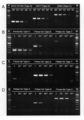
- Figure 1A detected type A, type B, and type C fimA using a PCR system using genomic DNA extracted from cultures of representative strains with type A, type B, and type C fimA. Results are shown.
- Figures 1B-D show typical Type A, Type B, and Type C fimA detection results when using DNA samples extracted from oral samples of dogs whose volume was determined from the initial concentration to 10 -3 Indicates.
- Porphyromonas gulae is a resident bacteria in the oral cavity of dogs and was found to be a causative agent for periodontal disease (Kato, Y., et al. , 2011. Journal of Veterinary Dentistry 28, 84-89.). Porphyromonas gulae fimbrillin FimA can be divided into three major genotypes; type A, type B and type C, of which type C is highly pathogenic for periodontitis, Pathogenicity was shown to be weakened as type B and type A (WO2013 / 089166, Nomura, R. et al., 2012. Journal of Veterinary Medical Sciences 74, 885-891., Yamasaki, Y. et al., 2012. Veterinary Microbiology 28, 196-205.).
- the inventors of the present invention further investigated Porphyromonas gulae fimbrillin FimA and found that Porphyromonas gulae fimA type A, type B and type C were found in the oral cavity of mitral regurgitation dogs. Of these, it was found that type C was significantly more abundant. In addition, based on such correlation, it suggests that Porphyromonas gulae itself has some influence on the mitral valve in the dog body, so Porphyromonas gulae invades the body from the oral cavity, It was thought that the fungus itself or its constituents reached the mitral valve via blood and affected the mitral valve in the dog's body.
- the inventors of the present invention collect a sample such as saliva, plaque, calculus, oral wiping fluid, or blood-derived sample from the oral cavity or body of a dog subject, Check if there is a risk factor associated with Porphyromonas gulae and if the risk factor is present in the sample, the dog subject is at risk of having mitral regurgitation, or mitral valve
- the inventors have completed an invention of a method for diagnosing mitral regurgitation risk, which is diagnosed as having an onset risk of regurgitation.
- a method for diagnosing mitral regurgitation in dogs when referring to “a method for diagnosing mitral regurgitation in dogs”, a method for diagnosing whether a dog subject suffers from mitral regurgitation, a sample of the dog subject was collected It is intended to include methods such as predicting the likelihood of having mitral regurgitation at that time, and the likelihood that a dog subject will suffer mitral regurgitation in the future.
- a dog subject is likely to have mitral regurgitation at the time the sample is taken, and the dog subject is predicted to be more likely to have mitral regurgitation in the future
- a close examination can be performed by, for example, an X-ray, an electrocardiogram, an echo, or the like.
- mitral regurgitation is caused by the fact that the mitral valve between the left atrium and the left ventricle of the heart is not completely closed due to hardening, shortening, etc., and blood is released from the left ventricle when the left ventricle contracts. It means a state of refluxing to the left atrium.
- “diagnosis that a dog subject has a risk of having mitral regurgitation” means that the dog subject suffers from mitral regurgitation at the time the sample is collected. This means that it is determined that there is a high possibility.
- mitral regurgitation determines that a dog subject is likely to suffer from mitral regurgitation in the future Means that.
- the sample collected from the dog subject contains Porphyromonas gulae type C fimbrillin FimA, or (ii) the Porphyromonas gulae type A in the sample collected from the dog subject.
- the method for diagnosing mitral regurgitation according to the present invention uses a dog as a subject, and any dog can be used regardless of breed, body size, age, sex, etc. This method can also be applied to other dogs.
- the risk factor is “(i) a sample collected from a dog subject is a Porphyromonas gulae type C fimbrillin FimA”.
- ⁇ Contains '', and in the obtained sample, examine whether the risk factor Porphyromonas gulae type C FimA ⁇ ⁇ is included, and the sample contains Porphyromonas gulae type C FimA If so, the dog subject from whom the sample was taken is diagnosed as being at risk of developing mitral regurgitation or at risk of developing mitral regurgitation.
- the risk factor is “(ii) Porphyromonas gulae type A fimbrillin (fimbrillin) in a sample collected from a dog subject. ) The highest level of Porphyromonas gulae type C FimA compared to each level of FimA and Porphyromonas gulae type B FimA.
- a sample collected from a dog subject is serially diluted to prepare two or more samples, and Porphyromonasegulae type A FimA, type B in the two or more samples. Detects each content signal of FimA and Type C FimA, and the sample with the lowest concentration in which a signal containing Type C FimA is detected is the lowest concentration in which each signal containing Type A FimA and Type B FimA is detected.
- the subject is at risk of having mitral regurgitation when the concentration of Porphyromonas gulae type C FimA is highest when the sample is at a lower concentration than each sample of mitral valve closure or mitral valve closure It can be diagnosed as having the risk of developing a deficiency.
- the present invention examines the presence of risk factors, (I) a step of examining whether or not Porphyromonas gulae type C FimA is contained in a sample collected from a dog subject; (Ii-1) By examining the content levels of Porphyromonas gulae type A FimA, Porphyromonas gulae type B FimA and Porphyromonas gulae type C FimA and comparing them respectively, Porphyromonas gulae type C FimA (Ii-2) Step dilution of a sample collected from a dog subject to prepare two or more samples, and Porphyromonas gulae type A in the two or more samples Fimbrillin FimA, Porphyromonas gulae type B FimA and Porphyromonas gulae type C FimA content signals were detected, and Porphyromonas gulae type C FimA content signals were detected.
- Porphyromonas gulae type A FimA and Porphyromonas gulae type B FimA containing signals are lower in concentration than the lowest concentration of each detected sample. Step containing levels of FimA the flop C identifies the highest, Any one of the above is performed.
- Porphyromonas gulae type A FimA, type B FimA and / or type C FimA which are the detection targets in the present invention, can be quantitatively examined.
- a method for examining the presence of such risk factors a method for examining at the nucleic acid sequence level or a method for examining at the amino acid sequence level can be used.
- each type of Porphyromonas gulae FimA gene PCR method As a method for examining the presence of a detection target in the present invention (ie, Porphyromonas ⁇ ⁇ ⁇ gulae type A FimA, type B FimA and / or type C FimA) at the nucleic acid sequence level, each type of Porphyromonas gulae FimA gene PCR method, Northern hybridization method, method using a diagnostic chip in which each nucleotide having a complementary sequence to each of fimA type A, type B and type C is bound in different wells, etc. Any of the known expression analysis methods may be used, and at present, the PCR method or a modification method thereof is generally used.
- each type of Porphyromonas gulae type A FimA, type B FimA and / or type C FimA is used for ELISA method, Western hybridization method, diagnostic chip that binds each antibody specific for target protein.
- Any known protein analysis method such as a method may be used, and at present, the PCR method or a modification method thereof is generally used.
- Porphyromonas gulae FimA type A is a type having a sequence specific to Porphyromonas gulae
- FimA type B is a type having a sequence similar to Porphyromonas gingivalis type III, type C.
- Porphyromonas gulae type A FimA has a characteristic amino acid sequence not found in other types of FimA (type B or type C).
- This characteristic amino acid sequence is an amino acid sequence portion corresponding to the nucleotide sequence portion of SEQ ID NO: 23 or SEQ ID NO: 24, and the amino acid sequence 1 to 383 of the amino acid sequence of SEQ ID NO: 2 or 83 to It has the 145th amino acid sequence and the like.
- Porphyromonas gulae type B FimA has a characteristic amino acid sequence not found in other types of FimA (type A or type C).
- This characteristic amino acid sequence is an amino acid sequence portion corresponding to the nucleotide sequence portion of SEQ ID NO: 25 or SEQ ID NO: 26, and the amino acid sequence 1 to 386 of the amino acid sequence of SEQ ID NO: -4 or 178- It has the 295th amino acid sequence.
- Porphyromonas gulae type C FimA has a characteristic amino acid sequence not found in other types of FimA (type A or type B).
- This characteristic amino acid sequence is the amino acid sequence portion corresponding to the nucleotide sequence portion of SEQ ID NO: 21 or SEQ ID NO: 22 and is the 11th to 388th amino acid sequence of the amino acid sequence of SEQ ID NO: -6 or 104 to It has the 313th amino acid sequence and the like.
- the nucleotide sequence characteristic to each type does not define the in-frame nucleotide sequence, so that both ends of the amino acid sequence are strictly defined. It may not be what was done.
- the nucleotide sequence of type C SEQ ID NO: 21 the 1st to 388th amino acid sequence or the 104th to 313th amino acid sequence was given as an example as described above.
- addition and shortening of ⁇ 2 amino acids can be allowed.
- ATCC 51700 is selected as a representative Porphyromonas gulae having a type A fimA, the nucleotide sequence of the fimA is shown as SEQ ID NO: 1, and the type A FimA of the type A encoded by the sequence is shown.
- the amino acid sequence is shown as SEQ ID NO: 2.
- Select D044 as a representative Porphyromonas gulae with type B fimA, its nucleotide sequence is shown as SEQ ID NO: 3, and the amino acid sequence of type B FimA encoded by that sequence is shown as SEQ ID NO: 4 .
- D049 as a representative Porphyromonas gulae with type C fimA, its nucleotide sequence is shown as SEQ ID NO: 5, and the amino acid sequence of type C FimA encoded by that sequence is SEQ ID NO: 6 As shown.
- examples of bacterial strains having type A FimA include D024, D025, D028, D034, D035, D036, D042, D043, D060, D066, D067 and D068, ATCC51700, etc. It is done.
- Examples of bacterial strains having type B FimA include D040, D044, D052, D053, D077 and B43.
- An example of a bacterial strain having type C FimA is D049.
- a sample such as saliva, plaque, calculus, oral wiping fluid, or a blood-derived sample is collected from the oral cavity or body (blood) of a dog. Extract the bacterial DNA present in this.
- Porphyromonas gulae DNA contained in this bacterial DNA as a template a primer set specific to Porphyromonas gulae [5'-ttg ctt ggt tgc atg atc gg-3 '(SEQ ID NO: 7) and 5' Porphyromonas gulae is detected by initial (primary) screening using -gct tat tct tac ggt aca ttc aca-3 '(SEQ ID NO: 8)]. Samples that were positive for this initial (primary) screening are further examined to determine if the samples contain Porphyromonas gulae type C FimA.
- nucleotide sequence of the sequence SEQ ID NO: 21 or SEQ ID NO: 22 (type C) is amplified, but SEQ ID NO: 23 or SEQ ID NO: 24 (type A) and SEQ ID A primer set that does not amplify the nucleotide sequence of each sequence of NO: 25 or SEQ ID NO:) 26 (type B) can be used.
- an antibody specific for a polypeptide comprising the amino acid sequence of Porphyromonas gulae type C FimA or an antigen of the antibody Derivatives containing binding sites can also be used to detect Porphyromonas gulae type C FimA protein. Specifically, for example, it binds to a polypeptide consisting of the amino acid sequence of SEQ ID NO: 6 (type C), but SEQ ID NO NO: 2 (type A) and SEQ ID NO: 4 (type B). An antibody or a derivative thereof that does not bind to a polypeptide consisting of each amino acid sequence can be used.
- Such an antibody or a derivative thereof can be used as long as it is specific for Porphyromonas gulae type C FimA, and may be a polyclonal antibody or a monoclonal antibody. From the viewpoint of availability, a monoclonal antibody is preferable.
- Monoclonal antibodies that can be used in the present invention include those produced by hybridomas and those produced by hosts transformed with expression vectors containing antibody genes by genetic engineering techniques.
- the content levels of type A and type B are also the same as in the case of type C. It can be examined in the same way.
- each primer set specific for type A fimA and each specific for type B fimA as described above for the step of examining type C You may investigate by PCR using a primer set.
- the primer set that can be used in the present embodiment is not particularly limited.
- a primer set specific to type A fimA a polynucleotide consisting of a nucleotide sequence of SEQ ID NO: NO 1 or SEQ ID NO: NO 23 or SEQ ID ID ID
- a primer set specific to a polynucleotide consisting of NO: 24 nucleotide sequence and a primer set specific to type B fimA a polynucleotide consisting of a nucleotide sequence of SEQ ID NO: ⁇ ⁇ 3 or SEQ ID NO: 25 or A primer set specific for a polynucleotide comprising the nucleotide sequence of SEQ ID NO: 26 can be used.
- primer sets specific to Porphyromonas gulae type A fimA are [5'-tga gaa tat caa atg tgg tgc agg ctc acg-3 '(SEQ ID NO: 9) and 5 '-ctt gcc tgc ctt caa aac gat tgc ttt tgg-3' (SEQ ID NO: 10)] primer set, [5'-ttc ata cgt cga cga ctg cg-3 '(SEQ ID NO: 15) and 5'-ttg agg gtt gat tac caa gt-3 '(SEQ ID NO: 16)], and a primer set specific for Porphyromonas gulae type B fimA is [5'-taa gat tga agt gaa gat gag cga ttc tta
- the content level of Porphyromonas gulae type A FimA and type B FimA is examined in the same manner as described above for the step of examining type C.
- the process may examine each level of inclusion using each antibody specific to Porphyromonas ona gulae type A and each type B FimA, or each derivative containing the antigen binding site of those antibodies.
- the antibody or derivative thereof that can be used in the present embodiment is not particularly limited. For example, it binds to a polypeptide consisting of the amino acid sequence of SEQ ID NO: II as an antibody specific to FimA of type A or a derivative thereof.
- Antibody or its derivative that does not bind to a polypeptide consisting of the amino acid sequence of SEQ ID NO: 4 (type B) or a polypeptide consisting of the amino acid sequence of SEQ ID NO: 6 (type C) is specific to type B FimA
- As a basic antibody or derivative thereof it binds to a polypeptide consisting of the amino acid sequence of SEQ ID NO: 4 but a polypeptide consisting of the amino acid sequence of SEQ ID NO: 2 (type A) or the amino acid sequence of SEQ ID NO: 6
- Monoclonal antibody-producing hybridomas against Porphyromonas gulae type A, type B or type C FimA proteins can be prepared using known techniques, for example, as follows. First, Porphyromonas gulae type A, type B or type C FimA protein is used as a sensitizing antigen, and this is immunized according to a normal immunization method. Immune cells obtained from an immunized animal are fused with known parent cells by a conventional cell fusion method to obtain a hybridoma. Furthermore, hybridomas that produce antibodies specific to Porphyromonas gulae type A, type B, or type C FimA can be selected from these hybridomas by screening cells that produce the desired antibody by a conventional screening method. .
- each type of FimA can be compared by a known method such as RT-PCR method when examining at the nucleic acid sequence level, and ELISA method when examining at the amino acid sequence level.
- a known method such as RT-PCR method when examining at the nucleic acid sequence level
- ELISA method when examining at the amino acid sequence level.
- it can also be compared as follows, for example.
- a dilution series consisting of a plurality of materials may be prepared by serially diluting a sample collected from a dog subject. Since more accurate sample variations can be diagnosed more accurately, it is preferable to prepare two or more samples having different concentrations, more preferably three or more, and even more preferably four or more. When preparing four samples with different concentrations, for example, in the case of 1/10 step dilution, the sample of the stock solution, and the sample with the concentration of 1/10, 1/100 and 1/1000 of the sample It is preferable to prepare.
- each fimA in each sample or each FimA content signal may be examined.
- the content level of type A fimA in the sample is SEQ ID NO: 1, SEQ ID NO: 23 or SEQ ID NO: 24, and the content level of type B FimA in the sample is SEQ ID NO: 3, SEQ ID NO: 25 or SEQ ID NO: 26, the content level of type C FimA in the sample is specific for each polynucleotide consisting of the nucleotide sequence of SEQ ID NO: 5, SEQ ID NO: 21 or SEQ ID NO: 22.
- the content level of type A FimA in the sample is SEQ ID NO: 2
- the content level of type B FimA in the sample is SEQ ID NO: 4
- the content level of type C FimA in the sample is SEQ ID NO: 6.
- This embodiment which compares the content level of type A and type B of Porphyromonas gulae with the content level of type C, is more accurate than the embodiment of examining the presence or absence of type C of Porphyromonas gulae FimA. Diagnosis of the risk of valve regurgitation or the risk of developing mitral regurgitation becomes possible.
- the present invention that can diagnose the risk of mitral regurgitation and the onset risk of mitral regurgitation is useful.
- Methods for preventing canine mitral regurgitation or inhibiting progression of canine mitral regurgitation Subject has risk of developing mitral regurgitation or risk of developing mitral regurgitation Prevention of canine mitral regurgitation or canine mitral regurgitation by reducing the number of Porphyromonas gulae with type C FimA in the oral cavity or in the body The progression of insufficiency can be suppressed.
- the number of Porphyromonas gulae having type C FimA that the subject has in the oral cavity or in the body for example, removal of plaque or tartar of the subject, cleaning of the subject in the oral cavity or medicine to the subject This can be done by administration.
- a medicine containing a monoclonal antibody specific for a polypeptide consisting of the amino acid sequence of SEQ ID NO: 6 or a derivative containing an antigen binding site of the antibody as an active ingredient can be used. It can be used in the oral cavity in the form of an oral spray, gel, etc., or may be introduced into the blood orally or parenterally.
- Biomarkers for diagnosing the risk of canine mitral regurgitation or the risk of developing canine mitral regurgitation include a risk for canine mitral regurgitation or a canine monkey It is a biomarker for diagnosis of the risk of onset of valvular insufficiency.
- the diagnostic biomarker according to an embodiment of the present invention is composed of a polynucleotide having a nucleotide sequence of SEQ ID NO: 5.
- a diagnostic biomarker according to another embodiment of the present invention consists of a polynucleotide comprising the nucleotide sequence of SEQ ID NO: 21 or SEQ ID NO: 22.
- a diagnostic biomarker according to another embodiment of the present invention consists of a polypeptide consisting of the amino acid sequence of SEQ ID NO: 6 or a partial polypeptide thereof.
- the biomarker according to the present invention When the biomarker according to the present invention is detected from a subject, it can be diagnosed as having a risk of canine mitral regurgitation or a risk of developing canine mitral regurgitation.
- a pharmaceutical for preventing canine mitral regurgitation or suppressing progression of canine mitral regurgitation is a polypeptide comprising the amino acid sequence of SEQ ID NO: 6, or a polypeptide thereof
- a monoclonal antibody specific for a partial polypeptide or a derivative containing the antigen-binding site of the antibody It is a medicine.
- Mitral valve insufficiency by administering a medicament according to the present invention, for example, to a subject diagnosed as having a risk of having mitral regurgitation or at risk of developing mitral regurgitation Prevention or progression of mitral regurgitation.
- Diagnostic kit for canine mitral regurgitation Other embodiments of the invention include canine mitral valve closure comprising a primer set for classifying Porphyromonas gulae FimA into Type A, Type B and Type C This is a diagnostic kit for insufficiency.
- One embodiment of the diagnostic kit of the present invention includes a primer set specific for each type A, type B and type C fimA of Porphyromonas gulae.
- a primer set specific to Porphyromonas gulae type A fimA [5'-tga gaa tat caa atg tgg tgc agg ctc acg-3 '(SEQ ID NO: 9) and 5'- ctt gcc tgc ctt caa aac gat tgc ttt tgg-3 '(SEQ ID NO: 10)], or 5'-ttc ata cgt cga cga ctg cg-3' (SEQ ID NO: 15) and 5'-ttg agg gtt gat tac caa gt-3 '(SEQ ID NO: 16)], specific primer set for Porphyromonas gulae type B fimA
- the diagnostic kit according to another embodiment of the present invention includes antibodies specific for each of Porphyromonas gulae type A, type B and type C FimA, respectively, or derivatives thereof.
- Diagnostic Chip for Canine Mitral Regurgitation Another embodiment of the present invention is a diagnostic chip for canine mitral regurgitation. By adding a sample to this chip, the content level of Porphyromonas gulae type A, type B and type C FimA in the sample can be detected at one time to diagnose mitral regurgitation in dogs. it can.
- a canine mitral regurgitation chip is a chip having a plurality of wells, each of Porphyromonas gulae type A, type B and type C fimA. Each nucleotide having a sequence complementary to each other is bound in a different well.
- the diagnostic chip for canine mitral regurgitation includes Porphyromonas gulae type A, type B and type C FimA specific antibodies or derivatives thereof, respectively. Combined in different wells.
- Example 1 Sample collection In this example, samples were collected from the oral cavity of various dogs.
- 36 healthy dogs (19 males, 17 females, 10.6 ⁇ 0.4 years old) in the control group were abnormal due to physical examination, chest radiographs, electrocardiography, and echocardiographic findings None of the individuals had unusual heart symptoms.
- Example 2 Evaluation of oral symptoms in dogs from which samples were collected
- oral symptoms in dogs from which samples were collected were examined using the following parameters for calculus volume, gingivitis and periodontitis: It was.
- the calculus score for calculus accumulation was evaluated for the condition of the representative tooth (fourth premolar or first molar) according to the following criteria: (3) more than half area, (2) less than half area, (1) tooth Slightly on the edge, and (0) None.
- the gingival score for gingival inflammation was evaluated according to the following criteria: (3) significant inflammation in the entire dentition, (2) significant inflammation in some dentitions, (1) tooth edges Slight inflammation is seen only at the edges, and (0) no significant findings.
- Periodontal scores for periodontitis were evaluated as follows: (3) tooth wobble with severe attachment loss, (2) attachment loss is seen in more than a quarter of the teeth, but tooth wobble None, (1) There is attachment loss in less than a quarter of the entire tooth, and (0) No significant findings. For each score, an average value and a standard error in the MR group and the control group were calculated. The results are shown in Table 1.
- Example 3 Sample classification based on Porphyromonas gulae FimA type
- samples were classified based on the Porphyromonas gulae FimA type contained in each sample.
- the PCR amplification reaction consisted of initial denaturation at 95 ° C for 4 minutes followed by 30 cycles of 95 ° C for 30 seconds, 60 ° C for 30 seconds and 72 ° C for 30 seconds, and 72 ° C for 7 minutes.
- the cycle parameters were used as the final extension of the thermal cycler (iCycler; Bio-Rad, Hercules, CA, USA).
- the resulting PCR product was electrophoresed in 1.5% agarose gel-Tris-acetic acid-EDTA buffer. The gel was then stained with 0.5 ⁇ g / ml ethidium bromide and photographed under UV illumination to detect amplified fragments.
- a 100-bp DNA ladder (New England Biolabs, Beverly, MA, USA) was used as a molecular size marker.
- DNA was extracted from 100 or more Porphyromonas gulae in each Porphyromonas gulae positive sample.
- FIGS. 1B to 1D Representative results for each sample positive for Porphyromonas gulae are shown in FIGS. 1B to 1D.
- FimA is type C Porphyromonas gulae is present in the dog's mouth and the dog is mitral It shows that there is a correlation with being incomplete.
- Table 3 shows the frequency distribution of Porphyromonas gulae and its fimA genotype in oral samples obtained from the MR group and the control group. Porphyromonas gulae was detected in almost all samples of both groups.
- the control group had significantly more type A dominant samples than the MR group (P ⁇ 0.05).
- the MR group had significantly more type C dominant samples than the control group (P ⁇ 0.05).
- the odds ratios for detection of type A dominant and type C dominant in the MR group were 0.22 and 3.82, respectively.
- the method of the present invention makes it possible to diagnose whether a dog is at risk of developing mitral regurgitation or at risk of developing mitral regurgitation, and canine mitral regurgitation Prevention of progression or the progression of canine mitral regurgitation.
- SEQ ID NO: 1 Nucleotide sequence of fimA gene coding for fimbrillin, fimA of ATCC51700, a standard strain (type A) of Porphyromonas gulae.
- SEQ ID NO: 2 FimA amino acid sequence encoded by the nucleotide sequence of SEQ ID NO: 1.
- SEQ ID NO: 3 Nucleotide sequence of the fimA gene encoding Porphyromonas gulae type B FimA.
- SEQ ID NO: IV4 FimA amino acid sequence encoded by the nucleotide sequence of SEQ ID NO: IV3.
- SEQ ID NO: 5 nucleotide sequence of fimA gene encoding Porphyromonas gulae type C FimA.
- SEQ ID NO: 6 Amino acid sequence of FimA encoded by the nucleotide sequence of SEQ ID NO: 5.
- SEQ ID NO: 7 and SEQ ID NO: 8 Primer sets specific for Porphyromonas gulae.
- SEQ ID NO: 9 and SEQ ID NO: 10 Primer pair used to amplify a partial sequence of the nucleotide sequence of the type A fimA gene of Porphyromonas gulae.
- SEQ ID NO: 11 and SEQ ID NO: 12 Primer pairs used to amplify a partial sequence of the nucleotide sequence of the type B fimA gene of Porphyromonas gulae.
- SEQ ID NO: 13 and SEQ ID NO: 14 Primer pairs used to amplify a partial sequence of the nucleotide sequence of the type C fimA gene of Porphyromonas gulae.
- SEQ ID NO: 15 and SEQ ID NO: 16 Primer pair used to amplify the nucleotide sequence of type A fimA gene of Porphyromonas gulae.
- SEQ ID NO: 17 and SEQ ID NO: 18 Primer pair used to amplify the nucleotide sequence of type B fimA gene of Porphyromonas gulae.
- SEQ ID NO: 19 and SEQ ID NO: 20 Primer pair used to amplify the nucleotide sequence of the type C fimA gene of Porphyromonas gulae.
- SEQ ID NO: 21 Partial sequence of the nucleotide sequence of the Porphyromonas gulae type C fimA gene amplified with a primer pair of SEQ ID NO: 13 and SEQ ID NO: 14.
- SEQ ID NO: 22 Partial sequence of the nucleotide sequence of the Porphyromonas gulae type C fimA gene amplified with a primer pair of SEQ ID NO: 19 and SEQ ID NO: 20.
- SEQ ID NO: 23 Partial sequence of the nucleotide sequence of the Porphyromonas gulae type A fimA gene amplified with a primer pair of SEQ ID NO: 9 and SEQ ID NO: 10 combination.
- SEQ ID NO: 24 Partial sequence of the nucleotide sequence of the Porphyromonas gulae type A fimA gene amplified by a primer pair of SEQ ID NO: 15 and SEQ ID NO: 16 combination.
- SEQ ID NO: 25 partial sequence of the Porphyromonas gulae type B fimA gene amplified with a primer pair of SEQ ID NO: 11 and SEQ ID NO: -12 combination.
- SEQ ID NO: 26 Partial sequence of the nucleotide sequence of the Porphyromonas gulae type B fimA gene amplified by a primer pair of SEQ ID NO: 17 and SEQ ID NO: 18 combination.
Landscapes
- Health & Medical Sciences (AREA)
- Life Sciences & Earth Sciences (AREA)
- Chemical & Material Sciences (AREA)
- Engineering & Computer Science (AREA)
- Bioinformatics & Cheminformatics (AREA)
- Organic Chemistry (AREA)
- Biotechnology (AREA)
- Wood Science & Technology (AREA)
- Zoology (AREA)
- Immunology (AREA)
- General Health & Medical Sciences (AREA)
- Genetics & Genomics (AREA)
- Microbiology (AREA)
- Biochemistry (AREA)
- Biomedical Technology (AREA)
- Medicinal Chemistry (AREA)
- Molecular Biology (AREA)
- Physics & Mathematics (AREA)
- General Engineering & Computer Science (AREA)
- Analytical Chemistry (AREA)
- Biophysics (AREA)
- Pathology (AREA)
- General Physics & Mathematics (AREA)
- Urology & Nephrology (AREA)
- Hematology (AREA)
- Proteomics, Peptides & Aminoacids (AREA)
- Plant Pathology (AREA)
- Veterinary Medicine (AREA)
- Public Health (AREA)
- Tropical Medicine & Parasitology (AREA)
- Virology (AREA)
- Cell Biology (AREA)
- Animal Behavior & Ethology (AREA)
- Epidemiology (AREA)
- Food Science & Technology (AREA)
- Pharmacology & Pharmacy (AREA)
- Mycology (AREA)
- Sustainable Development (AREA)
- Peptides Or Proteins (AREA)
- Measuring Or Testing Involving Enzymes Or Micro-Organisms (AREA)
Abstract
本発明は、イヌの僧帽弁閉鎖不全症のリスク診断方法、予防方法及び進行を抑制する方法を提供することを課題とする。 イヌ被検体から採取した試料が、SEQ ID NO: 6のアミノ酸配列を有する、Porphyromonas gulaeのタイプCのフィンブリリン(fimbrillin)FimAを含有しているか否かを調べる工程と、前記試料がPorphyromonas gulaeのタイプCのFimA を含有する場合に、前記イヌ被検体は僧帽弁閉鎖不全症であるリスクを有し又は僧帽弁閉鎖不全症の発症リスクを有すると診断する工程と、を有するイヌの僧帽弁閉鎖不全症のリスク診断方法。
Description
本発明は、イヌ歯周病の原因菌と考えられているPorphyromonas gulaeのフィンブリリンタンパク(Fimbrillin)FimAのタイプによりイヌの僧帽弁閉鎖不全症を診断することに関する。
僧帽弁閉鎖不全は、イヌにおいて生じる心臓血管疾患の中でも最も一般的なタイプの疾患の一つであり(非特許文献1、非特許文献2)、そして慢性的な進行により特徴づけられ、その症状が時間の経過とともに中程度~重度へと悪化する(非特許文献3)。慢性の心疾患のイヌのおよそ75%が、僧帽弁閉鎖不全を有する(非特許文献2)。
僧帽弁閉鎖不全症のイヌは、僧帽弁や僧帽弁を動かすための構造に変性を有しており、弁が完全には閉鎖しない。このため、左心室が収縮して全身に血液を送り出すときに、左心房に血液が逆流する。この逆流の影響で左心房が徐々に肥大していき、その後、右心系にも異常が生じる。こうして症状が進行すると、心臓に戻る血液の欝滞が起こり、胸水や腹水が溜まるようになる。心臓機能が落ちるために疲れやすくなるほか、肺に水が溜まり呼吸困難に陥る場合もある。結果的に動物の生活の質(QOL)が大きく低下する。
現在、健康診断では、レントゲン、心電図、エコーなどにより僧帽弁閉鎖不全の有無を確認している。しかし、このような方法では僧帽弁閉鎖不全の発生を阻止できない。
また、一旦僧帽弁閉鎖不全を発症してしまうと、僧帽弁の変性を抑制する治療方法はなく、食事療法や体重管理、運動制限、そして血管拡張剤などの投薬といった、症状を緩和させる処置が主体となる。手術により人工弁に置き換えるといった外科的な治療方法もあるが、心臓の拍動を止めて行う大掛かりな手術であり、死亡するリスクも高く、あまり行われない。
Serfass, P., et al., 2006. J Vet Cardiol. 8:11-18.
Atkins, C., et al., 2009. J Vet Intern Med. 23:1142-1150.
Borgarelli, M., et al., 2008. J Vet Intern Med. 22:120-128.
本発明は、イヌの僧帽弁閉鎖不全症のリスク診断方法、予防方法及び進行を抑制する方法を提供することを課題とする。
本発明の発明者らは、口腔内に線毛を形成するタンパク質フィンブリリンタンパク(Fimbrillin)FimAがタイプCであるPorphyromonas gulaeが存在することとイヌの僧帽弁閉鎖不全症とのあいだに相関性を見出し、本発明を完成した。
本発明は、一態様において、イヌの僧帽弁閉鎖不全症のリスク診断方法であって、
イヌ被検体から採取した試料中に、Porphyromonas gulaeが関連するリスク因子が存在するか否かを調べる工程と、
前記試料中に前記リスク因子が存在する場合に、前記イヌ被検体が僧帽弁閉鎖不全症であるリスクを有し又は僧帽弁閉鎖不全症の発症リスクを有すると診断する工程と、
を有する方法を提供する。このリスク診断方法において調べる対象であるイヌ被検体から採取した試料としては、唾液、歯垢、歯石、口腔拭い液、又は血液由来試料などを使用することができる。
イヌ被検体から採取した試料中に、Porphyromonas gulaeが関連するリスク因子が存在するか否かを調べる工程と、
前記試料中に前記リスク因子が存在する場合に、前記イヌ被検体が僧帽弁閉鎖不全症であるリスクを有し又は僧帽弁閉鎖不全症の発症リスクを有すると診断する工程と、
を有する方法を提供する。このリスク診断方法において調べる対象であるイヌ被検体から採取した試料としては、唾液、歯垢、歯石、口腔拭い液、又は血液由来試料などを使用することができる。
このリスク診断方法において、Porphyromonas gulaeが関連するリスク因子は、
(i)イヌ被検体から採取した試料が、Porphyromonas gulaeのタイプCのフィンブリリン(fimbrillin)FimAを含有していること、または
(ii) イヌ被検体から採取した試料中に、Porphyromonas gulaeのタイプAのフィンブリリン(fimbrillin)FimA、及びPorphyromonas gulaeのタイプBのFimAの含有レベルと比較して、Porphyromonas gulaeのタイプCのFimAの含有レベルが最も高いこと、
のいずれかである。この様なリスク因子は、核酸配列レベルまたはタンパク質レベルのいずれかの方法により、特定することができる。
(i)イヌ被検体から採取した試料が、Porphyromonas gulaeのタイプCのフィンブリリン(fimbrillin)FimAを含有していること、または
(ii) イヌ被検体から採取した試料中に、Porphyromonas gulaeのタイプAのフィンブリリン(fimbrillin)FimA、及びPorphyromonas gulaeのタイプBのFimAの含有レベルと比較して、Porphyromonas gulaeのタイプCのFimAの含有レベルが最も高いこと、
のいずれかである。この様なリスク因子は、核酸配列レベルまたはタンパク質レベルのいずれかの方法により、特定することができる。
本発明の他の実施態様として、イヌの僧帽弁閉鎖不全症の予防又はイヌの僧帽弁閉鎖不全症の進行を抑制する方法であって、イヌ被検体が僧帽弁閉鎖不全症であるリスクを有し又は僧帽弁閉鎖不全症の発症リスクを有すると診断された場合に、前記イヌ被検体が口腔内又は体内に有するタイプCのFimAを有するPorphyromonas gulaeの数を低減させる工程を有する、前記方法もまた提供する。この態様において、前記イヌ被検体が口腔内又は体内に有するタイプCのFimAを有するPorphyromonas gulaeの数を、前記イヌ被検体の歯垢又は歯石を除去することにより、前記イヌ被検体の口腔を洗浄することにより低減させることにより、あるいは前記イヌ被検体に医薬を投与することにより低減させることにより、低減させてもよい。前記医薬は、SEQ ID NO: 6のアミノ酸配列からなるポリペプチドに特異的なモノクローナル抗体又はその誘導体を有効成分とする医薬であってもよい。
本発明の他の実施態様として、SEQ ID NO:21のヌクレオチド配列からなるポリヌクレオチドを含むか、またはSEQ ID NO: 6のアミノ酸配列またはその部分アミノ酸配列からなるポリペプチドからなる、イヌの僧帽弁閉鎖不全症のリスク又はイヌの僧帽弁閉鎖不全症の発症リスクの診断用バイオマーカーを提供する。
本発明の他の実施態様として、SEQ ID NO: 6のアミノ酸配列からなるポリペプチドに特異的なモノクローナル抗体又はその誘導体を有効成分とする、イヌの僧帽弁閉鎖不全症の予防又はイヌの僧帽弁閉鎖不全症の進行を抑制するための医薬を提供する。
この他にも、本発明の実施態様として、Porphyromonas gulaeのフィンブリリン(fimbrillin)FimAのタイプA、タイプB及びタイプCに分類するためのプライマーセットを含む、イヌの僧帽弁閉鎖不全症の診断用キット;Porphyromonas gulaeのFimAのタイプA、タイプB及びタイプCそれぞれに特異的な各抗体又はそれらの誘導体を含む、イヌの僧帽弁閉鎖不全症の診断用キット;フィンブリリン(fimbrillin)fimAのタイプA、タイプB及びタイプCそれぞれに相補的な配列を有する各ヌクレオチドがそれぞれ異なるウェル内に結合されているか、またはフィンブリリン(fimbrillin)FimAのタイプA、タイプB及びタイプCそれぞれに特異的な各抗体又はそれらの誘導体がそれぞれ異なるウェル内に結合されている、イヌの僧帽弁閉鎖不全症の診断用チップ;を提供することができる。
本発明の方法により、唾液、歯垢、歯石、口腔拭い液、又は血液由来試料などの容易に入手可能な試料を使用して、イヌが僧帽弁閉鎖不全症であるリスクを有し又は僧帽弁閉鎖不全症の発症リスクを有するか診断することが可能になり、また、イヌの僧帽弁閉鎖不全症の予防又はイヌの僧帽弁閉鎖不全症の進行を抑制することが可能になる。
イヌの僧帽弁閉鎖不全症のリスク診断方法
Porphyromonas gulaeはイヌの口腔内に常在する菌であり、歯周病の原因菌であることが見出された(Kato, Y., et al., 2011. Journal of Veterinary Dentistry 28, 84-89.)。Porphyromonas gulaeのフィンブリリン(fimbrillin)FimAは、3つの主要な遺伝子タイプ;タイプA、タイプBおよびタイプCに分類することができ、そのうちタイプCが歯周炎に対して高度に病原性であり、病原性はタイプB、タイプAと弱まることが示された(WO2013/089166、Nomura, R.et al., 2012. Journal of Veterinary Medical Sciences 74, 885-891.、Yamasaki, Y. et al., 2012. Veterinary Microbiology 28, 196-205.)。
Porphyromonas gulaeはイヌの口腔内に常在する菌であり、歯周病の原因菌であることが見出された(Kato, Y., et al., 2011. Journal of Veterinary Dentistry 28, 84-89.)。Porphyromonas gulaeのフィンブリリン(fimbrillin)FimAは、3つの主要な遺伝子タイプ;タイプA、タイプBおよびタイプCに分類することができ、そのうちタイプCが歯周炎に対して高度に病原性であり、病原性はタイプB、タイプAと弱まることが示された(WO2013/089166、Nomura, R.et al., 2012. Journal of Veterinary Medical Sciences 74, 885-891.、Yamasaki, Y. et al., 2012. Veterinary Microbiology 28, 196-205.)。
本発明の発明者らは、Porphyromonas gulaeのフィンブリリン(fimbrillin)FimAについてさらに調査したところ、僧帽弁閉鎖不全症のイヌの口腔内には、Porphyromonas gulaeのfimAのタイプA、タイプBおよびタイプCのうち、タイプCが有意に多く含まれていることを見出した。また、この様な相関性に基づいて、Porphyromonas gulae自体がイヌの体内の僧帽弁に何らかの影響を与えていることを示唆していることから、Porphyromonas gulaeは、口腔内から体内に侵入し、菌自体もしくは菌の構成成分が血液を介して僧帽弁まで到達し、イヌの体内の僧帽弁に影響を与えていると考えられた。
本知見に基づいて、本発明の発明者らは、イヌ被検体の口腔や体内から、唾液、歯垢、歯石、口腔拭い液、又は血液由来試料などの試料を採取して、その試料中にPorphyromonas gulaeが関連するリスク因子が存在するか否かを調べ、前記試料中に前記リスク因子が存在する場合に、イヌ被検体が僧帽弁閉鎖不全症であるリスクを有し、又は僧帽弁閉鎖不全症の発症リスクを有すると診断する、僧帽弁閉鎖不全症のリスク診断方法の発明を完成させた。
本発明において、「イヌの僧帽弁閉鎖不全症のリスク診断方法」という場合、イヌ被検体が僧帽弁閉鎖不全症に罹患しているかを診断する方法、イヌ被検体が試料を採取された時点で僧帽弁閉鎖不全症に罹患していた可能性、及び、イヌ被検体が将来僧帽弁閉鎖不全症を罹患する可能性を予測する方法などを含むことを意図している。イヌ被検体が試料を採取された時点で僧帽弁閉鎖不全症に罹患していた可能性、及び、イヌ被検体が将来僧帽弁閉鎖不全症を罹患する可能性が高いと予測された場合には、さらなる精密検査により、実際に僧帽弁不全症を発症しているかの確認をすることができる。精密検査は、例えば、レントゲン、心電図、エコーなどにより行うことができる。
本発明において、僧帽弁閉鎖不全症は、心臓の左心房と左心室の間の僧帽弁が、硬化、短縮などにより完全には閉じなくなり、左心室が収縮する際に血液が左心室から左心房に逆流する状態を意味する。そして、本発明において、「イヌ被検体が僧帽弁閉鎖不全症であるリスクを有すると診断する」とは、イヌ被検体が試料を採取された時点で僧帽弁閉鎖不全症に罹患していた可能性が高いと判定することを意味する。また、本発明において、「イヌ被検体が僧帽弁閉鎖不全症の発症リスクを有すると診断する」とは、イヌ被検体が将来僧帽弁閉鎖不全症を罹患する可能性が高いと判定することを意味する。
上述した本発明において、「Porphyromonas gulaeが関連するリスク因子」という場合、
(i)イヌ被検体から採取した試料が、Porphyromonas gulaeのタイプCのフィンブリリン(fimbrillin)FimAを含有していること、または
(ii) イヌ被検体から採取した試料中に、Porphyromonas gulaeのタイプAのフィンブリリン(fimbrillin)FimA、及びPorphyromonas gulaeのタイプBのFimAの含有レベルと比較して、Porphyromonas gulaeのタイプCのFimAの含有レベルが最も高いこと、
を意味する。
(i)イヌ被検体から採取した試料が、Porphyromonas gulaeのタイプCのフィンブリリン(fimbrillin)FimAを含有していること、または
(ii) イヌ被検体から採取した試料中に、Porphyromonas gulaeのタイプAのフィンブリリン(fimbrillin)FimA、及びPorphyromonas gulaeのタイプBのFimAの含有レベルと比較して、Porphyromonas gulaeのタイプCのFimAの含有レベルが最も高いこと、
を意味する。
本発明の僧帽弁閉鎖不全症のリスク診断方法は、イヌを被検体とするものであり、イヌであれば犬種、身体のサイズ、年齢、性別などを問わないものであり、したがって、いずれのイヌに関しても適用することができる方法である。
本発明のイヌの僧帽弁閉鎖不全症のリスク診断方法の一実施形態では、リスク因子として、「(i)イヌ被検体から採取した試料が、Porphyromonas gulaeのタイプCのフィンブリリン(fimbrillin)FimAを含有していること」を選択し、得られた試料中に、リスク因子であるPorphyromonas gulaeのタイプCのFimAが含まれているか否かを調べ、試料にPorphyromonas gulaeのタイプCのFimA が含まれている場合に、その試料を採取したイヌ被検体が、僧帽弁閉鎖不全症であるリスクを有し又は僧帽弁閉鎖不全症の発症リスクを有すると診断する。
本発明のイヌの僧帽弁閉鎖不全症のリスク診断方法の別の実施形態では、リスク因子として、「(ii) イヌ被検体から採取した試料中に、Porphyromonas gulaeのタイプAのフィンブリリン(fimbrillin)FimA、及びPorphyromonas gulaeのタイプBのFimAの各含有レベルと比較して、Porphyromonas gulaeのタイプCのFimAの含有レベルが最も高いこと」を選択し、イヌ被検体から採取した試料中の、Porphyromonas gulaeのタイプAのFimA、タイプBのFimA及びタイプCのFimAの各含有レベルを調べ、それぞれを比較して、タイプA、タイプB及びタイプCの中で、タイプCのFimAの含有レベルが最も高い場合に、被検体は僧帽弁閉鎖不全症であるリスクを有し又は僧帽弁閉鎖不全症の発症リスクを有すると診断することができる。
また、この実施形態の別の方法として、イヌ被検体から採取した試料を階段希釈して、2以上の試料を用意し、前記2以上の試料中のPorphyromonas gulaeのタイプAのFimA、タイプBのFimA及びタイプCのFimAの各含有シグナルを検出し、タイプCのFimAの含有シグナルが検出された最低濃度の試料が、タイプAのFimA及びタイプBのFimAの各含有シグナルが検出された最低濃度の各試料よりも低い濃度の試料である場合に、Porphyromonas gulaeのタイプCのFimAの含有レベルが最も高い場合に、被検体は僧帽弁閉鎖不全症であるリスクを有し又は僧帽弁閉鎖不全症の発症リスクを有すると診断することができる。
上述した実施態様を含む本発明は、リスク因子の存在を調べるため、
(i) イヌ被検体から採取した試料中に、Porphyromonas gulaeのタイプCのFimAを含有しているか否かを調べる工程、
(ii-1) Porphyromonas gulaeのタイプAのFimA、Porphyromonas gulaeのタイプBのFimA及びPorphyromonas gulaeのタイプCのFimAの各含有レベルを調べ、それぞれを比較することにより、Porphyromonas gulaeのタイプCのFimAの含有レベルが最も高いこと特定する工程、または
(ii-2) イヌ被検体から採取した試料を階段希釈して、2以上の試料を用意し、前記2以上の試料中のPorphyromonas gulaeのタイプAのフィンブリリン(fimbrillin)FimA、Porphyromonas gulaeのタイプBのFimA及びPorphyromonas gulaeのタイプCのFimAの各含有シグナルを検出し、そしてPorphyromonas gulaeのタイプCのFimAの含有シグナルが検出された最低濃度の試料が、Porphyromonas gulaeのタイプAのFimA及びPorphyromonas gulaeのタイプBのFimAの各含有シグナルが検出された最低濃度の各試料よりも低い濃度の試料である場合に、Porphyromonas gulaeのタイプCのFimAの含有レベルが最も高いことを特定する工程、
のいずれかを行うことを特徴とする。
(i) イヌ被検体から採取した試料中に、Porphyromonas gulaeのタイプCのFimAを含有しているか否かを調べる工程、
(ii-1) Porphyromonas gulaeのタイプAのFimA、Porphyromonas gulaeのタイプBのFimA及びPorphyromonas gulaeのタイプCのFimAの各含有レベルを調べ、それぞれを比較することにより、Porphyromonas gulaeのタイプCのFimAの含有レベルが最も高いこと特定する工程、または
(ii-2) イヌ被検体から採取した試料を階段希釈して、2以上の試料を用意し、前記2以上の試料中のPorphyromonas gulaeのタイプAのフィンブリリン(fimbrillin)FimA、Porphyromonas gulaeのタイプBのFimA及びPorphyromonas gulaeのタイプCのFimAの各含有シグナルを検出し、そしてPorphyromonas gulaeのタイプCのFimAの含有シグナルが検出された最低濃度の試料が、Porphyromonas gulaeのタイプAのFimA及びPorphyromonas gulaeのタイプBのFimAの各含有シグナルが検出された最低濃度の各試料よりも低い濃度の試料である場合に、Porphyromonas gulaeのタイプCのFimAの含有レベルが最も高いことを特定する工程、
のいずれかを行うことを特徴とする。
本発明においてリスク因子の存在を調べる場合、本発明において検出対象としているPorphyromonas gulaeのタイプAのFimA、タイプBのFimAおよび/またはタイプCのFimAを、定量的に調べることができることが好ましく、その様なリスク因子の存在を調べる方法として、核酸配列レベルで調べる方法またはアミノ酸配列レベルで調べる方法を使用することができる。
本発明における検出対象(すなわち、Porphyromonas gulaeのタイプAのFimA、タイプBのFimAおよび/またはタイプCのFimA)の存在を、核酸配列レベルで調べる方法としては、Porphyromonas gulaeのそれぞれのタイプのFimA遺伝子の発現産物を、PCR法、ノザンハイブリダイゼーション法、fimAのタイプA、タイプB及びタイプCそれぞれに相補的な配列を有する各ヌクレオチドがそれぞれ異なるウェル内に結合されている診断用チップを用いる方法など、公知の発現解析方法のいずれを使用してもよく、現状においては、PCR法またはその改変方法を使用することが一般的である。
一方、本発明における検出対象(すなわち、Porphyromonas gulaeのタイプAのFimA、タイプBのFimAおよび/またはタイプCのFimA)の存在を、アミノ酸配列レベルで調べる方法としては、Porphyromonas gulaeのそれぞれのタイプのFimAタンパク質に特異的な抗体又はその誘導体を使用して、Porphyromonas gulaeのそれぞれのタイプのFimAタンパク質を、ELISA法、ウェスタンハイブリダイゼーション法、目的タンパク質に特異的な各抗体を結合した診断用チップを用いる方法など、公知のタンパク質解析方法のいずれを使用してもよく、現状においては、PCR法またはその改変方法を使用することが一般的である。
ここで、Porphyromonas gulaeのFimAのタイプAとは、Porphyromonas gulaeに特異的な配列を有するタイプであり、FimAのタイプBとは、Porphyromonas gingivalisのIII型と類似する配列を有するタイプであり、タイプCは、Porphyromonas gingivalis のIV型と類似する配列を有するタイプである。
Porphyromonas gulaeのタイプAのFimAは、他のタイプのFimA(タイプBまたはタイプC)にはない特徴的なアミノ酸配列を有する。この特徴的なアミノ酸配列は、SEQ ID NO: 23またはSEQ ID NO: 24のヌクレオチド配列部分に対応するアミノ酸配列部分であり、SEQ ID NO: 2のアミノ酸配列の1~383番目アミノ酸配列または83~145番目アミノ酸配列などを有する。
Porphyromonas gulaeのタイプBのFimAは、他のタイプのFimA(タイプAまたはタイプC)にはない特徴的なアミノ酸配列を有する。この特徴的なアミノ酸配列は、SEQ ID NO: 25またはSEQ ID NO: 26のヌクレオチド配列部分に対応するアミノ酸配列部分であり、SEQ ID NO: 4のアミノ酸配列の1~386番目アミノ酸配列または178~295番目アミノ酸配列などを有する。
Porphyromonas gulaeのタイプCのFimAは、他のタイプのFimA(タイプAまたはタイプB)にはない特徴的なアミノ酸配列を有する。この特徴的なアミノ酸配列は、SEQ ID NO: 21またはSEQ ID NO: 22のヌクレオチド配列部分に対応するアミノ酸配列部分であり、SEQ ID NO: 6のアミノ酸配列の11~388番目アミノ酸配列または104~313番目アミノ酸配列などを有する。
ここで、それぞれのタイプにおいて、特徴的なアミノ酸配列のアミノ酸配列部分という場合、それぞれのタイプに特徴的なヌクレオチド配列がインフレームのヌクレオチド配列を規定していないので、アミノ酸配列の両端は厳密に規定されたものではなくてもよい。例えば、タイプCのSEQ ID NO: 21のヌクレオチド配列を例に挙げる場合、上述したように1~388番目アミノ酸配列または104~313番目アミノ酸配列を例として挙げたが、前者の場合には両端に対してそれぞれ±2個ずつのアミノ酸の付加、短縮を許容することができる。
なお、本明細書において、タイプAのfimAを有する代表的なPorphyromonas gulaeとしてATCC51700を選択し、そのfimAのヌクレオチド配列を、SEQ ID NO: 1として示し、その配列によりコードされるタイプAのFimAのアミノ酸配列をSEQ ID NO: 2として示す。タイプBのfimAを有する代表的なPorphyromonas gulaeとしてD044を選択し、そのヌクレオチド配列をSEQ ID NO: 3として示し、その配列によりコードされるタイプBのFimAのアミノ酸配列をSEQ ID NO: 4として示す。そして、タイプCのfimAを有する代表的なPorphyromonas gulaeとしてD049を選択し、そのヌクレオチド配列をSEQ ID NO: 5として示し、その配列によりコードされるタイプCのFimAのアミノ酸配列をSEQ ID NO: 6として示す。これらの細菌株の他にも、タイプAのFimAを有する細菌株としては、D024、D025、D028、D034、D035、D036、D042、D043、D060、D066、D067及びD068、ATCC51700などが例として挙げられる。タイプBのFimAを有する細菌株としては、D040、D044、D052、D053、D077及びB43が例として挙げられる。タイプCのFimAを有する細菌株としては、D049が例として挙げられる。
Porphyromonas gulaeのFimAの存在を調べる工程としては、具体的には、例えば、イヌの口腔や体内(血液)から、唾液、歯垢、歯石、口腔拭い液、又は血液由来試料などの試料を採取し、この中に存在する細菌のDNAを抽出する。この細菌DNAの中に含まれているPorphyromonas gulaeのDNAを鋳型として、Porphyromonas gulaeに特異的なプライマーセット〔5'-ttg ctt ggt tgc atg atc gg-3'(SEQ ID NO: 7)および5'-gct tat tct tac ggt aca ttc aca-3’(SEQ ID NO: 8)〕を使用する初期(第一次)スクリーニングにより、Porphyromonas gulaeを検出する。この初期(第一次)スクリーニングについて陽性であったサンプルについて、さらに、試料にPorphyromonas gulaeのタイプCのFimAを含まれているか否かを調べる。
本発明において、試料がPorphyromonas gulaeのタイプCのFimAヌクレオチドを含んでいるか否かを調べるには、例えば、Porphyromonas gulaeのタイプCのFimA をコードする配列のヌクレオチド配列からなるポリヌクレオチドに対して特異的なプライマーセットを使用するPCRにより調べることができる。具体的には、例えば、SEQ ID NO: 21またはSEQ ID NO: 22(タイプC)の配列のヌクレオチド配列を増幅するが、SEQ ID NO: 23またはSEQ ID NO: 24(タイプA)及びSEQ ID NO: 25またはSEQ ID NO: 26(タイプB)の各配列のヌクレオチド配列は増幅しないプライマーセットを使用することができる。具体的には、例えば、〔5’-cga tta tga cct tgt cgg taa gag ctt gga-3'(SEQ ID NO: 13)及び5'-tgt ggc ttc gtt gtc gca gaa tcc ggc atg-3'(SEQ ID NO: 14)のプライマーペアや、〔5’-gac ttg ctg ccc ttg cga tga cag ctt gta-3'(SEQ ID NO: 19)及び5'-ttt agt cgt ttg acg ggt cga tta cca agt-3'(SEQ ID NO: 20)のプライマーペアを使用することができる。
また、試料がPorphyromonas gulaeのタイプCのFimAタンパク質を含んでいるか否かを調べるには、例えば、Porphyromonas gulaeのタイプCのFimAのアミノ酸配列からなるポリペプチドに特異的である抗体又はその抗体の抗原結合部位を含む誘導体を使用してPorphyromonas gulaeのタイプCのFimAタンパク質を検出することにより調べることもできる。具体的には、例えば、SEQ ID NO: 6(タイプC)のアミノ酸配列からなるポリペプチドに対して結合するが、SEQ ID NO: 2(タイプA)及びSEQ ID NO: 4(タイプB)の各アミノ酸配列からなるポリペプチドに対して結合しない抗体又はその誘導体を使用することができる。この様な抗体又はその誘導体は、Porphyromonas gulaeのタイプCのFimAに特異的であれば使用可能であり、ポリクローナル抗体であってもモノクローナル抗体であってもよい。利用性の観点からはモノクローナル抗体であることが好ましい。本発明に使用可能なモノクローナル抗体は、ハイブリドーマにより産生されるもの、および遺伝子工学的手法により抗体遺伝子を含む発現ベクターで形質転換した宿主により産生されるもの等を含む。
さらに、本実施形態で、Porphyromonas gulaeのタイプAのFimA、タイプBのFimA及びタイプCのFimAの各含有レベルを調べる工程においては、タイプA、及びタイプBの含有レベルも、タイプCの場合と同様に調べることができる。
例えば、Porphyromonas gulaeのFimAを核酸配列レベルで調べる場合、タイプCを調べる工程について上述したのと同様に、タイプAのfimAに特異的である各プライマーセット及びタイプBのfimAに特異的である各プライマーセットを使用してPCRにより調べてもよい。
本実施形態で使用可能なプライマーセットは特に限定されないが、例えば、タイプAのfimAに特異的なプライマーセットとして、SEQ ID NO: 1のヌクレオチド配列からなるポリヌクレオチド又はSEQ ID NO: 23またはSEQ ID NO: 24のヌクレオチド配列からなるポリヌクレオチドに特異的なプライマーセットを、そしてタイプBのfimAに特異的なプライマーセットとして、SEQ ID NO: 3のヌクレオチド配列からなるポリヌクレオチド又はSEQ ID NO: 25またはSEQ ID NO: 26のヌクレオチド配列からなるポリヌクレオチドに特異的なプライマーセットを、それぞれ使用することができる。具体的には、例えば、Porphyromonas gulaeのタイプAのfimAに対して特異的なプライマーセットは、〔5’-tga gaa tat caa atg tgg tgc agg ctc acg-3'(SEQ ID NO: 9)および5'-ctt gcc tgc ctt caa aac gat tgc ttt tgg-3'(SEQ ID NO: 10)〕のプライマーセットや、〔5’-ttc ata cgt cga cga ctg cg-3'(SEQ ID NO: 15)および5'-ttg agg gtt gat tac caa gt-3'(SEQ ID NO: 16)〕のプライマーセットを、そしてPorphyromonas gulaeのタイプBのfimAに対して特異的なプライマーセットは、〔5’-taa gat tga agt gaa gat gag cga ttc tta tgt-3'(SEQ ID NO: 11)および5'-att tcc tca gaa ctc aaa gga gta cca tca-3'(SEQ ID NO: 12)〕のプライマーセットや、〔5’-aac tac gac gct ata tgc aa-3'(SEQ ID NO: 17)および5'-tag aca aac tat gaa agt t-3'(SEQ ID NO: 18)〕のプライマーセットを、それぞれ使用することができる。
例えば、本実施形態でPorphyromonas gulaeのFimAをアミノ酸配列レベルで調べる場合、タイプCを調べる工程について上述したのと同様に、Porphyromonas gulaeのタイプAのFimA、およびタイプBのFimAの各含有レベルを調べる工程は、Porphyromonas gulaeのタイプA、およびタイプBの各FimAに特異的な各抗体又はそれらの抗体の抗原結合部位を含む各誘導体を使用して各含有レベルを調べてもよい。
本実施形態で使用可能な抗体又はその誘導体は特に限定されないが、例えば、タイプAのFimAに特異的な抗体又はその誘導体として、SEQ ID NO: 2のアミノ酸配列からなるポリペプチド又はには結合するがSEQ ID NO: 4のアミノ酸配列からなるポリペプチド(タイプB)またはSEQ ID NO: 6のアミノ酸配列からなるポリペプチド(タイプC)には結合しない抗体又はその誘導体を、タイプBのFimAに特異的な抗体又はその誘導体として、SEQ ID NO: 4のアミノ酸配列からなるポリペプチドには結合するがSEQ ID NO: 2のアミノ酸配列からなるポリペプチド(タイプA)またはSEQ ID NO: 6のアミノ酸配列からなるポリペプチド(タイプC)には結合しない抗体又はその誘導体を、そしてタイプCのFimAに特異的な抗体又はその誘導体として、SEQ ID NO: 6のアミノ酸配列からなるポリペプチドには結合するがSEQ ID NO: 2のアミノ酸配列からなるポリペプチド(タイプA)またはSEQ ID NO: 4のアミノ酸配列からなるポリペプチド(タイプB)には結合しない抗体又はその誘導体を、それぞれ使用することができる。
Porphyromonas gulaeのタイプA、タイプB又はタイプCのFimAタンパク質に対するモノクローナル抗体産生ハイブリドーマは、公知技術を使用して、例えば、以下のようにして作製できる。まず、Porphyromonas gulaeのタイプA、タイプB又はタイプCのFimAタンパク質を感作抗原として使用して、これを通常の免疫方法にしたがって免疫する。免疫動物から得られる免疫細胞を通常の細胞融合法によって公知の親細胞と融合させて、ハイブリドーマを得る。更に、このハイブリドーマから、通常のスクリーニング法により、目的とする抗体を産生する細胞をスクリーニングすることによってPorphyromonas gulaeのタイプA、タイプB又はタイプCのFimAに特異的な抗体を産生するハイブリドーマを選択できる。
また、各タイプのFimAの含有レベルの比較は、核酸配列レベルで調べる場合にはRT-PCR法など、またアミノ酸配列レベルで調べる場合にはELISA法など、いずれも公知の方法により行うことができるが、例えば、次のようにして比較することもできる。
まず、被検体から採取した試料について、その一部を希釈して希釈試料を用意する。例えば、イヌ被検体から採取した試料を階段希釈して複数の資料からなる希釈系列を作製すればよい。試料は濃度のバリエーションが多いほど正確な診断ができるため、互いに濃度の異なる試料を2つ以上用意することが好ましく、3つ以上用意することがより好ましく、4つ以上用意することがさらに好ましい。濃度の異なる試料を4つ用意する場合は、例えば、1/10の階段希釈の場合、原液の試料、並びに、試料の1/10濃度、1/100濃度及び1/1000濃度の濃度の試料を用意することが好ましい。
次に、Porphyromonas gulaeのタイプAのFimA、タイプBのFimA及びタイプCのFimAそれぞれの、含有シグナルが検出できる試料の最低濃度を調べる。各FimAの含有レベルの検出は、例えば、各試料中の各fimA又は各FimAの含有シグナルを調べればよい。例えば、試料中のタイプAのfimAの含有レベルはSEQ ID NO:1、SEQ ID NO: 23又はSEQ ID NO: 24、試料中のタイプBのFimAの含有レベルはSEQ ID NO:3、SEQ ID NO: 25又はSEQ ID NO: 26、試料中のタイプCのFimAの含有レベルはSEQ ID NO: 5、SEQ ID NO: 21又はSEQ ID NO: 22のヌクレオチド配列からなる各ポリヌクレオチドに対して特異的なプライマーセットを使用するPCRにより調べることができ、
試料中のタイプAのFimAの含有レベルはSEQ ID NO:2、試料中のタイプBのFimAの含有レベルはSEQ ID NO:4、試料中のタイプCのFimAの含有レベルはSEQ ID NO: 6のそれぞれのアミノ酸配列からなる各ポリペプチドに特異的な各抗体又はその抗体の抗原結合部位を含む誘導体を使用して調べてもよい。
試料中のタイプAのFimAの含有レベルはSEQ ID NO:2、試料中のタイプBのFimAの含有レベルはSEQ ID NO:4、試料中のタイプCのFimAの含有レベルはSEQ ID NO: 6のそれぞれのアミノ酸配列からなる各ポリペプチドに特異的な各抗体又はその抗体の抗原結合部位を含む誘導体を使用して調べてもよい。
次に、Porphyromonas gulaeのタイプCのFimAの含有シグナルが検出できる試料の最低濃度が、Porphyromonas gulaeのタイプA及びタイプBのFimAの各含有シグナルが検出できる各試料の最低濃度よりも低い場合は、被検体は僧帽弁閉鎖不全症であるリスクを有し又は僧帽弁閉鎖不全症の発症リスクを有すると診断する。
Porphyromonas gulaeのFimAのタイプA及びタイプBの含有レベルとタイプCの含有レベルとを比較する本実施形態は、Porphyromonas gulaeのFimAのタイプCの含有有無を調べる実施形態よりも、より正確な僧帽弁閉鎖不全症であるリスク又は僧帽弁閉鎖不全症を発症するリスクの診断が可能になる。
僧帽弁閉鎖不全症は治療が困難であることから予防することが重要である。また、僧帽弁閉鎖不全症である場合には早期の発見が重要である。従って、僧帽弁閉鎖不全症であるリスクや僧帽弁閉鎖不全症の発症リスクを診断することのできる本発明は有用である。
イヌの僧帽弁閉鎖不全症の予防又はイヌの僧帽弁閉鎖不全症の進行を抑制する方法
被検体は僧帽弁閉鎖不全症であるリスクを有し又は僧帽弁閉鎖不全症の発症リスクを有すると診断された場合、被検体が口腔内又は体内に有するタイプCのFimAを有するPorphyromonas gulaeの数を低減させることにより、イヌの僧帽弁閉鎖不全症の予防又はイヌの僧帽弁閉鎖不全症の進行を抑制することができる。被検体が口腔内又は体内に有するタイプCのFimAを有するPorphyromonas gulaeの数を低減させるには、例えば、被検体の歯垢又は歯石の除去、被検体の口腔内の洗浄又は被検体への医薬の投与により、行うことができる。
被検体は僧帽弁閉鎖不全症であるリスクを有し又は僧帽弁閉鎖不全症の発症リスクを有すると診断された場合、被検体が口腔内又は体内に有するタイプCのFimAを有するPorphyromonas gulaeの数を低減させることにより、イヌの僧帽弁閉鎖不全症の予防又はイヌの僧帽弁閉鎖不全症の進行を抑制することができる。被検体が口腔内又は体内に有するタイプCのFimAを有するPorphyromonas gulaeの数を低減させるには、例えば、被検体の歯垢又は歯石の除去、被検体の口腔内の洗浄又は被検体への医薬の投与により、行うことができる。
被検体に投与する医薬は、例えば、SEQ ID NO: 6のアミノ酸配列からなるポリペプチドに特異的なモノクローナル抗体又はその抗体の抗原結合部位を含む誘導体を有効成分とする医薬を用いることができる。口腔内スプレー、ジェルなどの形状で口腔内に使用することもでき、又は、経口的又は非経口的に血液中に導入してもよい。
イヌの僧帽弁閉鎖不全症のリスク又はイヌの僧帽弁閉鎖不全症の発症リスクの診断用バイオマーカー
本発明の他の実施態様は、イヌの僧帽弁閉鎖不全症のリスク又はイヌの僧帽弁閉鎖不全症の発症リスクの診断用バイオマーカーである。
本発明の他の実施態様は、イヌの僧帽弁閉鎖不全症のリスク又はイヌの僧帽弁閉鎖不全症の発症リスクの診断用バイオマーカーである。
本発明の一実施形態に係る診断用バイオマーカーは、SEQ ID NO: 5のヌクレオチド配列からなるポリヌクレオチドからなる。本発明の他の実施形態に係る診断用バイオマーカーは、SEQ ID NO: 21またはSEQ ID NO: 22のヌクレオチド配列からなるポリヌクレオチドからなる。本発明の他の実施形態に係る診断用バイオマーカーは、SEQ ID NO: 6のアミノ酸配列からなるポリペプチドまたはその部分ポリペプチドからなる。
本発明に係るバイオマーカーが被検体から検出された場合、イヌの僧帽弁閉鎖不全症のリスク又はイヌの僧帽弁閉鎖不全症の発症リスクを有すると診断することができる。
イヌの僧帽弁閉鎖不全症の予防又はイヌの僧帽弁閉鎖不全症の進行を抑制するための医薬
本発明の他の実施態様は、SEQ ID NO: 6のアミノ酸配列からなるポリペプチドまたはその部分ポリペプチドに特異的なモノクローナル抗体又はその抗体の抗原結合部位を含む誘導体を有効成分とする、イヌの僧帽弁閉鎖不全症の予防又はイヌの僧帽弁閉鎖不全症の進行を抑制するための医薬である。
本発明の他の実施態様は、SEQ ID NO: 6のアミノ酸配列からなるポリペプチドまたはその部分ポリペプチドに特異的なモノクローナル抗体又はその抗体の抗原結合部位を含む誘導体を有効成分とする、イヌの僧帽弁閉鎖不全症の予防又はイヌの僧帽弁閉鎖不全症の進行を抑制するための医薬である。
本発明に係る医薬を、例えば、僧帽弁閉鎖不全症であるリスクを有し又は僧帽弁閉鎖不全症の発症リスクを有すると診断された被検体に投与することにより、僧帽弁閉鎖不全症の予防又は僧帽弁閉鎖不全症の進行を抑制することができる。
イヌの僧帽弁閉鎖不全症の診断用キット
本発明の他の実施態様は、Porphyromonas gulaeのFimAをタイプA、タイプB及びタイプCに分類するためのプライマーセットを含む、イヌの僧帽弁閉鎖不全症の診断用キットである。
本発明の他の実施態様は、Porphyromonas gulaeのFimAをタイプA、タイプB及びタイプCに分類するためのプライマーセットを含む、イヌの僧帽弁閉鎖不全症の診断用キットである。
本発明の診断用キットの一実施形態は、Porphyromonas gulaeのタイプA、タイプB及びタイプCの各fimAに特異的なプライマーセットを含む。具体的には、例えば、Porphyromonas gulaeのタイプAのfimAに対して特異的なプライマーセット〔5’-tga gaa tat caa atg tgg tgc agg ctc acg-3'(SEQ ID NO: 9)および5'-ctt gcc tgc ctt caa aac gat tgc ttt tgg-3'(SEQ ID NO: 10)〕、または〔5'-ttc ata cgt cga cga ctg cg-3'(SEQ ID NO: 15)および5'-ttg agg gtt gat tac caa gt-3'(SEQ ID NO: 16)〕、Porphyromonas gulaeのタイプBのfimAに対して特異的なプライマーセット〔5'-taa gat tga agt gaa gat gag cga ttc tta tgt-3'(SEQ ID NO: 11)および5'-att tcc tca gaa ctc aaa gga gta cca tca-3'(SEQ ID NO: 12)〕、または〔5'-aac tac gac gct ata tgc aa-3'(SEQ ID NO: 17)および5'-tag aca aac tat gaa agt t-3'(SEQ ID NO: 18)〕、Porphyromonas gulaeのタイプCのfimAに対して特異的なプライマーセット〔5'-cga tta tga cct tgt cgg taa gag ctt gga-3'(SEQ ID NO: 13)および5'-tgt ggc ttc gtt gtc gca gaa tcc ggc atg-3'(SEQ ID NO: 14)〕、または〔5'-gac ttg ctg ccc ttg cga tga cag ctt gta-3'(SEQ ID NO: 19)および5'-ttt agt cgt ttg acg ggt cga tta cca agt-3'(SEQ ID NO: 20)〕、をプライマーセットとして含んでもよい。
本発明の他の実施形態に係る診断用キットは、Porphyromonas gulaeのタイプA、タイプB及びタイプCの各FimAそれぞれに特異的な各抗体又はそれらの誘導体を含む。
イヌの僧帽弁閉鎖不全症の診断用チップ
本発明の他の実施態様は、イヌの僧帽弁閉鎖不全症の診断用チップである。本チップに試料を添加することにより、試料中におけるPorphyromonas gulaeのタイプA、タイプB及びタイプCの各FimAの含有レベルを一度に検出してイヌの僧帽弁閉鎖不全症の診断をすることができる。
本発明の他の実施態様は、イヌの僧帽弁閉鎖不全症の診断用チップである。本チップに試料を添加することにより、試料中におけるPorphyromonas gulaeのタイプA、タイプB及びタイプCの各FimAの含有レベルを一度に検出してイヌの僧帽弁閉鎖不全症の診断をすることができる。
本発明の一実施形態に係るイヌの僧帽弁閉鎖不全症の診断用チップは、複数のウェルが設けられたチップであって、Porphyromonas gulaeのタイプA、タイプB及びタイプCの各fimAのそれぞれに相補的な配列を有する各ヌクレオチドがそれぞれ異なるウェル内に結合されている。
本発明の他の実施形態に係るイヌの僧帽弁閉鎖不全症の診断用チップは、Porphyromonas gulaeのタイプA、タイプB及びタイプCの各FimAそれぞれに特異的な各抗体又はそれらの誘導体がそれぞれ異なるウェル内に結合されている。
実施例1:サンプルの採取
本実施例において、様々なイヌの口腔からサンプルを採取した。
本実施例において、様々なイヌの口腔からサンプルを採取した。
まず、2012年~2013年に東京の獣医クリニックに来訪し僧帽弁閉鎖不全症と診断された25頭のイヌを、登録した(MR群)。さらに、同一のクリニックで同じ期間に健康な状態と判断され、そして年齢分布および性別分布を適合させた36頭のイヌを、対照として使用した(対照群)。この研究プロトコルは、麻布大学の動物実験委員会により承認を受けた(No. 130307-3)。サンプル採取に先立ち、飼い主に研究の目的を知らせ、そして参加の意思について承諾を受けた。サンプル採取前の過去3ヶ月の間に抗生物質治療を承けたイヌはいなかった。シードスワブ1号又は2号(Eiken Chemical Co., Ltd., Tokyo, Japan)を用いて各イヌの歯列全体の歯肉周縁を拭い、口腔試料を得た。
ACVIM(American College of Veterinary Internal Medicine)の機能分類(Atkins et al., 2009. Guidelines for the diagnosis and treatment of canine chronic valvular heart disease. J Vet Intern Med. 23:1142-1150.)に従って、MR群の25頭のイヌ(18頭のオス、7頭のメス;10.8±0.3歳)を、身体検査、胸部X線写真、心電図記録法、および心エコー検査での知見に基づいて診断した。MR群の犬種は、チワワ(n=8)、キャバリアキングチャールズスパニエル(n=4)、ポメラニアン(n=3)、ビーグル(n=2)、ミニチュアシュナウザー(n=2)、トイプードル(n=2)、雑種(n=2)、マルチーズ(n=1)およびヨークシャーテリア(n=1)であった。対照群における36頭の健康なイヌ(19頭のオス、17頭のメス、10.6±0.4歳)には、身体検査、胸部X線写真、心電図記録法、および心エコー検査での知見により、異常な心臓症状を示す個体はいなかった。対照群の犬種は、ミニチュアダックスフント(n=13), ヨークシャーテリア(n=3)、イングリッシュコッカースパニエル(n=2)、パピヨン(n=2)、シェットランドシープドッグ(n=2)、およびベアデッドコリー、チワワ、ビーグル、イングリッシュセッター、ゴールデンレトリーバー、ラブラドールレトリーバー、マルチーズ、ミニチュアシュナウザー、ノーウィッチテリア、ポメラニアン、パグ、シーズー、トイプードル、および雑種が各1頭であった。
実施例2:サンプルを採取したイヌの口腔症状の評価
本実施例では、サンプルを採取したイヌの口腔症状を、歯石体積、歯肉炎および歯周炎についての以下の様なパラメータを使用して調べた。
本実施例では、サンプルを採取したイヌの口腔症状を、歯石体積、歯肉炎および歯周炎についての以下の様なパラメータを使用して調べた。
歯石蓄積に関する歯石スコアは、以下の基準により代表歯(第四前臼歯もしくは第一後臼歯)の状態を評価した;(3)半分以上の領域、(2)半分以下の領域、(1)歯の辺縁に僅か、および(0)なし。歯肉炎症に関する歯肉スコアは、以下の基準により評価した;(3)歯列全体で顕著な炎症が見られる、(2)一部の歯列で顕著な炎症が見られる、(1)歯の辺縁においてのみわずかな炎症が見られる、および(0)顕著な知見なし。歯周炎に関する歯周スコアは、以下の様に評価した;(3)重度のアタッチメントロスを伴う歯のぐらつき、(2)歯全体の四分の一以上でアタッチメントロスが見られるが歯のぐらつきなし、(1)歯全体の四分の一以下でアタッチメントロスが見られる、および(0)顕著な知見なし。各スコアは、MR群及び対照群における平均値及び標準誤差を算出した。結果を表1に示す。

歯石スコアおよび歯肉炎スコアに関しては、MR群と対照群との間で有意差はなかった。一方、MR群の歯周炎スコアは、対照群の歯周スコアと比較して有意に高かった(P<0.05)。
実施例3:Porphyromonas gulaeのFimAのタイプに基づいたサンプルの分類
本実施例では、各サンプルに含まれるPorphyromonas gulaeのFimAのタイプに基づいて、サンプルの分類を行った。
本実施例では、各サンプルに含まれるPorphyromonas gulaeのFimAのタイプに基づいて、サンプルの分類を行った。
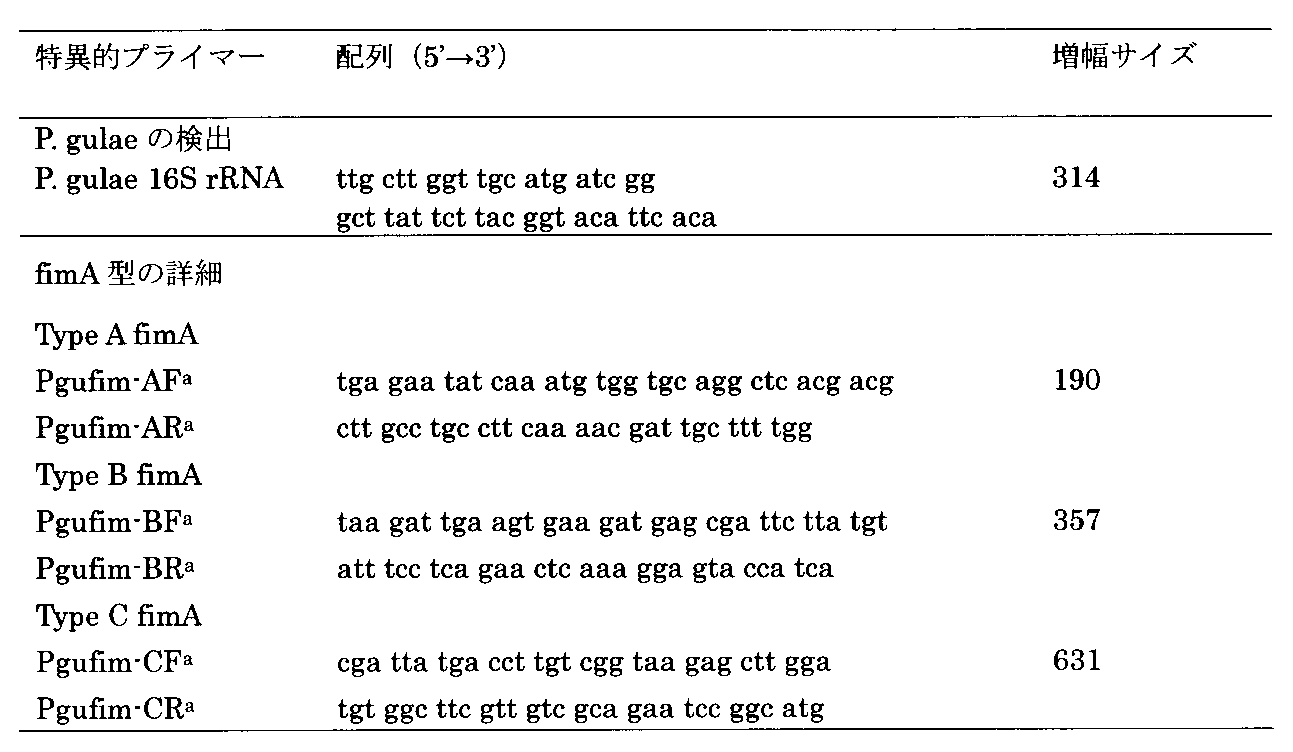
表2に記載のPorphyromonas gulaeに特異的なプライマーセット(Kato et al., 2011, Molecular detection of human periodontal pathogens in oral swab specimens from dogs in Japan. Journal of Veterinary Dentistry 28, 84-89.)を使用したPCRによりPorphyromonas gulaeの検出を行った。PCRは、供給者の指示にしたがって、1μlの鋳型溶液およびEx Taqポリメラーゼ(Takara Bio. Inc., Otsu, Japan)を含む全量20μlを用いて行った。PCR増幅反応は、95℃にて4分間の初期変性の後、95℃にて30秒間、60℃にて30秒間および72℃にて30秒間のサイクルを30サイクル、そして72℃にて7分間の最終伸長とするサイクルパラメータを使用して、サーマルサイクラー(iCycler;Bio-Rad, Hercules, CA, USA)を用いて行った。得られたPCR生成物を、1.5%アガロースゲル-Tris-酢酸-EDTAバッファー中で電気泳動にかけた。その後、ゲルを0.5μg/mlのエチジウムブロマイドで染色し、UV照明の下で写真撮影して、増幅されたフラグメントを検出した。100-bp DNAラダー(New England BioLabs, Beverly, MA, USA)を分子サイズマーカーとして使用した。
次に、Porphyromonas gulae陽性の各サンプル中の100個体以上のPorphyromonas gulaeからDNAを抽出した。
そして、1(希釈せず)、1/10、1/100、1/1000の濃度に調製した各DNA抽出サンプルについて、表2に記載の各fimA型に特異的なプライマーを用いるPCRを行い、増幅した各フラグメントを検出した(Nomura et al., 2012. Journal of Veterinary Medical Sciences 74, 885-891.、Yamasaki et al., 2012. Veterinary Microbiology 28, 196-205.Yamasaki et al., 2013)。PCR及びフラグメントの検出は上記と同様に行った。フラグメントの検出では、各fimAタイプの検出限界のサンプル濃度を特定し、その濃度の最も低いfimAタイプをそのサンプルのドミナントタイプとした。2つ以上のタイプで検出限界が同じであった場合は、優劣なしと判断した。
fimAがタイプAであるATCC51700、fimAがタイプBであるD077、及び、FimAがタイプCであるD049のゲノムDNAをテンプレートとして、表2に記載の各プライマーセットを用いてPCRを行い、各fimAのフラグメントを検出した結果を図1Aに示す。表2に記載のプライマーにより各タイプのfimAを増幅できることが確認できた。
Porphyromonas gulae陽性の各サンプルについての代表的な結果を図1B~Dに示す。
図1Bに示すサンプルでは、タイプAについては1~10-3の全てのサンプル濃度でバンドが検出されたが、タイプBについてはサンプル濃度が1、10-1の場合のみ、タイプCについてはサンプル濃度が1の場合のみでバンドが検出された。このため、図1Bに示すサンプルはタイプAドミナントと分類した。
図1Cに示すサンプルでは、タイプBについては1~10-3の全てのサンプル濃度でバンドが検出されたが、タイプAについてはサンプル濃度が1の場合のみ、タイプCについてはサンプル濃度が1の場合のみでバンドが検出された。このため、図1Cに示すサンプルは、タイプBドミナントと分類した。
図1Dでは、タイプCについては1~10-3の全てのサンプル濃度でバンドが検出されたが、タイプAについてはサンプル濃度が1の場合のみ、タイプBついてはサンプル濃度が1~10-2の場合のみでバンドが検出された。このため、図1Dに示すサンプルは、タイプCドミナントと分類した。
実施例4:fimA遺伝子型と僧帽弁閉鎖不全症との相関性についての解析
本実施例では、FimAがタイプCのPorphyromonas gulaeがイヌの口腔内に存在することと、イヌが僧帽弁閉鎖不全症であることとが相関性を有することを示す。
本実施例では、FimAがタイプCのPorphyromonas gulaeがイヌの口腔内に存在することと、イヌが僧帽弁閉鎖不全症であることとが相関性を有することを示す。
コンピュータソフトウェアパッケージ、StatView 5.0(SAS Institute Inc., Cary, NC, USA)およびPrism 4(GraphPad Software Inc., La Jolla, CA, USA)を使用して、統計解析を行った。Fisherの制約付最小有意差検定により、各歯肉症状を有する各fimA遺伝子型の検出頻度を比較した。オッズ比(OR)および95%信頼区間(CI95)値を算出して、イヌの口腔内から採取した試料中の各fimA遺伝子型と各歯周症状との相関性を調べた。0.05未満のP値は、統計的に有意であると考えられた。
MR群および対照群から得られた口腔試料における、Porphyromonas gulaeおよびそのfimA遺伝子型の度数分布を、表3に示す。Porphyromonas gulaeは、両方の群のサンプルのほぼ全てで検出された。その一方で、対照群では、タイプAドミナントのサンプルがMR群と比較して有意に多かった(P<0.05)。そして、MR群では、タイプCドミナントのサンプルが対照群と比較して有意に多かった(P<0.05)。MR群におけるタイプAドミナントおよびタイプCドミナントの検出についてのオッズ比は、それぞれ0.22および3.82であった。

この結果から、fimA遺伝子型がタイプCであるPorphyromonas gulaeが口腔内に存在するイヌの多くが、僧帽弁閉鎖不全症であるということが明らかになった。Porphyromonas gulaeは、口腔内から体内に侵入し、血液を介してイヌの体内の僧帽弁まで到達していると考えられた。
本発明の方法により、イヌが僧帽弁閉鎖不全症であるリスクを有し又は僧帽弁閉鎖不全症の発症リスクを有するか診断することが可能になり、また、イヌの僧帽弁閉鎖不全症の予防又はイヌの僧帽弁閉鎖不全症の進行を抑制することが可能になる。
SEQ ID NO: 1:Porphyromonas gulaeの標準株(タイプA)であるATCC51700のフィンブリリンタンパク(Fimbrillin)、FimAをコードするfimA遺伝子のヌクレオチド配列。
SEQ ID NO: 2:SEQ ID NO: 1のヌクレオチド配列によりコードされるFimAのアミノ酸配列。
SEQ ID NO: 3:Porphyromonas gulaeのタイプBのFimAをコードするfimA遺伝子のヌクレオチド配列。
SEQ ID NO: 4:SEQ ID NO: 3のヌクレオチド配列によりコードされるFimAのアミノ酸配列。
SEQ ID NO: 5:Porphyromonas gulaeのタイプCのFimAをコードするfimA遺伝子のヌクレオチド配列。
SEQ ID NO: 6:SEQ ID NO: 5のヌクレオチド配列によりコードされるFimAのアミノ酸配列。
SEQ ID NO: 7およびSEQ ID NO: 8:Porphyromonas gulaeに特異的なプライマーセット。
SEQ ID NO: 9およびSEQ ID NO: 10: Porphyromonas gulaeのタイプAのfimA遺伝子のヌクレオチド配列の部分配列を増幅するために使用されるプライマーペア。
SEQ ID NO: 11およびSEQ ID NO: 12: Porphyromonas gulaeのタイプBのfimA遺伝子のヌクレオチド配列の部分配列を増幅するために使用されるプライマーペア。
SEQ ID NO: 13およびSEQ ID NO: 14: Porphyromonas gulaeのタイプCのfimA遺伝子のヌクレオチド配列の部分配列を増幅するために使用されるプライマーペア。
SEQ ID NO: 15およびSEQ ID NO: 16: Porphyromonas gulaeのタイプAのfimA遺伝子のヌクレオチド配列を増幅するために使用されるプライマーペア。
SEQ ID NO: 17およびSEQ ID NO: 18: Porphyromonas gulaeのタイプBのfimA遺伝子のヌクレオチド配列を増幅するために使用されるプライマーペア。
SEQ ID NO: 19およびSEQ ID NO: 20: Porphyromonas gulaeのタイプCのfimA遺伝子のヌクレオチド配列を増幅するために使用されるプライマーペア。
SEQ ID NO: 21:SEQ ID NO: 13およびSEQ ID NO: 14の組み合わせのプライマーペアにより増幅された、Porphyromonas gulaeのタイプCのfimA遺伝子のヌクレオチド配列の部分配列。
SEQ ID NO: 22:SEQ ID NO: 19およびSEQ ID NO: 20の組み合わせのプライマーペアにより増幅された、Porphyromonas gulaeのタイプCのfimA遺伝子のヌクレオチド配列の部分配列。
SEQ ID NO: 23:SEQ ID NO: 9およびSEQ ID NO: 10の組み合わせのプライマーペアにより増幅された、Porphyromonas gulaeのタイプAのfimA遺伝子のヌクレオチド配列の部分配列。
SEQ ID NO: 24:SEQ ID NO: 15およびSEQ ID NO: 16の組み合わせのプライマーペアにより増幅された、Porphyromonas gulaeのタイプAのfimA遺伝子のヌクレオチド配列の部分配列。
SEQ ID NO: 25:SEQ ID NO: 11およびSEQ ID NO: 12の組み合わせのプライマーペアにより増幅された、Porphyromonas gulaeのタイプBのfimA遺伝子のヌクレオチド配列の部分配列。
SEQ ID NO: 26:SEQ ID NO: 17およびSEQ ID NO: 18の組み合わせのプライマーペアにより増幅された、Porphyromonas gulaeのタイプBのfimA遺伝子のヌクレオチド配列の部分配列。
Claims (22)
- イヌの僧帽弁閉鎖不全症のリスク診断方法であって、
イヌ被検体から採取した試料中に、Porphyromonas gulaeが関連するリスク因子が存在するか否かを調べる工程と、
前記試料中に前記リスク因子が存在する場合に、前記イヌ被検体が僧帽弁閉鎖不全症であるリスクを有し又は僧帽弁閉鎖不全症の発症リスクを有すると診断する工程と、
を有する前記方法。 - 前記試料が、唾液、歯垢、歯石、口腔拭い液、又は血液由来試料である、請求項1に記載の方法。
- Porphyromonas gulaeが関連するリスク因子が、
(i)イヌ被検体から採取した試料が、Porphyromonas gulaeのタイプCのフィンブリリン(fimbrillin)FimAを含有していること、または
(ii) イヌ被検体から採取した試料中に、Porphyromonas gulaeのタイプAのフィンブリリン(fimbrillin)FimA、及びPorphyromonas gulaeのタイプBのFimAの各含有レベルと比較して、Porphyromonas gulaeのタイプCのFimAの含有レベルが最も高いこと、
である、請求項1または2に記載の方法。 - 前記リスク因子の存在を、SEQ ID NO:21またはSEQ ID NO: 22のヌクレオチド配列からなるポリヌクレオチドに対して特異的なプライマーセットを使用するPCRによりPorphyromonas gulaeのタイプCのFimAが含有されるか否かを核酸配列レベルで調べることにより特定する、請求項1~3のいずれか1項に記載の方法。
- 前記リスク因子の存在を、
SEQ ID NO:6のアミノ酸配列からなるポリペプチドに特異的な抗体又はその誘導体を使用してPorphyromonas gulaeのタイプCのFimAタンパク質を検出することによりPorphyromonas gulaeのタイプCのFimAが含有されるか否かをアミノ酸配列レベルで調べることにより特定する、請求項1~3のいずれか1項に記載の方法。 - 前記Porphyromonas gulaeのタイプAのFimA、Porphyromonas gulaeのタイプBのFimA及びPorphyromonas gulaeのタイプCのFimAの各含有レベルを調べ、それぞれを比較することにより、Porphyromonas gulaeのタイプCのFimAの含有レベルが最も高いことを特定する、請求項3に記載の方法。
- イヌ被検体から採取した試料を階段希釈して、2以上の試料を用意し、
前記2以上の試料中のPorphyromonas gulaeのタイプAのフィンブリリン(fimbrillin)FimA、Porphyromonas gulaeのタイプBのFimA及びPorphyromonas gulaeのタイプCのFimAの各含有シグナルを検出し、
Porphyromonas gulaeのタイプCのFimAの含有シグナルが検出された最低濃度の試料が、Porphyromonas gulaeのタイプAのFimA及びPorphyromonas gulaeのタイプBのFimAの含有シグナルが検出された最低濃度の試料よりも低い濃度の試料である場合に、Porphyromonas gulaeのタイプCのFimAの含有レベルが最も高いことを特定する、
請求項3に記載の方法。 - 前記Porphyromonas gulaeのタイプAのFimA、Porphyromonas gulaeのタイプBのFimA及びPorphyromonas gulaeのタイプCのFimAを、タイプAについてはSEQ ID NO: 23またはSEQ ID NO: 24、タイプBについてはSEQ ID NO: 25またはSEQ ID NO: 26及びタイプCについてはSEQ ID NO:21またはSEQ ID NO: 22のそれぞれのヌクレオチド配列からなる各ポリヌクレオチドに特異的な各プライマーセットを使用してPCRによりPorphyromonas gulaeのタイプCのFimAの含有レベルが最も高いことを核酸配列レベルで調べる、請求項6または7に記載の方法。
- 前記Porphyromonas gulaeのタイプAのFimA、前記Porphyromonas gulaeのタイプBのFimA及び前記Porphyromonas gulaeのタイプCのFimAを、SEQ ID NO: 2、SEQ ID NO: 4及びSEQ ID NO:6それぞれのアミノ酸配列からなる各ポリペプチドに特異的な各抗体又はそれらの誘導体を使用して検出することにより、Porphyromonas gulaeのタイプCのFimAの含有レベルが最も高いことをアミノ酸配列レベルで調べる、請求項6または7に記載の方法。
- 請求項1~9のいずれか1項に記載の方法において、前記イヌ被検体が僧帽弁閉鎖不全症であるリスクを有し又は僧帽弁閉鎖不全症の発症リスクを有すると診断された場合に、前記イヌ被検体が口腔内又は体内に有するタイプCのFimAを有するPorphyromonas gulaeの数を低減させる工程を有する、
イヌの僧帽弁閉鎖不全症の予防又はイヌの僧帽弁閉鎖不全症の進行を抑制する方法。 - 前記イヌ被検体が口腔内又は体内に有するタイプCのFimAを有するPorphyromonas gulaeの数を、前記イヌ被検体の歯垢又は歯石を除去することにより低減させる、請求項10に記載の方法。
- 前記イヌ被検体が口腔内又は体内に有するタイプCのFimAを有するPorphyromonas gulaeの数を、前記イヌ被検体の口腔を洗浄することにより低減させる、請求項10に記載の方法。
- 前記イヌ被検体が口腔内又は体内に有するタイプCのFimAを有するPorphyromonas gulaeの数を、前記イヌ被検体に医薬を投与することにより低減させる、請求項10に記載の方法。
- 前記医薬は、SEQ ID NO:6のアミノ酸配列からなるポリペプチドに特異的なモノクローナル抗体又はその誘導体を有効成分とする医薬である、請求項13に記載の方法。
- SEQ ID NO:21またはSEQ ID NO: 22のヌクレオチド配列からなるポリヌクレオチドを含む、イヌの僧帽弁閉鎖不全症のリスク又はイヌの僧帽弁閉鎖不全症の発症リスクの診断用バイオマーカー。
- SEQ ID NO:6のアミノ酸配列またはその部分アミノ酸配列からなるポリペプチドからなる、イヌの僧帽弁閉鎖不全症のリスク又はイヌの僧帽弁閉鎖不全症の発症リスクの診断用バイオマーカー。
- SEQ ID NO:6のアミノ酸配列からなるポリペプチドに特異的なモノクローナル抗体又はその誘導体を有効成分とする、イヌの僧帽弁閉鎖不全症の予防又はイヌの僧帽弁閉鎖不全症の進行を抑制するための医薬。
- Porphyromonas gulaeのフィンブリリン(fimbrillin)FimAのタイプA、タイプB及びタイプCに分類するためのプライマーセットを含む、イヌの僧帽弁閉鎖不全症の診断用キット。
- Porphyromonas gulaeのタイプAのfimAに対して特異的なプライマーセット:
〔5'-tga gaa tat caa atg tgg tgc agg ctc acg-3'(SEQ ID NO: 9)および5'-ctt gcc tgc ctt caa aac gat tgc ttt tgg-3'(SEQ ID NO: 10)〕、または
〔5'-ttc ata cgt cga cga ctg cg-3'(SEQ ID NO: 15)および5'-ttg agg gtt gat tac caa gt-3'(SEQ ID NO: 16)〕、
Porphyromonas gulaeのタイプBのfimAに対して特異的なプライマーセット:
〔5'-taa gat tga agt gaa gat gag cga ttc tta tgt-3'(SEQ ID NO: 11)および5'-att tcc tca gaa ctc aaa gga gta cca tca-3'(SEQ ID NO: 12)〕、または
〔5'-aac tac gac gct ata tgc aa-3'(SEQ ID NO: 17)および5'-tag aca aac tat gaa agt t-3'(SEQ ID NO: 18)〕、
Porphyromonas gulaeのタイプCのfimAに対して特異的なプライマーセット:
〔5'-cga tta tga cct tgt cgg taa gag ctt gga-3'(SEQ ID NO: 13)および5'-tgt ggc ttc gtt gtc gca gaa tcc ggc atg-3'(SEQ ID NO: 14)〕、または
〔5'-gac ttg ctg ccc ttg cga tga cag ctt gta-3'(SEQ ID NO: 19)および5'-ttt agt cgt ttg acg ggt cga tta cca agt-3'(SEQ ID NO: 20)〕、
をプライマーセットとして含む、請求項18に記載のキット。 - Porphyromonas gulaeのフィンブリリン(fimbrillin)FimAのタイプA、タイプB及びタイプCそれぞれに特異的な各抗体又はそれらの誘導体を含む、イヌの僧帽弁閉鎖不全症の診断用キット。
- フィンブリリン(fimbrillin)fimAのタイプA、タイプB及びタイプCそれぞれに相補的な配列を有する各ヌクレオチドがそれぞれ異なるウェル内に結合されている、イヌの僧帽弁閉鎖不全症の診断用チップ。
- フィンブリリン(fimbrillin)FimAのタイプA、タイプB及びタイプCそれぞれに特異的な各抗体又はそれらの誘導体がそれぞれ異なるウェル内に結合されている、イヌの僧帽弁閉鎖不全症の診断用チップ。
Priority Applications (1)
| Application Number | Priority Date | Filing Date | Title |
|---|---|---|---|
| JP2016527887A JPWO2015190589A1 (ja) | 2014-06-13 | 2015-06-12 | イヌの僧帽弁閉鎖不全症のリスク診断 |
Applications Claiming Priority (2)
| Application Number | Priority Date | Filing Date | Title |
|---|---|---|---|
| JP2014122886 | 2014-06-13 | ||
| JP2014-122886 | 2014-06-13 |
Publications (1)
| Publication Number | Publication Date |
|---|---|
| WO2015190589A1 true WO2015190589A1 (ja) | 2015-12-17 |
Family
ID=54833672
Family Applications (1)
| Application Number | Title | Priority Date | Filing Date |
|---|---|---|---|
| PCT/JP2015/066980 Ceased WO2015190589A1 (ja) | 2014-06-13 | 2015-06-12 | イヌの僧帽弁閉鎖不全症のリスク診断 |
Country Status (2)
| Country | Link |
|---|---|
| JP (1) | JPWO2015190589A1 (ja) |
| WO (1) | WO2015190589A1 (ja) |
Cited By (1)
| Publication number | Priority date | Publication date | Assignee | Title |
|---|---|---|---|---|
| CN114174528A (zh) * | 2019-08-07 | 2022-03-11 | 学校法人东京齿科大学 | 判别方法、荧光测定装置和检查剂 |
Citations (3)
| Publication number | Priority date | Publication date | Assignee | Title |
|---|---|---|---|---|
| JP2008500379A (ja) * | 2004-05-21 | 2008-01-10 | ファイザー・プロダクツ・インク | 歯周病ワクチン |
| WO2012027288A2 (en) * | 2010-08-22 | 2012-03-01 | University Of Rochester | Method for predicting and preventing cardiovascular disease |
| WO2013089166A1 (ja) * | 2011-12-13 | 2013-06-20 | 学校法人麻布獣医学園 | Porphyromonas gulaeの線毛タイプ |
-
2015
- 2015-06-12 WO PCT/JP2015/066980 patent/WO2015190589A1/ja not_active Ceased
- 2015-06-12 JP JP2016527887A patent/JPWO2015190589A1/ja active Pending
Patent Citations (3)
| Publication number | Priority date | Publication date | Assignee | Title |
|---|---|---|---|---|
| JP2008500379A (ja) * | 2004-05-21 | 2008-01-10 | ファイザー・プロダクツ・インク | 歯周病ワクチン |
| WO2012027288A2 (en) * | 2010-08-22 | 2012-03-01 | University Of Rochester | Method for predicting and preventing cardiovascular disease |
| WO2013089166A1 (ja) * | 2011-12-13 | 2013-06-20 | 学校法人麻布獣医学園 | Porphyromonas gulaeの線毛タイプ |
Non-Patent Citations (4)
| Title |
|---|
| GLICKMAN L. ET AL.: "Evaluation of the risk of endocarditis and other cardiovascular events on the basis of the severity of periodontal disease in dogs", J. AM. VET. MED. ASSOC., vol. 234, no. 4, 2009, pages 486 - 494 * |
| KIYOKO WATANABE ET AL.: "Inu Soboben Heisa Fuzensho no Shinzo Soshiki ni Okeru Shishubyo Kanren Saikin no Kenshutsu", JAPANESE JOURNAL OF BACTERIOLOGY, vol. 70, no. 1, pages 2 - 075 * |
| MASAMI UECHI: "Dobutsu ni Okeru Shinzobyo Kenshin no Juyosei -Inu no Shinzoby o (Soboben Heisa Fuzensho) ni Tsuite Manabo!", DAI 15 KAI JAPANESE BOARD OF VETERINARY PRACTITIONERS FORUM 2013 NEN NENJI TAIKAI PROCEEDING, vol. 15 -2, 2013, pages 236 * |
| YAMASAKI Y. ET AL.: "Distribution and molecular characterization of Porphyromonas gulae carrying a new fimA genotype", VET. MICROBIOL., vol. 161, no. 1-2, 2012, pages 196 - 205, XP055242453 * |
Cited By (1)
| Publication number | Priority date | Publication date | Assignee | Title |
|---|---|---|---|---|
| CN114174528A (zh) * | 2019-08-07 | 2022-03-11 | 学校法人东京齿科大学 | 判别方法、荧光测定装置和检查剂 |
Also Published As
| Publication number | Publication date |
|---|---|
| JPWO2015190589A1 (ja) | 2017-04-20 |
Similar Documents
| Publication | Publication Date | Title |
|---|---|---|
| Chakraborty et al. | Advances in diagnosis of respiratory diseases of small ruminants | |
| US20210361721A1 (en) | Treatment of a cancer by microbiome modulation | |
| KR102035877B1 (ko) | 우울증이 있는 대상체를 위한 치료 양생법 선택을 위한 검정법 및 치료 방법 | |
| US20220043007A1 (en) | Diagnosing and treating alzheimers disease | |
| RU2691375C2 (ru) | Биомаркеры для ревматоидного артрита и их применение | |
| JP2016518816A (ja) | うつに罹っている対象のための治療レジメンを選択するためのアッセイ及び方法 | |
| Vélez et al. | Long-term use of yeast fermentation products in comparison to halofuginone for the control of cryptosporidiosis in neonatal calves | |
| Harvey | The relationship between periodontal infection and systemic and distant organ disease in dogs | |
| Berriatua et al. | Flock-prevalence of border disease virus infection in Basque dairy-sheep estimated by bulk-tank milk analysis | |
| US12037651B2 (en) | Microbiome markers and uses thereof | |
| JPWO2015190589A1 (ja) | イヌの僧帽弁閉鎖不全症のリスク診断 | |
| JP6108553B2 (ja) | Porphyromonasgulaeの線毛タイプ | |
| Walker et al. | Genomic characterization of a nalidixic acid-resistant Salmonella Enteritidis strain causing persistent infections in broiler chickens | |
| JP2023178523A (ja) | アトピー性皮膚炎の診断方法 | |
| US20210247394A1 (en) | Isolated bacterial strain for inducing proliferation or accumulation of regulatory t-cells | |
| RU2587753C1 (ru) | Способ прогнозирования риска развития инфекционного эндокардита | |
| Dadar et al. | Determination of virulence-associated genes and antimicrobial resistance profiles in Brucella isolates recovered from humans and animals in Iran using NGS technology. Pathogens. 2023; 12 (1): 82 | |
| EP1931799A1 (en) | Dog periodontitis | |
| WO2006117945A1 (en) | Method for detecting lipid metabolism disorder, and diagnostic agent for use therein | |
| Abdulzahra et al. | The occurrence of genetic variation In B. abortus isolated from sheep In Babylon Province, Iraq | |
| Kırış et al. | Evaluation of Echinococcus DNA by polymerase chain reaction (PCR) in cystic Echinococcosis of the liver | |
| CALICIVIRUS et al. | Research communications of the 24th ECVIM-CA congress | |
| Dolinski | The Intrinsic Host Factors Associated with Intraspecific Viral Shedding Variation in Low-Path Avian Influenza-Infected Wild Ducks | |
| KR20240095051A (ko) | 구강 마이크로바이옴을 이용한 턱관절 질환의 진단용 바이오 마커 및 이의 용도 | |
| James et al. | Integrating temporal genomic and transcriptomic analyses to decipher genetic basis of feed intake in dairy cattle |
Legal Events
| Date | Code | Title | Description |
|---|---|---|---|
| 121 | Ep: the epo has been informed by wipo that ep was designated in this application |
Ref document number: 15806859 Country of ref document: EP Kind code of ref document: A1 |
|
| ENP | Entry into the national phase |
Ref document number: 2016527887 Country of ref document: JP Kind code of ref document: A |
|
| NENP | Non-entry into the national phase |
Ref country code: DE |
|
| 122 | Ep: pct application non-entry in european phase |
Ref document number: 15806859 Country of ref document: EP Kind code of ref document: A1 |