WO2015146155A1 - スイングデータ圧縮方法、スイングデータ圧縮装置、スイング解析装置及びスイングデータ圧縮プログラム - Google Patents
スイングデータ圧縮方法、スイングデータ圧縮装置、スイング解析装置及びスイングデータ圧縮プログラム Download PDFInfo
- Publication number
- WO2015146155A1 WO2015146155A1 PCT/JP2015/001672 JP2015001672W WO2015146155A1 WO 2015146155 A1 WO2015146155 A1 WO 2015146155A1 JP 2015001672 W JP2015001672 W JP 2015001672W WO 2015146155 A1 WO2015146155 A1 WO 2015146155A1
- Authority
- WO
- WIPO (PCT)
- Prior art keywords
- swing
- swing data
- data
- compression
- unit
- Prior art date
- Legal status (The legal status is an assumption and is not a legal conclusion. Google has not performed a legal analysis and makes no representation as to the accuracy of the status listed.)
- Ceased
Links
Images






Classifications
-
- A—HUMAN NECESSITIES
- A63—SPORTS; GAMES; AMUSEMENTS
- A63B—APPARATUS FOR PHYSICAL TRAINING, GYMNASTICS, SWIMMING, CLIMBING, OR FENCING; BALL GAMES; TRAINING EQUIPMENT
- A63B24/00—Electric or electronic controls for exercising apparatus of preceding groups; Controlling or monitoring of exercises, sportive games, training or athletic performances
- A63B24/0003—Analysing the course of a movement or motion sequences during an exercise or trainings sequence, e.g. swing for golf or tennis
- A63B24/0006—Computerised comparison for qualitative assessment of motion sequences or the course of a movement
-
- A—HUMAN NECESSITIES
- A61—MEDICAL OR VETERINARY SCIENCE; HYGIENE
- A61B—DIAGNOSIS; SURGERY; IDENTIFICATION
- A61B5/00—Measuring for diagnostic purposes; Identification of persons
- A61B5/103—Measuring devices for testing the shape, pattern, colour, size or movement of the body or parts thereof, for diagnostic purposes
- A61B5/11—Measuring movement of the entire body or parts thereof, e.g. head or hand tremor or mobility of a limb
- A61B5/1116—Determining posture transitions
-
- A—HUMAN NECESSITIES
- A61—MEDICAL OR VETERINARY SCIENCE; HYGIENE
- A61B—DIAGNOSIS; SURGERY; IDENTIFICATION
- A61B5/00—Measuring for diagnostic purposes; Identification of persons
- A61B5/68—Arrangements of detecting, measuring or recording means, e.g. sensors, in relation to patient
- A61B5/6887—Arrangements of detecting, measuring or recording means, e.g. sensors, in relation to patient mounted on external non-worn devices, e.g. non-medical devices
- A61B5/6895—Sport equipment
-
- A—HUMAN NECESSITIES
- A63—SPORTS; GAMES; AMUSEMENTS
- A63B—APPARATUS FOR PHYSICAL TRAINING, GYMNASTICS, SWIMMING, CLIMBING, OR FENCING; BALL GAMES; TRAINING EQUIPMENT
- A63B60/00—Details or accessories of golf clubs, bats, rackets or the like
- A63B60/46—Measurement devices associated with golf clubs, bats, rackets or the like for measuring physical parameters relating to sporting activity, e.g. baseball bats with impact indicators or bracelets for measuring the golf swing
-
- A—HUMAN NECESSITIES
- A63—SPORTS; GAMES; AMUSEMENTS
- A63B—APPARATUS FOR PHYSICAL TRAINING, GYMNASTICS, SWIMMING, CLIMBING, OR FENCING; BALL GAMES; TRAINING EQUIPMENT
- A63B69/00—Training appliances or apparatus for special sports
- A63B69/36—Training appliances or apparatus for special sports for golf
-
- G—PHYSICS
- G09—EDUCATION; CRYPTOGRAPHY; DISPLAY; ADVERTISING; SEALS
- G09B—EDUCATIONAL OR DEMONSTRATION APPLIANCES; APPLIANCES FOR TEACHING, OR COMMUNICATING WITH, THE BLIND, DEAF OR MUTE; MODELS; PLANETARIA; GLOBES; MAPS; DIAGRAMS
- G09B19/00—Teaching not covered by other main groups of this subclass
- G09B19/003—Repetitive work cycles; Sequence of movements
- G09B19/0038—Sports
-
- A—HUMAN NECESSITIES
- A61—MEDICAL OR VETERINARY SCIENCE; HYGIENE
- A61B—DIAGNOSIS; SURGERY; IDENTIFICATION
- A61B2503/00—Evaluating a particular growth phase or type of persons or animals
- A61B2503/10—Athletes
-
- A—HUMAN NECESSITIES
- A63—SPORTS; GAMES; AMUSEMENTS
- A63B—APPARATUS FOR PHYSICAL TRAINING, GYMNASTICS, SWIMMING, CLIMBING, OR FENCING; BALL GAMES; TRAINING EQUIPMENT
- A63B71/00—Games or sports accessories not covered in groups A63B1/00 - A63B69/00
- A63B71/06—Indicating or scoring devices for games or players, or for other sports activities
- A63B71/0619—Displays, user interfaces and indicating devices, specially adapted for sport equipment, e.g. display mounted on treadmills
- A63B2071/0647—Visualisation of executed movements
-
- A—HUMAN NECESSITIES
- A63—SPORTS; GAMES; AMUSEMENTS
- A63B—APPARATUS FOR PHYSICAL TRAINING, GYMNASTICS, SWIMMING, CLIMBING, OR FENCING; BALL GAMES; TRAINING EQUIPMENT
- A63B2102/00—Application of clubs, bats, rackets or the like to the sporting activity ; particular sports involving the use of balls and clubs, bats, rackets, or the like
- A63B2102/32—Golf
-
- A—HUMAN NECESSITIES
- A63—SPORTS; GAMES; AMUSEMENTS
- A63B—APPARATUS FOR PHYSICAL TRAINING, GYMNASTICS, SWIMMING, CLIMBING, OR FENCING; BALL GAMES; TRAINING EQUIPMENT
- A63B2220/00—Measuring of physical parameters relating to sporting activity
- A63B2220/40—Acceleration
-
- A—HUMAN NECESSITIES
- A63—SPORTS; GAMES; AMUSEMENTS
- A63B—APPARATUS FOR PHYSICAL TRAINING, GYMNASTICS, SWIMMING, CLIMBING, OR FENCING; BALL GAMES; TRAINING EQUIPMENT
- A63B2220/00—Measuring of physical parameters relating to sporting activity
- A63B2220/50—Force related parameters
- A63B2220/51—Force
-
- A—HUMAN NECESSITIES
- A63—SPORTS; GAMES; AMUSEMENTS
- A63B—APPARATUS FOR PHYSICAL TRAINING, GYMNASTICS, SWIMMING, CLIMBING, OR FENCING; BALL GAMES; TRAINING EQUIPMENT
- A63B2220/00—Measuring of physical parameters relating to sporting activity
- A63B2220/80—Special sensors, transducers or devices therefor
- A63B2220/83—Special sensors, transducers or devices therefor characterised by the position of the sensor
- A63B2220/833—Sensors arranged on the exercise apparatus or sports implement
-
- Y—GENERAL TAGGING OF NEW TECHNOLOGICAL DEVELOPMENTS; GENERAL TAGGING OF CROSS-SECTIONAL TECHNOLOGIES SPANNING OVER SEVERAL SECTIONS OF THE IPC; TECHNICAL SUBJECTS COVERED BY FORMER USPC CROSS-REFERENCE ART COLLECTIONS [XRACs] AND DIGESTS
- Y10—TECHNICAL SUBJECTS COVERED BY FORMER USPC
- Y10S—TECHNICAL SUBJECTS COVERED BY FORMER USPC CROSS-REFERENCE ART COLLECTIONS [XRACs] AND DIGESTS
- Y10S482/00—Exercise devices
- Y10S482/901—Exercise devices having computer circuitry
Definitions
- the present invention relates to a swing data compression method, a swing data compression device, a swing analysis device, a swing data compression program, and the like.
- An apparatus mounts a sensor unit equipped with an inertial sensor on a golf club, transmits the output from the inertial sensor to an analysis device (personal computer) for analysis, and visualizes the swing (Patent Document 1).
- the inertial sensor collects swing data at a high sampling rate, so the amount of data transmitted to the analysis device is enormous.
- the multi-axial inertial sensor element is used as the inertial sensor, for example, three orthogonal axes, a data amount multiplied by the number of sensor elements is collected.
- the amount of data further increases. For this reason, the load of data storage in the analyzer is large.
- Some aspects of the present invention provide a swing data compression method, a swing data compression device, a swing analysis device, and a swing data compression program capable of reducing the amount of stored swing data while maintaining swing analysis accuracy. Objective.
- One aspect of the present invention stores swing data output from an inertial sensor attached to a detection target, analyzes the swing of the detection target using the stored swing data, and performs swing analysis
- the present invention relates to a swing data compression method for compressing the swing data according to a compression rate set based on a result.
- the compression rate (uncompressed size / compressed size) is set based on the swing analysis result, for example, swing characteristics such as swing speed and swing stability.
- the swing data is compressed according to the compression rate.
- the amount of swing data is reduced, the memory capacity of the final storage destination can be reduced, and the burden (transfer time, etc.) required to transfer the swing data can be reduced.
- the compression rate is set based on the characteristics of the swing and unnecessary data having low importance for the swing analysis can be excluded, the swing analysis accuracy can be maintained.
- the swing speed of the detection target is analyzed, and the compression rate of the swing data with the slow swing speed is set higher than the compression rate of the swing data with the fast swing speed. be able to. Swing data with a slow swing speed has a small amount of change per unit time. Therefore, even if the compression rate is increased and data is lost, the influence on the swing analysis accuracy is small.
- the swing data can be compressed by thinning out the swing data in one continuous swing in time series according to the compression ratio.
- the amount of data per unit time decreases, but swing data with a slow swing speed has a small amount of change per unit time, and therefore has little effect on swing analysis accuracy.
- At least one of the posture and position of the detection target during a plurality of swings is analyzed, and variation in at least one of the posture and position of the detection target in each swing is detected.
- the compression rate of the large swing data can be set higher than the compression rate of the swing data in which variation in at least one of the posture and position of the detection target in each swing is small.
- Swing data having a large variation in at least one of the posture and position of the detection target is data with poor stability. If the swing itself varies, the data indicating the resolution that remains within the variation range does not contribute to the analysis accuracy, so that the compression rate can be increased.
- the swing data can be compressed by truncating the lower bits of a plurality of bits constituting one swing data according to the compression rate. By discarding the lower bits, useless data indicating the resolution that remains within the range of variation can be eliminated.
- the standard deviation ⁇ of at least one of the posture and position of the detection target during a plurality of swings is analyzed, and the compression rate of the swing data having a wide range of ⁇ 3 ⁇ or ⁇ 4 ⁇ Can be set higher than the compression rate of the swing data having a narrow range of ⁇ 3 ⁇ or ⁇ 4 ⁇ .
- the resolution is higher as it is narrower and the resolution is lower as it is wider. Therefore, high resolution is not necessary for swing data having a wide range of ⁇ 3 ⁇ or ⁇ 4 ⁇ , and the analysis accuracy does not deteriorate even if the compression rate is increased.
- a storage unit that stores swing data output from an inertial sensor attached to a detection target, and the detection target using the swing data stored in the storage unit
- the present invention relates to a swing data compression apparatus having an analysis unit for analyzing the swing of the first and second compression units, and a compression unit for compressing the swing data in accordance with a compression rate set based on a swing analysis result.
- the compression method which concerns on 1 aspect of this invention can be implemented suitably.
- Still another aspect of the present invention is directed to a storage unit that stores swing data output from an inertial sensor attached to a detection target, and the detection target using the swing data stored in the storage unit.
- the present invention relates to a swing analysis apparatus including an analysis unit that analyzes a target swing and a compression unit that compresses the swing data in accordance with a compression rate set based on a swing analysis result.
- the compression rate is set based on the characteristics of the swing and unnecessary data that is less important for the swing analysis can be excluded, the swing analysis accuracy can be maintained.
- it may further include a sampling rate setting unit that sets a sampling rate for sampling the swing data by the inertial sensor based on the swing analysis.
- a sampling rate setting unit that sets a sampling rate for sampling the swing data by the inertial sensor based on the swing analysis.
- a procedure for storing swing data output from an inertial sensor attached to a detection target and a swing of the detection target are analyzed using the stored swing data.
- the present invention relates to a swing data compression program that causes a computer to execute a procedure for performing and a procedure for compressing the swing data according to a compression rate set based on a swing analysis result.
- the compression method, data compression apparatus, or swing analysis apparatus according to the above-described aspect of the present invention can be realized by software.
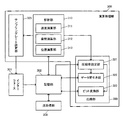
- FIG. 1 is an overall view of a swing analysis system that is an embodiment of the present invention. It is a block diagram of the swing analysis apparatus which is one Embodiment of this invention. It is a block diagram of the arithmetic processing circuit shown in FIG. It is a figure for demonstrating a golf swing locus
- FIG. 1 is an overall view of a swing analysis system in which the present invention is applied to, for example, golf swing support.
- servers 12, 14 and a base station 16 are connected to a network such as the Internet 10.
- the server 12 is a program distribution server that distributes a swing data compression program, a swing analysis program, and the like.
- the terminal device 30 includes a mobile terminal capable of communicating with the program distribution server 12 via the base station 16 and the Internet 10, such as a mobile phone, or a personal computer capable of communicating with the program distribution server 12 via the server 14 and the Internet 10. Is done.
- the swing analysis device 20 is configured by the terminal device 30 and the inertial sensor 40 attached to at least one of the operator (player) and the golf club that are the detection targets.
- the terminal device 30 that performs the swing analysis can also be referred to as a swing analysis device.
- the storage unit of the terminal device 30 stores a swing data compression program and a swing analysis program downloaded from the program distribution server 12.
- an acceleration sensor or a gyro sensor is incorporated in the inertial sensor 40, for example.
- the acceleration sensor can individually detect acceleration in the three axes x, y, and z directions orthogonal to each other.
- the gyro sensor can individually detect angular velocities around the three axes x, y, and z orthogonal to each other.
- the inertial sensor 40 outputs acceleration and angular velocity detection signals for each axis.
- the y axis coincides with the axial direction of the shaft 102, and the x axis coincides with the striking direction A.
- the inertial sensor 40 is attached to, for example, a golf club (exercise tool) 100 as shown in FIG.
- the golf club 100 includes a grip 101 and a shaft 102.
- a club head 103 is coupled to the tip of the shaft 102.
- the inertial sensor 40 is attached to the grip 101 or the shaft 102 of the golf club 100.
- the terminal device 30 includes an arithmetic processing circuit 300.
- the inertial sensor 40 is connected to the arithmetic processing circuit 300 via the interface 301.
- the interface 301 is connected to the inertial sensor 40 by wire or wireless.
- a detection signal is supplied from the inertial sensor 40 to the arithmetic processing circuit 300.
- a storage unit 302 is connected to the arithmetic processing circuit 300.
- the storage unit 302 stores, for example, a program 303 such as a swing data compression program and a swing analysis program, and swing data (data from the inertial sensor 40 and its analysis data).
- the program 303 is downloaded from the program distribution server 12 and stored.
- the arithmetic processing circuit 300 executes a golf swing analysis program to realize golf swing analysis.
- the arithmetic processing circuit 300 also compresses the swing data using a swing data compression program.
- the storage unit 302 can include a DRAM (Dynamic Random Access Memory), a mass storage device unit, a nonvolatile memory, and the like. For example, the above-described program 303 is held in the DRAM.
- DRAM Dynamic Random Access Memory
- the program 303 and data can be stored in the HDD.
- the nonvolatile memory stores a relatively small capacity program such as BIOS (basic input / output system) and data.
- the image processing circuit 305 is connected to the arithmetic processing circuit 300.
- the arithmetic processing circuit 300 sends predetermined image data to the image processing circuit 305.
- a display device 306 is connected to the image processing circuit 305.
- a predetermined interface circuit (not shown) is connected to the image processing circuit 305.
- the image processing circuit 305 sends an image signal to the display device 306 according to the input image data. An image specified by the image signal is displayed on the screen of the display device 306.
- the display device 306 is a liquid crystal display or other flat panel display.
- the arithmetic processing circuit 300, the storage unit 302, and the image processing circuit 305 are provided as a computer device, for example.
- the input device 307 is connected to the arithmetic processing circuit 300.
- the input device 307 includes, for example, alphabet keys and numeric keys. Character information and numerical information are input from the input device 307 to the arithmetic processing circuit 300.
- a transmission / reception unit 308 is connected to the storage unit 302. The transmission / reception unit 308 receives a program via the Internet 10 or transmits collected swing data.
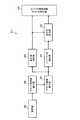
- the arithmetic processing circuit 300 is based on the analysis unit 310 that analyzes the swing of the golf club 100 using the swing data stored in the storage unit 302, and the swing analysis result. And a compression unit 320 that compresses the swing data according to the compression rate set in the above.
- the analysis unit 310 sets the golfer's level based on the swing analysis result.
- the golfer's level is stored in the storage unit 302.
- the compression unit 320 takes in the level from the storage unit 302 or the analysis unit 310 and sets a compression rate corresponding to the level.
- the arithmetic processing circuit 300 can further include a sampling rate setting unit 325.
- the sampling rate setting unit 325 variably sets the sampling rate when the inertial sensor 40 collects swing data according to the golfer's level.
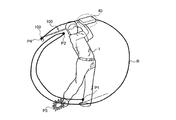
- FIG. 4 shows a movement trajectory R of one swing of the club head 103 when the golfer 1 swings the golf club 100.
- the movement trajectory R of one swing includes a swing activation (address) position P1, a top position P2, an impact position P3, and a finish position P4.
- FIG. 5 is a flowchart showing an outline of the swing data compression operation.
- the analysis unit 310 reads the level of the golfer 1 selected last time from the storage unit 302 (S1). Thereafter, the analysis unit 310 counts how many swings the swing data accumulated in the storage unit 302 is, and if the number of swings does not exceed a threshold (for example, 20 to 30 swings) (No in S2).
- the compression unit 320 compresses the swing data in the storage unit 302 in accordance with the compression rate corresponding to the past level of the golf fur 1 read from the storage unit 302 (S6).
- the reason for setting the threshold value for the number of swings is that the process for deriving the golfer's level (S3) cannot set the correct level without a certain amount of data.
- the analysis unit 310 analyzes the swing data stored in the storage unit 302 and derives the level of the golf player 1 (S3). Details of the level derivation method will be described later.
- the derived level is updated and stored in the storage unit 302 (S4).
- the analysis unit 310 delivers the compression unit 320 level.
- the compression unit 320 selects a compression rate according to the received golf level (S5).
- the compression unit 320 compresses the swing data read from the storage unit 302 according to the compression rate (S6). Details of the compression rate setting and compression method will be described later.
- the compressed swing data is stored in the storage unit 302 (S7).
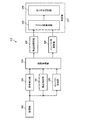
- FIG. 3 further shows an example of the analysis unit 310 and the compression unit 320.
- the analysis unit 310 includes a speed calculation unit 311, an attitude calculation unit 312, and a position calculation unit 313.
- the speed calculation unit 311 calculates the speed of the club head 103, for example.
- the posture calculation unit 312 calculates the orientation (angle) of the face surface of the club head 103 at the time of impact, for example.
- the position calculation unit 313 calculates, for example, a deceleration position of the grip 101 during a downswing.
- the compression unit 320 includes a compression rate setting unit 321 that sets the compression rate of swing data based on the analysis result (level) in the analysis unit 310 or the past level stored in the storage unit 302, and the set compression rate.
- a data thinning unit 322 that thins out and compresses the swing data
- a bit conversion unit 323 that converts the number of bits that define the resolution of the swing data according to a set compression rate may be further included.
- the speed calculation unit 311 calculates the acceleration ⁇ sj (including gravity g) of the club head 103 according to the following equation, for example.
- the speed calculation unit 311 specifies the position lsj of the club head 103 in accordance with the unique local coordinate system ⁇ s of the inertial sensor 40.
- the position lsj of the club head 103 is designated via the input device 307, for example, and can be stored in the storage unit 302.
- an acceleration output ⁇ s and an angular velocity output ⁇ s are obtained.
- Angular acceleration (in the following equation, a dot is added on ⁇ s) is obtained by differentiating the angular velocity output ⁇ s.
- the speed calculator 311 calculates the moving speed of the club head 103 based on the calculated acceleration.
- integration processing is applied to the acceleration at a specified sampling interval dt according to the following equation.
- the speed of the club head 103 varies by about 2 times depending on the person.
- the swing is 50 m / s, whereas for beginners and women, the swing is about 30 m / s. Since the amount of change per unit time is large for a high-speed swing, a relatively large amount of data is required for the analysis. However, since the amount of change per time is small for a low-speed swing, the amount of data can be reduced. Analysis accuracy does not decrease.
- the compression rate setting unit 321 of the compression unit 320 sets the compression rate of swing data with a slow swing speed higher than the compression rate (data size before compression / data size after compression) of swing data with a fast swing speed. For example, when the compression rate of swing data with a swing speed of 50 m / s or more is “1” (that is, no compression), the compression rate of swing data with a swing speed of 30 m / s is “2” (that is, the amount of data). Compress it so that is half.
- Data about a swing having a swing speed between 30 m / s and 50 m / s can be variable, for example, stepwise between “1” and “2”. For example, it is divided into levels 1 to 5 and the highest level, level 1, is compression rate “1”, and the lowest level, level 5, is compression rate “2”.
- the compression rate can be set using a table in which the compression rate is uniquely determined from the level.
- the data thinning unit 322 thins and compresses the swing data in the storage unit 302 in accordance with the compression rate set by the compression rate setting unit 321. For example, if the compression rate is “2”, one of the two time-sequential swing data is thinned out and the total data amount is compressed in half. If the compression rate is “1.5”, one of the three swing data continuous in time series is thinned out. If the compression rate is “1.75”, one of the four consecutive swing data is thinned out. Thus, the swing data can be compressed according to the swing speed. It should be noted that thinning out one of N (N ⁇ 2) pieces of swing data continuous in time series is referred to as a thinning rate N.
- the thinning rate is reduced.
- the memory capacity of the server 12 or the server 14 to which the swing data is transferred from the terminal device 30 can be reduced.
- the data transfer time can be shortened.
- the sampling rate setting unit 325 can vary the sampling rate based on the level or the compression rate.
- the already collected swing data is compressed, but after setting the compression rate, the sampling rate setting unit 325 can set the sampling rate according to the set compression rate.
- Information on the set sampling rate is supplied to the inertial sensor 40 via the interface 301.
- the inertial sensor 40 normally employs a fixed sampling rate (for example, 1 kHz), but the sampling rate can be lowered by a command from the terminal device 30.
- the sampling rate (for example, 1 kHz) is not changed for sampling data with a swing speed of 50 m / s or more, but the sampling rate is lowered when the speed is slower than that.
- 500 Hz is set when the swing speed is 30 m / s or less, and 750 Hz is set when the swing speed is around 40 m / s.
- the sampling rate decreases, the amount of swing data sampled during one swing also decreases. For example, if the sampling rate is 500 kHz, the amount of data is halved. Therefore, after that, if the inertial sensor 40 samples according to the changed sampling rate, the compression unit 320 does not need to perform compression.
- the posture calculation unit 312 in FIG. 3 analyzes, for example, the orientation (posture) of the face surface of the club head 103 at the time of impact, and the compression unit 320 performs the analysis according to the analysis result.
- the bit conversion unit 323 compresses the swing data by truncating the lower bits of the plurality of bits constituting one swing data.
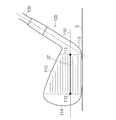
- a first measurement point 111 and a second measurement point 112 are set on the face surface 110 of the club head 103.
- the first measurement point 111 is located at the heel 113 side end of the face surface 110
- the second measurement point 112 is located at the toe 114 side end of the face surface 110.
- the first measurement point 111 and the second measurement point 112 are arranged on a horizontal plane 115 parallel to the ground G. Therefore, the line segment 116 connecting the first measurement point 111 and the second measurement point 112 can specify the orientation of the face surface 110 when projected onto the ground G.
- FIG. 7 schematically illustrates the configuration of the posture calculation unit 312 according to an embodiment.
- the posture calculation unit 312 includes a posture detection unit 330.
- the posture detection unit 330 is connected to the storage unit 302.
- the attitude detection unit 330 calculates the attitude of the inertial sensor 40 for each sampling point based on the angular velocities around the three axes. In the calculation, the rotation matrix Rs is specified from the angular velocity.
- the quaternion Q is specified when specifying the rotation matrix Rs.
- the change angle [rad] per unit time ⁇ t is calculated by the following equation.
- the posture calculation unit 312 includes a stationary determination unit 331 and an impact determination unit 332.
- the stillness determination unit 331 specifies the still state of the golf club 100 based on the output of the storage unit 302.
- the stationary determination unit 331 outputs a stationary notification signal when the stationary state is confirmed over a predetermined period.
- the impact determination unit 332 identifies the moment of impact based on the output of the storage unit 302. At the moment of impact, the output of the inertial sensor 40 is disturbed. When the impact determination unit 332 detects an impact, the impact determination unit 332 outputs an impact notification signal.
- the posture calculation unit 312 includes a coordinate conversion unit 334. Outputs are supplied to the coordinate conversion unit 334 from the posture detection unit 330, the stillness determination unit 331, and the impact determination unit 332.
- the coordinate conversion unit 334 specifies the posture of the face surface 110 of the club head 103 in the absolute reference coordinate system ⁇ xyz that specifies the real space. Coordinate conversion unit 334 when a particular posture identifying a first measurement point 111 and the second measurement point 112 on the face surface 31 according to the local coordinate system sigma s.
- the coordinate values of the first measurement point 111 and the second measurement point 112 may be stored in advance in the storage unit 302, for example.
- the coordinate conversion unit 334 performs coordinate conversion on the coordinate values of the local coordinate system ⁇ S, and specifies the first measurement point 111 and the second measurement point 112 according to the absolute reference coordinate system ⁇ xyz . In the coordinate conversion, the coordinate conversion unit 334 specifies the rotation matrix Rs for each sampling point.
- the posture change of the inertial sensor 40 from the start of measurement corresponds to the integrated value of the rotation matrix Rs from the start of measurement to the time of calculation.
- the posture calculation unit 312 includes a stationary analysis unit 335 and an impact analysis unit 336. Outputs are supplied from the coordinate conversion unit 334 to the stationary analysis unit 335 and the impact analysis unit 336.
- the coordinate conversion unit 334 receives the coordinate value of the first measurement point 111 and the coordinate value of the second measurement point 112 after the coordinate conversion in the stationary analysis unit 335 in response to reception of the stationary notification signal from the stationary analysis unit 335. Supply.
- the coordinate conversion unit 334 receives the impact notification signal from the impact determination unit 332, and the coordinate value of the first measurement point 111 and the coordinate of the second measurement point 112 after the coordinate conversion are performed by the impact analysis unit 336. Supply a value.
- the impact analysis unit 336 identifies the posture of the face surface 110 in the absolute reference coordinate system ⁇ xyz at the time of impact.
- the posture of the face surface 110 at the time of impact is specified by the second line segment L2.
- the second line segment L2 is projected onto a horizontal plane orthogonal to the y-axis in the absolute reference coordinate system ⁇ xyz .
- the posture calculation unit 312 includes a determination unit 337.
- the determination unit 337 determines variations in the face surface 110 at the time of impact based on the information on the posture of the face surface 110.
- the determination unit 337 includes a face angle calculation unit 338.
- the face angle calculation unit 338 is supplied with outputs from the stationary analysis unit 335 and the impact analysis unit 336.
- the face angle calculation unit 338 calculates an angle (face angle) ⁇ of the face surface 110 at impact relative to the face surface 31 at rest. In calculating the angle ⁇ , the angle is measured within the horizontal plane of the absolute reference coordinate system ⁇ xyz between the first line segment L1 and the second line segment L2.
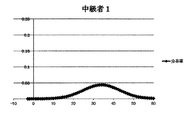
- the variation determination unit 339 determines the variation in the face angle ⁇ output from the face angle calculation unit 338 for each swing. In determining this variation, the standard deviation ⁇ can be used. 9 and 10 show the distribution ratio of the face angle ⁇ of the advanced player, and FIGS. 11 and 12 show the distribution ratio of the face angle ⁇ of the intermediate player. 9 to 12, the horizontal axis represents the face angle ⁇ , and the vertical axis represents the distribution rate.
- the intermediate level may have a lower resolution than the advanced level.
- the standard deviation ⁇ of the posture of the golf club during a plurality of swings is analyzed, and the compression rate of the swing data of beginners or intermediate persons having a wide range of ⁇ 3 ⁇ or ⁇ 4 ⁇ is in the range of ⁇ 3 ⁇ or ⁇ 4 ⁇ . It can be set higher than the compression ratio of swing data for narrow advanced players.
- the variation determining unit 339 obtains the standard deviation ⁇ of the face angle ⁇ , and further obtains a range of ⁇ 3 ⁇ or ⁇ 4 ⁇ .
- the obtained range of ⁇ 3 ⁇ or ⁇ 4 ⁇ is output as one of five levels, for example.
- This level is input to the compression rate setting unit 321 of the compression unit 320.
- the compression rate setting unit 321 sets the number of lower-order bits that are discarded by the bit conversion unit 323.
- the bit conversion unit 323 truncates lower bits from the bits constituting one swing data by the number of digits set by the compression rate setting unit 321. For example, in order to compress N-digit binary data of non-compressed swing data that can obtain an accuracy (resolution) in which the face angle ⁇ is 0.1 degree unit, and compress the data to an accuracy (resolution) in 0.5 degree unit. The last two digits should be rounded down. It should be noted that the lower bit digit truncation and data thinning can be performed together, thereby further increasing the compression rate.
- the position calculation unit 313 in FIG. 3 analyzes, for example, the deceleration position of the grip 101 during a downswing, and the bit conversion unit 323 of the compression unit 320 performs analysis according to the analysis result.
- the lower order bits of a plurality of bits constituting one swing data are discarded to compress the swing data.
- the grip acceleration calculation unit 340 calculates the length lsj of the club head 103 based on the swing data stored in the storage unit 502 by the above-described equation (1). Instead, the acceleration ⁇ sh of the grip 101 is calculated using the length lsh from the inertial sensor 40 to the grip 101.
- the maximum value extraction unit 342 extracts the maximum value of the moving speed of the grip 101.
- the impact extraction unit 343 extracts the moving speed of the grip 101 at the time of impact.
- the change rate calculation unit 344 calculates a speed change rate ⁇ based on the magnitude of the moving speed extracted by the maximum value extraction unit 342 and the impact time extraction unit 343 according to the following equation.
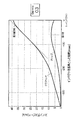
- FIG. 14 shows a change in the speed of the grip 101 when the speed change rate ⁇ is “0.3”.
- FIG. 14 also shows changes in the speed of the club head 103 for reference. If the time axis toward the impact is followed, the movement of the grip 101 is decelerated from the maximum value of the moving speed. Therefore, when the position (time) of the maximum value K of the moving speed is specified, the grip 101 decelerates at the position of the maximum value, and thus the deceleration position of the grip is specified. If there is no deceleration in the moving speed of the grip 13b, the moving speed at impact corresponds to the maximum value of the moving speed as it is.
- the rate of change becomes “0 (zero)”, meaning that the grip 101 does not decelerate during the downswing.
- the speed change rate ⁇ is “0”, data compression using the deceleration position of the grip 101 as an index is not performed.
- the speed change rate ⁇ is other than “0”, data compression is performed using the deceleration position of the grip 101 as an index.
- the variation of the position of the value is determined.
- the standard deviation ⁇ can be used as in the variation determining unit 339.
- the grip deceleration position variation determination unit 345 obtains the standard deviation ⁇ of the grip deceleration position and further obtains a range of ⁇ 3 ⁇ or ⁇ 4 ⁇ .
- the obtained range of ⁇ 3 ⁇ or ⁇ 4 ⁇ is output as one of five levels, for example.
- This level is input to the compression rate setting unit 321 of the compression unit 320.
- the compression rate setting unit 321 sets the number of lower-order bits that are discarded by the bit conversion unit 323.
- the bit conversion unit 323 truncates lower bits from the bits constituting one swing data by the number of digits set by the compression rate setting unit 321. Also in this case, truncation of the lower-order bit digits and data thinning can be performed together, thereby further increasing the compression rate.
- the analysis unit 310 shown in FIG. 3 can be used not only as a swing analysis for setting a compression ratio but also as an analysis unit that performs an original swing analysis using swing data after compression. Based on the compressed swing data, the analysis unit 310 can generate swing analysis data such as a swing trajectory and store it in the storage unit 502.
- the calculation example by the speed calculation unit 311, the posture calculation unit 312 or the position calculation unit 313 provided in the analysis unit 310 illustrated in FIG. 3 is an example, and calculation may be performed for other points of interest.
- the position calculation unit 313 may calculate the height of the switching position (top position) P2 shown in FIG. 4 and the swing width between the positions P2 and P4. Compared to the full shot, the half shot has a slower swing speed. Therefore, data thinning may be performed based on the height of the position P2 or the swing width between the positions P2 and P4 instead of the swing speed.
- the present invention is not limited to golf, and can be widely applied to exercises that swing exercise equipment such as tennis, table tennis, badminton, and baseball, and swing operations other than exercise.
Landscapes
- Health & Medical Sciences (AREA)
- Life Sciences & Earth Sciences (AREA)
- General Health & Medical Sciences (AREA)
- Engineering & Computer Science (AREA)
- Physics & Mathematics (AREA)
- Physical Education & Sports Medicine (AREA)
- Molecular Biology (AREA)
- Veterinary Medicine (AREA)
- Biophysics (AREA)
- Biomedical Technology (AREA)
- Heart & Thoracic Surgery (AREA)
- Medical Informatics (AREA)
- Business, Economics & Management (AREA)
- Surgery (AREA)
- Animal Behavior & Ethology (AREA)
- Pathology (AREA)
- Public Health (AREA)
- Dentistry (AREA)
- Oral & Maxillofacial Surgery (AREA)
- Entrepreneurship & Innovation (AREA)
- Educational Administration (AREA)
- Educational Technology (AREA)
- General Physics & Mathematics (AREA)
- Theoretical Computer Science (AREA)
- Physiology (AREA)
- Compression, Expansion, Code Conversion, And Decoders (AREA)
Priority Applications (2)
| Application Number | Priority Date | Filing Date | Title |
|---|---|---|---|
| KR1020167020253A KR20160102540A (ko) | 2014-03-27 | 2015-03-24 | 스윙 데이터 압축 방법, 스윙 데이터 압축 장치, 스윙 해석 장치 및 스윙 데이터 압축 프로그램 |
| US15/114,619 US20160346606A1 (en) | 2014-03-27 | 2015-03-24 | Swing data compression method, swing data compression apparatus, swing analysis apparatus, and swing data compression program |
Applications Claiming Priority (2)
| Application Number | Priority Date | Filing Date | Title |
|---|---|---|---|
| JP2014066074A JP2015188507A (ja) | 2014-03-27 | 2014-03-27 | スイングデータ圧縮方法、スイングデータ圧縮装置、スイング解析装置及びスイングデータ圧縮プログラム |
| JP2014-066074 | 2014-03-27 |
Publications (1)
| Publication Number | Publication Date |
|---|---|
| WO2015146155A1 true WO2015146155A1 (ja) | 2015-10-01 |
Family
ID=54194702
Family Applications (1)
| Application Number | Title | Priority Date | Filing Date |
|---|---|---|---|
| PCT/JP2015/001672 Ceased WO2015146155A1 (ja) | 2014-03-27 | 2015-03-24 | スイングデータ圧縮方法、スイングデータ圧縮装置、スイング解析装置及びスイングデータ圧縮プログラム |
Country Status (4)
| Country | Link |
|---|---|
| US (1) | US20160346606A1 (https=) |
| JP (1) | JP2015188507A (https=) |
| KR (1) | KR20160102540A (https=) |
| WO (1) | WO2015146155A1 (https=) |
Families Citing this family (3)
| Publication number | Priority date | Publication date | Assignee | Title |
|---|---|---|---|---|
| US20160089567A1 (en) * | 2014-09-26 | 2016-03-31 | Seiko Epson Corporation | Form analyzing device, form analyzing system, form analyzing method, and form analyzing program |
| JP2018157986A (ja) * | 2017-03-23 | 2018-10-11 | セイコーエプソン株式会社 | スイング解析装置、スイング解析システム、およびスイング解析方法 |
| WO2025081278A1 (en) * | 2023-10-18 | 2025-04-24 | Inertialai Inc. | System and method for monitoring swing performance |
Citations (3)
| Publication number | Priority date | Publication date | Assignee | Title |
|---|---|---|---|---|
| JP2012196241A (ja) * | 2011-03-18 | 2012-10-18 | Seiko Epson Corp | スイング解析システム |
| JP2013027648A (ja) * | 2011-07-29 | 2013-02-07 | Bridgestone Corp | ゴルフスイングの評価システム及び評価方法 |
| US20130267339A1 (en) * | 2011-04-28 | 2013-10-10 | Nike, Inc. | Golf Clubs and Golf Club Heads |
Family Cites Families (5)
| Publication number | Priority date | Publication date | Assignee | Title |
|---|---|---|---|---|
| JP2008073210A (ja) | 2006-09-21 | 2008-04-03 | Seiko Epson Corp | ゴルフクラブ、そのスイング評価支援装置 |
| US20100290522A1 (en) * | 2007-11-15 | 2010-11-18 | Sanyo Electric Co., Ltd. | Image transmission method and image transmitter |
| JP2009124518A (ja) * | 2007-11-15 | 2009-06-04 | Sanyo Electric Co Ltd | 画像送信装置 |
| US8702516B2 (en) * | 2010-08-26 | 2014-04-22 | Blast Motion Inc. | Motion event recognition system and method |
| US20150072797A1 (en) * | 2013-09-09 | 2015-03-12 | Access Co., Ltd. | Terminal Device and Display Method |
-
2014
- 2014-03-27 JP JP2014066074A patent/JP2015188507A/ja not_active Withdrawn
-
2015
- 2015-03-24 US US15/114,619 patent/US20160346606A1/en not_active Abandoned
- 2015-03-24 KR KR1020167020253A patent/KR20160102540A/ko not_active Ceased
- 2015-03-24 WO PCT/JP2015/001672 patent/WO2015146155A1/ja not_active Ceased
Patent Citations (3)
| Publication number | Priority date | Publication date | Assignee | Title |
|---|---|---|---|---|
| JP2012196241A (ja) * | 2011-03-18 | 2012-10-18 | Seiko Epson Corp | スイング解析システム |
| US20130267339A1 (en) * | 2011-04-28 | 2013-10-10 | Nike, Inc. | Golf Clubs and Golf Club Heads |
| JP2013027648A (ja) * | 2011-07-29 | 2013-02-07 | Bridgestone Corp | ゴルフスイングの評価システム及び評価方法 |
Also Published As
| Publication number | Publication date |
|---|---|
| US20160346606A1 (en) | 2016-12-01 |
| JP2015188507A (ja) | 2015-11-02 |
| KR20160102540A (ko) | 2016-08-30 |
Similar Documents
| Publication | Publication Date | Title |
|---|---|---|
| US11173362B2 (en) | Analysis apparatus, analysis method, and recording medium | |
| KR20150005447A (ko) | 운동 해석 장치 | |
| KR20140148298A (ko) | 운동 해석 방법 및 운동 해석 장치 | |
| JP2012130414A (ja) | スイング分析装置 | |
| JP5773122B2 (ja) | スイング分析装置及びスイング分析プログラム | |
| JP6783646B2 (ja) | 選択支援装置、選択支援システムおよび選択支援方法 | |
| US10276060B2 (en) | Golf club determination method, golf club determination device, and golf club determination program | |
| US10252137B2 (en) | Motion analysis method, motion analysis apparatus, and storage device | |
| WO2015146155A1 (ja) | スイングデータ圧縮方法、スイングデータ圧縮装置、スイング解析装置及びスイングデータ圧縮プログラム | |
| JP2015073821A (ja) | 運動解析方法、運動解析装置、および運動解析プログラム | |
| JP2015126813A (ja) | 状態推定装置、状態推定方法及びプログラム | |
| US20150119159A1 (en) | Motion analyzing apparatus, motion analyzing method, and motion analyzing program | |
| US10565895B2 (en) | Motion analysis method, motion analysis apparatus, and storage device | |
| JP6255737B2 (ja) | 運動解析装置および運動解析プログラム並びに表示方法 | |
| JP2021100453A (ja) | 情報処理装置、情報処理方法、プログラム | |
| US11648451B2 (en) | Golf club fitting apparatus | |
| US20160236034A1 (en) | Motion analysis method, motion analysis device, and storage device | |
| JP6822173B2 (ja) | 運動解析装置、運動解析方法、プログラム、及び運動解析システム | |
| JP2021058304A (ja) | ゴルフクラブのフィッティング装置 | |
| US20160236061A1 (en) | Motion analysis method, motion analysis apparatus, and storage device | |
| JP6984326B2 (ja) | 打具のフィッティング装置 | |
| JP2015166018A (ja) | スイング分析装置 | |
| WO2025081278A1 (en) | System and method for monitoring swing performance | |
| JP6904093B2 (ja) | 打具の把持状態の解析装置 | |
| JP2016209122A (ja) | 打撃解析装置、打撃解析システム、打撃解析方法、及びプログラム |
Legal Events
| Date | Code | Title | Description |
|---|---|---|---|
| 121 | Ep: the epo has been informed by wipo that ep was designated in this application |
Ref document number: 15769793 Country of ref document: EP Kind code of ref document: A1 |
|
| ENP | Entry into the national phase |
Ref document number: 20167020253 Country of ref document: KR Kind code of ref document: A |
|
| WWE | Wipo information: entry into national phase |
Ref document number: 15114619 Country of ref document: US |
|
| NENP | Non-entry into the national phase |
Ref country code: DE |
|
| 122 | Ep: pct application non-entry in european phase |
Ref document number: 15769793 Country of ref document: EP Kind code of ref document: A1 |