WO2015087422A1 - エタノールの製造方法 - Google Patents
エタノールの製造方法 Download PDFInfo
- Publication number
- WO2015087422A1 WO2015087422A1 PCT/JP2013/083316 JP2013083316W WO2015087422A1 WO 2015087422 A1 WO2015087422 A1 WO 2015087422A1 JP 2013083316 W JP2013083316 W JP 2013083316W WO 2015087422 A1 WO2015087422 A1 WO 2015087422A1
- Authority
- WO
- WIPO (PCT)
- Prior art keywords
- biomass
- saccharide
- furfural
- hydroxymethylfurfural
- acetic acid
- Prior art date
- Legal status (The legal status is an assumption and is not a legal conclusion. Google has not performed a legal analysis and makes no representation as to the accuracy of the status listed.)
- Ceased
Links
Images


Classifications
-
- C—CHEMISTRY; METALLURGY
- C12—BIOCHEMISTRY; BEER; SPIRITS; WINE; VINEGAR; MICROBIOLOGY; ENZYMOLOGY; MUTATION OR GENETIC ENGINEERING
- C12P—FERMENTATION OR ENZYME-USING PROCESSES TO SYNTHESISE A DESIRED CHEMICAL COMPOUND OR COMPOSITION OR TO SEPARATE OPTICAL ISOMERS FROM A RACEMIC MIXTURE
- C12P7/00—Preparation of oxygen-containing organic compounds
- C12P7/02—Preparation of oxygen-containing organic compounds containing a hydroxy group
- C12P7/04—Preparation of oxygen-containing organic compounds containing a hydroxy group acyclic
- C12P7/06—Ethanol, i.e. non-beverage
- C12P7/08—Ethanol, i.e. non-beverage produced as by-product or from waste or cellulosic material substrate
- C12P7/10—Ethanol, i.e. non-beverage produced as by-product or from waste or cellulosic material substrate substrate containing cellulosic material
-
- C—CHEMISTRY; METALLURGY
- C12—BIOCHEMISTRY; BEER; SPIRITS; WINE; VINEGAR; MICROBIOLOGY; ENZYMOLOGY; MUTATION OR GENETIC ENGINEERING
- C12P—FERMENTATION OR ENZYME-USING PROCESSES TO SYNTHESISE A DESIRED CHEMICAL COMPOUND OR COMPOSITION OR TO SEPARATE OPTICAL ISOMERS FROM A RACEMIC MIXTURE
- C12P7/00—Preparation of oxygen-containing organic compounds
- C12P7/02—Preparation of oxygen-containing organic compounds containing a hydroxy group
- C12P7/04—Preparation of oxygen-containing organic compounds containing a hydroxy group acyclic
- C12P7/06—Ethanol, i.e. non-beverage
-
- Y—GENERAL TAGGING OF NEW TECHNOLOGICAL DEVELOPMENTS; GENERAL TAGGING OF CROSS-SECTIONAL TECHNOLOGIES SPANNING OVER SEVERAL SECTIONS OF THE IPC; TECHNICAL SUBJECTS COVERED BY FORMER USPC CROSS-REFERENCE ART COLLECTIONS [XRACs] AND DIGESTS
- Y02—TECHNOLOGIES OR APPLICATIONS FOR MITIGATION OR ADAPTATION AGAINST CLIMATE CHANGE
- Y02E—REDUCTION OF GREENHOUSE GAS [GHG] EMISSIONS, RELATED TO ENERGY GENERATION, TRANSMISSION OR DISTRIBUTION
- Y02E50/00—Technologies for the production of fuel of non-fossil origin
- Y02E50/10—Biofuels, e.g. bio-diesel
Definitions
- the present invention relates to a method for producing ethanol from saccharides obtained from biomass.
- a method for producing bioethanol using cellulosic biomass as a raw material for example, a liquid containing a saccharide mainly composed of glucose by hydrolyzing at least one of cellulose and hemicellulose contained in cellulosic biomass with an enzyme (
- an enzymatic ethanol production technique for producing “saccharified solution” is mentioned.
- One of the challenges for putting this enzymatic ethanol production technology into practical use is to reduce the amount of enzyme used. In order to reduce the amount of the enzyme used, it is necessary to perform a pretreatment that destroys the structure of the biomass to increase the contact efficiency between at least one of cellulose and hemicellulose and the enzyme.
- inhibitors are generally known to inhibit enzymatic saccharification reactions and fermentation reactions that convert saccharides obtained from biomass into ethanol.
- cellulosic ethanol plant a plant that produces ethanol from food biomass. It has been studied to reduce the initial investment of the waste liquid facility by sharing these facilities. However, the amount of waste liquid in the cellulosic ethanol plant could not be reduced simply by sharing equipment.
- This invention is made
- the method for producing ethanol of the present invention is a method for producing ethanol from a saccharide obtained from biomass, wherein an additive solution containing at least acetic acid, formic acid, furfural and hydroxymethylfurfural is added to the saccharide, and the saccharide and A step of preparing a mixed solution containing the additive solution, and a step of adding a bacterium to the mixed solution and fermenting the saccharide with the bacterium to obtain ethanol.
- the additive solution may be a waste solution generated by subjecting the biomass to steam explosion treatment or dilute sulfuric acid treatment.
- the total concentration of the acetic acid, the formic acid, the furfural and the hydroxymethylfurfural contained in the mixed solution may be 400 ppm to 4500 ppm.
- the saccharide is a saccharide obtained by decomposing at least one of cellulose and hemicellulose contained in biomass with at least one of cellulose-degrading enzyme and hemicellulose-degrading enzyme. Also good.
- the bacterium may be a yeast.
- ethanol production efficiency can be improved in a process of producing ethanol from saccharides obtained from biomass.
- the ethanol production method of the present embodiment is a method for producing ethanol from saccharides obtained from biomass, wherein an additive solution containing at least acetic acid, formic acid, furfural and hydroxymethylfurfural is added to the saccharides, And a step of preparing a mixed solution containing the saccharide and the additive solution, and adding a bacterium to the mixture solution, fermenting the saccharide with the bacterium, and obtaining ethanol.
- This embodiment demonstrates the case where saccharides are obtained by decomposing
- cellulose and hemicellulose contained in the biomass At least one of cellulose and hemicellulose contained in the biomass, cellulolytic enzyme, and hemicellulose degrading enzyme A pretreatment for improving the contact efficiency with at least one of them is performed.
- Examples of the pretreatment include alkali treatment, organic solvent treatment, steam explosion treatment, and dilute sulfuric acid treatment for biomass. From the viewpoint of enzyme saccharification yield and equipment cost, steam explosion treatment or dilute sulfuric acid treatment is preferably used. .
- substances containing at least acetic acid, formic acid, furfural and hydroxymethylfurfural are removed from the pretreated biomass.
- the method for removing substances containing at least acetic acid, formic acid, furfural and hydroxymethylfurfural from the pretreated biomass include the following methods. By heating the pretreated biomass with water, the pretreated biomass at a boiling temperature of water or below the boiling temperature of water, acetic acid, formic acid, furfural from the pretreated biomass And a substance containing at least hydroxymethylfurfural.
- the concentration of substances containing at least acetic acid, formic acid, furfural and hydroxymethylfurfural in the treatment liquid is increased by the treatment for removing substances containing at least acetic acid, formic acid, furfural and hydroxymethylfurfural.
- the solid component is washed or neutralized to recover the biomass.
- biomass slurry a slurry containing biomass
- concentration of the biomass slurry that is, the biomass content in the biomass slurry is appropriately adjusted according to the type of biomass and the pretreatment method thereof, but 10 g to 30 g, that is, 10 w / v% with respect to 100 mL of the solution. It is preferably ⁇ 30 w / v%.
- Water is mentioned as a solution (solvent) used for biomass slurry.
- an adsorption inhibitor for preventing the enzyme (at least one of cellulose-degrading enzyme and hemicellulose-degrading enzyme) from adsorbing to the lignin contained in the biomass may be added to the biomass slurry.
- the adsorption inhibitor include bovine serum albumin (BSA), cheese whey and cereal protein.
- an aqueous solution (enzyme aqueous solution) containing the above-described biomass slurry and an appropriate amount of at least one of cellulose-degrading enzyme and hemicellulose-degrading enzyme suitable for degrading at least one of cellulose and hemicellulose contained in this biomass slurry are mixed in the reaction tank and the biomass slurry and the aqueous enzyme solution are mixed (mixing step).
- the pH of the reaction vessel solution is adjusted so that the pH of the reaction vessel solution containing the biomass slurry and the aqueous enzyme solution is the most suitable pH condition for at least one of the cellulose-degrading enzyme and hemicellulose-degrading enzyme used.
- the temperature of the reaction vessel is adjusted so that the temperature condition is most suitable for at least one of the cellulolytic enzyme and hemicellulose degrading enzyme to be used.
- the pH of the aqueous reaction system is preferably adjusted to 4-6.
- the temperature of the mixture is preferably adjusted so that at least one of the cellulose-degrading enzyme and hemicellulose-degrading enzyme functions actively. Specifically, the temperature of the reaction system The temperature is preferably raised to 40-60 ° C.
- Cellulase is used as an enzyme for decomposing biomass (at least one of cellulose degrading enzyme and hemicellulose degrading enzyme).
- xylanase or mannanase as an enzyme for degrading hemicellulose in addition to cellulase (at least one of cellulose degrading enzyme and hemicellulose degrading enzyme).
- a stirring blade or the like is used for stirring the mixture of the biomass slurry and the aqueous enzyme solution.
- biomass at least one of cellulose and hemicellulose
- Enzymatic saccharification is performed to obtain a saccharide mainly composed of glucose (enzymatic saccharification reaction step).
- this enzymatic saccharification reaction step it is preferable to adjust the temperature of the mixture so that the above-mentioned enzyme functions actively. Specifically, it is preferable to maintain the temperature at 40 to 60 ° C.
- the enzymatic saccharification reaction step is performed until the saccharification of the biomass by the enzyme sufficiently proceeds and the reaction does not proceed any more.
- the enzymatic decomposition of the biomass is performed at 40 to 60 ° C. for about 2 to 20 days. Do.
- an additive solution containing at least acetic acid, formic acid, furfural and hydroxymethylfurfural is added to a saccharide containing glucose as a main component to prepare a mixed solution containing a saccharide containing glucose as a main component and the additive solution ( Mixture preparation step).
- the above-mentioned saccharide containing glucose as a main component, and an additive solution containing at least an appropriate amount of acetic acid, formic acid, furfural and hydroxymethylfurfural suitable for fermentation of a saccharide containing glucose as a main component It puts into a reaction tank and mixes the saccharide which has glucose as a main component and the said addition liquid.
- the additive liquid containing at least acetic acid, formic acid, furfural and hydroxymethylfurfural is preferably a liquid produced by the above-described biomass pretreatment and separated and removed from the pretreated biomass.
- the biomass is subjected to steam explosion treatment.
- separated and removed from the biomass which performed these processes is more preferable.
- the total concentration of acetic acid, formic acid, furfural and hydroxymethylfurfural contained in the mixture containing saccharides mainly composed of glucose and the above-mentioned additive solution is preferably 400 ppm to 4500 ppm, and preferably 1000 ppm to 4500 ppm. Is more preferable.
- a stirring blade or the like is used for stirring the saccharide mainly composed of glucose and the additive solution.
- the above mixed solution and an appropriate amount of bacteria suitable for fermentation of saccharides containing glucose as a main component are placed in a reaction tank, and the mixed solution and the bacteria are mixed.
- yeast Escherichia coli, Zymomonus, Corynebacterium, and the like are used.
- the amount of bacteria added to the mixed solution is preferably 0.1 to 3 parts by mass, and preferably 0.2 to 2.2 parts by mass, with 100 parts by mass of saccharides mainly composed of glucose contained in the mixed solution. More preferably, it is a part.
- a stirring blade or the like is used for stirring the mixed solution and the bacteria.
- the temperature of the mixture containing the bacteria it is preferable to adjust the temperature of the mixture containing the bacteria so that the bacteria function actively, and specifically, it is preferable to maintain the temperature at 30 to 38 ° C.
- the fermentation process is performed until the fermentation of saccharides mainly composed of glucose by the fungi sufficiently progresses and the reaction does not proceed any further. Perform at 1 to 5 days at ⁇ 38 ° C.
- an additive solution containing at least acetic acid, formic acid, furfural and hydroxymethylfurfural is added to a saccharide mainly composed of glucose, and the saccharide mainly composed of glucose and the above-mentioned addition
- the ethanol production efficiency is improved by preparing a mixed solution containing the liquid, adding bacteria to the mixed solution, and fermenting the saccharides mainly composed of glucose with the bacteria.
- an additive liquid containing at least acetic acid, formic acid, furfural and hydroxymethylfurfural it is conventionally treated as a waste liquid by using a liquid produced by pretreatment of biomass and separated and removed from the pretreated biomass. The amount of discarded materials containing at least acetic acid, formic acid, furfural and hydroxymethylfurfural can be reduced.
- a sugar containing sucrose as a main component obtained by squeezing sugarcane is added with an additive solution containing at least acetic acid, formic acid, furfural and hydroxymethylfurfural, A mixed solution containing the additive solution is prepared (mixed solution preparing step).
- the mixing ratio of acetic acid, formic acid, furfural and hydroxymethylfurfural contained in the additive solution is preferably the same as that in the first embodiment.
- the total concentration of acetic acid, formic acid, furfural and hydroxymethylfurfural contained in the mixture containing saccharides mainly composed of sucrose and the above additive is preferably 400 ppm to 4500 ppm, and more preferably 1000 ppm to 4500 ppm. It is more preferable.
- a stirring blade or the like is used for stirring the saccharide containing sucrose as a main component and the additive solution.
- the above mixed solution and an appropriate amount of bacteria suitable for fermentation of saccharides containing sucrose as a main component are placed in a reaction tank, and the mixed solution and the bacteria are mixed.
- the same fungus as in the first embodiment described above is used.
- the amount of bacteria added to the mixed solution is preferably 0.1 to 3 parts by mass, and preferably 0.2 to 2.2 parts, based on 100 parts by mass of saccharides mainly composed of sucrose contained in the mixed solution. More preferably, it is part by mass.
- a stirring blade or the like is used for stirring the mixed solution and the bacteria.
- the temperature of the mixture containing the bacteria it is preferable to adjust the temperature of the mixture containing the bacteria so that the bacteria function actively, and specifically, it is preferable to maintain the temperature at 30 to 38 ° C.
- the fermentation process is carried out until the fermentation of saccharides mainly composed of sucrose by the fungi has progressed sufficiently and the reaction does not proceed any further. For about 1 to 2 days at 30 to 38 ° C.
- an additive solution containing at least acetic acid, formic acid, furfural and hydroxymethylfurfural is added to a saccharide containing sucrose as a main component, Than the case where the aforementioned additive solution is not added, by adding a bacterium to the mixture solution and fermenting the saccharide mainly composed of sucrose with the bacterium.
- the production efficiency can be improved.
- Example 1 Bagasse was steam blasted. Next, the substance containing at least acetic acid, formic acid, furfural and hydroxymethylfurfural was separated and removed from the bagasse subjected to the steam explosion treatment, and the substance was recovered. 30 g of bagasse subjected to steam explosion treatment was dispersed in 100 mL of water to prepare a slurry containing bagasse. The bagasse content in the obtained slurry was 30 w / v%. Next, under the following conditions, bagasse contained in the biomass slurry was decomposed with cellulase to obtain a liquid containing saccharides mainly composed of glucose. Bagasse weight: 30g-dry Cellulase addition amount: 4 mg / g-substrate solution amount: 100 mL Temperature: 50 ° C pH: 5
- a substance (addition liquid) containing at least acetic acid, formic acid, furfural and hydroxymethylfurfural separated and removed from bagasse is added to the liquid containing saccharides, and an aqueous solution and acetic acid, formic acid, furfural and hydroxymethyl are added.
- a substance containing at least furfural was mixed to prepare an aqueous solution (mixed solution) containing a saccharide mainly composed of glucose and a substance containing at least acetic acid, formic acid, furfural and hydroxymethylfurfural.
- the total concentration of acetic acid, formic acid, furfural and hydroxymethylfurfural contained in this mixed solution was 2510 ppm.
- yeast was added to the above mixed solution, and saccharides mainly composed of glucose contained in the mixed solution were fermented by the yeast to obtain ethanol.
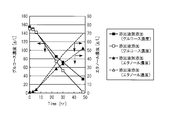
- the temperature of the mixed solution was kept at 34 ° C., and the concentration of glucose and the concentration of ethanol contained in the mixed solution with the passage of time from the start of fermentation were measured. . The results are shown in FIG.
- Comparative Example 1 Except that the substance (additive solution) containing at least acetic acid, formic acid, furfural and hydroxymethylfurfural separated and removed from bagasse was not added to the aqueous solution containing saccharides mainly composed of glucose. Then, saccharides mainly composed of glucose were fermented to obtain ethanol. The concentration of glucose and the concentration of ethanol contained in the aqueous solution with the passage of time from the start of fermentation of saccharides containing glucose as a main component were measured. The results are shown in FIG.
- Example 1 saccharides mainly composed of glucose were fermented by yeast without adding substances containing at least acetic acid, formic acid, furfural and hydroxymethylfurfural to an aqueous solution containing saccharides mainly composed of glucose. As compared with Comparative Example 1, it was found that the production rate of ethanol was improved by 30% or more.
- Example 2 Sugarcane was squeezed to prepare an aqueous solution containing 180 g / L of saccharides mainly composed of sucrose. Next, an additive solution containing at least acetic acid, formic acid, furfural and hydroxymethylfurfural is added to the aqueous solution, and the aqueous solution is mixed with a substance containing at least acetic acid, formic acid, furfural and hydroxymethylfurfural, and sucrose is mixed. An aqueous solution (mixed solution) containing a saccharide as a main component and an additive solution containing at least acetic acid, formic acid, furfural and hydroxymethylfurfural was prepared.
- the total concentration of acetic acid, formic acid, furfural and hydroxymethylfurfural contained in this mixed solution was 2303 ppm.
- yeast was added to the above mixed solution, and saccharides mainly composed of sucrose contained in the mixed solution were fermented by the yeast to obtain ethanol.
- the temperature of the mixed solution is maintained at 34 ° C., and the concentration of sucrose and the concentration of ethanol contained in the mixed solution with the lapse of time from the start of fermentation. It was measured. The results are shown in FIG.
- Comparative Example 2 In the same manner as in Example 2, except that an additive solution containing at least acetic acid, formic acid, furfural and hydroxymethylfurfural was not added to an aqueous solution containing a saccharide containing sucrose as a main component, sucrose was used as a main component. Sugar was fermented to obtain ethanol. The concentration of sucrose and the concentration of ethanol contained in the aqueous solution with the passage of time from the start of fermentation of saccharides containing sucrose as a main component were measured. The results are shown in FIG.
- Example 2 fermented by the above, a saccharide containing sucrose as a main component without adding an additive solution containing at least acetic acid, formic acid, furfural and hydroxymethylfurfural to an aqueous solution containing a saccharide containing sucrose as a main component It was found that the production rate of ethanol was improved by 20% or more in comparison with Comparative Example 2 in which was fermented with yeast.
- Example 2 Sugarcane was squeezed to prepare an aqueous solution containing 100 g / L to 200 g / L of saccharides mainly composed of sucrose. Next, an additive solution containing at least acetic acid, formic acid, furfural and hydroxymethylfurfural is added to the aqueous solution, and the aqueous solution is mixed with a substance containing at least acetic acid, formic acid, furfural and hydroxymethylfurfural, and sucrose is mixed. An aqueous solution (mixed solution) containing a saccharide as a main component and an additive solution containing at least acetic acid, formic acid, furfural and hydroxymethylfurfural was prepared.
- the total concentration of acetic acid, formic acid, furfural and hydroxymethylfurfural contained in this mixture was 217 ppm to 6680 ppm.
- yeast was added to the above mixed solution, and saccharides mainly composed of sucrose contained in the mixed solution were fermented by the yeast to obtain ethanol.
- the temperature of the mixed solution was maintained at 34 ° C., and the time until the ethanol concentration reached a predetermined concentration was measured.
- yeast is added to an aqueous solution containing 100 g / L to 200 g / L of the above saccharide containing sucrose as a main component.
- the temperature of the liquid containing the saccharides mainly composed of sucrose was maintained at 34 ° C., and the time until the ethanol concentration reached a predetermined concentration was measured.
- the additive solution is not added to the aqueous solution containing saccharides containing sucrose as a main component, the additive solution is added to the aqueous solution containing saccharides containing sucrose as a main component for the time until the ethanol concentration reaches a predetermined concentration. The ratio of the time until the ethanol concentration reached a predetermined concentration was calculated.
Landscapes
- Organic Chemistry (AREA)
- Chemical & Material Sciences (AREA)
- Engineering & Computer Science (AREA)
- Zoology (AREA)
- Life Sciences & Earth Sciences (AREA)
- Wood Science & Technology (AREA)
- Chemical Kinetics & Catalysis (AREA)
- Microbiology (AREA)
- General Chemical & Material Sciences (AREA)
- Biotechnology (AREA)
- Health & Medical Sciences (AREA)
- Biochemistry (AREA)
- Bioinformatics & Cheminformatics (AREA)
- General Engineering & Computer Science (AREA)
- General Health & Medical Sciences (AREA)
- Genetics & Genomics (AREA)
- Preparation Of Compounds By Using Micro-Organisms (AREA)
Abstract
Description
この酵素法エタノール製造技術を実用化するための課題の1つとして、酵素の使用量の削減が挙げられる。酵素の使用量を削減するには、バイオマスの構造を破壊する前処理を行い、セルロースおよびヘミセルロースの少なくともいずれか一方と、酵素との接触効率を増大させる必要がある。
そこで、酵素糖化反応を効率よく行うためには、前処理後のバイオマスを洗浄して、有機酸などを取り除くことが望ましい。
ところで、廃液設備の初期投資および廃液処理費用を低減するために、セルロース系バイオマスからエタノールを製造するプラント(以下、「セルロース系エタノールプラント」と言う。)を、食糧系バイオマスからエタノールを製造するプラントに併設し、これらの設備を共有することにより、廃液設備の初期投資を低減するということは検討されている。しかしながら、単に設備を共有しただけでは、セルロース系エタノールプラントの廃液量を低減することはできなかった。
なお、本実施の形態は、発明の趣旨をより良く理解させるために具体的に説明し、特に指定のない限り、本発明を限定しない。
本実施形態では、糖類が、バイオマスに含まれるセルロースおよびヘミセルロースの少なくともいずれか一方を、セルロース分解酵素およびヘミセルロース分解酵素の少なくともいずれか一方で分解して得られた場合について説明する。
バイオマスに対するアルカリ処理、有機溶剤処理、水蒸気爆砕処理、希硫酸処理としては、公知の処理が用いられる。
前処理が施されたバイオマスから、酢酸、ギ酸、フルフラールおよびヒドロキシメチルフルフラールを少なくとも含む物質を除去する方法としては、例えば、次のような方法が挙げられる。
前処理が施されたバイオマスを、水により、前処理が施されたバイオマスを水の沸騰温度または水の沸騰温度以下で加熱することにより、前処理が施されたバイオマスから、酢酸、ギ酸、フルフラールおよびヒドロキシメチルフルフラールを少なくとも含む物質を除去する。
バイオマススラリーの濃度、すなわち、バイオマススラリーにおけるバイオマスの含有量は、バイオマスの種類やその前処理方法などに応じて適宜調整されるが、溶液100mLに対して、10g~30g、すなわち、10w/v%~30w/v%であることが好ましい。
吸着抑制剤としては、例えば、牛血清アルブミン(BSA)、チーズホエーや穀物由来のタンパク質などが挙げられる。
この混合工程では、バイオマススラリーと酵素水溶液と添加剤の混合物のpHを、上記のセルロース分解酵素およびヘミセルロース分解酵素の少なくともいずれか一方が活発に機能するように調節することが好ましく、具体的には、反応系水溶液のpHを4~6に調節することが好ましい。
また、この混合工程では、上記の混合物の温度を、上記のセルロース分解酵素およびヘミセルロース分解酵素の少なくともいずれか一方が活発に機能するように調節することが好ましく、具体的には、反応系の温度を40~60℃に昇温することが好ましい。
バイオマス中にヘミセルロースが多く含まれる場合、セルラーゼ以外にヘミセルロースを分解するための酵素(セルロース分解酵素およびヘミセルロース分解酵素の少なくともいずれか一方)として、キシラナーゼやマンナナーゼを添加することが好ましい。
本実施形態では、反応槽内にて、酵素水溶液に含まれる酵素が過度に失活しない程度に緩やかに、混合物を攪拌混合することにより、バイオマス(セルロースおよびヘミセルロースの少なくともいずれか一方)を効率的に酵素糖化し、グルコースを主成分とする糖類を得る(酵素糖化反応工程)。
本実施形態では、糖類が、サトウキビの搾り汁に含まれるショ糖である場合について説明する。
バガスを水蒸気爆砕処理した。
次に、水蒸気爆砕処理したバガスから、酢酸、ギ酸、フルフラールおよびヒドロキシメチルフルフラールを少なくとも含む物質を分離、除去し、その物質を回収した。
水蒸気爆砕処理したバガス30gを、100mLの水に分散させて、バガスを含むスラリーを調製した。得られたスラリーにおけるバガスの含有量は30w/v%であった。
次に、下記の条件により、当該バイオマススラリーに含まれるバガスをセルラーゼで分解し、グルコースを主成分とする糖類を含む液を得た。
バガス重量:30g-dry
セルラーゼ添加量:4mg/g-基質
溶液量:100mL
温度:50℃
pH:5
次に、上記の混合液に酵母菌を添加して、その酵母菌により混合液に含まれるグルコースを主成分とする糖類を発酵させて、エタノールを得た。このグルコースを主成分とする糖類の発酵工程において、混合液の温度を34℃に保持し、発酵開始からの時間の経過に伴う、混合液中に含まれるグルコースの濃度およびエタノールの濃度を測定した。結果を図1に示す。
グルコースを主成分とする糖類を含む水溶液に、バガスから分離、除去した、酢酸、ギ酸、フルフラールおよびヒドロキシメチルフルフラールを少なくとも含む物質(添加液)を添加しなかったこと以外は実施例1と同様にして、グルコースを主成分とする糖類を発酵させて、エタノールを得た。
グルコースを主成分とする糖類の発酵開始からの時間の経過に伴う、水溶液中に含まれるグルコースの濃度およびエタノールの濃度を測定した。結果を図1に示す。
サトウキビを搾って、ショ糖を主成分とする糖類を180g/L含む水溶液を調製した。
次に、この水溶液に、酢酸、ギ酸、フルフラールおよびヒドロキシメチルフルフラールを少なくとも含む添加液を添加して、水溶液と、酢酸、ギ酸、フルフラールおよびヒドロキシメチルフルフラールを少なくとも含む物質とを混合し、ショ糖を主成分とする糖類と、酢酸、ギ酸、フルフラールおよびヒドロキシメチルフルフラールを少なくとも含む添加液とを含む水溶液(混合液)を調製した。このとき、この混合液に含まれる、酢酸、ギ酸、フルフラールおよびヒドロキシメチルフルフラールの合計の濃度は2303ppmであった。
次に、上記の混合液に酵母菌を添加して、その酵母菌により混合液に含まれるショ糖を主成分とする糖類を発酵させて、エタノールを得た。このショ糖を主成分とする糖類の発酵工程において、混合液の温度を34℃に保持し、発酵開始からの時間の経過に伴う、混合液中に含まれるショ糖の濃度およびエタノールの濃度を測定した。結果を図2に示す。
ショ糖を主成分とする糖類を含む水溶液に、酢酸、ギ酸、フルフラールおよびヒドロキシメチルフルフラールを少なくとも含む添加液を添加しなかったこと以外は実施例2と同様にして、ショ糖を主成分とする糖類を発酵させて、エタノールを得た。
ショ糖を主成分とする糖類の発酵開始からの時間の経過に伴う、水溶液中に含まれるショ糖の濃度およびエタノールの濃度を測定した。結果を図2に示す。
サトウキビを搾って、ショ糖を主成分とする糖類を100g/L~200g/L含む水溶液を調製した。
次に、この水溶液に、酢酸、ギ酸、フルフラールおよびヒドロキシメチルフルフラールを少なくとも含む添加液を添加して、水溶液と、酢酸、ギ酸、フルフラールおよびヒドロキシメチルフルフラールを少なくとも含む物質とを混合し、ショ糖を主成分とする糖類と、酢酸、ギ酸、フルフラールおよびヒドロキシメチルフルフラールを少なくとも含む添加液とを含む水溶液(混合液)を調製した。このとき、この混合液に含まれる、酢酸、ギ酸、フルフラールおよびヒドロキシメチルフルフラールの合計の濃度を、217ppm~6680ppmとした。
次に、上記の混合液に酵母菌を添加して、その酵母菌により混合液に含まれるショ糖を主成分とする糖類を発酵させて、エタノールを得た。このショ糖を主成分とする糖類の発酵工程において、混合液の温度を34℃に保持し、エタノールの濃度が所定の濃度になるまでの時間を測定した。
また、上記の添加液を添加せずに、上記のショ糖を主成分とする糖類を100g/L~200g/L含む水溶液に酵母菌を添加して、その酵母菌によりショ糖を主成分とする糖類を含む水溶液中のショ糖を主成分とする糖類を発酵させて、エタノールを得た。このショ糖を主成分とする糖類の発酵工程において、ショ糖を主成分とする糖類を含む液の温度を34℃に保持し、エタノールの濃度が所定の濃度になるまでの時間を測定した。
ショ糖を主成分とする糖類を含む水溶液に添加液を添加しなかった場合において、エタノールの濃度が所定の濃度になるまでの時間に対する、ショ糖を主成分とする糖類を含む水溶液に添加液を添加した場合において、エタノールの濃度が所定の濃度になるまでの時間の比を算出した。得られた結果を、ショ糖を主成分とする糖類を含む水溶液に添加液を添加しなかった場合に対する、ショ糖を主成分とする糖類を含む水溶液に添加液を添加した場合における、エタノールの生産速度の向上率(%)とした。結果を、表1および図3に示す。

Claims (5)
- バイオマスから得られた糖類からエタノールを製造する方法であって、
前記糖類に、酢酸、ギ酸、フルフラールおよびヒドロキシメチルフルフラールを少なくとも含む添加液を添加し、前記糖類および前記添加液を含む混合液を調製する工程と、
前記混合液に菌を添加して、該菌により前記糖類を発酵させて、エタノールを得る工程と、
を備えるエタノールの製造方法。 - 前記添加液は、前記バイオマスを水蒸気爆砕処理または希硫酸処理することにより生成した廃液である請求項1に記載のエタノールの製造方法。
- 前記混合液に含まれる、前記酢酸、前記ギ酸、前記フルフラールおよび前記ヒドロキシメチルフルフラールの合計の濃度は、400ppm~4500ppmである請求項1に記載のエタノールの製造方法。
- 前記糖類は、バイオマスに含まれるセルロースおよびヘミセルロースの少なくともいずれか一方を、セルロース分解酵素およびヘミセルロース分解酵素の少なくともいずれか一方で分解して得られた、請求項1に記載のエタノールの製造方法。
- 前記菌は、酵母菌である請求項1に記載のエタノールの製造方法。
Priority Applications (2)
| Application Number | Priority Date | Filing Date | Title |
|---|---|---|---|
| US15/102,517 US10280437B2 (en) | 2013-12-12 | 2013-12-12 | Method for producing ethanol |
| PCT/JP2013/083316 WO2015087422A1 (ja) | 2013-12-12 | 2013-12-12 | エタノールの製造方法 |
Applications Claiming Priority (1)
| Application Number | Priority Date | Filing Date | Title |
|---|---|---|---|
| PCT/JP2013/083316 WO2015087422A1 (ja) | 2013-12-12 | 2013-12-12 | エタノールの製造方法 |
Publications (1)
| Publication Number | Publication Date |
|---|---|
| WO2015087422A1 true WO2015087422A1 (ja) | 2015-06-18 |
Family
ID=53370763
Family Applications (1)
| Application Number | Title | Priority Date | Filing Date |
|---|---|---|---|
| PCT/JP2013/083316 Ceased WO2015087422A1 (ja) | 2013-12-12 | 2013-12-12 | エタノールの製造方法 |
Country Status (2)
| Country | Link |
|---|---|
| US (1) | US10280437B2 (ja) |
| WO (1) | WO2015087422A1 (ja) |
Families Citing this family (1)
| Publication number | Priority date | Publication date | Assignee | Title |
|---|---|---|---|---|
| EP3688177A1 (en) * | 2017-09-26 | 2020-08-05 | DSM IP Assets B.V. | Acetic acid consuming strain |
Citations (3)
| Publication number | Priority date | Publication date | Assignee | Title |
|---|---|---|---|---|
| WO2012005246A1 (ja) * | 2010-07-06 | 2012-01-12 | 三菱重工業株式会社 | 糖液を用いた発酵システム及び方法 |
| JP2012205988A (ja) * | 2011-03-29 | 2012-10-25 | Jx Nippon Oil & Energy Corp | 改質された植物バイオマスの製造方法及び製造装置、並びにエタノールの製造方法 |
| WO2013005595A1 (ja) * | 2011-07-01 | 2013-01-10 | 国立大学法人 神戸大学 | エタノールの新規生産方法 |
Family Cites Families (2)
| Publication number | Priority date | Publication date | Assignee | Title |
|---|---|---|---|---|
| JP2013051914A (ja) * | 2011-09-02 | 2013-03-21 | Maruha Nichiro Holdings Inc | 酵母を用いたマンニトールからのエタノール生産 |
| US8835140B2 (en) * | 2012-06-21 | 2014-09-16 | Ecolab Usa Inc. | Methods using peracids for controlling corn ethanol fermentation process infection and yield loss |
-
2013
- 2013-12-12 US US15/102,517 patent/US10280437B2/en active Active
- 2013-12-12 WO PCT/JP2013/083316 patent/WO2015087422A1/ja not_active Ceased
Patent Citations (3)
| Publication number | Priority date | Publication date | Assignee | Title |
|---|---|---|---|---|
| WO2012005246A1 (ja) * | 2010-07-06 | 2012-01-12 | 三菱重工業株式会社 | 糖液を用いた発酵システム及び方法 |
| JP2012205988A (ja) * | 2011-03-29 | 2012-10-25 | Jx Nippon Oil & Energy Corp | 改質された植物バイオマスの製造方法及び製造装置、並びにエタノールの製造方法 |
| WO2013005595A1 (ja) * | 2011-07-01 | 2013-01-10 | 国立大学法人 神戸大学 | エタノールの新規生産方法 |
Non-Patent Citations (2)
| Title |
|---|
| LU PENG ET AL.: "Influence of furfural concentration on growth and ethanol yield of Saccharomyces kluyveri", JOURNAL OF ENVIRONMENTAL SCIENCES, vol. 19, no. 12, 2007, pages 1528 - 1532 * |
| M. J. TAHERZADEH ET AL.: "Acetic acid - friend or foe in anaerobic batch conversion of glucose to ethanol by Saccharomyces cerevisiae?", CHEMICAL ENGINEERING SCIENCE, vol. 52, no. 15, 1997, pages 2653 - 2659 * |
Also Published As
| Publication number | Publication date |
|---|---|
| US20160376611A1 (en) | 2016-12-29 |
| US10280437B2 (en) | 2019-05-07 |
Similar Documents
| Publication | Publication Date | Title |
|---|---|---|
| Han et al. | An integrated biorefinery process for adding values to corncob in co-production of xylooligosaccharides and glucose starting from pretreatment with gluconic acid | |
| Um et al. | Effect of sulfuric and phosphoric acid pretreatments on enzymatic hydrolysis of corn stover | |
| Chen et al. | Simultaneous saccharification and fermentation of steam exploded wheat straw pretreated with alkaline peroxide | |
| US9920388B2 (en) | Process for the production of sugars from biomass | |
| CN100999739B (zh) | 蒸汽爆破与碱性双氧水氧化耦合处理秸秆的方法 | |
| US20080026431A1 (en) | Method for saccharification of woody biomass | |
| Liao et al. | Two-step acetic acid/sodium acetate and xylanase hydrolysis for xylooligosaccharides production from corncob | |
| JP2012504935A (ja) | リグノセルロース材料を処理するための2段階酵素加水分解法 | |
| JP2012504937A (ja) | リグノセルロース材料の真空下における酵素処理 | |
| CN105745331B (zh) | 糖液的制造方法 | |
| JP2015529456A5 (ja) | ||
| CN103068998A (zh) | 木质纤维素原料的稀酸预处理方法 | |
| JP5714396B2 (ja) | バイオマスの糖化方法 | |
| CN106715704A (zh) | 糖液的制造方法 | |
| JP2012504936A (ja) | ディスクリファイニングおよび酵素加水分解を利用するリグノセルロース材料の処理 | |
| JP5828913B2 (ja) | バイオマスの糖化方法 | |
| Tang et al. | Improving the enzymatic hydrolysis of larch by coupling water pre-extraction with alkaline hydrogen peroxide post-treatment and adding enzyme cocktail | |
| JP7141774B2 (ja) | ポプラキシロオリゴ糖の精製液の調製方法、並びにそれによって調整されたポプラキシロオリゴ糖の精製液、キシロオリゴ糖の固体及びその用途 | |
| EP3587584A1 (en) | A process for recovering higher sugar from biomass | |
| RU2012139480A (ru) | Способ предварительной обработки для получения водорастворимых сахаров из лигноцеллюлозного материала | |
| WO2015087422A1 (ja) | エタノールの製造方法 | |
| CN108004283A (zh) | 使用碱性溶液和蒸汽爆炸的木质纤维素生物质的预处理过程 | |
| Jia et al. | Effects of different pretreatment methods on the enzymatic hydrolysis of cassava residue | |
| JP2014097012A (ja) | セルロースを含むバイオマスの前処理方法 | |
| Hassan et al. | Ionic solution pretreatment of oil palm empty fruit bunch to produce sugars |
Legal Events
| Date | Code | Title | Description |
|---|---|---|---|
| 121 | Ep: the epo has been informed by wipo that ep was designated in this application |
Ref document number: 13899107 Country of ref document: EP Kind code of ref document: A1 |
|
| WWE | Wipo information: entry into national phase |
Ref document number: 15102517 Country of ref document: US |
|
| NENP | Non-entry into the national phase |
Ref country code: DE |
|
| REG | Reference to national code |
Ref country code: BR Ref legal event code: B01A Ref document number: 112016012879 Country of ref document: BR |
|
| 122 | Ep: pct application non-entry in european phase |
Ref document number: 13899107 Country of ref document: EP Kind code of ref document: A1 |
|
| NENP | Non-entry into the national phase |
Ref country code: JP |
|
| ENP | Entry into the national phase |
Ref document number: 112016012879 Country of ref document: BR Kind code of ref document: A2 Effective date: 20160606 |