WO2015064069A1 - Sodium iron(ii)-hexacyanoferrate(ii) battery electrode and synthesis method - Google Patents
Sodium iron(ii)-hexacyanoferrate(ii) battery electrode and synthesis method Download PDFInfo
- Publication number
- WO2015064069A1 WO2015064069A1 PCT/JP2014/005394 JP2014005394W WO2015064069A1 WO 2015064069 A1 WO2015064069 A1 WO 2015064069A1 JP 2014005394 W JP2014005394 W JP 2014005394W WO 2015064069 A1 WO2015064069 A1 WO 2015064069A1
- Authority
- WO
- WIPO (PCT)
- Prior art keywords
- ions
- sodium
- solution
- hexacyanoferrate
- group
- Prior art date
- Legal status (The legal status is an assumption and is not a legal conclusion. Google has not performed a legal analysis and makes no representation as to the accuracy of the status listed.)
- Ceased
Links
Images





Classifications
-
- C—CHEMISTRY; METALLURGY
- C01—INORGANIC CHEMISTRY
- C01C—AMMONIA; CYANOGEN; COMPOUNDS THEREOF
- C01C3/00—Cyanogen; Compounds thereof
- C01C3/08—Simple or complex cyanides of metals
- C01C3/12—Simple or complex iron cyanides
-
- H—ELECTRICITY
- H01—ELECTRIC ELEMENTS
- H01M—PROCESSES OR MEANS, e.g. BATTERIES, FOR THE DIRECT CONVERSION OF CHEMICAL ENERGY INTO ELECTRICAL ENERGY
- H01M4/00—Electrodes
- H01M4/02—Electrodes composed of, or comprising, active material
- H01M4/36—Selection of substances as active materials, active masses, active liquids
- H01M4/58—Selection of substances as active materials, active masses, active liquids of inorganic compounds other than oxides or hydroxides, e.g. sulfides, selenides, tellurides, halogenides or LiCoFy; of polyanionic structures, e.g. phosphates, silicates or borates
-
- C—CHEMISTRY; METALLURGY
- C01—INORGANIC CHEMISTRY
- C01P—INDEXING SCHEME RELATING TO STRUCTURAL AND PHYSICAL ASPECTS OF SOLID INORGANIC COMPOUNDS
- C01P2002/00—Crystal-structural characteristics
- C01P2002/70—Crystal-structural characteristics defined by measured X-ray, neutron or electron diffraction data
- C01P2002/72—Crystal-structural characteristics defined by measured X-ray, neutron or electron diffraction data by d-values or two theta-values, e.g. as X-ray diagram
-
- C—CHEMISTRY; METALLURGY
- C01—INORGANIC CHEMISTRY
- C01P—INDEXING SCHEME RELATING TO STRUCTURAL AND PHYSICAL ASPECTS OF SOLID INORGANIC COMPOUNDS
- C01P2002/00—Crystal-structural characteristics
- C01P2002/70—Crystal-structural characteristics defined by measured X-ray, neutron or electron diffraction data
- C01P2002/77—Crystal-structural characteristics defined by measured X-ray, neutron or electron diffraction data by unit-cell parameters, atom positions or structure diagrams
-
- C—CHEMISTRY; METALLURGY
- C01—INORGANIC CHEMISTRY
- C01P—INDEXING SCHEME RELATING TO STRUCTURAL AND PHYSICAL ASPECTS OF SOLID INORGANIC COMPOUNDS
- C01P2002/00—Crystal-structural characteristics
- C01P2002/80—Crystal-structural characteristics defined by measured data other than those specified in group C01P2002/70
- C01P2002/88—Crystal-structural characteristics defined by measured data other than those specified in group C01P2002/70 by thermal analysis data, e.g. TGA, DTA, DSC
-
- H—ELECTRICITY
- H01—ELECTRIC ELEMENTS
- H01M—PROCESSES OR MEANS, e.g. BATTERIES, FOR THE DIRECT CONVERSION OF CHEMICAL ENERGY INTO ELECTRICAL ENERGY
- H01M10/00—Secondary cells; Manufacture thereof
- H01M10/05—Accumulators with non-aqueous electrolyte
- H01M10/054—Accumulators with insertion or intercalation of metals other than lithium, e.g. with magnesium or aluminium
-
- Y—GENERAL TAGGING OF NEW TECHNOLOGICAL DEVELOPMENTS; GENERAL TAGGING OF CROSS-SECTIONAL TECHNOLOGIES SPANNING OVER SEVERAL SECTIONS OF THE IPC; TECHNICAL SUBJECTS COVERED BY FORMER USPC CROSS-REFERENCE ART COLLECTIONS [XRACs] AND DIGESTS
- Y02—TECHNOLOGIES OR APPLICATIONS FOR MITIGATION OR ADAPTATION AGAINST CLIMATE CHANGE
- Y02E—REDUCTION OF GREENHOUSE GAS [GHG] EMISSIONS, RELATED TO ENERGY GENERATION, TRANSMISSION OR DISTRIBUTION
- Y02E60/00—Enabling technologies; Technologies with a potential or indirect contribution to GHG emissions mitigation
- Y02E60/10—Energy storage using batteries
Definitions
- This invention generally relates to electrochemical cells and, more particularly, to a sodium iron(II)-hexacyanoferrate(II) material, iron(II)-hexacyanoferrate(II) battery electrode, and associated fabrication processes.
- a battery is an electrochemical cell through which chemical energy and electric energy can be converted back and forth. Overall, the energy density of a battery is determined by its voltage and charge capacity. Lithium has the most negative potential (-3.04 V vs. H 2 /H + ), and exhibits the highest gravimetric capacity corresponding to 3860 milliamp-hours per gram (mAh/g). Due to their high energy densities, lithium-ion batteries (LIBs) have triggered the portable electronics revolution. However, both the high cost of lithium metal and the strain on natural resources render doubtful the commercialization of LIBs as large scale energy storage devices. In general, LIBs employ lithium storage compounds as the positive (cathode) and negative (anode) electrode materials.
- the positive electrode (cathode) material is conventionally a metal oxide with a layered structure, such as lithium cobalt oxide (LiCoO 2 ), or a material having a tunneled structure, such as lithium manganese oxide (LiMn 2 O 4 ) on an aluminum current collector.
- the negative electrode (anode) typically consists of graphitic carbon, also a layered material, on a copper current collector.
- metal-ion batteries employ metal-ion host compounds as their electrode materials into which metal-ions can migrate both easily and reversibly. Since Li + has one of the smallest radii among metal ions, it is easily accommodated within the interstitial spaces of various materials including layered LiCoO 2 , olivine-structured LiFePO 4 , spinel-structured LiMn 2 O 4 , and so on.
- Fig. 1 is a diagram depicting the crystal structure of a transition metal hexacyanoferrate (TMHCF) in the form of A x M1M2(CN) 6 (prior art).
- Transition metals are defined as elements whose atoms possess an incomplete d sub-shell or can give rise to cations (transition metal ions) with an incomplete d shell and include Groups 3 to 12 of the Periodic Table.
- the crystal structure of TMHCFs exhibits an open framework and is analogous to that of the ABX 3 perovskite, as shown.
- M 1 and M 2 are transition metal ions in an ordered arrangement on the B sites.
- the large, tetrahedrally coordinated A sites can host both alkali and alkaline earth ions (A x ) in addition to species such as H 2 O.
- the open framework structure of the TMHCFs facilitates both rapid and reversible intercalation processes for alkali and alkaline earth ions (A x ).
- Transition metal hexacyanoferrates with large interstitial spaces have been investigated as cathode materials for rechargeable lithium-ion batteries [NPL 1,2], sodium-ion batteries [NPL 3,4], and potassium-ion batteries [NPL 5].
- NPL 1,2 lithium-ion batteries
- NPL 3,4 sodium-ion batteries
- NPL 5 potassium-ion batteries
- a method for synthesizing sodium iron(II)-hexacyanoferrate(II) comprising: preparing a first solution including sodium ions; mixing a Fe(CN) 6 material with the first solution and a first element selected from a group consisting of an anti-oxidant and a reducing agent; forming sodium iron(II)-hexacyanoferrate(II) (Na1+XFe[Fe(CN)6] Z .mH 2 O), where x and z are each less than or equal to 1; and, where m is in a range between 0 and 7.
- a sodium iron(II)-hexacyanoferrate(II) battery electrode comprising: a current collector; sodium iron(II)-hexacyanoferrate(II) (Na 1+X Fe[Fe(CN) 6 ] Z .mH 2 O) overlying the current collector, where x and z are each less than or equal to 1; and, where m is in a range of 0 to 7.
- a sodium iron(II)-hexacyanoferrate(II) battery comprising: a cathode comprising: a current collector; sodium iron(II)-hexacyanoferrate(II) (Na 1+X Fe[Fe(CN) 6 ] Z .mH 2 O) overlying the current collector, where x and z are each less than or equal to 1; where m is in a range of 0 to 7; an anode; an electrolyte; and, an ion-permeable membrane.
- Fig. 1 is a diagram depicting the crystal structure of a transition metal hexacyanoferrate (TMHCF) in the form of A x M1M2(CN) 6 (prior art).
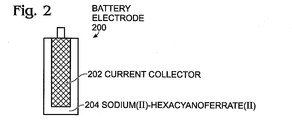
- Fig. 2 is a partial cross-sectional view of a sodium iron(II)-hexacyanoferrate(II) battery electrode.
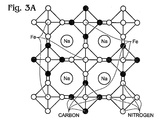
- Fig. 3A is schematic drawings of Na 1+X Fe[Fe(CN) 6 ] Z .MH 2 O.
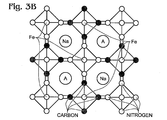
- Fig. 3B is schematic drawings of Na 1+X A Y Fe[Fe(CN) 6 ] Z .MH 2 O.
- Fig. 4 is a partial cross-sectional view of a battery employing the battery electrode of Fig. 2.
- Fig. 1 is a diagram depicting the crystal structure of a transition metal hexacyanoferrate (TMHCF) in the form of A x M1M2(CN) 6 (prior art).
- Fig. 2 is a partial cross-sectional view
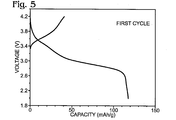
- FIG. 5 is a graph representing the electrochemical behavior of Na 1+X Fe[Fe(CN) 6 ] Z synthesized by a conventional precipitation method that mixes a Fe 2+ solution and a ferrocyanide solution.
- Fig. 6 is an x-ray diffraction (XRD) pattern of a NaFe 2 (CN) 6 sample prepared using a method purportedly able to produce K 2 Fe 2 (CN) 6 .
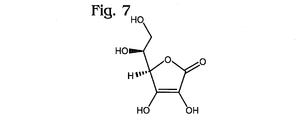
- Fig. 7 is a schematic diagram depicting the structure of ascorbic acid, which is a common anti-oxidant.
- Fig. 8 is a XRD pattern for Na 1+X Fe[Fe(CN) 6 ] Z synthesized using a hydrothermal process including ascorbic acid in the reaction solution.
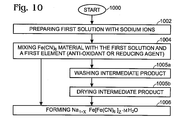
- Fig 10 is a flowchart illustrating method for synthesizing sodium iron(II)-hexacyanoferrate(II).
- Described herein is a hydrothermal reaction process for directly synthesizing sodium iron (II)-hexacyanoferrate(II) ( Na 1+X Fe[Fe 2 (CN) 6 ]).
- reducing agents and/or anti-oxidants are integrated into the reaction solutions.
- Fe (II) in the reaction solution is protected from oxidization by the presence of reducing agents/anti-oxidants.
- Na 1+X Fe[Fe 2 (CN) 6 ] can be directly used as a cathode in sodium-ion batteries with a non-sodium anode to achieve high capacity.
- Reducing agents or anti-oxidants are included within the hydrothermal reaction solutions to protect iron (II) from oxidization, which allows more sodium-ions to be retained in the Fe-HCF structure.
- reaction solution can be weakly acidic, although it is not necessary.
- Na 1+X Fe[Fe(CN) 6 ] can be directly employed as a cathode material in sodium-ion batteries with a non-sodium metal anode.
- a method for synthesizing sodium iron(II)-hexacyanoferrate(II).
- the method prepares a first solution including sodium ions, where the sodium ions are derived from a material such as sodium nitrite, sodium nitrate, sodium chloride, sodium carbonate, sodium acetate, sodium phosphate, sodium thiosulfate, sodium iodide, sodium bisulfite, sodium sulfite, sodium bromide, sodium fluoride, or combinations thereof.
- the first solution may include an aqueous solvent, non-aqueous solvent, or a combination thereof.
- a Fe(CN) 6 material is mixed with the first solution and either an anti-oxidant or a reducing agent.
- the Fe(CN) 6 material may be either ferrocyanide ([Fe(CN) 6 ] 4- ) or ferricyanide ([Fe(CN) 6 ] 3- ).
- Potential anti-oxidants and reducing agents include monosaccharides, disaccharides, glucose, ascorbic acid, formic acid, alcohols, oxalic acid, aldehydes, ketones, organic compounds having reducing properties, inorganic compounds having reducing properties, or combinations thereof.
- the first solution including includes A ions, such as alkali metal ions, alkaline earth metal ions, or combinations thereof, resulting in the formation of Na 1+X A Y Fe[Fe(CN) 6 ] Z .mH 2 O, where y is less than or equal to 1.
- Fig. 2 is a partial cross-sectional view of a sodium iron(II)-hexacyanoferrate(II) battery electrode.
- the battery electrode 200 comprises a current collector 202 and sodium iron(II)-hexacyanoferrate(II) (Na 1+X Fe[Fe(CN) 6 ] Z .mH 2 O) 204 overlying the current collector, where x and z are each less than or equal to 1; and, where m is in a range of 0 to 7.
- the sodium iron(II)-hexacyanoferrate(II) 204 additionally comprises A ions such as alkali metal ions, alkaline earth metal ions, or combinations thereof, forming Na 1+X A Y Fe[Fe(CN) 6 ] Z .mH 2 O, where y is less than or equal to 1.
- the A ions may be lithium ions (Li + ), sodium ions (Na + ), potassium ions (K + ), rubidium ions (Rb + ), cesium ions (Cs + ), beryllium ions (Be + ), magnesium ions (Mg + ), calcium ions (Ca + ), strontium ions (Sr + ), or barium ions (Ba + ).
- alkali metal refers to elements in Group 1 of the Periodic Table which exhibit a tendency to form ions with a single positive charge (alkali metal ions) through loss of an electron.
- Alkaline earth metals include those elements in Group 2 of the Periodic Table which readily lose two electrons to form species with a 2+ charge (alkaline earth metal ions).
- the battery electrode 200 may also include a conductor (not shown), such as a carbonaceous material including carbon black, carbon nanotubes, carbon fibers, etc., to improve electrical conductivity between the sodium iron(II)-hexacyanoferrate(II) 204, and between the sodium iron(II)-hexacyanoferrate(II) 204 and the current collector 202.
- the battery electrode 200 may also include a polymeric binder (not shown), such as polytetrafluoroethylene (PTFE) or polyvinylidene difluoride (PVDF) to provide adhesion between electrode components/current collector and improve the overall physical stability and form of the battery electrode.
- PTFE polytetrafluoroethylene
- PVDF polyvinylidene difluoride
- Figs. 3A and 3B are, respectively, schematic drawings of Na 1+X Fe[Fe(CN) 6 ] Z .mH 2 O and Na 1+X A Y Fe[Fe(CN) 6 ] Z .mH 2 O.
- Fig. 4 is a partial cross-sectional view of a battery employing the battery electrode of Fig. 2.
- the battery 400 comprises a cathode (positive) battery electrode 401, an electrolyte 402, and an anode (negative) battery electrode 406.
- Either the cathode battery electrode 401 or the anode battery electrode 406 is made from sodium iron(II)-hexacyanoferrate(II) overlying a current collector , as described above in the explanation of Fig 2.
- the cathode 401 can be made from a sodium iron(II)hexacyanoferrate(II) material while the anode 406 is made with a TMHCF material other than sodium iron(II)-hexacyanoferrate(II).
- the designation of an electrode as an anode or a cathode is arbitrary, based upon the relative potentials of the two TMHCF materials.
- the electrolyte 402 may be non-aqueous, such as an organic liquid electrolyte, or alternatively, gel electrolyte, polymer electrolyte, solid (inorganic) electrolyte, etc.
- non-aqueous (liquid) electrolytes include organic carbonates such as ethylene carbonate (EC), propylene carbonate (PC), diethyl carbonate (DEC), etc., although many other organic carbonates and alternatives to organic carbonates exist.
- gel electrolytes consist of polymeric materials which have been swelled in the presence of liquid electrolytes.
- polymers employed as gel electrolytes include, but are not limited to, poly(ethylene)oxide (PEO) and fluorinated polymers such as poly(vinylidene) fluoride (PVDF)-based polymers and copolymers, etc.
- (solid) polymer electrolytes may be prepared using the same classes of polymers for forming gel electrolytes although swelling of the polymer in liquid electrolytes is excluded.
- solid inorganic (or ceramic) materials may be considered as electrolytes, which may be employed in combination with liquid electrolytes.
- the appropriate electrolyte system may consist of combinations (hybrid) of the above classes of materials in a variety of configurations. Otherwise, an aqueous electrolyte compatible with the sodium iron(II)-hexacyanoferrate(II) may be used.
- An ion-permeable membrane 404 is interposed between the cathode 200a and the anode 200b. In some instances not shown, the ion-permeable membrane and the electrolyte can be the same material, as may be the case for polymer gel, polymer, and solid electrolytes.
- the cathode battery electrode 401 is made from sodium iron(II)-hexacyanoferrate(II), as described above, the anode battery electrode 406 may be made from a sodium metal, a metal (other than sodium), metal alloy, non-metal material, and/or a polymer material.
- the electrodes described above are the result of an improved hydrothermal reaction strategy to synthesize sodium iron(II)-hexacyanoferrate (Na 1+X Fe[Fe(CN) 6 ] Z ).
- metal hexacyanoferrates can be synthesized in a straightforward method using a standard precipitation method. Briefly, a solution containing metal-ions is dropped (added) into a ferrocyanide/ferricyanide solution to afford the metal hexacyanometallate material.
- the precipitation method is not readily applicable to the preparation of Fe(II) hexacyanoferrate (II) (Fe-HCF) synthesis since Fe(II) is readily oxidized in the solution even under inert (nitrogen) atmosphere.
- Fig. 5 is a graph representing the electrochemical behavior of Na 1+X Fe[Fe 2 (CN) 6 ] Z synthesized by a conventional precipitation method that mixes a Fe 2+ solution and a ferrocyanide solution.
- the material demonstrated a capacity of 40.85 mAh/g, which corresponds to 0.52 Na + -ions per formula.
- thermogravimetric analysis (TGA) analysis confirmed the presence of 2.79 water molecules per formula.
- the molecular formula can be calculated to be Na 0.52 Fe III [Fe II (CN) 6 ] 1-y 2.79H 2 O (y ⁇ 1).
- TGA thermogravimetric analysis
- Fig. 6 is an x-ray diffraction (XRD) pattern of a NaFe 2 (CN) 6 sample prepared using a method purportedly able to produce K 2 Fe 2 (CN) 6 .
- XRD x-ray diffraction
- the product was determined to be a mixture of NaFe 2 (CN) 6 , Fe 3 O 4 , and iron(III) oxide (Fe 2 O 3 ), although all peaks of Fe 2 O 3 exhibited a small displacement to the low angles.
- Some displacement is normal in XRD experiments, due to instrument accuracy and calibration, sample surface irregularities, and changes in the size of the crystal under examination.
- the XRD pattern of the synthesized NaFe 2 (CN) 6 sample (top) showing peaks and peak locations
- the standard (known) peak locations for Fe 3 O 4 (middle) and Fe 2 O 3 (bottom) are shown.
- Fig. 7 is a schematic diagram depicting the structure of ascorbic acid, which is a common anti-oxidant.
- ascorbic acid was added into the hydrothermal reaction solution.
- oxygen radicals O .
- ascorbic acid ions react with oxygen radicals (O . ) to effectively remove oxidizing species from the reaction solution according to the following:
- Fig. 8 is a XRD pattern for sodium Fe(II)-HCF(II) synthesized using a hydrothermal process including ascorbic acid in the reaction solution. Accordingly, Fe(II) was protected from oxidation and sodium Fe(II)-HCF(II) was formed. Unlike NaFe 2 (CN) 6 , with a cubic structure, sodium Fe(II)-CHF(II) exhibits a rhombohedral structure.
- Fig. 9 is a graph depicting the charge/discharge curves for batteries using Na 1+X Fe[Fe(CN) 6 ] Z material synthesized using a hydrothermal process including ascorbic acid in the reaction solution. Based upon a first charge capacity of 135 mAh/g, the number of sodium could be calculated to be ⁇ 1.6 per formula. In other words, the formula of sodium Fe(II)-HCF(II) could be designated as Na 1.6 Fe[Fe(CN) 6 ]mH 2 O.
- Fig 10 is a flowchart illustrating method for synthesizing sodium iron(II)-hexacyanoferrate(II). Although the method is depicted as a sequence of numbered steps for clarity, the numbering does not necessarily dictate the order of the steps. It should be understood that some of these steps may be skipped, performed in parallel, or performed without the requirement of maintaining a strict order of sequence. Generally however, the method follows the numeric order of the depicted steps. The method starts at Step 1000.
- Step 1002 prepares a first solution including sodium ions.
- the sodium ions may be derived from materials such as sodium nitrite, sodium nitrate, sodium chloride, sodium carbonate, sodium acetate, sodium phosphate, sodium thiosulfate, sodium iodide, sodium bisulfite, sodium sulfite, sodium bromide, sodium fluoride, or combinations thereof.
- Step 1004 mixes a Fe(CN) 6 material with the first solution and a first element, which is either an anti-oxidant or a reducing agent.
- the Fe(CN) 6 material may be either ferrocyanide ([Fe(CN) 6 ] 4- ) or ferricyanide ([Fe(CN) 6 ] 3- ).
- an anti-oxidant is defined as a material that inhibits oxidation. Anti-oxidants function to remove free radical intermediates generated during oxidation processes as well as inhibit other oxidation reactions.
- a reducing agent is defined as a species that donates an electron to another species in an oxidation-reduction (redox) reaction. Consequently, the reducing agent is itself oxidized in the process since electron(s) have been forfeited.
- agents that can function as anti-oxidants and/or reducing agents including monosaccharides (glucose, glyceraldehyde, galactose), disaccharides (lactose, maltose), starch, ascorbic acid, formic acid, alcohols, oxalic acid, aldehydes, ketones, organic compounds having reducing properties, and inorganic compounds having reducing properties.
- reducing sugars reducing mono- and di-saccharides
- reducing mono- and di-saccharides are characterized by ⁇ open-chain ⁇ forms containing an aldehyde group or, alternatively, containing a ketone group that can provide an aldehyde group via isomerization.
- the aldehyde group of the reducing sugar can be oxidized via a redox reaction through which a separate material is reduced in the process.
- Starches are glucose polymers that may contain an abundance of aldehyde groups.
- Ascorbic acid is a naturally occurring anti-oxidant that represents a form of Vitamin C. Since formic acid in a deprotonated form breaks into hydride and carbon dioxide, it can function as a reducing agent.
- Oxalic acid can function as a reducing agent by donating electrons during which process it is transformed (oxidized) to carbon dioxide.
- Step 1006 forms sodium iron(II)-hexacyanoferrate(II) (Na 1+X Fe[Fe(CN) 6 ] Z .mH 2 O), where x and z are each less than or equal to 1; and, where m is in a range between 0 and 7.
- preparing the first solution in Step 1002 includes the first solution comprising a solvent such as an aqueous solvent, non-aqueous solvent, or combinations thereof.
- mixing the Fe(CN) 6 material with the first solution and the first element in Step 1004 includes heating at a temperature in a range between about 20 and 1000 degrees centigrade, forming an intermediate product. The mixing of the Fe(CN) 6 material with the first solution and the first element may occur for a duration in the range of 1 hour to 1 month. Further, the mixing may performed by stirring, agitating, or shaking.
- Step 1005a subsequent to forming the intermediate product, Step 1005a washes the intermediate product in a solution such as an aqueous solution, non-aqueous solution, or combinations thereof.
- Step 1005b dries the intermediate product at a temperature in a range between about 20 and 200 degrees centigrade. In one aspect, Step 1005b dries the intermediate product under vacuum at a pressure in a range between 0.001 mTorr and 30 Torr.
- the separation of the intermediate product from the wash solution prior to drying may be performed using a number of conventional processes including, but not limited to, filtration and centrifugation.
- preparing the first solution in Step 1002 includes the first solution comprising A ions such as alkali metal ions, alkaline earth metal ions, or combinations thereof.
- Step 1006 forms Na 1+X A Y Fe[Fe(CN) 6 ] Z .mH 2 O, where y is less than or equal to 1.
- the A ions may be lithium ions (Li + ), sodium ions (Na + ), potassium ions (K + ), rubidium ions (Rb + ), cesium ions (Cs + ), beryllium ions (Be + ), magnesium ions (Mg + ), calcium ions (Ca + ), strontium ions (Sr + ), or barium ions (Ba + ).
- TRANSITION METAL HEXACYANOMETALLATE-CONDUCTIVE POLYMER COMPOSITE invented by Sean Vail et al., Serial No. 14/059,599, filed October 22, 2013, attorney docket No. SLA3336.
- METAL-DOPED TRANSITION METAL HEXACYANOFERRATE (TMHCF) BATTERY ELECTRODE invented by Yuhao Lu et al., Serial No. 13/907,892, filed June 1, 2013, attorney docket No. SLA3287.
- TRANSITION METAL HEXACYANOFERRATE BATTERY CATHODE WITH SINGLE PLATEAU CHARGE/DISCHARGE CURVE invented by Yuhao Lu et al., Serial No. 13/752,930, filed January 29, 2013, attorney docket No. SLA3265.
- SUPERCAPACITOR WITH HEXACYANOMETALLATE CATHODE, ACTIVATED CARBON ANODE, AND AQUEOUS ELECTROLYTE invented by Yuhao Lu et al., Serial No. 13/603,322, filed September 4, 2012, attorney docket No. SLA3212.
Landscapes
- Chemical & Material Sciences (AREA)
- Inorganic Chemistry (AREA)
- Health & Medical Sciences (AREA)
- General Health & Medical Sciences (AREA)
- Toxicology (AREA)
- Organic Chemistry (AREA)
- Chemical Kinetics & Catalysis (AREA)
- Electrochemistry (AREA)
- General Chemical & Material Sciences (AREA)
- Battery Electrode And Active Subsutance (AREA)
Abstract
A method is provided for synthesizing sodium iron(II)-hexacyanoferrate(II). A Fe(CN)6 material is mixed with the first solution and either an anti-oxidant or a reducing agent. The Fe(CN)6 material may be either ferrocyanide ([Fe(CN)6]4-) or ferricyanide ([Fe(CN)6]3-). As a result, sodium iron(II)-hexacyanoferrate(II) (Na1+XFe[Fe(CN)6]Z.mH2O is formed, where x is less than or equal to 1, and where m is in a range between 0 and 7. In one aspect, the first solution including includes A ions, such as alkali metal ions, alkaline earth metal ions, or combinations thereof, resulting in the formation of Na1+XAYFe[Fe(CN)6]Z.mH2O, where y is less than or equal to 1. Also provided are a Na1+XFe[Fe(CN)6]Z.mH2O battery and Na1+XFe[Fe(CN)6]Z.mH2O battery electrode.
Description
This invention generally relates to electrochemical cells and, more particularly, to a sodium iron(II)-hexacyanoferrate(II) material, iron(II)-hexacyanoferrate(II) battery electrode, and associated fabrication processes.
A battery is an electrochemical cell through which chemical energy and electric energy can be converted back and forth. Overall, the energy density of a battery is determined by its voltage and charge capacity. Lithium has the most negative potential (-3.04 V vs. H2/H+), and exhibits the highest gravimetric capacity corresponding to 3860 milliamp-hours per gram (mAh/g). Due to their high energy densities, lithium-ion batteries (LIBs) have triggered the portable electronics revolution. However, both the high cost of lithium metal and the strain on natural resources render doubtful the commercialization of LIBs as large scale energy storage devices. In general, LIBs employ lithium storage compounds as the positive (cathode) and negative (anode) electrode materials. During battery cycling, lithium ions (Li+) are exchanged between the positive and negative electrodes. LIBs have been referred to as `rocking chair` batteries since the lithium ions "rock" (shuttle) back and forth between the positive and negative electrodes as the cells are charged and discharged. The positive electrode (cathode) material is conventionally a metal oxide with a layered structure, such as lithium cobalt oxide (LiCoO2), or a material having a tunneled structure, such as lithium manganese oxide (LiMn2O4) on an aluminum current collector. The negative electrode (anode) typically consists of graphitic carbon, also a layered material, on a copper current collector. During the charge-discharge process, lithium ions are inserted into, or extracted from, the interstitial spaces of the active materials.
Analogous to LIBs, metal-ion batteries employ metal-ion host compounds as their electrode materials into which metal-ions can migrate both easily and reversibly. Since Li+ has one of the smallest radii among metal ions, it is easily accommodated within the interstitial spaces of various materials including layered LiCoO2, olivine-structured LiFePO4, spinel-structured LiMn2O4, and so on. In contrast, larger metal ions such as sodium ions (Na+), potassium ions (K+), magnesium ions (Mg2+), aluminum ions (Al3+), zinc ions (Zn2+), etc., severely distort the structures of conventional Li+ intercalation materials and, consequently, destroy the host structures within several charge/discharge cycles. In light of this, new materials with larger interstitial spaces are required in order to accommodate various metal-ions for a metal-ion battery.
Fig. 1 is a diagram depicting the crystal structure of a transition metal hexacyanoferrate (TMHCF) in the form of AxM1M2(CN)6 (prior art). Transition metals are defined as elements whose atoms possess an incomplete d sub-shell or can give rise to cations (transition metal ions) with an incomplete d shell and include Groups 3 to 12 of the Periodic Table. The crystal structure of TMHCFs exhibits an open framework and is analogous to that of the ABX3 perovskite, as shown. In general, M1
and M2 are transition metal ions in an ordered arrangement on the B sites. The large, tetrahedrally coordinated A sites can host both alkali and alkaline earth ions (Ax) in addition to species such as H2O. The number of alkali (or alkaline earth ions) in the large cages of this crystallographically porous framework may vary from x = 0 to x = 2 depending on the respective valence(s) of M1 and M2. Conveniently, the open framework structure of the TMHCFs facilitates both rapid and reversible intercalation processes for alkali and alkaline earth ions (Ax).
Transition metal hexacyanoferrates (TMHCFs) with large interstitial spaces have been investigated as cathode materials for rechargeable lithium-ion batteries [NPL 1,2], sodium-ion batteries [NPL 3,4], and potassium-ion batteries [NPL 5]. By employing an aqueous electrolyte containing the appropriate alkali-ions or ammonium-ions, copper and nickel hexacyanoferrates [(Cu,Ni)-HCFs] demonstrated a robust cycling life with 83% capacity retention after 40,000 cycles at a charge/discharge current rate of 17C [NPL 6-8]. In spite of this, the materials demonstrated low capacities and energy densities due to the facts that (1) only one sodium-ion (Na+) could be inserted/extracted into/from per Cu-HCF or Ni-HCF formula, and (2) the TM-HCFs electrodes were restricted to operation below 1.23 volts (V) due to the electrochemical window for water decomposition. In order to compensate for such shortcomings, manganese hexacyanoferrate (Mn-HCF) and iron hexacyanoferrate (Fe-HCF) were employed as cathode materials in non-aqueous electrolyte systems [NPL 9,10]. When assembled into batteries with sodium-metal anode, Mn-HCF and Fe-HCF electrodes delivered capacities of ~110 mAh/g when cycled between 2.0 and 4.2 V.
It is worth noting that it is extremely difficult to directly obtain Na2Fe2(CN)6 through a conventional precipitation method. Typically, upon addition of an Fe2+-containing solution into a solution of Fe(CN)6
4-, Fe2+-ions are immediately oxidized to afford a blue precipitate of Na1-xFe2(CN)6. Electrochemical methods have been used to determine that x equals 0.48 for a Na1-xFe2(CN)6 sample synthesized in this manner. Furthermore, the small Na+ content confirms that a certain proportion of Fe(II) in Fe(CN)6
4- was similarly oxidized during the process. In 2011, Hu et al. reported a hydrothermal method to synthesize K2Fe2(CN)6 from K4Fe(CN)6 in a neutral pH solution [NPL 11]. However, it is difficult to synthesize Na2Fe2(CN)6 due to the fact that sodium ions are smaller than potassium ions and are therefore harder to retain in the large interstitial space of Fe-HCF. In addition, the reaction is sensitive to the pH of the reaction solution [NPL 12-14]. In acidic solutions (pH<7), K4Fe(CN)6 produced a Prussian blue material, namely KFe2(CN)6, using a hydrothermal reaction process. In alkaline solutions (pH>7), K4Fe(CN)6 decomposed and formed iron (II, III) oxide (Fe3O4). In light of these results, it may be surmised that the formation of Na2Fe2(CN)6 requires a specific solution pH unlike the neutral conditions that were found to be satisfactory for synthesizing K2Fe2(CN)6. However, the deliberate adjustment of the pH for reaction solutions also failed to produce Na2Fe2(CN)6..
V. D. Neff, `Some Performance Characteristics of a Prussian Blue Battery`, Journal of Electrochemical Society 1985, 132, 1382-1384.
N. Imanishi, T. Morikawa, J. Kondo, Y. Takeda, O.Yamamoto, N. Kinugasa, and T. Yamagishi, `Lithium Intercalation Behavior into Iron Cyanide Complex as Positive Electrode of Lithium Secondary Battery`, Journal of Power Sources 1999, 79, 215-219.
Y. Lu, L. Wang, J. Cheng, and J. B. Goodenough, `Prussian Blue: a New Framework for Sodium Batteries`, Chemistry Communications 2012, 48, 6544-6546.
L. Wang, Y. Lu, J. Liu, M. Xu, J. Cheng, D. Zhang, and J. B. Goodenough, `A Superior Low-Cost Cathode for a Na-ion Battery`, Angewandte Chemie International Edition 2013, 52, 1964-1967.
A. Eftekhari, `Potassium Secondary Cell Based on Prussian Blue Cathode`, Journal of Power Sources 2004, 126, 221-228.
C. D. Wessells, R. A. Huggins, and Y. Cui, `Copper Hexacyanoferrate Battery Electrodes with Long Cycle Life and High Power`, Nature Communications 2011, 2, Article number: 550.
C. D. Wessells, S. V. Peddada, R. A. Huggins, and Y. Cui, `Nickel Hexacyanoferrate Nanoparticle Electrodes for Aqueous Sodium and Potassium Ion Batteries`, Nano Letters 2011, 11, 5421-5425.
C. D. Wessells, S. V. Peddada, M. T. McDowell, R. A. Huggins, and Y. Cui, `The Effect of Insertion Species on Nanostructured Open Framework Hexacyanoferrate Battery Electrodes`, Journal of the Electrochemical Society 2012, 159, A98-A103.
T. Matsuda, M. Takachi, and Y. Moritomo, `A Sodium Manganese Ferrocyanide Thin Film for Na-ion Batteries`, Chemical Communications 2013, 49, 2750-2752.
S-H. Yu, M. Shokouhimehr, T. Hyeon, and Y-E. Sung, `Iron Hexacyanoferrate Nanoparticles as Cathode Materials for Lithium and Sodium Rechargeable Batteries`,
M. Hu and J. S. Jiang, `Facile Synthesis of Air-Stable Prussian White Microcubes via a Hydrothermal Method`, Materials Research Bulletin 2011, 46, 702-707.
S-H. Lee and Y-D. Huh, `Preferential Evolution of Prussian Blues Morphology from Cube to Hexapod`,The Bulletin of the Korean Chemical Society 2012, 33, 1078-1080.
M. Hu, J-S. Jiang, C-C. Lin, and Y. Zeng, `Prussian Blue Mesocrystals: an Example of Self-Construction`, CrystEngComm 2010, 12, 2679-2683.
M. Hu, R-P. Ji, and J-S. Jiang, `Hydrothermal Synthesis of Magnetite Crystals: from Sheet to Pseudo-Octahedron`,
It would be advantageous if a process existed that was able to directly synthesize Na1+XFe[Fe(CN)6], where x is less than or equal to 1.
According to the one aspect of the present invention, a method for synthesizing sodium iron(II)-hexacyanoferrate(II), the method comprising: preparing a first solution including sodium ions; mixing a Fe(CN)6 material with the first solution and a first element selected from a group consisting of an anti-oxidant and a reducing agent; forming sodium iron(II)-hexacyanoferrate(II) (Na1+XFe[Fe(CN)6]Z.mH2O), where x and z are each less than or equal to 1; and, where m is in a range between 0 and 7.
According to the one aspect of the present invention, a sodium iron(II)-hexacyanoferrate(II) battery electrode, the battery electrode comprising: a current collector; sodium iron(II)-hexacyanoferrate(II) (Na1+XFe[Fe(CN)6]Z.mH2O) overlying the current collector, where x and z are each less than or equal to 1; and, where m is in a range of 0 to 7.
According to the one aspect of the present invention, a sodium iron(II)-hexacyanoferrate(II) battery comprising: a cathode comprising: a current collector; sodium iron(II)-hexacyanoferrate(II) (Na1+XFe[Fe(CN)6]Z.mH2O) overlying the current collector, where x and z are each less than or equal to 1; where m is in a range of 0 to 7; an anode; an electrolyte; and, an ion-permeable membrane.
Described herein is a hydrothermal reaction process for directly synthesizing sodium iron (II)-hexacyanoferrate(II) ( Na1+XFe[Fe2(CN)6]). According to one aspect of this method, reducing agents and/or anti-oxidants are integrated into the reaction solutions. During the hydrothermal reaction, Fe (II) in the reaction solution is protected from oxidization by the presence of reducing agents/anti-oxidants. Unlike NaFe2(CN)6, Na1+XFe[Fe2(CN)6]can be directly used as a cathode in sodium-ion batteries with a non-sodium anode to achieve high capacity. Some unique aspects of the process include:
(1) Hydrothermal reaction processes and conditions are employed to synthesize sodium iron(II) hexacyanoferrate [ Na1+XFe[Fe(CN)6]], where X = 0 to 1.
(2) Reducing agents or anti-oxidants are included within the hydrothermal reaction solutions to protect iron (II) from oxidization, which allows more sodium-ions to be retained in the Fe-HCF structure.
(3) The reaction solution can be weakly acidic, although it is not necessary.
(4) Without any additional processes, Na1+XFe[Fe(CN)6] can be directly employed as a cathode material in sodium-ion batteries with a non-sodium metal anode.
Accordingly, a method is provided for synthesizing sodium iron(II)-hexacyanoferrate(II). The method prepares a first solution including sodium ions, where the sodium ions are derived from a material such as sodium nitrite, sodium nitrate, sodium chloride, sodium carbonate, sodium acetate, sodium phosphate, sodium thiosulfate, sodium iodide, sodium bisulfite, sodium sulfite, sodium bromide, sodium fluoride, or combinations thereof. The first solution may include an aqueous solvent, non-aqueous solvent, or a combination thereof.
A Fe(CN)6 material is mixed with the first solution and either an anti-oxidant or a reducing agent. The Fe(CN)6 material may be either ferrocyanide ([Fe(CN)6]4-) or ferricyanide ([Fe(CN)6]3-). Potential anti-oxidants and reducing agents include monosaccharides, disaccharides, glucose, ascorbic acid, formic acid, alcohols, oxalic acid, aldehydes, ketones, organic compounds having reducing properties, inorganic compounds having reducing properties, or combinations thereof.
As a result, sodium iron(II)-hexacyanoferrate(II) (Na1+XFe[Fe(CN)6]Z.mH2O) is formed, where x are z are each less than or equal to 1, and where m is in a range between 0 and 7. In one aspect, the first solution including includes A ions, such as alkali metal ions, alkaline earth metal ions, or combinations thereof, resulting in the formation of Na1+XAYFe[Fe(CN)6]Z.mH2O, where y is less than or equal to 1.
Additional details of the above-described method, a Na1+XFe[Fe(CN)6]Z battery electrode, and Na1+XFe[Fe(CN)6]Z battery are presented below.
Fig. 2 is a partial cross-sectional view of a sodium iron(II)-hexacyanoferrate(II) battery electrode. The battery electrode 200 comprises a current collector 202 and sodium iron(II)-hexacyanoferrate(II) (Na1+XFe[Fe(CN)6]Z.mH2O) 204 overlying the current collector, where x and z are each less than or equal to 1; and, where m is in a range of 0 to 7.
In one aspect, the sodium iron(II)-hexacyanoferrate(II) 204 additionally comprises A ions such as alkali metal ions, alkaline earth metal ions, or combinations thereof, forming Na1+XAYFe[Fe(CN)6]Z.mH2O, where y is less than or equal to 1. The A ions may be lithium ions (Li+), sodium ions (Na+), potassium ions (K+), rubidium ions (Rb+), cesium ions (Cs+), beryllium ions (Be+), magnesium ions (Mg+), calcium ions (Ca+), strontium ions (Sr+), or barium ions (Ba+). As used herein, alkali metal refers to elements in Group 1 of the Periodic Table which exhibit a tendency to form ions with a single positive charge (alkali metal ions) through loss of an electron. Alkaline earth metals include those elements in Group 2 of the Periodic Table which readily lose two electrons to form species with a 2+ charge (alkaline earth metal ions).
As would be understood by those with ordinary skill in the art, the battery electrode 200 may also include a conductor (not shown), such as a carbonaceous material including carbon black, carbon nanotubes, carbon fibers, etc., to improve electrical conductivity between the sodium iron(II)-hexacyanoferrate(II) 204, and between the sodium iron(II)-hexacyanoferrate(II) 204 and the current collector 202. The battery electrode 200 may also include a polymeric binder (not shown), such as polytetrafluoroethylene (PTFE) or polyvinylidene difluoride (PVDF) to provide adhesion between electrode components/current collector and improve the overall physical stability and form of the battery electrode.
Figs. 3A and 3B are, respectively, schematic drawings of Na1+XFe[Fe(CN)6]Z.mH2O and Na1+XAYFe[Fe(CN)6]Z.mH2O.
Fig. 4 is a partial cross-sectional view of a battery employing the battery electrode of Fig. 2. The battery 400 comprises a cathode (positive) battery electrode 401, an electrolyte 402, and an anode (negative) battery electrode 406. Either the cathode battery electrode 401 or the anode battery electrode 406 is made from sodium iron(II)-hexacyanoferrate(II) overlying a current collector , as described above in the explanation of Fig 2. For example, the cathode 401 can be made from a sodium iron(II)hexacyanoferrate(II) material while the anode 406 is made with a TMHCF material other than sodium iron(II)-hexacyanoferrate(II). The designation of an electrode as an anode or a cathode is arbitrary, based upon the relative potentials of the two TMHCF materials. The electrolyte 402 may be non-aqueous, such as an organic liquid electrolyte, or alternatively, gel electrolyte, polymer electrolyte, solid (inorganic) electrolyte, etc. Common examples of non-aqueous (liquid) electrolytes include organic carbonates such as ethylene carbonate (EC), propylene carbonate (PC), diethyl carbonate (DEC), etc., although many other organic carbonates and alternatives to organic carbonates exist. Typically, gel electrolytes consist of polymeric materials which have been swelled in the presence of liquid electrolytes. Examples of polymers employed as gel electrolytes include, but are not limited to, poly(ethylene)oxide (PEO) and fluorinated polymers such as poly(vinylidene) fluoride (PVDF)-based polymers and copolymers, etc. In contrast, (solid) polymer electrolytes may be prepared using the same classes of polymers for forming gel electrolytes although swelling of the polymer in liquid electrolytes is excluded. Finally, solid inorganic (or ceramic) materials may be considered as electrolytes, which may be employed in combination with liquid electrolytes. Overall, the appropriate electrolyte system may consist of combinations (hybrid) of the above classes of materials in a variety of configurations. Otherwise, an aqueous electrolyte compatible with the sodium iron(II)-hexacyanoferrate(II) may be used. An ion-permeable membrane 404 is interposed between the cathode 200a and the anode 200b. In some instances not shown, the ion-permeable membrane and the electrolyte can be the same material, as may be the case for polymer gel, polymer, and solid electrolytes.
In another aspect, if the cathode battery electrode 401 is made from sodium iron(II)-hexacyanoferrate(II), as described above, the anode battery electrode 406 may be made from a sodium metal, a metal (other than sodium), metal alloy, non-metal material, and/or a polymer material.
The electrodes described above are the result of an improved hydrothermal reaction strategy to synthesize sodium iron(II)-hexacyanoferrate (Na1+XFe[Fe(CN)6]Z). In general, metal hexacyanoferrates can be synthesized in a straightforward method using a standard precipitation method. Briefly, a solution containing metal-ions is dropped (added) into a ferrocyanide/ferricyanide solution to afford the metal hexacyanometallate material. Conventionally, the precipitation method is not readily applicable to the preparation of Fe(II) hexacyanoferrate (II) (Fe-HCF) synthesis since Fe(II) is readily oxidized in the solution even under inert (nitrogen) atmosphere.
Fig. 5 is a graph representing the electrochemical behavior of Na1+XFe[Fe2(CN)6]Z synthesized by a conventional precipitation method that mixes a Fe2+ solution and a ferrocyanide solution. During the first charge, the material demonstrated a capacity of 40.85 mAh/g, which corresponds to 0.52 Na+-ions per formula. Furthermore, thermogravimetric analysis (TGA) analysis confirmed the presence of 2.79 water molecules per formula. Thus, the molecular formula can be calculated to be Na0.52FeIII[FeII(CN)6]1-y2.79H2O (y < 1). As a result, it is evident that Na1+XFe[Fe2(CN)6] cannot be synthesized using the conventional precipitation method.
Fig. 6 is an x-ray diffraction (XRD) pattern of a NaFe2(CN)6 sample prepared using a method purportedly able to produce K2Fe2(CN)6. At the time of this filing, only one technical paper has been found which described the synthesis of a stable potassium Fe(II)-HCF(II) (K2Fe2(CN)6) using the hydrothermal reaction [NPL 11]. Experiments were performed with strict adherence to the reported methods in attempts to synthesize sodium Fe(II)-HCF(II) (Na2Fe2(CN)6). However, no white-colored product consistent with Na2Fe2(CN)6 was obtained from the process. In fact, the product was determined to be a mixture of NaFe2(CN)6, Fe3O4, and iron(III) oxide (Fe2O3), although all peaks of Fe2O3 exhibited a small displacement to the low angles. Some displacement is normal in XRD experiments, due to instrument accuracy and calibration, sample surface irregularities, and changes in the size of the crystal under examination. As contrast to the XRD pattern of the synthesized NaFe2(CN)6 sample (top), showing peaks and peak locations, the standard (known) peak locations for Fe3O4 (middle) and Fe2O3 (bottom) are shown.
Additional experiments were also performed during which the pH of the reaction solution was deliberately adjusted to slightly acidic (pH<7), while oxygen was removed from the reaction solution by purging with nitrogen, with the expectation that Prussian white [Na2Fe2(CN)6] could be synthesized under these conditions. Despite pH values of less than 5, it was observed that as the pH decreased, the corresponding colors of the reaction products transitioned from red (Fe2O3) to dark blue (Prussian blue). However, no white-colored product consistent with the formation of Na2Fe2(CN)6 was observed.
The above results clearly demonstrate the fact that Fe(II)-ions were oxidized during the reaction regardless of solution pH. In response to this, an improved hydrothermal reaction was developed, as disclosed herein, to synthesize sodium Fe(II)-HCF(II) by introducing reducing agents or anti-oxidants to the reaction medium. During the hydrothermal reaction, these agents provide a reducing environment to protect Fe(II) from oxidization.
Fig. 7 is a schematic diagram depicting the structure of ascorbic acid, which is a common anti-oxidant. In one experiment, ascorbic acid was added into the hydrothermal reaction solution. From a mechanistic perspective, ascorbic acid ions react with oxygen radicals (O.) to effectively remove oxidizing species from the reaction solution according to the following:

Fig. 8 is a XRD pattern for sodium Fe(II)-HCF(II) synthesized using a hydrothermal process including ascorbic acid in the reaction solution. Accordingly, Fe(II) was protected from oxidation and sodium Fe(II)-HCF(II) was formed. Unlike NaFe2(CN)6, with a cubic structure, sodium Fe(II)-CHF(II) exhibits a rhombohedral structure. The presence of additional sodium-ions in the framework introduces a rhombohedral site symmetry along each of the four [1 1 1] axes that stabilize the sodium-ion displacement along a cubic [1 1 1] axis toward a more negative octahedral-site complex. This rhombohedral structure is also different from potassium Fe(II)-HCF(II) reported by Hu, et al. wherein the K2Fe2(CN)6 exhibited a monoclinic structure [NPL 11].
Fig. 9 is a graph depicting the charge/discharge curves for batteries using Na1+XFe[Fe(CN)6]Z material synthesized using a hydrothermal process including ascorbic acid in the reaction solution. Based upon a first charge capacity of 135 mAh/g, the number of sodium could be calculated to be ~1.6 per formula. In other words, the formula of sodium Fe(II)-HCF(II) could be designated as Na1.6Fe[Fe(CN)6]mH2O. These results unambiguously demonstrate that sodium Fe(II)-HCF(II) can be readily synthesized via the modified hydrothermal reaction wherein reducing agents and anti-oxidants assume a critical role in protecting Fe(II) from oxidization during the process Unlike NaFe2(CN)6, Na1+XFe[Fe(CN)6]Z.mH2O with a high Na+ content can be directly employed as cathode materials in sodium-ion batteries using a non-sodium metal anode.
Fig 10 is a flowchart illustrating method for synthesizing sodium iron(II)-hexacyanoferrate(II). Although the method is depicted as a sequence of numbered steps for clarity, the numbering does not necessarily dictate the order of the steps. It should be understood that some of these steps may be skipped, performed in parallel, or performed without the requirement of maintaining a strict order of sequence. Generally however, the method follows the numeric order of the depicted steps. The method starts at Step 1000.
In one aspect, preparing the first solution in Step 1002 includes the first solution comprising a solvent such as an aqueous solvent, non-aqueous solvent, or combinations thereof. In another aspect, mixing the Fe(CN)6 material with the first solution and the first element in Step 1004 includes heating at a temperature in a range between about 20 and 1000 degrees centigrade, forming an intermediate product. The mixing of the Fe(CN)6 material with the first solution and the first element may occur for a duration in the range of 1 hour to 1 month. Further, the mixing may performed by stirring, agitating, or shaking.
In one variation, subsequent to forming the intermediate product, Step 1005a washes the intermediate product in a solution such as an aqueous solution, non-aqueous solution, or combinations thereof. Step 1005b dries the intermediate product at a temperature in a range between about 20 and 200 degrees centigrade. In one aspect, Step 1005b dries the intermediate product under vacuum at a pressure in a range between 0.001 mTorr and 30 Torr. In one aspect, the separation of the intermediate product from the wash solution prior to drying may be performed using a number of conventional processes including, but not limited to, filtration and centrifugation.
In another aspect, preparing the first solution in Step 1002 includes the first solution comprising A ions such as alkali metal ions, alkaline earth metal ions, or combinations thereof. As a result, Step 1006 forms Na1+XAYFe[Fe(CN)6]Z.mH2O, where y is less than or equal to 1. The A ions may be lithium ions (Li+), sodium ions (Na+), potassium ions (K+), rubidium ions (Rb+), cesium ions (Cs+), beryllium ions (Be+), magnesium ions (Mg+), calcium ions (Ca+), strontium ions (Sr+), or barium ions (Ba+).
A Na1+XFe[Fe(CN)6] battery electrode and associated synthesis processes have been provided. Examples of particular materials and process steps have been presented to illustrate the invention. However, the invention is not limited to merely these examples. Other variations and embodiments of the invention will occur to those skilled in the art.
All applications described below are incorporated herein by reference: (1) TRANSITION METAL HEXACYANOMETALLATE-CONDUCTIVE POLYMER COMPOSITE, invented by Sean Vail et al., Serial No. 14/059,599, filed October 22, 2013, attorney docket No. SLA3336. (2) METAL-DOPED TRANSITION METAL HEXACYANOFERRATE (TMHCF) BATTERY ELECTRODE, invented by Yuhao Lu et al., Serial No. 13/907,892, filed June 1, 2013, attorney docket No. SLA3287. (3) HEXACYANOFERRATE BATTERY ELECTRODE MODIFIED WITH FERROCYANIDES OR FERRICYANIDES, invented by Yuhao Lu et al., Serial No. 13/897,492, filed May 20, 2013, attorney docket No. SLA3286. (4) PROTECTED TRANSITION METAL HEXACYANOFERRATE BATTERY ELECTRODE, invented by Yuhao Lu et al., Serial No. 13/872,673, filed April 29, 2013, attorney docket No. SLA3285. (5) TRANSITION METAL HEXACYANOFERRATE BATTERY CATHODE WITH SINGLE PLATEAU CHARGE/DISCHARGE CURVE, invented by Yuhao Lu et al., Serial No. 13/752,930, filed January 29, 2013, attorney docket No. SLA3265. (6) SUPERCAPACITOR WITH HEXACYANOMETALLATE CATHODE, ACTIVATED CARBON ANODE, AND AQUEOUS ELECTROLYTE, invented by Yuhao Lu et al., Serial No. 13/603,322, filed September 4, 2012, attorney docket No. SLA3212. (8) IMPROVEMENT OF ELECTRON TRANSPORT IN HEXACYANOMETALLATE ELECTRODE FOR ELECTROCHEMICAL APPLICATIONS, invented by Yuhao Lu et al., Serial No. 13/523,694, filed June 14, 2012, attorney docket No. SLA3152. (9) ALKALI AND ALKALINE-EARTH ION BATTERIES WITH HEXACYANOMETALLATE CATHODE AND NON-METAL ANODE, invented by Yuhao Lu et al., Serial No. 13/449,195, filed April 17, 2012, attorney docket no. SLA3151. (10) Electrode Forming Process for Metal-Ion Battery with Hexacyanometallate Electrode, invented by Yuhao Lu et al., Serial No. 13/432,993, filed March 28, 2012, attorney docket no. SLA3146.
Claims (18)
- A method for synthesizing sodium iron(II)-hexacyanoferrate(II), the method comprising:
preparing a first solution including sodium ions;
mixing a Fe(CN)6 material with the first solution and a first element selected from a group consisting of an anti-oxidant and a reducing agent;
forming sodium iron(II)-hexacyanoferrate(II) (Na1+XFe[Fe(CN)6]Z.mH2O),
where x and z are each less than or equal to 1; and,
where m is in a range between 0 and 7. - The method of claim 1 wherein mixing the Fe(CN)6 material includes the Fe(CN)6 material being selected from a group consisting of ferrocyanide ([Fe(CN)6]4-) and ferricyanide ([Fe(CN)6]3-).
- The method of claim 1 wherein mixing the Fe(CN)6 material with the first solution and the first element includes the first element being selected from a group consisting of monosaccharides, disaccharides, glucose, ascorbic acid, formic acid, alcohols, oxalic acid, aldehydes, ketones, organic compounds having reducing properties, inorganic compounds having reducing properties, and combinations thereof.
- The method of claim 1 wherein preparing the first solution including sodium ions additionally includes the first solution comprising a solvent selected from a group consisting of an aqueous solvent, non-aqueous solvent, and combinations thereof.
- The method of claim 4 wherein mixing the Fe(CN)6 material with the first solution and the first element includes heating at a temperature in a range between about 20 and 1000 degrees centigrade, forming an intermediate product.
- The method of claim 5 further comprising:
subsequent to forming the intermediate product, washing the intermediate product in a solution selected from a group consisting of an aqueous solution, non-aqueous solution, and combinations thereof; and,
drying the intermediate product at a temperature in a range between about 20 and 200 degrees centigrade. - The method of claim 6 wherein drying the intermediate product includes drying under vacuum at a pressure in a range between 0.001 mTorr and 30 Torr.
- The method of claim 5 wherein mixing the Fe(CN)6 material with the first solution and the first element includes mixing for a duration in a range of 1 hour to 1 month.
- The method of claim 1 wherein mixing the Fe(CN)6 material with the first solution and the first element includes the Fe(CN)6 material being mixed with the first solution and the first element through a method selected from a group consisting of stirring, agitating, and shaking.
- The method of claim 1 wherein preparing the first solution including sodium ions includes deriving the sodium ions from a material selected from a group consisting of sodium nitrite, sodium nitrate, sodium chloride, sodium carbonate, sodium acetate, sodium phosphate, sodium thiosulfate, sodium iodide, sodium bisulfite, sodium sulfite, sodium bromide, sodium fluoride, and combinations thereof.
- The method of claim 1 wherein preparing the first solution including sodium ions additionally includes the first solution comprising A ions selected from a group consisting of alkali metal ions, alkaline earth metal ions, and combinations thereof; and,
wherein forming Na1+XFe[Fe(CN)6]Z.mH2O includes forming Na1+XAYFe[Fe(CN)6]Z.mH2O, where y is less than or equal to 1. - The method of claim 11 wherein preparing the first solution including A ions comprises the A ions being selected from a group consisting of lithium ions (Li+), sodium ions (Na+), potassium ions (K+), rubidium ions (Rb+), cesium ions (Cs+), beryllium ions (Be+), magnesium ions (Mg+), calcium ions (Ca+), strontium ions (Sr+), and barium ions (Ba+).
- A sodium iron(II)-hexacyanoferrate(II) battery electrode, the battery electrode comprising:
a current collector;
sodium iron(II)-hexacyanoferrate(II) (Na1+XFe[Fe(CN)6]Z.mH2O) overlying the current collector,
where x and z are each less than or equal to 1; and,
where m is in a range of 0 to 7. - The battery electrode of claim 13 wherein the sodium iron(II)-hexacyanoferrate(II) additionally comprises A ions selected from a group consisting of alkali metal ions, alkaline earth metal ions, and combinations thereof, forming Na1+XAYFe[Fe(CN)6]Z.mH2O, where y is less than or equal to 1.
- The battery electrode of claim 14 wherein the A ions are selected from a group consisting of lithium ions (Li+), sodium ions (Na+), potassium ions (K+), rubidium ions (Rb+), cesium ions (Cs+), beryllium ions (Be+), magnesium ions (Mg+), calcium ions (Ca+), strontium ions (Sr+), and barium ions (Ba+).
- A sodium iron(II)-hexacyanoferrate(II) battery comprising:
a cathode comprising:
a current collector;
sodium iron(II)-hexacyanoferrate(II) (Na1+XFe[Fe(CN)6]Z.mH2O) overlying the current collector,
where x and z are each less than or equal to 1;
where m is in a range of 0 to 7;
an anode;
an electrolyte; and,
an ion-permeable membrane. - The battery of claim 16 wherein the sodium iron(II)-hexacyanoferrate(II) additionally comprises A ions selected from a group consisting of alkali metal ions, alkaline earth metal ions, and combinations thereof, forming Na1+XAYFe[Fe(CN)6]Z.mH2O, where y is less than or equal to 1.
- The battery of claim 17 wherein the A ions are selected from a group consisting of lithium ions (Li+), sodium ions (Na+), potassium ions (K+), rubidium ions (Rb+), cesium ions (Cs+), beryllium ions (Be+), magnesium ions (Mg+), calcium ions (Ca+), strontium ions (Sr+), and barium ions (Ba+).
Priority Applications (1)
| Application Number | Priority Date | Filing Date | Title |
|---|---|---|---|
| CN201480051249.3A CN105555712B (en) | 2013-10-30 | 2014-10-23 | Six cyano iron (II) acid sodium iron (II) battery electrode and synthetic method |
Applications Claiming Priority (2)
| Application Number | Priority Date | Filing Date | Title |
|---|---|---|---|
| US14/067,038 | 2013-10-30 | ||
| US14/067,038 US9450224B2 (en) | 2012-03-28 | 2013-10-30 | Sodium iron(II)-hexacyanoferrate(II) battery electrode and synthesis method |
Publications (1)
| Publication Number | Publication Date |
|---|---|
| WO2015064069A1 true WO2015064069A1 (en) | 2015-05-07 |
Family
ID=53003699
Family Applications (1)
| Application Number | Title | Priority Date | Filing Date |
|---|---|---|---|
| PCT/JP2014/005394 Ceased WO2015064069A1 (en) | 2013-10-30 | 2014-10-23 | Sodium iron(ii)-hexacyanoferrate(ii) battery electrode and synthesis method |
Country Status (2)
| Country | Link |
|---|---|
| CN (1) | CN105555712B (en) |
| WO (1) | WO2015064069A1 (en) |
Cited By (6)
| Publication number | Priority date | Publication date | Assignee | Title |
|---|---|---|---|---|
| US10122049B2 (en) | 2014-02-06 | 2018-11-06 | Gelion Technologies Pty Ltd | Gelated ionic liquid film-coated surfaces and uses thereof |
| CN109616674A (en) * | 2018-11-03 | 2019-04-12 | 华东师范大学 | A kind of hybrid battery based on seawater solute and preparation method |
| CN112786828A (en) * | 2021-02-22 | 2021-05-11 | 宁波容百新能源科技股份有限公司 | Prussian positive plate with high compaction density and high rate performance, preparation method of prussian positive plate and sodium ion battery |
| CN115188607A (en) * | 2022-06-20 | 2022-10-14 | 浙江师范大学 | Defective Fe 3 O 4 @ Fe electrode material and preparation method thereof |
| WO2024119235A1 (en) * | 2022-12-07 | 2024-06-13 | Proton Systems Pty Limited | Cathode for proton batteries and method of manufacture |
| CN118895539A (en) * | 2024-06-24 | 2024-11-05 | 合肥国轩高科动力能源有限公司 | Preparation method and application of potassium zinc ferrocyanide/carbon cloth composite electrode material |
Families Citing this family (8)
| Publication number | Priority date | Publication date | Assignee | Title |
|---|---|---|---|---|
| CN108933234A (en) * | 2017-05-22 | 2018-12-04 | 鸿富锦精密工业(深圳)有限公司 | Electrode material, electrode slice, electrolyte and lithium ion secondary battery |
| CN108821311B (en) * | 2018-06-21 | 2021-11-02 | 福州大学 | A kind of preparation method of finely tunable Prussian white mesogenic material of ferromanganese composition |
| WO2020086000A1 (en) * | 2018-10-26 | 2020-04-30 | National University Of Singapore | A lithium ion battery materials recycling method |
| CN110921681B (en) * | 2019-11-28 | 2021-09-21 | 国网浙江省电力有限公司电力科学研究院 | Prussian blue material and preparation method and application thereof |
| CN112850749A (en) * | 2021-01-26 | 2021-05-28 | 武汉理工大学 | Preparation method of electrochromic Prussian bletilla striata and analogue thin film thereof |
| CN114212803B (en) * | 2021-10-28 | 2023-09-12 | 广东邦普循环科技有限公司 | Preparation method of fluorine-doped Prussian blue sodium ion battery positive electrode material |
| GB2627024A (en) * | 2022-08-24 | 2024-08-14 | Guangdong Brunp Recycling Technology Co Ltd | Method for hydrothermal preparation of ferromanganese phosphate and use thereof |
| CN115385320B (en) * | 2022-08-24 | 2023-07-07 | 广东邦普循环科技有限公司 | Method and Application of Hydrothermal Preparation of Ferromanganese Phosphate |
Citations (4)
| Publication number | Priority date | Publication date | Assignee | Title |
|---|---|---|---|---|
| WO1994023333A1 (en) * | 1993-04-05 | 1994-10-13 | Igen, Inc. | Complementary surface confined polymer electrochromic materials, systems, and methods of fabrication therefor |
| JP2010113892A (en) * | 2008-11-05 | 2010-05-20 | Univ Of Tsukuba | Voltage drive element, battery, display, magnetic control apparatus and inversion symmetry control apparatus |
| WO2012177932A2 (en) * | 2011-06-22 | 2012-12-27 | The Board Of Trustees Of The Leland Stanford Junior University | High rate, long cycle life battery electrode materials with an open framework structure |
| JP2014075284A (en) * | 2012-10-04 | 2014-04-24 | Nippon Telegr & Teleph Corp <Ntt> | Sodium secondary battery |
Family Cites Families (2)
| Publication number | Priority date | Publication date | Assignee | Title |
|---|---|---|---|---|
| CN102522553A (en) * | 2011-12-31 | 2012-06-27 | 武汉大学 | Sodium ion battery positive material |
| CN103227325B (en) * | 2013-04-09 | 2015-03-11 | 上海中聚佳华电池科技有限公司 | Sodium-ion battery cathode material and preparation method thereof |
-
2014
- 2014-10-23 CN CN201480051249.3A patent/CN105555712B/en not_active Expired - Fee Related
- 2014-10-23 WO PCT/JP2014/005394 patent/WO2015064069A1/en not_active Ceased
Patent Citations (4)
| Publication number | Priority date | Publication date | Assignee | Title |
|---|---|---|---|---|
| WO1994023333A1 (en) * | 1993-04-05 | 1994-10-13 | Igen, Inc. | Complementary surface confined polymer electrochromic materials, systems, and methods of fabrication therefor |
| JP2010113892A (en) * | 2008-11-05 | 2010-05-20 | Univ Of Tsukuba | Voltage drive element, battery, display, magnetic control apparatus and inversion symmetry control apparatus |
| WO2012177932A2 (en) * | 2011-06-22 | 2012-12-27 | The Board Of Trustees Of The Leland Stanford Junior University | High rate, long cycle life battery electrode materials with an open framework structure |
| JP2014075284A (en) * | 2012-10-04 | 2014-04-24 | Nippon Telegr & Teleph Corp <Ntt> | Sodium secondary battery |
Cited By (6)
| Publication number | Priority date | Publication date | Assignee | Title |
|---|---|---|---|---|
| US10122049B2 (en) | 2014-02-06 | 2018-11-06 | Gelion Technologies Pty Ltd | Gelated ionic liquid film-coated surfaces and uses thereof |
| CN109616674A (en) * | 2018-11-03 | 2019-04-12 | 华东师范大学 | A kind of hybrid battery based on seawater solute and preparation method |
| CN112786828A (en) * | 2021-02-22 | 2021-05-11 | 宁波容百新能源科技股份有限公司 | Prussian positive plate with high compaction density and high rate performance, preparation method of prussian positive plate and sodium ion battery |
| CN115188607A (en) * | 2022-06-20 | 2022-10-14 | 浙江师范大学 | Defective Fe 3 O 4 @ Fe electrode material and preparation method thereof |
| WO2024119235A1 (en) * | 2022-12-07 | 2024-06-13 | Proton Systems Pty Limited | Cathode for proton batteries and method of manufacture |
| CN118895539A (en) * | 2024-06-24 | 2024-11-05 | 合肥国轩高科动力能源有限公司 | Preparation method and application of potassium zinc ferrocyanide/carbon cloth composite electrode material |
Also Published As
| Publication number | Publication date |
|---|---|
| CN105555712A (en) | 2016-05-04 |
| CN105555712B (en) | 2018-06-01 |
Similar Documents
| Publication | Publication Date | Title |
|---|---|---|
| US9531003B2 (en) | Sodium iron(II)-hexacyanoferrate(II) battery electrode | |
| WO2015064069A1 (en) | Sodium iron(ii)-hexacyanoferrate(ii) battery electrode and synthesis method | |
| Omarova et al. | Nickel hexacyanoferrate nanoparticles as a low cost cathode material for lithium-ion batteries | |
| US9385370B2 (en) | Transition metal hexacyanoferrate battery with single plateau charge/discharge curve | |
| JP5463561B2 (en) | COMPOUND HAVING ORIBIN STRUCTURE, PROCESS FOR PRODUCING THE SAME, POSITIVE ACTIVE MATERIAL USING COMPOUND HAVING ORIBIN STRUCTURE AND NON-AQUEOUS ELECTROLYTE BATTERY | |
| KR101159085B1 (en) | Cathode active material for nonaqueous electrolyte secondary battery and method of producing cathode active material for nonaqueous electrolyte secondary battery | |
| EP2911230B1 (en) | Cell | |
| US8968925B2 (en) | Metal-doped transition metal hexacyanoferrate (TMHCF) battery electrode | |
| EP2951874B1 (en) | Method for synthesizing a transition metal hexacyanoferrate battery material | |
| US9546097B2 (en) | Method for the synthesis of iron hexacyanoferrate | |
| WO2014178194A1 (en) | Metal-doped transition metal hexacyanoferrate (tmhcf) battery electrode | |
| WO2016002194A1 (en) | Electrolyte additives for transition metal cyanometallate electrode stabilization | |
| Fleischmann et al. | Nanostructured transition metal oxides for electrochemical energy storage | |
| US9745202B2 (en) | Metal cyanometallate synthesis method | |
| CN105164833B (en) | Hexacyanoferrate battery electrode modified by ferrocyanide or ferricyanide | |
| US20150266745A1 (en) | Metal Cyanometallate Synthesis Method | |
| CN109638278B (en) | Sodium ion battery positive electrode material, preparation method thereof and sodium ion battery | |
| US9966602B2 (en) | Metal cyanometallates | |
| US9099719B2 (en) | Hexacyanoferrate battery electrode modified with ferrocyanides or ferricyanides | |
| US9620815B2 (en) | Electrolyte additives for transition metal cyanometallate electrode stabilization | |
| US9419278B2 (en) | Rechargeable metal-ion battery with non-aqueous hybrid ion electrolyte | |
| JP2005332691A (en) | Layered nickel oxide electrode material, method for producing the same, and battery using the same | |
| Gulbinska | New and Future Developments in Catalysis: Chapter 17. Catalytic Materials and Processes in Secondary Lithium-Ion Batteries | |
| Bao | The rechargeable lithium/air battery and the application of mesoporous Fe₂O₃ in conventional lithium battery |
Legal Events
| Date | Code | Title | Description |
|---|---|---|---|
| WWE | Wipo information: entry into national phase |
Ref document number: 201480051249.3 Country of ref document: CN |
|
| 121 | Ep: the epo has been informed by wipo that ep was designated in this application |
Ref document number: 14857584 Country of ref document: EP Kind code of ref document: A1 |
|
| NENP | Non-entry into the national phase |
Ref country code: DE |
|
| 122 | Ep: pct application non-entry in european phase |
Ref document number: 14857584 Country of ref document: EP Kind code of ref document: A1 |