WO2014198022A1 - Ruthenium- or osmium-based complex catalysts - Google Patents
Ruthenium- or osmium-based complex catalysts Download PDFInfo
- Publication number
- WO2014198022A1 WO2014198022A1 PCT/CN2013/077107 CN2013077107W WO2014198022A1 WO 2014198022 A1 WO2014198022 A1 WO 2014198022A1 CN 2013077107 W CN2013077107 W CN 2013077107W WO 2014198022 A1 WO2014198022 A1 WO 2014198022A1
- Authority
- WO
- WIPO (PCT)
- Prior art keywords
- butyl
- unsubstituted
- substituted
- alkyl
- propyl
- Prior art date
- Legal status (The legal status is an assumption and is not a legal conclusion. Google has not performed a legal analysis and makes no representation as to the accuracy of the status listed.)
- Ceased
Links
Classifications
-
- C—CHEMISTRY; METALLURGY
- C07—ORGANIC CHEMISTRY
- C07F—ACYCLIC, CARBOCYCLIC OR HETEROCYCLIC COMPOUNDS CONTAINING ELEMENTS OTHER THAN CARBON, HYDROGEN, HALOGEN, OXYGEN, NITROGEN, SULFUR, SELENIUM OR TELLURIUM
- C07F15/00—Compounds containing elements of Groups 8, 9, 10 or 18 of the Periodic Table
- C07F15/0006—Compounds containing elements of Groups 8, 9, 10 or 18 of the Periodic Table compounds of the platinum group
- C07F15/0046—Ruthenium compounds
-
- B—PERFORMING OPERATIONS; TRANSPORTING
- B01—PHYSICAL OR CHEMICAL PROCESSES OR APPARATUS IN GENERAL
- B01J—CHEMICAL OR PHYSICAL PROCESSES, e.g. CATALYSIS OR COLLOID CHEMISTRY; THEIR RELEVANT APPARATUS
- B01J31/00—Catalysts comprising hydrides, coordination complexes or organic compounds
- B01J31/16—Catalysts comprising hydrides, coordination complexes or organic compounds containing coordination complexes
- B01J31/22—Organic complexes
- B01J31/2204—Organic complexes the ligands containing oxygen or sulfur as complexing atoms
- B01J31/2208—Oxygen, e.g. acetylacetonates
- B01J31/2217—At least one oxygen and one nitrogen atom present as complexing atoms in an at least bidentate or bridging ligand
-
- B—PERFORMING OPERATIONS; TRANSPORTING
- B01—PHYSICAL OR CHEMICAL PROCESSES OR APPARATUS IN GENERAL
- B01J—CHEMICAL OR PHYSICAL PROCESSES, e.g. CATALYSIS OR COLLOID CHEMISTRY; THEIR RELEVANT APPARATUS
- B01J31/00—Catalysts comprising hydrides, coordination complexes or organic compounds
- B01J31/16—Catalysts comprising hydrides, coordination complexes or organic compounds containing coordination complexes
- B01J31/22—Organic complexes
- B01J31/2204—Organic complexes the ligands containing oxygen or sulfur as complexing atoms
- B01J31/2208—Oxygen, e.g. acetylacetonates
- B01J31/2226—Anionic ligands, i.e. the overall ligand carries at least one formal negative charge
- B01J31/2243—At least one oxygen and one nitrogen atom present as complexing atoms in an at least bidentate or bridging ligand
-
- B—PERFORMING OPERATIONS; TRANSPORTING
- B01—PHYSICAL OR CHEMICAL PROCESSES OR APPARATUS IN GENERAL
- B01J—CHEMICAL OR PHYSICAL PROCESSES, e.g. CATALYSIS OR COLLOID CHEMISTRY; THEIR RELEVANT APPARATUS
- B01J31/00—Catalysts comprising hydrides, coordination complexes or organic compounds
- B01J31/16—Catalysts comprising hydrides, coordination complexes or organic compounds containing coordination complexes
- B01J31/22—Organic complexes
- B01J31/2265—Carbenes or carbynes, i.e.(image)
- B01J31/2269—Heterocyclic carbenes
- B01J31/2273—Heterocyclic carbenes with only nitrogen as heteroatomic ring members, e.g. 1,3-diarylimidazoline-2-ylidenes
-
- B—PERFORMING OPERATIONS; TRANSPORTING
- B01—PHYSICAL OR CHEMICAL PROCESSES OR APPARATUS IN GENERAL
- B01J—CHEMICAL OR PHYSICAL PROCESSES, e.g. CATALYSIS OR COLLOID CHEMISTRY; THEIR RELEVANT APPARATUS
- B01J31/00—Catalysts comprising hydrides, coordination complexes or organic compounds
- B01J31/16—Catalysts comprising hydrides, coordination complexes or organic compounds containing coordination complexes
- B01J31/22—Organic complexes
- B01J31/2265—Carbenes or carbynes, i.e.(image)
- B01J31/2278—Complexes comprising two carbene ligands differing from each other, e.g. Grubbs second generation catalysts
-
- C—CHEMISTRY; METALLURGY
- C07—ORGANIC CHEMISTRY
- C07C—ACYCLIC OR CARBOCYCLIC COMPOUNDS
- C07C5/00—Preparation of hydrocarbons from hydrocarbons containing the same number of carbon atoms
- C07C5/02—Preparation of hydrocarbons from hydrocarbons containing the same number of carbon atoms by hydrogenation
- C07C5/03—Preparation of hydrocarbons from hydrocarbons containing the same number of carbon atoms by hydrogenation of non-aromatic carbon-to-carbon double bonds
-
- C—CHEMISTRY; METALLURGY
- C08—ORGANIC MACROMOLECULAR COMPOUNDS; THEIR PREPARATION OR CHEMICAL WORKING-UP; COMPOSITIONS BASED THEREON
- C08C—TREATMENT OR CHEMICAL MODIFICATION OF RUBBERS
- C08C19/00—Chemical modification of rubber
- C08C19/02—Hydrogenation
-
- C—CHEMISTRY; METALLURGY
- C08—ORGANIC MACROMOLECULAR COMPOUNDS; THEIR PREPARATION OR CHEMICAL WORKING-UP; COMPOSITIONS BASED THEREON
- C08F—MACROMOLECULAR COMPOUNDS OBTAINED BY REACTIONS ONLY INVOLVING CARBON-TO-CARBON UNSATURATED BONDS
- C08F236/00—Copolymers of compounds having one or more unsaturated aliphatic radicals, at least one having two or more carbon-to-carbon double bonds
- C08F236/02—Copolymers of compounds having one or more unsaturated aliphatic radicals, at least one having two or more carbon-to-carbon double bonds the radical having only two carbon-to-carbon double bonds
- C08F236/04—Copolymers of compounds having one or more unsaturated aliphatic radicals, at least one having two or more carbon-to-carbon double bonds the radical having only two carbon-to-carbon double bonds conjugated
- C08F236/12—Copolymers of compounds having one or more unsaturated aliphatic radicals, at least one having two or more carbon-to-carbon double bonds the radical having only two carbon-to-carbon double bonds conjugated with nitriles
-
- C—CHEMISTRY; METALLURGY
- C08—ORGANIC MACROMOLECULAR COMPOUNDS; THEIR PREPARATION OR CHEMICAL WORKING-UP; COMPOSITIONS BASED THEREON
- C08L—COMPOSITIONS OF MACROMOLECULAR COMPOUNDS
- C08L15/00—Compositions of rubber derivatives
- C08L15/005—Hydrogenated nitrile rubber
-
- B—PERFORMING OPERATIONS; TRANSPORTING
- B01—PHYSICAL OR CHEMICAL PROCESSES OR APPARATUS IN GENERAL
- B01J—CHEMICAL OR PHYSICAL PROCESSES, e.g. CATALYSIS OR COLLOID CHEMISTRY; THEIR RELEVANT APPARATUS
- B01J2231/00—Catalytic reactions performed with catalysts classified in B01J31/00
- B01J2231/60—Reduction reactions, e.g. hydrogenation
- B01J2231/64—Reductions in general of organic substrates, e.g. hydride reductions or hydrogenations
- B01J2231/641—Hydrogenation of organic substrates, i.e. H2 or H-transfer hydrogenations, e.g. Fischer-Tropsch processes
- B01J2231/645—Hydrogenation of organic substrates, i.e. H2 or H-transfer hydrogenations, e.g. Fischer-Tropsch processes of C=C or C-C triple bonds
-
- B—PERFORMING OPERATIONS; TRANSPORTING
- B01—PHYSICAL OR CHEMICAL PROCESSES OR APPARATUS IN GENERAL
- B01J—CHEMICAL OR PHYSICAL PROCESSES, e.g. CATALYSIS OR COLLOID CHEMISTRY; THEIR RELEVANT APPARATUS
- B01J2531/00—Additional information regarding catalytic systems classified in B01J31/00
- B01J2531/80—Complexes comprising metals of Group VIII as the central metal
- B01J2531/82—Metals of the platinum group
- B01J2531/821—Ruthenium
-
- B—PERFORMING OPERATIONS; TRANSPORTING
- B01—PHYSICAL OR CHEMICAL PROCESSES OR APPARATUS IN GENERAL
- B01J—CHEMICAL OR PHYSICAL PROCESSES, e.g. CATALYSIS OR COLLOID CHEMISTRY; THEIR RELEVANT APPARATUS
- B01J2531/00—Additional information regarding catalytic systems classified in B01J31/00
- B01J2531/80—Complexes comprising metals of Group VIII as the central metal
- B01J2531/82—Metals of the platinum group
- B01J2531/825—Osmium
-
- C—CHEMISTRY; METALLURGY
- C07—ORGANIC CHEMISTRY
- C07C—ACYCLIC OR CARBOCYCLIC COMPOUNDS
- C07C2531/00—Catalysts comprising hydrides, coordination complexes or organic compounds
- C07C2531/16—Catalysts comprising hydrides, coordination complexes or organic compounds containing coordination complexes
- C07C2531/22—Organic complexes
Definitions
- the present invention relates to ruthenium and osmium based complex structures, to the synthesis thereof and the use as catalysts for hydrogenating unsaturated compounds.
- R 1 and R 2 have the following meanings in compounds 8a-h:
- R J H
- R 2 2,6- i-PrC 6 H 3
- R 2,6-Me 2 -4-BrC 6 H 2 wherein R 1 and R 2 have the following meanings in compounds 343 to 349:
- R 1 2,6-(CH 3 ) 2 -4-BrC 6 H 2
- R 2 H
- R 1 2,6-i-Pr 2 -C 6 H 3 ;
- R 2 H
- the strong electron-donating ability of the imidazol-2-ylidene-type ligand i.e. the N-heterocyclic carbene ligand, can facilitate the decoordination of one side of the bidentate ligand plus it can stabilize the generated intermediate;
- Ru-based NHC-Schiff base catalysts are mainly disclosed as catalysts catalysts for atom transfer radical polymerization (ATRP), ring-opening metathesis polymerization (ROMP), ring-closing metathesis (RCM), olefin isomerisation, enol ester synthesis and Kharasch addition.
- JP 2002/030057A does not contain any disclosure or teaching whether or not such catalysts are suited and active for the hydrogenation of other types of compounds or polymers with high conversion rates and if yes under which conditions and with which activity.
- the invention relates to novel complexes having the general formula (I)
- M is ruthenium or osmium
- Y represents H, F, CI, Br, I, CF 3, pyridine, -OC 6 H 5, CF 3 COO-, CH 3 SO 3 -, or BF 4
- R 1 , R 2 , R 3 , and R 4 are identical or different and represent H; N0 2 ; CF 3 ; halogen, preferably F, CI, Br, or I; or straight chain or branched, substituted or unsubstituted Ci-Ci 4 -alkyl, preferably Ci-Cg-alkyl, more preferably methyl, ethyl, n-propyl, i-propyl, n-butyl, i-butyl, or tert.
- R 7 represents H, straight chain or branched, substituted or unsubstituted C 1 -C 14 - alkyl, preferably Ci-Cg-alkyl, more preferably methyl, ethyl, n-propyl, i-propyl, n-butyl, i-butyl, or tert. -butyl; or
- X is halide, preferably chloride, and R 8 are identical or different and represent H; straight chain or branched, substituted or unsubstituted Ci-Ci 4 -alkyl, preferably Ci-Cg-alkyl, more preferably methyl, ethyl, n-propyl, i-propyl, n-butyl, i-butyl, or tert.
- C6-Ci 4 -aryl substituted or unsubstituted C6-Ci 4 -aryl, preferably C6-Cio-aryl, more preferably phenyl, which aryl group, more preferably phenyl, is either unsubstituted or contains 1 , 2, 3, 4 or 5 identical or different substituents; most preferably N(CH3)(C 2 H 5 )2 + CI " , N(C 2 H 5 ) 2 H + Cr, NH 3 + C1 ⁇ , NH(CH 3 ) 2 + C1 " , or N(CH 3 ) 3 + C1 ⁇ ; tris (Ci-C6-alkoxy)silyl-Ci-C6-alkyl, tris (C6-Ci 4 -aryloxy)silyl-Ci-C6-alkyl, or tris(C 3 -Cio-cycloalkoxy)silyl-Ci-C6-alkyl, preferably t
- R 5 represents H; or straight chain or branched, substituted or unsubstituted Ci-Ci 4 -alkyl, preferably Ci-Cg-alkyl, more preferably methyl, ethyl, n-propyl, i-propyl, n-butyl, i-butyl, or tert.-butyl; or substituted or unsubstituted C 3 -Ci 0 -cycloalkyl, preferably C 5 -C 8 -cycloalkyl, more preferably cyclopentyl, cyclohexyl or cycloheptyl; or substituted or unsubstituted C 6 -Ci 4 -aryl, preferably C 6 -Ci 0 -aryl, more preferably phenyl, which aryl group, preferably phenyl, is either unsubstituted or contains 1 , 2, 3, 4 or 5 identical or different substituents, even more preferably 1 , 2 or
- R 6 represents H, or straight chain or branched, substituted or unsubstituted Ci-Ci 4 -alkyl, preferably Ci-Cg-alkyl, more preferably methyl, ethyl, n-propyl, i-propyl, n-butyl, i-butyl, or tert.-butyl; or substituted or unsubstituted C 3 -Ci 0 -cycloalkyl, preferably C 5 -C 8 -cycloalkyl, more preferably cyclopentyl, cyclohexyl or cycloheptyl; or substituted or unsubstituted C6-Ci 4 -ar l, preferably C6-Cio-aryl, more preferably phenyl, which aryl group, more preferably phenyl, is either unsubstituted or contains 1 , 2, 3, 4 or 5 identical or different substituents; and
- NHC represents an N-heterocyclic carbene ligand.
- novel complexes of general formula (I) can be prepared according to various routes.
- the present invention also relates to processes for preparing the complexes of general formula (I).
- novel u and Os based complexes of general formula (I) are excellently suited for a broad variety of hydrogenation reactions.
- FIG 1 shows the percentage of residue double bonds (“RDB") depending on hydrogenation time for Comparative Examples 1 and 2 and Examples 3 to 8.
- FIG 2 shows the percentage of residue double bonds (“RDB") depending on hydrogenation time for Examples 4, and 9 to 11.
- FIG 3 shows the percentage of residue double bonds (“RDB") depending on hydrogenation time for Examples 4 and 12.
- Figure 4 shows the structure of complex (Ia)-SIMes as determined by single crystal XRD analysis.
- novel catalysts according to general formula (I) are excellently suited for hydrogenating a broad variety of unsaturated compounds, whether these unsaturated compounds are low molecular weight substances, oligomers or polymers.
- the novel catalysts according to general formula (I) are in particular suited for hydrogenating unsaturated polymers like nitrile rubber showing a very high hydrogenation activity so that the use of co-catalysts is no longer necessary and the amount of catalyst to be used is so low that a later removal and recycling of the catalyst may be skipped.
- nitrile rubber can be hydrogenated to more than 90% conversion within 4 hours using the novel complex catalyst with an extreme low u metal loading of e.g. ⁇ 22 ppm of Ru (corresponding to 0.015 phr of the complex catalyst).
- novel complex catalysts show a very high stability when being exposed to air or water. Additionally and very surprisingly the novel complex catalysts may be used at substantially lower hydrogenation temperatures. With regard to the hydrogenation of nitrile rubber it was shown that the novel catalysts are already very active at 65°C only. This is unexpected as other ruthenium based Schiff base catalysts known from prior art are only active at more elevated temperatures. If nitrile rubber is hydrogenated in the presence of the novel complexes the resulting hydrogenated nitrile rubber does not show any gel formation.
- substituted used for the purposes of the present patent application means that a hydrogen atom on an indicated radical or atom has been replaced by another group or moiety, with the proviso that the valency of the atom indicated is not exceeded and the substitution leads to a stable compound.
- M is ruthenium Y is H or CI, R 2 , R 3 , and R 4 are identical or different and represent H; N0 2 ; F, CI, or Br; or straight chain or branched, substituted or unsubstituted Ci-C 8 -alkyl, more preferably methyl, ethyl, n-propyl, i-propyl, n-butyl, i-butyl, or tert.-butyl; or substituted or unsubstituted Cs-Cs-cycloalkyl, more preferably cyclopentyl, cyclohexyl or cycloheptyl; or substituted or unsubstituted C6-Ci 4 -ar l, preferably C6-Cio-aryl, more preferably phenyl, which aryl group, more preferably phenyl, is either unsubstituted or contains 1 , 2, 3, 4 or 5 identical or different substituents; or
- R 5 represents H; or straight chain or branched, substituted or unsubstituted Ci-Ci 4 -alkyl, preferably Ci-Cg-alkyl, more preferably methyl, ethyl, n-propyl, i-propyl, n-butyl, i-butyl, or tert.-butyl; or substituted or unsubstituted C 3 -Ci 0 -cycloalkyl, preferably C 5 -C 8 -cycloalkyl, more preferably cyclopentyl, cyclohexyl or cycloheptyl; or substituted or unsubstituted C 6 -Ci 4 -aryl, preferably C 6 -Ci 0 -aryl, more preferably phenyl, which aryl group, more preferably phenyl, is either unsubstituted or contains 1 , 2, 3, 4 or 5 identical or different substituents, even more preferably 1 , 2
- R 7 represents H, straight chain or branched, substituted or unsubstituted Ci-Cn-alkyl, preferably Ci-Cg-alkyl, more preferably methyl, ethyl, n-propyl, i-propyl, n-butyl, i-butyl, and tert. -butyl;
- R 6 represents H, or straight chain or branched, substituted or unsubstituted Ci-Ci 4 -alkyl, preferably Ci-Cg-alkyl, more preferably methyl, ethyl, n-propyl, i-propyl, n-butyl, i-butyl, or tert.
- substituted or unsubstituted C3-Cio-cycloalkyl preferably Cs-Cg-cycloalkyl, more preferably cyclopentyl, cyclohexyl or cycloheptyl; or substituted or unsubstituted C6-Ci 4 -ar l, preferably C6-Cio-aryl, more preferably phenyl, which aryl group, more preferably phenyl is either unsubstituted or contains 1 , 2, 3, 4 or 5 identical or different substituents; and
- NHC represents an N-heterocyclic carbene ligand.
- the present invention provides complexes of general formula (I) wherein
- M is ruthenium
- Y is H or CI
- R 1 , R 2 , R 3 , and R 4 are all H or R 1 , R 3 , and R 4 are all H while R 2 is simultaneously N0 2 ;
- R 5 represents H; straight chain or branched, substituted or unsubstituted Ci-Cs-alkyl, more preferably methyl, ethyl, n-propyl, i-propyl, n-butyl, i-butyl, or tert.
- Cs-Cs-cycloalkyl more preferably cyclopentyl, cyclohexyl or cycloheptyl
- substituted or unsubstituted C6-Cio-aryl more preferably phenyl, which aryl group, more preferably phenyl, is either unsubstituted or contains 1 , 2, 3, 4 or 5 identical or different substituents, even more preferably 1 , 2 or 3 identical or different substituents which are located in the o- and/or p-positions and which are selected from the group consisting of Ci-Cg alkyl, particularly methyl, ethyl, n-propyl, i-propyl, n-butyl, i-butyl, and tert.
- R 7 represents H, straight chain or branched, substituted or unsubstituted Ci-Cn-alkyl, preferably Ci-Cg-alkyl, more preferably methyl, ethyl, n-propyl, i-propyl, n-butyl, i-butyl, and tert.-butyl;
- R 6 represents H, or straight chain or branched, substituted or unsubstituted Ci-Ci 4 -alkyl, preferably Ci-Cg-alkyl, more preferably methyl, ethyl, n-propyl, i-propyl, n-butyl, i-butyl, or tert.-butyl; or substituted or unsubstituted C 3 -Ci 0 -cycloalkyl, preferably C 5 -C 8 -cycloalkyl, more preferably cyclopentyl, cyclohexyl or cycloheptyl; or substituted or unsubstituted C 6 -Ci 4 -aryl, preferably C 6 -Ci 0 -aryl, more preferably phenyl, which aryl group, more preferably phenyl, is either unsubstituted or contains 1, 2, 3, 4 or 5 identical or different substituents; and
- NHC represents an N-heterocyclic carbene ligand.
- NHC-ligand NHC-ligand:
- the N-heterocyclic carbene ligand represents a cyclic carbene type ligand with at least one nitrogen as hetero atom being present in the ring.
- the ring can exhibit different substitution patterns on the ring atoms. Preferably this substitution pattern provides a certain degree of steric crowing.
- the N-heterocyclic carbene ligand(s) (hereinafter referred to as "NHC-ligand(s) and depicted as "NHC” in the general formulae) is/are preferably based on imidazoline or imidazolidine moieties.
- the NHC-ligand typically has a structure corresponding to the general formulae (Ha) to (He)
- R 8 R 9 , R 10 and R 11 are identical or different and represent hydrogen, straight-chain or branched Ci-C 3 o-alkyl, C 3 -C 2 o-cycloalkyl, C 2 -C 2 o-alkenyl, C 2 -C 2 o-alkynyl, C6-C 24 -aryl, C 7 -C 2 5-alkaryl, C 2 -C 2 o-heteroaryl, C 2 -C 2 o-heterocyclyl, Ci-C 2 o-alkoxy, C 2 -C 2 o-alkenyloxy, C 2 -C 2 o-alkynyloxy, C6-C 2 o-aryloxy, C 2 -C 2 o-alkoxycarbonyl, Ci-C 2 o-alkylthio, C 6 -C 20 -arylthio, -Si(R) 3> -0-Si(R) 3 , -0-C(
- R 8 , R 9 , R 10 , and R 11 can independently of one another, be substituted by one or more substituents, preferably straight-chain or branched Ci-Cio-alkyl, Ca-Cg-cycloalkyl, Ci-Cio-alkoxy, C6-C 24 -aryl, C 2 -C 2 o-heteroaryl, C 2 -C 2 o-heterocyclyl, and a functional group selected from the group consisting of hydroxy, thiol, thioether, ketone, aldehyde, ester, ether, amine, imine, amide, nitro, carboxylic acid, disulphide, carbonate, isocyanate, carbodiimide, carboalkoxy, carbamate and halogen, wherein the abovementioned substituents, to the extent chemically possible, may in turn be substituted by one or more substituents, preferably selected from the group consisting of halogen
- the structures of the NHC-ligand depicted in the general formulae (Ha) and (lib) in the present patent application are equivalent to the structures (Ila-(i)) and (Ilb-(i)) which are frequently also found in the literature for such NHC-ligands, respectively, and emphasize the carbene character of the NHC-ligand.
- R 8 and R 9 are identical or different and represent hydrogen, C6-C 24 -aryl, more preferably phenyl, straight-chain or branched Ci-Ci 0 -alkyl, more preferably methyl, ethyl, n-propyl, i-propyl, n-butyl, sec-butyl, i-butyl or tert.-butyl or form a cycloalkyl or aryl structure together with the carbon atoms to which they are bound.
- R 8 and R 9 may be either unsubstituted or substituted by one or more further substituents selected from the group consisting of straight-chain or branched Ci-Cio-alkyl or Ci-Cio-alkoxy, Ca-Cg-cycloalkyl, C6-C 24 -aryl, and a functional group selected from the group consisting of hydroxy, thiol, thioether, ketone, aldehyde, ester, ether, amine, imine, amide, nitro, carboxylic acid, disulphide, carbonate, isocyanate, carbodiimide, carboalkoxy, carbamate and halogen, wherein all these substituents may in turn be either unsubstituted or substituted by one or more substituents, preferably selected from the group consisting of halogen, in particular chlorine or bromine, Ci-C 5 -alkyl, Ci-C 5 -alkoxy and phenyl.
- substituents preferably selected from the
- NHC-ligand(s) in the catalysts of the general formula (I) 1 0 and R 11 are identical or different and preferably represent straight-chain or branched
- Ci-Cio-alkyl more preferably i-propyl or neopentyl, C3-Cio-cycloalkyl, more preferably adamantyl, substituted or unsubstituted C6-C 24 -aryl, more preferably phenyl, 2,6-diisopropylphenyl, 2,6-dimethylphenyl, or 2,4,6-trimethylphenyl, Ci-Cio-alkylsulfonate, or C6-Cio-arylsulfonate.
- R 10 and R 11 may be either unsubstituted or substituted by one or more further substituents selected from the group consisting of straight-chain or branched Ci-Cio-alkyl or Ci-Ci 0 -alkoxy, C 3 -C 8 -cycloalkyl, C 6 -C 2 4-aryl, and a functional group selected from the group consisting of hydroxy, thiol, thioether, ketone, aldehyde, ester, ether, amine, imine, amide, nitro, carboxylic acid, disulphide, carbonate, isocyanate, carbodiimide, carboalkoxy, carbamate and halogen, wherein all these substituents may in turn be either unsubstituted or substituted by one or more substituents, preferably selected from the group consisting of halogen, in particular chlorine or bromine, Ci-C 5 -alkyl, Ci-C 5 -alkoxy and phenyl.
- substituents
- R 8 and R 9 are identical or different and represent hydrogen, C 6 -C 2 4-aryl, more preferably phenyl, straight-chain or branched Ci-Cio-alkyl, more preferably methyl, ethyl, n-propyl, i-propyl, n-butyl, sec-butyl, and i-butyl, or form a cycloalkyl or aryl structure together with the carbon atoms to which they are bound, and 1 0 and R 11 are identical or different and preferably represent straight-chain or branched
- Ci-Cio-alkyl more preferably i-propyl or neopentyl, C3-Cio-cycloalkyl, more preferably adamantyl, substituted or unsubstituted C6-C24-aryl, more preferably phenyl, 2,6-diisopropylphenyl, 2,6-dimethylphenyl, 2,4,6-trimethylphenyl, Ci-Cio-alkylsulfonate, or C6-Cio-arylsulfonate, wherein all such meanings of R 8 , R 9 , R 10 and R 11 can be unsubstituted or substituted with the same substitution pattern as outlined above with respect to the R 8 and R 9 , on the one hand, and R 10 and R 11 , on the other hand.
- NHC-ligands have the following structures (Ilia) to (IIIu), where "Ph” means in each case phenyl, "Bu” means in each case butyl, i.e. either n-butyl, sec-butyl, iso-butyl or tert. -butyl, "Mes” represents in each case 2,4,6-trimethylphenyl, “Dipp” means in all cases 2,6-diisopropylphenyl and "Dimp” means in each case 2,6-dimethylphenyl.
- NHC-ligand contains not only an "N” (nitrogen), but also an “O” (oxygen) in the ring it is preferred that the substitution pattern of R 8 , R 9 , R 10 and/or R 11 provides a certain steric crowding.
- novel highly active catalysts can be synthesized starting from cheaply available raw materials and two different routes are available as possible pathways:
- the compounds of general formula (I) can be manufactured by reacting a compound of general formula (1)
- X is H, CI, Br or I
- Y represents H, F, CI, Br, I, CF 3 , pyridine, -OC 6 H 5 , CF 3 COO-, CH 3 SO 3 -, or BF 4 ;
- R represents substituted or unsubstituted Ci-Ci4-alkyl, preferably Ci-C6-alkyl; substituted or unsubstituted Ca-Cg-cycloalkyl, preferably cyclopentyl, cyclohexyl or cycloheptyl; substituted or unsubstituted C6-Ci4-ar l, preferably substituted or unsubstituted phenyl, more preferably phenyl; and n is 3, if R represent substituted or unsubstituted C6-Ci4-aryl, preferably substituted or unsubstituted phenyl, more preferably phenyl; or n is 2, if R represent substituted or unsubstituted Ci-Cn-alkyl, preferably Ci-C6-alkyl or substituted or unsubstituted Ca-Cg-cycloalkyl, preferably cyclopentyl, cyclohexyl or cyclohepty
- R 2 , R 3 , and R 4 are identical or different and represent
- halogen preferably F, CI, Br, or I; or straight chain or branched, substituted or unsubstituted Ci-Ci 4 -alkyl,
- Ci-C 8 -alkyl more preferably methyl, ethyl, n-propyl, i-propyl, n-butyl, i-butyl, or tert. -butyl; substituted or unsubstituted C3-Cio-cycloalkyl, preferably Cs-Cg-cycloalkyl, more preferably cyclopentyl, cyclohexyl or cycloheptyl; substituted or unsubstituted C6-Ci 4 -aryl, preferably C6-Cio-aryl, more preferably phenyl, which aryl group, more preferably phenyl, is either unsubstituted or contains 1 , 2, 3 , 4 or 5 identical or different substituents;
- R 7 represents H, straight chain or branched, substituted or unsubstituted
- Ci-Ci 4 -alkyl preferably Ci-Cg-alkyl, more preferably methyl, ethyl, n-propyl, i-propyl, n-butyl, i-butyl, or tert. -butyl;
- C 1 -C 14 alkyl preferably Ci-Cg-alkyl, more preferably methyl, ethyl, n-propyl, i-propyl, n-butyl, i-butyl, or tert.
- C6-Ci 4 -aryl substituted or unsubstituted C6-Ci 4 -aryl, preferably C6-Cio-aryl, more preferably phenyl, which aryl group, more preferably phenyl, is either unsubstituted or contains 1 , 2, 3, 4 or 5 identical or different substituents; most preferably N(CH 3 )(C 2 H 5 ) 2 + CI " , N(C 2 H 5 ) 2 H + Cr, NH 3 + C1 " , NH(CH 3 ) 2 + C1 ⁇ , or N(CH 3 ) 3 + C1 ⁇ ; tris (Ci-C6-alkoxy)silyl-Ci-C6-alkyl, tris (C6-Ci 4 -aryloxy)silyl-Ci-C6-alkyl, or tris(C 3 -Cio-cycloalkoxy)silyl-Ci-C6-alkyl, preferably
- R 5 represents H; straight chain or branched, substituted or unsubstituted Ci-Ci 4 -alkyl,
- Ci-Cg-alkyl more preferably methyl, ethyl, n-propyl, i-propyl, n-butyl, i-butyl, and tert.-butyl; substituted or unsubstituted C 3 -Ci 0 -cycloalkyl, preferably C 5 -C 8 -cycloalkyl, more preferably cyclopentyl, cyclohexyl or cycloheptyl; substituted or unsubstituted C 6 -Ci 4 -aryl, preferably C 6 -Ci 0 -aryl, more preferably phenyl, which aryl group, more preferably phenyl, is either unsubstituted or contains 1 , 2, 3, 4 or 5 identical or different substituents, even more preferably 1 , 2 or 3 identical or different substituents which are located in the o- and/or p-positions;
- R 6 represents H, or straight chain or branched, substituted or unsubstituted Ci-Ci 4 -alkyl, preferably Ci-C 8 -alkyl, more preferably methyl, ethyl, n-propyl, i-propyl, n-butyl, i-butyl, or tert.
- R 1 , R 2 , R 3 , R 4 , R 5 , R 6 , n, Y and R shall have the same general, preferred and more preferred meanings as outlined above for general formulae (1) and (2). which is then reacted with an N-heterocyclic carbene to yield the compounds of general formula (I).
- the process according to route 1 is typically performed in one or more organic solvents, preferably selected from the group consisting of ethers, more preferably THF, dioxane, and diethylether, alkanes, more preferably hexane, aromatic solvents, more preferably toluene, and benzene, halogenated hydrocarbon, more preferably chloroform and chlorobenzene, ester, more preferably ethyl acetate, ketone, more preferably methyl ethyl ketone, acetone, and alcohols, more preferably methanol, ethanol and methyloxyethanol. Further on the process pursuant to route 1 is typically performed either without any catalyst or in the presence of at least one catalyst, preferably Ag 2 C03 or TlOEt.
- organic solvents preferably selected from the group consisting of ethers, more preferably THF, dioxane, and diethylether, alkanes, more preferably hexane, aromatic solvents, more preferably
- Y represents H, F, CI, Br, I, CF 3, pyridine, -OC 6 H 5, CF 3 COO-, CH 3 SO 3 -, or BF 4
- PR 3 represents either triphenyl phosphine (PPh 3 ) with n being 3 or tricyclohexyl phosphine (PCya) with n being 2, is reacted with a compound of general formula (2) wherein
- R 1 , R 2 , R 3 , and R 4 are identical or different and represent H; N0 2 ; F, CI, or Br; or straight chain or branched, substituted or unsubstituted Ci-Cs-alkyl, more preferably methyl, ethyl, n-propyl, i-propyl, n-butyl, i-butyl, or tert.
- substituted or unsubstituted Cs-Cs-cycloalkyl more preferably cyclopentyl, cyclohexyl or cycloheptyl
- substituted or unsubstituted C6-Ci 4 -ar l preferably C6-Cio-aryl, more preferably phenyl, which aryl group, more preferably phenyl, is either unsubstituted or contains 1 , 2, 3, 4 or 5 identical or different substituents;
- Ci-Ci 4 -alkyl preferably Ci-Cg-alkyl, more preferably methyl, ethyl, n-propyl, i-propyl, n-butyl, i-butyl, or tert. -butyl; straight chain or branched Ci-Cs-alkyl, more preferably methyl, ethyl, n-propyl, i-propyl, n-butyl, i-butyl, or tert.
- R 7 represents H, straight chain or branched, substituted or unsubstituted Ci-Cn-alkyl, preferably Ci-C 8 -alkyl, more preferably methyl, ethyl, n-propyl, i-propyl, n-butyl, i-butyl, or tert.-butyl; substituted or unsubstituted C6-Ci 4 -ar l, preferably C6-Cio-aryl, more preferably phenyl, which is either unsubstituted or which contains 1 , 2, 3, 4 or 5 identical or different substituents, even more preferably 1 , 2 or 3 identical or different substituents which are located in the o- and/or p-positions and which are selected from the group consisting of Ci-Cg alkyl, particularly
- R 6 represents H, or straight chain or branched, substituted or unsubstituted Ci-Ci 4 -alkyl, preferably Ci-Cg-alkyl, more preferably methyl, ethyl, n-propyl, i-propyl, n-butyl, i-butyl, or tert.
- R 1 , R 2 , R 3 , R 4 , R 5 , R 6 , n, Y and R shall have the same meanings as outlined above for the above preferred embodiments of general formulae (1) and (2), which is then reacted with a N-heterocyclic carbene to result in the compound of general formula (I) wherein R 1 , R 2 , R 3 , R 4 , R 5 , and Y shall have the same meanings as outlined above for the preferred embodiments of general formulae (1) and (2).
- Compound (1) is typically either commercially available or can be synthesized according to processes known to a person skilled in the art.
- the following compounds of general formula (1) can be used: RuHCl(CO)(PR 3 ) n , RuH 2 (CO)(PR 3 ) n , or RuCl 2 (CO)(PR 3 ) n wherein R and n shall have the meanings defined above for general formula (I).
- RuHCl(CO)(PCy 3 ) 2 More preferably the following compounds of general formula (1) can be used: RuHCl(CO)(PCy 3 ) 2 , RuHCl(CO)(PPh 3 ) 3 , RuCl 2 (CO)(PCy 3 ) 2 , RuCl 2 (CO)(PPh 3 ) 3 , RuH 2 (CO)(PCy 3 ) 2 , or RuH 2 (CO)(PPh 3 ) 3 .
- RuHCl(CO)(PCy 3 ) 2 and RuHCl(CO)(PPh 3 ) 3 can be prepared from RuCl 3 and the corresponding phosphine in alcohol easily according to Journal of Molecular Catalysis A: Chemical, 1997, 126, 1 15 for RuHCl(CO)(PCy 3 ) 2 and Inorg. Synth. 1974, 15, 48 for RuHCl(CO)(PPh 3 ) 3 .
- RuCl 2 (CO)(PCy 3 ) 2 can be prepared from RuCl 3 and PCy 3 in the presence of CO pursuant to Journal of Organometallic Chemistry, 1974, 65, 93.
- RuCl 2 (CO)(PPh 3 ) 3 can be prepared following Comprehensive Organometallic Chemistry 1982, Vol 4, chapter 32.9.
- RuH 2 (CO)(PPh 3 ) 3 is commercially available, e.g. from Strem.
- Preferred examples of the compounds of general formula (2) are the following.
- IPr N,N'-bis(2,6-diisopropylphenyl)imidazol-2-ylidene or
- the compounds of general formula (I) can be manufactured by reacting a compound of general formula (4)
- X is H, CI, Br or I
- Ci-Cn-alkyl is identical or different, preferably identical and represents substituted or unsubstituted Ci-Cn-alkyl, preferably Ci-C6-alkyl; substituted or unsubstituted Ca-Cg-cycloalkyl, preferably cyclopentyl, cyclohexyl or cycloheptyl; substituted or unsubstituted C6-C i4-aryl, preferably substituted or unsubstituted phenyl, more preferably phenyl; and n is 3, if R represent substituted or unsubstituted C6-Ci 4 -aryl, preferably substituted or unsubstituted phenyl, more preferably phenyl; or n is 2, if R represent substituted or unsubstituted Ci-Cn-alkyl, preferably Ci-C6-alkyl; substituted or unsubstituted Ca-Cg-cycloalkyl, preferably cyclopenty
- NHC is an N-heterocyclic carbene; with a compound of general formula (2)
- R 2 , R 3 , and R 4 are identical or different and represent H; N0 2 ; CF 3 ; halogen, preferably F, CI, Br, or I; or straight chain or branched, substituted or unsubstituted Ci-Ci 4 -alkyl, preferably Ci-Cg-alkyl, more preferably methyl, ethyl, n-propyl, i-propyl, n-butyl, i-butyl, or tert.
- Ci-Cn-alkyl represents H, straight chain or branched, substituted or unsubstituted Ci-Cn-alkyl, preferably Ci-C 8 -alkyl, more preferably methyl, ethyl, n-propyl, i-propyl, n-butyl, i-butyl, or tert.-butyl; (N(R 8 )3) + X " wherein X is halide, preferably chloride, and R 8 are identical or different and represent H; straight chain or branched, substituted or unsubstituted Ci-Ci 4 -alkyl, preferably Ci-Cg-alkyl, more preferably methyl, ethyl, n-propyl, i-propyl, n-butyl, i-butyl, and tert.-butyl; substituted or unsubstituted C6-Ci 4 -aryl, preferably C6-Cio-aryl
- R 5 represents H; straight chain or branched, substituted or unsubstituted Ci-Ci 4 -alkyl, preferably Ci-Cg-alkyl, more preferably methyl, ethyl, n-propyl, i-propyl, n-butyl, i-butyl, or tert.-butyl; substituted or unsubstituted C3-Cio-cycloalkyl, preferably Cs-Cg-cycloalkyl, more preferably cyclopentyl, cyclohexyl or cycloheptyl; substituted or unsubstituted C6-Ci 4 -aryl, preferably C6-Cio-aryl, more preferably phenyl, which aryl group, more preferably phenyl, is either unsubstituted or contains 1 , 2, 3, 4 or 5 identical or different substituents, even more preferably 1 , 2 or 3 identical or different substituents which are located in
- R 6 represents H, or straight chain or branched, substituted or unsubstituted Ci-Ci 4 -alkyl, preferably Ci-Cg-alkyl, more preferably methyl, ethyl, n-propyl, i-propyl, n-butyl, i-butyl, or tert.-butyl; or substituted or unsubstituted C 3 -Ci 0 -cycloalkyl, preferably C 5 -C 8 -cycloalkyl, more preferably cyclopentyl, cyclohexyl or cycloheptyl; or substituted or unsubstituted C6-Ci 4 -ar l, preferably C6-Cio-aryl, more preferably phenyl, which aryl group, more preferably phenyl, is either unsubstituted or contains 1 , 2, 3, 4 or 5 identical or different substituents; and
- Typical examples of complex (4) include RuHCl(CO)(IMes)(PPh 3 ), RuHCl(CO)(SIMes)(PPh 3 ), RuHCl(CO)(IPr)(PPh 3 ), RuHCl(CO)(IMes)(PCy 3 ),
- the process according to route 2 is typically performed in one or more organic solvents, preferably selected from the group consisting of ethers, more preferably THF, dioxane, and diethylether, alkanes, more preferably hexane, aromatic solvents, more preferably toluene, and benzene, halogenated hydrocarbon, more preferably chloroform and chlorobenzene, ester, more preferably ethyl acetate, ketone, more preferably methyl ethyl ketone, acetone, and alcohols, more preferably methanol, ethanol and methyloxyethanol. Further on the process pursuant to route 2 is typically performed either without any catalyst or in the presence of at least one catalyst, preferably Ag 2 C03 or TlOEt.
- organic solvents preferably selected from the group consisting of ethers, more preferably THF, dioxane, and diethylether, alkanes, more preferably hexane, aromatic solvents, more preferably
- novel u and Os based complexes of general formula (I) are useful as catalysts, either alone or in combination with suitable co-catalysts or additives, for the hydrogenation of a wide variety of unsaturated organic and polymeric materials. However, is has proven not necessary to add any co-catalysts of additives.
- the present invention relates to the use of the complexes of general formula (I) as catalysts for hydrogenation reactions.
- the process of the present invention is broadly applicable to the hydrogenation of a variety of substrates, including terminal olefins, internal olefins, cyclic olefins, conjugated olefins, and any further olefins having at least one carbon-carbon double bond and additionally at least one further polar unsaturated double or triple bond.
- the process is also applicable to the hydrogenation of polymers having carbon-carbon double bonds. Such polymers may represent homo-, co- or terpolymers.
- a terminal olefin or alkene it is possible to hydrogenate a hydrocarbon compound with a terminal unsaturated carbon-carbon double bond having the general formula C n H 2n .
- the terminal olefin can be a straight-chain or a branched hydrocarbon compound of any length, preferably 1-hexene.
- an internal olefin or alkene it is possible to hydrogenate a hydrocarbon compound with an internal unsaturated carbon-carbon double bond having the general formula C n H 2n .
- the internal olefin can be a straight-chain or a branched hydrocarbon of any length, preferably 2-hexene.
- cyclic olefin or cycloalkene it is possible to hydrogenate a hydrocarbon compound with a cyclic unsaturated carbon-carbon double bond having the general formula C n H 2n -2-
- the cyclic olefin can be a ring of any size, preferably cyclohexene.
- conjugated olefin or dialkene it is possible to hydrogenate a hydrocarbon compound with conjugated carbon-carbon unsaturated double bonds.
- the conjugation can be a straight-chain or a branched hydrocarbon of any length, preferably styrene.
- olefin it is also possible to selectively hydrogenate a hydrocarbon compound with at least one unsaturated carbon-carbon double bond and least one other unsaturated polar double or triple bond.
- unsaturated polar bonds are surprisingly left unaltered.
- the carbon-carbon double bond in such olefins can be of any nature including terminal, internal, cyclic and conjugated ones.
- the additional unsaturated polar bond can be of any nature with preference given to carbon-nitrogen, carbon-phosphorus, carbon-oxygen, and carbon-sulfur unsaturated polar bonds.
- Polymers having carbon-carbon double bonds may also be subjected to the inventive process.
- Such polymers preferably comprise repeating units based on at least one conjugated diene monomer.
- the conjugated diene can be of any nature.
- (C 4 -C 6 ) conjugated dienes are used.
- polymers having carbon-carbon double bonds may be subjected to the inventive process which comprise repeating units of not only at least one conjugated diene as monomer (a) but additionally at least one further copolymerizable monomer (b).
- suitable monomers (b) are olefins, such as ethylene or propylene.
- suitable monomers (b) are vinylaromatic monomers, like styrene, a-methyl styrene, o-chlorostyrene or vinyltoluenes, vinylesters of aliphatic or branched C 1 -C 18 monocarboxylic acids, such as vinyl acetate, vinyl propionate, vinyl butyrate, vinyl valerate, vinyl hexanoate, vinyl 2-ethylhexanoate, vinyl decanoate, vinyl laurate and vinyl stearate.
- vinylaromatic monomers like styrene, a-methyl styrene, o-chlorostyrene or vinyltoluenes
- vinylesters of aliphatic or branched C 1 -C 18 monocarboxylic acids such as vinyl acetate, vinyl propionate, vinyl butyrate, vinyl valerate, vinyl hexanoate, vinyl 2-ethylhexanoate, vinyl decanoate, vinyl
- a preferred polymer to be used in the present invention is a copolymer of 1 ,3-butadiene and styrene or alpha-methylstyrene. Said copolymers may have a random or block type structure.
- suitable monomers (b) are esters of ethylenically unsaturated monocarboxylic acids or mono- or diesters of dicarboxylic acids with generally C 1 -C 12 alkanols, e.g. esters of acrylic acid, methacrylic acid, maleic acid, fumaric acid and itaconic acid with e.g.
- Nitrile rubbers also abbreviated as "NB ” represent copolymers or terpolymers containing repeating units of at least one conjugated diene, at least one ⁇ , ⁇ -unsaturated nitrile monomer and, if appropriate, one or more further copolymerizable monomers.
- the conjugated diene can be of any nature. Preference is given to using (C4-C6) conjugated dienes, more preferably selected from the group consisting of 1 ,3-butadiene, isoprene, 2,3-dimethylbutadiene, piperylene and mixtures thereof. Very particular preference is given to 1 ,3-butadiene and isoprene or mixtures thereof. Especial preference is given to 1 ,3-butadiene.
- ⁇ , ⁇ -unsaturated nitrile it is possible to use any known ⁇ , ⁇ -unsaturated nitrile, preferably a (C3-C5) ⁇ , ⁇ -unsaturated nitrile, more preferably selected from the group consisting of acrylonitrile, methacrylonitrile, ethacrylonitrile and mixtures thereof. Particular preference is given to acrylonitrile.
- a particularly preferred nitrile rubber used in the process of this invention is thus a copolymer having repeating units derived from acrylonitrile and 1 ,3-butadiene.
- the nitrile rubber may comprise repeating units of one or more further copolymerizable monomers known in the art, e.g. ⁇ , ⁇ -unsaturated (preferably mono-unsaturated) monocarboxylic acids, their esters and amides, ⁇ , ⁇ -unsaturated (preferably mono-unsaturated) dicarboxylic acids, their mono- oder diesters, as well as the respective anhydrides or amides of said ⁇ , ⁇ -unsaturated dicarboxylic acids.
- ⁇ , ⁇ -unsaturated (preferably mono-unsaturated) monocarboxylic acids e.g. ⁇ , ⁇ -unsaturated (preferably mono-unsaturated) monocarboxylic acids, their esters and amides
- ⁇ , ⁇ -unsaturated (preferably mono-unsaturated) dicarboxylic acids e.g. ⁇ , ⁇ -unsaturated (preferably mono-unsaturated) dicarboxylic acids, their esters and
- ⁇ , ⁇ -unsaturated monocarboxylic acids acrylic acid and methacrylic acid are preferably used.
- Esters of ⁇ , ⁇ -unsaturated monocarboxylic acids may also be used, in particular alkyl esters, alkoxyalkyl esters, aryl esters, cycloalkylesters, cyanoalkyl esters, hydroxyalkyl esters, and fluoroalkyl esters.
- Ci-Cig alkyl esters of the ⁇ , ⁇ -unsaturated monocarboxylic acids are preferably used, more preferably Q-Qg alkyl esters of acrylic acid or methacrylic acid, such as methylacrylate, ethylacrylate, propylacrylate, n-butylacrylate, tert.-butylacrylate, 2-ethyl- hexylacrylate, n-dodecylacrylate, methylmethacrylate, ethylmethacrylate, propylmethacrylate, n-butylmethacrylate, tert.-butylmethacrylate and
- alkoxyalkyl esters C 2 -Ci 8 alkoxyalkyl esters of ⁇ , ⁇ -unsaturated monocarboxylic acids are preferably used, more preferably alkoxyalkylester of acrylic acid or methacrylic acid such as methoxy methyl(meth)acrylate, methoxy ethyl(meth)acrylate, ethoxyethyl(meth)acrylate and methoxyethyl(meth)acrylate.
- aryl esters preferably C6-Ci 4 -aryl-, more preferably C6-Cio-aryl esters and most preferably the aforementioned aryl esters of acrylates and methacrylates.
- cycloalkyl esters preferably C5-C 12 -, more preferably C6-Ci 2 -cyclo-alkyl and most preferably the aforementioned cycloalkyl acrylates and methacrylates are used.
- cyanoalkyl esters in particular cyanoalkyl acrylates or cyanoalkyl methacrylates, with 2 to 12 C atoms in the cyanoalkyl group, preferably a-cyanoethyl acrylate, ⁇ -cyanoethyl acrylate or cyanobutyl methacrylate.
- hydroxyalkyl esters are used, in particular hydroxyalkyl acrylates and hydroxyalkyl methacrylates with 1 to 12 C-atoms in the hydro xylalkyl group, preferably 2-hydroxyethyl acrylate, 2-hydroxyethyl methacrylate or 3-hydroxypropyl acrylate.
- fluorobenzyl esters in particular fluorobenzyl acrylates or fluorobenzyl methacrylates, preferably trifluoroethyl acrylate and tetrafluoropropyl methacrylate.
- Substituted amino group containing acrylates and methacrylates may also be used like dimethylaminomethyl acrylate and diethylaminoethylacrylate.
- esters of the ⁇ , ⁇ -unsaturated carboxylic acids may also be used, like e.g. polyethyleneglycol(meth)acrylate, polypropyleneglycole(meth)acrylate, glycidyl(meth) acrylate, epoxy(meth)acrylate, N-(2-hydroxyethyl)acrylamide, N-(2-hydroxymethyl) acrylamide or urethane(meth)acrylate.
- Furthon ⁇ , ⁇ -unsaturated dicarboxylic acids may be used, preferably maleic acid, fumaric acid, crotonic acid, itaconic acid, citraconic acid and mesaconic acid.
- anhydrides of ⁇ , ⁇ -unsaturated dicarboxylic acids are used, preferably maleic anhydride, itaconic anhydride, itaconic anhydride, citraconic anhydride and mesaconic anhydride.
- mono- or diesters of ⁇ , ⁇ -unsaturated dicarboxylic acids can be used.
- Suitable alkyl esters are e.g. Ci-Cio-alkyl, preferably ethyl-, n-propyl-, iso-propyl, n-butyl-, tert.-butyl, n-pentyl- oder n-hexyl mono- or diesters.
- Suitable alkoxyalkyl esters are C 2 -Ci 2 -alkoxyalkyl-, preferably Ca-Cg-alkoxyalkyl mono- or diesters.
- Suitable hydroxyalkyl esters are C 1 -C 12 hydroxyalkyl-, preferably Ci-Cg-hydroxyalkyl mono- or diesters.
- Suitable cycloalkyl esters are C 5 -Ci 2 -cycloalkyl-, preferably C6-Ci 2 -cycloalkyl mono- or diesters.
- Suitable alkylcycloalkyl esters are C6-Ci 2 -alkylcycloalkyl-, preferably C 7 -Cio-alkylcycloalkyl mono- or diesters.
- Suitable aryl esters are C6-Ci 4 -aryl, preferably C6-Cio-aryl mono- or diesters.
- ⁇ , ⁇ -ethylenically unsaturated dicarboxylic acid monoester monomers include
- maleic acid monoalkyl esters preferably monomethyl maleate, monoethyl maleate, monopropyl maleate, and mono n-butyl maleate;
- maleic acid monocycloalkyl esters preferably monocyclopentyl maleate, monocyclohexyl maleate, and monocycloheptyl maleate;
- maleic acid monoalkylcycloalkyl esters preferably monomethylcyclopentyl maleate, and monoethylcyclohexyl maleate;
- maleic acid monoaryl ester preferably monophenyl maleate
- maleic acid mono benzyl ester preferably monobenzyl maleate
- fumaric acid monoalkyl esters preferably monomethyl fumarate, monoethyl fumarate, monopropyl fumarate, and mono n-butyl fumarate;
- fumaric acid monocycloalkyl esters preferably monocyclopentyl fumarate, monocyclohexyl fumarate, and monocycloheptyl fumarate;
- fumaric acid monoalkylcycloalkyl esters preferably monomethylcyclopentyl fumarate, and monoethylcyclohexyl fumarate
- fumaric acid monoaryl ester preferably monophenyl fumarate
- citraconic acid monoalkyl esters preferably monomethyl citraconate, monoethyl citraconate, monopropyl citraconate, and mono n-butyl citraconate;
- citraconic acid monocycloalkyl esters preferably monocyclopentyl citraconate, monocyclohexyl citraconate, and monocycloheptyl citraconate;
- citraconic acid monoalkylcycloalkyl esters preferably monomethy Icy clop entyl citraconate, and monoethylcyclohexyl citraconate;
- citraconic acid mono aryl ester preferably monophenyl citraconate
- citraconic acid mono benzyl ester preferably monobenzyl citraconate
- itaconic acid mono alkyl esters preferably monomethyl itaconate, monoethyl itaconate, monopropyl itaconate, and mono n-butyl itaconate;
- itaconic acid monocycloalkyl esters preferably monocyclopentyl itaconate, monocyclohexyl itaconate, and monocycloheptyl itaconate;
- itaconic acid monoalkylcycloalkyl esters preferably monomethy Icy clop entyl itaconate, and monoethylcyclohexyl itaconate;
- vinyl aromatic monomers like styrol, a-methylstyrol and vinylpyridine, as well as non-conjugated dienes like 4-cyanocyclohexene and 4-vinylcyclohexene, as well as alkines like 1- or 2-butine may be used.
- R 1 is hydrogen or a methyl group
- R 2 , R 3 , R 4 , R 5 are identical or different and may represent H, Q-C 12 alkyl, C 3 -C 8 cycloalkyl, alkoxyalkyl, hydroxyalkyl, expoxyalkyl, aryl, or heteroaryl.
- the proportions of conjugated diene and a, ⁇ -unsaturated nitrile in the NBR polymers to be used can vary within wide ranges.
- the proportion of the conjugated diene or the sum of conjugated dienes is usually in the range from 40 to 90% by weight, preferably in the range from 60 to 85% by weight, based on the total polymer.
- the proportion of a, ⁇ -unsaturated nitrile or the sum of a, ⁇ -unsaturated nitriles is usually from 10 to 60% by weight, preferably from 15 to 40% by weight, based on the total polymer.
- the proportions of the monomers in each case add up to 100% by weight.
- the additional monomers can be present in amounts of from 0 to 40% by weight, preferably from 0.1 to 40% by weight, particularly preferably from 1 to 30% by weight, based on the total polymer.
- corresponding proportions of the conjugated diene or dienes and/or the a, ⁇ -unsaturated nitrile or nitriles are replaced by proportions of the additional monomers, with the proportions of all monomers in each case adding up to 100% by weight.
- Nitrile rubbers which can be used for the purposes of the invention are also commercially available, e.g. as products from the product range of the Perbunan® and Krynac® grades of Lanxesstechnik GmbH. Process conditions for hydrogenating the unsaturated substrates:
- the hydrogenation of the unsaturated substrates, in particular the nitrile rubber can be carried out by bringing the unsaturated substrates, in particular the nitrile rubber, into contact with the novel complex catalyst of general formula (I) in the presence of hydrogen.
- the hydrogenation is preferably carried out at a temperature in the range of from 30°C to 200°C, preferably from 40°C to 180°C, most preferably from 50°C to 160°C and at a hydrogen pressure in the range of 0.5 MPa to 35 MPa, more preferably of 3.0 MPa to 10 MPa.
- the hydrogenation time is from 10 minutes to 48 hours, preferably from 15 minutes to 24 hours, more preferably from 30 minutes to 4 hours, even more preferably from 1 hour to 8 hours and most preferably from 1 hour to 3 hours.
- the amount of the complex catalyst to the unsaturated substrates, in particular the nitrile rubber depends on the nature and the catalytic activity of the catalyst.
- the amount of catalyst employed is typically chosen in the range of from 1 to 1000 ppm of noble metal, preferably from 2 to 500 ppm, in particular from 5 to 250 ppm, based on the unsaturated substrates, in particular the nitrile rubber used.
- a solution of the the unsaturated substrates, in particular the nitrile rubber in a suitable solvent is prepared.
- concentration of the the unsaturated substrates, in particular the nitrile rubber in the hydrogenation reaction is not critical, but it should naturally be ensured that the reaction is not adversely affected by an excessively high viscosity of the reaction mixture and any associated mixing problem.
- concentration of the unsaturated substrates, in particular the nitrile rubber in the reaction mixture is preferably in the range from 1 to 25% by weight, particularly preferably in the range from 5 to 20% by weight, based on the total reaction mixture.
- the hydrogenation reaction is typically carried out in a suitable solvent which does not deactivate the catalyst used and also does not adversely affect the reaction in any other way.
- suitable solvents include but are not restricted to dichloromethane, benzene, toluene, monochlorobenzene, methyl ethyl ketone, acetone, methyl isobutyl ketone, tetrahydrofuran, tetrahydropyran, dioxane and cyclohexane.
- the particularly preferred solvents are monochlorobenzene, methyl ethyl ketone and acetone.
- Such solution of the nitrile rubber is then brought into contact with the catalyst according to general formula (I) in the presence of hydrogen at the pressure mentioned above.
- the reaction mixture is typically stirred or any kind of shear can be introduced to allow sufficient contact of the solution with the hydrogen phase.
- One major advantage of the present invention resides in the fact that the complex catalyst used is very active, so that the catalyst residue in the final HNBR products can be low enough to make the catalyst metal removal or recycle step alleviated or even unnecessary.
- the catalysts used during the process of the present invention may be removed. Such removal can be performed e.g. by using ion-exchange resins as described in EP-A-2 072 532 Al and EP-A-2 072 533 Al.
- the reaction mixture obtained after the completion of the hydrogenation reaction can be taken and treated with an ion-exchange resin at e.g. 100 °C for 48 hours under nitrogen which leads to a bonding of the catalyst to the resin while the reaction mixture can be worked up with the usual finishing methods.
- the rubber can then be obtained from the solution by known workup procedures such as steam coagulation, solvent evaporation or precipitation and dried to a degree that allows usage in typical rubber processing methods.
- hydrogenation is a reaction of the double bonds present in the the unsaturated substrates, in particular the nitrile rubber to an extent of at least 50%, preferably 70-100%, more preferably 80-100%, even more preferably 90 - 100 % and most preferably 95-100%.
- Mw Mooney viscosity
- RhCl(PPh 3 ) 3 was purchased from Sigma- Aldrich and used without further purification.
- nitrile butadiene rubbers shown in the below Table 1 as used in the examples are all commercially available from Lanxess GmbH and had the properties given in Table 1.
- the molecular weights M n and M w were determined by a Waters GPC system equipped with a Waters 1515 high performance liquid chromatography pump, a Waters 717plus autosampler, a PL gel 10 ⁇ mixed B column and a Waters 2414 RI detector.
- the GPC test was carried out at 40 °C at 1 mL/min of flow rate with THF as the eluent, and the GPC column was calibrated with narrow PS standard samples.
- Example 4 Hydrogenation of Perbunan ⁇ 3431F; Catalyst (Ia)-SIMes
- Example 10 (Ex. 10):
Landscapes
- Chemical & Material Sciences (AREA)
- Organic Chemistry (AREA)
- Chemical Kinetics & Catalysis (AREA)
- Engineering & Computer Science (AREA)
- Inorganic Chemistry (AREA)
- Materials Engineering (AREA)
- Polymers & Plastics (AREA)
- Health & Medical Sciences (AREA)
- Medicinal Chemistry (AREA)
- General Chemical & Material Sciences (AREA)
- Catalysts (AREA)
- Organic Low-Molecular-Weight Compounds And Preparation Thereof (AREA)
- Low-Molecular Organic Synthesis Reactions Using Catalysts (AREA)
- Addition Polymer Or Copolymer, Post-Treatments, Or Chemical Modifications (AREA)
- Oil, Petroleum & Natural Gas (AREA)
Abstract
Disclosed are ruthenium or osmium based complex structures with a unique combination of ligands comprising a Schiff-base type ligand, a N-heterocyclic carbine ligand and a CO ligand. Further disclosed are the preparation processes of the said complex structures using easily accessible starting materials. The complex structures can be used as catalysts for hydrogenation of unsaturated compounds, oligomers and polymers at unforeseeably low temperatures.
Description
RUTHENIUM- OR OSMIUM-BASED COMPLEX CATALYSTS
FIELD OF THE INVENTION
The present invention relates to ruthenium and osmium based complex structures, to the synthesis thereof and the use as catalysts for hydrogenating unsaturated compounds.
BACKGROUND OF THE INVENTION
Ruthenium or Osmium based catalysts already play an important role in the homogeneous hydrogenation reactions of various substrates for many years as summarized in the Handbook of Homogeneous Hydrogenation, 2007, Volume 1, Pages 45-70 (Edited by De Vries, Johannes G; Elsevier, Come lis J).
In W099/26949A1 and Organometallics, 1998, 17(16), 3460 ruthenium and osmium based complex catalysts have been disclosed which contain bidentate Schiff-Base ligands. It is reported that such complex catalysts are suited for olefin metathesis. It further on described that these ruthenium or osmium based Schiff Base complexes are highly stable to air, moisture and temperature and even exhibit catalytic activity in polar protic solvents. Said (O, N) bidentate Schiff base ligands were recognized as especially feasible for fine-tuning of ligand parameters since their steric and electronic environment can be tailored by the proper choice of the starting materials, i.e. the amine and salicyl aldehyde type. The ruthenium based complexes can be prepared by the treatment of RuCl2(=CHPh)(PCy3)2 (3), the so-called Grubbs (I) catalyst, with a variety of Schiff-base ligands as thallium salts as shown in the following Scheme in which the compound numbering given below the formulae is the same as used in Organometallics, 1998, 17(16), 3460.

8a RJ = H, R2 = 2,6- i-PrC6H3
8b RJ = 4-N02, R2 = 2,6-i-PrC6H3
8c RJ = 4-N02, R2 = 2,6-Me-4-MeOC6H2
8d RJ = 4-N02, R2 = 2,6-Me-4-BrOC6H2
8e RJ = 4-N02, R2 = 2,6-Cl-4-CF3C6H2
8f RJ = 6-Me-4-NO 2, R2 = 2,6-i-PrC6H3
8g RJ = 4-N02, R2 = 2,6-i-Pr-4-N02-C6H3

However, at metathesis temperatures around room temperature these ruthenium based Schiff Base complexes have a lower activity compared to Grubbs (I) catalyst which is RuCl2(=CHPh)(PCy3)2, because they are highly thermally stable under standard catalytic reaction conditions. They only show a higher activity in ring-closing metathesis (RCM) reactions when these are performed at elevated temperatures as e.g. 70°C.
Chem. Rev., 2010, 110(3), 1746-1787 encompasses a review by G. C. Vougioukalakis and R. Grubbs that Schiff base N, O-bidentate ligands can be also introduced into NHC ligand containing Ru-based complexes (with "NHC" standing for a N-heterocyclic carbene ligand) and that the resulting complexes can act as catalysts for atom transfer radical polymerization (ATRP), ring-opening metathesis polymerization (ROMP), ring-closing metathesis (RCM), olefin isomerisation, enol ester synthesis and Kharasch addition. The Ru-based NHC-Schiff base metathesis catalysts disclosed have for example the following structures wherein the numberings given below the formulae are the same as used in Chem. Rev., 2010, 110(3),
1746-1787.

343-349 350: R = 2,6-Me2-4-BrC6H2 wherein R1 and R2 have the following meanings in compounds 343 to 349:
343 R1 = CH3, R2 = H
344 R1 = CH3, R2 = N02
345 R1 = 2,6-(CH3)2-4-BrC6H2, R2 = H
346 R1 = 2,6-(CH3)2-4-BrC6H2, R2 = N02
347 R1 = 2,6-i-Pr2-C6H3; R2 = H
348 R1 = 2,6-i-Pr2-C6H3; R2 = N02
349 R1 = 2,4,6-(CH3)3-C6H2, R2 = H
The catalysts of the following formulae are commercially available from Umicore as catalysts "M41" and "M42" and are recommended for metathesis reactions:

In Angewandte Chemie International Edition 2003, 42(25), 2876 T. Opstal and F. Verpoort have disclosed that the two donor atoms of Schiff base ligands in ruthenium based complexes have opposing natures: the phenolate oxygen atom is a hard donor and known to stabilize the higher oxidation states of ruthenium, whereas the imine nitrogen atom is in
comparison soft and a stabilizer of the lower oxidation states. It was recognized that combining an N-heterocyclic carbene ligand carrying mesitylene groups as substituents of the two N atoms in the ligand with a bidentate Schiff base ligand in the same compound should lead to superior performance, because
1) the strong electron-donating ability of the imidazol-2-ylidene-type ligand, i.e. the N-heterocyclic carbene ligand, can facilitate the decoordination of one side of the bidentate ligand plus it can stabilize the generated intermediate;
2) the bulky mesitylene groups protect the second carbene species in the complex and prevent bimolecular decomposition; and
3) with a phosphane-free catalyst, P-C decomposition reactions are avoided.
However, it is further reported that besides the increased stability, the association of both, the bidentate Schiff base ligands and NHC ligands into Ru complexes also causes rather low catalytic activity at lower temperature, To achieve an activation of this type of "latent" Ru-NHC-Schiff Base catalysts, specific protocols, e.g. heating or introduction of acidic co-catalysts (HC1, BF3, S1CI4, HS1CI3 etc.) are needed as e.g. reported in J. Polym. Sci. A Polym. Chem., 2010, 48(2), 302, as well as Dalton Trans, 2007, 44, 5201.
In Adv. Synth. Catal., 2007, 349(3), 395-404 it is disclosed that catalysts bearing both bidentate salicylaldimine ligands and NHC ligands represent robust olefin metathesis catalysts and test data has been provided for successful ring-closing metathesis of dienes and enynes in methanol and methanol/water mixtures under air. Examples of the investigated catalysts are shown in the following wherein the compound numberings given below the formulae are the same as used in Adv. Synth. Catal., 2007, 349(3), 395-404. The synthetic routes again employ the Schiff base ligands as highly toxic T1(I) salts.

6a R=H 7a R=H
b R=N02 b R=N02
c R=N(CH3)3+ Cl" c R=N(CH3)3+ Cl¬ in Journal of Organic Chemistry 2007, 72, 3561 a Tl salt free and efficient synthesis of bidentate Schiff Base ligand containing ruthenium based complex catalysts for olefin metathesis is described. The new synthesis involves a two-step, quasi-one -pot approach and Ag(I) carbonate as base as shown in the following scheme wherein R1 and R2 may different meanings as disclosed in Journal of Organic Chemistry 2007, 72, 3561.

Although different Ruthenium based complex catalysts containing a NHC-ligand and a Schiff base type ligand have been reported in the prior art so far, they all have one common structural feature: besides the NHC ligands and Schiff base ligands, they all additionally contain a Ru-alkylidene structure [Ru=C-]. So far these Ru-based NHC-Schiff base catalysts are mainly disclosed as catalysts catalysts for atom transfer radical polymerization
(ATRP), ring-opening metathesis polymerization (ROMP), ring-closing metathesis (RCM), olefin isomerisation, enol ester synthesis and Kharasch addition.
In JP 2002/030057A new ruthenium based complexes having a Schiff base ligand as shown below were synthesized and isolated.

These complexes have been reported as being capable of exhibiting a higher catalytic activity for partial hydrogenation of a cyclic polyene such as cyclododecatriene to cyclododecene than that of a conventionally known catalyst system without using an additive which is indispensable to conventional ruthenium complex catalyst systems. JP 2002/030057A does not contain any disclosure or teaching whether or not such catalysts are suited and active for the hydrogenation of other types of compounds or polymers with high conversion rates and if yes under which conditions and with which activity.
In Transition Metal Chemistry 2004, 29, 644-648, an efficient method for introducing a bidentate Schiff base ligand into u complexes is described which yields new hexa-coordinated Schiff base complexes of the type [RuCl(CO)(EPh3)(B)(L)] with E being P or As, B being PPh3 or AsPh3 or pyridin or piperidine and L being the anion of the Schiff bases derived from 2-hydroxy-l-naphthaldehyde and aniline, 4-chloroaniline or 2-methylaniline, respectively. This synthesis route operates in the absence of a metal catalyst mandatory pursuant to a number of other prior art references. The antibacterial activity of these complexes was investigated, but no catalytic properties were investigated or mentioned. The preparation process disclosed is shown in the following for E representing phosphorus, and B as well as L both being PPh3.
e
h

(R = Ph, 4-C6H4CI or 2-C6H4CH3)
As the hydrogenation of compounds is of high importance it was the object of the present invention to provide access to novel ruthenium or osmium based complexes which are excellent hydrogenation catalysts on the one hand and which show a high stability in air or water on the other hand. In particular such complexes should dispose of a high hydrogenation activity for large-scale industrial use at ambient reaction conditions. Preferably such novel complexes should exhibit a high hydrogenation activity even at low reaction temperatures. With regard to the hydrogenation of nitrile rubber the current industrial processes often use expensive h-based catalyst systems like Wilkinson's catalyst together with PPh3 as co-catalyst. After hydrogenation, extra time and costs must be spent to remove and recycle the expensive Rh-based catalyst. It would be desirable to find a catalyst disposing of such a high activity that no co-catalyst needs to be used anymore on the one hand and recovery and recycling of the catalyst would no longer be necessary on the other hand. This would reduce catalyst costs as well as process costs substantially. Compared to hydrogenated polymers as obtained nowadays with known catalysts it is important that the hydrogenated polymers to be obtained by using any new complex catalyst must not show any changes in polymer properties and the polymer's vulcanization behaviour as this has been unfortunately observed for other catalysts.
This object has now been solved by providing novel ruthenium or osmium based complex catalysts containing on the one hand a Schiff-base type ligand and on the other hand an N-heterocyclic carbene ("NHC") ligand, but no Ru- or Os-alkylidene structure.
SUMMARY OF THE INVENTION
The invention relates to novel complexes having the general formula (I)

M is ruthenium or osmium
Y represents H, F, CI, Br, I, CF3, pyridine, -OC6H5, CF3COO-, CH3SO3-, or BF4
R1, R2, R3, and R4 are identical or different and represent H; N02; CF3; halogen, preferably F, CI, Br, or I; or straight chain or branched, substituted or unsubstituted Ci-Ci4-alkyl, preferably Ci-Cg-alkyl, more preferably methyl, ethyl, n-propyl, i-propyl, n-butyl, i-butyl, or tert. -butyl; or substituted or unsubstituted C3-Cio-cycloalkyl, preferably Cs-Cg-cycloalkyl, more preferably cyclopentyl, cyclohexyl or cycloheptyl; or substituted or unsubstituted C6-Ci4-ar l, preferably C6-Cio-aryl, more preferably phenyl, which aryl group, more preferably phenyl,
is either unsubstituted or contains 1 , 2, 3, 4 or 5 substituents; or
OR7, OC(=0)R7, CO(=0)R7, S03R7, S03N(R7)2 or S03Na wherein R7 represents H, straight chain or branched, substituted or unsubstituted C1-C14- alkyl, preferably Ci-Cg-alkyl, more preferably methyl, ethyl, n-propyl, i-propyl, n-butyl,
i-butyl, or tert. -butyl; or
(N(R8)3)+X" wherein X is halide, preferably chloride, and R8 are identical or different and represent H; straight chain or branched, substituted or unsubstituted Ci-Ci4-alkyl, preferably Ci-Cg-alkyl, more preferably methyl, ethyl, n-propyl, i-propyl, n-butyl, i-butyl, or tert. -butyl; substituted or unsubstituted C6-Ci4-aryl, preferably C6-Cio-aryl, more preferably phenyl, which aryl group, more preferably phenyl, is either unsubstituted or contains 1 , 2, 3, 4 or 5 identical or different substituents; most preferably N(CH3)(C2H5)2 + CI", N(C2H5)2H+Cr, NH3 +C1~, NH(CH3)2 +C1", or N(CH3)3 +C1~; tris (Ci-C6-alkoxy)silyl-Ci-C6-alkyl, tris (C6-Ci4-aryloxy)silyl-Ci-C6-alkyl, or tris(C3-Cio-cycloalkoxy)silyl-Ci-C6-alkyl, preferably trisethoxysilyl-n-propyl;
R5 represents H; or straight chain or branched, substituted or unsubstituted Ci-Ci4-alkyl, preferably Ci-Cg-alkyl, more preferably methyl, ethyl, n-propyl, i-propyl, n-butyl, i-butyl, or tert.-butyl; or substituted or unsubstituted C3-Ci0-cycloalkyl, preferably C5-C8-cycloalkyl, more preferably cyclopentyl, cyclohexyl or cycloheptyl; or substituted or unsubstituted C6-Ci4-aryl, preferably C6-Ci0-aryl, more preferably phenyl, which aryl group, preferably phenyl, is either unsubstituted or contains 1 , 2, 3, 4 or 5 identical or different substituents, even more preferably 1 , 2 or 3 identical or different substituents which are located in the o- and/or p-positions; or
R6 represents H, or straight chain or branched, substituted or unsubstituted Ci-Ci4-alkyl, preferably Ci-Cg-alkyl, more preferably methyl, ethyl, n-propyl, i-propyl, n-butyl, i-butyl, or tert.-butyl; or substituted or unsubstituted C3-Ci0-cycloalkyl, preferably C5-C8-cycloalkyl, more preferably cyclopentyl, cyclohexyl or cycloheptyl; or
substituted or unsubstituted C6-Ci4-ar l, preferably C6-Cio-aryl, more preferably phenyl, which aryl group, more preferably phenyl, is either unsubstituted or contains 1 , 2, 3, 4 or 5 identical or different substituents; and
NHC represents an N-heterocyclic carbene ligand.
The novel complexes of general formula (I) can be prepared according to various routes.
Hence the present invention also relates to processes for preparing the complexes of general formula (I).
The novel u and Os based complexes of general formula (I) are excellently suited for a broad variety of hydrogenation reactions.
Therefore, the present invention also relates to a process for manufacturing partially or fully saturated compounds by contacting unsaturated compounds containing at least one C=C double bond with hydrogen in the presence of at least one compound according to general formula (I).
BRIEF DESCRIPTION OF THE FIGURES
The aspects, features and advantages of this invention will become apparent from the following detailed description in conjunction with the accompanying figures showing the following:
Figure 1 shows the percentage of residue double bonds ("RDB") depending on hydrogenation time for Comparative Examples 1 and 2 and Examples 3 to 8.
Figure 2 shows the percentage of residue double bonds ("RDB") depending on hydrogenation time for Examples 4, and 9 to 11.
Figure 3 shows the percentage of residue double bonds ("RDB") depending on hydrogenation time for Examples 4 and 12.
Figure 4 shows the structure of complex (Ia)-SIMes as determined by single crystal XRD analysis.
DETAILED DESCRIPTION OF THE INVENTION
The novel catalysts according to general formula (I) are excellently suited for hydrogenating a broad variety of unsaturated compounds, whether these unsaturated compounds are low molecular weight substances, oligomers or polymers. The novel catalysts according to general formula (I) are in particular suited for hydrogenating unsaturated polymers like nitrile rubber showing a very high hydrogenation activity so that the use of co-catalysts is no longer necessary and the amount of catalyst to be used is so low that a later removal and recycling of the catalyst may be skipped. In one embodiment of the invention nitrile rubber can be hydrogenated to more than 90% conversion within 4 hours using the novel complex catalyst with an extreme low u metal loading of e.g. ~22 ppm of Ru (corresponding to 0.015 phr of the complex catalyst).
The novel complex catalysts show a very high stability when being exposed to air or water. Additionally and very surprisingly the novel complex catalysts may be used at substantially lower hydrogenation temperatures. With regard to the hydrogenation of nitrile rubber it was shown that the novel catalysts are already very active at 65°C only. This is unexpected as other ruthenium based Schiff base catalysts known from prior art are only active at more elevated temperatures. If nitrile rubber is hydrogenated in the presence of the novel complexes the resulting hydrogenated nitrile rubber does not show any gel formation.
The term "substituted" used for the purposes of the present patent application means that a hydrogen atom on an indicated radical or atom has been replaced by another group or moiety, with the proviso that the valency of the atom indicated is not exceeded and the substitution leads to a stable compound.
For the purposes of the present patent application and invention, all the definitions of moities, parameters or explanations given above or below in general terms or in preferred ranges can be combined with one another in any way and shall be considered as disclosed this way, i.e. including combinations of the respective ranges and preferred ranges.
Complex catalyst:
In a preferred embodiment the present invention provides complexes of general formula (I) wherein
M is ruthenium Y is H or CI, R2, R3, and R4 are identical or different and represent H; N02; F, CI, or Br; or straight chain or branched, substituted or unsubstituted Ci-C8-alkyl, more preferably methyl, ethyl, n-propyl, i-propyl, n-butyl, i-butyl, or tert.-butyl; or substituted or unsubstituted Cs-Cs-cycloalkyl, more preferably cyclopentyl, cyclohexyl or cycloheptyl; or substituted or unsubstituted C6-Ci4-ar l, preferably C6-Cio-aryl, more preferably phenyl, which aryl group, more preferably phenyl, is either unsubstituted or contains 1 , 2, 3, 4 or 5 identical or different substituents; or
OR7, OC(=0)R7, CO(=0)R7, S03R7, S03N(R7)2 or S03Na wherein 7 represents H, straight chain or branched, substituted or unsubstituted Ci-Ci4-alkyl, preferably Ci-Cg-alkyl, more preferably methyl, ethyl, n-propyl, i-propyl, n-butyl, i-butyl, or tert.-butyl;
R5 represents H; or straight chain or branched, substituted or unsubstituted Ci-Ci4-alkyl, preferably Ci-Cg-alkyl, more preferably methyl, ethyl, n-propyl, i-propyl, n-butyl, i-butyl, or tert.-butyl; or substituted or unsubstituted C3-Ci0-cycloalkyl, preferably C5-C8-cycloalkyl, more preferably cyclopentyl, cyclohexyl or cycloheptyl; or substituted or unsubstituted C6-Ci4-aryl, preferably C6-Ci0-aryl, more preferably phenyl, which aryl group, more preferably phenyl, is either unsubstituted or
contains 1 , 2, 3, 4 or 5 identical or different substituents, even more preferably 1 , 2 or 3 identical or different substituents which are located in the o- and/or p-positions and which are selected from the group consisting of Ci-Cg alkyl, particularly methyl, ethyl, n-propyl, i-propyl, n-butyl, i-butyl, and tert. -butyl, halogen, particularly CI, Br, and I, OR7, OC(=0)R7, and CO(=0)R7 wherein R7 represents H, straight chain or branched, substituted or unsubstituted Ci-Cn-alkyl, preferably Ci-Cg-alkyl, more preferably methyl, ethyl, n-propyl, i-propyl, n-butyl, i-butyl, and tert. -butyl;
R6 represents H, or straight chain or branched, substituted or unsubstituted Ci-Ci4-alkyl, preferably Ci-Cg-alkyl, more preferably methyl, ethyl, n-propyl, i-propyl, n-butyl, i-butyl, or tert. -butyl; substituted or unsubstituted C3-Cio-cycloalkyl, preferably Cs-Cg-cycloalkyl, more preferably cyclopentyl, cyclohexyl or cycloheptyl; or substituted or unsubstituted C6-Ci4-ar l, preferably C6-Cio-aryl, more preferably phenyl, which aryl group, more preferably phenyl is either unsubstituted or contains 1 , 2, 3, 4 or 5 identical or different substituents; and
NHC represents an N-heterocyclic carbene ligand.
In an even more preferred embodiment the present invention provides complexes of general formula (I) wherein
M is ruthenium
Y is H or CI,
R1, R2, R3, and R4 are all H or R1, R3, and R4 are all H while R2 is simultaneously N02; R5 represents H; straight chain or branched, substituted or unsubstituted Ci-Cs-alkyl, more preferably methyl, ethyl, n-propyl, i-propyl, n-butyl, i-butyl, or tert. -butyl; or
substituted or unsubstituted Cs-Cs-cycloalkyl, more preferably cyclopentyl, cyclohexyl or cycloheptyl; or substituted or unsubstituted C6-Cio-aryl, more preferably phenyl, which aryl group, more preferably phenyl, is either unsubstituted or contains 1 , 2, 3, 4 or 5 identical or different substituents, even more preferably 1 , 2 or 3 identical or different substituents which are located in the o- and/or p-positions and which are selected from the group consisting of Ci-Cg alkyl, particularly methyl, ethyl, n-propyl, i-propyl, n-butyl, i-butyl, and tert. -butyl, halogen, particularly CI, Br, and I, OR7, OC(=0)R7, and CO(=0)R7 wherein R7 represents H, straight chain or branched, substituted or unsubstituted Ci-Cn-alkyl, preferably Ci-Cg-alkyl, more preferably methyl, ethyl, n-propyl, i-propyl, n-butyl, i-butyl, and tert.-butyl;
R6 represents H, or straight chain or branched, substituted or unsubstituted Ci-Ci4-alkyl, preferably Ci-Cg-alkyl, more preferably methyl, ethyl, n-propyl, i-propyl, n-butyl, i-butyl, or tert.-butyl; or substituted or unsubstituted C3-Ci0-cycloalkyl, preferably C5-C8-cycloalkyl, more preferably cyclopentyl, cyclohexyl or cycloheptyl; or substituted or unsubstituted C6-Ci4-aryl, preferably C6-Ci0-aryl, more preferably phenyl, which aryl group, more preferably phenyl, is either unsubstituted or contains 1, 2, 3, 4 or 5 identical or different substituents; and
NHC represents an N-heterocyclic carbene ligand. NHC-ligand:
In the general formula (I) the N-heterocyclic carbene ligand represents a cyclic carbene type ligand with at least one nitrogen as hetero atom being present in the ring. The ring can exhibit different substitution patterns on the ring atoms. Preferably this substitution pattern provides a certain degree of steric crowing.
In the context of this invention the N-heterocyclic carbene ligand(s) (hereinafter referred to as "NHC-ligand(s) and depicted as "NHC" in the general formulae) is/are preferably based on imidazoline or imidazolidine moieties.
In the general formula (I) as disclosed above with the general as well as the preferred, more preferred and particularly preferred meanings of M, Y, R:-R6 the NHC-ligand typically has a structure corresponding to the general formulae (Ha) to (He)

(lib)

(l ie) (l id) (l ie)
wherein
R8 R9, R10 and R11 are identical or different and represent hydrogen, straight-chain or branched Ci-C3o-alkyl, C3-C2o-cycloalkyl, C2-C2o-alkenyl, C2-C2o-alkynyl, C6-C24-aryl, C7-C25-alkaryl, C2-C2o-heteroaryl, C2-C2o-heterocyclyl, Ci-C2o-alkoxy, C2-C2o-alkenyloxy, C2-C2o-alkynyloxy, C6-C2o-aryloxy, C2-C2o-alkoxycarbonyl, Ci-C2o-alkylthio, C6-C20-arylthio, -Si(R)3> -0-Si(R)3, -0-C(=0)R, C(=0)R, -C(=0)N(R)2, -NR-C(=0)-N(R)2, -S02N(R)2 , -S(=0)R, -S(=0)2R, -0-S(=0)2R, halogen, nitro or cyano; wherein in all above occurences relating to the meanings of R8' R9, R10 and R11 the group R is identical or different and represents hydrogen, Ci-C3o-alkyl, C3-C2o-cycloalkyl, C2-C2o-alkenyl, C2-C2o-alkynyl, C6-C24-aryl, or C2-C2o-heteroaryl.
In these formulae (Ha) to (He) the carbon atom bonding to the Ruthenium or Osmium metal
center is formally a carbene carbon.
If appropriate, one or more of R8, R9, R10, and R11 can independently of one another, be substituted by one or more substituents, preferably straight-chain or branched Ci-Cio-alkyl, Ca-Cg-cycloalkyl, Ci-Cio-alkoxy, C6-C24-aryl, C2-C2o-heteroaryl, C2-C2o-heterocyclyl, and a functional group selected from the group consisting of hydroxy, thiol, thioether, ketone, aldehyde, ester, ether, amine, imine, amide, nitro, carboxylic acid, disulphide, carbonate, isocyanate, carbodiimide, carboalkoxy, carbamate and halogen, wherein the abovementioned substituents, to the extent chemically possible, may in turn be substituted by one or more substituents, preferably selected from the group consisting of halogen, in particular chlorine or bromine, Ci-C5-alkyl, Ci-C5-alkoxy and phenyl.
Merely for the sake of clarity, it may be added that the structures of the NHC-ligand depicted in the general formulae (Ha) and (lib) in the present patent application are equivalent to the structures (Ila-(i)) and (Ilb-(i)) which are frequently also found in the literature for such NHC-ligands, respectively, and emphasize the carbene character of the NHC-ligand. This applies analogously to the further structures (He) to (He) as well as the associated preferred structures (Illa)-(IIIu) depicted below.
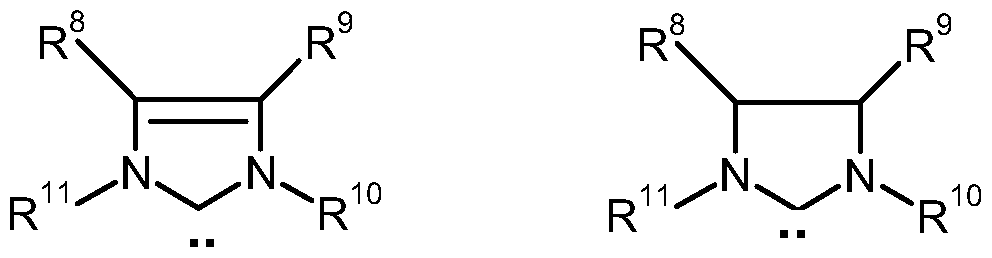
(Ila-(i)) (llb-(i))
In preferred NHC-ligand(s) in the catalysts of the general formula (I)
R8 and R9 are identical or different and represent hydrogen, C6-C24-aryl, more preferably phenyl, straight-chain or branched Ci-Ci0-alkyl, more preferably methyl, ethyl, n-propyl, i-propyl, n-butyl, sec-butyl, i-butyl or tert.-butyl or form a cycloalkyl or aryl structure together with the carbon atoms to which they are bound.
The preferred and more preferred meanings of R8 and R9 may be either unsubstituted or
substituted by one or more further substituents selected from the group consisting of straight-chain or branched Ci-Cio-alkyl or Ci-Cio-alkoxy, Ca-Cg-cycloalkyl, C6-C24-aryl, and a functional group selected from the group consisting of hydroxy, thiol, thioether, ketone, aldehyde, ester, ether, amine, imine, amide, nitro, carboxylic acid, disulphide, carbonate, isocyanate, carbodiimide, carboalkoxy, carbamate and halogen, wherein all these substituents may in turn be either unsubstituted or substituted by one or more substituents, preferably selected from the group consisting of halogen, in particular chlorine or bromine, Ci-C5-alkyl, Ci-C5-alkoxy and phenyl.
In further preferred NHC-ligand(s) in the catalysts of the general formula (I) 10 and R11 are identical or different and preferably represent straight-chain or branched
Ci-Cio-alkyl, more preferably i-propyl or neopentyl, C3-Cio-cycloalkyl, more preferably adamantyl, substituted or unsubstituted C6-C24-aryl, more preferably phenyl, 2,6-diisopropylphenyl, 2,6-dimethylphenyl, or 2,4,6-trimethylphenyl, Ci-Cio-alkylsulfonate, or C6-Cio-arylsulfonate.
These preferred meanings of R10 and R11 may be either unsubstituted or substituted by one or more further substituents selected from the group consisting of straight-chain or branched Ci-Cio-alkyl or Ci-Ci0-alkoxy, C3-C8-cycloalkyl, C6-C24-aryl, and a functional group selected from the group consisting of hydroxy, thiol, thioether, ketone, aldehyde, ester, ether, amine, imine, amide, nitro, carboxylic acid, disulphide, carbonate, isocyanate, carbodiimide, carboalkoxy, carbamate and halogen, wherein all these substituents may in turn be either unsubstituted or substituted by one or more substituents, preferably selected from the group consisting of halogen, in particular chlorine or bromine, Ci-C5-alkyl, Ci-C5-alkoxy and phenyl.
In further preferred NHC-ligand(s) in the catalysts of the general formula (I)
R8 and R9 are identical or different and represent hydrogen, C6-C24-aryl, more preferably phenyl, straight-chain or branched Ci-Cio-alkyl, more preferably methyl, ethyl, n-propyl, i-propyl, n-butyl, sec-butyl, and i-butyl, or form a cycloalkyl or aryl
structure together with the carbon atoms to which they are bound, and 10 and R11 are identical or different and preferably represent straight-chain or branched
Ci-Cio-alkyl, more preferably i-propyl or neopentyl, C3-Cio-cycloalkyl, more preferably adamantyl, substituted or unsubstituted C6-C24-aryl, more preferably phenyl, 2,6-diisopropylphenyl, 2,6-dimethylphenyl, 2,4,6-trimethylphenyl, Ci-Cio-alkylsulfonate, or C6-Cio-arylsulfonate, wherein all such meanings of R8, R9, R10 and R11 can be unsubstituted or substituted with the same substitution pattern as outlined above with respect to the R8 and R9, on the one hand, and R10 and R11, on the other hand.
Particularly preferred NHC-ligands have the following structures (Ilia) to (IIIu), where "Ph" means in each case phenyl, "Bu" means in each case butyl, i.e. either n-butyl, sec-butyl, iso-butyl or tert. -butyl, "Mes" represents in each case 2,4,6-trimethylphenyl, "Dipp" means in all cases 2,6-diisopropylphenyl and "Dimp" means in each case 2,6-dimethylphenyl.

(Mid) (llle) (lllf)

( n ig ) ( i i i h ) ( i i ij)

(I I Im) (l l ln)
(l l lk)

(Nip) (lllq)

(Ills) (Hit) (IMu)
Where the NHC-ligand contains not only an "N" (nitrogen), but also an "O" (oxygen) in the ring it is preferred that the substitution pattern of R8, R9, R10 and/or R11 provides a certain steric crowding.
Process for preparing the ruthenium or osmium based complexes of general formula
The novel highly active catalysts can be synthesized starting from cheaply available raw materials and two different routes are available as possible pathways:
Route 1:
According to Route 1 the compounds of general formula (I) can be manufactured by reacting a compound of general formula (1)
Ru XY (CO)(PR3)n (1) wherein
X is H, CI, Br or I;
Y represents H, F, CI, Br, I, CF3, pyridine, -OC6H5, CF3COO-, CH3SO3-, or BF4;
R represents substituted or unsubstituted Ci-Ci4-alkyl, preferably Ci-C6-alkyl;
substituted or unsubstituted Ca-Cg-cycloalkyl, preferably cyclopentyl, cyclohexyl or cycloheptyl; substituted or unsubstituted C6-Ci4-ar l, preferably substituted or unsubstituted phenyl, more preferably phenyl; and n is 3, if R represent substituted or unsubstituted C6-Ci4-aryl, preferably substituted or unsubstituted phenyl, more preferably phenyl; or n is 2, if R represent substituted or unsubstituted Ci-Cn-alkyl, preferably Ci-C6-alkyl or substituted or unsubstituted Ca-Cg-cycloalkyl, preferably cyclopentyl, cyclohexyl or cycloheptyl; with a compound of general formula (2)

wherein R2, R3, and R4 are identical or different and represent
H; N02; CF3; halogen, preferably F, CI, Br, or I; or straight chain or branched, substituted or unsubstituted Ci-Ci4-alkyl,
preferably Ci-C8-alkyl, more preferably methyl, ethyl, n-propyl, i-propyl, n-butyl, i-butyl, or tert. -butyl; substituted or unsubstituted C3-Cio-cycloalkyl, preferably Cs-Cg-cycloalkyl, more preferably cyclopentyl, cyclohexyl or cycloheptyl; substituted or unsubstituted C6-Ci4-aryl, preferably C6-Cio-aryl, more preferably phenyl, which aryl group, more preferably phenyl, is either unsubstituted or contains 1 , 2, 3 , 4 or 5 identical or different substituents;
OR7, OC(=0)R7, CO(=0)R7, S03R7, S03N(R7)2 or S03Na wherein R7
represents H, straight chain or branched, substituted or unsubstituted
Ci-Ci4-alkyl, preferably Ci-Cg-alkyl, more preferably methyl, ethyl, n-propyl, i-propyl, n-butyl, i-butyl, or tert. -butyl;
(N(R8)3)+X" wherein X is halide, preferably chloride, and R8 are identical or different and represent H; straight chain or branched, substituted or
unsubstituted C1-C14 alkyl, preferably Ci-Cg-alkyl, more preferably methyl, ethyl, n-propyl, i-propyl, n-butyl, i-butyl, or tert. -butyl; substituted or unsubstituted C6-Ci4-aryl, preferably C6-Cio-aryl, more preferably phenyl, which aryl group, more preferably phenyl, is either unsubstituted or contains 1 , 2, 3, 4 or 5 identical or different substituents; most preferably N(CH3)(C2H5)2 + CI", N(C2H5)2H+Cr, NH3 +C1", NH(CH3)2 +C1~, or N(CH3)3 +C1~; tris (Ci-C6-alkoxy)silyl-Ci-C6-alkyl, tris (C6-Ci4-aryloxy)silyl-Ci-C6-alkyl, or tris(C3-Cio-cycloalkoxy)silyl-Ci-C6-alkyl, preferably trisethoxysilyl-n-propyl;
R5 represents H; straight chain or branched, substituted or unsubstituted Ci-Ci4-alkyl,
preferably Ci-Cg-alkyl, more preferably methyl, ethyl, n-propyl, i-propyl, n-butyl, i-butyl, and tert.-butyl; substituted or unsubstituted C3-Ci0-cycloalkyl, preferably C5-C8-cycloalkyl, more preferably cyclopentyl, cyclohexyl or cycloheptyl; substituted or unsubstituted C6-Ci4-aryl, preferably C6-Ci0-aryl, more preferably phenyl, which aryl group, more preferably phenyl, is either unsubstituted or contains 1 , 2, 3, 4 or 5 identical or different substituents, even more preferably 1 , 2 or 3 identical or different substituents which are located in the o- and/or p-positions;
R6 represents H, or straight chain or branched, substituted or unsubstituted Ci-Ci4-alkyl, preferably Ci-C8-alkyl, more preferably methyl, ethyl, n-propyl, i-propyl,
n-butyl, i-butyl, or tert. -butyl; or substituted or unsubstituted C3-Cio-cycloalkyl, preferably Cs-Cg-cycloalkyl, more preferably cyclopentyl, cyclohexyl or cycloheptyl; or substituted or unsubstituted C6-Ci4-ar l, preferably C6-Cio-aryl, more preferably phenyl, which aryl group, more preferably phenyl, is either unsubstituted or contains 1 , 2, 3 , 4 or 5 identical or different substituents; and to yield a compound of general formula (3)

wherein
R1, R2, R3, R4, R5, R6, n, Y and R shall have the same general, preferred and more preferred meanings as outlined above for general formulae (1) and (2). which is then reacted with an N-heterocyclic carbene to yield the compounds of general formula (I).
Further typical reaction parameters:
The process according to route 1 is typically performed in one or more organic solvents, preferably selected from the group consisting of ethers, more preferably THF, dioxane, and diethylether, alkanes, more preferably hexane, aromatic solvents, more preferably toluene, and benzene, halogenated hydrocarbon, more preferably chloroform and chlorobenzene, ester, more preferably ethyl acetate, ketone, more preferably methyl ethyl ketone, acetone, and alcohols, more preferably methanol, ethanol and methyloxyethanol. Further on the process pursuant to route 1 is typically performed either without any catalyst or in the
presence of at least one catalyst, preferably Ag2C03 or TlOEt.
The process pursuant to Route 1 is shown in total in the following scheme:

(3) (I)
Preferred embodiments of Route 1 :
In a preferred embodiment of the process according to route 1 a compound of general formula (1) wherein X is H, CI, Br or I;
Y represents H, F, CI, Br, I, CF3, pyridine, -OC6H5, CF3COO-, CH3SO3-, or BF4
PR3 represents either triphenyl phosphine (PPh3) with n being 3 or tricyclohexyl phosphine (PCya) with n being 2, is reacted with a compound of general formula (2) wherein
R1, R2, R3, and R4 are identical or different and represent
H; N02; F, CI, or Br; or straight chain or branched, substituted or unsubstituted Ci-Cs-alkyl, more preferably methyl, ethyl, n-propyl, i-propyl, n-butyl, i-butyl, or tert. -butyl; substituted or unsubstituted Cs-Cs-cycloalkyl, more preferably cyclopentyl, cyclohexyl or cycloheptyl; substituted or unsubstituted C6-Ci4-ar l, preferably C6-Cio-aryl, more preferably phenyl, which aryl group, more preferably phenyl, is either unsubstituted or contains 1 , 2, 3, 4 or 5 identical or different substituents;
OR7, OC(=0)R7, CO(=0)R7, S03R7, S03N(R7)2 or S03Na wherein 7 represents H, straight chain or branched, substituted or unsubstituted
Ci-Ci4-alkyl, preferably Ci-Cg-alkyl, more preferably methyl, ethyl, n-propyl, i-propyl, n-butyl, i-butyl, or tert. -butyl; straight chain or branched Ci-Cs-alkyl, more preferably methyl, ethyl, n-propyl, i-propyl, n-butyl, i-butyl, or tert. -butyl which is either unsubstituted or substituted with OR7, OC(=0)R7, or CO(=0)R7, wherein R7 represents H, straight chain or branched, substituted or unsubstituted Ci-Cn-alkyl, preferably Ci-C8-alkyl, more preferably methyl, ethyl, n-propyl, i-propyl, n-butyl, i-butyl, or tert.-butyl; substituted or unsubstituted C6-Ci4-ar l, preferably C6-Cio-aryl, more preferably phenyl, which is either unsubstituted or which contains 1 , 2, 3, 4 or 5 identical or different substituents, even more preferably 1 , 2 or 3 identical or different substituents which are located in the o- and/or p-positions and which are selected from the group consisting of Ci-Cg alkyl, particularly methyl, ethyl, n-propyl, i-propyl, n-butyl, i-butyl, and tert.-butyl, halogen, particularly CI, Br, and I, OR7, OC(=0)R7, and CO(=0)R7 wherein R7 represents H, straight chain or branched, substituted or unsubstituted Ci-Ci4-alkyl, preferably Ci-C8-alkyl, more preferably methyl, ethyl, n-propyl, i-propyl,
n-butyl, i-butyl, or tert. -butyl;
R6 represents H, or straight chain or branched, substituted or unsubstituted Ci-Ci4-alkyl, preferably Ci-Cg-alkyl, more preferably methyl, ethyl, n-propyl, i-propyl, n-butyl, i-butyl, or tert. -butyl; or substituted or unsubstituted C3-Cio-cycloalkyl, preferably Cs-Cg-cycloalkyl, more preferably cyclopentyl, cyclohexyl or cycloheptyl; or substituted or unsubstituted C6-Ci4-ar l, preferably C6-Cio-aryl, more preferably phenyl, which aryl group, more preferably phenyl, is either unsubstituted or contains 1 , 2, 3 , 4 or 5 identical or different substituents; and to yield a compound of general formula (3) wherein
R1, R2, R3, R4, R5, R6, n, Y and R shall have the same meanings as outlined above for the above preferred embodiments of general formulae (1) and (2), which is then reacted with a N-heterocyclic carbene to result in the compound of general formula (I) wherein R1, R2, R3, R4, R5, and Y shall have the same meanings as outlined above for the preferred embodiments of general formulae (1) and (2).
Typical and preferred compounds (1):
Compound (1) is typically either commercially available or can be synthesized according to processes known to a person skilled in the art.
Preferably the following compounds of general formula (1) can be used: RuHCl(CO)(PR3)n, RuH2(CO)(PR3)n, or RuCl2(CO)(PR3)n wherein R and n shall have the meanings defined above for general formula (I).
More preferably the following compounds of general formula (1) can be used: RuHCl(CO)(PCy3)2, RuHCl(CO)(PPh3)3, RuCl2(CO)(PCy3)2, RuCl2(CO)(PPh3)3, RuH2(CO)(PCy3)2, or RuH2(CO)(PPh3)3.
RuHCl(CO)(PCy3)2 and RuHCl(CO)(PPh3)3 can be prepared from RuCl3 and the corresponding phosphine in alcohol easily according to Journal of Molecular Catalysis A: Chemical, 1997, 126, 1 15 for RuHCl(CO)(PCy3)2 and Inorg. Synth. 1974, 15, 48 for RuHCl(CO)(PPh3)3.
RuCl2(CO)(PCy3)2 can be prepared from RuCl3 and PCy3 in the presence of CO pursuant to Journal of Organometallic Chemistry, 1974, 65, 93.
RuCl2(CO)(PPh3)3 can be prepared following Comprehensive Organometallic Chemistry 1982, Vol 4, chapter 32.9.
RuH2(CO)(PPh3)3 is commercially available, e.g. from Strem. Typical and preferred compounds (2):
Compounds of general formula (2) represent Schiff bases and can be easily prepared from salicylaldehyde and the respective primary amine. Such preparation is well known in the art.
Preferred examples of the compounds of general formula (2) are the following.

(2a) (2b) (2c)
Preferred compounds (3):
Upon converting the preferred starting materials of formulae (2a), (2b) and (2c) with compounds of general formula (1) the following compounds (3) are for example obtained:


(3a)-PPh3 (3b)-PPh3 (3c)-PPh3
Preferred complexes of general formula (I)
By further conversion of the preferred compounds of the above formulae (3) with an N-heterocyclic carbene the following preferred complexes falling under formula (I) can be obtained when the following N-heterocyclic carbenes are used:
"IMes" which means N,N'-bis(mesityl)imidazol-2-ylidene, or
"SIMes" which means N,N'-bis(mesityl)imidazolidin-2-ylidene, or
"IPr" which means N,N'-bis(2,6-diisopropylphenyl)imidazol-2-ylidene or
"ItBu" which means N,N'-bis(tert-butyl)imidazol-2-ylidene

(la)-IMes (la)-SIMes (la)-IPr

(lc)-IMes (lc)-SIMes (lc)-IPr
Route 2:
According to Route 2 the compounds of general formula (I) can be manufactured by reacting a compound of general formula (4)
Ru XY (CO)(NHC)(PR3) (4) wherein
X is H, CI, Br or I;
represents H, F, CI, Br, I, CF3, pyridine, -OC6H5, CF3COO-, CH3SO3-,
is identical or different, preferably identical and represents substituted or unsubstituted Ci-Cn-alkyl, preferably Ci-C6-alkyl; substituted or unsubstituted Ca-Cg-cycloalkyl, preferably cyclopentyl, cyclohexyl or cycloheptyl; substituted or unsubstituted C6-C i4-aryl, preferably substituted or unsubstituted phenyl, more preferably phenyl; and
n is 3, if R represent substituted or unsubstituted C6-Ci4-aryl, preferably substituted or unsubstituted phenyl, more preferably phenyl; or n is 2, if R represent substituted or unsubstituted Ci-Cn-alkyl, preferably
Ci-C6-alkyl or substituted or unsubstituted Ca-Cg-cycloalkyl, preferably cyclopentyl, cyclohexyl or cycloheptyl; and
NHC is an N-heterocyclic carbene; with a compound of general formula (2)

wherein
, R2, R3, and R4 are identical or different and represent H; N02; CF3; halogen, preferably F, CI, Br, or I; or straight chain or branched, substituted or unsubstituted Ci-Ci4-alkyl, preferably Ci-Cg-alkyl, more preferably methyl, ethyl, n-propyl, i-propyl, n-butyl, i-butyl, or tert. -butyl; substituted or unsubstituted C3-Ci0-cycloalkyl, preferably C5-C8-cycloalkyl, more preferably cyclopentyl, cyclohexyl or cycloheptyl; substituted or unsubstituted C6-Ci4-aryl, preferably C6-Ci0-aryl, more preferably phenyl, which aryl group, more preferably phenyl, is either unsubstituted or contains 1 , 2, 3, 4 or 5 identical or different substituents;
OR7, OC(=0)R7, CO(=0)R7, S03R7, S03N(R7)2 or S03Na wherein R7
represents H, straight chain or branched, substituted or unsubstituted Ci-Cn-alkyl, preferably Ci-C8-alkyl, more preferably methyl, ethyl, n-propyl, i-propyl, n-butyl, i-butyl, or tert.-butyl;
(N(R8)3)+X" wherein X is halide, preferably chloride, and R8 are identical or different and represent H; straight chain or branched, substituted or unsubstituted Ci-Ci4-alkyl, preferably Ci-Cg-alkyl, more preferably methyl, ethyl, n-propyl, i-propyl, n-butyl, i-butyl, and tert.-butyl; substituted or unsubstituted C6-Ci4-aryl, preferably C6-Cio-aryl, more preferably phenyl, which aryl group is either unsubstituted or contains 1 , 2, 3, 4 or 5 identical or different substituents; most preferably N(CH3)(C2H5)2 + CI", N(C2H5)2H+Cr, NH3 +C1~, NH(CH3)2 +C1~, or N(CH3)3 +Cr; tris (Ci-C6-alkoxy)silyl-Ci-C6-alkyl, tris (C6-Ci4-aryloxy)silyl-Ci-C6-alkyl, or tris(C3-Cio-cycloalkoxy)silyl-Ci-C6-alkyl, preferably trisethoxysilyl-n-propyl;
R5 represents H; straight chain or branched, substituted or unsubstituted Ci-Ci4-alkyl, preferably Ci-Cg-alkyl, more preferably methyl, ethyl, n-propyl, i-propyl, n-butyl, i-butyl, or tert.-butyl; substituted or unsubstituted C3-Cio-cycloalkyl, preferably Cs-Cg-cycloalkyl, more preferably cyclopentyl, cyclohexyl or cycloheptyl; substituted or unsubstituted C6-Ci4-aryl, preferably C6-Cio-aryl, more preferably phenyl, which aryl group, more preferably phenyl, is either unsubstituted or contains 1 , 2, 3, 4 or 5 identical or different substituents, even more preferably 1 , 2 or 3 identical or different substituents which are located in the o- and/or p-positions;
R6 represents H, or straight chain or branched, substituted or unsubstituted Ci-Ci4-alkyl, preferably Ci-Cg-alkyl, more preferably methyl, ethyl, n-propyl, i-propyl, n-butyl, i-butyl, or tert.-butyl; or substituted or unsubstituted C3-Ci0-cycloalkyl, preferably C5-C8-cycloalkyl, more preferably cyclopentyl, cyclohexyl or cycloheptyl; or
substituted or unsubstituted C6-Ci4-ar l, preferably C6-Cio-aryl, more preferably phenyl, which aryl group, more preferably phenyl, is either unsubstituted or contains 1 , 2, 3, 4 or 5 identical or different substituents; and
to yield a compound of general formula (I) wherein R1, R2, R3, R4, R5, Y and R shall have the same general, preferred and more preferred meanings as outlined above for general formulae (2) and (4).
The process pursuant to Route 2 is shown in total in the following scheme:

Typical and preferred compounds (4):
Typical examples of complex (4) include RuHCl(CO)(IMes)(PPh3), RuHCl(CO)(SIMes)(PPh3), RuHCl(CO)(IPr)(PPh3), RuHCl(CO)(IMes)(PCy3),
RuHCl(CO)(SIMes)(PCy3), and RuHCl(CO)(IPr)(PCy3).
The synthesis of complex (4) can be performed according to processes disclosed in literature (see e.g. Organometallics, 2001 , 20, 794 when R — Cy (meaning cyclohexyl) and Organometallics, 2005, 24, 1056 when R— Ph (meaning phenyl)).
Typical and preferred compounds (2):
The compounds of general formula (2) are the same as defined above for Route 1. Further typical reaction parameters:
The process according to route 2 is typically performed in one or more organic solvents, preferably selected from the group consisting of ethers, more preferably THF, dioxane, and
diethylether, alkanes, more preferably hexane, aromatic solvents, more preferably toluene, and benzene, halogenated hydrocarbon, more preferably chloroform and chlorobenzene, ester, more preferably ethyl acetate, ketone, more preferably methyl ethyl ketone, acetone, and alcohols, more preferably methanol, ethanol and methyloxyethanol. Further on the process pursuant to route 2 is typically performed either without any catalyst or in the presence of at least one catalyst, preferably Ag2C03 or TlOEt.
Use of the complexes and Process for manufacturing hydrogenated compounds:
The novel u and Os based complexes of general formula (I) are useful as catalysts, either alone or in combination with suitable co-catalysts or additives, for the hydrogenation of a wide variety of unsaturated organic and polymeric materials. However, is has proven not necessary to add any co-catalysts of additives.
Hence the present invention relates to the use of the complexes of general formula (I) as catalysts for hydrogenation reactions. The present invention also relates to a process for manufacturing partially or fully saturated compounds by contacting unsaturated compounds containing at least one C=C double bond with hydrogen in the presence of at least one compound according to general formula (I).
Substrates to be hydrogenated:
The process of the present invention is broadly applicable to the hydrogenation of a variety of substrates, including terminal olefins, internal olefins, cyclic olefins, conjugated olefins, and any further olefins having at least one carbon-carbon double bond and additionally at least one further polar unsaturated double or triple bond. The process is also applicable to the hydrogenation of polymers having carbon-carbon double bonds. Such polymers may represent homo-, co- or terpolymers.
As a terminal olefin or alkene, it is possible to hydrogenate a hydrocarbon compound with a terminal unsaturated carbon-carbon double bond having the general formula CnH2n. The terminal olefin can be a straight-chain or a branched hydrocarbon compound of any length, preferably 1-hexene.
As an internal olefin or alkene, it is possible to hydrogenate a hydrocarbon compound with an internal unsaturated carbon-carbon double bond having the general formula CnH2n. The internal olefin can be a straight-chain or a branched hydrocarbon of any length, preferably 2-hexene.
As a cyclic olefin or cycloalkene, it is possible to hydrogenate a hydrocarbon compound with a cyclic unsaturated carbon-carbon double bond having the general formula CnH2n-2- The cyclic olefin can be a ring of any size, preferably cyclohexene.
As a conjugated olefin or dialkene, it is possible to hydrogenate a hydrocarbon compound with conjugated carbon-carbon unsaturated double bonds. The conjugation can be a straight-chain or a branched hydrocarbon of any length, preferably styrene.
As an olefin, it is also possible to selectively hydrogenate a hydrocarbon compound with at least one unsaturated carbon-carbon double bond and least one other unsaturated polar double or triple bond. Such unsaturated polar bonds are surprisingly left unaltered. The carbon-carbon double bond in such olefins can be of any nature including terminal, internal, cyclic and conjugated ones. The additional unsaturated polar bond can be of any nature with preference given to carbon-nitrogen, carbon-phosphorus, carbon-oxygen, and carbon-sulfur unsaturated polar bonds.
Polymers having carbon-carbon double bonds may also be subjected to the inventive process. Such polymers preferably comprise repeating units based on at least one conjugated diene monomer.
The conjugated diene can be of any nature. In one embodiment (C4-C6) conjugated dienes are used. Preference is given to 1 ,3-butadiene, isoprene, 1 -methylbutadiene, 2,3-dimethyl- butadiene, piperylene, chloroprene, or mixtures thereof. More preference is given to 1 ,3-butadiene, isoprene or mixtures thereof. Particular preference is given to 1 ,3-butadiene.
In a further embodiment polymers having carbon-carbon double bonds may be subjected to the inventive process which comprise repeating units of not only at least one conjugated diene as monomer (a) but additionally at least one further copolymerizable monomer (b).
Examples of suitable monomers (b) are olefins, such as ethylene or propylene.
Further examples of suitable monomers (b) are vinylaromatic monomers, like styrene, a-methyl styrene, o-chlorostyrene or vinyltoluenes, vinylesters of aliphatic or branched C1-C18 monocarboxylic acids, such as vinyl acetate, vinyl propionate, vinyl butyrate, vinyl valerate, vinyl hexanoate, vinyl 2-ethylhexanoate, vinyl decanoate, vinyl laurate and vinyl stearate.
A preferred polymer to be used in the present invention is a copolymer of 1 ,3-butadiene and styrene or alpha-methylstyrene. Said copolymers may have a random or block type structure.
Further examples of suitable monomers (b) are esters of ethylenically unsaturated monocarboxylic acids or mono- or diesters of dicarboxylic acids with generally C1-C12 alkanols, e.g. esters of acrylic acid, methacrylic acid, maleic acid, fumaric acid and itaconic acid with e.g. methanol, ethanol, n-propanol, isopropanol, 1-butanol, 2-butanol, isobutanol, tert.-butanol, n-hexanol, 2-ethylhexanol, or C5-Cio-cycloalkanols, such as cyclopentanol or cyclohexanol, and of these preferably the esters of acrylic and/or methacrylic acid, examples being methyl methacrylate, n-butyl methacrylate, tert-butyl methacrylate, n-butyl acrylate, tert-butyl acrylate, and 2-ethylhexyl acrylate.
Nitrile rubber:
The inventive process may be further used to hydrogenate so-called nitrile rubbers. Nitrile rubbers (also abbreviated as "NB ") represent copolymers or terpolymers containing repeating units of at least one conjugated diene, at least one α,β-unsaturated nitrile monomer and, if appropriate, one or more further copolymerizable monomers.
The conjugated diene can be of any nature. Preference is given to using (C4-C6) conjugated dienes, more preferably selected from the group consisting of 1 ,3-butadiene, isoprene, 2,3-dimethylbutadiene, piperylene and mixtures thereof. Very particular preference is given to 1 ,3-butadiene and isoprene or mixtures thereof. Especial preference is given to 1 ,3-butadiene.
As α,β-unsaturated nitrile, it is possible to use any known α,β-unsaturated nitrile, preferably a (C3-C5) α,β-unsaturated nitrile, more preferably selected from the group consisting of acrylonitrile, methacrylonitrile, ethacrylonitrile and mixtures thereof. Particular preference is given to acrylonitrile.
A particularly preferred nitrile rubber used in the process of this invention is thus a copolymer having repeating units derived from acrylonitrile and 1 ,3-butadiene.
Apart from the conjugated diene and the α,β-unsaturated nitrile, the nitrile rubber may comprise repeating units of one or more further copolymerizable monomers known in the art, e.g. α,β-unsaturated (preferably mono-unsaturated) monocarboxylic acids, their esters and amides, α,β-unsaturated (preferably mono-unsaturated) dicarboxylic acids, their mono- oder diesters, as well as the respective anhydrides or amides of said α,β-unsaturated dicarboxylic acids.
As α,β-unsaturated monocarboxylic acids acrylic acid and methacrylic acid are preferably used.
Esters of α,β-unsaturated monocarboxylic acids may also be used, in particular alkyl esters, alkoxyalkyl esters, aryl esters, cycloalkylesters, cyanoalkyl esters, hydroxyalkyl esters, and fluoroalkyl esters.
As alkyl esters Ci-Cig alkyl esters of the α,β-unsaturated monocarboxylic acids are preferably used, more preferably Q-Qg alkyl esters of acrylic acid or methacrylic acid, such as methylacrylate, ethylacrylate, propylacrylate, n-butylacrylate, tert.-butylacrylate, 2-ethyl- hexylacrylate, n-dodecylacrylate, methylmethacrylate, ethylmethacrylate, propylmethacrylate, n-butylmethacrylate, tert.-butylmethacrylate and
2-ethylhexyl-methacrylate.
As alkoxyalkyl esters C2-Ci8 alkoxyalkyl esters of α,β-unsaturated monocarboxylic acids are preferably used, more preferably alkoxyalkylester of acrylic acid or methacrylic acid such as methoxy methyl(meth)acrylate, methoxy ethyl(meth)acrylate,
ethoxyethyl(meth)acrylate and methoxyethyl(meth)acrylate.
It is also possible to use aryl esters, preferably C6-Ci4-aryl-, more preferably C6-Cio-aryl esters and most preferably the aforementioned aryl esters of acrylates and methacrylates.
In another emodiment cycloalkyl esters, preferably C5-C12-, more preferably C6-Ci2-cyclo-alkyl and most preferably the aforementioned cycloalkyl acrylates and methacrylates are used.
It is also possible to use cyanoalkyl esters, in particular cyanoalkyl acrylates or cyanoalkyl methacrylates, with 2 to 12 C atoms in the cyanoalkyl group, preferably a-cyanoethyl acrylate, β-cyanoethyl acrylate or cyanobutyl methacrylate.
In another emodiment hydroxyalkyl esters are used, in particular hydroxyalkyl acrylates and hydroxyalkyl methacrylates with 1 to 12 C-atoms in the hydro xylalkyl group, preferably 2-hydroxyethyl acrylate, 2-hydroxyethyl methacrylate or 3-hydroxypropyl acrylate.
It is also possible to use fluorobenzyl esters, in particular fluorobenzyl acrylates or fluorobenzyl methacrylates, preferably trifluoroethyl acrylate and tetrafluoropropyl methacrylate. Substituted amino group containing acrylates and methacrylates may also be used like dimethylaminomethyl acrylate and diethylaminoethylacrylate.
Various other esters of the α,β-unsaturated carboxylic acids may also be used, like e.g. polyethyleneglycol(meth)acrylate, polypropyleneglycole(meth)acrylate, glycidyl(meth) acrylate, epoxy(meth)acrylate, N-(2-hydroxyethyl)acrylamide, N-(2-hydroxymethyl) acrylamide or urethane(meth)acrylate.
It is also possible to use mixture of all aforementioned esters of α,β-unsaturated carboxylic acids.
Furthon α,β-unsaturated dicarboxylic acids may be used, preferably maleic acid, fumaric acid, crotonic acid, itaconic acid, citraconic acid and mesaconic acid.
In another embodiment anhydrides of α,β-unsaturated dicarboxylic acids are used, preferably maleic anhydride, itaconic anhydride, itaconic anhydride, citraconic anhydride and mesaconic anhydride.
In a further embodiment mono- or diesters of α,β-unsaturated dicarboxylic acids can be used. Suitable alkyl esters are e.g. Ci-Cio-alkyl, preferably ethyl-, n-propyl-, iso-propyl, n-butyl-, tert.-butyl, n-pentyl- oder n-hexyl mono- or diesters. Suitable alkoxyalkyl esters are C2-Ci2-alkoxyalkyl-, preferably Ca-Cg-alkoxyalkyl mono- or diesters. Suitable hydroxyalkyl esters are C1-C12 hydroxyalkyl-, preferably Ci-Cg-hydroxyalkyl mono- or diesters. Suitable cycloalkyl esters are C5-Ci2-cycloalkyl-, preferably C6-Ci2-cycloalkyl mono- or diesters. Suitable alkylcycloalkyl esters are C6-Ci2-alkylcycloalkyl-, preferably C7-Cio-alkylcycloalkyl mono- or diesters. Suitable aryl esters are C6-Ci4-aryl, preferably C6-Cio-aryl mono- or diesters.
Explicit examples of the α,β-ethylenically unsaturated dicarboxylic acid monoester monomers include
• maleic acid monoalkyl esters, preferably monomethyl maleate, monoethyl maleate, monopropyl maleate, and mono n-butyl maleate;
• maleic acid monocycloalkyl esters, preferably monocyclopentyl maleate, monocyclohexyl maleate, and monocycloheptyl maleate;
• maleic acid monoalkylcycloalkyl esters, preferably monomethylcyclopentyl maleate, and monoethylcyclohexyl maleate;
• maleic acid monoaryl ester, preferably monophenyl maleate;
• maleic acid mono benzyl ester, preferably monobenzyl maleate;
• fumaric acid monoalkyl esters, preferably monomethyl fumarate, monoethyl fumarate, monopropyl fumarate, and mono n-butyl fumarate;
• fumaric acid monocycloalkyl esters, preferably monocyclopentyl fumarate, monocyclohexyl fumarate, and monocycloheptyl fumarate;
• fumaric acid monoalkylcycloalkyl esters, preferably monomethylcyclopentyl fumarate, and monoethylcyclohexyl fumarate;
• fumaric acid monoaryl ester, preferably monophenyl fumarate;
• fumaric acid mono benzyl ester, preferably monobenzyl fumarate;
• citraconic acid monoalkyl esters, preferably monomethyl citraconate, monoethyl citraconate, monopropyl citraconate, and mono n-butyl citraconate;
• citraconic acid monocycloalkyl esters, preferably monocyclopentyl citraconate, monocyclohexyl citraconate, and monocycloheptyl citraconate;
• citraconic acid monoalkylcycloalkyl esters, preferably monomethy Icy clop entyl citraconate, and monoethylcyclohexyl citraconate;
• citraconic acid mono aryl ester, preferably monophenyl citraconate;
• citraconic acid mono benzyl ester, preferably monobenzyl citraconate;
• itaconic acid mono alkyl esters, preferably monomethyl itaconate, monoethyl itaconate, monopropyl itaconate, and mono n-butyl itaconate;
• itaconic acid monocycloalkyl esters, preferably monocyclopentyl itaconate, monocyclohexyl itaconate, and monocycloheptyl itaconate;
• itaconic acid monoalkylcycloalkyl esters, preferably monomethy Icy clop entyl itaconate, and monoethylcyclohexyl itaconate;
• itaconic acid mono aryl ester, preferably monophenyl itaconate;
• itaconic acid mono benzyl ester, preferably monobenzyl itaconate.
As α,β-ethylenically unsaturated dicarboxylic acid diester monomers the analoguos diesters based on the above explicitely mentioned mono ester monomers may be used, wherein, however, the two organic groups linked to the C=0 group via the oxygen atom may be identical or different.
As further termonomers vinyl aromatic monomers like styrol, a-methylstyrol and vinylpyridine, as well as non-conjugated dienes like 4-cyanocyclohexene and 4-vinylcyclohexene, as well as alkines like 1- or 2-butine may be used.
Particularly preferred are termonomers chosen from the below depicted formulae:

R1 is hydrogen or a methyl group, and
R2, R3, R4, R5 are identical or different and may represent H, Q-C 12 alkyl, C3-C8 cycloalkyl, alkoxyalkyl, hydroxyalkyl, expoxyalkyl, aryl, or heteroaryl.
The proportions of conjugated diene and a, β-unsaturated nitrile in the NBR polymers to be used can vary within wide ranges. The proportion of the conjugated diene or the sum of conjugated dienes is usually in the range from 40 to 90% by weight, preferably in the range from 60 to 85% by weight, based on the total polymer. The proportion of a, β-unsaturated nitrile or the sum of a, β-unsaturated nitriles is usually from 10 to 60% by weight, preferably from 15 to 40% by weight, based on the total polymer. The proportions of the monomers in each case add up to 100% by weight. The additional monomers can be present in amounts of from 0 to 40% by weight, preferably from 0.1 to 40% by weight, particularly preferably from 1 to 30% by weight, based on the total polymer. In this case, corresponding proportions of the conjugated diene or dienes and/or the a, β-unsaturated nitrile or nitriles are replaced by proportions of the additional monomers, with the proportions of all monomers in each case adding up to 100% by weight.
The preparation of the nitrile rubbers by polymerization of the abovementioned monomers is adequately and comprehensively known from prior art. Nitrile rubbers which can be used for the purposes of the invention are also commercially available, e.g. as products from the product range of the Perbunan® and Krynac® grades of Lanxess Deutschland GmbH.
Process conditions for hydrogenating the unsaturated substrates:
The hydrogenation of the unsaturated substrates, in particular the nitrile rubber can be carried out by bringing the unsaturated substrates, in particular the nitrile rubber, into contact with the novel complex catalyst of general formula (I) in the presence of hydrogen.
The hydrogenation is preferably carried out at a temperature in the range of from 30°C to 200°C, preferably from 40°C to 180°C, most preferably from 50°C to 160°C and at a hydrogen pressure in the range of 0.5 MPa to 35 MPa, more preferably of 3.0 MPa to 10 MPa.
Preferably, the hydrogenation time is from 10 minutes to 48 hours, preferably from 15 minutes to 24 hours, more preferably from 30 minutes to 4 hours, even more preferably from 1 hour to 8 hours and most preferably from 1 hour to 3 hours.
The amount of the complex catalyst to the unsaturated substrates, in particular the nitrile rubber, depends on the nature and the catalytic activity of the catalyst. The amount of catalyst employed is typically chosen in the range of from 1 to 1000 ppm of noble metal, preferably from 2 to 500 ppm, in particular from 5 to 250 ppm, based on the unsaturated substrates, in particular the nitrile rubber used.
Firstly, a solution of the the unsaturated substrates, in particular the nitrile rubber in a suitable solvent is prepared. The concentration of the the unsaturated substrates, in particular the nitrile rubber in the hydrogenation reaction is not critical, but it should naturally be ensured that the reaction is not adversely affected by an excessively high viscosity of the reaction mixture and any associated mixing problem. The concentration of the unsaturated substrates, in particular the nitrile rubber in the reaction mixture is preferably in the range from 1 to 25% by weight, particularly preferably in the range from 5 to 20% by weight, based on the total reaction mixture.
The hydrogenation reaction is typically carried out in a suitable solvent which does not deactivate the catalyst used and also does not adversely affect the reaction in any other way. Preferred solvents include but are not restricted to dichloromethane, benzene, toluene, monochlorobenzene, methyl ethyl ketone, acetone, methyl isobutyl ketone, tetrahydrofuran, tetrahydropyran, dioxane and cyclohexane. The particularly preferred solvents are monochlorobenzene, methyl ethyl ketone and acetone.
Such solution of the nitrile rubber is then brought into contact with the catalyst according to general formula (I) in the presence of hydrogen at the pressure mentioned above. The
reaction mixture is typically stirred or any kind of shear can be introduced to allow sufficient contact of the solution with the hydrogen phase.
One major advantage of the present invention resides in the fact that the complex catalyst used is very active, so that the catalyst residue in the final HNBR products can be low enough to make the catalyst metal removal or recycle step alleviated or even unnecessary. However, to the extent desired, the catalysts used during the process of the present invention may be removed. Such removal can be performed e.g. by using ion-exchange resins as described in EP-A-2 072 532 Al and EP-A-2 072 533 Al. The reaction mixture obtained after the completion of the hydrogenation reaction can be taken and treated with an ion-exchange resin at e.g. 100 °C for 48 hours under nitrogen which leads to a bonding of the catalyst to the resin while the reaction mixture can be worked up with the usual finishing methods.
The rubber can then be obtained from the solution by known workup procedures such as steam coagulation, solvent evaporation or precipitation and dried to a degree that allows usage in typical rubber processing methods.
For the purposes of the present invention, hydrogenation is a reaction of the double bonds present in the the unsaturated substrates, in particular the nitrile rubber to an extent of at least 50%, preferably 70-100%, more preferably 80-100%, even more preferably 90 - 100 % and most preferably 95-100%.
After the completion of the hydrogenation according to the present invention a hydrogenated nitrile rubber having a Mooney viscosity (ML 1+4 at 100°C), measured in accordance with ASTM standard D 1646, in the range from 1 to 130, preferably from 10 to 100, is obtained. This corresponds to a weight average molecular weight Mw in the range 2,000-400,000 g/mol, preferably in the range 20,000-200,000. The hydrogenated nitrile rubbers obtained also have a polydispersity PDI=Mw/Mn, where Mw is the weight average molecular weight and Mn is the number average molecular weight, in the range 1-5 and preferably in the range 2 -4.
The invention is further illustrated but is not intended to be limited by the following examples in which all parts and percentages are by weight unless otherwise specified.
EXAMPLES: Abbreviations:
phr per hundred rubber (weight)
rpm revolution per minute
HD hydrogenation degree
Mn number-average molecular weight
Mw weight-average molecular weight
PDI polydispersity index, defined as Mw/Mn
PPh3 triphenylphosphine
MCB monochlorobenzene
t. room temperature (22+/-2 °C)
RDB residue double bonds, in %, RDB = (1 -hydrogenation degree)* 100% with NBR having an RDB of 100%
NHC N-heterocyclic-carbene
Cy cyclohexyl
IMes N,N'-bis(mesityl)imidazol-2-ylidene
SIMes N,N'-bis(mesityl)imidazolidin-2-ylidene, also can be called H2-Imes
IPr N,N'-bis(2,6-diisopropylphenyl)imidazol-2-ylidene
ItBu N,N'-bis(tert-butyl)imidazol-2-ylidene
1 Preparation of Catalysts pursuant to Route 1
1.1 Complex (3a)-PCv^

(3a)-PCy3
Complex (3a)-PCy3 is prepared from complex uHCl(CO)(PCy3)2 as follows:
6.0 g of RuHCl(CO)(PCy3)2, 1.86 g of compound (2a) and 1.14 g of Ag2C03 were dissolved in 80 mL of anhydrous tetrahydrofuran (THF). After stirring the solution at 40°C for 72 hours, the solution was cooled to 0°C and filtrated. The filtrate was collected in a schlenk flask, and the solvent was removed under vacuum. 5mL hexane were added to the brown residue, and the suspension was filtrated. The precipitate was washed three times with 5 mL of anhydrous hexane. After drying, 3.87 grams of yellow solid was obtained. The yield was 73.8%. The reaction was completely conducted under inert gas protection.
1.2 Complex Qa)-IMes

(la)-IMes
Complex (Ia)-IMes is prepared from complex (3a)-PCy3 as follows:
200 mg of complex (3a)-PCy3 and 144 mg of IMes were dissolved in 15 mL of anhydrous hexane and the solution was stirred at 50°C for 17 hours. Afterwards the solution was cooled to room temperature. The obtained precipitate was fitered washed three times with 3 mL of anhydrous hexane. After drying, 90 mg of yellow solid was obtained. The yield was 43.3%. The reaction was completely conducted under inert gas protection.
1.3 Complex (Ia)-SIMes

(la)-SIMes
Complex (Ia)-SIMes is prepared from complex (3a)-PCy3 as follows:
2 grams of complex (3a)-PCy3 and 1.45 grams of SIMes were dissolved in 100 mL of anhydrous hexane and the solution was stirred at 50°C for 17 hours. Afterwards the solution was cooled to room temperature and the obtained precipitate was filtered and washed three times with 3 mL hexane. After drying, 1.72 grams of yellow solid was obtained. The yield was 82.7%. The reaction was completely conducted under inert gas protection.
1.4. Complex (IaVIPr

(la)-IPr
Complex (Ia)-IPr was prepared from complex (3a)-PCy3 as follows:
200 mg of complex (3a)-PCy3 and 183 mg of IPr were dissolved in 15 mL of anhydrous hexane and the solution was stirred at 50°C for 17 hours. Afterwards the solution was cooled to room temperature and the obtained precipitate was filtrated and washed three times with 3 mL hexane. After drying, 160 mg of yellow solid was obtained. The yield was 69.8%. The reaction was completely conducted under inert gas protection.
1.5 Complex Obl-PCv^

(3b)-PCy3
Complex (3b)-PCy3 is prepared from complex RuHCl(CO)(PCy3)2 as follows:
1.37 grams of uHCl(CO)(PCy3)2, 0.57 grams of compound (2b) and 0.26 grams of Ag2C03 were dissolved in 40 mL of anhydrous tetrahydrofuran (THF). After stirred at 40°C for 72 hours, the solution was cooled to 0°C and filtrated. The filtrate was collected in a schlenk flask, and the solvent was removed under vacuum. The brown residue was add 5mL hexane, and the suspension was filtrated. The precipitate was washed three times with 5mL anhydrous hexane. After drying, 0.45 grams of yellow solid was obtained. The yield was 33.5%. The reaction was completely conducted under inert gas protection.
1.6 Complex (Ib)-IMes

(Ib)-IMes
Complex (Ib)-IMes was prepared from complex (3b)-PCy3 as follows:
200 mg of complex (3b)-PCy3 and 124 mg of IMes were dissolved in 15 mL of anhydrous hexane and the solution was stirred at 50°C for 18 hours. Afterwards the solution was cooled to room temperature and the obtained precipitate was filtered and washed three times with 3
mL hexane. After drying, 140 mg of yellow solid was obtained. The yield was 67.8%. The reaction was completely conducted under inert gas protection.
1.7 Complex qb)-SIMes

Complex (Ib)-SIMes was prepared from complex (3b)-PCy3 as follows:
170 mg of complex (3b)-PCy3 and 107 mg of SIMes were dissolved in 13 mL of anhydrous hexane and the solution was stirred at 50°C for 18 hours. Afterwards the solution was cooled to room temperature and the obtained precipitate was filtrated and washed three times with 3 mL hexane. After drying, 120 mg of yellow solid was obtained. The yield was 68.0%. The reaction was completely conducted under inert gas protection.
1.8 Complex qb)-IPr

(Ib)-IPr
Complex (Ib)-IPr was prepared from complex (3b)-PCy3 as follows:
200 mg of complex (3b)-PCy3 and 160 mg of IPr were dissolved in 15 mL of anhydrous hexane and the solution was stirred at 50°C for 17 hours. Afterwards the solution was cooled
to room temperature and the obtained precipitate was filtrated and washed three times with 3 mL hexane. After drying, 90 mg of yellow solid was obtained. The yield was 40.4%. The reaction was completely conducted under inert gas protection.
1.9 Complex (3c)-PCv^

(3c)-PCy3
Complex (3c)-PCy3 is prepared from complex RuHCl(CO)(PCy3)2 as follows:
2.0 g of uHCl(CO)(PCy3)2, 0.76 g of compound (2c) and 0.38 g of Ag2C03 were dissolved in 50 mL of anhydrous tetrahydrofuran (THF). After stirred at 40°C for 72 hours, the solution was cooled to 0°C and filtrated. The filtrate was collected in a schlenk flask, and the solvent was removed under vacuum. The brown residue was add 5mL hexane, and the suspension was filtrated. The precipitate was washed two times with 1 mL anhydrous hexane and two times with 1 mL anhydrous toluene. After drying, 1.20 g of brown solid was obtained. The yield was 64.2 %. The reaction was completely conducted under inert gas protection.
1.10 Complex ilcMMes

(lc)-IMes
Complex (Ic)-IMes was prepared from complex (3c)-PCy3.
200 mg of complex (3c)-PCy3 and 133 mg of IMes were dissolved in 20 mL of anhydrous hexane and the solution was stirred at 50°C for 17 hours. Afterwards the solution was cooled to room temperature and the obtained precipitate was filtered and washed three times with 3 mL hexane. After drying, 200 mg of yellow solid was obtained. The yield was 96%. The reaction was completely conducted under inert gas protection.
1.11 Complex (IcVSIMes

(lc)-SIMes
Complex (Ic)-SIMes was prepared from complex (3c)-PCy3 as follows:
200 mg of complex (3c)-PCy3 and 135 mg of SIMes were dissolved in 15 mL of anhydrous hexane and the solution was stirred at 50°C for 17 hours. Afterwards the solution was cooled to room temperature and the obtained precipitate was filtrated and washed three times with 3 mL hexane. After drying, 150 mg of yellow solid was obtained. The yield was 71%. The reaction was completely conducted under inert gas protection.
1.12 Complex ObVPPh,
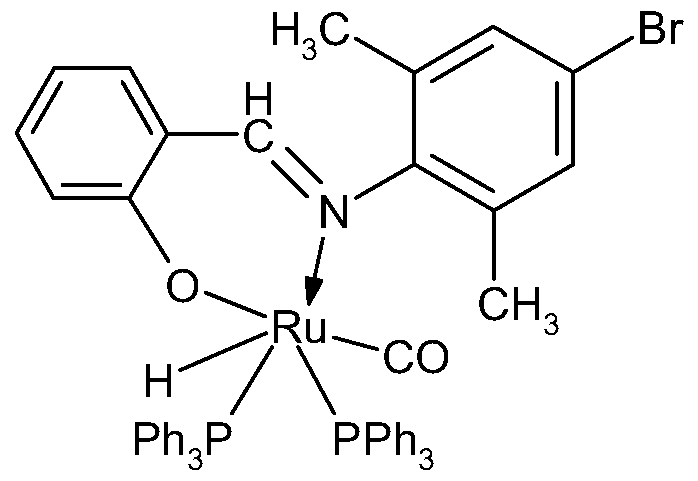
(3b)-PPh3
Complex (3b)-PPh3 was prepared from complex RuHCl(CO)(PPh3)3 as follows:
200 g of RuHCl(CO)(PPh3)3, 64 g of compound (2b) and 28.8 g of Ag2C03 were dissolved in 10 mL of anhydrous tetrahydrofuran (THF). After stirred at 40°C for 72 hours, the solution was cooled to 0°C and filtrated. The brown filter residue was dissolved in 1.5mL toluene. Subsequently 4mL hexane was added to precipitate the unreacted raw material. Then filtrated and the collected filtration was cooled to -70°C to precipitate the yellow product. The product was washed three times with 5 mL anhydrous hexane. After drying, 30 mg of yellow solid was obtained. The yield was 15%. The reaction was completely conducted under inert gas protection.
1.13 Complex (3b)-PPh3

(3b)-PPh3
Complex (3b)-PPh3 was prepared from complex RuH2(CO)(PPh3)3 as follows:
50 mg of RuH2(CO)(PPh3)3, and 20 mg of compound (2b) were dissolved in 10 mL of anhydrous toluene. After refluxed for 24 hours, the solution was cooled to 0°C and filtrated. The brown filter residue was dissolved in 1.5mL toluene. Subsequently 4mL hexane was added to precipitate the unreacted raw material. Then filtrated and the collected filtration was
cooled to -70°C to precipitate the yellow product. The product was washed with anhydrous hexane (5 mL * 3). After drying, 21 mg of yellow solid was obtained. The yield was 42%. All the operation was conducted under inert gas protection.
1.14 Complex (IbVSIMes

(Ib)-SIMes
Complex (Ib)-SIMes was prepared from complex (3b)-PPh3 as follows:
25 mg of complex (3b)-PPh3 and 13 mg of SIMes were dissolved in 4 mL of anhydrous THF and the solution was stirred at 23°C for 3 hours. Afterwards the solution was removed under vacuum. Then 0.5mL hexane was added to precipitate the yellow solid. The obtained precipitate was filtrated and washed two times with 0.5 mL hexane. After drying, 10 mg of yellow solid was obtained. The yield was 52%. The reaction was completely conducted under inert gas protection.
2. Preparation of Catalysts pursuant to Route 2
2.1 Complex (Ia)-IMes

(la)-IMes
200mg of uHCl(CO)(PCy3)(IMes), 60 mg of compound (2a) and 37 mg of Ag2C03 were dissolved in 8 mL of anhydrous tetrahydrofuran (THF). After stirred at 40°C for 72 hours, the
solution was cooled to 0°C and filtrated. The filtrate was collected in a Schlenk flask, and the solvent was removed under vacuum. The brown residue was dissolved in 1 mL toluene and then precipitated in ImL hexane. Then the suspension was filtrated again. The filtrate residue was washed two times with 1 mL hexane and two time with 1 mL toluene. After drying, 80 mg of yellow solid was obtained. The yield was 44%. All the operation was conducted under inert gas protection.
2.2 Complex ria)-SIMes

(la)-SIMes
200mg of uHCl(CO)(PPh3)(SIMes), 62 mg of compound (2a) and 38 mg of Ag2C03 were dissolved in 8 mL of anhydrous tetrahydrofuran (THF). After stirred at 40°C for 72 hours, the solution was cooled to 0°C and filtrated. The filtrate was collected in a Schlenk flask, and the solvent was removed under vacuum. The brown residue was dissolved in 1 mL toluene and then precipitated in ImL hexane. Then the suspension was filtrated again. The filtrate residue was washed two times with 1.5 mL hexane. After drying, the product could be obtained. All the operation was conducted under inert gas protection.
3. Characterization of the complexes via FT-IR. Ή-NMR and single crystal XRD analysis
Complexes prepared according to Route 1 :
 O peak on I T-I K I'rolon signal ol Kii-l l on ' l l
(. oin lcx
sped I'll in /cm 1 NM R spect rum /μμιιι
(Ia)-IMes 1903 -23.11(s)
(Ia)-SIMes 1903 -23.21(s)
(Ia)-IPr 1909 -23.25(s)
(3b)-PCy3 1913 -22.51 , -22.57(d)
(Ib)-IMes 1904 -23.13(s)
(Ib)-SIMes 1907 -23.23(s)
(Ib)-IPr 1909 -23.24(s)
(3c)-PCy3 1922 -22.97, -23.02(d)
(Ic)-IMes 1905 -23.61(s)
(Ic)-SIMes 1907 -23.65(s)
(3b)-PPh3 1917 -11.30, -11.35, -11.40(f)
(Ib)-SIMes 1908 -23.23(s)
Complexes prepared according to Route 2:
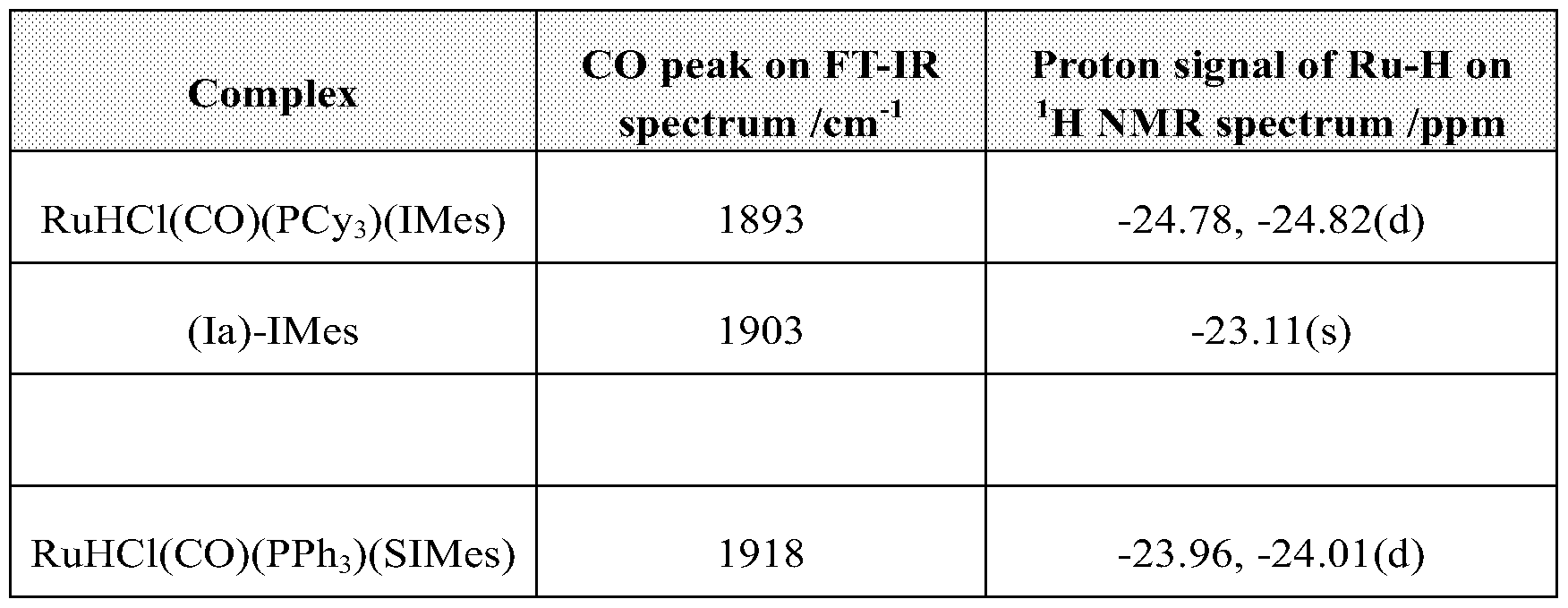
Single crystal XRD analysis of (Ia)-SIMes
A single crystal suitable for XRD measurements was obtained by slow diffusion of diethyl ether into a saturated solution of (Ia)-SIMes in dichloromethane. Data were collected on the Bruker SMART APEX II diffractometer revealing the structure of (Ia)-SIMes depicted in Figure 4.
4. Hydrogenation Experiments
4.1 Catalysts
The following complex catalysts were used for the hydrogenation of unsaturated substances:
(i) RhCl(PPh3)3 (used in comparative example)
RhCl(PPh3)3 was purchased from Sigma- Aldrich and used without further purification.
(ii) Complex (3a)-PCy3 (used in comparative example)
Complex (3a)-PCy3 was prepared as described in Section 1.1.
(iii) Complexes (Ia)-IMes, (Ia)-SIMes, (Ia)-IPr, (Ib)-IMes, (Ib)-SIMes and (Ib)-IPr
(used in inventive examples)
Complexes (Ia)-IMes, (Ia)-SIMes, (Ia)-IPr, (Ib)-IMes, (Ib)-SIMes and (Ib)-IPr were prepared as described in Section 1.
4.2 Nitrile Butadiene Rubbers
The nitrile butadiene rubbers shown in the below Table 1 as used in the examples are all commercially available from Lanxess Deutschland GmbH and had the properties given in Table 1.
Table 1: Nitrile butadiene rubbers used in the Examples


4.3 Analysis and test methods
Measurement of molecular weights Mn and Mw by GPC:
The molecular weights Mn and Mw were determined by a Waters GPC system equipped with a Waters 1515 high performance liquid chromatography pump, a Waters 717plus autosampler, a PL gel 10 μηι mixed B column and a Waters 2414 RI detector. The GPC test was carried out at 40 °C at 1 mL/min of flow rate with THF as the eluent, and the GPC column was calibrated with narrow PS standard samples.
Measurement of the hydrogenation degree by FT-IR:
The spectrum of nitrile rubber before, during and after the hydrogenation reaction was recorded on a Perkin Elmer spectrum 100 FT-IR spectrometer. The solution of the (hydro genated) nitrile butadiene rubber in MCB was cast onto a KBr disk and dried to form a film for the test. The hydrogenation degree was determined by the FT-IR analysis according to the ASTM D 5670-95 method. The residue double bonds, RDB, can be calculated to be (1 -hydrogenation degree)* 100%.
Measurement of the gel content:
A certain and constant weight of the HNBR sample was dissolved in 20 mL of methylethylketone. The solution was centrifuged for 1 hour at 20,000rpm. The liquid was decanted and the obtained gel was dried and weight to give the gel content value.
Measurement of the hydrogenation degree (HD) and the Residue Double Bonds ("RDB"):
The hydrogenation degree was calculated through ¾ NMR spectra and the RDB values were calculated through FT-IR spectra.
4.4 Hydrogenation Experiments Example 1:
Hydrogenation of 2-pentene
15 g 2-pentene were dissolved in 235 g of MCB in a 600 mL autoclave. The solution was bubbled with nitrogen for 20 minutes and heated to 130°C. Complex (Ia)-SIMes was dissolved in 15 mL of degassed MCB and the complex solution was injected into the autoclave. Subsequently hydrogen gas was introduced into the autoclave up to the desired pressure. After 5 hours of reaction, the hydrogenation degree reached 99+%.
Example 2:
Hydrogenation of 1-tetradecene
300 mL 1-tetradecene were charged in a 600 mL autoclave. The liquid was bubbled with nitrogen for 20 minutes and heated to 130°C. Complex (Ia)-SIMes was dissolved in 15 mL of degassed MCB and the complex solution was injected in to the autoclave. Subsequently the hydrogen gas was introduced into the autoclave up to the desired pressure. After 5 hours of reaction, the hydrogenation degree reached 68%.
The reaction conditions and results of Examples 1 and 2 are summarized in Table 2.
Table 2: Examples 1 and 2

Hydrogenation of Perbunan® 3431F; Wilkinson/PPh3
36 g Perbunan® 343 IF were dissolved in 248 g MCB to form a 12 wt% of NBR solution. The solution was filled into an autoclave (600 mL volume) and bubbled with nitrogen gas for 20 minutes to remove dissolved oxygen. Under nitrogen protection, 21.6 mg (0.06 phr) of Wilkinson's catalyst (RhCl(PPh3)3) and 360 mg of PPh3 were dissolved in 15 mL degassed MCB. After the autoclave was heated to 138°C, the catalyst solution was shot into the autoclave. Then the hydrogen was introduced into the autoclave and the pressure was raised to 8.4 MPa. Samples were taken out at intervals for FT-IR test to monitor the RDB. After the finish of NBR hydrogenation, the solution was cooled down and the pressure was released. Then the HNBR solution was treated with thiourea resin to remove Rh metal before stripping. Finally the HNBR crumbs were isolated by stripping and dried in vacuo.
Comparison Example 2 (CEx2):
Hydrogenation of Perbunan® 3431F; Catalyst (3a)-PCy3
The procedure and conditions were the same as in CEx. 1 except that the catalyst was (3a)-PCy3 and its dosage was 10.8 mg (0.03 phr). No co-catalyst PPh3 was used. After the finish of NBR hydrogenation, the HNBR crumbs were directly isolated by stripping and dried in vacuo. The remnant Ru metal was not removed.
Example 3 (Ex3):
Hydrogenation of Perbunan® 3431F; Catalyst (Ia)-IMes
The procedure and conditions were the same as in CEx. 2 except that catalyst (Ia)-IMes was used as inventive catalyst and that its dosage was 10.8 mg (0.03 phr).
Example 4 (Ex4):
Hydrogenation of Perbunan^ 3431F; Catalyst (Ia)-SIMes
The procedure and conditions were the same as in CEx. 2 except that catalyst (Ia)-SIMes was used as inventive catalyst and that its dosage was 10.8 mg (0.03 phr).
Example 5 (Ex5):
Hydrogenation of Perbunan® 343 IF; Catalyst (Ia)-IPr
The procedure and conditions were the same as in CEx. 2 except that catalyst (Ia)-IPr was used as inventive catalyst and that its dosage was 10.8 mg (0.03 phr).
Example 6 (Ex6):
Hydrogenation of Perbunan® 3431F; Catalyst (Ib)-IMes
The procedure and conditions were the same as in CEx. 2 except that catalyst (Ib)-IMes was used as inventive catalyst and that its dosage was 10.8 mg (0.03 phr).
Example 7 (Ex.7):
Hydrogenation of Perbunan® 343 IF; Catalyst (Ib)-SIMes
The procedure and conditions were the same as in CEx. 2 except that catalyst (Ib)-SIMes was used as inventive catalyst and that its dosage was 10.8 mg (0.03 phr).
Example 8 (Ex. 8):
Hydrogenation of Perbunan® 3431F; Catalyst (Ib)-IPr
The procedure and conditions were the same as in CEx. 2 except that catalyst (Ib)-IPr was used as inventive catalyst and that its dosage was 10.8 mg (0.03 phr). The DB depending on the hydrogenation time for Examples 1 to 8 is shown in Figure 1.
Example 9 (Ex. 9):
Hydrogenation of Perbunan® 3431F; Catalyst (Ia)-SIMes at 80°C
The procedure and conditions were the same as in Ex. 4 except that the hydrogenation was
conducted at 80°C.
Example 10 (Ex. 10):
Hydrogenation of Perbunan® 343 IF; Catalyst (Ia)-IMes at 65°C
The procedure and conditions were the same as in Ex. 4 except that the hydrogenation was conducted at 65 °C.
Example 11 (Ex. 11):
Hydrogenation of Perbunan® 3431F; Catalyst (Ia)-SIMes at 50°C
The procedure and conditions were the same as in Ex. 4 except that the hydrogenation was conducted at 50°C. The RDB depending on the hydrogenation time for Examples 4, and 9 to 11 is shown in Figure 2.
Example 12 (Ex. 12):
Hydrogenation of Perbunan® 3431F; Catalyst (Ia)-SIMes with 0.015 phr loading
The procedure and conditions were the same as in Ex. 4 except that the dosage of catalyst (Ia)-SIMes was 5.4 mg (0.015 phr). The RDB depending on the hydrogenation time for Examples 4 and 12 is shown in Figure 3.
Example 13 (Ex. 13):
Hydrogenation of Krynac® X740; Catalyst (Ia)-SIMes
The procedure and conditions were the same as in Ex. 4 except that the NBR feedstock was Krynac® X740. The concentration of NBR was decreased from 12wt% to 6wt%. The dosage of catalyst (Ia)-SIMes was 0.06 phr.
Example 14 (Ex. 14):
Hydrogenation of Krynac® 4450F; Catalyst (Ia)-SIMes
The procedure and conditions were the same as in Ex. 4 except that Krynac® 4450F was hydrogenated.
Example 15 (Ex. 15):
Hydrogenation of Krynac® 3330F; Catalyst (Ia)-SIMes
The procedure and conditions were the same as in Ex. 4 except that Krynac® 3330F was hydrogenated.
The conditions and results of the hydrogenation reactions are summarized in the following Tables 3 to 5.
Table 3 : Molecular weights and PDI of the hydrogenated nitrile rubber after the hydrogenation time indicated in Table 3 (starting material in all listed exam les: Perbunan 3431F with Mn=76,612, Mw=257,771 ; PDI = 3,36)

Mooney viscosity ML 1+4@100°C of the hydrogenated nitrile rubber of Examples 3, 4, and 6 after the hydrogenation time indicated in Table 3

It can be easily seen from Table 5 that the novel catalysts allow a remarkable reduction of the hydrogenation temperature. Even at temperatures of only 80°C or 65°C (Examples 8 and 9) the RDB values are as good as at a reaction temperature of 138°C used in the other examples
after the same reaction times. Even with a hydrogenation temperature of 50°C a RDB of 0.8 can be achieved after 23 hours.
Table 5: Hydrogenation conditions and results for CEx. 1 and CEx.2 and Ex. 3 to 15

Claims
1. Complexes having the general formula (I)

M is ruthenium or osmium
Y represents H, F, CI, Br, I, CF3, pyridine, -OC6H5; CF3COO-, CH3SO3-, ΟΓ
BF4
R1, R2, R3, and R4 are identical or different and represent
H; N02; CF3; halogen, preferably F, CI, Br, or I; or straight chain or branched, substituted or unsubstituted Ci-Ci4-alkyl, preferably Ci-C8-alkyl, more preferably methyl, ethyl, n-propyl, i-propyl, n-butyl, i-butyl, or tert.-butyl; or substituted or unsubstituted C3-Cio-cycloalkyl, preferably Cs-Cg-cycloalkyl, more preferably cyclopentyl, cyclohexyl or cycloheptyl; or substituted or unsubstituted C6-Ci4-aryl, preferably C6-Cio-aryl, more preferably phenyl, which aryl group, more preferably phenyl, is either unsubstituted or contains 1 , 2, 3, 4 or 5 identical or different substituents; or
OR7, OC(=0)R7, CO(=0)R7, S03R7, S03N(R7)2 or S03Na wherein R7 represents H, straight chain or branched, substituted or unsubstituted C1-C14- alkyl, preferably Q-Cg-alkyl, more preferably methyl, ethyl, n-propyl,
i-propyl, n-butyl, i-butyl, or tert. -butyl; or
(N(R8)3)+X" wherein X is halide, preferably chloride, and R8 are identical or different and represent H; straight chain or branched, substituted or
unsubstituted Ci-Cn-alkyl, preferably Ci-Cg-alkyl, more preferably methyl, ethyl, n-propyl, i-propyl, n-butyl, i-butyl, or tert.-butyl; substituted or unsubstituted C6-Ci4-aryl, preferably C6-Cio-aryl, more preferably phenyl, which aryl group, more preferably phenyl, is either unsubstituted or contains 1 , 2, 3, 4 or 5 substituents; most preferably N(CH3)(C2H5)2 + CI", N(C2H5)2H+Cr, NH3 +C1", NH(CH3)2 +C1", or N(CH3)3 +C1"; tris (Ci-C6-alkoxy)silyl-Ci-C6-alkyl, tris (C6-Ci4-aryloxy)silyl-Ci-C6-alkyl, or tris(C3-Cio-cycloalkoxy)silyl-Ci-C6-alkyl, preferably trisethoxysilyl-n-propyl;
R5 represents H; or straight chain or branched, substituted or unsubstituted Ci-Ci4-alkyl,
preferably Ci-Cg-alkyl, more preferably methyl, ethyl, n-propyl, i-propyl, n-butyl, i-butyl, or tert.-butyl; or substituted or unsubstituted C3-Cio-cycloalkyl, preferably Cs-Cg-cycloalkyl, more preferably cyclopentyl, cyclohexyl or cycloheptyl; or substituted or unsubstituted C6-Ci4-aryl, preferably C6-Cio-aryl, more preferably phenyl, which aryl group, preferably phenyl, is either unsubstituted or contains 1 , 2, 3, 4 or 5 identical or different substituents, even more preferably 1 , 2 or 3 identical or different substituents which are located in the o- and/or p-positions; or
R6 represents H, or straight chain or branched, substituted or unsubstituted Ci-Ci4-alkyl, preferably Ci-Cg-alkyl, more preferably methyl, ethyl, n-propyl, i-propyl, n-butyl, i-butyl, or tert.-butyl; or substituted or unsubstituted C3-Cio-cycloalkyl, preferably Cs-Cg-cycloalkyl,
more preferably cyclopentyl, cyclohexyl or cycloheptyl; or substituted or unsubstituted C6-Ci4-ar l, preferably C6-Cio-aryl, more preferably phenyl, which aryl group, more preferably phenyl, is either unsubstituted or contains 1 , 2, 3, 4 or 5 substituents; and
NHC represents an N-heterocyclic carbene ligand.
2. The complexes of general formula (I) according to claim 1 wherein M is ruthenium Y is H or CI,
R1, R2, R3, and R4 are identical or different and represent H; N02; F, CI, or Br; or straight chain or branched, substituted or unsubstituted Ci-Cs-alkyl, more preferably methyl, ethyl, n-propyl, i-propyl, n-butyl, i-butyl, and tert. -butyl; or substituted or unsubstituted Cs-Cs-cycloalkyl, more preferably cyclopentyl, cyclohexyl or cycloheptyl; or substituted or unsubstituted C6-Ci4-ar l, preferably C6-Cio-aryl, more preferably phenyl, which aryl group, more preferably phenyl, is either unsubstituted or contains 1 , 2, 3, 4 or 5 identical or different substituents; or
OR7, OC(=0)R7, CO(=0)R7, S03R7, S03N(R7)2 or S03Na wherein 7 represents H, straight chain or branched, substituted or unsubstituted
Ci-Ci4-alkyl, preferably Ci-Cg-alkyl, more preferably methyl, ethyl, n-propyl, i-propyl, n-butyl, i-butyl, or tert. -butyl;
R5 represents H; or straight chain or branched, substituted or unsubstituted Ci-Ci4-alkyl,
preferably Ci-Cg-alkyl, more preferably methyl, ethyl, n-propyl, i-propyl,
n-butyl, i-butyl, or tert.-butyl; or substituted or unsubstituted C3-Cio-cycloalkyl, preferably Cs-Cg-cycloalkyl, more preferably cyclopentyl, cyclohexyl or cycloheptyl; or substituted or unsubstituted C6-Ci4-ar l, preferably C6-Cio-aryl, more preferably phenyl, which aryl group, more preferably phenyl, is either unsubstituted or contains 1 , 2, 3, 4 or 5 identical or different substituents, even more preferably 1 , 2 or 3 identical or different substituents which are located in the o- and/or p-positions and which are selected from the group consisting of Ci-Cg alkyl, particularly methyl, ethyl, n-propyl, i-propyl, n-butyl, i-butyl, and tert.-butyl, halogen, particularly CI, Br, and I, OR7, OC(=0)R7, and CO(=0)R7 wherein R7 represents H, straight chain or branched, substituted or unsubstituted Ci-Cn-alkyl, preferably Ci-Cg-alkyl, more preferably methyl, ethyl, n-propyl, i-propyl, n-butyl, i-butyl, or tert.-butyl;
R6 represents H, or straight chain or branched, substituted or unsubstituted Ci-Ci4-alkyl, preferably Ci-Cg-alkyl, more preferably methyl, ethyl, n-propyl, i-propyl, n-butyl, i-butyl, or tert.-butyl; substituted or unsubstituted C3-Cio-cycloalkyl, preferably Cs-Cg-cycloalkyl, more preferably cyclopentyl, cyclohexyl or cycloheptyl; or substituted or unsubstituted C6-Ci4-ar l, preferably C6-Cio-aryl, more preferably phenyl, which aryl group, more preferably phenyl, is either unsubstituted or contains 1 , 2, 3, 4 or 5 identical or different substituents; and
NHC represents an N-heterocyclic carbene ligand.
3. The complexes of general formula (I) according to claim 1 wherein M is ruthenium
Y is H or CI,
R1, R2, R3, and R4 are all H or R1, R3, and R4 are all H while R2 is simultaneously N02;
R5 represents H; straight chain or branched, substituted or unsubstituted Ci-Cs-alkyl, more preferably methyl, ethyl, n-propyl, i-propyl, n-butyl, i-butyl, or tert. -butyl; or substituted or unsubstituted Cs-Cs-cycloalkyl, more preferably cyclopentyl, cyclohexyl or cycloheptyl; or substituted or unsubstituted C6-Cio-ar l, more preferably phenyl, which aryl group, more preferably phenyl, is either unsubstituted or contains 1 , 2, 3, 4 or 5 identical or different substituents, even more preferably 1 , 2 or 3 identical or different substituents which are located in the o- and/or p-positions and which are selected from the group consisting of Q-Cg alkyl, particularly methyl, ethyl, n-propyl, i-propyl, n-butyl, i-butyl, and tert.-butyl, halogen, particularly CI, Br, and I, OR7, OC(=0)R7, and CO(=0)R7 wherein R7 represents H, straight chain or branched, substituted or unsubstituted Ci-Cn-alkyl, preferably Ci-Cg-alkyl, more preferably methyl, ethyl, n-propyl, i-propyl, n-butyl, i-butyl, or tert.-butyl;
R6 represents H, or straight chain or branched, substituted or unsubstituted Ci-Ci4-alkyl, preferably Ci-Cg-alkyl, more preferably methyl, ethyl, n-propyl, i-propyl, n-butyl, i-butyl, or tert.-butyl; or substituted or unsubstituted C3-Cio-cycloalkyl, preferably Cs-Cg-cycloalkyl, more preferably cyclopentyl, cyclohexyl or cycloheptyl; or substituted or unsubstituted C6-Ci4-ar l, preferably C6-Cio-aryl, more preferably phenyl, which aryl group, more preferably phenyl, is either unsubstituted or contains 1 , 2, 3, 4 or 5 identical or different substituents; and
NHC represents an N-heterocyclic carbene ligand.
4. The complexes of the general formula (I) according to any claim of 1 to 3 wherein the N-heterocyclic carbene ligand represents a cyclic carbene type ligand with at least one nitrogen as hetero atom being present in the ring, preferably based on imidazoline or imidazolidine moieties, more preferably having a structure corresponding to the general formulae (Ha) to (He)

(lib)

(lie) (lid) (lie)
wherein
R8 R9, R10 and R11 are identical or different and represent hydrogen, straight-chain or branched Ci-C30-alkyl, C3-C2o-cycloalkyl, C2-C2o-alkenyl, C2-C2o-alkynyl, C6-C24-aryl, C7-C25-alkaryl, C2-C2o-heteroaryl, C2-C2o-heterocyclyl, Ci-C2o-alkoxy, C2-C2o-alkenyloxy, C2-C2o-alkynyloxy, C6-C2o-aryloxy, C2-C2o-alkoxycarbonyl, Ci-C2o-alkylthio, C6-C2o-arylthio, -Si(R)3; -0-Si(R)3 , -0-C(=0)R, C(=0)R, -C(=0)N(R)2, -NR-C(=0)-N(R)2, -S02N(R)2 , -S(=0)R, -S(=0)2R, -0-S(=0)2R, halogen, nitro or cyano; wherein in all above occurences relating to the meanings of R8' R9, R10 and R11 the group R is identical or different and represents hydrogen, Ci-C3o-alkyl, C3-C2o-cycloalkyl, C2-C2o-alkenyl, C2-C2o-alkynyl, C6-C24-aryl or C2-C2o-heteroaryl, and wherein
8' R9, R10 and R11 can independently of one another, be unsubstituted or substituted by one or more substituents, preferably straight-chain or branched Ci-Cio-alkyl, Ca-Cg-cycloalkyl, Ci-Cio-alkoxy, C6-C24-aryl, C2-C20 heteroaryl, C2-C20 heterocyclic, a functional group selected from the group consisting of hydroxy, thiol, thioether, ketone, aldehyde, ester, ether, amine, imine, amide, nitro, carboxylic acid, disulphide, carbonate, isocyanate, carbodiimide, carboalkoxy, carbamate and halogen, wherein the abovementioned substituents can independently of one another be either unsubstituted or are in turn substituted by one or more substituents, preferably selected from the group consisting of halogen, in particular chlorine or bromine, Ci-C5-alkyl, Ci-C5-alkoxy and phenyl.
5. The complexes according to claim 4, wherein in the NHC-ligand(s) in the catalysts of the general formula (I)
R8 and R9 are identical or different and represent hydrogen, C6-C24-aryl, more preferably phenyl, straight-chain or branched Ci-Cio-alkyl, more preferably methyl, ethyl, n-propyl, i-propyl, n-butyl, sec-butyl, and i-butyl, or form a cycloalkyl or aryl structure together with the carbon atoms to which they are bound, and
R10 and R11 are identical or different and preferably represent straight-chain or branched Ci-Cio-alkyl, more preferably i-propyl or neopentyl, C3-Cio-cycloalkyl, more preferably adamantyl, substituted or unsubstituted C6-C24-aryl, more preferably phenyl, 2,6-diisopropylphenyl, 2,6-dimethylphenyl, 2,4,6-trimethylphenyl, Ci-Cio-alkylsulfonate, or C6-Cio-arylsulfonate.
6. The complexes according to claim 4, wherein the NHC-ligand(s) in the catalysts of the general formula (I) have the structures (Ilia) to (IIIu), where "Ph" means in each case phenyl, "Bu" means in each case butyl, i.e. either n-butyl, sec. -butyl, iso-butyl or
tert.-butyl, "Mes" represents in each case 2,4,6-trimethylphenyl, "Dipp" means in all cases 2,6-diisopropylphenyl and "Dimp" means in each case 2,6-dimethylphenyl.

(I l ia) (1 Mb) (I llc)

(l llm) (I I In)
(Nik)
Ph Ph
1=1
Dimp J Dimp Dimp J Dimp Dimp Dimp
(l l lp) (l l lq) (l l lr)

(I l ls) (H it) (I Nu)
7. The complexes according to claim 1 selected from the group consisting of (Ia)-IMes,
(Ia)-SIMes, (Ia)-IPr, (Ib)-IMes, (Ib)-SIMes, (Ib)-IPr, (Ic)-IMes, (Ic)-SIMes, (Ic)-IPr, wherein "IMes" means N,N'-bis(mesityl)imidazol-2-ylidene, "SIMes" means
N,N'-bis(mesityl)imidazolidin-2-ylidene, "IPr" means N,N'-bis(2,6-diisopropyl- phenyl)imidazol-2-ylidene and "ItBu" means N,N'-bis(tert-butyl)imidazol-2-ylidene


(Ib)-IMes (Ib)-SIMes (lb)

(lc)-IMes (lc)-SIMes (lc)-IPr
8. A process for preparing the complexes of general formula (I) according to claim 1 comprising reacting a compound of general formula (1)
Ru XY (CO)(PR3)n (1) wherein
X is H, CI, Br or I;
represents H, F, CI, Br, I, CF3, pyridine, -OC6H5,CF3COO-, CH3
represents substituted or unsubstituted Ci-Cn-alkyl, preferably Ci-C6-alkyl;
substituted or unsubstituted Ca-Cg-cycloalkyl, preferably cyclopentyl, cyclohexyl or cycloheptyl; substituted or unsubstituted C6-Ci4-aryl, preferably substituted or unsubstituted phenyl, more preferably phenyl; and is 3, if represent substituted or unsubstituted C6-Ci4-aryl, preferably substituted or unsubstituted phenyl, more preferably phenyl; or is 2, if R represent substituted or unsubstituted Ci-Cn-alkyl, preferably Ci-C6-alkyl or substituted or unsubstituted Ca-Cg-cycloalkyl, preferably cyclopentyl, cyclohexyl or cycloheptyl; compound of general formula (2)

wherein
R1, R2, R3, and R4 are identical or different and represent H; NO2; CF3; halogen, preferably F, CI, Br, or I; or straight chain or branched, substituted or unsubstituted Ci-Cn-alkyl, preferably Ci-Cg-alkyl, more preferably methyl, ethyl, n-propyl, i-propyl, n-butyl, i-butyl, or tert. -butyl; substituted or unsubstituted C3-Cio-cycloalkyl, preferably Cs-Cg-cycloalkyl, more preferably cyclopentyl, cyclohexyl or cycloheptyl; substituted or unsubstituted C6-Ci4-aryl, preferably C6-Cio-aryl, more preferably phenyl, which aryl group is either unsubstituted or contains 1 , 2, 3, 4 or 5 identical or different substituents;
OR7, OC(=0)R7, CO(=0)R7, SO3R7, S03N(R7)2 or S03Na wherein R7 represents
H, straight chain or branched, substituted or unsubstituted Ci-Cn-alkyl, preferably Ci-Cg-alkyl, more preferably methyl, ethyl, n-propyl, i-propyl, n-butyl, i-butyl, or tert. -butyl;
(N(R8)3)+X~ wherein X is halide, preferably chloride, and R8 are identical or different and represent H; straight chain or branched, substituted or unsubstituted C1-C14- alkyl, preferably Ci-Cg-alkyl, more preferably methyl, ethyl, n-propyl, i-propyl, n-butyl, i-butyl, and tert.-butyl; substituted or unsubstituted C6-Ci4-aryl, preferably C6-Cio-aryl, more preferably phenyl, which aryl group is either unsubstituted or contains 1 , 2, 3, 4 or 5 identical or different substituents; most preferably N(CH3)(C2H5)2 + CI", N(C2H5)2H+Cr, NH3 +C1~, NH(CH3)2 +C1~, or N(CH3)3 +Cr; tris (Ci-C6-alkoxy)silyl-Ci-C6-alkyl, tris (C6-Ci4-aryloxy)silyl-Ci-C6-alkyl, or tris(C3-Cio-cycloalkoxy)silyl-Ci-C6-alkyl, preferably trisethoxysilyl-n-propyl;
R5 represents H; straight chain or branched, substituted or unsubstituted Ci-Cn-alkyl, preferably Ci-Cg-alkyl, more preferably methyl, ethyl, n-propyl, i-propyl, n-butyl, i-butyl, or tert.-butyl; substituted or unsubstituted C3-Cio-cycloalkyl, preferably Cs-Cg-cycloalkyl, more preferably cyclopentyl, cyclohexyl or cycloheptyl; substituted or unsubstituted C6-Ci4-aryl, preferably C6-Cio-aryl, more preferably phenyl, which aryl group, more preferably phenyl, is either unsubstituted or contains 1 , 2, 3, 4 or 5 identical or different substituents, even more preferably 1 , 2 or 3 identical or different substituents which are located in the o- and/or p-positions; and
R6 represents H, or straight chain or branched, substituted or unsubstituted Ci-Ci4-alkyl, preferably
Ci-Cg-alkyl, more preferably methyl, ethyl, n-propyl, i-propyl, n-butyl, i-butyl, or
tert. -butyl; or substituted or unsubstituted C3-Cio-cycloalkyl, preferably Cs-Cg-cycloalkyl, more preferably cyclopentyl, cyclohexyl or cycloheptyl; or substituted or unsubstituted C6-Ci4-ar l, preferably C6-Cio-aryl, more preferably phenyl, which aryl group, more preferably phenyl, is either unsubstituted or contains 1 , 2, 3, 4 or 5 identical or different substituents; and to yield a compound of general formula (3)

wherein
R1, R2, R3, R4, R5, R6, n, Y and R shall have the same general, preferred and more preferred meanings as outlined above for general formulae (1) and (2). which is then reacted with an N-heterocyclic carbene to yield the compounds of general formula (I).
9. The process according to claim 8 comprising reacting a compound of general formula (1) wherein
X is H, CI, Br or I;
Y represents H, F, CI, Br, I, CF3, pyridine, -OC6H5, CF3COO-, CH3SO3-, ΟΓ
BF4
PR3 representing either triphenyl phosphine (PPh3) with n being 3 or tricyclohexyl
phosphine (PCya) with n being 2, with a compound of general formula (2) wherein R1, R2, R3, and R4 are identical or different and represent H; N02; F, CI, or Br; or straight chain or branched, substituted or unsubstituted Ci-Cg-alkyl, more preferably methyl, ethyl, n-propyl, i-propyl, n-butyl, i-butyl, and tert.-butyl; substituted or unsubstituted C5-C8-cycloalkyl, more preferably cyclopentyl, cyclohexyl or cycloheptyl; substituted or unsubstituted C6-Ci4-aryl, preferably C6-Cio-aryl, more preferably phenyl, which aryl group, preferably phenyl, is either unsubstituted or contains 1 , 2, 3, 4 or 5 substituents;
OR7, OC(=0)R7, CO(=0)R7, S03R7, S03N(R7)2 or S03Na wherein R7 represents H, straight chain or branched, substituted or unsubstituted
Ci-Ci4-alkyl, preferably Ci-Cg-alkyl, more preferably methyl, ethyl, n-propyl, i-propyl, n-butyl, i-butyl, or tert.-butyl;
R5 straight chain or branched Ci-Cg-alkyl, more preferably methyl, ethyl, n-propyl, i-propyl, n-butyl, i-butyl, and tert.-butyl which is either unsubstituted or substituted with OR7, OC(=0)R7, or CO(=0)R7, wherein R7 represents H, straight chain or branched, substituted or unsubstituted Ci-Ci4-alkyl, preferably Ci-Cg-alkyl, more preferably methyl, ethyl, n-propyl, i-propyl, n-butyl, i-butyl, or tert.-butyl; substituted or unsubstituted C6-Ci4-aryl, preferably C6-Cio-aryl, more preferably phenyl, which is either unsubstituted or which contains 1 , 2, 3, 4 or
5 identical or different substituents, even more preferably 1 , 2 or 3 identical or different substituents which are located in the o- and/or p-positions and which are selected from the group consisting of Ci-Cg alkyl, particularly methyl, ethyl, n-propyl, i-propyl, n-butyl, i-butyl, and tert.-butyl, halogen, particularly
CI, Br, and I, OR7, OC(=0)R7, or CO(=0)R7 wherein R7 represents H, straight chain or branched, substituted or unsubstituted C1-C 14-, preferably Q-Cg-alkyl, more preferably methyl, ethyl, n-propyl, i-propyl, n-butyl, i-butyl, or tert.-butyl; and
R6 represents H, or straight chain or branched, substituted or unsubstituted Ci-Ci4-alkyl, preferably Ci-Cg-alkyl, more preferably methyl, ethyl, n-propyl, i-propyl, n-butyl, i-butyl, or tert.-butyl; or substituted or unsubstituted C3-Cio-cycloalkyl, preferably Cs-Cg-cycloalkyl, more preferably cyclopentyl, cyclohexyl or cycloheptyl; or substituted or unsubstituted C6-Ci4-ar l, preferably C6-Cio-aryl, more preferably phenyl, which aryl group, more preferably phenyl, is either unsubstituted or contains 1 , 2, 3, 4 or 5 identical or different substituents; and to yield a compound of general formula (3) wherein
R1, R2, R3, R4, R5, R6, n, Y and R shall have the same meanings as outlined above for the above preferred embodiments of general formulae (1) and (2). which is then reacted with a N-heterocyclic carbene to result in the compound of general formula (I) wherein R1, R2, R3, R4, R5, Y and NHC shall have the same meanings as outlined above for the compounds of general formulae (1 ) and (2).
10. The process according to claim 8 wherein the compound of general formula (1 ) is selected from the group consisting of RuHCl(CO)(PR3)„, RuH2(CO)(PR3)„, and RuCl2(CO)(PR3)n wherein R and n shall have the meanings defined in claim 7 for general formula (I) and more preferably selected from the group consisting of RuHCl(CO)(PCy3)2, RuHCl(CO)(PPh3)3, RuCl2(CO)(PCy3)2, RuCl2(CO)(PPh3)3, RuH2(CO)(PCy3)2, and RuH2(CO)(PPh3)3 and the compound of general formula (2) is selected from the group consisting of

(2a) (2b) (2c)
11. The process according to claim 10 resulting in a compound of the following formulae

(3a)-PPh3 (3b)-PPh3 (3c)-PPh3
12. A process for preparing the complexes according to claim 1 comprising reacting a compound of general formula (4)
Ru XY (CO)(NHC)(PR3) (4) wherein
X is H, CI, Br or I;
Y represents H, F, CI, Br, I, CF3, pyridine, -OC6H5; CF3COO-, CH3SO3-, ΟΓ
BF4 is identical or different, preferably identical and represents
substituted or unsubstituted Ci-Cn-alkyl, preferably Ci-C6-alkyl; substituted or unsubstituted Ca-Cg-cycloalkyl, preferably cyclopentyl, cyclohexyl or cycloheptyl; substituted or unsubstituted C6-C i4-aryl, preferably substituted or unsubstituted phenyl, more preferably phenyl; and n is 3, if the R represent substituted or unsubstituted C6-C i4-aryl, preferably substituted or unsubstituted phenyl, more preferably phenyl; or n is 2, if the R represent substituted or unsubstituted Ci-Cn-alkyl, preferably Ci-C6-alkyl or substituted or unsubstituted Ca-Cg-cycloalkyl, preferably cyclopentyl, cyclohexyl or cycloheptyl; and
NHC is an N-heterocyclic carbene; with a compound of general formula (2)

, R2, R3, and R4 are identical or different and represent H; N02; CF3; halogen, preferably F, CI, Br, or I; or straight chain or branched, substituted or unsubstituted Ci-Ci4-alkyl, preferably Ci-Cg-alkyl, more preferably methyl, ethyl, n-propyl, i-propyl, n-butyl, i-butyl, and tert.-butyl; substituted or unsubstituted C3-Cio-cycloalkyl, preferably Cs-Cg-cycloalkyl, more preferably cyclopentyl, cyclohexyl or cycloheptyl; substituted or unsubstituted C6-Ci4-aryl, preferably C6-Cio-aryl, more preferably phenyl, which aryl group, preferably phenyl, is either unsubstituted or contains 1 ,
2, 3, 4 or 5 substituents;
OR7, OC(=0)R7, CO(=0)R7, S03R7, S03N(R7)2 or S03Na wherein 7
represents H, straight chain or branched, substituted or unsubstituted Ci-Cn-alkyl, preferably Ci-Cg-alkyl, more preferably methyl, ethyl, n-propyl, i-propyl, n-butyl, i-butyl, or tert. -butyl;
(N(R8)3)+X~ wherein X is halide, preferably chloride, and R8 are identical or different and represent H; straight chain or branched, substituted or unsubstituted C1-C14- alkyl, preferably Q-Cg-alkyl, more preferably methyl, ethyl, n-propyl, i-propyl, n-butyl, i-butyl, and tert.-butyl; substituted or unsubstituted C6-Ci4-ar l, preferably C6-Cio-aryl, more preferably phenyl, which aryl group is either unsubstituted or contains 1, 2, 3, 4 or 5 substituents; most preferably
N(CH3)(C2H5)2 + Cf, N(C2H5)2H+Cr, NH3 +Cr, NH(CH3)2 +Cr, or N(CH3)3 +Cr; tris (Ci-C6-alkoxy)silyl-Ci-C6-alkyl, tris (C6-Ci4-aryloxy)silyl-Ci-C6-alkyl, or tris(C3-Cio-cycloalkoxy)silyl-Ci-C6-alkyl, preferably trisethoxysilyl-n-propyl;
R5 represents H; straight chain or branched, substituted or unsubstituted Ci-Ci4-alkyl, preferably Ci-Cg-alkyl, more preferably methyl, ethyl, n-propyl, i-propyl, n-butyl, i-butyl, and tert.-butyl; substituted or unsubstituted C3-Cio-cycloalkyl, preferably Cs-Cg-cycloalkyl, more preferably cyclopentyl, cyclohexyl or cycloheptyl; substituted or unsubstituted C6-Ci4-ar l, preferably C6-Cio-aryl, more preferably phenyl, which aryl group, preferably phenyl, is either unsubstituted or contains 1, 2, 3, 4 or 5 substituents; which contains 1, 2, 3, 4 or 5 identical or different substituents, even more preferably 1, 2 or 3 identical or different substituents which are located in the o- and/or p-positions; and
R6 represents H, or straight chain or branched, substituted or unsubstituted Ci-Ci4-alkyl, preferably
Ci-Cg-alkyl, more preferably methyl, ethyl, n-propyl, i-propyl, n-butyl, i-butyl, or tert. -butyl; or substituted or unsubstituted C3-Cio-cycloalkyl, preferably Cs-Cg-cycloalkyl, more preferably cyclopentyl, cyclohexyl or cycloheptyl; or substituted or unsubstituted C6-Ci4-ar l, preferably C6-Cio-aryl, more preferably phenyl, which aryl group, more preferably phenyl, is either unsubstituted or contains 1 , 2, 3, 4 or 5 identical or different substituents; and to yield a compound of general formula (I) wherein R1, R2, R3, R4, R5, Y and R shall have the same general, preferred and more preferred meanings as outlined above for general formulae (2) and (4).
13. The process according to claim 12 wherein complex (4) is selected from the group consisting of uHCl(CO)(IMes)(PPh3), RuHCl(CO)(SIMes)(PPh3), RuHCl(CO)(IPr)(PPh3), RuHCl(CO)(IMes)(PCy3), RuHCl(CO)(SIMes)(PCy3), and RuHCl(CO)(IPr)(PCy3).
14. The process according to any one of claims 8 to 13 wherein the reaction is performed in one or more organic solvents, preferably selected from the group consisting of ethers, more preferably THF, dioxane, and diethylether, alkanes, more preferably hexane, aromatic solvents, more preferably toluene and benzene, halogenated hydrocarbon, more preferably chloroform and chlorobenzene, ester, more preferably ethyl acetate, ketone, more preferably methyl ethyl ketone, acetone, and alcohols, more preferably methanol, ethanol and methyloxyethanol and either without any catalyst or in the presence of at least one catalyst, preferably Ag2C03 or TlOEt.
15. Use of the complexes of general formula (I) according to any one of claims 1 to 7 as catalysts, preferably for hydrogenation reactions.
16. A process for manufacturing partially or fully saturated compounds by contacting unsaturated compounds containing at least one C=C double bond, preferably terminal
olefins, internal olefins, cyclic olefins, conjugated olefins, any further olefins having at least one carbon-carbon double bond and additionally at least one further polar unsaturated double or triple bond, or oligomers or polymers having carbon-carbon double bonds, with hydrogen in the presence of at least one complex of general formula (I) according to any one of claims 1 to 7.
17. The process according to claim 16 wherein a polymer comprising repeating units based on at least one conjugated diene monomer, more preferably a nitrile rubber comprising (i) repeating units of at least one conjugated diene, more preferably at least one C4-C6 conjugated diene, even more preferably selected from the group consisting of 1 ,3 -butadiene, isoprene, 1 -methylbutadiene, 2,3-dimethylbutadiene, piperylene, chloroprene, and mixtures thereof, and most preferably 1,3-butadiene, (ii) at least one α,β-unsaturated nitrile monomer, preferably a C3-C5 α,β-unsaturated nitrile, more preferably selected from the group consisting of acrylonitrile, methacrylonitrile, ethacrylonitrile and mixtures thereof, most preferably acrylonitrile, and (iii) none, one or more termonomers, preferably selected from the group consisting of α,β-unsaturated, most preferably mono-unsaturated, monocarboxylic acids, their esters and amides, α,β-unsaturated, most preferably mono-unsaturated, dicarboxylic acids, their mono- oder diesters, the respective anhydrides and amides of said α,β-unsaturated dicarboxylic acids.
18. The process according to claim 16 or 17 wherein the hydrogenation is carried out at a temperature in the range of from 30°C to 200°C, preferably from 40°C to 180°C, most preferably from 50°C to 160°C and at a hydrogen pressure in the range of 0.5 MPa to 35 MPa, and more preferably of 3.0 MPa to 10 MPa.
19. The process according to any one of claims 16 to 18 wherein the amount of the complex of general formula (I) to the unsaturated substrates, in particular the nitrile rubber, lies in the range of from 1 to 1000 ppm of noble metal, preferably from 2 to 500 ppm, in particular from 5 to 250 ppm, based on the unsaturated substrates, in particular the nitrile rubber used.
Priority Applications (7)
| Application Number | Priority Date | Filing Date | Title |
|---|---|---|---|
| PCT/CN2013/077107 WO2014198022A1 (en) | 2013-06-09 | 2013-06-09 | Ruthenium- or osmium-based complex catalysts |
| EP14738745.0A EP3008077B1 (en) | 2013-06-09 | 2014-06-06 | Ruthenium- or osmium-based complex catalysts |
| PCT/EP2014/061823 WO2014198658A1 (en) | 2013-06-09 | 2014-06-06 | Ruthenium- or osmium-based complex catalysts |
| CN201480032993.9A CN105392792B (en) | 2013-06-09 | 2014-06-06 | Ruthenium base or osmium base complex catalyst |
| JP2016517621A JP6174794B2 (en) | 2013-06-09 | 2014-06-06 | Ruthenium or osmium-based complex catalysts |
| US14/896,412 US9802972B2 (en) | 2013-06-09 | 2014-06-06 | Ruthenium- or osmium-based complex catalysts |
| TW103119856A TWI614257B (en) | 2013-06-09 | 2014-06-09 | Ruthenium-or osmium-based complex catalysts |
Applications Claiming Priority (1)
| Application Number | Priority Date | Filing Date | Title |
|---|---|---|---|
| PCT/CN2013/077107 WO2014198022A1 (en) | 2013-06-09 | 2013-06-09 | Ruthenium- or osmium-based complex catalysts |
Publications (1)
| Publication Number | Publication Date |
|---|---|
| WO2014198022A1 true WO2014198022A1 (en) | 2014-12-18 |
Family
ID=51177028
Family Applications (2)
| Application Number | Title | Priority Date | Filing Date |
|---|---|---|---|
| PCT/CN2013/077107 Ceased WO2014198022A1 (en) | 2013-06-09 | 2013-06-09 | Ruthenium- or osmium-based complex catalysts |
| PCT/EP2014/061823 Ceased WO2014198658A1 (en) | 2013-06-09 | 2014-06-06 | Ruthenium- or osmium-based complex catalysts |
Family Applications After (1)
| Application Number | Title | Priority Date | Filing Date |
|---|---|---|---|
| PCT/EP2014/061823 Ceased WO2014198658A1 (en) | 2013-06-09 | 2014-06-06 | Ruthenium- or osmium-based complex catalysts |
Country Status (5)
| Country | Link |
|---|---|
| US (1) | US9802972B2 (en) |
| EP (1) | EP3008077B1 (en) |
| JP (1) | JP6174794B2 (en) |
| TW (1) | TWI614257B (en) |
| WO (2) | WO2014198022A1 (en) |
Cited By (1)
| Publication number | Priority date | Publication date | Assignee | Title |
|---|---|---|---|---|
| WO2020020677A1 (en) | 2018-07-23 | 2020-01-30 | Arlanxeo Deutschland Gmbh | Method for producing hydrogenated nitrile rubber and hnbr compositions thereof |
Families Citing this family (6)
| Publication number | Priority date | Publication date | Assignee | Title |
|---|---|---|---|---|
| WO2014198022A1 (en) | 2013-06-09 | 2014-12-18 | Lanxess Deutschland Gmbh | Ruthenium- or osmium-based complex catalysts |
| JP6671709B2 (en) * | 2016-03-22 | 2020-03-25 | 学校法人日本大学 | Manufacturing method of electrolyte |
| WO2019201730A1 (en) * | 2018-04-20 | 2019-10-24 | Arlanxeo Deutschland Gmbh | Hydrogenation catalyst compositions and their use for hydrogenation of nitrile rubber |
| EP3827030B1 (en) * | 2018-07-23 | 2024-03-27 | ARLANXEO Deutschland GmbH | Hydrogenation of nitrile rubber |
| CN113227153B (en) | 2018-12-17 | 2023-11-14 | 阿朗新科德国有限责任公司 | Methods for preparing HNBR solutions using alternative solvents |
| CN114262394B (en) * | 2020-09-16 | 2023-08-18 | 浙江赞昇新材料有限公司 | Liquid hydrogenated nitrile rubber and its preparation method and application |
Citations (3)
| Publication number | Priority date | Publication date | Assignee | Title |
|---|---|---|---|---|
| JP2002030057A (en) * | 2000-07-11 | 2002-01-29 | Ube Ind Ltd | New ruthenium complex |
| US6635768B1 (en) * | 1998-04-06 | 2003-10-21 | Degussa Ag | Alkylidene complexes of ruthenium containing N-heterocyclic carbene ligands; use as highly active, selective catalysts for olefin metathesis |
| US20110124868A1 (en) * | 2008-04-09 | 2011-05-26 | Materia, Inc. | Ruthenium olefin metathesis catalysts bearing n-heterocyclic carbene ligands with substituted backbone |
Family Cites Families (19)
| Publication number | Priority date | Publication date | Assignee | Title |
|---|---|---|---|---|
| DE3803450A1 (en) | 1988-02-05 | 1989-08-17 | Hoechst Ag | EMISSIONS OF DISPERSION PAINT, PAINT PAINT, AND PLASTIC DISPERSION SPOUSE, AND METHOD OF MANUFACTURING THEM |
| DE3834734A1 (en) | 1988-10-12 | 1990-04-19 | Basf Ag | METHOD FOR PRODUCING POLYMERIZES FROM OLEFINICALLY UNSATURATED MONOMERS |
| DE3902103A1 (en) | 1989-01-25 | 1990-08-02 | Roehm Gmbh | BINDER FOR WAESSED GLOSSY COLORS |
| CA2091128C (en) | 1992-03-08 | 1999-07-27 | Michael A. Taylor | Removal of organic volatiles from polymer solutions and dispersions |
| DE4213964A1 (en) | 1992-04-29 | 1993-11-04 | Basf Ag | AQUEOUS POLYMER DISPERSIONS |
| DE4213965A1 (en) | 1992-04-29 | 1993-11-04 | Basf Ag | AQUEOUS POLYMER DISPERSION |
| DE4213969A1 (en) | 1992-04-29 | 1993-11-04 | Basf Ag | AQUEOUS POLYMER DISPERSION |
| DE4213968A1 (en) | 1992-04-29 | 1993-11-04 | Basf Ag | AQUEOUS POLYMER DISPERSION |
| DE4213967A1 (en) | 1992-04-29 | 1993-11-04 | Basf Ag | AQUEOUS POLYMER DISPERSION |
| CN1120180C (en) | 1994-06-03 | 2003-09-03 | 巴斯福股份公司 | Preparation of aqueous polymer dispersions |
| DE4435422A1 (en) | 1994-10-04 | 1996-04-18 | Basf Ag | Process for the preparation of an aqueous polymer dispersion |
| US5977393A (en) * | 1997-11-21 | 1999-11-02 | California Institute Of Technology | Schiff base derivatives of ruthenium and osmium olefin metathesis catalysts |
| JP3861570B2 (en) * | 2000-07-11 | 2006-12-20 | 宇部興産株式会社 | Method for producing cyclododecene |
| PL1577282T3 (en) * | 2004-02-26 | 2011-11-30 | Rimtec Corp | Metal complexes for use in olefin metathesis and atom or group transfer reactions |
| US20070185343A1 (en) | 2004-02-26 | 2007-08-09 | Universiteit Gent | Metal complexes for use in olefin metathesis and atom group transfer reactions |
| EP2151445B1 (en) * | 2008-08-01 | 2015-02-18 | Rimtec Corporation | Process for the preparation of bidentate Schiff base ruthenium catalysts containing a salicylaldimine-type ligand |
| US20110137043A1 (en) * | 2009-12-09 | 2011-06-09 | Telene S.A.S. | Process for the preparation of bidentate schiff base ruthenium catalysts containing a salicylaldimine-type ligand |
| BR112014003140A2 (en) | 2011-08-15 | 2017-06-13 | Lanxess Deutschland Gmbh | ruthenium complex catalyst and substrate hydrogenation process having at least one carbon-carbon double bond |
| WO2014198022A1 (en) | 2013-06-09 | 2014-12-18 | Lanxess Deutschland Gmbh | Ruthenium- or osmium-based complex catalysts |
-
2013
- 2013-06-09 WO PCT/CN2013/077107 patent/WO2014198022A1/en not_active Ceased
-
2014
- 2014-06-06 US US14/896,412 patent/US9802972B2/en active Active
- 2014-06-06 EP EP14738745.0A patent/EP3008077B1/en active Active
- 2014-06-06 WO PCT/EP2014/061823 patent/WO2014198658A1/en not_active Ceased
- 2014-06-06 JP JP2016517621A patent/JP6174794B2/en active Active
- 2014-06-09 TW TW103119856A patent/TWI614257B/en not_active IP Right Cessation
Patent Citations (3)
| Publication number | Priority date | Publication date | Assignee | Title |
|---|---|---|---|---|
| US6635768B1 (en) * | 1998-04-06 | 2003-10-21 | Degussa Ag | Alkylidene complexes of ruthenium containing N-heterocyclic carbene ligands; use as highly active, selective catalysts for olefin metathesis |
| JP2002030057A (en) * | 2000-07-11 | 2002-01-29 | Ube Ind Ltd | New ruthenium complex |
| US20110124868A1 (en) * | 2008-04-09 | 2011-05-26 | Materia, Inc. | Ruthenium olefin metathesis catalysts bearing n-heterocyclic carbene ligands with substituted backbone |
Cited By (1)
| Publication number | Priority date | Publication date | Assignee | Title |
|---|---|---|---|---|
| WO2020020677A1 (en) | 2018-07-23 | 2020-01-30 | Arlanxeo Deutschland Gmbh | Method for producing hydrogenated nitrile rubber and hnbr compositions thereof |
Also Published As
| Publication number | Publication date |
|---|---|
| TW201512207A (en) | 2015-04-01 |
| JP6174794B2 (en) | 2017-08-02 |
| WO2014198658A1 (en) | 2014-12-18 |
| JP2016527194A (en) | 2016-09-08 |
| EP3008077B1 (en) | 2017-08-09 |
| US9802972B2 (en) | 2017-10-31 |
| EP3008077A1 (en) | 2016-04-20 |
| TWI614257B (en) | 2018-02-11 |
| US20160122376A1 (en) | 2016-05-05 |
Similar Documents
| Publication | Publication Date | Title |
|---|---|---|
| EP3008077B1 (en) | Ruthenium- or osmium-based complex catalysts | |
| JP6352900B2 (en) | Hydrogenation of nitrile rubber | |
| EP3004124B1 (en) | Novel transition metal complexes, their preparation and use | |
| EP3283496B1 (en) | Ruthenium- or osmium-based complex catalysts | |
| EP3134206B1 (en) | Ruthenium-based triazole carbene complexes | |
| EP3827030B1 (en) | Hydrogenation of nitrile rubber | |
| CN105392792B (en) | Ruthenium base or osmium base complex catalyst | |
| KR20160018518A (en) | Ruthenium- or osmium-based complex catalysts | |
| KR20200091402A (en) | Method for producing nitrile rubber using ruthenium complex catalyst |
Legal Events
| Date | Code | Title | Description |
|---|---|---|---|
| 121 | Ep: the epo has been informed by wipo that ep was designated in this application |
Ref document number: 13886765 Country of ref document: EP Kind code of ref document: A1 |
|
| NENP | Non-entry into the national phase |
Ref country code: DE |
|
| 122 | Ep: pct application non-entry in european phase |
Ref document number: 13886765 Country of ref document: EP Kind code of ref document: A1 |