WO2014187046A1 - 点云骨架提取方法及装置 - Google Patents
点云骨架提取方法及装置 Download PDFInfo
- Publication number
- WO2014187046A1 WO2014187046A1 PCT/CN2013/083441 CN2013083441W WO2014187046A1 WO 2014187046 A1 WO2014187046 A1 WO 2014187046A1 CN 2013083441 W CN2013083441 W CN 2013083441W WO 2014187046 A1 WO2014187046 A1 WO 2014187046A1
- Authority
- WO
- WIPO (PCT)
- Prior art keywords
- point cloud
- skeleton
- point
- sampling
- neighborhood
- Prior art date
- Legal status (The legal status is an assumption and is not a legal conclusion. Google has not performed a legal analysis and makes no representation as to the accuracy of the status listed.)
- Ceased
Links
Classifications
-
- G—PHYSICS
- G06—COMPUTING OR CALCULATING; COUNTING
- G06T—IMAGE DATA PROCESSING OR GENERATION, IN GENERAL
- G06T17/00—Three-dimensional [3D] modelling for computer graphics
-
- G—PHYSICS
- G06—COMPUTING OR CALCULATING; COUNTING
- G06T—IMAGE DATA PROCESSING OR GENERATION, IN GENERAL
- G06T2210/00—Indexing scheme for image generation or computer graphics
- G06T2210/56—Particle system, point based geometry or rendering
Definitions
- the present invention relates to the field of computer graphics processing technologies, and in particular, to a point cloud skeleton extraction method and apparatus. Background technique
- point cloud data often has a large area of missing, which is a problem that cannot be solved by existing hardware scanning devices.
- existing fitting-based reconstruction methods are difficult to quickly reconstruct a satisfactory three-dimensional model from the missing point cloud data.
- the so-called point cloud model generally refers to a set of three-dimensional coordinate points on the surface of the object by the scanning light emitted by the three-dimensional scanning device onto the surface of the object to be measured, and the reflected light is received.
- the so-called point cloud 3D reconstruction refers to reconstructing the grid data representing the source model based on a certain point cloud model data, which is convenient for computer rendering and user interaction.
- skeleton information has been an important research topic in the field of graphics. question. Because, whether it is a two-dimensional or three-dimensional shape, the skeleton is an important description of the source data. With skeleton information, we can greatly help us analyze and manipulate various graphic data, such as skeleton-based shape matching, skeleton animation, and so on.
- the technique of extracting skeletons from closed 3D meshes is relatively mature, but extracting skeletons from scattered point clouds is a new problem.
- the technique of extracting the skeleton from the grid cannot be directly applied to the point cloud skeleton extraction, because the connection information of the grid is missing in the point cloud, and the existing grid skeleton extraction technology cannot cope with the noise in the point cloud, the outer point and Missing and other issues.
- the current method for extracting the curve skeleton from the point cloud is the scheme proposed in 2009, referred to as ROSA ( rotational symmetry axis). This scheme proposes a concept of a rotational symmetry axis and assumes that the basic shape of the input model is mainly composed of cylinders.
- a rotationally symmetric center point can be calculated, best expressing the center position of the point set.
- the ROSA scheme first finds an optimal tangent plane for each point of the 3D point cloud. Then, the input point near the tangent plane is projected onto the two-dimensional plane, and the rotationally symmetric center of the plane point set is calculated. These rotationally symmetric center points are further contracted, and after the special treatment of the joint area, the final axis of rotational symmetry is obtained.
- the point cloud skeleton extraction technology based on Laplacian contraction proposed in the literature.
- This technique assumes that the input point cloud data is sufficiently dense and regular to establish a Laplacian connection based on the point set, which is equivalent to constructing a recessive mesh.
- the skeleton is then extracted using the more mature Laplacian mesh skeleton extraction technique.
- the ROSA scheme in the conventional technology relies heavily on the information of the point cloud normal vector and the assumption of the basic shape of the object.
- the normal vector information is a necessary condition for calculating the local rotational symmetry center.
- the assumption that the basic shape is a cylinder is that it is still the key to extracting the central axis for missing data.
- the normal vector information is not obtained directly from the hardware device, but is a value estimated from the information of the local neighbors. For the case of a large number of external points and noise, it is very likely to estimate the wrong normal vector direction and orientation. Therefore, the accuracy of the conventional ROSA scheme for extracting the point cloud skeleton is not high. Summary of the invention
- a point cloud skeleton extraction method includes: Obtain input point cloud sampling data;
- the point cloud shrinks to obtain the skeleton branch
- the iterative formula is:
- the point set of the point cloud sampling data is a sampling point in the point set, / is a set of neighborhood points of the sampling point, X is a domain point in the set of neighborhood points /, R is a regular item, and is a weight coefficient , h is the neighborhood radius of the domain point set /, ⁇ is the distribution coefficient;
- the method further includes:
- the distribution coefficient is obtained according to the following formula: ⁇ . - ) ⁇
- the step of performing point cloud contraction according to the iterative formula is: gradually expanding the neighborhood radius, and performing point cloud contraction according to the expanded neighborhood radius and the iterative formula. In one of the embodiments, the step of gradually expanding the neighborhood radius is:
- the step of connecting the skeleton branches to obtain a point cloud skeleton further comprises:
- a point cloud skeleton extraction device comprising:
- a sampling data obtaining module configured to acquire input point cloud sampling data
- a skeleton branch generating module configured to perform a point cloud contraction according to an iterative formula to obtain a skeleton branch, wherein the iterative formula is:
- the point set of the point cloud sampling data is a sampling point in the point set, / is a set of neighborhood points of the sampling point, X is a domain point in the set of neighborhood points /, R is a regular item, and is a weight coefficient , h is the neighborhood radius of the domain point set /, ⁇ is the distribution coefficient;
- a point cloud skeleton generation module is configured to connect the skeleton branches to obtain a point cloud skeleton.
- the skeleton branch generating module is further configured to establish a covariance matrix for the sampling points according to the PCA algorithm
- the distribution coefficient is obtained according to the following formula:
- the skeleton branch generation module is further configured to gradually expand the neighborhood radius, and perform point cloud contraction according to the expanded neighborhood radius and the iterative formula.
- the skeleton branch generation module is further configured to set an initial neighborhood radius
- the neighborhood radius is gradually expanded by /? /2, where is the diagonal length of the point cloud bounding box, and the number of sampling points in the point set of the point cloud sampling data.
- the apparatus further includes a point cloud skeleton adjustment module for smoothing and centralizing the point cloud skeleton.
- the above-mentioned point cloud skeleton extraction and extraction method and device are based on the traditional L1 median theorem contraction point cloud skeleton, and the regularity item is added, so that in the case of uneven distribution of sampling points, the adjustment effect of the regular item can be made
- the calculated median point is close to the median point of the real environment, which improves the accuracy.
- FIG. 1 is a flow chart of a method for extracting a point cloud skeleton in an embodiment
- FIG. 2 is a schematic structural view of a point cloud skeleton extracting device in an embodiment
- FIG. 3 is a schematic structural view of a point cloud skeleton extracting device in another embodiment. detailed description
- a point cloud skeleton extraction method is completely dependent on a computer program that can run on a computer system based on a von Roymann system, the method including the following Steps:
- Step S102 Acquire input point cloud sampling data.
- Sampling the scattered point set collected by the point cloud data acquisition device to obtain the point cloud sampling data (sampling point of the scattered point set), and generating the point cloud skeleton by shrinking the sampling point, can greatly reduce the calculation amount.
- the number of sampling points is generally 5% of the number of data points in the scattered point of the input, and the sampling position is random, that is, 5% of the data points in the scattered point are randomly extracted as sampling points.
- the set of scattered points that are collectively referred to below is Q
- the set of points that are downsampled is X.
- the so-called point set neighborhood has two aspects. On the one hand, it refers to the neighborhood of point set X itself, that is, for each point Q in point set X - ,.) , ⁇ .
- the neighborhood / is the set of neighbors whose distance is less than the h value (neighbor radius).
- J is the point set of the point cloud sampling data, which is the sampling point in the point set J
- / is the neighborhood point of the sampling point: the combination
- X is the domain point in the set of neighborhood points / R is a regular item
- h is the domain point: the neighborhood radius of the sum / ⁇ is the distribution coefficient.
- the LI median theorem in the traditional technique is: a r gmin ⁇
- — II), ⁇ ( ) ⁇ ⁇
- the calculated median point X is the point at which the sum of the distances to all points in the point set is the smallest.
- the sampling points may be unevenly distributed, so that many sampling points are overlapped and collected to nearby median points, forming a sparse distribution, thus making the points obtained by the contraction.
- the cloud skeleton is not accurate. For example, if the distribution of sampling points is close to a straight line, the position of the skeleton obtained by shrinking is deviated greatly.
- the regular item R is added, and the regular item R includes a distribution coefficient so that the sampling points with uneven distribution can still obtain an accurate skeleton position under the mediation of the regular item.
- the distribution coefficient ⁇ can be calculated according to the PCA algorithm.
- the distribution coefficient is obtained according to the following formula:
- the purpose of the PCA algorithm is "noise reduction” and "de-redundancy".
- the elements on the main diagonal of the covariance matrix are the variances (ie energy) in each dimension, and the other elements are the covariance between the two dimensions (ie Correlation).
- the correlation between different dimensions is as small as possible, that is, the non-diagonal elements in the covariance matrix are substantially zero.
- the matrix obtained after diagonalization is the eigenvalue of the covariance matrix on the diagonal. This eigenvalue is the new variance in each dimension and also represents the energy that each dimension should have.
- the covariance matrix of the sampling points can be established according to the PCA algorithm pair:
- the covariance matrix ⁇ must have three eigenvalues, and the three eigenvalues can be arranged first in order from small to large, followed by AO, ⁇ , and ⁇ 2.
- the step of performing point cloud contraction according to the iterative formula may further include gradually expanding the neighborhood Radius, point cloud shrinkage based on the expanded neighborhood radius and the iterative formula.
- step of gradually expanding the radius of the neighborhood may be specifically as follows:
- the neighborhood range is an important global fixed parameter for most point cloud processing algorithms.
- sampling points in some places need to consider smaller neighborhoods, otherwise they will be affected by points of different shape parts; others will consider larger neighborhoods so that the sample points can be shrunk correctly.
- the set of local sampling points that can clearly form the skeleton branch are connected into a skeleton, and these sampling points are fixed and no longer participate in the subsequent contraction.
- the neighborhood size is increased until all the sampling points are fixed to form the final skeleton.
- Step S106 connecting the skeleton branches to obtain a point cloud skeleton.
- the step of connecting the skeleton branches to obtain the point cloud skeleton may include constructing, extending, and connecting three sub-processes.
- some local point sets gradually form a distinct curve skeleton distribution, and these point sets are simply connected one by one to form a new skeleton branch.
- the existing skeleton branches can be extended according to the sampling point distribution at the head and tail or combined with other skeleton branches.
- the candidate point set of the unfixed sampling points that may form a new skeleton branch may be selected through coarse screening, and then the constraint rule is used to determine whether a new branch can be formed.
- the smoothed ⁇ value is greater than 0.9, and the unfixed sampling points are used as skeleton branches to construct candidate points. Therefore, the search starts from the candidate point with the largest ⁇ value, and the search direction is along the main direction of the PCA. (The feature vector with the largest eigenvalue) is searched at the front and the back.
- the search range is the current neighborhood size. If it is found that there are candidate points in the search range, the angle between the two adjacent segments is less than
- the candidate point is included in the current candidate branch.
- the skeleton branches formed in different neighborhoods are likely to lose the connection relationship, so the auxiliary bridge points can be introduced.
- the head and tail points of the branch are connected to a bridge point.
- This point acts as a temporary part of the skeleton branch, but actually points to the nearest unfixed sample point and participates in further contraction.
- the bridge point keeps track of the most recent sample point until the following conditions fail: 1) the tracked distance exceeds the given threshold; 2) the angle of the trace (the bridge point and the actual head and tail point of the corresponding branch, and the branch) The angle formed by the main direction is greater than 90°; 3)
- the other bridge points are encountered locally, and the conditions are merged or connected.
- the skeleton branch extension process based on the bridge point.
- the sample points at the head and tail of the existing skeleton may re-satisfy the constraints of the angle rule. Therefore, with the help of the bridge point, the corresponding sample points are included in the existing skeleton branch, and the search is continued until the nearest sampling point is not satisfied with the angle rule, and the position of the bridge point is finally updated.
- Bridge-based skeleton branching process In a certain local area, two or more bridge points may be encountered. This situation is only dealt with before increasing the size of the neighborhood. If there are only two bridge points in the area, and the angle between the directions of the corresponding two branches is greater than 145°, then the two branches are merged into one, and the bridge points are invalid; otherwise, no processing is performed. If there are more than two bridge points in the area, the average point of these bridge points is found and the head and tail of the corresponding branch are moved to the average point, and the bridge point fails.
- interference sampling points can also be removed. While gradually expanding the neighborhood radius and contracting at different stages, there may be a few sample points that do not form a skeleton branch but are free around the existing skeleton or at the head and tail. Therefore, in order to improve the robustness and efficiency of the algorithm, for these sampling points close to the existing branch, delete processing is performed.
- the point cloud skeleton may also be Line smoothing and centering.
- the smoothing process is as follows:
- the subdivided branch is downsampled, that is, starting from the first point, the next point is gradually taken out as a sampling node, and the node just satisfies the distance from the previous extraction point by more than a threshold. Finally, a smooth one-dimensional curve skeleton with substantially the same segment length is obtained.
- a danger information notification apparatus includes a sample data acquisition module 102, a skeleton branch generation module 104, and a point cloud skeleton generation module 106, wherein:
- the sampling data obtaining module 102 is configured to acquire input point cloud sampling data
- the point set of the point cloud sampling data is a sampling point in the point set, / is a set of neighborhood points of the sampling point, X is a domain point in the set of neighborhood points /, R is a regular item, and is a weight coefficient , h is the neighborhood radius of the domain point set /, ⁇ is the distribution coefficient;
- the point cloud skeleton generation module 106 is configured to connect the skeleton branches to obtain a point cloud skeleton.
- the skeleton branch generation module 104 is further configured to establish a covariance matrix for the sampling points according to the PCA algorithm;
- the distribution coefficient is obtained according to the following formula: ⁇ . - ) ⁇
- the skeleton branch generation module 104 is further configured to gradually expand the neighborhood radius, perform point cloud contraction based on the expanded neighborhood radius and the iterative formula.
- the point cloud skeleton extraction device further includes a point cloud skeleton adjustment module 108 for smoothing and centralizing the point cloud skeleton.
- the above-mentioned point cloud skeleton extraction and extraction method and device are based on the traditional L1 median theorem contraction point cloud skeleton, and the regularity item is added, so that in the case of uneven distribution of sampling points, the adjustment effect of the regular item can be made
- the calculated median point is close to the median point of the real environment, which improves the accuracy.
- the storage medium may be a magnetic disk, an optical disk, a read-only memory (ROM), or a random access memory (RAM).
- ROM read-only memory
- RAM random access memory
Landscapes
- Physics & Mathematics (AREA)
- Engineering & Computer Science (AREA)
- Computer Graphics (AREA)
- Geometry (AREA)
- Software Systems (AREA)
- General Physics & Mathematics (AREA)
- Theoretical Computer Science (AREA)
- Processing Or Creating Images (AREA)
- Image Generation (AREA)
- Image Processing (AREA)
Abstract
一种点云骨架提取方法,包括:获取输入的点云采样数据;根据迭代公式进行点云收缩得到骨架分支,所述迭代公式为:式1;其中,式2;其中,J为点云采样数据的点集合,q为点集合J中的采样点,I为采样点q的邻域点集合,x为邻域点集合I中的领域点,R为规整项,r为权重系数,h为领域点集合/的邻域半径,σ为分布系数;连接所述骨架分支得到点云骨架。此外,还提供了一种点云骨架提取装置。上述点云骨架提取方法及装置能够提高点云骨架的准确性。
Description
发明名称: 点云骨架提取方法及装置 技术领域
本发明涉及计算机图形处理技术领域, 特别是涉及一种点云骨架提取方法 及装置。 背景技术
当今的生产应用中, 计算机辅助设计, 逆向工程, 虚拟现实, 三维动画和 游戏等三维技术发展的一个主要瓶颈是: 至今仍没有一个便利的方法快速获得 用计算机存储的三维模型。 如何直接从扫描点云数据出发, 直接快速得到实用 的点云模型, 仍是一个未完近年来, 三维激光扫描仪凭借其能够方便灵活地获 取现实物体的三维表面数据的优势, 得到了广泛应用。 然而, 目前在世界范围 全解决的难题。 点云数据处理的难点在于, 点云数据一般是散乱的, 有大量缺 失, 噪声和外点的。 经过二十多年的研究, 从较为完整的点云数据中重构三维 模型的技术已经较为成熟。 然而, 制约其成为一种通用的逆向重构技术的关键 在于, 点云数据往往有大面积的缺失, 这是现有硬件扫描设备无法解决的问题。 而现有的基于拟合的重构手段都难以快速从缺失的点云数据直接重构出令人满 意的三维模型。
所谓点云模型, 一般指由三维扫描设备发射扫描光到被测物体表面上, 接 收反射光, 并以此推算出物体表面的三维坐标点的集合。 所谓点云三维重建, 是指在一定的点云模型数据基础上, 重建出能表示源模型的网格数据, 便于计 算机渲染和用户交互。
为了更好地处理点云数据, 从点云中提取骨架是很重要的一个预处理步骤。 因为骨架中包含了物体的拓朴结构信息。 所以点云骨架的提取其实相当于对原 物体的形状的理解过程。 一旦得到了点云的骨架后, 我们可以利用骨架来反补 缺失和增强点云数据, 为下一步的点云重构工作奠定基石出。
从另外一个角度说, 骨架信息的提取一直图形学领域的一个重要的研究课
题。 因为, 不管是二维还是三维的形状, 骨架都是对源数据的一个重要的描述 特征。 有了骨架信息后, 可以大大帮助我们分析并操纵各种图形数据, 比如基 于骨架的形状匹配, 骨架动画等。
从封闭的三维网格中提取骨架的技术已经较为成熟, 但是从散乱点云中提 取骨架却是个新兴的问题。 从网格中提取骨架的技术并不能直接应用到点云骨 架提取, 因为点云中缺少网格的连接信息, 并且现有的网格骨架提取技术并不 能应对点云中的噪声, 外点和缺失等问题。 而目前能够从点云中提取曲线骨架 的方法是 2009年提出的方案, 简称 ROSA ( rotational symmetry axis )。 该方案提 出了一个旋转对称轴的概念, 并且假设输入模型的基本形状主要由圓柱体构成。 假设已知一个二维的点集并且知道每个点的法向量, 可以算出一个旋转对称中 心点, 最能表达该点集的中心位置。基于这个二维概念, ROSA方案首先为三维 点云的每一个点找到一个最佳的切平面。 然后, 把切平面附近的输入点投影到 该二维平面上, 并算出该平面点集的旋转对称中心。 把这些旋转对称中心点进 行进一步收缩, 并且对接合点区域作特殊处理后, 得到最后的旋转对称中轴。 另外, 值得一提的是文献提出的基于拉普拉斯收缩的点云骨架提取技术。 该技 术假设输入的点云数据足够稠密和规整, 从而可以建立基于点集的拉普拉斯连 接关系, 相当于构造了一个隐性网格。 然后利用较为成熟的拉普拉斯网格骨架 提取技术提取骨架。
然而, 传统技术中的 ROSA方案严重依赖点云法向量的信息, 以及对物体 基本形状的假设。 在 ROSA方案中, 法向量信息是计算局部旋转对称中心的必 要条件。 而对基本形状是圓柱的假设, 是它对缺失数据仍能较好提取中轴的关 键。 然而, 法向量信息并不是直接从硬件设备中得到, 而是由局部邻点的信息 估算出来的值。 对于有大量外点和噪声的情况, 很可能估算出错误的法向量方 向和朝向, 因此, 传统技术总的 ROSA方案提取点云骨架的准确度不高。 发明内容
基于此, 有必要提供一种能提高准确性的点云骨架提取方法。
一种点云骨架提取方法, 包括:
获取输入的点云采样数据;
根据迭代公式进行点云收缩得到骨架分支, 所述迭代公式为:
arg min∑∑|| , -ql \\e(\\xJ-qJ \\) + R(X);
x i I j J 其中, R(X) =∑ri ∑ "'~Xf ll e(r) = e ^ ;
i≡I f i\{i} ai II Xi ~xr II
其中, 为点云采样数据的点集合, 为点集合 中的采样点, /为采样点 的邻域点集合, X为邻域点集合 /中的领域点, R为规整项, ; 为权重系数, h 为领域点集合 /的邻域半径, σ为分布系数;
连接所述骨架分支得到点云骨架。
在其中一个实施例中, 所述方法还包括:
根据 PCA算法为采样点建立协方差矩阵;
根据下述公式得到分布系数: σ. - ) ■
' 1 λΟί+λ\ί+λ2ί 其中, A0、 和 为所述协方差矩阵的三个特征值, 且 A0≤ ll≤ l2。
在其中一个实施例中, 所述根据迭代公式进行点云收缩的步骤为: 逐步扩大邻域半径, 根据扩大的邻域半径以及所述迭代公式进行点云收缩。 在其中一个实施例中, 所述逐步扩大邻域半径的步骤为:
设置初始邻域半径/ ¾ =2 /^ , 以 ? ^ ^+ ?。 的方式逐步扩大邻域半 径, 其中, 为点云包围盒对角线长度, W为点云采样数据的点集合中采样点 的个数。
在其中一个实施例中, 所述连接所述骨架分支得到点云骨架的步骤之后还 包括:
对所述点云骨架进行平滑化和中心化处理。 此外, 还有必要提供一种能提高准确性的点云骨架提取装置。
一种点云骨架提取装置, 包括:
采样数据获取模块, 用于获取输入的点云采样数据;
骨架分支生成模块, 用于根据迭代公式进行点云收缩得到骨架分支, 所述 迭代公式为:
arg min∑∑|| , -ql \\e(\\xJ-qJ \\) + R(X);
x i I j J 其中, R(X) =∑ri ∑ "'~Xf ll e(r) = e ^ ;
i≡I f i\{i} ai II Xi ~xr II
其中, 为点云采样数据的点集合, 为点集合 中的采样点, /为采样点 的邻域点集合, X为邻域点集合 /中的领域点, R为规整项, ; 为权重系数, h 为领域点集合 /的邻域半径, σ为分布系数;
点云骨架生成模块, 用于连接所述骨架分支得到点云骨架。
在其中一个实施例中, 所述骨架分支生成模块还用于根据 PCA算法为采样 点建立协方差矩阵;
根据下述公式得到分布系数:
σ. - ) ■
' 1 λΟί+λ\ί+λ2ί 其中, A0、 和 为所述协方差矩阵的三个特征值, 且 A0≤ ll≤ l2。
在其中一个实施例中, 所述骨架分支生成模块还用于逐步扩大邻域半径, 根据扩大的邻域半径以及所述迭代公式进行点云收缩。
在其中一个实施例中, 所述骨架分支生成模块还用于设置初始邻域半径
 , 以/? /2的方式逐步扩大邻域半径, 其中, 为点云包围 盒对角线长度, ΐ为点云采样数据的点集合中采样点的个数。
在其中一个实施例中, 所述装置还包括点云骨架调整模块, 用于对所述点 云骨架进行平滑化和中心化处理。 上述点云骨架提取提取方法及装置,在传统的基于 L1中值定理收缩点云骨 架的基础上, 增加了规整项, 使得在采样点分布不均匀的情况下, 能够依靠规 整项的调节作用使得计算得到的中值点为接近真实环境的中值点, 从而提高了 准确性。
附图说明
图 1为一个实施例中点云骨架提取方法的流程图;
图 2为一个实施例中点云骨架提取装置的结构示意图;
图 3为另一个实施例中点云骨架提取装置的结构示意图。 具体实施方式
在一个实施例中, 如图 1 所示, 一种点云骨架提取方法, 该方法完全依赖 于计算机程序, 该计算机程序可运行于基于冯洛伊曼体系的计算机系统之上, 该方法包括以下步骤:
步骤 S102, 获取输入的点云采样数据。
对点云数据采集设备采集到的散乱点集进行采样得到点云采样数据(散乱 点集的采样点), 通过对采样点的收缩从而生成点云骨架, 可大大减少计算量。
在本实施例中, 采样点数一般取输入的散乱点集中数据点数目的 5% , 采样 位置随机, 即随机抽取散乱点集中数据点的 5%作为采样点。 为了方便描述, 下 文统一称输入的散乱点集为 Q, 而下采样的点集为 X。 所谓点集的邻域有两个 方面。 一方面是指点集 X 自身的邻域 / , 即对于点集 X 中每个点 Q
 - ,.) , χ.的邻域 /为距离 的长度小于 h值(邻 域半径) 的邻点的集合。 另一方面是指点集 X在点集 Q中的邻域 J, 即对于集 合中每个点 X,· , 距离 X,·的长度小于 ?值的邻点的集合。 点集 X的邻域的大小, 由 h值控制。
步骤 S104, 根据迭代公式进行点云收缩得到骨架分支, 迭代公式为: x iel jeJ 其中, R(X) -∑rt ∑ ' 11 , 0(r) = e ^ ;
i≡I Gi II Xi ~ X II
其中, J为点云采样数据的点集合, 为点集合 J中的采样点, /为采样点 的邻域点 :合, X为邻域点集合 /中的领域点, R为规整项, ; 为权重系数, h 为领域点 :合 /的邻域半径, σ为分布系数。
传统技术中的 LI中值定理为: argmin∑∑||x,i, | | — II), θ( ) = β ^
x i I j J
其计算得到的中值点 X是到该点集中所有点的距离之和最小的点。而传统技 术中的基于 L1中值定理计算收缩点云的方法中, 采样点可能分布不均匀, 使得 很多采样点都重叠汇集到附近的中值点, 形成稀疏的分布, 因此使得收缩得到 的点云骨架不准确。 例如, 若采样点的分布接近一条直线, 则收缩得到的骨架 的则位置偏离较大
而在本实施例中, 加入了规整项 R, 规整项 R中包含有分布系数 使得 对于分布不均匀的采样点可在规整项的调解下仍可得到准确的骨架位置。
在本实施例中, 可根据 PCA算法计算分布系数 σ。
根据 PCA算法为采样点建立协方差矩阵;
根据下述公式得到分布系数:
σ. - ) ■
' 1 λΟί+λ\ί+λ2ί 中, λο, λ\ ^ λΐ ^i^A ^6 ^ ^ ^1 , ϋλ0<λ\<λ2ο
PCA算法的目的是 "降噪" 和 "去冗余", 协方差矩阵的主对角线上的元素 是各个维度上的方差 (即能量), 其他元素是两两维度间的协方差 (即相关性)。 为 了达到 "降噪" 目的, 希望不同维度间的相关性尽可能小, 即让协方差矩阵中 非对角线元素都基本为零。 这可利用线性代数中的矩阵对角化来实现。 对角化 后得到的矩阵, 其对角线上是协方差矩阵的特征值。 这特征值是各维度上的新 方差, 同时也代表各个维度本身应该拥有的能量。
可根据 PCA算法对建立采样点的协方差矩阵:
c, = X ^(11 Xi -Xf ΙΙ)(Λ· -Xf)T(Xi -Xf) 其中, 为 的均值。
由上述公式可看出, 协方差矩阵 ς必然具有三个特征值, 则可先将该三个 特征值按照从小到大的顺序排列, 依次为 AO、 λ\和 Λ2。
在本实施例中, 根据迭代公式进行点云收缩的步骤还可包括逐步扩大邻域
半径, 根据扩大的邻域半径以及迭代公式进行点云收缩。
进一步的, 逐步扩大邻域半径的步骤可具体为:
设置初始邻域半径/ /。 = 2 /^ , 以 ? ,. = ?,.— ?。 的方式逐步扩大邻域半 径, 其中, 为点云包围盒对角线长度, W为点云采样数据的点集合中采样点 的个数。
由于点云本身没有点与点之间的连接关系, 所以邻域范围是绝大部分点云 处理算法的一个重要的全局的固定的参数。 但是, 在本问题中, 用一个固定的 邻域范围是不可行的。 对于稍微复杂的模型, 有些地方的采样点需要考虑较小 的邻域范围, 否则会受不同形状部位的点的影响; 有些则要考虑较大的邻域范 围, 这样才能把采样点收缩到正确的局部形状内部。 因此, 在本实施例中, 可 先用较小的邻域大小, 即/ ¾ = 2 / ^作为初始邻域大小进行收缩。 收缩到一定 程度后, 让明显可以构成骨架分支的局部采样点集连成骨架, 并且把这些采样 点固定下来不再参与往后的收缩。 接着, 按一定的增长速率逐步增加邻域大小 (默认为 , 其中 ), 用新的邻域大小进行进一步的收缩和骨架提取。 本实施例 中, 就是通过不断增加邻域大小, 直到所有采样点都固定, 形成最终骨架为止。
步骤 S106, 连接骨架分支得到点云骨架。
在本实施例中, 连接骨架分支得到点云骨架的步骤可包括构建, 延展和连 接三个子过程。
在一定的邻域范围下, 采样点集 X经过多次迭代收缩后, 有些局部点集逐 渐形成明显的曲线骨架分布, 把这些点集简单地逐个连起来即可形成一条新的 骨架分支。 在前述的迭代收缩的过程中, 现有的骨架分支可以根据头尾的采样 点分布进行延展或和其他骨架分支合并。
新骨架分支的构建。 经过一定的收缩后, 可先通过粗筛选, 选出未被固定 的采样点中有可能形成新骨架分支的候选点集, 然后用约束规则确定是否能够 形成新分支。 粗筛选的方法是再次利用 PCA算法求出每个采样点的 σ值, 然后 取 点的 KNN ( k-Nearest Neighbor algorithm , 最邻近结点算法 )点进行平滑 , 即 , Κ=5。 最后把平滑后的 σ值大于 0.9的, 未被固定的采样点作为骨架分支构 建候选点。 于是, 从 σ值最大的候选点开始搜索, 搜索方向是沿着 PCA主方向
(特征值最大的特征向量)的前后两端进行搜索, 搜索范围是当前的邻域大小, 如果发现在搜索范围内有候选点满足夹角规则 (即两个相邻分段的夹角小于
25。 )那么把该候选点纳入当前候选分支。 当候选分支的头尾两端都没有合适 的候选点, 搜索停止。 如果搜索结果的候选分支包含的采样点数大于 5 , 我们认 为该分支可信, 并把对应的采样点标记为固定点。 否则把对应的采样点从候选 点中排除。 经过一轮搜索后, 如果没有候选点剩余, 则终止新骨架分支的构建, 否则, 继续从 σ值最大的候选点进行搜索。
由于采用逐步递增的邻域大小, 在不同邻域形成的骨架分支, 很可能会丟 失连接关系, 因此, 可引入辅助的桥接点。 每当一个新的骨架分支形成, 分支 的头尾点就会连接一个桥接点。 该点作为骨架分支的临时部分, 但实际指向最 近的未固定的采样点并参与进一步的收缩。 桥接点一直跟踪最近的采样点直到 出现以下情况会失效: 1 )跟踪的距离超出给定的阈值; 2 )跟踪的夹角 (桥接 点和对应分支的实际头尾点的连线,与该分支主方向形成的夹角)大于 90° ; 3 ) 局部遇到其他桥接点, 并满足条件合并或连接分支。
基于桥接点的骨架分支延展过程。 在更大的邻域大小的收缩下, 已有骨架 的头尾的采样点可能会重新满足夹角规则的约束。 因此, 在桥接点的帮助下, 对应的采样点回纳入现有的骨架分支, 并继续往前搜索直到最近的采样点不满 足夹角规则为止, 最后更新桥接点的位置。
基于桥接点的骨架分支连接过程。 在一定的局部区域内, 可能两个或多个 桥接点相遇。 只在增加邻域大小前, 对这种情况进行处理。 如果区域内有且只 有两个桥接点, 并且对应的两条分支的方向的夹角大于 145° , 则把这两条分支 合并成一条, 桥接点失效; 否则不做任何处理。 如果区域内有大于两个桥接点, 求出这些桥接点的平均点并把对应分支的头尾移动到该平均点, 桥接点失效。
进一步的, 还可去除干扰采样点。 在逐步扩大邻域半径并进行不同阶段的 收缩的同时, 可能会有少数采样点没有形成骨架分支却游离在已有骨架周围或 头尾。 因此, 为提高算法鲁棒性和效率, 对于这些靠近已有分支的采样点, 做 删除处理。
在本实施例中, 连接骨架分支得到点云骨架的步骤之后还可对点云骨架进
行平滑化和中心化处理。
平滑化的过程如下:
第一步, 对于每条骨架分支的除头尾外的每个结点 vl , 可以算出它和前后 节点 νθ与 v2之间对应的夹角, 如果该夹角大于 50° , 对该节点进行一维拉普 拉斯平滑 , 即 vl = vO/4 + vl/2 + v2/4。
第二步, 对每条分支进行四点插值细分, 直到该分支最长的分段小于一个 阈值。 细分的方法如下, ^^设 v0、 vl、 v2、 v3是分支上连续四个点, 插入新点 的规则如下。
1. vl,v2的新插入点 V = (-v0+9vl+9v2-v3)/16。
2. 如果 vl是端点, 即 vl之前没有点: V = (3vl+6v2-v3)/8„
3. 如果 v2是端点, 即 v2之后没有点: V = (-v0+6vl+3v2)/8„
第三步, 对细分后的分支进行下采样, 即从取出第一个点开始, 逐步取出 下一个点作为采样结点, 该结点刚好满足和前一个取出点的距离大于一个阈值。 最终得到一个平滑的 , 并且分段长度基本相同的一维曲线骨架。
中心化的过程如下:
对于骨架的每一条分支的除头尾外的结点, 都可以简单得到一个切平面。 该平面经过结点并且垂直于该结点和下一个结点连线方向的向量。 把结点对应 的邻近源点集 Q上的点投影到该切平面上, 然后用几何椭圓拟合的方法去用一 个椭圓逼近该二维点集。 如果得到的椭圓的拟合误差小于默认阈值, 即把该结 点移动到对应椭圓的中心。 如果一条分支上有多个结点被重新中心化, 对该分 支再次做平滑化。 需要说明的是, 这里的切平面邻域的半径, 是由该结点的在 收缩过程中第一次固定下来时候对应的邻域半径所决定。 在一个实施例中, 如图 2所示, 一种危险信息通知装置, 包括采样数据获 取模块 102、 骨架分支生成模块 104以及点云骨架生成模块 106, 其中:
采样数据获取模块 102, 用于获取输入的点云采样数据;
骨架分支生成模块 104, 用于根据迭代公式进行点云收缩得到骨架分支, 所 述迭代公式为:
x iel jeJ 其中, R(X)-∑rt∑ '11 , 0(r) = e ^ ;
i≡I Gi II Xi ~X II
其中, 为点云采样数据的点集合, 为点集合 中的采样点, /为采样点 的邻域点集合, X为邻域点集合 /中的领域点, R为规整项, ; 为权重系数, h 为领域点集合 /的邻域半径, σ为分布系数;
点云骨架生成模块 106, 用于连接所述骨架分支得到点云骨架。
在一个实施例中, 骨架分支生成模块 104还用于根据 PCA算法为采样点建 立协方差矩阵;
根据下述公式得到分布系数: σ. - ) ■
' 1 λΟί+λ\ί+λ2ί 其中, 10、 11和 12为所述协方差矩阵的三个特征值, 且 10≤ 1≤ 12。
在一个实施例中, 骨架分支生成模块 104还用于逐步扩大邻域半径, 根据 扩大的邻域半径以及所述迭代公式进行点云收缩。
在一个实施例中, 骨架分支生成模块 104 还用于设置初始邻域半径 h0 =2dbb , 以/? ,. =/?,.— /?。 的方式逐步扩大邻域半径, 其中, 为点云包围 盒对角线长度, ΐ为点云采样数据的点集合中采样点的个数。
在一个实施例中, 如图 3 所示, 点云骨架提取装置还包括点云骨架调整模 块 108, 用于对点云骨架进行平滑化和中心化处理。 上述点云骨架提取提取方法及装置,在传统的基于 L1中值定理收缩点云骨 架的基础上, 增加了规整项, 使得在采样点分布不均匀的情况下, 能够依靠规 整项的调节作用使得计算得到的中值点为接近真实环境的中值点, 从而提高了 准确性。
本领域普通技术人员可以理解实现上述实施例方法中的全部或部分流程, 是可以通过计算机程序来指令相关的硬件来完成, 所述的程序可存储于一计算 机可读取存储介质中, 该程序在执行时, 可包括如上述各方法的实施例的流程。
其中, 所述的存储介质可为磁碟、 光盘、 只读存储记忆体(Read-Only Memory, ROM )或随机存储记忆体(Random Access Memory, RAM )等。 但并不能因此而理解为对本发明专利范围的限制。 应当指出的是, 对于本领域 的普通技术人员来说, 在不脱离本发明构思的前提下, 还可以做出若干变形和 改进, 这些都属于本发明的保护范围。 因此, 本发明专利的保护范围应以所附 权利要求为准。
Claims
1、 一种点云骨架提取方法, 包括:
获取输入的点云采样数据;
根据迭代公式进行点云收缩得到骨架分支 所述迭代公式为:
argmin^^|| ! ||^(|| q \) + R(X);
其中, ?( ) = 0(r) = e
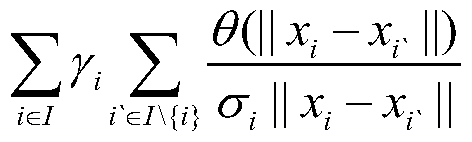
其中, 为点云采样数据的点集合, 为点集合 中的采样点, /为采样点 的邻域点集合, X为邻域点集合 /中的领域点, R为规整项, ; 为权重系数, h 为领域点集合 /的邻域半径, σ为分布系数;
连接所述骨架分支得到点云骨架。
2、 根据权利要求 1所述的点云骨架提取方法, 其特征在于, 所述方法还包 括:
根据 PCA算法为采样点建立协方差矩阵;
根据下述公式得到分布系数: a.=a(x.) =
0t + λ\ί + λ2ί 其中, 10、 11和 12为所述协方差矩阵的三个特征值, 且 10≤ 1≤ 12。
3、 根据权利要求 1所述的点云骨架提取方法, 其特征在于, 所述根据迭代 公式进行点云收缩的步骤为:
逐步扩大邻域半径, 根据扩大的邻域半径以及所述迭代公式进行点云收缩。
4、 根据权利要求 3所述的点云骨架提取方法, 其特征在于, 所述逐步扩大 邻域半径的步骤为:
设置初始邻域半径/?。 =2^/^ , 以 的方式逐步扩大邻域半 径, 其中, 为点云包围盒对角线长度, w为点云采样数据的点集合中采样点 的个数。
5、 根据权利要求 1所述的点云骨架提取方法, 其特征在于, 所述连接所述
骨架分支得到点云骨架的步骤之后还包括:
对所述点云骨架进行平滑化和中心化处理。
6、 一种点云骨架提取装置, 其特征在于, 包括:
采样数据获取模块, 用于获取输入的点云采样数据;
骨架分支生成模块, 用于根据迭代公式进行点云收缩得到骨架分支, 所述 迭代公式为:
arg minXXH , -ql\\e(\\xJ-qJ\\) + R(X);
x i I j J 其中, R(X) =∑ri ∑ "'~Xf ll e(r) = e ^ ;
i≡I f i\{i} ai II Xi ~xr II
其中, 为点云采样数据的点集合, 为点集合 中的采样点, /为采样点 的邻域点集合, X为邻域点集合 /中的领域点, R为规整项, ; 为权重系数, h 为领域点集合 /的邻域半径, σ为分布系数;
点云骨架生成模块, 用于连接所述骨架分支得到点云骨架。
7、 根据权利要求 6所述的点云骨架提取装置, 其特征在于, 所述骨架分支 生成模块还用于根据 PCA算法为采样点建立协方差矩阵;
根据下述公式得到分布系数:
λ2,
σ, - σ( , ) 其中, 10、 11和 12为所述协方差矩阵的三个特征值, 且 10≤ 1≤ 12。
8、 根据权利要求 6所述的点云骨架提取装置, 其特征在于, 所述骨架分支 生成模块还用于逐步扩大邻域半径, 根据扩大的邻域半径以及所述迭代公式进 行点云收缩。
9、 根据权利要求 8所述的点云骨架提取装置, 其特征在于, 所述骨架分支 生成模块还用于设置初始邻域半径/ ¾=2( /^ , 以 =/^ + /¾/2的方式逐步扩 大邻域半径, 其中, 为点云包围盒对角线长度, ι为点云采样数据的点集合 中采样点的个数。
10、 根据权利要求 6所述的点云骨架提取装置, 其特征在于, 所述装置还 包括点云骨架调整模块, 用于对所述点云骨架进行平滑化和中心化处理。
Priority Applications (1)
| Application Number | Priority Date | Filing Date | Title |
|---|---|---|---|
| US14/378,976 US9390552B1 (en) | 2013-05-23 | 2013-09-13 | Method and device for extracting skeleton from point cloud |
Applications Claiming Priority (2)
| Application Number | Priority Date | Filing Date | Title |
|---|---|---|---|
| CN201310196243.2A CN103268631B (zh) | 2013-05-23 | 2013-05-23 | 点云骨架提取方法及装置 |
| CN201310196243.2 | 2013-05-23 |
Publications (1)
| Publication Number | Publication Date |
|---|---|
| WO2014187046A1 true WO2014187046A1 (zh) | 2014-11-27 |
Family
ID=49012258
Family Applications (1)
| Application Number | Title | Priority Date | Filing Date |
|---|---|---|---|
| PCT/CN2013/083441 Ceased WO2014187046A1 (zh) | 2013-05-23 | 2013-09-13 | 点云骨架提取方法及装置 |
Country Status (3)
| Country | Link |
|---|---|
| US (1) | US9390552B1 (zh) |
| CN (1) | CN103268631B (zh) |
| WO (1) | WO2014187046A1 (zh) |
Cited By (5)
| Publication number | Priority date | Publication date | Assignee | Title |
|---|---|---|---|---|
| CN104966287A (zh) * | 2015-06-08 | 2015-10-07 | 浙江大学 | 层次化的多片点云刚性配准方法 |
| CN111666946A (zh) * | 2020-05-26 | 2020-09-15 | 东华大学 | 基于点云过分割与面片生长的植株点云单叶片分割方法 |
| CN114782511A (zh) * | 2021-11-15 | 2022-07-22 | 中南大学 | 基于点云数据的建模方法 |
| CN119579669A (zh) * | 2025-02-08 | 2025-03-07 | 中国农业大学 | 一种作物冠层表型参数提取方法、设备、介质及产品 |
| CN119863576A (zh) * | 2025-03-24 | 2025-04-22 | 山东科技大学 | 一种基于骨架收缩的复杂巷道网络中心线计算方法 |
Families Citing this family (32)
| Publication number | Priority date | Publication date | Assignee | Title |
|---|---|---|---|---|
| EP2816966B1 (en) | 2012-02-22 | 2023-10-25 | Veran Medical Technologies, Inc. | Steerable surgical catheter comprising a biopsy device at the distal end portion thereof |
| CN103268631B (zh) | 2013-05-23 | 2015-09-30 | 中国科学院深圳先进技术研究院 | 点云骨架提取方法及装置 |
| CN103778654A (zh) * | 2013-12-10 | 2014-05-07 | 深圳先进技术研究院 | 一种三维几何体特征线引导的表面光滑向量场计算方法 |
| CN103745497B (zh) * | 2013-12-11 | 2017-05-10 | 中国科学院深圳先进技术研究院 | 植物生长建模方法和系统 |
| CN103714555B (zh) * | 2013-12-13 | 2017-06-13 | 中国科学院深圳先进技术研究院 | 一种基于运动轨迹的四维运动点云分割与重建方法 |
| CN104156730B (zh) * | 2014-07-25 | 2017-12-01 | 山东大学 | 一种基于骨架的抗噪声汉字特征提取方法 |
| CN105373814B (zh) * | 2014-08-26 | 2019-04-02 | 南京林业大学 | 一种基于激光点云数据的真实阔叶树器官分类识别方法 |
| CN104408765B (zh) * | 2014-11-11 | 2017-01-11 | 中国科学院深圳先进技术研究院 | 植物扫描与重建方法 |
| CN105005995B (zh) * | 2015-07-29 | 2017-07-25 | 武汉大学 | 一种计算三维点云模型骨骼的方法 |
| CN105405162B (zh) * | 2015-10-16 | 2017-12-05 | 北京师范大学 | 基于局部结构和方向感知的树点云三维重建方法 |
| CN106504331B (zh) * | 2016-09-27 | 2021-05-18 | 西安科技大学 | 基于三维模型检索的牙齿建模方法 |
| CN106780458B (zh) * | 2016-12-09 | 2020-04-28 | 重庆邮电大学 | 一种点云骨架提取方法及装置 |
| TWI657691B (zh) * | 2017-05-24 | 2019-04-21 | 鈺立微電子股份有限公司 | 矯正原始立體掃描結果的錯誤法向量的裝置及其相關方法 |
| CN108280833B (zh) * | 2018-01-18 | 2021-09-24 | 华南农业大学 | 一种植物根系分叉特征的骨架提取方法 |
| CN109064471B (zh) * | 2018-07-18 | 2021-09-03 | 中北大学 | 一种基于骨架的三维点云模型分割方法 |
| CN109325993B (zh) * | 2018-08-10 | 2023-01-06 | 华北电力大学(保定) | 一种基于类八叉树索引的显著性特征强化采样方法 |
| CN109887009B (zh) * | 2019-01-24 | 2022-12-09 | 西北大学 | 一种点云局部匹配方法 |
| CN110827233B (zh) * | 2019-08-29 | 2022-06-14 | 杭州电子科技大学 | 一种牙齿三维点云数据表面窝沟区域的提取方法 |
| WO2021114026A1 (zh) * | 2019-12-09 | 2021-06-17 | 深圳大学 | 一种基于局部参考坐标系的3d形状匹配方法及装置 |
| EP3862850B1 (en) * | 2020-02-06 | 2023-03-29 | Dassault Systèmes | Method for locating a center of rotation of an articulated joint |
| CN111462202B (zh) * | 2020-04-08 | 2022-09-02 | 中国科学技术大学 | 非刚性注册方法及系统 |
| CN112102178B (zh) * | 2020-07-29 | 2024-09-06 | 深圳市菲森科技有限公司 | 一种点云保特征去噪方法、装置、电子设备及存储介质 |
| CN111968089B (zh) * | 2020-08-15 | 2024-06-21 | 晋江市博感电子科技有限公司 | 一种基于最大内切球机制的l1中值骨架提取方法 |
| CN112465832B (zh) * | 2020-11-25 | 2024-04-16 | 重庆大学 | 一种基于双目视觉的单面树木点云骨架线提取方法及系统 |
| CN112686799B (zh) * | 2020-12-25 | 2022-05-10 | 燕山大学 | 一种基于法向量和l1中值的环形锻件截面形线提取方法 |
| CN112712509B (zh) * | 2020-12-31 | 2023-09-01 | 重庆大学 | 基于点云的树木参数获取方法、生长评估方法、装置及系统 |
| CN112967333B (zh) * | 2021-02-04 | 2024-02-09 | 重庆大学 | 基于等级划分的复杂点云骨架提取方法及系统 |
| CN112802089B (zh) * | 2021-02-05 | 2023-09-01 | 重庆大学 | 一种基于分叉数量自动估计的点云骨架线提取方法及系统 |
| CN113298919A (zh) * | 2021-04-14 | 2021-08-24 | 江苏大学 | 一种三维植物点云模型的骨架提取方法 |
| CN113888623B (zh) * | 2021-10-08 | 2025-02-18 | 重庆大学 | 一种点云骨架提取方法及计算机存储介质 |
| CN114419276B (zh) * | 2022-01-19 | 2024-05-03 | 厦门大学 | 基于最优传输和聚类的曲线骨架提取方法 |
| CN115841581B (zh) * | 2023-02-20 | 2023-05-16 | 宜科(天津)电子有限公司 | 一种门板骨架的特征点提取方法 |
Citations (3)
| Publication number | Priority date | Publication date | Assignee | Title |
|---|---|---|---|---|
| CN101866495A (zh) * | 2010-06-01 | 2010-10-20 | 中国科学院自动化研究所 | 基于骨架点云的树木建模方法 |
| CN101887596A (zh) * | 2010-06-01 | 2010-11-17 | 中国科学院自动化研究所 | 树木点云数据基于分割和自动生长的三维模型重建方法 |
| CN103268631A (zh) * | 2013-05-23 | 2013-08-28 | 中国科学院深圳先进技术研究院 | 点云骨架提取方法及装置 |
Family Cites Families (5)
| Publication number | Priority date | Publication date | Assignee | Title |
|---|---|---|---|---|
| US8004517B1 (en) * | 2005-06-24 | 2011-08-23 | Geomagic, Inc. | Methods, apparatus and computer program products that model three-dimensional surface structures |
| US8064731B2 (en) * | 2006-11-13 | 2011-11-22 | Siemens Audiologische Technik Gmbh | Generalized rigid alignment of 3D ear impression models |
| CN102467753B (zh) * | 2010-11-04 | 2013-10-09 | 中国科学院深圳先进技术研究院 | 基于骨架配准的时变点云重建方法及系统 |
| US20140125663A1 (en) * | 2010-12-03 | 2014-05-08 | Institute of Automation, Chinese Academy of Scienc | 3d model shape analysis method based on perception information |
| EP2674913B1 (en) * | 2012-06-14 | 2014-07-23 | Softkinetic Software | Three-dimensional object modelling fitting & tracking. |
-
2013
- 2013-05-23 CN CN201310196243.2A patent/CN103268631B/zh active Active
- 2013-09-13 US US14/378,976 patent/US9390552B1/en active Active
- 2013-09-13 WO PCT/CN2013/083441 patent/WO2014187046A1/zh not_active Ceased
Patent Citations (3)
| Publication number | Priority date | Publication date | Assignee | Title |
|---|---|---|---|---|
| CN101866495A (zh) * | 2010-06-01 | 2010-10-20 | 中国科学院自动化研究所 | 基于骨架点云的树木建模方法 |
| CN101887596A (zh) * | 2010-06-01 | 2010-11-17 | 中国科学院自动化研究所 | 树木点云数据基于分割和自动生长的三维模型重建方法 |
| CN103268631A (zh) * | 2013-05-23 | 2013-08-28 | 中国科学院深圳先进技术研究院 | 点云骨架提取方法及装置 |
Non-Patent Citations (1)
| Title |
|---|
| HUANG, HU I ET AL.: "L1-Medial Skeleton of Point Cloud", ACM TRANSACTIONS ON GRAPHICS (TOG)-SIGGRAPH 2013 CONFERENCE PROCEEDINGS, vol. 32, no. 4, July 2013 (2013-07-01), pages 65 - 1-65-8 * |
Cited By (7)
| Publication number | Priority date | Publication date | Assignee | Title |
|---|---|---|---|---|
| CN104966287A (zh) * | 2015-06-08 | 2015-10-07 | 浙江大学 | 层次化的多片点云刚性配准方法 |
| CN104966287B (zh) * | 2015-06-08 | 2017-08-08 | 浙江大学 | 层次化的多片点云刚性配准方法 |
| CN111666946A (zh) * | 2020-05-26 | 2020-09-15 | 东华大学 | 基于点云过分割与面片生长的植株点云单叶片分割方法 |
| CN114782511A (zh) * | 2021-11-15 | 2022-07-22 | 中南大学 | 基于点云数据的建模方法 |
| CN114782511B (zh) * | 2021-11-15 | 2024-11-29 | 中南大学 | 基于点云数据的建模方法 |
| CN119579669A (zh) * | 2025-02-08 | 2025-03-07 | 中国农业大学 | 一种作物冠层表型参数提取方法、设备、介质及产品 |
| CN119863576A (zh) * | 2025-03-24 | 2025-04-22 | 山东科技大学 | 一种基于骨架收缩的复杂巷道网络中心线计算方法 |
Also Published As
| Publication number | Publication date |
|---|---|
| US9390552B1 (en) | 2016-07-12 |
| CN103268631A (zh) | 2013-08-28 |
| US20160203636A1 (en) | 2016-07-14 |
| CN103268631B (zh) | 2015-09-30 |
Similar Documents
| Publication | Publication Date | Title |
|---|---|---|
| WO2014187046A1 (zh) | 点云骨架提取方法及装置 | |
| CN100559398C (zh) | 自动的深度图像配准方法 | |
| CN109740227B (zh) | 基于特征识别的微型复杂零件建模方法 | |
| Salinas et al. | Structure‐aware mesh decimation | |
| CN107223268B (zh) | 一种三维点云模型重建方法及装置 | |
| CN106709947B (zh) | 一种基于rgbd相机的三维人体快速建模系统 | |
| CN103098100A (zh) | 基于感知信息的三维模型形状分析方法 | |
| CN103065352B (zh) | 一种基于图像和扫描数据的植株三维重建方法 | |
| CN107767453B (zh) | 一种基于规则约束的建筑物lidar点云重构优化方法 | |
| Harvey et al. | A randomized O (m log m) time algorithm for computing Reeb graphs of arbitrary simplicial complexes | |
| CN106780458B (zh) | 一种点云骨架提取方法及装置 | |
| US20110199382A1 (en) | Method and System for B-Rep Face and Edge Connectivity Compression | |
| CN106780751A (zh) | 基于改进的屏蔽泊松算法的三维点云重建方法 | |
| CN101719140A (zh) | 一种图形检索方法 | |
| CN106023298A (zh) | 基于局部泊松曲面重建的点云刚性配准方法 | |
| CN103646421B (zh) | 基于增强型PyrLK光流法的树木轻量化3D重建方法 | |
| CN118365802A (zh) | 一种三维点云重建方法、装置及计算机可读存储介质 | |
| Mérigot et al. | Robust voronoi-based curvature and feature estimation | |
| Jiang et al. | Structure-aware surface reconstruction via primitive assembly | |
| CN104821015B (zh) | 实物表面样点α-shape曲面拓扑重建方法 | |
| Li et al. | Meshless quadrangulation by global parameterization | |
| Athanasiadis et al. | Feature-based 3D morphing based on geometrically constrained spherical parameterization | |
| EP4636610A1 (en) | Local topological similarity retrieval in a b-rep model | |
| CN118411489A (zh) | 一种新的基于边收缩位置优化的无相交网格简化方法 | |
| CN110322415A (zh) | 基于点云的高精度表面三维重构方法 |
Legal Events
| Date | Code | Title | Description |
|---|---|---|---|
| WWE | Wipo information: entry into national phase |
Ref document number: 14378976 Country of ref document: US |
|
| 121 | Ep: the epo has been informed by wipo that ep was designated in this application |
Ref document number: 13885041 Country of ref document: EP Kind code of ref document: A1 |
|
| NENP | Non-entry into the national phase |
Ref country code: DE |
|
| 122 | Ep: pct application non-entry in european phase |
Ref document number: 13885041 Country of ref document: EP Kind code of ref document: A1 |