WO2014157136A1 - 吸収性物品 - Google Patents
吸収性物品 Download PDFInfo
- Publication number
- WO2014157136A1 WO2014157136A1 PCT/JP2014/058182 JP2014058182W WO2014157136A1 WO 2014157136 A1 WO2014157136 A1 WO 2014157136A1 JP 2014058182 W JP2014058182 W JP 2014058182W WO 2014157136 A1 WO2014157136 A1 WO 2014157136A1
- Authority
- WO
- WIPO (PCT)
- Prior art keywords
- sum
- amplitude peaks
- absorbent article
- frequency spectrum
- predetermined number
- Prior art date
- Legal status (The legal status is an assumption and is not a legal conclusion. Google has not performed a legal analysis and makes no representation as to the accuracy of the status listed.)
- Ceased
Links
Images





Classifications
-
- A—HUMAN NECESSITIES
- A61—MEDICAL OR VETERINARY SCIENCE; HYGIENE
- A61F—FILTERS IMPLANTABLE INTO BLOOD VESSELS; PROSTHESES; DEVICES PROVIDING PATENCY TO, OR PREVENTING COLLAPSING OF, TUBULAR STRUCTURES OF THE BODY, e.g. STENTS; ORTHOPAEDIC, NURSING OR CONTRACEPTIVE DEVICES; FOMENTATION; TREATMENT OR PROTECTION OF EYES OR EARS; BANDAGES, DRESSINGS OR ABSORBENT PADS; FIRST-AID KITS
- A61F13/00—Bandages or dressings; Absorbent pads
- A61F13/15—Absorbent pads, e.g. sanitary towels, swabs or tampons for external or internal application to the body; Supporting or fastening means therefor; Tampon applicators
- A61F13/45—Absorbent pads, e.g. sanitary towels, swabs or tampons for external or internal application to the body; Supporting or fastening means therefor; Tampon applicators characterised by the shape
- A61F13/49—Absorbent pads, e.g. sanitary towels, swabs or tampons for external or internal application to the body; Supporting or fastening means therefor; Tampon applicators characterised by the shape specially adapted to be worn around the waist, e.g. diapers or nappies
-
- A—HUMAN NECESSITIES
- A61—MEDICAL OR VETERINARY SCIENCE; HYGIENE
- A61F—FILTERS IMPLANTABLE INTO BLOOD VESSELS; PROSTHESES; DEVICES PROVIDING PATENCY TO, OR PREVENTING COLLAPSING OF, TUBULAR STRUCTURES OF THE BODY, e.g. STENTS; ORTHOPAEDIC, NURSING OR CONTRACEPTIVE DEVICES; FOMENTATION; TREATMENT OR PROTECTION OF EYES OR EARS; BANDAGES, DRESSINGS OR ABSORBENT PADS; FIRST-AID KITS
- A61F13/00—Bandages or dressings; Absorbent pads
- A61F13/15—Absorbent pads, e.g. sanitary towels, swabs or tampons for external or internal application to the body; Supporting or fastening means therefor; Tampon applicators
- A61F13/84—Accessories, not otherwise provided for, for absorbent pads
-
- G—PHYSICS
- G01—MEASURING; TESTING
- G01N—INVESTIGATING OR ANALYSING MATERIALS BY DETERMINING THEIR CHEMICAL OR PHYSICAL PROPERTIES
- G01N21/00—Investigating or analysing materials by the use of optical means, i.e. using sub-millimetre waves, infrared, visible or ultraviolet light
- G01N21/17—Systems in which incident light is modified in accordance with the properties of the material investigated
- G01N21/25—Colour; Spectral properties, i.e. comparison of effect of material on the light at two or more different wavelengths or wavelength bands
- G01N21/31—Investigating relative effect of material at wavelengths characteristic of specific elements or molecules, e.g. atomic absorption spectrometry
- G01N21/35—Investigating relative effect of material at wavelengths characteristic of specific elements or molecules, e.g. atomic absorption spectrometry using infrared light
- G01N21/359—Investigating relative effect of material at wavelengths characteristic of specific elements or molecules, e.g. atomic absorption spectrometry using infrared light using near infrared light
-
- A—HUMAN NECESSITIES
- A61—MEDICAL OR VETERINARY SCIENCE; HYGIENE
- A61F—FILTERS IMPLANTABLE INTO BLOOD VESSELS; PROSTHESES; DEVICES PROVIDING PATENCY TO, OR PREVENTING COLLAPSING OF, TUBULAR STRUCTURES OF THE BODY, e.g. STENTS; ORTHOPAEDIC, NURSING OR CONTRACEPTIVE DEVICES; FOMENTATION; TREATMENT OR PROTECTION OF EYES OR EARS; BANDAGES, DRESSINGS OR ABSORBENT PADS; FIRST-AID KITS
- A61F13/00—Bandages or dressings; Absorbent pads
- A61F13/15—Absorbent pads, e.g. sanitary towels, swabs or tampons for external or internal application to the body; Supporting or fastening means therefor; Tampon applicators
- A61F13/84—Accessories, not otherwise provided for, for absorbent pads
- A61F2013/8488—Accessories, not otherwise provided for, for absorbent pads including testing apparatus
- A61F2013/8491—Accessories, not otherwise provided for, for absorbent pads including testing apparatus including test methods
Definitions
- the present invention relates to an absorbent article, and in particular, an absorbent article that objectively improves comfort during wearing by associating measured values based on near infrared spectroscopy (NIRS) with physical properties of the absorbent article. About.
- NIRS near infrared spectroscopy
- NIRS near-infrared spectroscopy
- the nonwoven fabric (absorbent article) that has been considered to be highly comfortable is not necessarily a good value, that is, comfort. It has been found that may not show high values.
- the present invention has been made in view of such a situation, and the comfort when worn based on the correspondence between the measured value based on near infrared spectroscopy (NIRS) and the physical properties of the absorbent article. It aims at providing the absorbent article improved more objectively.
- NIRS near infrared spectroscopy
- a first feature of the present invention is an absorbent article (disposable diaper 10) provided with a skin contact surface sheet (top sheet 50) that comes into contact with a wearer's skin, based on a predetermined measurement condition, By stroking the surface of the abutting surface sheet along the first direction (product longitudinal direction L), Fourier transform is performed on the waveform data on the time axis of the frictional resistance force generated in the second direction opposite to the first direction.
- the sum of the first predetermined number of amplitude peaks of the frequency spectrum obtained by executing is less than or equal to 0.025 gf ⁇ s, and the second predetermined number of the frequency spectrum with respect to the sum of the first predetermined number of amplitude peaks
- the gist is that the ratio of the sum of the amplitude peaks is 20% or more.
- a second feature of the present invention is an absorbent article including a skin contact surface sheet that contacts a wearer's skin, and the surface of the skin contact surface sheet is formed on the first surface based on a predetermined measurement condition.
- FIG. 1 is a developed plan view of a disposable diaper according to an embodiment of the present invention.
- FIG. 2 is a cross-sectional view of the disposable diaper 10 taken along the line FF shown in FIG.
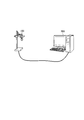
- FIG. 3 is a schematic configuration diagram of the measuring apparatus 100 and the evaluation apparatus 200 used in the comfort evaluation method for absorbent articles according to the embodiment of the present invention.
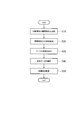
- FIG. 4 is a flowchart of a comfort evaluation method for absorbent articles according to an embodiment of the present invention.
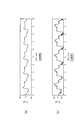
- FIG. 5 is a diagram showing an example of waveform data acquired using the measuring apparatus 100 according to the embodiment of the present invention.
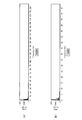
- FIG. 6 is a diagram illustrating an example of data after Fourier transform according to the embodiment of the present invention.
- FIG. 7 shows the absorptivity based on the correspondence between the ratio (3_sum / sum) of the amplitude peak of the frequency of a multiple of 0.333 Hz according to the embodiment of the present invention and the measured value of the brain function by NIRS. It is a graph which shows the evaluation result of the comfort of articles
- FIG. 8 is a diagram showing NIRS measurement values of examples and comparative examples according to the embodiment of the present invention.
- FIG. 9 is a graph showing a linear approximation line when the x-axis (frequency axis) and the y-axis (amplitude axis) of the data after Fourier transform according to the embodiment of the present invention are logarithmic.
- FIG. 8 is a diagram showing NIRS measurement values of examples and comparative examples according to the embodiment of the present invention.
- FIG. 9 is a graph showing a linear approximation line when the x-axis (frequency axis) and the y-axis (amplitude axis)
- FIG. 10 is a graph showing the evaluation results of the comfort of the absorbent article based on the association between the slope of the linear approximation line according to the embodiment of the present invention and the measured value of the brain function by NIRS.
- FIG. 11 is a graph showing the evaluation results of the comfort of the absorbent article based on the association between the slope of the linear approximation line according to the embodiment of the present invention and the measured value of the brain function by NIRS.
- FIG. 1 is a developed plan view of a disposable diaper 10 according to this embodiment.
- FIG. 2 is a cross-sectional view of the disposable diaper 10 taken along the line FF shown in FIG.
- the developed plan view shown in FIG. 1 is a view of the state in which the leg stretchable portion 75 and the leg side gathers 80 are extended until the top sheet 50 and the side flap 70 constituting the disposable diaper 10 are not formed. is there.
- the disposable diaper 10 includes a front waistline region 20 having a front waistline region 20, a crotch region 25, and a back waistline region 30. It is the part that touches. Further, the rear waistline region 30 is a portion in contact with the rear waistline portion (back portion) of the wearer. The crotch region 25 is located between the front waistline region 20 and the back waistline region 30.
- the direction from the front waistline region 20 to the rear waistline region 30 is referred to as a product longitudinal direction L
- a direction orthogonal to the product longitudinal direction L is referred to as a product width direction W.
- the disposable diaper 10 includes an absorbent body 40 that straddles the crotch region 25 and extends from the crotch region 25 toward at least one of the front waistline region 20 and the rear waistline region 30.
- the absorber 40 includes an absorbent core 40a and a core wrap 40b.
- the absorbent core 40a can be appropriately configured using a known member or material such as pulverized pulp or superabsorbent polymer.
- the absorbent core 40a is wrapped with a sheet-like core wrap 40b.
- a liquid-permeable top sheet 50 is provided on the surface side (skin contact surface side) of the absorber 40.
- a liquid-impermeable back sheet 60a is provided on the back side (non-skin contact surface side) of the absorber 40.
- the back sheet 60a is disposed between the absorber 40 and the exterior sheet 60, and functions as a leak-proof sheet.
- Side flaps 70 are respectively provided on the side edges of the absorbent body 40 in the product width direction W.
- the side flap 70 is composed of one or two or more non-woven fabrics.
- the pair of side flaps 70 are each provided with a fastening tape 90.
- the surface side (top sheet 50 side) of the absorber 40 is provided with a pair of leg stretchable parts 75 that can be stretched in the product longitudinal direction L.
- a pair of leg side gathers 80 extending along the product longitudinal direction L are provided inside the pair of leg stretchable portions 75 (near the center in the product width direction W).
- Fastening tape 90 extends along the product width direction W in the rear waistline region 30, and is fastened to the non-skin contact surface of the front waistline region 20, thereby holding the disposable diaper 10 on the wearer's body.
- the disposable diaper 10 has a second opposite to the first direction by stroking the surface of the top sheet 50 (skin contact surface sheet) along the product longitudinal direction L (first direction) based on a predetermined measurement condition.
- the sum of the first predetermined number of amplitude peaks of the frequency spectrum obtained by performing Fourier transform on the waveform data on the time axis of the frictional resistance force generated in the direction is 0.025 gf ⁇ s or less, and
- the ratio of the sum of the second predetermined number of amplitude peaks of the frequency spectrum to the sum of the predetermined number of amplitude peaks is 20% or more.
- the disposable diaper 10 is opposite to the first direction by stroking the surface of the top sheet 50 (skin contact surface sheet) along the product longitudinal direction L (first direction) based on predetermined measurement conditions.
- the sum of the amplitude peaks of the frequency spectrum obtained by executing Fourier transform on the waveform data of the frictional resistance generated in the second direction on the time axis is 0.07 gf ⁇ s or less, and a linear approximation of the frequency spectrum
- the slope of the straight line is less than -0.90.
- the predetermined measurement conditions the sum of the first predetermined number of amplitude peaks, the sum of the second predetermined number of amplitude peaks, the sum of the amplitude peaks of the frequency spectrum, and the slope of the linear approximation line will be described later.
- FIG. 3 is a schematic configuration diagram of the measuring device 100 and the evaluation device 200 used in the comfort evaluation method for absorbent articles (for example, disposable diapers) according to the present embodiment.
- the measuring device 100 measures the frictional resistance and coefficient of friction of the material (nonwoven fabric etc.) to be measured.
- a 3D motion friction measuring device manufactured by Trinity Lab is used as the measuring device 100.
- TL701x manufactured by Trinity Lab is used. Note that specific specifications of the measuring apparatus 100 will be described later.
- the evaluation device 200 is connected to the measurement device 100.
- the evaluation apparatus 200 acquires data measured by the measurement apparatus 100, and executes storage, processing (Fourier transform, etc.) and analysis of the data.
- a general personal computer for example, Windows (registered trademark)
- Windows registered trademark
- FIG. 4 is a flowchart of a comfort evaluation method for absorbent articles according to the present embodiment.
- the friction resistance (unit: gf) of the target material, specifically, the sheet (surface sheet) on the skin contact surface of the disposable diaper is measured using the measuring apparatus 100 (S10).
- the surface of the skin contact surface (surface sheet) of the absorbent article is set in the Y direction, specifically, the conveyance direction (first time when the absorbent article is manufactured)
- the waveform data on the time axis of the frictional resistance generated in the direction opposite to the Y direction (opposite 180 degrees) (second direction) is obtained by stroking along the direction (S20).
- Fourier transform is performed on the acquired waveform data using the evaluation apparatus 200 (S30).
- data based on the frequency axis from the time axis, specifically, a frequency spectrum is obtained.
- the waveform data after the execution of Fourier transform is analyzed using the evaluation apparatus 200 (S40). Specifically, frequency spectrum data (specifically, amplitude data) is processed to generate a graph or the like used for comfort evaluation.
- the evaluation apparatus 200 holds a correspondence between the analyzed data and a measured value of brain function by near infrared spectroscopy (NIRS), and evaluates the comfort of the absorbent article based on the correspondence. (S50). Specifically, the evaluation apparatus 200 holds a correspondence between the processed frequency spectrum data value and the amount of change in oxyhemoglobin concentration (Oxy-HbHconcentration (z-score)) as a measured value of NIRS. ing.
- NIRS near infrared spectroscopy
- Table 1 shows specific measurement environments and measurement conditions using the measurement apparatus 100.
- FIGS. 5A and 5B show examples of waveform data acquired using the measuring apparatus 100.
- FIG. FIG. 5A shows an example of waveform data according to the embodiment
- FIG. 5B shows an example of waveform data according to a comparative example.
- the x-axis is time
- the y-axis is the frictional resistance along the Y direction (MD direction).
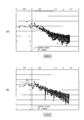
- FIGS. 6A and 6B show examples of data after Fourier transform.
- FIG. 6A corresponds to FIG. 5A and shows an example of data after Fourier transform according to the embodiment.
- FIG. 6B corresponds to FIG. 5B and shows an example of data after Fourier transform according to the comparative example.
- the Fourier transform is performed to convert the data into data based on the frequency axis, the x axis is the frequency, and the y axis is the amplitude of the frequency spectrum.
- analysis method 1 analysis based on the ratio of a predetermined number of amplitude peaks occupying the sum of a plurality of amplitude peaks in the frequency spectrum
- analysis method 2 analysis based on the slope of the linear approximation line in the case is used.
- Equation 1 (Sum of amplitude peaks in multiples of 0.333 Hz / sum of five amplitude peaks) ⁇ 100 (%) (Equation 1)
- the sum of the first predetermined number of amplitude peaks (sum of five amplitude peaks in order from the largest peak) of the frequency spectrum obtained by executing the Fourier transform, and the second predetermined number less than the first predetermined number.
- the ratio of the sum of the amplitude peaks (sum of the amplitude peaks that are multiples of 0.333 Hz) to the sum of the first predetermined number of amplitude peaks is calculated.
- the second predetermined number of amplitude peaks are selected based on a frequency that is a multiple of 0.333 Hz. Note that the frequency is not necessarily limited to a multiple of 0.333 Hz.
- the sum of the first predetermined number of amplitude peaks and the second predetermined number of amplitude peaks specifically, the ratio of the peak of the multiple of 0.333 Hz to the five peaks, and the brain function by NIRS
- the comfort of the absorbent article is evaluated based on the correspondence with the measured value.
- Table 2 shows an example of analysis results based on this analysis method.
- sum represents the sum of five amplitude peaks
- 3_sum represents the sum of amplitude peaks that are multiples of 0.333 Hz.
- 3_sum / sum indicates (sum of amplitude peaks in multiples of 0.333 Hz / total of five amplitude peaks) ⁇ 100 (%).
- the same measurement is performed three times and the average value of each value is used.
- An example in which the numerical value is “0” means that a frequency that is a multiple of 0.333 Hz has not appeared.
- Example 1 and Example 2 are disposable diapers manufactured by the applicant using a nonwoven fabric. Comparative Examples 1 and 3 to 5 are also disposable diapers using a nonwoven fabric. Comparative Examples 2 and 6 are not disposable diapers but fabrics such as pile fabrics and knits.
- the nonwoven fabric sheet of Example 1 is composed of an upper layer fiber configuration and a lower layer fiber configuration shown below, and has an uneven pattern at 22 g / m 2 with an upper layer of 7 g / m 2 and a lower layer of 15 g / m 2.
- a non-woven sheet provided with a pitch of adjacent convex portions of about 3 mm.
- the composite fiber having the following configuration is supplied to the first card machine as the third fiber (fiber configuration for the lower layer), and the mass per unit area is 15 g / m 2.
- the first web was made into a lower layer of the nonwoven fabric sheet of Example 1 by a predetermined process.
- Fiber core component Polyethylene terephthalate (PET, melting point approx. 260 ° C.)
- Fiber sheath component High density polyethylene (HDPE, melting point approx. 130 ° C) ⁇ Fineness: 2.2 dtex ⁇ Fiber length: 45mm
- Second upper layer fiber Core component PET (melting point 260 ° C.) ⁇ Sheath component: HDPE (melting point 130 ° C) ⁇ Fineness: 2.2 dtex ⁇ Fiber length: 45mm The fiber weight ratio in the upper layer fibers of the first upper layer fiber and the second upper layer fiber was 70% for the first upper layer fiber and 30% for the second upper layer fiber.
- the first upper layer fiber and the second upper layer fiber are supplied to the second card machine at a predetermined mixing ratio to obtain a second web, which is superimposed on the first web to obtain a composite web.
- the composite web is placed on the peripheral surface of the suction drum.
- the suction drum includes a fixed inner cylinder and a breathable outer cylinder that is concentric with the inner cylinder and rotates in the machine direction MD.
- the composite web is placed on the peripheral surface of the outer cylinder and proceeds in the machine direction MD at a required speed, for example, 100 m / min, together with the outer cylinder.
- a suction zone is formed in the inner cylinder.
- a first manifold and a second manifold are installed above the suction zone, and an outer cylinder is interposed between the suction zone and the first and second manifolds.
- Each of the first and second manifolds has a plurality of nozzles arranged at a required pitch in the axial direction of the suction drum, that is, in the intersecting direction CD orthogonal to the machine direction MD.
- the nozzles of the first manifold and the nozzles of the second manifold are aligned so as to be parallel to the machine direction MD, and each nozzle has a required opening diameter, for example, a diameter of 1 mm.
- heated air that has passed through a heater set at a required temperature, for example, 200 ° C., is jetted toward the composite web as first jet air.
- the injection amount of the first jet air is adjusted by the injection pressure, and is injected at a rate of, for example, 10 Nl / m 2 with respect to the unit surface area of the composite web. Subsequently, from each nozzle of the second manifold, heated air that has passed through a heater set at a required temperature, for example, 280 ° C., becomes second jet air and is jetted toward the composite web. The second jet air is jetted at a rate of, for example, 23 Nl / m 2 with respect to the unit surface area of the composite web after adjusting the jet pressure.
- the first jet air and the second jet air are sequentially injected, so that the first upper layer fiber, the second upper layer fiber, and the third fiber located immediately below the nozzle are sequentially formed in the width direction of the composite web.
- the first valley is formed in advance immediately below the nozzle, and a raised portion is formed in advance between the nozzles arranged in the cross direction CD.
- the nozzle pitch of the first manifold and the second manifold was 3 mm.
- the composite web passes through the dryer.
- heated air at a temperature (for example, 140 ° C.) capable of melting the surface of the fibers constituting the web is blown to the composite web, and the various fibers are welded to each other to form the primary
- the raised portion and the primary valley portion are in a stable state without being easily deformed.
- These raised portions and valleys are raised portions and valleys of the nonwoven fabric sheet.
- the composite web exiting the dryer becomes a non-woven sheet that can be used as a worn article when it is cooled to room temperature.
- the nonwoven fabric sheet of Example 2 uses “stretchable fibers” and “extensible fibers” described in JP 2011-226011 A.
- the gear pitch of the gear stretching device is 2.2 mm
- the nozzle interval of the water vapor treatment is 1.0 mm.
- Table 4 shows an example of an amplitude peak that is a multiple of 0.333 Hz extracted in the first measurement shown in Table 2. In Table 2, only Example 1, Comparative Example 1, Comparative Example 3, and Comparative Example 4 are shown.
- the sum of amplitude peaks of multiples of 0.333 Hz (333 ⁇ 10 ⁇ 3 ) ⁇ 0.005 (5 ⁇ 10 ⁇ 3 ) Hz is calculated as 3_sum.
- 665 Hz, 997 Hz, and 1,662 ( ⁇ 10 ⁇ 3 ) Hz are extracted as the frequencies.
- Fig. 7 shows the result of evaluating the comfort of absorbent articles based on the correspondence between the ratio of the amplitude peak with a frequency of a multiple of 0.333 Hz to the five peaks (3_sum / sum) and the measured value of brain function by NIRS. It is a graph which shows. Table 5 shows the ratio and the measured value of brain function by NIRS (Oxy-Hb concentration (z-score)).
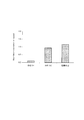
- FIG. 8 shows NIRS measurement values of the examples and comparative examples shown in Table 5.
- the area where the sum is 0.025 gf ⁇ s (25 ⁇ 10 ⁇ 3 gf ⁇ s) or less and 3_sum / sum is 20% or more is the high NIRS measurement value. It became corresponding. Specifically, Oxy-Hb concentration (z-score) of 0.3 or higher is classified as “high value”, and less than 0.3 is classified as “low value”.
- the comfort of the absorbent article is evaluated based on the correspondence between the sum of the amplitude peaks and the slope of the linear approximation line of the frequency spectrum and the measured value of brain function by NIRS.
- Table 6 shows an example of analysis results based on this analysis method.
- the sum of amplitudes in Table 6 represents the sum of amplitudes at all frequencies, and the approximate linear slope is a linear approximation when the x-axis (frequency axis) and y-axis (amplitude axis) of the data after Fourier transform are logarithmic. Indicates the slope of the straight line. In the example shown in Table 6, the same measurement is performed three times and the average value of each value is used.
- FIGS. 9 (a) and 9 (b) are graphs showing linear approximation lines when values obtained by Fourier transformation are plotted with the x-axis and y-axis of the data after Fourier transformation as logarithms.
- FIG. 9A is a graph showing a linear approximation line according to an example (Example 1)
- FIG. 9B is a graph showing a linear approximation line according to a comparative example (Comparative Example 4). Further, in the graphs shown in FIGS. 9A and 9B, the mathematical expression of the linear approximation line and the square value of R are shown.
- the slope of the linear approximation line in the example is ⁇ 0.856, and the slope of the linear approximation line in the comparative example is ⁇ 0.975.
- FIG. 10 is a graph showing the evaluation results of the comfort of the absorbent article based on the correspondence between the slope of the linear approximation line and the measured value of brain function by NIRS.
- Table 7 shows the measured values of the brain function by the inclination and NIRS (Oxy-Hb concentration (z-score)).
- a material (Examples 1 and 2 and Comparative Example 2) in which the total amplitude is 0.07 gf ⁇ s or less and the slope of the linear approximation line is less than ⁇ 0.90 is used as the waist of the subject.
- NIRS measurement value Oxy-Hb concentration (z-score)
- z-score concentration
- FIG. 11 shows NIRS measurement values (Oxy-Hb concentration (z-score)) when a disposable diaper is worn on an infant and NIRS measurement values when the infant's mother strokes the buttocks of the infant.
- “Diaper 1” and “Diaper 2” in FIG. 11 are values of Oxy-Hb concentration (z-score) when wearing disposable diapers.
- the z-score of “Diaper 1” is 0.14, whereas the z-score of “Diaper 2” is 0.94, which is good.
- “mother's palm” is Oxy-HbHconcentration (z-score) when the mother strokes the buttocks of an infant.
- z-score in the case of stroking the baby's buttocks with the mother's palm shows a high value (about 1.17), but also due to the difference in specifications used for the surface sheet of disposable diapers You can see that the z-score is different. In general, it is known that the higher the value of z-score, the more comfortable the brain feels. In the comfort evaluation method according to this embodiment, z according to the specifications of such a disposable diaper (nonwoven fabric). -Score difference.
- the frictional resistance measured based on the measurement conditions described above is a pseudo representation of the situation when the mother strokes the buttocks of an infant or when wearing a disposable diaper.
- the range based on the frequency spectrum of such frictional resistance specifically, sum is 0.025 gf ⁇ s (25 ⁇ 10 ⁇ 3 gf ⁇ s) or less and 3_sum / sum is 20% or more.
- the comfort of absorbent articles can be objectively evaluated by associating measured values based on NIRS with the physical properties of disposable diapers (such as face sheets). obtain.
- the wearer has a higher measured value based on NIRS, and the comfort during wearing can be improved. Moreover, the measurement value based on NIRS becomes high, so that comfort at the time of wearing can be improved more objectively.
- the measuring device 100 is not necessarily limited to the product.
- a measurement result equivalent to that of TL701x manufactured by Trinity Lab can be obtained, another measuring device may be used.
- the amplitude peak is selected based on a frequency that is a multiple of 0.333 Hz, but the frequency is not necessarily limited to 0.333 Hz.
- a frequency with many amplitude peaks with overlapping multiples may be determined.
- the disposable diaper has been described as an example.
- the scope of the present invention is not limited to the disposable diaper, and other absorbent articles that touch the wearer's skin, such as a sanitary napkin. It can also be applied.
- embodiment mentioned above demonstrated as an example the disposable diaper for infants this invention is applicable not only to an infant but the disposable diaper for elderly people, for example.
- NIRS near infrared spectroscopy
- Disposable diaper 20 For Disposable diaper 20
- Front waist area 25 For Inseam area 30
- Back waist area 40 Absorber 40a
- Absorptive core 40b For Core wrap 50
- Top sheet 60 External sheet 60a
- Back sheet 70 For Side flap 75
- Leg expansion / contraction Part 80 ... Legside gather 90 ... Fastening tape 100 ... Measurement device 200 ... Evaluation device
Landscapes
- Health & Medical Sciences (AREA)
- Life Sciences & Earth Sciences (AREA)
- Physics & Mathematics (AREA)
- General Health & Medical Sciences (AREA)
- Veterinary Medicine (AREA)
- Epidemiology (AREA)
- Heart & Thoracic Surgery (AREA)
- Animal Behavior & Ethology (AREA)
- Biomedical Technology (AREA)
- Public Health (AREA)
- Engineering & Computer Science (AREA)
- Vascular Medicine (AREA)
- Spectroscopy & Molecular Physics (AREA)
- Chemical & Material Sciences (AREA)
- Analytical Chemistry (AREA)
- Biochemistry (AREA)
- General Physics & Mathematics (AREA)
- Immunology (AREA)
- Pathology (AREA)
- Absorbent Articles And Supports Therefor (AREA)
Priority Applications (3)
| Application Number | Priority Date | Filing Date | Title |
|---|---|---|---|
| AU2014245946A AU2014245946B2 (en) | 2013-03-26 | 2014-03-25 | Absorbent article |
| KR1020157020621A KR20150135213A (ko) | 2013-03-26 | 2014-03-25 | 흡수성 물품 |
| CN201480018125.5A CN105120819A (zh) | 2013-03-26 | 2014-03-25 | 吸收性物品 |
Applications Claiming Priority (2)
| Application Number | Priority Date | Filing Date | Title |
|---|---|---|---|
| JP2013-065134 | 2013-03-26 | ||
| JP2013065134A JP6336247B2 (ja) | 2013-03-26 | 2013-03-26 | 吸収性物品 |
Publications (1)
| Publication Number | Publication Date |
|---|---|
| WO2014157136A1 true WO2014157136A1 (ja) | 2014-10-02 |
Family
ID=51624107
Family Applications (1)
| Application Number | Title | Priority Date | Filing Date |
|---|---|---|---|
| PCT/JP2014/058182 Ceased WO2014157136A1 (ja) | 2013-03-26 | 2014-03-25 | 吸収性物品 |
Country Status (5)
| Country | Link |
|---|---|
| JP (1) | JP6336247B2 (enExample) |
| KR (1) | KR20150135213A (enExample) |
| CN (1) | CN105120819A (enExample) |
| AU (1) | AU2014245946B2 (enExample) |
| WO (1) | WO2014157136A1 (enExample) |
Families Citing this family (1)
| Publication number | Priority date | Publication date | Assignee | Title |
|---|---|---|---|---|
| JP7496056B2 (ja) * | 2020-12-03 | 2024-06-06 | トヨタ紡織株式会社 | 樹脂繊維の評価方法 |
Citations (1)
| Publication number | Priority date | Publication date | Assignee | Title |
|---|---|---|---|---|
| JP2011226011A (ja) * | 2010-04-16 | 2011-11-10 | Uni Charm Corp | 伸長性繊維と伸縮性繊維とを含む、凹凸を有する不織布、及び当該不織布を製造する方法 |
Family Cites Families (3)
| Publication number | Priority date | Publication date | Assignee | Title |
|---|---|---|---|---|
| US6582798B2 (en) * | 2001-06-06 | 2003-06-24 | Tredegar Film Products Corporation | Vacuum formed film topsheets having a silky tactile impression |
| ES2914150T3 (es) * | 2002-12-20 | 2022-06-07 | Procter & Gamble | Banda laminada afelpada |
| JP5520124B2 (ja) * | 2009-05-14 | 2014-06-11 | ユニ・チャーム株式会社 | 透液性繊維不織布 |
-
2013
- 2013-03-26 JP JP2013065134A patent/JP6336247B2/ja not_active Expired - Fee Related
-
2014
- 2014-03-25 WO PCT/JP2014/058182 patent/WO2014157136A1/ja not_active Ceased
- 2014-03-25 KR KR1020157020621A patent/KR20150135213A/ko not_active Withdrawn
- 2014-03-25 AU AU2014245946A patent/AU2014245946B2/en not_active Expired - Fee Related
- 2014-03-25 CN CN201480018125.5A patent/CN105120819A/zh active Pending
Patent Citations (1)
| Publication number | Priority date | Publication date | Assignee | Title |
|---|---|---|---|---|
| JP2011226011A (ja) * | 2010-04-16 | 2011-11-10 | Uni Charm Corp | 伸長性繊維と伸縮性繊維とを含む、凹凸を有する不織布、及び当該不織布を製造する方法 |
Non-Patent Citations (2)
| Title |
|---|
| RIE SUDA ET AL.: "Hadagi no Hadazawari Kansuru Kenkyu -Kin Sekigai Bunk oho (NIRS) ni yoru Hyoka no Kokoromi", THE JAPAN RESEARCH ASSOCIATION FOR TEXTILE END-USES 2010 NEN NENJI TAIKAI KENKYU HAPPYO YOSHI, 26 June 2010 (2010-06-26), pages 129 * |
| TANGE AKIKO ET AL.: "Can infants distinguish between texture of diapers?", DAI 90 KAI THE PHYSIOLOGICAL SOCIETY OF JAPAN TAIKAI SHOROKUSHU, 26 March 2013 (2013-03-26), pages S172 * |
Also Published As
| Publication number | Publication date |
|---|---|
| CN105120819A (zh) | 2015-12-02 |
| JP2014188115A (ja) | 2014-10-06 |
| KR20150135213A (ko) | 2015-12-02 |
| AU2014245946A1 (en) | 2015-11-05 |
| JP6336247B2 (ja) | 2018-06-06 |
| AU2014245946B2 (en) | 2018-10-25 |
Similar Documents
| Publication | Publication Date | Title |
|---|---|---|
| US11033441B2 (en) | Diaper structure with enhanced tactile softness attributes | |
| US10064767B2 (en) | Diaper structure with enhanced tactile softness attributes and providing relatively low humidity | |
| JP7828176B2 (ja) | パンツ型着用可能物品 | |
| US10292874B2 (en) | Dual-mode high-waist foldover disposable absorbent pant | |
| CN110325155B (zh) | 具有特征材料特性的可穿着制品 | |
| JP6147536B2 (ja) | 着用物品の快適性評価方法 | |
| US12213866B2 (en) | Apertured nonwoven webs | |
| CZ2012655A3 (cs) | Netkaná textilie se zlepšenou měkkostí a způsob výroby této textilie | |
| CN102939064A (zh) | 一次性穿用物品 | |
| CN114432045A (zh) | 具有混合非织造纤维网的吸收制品 | |
| JP6336247B2 (ja) | 吸収性物品 | |
| CN109069319B (zh) | 套穿式吸收性物品与用于制造套穿式吸收性物品方法 | |
| JP7591861B2 (ja) | 吸収性物品 | |
| JP2015092916A (ja) | 吸収性物品 | |
| CN218852957U (zh) | 吸收制品 | |
| JP2015202251A (ja) | 使い捨ておむつ | |
| JP7278874B2 (ja) | 吸収性物品 | |
| JP2026048837A (ja) | パンツ型の着用可能な物品 | |
| WO2024034357A1 (ja) | 吸収性物品用の不織布の製造方法及び吸収性物品 |
Legal Events
| Date | Code | Title | Description |
|---|---|---|---|
| 121 | Ep: the epo has been informed by wipo that ep was designated in this application |
Ref document number: 14775354 Country of ref document: EP Kind code of ref document: A1 |
|
| ENP | Entry into the national phase |
Ref document number: 20157020621 Country of ref document: KR Kind code of ref document: A |
|
| NENP | Non-entry into the national phase |
Ref country code: DE |
|
| WWE | Wipo information: entry into national phase |
Ref document number: IDP00201506843 Country of ref document: ID |
|
| ENP | Entry into the national phase |
Ref document number: 2014245946 Country of ref document: AU Date of ref document: 20140325 Kind code of ref document: A |
|
| 122 | Ep: pct application non-entry in european phase |
Ref document number: 14775354 Country of ref document: EP Kind code of ref document: A1 |