WO2014156934A1 - 生体用ジルコニウム合金およびそれを用いた生体用医療器具 - Google Patents
生体用ジルコニウム合金およびそれを用いた生体用医療器具 Download PDFInfo
- Publication number
- WO2014156934A1 WO2014156934A1 PCT/JP2014/057705 JP2014057705W WO2014156934A1 WO 2014156934 A1 WO2014156934 A1 WO 2014156934A1 JP 2014057705 W JP2014057705 W JP 2014057705W WO 2014156934 A1 WO2014156934 A1 WO 2014156934A1
- Authority
- WO
- WIPO (PCT)
- Prior art keywords
- mass
- phase
- alloy
- zirconium alloy
- biomedical
- Prior art date
- Legal status (The legal status is an assumption and is not a legal conclusion. Google has not performed a legal analysis and makes no representation as to the accuracy of the status listed.)
- Ceased
Links
- 0 C**(C)C*=CNN Chemical compound C**(C)C*=CNN 0.000 description 1
- VBFROLLNYBOKBK-XOJFDHPMSA-N C[C@@]12N(C)CN1N2N Chemical compound C[C@@]12N(C)CN1N2N VBFROLLNYBOKBK-XOJFDHPMSA-N 0.000 description 1
Images








Classifications
-
- A—HUMAN NECESSITIES
- A61—MEDICAL OR VETERINARY SCIENCE; HYGIENE
- A61B—DIAGNOSIS; SURGERY; IDENTIFICATION
- A61B17/00—Surgical instruments, devices or methods
- A61B17/56—Surgical instruments or methods for treatment of bones or joints; Devices specially adapted therefor
-
- A—HUMAN NECESSITIES
- A61—MEDICAL OR VETERINARY SCIENCE; HYGIENE
- A61K—PREPARATIONS FOR MEDICAL, DENTAL OR TOILETRY PURPOSES
- A61K6/00—Preparations for dentistry
- A61K6/80—Preparations for artificial teeth, for filling teeth or for capping teeth
- A61K6/84—Preparations for artificial teeth, for filling teeth or for capping teeth comprising metals or alloys
-
- A—HUMAN NECESSITIES
- A61—MEDICAL OR VETERINARY SCIENCE; HYGIENE
- A61L—METHODS OR APPARATUS FOR STERILISING MATERIALS OR OBJECTS IN GENERAL; DISINFECTION, STERILISATION OR DEODORISATION OF AIR; CHEMICAL ASPECTS OF BANDAGES, DRESSINGS, ABSORBENT PADS OR SURGICAL ARTICLES; MATERIALS FOR BANDAGES, DRESSINGS, ABSORBENT PADS OR SURGICAL ARTICLES
- A61L27/00—Materials for grafts or prostheses or for coating grafts or prostheses
- A61L27/02—Inorganic materials
- A61L27/04—Metals or alloys
- A61L27/047—Other specific metals or alloys not covered by A61L27/042 - A61L27/045 or A61L27/06
-
- A—HUMAN NECESSITIES
- A61—MEDICAL OR VETERINARY SCIENCE; HYGIENE
- A61L—METHODS OR APPARATUS FOR STERILISING MATERIALS OR OBJECTS IN GENERAL; DISINFECTION, STERILISATION OR DEODORISATION OF AIR; CHEMICAL ASPECTS OF BANDAGES, DRESSINGS, ABSORBENT PADS OR SURGICAL ARTICLES; MATERIALS FOR BANDAGES, DRESSINGS, ABSORBENT PADS OR SURGICAL ARTICLES
- A61L31/00—Materials for other surgical articles, e.g. stents, stent-grafts, shunts, surgical drapes, guide wires, materials for adhesion prevention, occluding devices, surgical gloves, tissue fixation devices
- A61L31/02—Inorganic materials
- A61L31/022—Metals or alloys
-
- C—CHEMISTRY; METALLURGY
- C22—METALLURGY; FERROUS OR NON-FERROUS ALLOYS; TREATMENT OF ALLOYS OR NON-FERROUS METALS
- C22C—ALLOYS
- C22C16/00—Alloys based on zirconium
Definitions
- the present invention relates to a biomedical zirconium alloy and a biomedical device using the same.
- Metal materials are used in many medical devices mainly because of their mechanical reliability. Among them, implant materials such as artificial hip joints, artificial knee joints, bone plates, and artificial tooth roots are pure materials with excellent hard tissue compatibility. Ti and Ti alloys are used. However, these metal materials are considered to have the following problems at the time of image diagnosis using a magnetic resonance diagnosis (MRI) apparatus.
- MRI magnetic resonance diagnosis
- an image defect called artifact occurs around the member, making it difficult to evaluate and confirm the bone fusion of the member.
- the cause of the artifact is a mismatch between the magnetic susceptibility of the implant material and the negative magnetic susceptibility of the living tissue.
- a metal material having a low magnetic susceptibility or a negative magnetic susceptibility has been proposed.
- a diamagnetic metal material eg, a gold alloy
- a negative magnetic susceptibility has difficulty in strength
- the present inventors have attempted to lower the magnetic susceptibility with a paramagnetic metal material.
- Zirconium (Zr) is inferior in mechanical strength to Ti, but has lower cytotoxicity and magnetic susceptibility than Ti. Therefore, the present inventors have proposed a low magnetic susceptibility alloy for living body mainly composed of Zr.
- a Ti alloy is applied as a material for a bone anchor, a problem has been reported in which the bone anchor adheres to the bone and is difficult to remove after bone fusion. Since the Zr-based alloy of the present invention has the property of not forming calcium phosphate, which is the main component of bone, on the surface of the material, the above problem is solved.
- the elastic modulus of Ti-based alloy (about 100 to 200 GPa) is much larger than that of cortical bone (about 20 GPa).
- This elastic modulus gap causes overload shielding (stress shielding) to the bone, resulting in bone atrophy. Therefore, if a low-elasticity Zr alloy that is as close to cortical bone as possible can be developed, it can be provided as a material for a bone anchor that can be easily removed and stress shielding is less likely to occur.
- Patent Document 1 among the main transition metals of Groups 4 to 6 in the periodic element periodic table, Zr is a main component, and the main component other than Zr is used as a subcomponent having a lower content than the main component.
- a biomaterial is described that contains 0.5 to 15% by mass of at least one transition metal (Ti, V, Cr, Nb, Mo, Hf, Ta, W).
- Patent Document 2 describes a biological zirconium alloy containing Zr as a main component and containing Nb in a range of more than 15 mass% and 25 mass% or less.
- an object of the present invention is to provide a biomedical zirconium alloy having a low magnetic susceptibility and high strength and a biomedical device using the same.
- the present invention includes the following (1) to (15).
- Ta is contained in an amount of more than 15% by mass and 50% by mass or less, the balance is made of Zr and inevitable impurities, and the constituent phases are either ⁇ phase or ⁇ -Ta phase, ⁇ ′ phase
- the biomedical zirconium alloy according to (1) comprising: (8) The biomedical zirconium alloy according to (7), wherein Ta is contained in an amount of 16 to 19% by mass, and the constituent phases include an ⁇ phase and an ⁇ ′ phase, and are used for a bone anchor. (9) The biomedical zirconium alloy according to (7), which contains 25 to 35% by mass of Ta, and the constituent phase includes a ⁇ -Ta phase and an ⁇ ′ phase, and is used for a bone anchor.
- the biomedical zirconium alloy according to (7) containing 16 to 35% by mass of Ta.
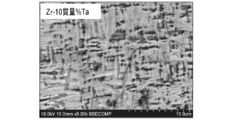
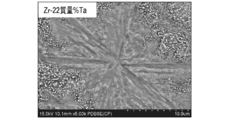
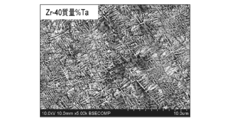
- FIG. 6 is a photograph of a metal structure obtained by a scanning electron microscope of Comparative Example 3.
- 2 is a photograph of a metal structure by a scanning electron microscope of Example 1.
- FIG. 3 is a photograph of a metal structure by a scanning electron microscope of Example 2.
- 3 is a photograph of a metal structure obtained by a scanning electron microscope in Example 3.
- 6 is a photograph of a metal structure by a scanning electron microscope of Example 5.
- 7 is a photograph of a metal structure obtained by a scanning electron microscope in Example 7. It is a figure which shows the structure of a bone fixing tool.
- the present invention is a biological zirconium alloy containing Zr as a main component and containing Ta in a range exceeding 15 mass%.
- a biomedical zirconium alloy is hereinafter also referred to as “the alloy of the present invention”.
- the C content and the S content are values obtained by measurement by a high-frequency combustion-infrared absorption method
- the Si content is a value obtained by measurement by a silicon dioxide weight method
- the O content is Is the value obtained by measuring by infrared absorption method
- N content is the value obtained by measuring by thermal conductivity method
- the content of other components is the value obtained by measuring by ICP-AES method.
- the alloy of the present invention contains Zr as a main component.
- “Main component” means a content of 30% by mass or more.
- the alloy of the present invention preferably contains 40 mass% or more of Zr, more preferably contains 50 mass% or more, more preferably contains 60 mass% or more, and more preferably contains 65 mass% or more. In such a case, the alloy of the present invention having a low magnetic susceptibility and higher strength can be obtained.
- the “main component” is used in the meaning as described above.
- the alloy of the present invention preferably contains Zr as a main component, Ta in a specific range, and the other consists of inevitable impurities.
- Inevitable impurities mean components that may be mixed from raw materials, manufacturing processes, etc. without intentional addition.
- the alloy of the present invention contains Ta in a range exceeding 15% by mass.
- the present inventor has found that when Zr is a main component and Ta is contained in a range exceeding 15 mass%, a biomedical zirconium alloy having a low magnetic susceptibility and a high strength can be obtained.
- the Ta content in the alloy of the present invention is preferably more than 15% by mass and 50% by mass or less.
- the Ta content in the alloy of the present invention is more preferably 16 to 35% by mass. This is because a biomedical zirconium alloy having a lower magnetic susceptibility and higher strength can be obtained.
- the alloy of the present invention preferably contains 16 to 24% by mass of Ta.
- the present inventors have found that the alloy of the present invention has a lower magnetic susceptibility. The lower the magnetic susceptibility, the smaller the artifact in MRI diagnosis, which is preferable.
- an alloy having high X-ray contrast properties can be obtained by containing Ta in an amount of 16 to 24% by mass. Note that the strength can be further improved by containing 20 to 22% by mass of Ta.
- the alloy of the present invention preferably contains 16 to 19% by mass of Ta.
- the present inventors have found that the alloy of the present invention has a low elastic modulus in addition to a low magnetic susceptibility and high strength.
- the elastic modulus is low, for example, when the alloy of the present invention is used as a bone fixing device, a load is easily transmitted to the bone tissue, and bone resorption is suppressed and bone contraction is suppressed.
- the alloy of the present invention preferably contains 25 to 35% by mass of Ta.
- the present inventors have found that the alloy of the present invention has a low elastic modulus in addition to a low magnetic susceptibility and high strength.
- the elastic modulus can be further reduced by containing 25 to 28% by mass of Ta.
- the alloy of the present invention preferably contains 40 to 50% by mass of Ta.
- the present inventors have found that the alloy of the present invention has a lower magnetic susceptibility. The lower the magnetic susceptibility, the smaller the artifact in MRI diagnosis, which is preferable. Further, when Ta is contained in an amount of 40 to 50% by mass, an alloy having high X-ray contrast properties can be obtained.
- the impurity component in the alloy of the present invention will be described.
- B, C, N, O, Na, Mg, Si, P, S, K, Ca, Mn, and the like are impurity components. The lower the content, the better.
- ⁇ Organization> Zr alone has an ⁇ phase (close-packed hexagonal crystal) at normal temperature and a ⁇ phase (body-centered cubic) at a temperature higher than 862 ° C.
- the crystal phase thereof is a phase called ⁇ ′ phase formed by Zr and Ta at room temperature, and is a ⁇ phase at higher temperature.
- ⁇ ′ phase formed by Zr and Ta at room temperature
- ⁇ phase may be frozen (quenched).
- a phase called hexagonal phase (hexagonal crystal) formed by Zr and Ta may appear in the ⁇ phase.
- the ⁇ phase may be appeared without being tempered only by quenching from the ⁇ phase in the high temperature range.
- the ⁇ phase may appear in the ⁇ phase even without rapid cooling.
- the ease of appearance of the ⁇ phase in the alloy is related to the Ta content.
- the alloy of the present invention may have a structure of ⁇ ′ phase, ⁇ -Ta phase and ⁇ phase. These tissues can be confirmed using XRD.
- the alloy of the present invention contains Ta in excess of 15% by mass and 50% by mass or less, and the balance is composed of Zr and inevitable impurities, the constituent phase is either ⁇ phase or ⁇ -Ta phase. , ⁇ ′ phase.
- the constituent phases include an ⁇ phase and an ⁇ ′ phase.
- the constituent phases include a ⁇ -Ta phase and an ⁇ ′ phase.
- the constituent phases are either ⁇ phase or ⁇ -Ta phase, ⁇ ′ phase, ,including.
- the constituent phases are either ⁇ phase or ⁇ -Ta phase, ⁇ ′ phase, ,including.
- the constituent phases include an ⁇ phase and an ⁇ ′ phase.
- the constituent phases include a ⁇ -Ta phase and an ⁇ ′ phase.
- the constituent phases include a ⁇ -Ta phase and an ⁇ ′ phase.
- the inventor has intensively studied and found that the existence ratio of these structures affects the magnetic susceptibility, strength (hardness) and elastic modulus of the alloy of the present invention. Further, it has been found that an alloy having mainly an ⁇ ′ phase and a ⁇ -Ta phase and having a low magnetic susceptibility and a high elastic modulus can be obtained when the volume fraction of the ⁇ -Ta phase is increased with respect to the ⁇ ′ phase.
- the method for producing the alloy of the present invention is not particularly limited.
- an alloy was melted by a non-consumable electrode type arc melting method in an Ar atmosphere using melting raw materials of Zr 99.5 mass% and Ta 99.5 mass%.
- the alloy of the present invention can be obtained only in a cast state.
- a biomedical device can be obtained using the alloy of the present invention. Such a biomedical device is also referred to as “the device of the present invention”.
- the instrument of the present invention can be manufactured by, for example, dissolving a raw material containing Zr and Ta and then solidifying it into a predetermined shape. After solidification, machining such as cutting and grinding, surface treatment such as various blast treatments, and the like may be performed as necessary.
- biomedical devices include aneurysm treatment devices (clips, embolization coils, stent grafts, etc.), stents (blood vessels, bile ducts, pancreatic ducts, tracheas, esophagus, intestinal tracts, etc.), indwelling in the body Devices (hemostatic clips, prosthetic valves, etc.), medical instruments (MRI compatible surgical instruments, devices (endoscopes, etc.), etc.), bone fixation instruments (eg osteosynthesis plates, osteosynthesis nails, osteosynthesis screws, bone fixation) Plate, intramedullary nail, etc.).
- aneurysm treatment devices clips, embolization coils, stent grafts, etc.
- stents blood vessels, bile ducts, pancreatic ducts, tracheas, esophagus, intestinal tracts, etc.
- indwelling in the body Devices hemostatic clips, prosthetic valves, etc.
- medical instruments
- Each alloy was phase-identified by X-ray diffraction (XRD).
- XRD X-ray diffraction
- the surface mechanically polished with water-resistant abrasive paper is used as the measurement surface, and measurement is performed under the conditions of an acceleration voltage of 40 kV, a current of 30 mA (in the air, at room temperature), a measurement range (2 ⁇ ) of 20 to 120 °, and a scanning speed of 1.2 ° / min. Went.
- the measurement results are shown in Table 1.
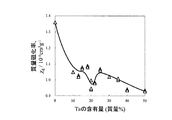
- Magnetic susceptibility measurement> Using a magnetic balance MSB-MKI (manufactured by Sherwood Scientific LTD), the magnetic susceptibility of each alloy was measured by the Evans method in the atmosphere and at room temperature. A sample obtained by cutting a round bar of ⁇ 3 mm ⁇ 25 mm from an ingot was used. Moreover, it measured twice about the sample of the same composition, and those average values were made into the magnetic susceptibility in the alloy of each composition. The measurement results are shown in Table 1 and FIG. In addition, the literature value was used for the value of 0 mass% Ta in FIG.
- the magnetic susceptibility is greatly reduced by the addition of 10% by mass Ta, shows a substantially constant value in the 10% by mass to 15% by mass Ta alloy, and then becomes 1.00 ⁇ with the 20% by mass Ta alloy. It decreased to 10 ⁇ 6 cm 3 / g. The increase started with the 25 mass% Ta alloy, but then gradually decreased with an increase in the amount of Ta added. The magnetic susceptibility reached 0.94 ⁇ 10 ⁇ 6 cm 3 / g with 40 mass% Ta and 50 mass% Ta alloy.
- the Vickers hardness increased as the amount of Ta increased, and after reaching the maximum with the 20 mass% Ta alloy, it decreased monotonously.
- the elastic modulus decreased with an increase in the amount of Ta, reached a minimum with an 18% by mass Ta alloy, then started to increase, and reached a maximum with a 20% by mass Ta alloy. After the 20% by mass Ta alloy, it decreased again, and after the 25% by mass Ta alloy showed the minimum value, the elastic modulus started to increase. Among the measured samples, 50 mass% Ta alloy was the largest, and the value was larger than the elastic modulus of pure Zr.
- FIG. 5A to FIG. 5H are photographs of metal structures obtained by a scanning electron microscope in Comparative Examples 1, 2, 3, and Examples 1, 2, 3, 5, and 7.
- the hardness and modulus of elasticity show maximum values with a 20 mass% Ta alloy in which the ⁇ phase is only found. Further, since the magnetic susceptibility shows a minimum value, the ⁇ phase is expected to contribute to higher hardness, higher elastic modulus, and lower magnetic susceptibility.
- the proportion of ⁇ -Ta increased as the amount of Ta added increased.
- the hardness and magnetic susceptibility decreased and the elastic modulus increased. Therefore, although the ⁇ -Ta phase is the same as the ⁇ phase in terms of the effects of increasing the elastic modulus and decreasing the magnetic susceptibility, the hardness tends to decrease.
- the magnetic susceptibility of the alloys of Examples 1 to 8 is a value at which MRI imaging can be performed without any problem in the entire composition region, and is equivalent to or compared with Zr—Mo alloys and Zr—Nb alloys that are being developed in the same manner. Low value.
- the alloys of Examples 1 to 8 can be applied to biological medical devices such as bone anchors.
- FIG. 6 is a diagram showing a configuration of the bone anchor 10.
- the bone anchor 10 includes an osteosynthesis plate 10a for fixing the bone 12 and an osteosynthesis screw 10b.
- the biomedical zirconium alloy of the present invention has a low magnetic susceptibility and high strength, and thus is useful for biomedical devices such as bone anchors.
Landscapes
- Health & Medical Sciences (AREA)
- Life Sciences & Earth Sciences (AREA)
- Chemical & Material Sciences (AREA)
- Public Health (AREA)
- General Health & Medical Sciences (AREA)
- Animal Behavior & Ethology (AREA)
- Veterinary Medicine (AREA)
- Epidemiology (AREA)
- Surgery (AREA)
- Oral & Maxillofacial Surgery (AREA)
- Inorganic Chemistry (AREA)
- Engineering & Computer Science (AREA)
- Heart & Thoracic Surgery (AREA)
- Nuclear Medicine, Radiotherapy & Molecular Imaging (AREA)
- Materials Engineering (AREA)
- Medical Informatics (AREA)
- Biomedical Technology (AREA)
- Orthopedic Medicine & Surgery (AREA)
- Organic Chemistry (AREA)
- Metallurgy (AREA)
- Vascular Medicine (AREA)
- Mechanical Engineering (AREA)
- Molecular Biology (AREA)
- Plastic & Reconstructive Surgery (AREA)
- Dermatology (AREA)
- Medicinal Chemistry (AREA)
- Transplantation (AREA)
- Materials For Medical Uses (AREA)
- Dental Preparations (AREA)
- Prostheses (AREA)
- Dental Prosthetics (AREA)
- Surgical Instruments (AREA)
Abstract
Zrを主成分とし、Taを15質量%を超える範囲で含有する生体用ジルコニウム合金。
Description
本発明は生体用ジルコニウム合金およびそれを用いた生体用医療器具に関する。
金属材料は主に力学的信頼性の点から多くの医療用デバイスに使用されており、中でも人工股関節、人工膝関節、ボーンプレート、人工歯根等のインプラント材料には、硬組織適合性に優れる純Ti、Ti合金が用いられている。しかし、これらの金属材料は磁気共鳴診断(MRI)装置による画像診断時に次のような点が問題視されている。
体内に金属材料が留置された状態でMRIを行うと、部材周囲にアーチファクトと呼ばれる画像欠損が生じ、部材の骨癒合評価や位置確認を困難にする。アーチファクトの原因は、インプラント材料の磁化率と生体組織が持つ負の磁化率とのミスマッチにあり、その解決策として常磁性金属材料の低磁化率化もしくは負の磁化率を持つ金属材料の適用が挙げられる。負の磁化率を持つ反磁性金属材料(たとえば、金合金)は、強度に難があるため、本発明者らは常磁性金属材料により低磁化率化を試みた。
ジルコニウム(Zr)はTiよりも機械的強度の面で劣るものの、Tiより低い細胞毒性と磁化率を有することから、Zrを主成分とする生体用低磁化率合金を提案するに至った。Ti合金を骨固定具の素材として適用した場合、骨固定具が骨に癒着してしまい、骨癒合後に抜去しにくくなる問題が近年報告されている。本発明のZr基合金は素材表面に骨の主成分であるリン酸カルシウムを形成しない性質を有するため、上記問題を解消する。
Ti基合金は、その弾性率(約100~200GPa)が皮質骨の弾性率(約20GPa)よりもはるかに大きい。この弾性率ギャップは、骨への過重負荷遮蔽(ストレスシールディング)を引き起こし、結果的に骨萎縮を引き起こす。したがって、できるだけ皮質骨に近い低弾性Zr合金を開発できれば、抜去しやすく、ストレスシールディングが発生しにくい骨固定具用素材としても提供できる。
Zr基合金の磁化率や弾性率については、合金化元素や構成相の制御により大きく変化する可能性がある。これに関して、従来、いくつかの提案がなされている。
例えば、特許文献1には、周期型元素周期表における第4~6族の主遷移金属のうち、Zrを主成分とし、該主成分よりも含有率の少ない副成分として、Zr以外の前記主遷移金属(Ti、V、Cr、Nb、Mo、Hf、Ta、W)の少なくとも1種を0.5~15質量%含むことを特徴とする生体用金属材料が記載されている。
例えば、特許文献2には、Zrを主成分とし、Nbを15質量%超25質量%以下の範囲で含む生体用ジルコニウム合金が記載されている。
例えば、特許文献1には、周期型元素周期表における第4~6族の主遷移金属のうち、Zrを主成分とし、該主成分よりも含有率の少ない副成分として、Zr以外の前記主遷移金属(Ti、V、Cr、Nb、Mo、Hf、Ta、W)の少なくとも1種を0.5~15質量%含むことを特徴とする生体用金属材料が記載されている。
例えば、特許文献2には、Zrを主成分とし、Nbを15質量%超25質量%以下の範囲で含む生体用ジルコニウム合金が記載されている。
医療分野では高解像度撮影のためMRIの高磁場化が進んでおり、今後より一層の低磁化率合金が求められる。特許文献1または2に記載のものに代表される従来の生体用ジルコニウム合金等は、磁化率および強度に改善の余地があった。
本発明は上記の課題を解決することを目的としている。
すなわち、本発明の目的は、磁化率が低く、強度が高い生体用ジルコニウム合金およびそれを用いた生体用医療器具を提供することにある。
すなわち、本発明の目的は、磁化率が低く、強度が高い生体用ジルコニウム合金およびそれを用いた生体用医療器具を提供することにある。
本発明者は上記課題を解決するため鋭意検討し、本発明を完成させた。
本発明は以下の(1)~(15)である。
(1)Zrを主成分とし、Taを15質量%を超える範囲で含有する生体用ジルコニウム合金。
(2)Zrを主成分とし、Taを16~35質量%含有する、上記(1)に記載の生体用ジルコニウム合金。
(3)Zrを主成分とし、Taを16~24質量%含有する、上記(2)に記載の生体用ジルコニウム合金。
(4)Zrを主成分とし、Taを16~19質量%含有する、上記(3)に記載の生体用ジルコニウム合金。
(5)Zrを主成分とし、Taを25~35質量%含有する、上記(2)に記載の生体用ジルコニウム合金。
(6)Zrを主成分とし、Taを40~50質量%含有する、上記(1)に記載の生体用ジルコニウム合金。
(7)Taを15質量%を超えて50質量%以下含有し、残部がZr及び不可避的不純物からなり、構成相が、ω相とβ―Ta相のいずれか一方と、α’相と、を含む、上記(1)に記載の生体用ジルコニウム合金。
(8)Taを16~19質量%含有し、前記構成相が、ω相とα’相とを含み、骨固定具に用いられる、上記(7)に記載の生体用ジルコニウム合金。
(9)Taを25~35質量%含有し、前記構成相が、β―Ta相とα’相とを含み、骨固定具に用いられる、上記(7)に記載の生体用ジルコニウム合金。
(10)Taを16~35質量%含有する、上記(7)に記載の生体用ジルコニウム合金。
(11)Taを16~24質量%含有する、上記(10)に記載の生体用ジルコニウム合金。
(12)Taを20~22質量%含有し、前記構成相が、ω相とα’相とを含む、上記(11)に記載の生体用ジルコニウム合金。
(13)Taを25~28質量%含有する、上記(9)に記載の生体用ジルコニウム合金。
(14)Taを40~50質量%含有し、前記構成相が、β―Ta相とα’相とを含む、上記(7)に記載の生体用ジルコニウム合金。
(15)上記(1)~(14)のいずれかに記載の生体用ジルコニウム合金を用いた生体用医療器具。
本発明は以下の(1)~(15)である。
(1)Zrを主成分とし、Taを15質量%を超える範囲で含有する生体用ジルコニウム合金。
(2)Zrを主成分とし、Taを16~35質量%含有する、上記(1)に記載の生体用ジルコニウム合金。
(3)Zrを主成分とし、Taを16~24質量%含有する、上記(2)に記載の生体用ジルコニウム合金。
(4)Zrを主成分とし、Taを16~19質量%含有する、上記(3)に記載の生体用ジルコニウム合金。
(5)Zrを主成分とし、Taを25~35質量%含有する、上記(2)に記載の生体用ジルコニウム合金。
(6)Zrを主成分とし、Taを40~50質量%含有する、上記(1)に記載の生体用ジルコニウム合金。
(7)Taを15質量%を超えて50質量%以下含有し、残部がZr及び不可避的不純物からなり、構成相が、ω相とβ―Ta相のいずれか一方と、α’相と、を含む、上記(1)に記載の生体用ジルコニウム合金。
(8)Taを16~19質量%含有し、前記構成相が、ω相とα’相とを含み、骨固定具に用いられる、上記(7)に記載の生体用ジルコニウム合金。
(9)Taを25~35質量%含有し、前記構成相が、β―Ta相とα’相とを含み、骨固定具に用いられる、上記(7)に記載の生体用ジルコニウム合金。
(10)Taを16~35質量%含有する、上記(7)に記載の生体用ジルコニウム合金。
(11)Taを16~24質量%含有する、上記(10)に記載の生体用ジルコニウム合金。
(12)Taを20~22質量%含有し、前記構成相が、ω相とα’相とを含む、上記(11)に記載の生体用ジルコニウム合金。
(13)Taを25~28質量%含有する、上記(9)に記載の生体用ジルコニウム合金。
(14)Taを40~50質量%含有し、前記構成相が、β―Ta相とα’相とを含む、上記(7)に記載の生体用ジルコニウム合金。
(15)上記(1)~(14)のいずれかに記載の生体用ジルコニウム合金を用いた生体用医療器具。
本発明によれば、磁化率が低く、強度が高い生体用ジルコニウム合金およびそれを用いた生体用医療器具を提供することができる。
本発明について説明する。
本発明は、Zrを主成分とし、Taを15質量%を超える範囲で含有する生体用ジルコニウム合金である。
このような生体用ジルコニウム合金を、以下では「本発明の合金」ともいう。
本発明は、Zrを主成分とし、Taを15質量%を超える範囲で含有する生体用ジルコニウム合金である。
このような生体用ジルコニウム合金を、以下では「本発明の合金」ともいう。
本発明の合金の各成分について説明する。
なお、本発明の合金におけるC含有率およびS含有率は高周波燃焼-赤外線吸収法によって測定して得た値とし、Si含有率は二酸化ケイ素重量法によって測定して得た値とし、O含有率は赤外線吸収法によって測定して得た値とし、N含有率は熱伝導度法によって測定して得た値とし、その他の成分の含有率はICP-AES法によって測定して得た値とする。
なお、本発明の合金におけるC含有率およびS含有率は高周波燃焼-赤外線吸収法によって測定して得た値とし、Si含有率は二酸化ケイ素重量法によって測定して得た値とし、O含有率は赤外線吸収法によって測定して得た値とし、N含有率は熱伝導度法によって測定して得た値とし、その他の成分の含有率はICP-AES法によって測定して得た値とする。
<Zr>
本発明の合金はZrを主成分として含む。「主成分」とは30質量%以上の含有率であることを意味するものとする。本発明の合金は、Zrを40質量%以上含むことが好ましく、50質量%以上含むことがより好ましく、60質量%以上含むことがより好ましく、65質量%以上含むことがさらに好ましい。このような場合、低磁化率かつ、強度がより高い本発明の合金を得ることができるからである。
以下、特に断りがない限り、「主成分」とは、上記のような意味で用いるものとする。
本発明の合金はZrを主成分として含む。「主成分」とは30質量%以上の含有率であることを意味するものとする。本発明の合金は、Zrを40質量%以上含むことが好ましく、50質量%以上含むことがより好ましく、60質量%以上含むことがより好ましく、65質量%以上含むことがさらに好ましい。このような場合、低磁化率かつ、強度がより高い本発明の合金を得ることができるからである。
以下、特に断りがない限り、「主成分」とは、上記のような意味で用いるものとする。
また、本発明の合金はZrを主成分とし、Taを特定範囲で含み、その他は不可避的不純物からなることが好ましい。不可避的不純物とは、意図的に添加しなくても原料や製造工程等から混入する可能性がある成分を意味する。
<Ta>
本発明の合金はTaを15質量%を超える範囲で含有する。
Zrを主成分とし、Taを15質量%を超える範囲で含有すると、磁化率が低く、強度が高い生体用ジルコニウム合金が得られることを、本発明者は見出した。本発明の合金におけるTa含有率は、15質量%を超えて50質量%以下であることが好ましい。
本発明の合金におけるTa含有率は16~35質量%であることがより好ましい。磁化率がより低く、強度がより高い生体用ジルコニウム合金が得られるからである。
本発明の合金はTaを15質量%を超える範囲で含有する。
Zrを主成分とし、Taを15質量%を超える範囲で含有すると、磁化率が低く、強度が高い生体用ジルコニウム合金が得られることを、本発明者は見出した。本発明の合金におけるTa含有率は、15質量%を超えて50質量%以下であることが好ましい。
本発明の合金におけるTa含有率は16~35質量%であることがより好ましい。磁化率がより低く、強度がより高い生体用ジルコニウム合金が得られるからである。
また、本発明の合金は、Taを16~24質量%含有するものであることが好ましい。このような場合、本発明の合金は、磁化率がさらに低くなることを本発明者は見出した。磁化率が低いほどMRI診断時のアーチファクトが小さくなるので好ましい。また、Taを16~24質量%含有することで、X線造影性が高い合金が得られる。なお、Taを20~22質量%含有することで、強度をより向上させることができる。
また、本発明の合金は、Taを16~19質量%含有するものであることが好ましい。このような場合、本発明の合金は、磁化率が低く、強度が高いことに加えて、弾性率が低いことを本発明者は見出した。弾性率が低いと、例えば本発明の合金を骨固定具として用いた場合に、荷重負荷が骨組織に伝わりやすく、骨吸収が抑制されて、骨収縮が抑制されるという効果を奏する。
また、本発明の合金は、Taを25~35質量%含有するものであることが好ましい。このような場合、本発明の合金は、磁化率が低く、強度が高いことに加えて、弾性率が低いことを本発明者は見出した。なお、Taを25~28質量%含有することで、弾性率をより低下させることができる。
また、本発明の合金は、Taを40~50質量%含有するものであることが好ましい。このような場合、本発明の合金は、磁化率がさらに低くなることを本発明者は見出した。磁化率が低いほどMRI診断時のアーチファクトが小さくなるので好ましい。また、Taを40~50質量%含有することで、X線造影性が高い合金が得られる。
次に、本発明の合金における不純物成分について説明する。
本発明の合金において、B、C、N、O、Na、Mg、Si、P、S、K、CaおよびMn等は不純物成分である。これらの含有率は低いほど好ましい。
本発明の合金において、B、C、N、O、Na、Mg、Si、P、S、K、CaおよびMn等は不純物成分である。これらの含有率は低いほど好ましい。
<組織>
Zr単体は、その結晶相が、常温ではα相(最密六方晶)であり、862℃を変態点としてそれより高温ではβ相(体心立方晶)である。
Zrを主成分としTaを含む合金は、その結晶相が、常温ではZrとTaとにより形成されるα’相と呼ばれる相であり、更に高温ではβ相である。
β相が現れている高温域から室温まで急冷すると、α’相が出現せず、β相が凍結(焼き入れ)されることがある。更に、これを温度を上げて焼き戻しすると、ZrとTaとにより形成されるω相と呼ばれる相(六方晶)がβ相の中に出現することがある。ω相は、高温域のβ相から焼き入れしただけで、焼き戻しをしなくても出現することもある。また、β相が現れている高温域にある該合金を室温に放置して冷却することで、急冷しなくても、ω相がβ相の中に出現することがある。該合金におけるω相の出現のしやすさは、Taの含有率と関係する。
本発明の合金は、α’相、β-Ta相およびω相の組織を備え得る。これらの組織はXRDを用いて確認することができる。
本発明の合金が、Taを15質量%を超えて50質量%以下含有し、残部がZr及び不可避的不純物からなる場合には、構成相が、ω相とβ―Ta相のいずれか一方と、α’相と、を含む。
本発明の合金が、Taを16~19質量%含有し、残部がZr及び不可避的不純物からなる場合には、構成相が、ω相とα’相とを含む。
本発明の合金が、Taを25~35質量%含有し、残部がZr及び不可避的不純物からなる場合には、構成相が、β―Ta相とα’相とを含む。
本発明の合金が、Taを16~35質量%含有し、残部がZr及び不可避的不純物からなる場合には、構成相が、ω相とβ―Ta相のいずれか一方と、α’相と、を含む。
本発明の合金が、Taを16~24質量%含有し、残部がZr及び不可避的不純物からなる場合には、構成相が、ω相とβ―Ta相のいずれか一方と、α’相と、を含む。
本発明の合金が、Taを20~22質量%含有し、残部がZr及び不可避的不純物からなる場合には、構成相が、ω相とα’相とを含む。
本発明の合金が、Taを25~28質量%含有し、残部がZr及び不可避的不純物からなる場合には、構成相が、β―Ta相とα’相とを含む。
本発明の合金が、Taを40~50質量%含有し、残部がZr及び不可避的不純物からなる場合には、構成相が、β―Ta相とα’相とを含む。
本発明者は鋭意検討し、これら組織の存在割合が、本発明の合金の磁化率、強度(硬さ)および弾性率に影響を及ぼすことを見出した。また、主としてα’相およびβ-Ta相からなり、α’相に対してβ-Ta相の体積率が多くなると、磁化率が低く、弾性率の高い合金が得られることを見出した。
Zr単体は、その結晶相が、常温ではα相(最密六方晶)であり、862℃を変態点としてそれより高温ではβ相(体心立方晶)である。
Zrを主成分としTaを含む合金は、その結晶相が、常温ではZrとTaとにより形成されるα’相と呼ばれる相であり、更に高温ではβ相である。
β相が現れている高温域から室温まで急冷すると、α’相が出現せず、β相が凍結(焼き入れ)されることがある。更に、これを温度を上げて焼き戻しすると、ZrとTaとにより形成されるω相と呼ばれる相(六方晶)がβ相の中に出現することがある。ω相は、高温域のβ相から焼き入れしただけで、焼き戻しをしなくても出現することもある。また、β相が現れている高温域にある該合金を室温に放置して冷却することで、急冷しなくても、ω相がβ相の中に出現することがある。該合金におけるω相の出現のしやすさは、Taの含有率と関係する。
本発明の合金は、α’相、β-Ta相およびω相の組織を備え得る。これらの組織はXRDを用いて確認することができる。
本発明の合金が、Taを15質量%を超えて50質量%以下含有し、残部がZr及び不可避的不純物からなる場合には、構成相が、ω相とβ―Ta相のいずれか一方と、α’相と、を含む。
本発明の合金が、Taを16~19質量%含有し、残部がZr及び不可避的不純物からなる場合には、構成相が、ω相とα’相とを含む。
本発明の合金が、Taを25~35質量%含有し、残部がZr及び不可避的不純物からなる場合には、構成相が、β―Ta相とα’相とを含む。
本発明の合金が、Taを16~35質量%含有し、残部がZr及び不可避的不純物からなる場合には、構成相が、ω相とβ―Ta相のいずれか一方と、α’相と、を含む。
本発明の合金が、Taを16~24質量%含有し、残部がZr及び不可避的不純物からなる場合には、構成相が、ω相とβ―Ta相のいずれか一方と、α’相と、を含む。
本発明の合金が、Taを20~22質量%含有し、残部がZr及び不可避的不純物からなる場合には、構成相が、ω相とα’相とを含む。
本発明の合金が、Taを25~28質量%含有し、残部がZr及び不可避的不純物からなる場合には、構成相が、β―Ta相とα’相とを含む。
本発明の合金が、Taを40~50質量%含有し、残部がZr及び不可避的不純物からなる場合には、構成相が、β―Ta相とα’相とを含む。
本発明者は鋭意検討し、これら組織の存在割合が、本発明の合金の磁化率、強度(硬さ)および弾性率に影響を及ぼすことを見出した。また、主としてα’相およびβ-Ta相からなり、α’相に対してβ-Ta相の体積率が多くなると、磁化率が低く、弾性率の高い合金が得られることを見出した。
<製造方法>
本発明の合金の製造方法は特に限定されない。
例えば、Zr99.5質量%、Ta99.5質量%の溶解原料を用い、Ar雰囲気中で非消耗電極式アーク溶解法にて合金を溶製した。鋳造しただけの状態で、本発明の合金を得ることができる。
本発明の合金の製造方法は特に限定されない。
例えば、Zr99.5質量%、Ta99.5質量%の溶解原料を用い、Ar雰囲気中で非消耗電極式アーク溶解法にて合金を溶製した。鋳造しただけの状態で、本発明の合金を得ることができる。
<生体用医療器具>
本発明の合金を用いて生体用医療器具を得ることができる。
このような生体用医療器具を「本発明の器具」ともいう。
本発明の合金を用いて生体用医療器具を得ることができる。
このような生体用医療器具を「本発明の器具」ともいう。
本発明の器具は、例えば、ZrおよびTaを含む原料を溶解した後、所定の形状に凝固させて製造することができる。凝固後、必要に応じて切削、研削のような機械加工、各種ブラスト処理のような表面処理等を施してもよい。
生体用医療器具の具体例としては、動脈瘤治療用器具(クリップ、塞栓用コイル、ステントグラフト等)、ステント(血管用、胆管用、膵管用、気管用、食道用、腸管用等)、体内留置デバイス(止血クリップ、人工弁等)、医療用器具(MRI対応手術器具、装置(内視鏡等)等)、骨固定器具(例えば骨接合板、骨接合用くぎ、骨接合用ねじ、骨固定用プレート、髄内釘等)が挙げられる。
次に、本発明の実施例および比較例を説明する。
<Zr-Ta合金の溶製>
Zr99.5質量%、Ta99.5質量%の溶解原料を用い、Ar雰囲気中で非消耗電極式アーク溶解法にて合金を溶製した。合金の偏析を防ぐため、3度溶解を行い、その都度、インゴットを反転させた。
これにより、9組成のZr-Ta合金(各350g、約500mm×400mm×15mm)のインゴットを得た。9個の合金におけるTaの目標組成は、10質量%、13質量%、15質量%、18質量%、20質量%、22質量%、25質量%、30質量%、35質量%、40質量%、および50質量%であり、残部はいずれもZrである。
<Zr-Ta合金の溶製>
Zr99.5質量%、Ta99.5質量%の溶解原料を用い、Ar雰囲気中で非消耗電極式アーク溶解法にて合金を溶製した。合金の偏析を防ぐため、3度溶解を行い、その都度、インゴットを反転させた。
これにより、9組成のZr-Ta合金(各350g、約500mm×400mm×15mm)のインゴットを得た。9個の合金におけるTaの目標組成は、10質量%、13質量%、15質量%、18質量%、20質量%、22質量%、25質量%、30質量%、35質量%、40質量%、および50質量%であり、残部はいずれもZrである。
そして、各合金について、鋳造しただけの状態で、構成相の同定、硬さ測定、弾性率測定、磁化率測定を行った。
<構成相の同定>
各合金について、X線回折(XRD)による相同定を行った。耐水研磨紙で機械研磨した面を測定面とし、加速電圧40kV、電流30mA(大気中、室温)、測定範囲(2θ)20~120°、走査速度1.2°/minの条件の下、測定を行った。
測定結果を表1に示す。
各合金について、X線回折(XRD)による相同定を行った。耐水研磨紙で機械研磨した面を測定面とし、加速電圧40kV、電流30mA(大気中、室温)、測定範囲(2θ)20~120°、走査速度1.2°/minの条件の下、測定を行った。
測定結果を表1に示す。
<磁化率測定>
磁気天秤MSB-MKI(Sherwood Scientific LTD社製)を用いて、大気中かつ室温中にてエバンス法によって、各合金の磁化率を測定した。サンプルは、インゴットからφ3mm×25mmの丸棒を切り出したものを用いた。また、同一組成のサンプルについて2回測定し、それらの平均値を各組成の合金における磁化率とした。
測定結果を表1および図1に示す。なお、図1中の0質量%Taの値には文献値を用いた。
磁気天秤MSB-MKI(Sherwood Scientific LTD社製)を用いて、大気中かつ室温中にてエバンス法によって、各合金の磁化率を測定した。サンプルは、インゴットからφ3mm×25mmの丸棒を切り出したものを用いた。また、同一組成のサンプルについて2回測定し、それらの平均値を各組成の合金における磁化率とした。
測定結果を表1および図1に示す。なお、図1中の0質量%Taの値には文献値を用いた。
<硬さ測定>
JIS Z 2244に則り、ビッカース硬さ試験機を用い、30kgf、15sの条件の下、硬さを測定した。サンプルは、インゴットから10mm×10mm×5mmに切り出したものを樹脂埋めしたものを用いた。また、同一組成のサンプルについて5回測定し、それらの平均値を各組成の合金における硬さとした。
測定結果を表1および図2に示す。なお、図2中の0質量%Taのプロットは、溶解原料の純Zrをアーク溶解鋳造したものである。
JIS Z 2244に則り、ビッカース硬さ試験機を用い、30kgf、15sの条件の下、硬さを測定した。サンプルは、インゴットから10mm×10mm×5mmに切り出したものを樹脂埋めしたものを用いた。また、同一組成のサンプルについて5回測定し、それらの平均値を各組成の合金における硬さとした。
測定結果を表1および図2に示す。なお、図2中の0質量%Taのプロットは、溶解原料の純Zrをアーク溶解鋳造したものである。
<弾性率測定>
JE-RT(日本テクノプラス社製)を用いて、大気中かつ室温中にて自由共振法によって、各合金の弾性率を測定した。サンプルは、インゴットからφ3mm×25mmの丸棒を切り出したものを用いた。また、同一組成のサンプルについて2回測定し、それらの平均値を各組成の合金における弾性率とした。
測定結果を表1および図3に示す。なお、図3中の0質量%Taの値には文献値を用いた。
JE-RT(日本テクノプラス社製)を用いて、大気中かつ室温中にて自由共振法によって、各合金の弾性率を測定した。サンプルは、インゴットからφ3mm×25mmの丸棒を切り出したものを用いた。また、同一組成のサンプルについて2回測定し、それらの平均値を各組成の合金における弾性率とした。
測定結果を表1および図3に示す。なお、図3中の0質量%Taの値には文献値を用いた。

図1に示すように、磁化率は10質量%Taの添加により大きく減少し、10質量%Ta~15質量%Ta合金でほぼ一定値を示した後、20質量%Ta合金で1.00×10⁻⁶cm3/gまで減少した。25質量%Ta合金で増加に転じるが、その後はTa添加量の増加とともに漸減した。40質量%Ta、50質量%Ta合金で磁化率は0.94×10-6cm3/gに達した。
図2に示すように、ビッカース硬さはTa量の増加とともに増大し、20質量%Ta合金で最大となった後、単調に減少した。
図3に示すように、弾性率はTa量の増加とともに減少し、18質量%Ta合金で極小に達した後、増加に転じ、20質量%Ta合金で極大となった。20質量%Ta合金以降で再び減少し、25質量%Ta合金で最小値を示した後、弾性率は増加に転じた。測定した試料の中では50質量%Ta合金が最大であり、その値は純Zrの弾性率よりも大きかった。
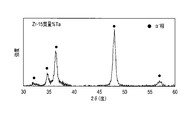
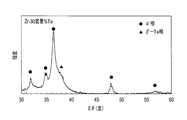
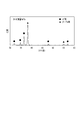
表1に示すように、全組成を通じてα’相が認められ、20質量%Ta合金ではω相が、25質量%以上の合金はβ-Ta相が新たに出現した。一方、全組成を通じて、β-Zr相由来のピークはXRDで検出されなかった。図4Aから図4Eは、比較例3、実施例2、5、7及び8のXRD結果を示すグラフである。図5Aから図5Hは、比較例1、2、3、実施例1、2、3、5及び7の走査型電子顕微鏡による金属組織の写真である。
硬さと弾性率は、唯一ω相が認められた20質量%Ta合金で極大値を示す。また、磁化率については極小値を示すことから、ω相は高硬度化、高弾性率化、低磁化率化に寄与すると予想される。
硬さと弾性率は、唯一ω相が認められた20質量%Ta合金で極大値を示す。また、磁化率については極小値を示すことから、ω相は高硬度化、高弾性率化、低磁化率化に寄与すると予想される。
β-Ta相が認められた30質量%Ta合金以降では、Ta添加量の増加にともないβ-Taの割合が増加し、その結果、硬さと磁化率は低下し、弾性率は増加した。したがって、β-Ta相は高弾性率化、低磁化率化の効果の点でω相と同じであるものの、硬度については低下させる傾向にあった。
実施例1~8の合金の磁化率は、全組成領域でMRI撮影が問題なく行える値であり、同様に開発が進められているZr-Mo合金やZr-Nb合金と比べても、同等もしくは低値である。また、実施例1から8の合金については、骨固定具等の生体用医療機器に適用可能である。図6は、骨固定具10の構成を示す図である。骨固定具10は、骨12を固定するための骨接合板10aと、骨接合用ねじ10bと、を備えている。
本発明の生体用ジルコニウム合金は、磁化率が低く、強度が高いことから、骨固定具等の生体用医療器具に有用なものである。
Claims (10)
- Zrを主成分とし、Taを15質量%を超える範囲で含有する生体用ジルコニウム合金。
- Zrを主成分とし、Taを16~35質量%含有する、請求項1に記載の生体用ジルコニウム合金。
- Zrを主成分とし、Taを16~24質量%含有する、請求項2に記載の生体用ジルコニウム合金。
- Zrを主成分とし、Taを16~19質量%含有する、請求項3に記載の生体用ジルコニウム合金。
- Zrを主成分とし、Taを25~35質量%含有する、請求項2に記載の生体用ジルコニウム合金。
- Zrを主成分とし、Taを40~50質量%含有する、請求項1に記載の生体用ジルコニウム合金。
- Taを15質量%を超えて50質量%以下含有し、残部がZr及び不可避的不純物からなり、
構成相が、ω相とβ―Ta相のいずれか一方と、α’相と、を含む、請求項1に記載の生体用ジルコニウム合金。 - Taを16~19質量%含有し、前記構成相が、ω相とα’相とを含み、骨固定具に用いられる、請求項7に記載の生体用ジルコニウム合金。
- Taを25~35質量%含有し、前記構成相が、β―Ta相とα’相とを含み、骨固定具に用いられる、請求項7に記載の生体用ジルコニウム合金。
- 請求項1~9のいずれか一項に記載の生体用ジルコニウム合金を用いた生体用医療器具。
Priority Applications (1)
| Application Number | Priority Date | Filing Date | Title |
|---|---|---|---|
| JP2015508401A JP6041045B2 (ja) | 2013-03-25 | 2014-03-20 | 生体用ジルコニウム合金およびそれを用いた骨固定具 |
Applications Claiming Priority (2)
| Application Number | Priority Date | Filing Date | Title |
|---|---|---|---|
| JP2013-061443 | 2013-03-25 | ||
| JP2013061443 | 2013-03-25 |
Publications (1)
| Publication Number | Publication Date |
|---|---|
| WO2014156934A1 true WO2014156934A1 (ja) | 2014-10-02 |
Family
ID=51623913
Family Applications (1)
| Application Number | Title | Priority Date | Filing Date |
|---|---|---|---|
| PCT/JP2014/057705 Ceased WO2014156934A1 (ja) | 2013-03-25 | 2014-03-20 | 生体用ジルコニウム合金およびそれを用いた生体用医療器具 |
Country Status (2)
| Country | Link |
|---|---|
| JP (1) | JP6041045B2 (ja) |
| WO (1) | WO2014156934A1 (ja) |
Cited By (4)
| Publication number | Priority date | Publication date | Assignee | Title |
|---|---|---|---|---|
| WO2015030131A1 (ja) * | 2013-08-30 | 2015-03-05 | 株式会社Ihi | 生体用ジルコニウム合金、その製造方法およびその生体用ジルコニウム合金を用いた生体用医療器具 |
| CN107794425A (zh) * | 2016-10-31 | 2018-03-13 | 中南大学 | 一种低弹模钽锆牙科种植体材料及其制备方法 |
| JP2021147698A (ja) * | 2020-03-24 | 2021-09-27 | トクセン工業株式会社 | 生体用合金及び医療用品 |
| CN119082538A (zh) * | 2024-09-05 | 2024-12-06 | 湘潭大学 | 一种兼具非晶和调幅异质结构的高强度Zr-Ta合金材料及其制备方法 |
Citations (3)
| Publication number | Priority date | Publication date | Assignee | Title |
|---|---|---|---|---|
| JP2001003126A (ja) * | 1999-04-23 | 2001-01-09 | Terumo Corp | Ti−Zr系合金からなる医療器具 |
| JP2001003127A (ja) * | 1999-04-23 | 2001-01-09 | Terumo Corp | Ti−Zr系合金 |
| US20120171516A1 (en) * | 2010-12-30 | 2012-07-05 | Hon Hai Precision Industry Co., Ltd. | Coated article and method for manufacturing coated article |
-
2014
- 2014-03-20 WO PCT/JP2014/057705 patent/WO2014156934A1/ja not_active Ceased
- 2014-03-20 JP JP2015508401A patent/JP6041045B2/ja active Active
Patent Citations (3)
| Publication number | Priority date | Publication date | Assignee | Title |
|---|---|---|---|---|
| JP2001003126A (ja) * | 1999-04-23 | 2001-01-09 | Terumo Corp | Ti−Zr系合金からなる医療器具 |
| JP2001003127A (ja) * | 1999-04-23 | 2001-01-09 | Terumo Corp | Ti−Zr系合金 |
| US20120171516A1 (en) * | 2010-12-30 | 2012-07-05 | Hon Hai Precision Industry Co., Ltd. | Coated article and method for manufacturing coated article |
Non-Patent Citations (4)
| Title |
|---|
| KYUHONG LEE ET AL.: "Anisotropic mechanical properties of tantalum-continuous-fiber- reinforced amorphous matrix composites fabricated by liquid pressing process", MATERIALS SCIENCE AND ENGINEERING A., vol. 527, no. 7-8, 2010, pages 1875 - 1881 * |
| TAKAO HANAWA: "Stent-yo Kinzoku Zairyo", THE JAPANESE JOURNAL OF ARTIFICIAL ORGANS, vol. 35, no. 1, 2006, pages 193 - 196 * |
| YOSUKE TAKANO ET AL.: "Zr-Nb, Zr-Ta no Taishokusei ni Oyobosu Kin", JAPANESE SOCIETY FOR BIOMATERIALS SYMPOSIUM 2008 YOKOSHU, vol. 223, no. P151, 2008 * |
| YUSUKE TSUTSUMI ET AL.: "Evaluation of corrosion resistance of Zr-Nb and Zr-Ta alloys in simulated body fluid", THE JOURNAL OF THE JAPANESE SOCIETY FOR DENTAL MATERIALS AND DEVICES, vol. 27, no. 5, 2008, pages 402 * |
Cited By (5)
| Publication number | Priority date | Publication date | Assignee | Title |
|---|---|---|---|---|
| WO2015030131A1 (ja) * | 2013-08-30 | 2015-03-05 | 株式会社Ihi | 生体用ジルコニウム合金、その製造方法およびその生体用ジルコニウム合金を用いた生体用医療器具 |
| JPWO2015030131A1 (ja) * | 2013-08-30 | 2017-03-02 | 株式会社Ihi | 生体用ジルコニウム合金、その製造方法およびその生体用ジルコニウム合金を用いた生体用医療器具 |
| CN107794425A (zh) * | 2016-10-31 | 2018-03-13 | 中南大学 | 一种低弹模钽锆牙科种植体材料及其制备方法 |
| JP2021147698A (ja) * | 2020-03-24 | 2021-09-27 | トクセン工業株式会社 | 生体用合金及び医療用品 |
| CN119082538A (zh) * | 2024-09-05 | 2024-12-06 | 湘潭大学 | 一种兼具非晶和调幅异质结构的高强度Zr-Ta合金材料及其制备方法 |
Also Published As
| Publication number | Publication date |
|---|---|
| JP6041045B2 (ja) | 2016-12-07 |
| JPWO2014156934A1 (ja) | 2017-02-16 |
Similar Documents
| Publication | Publication Date | Title |
|---|---|---|
| Correa et al. | Development of Ti-15Zr-Mo alloys for applying as implantable biomedical devices | |
| Kuroda et al. | Design and mechanical properties of new β type titanium alloys for implant materials | |
| Nomura et al. | Microstructure and magnetic susceptibility of as-cast Zr–Mo alloys | |
| Hsu et al. | The structure and mechanical properties of as-cast Zr–Ti alloys | |
| Niinomi et al. | Titanium alloys for biomedical applications | |
| CA2883268C (en) | Ultrapure magnesium alloy with adjustable degradation rate | |
| Kim et al. | Microstructure and elastic modulus of Ti–Nb–Si ternary alloys for biomedical applications | |
| Kondo et al. | Effect of cold rolling on the magnetic susceptibility of Zr–14Nb alloy | |
| JP5476696B2 (ja) | 生体用金属材料および医療機器 | |
| US9828655B2 (en) | Titanium alloys for biomedical applications and fabrication methods thereof | |
| US6786984B1 (en) | Ternary alloy and apparatus thereof | |
| JP6041045B2 (ja) | 生体用ジルコニウム合金およびそれを用いた骨固定具 | |
| Thoemmes et al. | Microstructure and mechanical properties of binary Ti-Nb alloys for application in medicine | |
| Hsu et al. | Effects of heat treatments on the structure and mechanical properties of Zr–30Ti alloys | |
| JP6160699B2 (ja) | 生体用ジルコニウム合金、その製造方法およびその生体用ジルコニウム合金を用いた生体用医療器具 | |
| US8492002B2 (en) | Titanium-based alloy | |
| Kuroda et al. | Development and characterization of new Ti-25Ta-Zr alloys for biomedical applications | |
| Niinomi | Titanium spinal-fixation implants | |
| Li et al. | Zr–Si biomaterials with high strength and low elastic modulus | |
| KR101829371B1 (ko) | 저자화율을 갖는 지르코늄-실리콘 이원계 합금 조성물 및 그 제조방법 | |
| Chapala et al. | Novel Ti-Nb alloys with improved wear resistance for biomedical implant application | |
| JP2006265633A (ja) | MRI対応生体用Co−Cr−Mo合金およびその製造方法 | |
| US9039963B2 (en) | Titanium based ceramic reinforced alloy for use in medical implants | |
| Venugopalan | Medical device materials iii | |
| JP6494172B2 (ja) | 医療用インプラントで使用するためのセラミック強化チタンベース合金 |
Legal Events
| Date | Code | Title | Description |
|---|---|---|---|
| 121 | Ep: the epo has been informed by wipo that ep was designated in this application |
Ref document number: 14776120 Country of ref document: EP Kind code of ref document: A1 |
|
| ENP | Entry into the national phase |
Ref document number: 2015508401 Country of ref document: JP Kind code of ref document: A |
|
| NENP | Non-entry into the national phase |
Ref country code: DE |
|
| 122 | Ep: pct application non-entry in european phase |
Ref document number: 14776120 Country of ref document: EP Kind code of ref document: A1 |