WO2014136546A1 - 無線通信装置および通信システム - Google Patents
無線通信装置および通信システム Download PDFInfo
- Publication number
- WO2014136546A1 WO2014136546A1 PCT/JP2014/053337 JP2014053337W WO2014136546A1 WO 2014136546 A1 WO2014136546 A1 WO 2014136546A1 JP 2014053337 W JP2014053337 W JP 2014053337W WO 2014136546 A1 WO2014136546 A1 WO 2014136546A1
- Authority
- WO
- WIPO (PCT)
- Prior art keywords
- power saving
- mode
- wireless communication
- parameter
- power
- Prior art date
- Legal status (The legal status is an assumption and is not a legal conclusion. Google has not performed a legal analysis and makes no representation as to the accuracy of the status listed.)
- Ceased
Links
Images


Classifications
-
- H—ELECTRICITY
- H04—ELECTRIC COMMUNICATION TECHNIQUE
- H04W—WIRELESS COMMUNICATION NETWORKS
- H04W52/00—Power management, e.g. Transmission Power Control [TPC] or power classes
- H04W52/02—Power saving arrangements
- H04W52/0209—Power saving arrangements in terminal devices
-
- H—ELECTRICITY
- H04—ELECTRIC COMMUNICATION TECHNIQUE
- H04W—WIRELESS COMMUNICATION NETWORKS
- H04W52/00—Power management, e.g. Transmission Power Control [TPC] or power classes
- H04W52/02—Power saving arrangements
- H04W52/0209—Power saving arrangements in terminal devices
- H04W52/0225—Power saving arrangements in terminal devices using monitoring of external events, e.g. the presence of a signal
- H04W52/0229—Power saving arrangements in terminal devices using monitoring of external events, e.g. the presence of a signal where the received signal is a wanted signal
- H04W52/0235—Power saving arrangements in terminal devices using monitoring of external events, e.g. the presence of a signal where the received signal is a wanted signal where the received signal is a power saving command
-
- Y—GENERAL TAGGING OF NEW TECHNOLOGICAL DEVELOPMENTS; GENERAL TAGGING OF CROSS-SECTIONAL TECHNOLOGIES SPANNING OVER SEVERAL SECTIONS OF THE IPC; TECHNICAL SUBJECTS COVERED BY FORMER USPC CROSS-REFERENCE ART COLLECTIONS [XRACs] AND DIGESTS
- Y02—TECHNOLOGIES OR APPLICATIONS FOR MITIGATION OR ADAPTATION AGAINST CLIMATE CHANGE
- Y02D—CLIMATE CHANGE MITIGATION TECHNOLOGIES IN INFORMATION AND COMMUNICATION TECHNOLOGIES [ICT], I.E. INFORMATION AND COMMUNICATION TECHNOLOGIES AIMING AT THE REDUCTION OF THEIR OWN ENERGY USE
- Y02D30/00—Reducing energy consumption in communication networks
- Y02D30/70—Reducing energy consumption in communication networks in wireless communication networks
Definitions
- the present invention relates to a wireless communication apparatus and a communication system that perform communication by selecting a power saving mode with low power consumption or an operation mode other than the power saving mode.
- the communication performance of a communication system is generally set for the convenience of the network (NW) side without considering the situation on the UE side, excluding the capability of the wireless communication terminal (UE: User Equipment). It was.
- NW network
- UE User Equipment
- excessive quality communication performance is set on the UE side, and a communication line more than necessary may be allocated. As a result, the power consumption of the UE may increase.
- the standardization of 3GPP Release 11 is to send PPI (Power Preference Indication) from the UE to the NW so that the performance of communication response etc. can be changed according to the power saving of the UE.
- PPI Power Preference Indication
- PPI is a report for notifying the NW of the operation mode preferentially selected by the UE from the two operation modes of the normal mode (normal) and the power saving mode (power efficient). NW sets and operates normal parameters for UE with PPI set to “normal”, and sets power saving parameters for UE with PPI set to “power efficient”. It becomes possible to do.
- the response of the NW that received the PPI and the changes in the communication performance in the power saving mode are not defined as standards, so the communication performance change in the power saving mode for each NW
- the contents may be different. That is, since the correspondence in power saving mode (contents of changes in communication performance) is not unified, the UE cannot obtain information on communication performance when a new operation mode (power ⁇ ⁇ efficient) is selected. The PPI cannot be selected. For this reason, a mechanism by which the UE can obtain information that is a criterion for selecting the PPI is desired.
- This invention is made in view of such a situation, and provides the radio
- the wireless communication apparatus is a wireless communication apparatus that performs communication by selecting a power saving mode with low power consumption or an operation mode other than the power saving mode, and saves power when operating in the power saving mode. It is determined whether the communication interface for acquiring the operation parameter and the acquired power saving operation parameter satisfy the permissible parameter of the own device when operating in the power saving mode, and according to the determination result, A control unit that selects an operation mode and an operation mode notification unit that transmits information indicating the selected operation mode are provided.
- the power saving operation parameter when operating in the power saving mode is acquired, and it is determined whether the acquired power saving operation parameter satisfies the permissible parameter of the own device when operating in the power saving mode, Since one of the operation modes is selected according to the determination result, the PPI can be correctly selected. As a result, when the wireless communication device selects the power saving mode (power-efficient), it is possible to avoid unintended deterioration in communication performance.
- PPI Power Preference Indication
- the NW Network
- the UE User Equipment
- the UE receives the System Information, determines the transmission content of the PPI using the operation parameters of the power saving mode, and transmits the PPI.
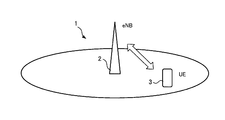
- FIG. 1 is a diagram showing a schematic configuration of a communication system according to the present embodiment.
- the communication system 1 includes an eNB (evolvedvolveNodeB) 1 as a base station device and a UE (User Equipment) 3 as a wireless communication device.
- the eNB 2 and the UE 3 can switch between 3G (3rd generation) and LTE (Long Term evolution) communications.
- FIG. 2 is a diagram illustrating a schematic configuration of the UE 3.
- the UE 3 performs communication by selecting a power saving mode with low power consumption or an operation mode other than the power saving mode, for example, a normal mode.
- the UE 3 transmits and receives radio signals in the communication control unit 32 via the RF antenna 31.
- the RF antenna 31 and the communication control unit 32 constitute a communication interface.
- the CPU 34 controls the operation of the entire apparatus.
- the power saving management unit 33 functions as a control unit, and determines whether or not the power saving operation parameter acquired from the NW satisfies the permissible parameter of the own device when operating in the power saving mode. Then, one of the operation modes is selected according to the determination result.
- the storage device 35 stores power saving operation parameters acquired from the NW.
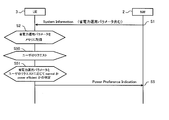
- FIG. 3 is a sequence chart showing an example of the operation of the communication system according to the present embodiment.
- eNB2 is demonstrated as NW.
- the NW 2 notifies the UE 3 of the power saving operation parameter as System Information (step S1).
- This power saving operation parameter is an operation parameter of the NW 2 when the UE 3 is operated in the power saving mode.
- the power saving operation parameters can be configured by, for example, those shown in the following table.
- LTE Connected DRX (Discontinuous Reception) cycle indicates a reception cycle when transmission information from NW 2 is periodically received. The power consumption decreases as the reception cycle becomes longer.
- the numerical value of “power saving operation value (right side of table)” indicates that UE 3 performs a periodic reception operation of “LTE Connected DRX” at a cycle of 5.12 seconds in the power saving mode.
- “Paging cycle” indicates a reception cycle when periodically receiving confirmation (Paging) of a call such as an incoming call from the NW 2. The longer the reception cycle, the lower the power consumption.
- the number “power saving operation value (right side of the table)” indicates that the UE 3 performs the paging reception operation at a cycle of 2.56 seconds in the power saving mode.
- Period Routing Area Update cycle is a transmission cycle when the location of UE 3 is periodically notified to NW 2 (periodic location registration). The longer the transmission cycle, the lower the power consumption.
- the number “power saving operation value (right side of table)” indicates that UE 3 performs location registration in a 54-minute cycle in the power saving mode.
- the UE 3 receives the power saving operation parameter as the system information from the NW 2 and stores it in the memory (step S2). Next, the NW 2 requests the UE 3 to transmit a PPI (Step S3).
- the request for transmission of the PPI by the NW 2 at this time is referred to as a “PPI transmission request message”.
- the UE 3 determines whether or not the power saving operation parameter received in step S1 satisfies the “UE allowable parameter” of the own device according to the determination method described below, and the content of the PPI is “normal” or “power efficient”. "" (Step S4).
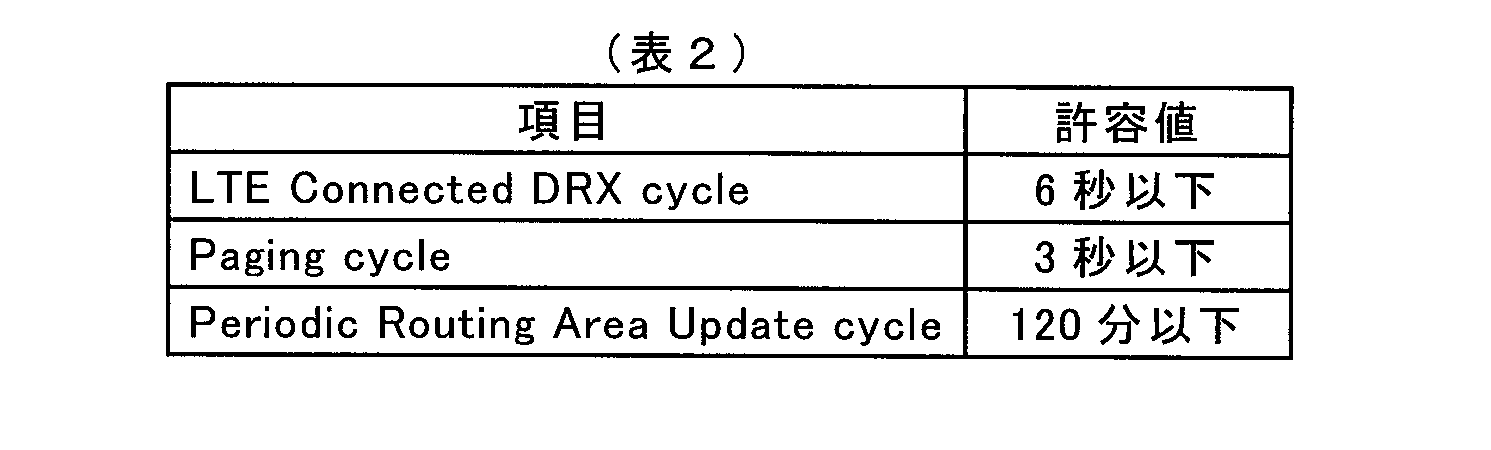
- the UE allowable parameter is an allowable parameter at the time of power saving operation in the UE.
- the UE tolerance parameters can be configured with, for example, those shown in the following table.
- the UE 3 determines whether the power saving operation parameters shown in Table 1 above satisfy the UE allowable parameters shown in Table 2, and determines whether the content of the PPI, that is, “Normal” or “Power efficient”. decide.
- the example shown in this embodiment is as follows. ⁇ LTE Connected DRX cycle 5.12 seconds ⁇ 6 seconds ⁇ Paging cycle 2.56 seconds ⁇ 3 seconds ⁇ Periodic Routing Area Update cycle 54 minutes ⁇ 120 minutes.
- PPI because the power saving parameters satisfy the conditions of UE allowable parameters in all items Is determined to be “Power efficient”. If even one item is not satisfied, the content of the PPI is set to “normal”.
- the UE 3 transmits a “normal” or “power efficient” PPI to the NW 2 based on the content determined above (step S5).
- “System Information” is received again, or when the user changes the mode, for example, changes from the normal mode to the power saving mode, the process returns to step S4 to determine the PPI.
- the NW 2 notifies the UE 3 in advance of the correspondence contents at the time of PPI reception, and selects either “normal” mode or “power efficient” mode by PPI.
- the UE3 can correctly select the PPI, and by selecting the “power efficient” mode, it is possible to avoid the communication performance degradation unintended by the UE3. it can.
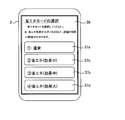
- FIG. 4 is a diagram illustrating a screen display example of the UE.
- the UE 3 includes a display 36 and can display various information.
- a selection screen for a power saving mode (energy saving mode) is displayed.
- a normal mode selection button 37a, an energy saving (small effect) mode selection button 37b, an energy saving (effective) mode selection button 37c, and an energy saving (high effect) mode selection button 37d are displayed. It is configured to select a mode.
- energy saving (small effect) mode selection button 37b, energy saving (effective) mode selection button 37c, and energy saving (high effect) mode selection button 37d” shown in FIG. 4 correspond to UE allowable parameters.
- energy saving (effective) mode selection button 37c by selecting the energy saving mode
- each parameter of energy saving (effective) shown in Table 3 below is set as an allowable parameter of the UE3.
- “Periodic Tracking Area Update Cycle” is a transmission cycle when the LTE NW periodically notifies the location of the UE to the NW (periodic location registration). The longer the transmission cycle, the lower the power consumption.
- “RAT restriction” restricts available “Radio Access Technology (RAT)” such as LTE, WCDMA (registered trademark), and GSM (registered trademark).
- RAT Radio Access Technology
- LTE / WCDMA (registered trademark) / GSM (registered trademark) can be used for energy saving (small effect), and only WCDMA (registered trademark) can be used for energy saving (large effect).
- CELL_DCH state maintenance time limits the time until the UE connected by NW and WCDMA (registered trademark) shifts from the CELL_DCH state to the CELL_FACH state. Since the current in the CELL_DCH state is large, the current decreases as the sustain time is shorter.
- CELL # FACH state maintenance time limits the time until the UE connected by NW and WCDMA (registered trademark) shifts from the CELL_FACH state to the CELL_PCH state. Since the current is large in the CELL_FACH state, the current decreases as the sustain time is shorter.
- LTE Connected state maintenance time limits the time required to shift from the “Connected state” to the “Idle state” in UEs connected by NW and LTE. Since the current is large in the “Connected state”, the current decreases as the maintenance time is shorter.
- Communication speed limit limits the communication speed. Since the current consumption is higher when the communication speed is faster than when the communication speed is slower, the communication speed is set to reduce the current.
- “Bandwidth Limit” limits the available bandwidth. The lower the bandwidth used, the lower the current consumption.
- “limit number of antennas” limits the number of UE antennas that can be used. The smaller the number of antennas used, the lower the current.
- Carrier“ Aggregation use restriction ” restricts the use of Carrier Aggregation and suppresses current consumption.
- This configuration makes it possible to change the UE allowable parameters according to the user's selection operation.
- FIG. 5 is a sequence chart showing an example of the operation of the communication system according to the second embodiment.
- the information (PPI) which shows an operation mode spontaneously transmits by the request from a user.
- the eNB 2 is described as an NW. The same step number is assigned to the same operation.
- the NW 2 notifies the UE 3 of power saving operation parameters as System Information (step S1).
- UE3 receives the power saving operation parameter from NW2 as System Information and stores it in the memory (step S2).
- step S50 when there is an operation for requesting transmission of information indicating the operation mode from the user (step S50), the content of the PPI is set to “normal” or “powerPefficient” according to the power saving operation parameter and the user request. "Is determined (step S51). Then, the PPI corresponding to the determination result is transmitted to the NW 2 (step S5). As a result, even if there is no “PPI transmission request message” from the network, the PPI can be transmitted spontaneously from the terminal side.
- the wireless communication apparatus can take the following aspects. That is, (1)
- the wireless communication device of the present invention is a wireless communication device that performs communication by selecting a power saving mode with low power consumption or an operation mode other than the power saving mode, and operates in the power saving mode.
- a control unit that selects one of the operation modes, and an operation mode notification unit that transmits information indicating the selected operation mode.
- the power saving operation parameter when operating in the power saving mode is acquired, and it is determined whether the acquired power saving operation parameter satisfies the permissible parameter of the own device when operating in the power saving mode, Since one of the operation modes is selected according to the determination result, the PPI can be correctly selected. As a result, when the wireless communication device selects the power saving mode (power-efficient), it is possible to avoid unintended deterioration in communication performance.
- the wireless communication apparatus of the present invention has received an operation requesting transmission of information indicating an operation mode from a user when a message requesting transmission of information indicating any operation mode is received.
- the operation mode notification unit transmits information indicating the operation mode selected by the control unit.
- the operation mode notification unit performs control. Since the information indicating the operation mode selected by the unit is transmitted, it is possible to notify the operation mode when there is a request from the network side and when there is a request from the user. As a result, the PPI can be correctly selected, and an unintended decrease in communication performance can be avoided.
- the control unit when the control unit re-acquires the power saving operation parameter or when the user changes the operation mode, the power saving operation parameter satisfies the allowable parameter. It is characterized by determining again whether or not.
- the control unit again determines whether or not the power saving operation parameter satisfies the allowable parameter. It is possible to make a determination using the power saving operation parameter.
- the control unit determines again whether the power saving operation parameter satisfies the changed allowable parameter. It is characterized by that.
- the control unit determines again whether or not the power-saving operation parameter satisfies the changed allowable parameter, so the operation mode is set according to the user's operation. It becomes possible to select.
- the communication system of the present invention is a communication system including the radio communication device according to any one of (1) to (4) above and a base station device, and the base station device Transmits a power saving operation parameter when the wireless communication device operates in the power saving mode to the wireless communication device, and the wireless communication device automatically detects when the power saving operation parameter operates in the power saving mode. It is determined whether or not an allowable parameter of the apparatus is satisfied, one of the operation modes is selected according to the determination result, and information indicating the selected operation mode is transmitted to the base station apparatus .
- the base station device transmits the power saving operation parameter when the wireless communication device operates in the power saving mode to the wireless communication device, and the wireless communication device operates in the power saving mode.
- the wireless communication device determines whether or not the permissible parameter of the local apparatus is satisfied, and according to the determination result, one of the operation modes is selected, and information indicating the selected operation mode is transmitted to the base station apparatus.
- the wireless communication device selects the power saving mode (power-efficient), it is possible to avoid unintended deterioration in communication performance.
Landscapes
- Engineering & Computer Science (AREA)
- Computer Networks & Wireless Communication (AREA)
- Signal Processing (AREA)
- Mobile Radio Communication Systems (AREA)
Abstract
Description
以下、本発明の実施形態について図面を参照して説明する。本実施形態に係る通信システムでは、NW(Network)は、省電力モード(power efficient)時のNWの運用パラメータをSystem InformationとしてUE(User Equipment)に報知する。UEは、System Informationを受信し、省電力モードの運用パラメータを利用して、PPIの送信内容を決定して、PPIの送信を行なう。

・LTE Connected DRX cycle 5.12秒 < 6秒
・Paging cycle 2.56秒 < 3秒
・Periodic Routing Area Update cycle 54分 < 120分
すなわち、省電力パラメータが、全ての項目でUE許容パラメータの条件を満たすため、PPIの内容を“Power efficient”に決定する。仮に、一項目でも満たさない場合は、PPIの内容を“normal”にする。
次に、第1の実施形態の変形例について説明する。ここでは、ユーザがUE許容パラメータを変更する場合を示す。図4は、UEの画面表示例を示す図である。UE3は、ディスプレイ36を備えており、種々の情報を表示することが可能である。図4では、省電力モード(省エネモード)の選択画面が表示されている。図4では、通常モード選択ボタン37a、省エネ(効果小)モード選択ボタン37b、省エネ(効果中)モード選択ボタン37cおよび省エネ(効果大)モード選択ボタン37dが表示され、ユーザに対し、UE3の動作モードを選択させるように構成されている。
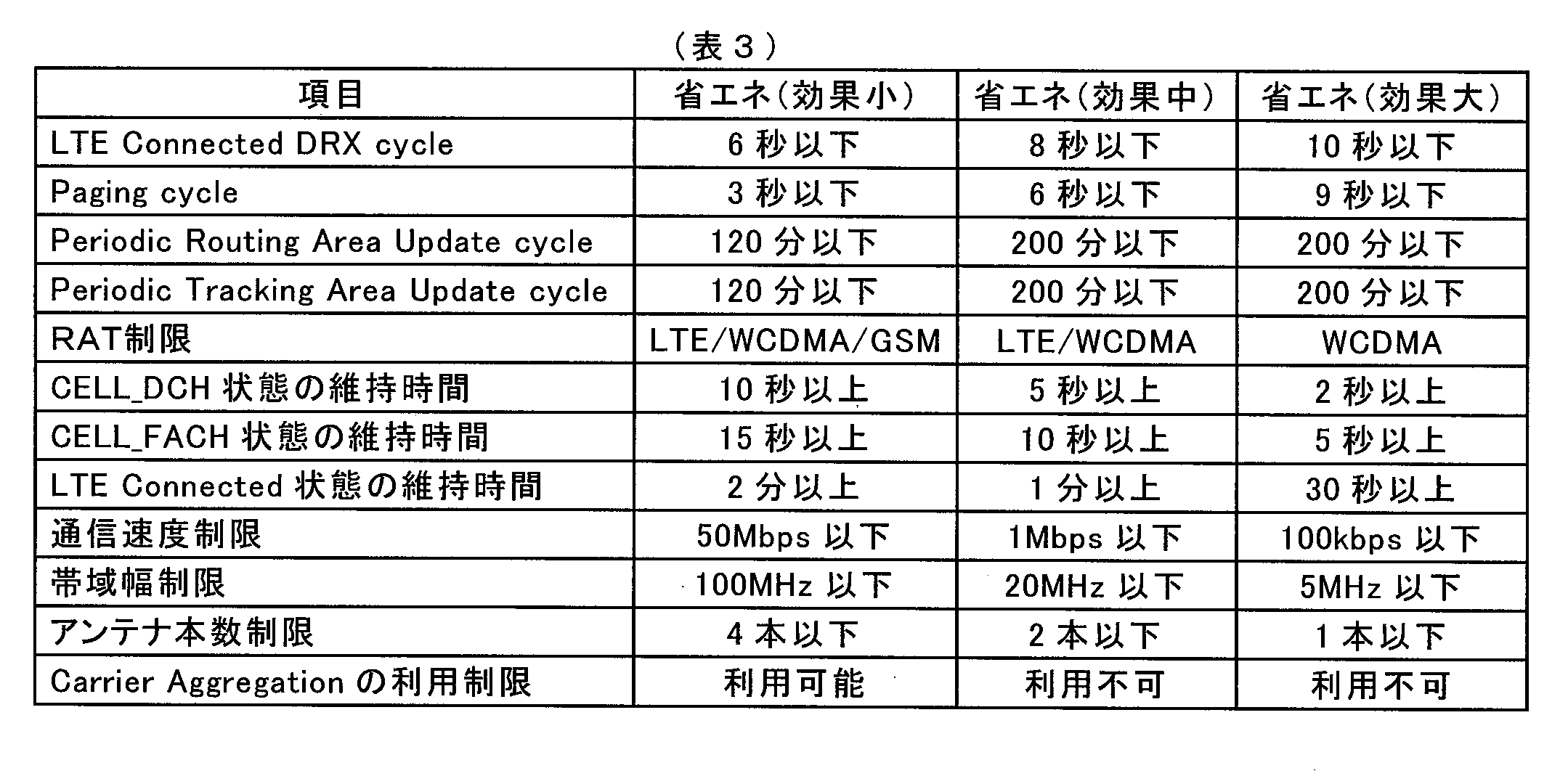
図5は、第2の実施形態に係る通信システムの動作の一例を示すシーケンスチャートである。第2の実施形態では、ユーザからのリクエストによって自発的に動作モードを示す情報(PPI)を送信する。図5では、第1の実施形態と同様に、eNB2がNWであるとして説明する。また、同じ動作については、同じステップ番号を付すものとする。まず、NW2は、UE3に対して、省電力運用パラメータを、System Informationとして報知する(ステップS1)。次に、UE3は、NW2からSystem Informationとして、省電力運用パラメータを受信し、メモリに保存する(ステップS2)。
2 eNB
3 UE
31 RFアンテナ
32 通信制御部
33 省電力管理部
35 記憶装置
36 ディスプレイ
37a 通常モード選択ボタン
37b モード選択ボタン
37c モード選択ボタン
37d モード選択ボタン
Claims (5)
- 消費電力の少ない省電力モードまたは前記省電力モード以外の動作モードを選択して通信を行なう無線通信装置であって、
省電力モードで動作する場合の省電力運用パラメータを取得する通信インタフェースと、
前記取得した省電力運用パラメータが、省電力モードで動作する場合の自装置の許容パラメータを満たすか否かを判定し、前記判定結果に応じて、いずれかの動作モードを選択する制御部と、
前記選択した動作モードを示す情報を送信する動作モード通知部と、を備えることを特徴とする無線通信装置。 - いずれかの動作モードを示す情報の送信を要求するメッセージを受信した時、又は、ユーザから動作モードを示す情報の送信を要求する操作があった時に、前記動作モード通知部は、前記制御部が選択した動作モードを示す情報を送信することを特徴とする請求項1に記載の無線通信装置。
- 前記制御部は、省電力運用パラメータを再取得した場合、またはユーザが動作モードを変更した場合は、前記省電力運用パラメータが前記許容パラメータを満たすか否かを再度判定することを特徴とする請求項1または請求項2記載の無線通信装置。
- 前記制御部は、ユーザが前記許容パラメータを変更した場合は、前記省電力運用パラメータが前記変更された許容パラメータを満たすか否かを再度判定することを特徴とする請求項1から請求項3のいずれかに記載の無線通信装置。
- 請求項1から請求項4のいずれかに記載の無線通信装置と、基地局装置と、から構成される通信システムであって、
前記基地局装置は、前記無線通信装置が省電力モードで動作する場合の省電力運用パラメータを前記無線通信装置に送信し、
前記無線通信装置は、前記省電力運用パラメータが、省電力モードで動作する場合の自装置の許容パラメータを満たすか否かを判定し、前記判定結果に応じて、いずれかの動作モードを選択し、前記選択した動作モードを示す情報を前記基地局装置に送信することを特徴とする通信システム。
Priority Applications (3)
| Application Number | Priority Date | Filing Date | Title |
|---|---|---|---|
| CN201480008780.2A CN104995969A (zh) | 2013-03-08 | 2014-02-13 | 无线通信装置以及通信系统 |
| US14/763,240 US20150365893A1 (en) | 2013-03-08 | 2014-02-13 | Wireless communication apparatus and communication system |
| DE112014001183.5T DE112014001183T5 (de) | 2013-03-08 | 2014-02-13 | Drahtloskommunikationsvorrichtung und Kommunikationssystem |
Applications Claiming Priority (2)
| Application Number | Priority Date | Filing Date | Title |
|---|---|---|---|
| JP2013-046981 | 2013-03-08 | ||
| JP2013046981A JP6032708B2 (ja) | 2013-03-08 | 2013-03-08 | 無線通信装置および通信システム |
Publications (1)
| Publication Number | Publication Date |
|---|---|
| WO2014136546A1 true WO2014136546A1 (ja) | 2014-09-12 |
Family
ID=51491071
Family Applications (1)
| Application Number | Title | Priority Date | Filing Date |
|---|---|---|---|
| PCT/JP2014/053337 Ceased WO2014136546A1 (ja) | 2013-03-08 | 2014-02-13 | 無線通信装置および通信システム |
Country Status (5)
| Country | Link |
|---|---|
| US (1) | US20150365893A1 (ja) |
| JP (1) | JP6032708B2 (ja) |
| CN (1) | CN104995969A (ja) |
| DE (1) | DE112014001183T5 (ja) |
| WO (1) | WO2014136546A1 (ja) |
Families Citing this family (4)
| Publication number | Priority date | Publication date | Assignee | Title |
|---|---|---|---|---|
| KR20160109611A (ko) * | 2015-03-12 | 2016-09-21 | 엘지전자 주식회사 | 디스플레이 장치 및 이동 단말기 |
| KR102490415B1 (ko) * | 2016-08-02 | 2023-01-19 | 삼성전자주식회사 | 전자 장치 및 전자 장치의 전력 제어 방법 |
| US11166238B2 (en) * | 2018-09-13 | 2021-11-02 | Qualcomm Incorporated | Methods and apparatus for supporting multiple power and spectrum efficient modes for power saving |
| US11089555B2 (en) | 2019-01-07 | 2021-08-10 | Qualcomm Incorporated | Dynamic configuration of operation power parameters |
Family Cites Families (7)
| Publication number | Priority date | Publication date | Assignee | Title |
|---|---|---|---|---|
| KR20080066561A (ko) * | 2007-01-12 | 2008-07-16 | 한국전자통신연구원 | 패킷 기반 통신 시스템에서 측정 정보 보고 방법 |
| JP2009118160A (ja) * | 2007-11-06 | 2009-05-28 | Nec Corp | 無線lan端末の無線lan省電力状態表示方法および無線lan端末 |
| CN101557330B (zh) * | 2008-04-08 | 2012-08-15 | 华为终端有限公司 | 一种支持省电模式的方法、系统及终端 |
| CN101729325B (zh) * | 2008-10-21 | 2012-10-10 | 中兴通讯股份有限公司 | 用于宽带无线接入系统的省电模式设置方法及系统 |
| CN102143562B (zh) * | 2010-02-01 | 2015-06-10 | 中兴通讯股份有限公司 | 一种基于机器到机器的省电方法及装置 |
| CN102695253B (zh) * | 2011-03-25 | 2016-08-03 | 中兴通讯股份有限公司 | 一种基站节能信息的传递方法及节能实现方法与系统 |
| US20140036748A1 (en) * | 2012-08-02 | 2014-02-06 | Research In Motion Limited | Ue indications of power mode preferences |
-
2013
- 2013-03-08 JP JP2013046981A patent/JP6032708B2/ja not_active Expired - Fee Related
-
2014
- 2014-02-13 US US14/763,240 patent/US20150365893A1/en not_active Abandoned
- 2014-02-13 CN CN201480008780.2A patent/CN104995969A/zh active Pending
- 2014-02-13 WO PCT/JP2014/053337 patent/WO2014136546A1/ja not_active Ceased
- 2014-02-13 DE DE112014001183.5T patent/DE112014001183T5/de not_active Withdrawn
Non-Patent Citations (2)
| Title |
|---|
| INTEL: "Clarifying the Impact of PPI of QoS", 3GPP TSG RAN WG2 MEETING #80 R2-125751, 15 November 2012 (2012-11-15) * |
| ITRI: "Remaining Issues of Power Preference Indication", 3GPP TSG-RAN WG2 MEETING #79BIS R2-124627, 12 October 2012 (2012-10-12) * |
Also Published As
| Publication number | Publication date |
|---|---|
| CN104995969A (zh) | 2015-10-21 |
| JP6032708B2 (ja) | 2016-11-30 |
| US20150365893A1 (en) | 2015-12-17 |
| DE112014001183T5 (de) | 2015-11-19 |
| JP2014175860A (ja) | 2014-09-22 |
Similar Documents
| Publication | Publication Date | Title |
|---|---|---|
| CN113596965B (zh) | 一种节能配置方法及装置 | |
| TWI715990B (zh) | 節能狀態轉換的方法、終端及基地台 | |
| US10051682B2 (en) | Deterministic RRC connections | |
| CN108419291B (zh) | 支持覆盖增强模式的无线设备的高效寻呼和空闲模式唤醒 | |
| KR101225195B1 (ko) | 무선통신 시스템에서 rrc 연결 해제 방법 및 장치 | |
| US9906977B2 (en) | Deterministic RRC connections | |
| AU2017203841B2 (en) | Inter-rat coverage determination for energy saving management | |
| EP3554145B1 (en) | Discontinuous reception method and device | |
| CN105103634B (zh) | 无线通信网络中的扩展型呼叫非连续接收(drx)周期 | |
| US10375646B2 (en) | Coordination between application and baseband layer operation | |
| CN110235484B (zh) | 无线电资源控制连接期间控制信道之间的快速切换 | |
| KR20190038586A (ko) | 동적 커버리지 모드 스위칭 및 통신 대역폭 조정 | |
| CN104396313A (zh) | 用于机器类型通信的用户设备功率节约 | |
| EP3445128A1 (en) | Method and device for data transmission | |
| EP3668151A1 (en) | Method and device for switching measuring modes | |
| JP2016541143A (ja) | プロトコルモード切り替えのための装置および方法 | |
| WO2014020560A1 (en) | Wireless devices, methods and apparatus and computer programs therefor | |
| JP6032708B2 (ja) | 無線通信装置および通信システム | |
| CN104812031A (zh) | Mtc用户设备的节能方法及系统、用户设备、rnc | |
| GB2504058A (en) | Mobile terminal makes inter radio access technology decisions to indicate that an earlier generation technology is no longer supported | |
| US20250203524A1 (en) | Communication method and communication apparatus | |
| CN104322096A (zh) | 小区测量方法、基站和用户设备 | |
| WO2015063887A1 (ja) | 無線アクセスシステム、及び基地局装置 | |
| CN110062394B (zh) | 更新系统消息的方法及装置 | |
| US20250338256A1 (en) | Signal scanning and symbol presentation for non-terrestrial networks |
Legal Events
| Date | Code | Title | Description |
|---|---|---|---|
| 121 | Ep: the epo has been informed by wipo that ep was designated in this application |
Ref document number: 14759547 Country of ref document: EP Kind code of ref document: A1 |
|
| WWE | Wipo information: entry into national phase |
Ref document number: 14763240 Country of ref document: US |
|
| WWE | Wipo information: entry into national phase |
Ref document number: 112014001183 Country of ref document: DE Ref document number: 1120140011835 Country of ref document: DE |
|
| 122 | Ep: pct application non-entry in european phase |
Ref document number: 14759547 Country of ref document: EP Kind code of ref document: A1 |