WO2014103305A1 - 歩行支援装置および歩行支援方法 - Google Patents
歩行支援装置および歩行支援方法 Download PDFInfo
- Publication number
- WO2014103305A1 WO2014103305A1 PCT/JP2013/007588 JP2013007588W WO2014103305A1 WO 2014103305 A1 WO2014103305 A1 WO 2014103305A1 JP 2013007588 W JP2013007588 W JP 2013007588W WO 2014103305 A1 WO2014103305 A1 WO 2014103305A1
- Authority
- WO
- WIPO (PCT)
- Prior art keywords
- walking
- pedestrian
- wearing tool
- support device
- arm
- Prior art date
- Legal status (The legal status is an assumption and is not a legal conclusion. Google has not performed a legal analysis and makes no representation as to the accuracy of the status listed.)
- Ceased
Links
Images


Classifications
-
- A—HUMAN NECESSITIES
- A61—MEDICAL OR VETERINARY SCIENCE; HYGIENE
- A61H—PHYSICAL THERAPY APPARATUS, e.g. DEVICES FOR LOCATING OR STIMULATING REFLEX POINTS IN THE BODY; ARTIFICIAL RESPIRATION; MASSAGE; BATHING DEVICES FOR SPECIAL THERAPEUTIC OR HYGIENIC PURPOSES OR SPECIFIC PARTS OF THE BODY
- A61H3/00—Appliances for aiding patients or disabled persons to walk about
-
- A—HUMAN NECESSITIES
- A61—MEDICAL OR VETERINARY SCIENCE; HYGIENE
- A61B—DIAGNOSIS; SURGERY; IDENTIFICATION
- A61B5/00—Measuring for diagnostic purposes; Identification of persons
- A61B5/103—Measuring devices for testing the shape, pattern, colour, size or movement of the body or parts thereof, for diagnostic purposes
- A61B5/11—Measuring movement of the entire body or parts thereof, e.g. head or hand tremor or mobility of a limb
- A61B5/112—Gait analysis
-
- A—HUMAN NECESSITIES
- A61—MEDICAL OR VETERINARY SCIENCE; HYGIENE
- A61B—DIAGNOSIS; SURGERY; IDENTIFICATION
- A61B5/00—Measuring for diagnostic purposes; Identification of persons
- A61B5/48—Other medical applications
- A61B5/4836—Diagnosis combined with treatment in closed-loop systems or methods
-
- A—HUMAN NECESSITIES
- A61—MEDICAL OR VETERINARY SCIENCE; HYGIENE
- A61H—PHYSICAL THERAPY APPARATUS, e.g. DEVICES FOR LOCATING OR STIMULATING REFLEX POINTS IN THE BODY; ARTIFICIAL RESPIRATION; MASSAGE; BATHING DEVICES FOR SPECIAL THERAPEUTIC OR HYGIENIC PURPOSES OR SPECIFIC PARTS OF THE BODY
- A61H1/00—Apparatus for passive exercising; Vibrating apparatus; Chiropractic devices, e.g. body impacting devices, external devices for briefly extending or aligning unbroken bones
- A61H1/02—Stretching or bending or torsioning apparatus for exercising
- A61H1/0274—Stretching or bending or torsioning apparatus for exercising for the upper limbs
-
- A—HUMAN NECESSITIES
- A61—MEDICAL OR VETERINARY SCIENCE; HYGIENE
- A61H—PHYSICAL THERAPY APPARATUS, e.g. DEVICES FOR LOCATING OR STIMULATING REFLEX POINTS IN THE BODY; ARTIFICIAL RESPIRATION; MASSAGE; BATHING DEVICES FOR SPECIAL THERAPEUTIC OR HYGIENIC PURPOSES OR SPECIFIC PARTS OF THE BODY
- A61H1/00—Apparatus for passive exercising; Vibrating apparatus; Chiropractic devices, e.g. body impacting devices, external devices for briefly extending or aligning unbroken bones
- A61H1/02—Stretching or bending or torsioning apparatus for exercising
- A61H1/0274—Stretching or bending or torsioning apparatus for exercising for the upper limbs
- A61H1/0277—Elbow
-
- A—HUMAN NECESSITIES
- A61—MEDICAL OR VETERINARY SCIENCE; HYGIENE
- A61H—PHYSICAL THERAPY APPARATUS, e.g. DEVICES FOR LOCATING OR STIMULATING REFLEX POINTS IN THE BODY; ARTIFICIAL RESPIRATION; MASSAGE; BATHING DEVICES FOR SPECIAL THERAPEUTIC OR HYGIENIC PURPOSES OR SPECIFIC PARTS OF THE BODY
- A61H1/00—Apparatus for passive exercising; Vibrating apparatus; Chiropractic devices, e.g. body impacting devices, external devices for briefly extending or aligning unbroken bones
- A61H1/02—Stretching or bending or torsioning apparatus for exercising
- A61H1/0274—Stretching or bending or torsioning apparatus for exercising for the upper limbs
- A61H1/0281—Shoulder
-
- A—HUMAN NECESSITIES
- A61—MEDICAL OR VETERINARY SCIENCE; HYGIENE
- A61B—DIAGNOSIS; SURGERY; IDENTIFICATION
- A61B5/00—Measuring for diagnostic purposes; Identification of persons
- A61B5/103—Measuring devices for testing the shape, pattern, colour, size or movement of the body or parts thereof, for diagnostic purposes
- A61B5/11—Measuring movement of the entire body or parts thereof, e.g. head or hand tremor or mobility of a limb
- A61B5/1121—Determining geometric values, e.g. centre of rotation or angular range of movement
- A61B5/1122—Determining geometric values, e.g. centre of rotation or angular range of movement of movement trajectories
-
- A—HUMAN NECESSITIES
- A61—MEDICAL OR VETERINARY SCIENCE; HYGIENE
- A61B—DIAGNOSIS; SURGERY; IDENTIFICATION
- A61B5/00—Measuring for diagnostic purposes; Identification of persons
- A61B5/68—Arrangements of detecting, measuring or recording means, e.g. sensors, in relation to patient
- A61B5/6801—Arrangements of detecting, measuring or recording means, e.g. sensors, in relation to patient specially adapted to be attached to or worn on the body surface
- A61B5/6813—Specially adapted to be attached to a specific body part
- A61B5/6823—Trunk, e.g., chest, back, abdomen, hip
-
- A—HUMAN NECESSITIES
- A61—MEDICAL OR VETERINARY SCIENCE; HYGIENE
- A61H—PHYSICAL THERAPY APPARATUS, e.g. DEVICES FOR LOCATING OR STIMULATING REFLEX POINTS IN THE BODY; ARTIFICIAL RESPIRATION; MASSAGE; BATHING DEVICES FOR SPECIAL THERAPEUTIC OR HYGIENIC PURPOSES OR SPECIFIC PARTS OF THE BODY
- A61H1/00—Apparatus for passive exercising; Vibrating apparatus; Chiropractic devices, e.g. body impacting devices, external devices for briefly extending or aligning unbroken bones
- A61H1/02—Stretching or bending or torsioning apparatus for exercising
- A61H2001/0211—Walking coordination of arms and legs
-
- A—HUMAN NECESSITIES
- A61—MEDICAL OR VETERINARY SCIENCE; HYGIENE
- A61H—PHYSICAL THERAPY APPARATUS, e.g. DEVICES FOR LOCATING OR STIMULATING REFLEX POINTS IN THE BODY; ARTIFICIAL RESPIRATION; MASSAGE; BATHING DEVICES FOR SPECIAL THERAPEUTIC OR HYGIENIC PURPOSES OR SPECIFIC PARTS OF THE BODY
- A61H3/00—Appliances for aiding patients or disabled persons to walk about
- A61H2003/007—Appliances for aiding patients or disabled persons to walk about secured to the patient, e.g. with belts
-
- A—HUMAN NECESSITIES
- A61—MEDICAL OR VETERINARY SCIENCE; HYGIENE
- A61H—PHYSICAL THERAPY APPARATUS, e.g. DEVICES FOR LOCATING OR STIMULATING REFLEX POINTS IN THE BODY; ARTIFICIAL RESPIRATION; MASSAGE; BATHING DEVICES FOR SPECIAL THERAPEUTIC OR HYGIENIC PURPOSES OR SPECIFIC PARTS OF THE BODY
- A61H2201/00—Characteristics of apparatus not provided for in the preceding codes
- A61H2201/12—Driving means
- A61H2201/1207—Driving means with electric or magnetic drive
-
- A—HUMAN NECESSITIES
- A61—MEDICAL OR VETERINARY SCIENCE; HYGIENE
- A61H—PHYSICAL THERAPY APPARATUS, e.g. DEVICES FOR LOCATING OR STIMULATING REFLEX POINTS IN THE BODY; ARTIFICIAL RESPIRATION; MASSAGE; BATHING DEVICES FOR SPECIAL THERAPEUTIC OR HYGIENIC PURPOSES OR SPECIFIC PARTS OF THE BODY
- A61H2201/00—Characteristics of apparatus not provided for in the preceding codes
- A61H2201/16—Physical interface with patient
- A61H2201/1602—Physical interface with patient kind of interface, e.g. head rest, knee support or lumbar support
- A61H2201/165—Wearable interfaces
-
- A—HUMAN NECESSITIES
- A61—MEDICAL OR VETERINARY SCIENCE; HYGIENE
- A61H—PHYSICAL THERAPY APPARATUS, e.g. DEVICES FOR LOCATING OR STIMULATING REFLEX POINTS IN THE BODY; ARTIFICIAL RESPIRATION; MASSAGE; BATHING DEVICES FOR SPECIAL THERAPEUTIC OR HYGIENIC PURPOSES OR SPECIFIC PARTS OF THE BODY
- A61H2201/00—Characteristics of apparatus not provided for in the preceding codes
- A61H2201/50—Control means thereof
- A61H2201/5007—Control means thereof computer controlled
-
- A—HUMAN NECESSITIES
- A61—MEDICAL OR VETERINARY SCIENCE; HYGIENE
- A61H—PHYSICAL THERAPY APPARATUS, e.g. DEVICES FOR LOCATING OR STIMULATING REFLEX POINTS IN THE BODY; ARTIFICIAL RESPIRATION; MASSAGE; BATHING DEVICES FOR SPECIAL THERAPEUTIC OR HYGIENIC PURPOSES OR SPECIFIC PARTS OF THE BODY
- A61H2201/00—Characteristics of apparatus not provided for in the preceding codes
- A61H2201/50—Control means thereof
- A61H2201/5058—Sensors or detectors
- A61H2201/5061—Force sensors
-
- A—HUMAN NECESSITIES
- A61—MEDICAL OR VETERINARY SCIENCE; HYGIENE
- A61H—PHYSICAL THERAPY APPARATUS, e.g. DEVICES FOR LOCATING OR STIMULATING REFLEX POINTS IN THE BODY; ARTIFICIAL RESPIRATION; MASSAGE; BATHING DEVICES FOR SPECIAL THERAPEUTIC OR HYGIENIC PURPOSES OR SPECIFIC PARTS OF THE BODY
- A61H2201/00—Characteristics of apparatus not provided for in the preceding codes
- A61H2201/50—Control means thereof
- A61H2201/5058—Sensors or detectors
- A61H2201/5064—Position sensors
-
- A—HUMAN NECESSITIES
- A61—MEDICAL OR VETERINARY SCIENCE; HYGIENE
- A61H—PHYSICAL THERAPY APPARATUS, e.g. DEVICES FOR LOCATING OR STIMULATING REFLEX POINTS IN THE BODY; ARTIFICIAL RESPIRATION; MASSAGE; BATHING DEVICES FOR SPECIAL THERAPEUTIC OR HYGIENIC PURPOSES OR SPECIFIC PARTS OF THE BODY
- A61H2201/00—Characteristics of apparatus not provided for in the preceding codes
- A61H2201/50—Control means thereof
- A61H2201/5058—Sensors or detectors
- A61H2201/5069—Angle sensors
-
- A—HUMAN NECESSITIES
- A61—MEDICAL OR VETERINARY SCIENCE; HYGIENE
- A61H—PHYSICAL THERAPY APPARATUS, e.g. DEVICES FOR LOCATING OR STIMULATING REFLEX POINTS IN THE BODY; ARTIFICIAL RESPIRATION; MASSAGE; BATHING DEVICES FOR SPECIAL THERAPEUTIC OR HYGIENIC PURPOSES OR SPECIFIC PARTS OF THE BODY
- A61H2201/00—Characteristics of apparatus not provided for in the preceding codes
- A61H2201/50—Control means thereof
- A61H2201/5058—Sensors or detectors
- A61H2201/5079—Velocity sensors
-
- A—HUMAN NECESSITIES
- A61—MEDICAL OR VETERINARY SCIENCE; HYGIENE
- A61H—PHYSICAL THERAPY APPARATUS, e.g. DEVICES FOR LOCATING OR STIMULATING REFLEX POINTS IN THE BODY; ARTIFICIAL RESPIRATION; MASSAGE; BATHING DEVICES FOR SPECIAL THERAPEUTIC OR HYGIENIC PURPOSES OR SPECIFIC PARTS OF THE BODY
- A61H2201/00—Characteristics of apparatus not provided for in the preceding codes
- A61H2201/50—Control means thereof
- A61H2201/5058—Sensors or detectors
- A61H2201/5084—Acceleration sensors
Definitions
- the present invention relates to a technique for supporting and improving human walking motion.
- a walking support device is used to support the walking movement of elderly people with disabilities in walking movements, disabled persons, and victims, or to improve it by rehabilitation.
- a method for supporting and improving walking there has been a method of directly supporting leg movement.
- a method has been proposed in which a leg is directly and mechanically interposed by a prosthetic leg or a power assist robot (actuator).
- actuator a prosthetic leg or a power assist robot
- a method of indirectly supporting leg movement by measuring a rhythm of walking and giving a rhythm stimulus synchronized with walking to a pedestrian has been proposed. (For example, see Patent Documents 1 to 3).
- the method directly intervening in the leg movement has a safety problem such as inducing a fall when a trouble occurs because the leg is mechanically acted on from the outside to promote walking movement.
- a pedestrian since the pedestrian's leg which has a disorder
- the exercise ability of the legs may be degraded, and rather it may become impossible to walk without the walking support device, which has a problem from the viewpoint of learning effect. ing.
- the present invention has been made in such a situation, and one of exemplary purposes of an aspect thereof is to provide a walking support device capable of improving at least one of the problems of the conventional walking support method.
- the walking support device includes a measuring unit that measures walking information of a pedestrian, and an attachment that acts on the arm of the pedestrian according to the walking information measured by the measuring unit.
- the present inventor has recognized that leg movement and arm movement are closely related to each other via the brain during walking movement.
- the walking motion can be improved from the inner surface by intervening not the leg motion but the arm motion related to the brain.
- security is information related to walking, (i) information indicating the trajectory of each part such as arms and legs, chest, waist, abdomen, neck, head, center of gravity, and (ii) information indicating posture during walking.
- information related to the rhythm of walking such as the frequency of arm swing motion, the frequency of leg motion, and their phase relationship.
- arm means a part from the shoulder to the fingertip.
- the wearing tool may be configured to be able to adjust the bending angle of the pedestrian's elbow joint according to the measurement result by the measurement unit.
- the wearing tool may be configured to be able to restrict the movable range of the elbow joint of the pedestrian according to the measurement result by the measurement unit.
- the wearing tool may be configured to be able to adjust the angle of the shoulder joint of the pedestrian according to the measurement result by the measurement unit.
- the wearing tool may be configured to be able to restrict the movable range of the shoulder joint of the pedestrian according to the measurement result by the measurement unit.
- the wearing tool may be configured to be able to control the bending angle of the elbow joint in synchronization with the walking motion.
- the wearing tool may be configured to be able to control the bending angle of the shoulder joint in synchronization with the walking motion.
- the measuring unit may include a sensor mounted on the pedestrian's waist or abdomen.
- the walking information may include a waist or abdominal trajectory.
- the mounting tool may be adjusted so that the trajectory is symmetrical.
- FIGS. 3A and 3B are diagrams showing the wearing tool.
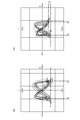
- 4 (a) and 4 (b) are diagrams showing a state where there is no restraint by the wearing tool, a state where only the right elbow is restrained by the wearing tool, and swinging trajectories of the respective waists.
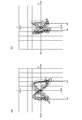
- FIGS. 5A and 5B are diagrams showing a state without restraint by the wearing tool, a state in which both elbows are restrained by the wearing tool, and swinging trajectories of the respective waists.
- FIGS. 7A to 7C are diagrams showing how the pseudo hemiplegic walking motion is improved by the walking assist device.
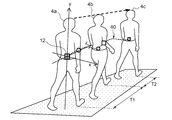
- FIG. 1 is a diagram showing a walking support device 2 according to the embodiment.
- the walking support device 2 supports the walking of the pedestrian (subject) 4.
- the walking support device 2 is intended for pedestrians 4 who cannot remain freely walking, such as elderly people, disabled people, and disabled people.
- the walking support device 2 mainly includes a measuring unit 10 and a wearing tool 20.
- the measurement unit 10 measures walking information of the pedestrian 4.
- the gait evaluation system described in Patent Document 1 can be used as the measurement unit 10.
- the measurement unit 10 includes an acceleration sensor 12 and a computer (also referred to as a control unit) 14.
- the acceleration sensor 12 is attached to the waist or abdomen of the pedestrian 4, and has data S1 indicating acceleration in each of the pedestrian's left-right direction (x-axis), vertical direction (y-axis), and traveling direction (front-back direction, z-axis).
- Output The computer 14 processes the data S1 from the acceleration sensor 12, and generates data S2 indicating walking information (hereinafter referred to as walking information data).
- the walking information data S2 is data indicating the motion trajectory of the three-dimensional waist or abdomen of the pedestrian 4.
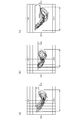
- FIG. 2 is a diagram showing the trajectory of the waist of the pedestrian 4 measured by the measuring unit 10.
- 2a shows a state where the right leg heel is grounded
- 4b shows a state where the left leg heel is grounded next
- 4c shows a state where the right leg heel is next grounded.
- the human walking movement is performed during the first period T1 (4a to 4b) from when the right heel touches the ground until the left heel touches the ground, and from when the left heel touches the ground until the right heel touches the ground. It is grasped as a repetition of the second period T2 (4b to 4c).
- the measuring unit 10 may acquire a trajectory (hereinafter referred to as a swinging trajectory) obtained by projecting the waist motion shown in FIG. 2 on the XY plane as the walking information data S2.
- a trajectory in the XYZ space may be acquired as the walking information data S2
- the trajectory in the four-dimensional space including the time axis may be acquired as the walking information data S2
- the coordinates projected on the XY plane A trajectory in a three-dimensional space including the time axis may be acquired as the walking information data S2.
- the computer 14 generates control information S3 for controlling the wearing tool 20 so that the swinging trajectory of the waist or abdomen of the pedestrian 4 approaches that in an ideal walking state (referred to as a target trajectory).
- the control information S3 may include information such as whether the wearing tool 20 should act on the right arm or the left arm, how it should act, how much it should act, and when it should act.
- the wearing tool 20 is worn on the arm 6 of the pedestrian 4 and acts on the arm 6 of the pedestrian 4 according to the measurement result by the measuring unit 10.
- the arm movement is closely related to the leg movement, and when acting on the arm movement, not only the acting arm movement but also the entire walking movement is affected. Therefore, the wearing tool 20 may be configured to have some influence on the walking information, more specifically, the data S1 measured by the measurement unit 10, and the action given to the arm 6 is not particularly limited.
- the arm 6 refers to the portion from the shoulder to the fingertip, and “acting on the arm 6” specifically means any of the arm joints, that is, the shoulder joint, the elbow joint, the wrist joint, or the finger joint. Or acting on any combination. Acting on a joint includes controlling the bending angle of the joint to a predetermined value, constraining the movable range of the joint to a predetermined range, giving resistance (load) to the joint motion, and the like. .
- the wearing tool 20 acts on the elbow joint of the pedestrian 4.
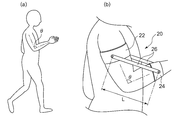
- FIGS. 3A and 3B are views showing the wearing tool 20.
- the wearing tool 20 acts on the bending angle ⁇ of the elbow joint.
- the wearing tool 20 may include a first portion 22 fixed to the upper arm, a second portion 24 fixed to the forearm, and an adjustment member 26 that changes the distance L between the first portion 22 and the second portion 24.
- the adjustment member 26 may be configured using an electric actuator, and may further be capable of automatically controlling the bending angle ⁇ based on the control information S3 generated by the computer 14.
- the length L of the adjusting member 26 may be manually adjustable.
- the pedestrian 4 itself or an assistant may manually change the bending angle ⁇ based on the control information S3 generated by the computer 14.
- the specific configuration of the wearing tool 20 is not particularly limited as long as the elbow joint angle ⁇ can be adjusted.
- the wearing tool 20 is worn on the right arm, only the left arm, or both arms of the pedestrian 4 based on the control information S3 generated by the computer 14 as required.
- the angles ⁇ l and ⁇ r of the respective elbow joints may be different.
- the above is the configuration of the walking support device 2 according to the embodiment.
- the present inventor conducted the following experiment in order to verify the effectiveness of the walking support device 2.
- the swinging trajectory of the lumbar region was measured for a healthy person in a state where there was no restraint by the wearing tool 20, a state where only the right elbow was restrained by the wearing tool 20, and a state where both elbows were restrained by the wearing tool 20. It was measured.
- 4 (a) and 4 (b) are diagrams showing a state where there is no restraint by the wearing tool 20, a state where only the right elbow is restrained by the wearing tool 20, and a swing trajectory of each waist.
- the circles shown on the track indicate the coordinates of the waist at the contact point.
- FIGS. 5 (a) and 5 (b) are diagrams showing a swinging trajectory of each waist, in a state in which there is no restraint by the wearing tool 20, in a state in which both elbows are restrained by the wearing tool 20. Comparing the trajectories of FIGS. 5 (a) and 5 (b), by fixing the bending angles ⁇ l and ⁇ r of both elbows, the amplitude in the left-right direction is larger than that in the case of fixing only the right elbow in FIG. 4 (b). It can be seen that it becomes even smaller.
- FIG. 6A is a diagram illustrating a state in which the right knee joint of the subject is fixed
- FIG. 6B is a diagram illustrating a state in which the right knee joint is fixed by the wearing tool 20.
- the angle ⁇ of the elbow joint is about 90 degrees.
- FIGS. 7A to 7C are diagrams showing how the pseudo hemiplegic walking motion is improved by the walking support device 2.
- FIG. In general, it is desirable that the swinging trajectory is bilaterally symmetric, and therefore the mounting tool 20 may be adjusted so that the trajectory is bilaterally symmetric.
- 7A shows a state where both elbows are not restrained
- FIG. 7B shows a state where the right elbow joint is restrained
- FIG. 7C shows a state where the left elbow joint is restrained.
- the oscillating locus of the waist is asymmetrical. Specifically, the coordinates of the uppermost left point are higher than the coordinates of the uppermost right point, and the amplitude in the left direction is larger than the amplitude in the right direction. Further, the amplitude in the vertical direction and the amplitude in the horizontal direction are larger than those of the healthy person shown in FIG.
- a walking state that is, a trajectory is observed by the measurement unit 10.
- the computer 14 may generate the control information S3 by feedback so as to control the wearing tool 20 so that the observed trajectory and the target trajectory coincide with each other.
- the computer 14 learns in advance the relationship between the state of the wearing tool 20 and the effect it has on the trajectory, generates control information S3 by open loop based on the observed trajectory, and sets the wearing tool 20 You may control.
- the effect of improving walking can be obtained for an actual paralyzed patient, a disabled person, and an elderly person as well as for a pseudo-paralyzed patient.
- conventional walking support technology aims to improve walking by directly intervening in leg movements.
- the walking support device 2 according to the embodiment can improve the walking motion from the inner surface by intervening not in the leg motion but in the related arm motion of the brain.
- security, the reduction of the pain given to a pedestrian, suppression of the fall of athletic ability, and a learning effect is realizable.
- the moment of inertia of the arm changes with the angle ⁇ of the elbow joint. Therefore, by optimizing the angle ⁇ of the elbow joint, the trajectory can be changed more flexibly and brought closer to the target trajectory.
- the state of the wearing tool 20 is fixed during the walking exercise.
- the wearing tool 20 may be configured to be able to control the bending angle ⁇ of the elbow joint in synchronization with the walking motion.
- the moment of inertia that is, the vibration frequency of the swing motion of the arm can be dynamically changed within one cycle in synchronism with the walking motion. it can.
- the wearing tool 20 may control any one of an elbow joint, a shoulder joint, a wrist joint, a finger joint, or any combination. Not only the elbow joint but also other joint conditions can affect the walking movement. In this case, joints other than the elbow joint may be changed in synchronization with the walking motion.
- the mounting tool 20 may be controlled so that the measured Z-coordinate trajectory coincides with the target trajectory by paying attention only to the Z-coordinate (front-rear direction).
- the wearing tool 20 may be controlled so that the velocity in the X direction, the velocity in the Y direction, or both coincide with the target.
- the wearing tool 20 may be controlled so that the acceleration in the X direction, the acceleration in the Y direction, or both coincide with the target.
- attention is paid to the trajectory on the XY plane, but the wearing tool 20 may be controlled so that the three-dimensional trajectory in the XYZ space coincides with the target trajectory.
- the wearing tool 20 may be controlled so that the four-dimensional trajectory including the time axis coincides with the target trajectory.
- Modification 6 In the embodiment, attention is paid only to the lumbar region, but the movement of other parts, for example, the head, jaw, neck, shoulder, upper arm, elbow, forearm, thigh, knee, heel, ankle, is measured, and walking information data S2 may be acquired.
- the walking support device 2 can be used for fashion models, ordinary people, and athletes who want to improve walking forms, and can also be applied to correction of walking forms of healthy persons.
- the walking support device 2 is expected to be used for passing down traditional performing arts that involve walking movements such as dance.
- the present invention can be used for technologies related to human walking motion.
Landscapes
- Health & Medical Sciences (AREA)
- Life Sciences & Earth Sciences (AREA)
- Animal Behavior & Ethology (AREA)
- Veterinary Medicine (AREA)
- Public Health (AREA)
- General Health & Medical Sciences (AREA)
- Rehabilitation Therapy (AREA)
- Physical Education & Sports Medicine (AREA)
- Pain & Pain Management (AREA)
- Epidemiology (AREA)
- Physics & Mathematics (AREA)
- Biophysics (AREA)
- Pathology (AREA)
- Surgery (AREA)
- Medical Informatics (AREA)
- Heart & Thoracic Surgery (AREA)
- Biomedical Technology (AREA)
- Engineering & Computer Science (AREA)
- Molecular Biology (AREA)
- Oral & Maxillofacial Surgery (AREA)
- Dentistry (AREA)
- Physiology (AREA)
- Rehabilitation Tools (AREA)
- Geometry (AREA)
- Orthopedic Medicine & Surgery (AREA)
- Measurement Of The Respiration, Hearing Ability, Form, And Blood Characteristics Of Living Organisms (AREA)
Priority Applications (4)
| Application Number | Priority Date | Filing Date | Title |
|---|---|---|---|
| CN201380066273.XA CN104902862B (zh) | 2012-12-28 | 2013-12-25 | 步行辅助装置及步行辅助方法 |
| EP13869550.7A EP2939647A4 (en) | 2012-12-28 | 2013-12-25 | AIDING DEVICE AND ASSISTANCE PROCEDURE |
| US14/758,332 US9833375B2 (en) | 2012-12-28 | 2013-12-25 | Walking support apparatus and walking support method |
| KR1020157019584A KR102046208B1 (ko) | 2012-12-28 | 2013-12-25 | 보행 지원 장치 및 보행 지원 방법 |
Applications Claiming Priority (2)
| Application Number | Priority Date | Filing Date | Title |
|---|---|---|---|
| JP2012288597A JP2014128464A (ja) | 2012-12-28 | 2012-12-28 | 歩行支援装置および歩行支援方法 |
| JP2012-288597 | 2012-12-28 |
Publications (1)
| Publication Number | Publication Date |
|---|---|
| WO2014103305A1 true WO2014103305A1 (ja) | 2014-07-03 |
Family
ID=51020421
Family Applications (1)
| Application Number | Title | Priority Date | Filing Date |
|---|---|---|---|
| PCT/JP2013/007588 Ceased WO2014103305A1 (ja) | 2012-12-28 | 2013-12-25 | 歩行支援装置および歩行支援方法 |
Country Status (6)
| Country | Link |
|---|---|
| US (1) | US9833375B2 (cg-RX-API-DMAC7.html) |
| EP (1) | EP2939647A4 (cg-RX-API-DMAC7.html) |
| JP (1) | JP2014128464A (cg-RX-API-DMAC7.html) |
| KR (1) | KR102046208B1 (cg-RX-API-DMAC7.html) |
| CN (1) | CN104902862B (cg-RX-API-DMAC7.html) |
| WO (1) | WO2014103305A1 (cg-RX-API-DMAC7.html) |
Cited By (1)
| Publication number | Priority date | Publication date | Assignee | Title |
|---|---|---|---|---|
| CN112603753A (zh) * | 2020-11-30 | 2021-04-06 | 中国人民解放军陆军军医大学第一附属医院 | 一种上肢骨折用康复训练装置 |
Families Citing this family (11)
| Publication number | Priority date | Publication date | Assignee | Title |
|---|---|---|---|---|
| JP2015177863A (ja) * | 2014-03-19 | 2015-10-08 | 株式会社東芝 | アシスト制御装置および方法 |
| WO2015169880A1 (en) * | 2014-05-09 | 2015-11-12 | Koninklijke Philips N.V. | Method and apparatus for determining the orientation of an accelerometer |
| JP6400194B2 (ja) * | 2015-05-19 | 2018-10-03 | Cyberdyne株式会社 | 歩行支援装置 |
| KR102556924B1 (ko) * | 2016-09-05 | 2023-07-18 | 삼성전자주식회사 | 보행 보조 방법 및 이를 수행하는 장치 |
| CN109688923B (zh) * | 2016-09-09 | 2022-04-19 | 日本电信电话株式会社 | 乳酸性作业阈值推测装置以及乳酸性作业阈值推测方法 |
| KR102002303B1 (ko) | 2017-03-31 | 2019-07-22 | 주식회사 푸드인쿡홀딩스 | 보행자-차량 간의 상충위험도 분석시스템 |
| JP6846535B2 (ja) * | 2017-11-08 | 2021-03-24 | 本田技研工業株式会社 | 移動運動支援装置 |
| JP2020005749A (ja) * | 2018-07-04 | 2020-01-16 | Walk−Mate Lab株式会社 | 歩行支援装置および歩行支援方法 |
| KR102222967B1 (ko) * | 2019-06-28 | 2021-03-08 | 서울대학교병원 | 비고정식 어깨 보조기 |
| EP3991709B1 (en) | 2019-06-28 | 2025-11-26 | Seoul National University R&DB Foundation | Non-fixed shoulder brace |
| KR102705143B1 (ko) * | 2021-11-24 | 2024-09-11 | 에이치로보틱스 주식회사 | 도달운동을 위한 재활운동장치의 제어방법 |
Citations (8)
| Publication number | Priority date | Publication date | Assignee | Title |
|---|---|---|---|---|
| JP2004208976A (ja) * | 2002-12-27 | 2004-07-29 | Yaskawa Electric Corp | 歩行訓練装置および歩行ユニット |
| JP2005227909A (ja) | 2004-02-10 | 2005-08-25 | Rikogaku Shinkokai | 非線形制御器及び非線形的制御方法 |
| JP2006503658A (ja) * | 2002-10-24 | 2006-02-02 | ロッキード マーティン コーポレイション | 運動障害の治療システム及び方法 |
| JP2006102156A (ja) | 2004-10-05 | 2006-04-20 | Rikogaku Shinkokai | 歩行介助システム |
| JP2007029113A (ja) * | 2005-07-22 | 2007-02-08 | Toyota Motor Corp | 補助装置 |
| JP2010264320A (ja) | 2010-09-01 | 2010-11-25 | Tokyo Institute Of Technology | 歩容評価システム及び歩容評価方法 |
| JP2011177278A (ja) * | 2010-02-26 | 2011-09-15 | Tokyo Institute Of Technology | 歩行障害自動分析システム |
| JP2012105732A (ja) * | 2010-11-15 | 2012-06-07 | Toyota Motor Corp | リハビリ補助装置 |
Family Cites Families (10)
| Publication number | Priority date | Publication date | Assignee | Title |
|---|---|---|---|---|
| US6064912A (en) * | 1997-03-28 | 2000-05-16 | Kenney; John P. | Orthotic/electrotherapy for treating contractures due to immobility |
| US7396337B2 (en) * | 2002-11-21 | 2008-07-08 | Massachusetts Institute Of Technology | Powered orthotic device |
| JP4787957B2 (ja) * | 2005-08-30 | 2011-10-05 | 国立大学法人豊橋技術科学大学 | ウェアラブル足底圧力提示装置 |
| GB2455427B (en) | 2005-10-11 | 2009-12-02 | Panasonic Corp | Motion Assistance Apparatus |
| US8585620B2 (en) * | 2006-09-19 | 2013-11-19 | Myomo, Inc. | Powered orthotic device and method of using same |
| JP4911738B2 (ja) * | 2006-11-22 | 2012-04-04 | 学校法人早稲田大学 | 歩行リハビリ支援装置 |
| EP2335570A4 (en) * | 2008-09-10 | 2014-04-02 | Univ Tsukuba | Wearing tool for measuring biological signal, and wearing-type motion assisting device |
| US8568344B2 (en) * | 2009-10-23 | 2013-10-29 | Applied Neural Mechanics, Llc | Torso assist orthotic device |
| FR2975895B1 (fr) * | 2011-05-30 | 2013-06-28 | Commissariat Energie Atomique | Vehicule a au moins trois points d'appui stable sur le sol |
| EP3791834B1 (en) * | 2012-09-17 | 2026-03-04 | President And Fellows Of Harvard College | Soft exosuit for assistance with human motion |
-
2012
- 2012-12-28 JP JP2012288597A patent/JP2014128464A/ja active Pending
-
2013
- 2013-12-25 EP EP13869550.7A patent/EP2939647A4/en not_active Withdrawn
- 2013-12-25 US US14/758,332 patent/US9833375B2/en active Active
- 2013-12-25 KR KR1020157019584A patent/KR102046208B1/ko active Active
- 2013-12-25 CN CN201380066273.XA patent/CN104902862B/zh active Active
- 2013-12-25 WO PCT/JP2013/007588 patent/WO2014103305A1/ja not_active Ceased
Patent Citations (8)
| Publication number | Priority date | Publication date | Assignee | Title |
|---|---|---|---|---|
| JP2006503658A (ja) * | 2002-10-24 | 2006-02-02 | ロッキード マーティン コーポレイション | 運動障害の治療システム及び方法 |
| JP2004208976A (ja) * | 2002-12-27 | 2004-07-29 | Yaskawa Electric Corp | 歩行訓練装置および歩行ユニット |
| JP2005227909A (ja) | 2004-02-10 | 2005-08-25 | Rikogaku Shinkokai | 非線形制御器及び非線形的制御方法 |
| JP2006102156A (ja) | 2004-10-05 | 2006-04-20 | Rikogaku Shinkokai | 歩行介助システム |
| JP2007029113A (ja) * | 2005-07-22 | 2007-02-08 | Toyota Motor Corp | 補助装置 |
| JP2011177278A (ja) * | 2010-02-26 | 2011-09-15 | Tokyo Institute Of Technology | 歩行障害自動分析システム |
| JP2010264320A (ja) | 2010-09-01 | 2010-11-25 | Tokyo Institute Of Technology | 歩容評価システム及び歩容評価方法 |
| JP2012105732A (ja) * | 2010-11-15 | 2012-06-07 | Toyota Motor Corp | リハビリ補助装置 |
Non-Patent Citations (1)
| Title |
|---|
| See also references of EP2939647A4 * |
Cited By (2)
| Publication number | Priority date | Publication date | Assignee | Title |
|---|---|---|---|---|
| CN112603753A (zh) * | 2020-11-30 | 2021-04-06 | 中国人民解放军陆军军医大学第一附属医院 | 一种上肢骨折用康复训练装置 |
| CN112603753B (zh) * | 2020-11-30 | 2022-04-19 | 中国人民解放军陆军军医大学第一附属医院 | 一种上肢骨折用康复训练装置 |
Also Published As
| Publication number | Publication date |
|---|---|
| US20160000635A1 (en) | 2016-01-07 |
| EP2939647A4 (en) | 2016-11-02 |
| KR20150100797A (ko) | 2015-09-02 |
| JP2014128464A (ja) | 2014-07-10 |
| EP2939647A1 (en) | 2015-11-04 |
| KR102046208B1 (ko) | 2019-12-02 |
| US9833375B2 (en) | 2017-12-05 |
| CN104902862A (zh) | 2015-09-09 |
| CN104902862B (zh) | 2017-03-15 |
Similar Documents
| Publication | Publication Date | Title |
|---|---|---|
| WO2014103305A1 (ja) | 歩行支援装置および歩行支援方法 | |
| Martinez et al. | A controller for guiding leg movement during overground walking with a lower limb exoskeleton | |
| Pietrusinski et al. | Robotic gait rehabilitation trainer | |
| CN107106846B (zh) | 用于辅助步态干预和跌倒预防的系统和方法 | |
| Lora-Millan et al. | A unilateral robotic knee exoskeleton to assess the role of natural gait assistance in hemiparetic patients | |
| Munawar et al. | AssistOn-Gait: An overground gait trainer with an active pelvis-hip exoskeleton | |
| Jamshidi et al. | Modelling of human walking to optimise the function of ankle-foot orthosis in Guillan-Barré patients with drop foot | |
| Sawers et al. | Regulation of whole-body frontal plane balance varies within a step during unperturbed walking | |
| Hayes et al. | A biomechanical comparison of powered robotic exoskeleton gait with normal and slow walking: An investigation with able-bodied individuals | |
| Pietrusinski et al. | Gait rehabilitation therapy using robot generated force fields applied at the pelvis | |
| Nyberg et al. | A novel elastic force-field to influence mediolateral foot placement during walking | |
| Biffi et al. | Gait rehabilitation with a high tech platform based on virtual reality conveys improvements in walking ability of children suffering from acquired brain injury. | |
| JP6694214B2 (ja) | 歩行支援装置 | |
| Tsukahara et al. | Pilot study of single-legged walking support using wearable robot based on synchronization control for stroke patients | |
| Nomura et al. | Development of Stewart platform type ankle-foot device for trip prevention support | |
| Jung et al. | Brief biomechanical analysis on the walking of spinal cord injury patients with a lower limb exoskeleton robot | |
| Vashista et al. | Asymmetric adaptation in human walking using the tethered pelvic assist device (TPAD) | |
| Wang et al. | Synchronized walking coordination for impact-less footpad contact of an overground gait rehabilitation system: NaTUre-gaits | |
| Van Leeuwen et al. | Stabilization of gait, mechanisms, and opportunities for training | |
| Zhang et al. | Gait self-learning control based on reference trajectory generation online for an asymmetric limb rehabilitation exoskeleton | |
| JP2019107471A (ja) | 歩行支援装置 | |
| JP2022087095A (ja) | 歩行支援装置 | |
| Mokhtarian et al. | An assistive passive pelvic device for gait training and rehabilitation using locomotion dynamic model | |
| Mao et al. | Balance control and energetics of powered exoskeleton-assisted sit-to-stand movement in individuals with paraplegic spinal cord injury | |
| Jung et al. | Development of gait rehabilitation system capable of assisting pelvic movement of normal walking |
Legal Events
| Date | Code | Title | Description |
|---|---|---|---|
| 121 | Ep: the epo has been informed by wipo that ep was designated in this application |
Ref document number: 13869550 Country of ref document: EP Kind code of ref document: A1 |
|
| DPE2 | Request for preliminary examination filed before expiration of 19th month from priority date (pct application filed from 20040101) | ||
| NENP | Non-entry into the national phase |
Ref country code: DE |
|
| WWE | Wipo information: entry into national phase |
Ref document number: 14758332 Country of ref document: US |
|
| ENP | Entry into the national phase |
Ref document number: 20157019584 Country of ref document: KR Kind code of ref document: A |
|
| WWE | Wipo information: entry into national phase |
Ref document number: 2013869550 Country of ref document: EP |