WO2014069295A1 - 慢性膀胱炎モデル非ヒト動物の製造方法 - Google Patents
慢性膀胱炎モデル非ヒト動物の製造方法 Download PDFInfo
- Publication number
- WO2014069295A1 WO2014069295A1 PCT/JP2013/078665 JP2013078665W WO2014069295A1 WO 2014069295 A1 WO2014069295 A1 WO 2014069295A1 JP 2013078665 W JP2013078665 W JP 2013078665W WO 2014069295 A1 WO2014069295 A1 WO 2014069295A1
- Authority
- WO
- WIPO (PCT)
- Prior art keywords
- human animal
- bladder
- model
- chronic cystitis
- hydrogen peroxide
- Prior art date
- Legal status (The legal status is an assumption and is not a legal conclusion. Google has not performed a legal analysis and makes no representation as to the accuracy of the status listed.)
- Ceased
Links
Images




Classifications
-
- A—HUMAN NECESSITIES
- A01—AGRICULTURE; FORESTRY; ANIMAL HUSBANDRY; HUNTING; TRAPPING; FISHING
- A01K—ANIMAL HUSBANDRY; AVICULTURE; APICULTURE; PISCICULTURE; FISHING; REARING OR BREEDING ANIMALS, NOT OTHERWISE PROVIDED FOR; NEW BREEDS OF ANIMALS
- A01K67/00—Rearing or breeding animals, not otherwise provided for; New or modified breeds of animals
- A01K67/027—New or modified breeds of vertebrates
-
- G—PHYSICS
- G01—MEASURING; TESTING
- G01N—INVESTIGATING OR ANALYSING MATERIALS BY DETERMINING THEIR CHEMICAL OR PHYSICAL PROPERTIES
- G01N33/00—Investigating or analysing materials by specific methods not covered by groups G01N1/00 - G01N31/00
- G01N33/48—Biological material, e.g. blood, urine; Haemocytometers
- G01N33/50—Chemical analysis of biological material, e.g. blood, urine; Testing involving biospecific ligand binding methods; Immunological testing
- G01N33/5005—Chemical analysis of biological material, e.g. blood, urine; Testing involving biospecific ligand binding methods; Immunological testing involving human or animal cells
- G01N33/5008—Chemical analysis of biological material, e.g. blood, urine; Testing involving biospecific ligand binding methods; Immunological testing involving human or animal cells for testing or evaluating the effect of chemical or biological compounds, e.g. drugs, cosmetics
- G01N33/5082—Supracellular entities, e.g. tissue, organisms
- G01N33/5088—Supracellular entities, e.g. tissue, organisms of vertebrates
-
- A—HUMAN NECESSITIES
- A01—AGRICULTURE; FORESTRY; ANIMAL HUSBANDRY; HUNTING; TRAPPING; FISHING
- A01K—ANIMAL HUSBANDRY; AVICULTURE; APICULTURE; PISCICULTURE; FISHING; REARING OR BREEDING ANIMALS, NOT OTHERWISE PROVIDED FOR; NEW BREEDS OF ANIMALS
- A01K2207/00—Modified animals
- A01K2207/20—Animals treated with compounds which are neither proteins nor nucleic acids
-
- A—HUMAN NECESSITIES
- A01—AGRICULTURE; FORESTRY; ANIMAL HUSBANDRY; HUNTING; TRAPPING; FISHING
- A01K—ANIMAL HUSBANDRY; AVICULTURE; APICULTURE; PISCICULTURE; FISHING; REARING OR BREEDING ANIMALS, NOT OTHERWISE PROVIDED FOR; NEW BREEDS OF ANIMALS
- A01K2267/00—Animals characterised by purpose
- A01K2267/03—Animal model, e.g. for test or diseases
Definitions
- the present invention relates to a method for producing a chronic cystitis model non-human animal.
- Interstitial cystitis a type of chronic cystitis, is an organic disease of the bladder that exhibits symptoms such as frequent urination, increased urinary urgency, urgency, inflammation, and bladder pain. Then, the quality of life is significantly reduced. Although the underlying cause of interstitial cystitis has not been clarified, three pathophysiological mechanisms have been suggested so far: epithelial dysfunction, mast cell activation and neuropathitis. In recent years, interstitial cystitis has been reported to have a high prevalence, and as the degree of recognition increases, the need for therapeutic agents in clinical settings is also increasing.
- Non-patent Documents 1 and 2 a model animal administered with cyclophosphamide
- Non-patent Document 3 a model animal administered with acetic acid or LPS and protamine sulfate
- Non-patent Document 5 a model animal administered with knockout
- these model animals are complicated to produce and exhibit symptoms of cystitis, it is difficult to say that they are model animals that appropriately represent the pathology of interstitial cystitis, which is chronic cystitis.
- Intravesical botulinum toxin aadministration produces analgesia against acetic acid induced bladder painresponses in rats.
- an object of the present invention is to provide a method for easily producing a model non-human animal exhibiting symptoms of chronic cystitis.
- the method for producing a chronic cystitis model non-human animal of the present invention includes a step of administering hydrogen peroxide to the non-human animal.
- the chronic cystitis model non-human animal of the present invention is obtained by the method for producing a chronic cystitis model non-human animal of the present invention.
- the screening method for a therapeutic agent for chronic cystitis of the present invention comprises the following steps (A) to (C).
- a model animal that appropriately represents a pathological condition of chronic cystitis can be provided by a simple treatment.
- chronic cystitis cycle of inflammatory cell infiltration and stromal layer hyperplasia due to damage and rupture of bladder mucosa caused by increased mucosal permeability caused thereby Can be said to appropriately represent the pathology of chronic cystitis.
- the model non-human animal is extremely useful, for example, for screening for a therapeutic candidate agent for chronic cystitis.
- the model non-human animal can be obtained by administering hydrogen peroxide, which is generally available at a low cost, to the non-human animal. This is also advantageous from the viewpoint of the labor and cost required to manufacture the device.
- Example 1 it is a graph which shows the result of having compared the frequency
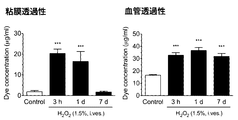
- Example 1 it is a graph which shows the mucosa permeability and blood-vessel permeability in the chronic cystitis model non-human animal of this invention.
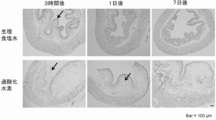
- Example 1 it is a photograph which shows the bladder tissue in the chronic cystitis model non-human animal of this invention.
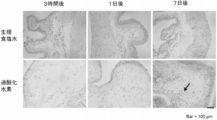
- Example 1 it is a photograph which shows the bladder tissue in the chronic cystitis model non-human animal of this invention.
- it is a graph which shows the efficacy evaluation of the existing therapeutic agent with respect to the chronic cystitis model non-human animal of this invention.
- Example 1 it is a graph which shows the expression induction of the inflammatory marker and the fibrosis marker in the chronic cystitis model non-human animal of this invention.
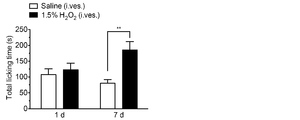
- Example 2 it is a graph which shows the evaluation of the bladder pain in the chronic cystitis model non-human animal of this invention.
- Example 2 it is a graph which shows the efficacy evaluation of the existing therapeutic agent with respect to the evaluation of the bladder pain in the chronic cystitis model non-human animal of this invention.
- the method for producing a chronic cystitis model non-human animal of the present invention includes the step of administering hydrogen peroxide to the non-human animal as described above. To do.
- any active oxygen generator that generates active oxygen can be used in place of the hydrogen peroxide, but hydrogen peroxide is preferably used.
- the hydrogen peroxide can also be said to be a chronic cystitis inducer.
- the dose of hydrogen peroxide is not particularly limited.
- the upper limit of the hydrogen peroxide dose is, for example, 10 mL per kg body weight, preferably 7 mL per kg body weight, more preferably 5 mL per kg body weight, and the lower limit is, for example, per kg body weight.
- the form of the hydrogen peroxide is not particularly limited.
- the hydrogen peroxide may be administered as it is, for example, but is preferably administered as a hydrogen peroxide solution mixed with a solvent.
- the solvent include water, physiological saline, and buffer solution.
- the upper limit of the hydrogen peroxide concentration in the hydrogen peroxide solution is, for example, 5.0 v / v%, preferably 3.0 v / v%. More preferably 2.0 v / v%, and the lower limit thereof is, for example, 0.1 v / v%, preferably 0.3 v / v%, more preferably 1.0 v / v%.
- the range is, for example, 0.1 to 5.0 v / v%, preferably 0.3 to 3.0 v / v%, more preferably 1.0 to 2.0 v / v%. is there.
- the hydrogen peroxide concentration in the hydrogen peroxide solution is preferably 1.5 v / v%.
- the administration method of the hydrogen peroxide is not particularly limited, and for example, a method capable of administering hydrogen peroxide to the bladder directly or indirectly is preferable.
- the administration method include intravenous administration and intravesical administration, and preferably intravesical administration by inserting a catheter from the urethra.
- the non-human animal is not particularly limited.
- the non-human animal include rodents, rabbits, cats, cows, monkeys, dogs, weasels, wild boars, and primates.
- the rodents include mice, rats, hamsters, and guinea pigs.
- Other non-human animals include, for example, rabbits, dogs, cats, ferrets, goats, sheep, cows, pigs, cynomolgus monkeys, rhesus monkeys, and marmosets.
- the non-human animals are preferably rodents, more preferably mice and rats, and particularly preferably mice.
- a general animal used for producing a model animal can be used.
- a model non-human animal exhibiting symptoms of chronic cystitis can be obtained.
- the characteristics of the chronic cystitis model non-human animal of the present invention will be described later.
- Chronic cystitis model non-human animal The chronic cystitis model non-human animal of the present invention is obtained by the method for producing a chronic cystitis model non-human animal of the present invention as described above.
- the chronic cystitis model non-human animal of the present invention exhibits at least one characteristic selected from the group consisting of the following (a) to (h) for at least one week, for example, in a state where the hydrogen peroxide is not administered.
- bladder fibrosis (c) bladder wall hypertrophy (d) bladder inflammation (e) compared to normal non-human animals relative to the model non-human animals, Increased bladder weight (f) Increased vascular permeability compared to normal non-human animals for the model non-human animals
- g) Increased white blood cell count in the bladder compared to normal non-human animals for the model non-human animals
- Increase Increased time of licking action of the lower abdomen during bladder dilatation compared to normal non-human animals for the model non-human animals
- the unadministered state means a state in which no further hydrogen peroxide is administered after the administration of hydrogen peroxide at the time of production.
- the chronic cystitis model non-human animal of the present invention can maintain cystitis symptoms for a long time in the non-administered state.
- the period showing the characteristics (a) to (h) is, for example, at least 1 week, preferably at least 2 weeks, more preferably at least 1 month.
- the number of urinations per 15 minutes is, for example, at least 2 to 3 times, preferably at least 4 to 5 times, more preferably at least 5 times.
- the fibrosis of the bladder means that the extracellular matrix such as collagen fibers (collagen) increases and as a result, the bladder hardens.
- the fibrosis of the bladder can be indirectly detected by, for example, a fibrosis marker.
- a fibrosis marker As a specific example, when the expression level of the fibrosis marker in the bladder of the chronic cystitis model non-human animal is significantly higher than that of a normal non-human animal for the chronic cystitis model non-human animal, the chronic bladder It can be judged that the fibrosis of the bladder in the non-human animal model of inflammation occurs.
- the fibrosis marker is not particularly limited.
- fibrosis markers examples include transforming growth factor ⁇ (transforming growth factor (TGF) - ⁇ ), fibroblast growth factor-2 (fibroblast growth factor (FGF) -2), and platelet-derived growth factor (platelet-derived). growth factors (growth factor (PDGF)), insulin-like growth factor-1 (insulin-like growth factor (IGF) -1), connective tissue growth factor (connective tissue growth factor (CTGF)), and collagen and its Examples thereof include hydroxyproline, which is a constituent amino acid.
- the fibrosis marker is preferably TGF- ⁇ and collagen, more preferably collagen. Whether or not the model non-human animal is significantly higher than the normal non-human animal can be determined, for example, based on a general statistical significance difference (the same applies hereinafter).
- the enlargement of the bladder wall means that the thickness of the bladder wall increases as a result of inflammation or fibrosis.
- the enlargement of the bladder wall can be determined by anatomical findings such as dissecting the bladder taken out of the non-human animal and measuring the thickness of the bladder wall.
- the chronic bladder it can be judged that the thickness of the bladder wall of the flame model non-human animal is increased. Whether or not the model non-human animal is significantly increased compared to the normal non-human animal can be determined based on, for example, a general statistical significance difference (hereinafter the same).
- the inflammation of the bladder means a biological defense reaction against harmful stimuli such as infection, damage and injury to the bladder tissue.
- the inflammation of the bladder can be indirectly detected by, for example, an inflammation marker.
- an inflammation marker As a specific example, when the expression level of the inflammatory marker in the bladder of the chronic cystitis model non-human animal is significantly higher than that of a normal non-human animal relative to the chronic cystitis model non-human animal, the chronic cystitis It can be judged that inflammation of the bladder of the model non-human animal occurs.
- the inflammation marker is not particularly limited. Examples of the inflammatory marker include inflammatory cytokines such as IL-1 ⁇ , TFN- ⁇ and IL-6, and chemokines such as CCL1, CCL2, CXCL1 and CXCL2.
- the inflammatory marker is preferably the chemokines and the inflammatory cytokines, and more preferably the inflammatory cytokines.
- the increase in the weight of the bladder is, for example, that the weight of the bladder of the chronic cystitis model non-human animal is significantly increased compared to a normal non-human animal with respect to the chronic cystitis model non-human animal. If it is, it can be determined that the bladder weight of the chronic cystitis model non-human animal has increased.
- vascular permeability means the mobility of substances present in blood to the bladder tissue. Therefore, vascular permeability means, for example, the degree to which a high molecular weight protein or blood cell component passes through the blood vessel wall from within the blood vessel. When inflammation occurs, vascular permeability increases and leukocyte infiltration and edema occur. As shown in the Examples described later, in the chronic cystitis model non-human animal, the increase in vascular permeability continues even after the following mucosal permeability (i) returns to the original state. Therefore, the period in which the increase in vascular permeability lasts is preferably longer than the period in which the increase in mucosal permeability persists.
- the blood vessel permeability is measured by, for example, injecting a dye for staining such as Evans Blue into the vein of the non-human animal, then removing the bladder from the non-human animal and measuring the concentration of the dye for staining in the bladder tissue. Can be measured.
- a dye for staining such as Evans Blue
- the concentration of the dye for staining in the bladder tissue can be measured.
- the chronic cystitis it can be judged that the vascular permeability of the model non-human animal is increased.
- the white blood cells are not particularly limited.
- the leukocytes include neutrophils, eosinophils, basophils, lymphocytes, macrophages and monocytes.
- neutrophils neutrophils
- eosinophils neutrophils
- basophils lymphocytes
- macrophages macrophages
- monocytes monocytes.
- leukocytes were removed after the loss and thinning of the bladder wall due to the increase in mucosal permeability described below (i) returned to the original state.
- the infiltration of inflammatory cells such as is sustained. Therefore, the period in which the increase in the white blood cell count is preferably longer than the period in which the increase in mucosal permeability continues.
- the chronic cystitis model non-human animal when leukocytes are significantly increased compared to the normal non-human animal relative to the chronic cystitis model non-human animal, the chronic cystitis model non-human animal It can be determined that leukocytes in human animals are increasing.
- the licking behavior of the lower abdomen means a stress response to bladder pain in the chronic cystitis model non-human animal.
- the licking action means an action of bending the upper body and licking the urethral opening or its periphery with the tongue.
- the time of licking action of the lower abdomen continues even after the mucosal permeability (i) below returns to the original state.
- the time of the licking behavior is, for example, the time during which the chronic cystitis model non-human animal is performing the licking behavior at 1 to 30 minutes, preferably 0 to 60 minutes with reference to the time of bladder expansion. .
- Examples of the method of expanding the bladder include a method of injecting the solvent into the bladder of the chronic cystitis model non-human animal.
- the time of the licking action in 1 to 30 minutes is based on the time when physiological saline is injected into the bladder of the chronic cystitis model non-human animal.
- the chronic cystitis model non-human animal is significantly increased compared to the normal non-human animal, it can be determined that the licking time of the chronic cystitis model non-human animal is increased.
- Mucosal permeability is an indicator of the barrier mechanism of the bladder mucosal layer, and an increase means barrier mechanism failure and failure.
- the mucosal permeability can be measured by, for example, injecting a dye for staining such as Evans Blue into the non-human animal, then removing the bladder from the non-human animal and measuring the concentration of the dye for staining.
- a statistically significant difference can be judged based on
- a known statistical analysis method can be selected and used.
- the statistical analysis method is not particularly limited, and examples thereof include one-way ANOVA, one-way repeated measurement ANOVA, Dunnett's test, Student's t test, and Wilcoxon test, and these can be combined. For example, in the above test, it can be determined that a significant difference was observed when the P value was less than 0.05, while it was determined that no significant difference was observed when the P value was 0.05 or more.
- Examples of the normal non-human animal include animals that have not developed chronic cystitis.
- the screening method for a treatment candidate agent for chronic cystitis comprises the following steps (A) to (C) as described above: .
- (A) A step of administering the test substance to the chronic cystitis model non-human animal of the present invention
- B) A step of confirming improvement of the symptoms of chronic cystitis in the model non-human animal administered with the test substance
- ( C) A step of selecting a test substance that improves symptoms of chronic cystitis based on the result obtained in the step (B)
- the test substance is not particularly limited.
- the test substance include natural compounds, organic compounds, inorganic compounds, nucleic acid molecules, single compounds such as proteins and peptides, compound libraries, gene library expression products, cell extracts, cell culture supernatants, fermentations, and the like.
- Examples include microbial products, marine organism extracts and plant extracts.
- the method for administering the test substance to the chronic cystitis model non-human animal of the present invention is not particularly limited.
- the administration method include oral administration and parenteral administration.
- the parenteral administration include intravenous administration, intramuscular administration, intraperitoneal administration, subcutaneous administration, nasal administration, pulmonary administration, and transdermal administration.
- the test substance is a protein or a peptide
- a viral vector having a gene encoding the protein or the like is constructed, and the gene is converted to the chronic cystitis model non-human animal of the present invention using its infectivity. And may be expressed in the body.
- step (B) confirmation of improvement against chronic cystitis can be performed based on symptoms exhibited by the model non-human animal.
- Symptoms used for confirming improvement for chronic cystitis include, for example, the above (a) to (h).
- “improvement” means, for example, that a symptom of chronic cystitis is restored to a normal state, or a symptom of chronic cystitis is alleviated.
- a person skilled in the art can determine whether or not the symptoms of chronic cystitis have improved in the model non-human animal based on the description herein. Specific examples include, for example, comparison of symptoms between the model non-human animal administered with the test substance and normal non-human animals relative to the model non-human animal, or symptoms before or after administration of the test substance. It can be determined based on the comparison.
- the treatment candidate agent of a chronic cystitis can be obtained by selecting the test substance which improves the symptom of chronic cystitis from the result of the said (B) process.
- treatment includes, for example, the meaning of improvement and prevention of symptoms of chronic cystitis.
- Example 1 Hydrogen peroxide was administered from the mouse urethra to produce a chronic cystitis model mouse, and its properties were confirmed.
- mice for injecting hydrogen peroxide 5 to 6 weeks old female C57BL / 6J mice (Japan SLC, Inc.) were used. The growth of the mice was carried out using a cage maintained at 20-26 ° C., a relative humidity of 35% -75% and a light / dark cycle of 12 hours, and the light period was started automatically at 8 am. Groups of 4 to 6 animals were used per animal. Mice were given food and water ad libitum.
- H 2 O 2 The administration of of H 2 O 2 to the mice was carried out as follows. First, a 24-G polypropylene catheter was inserted into the bladder under isoflurane anesthesia until urine was observed through the catheter, and the lower abdomen was slightly compressed until urine was drained. Next, H 2 O 2 (Santoku Chemical Co., Ltd.) is dissolved in physiological saline (Otsuka Pharmaceutical Co., Ltd.) to prepare a H 2 O 2 solution having a predetermined concentration (1.5 v / v%). 50 ⁇ L of 2 O 2 solution was injected into the bladder through a catheter. After 30 minutes, the H 2 O 2 solution was injected again into the bladder. Thus, the chronic cystitis model mouse of the Example was obtained.
- cyclophosphamide (Wako Pure Chemical Industries, Ltd.) was used as a drug instead of the H 2 O 2 .
- cyclophosphamide (Wako Pure Chemical Industries, Ltd.) is dissolved in physiological saline (Otsuka Pharmaceutical Co., Ltd.) to prepare a 15 mg / mL cyclophosphamide solution.
- the mice were intraperitoneally administered to give 300 mg of cyclophosphamide.
- As a control no drug was added, and 50 ⁇ L of physiological saline (Otsuka Pharmaceutical Co., Ltd.) was intraperitoneally administered to the mice instead of H 2 O 2 .
- a comparative model mouse and a control model mouse were obtained.
- the filter paper was replaced with a new one, the mouse was allowed to move freely for 15 minutes, and the behavior of the mouse was recorded. Thereafter, the recorded content was confirmed, and the number of urinations in 15 minutes was measured by counting the number of urination spots (stains) on the filter paper.
- the bladder weight was measured as the wet weight of the mouse taken out of the mouse.
- the urination frequency and bladder weight were measured by arbitrarily selecting 6 mice from the group of mice treated under the same conditions.
- FIG. 1 is a graph showing the number of urinations per 15 minutes and the weight of the bladder in a model mouse.
- the upper and lower graphs on the left are the number of urinations
- the upper and lower graphs are the results of bladder weight
- the upper two graphs are the model mice of the comparative example to which cyclophosphamide was administered
- the lower two graphs is the result of a model mouse in example administered with H 2 O 2.
- “Control” is the result of no drug administration
- “3h, 1d, and 7d” are the results of 3 hours, 1 day, and 7 days after drug administration, respectively.
- the number of urinations in the model mouse of the comparative example increased at 3 hours after administration, but then decreased rapidly, and almost the same state as when no drug was administered on the 7th day after administration. became.
- the number of urinations of the model mice of the examples gradually increased after administration, and it was confirmed that the number of urinations increased further on the seventh day after administration than on the first day after administration.
- the bladder weight of the model mouse of the comparative example increased at 3 hours after the administration, and the state was maintained on the first day after the administration, but almost no drug administration was observed on the seventh day after the administration. It became the same state.
- the bladder was removed from the model mouse. The bladder was then heated overnight (56 ° C.) in 1 mL of formamide to extract Evans blue.
- the dye (Evans blue) concentration ( ⁇ g / mL) in the obtained extract was quantified with a spectrophotometer (Bio-Rad) to evaluate the mucosal permeability and vascular permeability of the bladder.
- FIG. 2 is a graph showing mucosal permeability and vascular permeability in the bladder of a model mouse by pigment concentration.
- the left graph is the result of mucosal permeability
- the right graph is the result of vascular permeability
- “Control” is the result of no drug administration
- “3h, 1d and 7d” are the results, respectively.
- the results are 3 hours, 1 day and 7 days after drug administration.
- the mucosal permeability of the model mouse of the example administered with H 2 O 2 increased after the administration, and the state was maintained even on the first day after the administration, but it was 7 days after the administration. In the eyes, the condition was almost the same as when no drug was administered.
- the vascular permeability of the model mice of the above examples increased after administration, and the state was maintained even on the seventh day after administration.
- FIG. 3 is a micrograph of the stained bladder tissue
- FIG. 4 is an enlarged photo of FIG. 3 and 4, the upper photograph shows the results of the control model mouse administered with physiological saline, and the lower photograph shows the results of the model mouse of the example administered with H 2 O 2 .
- the bladder of the model mouse of the Example was compared with the control model mouse at 3 hours or 1 day after administration, as shown in FIG. 3 hours later, the arrow portion in the photograph), thinning and interstitial enlargement occurred.
- the bladder wall deletion and thinning were restored to the original state, but the stromal layer hypertrophy was maintained.
- infiltration of inflammatory cells such as leukocytes was confirmed in the interstitium as compared with the control model mouse, and the state was maintained even 7 days after administration. (For example, the arrow part in the 7th day photograph in FIG. 4).
- Intraperitoneal administration of existing therapeutic agent was carried out on the model mouse of the example 7 days after administration of H 2 O 2 produced by the method of (1) above. It was.
- As the existing therapeutic agent a non-applicable drug that was reported to be insufficient as a therapeutic agent for chronic cystitis was used. Specifically, amitriptyline (AMT, 1 mg / kg), a tricyclic antidepressant, indomethacin (IND, 3 mg / kg), a nonsteroidal anti-inflammatory drug (NSAID), oxybutynin (OXY), an anticholinergic drug 3 mg / kg), morphine (MOR, 3 mg / kg), an opioid analgesic was used.
- AMT amitriptyline
- IND indomethacin
- NSAID nonsteroidal anti-inflammatory drug
- OXY oxybutynin
- MOR 3 mg / kg
- an opioid analgesic was used.
- FIG. 5 is a graph showing the number of urinations per 15 minutes in the model mouse on the left, and a graph showing the bladder weight on the right.
- each bar represents, from the left, a control model mouse (saline), a physiological saline-administered example model mouse (V), an AMT-administered example model mouse, an IND-administered example model mouse, It is a result of the example model mouse of OXY administration, and the example model mouse of MOR administration.
- the number of urinations in the example model mice administered with these existing therapeutic agents was significantly reduced as compared with the example model mice (V) not administered with the existing therapeutic agents.
- the model mouse of the example administered with H 2 O 2 appropriately represents the symptoms of chronic cystitis and can be used for screening and evaluation of therapeutic agents for chronic cystitis.
- FIG. 6 is a graph showing mRNA expression levels of inflammatory cytokines (IL-1 ⁇ , TNF- ⁇ and IL-6) and fibrosis marker (TGF- ⁇ ) in the bladder of a model mouse.
- IL-1 ⁇ , TNF- ⁇ and IL-6 inflammatory cytokines
- TGF- ⁇ fibrosis marker
- Example model mice IL-6 gradually decreased with a peak at 3 hours after H 2 O 2 administration, whereas IL-1 ⁇ and TNF- ⁇ were expressed from 3 hours after administration. Induction was observed and was almost sustained on day 7.
- TGF- ⁇ a fibrosis marker
- Example 2 Hydrogen peroxide was administered from the mouse urethra to produce a chronic cystitis model mouse, and bladder pain was evaluated.
- FIG. 7 is a graph showing the time of licking behavior of the model mouse.
- the horizontal axis indicates the number of days after drug administration, and the vertical axis indicates the time of licking action.
- “Saline” is the result of the control model mouse administered with physiological saline, and “1.5% H 2 O 2 ” is the result of the model mouse of the example.
- FIG. 8 is a graph showing the time of licking behavior of the model mouse.
- each bar shows, from the left, a control model mouse (saline), a model mouse (Veh) of an example of physiological saline administration, a model mouse of an example of MOR administration, and a model mouse of an example of AMT administration.
- FIG. 5 shows the results of the model mouse of the example administered with OXY and the model mouse of the example administered with IND.
- the time of licking behavior of the model mouse of the example administered with MOR or AMT was significantly reduced as compared with the model mouse of the non-administered example (Veh).
- MOR and AMT are used to relieve symptoms of bladder pain, while OXY and IND are known to have little effect on relieving symptoms of bladder pain.
- the result of administering the existing therapeutic agent to the model mouse of the Example is consistent with the result in human chronic cystitis. That is, the model mouse of the example administered with H 2 O 2 appropriately represents the symptoms of bladder pain in chronic cystitis, indicating that it can be used for screening and evaluation of therapeutic agents for chronic cystitis.
- a model animal that appropriately represents the pathological condition of chronic cystitis can be provided.
- chronic cystitis cycle of inflammatory cell infiltration and stromal layer hyperplasia due to damage and rupture of bladder mucosa caused by increased mucosal permeability caused thereby Can be said to appropriately represent the pathology of chronic cystitis.
- the model non-human animal is extremely useful, for example, for screening for a therapeutic candidate agent for chronic cystitis.
- the model non-human animal can be obtained by administering generally available hydrogen peroxide to the non-human animal. This is advantageous from the viewpoint of labor and cost required for the operation.
Landscapes
- Life Sciences & Earth Sciences (AREA)
- Health & Medical Sciences (AREA)
- Engineering & Computer Science (AREA)
- Biomedical Technology (AREA)
- Immunology (AREA)
- Chemical & Material Sciences (AREA)
- Molecular Biology (AREA)
- Environmental Sciences (AREA)
- Cell Biology (AREA)
- Urology & Nephrology (AREA)
- Hematology (AREA)
- Analytical Chemistry (AREA)
- General Health & Medical Sciences (AREA)
- Biotechnology (AREA)
- Tropical Medicine & Parasitology (AREA)
- Food Science & Technology (AREA)
- Medicinal Chemistry (AREA)
- Physics & Mathematics (AREA)
- Toxicology (AREA)
- Biochemistry (AREA)
- Microbiology (AREA)
- General Physics & Mathematics (AREA)
- Pathology (AREA)
- Animal Behavior & Ethology (AREA)
- Zoology (AREA)
- Animal Husbandry (AREA)
- Biodiversity & Conservation Biology (AREA)
- Bioinformatics & Cheminformatics (AREA)
- Investigating Or Analysing Biological Materials (AREA)
- Pharmaceuticals Containing Other Organic And Inorganic Compounds (AREA)
Abstract
慢性膀胱炎モデル非ヒト動物の製造方法を提供する。 本発明の慢性膀胱炎モデル非ヒト動物の製造方法によれば、過酸化水素を非ヒト動物に投与することで、慢性膀胱炎の病態を適切に表すモデル動物を提供できる。前記過酸化水素は、例えば、直接的または間接的に膀胱に投与でき、尿道からの投与が好ましい。本発明の製造方法により得られたモデル非ヒト動物は、膀胱炎の病態を長く維持できるため、例えば、慢性膀胱炎の治療候補剤のスクリーニングに、極めて有用といえる。
Description
本発明は、慢性膀胱炎モデル非ヒト動物の製造方法に関する。
慢性膀胱炎の一種である間質性膀胱炎(Interstitial Cystitis;IC)は、頻尿、尿意亢進、尿意切迫感、炎症および膀胱痛等の症状を示す膀胱の器質的疾患であり、その重症例では、生活の質が著しく低下する。間質性膀胱炎の根本的な原因は、明らかになっていないが、これまでに、上皮機能不全、肥満細胞活性化および神経因性炎という3つの病態生理学的な機構が示唆されている。近年、間質性膀胱炎は、有病率が高いことが報告されており、認知度が高まるにつれて、臨床現場における治療薬のニーズも高まっている。
しかしながら、現状では、間質性膀胱炎に対する有効な治療法が確立されておらず、また、現在、日本で使用されている治療薬のすべてが、承認された効能以外の適応外使用であって、間質性膀胱炎または間質性膀胱炎に伴う症状に適した治療薬は、世界的にもほとんど実用化されていない。このように、間質性膀胱炎の治療薬の開発が進まない主な原因の一つに、間質性膀胱炎の適切なモデル動物が存在しないことがあげられる。
これまで、間質性膀胱炎のモデル動物としては、シクロホスファミドを投与したモデル動物(非特許文献1、2)、酢酸またはLPSと、プロタミン硫酸とを投与したモデル動物(非特許文献3、4)、および、ノックアウトのモデル動物(非特許文献5)が報告されている。しかし、これらのモデル動物は、作製方法が煩雑であり、また、膀胱炎の症状は示すものの、慢性膀胱炎である間質性膀胱炎の病態を適切に表すモデル動物とは言い難い。例えば、最も代表的な膀胱炎モデル動物であるシクロホスファミドで誘発される膀胱炎モデル動物は、膀胱炎の程度が非常に強過ぎる、単回投与では急性膀胱炎の評価しかできない(非特許文献2)等の問題がある。また、膀胱炎がすぐに治癒するため、短い時間のインターバルで低用量のシクロホスファミドを複数回投与することが必要となるが(非特許文献3)、これは、慢性膀胱炎ではなく、急性膀胱炎を反映しているものと考えられる。したがって、間質性膀胱炎を含む慢性膀胱炎の病態を適切に表すモデル動物の提供が、強く求められている。
Neurosci Lett.2007 Jun 29;421(3):250-2. Epub 2007 Jun 2. Pharmacological validationof a model of cystitis pain in the mouse. Wantuch C, Piesla M,Leventhal L.
NeurourolUrodyn. 2011 Nov;30(8):1659-65. doi: 10.1002/nau.21180. Epub 2011 Jun 29.Functional characterization of a chronic cyclophosphamide-induced overactivebladder model in mice. Boudes M, Uvin P, Kerselaers S, Vennekens R, VoetsT, De Ridder D.
J Urol. 2004 Oct;172(4 Pt 1):1529-32. Intravesical botulinum toxin aadministration produces analgesia against acetic acid induced bladder painresponses in rats. Chuang YC, Yoshimura N, Huang CC, Chiang PH, Chancellor MB.
J Urol. 1996 Mar;155(3):1133-8. Bladder injury model induced in ratsby exposure to protamine sulfate followed by bacterial endotoxin. Stein PC,Pham H, Ito T, Parsons CL.
Sci Rep. 2012;2:317. Epub 2012 Mar 19.BALB/c-Fcgr2bPdcd1 mouseexpressing anti-urothelial antibody is a novel model of autoimmune cystitis.Sugino Y, Nishikawa N, Yoshimura K, Kuno S, Hayashi Y, Yoshimura N, Okazaki T,Kanematsu A, Ogawa O.
そこで、本発明は、慢性膀胱炎の症状を示すモデル非ヒト動物を容易に製造する方法の提供を目的とする。
前記目的を達成するために、本発明の慢性膀胱炎モデル非ヒト動物の製造方法は、過酸化水素を非ヒト動物に投与する工程を含むことを特徴とする。
本発明の慢性膀胱炎モデル非ヒト動物は、本発明の慢性膀胱炎モデル非ヒト動物の製造方法によって得られることを特徴とする。
本発明の慢性膀胱炎の治療候補剤のスクリーニング方法は、下記(A)~(C)の工程を含むことを特徴とする。
(A)被検物質を、本発明の慢性膀胱炎モデル非ヒト動物に投与する工程
(B)前記被検物質を投与した前記モデル非ヒト動物における慢性膀胱炎の症状の改善を確認する工程
(C)前記(B)工程で得られた結果に基づいて、慢性膀胱炎の症状を改善する被検物質を選択する工程
(A)被検物質を、本発明の慢性膀胱炎モデル非ヒト動物に投与する工程
(B)前記被検物質を投与した前記モデル非ヒト動物における慢性膀胱炎の症状の改善を確認する工程
(C)前記(B)工程で得られた結果に基づいて、慢性膀胱炎の症状を改善する被検物質を選択する工程
本発明の慢性膀胱炎モデル非ヒト動物の製造方法によれば、簡便な処理によって、慢性膀胱炎の病態を適切に表すモデル動物を提供できる。前記製造方法により得られたモデル非ヒト動物では、例えば、膀胱粘膜の障害および破綻、それによって引き起こされる粘膜透過性の増加による炎症性細胞の浸潤および間質層の過形成という慢性膀胱炎のサイクルが再現されているため、慢性膀胱炎の病態を適切に表しているといえる。このため、前記モデル非ヒト動物は、例えば、慢性膀胱炎の治療候補剤のスクリーニングに、極めて有用といえる。さらに、本発明の慢性膀胱炎モデル非ヒト動物の製造方法によれば、一般に安価で入手可能な過酸化水素を非ヒト動物に投与することによって、前記モデル非ヒト動物が得られるため、モデル動物を作製するのに必要な手間およびコストの観点からも有利である。
(1)慢性膀胱炎モデル非ヒト動物の製造方法
本発明の慢性膀胱炎モデル非ヒト動物の製造方法は、前述のように、過酸化水素を非ヒト動物に投与する工程を含むことを特徴とする。
本発明の慢性膀胱炎モデル非ヒト動物の製造方法は、前述のように、過酸化水素を非ヒト動物に投与する工程を含むことを特徴とする。
本発明において、前記過酸化水素に代えて、活性酸素を発生させる任意の活性酸素発生剤を使用できるが、過酸化水素を使用することが好ましい。本発明において前記過酸化水素は、慢性膀胱炎誘導剤ともいえる。
本発明において、前記過酸化水素の投与量は、特に制限されない。前記過酸化水素の投与量は、その上限が、例えば、体重1kgあたり10mLであり、好ましくは体重1kgあたり7mLであり、より好ましくは体重1kgあたり5mLであり、その下限が、例えば、体重1kgあたり1mLであり、好ましくは体重1kgあたり1.5mLであり、より好ましくは体重1kgあたり2mLであり、その範囲が、例えば、体重1kgあたり1~10mLであり、好ましくは体重1kgあたり1.5~7mLであり、より好ましくは体重1kgあたり2~5mLである。
本発明において、前記過酸化水素の形態は、特に制限されない。前記過酸化水素は、例えば、そのまま投与してもよいが、溶媒と混合した過酸化水素液として投与することが好ましい。前記溶媒は、例えば、水、生理食塩水および緩衝液等があげられる。前記過酸化水素を過酸化水素液として投与する場合、前記過酸化水素液における過酸化水素濃度は、その上限が、例えば、5.0v/v%であり、好ましくは3.0v/v%であり、より好ましくは2.0v/v%であり、その下限が、例えば、0.1v/v%であり、好ましくは0.3v/v%であり、より好ましくは1.0v/v%であり、その範囲が、例えば、0.1~5.0v/v%であり、好ましくは0.3~3.0v/v%であり、より好ましくは1.0~2.0v/v%である。前記過酸化水素液における過酸化水素濃度は、好ましくは、1.5v/v%である。
本発明において、前記過酸化水素の投与方法は、特に制限されず、例えば、直接的または間接的に、膀胱に過酸化水素を投与できる方法が好ましい。前記投与方法は、例えば、経静脈内投与および膀胱内投与があげられ、好ましくは、尿道からのカテーテル挿入による膀胱内投与である。
本発明において、非ヒト動物は、特に制限されない。前記非ヒト動物は、例えば、げっ歯目、ウサギ目、ネコ目、ウシ目、サル目、イヌ目、イタチ目、イノシシ目、および霊長目等があげられる。前記げっ歯目は、例えば、マウス、ラット、ハムスターおよびモルモット等があげられる。他の前記非ヒト動物は、例えば、ウサギ、イヌ、ネコ、フェレット、ヤギ、ヒツジ、ウシ、ブタ、カニクイザル、アカゲザルおよびマーモセットがあげられる。前記非ヒト動物は、好ましくはげっ歯目であり、より好ましくはマウスおよびラットであり、特に好ましくはマウスである。過酸化水素を投与する非ヒト動物は、例えば、モデル動物の作製に使用される一般的なものが使用できる。
このような本発明の慢性膀胱炎モデル非ヒト動物の製造方法によって、慢性膀胱炎の症状を示すモデル非ヒト動物が得られる。この本発明の慢性膀胱炎モデル非ヒト動物が示す特性は、後述する。
(2)慢性膀胱炎モデル非ヒト動物
本発明の慢性膀胱炎モデル非ヒト動物は、前述のように、本発明の慢性膀胱炎モデル非ヒト動物の製造方法によって得られることを特徴とする。
本発明の慢性膀胱炎モデル非ヒト動物は、前述のように、本発明の慢性膀胱炎モデル非ヒト動物の製造方法によって得られることを特徴とする。
本発明の慢性膀胱炎モデル非ヒト動物は、例えば、前記過酸化水素の未投与状態で、下記(a)~(h)からなる群より選択される少なくとも1つの特性を、少なくとも1週間示す。
(a)15分あたり、少なくとも2回の排尿
(b)膀胱の線維化
(c)膀胱壁の肥大
(d)膀胱の炎症
(e)前記モデル非ヒト動物に対する正常非ヒト動物と比較して、膀胱重量の増加
(f)前記モデル非ヒト動物に対する正常非ヒト動物と比較して、血管透過性の増加
(g)前記モデル非ヒト動物に対する正常非ヒト動物と比較して、膀胱における白血球数の増加
(h)前記モデル非ヒト動物に対する正常非ヒト動物と比較して、膀胱拡張時の下腹部のlicking行動(舐め行動)の時間の増加
(a)15分あたり、少なくとも2回の排尿
(b)膀胱の線維化
(c)膀胱壁の肥大
(d)膀胱の炎症
(e)前記モデル非ヒト動物に対する正常非ヒト動物と比較して、膀胱重量の増加
(f)前記モデル非ヒト動物に対する正常非ヒト動物と比較して、血管透過性の増加
(g)前記モデル非ヒト動物に対する正常非ヒト動物と比較して、膀胱における白血球数の増加
(h)前記モデル非ヒト動物に対する正常非ヒト動物と比較して、膀胱拡張時の下腹部のlicking行動(舐め行動)の時間の増加
前記未投与状態とは、製造時の過酸化水素投与の後、さらなる過酸化水素の投与を行わない状態を意味する。
本発明の慢性膀胱炎モデル非ヒト動物は、前記未投与状態で、膀胱炎の症状を長く維持することができる。前記(a)~(h)の特性を示す期間は、例えば、少なくとも1週間、好ましくは少なくとも2週間、より好ましくは少なくとも1ヶ月間である。
前記(a)において、15分あたりの排尿回数は、例えば、少なくとも2回~3回、好ましくは少なくとも4回~5回、より好ましくは少なくとも5回である。
前記(b)において、膀胱の線維化とは、膠原線維(コラーゲン)等の細胞外基質が増加し、その結果、膀胱が硬化することを意味する。前記膀胱の線維化は、例えば、線維化マーカーによって間接的に検出できる。具体例として、前記慢性膀胱炎モデル非ヒト動物の膀胱において、前記線維化マーカーの発現量が、前記慢性膀胱炎モデル非ヒト動物に対する正常非ヒト動物と比較して有意に高い場合、前記慢性膀胱炎モデル非ヒト動物の膀胱の線維化が生じていると判断できる。前記線維化マーカーは、特に制限されない。前記線維化マーカーは、例えば、トランスフォーミング増殖因子β(transforming growth factor(TGF)-β)、線維芽細胞増殖因子-2(fibroblast growth factor(FGF)-2)、血小板由来増殖因子(platelet-derived growth factor(PDGF))、インスリン様増殖因子-1(insulin-like growth factor(IGF)-1)、結合組織増殖因子(connective tissue growth factor(CTGF))等の成長因子類、ならびに、コラーゲンおよびその構成アミノ酸であるヒドロキシプロリンがあげられる。前記線維化マーカーは、好ましくはTGF-βおよびコラーゲンであり、より好ましくはコラーゲンである。前記モデル非ヒト動物に対する正常非ヒト動物と比較して「有意に高いか否か」は、例えば、一般的な統計学的有意差に基づき判断できる(以下、同様)。
前記(c)において、膀胱壁の肥大とは、炎症または線維化が生じた結果、膀胱壁の厚みが増加することを意味する。前記膀胱壁の肥大は、例えば、前記非ヒト動物から取り出した膀胱を解剖し、膀胱壁の厚みを測定する等の解剖学的所見によって判断できる。具体例として、前記慢性膀胱炎モデル非ヒト動物の膀胱において、膀胱壁の厚みが、前記慢性膀胱炎モデル非ヒト動物に対する正常非ヒト動物と比較して有意に増加している場合、前記慢性膀胱炎モデル非ヒト動物の膀胱壁の厚みが増加していると判断できる。前記モデル非ヒト動物に対する正常非ヒト動物と比較して「有意に増加しているか否か」は、例えば、一般的な統計学的有意差に基づき判断できる(以下、同様)。
前記(d)において、膀胱の炎症とは、膀胱組織への感染、損傷および障害等の有害刺激に対する生体防御反応を意味する。前記膀胱の炎症は、例えば、炎症マーカーによって間接的に検出できる。具体例として、前記慢性膀胱炎モデル非ヒト動物の膀胱において、前記炎症マーカーの発現量が、前記慢性膀胱炎モデル非ヒト動物に対する正常非ヒト動物と比較して有意に高い場合、前記慢性膀胱炎モデル非ヒト動物の膀胱の炎症が生じていると判断できる。前記炎症マーカーは、特に制限されない。前記炎症マーカーは、例えば、IL-1β、TFN-αおよびIL-6等の炎症性サイトカイン類、ならびに、CCL1、CCL2、CXCL1およびCXCL2等のケモカイン類があげられる。前記炎症マーカーは、好ましくは前記ケモカイン類および前記炎症性サイトカイン類であり、より好ましくは前記炎症性サイトカイン類である。
前記(e)において、膀胱重量の増加は、例えば、前記慢性膀胱炎モデル非ヒト動物の膀胱の重量が、前記慢性膀胱炎モデル非ヒト動物に対する正常非ヒト動物と比較して有意に増加している場合、前記慢性膀胱炎モデル非ヒト動物の膀胱重量が増加していると判断できる。
前記(f)において、血管透過性とは、血液中に存在する物質の膀胱組織への移動度を意味する。このため、血管透過性は、例えば、高分子タンパク質または血球成分が、血管内から血管壁を通過する程度を意味する。炎症が生じると、血管透過性が増加し、白血球の浸潤および浮腫等が発生する。後述の実施例において示すように、前記慢性膀胱炎モデル非ヒト動物では、下記(i)の粘膜透過性が元の状態に戻った後も、前記血管透過性の増加は持続する。したがって、前記血管透過性の増加が持続する期間は、好ましくは、前記粘膜透過性の増加が持続する期間よりも長い。前記血管透過性は、例えば、エバンスブルー等の染色用色素を前記非ヒト動物の静脈内に注射した後、前記非ヒト動物から膀胱を取り出し、膀胱組織中の前記染色用色素の濃度を測定することによって測定できる。具体例として、前記慢性膀胱炎モデル非ヒト動物の膀胱において、血管透過性が、前記慢性膀胱炎モデル非ヒト動物に対する正常非ヒト動物と比較して有意に増加している場合、前記慢性膀胱炎モデル非ヒト動物の血管透過性が増加していると判断できる。
前記(g)において、白血球は、特に制限されない。前記白血球は、例えば、好中球、好酸球、好塩基球、リンパ球、マクロファージおよび単球があげられる。後述の実施例において示すように、前記慢性膀胱炎モデル非ヒト動物では、下記(i)の粘膜透過性の増加による膀胱壁の欠失および薄層化が元の状態に戻った後も、白血球等の炎症系細胞の浸潤は持続する。したがって、前記白血球数の増加が持続する期間は、好ましくは、前記粘膜透過性の増加が持続する期間よりも長い。具体例として、前記慢性膀胱炎モデル非ヒト動物の膀胱において、白血球が、前記慢性膀胱炎モデル非ヒト動物に対する正常非ヒト動物と比較して有意に増加している場合、前記慢性膀胱炎モデル非ヒト動物の白血球が増加していると判断できる。
前記(h)において、下腹部のlicking行動(舐め行動)とは、前記慢性膀胱炎モデル非ヒト動物の膀胱痛に対するストレス反応を意味する。前記舐め行動は、具体的には、上半身を屈曲させ、尿道口またはその周辺を舌で舐める行動を意味する。後述の実施例において示すように、前記慢性膀胱炎モデル非ヒト動物では、下記(i)の粘膜透過性が元の状態に戻った後も、前記下腹部の舐め行動の時間の増加は継続する。前記舐め行動の時間は、例えば、膀胱拡張時を基準として、1~30分、好ましくは、0~60分において、前記慢性膀胱炎モデル非ヒト動物が、前記舐め行動を行っている時間である。前記膀胱拡張の方法は、例えば、前記慢性膀胱炎モデル非ヒト動物の膀胱に前記溶媒を注入する方法があげられる。具体例として、前記慢性膀胱炎モデル非ヒト動物において、前記慢性膀胱炎モデル非ヒト動物の膀胱に生理的食塩水を注入した時を基準として、例えば、1~30分における前記舐め行動の時間が、前記慢性膀胱炎モデル非ヒト動物に対する正常非ヒト動物と比較して有意に増加している場合、前記慢性膀胱炎モデル非ヒト動物の舐め行動の時間が増加していると判断できる。
その他の症状として、例えば、(i)粘膜透過性の増加があげられる。粘膜透過性とは、膀胱粘膜層のバリヤー機構の指標であり、その増加はバリヤー機構の障害および破綻を意味する。前記粘膜透過性は、例えば、エバンスブルー等の染色用色素を前記非ヒト動物に注射した後、前記非ヒト動物から膀胱を取り出し、前記染色用色素の濃度を測定することによって測定できる。
前記(a)~(h)または(i)の症状について、本発明の慢性膀胱炎モデル非ヒト動物と、前記モデル非ヒト動物に対する正常非ヒト動物と比較する場合、例えば、統計学的有意差に基づき判断できる。前記統計解析手法は、公知の統計解析手法を選択して使用できる。前記統計解析手法は、特に制限されず、例えば、一元配置ANOVA、一元配置反復測定ANOVA、ダネット検定、スチューデントのt検定およびウィルコクソン検定があげられ、これらを組み合わせることもできる。例えば、前記検定において、P値が0.05未満であった場合に有意差が認められたと判断し、一方、P値が0.05以上であった場合に有意差が認められなかったと判断できる。前記正常非ヒト動物は、例えば、慢性膀胱炎を発症していない動物があげられる。
(3)慢性膀胱炎の治療候補剤のスクリーニング方法
本発明の慢性膀胱炎の治療候補剤のスクリーニング方法は、前述のように、下記(A)~(C)の工程を含むことを特徴とする。
(A)被検物質を、本発明の慢性膀胱炎モデル非ヒト動物に投与する工程
(B)前記被検物質を投与した前記モデル非ヒト動物における慢性膀胱炎の症状の改善を確認する工程
(C)前記(B)工程で得られた結果に基づいて、慢性膀胱炎の症状を改善する被検物質を選択する工程
本発明の慢性膀胱炎の治療候補剤のスクリーニング方法は、前述のように、下記(A)~(C)の工程を含むことを特徴とする。
(A)被検物質を、本発明の慢性膀胱炎モデル非ヒト動物に投与する工程
(B)前記被検物質を投与した前記モデル非ヒト動物における慢性膀胱炎の症状の改善を確認する工程
(C)前記(B)工程で得られた結果に基づいて、慢性膀胱炎の症状を改善する被検物質を選択する工程
前記(A)工程において、前記被検物質は、特に制限されない。前記被検物質は、例えば、天然化合物、有機化合物、無機化合物、核酸分子、タンパク質およびペプチドなどの単一化合物、化合物ライブラリー、遺伝子ライブラリーの発現産物、細胞抽出物、細胞培養上清、発酵微生物産生物、海洋生物抽出物ならびに植物抽出物があげられる。
前記(A)工程において、前記被検物質を本発明の慢性膀胱炎モデル非ヒト動物に投与する方法は、特に制限されない。前記投与方法は、例えば、経口投与および非経口投与があげられる。前記非経口投与は、例えば、経静脈内投与、筋肉内投与、腹腔内投与、皮下投与、経鼻投与、経肺投与および経皮投与があげられる。前記被検物質がタンパク質およびペプチドである場合、例えば、前記タンパク質等をコードする遺伝子を有するウイルスベクターを構築し、その感染力を利用して、前記遺伝子を本発明の慢性膀胱炎モデル非ヒト動物に投与し、その体内で発現させてもよい。
前記(B)工程において、慢性膀胱炎に対する改善の確認は、前記モデル非ヒト動物が示す症状に基づいて行うことができる。慢性膀胱炎に対する改善の確認に用いられる症状は、例えば、前記(a)~(h)があげられる。本発明において、「改善」とは、例えば、慢性膀胱炎の症状が正常な状態へ回復していること、または、慢性膀胱炎の症状が緩和していることをいう。当業者であれば、本明細書の記載に基づき、前記モデル非ヒト動物において、慢性膀胱炎の症状が改善しているか否かを判定できる。具体例としては、例えば、前記被検物質を投与した前記モデル非ヒト動物と前記モデル非ヒト動物に対する正常非ヒト動物との症状の比較、または、前記被検物質投与前もしくは投与後の症状の比較に基づき、判定できる。
そして、前記(C)工程において、前記(B)工程の結果から、慢性膀胱炎の症状を改善する被検物質を選択することにより、慢性膀胱炎の治療候補剤を得ることができる。なお、本発明において、治療とは、例えば、慢性膀胱炎の症状の改善、予防の意味も含む。
以下、実施例を用いて本発明を詳細に説明するが、本発明は実施例に記載された態様に限定されるものではない。
[実施例1]
マウスの尿道から過酸化水素を投与して、慢性膀胱炎モデルマウスを作製し、その性質を確認した。
マウスの尿道から過酸化水素を投与して、慢性膀胱炎モデルマウスを作製し、その性質を確認した。
(1)慢性膀胱炎モデルマウスの作製方法
過酸化水素を注入するマウスとして、5~6週齢の雌性C57BL/6Jマウス(日本エスエルシー株式会社)を使用した。マウスの生育は、20~26℃、35%~75%の相対湿度および12時間の明暗周期に維持した飼育ケージを使用し、明期は、午前8時から自動的に開始させ、飼育ケージ1つあたり4~6匹のグループとした。マウスには、食料および水を自由に与えた。
過酸化水素を注入するマウスとして、5~6週齢の雌性C57BL/6Jマウス(日本エスエルシー株式会社)を使用した。マウスの生育は、20~26℃、35%~75%の相対湿度および12時間の明暗周期に維持した飼育ケージを使用し、明期は、午前8時から自動的に開始させ、飼育ケージ1つあたり4~6匹のグループとした。マウスには、食料および水を自由に与えた。
そして、前記マウスへのH2O2の投与は、以下のようにして行った。まず、カテーテルを通じて尿が観察されるまで、イソフルラン麻酔下、24-Gポリプロピレンカテーテルを膀胱に挿入し、尿が排出されるまで、下腹部をわずかに圧迫した。ついで、生理食塩水(大塚製薬株式会社)にH2O2(三徳化学工業株式会社)を溶解させて、所定濃度(1.5v/v%)のH2O2溶液を調製し、前記H2O2溶液50μLを、カテーテルを通じて膀胱に注入した。30分後に、前記H2O2溶液を膀胱に再度注入した。このようにして、実施例の慢性膀胱炎モデルマウスを得た。
比較例は、薬剤として、前記H2O2に代えてシクロホスファミド(和光純薬工業株式会社)を使用した。具体的には、生理食塩水(大塚製薬株式会社)にシクロホスファミド(和光純薬工業株式会社)を溶解させて、15mg/mLのシクロホスファミド溶液を調製し、これを体重1kgあたりシクロホスファミド300mgとなるように、前記マウスに腹腔内投与した。また、コントロールは、薬剤は未添加とし、前記にH2O2に代えて、生理食塩水(大塚製薬株式会社)50μLを、前記マウスに腹腔内投与した。このようにして、比較例のモデルマウスおよびコントロールのモデルマウスを得た。
前記実施例、比較例およびコントロールのモデルマウスについて、以下に示す各特性を確認した。なお、各特性の結果は、SASプログラム(Ver.8.2、SAS Institute社)を用いて、統計的に分析し、平均±S.E.Mとして示した。また、各特性の結果は、一元配置ANOVAまたは一元配置反復測定ANOVAを行った後に、事後ダネット比較検定を行うことによって、統計的に分析し、すべての結果について、P値が0.05未満の場合に、統計的に有意であると判断した。
(2)排尿回数および膀胱重量の測定
前記(1)の作製方法において、前記H2O2投与(1.5v/v%)または前記シクロホスファミド投与後3時間、1日目および7日目のマウス(それぞれn=6)について、排尿回数および膀胱重量を測定した。また、コントロールとして、生理食塩水を投与したマウス(n=6)についても、排尿回数および膀胱重量を測定した。排尿回数は、以下のように測定した。まず、前記モデルマウスを、濾紙(アドバンテッククロマトグラフィー用濾紙No.50、東洋濾紙株式会社)を敷いた透明なプラスチックケージ(20cm×25cm×14cm:幅×長さ×高さ)内で、前記生育条件下に30分間適応させた。つぎに、濾紙を新しいものに交換し、前記マウスを15分間自由に行動させ、前記マウスの行動を録画した。その後、録画内容を確認して、前記濾紙上の排尿スポット(染み)の数を数えることによって、15分間における排尿回数を測定した。また、膀胱重量は、前記マウスから膀胱を取り出し、その湿重量として測定した。なお、排尿回数および膀胱重量は、同条件で処理したマウス群から任意に6匹を選択して測定した。
前記(1)の作製方法において、前記H2O2投与(1.5v/v%)または前記シクロホスファミド投与後3時間、1日目および7日目のマウス(それぞれn=6)について、排尿回数および膀胱重量を測定した。また、コントロールとして、生理食塩水を投与したマウス(n=6)についても、排尿回数および膀胱重量を測定した。排尿回数は、以下のように測定した。まず、前記モデルマウスを、濾紙(アドバンテッククロマトグラフィー用濾紙No.50、東洋濾紙株式会社)を敷いた透明なプラスチックケージ(20cm×25cm×14cm:幅×長さ×高さ)内で、前記生育条件下に30分間適応させた。つぎに、濾紙を新しいものに交換し、前記マウスを15分間自由に行動させ、前記マウスの行動を録画した。その後、録画内容を確認して、前記濾紙上の排尿スポット(染み)の数を数えることによって、15分間における排尿回数を測定した。また、膀胱重量は、前記マウスから膀胱を取り出し、その湿重量として測定した。なお、排尿回数および膀胱重量は、同条件で処理したマウス群から任意に6匹を選択して測定した。
これらの結果を図1に示す。図1は、モデルマウスにおける15分あたりの排尿回数および膀胱重量を示すグラフである。図1において、左の上下のグラフが、排尿回数、右の上下のグラフが、膀胱重量の結果であり、上の2つのグラフが、シクロホスファミドを投与した比較例のモデルマウス、下の2つのグラフが、H2O2を投与した実施例のモデルマウスの結果である。また、図1において、「Control」は、薬剤未投与の結果であり、「3h、1dおよび7d」は、それぞれ、薬剤投与後3時間、1日目および7日目の結果である。
図1に示すように、比較例のモデルマウスの排尿回数は、投与後3時間において増加していたが、その後、急激に減少し、投与後7日目には薬剤未投与とほぼ同じ状態になった。一方、実施例のモデルマウスの排尿回数は、投与後、次第に増加し、投与後7日目においても、投与後1日目よりも、さらに増加する傾向が確認された。また、比較例のモデルマウスの膀胱重量は、投与後3時間において増加しており、投与後1日目は、その状態が維持されていたが、投与後7日目には薬剤未投与とほぼ同じ状態になった。一方、実施例のモデルマウスの膀胱重量は、投与後3時間において増加しており、投与後7日目においても、その状態が維持されていた。これらの結果は、H2O2を投与した実施例のモデルマウスでは、シクロホスファミドを投与した比較例のモデルマウスと比較して、膀胱炎の症状が持続する期間が極めて長いことを示している。
(3)膀胱の粘膜透過性および血管透過性の測定
膀胱の粘膜透過性および血管透過性の測定を行った。具体的には、粘膜透過性を評価するために、前記(1)の作製方法において、H2O2未投与(n=6)、あるいは前記H2O2(1.5v/v%)投与後3時間、1日目および7日目のマウス(それぞれn=6、4および10)について、カテーテルを用いて、滅菌生理食塩水に溶解させた5%エバンスブルー(ナカライテスク株式会社)0.05mLを膀胱内に注射した。また、血管透過性を評価するために、H2O2未投与、あるいは前記H2O2(1.5v/v%)投与後3時間、1日目および7日目のマウス(それぞれn=6)について、滅菌生理食塩水に溶解させた5%エバンスブルー0.1mLを尾静脈に注射した。注射後30分に、前記モデルマウスから膀胱を取り出した。そして、膀胱をホルムアミド1mL中で一晩加熱(56℃)し、エバンスブルーを抽出した。得られた抽出液における色素(エバンスブルー)濃度(μg/mL)を、分光光度計(Bio-Rad)により定量することによって、膀胱の粘膜透過性および血管透過性をそれぞれ評価した。
膀胱の粘膜透過性および血管透過性の測定を行った。具体的には、粘膜透過性を評価するために、前記(1)の作製方法において、H2O2未投与(n=6)、あるいは前記H2O2(1.5v/v%)投与後3時間、1日目および7日目のマウス(それぞれn=6、4および10)について、カテーテルを用いて、滅菌生理食塩水に溶解させた5%エバンスブルー(ナカライテスク株式会社)0.05mLを膀胱内に注射した。また、血管透過性を評価するために、H2O2未投与、あるいは前記H2O2(1.5v/v%)投与後3時間、1日目および7日目のマウス(それぞれn=6)について、滅菌生理食塩水に溶解させた5%エバンスブルー0.1mLを尾静脈に注射した。注射後30分に、前記モデルマウスから膀胱を取り出した。そして、膀胱をホルムアミド1mL中で一晩加熱(56℃)し、エバンスブルーを抽出した。得られた抽出液における色素(エバンスブルー)濃度(μg/mL)を、分光光度計(Bio-Rad)により定量することによって、膀胱の粘膜透過性および血管透過性をそれぞれ評価した。
これらの結果を図2に示す。図2は、モデルマウスの膀胱における粘膜透過性および血管透過性を、色素濃度により示すグラフである。図2において、左のグラフが、粘膜透過性、右のグラフが、血管透過性の結果であり、「Control」は、薬剤未投与の結果であり、「3h、1dおよび7d」は、それぞれ、薬剤投与後3時間、1日目および7日目の結果である。
図2に示すように、H2O2を投与した実施例のモデルマウスの粘膜透過性は、投与後に増加し、投与後1日目においてもその状態が維持されていたが、投与後7日目においては、薬剤未投与とほぼ同じ状態になった。また、前記実施例のモデルマウスの血管透過性は、投与後に増加し、投与後7日目においてもその状態が維持されていた。これらの結果は、H2O2を投与した実施例のモデルマウスでは、膀胱粘膜層におけるバリヤー機構の障害および破綻により炎症が惹起されるが、バリヤー機構の障害および破綻が数日以内に治癒した後も、血管透過性の増加を伴った膀胱炎の症状が持続することを示している。
(4)膀胱の組織学的検査
前記(1)の方法で作製したH2O2を投与した実施例のモデルマウスまたは生理食塩水を投与したコントロールのモデルマウスに対し、ペントバルビタールナトリウム麻酔下、カリウムフリーのリン酸緩衝生理食塩水を経心臓的に灌流させた。ついで、前記モデルマウスから膀胱を取り出し、縦方向に分割した膀胱組織を、一晩、4%パラホルムアルデヒドで後固定し、パラフィンに包埋した。得られたパラフィン包埋組織を5μmの切片に切断し、ヘマトキシリンおよびエオシンで染色した。そして、染色後の前記組織を、顕微鏡システム(BZ-8100;株式会社キーエンス)により観察した。
前記(1)の方法で作製したH2O2を投与した実施例のモデルマウスまたは生理食塩水を投与したコントロールのモデルマウスに対し、ペントバルビタールナトリウム麻酔下、カリウムフリーのリン酸緩衝生理食塩水を経心臓的に灌流させた。ついで、前記モデルマウスから膀胱を取り出し、縦方向に分割した膀胱組織を、一晩、4%パラホルムアルデヒドで後固定し、パラフィンに包埋した。得られたパラフィン包埋組織を5μmの切片に切断し、ヘマトキシリンおよびエオシンで染色した。そして、染色後の前記組織を、顕微鏡システム(BZ-8100;株式会社キーエンス)により観察した。
これらの結果を図3および図4に示す。図3は、染色した膀胱組織の顕微鏡写真であり、図4は、図3の拡大写真である。図3および図4において、上段の写真が、生理食塩水を投与したコントロールのモデルマウス、下段が、H2O2を投与した実施例のモデルマウスの結果である。
図3および図4に示すように、実施例のモデルマウスの膀胱は、コントロールのモデルマウスと比較して、投与後3時間あるいは1日目においては、膀胱壁の欠失(例えば、図3における3時間後の写真中の矢印部分)、薄層化および間質の肥大化が生じていた。投与後7日目においては、膀胱壁の欠失および薄層化は元の状態に戻っていたが、間質層の肥大化はその状態が維持されていた。また、実施例のモデルマウスの膀胱は、コントロールのモデルマウスと比較して、間質内において白血球等の炎症系細胞の浸潤が確認され、投与後7日目においてもその状態が維持されていた(例えば、図4における7日目の写真中の矢印部分)。これらの結果は、H2O2を投与した実施例のモデルマウスでは、まず、膀胱壁の欠失および薄層化が生じ、膀胱炎の症状が惹起されるが、膀胱壁の欠失および薄層化が数日以内に治癒した後も、炎症系細胞の浸潤を伴った膀胱炎の症状が持続することを示している。
(5)既存治療薬の薬効効果の確認
前記(1)の方法で作製した、H2O2の投与後7日目の実施例のモデルマウスに対して、既存治療薬の腹腔内投与を行った。前記既存治療薬として、適用外使用の薬剤であり、慢性膀胱炎の治療薬として十分ではないことが報告されているものを使用した。具体的には、三環系抗うつ薬であるアミトリプチリン(AMT、1mg/kg)、非ステロイド系抗炎症薬(NSAID)であるインドメタシン(IND、3mg/kg)、抗コリン薬であるオキシブチニン(OXY、3mg/kg)、オピオイド鎮痛薬であるモルヒネ(MOR、3mg/kg)を使用した。体重あたりの投与量は、それぞれ、括弧内に示す。なお、アミトリプチリン(n=7)、インドメタシン(n=7)、オキシブチニン(n=7)およびモルヒネ(n=6)は、使用直前に、5%DMSOおよび2%Tween80(ナカライテスク株式会社)を含む生理食塩水(n=7)に溶解させて使用した。また、コントロールとして、前記既存治療薬に代えて、生理食塩水(n=6)を同様に腹腔内投与した(V)。そして、前記既存治療薬の投与後30分に、前記(2)と同様の方法により、排尿回数および膀胱重量を測定した。また、前記(1)の方法で作製したコントロールのモデルマウスについて、前記既存治療薬を投与することなく、同様に排尿回数および膀胱重量を測定した。
前記(1)の方法で作製した、H2O2の投与後7日目の実施例のモデルマウスに対して、既存治療薬の腹腔内投与を行った。前記既存治療薬として、適用外使用の薬剤であり、慢性膀胱炎の治療薬として十分ではないことが報告されているものを使用した。具体的には、三環系抗うつ薬であるアミトリプチリン(AMT、1mg/kg)、非ステロイド系抗炎症薬(NSAID)であるインドメタシン(IND、3mg/kg)、抗コリン薬であるオキシブチニン(OXY、3mg/kg)、オピオイド鎮痛薬であるモルヒネ(MOR、3mg/kg)を使用した。体重あたりの投与量は、それぞれ、括弧内に示す。なお、アミトリプチリン(n=7)、インドメタシン(n=7)、オキシブチニン(n=7)およびモルヒネ(n=6)は、使用直前に、5%DMSOおよび2%Tween80(ナカライテスク株式会社)を含む生理食塩水(n=7)に溶解させて使用した。また、コントロールとして、前記既存治療薬に代えて、生理食塩水(n=6)を同様に腹腔内投与した(V)。そして、前記既存治療薬の投与後30分に、前記(2)と同様の方法により、排尿回数および膀胱重量を測定した。また、前記(1)の方法で作製したコントロールのモデルマウスについて、前記既存治療薬を投与することなく、同様に排尿回数および膀胱重量を測定した。
これらの結果を図5に示す。図5は、左が、モデルマウスにおける15分あたりの排尿回数を示すグラフであり、右が、膀胱重量を示すグラフである。図5の両グラフにおいて、各バーは、左から、コントロールモデルマウス(saline)、生理食塩水投与の実施例モデルマウス(V)、AMT投与の実施例モデルマウス、IND投与の実施例モデルマウス、OXY投与の実施例モデルマウス、および、MOR投与の実施例モデルマウスの結果である。
図5に示すように、これらの既存治療薬を投与した実施例モデルマウスの排尿回数は、前記既存治療薬を未投与の実施例モデルマウス(V)と比較して、有意に減少した。一方、これらの既存治療薬を投与した実施例モデルマウスと、前記既存治療薬を未投与の実施例モデルマウスとの間で、膀胱重量の増加に有意差は認められなかった。これらの結果は、前記既存治療薬が排尿回数を低減させたものの、膀胱炎を治療できたことを示すものではなかった。つまり、H2O2を投与した実施例のモデルマウスが、慢性膀胱炎の症状を適切に表しており、慢性膀胱炎の治療薬のスクリーニングならびに評価に使用できることを示している。
(6)炎症性サイトカインおよび線維化マーカーの発現
前記(1)の作製方法において、前記H2O2投与(1.5v/v%)後、3時間、1日目および7日目の実施例モデルマウス(それぞれn=4)について、炎症性サイトカインであるインターロイキン-1β(IL-1β)、腫瘍壊死因子(Tumor Necrosis Factor(TNF))-αおよびインターロイキン-6(IL-6)、ならびに、線維化マーカーであるトランスフォーミング増殖因子(Transforming Growth Factor(TGF))-βの発現を確認した。具体的には、前記マウスから膀胱を取り出し、常法に基づいて、トータルRNAを抽出し、Real-Time RT-PCR法により、各炎症性サイトカインおよび線維化マーカーのmRNAの発現量を測定した。また、薬剤未投与のコントロールモデルマウスについても、同様に炎症性サイトカインおよび線維化マーカーのmRNAの発現量を測定した(n=3)。
前記(1)の作製方法において、前記H2O2投与(1.5v/v%)後、3時間、1日目および7日目の実施例モデルマウス(それぞれn=4)について、炎症性サイトカインであるインターロイキン-1β(IL-1β)、腫瘍壊死因子(Tumor Necrosis Factor(TNF))-αおよびインターロイキン-6(IL-6)、ならびに、線維化マーカーであるトランスフォーミング増殖因子(Transforming Growth Factor(TGF))-βの発現を確認した。具体的には、前記マウスから膀胱を取り出し、常法に基づいて、トータルRNAを抽出し、Real-Time RT-PCR法により、各炎症性サイトカインおよび線維化マーカーのmRNAの発現量を測定した。また、薬剤未投与のコントロールモデルマウスについても、同様に炎症性サイトカインおよび線維化マーカーのmRNAの発現量を測定した(n=3)。
これらの結果を図6に示す。図6は、モデルマウスの膀胱における各炎症性サイトカイン(IL-1β、TNF-αおよびIL-6)および線維化マーカー(TGF-β)のmRNAの発現量を示すグラフである。図6の各グラフにおいて、「Control」は、薬剤未投与のコントロールモデルマウスの結果であり、「3h、1dおよび7d」は、それぞれ、H2O2投与後3時間、1日目および7日目の実施例モデルマウスの結果である。
図6に示すように、実施例モデルマウスにおいて、IL-6は、H2O2投与後3時間をピークに徐々に減少したが、IL-1βおよびTNF-αは、投与後3時間から発現誘導が認められ、7日目でもほぼ持続していた。また、図6に示すように、実施例モデルマウスにおいて、線維化マーカーであるTGF-βは、徐々に発現が増加した。これらの結果は、H2O2を投与した実施例のモデルマウスでは、膀胱炎の症状が持続する期間が極めて長く、さらに、膀胱の線維化も生じていることを示している。膀胱の線維化は、症状の持続が短い急性膀胱炎で見られる所見ではなく、症状の持続が長い慢性膀胱炎で見られる所見である。このことからも、H2O2を投与した実施例のモデルマウスが、慢性膀胱炎の症状を適切に表していることがわかる。
[実施例2]
マウスの尿道から過酸化水素を投与して、慢性膀胱炎モデルマウスを作製し、膀胱痛の評価を行った。
マウスの尿道から過酸化水素を投与して、慢性膀胱炎モデルマウスを作製し、膀胱痛の評価を行った。
(1)膀胱痛の評価
膀胱痛の評価を行った。具体的には、前記実施例(1)の作製方法において、生理食塩水投与後1日目および7日目のマウス(それぞれn=7および12)、あるいはH2O2(1.5v/v%)投与後1日目および7日目のマウス(それぞれn=6および15)について、イソフルラン麻酔下で、カテーテルを用いて、50μLの生理食塩水を膀胱内に注入した。前記注入後、前記膀胱内に注入した生理食塩水は排出させず、前記カテーテルを抜去した。つぎに、前記マウスを麻酔から回復させ、回復後20分間の行動をビデオ撮影し、下腹部へのlicking行動(舐め行動)を行う時間を測定することによって、膀胱痛を評価した。
膀胱痛の評価を行った。具体的には、前記実施例(1)の作製方法において、生理食塩水投与後1日目および7日目のマウス(それぞれn=7および12)、あるいはH2O2(1.5v/v%)投与後1日目および7日目のマウス(それぞれn=6および15)について、イソフルラン麻酔下で、カテーテルを用いて、50μLの生理食塩水を膀胱内に注入した。前記注入後、前記膀胱内に注入した生理食塩水は排出させず、前記カテーテルを抜去した。つぎに、前記マウスを麻酔から回復させ、回復後20分間の行動をビデオ撮影し、下腹部へのlicking行動(舐め行動)を行う時間を測定することによって、膀胱痛を評価した。
これらの結果を図7に示す。図7は、モデルマウスの舐め行動の時間を示すグラフである。図7において、横軸は、薬剤投与後の日数を示し、縦軸は、舐め行動の時間を示す。また、図7において、「Saline」は、生理食塩水投与のコントロールのモデルマウスの結果であり、「1.5%H2O2」は、実施例のモデルマウスの結果である。
図7に示すように、生理食塩水投与のコントロールのモデルマウスは、いずれの日数においても、舐め行動の時間は、変化しなかった。これに対して、H2O2を投与した実施例のモデルマウスの舐め行動の時間は、投与後7日目において増加し、投与後14日目(図示せず)においてもその状態が維持されていた。これらの結果は、H2O2を投与した実施例のモデルマウスでは、遅発性且つ持続性の膀胱痛が生じていることを示している。
(2)既存治療薬の薬効効果の確認
前記実施例2(1)の方法で作製した、H2O2の投与後7日目の膀胱痛の評価に用いた実施例のモデルマウスに対して、膀胱内に生理食塩水を注入する30分前に、既存治療薬の腹腔内投与を行った。前記既存治療薬および前記既存治療薬の体重あたりの投与量は、前記実施例1(5)と同様とした。なお、アミトリプチリン(n=12)、インドメタシン(n=6)、オキシブチニン(n=5)およびモルヒネ(n=11)は、使用直前に、5%DMSOおよび2%Tween80(ナカライテスク株式会社)を含む生理食塩水に溶解させて使用した。また、コントロールとして、前記既存治療薬に代えて、5%DMSOおよび2%Tween80を含む生理食塩水(n=15)を同様に腹腔内投与した(Veh)。そして、前記実施例2(1)と同様にして、舐め行動の時間を測定した。また、前記実施例2(1)の方法で作製したコントロールのモデルマウスについて、前記既存治療薬を投与することなく、同様に舐め行動の時間を測定した(n=12)。
前記実施例2(1)の方法で作製した、H2O2の投与後7日目の膀胱痛の評価に用いた実施例のモデルマウスに対して、膀胱内に生理食塩水を注入する30分前に、既存治療薬の腹腔内投与を行った。前記既存治療薬および前記既存治療薬の体重あたりの投与量は、前記実施例1(5)と同様とした。なお、アミトリプチリン(n=12)、インドメタシン(n=6)、オキシブチニン(n=5)およびモルヒネ(n=11)は、使用直前に、5%DMSOおよび2%Tween80(ナカライテスク株式会社)を含む生理食塩水に溶解させて使用した。また、コントロールとして、前記既存治療薬に代えて、5%DMSOおよび2%Tween80を含む生理食塩水(n=15)を同様に腹腔内投与した(Veh)。そして、前記実施例2(1)と同様にして、舐め行動の時間を測定した。また、前記実施例2(1)の方法で作製したコントロールのモデルマウスについて、前記既存治療薬を投与することなく、同様に舐め行動の時間を測定した(n=12)。
これらの結果を図8に示す。図8は、モデルマウスの舐め行動の時間を示すグラフである。図8において、各バーは、左から、コントロールのモデルマウス(saline)、生理食塩水投与の実施例のモデルマウス(Veh)、MOR投与の実施例のモデルマウス、AMT投与の実施例のモデルマウス、OXY投与の実施例のモデルマウスおよびIND投与の実施例のモデルマウスの結果である。
図8に示すように、MORまたはAMTを投与した実施例のモデルマウスの舐め行動の時間は、未投与の実施例のモデルマウス(Veh)と比較して有意に減少した。一方、OXYまたはINDを投与した実施例のモデルマウスの舐め行動の時間は、未投与の実施例のモデルマウス(Veh)と比較して有意な差はみられなかった。ヒトの慢性膀胱炎において、MORおよびAMTは、膀胱痛の症状緩和に使用されており、他方、OXYおよびINDは、膀胱痛の症状緩和には、ほとんど効果がないことが知られている。このため、前記既存治療薬を実施例のモデルマウスに投与した結果は、ヒトの慢性膀胱炎における結果と一致する。つまり、H2O2を投与した実施例のモデルマウスが、慢性膀胱炎における膀胱痛の症状を適切に表しており、慢性膀胱炎の治療薬のスクリーニングならびに評価に使用できることを示している。
以上、実施形態および実施例を参照して本願発明を説明したが、本願発明は、上記実施形態および実施例に限定されるものではない。本願発明の構成や詳細には、本願発明のスコープ内で当業者が理解しうる様々な変更をできる。
この出願は、2012年10月30日に出願された日本出願特願2012-238528を基礎とする優先権を主張し、その開示の全てをここに取り込む。
以上のように、本発明の慢性膀胱炎モデル非ヒト動物の製造方法によれば、慢性膀胱炎の病態を適切に表すモデル動物を提供できる。前記製造方法により得られたモデル非ヒト動物では、例えば、膀胱粘膜の障害および破綻、それによって引き起こされる粘膜透過性の増加による炎症性細胞の浸潤および間質層の過形成という慢性膀胱炎のサイクルが再現されているため、慢性膀胱炎の病態を適切に表しているといえる。このため、前記モデル非ヒト動物は、例えば、慢性膀胱炎の治療候補剤のスクリーニングに、極めて有用といえる。さらに、本発明の慢性膀胱炎モデル非ヒト動物の製造方法によれば、一般に入手可能な過酸化水素を非ヒト動物に投与することによって、前記モデル非ヒト動物が得られるため、モデル動物を作製するのに必要な手間およびコストの観点から有利である。
Claims (12)
- 過酸化水素を非ヒト動物に投与する工程を含むことを特徴とする、慢性膀胱炎モデル非ヒト動物の製造方法。
- 前記過酸化水素を、体重1kgあたり1~10mL投与する、請求項1記載の製造方法。
- 前記過酸化水素を過酸化水素液として投与し、前記過酸化水素液における過酸化水素濃度が、0.1~5.0v/v%である、請求項1または2に記載の製造方法。
- 前記過酸化水素液における過酸化水素濃度が、1.5v/v%である、請求項3記載の製造方法。
- 前記過酸化水素を、尿道から投与する、請求項1から4のいずれか一項に記載の製造方法。
- 前記非ヒト動物が、げっ歯目、ウサギ目、ネコ目、ウシ目、サル目、イヌ目、イタチ目、イノシシ目および霊長目からなる群から選択された少なくとも一つである、請求項1から5のいずれか一項に記載の製造方法。
- 前記非ヒト動物が、マウス、ラット、モルモット、ハムスター、ウサギ、イヌ、ネコ、フェレット、ヤギ、ヒツジ、ウシ、ブタ、カニクイザル、アカゲザルおよびマーモセットからなる群から選択された少なくとも一つである、請求項1から6のいずれか一項に記載の製造方法。
- 請求項1から7のいずれか一項に記載の製造方法によって得られることを特徴とする、慢性膀胱炎モデル非ヒト動物。
- 過酸化水素の未投与状態で、下記(a)~(h)からなる群より選択される少なくとも1つの特性を、少なくとも1週間示す、請求項8記載の慢性膀胱炎モデル非ヒト動物:
(a)15分あたり、少なくとも2回の排尿
(b)膀胱の線維化
(c)膀胱壁の肥大
(d)膀胱の炎症
(e)前記モデル非ヒト動物に対する正常非ヒト動物と比較して、膀胱重量の増加
(f)前記モデル非ヒト動物に対する正常非ヒト動物と比較して、血管透過性の増加
(g)前記モデル非ヒト動物に対する正常非ヒト動物と比較して、膀胱における白血球数の増加
(h)前記モデル非ヒト動物に対する正常非ヒト動物と比較して、膀胱拡張時の下腹部のlicking行動(舐め行動)の時間の増加 - 線維化マーカーの発現量が、前記慢性膀胱炎モデル非ヒト動物に対する正常非ヒト動物と比較して有意に高い、請求項8記載の慢性膀胱炎モデル非ヒト動物。
- 前記線維化マーカーが、TGF-β、FGF-2、PDGF、IGF-1、CTGF、コラーゲンおよびヒドロキシプリンからなる群から選択された少なくとも一つである、請求項10記載の慢性膀胱炎モデル非ヒト動物。
- 下記(A)~(C)の工程を含むことを特徴とする、慢性膀胱炎の治療候補剤のスクリーニング方法。
(A)被検物質を、請求項8から11のいずれか一項に記載の慢性膀胱炎モデル非ヒト動物に投与する工程
(B)前記被検物質を投与した前記モデル非ヒト動物における慢性膀胱炎の症状の改善を確認する工程
(C)前記(B)工程で得られた結果に基づいて、慢性膀胱炎の症状を改善する被検物質を選択する工程
Priority Applications (1)
| Application Number | Priority Date | Filing Date | Title |
|---|---|---|---|
| JP2014544447A JP6281874B2 (ja) | 2012-10-30 | 2013-10-23 | 慢性膀胱炎モデル非ヒト動物の製造方法 |
Applications Claiming Priority (2)
| Application Number | Priority Date | Filing Date | Title |
|---|---|---|---|
| JP2012238528 | 2012-10-30 | ||
| JP2012-238528 | 2012-10-30 |
Publications (1)
| Publication Number | Publication Date |
|---|---|
| WO2014069295A1 true WO2014069295A1 (ja) | 2014-05-08 |
Family
ID=50627206
Family Applications (1)
| Application Number | Title | Priority Date | Filing Date |
|---|---|---|---|
| PCT/JP2013/078665 Ceased WO2014069295A1 (ja) | 2012-10-30 | 2013-10-23 | 慢性膀胱炎モデル非ヒト動物の製造方法 |
Country Status (2)
| Country | Link |
|---|---|
| JP (1) | JP6281874B2 (ja) |
| WO (1) | WO2014069295A1 (ja) |
-
2013
- 2013-10-23 WO PCT/JP2013/078665 patent/WO2014069295A1/ja not_active Ceased
- 2013-10-23 JP JP2014544447A patent/JP6281874B2/ja not_active Expired - Fee Related
Non-Patent Citations (4)
| Title |
|---|
| HITOSHI MASUDA ET AL.: "Sanka Stress to Boko Shigeki Shojo no Kanren, Kanshitsusei Bokoen ni Okeru Rinshoteki Kento", THE JAPANESE JOURNAL OF UROLOGY, vol. 99, no. 2, 20 February 2008 (2008-02-20), pages 508 * |
| HOMAN, T. ET AL.: "A Novel Mouse Model of Chronic Inflammatory and Overactive Bladder by a Single Intravesical Injection of Hydrogen Peroxide", JOURNAL OF PHARMACOLOGICAL SCIENCES, vol. 121, no. 4, 30 March 2013 (2013-03-30), pages 327 - 337 * |
| IKKO MIYAZAKI ET AL.: "Cyclophosphamide Bokoen Model Mouse no Bokotsu Oyobi Boko Kakatsudo ni Taisuru Tosyl-san Suplatast (IPD-1151T) no Koka", THE JAPANESE JOURNAL OF UROLOGY, vol. 98, no. 2, 20 February 2007 (2007-02-20), pages 519 * |
| KOKORO HINO ET AL.: "Ensan Yuhatsu Bokoen Model Rat no Boko Kino to Senkotsubu Hari Shigeki Koka no Kento", JOURNAL OF THE JAPAN SOCIETY OF ACUPUNCTURE, vol. 59, no. 3, 10 May 2009 (2009-05-10), pages 410 * |
Also Published As
| Publication number | Publication date |
|---|---|
| JPWO2014069295A1 (ja) | 2016-09-08 |
| JP6281874B2 (ja) | 2018-02-21 |
Similar Documents
| Publication | Publication Date | Title |
|---|---|---|
| Corre et al. | Dopamine neurons projecting to medial shell of the nucleus accumbens drive heroin reinforcement | |
| Zhao et al. | Th17 cell-derived amphiregulin promotes colitis-associated intestinal fibrosis through activation of mTOR and MEK in intestinal myofibroblasts | |
| Quan et al. | Induction of pro-inflammatory cytokine mRNAs in the brain after peripheral injection of subseptic doses of lipopolysaccharide in the rat | |
| Ferrini et al. | Effects of long‐term vardenafil treatment on the development of fibrotic plaques in a rat model of Peyronie's disease | |
| Feng et al. | IL-17 induces myocardial fibrosis and enhances RANKL/OPG and MMP/TIMP signaling in isoproterenol-induced heart failure | |
| Abbad et al. | Advances and challenges in kidney fibrosis therapeutics | |
| ES2738101T3 (es) | Ratón modelo de esteatohepatitis-cáncer de hígado | |
| US11286301B2 (en) | Antifibrotic activity of CD47 blockade | |
| EP2292089A1 (en) | Model animal having both pain in testis or testis-related discomfort actions and frequent urination | |
| JP6281874B2 (ja) | 慢性膀胱炎モデル非ヒト動物の製造方法 | |
| CN106999549A (zh) | 促进组织愈合和修复的方法 | |
| Busby et al. | Therapy of multidrug resistant human prostate tumors in the prostate of nude mice by simultaneous targeting of the epidermal growth factor receptor and vascular endothelial growth factor receptor on tumor‐associated endothelial cells | |
| US20220031804A1 (en) | Therapeutic agent of uremia containing alarin as the main ingredient | |
| CN113613644A (zh) | 胃肠疾病及其症状的治疗 | |
| Mentrup et al. | The ubiquitin ligase ITCH coordinates small intestinal epithelial homeostasis by modulating cell proliferation, differentiation, and migration | |
| RS51481B (sr) | Lečenje amiotrofične lateralne skleroze | |
| US20080118436A1 (en) | Pathological Animal Model For Non-Alcoholic Fatty Hepatitis | |
| Martínez-Fernández et al. | Edoxaban treatment in a post-infarction experimental model | |
| Paul et al. | Qualitative analysis of the deposit of collagen in bladder suture of rats treated with tacrolimus combined with mycophenolate-mofetil | |
| US20260048145A1 (en) | Compositions and methods for treating drug addiction | |
| US20230201311A1 (en) | Compositions and methods for treating non-alcoholic steatohepatitis (nash) | |
| CN114522235B (zh) | Bcar3抑制剂及其在预防和治疗纤维化疾病中的用途 | |
| US20250163141A1 (en) | Ccl4 antagonist for inhibiting vascular aging | |
| KR20200045910A (ko) | 섬유화 질환을 예방 또는 치료하는 조성물 | |
| WO2025108432A1 (en) | Circular rna encoding fgf21 and the use thereof |
Legal Events
| Date | Code | Title | Description |
|---|---|---|---|
| 121 | Ep: the epo has been informed by wipo that ep was designated in this application |
Ref document number: 13851266 Country of ref document: EP Kind code of ref document: A1 |
|
| ENP | Entry into the national phase |
Ref document number: 2014544447 Country of ref document: JP Kind code of ref document: A |
|
| NENP | Non-entry into the national phase |
Ref country code: DE |
|
| 122 | Ep: pct application non-entry in european phase |
Ref document number: 13851266 Country of ref document: EP Kind code of ref document: A1 |