WO2014017408A1 - Actinic ray-sensitive or radiation-sensitive resin composition, actinic ray-sensitive or radiation-sensitive film and pattern forming method using the composition, and electronic device producing method and electronic device - Google Patents
Actinic ray-sensitive or radiation-sensitive resin composition, actinic ray-sensitive or radiation-sensitive film and pattern forming method using the composition, and electronic device producing method and electronic device Download PDFInfo
- Publication number
- WO2014017408A1 WO2014017408A1 PCT/JP2013/069718 JP2013069718W WO2014017408A1 WO 2014017408 A1 WO2014017408 A1 WO 2014017408A1 JP 2013069718 W JP2013069718 W JP 2013069718W WO 2014017408 A1 WO2014017408 A1 WO 2014017408A1
- Authority
- WO
- WIPO (PCT)
- Prior art keywords
- group
- sensitive
- atom
- examples
- carbon atoms
- Prior art date
- Legal status (The legal status is an assumption and is not a legal conclusion. Google has not performed a legal analysis and makes no representation as to the accuracy of the status listed.)
- Ceased
Links
- 0 C**(C)(C)S(*C)c1c(*)c(C)c(*C)c(*)c1* Chemical compound C**(C)(C)S(*C)c1c(*)c(C)c(*C)c(*)c1* 0.000 description 28
- IDLOMJMRIPLYKM-UHFFFAOYSA-N C(C1CCCCC1)Oc(cc1)ccc1S1=CCCCC1 Chemical compound C(C1CCCCC1)Oc(cc1)ccc1S1=CCCCC1 IDLOMJMRIPLYKM-UHFFFAOYSA-N 0.000 description 1
- KJXZOEMVXBTONX-UHFFFAOYSA-O CC(C(C(C(F)(F)S([NH2+]1)(=[O-])=O)(F)F)(F)S1(=O)=O)=C Chemical compound CC(C(C(C(F)(F)S([NH2+]1)(=[O-])=O)(F)F)(F)S1(=O)=O)=C KJXZOEMVXBTONX-UHFFFAOYSA-O 0.000 description 1
- LXNUWCUPANCREE-UHFFFAOYSA-N CC(C)(C(c1ccc(C2CCCCC2)cc1)=O)S1CCCC1 Chemical compound CC(C)(C(c1ccc(C2CCCCC2)cc1)=O)S1CCCC1 LXNUWCUPANCREE-UHFFFAOYSA-N 0.000 description 1
- FFVFQOSTFOOQFI-UHFFFAOYSA-N CC(C)(C)c(cc1)ccc1S1c(cccc2)c2-c2c1cccc2 Chemical compound CC(C)(C)c(cc1)ccc1S1c(cccc2)c2-c2c1cccc2 FFVFQOSTFOOQFI-UHFFFAOYSA-N 0.000 description 1
- FPKSCGJPUCBYQQ-UHFFFAOYSA-N COc1cc(S2CCCC2)cc(OC)c1O Chemical compound COc1cc(S2CCCC2)cc(OC)c1O FPKSCGJPUCBYQQ-UHFFFAOYSA-N 0.000 description 1
- ILDQCRMMRVFSNH-UHFFFAOYSA-N C[n]1c2ccccc2c(S2(C)CCCC2)c1 Chemical compound C[n]1c2ccccc2c(S2(C)CCCC2)c1 ILDQCRMMRVFSNH-UHFFFAOYSA-N 0.000 description 1
- SNTGGEPNKMJCLX-UHFFFAOYSA-N Cc(cc1)ccc1S(c1ccccc1)c1ccccc1 Chemical compound Cc(cc1)ccc1S(c1ccccc1)c1ccccc1 SNTGGEPNKMJCLX-UHFFFAOYSA-N 0.000 description 1
- CHLUHGXWVDBKAG-UHFFFAOYSA-N FC(Cc1c(cccc2)c2ccc1)(F)S Chemical compound FC(Cc1c(cccc2)c2ccc1)(F)S CHLUHGXWVDBKAG-UHFFFAOYSA-N 0.000 description 1
- XSOHXMFFSKTSIT-UHFFFAOYSA-N NCC1(CC(C2)C3)CC3CC2C1 Chemical compound NCC1(CC(C2)C3)CC3CC2C1 XSOHXMFFSKTSIT-UHFFFAOYSA-N 0.000 description 1
- XIKQDNZMICBJIX-UHFFFAOYSA-N O=C(CS1CCCC1)c1ccccc1 Chemical compound O=C(CS1CCCC1)c1ccccc1 XIKQDNZMICBJIX-UHFFFAOYSA-N 0.000 description 1
- NYFPBHOYXLRLDZ-UHFFFAOYSA-N Oc(cc1)ccc1S1CCCC1 Chemical compound Oc(cc1)ccc1S1CCCC1 NYFPBHOYXLRLDZ-UHFFFAOYSA-N 0.000 description 1
Classifications
-
- C—CHEMISTRY; METALLURGY
- C07—ORGANIC CHEMISTRY
- C07D—HETEROCYCLIC COMPOUNDS
- C07D295/00—Heterocyclic compounds containing polymethylene-imine rings with at least five ring members, 3-azabicyclo [3.2.2] nonane, piperazine, morpholine or thiomorpholine rings, having only hydrogen atoms directly attached to the ring carbon atoms
- C07D295/22—Heterocyclic compounds containing polymethylene-imine rings with at least five ring members, 3-azabicyclo [3.2.2] nonane, piperazine, morpholine or thiomorpholine rings, having only hydrogen atoms directly attached to the ring carbon atoms with hetero atoms directly attached to ring nitrogen atoms
-
- C—CHEMISTRY; METALLURGY
- C07—ORGANIC CHEMISTRY
- C07D—HETEROCYCLIC COMPOUNDS
- C07D279/00—Heterocyclic compounds containing six-membered rings having one nitrogen atom and one sulfur atom as the only ring hetero atoms
- C07D279/10—1,4-Thiazines; Hydrogenated 1,4-thiazines
- C07D279/12—1,4-Thiazines; Hydrogenated 1,4-thiazines not condensed with other rings
-
- C—CHEMISTRY; METALLURGY
- C07—ORGANIC CHEMISTRY
- C07D—HETEROCYCLIC COMPOUNDS
- C07D311/00—Heterocyclic compounds containing six-membered rings having one oxygen atom as the only hetero atom, condensed with other rings
- C07D311/02—Heterocyclic compounds containing six-membered rings having one oxygen atom as the only hetero atom, condensed with other rings ortho- or peri-condensed with carbocyclic rings or ring systems
- C07D311/78—Ring systems having three or more relevant rings
- C07D311/80—Dibenzopyrans; Hydrogenated dibenzopyrans
-
- C—CHEMISTRY; METALLURGY
- C07—ORGANIC CHEMISTRY
- C07D—HETEROCYCLIC COMPOUNDS
- C07D311/00—Heterocyclic compounds containing six-membered rings having one oxygen atom as the only hetero atom, condensed with other rings
- C07D311/02—Heterocyclic compounds containing six-membered rings having one oxygen atom as the only hetero atom, condensed with other rings ortho- or peri-condensed with carbocyclic rings or ring systems
- C07D311/78—Ring systems having three or more relevant rings
- C07D311/80—Dibenzopyrans; Hydrogenated dibenzopyrans
- C07D311/82—Xanthenes
-
- C—CHEMISTRY; METALLURGY
- C07—ORGANIC CHEMISTRY
- C07D—HETEROCYCLIC COMPOUNDS
- C07D327/00—Heterocyclic compounds containing rings having oxygen and sulfur atoms as the only ring hetero atoms
- C07D327/02—Heterocyclic compounds containing rings having oxygen and sulfur atoms as the only ring hetero atoms one oxygen atom and one sulfur atom
- C07D327/06—Six-membered rings
-
- C—CHEMISTRY; METALLURGY
- C07—ORGANIC CHEMISTRY
- C07D—HETEROCYCLIC COMPOUNDS
- C07D339/00—Heterocyclic compounds containing rings having two sulfur atoms as the only ring hetero atoms
- C07D339/08—Six-membered rings
-
- C—CHEMISTRY; METALLURGY
- C07—ORGANIC CHEMISTRY
- C07D—HETEROCYCLIC COMPOUNDS
- C07D411/00—Heterocyclic compounds containing two or more hetero rings, at least one ring having oxygen and sulfur atoms as the only ring hetero atoms
- C07D411/02—Heterocyclic compounds containing two or more hetero rings, at least one ring having oxygen and sulfur atoms as the only ring hetero atoms containing two hetero rings
- C07D411/04—Heterocyclic compounds containing two or more hetero rings, at least one ring having oxygen and sulfur atoms as the only ring hetero atoms containing two hetero rings directly linked by a ring-member-to-ring-member bond
-
- C—CHEMISTRY; METALLURGY
- C07—ORGANIC CHEMISTRY
- C07D—HETEROCYCLIC COMPOUNDS
- C07D417/00—Heterocyclic compounds containing two or more hetero rings, at least one ring having nitrogen and sulfur atoms as the only ring hetero atoms, not provided for by group C07D415/00
- C07D417/02—Heterocyclic compounds containing two or more hetero rings, at least one ring having nitrogen and sulfur atoms as the only ring hetero atoms, not provided for by group C07D415/00 containing two hetero rings
- C07D417/04—Heterocyclic compounds containing two or more hetero rings, at least one ring having nitrogen and sulfur atoms as the only ring hetero atoms, not provided for by group C07D415/00 containing two hetero rings directly linked by a ring-member-to-ring-member bond
-
- G—PHYSICS
- G03—PHOTOGRAPHY; CINEMATOGRAPHY; ANALOGOUS TECHNIQUES USING WAVES OTHER THAN OPTICAL WAVES; ELECTROGRAPHY; HOLOGRAPHY
- G03F—PHOTOMECHANICAL PRODUCTION OF TEXTURED OR PATTERNED SURFACES, e.g. FOR PRINTING, FOR PROCESSING OF SEMICONDUCTOR DEVICES; MATERIALS THEREFOR; ORIGINALS THEREFOR; APPARATUS SPECIALLY ADAPTED THEREFOR
- G03F7/00—Photomechanical, e.g. photolithographic, production of textured or patterned surfaces, e.g. printing surfaces; Materials therefor, e.g. comprising photoresists; Apparatus specially adapted therefor
- G03F7/004—Photosensitive materials
- G03F7/0045—Photosensitive materials with organic non-macromolecular light-sensitive compounds not otherwise provided for, e.g. dissolution inhibitors
-
- G—PHYSICS
- G03—PHOTOGRAPHY; CINEMATOGRAPHY; ANALOGOUS TECHNIQUES USING WAVES OTHER THAN OPTICAL WAVES; ELECTROGRAPHY; HOLOGRAPHY
- G03F—PHOTOMECHANICAL PRODUCTION OF TEXTURED OR PATTERNED SURFACES, e.g. FOR PRINTING, FOR PROCESSING OF SEMICONDUCTOR DEVICES; MATERIALS THEREFOR; ORIGINALS THEREFOR; APPARATUS SPECIALLY ADAPTED THEREFOR
- G03F7/00—Photomechanical, e.g. photolithographic, production of textured or patterned surfaces, e.g. printing surfaces; Materials therefor, e.g. comprising photoresists; Apparatus specially adapted therefor
- G03F7/004—Photosensitive materials
- G03F7/0046—Photosensitive materials with perfluoro compounds, e.g. for dry lithography
-
- G—PHYSICS
- G03—PHOTOGRAPHY; CINEMATOGRAPHY; ANALOGOUS TECHNIQUES USING WAVES OTHER THAN OPTICAL WAVES; ELECTROGRAPHY; HOLOGRAPHY
- G03F—PHOTOMECHANICAL PRODUCTION OF TEXTURED OR PATTERNED SURFACES, e.g. FOR PRINTING, FOR PROCESSING OF SEMICONDUCTOR DEVICES; MATERIALS THEREFOR; ORIGINALS THEREFOR; APPARATUS SPECIALLY ADAPTED THEREFOR
- G03F7/00—Photomechanical, e.g. photolithographic, production of textured or patterned surfaces, e.g. printing surfaces; Materials therefor, e.g. comprising photoresists; Apparatus specially adapted therefor
- G03F7/004—Photosensitive materials
- G03F7/039—Macromolecular compounds which are photodegradable, e.g. positive electron resists
- G03F7/0392—Macromolecular compounds which are photodegradable, e.g. positive electron resists the macromolecular compound being present in a chemically amplified positive photoresist composition
-
- G—PHYSICS
- G03—PHOTOGRAPHY; CINEMATOGRAPHY; ANALOGOUS TECHNIQUES USING WAVES OTHER THAN OPTICAL WAVES; ELECTROGRAPHY; HOLOGRAPHY
- G03F—PHOTOMECHANICAL PRODUCTION OF TEXTURED OR PATTERNED SURFACES, e.g. FOR PRINTING, FOR PROCESSING OF SEMICONDUCTOR DEVICES; MATERIALS THEREFOR; ORIGINALS THEREFOR; APPARATUS SPECIALLY ADAPTED THEREFOR
- G03F7/00—Photomechanical, e.g. photolithographic, production of textured or patterned surfaces, e.g. printing surfaces; Materials therefor, e.g. comprising photoresists; Apparatus specially adapted therefor
- G03F7/004—Photosensitive materials
- G03F7/039—Macromolecular compounds which are photodegradable, e.g. positive electron resists
- G03F7/0392—Macromolecular compounds which are photodegradable, e.g. positive electron resists the macromolecular compound being present in a chemically amplified positive photoresist composition
- G03F7/0397—Macromolecular compounds which are photodegradable, e.g. positive electron resists the macromolecular compound being present in a chemically amplified positive photoresist composition the macromolecular compound having an alicyclic moiety in a side chain
-
- G—PHYSICS
- G03—PHOTOGRAPHY; CINEMATOGRAPHY; ANALOGOUS TECHNIQUES USING WAVES OTHER THAN OPTICAL WAVES; ELECTROGRAPHY; HOLOGRAPHY
- G03F—PHOTOMECHANICAL PRODUCTION OF TEXTURED OR PATTERNED SURFACES, e.g. FOR PRINTING, FOR PROCESSING OF SEMICONDUCTOR DEVICES; MATERIALS THEREFOR; ORIGINALS THEREFOR; APPARATUS SPECIALLY ADAPTED THEREFOR
- G03F7/00—Photomechanical, e.g. photolithographic, production of textured or patterned surfaces, e.g. printing surfaces; Materials therefor, e.g. comprising photoresists; Apparatus specially adapted therefor
- G03F7/004—Photosensitive materials
- G03F7/075—Silicon-containing compounds
- G03F7/0757—Macromolecular compounds containing Si-O, Si-C or Si-N bonds
-
- G—PHYSICS
- G03—PHOTOGRAPHY; CINEMATOGRAPHY; ANALOGOUS TECHNIQUES USING WAVES OTHER THAN OPTICAL WAVES; ELECTROGRAPHY; HOLOGRAPHY
- G03F—PHOTOMECHANICAL PRODUCTION OF TEXTURED OR PATTERNED SURFACES, e.g. FOR PRINTING, FOR PROCESSING OF SEMICONDUCTOR DEVICES; MATERIALS THEREFOR; ORIGINALS THEREFOR; APPARATUS SPECIALLY ADAPTED THEREFOR
- G03F7/00—Photomechanical, e.g. photolithographic, production of textured or patterned surfaces, e.g. printing surfaces; Materials therefor, e.g. comprising photoresists; Apparatus specially adapted therefor
- G03F7/004—Photosensitive materials
- G03F7/075—Silicon-containing compounds
- G03F7/0757—Macromolecular compounds containing Si-O, Si-C or Si-N bonds
- G03F7/0758—Macromolecular compounds containing Si-O, Si-C or Si-N bonds with silicon- containing groups in the side chains
-
- G—PHYSICS
- G03—PHOTOGRAPHY; CINEMATOGRAPHY; ANALOGOUS TECHNIQUES USING WAVES OTHER THAN OPTICAL WAVES; ELECTROGRAPHY; HOLOGRAPHY
- G03F—PHOTOMECHANICAL PRODUCTION OF TEXTURED OR PATTERNED SURFACES, e.g. FOR PRINTING, FOR PROCESSING OF SEMICONDUCTOR DEVICES; MATERIALS THEREFOR; ORIGINALS THEREFOR; APPARATUS SPECIALLY ADAPTED THEREFOR
- G03F7/00—Photomechanical, e.g. photolithographic, production of textured or patterned surfaces, e.g. printing surfaces; Materials therefor, e.g. comprising photoresists; Apparatus specially adapted therefor
- G03F7/004—Photosensitive materials
- G03F7/09—Photosensitive materials characterised by structural details, e.g. supports, auxiliary layers
- G03F7/11—Photosensitive materials characterised by structural details, e.g. supports, auxiliary layers having cover layers or intermediate layers, e.g. subbing layers
-
- G—PHYSICS
- G03—PHOTOGRAPHY; CINEMATOGRAPHY; ANALOGOUS TECHNIQUES USING WAVES OTHER THAN OPTICAL WAVES; ELECTROGRAPHY; HOLOGRAPHY
- G03F—PHOTOMECHANICAL PRODUCTION OF TEXTURED OR PATTERNED SURFACES, e.g. FOR PRINTING, FOR PROCESSING OF SEMICONDUCTOR DEVICES; MATERIALS THEREFOR; ORIGINALS THEREFOR; APPARATUS SPECIALLY ADAPTED THEREFOR
- G03F7/00—Photomechanical, e.g. photolithographic, production of textured or patterned surfaces, e.g. printing surfaces; Materials therefor, e.g. comprising photoresists; Apparatus specially adapted therefor
- G03F7/20—Exposure; Apparatus therefor
- G03F7/2041—Exposure; Apparatus therefor in the presence of a fluid, e.g. immersion; using fluid cooling means
Definitions
- the present invention relates to an actinic ray-sensitive or radiation-sensitive resin composition of which the properties are changed by reacting with irradiation of actinic rays or radiations, to an actinic ray-sensitive or radiation-sensitive film formed by using the composition and a patterning forming method using the composition, and to a method of producing an electronic device and the electronic device thereof.
- the present invention relates to an actinic ray-sensitive or radiation-sensitive resin composition which is to be used for a manufacturing process of a semiconductor such as an integrated circuit (IC), a manufacturing process of a circuit board such as a liquid crystal and a thermal head, and further a photofabrication process, a planographic process, and an acid-hardening composition, to an actinic ray-sensitive or radiation-sensitive film using the composition and a pattern forming method using the composition, and to a method of producing an electronic device and the electronic device.
- a semiconductor such as an integrated circuit (IC)
- a manufacturing process of a circuit board such as a liquid crystal and a thermal head
- an acid-hardening composition to an actinic ray-sensitive or radiation-sensitive film using the composition and a pattern forming method using the composition, and to a method of producing an electronic device and the electronic device.
- a chemically amplified-type resist composition is a pattern forming material which generates an acid on an exposure unit by irradiation of a radiation such as far-ultraviolet light, and changes solubility on developer of a non-irradiation unit and an irradiation unit of an active radiation by reacting with the acid as a catalyst to form a pattern on a substrate.
- a radiation such as far-ultraviolet light
- JP2004-59882A discloses a photoacid generator of naphthyl sulfonium salt, but the photoacid generator does not have sufficient performance of the acid generating efficiency and the preservation stability, so that further improvement thereof is desired.
- JP2012-31145A and JP2012-97074A disclose a photoacid generator of phenyl sulfonium salt in order to improve the exposure latitude and focus margin in a resist composition, but the basic performance of the exposure latitude and the like are not sufficient. It is considered that satisfying the total performance including the above properties and preservation stability is an important issue for developing the photoacid generator for a photoresist.
- an object of the present invention is to provide an actinic ray-sensitive or radiation-sensitive resin composition with few pattern collapses, which has an excellent pattern roughness property such as exposure latitude and LWR, and of which the performance over time - docs not fluctuate much, to provide an actinic ray-sensitive or radiation-sensitive film and a pattern forming method using the composition, and a method of producing an electronic device and the electronic device.
- A represents a divalent or trivalent hetero atom.
- Ri to R 5 each independently represent a hydrogen atom or a substituent. Any two of substituents represented by Ri to R 5 may be linked to each other to form a condensed ring together with a benzene ring in the formula.
- R ⁇ 5 and R 7 each independently represent an alkylene group, and R$ and R9 each independently represent a substituent.
- Q represents a linking group containing a hetero atom.
- s represents 1
- s represents 2.
- two R 5 's may be the same as or different from each other.
- n and m each independently represents an integer of 0 to 12.
- n 2 or more
- a plurality of Rs's may be the same as or different from each other, and the plurality of Rs's may be linked to each other to form a non-aromatic ring together with R ⁇ .
- m 2 or more
- a plurality of Rg's may be the same as or different from each other, and the plurality of Rci's may be linked to each other to form a non-aromatic ring together with R 7 .
- X " represents a non-nucleophilic anion.
- Rio represents a hydrogen atom or a substituent.
- p represents an integer of 0 to 2.
- Xf's each independently represents a fluorine atom or an alkyl group which is substituted with at least one of fluorine atoms.
- R a and R b each independently represent a hydrogen atom, a fluorine atom, an alkyl atom or an alkyl group substituted with at least one of fluorine atoms, and when a plurality of
- R a 's and R b 's are present, they may be the same as or different from each other.
- L represents a divalent linking group, and when a plurality of L's are present, they may be the same as or different from each other.
- A represents an organic group containing a cyclic structure.
- x represents an integer of 1 to 20.
- y represents an integer of 0 to 10.
- z represents an integer of 0 to 10.
- a pattern forming method including: exposing the actinic ray-sensitive or radiation-sensitive film according to (7), and developing the exposed film.
- A represents a divalent or a trivalent hetero atom.
- Ri to R 5 each independently represent a hydrogen atom or a substituent. Any two substituents represented by Ri to R 5 may be linked to each other to form a condensed ring together with a benzene ring in the general formula;
- R6 to R 7 each independently represent an alkylene group, and R 8 and R9 each independently represent a substituent;
- Qi represents any one of linking groups selected from the following group:
- R 10 represents a hydrogen atom or a substituent.
- p represents an integer of 0 to 2.
- A is a divalent hetero atom
- s represents 1
- A is a trivalent hetero atom
- s represents 2.
- two R 5 's may be the same as or different from each other.
- n and m each independently represent an integer 0 to 12.
- a plurality of Rg's may be the same as or different from each other, and the plurality of Rg's may link with each other to form a non-aromatic ring together with 3 ⁇ 4.
- a plurality of R 9 's may be the same as or different from each other, and may be linked to each other to form a non-aromatic ring together with R 7 .
- X " represents a non-nucleophilic anion.
- an "alkyl group” includes not only an alkyl group having no substituent (unsubstituted alkyl group) but also an alkyl group having a substituent (substituted alkyl group).
- an "actinic ray” or a “radiation” in the present specification means a far-ultraviolet ray represented by a bright line spectrum of a mercury lamp and an excimer laser, extreme ultraviolet (EUV radiation), an X ray or an electron beam (EB). Further, the light in the present invention means actinic rays or radiations.
- exposure means not only exposure exposed by a mercury lamp, a far-ultraviolet ray represented by an excimer laser, an X ray, EUV radiation, and the like, but also lithography carried out by a particle beam such as an electron beam, an ion beam and the like.
- the actinic ray-sensitive or radiation-sensitive resin composition of the present invention can be particularly preferably used in an ArF liquid immersion exposure process.
- the actinic ray-sensitive or radiation-sensitive resin composition contains a compound (A) which generates an acid by irradiation of radiations or actinic rays represented by the general formula (1) to be described below (hereinafter, referred to as a "compound (A)” or an “acid generating agent (A)").
- the actinic ray-sensitive or radiation-sensitive resin composition of the present invention may improve pattern collapses by containing the compound (A). Since the compound (A) includes a ring structure containing a hetero atom, adhesion of a pattern to a substrate is improved by the interaction between the substrate and the compound, thereby contributing to improvement of -the pattern collapses, [0053] In addition, the actinic ray-sensitive or radiation-sensitive resin composition of the present invention may improve the exposure latitude and pattern roughness (LWR) by containing the compound (A).
- LWR exposure latitude and pattern roughness
- the actinic ray-sensitive or radiation-sensitive resin composition of the present invention may suppress variation in performance over timeby containing the compound (A).
- the actinic ray-sensitive or radiation-sensitive resin composition is, for example, a resin composition containing a resin having a group that decomposes by an action of an acid or a resin composition containing a resin having a crosslinked group, preferably the resin composition containing a resin having a group that decomposes by an action of an acid.
- a resin composition containing a resin having a group that decomposes by an action of an acid preferably the resin composition containing a resin having a group that decomposes by an action of an acid.
- the actinic ray-sensitive or radiation-sensitive resin composition of the present invention contains the compound (A) represented by the below general formular (1) as described above.
- the compound (A) is a compound generating an acid by irradiation of actinic rays or radiations.
- A represents a divalent or trivalent hetero atom.
- i to R 5 each independently represent a hydrogen atom or a substituent. Any two substituents represented by Ri to R 5 may be linked to each other to form a condensed ring together with a benzene ring in the formula.
- R6 and R 7 each independently represent an alkylene group
- Rs and Rg each independently represent a substituent.
- Q represents a linking group containing a hetero atom.
- A is a divalent hetero atom
- s represents 1
- A is a trivalent hetero atom
- s represents 2.
- two R 5 's may be the same as or different from each other.
- n and m each independentaly represents an integer of 0 to 12.
- a plurality of Rg's may be the same as or different from each other and may be linked to each other to form a non-aromatic ring together with R ⁇ s.
- a plurality of R 9 's may be the same as or different from each other and may be linked to each other to form a non-aromatic ring together with R 7.
- X " represents a non-nucleophilic anion.
- A represents a divalent or trivalent hetero atom as described above, is preferably an oxygen atom, a sulfur atom, or a nitrogen atom, and is more preferably an oxygen group or a nitrogen atom.
- Ri to R4 each independently represent a hydrogen atom or a substituent.
- the substituent is, for example, a halogen atom (for example, fluorine, chlorine, and bromine), an alkyl group (preferably a linear or branched alkyl group having 1 to 20 carbon atoms and may contain an oxygen atom, a sulfur atom, and a nitrogen atom in an alkyl chain.
- examples thereof include a linear alkyl group such as a methyl group, an ethyl group, an n-propyl group, an n-butyl group, an n-pentyl group, an n-hexyl group, an n-octyl group, an n-dodecyl group, an n-tetradecyl group, and an n-octadexyl group and a branched alkyl group such as an isopropyl group, an isobutyl group, a t-butyl group, a neopentyl group, and a 2-ethylhexyl group), an cycloalkyl group (preferably a cycloalkyl group having 3 to 20 carbon atoms and may contain an oxygen atom or a sulfur atom in a ring.
- a linear alkyl group such as a methyl group, an ethyl group, an n-propyl
- examples thereof include a cyclopropyl group, a cyclopentyl group, a cyclohexyl group, a norbornyl group, and an adamantyl group), an alkenyl group (preferably an alkenyl group having 2 to 48 carbon atoms, more preferably 2 to 18 carbon atoms and examples thereof include vinyl, aryl, and 3-butyl-l-yl), an aryl group (preferably an aryl group having 6 to 48 carbon atoms, more preferably 6 to 24 carbon atoms, and examples thereof include phenyl and naphthyl), a heterocyclic group ( preferably a heterocyclic group having 1 to 32 carbon atoms, more preferably 1 to 18, and examples thereof include 2-thienyl, 4-pyridyl, 2-furyl, 2-pyrimidinyl, 1-pyridyl, 2-benzothiazolyl, 1-imidazolyl, 1-pyrazolyl, and benzotriazole-l-y
- an amino group preferably an amino group having 32 or less carbon atoms, more preferably having 24 or less carbon atoms and examples thereof include amino, methylamino, ⁇ , ⁇ -dibutylamino, tetradecylamino, 2-ethylhexylamino, and cyclohexylamino
- an anilinogroup preferably an anilino group having 6 to 32 carbon atoms, and more preferably having 6 to 24 carbon atoms and examples thereof include anilino and N-methylanilino
- a heterocyclic amino group preferably a heterocyclic amino group having 1 to 32 carbon atoms, and more preferably having 1 to 18 carbon atoms and examples thereof include 4-pyridyl amino
- a carbon amide group preferably a carbon amide group having 2 to 48 carbon atoms, and more preferably having 2 to 24 carbon
- Ri to R4 may further have a substituent.
- substituents that R ⁇ to R4 may have include a halogen atom such as a fluorine atom, a hydroxyl group, a nitro group, a cyano group, a carboxy group, a carbonyl group, an alkyl group (preferably having 1 to 6 carbon atoms), a cycloalkyl group (preferably having 3 to 10 carbon atoms), an aryl group (preferably having 6 to 14 carbon atoms), an alkoxy group (preferably having 1 to 10 carbon atoms), and acyl group (preferably having 2 to 20 carbon atoms), an acyloxy group (preferably having 2 to 10 carbon atoms), an alkoxycarbonyl group (preferably having 2 to 20 carbon atoms), and an aminoacyl group (preferably having 2 to 10 carbon atoms).
- a halogen atom such as a fluorine atom, a hydroxyl group, a nitro group, a cyano group,
- a cycloalkyl group, an aryl group, an alkoxy group, and alkoxycarbonyl group serving as a substituent may be substituted with a halogen atom such as a fluorine atom.
- a cyclic structure such as an aryl group and a cycloalkyl group may be substituted with an alkyl group (preferably having 1 to 10 carbon atoms).
- An aminoacyl group may be further substituted with an alkyl group (preferably having 1 to 10 carbon atoms).
- Examples of the substituent represented by Ri to R4 preferably include a linear or branched alkyl group, a cycloalkyl group, a hydroxyl group, an alkoxy group, an amino group or alkoxycarbonylamino group.
- Examples of the substituent represented by Ri to R4 more preferably include a linear or branched alkyl group, a cycloalkyl group, a hydroxyl group, an alkoxy group or an alkoxycarbonylamino group.
- Examples of the substituent represented by Ri to R4 still more preferably include a linear or branched alkyl group, a cycloalkyl group or an alkoxy group.
- R 5 represents a hydrogen atom or a substituent as described above. Examples of the substituent are the same as those described above for examples of the substituents Ri to R4.
- the preferred examples of the substituent R 5 are the same as those of the detailed examples and the preferred examples shown as an alkyl group, a cycloalkyl group, an alkenyl group, an aryl group, and acyl group in the above-described substituents Ri to R4.
- the substituent represented by R 5 may further include a substituent, examples of the substituent are the same as those of the specific examples described above as the substituents that Ri to R4 may further include.
- any of two substituents may be linked to each other to form a condensed ring together with a benzene ring in the formula.
- Two substituents are preferably linked to each other through, for example, a single bond or a divalent linking group.
- the condensed ring to be formed together with the benzene ring in the formula by linking R 5 to any one of Ri to R4 is a heterocyclic aromatic ring containing a hetero atom represented by A in the formula.
- the heterocyclic aromatic ring preferably has 6 to 20 carbon atoms, examples thereof include an acridine group, a xanthene group, a carbazole group, an indole group, a benzopyran group, a benzothiazole group, a benzoxazole group, a benzofuran group, a dihydrobenzofuran group, a benzothiophene group, a dihydrobenzothiophene group, a chromane group, a thiochromane group, a benzodioxane group, a dibenzodioxin group, a phenoxathiin group, a dibenzo-l,4-dithiane group, a phenothia
- the condensed ring to be formed together with the benzene ring in the formula by linking any two substituents of Ri to R4 to each other is preferably a polycyclic aromatic hydrocarbon ring having 10 to 20 caron atoms, or a polycyclic heterocyclic aromatic ring having 6 to 20 carbon atoms.
- polycyclic aromatic hydrocarbon group examples include a naphthyl group, an azulenyl group, an acenaphthylenyl group, a phenanthrenyl group, a penalenyl group, a phenanthracenyl group, a fluorenyl group, an anthracenyl group, a pyrenyl group, a benzopyrenyl group, and a biphenyl group.
- polycyclic heterocyclic aromatic group are the same as those described for the specific examples of the heterocyclic aromatic ring.
- R6 and R 7 each independently represent an alkylene group, and are preferably an alkylene group having 1 to 6 carbon atoms, more preferably an alkylene group having 1 to 4 carbon atoms, particularly preferably an alkylene group having 2 to 3 carbon atoms and most preferably an ethylene group.
- R6 and R 7 each may have substituents Rg and Rg.
- substituents Rg and R9 include the substituents described above as the substituents represented by Ri to R 5 .
- Rg and R9 preferably include an alkyl group that may have a substituent, a cycloalkyl group that may have a substituent, an alkenyl group that may have a substituent, or an aryl group that may have a substituent.
- the alkyl group as Rg and R9 is preferably a linear or branched alkyl group having 1 to 20 carbon atoms and may have an oxygen atom, a sulfur atom, a nitrogen atom in the alkyl chain.
- a linear alkyl group such as a methyl group, an ethyl group, an n-propyl group, an n-butyl group, an n-pentyl group, an n-hexyl group, an n-octyl group, an n-dodecyl group, an n-tetradecyl group, and an n-octadecyl group, and a branched alkyl group such as an isopropyl group, an isobutyl group, a t-butyl group, a neopentyl group, and a 2-ethylhexyl group.
- the alkyl group containing a substituent include
- the cycloalkyl group of Rg and Rg is preferably a cycloalkyl group having 3 to 20 carbon atoms, and may have an oxygen atom in the ring. Specific examples thereof include a cyclopropyl group, a cyclopentyl group, a cyclohexyl group, a norbornyl group, and an adamantyl group.
- the aryl group as Rg and R9 is preferably an aryl group having 6 to 14 carbon atoms, and examples thereof include a phenyl group and a naphthyl group.
- the alkenyl group as Rg and R9 is preferably an alkenyl group having 2 to 20 carbon atoms, and specific examples thereof include a group having a double bond at an arbitrary position of the alkenyl group as Rg and R9 described above.
- n and m each independently represent an integer of 0 to 12 as described above, and when n is 2 or more, a plurality of Rg's may be the same as or different from each other. Further, when m is 2 or more, a plurality of Rg's may be the same as or different from each other, n and m are preferably integers of 0 to 3.
- n is 2 or more
- a plurality of Rg's may be linked to each other to form a non-aromatic ring together with R
- the non-aromatic ring is preferably a 5- or 6-membered ring, and particularly preferably a 6-membered ring.
- a plurality of R 9 's may be linked to each other to form a non-aromatic ring together with R 7 , and the non-aromatic ring is preferably a 5- or 6-membered ring, and particularly preferably a 6-membered ring.
- Q represents a linking group containing a hetero atom as described above, and is preferably a linking group which is to be selected from the below group (G).
- R 10 represents a hydrogen atom or a substituent.
- p represents an integer of 0 to 2.
- the linking group represented by Q is preferably -0-.
- the substituent represented by R 10 is preferably a group which reduces basicity of a nitrogen atom.
- Specific examples thereof include an electron-withdrawing group such as an acyl group and a sulfonate group.
- the acyl group include a formyl group, an acetyl group, a pivaloyl group, a benzoyl group, a tetradecanoyl group, and a cylohexanoyl group.
- sulfonate group examples include methansulfonate group, an ethansulfonate group, a propanesulfonate group, a butanesulfonate group, a paratoluenesulfonate group, and a trifluoromethansulfonate group.
- the compound (A) is preferably represented by the below general formula (5).
- Qi represents a linking group which is to be selected from the above group (G).
- Ri to R9, A, X " , n, m, and s respectively have the same definitions as those in the above general formula (1).
- the compound (A) is preferably represented by the below general formula (la).
- A represents a divalent or trivalent hetero atom.
- Ra represents a hydrogen atom or a substituent.
- Rb represents a substituent
- R6 and R 7 each independently represent an alkylene group
- Rg and R 9 each independently represent a substituent
- Q represents a linking group containing a hetero atom.
- A is a divalent hetero atom
- s represents 1
- s represents 2.
- two Ra's may be the same as or different from each other.
- o represents an integer of 0 to 6.
- a plurality of Rb's may be the same as or different from each other.
- n and m each independently represent an integer of 0 to 12.
- a plurality of Rg's may be the same as or different from each other and may be linked to each other to form a non-aromatic ring together with R6.
- a plurality of Rc > 's may be the same as or different from each other and may be linked to each other to form a non- aromatic ring together with R 7 .
- X ' represents a non-nucleophilic anion.
- R6, R 7 , 3 ⁇ 4, R9, Q, and X " in the formula have the same definitions as those in the above general formula (1).
- examples of the substituent represented by Ra and Rb are the same as the specific examples described for the substituents represented by Ri to R4 in the above general formula (1).
- Examples of the non-nucleophilic anion represented by X " in the general formula (1) include a sulfonic acid anion, a carboxylate anion, a sulfonylimide anion, a bis(alkylsulfonyl) imide anion, and a tris(alkylsulfonyl)methyl anion.
- the non-nucleophilic anion is an anion having an exceedingly low ability of causing a nucleophilic reaction, and is also an anion capable of suppressing the decomposition over time by the nucleophilic reaction in a molecule, thereby improving the aging stability of the resist.
- sulfonic acid anion examples include an alkyl sulfonic acid anion, an aryl sulfonic acid anion, and a camphor sulfonic acid anion.
- Examples of the carboxylate anion include an alkyl carboxylate anion, an aryl carboxylate anion, and an aralkyl carboxylate anion.
- the alkyl group in the alkyl sulfonic acid anion is preferably an alkyl group having 1 to 30 carbon atoms, and examples thereof include a methyl group, an ethyl group, a propyl group, an isopropyl group, an n-butyl group, an isobutyl group, a sec-butyl group, a pentyl group, a neopentyl group, a hexyl group, a heptyl group, an octyl group, a nonyl group, a decyl group, an undecyl group, a dodecyl group, a tridecyl group, a tetradecyl group, a pentadecyl group, a hexadecyl group, a heptadecyl group, a octadecyl group, a nonadecyl group, an an alkyl
- the aryl group in the aryl sulfonic acid anion is preferably an aryl group having 6 to 14 carbon atoms, and examples thereof include a phenyl group, a tolyl group, and a naphthyl group.
- the alkyl group in the alkyl sulfonic acid anion and the aryl group in the aryl sulfonic acid anion may have a substituent.
- Examples of the substituent include a halogen atom, an alkyl group, an alkoxy group, and an alkylthio group.
- halogen atom examples include a chlorine atom, a bromine atom, a fluorine atom, and an iodine atom.
- the alkyl group is preferably an alkyl group having 1 to 20 carbon atoms and examples thereof include a methyl group, an ethyl group, a propyl group, an isopropyl group, an n-butyl group, an isobutyl group, a sec-butyl group, a pentyl group, a neopentyl group, a hexyl group, a heptyl group, an octyl group, a nonyl group, a decyl group, an undecyl group, a dodecyl group, a tridecyl group, a tetradecyl group, a pentadecyl group, a hexadecyl group, a heptadecyl group, an octadecyl group, a nonadecyl group, and an eicosyl group.
- the alkylthio group is preferably an alkylthio group having 1 to 20 carbon atoms and examples thereof include a methylthio group, an ethylthio group, a propylthio group, an isopropylthio group, an n-butylthio group, an isobutylthio group, a sec-butylthio group, a pentylthio group, a neopentylthio group, a hexylthio group, a heptylthio group, an octylthio group, a nonylthio group, a decylthio group, an undecylthio group, a dodecylthio group, a tridecylthio group, a tetradecylthio group, a pentadecylthio group, a hexadecylthio group, a heptade
- alkyl group in the alkyl carboxylate anion are the same as those described for the alkyl group in the alkyl sulfonic acid anion.
- Examples of the aryl group in the aryl carboxylate anion are the same as those described for the aryl group in the aryl sulfonic acid anion.
- the aralkyl group in the aralkylcarboxylate anion is preferably an aralkyl group having 6 to 12 carbon atoms, and examples thereof include a benzyl group, a phenethyl group, a naphthylmethyl group, a naphthylethyl group, and a naphthylmethyl group.
- the alkyl group in the alkyl carboxylate anion, the aryl group in the aryl carboxylate anion, and the aralkyl group in the aralkyl carboxylate anion may have a substituent, and examples of the substituent include a halogen atom, an alkyl group, an alkoxy group, and an alkylthio group which are the same as those for the aryl sulfonic acid anion.
- Examples of the sulfonylimide anion include a saccharin anion.
- the alkyl group in the bis(alkylsulfonyl)imide anion and the tris(alkylsulfonyl)methyl anion is preferably an alkyl group having 1 to 5 carbon atoms, and examples thereof include a methyl group, an ethyl group, a propyl group, an isopropyl group, an n-butyl group, an isobutyl group, a sec-butyl group, a pentyl group, and a neopentyl group.
- Such an alkyl group may include a substituent, examples of the substituent include a halogen atom, an alkyl group substituted with a halogen atom, an alkoxy group, and an alkylthio group, and preferably an alkyl group substituted with a fluorine atom.
- non-nucleophilic anion examples include a phosphorous fluoride, a fluorinated boron, a fluorinated antimony.
- the non-nucleophilic anion for X " is preferably an alkane sulfonic acid anion in which the a-position of sulfonic acid is substituted with a fluorine atom, an aryl sulfonic acid anion substituted with a fluorine atom, or a group having a fluorine atom, a bis(alkylsulfonyl)imide anion in which an alkyl group is substituted with a fluorine atom, or a tris(alkylsulfonyl)methide anion in which an alkyl group is substituted with a fluorine atom.
- the non-nucleophilic anion for X " is particularly preferably a per fluoro alkane sulfonic acid anion having 1 to 8 carbon atoms, a nonafluorobutane sulfonic acid anion, or a perfluorooctane sulfonic acid anion.
- the non-nucleophilic anion for X " is preferably represented by the general formula (2).
- the size of the generated acid is large and the distribution of the acid is suppressed, it is assumed that the improvement of exposure latitude is further accelerated.
- Xf's each independently represent a fluorine atom or an alkyl group which is substituted with at least one fluorine atom.
- R a and R 3 ⁇ 4 each independently represent a hydrogen atom, a fluorine atom, an alkyl group, or an alkyl group which is substituted with at least one fluorine atom.
- R a 's and R b 's may be the same as or different from each other.
- L represents a divalent linking group, and when a plurality of L's are present, they may be the same as or different from each other.
- A represents an organic group containing a cyclic structure.
- x represents an integer of 1 to 20.
- y represents an integer of 0 to 10.
- z represents an integer of 0 to 10.
- Xf is a fluorine atom or an alkyl group which is substituted with at least one fluorine atom as described above, the alkyl group in the alkyl group substituted with a fluorine atom is preferably an alkyl group having 1 to 10 carbon atoms, and more preferably an alkyl group having 1 to 4 carbon atom. Further, the alkyl group substituted with a fluorine atom for Xf is preferably a perfluoroalkyl group. [0133] Xf is preferably a fluorine atom or a perfluoroalkyl group having 1 to 4 carbon atoms.
- a fluorine atom CF 3 , C 2 F 5 , C 3 F 7 , C 4 F 9 , C 5 Fn, C 6 Fi 3, C 7 Fi 5 , C 8 F 17 , CH 2 CF 3 , CH 2 CH 2 CF 3 , CH 2 C 2 F 5 , CH 2 CH 2 C 2 F 5 , CH 2 C 3 F 7 , CH 2 CH 2 C 3 F 7 , CH 2 C 4 F 9 , and CH 2 CH 2 C 4 F 9 .
- a fluorine atom and CF 3 are preferred.
- both Xf s are preferably fluorine atoms.
- R a and 3 ⁇ 4 represent a hydrogen atom, a fluorin atom, an alkyl group, or an alkyl group substituted with at least one fluorine atom.
- the alkyl group is preferably an alkyl group having 1 to 4 carbon atoms, and more preferably a perfluoroalkyl group having 1 to 4 carbon atoms.
- alkyl group substituted with at least one fluorine atom of R a and R b include CF 3 , C 2 F 5 , C 3 F 7 , C 4 F 9 , C 5 F U , C 6 F 13 , C 7 F 15 , C 8 F 17 , CH 2 CF 3 , CH 2 CH 2 CF 3 , CH 2 C 2 F 5 , CH 2 CH 2 C 2 F 5 , CH 2 C 3 F 7 , CH 2 CH 2 C 3 F 7 , CH 2 C 4 F 9 , and CH 2 CH 2 C 4 F 9 , among these, CF 3 is preferred.
- L represents a divalent linking group, examples thereof include -COO-, -OCO-, -CO-, -0-, -S-, -SO-, -S0 2 -, -N(Ri)- (wherein Ri represents a hydrogen atom or alkyl), and an alkylene group (preferably an alkyl group having 1 to 6 carbon atoms, more preferably an alkyl group having 1 to 4 carbon atoms, particularly preferably a methyl group, or an ethyl group, and most preferably a methyl group), a cycloalkylene group (preferably having 3 to 10 carbon atoms), an alkenyl group (preferably having 2 to 6 carbon atoms), and a divalent linking group formed by the combination of a plurality of these groups.
- Ri represents a hydrogen atom or alkyl
- an alkylene group preferably an alkyl group having 1 to 6 carbon atoms, more preferably an alkyl group having 1 to 4 carbon atoms, particularly preferably
- L is preferably -COO-, -OCO-, -CO-, -S0 2 -, -CON(Ri)-, -S0 2 N(Ri)-, -CON(Ri)-alkylene group-, -N(Ri)CO-alkylene group-, -COO-alkylene group-, or -OCO-alkylene group-, and more preferably -S0 2 -, -COO-, -OCO-, -COO-alkylene group-, or -OCO-alkylene group-.
- alkylene group in -CON(Ri)-alkylene group-, -N(Ri)CO-alkylene group-, -COO-alkylene group-, -OCO-alkylene group-, and an alkylene group having 1 to 20 carbon atoms is preferred, and an alkylene group having 1 to 10 carbon atoms is more preferred.
- a plurality of L's are present, they are the same as or different from each other.
- the organic group containing a cyclic structure of A is not particularly limited as long as the group has a cyclic structure, and examples thereof include an alicyclic group, an aryl group, and a heterocyclic group (containing those having not only aromatic quality but also aromaticity, exmaples thereof include a tetrahydropyran ring, a lactone ring structure, and a sultone ring structure).
- the alicyclic group may be monocyclic or polycyclic, is preferably a monocyclic cycloalkyl group such as a cyclopentyl group, a cyclohexyl group, and a cyclooctyl group, a polycyclic cycloalkyl group such as a norbornyl group, a norbornene-yl group, a tricyclodecanyl group (for example, a tricyclo [5.2.1.0(2, 6)]decanyl group), a tetracyclodecanyl group, a tetracyclododecanyl group, and an adamantyl group, and particularly preferably an adamantyl group.
- a monocyclic cycloalkyl group such as a cyclopentyl group, a cyclohexyl group, and a cyclooctyl group
- a polycyclic cycloalkyl group such as a
- a nitrogen atom-containing alicyclic group such as piperidine group, a decahydroquinoline group or a decahydroisoquinoline group is also preferred.
- the alicyclic group of a bulky structure which has 7 or more carbon atoms such as a norbornyl group, a tricyclodecanyl group, a tetracyclodecanyl group, a tetracyclododecanyl group, an adamantyl group, a decahydroquinoline group, and a decahydroisoquinoline group may suppress diffusibility in a film during a PEB (Post Exposure Bake) process, so that it is preferred from the viewpoint of improving the exposure latitude.
- An amadantyl group and a decahydroisoquinoline group are particularly preferred among those described above.
- Examples of the aryl group include a benzene ring, a naphthalene ring, a phenanthrene ring, and an anthracene ring.
- naphthalene with low light absorbance is preferred from the viewpoint of light absorbance at 193 nm.
- heterocyclic group examples include a furan ring, a thiophene ring, a benzofuran ring, a benzothiophene ring, a dibenzofuran ring, a dibenzothiophene ring, and a pyridine ring, among these, a furan ring, a thiophene ring, and a pyridine ring are preferred.
- Other emaples of the preferred heterocyclic group include the structures shown below (wherein X represents a methylene group or an oxygen atom, and R represents a monovalent organic group).
- the above cyclic organic group may contain a substituent, examples of the substituent include an alkyl group (may be linear, branched, or cyclic, and is preferably having 1 to 12 carbon atoms), an aryl group (preferably having 6 to 14 carbon atoms), a hydroxy group, an alkoxy group, an ester group, an amide group, a urethane group, a ureido group, a thioether group, a sulfonamide group, and a sulfonicacid ester group.
- an alkyl group may be linear, branched, or cyclic, and is preferably having 1 to 12 carbon atoms
- an aryl group preferably having 6 to 14 carbon atoms
- a hydroxy group an alkoxy group
- an ester group an amide group, a urethane group, a ureido group, a thioether group, a sulfonamide group, and a sulfonic
- the carbon which constitutes an organic group containing a cyclic structure may be a carbonyl carbon.
- x is preferably 1 to 10, more preferably 1 to 6, and particularly preferably 1.
- y is preferably 0 to 4, more preferably 0 or 1, and still more preferably 1.
- z is preferably 0 to 8, more preferably 0 to 4, and still more preferably 1.
- the non-nucleophilic anion for X " may be a disulfonyl imide acid anion.
- disulfonyl imide acid anion a bis(alkylsulfonyl)imide anion is preferred.
- the alkyl group in the bis(alkylsulfonyl)imide anion is preferably an alkyl group having 1 to 5 carbon atoms.
- the two alkyl groups in a bis(alkylsulfonyl)imide anion may be linked to each other to form an alkylene group (preferably having 2 to 4 carbon atoms), and then form a ring together with an imide group and two sulfonyl groups.
- the above ring structure which the bis(alkylsulfonyl)imide anion may form is preferably a 5- to 7-membered structure, and more preferably 6-membered structure.
- the examples of the substituent that the alkylene group, which is formed by linking the above alkyl groups or two alkyl groups with each other may have, include a halogen atom, an alkyl group substituted with a halogen atom, an alkoxy group, an alkylthio group, an alkyloxysulfonyl group, an aryloxysulfonyl group, and a cycloalkylaryloxysulfonyl group, and a fluorine atom or an alkyl group substituted with a fluorine atom is preferred.
- pKa of the generated acid is preferably -1 or less for improving sensitivity.
- the compound (A) may be a compound having a plurality of structures represented by the general formula (1).
- the compound (A) may be a compound having a structure formed by bonding R 5 in the general formula (1) and another R 5 in the general formula (1) through a single bond or a linking group.
- the content ratio of fluorine, which is represented by (the total mass of all fluorine atoms contained in the compound)/(the total mass of all atoms contained in the compound), of the compound represented by the general formula (1) or (la) is preferably 0.25 or less, more preferably 0.20 or less, still more preferably 0.15 or less, and particularly preferably 0.10 or less.
- the sulfonic acid anion in the general formula (1) or a salt thereof may be used in the synthesis of the compound (A) represented by the general formula (1).
- the sulfonic acid anion in the general formula (1) or a salt thereof (for example, an onium salt and a metal salt) which may be used in synthesis of the compound (A) may be synthesized by causing a general sulfonic acid esterification reaction or a sulfonic amidation reaction.
- the compound (A) can be obtained using a method of selectively reacting a sulfonyl halide moiety of a bis-sulfornyl halide compound with amine, alcohol, or an amide compound, forming a sulfonamide bond, a sulfonic acid ester bond, or a sulfonimide bond, and hydrolyzing another sulfonyl halide moiety, or a method of opening a ring of a sulfonic acid cyclic anhydride with amine, alcohol or an amide compound.
- Examples of the sulfonic acid anion salt in the general formula (1) include a sulfonic acid metal salt, a sulfonic acid onium salt.
- Examples of the metal in the sulfonic acid metal salt include Na + , Li + , and K + .
- Examples of the onium cation in the sulfonic acid onium salt include an ammonium cation, a sulfonium cation, a iodonium cation, a phosphonium cation, and a diazonium cation.
- the compound (A) may synthesize the sulfonic acid anion represented by the general formula (1) using a method of exchanging salts for a photoactive onium salt such as a sulfonium salt corresponding to the sulfonium cation in the general formula (1).
- the acitive light ray sensitive or radiation-sensitive resin composition of the present invention, the compound (A) can be used alone or in combination of two or more thereof.
- the content ratio of the composition of the compound (A) is preferably 0.1 to 40% by mass, more preferably 0.5 to 30% by mass, and still more preferably 5 to 25% by mass based on the total solid content of the composition.
- the compound (A) can be used by forming a combination with an acid generating agent other than the compound (A) (hereinafter, also referred to as a compound ( ⁇ ') and an acid generating agent (A)).
- Examples of the compound ( ⁇ ') are not particularly limited, and may preferably include a compound represented by the general formulae ( ⁇ ), ( ⁇ ), and ( ⁇ ) below.
- R 2 oi, R 202 , and R 203 in the general formula ( ⁇ ) each independentaly represent an organic group.
- the number of carbon atoms of the organic group as R 20 i , R 202 , and R 203 is generally from 1 to 30, and preferably from 1 to 20.
- two members of R 20 i to R 203 may be bonded to each other to form a ring structure, and the ring may contain an oxygen atom, a sulfur atom, an ester bond, an amide bond or a carbonyl group.
- the group formed by the combination of two members of R 20 i to R 203 include an alkylene group (for example, a butylene group and a pentylene group).
- Examples of the organic group represented by R 20 i , R 202 , and R 203 include a group corresponding to the group in the compound ( ⁇ -1) described below.
- the compound may be a compound having a plurality of structures 28 . . .. . represented by the general formula ( ⁇ ).
- the compound may be a compound having a structure where at least one of R 20 i to R 203 in the compound represented by the general formula ( ⁇ ) is bonded to at least one of R 20 i to R 203 in another compound represented by the general formula ( ⁇ ) through a single bond or a linking group.
- Z " represents a non-nucleophilic anion (an anion of which an ability of causing a nucleophilic reaction is exceedingly low).
- Examples of Z " include a sulfonic acid anion (an aliphatic sulfonic acid anion, an aromatic sulfonic acid anion, a camphorsulfonic acid anion, and the like), a carboxylate anion (an aliphatic carboxylate anion, an aromatic carboxylate anion, an aralkyl carboxylate anion, and the like), a sulfonyl imide anion, a bis(alkylsulfonyl)imide anion, and a tris(alkylsulfonyl)methyl anion.
- a sulfonic acid anion an aliphatic sulfonic acid anion, an aromatic sulfonic acid anion, a camphorsulfonic acid anion, and the like
- a carboxylate anion an aliphatic carboxylate anion, an aromatic carboxylate anion, an aralkyl carboxylate anion, and the like
- the aliphatic moiety in the aliphatic sulfonic acid anion and the aliphatic carboxylate anion may be an alkyl group or a cycloalkyl group, and preferably a linear or branched alkyl group having 1 to 30 carbon atoms and a cycloalkyl group having 3 to 30 carbon atoms.
- the aromatic group in the aromatic sulfonic acid anion and the aromatic carboxylate anion is preferably an aryl group having 6 to 14 carbon atoms, and examples thereof include a phenyl group, a tolyl group, and a naphthyl group.
- the alkyl group, the cycloalkyl group, and the aryl group described above may contain a substituent. Specific examples thereof include a halogen atom such as a nitro group and a fluorine atom, a carboxyl group, a hydroxyl group, an amino group, a cyano group, an alkoxy group (preferably having 1 to 15 carbon atoms), a cycloalkyl group (preferably having 3 to 15 carbon atoms), an aryl group (preferably having 6 to 14 carbon atoms), an alkoxycarbonyl group (preferably having 2 to 7 carbon atoms), an acyl group (preferably having 2 to 12 carbon atoms), an alkoxycarbonyloxy group (preferably having 2 to 7 carbon atoms), an alkylthio group (preferably having 1 to 15 carbon atoms), an alkylsulfonyl group (preferably having 1 to 15 carbon atoms), an alkyliminosulfonyl group (preferably having 2 to 15 carbon atoms).
- Examples of the aryl group and the ring structure which are included in each group may further include an alkyl group (preferably having 1 to 15 carbon atoms) as a substituent.
- the aralkyl group in the aralkylcarboxylate anion is preferably an aralkyl group having 7 to 12 carbon atoms, and examples thereof include a benzyl group, a phenethyl group, a naphthylmethyl group, a naphthylethyl group, and a naphthylbutyl group.
- Examples of the sulfonylimide anion include a saccharin anion.
- the alkyl group in a bis(alkylsulfonyl)imide anion, a tris(alkylsufonyl)methide anion is preferably an alkyl group having 1 to 5 carbon atoms.
- the two alkyl groups in the bis(alkylsulfonyl)imide anion may be linked to each other to form an alkylene group (preferably having 2 to 4 carbon atoms) so as to form a ring together with an imide group and two sulfonyl groups.
- Z include a phosphorous fluoride (for example, PF 6 " ), a fluorinated boron (for example, BF 4 " ), and a fluorinated antimony (for example, SbF 6 " )-
- Z is preferably an aliphatic sulfonic acid anion in which at least at the -position of a sulfonate acid is substituted with a fluorine atom, a fluorine atom, or an aromatic sulfonic acid anion substituted with a fluorine atom, a bis(alkylsulfonyi)imide anion in which an alkyl group is substituted with a fluorine atom, and a tris(alkylsulfonyl)methide anion in which an alkyl group is substituted with a fluorine atom.
- the non-nucleophilic anion is more preferably a perfluoro aliphatic sulfonic acid anion (more preferably having 4 to 8 carbon atoms), and a benzene sulfonic acid anion containing a fluorine atom, and still more preferably a nonafluorobutane sulfonic acid anion, a perfluorooctane sulfonic acid anion, a pentafluorobenzen sulfonic acid anion, and a 3,5-bis(trifluoromethyl)benzene sulfonic acid anion.
- pKa of the generated acid is preferably -1 or less for improving the sensitivity.
- ( ⁇ ) component More preferred examples include the compound ( ⁇ -1) described below.
- the compound ( ⁇ -1) is an arylsulfonium compound where at least one of R 20 i to 20 3 in the general formula ( ⁇ ) is an aryl group, that is, a compound having an arylsulfonium as a cation.
- R 20 i to R 203 may be aryl groups, or a part of R 20 i to R 203 may be an aryl group and the remaining ones may be an alkyl group or a cycloalkyl group. But, it is preferable that all of R 20 i to R 203 be aryl groups.
- arylsulfonium compound examples include a triarylsulfonium compound, a diarylalkylsulfonium compound, an aryldialkylsulfonium compound, a diarylcycloalkylsulfonium compound, and an aryldicycloalkylsulfonium compound, with a triarylsulfonium compound being preferred.
- the aryl group in the arylsulfonium compound is preferably a phenyl group or a naphthyl group, and more preferably a phenyl group.
- the aryl group may be an aryl group having a heterocyclic structure containing an oxygen atom, a nitrogen atom, a sulfur atom, or the like. Examples of the heterocyclic structure include a pyrrole residue, a furan residue, a thiophene residue, an indole residue, a benzofuran residue, and a benzothiophene residue.
- these two or more aryl groups may be the same as or different from each other.
- the alkyl or cycloalkyl group which is present, if desired, in the arylsulfonium compound is preferably a linear or branched alkyl group having 1 to 15 carbon atoms or a cycloalkyl group having 3 to 15 carbon atoms, and examples thereof include a methyl group, an ethyl group, a propyl group, an n-butyl group, a sec-butyl group, a t-butyl group, a cyclopropyl group, a cyclobutyl group, and a cyclohexyl group.
- the aryl group, the alkyl group, and the cycloalkyl group of R 20 i to R 203 may have, as the substituent, an alkyl group (for example, having 1 to 15 carbon atoms), a cycloalkyl group (for example, having 3 to 15 carbon atoms), an aryl group (for example, having 6 to 14 carbon atoms), an alkoxy group (for example, having 1 to 15 carbon atoms), a halogen atom, a hydroxyl group or a phenylthio group.
- the substituent is preferably a linear or branched alkyl group having 1 to 12 carbon atoms, a cycloalkyl group having 3 to 12 carbon atoms, or a linear, branched, or cyclic alkoxy group having 1 to 12 carbon atoms, more preferably an alkyl group having 1 to 4 carbon atoms, or an alkoxy group having 1 to 4 carbon atoms.
- the substituent may be substituted with any one of three members R 20 i to R 203 or may be substituted with all of these three members. In the case where R 20 i to R 20 are an aryl group, the substituent is preferably substituted at the p-position of the aryl group.
- R 204 to R 207 in the general formulae ( ⁇ ) and ( ⁇ ) each independently represent an aryl group, an alkyl group, or a cycloalkyl group.
- the aryl group, the alkyl group, and the cycloalkyl group of R 2 o 4 to R 20 7 are the same as the aryl group described as the aryl group, the alkyl group, and the cycloalkyl group of R 20 i to R 203 in the above-described compound ( ⁇ -1).
- the aryl group, the alkyl group, and the cycloalkyl group of R 204 to R 207 may have a substituent.
- the substituent include a substituent that an aryl group, an alkyl group, and a cycloalkyl group of R 20 i to R 203 in the above-described compound ( ⁇ -1) may have.
- Z- represents a non-nucleophilic anion, and examples thereof are the same as those described for the non-nucleophilic anion of Z- in the general formula ( ⁇ ).
- Examples of the acid generating agent ( ⁇ ') which may be used together with the acid generating agent of the present invention include a compound represented by the general formulae (ZIV), (ZV), and (ZVT) described below.
- Ar3 and Ar4 each independently represent an aryl group.
- R 208 , R 2 o9, and R 2 io each independently represent an alkyl group, a cycloalkyl group, or an aryl group.
- A represents an alkylene group, an alkenylene group, or an arylene group.
- alkyl group and cycloalkyl group of R 208 , R 20 9, and R 2 i 0 are the same as the specific examples of the alkyl group and the cycloalkyl group of R 20 i , R 202 , and R 203 in the general formula ( ⁇ -1), respectively.
- Examples of the alkylene group of A include an alkylene group having 1 to 12 carbon atoms (for example, a methylene group, an ethylene group, a propylene group, an isopropylene group, a butylene group, and an isobutylene group); examples of the alkenylene group of A include an alkenylene group having 2 to 12 carbon atoms (for example, an ethenylene group, a propenylene group, and a butenylene group); and examples of the arylene group of A include an arylene group having 6 to 10 carbon atoms (for example, a phenylene group, a tolylene group, and a naphthylene group).
- the used amount of the acid generating agent in the case where the compound (A) and the compound (A) are used together is preferably 99/1 to 20/80, more preferably 99/1 to 40/60, and still more preferably 99/1 to 50/50 based on the mass ratio (the compound (A)/the compound (A)). Further, in the case where the compound (A) and the compound (A) are used together, the combination of which the anionic moiety of the compound (A) and the anionic moiety of the compound (A) are the same is preferred.
- the actinic ray-sensitive or radiation-sensitive resin composition of the present invention may contain a resin that decomposes by an action of an acid to increase the solubility in an alkaline developer (hereinafter, also referred to as an "acid decomposable resin” or a “resin (B)").
- the acid decomposable resin includes a group (hereinafter, also referred to as an "acid-decomposable group") that decomposes by an action of an acid to generate an alkali- soluble group at the main or side chain of the resin or at the both main and side chains thereof.
- acid-decomposable group a group that decomposes by an action of an acid to generate an alkali- soluble group at the main or side chain of the resin or at the both main and side chains thereof.
- the resin (B) is preferably insoluble or sparingly soluble in an alkaline developer.
- the acid-decomposable group preferably includes a structure which is protected by a group that decomposes and leaves an alkali-soluble group by an action of an acid.
- alkali-soluble group examples include a phenolic hydroxyl group, a carboxyl group, a fluorinated alcohol group, a sulfonate group, a sulfonamide group, a sulfonylimide group, an (alkylsulfonyl)(alkylcarbonyl)methylene group, an (alkylsulfonyl)(alkylcarbonyl)imide group, a bis(alkylcarbonyl)methylene group, a bis(alkylcarbonyl)imide group, a bis(alkylsulfonyl)methylene group, a bis(alkylsulfonyl)imide group, a tris(alkylcarbonyl)methylene group, and a tris(alkylsulfonyl)methylene group.
- Preferred examples of the alkali- soluble group include a carboxyl group, a fluorinated alcohol group (preferably a hexafluoroisopropanol group), and a sulfonate group.
- the acid-decomposable group is preferably a group formed by substituting a group that leaves for a hydrogen atom of the alkali-soluble group by an action of an acid.
- Examples of the group that disorbs by an action of an acid include -C(R )(R 37 )(R 3 8),
- R 36 to R 3 9 each independently represent an alkyl group, a cycloalkyl group, an aryl group, an aralkyl group, or an alkenyl group.
- R36 and R37 may be bonded to each other to form a ring.
- Roi and R 2 each independently represent a hydrogen atom, an alkyl group, a cycloalkyl group, an aryl group, an aralkyl group, or an alkenyl group.
- the acid-decomposable group is preferably a cumyl ester group, an enol ester group, an acetal ester group, a tertiary alkyl ester group, or the like, and more preferably a tertiary alkyl ester group.
- the repeating unit containing an acid-decomposable group that the resin (B) may contain is preferably a repeating unit represented by the following general formula (AI).
- Xai represents an alkyl group which may include a hydrogen atom or a substituent.
- T represents a single bond or a divalent linking group.
- Rx] to Rx each independently represent an (linear or branched) alkyl group or a (monocyclic or polycyclic) cycloalkyl group.
- Two members of Rxl to Rx3 may be bonded to each other to form a (monocyclic or polycyclic) cycloalkyl group.
- Examples of the alkyl group which is represented by Xai and may contain a substituent include a group represented by a methyl group or -CH 2 -Ru.
- Ru represents a halogen atom (fluorine atom or the like), a hydroxyl group, or a monovalent organic group, and the examples thereof include an alkyl group having 5 or less carbon atoms and an acyl group having 5 ot less carbon atoms. Further, an alkyl group having 3 or less carbon atoms is preferred, and a methyl group is more preferred.
- Xai is preferably a hydrogen atom, a methyl group, a trifluoromethyl group, or a hydroxymethyl group.
- Examples of the divalent linking group of T include an alkylene group, a -COO-Rt- group, and a -O-Rt- group.
- Rt represents an alkylene group or a cycloalkylene group.
- T is preferably a single bond or a -COO-Rt- group.
- Rt is preferably an alkylene group having 1 to 5 carbon atoms, and more preferably a -CH 2 - group, a -(CH 2 ) 2 - group, or a -(CH 2 ) 3 - group.
- the alkyl group of R i to Rx 3 is preferably an alkyl group having 1 to 4 carbon atoms, such as a methyl group, an ethyl group, an n-propyl group, an isopropyl group, an n-butyl group, an isobutyl group, and a t-butyl group.
- the cycloalkyl group of Rxi to Rx 3 is preferably a monocyclic cycloalkyl group such as a cyclopentyl group and a cyclohexyl group, or a polycyclic cycloalkyl group such as a norbornyl group, a tetracyclodecanyl group, a tetracyclododecanyl group, and an adamantyl group.
- the cycloalkyl group formed by the combination of two members of Rx t to Rx is preferably a monocyclic cycloalkyl group such as a cyclopentyl group and a cyclohexyl group, or a polycyclic cycloalkyl group such as a norbornyl group, a tetracyclodecanyl group, a tetracyclododecanyl group, and an adamantyl group,and particularly preferably a monocyclic cycloalkyl group having 5 to 6 carbon atoms.
- a monocyclic cycloalkyl group such as a cyclopentyl group and a cyclohexyl group
- a polycyclic cycloalkyl group such as a norbornyl group, a tetracyclodecanyl group, a tetracyclododecanyl group, and an adamantyl group,and particularly preferably
- one of methylene groups constituting a ring may be replaced with a group containing a hetero atom such as an oxygen atom or a hetero atom such as a carbonyl group.
- Rxi of the repeating unit represented by the general formula (AI) is, for example, a methyl group or an ethyl group, and Rx 2 and Rx 3 are preferably bonded with each other to form a cycloalkyl group described above.
- Each of the groups above may have a substituent, and examples of the substituent include an alkyl group (having 1 to 4 carbon atoms), a halogen atom, a hydroxyl group, an alkoxy group (having 1 to 4 carbon atoms), a carboxyl group, and an alkoxycarbonyl group (having 2 to 6 carbon atoms), and the number of carbon atoms is preferably 8 or less.
- the total content of the repeating units containing an acid-decomposable group is preferably 20 to 80% by mole, more preferably 25 to 75% by mole, and still more preferably 30 to 70% by mole based on all the repeating units of the resin (B).
- repeating units containing the preferred acid-decomposable group are shown below, but the present invention is not limited thereto.
- Rx and Xai each represent a hydrogen atom, C3 ⁇ 4, CF 3 , or CH 2 OH
- Rxa and Rxb each represent an alkyl group having 1 to 4 carbon atoms.
- Z represents a substituent containing a polar group, and when a plurality of Z's are present, each of them is independent from each other, p represents 0 or a positive integer.
- Examples of the substituent containing a polar group represented by Z include a hydrogen group, a cyano group, an amino group, a linear or a branched alkyl group having an alkylamide group or a sulfonamide group, and a cyanoalkyl group, and preferably an alkyl group having a hydroxyl group.
- the branched alkyl group is particularly preferably an isopropyl group.
- the resin (B) preferably contains, for example, the repeating unit represented by the general formula (3) as the repeating unit represented by the general formula (AI).
- R 3 i represents a hydrogen atom or an alkyl group.
- R 32 represents a methyl group, an ethyl group, an n-propyl group, an isopropyl group, an n-butyl group, an isobutyl group, or a sec-butyl group.
- R 33 represents an atomic group necessary for forming a monocyclic alicyclic hydrocarbon structure together with the carbon atom to which R 32 is bonded.
- a part of the carbon atom constituting a ring may be substituted with a hetero atom or a group containing a hetero atom.
- the alkyl group of R 3 i may include a substituent, examples thereof include a fluorine atom and a hydroxyl group as the substituent.
- R 3 i is preferably a hydrogen atom, a methyl group, a trifluoromethyl group, or a hydro xymethyl group.
- R 32 is preferably a methyl group, an ethyl group, an n-propyl group, or an isopropyl group, and more preferably a methyl group or an ethyl group.
- the monocyclic alicyclic hydrocarbon structure formed by R 33 together with the carbon atom is preferably a 3- to 8-membered ring, and more preferably a 5- or 6-membered ring.
- examples of the hetero atom that may constitute a ring include an oxygen atom and a sulfur atom
- examples of the group containing a hetero atom include a carbonyl group.
- the group containing a hetero atom is preferably not an ester group (an ester bond).
- the monocyclic alicyclic hydrocarbon structure formed by R 33 together with the carbon atom is preferably formed only by a carbon atom and a hydrogen atom.
- the repeating unit represented by the general formula (3) is preferably a repeating unit represented by the general formula (3').
- R i and R 32 have the same definitions as those in the general formula (3), respectively.
- the content of the repeating unit having a structure represented by the general formula (3) is preferably 20 to 80% by mole, more preferably 25 to 75% by mole, and still more preferably 30 to 70 mole% based all the repeating units in the resin (B).
- the resin (B) is more preferably a resin containing, as the repeating units represented by the general formula (AI), at least either one of the repeating unit represented by the general formula (I) and the repeating unit represented by the general formula (II);
- Ri and R 3 each independently represent a hydrogen atom, a methyl group which may have a substituent, or a group represented by -CH 2 -Rn.
- Rn represents a monovalent organic group.
- R 2 , R4, R 5 and each independently represent an alkyl group or a cycloalkyl group.
- R represents an atomic group necessary for forming an alicyclic structure together with the carbon atom to which R 2 is bonded.
- Ri and R 3 each preferably represent a hydrogen atom, a methyl group, a trifluoromethyl group, or a hydroxymethyl group.
- Specific examples and preferred examples of the monovalent organic group in Rn are the same as those described for Rn in the general formula (AI).
- the alkyl group in R 2 may be linear or branched and may have a substituent.
- the cycloalkyl group in R 2 may be monocyclic or polycyclic and may have a substituent.
- R 2 is preferably an alkyl group, more preferably an alkyl group having 1 to 10 carbon atoms, still more preferably an alkyl group having 1 to 5 carbon atoms, and examples thereof include a methyl group and an ethyl group.
- R represents an atomic group necessary for forming an alicyclic structure together with the carbon atom.
- the alicyclic structure formed by R together with the carbon atom is preferably a monocyclic alicyclic structure, and the number of carbon atoms thereof is preferably from 3 to 7, and more preferably 5 or 6.
- R 3 is preferably a hydrogen atom or a methyl group, and more preferably a methyl group.
- the alkyl group in R4, R 5 , and R6 may be linear or branched and may have a substituent.
- the alkyl group is preferably an alkyl group having 1 to 4 carbon atoms, such as a methyl group, an ethyl group, an n-propyl group, an isopropyl group, an n-butyl group, an isobutyl group, and a t-butyl group.
- the cycloalkyl group in 3 ⁇ 4, R 5 , and R6 may be monocyclic or polycyclic and may have a substituent.
- cycloalkyl group a monocyclic cycloalkyl group such as a cyclopentyl group and a cyclohexyl group, or a polycyclic cycloalkyl group such as a norbornyl group, a tetracyclodecanyl group, a tetracyclododecanyl group, and an adamantyl group is preferred.
- the acid decomposable resin is more preferably a resin containing, as the repeating unit represented by the general formula (AI), the repeating unit represented by the general formula (1) and the repeating unit represented by the general formula (II).
- the acid decomposable resin is preferably a resin containing, as the repeating unit represented by the general formula (AI), at least two kinds of repeating units represented by the general formula (I).
- the resin preferably includes both of the repeating unit in which an alicyclic structure formed by R together with the carbon atom is a monocyclic alicyclic structure and the repeating unit in which an alicyclic structure formed by R together with the carbon atom is a polycyclic alicyclic structure.
- the monocyclic alicyclic structure the number of carbon atoms is preferably 5 to 8, more preferably 5 or 6, particularly preferably 5.
- As the polycyclic alicyclic structure a norbornyl group, a tetracyclodecanyl group, a tetracyclododecanyl group, and an adamantyl group are preferred.
- the repeating unit having an acid-decomposable group included in the resin (B) one kind of a repeating unit may be used or two kinds or more repeating units may be used in combination. When two kinds or more repeating units are used in combination, a combination described below is preferred.
- R's each independently represent a hydrogen atom or a methyl group.
- the resin (B) preferably includes a repeating unit having a cyclic carbonic ester structure.
- Such a ring may be condensed with another ring to form a condensed ring.
- the resin (B) preferably includes a repeating unit having a lactone structure or a sultone (cyclic surfonic acid ester) structure.
- any one that has a lactone structure or a sultone structure can be used, a 5- to 7-membered lactone structure or sultone structure is preferred, and another ring structure is preferably condensed to a 5- to 7-membered lactone structure or sultone structure, in the form of forming a bicycle structure or a spiro structure.
- the possession of the repeating units having a lactone structure or sultone structure represented by any one of the following general formulae (LCl-1) to (LCl-17), (SLl-1), and (SL1-2) is more preferred.
- the lactone structure or the sultone structure may be bonded directly to the main chain.
- the lactone structure of sultone structure is preferably (LC 1 - 1 ), (LC 1 -4), (LC 1 -5), or (LC 1-8), and more preferably (LC 1 -4).
- a substituent (Rb 2 ) on the portion of the lactone structure or sultone structure is optional.
- Preferred examples of the substituent (Rb 2 ) include an alkyl group having 1 to 8 carbon atoms, a cycloaikyl group having 4 to 7 carbon atoms, an alkoxy group having 1 to 8 carbon atoms, an alkoxycarbonyl group having 2 to 8 carbon atoms, a carboxyl group, a halogen atom, a hydroxyl group, a cyano group, and an acid-decomposable group.
- an alkyl group having 1 to 4 carbon atoms, a cyano group, and an acid-decomposable group are more preferred.
- n 2 represents an integer of 0 to 4.
- the plurality of present substituents (Rb 2 ) may be the same as or different from each other, and further, the plurality of present substituents (Rb 2 ) may be bonded to each other to form a ring.
- the resin (B) preferably includes a repeating unit having a lactone structure or a sultone structure represented by the general formula (111)7
- A represents an ester bond (a group represented by -COO-) or an amide bond (a group represented by -CONH-);
- RQ'S in the case where a plurality of RQ'S are present, they each independently represent an alkylene group, a cycloalkylene group, or a combination thereof;
- a plurality of Z's are present, they each independently represent a single bond, an ether bond, an ester bond, an amide bond, a urethane bond, or a urea bond.
- R's each independently represent a hydrogen atom, an alkyl group, a cycloalkyl group, or an aryl group.
- R. 8 represents a monovalent organic group having a lactone structure or a sultone structure.
- n is a repetition number of a structure represented by -Ro-Z- and represents an integer of 0 to 2.
- R 7 represents a hydrogen atom, a halogen atom, or an alkyl group.
- the alkylene group or the cycloalkylene group of o may have a substituent.
- Z is preferably an ether bond or an ester bond, and particularly preferably an ester bond.
- the alkyl group of R 7 is preferably an alkyl group having 1 to 4 carbon atoms, more preferably a methyl group or an ethyl group, and particularly preferably a methyl group.
- the alkylene group and the cycloajkylene group ⁇ of ⁇ o, and the alkyl group in R may be substituted, and examples of the substituent include halogen atoms such as a fluorine atom, a chlorine atom, and a bromine atom; an alkoxy group such as a mercapto group, a hydroxyl group, a methoxy group, an ethoxy group, an isopropoxy group, a t-butoxy group, and a benzyloxy group; an acetoxy group such as an acetyloxy group and a propionyloxy group.
- R7 is preferably a hydrogen atom, a methyl group, a trifluoromethyl group, or a hydroxymethyl group.
- a chain alkylene group in Ro is preferably a chain alkylene group having 1 to 10 carbon atoms, and more preferably having 1 to 5 carbon atoms, and examples thereof include a methylene group, an ethylene group, and a propylene group.
- the cycloalkylene group is preferably a cycloalkylene group having 3 to 20 carbon atoms, and examples thereof include a cyclohexylene group, a cyclopentylene group, a norbornylene group, and anadamantylene group.
- the chain alkylene groups are more preferred from the viewpoint of the exertion of the effect of the present invention, and a methylene group is particularly preferred.
- the monovalent organic group having a sultone structure or a lactone structure represented by R 8 is not limited as long as the group has a lactone structure or a sultone structure, specific examples thereof include the sultone structure or the lactone structure represented by the general formulae (LCl-1) to (LCI -17), (SLl-1), and (SL1-2) described above, and among these, the structure represented by (LCI -4) is particularly preferred. Further, in (LCl-1) to (LCl-17), (SLl-1), and (SL1-2), n 2 is more preferably 2 or less.
- Rs is preferably a monovalent organic group having an unsubstituted lactone structure or sultone structure or a monovalent organic group having a lactone structure or sultone structure containing a methyl group, a cyano group or an alkoxycarbonyl group as the substituent, and more preferably a monovalent organic group having a lactone structure containing a cyano group as the substituent (cyanolactone) or a sultone structure containing a cyano group as the substituent (cyano sultone).
- n is preferably 1 or 2.
- repeating units containing a group having the lactone structure or sultone structure represented by the general formula (III) are shown below, but the present invention is not limited thereto.
- R represents a hydrogen atom, an alkyl group which may have a substituent, or a halogen atom, and preferably a hydrogen atom, a methyl group, a hydroxymethyl group, or an acetoxymethyl group.
- Me represents a methyl group.
- the repeating unit having the lactone structure or the sultone structure is preferably a repeating unit represented by the general formula (III- 1) or ( ⁇ - ) below.
- R 7 , A, Ro, Z and n have the same definitions as those of the general formula (III).
- R 7 ', A', Ro', Z' and n' have the same definitions as R 7 , A, Ro, Z and n in the general formula (III).
- R 9 's each independently represent an alkyl group, a cycloalkyl group, an alkoxycarbonyl group, a cyano group, a hydroxyl group, and an alkoxy group
- R 9 's when the plurality of R 9 's are present, two R 9 's may be bonded to each other to form a ring.
- R 9 "s each independently represent an alkyl group, a cyanoalkyl group, an alkoxycarbonyl group, a cyano group, a hydroxyl group or an alkoxy group, the plurality of the R 9 "s are present, two R 9 "s are bonded to each other to form a ring.
- X and X' each independently represent an alkylene group, a oxygen group, or a sulfur group.
- m and m' are the numbers of the substituents, each indepently represent an integer of 0 to 5. It is preferable that m and m' each be independently 0 or 1.
- the alkyl group of R and R9' is preferably an alkyl group having 1 to 4 carbon atoms, more preferably a methyl group or an ethyl group, and most preferably a methyl group.
- the cycloalkyl group include a cyclopropyl group, a cyclobutyl group, a cyclopentyl group, and a cyclohexyl group.
- the alkoxycarbonyl group include a methoxycarbonyl group, an ethoxycarbonyl group, an n-butoxycarbonyl group, and a t-butoxycarbonyl group.
- alkoxy group examples include a methoxy group, an ethoxy group, a propoxy group, an isopropoxy group, and a butoxy group. These groups may have a substituent, and examples of the substituent include a hydroxy group, an alkoxy group such as a methoxy group, and an ethoxy group, a cyano group, and a halogen atom such as a fluorine atom.
- R9 and R9' are more preferably a methyl group, a cyano group, or an alkoxycarbonyl group, and still more preferably a cyano group.
- Examples of the alkylene group of X and X' include a methylene group and an ethylene group.
- X and X' are preferably an oxygen atom or a methylene group, and more preferably a methylene group.
- R9 or R9' is preferably substituted at the -position or the ⁇ -position of the carbonyl group of lactone, and is more preferably substituted at the a-position thereof.
- R represents a hydrogen atom, an alkyl group which may have a substituent, or a halogen atom, and preferably a hydrogen atom, a methyl group, a hydroxymethyl group, or an acetoxymethyl group.
- the resin (B) may include not only the unit represented by the general formula (III) but also the repeating unit having a lactone structure or a sultone structure described above.
- Rx represents H, CH 3 , CH 2 OH, or CF 3
- Rx represents H, CH 3 , CH 2 OH, or CF 3
- repeating units in the above-described specific examples include the repeating units below.
- the pattern profile and the density dependence thereof are improved by selecting an appropriate lactone group or sultone group.
- the repeating units having a lactone group or sultone group usually have an optical isomer, but any optical isomer may be used.
- One optical isomer may be used alone or a mixture of a plurality of optical isomers may be used.
- the optical purity (ee) thereof is preferably 90% or more, and more preferably 95% or 55 - ⁇ * ⁇ ⁇ ⁇ ⁇ ,. . more.
- lactone or sultone repeating units which are selected from the general formula (III) are used together in order to increase the effects of the present invention. When they are used together, it is preferable that two kinds or more be selected from the lactone or the sultone repeating unit in which n is 1 and then used in the general formula (III).
- the resin (B) preferably includes a repeating unit containing a hydroxyl group or a cyano group other than those in the general formulae (AI) and (III) so as to improve adhesion to a substrate and an affinity for a developer.
- the repeating group having a hydroxyl group or a cyano group is preferably a repeating group having an alicyclic hydrocarbon structure substituted with a cyano group or a hydroxyl group, and preferably does not have an acid-decomposable group.
- the alicyclic hydrocarbon structure in the alicyclic hydrocarbon structure substituted with a hydroxyl group or a cyano group is preferably an adamantyl group, a diamantyl group, or a norbornane group.
- the alicyclic hydrocarbon structure substituted with a hydroxyl group or a cyano group is preferably a partial structure represented by the general formulae (Vila) to (Vlld) as follows:
- R 2 c to R4C each independently represent a hydrogen atom, a hydroxyl group, or a cyano group. However, at least one of R 2 c to R4C represents a hydroxyl group or a cyano group.
- One or two members of R c to R4C is preferably a hydroxyl group and the remaining ones are hydrogen atoms.
- a structure where one or two members of R 2c to R ⁇ are a hydroxyl group with the remaining ones being a hydrogen atom is preferred. In the general formula (Vila), it is more preferable that two members of R 2c to tc be hydroxyl groups and the remaining ones be hydrogen atoms.
- Examples of the repeating units having a partial structure represented by the general formulae (Vila) to (Vlld) include repeating units represented by the following general formulae (Alia) to (Alld).
- Ric represents a hydrogen atom, a methyl group, a trifluoro methyl group, or a hydroxymethyl group.
- R 2 c to R4C have the same definitions as R 2 c to R4C in the general formulae (Vila) to (VIIc).
- the content of the repeating unit having a hydroxyl group or a cyano group is preferably 5 to 40% by mole, more preferably 5 to 30% by mole, and still more preferably 10 to 25% by mole based on all the repeating units in the resin (B).
- repeating unit having a hydroxyl group or a cyano group are shown below, but the present invention is not limited thereto.
- the resin (B) used in the actinic ray-sensitive or radiation-sensitive resin composition of the present invention may contain repeating units having an alkali- soluble group.
- the alkali- soluble group include a carboxyl group, a sulfonamide group, a sulfonylimide group, a bissulfonylimide group, and an aliphatic alcohol substituted with an electron-withdrawing group at the cc-position (for example, a hexafluoroisopropanol group), the alkali- soluble group preferably include repeating units having a carboxyl group.
- repeating units having an alkali- soluble group all of a repeating unit where an alkali-soluble group is directly bonded to the main chain of the resin, such as a repeating unit of an acrylic acid or methacrylic acid, a repeating unit where an alkali-soluble group is bonded to the main chain of the resin through a linking group, and a repeating unit where an alkali-soluble group is introduced into the polymer chain terminal by using a polymerization initiator or a chain transfer agent containing an alkali-soluble group during the polymerization, are preferred.
- the linking group may have a monocyclic or polycyclic cyclic hydrocarbon structure.
- a repeating unit of an acrylic acid or a methacrylic acid is preferred.
- the content of the repeating unit having an alkali-soluble group is preferably 0 to 20% by mole, more preferably 3 to 15% by mole, and still more preferably 5 to 10% by mole based on all the repeating units of the resin (B).
- repeating units having an alkali- soluble group are shown below, but the present invention is not limited thereto.
- Rx represents H, CH 3 , CH 2 OH, or CF 3 .
- the resin (B) of the present invention may further contain a repeating unit having an alicyclic hydrocarbon structure free from a polar group (for example, an alkali- soluble group, a hydroxy! group, and a cyano group) and not exhibiting acid decomposahility.
- a repeating unit having an alicyclic hydrocarbon structure free from a polar group (for example, an alkali- soluble group, a hydroxy! group, and a cyano group) and not exhibiting acid decomposahility.
- a repeating unit include repeating units represented by the general formula (IV).
- R 5 represents a hydrocarbon group having at least one cyclic structure and having no polar group.
- Ra represents a hydrogen atom, an alkyl group or a -CH 2 -0-Ra 2 group.
- Ra 2 represents a hydrogen atom, an alkyl group, or an acyl group.
- Ra is preferably a hydrogen atom, a methyl group, a hydroxymethyl group, or a trifluoromethyl group, and more preferably a hydrogen atom or a methyl group.
- the cyclic structure included in R 5 includes a monocyclic hydrocarbon group and a polycyclic hydrocarbon group.
- the monocyclic hydrocarbon group include a cycloalkyl group having 3 to 12 carbon atoms, such as a cyclopentyl group, a cyclohexyl group, a cycloheptyl group, and a cyclooctyl group, and a cycloalkenyl group having 3 to 12 carbon atoms, such as a cyclohexenyl group.
- the monocyclic hydrocarbon group is preferably a monocyclic hydrocarbon group having 3 to 7 carbon atoms, and more preferably a cyclopentyl group or a cyclohexyl group.
- the polycyclic hydrocarbon group includes a ring system hydrocarbon group and a crosslinked cyclic hydrocarbon group.
- the ring system hydrocarbon group include a bicyclohexyl group and a perhydronaphthalenyl group.
- Examples of the crosslinked cyclic hydrocarbon group include a bicyclic hydrocarbon group such as a pinane ring, a bornane ring, a norpinane ring, a norbornane ring, and a bicyclooctane ring (for example, a bicyclo[2.2.2]octane ring and a bicyclo[3.2.1]octane ring), a tricyclic hydrocarbon group such as a homobredane ring, an adamantane ring, a tricyclo[5.2.1.0 2 ' 6 ]decane ring, and a tricyclo[4.3.1.1 2,5 ]undecane ring, and a tetracyclic hydrocarbon ring such as a tetracyclo[4.4.0.1 2 ' 5 .
- a bicyclic hydrocarbon group such as a pinane ring, a bornane ring, a norpinane ring, a norbornane
- the crosslinked cyclic hydrocarbon ring also includes a condensed cyclic hydrocarbon ring, for example, a condensed ring formed by condensing a plurality of 5- to 8-membered cycloalkane rings, such as a perhydronaphthalene (decalin) ring, a perhydro anthracene ring, a perhydrophenanthrene ring, a perhydroacenaphthene ring, a perhydro fluorene ring, a perhydro indene ring, and a perhydrophenalene ring.
- a condensed cyclic hydrocarbon ring for example, a condensed ring formed by condensing a plurality of 5- to 8-membered cycloalkane rings, such as a perhydronaphthalene (decalin) ring, a perhydro anthracene ring, a perhydrophenanthrene ring, a perhydr
- Preferred examples of the crosslinked cyclic hydrocarbon ring include a norbornyl group, an adamantyl group, a bicyclooctanyl group, and a tricyclo[5.2.1.0 2 ' 6 ]decanyl group. More preferred examples of the crosslinked cyclic hydrocarbon ring include a norbornyl group and an adamantyl group.
- the alicyclic hydrocarbon group may have a substituent, and preferred examples of the substituent include a halogen atom, an alkyl group, a hydroxyl group substituted with a hydrogen atom, and an amino group substituted with a hydrogen atom.
- Preferred examples of the halogen atom include a bromine atom, a chlorine atom, and a fluorine atom
- preferred examples of the alkyl group include a methyl group, an ethyl group, a butyl group, and a t-butyl group.
- This alkyl group may further have a substituent, and examples of the substituent that the alkyl group may further have include a halogen atom, an alkyl group, a hydroxyl group substituted with a hydrogen atom, and an amino group substituted with a hydrogen atom.
- Examples of the group substituted with a hydrogen atom include an alkyl group, a cycloalkyl group, an aralkyl group, a substituted methyl group, a substituted ethyl group, an alkoxycarbonyl group, and an aralkyloxycarbonyl group.
- Preferred examples of the alkyl group include an alkyl group having 1 to 4 carbon atoms; preferred examples of the substituted methyl group include a methoxymethyl group, a methoxythiomethyl group, a benzyloxymethyl group, a t-butoxymethyl group, and a 2-methoxyethoxymethyl group; preferred examples of the substituted ethyl group include a 1-ethoxyethyl group and a 1 -methyl- 1-methoxyethyl group; preferred examples of the acyl group include an aliphatic acyl group having 1 to 6 carbon atoms, such as a formyl group, an acetyl group, a propionyl group, a butyryl group, an isobutyryl group, a valeryl group, and a pivaloyl group; and examples of the alkoxycarbonyl group include an alkoxycarbonyl group having 1 to 4 carbon atoms.
- the resin (B) may or may not contain repeating units having an alicyclic hydrocarbon structure free from a polar group and not exhibiting acid decomposability, but in the case where it contains the repeating units, the content of the repeating units is preferably from 1 to 40% by mole, and more preferably from 2 to 20% by mole, based on all the repeating units in the resin (B).
- Ra represents H, CH 3 , CH 2 OH, or CF 3 .
- the resin ( ⁇ ) used in the composition of the present invention may contain, in addition to the above-described repeating structural units, various repeating structural units for the purpose of controlling the dry etching resistance, suitability for standard developer, adhesion to a substrate, resist profile, and characteristics that are generally required for a resist, such as resolution, heat resistance, and sensitivity.
- repeating structural unit examples include, but are not limited to, repeating structural units corresponding to the monomers described below.
- repeating structural units enable the fine adjustment of the performance that is required for the resin used in the composition of the present invention, particularly (1) solubility in a coating solvent, (2) a film forming property (glass transition point), (3) alkaline developability, (4) film loss (selection of hydrophilic, hydrophobic, or alkali-soluble groups), (5) adhesion of unexposed area to a substrate, (6) dry etching resistance, and the like.
- Examples of the monomer include a compound having one addition-polymerizable unsaturated bond selected from acrylic acid esters, methacrylic acid esters, acrylamides, methacrylamides, allyl compounds, vinyl ethers, and vinyl esters.
- an addition-polymerizable unsaturated compound that is copolymerizable with the monomers corresponding to the above-described various repeating structural units may be copolymerized.
- the molar ratio of respective repeating structural units included in the resin (B) is appropriately set to control the dry etching resistance of a resist, suitability for a standard developer, adhesion to a substrate, resist profile, and performance that is generally required for a resist, such as resolution, heat resistance, and sensitivity.
- the composition of the present invention is one for ArF exposure, it is preferable for the resin (B) used in the composition of the present invention to have substantially no aromatic group from the viewpoint of transparency to ArF light.
- the content of the aromatic group-containing repeating units is preferably 5% by mole or less, more preferably 3% by mole or less, and ideally 0% by mole, based on all the repeating units, that is, still more preferably free from the aromatic group-containing repeating units.
- the resin (B) preferably has a monocyclic or polycyclic alicyclic hydrocarbon structure.
- the resin (B) preferably has neither a fluorine atom nor a silicon atom from the viewpoint of compatibility with a hydrophobic resin (HR) as described below.
- the resin (B) used in the composition of the present invention is preferably a resin in which all the repeating units consist of (meth) acrylate-based repeating units.
- a resin in which all the repeating units consist of methacrylate-based repeating units a resin in which all the repeating units consist of acrylate-based repeating units and a resin in which all the repeating units consist of methacrylate-based repeating units and acrylate-based repeating units.
- the resin (B) preferably further includes a hydroxystylene-based repeating unit, and more preferably includes a hydroxystylene-based repreating unit, a hydroxystylene-based repeating unit protected by an acid-decomposable group, and an acid-decomposable repeating unit such as (meth)acrylic acid tertiary alkyl ester.
- Preferred examples of the repeating unit having a hydroxystylene-based acid-decomposable group include a repeating unit composed of t-butoxycarbonyloxystylene, 1-alkoxyethoxystylene, and (meth)acrylic acid tertiary alkyl ester, and a repeating unit composed of 2-alkyl-2-adamantyl (meth)acrylate and dialkyl(l-adamantyl)methyl(meth)acrylate is more preferred.
- the resin (B) in the present invention can be synthesized by conventional techniques (for example, radical polymerization).
- Examples of the general synthesis method include a batch polymerization method of dissolving monomer species and an initiator in a solvent and heating the solution, thereby effecting the polymerization, and a dropping polymerization method of adding dropwise a solution containing monomer species and an initiator to a heated solvent over 1 to 10 hours.
- the dropping polymerization method is preferred.
- reaction solvent examples include ethers such as tetrahydrofuran, 1,4-dioxane, and diisopropyl ether; ketones such as methyl ethyl ketone and methyl isobutyl ketone; ester solvents such as ethyl acetate; amide solvents such as dimethylformamide and dimethylacetamide; and solvents capable of dissolving the composition of the present invention, such as propylene glycol monomethyl ether acetate, propylene glycol monomethyl ether, and cyclohexanone, as described below. It is preferable to perform the polymerization with the use of the same solvent as employed in the actinic ray-sensitive or radiation-sensitive resin composition of the present invention. This could inhibit generation of particles during storage.
- the polymerization reaction is preferably carried out in an atmosphere of inert gas, such as nitrogen or argon.
- the polymerization is initiated by the use of a commercially available radical initiator (azo initiator, peroxide, etc.) as a polymerization initiator.
- a commercially available radical initiator azo initiator, peroxide, etc.
- an azo initiator is preferred.
- An azo initiator having an ester group, a cyano group or a carboxyl group is especially preferred.
- Preferred examples of the initiator include azobisisobutyronitrile, azobisdimethylvaleronitrile, and dimethyl 2,2'-azobis(2-methylpropionate). According to necessity, a supplementation of initiator or divided addition thereof may be effected.
- reaction mixture is poured into a solvent.
- the desired polymer is recovered by a method for powder or solid recovery, or the like.
- concentration during the reaction is in the range of 5 to 50% by mass, and preferably 10 to 30% by mass.
- the reaction temperature is generally in the range of 10°C to 150°C, preferably 30°C to 120°C, and more preferably 60°C to 100°C.
- the weight average molecular weight of the resin (B) of the present invention in terms of polystyrene as measured by GPC is preferably in the range of 1,000 to 200,000, more preferably 2,000 to 20,000, still more preferably 3,000 to 15,000, and particularly preferably 3,000 to 11,000.
- the regulation of the weight average molecular weight to 1,000 to 200,000 would prevent deterioration of heat resistance and dry etching resistance and also prevent deterioration of developability and increase of viscosity, thereby preventing deterioration of a film forming property.
- the dispersity (molecular weight distribution, Mw/Mn) is usually from 1.0 to 3.0, preferably from 1.0 to 2.6, more preferably from 1.0 to 2.0, and particularly preferably from 1.4 to 2.0. As the molecular weight distribution is smaller, the resolution and resist shape are superior, the side wall of the resist pattern is smoother, and the roughness is more improved.
- the weight average molecular weight (Mw) and the number average molecular weight (Mn) of the resin (B) may be calculated by using, for example, an HLC-8120 (manufactured by Tosoh Corporation) and using a TSK gel Multipore HXL-M column (manufactured by Tosoh Corporation, 7.8 mm IDD 30.0 cm), and THF (tetrahydrofuran) as an eluent.
- HLC-8120 manufactured by Tosoh Corporation
- TSK gel Multipore HXL-M column manufactured by Tosoh Corporation, 7.8 mm IDD 30.0 cm
- THF tetrahydrofuran
- the content of the entire composition of the resin (B) in the present invention is preferably 30 to 99% by mass and more preferably 55 to 95% by mass in the total solid content.
- the resin of the present invention one kind of a resin may be used or a plural kinds of resins may be used in combination.
- the actinic ray-sensitive or radiation-sensitive resin composition of the present invention preferably includes a basic compound in order to reduce the variation in performance during the time from the exposure to the heating.
- Examples of the basic compound preferably include a compound having a structure represented by the general formulae (A) to (E).
- R , R , and R may be the same as or different from each other, represent a hydrogen atom, an alkyl group (preferably having 1 to 20 carbon atoms), a cycloalkyl group (preferably having 3 to 20 carbon atoms), or an aryl group (having 6 to 20 carbon atoms), and
- R and R may be linked to each other to form a ring.
- R 203 , R 204 , R 205 , and R 206 may be the same as or different from each other, and represent an alkyl group having 1 to 20 carbon atoms.
- the alkyl group is preferably an aniinoalkyl group having 1 to 20 carbon atoms, a hydro xyalkyl group having 1 to 20 carbon atoms, or a cyanoalkyl group having 1 to 20 carbon- atoms as an alkyl group having a substituent.
- the alkyl group in the general formulae (A) to (E) is more preferably unsubstituted.
- Preferred examples of the compound include guanidine, aminopirrolidine, pyrazole, pyrazolone, piperazine, aminomorpholine, aminoalkylmorpholine, and piperidine, more preferred examples of the compound include a compound having an imidazole structure, a diazabicyclo structure, an onium hydroxide structure, an onium carboxylate structure, a trialkyl amino structure, an aniline structure, or a pyridine structure; an alkyl amino derivative having a hydroxyl group and/or an ether bond; an aniline derivative having a hydroxyl group and/or an ether bond.
- Examples of the compound having an imidazole structure include imidazole, 2,4,5-triphenylimidazole, benzimidazole, and 2-phenylbenzo imidazole.
- Examples of the compound having a diazabicyclo structure include l ,4-diazabicyclo[2,2,2]octane, l,5-diazabicyclo[4,3,0]nona-5-ene, and l,8-diazabicyclo[5,4,0]undeca-7-ene.
- Examples of the compound having an onium hydroxide structure include tetrabutyl ammonium hydroxide, triarylsulfonium hydroxide, phenacylsulfonium hydroxide, sulfonium hydroxide having a 2-oxyalkyl group, the specific examples thereof include triphenylsulfonium hydroxide, tris(t-butylphenyl)sulfonium hydroxide, bis(t-butylphenyl)iodonium hydroxide, a phenacylthiophenium hydroxide, and 2-oxopropylthiophenium hydroxide.
- Examples of the compound having an onium carboxylate structure, in which the anionic moiety of the compound having an onium hydroxide structure is carboxlated, include acetate, adamantane-1 -carboxylate, and perfluoroalkylcarboxylate.
- Examples of the compound having trialkyl amino structure include tri(n-butyl)amine, and tri(n-octyl)amin.
- Examples of the aniline compound include 2,6-diisopropyl aniline, ⁇ , ⁇ -dimethyl aniline, N,N-dibutyl aniline, and ⁇ , ⁇ -dihexyl aniline.
- alkyl amine derivative having a hydroxyl group and/or ether bond examples include ethanol amine, diethanol amine, triethanol amine, N-phenyldiethanol amine, and tris(methoxyethoxyethyl)amine.
- alkyl amine derivative having a hydroxyl group and/or an ether bond examples include N,N-bis(hydroxyethyl)aniline.
- Preferred examples of the basic compound further include an amine compound having a phenoxy group, an ammonium salt compound having a phenoxy group, an amine compound having a sulfonic acid ester group, and an ammonium salt compound having a sulfonic acid ester group.
- the amine compound may use a primary, secondary, and tertiary amine compound, and is preferably an amine compound in which at least one alkyl group is bonded to a nitrogen atom. Further, the amine compound is more preferably a tertiary amine compound.
- a cycloalkyl group preferably having 3 to 20 carbon atoms
- an aryl group preferably having 6 to 12 carbon atoms
- the amine compound preferably contains an oxygen atom and an oxyalkylene group formed in the alkyl chain.
- the number of the oxyalkylenegroup is 1 or more in a molecule, preferably 3 to 9, and more preferably 4 to 6.
- an oxyethylene group (-CH 2 CH 2 0-) or an oxypropylene group (-CH(CH 3 )CH 2 0- or -CH2CH 2 CH 2 0) is preferred, and an oxyethylene group is more preferred.
- the ammonium salt compound can use a primary, secondary, tertiary, and quaternary ammonium salt compound, and is preferably an ammonium salt compound in which at least one alkyl group is bonded to a nitrogen atom.
- an alkyl group preferably having 1 to 20 carbon atoms
- a cycloalkyl group preferably having 3 to 20 carbon atoms
- an aryl group preferably having 6 to 12 carbon atoms
- the ammonium salt compound preferably contains an oxygen atom and an oxyalkylene group formed in the alkyl chain.
- the number of the oxyalkylene group is 1 or more in a molecule, preferably 3 to 9, and more preferably 4 to 6.
- an oxyethylene group (-CH 2 CH 2 0-) or an oxypropylene group (-CH(CH 3 )CH 2 0- or -CH 2 CH 2 CH 2 0-) is preferred, and an oxyethylene group is more preferred.
- Examples of the anion of the ammonium salt compound include a halogen atom, sulfonate, borate, and phosphate, among these, a halogen atom and sulfonate are preferred.
- the halogen atom is particularly preferably chloride, bromide, and iodide
- the sulfonate is particularly preferably an orgarnic sulfonate having 1 to 20 carbon atoms.
- Examples of the organic sulfonate include an alkylsulfonate having 1 to 20 carbon atoms and arylsulfonate.
- the alkyl group of alkylsulfonate may include a substituent, and examples of the substituent include florine, chlorine, bromine, an alkoxy group, an acyl group, and an aryl group.
- substituent include florine, chlorine, bromine, an alkoxy group, an acyl group, and an aryl group.
- Specific examples of the alkylsulfonate include methansulfonate, ethansulfonate, butanesulfonate, hexanesulfonate, octanesulfonate, benzylsulfonate, trifluoromethansulfonate, pentafluoroethansulfonate, and nonafluorobutanesulfonate.
- Examples of the aryl group of arylsulfonate include a benzene ring, a naphthalene ring, and an anthracene ring.
- a benzene ring, a naphthalene ring, an anthracene ring may include a substituent, and the substituent is preferably a linear or branched alkyl group having 1 to 6 carbon atoms, and a cycloalkyl group having 3 to 6 carbon atoms.
- linear or branched alkyl group and the cycloalkyl group include methyl, ethyl, n-propyl, isopropyl, n-butyl, i-butyl, t-butyl, n-hexyl, and cyclohexyl.
- substituents include an alcoxy group having 1 to 6 carbon atoms, a halogen atom, cyano, nitro, an acyl group, and an acyloxy group.
- the amine compound having a phenoxy group, the ammonium salt compound having a phenoxy group is a compound having a nitrogen atom of an alkyl group of the amine compound or the ammonium compound and a phenoxy group at an opposite side terminal thereof.
- the phenoxy group may include a substituent.
- the substituent of the phenoxy group include an alkyl group, an alkoxy group, a halogen atom, a cyano group, a nitro group, a carboxyl group, a carboxylic acid ester group, a sulfonic acid ester group, an aryl group, an aralkyl group, an acyloxy group, and an aryloxy group.
- the substitution position of the substituent may be any one of 2 to 6.
- the number of the substituents may be in the range of 1 to 5.
- At least one oxyalkylene group is preferably included between a phenoxy group and a nitrogen group.
- the number of the oxyalkylene group is 1 or more in a molecule, preferably 3 to 9, and more preferably 4 to 6.
- an oxyethylene group (-CH 2 CH 2 0-) or an oxypropylene group (-CH(CH 3 )CH 2 0 or -CH 2 CH 2 CH 2 0-) is preferred, and an oxyethylene group is more preferred.
- the sulfonic acid ester group in the amine compound containing a sulfonic acid ester group and the ammonium salt compound containing a sulfonic acid ester group may be any one of alkylsulfonic acid ester, cycloalkyl group sulfonic acid ester, and arylsulfonic acid ester.
- the alkyl group preferably has 1 to 20 carbon atoms
- the cycloalkyl group preferably has 3 to 20 carbon atoms
- the aryl group preferably has 6 to 12 carbon atoms.
- the alkylsulfonic acid ester, the cycloalkylsulfonic acid ester, and the arylsulfonic acid ester may have a substituent, the substituent is preferably a halgen atom, a cyano group, a nitro group, a carboxyl group, a carboxylic acid ester group, or a sulfonic acid ester group.
- At least one oxyalkylene group is preferably included between a sulfonic acid ester group and a nitrogen atom.
- the number of the oxyalkylene group is 1 or more in a molecule, preferably 3 to 9, and more preferably 4 to 6.
- an oxyethylene group (-CH 2 CH2O-) or an oxypropylene group (-CH(CH 3 )CH 2 0 or -CH 2 CH 2 CH 2 0) is preferred, and an oxyethylene group is more preferred.
- the compound below is preferable as a basic compound.
- the basic compound As the basic compound, the compounds described in the paragraphs [0180] to [0225] of JP2011-22560A, the paragraphs [0218] to [0219] of JP2012-137735A, and the paragraphs [0416] to [0438] of WO2011/158687A1 can be used in addition to the compounds described above.
- the basic compound may be a basic compound or an ammonium salt compound which decrease the basicity by irradiation with the actinic rays or radiations.
- the basic compounds may be used alone or in combination of 2 or more thereof.
- the composition of the present invention may or may not contain a basic compound.
- the content ratio of the basic compound is generally 0.001 to 10% by mass, and preferably 0.01 to 5% by mass based on the the solid content of the actinic ray-sensitive or radiation-sensitive resin composition.
- the usage ratio of the basic compound to the acid generating agent (including the acid generating agent (A')) in the composition is 2.5 to 300. That is, the molar ratio is preferably 2.5 or more from the viewpoint of sensitivity and resolution, and also preferably 300 or less from the viewpoint of suppressing the decrease of resolution due to the thickening of a resist pattern during the time from the exposure to the heating process.
- the molar ratio of the acid generating agent/the basic compound is preferably 5.0 to 200, and more preferably 7.0 to 150.
- the molar ratio of the low molecular weight compound (D)/the basic compound is preferably 100/0 to 10/90, more preferably 100/0 to 30/70, and particularly preferably 100/0 to 50/50.
- these basic compounds include the nitrogen atom (C) described below, and does not include a low molecular weight compound containing a group that disorbs by an action of an acid.
- the relatively low acidic onium salt with respect to the acid generating agent can be used as the basic compound.
- the onium salt with relatively low acids with respect to the acid generating agent is preferably a compound represented by the general formulae (dl-1) to (dl-3).
- R 51 is a hydrocarbon group that may have a substituent
- Z 2c is a hydrocarbon group having 1 to 30 carbon atoms that may have a substituent (however, a fluorine atom is not substituted with a carbon adjacent to S).
- R 52 is an organic group
- Y 3 is a linear, branched, or cyclic alkylene group or an arylene group
- Rf is a hydrocarbon group containing a fluorine atom
- M + 's each independently represent a sulfonium cation or an iodonium cation.
- Preferred examples of the sulfonium cation or iodonium cation represented by M + include the sulfonium cation exemplified with the acid generating agent (ZI) and the iodonium cation exemplified with the acid generating agent (ZII).
- Preferred examples of the anionic moiety of the compound represented by the general formula (dl-1) include a structure described in the paragraph [0198] of JP 2012-242799 A.
- Preferred examples of the anionic moiety of the compound represented by the general formula (dl-2) include a structure described in the paragraph [0201] of JP 2012-242799 A.
- Preferred examples of the anionic moiety of the compound represented by the general formula (dl-3) include a structure described in the paragraphs [0209] and [0210] of JP 2012-242799 A.
- the onium salt with relatively weak acids with respect to the acid generating agent include a cationic moiety and an anionic moiety in the same molecule, and may be a compound in which the cationic moiety and the anionic moiety are linked to each other by covalent bonding.
- Such a compound is preferably a compound represented by any one of the general formulae (C- 1) to (C-3).
- Ri, R 2 , and R 3 each independently represent a substituent having 1 or more carbon atoms.
- Li represents a single bond or a divalent linking group linking an anionic moiety to a cationic moiety.
- -X " represents an anionic moiety selected from -COO " , -SO3 " , -S0 2 " , and -N -R-t.
- Ri, R 2 , R 3 , R4, and Li may form a ring structure by being linked to each other.
- two members of Ri to R 3 may be linked to each other to form a double bond with the N atom.
- Examples of the substituent having 1 or more carbon atoms in RI to R3 include an alkyl group, a cycloalkyl group, an aryl group, an alkyloxycarbonyl group, a cycloalkyloxycarbonyl group, an aryloxycarbonyl group, an alkylaminocarbonyl group, a cycloalkylaminocarbonyl group, and an alkylaminocarbonyl group.
- an alkyl group, a cycloalkyl group, and an aryl group are preferred.
- Li as a divalent linking group examples include a linear or branched alkylene group, a cycloalkyl group, an arylene group, a carbonyl group, an ether bond, an ester bond, an amide bond, a urethane bond, a urea bond, and a group formed by combining 2 or more thereof.
- LI is preferably an alkylene group, an aryl group, an ether bond, an ester bond, or a group formed by combining two or more thereof.
- Preferred examples of the compound represented by the general formula (C- 1) may include a compound described in the paragraphs [0037] to [0039] of JP2013-6827 A and the paragraphs [0027] to [0029] of JP2013-8020A.
- Preferred examples of the compound represented by the general formula (C-2) include a compound described in the paragraphs [0012] and [0013] of JP2012-189977A.
- Preferred examples of the compound represented by the general formula (C-3) include a compound described in the paragraphs [0029] to [0031] of JP2012-252124 A.
- the content of the onium salt which has relatively weak acids with respect to an acid generating agent is preferably 0.5 to 10.0% by mass, more preferably 0.5 to 8.0% by mass, and still more preferably 1.0 to 8.0% by mass based on the solid content of the composition.
- composition of the present invention may contain a low molecular weight compound (C) (hereinafter, also referred to as a "compound (C)”) containing a nitrogen atom and a group that disorbs by an action of an acid.
- C low molecular weight compound
- the group that disorbs by an action of an acid is not particularly limited, but an acetal group, a carbonate group, a carbamate group, a tertiary ester group, a tertiary hydroxyl group, and a hemiaminal ether group are preferred, and a carbamate group and a hemiaminal ether group are particularly preferred.
- the content of the compound (C) containing a nitrogen atom and a group that disorbs by an action of an acid is preferably 100 to 1000, more preferably 100 to 700, and particularly preferably 100 to 500.
- an amine derivative containing a group that disorbs by an action of an acid on a nitrogen atom is preferred.
- the compound (C) may contain a carbamate group having a protecting group on a nitrogen atom.
- the protecting group constituting the carbamate group can be represented by the following general formula (d-1).
- Rb's each independently represent a hydrogen atom, an alkyl group (preferably having 1 to 10 carbon atoms), a cycloalkyl group (preferably having 3 to 30 carbon atoms), an aryl group (preferably 3 to 30 carbon atoms), an aralkyl group (preferably 1 to 10 carbon atoms), or an alcoxyalkyl group (preferably 1 to 10 carbon atoms).
- Rb's may be linked to each other to form a ring.
- the alkyl group, the cycloalkyl group, the aryl group, or the aralkyl group represented by Rb may be substituted with a functional group such as a hydroxyl group, a cyano group, an amino group, a pyrrolidino group, a piperidino group, a morpholino group, and an oxo group, an alkoxy group, or a halogen atom. This case comes under the alkoxyalkyl group represented by Rb.
- Examples of the alkyl group, the cycloalkyl group, the aryl group, and the aralkyl group (these alkyl, cycloalkyl, and aryl aralkyl groups may be substituted with the above-described functional group, an alkoxy group, and a halogen atom) of the above Rb include a group derived from linear or branched alkane such as methane, ethane, propane, butane, pentane, hexane, heptane, octane, nonane, decane, undecane, and dodecane; a group in which the group derived from the alkane is substituted with one kind or more or one or more of a cycloalkyl group such as a cyclobutyl group, a cyclopentyl group, and a cyclohexyl group; a group derived from cycloalkane such as cyclobutane
- Rb is preferably a linear or branched alkyl group, a cycloalkyl group, or an aryl group, and more preferably a linear or branched alkyl group, or a cycloalkyl group.
- Examples of the ring formed by the mutual linking of two Rb's include 3 ⁇ 4n ialicyclic hydrocarbon group, an aromatic hydrocarbon group, a heterocyclic hydrocarbon group, and derivatives thereof.
- the compound (C) is particularly preferably one having a structure represented by the following general formula (6).
- Ra represents a hydrogen atom, an alkyl group, a cycloalkyl group, an aryl group, or an aralkyl group.
- two Ra's may be the same as or different from each other and may form a heterocyclic ring together with the nitrogen atom in the formula by linking mutually.
- the heterocyclic ring may contain a hetero atom other than the nitrogen atom in the formula.
- Rb has the same definition as Rb in the general formula (d-1), and preferable examples thereof are also the same.
- 1 represents an integer of 0 to 2
- m represents an integer of 1 to 3
- satisfies an equation of the form 1 + m 3.
- an alkyl group, a cycloalkyl group, an aryl group, and an aralkyl group as Ra may be substituted with the same group as those described above for the group which can be substituted with the alkyl group, the cycloalkyl group, the aryl group, and the aralkyl group as Rb.
- alkyl group, the cycloalkyl group, the aryl group, or the aralkyl group of the above Ra include the same groups of the specific examples described above with respect to Rb.
- the number of carbon atoms of the heterocyclic ring formed by mutual linking of the above Ra's is preferably 20 or less, examples thereof include a group derived from the heterocyclic compound such as pyrrolidine, pyperidine, morpholine, 1,4,5,6-tetrahydropyrimidine, 1 ,2,3,4-tetrahydroquinoline, 1 ,2,3,6-tetrahydropyridine, homopiperazine, 4-azabenzimidazole,benzotriazole, 5-azabenzotriazole, lH-l,2,3-triazole, 1,4,7-triazacyclononane, tetrazole, 7-azaindole, indazole, benzimidazole, imidazo[l,2-a]pyridine,(l S,4S)-(+)-2,5-diazabicyclo[2.2.1]heptane,
- l,5,7-triazabicyclo[4.4.0]dec-5-ene indole, indoline, 1,2,3,4-tetrahydroquinoxaline, perhydroquinoline, 1,5,9-triazacyclododecane; and a group in which the group derived from the heterocyclic compound is substituted with one kine or more or one or more of a functional group such as a group derived from linear or branched alkane, a group derived from cycloalkane, a group derived from an aromatic compound, a group derived from a heterocyclic compound, a hydroxyl group, a cyano group, an amino group, a pirrolidino group, a pyperidino group, a morpholino group, and an oxo group.
- a functional group such as a group derived from linear or branched alkane, a group derived from cycloalkane, a group derived from an aromatic compound,
- the compound represented by the general formula (6) can be synthesized according to JP2007-298569A, JP2009- 199021 A, or the like.
- the low molecular weight compound (C) containing a group that disorbs by an action of an acid on a nitrogen atom can be used alone or in combination of two or more threreof.
- the content in the compound (C) in the actinic ray- sensitive or radiation-sensitive resin composition is preferably 0.001 to 20% by mass, more preferably 0.001 to 10% by mass, and still more preferably 0.01 to 5% by mass based on the total solid content of the composition.
- the actinic ray-sensitive or radiation-sensitive resin composition of the present invention may contain a hydrophobic resin having at least either fluorine atoms or silicon atoms (hereinafter, also referred to as a "hydrophobic resin (HR)") particularly when the resin composition is applied to liquid immersion exposure.
- the hydrophobic resin (HR) is unevenly distributed at the film surface layer and when the liquid immersion medium is water, the static/dynamic contact angle on the resist film surface for water as well as the followability of a liquid for liquid immersion can be enhanced.
- the hydrophobic resin (HR) is, as described above, unevenly distributed at the interface but unlike a surfactant, need not necessarily have a hydrophilic group in the molecule and may not contribute to uniform mixing of polar/nonpolar substances.
- the hydrophobic resin typically contains fluorine atoms and/or silicon atoms.
- the fluorine atoms and/or silicon atoms in the hydrophobic resin (HR) may be included in the main chain of the resin or may be included in the side chain.
- the resin preferably contains, as a fluorine atom-containing partial structure, a fluorine atom-containing alkyl group, a fluorine atom-containing cycloalkyl group or a fluorine atom-containing aryl group.
- the fluorine atom-containing alkyl group preferably having 1 to 10 carbon atoms, and more preferably 1 to 4 carbon atoms, is a linear or branched alkyl group with at least one hydrogen atom substituted with a fluorine atom and may further have a substituent other than the fluorine atom.
- the fluorine atom-containing cycloalkyl group is a monocyclic or polycyclic cycloalkyl group with at least one hydrogen atom substituted with a fluorine atom and may further have a substituent other than the fluorine atom.
- the fluorine atom-containing aryl group is an aryl group with at least one hydrogen atom of the aryl group, such as a phenyl group and a naphthyl group, substituted with a fluorine atom, and may further have a substituent other than the fluorine atom.
- fluorine atom-containing alkyl group preferably includes the groups represented by the following general formulae (F2) to (F4), but the present invention is not limited thereto.
- R 57 to ⁇ 1 ⁇ 2 each independently represent a hydrogen atom, a fluorine atom or an (linear or branched) alkyl group,provided that at least one of R 57 to R ⁇ , at least one of ]1 ⁇ 2 to R( 4 , and at least one of to R ⁇ s each independently represent a fluorine atom or an alkyl group (preferably having 1 to 4 carbon atoms) with at least one hydrogen atom substituted with a fluorine atom.
- R 57 to R6i and R65 to R6 7 be fluorine atoms.
- R ⁇ 3 2 , ⁇ 1 ⁇ 2 and R ⁇ g are each preferably a fluoroalkyl group (preferably having 1 to 4 carbon atoms), and more preferably a perfluoroalkyl group having 1 to 4 carbon atoms.
- R ⁇ is preferably a hydrogen atom.
- R62 and R ⁇ 3 may be linked to each other to form a ring.
- Specific examples of the group represented by the general formula (F2) include a p- fluorophenyl group, a pentafluorophenyl group, and a 3,5-di(trifluoromethyl)phenyl group.
- Specific examples of the group represented by the general formula (F3) include a trifluoro methyl group, a pentafluoropropyl group, a pentafluoroethyl group, a heptafluorobutyl group, a hexafluoroisopropyl group, a heptafluoroisopropyl group, a hexafluoro(2-methyl)isopropyl group, a nonafluorobutyl group, an octafluoroisobutyl group, a nonafluorohexyl group, a nonafluoro-t-butyl group, a perfluoroisopentyl group, a perfluorooctyl group, a perfluoro(trimethyl)hexyl group, a 2,2,3, 3-tetrafluorocyclobutyl group, and a perfluorocyclohexyl group.
- a hexafluoroisopropyl group, a heptafluoroisopropyl group, a hexafluoro(2-methyl)isopropyl group, an octafluoroisobutyl group, a nonafluoro-t-butyl group, and a perfluoroisopentyl group are preferred, and a hexafluoroisopropyl group and a heptafluoroisopropyl group are more preferred.
- Specific examples of the group represented by the general formula (F4) include -C(CF 3 ) 2 OH, -C(C 2 F 5 ) 2 OH, -C(CF 3 )(CH 3 )OH, and -CH(CF 3 )OH, with -C(CF 3 ) 2 OH being preferred.
- the fluorine atom-containing partial structure may be bonded directly to the main chain or may be bonded to the main chain through a group selected from the group consisting of an alkylene group, a phenylene group, an ether bond, a thioether bond, a carbonyl group, an ester bond, an amide bond, a urethane bond and a ureylene bond, or a group formed by the combination of two or more thereof.
- Rio and Ru each independently represent a hydrogen atom, a fluorine atom, or an alkyl group.
- the alkyl group is preferably a linear or branched alkyl group having 1 to 4 carbon atoms and may have a substituent, and the alkyl group having a substituent includes, in particular, a fluorinated alkyl group.
- W 3 to W 6 each independently represent an organic group having at least one or more fluorine atoms, and specifically includes the atomic groups of (F2) to (F4) above.
- the hydrophobic resin may contain a unit shown below as the repeating units having a fluorine atom.
- R4 to R 7 each independently represent a hydrogen atom, a fluorine atom, or an alkyl group.
- the alkyl group is preferably a linear or branched alkyl group having 1 to 4 carbon atoms and may have a substituent, and the alkyl group having a substituent includes, in particular, a fluorinated alkyl group.
- R 4 to R 7 represents a fluorine atom.
- R4 and R 5 , or R6 and R 7 may form a ring.
- W 2 represents an organic group having at least one fluorine atomand specifically includes the atomic groups of (F2) to (F4) above.
- L 2 represents a single bond or a divalent linking group.
- the divalent linking group is a substituted or unsubstituted arylene group, a substituted or unsubstituted alkylene group, a substituted or unsubstituted cycloalkylene group, -0-, -S0 2 -, -CO-, -N(R)- (wherein R represents a hydrogen atom or an alkyl group), - HS0 2 -, or a divalent linking group formed by the combination of a plurality of these groups.
- Q represents an alicyclic structure.
- the alicyclic structure may have a substituent and may be monocyclic or polycyclic, and in the case of a polycyclic structure, the structure may be a crosslinked structure.
- the monocyclic structure is preferably a cycloalkyl group having 3 to 8 carbon atoms, and examples thereof include a cyclopentyl group, a cyclohexyl group, a cyclobutyl group, and a cyclooctyl group.
- Examples of the polycyclic structure include a group containing a bicyclo, tricyclo or tetracyclo structure having 5 or more carbon atoms.
- a cycloalkyl group having 6 to 20 carbon atoms is preferred, and examples thereof include an adamantyl group, a norbornyl group, a dicyclopentyl group, a tricyclodecanyl group and a tetracyclododecyl group.
- at least one carbon atom in the cycloalkyl group may be substituted with a hetero atom such as an oxygen atom.
- Q is preferably a norbornyl group, a tricyclodecanyl group, a tetracyclododecyl group or the like.
- the hydrophobic resin may contain a silicon atom.
- the resin preferably has an alkylsilyl structure (preferably a trialkylsilyl group) or a cyclic siloxane structure as a silicon atom-containing partial structure.
- alkylsilyl structure and the cyclic siloxane structure include the groups represented by the following general formulae (CS-1) to (CS-3).
- Ri 2 to R 26 each independently represent a linear or branched alkyl group (preferably having 1 to 20 carbon atoms) or a cycloalkyl group (preferably having 3 to 20 carbon atoms),
- L 3 to L 5 each represent a single bond or a divalent linking group.
- the divalent linking group is a single group or a combination of two or more groups selected from the group consisting of an alkylene group, a phenylene group, an ether bond, a thioether bond, a carbonyl group, an ester bond, an amide bond, a urethane bond and a ureylene bond.
- n represents an integer of 1 to 5. n is preferably an integer of 2 to 4.
- the repeating units having at least either a fluorine atom ora silicon atom are preferably (meth)acrylate-based repeating units.
- repeating units having at least either a fluorine atom or a silicon atom are shown below, but the present invention is not limited thereto.
- Xi represents a hydrogen atom, -CH 3 , -F or - C F 3
- X 2 represents -F or -CF 3 .
- the hydrophobic resin preferably contains a repeating unit (b) having at least group selected from the group consisting of the following (x) to (z). [0437] (x) an alkali-soluble group,
- the repeating unit (b) includes the following kinds.
- repeating units having at least one group selected from the group consisting of (x) to (z) on one side chain and having at least either a fluorine atom or a silicon atom on a side chain different from the side chain above in the same repeating unit.
- the hydrophobic resin more preferably contains the repeating unit (b') as the repeating unit (b). That is, the repeating unit (b) having at least one group selected from the group consisting of (x) to (z) more preferably contains at least either a fluorine atom or a silicon atom.
- the resin is preferably a copolymer with repeating units having at least either a fluorine atom or a silicon atom (a repeating unit different from the repeating units (b') and (b")).
- the side chain having at least one group selected from the group consisting of (x) to (z) and the side chain having at least either a fluorine atom or a silicon atom are preferably bonded to the same carbon atom in the main chain, that is, have a positional relation as in the following formula (Kl).
- Bl represents a partial structure having at least one group selected from the group consisting of (x) to (z), and B2 represents a partial structure having at least either a fluorine atom or a silicon atom.
- the group selected from the group consisting of (x) to (z) is preferably (x) an alkali- soluble group or (y) a polarity converting group, and more preferably (y) a polarity converting group.
- alkali- soluble group (x) examples include a phenolic hydroxyl group, a carboxylic acid group, a fluorinated alcohol group, a sulfonate group, a sulfonamide group, a sulfonylimide group, an (alkylsulfonyl)(alkylcarbonyl)methylene group, an (alkylsulfonyl)(alkylcarbonyl)imide group, a bis(alkylcarbonyl)methylene group, a bis(alkylcarbonyl)imide group, a bis(alkylsulfonyl)methylene group, a bis(alkylsulfonyl)imide group, a tris(alkylcarbonyl)methylene group, and a tris(alkylsulfonyl)methylene group.
- Preferred alkali-soluble groups include a fluorinated alcohol group (preferably, a hexafluoroisopropanol group), a sulfonimide group, and a bis(carbonyl)methylene group.
- Examples of the repeating unit (bx) having an alkali- soluble group (x) include a repeating unit where an alkali- soluble group is directly bonded to the main chain of the resin, such as a repeating unit by an acrylic acid or a methacrylic acid, and a repeating unit where an alkali-soluble group is bonded to the main chain of the resin through a linking group. Furthermore, an alkali-soluble group may be introduced into the polymer chain terminal by using an alkali-soluble group-containing polymerization initiator or a chain transfer agent at the polymerization. All of these cases are preferred.
- the repeating unit (bx) is a repeating unit having at least either a fluorine atom or a silicon atom (that is, a repeating unit corresponding to the repeating unit (b') or (b"))
- examples of the fluorine atom-containing partial structure in the repeating unit (bx) are the same as those described for the repeating units having at least either the fluorine atom or the silicon atom and preferably include the groups represented by the general formulae (F2) to (F4).
- examples of the silicon atom-containing partial structure in the repeating unit (bx) are the same as those described for the repeating units having at least either the fluorine atom or the silicon atom and preferably include the groups represented by the general formulae (CS-1) to (CS-3).
- the content of the repeating unit (bx) having an alkali- soluble group (x) is preferably from 1 to 50% by mole, more preferably from 3 to 35% by mole, and still more preferably from 5 to 20% by mole, based on all repeating units in the hydrophobic resin.
- repeating unit (bx) having an alkali-soluble group (x) are shown below, but the present invention is not limited thereto.
- Xi represents a hydrogen atom, CH 3 , -F, or -CF 3 .
- Rx represents H, CH 3 , CF 3 , or CH 2 OH
- Examples of the polarity converting group (y) include a lactone group, a carboxylic acid ester group (-COO-), an acid anhydride group (-C(O)OC(O)-), an acid imide group (-NHCONH-), a carboxylic acid thioester group (-COS-), a carbonic acid ester group (-OC(O)O-), a sulfuric acid ester group (-OS0 2 0-), and a sulfonic acid ester group (-SO 2 O-), with a lactone group being preferred.
- repeating unit (by) having a polarity converting group (y) include repeating units having a lactone structure represented by the formulae (KA-1-1) to (KA-1-17) to be described below.
- the repeating unit (by) having a polarity converting group (y) is preferably a repeating unit having at least either a fluorine atom and a silicon atom (that is, a repeating unit corresponding to the repeating unit (b') or (b")).
- the repeating unit (by)-containing resin has hydrophobic ity, and addition thereof is preferred particularly from the viewpoint of reducing the development defect.
- the repeating unit includes, for example, a repeating unit represented by the formula (K0).
- Rki represents a hydrogen atom, a halogen atom, a hydroxyl group, an alkyl group, a cycloalkyl group, an aryl group, or a polarity converting group-containing group.
- Rk 2 represents an alkyl group, a cycloalkyl group, an aryl group, or a polarity converting group-containing group.
- At least either one of Rki and Rk 2 represents a polarity converting group-containing group.
- the polarity converting group is, as described above, a group that decomposes by an action of an alkaline developer to increase the solubility in an alkaline developer.
- the polarity converting group is preferably a group X in a partial structure represented by the general formula (KA-1) or (KB-1).
- X in the general formula (KA-1) or (KB-1) represents a carboxylic acid ester group -COO-, an acid anhydride group -C(0)0C(O)-, an acid imide group -NHCONH-, a carboxylic acid thioester group -COS-, a carbonic acid ester group -OC(0)0-, a sulfuric ester group -OS0 2 0-, and a sulfonic acid ester group -S0 2 0-.
- Each Y 1 and Y 2 which may be the same as or different from each other, represents an electron- withdrawing group.
- the repeating unit has a preferred group that increases the solubility in an alkaline developer by containing a group having a partial structure represented by the general formula (KA-1) or (KB-1), but as in the case of the partial structure represented by the general formula (KA-1) or the partial structure represented by (KB-1) in which Y 1 and Y 2 are monovalent, when the partial structure does not have a bond, the group having the partial structure is a group having a monovalent or higher valent group formed by removing at least one arbitrary hydrogen atom in the partial structure.
- the partial structure represented by the general formula (KA-1) or (KB-1) is connected to the main chain of the hydrophobic resin at an arbitrary position through a substituent.
- the partial structure represented by the general formula (KA- 1) is a structure forming a ring structure together with the group as X.
- X is preferably a carboxylic acid ester group (that is, a case of forming a lactone ring structure as KA-1), an acid anhydride group or a carbonic acid ester group,more preferably a carboxylic acid ester group.
- the ring structure represented by the general formula (KA-1) may have a substituent and, for example, may have nka substituents Zk a i -
- a plurality of Zkai's are present, they each independently represent a halogen atom, an alkyl group, a cycloalkyl group, an ether group, a hydroxyl group, an amido group, an aryl group, a lactone ring group, or an electron-withdrawing group.
- Zkai's may be linked to each other to form a ring.
- Examples of the ring formed by the combination of Zkai's with each other include a cycloalkyl ring and a heterocyclic ring (for example, a cyclic ether ring, or a lactone ring).
- nka represents an integer of 0 to 10, and is preferably an integer of 0 to 8, more preferably an integer of 0 to 5, still more preferably an integer of 1 to 4, and most preferably an integer of 1 to 3.
- the electron-withdrawing group as Zk a i has the same definition as the electron-withdrawing group of Y 1 and Y 2 to be described hereinafter. Incidentally, the electron-withdrawing group above may be substituted with another electron-withdrawing group.
- Zkai is preferably an alkyl group, a cycloalkyl group, an ether group, a hydroxyl group or an electron-withdrawing group, and more preferably an alkyl group, a cycloalkyl group or an electron-withdrawing group.
- the ether group is preferably an ether group substituted, for example, with an alkyl group or a cycloalkyl group, that is, an alkyl ether group.
- the electron- withdrawing group has the same definition as above.
- halogen atom as Zkai examples include a fluorine atom, a chlorine atom, a bromine atom and an iodine atom, with a fluorine atom being preferred.
- the alkyl group as Zkai may have a substituent and may be either linear or branched.
- the linear alkyl group is preferably an alkyl group having 1 to 30 carbon atoms, more preferably 1 to 20 carbon atoms, and examples thereof include a methyl group, an ethyl group, an n-propyl group, an n-butyl group, a sec-butyl group, a t-butyl group, an n-pentyl group, an n-hexyl group, an n-heptyl group, an n-octyl group, an n-nonyl group and an n-decanyl group.
- the branched alkyl group is preferably an alkyl group having 3 to 30 carbon atoms, more preferably 3 to 20, and examples thereof include an i-propyl group, an i-butyl group, a t-butyl group, an i-pentyl group, a t-pentyl group, an i-hexyl group, a t-hexyl group, an i-heptyl group, a t-heptyl group, an i-octyl group, a t-octyl group, an i-nonyl group and a t-decanoyl group.
- the cycloalkyl group as Z ka i may have a substituent and may be monocyclic or polycyclic.
- the polycyclic cycloalkyl group may be crosslinked. That is, in this case, the cycloalkyl group may have a bridged structure.
- the monocyclic type is preferably a cycloalkyl group having 3 to 8 carbon atoms, and examples thereof include a cyclopropyl group, a cyclopentyl group, a cyclohexyl group, a cyclobutyl group and a cyclooctyl group.
- the polycyclic type includes a group having a bicyclo, tricyclo or tetracyclo structure or the like and having 5 or more carbon atoms.
- a cycloalkyl group having 6 to 20 carbon atoms is preferred, and examples thereof include an adamantyl group, a norbornyl group, an isobornyl group, a camphanyl group, a dicyclopentyl group, an aD-pinel group, a tricyclodecanyl group, a tetracyclododecyl group and an androstanyl group.
- the following structures are also preferred as the cycloalkyl group.
- at least one carbon atom in the cycloalkyl group may be substituted with a hetero atom such as an oxygen atom.
- the alicyclic moiety is preferably an adamantyl group, a noradamantyl group, a decalin group, a tricyclodecanyl group, a tetracyclododecanyl group, a norbornyl group, a cedrol group, a cyclohexyl group, a cycloheptyl group, a cyclooctyl group, a cyclodecanyl group or a cyclododecanyl group, and more preferably an adamantyl group, a decalin group, a norbornyl group, a cedrol group, a cyclohexyl group, a cycloheptyl group, a cyclooctyl group, a cyclodecanyl group, a cyclododecanyl group, or a tricyclodecanyl group.
- Examples of the substituent in such an alicyclic structure include an alkyl group, a halogen atom, a hydroxyl group, an alkoxy group, a carboxyl group, and an alkoxycarbonyl group.
- the alkyl group is preferably a lower alkyl group such as a methyl group, an ethyl group, a propyl group, an isopropyl group, and a butyl group, and more preferably a methyl group, an ethyl group, a propyl group, or an isopropyl group.
- alkoxy group examples include an alkoxy group having 1 to 4 carbon atoms, such as a methoxy group, an ethoxy group, a propoxy group, and a butoxy group.
- substituent that the alkyl group and the alkoxy group may have include a hydroxyl group, a halogen atom and an alkoxy group (preferably having 1 to 4 carbon atoms).
- Each of these groups may further have a substituent, and examples of the further substituent include a hydroxyl group, a halogen atom (fluorine, chlorine, bromine, or iodine), a nitro group, a cyano group, the foregoing alkyl group, an alkoxy group such as a methoxy group, an ethoxy group, a hydroxyethoxy group, a propoxy group, a hydroxypropoxy group, an n-butoxy group, an isobutoxy group, a sec-butoxy group, and a t-butoxy group, an alkoxycarbonyl group such as a methoxycarbonyl group and an ethoxycarbonyl group, an aralkyl group such as a benzyl group, a phenethyl group, and a cumyl group, an aralkyloxy group, an acyl group such as a formyl group, an acetyl group, a butyryl
- X in the general formula (KA-1) be a carboxylic acid ester group and the partial structure represented by the general formula (KA-1) be a lactone ring, and the lactone ring be preferably a 5- to 7-membered lactone ring.
- another ring structure is preferably condensed to a 5- to 7-membered lactone ring that is the partial structure represented by the general formula (KA-1), in the form of forming a bicyclo or spiro structure.
- Examples of the peripheral ring structure to which the ring structure represented by the general formula (KA-1) may be bonded include those in (KA-1-1) to (KA-1- 17) and structures based on these structures.
- the structure containing the lactone ring structure represented by the general formula (KA-1) is more preferably a structure represented by any one of the following (KA-1-1) to (KA-1-17).
- the lactone structure may be bonded directly to the main chain.
- Preferred structures are (KA-1-1), (KA-1-4), (KA-1-5), (KA-1 -6), (KA-1- 13), (KA- 1- 14), and
- the structure containing the lactone ring structure may or may not have a substituent.
- Preferred examples of the substituent are the same as those of the substituent Zkai which the ring structure represented by the general formula (KA-1) may have.
- X is preferably a carboxylic acid ester group (-COO-).
- Y 1 and Y 2 each independently represent an electron- withdrawing group.
- the electron-withdrawing group is a partial structure represented by the general formula (EW) described below.
- EW indicates a direct bond to (KA-1) or a direct bond to X in (KB-1).
- R e wi and R eW 2 each independently represent an arbitrary substituent, for example, a hydrogen atom, an alkyl group, a cycloalkyl group, or an aryl group.
- n ew is a repetition number of the linking group represented by -C(R ew i)(Rew2)- and represents an integer of 0 or 1. In the case where is 0, this indicates that the bond is a single bond and Y ew i is directly bonded thereto.
- Examples of Y ew i include a halogen atom, a cyano group, a nitrile group, a nitro group, a halo(cyclo)alkyl group represented by -C(Rn)(Rc)-Rf3, a haloaryl group, an oxy group, a carbonyl group, a sulfonyl group, a sulfinyl group, and a combination thereof.
- the electron-withdrawing group may be, for example, a structure shown below.
- halo(cyclo)alkyl group indicates an alkyl or cycloalkyl group that is at least partially halogenated
- haloaryl group indicates an aryl group that is at least partially halogenated.
- R eW3 and R EW 4 each independently represent an arbitrary structure.
- the partial structure represented by the general formula (EW) has an electron-withdrawing group regardless of what structure R ew3 or R ew4 may take, and each of R ew3 and Re w4 may be linked, for example, to the main chain of the resin but is preferably an alkyl group, a cycloalkyl group or an alkyl fluoride group.
- Y ew i is a divalent or higher valent group
- the remaining bond is bonded to an arbitrary atom or a substituent.
- At least any one group of Y ew i, R ew i, and R ew2 may be linked to the main chain of the hydrophobic resin through a further substituent.
- Y e wi is preferably a halogen atom, a halo(cyclo)alkyl group represented by -C(RA)(R O )-RB or a haloaryl group.
- At least two members of R ew i , Rew2 and Y ew i may be linked to each other to form a ring.
- Rfl represents a halogen atom, a perhaloalkyl group, a perhalocycloalkyl group or a perhaloaryl group, is preferably a fluorine atom, a perfluoroalkyl group or a perfluorocycloalkyl group, and is more preferably a fluorine atom or a trifluoromethyl group.
- R.£2 and R each independently represent a hydrogen atom, a halogen atom or an organic group, or alternatively R ⁇ and Ro may be bonded to each other to form a ring.
- the organic group include an alkyl group, a cycloalkyl group, and an alkoxy group.
- Rc is more preferably the same group as Rn or combines with Ro to form a ring.
- Rn to Ro may be bonded to each other to form a ring, and examples of the ring to be formed include a (halo)cycloalkyl ring and a (halo)aryl ring.
- Examples of the (halo)alkyl group in Rn to Ro include the alkyl group in Zkai described above and halogenated structures thereof.
- Examples of the (per)halocycloalkyl group and (per)haloaryl group in Rn to R or in the ring formed by the combination of Ra and R include structures resulting from halogenation of cycloalkyl groups in Zk al , preferably a fluorocycloalkyl group represented by -C (n) F(2n- 2) H, and a perfluoroaryl group represented by -C (n )F( n-1 ).
- the number of carbon atoms n is not particularly limited, but is preferably from 5 to 13, and more preferably 6.
- the ring which may be formed by the combination of at least two members of R ew i , Re w2 and Y ew i with each other is preferably a cycloalkyl group or a heterocyclic group, and the heterocyclic group is preferably a lactone ring group.
- the lactone ring include structures represented by the formulae (KA-1-1) to (KA-1-17).
- the repeating unit may have a plurality of partial structures represented by the general formula (KA-1), a plurality of partial structures represented by the general formula (KB-1), or both a partial structure of the general formula (KA-1) and a partial structure of the general formula (KB-1).
- the partial structure of the general formula (KA-1) may partially or entirely serve also as the electron-withdrawing group of Yl or Y2 in the general formula (KB-1).
- X in the general formula (KA-1) is a carboxylic acid ester group
- the carboxylic acid ester group may function as the electron- withdrawing group of Yl or Y2 in the general formula (KB-1).
- the repeating unit (by) corresponds to the repeating unit (b*) or (b") and has a partial structure represented by the general formula (KA-1)
- the partial structure represented by the general formula (KA-1) is more preferred when the polarity converting group is the partial structure represented by -COO- in the structure of the general formula (KA-1).
- the repeating unit (by) may be a repeating unit having the partial structure represented b the general formula (KY-0).
- R 2 represents a chain or cyclic alkylene group and when a plurality of R2's are present, they may be the same as or different from each other.
- R 3 represents a linear, branched, or cyclic hydrocarbon group where a part or all of hydrogen atoms on the constituent carbons are substituted with a fluorine atom.
- X represents an alkylene group, an oxygen atom or a sulfur atom.
- Z and Za each represent a single bond, an ether bond, an ester bond, an amide bond, a urethane bond or a urea bond and when a plurality of Z's or Za's are present, they may be the same as or different from each other.
- [0506] * represents a bond to the main or side chain of the resin.
- o is the number of substituents and represents an integer of 1 to 7.
- m is the number of substituents and represents an integer of 0 to 7.
- n is a repetition number and represents an integer of 0 to 5.
- the structure of -R 2 -Z- is preferably a structure represented by -(CH 2 )j-COO- (wherein 1 represents an integer of 1 to 5).
- the number of carbon atoms of the linear, branched, or cyclic hydrocarbon group as R 3 is, in the case of a linear hydrocarbon group, preferably from 1 to 30, more preferably from 1 to 20; in the case of a branched hydrocarbon group, preferably from 3 to 30, more preferably from 3 to 20; and in the case of a cyclic hydrocarbon group, from 6 to 20.
- R 3 include specific examples of the alkyl group and the cycloalkyl group as ; Zk a i above: > ⁇ ⁇ ⁇ [0513]
- the preferred number of carbon atoms and specific examples of the alkyl group and cycloalkyl group as R 4 and R are the same as those described above for the alkyl group and the cycloalkyl group as Zk a i.
- the acyl group as R4 is preferably an acyl group having 1 to 6 carbon atoms, and examples thereof include a formyl group, an acetyl group, a propionyl group, a butyryl group, an isobutyryl group, a valeryl group, and a pivaloyl group.
- the alkyl moiety in the alkoxy group and alkoxycarbonyl group as includes a linear, branched, or cyclic alkyl moiety, and the preferred number of carbon atoms and specific examples of the alkyl moiety are the same as those described above for the alkyl group and cycloalkyl group as Zk a i.
- the alkylene group as X includes a chain or cyclic alkylene group, and the preferred number of carbon atoms and specific examples thereof are the same as those described for the chain alkylene group and the cyclic alkylene group as R 2 .
- Examples of the specific structure of the repeating unit also include repeating units having a partial structure shown below.
- X' represents an electron-withdrawing substituent and is preferably a carbonyloxy group, an oxycarbonyl group, a fluorine atom-substituted alkylene group or a fluorine atom-substituted cycloalkylene group.
- A represents a single bond or a divalent linking group represented by -C(Rx)(Ry)-.
- Rx and Ry each independently represent a hydrogen atom, a fluorine atom, an alkyl group (preferably having 1 to 6 carbon atoms, which may be substituted with a fluorine atom or the like), or a cycloalkyl group (preferably having 5 to 12 carbon atoms, which may be substituted with a fluorine atom or the like).
- Each of Rx and Ry is preferably a hydrogen atom, an alkyl group or a fluorine atom-substituted alkyl group.
- X represents an electron-withdrawing group and specific examples thereof include the electron-withdrawing groups as Y 1 and Y 2 described above.
- an alkyl fluoride group, a cycloalkyl fluoride group, an aryl group substituted with fluorine or an alkyl fluoride group, an aralkyl group substituted with fluorine or an alkyl fluoride group, a cyano group, and a nitro group are preferred.
- [0521] * represents a bond to the main or the side chain of the resin, that is, a bond to the main chain of the resin through a single bond or a linking group.
- the polarity converting group is decomposed by an action of an alkaline developer to effect polarity conversion, whereby the receding contact angle with water of the resist film after alkali development can be decreased. Decreasing the receding contact angle with water of the film after alkali development is preferred from the viewpoint of suppressing the development defect.
- the receding contact angle with water of the resist film after alkali development is preferably 50° or less, more preferably 40° or less, still more preferably 35° or less, and most preferably 30° or less, at a temperature of 23 + 3°C and a humidity of 45 ⁇ 5%.
- the receding contact angle is a contact angle measured when a contact line recedes on the liquid droplet-substrate interface, and this is generally known to be useful in simulating the mobility of a liquid droplet in the dynamic state.
- the receding contact angle is defined as a contact angle at the time of the liquid droplet interface receding when a liquid droplet ejected from a needle tip is landed on a substrate and then the liquid droplet is again suctioned into the needle.
- the receding contact angle may be measured by a contact angle measuring method called an expansion/contraction method.
- the hydrolysis rate of the hydrophobic resin for an alkaline developer is preferably 0.001 nm/sec or more, more preferably 0.01 nm/sec or more, still more preferably 0.1 nm/sec or more, and most preferably 1 nm/sec or more.
- the hydrolysis rate of the hydrophobic resin for an alkaline developer is a rate at which the thickness of a resin film formed of only the hydrophobic resin decreases when treated with TMAH (an aqueous tetramethylammonium hydroxide solution) (2.38% by mass) at 23°C.
- TMAH an aqueous tetramethylammonium hydroxide solution
- the repeating unit (by) is more preferably a repeating unit having at least two or more polarity converting groups.
- the repeating unit preferably has a group containing a partial structure having two polarity converting groups represented by the following general formula (KY-1).
- KY-1 a group containing a monovalent or higher valent group formed by removing at least one arbitrary hydrogen atom from the structure.
- R k yi and R ky4 each independently represent a hydrogen atom, a halogen atom, an alkyl group, a cycloalkyl group, a carbonyl group, a carbonyloxy group, an oxycarbonyl group, an ether group, a hydroxyl group, a cyano group, an amide group or an aryl group.
- R k yi and R ky4 may be bonded to the same atom to form a double bond.
- R kY2 and R ky3 each independently represent an electron-withdrawing group, or when R k yi and R ky2 are linked to form a lactone ring, R ky3 is an electron-withdrawing group.
- the lactone ring to be formed is preferably a structure of (KA-1-1) to (KA-1-17) described above.
- Examples of the electron-withdrawing group are the same as those for Yi and Y 2 in the general formula (KB-1), and a halogen atom, or a halo(cyclo)alkyl group or haloaryl group represented by -C(Rn)(R E )-Ro is preferred.
- R ky3 is a halogen atom, or a halo(cyclo)alkyl group or haloaryl group represented by -C(RA)(R£2)- B, and R ky2 is linkedto R k yi to form a lactone ring or is an electron-withdrawing group containing no halogen atom.
- R k yi, R kY2 , and Rk y4 may be linked to each other to form a monocyclic or a polycyclic structure.
- R ky i and R ky4 include the same groups as those for Z ka i in the formula (KA-1).
- the lactone ring formed by the combination of R ky i and R ky2 is preferably a structure of (KA-1-1) to (KA-1-17) described above.
- Examples of the electron- withdrawing group are the same as those for Yi and Y 2 in the general formula (KB-1) described above.
- the structure represented by the general formula (KY-1) is more preferably a structure represented by the following general formula (KY-2).
- the structure represented by the general formula (KY-2) is a group having a monovalent or higher valent group formed by removing at least one arbitrary hydrogen atom from the structure.
- Rk y 6 to Rkyio each independently represent a hydrogen atom, a halogen atom, an alkyl group, a cycloalkyl group, a carbonyl group, a carbonyloxy group, an oxycarbonyl group, an ether group, a hydroxyl group, a cyano group, an amide group, or an aryl group.
- Two or more members of Rk y6 to Rk y io may be linked to each other to form a monocyclic or polycyclic structure.
- Rkys represents an electron-withdrawing group.
- the electron-withdrawing group are the same as those described for Y ⁇ and Y 2 above, and among these, a halogen atom, or a halo(cyclo)alkyl group or a haloaryl group represented by -C(Rfi)(Rf2)-Rfi is preferred.
- Rk y5 to Rkyio include the same groups as those for Zk a i in the formula (KA-1).
- the structure represented by the general formula (KY-2) is more preferably a partial group represented by the general formual (KY-3) below.
- Zk a i and nka have the same definitions as in the general formula (KA-1).
- Rk y 5 has the same definition as in the formula (KY-2).
- Lk y represents an alkylene group, an oxygen atom or a sulfur atom.
- alkylene group of Lk y include a methylene group and an ethylene group.
- Lk y is preferably an oxygen atom or a methylene group, and more preferably a methylene group.
- the repeating unit (b) is not limited as long as the repeating unit (b) is a repeating unit which is obtainable by polymerization such as addition polymerization, condensation polymerization, or addition condensation, but this repeating unit is preferably a repeating unit which is obtainable by addition polymerization of a carbon-carbon double bond.
- Examples thereof include an acrylate-based repeating unit (including a system having a substituent at the a- or ⁇ -position), a styrene-based repeating unit (including a system having a substituent at the a- or ⁇ -position), a vinyl ether-based repeating unit, a norbornene-based repeating unit, and a maleic acid derivative (such as a maleic acid anhydride or its derivative, and maleimide) repeating unit.
- an acrylate-based repeating unit including a system having a substituent at the a- or ⁇ -position
- styrene-based repeating unit including a system having a substituent at the a- or ⁇ -position
- a vinyl ether-based repeating unit including a system having a substituent at the a- or ⁇ -position
- a norbornene-based repeating unit a maleic acid derivative (such as a maleic acid anhydride or its derivative, and maleimide) repeat
- An acrylate-based repeating unit, a styrene-based repeating unit, a vinyl ether-based repeating unit and a norbornene-based repeating unit are preferred, an acrylate-based repeating unit, a vinyl ether-based repeating unit and a norbornene-based repeating unit are more preferred, and an acrylate-based repeating unit is most preferred.
- the repeating unit (by) is a repeating unit having at least either a fluorine atom or a silicon atom (that is, a repeating unit corresponding to the repeating unit (b') or (b"))
- examples of the fluorine atom-containing partial structure in the repeating unit (by) are the same as those described for the repeating units having at least either a fluorine atom or a silicon atom, and the groups represented by the general formulae (F2) to (F4) are preferred.
- examples of the silicon atom-containing partial structure in the repeating unit are the same as those described for the repeating units having at least either the fluorine atom or the silicon atom and preferably include the groups represented by the general formulae (CS-1) to (CS-3).
- the content of the repeating unit (by) is preferably from 10 to 100% by mole, more preferably from 20 to 99% by mole, still more preferably from 30 to 97% by mole, and most preferably from 40 to 95% by mole, based on all repeating units in the hydrophobic resin.
- repeating unit (by) having a group that increases the solubility in an alkaline developer are shown below, but the present invention is not limited thereto.
- Ra represents a hydrogen atom, a fluorine atom, a methyl group, or a trifluoromethyl group.
- Synthesis method of monomers corresponding to the repeating unit (by) having the polarity converting group (y) as described above may be carried out, for example, with reference to the methods disclosed in WO2010/067905A or WO2010/067905 A.
- examples of the repeating unit (bz) having a group (z) that decomposes by an action of an acid are the same as those described for the repeating units having an acid-decomposable group in the resin (B).
- the repeating unit (bz) is a repeating unit having at least either a fluorine atom or a silicon atom (that is, a repeating unit corresponding to the repeating unit (b') or (b"))
- examples of the fluorine atom-containing partial structure in the repeating unit (bz) are the same as those described for the repeating units having at least either a fluorine atom or a silicon atom and preferably include the groups represented by the general formulae (F2) to (F4).
- examples of the silicon atom-containing partial structure in the repeating unit are the same as those described for the repeating units having at least either a fluorine atom or a silicon atom and preferably include the groups represented by the general formulae (CS-l) to (CS-3).
- the content of the repeating unit (bz) having a group (z) that decomposes by an action of an acid is preferably from 1 to 80% by mole, more preferably from 10 to 80% by mole, and still more preferably from 20 to 60% by mole, based on all repeating units in the hydrophobic resin.
- the repeating unit (b) having at least one group selected from the group consisting of (x) to (z) was described as above, but the content of the repeating unit (b) in the hydrophobic resin is preferably from 1 to 98% by mole, more preferably from 3 to 98% by mole, still more preferably from 5 to 97% by mole, and most preferably from 10 to 95% by mole, based on all repeating units in the hydrophobic resin.
- the content of the repeating unit (b') is preferably from 1 to 100% by mole, more preferably from 3 to 99% by mole, still more preferably from 5 to 97% by mole, and most preferably from 10 to 95% by mole, based on all repeating units in the hydrophobic resin.
- the content of the repeating unit (b*) is preferably from 1 to 90% by mole, more preferably from 3 to 80% by mole, still more preferably 5 to 70% by mole, and most preferably 10 to 60% by mole, based on all repeating units in the hydrophobic resin.
- the content of the repeating units having at least either a fluorine atom or a silicon atom, which is used together with the repeating unit (b*) is preferably from 10 to 99% by mole, more preferably from 20 to 97% by mole, still more preferably from 30 to 95% by mole, and most preferably from 40 to 90% by mole, based on all repeating units in the hydrophobic resin.
- the content of the repeating unit (b") is preferably from 1 to 100% by mole, more preferably from 3 to 99% by mole, still more preferably from 5 to 97% by mole, and most preferably from 10 to 95% by mole, based on all repeating units in the hydrophobic resin.
- the hydrophobic resin may further contain a repeating unit represented by the following general formula (CIII).
- Rc3i represents a hydrogen atom, an alkyl group (which may be substituted with a fluorine atom or the like), a cyano group or a -CH 2 -0-Rac 2 group.
- Rac 2 represents a hydrogen atom, an alkyl group or an acyl group.
- R ⁇ i is preferably a hydrogen atom, a methyl group, a hydroxymethyl group or a trifluoromethyl group, andparticularly preferably a hydrogen atom or a methyl group.
- Rc3 2 represents a group having an alkyl group, a cycloalkyl group, an alkenyl group, a cycloalkenyl group or an aryl group. Each of these groups may be substituted with a fluorine atom or silicon atom-containing group or the like.
- L c3 represents a single bond or a divalent linking group.
- the alkyl group of R c32 is preferably a linear or branched alkyl group having 3 to 20 carbon atoms.
- the cycloalkyl group is preferably a cycloalkyl group having 3 to 20 carbon atoms.
- the alkenyl group is preferably an alkenyl group having 3 to 20 carbon atoms.
- the cycloalkenyl group is preferably a cycloalkenyl group having 3 to 20 carbon atoms.
- the aryl group is preferably a phenyl group having 6 to 20 carbon atoms or a naphthyl group, each of which may have a substituent.
- Rc3 2 is preferably an unsubstituted alkyl group or an alkyl group substituted with a fluorine atom.
- the divalent linking group of L c3 is preferably an alkylene group (preferably having 1 to 5 carbon atoms), an oxy group, a phenylene group or an ester bond (a group represented by -COO-).
- hydrophobic resin further contain a repeating unit represented by the following general formula (BII-AB).
- Rci i ' and R c i 2 ' each independently represent a hydrogen atom, a cyano group, a halogen atom, or an alkyl group.
- Zc' represents an atomic group for forming an alicyclic structure, which contains two carbon atoms (C-C) to which Zc' is bonded.
- each group in the repeating units represented by the general formulae (CM) and (BII-AB) is substituted with a fluorine atom- or silicon atom-containing group
- the repeating unit also corresponds to the repeating units having at least either a fluorine atom or a silicon atom.
- CM general formulae
- BI-AB basic formulae
- Ra represents H, CH 3 , CH 2 OH, CF 3 , or CN.
- the repeating unit where Ra is CF 3 also corresponds to the repeating units having at least either a fluorine atom or a silicon atom.
- the content of impurities such as metals be low, and also the content of residual monomers or oligomer components is preferably from 0 to 10% by mass, more preferably from 0 to 5% by mass, and still more preferably from 0 to 1% by mass.
- the content of impurities such as metals be low, and also the content of residual monomers or oligomer components is preferably from 0 to 10% by mass, more preferably from 0 to 5% by mass, and still more preferably from 0 to 1% by mass.
- the molecular weight distribution (Mw/Mn, also referred to as "dispersity”) is preferably in a range of 1 to 3, more preferably 1 to 2, still more preferably 1 to 1.8, and most preferably 1 to 1.5.
- the hydrophobic resin various commercially available products may be also used, or the resin may be synthesized by a conventional method (for example, radical polymerization).
- a conventional method for example, radical polymerization
- the general synthesis method include a batch polymerization method of dissolving monomer species and an initiator in a solvent and heating the solution, thereby effecting the polymerization, and a dropping polymerization method of adding dropwise a solution containing monomer species and an initiator to a heated solvent over 1 to 10 hours, among these methods,the dropping polymerization method is preferred.
- reaction solvent for example, temperature, concentration, and the like
- reaction conditions for example, temperature, concentration, and the like
- purification method after reaction are the same as those described for the resin (B) above.
- the hydrophobic resin containing at least either a fluorine atom or a silicon atom is included in the actinic ray-sensitive or radiation-sensitive resin composition of the present invention, the hydrophobic resin is unevenly distributed at a surface layer of the film formed from the actinic ray-sensitive or radiation-sensitive resin composition and when the liquid immersion medium is water, the receding contact angle of the film surface with respect to water after baking and before exposure can be increased, thereby enhancing the followability of the liquid for liquid immersion.
- the receding contact angle of the coating film including the actinic ray-sensitive or radiation-sensitive resin composition of the present invention, which has been baked but is not yet exposed, as measured at the exposure temperature, generally room temperature of 23 ⁇ 3°C and a humidity of 45 + 5%, is preferably in the range of 60° to 90°, more preferably 65° or more, still more preferably 70° or more and most preferably 75° or more.
- the hydrophobic resin is, as described above, unevenly distributed at the interface but unlike a surfactant, need not necessarily have a hydrophilic group in a molecule and may not contribute to uniform mixing of polar/nonpolar substances.
- the liquid for liquid immersion needs to move on a wafer following the movement of an exposure head that is scanning the wafer at a high speed and forming an exposure pattern. Therefore, the contact angle of the liquid for liquid immersion with respect to the resist film in a dynamic state is important, and the resist is required to have performance of allowing liquid droplets to follow the high-speed scanning of the exposure head without remaining any liquid droplet.
- hydrophobic resin is hydrophobic, the problems of development residue (scum) and BLOB defect after alkali development are likely to become serious. However, improvement of performance in terms of the development residue (scum) and BLO defect performance can be attained due to an increase in alkali dissolution rate by containing three or more polymer chains through at least one branch point, as compared with linear chain resins.
- the content of the fluorine atoms is preferably from 5 to 80% by mass, and more preferably from 10 to 80% by mass, based on the molecular weight of the hydrophobic resin.
- the content of the repeating units containing a fluorine atom is preferably from 10 to 100% by mole, and more preferably from 30 to 100% by mole, based on all repeating units in the hydrophobic resin.
- the content of the silicon atoms is preferably from 2 to 50% by mass, and more preferably from 2 to 30% by mass, based on the molecular weight of the hydrophobic resin.
- the content of the repeating units containing a silicon atom is preferably from 10 to 90% by mole, and more preferably 20 to 80% by mole, based on all the repeating units of the hydrophobic resin.
- the weight average molecular weight of the hydrophobic resin is preferably in the range of 1,000 to 100,000, more preferably 2,000 to 50,000 and still more preferably 3,000 to 35,000.
- the weight average molecular weight of the resin indicates a molecular weight in terms of polystyrene as measured by GPC (carrier: tetrahydrofuran (THF)).
- the content of the hydrophobic resin in the actinic ray-sensitive or radiation-sensitive resin composition may be adjusted prior to use so that the receding contact angle of the actinic ray-sensitive or radiation-sensitive resin falls within the above-specified range.
- the content of the hydrophobic resin is preferably in the range of 0.01 to 20% by mass, more preferably 0.1 to 15% by mass, still more preferably 0.1 to 10% by mass and most preferably 0.2 to 8% by mass, based on the total solid content of the actinic ray-sensitive or radiation-sensitive resin composition.
- hydrophobic resins may be used alone or in combination of two or more thereof.
- the actinic ray-sensitive or radiation-sensitive resin composition of the present invention may contain the resin (D) (hereinafter, simply referred to as a "resin (D)”) containing substantially no fluorin atom and silicon atom unlike the above-described resin (B), of which the content is from 0.1 % by mass to less than 10% by mass based on the total solid content of the actinic ray-sensitive or radiation-sensitive resin composition.
- resin (D) hereinafter, simply referred to as a "resin (D)" containing substantially no fluorin atom and silicon atom unlike the above-described resin (B), of which the content is from 0.1 % by mass to less than 10% by mass based on the total solid content of the actinic ray-sensitive or radiation-sensitive resin composition.
- the resin (D) contains substantially no fluorine atom and silicon atom, specifically, the content of the repeating unit containing a fluorine atom and a silicon atom is preferably 5% by mole or less, more preferably 3% by mole or less, sill more preferably 1% by mole or less, and ideally 0% by mole, that is, containing no fluorine atom and silicon atom, based on all repeating units in the resin (D).
- the content of the composition of the resin (D) in the present invention is from 0.1 % by mass to less than 10% by mass, preferably 0.2 to 8% by mass, more preferably 0.3 to 6% by mass, and particularly preferably 0.5 to 5% by mass, based on the total solid content of the actinic ray-sensitive or radiation-sensitive resin composition.
- the mass content of the CH 3 partial structure, which is included in the side chain portion of the resin (D), among the resin (D) is equal to or more than 12.0%, and preferably equal to or more than 18.0%.
- the upper limit of the mass content of the CH 3 partial structure, which is included in the side chain portion, among the resin (D) is preferably 50.0% or less, and more preferably 40% or less.
- the methyl group for example, an a-methyl group of a repeating unit including a methacrylic structure
- the methyl group directly linked to the main chain of the resin (D) barely contributes to uneven distributing to the surface of the resin (D) due to the effect of the main chain, it is assumed that the methyl group is not included in the CH 3 partial structure of the present invention.
- the resin (D) contains a repeating unit derived from a monomer having a carbon-carbon double bond-containing polymer izable moiety, such as a repeating unit represented by the general formula (M), and when Rn to R44 is CH 3 itself, it is assumed that the CH 3 is not included (is not counted) in the CH3 partial structure contained in the side chain portion of the present invention.
- a CH 3 partial structure existing through some kind of atoms from the C-C main chain is counted as the CH 3 partial structure in the present invention.
- Rn is an ethyl group (CH 2 CH 3 )
- Rn is counted as the one having one CH 3 partial structure in the present invention.
- Rn to Rn each independently represent a side chain portion.
- Rn to Ri 4 of the side chain portion include a hydroge atom and a monovalent organic group.
- Examples of the monovalent organic group for Rn to RH include an alkyl group, a cyanoalkyl group, an aryl group, an alkyloxycarbonyl group, a cycloalkyloxycarbonyl group, an aryloxycarbonyl group, an alkylaminocarbonyl group, a cycloalkylaminocarbonyl group, and an arylaminocarbonyl group.
- the monovalent organic group may include a substitutent, and examples of the substituent are the same as those of the specific examples and preferred examples described below as a substituent which can be included in the aromatic group Ar 2 [ in the general formula (II).
- the CH 3 partial structure (hereinafter, simply referred to as a "side chain CH 3 partial structure") included in the side chain portion of the resin (D) includes a CH 3 partial structure contained in an ethyl group, a propyl group, or the like.
- the mass content of the CH 3 partial structure, which is included in the side chain portion of the resin (D), among the resin (D) (hereinafter, simply referred to as “the mass content of the side chain CH 3 partial structure among the resin (D)") will be described below.
- the mass conten of the side chain CH 3 partial structure among the resin (D), in the case where the resin (D) is composed of repeating units Dl, D2, ...Dx, . .. Dn and the molar fractions in the resin (D) composed of repeating units Dl, D2, ...Dx, ... Dn are respectively ⁇ 1 , ⁇ 2, ... , ⁇ , ... , ⁇ , will be described below.
- the mass content (MCx) of the side chain CH 3 partial structure of the repeating unit Dx can be calculated by a calculating formula of "100 x 15.03 x (number of CH 3 partial structure in side chain potrion in repeating unit Dx)/mocular weight of repeating unit Dx (Mx)."
- the number of the CH 3 partial structure in the side chain portion of the repeating unit Dx does not include the number of a methyl group directly linked to the main chain.
- the mass content of the side chain CH 3 partial structure in the resin (D) can be calculated by the following calculating formula using the mass content of the side chain CH 3 partial structure, which is calculated with respect to each repeating unit.
- DMC ⁇ [(col x MCI) + ( ⁇ 2 x MC2) + - + (cox x MCx) + - + (con x MCn)]
- the resin (D) preferably includes at least either one of the repeating units represented by the general formula (V) or (VI), and more preferably consists of at least either one of the repeating units represented by the general formula (V) or (VI).
- R 2 i to R 23 each independently represent a hydrogen atom or an alkyl group.
- Ar 2 i represents an aromatic group and may form a ring with R 22 and Ar 21 .
- R 22 represents an alkylene group.
- R 3 i to R 33 each independently represent a hydrogen atom or an alkyl group.
- X 3 i represents -O- or -NR 35 -.
- R 35 represents a hydrogen atom or an alkyl group.
- R34 represents an alkyl group or a cycloalkyl group.
- the alkyl group of R 2 i to R 23 in the general formula (V) is preferably an alkyl group (a methyl group, an ethyl group, a propyl group, and a butyl group) having 1 to 4 carbon atoms, more preferably a methyl group or an ethyl group, and particularly preferably a methyl group.
- Examples of the alkylene group when R 22 and Ar 2 i form a ring include a methylene group and an ethylene group.
- R 2 i to R 23 in the general formula (V) are particularly preferably a hydrogen atom or a methyl group.
- the aromatic group of Ar 2i in the general formula (V) may include a substituent, and examples thereof include an aryl group having 6 to 14 carbon atoms such as a phenyl group and a naphthyl group, or an aromatic group containing a hetero ring such as thiophen, furan, pyrrol, benzothiophen, benzofuran, benzopyrrol, triazine, imidazole, benzo imidazole, triazole, thiadiazole, and thiazole, among these, an aryl group that may include a substituent having 6 to 14 carbon atoms such as a phenyl group and a naphthyl group is preferred.
- Examples of the substituent that may be included in the aromatic group Ar 21 include an alkyl group, an alkoxyl group, and an aryl group.
- the substituent is preferably an alkyl group or alkoxy group, more preferably an alkyl group having 1 to 4 carbon atoms or an alkoxyl group, and particularly preferably a methyl group, an isopropyl group, a tert-butyl group, or a tert-butoxy group.
- aromatic group for Ar 2 i may include two or more substituents.
- the alkyl group of R 3 i to R 33 , and R 35 is preferably an alkyl group having 1 to 4 carbon atoms (a methyl group, an ethyl group, a propyl group, and a butyl group), more preferably a methyl group and an ethyl group, and particularly preferably a methyl group. It is particularly preferable that each of R 3 i to R 33 in the general formula (III) is independently a hydrogen atom or a methyl group.
- X 3 i in the general formula (VI) is preferably -0-, or - H- (that is, in the case of R 35 in the -NR 35 - being a hydrogen atom), and particularly preferably -0-.
- the alkyl group for R 34 in the general formula (VI) may be chained or branched, and examples thereof include a chain alkyl group (for example, a methyl group, an ethyl group, an n-propyl group, an an-butyl group, an n-hexyl group, an n-octyl group, and n-dodecyl group), and a branched alkyl group (for example, an isopropyl group, an isobutyl group, a tert-butyl group, a methylbutyl group, and a dimethylpentyl group).
- a chain alkyl group for example, a methyl group, an ethyl group, an n-propyl group, an an-butyl group, an n-hexyl group, an n-octyl group, and n-dodecyl group
- a branched alkyl group for example,
- the alkyl group is preferably a branched alkyl group, more preferably a branched alkyl group having 3 to 10 carbon atoms, and particularly preferably a branched alkyl group having 3 to 8 carbon atoms.
- the cycloalkyl group for R 34 in the general formula (VI) may include a substituent, and the examples thereof include a monocyclic cycloalkyl group such as a cyclobutyl group, a cyclopentyl group, and a cyclohexyl group and a polycyclic cycloalkyl group such as a norbornyl group, a tetracyclododecanyl group, and an adamantyl group.
- a monocyclic cycloalkyl group such as a cyclobutyl group, a cyclopentyl group, and a cyclohexyl group
- a polycyclic cycloalkyl group such as a norbornyl group, a tetracyclododecanyl group, and an adamantyl group.
- the cycloalkyl group is preferably a monocyclic cycloalkyl group, more preferably a monocyclic cycloalkyl group having 5 or 6 carbon atoms, and particularly preferably a cyclohexyl group.
- Examples of the substituent that may be included in R 34 include an alkyl group, an alkocy group, and an aryl group.
- the substituent is preferably an alkyl group or an alkoxy group, more preferably an alkyl group having 1 to 4 carbon atoms, or an alkoxy group, and particularly preferably a methyl group, an isopropyl group, a tert-butyl group, or a tert-butoxy group.
- the cycloalkyl group for R 34 may include two or more substituents.
- R34 is preferably not a group that decomposes and disorbs by an action of an acid, that is, the repeating unit represented by the general formula (VI) is preferably not a repeating unit containing an acid-decomposable group.
- R34 in the general formula (VI) is most preferably a branched alkyl group having 3 to 8 carbon atoms, an alkyl group having 1 to 4 carbon atoms, or a cyclohexyl group substituted with an alkoxy group.
- the content of the repeating unit represented by the general formula (V) or (VI) is preferably in the range of 50 to 100% by mole, more preferably in the range of 65 to 100% by mole, and particularly preferably in the range of 80 to 100% by mole based on all repeating units in the resin (D).
- the resin (D), of which examples are the same as those described for the resin (B), may further include a repeating unit containing an acid-decomposable group; a repeating unit containing a lactone structure; a repeating unit containing a hydroxyl atom or a cyano group; a repeating unit containing an acid group (an alkali-soluble group); and a repeating unit that has an alicyclic hydrocarbon structure with no polar group and has no acid decomposability, appropriately.
- the resin (D) preferably does not include a repeating unit containing an acid-decomposable group, an alkali- soluble repeating unit, and a repeating unit containing a lactone structure.
- the weight average molecular weight of the resin (D) of the present invention is, not particularly limited to, preferably in the range of 3000 to 100000, more preferably in the range of 6000 to 70000, and particularly preferably in the range of 10000 to 40000. Particularly, excellent local critical dimension uniformity (CDU) and exposure latitude in forming a fine hole pattern and excellent defect performance in liquid immersion exposure are obtained by allowing the weight average molecular weight to be in the range of 10000 to 40000.
- the weight average molecular weight of the resin indicates a molecular weight in terms of polystyrene as measured by GPC (carrier: THF or N-methyl-2-pyrrolidone (NMP))
- the dispersity (Mw/Mn) is preferably 1.00 to 5.00, more preferably 1.03 to 3.50, and still more preferably 1.05 to 2.50. As the molecular weight distribution is small, the resolution and the resist pattern shape are more excellent.
- the resin (D) of the present invention can be used alone or in combination of two or more thereof.
- the resin (D) various commercially available products may be also used, or the resin may be synthesized by a conventional method (for example, radical polymerization).
- a conventional method for example, radical polymerization
- the general synthesis method include a batch polymerization method of dissolving monomer species and an initiator in a solvent and heating the solution, thereby effecting the polymerization, and a dropping polymerization method of adding dropwise a solution containing monomer species and an initiator to a heated solvent over 1 to 10 hours.
- a dropping polymerization method is preferred.
- the reaction solvent, the polymerization initiator, the reaction condition (for example, temperature, concentration, and the like), and the purification method after reaction are the same as those described for the resin (B), the concentration of the reaction is preferably 10 to 50% by mass in the synthesis of the resin (D).
- composition of the present invention may or may not include a surfactant.
- the surfactant is preferably a fluorinated surfactant and/or a siliconized surfactant.
- Examples of the corresponding surfactant include MEGAFAC F176, MEGAFAC R08 (both manufactured by DIC corporation), PF656, PF6320 (both manufactured by OMNOVA solutions Inc.), TROYSOL S-366 (manufactured by Troy Chemical Corp.), FLUORAD FC430 (manufactured by Sumitomo 3M Ltd.), and polysiloxane polymer KP-341 (manufactured by Shin-Etsu Chemical Co., Ltd.).
- surfactants other than these fluorinated and/or siliconized surfactants may also be used.
- Specific examples thereof include polyoxyethylene alkyl ethers and polyoxyethylene alkyl aryl ethers.
- surfactants can be appropriately used.
- useful surfactants include those described in [0273] et seq in the specification of US2008/0248425A1.
- the actinic ray-sensitive or radiation-sensitive resin composition of the present invention may or may not include a surfactant, in the case of including a surfactant, the used amount of the surfactant is preferably 0.0001 to 2% by mass, more preferably 0.0001 to 1% by mass, and particularly preferably 0.0005 to 1% by mass based on the total solid contents of the composition.
- the surfactant be not added or be added in an amount of 10 ppm or less.
- the hydrophobic resin is more unevenly distributed at the surface, so that the resist film surface can be made more hydrophobic. As a result, the folio wability of water upon liquid immersion exposure can be enhanced.
- the actinic ray-sensitive or radiation-sensitive resin composition of the present invention generally further includes a solvent.
- Examples of the solvent include an organic solvent such as alkylene glycol monoalkyl ether carboxylate, alkylene glycol monoalkyl ether, alkyl lactic acid ester, alkyl alkoxy propionate, cyclic lactone (preferably having 4 to 10 carbon atoms), a monoketone compound that may include a ring (preferably having 4 to 10 carbon atoms), alkylene carbonate, alkyl alkoxy acetate, and alkyl pyruvate.
- organic solvent such as alkylene glycol monoalkyl ether carboxylate, alkylene glycol monoalkyl ether, alkyl lactic acid ester, alkyl alkoxy propionate, cyclic lactone (preferably having 4 to 10 carbon atoms), a monoketone compound that may include a ring (preferably having 4 to 10 carbon atoms), alkylene carbonate, alkyl alkoxy acetate, and alkyl pyruvate.
- organic solvent such as alkylene glycol monoalky
- alkylene glycol monoalkyl ether carboxylate preferably include propylene glycol monomethyl ether acetate (PGMEA, also known as
- propylene glycol monoethyl ether acetate propylene glycol monopropyl ether acetate, propylene glycol mo no butyl ether acetate, propylene glycol monomethyl ether propionate, propylene glycol monoethyl ether propionate, ethylene glycol monomethyl ether acetate, and ethylene glycol monoethyl ether acetate.
- alkylene glycol monoalkyl ether preferably include propylene glycol monomethyl ether (PGME, also known as l-methoxy-2-propanole), propylene glycol monoethyl ether, propylene glycol monopropyl ether, propylene glycol monobutyl ether, ethylene glycol monomethyl ether, and ethylene glycol monoethyl ether.
- PGME propylene glycol monomethyl ether
- propylene glycol monoethyl ether propylene glycol monopropyl ether
- propylene glycol monobutyl ether propylene glycol monobutyl ether
- ethylene glycol monomethyl ether propylene glycol monomethyl ether
- ethylene glycol monoethyl ether ethylene glycol monoethyl ether
- alkyl lactic acid ester preferably include methyl lactate, ethyl lactate, propyl lactate, and butyl lactate.
- alkyl alkoxy propionate preferably include ethyl 3 -ethoxy propionate, methyl 3-methoxy propionate, methyl 3- ethoxy propionate, and ethyl 3-methoxy propionate.
- Examples of the cyclic lactone preferably include ⁇ -propyo lactone, ⁇ -butyro lactone, ⁇ -butyro lactone, a-methyl-ybutyro lactone, -methyl-y-butyro lactone, ⁇ -valero lactone, ⁇ -capro lactone, and ⁇ -octanoiclactone, and -hydroxy-y-butyrolactone.
- Examples of the monoketone compound that may have a ring preferably include
- alkylene carbonate preferably include propylene carbonate, vinylene carbonate, ethylene carbonate, and butylene carbonate.
- alkyl alkoxy acetate preferably include 2-mefhoxyethyl acetate, 2-ethoxyethyl acetate, 2-(2-ethoxyethoxy) ethyl acetate, 3-methoxy-3-methylbutyl acetate, and
- alkyl pyruvate preferably include methyl pyruvate, ethyl pyruvate, and propyl pyruvate.
- Examples of the solvent which can be preferably used include a solvent having a boiling point of 130°C or more under the ordinary temperature and pressure of the atmosphere. Specific examples thereof include cyclopentanone, Dy-butyrolantone, cyclohexanone, ethyl lactate, ethylene glycol monoethyl ether acetate, propylene glycol monomethyl ether acetate, ethyl 3-ethoxy propionate, ethyl pyruvate, 2-ethoxyethyl acetate, 2-(2-ethoxyethoxy)ethyl acetate, and propylene carbonate.
- the above-described solvent may be used alone or in combination of two or more thereof.
- a mixed solvent in which a solvent containing a hydroxy 1 group in a structure as an organic solvent and a solvent not containing a hydroxyl group are mixed may be used.
- the above-described compounds can be appropriately selected as a solvent containing a hydroxyl group or a solvent not containing a hydroxyl group, for example, as the solvent containing a hydroxyl group, alkylene glycol monoalkyl ether or alkyl lactate is preferred, and propylene glycol monomethyl ether or ethyl lactate is more preferred.
- alkylene glycol monoalkyl ether acetate, alkyl alkoxy propionate, a monoketone compound that may have a ring, cyclic lactone, or alkyl lactate is preferred, among these, propylene glycol monomethyl ether acetate, ethyl ethoxy propionate,
- 2- heptanone, ⁇ -butyrolactane, cyclohexanone, or butyl acetate is particularly preferred, and propylene glycol monomethyl ether acetate, ethyl ethoxy propionate, or 2-heptanone is most preferred.
- the mixing ratio (mass) of a solvent including a hydroxyl group to a solvent not including a hydroxyl group is 1/99 to 99/1, preferably 10/90 to 90/10, and more preferably 20/80 to 60/40. It is particulary preferable because coating of the mixed solvent containing 50% by mass or more of a solvent not including a hydroxyl group is uniformly performed.
- the solvent is preferably a mixed solvent in which two or more solvents having propylene glycol monomethyl ether acetate are mixed.
- a dissolution inhibitory compound having a molecular weight of 3000 or less, which decomposes by an action of an acid to increase the solubility in an alkaline developer (hereinafter, also referred to as a "dissolution inhibitory compound"), an alicyclic or aliphatic compound containing an acid-decomposable group such as a cholic acid derivative containing an acid-decomposable group described in Proceeding of SPIE, vol. 2724, page 355, (1996), in order not to decrease permeability value of not more than 220 nm.
- the acid-decomposable group and the alicyclic structure are the same as those described for the resin (B) above.
- the dissolution inhibitory compound is preferably a compound containing a structure in which a phenolic hydroxyl group of a phenol compound is substituted with an acid-decomposable group.
- the phenol compound is preferably a compound having 1 to 9 phenol skeletons, and more preferably having 2 to 6 phenol skeletons.
- the additive amount of the dissolution inhibitory compound is preferably 0.5 to 50% by mass and more preferably 0.5 to 40% by mass based on the total content of the actinic ray-sensitive or radiation-sensitive resin composition.
- composition of the present invention may appropriately include a carboxylic acid onium salt, a dye, a plasticizer, a photo sensitizer, and a light absorption agent in addition to the components described above.
- the pattern forming method of the present invention includes processes of exposing and developing the resist film.
- the resist film is formed from the above-described actinic ray-sensitive or radiation-sensitive resin composition of the present invention, and more specifically, it is preferably formed on a substrate.
- the pattern forming method of the present invention can be carried out by a generally known method, including forming a film from the resist composition on a substrate, exposing the film, and developing the film.
- the actinic ray-sensitive or radiation-sensitive resin composition of the present invention is preferably used in a film thickness of 30 to 250 nm, and more preferably from 30 to 200 nm, from the viewpoint of enhancing the resolving power.
- a film thickness can be obtained by setting the solid content concentration in the actinic ray-sensitive or radiation-sensitive resin composition to an appropriate range, thereby imparting an appropriate viscosity and enhancing the coatability and the film- forming property.
- the total solid content concentration in the actinic ray-sensitive or radiation-sensitive resin composition is generally from 1 to 10% by mass, preferably from 1 to 8.0% by mass, and more preferably from 1.0 to 6.0% by mass.
- the actinic ray-sensitive or radiation-sensitive resin composition of the present invention is used by dissolving the components above in a solvent, filtering the solution with a filter, and coating it on a support as follows.
- a filter thereof a polytetrafluoroethylene filter, a polyethylene filter, or a nylone filter is preferred, and a pore size thereof is preferably 0.1 ⁇ or less, more preferably 0.05 ⁇ or less, still more preferably 0.03 ⁇ or less.
- two kinds or more the filters can be connected serially or in parallel, and then used.
- the composition may be filtered two or more times.
- the composition may be subjected to a deaeration treatment, or the like.
- the composition is coated on a substrate (for example, silicon or silicon dioxide coating), which may be used for manufacturing an integrated circuit device, using an appropriate coating method such as a spinner. After this process, the substrate is dried, and then a photosensitive resist film can be formed.
- a substrate for example, silicon or silicon dioxide coating
- an appropriate coating method such as a spinner.
- This film is irradiated with actinic rays or radiations through a predetermined mask, preferably baked (heated), developed, and rinsed, whereby a favorable pattern may be obtained. Further, for the irradiation of an electron beam, lithography through no mask (direct lithography) is generally carried out.
- PB prebake
- a heating process after exposure (PEB; Post Exposure Bake) is also preferably included.
- heating of any of PB and PEB is preferably at a temperature of 70 to 120°C, and more preferably at a temperature of 80 to 110°C.
- the heating time is preferably 30 to 300 seconds, more preferably 30 to 180 seconds, and still more preferably 30 to 90 seconds.
- Heating may be carried out by a unit included in a conventional exposure/development apparatus, and may also be carried out using a hot plate or the like.
- the actinic rays or the radiations are not particularly limited, but examples thereof include a KrF excimer laser, an ArF excimer laser, EUV radiation, and an electron beam, with an ArF excimer laser, EUV radiation, and an electron beam being preferred.
- the developer used in a precess of developing a resist film which is formed using the actinic ray-sensitive or radiation-sensitive resin composition of the present invention is not particularly limited, for example, a developer containing an alkaline developer or an organic solvent (hereinafter, also referred to as an organic developer) can be used.
- a pattern may be formed by combining a developing process using an alkaline developer and a developing process using an organic developer together.
- Such pattern forming methods include a pattern forming method described in the specification of US8227183.
- alkaline aqueous solution for example, inorganic alkalis such as sodium hydroxide, potassium hydroxide, sodium carbonate, sodium silicate, sodium metasilicate, and ammonia water; primary amines such as ethyl amine and n-propyl amine; secondary amines such as diethyl amine and di-n-butyl amine; tertiary amines such as triethyl amine and methyldiethyl amine; alcohol amines such as dimethylethanol amine and triethanol amine; quaternary ammonium salts such as tetramethyl ammonium hydroxide and tetraethyl ammonium hydroxide; and cyclic amines such as pyrrole and piperidine can be used.
- alcohols and surfactants are added to the above-described alkaline aqueous solution in an appropriate amount and then used.
- the alkali concentration of the alkaline developer is
- the pH of the alkaline developer is usually from 10.0 to 15.0.
- a polar solvent and a hydrocarbon solvent such as a ketone-based solvent, an ester-based solvent, an alcohol-based solvent, an amide-based solvent, and an ether-based solvent can be used.
- Examples of the ketone-based solvent include 1-octanone, 2-octanone, 1-nonanone, 2-nonanone, acetone, 2-heptanone, (methylamylketone), 4-heptanone, 1-hexanone, 2-hexanone, diisobutylketone, cyclohexanone, methylcyclohexanone, phenylacetone, methylethylketone, methylisobutylketone, acetylacetone, acetonylacetone, ionone, diacetonylalcohol, acetylcarbinol, acetophenone, methylnaphtylketone, isophorone, and propylenecarbonate.
- ester-based solvent examples include methyl acetate, butyl acetate, ethyl acetate, isopropyl acetate, pentyl acetate, isopentyl acetate, amyl acetate, propylene glycol monomethyl ether acetate, ethylene glycol monoethyl ether acetate, diethylene glycol monobutyl ether acetate, diethylene glycol monoethyl ether acetate, ethyl-3-ethoxypropionate, 3-methoxybuthyl acetate, 3-methyl-3-methoxybutyl acetate, methy formate, ethyl formate, buthy formate, propyl formate, ethyl lactate, butyl lactate, and propyl lactate.
- Examples of the alcohol-based solvent include alcohol such as methyl alcohol, ethyl alcohol, n-propyl alcohol, isopropyl alcohol, n- butyl alcohol, sec-butyl alcohol, tert-butyl alcohol, isobutyl alcohol, n-hexyl alcohol, n-heptyl alcohol, n-octyl alcohol, and n-decanone; glycol-based solvent such as ethylene glycol, diethylene glycol, and triethylene glycol; and glycol ether-based solvent such as ethylene glycol monomethyl ether, propylene glycol monomethyl ether, ethylene glycol monoethyl ether, propylene glycol monoethyl ether, diethylene glycol monomethyl ether, triethylene glycol monoethyl ether, and methoxy methyl butanol.
- alcohol such as methyl alcohol, ethyl alcohol, n-propyl alcohol, isopropyl alcohol, n- butyl alcohol, sec-
- Examples of the ether-based solvent includes dioxane and tetrahydrofuran in addition to the above-described glycol ether-based solvent.
- amide-based solvent for example, N-methyl-2-pirroridone, N,N-dimethylacetamido, ⁇ , ⁇ -dimethylformamide, hexamethylphosphoric triamide, and l,3-dimethyl-2-imidazolidinone can be used.
- hydrocarbon-based solvent examples include an aromatic hydrocarbon-based solvent such as toluene and xylene, and an aliphatic hydrocarbon-based solvent such as pentane, hexane, octane, and decane.
- the above solvents can be used by mixing two or more thereof, or by mixing water or solvents other than the solvents described above.
- the content of water included in an organic developer is preferably less than 10% by mass, but an organic developer having substantially no water is more preferred.
- the used amount of the organic solvent with respect to the organic developer is preferably from 90% by mass to 100% by mass, and more preferably from 95% by mass to 100% by mass based on the total amount of the developer.
- the organic developer is preferably a developer containing at least one organic solvent which is selected from a group composed of a ketone-based solvent, an ester-based solvent, an alcohol-based solvent, an amide-based solvent, and an ether-based solvent.
- a surfactant can be added to the organic developer in an appropriate amount as needed.
- a basic compound can be added to the organic developer as needed.
- a nitrogen-containing compound such as an amine compound or an ammonium compound described above is preferably used.
- a surfactant for example, an inonic or non- ionic fluorinated surfactant and/or an ionic or non-ionic siliconized surfactant cab be used, but the present invention is not limited thereto.
- the fluorinated surfactant and/or the siliconized surfactant include surfactants described in the specification of JPS62-36663A, JPS61-226746 A, JPS61-226745A, JPS62-170950A, JPS63-34540A, JPH7-230165A, JPH8-62834A, JPH9-54432A, JPH9-5988A, US5405720A, US5360692A, US5529881A, US5296330A, US5436098A, US5576143A, US5294511A, and US5824451A, among these, a non-ionic surfactant is preferred.
- a fluorinated surfactant or a siliconized surfactant is more preferably used, but the present invention is not limited thereto.
- the used amount of the surfactant is generally 0.001 to 5% by mass, preferably 0.005 to 2% by mass, and more preferably 0.01 to 0.5% by mass based on the total amount of the developer.
- Pure water can be used as a rinse agent, and a surfactant can be added to the rinse agent in an appropriate amount and then used.
- a developing method a method of soaking a substrate in a tank filled with a developer for a predetermined time (dip method), a method of developing by drawing up a developer to a surface of a substrate using surface tension and holding it for a predetermined time (paddle method), a method of spraying a developer on a surface of a substrate (spray method), and a method of discharging a developer while a discharging nozzle of a developer is being scanned at a predetermined speed on a substrate which is rotating at a predetermined speed (dynamic dispense method) can be applied thereto.
- dip method a method of soaking a substrate in a tank filled with a developer for a predetermined time
- paddle method a method of developing by drawing up a developer to a surface of a substrate using surface tension and holding it for a predetermined time
- spray method a method of spraying a developer on a surface of a substrate
- dynamic dispense method a method of discharging a developer while
- an antireflection film may also be coated on the substrate in advence.
- the antireflection film not only an inorganic film of titanium, titanium dioxide, titanium nitride, chromium oxide, carbon, amorphous silicon, and the like but also an organic film composed of a light absorber and a polymer substance may be used.
- organic antireflection film commercially available organic antireflection films, such as the DUV30 Series and DUV40 Series (both manufactured by Brewer Science Inc.), and AR-2, AR-3, and AR-5 (all manufactured by Shipley Co., L. L. C.) can also be used.
- a liquid with a high refractive index may be filled up rather than air between a film and a lens to perform exposure (liquid immersion exposure). By performing this process, the resolution may be enhanced.
- the liquid immersion medium to be used is preferably water. Water is preferred because the temperature coefficient of the refractive index is small, and it is easy to obtain or handle.
- a medium having a refractive index of 1.5 or more may also be used from the viewpoint that the refractive index can be enhanced.
- This medium may be either an aqueous solution or an organic solvent.
- a liquid immersion liquid insoluble film (hereinafter, also referred to as a "top coat”) may be provided between a resist film and a liquid for liquid immersion in order to avoid cotacting with the resis film and the liquid for liquid immersion.
- a top coat examples include an aptitude for coating on the resist film, transparency with respect to radiations, particularly radiations having a wavelength of 193 nm and insolubility of liquid for liquid immersion.
- the top coat is preferably the one which is not mixed with the resist film, and can be uniformly coated on the resist film.
- the top coat is preferably a polymer containing no aromatic series from the viewpoint of transparency in 193 nm.
- a polymer include a hydrocarbon polymer, an acrylic acid ester polymer, polymethacrylate, polyacrylate, polyvinyl ether, a silicon-containing polymer, and a fluorine-containing polymer.
- the above-described hydrophobic resin is preferable for the top coat. Since an optical lens is contaminated when impurities are eluted from the top coat to the liquid for liquid immersion, residue monomer components of the polymer contained in the top coat is preferably small.
- the developer may be used, or a stripper may be separately used.
- a solvent which poorly infiltrates into the resist film is preferred.
- stripping can be achieved by the alkaline developer.
- the top coat is preferably acidic from the viewpoint of stripping with the alkaline developer, but it may be neutral or alkaline from the viewpoint of non- intermixing with the resist.
- the top coat and the liquid for liquid immersion it is preferably that there is a small difference or no difference in the refractive index. In this case, it is possible to increase the resolution. Since using water as a liquid for liquid immersion is preferable when the exposure light source is ArF excimer laser (wavelength: 193 nm), the top coat for ArF liquid immersion exposure is preferably near to the refractive index of water (1.44).
- the top coat is preferably a thin film from the viewpoint of the transparency and the refractive index.
- the top coat is preferably not mixed with the resist film and more preferably not mixed with the liquid for liquid immersion.
- the solvent to be used for the top coat is insoluble in water and poorly soluble in the solvent to be used for the actinic ray-sensitive or radiation- sensitive resin composition of the present invention.
- the top coat may be soluble in water or may be insoluble in water.
- the present invention relates to a method for producing an electronic device, including the pattern forming method of the present invention as described above, and an electronic device produced by the producing method.
- the electronic device of the present invention is preferably mounted on an electric/electronic device (domestic appliances, OA media-related devices, optical devices, and communication devices, or the like).
- the inside temperature of the reaction liquid was adjusted so as to be 10°C or less. Further, after the reaction liquid was stirred at the inside temperature of 4°C for one hour, 20 g of water was added, and then 3.7 g (9.8 mmol) of
- the reaction liquid was cooled, added drowise to a mixture of 420 g of hexane and 180 g of ethyl acetate over 20 minutes, and then the precipitated powder was filtered and dried, thereby obtaining 9.1 g of the below resin (3) which is an acid decomposable resin.
- the composition ratio of the polymer calculated from NMR was 20:25: 10:30: 15.
- the weight average molecular weight of the obtained resin (3) in terms of standard polystyrene was 10400 and the dispersity (Mw/Mn) thereof was 1.56.
- a solution of which the content was 3% by mass, obtained by dissoving the resin for the top coat in a mixture of decane and octanol (the mass ratio thereof was 9: 1), was coated on the resist film, and then the resist film was baked at 85°C for 60 seconds to form a top coat layer having a film thickness of 50 nm.
- the resultant was heated at 100°C for 60 seconds and performed development by puddling for 30 seconds with a tetramethylammonium hydroxide aqueous solution (2.38% by mass), was puddled with pure water to rinse, and was performed spin drying, thereby forming a resist pattern.
- ARC29A manufactured by Brewer Science, Inc.
- the wafer was coated with a prepared actinic ray-sensitive or radiation-sensitive resin composition, and then was baked at 130°C for 60 seconds to form a resist film having a film thickness of 120 nm.
- the resultant was heated at 100°C for 60 seconds and was performed development with a tetramethylammonium hydroxide aqueous solution (2.38% by mass) for 30 seconds, was rinsed with pure water, and was performed spin drying, therby forming a resist pattern.
- the amount of exposure reproducing a mask pattern of a line and space having a line width of 48 nm was set to the optimal exposure amount.
- the exposure amount range that allows the pattern size to be 48 nm ⁇ 10% when the exposure amount was changed was deterrnined, and the value was divided by the optimal exposure amount so as to be expressed as a percentage.
- the amount of exposure reproducing a mask pattern of a line and space having a line width of 75 nm was set to the optimal exposure amount.
- the exposure amount range that allows the pattern size to be 75 nm ⁇ 10% when the exposure amount was changed was determined, and the value was divided by the optimal exposure amount so as to be expressed as a percentage. A larger value indicates the change in performance caused by the change in the exposure amount is small, and the exposure latitude is excellent.
- the optimal exposure amount was the amount of exposure reproducing a mask pattern of a line width of 48 nm / the space of 48 nm.
- the optimal exposure amount was the amount of exposure reproducing a mask pattern of a line width of 75nm / the space of 75nm was set to the optimal exposure amount. A smaller value indicates that a finer pattern resolves without pattern collapse, therefore, pattern collapse is less likely to occur, and resolution is high.
- Aging stability of the resist was determined from the guaranteed period, which is the time during which the performance of the resist stays flat, and evaluated by the following (I) “the aging stability test of the line width” and (II) “the aging stability test of the contact angle”.
- the aging stability of the line width was evaluated from a difference between a line width of a resist after elapsing 30 days at 40°C, 50°C, and 60°C, and a resist (standard resist) after elapsing 30 days at 0°C.
- composition ratios of repeating units indicate molar ratios.
- PEA N-Phenyl diethanol amine
- the hydrophobic resin (HR) was used by appropriately selecting from the above -described resins (B-l) to (B-56) and the following resin (B-57).
- compositions of the present invention can be appropriately applied to a lithograph process for producing electronic devices such as a recording medium and various semiconductor devices.
Landscapes
- Chemical & Material Sciences (AREA)
- Organic Chemistry (AREA)
- Physics & Mathematics (AREA)
- Spectroscopy & Molecular Physics (AREA)
- General Physics & Mathematics (AREA)
- Architecture (AREA)
- Engineering & Computer Science (AREA)
- Structural Engineering (AREA)
- Materials For Photolithography (AREA)
- Exposure And Positioning Against Photoresist Photosensitive Materials (AREA)
- Heterocyclic Compounds That Contain Two Or More Ring Oxygen Atoms (AREA)
- Nitrogen- Or Sulfur-Containing Heterocyclic Ring Compounds With Rings Of Six Or More Members (AREA)
- Plural Heterocyclic Compounds (AREA)
- Organic Low-Molecular-Weight Compounds And Preparation Thereof (AREA)
- Addition Polymer Or Copolymer, Post-Treatments, Or Chemical Modifications (AREA)
Description
DESCRIPTION
Title of Invention: ACTINIC RAY-SENSITIVE OR RADIATION-SENSITIVE RESIN COMPOSITION, ACTINIC RAY-SENSITIVE OR RADIATION-SENSITIVE FILM
AND PATTERN FORMING METHOD USING THE COMPOSITION, AND ELECTRONIC DEVICE PRODUCING METHOD AND ELECTRONIC DEVICE
BACKGROUND OF THE INVENTION
[0001] 1. Field of the Invention
[0002] The present invention relates to an actinic ray-sensitive or radiation-sensitive resin composition of which the properties are changed by reacting with irradiation of actinic rays or radiations, to an actinic ray-sensitive or radiation-sensitive film formed by using the composition and a patterning forming method using the composition, and to a method of producing an electronic device and the electronic device thereof. More specifically, the present invention relates to an actinic ray-sensitive or radiation-sensitive resin composition which is to be used for a manufacturing process of a semiconductor such as an integrated circuit (IC), a manufacturing process of a circuit board such as a liquid crystal and a thermal head, and further a photofabrication process, a planographic process, and an acid-hardening composition, to an actinic ray-sensitive or radiation-sensitive film using the composition and a pattern forming method using the composition, and to a method of producing an electronic device and the electronic device.
[0003] 2. Description of the Related Art
[0004] A chemically amplified-type resist composition is a pattern forming material which generates an acid on an exposure unit by irradiation of a radiation such as far-ultraviolet light, and changes solubility on developer of a non-irradiation unit and an irradiation unit of an active radiation by reacting with the acid as a catalyst to form a pattern on a substrate.
[0005] When a krypton fluoride (KrF) excimer laser is used as an exposing light source, since a resin of which the absorption is mainly low at a range of 248 nm and in which the basic structure is poly (hydroxystyrene) is mainly used, thereby forming an excellent pattern with high sensitivity and high resolution. Further, a resin system thereof is excellent compared to a naphthoquinonediazide/novolak resin system in the related art.
[0006] On the other hand, when a light source with a short wavelength such as argon fluoride (ArF) excimer laser (193 nm) is used as an exposing light source, since a compound having an aromatic, group substantially shows large absorption at a range of 193 nm. the above-described
chemically amplified-type system has not been sufficient. Therefore, a resist for the ArF excimer laser containing a resin with an alicyclic hydrocarbon structure has been developed.
[0007] However, it is extremely difficult to find an appropriate combination such as a resin, a photoacid generator, a basic compound, an additive, and a solvent which are to be used, and it is not yet sufficiently good enough when considered from a viewpoint of the total performance as a resist. For example, a resist with few pattern collapses, which has an excellent pattern roughness property such as exposure latitude and Line Width Roughness (LWR), and of which the performance over time does not fluctuate much is desired to be developed.
[0008] Under such a circumstance, various compounds for a photoacid generator which is a main component of a chemically amplified-type resist composition have been developed. However, in general, the photoacid generator with high acid generation efficiency is desired, the high acid generation efficiency means that the photoacid generator is easily decomposed, and is in a relation of trade off with preservation stability in many cases. Therefore, it is extremely difficult to allow the high acid generation efficiency to be compatible with the preservation stability.
[0009] For example, JP2004-59882A discloses a photoacid generator of naphthyl sulfonium salt, but the photoacid generator does not have sufficient performance of the acid generating efficiency and the preservation stability, so that further improvement thereof is desired.
[0010] In addition, since the photoacid generator is largely contained in the chemically amplified-type resist composition, the basic performance such as a pattern collapse, exposure latitude, and LWR is largely affected by that. For example, JP2012-31145A and JP2012-97074A disclose a photoacid generator of phenyl sulfonium salt in order to improve the exposure latitude and focus margin in a resist composition, but the basic performance of the exposure latitude and the like are not sufficient. It is considered that satisfying the total performance including the above properties and preservation stability is an important issue for developing the photoacid generator for a photoresist.
SUMMARY OF THE INVENTION
[0011] In light of the background art, an object of the present invention is to provide an actinic ray-sensitive or radiation-sensitive resin composition with few pattern collapses, which has an excellent pattern roughness property such as exposure latitude and LWR, and of which the performance over time - docs not fluctuate much, to provide an actinic ray-sensitive or
radiation-sensitive film and a pattern forming method using the composition, and a method of producing an electronic device and the electronic device.
[0012] The inventors of the present invention conducted thorough research in order to solve the above-described problems, and succeeded in completing the present invention.
[0013] That is, according to an aspect of the present invention, there are provided the following configurations.
[0014] (1) An actinic ray-sensitive or radiation-sensitive resin composition containing a compound represented the following general formula (1).

[0015] In the formula, A represents a divalent or trivalent hetero atom.
[0016] Ri to R5 each independently represent a hydrogen atom or a substituent. Any two of substituents represented by Ri to R5 may be linked to each other to form a condensed ring together with a benzene ring in the formula.
[0017] R<5 and R7 each independently represent an alkylene group, and R$ and R9 each independently represent a substituent.
[0018] Q represents a linking group containing a hetero atom.
[0019] In the case where A is a divalent hetero atom, s represents 1 , and when A is a trivalent hetero atom, s represents 2. When s is 2, two R5's may be the same as or different from each other.
[0020] n and m each independently represents an integer of 0 to 12. When n is 2 or more, a plurality of Rs's may be the same as or different from each other, and the plurality of Rs's may be linked to each other to form a non-aromatic ring together with R^. When m is 2 or more, a plurality of Rg's may be the same as or different from each other, and the plurality of Rci's may be linked to each other to form a non-aromatic ring together with R7.
[0021] X" represents a non-nucleophilic anion.
[0022] (2) The actinic ray-sensitive or radiation-sensitive resin composition according to (1), wherein Q in the general formula (1) is any one of linking groups selected from the following
group.

[0023] In the formula, Rio represents a hydrogen atom or a substituent. p represents an integer of 0 to 2.
[0024] (3) The actinic ray-sensitive or radiation-sensitive resin composition according to (1) or (2), wherein X" in the general formula (1) is represented by the general formula (2).

[0025] In the general formula (2),
Xf's each independently represents a fluorine atom or an alkyl group which is substituted with at least one of fluorine atoms.
[0026] Ra and Rb each independently represent a hydrogen atom, a fluorine atom, an alkyl atom or an alkyl group substituted with at least one of fluorine atoms, and when a plurality of
Ra's and Rb's are present, they may be the same as or different from each other.
[0027] L represents a divalent linking group, and when a plurality of L's are present, they may be the same as or different from each other.
[0028] A represents an organic group containing a cyclic structure.
[0029] x represents an integer of 1 to 20. y represents an integer of 0 to 10. z represents an integer of 0 to 10.
[0030] (4) The actinic ray-sensitive or radiation- sensitive resin composition according to any one of (1) to (3), further containing a resin that decomposes by an action of an acid to increase solubility in an alkaline developer.
[0031] (5) The actinic ray-sensitive or radiation- sensitive resin composition according to any one of (1) to (4), further containing a low molecular weight compound having a nitrogen atom and a group that disorbs by an action of an acid or a basic compound.
[0032] (6) The actinic ray-sensitive or radiation-sensitive resin composition according to any one of (1) to (5), further containing a hydrophobic resin having at least either a fluorine atom or a silicon atom.
[0033] (7) An actinic ray-sensitive or radiation-sensitive film formed by using the actinic
ray-sensitive or radiation-sensitive resin composition according to any one of (1) to (6).
[0034] (8) A pattern forming method including: exposing the actinic ray-sensitive or radiation-sensitive film according to (7), and developing the exposed film.
[0035] (9) The pattern forming method according to (8), wherein the exposure is liquid immersion exposure.
[0036] (10) A producing method of an electronic device, including the pattern forming method according to (8) or (9).
[0037] (11) An electronic device produced by the producing method of the electronic device according to (10).
[0038] (12) A compound represented by the following general formula (5).

[0039] In the formula, A represents a divalent or a trivalent hetero atom.
[0040] Ri to R5 each independently represent a hydrogen atom or a substituent. Any two substituents represented by Ri to R5 may be linked to each other to form a condensed ring together with a benzene ring in the general formula;
[0041] R6 to R7 each independently represent an alkylene group, and R8 and R9 each independently represent a substituent; and
[0042] Qi represents any one of linking groups selected from the following group:

[0043] In the formula, R10 represents a hydrogen atom or a substituent. p represents an integer of 0 to 2.
[0044] When A is a divalent hetero atom, s represents 1, and when A is a trivalent hetero atom, s represents 2. When s is 2, two R5's may be the same as or different from each other.
[0045] n and m each independently represent an integer 0 to 12. When n is 2 or more, a plurality of Rg's may be the same as or different from each other, and the plurality of Rg's may
link with each other to form a non-aromatic ring together with ¾. When m is 2 or more, a plurality of R9's may be the same as or different from each other, and may be linked to each other to form a non-aromatic ring together with R7.
[0046] X" represents a non-nucleophilic anion.
DESCRIPTION OF THE PREFERRED EMBODIMENTS
[0047] Hereinafter, embodiments of the present invention will be described in detail.
[0048] In expressions of groups (atomic group) of the present specification, the expressions with no description about substitution and unsubstitution includes not only a group (atomic group) having no substituent but also a group (atomic group) having a substituent. For example, the term an "alkyl group" includes not only an alkyl group having no substituent (unsubstituted alkyl group) but also an alkyl group having a substituent (substituted alkyl group).
[0049] The term an "actinic ray" or a "radiation" in the present specification means a far-ultraviolet ray represented by a bright line spectrum of a mercury lamp and an excimer laser, extreme ultraviolet (EUV radiation), an X ray or an electron beam (EB). Further, the light in the present invention means actinic rays or radiations.
[0050] The term "exposure" of the present specification, unless otherwise stated, means not only exposure exposed by a mercury lamp, a far-ultraviolet ray represented by an excimer laser, an X ray, EUV radiation, and the like, but also lithography carried out by a particle beam such as an electron beam, an ion beam and the like. The actinic ray-sensitive or radiation-sensitive resin composition of the present invention can be particularly preferably used in an ArF liquid immersion exposure process.
[0051] The actinic ray-sensitive or radiation-sensitive resin composition contains a compound (A) which generates an acid by irradiation of radiations or actinic rays represented by the general formula (1) to be described below (hereinafter, referred to as a "compound (A)" or an "acid generating agent (A)").
[0052] The actinic ray-sensitive or radiation-sensitive resin composition of the present invention may improve pattern collapses by containing the compound (A). Since the compound (A) includes a ring structure containing a hetero atom, adhesion of a pattern to a substrate is improved by the interaction between the substrate and the compound, thereby contributing to improvement of -the pattern collapses,
[0053] In addition, the actinic ray-sensitive or radiation-sensitive resin composition of the present invention may improve the exposure latitude and pattern roughness (LWR) by containing the compound (A). However the reason thereof is unclear, it is considered that since C-S+ bond cleavage after light absorption and excitation is occurred with high efficiency in the compound (A), a large amount of acids are generated after the exposure, and then the acids are uniformly distributed on a photosensitive resist film, thereby contributing to improvement of the LWR. Further, it is considered that since the compound (A) includes a ring structure containing a hetero atom and an aromatic ring to which a hetero atom is linked, the distribution of the compound (A) is suppressed by the interaction with the resin of the resist, thereby contributing to improvement of the exposure latitude.
[0054] In addition, the actinic ray-sensitive or radiation-sensitive resin composition of the present invention may suppress variation in performance over timeby containing the compound (A).
[0055] However, the reason thereof is unclear, it is considered that since, in the compound (A), a hetero atom with high polarity is necessarily present in Q on the periphery of a sulfur atom of a sulfonium cation, an affinity for a hydrophobic component in the resist is inhibited, therefore, nucleophilic addition decomposition is hardly occurred, so that the variation in the performance over time can be suppressed.
[0056] The actinic ray-sensitive or radiation-sensitive resin composition is, for example, a resin composition containing a resin having a group that decomposes by an action of an acid or a resin composition containing a resin having a crosslinked group, preferably the resin composition containing a resin having a group that decomposes by an action of an acid. Hereinafter, each component of the composition will be described.
[0057] [1] Compound (A) represented by general formula (1)
[0058] The actinic ray-sensitive or radiation-sensitive resin composition of the present invention contains the compound (A) represented by the below general formular (1) as described above. The compound (A) is a compound generating an acid by irradiation of actinic rays or radiations.
[0059] Hereinafter, the compound (A) will be described in detail.

[0060] In the general formula (1),
A represents a divalent or trivalent hetero atom.
[0061] i to R5 each independently represent a hydrogen atom or a substituent. Any two substituents represented by Ri to R5 may be linked to each other to form a condensed ring together with a benzene ring in the formula.
[0062] R6 and R7 each independently represent an alkylene group, Rs and Rg each independently represent a substituent.
[0063] Q represents a linking group containing a hetero atom.
[0064] When A is a divalent hetero atom, s represents 1, and when A is a trivalent hetero atom, s represents 2. In the case where s is 2, two R5's may be the same as or different from each other.
[0065] n and m each independentaly represents an integer of 0 to 12. When n is 2 or more, a plurality of Rg's may be the same as or different from each other and may be linked to each other to form a non-aromatic ring together with R<s. When m is 2 or more, a plurality of R9's may be the same as or different from each other and may be linked to each other to form a non-aromatic ring together with R7.
[0066] X" represents a non-nucleophilic anion.
[0067] The general formula (1) will be described in detail.
[0068] A represents a divalent or trivalent hetero atom as described above, is preferably an oxygen atom, a sulfur atom, or a nitrogen atom, and is more preferably an oxygen group or a nitrogen atom.
[0069] Ri to R4, as described above, each independently represent a hydrogen atom or a substituent. The substituent is, for example, a halogen atom (for example, fluorine, chlorine, and bromine), an alkyl group (preferably a linear or branched alkyl group having 1 to 20 carbon atoms and may contain an oxygen atom, a sulfur atom, and a nitrogen atom in an alkyl chain. Specifically, examples thereof include a linear alkyl group such as a methyl group, an
ethyl group, an n-propyl group, an n-butyl group, an n-pentyl group, an n-hexyl group, an n-octyl group, an n-dodecyl group, an n-tetradecyl group, and an n-octadexyl group and a branched alkyl group such as an isopropyl group, an isobutyl group, a t-butyl group, a neopentyl group, and a 2-ethylhexyl group), an cycloalkyl group (preferably a cycloalkyl group having 3 to 20 carbon atoms and may contain an oxygen atom or a sulfur atom in a ring. Specifically, examples thereof include a cyclopropyl group, a cyclopentyl group, a cyclohexyl group, a norbornyl group, and an adamantyl group), an alkenyl group ( preferably an alkenyl group having 2 to 48 carbon atoms, more preferably 2 to 18 carbon atoms and examples thereof include vinyl, aryl, and 3-butyl-l-yl), an aryl group ( preferably an aryl group having 6 to 48 carbon atoms, more preferably 6 to 24 carbon atoms, and examples thereof include phenyl and naphthyl), a heterocyclic group ( preferably a heterocyclic group having 1 to 32 carbon atoms, more preferably 1 to 18, and examples thereof include 2-thienyl, 4-pyridyl, 2-furyl, 2-pyrimidinyl, 1-pyridyl, 2-benzothiazolyl, 1-imidazolyl, 1-pyrazolyl, and benzotriazole-l-yl), a silyl group ( preferably a silyl group having 3 to 38 carbon atoms, more preferably 3 to 18 carbon atoms, and examples thereof include trimethylsilyl, triethylsilyl, tributylsilyl, t-butyldimethylsilyl, and t-hexyldimethylsilyl), a hydroxyl group, a cyano group, a nitro group, an alkoxy group ( preferably an alkoxy group having 1 to 48 carbon atoms, more preferably 1 to 24 carbon atoms, and examples thereof include an alkyloxy group such as methoxy, ethoxy, 1-butoxy, 2-butoxy, isopropoxy, t-butoxy, and dodecyloxy and a cycloalkyloxy group such as cyclopentyloxy and cyclohexyloxy), an aryloxy group (preferably an arylyoxy group having 6 to 48 carbon atoms, and more preferably 6 to 24 carbon atoms and examples thereof include phenoxy and 1-naphthoxy), a heterocyclic oxy group ( preferably a heterocyclic oxy group having 1 to 32 carbon atoms, and more preferably 1 to 18 carbon atoms and examples thereof include l-phenyltetrazole-5-oxy and 2-tetrahydropyranyloxy), a silyloxy group ( preferably a silyloxygroup having 1 to 32 carbon atoms, and more preferably 1 to 18 carbon atoms and examples thereof include trimethylsilyloxy, t-butyldimethylsilyloxy, and diphenylmethylsilyloxy), an acyloxy group (preferably an acyloxy group having 2 to 48 carbon atoms, and more preferably having 2 to 24 carbon atoms and examples thereof include acethoxy, pivaloyloxy, benzoyloxy, and dodecanoyloxy), an alkoxycarbonyloxy group (preferably an alkoxycarbonyloxy group having 2 to 48 carbon atoms, and more preferably 2 to 24 carbon atoms and examples thereof include an alkyloxycarbonyloxy group such as ethoxycarbonyloxy and t-butoxycarbonyloxy, and a cycloalkyloxycarbonyloxy group such as cyclohexyloxycarbonyloxy group), an aryloxycarbonyloxy group (preferably an
aryloxycarbonyloxy group having 7 to 32 carbon atoms, and more preferably 7 to 24 carbon atoms and examples thereof include phenoxycarbonyloxy), a carbamoyloxy group (preferably a carbamoyloxy group having 1 to 48 carbon atoms, more preferably 1 to 24 carbon atoms and examples thereof include Ν,Ν-dimethylcarbamoyloxy, N-butylcarbamoyloxy, N-phenylcarbamolyoxy, and N-ethyl-N-phenylcarbamoyloxy), a sulfamoyloxy group (preferably a sulfamoyloxy group having 1 to 32 carbon atoms, more preferably 1 to 24 carbon atoms and examples thereof include Ν,Ν-diethylsulfamoyloxy, and N-propylsulfamoyloxy), an alkylsulfonyloxy group (preferably an alkylsulfonyloxy group having 1 to 38 carbon atoms, and more preferably having 1 to 24 carbon atoms and examples thereof include methylsulfonyloxy, hexadecylsulfonyloxy, and cyclohexylsulfonyloxy), an arylsulfonyloxy group (preferably an arylsulfonyloxy group having 6 to 32 carbon atoms, more preferably having 6 to 24 carbon atoms and examples thereof include phenylsulfonyloxy), an acyl group (preferably an acyl group having 1 to 48 carbon atoms, more preferably having 1 to 24 carbon atoms and examples thereof include formyl, acetyl, pivaloyl, benzoyl, tetradecanoyl, and cyclohexanoyl), an alkoxycarbonyl group (preferably an alkoxycarbonyl group having 2 to 48 carbon atoms, and more preferably 2 to 24 carbon atoms and example thereof include methoxycarbonyl, ethoxycarbonyl, octadecyloxycarbonyl, cyclohexyloxycarbonyl, and 2,6-di-tert-butyl-4-methylcyclohexyloxycarbonyl), an aryloxycarbonyl group (preferably an aryloxycarbonyl group having 7 to 32 carbon atoms, more preferably having 7 to 24 carbon atoms and examples thereof include phenoxycarbonyl), a carbamoyl group (preferably a carbamoyl group having 1 to 48 carbon atoms, more preferably having 1 to 24 carbon atoms and examples thereof include carbamoyl, Ν,Ν-diethylcarbamoyl, N-ethyl-N-octylcarbamoyl, Ν,Ν-dibutylcarbamoyl, N-propylcarbamoyl, N-phenylcarbamoyl,
N-methyl-N-phenylcarbamoyl, and Ν,Ν-dicyclohexylcarbamoyl), an amino group (preferably an amino group having 32 or less carbon atoms, more preferably having 24 or less carbon atoms and examples thereof include amino, methylamino, Ν,Ν-dibutylamino, tetradecylamino, 2-ethylhexylamino, and cyclohexylamino), an anilinogroup (preferably an anilino group having 6 to 32 carbon atoms, and more preferably having 6 to 24 carbon atoms and examples thereof include anilino and N-methylanilino), a heterocyclic amino group (preferably a heterocyclic amino group having 1 to 32 carbon atoms, and more preferably having 1 to 18 carbon atoms and examples thereof include 4-pyridyl amino), a carbon amide group (preferably a carbon amide group having 2 to 48 carbon atoms, and more preferably having 2 to 24 carbon atoms and examples thereof include acetoamide, benzamide, tetradecaneamide,
pivaloylamide, and cyclohexaneamide), a ureido group (preferably a ureido group having 1 to 32 carbon atoms, and more preferably having 1 to 24 carbon atoms and examples thereof include ureido, Ν,Ν-dimethylureido, and N-phenylureido), an imide group (preferably an imide group having 36 or less carbon atoms, and more preferably having 24 or less carbon atoms and examples thereof include N-succineimide and N-phthalimide), an alkoxycarbonylamino group (preferably an alkoxycarbonylamino group having 2 to 48 carbon atoms, and more preferably having 2 to 24 carbon atoms and examples thereof include methoxycarbonylamino, ethoxycarbonylamino, t-butoxycarbonylamino, octadecyloxycarbonylamino, and cyclohexyloxycarbonylamino), an aryloxycarbonylamino group (preferably an aryloxycarbonylamino group having 7 to 32 carbon atoms, and more preferably having 7 to 24 carbon atoms and examples thereof include phenoxycarbonylamino), a sulfonamide group (preferably a sulfonamide group having 1 to 48 carbon atoms, and more preferably having 1 to 24 carbon atoms and examples thereof include methansulfonamide, butansulfonamide, benzensulfonamide, hexadecanamide, and cyclohexansulfonamide), a sulfamoylamino group (preferably a sulfamoylamino group having 1 to 48 carbon atoms, and more preferably 1 to 24 carbon atoms and examples thereof include Ν,Ν-dipropylsulfamoylamino, and N-ethyl-N-dodecylsulfamoylamino), an azo group (preferably an azo group having 1 to 32 carbon atoms, and more preferably having 1 to 24 carbon atoms and examples thereof include phenylazo, and 3-pyrazolyazo), an alkylthio group (preferably an alkylthio group having 1 to 48 carbon atoms, and more preferably having 1 to 24 carbon atoms and examples thereof include rnethylthio, ethylthio, octylthio, and cyclohexylthio), an arylthio group (preferably an arylthio group having 6 to 48 carbon atoms, and more preferably 6 to 24 carbon atoms and examples thereof include phenylthio), a heterocyclic thio group (preferably a heterocyclic thio group having 1 to 32 carbon atoms, and more preferably 1 to 18 carbon atoms and examples thereof include 2-benzothiazolylthio, 2-pyridylthio, and 1-phenyltetrazolylthio), an alkylsulfinyl group (preferably an alkylsulfinyl group having 1 to 32 carbon group, and more preferably having 1 to 24 carbon atoms and examples thereof include dodecanesulfinyl), an arylsulfinyl group (preferably an arylsulfinyl group having 6 to 32 carbon atoms, and more preferably having 6 to 24 carbon atoms and examples thereof include phenylsulfinyl), an alkylsulfonyl group (preferably an alkylsulfonyl group having 1 to 48 carbon atoms, and more preferably having 1 to 24 carbon atoms and examples thereof include methylsulfonyl, ethylsulfonyl, propylsulfonyl, butylsulfonyl, isopropylsulfonyl, 2-ethylhexylsulfonyl, hexadecylsulfonyl, octylsulfonyl, and
cyclohexylsulfonyl), an arylsulfonyl group (preferably an arylsulfonyl group having 6 to 48 carbon atoms, and more preferably having 6 to 24 carbon atoms and examples thereof include phenylsulfonyl, and l-naphthylsulfonyl), a sulfamoyl group (preferably a sulfamoyl group having 32 or less carbon atoms, and more preferably having 24 or less carbon atoms and examples thereof include sulfamoyl, Ν,Ν-dipropylsulfamoyl, N-ethyl-N-dodecylsulfamoyl, N-ethyl-N-phenylsulfamoyl, and N-cyclohexylsulfamoyl), a sulfo group, a phosphonyl group (preferably a phosphonyl group having 1 to 32 carbon atoms, and more preferably having 1 to 24 carbon atoms and examples thereof include phenoxyphosphonyl, octyloxyphosphonyl, and phenylphosphonyl), and a phosphinoylamino group (preferably a phosphinoylamino group having 1 to 32 carbon atoms, and more preferably having 1 to 24 carbon atoms and examples thereof include diethoxyphosphinoylamino and dioctyloxyphophinoylamino).
[0070] Ri to R4 may further have a substituent. Examples of the substituent that R\ to R4 may have include a halogen atom such as a fluorine atom, a hydroxyl group, a nitro group, a cyano group, a carboxy group, a carbonyl group, an alkyl group (preferably having 1 to 6 carbon atoms), a cycloalkyl group (preferably having 3 to 10 carbon atoms), an aryl group (preferably having 6 to 14 carbon atoms), an alkoxy group (preferably having 1 to 10 carbon atoms), and acyl group (preferably having 2 to 20 carbon atoms), an acyloxy group (preferably having 2 to 10 carbon atoms), an alkoxycarbonyl group (preferably having 2 to 20 carbon atoms), and an aminoacyl group (preferably having 2 to 10 carbon atoms). A cycloalkyl group, an aryl group, an alkoxy group, and alkoxycarbonyl group serving as a substituent may be substituted with a halogen atom such as a fluorine atom. A cyclic structure such as an aryl group and a cycloalkyl group may be substituted with an alkyl group (preferably having 1 to 10 carbon atoms). An aminoacyl group may be further substituted with an alkyl group (preferably having 1 to 10 carbon atoms).
[0071 ] Examples of the substituent represented by Ri to R4 preferably include a linear or branched alkyl group, a cycloalkyl group, a hydroxyl group, an alkoxy group, an amino group or alkoxycarbonylamino group.
[0072] Examples of the substituent represented by Ri to R4 more preferably include a linear or branched alkyl group, a cycloalkyl group, a hydroxyl group, an alkoxy group or an alkoxycarbonylamino group.
[0073] Examples of the substituent represented by Ri to R4 still more preferably include a linear or branched alkyl group, a cycloalkyl group or an alkoxy group.
[0074] R5 represents a hydrogen atom or a substituent as described above. Examples of the
substituent are the same as those described above for examples of the substituents Ri to R4. The preferred examples of the substituent R5 are the same as those of the detailed examples and the preferred examples shown as an alkyl group, a cycloalkyl group, an alkenyl group, an aryl group, and acyl group in the above-described substituents Ri to R4. The substituent represented by R5 may further include a substituent, examples of the substituent are the same as those of the specific examples described above as the substituents that Ri to R4 may further include.
[0075] In Ri to R5, any of two substituents may be linked to each other to form a condensed ring together with a benzene ring in the formula. Two substituents are preferably linked to each other through, for example, a single bond or a divalent linking group. Examples of the two susbtituents include a substituted or unsubstitued alkylene group, an alkenyl group, -0-, -S-, -S(=0)-, -S(=0)2-, -CO-, -N(R)- (wherein R represents a hydrogen atom, an alkyl group, an alkyl carbonyl group, or an alkyloxycarbonyl group), or a divalent linking group formed by the combination of a plurality of these groups.
[0076] The condensed ring to be formed together with the benzene ring in the formula by linking R5 to any one of Ri to R4 is a heterocyclic aromatic ring containing a hetero atom represented by A in the formula. The heterocyclic aromatic ring preferably has 6 to 20 carbon atoms, examples thereof include an acridine group, a xanthene group, a carbazole group, an indole group, a benzopyran group, a benzothiazole group, a benzoxazole group, a benzofuran group, a dihydrobenzofuran group, a benzothiophene group, a dihydrobenzothiophene group, a chromane group, a thiochromane group, a benzodioxane group, a dibenzodioxin group, a phenoxathiin group, a dibenzo-l,4-dithiane group, a phenothiazine group, and a dibenzothiophen group.
[0077] The condensed ring to be formed together with the benzene ring in the formula by linking any two substituents of Ri to R4 to each other is preferably a polycyclic aromatic hydrocarbon ring having 10 to 20 caron atoms, or a polycyclic heterocyclic aromatic ring having 6 to 20 carbon atoms. Specific examples of the polycyclic aromatic hydrocarbon group include a naphthyl group, an azulenyl group, an acenaphthylenyl group, a phenanthrenyl group, a penalenyl group, a phenanthracenyl group, a fluorenyl group, an anthracenyl group, a pyrenyl group, a benzopyrenyl group, and a biphenyl group. Specific examples of the polycyclic heterocyclic aromatic group are the same as those described for the specific examples of the heterocyclic aromatic ring.
[0078] R6 and R7 each independently represent an alkylene group, and are preferably an
alkylene group having 1 to 6 carbon atoms, more preferably an alkylene group having 1 to 4 carbon atoms, particularly preferably an alkylene group having 2 to 3 carbon atoms and most preferably an ethylene group.
[0079] R6 and R7 each may have substituents Rg and Rg. Examples of the substituents Rg and R9 include the substituents described above as the substituents represented by Ri to R5. Examples of Rg and R9 preferably include an alkyl group that may have a substituent, a cycloalkyl group that may have a substituent, an alkenyl group that may have a substituent, or an aryl group that may have a substituent.
[0080] The alkyl group as Rg and R9 is preferably a linear or branched alkyl group having 1 to 20 carbon atoms and may have an oxygen atom, a sulfur atom, a nitrogen atom in the alkyl chain. Specific examples thereof include a linear alkyl group such as a methyl group, an ethyl group, an n-propyl group, an n-butyl group, an n-pentyl group, an n-hexyl group, an n-octyl group, an n-dodecyl group, an n-tetradecyl group, and an n-octadecyl group, and a branched alkyl group such as an isopropyl group, an isobutyl group, a t-butyl group, a neopentyl group, and a 2-ethylhexyl group. Examples of the alkyl group containing a substituent include a cyanomethyl group, a 2,2,2-trifluoroethyl group, a methoxycarbonylmethyl group, and an ethoxycarbonylmethyl group.
[0081] Further, the cycloalkyl group of Rg and Rg is preferably a cycloalkyl group having 3 to 20 carbon atoms, and may have an oxygen atom in the ring. Specific examples thereof include a cyclopropyl group, a cyclopentyl group, a cyclohexyl group, a norbornyl group, and an adamantyl group.
[0082] The aryl group as Rg and R9 is preferably an aryl group having 6 to 14 carbon atoms, and examples thereof include a phenyl group and a naphthyl group.
[0083] The alkenyl group as Rg and R9 is preferably an alkenyl group having 2 to 20 carbon atoms, and specific examples thereof include a group having a double bond at an arbitrary position of the alkenyl group as Rg and R9 described above.
[0084] Examples of the substituents that may be included in these groups are the same as those of the specific examples described above for the substituents which Ri to R4 may further have.
[0085] n and m each independently represent an integer of 0 to 12 as described above, and when n is 2 or more, a plurality of Rg's may be the same as or different from each other. Further, when m is 2 or more, a plurality of Rg's may be the same as or different from each other, n and m are preferably integers of 0 to 3.
[0086] As described above, when n is 2 or more, a plurality of Rg's may be linked to each
other to form a non-aromatic ring together with R , and the non-aromatic ring is preferably a 5- or 6-membered ring, and particularly preferably a 6-membered ring.
[0087] In addition, as described above, when m is 2 or more, a plurality of R9's may be linked to each other to form a non-aromatic ring together with R7, and the non-aromatic ring is preferably a 5- or 6-membered ring, and particularly preferably a 6-membered ring.
[0088] Q represents a linking group containing a hetero atom as described above, and is preferably a linking group which is to be selected from the below group (G).
Group (G) — o—

[0089] In the formula, R10 represents a hydrogen atom or a substituent. p represents an integer of 0 to 2.
[0090] Examples of Rio as a substituent are the same as those of the groups of Ri to R4 described above.
[0091] In an embodiment of the present invention, the linking group represented by Q is preferably -0-.
[0092] The substituent represented by R10 is preferably a group which reduces basicity of a nitrogen atom. Specific examples thereof include an electron-withdrawing group such as an acyl group and a sulfonate group. Examples of the acyl group include a formyl group, an acetyl group, a pivaloyl group, a benzoyl group, a tetradecanoyl group, and a cylohexanoyl group. Examples of the sulfonate group include methansulfonate group, an ethansulfonate group, a propanesulfonate group, a butanesulfonate group, a paratoluenesulfonate group, and a trifluoromethansulfonate group.
[0093] In an embodiment of the present invention, the compound (A) is preferably represented by the below general formula (5).

[0095] In addition, in an embodiment of the present invention, the compound (A) is preferably represented by the below general formula (la).

[0096] In the formula, A represents a divalent or trivalent hetero atom.
[0097] Ra represents a hydrogen atom or a substituent.
[0098] Rb represents a substituent.
[0099] R6 and R7 each independently represent an alkylene group, Rg and R9 each independently represent a substituent.
[0100] Q represents a linking group containing a hetero atom.
[0101] When A is a divalent hetero atom, s represents 1 , and when A is a trivalent hetero atom, s represents 2. When s is 2, two Ra's may be the same as or different from each other.
[0102] o represents an integer of 0 to 6. When o is 2 or more, a plurality of Rb's may be the same as or different from each other.
[0103] n and m each independently represent an integer of 0 to 12. When n is 2 or more, a plurality of Rg's may be the same as or different from each other and may be linked to each other to form a non-aromatic ring together with R6. When m is 2 or more, a plurality of Rc>'s may be the same as or different from each other and may be linked to each other to form a non- aromatic ring together with R7.
[0104] X' represents a non-nucleophilic anion.
[0105] A, R6, R7, ¾, R9, Q, and X" in the formula have the same definitions as those in the above general formula (1). In addition, examples of the substituent represented by Ra and Rb are the same as the specific examples described for the substituents represented by Ri to R4 in the above general formula (1).
[0106] Examples of the non-nucleophilic anion represented by X" in the general formula (1) include a sulfonic acid anion, a carboxylate anion, a sulfonylimide anion, a bis(alkylsulfonyl) imide anion, and a tris(alkylsulfonyl)methyl anion. The non-nucleophilic anion is an anion having an exceedingly low ability of causing a nucleophilic reaction, and is also an anion capable of suppressing the decomposition over time by the nucleophilic reaction in a molecule, thereby improving the aging stability of the resist.
[0107] Examples of the sulfonic acid anion include an alkyl sulfonic acid anion, an aryl sulfonic acid anion, and a camphor sulfonic acid anion.
[0108] Examples of the carboxylate anion include an alkyl carboxylate anion, an aryl carboxylate anion, and an aralkyl carboxylate anion.
[0109] The alkyl group in the alkyl sulfonic acid anion is preferably an alkyl group having 1 to 30 carbon atoms, and examples thereof include a methyl group, an ethyl group, a propyl group, an isopropyl group, an n-butyl group, an isobutyl group, a sec-butyl group, a pentyl group, a neopentyl group, a hexyl group, a heptyl group, an octyl group, a nonyl group, a decyl group, an undecyl group, a dodecyl group, a tridecyl group, a tetradecyl group, a pentadecyl group, a hexadecyl group, a heptadecyl group, a octadecyl group, a nonadecyl group, an eicosyl group, a cyclopropyl group, a cyclopentyl group, a cyclohexyl group, an adamantyl group, a norbornyl group, and a bornyl group.
[0110] The aryl group in the aryl sulfonic acid anion is preferably an aryl group having 6 to 14 carbon atoms, and examples thereof include a phenyl group, a tolyl group, and a naphthyl group.
[0111] The alkyl group in the alkyl sulfonic acid anion and the aryl group in the aryl sulfonic acid anion may have a substituent.
[0112] Examples of the substituent include a halogen atom, an alkyl group, an alkoxy group, and an alkylthio group.
[0113] Examples of the halogen atom include a chlorine atom, a bromine atom, a fluorine atom, and an iodine atom.
[0114] The alkyl group is preferably an alkyl group having 1 to 20 carbon atoms and examples thereof include a methyl group, an ethyl group, a propyl group, an isopropyl group, an n-butyl group, an isobutyl group, a sec-butyl group, a pentyl group, a neopentyl group, a hexyl group, a heptyl group, an octyl group, a nonyl group, a decyl group, an undecyl group, a dodecyl group, a tridecyl group, a tetradecyl group, a pentadecyl group, a hexadecyl group, a heptadecyl group, an octadecyl group, a nonadecyl group, and an eicosyl group.
[0115] The alkoxy group is preferably an alkoxy group having 1 to 5 carbon group and examples thereof include a methoxy group, an ethoxy group, a propyl group, and a butoxy group.
[0116] The alkylthio group is preferably an alkylthio group having 1 to 20 carbon atoms and examples thereof include a methylthio group, an ethylthio group, a propylthio group, an isopropylthio group, an n-butylthio group, an isobutylthio group, a sec-butylthio group, a pentylthio group, a neopentylthio group, a hexylthio group, a heptylthio group, an octylthio group, a nonylthio group, a decylthio group, an undecylthio group, a dodecylthio group, a tridecylthio group, a tetradecylthio group, a pentadecylthio group, a hexadecylthio group, a heptadecylthio group, an octadecylthio group, a nonadecylthio group, and an eicosylthio group. Further, an alkyl group, an alkoxy group, and an alkylthio group may be substituted with a halogen atom (preferably a fluorine atom).
[0117] Examples of the alkyl group in the alkyl carboxylate anion are the same as those described for the alkyl group in the alkyl sulfonic acid anion.
[0118] Examples of the aryl group in the aryl carboxylate anion are the same as those described for the aryl group in the aryl sulfonic acid anion.
[0119] The aralkyl group in the aralkylcarboxylate anion is preferably an aralkyl group having 6 to 12 carbon atoms, and examples thereof include a benzyl group, a phenethyl group, a naphthylmethyl group, a naphthylethyl group, and a naphthylmethyl group.
[0120] The alkyl group in the alkyl carboxylate anion, the aryl group in the aryl carboxylate anion, and the aralkyl group in the aralkyl carboxylate anion may have a substituent, and examples of the substituent include a halogen atom, an alkyl group, an alkoxy group, and an alkylthio group which are the same as those for the aryl sulfonic acid anion.
[0121] Examples of the sulfonylimide anion include a saccharin anion.
[0122] The alkyl group in the bis(alkylsulfonyl)imide anion and the tris(alkylsulfonyl)methyl anion is preferably an alkyl group having 1 to 5 carbon atoms, and examples thereof include a methyl group, an ethyl group, a propyl group, an isopropyl group, an n-butyl group, an isobutyl group, a sec-butyl group, a pentyl group, and a neopentyl group. Such an alkyl group may include a substituent, examples of the substituent include a halogen atom, an alkyl group substituted with a halogen atom, an alkoxy group, and an alkylthio group, and preferably an alkyl group substituted with a fluorine atom.
[0123] Other examples of the non-nucleophilic anion include a phosphorous fluoride, a fluorinated boron, a fluorinated antimony.
[0124] The non-nucleophilic anion for X" is preferably an alkane sulfonic acid anion in which the a-position of sulfonic acid is substituted with a fluorine atom, an aryl sulfonic acid anion substituted with a fluorine atom, or a group having a fluorine atom, a bis(alkylsulfonyl)imide anion in which an alkyl group is substituted with a fluorine atom, or a tris(alkylsulfonyl)methide anion in which an alkyl group is substituted with a fluorine atom. The non-nucleophilic anion for X" is particularly preferably a per fluoro alkane sulfonic acid anion having 1 to 8 carbon atoms, a nonafluorobutane sulfonic acid anion, or a perfluorooctane sulfonic acid anion.
[0125] In an embodiment of the present invention, the non-nucleophilic anion for X" is preferably represented by the general formula (2). In this case, since the size of the generated acid is large and the distribution of the acid is suppressed, it is assumed that the improvement of exposure latitude is further accelerated.
O Xf Ra
O Xf Rb
[0126] In the general formula (2),
Xf's each independently represent a fluorine atom or an alkyl group which is substituted with at least one fluorine atom.
[0127] Ra and R¾ each independently represent a hydrogen atom, a fluorine atom, an alkyl group, or an alkyl group which is substituted with at least one fluorine atom. When a plurality of Ra's and Rb's are present, they may be the same as or different from each other.
[0128] L represents a divalent linking group, and when a plurality of L's are present, they may be the same as or different from each other.
[0129] A represents an organic group containing a cyclic structure.
[0130] x represents an integer of 1 to 20. y represents an integer of 0 to 10. z represents an integer of 0 to 10.
[0131] The anion of the general formula (2) will be further described in detail.
[0132] Xf is a fluorine atom or an alkyl group which is substituted with at least one fluorine atom as described above, the alkyl group in the alkyl group substituted with a fluorine atom is preferably an alkyl group having 1 to 10 carbon atoms, and more preferably an alkyl group having 1 to 4 carbon atom. Further, the alkyl group substituted with a fluorine atom for Xf is preferably a perfluoroalkyl group.
[0133] Xf is preferably a fluorine atom or a perfluoroalkyl group having 1 to 4 carbon atoms. Specific examples thereof include a fluorine atom, CF3, C2F5, C3F7, C4F9, C5Fn, C6Fi 3, C7Fi5, C8F17, CH2CF3, CH2CH2CF3, CH2C2F5, CH2CH2C2F5, CH2C3F7, CH2CH2C3F7, CH2C4F9, and CH2CH2C4F9. Among these, a fluorine atom and CF3 are preferred. In particular, both Xf s are preferably fluorine atoms.
[0134] Raand ¾ represent a hydrogen atom, a fluorin atom, an alkyl group, or an alkyl group substituted with at least one fluorine atom. The alkyl group is preferably an alkyl group having 1 to 4 carbon atoms, and more preferably a perfluoroalkyl group having 1 to 4 carbon atoms. Specific examples of the alkyl group substituted with at least one fluorine atom of Ra and Rb include CF3, C2F5, C3F7, C4F9, C5FU, C6F13, C7F15, C8F17, CH2CF3, CH2CH2CF3, CH2C2F5, CH2CH2C2F5, CH2C3F7, CH2CH2C3F7, CH2C4F9, and CH2CH2C4F9, among these, CF3 is preferred.
[0135] L represents a divalent linking group, examples thereof include -COO-, -OCO-, -CO-, -0-, -S-, -SO-, -S02-, -N(Ri)- (wherein Ri represents a hydrogen atom or alkyl), and an alkylene group (preferably an alkyl group having 1 to 6 carbon atoms, more preferably an alkyl group having 1 to 4 carbon atoms, particularly preferably a methyl group, or an ethyl group, and most preferably a methyl group), a cycloalkylene group (preferably having 3 to 10 carbon atoms), an alkenyl group (preferably having 2 to 6 carbon atoms), and a divalent linking group formed by the combination of a plurality of these groups. L is preferably -COO-, -OCO-, -CO-, -S02-, -CON(Ri)-, -S02N(Ri)-, -CON(Ri)-alkylene group-, -N(Ri)CO-alkylene group-, -COO-alkylene group-, or -OCO-alkylene group-, and more preferably -S02-, -COO-, -OCO-, -COO-alkylene group-, or -OCO-alkylene group-. As for the alkylene group in -CON(Ri)-alkylene group-, -N(Ri)CO-alkylene group-, -COO-alkylene group-, -OCO-alkylene group-, and an alkylene group having 1 to 20 carbon atoms is preferred, and an alkylene group having 1 to 10 carbon atoms is more preferred. A plurality of L's are present, they are the same as or different from each other.
[0136] Specific examples and preferred examples of the alkylene group of Ri are the same as the specific examples and the preferred examples described above for Ri to R4 in the general formula (1).
[0137] The organic group containing a cyclic structure of A is not particularly limited as long as the group has a cyclic structure, and examples thereof include an alicyclic group, an aryl group, and a heterocyclic group (containing those having not only aromatic quality but also aromaticity, exmaples thereof include a tetrahydropyran ring, a lactone ring structure, and a
sultone ring structure).
[0138] The alicyclic group may be monocyclic or polycyclic, is preferably a monocyclic cycloalkyl group such as a cyclopentyl group, a cyclohexyl group, and a cyclooctyl group, a polycyclic cycloalkyl group such as a norbornyl group, a norbornene-yl group, a tricyclodecanyl group (for example, a tricyclo [5.2.1.0(2, 6)]decanyl group), a tetracyclodecanyl group, a tetracyclododecanyl group, and an adamantyl group, and particularly preferably an adamantyl group. Further, a nitrogen atom-containing alicyclic group such as piperidine group, a decahydroquinoline group or a decahydroisoquinoline group is also preferred. Among these, the alicyclic group of a bulky structure which has 7 or more carbon atoms such as a norbornyl group, a tricyclodecanyl group, a tetracyclodecanyl group, a tetracyclododecanyl group, an adamantyl group, a decahydroquinoline group, and a decahydroisoquinoline group may suppress diffusibility in a film during a PEB (Post Exposure Bake) process, so that it is preferred from the viewpoint of improving the exposure latitude. An amadantyl group and a decahydroisoquinoline group are particularly preferred among those described above.
[0139] Examples of the aryl group include a benzene ring, a naphthalene ring, a phenanthrene ring, and an anthracene ring. Among these, naphthalene with low light absorbance is preferred from the viewpoint of light absorbance at 193 nm.
[0140] Examples of the heterocyclic group include a furan ring, a thiophene ring, a benzofuran ring, a benzothiophene ring, a dibenzofuran ring, a dibenzothiophene ring, and a pyridine ring, among these, a furan ring, a thiophene ring, and a pyridine ring are preferred. Other emaples of the preferred heterocyclic group include the structures shown below (wherein X represents a methylene group or an oxygen atom, and R represents a monovalent organic group).

[0141] The above cyclic organic group may contain a substituent, examples of the substituent include an alkyl group (may be linear, branched, or cyclic, and is preferably having 1 to 12 carbon atoms), an aryl group (preferably having 6 to 14 carbon atoms), a hydroxy group, an alkoxy group, an ester group, an amide group, a urethane group, a ureido group, a thioether group, a sulfonamide group, and a sulfonicacid ester group.
[0142] In addition, the carbon which constitutes an organic group containing a cyclic structure
(the carbon contributing to forming a ring) may be a carbonyl carbon.
[0143] x is preferably 1 to 10, more preferably 1 to 6, and particularly preferably 1. y is preferably 0 to 4, more preferably 0 or 1, and still more preferably 1. z is preferably 0 to 8, more preferably 0 to 4, and still more preferably 1.
[0144] Further, in another embodiment of the present invention, the non-nucleophilic anion for X" may be a disulfonyl imide acid anion.
[0145] As the disulfonyl imide acid anion, a bis(alkylsulfonyl)imide anion is preferred.
[0146] The alkyl group in the bis(alkylsulfonyl)imide anion is preferably an alkyl group having 1 to 5 carbon atoms.
[0147] The two alkyl groups in a bis(alkylsulfonyl)imide anion may be linked to each other to form an alkylene group (preferably having 2 to 4 carbon atoms), and then form a ring together with an imide group and two sulfonyl groups. The above ring structure which the bis(alkylsulfonyl)imide anion may form is preferably a 5- to 7-membered structure, and more preferably 6-membered structure.
[0148] The examples of the substituent that the alkylene group, which is formed by linking the above alkyl groups or two alkyl groups with each other may have, include a halogen atom, an alkyl group substituted with a halogen atom, an alkoxy group, an alkylthio group, an alkyloxysulfonyl group, an aryloxysulfonyl group, and a cycloalkylaryloxysulfonyl group, and a fluorine atom or an alkyl group substituted with a fluorine atom is preferred.
[0149] From the viewpoint of acid strength, pKa of the generated acid is preferably -1 or less for improving sensitivity.
[0150] In addition, the compound (A) may be a compound having a plurality of structures represented by the general formula (1). For example, the compound (A) may be a compound having a structure formed by bonding R5 in the general formula (1) and another R5 in the general formula (1) through a single bond or a linking group.
[0151] The content ratio of fluorine, which is represented by (the total mass of all fluorine atoms contained in the compound)/(the total mass of all atoms contained in the compound), of the compound represented by the general formula (1) or (la) is preferably 0.25 or less, more preferably 0.20 or less, still more preferably 0.15 or less, and particularly preferably 0.10 or less.
[0152] Preferred specific examples of the compound (A) represented by the general formula (1) will be described below, but the present invention is not limited thereto.


[0153] The synthesis method of the compound (A) will be described.
[0154] The sulfonic acid anion in the general formula (1) or a salt thereof may be used in the synthesis of the compound (A) represented by the general formula (1). The sulfonic acid anion in the general formula (1) or a salt thereof (for example, an onium salt and a metal salt) which may be used in synthesis of the compound (A) may be synthesized by causing a general sulfonic acid esterification reaction or a sulfonic amidation reaction. For example, the compound (A) can be obtained using a method of selectively reacting a sulfonyl halide moiety of a bis-sulfornyl halide compound with amine, alcohol, or an amide compound, forming a sulfonamide bond, a sulfonic acid ester bond, or a sulfonimide bond, and hydrolyzing another sulfonyl halide moiety, or a method of opening a ring of a sulfonic acid cyclic anhydride with amine, alcohol or an amide compound.
[0155] Examples of the sulfonic acid anion salt in the general formula (1) include a sulfonic
acid metal salt, a sulfonic acid onium salt. Examples of the metal in the sulfonic acid metal salt include Na+, Li+, and K+. Examples of the onium cation in the sulfonic acid onium salt include an ammonium cation, a sulfonium cation, a iodonium cation, a phosphonium cation, and a diazonium cation.
[0156] The compound (A) may synthesize the sulfonic acid anion represented by the general formula (1) using a method of exchanging salts for a photoactive onium salt such as a sulfonium salt corresponding to the sulfonium cation in the general formula (1).
[0157] The acitive light ray sensitive or radiation-sensitive resin composition of the present invention, the compound (A) can be used alone or in combination of two or more thereof.
According to the present invention, the content ratio of the composition of the compound (A) is preferably 0.1 to 40% by mass, more preferably 0.5 to 30% by mass, and still more preferably 5 to 25% by mass based on the total solid content of the composition.
[0158] In addition, the compound (A) can be used by forming a combination with an acid generating agent other than the compound (A) (hereinafter, also referred to as a compound (Α') and an acid generating agent (A)).
[0159] Examples of the compound (Α') are not particularly limited, and may preferably include a compound represented by the general formulae (ΖΓ), (ΖΙΓ), and (ΖΙΙΓ) below.

(ΖΙ') (ZIP) (ΖΙΙΙ')
[0160] R2oi, R202, and R203 in the general formula (ΖΓ) each independentaly represent an organic group.
[0161] The number of carbon atoms of the organic group as R20i , R202, and R203 is generally from 1 to 30, and preferably from 1 to 20.
[0162] Further, two members of R20i to R203 may be bonded to each other to form a ring structure, and the ring may contain an oxygen atom, a sulfur atom, an ester bond, an amide bond or a carbonyl group. Examples of the group formed by the combination of two members of R20i to R203 include an alkylene group (for example, a butylene group and a pentylene group).
[0163] Examples of the organic group represented by R20i , R202, and R203 include a group corresponding to the group in the compound (ΖΓ-1) described below.
[0164] Moreover, the compound may be a compound having a plurality of structures
28 . . .. . represented by the general formula (ΖΓ). For example, the compound may be a compound having a structure where at least one of R20i to R203 in the compound represented by the general formula (ΖΓ) is bonded to at least one of R20i to R203 in another compound represented by the general formula (ΖΓ) through a single bond or a linking group.
[0165] Z" represents a non-nucleophilic anion (an anion of which an ability of causing a nucleophilic reaction is exceedingly low).
[0166] Examples of Z" include a sulfonic acid anion (an aliphatic sulfonic acid anion, an aromatic sulfonic acid anion, a camphorsulfonic acid anion, and the like), a carboxylate anion (an aliphatic carboxylate anion, an aromatic carboxylate anion, an aralkyl carboxylate anion, and the like), a sulfonyl imide anion, a bis(alkylsulfonyl)imide anion, and a tris(alkylsulfonyl)methyl anion.
[0167] The aliphatic moiety in the aliphatic sulfonic acid anion and the aliphatic carboxylate anion may be an alkyl group or a cycloalkyl group, and preferably a linear or branched alkyl group having 1 to 30 carbon atoms and a cycloalkyl group having 3 to 30 carbon atoms.
[0168] The aromatic group in the aromatic sulfonic acid anion and the aromatic carboxylate anion is preferably an aryl group having 6 to 14 carbon atoms, and examples thereof include a phenyl group, a tolyl group, and a naphthyl group.
[0169] The alkyl group, the cycloalkyl group, and the aryl group described above may contain a substituent. Specific examples thereof include a halogen atom such as a nitro group and a fluorine atom, a carboxyl group, a hydroxyl group, an amino group, a cyano group, an alkoxy group (preferably having 1 to 15 carbon atoms), a cycloalkyl group (preferably having 3 to 15 carbon atoms), an aryl group (preferably having 6 to 14 carbon atoms), an alkoxycarbonyl group (preferably having 2 to 7 carbon atoms), an acyl group (preferably having 2 to 12 carbon atoms), an alkoxycarbonyloxy group (preferably having 2 to 7 carbon atoms), an alkylthio group (preferably having 1 to 15 carbon atoms), an alkylsulfonyl group (preferably having 1 to 15 carbon atoms), an alkyliminosulfonyl group (preferably having 2 to 15 carbon atoms), an aryloxysulfonyl group (preferably having 6 to 20 carbon atoms), an alkylaryloxysulfonyl group (preferably having 7 to 20 carbon atoms), a cycloalkylaryloxysulfonyl group (preferably having 10 to 20 carbon atoms), an alkyloxyalkyloxy group (preferably having 5 to 20 carbon atoms), and a cycloalkylalkyloxyalkyloxy group (preferably having 8 to 20 carbon atoms). Examples of the aryl group and the ring structure which are included in each group may further include an alkyl group (preferably having 1 to 15 carbon atoms) as a substituent.
[0170] The aralkyl group in the aralkylcarboxylate anion is preferably an aralkyl group having 7 to 12 carbon atoms, and examples thereof include a benzyl group, a phenethyl group, a naphthylmethyl group, a naphthylethyl group, and a naphthylbutyl group.
[0171] Examples of the sulfonylimide anion include a saccharin anion.
[0172] The alkyl group in a bis(alkylsulfonyl)imide anion, a tris(alkylsufonyl)methide anion is preferably an alkyl group having 1 to 5 carbon atoms.
[0173] The two alkyl groups in the bis(alkylsulfonyl)imide anion may be linked to each other to form an alkylene group (preferably having 2 to 4 carbon atoms) so as to form a ring together with an imide group and two sulfonyl groups.
[0174] Examples of the substituent which the alkylene group formed by linking the two alkyl groups in the alkyl group and the bis(alkylsulfonyl)imide anion with each other, may have, include a halogen atom, an alkyl group substituted with a halogen atom, an alkoxy group, an alkylthio group, an alkyloxysulfonyl group, an aryloxysulfonyl group, and a cycloalkylaryloxysulfonyl group, and a fluorine atom and an alkyl group substituted with a fluorine atom are preferred.
[0175] Other examples of Z" include a phosphorous fluoride (for example, PF6 "), a fluorinated boron (for example, BF4 "), and a fluorinated antimony (for example, SbF6 ")- [0176] Z is preferably an aliphatic sulfonic acid anion in which at least at the -position of a sulfonate acid is substituted with a fluorine atom, a fluorine atom, or an aromatic sulfonic acid anion substituted with a fluorine atom, a bis(alkylsulfonyi)imide anion in which an alkyl group is substituted with a fluorine atom, and a tris(alkylsulfonyl)methide anion in which an alkyl group is substituted with a fluorine atom. The non-nucleophilic anion is more preferably a perfluoro aliphatic sulfonic acid anion (more preferably having 4 to 8 carbon atoms), and a benzene sulfonic acid anion containing a fluorine atom, and still more preferably a nonafluorobutane sulfonic acid anion, a perfluorooctane sulfonic acid anion, a pentafluorobenzen sulfonic acid anion, and a 3,5-bis(trifluoromethyl)benzene sulfonic acid anion.
[0177] From the viewpoint of the acid strength, pKa of the generated acid is preferably -1 or less for improving the sensitivity.
[0178] More preferred examples of the (ΖΓ) component include the compound (ΖΓ-1) described below.
[0179] The compound (ΖΓ-1) is an arylsulfonium compound where at least one of R20i to 203 in the general formula (ΖΓ) is an aryl group, that is, a compound having an arylsulfonium as a
cation.
[0180] In the arylsulfonium compound, all of R20i to R203 may be aryl groups, or a part of R20i to R203 may be an aryl group and the remaining ones may be an alkyl group or a cycloalkyl group. But, it is preferable that all of R20i to R203 be aryl groups.
[0181] Examples of the arylsulfonium compound include a triarylsulfonium compound, a diarylalkylsulfonium compound, an aryldialkylsulfonium compound, a diarylcycloalkylsulfonium compound, and an aryldicycloalkylsulfonium compound, with a triarylsulfonium compound being preferred.
[0182] The aryl group in the arylsulfonium compound is preferably a phenyl group or a naphthyl group, and more preferably a phenyl group. The aryl group may be an aryl group having a heterocyclic structure containing an oxygen atom, a nitrogen atom, a sulfur atom, or the like. Examples of the heterocyclic structure include a pyrrole residue, a furan residue, a thiophene residue, an indole residue, a benzofuran residue, and a benzothiophene residue. In the case where the arylsulfonium compound has two or more aryl groups, these two or more aryl groups may be the same as or different from each other.
[0183] The alkyl or cycloalkyl group which is present, if desired, in the arylsulfonium compound is preferably a linear or branched alkyl group having 1 to 15 carbon atoms or a cycloalkyl group having 3 to 15 carbon atoms, and examples thereof include a methyl group, an ethyl group, a propyl group, an n-butyl group, a sec-butyl group, a t-butyl group, a cyclopropyl group, a cyclobutyl group, and a cyclohexyl group.
[0184] The aryl group, the alkyl group, and the cycloalkyl group of R20i to R203 may have, as the substituent, an alkyl group (for example, having 1 to 15 carbon atoms), a cycloalkyl group (for example, having 3 to 15 carbon atoms), an aryl group (for example, having 6 to 14 carbon atoms), an alkoxy group (for example, having 1 to 15 carbon atoms), a halogen atom, a hydroxyl group or a phenylthio group. The substituent is preferably a linear or branched alkyl group having 1 to 12 carbon atoms, a cycloalkyl group having 3 to 12 carbon atoms, or a linear, branched, or cyclic alkoxy group having 1 to 12 carbon atoms, more preferably an alkyl group having 1 to 4 carbon atoms, or an alkoxy group having 1 to 4 carbon atoms. The substituent may be substituted with any one of three members R20i to R203 or may be substituted with all of these three members. In the case where R20i to R20 are an aryl group, the substituent is preferably substituted at the p-position of the aryl group.
[0185] Next, the general formulae (ΖΙΓ) and (ΖΙΙΓ) will be described.
[0186] R204 to R207 in the general formulae (ΖΙΓ) and (ΖΙΙΓ) each independently represent an
aryl group, an alkyl group, or a cycloalkyl group.
[0187] The aryl group, the alkyl group, and the cycloalkyl group of R2o4 to R207 are the same as the aryl group described as the aryl group, the alkyl group, and the cycloalkyl group of R20i to R203 in the above-described compound (ΖΓ-1).
[0188] The aryl group, the alkyl group, and the cycloalkyl group of R204 to R207 may have a substituent. Examples of the substituent include a substituent that an aryl group, an alkyl group, and a cycloalkyl group of R20i to R203 in the above-described compound (ΖΓ-1) may have.
[0189] Z- represents a non-nucleophilic anion, and examples thereof are the same as those described for the non-nucleophilic anion of Z- in the general formula (ΖΓ).
[0190] Examples of the acid generating agent (Α') which may be used together with the acid generating agent of the present invention include a compound represented by the general formulae (ZIV), (ZV), and (ZVT) described below.

[0191] In the general formulae (ZIV) to (ZVT),
Ar3 and Ar4 each independently represent an aryl group.
[0192] R208, R2o9, and R2io each independently represent an alkyl group, a cycloalkyl group, or an aryl group.
[0193] A represents an alkylene group, an alkenylene group, or an arylene group.
[0194] Specific examples of the aryl group of Ar3, Ar4, R208, R209, and R2[0 are the same as the specific examples of the aryl group of R20i , R202, and R203 in the general formula (ZF-1).
[0195] Specific examples of the alkyl group and cycloalkyl group of R208, R209, and R2 i 0 are the same as the specific examples of the alkyl group and the cycloalkyl group of R20i , R202, and R203 in the general formula (ΖΓ-1), respectively.
[0196] Examples of the alkylene group of A include an alkylene group having 1 to 12 carbon atoms (for example, a methylene group, an ethylene group, a propylene group, an isopropylene group, a butylene group, and an isobutylene group); examples of the alkenylene group of A include an alkenylene group having 2 to 12 carbon atoms (for example, an ethenylene group, a propenylene group, and a butenylene group); and examples of the arylene group of A include an arylene group having 6 to 10 carbon atoms (for example, a phenylene group, a tolylene
group, and a naphthylene group).
[0197] Particularly preferred examples among the acid generating agent which can be used together with the acid generating agent of the present invention will be shown below.


(z92) (z93) (z94)

(z9B)
[0198] The used amount of the acid generating agent in the case where the compound (A) and the compound (A) are used together is preferably 99/1 to 20/80, more preferably 99/1 to 40/60, and still more preferably 99/1 to 50/50 based on the mass ratio (the compound (A)/the compound (A)). Further, in the case where the compound (A) and the compound (A) are used together, the combination of which the anionic moiety of the compound (A) and the anionic moiety of the compound (A) are the same is preferred.
[0199] [2] A resin that decomposes by an action of an acid to increase the solubility in an alkaline developer
[0200] The actinic ray-sensitive or radiation-sensitive resin composition of the present invention may contain a resin that decomposes by an action of an acid to increase the solubility in an alkaline developer (hereinafter, also referred to as an "acid decomposable resin" or a "resin (B)").
[0201] The acid decomposable resin includes a group (hereinafter, also referred to as an "acid-decomposable group") that decomposes by an action of an acid to generate an alkali- soluble group at the main or side chain of the resin or at the both main and side chains thereof.
[0202] The resin (B) is preferably insoluble or sparingly soluble in an alkaline developer.
[0203] The acid-decomposable group preferably includes a structure which is protected by a group that decomposes and leaves an alkali-soluble group by an action of an acid.
[0204] Examples of the alkali-soluble group include a phenolic hydroxyl group, a carboxyl group, a fluorinated alcohol group, a sulfonate group, a sulfonamide group, a sulfonylimide group, an (alkylsulfonyl)(alkylcarbonyl)methylene group, an
(alkylsulfonyl)(alkylcarbonyl)imide group, a bis(alkylcarbonyl)methylene group, a bis(alkylcarbonyl)imide group, a bis(alkylsulfonyl)methylene group, a bis(alkylsulfonyl)imide group, a tris(alkylcarbonyl)methylene group, and a tris(alkylsulfonyl)methylene group.
[0205] Preferred examples of the alkali- soluble group include a carboxyl group, a fluorinated alcohol group (preferably a hexafluoroisopropanol group), and a sulfonate group.
[0206] The acid-decomposable group is preferably a group formed by substituting a group that leaves for a hydrogen atom of the alkali-soluble group by an action of an acid.
[0207] Examples of the group that disorbs by an action of an acid include -C(R )(R37)(R38),
-C(R36)(R37)(OR39), and -C(R01)(R02)(OR39).
[0208] In the formulae, R36 to R39 each independently represent an alkyl group, a cycloalkyl group, an aryl group, an aralkyl group, or an alkenyl group. R36 and R37 may be bonded to each other to form a ring.
[0209] Roi and R 2 each independently represent a hydrogen atom, an alkyl group, a cycloalkyl group, an aryl group, an aralkyl group, or an alkenyl group.
[0210] The acid-decomposable group is preferably a cumyl ester group, an enol ester group, an acetal ester group, a tertiary alkyl ester group, or the like, and more preferably a tertiary alkyl ester group.
[0211] The repeating unit containing an acid-decomposable group that the resin (B) may contain is preferably a repeating unit represented by the following general formula (AI).

(A I )
[0212] In the general formula (AI),
Xai represents an alkyl group which may include a hydrogen atom or a substituent.
[0213] T represents a single bond or a divalent linking group.
[0214] Rx] to Rx each independently represent an (linear or branched) alkyl group or a (monocyclic or polycyclic) cycloalkyl group.
[0215] Two members of Rxl to Rx3 may be bonded to each other to form a (monocyclic or polycyclic) cycloalkyl group.
[0216] Examples of the alkyl group which is represented by Xai and may contain a substituent
include a group represented by a methyl group or -CH2-Ru. Ru represents a halogen atom (fluorine atom or the like), a hydroxyl group, or a monovalent organic group, and the examples thereof include an alkyl group having 5 or less carbon atoms and an acyl group having 5 ot less carbon atoms. Further, an alkyl group having 3 or less carbon atoms is preferred, and a methyl group is more preferred. In an embodiment of the present invention, Xai is preferably a hydrogen atom, a methyl group, a trifluoromethyl group, or a hydroxymethyl group.
[0217] Examples of the divalent linking group of T include an alkylene group, a -COO-Rt- group, and a -O-Rt- group. In the formulae, Rt represents an alkylene group or a cycloalkylene group.
[0218] T is preferably a single bond or a -COO-Rt- group. Rt is preferably an alkylene group having 1 to 5 carbon atoms, and more preferably a -CH2- group, a -(CH2)2- group, or a -(CH2)3- group.
[0219] The alkyl group of R i to Rx3 is preferably an alkyl group having 1 to 4 carbon atoms, such as a methyl group, an ethyl group, an n-propyl group, an isopropyl group, an n-butyl group, an isobutyl group, and a t-butyl group.
[0220] The cycloalkyl group of Rxi to Rx3 is preferably a monocyclic cycloalkyl group such as a cyclopentyl group and a cyclohexyl group, or a polycyclic cycloalkyl group such as a norbornyl group, a tetracyclodecanyl group, a tetracyclododecanyl group, and an adamantyl group.
[0221] The cycloalkyl group formed by the combination of two members of Rxt to Rx is preferably a monocyclic cycloalkyl group such as a cyclopentyl group and a cyclohexyl group, or a polycyclic cycloalkyl group such as a norbornyl group, a tetracyclodecanyl group, a tetracyclododecanyl group, and an adamantyl group,and particularly preferably a monocyclic cycloalkyl group having 5 to 6 carbon atoms.
[0222] In the cycloalkyl group formed by the combination of two members of Rxj to Rx3, one of methylene groups constituting a ring may be replaced with a group containing a hetero atom such as an oxygen atom or a hetero atom such as a carbonyl group.
[0223] Rxi of the repeating unit represented by the general formula (AI) is, for example, a methyl group or an ethyl group, and Rx2 and Rx3 are preferably bonded with each other to form a cycloalkyl group described above.
[0224] Each of the groups above may have a substituent, and examples of the substituent include an alkyl group (having 1 to 4 carbon atoms), a halogen atom, a hydroxyl group, an alkoxy group (having 1 to 4 carbon atoms), a carboxyl group, and an alkoxycarbonyl group
(having 2 to 6 carbon atoms), and the number of carbon atoms is preferably 8 or less.
[0225] The total content of the repeating units containing an acid-decomposable group is preferably 20 to 80% by mole, more preferably 25 to 75% by mole, and still more preferably 30 to 70% by mole based on all the repeating units of the resin (B).
[0226] Specific examples of the repeating units containing the preferred acid-decomposable group are shown below, but the present invention is not limited thereto.
[0227] In specific examples, Rx and Xai each represent a hydrogen atom, C¾, CF3, or CH2OH,and Rxa and Rxb each represent an alkyl group having 1 to 4 carbon atoms. Z represents a substituent containing a polar group, and when a plurality of Z's are present, each of them is independent from each other, p represents 0 or a positive integer. Examples of the substituent containing a polar group represented by Z include a hydrogen group, a cyano group, an amino group, a linear or a branched alkyl group having an alkylamide group or a sulfonamide group, and a cyanoalkyl group, and preferably an alkyl group having a hydroxyl group. The branched alkyl group is particularly preferably an isopropyl group.

[0228] The resin (B) preferably contains, for example, the repeating unit represented by the general formula (3) as the repeating unit represented by the general formula (AI).
(3)

R3i represents a hydrogen atom or an alkyl group.
[0230] R32 represents a methyl group, an ethyl group, an n-propyl group, an isopropyl group, an n-butyl group, an isobutyl group, or a sec-butyl group.
[0231] R33 represents an atomic group necessary for forming a monocyclic alicyclic hydrocarbon structure together with the carbon atom to which R32 is bonded. In the alicyclic hydrocarbon structure, a part of the carbon atom constituting a ring may be substituted with a hetero atom or a group containing a hetero atom.
[0232] The alkyl group of R3i may include a substituent, examples thereof include a fluorine atom and a hydroxyl group as the substituent.
[0233] R3i is preferably a hydrogen atom, a methyl group, a trifluoromethyl group, or a hydro xymethyl group.
[0234] R32 is preferably a methyl group, an ethyl group, an n-propyl group, or an isopropyl group, and more preferably a methyl group or an ethyl group.
[0235] The monocyclic alicyclic hydrocarbon structure formed by R33 together with the carbon atom is preferably a 3- to 8-membered ring, and more preferably a 5- or 6-membered ring.
[0236] In the monocyclic alicyclic hydrocarbon structure formed by R33 together with the carbon atom, examples of the hetero atom that may constitute a ring include an oxygen atom and a sulfur atom, and examples of the group containing a hetero atom include a carbonyl group. However, the group containing a hetero atom is preferably not an ester group (an ester bond).
[0237] The monocyclic alicyclic hydrocarbon structure formed by R33 together with the carbon atom is preferably formed only by a carbon atom and a hydrogen atom.
[0238] The repeating unit represented by the general formula (3) is preferably a repeating unit represented by the general formula (3').

[0239] In the general formula (3'), R i and R32 have the same definitions as those in the general formula (3), respectively.
[0240] Specific examples of the repeating unit having a structure represented by the general
formula (3) will be described below, but the invention is not limited thereto.

[0241] The content of the repeating unit having a structure represented by the general formula (3) is preferably 20 to 80% by mole, more preferably 25 to 75% by mole, and still more preferably 30 to 70 mole% based all the repeating units in the resin (B).
[0242] The resin (B) is more preferably a resin containing, as the repeating units represented by the general formula (AI), at least either one of the repeating unit represented by the general formula (I) and the repeating unit represented by the general formula (II);

[0243] In the formulae (I) and (II),
Ri and R3 each independently represent a hydrogen atom, a methyl group which may have a substituent, or a group represented by -CH2-Rn. Rn represents a monovalent organic group.
[0244] R2, R4, R5, and each independently represent an alkyl group or a cycloalkyl group.
[0245] R represents an atomic group necessary for forming an alicyclic structure together with the carbon atom to which R2 is bonded.
[0246] Ri and R3 each preferably represent a hydrogen atom, a methyl group, a trifluoromethyl group, or a hydroxymethyl group. Specific examples and preferred examples of the monovalent organic group in Rn are the same as those described for Rn in the general formula (AI).
[0247] The alkyl group in R2 may be linear or branched and may have a substituent.
[0248] The cycloalkyl group in R2 may be monocyclic or polycyclic and may have a substituent.
[0249] R2 is preferably an alkyl group, more preferably an alkyl group having 1 to 10 carbon atoms, still more preferably an alkyl group having 1 to 5 carbon atoms, and examples thereof include a methyl group and an ethyl group.
[0250] R represents an atomic group necessary for forming an alicyclic structure together with the carbon atom. The alicyclic structure formed by R together with the carbon atom is preferably a monocyclic alicyclic structure, and the number of carbon atoms thereof is preferably from 3 to 7, and more preferably 5 or 6.
[0251] R3 is preferably a hydrogen atom or a methyl group, and more preferably a methyl group.
[0252] The alkyl group in R4, R5, and R6 may be linear or branched and may have a substituent. The alkyl group is preferably an alkyl group having 1 to 4 carbon atoms, such as a methyl group, an ethyl group, an n-propyl group, an isopropyl group, an n-butyl group, an isobutyl group, and a t-butyl group.
[0253] The cycloalkyl group in ¾, R5, and R6 may be monocyclic or polycyclic and may have a substituent. As the cycloalkyl group, a monocyclic cycloalkyl group such as a cyclopentyl group and a cyclohexyl group, or a polycyclic cycloalkyl group such as a norbornyl group, a tetracyclodecanyl group, a tetracyclododecanyl group, and an adamantyl group is preferred.
[0254] Examples of the substituent that each of the groups may have are the same as the group described for the substituent that each of the groups in the general formula (AI) may have.
[0255] The acid decomposable resin is more preferably a resin containing, as the repeating unit represented by the general formula (AI), the repeating unit represented by the general formula (1) and the repeating unit represented by the general formula (II).
[0256] In another embodiment, the acid decomposable resin is preferably a resin containing, as the repeating unit represented by the general formula (AI), at least two kinds of repeating units represented by the general formula (I). When two kinds or more of the repeating units of the general formula (I) are included, the resin preferably includes both of the repeating unit in which an alicyclic structure formed by R together with the carbon atom is a monocyclic alicyclic structure and the repeating unit in which an alicyclic structure formed by R together with the carbon atom is a polycyclic alicyclic structure. As the monocyclic alicyclic structure, the number of carbon atoms is preferably 5 to 8, more preferably 5 or 6, particularly preferably 5. As the polycyclic alicyclic structure, a norbornyl group, a tetracyclodecanyl group, a tetracyclododecanyl group, and an adamantyl group are preferred.
[0257] As for the repeating unit having an acid-decomposable group included in the resin (B), one kind of a repeating unit may be used or two kinds or more repeating units may be used in combination. When two kinds or more repeating units are used in combination, a combination described below is preferred. In the formulae below, R's each independently represent a hydrogen atom or a methyl group.

[0258] According to an embodiment, the resin (B) preferably includes a repeating unit having a cyclic carbonic ester structure. The cyclic carbonic ester structure is a structure having a ring which contains a bond represented by -0-C(=0)-0- as an atomic group constituting the
ring. The ring containing the bond represented by -0-C(=0)-0- as the atomic group constituting the ring is preferably a 5- to 7-membered ring, and most preferably a 5-membered ring. Such a ring may be condensed with another ring to form a condensed ring.
[0259] The resin (B) preferably includes a repeating unit having a lactone structure or a sultone (cyclic surfonic acid ester) structure.
[0260] As the lactone group or the sultone group, any one that has a lactone structure or a sultone structure can be used, a 5- to 7-membered lactone structure or sultone structure is preferred, and another ring structure is preferably condensed to a 5- to 7-membered lactone structure or sultone structure, in the form of forming a bicycle structure or a spiro structure. The possession of the repeating units having a lactone structure or sultone structure represented by any one of the following general formulae (LCl-1) to (LCl-17), (SLl-1), and (SL1-2) is more preferred. Further, the lactone structure or the sultone structure may be bonded directly to the main chain. The lactone structure of sultone structure is preferably (LC 1 - 1 ), (LC 1 -4), (LC 1 -5), or (LC 1-8), and more preferably (LC 1 -4). By using a particular lactone structure or a sultone structure, LWR and development defect are improved.

[0261] The presence of a substituent (Rb2) on the portion of the lactone structure or sultone structure is optional. Preferred examples of the substituent (Rb2) include an alkyl group having 1 to 8 carbon atoms, a cycloaikyl group having 4 to 7 carbon atoms, an alkoxy group having 1 to 8 carbon atoms, an alkoxycarbonyl group having 2 to 8 carbon atoms, a carboxyl group, a halogen atom, a hydroxyl group, a cyano group, and an acid-decomposable group. Among these, an alkyl group having 1 to 4 carbon atoms, a cyano group, and an acid-decomposable group are more preferred. n2 represents an integer of 0 to 4. When n2 is 2 or more, the plurality of present substituents (Rb2) may be the same as or different from each other, and further, the plurality of present substituents (Rb2) may be bonded to each other to form a ring.
[0262] The resin (B) preferably includes a repeating unit having a lactone structure or a sultone structure represented by the general formula (111)7

[0263] In the formula (III),
A represents an ester bond (a group represented by -COO-) or an amide bond (a group represented by -CONH-);
[0264] in the case where a plurality of RQ'S are present, they each independently represent an alkylene group, a cycloalkylene group, or a combination thereof; and
[0265] in the case where a plurality of Z's are present, they each independently represent a single bond, an ether bond, an ester bond, an amide bond, a urethane bond, or a urea bond.
Group
represented by

Group represented by

[0266] Wherein, R's each independently represent a hydrogen atom, an alkyl group, a cycloalkyl group, or an aryl group.
[0267] R.8 represents a monovalent organic group having a lactone structure or a sultone structure.
[0268] n is a repetition number of a structure represented by -Ro-Z- and represents an integer of 0 to 2.
[0269] R7 represents a hydrogen atom, a halogen atom, or an alkyl group.
[0270] The alkylene group or the cycloalkylene group of o may have a substituent.
[0271] Z is preferably an ether bond or an ester bond, and particularly preferably an ester bond.
[0272] The alkyl group of R7 is preferably an alkyl group having 1 to 4 carbon atoms, more preferably a methyl group or an ethyl group, and particularly preferably a methyl group. The alkylene group and the cycloajkylene group^ of ^ o, and the alkyl group in R may be substituted, and examples of the substituent include halogen atoms such as a fluorine atom, a
chlorine atom, and a bromine atom; an alkoxy group such as a mercapto group, a hydroxyl group, a methoxy group, an ethoxy group, an isopropoxy group, a t-butoxy group, and a benzyloxy group; an acetoxy group such as an acetyloxy group and a propionyloxy group. R7 is preferably a hydrogen atom, a methyl group, a trifluoromethyl group, or a hydroxymethyl group.
[0273] A chain alkylene group in Ro is preferably a chain alkylene group having 1 to 10 carbon atoms, and more preferably having 1 to 5 carbon atoms, and examples thereof include a methylene group, an ethylene group, and a propylene group. The cycloalkylene group is preferably a cycloalkylene group having 3 to 20 carbon atoms, and examples thereof include a cyclohexylene group, a cyclopentylene group, a norbornylene group, and anadamantylene group. The chain alkylene groups are more preferred from the viewpoint of the exertion of the effect of the present invention, and a methylene group is particularly preferred.
[0274] The monovalent organic group having a sultone structure or a lactone structure represented by R8 is not limited as long as the group has a lactone structure or a sultone structure, specific examples thereof include the sultone structure or the lactone structure represented by the general formulae (LCl-1) to (LCI -17), (SLl-1), and (SL1-2) described above, and among these, the structure represented by (LCI -4) is particularly preferred. Further, in (LCl-1) to (LCl-17), (SLl-1), and (SL1-2), n2 is more preferably 2 or less.
[0275] Further, Rs is preferably a monovalent organic group having an unsubstituted lactone structure or sultone structure or a monovalent organic group having a lactone structure or sultone structure containing a methyl group, a cyano group or an alkoxycarbonyl group as the substituent, and more preferably a monovalent organic group having a lactone structure containing a cyano group as the substituent (cyanolactone) or a sultone structure containing a cyano group as the substituent (cyano sultone).
[0276] In the general formula (III), n is preferably 1 or 2. .
[0277] Specific examples of the repeating units containing a group having the lactone structure or sultone structure represented by the general formula (III) are shown below, but the present invention is not limited thereto.
[0278] In specific examples, R represents a hydrogen atom, an alkyl group which may have a substituent, or a halogen atom, and preferably a hydrogen atom, a methyl group, a hydroxymethyl group, or an acetoxymethyl group.
[0279] In the following formula, Me represents a methyl group.

[0280] The repeating unit having the lactone structure or the sultone structure is preferably a repeating unit represented by the general formula (III- 1) or (ΙΠ- ) below.

(111-1) (iii-r)
[0281] In the general formulae (III-l) and (ΙΙΙ-Ι '),
R7, A, Ro, Z and n have the same definitions as those of the general formula (III).
[0282] R7', A', Ro', Z' and n' have the same definitions as R7, A, Ro, Z and n in the general formula (III).
[0283] When a plurality of R9's are present, R9's each independently represent an alkyl group, a cycloalkyl group, an alkoxycarbonyl group, a cyano group, a hydroxyl group, and an alkoxy group, when the plurality of R9's are present, two R9's may be bonded to each other to form a ring.
[0284] When a plurality of R9"s are present, R9"s each independently represent an alkyl group, a cyanoalkyl group, an alkoxycarbonyl group, a cyano group, a hydroxyl group or an alkoxy group, the plurality of the R9"s are present, two R9"s are bonded to each other to form a ring.
[0285] X and X' each independently represent an alkylene group, a oxygen group, or a sulfur group.
[0286] m and m' are the numbers of the substituents, each indepently represent an integer of 0 to 5. It is preferable that m and m' each be independently 0 or 1.
[0287] The alkyl group of R and R9' is preferably an alkyl group having 1 to 4 carbon atoms, more preferably a methyl group or an ethyl group, and most preferably a methyl group. Examples of the cycloalkyl group include a cyclopropyl group, a cyclobutyl group, a cyclopentyl group, and a cyclohexyl group. Examples of the alkoxycarbonyl group include a methoxycarbonyl group, an ethoxycarbonyl group, an n-butoxycarbonyl group, and a t-butoxycarbonyl group. Examples of the alkoxy group include a methoxy group, an ethoxy group, a propoxy group, an isopropoxy group, and a butoxy group. These groups may have a substituent, and examples of the substituent include a hydroxy group, an alkoxy group such as a methoxy group, and an ethoxy group, a cyano group, and a halogen atom such as a fluorine atom. R9 and R9' are more preferably a methyl group, a cyano group, or an alkoxycarbonyl group, and still more preferably a cyano group.
[0288] Examples of the alkylene group of X and X' include a methylene group and an ethylene group. X and X' are preferably an oxygen atom or a methylene group, and more preferably a methylene group.
[0289] When m and m' are 1 or more, at least either R9 or R9' is preferably substituted at the -position or the β-position of the carbonyl group of lactone, and is more preferably substituted at the a-position thereof.
[0290] Specific examples of the repeating unit having the sultone structure or the group having the lactone structure represented by the general formula (III- 1 ) or (ΙΙΙ- ) are shown below, but the present invention is not limited thereto. In specific examples, R represents a hydrogen atom, an alkyl group which may have a substituent, or a halogen atom, and preferably a hydrogen atom, a methyl group, a hydroxymethyl group, or an acetoxymethyl group.
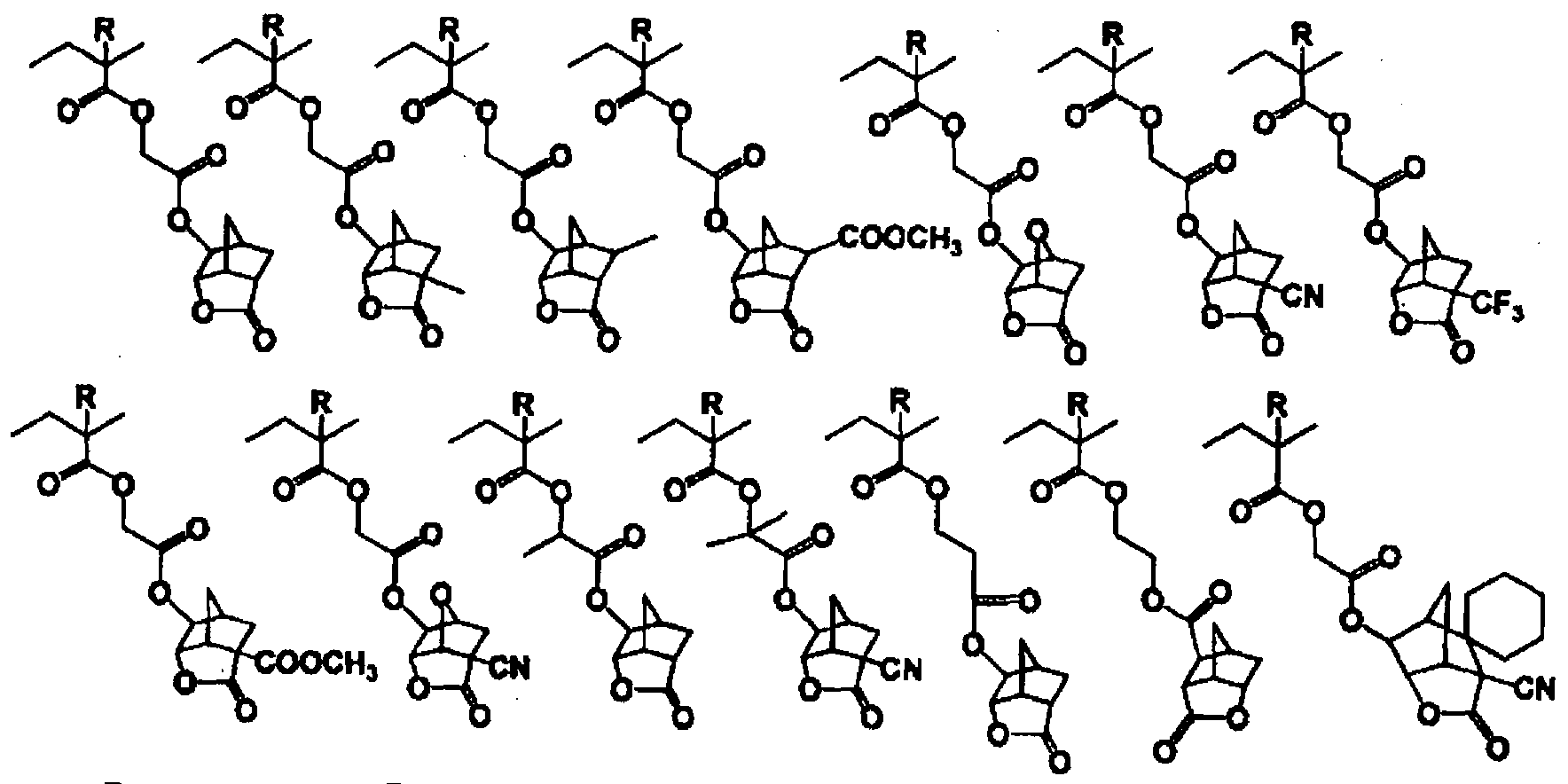

[0291] The content of the repeating unit represented by the general formula (III), when a plural kinds of repeating units are included, they are summed up, so that the content thereof is preferably 15 to 60% by mole, more preferably 20 to 60% by mole, and still more preferably 30 to 50% by mole based on all repreating units in the resin (B).
[0292] The resin (B) may include not only the unit represented by the general formula (III) but also the repeating unit having a lactone structure or a sultone structure described above.
[0293] In addition to the specific examples shown above, specific examples of the repeating
unit having a lactone group or a sultone group are as follows, but the present invention limited thereto.
In formula, Rx represents H, CH3, CH2OH, or CF3


[0294] Particularly preferred examples of the repeating units in the above-described specific examples include the repeating units below. The pattern profile and the density dependence thereof are improved by selecting an appropriate lactone group or sultone group.

[0295] The repeating units having a lactone group or sultone group usually have an optical isomer, but any optical isomer may be used. One optical isomer may be used alone or a mixture of a plurality of optical isomers may be used. In a case of mainly using one optical isomer, the optical purity (ee) thereof is preferably 90% or more, and more preferably 95% or
55 - ■* · ·■ ·■ ,. . more.
[0296] The content of the repeating unit having a sultone structure or a lactone structure other than the repeating units represented by the general formula (III), when plural kinds of repeating units are included, they are all summed up, so that the content is preferably 15 to 60% by mole, more preferably 20 to 50% by mole, and still more preferably 30 to 50% by mole based on the the repeating units in the resin.
[0297] Two kinds or more lactone or sultone repeating units which are selected from the general formula (III) are used together in order to increase the effects of the present invention. When they are used together, it is preferable that two kinds or more be selected from the lactone or the sultone repeating unit in which n is 1 and then used in the general formula (III).
[0298] The resin (B) preferably includes a repeating unit containing a hydroxyl group or a cyano group other than those in the general formulae (AI) and (III) so as to improve adhesion to a substrate and an affinity for a developer. The repeating group having a hydroxyl group or a cyano group is preferably a repeating group having an alicyclic hydrocarbon structure substituted with a cyano group or a hydroxyl group, and preferably does not have an acid-decomposable group. The alicyclic hydrocarbon structure in the alicyclic hydrocarbon structure substituted with a hydroxyl group or a cyano group is preferably an adamantyl group, a diamantyl group, or a norbornane group. The alicyclic hydrocarbon structure substituted with a hydroxyl group or a cyano group is preferably a partial structure represented by the general formulae (Vila) to (Vlld) as follows:

( i l a ) (V I I b ) (V I I c ) (V I I d )
[0299] In the general formulae (Vila) to (VIIc),
R2c to R4C each independently represent a hydrogen atom, a hydroxyl group, or a cyano group. However, at least one of R2c to R4C represents a hydroxyl group or a cyano group. One or two members of R c to R4C is preferably a hydroxyl group and the remaining ones are hydrogen atoms. A structure where one or two members of R2c to R^ are a hydroxyl group with the remaining ones being a hydrogen atom is preferred. In the general formula (Vila), it is more preferable that two members of R2c to tc be hydroxyl groups and the
remaining ones be hydrogen atoms.
[0300] Examples of the repeating units having a partial structure represented by the general formulae (Vila) to (Vlld) include repeating units represented by the following general formulae (Alia) to (Alld).

[0301] In the general formulae (Alia) to (Alld),
Ric represents a hydrogen atom, a methyl group, a trifluoro methyl group, or a hydroxymethyl group.
[0302] R2c to R4C have the same definitions as R2c to R4C in the general formulae (Vila) to (VIIc).
[0303] The content of the repeating unit having a hydroxyl group or a cyano group is preferably 5 to 40% by mole, more preferably 5 to 30% by mole, and still more preferably 10 to 25% by mole based on all the repeating units in the resin (B).
[0304] Specific examples of the repeating unit having a hydroxyl group or a cyano group are shown below, but the present invention is not limited thereto.

[0305] The resin (B) used in the actinic ray-sensitive or radiation-sensitive resin composition
of the present invention may contain repeating units having an alkali- soluble group. Examples of the alkali- soluble group include a carboxyl group, a sulfonamide group, a sulfonylimide group, a bissulfonylimide group, and an aliphatic alcohol substituted with an electron-withdrawing group at the cc-position (for example, a hexafluoroisopropanol group), the alkali- soluble group preferably include repeating units having a carboxyl group. By virtue of containing repeating units having an alkali-soluble group, the resolution increases in the usage of forming contact holes. As for the repeating units having an alkali- soluble group, all of a repeating unit where an alkali-soluble group is directly bonded to the main chain of the resin, such as a repeating unit of an acrylic acid or methacrylic acid, a repeating unit where an alkali-soluble group is bonded to the main chain of the resin through a linking group, and a repeating unit where an alkali-soluble group is introduced into the polymer chain terminal by using a polymerization initiator or a chain transfer agent containing an alkali-soluble group during the polymerization, are preferred. The linking group may have a monocyclic or polycyclic cyclic hydrocarbon structure. In particular, a repeating unit of an acrylic acid or a methacrylic acid is preferred.
[0306] The content of the repeating unit having an alkali-soluble group is preferably 0 to 20% by mole, more preferably 3 to 15% by mole, and still more preferably 5 to 10% by mole based on all the repeating units of the resin (B).
[0307] Specific examples of the repeating units having an alkali- soluble group are shown below, but the present invention is not limited thereto.
[0308] In specific examples, Rx represents H, CH3, CH2OH, or CF3.

[0309] The resin (B) of the present invention may further contain a repeating unit having an alicyclic hydrocarbon structure free from a polar group (for example, an alkali- soluble group, a hydroxy! group, and a cyano group) and not exhibiting acid decomposahility. Examples of such a repeating unit include repeating units represented by the general formula (IV).

[0310] In the general formula (IV), R5 represents a hydrocarbon group having at least one cyclic structure and having no polar group.
[0311] Ra represents a hydrogen atom, an alkyl group or a -CH2-0-Ra2 group. In the formula, Ra2 represents a hydrogen atom, an alkyl group, or an acyl group. Ra is preferably a hydrogen atom, a methyl group, a hydroxymethyl group, or a trifluoromethyl group, and more preferably a hydrogen atom or a methyl group.
[0312] The cyclic structure included in R5 includes a monocyclic hydrocarbon group and a polycyclic hydrocarbon group. Examples of the monocyclic hydrocarbon group include a cycloalkyl group having 3 to 12 carbon atoms, such as a cyclopentyl group, a cyclohexyl group, a cycloheptyl group, and a cyclooctyl group, and a cycloalkenyl group having 3 to 12 carbon atoms, such as a cyclohexenyl group. The monocyclic hydrocarbon group is preferably a monocyclic hydrocarbon group having 3 to 7 carbon atoms, and more preferably a cyclopentyl group or a cyclohexyl group.
[0313] The polycyclic hydrocarbon group includes a ring system hydrocarbon group and a crosslinked cyclic hydrocarbon group. Examples of the ring system hydrocarbon group include a bicyclohexyl group and a perhydronaphthalenyl group. Examples of the crosslinked cyclic hydrocarbon group include a bicyclic hydrocarbon group such as a pinane ring, a bornane ring, a norpinane ring, a norbornane ring, and a bicyclooctane ring (for example, a bicyclo[2.2.2]octane ring and a bicyclo[3.2.1]octane ring), a tricyclic hydrocarbon group such as a homobredane ring, an adamantane ring, a tricyclo[5.2.1.02'6]decane ring, and a tricyclo[4.3.1.12,5]undecane ring, and a tetracyclic hydrocarbon ring such as a tetracyclo[4.4.0.12'5. l7'10]dodecane ring and a perhydro-l,4-methano-5,8-methanonaphthalene ring. The crosslinked cyclic hydrocarbon ring also includes a condensed cyclic hydrocarbon ring, for example, a condensed ring formed by condensing a plurality of 5- to 8-membered cycloalkane rings, such as a perhydronaphthalene (decalin) ring, a perhydro anthracene ring, a perhydrophenanthrene ring, a perhydroacenaphthene ring, a perhydro fluorene ring, a perhydro indene ring, and a perhydrophenalene ring.
[0314] Preferred examples of the crosslinked cyclic hydrocarbon ring include a norbornyl
group, an adamantyl group, a bicyclooctanyl group, and a tricyclo[5.2.1.02'6]decanyl group. More preferred examples of the crosslinked cyclic hydrocarbon ring include a norbornyl group and an adamantyl group.
[0315] The alicyclic hydrocarbon group may have a substituent, and preferred examples of the substituent include a halogen atom, an alkyl group, a hydroxyl group substituted with a hydrogen atom, and an amino group substituted with a hydrogen atom. Preferred examples of the halogen atom include a bromine atom, a chlorine atom, and a fluorine atom, and preferred examples of the alkyl group include a methyl group, an ethyl group, a butyl group, and a t-butyl group. This alkyl group may further have a substituent, and examples of the substituent that the alkyl group may further have include a halogen atom, an alkyl group, a hydroxyl group substituted with a hydrogen atom, and an amino group substituted with a hydrogen atom.
[0316] Examples of the group substituted with a hydrogen atom include an alkyl group, a cycloalkyl group, an aralkyl group, a substituted methyl group, a substituted ethyl group, an alkoxycarbonyl group, and an aralkyloxycarbonyl group. Preferred examples of the alkyl group include an alkyl group having 1 to 4 carbon atoms; preferred examples of the substituted methyl group include a methoxymethyl group, a methoxythiomethyl group, a benzyloxymethyl group, a t-butoxymethyl group, and a 2-methoxyethoxymethyl group; preferred examples of the substituted ethyl group include a 1-ethoxyethyl group and a 1 -methyl- 1-methoxyethyl group; preferred examples of the acyl group include an aliphatic acyl group having 1 to 6 carbon atoms, such as a formyl group, an acetyl group, a propionyl group, a butyryl group, an isobutyryl group, a valeryl group, and a pivaloyl group; and examples of the alkoxycarbonyl group include an alkoxycarbonyl group having 1 to 4 carbon atoms.
[0317] The resin (B) may or may not contain repeating units having an alicyclic hydrocarbon structure free from a polar group and not exhibiting acid decomposability, but in the case where it contains the repeating units, the content of the repeating units is preferably from 1 to 40% by mole, and more preferably from 2 to 20% by mole, based on all the repeating units in the resin (B).
[0318] Specific examples of the repeating units having an alicyclic hydrocarbon structure free from a polar group and not exhibiting acid decomposability are shown below, but the present invention is not limited thereto. In the formulae, Ra represents H, CH3, CH2OH, or CF3.

[0319] The resin (Β) used in the composition of the present invention may contain, in addition to the above-described repeating structural units, various repeating structural units for the purpose of controlling the dry etching resistance, suitability for standard developer, adhesion to a substrate, resist profile, and characteristics that are generally required for a resist, such as resolution, heat resistance, and sensitivity.
[0320] Examples of such a repeating structural unit include, but are not limited to, repeating structural units corresponding to the monomers described below.
[0321] The use of such repeating structural units enables the fine adjustment of the performance that is required for the resin used in the composition of the present invention, particularly (1) solubility in a coating solvent, (2) a film forming property (glass transition point), (3) alkaline developability, (4) film loss (selection of hydrophilic, hydrophobic, or alkali-soluble groups), (5) adhesion of unexposed area to a substrate, (6) dry etching resistance, and the like.
[0322] Examples of the monomer include a compound having one addition-polymerizable unsaturated bond selected from acrylic acid esters, methacrylic acid esters, acrylamides, methacrylamides, allyl compounds, vinyl ethers, and vinyl esters.
[0323] In addition, an addition-polymerizable unsaturated compound that is copolymerizable with the monomers corresponding to the above-described various repeating structural units may be copolymerized.
[0324] In the resin (B) used in the composition of the present invention, the molar ratio of respective repeating structural units included in the resin (B) is appropriately set to control the dry etching resistance of a resist, suitability for a standard developer, adhesion to a substrate, resist profile, and performance that is generally required for a resist, such as resolution, heat resistance, and sensitivity.
[0325] When the composition of the present invention is one for ArF exposure, it is preferable for the resin (B) used in the composition of the present invention to have substantially no aromatic group from the viewpoint of transparency to ArF light. More specifically, in all repeating units of the resin (B), the content of the aromatic group-containing repeating units is preferably 5% by mole or less, more preferably 3% by mole or less, and ideally 0% by mole, based on all the repeating units, that is, still more preferably free from the aromatic group-containing repeating units. The resin (B) preferably has a monocyclic or polycyclic alicyclic hydrocarbon structure.
[0326] Furthermore, the resin (B) preferably has neither a fluorine atom nor a silicon atom from the viewpoint of compatibility with a hydrophobic resin (HR) as described below.
[0327] The resin (B) used in the composition of the present invention is preferably a resin in which all the repeating units consist of (meth) acrylate-based repeating units. In this case, use can be made of any of a resin in which all the repeating units consist of methacrylate-based repeating units, a resin in which all the repeating units consist of acrylate-based repeating units and a resin in which all the repeating units consist of methacrylate-based repeating units and acrylate-based repeating units. However, it is preferable for the acrylate-based repeating units to account for 50% by mole or less of all the repeating units. In addition, a copolymerized polymer containing 20 to 50% by mole of (meth) acrylate-based repeating units having an acid-decomposable group, 20 to 50% by mole of (meth) acrylate-based repeating units having a lactone group, 5 to 30% by mole of (meth) acrylate-based repeating units having an alicyclic hydrocarbon structure substituted with a hydroxyl group or a cyano group, and 0 to 20% by mole of another (meth) acrylate-based repeating units is also preferred.
[0328] In the case where the composition of the present invention is irradiated with a KrF excimer laser, an electron beam, an X ray, and a high energy light beams (EUV or the like) with a wavelength of 50 nm or less, the resin (B) preferably further includes a hydroxystylene-based repeating unit, and more preferably includes a hydroxystylene-based repreating unit, a hydroxystylene-based repeating unit protected by an acid-decomposable group, and an acid-decomposable repeating unit such as (meth)acrylic acid tertiary alkyl ester.
[0329] Preferred examples of the repeating unit having a hydroxystylene-based acid-decomposable group include a repeating unit composed of t-butoxycarbonyloxystylene, 1-alkoxyethoxystylene, and (meth)acrylic acid tertiary alkyl ester, and a repeating unit composed of 2-alkyl-2-adamantyl (meth)acrylate and
dialkyl(l-adamantyl)methyl(meth)acrylate is more preferred.
[0330] The resin (B) in the present invention can be synthesized by conventional techniques (for example, radical polymerization). Examples of the general synthesis method include a batch polymerization method of dissolving monomer species and an initiator in a solvent and heating the solution, thereby effecting the polymerization, and a dropping polymerization method of adding dropwise a solution containing monomer species and an initiator to a heated solvent over 1 to 10 hours. The dropping polymerization method is preferred. Examples of the reaction solvent include ethers such as tetrahydrofuran, 1,4-dioxane, and diisopropyl ether; ketones such as methyl ethyl ketone and methyl isobutyl ketone; ester solvents such as ethyl acetate; amide solvents such as dimethylformamide and dimethylacetamide; and solvents capable of dissolving the composition of the present invention, such as propylene glycol monomethyl ether acetate, propylene glycol monomethyl ether, and cyclohexanone, as described below. It is preferable to perform the polymerization with the use of the same solvent as employed in the actinic ray-sensitive or radiation-sensitive resin composition of the present invention. This could inhibit generation of particles during storage.
[0331] The polymerization reaction is preferably carried out in an atmosphere of inert gas, such as nitrogen or argon. The polymerization is initiated by the use of a commercially available radical initiator (azo initiator, peroxide, etc.) as a polymerization initiator. Among the radical initiators, an azo initiator is preferred. An azo initiator having an ester group, a cyano group or a carboxyl group is especially preferred. Preferred examples of the initiator include azobisisobutyronitrile, azobisdimethylvaleronitrile, and dimethyl 2,2'-azobis(2-methylpropionate). According to necessity, a supplementation of initiator or divided addition thereof may be effected. After the completion of the reaction, the reaction mixture is poured into a solvent. The desired polymer is recovered by a method for powder or solid recovery, or the like. The concentration during the reaction is in the range of 5 to 50% by mass, and preferably 10 to 30% by mass. The reaction temperature is generally in the range of 10°C to 150°C, preferably 30°C to 120°C, and more preferably 60°C to 100°C.
[0332] The weight average molecular weight of the resin (B) of the present invention in terms of polystyrene as measured by GPC is preferably in the range of 1,000 to 200,000, more preferably 2,000 to 20,000, still more preferably 3,000 to 15,000, and particularly preferably 3,000 to 11,000. The regulation of the weight average molecular weight to 1,000 to 200,000 would prevent deterioration of heat resistance and dry etching resistance and also prevent deterioration of developability and increase of viscosity, thereby preventing deterioration of a
film forming property.
[0333] The dispersity (molecular weight distribution, Mw/Mn) is usually from 1.0 to 3.0, preferably from 1.0 to 2.6, more preferably from 1.0 to 2.0, and particularly preferably from 1.4 to 2.0. As the molecular weight distribution is smaller, the resolution and resist shape are superior, the side wall of the resist pattern is smoother, and the roughness is more improved.
[0334] In the present specification, the weight average molecular weight (Mw) and the number average molecular weight (Mn) of the resin (B) may be calculated by using, for example, an HLC-8120 (manufactured by Tosoh Corporation) and using a TSK gel Multipore HXL-M column (manufactured by Tosoh Corporation, 7.8 mm IDD 30.0 cm), and THF (tetrahydrofuran) as an eluent.
[0335] The content of the entire composition of the resin (B) in the present invention is preferably 30 to 99% by mass and more preferably 55 to 95% by mass in the total solid content.
[0336] As for the resin of the present invention, one kind of a resin may be used or a plural kinds of resins may be used in combination.
[0337] [3] Basic compound
[0338] The actinic ray-sensitive or radiation-sensitive resin composition of the present invention preferably includes a basic compound in order to reduce the variation in performance during the time from the exposure to the heating.
[0339] Examples of the basic compound preferably include a compound having a structure represented by the general formulae (A) to (E).

[0340] In the general formulae (A) to (E),
R , R , and R may be the same as or different from each other, represent a hydrogen atom, an alkyl group (preferably having 1 to 20 carbon atoms), a cycloalkyl group (preferably having 3 to 20 carbon atoms), or an aryl group (having 6 to 20 carbon atoms), and
R and R may be linked to each other to form a ring.
[0341] R203, R204, R205, and R206 may be the same as or different from each other, and represent an alkyl group having 1 to 20 carbon atoms.
[0342] The alkyl group is preferably an aniinoalkyl group having 1 to 20 carbon atoms, a
hydro xyalkyl group having 1 to 20 carbon atoms, or a cyanoalkyl group having 1 to 20 carbon- atoms as an alkyl group having a substituent.
[0343] The alkyl group in the general formulae (A) to (E) is more preferably unsubstituted.
[0344] Preferred examples of the compound include guanidine, aminopirrolidine, pyrazole, pyrazolone, piperazine, aminomorpholine, aminoalkylmorpholine, and piperidine, more preferred examples of the compound include a compound having an imidazole structure, a diazabicyclo structure, an onium hydroxide structure, an onium carboxylate structure, a trialkyl amino structure, an aniline structure, or a pyridine structure; an alkyl amino derivative having a hydroxyl group and/or an ether bond; an aniline derivative having a hydroxyl group and/or an ether bond.
[0345] Examples of the compound having an imidazole structure include imidazole, 2,4,5-triphenylimidazole, benzimidazole, and 2-phenylbenzo imidazole. Examples of the compound having a diazabicyclo structure include l ,4-diazabicyclo[2,2,2]octane, l,5-diazabicyclo[4,3,0]nona-5-ene, and l,8-diazabicyclo[5,4,0]undeca-7-ene. Examples of the compound having an onium hydroxide structure include tetrabutyl ammonium hydroxide, triarylsulfonium hydroxide, phenacylsulfonium hydroxide, sulfonium hydroxide having a 2-oxyalkyl group, the specific examples thereof include triphenylsulfonium hydroxide, tris(t-butylphenyl)sulfonium hydroxide, bis(t-butylphenyl)iodonium hydroxide, a phenacylthiophenium hydroxide, and 2-oxopropylthiophenium hydroxide. Examples of the compound having an onium carboxylate structure, in which the anionic moiety of the compound having an onium hydroxide structure is carboxlated, include acetate, adamantane-1 -carboxylate, and perfluoroalkylcarboxylate. Examples of the compound having trialkyl amino structure include tri(n-butyl)amine, and tri(n-octyl)amin. Examples of the aniline compound include 2,6-diisopropyl aniline, Ν,Ν-dimethyl aniline, N,N-dibutyl aniline, and Ν,Ν-dihexyl aniline. Examples of the alkyl amine derivative having a hydroxyl group and/or ether bond include ethanol amine, diethanol amine, triethanol amine, N-phenyldiethanol amine, and tris(methoxyethoxyethyl)amine. Examples of the ailine derivative having a hydroxyl group and/or an ether bond include N,N-bis(hydroxyethyl)aniline.
[0346] Preferred examples of the basic compound further include an amine compound having a phenoxy group, an ammonium salt compound having a phenoxy group, an amine compound having a sulfonic acid ester group, and an ammonium salt compound having a sulfonic acid ester group.
[0347] The amine compound may use a primary, secondary, and tertiary amine compound, and is preferably an amine compound in which at least one alkyl group is bonded to a nitrogen atom. Further, the amine compound is more preferably a tertiary amine compound. In the amine compound, when at least one alkyl group (preferably having 1 to 20 carbon atoms) is bonded to a nitrogen atom, a cycloalkyl group (preferably having 3 to 20 carbon atoms) or an aryl group (preferably having 6 to 12 carbon atoms) other than an alkyl group may be bonded to a nitrogen atom. The amine compound preferably contains an oxygen atom and an oxyalkylene group formed in the alkyl chain. The number of the oxyalkylenegroup is 1 or more in a molecule, preferably 3 to 9, and more preferably 4 to 6. Among the oxyalkylene group, an oxyethylene group (-CH2CH20-) or an oxypropylene group (-CH(CH3)CH20- or -CH2CH2CH20) is preferred, and an oxyethylene group is more preferred.
[0348] The ammonium salt compound can use a primary, secondary, tertiary, and quaternary ammonium salt compound, and is preferably an ammonium salt compound in which at least one alkyl group is bonded to a nitrogen atom. In the ammonium salt compound, when at least one alkyl group (preferably having 1 to 20 carbon atoms) is bonded to a nitrogen atom, a cycloalkyl group (preferably having 3 to 20 carbon atoms) or an aryl group (preferably having 6 to 12 carbon atoms) other than an alkyl group may be bonded to a nitrogen atom. The ammonium salt compound preferably contains an oxygen atom and an oxyalkylene group formed in the alkyl chain. The number of the oxyalkylene group is 1 or more in a molecule, preferably 3 to 9, and more preferably 4 to 6. Among the oxyalkylene group, an oxyethylene group (-CH2CH20-) or an oxypropylene group (-CH(CH3)CH20- or -CH2CH2CH20-) is preferred, and an oxyethylene group is more preferred.
[0349] Examples of the anion of the ammonium salt compound include a halogen atom, sulfonate, borate, and phosphate, among these, a halogen atom and sulfonate are preferred. The halogen atom is particularly preferably chloride, bromide, and iodide, and the sulfonate is particularly preferably an orgarnic sulfonate having 1 to 20 carbon atoms. Examples of the organic sulfonate include an alkylsulfonate having 1 to 20 carbon atoms and arylsulfonate. The alkyl group of alkylsulfonate may include a substituent, and examples of the substituent include florine, chlorine, bromine, an alkoxy group, an acyl group, and an aryl group. Specific examples of the alkylsulfonate include methansulfonate, ethansulfonate, butanesulfonate, hexanesulfonate, octanesulfonate, benzylsulfonate, trifluoromethansulfonate, pentafluoroethansulfonate, and nonafluorobutanesulfonate. Examples of the aryl group of arylsulfonate include a benzene ring, a naphthalene ring, and an anthracene ring. A benzene
ring, a naphthalene ring, an anthracene ring may include a substituent, and the substituent is preferably a linear or branched alkyl group having 1 to 6 carbon atoms, and a cycloalkyl group having 3 to 6 carbon atoms. Specific examples of the linear or branched alkyl group and the cycloalkyl group include methyl, ethyl, n-propyl, isopropyl, n-butyl, i-butyl, t-butyl, n-hexyl, and cyclohexyl. Examples of other substituents include an alcoxy group having 1 to 6 carbon atoms, a halogen atom, cyano, nitro, an acyl group, and an acyloxy group.
[0350] The amine compound having a phenoxy group, the ammonium salt compound having a phenoxy group is a compound having a nitrogen atom of an alkyl group of the amine compound or the ammonium compound and a phenoxy group at an opposite side terminal thereof. The phenoxy group may include a substituent. The substituent of the phenoxy group include an alkyl group, an alkoxy group, a halogen atom, a cyano group, a nitro group, a carboxyl group, a carboxylic acid ester group, a sulfonic acid ester group, an aryl group, an aralkyl group, an acyloxy group, and an aryloxy group. The substitution position of the substituent may be any one of 2 to 6. The number of the substituents may be in the range of 1 to 5.
[0351] At least one oxyalkylene group is preferably included between a phenoxy group and a nitrogen group. The number of the oxyalkylene group is 1 or more in a molecule, preferably 3 to 9, and more preferably 4 to 6. Among the oxyalkylene groups, an oxyethylene group (-CH2CH20-) or an oxypropylene group (-CH(CH3)CH20 or -CH2CH2CH20-) is preferred, and an oxyethylene group is more preferred.
[0352] The sulfonic acid ester group in the amine compound containing a sulfonic acid ester group and the ammonium salt compound containing a sulfonic acid ester group may be any one of alkylsulfonic acid ester, cycloalkyl group sulfonic acid ester, and arylsulfonic acid ester. When the sulfonic acid ester group is alkylsulfonic acid ester, the alkyl group preferably has 1 to 20 carbon atoms, and when the sulfonic acid ester group is eye lo alkylsulfonic acid ester, the cycloalkyl group preferably has 3 to 20 carbon atoms, and when the sulfonic acid ester group is arylsulfonic acid ester, the aryl group preferably has 6 to 12 carbon atoms. The alkylsulfonic acid ester, the cycloalkylsulfonic acid ester, and the arylsulfonic acid ester may have a substituent, the substituent is preferably a halgen atom, a cyano group, a nitro group, a carboxyl group, a carboxylic acid ester group, or a sulfonic acid ester group.
[0353] At least one oxyalkylene group is preferably included between a sulfonic acid ester group and a nitrogen atom. The number of the oxyalkylene group is 1 or more in a molecule, preferably 3 to 9, and more preferably 4 to 6. Among the oxyalkylene groups, an
oxyethylene group (-CH2CH2O-) or an oxypropylene group (-CH(CH3)CH20 or -CH2CH2CH20) is preferred, and an oxyethylene group is more preferred.
[0354 Further, the compound below is preferable as a basic compound.

«0-4)
[0355] As the basic compound, the compounds described in the paragraphs [0180] to [0225] of JP2011-22560A, the paragraphs [0218] to [0219] of JP2012-137735A, and the paragraphs [0416] to [0438] of WO2011/158687A1 can be used in addition to the compounds described above. The basic compound may be a basic compound or an ammonium salt compound which decrease the basicity by irradiation with the actinic rays or radiations.
[0356] The basic compounds may be used alone or in combination of 2 or more thereof.
[0357] The composition of the present invention may or may not contain a basic compound. When the composition may contain a basic compound, the content ratio of the basic compound is generally 0.001 to 10% by mass, and preferably 0.01 to 5% by mass based on the the solid content of the actinic ray-sensitive or radiation-sensitive resin composition.
[0358] The usage ratio of the basic compound to the acid generating agent (including the acid generating agent (A')) in the composition, it is preferable that the acid generating agent/the basic compound (molar ratio), is 2.5 to 300. That is, the molar ratio is preferably 2.5 or more from the viewpoint of sensitivity and resolution, and also preferably 300 or less from the viewpoint of suppressing the decrease of resolution due to the thickening of a resist pattern during the time from the exposure to the heating process. The molar ratio of the acid generating agent/the basic compound is preferably 5.0 to 200, and more preferably 7.0 to 150.
[0359] In the molar ratio of the basic comound to the low molecular weight compound (D) shown the below item [4], the molar ratio of the low molecular weight compound (D)/the basic compound is preferably 100/0 to 10/90, more preferably 100/0 to 30/70, and particularly preferably 100/0 to 50/50.
[0360] Moreover, these basic compounds include the nitrogen atom (C) described below, and does not include a low molecular weight compound containing a group that disorbs by an action of an acid.
[0361] Further, the relatively low acidic onium salt with respect to the acid generating agent
can be used as the basic compound.
[0362] When the acid generating agent and the onium salt which generates relatively weak acids with respect to the acids generated from an acid generating agent are mixed together, if the acids generated from the acid generating agent by irradiation with the actinic rays or radiations collide with the onium salt containing an unreacted weak acidic anion, the weak acids are discharged by exchanging salts to generate the onium salt containing a strong acidic anion. In this process, since the strong acids are exchanged for the weak acids with lower catalytic capacity, acids are apparently deactivated, so that the acid diffusion can be suppressed.
[0363] The onium salt with relatively low acids with respect to the acid generating agent is preferably a compound represented by the general formulae (dl-1) to (dl-3).

( d l - 1 ) ( d l - 2 ) ( d l - 3 )
[0364] Wherein R51 is a hydrocarbon group that may have a substituent, Z2c is a hydrocarbon group having 1 to 30 carbon atoms that may have a substituent (however, a fluorine atom is not substituted with a carbon adjacent to S). R52 is an organic group, Y3 is a linear, branched, or cyclic alkylene group or an arylene group, Rf is a hydrocarbon group containing a fluorine atom, and M+'s each independently represent a sulfonium cation or an iodonium cation.
[0365] Preferred examples of the sulfonium cation or iodonium cation represented by M+ include the sulfonium cation exemplified with the acid generating agent (ZI) and the iodonium cation exemplified with the acid generating agent (ZII).
[0366] Preferred examples of the anionic moiety of the compound represented by the general formula (dl-1) include a structure described in the paragraph [0198] of JP 2012-242799 A.
[0367] Preferred examples of the anionic moiety of the compound represented by the general formula (dl-2) include a structure described in the paragraph [0201] of JP 2012-242799 A.
[0368] Preferred examples of the anionic moiety of the compound represented by the general formula (dl-3) include a structure described in the paragraphs [0209] and [0210] of JP 2012-242799 A.
[0369] The onium salt with relatively weak acids with respect to the acid generating agent include a cationic moiety and an anionic moiety in the same molecule, and may be a compound in which the cationic moiety and the anionic moiety are linked to each other by
covalent bonding.
[0370] Such a compound is preferably a compound represented by any one of the general formulae (C- 1) to (C-3).

(C-1) (C-2) (C-3)
[0371] In the general formulae (C- 1) to (C-3),
Ri, R2, and R3 each independently represent a substituent having 1 or more carbon atoms.
[0372] Li represents a single bond or a divalent linking group linking an anionic moiety to a cationic moiety.
[0373] -X" represents an anionic moiety selected from -COO", -SO3", -S02 ", and -N -R-t. R4 represents a monovalent substituent having a carbonyl group: -C(=0)-, a sulfonyl group: -S(=0)2-, and a sulfinyl group: -S(=0)- in a portion linked to an adjacent N atoms.
[0374] Ri, R2, R3, R4, and Li may form a ring structure by being linked to each other. In addition, in (C-3), two members of Ri to R3 may be linked to each other to form a double bond with the N atom.
[0375] Examples of the substituent having 1 or more carbon atoms in RI to R3 include an alkyl group, a cycloalkyl group, an aryl group, an alkyloxycarbonyl group, a cycloalkyloxycarbonyl group, an aryloxycarbonyl group, an alkylaminocarbonyl group, a cycloalkylaminocarbonyl group, and an alkylaminocarbonyl group. Among these, an alkyl group, a cycloalkyl group, and an aryl group are preferred.
[0376] Examples of Li as a divalent linking group include a linear or branched alkylene group, a cycloalkyl group, an arylene group, a carbonyl group, an ether bond, an ester bond, an amide bond, a urethane bond, a urea bond, and a group formed by combining 2 or more thereof. LI is preferably an alkylene group, an aryl group, an ether bond, an ester bond, or a group formed by combining two or more thereof.
[0377] Preferred examples of the compound represented by the general formula (C- 1) may include a compound described in the paragraphs [0037] to [0039] of JP2013-6827 A and the paragraphs [0027] to [0029] of JP2013-8020A.
[0378] Preferred examples of the compound represented by the general formula (C-2) include a compound described in the paragraphs [0012] and [0013] of JP2012-189977A.
[0379] Preferred examples of the compound represented by the general formula (C-3) include a compound described in the paragraphs [0029] to [0031] of JP2012-252124 A.
[0380] The content of the onium salt which has relatively weak acids with respect to an acid generating agent is preferably 0.5 to 10.0% by mass, more preferably 0.5 to 8.0% by mass, and still more preferably 1.0 to 8.0% by mass based on the solid content of the composition.
[0381] [4] Low molecular weight compound containing nitrogen atom and containing group that disorbs by an action of an acid
[0382] The composition of the present invention may contain a low molecular weight compound (C) (hereinafter, also referred to as a "compound (C)") containing a nitrogen atom and a group that disorbs by an action of an acid.
[0383] The group that disorbs by an action of an acid is not particularly limited, but an acetal group, a carbonate group, a carbamate group, a tertiary ester group, a tertiary hydroxyl group, and a hemiaminal ether group are preferred, and a carbamate group and a hemiaminal ether group are particularly preferred.
[0384] The content of the compound (C) containing a nitrogen atom and a group that disorbs by an action of an acid is preferably 100 to 1000, more preferably 100 to 700, and particularly preferably 100 to 500.
[0385] As the compound (C), an amine derivative containing a group that disorbs by an action of an acid on a nitrogen atom is preferred.
[0386] The compound (C) may contain a carbamate group having a protecting group on a nitrogen atom. The protecting group constituting the carbamate group can be represented by the following general formula (d-1).

[0387] In the general formula (d-1),
Rb's each independently represent a hydrogen atom, an alkyl group (preferably having 1 to 10 carbon atoms), a cycloalkyl group (preferably having 3 to 30 carbon atoms), an aryl group (preferably 3 to 30 carbon atoms), an aralkyl group (preferably 1 to 10 carbon atoms), or an alcoxyalkyl group (preferably 1 to 10 carbon atoms). Rb's may be linked to each other to form a ring.
[0388] The alkyl group, the cycloalkyl group, the aryl group, or the aralkyl group represented
by Rb may be substituted with a functional group such as a hydroxyl group, a cyano group, an amino group, a pyrrolidino group, a piperidino group, a morpholino group, and an oxo group, an alkoxy group, or a halogen atom. This case comes under the alkoxyalkyl group represented by Rb.
[0389] Examples of the alkyl group, the cycloalkyl group, the aryl group, and the aralkyl group (these alkyl, cycloalkyl, and aryl aralkyl groups may be substituted with the above-described functional group, an alkoxy group, and a halogen atom) of the above Rb include a group derived from linear or branched alkane such as methane, ethane, propane, butane, pentane, hexane, heptane, octane, nonane, decane, undecane, and dodecane; a group in which the group derived from the alkane is substituted with one kind or more or one or more of a cycloalkyl group such as a cyclobutyl group, a cyclopentyl group, and a cyclohexyl group; a group derived from cycloalkane such as cyclobutane, cyclopentane, cyclohexane, cycloheptane, cyclooctane, norbornane, adamantane, and noradamantane; a group in which the group derived from the cycloalkane is substituted with one kind or more or one or more of a linear or branched alkyl group such as a methyl group, an ethyl group, an n-propyl group, an
1- propyl group, an n-butyl group, a 2-methylpropyl group, a 1-methylpropyl group, and a t-butyl group; a group derived from an aromatic compound such as benzene, naphthalene, and anthracene; a group in which the group derived from the aromatic compound is substituted with one kind or more or one or more of a linear or branched alkyl group such as a methyl group, an ethyl group, an n-propyl group, an i-propyl group, an n-butyl group, a
2- methylpropyl group, a 1-methylpropyl group, and a t-butyl group; a group derived from a heterocyclic compound such as pyrrolidine, piperidine, morpholine, tetrahydrofuran, tetrahydropyran, indole, indoline, quinoline, perhydroquinoline, indazole, and benzimidazole; a group in which the group derived from the heterocyclic compound is substituted with one kind or more or one or more of a group derived from a linear or branched alkyl group or an aromatic compound; a group in which a group derived from a linear or branched alkane and a group derived from cycloalkane are substituted with one kind or more or one or more of a group derived from an aromatic compound such as a phenyl group, a naphthyl group, and an anthracenyl group; and a group in which the substituent group is substituted with a functional group such as a hydroxyl group, a cyano group, an amino group, a pyrrolidino group, a piperidino group, a morpholino group, and an oxo group.
[0390] Rb is preferably a linear or branched alkyl group, a cycloalkyl group, or an aryl group, and more preferably a linear or branched alkyl group, or a cycloalkyl group.
[0391] Examples of the ring formed by the mutual linking of two Rb's include ¾n ialicyclic hydrocarbon group, an aromatic hydrocarbon group, a heterocyclic hydrocarbon group, and derivatives thereof.
[0392] Specific structures of the group represented by the general formula (d-1) will be shown below.

[0393] The compound (C) is particularly preferably one having a structure represented by the following general formula (6).

[0394] In the general formula (6), Ra represents a hydrogen atom, an alkyl group, a cycloalkyl group, an aryl group, or an aralkyl group. When 1 is 2, two Ra's may be the same as or
different from each other and may form a heterocyclic ring together with the nitrogen atom in the formula by linking mutually. The heterocyclic ring may contain a hetero atom other than the nitrogen atom in the formula.
[0395] Rb has the same definition as Rb in the general formula (d-1), and preferable examples thereof are also the same.
[0396] Here, 1 represents an integer of 0 to 2, m represents an integer of 1 to 3, and satisfies an equation of the form 1 + m = 3.
[0397] In the general formula (6), an alkyl group, a cycloalkyl group, an aryl group, and an aralkyl group as Ra may be substituted with the same group as those described above for the group which can be substituted with the alkyl group, the cycloalkyl group, the aryl group, and the aralkyl group as Rb.
[0398] Specific examples of the alkyl group, the cycloalkyl group, the aryl group, or the aralkyl group of the above Ra (the alkyl group, the cycloalkyl group, the aryl group, and the aralkyl group may be substituted with the above-described groups) include the same groups of the specific examples described above with respect to Rb.
[0399] Further, the number of carbon atoms of the heterocyclic ring formed by mutual linking of the above Ra's is preferably 20 or less, examples thereof include a group derived from the heterocyclic compound such as pyrrolidine, pyperidine, morpholine, 1,4,5,6-tetrahydropyrimidine, 1 ,2,3,4-tetrahydroquinoline, 1 ,2,3,6-tetrahydropyridine, homopiperazine, 4-azabenzimidazole,benzotriazole, 5-azabenzotriazole, lH-l,2,3-triazole, 1,4,7-triazacyclononane, tetrazole, 7-azaindole, indazole, benzimidazole, imidazo[l,2-a]pyridine,(l S,4S)-(+)-2,5-diazabicyclo[2.2.1]heptane,
l,5,7-triazabicyclo[4.4.0]dec-5-ene, indole, indoline, 1,2,3,4-tetrahydroquinoxaline, perhydroquinoline, 1,5,9-triazacyclododecane; and a group in which the group derived from the heterocyclic compound is substituted with one kine or more or one or more of a functional group such as a group derived from linear or branched alkane, a group derived from cycloalkane, a group derived from an aromatic compound, a group derived from a heterocyclic compound, a hydroxyl group, a cyano group, an amino group, a pirrolidino group, a pyperidino group, a morpholino group, and an oxo group.
[0400] Particularly preferred examples of the compound (C) in the present invention will be specifically shown below, but the present invention is not limited thereto.
 (D-33)

(D-49) (D-50) (D-51 ) (D-52)

(D-57) (D-58)
[0401] The compound represented by the general formula (6) can be synthesized according to JP2007-298569A, JP2009- 199021 A, or the like.
[0402] In the present invention, the low molecular weight compound (C) containing a group
that disorbs by an action of an acid on a nitrogen atom can be used alone or in combination of two or more threreof.
[0403] The content in the compound (C) in the actinic ray- sensitive or radiation- sensitive resin composition is preferably 0.001 to 20% by mass, more preferably 0.001 to 10% by mass, and still more preferably 0.01 to 5% by mass based on the total solid content of the composition.
[0404] [5] Hydrophobic Resin (HR)
[0405] The actinic ray-sensitive or radiation-sensitive resin composition of the present invention may contain a hydrophobic resin having at least either fluorine atoms or silicon atoms (hereinafter, also referred to as a "hydrophobic resin (HR)") particularly when the resin composition is applied to liquid immersion exposure. The hydrophobic resin (HR) is unevenly distributed at the film surface layer and when the liquid immersion medium is water, the static/dynamic contact angle on the resist film surface for water as well as the followability of a liquid for liquid immersion can be enhanced.
[0406] The hydrophobic resin (HR) is, as described above, unevenly distributed at the interface but unlike a surfactant, need not necessarily have a hydrophilic group in the molecule and may not contribute to uniform mixing of polar/nonpolar substances.
[0407] The hydrophobic resin typically contains fluorine atoms and/or silicon atoms. The fluorine atoms and/or silicon atoms in the hydrophobic resin (HR) may be included in the main chain of the resin or may be included in the side chain.
[0408] In the case where the hydrophobic resin contains fluorine atoms, the resin preferably contains, as a fluorine atom-containing partial structure, a fluorine atom-containing alkyl group, a fluorine atom-containing cycloalkyl group or a fluorine atom-containing aryl group.
[0409] The fluorine atom-containing alkyl group, preferably having 1 to 10 carbon atoms, and more preferably 1 to 4 carbon atoms, is a linear or branched alkyl group with at least one hydrogen atom substituted with a fluorine atom and may further have a substituent other than the fluorine atom.
[0410] The fluorine atom-containing cycloalkyl group is a monocyclic or polycyclic cycloalkyl group with at least one hydrogen atom substituted with a fluorine atom and may further have a substituent other than the fluorine atom.
[0411] The fluorine atom-containing aryl group is an aryl group with at least one hydrogen atom of the aryl group, such as a phenyl group and a naphthyl group, substituted with a fluorine atom, and may further have a substituent other than the fluorine atom.
[0412] Preferred examples of the fluorine atom-containing alkyl group, the fluorine
atom-containing cycloalkyl group and the fluorine atom-containing aryl group preferably include the groups represented by the following general formulae (F2) to (F4), but the present invention is not limited thereto.

(F2) (F3) (F4)
[0413] In the general formulae (F2) to (F4),
R57 to Ι½ each independently represent a hydrogen atom, a fluorine atom or an (linear or branched) alkyl group,provided that at least one of R57 to R^, at least one of ]½ to R( 4, and at least one of to R^s each independently represent a fluorine atom or an alkyl group (preferably having 1 to 4 carbon atoms) with at least one hydrogen atom substituted with a fluorine atom.
[0414] It is preferable that all of R57 to R6i and R65 to R67 be fluorine atoms. R<32, Ι½ and R^g are each preferably a fluoroalkyl group (preferably having 1 to 4 carbon atoms), and more preferably a perfluoroalkyl group having 1 to 4 carbon atoms. When I½ and Rg3 are perfluoro alkyl groups, R^ is preferably a hydrogen atom. R62 and R^3 may be linked to each other to form a ring.
[0415] Specific examples of the group represented by the general formula (F2) include a p- fluorophenyl group, a pentafluorophenyl group, and a 3,5-di(trifluoromethyl)phenyl group.
[0416] Specific examples of the group represented by the general formula (F3) include a trifluoro methyl group, a pentafluoropropyl group, a pentafluoroethyl group, a heptafluorobutyl group, a hexafluoroisopropyl group, a heptafluoroisopropyl group, a hexafluoro(2-methyl)isopropyl group, a nonafluorobutyl group, an octafluoroisobutyl group, a nonafluorohexyl group, a nonafluoro-t-butyl group, a perfluoroisopentyl group, a perfluorooctyl group, a perfluoro(trimethyl)hexyl group, a 2,2,3, 3-tetrafluorocyclobutyl group, and a perfluorocyclohexyl group. Among these, a hexafluoroisopropyl group, a heptafluoroisopropyl group, a hexafluoro(2-methyl)isopropyl group, an octafluoroisobutyl group, a nonafluoro-t-butyl group, and a perfluoroisopentyl group are preferred, and a hexafluoroisopropyl group and a heptafluoroisopropyl group are more preferred.
[0417] Specific examples of the group represented by the general formula (F4) include
-C(CF3)2OH, -C(C2F5)2OH, -C(CF3)(CH3)OH, and -CH(CF3)OH, with -C(CF3)2OH being preferred.
[0418] The fluorine atom-containing partial structure may be bonded directly to the main chain or may be bonded to the main chain through a group selected from the group consisting of an alkylene group, a phenylene group, an ether bond, a thioether bond, a carbonyl group, an ester bond, an amide bond, a urethane bond and a ureylene bond, or a group formed by the combination of two or more thereof.
[0419] Preferred examples of the repeating units having a fluorine atom are shown below.

( C— I a ) ( C - I b ) ( C — I c ) ( C - I d )
[0420] In the formulae (C-Ia) to (C-Id), Rio and Ru each independently represent a hydrogen atom, a fluorine atom, or an alkyl group. The alkyl group is preferably a linear or branched alkyl group having 1 to 4 carbon atoms and may have a substituent, and the alkyl group having a substituent includes, in particular, a fluorinated alkyl group.
[0421] W3 to W6 each independently represent an organic group having at least one or more fluorine atoms, and specifically includes the atomic groups of (F2) to (F4) above.
[0422] Other than these, the hydrophobic resin may contain a unit shown below as the repeating units having a fluorine atom.

(C-II) (C-III)
[0423] In the formulae (C-II) and (C-III), R4 to R7 each independently represent a hydrogen atom, a fluorine atom, or an alkyl group. The alkyl group is preferably a linear or branched alkyl group having 1 to 4 carbon atoms and may have a substituent, and the alkyl group having a substituent includes, in particular, a fluorinated alkyl group.
[0424] However, at least one of R4 to R7 represents a fluorine atom. R4 and R5, or R6 and R7
may form a ring.
[0425] W2 represents an organic group having at least one fluorine atomand specifically includes the atomic groups of (F2) to (F4) above.
[0426] L2 represents a single bond or a divalent linking group. The divalent linking group is a substituted or unsubstituted arylene group, a substituted or unsubstituted alkylene group, a substituted or unsubstituted cycloalkylene group, -0-, -S02-, -CO-, -N(R)- (wherein R represents a hydrogen atom or an alkyl group), - HS02-, or a divalent linking group formed by the combination of a plurality of these groups.
[0427] Q represents an alicyclic structure. The alicyclic structure may have a substituent and may be monocyclic or polycyclic, and in the case of a polycyclic structure, the structure may be a crosslinked structure. The monocyclic structure is preferably a cycloalkyl group having 3 to 8 carbon atoms, and examples thereof include a cyclopentyl group, a cyclohexyl group, a cyclobutyl group, and a cyclooctyl group. Examples of the polycyclic structure include a group containing a bicyclo, tricyclo or tetracyclo structure having 5 or more carbon atoms. A cycloalkyl group having 6 to 20 carbon atoms is preferred, and examples thereof include an adamantyl group, a norbornyl group, a dicyclopentyl group, a tricyclodecanyl group and a tetracyclododecyl group. Incidentally, at least one carbon atom in the cycloalkyl group may be substituted with a hetero atom such as an oxygen atom. In particular, Q is preferably a norbornyl group, a tricyclodecanyl group, a tetracyclododecyl group or the like.
[0428] The hydrophobic resin may contain a silicon atom.
[0429] The resin preferably has an alkylsilyl structure (preferably a trialkylsilyl group) or a cyclic siloxane structure as a silicon atom-containing partial structure.
[0430] Specific examples of the alkylsilyl structure and the cyclic siloxane structure include the groups represented by the following general formulae (CS-1) to (CS-3).

(CS-1) (CS-2) (CS-3)
[0431 ] In the general formulae (CS-1 ) to (CS-3),
Ri2 to R26 each independently represent a linear or branched alkyl group (preferably having 1 to 20 carbon atoms) or a cycloalkyl group (preferably having 3 to 20 carbon atoms), [0432] L3 to L5 each represent a single bond or a divalent linking group. The divalent linking group is a single group or a combination of two or more groups selected from the group consisting of an alkylene group, a phenylene group, an ether bond, a thioether bond, a carbonyl group, an ester bond, an amide bond, a urethane bond and a ureylene bond.
[0433] n represents an integer of 1 to 5. n is preferably an integer of 2 to 4.
[0434] The repeating units having at least eithera fluorine atom ora silicon atom are preferably (meth)acrylate-based repeating units.
[0435] Specific examples of the repeating units having at least either a fluorine atom or a silicon atom are shown below, but the present invention is not limited thereto. In specific examples, Xi represents a hydrogen atom, -CH3, -F or -CF3, and X2 represents -F or -CF3.


[0436] The hydrophobic resin preferably contains a repeating unit (b) having at least group selected from the group consisting of the following (x) to (z).
[0437] (x) an alkali-soluble group,
(y) a group that decomposes by an action of an alkaline developer to increase the solubility in an alkaline developer (hereinafter, also referred to as a "polarity converting group"),
and (z) a group that decomposes by an action of an acid to increase the solubility in an alkaline developer.
[0438] The repeating unit (b) includes the following kinds.
[0439] (b') repeating units having at least either fluorine atoms or silicon atoms and at least one group selected from the group consisting of (x) to (z) on one side chain,
(b*) repeating units having at least one group selected from the group consisting of (x) to (z) and having neither a fluorine atom nor a silicon atom,
and (b") repeating units having at least one group selected from the group consisting of (x) to (z) on one side chain and having at least either a fluorine atom or a silicon atom on a side chain different from the side chain above in the same repeating unit.
[0440] The hydrophobic resin more preferably contains the repeating unit (b') as the repeating unit (b). That is, the repeating unit (b) having at least one group selected from the group consisting of (x) to (z) more preferably contains at least either a fluorine atom or a silicon atom.
[0441] In the case where the hydrophobic resin contains the repeating unit (b*), the resin is preferably a copolymer with repeating units having at least either a fluorine atom or a silicon atom (a repeating unit different from the repeating units (b') and (b")). Also, in the repeating unit (b"), the side chain having at least one group selected from the group consisting of (x) to (z) and the side chain having at least either a fluorine atom or a silicon atom are preferably bonded to the same carbon atom in the main chain, that is, have a positional relation as in the following formula (Kl).
[0442] In the formula, Bl represents a partial structure having at least one group selected from the group consisting of (x) to (z), and B2 represents a partial structure having at least either a fluorine atom or a silicon atom.

[0443] The group selected from the group consisting of (x) to (z) is preferably (x) an alkali- soluble group or (y) a polarity converting group, and more preferably (y) a polarity
converting group.
[0444] Examples of the alkali- soluble group (x) include a phenolic hydroxyl group, a carboxylic acid group, a fluorinated alcohol group, a sulfonate group, a sulfonamide group, a sulfonylimide group, an (alkylsulfonyl)(alkylcarbonyl)methylene group, an (alkylsulfonyl)(alkylcarbonyl)imide group, a bis(alkylcarbonyl)methylene group, a bis(alkylcarbonyl)imide group, a bis(alkylsulfonyl)methylene group, a bis(alkylsulfonyl)imide group, a tris(alkylcarbonyl)methylene group, and a tris(alkylsulfonyl)methylene group.
[0445] Preferred alkali-soluble groups include a fluorinated alcohol group (preferably, a hexafluoroisopropanol group), a sulfonimide group, and a bis(carbonyl)methylene group.
[0446] Examples of the repeating unit (bx) having an alkali- soluble group (x) include a repeating unit where an alkali- soluble group is directly bonded to the main chain of the resin, such as a repeating unit by an acrylic acid or a methacrylic acid, and a repeating unit where an alkali-soluble group is bonded to the main chain of the resin through a linking group. Furthermore, an alkali-soluble group may be introduced into the polymer chain terminal by using an alkali-soluble group-containing polymerization initiator or a chain transfer agent at the polymerization. All of these cases are preferred.
[0447] In the case where the repeating unit (bx) is a repeating unit having at least either a fluorine atom or a silicon atom (that is, a repeating unit corresponding to the repeating unit (b') or (b")), examples of the fluorine atom-containing partial structure in the repeating unit (bx) are the same as those described for the repeating units having at least either the fluorine atom or the silicon atom and preferably include the groups represented by the general formulae (F2) to (F4). Also in this case, examples of the silicon atom-containing partial structure in the repeating unit (bx) are the same as those described for the repeating units having at least either the fluorine atom or the silicon atom and preferably include the groups represented by the general formulae (CS-1) to (CS-3).
[0448] The content of the repeating unit (bx) having an alkali- soluble group (x) is preferably from 1 to 50% by mole, more preferably from 3 to 35% by mole, and still more preferably from 5 to 20% by mole, based on all repeating units in the hydrophobic resin.
[0449] Specific examples of the repeating unit (bx) having an alkali-soluble group (x) are shown below, but the present invention is not limited thereto. Further, in specific examples, Xi represents a hydrogen atom, CH3, -F, or -CF3.
In formula, Rx represents H, CH3, CF3, or CH2OH

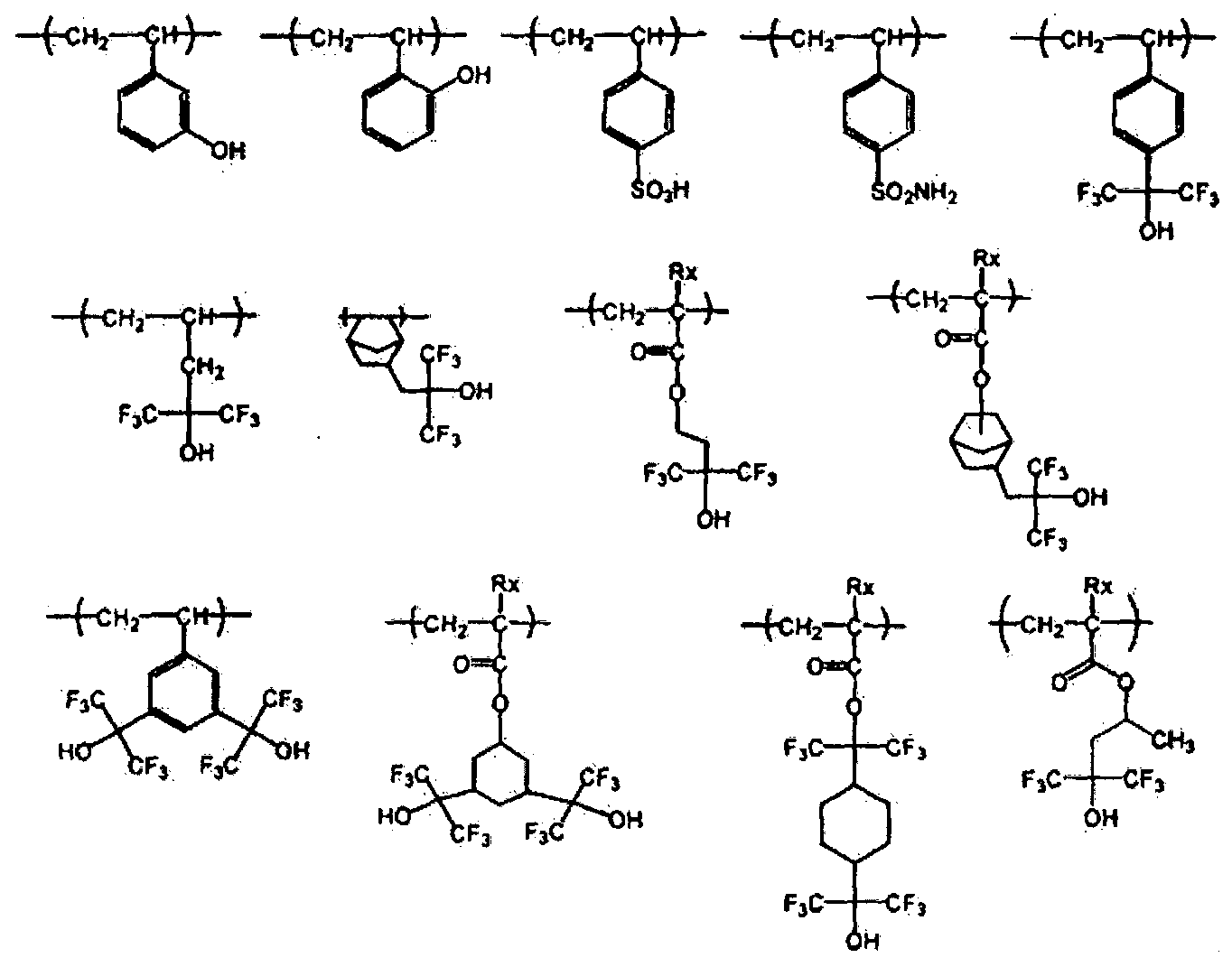


[0450] Examples of the polarity converting group (y) include a lactone group, a carboxylic acid ester group (-COO-), an acid anhydride group (-C(O)OC(O)-), an acid imide group (-NHCONH-), a carboxylic acid thioester group (-COS-), a carbonic acid ester group (-OC(O)O-), a sulfuric acid ester group (-OS020-), and a sulfonic acid ester group (-SO2O-), with a lactone group being preferred.
[0451] As for the polarity converting group (y), both a configuration where the polarity converting group is included in a repeating unit composed of an acrylic acid ester or a methacrylic acid ester and thereby is introduced into the side chain of the resin, and a configuration where the polarity converting group is introduced into the polymer chain terminal by using a polymerization initiator or a chain transfer agent containing the polarity converging group (y) during the polymerization are preferred.
[0452] Specific examples of the repeating unit (by) having a polarity converting group (y) include repeating units having a lactone structure represented by the formulae (KA-1-1) to (KA-1-17) to be described below.
[0453] Further, the repeating unit (by) having a polarity converting group (y) is preferably a repeating unit having at least either a fluorine atom and a silicon atom (that is, a repeating unit corresponding to the repeating unit (b') or (b")). The repeating unit (by)-containing resin has hydrophobic ity, and addition thereof is preferred particularly from the viewpoint of reducing the development defect.
[0454] The repeating unit (by) includes, for example, a repeating unit represented by the formula (K0).

[0455] In the formula, Rki represents a hydrogen atom, a halogen atom, a hydroxyl group, an
alkyl group, a cycloalkyl group, an aryl group, or a polarity converting group-containing group.
[0456] Rk2 represents an alkyl group, a cycloalkyl group, an aryl group, or a polarity converting group-containing group.
[0457] However, at least either one of Rki and Rk2 represents a polarity converting group-containing group.
[0458] The polarity converting group is, as described above, a group that decomposes by an action of an alkaline developer to increase the solubility in an alkaline developer. The polarity converting group is preferably a group X in a partial structure represented by the general formula (KA-1) or (KB-1).

[0459] X in the general formula (KA-1) or (KB-1) represents a carboxylic acid ester group -COO-, an acid anhydride group -C(0)0C(O)-, an acid imide group -NHCONH-, a carboxylic acid thioester group -COS-, a carbonic acid ester group -OC(0)0-, a sulfuric ester group -OS020-, and a sulfonic acid ester group -S020-.
[0460] Each Y1 and Y2, which may be the same as or different from each other, represents an electron- withdrawing group.
[0461] Incidentally, the repeating unit (by) has a preferred group that increases the solubility in an alkaline developer by containing a group having a partial structure represented by the general formula (KA-1) or (KB-1), but as in the case of the partial structure represented by the general formula (KA-1) or the partial structure represented by (KB-1) in which Y1 and Y2 are monovalent, when the partial structure does not have a bond, the group having the partial structure is a group having a monovalent or higher valent group formed by removing at least one arbitrary hydrogen atom in the partial structure.
[0462] The partial structure represented by the general formula (KA-1) or (KB-1) is connected to the main chain of the hydrophobic resin at an arbitrary position through a substituent.
[0463] The partial structure represented by the general formula (KA- 1) is a structure forming a ring structure together with the group as X.
[0464] In the general formula (KA-1), X is preferably a carboxylic acid ester group (that is, a case of forming a lactone ring structure as KA-1), an acid anhydride group or a carbonic acid ester group,more preferably a carboxylic acid ester group.
[0465] The ring structure represented by the general formula (KA-1) may have a substituent and, for example, may have nka substituents Zkai -
[0466] When a plurality of Zkai's are present, they each independently represent a halogen atom, an alkyl group, a cycloalkyl group, an ether group, a hydroxyl group, an amido group, an aryl group, a lactone ring group, or an electron-withdrawing group.
[0467] Zkai's may be linked to each other to form a ring. Examples of the ring formed by the combination of Zkai's with each other include a cycloalkyl ring and a heterocyclic ring (for example, a cyclic ether ring, or a lactone ring).
[0468] nka represents an integer of 0 to 10, and is preferably an integer of 0 to 8, more preferably an integer of 0 to 5, still more preferably an integer of 1 to 4, and most preferably an integer of 1 to 3.
[0469] The electron-withdrawing group as Zkai has the same definition as the electron-withdrawing group of Y1 and Y2 to be described hereinafter. Incidentally, the electron-withdrawing group above may be substituted with another electron-withdrawing group.
[0470] Zkai is preferably an alkyl group, a cycloalkyl group, an ether group, a hydroxyl group or an electron-withdrawing group, and more preferably an alkyl group, a cycloalkyl group or an electron-withdrawing group. The ether group is preferably an ether group substituted, for example, with an alkyl group or a cycloalkyl group, that is, an alkyl ether group. The electron- withdrawing group has the same definition as above.
[0471] Examples of the halogen atom as Zkai include a fluorine atom, a chlorine atom, a bromine atom and an iodine atom, with a fluorine atom being preferred.
[0472] The alkyl group as Zkai may have a substituent and may be either linear or branched. The linear alkyl group is preferably an alkyl group having 1 to 30 carbon atoms, more preferably 1 to 20 carbon atoms, and examples thereof include a methyl group, an ethyl group, an n-propyl group, an n-butyl group, a sec-butyl group, a t-butyl group, an n-pentyl group, an n-hexyl group, an n-heptyl group, an n-octyl group, an n-nonyl group and an n-decanyl group. The branched alkyl group is preferably an alkyl group having 3 to 30 carbon atoms, more preferably 3 to 20, and examples thereof include an i-propyl group, an i-butyl group, a t-butyl group, an i-pentyl group, a t-pentyl group, an i-hexyl group, a t-hexyl group, an i-heptyl group, a t-heptyl group, an i-octyl group, a t-octyl group, an i-nonyl group and a t-decanoyl group. An alkyl group having 1 to 4 carbon atoms is preferred, such as a methyl group, an ethyl group, an n-propyl group, an i-propyl group, an n-butyl group, an i-butyl group and a t-butyl group.
[0473] The cycloalkyl group as Zkai may have a substituent and may be monocyclic or polycyclic. The polycyclic cycloalkyl group may be crosslinked. That is, in this case, the cycloalkyl group may have a bridged structure. The monocyclic type is preferably a cycloalkyl group having 3 to 8 carbon atoms, and examples thereof include a cyclopropyl group, a cyclopentyl group, a cyclohexyl group, a cyclobutyl group and a cyclooctyl group. The polycyclic type includes a group having a bicyclo, tricyclo or tetracyclo structure or the like and having 5 or more carbon atoms. A cycloalkyl group having 6 to 20 carbon atoms is preferred, and examples thereof include an adamantyl group, a norbornyl group, an isobornyl group, a camphanyl group, a dicyclopentyl group, an aD-pinel group, a tricyclodecanyl group, a tetracyclododecyl group and an androstanyl group. The following structures are also preferred as the cycloalkyl group. Incidentally, at least one carbon atom in the cycloalkyl group may be substituted with a hetero atom such as an oxygen atom.


[0474] The alicyclic moiety is preferably an adamantyl group, a noradamantyl group, a decalin
group, a tricyclodecanyl group, a tetracyclododecanyl group, a norbornyl group, a cedrol group, a cyclohexyl group, a cycloheptyl group, a cyclooctyl group, a cyclodecanyl group or a cyclododecanyl group, and more preferably an adamantyl group, a decalin group, a norbornyl group, a cedrol group, a cyclohexyl group, a cycloheptyl group, a cyclooctyl group, a cyclodecanyl group, a cyclododecanyl group, or a tricyclodecanyl group.
[0475] Examples of the substituent in such an alicyclic structure include an alkyl group, a halogen atom, a hydroxyl group, an alkoxy group, a carboxyl group, and an alkoxycarbonyl group. The alkyl group is preferably a lower alkyl group such as a methyl group, an ethyl group, a propyl group, an isopropyl group, and a butyl group, and more preferably a methyl group, an ethyl group, a propyl group, or an isopropyl group. Preferred examples of the alkoxy group include an alkoxy group having 1 to 4 carbon atoms, such as a methoxy group, an ethoxy group, a propoxy group, and a butoxy group. Examples of the substituent that the alkyl group and the alkoxy group may have include a hydroxyl group, a halogen atom and an alkoxy group (preferably having 1 to 4 carbon atoms).
[0476] Each of these groups may further have a substituent, and examples of the further substituent include a hydroxyl group, a halogen atom (fluorine, chlorine, bromine, or iodine), a nitro group, a cyano group, the foregoing alkyl group, an alkoxy group such as a methoxy group, an ethoxy group, a hydroxyethoxy group, a propoxy group, a hydroxypropoxy group, an n-butoxy group, an isobutoxy group, a sec-butoxy group, and a t-butoxy group, an alkoxycarbonyl group such as a methoxycarbonyl group and an ethoxycarbonyl group, an aralkyl group such as a benzyl group, a phenethyl group, and a cumyl group, an aralkyloxy group, an acyl group such as a formyl group, an acetyl group, a butyryl group, a benzoyl group, a cinnamoyl group, and a valeryl group, an acyloxy group such as a butyryloxy group, an alkenyl group such as a vinyl group, a propenyl group, and an allyl group, an alkenyloxy group such as a vinyloxy group, a propenyloxy group, an aryloxy group, and a butenyloxy group, an aryl group such as a phenyl group and a naphthyl group, an aryloxy group such as a phenoxy group, and an aryloxycarbonyl group such as a benzoyloxy group.
[0477] It is preferable that X in the general formula (KA-1) be a carboxylic acid ester group and the partial structure represented by the general formula (KA-1) be a lactone ring, and the lactone ring be preferably a 5- to 7-membered lactone ring.
[0478] Moreover, as in (KA-1-1) to (KA-1 - 17) described below, another ring structure is preferably condensed to a 5- to 7-membered lactone ring that is the partial structure represented by the general formula (KA-1), in the form of forming a bicyclo or spiro structure.
[0479] Examples of the peripheral ring structure to which the ring structure represented by the general formula (KA-1) may be bonded include those in (KA-1-1) to (KA-1- 17) and structures based on these structures.
[0480] The structure containing the lactone ring structure represented by the general formula (KA-1) is more preferably a structure represented by any one of the following (KA-1-1) to (KA-1-17). The lactone structure may be bonded directly to the main chain. Preferred structures are (KA-1-1), (KA-1-4), (KA-1-5), (KA-1 -6), (KA-1- 13), (KA- 1- 14), and
(KA-1-17).

[0481] The structure containing the lactone ring structure may or may not have a substituent. Preferred examples of the substituent are the same as those of the substituent Zkai which the ring structure represented by the general formula (KA-1) may have.
[0482] In the general formula (KB-1), X is preferably a carboxylic acid ester group (-COO-).
[0483] In the general formula (KB-1), Y1 and Y2 each independently represent an electron- withdrawing group.
[0484] The electron-withdrawing group is a partial structure represented by the general formula (EW) described below. In the general formula (EW), * indicates a direct bond to (KA-1) or a direct bond to X in (KB-1).

[0485] In the formula (EW),
Rewi and ReW2 each independently represent an arbitrary substituent, for example, a hydrogen atom, an alkyl group, a cycloalkyl group, or an aryl group.
[0486] new is a repetition number of the linking group represented by -C(Rewi)(Rew2)- and represents an integer of 0 or 1. In the case where is 0, this indicates that the bond is a single bond and Yewi is directly bonded thereto.
[0487] Examples of Yewi include a halogen atom, a cyano group, a nitrile group, a nitro group, a halo(cyclo)alkyl group represented by -C(Rn)(Rc)-Rf3, a haloaryl group, an oxy group, a carbonyl group, a sulfonyl group, a sulfinyl group, and a combination thereof. The electron-withdrawing group may be, for example, a structure shown below. The "halo(cyclo)alkyl group" indicates an alkyl or cycloalkyl group that is at least partially halogenated, and the "haloaryl group" indicates an aryl group that is at least partially halogenated. In the following structural formulae, ReW3 and REW4 each independently represent an arbitrary structure. The partial structure represented by the general formula (EW) has an electron-withdrawing group regardless of what structure Rew3 or Rew4 may take, and each of Rew3 and Rew4 may be linked, for example, to the main chain of the resin but is preferably an alkyl group, a cycloalkyl group or an alkyl fluoride group.

[0488] When Yewi is a divalent or higher valent group, the remaining bond is bonded to an arbitrary atom or a substituent. At least any one group of Yewi, Rewi, and Rew2 may be linked to the main chain of the hydrophobic resin through a further substituent.
[0489] Yewi is preferably a halogen atom, a halo(cyclo)alkyl group represented by -C(RA)(RO)-RB or a haloaryl group.
[0490] At least two members of Rewi , Rew2 and Yewi may be linked to each other to form a ring.
[0491] Rfl represents a halogen atom, a perhaloalkyl group, a perhalocycloalkyl group or a perhaloaryl group, is preferably a fluorine atom, a perfluoroalkyl group or a
perfluorocycloalkyl group, and is more preferably a fluorine atom or a trifluoromethyl group.
[0492] R.£2 and R each independently represent a hydrogen atom, a halogen atom or an organic group, or alternatively R^ and Ro may be bonded to each other to form a ring. Examples of the organic group include an alkyl group, a cycloalkyl group, and an alkoxy group. Rc is more preferably the same group as Rn or combines with Ro to form a ring.
[0493] Rn to Ro may be bonded to each other to form a ring, and examples of the ring to be formed include a (halo)cycloalkyl ring and a (halo)aryl ring.
[0494] Examples of the (halo)alkyl group in Rn to Ro include the alkyl group in Zkai described above and halogenated structures thereof.
[0495] Examples of the (per)halocycloalkyl group and (per)haloaryl group in Rn to R or in the ring formed by the combination of Ra and R include structures resulting from halogenation of cycloalkyl groups in Zkal , preferably a fluorocycloalkyl group represented by -C(n)F(2n-2)H, and a perfluoroaryl group represented by -C(n)F(n-1). Here, the number of carbon atoms n is not particularly limited, but is preferably from 5 to 13, and more preferably 6.
[0496] The ring which may be formed by the combination of at least two members of Rewi , Rew2 and Yewi with each other is preferably a cycloalkyl group or a heterocyclic group, and the heterocyclic group is preferably a lactone ring group. Examples of the lactone ring include structures represented by the formulae (KA-1-1) to (KA-1-17).
[0497] Incidentally, the repeating unit (by) may have a plurality of partial structures represented by the general formula (KA-1), a plurality of partial structures represented by the general formula (KB-1), or both a partial structure of the general formula (KA-1) and a partial structure of the general formula (KB-1).
[0498] Here, the partial structure of the general formula (KA-1) may partially or entirely serve also as the electron-withdrawing group of Yl or Y2 in the general formula (KB-1). For example, in the case where X in the general formula (KA-1) is a carboxylic acid ester group, the carboxylic acid ester group may function as the electron- withdrawing group of Yl or Y2 in the general formula (KB-1).
[0499] In the case where the repeating unit (by) corresponds to the repeating unit (b*) or (b") and has a partial structure represented by the general formula (KA-1), the partial structure represented by the general formula (KA-1) is more preferred when the polarity converting group is the partial structure represented by -COO- in the structure of the general formula (KA-1).
[0500] The repeating unit (by) may be a repeating unit having the partial structure represented
b the general formula (KY-0).

[0501 ] In the general formula (KY-0),
R2 represents a chain or cyclic alkylene group and when a plurality of R2's are present, they may be the same as or different from each other.
[0502] R3 represents a linear, branched, or cyclic hydrocarbon group where a part or all of hydrogen atoms on the constituent carbons are substituted with a fluorine atom.
[0503] R4 represents a halogen atom, a cyano group, a hydroxy group, an amide group, an alkyl group, a cycloalkyl group, an alkoxy group, a phenyl group, an acyl group, an alkoxycarbonyl group or a group represented by R-C(=0)- or R-C(=0)0- (wherein R represents an alkyl group or a cycloalkyl group). When a plurality of R s are present, they may be the same as or different from each other, and two or more RVs may be bonded to each other to form a ring.
[0504] X represents an alkylene group, an oxygen atom or a sulfur atom.
[0505] Z and Za each represent a single bond, an ether bond, an ester bond, an amide bond, a urethane bond or a urea bond and when a plurality of Z's or Za's are present, they may be the same as or different from each other.
[0506] * represents a bond to the main or side chain of the resin.
[0507] o is the number of substituents and represents an integer of 1 to 7.
[0508] m is the number of substituents and represents an integer of 0 to 7.
[0509] n is a repetition number and represents an integer of 0 to 5.
[0510] The structure of -R2-Z- is preferably a structure represented by -(CH2)j-COO- (wherein 1 represents an integer of 1 to 5).
[0511] The preferred number of carbon atoms and specific examples of the chain or cyclic alkylene group as R2 are the same as those described for the chain alkylene group and the cyclic alkylene group in Z2 of the general formula (bb).
[0512] The number of carbon atoms of the linear, branched, or cyclic hydrocarbon group as R3 is, in the case of a linear hydrocarbon group, preferably from 1 to 30, more preferably from 1 to 20; in the case of a branched hydrocarbon group, preferably from 3 to 30, more preferably from 3 to 20; and in the case of a cyclic hydrocarbon group, from 6 to 20. Specific examples
of R3 include specific examples of the alkyl group and the cycloalkyl group as ; Zkai above: >·■■■■■ [0513] The preferred number of carbon atoms and specific examples of the alkyl group and cycloalkyl group as R4 and R are the same as those described above for the alkyl group and the cycloalkyl group as Zkai.
[0514] The acyl group as R4 is preferably an acyl group having 1 to 6 carbon atoms, and examples thereof include a formyl group, an acetyl group, a propionyl group, a butyryl group, an isobutyryl group, a valeryl group, and a pivaloyl group.
[0515] The alkyl moiety in the alkoxy group and alkoxycarbonyl group as includes a linear, branched, or cyclic alkyl moiety, and the preferred number of carbon atoms and specific examples of the alkyl moiety are the same as those described above for the alkyl group and cycloalkyl group as Zkai.
[0516] The alkylene group as X includes a chain or cyclic alkylene group, and the preferred number of carbon atoms and specific examples thereof are the same as those described for the chain alkylene group and the cyclic alkylene group as R2.
[0517] Examples of the specific structure of the repeating unit (by) also include repeating units having a partial structure shown below.
*— X'-A-O-

[0518] In the general formulae (rf-1) and (rf-2),
X' represents an electron-withdrawing substituent and is preferably a carbonyloxy group, an oxycarbonyl group, a fluorine atom-substituted alkylene group or a fluorine atom-substituted cycloalkylene group.
[0519] A represents a single bond or a divalent linking group represented by -C(Rx)(Ry)-. Here, Rx and Ry each independently represent a hydrogen atom, a fluorine atom, an alkyl group (preferably having 1 to 6 carbon atoms, which may be substituted with a fluorine atom or the like), or a cycloalkyl group (preferably having 5 to 12 carbon atoms, which may be substituted with a fluorine atom or the like). Each of Rx and Ry is preferably a hydrogen atom, an alkyl group or a fluorine atom-substituted alkyl group.
[0520] X represents an electron-withdrawing group and specific examples thereof include the electron-withdrawing groups as Y1 and Y2 described above. Among these, an alkyl fluoride group, a cycloalkyl fluoride group, an aryl group substituted with fluorine or an alkyl fluoride group, an aralkyl group substituted with fluorine or an alkyl fluoride group, a cyano group,
and a nitro group are preferred.
[0521] * represents a bond to the main or the side chain of the resin, that is, a bond to the main chain of the resin through a single bond or a linking group.
[0522] In addition, when X' is a carbonyloxy group or an oxycarbonyl group, A is not a single bond.
[0523] The polarity converting group is decomposed by an action of an alkaline developer to effect polarity conversion, whereby the receding contact angle with water of the resist film after alkali development can be decreased. Decreasing the receding contact angle with water of the film after alkali development is preferred from the viewpoint of suppressing the development defect.
[0524] The receding contact angle with water of the resist film after alkali development is preferably 50° or less, more preferably 40° or less, still more preferably 35° or less, and most preferably 30° or less, at a temperature of 23 + 3°C and a humidity of 45 ± 5%.
[0525] The receding contact angle is a contact angle measured when a contact line recedes on the liquid droplet-substrate interface, and this is generally known to be useful in simulating the mobility of a liquid droplet in the dynamic state. In a simple manner, the receding contact angle is defined as a contact angle at the time of the liquid droplet interface receding when a liquid droplet ejected from a needle tip is landed on a substrate and then the liquid droplet is again suctioned into the needle. In general, the receding contact angle may be measured by a contact angle measuring method called an expansion/contraction method.
[0526] The hydrolysis rate of the hydrophobic resin for an alkaline developer is preferably 0.001 nm/sec or more, more preferably 0.01 nm/sec or more, still more preferably 0.1 nm/sec or more, and most preferably 1 nm/sec or more.
[0527] Here, the hydrolysis rate of the hydrophobic resin for an alkaline developer is a rate at which the thickness of a resin film formed of only the hydrophobic resin decreases when treated with TMAH (an aqueous tetramethylammonium hydroxide solution) (2.38% by mass) at 23°C.
[0528] Further, the repeating unit (by) is more preferably a repeating unit having at least two or more polarity converting groups.
[0529] In the case where the repeating unit (by) has at least two polarity converting groups, the repeating unit preferably has a group containing a partial structure having two polarity converting groups represented by the following general formula (KY-1). Incidentally, when the structure represented by the general formula (KY-1) does not have a bond, this is a group
containing a monovalent or higher valent group formed by removing at least one arbitrary hydrogen atom from the structure.

[0530] In the general formula (KY-1),
Rkyi and Rky4 each independently represent a hydrogen atom, a halogen atom, an alkyl group, a cycloalkyl group, a carbonyl group, a carbonyloxy group, an oxycarbonyl group, an ether group, a hydroxyl group, a cyano group, an amide group or an aryl group. Alternatively, Rkyi and Rky4 may be bonded to the same atom to form a double bond. For example, Rkyl and Rky4 may be bonded to the same oxygen atom to form a part (=0) of a carbonyl group.
[0531] RkY2 and Rky3 each independently represent an electron-withdrawing group, or when Rkyi and Rky2 are linked to form a lactone ring, Rky3 is an electron-withdrawing group. The lactone ring to be formed is preferably a structure of (KA-1-1) to (KA-1-17) described above. Examples of the electron-withdrawing group are the same as those for Yi and Y2 in the general formula (KB-1), and a halogen atom, or a halo(cyclo)alkyl group or haloaryl group represented by -C(Rn)(RE)-Ro is preferred. Preferably, Rky3 is a halogen atom, or a halo(cyclo)alkyl group or haloaryl group represented by -C(RA)(R£2)- B, and Rky2 is linkedto Rkyi to form a lactone ring or is an electron-withdrawing group containing no halogen atom.
[0532] Rkyi, RkY2, and Rky4 may be linked to each other to form a monocyclic or a polycyclic structure.
[0533] Specific examples of Rkyi and Rky4 include the same groups as those for Zkai in the formula (KA-1).
[0534] The lactone ring formed by the combination of Rkyi and Rky2 is preferably a structure of (KA-1-1) to (KA-1-17) described above. Examples of the electron- withdrawing group are the same as those for Yi and Y2 in the general formula (KB-1) described above.
[0535] The structure represented by the general formula (KY-1) is more preferably a structure represented by the following general formula (KY-2). Here, the structure represented by the general formula (KY-2) is a group having a monovalent or higher valent group formed by removing at least one arbitrary hydrogen atom from the structure.

[0536] In the formula (KY-2),
Rky6 to Rkyio each independently represent a hydrogen atom, a halogen atom, an alkyl group, a cycloalkyl group, a carbonyl group, a carbonyloxy group, an oxycarbonyl group, an ether group, a hydroxyl group, a cyano group, an amide group, or an aryl group.
[0537] Two or more members of Rky6 to Rkyio may be linked to each other to form a monocyclic or polycyclic structure.
[0538] Rkys represents an electron-withdrawing group. Examples of the electron-withdrawing group are the same as those described for Y\ and Y2 above, and among these, a halogen atom, or a halo(cyclo)alkyl group or a haloaryl group represented by -C(Rfi)(Rf2)-Rfi is preferred.
[0539] Specific examples of Rky5 to Rkyio include the same groups as those for Zkai in the formula (KA-1).
[0540] The structure represented by the general formula (KY-2) is more preferably a partial group represented by the general formual (KY-3) below.

[0541] In the formula (KY-3), Zkai and nka have the same definitions as in the general formula (KA-1). Rky5 has the same definition as in the formula (KY-2).
[0542] Lky represents an alkylene group, an oxygen atom or a sulfur atom. Examples of the alkylene group of Lky include a methylene group and an ethylene group. Lky is preferably an oxygen atom or a methylene group, and more preferably a methylene group.
[0543] The repeating unit (b) is not limited as long as the repeating unit (b) is a repeating unit which is obtainable by polymerization such as addition polymerization, condensation
polymerization, or addition condensation, but this repeating unit is preferably a repeating unit which is obtainable by addition polymerization of a carbon-carbon double bond. Examples thereof include an acrylate-based repeating unit (including a system having a substituent at the a- or β-position), a styrene-based repeating unit (including a system having a substituent at the a- or β-position), a vinyl ether-based repeating unit, a norbornene-based repeating unit, and a maleic acid derivative (such as a maleic acid anhydride or its derivative, and maleimide) repeating unit. An acrylate-based repeating unit, a styrene-based repeating unit, a vinyl ether-based repeating unit and a norbornene-based repeating unit are preferred, an acrylate-based repeating unit, a vinyl ether-based repeating unit and a norbornene-based repeating unit are more preferred, and an acrylate-based repeating unit is most preferred.
[0544] In the case where the repeating unit (by) is a repeating unit having at least either a fluorine atom or a silicon atom (that is, a repeating unit corresponding to the repeating unit (b') or (b")), examples of the fluorine atom-containing partial structure in the repeating unit (by) are the same as those described for the repeating units having at least either a fluorine atom or a silicon atom, and the groups represented by the general formulae (F2) to (F4) are preferred. Also in this case, examples of the silicon atom-containing partial structure in the repeating unit (by) are the same as those described for the repeating units having at least either the fluorine atom or the silicon atom and preferably include the groups represented by the general formulae (CS-1) to (CS-3).
[0545] In the hydrophobic resin, the content of the repeating unit (by) is preferably from 10 to 100% by mole, more preferably from 20 to 99% by mole, still more preferably from 30 to 97% by mole, and most preferably from 40 to 95% by mole, based on all repeating units in the hydrophobic resin.
[0546] Specific examples of the repeating unit (by) having a group that increases the solubility in an alkaline developer are shown below, but the present invention is not limited thereto.
[0547] In specific examples shown below, Ra represents a hydrogen atom, a fluorine atom, a methyl group, or a trifluoromethyl group.


[0548] Synthesis method of monomers corresponding to the repeating unit (by) having the polarity converting group (y) as described above may be carried out, for example, with reference to the methods disclosed in WO2010/067905A or WO2010/067905 A.
[0549] In the hydrophobic resin, examples of the repeating unit (bz) having a group (z) that decomposes by an action of an acid are the same as those described for the repeating units having an acid-decomposable group in the resin (B).
[0550] In the case where the repeating unit (bz) is a repeating unit having at least either a fluorine atom or a silicon atom (that is, a repeating unit corresponding to the repeating unit (b') or (b")), examples of the fluorine atom-containing partial structure in the repeating unit (bz) are the same as those described for the repeating units having at least either a fluorine atom or a silicon atom and preferably include the groups represented by the general formulae (F2) to (F4). Also in this case, examples of the silicon atom-containing partial structure in the repeating unit (by) are the same as those described for the repeating units having at least either a fluorine atom or a silicon atom and preferably include the groups represented by the general formulae (CS-l) to (CS-3).
[0551] In the hydrophobic resin, the content of the repeating unit (bz) having a group (z) that decomposes by an action of an acid is preferably from 1 to 80% by mole, more preferably from 10 to 80% by mole, and still more preferably from 20 to 60% by mole, based on all repeating units in the hydrophobic resin.
[0552] The repeating unit (b) having at least one group selected from the group consisting of (x) to (z) was described as above, but the content of the repeating unit (b) in the hydrophobic resin is preferably from 1 to 98% by mole, more preferably from 3 to 98% by mole, still more preferably from 5 to 97% by mole, and most preferably from 10 to 95% by mole, based on all repeating units in the hydrophobic resin.
[0553] The content of the repeating unit (b') is preferably from 1 to 100% by mole, more preferably from 3 to 99% by mole, still more preferably from 5 to 97% by mole, and most preferably from 10 to 95% by mole, based on all repeating units in the hydrophobic resin.
[0554] The content of the repeating unit (b*) is preferably from 1 to 90% by mole, more preferably from 3 to 80% by mole, still more preferably 5 to 70% by mole, and most preferably 10 to 60% by mole, based on all repeating units in the hydrophobic resin. The content of the repeating units having at least either a fluorine atom or a silicon atom, which is used together with the repeating unit (b*) is preferably from 10 to 99% by mole, more preferably from 20 to 97% by mole, still more preferably from 30 to 95% by mole, and most preferably from 40 to 90% by mole, based on all repeating units in the hydrophobic resin.
[0555] The content of the repeating unit (b") is preferably from 1 to 100% by mole, more preferably from 3 to 99% by mole, still more preferably from 5 to 97% by mole, and most
preferably from 10 to 95% by mole, based on all repeating units in the hydrophobic resin.
[0556] The hydrophobic resin may further contain a repeating unit represented by the following general formula (CIII).

[0557] In the general formula (CIII),
Rc3i represents a hydrogen atom, an alkyl group (which may be substituted with a fluorine atom or the like), a cyano group or a -CH2-0-Rac2 group. In the formula, Rac2 represents a hydrogen atom, an alkyl group or an acyl group. R^i is preferably a hydrogen atom, a methyl group, a hydroxymethyl group or a trifluoromethyl group, andparticularly preferably a hydrogen atom or a methyl group.
[0558] Rc32 represents a group having an alkyl group, a cycloalkyl group, an alkenyl group, a cycloalkenyl group or an aryl group. Each of these groups may be substituted with a fluorine atom or silicon atom-containing group or the like.
[0559] Lc3 represents a single bond or a divalent linking group.
[0560] In the general formula (CIII), the alkyl group of Rc32 is preferably a linear or branched alkyl group having 3 to 20 carbon atoms.
[0561] The cycloalkyl group is preferably a cycloalkyl group having 3 to 20 carbon atoms.
[0562] The alkenyl group is preferably an alkenyl group having 3 to 20 carbon atoms.
[0563] The cycloalkenyl group is preferably a cycloalkenyl group having 3 to 20 carbon atoms.
[0564] The aryl group is preferably a phenyl group having 6 to 20 carbon atoms or a naphthyl group, each of which may have a substituent.
[0565] Rc32 is preferably an unsubstituted alkyl group or an alkyl group substituted with a fluorine atom.
[0566] The divalent linking group of Lc3 is preferably an alkylene group (preferably having 1 to 5 carbon atoms), an oxy group, a phenylene group or an ester bond (a group represented by -COO-).
[0567] It is also preferable that the hydrophobic resin further contain a repeating unit represented by the following general formula (BII-AB).

(BII-AB)
[0568] In the formula (BII-AB),
Rci i ' and Rci2' each independently represent a hydrogen atom, a cyano group, a halogen atom, or an alkyl group.
[0569] Zc' represents an atomic group for forming an alicyclic structure, which contains two carbon atoms (C-C) to which Zc' is bonded.
[0570] In the case where each group in the repeating units represented by the general formulae (CM) and (BII-AB) is substituted with a fluorine atom- or silicon atom-containing group, the repeating unit also corresponds to the repeating units having at least either a fluorine atom or a silicon atom.
[0571] Specific examples of the repeating units represented by the general formulae (CM) and (BII-AB) are shown below, but the present invention is not limited thereto. In the formulae, Ra represents H, CH3, CH2OH, CF3, or CN. Further, the repeating unit where Ra is CF3 also corresponds to the repeating units having at least either a fluorine atom or a silicon atom.

[0572] In the hydrophobic resin, similarly to the resin (B), it is of course preferable that the content of impurities such as metals be low, and also the content of residual monomers or oligomer components is preferably from 0 to 10% by mass, more preferably from 0 to 5% by mass, and still more preferably from 0 to 1% by mass. When these conditions are satisfied, a
resist composition free from foreign substances in liquid or change with aging of sensitivity or the like can be obtained. Further, in view of resolution, resist profile, the side wall of resist pattern, roughness, and the like, the molecular weight distribution (Mw/Mn, also referred to as "dispersity") is preferably in a range of 1 to 3, more preferably 1 to 2, still more preferably 1 to 1.8, and most preferably 1 to 1.5.
[0573] As for the hydrophobic resin, various commercially available products may be also used, or the resin may be synthesized by a conventional method (for example, radical polymerization). Examples of the general synthesis method include a batch polymerization method of dissolving monomer species and an initiator in a solvent and heating the solution, thereby effecting the polymerization, and a dropping polymerization method of adding dropwise a solution containing monomer species and an initiator to a heated solvent over 1 to 10 hours, among these methods,the dropping polymerization method is preferred.
[0574] The reaction solvent, the polymerization initiator, the reaction conditions (for example, temperature, concentration, and the like) and the purification method after reaction are the same as those described for the resin (B) above.
[0575] Specific examples of the hydrophobic resin (HR) are shown below. Further, molar ratios of the repeating units in each resin (the positional relation of each repeating unit in each resin described in the specific examples corresponds to the positional relation of the composition ratio in Table 1), the weight average molecular weight, and the dispersity are listed in Table 1 below.


(B-40) (B-41) (B-42)

[Table 1]


[0577] The receding contact angle of the coating film including the actinic ray-sensitive or radiation-sensitive resin composition of the present invention, which has been baked but is not yet exposed, as measured at the exposure temperature, generally room temperature of 23 ± 3°C and a humidity of 45 + 5%, is preferably in the range of 60° to 90°, more preferably 65° or more, still more preferably 70° or more and most preferably 75° or more.
[0578] The hydrophobic resin is, as described above, unevenly distributed at the interface but unlike a surfactant, need not necessarily have a hydrophilic group in a molecule and may not contribute to uniform mixing of polar/nonpolar substances.
[0579] In the liquid immersion exposure process, the liquid for liquid immersion needs to move on a wafer following the movement of an exposure head that is scanning the wafer at a high speed and forming an exposure pattern. Therefore, the contact angle of the liquid for liquid immersion with respect to the resist film in a dynamic state is important, and the resist is required to have performance of allowing liquid droplets to follow the high-speed scanning of the exposure head without remaining any liquid droplet.
[0580] As the hydrophobic resin is hydrophobic, the problems of development residue (scum) and BLOB defect after alkali development are likely to become serious. However, improvement of performance in terms of the development residue (scum) and BLO defect performance can be attained due to an increase in alkali dissolution rate by containing three or more polymer chains through at least one branch point, as compared with linear chain resins.
[0581] When the hydrophobic resin contains a fluorine atom, the content of the fluorine atoms is preferably from 5 to 80% by mass, and more preferably from 10 to 80% by mass, based on the molecular weight of the hydrophobic resin. The content of the repeating units containing a fluorine atom is preferably from 10 to 100% by mole, and more preferably from 30 to 100% by mole, based on all repeating units in the hydrophobic resin.
[0582] When the hydrophobic resin contains a silicon atom, the content of the silicon atoms is preferably from 2 to 50% by mass, and more preferably from 2 to 30% by mass, based on the
molecular weight of the hydrophobic resin. The content of the repeating units containing a silicon atom is preferably from 10 to 90% by mole, and more preferably 20 to 80% by mole, based on all the repeating units of the hydrophobic resin.
[0583] The weight average molecular weight of the hydrophobic resin is preferably in the range of 1,000 to 100,000, more preferably 2,000 to 50,000 and still more preferably 3,000 to 35,000. Here, the weight average molecular weight of the resin indicates a molecular weight in terms of polystyrene as measured by GPC (carrier: tetrahydrofuran (THF)).
[0584] The content of the hydrophobic resin in the actinic ray-sensitive or radiation-sensitive resin composition may be adjusted prior to use so that the receding contact angle of the actinic ray-sensitive or radiation-sensitive resin falls within the above-specified range. The content of the hydrophobic resin is preferably in the range of 0.01 to 20% by mass, more preferably 0.1 to 15% by mass, still more preferably 0.1 to 10% by mass and most preferably 0.2 to 8% by mass, based on the total solid content of the actinic ray-sensitive or radiation-sensitive resin composition.
[0585] The hydrophobic resins may be used alone or in combination of two or more thereof.
[0586] [6] Resin (D) containing substantially no fluorine atom and silicon atom unlike above-described resin (B)
[0587] The actinic ray-sensitive or radiation-sensitive resin composition of the present invention may contain the resin (D) (hereinafter, simply referred to as a "resin (D)") containing substantially no fluorin atom and silicon atom unlike the above-described resin (B), of which the content is from 0.1 % by mass to less than 10% by mass based on the total solid content of the actinic ray-sensitive or radiation-sensitive resin composition.
[0588] However, the resin (D) contains substantially no fluorine atom and silicon atom, specifically, the content of the repeating unit containing a fluorine atom and a silicon atom is preferably 5% by mole or less, more preferably 3% by mole or less, sill more preferably 1% by mole or less, and ideally 0% by mole, that is, containing no fluorine atom and silicon atom, based on all repeating units in the resin (D).
[0589] From the viewpoints of unevenly distributing the resin (D) on the surfice layer of the resist film, having excellent uniformity of the local pattern size and exposure latitude (EL), and reducing water residue defect, the content of the composition of the resin (D) in the present invention is from 0.1 % by mass to less than 10% by mass, preferably 0.2 to 8% by mass, more preferably 0.3 to 6% by mass, and particularly preferably 0.5 to 5% by mass, based on the total solid content of the actinic ray-sensitive or radiation-sensitive resin
composition.
[0590] In the present invention, the mass content of the CH3 partial structure, which is included in the side chain portion of the resin (D), among the resin (D) is equal to or more than 12.0%, and preferably equal to or more than 18.0%. By satisfying this condition, the resin having a low surface free energy can be obtained, the resin (D) can be unevenly distributed on the surface layer of the resist film, thereby obtaining excellent uniformity of the local pattern size (uniformity of a hole diameter in forming a fine hole pattern) and EL, and reducing the water residue defect in the liquid immersion exposure.
[0591] The upper limit of the mass content of the CH3 partial structure, which is included in the side chain portion, among the resin (D) is preferably 50.0% or less, and more preferably 40% or less.
[0592] Here, since the methyl group (for example, an a-methyl group of a repeating unit including a methacrylic structure) directly linked to the main chain of the resin (D) barely contributes to uneven distributing to the surface of the resin (D) due to the effect of the main chain, it is assumed that the methyl group is not included in the CH3 partial structure of the present invention. More specifically, for example, in a case where the resin (D) contains a repeating unit derived from a monomer having a carbon-carbon double bond-containing polymer izable moiety, such as a repeating unit represented by the general formula (M), and when Rn to R44 is CH3 itself, it is assumed that the CH3 is not included (is not counted) in the CH3 partial structure contained in the side chain portion of the present invention.
[0593] On the other hand, a CH3 partial structure existing through some kind of atoms from the C-C main chain is counted as the CH3 partial structure in the present invention. For example, in the case where Rn is an ethyl group (CH2CH3), Rn is counted as the one having one CH3 partial structure in the present invention.

[0594] In the general formula (M),
Rn to Rn each independently represent a side chain portion.
[0595] Examples of Rn to Ri4 of the side chain portion include a hydroge atom and a monovalent organic group.
[0596] Examples of the monovalent organic group for Rn to RH include an alkyl group, a cyanoalkyl group, an aryl group, an alkyloxycarbonyl group, a cycloalkyloxycarbonyl group, an aryloxycarbonyl group, an alkylaminocarbonyl group, a cycloalkylaminocarbonyl group, and an arylaminocarbonyl group.
[0597] The monovalent organic group may include a substitutent, and examples of the substituent are the same as those of the specific examples and preferred examples described below as a substituent which can be included in the aromatic group Ar2 [ in the general formula (II).
[0598] In the present invention, the CH3 partial structure (hereinafter, simply referred to as a "side chain CH3 partial structure") included in the side chain portion of the resin (D) includes a CH3 partial structure contained in an ethyl group, a propyl group, or the like.
[0599] Hereinafter, the mass content of the CH3 partial structure, which is included in the side chain portion of the resin (D), among the resin (D) (hereinafter, simply referred to as "the mass content of the side chain CH3 partial structure among the resin (D)") will be described below.
[0600] Here, the mass conten of the side chain CH3 partial structure among the resin (D), in the case where the resin (D) is composed of repeating units Dl, D2, ...Dx, . .. Dn and the molar fractions in the resin (D) composed of repeating units Dl, D2, ...Dx, ... Dn are respectively ω 1 , ω2, ... , ωχ, ... , ωη, will be described below.
[0601] (1) Firstly, the mass content (MCx) of the side chain CH3 partial structure of the repeating unit Dx can be calculated by a calculating formula of "100 x 15.03 x (number of CH3 partial structure in side chain potrion in repeating unit Dx)/mocular weight of repeating unit Dx (Mx)."
[0602] Here, the number of the CH3 partial structure in the side chain portion of the repeating unit Dx does not include the number of a methyl group directly linked to the main chain.
[0603] (2) Next, the mass content of the side chain CH3 partial structure in the resin (D) can be calculated by the following calculating formula using the mass content of the side chain CH3 partial structure, which is calculated with respect to each repeating unit.
[0604] The mass content of the side chain CH3 partial structure among the resin (D) is as follows:
DMC =∑ [(col x MCI) + (ω2 x MC2) + - + (cox x MCx) + - + (con x MCn)]
[0605] Specific examples of the mass content of the CH3 partial structure in the side chain portion of the repeating uni Dx is shown below, the present invention is not limited thereto.


[0606] Specific examples of the mass content of the side chain CH3 partial structure among the resin (D) is shown below, the present invention is not limited thereto.


7] The resin (D) preferably includes at least either one of the repeating units represented
by the general formula (V) or (VI), and more preferably consists of at least either one of the repeating units represented by the general formula (V) or (VI).
(VI)

[0608] In the general formula (V) above,
R2i to R23 each independently represent a hydrogen atom or an alkyl group.
[0609] Ar2i represents an aromatic group and may form a ring with R22 and Ar21. In this case, R22 represents an alkylene group.
[0610] In the general formula (VI) above,
R3 i to R33 each independently represent a hydrogen atom or an alkyl group.
[0611] X3i represents -O- or -NR35-. R35 represents a hydrogen atom or an alkyl group.
[0612] R34 represents an alkyl group or a cycloalkyl group.
[0613] The alkyl group of R2i to R23 in the general formula (V) is preferably an alkyl group (a methyl group, an ethyl group, a propyl group, and a butyl group) having 1 to 4 carbon atoms, more preferably a methyl group or an ethyl group, and particularly preferably a methyl group.
[0614] Examples of the alkylene group when R22 and Ar2i form a ring include a methylene group and an ethylene group.
[0615] R2 i to R23 in the general formula (V) are particularly preferably a hydrogen atom or a methyl group.
[0616] The aromatic group of Ar2i in the general formula (V) may include a substituent, and examples thereof include an aryl group having 6 to 14 carbon atoms such as a phenyl group and a naphthyl group, or an aromatic group containing a hetero ring such as thiophen, furan, pyrrol, benzothiophen, benzofuran, benzopyrrol, triazine, imidazole, benzo imidazole, triazole, thiadiazole, and thiazole, among these, an aryl group that may include a substituent having 6 to 14 carbon atoms such as a phenyl group and a naphthyl group is preferred.
[0617] Examples of the substituent that may be included in the aromatic group Ar21 include an alkyl group, an alkoxyl group, and an aryl group. However, from the viewpoints of increasing the mass content of the CH3 partial structure included in the side chain portion among the resin (D) and reducing surface free energy, the substituent is preferably an alkyl
group or alkoxy group, more preferably an alkyl group having 1 to 4 carbon atoms or an alkoxyl group, and particularly preferably a methyl group, an isopropyl group, a tert-butyl group, or a tert-butoxy group.
[0618] Moreover, the aromatic group for Ar2i may include two or more substituents.
[0619] In the general formula (VI), the alkyl group of R3i to R33, and R35 is preferably an alkyl group having 1 to 4 carbon atoms (a methyl group, an ethyl group, a propyl group, and a butyl group), more preferably a methyl group and an ethyl group, and particularly preferably a methyl group. It is particularly preferable that each of R3i to R33 in the general formula (III) is independently a hydrogen atom or a methyl group.
[0620] X3i in the general formula (VI) is preferably -0-, or - H- (that is, in the case of R35 in the -NR35- being a hydrogen atom), and particularly preferably -0-.
[0621] The alkyl group for R34 in the general formula (VI) may be chained or branched, and examples thereof include a chain alkyl group (for example, a methyl group, an ethyl group, an n-propyl group, an an-butyl group, an n-hexyl group, an n-octyl group, and n-dodecyl group), and a branched alkyl group (for example, an isopropyl group, an isobutyl group, a tert-butyl group, a methylbutyl group, and a dimethylpentyl group). However, from the viewpoints from increasing the mass content of the CH3 partial structure included in the side chain portion among the resin (D) and reducing the surface free energy, the alkyl group is preferably a branched alkyl group, more preferably a branched alkyl group having 3 to 10 carbon atoms, and particularly preferably a branched alkyl group having 3 to 8 carbon atoms.
[0622] The cycloalkyl group for R34 in the general formula (VI) may include a substituent, and the examples thereof include a monocyclic cycloalkyl group such as a cyclobutyl group, a cyclopentyl group, and a cyclohexyl group and a polycyclic cycloalkyl group such as a norbornyl group, a tetracyclododecanyl group, and an adamantyl group. Among these, the cycloalkyl group is preferably a monocyclic cycloalkyl group, more preferably a monocyclic cycloalkyl group having 5 or 6 carbon atoms, and particularly preferably a cyclohexyl group.
[0623] Examples of the substituent that may be included in R34 include an alkyl group, an alkocy group, and an aryl group. However, from the viewpoints of increasing the mass content of the CH3 partial structure included the side chain portion among the resin (D) and reducing the surface free energy, the substituent is preferably an alkyl group or an alkoxy group, more preferably an alkyl group having 1 to 4 carbon atoms, or an alkoxy group, and particularly preferably a methyl group, an isopropyl group, a tert-butyl group, or a tert-butoxy group.
[0624] In addition, the cycloalkyl group for R34 may include two or more substituents.
[0625] R34 is preferably not a group that decomposes and disorbs by an action of an acid, that is, the repeating unit represented by the general formula (VI) is preferably not a repeating unit containing an acid-decomposable group.
[0626] R34 in the general formula (VI) is most preferably a branched alkyl group having 3 to 8 carbon atoms, an alkyl group having 1 to 4 carbon atoms, or a cyclohexyl group substituted with an alkoxy group.
[0627] Specific examples of the repeating unit represented by the general formula (V) or (VI) is shown below, but the present invention is not limited thereto.

[0628] In the case where the resin (D) includes the repeating unit represented by the general formula (V) or (VI), from the viewpoints of reducing the surface free energy and implementing the effects of the present invention, the content of the repeating unit represented by the general formula (V) or (VI) is preferably in the range of 50 to 100% by mole, more
preferably in the range of 65 to 100% by mole, and particularly preferably in the range of 80 to 100% by mole based on all repeating units in the resin (D).
[0629] The resin (D), of which examples are the same as those described for the resin (B), may further include a repeating unit containing an acid-decomposable group; a repeating unit containing a lactone structure; a repeating unit containing a hydroxyl atom or a cyano group; a repeating unit containing an acid group (an alkali-soluble group); and a repeating unit that has an alicyclic hydrocarbon structure with no polar group and has no acid decomposability, appropriately.
[0630] Specific examples and preferred examples of the respective repeating units that may be included in the resin (D) are the same as those of the specific examples and the preferred examples of the respective repeating units described above for the resin (B).
[0631] However, from the viewpoint of implementing the effects of the present invention, the resin (D) preferably does not include a repeating unit containing an acid-decomposable group, an alkali- soluble repeating unit, and a repeating unit containing a lactone structure.
[0632] The weight average molecular weight of the resin (D) of the present invention is, not particularly limited to, preferably in the range of 3000 to 100000, more preferably in the range of 6000 to 70000, and particularly preferably in the range of 10000 to 40000. Particularly, excellent local critical dimension uniformity (CDU) and exposure latitude in forming a fine hole pattern and excellent defect performance in liquid immersion exposure are obtained by allowing the weight average molecular weight to be in the range of 10000 to 40000. Here, the weight average molecular weight of the resin indicates a molecular weight in terms of polystyrene as measured by GPC (carrier: THF or N-methyl-2-pyrrolidone (NMP))
[0633] Further, the dispersity (Mw/Mn) is preferably 1.00 to 5.00, more preferably 1.03 to 3.50, and still more preferably 1.05 to 2.50. As the molecular weight distribution is small, the resolution and the resist pattern shape are more excellent.
[0634] The resin (D) of the present invention can be used alone or in combination of two or more thereof.
[0635] As for the resin (D), various commercially available products may be also used, or the resin may be synthesized by a conventional method (for example, radical polymerization). Examples of the general synthesis method include a batch polymerization method of dissolving monomer species and an initiator in a solvent and heating the solution, thereby effecting the polymerization, and a dropping polymerization method of adding dropwise a solution containing monomer species and an initiator to a heated solvent over 1 to 10 hours.
Among these, a dropping polymerization method is preferred.
[0636] However, the reaction solvent, the polymerization initiator, the reaction condition (for example, temperature, concentration, and the like), and the purification method after reaction are the same as those described for the resin (B), the concentration of the reaction is preferably 10 to 50% by mass in the synthesis of the resin (D).
[0637] Specific examples of the resin (D) are shown below, but the present invention is not limited thereto.


[0638] [7] Surfactant
[0639] The composition of the present invention may or may not include a surfactant. The surfactant is preferably a fluorinated surfactant and/or a siliconized surfactant.
[0640] Examples of the corresponding surfactant include MEGAFAC F176, MEGAFAC R08 (both manufactured by DIC corporation), PF656, PF6320 (both manufactured by OMNOVA solutions Inc.), TROYSOL S-366 (manufactured by Troy Chemical Corp.), FLUORAD FC430 (manufactured by Sumitomo 3M Ltd.), and polysiloxane polymer KP-341 (manufactured by Shin-Etsu Chemical Co., Ltd.).
[0641] Furthermore, surfactants other than these fluorinated and/or siliconized surfactants may also be used. Specific examples thereof include polyoxyethylene alkyl ethers and polyoxyethylene alkyl aryl ethers.
[0642] Moreover, known surfactants can be appropriately used. Examples of the useful surfactants include those described in [0273] et seq in the specification of US2008/0248425A1.
[0643] These surfactants may be used alone or in combination of two or more thereof.
[0644] The actinic ray-sensitive or radiation-sensitive resin composition of the present invention may or may not include a surfactant, in the case of including a surfactant, the used amount of the surfactant is preferably 0.0001 to 2% by mass, more preferably 0.0001 to 1% by mass, and particularly preferably 0.0005 to 1% by mass based on the total solid contents of the composition.
[0645] On the other hand, it is also preferable that the surfactant be not added or be added in
an amount of 10 ppm or less. In this case, the hydrophobic resin is more unevenly distributed at the surface, so that the resist film surface can be made more hydrophobic. As a result, the folio wability of water upon liquid immersion exposure can be enhanced.
[0646] [8] Solvent
[0647] The actinic ray-sensitive or radiation-sensitive resin composition of the present invention generally further includes a solvent.
[0648] Examples of the solvent include an organic solvent such as alkylene glycol monoalkyl ether carboxylate, alkylene glycol monoalkyl ether, alkyl lactic acid ester, alkyl alkoxy propionate, cyclic lactone (preferably having 4 to 10 carbon atoms), a monoketone compound that may include a ring (preferably having 4 to 10 carbon atoms), alkylene carbonate, alkyl alkoxy acetate, and alkyl pyruvate.
[0649] Examples of the alkylene glycol monoalkyl ether carboxylate preferably include propylene glycol monomethyl ether acetate (PGMEA, also known as
1- methoxy-2-acetoxypropane), propylene glycol monoethyl ether acetate, propylene glycol monopropyl ether acetate, propylene glycol mo no butyl ether acetate, propylene glycol monomethyl ether propionate, propylene glycol monoethyl ether propionate, ethylene glycol monomethyl ether acetate, and ethylene glycol monoethyl ether acetate.
[0650] Examples of the alkylene glycol monoalkyl ether preferably include propylene glycol monomethyl ether (PGME, also known as l-methoxy-2-propanole), propylene glycol monoethyl ether, propylene glycol monopropyl ether, propylene glycol monobutyl ether, ethylene glycol monomethyl ether, and ethylene glycol monoethyl ether.
[0651] Examples of the alkyl lactic acid ester preferably include methyl lactate, ethyl lactate, propyl lactate, and butyl lactate.
[0652] Examples of the alkyl alkoxy propionate preferably include ethyl 3 -ethoxy propionate, methyl 3-methoxy propionate, methyl 3- ethoxy propionate, and ethyl 3-methoxy propionate.
[0653] Examples of the cyclic lactone preferably include β-propyo lactone, β-butyro lactone, γ-butyro lactone, a-methyl-ybutyro lactone, -methyl-y-butyro lactone, γ-valero lactone, γ-capro lactone, and γ-octanoiclactone, and -hydroxy-y-butyrolactone.
[0654] Examples of the monoketone compound that may have a ring preferably include
2- butanone, 3-methylbutanone, pinacolone, 2-pentanone, 3-pentanone, 3-methyl-2-pentanone,
4- methyl-2-pentanone, 2-methyl-3-pentanone, 4,4-dimethyl-2-pentanone, 2,4-dimethyl-3-pentanone, 2,2,4,4-tetramethyl-3-pentanone, 2-hexanone, 3-hexanone,
5- methyl-3-hexanone, 2-heptanone, 3-heptanone, 4-heptanone, 2-methyl-3-heptanone,
5-methyl-3-heptanone, 2,6-dimethyl-4-heptanone, 2-octanone, 3-octanone, 2-nonanone, 3-nonanone, 5-nonanone, 2-decanone, 3-decanone, 4-decanone, 5-hexene-2-one, 3-pentene-2-one, cyclopentanone, 2-methylcyclopentanone, 3-methylcyclopentanone,
2,2-dimethylcyclopentanone, 2,4,4-trimethylcyclopent cyclohexanone, 3 - methylc yc lo hexanone, 4-methylcyclohexanone, 4-ethylcyclohexanone,
2,2-dimethylcyclohexanone, 2,6-dimethylcyclohexanone, 2,2,6-trimethylcyclohexanone, cycloheptanone, 2-methylcycloheptanone, and 3-methylcycloheptanone.
[0655] Examples of the alkylene carbonate preferably include propylene carbonate, vinylene carbonate, ethylene carbonate, and butylene carbonate.
[0656] Examples of the alkyl alkoxy acetate preferably include 2-mefhoxyethyl acetate, 2-ethoxyethyl acetate, 2-(2-ethoxyethoxy) ethyl acetate, 3-methoxy-3-methylbutyl acetate, and
1- methoxy-2-propyl acetate.
[0657] Examples of the alkyl pyruvate preferably include methyl pyruvate, ethyl pyruvate, and propyl pyruvate.
[0658] Examples of the solvent which can be preferably used include a solvent having a boiling point of 130°C or more under the ordinary temperature and pressure of the atmosphere. Specific examples thereof include cyclopentanone, Dy-butyrolantone, cyclohexanone, ethyl lactate, ethylene glycol monoethyl ether acetate, propylene glycol monomethyl ether acetate, ethyl 3-ethoxy propionate, ethyl pyruvate, 2-ethoxyethyl acetate, 2-(2-ethoxyethoxy)ethyl acetate, and propylene carbonate.
[0659] In the present invention, the above-described solvent may be used alone or in combination of two or more thereof.
[0660] In the present invention, a mixed solvent in which a solvent containing a hydroxy 1 group in a structure as an organic solvent and a solvent not containing a hydroxyl group are mixed may be used.
[0661] The above-described compounds can be appropriately selected as a solvent containing a hydroxyl group or a solvent not containing a hydroxyl group, for example, as the solvent containing a hydroxyl group, alkylene glycol monoalkyl ether or alkyl lactate is preferred, and propylene glycol monomethyl ether or ethyl lactate is more preferred. Further, as the solvent not containing a hydroxyl group, alkylene glycol monoalkyl ether acetate, alkyl alkoxy propionate, a monoketone compound that may have a ring, cyclic lactone, or alkyl lactate is preferred, among these, propylene glycol monomethyl ether acetate, ethyl ethoxy propionate,
2- heptanone, γ-butyrolactane, cyclohexanone, or butyl acetate is particularly preferred, and
propylene glycol monomethyl ether acetate, ethyl ethoxy propionate, or 2-heptanone is most preferred.
[0662] The mixing ratio (mass) of a solvent including a hydroxyl group to a solvent not including a hydroxyl group is 1/99 to 99/1, preferably 10/90 to 90/10, and more preferably 20/80 to 60/40. It is particulary preferable because coating of the mixed solvent containing 50% by mass or more of a solvent not including a hydroxyl group is uniformly performed.
[0663] The solvent is preferably a mixed solvent in which two or more solvents having propylene glycol monomethyl ether acetate are mixed.
[0664] [9] A dissolution inhibitory compound having a molecular weight of 3000 or less, which decomposes by an action of an acid to increase the solubility in an alkaline developer [0665] As the dissolution inhibitory compound having a molecular weight of 3000 or less, which decomposes by an action of an acid to increase the solubility in an alkaline developer (hereinafter, also referred to as a "dissolution inhibitory compound"), an alicyclic or aliphatic compound containing an acid-decomposable group such as a cholic acid derivative containing an acid-decomposable group described in Proceeding of SPIE, vol. 2724, page 355, (1996), in order not to decrease permeability value of not more than 220 nm. Examples of the acid-decomposable group and the alicyclic structure are the same as those described for the resin (B) above.
[0666] In the case where the actinic ray-sensitive or radiation- sensitive resin composition of the present invention is exposed by a rF excimer laser or irradiated with an electron beam, the dissolution inhibitory compound is preferably a compound containing a structure in which a phenolic hydroxyl group of a phenol compound is substituted with an acid-decomposable group. The phenol compound is preferably a compound having 1 to 9 phenol skeletons, and more preferably having 2 to 6 phenol skeletons.
[0667] The additive amount of the dissolution inhibitory compound is preferably 0.5 to 50% by mass and more preferably 0.5 to 40% by mass based on the total content of the actinic ray-sensitive or radiation-sensitive resin composition.
[0668] Specific examples of the dissolution inhibitory compound are shown below, but the present invention is not limited thereto.


[0669] [10] Other Components
[0670] The composition of the present invention may appropriately include a carboxylic acid onium salt, a dye, a plasticizer, a photo sensitizer, and a light absorption agent in addition to the components described above.
[0671] [11] Pattern forming method
[0672] The pattern forming method of the present invention includes processes of exposing and developing the resist film.
[0673] The resist film is formed from the above-described actinic ray-sensitive or radiation-sensitive resin composition of the present invention, and more specifically, it is preferably formed on a substrate. The pattern forming method of the present invention can be carried out by a generally known method, including forming a film from the resist composition on a substrate, exposing the film, and developing the film.
[0674] The actinic ray-sensitive or radiation-sensitive resin composition of the present invention is preferably used in a film thickness of 30 to 250 nm, and more preferably from 30 to 200 nm, from the viewpoint of enhancing the resolving power. Such a film thickness can be obtained by setting the solid content concentration in the actinic ray-sensitive or radiation-sensitive resin composition to an appropriate range, thereby imparting an appropriate
viscosity and enhancing the coatability and the film- forming property.
[0675] The total solid content concentration in the actinic ray-sensitive or radiation-sensitive resin composition is generally from 1 to 10% by mass, preferably from 1 to 8.0% by mass, and more preferably from 1.0 to 6.0% by mass.
[0676] The actinic ray-sensitive or radiation-sensitive resin composition of the present invention is used by dissolving the components above in a solvent, filtering the solution with a filter, and coating it on a support as follows. As for a filter thereof, a polytetrafluoroethylene filter, a polyethylene filter, or a nylone filter is preferred, and a pore size thereof is preferably 0.1 μιη or less, more preferably 0.05 μιη or less, still more preferably 0.03 μηι or less. Further, two kinds or more the filters can be connected serially or in parallel, and then used. Further, the composition may be filtered two or more times. Furthermore, before and after the filtration with a filter, the composition may be subjected to a deaeration treatment, or the like.
[0677] The composition is coated on a substrate (for example, silicon or silicon dioxide coating), which may be used for manufacturing an integrated circuit device, using an appropriate coating method such as a spinner. After this process, the substrate is dried, and then a photosensitive resist film can be formed.
[0678] This film is irradiated with actinic rays or radiations through a predetermined mask, preferably baked (heated), developed, and rinsed, whereby a favorable pattern may be obtained. Further, for the irradiation of an electron beam, lithography through no mask (direct lithography) is generally carried out.
[0679] After preparing the film and before the exposure process, a prebake process (PB; Prebake) is also preferably included.
[0680] In addition, after the exposure process and before the development process, a heating process after exposure (PEB; Post Exposure Bake) is also preferably included.
[0681] As for the heating temperature, heating of any of PB and PEB is preferably at a temperature of 70 to 120°C, and more preferably at a temperature of 80 to 110°C.
[0682] The heating time is preferably 30 to 300 seconds, more preferably 30 to 180 seconds, and still more preferably 30 to 90 seconds.
[0683] Heating may be carried out by a unit included in a conventional exposure/development apparatus, and may also be carried out using a hot plate or the like.
[0684] By the baking, the reaction of the exposed portion is accelerated and the sensitivity or pattern profile is improved.
[0685] The actinic rays or the radiations are not particularly limited, but examples thereof include a KrF excimer laser, an ArF excimer laser, EUV radiation, and an electron beam, with an ArF excimer laser, EUV radiation, and an electron beam being preferred.
[0686] The developer used in a precess of developing a resist film which is formed using the actinic ray-sensitive or radiation-sensitive resin composition of the present invention is not particularly limited, for example, a developer containing an alkaline developer or an organic solvent (hereinafter, also referred to as an organic developer) can be used. In addition, a pattern may be formed by combining a developing process using an alkaline developer and a developing process using an organic developer together. Such pattern forming methods include a pattern forming method described in the specification of US8227183.
[0687] As the alkaline developer, alkaline aqueous solution, for example, inorganic alkalis such as sodium hydroxide, potassium hydroxide, sodium carbonate, sodium silicate, sodium metasilicate, and ammonia water; primary amines such as ethyl amine and n-propyl amine; secondary amines such as diethyl amine and di-n-butyl amine; tertiary amines such as triethyl amine and methyldiethyl amine; alcohol amines such as dimethylethanol amine and triethanol amine; quaternary ammonium salts such as tetramethyl ammonium hydroxide and tetraethyl ammonium hydroxide; and cyclic amines such as pyrrole and piperidine can be used. In addition, alcohols and surfactants are added to the above-described alkaline aqueous solution in an appropriate amount and then used. The alkali concentration of the alkaline developer is usually from 0.1 to 20% by mass.
[0688] The pH of the alkaline developer is usually from 10.0 to 15.0.
[0689] As the organic developer, a polar solvent and a hydrocarbon solvent such as a ketone-based solvent, an ester-based solvent, an alcohol-based solvent, an amide-based solvent, and an ether-based solvent can be used.
[0690] Examples of the ketone-based solvent include 1-octanone, 2-octanone, 1-nonanone, 2-nonanone, acetone, 2-heptanone, (methylamylketone), 4-heptanone, 1-hexanone, 2-hexanone, diisobutylketone, cyclohexanone, methylcyclohexanone, phenylacetone, methylethylketone, methylisobutylketone, acetylacetone, acetonylacetone, ionone, diacetonylalcohol, acetylcarbinol, acetophenone, methylnaphtylketone, isophorone, and propylenecarbonate.
[0691] Examples of the ester-based solvent include methyl acetate, butyl acetate, ethyl acetate, isopropyl acetate, pentyl acetate, isopentyl acetate, amyl acetate, propylene glycol monomethyl ether acetate, ethylene glycol monoethyl ether acetate, diethylene glycol
monobutyl ether acetate, diethylene glycol monoethyl ether acetate, ethyl-3-ethoxypropionate, 3-methoxybuthyl acetate, 3-methyl-3-methoxybutyl acetate, methy formate, ethyl formate, buthy formate, propyl formate, ethyl lactate, butyl lactate, and propyl lactate.
[0692] Examples of the alcohol-based solvent include alcohol such as methyl alcohol, ethyl alcohol, n-propyl alcohol, isopropyl alcohol, n- butyl alcohol, sec-butyl alcohol, tert-butyl alcohol, isobutyl alcohol, n-hexyl alcohol, n-heptyl alcohol, n-octyl alcohol, and n-decanone; glycol-based solvent such as ethylene glycol, diethylene glycol, and triethylene glycol; and glycol ether-based solvent such as ethylene glycol monomethyl ether, propylene glycol monomethyl ether, ethylene glycol monoethyl ether, propylene glycol monoethyl ether, diethylene glycol monomethyl ether, triethylene glycol monoethyl ether, and methoxy methyl butanol.
[0693] Examples of the ether-based solvent includes dioxane and tetrahydrofuran in addition to the above-described glycol ether-based solvent.
[0694] As amide-based solvent, for example, N-methyl-2-pirroridone, N,N-dimethylacetamido, Ν,Ν-dimethylformamide, hexamethylphosphoric triamide, and l,3-dimethyl-2-imidazolidinone can be used.
[0695] Examples of the hydrocarbon-based solvent include an aromatic hydrocarbon-based solvent such as toluene and xylene, and an aliphatic hydrocarbon-based solvent such as pentane, hexane, octane, and decane.
[0696] The above solvents can be used by mixing two or more thereof, or by mixing water or solvents other than the solvents described above. The content of water included in an organic developer is preferably less than 10% by mass, but an organic developer having substantially no water is more preferred.
[0697] That is, the used amount of the organic solvent with respect to the organic developer is preferably from 90% by mass to 100% by mass, and more preferably from 95% by mass to 100% by mass based on the total amount of the developer.
[0698] Particularly, the organic developer is preferably a developer containing at least one organic solvent which is selected from a group composed of a ketone-based solvent, an ester-based solvent, an alcohol-based solvent, an amide-based solvent, and an ether-based solvent.
[0699] A surfactant can be added to the organic developer in an appropriate amount as needed.
[0700] Further, a basic compound can be added to the organic developer as needed. As the basic compound, a nitrogen-containing compound such as an amine compound or an
ammonium compound described above is preferably used.
[0701] As a surfactant, for example, an inonic or non- ionic fluorinated surfactant and/or an ionic or non-ionic siliconized surfactant cab be used, but the present invention is not limited thereto. Examples of the fluorinated surfactant and/or the siliconized surfactant include surfactants described in the specification of JPS62-36663A, JPS61-226746 A, JPS61-226745A, JPS62-170950A, JPS63-34540A, JPH7-230165A, JPH8-62834A, JPH9-54432A, JPH9-5988A, US5405720A, US5360692A, US5529881A, US5296330A, US5436098A, US5576143A, US5294511A, and US5824451A, among these, a non-ionic surfactant is preferred. As a non-ionic surfactant, a fluorinated surfactant or a siliconized surfactant is more preferably used, but the present invention is not limited thereto. The used amount of the surfactant is generally 0.001 to 5% by mass, preferably 0.005 to 2% by mass, and more preferably 0.01 to 0.5% by mass based on the total amount of the developer.
[0702] Pure water can be used as a rinse agent, and a surfactant can be added to the rinse agent in an appropriate amount and then used.
[0703] As a developing method, a method of soaking a substrate in a tank filled with a developer for a predetermined time (dip method), a method of developing by drawing up a developer to a surface of a substrate using surface tension and holding it for a predetermined time (paddle method), a method of spraying a developer on a surface of a substrate (spray method), and a method of discharging a developer while a discharging nozzle of a developer is being scanned at a predetermined speed on a substrate which is rotating at a predetermined speed (dynamic dispense method) can be applied thereto.
[0704] Further, a process for removing a developer or a rinse agent attached to a pattern using a supercritical fluid subsequent to a developing process or a rinse process.
[0705] Moreover, prior to the formation of a photosensitive film (resist film), an antireflection film may also be coated on the substrate in advence.
[0706] As the antireflection film, not only an inorganic film of titanium, titanium dioxide, titanium nitride, chromium oxide, carbon, amorphous silicon, and the like but also an organic film composed of a light absorber and a polymer substance may be used. Further, as the organic antireflection film, commercially available organic antireflection films, such as the DUV30 Series and DUV40 Series (both manufactured by Brewer Science Inc.), and AR-2, AR-3, and AR-5 (all manufactured by Shipley Co., L. L. C.) can also be used.
[0707] When irradiating with actinic rays or radiations, a liquid with a high refractive index (liquid immersion medium) may be filled up rather than air between a film and a lens to
perform exposure (liquid immersion exposure). By performing this process, the resolution may be enhanced. The liquid immersion medium to be used is preferably water. Water is preferred because the temperature coefficient of the refractive index is small, and it is easy to obtain or handle.
[0708] Furthermore, a medium having a refractive index of 1.5 or more may also be used from the viewpoint that the refractive index can be enhanced. This medium may be either an aqueous solution or an organic solvent.
[0709] When using water as a liquid immersion liquid, an additive using for the purpose of enhancing a refractive index and the like may be added in a small proportion. Examples of the additive are specifically described in the twelfth chapter of "Process and Ingredient of Liquid Immersion Lithography" published by CMC Publishing Co., Ltd. On the other hand, since the presence of impurities which are greatly different from water in terms of opaque substances and the refractive index with respect to a light beam having a wavelength of 193 nm causes distortion of an optical image reflected on a film, therefore, distilled water is preferred as water to be used. Further, pure water which is purified with an ion exchanging filter or the like may be used. Electric resistance of the pure water is desirably 18.3 MQcm or more, TOC (organic concentration) is desirably 20 ppb or less, and performing a deaeration process is desired.
[0710] A liquid immersion liquid insoluble film (hereinafter, also referred to as a "top coat") may be provided between a resist film and a liquid for liquid immersion in order to avoid cotacting with the resis film and the liquid for liquid immersion. Examples of the necessary functions to the top coat include an aptitude for coating on the resist film, transparency with respect to radiations, particularly radiations having a wavelength of 193 nm and insolubility of liquid for liquid immersion. The top coat is preferably the one which is not mixed with the resist film, and can be uniformly coated on the resist film.
[0711] The top coat is preferably a polymer containing no aromatic series from the viewpoint of transparency in 193 nm. Examples of such a polymer include a hydrocarbon polymer, an acrylic acid ester polymer, polymethacrylate, polyacrylate, polyvinyl ether, a silicon-containing polymer, and a fluorine-containing polymer. The above-described hydrophobic resin is preferable for the top coat. Since an optical lens is contaminated when impurities are eluted from the top coat to the liquid for liquid immersion, residue monomer components of the polymer contained in the top coat is preferably small.
[0712] In stripping the top coat, the developer may be used, or a stripper may be separately
used. As the stripper, a solvent which poorly infiltrates into the resist film is preferred. In view of the matter that the stripping process can be carried out simultaneously with the developing treatment process of the resist, it is preferable that stripping can be achieved by the alkaline developer. The top coat is preferably acidic from the viewpoint of stripping with the alkaline developer, but it may be neutral or alkaline from the viewpoint of non- intermixing with the resist.
[0713] Between the top coat and the liquid for liquid immersion, it is preferably that there is a small difference or no difference in the refractive index. In this case, it is possible to increase the resolution. Since using water as a liquid for liquid immersion is preferable when the exposure light source is ArF excimer laser (wavelength: 193 nm), the top coat for ArF liquid immersion exposure is preferably near to the refractive index of water (1.44).
[0714] Further, the top coat is preferably a thin film from the viewpoint of the transparency and the refractive index. The top coat is preferably not mixed with the resist film and more preferably not mixed with the liquid for liquid immersion. From this viewpoint, in the case where the liquid for liquid immersion is water, preferably, the solvent to be used for the top coat is insoluble in water and poorly soluble in the solvent to be used for the actinic ray-sensitive or radiation- sensitive resin composition of the present invention. In addition, when the liquid for liquid immersion is an organic solvent, the top coat may be soluble in water or may be insoluble in water.
[0715] In addition, the present invention relates to a method for producing an electronic device, including the pattern forming method of the present invention as described above, and an electronic device produced by the producing method.
[0716] The electronic device of the present invention is preferably mounted on an electric/electronic device (domestic appliances, OA media-related devices, optical devices, and communication devices, or the like).
[Examples]
[0717] Hereinafter, the present invention will be described by way of Examples, but the present invention is not limited to these Examples.
[0718] [Synthesis Example 1 : Synthesis of Compound A-35]
[0719] The compound A-35 was synthesized in conformity with the below schemes.

A-35'

A-35
[0720] [Synthesis of A-35']
[0721] 10 g of 1-naphthol (69.4 mmol), 14.63 g of l-bromo-2-methoxyethane (76.3 mmol), 19.2 g of potassium carbonate (138.4 mmol), and 50 g of DMAc were added to a three-necked flask, heated at a temperature of 90°C, and then stirred for 12 hours. Subsequently, 100 ml of water and 100 ml of ethyl acetate were added to the reaction liquid, the orgarnic layer was separated therefrom, and then was washed by 100 ml of 0.5M hydrochloric acid aqueous solution, 50 g of saturated sodium bicarbonate water and 50 g of saturated aqueous sodium chloride solution, in this order. Subsequently, the organic layer was condensed, thereby obtaining 13.3 g of the target compound A-35' (65.9 mmol).
[0722] 1H-NMR, 400MHz, δ (CDC13) ppm: 3.51 (3H, s), 3.89 (2H, t), 4.30 (2H, t), 6.81 (1H, d), 7.56 (1H, t), 7.41-7.54 (3H, m), 7.76-7.81(lH, m), 8.28-8.31 (1H, m)
[0723] [Synthesis of A-35]
[0724] After 2 g (9.8 mmol) of A-35' was added to the three-necked flask and dissolved in 20 g of dichloromethane, 4.2 g of anhydride trifluoroacetate (19.6 mmol), 1.15 g of methane sulfonic acid (11.8 mmol) were added thereto, and the inside temperature of the reaction liquid was cooled to 4°C in the ice bath. Next, a solution in which 1.3 g (10.8 mmol) of l,4-thioxane-4-oxide was dissolved in 5 g of die loro methane was added dropwise to the reaction liquid by using a dropping funnel. During the solution was added dropwise thereto, the inside temperature of the reaction liquid was adjusted so as to be 10°C or less. Further, after the reaction liquid was stirred at the inside temperature of 4°C for one hour, 20 g of water was added, and then 3.7 g (9.8 mmol) of
(adamantane-l-ylmethoxycarbonyl)-difluoro-methanesulfonic acid sodium salt was added, and
the resultant solution was stirred at the room temperature for one hour. Subsequently, the organic layer was separated therefrom, washed using 20 g of water, condensed and crystalized, thereby obtaining 5.7 g (9.1 mmol) of the target compound A-35.
[0725] 1H-NMR, 400MHz, 5(CDC13) ppm: 1.52 (6H, brs), 1.56-1.69 (6H, m), 1.91 (3H, s), 3.49 (3H, s), 3.77-3.93 (8H, m), 4.22 (2H, ddd), 4.37(2H, bit), 4.44 (2H, td), 7.15 (1H, d), 7.58 (1H, t), 7.74 (1H, t), 8.30-8.40 (3H, m)
[0726] Another compound (A) described in Table 2 below was synthesized using the same synthesis method as the method for the above compound A-35.
[0727] [Synthesis example 2: synthesis of resin (3)
[0728] Under a nitrogen gas stream, 11.5 g of cyclohexanone was put into a three-necked flask, and heated at 85°C. Then, a solution dissolving the below compounds (monomer) amounting in Order from the left side to 1.98 g, 3.05 g, 0.95 g, 2.19 g, 2.76 g and the polymerization initiator V-601 (manufactured by Wako Chemical Indestries, Ltd., 0.453 g) in 21.0 g of cyclohexanone was added dropwise thereto over 6 hours. After completion of dropwise addition, the solution was further subjected to a reaction at 85°C for 2 hours. After the reaction liquid was cooled, added drowise to a mixture of 420 g of hexane and 180 g of ethyl acetate over 20 minutes, and then the precipitated powder was filtered and dried, thereby obtaining 9.1 g of the below resin (3) which is an acid decomposable resin. The composition ratio of the polymer calculated from NMR was 20:25: 10:30: 15. The weight average molecular weight of the obtained resin (3) in terms of standard polystyrene was 10400 and the dispersity (Mw/Mn) thereof was 1.56.

[0729] In the synthesis example 2, the below resins (1),(2),(4) to (6) were synthesized as an acid decomposable resin with the same process as the synthesis example 2 except that the used monomers were changed.
[0730] <Preparation for resist>
[0731] The components shown in Table 2 below were dissolved in a solvent to prepare solutions each having a solid content concentration of 4% by mass, and the solutions were filtered through a polyethylene filter having a pore size of 0.05 μηι to prepare an actinic
ray-sensitive or radiation-sensitive resin composition (positive tone resist composition). The actinic ray-sensitive or radiation-sensitive resin composition was evaluated by the below method and the results thereof were listed in Table 2.
[0732] Regarding each component in Table 2, when a plurality of the components were used, the ratios indicate the mass ratios.
[0733] Further, in Table 2, when the actinic ray-sensitive or radiation-sensitive resin composition, which did not contain a hydrophobic resin (HR), formed a film and allowed a top coat protecting film containing a hydrophobic resin (HR) to be formed on the upper layer of the film, the usage pattern was mentioned as "TC."
[0734] <Evaluation of resist in which alkaline developer was used>
[0735] <Evaluation of resist>
[0736] (Exposure condition 1 : ArF liquid immersion exposure)
[0737] 12 inches of a silicon wafer was coated with ARC29SR (manufactured by Brewer Science, Inc.) for an organic antireflection film and then was baked at 205°C for 60 seconds to form an antireflection film having a film thickness of 98 nm. Subsequently, the wafer was coated with a prepared actinic ray-sensitive or radiation-sensitive resin composition, and then was baked at 130°C for 60 seconds to form a resist film having a film thickness of 120 nm. When a top coat was used, a solution, of which the content was 3% by mass, obtained by dissoving the resin for the top coat in a mixture of decane and octanol (the mass ratio thereof was 9: 1), was coated on the resist film, and then the resist film was baked at 85°C for 60 seconds to form a top coat layer having a film thickness of 50 nm. Subsequently, ArF excimer laser liquid immersion scanner (XT1700i, manufactured by ASML Holding N.V., NA: 1.20, C-Quad, outer sigma: 0.981, inner sigma: 0.895, XY deflection) was used to exposure the resultant through a 6% halftone mask with a line width of 48 nm and a pattern of line: space = 1 : 1. Ultrapure water was used as a liquid for liquid immersion. Subsequentely, the resultant was heated at 100°C for 60 seconds and performed development by puddling for 30 seconds with a tetramethylammonium hydroxide aqueous solution (2.38% by mass), was puddled with pure water to rinse, and was performed spin drying, thereby forming a resist pattern.
[0738] (Exposure condition 2: ArF dry exposure)
[0739] 12 inches of a silicon wafer was coated with ARC29A (manufactured by Brewer Science, Inc.) for an organic antireflection film and then was baked at 205°C for 60 seconds to form an antireflection film having a film thickness of 75 nm. Subsequently, the wafer was
coated with a prepared actinic ray-sensitive or radiation-sensitive resin composition, and then was baked at 130°C for 60 seconds to form a resist film having a film thickness of 120 nm. Subsequently, ArF excimer laser scanner (PAS5500/1100, manufactured by ASML Holding N.V., NA:0.75, Dipole, σο/σί= 0.89/0.65) was used to exposure the resultant through a 6% halftone mask with a line width of 75 nm and a pattern of line: space = 1 :1. Subsequentely, the resultant was heated at 100°C for 60 seconds and was performed development with a tetramethylammonium hydroxide aqueous solution (2.38% by mass) for 30 seconds, was rinsed with pure water, and was performed spin drying, therby forming a resist pattern.
[0740] (Evaluation of exposure latitude)
[0741] In the exposure condition 1, the amount of exposure reproducing a mask pattern of a line and space having a line width of 48 nm was set to the optimal exposure amount. The exposure amount range that allows the pattern size to be 48 nm ± 10% when the exposure amount was changed was deterrnined, and the value was divided by the optimal exposure amount so as to be expressed as a percentage.
[0742] In the exposure condition 2, the amount of exposure reproducing a mask pattern of a line and space having a line width of 75 nm was set to the optimal exposure amount. The exposure amount range that allows the pattern size to be 75 nm ± 10% when the exposure amount was changed was determined, and the value was divided by the optimal exposure amount so as to be expressed as a percentage. A larger value indicates the change in performance caused by the change in the exposure amount is small, and the exposure latitude is excellent.
[0743] (LWR evaluation)
[0744] The obtained line pattern of line:space = 1 : 1 (ArF dry exposure: line width of 75 nm, ArF liquid immersion exposure: line width of 48 nm) was observed with a scanning electron microscope (S9380, manufactured by Hitachi, Ltd.). When the line width at 50 points with respect to the range of 2 μηι in the edge of the line pattern in the longitudinal direction was measured, and then the standard deviation of the measurement dispersion was calculated, thereby obtaining 3σ. A smaller value thereof indicates more favorable performance.
[0745] (Evaluation of pattern collapse)
[0746] In the exposure condition 1, a limited minimum line width, which resolves without collapsing the pattern when the line width of the line pattern formed by the amount of exposure being increased further from an optimal exposure amount was made to be fine, was defined. The optimal exposure amount was the amount of exposure reproducing a mask
pattern of a line width of 48 nm / the space of 48 nm.
[0747] In the exposure condition 2, a limited minimum line width, which resolves without collapsing the pattern when the line width of the line pattern formed by the amount of exposure being increased further from an optimal exposure amount was made to be fine, was defined. The optimal exposure amount was the amount of exposure reproducing a mask pattern of a line width of 75nm / the space of 75nm was set to the optimal exposure amount. A smaller value indicates that a finer pattern resolves without pattern collapse, therefore, pattern collapse is less likely to occur, and resolution is high.
[0748] (Aging stability of Resist)
[0749] Aging stability of the resist was determined from the guaranteed period, which is the time during which the performance of the resist stays flat, and evaluated by the following (I) "the aging stability test of the line width" and (II) "the aging stability test of the contact angle".
[0750] [(I) Aging stability test of line width: exposure condition (1)]
[0751] The aging stability of the line width was evaluated from a difference between a line width of a resist after elapsing 30 days at 40°C, 50°C, and 60°C, and a resist (standard resist) after elapsing 30 days at 0°C.
[0752] Specifically, firstly, an exposure amount Ei reproducing a mask pattern of a line and space having a line width of 45 nm (line: space = 1 : 1) was calculated regarding the resist after elapsing 30 days at 0°C. Subsequently, three kinds of resist films which were elapsed 30 days while heating were exposed with the exposure amount E^ The obtained line width of the pattern was observed with the scanning electron microscope (S9260, manufactured by Hitachi, Ltd.), and then the variation in the line width of the pattern with respect to the line widh (45 nm) obtained by using the standard resist was calculated.
[0753] Based on the obtained three points of data, a reciprocal of the aging temperatures (Celsius was converted to Kelvin) on an X-axis and a reciprocal of the line width variation per a day (that is, the value obtained by dividing the obtained line width variation by 30) on a Y-axis were plotted on a semilog graph, and then approximated to a straight line. Next, the value of the Y coordinate with respect to the X coordinate corresponding to "the aging temperature = 25°C" in the obtained straight line was read. The read value of the Y coordinate was set to guaranteed days for a line width of 1 nm under the condition of room temperature (25°C)
[0754] [(I) Aging stability test of line width: exposure condition (2)]
[0755] The aging stability of the line width was evaluated from a difference between a line width of a resist after elapsing 30 days at 40°C, 50°C, and 60°C and a resist (standard resist) after elapsing 30 days at 0°C.
[0756] Specifically, firstly, an exposure amount Ei reproducing a mask pattern of a line and space having a line width of 75 nm (line: space = 1 : 1) was calculated regarding the resist after elapsing 30 days at 0°C was calculated. Subsequently, three kinds of resist films which were elapsed 30 days while heating were exposed with the exposure amount E\ . The obtained line width of the pattern was observed with the scanning electron microscope (S9260, manufactured by Hitachi, Ltd.), and then the variation in the line width of the pattern with respect to the line widh (75 nm) obtained by using the standard resist was calculated.
[0757] Based on the obtained three points of data, a reciprocal of aging temperatures (Celsius was converted to Kelvin) on an X-axis and a reciprocal of the line width variation per a day (that is, the value obtained by dividing the obtained line width variation by 30) on a Y-axis were plotted on a semilog graph, and then approximated to a straight line. Next, the value of the Y coordinate with respect to the X coordinate corresponding to "the aging temperature = 25°C" in the obtained straight line was read. The read value of the Y coordinate was set to guaranteed days for a line width of 1 nm under the condition of room temperature (25°C).
[0758] [(II) Aging stability test of contact angle: exposure conditions (1) and (2)]
[0759] With the same way as the "Aging stability of line width: exposure conditions (1) and (2)" described above, the aging variation of the contact angle was evaluated, plotted on a graph, and then the guaranteed days (a reciprocal of a dynamic receding contact angle variation for a day) for a contact angle of 1 ° under the condition of room temperature (25°C) were calculated. Further, the measurement of the contact angle was performed by measuring the dynamic receding contact angle with pure water prior to the exposure with a fully automatic contact angle meter (Dropmaster DM700, manyfactured by Kyowa Interface Science Co,. Ltd.).
[Table 2]


[0761] <Compound (A)>

A-38

-¾s-|- Kb ^A3 «¾ 0® -H+K ^

[0762] <Other photo-acid generator>
2013/069718
143

[0763] <Resin (B)>
[0764] Regarding each resin described below, the composition ratios of repeating units indicate molar ratios.
Resin(l)

Resin (2)

Resin (3)

Resin (4)


Resin (6)

[0765] <Basic compounds>
DIA: 2,6-Diisopropylaniline
TEA: Triethanol amine
DBA: N,N-Dibutylaniline
PBI: 2-phenylbenzimidazole
PEA: N-Phenyl diethanol amine

Q-2
[0766] [Low molecular weight compound (C) containing group that disorbs by an action of an acid (compound (C))]
Low molecular weight compound

[0767] hydrophobic resin (HR)>
[0768] The hydrophobic resin (HR) was used by appropriately selecting from the above -described resins (B-l) to (B-56) and the following resin (B-57).
[0769] <Resin (D)>

(B-57)
[0770] <Surfactants>
W-l : MEGAFAC F176 (manufactured by DIC Corporation) (fluorine series)
W-2: MEGAFAC R08 (manufactured by DIC Corporation) (fluorine series and silicon series)
W-3: PF6320 (manufactured by OMNOVA Solutions Inc.) (fluorine series)
W-4: TROYSOL S-366 (manufactured by Troy Chemical Corp.)
[0771] [Solvents]
Al : Propylene glycol monomethyl ether acetate (PGMEA)
A2: Cyclohexanone
A3: γ-butyro lactone
B 1 : Propylene glycol monomethyl ether (PGME)
B2: Ethyl lactate
[0772] As understood from the results listed in Table 2, in the comparative examples 1 to 6 in which the photo-acid generator not satisfying the conditions of the general formula (1) were used, the values of exposure latitude were small and the values of LWR were large, so it can be speculated that both the exposure latitude and LWR are inferior in those.
[0773] On the other hand, in the examples 1 to 25 and 51 to 53 in which the compound (C)
satisfying the conditions of the general formula (1) was used as the photo-acid generator, the values of exposure latitude were large and the values of LWR were small, so it can be speculated that both the exposure latitude and LWR were superior and the aging stability of the resist was also excellent.
[0774] The compositions of the present invention can be appropriately applied to a lithograph process for producing electronic devices such as a recording medium and various semiconductor devices.
[0775] <E valuation of resist when organic solvent-based developer was used >
[0776] [Synthesis example 3: synthesis of resin (7)]
[0777] Under a nitrogen gas stream, 102.3 parts by mass of cyclohexanone was heated at 80°C. While the liquid was being stirred, a mixed solution of 22.2 parts by mass of monomer represented by the below structural formula M-1, 22.8 parts by mass of monomer represented by the below structural formula M-2, 6.6 parts by mass of monomer represented by the below structural formula M-3, 189.9 parts by mass of cyclohexanone, 2.40 parts by mass of dimethyl-2,2'-azobis isobutyrate (polymerization initiator: V-601, manufactured by Wako Pure Industries, Ltd.) was added dropwise to the liquid for 5 hours. After completion of the dropwise addition, the resultant was further stirred 80°C for 2 hours. Subsequently, the reaction liquid was cooled, reprecipitated with a large amount of hexane and ethyl acetate (mass ratio = 9: 1), and filtered, and then the obtained solid was dried in a vacuum, thereby obtaining 41.1 parts by mass of the resin (7) serving as an acid decomposable resin.

[0778] In the weight average molecular weight (Mw: polystyelene conversion) calculated from GPC (carrier: tetrahydrofuran (THT)) of the obtained resin (7), Mw = 9500, and the dispersity was Mw : Mn =1.60. The composition ratios measured by 1 C-NMR were 40:50: 10.
[0779] In the synthesis example 3, the resins (8) to (15) were synthesized in the same way as the synthesis example 3 except that the used monomer was changed. The synthesized
polymer structures are shown below.

Resiii (14) Resin (15)
[0780] Moreover, the composition ratios of each repeating unit (molar ratios: in the order from the left), the weight average molecular weight (Mw), and the dispersity (Mw/Mn) are shown below.
[Table 3]

[0781] Preparation for resist>
[0782] The each component listed the below Table 4 was dissolved in a solvent to prepare a solution of which the solid content concentration was 3.8% by mass, and then each component
was filtered by a polyethylene filter having a pore size of 0.03 μηι, thereby preparing an actinic ray-sensitive or radioactive resin composition (resist composition).
[0783] <Evaluation for resist used negative tone developer>
[0784] (ArF liquid immersion exposure)
[0785] A silicon wafer was coated with ARC 29SR (manufactured by Brewer Science Inc.) for an organic antireflection film, baked at 205°C for 60 seconds to form an antireflection film having a film thickness of 95 nm. Subsequently, the actinic ray-sensitive or radiation-sensitive resin composition was coated thereon, and the resultant was baked (PB: Prebake) 100°C over 60 seconds, thereby forming a resist film having a film thickness of 100 nm.
[0786] The obtained wafer was subjected to exposure through a 6% halftone mask with a line width of 48 nm and a pattern of line:space=l :l, using an ArF excimer laser liquid immersion scanner (manufactured by ASML Holding N.V., XT1700i, NA1.20, C-Quad, outer sigma 0.900, inner sigma 0.812, XY deflection). Ultrapure water was used as a liquid for liquid immersion. Subsequentely, the resultant was heated (PEB: Post Exposure Bake) at 105°C for 60 seconds and performed development by puddling for 30 seconds with a negative tone developer (butyl acetate), and was puddled for 30 seconds with a rinse liquid (methylisobutylcarbinol (MIBC)) to rinse. Subsequently, the wafer was rotated for 30 seconds with a rotation speed of 4000 rpm, thereby forming a pattern with a line width of 48 nm and line:space = 1 : 1.
[0787] Evaluations for the exposure latitude, LWR, collapse, and aging stability were performed with the same way as the method of evaluating resist in which an alkaline developer was used. The evaluation results are shown in Table 4 below.
[Table 4]


[0789] On the other hand, in the examples 26 to 50 and 54 to 56 in which the compound (A) satisfying the conditions of the general formula (1) was used as an acid generating agent, the values of exposure latitude were large, and the values of LWR were small, and the exposure latitude and the LWR were excellent, so it can be speculated that the aging stability of the resist was excellent.
Claims
1. An actinic ray-sensitive or radiation-sensitive resin composition, comprising a compound represented the following general formula (1):

A represents a divalent or trivalent hetero atom;
Ri to R5 each independently represent a hydrogen atom or a substituent;
any two substituents represented by Ri to R5 may be linked to each other to form a condensed ring together with a benzene ring in the formula;
R<5 and R7 each independently represent an alkylene group, and ¾ and R9 each independently represent a substituent;
Q represents a linking group containing a hetero atom;
in the case where A is a divalent hetero atom, s represents 1 , and when A is a trivalent hetero atom, s represents 2;
when s is 2, two R5's may be the same as or different from each other;
n and m each independently represent an integer of 0 to 12;
when n is 2 or more, a plurality of R8's may be the same as or different from each other, and the plurality of R8's may be linked to each other to form a non-aromatic ring together with Re;
when m is 2 or more, a plurality of R9's may be the same as or different from each other, and the plurality of Rg's may be linked to each other to form a non-aromatic ring together with R7; and
X" represents a non-nucleophilic anion.
2. The actinic ray-sensitive or radiation-sensitive resin composition according to claim 1 ,
wherein Q in the general formula (1) is any one of linking groups selected from the following group:
( ° )n i10 °
— o— , — s— , — N— And— o-u— wherein Ri0 represents a hydrogen atom or a substituent, p represents an integer of 0 to 2.
3. The actinic ray-sensitive or radiation-sensitive resin composition according to claim 1 or 2, wherein X" in the general formula (1) is represented by the general formula (2):
O Xf Ra O Xf Rb in the general formula (2), Xf's each independently represents a fluorine atom or an alkyl group which is substituted with at least one of fluorine atoms;
Ra and R each independently represent a hydrogen atom, a fluorine atom, an alkyl atom or an alkyl group which is substituted with at least one of fluorine atoms, and when a plurality of Ra's and R 's are present, they may be the same as or different from each other;
L represents a divalent linking group, and when a plurality of L's are present, they may be the same as or different from each other;
A represents an organic group containing a cyclic structure;
x represents an integer of 1 to 20;
y represents an integer 0 to 10; and
z represents an integer of 0 to 10.
4. The actinic ray-sensitive or radiation- sensitive resin composition according to any one of claims 1 to 3, further comprising a resin that decomposes by an action of an acid to increase the solubility in an alkaline developer.
5. The actinic ray-sensitive or radiation-sensitive resin composition according to any one of claims 1 to 4, further comprising a low molecular weight compound having a nitrogen atom and a group that disorbs by an action of an acid or a basic compound.
6. The actinic ray-sensitive or radiation-sensitive resin composition according to any one of claims 1 to 5, further comprising a hydrophobic resin having at least either of a fluorine atom or a silicon atom.
7. An actinic ray-sensitive or radiation-sensitive film formed by using the actinic ray-sensitive or radiation-sensitive resin composition according to any one of claims 1 to 6.
8. A pattern forming method comprising:
exposing the actinic ray-sensitive or radiation-sensitive film according to claim 7; and developing the exposed film.
9. The pattern forming method according to claim 8, wherein the exposureis liquid immersion exposure.
10. A producing method of an electronic device, comprising the pattern forming method according to claim 8 or 9.
11. An electronic device produced by the producing method of the electronic device according to claim 10.
12. A compound represented by the following general formula (5):

A represents a divalent or a trivalent hetero atom;
Ri to R5 each independently represent a hydrogen atom or a substituent;
any two substituents represented by Ri to R5 may be linked to each other to form a condensed ring together with a benzene ring in the general formula;
R6 to R7 each independently represent an alkylene group, and Rs and Rg each independently represent a substituent; and
Qi represents any one of linking groups selected from the following group:
 wherein Rio represents a hydrogen atom or a substituent, and p represents an integer of 0 to 2.;
when A is a divalent hetero atom, s represents 1 , and when A is a trivalent hetero atom, s represents 2;
when s is 2, two R5's may be the same as or different from each other;
n and m each independently represent an integer 0 to 12;
when n is 2 or more, a plurality of Rs's may be the same as or different from each other, and the plurality of Rg's may be linked to each other to form a non-aromatic ring together with R^;
when m is 2 or more, a plurality of Rci's may be the same as or different from each other, and the plurality of Rg's may be linked to each other to form a non-aromatic ring together with R7; and
X" represents a non-nucleophilic anion.
Applications Claiming Priority (4)
| Application Number | Priority Date | Filing Date | Title |
|---|---|---|---|
| JP2012164184 | 2012-07-24 | ||
| JP2012-164184 | 2012-07-24 | ||
| JP2013053053 | 2013-03-15 | ||
| JP2013-053053 | 2013-03-15 |
Publications (1)
| Publication Number | Publication Date |
|---|---|
| WO2014017408A1 true WO2014017408A1 (en) | 2014-01-30 |
Family
ID=49997221
Family Applications (1)
| Application Number | Title | Priority Date | Filing Date |
|---|---|---|---|
| PCT/JP2013/069718 Ceased WO2014017408A1 (en) | 2012-07-24 | 2013-07-12 | Actinic ray-sensitive or radiation-sensitive resin composition, actinic ray-sensitive or radiation-sensitive film and pattern forming method using the composition, and electronic device producing method and electronic device |
Country Status (2)
| Country | Link |
|---|---|
| JP (1) | JP5887300B2 (en) |
| WO (1) | WO2014017408A1 (en) |
Cited By (3)
| Publication number | Priority date | Publication date | Assignee | Title |
|---|---|---|---|---|
| TWI691786B (en) * | 2015-03-24 | 2020-04-21 | 日商東京應化工業股份有限公司 | Resist composition, method of forming resist pattern, acid generator, photoreactive quencher, and compound |
| TWI723970B (en) * | 2014-12-15 | 2021-04-11 | 日商住友化學股份有限公司 | Resist composition and method for producing resist pattern |
| US11448962B2 (en) | 2019-02-05 | 2022-09-20 | Shin-Etsu Chemical Co., Ltd. | Resist composition and patterning process |
Families Citing this family (10)
| Publication number | Priority date | Publication date | Assignee | Title |
|---|---|---|---|---|
| JP5997982B2 (en) * | 2012-08-31 | 2016-09-28 | 富士フイルム株式会社 | Actinic ray-sensitive or radiation-sensitive resin composition, resist film using the composition, pattern formation method, and electronic device manufacturing method |
| JP6244891B2 (en) * | 2013-01-29 | 2017-12-13 | 住友化学株式会社 | Salt, resist composition and method for producing resist pattern |
| TWI610909B (en) * | 2013-10-24 | 2018-01-11 | 住友化學股份有限公司 | Salt and photoresist composition comprising the same |
| JP6459480B2 (en) * | 2013-12-25 | 2019-01-30 | 住友化学株式会社 | Salt, resist composition and method for producing resist pattern |
| JP6706955B2 (en) * | 2015-04-08 | 2020-06-10 | 住友化学株式会社 | Salt, acid generator, resist composition, and method for producing resist pattern |
| JP6394481B2 (en) * | 2015-04-28 | 2018-09-26 | 信越化学工業株式会社 | Resist composition and pattern forming method |
| JP6783626B2 (en) * | 2015-11-16 | 2020-11-11 | 住友化学株式会社 | Method for Producing Salt, Acid Generator, Resist Composition and Resist Pattern |
| WO2019167570A1 (en) * | 2018-03-01 | 2019-09-06 | 富士フイルム株式会社 | Actinic-light-sensitive or radiation-sensitive resin composition, resist film, pattern formation method, and method for manufacturing electronic device |
| JP7196004B2 (en) * | 2018-04-12 | 2022-12-26 | 住友化学株式会社 | Salt, acid generator, resist composition and method for producing resist pattern |
| CN115151864B (en) * | 2020-02-27 | 2025-07-15 | 富士胶片株式会社 | Actinic ray-sensitive or radiation-sensitive resin composition, actinic ray-sensitive or radiation-sensitive film, pattern forming method, and method for producing electronic device |
Citations (6)
| Publication number | Priority date | Publication date | Assignee | Title |
|---|---|---|---|---|
| US5250385A (en) * | 1990-09-03 | 1993-10-05 | Fuji Photo Film Co., Ltd. | Photopolymerizable composition |
| JPH1097075A (en) * | 1996-06-07 | 1998-04-14 | Fuji Photo Film Co Ltd | Positive photoresist composition |
| US20030186161A1 (en) * | 2001-07-05 | 2003-10-02 | Fuji Photo Film Co., Ltd. | Positive photosensitive composition |
| JP2012133054A (en) * | 2010-12-20 | 2012-07-12 | Fujifilm Corp | Actinic ray-sensitive or radiation-sensitive resin composition and resist film and pattern forming method using the composition |
| JP2012137686A (en) * | 2010-12-27 | 2012-07-19 | Fujifilm Corp | Actinic-ray-sensitive or radiation-sensitive resin composition and actinic-ray-sensitive or radiation-sensitive film and pattern forming method |
| JP2012214442A (en) * | 2011-03-28 | 2012-11-08 | Sumitomo Chemical Co Ltd | Salt, resist composition, and method for producing resist pattern |
Family Cites Families (5)
| Publication number | Priority date | Publication date | Assignee | Title |
|---|---|---|---|---|
| KR100294715B1 (en) * | 1995-09-14 | 2001-09-17 | 포만 제프리 엘 | Cured Photosensitive Polycyanurate Resist, Structures Produced therefrom and Method of Making the Same |
| JP4054978B2 (en) * | 2001-08-24 | 2008-03-05 | 信越化学工業株式会社 | Resist material and pattern forming method |
| JP2003207884A (en) * | 2002-01-10 | 2003-07-25 | Fuji Photo Film Co Ltd | Positive photosensitive composition |
| JP5544098B2 (en) * | 2008-09-26 | 2014-07-09 | 富士フイルム株式会社 | Actinic ray-sensitive or radiation-sensitive resin composition, and pattern formation method using the photosensitive composition |
| JP6318608B2 (en) * | 2013-02-01 | 2018-05-09 | 住友化学株式会社 | Resist composition and method for producing resist pattern |
-
2013
- 2013-06-05 JP JP2013119288A patent/JP5887300B2/en active Active
- 2013-07-12 WO PCT/JP2013/069718 patent/WO2014017408A1/en not_active Ceased
Patent Citations (6)
| Publication number | Priority date | Publication date | Assignee | Title |
|---|---|---|---|---|
| US5250385A (en) * | 1990-09-03 | 1993-10-05 | Fuji Photo Film Co., Ltd. | Photopolymerizable composition |
| JPH1097075A (en) * | 1996-06-07 | 1998-04-14 | Fuji Photo Film Co Ltd | Positive photoresist composition |
| US20030186161A1 (en) * | 2001-07-05 | 2003-10-02 | Fuji Photo Film Co., Ltd. | Positive photosensitive composition |
| JP2012133054A (en) * | 2010-12-20 | 2012-07-12 | Fujifilm Corp | Actinic ray-sensitive or radiation-sensitive resin composition and resist film and pattern forming method using the composition |
| JP2012137686A (en) * | 2010-12-27 | 2012-07-19 | Fujifilm Corp | Actinic-ray-sensitive or radiation-sensitive resin composition and actinic-ray-sensitive or radiation-sensitive film and pattern forming method |
| JP2012214442A (en) * | 2011-03-28 | 2012-11-08 | Sumitomo Chemical Co Ltd | Salt, resist composition, and method for producing resist pattern |
Non-Patent Citations (1)
| Title |
|---|
| HISASHI FUJIHARA ET AL.: "Preparation and reactivity of dichalcogenide (S, Se) dication salts from medium-sized cyclic bis-sulfide and bis-selenides", TETRAHEDRON, vol. 49, no. 8, 1993, pages 1605 - 1618 * |
Cited By (3)
| Publication number | Priority date | Publication date | Assignee | Title |
|---|---|---|---|---|
| TWI723970B (en) * | 2014-12-15 | 2021-04-11 | 日商住友化學股份有限公司 | Resist composition and method for producing resist pattern |
| TWI691786B (en) * | 2015-03-24 | 2020-04-21 | 日商東京應化工業股份有限公司 | Resist composition, method of forming resist pattern, acid generator, photoreactive quencher, and compound |
| US11448962B2 (en) | 2019-02-05 | 2022-09-20 | Shin-Etsu Chemical Co., Ltd. | Resist composition and patterning process |
Also Published As
| Publication number | Publication date |
|---|---|
| JP2014199389A (en) | 2014-10-23 |
| JP5887300B2 (en) | 2016-03-16 |
Similar Documents
| Publication | Publication Date | Title |
|---|---|---|
| JP5997982B2 (en) | Actinic ray-sensitive or radiation-sensitive resin composition, resist film using the composition, pattern formation method, and electronic device manufacturing method | |
| JP5887300B2 (en) | Actinic ray-sensitive or radiation-sensitive resin composition, actinic ray-sensitive or radiation-sensitive film and pattern forming method using the composition, and method for producing electronic device | |
| JP5690710B2 (en) | Actinic ray-sensitive or radiation-sensitive resin composition, actinic ray-sensitive or radiation-sensitive film and pattern formation method using the composition | |
| JP5578994B2 (en) | Actinic ray-sensitive or radiation-sensitive resin composition, and resist film and pattern forming method using the same | |
| KR101524571B1 (en) | Positive resist composition, pattern forming method using the composition, and compound used in the composition | |
| KR101650067B1 (en) | Actinic ray- or radiation-sensitive resin composition, actinic ray- or radiation-sensitive film and method of forming pattern | |
| TWI494688B (en) | Photosensitive ray- or radiation-sensitive resin composition and pattern forming method using same | |
| JP5593277B2 (en) | Actinic ray-sensitive or radiation-sensitive resin composition, actinic ray-sensitive or radiation-sensitive film and pattern formation method using the composition | |
| KR101469695B1 (en) | Actinic ray-sensitive or radiation-sensitive resin composition, and, resist film, pattern forming method, electronic device manufacturing method, and electronic device, each using the composition | |
| JP5618815B2 (en) | Actinic ray-sensitive or radiation-sensitive resin composition, actinic ray-sensitive or radiation-sensitive film and pattern formation method using the composition | |
| JP5719536B2 (en) | Actinic ray-sensitive or radiation-sensitive resin composition and pattern forming method using the same | |
| JP5740376B2 (en) | Actinic ray-sensitive or radiation-sensitive resin composition, actinic ray-sensitive or radiation-sensitive film and pattern forming method using the composition, and method for producing electronic device | |
| JP5401485B2 (en) | Actinic ray-sensitive or radiation-sensitive resin composition, and resist film and pattern forming method using the composition | |
| WO2013008700A1 (en) | Actinic ray-sensitive or radiation-sensitive resin composition, resist film and pattern forming method each using the composition, manufacturing method of electronic device and electronic device | |
| JP2013178370A (en) | Actinic ray-sensitive or radiation-sensitive resin composition, actinic ray-sensitive or radiation-sensitive film and pattern formation method using said composition, and electronic device manufacturing method and electronic device | |
| JP2011186244A (en) | Active ray sensitive or radiation sensitive resin composition, and pattern forming method using the same | |
| JP2013182023A (en) | Actinic ray-sensitive or radiation-sensitive resin composition, actinic ray-sensitive or radiation-sensitive film and pattern formation method using said composition, and electronic device manufacturing method and electronic device | |
| JP2014010352A (en) | Active light-sensitive or radiation-sensitive resin composition, resist film using the composition, pattern forming method, method for producing electronic device, and electronic device | |
| JP2013044811A (en) | Actinic ray-sensitive or radiation-sensitive resin composition, resist film and pattern forming method using the composition, and method for manufacturing electronic device and electronic device | |
| JP2013167731A (en) | Actinic ray-sensitive or radiation-sensitive resin composition and pattern forming method using the same |
Legal Events
| Date | Code | Title | Description |
|---|---|---|---|
| 121 | Ep: the epo has been informed by wipo that ep was designated in this application |
Ref document number: 13822490 Country of ref document: EP Kind code of ref document: A1 |
|
| NENP | Non-entry into the national phase |
Ref country code: DE |
|
| 122 | Ep: pct application non-entry in european phase |
Ref document number: 13822490 Country of ref document: EP Kind code of ref document: A1 |