WO2014017128A1 - 処理装置、処理方法、プログラム、及び記録媒体 - Google Patents
処理装置、処理方法、プログラム、及び記録媒体 Download PDFInfo
- Publication number
- WO2014017128A1 WO2014017128A1 PCT/JP2013/060489 JP2013060489W WO2014017128A1 WO 2014017128 A1 WO2014017128 A1 WO 2014017128A1 JP 2013060489 W JP2013060489 W JP 2013060489W WO 2014017128 A1 WO2014017128 A1 WO 2014017128A1
- Authority
- WO
- WIPO (PCT)
- Prior art keywords
- genre
- keyword
- distribution pattern
- hierarchical structure
- degree
- Prior art date
- Legal status (The legal status is an assumption and is not a legal conclusion. Google has not performed a legal analysis and makes no representation as to the accuracy of the status listed.)
- Ceased
Links
Images






Classifications
-
- G—PHYSICS
- G06—COMPUTING OR CALCULATING; COUNTING
- G06Q—INFORMATION AND COMMUNICATION TECHNOLOGY [ICT] SPECIALLY ADAPTED FOR ADMINISTRATIVE, COMMERCIAL, FINANCIAL, MANAGERIAL OR SUPERVISORY PURPOSES; SYSTEMS OR METHODS SPECIALLY ADAPTED FOR ADMINISTRATIVE, COMMERCIAL, FINANCIAL, MANAGERIAL OR SUPERVISORY PURPOSES, NOT OTHERWISE PROVIDED FOR
- G06Q50/00—Information and communication technology [ICT] specially adapted for implementation of business processes of specific business sectors, e.g. utilities or tourism
- G06Q50/10—Services
- G06Q50/12—Hotels or restaurants
-
- G—PHYSICS
- G06—COMPUTING OR CALCULATING; COUNTING
- G06F—ELECTRIC DIGITAL DATA PROCESSING
- G06F16/00—Information retrieval; Database structures therefor; File system structures therefor
- G06F16/20—Information retrieval; Database structures therefor; File system structures therefor of structured data, e.g. relational data
- G06F16/28—Databases characterised by their database models, e.g. relational or object models
- G06F16/284—Relational databases
- G06F16/285—Clustering or classification
-
- G—PHYSICS
- G06—COMPUTING OR CALCULATING; COUNTING
- G06Q—INFORMATION AND COMMUNICATION TECHNOLOGY [ICT] SPECIALLY ADAPTED FOR ADMINISTRATIVE, COMMERCIAL, FINANCIAL, MANAGERIAL OR SUPERVISORY PURPOSES; SYSTEMS OR METHODS SPECIALLY ADAPTED FOR ADMINISTRATIVE, COMMERCIAL, FINANCIAL, MANAGERIAL OR SUPERVISORY PURPOSES, NOT OTHERWISE PROVIDED FOR
- G06Q90/00—Systems or methods specially adapted for administrative, commercial, financial, managerial or supervisory purposes, not involving significant data processing
Definitions
- the present invention relates to a processing device, a processing method, a program, and a recording medium, and more particularly, to processing of a genre into which goods or services are classified.
- Patent Document 1 discloses a cooking recipe in which, when the number of cooking recipes in a genre (category) exceeds a predetermined value, the genre is divided and a new genre is added.
- a presentation system is disclosed.
- the cooking recipe presentation system described in Patent Document 1 divides the genre when the number of cooking recipes in the genre increases. Therefore, when a plurality of genres are represented in a hierarchical structure, if one or more new genres are added regardless of the increase in the number of cooking recipes, it is possible to determine at which position in the hierarchical structure a new genre should be added. It was difficult. It is also difficult to determine whether the position of an existing genre is appropriate.
- the present invention has been made in view of these points, and provides a processing device, a processing method, a program, and a recording medium that can identify an appropriate position of a genre in a hierarchical structure having a plurality of genres. Objective.
- a processing apparatus for processing a genre included in a hierarchical structure having a genre into which goods or services are classified and a keyword, An acquisition unit that acquires, for each genre included in the hierarchical structure, the degree that the name of the genre and the keyword co-occur in a search query given to a search device; If at least a portion of the acquired degree distribution in the hierarchical structure matches one of at least one predetermined distribution pattern, the matching portion in the hierarchical structure and the distribution pattern A specifying unit for specifying a position in the hierarchical structure of a genre whose name is the keyword based on a pre-associated position; It is characterized by providing.
- One distribution pattern of the at least one distribution pattern is a distribution pattern partially including a degree sufficiently different in a predetermined comparison criterion among a plurality of degrees, and the position of the sufficiently different degree is previously set Associated, It is characterized by that.
- One distribution pattern of the at least one distribution pattern is a distribution pattern sufficiently different according to a predetermined comparison criterion as compared to a degree indicating that all of a plurality of degrees do not co-occur. Pre-associated with the position immediately below the end degree in the degree sequence, It is characterized by that.
- the search device searches for an object that matches all of the plurality of keywords
- the acquisition unit acquires, for each genre included in the hierarchical structure, a first degree in which the name of the genre and the keyword co-occur in a first search query given to the search device, If the at least part of the acquired first degree distribution in the hierarchical structure matches one first distribution pattern of the at least one distribution pattern, the specifying unit Identifying the position in the hierarchical structure of the genre with the keyword as a name based on the matching part and the position pre-associated with the first distribution pattern;
- the first distribution pattern is a distribution pattern that partially includes a sufficiently low degree in a predetermined comparison criterion among a plurality of degrees, and is associated with a position of the sufficiently low degree in advance. It is characterized by that.
- the search device searches for an object that matches all of the plurality of keywords
- the acquisition unit acquires, for each genre included in the hierarchical structure, a first degree in which the name of the genre and the keyword co-occur in a first search query given to the search device, If the at least part of the acquired first degree distribution in the hierarchical structure matches one second distribution pattern of the at least one distribution pattern, the specifying unit Based on the matching part and the position previously associated with the second distribution pattern, the position in the hierarchical structure of the genre with the keyword as a name is specified,
- the second distribution pattern is a distribution pattern that is sufficiently higher in a predetermined comparison criterion than a degree indicating that all of the plurality of degrees do not co-occur, and in the arrangement of the plurality of degrees, Pre-associated with the position directly below, It is characterized by that.
- the search device searches for an object that matches any of the plurality of keywords
- the acquisition unit acquires, for each genre included in the hierarchical structure, a second degree in which the name of the genre and the keyword co-occur in a second search query given to the search device; If the at least part of the acquired second degree distribution in the hierarchical structure matches one third distribution pattern of the at least one distribution pattern, the specifying unit Based on the matching part and the position associated with the third distribution pattern in advance, the position in the hierarchical structure of the genre with the keyword as a name is specified,
- the third distribution pattern is a distribution pattern partially including a sufficiently high degree in a predetermined comparison reference among a plurality of degrees, and is associated with a position of the sufficiently high degree in advance. It is characterized by that.
- One distribution pattern of the at least one distribution pattern is a second distribution pattern that is sufficiently high in a predetermined comparison criterion as compared to a degree indicating that all of the plurality of degrees do not co-occur, It is associated in advance with the position directly below the end degree in the plurality of degrees.
- the specifying unit has a first portion that is at least part of the distribution of the acquired degree in the hierarchical structure matches the first distribution pattern, and the acquired degree in the hierarchical structure. If a second part that is at least a part of the distribution of the second distribution pattern matches the second distribution pattern, the keyword is based on the second part and a position associated with the second distribution pattern in advance. Identifying the position in the hierarchical structure of the genre named It is characterized by that.
- a generating unit that generates a genre named after the keyword at the specified position; Further comprising It is characterized by that.
- the keyword is a name of a genre included in the hierarchical structure
- the specifying unit specifies and specifies a route from the genre at the top of the hierarchical structure to each of the target genre and the genre immediately below the target genre, with the genre included in the hierarchical structure as the target genre. If the acquired degree distribution for the route matches the distribution pattern, the position associated with the distribution pattern in the route in advance is specified as the position of the genre whose name is the keyword. It is characterized by that.
- the processing method is: A method executed by a processing device that processes a genre included in a hierarchical structure having a genre into which goods or services are classified and a keyword, An acquisition step in which the acquisition unit acquires, for each genre included in the hierarchical structure, the degree that the name of the genre and the keyword co-occur in a search query given to a search device; If at least a part of the acquired degree distribution in the hierarchical structure matches one of at least one predetermined distribution pattern in the hierarchical structure, the identifying unit, and the matching part in the hierarchical structure, A specific step of identifying a position in the hierarchical structure of a genre having the keyword as a name based on a position associated in advance with the distribution pattern; It is characterized by providing.
- the program according to the third aspect of the present invention is: A computer for processing a genre included in a hierarchical structure having a genre into which goods or services are classified and a keyword, An acquisition unit that acquires, for each genre included in the hierarchical structure, the degree that the name of the genre and the keyword co-occur in a search query given to a search device; If at least a portion of the acquired degree distribution in the hierarchical structure matches one of at least one predetermined distribution pattern, the matching portion in the hierarchical structure and the distribution pattern A specifying unit for specifying a position in the hierarchical structure of a genre whose name is the keyword based on a pre-associated position; It is made to function as.
- the recording medium is: A computer for processing a genre included in a hierarchical structure having a genre into which goods or services are classified and a keyword, An acquisition unit that acquires, for each genre included in the hierarchical structure, the degree that the name of the genre and the keyword co-occur in a search query given to a search device; If at least a portion of the acquired degree distribution in the hierarchical structure matches one of at least one predetermined distribution pattern, the matching portion in the hierarchical structure and the distribution pattern A specifying unit for specifying a position in the hierarchical structure of a genre whose name is the keyword based on a pre-associated position; It is a computer-readable recording medium which records the program characterized by functioning as.
- an appropriate position of a genre can be specified in a hierarchical structure having a plurality of genres.
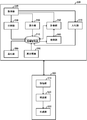
- the processing apparatus 300 constitutes a genre processing system 1 as shown in FIG.
- the genre processing system 1 is described as performing an auction of a product or service (hereinafter referred to as a product) on an auction site, but is not limited thereto.
- the genre processing system 1 may sell or provide a product or the like (hereinafter referred to as “sales”) at an electronic store (that is, an online shop) established on the Internet.
- the service provided in the present embodiment is described as including, for example, a moving image distribution service through the Internet, but is not limited thereto.
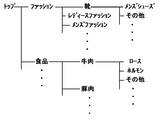
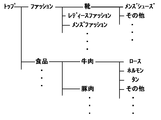
- Products etc. that are put up for auction in the genre processing system 1 are classified into a plurality of types (that is, genres) as shown in FIG. 2, and each of the plurality of genres belongs to a genre hierarchy having a hierarchical structure.
- top genre corresponds to the root node in the tree structure, and corresponds to “top” in the genre hierarchy shown in FIG.
- the “direct genre” corresponds to the parent node in the tree structure.
- the genre immediately above the genre “shoes” is the genre “fashion”.
- “direct genre” corresponds to a child node in the tree structure.
- the genres immediately below the genre “food” are the genres “beef” and “pork”.
- “upper genre” corresponds to an ancestor node in the tree structure.
- the top genres of the genre “men's shoes” are the genres “shoes”, “fashion”, and “top”.
- the “subordinate genre” corresponds to a descendant node in the tree structure.
- the lower genres of the genre “fashion” are the genres “shoes”, “ladies fashion”, “mens fashion”, and “mens shoes”.
- the “sibling genre” corresponds to a sibling node in the tree structure.
- the genre “shoes” and the sibling genre are genres immediately below the genre “fashion”, such as the genres “ladies fashion” and “mens fashion”.
- the “end genre” corresponds to a leaf node in the tree structure.
- the genre at the end is a genre that does not have a genre immediately below, such as the genres “men's shoes”, “loose”, and “hormone”.
- the genre processing system 1 that conducts auctions for products classified into the above genres, in addition to the processing device 300, a computer communication network 10 (hereinafter simply referred to as the communication network 10) as shown in FIG. It comprises a terminal device 101, a bidder terminal device 102, and a search device 200.
- the communication network 10 is configured by the Internet, for example.
- the communication network 10 may be a LAN (Local Area Network) or a public line network.
- the exhibitor side terminal device 101 and the bidder side terminal device 102 are configured by a personal computer including a display unit such as an LCD (Liquid Crystal Display) and an input unit such as a keyboard and a mouse.
- a display unit such as an LCD (Liquid Crystal Display)
- an input unit such as a keyboard and a mouse.
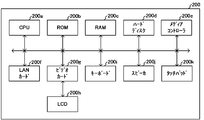
- the search device 200 includes a server as shown in FIG. 3, and includes a CPU (Central Processing Unit) 200a, a ROM (Read Only Memory) 200b, a RAM (Random Access Memory) 200c, a hard disk 200d, a media controller 200e, and a LAN card. 200f, video card 200g, LCD 200h, keyboard 200i, speaker 200j, and touch pad 200k.
- CPU Central Processing Unit
- ROM Read Only Memory
- RAM Random Access Memory
- the CPU 200a performs overall control of the search device 200 by executing software processing according to programs stored in the ROM 200b or the hard disk 200d.
- the RAM 200c temporarily stores information (that is, data) to be processed when the CPU 200a executes the program.
- the hard disk 200d is an information storage unit that stores a table (that is, a table) that stores various types of information (that is, data). Note that the search device 200 may include a flash memory instead of the hard disk 200d.
- the media controller 200e reads various data and programs from recording media including flash memory, CD (Compact Disc), DVD (Digital Versatile Disc), and Blu-ray Disc (Blu-ray (registered trademark) Disc).
- the LAN card 200f transmits and receives data to and from the seller-side terminal device 101, the bidder-side terminal device 102, and the processing device 300 that are connected via the communication network 10.
- the keyboard 200i and the touch pad 200k input signals or information corresponding to user operations.
- the LAN card 200f constitutes an acquisition unit 220 and a presentation unit 240 shown in FIG.
- the video card 200g draws (that is, renders) an image based on the digital signal output from the CPU 200a, and outputs an image signal representing the drawn image.
- the LCD 200h displays an image according to the image signal output from the video card 200g.
- the search device 200 may include a PDP (Plasma Display Panel) or an EL (Electroluminescence) display instead of the LCD 200h.
- the speaker 200j outputs sound based on the signal output from the CPU 200a.
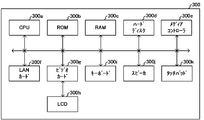
- the processing device 300 includes a server as shown in FIG. 4, and includes a CPU 300a, ROM 300b, RAM 300c, hard disk 300d, media controller 300e, LAN card 300f, video card 300g, LCD 300h, keyboard 300i, speaker 300j, and touch pad 300k. Consists of.
- the CPU 300a performs overall control of the processing device 300 by executing software processing according to a program stored in the ROM 300b or the hard disk 300d.
- the RAM 300c temporarily stores information (that is, data) to be processed when the CPU 300a executes the program.
- the hard disk 300d is an information storage unit that stores a table (that is, a table) that stores various types of information (that is, data). Note that the processing apparatus 300 may include a flash memory instead of the hard disk 300d.
- the media controller 300e reads various data and programs from recording media including flash memory, CD, DVD, and Blu-ray (registered trademark) disk.
- the LAN card 300f transmits and receives data to and from the exhibitor terminal device 101, the bidder terminal device 102, and the search device 200 connected via the communication network 10.
- the keyboard 300i and the touch pad 300k input signals or information corresponding to user operations.
- the video card 300g draws (that is, renders) an image based on the digital signal output from the CPU 300a, and outputs an image according to an image signal representing the drawn image.
- the LCD 300h displays an image according to the image signal output from the video card 300g.
- the processing device 300 may include a PDP or an EL display instead of the LCD 300h.
- the speaker 300j outputs sound based on the signal output from the CPU 300a.
- the seller-side terminal device 101 operates the input unit by an exhibitor such as a product, so that information indicating the name of the product (hereinafter referred to as a product name) and the lowest genre in which the product is classified Information for identifying the genre designated by the seller (hereinafter referred to as a category genre), advertising information for advertising the product, etc., and information representing the exhibition deadline for the product, etc. Enter. Thereafter, the seller-side terminal device 101 transmits information representing the inputted product name, classification genre ID, advertisement information, and information representing the exhibition deadline to the search device 200.
- the CPU 200a classifies the product etc. whose name is represented by the received information in the classification.
- a product etc. classification process as shown in FIG. Thereby, the CPU 200a of the search device 200 functions as a classification unit 230 as shown in FIG.
- the CPU 200a functions as the information storage unit 210 in cooperation with the hard disk 200d. Further, the CPU 200a functions as the acquisition unit 220 in cooperation with the LAN card 200f.
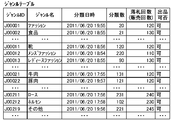
- the information storage unit 210 in FIG. 6 stores a genre table as shown in FIG.
- the genre table information for identifying a genre as shown in FIG. 2 (hereinafter referred to as a genre ID), information indicating a name of the genre (hereinafter referred to as a genre name), and finally a product or the like is classified into the genre Information indicating the date and time (hereinafter referred to as the classification date), the number of products and the like classified in the genre (hereinafter referred to as the number of classifications), and the products and the like classified in the genre are awarded (that is, sold) Information in which the number of times (hereinafter referred to as the number of sales) is associated with a flag indicating whether or not to allow the sale of a product or the like classified in the genre (hereinafter referred to as an exhibition availability flag) is associated. Saved.
- the information storage unit 210 stores a genre hierarchy table as shown in FIG.
- the genre hierarchy table the genre ID stored in the genre table of FIG. 7, the genre name information, the genre ID of the genre immediately below the genre identified by the genre ID (hereinafter referred to as “genre ID”), Information in which the name of the genre immediately below (hereinafter referred to as the genre name immediately below) is associated with the name is stored.
- the information storage unit 210 stores a product etc. table as shown in FIG.
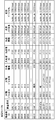
- product etc. table information for identifying the product etc. (hereinafter referred to as product etc. ID), information representing the name of the product etc., a category genre ID for identifying the category genre of the product etc., and the name of the category genre Information in which information representing (hereinafter referred to as “category genre name”), auction information related to the auction of the product or the like, and advertisement information for advertising the product or the like is stored is stored.
- the auction information includes information indicating the highest bid price of a product, information for identifying a bidder who bids the product at the bid price (hereinafter referred to as a bidder ID), and the product.
- This is information in which information representing the seller (hereinafter referred to as a seller ID) is associated with information representing the exhibition deadline.
- the advertisement information is associated with information representing the name of an image file representing an advertisement of a product or the like (hereinafter referred to as an advertisement file name) and information representing the URL of an advertisement page (hereinafter referred to as an advertisement page URL).
- Information is associated with information representing the name of an image file representing an advertisement of a product or the like (hereinafter referred to as an advertisement file name) and information representing the URL of an advertisement page (hereinafter referred to as an advertisement page URL).
- the information storage unit 210 stores a keyword table for products as shown in FIG.
- the product keyword table stores information in which a product ID that identifies a product, information that represents the product name of the product, and information that represents a keyword that describes the product are associated with each other. ing.
- the information indicating the keyword associated with the product etc. ID in the product etc. keyword table of FIG. 10 is extracted from the character string represented by the advertisement image stored in the advertisement file of the product etc. identified by the product etc. ID. It may be information indicating a keyword that has been performed (that is, extracted from the content of the advertising content) or information indicating a keyword selected by the seller of the product identified by the product ID.
- the acquisition unit 220 of FIG. 6 obtains the information indicating the product etc. name received from the seller side terminal device 101, the classification genre ID, and the advertisement information. Obtained from the LAN card 200f of FIG. 3 (step S01).
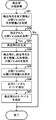
- the classification unit 230 in FIG. 6 refers to the exhibition availability flag associated with the same genre ID as the classification genre ID acquired in step S01 from the genre table in FIG. It is determined whether or not the listing is possible (step S02). At this time, if the classification unit 230 determines that the designated classification genre is not available for listing (step S02; No), the execution of the product etc. classification process is terminated.
- the classification unit 230 determines that the designated classification genre can be exhibited (step S02; Yes)
- the classification unit 230 generates an ID of a commodity such as a commodity to be exhibited (step S03).
- the classification unit 230 sets the product etc. ID generated in step S03, the information indicating the product etc. name acquired in step S01, the category genre ID, and the category genre name to the product etc. table of FIG. Information representing the information to be represented and the advertisement information is stored (step S04).
- the classification unit 230 acquires the system date and time managed by the OS (Operating System), and sets the acquired system date and time as the classification date and time when the product or the like was last classified into the classification genre.
- the classification unit 230 stores information in which the classification genre ID and information indicating the classification date / time are associated with each other in the genre table of FIG. 7 (step S05).
- the classification unit 230 extracts keywords from the advertisement page located at the URL represented by the advertisement information acquired in step S01 (step S06).
- the classification unit 230 extracts words that are used more than a predetermined number of times for keyword extraction on the advertisement page as keywords, but it is not necessary to extract words that are used less than the predetermined number of times on the advertisement page as keywords. good.
- Information indicating a predetermined number of times for keyword extraction is stored in the information storage unit 210.
- the classification unit 230 stores information in which the extracted one or more keywords and the product etc. ID generated in step S03 are associated with each other in the product keyword table of FIG. S07), the execution of the product etc. classification process is terminated.
- the bidder-side terminal device 102 in FIG. 1 operates the input unit by a user who wants to bid on the exhibited goods and the like, inputs various information such as a search query, and transmits the input information to the search device 200. To do. Further, the bidder-side terminal device 102 receives the information transmitted from the search device 200 and displays the received information on the display unit.
- the input search query is a search query consisting of one keyword that describes a product, a search query consisting of one keyword and a refinement instruction, a Boolean search connecting a plurality of keywords and the plurality of keywords. It is assumed that the search query is composed of a search query composed of operators and a search query composed of a plurality of keywords (that is, includes a plurality of keywords but does not include an operator). is not.
- a search query consisting of one keyword is a query that instructs the search device 200 to send back a result of searching for a product or the like described in the keyword among the products or the like exhibited in the auction.
- a search query consisting of one keyword and a refinement instruction is to narrow down the products searched based on the search query transmitted last time (that is, the search result) based on the products further described by the keyword. It is a query to instruct.
- Boolean search operator is described as including an AND operator, an OR operator, and a-operator, but is not limited thereto.
- a search query including a plurality of keywords and a Boolean search operator that connects the plurality of keywords includes, for example, queries represented by the following formulas (1) to (3).
- the search query represented by Formula (1) is a query that instructs to return a result of searching for a product or the like that is described by the first keyword and also described by the second keyword. That is, the search query represented by the formula (1) is a result of further narrowing down the products etc. also described by the second keyword from the products etc. described by the first keyword, or the products explained by the second keyword. Is a query instructing to return a result of further narrowing down the products described in the first keyword.
- the search query represented by Expression (2) is a query that instructs to return a result of searching for a product or the like described by either the first keyword or the second keyword.
- the search query represented by the formula (2) is a query that instructs to return a result of searching for both the product described by the first keyword and the product described by the second keyword. is there.
- the search query represented by Expression (3) is a query that instructs to return a result of searching for a product or the like that is described by the first keyword but is not described by the second keyword.
- the search query represented by the expression (3) is a query that instructs to return a result obtained by excluding the product described by the second keyword from the search result of the product described by the first keyword. is there.
- the degree to which the first keyword and the second keyword co-occur in the search query is referred to as the co-occurrence degree.
- the degree at which the first keyword and the second keyword co-occur in the search query combined by the AND operator is referred to as an AND co-occurrence degree.
- the AND co-occurrence degree is calculated by calculating the AND of the first keyword and the second keyword with respect to the sum of the number of acquisition times of the search query including the first keyword and the number of acquisition times of the search query including the second keyword. It is acquired as a ratio to the number of acquisition times of linked search queries.
- the degree of co-occurrence in the search query in which the first keyword and the second keyword are combined by the OR operator is referred to as the OR co-occurrence degree.
- the OR co-occurrence degree is determined by the OR operator for the first keyword and the second keyword with respect to the sum of the number of search queries including the first keyword and the number of search queries including the second keyword. It is acquired as a ratio to the number of acquisition times of linked search queries.
- the CPU 200a of the search device 200 shown in FIG. 3 performs an auction for a product or the like searched based on the search query.
- the auction process for merchandise as shown in FIG. As a result, the CPU 200a functions as a counting unit 250, a search unit 260, and a bidding unit 270 as shown in FIG. Further, the CPU 200a further functions as the presentation unit 240 in cooperation with the LAN card 200f.
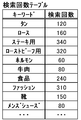
- the information storage unit 210 stores a search frequency table as shown in FIG. Information in which a keyword used for searching for a product etc. is associated with information indicating the number of times a product etc. have been searched using the keyword (hereinafter referred to as the number of searches) in the search count table Is saved.
- the information storage unit 210 stores an acquisition count table as shown in FIG.
- the acquisition count table includes information representing the word designated as the first keyword, information representing the word designated as the second keyword, and the first keyword and the second keyword connected by an AND operator.
- Information in which an OR query acquisition count is associated with information is stored.
- the information storage unit 210 stores a co-occurrence degree table as shown in FIG.
- the co-occurrence degree table includes information representing the word designated as the first keyword, information representing the word designated as the second keyword, and the AND co-occurrence degree and OR of the first keyword and the second keyword. Information in which information indicating the co-occurrence degree is associated with the information is stored.
- the CPU 200a displays the product shown in FIG. The execution of the auction process is started.
- the acquisition unit 220 in FIG. 6 acquires the information received from the bidder terminal device 102 from the LAN card 200f in FIG.
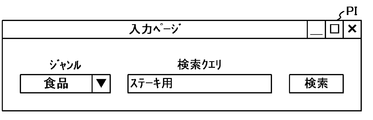
- the presentation unit 240 of FIG. 6 inputs a search query as illustrated in FIG.
- Information representing the input page PI to be used is acquired from the information storage unit 210, and the acquired information is output to the LAN card 200f of FIG. 3 (step S12).
- the LAN card 200f returns the output information to the bidder side terminal device 102.
- the bidder-side terminal device 102 When receiving information representing the input page PI, the bidder-side terminal device 102 displays the input page PI represented by the received information on the display unit. Next, when operated by a user who visually recognizes the input page, the bidder-side terminal device 102 is designated as a genre to which the search query “for steak” designated by the user and the products searched by the query belong. After inputting the genre ID “J00002” of the genre “food” in the input unit, the input search query “for steak” and the genre ID “J00002” are transmitted to the search device 200. Note that the input search query and genre ID are not limited to these.
- step S12 of FIG. 220 acquires these search queries “for steak” and genre ID “J00002” from the LAN card 200f. Thereafter, when the acquisition unit 220 does not acquire an input request from the bidder-side terminal device 102 (step S11; No), but determines that a search query has been acquired (step S13; Yes), a search as illustrated in FIG. A pre-query correction process is executed (step S14).
- the counting unit 250 of FIG. 6 determines that the keyword included in the search query is “for steak” (step S31; Yes), and will be described later.
- Information representing the keyword stored in the information storage unit 210 in step S77 (hereinafter referred to as a stored keyword) is read out (step S32).
- the counting unit 250 determines that the information representing the saved keyword is not stored in the information storage unit 210 (step S33; No), and before the search. The execution of the query correction process is terminated.
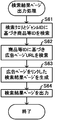
- step S15 a search result page output process as shown in FIG. 17 is executed (step S15).
- the search unit 260 of FIG. 6 performs a direct genre ID “J00021” associated with the acquired genre ID “J00002” from the genre hierarchy table of FIG. Search for “J00022”.
- the search unit 260 searches for the direct genre IDs “J00211”, “J00212”, and “J00219” associated with the same genre ID as the direct genre ID “J00021”.
- the search unit 260 acquires the system date and time from the OS, and from the product etc. table of FIG.
- any of the acquired genre ID “J00002” and the directly below genre IDs “J00021”, “J00022”, and “J00219” “M006” and “M010” are retrieved from the product IDs “M001” associated with the same category genre ID and information representing the exhibition deadline after the system date and time.
- the search unit 260 represents the same keyword as the acquired search query “for steak” from the acquired product IDs “M001” to “M006” and “M010” from the product etc.
- keyword table of FIG. “M003” is searched from the product etc. ID “M001” associated with the information (step S61).
- the search unit 260 selects the advertisement file name for advertising the product etc. identified by the ID from the product etc. table of FIG.
- the information representing, the information representing the advertisement page URL, and the information representing the product name are respectively searched (step S62).
- the search unit 260 acquires information indicating the product name “XA beef”, information indicating “XB beef”, information indicating “XC beef”, and the like.
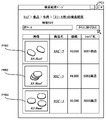
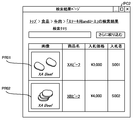
- the presentation unit 240 in FIG. 6 generates a search result page PC1 as shown in FIG. 18 (step S63).
- This search result page PC1 publishes advertisement images PR01 to PR03 represented by the electronic file having the advertisement file name represented by the information acquired in step S62 of FIG.
- An advertisement page for advertising products etc. advertised with images is linked.
- the presentation unit 240 outputs information representing the generated search result page PC1 to the LAN card 200f in FIG. 3 (step S64).
- the LAN card 200f returns the output information to the bidder-side terminal device 102.
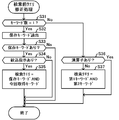
- step S15 in FIG. 11 When the execution of step S15 in FIG. 11 is completed, the counting unit 250 executes a post-search query correction process as shown in FIG. 19 (step S16).
- the counting unit 250 executes the same processing as in step S31 and step S32 in FIG. 16 (step S71 and step S72), and then the saved keyword is stored in the information storage unit 210. (Step S73; No), information representing the keyword “for steak” included in the currently acquired search query is stored in the information storage unit 210 as information representing a stored keyword (step S77). ).
- the counting unit 250 clears a software timer (hereinafter referred to as an elapsed time timer) that measures an elapsed time from the date and time when the search query including the saved keyword “for steak” is specified (hereinafter referred to as the query specified date and time). And then start (step S78).
- the counting unit 250 clears the value of the browsing page counter that counts the number of web pages browsed from the date and time specified by the query by the user of the bidder side terminal device 102 by setting it to “0” (step S79). Then, the execution of the post-search query correction process is terminated.
- step S17 the counting unit 250 increments the value of the browse page counter cleared in step S79 in FIG. 19 by “1” (step S17). This is because the user of the bidder side terminal device 102 browses the search result page PC1.
- step S18 the counting unit 250 determines that the number of keywords included in the search query is “for steak” (step S18; Yes)
- step S18 the above process is repeated from step S11.
- the user of the bidder side terminal device 102 visually recognizes the search result page PC1 of FIG. 18, and considers bidding from products etc. advertised in the advertisement images PR01 to PR03 posted on the search result page PC1.
- the product “XA beef” is determined as the product.
- the input unit of the bidder-side terminal device 102 is operated by the user to input a signal for selecting the advertisement image PR01 that advertises the product “XA beef” that has been considered for bidding. Thereafter, the bidder-side terminal apparatus 102 is a request for a reply of the linked advertisement page, and the URL “./public_dir/ of the advertisement page linked to the advertisement image PR01 selected by the input signal. A reply request including information representing “C001.html” is transmitted to the search device 200.
- the acquisition unit 220 in FIG. 6 acquires information received from the bidder-side terminal device 102 by the LAN card 200f, and the acquired information is not an input request (step S11; No) and is not a search query (step If it is determined that the request is a reply request (step S20; Yes), a request page output process for outputting an advertisement page requested to be returned by the request is executed (step S21).
- the search unit 260 in the product etc. table in FIG. The information representing the bid price “3,000” associated with the information representing the advertisement page URL is searched.
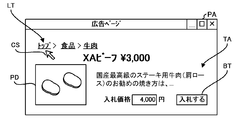
- the search unit 260 reads the advertisement page PA as shown in FIG. 20 in the advertisement page URL from the information storage unit 210.
- an image PD such as a product to be advertised and an advertisement text TA of the product are posted.
- the presentation unit 240 of FIG. 6 represents the information representing the advertisement page PA as the request page. Information is output to the LAN card 200f. Thereafter, the counting unit 235 increases the value of the browsing page counter by “1” (step S22). Thereafter, the LAN card 200f returns information representing the advertisement page to the bidder side terminal device 102.
- the bidder side terminal device 102 displays the advertisement page PA of FIG. 20 represented by the information received from the search device 200.
- the input of the bidder side terminal device 102 is performed. Operate the department.
- the bidder-side terminal device 102 uses the product etc. ID “M001” of the product etc. indicated by the bid intention, the information indicating the bid price “4,000” designated by the user, and the bidder ID “B101” of the user. "And a bid request for requesting to accept a bid is transmitted to the search device 200.
- step S22 of FIG. 11 the acquisition unit 220 of FIG. 6 acquires information received from the bidder side terminal device 102 from the LAN card 200f, and the acquired information is not an input request (step S11; No), not a search query (step S13; No), not a reply request (step S20; No), it is determined that the request is a bid request (step S23; Yes).
- the bidding unit 270 of FIG. 6 executes bidding processing in response to the bidding request (step S24).
- This bidding process is a process of storing information in which the product etc. ID “M001”, the bidder ID “B101”, and the information indicating the bid price “4,000” are associated with each other in the product etc. table of FIG. is there. If it is determined in step S23 that the acquired information is not a bid request (step S23; No), the above process is repeated from step S11.
- the user of the bidder-side terminal device 102 who has viewed the advertisement page PA operates the input unit of the bidder-side terminal device 102 to search for new products again, and the cursor displayed on the display unit A click operation is performed after the CS is superimposed on the character string “top” LT.
- the bidder-side terminal device 102 transmits an input request to the search device 200 and displays the input page returned from the search device 200.
- the bidder-side terminal device 102 is operated by the user and inputs the search query “for roast beef” designated by the user, and then transmits the search query to the search device 200.
- the acquisition unit 220 in FIG. 6 acquires information received from the bidder side terminal device 102 by the LAN card 200f in FIG. 3, and the acquired information is not an input request (step S11; No). If it is determined that the query is a search query (step S13; Yes), the pre-search query correction process of FIG. 16 is executed again (step S14).
- the counting unit 250 of FIG. 6 has already executed the processing of step S31 and step S32, and information indicating the storage keyword “for steak” has already been stored in the information storage unit 210. It is determined that it is stored (step S33; Yes). Thereafter, the counting unit 250 determines that the search query acquired this time does not include a narrowing instruction (step S34; No), and ends the pre-search query correction process.
- step S15 the search result output process is re-executed (step S15).
- the search query “for roast beef” the search for the products “XD beef”, “XE beef”, “XF beef”, and “YA pork” searched from the product etc. keyword table of FIG.
- the result page is transmitted to the bidder side terminal device 102.
- the counting unit 250 re-executes the post-search query correction process as shown in FIG. 19 (step S16).
- the counting unit 250 executes the processing from step S71 to step S73.
- the counting unit 250 is within a predetermined time from the query designated date and time based on the timer value of the elapsed time timer started in step S78 and the value of the browse page counter cleared in step S79, and the user It is determined whether or not the page is before browsing only a predetermined page (step S74).
- the counting unit 250 determines that it is within a predetermined time from the query designation date and time, and the value of the browsing page counter is the browsing page counter value.
- the threshold value for use it is determined that the user is before browsing the web page by a predetermined number of pages.
- Information indicating the threshold value for the timer value and information indicating the threshold value for the browsing page counter are stored in the information storage unit 210.
- step S74 the counting unit 250 determines that it is within a predetermined time from the query designated date and time and before the user browses the web page only for the predetermined page (step S74; Yes), and then the search query “for roast beef” "Is not included (" No "in step S74). After that, the counting unit 250 generates a search query “for steak OR for roast beef” by concatenating the saved keyword “for steak” and the currently acquired keyword (hereinafter referred to as “acquired keyword”) “for roast beef” with an OR operator. To do. Next, the counting unit 250 corrects the search query “for roast beef” acquired this time to the generated search query “for steak OR for roast beef” (step S76), and then finishes executing the post-search query correction processing. To do.
- step S76 the reason why the search query “for roast beef” acquired this time is modified to the generated search query “for steak OR for roast beef” is within a predetermined time after designating the search query “for steak”, and If the user specifies the search query “for roast beef” before browsing a predetermined number of pages from the specified date and time, the product that bids from the products searched by the search query “for steak”, etc. Even if you select products to bid from the products searched by the search query “for roast beef”, products to bid from products searched by the search query “for steak OR roast beef” This is because it is considered that there is little difference for the user. That is, if the user is familiar with the usage of the OR operator, the user does not specify the search query “for steak” and then specifies the search query “for roast beef”. This is because it is considered that the steak OR roast beef was specified.
- step S74 when the counting unit 250 determines that a predetermined time has elapsed since the query designation date or time, or the user has browsed more than a predetermined page of the web page from the query designation date (step S74; No), the information After overwriting the information representing the keyword stored in the storage unit 210 with the information representing the keyword acquired this time (step S77), the elapsed time timer is cleared and restarted (step S78), and the browsing page counter is set. After clearing (step S79), the post-search query correction process is terminated.
- step S74 the reason why the search query acquired this time is not modified to a search query obtained by concatenating the previous search query and the keyword acquired this time with an OR operator is as follows. For example, when the user specifies a search query after a predetermined time has elapsed from the date and time when the query is specified, or after the user browses a web page more than a predetermined page, the user is familiar with how to use the OR operator. However, it is rare to specify a search query in which the previous search query and the keyword acquired this time are connected by an OR operator, and the product searched based on the previous search query is used as the keyword acquired this time. This is because there are many cases where the user does not have the intention to narrow down based on this.
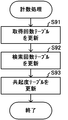
- step S16 in FIG. 11 the counting unit 250 increases the value of the viewing counter by “1” (step S17), and then the number of keywords included in the corrected search query “for steak OR for roast beef” is “2”. ”And not“ 1 ”(step S18; No). After that, the counting unit 250 executes the counting process as shown in FIG. 21 (step S19), and then the above process is repeated from step S11.
- the counting unit 250 updates the acquisition count table of FIG. 13 based on the corrected search query “for steak OR for roast beef” (step S91). Specifically, the counting unit 250 obtains information indicating the OR query acquisition count “108”, which is the number of times an OR query including the keyword “for steak” and the keyword “for roast beef” has been acquired, Update to information that represents.
- the counting unit 250 represents information indicating the search count “340” associated with information indicating the keyword “for steak” included in the search query in the search count table of FIG.
- the information is updated, and the information indicating the number of searches “320” associated with the information indicating the keyword “for roast beef” included in the search query is updated to information indicating the number of searches “321” (step S92).
- the counting unit 250 obtains an OR query acquisition count “109” associated with information indicating “for steak” and information indicating “for roast beef” from the acquisition count table in FIG. Search for information representing the query acquisition count “120”. Further, from the search frequency table of FIG. 12, information indicating the search frequency “341” associated with information indicating the keyword “for steak” included in the search query and the keyword “for roast beef” included in the search query are represented. Information indicating the number of searches “321” associated with the information is searched.
- the number of searches “341” associated with the information representing the keyword “for steak” represented by the retrieved information and the number of searches “321” associated with the information representing the keyword “for roast beef”
- the ratio of the AND query acquisition count “120” with respect to the sum of (and the AND co-occurrence) “18” and the ratio of the OR query acquisition count “109” with respect to the sum (ie, the OR co-occurrence) “16” are calculated. To do.
- the counting unit 250 uses the AND co-occurrence degree “19” and the OR co-occurrence degree “corresponding to information representing“ for steak ”and information representing“ for roast beef ”in the co-occurrence degree table of FIG.
- the information representing “15” is updated to information representing the calculated AND co-occurrence degree “18” and OR co-occurrence degree “16” (step S93). Thereafter, the counting unit 250 ends the execution of the counting process.
- the search device 200 acquires a search query including a refinement instruction with respect to the auction processing for products already described.
- the bidder-side terminal device 102 transmits the search query “for steak” to the search device 200, a search result page PC1 as shown in FIG.
- the user of the bidder side terminal device 102 performs an operation on the input unit of the bidder side terminal device 102 for narrowing down the products listed on the search result page PC1 to the products described by the keyword “loose”. Do.
- the bidder side terminal device 102 transmits a search query including the keyword “loose” designated by the user and a narrowing down instruction to the search device 200.
- Step S14 the pre-search query correction process of FIG. 16 is executed again (Step S14).
- the counting unit 250 in FIG. 6 executes the processing from step S31 to step S33.
- the counting unit 250 determines that the keyword “for steak” included in the previously acquired search query is already stored in the information storage unit 210 (step S33; Yes), and narrows down the search query acquired this time. It is determined whether or not an instruction is included (step S34).
- the counting unit 250 determines that the search query includes a narrowing instruction (step S34; Yes), and uses the currently acquired search query as the saved keyword “for steak” and the currently acquired keyword “loose”. And the search query acquired this time is corrected to “AND steak for steak” (step S35). This is to perform a search according to the narrowing down instruction.
- the counting unit 250 sets the stored keyword “for steak” as the first keyword and the currently acquired keyword (referred to as the currently acquired keyword) “loose” as the second keyword, and then ends the execution of the search query correction process. .
- step S15 a search result output process is executed (step S15).
- the product etc. “XA beef”, “XB beef”, and “XC beef” retrieved based on the first keyword (that is, the storage keyword) “for steak” are the product etc. keywords of FIG.
- products such as “XA beef” and “XB beef” associated with the second keyword (that is, the keyword acquired this time) “loose” are narrowed down.
- a search result page PC2 as shown in FIG.
- the counting unit 250 re-executes the post-search query correction process as shown in FIG. 19 (step S16).
- the counting unit 250 includes two keywords, “for steak” and “loose”, included in the search query corrected by the pre-search query correction process. It is determined that it is not (step S71; No).
- the counting unit 250 deletes the saved keyword saved in step S77 (step S80). The reason for deleting the saved keyword is that it is no longer necessary to perform correction using the saved keyword.
- the counting unit 250 determines that the-operator is not included in the search query (step S81; No), and ends the post-search query correction process.
- step S16 in FIG. 11 the counting unit 250 increments the value of the viewing counter by “1” (step S17), and then the search query includes “2” keywords, “for steak” and “loin”. It is determined that the number is greater than “1” (step S18; No). Thereafter, the counting unit 250 performs the counting process as shown in FIG. 21 (step S19), and then repeats the process of step S11.
- the counting unit 250 obtains an AND query acquisition count “that is the number of times that an AND query connecting the keyword“ for steak ”and the keyword“ loose ”is acquired in the acquisition count table of FIG.
- Information representing “100” is updated to information representing the number of times of acquisition “101” (step S91).
- the counting unit 250 represents information indicating the search count “340” associated with information indicating the keyword “for steak” included in the search query in the search count table of FIG.
- the information is updated, and the information indicating the search count “160” associated with the information indicating the keyword “loose” included in the search query is updated to information indicating the search count “161” (step S92).
- the counting unit 250 obtains an OR query acquisition count “41” associated with information indicating “for steak” and information indicating “loose” from the acquisition count table in FIG. Search for information indicating the number of times of acquisition “101”. Also, from the search count table of FIG. 12, information representing the search count “341” associated with information representing the keyword “for steak” included in the search query and information representing the keyword “loose” included in the search query. And information indicating the number of times of search “161” associated with.
- the number of searches “341” associated with the information representing the keyword “for steak” represented by the retrieved information and the number of searches “161” associated with the information representing the keyword “loose”
- the ratio of the AND query acquisition count “101” to the sum of the sums (ie, the AND co-occurrence) “20” and the ratio of the OR query acquisition count “100” to the sum (ie, the OR co-occurrence) “8” are calculated. .
- the counting unit 250 in the co-occurrence degree table of FIG. 14, information representing the AND co-occurrence degree “21” associated with the information representing “for steak” and the information representing “loin”, and OR co-occurrence.
- the degree “7” is updated to information indicating the calculated AND co-occurrence degree “20” and OR co-occurrence degree “8” (step S93).
- the counting unit 250 ends the execution of the counting process.
- the search device 200 acquires a search query that includes the first keyword and the second keyword but does not include an operator, regarding the auction processing for products already described.
- step S11 When the bidder-side terminal device 102 transmits the search query “steak loin” to the search device 200, the acquisition unit 220 of the search device 200 acquires information received by the LAN card 200f, and the acquired information Is not an input request (step S11; No), it is determined that it is a search query (step S13; Yes). Next, after the pre-search query correction process of FIG. 16 is executed again (step S14), after the processes of step S15 to step S19 are executed, the above process from step S11 is repeated.
- the counting unit 250 of FIG. 6 includes “2” keywords included in the search query, the first keyword “for steak” and the second keyword “loose”. It is determined that the number is not “1” (step S31; No). Next, the counting unit 250 determines that the operator is not included in the search query (step S36; No), and connects the first keyword and the second keyword with an AND operator that is a predetermined operator. After correcting the acquired search query to the search query “steak AND loin” (step S37), the execution of the pre-search query correction processing is terminated. Information representing a predetermined operator is stored in the information storage unit 210. The predetermined operator is not limited to the AND operator, and may be an OR operator or a-operator.
- the counting unit 250 determines that the operator is included in the search query (step S36; Yes), The execution of the pre-search query correction process is terminated without executing the process of step S37.
- the search device 200 obtains a search query in which the first keyword and the second keyword are connected by the-operator with respect to the commodity auction processing already described.
- the acquisition unit 220 of the search device 200 includes the LAN card.
- Information received at 200f is acquired, and it is determined that the acquired information is not an input request (step S11; No) but a search query (step S13; Yes).
- the counting unit 250 in FIG. 6 executes the pre-search query correction process again (step S14), but does not correct the search query.
- the search result page output process of FIG. 17 is executed (step S15).
- the search unit 260 in FIG. 6 starts from the lower genre IDs “J00011” to “J00013” associated with the acquired genre ID “J00001” from the genre hierarchy table in FIG. Search for.
- the search unit 260 acquires the system date and time from the OS, and the same category genre ID as any of the acquired genre ID “J00001” and the lower genre IDs “J00011” to “J00013” from the product etc. table of FIG. And “M103” from the product ID “M100” associated with the information indicating the exhibition deadline after the system date and time.
- the search unit 260 obtains information representing the same keyword as “fashion” included in the acquired search query from the acquired product IDs “M100” to “M103” from the product etc. keyword table of FIG. Search for “M102” from the associated product etc. ID “M100”.
- the search unit 260 searches for the product etc. ID “M102” based on the keyword “men's fashion”, and searches for the product etc. ID “M100” to “M102” searched based on the keyword “fashion”.
- the product etc. ID “M102” is excluded (step S61 in FIG. 17).
- the search unit 260 executes the processing from step S62 to step S64, so that the search unit 260 is identified by the product “ZA sandal” identified by the product etc. ID “M100” and the product etc. ID “M101”. Information representing the search result page in which information representing the product “ZB skirt” is posted is returned to the bidder side terminal device 102.
- step S15 in FIG. 11 When the execution of step S15 in FIG. 11 is completed, the counting unit 250 executes a post-search query correction process as shown in FIG. 19 (step S16).
- the counting unit 250 determines that the acquired search query includes a ⁇ operator after executing the processes of Step S71 and Step S80 (Step S71). S81; Yes). Next, the counting unit 250 acquires a genre represented by the second keyword “men's fashion” and a keyword representing a sibling genre (hereinafter referred to as a sibling keyword) (step S82).
- the counting unit 250 searches a genre ID “J00012” associated with information representing the same genre name as the second keyword “men's fashion” from the genre table of FIG.
- the counting unit 250 searches the genre hierarchy table of FIG. 8 for the genre ID “J00001” associated with the same genre ID as the searched genre ID “J00012”, and the searched genre ID “J00001”.
- "J00013” is acquired from the genre IDs "J00011” directly below.
- the counting unit 250 acquires information representing genre names associated with the same genre IDs as the genre IDs “J00011” to “J00013” directly from the genre table of FIG.
- the keywords “shoes”, “ladies fashion”, and “mens fashion” are represented as sibling keywords.
- the counting unit 250 generates a concatenated keyword “shoes OR ladies fashion” obtained by concatenating brother keywords “shoes” and “ladies fashion” other than the second keyword “mens fashion” with an OR operator.
- the counting unit 250 searches the query “fashion AND (shoe OR ladies' fashion) by connecting the search keyword“ fashion-men's fashion ”with the first keyword“ fashion ”and the linked keyword“ shoe OR ladies fashion ”with an AND operator. ) "(Step S83), the post-search query correction process is terminated.
- step S16 in FIG. 11 the counting unit 250 executes the processes of step S17 and step S18. After that, the counting unit 250 regards the search query “fashion AND (shoes OR ladies fashion)” as an AND query “fashion AND ladies fashion”, an AND query “fashion AND ladies fashion”, and an OR query “shoe OR ladies fashion”. After the counting process is executed (step S19), the above process is repeated from step S11.
- step S83 the reason for modifying “fashion-men's fashion” to the search query “fashion AND (shoes OR ladies fashion)” is that the user who specified the search query “fashion-men's fashion” This is because it is often recognized that the genre is “high-ranking genre”.
- the search result of the product based on the search query “Fashion-Men's fashion” and the search result of the product etc. based on the search query “Fashion AND (shoes OR ladies fashion)” are equal, the user
- the genre “fashion” is the genre “shoes” and the genre “lower” or lower than the genre “shoes”, and the genre “shoes” and the genre “ladies fashion” are often recognized as sibling genres. is there.
- the CPU 200a of the search device 200 shown in FIG. 3 executes a successful bid process (not shown) at a predetermined time period. Thereby, CPU200a functions as a successful bid part 280 as shown in FIG.
- the successful bid unit 280 acquires the system date and time from the OS, and is associated with the time up to the predetermined time before the acquired date and time in the product etc. table of FIG.
- the product etc. ID product for which the exhibition period has expired from the predetermined time to the present
- information representing the product etc. name, classification genre ID, information representing the bid price, bidder ID, and exhibitor ID are acquired.
- the successful bid unit 280 gives the bidder identified by the bidder ID the product etc. ID of the product etc. for which the bid has been made, the information indicating the name of the product, the information indicating the bid price, the exhibitor ID, etc. Notify by email.
- the successful bid unit 280 gives the successful bidder identified by the successful bidder ID the product etc. ID of the product etc. for which a successful bid has been made, the information indicating the name of the product, the information indicating the bid price, the bidder ID, etc. Notify me by e-mail.
- the successful bid section 280 obtains information indicating the number of times of sale associated with the same genre ID as the category genre ID of the successful bid item in the genre table of FIG. Update to information that represents the increased number of sales.
- genre generation will be described.
- a method for generating a genre having a name of a certain keyword an AND co-occurrence degree and an OR co-occurrence degree of the genre included in the route in the route from the top genre to the genre of the hierarchical structure of the genre If at least one of the distributions matches one of at least one predetermined distribution pattern, the keyword is named based on the route and the position associated with the distribution pattern in advance. The position of the genre is specified, and a genre whose name is the keyword is generated at the specified position.
- one genre included in the hierarchical structure of genres is set as “attention genre”, and when a genre directly below the attention genre exists, The path from the top genre of the structure to each of the genres immediately below the target genre, or if there is no genre directly below the target genre, specify the path from the top genre of the hierarchical structure to the target genre, If the distribution of at least one of the AND co-occurrence degree and the OR co-occurrence degree acquired for the identified route matches one of at least one predetermined distribution pattern, the distribution pattern in the route An example in which a position associated with a keyword is specified as a position of a genre whose name is the keyword. To.
- the candidate condition is a condition that is satisfied when the target genre is specified as a candidate for a genre immediately above a genre with a certain keyword as a name, and a query including a plurality of keywords is given to the search device 200.
- a route from the top genre of the hierarchical structure to each of the genres immediately below the target genre is specified.
- a route from the top genre of the hierarchical structure to the target genre is specified.
- each genre included in the hierarchical structure of the genre is set as a target genre, and by determining whether or not the candidate condition is satisfied, a genre candidate immediately above a genre having a certain keyword as a name is specified. . Details of specific candidate conditions will be described later.
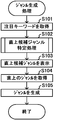
- the CPU 300a of the processing device 300 illustrated in FIG. 4 functions as the acquisition unit 310, the specification unit 320, and the generation unit 330 in cooperation with the LAN card 300f by executing the genre generation processing of FIG. 23 at a predetermined period. .
- the acquisition unit 310 of FIG. 6 selects, for example, a keyword (hereinafter referred to as a keyword of interest) representing a newly generated genre designated by the user from the keyboard 300i of FIG. Information to represent is acquired (step S101).
- a keyword of interest a keyword representing a newly generated genre designated by the user from the keyboard 300i of FIG. Information to represent is acquired (step S101).
- the acquisition unit 310 executes the immediately above candidate genre specifying process as shown in FIG. 24 (step S102). 24 starts, the acquisition unit 310 reads the genre table of FIG. 7 from the information storage unit 210 of the search device 200, and steps through all the genres stored in the genre table. It is determined whether or not the target genre is determined in the process of S112 (step S111). At this time, if the acquisition unit 310 determines that all of the genres have not been determined as the target genre (step S111; No), the target genre is determined from the genres that have not yet been determined as the target genre (step S112). ).
- the acquisition unit 310 reads the genre hierarchy table of FIG. 8 from the information storage unit 210 of the search device 200. If there is a genre immediately below the genre of interest, the acquisition unit 310 immediately below the genre of interest from the genre at the top of the hierarchical structure. Identify the route to each genre. When there is no genre immediately below the genre of interest, the acquisition unit 310 identifies a route from the genre at the top of the hierarchical structure to the genre of interest. Then, the acquisition unit 310 identifies a genre included in the identified route (hereinafter, referred to as “in-route genre”) (step S113).
- in-route genre a genre included in the identified route
- the acquisition unit 310 determines from the genre hierarchy table of FIG. 8 that the genre “loin” directly associated with the determined target genre “beef” is determined. ”,“ Hormone ”, and“ others ”are specified as genres in the route. Furthermore, the acquisition unit 310 identifies the genre “food” associated with the target genre “beef” from the genre hierarchy table of FIG. In addition, the acquisition unit 310 identifies the target genre “beef” as the in-route genre. The genre “others” may not be specified as the genre in the route.
- the acquisition unit 310 reads the co-occurrence degree table of FIG. 14 from the information storage unit 210 of the search device 200, and AND co-occurrence of the genre name of the in-path genre identified in the process of step S113 and the keyword of interest.
- the degree is read (step S114).
- step S113 when the in-route genres “food”, “beef”, “loose”, and “hormone” corresponding to the target genre “beef” are specified, the acquisition unit 310 performs the co-occurrence of FIG. From the degree table, the AND co-occurrence degree “10” associated with the attention keyword “tan” and the genre name “food”, and the AND co-occurrence degree “20” associated with the attention keyword “tan” and the genre name “beef”. , AND co-occurrence degree “2” associated with the keyword “Tan” and the genre name “Loose”, and AND co-occurrence degree “2” associated with the keyword “Tan” and the genre name “hormone”. read out.
- the acquisition unit 310 instead of reading the AND co-occurrence degree from the information storage unit 210 of the search device 200 in step S114, the acquisition unit 310 has already been read from the information storage unit 210 in the previous process and stored in the RAM 300c of the processing device 300. The acquisition unit 310 may read out the stored AND co-occurrence degree from the RAM 300c.
- the acquisition unit 310 determines whether there is a genre immediately below the target genre determined in the process of step S112 (step S115). Specifically, the acquisition unit 310 reads the genre hierarchy table of FIG. 8 from the information storage unit 210 of the search device 200, and determines whether there is a direct genre corresponding to the target genre.
- step S115 When it is determined that there is a genre immediately below the attention genre (step S115; Yes), the specifying unit 320 determines whether or not the first candidate condition is satisfied (step S116). When it is determined that the first candidate condition is not satisfied (step S116; No), the specifying unit 320 returns to the process of step S111.
- the first candidate condition is one of the candidate conditions described above.
- the first candidate condition is associated with a search query in which a plurality of keywords are linked by an AND operator as a type of search.
- the first candidate condition is a distribution of AND co-occurrence degrees of genres included in the route from the top genre of the hierarchical structure to each of the genres immediately below the target genre.
- the condition is that it matches a predetermined distribution pattern to be associated.
- the predetermined distribution pattern associated with the first candidate condition is a distribution pattern represented by a sequence of a plurality of degrees, and a degree sufficiently low in the predetermined comparison criterion among the plurality of degrees is a terminal position. Is included. This distribution pattern is associated with the sufficiently low position in advance.
- the AND co-occurrence degree acquired in step S114 for the genre immediately below is more sufficient in a predetermined comparison criterion than the AND co-occurrence degree acquired for the genre other than the top of the genre of interest and the genre of interest. If it is low, the distribution of the AND co-occurrence degree of the in-path genre matches the predetermined distribution pattern associated with the first candidate condition, the first candidate condition is satisfied.
- the higher the degree of AND co-occurrence acquired for a genre in the route the higher the genre is, the higher or lower genre of the genre whose name is the keyword of interest; It is thought that. Further, the lower the degree of AND co-occurrence acquired for the genre in the route, the higher the genre is recognized by the user that it is not a higher or lower genre of the genre whose name is the keyword of interest, that is, a brother genre. It is thought that. Therefore, when the AND co-occurrence degree acquired for the genre immediately below is sufficiently lower in the predetermined comparison criteria than the AND co-occurrence degree acquired for the genre other than the top of the genre of interest and the genre of interest.
- the attention genre is a genre that is higher or lower than the genre with the name of the attention keyword, and the genre immediately below is the genre with the name of the attention keyword and the sibling genre. It is considered as a candidate for a genre immediately above the genre to be named.
- the specifying unit 320 sets the AND co-occurrence degree “2” acquired for the genre “loose” and “hormone” immediately below the target genre “beef” to the target genre “beef”.
- the AND co-occurrence degree “1” acquired for the genre “men's shoes” immediately below the attention genre “shoes” is More than the AND co-occurrence degree “1” acquired for the attention genre “shoes” and the AND co-occurrence degree “1” acquired for the genre “fashion” other than the top of the attention genre “shoes”. It is determined that the predetermined comparison criterion is not sufficiently low. Therefore, the specifying unit 320 determines that the first candidate condition is not satisfied.
- step S115 determines whether or not the second candidate condition is satisfied.
- step S117 determines whether or not the second candidate condition is satisfied.
- the second candidate condition is one of the candidate conditions described above.
- the second candidate condition is associated with a search query in which a plurality of keywords are linked by an AND operator as a type of search.
- the second candidate condition is a predetermined distribution in which a distribution of AND co-occurrence degrees of genres included in a route from the genre at the top of the hierarchical structure to the genre of interest is associated with the second candidate condition. The condition is that it matches the pattern.
- the predetermined distribution pattern that is associated with the second candidate condition is a distribution pattern that is represented by a sequence of a plurality of degrees, and in comparison with a degree that all of the plurality of degrees do not co-occur, It is a sufficiently high distribution pattern in a predetermined comparison standard.
- This distribution pattern is associated in advance with a position immediately below the end degree in the plurality of degrees. Therefore, when there is no direct genre in the target genre, the AND co-occurrence degree acquired for the target genre and the genres other than the top of the target genre is a predetermined comparison criterion rather than the degree indicating that the co-occurrence does not occur. If the distribution is sufficiently high, the distribution of the AND co-occurrence degree of the in-path genre matches the predetermined distribution pattern associated with the second candidate condition, and thus the second candidate condition is satisfied.
- the degree of AND co-occurrence acquired for the genre in the route is based on the degree indicating that co-occurrence does not occur. If the predetermined comparison criterion is sufficiently high, it is considered that the attention genre is highly recognized by the user as a genre higher than the genre whose name is the attention keyword. Accordingly, the target genre is considered as a genre candidate immediately above the genre with the name of the target keyword.
- the target genre determined in the process of step S112 is “loin”, and in the process of step S113, the in-route genres “food”, “beef”, and “loose” corresponding to the target genre “loin” are specified.
- the specifying unit 320 determines that there is no genre immediately below the target genre “loin”. Further, the identification unit 320 confirms that the AND co-occurrence degrees “10”, “18”, and “25” acquired for the genres “food”, “beef”, and “loin” in the route do not co-occur. It is determined that the predetermined comparison criterion is sufficiently higher than the degree to be expressed. Therefore, the specifying unit 320 determines that the second candidate condition is satisfied.
- the genre of interest determined in the process of step S112 is “hormone”
- the AND co-occurrence degree “10” associated with the keyword of interest “steak” and the genre name “food” is associated with the keyword of interest “steak” and the genre name “beef”.
- the AND co-occurrence degree “18”, the AND keyword co-occurrence degree “1” associated with the keyword of interest “for steak” and the genre name “hormone” are acquired.
- the specifying unit 320 determines that there is no genre immediately below the target genre “hormone”.
- the identification unit 320 determines that the AND co-occurrence degrees “10” and “18” acquired for the genres “food” and “beef” in the route are more than a degree indicating that they do not co-occur, and a predetermined comparison criterion. However, it is determined that the AND co-occurrence degree “1” acquired for the in-path genre “hormone” is not sufficiently high in the predetermined comparison criterion than the degree indicating the non-co-occurrence. Therefore, the specifying unit 320 determines that the second candidate condition is not satisfied.
- step S116 When it is determined that the first candidate condition is satisfied (step S116; Yes), or when it is determined that the second candidate condition is satisfied (step S117; Yes), the specifying unit 320 names the target genre and the target keyword. Is specified as a genre candidate immediately above the genre (hereinafter referred to as an immediately above candidate genre). Then, the process returns to step S111.
- step S111 When the above processing is repeated and the acquisition unit 310 determines that all of the genres are determined as the genre of interest in the process of step S112 (step S111; Yes), the immediately above candidate genre specifying process is terminated.
- the generating unit 330 displays information representing the immediately above candidate genre specified in the immediately above candidate genre specifying process in step S102 of FIG. 23, for example, on the LCD 300h of FIG. 4 (step S103).
- the generation unit 330 acquires information representing the genre selected by the user from the immediately above candidate genres, that is, the genre immediately above the genre having the name of the keyword of interest from the keyboard 200i in FIG. 4 (step S104). ).
- the generation unit 330 generates a genre whose name is the keyword of interest immediately below the genre immediately above acquired in step S104 (step S105).
- step S104 when the genre “beef” is selected by the user as the genre directly above the keyword “tan” as the name, the generation unit 330 converts the genre “tan” into the genre “genre” as illustrated in FIG. Produced directly under “beef”.
- the generation unit 330 After generating the genre ID of the genre whose name is the keyword of interest, the generation unit 330 generates the generated genre ID and information indicating the genre name of the genre with respect to the genre table of FIG. , Save. Next, the generation unit 330 searches the genre table for the genre ID of the genre immediately above selected by the user. Thereafter, the generation unit 330 sets the genre ID of the genre with the name of the attention keyword as the genre ID immediately below, and enters the genre ID of the genre immediately above and the genre ID of the genre with the name of the attention keyword in the genre hierarchy table of FIG. Save the information associated with. Then, the execution of the genre generation process is terminated.
- the CPU 200a of the search device 200 illustrated in FIG. 3 functions as a reclassification unit 290 that reclassifies products and the like into newly generated genres and existing genres when the genre generation processing in FIG.
- the reclassification unit 290 converts the product or the like classified into the genre “beef” directly below the genre “beef”. Reclassify into existing genre “loose”, “hormone”, “other” and newly generated genre “tan”.
- the reclassification unit 290 searches the product etc. table of FIG. 9 for the product etc. ID associated with the information representing the same category genre name as the information representing the genre immediately below the genre “beef”.
- the reclassification unit 290 searches the product etc. keyword table of FIG. 10 for information representing the product etc. name associated with the retrieved product etc. ID and information representing the keyword.
- the reclassification unit 290 converts the product etc. into the existing genre “Loose”, ““ based on one or more of the information indicating the product etc. name identified by the product etc. ID and the information showing the keyword. Reclassify to either “hormone” and “other” and the newly generated genre “tan”.
- the reclassification unit 290 may classify the product or the like into a genre represented by a keyword that matches or partially matches the name of the product or the like. Similarly, when the information indicating the keyword “tan” and the information indicating “beef” are associated with the product etc. ID, the reclassifying unit 290 is a genre immediately below the genre “beef”. The product may be classified into the genre “Tan” included in “Beef”.
- the reclassification unit 290 identifies information representing the classification genre ID and the classification genre name associated with the reclassified product etc. ID in the product etc. table of FIG. Is updated to information indicating the genre ID and genre name of the genre that has been reclassified.
- the processing apparatus 300 determines that the genre of interest is the genre having the keyword as the name if the co-occurrence of the genre name and the keyword in the route genre satisfies the candidate condition. Identifies candidates for the genre directly above. Therefore, when a genre is newly added in a hierarchical structure having a plurality of genres, a genre candidate immediately above the genre can be specified. Therefore, a new genre can be generated at an appropriate position.
- the specifying unit 320 reads the AND co-occurrence degree acquired for the in-path genre in the process of step S114 of the immediately above candidate genre specifying process of FIG. 24, and the read AND co-occurrence degree is the first.
- the attention genre is described as the candidate genre directly above.
- the method for identifying the immediately above candidate genre is not limited to this.
- the OR co-occurrence degree acquired for the in-path genre is read and read.
- the genre of interest may be specified as a candidate genre directly above.
- an example of the predetermined candidate condition when the OR co-occurrence is read instead of the AND co-occurrence is included in the route from the top genre of the hierarchical structure to each of the genres immediately below the target genre. It is a condition that the distribution of the OR co-occurrence of the genre matches the predetermined distribution pattern associated with the candidate condition.
- the predetermined distribution pattern associated with the candidate condition is a distribution pattern represented by a sequence of a plurality of degrees, and includes a sufficiently high degree in a predetermined comparison criterion among the plurality of degrees at the end position. It is a waste. This distribution pattern is associated with the sufficiently high position in advance.
- the OR co-occurrence degree acquired for the genre immediately below the target genre is higher than the OR co-occurrence level acquired for the target genre and genres other than the top of the target genre in a predetermined comparison criterion. If it is sufficiently high, the distribution of the OR co-occurrence of the in-path genre matches the predetermined distribution pattern associated with the candidate condition, so that the candidate condition is satisfied.
- the OR co-occurrence obtained for the genre immediately below is sufficiently larger than the predetermined comparison criterion, the OR co-occurrence obtained for the genre other than the top of the genre of interest and the genre of interest,
- the genre immediately below the target genre is the genre with the name of the target keyword and the sibling genre, that is, the target genre is considered as a candidate for the genre immediately above the genre with the name of the target keyword.
- step S114 of the immediately above candidate genre specifying process instead of reading the AND co-occurrence degree acquired for the in-path genre, the OR co-occurrence degree acquired for the in-path genre is read and read.
- the genre immediately above the genre is added when a new genre is added by specifying the attention genre as the candidate genre directly above, as in the above embodiment. Candidates can be identified. Therefore, a new genre can be generated at an appropriate position.
- both the AND co-occurrence degree and the OR co-occurrence degree may be used as a method for identifying the immediately above candidate genre.
- the AND co-occurrence degree and OR co-occurrence degree acquired for the in-path genre in the process of step S114 of the immediately above candidate genre specifying process are read, and the read AND co-occurrence degree and OR co-occurrence degree are When a predetermined candidate condition is satisfied, the genre of interest may be specified as a candidate genre directly above.
- an example of the predetermined candidate condition when both the AND co-occurrence degree and the OR co-occurrence degree are read out is included in the route from the top genre of the hierarchical structure to each of the genres immediately below the genre of interest.
- OR distribution of the genres included in the route corresponding to the position associated with the distribution pattern is matched with the predetermined first distribution pattern associated with the candidate condition.
- This is a condition that the distribution of the degree of coincidence matches a predetermined second distribution pattern.
- the predetermined first distribution pattern associated with the candidate condition is a distribution pattern represented by a sequence of a plurality of degrees, and among the plurality of degrees, a degree sufficiently low in a predetermined comparison criterion is set to the end and the distribution pattern. It is included in the position immediately above.
- the predetermined second distribution pattern that is associated with the candidate condition is a distribution pattern that is represented by a sequence of two degrees, and among the two degrees, a sufficiently low degree in a predetermined comparison criterion is a higher position. Is included.
- This distribution pattern is associated with a position immediately below the sufficiently low degree in advance. Therefore, the AND co-occurrence degree acquired for the target genre and the genre immediately below the target genre is higher than the AND co-occurrence level acquired for the genres other than the top of the target genre in a predetermined comparison criterion.
- the OR co-occurrence degree acquired for the target genre is sufficiently low and sufficiently lower than the OR co-occurrence degree acquired for the genre immediately below in the predetermined comparison criterion, the AND of the genre in the path is obtained. Since the distribution of the co-occurrence degree and the OR co-occurrence degree matches the predetermined first distribution pattern and second distribution pattern associated with the candidate condition, the candidate condition is satisfied.
- the predetermined candidate condition when both the AND co-occurrence degree and the OR co-occurrence degree are read out is included in the route from the top genre of the hierarchical structure to each of the genres immediately below the target genre.
- AND co-occurrence of genres included in the route corresponding to a position associated with the distribution pattern and the distribution of the genre OR co-occurrence coincides with a predetermined first distribution pattern associated with the candidate condition
- the predetermined first distribution pattern associated with the candidate condition is a distribution pattern represented by a sequence of a plurality of degrees, and among the plurality of degrees, an end having a sufficiently high degree in a predetermined comparison criterion and its end It is included in the position immediately above.
- the predetermined second distribution pattern that is associated with the candidate condition is a distribution pattern that is represented by a sequence of two degrees, and of the two degrees, a sufficiently high degree in a predetermined comparison criterion is a higher position. Is included.
- This distribution pattern is associated in advance with the position immediately below the sufficiently high degree. Therefore, the OR co-occurrence degree acquired for the target genre and the genre immediately below the target genre is higher than the OR co-occurrence level acquired for genres other than the top of the target genre in a predetermined comparison criterion.
- the AND co-occurrence degree acquired for the target genre is sufficiently high and higher than the AND co-occurrence degree acquired for the genre immediately below in a predetermined comparison criterion, the AND of the genre in the path Since the distribution of the co-occurrence degree and the OR co-occurrence degree matches the predetermined first distribution pattern and second distribution pattern associated with the candidate condition, the candidate condition is satisfied.
- the generation unit 330 has been described as generating a genre whose name is the keyword of interest immediately below the candidate selected by the user among the directly above candidate genres specified by the specifying unit 320.
- the generation unit 330 may generate a genre having the keyword of interest as a name directly below all candidate genres directly above specified by the specifying unit 320.
- the function of the processing device 300 is not limited to the function of generating a new genre.
- the immediately above candidate genre specifying process may be executed using the name of an already generated genre (hereinafter referred to as an existing genre) as a keyword of interest, and the immediately above candidate genre of the existing genre may be specified.
- an existing genre an already generated genre
- the immediately above candidate genre of the existing genre may be specified.
- the processing device 300 may include a determination function for determining whether the position of the existing genre in the hierarchical structure matches the position specified by the specifying unit 320 using the name of the existing genre as a keyword of interest.
- the specifying unit 320 determines whether or not the candidate condition is satisfied with each genre included in the hierarchical structure of the genre as the attention genre.
- the specifying unit 320 may specify the position in the hierarchical structure of the genre having the name of the attention keyword without setting the attention genre.
- the specifying unit 320 The position in the hierarchical structure of the genre whose name is the keyword of interest may be specified based on the matching portion in the hierarchical structure and the position previously associated with the distribution pattern.
- the processing apparatus 300 stores at least one or more distribution patterns in association with predetermined positions in advance.
- An example of the distribution pattern is a distribution pattern (hereinafter referred to as a first distribution pattern) that includes a plurality of degrees of distribution and includes a degree that is sufficiently low in a predetermined comparison standard.
- the distribution pattern is associated with a sufficiently low position as a predetermined position.
- Another example of the distribution pattern is a distribution of a plurality of degrees, and the distribution pattern is sufficiently higher in a predetermined comparison criterion than a degree indicating that all of the plurality of degrees do not co-occur. (Hereinafter referred to as the second distribution pattern).
- This distribution pattern is associated with a position immediately below the end of the plurality of distributions as a predetermined position.
- the specifying unit 320 compares the distribution of at least one of the AND co-occurrence degree and the OR co-occurrence degree in the hierarchical structure of the genre with a distribution pattern stored in advance. Then, the specifying unit 320 has at least a part of the distribution of at least one of the AND co-occurrence degree and the OR co-occurrence degree in the hierarchical structure of the genre coincident with one of the distribution patterns or within a predetermined error range. Is determined, the position in the hierarchical structure of the genre whose name is the keyword of interest is specified based on the matching portion in the hierarchical structure and the position associated with the distribution pattern.
- the position corresponding to the position associated with the distribution pattern in the matching portion in the hierarchical structure is the position of the genre whose name is the keyword of interest.
- the specifying unit 320 determines whether or not at least a part of the distribution of at least one of the AND co-occurrence degree and the OR co-occurrence degree in the hierarchical structure of the genre matches the distribution pattern by the pattern matching process.
- the position of the genre whose name is the keyword of interest may be specified.
- the duplication check of the co-occurrence degree can be reduced when the candidate genre immediately above is specified with each genre included in the hierarchical structure of the genre as the target genre.
- the specifying unit 320 has a first portion, which is at least a part of the distribution of AND co-occurrence in the genre hierarchical structure, matching the first distribution pattern, and the AND co-occurrence distribution in the genre hierarchical structure. If the second part which is at least a part of the second part matches the second distribution pattern, the name of the attention keyword is set based on the second part and the position previously associated with the second distribution pattern. The position of the genre may be specified.
- the above embodiment and the modifications 1 to 5 of the above embodiment can be combined with each other.
- the system includes a plurality of apparatuses. It is also possible to provide a system having a configuration for realizing the functions according to the embodiment as a whole system.
- the existing processing can be performed by applying the program.
- the apparatus can also function as a processing apparatus according to the present embodiment. That is, a computer (such as a CPU) that controls an existing processing device stores a program for realizing each functional configuration by the processing device 300 exemplified in the present embodiment and any one of the first to fifth modifications of the present embodiment. By applying so that it can be performed, it can function as the processing apparatus 300 according to the present embodiment.
- the distribution method of such a program is arbitrary.
- the program can be distributed by being stored in a recording medium such as a memory card, a CD-ROM, or a DVD-ROM, or can be distributed via an Internet communication medium. it can.
- the processing method according to the present invention can be implemented using the processing apparatus 300 according to the present embodiment.
Landscapes
- Business, Economics & Management (AREA)
- Engineering & Computer Science (AREA)
- Tourism & Hospitality (AREA)
- Theoretical Computer Science (AREA)
- Physics & Mathematics (AREA)
- General Physics & Mathematics (AREA)
- Economics (AREA)
- General Business, Economics & Management (AREA)
- Databases & Information Systems (AREA)
- Health & Medical Sciences (AREA)
- Human Resources & Organizations (AREA)
- Marketing (AREA)
- Primary Health Care (AREA)
- Strategic Management (AREA)
- General Health & Medical Sciences (AREA)
- Data Mining & Analysis (AREA)
- General Engineering & Computer Science (AREA)
- Information Retrieval, Db Structures And Fs Structures Therefor (AREA)
Priority Applications (1)
| Application Number | Priority Date | Filing Date | Title |
|---|---|---|---|
| US14/396,096 US9710538B2 (en) | 2012-07-27 | 2013-04-05 | Processing device, processing method, program, and recording medium |
Applications Claiming Priority (2)
| Application Number | Priority Date | Filing Date | Title |
|---|---|---|---|
| JP2012-167781 | 2012-07-27 | ||
| JP2012167781A JP5545896B2 (ja) | 2012-07-27 | 2012-07-27 | 処理装置、処理方法、及びプログラム |
Publications (1)
| Publication Number | Publication Date |
|---|---|
| WO2014017128A1 true WO2014017128A1 (ja) | 2014-01-30 |
Family
ID=49996947
Family Applications (1)
| Application Number | Title | Priority Date | Filing Date |
|---|---|---|---|
| PCT/JP2013/060489 Ceased WO2014017128A1 (ja) | 2012-07-27 | 2013-04-05 | 処理装置、処理方法、プログラム、及び記録媒体 |
Country Status (3)
| Country | Link |
|---|---|
| US (1) | US9710538B2 (OSRAM) |
| JP (1) | JP5545896B2 (OSRAM) |
| WO (1) | WO2014017128A1 (OSRAM) |
Families Citing this family (4)
| Publication number | Priority date | Publication date | Assignee | Title |
|---|---|---|---|---|
| JP6682837B2 (ja) * | 2015-12-10 | 2020-04-15 | 富士通株式会社 | 通信装置及び通信システム |
| US11321402B2 (en) * | 2017-05-05 | 2022-05-03 | Microsoft Technology Licensing, Llc. | Index storage across heterogenous storage devices |
| JP7095439B2 (ja) * | 2018-07-02 | 2022-07-05 | 富士フイルムビジネスイノベーション株式会社 | 情報処理装置、情報処理システム、及び情報処理プログラム |
| CN112528144B (zh) * | 2020-12-08 | 2025-11-11 | 北京百度网讯科技有限公司 | 搜索推荐方法、装置、智能设备、电子设备及存储介质 |
Citations (3)
| Publication number | Priority date | Publication date | Assignee | Title |
|---|---|---|---|---|
| JP2008293134A (ja) * | 2007-05-22 | 2008-12-04 | Fujitsu Ltd | ディレクトリ階層生成プログラム、ディレクトリ階層生成装置およびディレクトリ階層生成方法 |
| JP2009031931A (ja) * | 2007-07-25 | 2009-02-12 | Univ Waseda | 検索語クラスタリング装置、検索語クラスタリング方法、検索語クラスタリングプログラム及び記録媒体 |
| WO2013015341A1 (ja) * | 2011-07-25 | 2013-01-31 | 楽天株式会社 | ジャンル生成装置 |
Family Cites Families (4)
| Publication number | Priority date | Publication date | Assignee | Title |
|---|---|---|---|---|
| US7602962B2 (en) * | 2003-02-25 | 2009-10-13 | Hitachi High-Technologies Corporation | Method of classifying defects using multiple inspection machines |
| JP2005284406A (ja) | 2004-03-26 | 2005-10-13 | Matsushita Electric Works Ltd | 料理レシピ提示システム |
| US7747601B2 (en) * | 2006-08-14 | 2010-06-29 | Inquira, Inc. | Method and apparatus for identifying and classifying query intent |
| US20100077001A1 (en) * | 2008-03-27 | 2010-03-25 | Claude Vogel | Search system and method for serendipitous discoveries with faceted full-text classification |
-
2012
- 2012-07-27 JP JP2012167781A patent/JP5545896B2/ja active Active
-
2013
- 2013-04-05 WO PCT/JP2013/060489 patent/WO2014017128A1/ja not_active Ceased
- 2013-04-05 US US14/396,096 patent/US9710538B2/en active Active
Patent Citations (3)
| Publication number | Priority date | Publication date | Assignee | Title |
|---|---|---|---|---|
| JP2008293134A (ja) * | 2007-05-22 | 2008-12-04 | Fujitsu Ltd | ディレクトリ階層生成プログラム、ディレクトリ階層生成装置およびディレクトリ階層生成方法 |
| JP2009031931A (ja) * | 2007-07-25 | 2009-02-12 | Univ Waseda | 検索語クラスタリング装置、検索語クラスタリング方法、検索語クラスタリングプログラム及び記録媒体 |
| WO2013015341A1 (ja) * | 2011-07-25 | 2013-01-31 | 楽天株式会社 | ジャンル生成装置 |
Non-Patent Citations (1)
| Title |
|---|
| ATSUSHI KUBOTA ET AL.: "Shohin Setsumeibun kara no Kensakugo ni Taisuru Kanrengo Chushutsu", PROCEEDINGS OF THE 15TH ANNUAL MEETING OF THE ASSOCIATION FOR NATURAL LANGUAGE PROCESSING, 2 March 2009 (2009-03-02), pages 685 - 688 * |
Also Published As
| Publication number | Publication date |
|---|---|
| US20150081709A1 (en) | 2015-03-19 |
| JP2014026550A (ja) | 2014-02-06 |
| JP5545896B2 (ja) | 2014-07-09 |
| US9710538B2 (en) | 2017-07-18 |
Similar Documents
| Publication | Publication Date | Title |
|---|---|---|
| US10657161B2 (en) | Intelligent navigation of a category system | |
| US8589429B1 (en) | System and method for providing query recommendations based on search activity of a user base | |
| TWI512653B (zh) | Information providing method and apparatus, method and apparatus for determining the degree of comprehensive relevance | |
| US11734736B2 (en) | Building containers of uncategorized items | |
| TWI584136B (zh) | Graphic code library updates, query methods and related devices | |
| CN120372089A (zh) | 搜索处理方法、装置、设备及存储介质 | |
| US20070192317A1 (en) | Method of assessing consumer preference tendencies based on correlated communal information | |
| US20160019621A1 (en) | Review based navigation and product discovery platform | |
| JP2014522056A (ja) | 検索結果へのスクリーニング情報の適用 | |
| JP5308593B2 (ja) | ジャンル生成装置 | |
| JP5545896B2 (ja) | 処理装置、処理方法、及びプログラム | |
| KR20230022796A (ko) | 아이템 정보 제공 방법 및 그 장치 | |
| KR102373486B1 (ko) | 브랜드 정보 제공 방법 및 그 장치 | |
| US10417687B1 (en) | Generating modified query to identify similar items in a data store | |
| JP5203490B2 (ja) | 検索装置、検索プログラム、検索プログラムを記録したコンピュータ読み取り可能な記録媒体、及び検索方法 | |
| CN114417130A (zh) | 订单商品排序方法、装置、设备及存储介质 | |
| JP2012194685A (ja) | 商品検索装置及び商品検索方法 | |
| US20070192345A1 (en) | Method of assessing consumer preference tendencies based on an analysis of correlated communal information | |
| CN112907292A (zh) | 一种信息处理方法及装置、计算机可读存储介质 | |
| TW202437136A (zh) | 一頁式網頁搜尋瀏覽系統 | |
| KR100783752B1 (ko) | 카테고리 자동 매칭 방법 및 카테고리 자동 매칭 시스템 | |
| CN121146861A (zh) | 物品推荐方法和装置 | |
| HK1194500A (en) | Method and device for sequencing search results |
Legal Events
| Date | Code | Title | Description |
|---|---|---|---|
| 121 | Ep: the epo has been informed by wipo that ep was designated in this application |
Ref document number: 13823170 Country of ref document: EP Kind code of ref document: A1 |
|
| WWE | Wipo information: entry into national phase |
Ref document number: 14396096 Country of ref document: US |
|
| NENP | Non-entry into the national phase |
Ref country code: DE |
|
| 122 | Ep: pct application non-entry in european phase |
Ref document number: 13823170 Country of ref document: EP Kind code of ref document: A1 |