WO2013100495A1 - 살모넬라 혈청형의 분자적 동정을 위한 프라이머 및 이를 이용한 살모넬라 혈청형 동정 방법 - Google Patents
살모넬라 혈청형의 분자적 동정을 위한 프라이머 및 이를 이용한 살모넬라 혈청형 동정 방법 Download PDFInfo
- Publication number
- WO2013100495A1 WO2013100495A1 PCT/KR2012/011245 KR2012011245W WO2013100495A1 WO 2013100495 A1 WO2013100495 A1 WO 2013100495A1 KR 2012011245 W KR2012011245 W KR 2012011245W WO 2013100495 A1 WO2013100495 A1 WO 2013100495A1
- Authority
- WO
- WIPO (PCT)
- Prior art keywords
- seq
- salmonella
- nucleotide sequence
- rpob
- primer
- Prior art date
- Legal status (The legal status is an assumption and is not a legal conclusion. Google has not performed a legal analysis and makes no representation as to the accuracy of the status listed.)
- Ceased
Links
Images
Classifications
-
- C—CHEMISTRY; METALLURGY
- C12—BIOCHEMISTRY; BEER; SPIRITS; WINE; VINEGAR; MICROBIOLOGY; ENZYMOLOGY; MUTATION OR GENETIC ENGINEERING
- C12Q—MEASURING OR TESTING PROCESSES INVOLVING ENZYMES, NUCLEIC ACIDS OR MICROORGANISMS; COMPOSITIONS OR TEST PAPERS THEREFOR; PROCESSES OF PREPARING SUCH COMPOSITIONS; CONDITION-RESPONSIVE CONTROL IN MICROBIOLOGICAL OR ENZYMOLOGICAL PROCESSES
- C12Q1/00—Measuring or testing processes involving enzymes, nucleic acids or microorganisms; Compositions therefor; Processes of preparing such compositions
- C12Q1/68—Measuring or testing processes involving enzymes, nucleic acids or microorganisms; Compositions therefor; Processes of preparing such compositions involving nucleic acids
- C12Q1/6876—Nucleic acid products used in the analysis of nucleic acids, e.g. primers or probes
- C12Q1/6888—Nucleic acid products used in the analysis of nucleic acids, e.g. primers or probes for detection or identification of organisms
- C12Q1/689—Nucleic acid products used in the analysis of nucleic acids, e.g. primers or probes for detection or identification of organisms for bacteria
-
- C—CHEMISTRY; METALLURGY
- C12—BIOCHEMISTRY; BEER; SPIRITS; WINE; VINEGAR; MICROBIOLOGY; ENZYMOLOGY; MUTATION OR GENETIC ENGINEERING
- C12Q—MEASURING OR TESTING PROCESSES INVOLVING ENZYMES, NUCLEIC ACIDS OR MICROORGANISMS; COMPOSITIONS OR TEST PAPERS THEREFOR; PROCESSES OF PREPARING SUCH COMPOSITIONS; CONDITION-RESPONSIVE CONTROL IN MICROBIOLOGICAL OR ENZYMOLOGICAL PROCESSES
- C12Q1/00—Measuring or testing processes involving enzymes, nucleic acids or microorganisms; Compositions therefor; Processes of preparing such compositions
- C12Q1/68—Measuring or testing processes involving enzymes, nucleic acids or microorganisms; Compositions therefor; Processes of preparing such compositions involving nucleic acids
- C12Q1/6869—Methods for sequencing
-
- C—CHEMISTRY; METALLURGY
- C12—BIOCHEMISTRY; BEER; SPIRITS; WINE; VINEGAR; MICROBIOLOGY; ENZYMOLOGY; MUTATION OR GENETIC ENGINEERING
- C12R—INDEXING SCHEME ASSOCIATED WITH SUBCLASSES C12C - C12Q, RELATING TO MICROORGANISMS
- C12R2001/00—Microorganisms ; Processes using microorganisms
- C12R2001/01—Bacteria or Actinomycetales ; using bacteria or Actinomycetales
- C12R2001/42—Salmonella
-
- Y—GENERAL TAGGING OF NEW TECHNOLOGICAL DEVELOPMENTS; GENERAL TAGGING OF CROSS-SECTIONAL TECHNOLOGIES SPANNING OVER SEVERAL SECTIONS OF THE IPC; TECHNICAL SUBJECTS COVERED BY FORMER USPC CROSS-REFERENCE ART COLLECTIONS [XRACs] AND DIGESTS
- Y02—TECHNOLOGIES OR APPLICATIONS FOR MITIGATION OR ADAPTATION AGAINST CLIMATE CHANGE
- Y02A—TECHNOLOGIES FOR ADAPTATION TO CLIMATE CHANGE
- Y02A50/00—TECHNOLOGIES FOR ADAPTATION TO CLIMATE CHANGE in human health protection, e.g. against extreme weather
- Y02A50/30—Against vector-borne diseases, e.g. mosquito-borne, fly-borne, tick-borne or waterborne diseases whose impact is exacerbated by climate change
Definitions
- the present invention relates to a technique for identifying the serotype of Salmonella, a major cause of food poisoning, using the entire sequence of the RNA polymerase beta subunit (rpoB) gene. More specifically, the present invention is a method for identifying the serotypes of Salmonella microorganisms by analyzing the entire nucleotide sequence of the rpoB gene of the genus Salmonella, primers and base sequences for amplifying the entire base sequence of the rpoB gene of the genus Salmonella The present invention relates to primers for determining, compositions and kits for identifying serotypes of Salmonella spp.
- Microorganisms comprising the primers, and rpoB polynucleotides specific for the serotypes of the major Salmonella spp. Microorganisms.
- the present invention can be usefully used as a molecular identification method that can replace the conventional Salmonella serotype identification method using antiserum.
- Salmonella is one of the most frequent food poisoning bacteria at home and abroad. As the number of patients per case has increased due to the recent increase in group feeding, it is recognized as an important public health agent.
- the genus Salmonella forms a single group by DNA-DNA hybridization, with 99% homology with Escherichia coli, and two species [Salmonella], as proposed by the World Health Organization (WHO) Cooperation Center. enterica and Salmonella bongori (V)] and six subspecies [Salmonella enterica subsp. enterica (I), Salmonella enterica subsp. salamae (II), Salmonella enterica subsp. arizonae (IIIa), Salmonella enterica subsp. diarizonae (IIIb), Salmonella enterica subsp. houtenae (IV), Salmonella enterica subsp. indica (VI)].
- Salmonella serotypes were identified as 46 O serotypes and 114 H serotypes by Kaufmann-White classification based on Somatic antigen (O) and flagellan antigen (Phase I, II flagellin; H). Various serotypes of dogs were identified. The identification of Salmonella serotypes is fundamental to epidemiological studies. To apply traditional serological methods, all sera for identifying serotypes must be obtained, and antisera for new serotypes should be obtained. Only a small number of accredited laboratories are identified and results may vary depending on the phenotype expressed (Andrews WH, et al., 1992, Salmonella, in FDA Bacterilogical Analytical Manual ed. Tomlinson, L. pp. 51-69.
- ribosome RNA which typically exists from bacteria to animals and plants, is a chronological molecule.
- sequencing of 16S / 18S rDNA is underway through the University of Michigan Ribosome Database Project (RDP II).
- RDP II Ribosome Database Project
- fliC H1-antigen
- fljB H2-antigen
- Typhi is classified as another genotype and Salmonella Dublin and Salmonella Enteritidis are indistinguishable (Dauga et al., 1998, JCM. 2835-2843).
- atpD ATP synthase beta subunit gene
- strains from 25 strains were detected through detection of housekeeping genes and serum-specific pathogenic genes (panB, fimA, aceK, mdh, icdA, manB, and spaN) showing differences in nucleotide sequences among Salmonella enterica strains.
- a multilocus sequence typing (MLST) type was obtained, which was reported to be associated with serotypes (Sharinne Sukhnanand et al., 2005, JCM. 3688-3698).
- PCR is used to target a rif that causes rifampicin resistance in the rpoB gene.
- Partial sequencing (612-937) containing the high mutation region of the rpoB gene was used for phylogenetic analysis of enteric, and there is a limit that can be identified only for some subspecies of Salmonella (Kwon et al., Veterinary Microbiology, 2001, 82: 121-129). As such, there is no possibility of identifying specific Salmonella serotypes, and the possibility of Salmonella serotype identification using partial nucleotide sequence of rpoB has been suggested. have.
- the present inventors have designed a primer that can amplify the entire rpoB gene of all Salmonella serotypes and a primer that can determine the entire gene sequence, using these primers specific for Salmonella serotypes that are frequently worldwide
- a database was constructed by analyzing the entire sequencing of the rpoB gene.
- the primers are used to amplify and determine the entire sequence of the rpoB gene of the target strain, By comparing the nucleotide sequence of the rpoB gene of Salmonella serotypes, it was confirmed that the serotype of the target strain can be accurately determined.
- Salmonella serotype identification using the entire base sequence of the rpoB gene can be widely applied to all Salmonella strains and confirmed that it can be usefully used for faster and more accurate judgment, Salmonella serotype identification using the existing antiserum
- the present invention has been completed as a molecular identification method that can replace the method.
- the present invention provides a technique for identifying the serotype of Salmonella using the entire sequence of the RNA polymerase beta subunit (rpoB) gene.
- the present invention effectively using the primers that can amplify and determine the entire rpoB gene of Salmonella serotypes, and the rpoB polynucleotide and nucleotide sequence information of the major Salmonella serotype strains identified using the primers serotypes of Salmonella Provide skills to identify them.
- one object of the present invention is to provide a method for identifying the serotype of Salmonella genus microorganism comprising amplifying the entire nucleotide sequence of rpoB gene.
- Another object of the present invention is to provide a primer for amplifying the entire sequence of the rpoB gene of Salmonella genus microorganisms.
- Another object of the present invention is to provide a primer for determining the entire sequence of the rpoB gene of Salmonella genus microorganisms.
- Another object of the present invention to provide a composition for identifying serotypes of Salmonella microorganisms comprising the primer.
- Another object of the present invention to provide a kit for identifying serotypes of Salmonella genus microorganism comprising the composition.
- Another object of the present invention is to provide rpoB polynucleotides specific for serotypes of the major Salmonella spp. Microorganisms identified using the primers.
- Microorganisms comprising rpoB polynucleotides specific for the serotypes of Salmonella spp. Microorganisms.
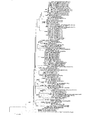
- Figure 1 shows the results of a systematic analysis (Neighbor-joining method; Tamura-Nei distance; bootstrapping 100 repeats) using the entire sequence of the rpoB gene coding portion of Salmonella serotypes.
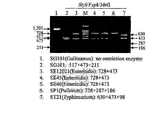
- Figure 2 PCR amplified differentially by electrophoresis on agar gel after treatment with StyI, FspI, MnlI after amplifying the entire rpoB nucleotide sequence of Salmonella Enteritidis, Salmonella Gallinarum, Salmonella Pullorum, Salmonella Typhimurium using the amplification primer of the present invention -RFLP results are shown.
- the present invention relates to a method for identifying a serotype of Salmonella genus microorganism comprising amplifying the entire nucleotide sequence of the RNA polymerase beta subunit (rpoB) gene.
- the present invention As a preferred embodiment for this, the present invention
- step (3) comparing the base sequence obtained in step (2) with the base sequence of the rpoB gene of the standard strain to determine the serotype
- It relates to a method for identifying the serotypes of Salmonella genus microorganisms.
- step (1) and step (2) are complementary to the nucleotide sequence of the conserved moiety shown in Table 1 in the nucleotide sequence of the rpoB gene of the genus Salmonella (SEQ ID NO: 15) and a continuous base of 7 to 50 bp. It may be performed using a primer having a sequence.
- the step (1) may be to amplify the entire nucleotide sequence of the rpoB gene using a primer pair having a nucleotide sequence of SEQ ID NO: 1 and 2, or SEQ ID NO: 3 and 4.
- the step (2) may be to determine the entire nucleotide sequence of the rpoB gene using at least one primer having a nucleotide sequence selected from the group consisting of nucleotide sequences of SEQ ID NO: 5 to SEQ ID NO: 14.
- the base sequence of the rpoB gene of the standard strain in step (3) may be selected from the group consisting of the nucleotide sequence of SEQ ID NO: 15 to SEQ ID NO: 75.
- the present invention is directed to a primer having a nucleotide sequence of 7 to 50 bp that is complementary to the nucleotide sequence of the conserved portion shown in Table 1 in the nucleotide sequence of the rpoB gene of the genus Salmonella (SEQ ID NO: 15). It is about.
- the present invention relates to a primer for amplifying the entire nucleotide sequence of the rpoB gene of the genus Salmonella having a nucleotide sequence of SEQ ID NO: 1 and 2, or SEQ ID NO: 3 and 4.
- the present invention relates to a primer for determining the entire nucleotide sequence of the rpoB gene of the genus Salmonella microorganism having a nucleotide sequence selected from the group consisting of the nucleotide sequence of SEQ ID NO: 5 to SEQ ID NO: 14.
- the present invention relates to a composition for identifying serotypes of Salmonella microorganisms comprising any one or more of the above primers.
- the present invention relates to a kit comprising a composition for identifying serotypes of Salmonella sp. Microorganisms.
- the present invention provides a composition for identifying serotypes of Salmonella spp.
- Microorganisms comprising rpoB polynucleotide of Salmonella spp.
- Microorganism having a nucleotide sequence selected from the group consisting of SEQ ID NOs: 15 to 75. It is about.
- the present invention is SEQ ID NO: 15, SEQ ID NO: 16, SEQ ID NO: 17, SEQ ID NO: 19, SEQ ID NO: 20, SEQ ID NO: 21, SEQ ID NO: 22, SEQ ID NO: 24, SEQ ID NO: 25, SEQ ID NO: 26, sequence SEQ ID NO: 28, SEQ ID NO: 31, SEQ ID NO: 32, SEQ ID NO: 33, SEQ ID NO: 34, SEQ ID NO: 38, SEQ ID NO: 43, SEQ ID NO: 44, SEQ ID NO: 45, SEQ ID NO: 47, SEQ ID NO: 49, SEQ ID NO: 50, SEQ ID NO: 51 , SEQ ID 54, SEQ ID 55, SEQ ID 56, SEQ ID 57, SEQ ID 59, SEQ ID 60, SEQ ID 61, SEQ ID 63, SEQ ID 64, SEQ ID 65, SEQ ID 66, SEQ ID 67 It relates to a rpoB polynucleotide of the genus Salmonella microorganism having
- the target gene In order for a gene to be a chronological molecular marker that well reflects the phylogenetic relationship of a bacterium, the target gene must be functionally essential and conserved in all bacteria, and there is no variation in the sequence of the species between bacteria due to acquired effects. It should show the conservation of the species within the genus, such as the interspecies variation appropriate for presentation. Since the rpoB gene encodes an essential enzyme involved in bacterial transcription, it is essential and conserved in all strains, and the variation of sequence between bacteria species does not occur well, and diversity and preservation in other strains have been reported (Kim et al.
- the present invention it was possible to identify the serotypes of strains that could not be identified by the existing method (eg, B21, B22 strain), serotype identification by the existing method It was possible to classify subgroups into subtypes by identifying differences in nucleotide sequences in strains that were not distinguished by methods (eg, S1 and A3; B1, B4, B5, B9, B7 and B21; B13 and B14; SL317, C1, C22, S50, and SL254; E3, E4 and E5; E1, E2 and S87).
- methods eg, S1 and A3; B1, B4, B5, B9, B7 and B21; B13 and B14; SL317, C1, C22, S50, and SL254; E3, E4 and E5; E1, E2 and S87).
- the present invention provides a primer capable of amplifying or determining the entire nucleotide sequence of the rpoB gene.
- a primer capable of amplifying or determining the entire nucleotide sequence of the rpoB gene is a primer capable of amplifying or determining the entire rpoB gene of the genus Salmonella, preferably, the base sequence of the rpoB gene of the genus Salmonella (SEQ ID NO: 15 ) May be a primer complementary to the nucleotide sequence of the conserved portion described in Table 1 and having a sequential sequence of 7 to 50 bp.
- a primer capable of amplifying the entire nucleotide sequence of the rpoB gene is a primer capable of amplifying the entire rpoB gene of all Salmonella strains, and preferably SEQ ID NO: 1 (Sal-rpoB-preF) and It may be a primer pair having a nucleotide sequence of SEQ ID NO: 2 (Sal-rpoB-postR), or a primer pair having a nucleotide sequence of SEQ ID NO: 3 (Sal-rpoB-F) and SEQ ID NO: 4 (Sal-rpoB-R).
- the primer for determining the entire nucleotide sequence of the rpoB gene as a primer that can determine the entire rpoB gene of all Salmonella strains, SEQ ID NO: 5 (salrpoB-PIR), SEQ ID NO: 5 ( salrpoB-PIR), SEQ ID NO: 6 (salrpoB-P2), SEQ ID NO: 7 (salrpoB-P3), SEQ ID NO: 8 (salrpoB-P4), SEQ ID NO: 9 (salrpoB-P5), SEQ ID NO: 10 (salrpoB-P6), Primer having a nucleotide sequence selected from the group consisting of SEQ ID NO: 11 (salrpoB-P7), SEQ ID NO: 12 (salrpoB-PN3), SEQ ID NO: 13 (salrpoB-PN4) and SEQ ID NO: 14 (salrpoB
- the primers of the present invention are the first primers for amplifying the entire nucleotide sequence of the rpoB gene of Salmonella serotypes and determining the nucleotide sequence, and the conserved portion identified by multiplexing the rpoB genomic sequence of the Salmonella serotype strain 44 registered in GenBank. Based on the rpoB is a primer that is highly calculated and prepared to amplify and determine the entire sequence. That is, in the present invention, the conserved portion of the rpoB gene was first identified among Salmonella serotypes (Table 1), and a primer was designed based on this, and the primer of the present invention can be applied to all Salmonella serotypes known to date. have.
- the present invention also provides a polynucleotide having the entire base sequence of rpoB specific for serotypes of Salmonella spp.
- the rpoB polynucleotide provided in the present invention has a nucleotide sequence selected from the group consisting of the nucleotide sequences of SEQ ID NO: 15 to SEQ ID NO: 75.
- the polynucleotide has been identified using primers for amplification and determination of the rpoB gene of the present invention, it is possible to build a unique Salmonella serotype identification database.
- SEQ ID NO: 15 SEQ ID NO: 16, SEQ ID NO: 17, SEQ ID NO: 19, SEQ ID NO: 20, SEQ ID NO: 21, SEQ ID NO: 22, SEQ ID NO: 24, SEQ ID NO: 25, SEQ ID NO: 26, SEQ ID NO: 28, SEQ ID NO: 31, SEQ ID NO: 32, SEQ ID NO: 33, SEQ ID NO: 34, SEQ ID NO: 38, SEQ ID NO: 43, SEQ ID NO: 44, SEQ ID NO: 45, SEQ ID NO: 47, SEQ ID NO: 49, SEQ ID NO: 50, SEQ ID NO: 51, SEQ ID NO: 54, SEQ ID NO: 55, SEQ ID NO: 56, SEQ ID NO: 57, SEQ ID NO: 59, SEQ ID NO: 60, SEQ ID NO: 61, SEQ ID NO: 63, SEQ ID NO: 64, SEQ ID NO: 65, SEQ ID NO: 66, SEQ ID NO: 67, SEQ ID NO: 68, SEQ
- the rpoB polynucleotide provided in the present invention is SEQ ID NO: 15, SEQ ID NO: 16, SEQ ID NO: 17, SEQ ID NO: 19, SEQ ID NO: 20, SEQ ID NO: 21, SEQ ID NO: 22, SEQ ID NO: 24, SEQ ID NO: 25 , SEQ ID NO: 26, SEQ ID NO: 28, SEQ ID NO: 31, SEQ ID NO: 32, SEQ ID NO: 33, SEQ ID NO: 34, SEQ ID NO: 38, SEQ ID NO: 43, SEQ ID NO: 44, SEQ ID NO: 45, SEQ ID NO: 47, SEQ ID NO: 49, sequence SEQ ID NO: 50, SEQ ID NO: 51, SEQ ID NO: 54, SEQ ID NO: 55, SEQ ID NO: 56, SEQ ID NO: 57, SEQ ID NO: 59, SEQ ID NO: 60, SEQ ID NO: 61, SEQ ID NO: 63, SEQ ID: 64, SEQ ID: 65, SEQ ID: 66
- nucleotide sequences of each of the nucleotide sequences of SEQ ID NOs: 15 to 75 analyzed in the present invention and comparing them with each other all of them had different nucleotide sequences, indicating interspecies variation between the base sequences, and all of the base sequences on the multiple sequences. Since the base was encoded at 4029 bp without insertion or deletion of the sequence, it can be confirmed that the entire nucleotide sequence of rpoB is suitable as a chronological molecular label.
- the serotype of the strain to be analyzed is determined by comparing with the rpoB nucleotide sequence of the strain to be analyzed based on the nucleotide sequence. Can be used to analyze relationships.
- the present invention provides a method for identifying serotypes of Salmonella spp. Microorganisms using the primers and rpoB polynucleotide sequences.
- the method for identifying the serotype of the Salmonella genus microorganism includes amplifying the entire nucleotide sequence of the rpoB gene.
- the method for identifying a serotype of Salmonella spp. Microorganisms comprises the following steps:
- step (3) determining the serotype by comparing the base sequence obtained in step (2) with the base sequence of the rpoB gene of the standard strain.
- Step (1) is to amplify the entire sequence of the unknown Salmonella strain, that is, the rpoB gene of the desired strain to be identified.
- the step is a primer capable of amplifying the entire nucleotide sequence of the rpoB gene, PCR using a primer having a nucleotide sequence of 7 to 50 bp complementary to the nucleotide sequence of the rpoB gene conserved portion described in Table 1 By amplification.
- the step is a primer capable of amplifying the entire nucleotide sequence of the rpoB gene, a primer pair having a nucleotide sequence of SEQ ID NO: 1 (Sal-rpoB-preF) and SEQ ID NO: 2 (Sal-rpoB-postR), Or by PCR amplification using a primer pair having a nucleotide sequence of SEQ ID NO: 3 (Sal-rpoB-F) and SEQ ID NO: 4 (Sal-rpoB-R).
- PCR amplification can use any method known to those skilled in the art.
- Step (2) is a primer for determining the total nucleotide sequence of the rpoB gene amplified in step (1), preferably complementary to the nucleotide sequence of the rpoB gene conserved portion shown in Table 1 of 7 to 50 bp
- Purification of PCR amplification products using at least one primer having a nucleotide sequence selected from the group consisting of nucleotide sequences of SEQ ID NO: 5 to SEQ ID NO: 14 can be carried out using a primer having a sequential nucleotide sequence. It can be performed by a kit or the like.
- Step (3) is a step of determining the serotype by comparing the base sequence obtained in step (2) with the base sequence of the rpoB gene of the standard strain, preferably, the base sequence of the rpoB gene of the standard strain is SEQ ID NO: 15 to SEQ ID NO: 75 is selected from the group consisting of.
- the polynucleotide having the nucleotide sequence of SEQ ID NO: 15 to SEQ ID NO: 75 has been confirmed by using the primers for amplification and determination of the rpoB gene of the present invention, since the entire base sequence and the serotype of the strain is known in advance, By comparing the rpoB nucleotide sequence of the target strain based on the nucleotide sequence, the serotype of the target strain can be determined and the lineage relationship can be analyzed. Molecular biological methods using the difference between the rpoB total sequence of the standard strain and the target strain can be applied to the present invention.
- to analyze the rpoB sequences of the target strain and then compare the rpoB sequences of the standard strain to determine the serotype of the target strain to identify the rpoB sequences of the pre-built standard strain in an aligned database
- Add the rpoB base sequence of the bacterium and perform sequence alignment again to complete the schematic.
- branches are formed in close proximity to the corresponding species, so the serotype can be determined by the phylogenetic tree.
- a neighbor-joining method using Mega software or the like can be used, and the support of the branch can be determined by performing 100 to 1000 repetitions of bootstrap analysis.
- the serotype identification method when an unknown bacterium suspected of Salmonella is isolated from a food poisoning patient or the surrounding environment, amplification and determination of the entire rpoB nucleotide sequence are performed using specific primers. By comparison, it is possible to determine the species, and more precisely compared to the conventional species identification method, so that the treatment policy of Salmonella infected patients can be quickly determined.
- the present invention also provides a composition for identifying serotypes of Salmonella spp. Microorganisms comprising the primers described above.
- the present invention comprises a primer having a nucleotide sequence of 7 to 50 bp complementary to the nucleotide sequence of the conserved portion shown in Table 1 in the nucleotide sequence of the rpoB gene of the genus Salmonella (SEQ ID NO: 15), Provided is a composition for identifying serotypes of Salmonella spp.
- the present invention has a nucleotide sequence of SEQ ID NO: 1 and 2, or SEQ ID NO: 3 and 4, the composition for identifying serotypes of Salmonella genus microorganisms comprising a primer for amplifying the entire sequence of the rpoB gene of Salmonella genus microorganisms To provide. More preferably, the composition may further include a primer for determining the entire nucleotide sequence of the rpoB gene selected from the group consisting of the nucleotide sequence of SEQ ID NO: 5 to SEQ ID NO: 14.
- the present invention provides a composition for identifying serotypes of Salmonella genus microorganisms comprising a primer for determining the entire nucleotide sequence of the rpoB gene selected from the group consisting of the nucleotide sequences of SEQ ID NOs: 5 to 14.
- the present invention also provides a kit for identifying serotypes of Salmonella spp. Microorganisms comprising the composition.
- the kit may be a PCR-RFLP (restriction fragment length polymorphism) kit, an allele-specific PCR kit, a real time PCR kit, a DNA chip kit or a Southern blotting kit.
- the kit may further comprise a DNA polymerase, a DNA staining reagent or a suitable carrier, in addition to the primer.
- the mutant portion can be usefully used for serotype identification using DNA chips, allele-specific PCR, RFLP and Southern blotting, and conserved portions. Can be used to design new primers for sequencing and amplifying sequences of various serotype strains. We found that Sal-rpoB-preF (upstream non-coding region of the rpoB initiation codon, SEQ ID NO: 1) and Sal-rpoB-postR (downstream non-coding region of the rpoB termination codon) are optimal primers for amplifying rpoB whole genes.
- Sal-rpoB- was determined by determining the sequencing for 72 strains of Salmonella provided by the National Institute of Health's Intestinal Bacteria Team.
- Sal-rpoB-P3N SEQ ID NO: 12
- Sal-rpoB-P4N SEQ ID NO: 7
- Sal-rpoB-P4 SEQ ID NO: 8
- Sal-rpoB-P5 SEQ ID NO: 9
- the Sal-rpoB-P5N SEQ ID NO: 14
- PCR reaction solution was 5 ⁇ l of 10 ⁇ buffer, 1 ⁇ l of dNTPs (2.5 mM each), 1.0 ⁇ l of Sal-rpoB-preF (SEQ ID NO: 1) and Sal-rpoB-postR (SEQ ID NO: 2) (10 pmol / ul), and Taq.
- Primers for sequencing are Sal-rpoB-P1R (SEQ ID NO: 5), Sal-rpoB-P2 (SEQ ID NO: 6), Sal-rpoB-P3N (SEQ ID NO: 12), Sal-rpoB-P4N (SEQ ID NO: 13 ), Sal-rpoB-P5N (SEQ ID NO: 14), Sal-rpoB-P6 (SEQ ID NO: 10) and Sal-rpoB-P7 (SEQ ID NO: 11) were optimal.
- the determined nucleotide sequences were multiarrayed using the MEGA 5 program and then systematically analyzed by the Neighbor-joining method (Tamura-Nei distance; 100 repeats of bootstrapping), and the results are shown in FIGS. 1 and 3.
- Table 3 shows the serotypes identified by the conventional serological method for each strain, and the serotypes identified by the rpoB typing according to the method of the present invention, the rpoB base sequence of the strains identified in the present invention is SEQ ID NO: 15 to SEQ ID NO: 75.
- the mutant portion can be usefully used for serotype identification using DNA chips, allele-specific PCR, RFLP and Southern blotting, and conserved portions. Can be used to design new primers for sequencing and amplifying sequences of various serotype strains. We found that Sal-rpoB-preF (upstream non-coding region of the rpoB initiation codon, SEQ ID NO: 1) and Sal-rpoB-postR (downstream non-coding region of the rpoB termination codon) are optimal primers for amplifying rpoB whole genes.
- Sal-rpoB- was determined by determining the sequencing for 72 strains of Salmonella provided by the National Institute of Health's Intestinal Bacteria Team.
- Sal-rpoB-P3N SEQ ID NO: 12
- Sal-rpoB-P4N SEQ ID NO: 7
- Sal-rpoB-P4 SEQ ID NO: 8
- Sal-rpoB-P5 SEQ ID NO: 9
- the Sal-rpoB-P5N SEQ ID NO: 14
- PCR reaction solution was 5 ⁇ l of 10 ⁇ buffer, 1 ⁇ l of dNTPs (2.5 mM each), 1.0 ⁇ l of Sal-rpoB-preF (SEQ ID NO 1) and Sal-rpoB-postR (SEQ ID NO 2) (10 pmol / ul), Taq 0.5 ⁇ l of DNA polymerase (5 U / ⁇ l; MACROGEN Co., Seoul, ROK), 1 ⁇ l of DW 40.5 ⁇ l, template DNA (50 ng / ⁇ l), temperature was 94 ⁇ 4 min, (94 ° C.-30 sec, 54 ° C.- 20 second, 72 degreeC-4 minutes and 30 second) x40 times, and 72 degreeC-5min reaction.
- Primers for sequencing are Sal-rpoB-P1R (SEQ ID NO: 5), Sal-rpoB-P2 (SEQ ID NO: 6), Sal-rpoB-P3N (SEQ ID NO: 12), Sal-rpoB-P4N (SEQ ID NO: 13 ), Sal-rpoB-P5N (SEQ ID NO: 14), Sal-rpoB-P6 (SEQ ID NO: 10) and Sal-rpoB-P7 (SEQ ID NO: 11) were optimal.
- the determined nucleotide sequences were multiarrayed using the MEGA 5 program and then systematically analyzed by the Neighbor-joining method (Tamura-Nei distance; 100 repeats of bootstrapping), and the results are shown in FIGS. 1 and 3.
- Table 3 shows the serotypes identified by the conventional serological method for each strain, and the serotypes identified by the rpoB typing according to the method of the present invention, the rpoB base sequence of the strains identified in the present invention is SEQ ID NO: 15 to SEQ ID NO: 75.
- S1 and A3 classified as Paratyphi A form clusters with AKU12601 and ATCC9150 registered as Paratyphi A in GenBank, and are classified as Paratyphi A-1. It was classified as Paratyphi A-2.
- S57, D13, D14, D15, D16, D18, D22, and D23, classified as Typhi, are classified as Typhi by forming clusters with Ty2 and CT18 registered as Typhi in GenBank.
- D1, D5, D7, D8, D9, D10, and D24 classified as Enteritidis, form clusters with P125109 and SE4 registered as Enteritidis in GenBank, all of which are classified as Enteritidis. Showed.
- B17 and S3 identified as Paratyphi B were clustered with SPB7 registered as Paratyphi B in GenBank and classified as Paratyphi B. They all showed the same sequence.
- E6 and E7 identified as Weltevreden formed clusters with SPB7 registered as Weltevreden in GenBank, and they were classified as Weltevreden.
- D25 identified as Dublin by conventional serological methods, was classified as Dublin by forming a cluster with CT 02021853 registered as Dublin in GenBank, and the two subgroups Dublin-1 (D25) and Dublin- Subdivided into 2 (CT02021853).
- C1 and C22 identified as Newport formed the same cluster, but S50 formed a different cluster from C1 and C22 with SL254 registered as Newport in GenBank, and SL317 registered as Newport in GenBank. Formed different clusters and showed differences in nucleotide sequences, such as Newport-1 (SL317), Newport-2 (C1), Newport-3 (C22), Newport-4 (S50), and Newport-5 (SL254). Classified.
- C19 identified as Hadar by the conventional serological method formed a cluster with RI 05P066 registered as Hadar in GenBank, and they were classified as Hadar.
- B15 identified as Agona was classified as Agona by forming a cluster with SL483 registered as Agona in GenBank, and showed a slight difference in nucleotide sequence between Agona-1 (B15) and Agona-2 (SL483). )
- B13 and B14 identified as Derby formed different clusters and were classified as Derby-1 (B13) and Derby-2 (B14).
- E4, E5, and E3 form the same cluster, but show slight differences in nucleotide sequence.
- C4, C10, and C11 identified as Rissen formed the same cluster, but were subdivided into Rissen-1 (C4) and Rissen-2 (C10, C11) because of the slight differences in nucleotide sequences.
- E1, E2, and E1, E2 identified as Senftenberg form the same cluster, show the same sequence, and are subdivided into Senftenberg-1 (E1, E2). S87 formed was classified as Senftenberg-2 (S87).
- C12 identified as Virchow was classified as Virchow by forming a cluster with SL491 registered as Virchow in GenBank, and they all showed the same sequence.
- CVM29188 classified Kentucky among Salmonella serotype strains registered with GenBank; CDC07-0191 classified as Tennesee; SP1 classified as Pullorum; 287/91 and SG52 classified Gallinarum; RKS4594 classified as Paratyphi C; ABEH 02000013 classified as Javiana; SL476 and SL486 classified as Heidelberg; And SARA23 classified as Saintpaul had a unique sequence different from any Salmonella serotype compared to the present invention.
- the technique of identifying Salmonella serotypes by analyzing the entire sequencing of the rpoB gene of the present invention can be obtained more objectively and accurately compared to the complex serotype determination method using conventional antiserum, and can be widely applied to all Salmonella strains. It can be used for Salmonella serotype identification because it is simple and saves time and money.
Landscapes
- Chemical & Material Sciences (AREA)
- Life Sciences & Earth Sciences (AREA)
- Proteomics, Peptides & Aminoacids (AREA)
- Organic Chemistry (AREA)
- Analytical Chemistry (AREA)
- Zoology (AREA)
- Wood Science & Technology (AREA)
- Health & Medical Sciences (AREA)
- Engineering & Computer Science (AREA)
- Microbiology (AREA)
- Immunology (AREA)
- Molecular Biology (AREA)
- Biotechnology (AREA)
- Biophysics (AREA)
- Physics & Mathematics (AREA)
- Biochemistry (AREA)
- Bioinformatics & Cheminformatics (AREA)
- General Engineering & Computer Science (AREA)
- General Health & Medical Sciences (AREA)
- Genetics & Genomics (AREA)
- Measuring Or Testing Involving Enzymes Or Micro-Organisms (AREA)
Description
본 발명은 RNA중합효소 베타 서브유닛 (rpoB) 유전자의 전체 염기서열을 이용하여 식중독의 주요 원인인 살모넬라의 혈청형을 동정하는 기술에 관한 것이다. 보다 구체적으로, 본 발명은 살모넬라 속 미생물의 rpoB 유전자의 전체 염기서열을 분석하여 살모넬라 속 미생물의 혈청형을 동정하는 방법, 살모넬라 속 미생물의 rpoB 유전자의 전체 염기서열을 증폭하기 위한 프라이머 및 염기서열을 결정하기 위한 프라이머, 상기 프라이머를 포함하는 살모넬라 속 미생물의 혈청형 동정용 조성물 및 키트, 그리고 주요 살모넬라 속 미생물의 혈청형에 특이적인 rpoB 폴리뉴클레오티드에 관한 것이다. 본 발명은 기존의 항혈청을 이용한 살모넬라 혈청형 동정법을 대체할 수 있는 분자 동정법으로 유용하게 사용될 수 있다.
살모넬라는 국내외에서 가장 빈발하는 식중독 원인균 중 하나로, 최근 단체급식의 증가로 인해 건당 환자수가 증가하면서, 공중보건학적으로 중요한 병원체로 인식되고 있다. 살모넬라 속 균은 DNA-DNA 교잡법에 의해 단일한 군을 이루고 있으며, 대장균과는 99%의 상동성을 보이며, 현재 세계보건기구 (WHO) 협력 센터의 제안에 따라 두 개의 종 (species) [Salmonella enterica와 Salmonella bongori (V)] 및 여섯 개의 아종 (subspecies) [Salmonella enterica subsp. enterica (I), Salmonella enterica subsp. salamae (II), Salmonella enterica subsp. arizonae (IIIa), Salmonella enterica subsp. diarizonae (IIIb), Salmonella enterica subsp. houtenae (IV), Salmonella enterica subsp. indica (VI)] 으로 분류되고 있다.
살모넬라의 혈청형은 현재까지 균체항원 (Somatic antigen; O)과 편모항원 (Phase I, II flagellin; H)에 기초한 Kaufmann-White 분류법에 의해 O 혈청형 46개와 H 혈청형 114개가 확인되었고, 총 2,523개의 다양한 혈청형이 동정되었다. 살모넬라 혈청형의 동정은 역학 연구에 있어 가장 기본이 되는데, 전통적인 혈청학적 방법을 적용하기 위해서는 혈청형 동정을 위한 모든 혈청을 확보하고 있어야 하며 새로운 혈청형이 출현하는 경우 그에 대한 항혈청을 확보해야 하므로, 소수의 공인된 실험실에서만 동정이 이루어지며 발현되는 표현형에 따라 결과가 다르게 나타날 수 있다 (Andrews WH, et al., 1992, Salmonella, in FDA Bacterilogical Analytical Manual ed. Tomlinson, L. pp.51-69. Arlington, VA :AOAC International.; Desmonts C., et al., 1990, Appl Environ Microbiol 56:1448-1452.). 또한, 동정이 안 되는 분리주의 경우 파스퇴르 연구소에 의뢰하여 혈청형을 동정해야 하는 번거로움이 있다.
이에, 기존의 항혈청에 의한 동정법을 대체할 수 있는 살모넬라 혈청형 동정법을 개발하기 위한 다양한 연구가 이루어지고 있다. 일 예로, LPS (Lipopolysaccharide)에 대한 ELISA 검출법이 소개되었으며 (Rigby CE. 1984. Appl Environ Microbiol 47:1327-1330), 여러 가지 O 항원에 대한 단클론항체를 이용한 동정법도 소개되었으나 (Araj GF, et al., 1987, J Clin Microbiol 25: 2150-2153; Lee HA, et al., 1990, Appl Envirom Microbiol 56: 1541-1546.; Torensma R, et al., 1992. Appl Envirom Mcirobiol 58:3868-3872.), 다수의 단클론항체가 요구되며 교차반응이 나타나는 경우도 있어 기존의 혈청형 검사법 대비 차별성이 없는 문제가 있다.
최근에는 분자생물학적 기술의 발달로, 생화학적 성상에 기초한 기존의 분류법 외에도 유전자 염기서열에 기초한 분자 분류법이 대두되고 있는데, 대표적으로 세균부터 동식물의 세포까지 모두 존재하는 리보솜 RNA (rRNA)가 연대기적 분자 표지로써 널리 사용되고 있으며, 16S/18S rDNA (ribosomal DNA)의 염기서열 분석 작업이 미시간 대학의 리보솜 데이터베이스 계획 (RDP II)을 통해 이루어지고 있다. 현재 20,000 종의 16S/18S rDNA 염기서열이 확보되어 생물의 분류 및 진화 연구에 중요한 자료가 되고 있으나, 기존의 혈청형 동정법에 비해 구분 능력이 떨어진다는 한계가 지적되고 있다.
16S/18S rDNA 외에도 다양한 분자 표지들이 살모넬라 혈청형 동정을 위해 제안되었다. 일 예로, fliC (H1-항원) 및 fljB (H2-항원) 유전자를 PCR로 증폭하여 각각 HhaI및 HphI 제한효소로 절단한 후 그 분획을 분석하는 PCR-RFLP (restriction fragment length polymorphism)법이 보고되었으나, fliC는 195개의 혈청형이 74개의 제한형 (restriction pattern; 38%)으로 분류되고, fljB는 134개 혈청형이 47개의 유전형 (35%)으로 분류되어 분별능력이 낮았고, 표준형 Typhi와 변이형 Typhi가 다른 유전형으로 분류되고 Salmonella Dublin과 Salmonella Enteritidis는 구분이 되지 않았다 (Dauga 등., 1998, JCM. 2835-2843). 다른 분자 표지의 예로, atpD (ATP 합성 효소 베타소단위유전자)가 Salmonella Typhimurium과 Salmonella Dublin 사이의 상동성이 99.2%로 비교적 높은 것으로 보고되었다 (Christensen & Olsen, 1998, FEMS Microbiol Lett. 161:89-96).
또한, 자동 리보타이핑 시스템 (automated ribotyping system: RiboPrinter)이 소개되었으나, 117개 분리주 중 34주 (29%)는 혈청형 수준에서, 11주 (9%)는 균주 수준에서, 46주 (39%)는 종 수준에서 동정되었고, 나머지 26주 (22%)는 동정되지 않았다 (Oscar, 1998. J Food Prot. 61:519-524).
또한, 16S-23S rRNA spacer RFLP 법에 의할 경우 58개 혈청형 101주에 대해 10개 (17%) 혈청형만이 특이적인 유전형을 보이고 나머지는 구분이 안 되었다 (Christensen 등., 2000, J Appl Microbiol. 89:130-136). 또한, tyv, wzx multiplex PCR을 이용하여 10종의 프라이머를 32개 혈청형 69주에 대해 적용한 결과 혈청형 특이적인 반응을 얻었으며, 선행 연구에 사용한 multiplex 방법과 같이 사용 시 84.9% (423/500주)의 정확성을 보였다는 보고가 있었다 (Silvia Herrera-Leon 등., 2007, Res. Microb., 122-127). 또한, Salmonella enterica 균주 간 염기서열의 차이를 보이는 하우스키핑 유전자 및 혈청 특이적인 병원성 유전자 (virulence gene)의 검출 (panB, fimA, aceK, mdh, icdA, manB, and spaN)을 통해 25균주로부터 8가지 MLST (multilocus sequence typing) 타입을 얻어내었고 이것은 혈청형과 연관성이 있는 것으로 보고되었다 (Sharinne Sukhnanand등., 2005, JCM. 3688-3698).
또한, 33가지 혈청형에 대해 hin 유전자 PCR 법을 사용하여 단상 편모 살모넬라를 동정하는 방법이 보고되었으나, 단상 편모/이상 편모 살모넬라 간의 구분만 가능할 뿐, 같은 그룹 내의 살모넬라 혈청형들 간에는 구분 안 되었다 (김성훈 등., 2005, J. of Bac. and Virol. 4:291-297). 또한, Allele specific rfb의 allele specific PCR에 의할 경우 살모넬라 serogroup D내 Salmonella gallinarum과 Salmonella pullorum의 분류가 가능하였으나, Salmonella Pullorum과 Salmonella Enteritidis 및 Salmonella Dublin, Salmonella Typhi 등 Salmonella serogroup D내의 다른 혈청형 간에는 구분이 안 되었다 (Devendra 등. J. Microbial Methods. 60:169-177, 2005).
또한, 혈청형 분류의 정확도를 높이기 위해 Salmonella Enteritidis와 Salmonella Derby를 구분하는 프라이머 세트 및 Salmonella Saint Paul와 Salmonella Anatum, Salmonella Branderup, Salmonella Ohio를 구분하는 프라이머 세트를 추가시킨 경우 혈청학적 방법을 기준으로 할 때 97% 정확성을 보였으나, 실험에 사용한 1,024가지 조합의 amplicon codes로 알려져 있는 1,478개 혈청형 모두를 구분하지는 못하였다.
따라서, 보다 많은 실험실에서 수행할 수 있고, 결과가 객관적이고 명확하며, 모든 살모넬라의 혈청형을 동정할 수 있는 기술이 요구되고 있다.
한편, RNA 중합효소 베타 서브유닛 (RNA polymerase beta subunit)을 코딩하는 rpoB 유전자가 모든 생물에 보존되어 있음이 알려지면서, rpoB 유전자 내 리팜피신 내성을 유발하는 분절(rif)을 표적으로 하는 PCR 을 사용하여 다양한 병원균들의 동정과 분류하는 기술이 개발되었다. 예를 들어, Mycobacterium (Kim 등, J Clin Microbiol 37:1714-1720, 1999), Borrelia (Lee 등, J Clin Microbiol 38:2557-2562, 2000), Bartonlla (Renesto 등, Research in Microbiology 151:831-836, 2000), Bacteroides (Ko, Kuwahara 등, Clin Microbiol Infect 13:48-54, 2007), 및 Legionella (Ko 등, J Clin Microbiol 40:2653-2658, 2002) 속 미생물의 분류와 동정에 rpoB 유전자가 사용된 바 있다. 상기 rpoB 유전자를 이용한 동정법의 경우 대부분 고변이 부분을 포함하는 부분 염기서열을 사용하였다.
살모넬라 혈청형 동정에 있어서도 rpoB 유전자의 부분 염기서열을 사용한 시도가 있었으나, 이는 Salmonella enterica subsp. enteric 의 계통분석을 위하여 rpoB 유전자 중 고변이 부위를 포함하는 부분 염기서열(612-937)을 사용한 것으로, 살모넬라의 일부 아종에 대해서만 동정이 가능한 한계가 있다 (Kwon 등, Veterinary Microbiology, 2001, 82: 121- 129). 이와 같이, 지금까지 살모넬라 혈청형 동정에 특이적인 유전자는 전무하고, rpoB 의 부분 염기서열을 사용한 살모넬라 혈청형 동정의 가능성이 제시되었으나 부분 서열을 사용하여 구분 능력이 상대적으로 낮아 적용성이 낮은 문제가 있다.
이에, 본 발명자들은 모든 살모넬라 혈청형의 rpoB 유전자 전체를 증폭할 수 있는 프라이머 및 상기 전체 유전자 염기서열을 결정할 수 있는 프라이머를 설계하였으며, 이 프라이머들을 사용하여 전 세계적으로 빈발하는 살모넬라 혈청형들에 특이적인 rpoB 유전자의 전체 염기서열을 분석하여 데이터베이스를 구축하였다. 또한, 식중독 환자나 주변 환경으로부터 살모넬라로 의심되는 미지의 균(목적 균주)이 분리되었을 때, 상기 프라이머를 사용하여 목적 균주의 rpoB 유전자의 전체 염기서열을 증폭 및 결정하고, 이를 이미 확보된 데이터베이스 상의 살모넬라 혈청형들의 rpoB 유전자의 염기서열과 비교함으로써, 목적 균주의 혈청형을 정확하게 판단할 수 있음을 확인하였다. 또한, 상기 rpoB 유전자의 전체 염기서열을 이용한 살모넬라 혈청형 동정법이 모든 살모넬라 균주에 광범위하게 적용될 수 있으며 보다 신속하고 정확한 판단에 유용하게 사용될 수 있음을 확인하여, 기존의 항혈청을 이용한 살모넬라 혈청형 동정법을 대체할 수 있는 분자적 동정법으로서 본 발명을 완성하였다.
본 발명은 RNA중합효소 베타 서브유닛 (rpoB) 유전자의 전체 염기서열을 이용하여 살모넬라의 혈청형을 동정하는 기술을 제공한다. 또한, 본 발명은 살모넬라 혈청형의 전체 rpoB 유전자를 증폭 및 결정할 수 있는 프라이머, 그리고 상기 프라이머를 사용하여 확인된 주요 살모넬라 혈청형 균주들의 rpoB 폴리뉴클레오티드 및 이의 염기서열 정보를 이용하여 효과적으로 살모넬라의 혈청형을 동정하는 기술을 제공한다.
보다 구체적으로, 본 발명의 하나의 목적은 rpoB 유전자의 전체 염기서열을 증폭하는 단계를 포함하는 살모넬라 속 미생물의 혈청형을 동정하는 방법을 제공하는 것이다.
본 발명의 또 하나의 목적은 살모넬라 속 미생물의 rpoB 유전자의 전체 염기서열을 증폭하기 위한 프라이머를 제공하는 것이다.
본 발명의 또 하나의 목적은 살모넬라 속 미생물의 rpoB 유전자의 전체 염기서열을 결정하기 위한 프라이머를 제공하는 것이다.
본 발명의 또 하나의 목적은 상기 프라이머를 포함하는 살모넬라 속 미생물의 혈청형 동정용 조성물을 제공하는 것이다.
본 발명의 또 하나의 목적은 상기 조성물을 포함하는 살모넬라 속 미생물의 혈청형 동정용 키트를 제공하는 것이다.
본 발명의 또 하나의 목적은 상기 프라이머를 사용하여 확인된, 주요 살모넬라 속 미생물의 혈청형들에 특이적인 rpoB 폴리뉴클레오티드를 제공하는 것이다.
본 발명의 또 하나의 목적은 주요 살모넬라 속 미생물의 혈청형들에 특이적인 rpoB 폴리뉴클레오티드를 포함하는 살모넬라 속 미생물의 혈청형 동정용 조성물을 제공하는 것이다.
도 1은 살모넬라 혈청형들의 rpoB 유전자 코딩 부분의 전체 염기서열을 사용하여 계통분석 (Neighbor-joining method; Tamura-Nei distance; bootstrapping 100 repeats) 한 결과를 나타낸다.
도 2는 본 발명의 증폭용 프라이머를 사용하여 Salmonella Enteritidis, Salmonella Gallinarum, Salmonella Pullorum, Salmonella Typhimurium의 rpoB 전체 염기서열을 증폭한 후 StyI, FspI, MnlI을 처리하여 한천 겔에서 전기영동 함으로써 감별진단 한 PCR-RFLP 결과를 나타낸다.
상기 목적을 달성하기 위한 하나의 양태로서, 본 발명은 RNA 중합효소 베타 서브유닛 (rpoB) 유전자의 전체 염기서열을 증폭하는 단계를 포함하는 살모넬라 속 미생물의 혈청형을 동정하는 방법에 관한 것이다.
이를 위한 바람직한 양태로서, 본 발명은
(1) 살모넬라 속 미생물의 rpoB 유전자의 전체 염기서열을 증폭하는 단계;
(2) 상기 증폭된 rpoB 유전자의 전체 염기서열을 결정하는 단계;
(3) 상기 단계 (2)에서 얻어진 염기서열을 표준 균주의 rpoB 유전자의 염기서열과 비교하여 혈청형을 결정하는 단계를 포함하는,
살모넬라 속 미생물의 혈청형을 동정하는 방법에 관한 것이다.
바람직하게, 상기 단계 (1) 및 단계 (2) 는 살모넬라 속 미생물의 rpoB 유전자의 염기서열(서열번호 15) 중에서 표 1에 기재된 보존 부분의 염기 서열에 상보적이며 7 내지 50 bp 의 연속된 염기서열을 가지는 프라이머를 사용하여 수행하는 것일 수 있다.
표 1
| 보존부분의 염기 위치 | |||
| 1-139 | 1174-1202 | 2275-2306 | 3151-3206 |
| 146-251 | 1291-1367 | 2404-2447 | 3223-3260 |
| 268-341 | 1403-1472 | 2470-2522 | 3283-3326 |
| 343-380 | 1501-1559 | 2536-2558 | 3331-3362 |
| 394-422 | 1561-1583 | 2581-2616 | 3385-3416 |
| 460-491 | 1621-1652 | 2641-2660 | 3424-3443 |
| 493-524 | 1681-1709 | 2683-2718 | 3457-3486 |
| 526-587 | 1729-1754 | 2720-2749 | 3488-3506 |
| 628-647 | 1756-1796 | 2751-2783 | 3562-3608 |
| 685-707 | 1798-1844 | 2785-2835 | 3646-3756 |
| 709-739 | 1849-1895 | 2837-2889 | 3790-3821 |
| 751-770 | 1906-1940 | 2902-2933 | 3833-3854 |
| 799-818 | 1966-2006 | 2945-2984 | 3865-3896 |
| 842-878 | 2047-2066 | 2986-3028 | 3907-3926 |
| 919-971 | 2089-2186 | 3035-3059 | 3928-3947 |
| 994-1061 | 2188-2231 | 3088-3111 | 3949-3986 |
| 1079-1100 | 2239-2261 | 3113-3149 | 3988-4019 |
| 1102-1130 | |||
또한 바람직하게, 상기 단계 (1) 은 서열번호 1 및 2, 또는 서열번호 3 및 4의 염기서열을 가지는 프라이머 쌍을 사용하여 rpoB 유전자의 전체 염기서열을 증폭하는 것일 수 있다.
또한 바람직하게, 상기 단계 (2) 는 서열번호 5 내지 서열번호 14의 염기서열로 이루어진 군으로부터 선택되는 염기서열을 가지는 1종 이상의 프라이머를 사용하여 rpoB 유전자의 전체 염기서열을 결정하는 것일 수 있다.
또한 바람직하게, 상기 단계 (3) 에서 표준 균주의 rpoB 유전자의 염기서열은 서열번호 15 내지 서열번호 75의 염기서열로 이루어진 군으로부터 선택되는 것일 수 있다.
또 하나의 양태로서, 본 발명은 살모넬라 속 미생물의 rpoB 유전자의 염기서열 (서열번호 15) 중에서 표 1에 기재된 보존 부분의 염기 서열에 상보적이며 7 내지 50 bp 의 연속된 염기서열을 가지는 프라이머에 관한 것이다.
또 하나의 양태로서, 본 발명은 서열번호 1 및 2, 또는 서열번호 3 및 4의 염기서열을 가지는, 살모넬라 속 미생물의 rpoB 유전자의 전체 염기서열 증폭용 프라이머에 관한 것이다.
또 하나의 양태로서, 본 발명은 서열번호 5 내지 서열번호 14의 염기서열로 이루어진 군으로부터 선택되는 염기서열을 가지는, 살모넬라 속 미생물의 rpoB 유전자의 전체 염기서열 결정용 프라이머에 관한 것이다.
또 하나의 양태로서, 본 발명은 상기 프라이머들 중 어느 하나 이상을 포함하는 살모넬라 속 미생물의 혈청형 동정용 조성물에 관한 것이다.
또 하나의 양태로서, 본 발명은 상기 살모넬라 속 미생물의 혈청형 동정용 조성물을 포함하는 키트에 관한 것이다.
또 하나의 양태로서, 본 발명은 서열번호 15 내지 서열번호 75의 염기서열로 이루어진 군으로부터 선택되는 염기서열을 가지는 살모넬라 속 미생물의 rpoB 폴리뉴클레오티드를 포함하는, 살모넬라 속 미생물의 혈청형 동정용 조성물 에 관한 것이다.
또 하나의 양태로서, 본 발명은 서열번호 15, 서열번호 16, 서열번호 17, 서열번호 19, 서열번호 20, 서열번호 21, 서열번호 22, 서열번호 24, 서열번호 25, 서열번호 26, 서열번호 28, 서열번호 31, 서열번호 32, 서열번호 33, 서열번호 34, 서열번호 38, 서열번호 43, 서열번호 44, 서열번호 45, 서열번호 47, 서열번호 49, 서열번호 50, 서열번호 51, 서열번호 54, 서열번호 55, 서열번호 56, 서열번호 57, 서열번호 59, 서열번호 60, 서열번호 61, 서열번호 63, 서열번호 64, 서열번호 65, 서열번호 66, 서열번호 67, 서열번호 68, 서열번호 70, 서열번호 74 및 서열번호 75의 염기서열로 이루어진 군으로부터 선택되는 염기서열을 가지는 살모넬라 속 미생물의 rpoB 폴리뉴클레오티드에 관한 것이다.
이하, 본 발명을 보다 상세하게 설명한다.
본 발명자들은 살모넬라 속 미생물의 rpoB 유전자의 전체 염기서열을 분석하여 살모넬라 속 미생물의 혈청형을 동정하는 방법을 확립하기 위하여, GenBank에 등록된 살모넬라 혈청형 균주 44 주의 rpoB 게놈 서열을 다중배열하여 혈청형 간 차이를 보이는 rpoB 유전자의 변이 부분과 프라이머 설계에 유용하게 사용할 수 있는 보존된 부분을 확인하였고, 이를 토대로 rpoB 전체를 증폭할 수 있는 프라이머 2개쌍을 설계하였고, 염기서열 결정을 위한 프라이머를 보존된 부분에서 설계하였다. 또한, 이 프라이머들을 이용하여 질병관리본부 국립보건원 장내세균팀으로부터 제공받은 살모넬라 균주들의 rpoB 유전자의 전체 염기서열을 분석하여 데이터베이스를 구축하였다. 또한, 동정하고자 하는 목적 균주의 rpoB 전체 염기서열을 증폭 및 결정하고 상기 데이터베이스의 염기서열과 비교 분석함으로써 살모넬라 혈청형을 동정하는 새로운 방법을 개발하게 되었다.
어떤 유전자가 세균의 계통적 관계를 잘 반영하는 연대기적 분자 표지가 되기 위해서는, 표적 유전자가 모든 세균에서 기능적으로 필수적이고 보존되어야 하고, 후천적 영향에 의한 균 종간 염기서열의 변이가 일어나지 않으며, 계통 관계를 나타내기에 적절한 종 간 다양성 (interspecies variation)과 같은 속 내의 균종 사이의 보존성 (intraspecies conservation)을 보여야 한다. rpoB 유전자의 경우 세균의 전사에 관여하는 필수 효소를 코딩하므로 모든 균주에 필수적이고 보존되어 있으며, 균 종간 염기서열의 변이가 잘 일어나지 않고, 다른 속 균주들에서 다양성과 보존성이 보고되어 있으므로 (Kim 등, J Clin Microbiol 37:1714-1720, 1999; Lee 등, J Clin Microbiol 38:2557-2562, 2000), 분자 표지로 적절하다. 또한, 종래에 rpoB 유전자의 염기서열 중에서 고변이 부위에 해당하는 약 300bp 정도의 부분적 염기서열을 사용하여 살모넬라 아종을 구분하는 것이 보고되었으나 (Kwon 등, Veterinary Microbiology, 2001, 82: 121- 129), 살모넬라의 일부 아종의 구분에만 적용 가능하고 구분 능력이 상대적으로 낮아 적용성이 낮은 문제가 있었다. 즉 상기의 rpoB의 일부분을 사용하는 경우 Agona와 Derby; Paratyphi A와 Typhi; Blockley와 Paratyphi B; Braenderup, Hadar 와 Infantis; Enteritidis와 Gallinarum; Kentucky와 Senftenberg; Give와 Montevideo가 구분되지 않는 문제점이 있다.
본 발명과 같이 rpoB 유전자의 전체 염기서열을 분석하여 혈청형 동정에 사용할 경우, 보존된 부분에서 유래된 프라이머를 사용하므로 지금까지 알려진 모든 살모넬라 균주들에 적용가능하며, 도 1및 표 3에 나타난 바와 같이 정확히 혈청형을 구분할 수 있다. 본 발명의 구체적인 실시예에서 볼 수 있듯이, 본 발명에서는 기존의 방법으로는 혈청형을 동정할 수 없었던 균주들의 혈청형 동정이 가능하였고 (예, B21, B22 균주), 기존 방법에 의한 혈청형 동정법으로는 구분이 되지 않는 균주들에서 염기서열의 차이를 확인하여 아군(subtype)으로 세부 분류가 가능하였다 (예, S1 및 A3; B1, B4, B5, B9, B7 및 B21; B13 및 B14; SL317, C1, C22, S50, 및 SL254; E3, E4 및 E5; E1, E2 및 S87).
따라서, 본 발명은 rpoB 유전자의 전체 염기서열을 증폭 또는 결정할 수 있는 프라이머를 제공한다.
본 발명에서 rpoB 유전자의 전체 염기서열을 증폭 또는 결정할 수 있는 프라이머는, 살모넬라 속 균주의 rpoB 유전자 전체를 증폭 또는 결정할 수 있는 프라이머로서, 바람직하게는 살모넬라 속 미생물의 rpoB 유전자의 염기서열 (서열번호 15)중에서 표 1에 기재된 보존 부분의 염기 서열에 상보적이며 7 내지 50 bp 의 연속된 염기서열을 가지는 프라이머일 수 있다.
보다 바람직하게, 본 발명에서 rpoB 유전자의 전체 염기서열을 증폭할 수 있는 프라이머는, 모든 살모넬라 속 균주의 rpoB 유전자 전체를 증폭시킬 수 있는 프라이머로서, 바람직하게 서열번호 1 (Sal-rpoB-preF) 및 서열번호 2 (Sal-rpoB-postR) 의 염기서열을 가지는 프라이머 쌍, 또는 서열번호 3 (Sal-rpoB-F) 및 서열번호 4 (Sal-rpoB-R)의 염기서열을 가지는 프라이머 쌍일 수 있다.
또한, 보다 바람직하게, 본 발명에서 rpoB 유전자의 전체 염기서열을 결정하기 위한 프라이머는, 모든 살모넬라 속 균주의 rpoB 유전자 전체를 결정할 수 있는 프라이머로서,서열번호 5 (salrpoB-PIR), 서열번호 5 (salrpoB-PIR), 서열번호 6 (salrpoB-P2), 서열번호 7 (salrpoB-P3), 서열번호 8 (salrpoB-P4), 서열번호 9 (salrpoB-P5), 서열번호 10 (salrpoB-P6), 서열번호 11 (salrpoB-P7), 서열번호 12 (salrpoB-PN3), 서열번호 13 (salrpoB-PN4) 및 서열번호 14 (salrpoB-PN5) 의 염기서열로 이루어진 군으로부터 선택되는 염기서열을 가지는 프라이머일 수 있다.
본 발명의 프라이머는 살모넬라 혈청형들의 rpoB 유전자의 전체 염기서열을 증폭하고 염기서열을 결정하기 위한 최초의 프라이머들로, GenBank에 등록된 살모넬라 혈청형 균주 44 주의 rpoB 게놈 서열을 다중배열하여 확인한 보존 부분을 토대로 하여 rpoB 전체 염기서열을 증폭 및 결정할 수 있도록 고도로 계산되어 제조된 프라이머이다. 즉, 본 발명에서는 살모넬라 혈청형들 사이에서 rpoB 유전자의 보존된 부분을 최초로 확인하고 (표 1) 이를 토대로 하여 프라이머를 설계하였으며, 본 발명의 프라이머는 지금까지 알려진 모든 살모넬라 혈청형들에 적용할 수 있다.
또한, 본 발명은 전세계적으로 빈발하는 살모넬라 속 미생물의 혈청형들에 특이적인 rpoB 의 전체 염기서열을 가지는 폴리뉴클레오티드를 제공한다.
바람직하게, 본 발명에서 제공하는 rpoB 폴리뉴클레오티드는, 서열번호 15내지 서열번호 75의 염기서열로 이루어진 군으로부터 선택되는 염기서열을 가지는 것이다. 상기 폴리뉴클레오티드는 본 발명의 rpoB 유전자의 증폭 및 결정용 프라이머들을 사용하여 확인된 것으로, 독자적인 살모넬라 혈청형 동정용 데이터베이스를 구축할 수 있다.
특히, 이 중에서 서열번호 15, 서열번호 16, 서열번호 17, 서열번호 19, 서열번호 20, 서열번호 21, 서열번호 22, 서열번호 24, 서열번호 25, 서열번호 26, 서열번호 28, 서열번호 31, 서열번호 32, 서열번호 33, 서열번호 34, 서열번호 38, 서열번호 43, 서열번호 44, 서열번호 45, 서열번호 47, 서열번호 49, 서열번호 50, 서열번호 51, 서열번호 54, 서열번호 55, 서열번호 56, 서열번호 57, 서열번호 59, 서열번호 60, 서열번호 61, 서열번호 63, 서열번호 64, 서열번호 65, 서열번호 66, 서열번호 67, 서열번호 68, 서열번호 70, 서열번호 74 및 서열번호 75의 염기서열은 Genbank 검색 상에서 새로운 염기서열로 밝혀졌다.
따라서, 보다 바람직하게, 본 발명에서 제공하는 rpoB 폴리뉴클레오티드는 서열번호 15, 서열번호 16, 서열번호 17, 서열번호 19, 서열번호 20, 서열번호 21, 서열번호 22, 서열번호 24, 서열번호 25, 서열번호 26, 서열번호 28, 서열번호 31, 서열번호 32, 서열번호 33, 서열번호 34, 서열번호 38, 서열번호 43, 서열번호 44, 서열번호 45, 서열번호 47, 서열번호 49, 서열번호 50, 서열번호 51, 서열번호 54, 서열번호 55, 서열번호 56, 서열번호 57, 서열번호 59, 서열번호 60, 서열번호 61, 서열번호 63, 서열번호 64, 서열번호 65, 서열번호 66, 서열번호 67, 서열번호 68, 서열번호 70, 서열번호 74 및 서열번호 75의 염기서열로 이루어진 군으로부터 선택되는 염기서열을 가지는 살모넬라 속 미생물의 rpoB 폴리뉴클레오티드이다.
본 발명에서 분석된 서열번호 15 내지 75의 염기서열을 다중배열하여 서로의 염기서열을 비교해본 결과, 모두 다른 염기서열을 가지고 있어 종간 염기서열 다양성(interspecies variation)을 나타내었으며, 모두 다중배열 상에서 염기서열의 삽입이나 결실 없이 4029bp의 염기를 코딩하고 있었으므로, rpoB 의 전체 염기서열이 연대기적 분자 표지로 적합함을 확인할 수 있다. 또한, 상기 폴리뉴클레오티드의 전체 염기서열 및 이를 포함하는 해당 균주의 혈청형을 미리 알고 있으므로, 이 염기서열을 기준으로 하여 분석 대상 균주의 rpoB 염기서열과 비교함으로써 분석 대상 균주의 혈청형을 결정하고 계통 관계를 분석하는 데 사용될 수 있다.
따라서, 본 발명은 상기 프라이머 및 rpoB 폴리뉴클레오티드 염기서열을 이용하여 살모넬라 속 미생물의 혈청형을 동정하는 방법을 제공한다.
구체적으로, 상기 살모넬라 속 미생물의 혈청형을 동정하는 방법은 rpoB 유전자의 전체 염기서열을 증폭하는 단계를 포함한다.
바람직하게, 상기 살모넬라 속 미생물의 혈청형을 동정하는 방법은 다음의 단계를 포함한다:
(1) 살모넬라 속 미생물의 rpoB 유전자의 전체 염기서열을 증폭하는 단계;
(2) 상기 증폭된 rpoB 유전자의 전체 염기서열을 결정하는 단계;
(3) 상기 단계 (2)에서 얻어진 염기서열을 표준 균주의 rpoB 유전자의 염기서열과 비교하여 혈청형을 결정하는 단계.
상기 단계 (1)은 동정하고자 하는 미지의 살모넬라 균주, 즉 목적 균주의 rpoB 유전자의 전체 염기서열을 증폭하는 단계이다.
바람직하게, 상기 단계는 rpoB 유전자의 전체 염기서열을 증폭할 수 있는 프라이머로서, 표 1에 기재된 rpoB 유전자 보존 부분의 염기 서열에 상보적이며 7 내지 50 bp 의 연속된 염기서열을 가지는 프라이머를 이용한 PCR 증폭에 의하여 수행할 수 있다.
보다 바람직하게, 상기 단계는 rpoB 유전자의 전체 염기서열을 증폭할 수 있는 프라이머로서, 서열번호 1 (Sal-rpoB-preF) 및 서열번호 2 (Sal-rpoB-postR) 의 염기서열을 가지는 프라이머 쌍, 또는 서열번호 3 (Sal-rpoB-F) 및 서열번호 4 (Sal-rpoB-R)의 염기서열을 가지는 프라이머 쌍을 이용한 PCR 증폭에 의하여 수행할 수 있다. PCR 증폭은 본 기술분야의 전문가에게 알려진 분석법을 모두 사용할 수 있다.
상기 단계 (2)는 상기 단계 (1) 에서 증폭된 rpoB 유전자의 전체 염기서열을 결정하기 위한 프라이머로서, 바람직하게는 표 1에 기재된 rpoB 유전자 보존 부분의 염기 서열에 상보적이며 7 내지 50 bp 의 연속된 염기서열을 가지는 프라이머를 사용하여 수행할 수 있으며, 보다 바람직하게는, 서열번호 5 내지 서열번호 14의 염기서열로 이루어진 군으로부터 선택되는 염기서열을 가지는 1종 이상의 프라이머를 이용한 PCR 증폭산물 정제 키트 등에 의하여 수행할 수 있다.
상기 단계 (3)은 상기 단계 (2)에서 얻어진 염기서열을 표준 균주의 rpoB 유전자의 염기서열과 비교하여 혈청형을 결정하는 단계로, 바람직하게, 상기 표준 균주의 rpoB 유전자의 염기서열은 서열번호 15 내지 서열번호 75의 염기서열로 이루어진 군으로부터 선택되는 것이다. 상기 서열번호 15 내지 서열번호 75의 염기서열을 가지는 폴리뉴클레오티드는 본 발명의 rpoB 유전자의 증폭 및 결정용 프라이머들을 사용하여 확인된 것으로, 그 전체 염기서열 및 해당 균주의 혈청형을 미리 알고 있으므로, 상기 염기서열을 기준으로 하여 목적 균주의 rpoB 염기서열과 비교함으로써 목적 균주의 혈청형을 결정하고 계통 관계를 분석할 수 있다. 표준 균주와 목적 균주의 rpoB 전체 염기서열의 차이를 이용한 분자 생물학적 방법은 모두 본 발명에 적용할 수 있다.
바람직한 일예로, 목적 균주의 rpoB 염기서열을 분석한 후에 이를 표준 균주의 rpoB 염기서열 비교하여 목적 균주의 혈청형을 결정하기 위하여, 미리 구축된 표준 균주의 rpoB 염기서열이 정렬된 데이타베이스에 동정하고자 하는 균의 rpoB염기서열을 추가시키고, 다시 염기서열 정렬을 수행하여 계통도를 완성할 수 있다. 계통도가 완성되면 해당되는 균종에 근접하여 가지를 형성하게 되므로 계통도로 혈청형을 결정할 수 있다. 상기 계통도를 완성하기 위하여, Mega 소프트웨어 등을 이용한 Neighbor-joining 방법을 사용할 수 있으며, 계통 가지의 지지도는 부트스트랩 분석(bootstrap replications)을 100회 내지 1000회 반복 시행하여 결정할 수 있다.
상기 혈청형 동정 방법에 의하여, 식중독 환자 또는 주변 환경으로부터 살모넬라로 의심되는 미지의 균이 분리되었을 때, 특이적 프라이머로 rpoB 전체 염기서열을 증폭 및 결정하고, 이를 이미 확보한 표준 균주들의 염기서열과 비교함으로써 균종을 판별할 수 있으며, 종래의 균종 동정 방법에 비해 보다 정확하게 이루어지게 되어 살모넬라에 감염된 환자의 치료 방침이 신속하게 결정될 수 있다.
본 발명은 또한, 상기 기술한 프라이머를 포함하는 살모넬라 속 미생물의 혈청형 동정용 조성물을 제공한다.
바람직하게, 본 발명은 살모넬라 속 미생물의 rpoB 유전자의 염기서열 (서열번호 15)중에서 표 1에 기재된 보존 부분의 염기 서열에 상보적이며 7 내지 50 bp 의 연속된 염기서열을 가지는 프라이머를 포함하는, 살모넬라 속 미생물의 혈청형 동정용 조성물을 제공한다.
또한 바람직하게, 본 발명은 서열번호 1 및 2, 또는 서열번호 3 및 4의 염기서열을 가지는, 살모넬라 속 미생물의 rpoB 유전자의 전체 염기서열 증폭용 프라이머를 포함하는 살모넬라 속 미생물의 혈청형 동정용 조성물을 제공한다. 보다 바람직하게, 상기 조성물은 서열번호 5 내지 서열번호 14의 염기서열로 이루어진 군으로부터 선택되는 rpoB 유전자의 전체 염기서열 결정용 프라이머를 추가로 포함할 수 있다.
또한 바람직하게, 본 발명은 서열번호 5 내지 서열번호 14의 염기서열로 이루어진 군으로부터 선택되는 rpoB 유전자의 전체 염기서열 결정용 프라이머를 포함하는 살모넬라 속 미생물의 혈청형 동정용 조성물을 제공한다.
본 발명은 또한, 상기 조성물을 포함하는 살모넬라 속 미생물의 혈청형 동정용 키트를 제공한다. 바람직하게, 상기 키트는 PCR-RFLP (restriction fragment length polymorphism) 키트, allele-specific PCR 키트, 실시간 PCR 키트, DNA 칩 키트 또는 서던 블랏팅 키트일 수 있다. 상기 키트는 상기 프라이머 외에도, DNA 중합효소, DNA 염색 시약 또는 적합한 담체를 추가로 포함할 수 있다.
이하, 본 발명을 실시예에 의해 상세히 설명한다. 단, 하기 실시예는 본 발명을 예시하는 것일 뿐, 본 발명이 하기 실시예에 의해 한정되는 것은 아니다.
실시예 1. 프라이머의 설계 및 살모넬라 혈청형의 동정
1-1. 살모넬라 혈청형의 전체 rpoB 증폭용 및 염기서열 결정용 프라이머의 설계
GenBank에 등록되어 있는 살모넬라 균주 44주의 rpoB 염기서열 Typhimurium LT2(NC 003197), Paratyphi B SPB7 (NC_010102), Paratyphi A ATCC9150 (NC 006511), Typhi Ty2 (NC 004631), Enteritidis P125109 (NC 011294), Gallinarum 287/91 (NC 011274), Paratyphi A AKU-12601 (NC_011147), Typhi CT18 (NC 003198), Paratyphi C RKS4594 (NC 012125), Dublin CT-02021853 (NC 011205), Agona SL483 (NC_011149), Schwarzengrund CVM19633 (NC 011094), Heidelberg SL476 (NC_011083), Newport SL254 (NC 011080), Tennesee CDC07-0191 (NZ ACBF01000033), Pullorum SP12 (FJ797633), Enteritidis SE4 (FJ797617), Enteritidis SE14 (FJ797618), Enteritidis SE38 (FJ797619), Enteritidis SE40 (FJ797620), Enteritidis SE43 (FJ797621), Gallinarum SG52 (FJ797622), Gallinarum SG60 (FJ797623), Gallinarum SG101 (FJ797624), Gallinarum SG4041 (FJ797625), Gallinarum SG4160 (FJ797626), Gallinarum SG5132 (FJ797627), Gallinarum SG6039 (FJ797628), Pullorum SP1 (FJ797629), Pullorum SP4 (FJ797630), Pullorum SP5 (FJ797631), Pullorum SP11 (FJ797632), Typhimurium ST17 (FJ797634), Typhimurium ST18 (FJ797635), Typhimurium ST19 (FJ797636), Typhimurium ST21 (FJ797637), Javiana (ABEH02000013), Hadar RI-05P066 (NZ ABFG01000019), Weltevreden HI-N05/537 (NZ ABFF01000047), Heidelberg SL486 (NZ ABEL01000038), Virchow SL491 (NZ ABFH02000001), Saintpaul SARA23 (NZ ABAM02000001), Newport SL317 (NZ_ABEW01000017) 및 Kentucky CVM29188 (NZ ABAK02000001)을 다중배열 하여, 혈청형 간 차이를 보이는 rpoB 유전자의 변이 부분과 보존된 부분을 확인하였으며, 이를 표 1 및 표 2에 나타내었다.
표 2
| 보존부분 | 염기서열 돌연변이 | 보존부분 | 염기서열 돌연변이 |
| 1-139 | A140G, C145T | 2275-2306 | A2307G, T2310C, G2313A, A2334G, C2343T, C2345T, T2358C, T2376C, C2380T, G2385A, C2388A, G2394C |
| 146-251 | A252G, C267T | 2404-2447 | T2448C, T2454A/C, T2466G, C2469T |
| 268-341 | A342T | 2470-2522 | T2623C, G2535A |
| 343-380 | T381C, C393T | 2536-2558 | T2559C, T2580G |
| 394-422 | T423C, C435T, C445T, C456T, T459G | 2581-2616 | A2617C, C2619T, C2622T, G2631A, A2634C/T, T2640C |
| 460-491 | C492T | 2641-2660 | G2661A, C2679G, G2682A |
| 493-524 | C525T | 2683-2718 | G2719C |
| 526-587 | A588G, C594T, T606C, A612G, A619C, A622T, C624T, C627T | 2720-2749 | C2750T |
| 628-647 | C648T, C660T, A665T, C684G/T | 2751-2783 | T2784G |
| 685-707 | A708G | 2785-2835 | C2836T |
| 709-739 | G740T, T741C, C750T | 2837-2889 | C2890T, G2895A, C2901T |
| 751-770 | T771G, C774T, A780G, C798T | 2902-2933 | G2934A, C2935T, T2940G, A2944G |
| 799-818 | C819T, C829T | 2945-2984 | C2985T |
| 842-878 | G841T, A879G, T882C, C891T, C909T, T915C, T918A | 2986-3028 | A3029C, A3036G |
| 919-971 | G972A, C973T, C984T, G993A | 3035-3059 | A3060G, A3081G, T3087G |
| 994-1061 | C1062T, T1068C, C1078T | 3088-3111 | C3112A |
| 1079-1100 | C1101T | 3113-3149 | G3150T |
| 1102-1130 | A1131T, C1134T, G1140A, T1155C, C1170T, C1173G | 3151-3206 | T3207C, T3222G |
| 1174-1202 | T1203G, G1212A, C1228T, C1233T, C1251T, A1264G, C1275T, C1284T, G1290A | 3223-3260 | C3261T |
| 1291-1367 | G1380A, C1402T | 3283-3326 | C3327T, C3330T |
| 1403-1472 | T1473C, C1485T, C1500G | 3331-3362 | G3363A, T3372C, C3378T, T3384C |
| 1501-1559 | T1584C | 3385-3416 | G3417C, G3423A |
| 1561-1583 | C1608T, C1617T, C1620T | 3424-3443 | C3444T, C3456A |
| 1621-1652 | C1653T, G1659T, T1668G, A1674G, T1680A | 3457-3486 | A3487T |
| 1681-1709 | T1710C, C1716T, C1722G, C1728T | 3488-3506 | G3507T, A3519T, C3531T, A3533T, T3546C, C3549A, A3552G, T3561C |
| 1729-1754 | C1755T | 3562-3608 | C3609T, C3618A/T, C3634T, G3636C, C3645T |
| 1756-1796 | T1797C | 3646-3756 | C3757T, G3771A, G3789C |
| 1798-1844 | T1845C, C1848T | 3790-3821 | A3822G, C3832T |
| 1849-1895 | T1896C, T1897C, G1902A/T, C1905G | 3833-3854 | C3855T |
| 1906-1940 | C1941T, C1953T, T1965A | 3865-3896 | T3897C, T3900C, C3906T |
| 1966-2006 | G2007A, C2025T, C2028T, A2037G, T2046G | 3907-3926 | G3927A |
| 2047-2066 | C2082T, C2088T | 3928-3947 | A3948G |
| 2089-2186 | G2187A | 3949-3986 | G3987A |
| 2188-2231 | C2232T, G2238A | 3988-4019 | A4020G, G4021A |
| 2239-2261 | C2262T, C2268T, C2274T |
본 발명자들이 제공한 표 1 및 표 2의 정보를 토대로 하여, 상기 돌연변이 부분은 DNA 칩, allele-specific PCR, RFLP 및 서던 블랏팅 등을 이용한 혈청형 동정에 유용하게 활용될 수 있고, 보존된 부분은 다양한 혈청형 균주의 염기서열 증폭과 염기서열 결정(sequencing)을 위한 새로운 프라이머 설계에 활용할 수 있다. 본 발명자들은 rpoB 전체 유전자를 증폭할 수 있는 최적의 프라이머로 Sal-rpoB-preF (rpoB 개시 코돈의 업스트림 비코딩 영역, 서열번호 1) 및 Sal-rpoB-postR (rpoB 종결 코돈의 다운스트림 비코딩 영역, 서열번호 2), Sal-rpoB-F (서열번호 3) 및 Sal-rpoB-R (서열번호 4) 의 프라이머 쌍을 설계하였고, 상기 보존 부분을 토대로 하여 염기서열 결정용 프라이머로 Sal-rpoB-P1R (서열번호 5), Sal-rpoB-P2 (서열번호 6), Sal-rpoB-P3 (서열번호 7), Sal-rpoB-P4 (서열번호 8), Sal-rpoB-P5 (서열번호 9), Sal-rpoB-P6 (서열번호 10) 및 Sal-rpoB-P7 (서열번호 11)을 설계하였으며, 질병관리본부 국립보건원 장내세균팀에서 제공한 살모넬라 72주에 대한 염기서열을 결정하면서 Sal-rpoB-P3 (서열번호 7), Sal-rpoB-P4 (서열번호 8) 및 Sal-rpoB-P5 (서열번호 9) 프라이머를 개선한 Sal-rpoB-P3N (서열번호 12), Sal-rpoB-P4N (서열번호 13) 및 Sal-rpoB-P5N (서열번호 14) 을 설계하였다.
1-2. 살모넬라 혈청형의 전체 rpoB 염기서열 결정 및 혈청형 동정
질병관리본부 국립보건원 장내세균팀에서 제공한 살모넬라 73주를 LB 육즙배지에서 종야 배양하여 1ml를 1.5ml microcentrifuge 튜브에 분주하여 3,500xg에서 10분간 원심분리 한 후 배지를 제거하였고, 남은 세균 펠렛으로부터 전체 DNA를 BioPOA의 GenomEx 키트를 사용하여 추출한 후 rpoB를 PCR을 이용하여 증폭하였다. PCR 반응액은 10 X buffer 5㎕, dNTPs (2.5mM each) 1㎕, Sal-rpoB-preF (서열번호 1) 및 Sal-rpoB-postR (서열번호 2) 각각 (10pmol/ul) 1.0㎕, Taq DNA polymerase(5U/㎕; MACROGEN Co., Seoul, ROK) 0.5㎕, DW 40.5㎕, template DNA (50ng/㎕) 1㎕ 이었고, 온도는 94 -4분, ( 94℃-30초, 54℃-20초, 72℃-4분30초)x40회, 72℃-5min 반응하였다. 그 결과 모든 살모넬라 혈청형에서 4,029bp의 특이적인 증폭산물이 확인되었고, 이들을 PCR 증폭산물 정제키트(BioPOA Co., 용인)를 사용하여 염기서열을 결정(MACROGEN Co.) 하였다. 염기서열 결정을 위한 프라이머로는 Sal-rpoB-P1R (서열번호 5), Sal-rpoB-P2 (서열번호 6), Sal-rpoB-P3N (서열번호 12), Sal-rpoB-P4N (서열번호 13), Sal-rpoB-P5N (서열번호 14), Sal-rpoB-P6 (서열번호 10) 및 Sal-rpoB-P7 (서열번호 11) 이 최적이었다. 결정된 염기서열을 MEGA 5 프로그램을 사용하여 다중배열 한 후 Neighbor-joining method(Tamura-Nei distance; 100 repeats of bootstrapping)로 계통분석 하였으며, 그 결과를 도 1 및 표 3에 나타내었다.
하기 표 3은 각 균주들에 대하여 기존의 혈청학적 방법에 의하여 동정한 혈청형과, 본 발명의 방법에 의한 rpoB 타이핑으로 동정한 혈청형을 나타내며, 본 발명에서 확인한 균주들의 rpoB 염기서열은 서열번호 15내지 서열번호 75로 표시하였다.
본 발명자들이 제공한 표 1 및 표 2의 정보를 토대로 하여, 상기 돌연변이 부분은 DNA 칩, allele-specific PCR, RFLP 및 서던 블랏팅 등을 이용한 혈청형 동정에 유용하게 활용될 수 있고, 보존된 부분은 다양한 혈청형 균주의 염기서열 증폭과 염기서열 결정(sequencing)을 위한 새로운 프라이머 설계에 활용할 수 있다. 본 발명자들은 rpoB 전체 유전자를 증폭할 수 있는 최적의 프라이머로 Sal-rpoB-preF (rpoB 개시 코돈의 업스트림 비코딩 영역, 서열번호 1) 및 Sal-rpoB-postR (rpoB 종결 코돈의 다운스트림 비코딩 영역, 서열번호 2), Sal-rpoB-F (서열번호 3) 및 Sal-rpoB-R (서열번호 4) 의 프라이머 쌍을 설계하였고, 상기 보존 부분을 토대로 하여 염기서열 결정용 프라이머로 Sal-rpoB-P1R (서열번호 5), Sal-rpoB-P2 (서열번호 6), Sal-rpoB-P3 (서열번호 7), Sal-rpoB-P4 (서열번호 8), Sal-rpoB-P5 (서열번호 9), Sal-rpoB-P6 (서열번호 10) 및 Sal-rpoB-P7 (서열번호 11)을 설계하였으며, 질병관리본부 국립보건원 장내세균팀에서 제공한 살모넬라 72주에 대한 염기서열을 결정하면서 Sal-rpoB-P3 (서열번호 7), Sal-rpoB-P4 (서열번호 8) 및 Sal-rpoB-P5 (서열번호 9) 프라이머를 개선한 Sal-rpoB-P3N (서열번호 12), Sal-rpoB-P4N (서열번호 13) 및 Sal-rpoB-P5N (서열번호 14) 을 설계하였다.
1-3. 살모넬라 혈청형의 전체 rpoB 염기서열 결정 및 혈청형 동정
질병관리본부 국립보건원 장내세균팀에서 제공한 살모넬라 73주를 LB 육즙배지에서 종야 배양하여 1ml를 1.5ml microcentrifuge 튜브에 분주하여 3,500xg에서 10분간 원심분리 한 후 배지를 제거하였고, 남은 세균 펠렛으로부터 전체 DNA를 BioPOA의 GenomEx 키트를 사용하여 추출한 후 rpoB를 PCR을 이용하여 증폭하였다. PCR 반응액은 10×buffer 5㎕, dNTPs (2.5mM each) 1㎕, Sal-rpoB-preF (서열번호 1) 및 Sal-rpoB-postR (서열번호 2) 각각 (10pmol/ul) 1.0㎕, Taq DNA polymerase(5U/㎕; MACROGEN Co., Seoul, ROK) 0.5㎕, DW 40.5㎕, template DNA (50ng/㎕) 1㎕ 이었고, 온도는 94 -4분, ( 94℃-30초, 54℃-20초, 72℃-4분30초)x40회, 72℃-5min 반응하였다. 그 결과 모든 살모넬라 혈청형에서 4,029bp의 특이적인 증폭산물이 확인되었고, 이들을 PCR 증폭산물 정제키트(BioPOA Co., 용인)를 사용하여 염기서열을 결정(MACROGEN Co.) 하였다. 염기서열 결정을 위한 프라이머로는 Sal-rpoB-P1R (서열번호 5), Sal-rpoB-P2 (서열번호 6), Sal-rpoB-P3N (서열번호 12), Sal-rpoB-P4N (서열번호 13), Sal-rpoB-P5N (서열번호 14), Sal-rpoB-P6 (서열번호 10) 및 Sal-rpoB-P7 (서열번호 11) 이 최적이었다. 결정된 염기서열을 MEGA 5 프로그램을 사용하여 다중배열 한 후 Neighbor-joining method(Tamura-Nei distance; 100 repeats of bootstrapping)로 계통분석 하였으며, 그 결과를 도 1 및 표 3에 나타내었다.
하기 표 3은 각 균주들에 대하여 기존의 혈청학적 방법에 의하여 동정한 혈청형과, 본 발명의 방법에 의한 rpoB 타이핑으로 동정한 혈청형을 나타내며, 본 발명에서 확인한 균주들의 rpoB 염기서열은 서열번호 15 내지 서열번호 75로 표시하였다.
표 3
| 균주 | 혈청형(기존의 방법) | rpoB type(본 발명의 방법) | rpoB subtype(본 발명의 방법) | 서열번호 | 출처 |
| B1 | Typhimurium | Typhimurium | Typhimurium-1 | 서열번호 15 | 질병관리본부 |
| B4 | Typhimurium | Typhimurium | Typhimurium-2 | 서열번호 16 | 질병관리본부 |
| B6 | Typhimurium | Typhimurium | Typhimurium-2 | 질병관리본부 | |
| B8 | Typhimurium | Typhimurium | Typhimurium-2 | 질병관리본부 | |
| B10 | Typhimurium | Typhimurium | Typhimurium-2 | 질병관리본부 | |
| B5 | Typhimurium | Typhimurium | Typhimurium-3 | 서열번호 17 | 질병관리본부 |
| B9 | Typhimurium | Typhimurium | Typhimurium-4 | 서열번호 18 | 질병관리본부 |
| ST17 | Typhimurium | Typhimurium | Typhimurium-4 | GenBank | |
| ST21 | Typhimurium | Typhimurium | Typhimurium-4 | GenBank | |
| LT2 | Typhimurium | Typhimurium | Typhimurium-4 | GenBank | |
| B7 | Typhimurium | Typhimurium | Typhimurium-5 | 서열번호 19 | 질병관리본부 |
| B21 | Untypable | Typhimurium | Typhimurium-6 | 서열번호 20 | 질병관리본부 |
| B22 | Untypable | Typhimurium | Typhimurium-6 | 질병관리본부 | |
| C9 | Hartford | Hartford | 서열번호 21 | 질병관리본부 | |
| C5 | Braenderup | Braenderup | 서열번호 22 | 질병관리본부 | |
| SL317 | Newport | Newport | Newport-1 | 서열번호 23 | GenBank |
| C7 | Infantis | Infantis | 서열번호 24 | 질병관리본부 | |
| C15 | Thompson | Thompson | 서열번호 25 | 질병관리본부 | |
| S40 | Thompson | Thompson | 질병관리본부 | ||
| E8 | Anatum | Anatum | 서열번호 26 | 질병관리본부 | |
| S84 | Anatum | Anatum | 질병관리본부 | ||
| A3 | Paratyphi A | Paratyphi A | Paratyphi A-1 | 서열번호 27 | 질병관리본부 |
| AKU12601 | Paratyphi A | Paratyphi A | Paratyphi A-1 | GenBank | |
| ATCC9150 | Paratyphi A | Paratyphi A | Paratyphi A-1 | GenBank | |
| S1 | Paratyphi A | Paratyphi A | Paratyphi A-2 | 서열번호 28 | 질병관리본부 |
| D13 | Typhi | Typhi | Typhi-1 | 서열번호 29 | 질병관리본부 |
| D14 | Typhi | Typhi | Typhi-1 | 질병관리본부 | |
| D15 | Typhi | Typhi | Typhi-1 | 질병관리본부 | |
| D16 | Typhi | Typhi | Typhi-1 | 질병관리본부 | |
| D18 | Typhi | Typhi | Typhi-1 | 질병관리본부 | |
| D22 | Typhi | Typhi | Typhi-1 | 질병관리본부 | |
| D23 | Typhi | Typhi | Typhi-1 | 질병관리본부 | |
| Ty2 | Typhi | Typhi | Typhi-1 | GenBank | |
| CT18 | Typhi | Typhi | Typhi-2 | 서열번호 30 | GenBank |
| S57 | Typhi | Typhi | Typhi-3 | 서열번호 31 | 질병관리본부 |
| C2 | Blockley | Blockley | 서열번호 32 | 질병관리본부 | |
| C21 | Blockley | Blockley | 질병관리본부 | ||
| C3 | Litchfield | Litchfield | 서열번호 33 | 질병관리본부 | |
| B20 | Stanley | Stanley | 서열번호 34 | 질병관리본부 | |
| B17 | Paratyphi B | Paratyphi B | 서열번호 35 | 질병관리본부 | |
| S3 | Paratyphi B | Paratyphi B | 질병관리본부 | ||
| SPB7 | Paratyphi B | Paratyphi B | GenBank | ||
| CVM29188 | Kentucky | Kentucky | 서열번호 36 | GenBank | |
| CDC07-0191 | Tennesee | Tennesee | 서열번호 37 | GenBank | |
| B13 | Derby | Derby | Derby-1 | 서열번호 38 | 질병관리본부 |
| D1 | Enteritidis | Enteritidis | 서열번호 39 | 질병관리본부 | |
| D5 | Enteritidis | Enteritidis | 질병관리본부 | ||
| D7 | Enteritidis | Enteritidis | 질병관리본부 | ||
| D8 | Enteritidis | Enteritidis | 질병관리본부 | ||
| D9 | Enteritidis | Enteritidis | 질병관리본부 | ||
| D10 | Enteritidis | Enteritidis | 질병관리본부 | ||
| D24 | Enteritidis | Enteritidis | 질병관리본부 | ||
| SE4 | Enteritidis | Enteritidis | GenBank | ||
| P125109 | Enteritidis | Enteritidis | GenBank | ||
| SP1 | Pullorum | Pullorum | 서열번호 40 | GenBank | |
| SG52 | Gallinarum | Gallinarum | 서열번호 41 | GenBank | |
| 287/91 | Gallinarum | Gallinarum | GenBank | ||
| E6 | Weltevreden | Weltevreden | 서열번호 42 | 질병관리본부 | |
| E7 | Weltevreden | Weltevreden | 질병관리본부 | ||
| HI-N05-537 | Weltevreden | Weltevreden | GenBank | ||
| C1 | Newport | Newport | Newport-2 | 서열번호 43 | 질병관리본부 |
| C22 | Newport | Newport | Newport-3 | 서열번호 44 | 질병관리본부 |
| D25 | Dublin | Dublin | Dublin-1 | 서열번호 45 | 질병관리본부 |
| CT02021853 | Dublin | Dublin | Dublin-2 | 서열번호 46 | GenBank |
| S50 | Newport | Newport | Newport-4 | 서열번호 47 | 질병관리본부 |
| SL254 | Newport | Newport | Newport-5 | 서열번호 48 | GenBank |
| E4 | London | London | London-1 | 질병관리본부 | |
| E5 | London | London | London-1 | 질병관리본부 | |
| E3 | London | London | London-2 | 서열번호 49 | 질병관리본부 |
| C4 | Rissen | Rissen | Rissen-1 | 서열번호 50 | 질병관리본부 |
| C10 | Rissen | Rissen | Rissen-2 | 서열번호 51 | 질병관리본부 |
| C11 | Rissen | Rissen | Rissen-2 | 질병관리본부 | |
| C19 | Hadar | Hadar | 서열번호 52 | 질병관리본부 | |
| RI05P066 | Hadar | Hadar | GenBank | ||
| RKS4594 | Paratyphi C | Paratyphi C | 서열번호 53 | GenBank | |
| C13 | Bareilly | Bareilly | 서열번호 54 | 질병관리본부 | |
| E1 | Senftenberg | Senftenberg | Senftenberg-1 | 서열번호 55 | 질병관리본부 |
| E2 | Senftenberg | Senftenberg | Senftenberg-1 | 질병관리본부 | |
| B16 | Paratyphi B Java | Paratyphi B Java | 서열번호 56 | 질병관리본부 | |
| C18 | Ohio | Ohio | 서열번호 57 | 질병관리본부 | |
| ABEH02000013 | Javiana | Javiana | 서열번호 58 | GenBank | |
| S76 | London | London | London-3 | 서열번호 59 | 질병관리본부 |
| D26 | Panama | Panama | 서열번호 60 | 질병관리본부 | |
| B18 | Muenchen | Muenchen | 서열번호 61 | 질병관리본부 | |
| B19 | Schwarzengrund | Schwarzengrund | 서열번호 62 | 질병관리본부 | |
| CVM19633 | Schwarzengrund | Schwarzengrund | GenBank | ||
| B23 | Brandenburg | Brandenburg | 서열번호 63 | 질병관리본부 | |
| C8 | Montevideo | Montevideo | 서열번호 64 | 질병관리본부 | |
| E9 | Give | Give | 서열번호 65 | 질병관리본부 | |
| C16 | Mbandaka | Mbandaka | 서열번호 66 | 질병관리본부 | |
| S87 | Senftenberg | Senftenberg | Senftenberg-2 | 서열번호 67 | 질병관리본부 |
| B15 | Agona | Agona | Agona-1 | 서열번호 68 | 질병관리본부 |
| SL483 | Agona | Agona | Agona-2 | 서열번호 69 | GenBank |
| B14 | Derby | Derby | Derby-2 | 서열번호 70 | 질병관리본부 |
| SL476 | Heidelberg | Heidelberg | 서열번호 71 | GenBank | |
| SL486 | Heidelberg | Heidelberg | GenBank | ||
| SARA23 | Saintpaul | Saintpaul | 서열번호 72 | GenBank | |
| C12 | Virchow | Virchow | 서열번호 73 | 질병관리본부 | |
| SL491 | Virchow | Virchow | GenBank | ||
| B24 | Scheleissheim | Scheleissheim | 서열번호 74 | 질병관리본부 | |
| D11 | 9,12:l,w:enx | 9,12:l,w:enx | 서열번호 75 | 질병관리본부 |
상기 표 3에 나타난 바와 같이, 기존의 혈청학적 방법에 의할 때 Typhimurium으로 분류된 B1, B4, B5, B6, B7, B8, B9, B10과 혈청학적으로 동정할 수 없었던 B21, B22는 GenBank에 등록된 Typhimurium인 LT2, ST17, ST21과 같은 클러스터를 형성하여 Typhimurium으로 분류되었으며 미세한 염기서열의 차이로 6개 아군, Typhimurium-1 (B1), Typhimurium-2 (B4=B6=B8=B10;), Typhimurium-3 (B5), Typhimurium-4 (B9=LT2=ST17=ST21), Typhimurium-5 (B7), Typhimurium-6 (B21=B22)로 세분되었다.
기존의 혈청학적 방법에 의할 때 Paratyphi A로 분류된 S1과 A3는 GenBank에 Paratyphi A로 등록된 AKU12601과 ATCC9150과 클러스터를 형성하여 Paratyphi A-1로 분류되었으며 S1은 나머지들과 미세한 염기서열 차이를 보여 Paratyphi A-2로 분류하였다.
기존의 혈청학적 방법에 의할 때 Typhi로 분류된 S57, D13, D14, D15, D16, D18, D22, D23은 GenBank에 Typhi로 등록된 Ty2와 CT18과 클러스터를 형성하여 Typhi로 분류되었으며 미세한 염기서열의 차이로 3개의 아군 Typhi-1 (D13=D14=D15=D16=D18=D22=D23=Ty2), Typhi-2 (CT18) , Typhi-3 (S57)으로 분류되었다.
기존의 혈청학적 방법에 의할 때 Enteritidis로 분류된 D1, D5, D7, D8, D9, D10, D24는 GenBank에 Enteritidis로 등록된 P125109와 SE4와 클러스터를 형성하여 Enteritidis로 분류되었으며 이들은 모두 동일한 염기서열을 보였다.
기존의 혈청학적 방법에 의할 때 Paratyphi B로 동정된 B17과 S3은 GenBank에 Paratyphi B로 등록된 SPB7과 클러스터를 형성하여 Paratyphi B로 분류되었으며 이들은 모두 동일한 염기서열을 보였다.
기존의 혈청학적 방법에 의할 때 Weltevreden으로 동정된 E6과 E7은 GenBank에 Weltevreden로 등록된 SPB7과 클러스터를 형성하여 Weltevreden로 분류되었으며 이들은 모두 동일한 염기서열을 보였다.
기존의 혈청학적 방법에 의할 때 Dublin으로 동정된 D25는 GenBank에 Dublin으로 등록된 CT 02021853과 클러스터를 형성하여 Dublin으로 분류되었으며 미세한 염기서열의 차이로 2개 아군 Dublin-1(D25)과 Dublin-2(CT02021853)로 세분되었다.
기존의 혈청학적 방법에 의할 때 Newport로 동정된 C1과 C22은 같은 클러스터를 형성하였으나 S50은GenBank에 Newport로 등록된 SL254와 함께 C1과 C22와 다른 클러스터를 형성하였고, GenBank에 Newport로 등록된 SL317은 이들과는 다른 클러스터를 형성하였으며 염기서열의 차이를 보여 Newport-1(SL317), Newport-2(C1), Newport-3(C22), Newport-4(S50), Newport-5(SL254)로 분류하였다.
기존의 혈청학적 방법에 의할 때 Hadar로 동정된 C19는 GenBank에 Hadar로 등록된 RI 05P066와 클러스터를 형성하여 Hadar로 분류되었으며 이들은 모두 동일한 염기서열을 보였다.
기존의 혈청학적 방법에 의할 때 Schwarzengrund로 동정된 B19는 GenBank에 Schwarzengrund로 등록된 CVM19633과 클러스터를 형성하여 Schwarzengrund로 분류되었으며 이들은 모두 동일한 염기서열을 보였다.
기존의 혈청학적 방법에 의할 때 Agona로 동정된 B15는 GenBank에 Agona로 등록된 SL483과 클러스터를 형성하여 Agona로 분류되었으며 미세한 염기서열의 차이를 보여 Agona-1(B15)과 Agona-2(SL483)로 분류되었다.
기존의 혈청학적 방법에 의할 때 Derby로 동정된 B13과 B14는 서로 다른 클러스터를 형성하여 Derby-1(B13)과 Derby-2(B14)로 분류되었다.
기존의 혈청학적 방법에 의할 때 London으로 동정된 E4, E5, E3 및 S76 중 E4, E5,는 같은 E3는 같은 클러스터를 형성하나 미세한 염기서열 차이를 보여 London-1(E4, E5)과 London-2(E3)로 세분되었고, 다른 클러스터를 형성한 S76은 London-3로 분류되었다.
기존의 혈청학적 방법에 의할 때 Rissen으로 동정된 C4, C10, C11은 같은 클러스터를 형성하였으나 미세한 염기서열의 차이를 보여 Rissen-1(C4)과 Rissen-2(C10, C11)로 세분되었다.
기존의 혈청학적 방법에 의할 때 Senftenberg로 동정된 E1, E2, 및 S87 중 E1, E2는 같은 클러스터를 형성하고, 동일한 염기서열을 보여 Senftenberg-1(E1, E2)으로 세분되었고, 다른 클러스터를 형성한 S87은 Senftenberg-2(S87)로 분류되었다. 기존의 혈청학적 방법에 의할 때 Virchow로 동정된 C12는 GenBank에 Virchow로 등록된 SL491과 클러스터를 형성하여 Virchow로 분류되었으며 이들은 모두 동일한 염기서열을 보였다.
기존의 혈청학적 방법에 의할 때 Thompson으로 동정된 C15와 S40; Anatum으로 동정된 E8과 S84; 및 Blockley로 동정된 C2와 C21 은 동일한 염기서열을 가지고 있었다.
C9(Hartford), C5(Braenderup), C7(Infantis), C3(Litchfield), B20(Stanley), C13(Bareilly), B16(Paratyphi B Java), C18(Ohio), D26(Panama), B18(Muenchen), B23(Brandenburg), C8(Montevideo), E9(Give), C16(Mbandaka), B24(Schleissheim) 및 D11(9,12:l,w:enx)은 특유의 염기서열을 가지고 있어 다른 살모넬라 혈청형들과 구분되었다.
GenBank에 등록된 살모넬라 혈청형 균주 중 Kentucky로 분류된 CVM29188; Tennesee로 분류된 CDC07-0191; Pullorum으로 분류된 SP1; Gallinarum으로 분류된 287/91과 SG52; Paratyphi C로 분류된 RKS4594; Javiana로 분류된 ABEH 02000013; Heidelberg로 분류된 SL476과 SL486; 및 Saintpaul로 분류된 SARA23은 본 발명에서 비교한 어떠한 살모넬라 혈청형과도 다른 고유의 염기서열을 가지고 있었다.
본 발명인 rpoB 유전자의 전체 염기서열을 분석하여 살모넬라 혈청형을 동정하는 기술은, 기존의 항혈청을 이용한 복잡한 혈청형 결정법과 비교하여 보다 객관적이고 정확한 결과를 얻을 수 있고, 모든 살모넬라 균주에 광범위하게 적용할 수 있으며, 과정이 단순하고 시간과 비용을 절약할 수 있어 살모넬라 혈청형 동정에 유용하게 사용될 수 있다.
Claims (18)
- RNA 중합효소 베타 서브유닛 (rpoB) 유전자의 전체 염기서열을 증폭하는 단계를 포함하는, 살모넬라 속 미생물의 혈청형을 동정하는 방법.
- (1) 살모넬라 속 미생물의 rpoB 유전자의 전체 염기서열을 증폭하는 단계;(2) 상기 증폭된 rpoB 유전자의 전체 염기서열을 결정하는 단계;(3) 상기 단계 (2)에서 얻어진 염기서열을 표준 균주의 rpoB 유전자의 염기서열과 비교하여 혈청형을 결정하는 단계를 포함하는,살모넬라 속 미생물의 혈청형을 동정하는 방법.
- [규칙 제91조에 의한 정정 13.03.2013]
제2항에 있어서, 상기 단계 (1) 및 단계 (2) 는 살모넬라 속 미생물의 rpoB 유전자의 염기서열 (서열번호 15) 중에서 표 1에 기재된 보존 부분의 염기 서열에 상보적이며 7 내지 50 bp 의 연속된 염기서열을 가지는 프라이머를 사용하여 수행하는 것인 방법.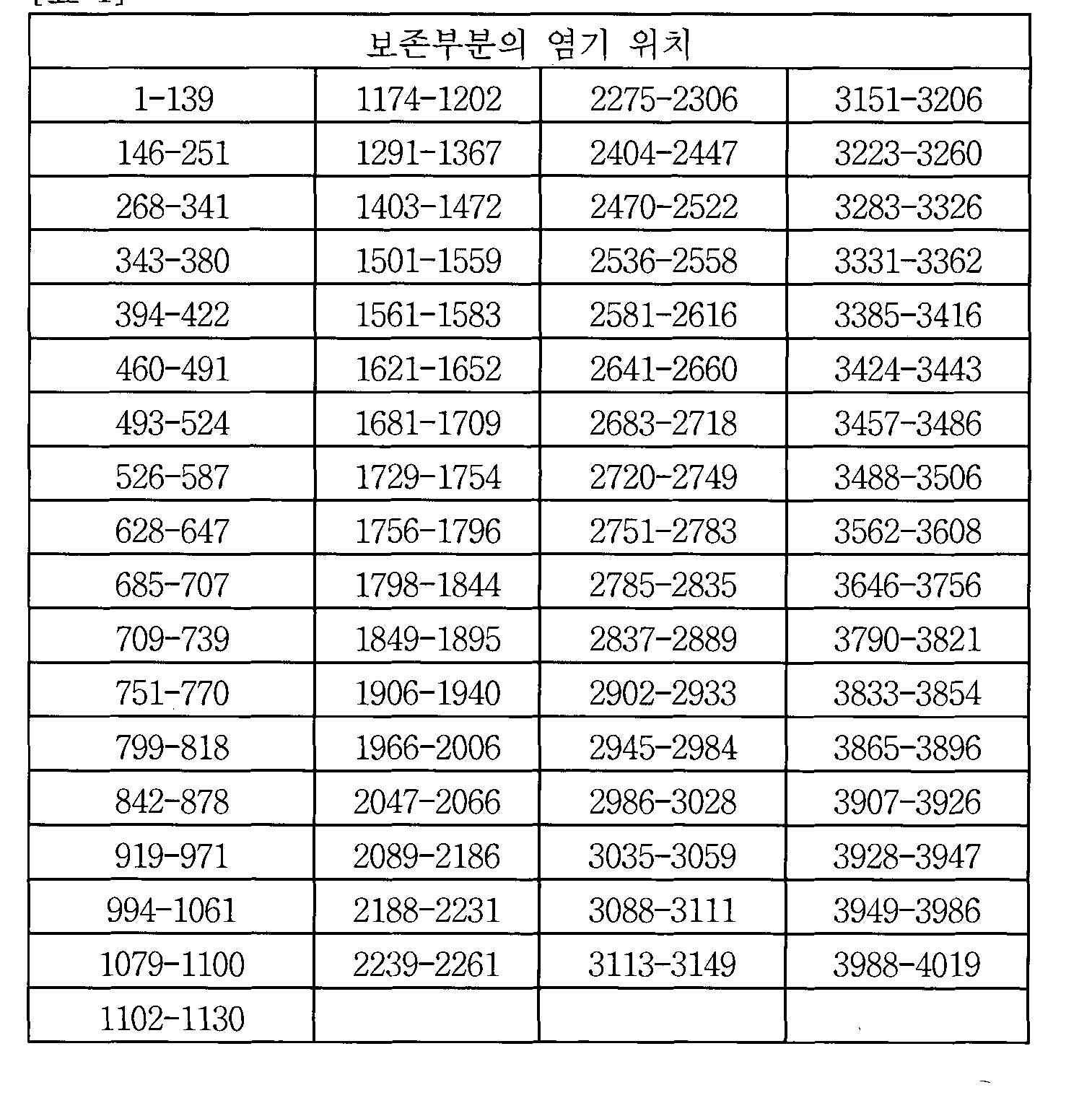
- 제2항에 있어서, 상기 단계 (1) 은 서열번호 1 및 2, 또는 서열번호 3 및 4의 염기서열을 가지는 프라이머 쌍을 사용하여 rpoB 유전자의 전체 염기서열을 증폭하는 것인 방법.
- 제2항에 있어서, 상기 단계 (2) 는 서열번호 5 내지 서열번호 14의 염기서열로 이루어진 군으로부터 선택되는 염기서열을 가지는 1종 이상의 프라이머를 사용하여 rpoB 유전자의 전체 염기서열을 결정하는 것인 방법.
- 제2항에 있어서, 상기 단계 (3) 에서 표준 균주의 rpoB 유전자의 염기서열은 서열번호 15 내지 서열번호 75의 염기서열로 이루어진 군으로부터 선택되는 것인 방법.
- 제2항에 있어서, 상기 단계 (3) 은 살모넬라 속 미생물의 rpoB 유전자의 전체 염기서열을 표준 균주의 rpoB 유전자의 염기서열에 대입하여 다중배열한 후 계통도를 완성하여 결정하는 것인 방법.
- [규칙 제91조에 의한 정정 13.03.2013]
살모넬라 속 미생물의 rpoB 유전자의 염기서열 (서열번호 15) 중에서 표 1에 기재된 보존 부분의 염기 서열에 상보적이며 7 내지 50 bp 의 연속된 염기서열을 가지는 프라이머.[표 1]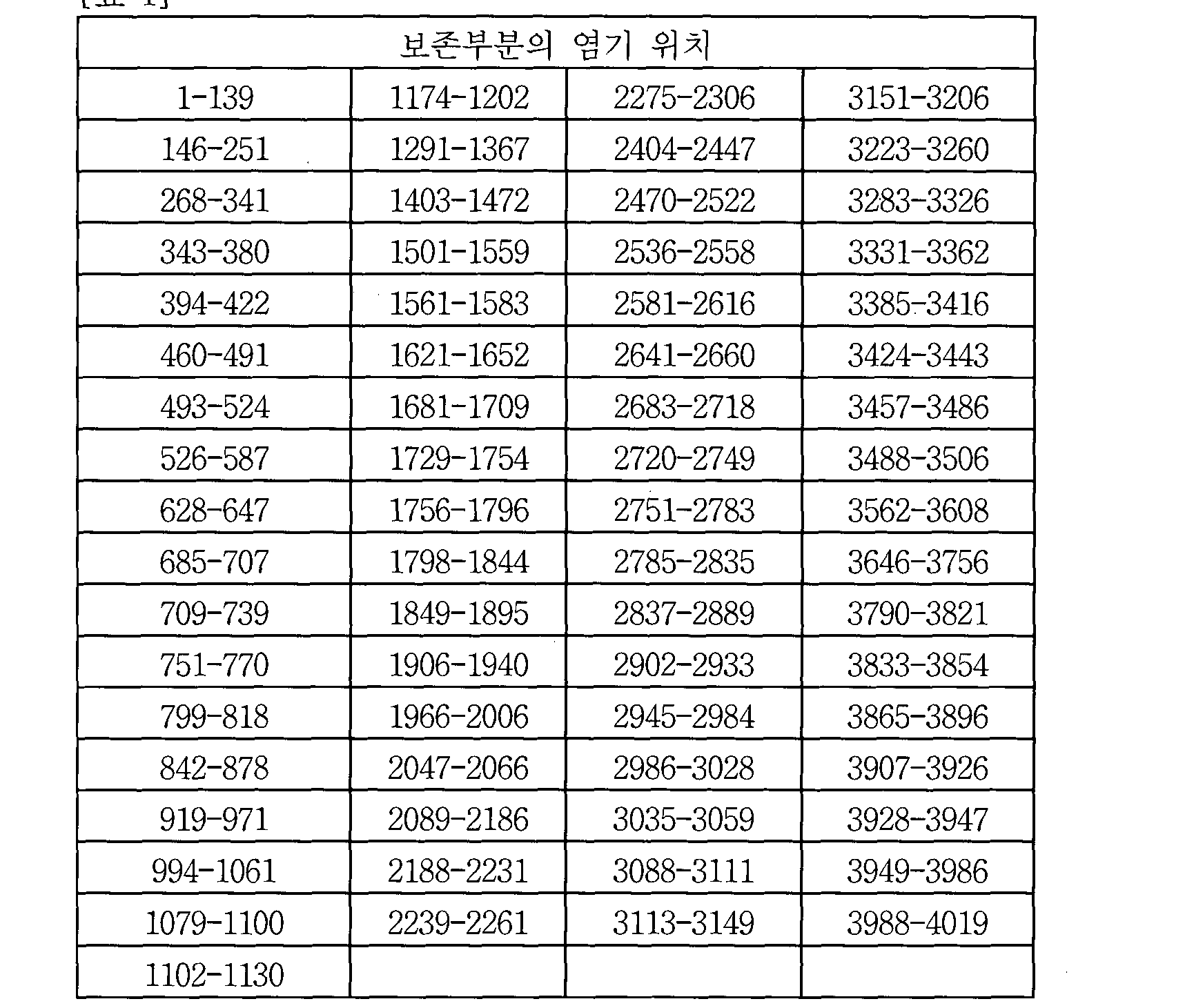
- 서열번호 1 및 2, 또는 서열번호 3 및 4의 염기서열을 가지는, 살모넬라 속 미생물의 rpoB 유전자의 전체 염기서열 증폭용 프라이머 쌍.
- 서열번호 5 내지 서열번호 14의 염기서열로 이루어진 군으로부터 선택되는 염기서열을 가지는, 살모넬라 속 미생물의 rpoB 유전자의 전체 염기서열 결정용 프라이머.
- 제8항의 프라이머를 포함하는 살모넬라 속 미생물의 혈청형 동정용 조성물.
- 제11항에 있어서, 서열번호 5 내지 서열번호 14의 염기서열로 이루어진 군으로부터 선택되는 염기서열을 가지는 1종 이상의 프라이머를 추가로 포함하는 살모넬라 속 미생물의 혈청형 동정용 조성물.
- 제9항의 프라이머 쌍을 포함하는 살모넬라 속 미생물의 혈청형 동정용 조성물.
- 제10항의 프라이머를 포함하는 살모넬라 속 미생물의 혈청형 동정용 조성물.
- 제11항 내지 제14항 중 어느 한 항의 조성물을 포함하는 살모넬라 속 미생물의 혈청형 동정용 키트.
- 제15항에 있어서, 상기 키트는 PCR-RFLP (restriction fragment length polymorphism) 키트, allele-specific PCR 키트, 실시간 PCR 키트, DNA 칩 키트 또는 서던 블랏팅 키트인 살모넬라 속 미생물의 혈청형 동정용 키트.
- 서열번호 15 내지 서열번호 75의 염기서열로 이루어진 군으로부터 선택되는 염기서열을 가지는 살모넬라 속 미생물의 rpoB 폴리뉴클레오티드를 포함하는, 살모넬라 속 미생물의 혈청형 동정용 조성물.
- 서열번호 15, 서열번호 16, 서열번호 17, 서열번호 19, 서열번호 20, 서열번호 21, 서열번호 22, 서열번호 24, 서열번호 25, 서열번호 26, 서열번호 28, 서열번호 31, 서열번호 32, 서열번호 33, 서열번호 34, 서열번호 38, 서열번호 43, 서열번호 44, 서열번호 45, 서열번호 47, 서열번호 49, 서열번호 50, 서열번호 51, 서열번호 54, 서열번호 55, 서열번호 56, 서열번호 57, 서열번호 59, 서열번호 60, 서열번호 61, 서열번호 63, 서열번호 64, 서열번호 65, 서열번호 66, 서열번호 67, 서열번호 68, 서열번호 70, 서열번호 74 및 서열번호 75의 염기서열로 이루어진 군으로부터 선택되는 염기서열을 가지는 살모넬라 속 미생물의 rpoB 폴리뉴클레오티드.
Applications Claiming Priority (2)
| Application Number | Priority Date | Filing Date | Title |
|---|---|---|---|
| KR10-2011-0144486 | 2011-12-28 | ||
| KR1020110144486A KR101412120B1 (ko) | 2011-12-28 | 2011-12-28 | 살모넬라 혈청형의 분자적 동정을 위한 프라이머 및 이를 이용한 살모넬라 혈청형 동정 방법 |
Publications (1)
| Publication Number | Publication Date |
|---|---|
| WO2013100495A1 true WO2013100495A1 (ko) | 2013-07-04 |
Family
ID=48697871
Family Applications (1)
| Application Number | Title | Priority Date | Filing Date |
|---|---|---|---|
| PCT/KR2012/011245 Ceased WO2013100495A1 (ko) | 2011-12-28 | 2012-12-21 | 살모넬라 혈청형의 분자적 동정을 위한 프라이머 및 이를 이용한 살모넬라 혈청형 동정 방법 |
Country Status (2)
| Country | Link |
|---|---|
| KR (1) | KR101412120B1 (ko) |
| WO (1) | WO2013100495A1 (ko) |
Families Citing this family (3)
| Publication number | Priority date | Publication date | Assignee | Title |
|---|---|---|---|---|
| KR102411940B1 (ko) | 2021-12-17 | 2022-06-22 | 대한민국 | 살모넬라 종 판별용 프로브 조성물 및 이를 포함하는 살모넬라 종 판별용 키트 |
| KR102618075B1 (ko) | 2023-02-22 | 2023-12-29 | 대한민국 | 올리고뉴클레오티드 세트를 포함하는 사료의 살모넬라 d 그룹 신속 검출용 조성물 |
| KR102839038B1 (ko) | 2024-12-18 | 2025-07-29 | 대한민국 (식품의약품안전처장) | 살모넬라 혈청형 검출용 조성물 및 이를 이용한 살모넬라 혈청형 검출방법 |
-
2011
- 2011-12-28 KR KR1020110144486A patent/KR101412120B1/ko not_active Expired - Fee Related
-
2012
- 2012-12-21 WO PCT/KR2012/011245 patent/WO2013100495A1/ko not_active Ceased
Non-Patent Citations (4)
| Title |
|---|
| ADéKAMBI, T. ET AL.: "The rpoB gene as a tool for clinical microbiologists.", TRENS IN MICROBIOLOGY, vol. 17, no. 1, January 2009 (2009-01-01), pages 37 - 45 * |
| BUSTAMANTE, V. H. ET AL.: "Identification of Campylobacter jejuni and C. coli using the ropB gene and a cryptic DNA fragment from C. jejuni.", GENE, vol. 165, no. 1, 7 November 1995 (1995-11-07), pages 1 - 8 * |
| KWON, H. J. ET AL.: "Application of nucleotide sequence of RNA polymerase beta-subunit gene (rpoB) to molecular differentiation of serovars of Salmonella enterica subsp. enterica.", VETERINARY MICROBIOLOGY, vol. 82, no. 2, 20 September 2001 (2001-09-20), pages 121 - 129 * |
| MSHANA, S. E. ET AL.: "Outbreak of a novel Enterobacter sp. carrying blaCTX-M-15 in a neonatal unit of a tertiary care hospital in Tanzania.", INTERNATIONAL JOURNAL OF ANTIMICROBIAL AGENTS, vol. 38, no. 3, 12 July 2011 (2011-07-12), pages 565 - 269 * |
Also Published As
| Publication number | Publication date |
|---|---|
| KR101412120B1 (ko) | 2014-06-27 |
| KR20130076069A (ko) | 2013-07-08 |
Similar Documents
| Publication | Publication Date | Title |
|---|---|---|
| Fukushima et al. | Phylogenetic analysis of Salmonella, Shigella, and Escherichia coli strains on the basis of the gyrB gene sequence | |
| Fitzgerald et al. | Campylobacter fetus subsp. testudinum subsp. nov., isolated from humans and reptiles | |
| Picard et al. | Use of tuf sequences for genus-specific PCR detection and phylogenetic analysis of 28 streptococcal species | |
| Peng et al. | The molecular evolutionary history of Shigella spp. and enteroinvasive Escherichia coli | |
| Chung et al. | Genome analysis of Campylobacter concisus strains from patients with inflammatory bowel disease and gastroenteritis provides new insights into pathogenicity | |
| Jost et al. | Clonal relationships among Clostridium perfringens of porcine origin as determined by multilocus sequence typing | |
| Wang et al. | Occurrence and molecular characterization of reptilian Campylobacter fetus strains isolated in Taiwan | |
| CN115772518A (zh) | 同时检测至少八种血流感染病原体的引物组合物及其应用 | |
| Sano et al. | Profiling system of oral microbiota utilizing polymerase chain reaction-restriction fragment length polymorphism analysis | |
| Williams et al. | Large plasmids of Escherichia coli and Salmonella encode highly diverse arrays of accessory genes on common replicon families | |
| Tomida et al. | Fusobacterium watanabei sp. nov. As additional species within the genus Fusobacerium, isolated from human clinical specimens | |
| WO2013100495A1 (ko) | 살모넬라 혈청형의 분자적 동정을 위한 프라이머 및 이를 이용한 살모넬라 혈청형 동정 방법 | |
| KR101373756B1 (ko) | 황색포도상구균의 분자적 동정을 위한 프라이머 및 이를 이용한 황색포도상구균 동정 방법 | |
| KR101828574B1 (ko) | 살모넬라균 검출용 중합효소연쇄반응 프라이머 세트 및 이를 이용한 여러 종의 살모넬라균 동시 검출방법 | |
| US20260028669A1 (en) | Methods and compositions for nucleic acid analysis | |
| Hayford et al. | Single nucleotide polymorphism (SNP)-based differentiation of Shigella isolates by pyrosequencing | |
| Pugliese et al. | Validation of a seminested PCR approach for rapid detection of Salmonella enterica subsp. enterica serovar Gallinarum | |
| Bratchikov et al. | Development of a multiple-run high-resolution melting assay for Salmonella spp. genotyping: HRM application for Salmonella spp. subtyping | |
| Yang et al. | Identification and characterization of simple sequence repeats in the genomes of Shigella species | |
| Sirikaew et al. | Immuno-magnetic isolation, characterization and genetic relationship of Escherichia coli O26 from raw meats, Hat Yai City, Songkhla, Thailand | |
| JP6387500B2 (ja) | 大腸菌の遺伝子型タイピング法及びこれに用いるプライマーセット | |
| Cattoir et al. | The sodA gene as a target for phylogenetic dissection of the genus Haemophilus and accurate identification of human clinical isolates | |
| Uneze et al. | Molecular Characterization of Salmonella Species Isolates from Some Hospitals in Jos, Nigeria | |
| KR100502765B1 (ko) | 마이코플라즈마의 탐지 및 동정 | |
| Abed et al. | The whole genome sequence for Acinetobacter baumannii strain in Iraqi hospitals outbreak |
Legal Events
| Date | Code | Title | Description |
|---|---|---|---|
| 121 | Ep: the epo has been informed by wipo that ep was designated in this application |
Ref document number: 12862299 Country of ref document: EP Kind code of ref document: A1 |
|
| NENP | Non-entry into the national phase |
Ref country code: DE |
|
| 122 | Ep: pct application non-entry in european phase |
Ref document number: 12862299 Country of ref document: EP Kind code of ref document: A1 |