WO2013031533A1 - 情報処理装置、情報処理方法、及びプログラム - Google Patents
情報処理装置、情報処理方法、及びプログラム Download PDFInfo
- Publication number
- WO2013031533A1 WO2013031533A1 PCT/JP2012/070675 JP2012070675W WO2013031533A1 WO 2013031533 A1 WO2013031533 A1 WO 2013031533A1 JP 2012070675 W JP2012070675 W JP 2012070675W WO 2013031533 A1 WO2013031533 A1 WO 2013031533A1
- Authority
- WO
- WIPO (PCT)
- Prior art keywords
- algorithm
- information
- polynomials
- order
- public key
- Prior art date
- Legal status (The legal status is an assumption and is not a legal conclusion. Google has not performed a legal analysis and makes no representation as to the accuracy of the status listed.)
- Ceased
Links
Images



Classifications
-
- H—ELECTRICITY
- H04—ELECTRIC COMMUNICATION TECHNIQUE
- H04L—TRANSMISSION OF DIGITAL INFORMATION, e.g. TELEGRAPHIC COMMUNICATION
- H04L9/00—Cryptographic mechanisms or cryptographic arrangements for secret or secure communications; Network security protocols
- H04L9/32—Cryptographic mechanisms or cryptographic arrangements for secret or secure communications; Network security protocols including means for verifying the identity or authority of a user of the system or for message authentication, e.g. authorization, entity authentication, data integrity or data verification, non-repudiation, key authentication or verification of credentials
- H04L9/3247—Cryptographic mechanisms or cryptographic arrangements for secret or secure communications; Network security protocols including means for verifying the identity or authority of a user of the system or for message authentication, e.g. authorization, entity authentication, data integrity or data verification, non-repudiation, key authentication or verification of credentials involving digital signatures
-
- H—ELECTRICITY
- H04—ELECTRIC COMMUNICATION TECHNIQUE
- H04L—TRANSMISSION OF DIGITAL INFORMATION, e.g. TELEGRAPHIC COMMUNICATION
- H04L9/00—Cryptographic mechanisms or cryptographic arrangements for secret or secure communications; Network security protocols
- H04L9/30—Public key, i.e. encryption algorithm being computationally infeasible to invert or user's encryption keys not requiring secrecy
- H04L9/3093—Public key, i.e. encryption algorithm being computationally infeasible to invert or user's encryption keys not requiring secrecy involving Lattices or polynomial equations, e.g. NTRU scheme
-
- H—ELECTRICITY
- H04—ELECTRIC COMMUNICATION TECHNIQUE
- H04L—TRANSMISSION OF DIGITAL INFORMATION, e.g. TELEGRAPHIC COMMUNICATION
- H04L9/00—Cryptographic mechanisms or cryptographic arrangements for secret or secure communications; Network security protocols
- H04L9/32—Cryptographic mechanisms or cryptographic arrangements for secret or secure communications; Network security protocols including means for verifying the identity or authority of a user of the system or for message authentication, e.g. authorization, entity authentication, data integrity or data verification, non-repudiation, key authentication or verification of credentials
- H04L9/3247—Cryptographic mechanisms or cryptographic arrangements for secret or secure communications; Network security protocols including means for verifying the identity or authority of a user of the system or for message authentication, e.g. authorization, entity authentication, data integrity or data verification, non-repudiation, key authentication or verification of credentials involving digital signatures
- H04L9/3252—Cryptographic mechanisms or cryptographic arrangements for secret or secure communications; Network security protocols including means for verifying the identity or authority of a user of the system or for message authentication, e.g. authorization, entity authentication, data integrity or data verification, non-repudiation, key authentication or verification of credentials involving digital signatures using DSA or related signature schemes, e.g. elliptic based signatures, ElGamal or Schnorr schemes
Definitions
- the present technology relates to an information processing device, an information processing method, and a program.
- Electronic signatures are used to identify the creator of an electronic document. Therefore, the electronic signature should be generated only by the creator of the electronic document. If a malicious third party can generate the same electronic signature, that third party can impersonate the creator of the electronic document. That is, a malicious third party may forge the electronic document.
- a digital signature system widely used at present, for example, an RSA signature system, a DSA signature system, etc. are known.
- the RSA signature scheme is based on "the difficulty of prime factorization for large composite numbers (hereinafter, prime factorization problem)" as the basis of security.
- DSA signature scheme is based on "difficulty of deriving solution for discrete logarithm problem” as the basis of security.
- MI Magnetic-Imai cryptography
- HFE Hidden Field Equation cryptography
- OV Olet-Vinegar signature scheme
- TTM Treatment Method cryptography
- the multivariate polynomial problem is an example of a problem called the NP hard problem which is difficult to solve even using a quantum computer.
- a public key authentication method using a multivariate polynomial problem represented by HFE or the like utilizes a multiorder multivariate simultaneous equation in which a special trap door is installed.
- multiorder multivariate simultaneous equations F and linear transformations A and B become trap doors.
- a public key authentication method or a digital signature method can be realized, which is based on the difficulty of solution of multi-order multivariable simultaneous equations.
- the inventor of the present invention is an efficient public key authentication system having high security by using a multiorder multivariate simultaneous equation whose means (trapdoor) to solve efficiently is not known.
- An electronic signature scheme was devised (Koichi Sakumoto, Taizo Shirai and Harunaga Hiwatari, "Public-Key Identification Schemes Based on Multivariate Quadratic Polynomials", CRYPTO 2011, LNCS 6841, pp. 706-723, 2011.).
- multivariate polynomials used in this public key authentication scheme and electronic signature scheme have a large number of coefficients, and in order to use them as a public key, we decide how to efficiently assign the coefficients between the prover and the verifier. I needed to keep The present technology is intended to provide a new and improved information processing apparatus, an information processing method, and a program capable of efficiently substituting the coefficients of a multivariate polynomial.
- a number generation unit configured to generate a number to be used for a coefficient of each term constituting the set F of the multi-order multivariate polynomials from information shared among the entities using a predetermined function, and the number generation unit
- An information processing apparatus is provided, in which a coefficient matrix in a case where multi-order multi-variable polynomials included in constituent elements are expressed in a quadratic form is grouped by row or column, and assignment processing is performed in group units.
- a number generation unit for generating a number of coefficients equal to the number of coefficients of each of the terms making up the set F of multi-order multivariate polynomials from information shared among entities using a predetermined function;
- An assignment unit for assigning the number generated by the number generation unit in a predetermined order with the certifier to the coefficients of the multiorder multivariate polynomial including the set F of the multiorder multivariate polynomial as a component
- An information processing apparatus is provided.
- An information processing method is provided, in which among the coefficients of polynomials, coefficients of terms having the same type of combination of variables are grouped, and assignment processing is performed in group units.
- An information processing method is provided, in which coefficient matrices in the case of representing polynomials in a quadratic form are grouped by row or column, and assignment processing is performed in group units.
- a method of treatment is provided.
- the program for causing a computer to realize the assignment function
- a program that groups the coefficient matrix when the multi-order multi-variable polynomials including the set F of the second-order multi-variable polynomials in the component in quadratic form is grouped by row or column and executes assignment processing in groups.
- a number generation function of generating as many as the number of coefficients of each term constituting the set F of multi-order multivariate polynomials from information shared among entities using a predetermined function, the prover and the prover An assignment function of assigning the number generated by the number generation unit in a predetermined order with the certifier to the coefficients of the multiorder multivariate polynomial including the set F of the multiorder multivariate polynomial as a component
- a program for realizing the computer is provided.
- a computer readable recording medium having the above program recorded thereon.
- composition of an algorithm concerning a public key attestation system It is an explanatory view for explaining composition of an algorithm concerning a digital signature method. It is explanatory drawing for demonstrating the structure of the algorithm which concerns on the public key authentication system of n path
- FIGS. 4 to 6 An exemplary configuration of an algorithm related to the 3-pass public key authentication scheme will be described with reference to FIGS. 4 to 6.
- a configuration example of an algorithm related to the 5-pass public key authentication scheme will be described with reference to FIGS. 7 to 9.
- FIGS. 10 and 11 a method of transforming an efficient algorithm related to a 3-pass and 5-pass public key authentication scheme into an algorithm of a digital signature scheme will be described.
- the present embodiment relates to a public key authentication scheme and a digital signature scheme that base security on the difficulty of solving a multi-order multivariate simultaneous equation.
- the present embodiment relates to a public key authentication method and an electronic signature method using multi-order multivariate simultaneous equations which do not have means (trap door) to be solved efficiently unlike the conventional methods such as the HFE electronic signature method.
- FIG. 1 is an explanatory diagram for describing an outline of an algorithm of the public key authentication scheme.
- Public key authentication is used to convince a person (certifier) to be another person (verifier) that the person is the person using the public key pk and the secret key sk.
- the public key pk A of the prover A is disclosed to the verifier B.
- the prover A's secret key sk A is secretly managed by the prover A.
- the person who knows the secret key sk A corresponding to the public key pk A is considered to be the prover A himself.
- the secret key sk corresponding to the public key pk A by the certifier A through the dialogue protocol
- the verifier B should be presented with evidence that he knows A. Then, if evidence that the prover A knows the secret key sk A is presented to the verifier B and the examiner B confirms the evidence, the legitimacy (identity) of the prover A is It will be proved.
- the first condition is to “make the probability of false proof established by a false witness who does not have the secret key sk when executing the dialogue protocol as small as possible”. It is called “soundness” that this first condition holds. In other words, soundness can be reworded as "a false witness that does not have the secret key sk can not establish false evidence with a probability that can not be ignored during execution of the dialogue protocol.”
- the second condition is, "even if you perform an interactive protocol, information of the secret key sk A of the prover A has there is no leak at all to the verifier B" that is. It is called “zero knowledge" that this second condition holds.
- model In the model of the public key authentication scheme, as shown in FIG. 1, there are two entities, a prover and a verifier.
- the prover uses the key generation algorithm Gen to generate a set of a prover's unique secret key sk and a public key pk.
- the prover executes the dialogue protocol with the verifier using the set of the secret key sk and the public key pk generated using the key generation algorithm Gen.
- the prover executes the dialogue protocol using the prover algorithm P.
- the prover uses the prover algorithm P to present to the verifier the evidence of holding the secret key sk in the dialogue protocol.
- the verifier executes the dialogue protocol using the verifier algorithm V, and verifies whether or not the prover holds the private key corresponding to the public key published by the prover. That is, the verifier is an entity that verifies whether the prover holds the private key corresponding to the public key.
- the model of the public key authentication scheme is composed of three entities of a prover and a verifier, and three algorithms of a key generation algorithm Gen, a prover algorithm P, and a verifier algorithm V.
- the expressions “prover” and “verifier” are used, these expressions mean entity to the last. Therefore, the subject that executes the key generation algorithm Gen and the prover algorithm P is an information processing apparatus corresponding to the entity of the "prover”. Similarly, the subject that executes the verifier algorithm V is an information processing apparatus.
- the hardware configuration of these information processing apparatuses is, for example, as shown in FIG. That is, the key generation algorithm Gen, the prover algorithm P, and the verifier algorithm V are executed by the CPU 902 or the like based on programs recorded in the ROM 904, the RAM 906, the storage unit 920, the removable recording medium 928 or the like.
- the key generation algorithm Gen is used by the prover.
- the key generation algorithm Gen is an algorithm that generates a pair of a secret key sk unique to the prover and a public key pk.
- the public key pk generated by the key generation algorithm Gen is released. Then, the public key pk released is used by the verifier.
- the prover manages the secret key sk generated by the key generation algorithm Gen in a secret.
- the secret key sk secretly managed by the prover is used to prove to the verifier that the prover holds the secret key sk corresponding to the public key pk.
- the key generation algorithm Gen is expressed as the following equation (1) as an algorithm which receives the security parameter 1 ⁇ ( ⁇ is an integer of 0 or more) and outputs the secret key sk and the public key pk. Ru.
- the prover algorithm P is used by the prover.
- the prover algorithm P is an algorithm for proving to the verifier that the prover holds the secret key sk corresponding to the public key pk. That is, the prover algorithm P is an algorithm that receives the secret key sk and the public key pk as input, and executes the dialogue protocol.
- the verifier algorithm V is used by the verifier.
- the verifier algorithm V is an algorithm for verifying whether the prover holds the secret key sk corresponding to the public key pk in the dialogue protocol.
- the verifier algorithm V is an algorithm that receives the public key pk and outputs 0 or 1 (1 bit) according to the result of execution of the interaction protocol.
- the verifier determines that the prover is invalid when the verifier algorithm V outputs 0, and determines that the prover is valid when 1 is output.
- the verifier algorithm V is expressed as the following equation (2).
- the dialogue protocol needs to satisfy the two conditions of soundness and zero knowledge.
- the prover executes a procedure dependent on the secret key sk, notifies the verifier of the result, and It is necessary to have the verifier perform verification based on Performing procedures dependent on the secret key sk is necessary to ensure soundness.
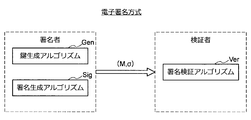
- FIG. 2 is an explanatory diagram for explaining an outline of an algorithm of the digital signature scheme.
- the electronic signature refers to a mechanism for providing the recipient with signature data that is known only to the creator of the data and providing it to the recipient, and verifying the signature data on the recipient side.
- model In the model of the electronic signature scheme, as shown in FIG. 2, there are two entities, a signer and a verifier.
- the model of the electronic signature scheme is composed of three algorithms: a key generation algorithm Gen, a signature generation algorithm Sig, and a signature verification algorithm Ver.
- the signer generates a pair of a signer's unique signature key sk and a verification key pk using the key generation algorithm Gen. Further, the signer generates a digital signature ⁇ to be attached to the document M using the signature generation algorithm Sig. That is, the signer is an entity that gives the document M a digital signature.
- the verifier verifies the electronic signature ⁇ attached to the document M using the signature verification algorithm Ver. That is, the verifier is an entity that verifies the digital signature ⁇ in order to confirm whether the creator of the document M is a signer.
- the expressions “signer” and “verifier” mean the entities to the last. Therefore, the subject that executes the key generation algorithm Gen and the signature generation algorithm Sig is an information processing apparatus corresponding to the “signer” entity. Similarly, an entity that executes the signature verification algorithm Ver is an information processing apparatus.
- the hardware configuration of these information processing apparatuses is, for example, as shown in FIG. That is, the key generation algorithm Gen, the signature generation algorithm Sig, and the signature verification algorithm Ver are executed by the CPU 902 or the like based on programs recorded in the ROM 904, the RAM 906, the storage unit 920, the removable recording medium 928 or the like.
- the key generation algorithm Gen is used by the signer.
- the key generation algorithm Gen is an algorithm that generates a pair of a signer-specific signature key sk and a verification key pk.
- the verification key pk generated by the key generation algorithm Gen is released.
- the signature key sk generated by the key generation algorithm Gen is secretly managed by the signer.
- the signature key sk is used to generate the electronic signature ⁇ given to the document M.
- the key generation algorithm Gen takes a security parameter 1 ⁇ ( ⁇ is an integer of 0 or more) as an input, and outputs a signature key sk and a public key pk.
- the key generation algorithm Gen can be formally expressed as the following equation (3).
- the signature generation algorithm Sig is used by the signer.
- the signature generation algorithm Sig is an algorithm for generating a digital signature ⁇ given to the document M.
- the signature generation algorithm Sig is an algorithm that receives the signature key sk and the document M and outputs a digital signature ⁇ .
- This signature generation algorithm Sig can be formally expressed as the following equation (4).
- the signature verification algorithm Ver is used by the verifier.
- the signature verification algorithm Ver is an algorithm for verifying whether the digital signature ⁇ is a valid electronic signature for the document M.
- the signature verification algorithm Ver is an algorithm that receives a signer's verification key pk, a document M, and a digital signature ⁇ as input, and outputs 0 or 1 (1 bit).
- This signature verification algorithm Ver can be formally expressed as the following equation (5).
- the verifier determines that the electronic signature ⁇ is invalid when the signature verification algorithm Ver outputs 0 (when the public key pk rejects the document M and the electronic signature ⁇ ), and outputs 1 ( If the public key pk accepts the document M and the electronic signature ⁇ ), it is determined that the electronic signature ⁇ is valid.
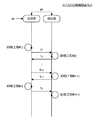
- FIG. 3 is an explanatory diagram for describing an n-pass public key authentication scheme.
- the public key authentication method is an authentication method that proves to the verifier that the prover holds the secret key sk corresponding to the public key pk in the dialogue protocol.
- the dialogue protocol needs to satisfy two conditions of soundness and zero knowledge. Therefore, in the dialogue protocol, as shown in FIG. 3, both the prover and the verifier exchange information n times while executing processing.
- an "n-pass" public key authentication scheme a scheme in which information is transmitted and received n times.
- the 3-pass public key authentication scheme may be referred to as a “3-pass scheme”.
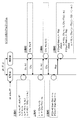
- FIG. 4 is an explanatory diagram for describing a specific algorithm configuration related to the 3-pass scheme.
- the quadratic polynomial f i (x) is expressed as the following equation (6).
- a set of quadratic polynomials (f 1 (x),..., F m (x)) can be expressed as the following equation (7).
- a 1 ,..., A m are n ⁇ n matrices.
- b 1 ,..., B m are n ⁇ 1 vectors respectively.
- the multivariate polynomial F can be expressed as the following Expression (8) and Expression (9). It can be easily confirmed from the following formula (10) that this expression holds.
- G (x, y) corresponding to x is bilinear with respect to x and y.
- G (x, y) may be called a bilinear term.
- the sum of the multivariate polynomial F (x + r 0 ) and G (x) is expressed as the following equation (11).
- the key generation algorithm Gen sets (f 1 (x 1 ,..., X n ),..., F m (x 1 ,..., X n ), y) as the public key pk and s as the secret key Set
- Process # 1 As shown in FIG. 4, first, the prover algorithm P randomly generates vectors r 0 , t 0 ⁇ K n and e 0 ⁇ K m . Next, the prover algorithm P calculates r 1 ss ⁇ r 0 . This calculation corresponds to an operation of masking the secret key s by the vector r 0 . Furthermore, the prover algorithm P calculates t 1 rr 0 ⁇ t 0 . Next, the prover algorithm P calculates e 1 ⁇ F (r 0 ) ⁇ e 0 .
- Process # 1 (cont.): Next, the prover algorithm P calculates c 0 HH (r 1 , G (t 0 , r 1 ) + e 0 ). Next, the prover algorithm P calculates c 1 H H (t 0 , e 0 ). Next, the prover algorithm P calculates c 2 H H (t 1 , e 1 ). The message (c 0 , c 1 , c 2 ) generated in step # 1 is sent to the verifier algorithm V.
- Process # 2 The verifier algorithm V that receives the message (c 0 , c 1 , c 2 ) selects which one of the three verification patterns to use. For example, the verifier algorithm V selects one numerical value from three numerical values ⁇ 0, 1, 2 ⁇ representing the type of verification pattern, and sets the selected numerical value in the request Ch. This request Ch is sent to the prover algorithm P.
- Process # 4 The verifier algorithm V that has received the response Rsp executes the following verification process using the received response Rsp.
- a serial method in which the exchange of messages, requests, and replies is sequentially repeated plural times and the exchange of messages, requests, and answers for plural times in one exchange are performed.
- a parallel method can be considered.
- a hybrid method combining a serial method and a parallel method is also conceivable.
- an algorithm hereinafter, parallelization algorithm
- Process (1) The prover algorithm P randomly generates vectors r 0i , t 0i ⁇ K n and e 0i ⁇ K m .
- Process (3) The prover algorithm P calculates e 1i ⁇ F (r 0i ) ⁇ e 0i .
- the hash value Cmt generated in step # 1 is sent to the verifier algorithm V.
- the amount of communication can be reduced by converting the messages (c 01 , c 11 , c 21 ,..., C 0 N , c 1 N , c 2 N ) into hash values and sending them to the verifier algorithm V. It will be possible.
- Process # 3 Request Ch 1, ..., a prover algorithm P that received Ch N, requested Ch 1 received, ..., reply Rsp 1 to send to the verifier algorithm V in accordance respective Ch N, ..., to produce a Rsp N.
- Ch i 2i
- the prover algorithm P, Rsp i (r 1i, t 1i, e 1i, c 1i) to produce a.
- the responses Rsp 1 ,..., Rsp N generated in step # 3 are sent to the verifier algorithm V.
- Ch i 1, the verifier algorithm V from Rsp i (r 1i, t 0i , e 0i, c 2i) taken out.
- the verifier algorithm V holds (c 0i , c 1i , c 2i ).
- g xl and g yl are as shown in the following formula (14) and formula (15), respectively. Can be deployed.
- the second term on the right side of the g xl are the primary For any x and y, it may be included in the g yl.
- G x (x, y) and G y (x, y) are additively homomorphic to x and y. Therefore, new variables r 0 , r 1 , t 0 , u 0 and e 0 are introduced and released in the same manner as the efficient algorithm construction method using the second-order polynomial f i using these properties. Divide the key F (s).
- the following equation (16) is composed of the third and fourth parts
- the following equation (17) and the following equation (18) are composed of the first and fourth parts
- 19) is composed of first and second parts.
- the following equations (16) to (19) are each composed of two types of parts.
- the basic point on the design of the extended algorithm is to send the message expressed by the following equation (20) to the equation (22) to the verifier, and to perform verification on any of the first to fourth parts. 2 points.
- this verification alone can not verify whether “r 1 ” included in the third part is equal to “r 1 ” included in the fourth part.
- "r 0 " included in the first part is equal to "r 0 " included in the second part, or "t 0 , e 0 " included in the first part and the third part
- It can not be verified that "t 0 , e 0 " included in is equal.
- it can not be verified whether "u 1 , e 1 " included in the second part is equal to "u 1 , e 1 " included in the fourth part. So, below, the example of composition which enabled these verifications is introduced.
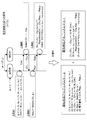
- Process # 1 As shown in FIG. 6, the prover algorithm P randomly generates vectors r 0 , t 0 , u 0 ⁇ K n and e 0 ⁇ K m . Next, the prover algorithm P calculates r 1 ss ⁇ r 0 . This calculation corresponds to an operation of masking the secret key s by the vector r 0 . Next, the prover algorithm P calculates t 1 rr 0 ⁇ t 0 . Then, the prover algorithm P calculates u 1 rr 1 ⁇ u 0 . Next, the prover algorithm P calculates e 1 ⁇ F (r 0 ) ⁇ e 0 .
- Process # 1 (cont.): Next, the prover algorithm P calculates c 0 H H (r 1 , G x (t 0 , r 1 ) + e 0 ). Next, the prover algorithm P calculates c 1 HH (r 0 ⁇ t 0 , u 0 ). Next, the prover algorithm P calculates c 2 H H (r 0 , e 1 -G y (r 0 , u 1 )). Next, the prover algorithm P calculates c 3 H H (t 0 , e 0 ). Then, the prover algorithm P calculates c 4 H H (u 1 , e 1 ). The messages (c 0 , c 1 , c 2 , c 3 , c 4 ) generated in step # 1 are sent to the verifier algorithm V.
- Process # 2 The verifier algorithm V that receives the message (c 0 , c 1 , c 2 , c 3 , c 4 ) selects which of the four verification patterns is to be used. For example, the verifier algorithm V selects one numerical value from four numerical values ⁇ 0, 1, 2, 3 ⁇ representing the type of verification pattern, and sets the selected numerical value in the request Ch. This request Ch is sent to the prover algorithm P.
- Process # 3 The prover algorithm P that has received the request Ch generates a response Rsp to be sent to the verifier algorithm V according to the received request Ch.
- the response Rsp generated in step # 3 is sent to the verifier algorithm V.
- Process # 4 The verifier algorithm V that has received the response Rsp executes the following verification process using the received response Rsp.
- the verifier algorithm V outputs the value 1 indicating the authentication success when all the verifications are successful, and outputs the value 0 indicating the authentication failure when the verification fails.
- the false evidence rate per interaction protocol is 2/3, but in the case of the 5-pass scheme, the false evidence probability per interactive protocol is 1/2 + 1 / q. Where q is the order of the ring to be used. Therefore, if the order of the ring is sufficiently large, the 5-pass scheme can reduce the perjudging probability per time, and can reduce the perjudacy probability sufficiently with a small number of executions of the dialogue protocol. it can.
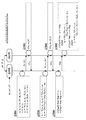
- FIG. 7 is an explanatory diagram for describing a specific algorithm configuration related to the 5-pass scheme.
- the quadratic polynomial f i (x) is assumed to be expressed as the above equation (6).
- the multivariate polynomial F 1 (x) used to mask the multivariate polynomial F (x + r 0 ) using two vectors t 0 nK n and e 0 ⁇ K m as in the algorithm related to the 3-pass scheme Is expressed as F 1 (x) G (x, t 0 ) + e 0 .
- F 1 (x) G (x, t 0 ) + e 0 .
- the key generation algorithm Gen sets (f 1 ,..., F m , y) as the public key pk and sets s as the secret key.
- the vector (x 1 ,..., X n ) is represented as x
- the set of multivariable polynomials (f 1 (x),..., F m (x)) is represented as F (x).
- Process # 1 As shown in FIG. 7, first of all, the prover algorithm P randomly generates vectors r 0 ⁇ K n , t 0 ⁇ K n and e 0 ⁇ K m . Next, the prover algorithm P calculates r 1 ss ⁇ r 0 . This calculation corresponds to an operation of masking the secret key s by the vector r 0 . Next, the prover algorithm P generates a hash value c 0 of the vectors r 0 , t 0 and e 0 . That is, the prover algorithm P calculates c 0 ⁇ H (r 0 , t 0 , e 0 ).
- the prover algorithm P generates a hash value c 1 of G (t 0 , r 1 ) + e 0 and r 1 . That is, the prover algorithm P calculates c 0 H H (r 1 , G (t 0 , r 1 ) + e 0 ).
- the message (c 0 , c 1 ) generated in step # 1 is sent to the verifier algorithm V.
- Process # 2 The verifier algorithm V that has received the message (c 0 , c 1 ) randomly selects one number Ch A from the elements of the ring K existing in q ways, and sends the selected number Ch A to the prover algorithm P.
- Process # 3 The prover algorithm P that has received the number Ch A calculates t 1 ⁇ Ch A ⁇ r 0 -t 0 . Furthermore, the prover algorithm P calculates e 1 ChCh A ⁇ F (r 0 ) ⁇ e 0 . Then, the prover algorithm P sends t 1 and e 1 to the verifier algorithm V.
- Process # 4 The verifier algorithm V that has received t 1 and e 1 selects which one of two verification patterns to use. For example, the verifier algorithm V selects one numerical value from among two numbers representing verification patterns ⁇ 0, 1 ⁇ , and set the selected numerical value in the request Ch B. This request Ch B is sent to the prover algorithm P.
- Process # 6 The verifier algorithm V that has received the response Rsp executes the following verification process using the received response Rsp.
- Ch B 1
- a serial method in which the exchange of messages, requests, and replies is sequentially repeated plural times and the exchange of messages, requests, and answers for plural times in one exchange are performed.
- a parallel method can be considered.
- a hybrid method combining a serial method and a parallel method is also conceivable.
- an algorithm hereinafter, parallelization algorithm
- Process (1) The prover algorithm P randomly generates vectors r 0i , t 0i ⁇ K n and e 0i ⁇ K m .
- the basic point on the design of the extended algorithm is to send the message expressed by the following Eq. (28) and Eq. (29) to the verifier, and the part depending on Ch A for the ver A selected Ch A.
- Eq. (28) and Eq. (29) There are two points in the verification regarding (the first part).
- the r 0 and r 1 were used when generating messages, prevent be swap to another r 0 and r 1 upon verification"
- added the verification of r 0 and r 1 configuration An example is introduced below.
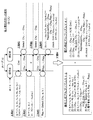
- Process # 1 As shown in FIG. 9, the prover algorithm P randomly generates vectors r 0 , t 0 , u 0 ⁇ K n and e 0 ⁇ K m . Next, the prover algorithm P calculates r 1 ss ⁇ r 0 . This calculation corresponds to an operation of masking the secret key s by the vector r 0 . Next, the prover algorithm P calculates c 0 HH (r 0 , t 0 , e 0 -G y (r 0 , u 0 )).
- the prover algorithm P calculates c 1 H H (r 1 , u 0 , G x (t 0 , r 1 ) + e 0 ).
- the message (c 0 , c 1 ) generated in step # 1 is sent to the verifier algorithm V.
- Process # 2 The verifier algorithm V that has received the message (c 0 , c 1 ) randomly selects the number Ch A. This number Ch A is sent to the prover algorithm P.
- Process # 3 The prover algorithm P that has received the number Ch A calculates t 1 ⁇ Ch A ⁇ r 0 -t 0 . Then, the prover algorithm P calculates u 1 ChCh A ⁇ r 1 -u 0 . Next, the prover algorithm P calculates e 1 ChCh A ⁇ F (r 0 ) + Ch A ⁇ G y (r 0 , r 1 ) ⁇ e 0 . The (t 1 , u 1 , e 1 ) generated in step # 3 is sent to the verifier algorithm V.
- Process # 4 The verifier algorithm V that has received (t 1 , u 1 , e 1 ) selects which one of the two verification patterns to use. For example, the verifier algorithm V selects one numerical value from among two numbers representing verification patterns ⁇ 0, 1 ⁇ , and set the selected numerical value in the request Ch B. This request Ch B is sent to the prover algorithm P.
- Process # 6 The verifier algorithm V that has received the response Rsp executes the following verification process using the received response Rsp.
- the verifier algorithm V outputs the value 1 indicating the authentication success when the verification is successful, and outputs the value 0 indicating the authentication failure when the verification fails.
- the verifier algorithm V outputs the value 1 indicating the authentication success when the verification is successful, and outputs the value 0 indicating the authentication failure when the verification fails.
- the prover in the model of the public key authentication scheme corresponds to the signer in the digital signature scheme, it is easily understood that it is similar to the model of the digital signature scheme in that only the prover can convince the verifier. It will be done. Based on such an idea, a method of transforming the above-described public key authentication scheme into a digital signature scheme will be described.
- an efficient algorithm according to the 3-pass scheme is represented by three interactions and four steps # 1 to # 4.
- the Cmt generated by the prover algorithm P in step # 1 is sent to the verifier algorithm V.
- Step # 2 is configured by a process of selecting Ch 1 ,..., Ch N.
- Ch 1 ,..., Ch N selected by the verifier algorithm V at step # 2 are sent to the prover algorithm P.
- Step # 3 Ch 1, ..., Ch N and a 1, ..., Rsp 1 with a N, ..., consisting of the process of generating Rsp N. This process is expressed as Rsp i SelectSelect (Ch i , a i ).
- the Rsp 1 ,..., Rsp N generated by the prover algorithm P at step # 3 are sent to the verifier algorithm V.
- the algorithm of the public key authentication scheme expressed in the above steps # 1 to # 4 is transformed into a signature generation algorithm Sig and a signature verification algorithm Ver as shown in FIG.
- the signature generation algorithm Sig is composed of the following processes (1) to (5).
- Process (3): The signature generation algorithm Sig calculates (Ch 1 ,..., Ch N ) ⁇ H (M, Cmt). This M is a document to which a signature is given.
- the signature verification algorithm Ver is composed of the following processing (1) to processing (3).
- Process (1): The signature verification algorithm Ver calculates (Ch 1 ,..., Ch N ) ⁇ -H (M, Cmt). Processing (2): The signature verification algorithm Ver, Ch 1, ..., Ch N and Rsp 1, ..., c 01, c 11, c 21 using Rsp N, generate ..., c 0N, c 1N, c 2N Do. Process (3): The signature verification algorithm Ver uses the reproduced c 01 , c 11 , c 21 ,..., C 0 N , c 1 N , c 2 N to use Cmt H (c 01 , c 11 , c 21 ,. Verify c 0N , c 1N , c 2N ).
- an efficient algorithm according to the 5-pass scheme is represented by 5 interactions and 6 steps # 1 to # 6.
- the Cmt generated by the prover algorithm P in step # 1 is sent to the verifier algorithm V.
- the process # 2 is configured by a process of selecting Ch A1 to Ch AN .
- Ch A1 ,..., Ch AN selected by the verifier algorithm V at step # 2 are sent to the prover algorithm P.
- Process # 4 is comprised of a process of selecting Ch B1 ,..., Ch BN .
- the Ch B1 ,..., Ch BN selected by the verifier algorithm V at step # 4 are sent to the prover algorithm P.
- Step # 5 Ch B1, ..., Ch BN , a 1, ..., a N, b 1, ..., Rsp 1 with b N, ..., consisting of the process of generating Rsp N. This process is expressed as Rsp i SelectSelect (Ch Bi , a i , b i ).
- the Rsp 1 ,..., Rsp N generated by the prover algorithm P at step # 5 are sent to the verifier algorithm V.
- the algorithm of the public key authentication scheme expressed in the above steps # 1 to # 6 is transformed into a signature generation algorithm Sig and a signature verification algorithm Ver as shown in FIG.
- the signature generation algorithm Sig is composed of the following processing (1) to processing (7).
- the signature verification algorithm Ver is composed of the following processing (1) to processing (4).
- the signature verification algorithm Ver executes (Ch B1 ,..., Ch BN ) ⁇ H (Ch A1 ,..., Ch AN , d) is modified, the signature verification algorithm Ver is (Ch B1 ,..., Ch BN ) ⁇ H (Ch A1 ,..., Ch AN , d) are calculated.
- Process (3) The signature verification algorithm Ver, Ch A1, ..., Ch AN , Ch B1, ..., Ch BN, Rsp 1, ..., t 11, e 11 with Rsp N, ..., t 1N, e 1N , C 01 , c 11 ,..., C 0 N and c 1 N are generated.
- the signature verification algorithm Ver has executed the processing of signature verification after receiving the entire electronic signature.
- the data size of the electronic signature is relatively large. Therefore, when performing authentication using a device having only a small memory capacity, such as RFID (Radio Frequency IDentification), it was necessary to pay attention to the free space of the memory, the memory usage rate during the authentication process, and the like.
- RFID Radio Frequency IDentification
- the hash function has a structure in which input is divided into blocks and processing is sequentially performed block by block.
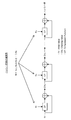
- the hash function has a structure as shown in FIG. Figure hash function shown is 12, Z blocks m 1 inputs M already padded, ..., separated into m Z, while incrementing the index j, sequentially, the initial block m j value IV or the intermediate value CV
- the hash value is generated by acting on a predetermined function CF together with j . Therefore, when the intermediate value CV j is obtained, the previously used block becomes unnecessary. Therefore, we have devised a mechanism (hereinafter, memory reduction method) that effectively reduces the amount of memory required to execute the algorithm using this characteristic.
- memory reduction method a mechanism for applying this mechanism to the above-described electronic signature method will be described.
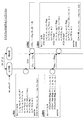
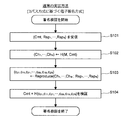
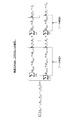
- the signature verification algorithm Ver (Normal mounting method: Fig. 13) Usually, as shown in FIG. 13, the signature verification algorithm Ver according to the above-described electronic signature method constructs an electronic signature (Cmt, Rsp 1 ,..., Rsp N ) at one time (S101). Next, the signature verification algorithm Ver executes (Ch 1 ,..., Ch N ) ⁇ -H (M, Cmt) (S 102). Next, the signature verification algorithm Ver executes (c 01 , c 11 , c 21 ,..., C 0 N , c 1 N , c 2 N ) Re Reproduce (Ch 1 ,..., Ch N ; Rsp 1 ,..., Rsp N ) (S103).
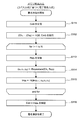
- step S101 of FIG. 13 when the electronic signature is received at one time , the memory for holding (Rsp 1 ,..., Rsp N ) is complete until the process of step S103 is completed. It will be necessary. However, as can be seen from the algorithm configuration of FIG. 5, information other than (Ch i ; Rsp i ) is not used in the reproduction of (c 0i , c 1i , c 2i ) executed in step S103. Also, in view of the structure of the hash function shown in FIG. 12, it can be understood that the calculation of the hash function executed in step S104 can be divided and executed in block units. Therefore, the configuration of processing relating to signature verification is improved to a configuration as shown in FIG.
- step S113 the signature verification algorithm Ver receives Rsp i (S113). Then, the signature verification algorithm Ver using Rsp i received, (c 0i, c 1i, c 2i) ⁇ Reproduce; executes (Ch i Rsp i) (S114 ). After executing the process of step S114, Ch i and Rsp i becomes unnecessary. Therefore, the signature verification algorithm Ver erases Ch i and Rsp i from the memory the process of step S114 after the execution.
- the function H i is a function that outputs an intermediate value generated when c 0i , c 1i , c 2i are calculated inside the hash function H.
- an appropriate input length correction such as adding a bit is performed as necessary.
- the hash function H is expressed by an algorithm configured by the following processing (1) to processing (3).
- tmp N is the final output (hash value) of the hash function H.
- padding is added in the final process according to the specification of the hash function.
- the signature verification algorithm Ver erases, from the memory, the information that has become unnecessary in the process of repeatedly executing the processing of steps S113 to S115. Therefore, the amount of memory required for signature verification can be minimized. As a result, the above-described signature verification can be performed even with a device having a small memory capacity.
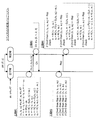
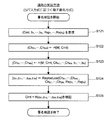
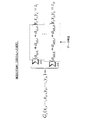
- the signature verification algorithm Ver (Normal mounting method: Fig. 15) Usually, as shown in FIG. 15, the signature verification algorithm Ver according to the above-described electronic signature method constructs an electronic signature (Cmt, d, Rsp 1 ,..., Rsp N ) at one time (S121). Next, the signature verification algorithm Ver executes (Ch A1 ,..., Ch AN ) ⁇ H (M, Cmt) (S122). Next, the signature verification algorithm Ver executes (Ch B1 ,..., Ch BN ) H H (M, C mt, Ch A1 ,..., Ch AN , d) (S123).
- the signature verification algorithm Ver is (c 01 , c 11 ,..., C 0 N , c 1 N , d 11 , e 11 ,..., D 1 N , e 1 N ) ⁇ Reproduce (Ch A1 ,..., Ch AN , Ch B1 , ..., Ch BN ; Rsp 1 , ..., Rsp N ) are executed (S 124).
- the signature verification algorithm Ver first receives only Cmt contained in the electronic signature (S131). Next, the signature verification algorithm Ver executes (Ch A1 ,..., Ch AN ) ⁇ H (M, Cmt) (S132).
- the signature verification algorithm Ver receives d (S133).
- the signature verification algorithm Ver executes (Ch B1 ,..., Ch BN ) ⁇ -H (M, C mt, Ch A1 ,..., Ch AN , d) using the received d (S 134).
- d becomes unnecessary. Therefore, the signature verification algorithm Ver erases d from the memory after executing the process of step S134.
- step S135 the signature verification algorithm Ver receives Rsp i (S135). Then, the signature verification algorithm Ver using Rsp i received, executes (c 0i, c 1i, t 1i, e 1i) ⁇ Reproduce (Ch Ai, Ch Bi, Rsp i) (S136). After the process of step S136 is performed, Ch Ai , Ch Bi and Rsp i become unnecessary. Therefore, the signature verification algorithm Ver erases Ch Ai , Ch Bi and Rsp i from the memory after executing the process of step S136.
- the signature verification algorithm Ver executes tmp i H H i (tmp i-1 ; c 0i , c 1i ) and tmp i ′ ⁇ H i (tmp i-1 ′; t 1i , e 1i ) (S 137) ).
- the signature verification algorithm Ver erases, from the memory, information that has become unnecessary in the process of repeatedly executing the processing of steps S135 to S137. Therefore, the amount of memory required for signature verification can be minimized. As a result, the above-described signature verification can be performed even with a device having a small memory capacity.
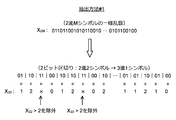
- extraction method # 1 (2-bit division) (FIG. 17)
- M / 2 2-bit random numbers can be obtained by dividing the random number sequence in binary representation by 2 bits. For example, if “00” is associated with a ternary “0”, “01” with a ternary “1”, and “10” with a ternary “2”, the random number sequence of binary representation of 2-bit unit 3 You can get a random number sequence of base numbers. However, the 2-bit value "11" is excluded.
- the extraction method # 1 from the number of 2 two types represented by binary 2 symbols, a method of extracting a number of 3 1 types represented by 3 binary one symbol. Therefore, the probability P 1 for which N or more ternary numbers can not be extracted is expressed by the following equation (30).
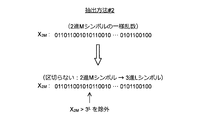
- extraction method # 2 (No Division) (FIG. 18)
- L is the largest integer which is a 3 L ⁇ 2 M.
- the above extraction method # 1 is a method of dividing a random number sequence of binary expression in the smallest dividing unit.
- the above-mentioned extraction method # 2 is a method of dividing a random number sequence of binary expression in the maximum division unit (because it is considered as an M bit division).
- the probability that N or more ternary numbers can not be extracted differs depending on the division length.
- the probability P 3 where N or more ternary can not be extracted is as the following equation (32).
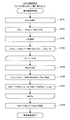
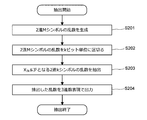
- a random number sequence of binary M symbols is generated (S201).
- a random number sequence of binary M symbols is divided into k bit units (S202).
- a bit string satisfying X 2 k ⁇ 3 L is extracted (S 203).
- the extracted bit string is output in ternary notation (S204), and the series of processing ends.
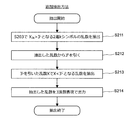
- This method is a method of extracting a symbol string of ternary expression using the bit string not extracted in step S204 of FIG.
- X 2k> 3 L become bit sequence pairs (e.g., when a set of bit strings representing the y 1 y 2 ... y N ' , each The bit string y i of 3 L is extracted as 3 L ⁇ y i ⁇ 2 k ) (S211).
- bit string extracted in step S213 is output in ternary representation (S214), and the series of processing ends.
- L 'ternary numbers with probability 3 L' / (2 k- 3 L ).
- more ternary numbers can be extracted. That is, a ternary number can be extracted similarly from the bit string in which the bit string X becomes X ⁇ 3 L ′ in step S213.
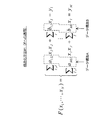
- the structuring method # 1 is a method of putting together the coefficients of the same kind of terms constituting the multivariate polynomial as one data structure.
- the coefficients a 1IJ to a MIJ of the multivariable polynomial F are collected as the data structure A
- the coefficients b 1I to b MI are collected as the data structure B.
- the same method can be applied to the multivariable polynomial G. In this case, coefficients (a 1IJ + a 1JI ) to (a MIJ + a MJI ) are collected as a data structure.
- the calculation of the multivariate polynomial F configured by M N variable polynomials is performed by an algorithm as shown in (Example 1).
- the input x is assumed to be N bits.
- [a (1 to M) IJ ] may not be generated each time, but may be generated only once in M times.
- [a (1 to M) IJ ] may be used while being rotated by one bit during the loop of M times.
- an intermediate result to which the coefficients of the multivariate polynomial F are applied may be held in a table.
- the above algorithm is as in (Example 3).
- Example 3 The method shown in (Example 3) can be said to be a method in which the values of F IJparfined by the following equation (33) are calculated in advance and held as an array.
- an algorithm for calculating the multivariate polynomial G is expressed as the following (example 1 ').
- the inputs x and y are assumed to be N bits respectively.
- an algorithm for calculating the multivariate polynomial G is the following (example 3 ') corresponding to the above (example 3) become that way.
- Example 3 the only need to perform XOR operation of M bits ( ⁇ ) (N / k) 2 times. However, compared to the algorithm of (Example 2 '), the amount of memory required is twice 2 2k / k.
- Example 3 can be said to be a method in which the values of GIJ defined by the following equation (34) are calculated in advance and held as an array.
- an algorithm of calculation according to the data structure A is, for example, as follows (example 4).
- an intermediate result obtained by applying the coefficients of the multivariate polynomial F may be held in a table.
- the above algorithm is as in (Example 6).
- the structuring method # 1 can be applied to the third-order multivariate polynomials G x and G y It is.
- the calculation relating to the data structure A of the third-order multivariate polynomial G x is performed, for example, by the algorithm of the following (example 4′X).
- an algorithm for calculating the multivariate polynomial G x is as follows (example 5'X). Further, in the same manner as the above (example 6), an intermediate result obtained by applying the coefficients of the multivariate polynomial G x may be held in a table.
- the calculation of the third-order multivariate polynomial G y is performed, for example, by an algorithm of (Example 4'Y) described below.
- an algorithm for calculating the multivariate polynomial G y is as follows (example 5′Y). Further, as in the above (example 6), an intermediate result obtained by applying the coefficients of the multivariate polynomial G y may be held in a table.
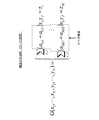
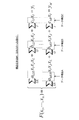
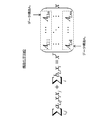
- the structuring method # 2 is a method of representing a multivariate polynomial in a quadratic form as shown in FIG. 27 and putting together a row or a column of a quadratic form as one data structure. In the example of FIG. 27, the data structure is organized in the row direction.
- the substitution algorithm of the coefficients is as shown in (Example 4).
- the coefficients may be structured, and intermediate results obtained by applying the coefficients of the multivariate polynomial may be held in a table.
- the coefficient substitution algorithm is as shown in (Example 5).
- a I [x 1 ,..., X k ] (A (k (I-1) +1) & x 1 ) ⁇ .
- ⁇ (A (k (I-1) + k) & x k ) is stored.
- the required memory size is 2 k / k times.
- the calculations of the multivariate polynomials F and G are repeatedly executed N times while updating the arguments in step # 1. Therefore, such calculation part is configured to repeatedly perform calculation using the same coefficient.
- FIG. 28 Hardware Configuration Example
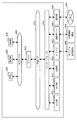
- Each of the above algorithms can be executed using, for example, the hardware configuration of the information processing apparatus shown in FIG. That is, the processing of each algorithm is realized by controlling the hardware shown in FIG. 28 using a computer program.
- the form of this hardware is arbitrary and, for example, personal computer, portable telephone, portable information terminal such as PHS, PDA, game machine, contact or non-contact IC chip, contact or non-contact IC This includes cards, or various home information appliances.
- PHS is an abbreviation for Personal Handy-phone System.
- the above PDA is an abbreviation of Personal Digital Assistant.
- the hardware mainly includes a CPU 902, a ROM 904, a RAM 906, a host bus 908, and a bridge 910. Further, the hardware includes an external bus 912, an interface 914, an input unit 916, an output unit 918, a storage unit 920, a drive 922, a connection port 924, and a communication unit 926.
- said CPU is the abbreviation for Central Processing Unit.
- the above ROM is an abbreviation of Read Only Memory.
- the above RAM is an abbreviation of Random Access Memory.
- the CPU 902 functions as, for example, an arithmetic processing unit or a control unit, and controls the entire operation of each component or a part thereof based on various programs recorded in the ROM 904, the RAM 906, the storage unit 920, or the removable recording medium 928.
- the ROM 904 is a means for storing a program read by the CPU 902, data used for an operation, and the like.
- the RAM 906 temporarily or permanently stores, for example, a program read by the CPU 902, various parameters that appropriately change when the program is executed, and the like.
- a host bus 908 capable of high-speed data transmission.
- the host bus 908 is connected to the external bus 912, which has a relatively low data transmission speed, via the bridge 910, for example.
- the input unit 916 for example, a mouse, a keyboard, a touch panel, a button, a switch, a lever, or the like is used.
- a remote controller capable of transmitting a control signal using infrared rays or other radio waves may be used.
- a display device such as a CRT, LCD, PDP, or ELD
- an audio output device such as a speaker or a headphone, a printer, a mobile phone, or a facsimile etc.
- the above-mentioned CRT is an abbreviation of Cathode Ray Tube.
- the above LCD is an abbreviation of Liquid Crystal Display.
- the above-mentioned PDP is an abbreviation of Plasma Display Panel.
- the above ELD is an abbreviation of Electro-Luminescence Display.
- the storage unit 920 is a device for storing various data.
- a magnetic storage device such as a hard disk drive (HDD), a semiconductor storage device, an optical storage device, a magneto-optical storage device, or the like is used.
- HDD hard disk drive
- the above HDD is an abbreviation of Hard Disk Drive.
- the drive 922 is a device that reads information recorded in a removable recording medium 928 such as, for example, a magnetic disk, an optical disk, a magneto-optical disk, or a semiconductor memory, or writes information in the removable recording medium 928.
- the removable recording medium 928 is, for example, a DVD medium, a Blu-ray medium, an HD DVD medium, various semiconductor storage media, and the like.
- the removable recording medium 928 may be, for example, an IC card equipped with a noncontact IC chip, an electronic device, or the like.
- the above IC is an abbreviation for Integrated Circuit.
- the connection port 924 is a port for connecting an external connection device 930 such as a USB port, an IEEE 1394 port, a SCSI, an RS-232C port, or an optical audio terminal.
- the external connection device 930 is, for example, a printer, a portable music player, a digital camera, a digital video camera, an IC recorder, or the like.
- USB is an abbreviation of Universal Serial Bus.
- SCSI is an abbreviation of Small Computer System Interface.
- the communication unit 926 is a communication device for connecting to the network 932, and for example, a wired or wireless LAN, a communication card for Bluetooth (registered trademark) or WUSB, a router for optical communication, a router for ADSL, or a contact Or a device for contactless communication.
- a network 932 connected to the communication unit 926 is configured by a wired or wirelessly connected network, and is, for example, the Internet, a home LAN, infrared communication, visible light communication, broadcasting, satellite communication, or the like.
- the above-mentioned LAN is an abbreviation of Local Area Network.
- WUSB is an abbreviation of Wireless USB.
- the above-mentioned ADSL is an abbreviation of Asymmetric Digital Subscriber Line.
- the functional configuration of the above information processing apparatus is expressed as follows.
- the information processing apparatus described in the following (1) has a function of executing an efficient public key authentication scheme or an electronic signature scheme algorithm based on security on the difficulty of solving multi-order multivariate simultaneous equations .
- a number generation unit that generates numbers to be used for the coefficients of the respective terms that make up the set F of multi-order multi-variable polynomials using
- An assignment unit that assigns the number generated by the number generation unit to coefficients of a multi-order multivariate polynomial including the set F of the multiorder multivariate polynomial as a component; Equipped with Among the coefficients of the multi-order multi-variable polynomials including the set F of the multi-order multi-variable polynomials in the component, the allocation unit groups coefficients of terms having the same type of combination of variables, To run, Information processing device.
- the number generation unit generates the number by the number of coefficients belonging to one group when the allocation unit performs allocation processing for one group.
- the information processing apparatus according to the above (1) or (2).
- the number generation unit When the number generation unit generates the number by the number of coefficients belonging to the one group, the number generation unit generates one number and rotates the generated number one bit at a time to generate the required number.
- the information processing apparatus according to (3).
- the apparatus further comprises a table holding unit that assigns the coefficient to a term of the type corresponding to each group and holds, as a table, a value obtained by substituting an arbitrary number for the variable of the term.
- the information processing apparatus according to the above (1) or (2).
- the information is a seed of random numbers
- the predetermined function is a random number generator that generates a random number using the seed.
- a provider, an answer providing unit that provides the verifier with answer information corresponding to a verification pattern selected by the verifier from k (k ⁇ 3) verification patterns; Equipped with The vector s is a secret key,
- the set F of multi-order multivariate polynomials and the vector y are public keys,
- the answer information is information selected according to the verification pattern from the set of random numbers and the message,
- the message is information obtained by executing an operation prepared in advance for a verification pattern corresponding to the response information using the public key and
- S An information holding unit holding the A message acquisition unit for acquiring a message generated based on the set F of multi-order multivariate polynomials and a vector s ⁇ K n ;
- a pattern information providing unit that provides information of one verification pattern randomly selected from k (k ⁇ 3) verification patterns to the prover who provided the message;
- An answer acquiring unit that acquires answer information corresponding to the selected verification pattern from the prover;
- a verification unit that verifies whether the prover holds the vector s based on the message, the set F of the multi-order multivariate polynomials, the vector y, and the answer information; Equipped with The vector s is a secret key,
- the set F of multi-order multivariate polynomials and the vector y are public keys,
- An intermediate information generation unit that generates third information using the first information randomly selected by the verifier and the second information obtained when generating the message;
- An intermediate information providing unit for providing the third information to the verifier; an answer providing unit which provides the verifier with answer information corresponding to a verification pattern selected by the verifier from k (k ⁇ 2) verification patterns; Equipped with The vector s is a secret key,
- the set F of multi-order multivariate polynomials and the vector y are public keys,
- the response information is information selected according to
- S An information holding unit holding the A message acquisition unit for acquiring a message generated based on the set F of multi-order multivariate polynomials and a vector s ⁇ K n ;
- An information providing unit for providing randomly selected first information to a prover who provided the message;
- An intermediate information acquisition unit that acquires third information generated by the prover using the first information and second information obtained when generating the message; a pattern information providing unit that provides information of one verification pattern randomly selected from k (k ⁇ 3) verification patterns to the prover;
- An answer acquiring unit that acquires answer information corresponding to the selected verification pattern from the prover; Verification to verify whether the prover holds the vector s based on the message, the first information, the third information, the set F of the multi-order multivariate polynomials
- the number generation unit When the algorithm is repeatedly executed a plurality of times, the number generation unit generates the number only once, and the allocation unit executes the allocation process only once, The algorithm repeatedly uses the coefficients assigned by the assigning unit.
- the information processing apparatus according to the above (1) or (2).
- the prover algorithm P, the verifier algorithm V, the signature generation algorithm Sig, and the signature verification algorithm Ver are examples of a number generation unit, an assignment unit, and a table holding unit.
- the prover algorithm P described above is an example of a message generation unit, a message provision unit, an answer provision unit, an intermediate information generation unit, and an intermediate information provision unit.
- the above verifier algorithm V is an example of an information storage unit, a message acquisition unit, a pattern information provision unit, an answer acquisition unit, a verification unit, and an intermediate information acquisition unit.
- the commitment function COM may be used instead of the hash function H.
- the commitment function COM is a function that takes a string S and a random number ⁇ as arguments.
- An example of the commitment function is the method presented by Shai Halevi and Silvio Micali at the international conference CRYPTO1996.
Landscapes
- Engineering & Computer Science (AREA)
- Computer Security & Cryptography (AREA)
- Computer Networks & Wireless Communication (AREA)
- Signal Processing (AREA)
- Physics & Mathematics (AREA)
- Algebra (AREA)
- General Physics & Mathematics (AREA)
- Mathematical Analysis (AREA)
- Mathematical Optimization (AREA)
- Mathematical Physics (AREA)
- Pure & Applied Mathematics (AREA)
- Computing Systems (AREA)
- Theoretical Computer Science (AREA)
- Storage Device Security (AREA)
- Complex Calculations (AREA)
Priority Applications (6)
| Application Number | Priority Date | Filing Date | Title |
|---|---|---|---|
| US14/239,861 US10020945B2 (en) | 2011-08-29 | 2012-08-14 | Information processing apparatus and to efficiently substitute coefficients of a multivariate polynomial |
| EP12826899.2A EP2752835B1 (en) | 2011-08-29 | 2012-08-14 | Information processing device, information processing method, and program |
| IN1411CHN2014 IN2014CN01411A (enExample) | 2011-08-29 | 2012-08-14 | |
| CN201280040706.XA CN104011781B (zh) | 2011-08-29 | 2012-08-14 | 信息处理设备、信息处理方法 |
| BR112014004058A BR112014004058A2 (pt) | 2011-08-29 | 2012-08-14 | aparelho e método de processamento de informação, e, programa |
| RU2014106490/08A RU2595924C2 (ru) | 2011-08-29 | 2012-08-14 | Устройство обработки информации, способ обработки информации и программа |
Applications Claiming Priority (4)
| Application Number | Priority Date | Filing Date | Title |
|---|---|---|---|
| JP2011-185947 | 2011-08-29 | ||
| JP2011185947 | 2011-08-29 | ||
| JP2012046687A JP6069852B2 (ja) | 2011-08-29 | 2012-03-02 | 情報処理装置、情報処理方法、及びプログラム |
| JP2012-046687 | 2012-03-02 |
Publications (1)
| Publication Number | Publication Date |
|---|---|
| WO2013031533A1 true WO2013031533A1 (ja) | 2013-03-07 |
Family
ID=47756028
Family Applications (1)
| Application Number | Title | Priority Date | Filing Date |
|---|---|---|---|
| PCT/JP2012/070675 Ceased WO2013031533A1 (ja) | 2011-08-29 | 2012-08-14 | 情報処理装置、情報処理方法、及びプログラム |
Country Status (9)
| Country | Link |
|---|---|
| US (1) | US10020945B2 (enExample) |
| EP (1) | EP2752835B1 (enExample) |
| JP (1) | JP6069852B2 (enExample) |
| CN (1) | CN104011781B (enExample) |
| BR (1) | BR112014004058A2 (enExample) |
| IN (1) | IN2014CN01411A (enExample) |
| RU (1) | RU2595924C2 (enExample) |
| TW (1) | TW201320701A (enExample) |
| WO (1) | WO2013031533A1 (enExample) |
Families Citing this family (25)
| Publication number | Priority date | Publication date | Assignee | Title |
|---|---|---|---|---|
| JP5790288B2 (ja) * | 2011-08-12 | 2015-10-07 | ソニー株式会社 | 情報処理装置、及び情報処理方法 |
| JP2013047727A (ja) * | 2011-08-29 | 2013-03-07 | Sony Corp | 情報処理装置、情報処理方法、プログラム、及び記録媒体 |
| JP5790319B2 (ja) * | 2011-08-29 | 2015-10-07 | ソニー株式会社 | 署名検証装置、署名検証方法、プログラム、及び記録媒体 |
| CN103490897B (zh) * | 2013-09-17 | 2017-04-05 | 华南理工大学 | 一种多变量公钥签名/验证系统及签名/验证方法 |
| US10075288B1 (en) * | 2014-02-28 | 2018-09-11 | The Governing Council Of The University Of Toronto | Systems, devices, and processes for homomorphic encryption |
| JP6260442B2 (ja) | 2014-05-02 | 2018-01-17 | 富士通株式会社 | 情報処理方法及びプログラム |
| CN109792383B (zh) * | 2016-08-02 | 2022-11-18 | 阿尔几何有限责任公司 | 用于使用几何代数的增强的以数据为中心的加密系统的方法和系统 |
| US11030618B1 (en) | 2016-09-30 | 2021-06-08 | Winkk, Inc. | Authentication and personal data sharing for partner services using out-of-band optical mark recognition |
| US10484186B2 (en) * | 2016-09-30 | 2019-11-19 | Intel Corporation | Cascading multivariate quadratic identification schemes for chain of trust |
| US10812252B2 (en) | 2017-01-09 | 2020-10-20 | Microsoft Technology Licensing, Llc | String matching in encrypted data |
| US11196539B2 (en) * | 2017-06-22 | 2021-12-07 | Microsoft Technology Licensing, Llc | Multiplication operations on homomorphic encrypted data |
| US10541805B2 (en) * | 2017-06-26 | 2020-01-21 | Microsoft Technology Licensing, Llc | Variable relinearization in homomorphic encryption |
| US10749665B2 (en) | 2017-06-29 | 2020-08-18 | Microsoft Technology Licensing, Llc | High-precision rational number arithmetic in homomorphic encryption |
| JP6942601B2 (ja) | 2017-10-18 | 2021-09-29 | キヤノン株式会社 | 情報処理装置、その制御方法、及びプログラム |
| US20220094545A1 (en) * | 2018-07-16 | 2022-03-24 | Winkk, Inc | Low power encryption in motion |
| KR102833750B1 (ko) * | 2019-12-05 | 2025-07-14 | 주식회사 원익아이피에스 | 기판이송모듈, 기판처리장치 및 이를 포함하는 기판처리시스템 |
| US11574045B2 (en) | 2019-12-10 | 2023-02-07 | Winkk, Inc. | Automated ID proofing using a random multitude of real-time behavioral biometric samplings |
| US12335399B2 (en) | 2019-12-10 | 2025-06-17 | Winkk, Inc. | User as a password |
| US12341790B2 (en) | 2019-12-10 | 2025-06-24 | Winkk, Inc. | Device behavior analytics |
| US11553337B2 (en) | 2019-12-10 | 2023-01-10 | Winkk, Inc. | Method and apparatus for encryption key exchange with enhanced security through opti-encryption channel |
| US12099997B1 (en) | 2020-01-31 | 2024-09-24 | Steven Mark Hoffberg | Tokenized fungible liabilities |
| KR102833331B1 (ko) * | 2020-06-18 | 2025-07-11 | 주식회사 원익아이피에스 | 기판이송모듈 및 이를 포함하는 기판처리장치 |
| US11843943B2 (en) | 2021-06-04 | 2023-12-12 | Winkk, Inc. | Dynamic key exchange for moving target |
| CN114390065B (zh) * | 2022-01-24 | 2024-03-19 | 浙江数秦科技有限公司 | 一种区块链网络数据快速传输方法 |
| US12438731B2 (en) | 2022-09-21 | 2025-10-07 | Winkk, Inc. | Diophantine system for digital signatures |
Citations (1)
| Publication number | Priority date | Publication date | Assignee | Title |
|---|---|---|---|---|
| JP2009533705A (ja) * | 2006-04-10 | 2009-09-17 | フランス テレコム ソシエテ アノニム | 擬似ランダムストリングを生成するための方法及びデバイス |
Family Cites Families (17)
| Publication number | Priority date | Publication date | Assignee | Title |
|---|---|---|---|---|
| US7162032B2 (en) * | 1999-12-20 | 2007-01-09 | Telenor Asa | Encryption of programs represented as polynomial mappings and their computations |
| US6910130B2 (en) * | 2000-11-29 | 2005-06-21 | Hideki Imai | System for and method of unconditionally secure digital signature |
| JP2004015891A (ja) | 2002-06-05 | 2004-01-15 | Toshiba Corp | インバータ装置、ブラシレスdcモータの制御方法およびコンプレッサ駆動システム |
| JP4014490B2 (ja) * | 2002-11-05 | 2007-11-28 | 日本電信電話株式会社 | セキュリティ装置、セキュリティ方法、プログラム及び記録媒体 |
| JP4485175B2 (ja) * | 2002-12-03 | 2010-06-16 | パナソニック株式会社 | 鍵共有システム、共有鍵生成装置及び共有鍵復元装置 |
| JP4282546B2 (ja) * | 2004-05-19 | 2009-06-24 | 株式会社東芝 | 暗号装置、復号装置、鍵生成装置、プログラム及び方法 |
| US7961876B2 (en) * | 2005-01-11 | 2011-06-14 | Jintai Ding | Method to produce new multivariate public key cryptosystems |
| JP4575283B2 (ja) * | 2005-11-15 | 2010-11-04 | 株式会社東芝 | 暗号装置、復号装置、プログラム及び方法 |
| US8019079B2 (en) * | 2007-07-08 | 2011-09-13 | Georgia Tech Research Corporation | Asymmetric cryptosystem employing paraunitary matrices |
| JP4834650B2 (ja) * | 2007-11-22 | 2011-12-14 | パナソニック株式会社 | 情報処理装置 |
| WO2009078139A1 (ja) * | 2007-12-14 | 2009-06-25 | Nec Corporation | 署名生成装置および署名検証装置 |
| JP5366691B2 (ja) * | 2008-07-29 | 2013-12-11 | パナソニック株式会社 | 保護部材と共に用いる電子機器 |
| US8891756B2 (en) * | 2008-10-30 | 2014-11-18 | Certicom Corp. | Collision-resistant elliptic curve hash functions |
| ES2445535T3 (es) * | 2009-04-24 | 2014-03-03 | Nippon Telegraph And Telephone Corporation | Sistema criptográfico, método de comunicación criptográfico, aparato de cifrado, aparato de generación de claves, aparato de descifrado, servidor de contenidos, programa, y medio de almacenamiento |
| JP5446453B2 (ja) * | 2009-04-30 | 2014-03-19 | ソニー株式会社 | 情報処理装置、電子署名生成システム、電子署名用の鍵生成方法、情報処理方法、及びプログラム |
| JP5593850B2 (ja) * | 2010-05-31 | 2014-09-24 | ソニー株式会社 | 認証装置、認証方法、プログラム、及び署名生成装置 |
| IL206139A0 (en) * | 2010-06-02 | 2010-12-30 | Yaron Sella | Efficient multivariate signature generation |
-
2012
- 2012-03-02 JP JP2012046687A patent/JP6069852B2/ja active Active
- 2012-08-03 TW TW101128119A patent/TW201320701A/zh unknown
- 2012-08-14 BR BR112014004058A patent/BR112014004058A2/pt not_active IP Right Cessation
- 2012-08-14 US US14/239,861 patent/US10020945B2/en not_active Expired - Fee Related
- 2012-08-14 RU RU2014106490/08A patent/RU2595924C2/ru not_active IP Right Cessation
- 2012-08-14 WO PCT/JP2012/070675 patent/WO2013031533A1/ja not_active Ceased
- 2012-08-14 IN IN1411CHN2014 patent/IN2014CN01411A/en unknown
- 2012-08-14 CN CN201280040706.XA patent/CN104011781B/zh not_active Expired - Fee Related
- 2012-08-14 EP EP12826899.2A patent/EP2752835B1/en not_active Not-in-force
Patent Citations (1)
| Publication number | Priority date | Publication date | Assignee | Title |
|---|---|---|---|---|
| JP2009533705A (ja) * | 2006-04-10 | 2009-09-17 | フランス テレコム ソシエテ アノニム | 擬似ランダムストリングを生成するための方法及びデバイス |
Non-Patent Citations (6)
| Title |
|---|
| COME BERBAIN ET AL.: "Efficient Implementations of Multivariate Quadratic Systems", SELECTED AREAS IN CRYPTOGRAPHY13TH INTERNATIONAL WORKSHOP, SAC 2006, MONTREAL, CANADA, AUGUST 17-18, 2006 REVISED SELECTED PAPERS(LNCS 4356), vol. 4356, 2007, pages 174 - 187, XP019098542 * |
| JACQUES PATARIN: "Asymmetric Cryptography with a Hidden Monomial", CRYPTO, 1996, pages 45 - 60 |
| KOICHI SAKUMOTO ET AL.: "Public-Key Identification Schemes based on Multivariate Quadratic Polynomials", 18 August 2011 (2011-08-18), XP019161037, Retrieved from the Internet <URL:http://www.iacr.org/cryptodb/archive/2011/CRYPTO/presentation/13-1-Sakumoto.pdf> [retrieved on 20120905] * |
| KOICHI SAKUMOTO ET AL.: "Public-Key Identification Schemes Based on Multivariate Quadratic Polynomials", ADVANCES IN CRYPTOLOGY- CRYPTO 2011 31ST ANNUAL CRYPTOLOGY CONFERENCE, vol. 6841, 14 August 2011 (2011-08-14), SANTA BARBARA, CA, USA, pages 706 - 723, XP019161037 * |
| KOICHI SAKUMOTO; TAIZO SHIRAI; HARUNAGA HIWATARI: "Public-Key Identification Schemes Based on Multivariate Quadratic Polynomials", CRYPTO 2011, LNCS, vol. 6841, 2011, pages 702 - 723 |
| PATARIN, J.; COURTOIS, N.; GOUBIN, L.: "Topics in Cryptology - CT-RSA 2001", vol. 2020, April 2001, SPRINGER-VERLAG., article "QUARTZ, 128-Bit Long Digital Signatures", pages: 282 - 297 |
Also Published As
| Publication number | Publication date |
|---|---|
| JP6069852B2 (ja) | 2017-02-01 |
| BR112014004058A2 (pt) | 2017-03-07 |
| IN2014CN01411A (enExample) | 2015-05-08 |
| JP2013066151A (ja) | 2013-04-11 |
| EP2752835A1 (en) | 2014-07-09 |
| US20140215222A1 (en) | 2014-07-31 |
| EP2752835A4 (en) | 2015-05-20 |
| RU2595924C2 (ru) | 2016-08-27 |
| CN104011781A (zh) | 2014-08-27 |
| CN104011781B (zh) | 2017-05-17 |
| US10020945B2 (en) | 2018-07-10 |
| TW201320701A (zh) | 2013-05-16 |
| RU2014106490A (ru) | 2015-08-27 |
| EP2752835B1 (en) | 2018-12-19 |
Similar Documents
| Publication | Publication Date | Title |
|---|---|---|
| JP6069852B2 (ja) | 情報処理装置、情報処理方法、及びプログラム | |
| JP5790319B2 (ja) | 署名検証装置、署名検証方法、プログラム、及び記録媒体 | |
| JP5790318B2 (ja) | 情報処理装置、署名生成装置、情報処理方法、署名生成方法、及びプログラム | |
| CN103718502B (zh) | 信息处理设备和信息处理方法 | |
| EP2822217A1 (en) | Information processing device, information processing method, and program | |
| JP5790286B2 (ja) | 情報処理装置、署名生成装置、情報処理方法、署名生成方法、及びプログラム | |
| US20140380062A1 (en) | Information processing apparatus, image processing method, and program | |
| US20140208110A1 (en) | Information processing apparatus, signature generation apparatus, signature verification apparatus, information processing method, signature generation method, and signature verification method | |
| KR20140054059A (ko) | 정보 처리 장치, 정보 처리 방법, 프로그램 및 기록 매체 | |
| US9184914B2 (en) | Information processing apparatus and information processing method |
Legal Events
| Date | Code | Title | Description |
|---|---|---|---|
| 121 | Ep: the epo has been informed by wipo that ep was designated in this application |
Ref document number: 12826899 Country of ref document: EP Kind code of ref document: A1 |
|
| WWE | Wipo information: entry into national phase |
Ref document number: 2012826899 Country of ref document: EP |
|
| ENP | Entry into the national phase |
Ref document number: 2014106490 Country of ref document: RU Kind code of ref document: A |
|
| WWE | Wipo information: entry into national phase |
Ref document number: 14239861 Country of ref document: US |
|
| NENP | Non-entry into the national phase |
Ref country code: DE |
|
| REG | Reference to national code |
Ref country code: BR Ref legal event code: B01A Ref document number: 112014004058 Country of ref document: BR |
|
| ENP | Entry into the national phase |
Ref document number: 112014004058 Country of ref document: BR Kind code of ref document: A2 Effective date: 20140221 |