WO2013031464A1 - Gray composition - Google Patents
Gray composition Download PDFInfo
- Publication number
- WO2013031464A1 WO2013031464A1 PCT/JP2012/069635 JP2012069635W WO2013031464A1 WO 2013031464 A1 WO2013031464 A1 WO 2013031464A1 JP 2012069635 W JP2012069635 W JP 2012069635W WO 2013031464 A1 WO2013031464 A1 WO 2013031464A1
- Authority
- WO
- WIPO (PCT)
- Prior art keywords
- group
- gray
- composition according
- manufactured
- examples
- Prior art date
- Legal status (The legal status is an assumption and is not a legal conclusion. Google has not performed a legal analysis and makes no representation as to the accuracy of the status listed.)
- Ceased
Links
- 0 CC1(C2)*CC2C1 Chemical compound CC1(C2)*CC2C1 0.000 description 9
- YAHRDLICUYEDAU-UHFFFAOYSA-N CCC(C)CC(C)N Chemical compound CCC(C)CC(C)N YAHRDLICUYEDAU-UHFFFAOYSA-N 0.000 description 1
Classifications
-
- C—CHEMISTRY; METALLURGY
- C01—INORGANIC CHEMISTRY
- C01B—NON-METALLIC ELEMENTS; COMPOUNDS THEREOF; METALLOIDS OR COMPOUNDS THEREOF NOT COVERED BY SUBCLASS C01C
- C01B21/00—Nitrogen; Compounds thereof
- C01B21/06—Binary compounds of nitrogen with metals, with silicon, or with boron, or with carbon, i.e. nitrides; Compounds of nitrogen with more than one metal, silicon or boron
- C01B21/0615—Binary compounds of nitrogen with metals, with silicon, or with boron, or with carbon, i.e. nitrides; Compounds of nitrogen with more than one metal, silicon or boron with transition metals other than titanium, zirconium or hafnium
- C01B21/0617—Binary compounds of nitrogen with metals, with silicon, or with boron, or with carbon, i.e. nitrides; Compounds of nitrogen with more than one metal, silicon or boron with transition metals other than titanium, zirconium or hafnium with vanadium, niobium or tantalum
-
- C—CHEMISTRY; METALLURGY
- C08—ORGANIC MACROMOLECULAR COMPOUNDS; THEIR PREPARATION OR CHEMICAL WORKING-UP; COMPOSITIONS BASED THEREON
- C08F—MACROMOLECULAR COMPOUNDS OBTAINED BY REACTIONS ONLY INVOLVING CARBON-TO-CARBON UNSATURATED BONDS
- C08F299/00—Macromolecular compounds obtained by interreacting polymers involving only carbon-to-carbon unsaturated bond reactions, in the absence of non-macromolecular monomers
- C08F299/02—Macromolecular compounds obtained by interreacting polymers involving only carbon-to-carbon unsaturated bond reactions, in the absence of non-macromolecular monomers from unsaturated polycondensates
- C08F299/022—Macromolecular compounds obtained by interreacting polymers involving only carbon-to-carbon unsaturated bond reactions, in the absence of non-macromolecular monomers from unsaturated polycondensates from polycondensates with side or terminal unsaturations
-
- C—CHEMISTRY; METALLURGY
- C09—DYES; PAINTS; POLISHES; NATURAL RESINS; ADHESIVES; COMPOSITIONS NOT OTHERWISE PROVIDED FOR; APPLICATIONS OF MATERIALS NOT OTHERWISE PROVIDED FOR
- C09D—COATING COMPOSITIONS, e.g. PAINTS, VARNISHES OR LACQUERS; FILLING PASTES; CHEMICAL PAINT OR INK REMOVERS; INKS; CORRECTING FLUIDS; WOODSTAINS; PASTES OR SOLIDS FOR COLOURING OR PRINTING; USE OF MATERIALS THEREFOR
- C09D17/00—Pigment pastes, e.g. for mixing in paints
- C09D17/004—Pigment pastes, e.g. for mixing in paints containing an inorganic pigment
-
- C—CHEMISTRY; METALLURGY
- C09—DYES; PAINTS; POLISHES; NATURAL RESINS; ADHESIVES; COMPOSITIONS NOT OTHERWISE PROVIDED FOR; APPLICATIONS OF MATERIALS NOT OTHERWISE PROVIDED FOR
- C09D—COATING COMPOSITIONS, e.g. PAINTS, VARNISHES OR LACQUERS; FILLING PASTES; CHEMICAL PAINT OR INK REMOVERS; INKS; CORRECTING FLUIDS; WOODSTAINS; PASTES OR SOLIDS FOR COLOURING OR PRINTING; USE OF MATERIALS THEREFOR
- C09D7/00—Features of coating compositions, not provided for in group C09D5/00; Processes for incorporating ingredients in coating compositions
- C09D7/40—Additives
- C09D7/45—Anti-settling agents
-
- C—CHEMISTRY; METALLURGY
- C09—DYES; PAINTS; POLISHES; NATURAL RESINS; ADHESIVES; COMPOSITIONS NOT OTHERWISE PROVIDED FOR; APPLICATIONS OF MATERIALS NOT OTHERWISE PROVIDED FOR
- C09D—COATING COMPOSITIONS, e.g. PAINTS, VARNISHES OR LACQUERS; FILLING PASTES; CHEMICAL PAINT OR INK REMOVERS; INKS; CORRECTING FLUIDS; WOODSTAINS; PASTES OR SOLIDS FOR COLOURING OR PRINTING; USE OF MATERIALS THEREFOR
- C09D7/00—Features of coating compositions, not provided for in group C09D5/00; Processes for incorporating ingredients in coating compositions
- C09D7/40—Additives
- C09D7/60—Additives non-macromolecular
- C09D7/61—Additives non-macromolecular inorganic
-
- C—CHEMISTRY; METALLURGY
- C01—INORGANIC CHEMISTRY
- C01P—INDEXING SCHEME RELATING TO STRUCTURAL AND PHYSICAL ASPECTS OF SOLID INORGANIC COMPOUNDS
- C01P2006/00—Physical properties of inorganic compounds
- C01P2006/60—Optical properties, e.g. expressed in CIELAB-values
-
- C—CHEMISTRY; METALLURGY
- C08—ORGANIC MACROMOLECULAR COMPOUNDS; THEIR PREPARATION OR CHEMICAL WORKING-UP; COMPOSITIONS BASED THEREON
- C08K—Use of inorganic or non-macromolecular organic substances as compounding ingredients
- C08K3/00—Use of inorganic substances as compounding ingredients
- C08K3/18—Oxygen-containing compounds, e.g. metal carbonyls
- C08K3/20—Oxides; Hydroxides
- C08K3/22—Oxides; Hydroxides of metals
-
- C—CHEMISTRY; METALLURGY
- C08—ORGANIC MACROMOLECULAR COMPOUNDS; THEIR PREPARATION OR CHEMICAL WORKING-UP; COMPOSITIONS BASED THEREON
- C08K—Use of inorganic or non-macromolecular organic substances as compounding ingredients
- C08K3/00—Use of inorganic substances as compounding ingredients
- C08K3/28—Nitrogen-containing compounds
-
- C—CHEMISTRY; METALLURGY
- C08—ORGANIC MACROMOLECULAR COMPOUNDS; THEIR PREPARATION OR CHEMICAL WORKING-UP; COMPOSITIONS BASED THEREON
- C08K—Use of inorganic or non-macromolecular organic substances as compounding ingredients
- C08K5/00—Use of organic ingredients
- C08K5/04—Oxygen-containing compounds
- C08K5/06—Ethers; Acetals; Ketals; Ortho-esters
-
- C—CHEMISTRY; METALLURGY
- C08—ORGANIC MACROMOLECULAR COMPOUNDS; THEIR PREPARATION OR CHEMICAL WORKING-UP; COMPOSITIONS BASED THEREON
- C08K—Use of inorganic or non-macromolecular organic substances as compounding ingredients
- C08K5/00—Use of organic ingredients
- C08K5/04—Oxygen-containing compounds
- C08K5/10—Esters; Ether-esters
-
- C—CHEMISTRY; METALLURGY
- C08—ORGANIC MACROMOLECULAR COMPOUNDS; THEIR PREPARATION OR CHEMICAL WORKING-UP; COMPOSITIONS BASED THEREON
- C08K—Use of inorganic or non-macromolecular organic substances as compounding ingredients
- C08K5/00—Use of organic ingredients
- C08K5/04—Oxygen-containing compounds
- C08K5/10—Esters; Ether-esters
- C08K5/101—Esters; Ether-esters of monocarboxylic acids
- C08K5/103—Esters; Ether-esters of monocarboxylic acids with polyalcohols
-
- C—CHEMISTRY; METALLURGY
- C08—ORGANIC MACROMOLECULAR COMPOUNDS; THEIR PREPARATION OR CHEMICAL WORKING-UP; COMPOSITIONS BASED THEREON
- C08K—Use of inorganic or non-macromolecular organic substances as compounding ingredients
- C08K5/00—Use of organic ingredients
- C08K5/16—Nitrogen-containing compounds
- C08K5/205—Compounds containing groups, e.g. carbamates
Definitions
- the present invention relates to a gray composition.
- the gray color material is not a black color material which completely blocks a visible light, but a material which uniformly transmits a definite amount of light over the entire range of a visible region. Accordingly the gray color material does not take on a coloration of any specific color.
- the gray color material is applied to design and production of a device. ⁇ 0003 ⁇
- Examples of the application include a production of a semiconductor device or a color filter using a gray tone photomask (see Patent Literatures 1 to 3).
- a newly added semi-transmissive region due to use of the gray tone photomask makes it possible to get the exposure amount under control whereby a multivalued resist remaining film can be realized.
- This enables to obtain a resist pattern having two kinds of thickness in one process.
- By exerting one sheet of a multiple tone mask using a transmissive region of gray tone to exhibit an action equivalent to two sheets of ordinary masks the number of a mask necessary for the production of a TFT substrate and the like can be reduced. Further, the production costs can be reduced by simplification of entire process.
- the shape of a photospacer can be diversified, or a phase difference can be adjusted by providing colored layers having different thicknesses from one another.
- this method is under consideration as a method for effectively producing a color filter.
- Patent Literature 1 JP-A-2010-002899 ("JP-A" means unexamined published Japanese patent application)
- Patent Literature 2 JP-A-2010-014931
- Patent Literature 3 JP-A-201 1-436443
- the present inventors have advanced the development of a gray color material having excellent characteristics by considering application to the above-described gray tone photomask and gray pixels of a color filter (see Japanese patent application No. 2011-074799).
- the present inventors have found that the existing dark color material varies in spectral characteristics as shown in Comparative Examples below, and exhibits a biased optical density (OD: Optical Density) in a particular wavelength region.
- OD Optical Density
- carbon black has a high optical density in a low wavelength region
- titanium black has a high optical density in a high wavelength region.
- a dye toning performed by mixing with other color materials, or by another technique is thought to address the problem.
- this causes not only manufacturing load, but also anxiety about an impact on properties of the color material such as storage stability.
- the present invention addresses to the provision of a gray colored composition having suppressed wavelength dependency in spectral
- the present invention addresses to the provision of a gray composition having a good gray as mentioned above and also having stability to storage over time. SOLUTION TO PROBLEM
- a gray composition having a nitride of a Group V transition metal.
- R, T and Z are groups represented by the following formulae; n represents an integer of 0 to 14; m represents an integer of 1 to 8; and multiple Rs and Ts present in one molecule may be identical with or different from each other, respectively,
- R , R and R each independently represent a hydrogen atom, a halogen atom, or an alkyl group having 1 to 6 carbon atom(s);
- X represents an oxygen atom (-0-) or an imino group (-NH-);
- Y represents a methyn group or a nitrogen atom;
- L represents a single bond or a divalent linking group;
- Z represents a functional group; and
- R 4 , R 5 and R 6 each independently represent a hydrogen atom, a halogen atom, an alkyl group having 1 to 6 carbon atom(s), -Z or -L-Z.
- the gray composition of the present invention shows a good gray having suppressed wavelength dependency in spectral characteristics. Further, the gray composition of the present invention has the good gray as mentioned above and also has stability to storage over time, in which no precipitation and the like are generated in preservation.
- the gray composition of the present invention contains a nitride of Group V transition metal (preferably together with an oxide thereof). This enables the gray composition to have a good gray that is free from wavelength dependency, and also to exhibit high stability with age.
- the use of the specific stabilizer enables the gray composition to further enhance the stability with age while keeping coloring properties of the good gray.
- the gray composition of the present invention is described in detail on the basis of preferable embodiments thereof.
- the nitride of Group V transition metal and the oxide of Group V transition metal that are used in a preferable embodiment of the present invention are not limited in particular, and any of materials that are known to be used as this kind of materials may be used.
- Examples of the nitride of Group V transition metal include vanadium nitride and niobium nitride. Especially, vanadium nitride is preferable.
- Examples of the oxide of Group V transition metal include vanadium oxide and niobium oxide. Especially, vanadium oxide is preferable.
- the composition of vanadium oxide and vanadium nitride is not limited in particular. However, from the viewpoint of realizing the coloring of the good gray, it is preferable to set a ratio of the vanadium oxide and the vanadium nitride. Two or more kinds of the vanadium oxide or the vanadium nitride may be used respectively.
- a solvent is not particularly limited.
- the solvent is properly selected, depending on the convenience on preparation, the needs on application, and the like.
- Examples of an organic solvent capable of being used as the medium include: esters, for example, ethyl acetate, n-butyl acetate, isobutyl acetate, amyl formate, isoamyl acetate, isobutyl acetate, butyl propionate, isopropyl butyrate, ethyl butyrate, butyl butyrate, alkyl esters, methyl lactate, ethyl lactate, methyl oxyacetate, ethyl oxyacetate, butyl oxyacetate, methyl methoxyacetate, ethyl methoxyacetate, butyl methoxyacetate, methyl ethoxyacetate, ethyl ethoxyacetate;
- 3-oxypropionic acid alkylesters such as methyl 3-oxypropionate and ethyl 3- oxypropionate, for example, methyl 3-methoxypropionate, ethyl 3-methoxypropionate, methyl 3-ethoxypropionate, ethyl 3-ethoxypropionate; 2-oxypropionic acid alkylesters such as methyl 2-oxypropionate, ethyl 2-oxypropionate, and propyl 2-oxypropionate, for example, methyl 2-methoxypropionate, ethyl 2-methoxypropionate, propyl 2- methoxypropionate, methyl 2-ethoxypropionate, ethyl 2-ethoxypropionate, methyl 2- oxy-2 -methylpropionate, ethyl 2-oxy-2-methylpropionate, methyl 2-methoxy-2- methylpropionate, ethyl 2-ethoxy-2-methylpropionate; methyl pyruvate, ethyl pyr
- ethers for example, diethyleneglycol dimethyl ether, tetrahydrofuran, ethyleneglycol monomethyl ether, ethyleneglycol monoethyl ether, methyl cellosolve acetate, ethyl cellosolve acetate, diethyleneglycol monomethyl ether, diethyleneglycol monoethyl ether, diethyleneglycol monobutyl ether , propylene glycol monomethyl ether, propylene glycol monomethyl ether acetate, propylene glycol monoethyl ether acetate, and propylene glycol monopropyl ether acetate;
- ketones for example, methyl ethyl ketone, cyclohexanone, 2-heptanone, and 3- heptanone
- aromatic hydrocarbons for example, toluene and xylene
- More than two kinds of these organic solvents may be mixed from the viewpoints of the solubility of an alkali-soluble resin, improvement in a coated surface state, and the like.
- the content of the medium is preferably set so that the total solid concentration of the composition is 5 to 90 mass%, more preferably 5 to 87 mass%, and particularly preferably 10 to 85 mass%.
- the gray composition of the present invention has good spectral characteristics such that the wavelength dependency is low or very few.
- a method of measuring spectral characteristics is not limited in particular. Unless otherwise specified, measurement is conducted under the conditions in accordance with the method described in Examples below. The spectral characteristics of the sample after film formation were measured in Examples; however, the spectral characteristics of the liquid composition also correlate therewith, and ordinarily a rank order of the wavelength dependency is not different from one another.
- the wavelength dependency is suppressed in the entire area of the visible light region. Specifically, it is desirable that the gray composition exhibits a uniform optical density (OD) in the wavelength region of 400 nm to 700 nm.
- variation in optical density in the range of 400 nm to 700 nm is controlled within ⁇ 20%, and more preferably within ⁇ 10%, on the basis of the optical density at the wavelength of 400 nm.
- the lower limit is not less than ⁇ 1%. Suppression of the variation to such a low level enables the color material to have a good gray without a large absorption at a particular wavelength, which results in no color.
- composition as used in the present invention means that two or more components are substantially uniformly present at a particular composition ratio.
- substantially uniform means that the individual components may be eccentrically-located to the extent that the effect of the present invention can be exerted.
- composition means that the form of the composition is not limited in particular as long as the above-described definition is satisfied, and examples of the form include not only a mobile liquid or paste, but also a solid or powder composed of multiple components.
- the stabilizer enables the color material to further enhance stability thereof with age due to the above-described vanadium mixture.
- the stabilizer having an unsaturated bond in the molecule thereof it is preferable to use a polymerizable compound.
- the stabilizer is selected from compounds each having at least one terminal ethylenically unsaturated bond, preferably having two or more terminal ethylenically unsaturated bonds.
- Such compounds are widely known in a relevant industrial field, and such compounds may be used in the present invention without particular limitations.
- Such compounds may have a chemical form of a monomer or a prepolymer (in other words, a dimer, a trimer, or an oligomer), or a mixture thereof, or a copolymer thereof.
- the polymerizable compound in the present invention may be used singly or in the combination of two or more kinds thereof.
- examples of the monomer and prepolymers thereof include an unsaturated carboxylic acid (for example, acrylic acid, methacrylic acid, itaconic acid, crotonic acid, isocrotonic acid, or maleic acid), esters thereof, amides thereof, and multimer thereof.
- polyhydric alcohol compound an amide of an unsaturated carboxylic acid and an aliphatic polyamine compound, and multimer thereof are preferably used.
- Other examples include, for example, a compound obtained by replacing the unsaturated carboxylic acid in any of the above examples with an unsaturated phosphonic acid, styrene, or vinyl ether.
- the photopolymerizable monomer is preferably a compound having at least one addition-polymerizable ethylenically unsaturated group therein and having a boiling point of 100°C or higher at normal pressure.
- polymerizable monomer examples include: a monofunctional acrylate and a monofunctional methacrylate such as polyethylene glycol mono(meth)acrylate, polypropylene glycol mono(meth)acrylate, and phenoxyethyl(meth)acrylate;
- polyfunctional aclylates such as epoxy acrylate obtained by reacting an epoxy resin and (meth)acrylic acid and a mixture of
- this type of monomer includes a monomer having a hydrogen-bonding group (hereinafter, may be referred to as "a hydrogen-bonding group-containing monomer").
- examples of the hydrogen-bonding group includes a hydroxyl group, a carboxyl group, an amino group, an ureido group, alkoxycarbonylamino group, a sulfo group, a sulfone amide group, an amide group, and the like.
- a group having both hydrogen which provides a hydrogen bond and a substituent which accepts the hydrogen bond is preferable.
- the hydrogen bonding group includes at least one selected from the group consisting of a carboxyl group, an alkoxycarbonylamino group, and an ureido group.
- the hydrogen bonding group-containing monomer is preferably a polyfunctional monomer (hereinafter, also referred to as a "polyfunctional
- Examples of a polyfunctional polymerizable monomer containing a hydroxyl group include pentaerythritol triacrylate, ECH-modified ethyleneglycol diacrylate, ECH-modified glycerol triacrylate, ECH-modified phthalic acid diacrylate, triglycerol diacrylate, and ECH-modified trimethylolpropane triacrylate.
- polyfunctional polymerizable monomer a compound represented by the following formula (I) or (II) is exemplified.
- the polyfunctional polymerizable monomer is not limited thereto.
- T is an oxyalkylene group
- the bonding arm at the carbon atom side of the oxyalkylene group is linked to R or Z.
- R, T and Z are groups represented by the following formulae, respectively; n is an integer of 0 to 14; m is an integer of 1 to 8; and multiple Rs and Ts present in one molecule may be identical with or different from each other, respectively.
- T -CH2 - , -O-CH2 - , -0-CH 2 CH 2 - , -O-CH2CH2CH2- , -O-CH2CH2CH2CH2-
- Examples of a combination of the polyfunctional polymerizable monomer containing a carboxyl group and another monomer described below include commercially available products such as TO-2359, TO-2360, TO-2348, and TO-756 (all trade names, manufactured by TOAGOSEI Co., Ltd.).
- Another preferred examples include those compounds that are obtained by addition reaction of ethylene oxide or propylene oxide to polyfunctional alcohol, followed by (meth)acrylation, as described in formulae (1) and (2) of JP-A- 10-62986, with the examples thereof.
- Especially preferred polymerizable monomers are dipentaerythritol triacrylate (as a commercially available product, KAYARAD D-330, manufactured by NIPPON KAYAKU Co., Ltd.), dipentaerythritol tetraacrylate (as a commercially available product, KAYARAD D-320, manufactured by NIPPON KAYAKU Co., Ltd.), dipentaerythritol penta(meth)acrylate (as a commercially available product,
- KAYARAD D-310 manufactured by NIPPON KAYAKU Co., Ltd.
- dipentaerythritol hexa(meth)acrylate as a commercially available product, KAYARAD DPHA, manufactured by NIPPON KAYAKU Co., Ltd.
- Oligomer types of these monomers may be also used.
- Examples of a polyfunctional monomer having an alkoxycarbonylamino group include U-6LHA, U-6LYXA and U-12LMA (all trade names, manufactured by Shin- Nakamura Chemical Co., Ltd.).
- Examples of a polyfunctional monomer having an amide group include monomer M-315 and M-215 (all trade names, manufactured by TOAGOSEI Co., Ltd.).
- a polyfunctional monomer having an amino group can be favorably used.
- examples of a polyfunctional monomer containing a hydrogen bonding group include the following exemplary compounds.
- hydrogen bonding group-containing monomers preferred examples include a monomer containing a carboxyl group, a monomer containing an
- alkoxycarbonylamino group and a monomer containing an ureido group.
- the most preferable example is a monomer containing a carboxyl group. It is still more preferable that the monomer containing a carboxyl group and a multifunctional monomer containing an amino group are used in combination.
- the above-described stabilizer is preferably contained in an amount of not less than 10% by mass, based on a total solid content of the composition, whereby conspicuous improvement in stability can be exhibited.
- the upper limit is 90% or less.
- a showing of the compound is used to mean not only the compound itself, but also a salt or ion thereof and the like. Further, the showing of the compound is also used to mean incorporation of derivatives modified by a predefined configuration to an extent necessary to obtain a desired effect.
- a substituent in which substitution or non-substitution is not explicitly stated means that the substituent may have any substituent. This is also applied to the compound in which substitution or non- substitution is not explicitly stated. Examples of preferable substituents include the following substituent T.
- the subsutituent T include the following subsutituents.
- the subsutituents include an alkyl group (preferably an alkyl group having 1 to 20 carbon atom(s), for example, methyl, ethyl, isopropyl, t-butyl, pentyl, heptyl, 1- ethylpentyl, benzyl, 2-ethoxyethyl, and 1 -carboxymethyl), an alkenyl group (preferably an alkenyl group having 2 to 20 carbon atoms, for example, vinyl, allyl, and oleyl), an alkynyl group (preferably an alkynyl group having 2 to 20 carbon atoms, for example, ethynyl, butadiynyl, and phenylethynyl), a cycloalkyl group (preferably a cycloalkyl group having 3 to 20 carbon atoms, for example, cyclopropyl, cyclopentyl, cyclohexyl, and 4-methylcycl
- an acyloxy group preferably an acyloxy group having 1 to 20 carbon atom(s), for example, acethyloxy and benzoyloxy
- a carbamoyl group preferably a carbamoyl group having 1 to 20 carbon atom(s), for example, ⁇ , ⁇ -dimethylcarbamoyl and N-phenylcarbamoyl
- an acylamino group preferably a sulfonamide having 0 to 20 carbon atom(s), for example, N,N- dimethylsulfonamide, and N-phenylsulfonamide
- an acyloxy group preferably an acyloxy group having 1 to 20 carbon atom(s), for example, acethyloxy and benzoyloxy
- a carbamoyl group preferably a carbamoyl group having 1 to 20 carbon atom(s), for example, ⁇ , ⁇ -dimethylcarbamoyl and N-phenylcarbamoyl
- an alkyl group, an alkenyl group, an aryl group, a heterocyclic group, an alkoxy group, an aryloxy group, an alkoxycarbonyl group, an amino group, an acylamino group, a cyano group, and a halogen atom are more preferable.
- An alkyl group, an alkenyl group, a heterocyclic group, an alkoxy group, an alkoxycarbonyl group, an amino group, an acylamino group, and a cyano group are particularly preferable.
- the dispersant that can be used in the present invention is a polymer dispersant.
- Examples thereof include polyamide amine and a salt thereof, polycarboxylic acid and a salt thereof, high-molecular-weight unsaturated acid ester, modified polyurethane, modified polyester, modified poly(meth)acrylate, a (meth)acrylic copolymer, and a naphthalene sulfonic acid formalin condensate, polyoxyethylene alkyl phosphoric acid ester, polyoxyethylene alkylamine, alkanolamine, and a pigment derivative.
- the dispersant is preferably a polymer that can be further classified into a straight-chain polymer, a terminal-modified polymer, a graft polymer, and a block polymer, from the viewpoint of its structure.
- a dispersant functions to prevent re-aggregation of a Group V transition metal compound by adsorbing to a surface of the Group V transition metal compound
- a dispersant having an anchor site with respect to the particle surface selected from a terminal-modified polymer, a graft polymer and a block polymer, can be mentioned as preferable structures of the dispersant.
- the dispersant also has an effect of promoting adsorption of the dispersing resin by modifying a surface of the dispersed element.
- dispersants include Disperbyk-101 (trade name, polyamidoamine phosphate), 107 (trade name, carboxylic acid ester), 110 (trade name, polymer containing an acidic group), 130 (trade name, polyamide), 161, 162, 163, 164, 165, 166, 170 and 180 (trade names, high-molecular copolymer), BYK-P104 and PI 05 (trade names, high-molecular unsaturated polycarboxylic acids) (all of the above are manufactured by BY Chemie Co.); EFKA 4047, 4050, 4010, 4165 (trade names, polyurethanes), EFKA 4330, 4340 (trade names, block copolymers), 4400, 4402 (trade names, modified polyacrylates), 5010 (polyesteramide), 5765 (trade name, high- molecular polycarbonate), 6220 (trade name, fatty acid polyester), 6745 (trade name, phthalocyanine derivative), 6750 (trade name, azo pigment
- POLYFLOW No. 50E, No. 300 trade names, acrylic copolymer (all of the above are manufactured by Kyoeisha Chemical Co., Ltd.); DISPERON KS-860, 873 SN, 874,
- DEMOL RN (trade names, naphthalenesulfonic acid formalin heavy condensates), MS, C, SN-B (trade names, aromatic sulfonic acid formalin heavy condensate), HOMOGENOL L-18 (trade name, polycarboxylic acid type polymer), EMULGEN 920, 930, 935, 985 (trade names, polyoxyethylene nonylphenyl ether), ACET AMINE 86 (stearylamine acetate) (all of the above are manufactured by ao Corporation); SOLSPERSE 5000 (phthalocyanine derivative), 22000 (trade name, azo pigment derivative), 13240 (polyester amine), 3000, 17000, 27000 (trade names, polymer having a functional part at the terminal thereof), 24000, 28000, 32000, 38500 (graft copolymer) (all of the above are manufactured by Lubrizol Corp.); an d NIKOL T106 (polyoxyethylene sorbitan mono
- polyoxyethylene monostearate examples include an amphoteric dispersant such as Hinoact T-8000E produced by Ka waken Fine Chemicals Co., Ltd.
- These dispersants may be used singly or the combination of two or more kinds thereof.
- the acid value of the dispersant is preferable within the range of 5.0 mg KOH/g to 200 mg KOH/g, more preferably within the range of 10 mg KOH/g to 150 mg KOH/g, and particularly preferable within the range of 60 mg KOH/g to 150 mg KOH/g.
- the acid value of the dispersant is 200 mg KOH/g or less, a pattern delamination (or stripping or separation) at the time of development in the formation of a light-shielding film is more effectively suppressed. If the acid value of the dispersant is 5.0 mg KOH/g or more, alkali developability becomes better. If the acid value of the dispersant is 60 mg KOH/g or more, precipitation of the specific metal compound particles can be more suppressed, thereby making it possible to lessen the number of coarse particles. As a result, stability with age of the composition can be much further improved.
- the acid value of the dispersant can be calculated from, for example, an average content of the acid group in the dispersant. Further, a resin having a desired acid value can be obtained by varying a content of the monomer unit containing an acid group that is a component of the dispersant.
- the weight-average molecular weight of the dispersant in the present invention is preferably in a range from 10,000 to 300,000, more preferably from 15,000 to 200,000, still more preferably from 20,000 to 100,000, and especially preferably from 25,000 to 50,000.
- the molecular weight and the degree of dispersion are defined as the values obtained by measurement in accordance with a GPC (Gel Permeation Chromatography).
- the molecular weight is defined as polystyrene- converted mass-average molecular weight.
- the gel charged into the column used in the GPC method is preferably a gel having an aromatic compound as a repeating unit, and examples thereof include a gel including styrene-divinylbenzene copolymers.
- the column is preferably used in the form where 2 to 6 columns are connected.
- Examples of a solvent used include ether-based solvents such as tetrahydrofuran and the like, and amide-based solvents such as N-methylpyrrolidinone and the like.
- the measurement is preferably carried out at a flow rate of the solvent in the range of 0.1 to 2 mL/min, and most preferably in the range of 0.5 to 1.5 mL/min. By carrying out the measurement within these ranges, there is no occurrence of loading in an apparatus, and thus, the measurement can be carried out further efficiently.
- the measurement temperature is preferably carried out at 10°C to 50°C, and most preferably 20°C to 40°C. A column and a carrier to be used can be properly selected, according to the property of a polymer compound to be measured.
- a graft copolymer as a dispersant (hereinafter, may be referred to as a "specific resin").
- a specific resin a graft copolymer
- Use of the graft copolymer as a dispersant enables the composition to improve both dispersibility and storage stability.
- the graft copolymer which can be used as a dispersant in the present invention preferably has a graft chain in which the number of atoms other than hydrogen atoms is in a range from 40 to 10,000.
- the graft chain in this case means a portion from the root of the main chain of the copolymer to the terminal of the group branching from the main chain.
- the graft copolymer is a dispersion resin which is used to impart dispersibility to specific metal compound particles. Since the specific resin has excellent
- the graft copolymer improves the dispersibility of the specific metal compound particles and dispersion stability over time. Further, when the graft copolymer is included in a photosensitive resin composition, since the graft copolymer has affinity to a photosensitive resin composition
- an alkali-soluble partial structure such as a carboxylic acid group
- introduction of an alkali-soluble partial structure such as a carboxylic acid group into the specific resin also makes it possible to provide a function as a resin that imparts developability for pattern formation by alkali development.
- the dispersing resin itself necessary for dispersion of the specific metal compound particles is made alkali soluble by introducing an alkali-soluble partial structure into the above- described graft copolymer.
- the light-sensitive resin composition containing such specific metal compound dispersion becomes excellent in light blocking effect in an exposed area, and further alkali developability in an unexposed area is improved.
- the graft copolymer used in the present invention preferably has the number of atoms other than hydrogen atoms from 40 to 10,000 per one graft chain, more preferably has the number of atoms other than hydrogen atoms from 50 to 2,000 per one graft chain, and even more preferably has the number of atoms other than hydrogen atoms from 60 to 500 per one graft chain.
- poly(meth)acryl poly(meth)acryl, polyester, polyurethane, polyurea, polyamide, polyether, or the like may be used.
- a graft chain having poly(meth)acryl, polyester, or polyether is preferable, and a graft chain having polyester or polyether is more preferable.
- the structure of macromonomer having such a polymer structure as the graft chain is not particularly limited as long as the macromonomer has a substituent which can react with a main chain portion of the polymer and simultaneously satisfies the necessary conditions of the present invention.
- a macromonomer having a reactive double-bond group can be suitably used.
- Examples of the commercially available macromonomer favorably used in the synthesis of the specific resin include AA-6 (trade name, manufactured by TOAGOSEI CO., LTD.), AA-10 (trade name, manufactured by TOAGOSEI CO., LTD.), AB-6 (trade name, manufactured by TOAGOSEI CO., LTD.), AS-6 (trade name,
- TOAGOSEI CO., LTD. AW-6 (trade name, manufactured by TOAGOSEI CO., LTD.), AA-714 (trade name, manufactured by TOAGOSEI CO., LTD.), AY-707 (trade name, manufactured by TOAGOSEI CO., LTD.), AY-714 (trade name, manufactured by TOAGOSEI CO., LTD.), AK-5 (trade name, manufactured by TOAGOSEI CO., LTD.), AK-30 (trade name, manufactured by TOAGOSEI CO., LTD.), AK-32 (trade name, manufactured by TOAGOSEI CO., LTD.), BLENMER PP-100 (trade name,
- AA-6 (trade name, manufactured by TOAGOSEI CO., LTD.), AA-10 (trade name, manufactured by TOAGOSEI CO., LTD.), AB-6 (trade name, manufactured by TOAGOSEI CO., LTD.), AS-6 (trade name, manufactured by TOAGOSEI CO., LTD.), AN-6(trade name, manufactured by TOAGOSEI CO., LTD.), BLENMER PME-4000 (trade name, manufactured by Nippon Oil & Fats Co., Ltd.) are preferably used.
- the graft site of the specific resin preferably includes a structural unit represented by at least any one of the following formulae (1) to (4), and more preferably a structural unit represented by at least any one of the following formula (1 A), the following formula (2A), the following formula (3 A), the following formula (3B) and the following formula (4).
- W 1 , W 2 , W 3 and W 4 each independently represent an oxygen atom or NH; and it is preferable that W 1 , W 2 , W 3 and W 4 are oxygen atoms.
- X 1 , X 2 , X 3 , X 4 and X 5 each independently represent a hydrogen atom or a monovalent organic group. From the restriction on the synthesis, it is preferable that X 1 , X 2 , X 3 , X 4 and X 5 each independently represent a hydrogen atom or an alkyl group having 1 to 12 carbon atom(s), it is more preferable that X ! , X 2 , X 3 , X 4 and X 5 each independently represent a hydrogen atom or a methyl group, and it is particularly preferable that X 1 , X 2 , X 3 , X 4 and X 5 each independently represent a methyl group
- Y 1 , Y 2 , Y 3 and Y 4 each independently represent a divalent linking group, and the divalent linking group is not structurally restricted, particularly.
- Specific examples of the divalent linking group represented by Y 1 , Y 2 , Y 3 and Y 4 include divalent linking groups represented by the following (Y-1) to (Y-21).
- a and B represent bonding positions at the left and right terminal groups of formulae (1) to (4), respectively.
- each of Y 1 , Y 2 , Y 3 and Y 4 is (Y-2) or (Y-13), from the view point of the easiness of synthesis.
- Z 1 , Z 2 , Z 3 and Z 4 each independently represent a monovalent organic group.
- the structure of the organic group is not particularly limited, specific examples thereof include an alkyl group, a hydroxyl group, an alkoxy group, an aryloxy group, a heteroaryloxy group, an alkylthioether group, an arylthioether group, a heteroarylthioether group, an amino group, and the like.
- the organic group represented by any one of Z 1 , Z 2 , Z 3 and Z 4 is preferably an organic group having steric repulsion effect.
- the organic group represented by any one of Z 1 , Z 2 , Z 3 and Z 4 each independently represent an alkyl group having 5 to 24 carbon atoms. Among them, it is particularly preferable that the organic group represented by any one of Z 1 , Z 2 , Z 3 and Z 4 each independently represent a branched alkyl group having 5 to 24 carbon atoms or a cyclic alkyl group having 5 to 24 carbon atoms.
- n, m, p and q are an integer of 1 to 500, respectively.
- j and k each independently represent an integer of 2 to 8.
- j and k preferably represent an integer of 4 to 6, most preferably 5, from the view points of the dispersion stability and the development property.
- R represents a branched or straight alkylene group, preferably an alkylene group having 1 to 10 carbon atom(s), and more preferably an alkylene group having 2 or 3 carbon atoms
- R 4 represents a hydrogen atom or a monovalent organic group, and the monovalent organic group is not structurally restricted.
- R 4 preferably represents a hydrogen atom, an alkyl group, an aryl group, and a heteroaryl group, more preferably a hydrogen atom or an alkyl group.
- the alkyl group preferably represents a straight chain alkyl group having 1 to 20 carbon atom(s), a branched alkyl group having 3 to 20 carbon atoms, or a cyclic alkyl group having 5 to 20 carbon atoms, more preferably a straight chain alkyl group having 1 to 20 carbon atom(s), particularly preferably a straight chain alkyl group having 1 to 6 carbon atom(s).
- the structural unit represented by any one of formulae (1) to (4) is incorporated preferably in a range from 10% by mass to 90% by mass, and more preferably from 30% by mass to 70% by mass, with respect to a total mass of the specific resin.
- the structural unit represented by any one of formulae (1) to (4) is incorporated in the above range, dispersibility of the specific metal compound particle is high, and developability at the formation of a light blocking film is good.
- more than one type of graft sites that are different in structure from one another may be incorporated in the specific resin. That is, in the molecule of the specific resin, the structural units represented by any one of formulae (1) to (4) that are different in structure from one another may be incorporated. Further in formulae (1) to (4), when n, m, p and q each represent an integer of 2 or more, structures in which respective j or respective k is different from one another may be incorporated in the side chain of formulae (1) and (2); and meanwhile in formulae (3) and (4) in which more than one R 3 , more than one R 4 , and more than one X s exist in the molecule, respective R 3 , respective R 4 , or respective X 5 may be the same or different from one another.
- a structural unit represented by formula (1) is preferably a structural unit represented by formula (1 A), from the view points of the dispersion stability and the development property.
- a structural unit represented by formula (2) is preferably a structural unit represented by formula (2A), from the view points of the dispersion stability and the development property.
- X 1 , Y 1 , Z 1 and n have the same meanings as those of X 1 , Y 1 , Z 1 and n in formula (1), and the preferable ranges of X 1 , Y 1 , Z 1 and n are also the same as those of X 1 , Y 1 , Z 1 and n in formula (1).
- a structural unit represented by formula (3) is preferably a structural unit represented by formula (3 A) or (3B), from the view points of the dispersion stability and the development property.
- the specific resin has the structural unit represented by the above-described formula (1 A).
- the specific resin may have a functional group that can interact with the specific metal compound particles.
- Examples of the functional group that can form an interaction with the specific metal compound particles include an acidic group, a basic group, a coordination group, and a functional group having reactivity.
- the functional group may be introduced into the specific resin by using a structural unit having an acidic group, a structural unit having a basic group, a structural unit having a coordination group, or a structural unit having reactivity.
- Examples of the acidic group as the functional group that can form an interaction with the specific metal compound particles include a carboxylic acid group, a sulfonic acid group, a phosphate group, and a phenolic hydroxyl group.
- a carboxylic acid group is preferable since it exhibits favorable adsorbability to the specific metal compound particles and high dispersibility.
- These acidic groups can be used singly or in combination of two or more kinds thereof in specific resin.
- the introduction of such acidic groups may improve alkaline developability of the specific resin.
- the content of the structural unit having an acidic group that may be incorporated into the specific resin as a copolymerization component is preferably from 0.1% by mol to 50% by mol, and more preferably from 1% by mol to 30% by mol in order to prevent damages of image intensity due to the alkaline development.
- Examples of the basic group that is a functional group capable of forming an interaction with the specific metal compound particles include a primary amino group, a secondary amino group, a tertiary amino group, a heterocyclic group containing N atom, and an amido group.
- a tertiary amino group is preferable since it exhibits favorable adsorbability to pigments and high dispersibility.
- These basic groups can be used singly or in combination of one or more kinds thereof in the specific resin.
- the content of the structural unit having a basic group is preferably from 0.01% by mol to 50% by mol, and more preferably from 0.01% by mol to 30% by mol, with respect to a total mass of the specific resin, in order to reduce the inhibition of developability.
- Examples of the coordination group that is a functional group capable of forming an interaction with the specific metal compound particles and the functional group having reactivity with the specific metal compound particles include an acetyl acetoxy group, a trialkoxysilyl group, an isocyanate group, groups derived from an acid anhydride, and groups derived from an acid chloride.
- an acetyl acetoxy group is preferable since it exhibits favorable adsorbability to pigments and high dispersibility.
- These groups can be used singly or in a combination of one or more kinds thereof in the specific resin.
- copolymerization component of the specific resin is preferably from 0.5% by mol to 50% by mol, and more preferably from 1% by mol to 30% by mol in order to reduce the inhibition of developability, relative to the entire structural unit of the specific resin.
- the specific resin used in the present invention has a functional group capable of forming an interaction with the specific metal compound particles in addition to the graft site
- the specific resin may contain various kinds of functional groups capable of forming an interaction with the specific metal compound particles as described above, and hence there is no particular limitations on how these functional groups are introduced into the specific resin.
- the functional group is introduced into using at least one structural unit obtained from any one of the monomers represented by the following formulae (i) to (iii).
- R , R and R each independently represent a hydrogen atom, a halogen atom (e.g. fluorine atom, chlorine atom, bromine atom), or an alkyl group having 1 to 6 carbon atom(s).
- a halogen atom e.g. fluorine atom, chlorine atom, bromine atom
- R 1 , R 2 and R 3 each independently represent a hydrogen atom or an alkyl group having 1 to 3 carbon atom(s), and it is most preferable that R , R and R each independently represent a hydrogen atom or a methyl group. In formula (i), it is particularly preferable that R 2 and R each represent a hydrogen atom.
- X represents an oxygen atom (-0-) or an imino group (-NH-), and an oxygen atom is preferable.
- Y represents a methine group or a nitrogen group.
- L represents a single bond or a divalent linking group.
- the divalent linking group include a divalent aliphatic group (e.g. alkylene group, substituted alkylene group, alkenylene group, substituted alkenylene group, alkynylene group, and substituted alkynylene group), a divalent aromatic group (e.g.
- arylene group and substituted arylene group a divalent heterocyclic group, and a combination of the above group with one or more of an oxygen atom (-0-), a sulfur atom (-S-), an imino group (-NH-) N a substituted imino bond (-NR 31 -, herein, R 31 represents an aliphatic group, an aromatic group, or a hetero cyclic group), and a carbonyl bond.
- the divalent aliphatic group may have a cyclic structure or a branched structure.
- the carbon number of the aliphatic group is preferably 1 to 20, more preferably 1 to 15, furthermore preferably 1 to 10.
- the aliphatic group prefers a saturated aliphatic group to an unsaturated aliphatic group.
- the aliphatic group may have a substituent. Examples of the substituent include a halogen atom, a hydroxyl group, an aromatic group, and heterocyclic group.
- the carbon number of the divalent aromatic group is preferably 6 to 20, more preferably 6 to 15, most preferably 6 to 10.
- the divalent aromatic group may have a substituent.
- the substituent include a halogen atom, a hydroxyl group, an aliphatic group, an aromatic group, and heterocyclic group.
- the divalent heterocyclic group has a 5-membered ring or a six-membered ring as a heterocyclic.
- the heterocyclic group may be condensed with one or more of the other heterocyclic, an aliphatic group, and an aromatic ring.
- L preferably represents a divalent linking group including a single bond, an alkylene group, or an oxyalkylene structure.
- the oxyalkylene structure is more preferably an oxyethylene structure or an oxypropylene structure.
- L may be a polyoxyalkylene structure repeatedly containing two or more repeats of oxyalkylene structures.
- the polyoxyalkylene structure is preferably a polyoxyethylene structure or a polyoxypropylene structure.
- the polyoxyethylene structure is represented by - (OCH 2 CH 2 ) n -, in which n is preferably an integer of 2 or more, and more preferably an integer from 2 to 10.
- Z represents a functional group that can interact with the specific metal compound particles on a moiety other than the graft moiety.
- Z preferably represents carboxylic acid group or a tertiary amino group, and more preferably a carboxylic acid group.
- R 4 , R 5 , and R 6 each independently represent a hydrogen atom, a halogen atom (e.g. fluorine atom, chlorine atom, and bromine atom), an alkyl group having 1 to 6 carbon atom(s) (e.g. methyl group, ethyl group, and propyl group), -Z or - L-Z.
- a halogen atom e.g. fluorine atom, chlorine atom, and bromine atom
- an alkyl group having 1 to 6 carbon atom(s) e.g. methyl group, ethyl group, and propyl group
- L and Z have the same meanings as those of L and Z described above and the preferable examples of L and Z are also the same as those of L and Z.
- R 4 , R 5 and R 6 each independently preferably represent a hydrogen atom or an alkyl group having 1 to 3 carbon atom(s), more preferably a hydrogen atom.
- a monomer represented by formula (i) is a preferably compound, in which R , R and R each independently represent a hydrogen atom or a methyl group, L is a divalent linking group including an alkylene group or an
- X is an oxygen atom or an imino group
- Z is a carboxylic acid group.
- a monomer represented by formula (ii) is a preferably compound, in which R 1 is a hydrogen atom or a methyl group, L is an alkylene group, Z is a carboxylic acid group, and Y is a methyne group.
- a monomer represented by formula (iii) is a preferably compound, in which R 4 , R 5 and R 6 each independently represent a halogen atom or a methyl group, L is a single bond or an alkylene group, and Z is a carboxylic acid group.
- Examples of the monomer include: methacrylic acid, crotonic acid and isocrotonic acid; a reaction product of a compound having an addition-polymerizable double bond and a hydroxy group (for example, 2 -hydroxy ethyl methacrylate) and a succinic anhydride; a reaction product of a compound having an addition-polymerizable double bond and a hydroxy group and a phthalic anhydride; a reaction product of a compound having an addition-polymerizable double bond and a hydroxy group and a tetrahydroxyphthalic anhydride; a reaction product of a compound having an addition- polymerizable double bond and a hydroxy group and a trimellitic anhydride; a reaction product of a compound having an addition polymerizable double bond and a hydroxy group and a pyromellitic anhydride; and acrylic acid, an acrylic acid dimer, an acrylic acid oligomer, maleic acid, itaconic acid, fumaric
- the content, in the specific resin, of the functional group, such as the monomer having an acidic group, that can interact with the specific metal compound particles is preferably from 0.05% by mass to 90% by mass, more preferably from 1.0% by mass to 80% by mass, and still more preferably from 10% by mass to 70% by mass, with respect to the total mass of the specific resin.
- the specific resin contained in a specific metal compound dispersion may further include an additional structural unit having various functions (for example, a structural unit that has a functional group having compatibility with a dispersion medium used in a dispersion) as a copolymerization component, as long as the effects of the invention are not adversely affected.
- copolymerization components can be used singly or in combination of two or more kinds thereof.
- the content of the copolymerization component in the specific resin is preferably from 0% by mol to 90% by mol, and more preferably from 0% by mol to 60% by mol. When the content is within the above range, sufficient pattern formation properties can be maintained.
- solvents used in synthesizing the specific resin include ethylene dichloride, cyclohexanone, methyl ethyl ketone, acetone, methanol, ethanol, propanol, butanol, ethylene glycol monomethyl ether, ethylene glycol monoethyl ether, 2- methoxy ethyl acetate, l-methoxy-2-propanol, 1 -methoxy-2-propyl acetate, N,N- dimethylformamide, ⁇ , ⁇ -dimethylacetamide, dimethyl sulfoxide, toluene, ethyl acetate, methyl lactate, and ethyl lactate. These solvents may be used singly or as a mixture of two or more kinds thereof.
- Specific examples of the specific resin include the following exemplified compounds 1 to 55.
- the numeric value of each constituent unit (main chain portion) represents a percentage by mass.
- the content of a dispersant in the specific metal compound dispersion in the present invention is preferably within a range from 1% by mass to 90% by mass, and more preferably from 3% by mass to 70% by mass, with respect to a total solid content by mass of the dispersing element which includes a dispersing element composed of the specific metal compound particles and a dispersing element composed of other colorants and the like.
- the content of a dispersant in the light-sensitive resin dispersion of the present invention is preferably in a range of from 1% by mass to 90% by mass, and more preferably from 3% by mass to 70% by mass, with respect to a total solid content by mass of the dispersing element which includes a dispersing element composed of the specific metal compound particles and a dispersing element composed of other colorants and the like.
- composition of the present invention preferably further contains an alkali- soluble resin.
- Developability and pattern formability are improved by incorporation of the alkali-soluble resin.
- the alkali-soluble resin may be selected from alkali-soluble resins which are linear organic polymer molecules and have at least one alkali-solubility-accelerating group in the molecule thereof (preferably a molecule containing an acrylic copolymer or a styrene copolymer as a main chain).
- alkali-soluble resins which are linear organic polymer molecules and have at least one alkali-solubility-accelerating group in the molecule thereof (preferably a molecule containing an acrylic copolymer or a styrene copolymer as a main chain).
- polyhydroxystyrene resins polysiloxane resins
- acrylic resins, acrylamide resins and acryl/acrylamide copolymer resins from the viewpoint of developability control.
- alkali-solubility-accelerating group examples include a carboxyl group, a phosphoric group, a sulfonic group and a phenolic hydroxyl group. Those groups which are soluble in an organic solvent and are developable with a weak alkali aqueous solution are preferable.
- the acid group include a (meth)acryl acid group.
- These acid groups may be of only one kind or two or more kinds.
- Examples of monomers capable of providing an acid group after the above- descried polymerization include: a monomer having a hydroxyl group such as 2- hydroxyethyl (meth)acrylate or the like; a monomer having an epoxy group such as glycidyl (meth)acrylate or the like; and a monomer having an isocyanate group such as 2-isocyanatoethyl (meth)acrylate or the like.
- the monomer for introducing such acid group may be of only one kind or two or more kinds.
- a monomer having an acid group and/or a monomer capable of providing an acid group after polymerization may be polymerized as a monomer component.
- a process for providing an acid group such as those describe below, after polymerization is required.
- an alkali-soluble resin for example, a method by a known radical polymerization process can be applied.
- polymerization conditions such as temperature, pressure, type and amount of a radical initiator and type of a solvent can be easily set by those skilled in the art, and the conditions can also be experimentally determined.
- linear organic polymer which is used as the alkali-soluble resin polymers having a carboxylic acid in a side chain thereof are preferable.
- examples thereof include methacrylic acid copolymers, acrylic acid copolymers, itaconic acid copolymers, crotonic acid copolymers, maleic acid copolymers, partially esterified maleic acid copolymers and alkali-soluble phenol resins such as novolak resins or the like; acidic cellulose derivatives having a carboxylic acid in a side chain thereof; and polymers having an acid anhydride added to a hydroxyl group-containing polymer.
- copolymers of (meth)acrylic acid and other monomer which is
- copolymerizable therewith are suitable as the alkali-soluble resin.
- examples of other monomer which is copolymerizable with (meth)acrylic acid include alkyl
- alkyl (meth)acrylate and the aryl (meth)acrylate include methyl (meth)acrylate, ethyl
- vinyl compound examples include styrene, a-methylstyrene, vinyltoluene, glycidyl methacrylate, acrylonitrile, vinyl acetate, N-vinylpyrrolidone, tetrahydrofurfuryl methacrylate, polystyrene macromonomer and polymethyl
- (meth)acrylic acid may be of only one kind or two or more kinds.
- alkali-soluble resin it is also preferable to use, one containing, as an essential polymer component (A), a polymer (a) obtained by polymerizing monomer components including, as an essential component, a compound represented by formula (ED) (hereinafter also referred to as "ether dimer”).
- ED a compound represented by formula
- R 1 and R 2 each independently represent a hydrogen atom or a hydrocarbon group having 1 to 25 carbon atom(s), which may have a substituent.
- the hydrocarbon group having 1 to 25 carbon atom(s), which may have a sustituent, that is represented by Ri and R 2 is not particularly limited, examples thereof include linear or branched alkyl groups such as methyl, ethyl, n-propyl, isopropyl, n-butyl, isobutyl, t- butyl, t-amyl, stearyl, lauryl and 2-ethylhexyl; aryl groups such as phenyl; alicyclic groups such as cyclohexyl, t-butylcyclohexyl, dicyclopentadienyl, tricyclodecanyl, isobornyl, adamantyl and 2-methyl-2-adamantyl; alkoxy group-substituted alkyl groups such as 1-methoxy ethyl and 1-ethoxyethyl; and aryl
- ether dimer examples include dimethyl-2,2'-
- [oxybis(methylene)]bis-2-propenoate are especially preferable.
- Such an ether dimer may be used alone or in combination of two or more kinds thereof.
- the structure derived from the compound represented by formula (ED) may be copolymerized with other monomer.
- an alkali-soluble resin having a polymerizable group may be used.
- alkali-soluble resin having a polymerizable group alkali-soluble resins having an allyl group, a (meth)acryl group, an allyloxyalkyl group, or the like at the side chain thereof are useful.
- Specific examples of the above-described polymer having a polymerizable group include DIANAL NR series (produced by Mitsubishi Rayon Co., Ltd.); PHOTOMER 6173 (a COOH group-containing polyurethane acrylic oligomer, produced by Diamond Shamrock Co.
- BISCOAT R-264, and KS RESIST 106 both produced by Osaka Yuki Kagaku K.K.
- CYCLOMER P series, and PLACCEL CF200 series both produced by Daicel Chemical Industries, Ltd.
- EBECRYL 3800 produced by Daicel UCB Co., Ltd.
- MX-2-RD-FS produced by NIPPON
- the alkali-soluble resin having a polymerizable group include a urethane-modified polymerizable double bond- containing acrylic resin obtained by allowing an isocyanate group and an OH group to react with each other in advance, with leaving one unreacted isocyanate group, and allowing a compound containing a (meth)acryloyl group and an acrylic resin containing a carboxyl group to react with each other; an unsaturated group-containing acrylic resin obtained by allowing an acrylic resin containing a carboxyl group and a compound having both an epoxy group and a polymerizable double bond in a molecule thereof to react with each other; a polymerizable double bond-containing acrylic resin obtained by allowing an acid pendant type epoxy acrylate resin, an acrylic resin containing an OH group and a dibasic acid anhydride having a polymerizable double bond to react with each other; a resin obtained by allowing an acrylic resin containing an OH group, an is
- a benzyl (meth)acrylate/(meth)acrylic acid copolymer or a multi- component copolymer composed of benzyl (meth)acrylate/(meth)acrylic acid/other monomer is especially suitable.
- the alkali-soluble resin preferably has an acid value of 30 mg KOH/g to 200 mg KOH/g, more preferably 50 mg KOH/g to 150 mg KOH/g, most preferably 70 to 120 mg KOH/g.
- the alkali-soluble resin preferably has a weight-average molecular weight (Mw) of 2,000 to 50,000, more preferably 5,000 to 30,000, most preferably 7,000 to 20,000. ⁇ 0128 ⁇
- the content of the alkali-soluble resin in the composition is preferably 1 to 30 mass%, more preferably 2 to 25 mass%, particularly preferably 3 to 20 mass%, to the total solid content of the composition.
- a polymerization initiator As for the photopolymerization initiator (hereinafter, may be referred to simply as "a polymerization initiator”) used in the present invention, those materials that are known as a photopolymerization initiator as described below are preferably used.
- the photopolymerization initiator is not particularly limited and may be suitably selected from known ones as long as it has the property to initiate
- the photopolymerization initiator is preferably the one that exhibits photosensitivity to ultraviolet rays to visual lights.
- the photopolymerization initiator may be an active substance that generates an active radical due to an effect with a photo-exited photosensitizer, or a substance that initiates cation polymerization depending on the monomer species.
- the photopolymerization initiator preferably contains at least one component that has a molecular extinction coefficient of approximately 50 in a range from approximately 300 nm to 800 nm, more preferably about 330 nm to 500 nm.
- photopolymerization initiators examples include halogenated hydrocarbon derivatives (e.g., one having a triazine skeleton and one having an oxadiazole skeleton), acylphosphine compounds, such as acylphosphine oxides, hexaarylbiimidazole, oxime compounds, such as oxime derivatives, organic peroxides, thio compounds, ketone compounds, aromatic onium salts, keto oxime ethers, aminoacetophenone compounds, and hydroxyacetophenone compounds.
- halogenated hydrocarbon derivatives e.g., one having a triazine skeleton and one having an oxadiazole skeleton
- acylphosphine compounds such as acylphosphine oxides, hexaarylbiimidazole
- oxime compounds such as oxime derivatives, organic peroxides, thio compounds, ketone compounds, aromatic onium salts, keto oxi
- halogenated hydrocarbon compounds having a triazine structure include, for example, compounds described in Wakabayashi, et. al., Bull. Chem. Soc. Japan, 42, 2924 (1969), British Patent No. 1,388,492, JP-A-53- 133428, German Patent No. 3,337,024, F. C. Schaefer et. al., J. Org. Chem. 29, 1527 (1964), JP-A-62-58241, JP-A-
- Examples of the compounds described in U.S. Patent No. 4,212,976 set forth above include the compounds having an oxadiazole skeleton such as 2-trichloromethyl- 5-phenyl- 1 ,3 ,4-oxadiazole, 2-trichloromethyl-5 -(4-chlorophenyl)- 1 ,3 ,4-oxadiazole, 2- trichloromethyl-5-(l -naphthyl)- 1,3,4-oxadiazole, 2-trichloromethyl-5-(2-naphthyl)- 1,3,4-oxadiazole, 2-tribromomethyl-5-phenyl- 1,3,4-oxadiazole, 2-tribromomethyl-5-(2- naphthyl)- 1 ,3,4-oxadiazole, 2-trichloromethyl-5-styryl- 1 ,3,4-oxadiazole, 2- trichloromethyl-5-(4-chlorostyryl)-l
- photopolymerization initiators include oxime compounds.
- oxime compounds include compounds described in JP-A-2001-233842, JP-A-2000-80068 and JP-A-2006-342166.
- oxime compound examples include an oxime compound having a specific substituent described in JP-A-2007-269779 and an oxime compound having a thioaryl group described in JP-A-2009-191061.
- the oxime-series photopolymerization initiator is preferably a compound represented by formula (1).
- the oxime compound may be an oxime compound where the N-0 bond of the oxime bond is an (E) form, an oxime compound where the bond is a (Z) form, or a mixture of a (E) form and a (Z) form.
- R and B each independently represent a monovalent substituent; A represents a divalent organic group; and Ar represents an aryl group.
- the monovalent substituent represented by R is preferably a monovalent nonmetal atomic group.
- the monovalent nonmetal atomic group include an alkyl group, an aryl group, an acyl group, an alkoxycarbonyl group, an aryloxycarbonyl group, a heterocyclic group, an alkylthiocarbonyl group, and an arylthiocarbonyl group. These groups may have one or more substituent(s). Further, the substituent(s) may have another subsutituent.
- substituents examples include a halogen atom, an aryloxy group, an alkoxycarbonyl group, an aryloxycarbonyl group, an acyloxy group, an acyl group, an alkyl group, and an aryl group.
- the structure of "SAr" formed by Ar and S adjacent thereto is preferably a structure shown below.
- Me represents a methyl group
- Et represents an ethyl group.
- the oxime compound is preferably a compound represented by the following formula (2).
- R and X each independently represent a monovalent substituent; A and Y each independently represent a divalent organic group; Ar represents an aryl group; and n represents an integer of 0 to 5.
- R, A and Ar in formula (2) have the same meanings of those of R, A and Ar in formula (1), and the preferable examples of R, A and Ar in formula (2) are also the same as those R, A and Ar in formula (1).
- Examples of the monovalent substituent represented by X in formula (2) include an alkyl group, an aryl group, an alkoxy group, an aryloxy group, an acyloxy group, an acyl group, an alkoxycarbonyl group, an amino group, a heterocyclic group, and a halogen group. These groups may have one or more substiuent(s).
- the substituent the above-described substituents are exemplified. The above-described substituents may have another substituent.
- X in formula (2) is preferably an alkyl group from the standpoint of enhancing solvent solubility and absorption efficiency in the long wavelength region.
- n represents an integer of 0 to 5, preferably an integer of 0 to 2.
- the divalent organic group represented by Y in formula (2) includes compounds represented by the structures shown below. In the groups shown below, "*" indicates the bonding position to the carbon atom adjacent to Y in formula (2).
- a compound represented by the structure shown below is preferred from the standpoint of increasing the sensitivity.
- the oxime compound is preferably a compound represented by the following formula (3).
- R and X each independently represent a monovalent substituent;
- A represents a divalent organic group;
- Ar represents an aryl group; and
- n represents an integer of 0 to 5.
- R, X, A, Ar and n in formula (3) have the same meanings of those of R, X, A, Ar and n in formula (2), and the preferable examples of R, X, A, Ar and n in formula (3) are also the same as those of R, X, A, Ar and n in formula (2).
- the oxime compound is a compound having a maximum absorption wavelength in the wavelength region of 350 to 500 nm, preferably a compound having an absorption wavelength in the wavelength region of 360 to 480 nm, more preferably a compound having high absorbance at 365 nm and 455 nm.
- the oxime compound preferably has a molar extinction coefficient of 1 ,000 to
- 300,000 more preferably 2,000 to 300,000, particularly preferably 5,000 to 200,000, at 365 nm or 405 nm, in view of the sensitivity.
- the molar extinction coefficient of the compound may be measured by a known method but is preferably measured, for example, by using, specifically, an ultraviolet- visible spectrophotometer (Carry-5 spectrophotometer manufactured by Varian) with an ethyl acetate solvent at a concentration of 0.01 g/L.
- an ultraviolet- visible spectrophotometer Carry-5 spectrophotometer manufactured by Varian
- the photopolymerization initiator used in the present invention may be used in combination of more than one kind, if needed.
- the content of the photopolymerization initiator (the total content in the case of more than one kind thereof) in the composition is preferably in a range from 0.1 to 20% by mass, more preferably from 0.5 to 10% by mass, and especially preferably from 1 to 8% by mass, with respect to the total solid content of the composition.
- the photopolymerization initiator effectively contributes to exertion of good stability.
- composition of the present invention may contain various kinds of additives such as fillers, polymer compounds other than the above-described ones, surfactants, organic carboxylic acids, organic carboxylic acid anhydrides,
- polymerization inhibitors adhesion accelerators, antioxidants, and anti-aggregating agents.
- various surfactants may be added to the composition of the present invention.
- various surfactants such as fluorine-containing surfactant, nonionic surfactant, cationic surfactant, anionic surfactant and silicone-containing surfactant may be used.
- fluorine-containing surfactant is preferable.
- the liquid characteristics (especially, fluidity) of a coating solution prepared is more enhanced, so that the coating thickness uniformity or the liquid saving can be more improved. That is, in the case of forming a film by using a coating solution to which a composition containing a fluorine-containing surfactant is applied, the interface tension between the coated surface and the coating solution is reduced, whereby wettability to the coated surface is improved and the coatability on the coated surface is enhanced. This is effective in that even when a thin film of approximately several ⁇ is formed with a small liquid volume, a film having a uniform thickness with little thickness unevenness can be more suitably performed.
- fluorine-containing surfactant examples include Megafac F171,
- nonionic surfactant examples include glycerol,
- trimethylolpropane, trimethylolethane, their ethoxylates and propoxylates e.g. glycerol propoxylate, glycerin ethoxylate
- polyoxyethylene lauryl ether polyoxyethylene stearyl ether, polyoxyethylene oleyl ether, polyoxyethylene octylphenyl ether, polyoxyethylene nonylphenyl ether, polyethylene glycol dilaurate, polyethylene glycol distearate, sorbitan fatty acid ester (such as Pluronic L10, L31, L61, L62, 10R5, 17R2, 25R2, Tetronic 304, 701, 704, 901, 904 and 150R1, all produced by BASF), and Pionine D- 6315 (trade name, manufactured by TAKEMOTO OIL & FAT Co., Ltd.).
- cationic surfactant examples include a phthalocyanine derivative (EFKA-745, trade name, manufactured by Morishita Sangyo .K.), organosiloxane polymer KP341 (manufactured by Shin-Etsu Chemical Co., Ltd.), (meth)acrylic (co)polymer Polyflow No. 75, No. 90, No. 95 (manufactured by Kyoeisha Chemical Co., Ltd.), and WO01 (manufactured by Yusho Co., Ltd.).
- a phthalocyanine derivative EFKA-745, trade name, manufactured by Morishita Sangyo .K.
- organosiloxane polymer KP341 manufactured by Shin-Etsu Chemical Co., Ltd.
- (meth)acrylic (co)polymer Polyflow No. 75, No. 90, No. 95 manufactured by Kyoeisha Chemical Co., Ltd.
- WO01 manufactured by Yusho Co., Ltd.
- anionic surfactant examples include WO04, WO05, WO 17 (all manufactured by Yusho Co., Ltd.).
- silicone-series surfactant examples include Toray silicone DC3PA, Toray silicone SH7PA, Toray silicone DC11PA, Toray silicone SH21PA, Toray silicone SH28PA, Toray silicone SH29PA and Toray silicone SH30PA, Toray silicone SH8400 (trade names, manufactured by Dow Corning Toray Co., Ltd.), TSF-4440, TSF-4300, TSF-4445, TSF-4460 and TSF-4452 (trade names, manufactured by Dow Corning Toray Co., Ltd.), TSF-4440, TSF-4300, TSF-4445, TSF-4460 and TSF-4452 (trade names, manufactured by Dow Corning Toray Co., Ltd.), TSF-4440, TSF-4300, TSF-4445, TSF-4460 and TSF-4452 (trade names, manufactured by Dow Corning Toray Co., Ltd.), TSF-4440, TSF-4300, TSF-4445, TSF-4460 and TSF-4452 (trade names, manufactured by Dow Corning Toray Co., Ltd.), T
- KP341, KF6001, KF6002 (trade names, manufactured by Shin-Etsu Chemical Co., Ltd.), BYK307, BYK323 and BYK330 (trade name, manufactured by BYK Chemie).
- the content of the surfactant to be added is preferably from 0.001 to 2.0 mass%, more preferably from 0.005 to 1.0 mass%, based on the entire solid content by mass of the composition of the present invention.
- composition of the present invention a small amount of a
- polymerization inhibitor may be added so as to inhibit unnecessary thermal
- polymerization inhibitor examples include hydroquinone, p-methoxyphenol, di-tert-butyl-p-cresol, pyrogallol, tert-butylcatechol, benzoquinone, 4,4'-thiobis(3-methyl-6-tert-butylphenol), 2,2'- methylenebis(4-methyl-6-tert-butylphenol), and N-nitrosophenylhydroxyamine cerous salt.
- the content of the polymerization inhibitor to be added is preferably from approximately 0.01 mass% to 5 mass%, based on the entire solid content of the composition.
- the present invention will be described in more detail based on the following examples, but the invention is not intended to be limited thereto.
- the term “part(s)” is a value by mass, unless otherwise specified.
- room temperature means 25°C.
- composition ratio The composition ratio, the acid value and the weight-average molecular weight
- the weight average molecular weight was measured by gel permeation chromatography (GPC), and was calculated in terms of polystyrene.
- GPC gel permeation chromatography
- VT-1 vadium pentaoxide with a particle diameter of 100 ⁇ .
- VT-1 manufactured by TAIYO TEKKO Co., Ltd.
- 100 g of Disperbyk 190 manufactured by BYK-Chemie were weighed.
- 71 g of ion-exchanged water was added to the mixture and subjected to a processing for 20 minutes at revolution rotational frequency of 1,360 rpm and spinning rotational frequency of 1,047 rpm using MAZERSTAR KK-400W manufactured by KURABO, thereby obtaining a uniformly mixed aqueous solution.
- a quartz vessel was filled with the aqueous solution and heated at 920°C at an oxygen atmosphere using a compact size rotary kiln manufactured by K.K. MOTOYAMA.
- a nitridization reduction treatment was performed by replacing the atmosphere with nitrogen, and then by flowing ammonia gas at the same temperature at the rate of 100 niL/min for 5 hours. After termination of the treatment, a recovered powder was pulverized in a mortar to obtain a vanadium mixture of powdered nitride and oxide. ⁇ 0176 ⁇
- the obtained dispersion 101a was subjected to a dispersion treatment under the following conditions using an ultraapex mill UAM 015 (trade name), manufactured by KOTOBUKI INDUSTRIES CO., LTD. Thus, a vanadium dispersion liquid (coating composition) 101 was obtained.
- the vanadium mixture VN1 in the example 1 was replaced with carbon black TEP BP-BLACK 1 (trade name, manufactured by TOKYO PRINTING INK MFG. CO., LTD.) (coating composition cl 1). Further, the vanadium mixture VN1 in Example 1 was replaced with titanium black 12S (trade name, manufactured by Mitsubushi
- Spectral characteristics of the above-described colored composition coating film were evaluated.
- a measuring equipment UV-3600 (trade name) manufactured by Shimadzu Corporation was used. Measurement was conducted at room temperature (25°C).
- the ratio (OD x /OD 4 oo) of optical density (OD x ) at 450 nm, 550 nm, or 650 nm, with respect to optical density (OD 00 ) at 400 nm as a standard is shown in Table 1.
- the dispersion liquid (cl 1) containing carbon black for comparison exhibited considerably high optical density (OD) at the lower wavelength side. It was seen that the dispersion liquid (cl2) containing titanium black also exhibited high optical density (OD) at the higher wavelength side whereby uniform spectral characteristics were not obtained.
- the composition of the present invention that contained a vanadium mixture made it possible to realize uniform spectral characteristics that exhibited a constant optical density (OD) all over the visible region. Further, it was seen that the composition of the present invention that contained a vanadium mixture made it possible to suppress deterioration of the film, and to exhibit a good stability with age.
- composition 201 Components of the following composition were mixed using an agitator to prepare coating composition 201.
- Coating compositions 202 to 205 were obtained in the same manner as the above-described coating composition 201, except that the dispersant and the stabilizer were changed as shown in Table 2. The addition amount of the dispersant was adjusted so as to be 25 parts.
Landscapes
- Chemical & Material Sciences (AREA)
- Organic Chemistry (AREA)
- Inorganic Chemistry (AREA)
- Life Sciences & Earth Sciences (AREA)
- Engineering & Computer Science (AREA)
- Materials Engineering (AREA)
- Wood Science & Technology (AREA)
- Crystallography & Structural Chemistry (AREA)
- Health & Medical Sciences (AREA)
- Chemical Kinetics & Catalysis (AREA)
- Medicinal Chemistry (AREA)
- Polymers & Plastics (AREA)
- Materials For Photolithography (AREA)
- Optical Filters (AREA)
- Inorganic Compounds Of Heavy Metals (AREA)
- Compositions Of Macromolecular Compounds (AREA)
- Pigments, Carbon Blacks, Or Wood Stains (AREA)
Abstract
A gray composition, having a nitride of a Group V transition metal.
Description
DESCRIPTION
GRAY COMPOSITION TECHNICAL FIELD
{0001 }
The present invention relates to a gray composition.
BACKGROUND ART
{0002}
There is a technical field in which a gray color material is required. The gray color material is not a black color material which completely blocks a visible light, but a material which uniformly transmits a definite amount of light over the entire range of a visible region. Accordingly the gray color material does not take on a coloration of any specific color. There are examples in which, taking advantage of such optical characteristics, the gray color material is applied to design and production of a device. {0003}
Examples of the application include a production of a semiconductor device or a color filter using a gray tone photomask (see Patent Literatures 1 to 3). In this production, a newly added semi-transmissive region due to use of the gray tone photomask makes it possible to get the exposure amount under control whereby a multivalued resist remaining film can be realized. This enables to obtain a resist pattern having two kinds of thickness in one process. By exerting one sheet of a multiple tone mask using a transmissive region of gray tone to exhibit an action equivalent to two sheets of ordinary masks, the number of a mask necessary for the production of a TFT substrate and the like can be reduced. Further, the production costs can be reduced by simplification of entire process. Further, in the production of a color filter, the shape of a photospacer can be diversified, or a phase difference can be adjusted by providing colored layers having different thicknesses from one another. Thus, this method is under consideration as a method for effectively producing a color filter.
CITATION LIST
Patent Literatures
{0004}
Patent Literature 1 : JP-A-2010-002899 ("JP-A" means unexamined published Japanese patent application)
Patent Literature 2: JP-A-2010-014931
Patent Literature 3: JP-A-201 1-436443
DISCLOSURE OF INVENTION TECHNICAL PROBLEM
{0005}
The present inventors have advanced the development of a gray color material having excellent characteristics by considering application to the above-described gray tone photomask and gray pixels of a color filter (see Japanese patent application No. 2011-074799). However, the present inventors have found that the existing dark color material varies in spectral characteristics as shown in Comparative Examples below, and exhibits a biased optical density (OD: Optical Density) in a particular wavelength region. Specifically, carbon black has a high optical density in a low wavelength region, while titanium black has a high optical density in a high wavelength region. For the material that has wavelength-dependent spectral characteristics in this manner, even though light permeability is enhanced in its entirety, a color is produced, which creates difficulty in making this material a good gray color material. A dye toning performed by mixing with other color materials, or by another technique is thought to address the problem. However, this causes not only manufacturing load, but also anxiety about an impact on properties of the color material such as storage stability.
{0006}
In view of the above, the present invention addresses to the provision of a gray colored composition having suppressed wavelength dependency in spectral
characteristics. Further, the present invention addresses to the provision of a gray composition having a good gray as mentioned above and also having stability to storage over time.
SOLUTION TO PROBLEM
{0007}
According to the present invention, there is provided the following means: (1) A gray composition, having a nitride of a Group V transition metal.
(2) The gray composition as described in the item (1), wherein the Group V transition metal is vanadium or niobium.
(3) The gray composition as described in the item (1) or (2), wherein the nitride of a Group V transition metal is a vanadium nitride.
(4) The gray composition as described in any one of the items (1) to (3), containing an oxide of a Group V transition metal.
(5) The gray composition as described in any one of the items (1) to (4), containing a stabilizing agent having an unsaturated bond in the molecule thereof.
(6) The gray composition as described in any one of the items (1) to (5), containing a dispersing agent.
(7) The gray composition as described in the item (5) or (6), wherein the stabilizing agent is a compound represented by formula (I) or (II):
{0008}
R-(T) N-CH2

«> (ID wherein, R, T and Z are groups represented by the following formulae; n represents an integer of 0 to 14; m represents an integer of 1 to 8; and multiple Rs and Ts present in one molecule may be identical with or different from each other, respectively,
{0009} R : -0-

T: -CH2 - , -O-CH2- , -O-CH2CH2- , -O-CH2CH2CH2- , -O-CH2CH2CH2CH2-
H H
Z: -0- , -0-C-N-(CH2)-N-C-0-
0 0
(8) The gray composition as described in the item (6) or (7), wherein the dispersing agent has a repeating unit derived from a monomer represented by any one of formulae (i) to (iii):
{0010}

(i t ) as
wherein R , R and R each independently represent a hydrogen atom, a halogen atom, or an alkyl group having 1 to 6 carbon atom(s); X represents an oxygen atom (-0-) or an imino group (-NH-); Y represents a methyn group or a nitrogen atom; L represents a single bond or a divalent linking group; Z represents a functional group; and R4, R5 and R6 each independently represent a hydrogen atom, a halogen atom, an alkyl group having 1 to 6 carbon atom(s), -Z or -L-Z.
(9) The gray composition as described in any one of the items (6) to (8), containing 1 to 90 mass% of the stabilizing agent, to the total mass of the composition.
(10) The gray composition as described in any one of the items (1) to (9), wherein a variation of an optical density (OD) in the visible light region is controlled within ±20% on the basis of an optical density (OD) at wavelength of 400 nm.
(11) The gray composition as described in any one of the items (1) to (10), wherein an organic solvent is used as a medium containing the vanadium oxide and the vanadium nitride.
ADVANTAGEOUS EFFECTS OF INVENTION
{0011 }
The gray composition of the present invention shows a good gray having suppressed wavelength dependency in spectral characteristics. Further, the gray composition of the present invention has the good gray as mentioned above and also has stability to storage over time, in which no precipitation and the like are generated in preservation.
Other and further features and advantages of the invention will appear more
fully from the following description.
MODE FOR CARRYING OUT THE INVENTION
{0012}
The gray composition of the present invention contains a nitride of Group V transition metal (preferably together with an oxide thereof). This enables the gray composition to have a good gray that is free from wavelength dependency, and also to exhibit high stability with age. In the present invention, the use of the specific stabilizer enables the gray composition to further enhance the stability with age while keeping coloring properties of the good gray. Hereinafter, the gray composition of the present invention is described in detail on the basis of preferable embodiments thereof.
{0013}
[Compound of Group V transition metal]
The nitride of Group V transition metal and the oxide of Group V transition metal that are used in a preferable embodiment of the present invention are not limited in particular, and any of materials that are known to be used as this kind of materials may be used. Examples of the nitride of Group V transition metal include vanadium nitride and niobium nitride. Especially, vanadium nitride is preferable. Examples of the oxide of Group V transition metal include vanadium oxide and niobium oxide. Especially, vanadium oxide is preferable.
{0014}
• Composition and the like
In a vanadium mixture of the present embodiment, the composition of vanadium oxide and vanadium nitride is not limited in particular. However, from the viewpoint of realizing the coloring of the good gray, it is preferable to set a ratio of the vanadium oxide and the vanadium nitride. Two or more kinds of the vanadium oxide or the vanadium nitride may be used respectively.
{0015}
• Medium
In the gray composition of the present embodiment, a solvent is not particularly limited. The solvent is properly selected, depending on the convenience on preparation,
the needs on application, and the like.
Examples of an organic solvent capable of being used as the medium include: esters, for example, ethyl acetate, n-butyl acetate, isobutyl acetate, amyl formate, isoamyl acetate, isobutyl acetate, butyl propionate, isopropyl butyrate, ethyl butyrate, butyl butyrate, alkyl esters, methyl lactate, ethyl lactate, methyl oxyacetate, ethyl oxyacetate, butyl oxyacetate, methyl methoxyacetate, ethyl methoxyacetate, butyl methoxyacetate, methyl ethoxyacetate, ethyl ethoxyacetate;
{0016}
3-oxypropionic acid alkylesters such as methyl 3-oxypropionate and ethyl 3- oxypropionate, for example, methyl 3-methoxypropionate, ethyl 3-methoxypropionate, methyl 3-ethoxypropionate, ethyl 3-ethoxypropionate; 2-oxypropionic acid alkylesters such as methyl 2-oxypropionate, ethyl 2-oxypropionate, and propyl 2-oxypropionate, for example, methyl 2-methoxypropionate, ethyl 2-methoxypropionate, propyl 2- methoxypropionate, methyl 2-ethoxypropionate, ethyl 2-ethoxypropionate, methyl 2- oxy-2 -methylpropionate, ethyl 2-oxy-2-methylpropionate, methyl 2-methoxy-2- methylpropionate, ethyl 2-ethoxy-2-methylpropionate; methyl pyruvate, ethyl pyruvate, propyl pyruvate, methyl acetoacetate, ethyl acetoacetate, methyl 2-oxobutanoate, and ethyl 2-oxobutanoate;
{0017}
ethers, for example, diethyleneglycol dimethyl ether, tetrahydrofuran, ethyleneglycol monomethyl ether, ethyleneglycol monoethyl ether, methyl cellosolve acetate, ethyl cellosolve acetate, diethyleneglycol monomethyl ether, diethyleneglycol monoethyl ether, diethyleneglycol monobutyl ether , propylene glycol monomethyl ether, propylene glycol monomethyl ether acetate, propylene glycol monoethyl ether acetate, and propylene glycol monopropyl ether acetate;
{0018}
ketones, for example, methyl ethyl ketone, cyclohexanone, 2-heptanone, and 3- heptanone; and aromatic hydrocarbons, for example, toluene and xylene.
{0019}
More than two kinds of these organic solvents may be mixed from the viewpoints of the solubility of an alkali-soluble resin, improvement in a coated surface
state, and the like. Particularly, a mixed solution prepared from two kinds or more selected from methyl 3-ethoxypropionate, ethyl 3-ethoxypropionate, ethyl cellosolve acetate, ethyl lactate, diethyleneglycol dimethyl ether, butyl acetate, methyl 3- methoxypropionate, 2-heptanone, cyclohexanone, diethyleneglycol monoethyl ether acetate, diethyleneglycol monobutyl ether acetate, propylene glycol methyl ether, and propylene glycol monomethyl ether acetate is favorably used.
{0020}
In the gray composition, from the viewpoint of coating property, the content of the medium is preferably set so that the total solid concentration of the composition is 5 to 90 mass%, more preferably 5 to 87 mass%, and particularly preferably 10 to 85 mass%.
{0021 }
[Gray composition]
The gray composition of the present invention has good spectral characteristics such that the wavelength dependency is low or very few. A method of measuring spectral characteristics is not limited in particular. Unless otherwise specified, measurement is conducted under the conditions in accordance with the method described in Examples below. The spectral characteristics of the sample after film formation were measured in Examples; however, the spectral characteristics of the liquid composition also correlate therewith, and ordinarily a rank order of the wavelength dependency is not different from one another.
It is preferable that the wavelength dependency is suppressed in the entire area of the visible light region. Specifically, it is desirable that the gray composition exhibits a uniform optical density (OD) in the wavelength region of 400 nm to 700 nm.
Specifically, it is preferable that variation in optical density in the range of 400 nm to 700 nm is controlled within ±20%, and more preferably within ±10%, on the basis of the optical density at the wavelength of 400 nm. There is no particular lower limit. Usually, the lower limit is not less than ±1%. Suppression of the variation to such a low level enables the color material to have a good gray without a large absorption at a particular wavelength, which results in no color.
{0022}
The term "composition" as used in the present invention means that two or more components are substantially uniformly present at a particular composition ratio. Herein, the term "substantially uniform" means that the individual components may be eccentrically-located to the extent that the effect of the present invention can be exerted. Further, the term "composition" means that the form of the composition is not limited in particular as long as the above-described definition is satisfied, and examples of the form include not only a mobile liquid or paste, but also a solid or powder composed of multiple components.
{0023}
[Stabilizer (stabilizing agent)]
In the present invention, it is preferable to use a stabilizer having an
unsaturated bond in the molecule thereof. Use of the stabilizer enables the color material to further enhance stability thereof with age due to the above-described vanadium mixture.
As for the stabilizer having an unsaturated bond in the molecule thereof, it is preferable to use a polymerizable compound. Specifically, the stabilizer is selected from compounds each having at least one terminal ethylenically unsaturated bond, preferably having two or more terminal ethylenically unsaturated bonds.
{0024}
Such compounds are widely known in a relevant industrial field, and such compounds may be used in the present invention without particular limitations. Such compounds may have a chemical form of a monomer or a prepolymer (in other words, a dimer, a trimer, or an oligomer), or a mixture thereof, or a copolymer thereof. The polymerizable compound in the present invention may be used singly or in the combination of two or more kinds thereof.
{0025}
More specifically, examples of the monomer and prepolymers thereof include an unsaturated carboxylic acid (for example, acrylic acid, methacrylic acid, itaconic acid, crotonic acid, isocrotonic acid, or maleic acid), esters thereof, amides thereof, and multimer thereof. An ester of an unsaturated carboxylic acid and an aliphatic
polyhydric alcohol compound, an amide of an unsaturated carboxylic acid and an
aliphatic polyamine compound, and multimer thereof are preferably used. An addition reaction product of an unsaturated carboxylic ester or amide having a nucleophilic substituent such as a hydroxyl group, an amino group or a mercapto group, with a monofunctional or polyfunctional, isocyanates or epoxy compounds, and a dehydration condensation reaction product of such an unsaturated carboxylic ester or amide having a nucleophilic substituent with a monofunctional or polyfunctional carboxylic acid, are favorably used. An addition reaction product of an unsaturated carboxylic ester or amide having an electrophilic substituent such as an isocyanate group or an epoxy group, with monofunctional or polyfunctional alcohols, amines, or thiols, and a substitution reaction product of an unsaturated carboxylic ester or amide having a halogen group or having a leaving substituent such as a tosyloxy group, with a monofunctional or polyfunctional alcohols, amines, or thiols, are also favorably. Other examples include, for example, a compound obtained by replacing the unsaturated carboxylic acid in any of the above examples with an unsaturated phosphonic acid, styrene, or vinyl ether.
As specific compounds thereof, compounds described in the paragraph Nos.
0095 to 0108 of JP-A-2009-288705 are favorably used also in the present invention. {0026}
As for the polymerizable compound, polymerizable monomers detailed below may be favorably used. The photopolymerizable monomer is preferably a compound having at least one addition-polymerizable ethylenically unsaturated group therein and having a boiling point of 100°C or higher at normal pressure.
{0027}
Examples of the polymerizable monomer include: a monofunctional acrylate and a monofunctional methacrylate such as polyethylene glycol mono(meth)acrylate, polypropylene glycol mono(meth)acrylate, and phenoxyethyl(meth)acrylate;
polyethylene glycol di(meth)acrylate, trimethylolethane tri(meth)acrylate, neopentyl glycol di(meth)acrylate, pentaerythritol tri(meth)acrylate, pentaerythritol
tetra(meth)acrylate, dipentaerythritol penta(meth)acrylate, dipentaerythritol
hexa(meth)acrylate, hexanediol (meth)acrylate, trimethylolpropane
tri(acryloyloxypropyl)ether, tri(acryloyloxyethyl)isocyanurate; a polyfunctional acrylate or polyfunctional methacrylate which may be obtained by adding ethylene oxide or
propylene oxide to a polyfunctional alcohol such as glycerin and trimethylolethane and converting the adduct into a (meth)acrylate; urethane acrylates described in JP-B-48-
41708, JP-B-50-6034 and JP-A-51-37193; polyester acrylates described in JP-A-48-
64183, JP-B-49-43191 and JP-B-52-30490; and polyfunctional aclylates such as epoxy acrylate obtained by reacting an epoxy resin and (meth)acrylic acid and a mixture of
(meth)acrylates and these.
Further, substances that are described, as photocuring monomers and photocuring oligomers, in Nihon Secchaku youkai-Shi (Journal of the Adhesion
Society of Japan) Vol. 20, No. 7, pp. 300-308 (1984) are also usable.
It is preferable that this type of monomer includes a monomer having a hydrogen-bonding group (hereinafter, may be referred to as "a hydrogen-bonding group-containing monomer").
This causes effective formation of a hydrogen bond between hydrogen-bonding group-containing monomers (or a hydrogen bond between the hydrogen-bonding group- containing monomer and other monomers described below). As a result, a thermal drop due to the post bake is suppressed, and deterioration of pattern rectangularity is suppressed.
{0028}
Specifically, examples of the hydrogen-bonding group includes a hydroxyl group, a carboxyl group, an amino group, an ureido group, alkoxycarbonylamino group, a sulfo group, a sulfone amide group, an amide group, and the like. Among them, a group having both hydrogen which provides a hydrogen bond and a substituent which accepts the hydrogen bond is preferable.
From the viewpoints of pattern rectangularity, it is more preferable that the hydrogen bonding group includes at least one selected from the group consisting of a carboxyl group, an alkoxycarbonylamino group, and an ureido group.
{0029}
Further, the hydrogen bonding group-containing monomer is preferably a polyfunctional monomer (hereinafter, also referred to as a "polyfunctional
polymerizable monomer").
Hereinafter, specific examples of the polyfunctional polymerizable monomer
containing a hydrogen bonding group are described.
{0030}
Examples of a polyfunctional polymerizable monomer containing a hydroxyl group include pentaerythritol triacrylate, ECH-modified ethyleneglycol diacrylate, ECH-modified glycerol triacrylate, ECH-modified phthalic acid diacrylate, triglycerol diacrylate, and ECH-modified trimethylolpropane triacrylate.
{0031 }
As the polyfunctional polymerizable monomer, a compound represented by the following formula (I) or (II) is exemplified. However, in the present invention, the polyfunctional polymerizable monomer is not limited thereto.
With regard to the following formulae, when T is an oxyalkylene group, the bonding arm at the carbon atom side of the oxyalkylene group is linked to R or Z. {0032}
R-(T)„-CH2

«> ( ID In the formulae (I) and (II), R, T and Z are groups represented by the following formulae, respectively; n is an integer of 0 to 14; m is an integer of 1 to 8; and multiple Rs and Ts present in one molecule may be identical with or different from each other, respectively.
{0033} R : -0-

T: -CH2 - , -O-CH2 - , -0-CH2CH2- , -O-CH2CH2CH2- , -O-CH2CH2CH2CH2-
H H
Z: -0- , -0-C- N-(CH2) -N-C-0- 0 0
{0034}
Hereinafter, specific examples of the compound represented by formula (I) or (II). However, in the present invention, the compound represented by formula (I) or (II)
is not limited thereto.
{0035

(M-101)

( -103)
{0036}


{0038}


{0039}

( -21 3)
KAYARAD DPCA-60 (trade name)
MW = 1262
{0040}
Examples of a combination of the polyfunctional polymerizable monomer containing a carboxyl group and another monomer described below include
commercially available products such as TO-2359, TO-2360, TO-2348, and TO-756 (all trade names, manufactured by TOAGOSEI Co., Ltd.).
{0041}
Further, another preferred examples include those compounds that are obtained by addition reaction of ethylene oxide or propylene oxide to polyfunctional alcohol, followed by (meth)acrylation, as described in formulae (1) and (2) of JP-A- 10-62986, with the examples thereof.
{0042}
Especially preferred polymerizable monomers are dipentaerythritol triacrylate (as a commercially available product, KAYARAD D-330, manufactured by NIPPON KAYAKU Co., Ltd.), dipentaerythritol tetraacrylate (as a commercially available product, KAYARAD D-320, manufactured by NIPPON KAYAKU Co., Ltd.), dipentaerythritol penta(meth)acrylate (as a commercially available product,
KAYARAD D-310, manufactured by NIPPON KAYAKU Co., Ltd.), dipentaerythritol hexa(meth)acrylate (as a commercially available product, KAYARAD DPHA, manufactured by NIPPON KAYAKU Co., Ltd.), and these compounds of structures in which the (meth)acryloyl group thereof is corporate through an ethyleneglycol or propyleneglycol residue. Oligomer types of these monomers may be also used.
{0043}
Examples of a polyfunctional monomer having an alkoxycarbonylamino group include U-6LHA, U-6LYXA and U-12LMA (all trade names, manufactured by Shin- Nakamura Chemical Co., Ltd.).
Examples of a polyfunctional monomer having an amide group include monomer M-315 and M-215 (all trade names, manufactured by TOAGOSEI Co., Ltd.). In addition, a polyfunctional monomer having an amino group can be favorably used.
Further, examples of a polyfunctional monomer containing a hydrogen bonding group include the following exemplary compounds.
{0044}


alkoxycarbonylamino group, and a monomer containing an ureido group. The most preferable example is a monomer containing a carboxyl group. It is still more preferable that the monomer containing a carboxyl group and a multifunctional monomer containing an amino group are used in combination.
{0047}
In the present invention, the above-described stabilizer is preferably contained in an amount of not less than 10% by mass, based on a total solid content of the composition, whereby conspicuous improvement in stability can be exhibited. There is no particular upper limit. However, it is practical that the upper limit is 90% or less.
In the present specification, a showing of the compound is used to mean not only the compound itself, but also a salt or ion thereof and the like. Further, the showing of the compound is also used to mean incorporation of derivatives modified by a predefined configuration to an extent necessary to obtain a desired effect. Further in the present specification, a substituent (including a linking group) in which substitution or non-substitution is not explicitly stated means that the substituent may have any substituent. This is also applied to the compound in which substitution or non- substitution is not explicitly stated. Examples of preferable substituents include the following substituent T.
{0048}
The subsutituent T include the following subsutituents.
The subsutituents include an alkyl group (preferably an alkyl group having 1 to 20 carbon atom(s), for example, methyl, ethyl, isopropyl, t-butyl, pentyl, heptyl, 1- ethylpentyl, benzyl, 2-ethoxyethyl, and 1 -carboxymethyl), an alkenyl group (preferably an alkenyl group having 2 to 20 carbon atoms, for example, vinyl, allyl, and oleyl), an alkynyl group (preferably an alkynyl group having 2 to 20 carbon atoms, for example, ethynyl, butadiynyl, and phenylethynyl), a cycloalkyl group (preferably a cycloalkyl group having 3 to 20 carbon atoms, for example, cyclopropyl, cyclopentyl, cyclohexyl, and 4-methylcyclohexyl), an aryl group (preferably an aryl group having from 6 to 26 carbon atoms, for example, phenyl, 1-naphthyl, 4-methoxyphenyl, 2-chlorophenyl, and 3-methylphenyl), a heterocyclic group (preferably a heterocyclic group having 2 to 20
carbon atoms, for example, 2-pyridyl, 4-pyridyl, 2-imidazolyl, 2-benzimidazolyl, 2- thiazolyl, and 2-oxazolyl), an alkoxy group (preferably an alkoxy group having 1 to 20 carbon atom(s), for example, methoxy, ethoxy, isopropyloxy, and benzyloxy), an aryloxy group (preferably an aryloxy group having from 6 to 26 carbon atoms, for example, phenoxy, 1-naphthyloxy, 3-methylphenyl, and 4-methoxyphenoxy), an alkoxycarbonyl group (preferably an alkoxycarbonyl group having 2 to 20 carbon atoms, for example, ethoxycarbonyl and 2-ethylhexyloxycarbonyl), an amino group (preferably an amino group having 0 to 20 carbon atom(s), for example, amino, N,N- dimethylamino, N,N-diethylamino, N-ethylamino, and anilino), a sulfonamide
(preferably a sulfonamide having 0 to 20 carbon atom(s), for example, N,N- dimethylsulfonamide, and N-phenylsulfonamide), an acyloxy group (preferably an acyloxy group having 1 to 20 carbon atom(s), for example, acethyloxy and benzoyloxy), a carbamoyl group (preferably a carbamoyl group having 1 to 20 carbon atom(s), for example, Ν,Ν-dimethylcarbamoyl and N-phenylcarbamoyl), an acylamino group
(preferably an acylamino group having 1 to 20 carbon atom(s) for example, acetylamino and benzoylamino), a cyano group, and a halogen atom (for example, a fluorine atom, a chlorine atom, a bromine atom, and an iodine atom). Among them, an alkyl group, an alkenyl group, an aryl group, a heterocyclic group, an alkoxy group, an aryloxy group, an alkoxycarbonyl group, an amino group, an acylamino group, a cyano group, and a halogen atom are more preferable. An alkyl group, an alkenyl group, a heterocyclic group, an alkoxy group, an alkoxycarbonyl group, an amino group, an acylamino group, and a cyano group are particularly preferable.
{0049}
[Dispersant (dispersing agent)]
The dispersant that can be used in the present invention is a polymer dispersant.
Examples thereof include polyamide amine and a salt thereof, polycarboxylic acid and a salt thereof, high-molecular-weight unsaturated acid ester, modified polyurethane, modified polyester, modified poly(meth)acrylate, a (meth)acrylic copolymer, and a naphthalene sulfonic acid formalin condensate, polyoxyethylene alkyl phosphoric acid ester, polyoxyethylene alkylamine, alkanolamine, and a pigment derivative.
The dispersant is preferably a polymer that can be further classified into a
straight-chain polymer, a terminal-modified polymer, a graft polymer, and a block polymer, from the viewpoint of its structure.
{0050}
A dispersant functions to prevent re-aggregation of a Group V transition metal compound by adsorbing to a surface of the Group V transition metal compound
(specific metal compound) particle. Therefore, a dispersant having an anchor site with respect to the particle surface, selected from a terminal-modified polymer, a graft polymer and a block polymer, can be mentioned as preferable structures of the dispersant. On the other hand, the dispersant also has an effect of promoting adsorption of the dispersing resin by modifying a surface of the dispersed element.
{0051 }
Specific examples of the dispersants include Disperbyk-101 (trade name, polyamidoamine phosphate), 107 (trade name, carboxylic acid ester), 110 (trade name, polymer containing an acidic group), 130 (trade name, polyamide), 161, 162, 163, 164, 165, 166, 170 and 180 (trade names, high-molecular copolymer), BYK-P104 and PI 05 (trade names, high-molecular unsaturated polycarboxylic acids) (all of the above are manufactured by BY Chemie Co.); EFKA 4047, 4050, 4010, 4165 (trade names, polyurethanes), EFKA 4330, 4340 (trade names, block copolymers), 4400, 4402 (trade names, modified polyacrylates), 5010 (polyesteramide), 5765 (trade name, high- molecular polycarbonate), 6220 (trade name, fatty acid polyester), 6745 (trade name, phthalocyanine derivative), 6750 (trade name, azo pigment derivative (all of the above are manufactured by EFKA Chemicals Co.); AJISPER PB821, PB822 (manufactured by Ajinomoto Fine- Techno Co.); FLORENE TG-710 (urethane oligomer) and
POLYFLOW No. 50E, No. 300 ( trade names, acrylic copolymer) (all of the above are manufactured by Kyoeisha Chemical Co., Ltd.); DISPERON KS-860, 873 SN, 874,
#2150 (trade names, aliphatic polyhydric carboxylic acid), #7004 (polyether ester type), DA-703-50, DA-705, DA-725 (all of the above are manufactured by Kusumoto
Chemicals Co., Ltd.); DEMOL RN, N (trade names, naphthalenesulfonic acid formalin heavy condensates), MS, C, SN-B (trade names, aromatic sulfonic acid formalin heavy condensate), HOMOGENOL L-18 (trade name, polycarboxylic acid type polymer), EMULGEN 920, 930, 935, 985 (trade names, polyoxyethylene nonylphenyl ether),
ACET AMINE 86 (stearylamine acetate) (all of the above are manufactured by ao Corporation); SOLSPERSE 5000 (phthalocyanine derivative), 22000 (trade name, azo pigment derivative), 13240 (polyester amine), 3000, 17000, 27000 (trade names, polymer having a functional part at the terminal thereof), 24000, 28000, 32000, 38500 (graft copolymer) (all of the above are manufactured by Lubrizol Corp.); and NIKOL T106 (polyoxyethylene sorbitan monooleate) and MYS-IEX (trade name,
polyoxyethylene monostearate). Other examples include an amphoteric dispersant such as Hinoact T-8000E produced by Ka waken Fine Chemicals Co., Ltd.
These dispersants may be used singly or the combination of two or more kinds thereof.
{0052}
The acid value of the dispersant is preferable within the range of 5.0 mg KOH/g to 200 mg KOH/g, more preferably within the range of 10 mg KOH/g to 150 mg KOH/g, and particularly preferable within the range of 60 mg KOH/g to 150 mg KOH/g.
If the acid value of the dispersant is 200 mg KOH/g or less, a pattern delamination (or stripping or separation) at the time of development in the formation of a light-shielding film is more effectively suppressed. If the acid value of the dispersant is 5.0 mg KOH/g or more, alkali developability becomes better. If the acid value of the dispersant is 60 mg KOH/g or more, precipitation of the specific metal compound particles can be more suppressed, thereby making it possible to lessen the number of coarse particles. As a result, stability with age of the composition can be much further improved.
{0053}
In the present invention, the acid value of the dispersant can be calculated from, for example, an average content of the acid group in the dispersant. Further, a resin having a desired acid value can be obtained by varying a content of the monomer unit containing an acid group that is a component of the dispersant.
{0054}
From the viewpoints of the pattern delamination and developability at the time of development in the formation of a light-shielding film, the weight-average molecular
weight of the dispersant in the present invention is preferably in a range from 10,000 to 300,000, more preferably from 15,000 to 200,000, still more preferably from 20,000 to 100,000, and especially preferably from 25,000 to 50,000.
[Molecular weight]
Unless it is explicitly stated otherwise, the molecular weight and the degree of dispersion are defined as the values obtained by measurement in accordance with a GPC (Gel Permeation Chromatography). The molecular weight is defined as polystyrene- converted mass-average molecular weight. The gel charged into the column used in the GPC method is preferably a gel having an aromatic compound as a repeating unit, and examples thereof include a gel including styrene-divinylbenzene copolymers. The column is preferably used in the form where 2 to 6 columns are connected. Examples of a solvent used include ether-based solvents such as tetrahydrofuran and the like, and amide-based solvents such as N-methylpyrrolidinone and the like. The measurement is preferably carried out at a flow rate of the solvent in the range of 0.1 to 2 mL/min, and most preferably in the range of 0.5 to 1.5 mL/min. By carrying out the measurement within these ranges, there is no occurrence of loading in an apparatus, and thus, the measurement can be carried out further efficiently. The measurement temperature is preferably carried out at 10°C to 50°C, and most preferably 20°C to 40°C. A column and a carrier to be used can be properly selected, according to the property of a polymer compound to be measured.
{0055}
(Graft copolymer)
In the present invention, it is also preferable to use a graft copolymer as a dispersant (hereinafter, may be referred to as a "specific resin"). Use of the graft copolymer as a dispersant enables the composition to improve both dispersibility and storage stability.
{0056}
The graft copolymer which can be used as a dispersant in the present invention preferably has a graft chain in which the number of atoms other than hydrogen atoms is in a range from 40 to 10,000. The graft chain in this case means a portion from the root of the main chain of the copolymer to the terminal of the group branching from the
main chain.
The graft copolymer is a dispersion resin which is used to impart dispersibility to specific metal compound particles. Since the specific resin has excellent
dispersibility and affinity to the solvent due to the existence of the graft chain, the graft copolymer improves the dispersibility of the specific metal compound particles and dispersion stability over time. Further, when the graft copolymer is included in a photosensitive resin composition, since the graft copolymer has affinity to a
polymerizable compound or other resin, which can be used in combination, due to the existence of the graft chain, residues hardly generate during an alkali development. {0057}
Further, introduction of an alkali-soluble partial structure such as a carboxylic acid group into the specific resin also makes it possible to provide a function as a resin that imparts developability for pattern formation by alkali development.
Accordingly, in the specific metal dispersion of the present invention, the dispersing resin itself necessary for dispersion of the specific metal compound particles is made alkali soluble by introducing an alkali-soluble partial structure into the above- described graft copolymer. The light-sensitive resin composition containing such specific metal compound dispersion becomes excellent in light blocking effect in an exposed area, and further alkali developability in an unexposed area is improved.
{0058}
When the graft chain is longer, steric repulsion effect may be enhanced and dispersibility may be improved. However, when the graft chain is too long, adsorption force with respect to the specific metal compound may be lowered, and dispersibility may be lowered. Therefore, the graft copolymer used in the present invention preferably has the number of atoms other than hydrogen atoms from 40 to 10,000 per one graft chain, more preferably has the number of atoms other than hydrogen atoms from 50 to 2,000 per one graft chain, and even more preferably has the number of atoms other than hydrogen atoms from 60 to 500 per one graft chain.
{0059}
Concerning the polymer structure of the graft chain, poly(meth)acryl, polyester, polyurethane, polyurea, polyamide, polyether, or the like may be used. For the purpose
of enhancing the interaction property of the graft moiety with the solvent, and thereby enhancing the dispersibility, a graft chain having poly(meth)acryl, polyester, or polyether is preferable, and a graft chain having polyester or polyether is more preferable.
{0060}
The structure of macromonomer having such a polymer structure as the graft chain is not particularly limited as long as the macromonomer has a substituent which can react with a main chain portion of the polymer and simultaneously satisfies the necessary conditions of the present invention. Preferably, a macromonomer having a reactive double-bond group can be suitably used.
{0061 }
Examples of the commercially available macromonomer favorably used in the synthesis of the specific resin include AA-6 (trade name, manufactured by TOAGOSEI CO., LTD.), AA-10 (trade name, manufactured by TOAGOSEI CO., LTD.), AB-6 (trade name, manufactured by TOAGOSEI CO., LTD.), AS-6 (trade name,
manufactured by TOAGOSEI CO., LTD.), AN-6 (trade name, manufactured by
TOAGOSEI CO., LTD.), AW-6 (trade name, manufactured by TOAGOSEI CO., LTD.), AA-714 (trade name, manufactured by TOAGOSEI CO., LTD.), AY-707 (trade name, manufactured by TOAGOSEI CO., LTD.), AY-714 (trade name, manufactured by TOAGOSEI CO., LTD.), AK-5 (trade name, manufactured by TOAGOSEI CO., LTD.), AK-30 (trade name, manufactured by TOAGOSEI CO., LTD.), AK-32 (trade name, manufactured by TOAGOSEI CO., LTD.), BLENMER PP-100 (trade name,
manufactured by Nippon Oil & Fats Co., Ltd.), BLENMER PP-500 (trade name, manufactured by Nippon Oil & Fats Co., Ltd.), BLENMER PP-800 (trade name, manufactured by Nippon Oil & Fats Co., Ltd.), BLENMER PP- 1000 (trade name, manufactured by Nippon Oil & Fats Co., Ltd.), BLENMER 55-PET-800 (trade name, manufactured by Nippon Oil & Fats Co., Ltd.), BLENMER PME-4000 (trade name, manufactured by Nippon Oil & Fats Co., Ltd.), BLENMER PSE-400 (trade name, manufactured by Nippon Oil & Fats Co., Ltd.), BLENMER PSE-1300 (trade name, manufactured by Nippon Oil & Fats Co., Ltd.), BLENMER 43PAPE-600B (trade name, manufactured by Nippon Oil & Fats Co., Ltd.), and the like. Among them, AA-6 (trade
name, manufactured by TOAGOSEI CO., LTD.), AA-10 (trade name, manufactured by TOAGOSEI CO., LTD.), AB-6 (trade name, manufactured by TOAGOSEI CO., LTD.), AS-6 (trade name, manufactured by TOAGOSEI CO., LTD.), AN-6(trade name, manufactured by TOAGOSEI CO., LTD.), BLENMER PME-4000 (trade name, manufactured by Nippon Oil & Fats Co., Ltd.) are preferably used.
{0062}
The graft site of the specific resin preferably includes a structural unit represented by at least any one of the following formulae (1) to (4), and more preferably a structural unit represented by at least any one of the following formula (1 A), the following formula (2A), the following formula (3 A), the following formula (3B) and the following formula (4).
{ 063}

{0064}
In formulae (1) to (4), W1, W2, W3 and W4 each independently represent an oxygen atom or NH; and it is preferable that W1, W2, W3 and W4 are oxygen atoms.
In formulae (1) to (4), X1, X2, X3, X4 and X5 each independently represent a hydrogen atom or a monovalent organic group. From the restriction on the synthesis, it is preferable that X1, X2, X3, X4 and X5 each independently represent a hydrogen atom or an alkyl group having 1 to 12 carbon atom(s), it is more preferable that X!, X2, X3, X4 and X5 each independently represent a hydrogen atom or a methyl group, and it is particularly preferable that X1, X2, X3, X4 and X5 each independently represent a methyl group
{0065}
In formulae (1) to (4), Y1, Y2, Y3 and Y4 each independently represent a divalent linking group, and the divalent linking group is not structurally restricted, particularly. Specific examples of the divalent linking group represented by Y1, Y2, Y3 and Y4 include divalent linking groups represented by the following (Y-1) to (Y-21). In the following formulae, A and B represent bonding positions at the left and right terminal groups of formulae (1) to (4), respectively. Among the following structures, it is more preferable that each of Y1, Y2, Y3 and Y4 is (Y-2) or (Y-13), from the view point of the easiness of synthesis.
{0066}

A ^B
Y-4) (Y-5) Y-6)

(Y-1 ) (Y-20) (Y-21 )
{0067}
In formulae (1) to (4), Z1, Z2, Z3 and Z4 each independently represent a monovalent organic group. Although the structure of the organic group is not particularly limited, specific examples thereof include an alkyl group, a hydroxyl group, an alkoxy group, an aryloxy group, a heteroaryloxy group, an alkylthioether group, an arylthioether group, a heteroarylthioether group, an amino group, and the like. Among them, particularly from the view point for improving the dispersibility, the organic group represented by any one of Z1, Z2, Z3 and Z4 is preferably an organic group having steric repulsion effect. It is preferable that the organic group represented by any one of Z1, Z2, Z3 and Z4 each independently represent an alkyl group having 5 to 24 carbon atoms. Among them, it is particularly preferable that the organic group represented by any one of Z1, Z2, Z3 and Z4 each independently represent a branched alkyl group having 5 to 24 carbon atoms or a cyclic alkyl group having 5 to 24 carbon atoms.
{0068}
In formulae (1) to (4), n, m, p and q are an integer of 1 to 500, respectively.
In formulae (1) and (2), j and k each independently represent an integer of 2 to 8. In formulae (1) and (2), j and k preferably represent an integer of 4 to 6, most preferably 5, from the view points of the dispersion stability and the development property.
{0069}
In formula (3), R represents a branched or straight alkylene group, preferably an alkylene group having 1 to 10 carbon atom(s), and more preferably an alkylene group having 2 or 3 carbon atoms
In formula (4), R4 represents a hydrogen atom or a monovalent organic group, and the monovalent organic group is not structurally restricted. R4 preferably represents a hydrogen atom, an alkyl group, an aryl group, and a heteroaryl group, more preferably a hydrogen atom or an alkyl group. In a case where R4 represents an alkyl group, the alkyl group preferably represents a straight chain alkyl group having 1 to 20 carbon atom(s), a branched alkyl group having 3 to 20 carbon atoms, or a cyclic alkyl group having 5 to 20 carbon atoms, more preferably a straight chain alkyl group having 1 to 20 carbon atom(s), particularly preferably a straight chain alkyl group having 1 to 6
carbon atom(s).
{0070}
In the specific resin, the structural unit represented by any one of formulae (1) to (4) is incorporated preferably in a range from 10% by mass to 90% by mass, and more preferably from 30% by mass to 70% by mass, with respect to a total mass of the specific resin. When the structural unit represented by any one of formulae (1) to (4) is incorporated in the above range, dispersibility of the specific metal compound particle is high, and developability at the formation of a light blocking film is good.
{0071 }
Further, more than one type of graft sites that are different in structure from one another may be incorporated in the specific resin. That is, in the molecule of the specific resin, the structural units represented by any one of formulae (1) to (4) that are different in structure from one another may be incorporated. Further in formulae (1) to (4), when n, m, p and q each represent an integer of 2 or more, structures in which respective j or respective k is different from one another may be incorporated in the side chain of formulae (1) and (2); and meanwhile in formulae (3) and (4) in which more than one R3, more than one R4, and more than one Xs exist in the molecule, respective R3, respective R4, or respective X5 may be the same or different from one another.
{0072}
A structural unit represented by formula (1) is preferably a structural unit represented by formula (1 A), from the view points of the dispersion stability and the development property.
A structural unit represented by formula (2) is preferably a structural unit represented by formula (2A), from the view points of the dispersion stability and the development property.
{0073}

{0074}
In formula (1A), X1, Y1, Z1 and n have the same meanings as those of X1, Y1, Z1 and n in formula (1), and the preferable ranges of X1, Y1, Z1 and n are also the same as those of X1, Y1, Z1 and n in formula (1).
9 9 9 9 9
In formula (2 A), X , Y , Z and m have the same meanings as those of X , Y ,
9 9 9 9
Z and m in formula (2), and the preferable ranges of X , Y , Z and m are also the same
9 9 9
as those of X Y Zz and m in formula (2).
{0075}
A structural unit represented by formula (3) is preferably a structural unit represented by formula (3 A) or (3B), from the view points of the dispersion stability and the development property.
{0076}

{0077}
In formula (3 A) or (3B), X , Y , Z and p have the same meanings as those of
X , Y , Z and p in formula (3), and the preferable ranges of X , Y , Z and p are also the same as those of X , Y , Z and p in formula (3).
{0078}
It is more preferable that the specific resin has the structural unit represented by the above-described formula (1 A).
{0079}
In addition to the graft moiety described above, the specific resin may have a functional group that can interact with the specific metal compound particles.
Examples of the functional group that can form an interaction with the specific metal compound particles include an acidic group, a basic group, a coordination group, and a functional group having reactivity. The functional group may be introduced into the specific resin by using a structural unit having an acidic group, a structural unit having a basic group, a structural unit having a coordination group, or a structural unit having reactivity.
{0080}
Examples of the acidic group as the functional group that can form an interaction with the specific metal compound particles include a carboxylic acid group, a sulfonic acid group, a phosphate group, and a phenolic hydroxyl group. Among these, a carboxylic acid group is preferable since it exhibits favorable adsorbability to the specific metal compound particles and high dispersibility. These acidic groups can be used singly or in combination of two or more kinds thereof in specific resin.
The introduction of such acidic groups may improve alkaline developability of the specific resin.
The content of the structural unit having an acidic group that may be incorporated into the specific resin as a copolymerization component is preferably from 0.1% by mol to 50% by mol, and more preferably from 1% by mol to 30% by mol in order to prevent damages of image intensity due to the alkaline development.
{0081 }
Examples of the basic group that is a functional group capable of forming an interaction with the specific metal compound particles include a primary amino group, a secondary amino group, a tertiary amino group, a heterocyclic group containing N atom, and an amido group. Among these, a tertiary amino group is preferable since it exhibits favorable adsorbability to pigments and high dispersibility. These basic groups can be
used singly or in combination of one or more kinds thereof in the specific resin.
In a case where the structural unit having a basic group is incorporated into the specific resin as a copolymerization component, the content of the structural unit having a basic group is preferably from 0.01% by mol to 50% by mol, and more preferably from 0.01% by mol to 30% by mol, with respect to a total mass of the specific resin, in order to reduce the inhibition of developability.
{0082}
Examples of the coordination group that is a functional group capable of forming an interaction with the specific metal compound particles and the functional group having reactivity with the specific metal compound particles include an acetyl acetoxy group, a trialkoxysilyl group, an isocyanate group, groups derived from an acid anhydride, and groups derived from an acid chloride. Among these, an acetyl acetoxy group is preferable since it exhibits favorable adsorbability to pigments and high dispersibility. These groups can be used singly or in a combination of one or more kinds thereof in the specific resin.
The total content of the structural unit having a coordination group or the structural unit having the reactivity which may be incorporated into as a
copolymerization component of the specific resin is preferably from 0.5% by mol to 50% by mol, and more preferably from 1% by mol to 30% by mol in order to reduce the inhibition of developability, relative to the entire structural unit of the specific resin. {0083}
In the case where the specific resin used in the present invention has a functional group capable of forming an interaction with the specific metal compound particles in addition to the graft site, the specific resin may contain various kinds of functional groups capable of forming an interaction with the specific metal compound particles as described above, and hence there is no particular limitations on how these functional groups are introduced into the specific resin. However, it is preferable that the functional group is introduced into using at least one structural unit obtained from any one of the monomers represented by the following formulae (i) to (iii).
{0084}

( ί )
{0085}
In formulae (l) to (lii), R , R and R each independently represent a hydrogen atom, a halogen atom (e.g. fluorine atom, chlorine atom, bromine atom), or an alkyl group having 1 to 6 carbon atom(s).
In formulae (i) to (iii), it is more preferable that R1, R2 and R3 each independently represent a hydrogen atom or an alkyl group having 1 to 3 carbon atom(s), and it is most preferable that R , R and R each independently represent a hydrogen atom or a methyl group. In formula (i), it is particularly preferable that R2 and R each represent a hydrogen atom.
{0086}
In formula (i), X represents an oxygen atom (-0-) or an imino group (-NH-), and an oxygen atom is preferable.
In formula (ii), Y represents a methine group or a nitrogen group.
{0087}
In formulae (i) and (ii), L represents a single bond or a divalent linking group. Examples of the divalent linking group include a divalent aliphatic group (e.g. alkylene group, substituted alkylene group, alkenylene group, substituted alkenylene group, alkynylene group, and substituted alkynylene group), a divalent aromatic group (e.g. arylene group and substituted arylene group), a divalent heterocyclic group, and a combination of the above group with one or more of an oxygen atom (-0-), a sulfur atom (-S-), an imino group (-NH-)N a substituted imino bond (-NR31-, herein, R31 represents an aliphatic group, an aromatic group, or a hetero cyclic group), and a carbonyl bond.
{0088}
The divalent aliphatic group may have a cyclic structure or a branched structure. The carbon number of the aliphatic group is preferably 1 to 20, more preferably 1 to 15, furthermore preferably 1 to 10. The aliphatic group prefers a
saturated aliphatic group to an unsaturated aliphatic group. The aliphatic group may have a substituent. Examples of the substituent include a halogen atom, a hydroxyl group, an aromatic group, and heterocyclic group.
{0089}
The carbon number of the divalent aromatic group is preferably 6 to 20, more preferably 6 to 15, most preferably 6 to 10. Further, the divalent aromatic group may have a substituent. Examples of the substituent include a halogen atom, a hydroxyl group, an aliphatic group, an aromatic group, and heterocyclic group.
{0090}
It is preferable that the divalent heterocyclic group has a 5-membered ring or a six-membered ring as a heterocyclic. The heterocyclic group may be condensed with one or more of the other heterocyclic, an aliphatic group, and an aromatic ring.
Examples of the subsistent include a halogen atom, a hydroxyl group, an oxo group (=0), thioxo group (=S), an imino group (=NH), a substituted imino group (=N-R32, herein, R represents an aliphatic group, an aromatic group, or heterocyclic group), an aliphatic group, an aromatic group, and heterocyclic group.
{0091 }
L preferably represents a divalent linking group including a single bond, an alkylene group, or an oxyalkylene structure. The oxyalkylene structure is more preferably an oxyethylene structure or an oxypropylene structure. L may be a polyoxyalkylene structure repeatedly containing two or more repeats of oxyalkylene structures. The polyoxyalkylene structure is preferably a polyoxyethylene structure or a polyoxypropylene structure. The polyoxyethylene structure is represented by - (OCH2CH2)n-, in which n is preferably an integer of 2 or more, and more preferably an integer from 2 to 10.
{0092}
In formulae (i) to (iii), Z represents a functional group that can interact with the specific metal compound particles on a moiety other than the graft moiety. Z preferably represents carboxylic acid group or a tertiary amino group, and more preferably a carboxylic acid group.
{0093}
In formula (iii), R4, R5, and R6 each independently represent a hydrogen atom, a halogen atom (e.g. fluorine atom, chlorine atom, and bromine atom), an alkyl group having 1 to 6 carbon atom(s) (e.g. methyl group, ethyl group, and propyl group), -Z or - L-Z. Herein, L and Z have the same meanings as those of L and Z described above and the preferable examples of L and Z are also the same as those of L and Z.
R4, R5 and R6 each independently preferably represent a hydrogen atom or an alkyl group having 1 to 3 carbon atom(s), more preferably a hydrogen atom.
{0094}
In the present invention, a monomer represented by formula (i) is a preferably compound, in which R , R and R each independently represent a hydrogen atom or a methyl group, L is a divalent linking group including an alkylene group or an
oxyalkylene group, X is an oxygen atom or an imino group, and Z is a carboxylic acid group.
Further, a monomer represented by formula (ii) is a preferably compound, in which R1 is a hydrogen atom or a methyl group, L is an alkylene group, Z is a carboxylic acid group, and Y is a methyne group.
Furthermore, a monomer represented by formula (iii) is a preferably compound, in which R4, R5 and R6 each independently represent a halogen atom or a methyl group, L is a single bond or an alkylene group, and Z is a carboxylic acid group.
{0095}
Hereinafter, typical examples of the monomer (compound) represented by formulae (i) to (iii) are described.
Examples of the monomer include: methacrylic acid, crotonic acid and isocrotonic acid; a reaction product of a compound having an addition-polymerizable double bond and a hydroxy group (for example, 2 -hydroxy ethyl methacrylate) and a succinic anhydride; a reaction product of a compound having an addition-polymerizable double bond and a hydroxy group and a phthalic anhydride; a reaction product of a compound having an addition-polymerizable double bond and a hydroxy group and a tetrahydroxyphthalic anhydride; a reaction product of a compound having an addition- polymerizable double bond and a hydroxy group and a trimellitic anhydride; a reaction product of a compound having an addition polymerizable double bond and a hydroxy
group and a pyromellitic anhydride; and acrylic acid, an acrylic acid dimer, an acrylic acid oligomer, maleic acid, itaconic acid, fumaric acid, 4-vinylbenzoic acid, vinyl phenol, and 4-hydroxyphenyl methacrylamide.
{0096}
In view of the interaction with the specific metal compound particles, dispersion stability, and permeability in a developer, the content, in the specific resin, of the functional group, such as the monomer having an acidic group, that can interact with the specific metal compound particles is preferably from 0.05% by mass to 90% by mass, more preferably from 1.0% by mass to 80% by mass, and still more preferably from 10% by mass to 70% by mass, with respect to the total mass of the specific resin. {0097}
For the purpose of improving properties such as image intensity, in addition to the structural unit having the graft moiety (structural unit having a graft chain) and the functional group that can interact with the specific metal compound particles, the specific resin contained in a specific metal compound dispersion may further include an additional structural unit having various functions (for example, a structural unit that has a functional group having compatibility with a dispersion medium used in a dispersion) as a copolymerization component, as long as the effects of the invention are not adversely affected.
{0098}
Examples of the copolymerization component that is copolymerizable in the specific resin include radical polymerizable compounds selected from acrylates, methacrylates, styrenes, acrylonitriles or methacrylonitriles.
{0099}
These copolymerization components can be used singly or in combination of two or more kinds thereof. The content of the copolymerization component in the specific resin is preferably from 0% by mol to 90% by mol, and more preferably from 0% by mol to 60% by mol. When the content is within the above range, sufficient pattern formation properties can be maintained.
{0100}
Examples of solvents used in synthesizing the specific resin include ethylene
dichloride, cyclohexanone, methyl ethyl ketone, acetone, methanol, ethanol, propanol, butanol, ethylene glycol monomethyl ether, ethylene glycol monoethyl ether, 2- methoxy ethyl acetate, l-methoxy-2-propanol, 1 -methoxy-2-propyl acetate, N,N- dimethylformamide, Ν,Ν-dimethylacetamide, dimethyl sulfoxide, toluene, ethyl acetate, methyl lactate, and ethyl lactate. These solvents may be used singly or as a mixture of two or more kinds thereof.
{0101 }
Specific examples of the specific resin include the following exemplified compounds 1 to 55. The numeric value of each constituent unit (main chain portion) represents a percentage by mass.
{0102}

{0103}

{0104}
pound 8) pound 9) pound 10)

05}

{0106}

Exemplified compound 17)

(Exemplified compound

Exemplified compound 23)

(Exemplified compound 25)

(Exemplified compound 26)

(Exemplified compound 27)

(Exemplified compound 29)

(Exemplified compound 31) 110}


(Exemplified compound 37)


(Exemplified compound 4 )

xemp e compoun


{0116}
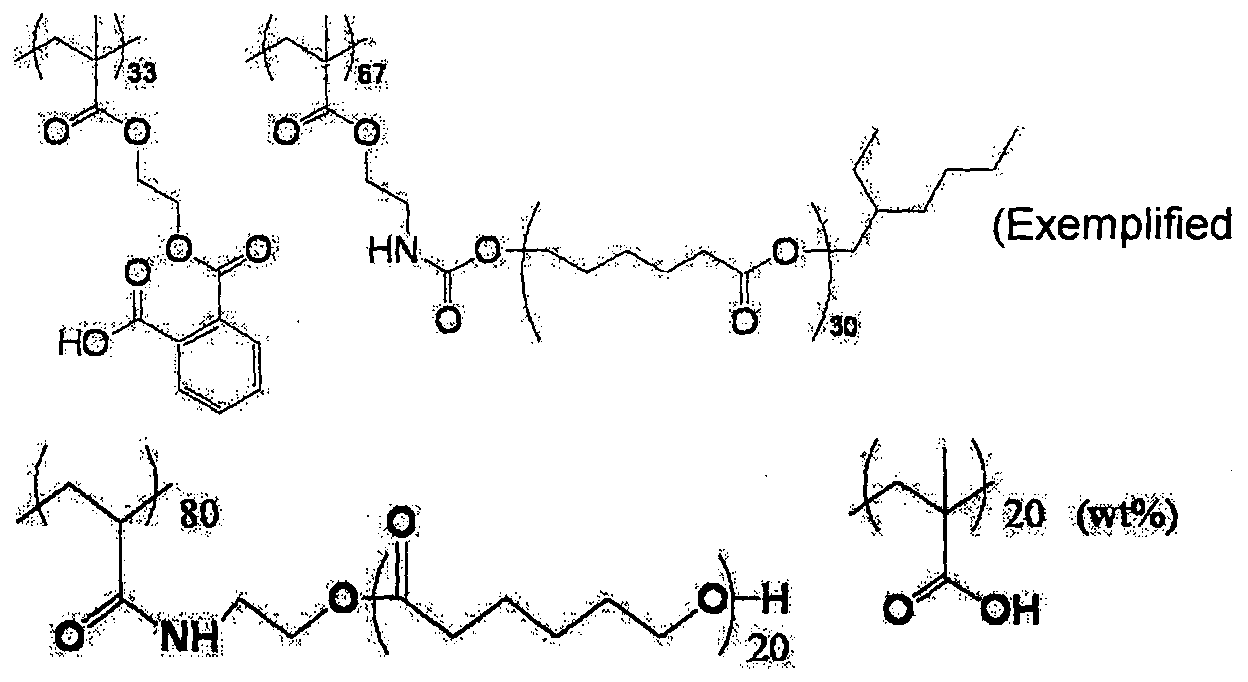
Exemplified compound 55)
(Exemplified compound 56)
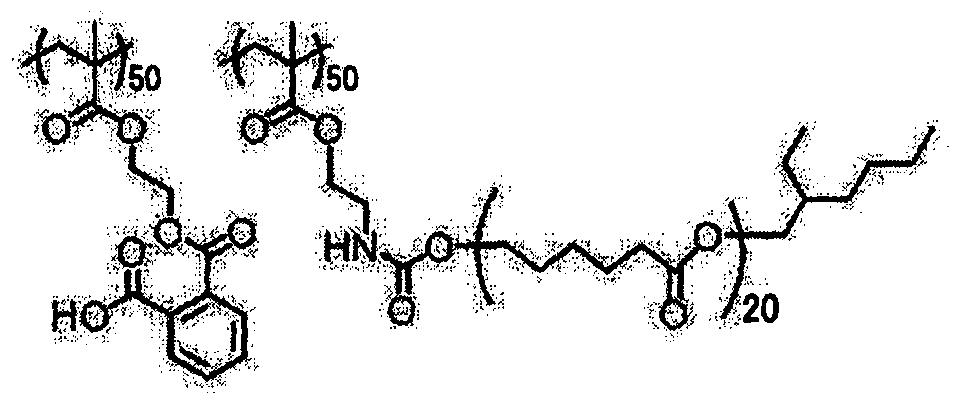
{0117}
The content of a dispersant in the specific metal compound dispersion in the present invention is preferably within a range from 1% by mass to 90% by mass, and more preferably from 3% by mass to 70% by mass, with respect to a total solid content by mass of the dispersing element which includes a dispersing element composed of the specific metal compound particles and a dispersing element composed of other colorants and the like.
Further, the content of a dispersant in the light-sensitive resin dispersion of the present invention is preferably in a range of from 1% by mass to 90% by mass, and more preferably from 3% by mass to 70% by mass, with respect to a total solid content by mass of the dispersing element which includes a dispersing element composed of the specific metal compound particles and a dispersing element composed of other colorants and the like.
{0118}
<Alkali-soluble resin>
The composition of the present invention preferably further contains an alkali- soluble resin. Developability and pattern formability are improved by incorporation of
the alkali-soluble resin.
{0119}
The alkali-soluble resin may be selected from alkali-soluble resins which are linear organic polymer molecules and have at least one alkali-solubility-accelerating group in the molecule thereof (preferably a molecule containing an acrylic copolymer or a styrene copolymer as a main chain). From the viewpoint of heat resistance, preferred are polyhydroxystyrene resins, polysiloxane resins, acrylic resins, acrylamide resins and acryl/acrylamide copolymer resins. From the viewpoint of developability control, preferred are acrylic resins, acrylamide resins and acryl/acrylamide copolymer resins.
Examples of the alkali-solubility-accelerating group (hereinafter, may be referred to as "an acid group") include a carboxyl group, a phosphoric group, a sulfonic group and a phenolic hydroxyl group. Those groups which are soluble in an organic solvent and are developable with a weak alkali aqueous solution are preferable.
Especially preferable examples of the acid group include a (meth)acryl acid group. These acid groups may be of only one kind or two or more kinds.
Examples of monomers capable of providing an acid group after the above- descried polymerization include: a monomer having a hydroxyl group such as 2- hydroxyethyl (meth)acrylate or the like; a monomer having an epoxy group such as glycidyl (meth)acrylate or the like; and a monomer having an isocyanate group such as 2-isocyanatoethyl (meth)acrylate or the like. The monomer for introducing such acid group may be of only one kind or two or more kinds. In order to introduce an acid group into an alkali-soluble binder, for example, a monomer having an acid group and/or a monomer capable of providing an acid group after polymerization (hereinafter, may be referred to as "a monomer for introduce an acid group") may be polymerized as a monomer component. In the case of introducing an acid group using, as a monomer component, a monomer capable of providing an acid group after polymerization, a process for providing an acid group, such as those describe below, after polymerization is required.
{0120}
For the production of an alkali-soluble resin, for example, a method by a known radical polymerization process can be applied. At the production of an alkali-
soluble resin by a radical polymerization process, polymerization conditions such as temperature, pressure, type and amount of a radical initiator and type of a solvent can be easily set by those skilled in the art, and the conditions can also be experimentally determined.
{0121 }
As the linear organic polymer which is used as the alkali-soluble resin, polymers having a carboxylic acid in a side chain thereof are preferable. Examples thereof include methacrylic acid copolymers, acrylic acid copolymers, itaconic acid copolymers, crotonic acid copolymers, maleic acid copolymers, partially esterified maleic acid copolymers and alkali-soluble phenol resins such as novolak resins or the like; acidic cellulose derivatives having a carboxylic acid in a side chain thereof; and polymers having an acid anhydride added to a hydroxyl group-containing polymer. In particular, copolymers of (meth)acrylic acid and other monomer which is
copolymerizable therewith are suitable as the alkali-soluble resin. Examples of other monomer which is copolymerizable with (meth)acrylic acid include alkyl
(meth)acrylates, aryl (meth)acrylates and vinyl compounds. Examples of the alkyl (meth)acrylate and the aryl (meth)acrylate include methyl (meth)acrylate, ethyl
(meth)acrylate, propyl (meth)acrylate, butyl (meth)acrylate, isobutyl (meth)acrylate, pentyl (meth)acrylate, hexyl (meth)acrylate, octyl (meth)acrylate, phenyl (meth)acrylate, benzyl (meth)acrylate, tolyl (meth)acrylate, naphthyl (meth)acrylate and cyclohexyl (meth)acrylate; and examples of the vinyl compound include styrene, a-methylstyrene, vinyltoluene, glycidyl methacrylate, acrylonitrile, vinyl acetate, N-vinylpyrrolidone, tetrahydrofurfuryl methacrylate, polystyrene macromonomer and polymethyl
methacrylate macromonomer. Examples of N-position substituted maleimide
monomers described in JP-A-10-300922 include N-phenylmaleimide and N- cyclohexylmaleimide. Such other monomer which is copolymerizable with
(meth)acrylic acid may be of only one kind or two or more kinds.
As the alkali-soluble resin, it is also preferable to use, one containing, as an essential polymer component (A), a polymer (a) obtained by polymerizing monomer components including, as an essential component, a compound represented by formula (ED) (hereinafter also referred to as "ether dimer").
{0122}

Formula (ED)
{0123}
In formula (ED), R1 and R2 each independently represent a hydrogen atom or a hydrocarbon group having 1 to 25 carbon atom(s), which may have a substituent. When the composition of the invention contains the foregoing polymer (a), heat resistance and transparency of the cured coating film formed using the subject composition are more enhanced. In formula (ED) representing the foregoing ether dimer, though the hydrocarbon group having 1 to 25 carbon atom(s), which may have a sustituent, that is represented by Ri and R2 is not particularly limited, examples thereof include linear or branched alkyl groups such as methyl, ethyl, n-propyl, isopropyl, n-butyl, isobutyl, t- butyl, t-amyl, stearyl, lauryl and 2-ethylhexyl; aryl groups such as phenyl; alicyclic groups such as cyclohexyl, t-butylcyclohexyl, dicyclopentadienyl, tricyclodecanyl, isobornyl, adamantyl and 2-methyl-2-adamantyl; alkoxy group-substituted alkyl groups such as 1-methoxy ethyl and 1-ethoxyethyl; and aryl group-substituted alkyl groups such as a benzyl group. Of these, primary or secondary carbon substituents which hardly leave by the action of an acid or heat, such as methyl, ethyl, cyclohexyl and benzyl, are especially preferable in view of heat resistance.
{0124}
Specific examples of the ether dimer include dimethyl-2,2'-
[oxybis(methylene)]bis-2-propenoate, diethyl-2,2'-[oxybis(methylene)]bis-2-propenoate, di(n-propyl)-2,2'-[oxybis(methylene)]bis-2-propenoate, di(isopropyl)-2,2'- [oxybis(methylene)]bis-2-propenoate, di(n-butyl)-2,2'-[oxybis(methylene)]bis-2- propenoate, di(isobutyl)-2,2'-[oxybis(methylene)]bis-2-propenoate, di(t-butyl)-2,2'- [oxybis(methylene)bis-2-propenoate, di(t-amyl)-2,2'-[oxybis(methylene)]bis-2- propenoate, di(stearyl)-2,2'-[oxybis(methylene)]bis-2-propenoate, di(lauryl)-2,2'- [oxybis(methylene)]bis-2-propenoate, di(2-ethylhexyl)-2,2'-[oxybis(methylene)]bis-2- propenoate, di(l-methoxyethyl)-2,2'-[oxybis(methylene)]bis-2-propenoate, di(l-
ethoxyethyl)-2,2'-[oxybis(methylene)]bis-2-propenoate, dibenzyl-2,2'- [oxybis(methylene)]bis-2-propenoate, biphenyl-2,2'-[oxybis(methylene)]bis-2- propenoate, dicyclohexyl-2,2'-[oxybis(methylene)]bis-2-propenoate, di(t- butylcyclohexyl)-2,2'-[oxybis(methylene)]bis-2-propenoate, di(dicyclopentadienyl)- 2,2'-[oxybis(methylene)]bis-2-propenoate, di(tricyclodecanyl)-2,2'-
[oxybis(methylene)]bis-2-propenoate, di(isobomyl)-2,2'[oxybis(methylene)]bis-2- propenoate, diadamantyl-2,2'-[oxybis(methylene)]bis-2-propenoate and di(2-methyl-2- adamantyl)-2,2'-[oxybis(niethylene)]bis-2-propenoate. Of these, dimethyl-2,2'- [oxybis(methylene)bis-2-propenoate, diethyl-2,2'-[oxybis(methylene)]bis-2-propenoate, dicyclohexyl-2,2'-[oxybis(methylene)]bis-2-propenoate and dibenzyl-2,2'-
[oxybis(methylene)]bis-2-propenoate are especially preferable. Such an ether dimer may be used alone or in combination of two or more kinds thereof. The structure derived from the compound represented by formula (ED) may be copolymerized with other monomer.
{0125}
Further in order to improve cross-linking efficiency of the composition of the present invention, an alkali-soluble resin having a polymerizable group may be used. As for the alkali-soluble resin having a polymerizable group, alkali-soluble resins having an allyl group, a (meth)acryl group, an allyloxyalkyl group, or the like at the side chain thereof are useful. Specific examples of the above-described polymer having a polymerizable group include DIANAL NR series (produced by Mitsubishi Rayon Co., Ltd.); PHOTOMER 6173 (a COOH group-containing polyurethane acrylic oligomer, produced by Diamond Shamrock Co. Ltd.); BISCOAT R-264, and KS RESIST 106 (both produced by Osaka Yuki Kagaku K.K.); CYCLOMER P series, and PLACCEL CF200 series (both produced by Daicel Chemical Industries, Ltd.); EBECRYL 3800 (produced by Daicel UCB Co., Ltd.); and MX-2-RD-FS (produced by NIPPON
SHOKUBAI CO., LTD.). Preferred examples of the alkali-soluble resin having a polymerizable group include a urethane-modified polymerizable double bond- containing acrylic resin obtained by allowing an isocyanate group and an OH group to react with each other in advance, with leaving one unreacted isocyanate group, and allowing a compound containing a (meth)acryloyl group and an acrylic resin containing
a carboxyl group to react with each other; an unsaturated group-containing acrylic resin obtained by allowing an acrylic resin containing a carboxyl group and a compound having both an epoxy group and a polymerizable double bond in a molecule thereof to react with each other; a polymerizable double bond-containing acrylic resin obtained by allowing an acid pendant type epoxy acrylate resin, an acrylic resin containing an OH group and a dibasic acid anhydride having a polymerizable double bond to react with each other; a resin obtained by allowing an acrylic resin containing an OH group, an isocyanate and a compound having a polymerizable group to react with each other; and a resin obtained by subjecting a resin having an ester group having, at the a-position or β-position, a leaving group such as a halogen atom and a sulfonate group, in a side chain thereof to a treatment with a base, as described in JP-A-2002-229207 and JP-A- 2003-335814.
{0126}
Of these, a benzyl (meth)acrylate/(meth)acrylic acid copolymer or a multi- component copolymer composed of benzyl (meth)acrylate/(meth)acrylic acid/other monomer is especially suitable. In addition to the above, there are exemplified a 2- hydroxypropyl (meth)acrylate/polystyrene macromonomer/benzyl
methacrylate/methacrylic acid copolymer, a 2-hydroxy-3-phenoxypropyl
acrylate/polymethyl methacrylate macromonomer/benzyl methacrylate/methacrylic acid copolymer, a 2-hydroxyethyl methacrylate/polystyrene macromonomer/methyl methacrylate/methacrylic acid copolymer and a 2-hydroxyethyl
methacrylate/polystyrene macromonomer/benzyl methacrylate/methacrylic acid copolymer as described in JP-A-7- 140654 as well as copolymerization products of 2- hydroxyethyl methacrylate.
{0127}
The alkali-soluble resin preferably has an acid value of 30 mg KOH/g to 200 mg KOH/g, more preferably 50 mg KOH/g to 150 mg KOH/g, most preferably 70 to 120 mg KOH/g.
The alkali-soluble resin preferably has a weight-average molecular weight (Mw) of 2,000 to 50,000, more preferably 5,000 to 30,000, most preferably 7,000 to 20,000.
{0128}
The content of the alkali-soluble resin in the composition is preferably 1 to 30 mass%, more preferably 2 to 25 mass%, particularly preferably 3 to 20 mass%, to the total solid content of the composition.
{0129}
[Photopolymerization initiator]
As for the photopolymerization initiator (hereinafter, may be referred to simply as "a polymerization initiator") used in the present invention, those materials that are known as a photopolymerization initiator as described below are preferably used.
{0130}
The photopolymerization initiator is not particularly limited and may be suitably selected from known ones as long as it has the property to initiate
polymerization of a polymerizable compound; the photopolymerization initiator is preferably the one that exhibits photosensitivity to ultraviolet rays to visual lights. The photopolymerization initiator may be an active substance that generates an active radical due to an effect with a photo-exited photosensitizer, or a substance that initiates cation polymerization depending on the monomer species. The photopolymerization initiator preferably contains at least one component that has a molecular extinction coefficient of approximately 50 in a range from approximately 300 nm to 800 nm, more preferably about 330 nm to 500 nm.
{0131 }
Examples of the photopolymerization initiators include halogenated hydrocarbon derivatives (e.g., one having a triazine skeleton and one having an oxadiazole skeleton), acylphosphine compounds, such as acylphosphine oxides, hexaarylbiimidazole, oxime compounds, such as oxime derivatives, organic peroxides, thio compounds, ketone compounds, aromatic onium salts, keto oxime ethers, aminoacetophenone compounds, and hydroxyacetophenone compounds.
{0132}
The halogenated hydrocarbon compounds having a triazine structure include, for example, compounds described in Wakabayashi, et. al., Bull. Chem. Soc. Japan, 42, 2924 (1969), British Patent No. 1,388,492, JP-A-53- 133428, German Patent No.
3,337,024, F. C. Schaefer et. al., J. Org. Chem. 29, 1527 (1964), JP-A-62-58241, JP-A-
5-281728, JP-A-5-34920 and U.S. Pat. No. 4,212,976.
{0133}
Examples of the compounds described in U.S. Patent No. 4,212,976 set forth above include the compounds having an oxadiazole skeleton such as 2-trichloromethyl- 5-phenyl- 1 ,3 ,4-oxadiazole, 2-trichloromethyl-5 -(4-chlorophenyl)- 1 ,3 ,4-oxadiazole, 2- trichloromethyl-5-(l -naphthyl)- 1,3,4-oxadiazole, 2-trichloromethyl-5-(2-naphthyl)- 1,3,4-oxadiazole, 2-tribromomethyl-5-phenyl- 1,3,4-oxadiazole, 2-tribromomethyl-5-(2- naphthyl)- 1 ,3,4-oxadiazole, 2-trichloromethyl-5-styryl- 1 ,3,4-oxadiazole, 2- trichloromethyl-5-(4-chlorostyryl)-l ,3,4-oxadiazole, 2-trichloromethyl-5-(4- methoxystyryl)- 1 ,3,4-oxadiazole, 2-trichloromethyl-5-(l -naphthyl)- 1 ,3,4-oxadiazole, 2- trichloromethyl-5-(4-n-butoxystyryl)-l ,3,4-oxadiazole, and 2-tribromomethyl-5-styryl- 1,3 ,4-oxadiazole.
{0134}
More favorable examples of the photopolymerization initiators include oxime compounds. Specific examples of the oxime compound include compounds described in JP-A-2001-233842, JP-A-2000-80068 and JP-A-2006-342166.
{0135}
Especially preferred examples of the oxime compound include an oxime compound having a specific substituent described in JP-A-2007-269779 and an oxime compound having a thioaryl group described in JP-A-2009-191061.
Specifically, the oxime-series photopolymerization initiator is preferably a compound represented by formula (1). The oxime compound may be an oxime compound where the N-0 bond of the oxime bond is an (E) form, an oxime compound where the bond is a (Z) form, or a mixture of a (E) form and a (Z) form.
0136}

{0137}
In formula (1), R and B each independently represent a monovalent
substituent; A represents a divalent organic group; and Ar represents an aryl group.
The monovalent substituent represented by R is preferably a monovalent nonmetal atomic group. Examples of the monovalent nonmetal atomic group include an alkyl group, an aryl group, an acyl group, an alkoxycarbonyl group, an aryloxycarbonyl group, a heterocyclic group, an alkylthiocarbonyl group, and an arylthiocarbonyl group. These groups may have one or more substituent(s). Further, the substituent(s) may have another subsutituent. Examples of the substituent include a halogen atom, an aryloxy group, an alkoxycarbonyl group, an aryloxycarbonyl group, an acyloxy group, an acyl group, an alkyl group, and an aryl group.
{0138}
In formula (I), in view of sensitivity, the structure of "SAr" formed by Ar and S adjacent thereto is preferably a structure shown below. Me represents a methyl group, and Et represents an ethyl group.
{0139

{0140}
The oxime compound is preferably a compound represented by the following formula (2).
{0141

{0142}
In formula (2), R and X each independently represent a monovalent substituent; A and Y each independently represent a divalent organic group; Ar represents an aryl group; and n represents an integer of 0 to 5.
R, A and Ar in formula (2) have the same meanings of those of R, A and Ar in formula (1), and the preferable examples of R, A and Ar in formula (2) are also the same as those R, A and Ar in formula (1).
{0143}
Examples of the monovalent substituent represented by X in formula (2) include an alkyl group, an aryl group, an alkoxy group, an aryloxy group, an acyloxy group, an acyl group, an alkoxycarbonyl group, an amino group, a heterocyclic group, and a halogen group. These groups may have one or more substiuent(s). As the substituent, the above-described substituents are exemplified. The above-described substituents may have another substituent.
{0144}
Among these, X in formula (2) is preferably an alkyl group from the standpoint of enhancing solvent solubility and absorption efficiency in the long wavelength region.
In formula (2), n represents an integer of 0 to 5, preferably an integer of 0 to 2.
{0145}
The divalent organic group represented by Y in formula (2) includes compounds represented by the structures shown below. In the groups shown below, "*" indicates the bonding position to the carbon atom adjacent to Y in formula (2).
{0146}

{0147}
Among these, a compound represented by the structure shown below is preferred from the standpoint of increasing the sensitivity.
{0148}

{0149}
Further, the oxime compound is preferably a compound represented by the following formula (3).
{

{0151 }
In formula (3), R and X each independently represent a monovalent substituent; A represents a divalent organic group; Ar represents an aryl group; and n represents an integer of 0 to 5.
R, X, A, Ar and n in formula (3) have the same meanings of those of R, X, A, Ar and n in formula (2), and the preferable examples of R, X, A, Ar and n in formula (3) are also the same as those of R, X, A, Ar and n in formula (2).
{0152}
Hereinafter, specific examples of the oxime compound are exemplified, but the present invention is not limited thereto.
0153}

{0155}
The oxime compound is a compound having a maximum absorption
wavelength in the wavelength region of 350 to 500 nm, preferably a compound having an absorption wavelength in the wavelength region of 360 to 480 nm, more preferably a compound having high absorbance at 365 nm and 455 nm.
{0156}
The oxime compound preferably has a molar extinction coefficient of 1 ,000 to
300,000, more preferably 2,000 to 300,000, particularly preferably 5,000 to 200,000, at 365 nm or 405 nm, in view of the sensitivity.
The molar extinction coefficient of the compound may be measured by a known method but is preferably measured, for example, by using, specifically, an ultraviolet- visible spectrophotometer (Carry-5 spectrophotometer manufactured by Varian) with an ethyl acetate solvent at a concentration of 0.01 g/L.
{0157}
The photopolymerization initiator used in the present invention may be used in combination of more than one kind, if needed.
{0158}
The content of the photopolymerization initiator (the total content in the case of more than one kind thereof) in the composition is preferably in a range from 0.1 to 20% by mass, more preferably from 0.5 to 10% by mass, and especially preferably from 1 to 8% by mass, with respect to the total solid content of the composition. When the content falls within the above range, the photopolymerization initiator effectively contributes to exertion of good stability.
{0159}
[Other additive]
If needed, the composition of the present invention may contain various kinds of additives such as fillers, polymer compounds other than the above-described ones, surfactants, organic carboxylic acids, organic carboxylic acid anhydrides,
polymerization inhibitors, adhesion accelerators, antioxidants, and anti-aggregating agents.
{0160}
· Surfactant
From the standpoint of more enhancing the coatability, various surfactants may
be added to the composition of the present invention. As the surfactant, various surfactants such as fluorine-containing surfactant, nonionic surfactant, cationic surfactant, anionic surfactant and silicone-containing surfactant may be used. Among these, the fluorine-containing surfactant is preferable.
{0161 }
When the composition of the present invention contains a fluorine-containing surfactant, the liquid characteristics (especially, fluidity) of a coating solution prepared is more enhanced, so that the coating thickness uniformity or the liquid saving can be more improved. That is, in the case of forming a film by using a coating solution to which a composition containing a fluorine-containing surfactant is applied, the interface tension between the coated surface and the coating solution is reduced, whereby wettability to the coated surface is improved and the coatability on the coated surface is enhanced. This is effective in that even when a thin film of approximately several μηι is formed with a small liquid volume, a film having a uniform thickness with little thickness unevenness can be more suitably performed.
{0162}
Examples of the fluorine-containing surfactant include Megafac F171,
Megafac F172, Megafac F173, Megafac F176, Megafac F177, Megafac F141, Megafac F142, Megafac F143, Megafac F144, Megafac R30, Megafac F437, Megafac F475, Megafac F479, Megafac F482, Megafac F554, Megafac F780 and Megafac F781 (trade names, manufactured by DIC corporation), Fluorad FC430, Fluorad FC431 , Fluorad FC171 (trade names, manufactured by Sumitomo 3M Limited), Surflon S-382, Surflon SC-101, Surflon SC-103, Surflon SC-104, Surflon SC-105, Surflon SC1068, Surflon SC-381, Surflon SC-383, Surflon S393 and Surflon KH-40(trade names, respectively, manufactured by ASAHI GLASS CO., LTD.).
{0163}
Specific examples of the nonionic surfactant include glycerol,
trimethylolpropane, trimethylolethane, their ethoxylates and propoxylates (e.g. glycerol propoxylate, glycerin ethoxylate), polyoxyethylene lauryl ether, polyoxyethylene stearyl ether, polyoxyethylene oleyl ether, polyoxyethylene octylphenyl ether, polyoxyethylene nonylphenyl ether, polyethylene glycol dilaurate, polyethylene glycol distearate,
sorbitan fatty acid ester (such as Pluronic L10, L31, L61, L62, 10R5, 17R2, 25R2, Tetronic 304, 701, 704, 901, 904 and 150R1, all produced by BASF), and Pionine D- 6315 (trade name, manufactured by TAKEMOTO OIL & FAT Co., Ltd.).
{0164}
Specific examples of the cationic surfactant include a phthalocyanine derivative (EFKA-745, trade name, manufactured by Morishita Sangyo .K.), organosiloxane polymer KP341 (manufactured by Shin-Etsu Chemical Co., Ltd.), (meth)acrylic (co)polymer Polyflow No. 75, No. 90, No. 95 (manufactured by Kyoeisha Chemical Co., Ltd.), and WO01 (manufactured by Yusho Co., Ltd.).
{0165}
Specific examples of the anionic surfactant include WO04, WO05, WO 17 (all manufactured by Yusho Co., Ltd.).
{0166}
Examples of the silicone-series surfactant include Toray silicone DC3PA, Toray silicone SH7PA, Toray silicone DC11PA, Toray silicone SH21PA, Toray silicone SH28PA, Toray silicone SH29PA and Toray silicone SH30PA, Toray silicone SH8400 (trade names, manufactured by Dow Corning Toray Co., Ltd.), TSF-4440, TSF-4300, TSF-4445, TSF-4460 and TSF-4452 (trade names, manufactured by
Momentive Performance Materials Inc.), KP341, KF6001, KF6002 (trade names, manufactured by Shin-Etsu Chemical Co., Ltd.), BYK307, BYK323 and BYK330 (trade name, manufactured by BYK Chemie).
{0167}
Only one surfactant may be used, or two or more kinds of surfactants may be combined. The content of the surfactant to be added is preferably from 0.001 to 2.0 mass%, more preferably from 0.005 to 1.0 mass%, based on the entire solid content by mass of the composition of the present invention.
{0168}
• Polymerization Inhibitor
In the composition of the present invention, a small amount of a
polymerization inhibitor may be added so as to inhibit unnecessary thermal
polymerization of a polymerizable compound during production or storage of the
composition.
Examples of the polymerization inhibitor that can be used in the present invention include hydroquinone, p-methoxyphenol, di-tert-butyl-p-cresol, pyrogallol, tert-butylcatechol, benzoquinone, 4,4'-thiobis(3-methyl-6-tert-butylphenol), 2,2'- methylenebis(4-methyl-6-tert-butylphenol), and N-nitrosophenylhydroxyamine cerous salt.
The content of the polymerization inhibitor to be added is preferably from approximately 0.01 mass% to 5 mass%, based on the entire solid content of the composition.
EXAMPLES
{0169}
The present invention will be described in more detail based on the following examples, but the invention is not intended to be limited thereto. In the following examples, the term "part(s)" is a value by mass, unless otherwise specified. Further, the term "room temperature" means 25°C.
{0170}
(Synthetic example: synthesis of dispersant 1)
To a 500 ml three-necked flask, 600.0 g of ε-caprolactone and 22.8 g of 2- ethyl- 1-hexanol were introduced and stirred while injecting nitrogen into the flask to dissolve them. 0.1 g of monobutyl tin oxide was added to the flask, and then the content of the flask was heated at 100°C. Eight hours after, disappearance of raw materials was confirmed by means of gas chromatography, and then the content of the flask was cooled to 80°C. 0.1 g of 2,6-di-t-butyl-4-methylphenol was added, and then 27.2 g of 2-methacryloyloxyethylisocyanate was added. Five hours after, disappearance of raw materials was confirmed by means of lH-NMR, and then the content of the flask was cooled to room temperature. Thus, 200 g of solid precursor Ml (represented by the following structure) was obtained. The identification of the obtained substance as Ml was confirmed by means of 1H-NMR, IR and mass spectrography.
{0171 }

{0172}
To a nitrogen-substituted three-necked flask, 30.0 g of the precursor Ml, 70.0 g of NK ester CB-1, 2.3 g of dodecyl mercaptane, and 233.3 g of propyleneglycol monomethylether acetate (PGMEA) were introduced and stirred using an agitator
(SHINTO Scientific Co., Ltd.: Tree-One Motor), and temperature was raised to 75°C by heating while injecting nitrogen into the flask. To this mixture, 0.2 g of 2,2-azobis (2- methylpropionic acid)dimethyl (V-601, manufactured by Wako Pure Chemical Industries, Ltd.) was added, and heated while stirring at 75°C for 2 hours. Two hours after, 0.2 g of V-601 was further added, and heated while stirring for 3 hours. Thus, a 30% solution of the following dispersant d-1 was obtained.
{0173}
Dispersant d-1
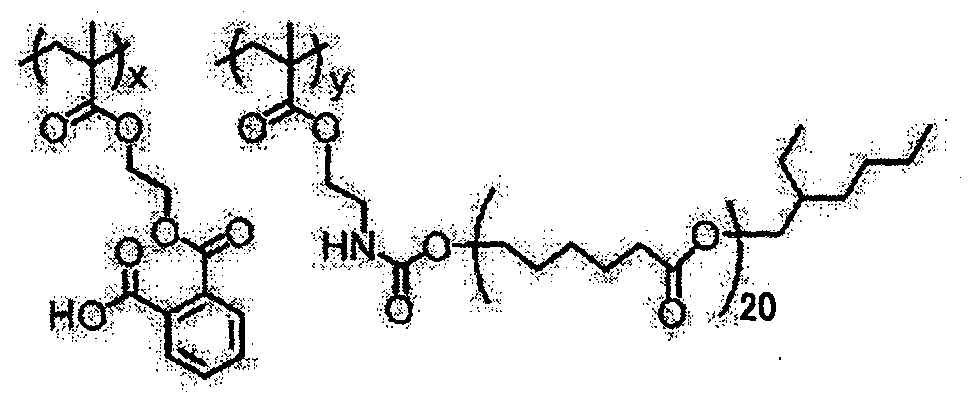
{0174}
The composition ratio, the acid value and the weight-average molecular weight
(Mw) of the dispersant d-1 are described below.
The weight average molecular weight was measured by gel permeation chromatography (GPC), and was calculated in terms of polystyrene. The GPC is performed by using a GPC instrument (HLC-8020GPC, trade name, manufactured by Tosoh Corporation), three columns (TSKGEL SUPER HZM-H, TSKGEL SUPER
HZ4000 and TSKGEL SUPER HZ200, trade names, all manufactured by Tosoh
Corporation).
• Composition ratio: x = 50 (mass%), y = 50(mass%)
• Acid value: 100 mg KOH/g
• Mw: 30,000
{0175}
(Preparation example: preparation of vanadium mixture VN1)
100 g of vadium pentaoxide with a particle diameter of 100 μπν. VT-1 manufactured by TAIYO TEKKO Co., Ltd. and 100 g of Disperbyk 190 manufactured by BYK-Chemie were weighed. 71 g of ion-exchanged water was added to the mixture and subjected to a processing for 20 minutes at revolution rotational frequency of 1,360 rpm and spinning rotational frequency of 1,047 rpm using MAZERSTAR KK-400W manufactured by KURABO, thereby obtaining a uniformly mixed aqueous solution. A quartz vessel was filled with the aqueous solution and heated at 920°C at an oxygen atmosphere using a compact size rotary kiln manufactured by K.K. MOTOYAMA. Then, a nitridization reduction treatment was performed by replacing the atmosphere with nitrogen, and then by flowing ammonia gas at the same temperature at the rate of 100 niL/min for 5 hours. After termination of the treatment, a recovered powder was pulverized in a mortar to obtain a vanadium mixture of powdered nitride and oxide. {0176}
(Example 1)
(Preparation of vanadium dispersion)
The components shown in the following composition were mixed for 15 minutes using an agitator (EUROSTAR (trade name), manufactured by IKA Works, thereby obtaining dispersion 101a.
{0177}
(Composition)
• The vanadium mixture VN1 prepared as described above 25 parts
• 30% solution of the dispersant d-1
prepared by the synthetic example described above 25 parts
• Propyleneglycol monomethylether acetate (PGMEA) (solvent) 50 parts {0178}
The obtained dispersion 101a was subjected to a dispersion treatment under the
following conditions using an ultraapex mill UAM 015 (trade name), manufactured by KOTOBUKI INDUSTRIES CO., LTD. Thus, a vanadium dispersion liquid (coating composition) 101 was obtained.
{0179}
<Condition for dispersion>
• Bead diameter: φ 0.05 mm
• Bead filling rate: 75 volume%
• Mill circumpherential speed: 8 m/sec
• Amount of mixed liquid subjected to a dispersion treatment: 500 g
· Circulation flow rate (pump supply): 13 kg/hour
• Treatment liquid temperature: from 25°C to 30°C
• Cooled water: tap water
• Bead mill circular pathway internal volume: 0.15 L
• Number of passes: 90 passes
{0180}
(Comparative example)
The vanadium mixture VN1 in the example 1 was replaced with carbon black TEP BP-BLACK 1 (trade name, manufactured by TOKYO PRINTING INK MFG. CO., LTD.) (coating composition cl 1). Further, the vanadium mixture VN1 in Example 1 was replaced with titanium black 12S (trade name, manufactured by Mitsubushi
Materials Electronic Chemicals Co., Ltd.) (coating composition cl2).
{0181 }
(Coating of coating composition)
Each of the coating compositions obtained above was spin coated on a substrate of glass wafer Corning 1737 (trade name, manufactured by Corning
Incorporated) to obtain a colored composition coating film. By setting the film thickness to 1 μιη, all of the samples were controlled so that the film thickness was 1 μηι.
{0182}
(Spectroscopy evaluation of vanadium dispersion liquid)
Spectral characteristics of the above-described colored composition coating
film were evaluated. Herein, a measuring equipment UV-3600 (trade name) manufactured by Shimadzu Corporation was used. Measurement was conducted at room temperature (25°C). The ratio (ODx/OD4oo) of optical density (ODx) at 450 nm, 550 nm, or 650 nm, with respect to optical density (OD 00) at 400 nm as a standard is shown in Table 1.
{0183}
(Evaluation of coating composition film)
The appearance of the black composition coating film obtained above was visually evaluated immediately after coating and 3 days after. The evaluation results are shown in Table 2. The scores are given by the following criteria for evaluation.
• There is no foreign substance over the entire film: 5
• A foreign substance was very slightly deposited on the surrounding area of the film: 4
• A foreign substance was slightly deposited on the surrounding area of the film;
however it was allowable in practice: 3
· A foreign substance was deposited over the entire film; it was impracticable: 2
• A large amount of foreign substance was deposited over the entire film; it was impracticable: 1
{0184}
Table 1

{0185}
From the above results, it was seen that the dispersion liquid (cl 1) containing carbon black for comparison exhibited considerably high optical density (OD) at the lower wavelength side. It was seen that the dispersion liquid (cl2) containing titanium black also exhibited high optical density (OD) at the higher wavelength side whereby uniform spectral characteristics were not obtained. In contrast, it was seen that the composition of the present invention that contained a vanadium mixture made it
possible to realize uniform spectral characteristics that exhibited a constant optical density (OD) all over the visible region. Further, it was seen that the composition of the present invention that contained a vanadium mixture made it possible to suppress deterioration of the film, and to exhibit a good stability with age.
{0186}
(Example 2)
Components of the following composition were mixed using an agitator to prepare coating composition 201.
(Composition)
· The exemplified compound M-213
[stabilizing agent including an unsaturated bond] 6 parts
• Vanadium dispersion liquid 101 36.5 parts
• MX-2-RD-FS manufactured by NIPPON SHOKUBAI CO., LTD. 4.5 parts
• IRGACURE OXE01 manufactured by BASF 0.9 part
· Pionine D-6315
manufactured by TAKEMOTO OIL & FAT Co., Ltd. 0.2 part
• Megafac F-781 manufactured by DIC corporation 0.04 part
• p-methoxyphenol manufactured by SANRITSU CHEMICALS 0.003 part
• Propyleneglycol monomethylether acetate (PGMEA) 50 parts
Coating compositions 202 to 205 were obtained in the same manner as the above-described coating composition 201, except that the dispersant and the stabilizer were changed as shown in Table 2. The addition amount of the dispersant was adjusted so as to be 25 parts.
{0187}
Table 2

{0188}
From the results shown in Table 2, it was seen that supplementary addition of an unsaturated low-molecular compound to the dispersion liquid of the present invention that contained a vanadium mixture made it possible to maintain uniform spectral characteristics in the visible region, and also to enhance stability with age.
Having described our invention as related to the present embodiments, it is our intention that the invention not be limited by any of the details of the description, unless otherwise specified, but rather be construed broadly within its spirit and scope as set out in the accompanying claims.
This application claims priority on Patent Application No. 2011-189482 filed in Japan on August 31, 201 1, which is entirely herein incorporated by reference.
Claims
1. A gray composition, comprising a nitride of a Group V transition metal.
2. The gray composition according to Claim 1 , wherein the Group V transition metal is vanadium or niobium.
3. The gray composition according to Claim 1 or 2, wherein the nitride of a Group V transition metal is a vanadium nitride.
4. The gray composition according to any one of Claims 1 to 3, comprising an oxide of a Group V transition metal.
5. The gray composition according to any one of Claims 1 to 4, comprising a stabilizing agent having an unsaturated bond in the molecule thereof.
6. The gray composition according to any one of Claims 1 to 5, comprising a dispersing agent.
7. The gray composition according to Claim 5 or 6, wherein the stabilizing agent is a compound represented by formula (I) or (II):
R-(T)n-CH2 R

«> (ID
wherein, R, T and Z are groups represented by the following formulae; n represents an integer of 0 to 14; m represents an integer of 1 to 8; and multiple Rs and Ts present in one molecule may be identical with or different from each other, respectively, R :

T: -CH2 - , -O-CH2 - , -O-CH2 CH2- , -O-CH2CH2 CH2- , -0-CH2CH2CH2CH2-
H H
Z: -0- , -0-C-N-(CH2} ; N -C-0-
0 0
8. The gray composition according to Claim 6 or 7, wherein the dispersing agent has a repeating unit derived from a monomer represented by any one of formulae (i) to (iii):

wherein R , R and R each independently represent a hydrogen atom, a halogen atom, or an alkyl group having 1 to 6 carbon atom(s); X represents an oxygen atom (-0-) or an imino group (-NH-); Y represents a methyn group or a nitrogen atom; L represents a single bond or a divalent linking group; Z represents a functional group; and R4, R5 and R6 each independently represent a hydrogen atom, a halogen atom, an alkyl group having 1 to 6 carbon atom(s), -Z or -L-Z.
9. The gray composition according to any one of Claims 6 to 8, comprising 1 to 90 mass% of the stabilizing agent, to the total mass of the composition.
10. The gray composition according to any one of Claims 1 to 9, wherein a variation of an optical density (OD) in the visible light region is controlled within ±20% on the basis of an optical density (OD) at wavelength of 400 nm.
11. The gray composition according to any one of Claims 1 to 10, wherein an organic solvent is used as a medium containing the vanadium oxide and the vanadium nitride.
Priority Applications (1)
| Application Number | Priority Date | Filing Date | Title |
|---|---|---|---|
| KR1020137031699A KR101613139B1 (en) | 2011-08-31 | 2012-07-26 | Gray composition |
Applications Claiming Priority (2)
| Application Number | Priority Date | Filing Date | Title |
|---|---|---|---|
| JP2011-189482 | 2011-08-31 | ||
| JP2011189482A JP5864959B2 (en) | 2011-08-31 | 2011-08-31 | Gray composition |
Publications (1)
| Publication Number | Publication Date |
|---|---|
| WO2013031464A1 true WO2013031464A1 (en) | 2013-03-07 |
Family
ID=47755966
Family Applications (1)
| Application Number | Title | Priority Date | Filing Date |
|---|---|---|---|
| PCT/JP2012/069635 Ceased WO2013031464A1 (en) | 2011-08-31 | 2012-07-26 | Gray composition |
Country Status (3)
| Country | Link |
|---|---|
| JP (1) | JP5864959B2 (en) |
| KR (1) | KR101613139B1 (en) |
| WO (1) | WO2013031464A1 (en) |
Cited By (1)
| Publication number | Priority date | Publication date | Assignee | Title |
|---|---|---|---|---|
| CN109517101A (en) * | 2017-09-20 | 2019-03-26 | 东友精细化工有限公司 | Acrylate compounds, the Photocurable composition containing it, photo-curable cured film and image display device |
Families Citing this family (2)
| Publication number | Priority date | Publication date | Assignee | Title |
|---|---|---|---|---|
| KR20210011080A (en) * | 2016-04-08 | 2021-01-29 | 후지필름 가부시키가이샤 | Composition, method for producing composition, cured film, color filter, light-blocking film, solid-state imaging element, and image display device |
| JP6936588B2 (en) * | 2017-02-28 | 2021-09-15 | 三菱マテリアル電子化成株式会社 | Gray-white oxynitride niobium powder and its manufacturing method |
Citations (6)
| Publication number | Priority date | Publication date | Assignee | Title |
|---|---|---|---|---|
| JPH11263639A (en) * | 1998-03-16 | 1999-09-28 | Sumitomo Metal Mining Co Ltd | Coating liquid for forming heat ray shielding film and heat ray shielding film |
| JP2001049190A (en) * | 1999-08-11 | 2001-02-20 | Sumitomo Metal Mining Co Ltd | Coating solution for solar filter film formation |
| JP2008534739A (en) * | 2005-03-31 | 2008-08-28 | イーストマン ケミカル カンパニー | Polyester polymer and copolymer compositions comprising particles of one or more transition metal compounds |
| JP2008222903A (en) * | 2007-03-14 | 2008-09-25 | Sumitomo Metal Mining Co Ltd | Laser-absorbing light-absorbing resin composition, light-absorbing resin molded body, and method for producing light-absorbing resin molded body |
| WO2009031383A1 (en) * | 2007-09-07 | 2009-03-12 | Showa Denko K.K. | Catalyst, method for producing the same, and use of the same |
| JP2012096945A (en) * | 2010-10-29 | 2012-05-24 | Mitsubishi Materials Corp | Blue color-shielding black powder, method for producing the same and use of the same |
Family Cites Families (2)
| Publication number | Priority date | Publication date | Assignee | Title |
|---|---|---|---|---|
| JP2003107697A (en) * | 2001-09-28 | 2003-04-09 | Fuji Photo Film Co Ltd | Photosensitive transfer material, photomask material, photomask and method for manufacturing the photomask |
| JP5538688B2 (en) | 2008-05-30 | 2014-07-02 | 富士フイルム株式会社 | Colored curable composition, color filter, method for producing the same, and solid-state imaging device |
-
2011
- 2011-08-31 JP JP2011189482A patent/JP5864959B2/en active Active
-
2012
- 2012-07-26 KR KR1020137031699A patent/KR101613139B1/en not_active Expired - Fee Related
- 2012-07-26 WO PCT/JP2012/069635 patent/WO2013031464A1/en not_active Ceased
Patent Citations (6)
| Publication number | Priority date | Publication date | Assignee | Title |
|---|---|---|---|---|
| JPH11263639A (en) * | 1998-03-16 | 1999-09-28 | Sumitomo Metal Mining Co Ltd | Coating liquid for forming heat ray shielding film and heat ray shielding film |
| JP2001049190A (en) * | 1999-08-11 | 2001-02-20 | Sumitomo Metal Mining Co Ltd | Coating solution for solar filter film formation |
| JP2008534739A (en) * | 2005-03-31 | 2008-08-28 | イーストマン ケミカル カンパニー | Polyester polymer and copolymer compositions comprising particles of one or more transition metal compounds |
| JP2008222903A (en) * | 2007-03-14 | 2008-09-25 | Sumitomo Metal Mining Co Ltd | Laser-absorbing light-absorbing resin composition, light-absorbing resin molded body, and method for producing light-absorbing resin molded body |
| WO2009031383A1 (en) * | 2007-09-07 | 2009-03-12 | Showa Denko K.K. | Catalyst, method for producing the same, and use of the same |
| JP2012096945A (en) * | 2010-10-29 | 2012-05-24 | Mitsubishi Materials Corp | Blue color-shielding black powder, method for producing the same and use of the same |
Cited By (2)
| Publication number | Priority date | Publication date | Assignee | Title |
|---|---|---|---|---|
| CN109517101A (en) * | 2017-09-20 | 2019-03-26 | 东友精细化工有限公司 | Acrylate compounds, the Photocurable composition containing it, photo-curable cured film and image display device |
| CN109517101B (en) * | 2017-09-20 | 2021-04-23 | 东友精细化工有限公司 | Acrylate compound, photocurable composition containing same, photocurable cured film, and image display device |
Also Published As
| Publication number | Publication date |
|---|---|
| JP5864959B2 (en) | 2016-02-17 |
| JP2013049809A (en) | 2013-03-14 |
| KR101613139B1 (en) | 2016-04-18 |
| KR20140057203A (en) | 2014-05-12 |
Similar Documents
| Publication | Publication Date | Title |
|---|---|---|
| TWI621476B (en) | Photosensitive composition, a composition for forming a pixel of a solid-state imaging element, a gray cured film using the same, a gray pixel, and a solid-state imaging element | |
| JP6147143B2 (en) | Colored photosensitive resin composition, cured film, color filter, method for producing color filter, solid-state imaging device, and image display device | |
| JP7126537B2 (en) | Coloring composition, method for producing coloring composition, color filter, pattern forming method, solid-state imaging device, and image display device | |
| CN103959104B (en) | Optical component group and use the solid-state imager of this optical component group | |
| TW201431682A (en) | Curable resin composition for forming infrared reflective film, infrared reflective film, method for producing the same, and infrared cut filter, and solid-state imaging device using the same | |
| JP7109624B2 (en) | Composition, cured film, color filter, light-shielding film, solid-state imaging device, and image display device | |
| TW201439291A (en) | Curable resin composition, infrared ray cut filter and solid-state imaging device using the same | |
| JP6234792B2 (en) | Colored curable composition, method for producing colored curable composition, cured film, color filter, method for producing color filter, solid-state imaging device, and image display device | |
| KR101793114B1 (en) | Dispersion composition, photosensitive resin composition for light-shielding color filter, light-shielding color filter, method of producing the same, and solid-state image sensor having the color filter | |
| TW201331611A (en) | Optical member set and solid-state imaging element using same | |
| WO2018021313A1 (en) | Coloring composition, color filter, pattern formation method, solid-stage imaging element, and image display device | |
| KR20160058893A (en) | Red-photosensitive resin composition, cured film, color filter, production method for color filter, solid state imaging element, and image display device | |
| JP2015007766A (en) | Method for producing color filter, composition for forming underlayer, organic EL display device | |
| WO2015115416A1 (en) | Coloring composition, cured film, manufacturing method for color filter, color filter, solid state imaging element, and image display device | |
| JPWO2017221620A1 (en) | Curable composition, cured film, color filter, light shielding film, solid-state imaging device, image display device, method of producing cured film, and polyfunctional thiol compound | |
| JP6158765B2 (en) | Radiation-sensitive composition, color filter and method for producing the same, and solid-state imaging device | |
| WO2016072259A1 (en) | Colored curable composition, color filter, pattern formation method, method for producing color filter, solid-state imaging device, and image display device | |
| JPWO2017150093A1 (en) | Composition, method of producing composition, cured film, color filter, light shielding film, solid-state imaging device, and image display device | |
| KR20190003681A (en) | Color composition and method for producing a film | |
| JP6341694B2 (en) | Radiation-sensitive composition and method for producing the same, cured film, color filter and method for producing the same, pattern forming method, solid-state imaging device, and image display device | |
| WO2013031464A1 (en) | Gray composition | |
| JP6435039B2 (en) | Coloring composition, method for producing coloring composition, color filter, ink-jet ink composition, and printing ink composition | |
| JP5657337B2 (en) | Titanium black dispersion for wafer level lens, photosensitive resin composition containing the same, and wafer level lens | |
| JP5710283B2 (en) | Titanium black dispersion for wafer level lens, photosensitive resin composition containing the same, wafer level lens, and solid-state imaging device | |
| JP6587697B2 (en) | Coloring composition, color filter, pattern forming method, solid-state imaging device, and image display device |
Legal Events
| Date | Code | Title | Description |
|---|---|---|---|
| 121 | Ep: the epo has been informed by wipo that ep was designated in this application |
Ref document number: 12828117 Country of ref document: EP Kind code of ref document: A1 |
|
| ENP | Entry into the national phase |
Ref document number: 20137031699 Country of ref document: KR Kind code of ref document: A |
|
| NENP | Non-entry into the national phase |
Ref country code: DE |
|
| 122 | Ep: pct application non-entry in european phase |
Ref document number: 12828117 Country of ref document: EP Kind code of ref document: A1 |