WO2012176651A1 - 新規抗腫瘍剤及び新規抗腫瘍剤のスクリーニング方法 - Google Patents
新規抗腫瘍剤及び新規抗腫瘍剤のスクリーニング方法 Download PDFInfo
- Publication number
- WO2012176651A1 WO2012176651A1 PCT/JP2012/064964 JP2012064964W WO2012176651A1 WO 2012176651 A1 WO2012176651 A1 WO 2012176651A1 JP 2012064964 W JP2012064964 W JP 2012064964W WO 2012176651 A1 WO2012176651 A1 WO 2012176651A1
- Authority
- WO
- WIPO (PCT)
- Prior art keywords
- hif
- idh3
- idh3α
- tumor
- novel
- Prior art date
- Legal status (The legal status is an assumption and is not a legal conclusion. Google has not performed a legal analysis and makes no representation as to the accuracy of the status listed.)
- Ceased
Links
Images






Classifications
-
- C—CHEMISTRY; METALLURGY
- C12—BIOCHEMISTRY; BEER; SPIRITS; WINE; VINEGAR; MICROBIOLOGY; ENZYMOLOGY; MUTATION OR GENETIC ENGINEERING
- C12Q—MEASURING OR TESTING PROCESSES INVOLVING ENZYMES, NUCLEIC ACIDS OR MICROORGANISMS; COMPOSITIONS OR TEST PAPERS THEREFOR; PROCESSES OF PREPARING SUCH COMPOSITIONS; CONDITION-RESPONSIVE CONTROL IN MICROBIOLOGICAL OR ENZYMOLOGICAL PROCESSES
- C12Q1/00—Measuring or testing processes involving enzymes, nucleic acids or microorganisms; Compositions therefor; Processes of preparing such compositions
- C12Q1/26—Measuring or testing processes involving enzymes, nucleic acids or microorganisms; Compositions therefor; Processes of preparing such compositions involving oxidoreductase
- C12Q1/32—Measuring or testing processes involving enzymes, nucleic acids or microorganisms; Compositions therefor; Processes of preparing such compositions involving oxidoreductase involving dehydrogenase
-
- A—HUMAN NECESSITIES
- A61—MEDICAL OR VETERINARY SCIENCE; HYGIENE
- A61K—PREPARATIONS FOR MEDICAL, DENTAL OR TOILETRY PURPOSES
- A61K31/00—Medicinal preparations containing organic active ingredients
- A61K31/70—Carbohydrates; Sugars; Derivatives thereof
- A61K31/7088—Compounds having three or more nucleosides or nucleotides
-
- A—HUMAN NECESSITIES
- A61—MEDICAL OR VETERINARY SCIENCE; HYGIENE
- A61P—SPECIFIC THERAPEUTIC ACTIVITY OF CHEMICAL COMPOUNDS OR MEDICINAL PREPARATIONS
- A61P35/00—Antineoplastic agents
-
- C—CHEMISTRY; METALLURGY
- C12—BIOCHEMISTRY; BEER; SPIRITS; WINE; VINEGAR; MICROBIOLOGY; ENZYMOLOGY; MUTATION OR GENETIC ENGINEERING
- C12N—MICROORGANISMS OR ENZYMES; COMPOSITIONS THEREOF; PROPAGATING, PRESERVING, OR MAINTAINING MICROORGANISMS; MUTATION OR GENETIC ENGINEERING; CULTURE MEDIA
- C12N15/00—Mutation or genetic engineering; DNA or RNA concerning genetic engineering, vectors, e.g. plasmids, or their isolation, preparation or purification; Use of hosts therefor
- C12N15/09—Recombinant DNA-technology
- C12N15/11—DNA or RNA fragments; Modified forms thereof; Non-coding nucleic acids having a biological activity
- C12N15/113—Non-coding nucleic acids modulating the expression of genes, e.g. antisense oligonucleotides; Antisense DNA or RNA; Triplex- forming oligonucleotides; Catalytic nucleic acids, e.g. ribozymes; Nucleic acids used in co-suppression or gene silencing
- C12N15/1137—Non-coding nucleic acids modulating the expression of genes, e.g. antisense oligonucleotides; Antisense DNA or RNA; Triplex- forming oligonucleotides; Catalytic nucleic acids, e.g. ribozymes; Nucleic acids used in co-suppression or gene silencing against enzymes
-
- C—CHEMISTRY; METALLURGY
- C12—BIOCHEMISTRY; BEER; SPIRITS; WINE; VINEGAR; MICROBIOLOGY; ENZYMOLOGY; MUTATION OR GENETIC ENGINEERING
- C12Y—ENZYMES
- C12Y101/00—Oxidoreductases acting on the CH-OH group of donors (1.1)
- C12Y101/01—Oxidoreductases acting on the CH-OH group of donors (1.1) with NAD+ or NADP+ as acceptor (1.1.1)
- C12Y101/01041—Isocitrate dehydrogenase (NAD+) (1.1.1.41)
-
- C—CHEMISTRY; METALLURGY
- C12—BIOCHEMISTRY; BEER; SPIRITS; WINE; VINEGAR; MICROBIOLOGY; ENZYMOLOGY; MUTATION OR GENETIC ENGINEERING
- C12Y—ENZYMES
- C12Y101/00—Oxidoreductases acting on the CH-OH group of donors (1.1)
- C12Y101/01—Oxidoreductases acting on the CH-OH group of donors (1.1) with NAD+ or NADP+ as acceptor (1.1.1)
- C12Y101/01042—Isocitrate dehydrogenase (NADP+) (1.1.1.42)
-
- G—PHYSICS
- G01—MEASURING; TESTING
- G01N—INVESTIGATING OR ANALYSING MATERIALS BY DETERMINING THEIR CHEMICAL OR PHYSICAL PROPERTIES
- G01N33/00—Investigating or analysing materials by specific methods not covered by groups G01N1/00 - G01N31/00
- G01N33/48—Biological material, e.g. blood, urine; Haemocytometers
- G01N33/50—Chemical analysis of biological material, e.g. blood, urine; Testing involving biospecific ligand binding methods; Immunological testing
- G01N33/5005—Chemical analysis of biological material, e.g. blood, urine; Testing involving biospecific ligand binding methods; Immunological testing involving human or animal cells
- G01N33/5008—Chemical analysis of biological material, e.g. blood, urine; Testing involving biospecific ligand binding methods; Immunological testing involving human or animal cells for testing or evaluating the effect of chemical or biological compounds, e.g. drugs, cosmetics
- G01N33/5011—Chemical analysis of biological material, e.g. blood, urine; Testing involving biospecific ligand binding methods; Immunological testing involving human or animal cells for testing or evaluating the effect of chemical or biological compounds, e.g. drugs, cosmetics for testing antineoplastic activity
-
- C—CHEMISTRY; METALLURGY
- C12—BIOCHEMISTRY; BEER; SPIRITS; WINE; VINEGAR; MICROBIOLOGY; ENZYMOLOGY; MUTATION OR GENETIC ENGINEERING
- C12N—MICROORGANISMS OR ENZYMES; COMPOSITIONS THEREOF; PROPAGATING, PRESERVING, OR MAINTAINING MICROORGANISMS; MUTATION OR GENETIC ENGINEERING; CULTURE MEDIA
- C12N2310/00—Structure or type of the nucleic acid
- C12N2310/10—Type of nucleic acid
- C12N2310/14—Type of nucleic acid interfering nucleic acids [NA]
-
- C—CHEMISTRY; METALLURGY
- C12—BIOCHEMISTRY; BEER; SPIRITS; WINE; VINEGAR; MICROBIOLOGY; ENZYMOLOGY; MUTATION OR GENETIC ENGINEERING
- C12N—MICROORGANISMS OR ENZYMES; COMPOSITIONS THEREOF; PROPAGATING, PRESERVING, OR MAINTAINING MICROORGANISMS; MUTATION OR GENETIC ENGINEERING; CULTURE MEDIA
- C12N2310/00—Structure or type of the nucleic acid
- C12N2310/50—Physical structure
- C12N2310/53—Physical structure partially self-complementary or closed
- C12N2310/531—Stem-loop; Hairpin
-
- G—PHYSICS
- G01—MEASURING; TESTING
- G01N—INVESTIGATING OR ANALYSING MATERIALS BY DETERMINING THEIR CHEMICAL OR PHYSICAL PROPERTIES
- G01N2500/00—Screening for compounds of potential therapeutic value
- G01N2500/10—Screening for compounds of potential therapeutic value involving cells
Definitions
- the present invention relates to a novel antitumor agent and to a screening method for a novel antitumor agent. Furthermore, it is related with the novel treatment method of a malignant tumor.
- hypoxia-inducible factor 1 (Hypoxia Inducible Factor-1: hereinafter sometimes referred to simply as “HIF-1”) is activated in a hypoxic environment within a malignant solid tumor, and treatment resistance and metastasis of cancer cells.
- Non-patent Document 1 invasive ability and angiogenesis are enhanced.
- HIF-1 is activated in response to changes in the tumor microenvironment after an anticancer agent or radiotherapy, and the treatment resistance of cancer is enhanced.
- the solid tumor has a very different microenvironment.
- hypoxic and hypotrophic environment where sufficient oxygen and nutrient sources are not provided at the distal end of the tumor blood vessels.
- an acidic (low pH) environment exists in a region where ATP production by glycolysis and lactic acid fermentation is popular.
- Cancer cells induce the expression of genes necessary to survive these harsh microenvironments.
- cancer cells that exist in a hypoxic environment activate a transcription factor called HIF-1 to produce energy in the hypoxic environment (transformation of glucose metabolic pathway), improve the hypoxic environment (angiogenesis), hypoxia Avoid the environment (metastasis / infiltration).
- Non-patent Document 3 the tumor microenvironment changes due to anticancer drugs and radiotherapy, and activation of HIF-1 induces the expression of vascular endothelial growth factor (Vascular Endothelial Growth Factor: VEGF), and VEGF induces tumor blood vessels Effect of reducing radiation damage to endothelial cells, preventing tumor vasculature from collapsing, ensuring supply of oxygen and nutrients to cancer cells, and finally ensuring survival of cancer cells after radiation therapy Works.
- VEGF Vascular Endothelial Growth Factor
- hypoxia may promote tumor growth, angiogenesis, and metastasis by inducing specific gene expression.
- a strong correlation was reported between the number of hypoxia fractions and therapeutic effects and life prognosis. ing.
- HIF-1 is a protein that is induced when oxygen supply to cells is deficient or when cells are exposed to excessive reactive oxygen species, and functions as a transcription factor.
- nutrient deficiencies, decreased extracellular pH, and insufficient oxygen supply (hypoxia) due to insufficient blood flow are observed, but in order for cancer cells to survive, the lesion is formed by forming a new vascular network. It is necessary to secure blood flow to the limbs and escape from hypoxia.
- HIF-1 is a transcription factor induced under hypoxic conditions so as to have a function for that purpose, and enhances transcription of various genes. HIF-1 is involved in the control of various gene expressions, such as genes involved in angiogenesis, cell proliferation, sugar metabolism, pH regulation, apoptosis, and the like.
- HIF-1 examples include erythropoietin and VEGF.
- HIF-1 is composed of two subunits, ⁇ and ⁇ .
- HIF-1 ⁇ is said to regulate various genes such as adrenomedullin, matrix metalloproteinases (MMPs), endothelin (ET) -1, and nitric oxide synthase (NOS) 2.
- MMPs matrix metalloproteinases
- ETS endothelin
- NOS nitric oxide synthase
- an antitumor agent that suppresses HIF-1 is being developed.
- examples include antisense oligonucleotides against the HIF-1 gene (Enzon, National Cancer Institute, Santaris Pharma) and low molecular weight compounds that suppress HIF-1 activity (Abbot).
- HSP90 inhibitor etc. are also reported as a HIF-1 inhibitor (nonpatent literature 4).
- HIF-1 is activated, where HIF-1-positive cancer cells involved in treatment resistance are located in the tumor, and what pathology and behavior are shown This is a major obstacle to achieving complete cure for cancer.
- IDH1 isocitrate dehydrogenase
- TCA cycle citrate cycle
- IDH1 is known as an enzyme involved.
- Patent Literature 1 Non-patent literature 5-7
- An object of the present invention is to provide a novel antitumor agent and to provide a screening method for a novel antitumor agent. Furthermore, it aims at providing the novel treatment method of a malignant tumor.
- the present inventors have focused on the fact that cancer treatment resistance is enhanced through the activation of HIF-1, and the activation of HIF-1 As a result of searching for substances that can be controlled, it was found for the first time that IDH3, a kind of isocitrate dehydrogenase, contributes to the activation of HIF-1, and the present invention was completed.
- this invention consists of the following. 1. A novel antitumor agent comprising an IDH3 inhibitor as an active ingredient. 2. 2. The novel antitumor agent according to item 1 above, wherein the IDH3 suppression is IDH3 ⁇ expression suppression or function suppression. 3. 3. The novel antitumor agent according to 1 or 2 above, which suppresses IDH3 and suppresses HIF-1. 4). 4. The novel antitumor agent according to item 3 above, wherein the suppression of HIF-1 is suppression of expression or function of HIF-1 ⁇ . 5. 5. The novel antitumor agent according to any one of items 1 to 4, wherein the tumor is an intractable malignant tumor. 6). 6.
- novel antitumor agent according to 5 above, wherein the refractory malignant tumor is a radiation therapy resistant cancer and / or an anticancer drug resistant cancer. 7.
- An HIF-1 inhibitor comprising an IDH3 inhibitor as an active ingredient. 8).
- the cell line capable of expressing IDH3 ⁇ is a cell line that expresses a reporter gene in an HIF-1-dependent manner, and the measurement of IDH3 ⁇ expression level or IDH3 activity is performed by measuring the reporter gene product. Screening method for novel antitumor agents. 11. A novel method for treating a tumor, comprising inhibiting at least one of the subunits constituting IDH3 as a target factor. 12 12. The novel method for treating a tumor according to item 11, wherein at least one of the subunits constituting IDH3 is IDH3 ⁇ . 13. 13. The novel method for treating a tumor according to item 11 or 12, wherein suppressing at least one of the subunits constituting IDH3 as a target factor is suppression of expression or function of IDH3 ⁇ . 14 14.
- the IDH3 inhibitory substance of the present invention has an antitumor effect. Further, the IDH3 inhibitory substance of the present invention has a HIF-1 inhibitory effect. From these actions, an effective antitumor agent can be provided by screening a substance capable of suppressing the activity of IDH3.
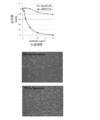
- FIG. 1 It is a figure which shows the antibiotic sensitivity of the cell in a normoxic condition and a hypoxic condition about the cell strain which integrated stably "the gene which expresses an antibiotic resistance gene under control of a HIF-1 responsive promoter.”
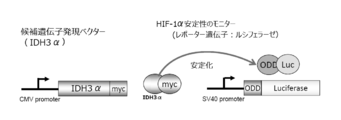
- Reference Example 1 It is a conceptual diagram which shows the system for confirming the effect
- Example 1 It is the figure which transplanted the cancer cell line which integrated stably the shRNA expression vector with respect to IDH3 (alpha), or the shRNA expression vector for negative controls to the immunodeficient mouse
- Example 1 It is the photograph which confirmed the magnitude
- Example 1 It is the figure which transplanted the cancer cell line which each integrated stably the shRNA expression vector with respect to IDH3 (alpha) or HIF-1 (alpha) to an immunodeficient mouse, and confirmed subsequent tumor growth.
- Example 2 It is a photograph figure which shows the intravascular tumor blood vessel which transplanted the cancer cell line which integrated stably the shRNA expression vector with respect to IDH3 (alpha), or the shRNA expression vector for negative controls to the immunodeficient mouse
- Example 3 It is a figure which shows the result of having transplanted the cancer cell line which integrated stably the shRNA expression vector with respect to IDH3 (alpha), or the shRNA expression vector for negative controls to the immunodeficient mouse
- IDH3 means isocitrate dehydrogenase 3 (Isocitrate Dehydrogenase 3).
- the present invention relates to a novel antitumor agent comprising an IDH3 inhibitor as an active ingredient.
- IDH3 is a heterotetramer composed of two molecules of ⁇ subunit (hereinafter “IDH3 ⁇ ”), one molecule of ⁇ subunit (hereinafter “IDH3 ⁇ ”) and one molecule of ⁇ subunit (hereinafter “IDH3 ⁇ ”). .
- the “IDH3 inhibitory substance” may be any substance that can suppress IDH3 activity, and in order to suppress IDH3 activity, a substance that targets at least one subunit among the subunits constituting IDH3 If it is.
- the target subunit is particularly preferably IDH3 ⁇ .
- the expression suppression of IDH3 ⁇ or the function of IDH3 ⁇ may be suppressed.
- suppression of IDH3 ⁇ expression refers to suppression of expression of IDH3 ⁇ biosynthetic gene (hereinafter simply referred to as “IDH3 ⁇ gene”), and any of the gene expression control processes including transcription and translation. It means the action of inhibiting the stage.
- suppression of the function of IDH3 ⁇ refers to suppression of the function of IDH3 on isocitrate dehydrogenase activity by inhibiting part or all of IDH3 ⁇ .
- the IDH3 inhibitor include antisense nucleic acids, ribozyme nucleic acids, siRNA, shRNA, low molecular compounds that suppress IDH3 ⁇ expression or IDH3 ⁇ function, peptides, enzymes, antibodies, and the like that can suppress IDH3 ⁇ expression.
- the IDH3 inhibitory substance of the present invention includes pharmaceutically acceptable salts thereof in addition to the above substances.
- IDH3 ⁇ can be identified by the amino acid sequence represented by GenBank Accession Number: NP_005521.1, and mRNA can be designated by the same Accession Number: NM_005530.2.
- IDH3 inhibitory substance of the present invention include shRNA that can suppress the expression of IDH3 ⁇ .
- sequences targeted by the shRNA include (A) to (C) shown in the following SEQ ID NOs: 1 to 3.
- C) TCACC CATCT ATGAA TTTAC T SEQ ID NO: 3
- suppressing IDH3 and suppressing HIF-1 means suppressing HIF-1 activity through suppressing IDH3 described above.
- HIF-1 means hypoxia-inducible factor 1 (Hypoxia-Inducible Factor 1).
- HIF-1 is a protein that is activated when oxygen supply to cells falls short or when cells are exposed to excessive reactive oxygen species. It is a functional substance. HIF-1 forms a heterodimer of HIF-1 ⁇ and HIF-1 ⁇ , and can exert a function of enhancing transcription of various genes as a transcription factor.
- an oxygen-dependent degradation domain (Oxygen-dependent) degradation domain: ODD) exists in the approximate center of the HIF-1 ⁇ protein.
- ODD oxygen-dependent degradation domain
- HIF-1 ⁇ expression refers to suppression of HIF-1 ⁇ biosynthetic gene expression (hereinafter simply referred to as “HIF-1 ⁇ gene”), and gene expression including transcription and translation. It means an action that inhibits any step of the control process.
- the suppression of the function of HIF-1 ⁇ refers to the suppression of the function exerted on the activity of HIF-1 by inhibiting part or all of HIF-1 ⁇ . Suppressing HIF-1 effectively exerts an antitumor effect against refractory malignant tumors such as radiation resistant cancer and chemotherapeutic resistant cancer such as chemotherapeutic agents. sell.
- the present invention also extends to an HIF-1 inhibitor containing an IDH3 inhibitor as an active ingredient. That is, a drug containing an effective amount of the IDH3 inhibitory substance of the present invention is not limited to an antitumor agent as long as functions other than the antitumor effect can be exhibited by the HIF-1 inhibitory action.
- the IDH3 inhibitor contained in the novel antitumor agent of the present invention as an active ingredient may exert an antitumor action by a mechanism different from the action mechanism resulting from the relationship between IDH3 and HIF-1.
- the novel antitumor agent or HIF-1 inhibitor of the present invention contains an effective amount of an IDH3 inhibitory substance as an active ingredient, and may also contain additives generally used in medicine.
- Additives include excipients, binders, lubricants, disintegrants, colorants, flavoring agents, emulsifiers, surfactants, solubilizers, suspending agents, isotonic agents, buffers, preservatives Agents, antioxidants, stabilizers, absorption promoters and the like, and these can be used in appropriate combinations as desired.
- excipient examples include lactose, sucrose, glucose, corn starch, mannitol, sorbitol, starch, pregelatinized starch, dextrin, crystalline cellulose, light anhydrous silicic acid, aluminum silicate, calcium silicate, and metasilicate.
- examples thereof include magnesium aluminate acid and calcium hydrogen phosphate.
- the binder include polyvinyl alcohol, methylcellulose, ethylcellulose, gum arabic, tragacanth, gelatin, shellac, hydroxypropylmethylcellulose, hydroxypropylcellulose, sodium carboxymethylcellulose, polyvinylpyrrolidone, macrogol and the like.
- Examples of the lubricant include magnesium stearate, calcium stearate, sodium stearyl fumarate, talc, polyethylene glycol, colloidal silica and the like.
- Examples of the disintegrant include crystalline cellulose, agar, gelatin, calcium carbonate, sodium bicarbonate, calcium citrate, dextrin, pectin, low-substituted hydroxypropylcellulose, carboxymethylcellulose, carboxymethylcellulose calcium, croscarmellose sodium, carboxymethyl Examples include starch and sodium carboxymethyl starch.
- Examples of the colorant include those allowed to be added to pharmaceuticals such as iron sesquioxide, yellow sesquioxide, carmine, caramel, ⁇ -carotene, titanium oxide, talc, riboflavin sodium phosphate, yellow aluminum lake, etc. Can be mentioned.
- Examples of the flavoring agent include cocoa powder, mint brain, aroma powder, mint oil, menthol, dragon brain, and cinnamon powder.
- Examples of the emulsifier or surfactant include stearyl triethanolamine, sodium lauryl sulfate, laurylaminopropionic acid, lecithin, glyceryl monostearate, sucrose fatty acid ester, and glycerin fatty acid ester.
- solubilizer examples include polyethylene glycol, propylene glycol, benzyl benzoate, ethanol, cholesterol, triethanolamine, sodium carbonate, sodium citrate, polysorbate 80, and nicotinamide.
- suspending agent examples include hydrophilic polymers such as polyvinyl alcohol, polyvinyl pyrrolidone, methyl cellulose, hydroxymethyl cellulose, hydroxyethyl cellulose, and hydroxypropyl cellulose, in addition to the surfactant.
- examples of the isotonic agent include glucose, sodium chloride, mannitol, sorbitol and the like.
- buffer examples include buffer solutions such as phosphate, acetate, carbonate, citrate.
- Examples of the preservative include methyl paraben, propyl paraben, chlorobutanol, benzyl alcohol, phenethyl alcohol, dehydroacetic acid, sorbic acid and the like.
- Examples of the antioxidant include sulfite, ascorbic acid, ⁇ -tocopherol and the like.
- Examples of the stabilizer include ascorbic acid, sodium edetate, erythorbic acid, tocopherol and the like.
- Examples of the absorption promoter include isopropyl myristate, tocopherol, calciferol and the like.
- the present invention also extends to a method for screening a novel antitumor agent using IDH3 activity suppression as an index.
- the screening method for a novel antitumor agent of the present invention is not particularly limited as long as it is a system that can evaluate the activity of IDH3.
- it can be performed by a method including the following steps. 1) a step of treating a cell line capable of expressing IDH3 ⁇ with a candidate substance; 2) A step of measuring IDH3 ⁇ expression level or IDH3 activity for the above cell lines before and after treatment with a candidate substance, and evaluating IDH3 activity suppression from IDH3 ⁇ expression level or IDH3 activity.
- the cell line capable of expressing IDH3 ⁇ is preferably a cell line that expresses a reporter gene in an HIF-1-dependent manner.
- the reporter gene is stably integrated downstream of the HIF-1-responsive promoter.
- a cell line capable of expressing IDH3 ⁇ may contain a fusion gene of a reporter gene and a gene encoding the ODD region of HIF-1 ⁇ instead of the HIF-1 responsive promoter.
- a cell line prepared in advance may be used, or a step of preparing the cell line may be included in the step of the screening method of the present invention.
- the reporter gene a gene known per se can be used. Although not particularly limited, it is preferable to use a gene capable of emitting light or fluorescence such as luciferase or GFP.
- a cell line that can be used in the screening method of the present invention can be constructed by the following method. First, a cell line that stably incorporates a reporter gene downstream of the HIF-1-responsive promoter is established. Furthermore, a vector capable of expressing IDH3 ⁇ in large quantities is introduced into the cells. Since IDH3 ⁇ activates HIF-1, a cell line incorporating the reporter gene emits intense luminescence when an IDH3 mass expression vector is introduced. Examples of cell lines that can be used include human cervical cancer-derived cell line HeLa, human alveolar carcinoma-derived cell line A549, and human colon cancer-derived cell line Colon 26.
- the novel anti-tumor of the present invention is obtained by culturing the cells established as described above or already established in a medium containing a candidate substance, and measuring an indicator derived from a reporter gene, such as luminescence and fluorescence, for the cultured cells. Agents can be screened. Specifically, the selected substance can be the antitumor agent of the present invention when the candidate substance shows a decrease in the amount of luminescence or fluorescence, or a decrease in the expression level of IDH3 ⁇ .
- screening may be performed by the following method, for example. 1) a step of treating a cell line capable of expressing IDH3 ⁇ with a candidate substance; 2) Obtain an extract from cells treated with the candidate substance, Western blotting or ELISA using IDH3 ⁇ antibody or HIF-1 ⁇ antibody, and antibodies against downstream HIF-1 genes such as VEGF, etc. To evaluate IDH3 activity suppression by confirming the expression level of IDH3 ⁇ , HIF-1 ⁇ or HIF-1 downstream gene and the activity of HIF-1 or HIF-1 downstream gene, etc. .
- the candidate substances screened above are HIF-1 responsive reporter genes, for example, the tumor cells obtained by transplanting cancer cells stably incorporating a reporter gene downstream of the HIF-1 responsive promoter into immunodeficient mice.
- the cancer mouse can be evaluated by observing, visualizing, and quantifying a reporter substance such as a luminescent protein or a fluorescent protein that is expressed in an HIF-1-dependent manner after the cancer mouse is treated with the screened candidate substance.
- the IDH3 inhibitor contained as an active ingredient in the novel antitumor agent of the present invention was achieved as a result of repeated investigations by selecting target substances by focusing on the activity of HIF-1 by the method of Reference Example 1 below. It is a thing.
- a new antitumor agent can be screened by a screening method focusing on the activity of HIF-1.
- the novel antitumor agent of the present invention contains an IDH3 inhibitory substance as an active ingredient, and IDH3 ⁇ is cited as the target substance. It is done. In this reference example, the reason why IDH3 ⁇ has been selected as a target substance will be described.
- HIF-1 which is a kind of hypoxia-inducible factor
- the present inventors have reported that cancer treatment resistance and malignancy are enhanced through activation of HIF-1.
- the mechanism by which HIF-1 is activated and where the HIF-1-positive cancer cells involved in treatment resistance are located in the tumor and what kinetics / behavior is shown. was not revealed. Therefore, the present inventor conducted an experiment to exhaustively search for factors (genes) that activate HIF-1.
- FIG. 2 shows the cell viability when the cells were cultured under normoxic and hypoxic conditions using a medium containing antibiotics at various concentrations.
- a cDNA library is appropriately introduced into the cells established above using a retroviral vector, 20%) cells were cultured in a medium containing blasticidin, and cells that formed colonies were selected (see FIG. 1). In the surviving cells, HIF-1 was activated by the function of the gene integrated (incorporated) into the genomic DNA, and it was expected that the expression of the blasticidin resistance gene was induced as a result. Therefore, the cDNA fragment was amplified by performing a PCR reaction using “genomic DNA purified from living cells” as a template and further using a “primer sandwiching the inserted cDNA”.
- This DNA fragment was subcloned into the EcoRV site of a general-purpose plasmid vector (specifically, pBlueScript II SK +).
- a general-purpose plasmid vector specifically, pBlueScript II SK +.
- HeLa / 5HRE-Luc cells are introduced with the respective shRNA (A)-(C) expression plasmids or shRNA (Scr) expression plasmids for negative control, and under normal oxygen (20%) or hypoxia (0.02%) environment After culturing in, a luciferase assay was performed. (See Figure 5)
- IDH3 ⁇ can be identified by the amino acid sequence represented by GenBank Accession Number: NP_005521.1, and mRNA can be identified by the Accession Number: NM_005530.2. it can.
- HIF-1 protein is composed of HIF-1 ⁇ and HIF-1 ⁇ subunits.
- HIF-1 ⁇ one of the subunits, undergoes oxygen-dependent ubiquitination and is rapidly degraded after translation in normoxic cells.
- ODD oxygen-dependent degradation domain
- Cell extract was obtained from the above-mentioned IDH3 ⁇ forced expression cell line (HeLa / IDH3 ⁇ 1-3) and negative control cell line (HeLa / EV31-3), and the expression of IDH3 ⁇ derived from pcDNA4A / IDH3 ⁇ plasmid was fused. Detected with antibody against myc tag. On the other hand, by using an antibody against IDH3 ⁇ , the expression of endogenous IDH3 ⁇ was confirmed together with the IDH3 ⁇ protein fused with the myc tag derived from the pcDNA4A / IDH3 ⁇ plasmid. Both proteins could be detected independently with or without myc tag.
- Example 1 Effect of shRNA on IDH3 ⁇ gene
- Cell line in which expression of endogenous IDH3 ⁇ is constitutively knocked down by stably incorporating each expression plasmid of shRNA (A) to (C) against IDH3 ⁇ into HeLa cell line (HeLa / shIDH3 ⁇ A2, A5, B2, B4, C1, C2) was established.
- cell lines (HeLa / shRNA (Scr) N5, N9) stably incorporating the shRNA (Scr) expression plasmid were established. After culturing these cell lines under normoxic conditions (20%) or hypoxic conditions (0.02%), cell extracts were obtained, and Western blotting was performed using anti-HIF-1 ⁇ antibody and anti-IDH3 ⁇ antibody.
- Example 2 Anti-tumor effect by knockdown of IDH3 ⁇ gene or HIF-1 ⁇ gene shRNA (B) expression plasmid for IDH3 ⁇ gene, shRNA expression plasmid for HIF-1 ⁇ gene, and shRNA (Scr) expression plasmid of negative control HeLa cells stably incorporating each of these were transplanted into immunodeficient mice, and the tumor size was measured. As a result, more effective tumor growth inhibitory effect was observed in the tumor in which the IDH3 ⁇ gene was knocked down compared to the tumor in which the HIF-1 ⁇ gene was knocked down (FIG. 15). From the above, it was confirmed that suppressing IDH3 ⁇ can more effectively suppress tumor growth than directly suppressing HIF-1 ⁇ .
- IDH3 ⁇ has actions other than stabilizing HIF-1 ⁇ .
- a substance capable of suppressing IDH3, specifically, at least one of the subunits constituting IDH3, specifically, a substance capable of suppressing IDH3 ⁇ can exert an effect as an antitumor agent. .
- Example 3 Action of shRNA on IDH3 ⁇ gene “Cell HeLa / shIDH3 ⁇ B2 in which expression of endogenous IDH3 ⁇ is constantly knocked down” established in Example 1, and “negative control cell HeLa / shRNA (Scr) N9” "And 10 million and 1 million cells, respectively, were transplanted into immunodeficient mice.
- the resulting solid tumors have the same size, i.e., 45 days after transplantation for HeLa / shIDH3 ⁇ B2 tumors, 37 days after transplantation for HeLa / shRNA (Scr) N9 tumors, the sections are removed from vascular endothelial cells. Were stained with a marker (CD31 antibody).
- the IDH3 inhibitor of the present invention has an antitumor effect. Further, the IDH3 inhibitory substance of the present invention has a HIF-1 inhibitory effect. From these actions, an effective antitumor agent can be provided by screening a substance capable of suppressing the activity of IDH3. Since the novel antitumor agent containing the IDH3 inhibitory substance of the present invention as an active ingredient can control the activity of HIF-1, it is useful for intractable tumors such as radiotherapy resistant cancer and anticancer drug resistant cancer. Even if it is effective, it can be effective.
Landscapes
- Health & Medical Sciences (AREA)
- Life Sciences & Earth Sciences (AREA)
- Chemical & Material Sciences (AREA)
- Engineering & Computer Science (AREA)
- Organic Chemistry (AREA)
- General Health & Medical Sciences (AREA)
- Genetics & Genomics (AREA)
- Biomedical Technology (AREA)
- Bioinformatics & Cheminformatics (AREA)
- Wood Science & Technology (AREA)
- Zoology (AREA)
- Molecular Biology (AREA)
- Biochemistry (AREA)
- General Engineering & Computer Science (AREA)
- Immunology (AREA)
- Biotechnology (AREA)
- Medicinal Chemistry (AREA)
- Physics & Mathematics (AREA)
- Microbiology (AREA)
- Public Health (AREA)
- Veterinary Medicine (AREA)
- Analytical Chemistry (AREA)
- Animal Behavior & Ethology (AREA)
- Biophysics (AREA)
- Proteomics, Peptides & Aminoacids (AREA)
- Pharmacology & Pharmacy (AREA)
- Urology & Nephrology (AREA)
- Hematology (AREA)
- Plant Pathology (AREA)
- Cell Biology (AREA)
- Tropical Medicine & Parasitology (AREA)
- Toxicology (AREA)
- Food Science & Technology (AREA)
- Virology (AREA)
- General Physics & Mathematics (AREA)
- Pathology (AREA)
- Chemical Kinetics & Catalysis (AREA)
- General Chemical & Material Sciences (AREA)
- Nuclear Medicine, Radiotherapy & Molecular Imaging (AREA)
- Epidemiology (AREA)
Abstract
新規抗腫瘍剤を提供する。また新規抗腫瘍剤のスクリーニング方法を提供する。更に悪性腫瘍の新規治療方法を提供する。イソクエン酸脱水素酵素3(IDH3)抑制物質を有効成分として含む新規抗腫瘍剤による。IDH3の活性抑制を指標とする、新規抗腫瘍剤のスクリーニング方法による。さらに、IDH3を構成するサブユニットの少なくとも一つを標的因子として抑制することを含む、腫瘍の新規治療方法による。固形腫瘍内に常在する低酸素環境での低酸素誘導因子1(HIF-1)の活性化を介してがんの治療抵抗性が亢進することに着目し、HIF-1の活性化を制御しうる物質を探索したところ、IDH3がHIF-1の活性化に寄与していることを初めて見出し、本発明を完成した。
Description
本発明は、新規抗腫瘍剤に関し、また新規抗腫瘍剤のスクリーニング方法に関する。さらに悪性腫瘍の新規治療方法に関する。
本出願は、参照によりここに援用されるところの日本出願特願2011-138981号優先権を請求する。
厚生労働省が公表した資料によると、日本人男性の約2人に1人、女性の約3人に1人が一生のうちに"がん"と診断され、肝臓がん、すい臓がん、肺がん患者の5年生存率はわずか20%にも満たないことが報告されている。生命予後不良の主因は、腫瘍内の不均一(ヘテロ)な微小環境下で、一部のがん細胞が抗がん剤や放射線治療へ抵抗性を獲得することにあると考えられている。例えば悪性固形腫瘍内の低酸素環境下では低酸素誘導因子1(Hypoxia Inducible Factor-1:以下、単に「HIF-1」という場合もある。)が活性化し、がん細胞の治療抵抗性、転移・浸潤能、血管新生が亢進することが知られている(非特許文献1)。また、抗がん剤や放射線治療後の腫瘍内微小環境変化に応答してHIF-1が活性化し、がんの治療抵抗性が亢進することが報告されている(非特許文献2、3)。
正常組織内部と異なり、固形腫瘍内部は極めて異質な微小環境で構成されている。腫瘍血管の遠位には十分な酸素や栄養源が供給されない低酸素、低栄養な環境が存在する。その一方で、解糖系や乳酸発酵によるATP産生が盛んな領域には酸性(低pH)環境が存在する。がん細胞はこれら過酷な微小環境を生き延びるために必要な遺伝子の発現を誘導する。例えば、低酸素環境に存在するがん細胞は、HIF-1という転写因子を活性化して低酸素環境でのエネルギー産生(グルコース代謝経路の変換)、低酸素環境の改善(血管新生)、低酸素環境からの回避(転移・浸潤)を図る。このような、がん細胞の環境応答システムが、がんの治療抵抗性においても重要な役割を果たしていることが報告されている(非特許文献3)。すなわち、抗がん剤や放射線治療によって腫瘍内微小環境が変化し、HIF-1が活性化することで、血管内皮増殖因子(Vascular Endothelial Growth Factor:VEGF)の発現を誘導し、VEGFが腫瘍血管内皮細胞の放射線障害を軽減し、腫瘍血管系が崩壊を免れ、がん細胞への酸素と栄養源の供給が保障され、最終的に放射線治療後のがん細胞の生存が保障されるという作用がはたらく。
固形腫瘍内に常在する低酸素環境下(固形腫瘍内低酸素領域)では、放射線感受性が著しく低下するため、腫瘍低酸素はがんの放射線治療成績不良の一因とされている。また近年、低酸素は特異的な遺伝子発現を誘導することにより、腫瘍増殖、血管新生、転移を促進する可能性が指摘されている。事実、子宮頸がん、頭頚部がん等の腫瘍内酸素分圧測定を施行した国内外の臨床研究において、低酸素分画の多寡と治療効果や生命予後との間に強い相関が報告されている。
HIF-1は、細胞に対する酸素供給が不足状態に陥った時や細胞が過剰な活性酸素種にさらされた時に誘導されてくるタンパク質であり、転写因子として機能する。がんの病巣においては栄養不足や細胞外pHの低下、血流不足による酸素供給不足(低酸素)状態が認められるが、がん細胞が生き延びるためには新たに血管網を形成することにより病巣への血流を確保し、低酸素状態を脱する必要がある。そのための機能を担うべく低酸素条件において誘導される転写因子がHIF-1であり、種々の遺伝子の転写を亢進させる。HIF-1は様々な遺伝子発現の制御に関与しており、たとえば血管新生や細胞増殖、糖代謝、pH調節やアポトーシスなどに関わる遺伝子が挙げられる。HIF-1による発現制御を受ける遺伝子としてエリスロポエチンやVEGF等が挙げられる。HIF-1は、αとβの2つのサブユニットから構成されている。HIF-1αはアドレノメデュリンやマトリックスメタロプロテアーゼ(MMPs)、エンドセリン(ET)-1、一酸化窒素合成酵素(NOS)2など様々な遺伝子の制御を行っているといわれている。HIF-1αは有酸素状態の細胞内でユビキチン化を受け、タンパク質分解酵素複合体である26Sプロテアソームにより速やかに分解される。
上記メカニズムに鑑み、HIF-1を抑制する抗腫瘍剤について開発が進められている。例えば、HIF-1遺伝子に対するアンチセンスオリゴヌクレオチド(Enzon、National Cancer Institute、Santaris Pharma)やHIF-1活性を抑制する低分子化合物(Abbot社)が挙げられる。またHIF-1抑制剤として、HSP90阻害剤等も報告されている(非特許文献4)。しかしながら、HIF-1がどのような機序で活性化するのか、また治療抵抗性に関わるHIF-1陽性がん細胞が腫瘍内のどこに局在し、どの様な病態・挙動を示すのかは明らかにされておらず、がんの完治を目指すうえで大きな障害となっている。
イソクエン酸脱水素酵素(isocitrate dehydrogenase:以下、単に「IDH」という場合もある。)にはいくつかのアイソフォームがあり、クエン酸回路(TCA回路)において、イソクエン酸からαケトグルタル酸への代謝に関わる酵素としてIDH1が公知である。IDHとがんの関係では、IDH1遺伝子やIDH2遺伝子に特定の変異がある場合にIDH1やIDH2の正常な機能が抑制され、腫瘍の悪性化に寄与することが報告されている(特許文献1、非特許文献5-7)。しかしながら、変異型でないIDHについて腫瘍の悪性化に関わる報告はなく、IDH1は腫瘍に対してむしろ良好な予後因子であると考えられている。
Cancer Sci. 94:1021-1028. 2003
Br J Cancer, 100:747-757. 2009
Current Signal Transduction Therapy. 5:188-196. 2010
J. Biol. Chem., 277 (33), 29936-29944 (2002)
Acta Neuropathol., 116, 597-602 (2008)
Am. J. Pathol., 174, 1149-1153 (2009)
N. Engl. J. Med., 360, 765-773 (2009)
本発明は、新規抗腫瘍剤を提供することを課題とし、また新規抗腫瘍剤のスクリーニング方法を提供することを課題とする。更に悪性腫瘍の新規治療方法を提供することを課題とする。
本発明者らは、上記課題を解決するために鋭意研究を重ねた結果、HIF-1の活性化を介してがんの治療抵抗性が亢進することに着目し、HIF-1の活性化を制御しうる物質を探索したところ、イソクエン酸脱水素酵素の一種であるIDH3がHIF-1の活性化に寄与していることを初めて見出し、本発明を完成した。
即ち本発明は、以下よりなる。
1.IDH3抑制物質を有効成分として含む、新規抗腫瘍剤。
2.IDH3抑制が、IDH3αの発現抑制又は機能抑制である、前項1に記載の新規抗腫瘍剤。
3.IDH3を抑制し、HIF-1を抑制することを特徴とする、前項1又は2に記載の新規抗腫瘍剤。
4.HIF-1を抑制することが、HIF-1αの発現抑制又は機能抑制である前項3に記載の新規抗腫瘍剤。
5.腫瘍が、難治性悪性腫瘍である、前項1~4のいずれか1に記載の新規抗腫瘍剤。
6.難治性悪性腫瘍が、放射線治療抵抗性がん及び/又は抗がん剤抵抗性がんである、前項5に記載の新規抗腫瘍剤。
7.IDH3抑制物質を有効成分として含む、HIF-1抑制剤。
8.IDH3の活性抑制を指標とする、新規抗腫瘍剤のスクリーニング方法。
9.以下の工程を含む、前項8に記載の新規抗腫瘍剤のスクリーニング方法:
1)IDH3αを発現しうる細胞株を候補物質で処理する工程;
2)候補物質で処理した前後で、上記細胞株についてIDH3αの発現量又はIDH3の活性を測定し、IDH3αの発現量又はIDH3の活性からIDH3の活性抑制を評価する工程。
10.IDH3αを発現しうる細胞株が、HIF-1依存的にレポーター遺伝子を発現する細胞株であり、IDH3αの発現量又はIDH3の活性の測定が、レポーター遺伝子産物を計測することによる、前項9に記載の新規抗腫瘍剤のスクリーニング方法。
11.IDH3を構成するサブユニットの少なくとも一つを標的因子として抑制することを含む、腫瘍の新規治療方法。
12.IDH3を構成するサブユニットの少なくとも一つがIDH3αである、前項11に記載の腫瘍の新規治療方法。
13.IDH3を構成するサブユニットの少なくとも一つを標的因子として抑制することが、IDH3αの発現抑制又は機能抑制である、前項11又は12に記載の腫瘍の新規治療方法。
14.腫瘍が、難治性悪性腫瘍である、前項11~13のいずれか1に記載に腫瘍の新規治療方法。
15.難治性悪性腫瘍が、放射線治療抵抗性がん及び/又は抗がん剤抵抗性がんである、前項14に記載の腫瘍の新規治療方法。
1.IDH3抑制物質を有効成分として含む、新規抗腫瘍剤。
2.IDH3抑制が、IDH3αの発現抑制又は機能抑制である、前項1に記載の新規抗腫瘍剤。
3.IDH3を抑制し、HIF-1を抑制することを特徴とする、前項1又は2に記載の新規抗腫瘍剤。
4.HIF-1を抑制することが、HIF-1αの発現抑制又は機能抑制である前項3に記載の新規抗腫瘍剤。
5.腫瘍が、難治性悪性腫瘍である、前項1~4のいずれか1に記載の新規抗腫瘍剤。
6.難治性悪性腫瘍が、放射線治療抵抗性がん及び/又は抗がん剤抵抗性がんである、前項5に記載の新規抗腫瘍剤。
7.IDH3抑制物質を有効成分として含む、HIF-1抑制剤。
8.IDH3の活性抑制を指標とする、新規抗腫瘍剤のスクリーニング方法。
9.以下の工程を含む、前項8に記載の新規抗腫瘍剤のスクリーニング方法:
1)IDH3αを発現しうる細胞株を候補物質で処理する工程;
2)候補物質で処理した前後で、上記細胞株についてIDH3αの発現量又はIDH3の活性を測定し、IDH3αの発現量又はIDH3の活性からIDH3の活性抑制を評価する工程。
10.IDH3αを発現しうる細胞株が、HIF-1依存的にレポーター遺伝子を発現する細胞株であり、IDH3αの発現量又はIDH3の活性の測定が、レポーター遺伝子産物を計測することによる、前項9に記載の新規抗腫瘍剤のスクリーニング方法。
11.IDH3を構成するサブユニットの少なくとも一つを標的因子として抑制することを含む、腫瘍の新規治療方法。
12.IDH3を構成するサブユニットの少なくとも一つがIDH3αである、前項11に記載の腫瘍の新規治療方法。
13.IDH3を構成するサブユニットの少なくとも一つを標的因子として抑制することが、IDH3αの発現抑制又は機能抑制である、前項11又は12に記載の腫瘍の新規治療方法。
14.腫瘍が、難治性悪性腫瘍である、前項11~13のいずれか1に記載に腫瘍の新規治療方法。
15.難治性悪性腫瘍が、放射線治療抵抗性がん及び/又は抗がん剤抵抗性がんである、前項14に記載の腫瘍の新規治療方法。
本発明のIDH3抑制物質は抗腫瘍効果を有する。また、本発明のIDH3抑制物質はHIF-1抑制効果を有する。これらの作用から、IDH3の活性を抑制しうる物質をスクリーニングすることで、効果的な抗腫瘍剤を提供しうる。
本明細書において「IDH3」とは、イソクエン酸脱水素酵素3(Isocitrate Dehydrogenase 3)を意味する。本発明は、IDH3抑制剤を有効成分として含む新規抗腫瘍剤に関する。IDH3はαサブユニット(以下、「IDH3α」)2分子、βサブユニット(以下、「IDH3β」)1分子及びγサブユニット(以下、「IDH3γ」)1分子で構成されるヘテロ4量体である。
本発明において「IDH3抑制物質」とは、IDH3活性を抑制しうる物質であればよく、IDH3活性を抑制するために、IDH3を構成するサブユニットのうち少なくとも1種のサブユニットを標的とする物質であればよい。本発明において、標的とされるサブユニットとしては、特に好ましくはIDH3αである。ここで、IDH3を抑制するために、IDH3αの発現抑制又はIDH3αの機能を抑制すればよい。ここにおいて、IDH3αの発現抑制とはIDH3αの生合成遺伝子(以下、単に「IDH3α遺伝子」という。)の発現が抑制されることをいい、転写と翻訳をはじめとする遺伝子発現制御過程のいずれかの段階を阻害する作用を意味する。また、IDH3αの機能抑制とは、IDH3αの一部又は全部を阻害することによるIDH3のイソクエン酸脱水素酵素活性に及ぼす機能を抑制することをいう。IDH3抑制物質として、例えばIDH3αの発現を抑制しうるアンチセンス核酸、リボザイム核酸、siRNA、shRNAや、IDH3αの発現若しくはIDH3αの機能を抑制する低分子化合物、ペプチド、酵素や抗体などが挙げられる。本発明のIDH3抑制物質は、上記物質の他、それらの薬学的に許容しうる塩も含まれる。ここにおいて、IDH3αは、GenBank Accession Number:NP_005521.1で示されるアミノ酸配列で特定することができ、mRNAは、同Accession Number:NM_005530.2で示すことができる。
本発明のIDH3抑制物質として、具体的にはIDH3αの発現を抑制しうるshRNAを例示することができる。当該shRNAが標的とする具体的な配列としては、以下の配列番号1~3に示す(A)~(C)が挙げられる。
(A)TGACT TGTGT GCAGG ATTGAT (配列番号1)
(B)AGATG GTATT GGCCC AGAAA T (配列番号2)
(C)TCACC CATCT ATGAA TTTAC T (配列番号3)
(A)TGACT TGTGT GCAGG ATTGAT (配列番号1)
(B)AGATG GTATT GGCCC AGAAA T (配列番号2)
(C)TCACC CATCT ATGAA TTTAC T (配列番号3)
本発明において、IDH3を抑制しHIF-1を抑制するとは、上述のIDH3を抑制することを介してHIF-1活性を抑制することを意味する。ここにおいて、「HIF-1」とは、低酸素誘導因子1(Hypoxia-Inducible Factor 1)を意味する。HIF-1は、背景技術の欄でも説明したように、細胞に対する酸素供給が不足状態に陥った時、もしくは細胞が過剰な活性酸素種に曝された時に活性化するタンパク質であり、転写因子として機能する物質である。HIF-1は、HIF-1αとHIF-1βとのヘテロ2量体を形成し、転写因子として種々の遺伝子の転写を亢進させる機能を発揮しうる。HIF-1の低酸素依存的活性を制御している部位として、HIF-1αタンパク質のほぼ中央にある酸素依存的分解ドメイン(Oxygen-dependent degradation domain: ODD)が存在する。HIF-1とがんとの関係について多く報告されていることは、背景技術の欄で説明したとおりである。
しかしながら、本発明においてIDH3とHIF-1の活性との関係を初めて見出した。IDH3とHIF-1活性との関係を初めて見出した経緯については、後述の参考例において、詳細に説明する。ここで、HIF-1活性を抑制するために、HIF-1αの発現抑制若しくは機能を抑制、又はHIF-1αとHIF-1βの結合を阻害すればよい。ここにおいて、HIF-1αの発現抑制とはHIF-1αの生合成遺伝子(以下、単に「HIF-1α遺伝子」という。)の発現が抑制されることをいい、転写と翻訳をはじめとする遺伝子発現制御過程のいずれかの段階を阻害する作用を意味する。また、HIF-1αの機能抑制とは、HIF-1αの一部又は全部を阻害することによるHIF-1の活性に及ぼす機能を抑制することをいう。HIF-1を抑制することで、腫瘍のうち難治性悪性腫瘍、例えば放射線抵抗性がんや化学療法剤などの抗がん剤抵抗性がんに対して、効果的に抗腫瘍効果を発揮しうる。また、本発明は、IDH3抑制物質を有効成分として含むHIF-1抑制剤にも及ぶ。即ち、HIF-1抑制作用によって、抗腫瘍効果以外の機能を発揮しうるのであれば、本発明のIDH3抑制物質を有効量含む薬剤は抗腫瘍剤に限定されるものではない。
本発明の新規抗腫瘍剤に有効成分として含まれるIDH3抑制物質は、IDH3とHIF-1との関係に起因する作用機序とは異なる機序によって抗腫瘍作用を発揮することもあり得る。
本発明の新規抗腫瘍剤又はHIF-1抑制剤は、有効成分としてのIDH3抑制物質を有効量含む他、一般に医薬に使用される添加剤を含んでいてもよい。添加剤としては、賦形剤、結合剤、滑沢剤、崩壊剤、着色剤、矯味矯臭剤、乳化剤、界面活性剤、溶解補助剤、懸濁化剤、等張化剤、緩衝剤、防腐剤、抗酸化剤、安定化剤、吸収促進剤等を挙げることができ、所望により、これらを適宜組み合わせて使用することもできる。
具体的には、上記賦形剤としては、例えば乳糖、白糖、ブドウ糖、コーンスターチ、マンニトール、ソルビトール、デンプン、α化デンプン、デキストリン、結晶セルロース、軽質無水ケイ酸、ケイ酸アルミニウム、ケイ酸カルシウム、メタケイ酸アルミン酸マグネシウム、リン酸水素カルシウム等を挙げることができる。上記結合剤としては、例えばポリビニルアルコール、メチルセルロース、エチルセルロース、アラビアゴム、トラガント、ゼラチン、シェラック、ヒドロキシプロピルメチルセルロース、ヒドロキシプロピルセルロース、カルボキシメチルセルロースナトリウム、ポリビニルピロリドン、マクロゴール等を挙げることができる。上記滑沢剤としては、例えばステアリン酸マグネシウム、ステアリン酸カルシウム、フマル酸ステアリルナトリウム、タルク、ポリエチレングリコール、コロイドシリカ等を挙げることができる。上記崩壊剤としては、例えば結晶セルロース、寒天、ゼラチン、炭酸カルシウム、炭酸水素ナトリウム、クエン酸カルシウム、デキストリン、ペクチン、低置換度ヒドロキシプロピルセルロース、カルボキシメチルセルロース、カルボキシメチルセルロースカルシウム、クロスカルメロースナトリウム、カルボキシメチルスターチ、カルボキシメチルスターチナトリウム等を挙げることができる。上記着色剤としては、例えば三二酸化鉄、黄色三二酸化鉄、カルミン、カラメル、β-カロチン、酸化チタン、タルク、リン酸リボフラビンナトリウム、黄色アルミニウムレーキ等、医薬品に添加することが許可されているものを挙げることができる。上記矯味矯臭剤としては、例えばココア末、ハッカ脳、芳香散、ハッカ油、メントール、竜脳、桂皮末等を挙げることができる。上記乳化剤又は界面活性剤としては、例えばステアリルトリエタノールアミン、ラウリル硫酸ナトリウム、ラウリルアミノプロピオン酸、レシチン、モノステアリン酸グリセリン、ショ糖脂肪酸エステル、グリセリン脂肪酸エステル等を挙げることができる。上記溶解補助剤としては、例えばポリエチレングリコール、プロピレングリコール、安息香酸ベンジル、エタノール、コレステロール、トリエタノールアミン、炭酸ナトリウム、クエン酸ナトリウム、ポリソルベート80、ニコチン酸アミド等を挙げることができる。上記懸濁化剤としては、前記界面活性剤のほか、例えばポリビニルアルコール、ポリビニルピロリドン、メチルセルロース、ヒドロキシメチルセルロース、ヒドロキシエチルセルロース、ヒドロキシプロピルセルロース等の親水性高分子を挙げることができる。上記等張化剤としては、例えばブドウ糖、塩化ナトリウム、マンニトール、ソルビトール等を挙げることができる。上記緩衝剤としては、例えばリン酸塩、酢酸塩、炭酸塩、クエン酸塩などの緩衝液を挙げることができる。上記防腐剤としては、例えばメチルパラベン、プロピルパラベン、クロロブタノール、ベンジルアルコール、フェネチルアルコール、デヒドロ酢酸、ソルビン酸等を挙げることができる。上記抗酸化剤としては、例えば亜硫酸塩、アスコルビン酸、α-トコフェロール等を挙げることができる。上記安定化剤としては、アスコルビン酸、エデト酸ナトリウム、エリソルビン酸、トコフェロール等を挙げることができる。上記吸収促進剤としては、ミリスチン酸イソプロピル、トコフェロール、カルシフェロール等を挙げることができる。
本発明は、IDH3の活性抑制を指標とする新規抗腫瘍剤のスクリーニング方法にも及ぶ。本発明の、新規抗腫瘍剤のスクリーニング方法は、IDH3の活性を評価可能な系であればよく、特に限定されないが、例えば以下の工程を含む方法により行うことができる。
1)IDH3αを発現しうる細胞株を候補物質で処理する工程;
2)候補物質で処理した前後で、上記細胞株についてIDH3αの発現量又はIDH3の活性を測定し、IDH3αの発現量又はIDH3の活性からIDH3の活性抑制を評価する工程。
1)IDH3αを発現しうる細胞株を候補物質で処理する工程;
2)候補物質で処理した前後で、上記細胞株についてIDH3αの発現量又はIDH3の活性を測定し、IDH3αの発現量又はIDH3の活性からIDH3の活性抑制を評価する工程。
IDH3αを発現しうる細胞株は、HIF-1依存的にレポーター遺伝子を発現する細胞株であることが好ましく、例えばHIF-1応答性プロモーターの下流にレポーター遺伝子が安定に組み込まれているのが好適である。IDH3αを発現しうる細胞株には、HIF-1応答性プロモーターの代わりに、レポーター遺伝子とHIF-1αのODD領域をコードする遺伝子の融合遺伝子を含めてもよい。係る細胞株は、予め作製した細胞株を用いてもよいし、本発明のスクリーニング方法の工程に細胞株を準備する工程を含めてもよい。レポーター遺伝子としては、自体公知の遺伝子を使用することができ、特に限定されないがルシフェラーゼやGFP等のように発光や蛍光を発しうる遺伝子を用いるのが好適である。
本発明のスクリーニング方法に使用可能な細胞株は、以下の方法により構築することができる。まずはじめに、HIF-1応答性プロモーターの下流にレポーター遺伝子を安定に組み込んだ細胞株を樹立する。さらにIDH3αを大量に発現しうるベクターを前記細胞に導入する。IDH3αはHIF-1を活性化するため、当該レポーター遺伝子を組み込んだ細胞株は、IDH3大量発現ベクターを導入した場合に強い発光を生じる。使用可能な細胞株としては、例えばヒト子宮頸がん由来細胞株HeLa、ヒト肺胞上皮がん由来細胞株A549、ヒト大腸がん由来細胞株Colon26などが挙げられる。
上記で樹立された、又は既に樹立された細胞を、候補物質を含む培地で培養し、培養細胞についてレポーター遺伝子由来の指標、例えば発光量や蛍光量を測定することで、本発明の新規抗腫瘍剤をスクリーニングすることができる。具体的には、候補物質により発光量や蛍光量の低下、又はIDH3αの発現量の低下を認めた場合に、選別された物質は本発明の抗腫瘍剤となりえる。
上記の他、例えば以下の方法によりスクリーニングを行ってもよい。
1)IDH3αを発現しうる細胞株を候補物質で処理する工程;
2)候補物質で処理した細胞から抽出液を得、IDH3α抗体又はHIF-1α抗体、さらには例えばVEGFなどに代表されるHIF-1下流遺伝子に対する抗体などを利用したウェスタンブロッティングやELISA、もしくは対象とする遺伝子の活性測定などを行い、IDH3α、HIF-1α又はHIF-1下流遺伝子の発現量及びHIF-1やHIF-1下流遺伝子の活性などを確認することで、IDH3の活性抑制を評価する工程。
1)IDH3αを発現しうる細胞株を候補物質で処理する工程;
2)候補物質で処理した細胞から抽出液を得、IDH3α抗体又はHIF-1α抗体、さらには例えばVEGFなどに代表されるHIF-1下流遺伝子に対する抗体などを利用したウェスタンブロッティングやELISA、もしくは対象とする遺伝子の活性測定などを行い、IDH3α、HIF-1α又はHIF-1下流遺伝子の発現量及びHIF-1やHIF-1下流遺伝子の活性などを確認することで、IDH3の活性抑制を評価する工程。
上記でスクリーニングされた候補物質は、HIF-1応答性レポーター遺伝子、例えばHIF-1応答性プロモーターの下流にレポーター遺伝子を安定に組み込こんだがん細胞を免疫不全マウスに移植し、得られた担がんマウスを前記スクリーニングされた候補物質で処理した後、HIF-1依存的に発現するレポーター物質、例えば発光タンパク質や蛍光タンパク質を観察・可視化・定量することで評価することができる。
本発明の新規抗腫瘍剤に有効成分として含有されるIDH3抑制剤は、下記の参考例1の方法によりHIF-1の活性に着目して標的物質を選別し、鋭意検討を重ねた結果達成されたものである。本発明のIDH3抑制剤のみならず、HIF-1の活性に着目した選別方法により、あらたな抗腫瘍剤をスクリーニングすることができる。
本発明の理解を深めるために、以下に本発明の新規抗腫瘍剤を完成させるに至った経緯を参考例に示し、本発明を実施例に示してより具体的に説明するが、本発明はこれに限定されるものではないことはいうまでもない。
(参考例1)本発明の新規抗腫瘍剤の標的物質を選別するに至った経緯
本発明の新規抗腫瘍剤は、IDH3抑制物質を有効成分として含むものであり、その標的物質としてIDH3αが挙げられる。本参考例では、IDH3αが標的物質として選別されるに至った経緯を説明する。
本発明の新規抗腫瘍剤は、IDH3抑制物質を有効成分として含むものであり、その標的物質としてIDH3αが挙げられる。本参考例では、IDH3αが標的物質として選別されるに至った経緯を説明する。
低酸素誘導性因子の一種であるHIF-1については、HIF-1の活性化を介して、がんの治療抵抗性及び悪性化が亢進することが、本発明者らにより報告されている(非特許文献2、3)。しかしながら、HIF-1がどのような機序で活性化するのか、また治療抵抗性に関わるHIF-1陽性がん細胞が腫瘍内の何処に局在し、どのような動態・挙動を示すのかは、明らかにされていなかった。そこで、本発明者はHIF-1を活性化する因子(遺伝子)を網羅的に探索する実験を実施した。まず、血管内皮細胞増殖因子(VEGF)遺伝子のプロモーター由来のHIF-1応答性エンハンサーHREを含む人工的なHIF-1応答性プロモーターの制御下で、ブラストサイジンという抗生物質への耐性を担うタンパク質を発現する遺伝子を構築した。そして、当該遺伝子を安定に組み込んだ細胞株を樹立した(図1参照)。
上記細胞株によるブラストサイジン耐性遺伝子の発現は、HIF-1応答性プロモーターの制御下にあるため、有酸素条件ではブラストサイジン耐性タンパク質の発現が認められない。その結果、当該細胞株は酸素存在下で薬剤に感受性を示して死滅する。逆に、低酸素刺激などによってHIF-1活性が亢進した場合に、当該細胞はブラストサイジン耐性タンパク質を発現するようになり、結果として薬剤耐性を示す。各濃度の抗生物質を含む培地を用いて上記細胞を常酸素条件及び低酸素条件で培養した際の細胞生存率を図2に示した。
HIF-1活性化に影響を及ぼしうる遺伝子を網羅的に探索(スクリーニング)するために、上記で樹立した細胞に、レトロウィルスベクターを利用してcDNAライブラリーを適宜導入し、これを常酸素(20%)条件下にてブラストサイジンを含む培地で培養し、コロニーを形成する細胞を選択した(図1参照)。ここで生き残った細胞内では、ゲノムDNAにインテグレートされた(組込まれた)遺伝子の機能によってHIF-1が活性化し、結果としてブラストサイジン耐性遺伝子の発現が誘導されていることが期待できた。そこで"生存細胞から精製したゲノムDNA"を鋳型とし、さらに"挿入されたcDNAを挟みこむプライマー"を用いてPCR反応を行うことで、当該cDNA断片を増幅した。このDNA断片を汎用のプラスミドベクター(具体的にはpBlueScript II SK+)のEcoRV部位にサブクローニングした。T7プライマーとT3プライマーを用いて挿入されたcDNAの塩基配列を解析し、その情報を基にホモロジー検索を実施した結果、HIF-1を活性化する機能を持ち得る遺伝子としてIDH3αを同定するに至った。
(参考例2)IDH3αによるHIF-1活性に及ぼす影響
参考例1にて獲得したIDH3αがHIF-1を活性化する機能を有することを確認する目的で、以下の実験を行った(図3参照)。まずヒトIDH3α cDNAをpcDNA4/myc-His Aプラスミド(Invitrogen社)のEcoR1-Xho1部位に挿入し、IDH3α強制発現プラスミドpcDNA4A/IDH3αを構築した。当該強制発現プラスミド内では、IDH3α遺伝子の翻訳終結コドンが欠失されていること、またIDH3α構造遺伝子とその下流のmycタグがインフレームで融合されていることから、当該プラスミドはIDH3αとmycタグの融合タンパク質を強制発現する。HIF-1依存的にルシフェラーゼを発現する5HREp-lucレポーター遺伝子を安定に組み込んだヒト子宮頸がん由来細胞株HeLa/5HRE-Luc(Harada et al. Mol Imaging, 4: 182-193. 2005)に、当該pcDNA4A/IDH3αをトランスフェクトした。常酸素(20%)又は低酸素(0.02%)条件下で培養した後に細胞溶解用試薬(Passive Lysis buffer:Promega社)を用いて細胞抽出液を得、ルシフェラーゼアッセイキット(Promoga社)を用いて、当該細胞抽出液中のルシフェラーゼ活性を定量した。陰性対照実験として、IDH3α cDNAを組み込んでいないpcDNA4/myc-His Aプラスミド(Empty Vector:以下、単に「空ベクター」という。)を用いて同様の実験を行った。その結果、空ベクターを導入した場合と比較して、pcDNA4A/IDH3αを導入した場合に、酸素条件に関わらず有意にルシフェラーゼ活性が亢進することを確認した(図4参照)。この結果は、IDH3αの過剰発現によって、HIF-1が活性化したことを示している。
参考例1にて獲得したIDH3αがHIF-1を活性化する機能を有することを確認する目的で、以下の実験を行った(図3参照)。まずヒトIDH3α cDNAをpcDNA4/myc-His Aプラスミド(Invitrogen社)のEcoR1-Xho1部位に挿入し、IDH3α強制発現プラスミドpcDNA4A/IDH3αを構築した。当該強制発現プラスミド内では、IDH3α遺伝子の翻訳終結コドンが欠失されていること、またIDH3α構造遺伝子とその下流のmycタグがインフレームで融合されていることから、当該プラスミドはIDH3αとmycタグの融合タンパク質を強制発現する。HIF-1依存的にルシフェラーゼを発現する5HREp-lucレポーター遺伝子を安定に組み込んだヒト子宮頸がん由来細胞株HeLa/5HRE-Luc(Harada et al. Mol Imaging, 4: 182-193. 2005)に、当該pcDNA4A/IDH3αをトランスフェクトした。常酸素(20%)又は低酸素(0.02%)条件下で培養した後に細胞溶解用試薬(Passive Lysis buffer:Promega社)を用いて細胞抽出液を得、ルシフェラーゼアッセイキット(Promoga社)を用いて、当該細胞抽出液中のルシフェラーゼ活性を定量した。陰性対照実験として、IDH3α cDNAを組み込んでいないpcDNA4/myc-His Aプラスミド(Empty Vector:以下、単に「空ベクター」という。)を用いて同様の実験を行った。その結果、空ベクターを導入した場合と比較して、pcDNA4A/IDH3αを導入した場合に、酸素条件に関わらず有意にルシフェラーゼ活性が亢進することを確認した(図4参照)。この結果は、IDH3αの過剰発現によって、HIF-1が活性化したことを示している。
IDH3αが真にHIF-1を活性化しうるか否かを検討する目的で、IDH3α遺伝子内の以下の(A)~(C)の配列に対するshRNA発現プラスミド(SABiosciences社:品番KH15075P)を用いて実験を行った。陰性対照として、ヒト遺伝子の何れにも一致しない以下(D)の配列に対するshRNA(Scr)発現プラスミドを用いた。
(A)TGACT TGTGT GCAGG ATTGAT (配列番号1)
(B)AGATG GTATT GGCCC AGAAA T (配列番号2)
(C)TCACC CATCT ATGAA TTTAC T (配列番号3)
(D)GGAAT CTCAT TCGAT GCATA C (配列番号4)
HeLa/5HRE-Luc細胞に当該shRNA(A)~(C)各発現プラスミド、又は陰性対照用のshRNA(Scr)発現プラスミドを導入し、常酸素(20%)又は低酸素(0.02%)環境下で培養した後に、ルシフェラーゼアッセイを実施した。(図5参照)
(A)TGACT TGTGT GCAGG ATTGAT (配列番号1)
(B)AGATG GTATT GGCCC AGAAA T (配列番号2)
(C)TCACC CATCT ATGAA TTTAC T (配列番号3)
(D)GGAAT CTCAT TCGAT GCATA C (配列番号4)
HeLa/5HRE-Luc細胞に当該shRNA(A)~(C)各発現プラスミド、又は陰性対照用のshRNA(Scr)発現プラスミドを導入し、常酸素(20%)又は低酸素(0.02%)環境下で培養した後に、ルシフェラーゼアッセイを実施した。(図5参照)
上記の結果、陰性対照群と比較して、IDH3αの発現を抑制した場合に、低酸素刺激によるHIF-1活性化が抑制されることが明らかになった。このことより、IDH3αがHIF-1活性に関与することが示唆された。本参考例及び以降の参考例、実施例において、IDH3αは、GenBank Accession Number:NP_005521.1で示されるアミノ酸配列で特定することができ、mRNAは、同Accession Number:NM_005530.2で特定することができる。
(参考例3)HIF-1αタンパク質の安定性に及ぼすIDH3αの影響
HIF-1タンパク質は、HIF-1αとHIF-1βのサブユニットから構成されている。サブユニットの一つであるHIF-1αは酸素依存的なユビキチン化を受けて、常酸素状態の細胞内では、翻訳後速やかに分解される。HIF-1の低酸素依存的活性を制御している部位として、HIF-1αタンパク質のほぼ中央にある酸素依存的分解ドメイン(Oxygen-dependent degradation domain: ODD)が存在する。このODD領域とルシフェラーゼとの融合タンパク質をSV40プロモーターの制御下で発現するプラスミドpGL3/ODD-Luc(Wakamatsu et al. Eur J Pharmacol. 617:17-22. 2009)を安定に導入したHeLa/ODD-Luc細胞と、pcDNA4A/IDH3αプラスミドを利用して、IDH3αの強制発現がHIF-1αタンパク質の安定性に及ぼす影響をルシフェラーゼ活性としてモニターした(図6参照)。陰性対照として空ベクター(pcDNA4/myc-His Aプラスミド)を同様に細胞に導入した系を用いた。
HIF-1タンパク質は、HIF-1αとHIF-1βのサブユニットから構成されている。サブユニットの一つであるHIF-1αは酸素依存的なユビキチン化を受けて、常酸素状態の細胞内では、翻訳後速やかに分解される。HIF-1の低酸素依存的活性を制御している部位として、HIF-1αタンパク質のほぼ中央にある酸素依存的分解ドメイン(Oxygen-dependent degradation domain: ODD)が存在する。このODD領域とルシフェラーゼとの融合タンパク質をSV40プロモーターの制御下で発現するプラスミドpGL3/ODD-Luc(Wakamatsu et al. Eur J Pharmacol. 617:17-22. 2009)を安定に導入したHeLa/ODD-Luc細胞と、pcDNA4A/IDH3αプラスミドを利用して、IDH3αの強制発現がHIF-1αタンパク質の安定性に及ぼす影響をルシフェラーゼ活性としてモニターした(図6参照)。陰性対照として空ベクター(pcDNA4/myc-His Aプラスミド)を同様に細胞に導入した系を用いた。
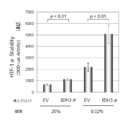
上記の結果、常酸素(20%)、低酸素(0.02%)のいずれの条件においてもIDH3αを強発現させた場合に、陰性対照群に比べて高いルシフェラーゼ活性を認めた(図7参照)。このことより、IDH3αはHIF-1αタンパク質を安定化しうることが示唆された。
HIF-1αの安定化が真にIDH3αによるものかを確認するために、上述のHeLa/ODD-Luc細胞に、参考例2で示したIDH3αに対するshRNA(A)~(C)各発現プラスミドを導入して、ルシフェラーゼ活性を指標にHIF-1αタンパク質の安定性をモニターした。陰性対照として、shRNA(Scr)発現プラスミドを用いた。その結果、陰性対照群と比較して、IDH3αの発現を抑制した場合に、低酸素刺激によるODD-Lucの安定化が抑制されることが明らかになった(図8参照)。このことより、IDH3αがHIF-1αタンパク質の安定性に関与することが示唆された。
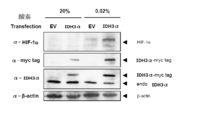
HeLa細胞にpcDNA4/myc-His Aプラスミド(EV:空ベクター)又はpcDNA4A/IDH3αプラスミドを導入し、常酸素(20%)又は低酸素(0.02%)の条件下で培養して得た細胞抽出液について、タンパク質の発現をウェスタンブロッティングにより確認した。その結果、IDH3αを強制発現させた場合に、HIF-1αの発現量が増加することを認めた(図9参照)。その傾向は低酸素条件下でより顕著であった。このことより、IDH3αはHIF-1αの発現において重要な役割を担う因子であることが示唆された。
(参考例4)IDH3αの有無による腫瘍増殖作用
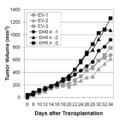
参考例1~3の結果より、IDH3αはHIF-1αの発現及びHIF-1活性に"正"の影響を与える因子であることが示唆された。IDH3αが腫瘍増殖に及ぼす影響を検討する目的で、HeLa細胞にIDH3α強制発現ベクターを安定に導入したIDH3α強制発現細胞(HeLa/IDH3α 1~3)を、免疫不全マウスに移植し、その後の腫瘍増殖速度を計測した。対照として空ベクターを導入したHeLa細胞(HeLa/EV 1~3)を用い、同様の実験を行った。上記の結果、IDH3αの強制発現によって腫瘍増殖速度が亢進することが確認された(図10参照)。
参考例1~3の結果より、IDH3αはHIF-1αの発現及びHIF-1活性に"正"の影響を与える因子であることが示唆された。IDH3αが腫瘍増殖に及ぼす影響を検討する目的で、HeLa細胞にIDH3α強制発現ベクターを安定に導入したIDH3α強制発現細胞(HeLa/IDH3α 1~3)を、免疫不全マウスに移植し、その後の腫瘍増殖速度を計測した。対照として空ベクターを導入したHeLa細胞(HeLa/EV 1~3)を用い、同様の実験を行った。上記の結果、IDH3αの強制発現によって腫瘍増殖速度が亢進することが確認された(図10参照)。
上述のIDH3α強制発現細胞株(HeLa/IDH3α 1~3)及び陰性対照細胞株(HeLa/EV 1~3)より細胞抽出液を得、pcDNA4A/IDH3αプラスミドに由来するIDH3αの発現を、融合されているmycタグに対する抗体で検出した。一方、IDH3αに対する抗体を用いることで、pcDNA4A/IDH3αプラスミドに由来するmycタグと融合されたIDH3αタンパク質と共に、内在性IDH3αの発現を確認した。mycタグの有無により、両タンパク質を各々独立して検出することが出来た。pcDNA4A/IDH3αプラスミドに由来するIDH3αの発現はHeLa/IDH3α 1~3においてのみ検出されたのに対し、内在性のIDH3αの発現はpcDNA4A/IDH3αの有無に関わらず検出された(図11参照)。このことより、内在性のIDH3αの存在も図10にて測定した腫瘍増殖に寄与していることが懸念された。
(実施例1)IDH3α遺伝子に対するshRNAの作用
HeLa細胞株に、IDH3αに対するshRNA(A)~(C)各発現プラスミドを安定に組み込むことによって、内在性IDH3αの発現を恒常的にノックダウンした細胞株(HeLa/shIDH3α A2, A5, B2, B4, C1, C2)を樹立した。陰性対照としてshRNA(Scr)発現プラスミドを安定に組み込んだ細胞株(HeLa/shRNA(Scr) N5, N9)を樹立した。これらの細胞株を常酸素条件(20%)又は低酸素条件(0.02%)で培養した後に細胞抽出液を得、抗HIF-1α抗体と抗IDH3α抗体を用いてウェスタンブロッティングを行った。その結果、陰性対照群(N5, N9細胞)ではIDH3αの発現が酸素条件にかかわらず認められ、HIF-1αの発現は低酸素条件下においてのみ認められた。一方、IDH3αをノックダウンした細胞株群では、HIF-1αの発現が低酸素環境においても認められなかった(図12)。このことより、IDH3αが低酸素刺激によるHIF-1αの発現において決定的な役割を担っていることが確認された。
HeLa細胞株に、IDH3αに対するshRNA(A)~(C)各発現プラスミドを安定に組み込むことによって、内在性IDH3αの発現を恒常的にノックダウンした細胞株(HeLa/shIDH3α A2, A5, B2, B4, C1, C2)を樹立した。陰性対照としてshRNA(Scr)発現プラスミドを安定に組み込んだ細胞株(HeLa/shRNA(Scr) N5, N9)を樹立した。これらの細胞株を常酸素条件(20%)又は低酸素条件(0.02%)で培養した後に細胞抽出液を得、抗HIF-1α抗体と抗IDH3α抗体を用いてウェスタンブロッティングを行った。その結果、陰性対照群(N5, N9細胞)ではIDH3αの発現が酸素条件にかかわらず認められ、HIF-1αの発現は低酸素条件下においてのみ認められた。一方、IDH3αをノックダウンした細胞株群では、HIF-1αの発現が低酸素環境においても認められなかった(図12)。このことより、IDH3αが低酸素刺激によるHIF-1αの発現において決定的な役割を担っていることが確認された。
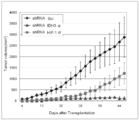
IDH3αの発現が腫瘍増殖に及ぼす影響を検討する目的で、内在性IDH3αの発現を恒常的にノックダウンさせた細胞株HeLa/shIDH3α A2, A5, B2, B4, C1, C2及び陰性対照細胞HeLa/shRNA(Scr) N5, N9を樹立し、各々30万個を免疫不全マウスに移植後、腫瘍の大きさを計測した。その結果、IDH3αの発現をノックダウンした場合に、腫瘍の増殖が有意に抑制されることが確認された(図13)。また、移植46日後の腫瘍サイズを目視した写真からも同様の結果が確認された(図14)。また、IDH3α遺伝子の発現を最も効果的にノックダウンするshRNA (B)を用いた群においては、腫瘍形成そのものが抑制されうることも確認された。
(実施例2)IDH3α遺伝子又はHIF-1α遺伝子のノックダウンによる抗腫瘍効果
上記のIDH3α遺伝子に対するshRNA(B)発現プラスミド、HIF-1α遺伝子に対するshRNA発現プラスミド、及び陰性対照のshRNA(Scr)発現プラスミドを各々安定に組み込んだHeLa細胞を免疫不全マウスに移植し、腫瘍の大きさを計測した。その結果、IDH3α遺伝子をノックダウンした腫瘍のほうが、HIF-1α遺伝子をノックダウンした腫瘍に比べて、より効果的な腫瘍増殖抑制効果が認められた(図15)。以上により、IDH3αを抑制したほうがHIF-1αを直接抑制するよりも、より効果的に腫瘍の増殖を抑制しうることが確認された。この結果は、IDH3αがHIF-1αを安定化させる以外の作用を有していることを示唆しているのかもしれない。以上、IDH3を抑制しうる物質、具体的にはIDH3を構成するサブユニットの少なくとも一つ、具体的にはIDH3αを抑制しうる物質は、抗腫瘍剤として効果を発揮しうることが確認された。
上記のIDH3α遺伝子に対するshRNA(B)発現プラスミド、HIF-1α遺伝子に対するshRNA発現プラスミド、及び陰性対照のshRNA(Scr)発現プラスミドを各々安定に組み込んだHeLa細胞を免疫不全マウスに移植し、腫瘍の大きさを計測した。その結果、IDH3α遺伝子をノックダウンした腫瘍のほうが、HIF-1α遺伝子をノックダウンした腫瘍に比べて、より効果的な腫瘍増殖抑制効果が認められた(図15)。以上により、IDH3αを抑制したほうがHIF-1αを直接抑制するよりも、より効果的に腫瘍の増殖を抑制しうることが確認された。この結果は、IDH3αがHIF-1αを安定化させる以外の作用を有していることを示唆しているのかもしれない。以上、IDH3を抑制しうる物質、具体的にはIDH3を構成するサブユニットの少なくとも一つ、具体的にはIDH3αを抑制しうる物質は、抗腫瘍剤として効果を発揮しうることが確認された。
(実施例3)IDH3α遺伝子に対するshRNAの作用
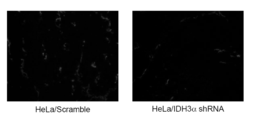
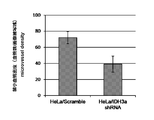
実施例1で樹立した"内在性IDH3αの発現を恒常的にノックダウンさせた細胞HeLa/shIDH3α B2"、及び"陰性対照細胞HeLa/shRNA(Scr)N9" の懸濁液を準備し、各々1,000万個および100万個の細胞を免疫不全マウスに移植した。生じた固形腫瘍の大きさが同じになるタイミング、すなわちHeLa/shIDH3α B2腫瘍の場合は移植45日後、HeLa/shRNA(Scr)N9腫瘍の場合は移植37日後に摘出し、その切片を血管内皮細胞のマーカー(CD31抗体)で染色した。検出された腫瘍内血管の密度を定量したところ、IDH3α遺伝子をノックダウンした場合に血管密度が減少することが確認された(図16、17)。
当該データは、IDH3αを抑制した場合に、HIF-1α発現量の低下を介して腫瘍血管密度を低下させ得ることを示唆している。
実施例1で樹立した"内在性IDH3αの発現を恒常的にノックダウンさせた細胞HeLa/shIDH3α B2"、及び"陰性対照細胞HeLa/shRNA(Scr)N9" の懸濁液を準備し、各々1,000万個および100万個の細胞を免疫不全マウスに移植した。生じた固形腫瘍の大きさが同じになるタイミング、すなわちHeLa/shIDH3α B2腫瘍の場合は移植45日後、HeLa/shRNA(Scr)N9腫瘍の場合は移植37日後に摘出し、その切片を血管内皮細胞のマーカー(CD31抗体)で染色した。検出された腫瘍内血管の密度を定量したところ、IDH3α遺伝子をノックダウンした場合に血管密度が減少することが確認された(図16、17)。
当該データは、IDH3αを抑制した場合に、HIF-1α発現量の低下を介して腫瘍血管密度を低下させ得ることを示唆している。
以上詳述したように、本発明のIDH3抑制物質は抗腫瘍効果を有する。また、本発明のIDH3抑制物質はHIF-1抑制効果を有する。これらの作用から、IDH3の活性を抑制しうる物質をスクリーニングすることで、効果的な抗腫瘍剤を提供しうる。本発明のIDH3抑制物質を有効成分として含む新規抗腫瘍剤は、HIF-1の活性を制御しうることから、難治性腫瘍、例えば放射線治療抵抗性がんや抗がん剤抵抗性がんに対しても有効に効果を発揮しうる。
Claims (15)
- イソクエン酸脱水素酵素3(IDH3)抑制物質を有効成分として含む、新規抗腫瘍剤。
- IDH3抑制が、IDH3αの発現抑制又は機能抑制である、請求項1に記載の新規抗腫瘍剤。
- IDH3を抑制し、低酸素誘導因子1(HIF-1)を抑制することを特徴とする、請求項1又は2に記載の新規抗腫瘍剤。
- HIF-1を抑制することが、HIF-1αの発現抑制又は機能抑制である請求項3に記載の新規抗腫瘍剤。
- 腫瘍が、難治性悪性腫瘍である、請求項1~4のいずれか1に記載の新規抗腫瘍剤。
- 難治性悪性腫瘍が、放射線治療抵抗性がん及び/又は抗がん剤抵抗性がんである、請求項5に記載の新規抗腫瘍剤。
- IDH3抑制物質を有効成分として含む、HIF-1抑制剤。
- IDH3の活性抑制を指標とする、新規抗腫瘍剤のスクリーニング方法。
- 以下の工程を含む、請求項8に記載の新規抗腫瘍剤のスクリーニング方法:
1)IDH3αを発現しうる細胞株を候補物質で処理する工程;
2)候補物質で処理した前後で、上記細胞株についてIDH3αの発現量又はIDH3の活性を測定し、IDH3αの発現量又はIDH3の活性からIDH3の活性抑制を評価する工程。 - IDH3αを発現しうる細胞株が、HIF-1依存的にレポーター遺伝子を発現する細胞株であり、IDH3αの発現量又はIDH3の活性の測定が、レポーター遺伝子産物を計測することによる、請求項9に記載の新規抗腫瘍剤のスクリーニング方法。
- IDH3を構成するサブユニットの少なくとも一つを標的因子として抑制することを含む、腫瘍の新規治療方法。
- IDH3を構成するサブユニットの少なくとも一つがIDH3αである、請求項11に記載の腫瘍の新規治療方法。
- IDH3を構成するサブユニットの少なくとも一つを標的因子として抑制することが、IDH3αの発現抑制又は機能抑制である、請求項11又は12に記載の腫瘍の新規治療方法。
- 腫瘍が、難治性悪性腫瘍である、請求項11~13のいずれか1に記載の腫瘍の新規治療方法。
- 難治性悪性腫瘍が、放射線治療抵抗性がん及び/又は抗がん剤抵抗性がんである、請求項14に記載の腫瘍の新規治療方法。
Priority Applications (1)
| Application Number | Priority Date | Filing Date | Title |
|---|---|---|---|
| JP2013521531A JP6046618B2 (ja) | 2011-06-22 | 2012-06-12 | 新規抗腫瘍剤及び新規抗腫瘍剤のスクリーニング方法 |
Applications Claiming Priority (2)
| Application Number | Priority Date | Filing Date | Title |
|---|---|---|---|
| JP2011138981 | 2011-06-22 | ||
| JP2011-138981 | 2011-06-22 |
Publications (1)
| Publication Number | Publication Date |
|---|---|
| WO2012176651A1 true WO2012176651A1 (ja) | 2012-12-27 |
Family
ID=47422491
Family Applications (1)
| Application Number | Title | Priority Date | Filing Date |
|---|---|---|---|
| PCT/JP2012/064964 Ceased WO2012176651A1 (ja) | 2011-06-22 | 2012-06-12 | 新規抗腫瘍剤及び新規抗腫瘍剤のスクリーニング方法 |
Country Status (2)
| Country | Link |
|---|---|
| JP (1) | JP6046618B2 (ja) |
| WO (1) | WO2012176651A1 (ja) |
Citations (1)
| Publication number | Priority date | Publication date | Assignee | Title |
|---|---|---|---|---|
| WO2010028099A1 (en) * | 2008-09-03 | 2010-03-11 | The Johns Hopkins University | Genetic alterations in isocitrate dehydrogenase and other genes in malignant glioma |
-
2012
- 2012-06-12 JP JP2013521531A patent/JP6046618B2/ja active Active
- 2012-06-12 WO PCT/JP2012/064964 patent/WO2012176651A1/ja not_active Ceased
Patent Citations (1)
| Publication number | Priority date | Publication date | Assignee | Title |
|---|---|---|---|---|
| WO2010028099A1 (en) * | 2008-09-03 | 2010-03-11 | The Johns Hopkins University | Genetic alterations in isocitrate dehydrogenase and other genes in malignant glioma |
Non-Patent Citations (2)
| Title |
|---|
| LIU F. ET AL.: "Antisense hypoxia-inducible factor 1 alpha gene therapy enhances the therapeutic efficacy of doxorubicin to combat hepatocellular carcinoma", CANCER SCI., vol. 99, 2008, pages 2055 - 2061 * |
| ZHENHONG Z. ET AL.: "The mRNA quantitative analysis, prokaryotic exprssion and structure prediction of hepatocarcinogenesis related gene idh3alpha under AFB1 stress", AFR.J.MICROBIOL. RES., vol. 5, 4 August 2011 (2011-08-04), pages 2082 - 2089 * |
Also Published As
| Publication number | Publication date |
|---|---|
| JP6046618B2 (ja) | 2016-12-21 |
| JPWO2012176651A1 (ja) | 2015-02-23 |
Similar Documents
| Publication | Publication Date | Title |
|---|---|---|
| Semenza | Hypoxia-inducible factors in physiology and medicine | |
| KR102373074B1 (ko) | 인간 ezh2의 억제제 및 이의 사용 방법 | |
| Li et al. | Overexpression of isocitrate dehydrogenase mutant proteins renders glioma cells more sensitive to radiation | |
| Cui et al. | R132H mutation in IDH1 gene reduces proliferation, cell survival and invasion of human glioma by downregulating Wnt/β-catenin signaling | |
| Basheer et al. | Cardiomyocyte-specific overexpression of the ubiquitin ligase Wwp1 contributes to reduction in Connexin 43 and arrhythmogenesis | |
| Zhao et al. | ABCC10 plays a significant role in the transport of gefitinib and contributes to acquired resistance to gefitinib in NSCLC | |
| BR112020025760A2 (pt) | Uso de campos elétricos alternados para aumentar a permeabilidade da membrana celular | |
| Elschami et al. | Reduction of STAT3 expression induces mitochondrial dysfunction and autophagy in cardiac HL-1 cells | |
| Chen et al. | HO-1 protects against hypoxia/reoxygenation-induced mitochondrial dysfunction in H9c2 cardiomyocytes | |
| Im et al. | DNA damage-induced apoptosis suppressor (DDIAS), a novel target of NFATc1, is associated with cisplatin resistance in lung cancer | |
| ES2869463T3 (es) | Composición para la prevención o tratamiento de la calcificación de válvulas que contiene un inhibidor de DPP-4 | |
| Jiang et al. | Downregulation of VGLL4 in the progression of esophageal squamous cell carcinoma | |
| Wang et al. | Colorectal cancer cells establish metabolic reprogramming with cancer-associated fibroblasts (CAFs) through lactate shuttle to enhance invasion, migration, and angiogenesis | |
| Luo et al. | An indispensable role of CPT-1a to survive cancer cells during energy stress through rewiring cancer metabolism | |
| Oka et al. | Endogenous ROS production in early differentiation state suppresses endoderm differentiation via transient FOXC1 expression | |
| Han et al. | EGR1 promoted anticancer effects of Scutellarin via regulating LINC00857/miR‐150‐5p/c‐Myc in osteosarcoma | |
| van Noorden et al. | New insights in ATP synthesis as therapeutic target in cancer and angiogenic ocular diseases | |
| Friebe et al. | The 10th International Conference on cGMP 2022: recent trends in cGMP research and development—meeting report | |
| Ren et al. | Ultrasound microbubble-stimulated miR-145-5p inhibits malignant behaviors of breast cancer cells by targeting ACTG1 | |
| Zhang et al. | USP12 facilitates gastric cancer progression via stabilizing YAP | |
| KR101835759B1 (ko) | Phf 20 를 이용한 암세포에 대한 정보 제공 방법 | |
| JP7025034B2 (ja) | 膵臓炎、腎損傷および腎臓癌を治療および予防するための組成物および方法 | |
| Zhang et al. | Acetyl-CoA synthetase 2 alleviates brain injury following cardiac arrest by promoting autophagy in brain microvascular endothelial cells | |
| JP6046618B2 (ja) | 新規抗腫瘍剤及び新規抗腫瘍剤のスクリーニング方法 | |
| Wu et al. | A double suicide gene system driven by vascular endothelial growth factor promoter selectively kills human hepatocellular carcinoma cells |
Legal Events
| Date | Code | Title | Description |
|---|---|---|---|
| 121 | Ep: the epo has been informed by wipo that ep was designated in this application |
Ref document number: 12801944 Country of ref document: EP Kind code of ref document: A1 |
|
| ENP | Entry into the national phase |
Ref document number: 2013521531 Country of ref document: JP Kind code of ref document: A |
|
| NENP | Non-entry into the national phase |
Ref country code: DE |
|
| 122 | Ep: pct application non-entry in european phase |
Ref document number: 12801944 Country of ref document: EP Kind code of ref document: A1 |