WO2012165459A1 - 一酸化炭素の除去方法及び除去装置 - Google Patents
一酸化炭素の除去方法及び除去装置 Download PDFInfo
- Publication number
- WO2012165459A1 WO2012165459A1 PCT/JP2012/063876 JP2012063876W WO2012165459A1 WO 2012165459 A1 WO2012165459 A1 WO 2012165459A1 JP 2012063876 W JP2012063876 W JP 2012063876W WO 2012165459 A1 WO2012165459 A1 WO 2012165459A1
- Authority
- WO
- WIPO (PCT)
- Prior art keywords
- carbon monoxide
- gas
- quinones
- porphyrin complex
- solution
- Prior art date
- Legal status (The legal status is an assumption and is not a legal conclusion. Google has not performed a legal analysis and makes no representation as to the accuracy of the status listed.)
- Ceased
Links
Images




Classifications
-
- H—ELECTRICITY
- H01—ELECTRIC ELEMENTS
- H01M—PROCESSES OR MEANS, e.g. BATTERIES, FOR THE DIRECT CONVERSION OF CHEMICAL ENERGY INTO ELECTRICAL ENERGY
- H01M8/00—Fuel cells; Manufacture thereof
- H01M8/06—Combination of fuel cells with means for production of reactants or for treatment of residues
- H01M8/0662—Treatment of gaseous reactants or gaseous residues, e.g. cleaning
- H01M8/0668—Removal of carbon monoxide or carbon dioxide
-
- B—PERFORMING OPERATIONS; TRANSPORTING
- B01—PHYSICAL OR CHEMICAL PROCESSES OR APPARATUS IN GENERAL
- B01J—CHEMICAL OR PHYSICAL PROCESSES, e.g. CATALYSIS OR COLLOID CHEMISTRY; THEIR RELEVANT APPARATUS
- B01J31/00—Catalysts comprising hydrides, coordination complexes or organic compounds
- B01J31/16—Catalysts comprising hydrides, coordination complexes or organic compounds containing coordination complexes
- B01J31/18—Catalysts comprising hydrides, coordination complexes or organic compounds containing coordination complexes containing nitrogen, phosphorus, arsenic or antimony as complexing atoms, e.g. in pyridine ligands, or in resonance therewith, e.g. in isocyanide ligands C=N-R or as complexed central atoms
- B01J31/1805—Catalysts comprising hydrides, coordination complexes or organic compounds containing coordination complexes containing nitrogen, phosphorus, arsenic or antimony as complexing atoms, e.g. in pyridine ligands, or in resonance therewith, e.g. in isocyanide ligands C=N-R or as complexed central atoms the ligands containing nitrogen
- B01J31/181—Cyclic ligands, including e.g. non-condensed polycyclic ligands, comprising at least one complexing nitrogen atom as ring member, e.g. pyridine
- B01J31/1825—Ligands comprising condensed ring systems, e.g. acridine, carbazole
- B01J31/183—Ligands comprising condensed ring systems, e.g. acridine, carbazole with more than one complexing nitrogen atom, e.g. phenanthroline
-
- C—CHEMISTRY; METALLURGY
- C01—INORGANIC CHEMISTRY
- C01B—NON-METALLIC ELEMENTS; COMPOUNDS THEREOF; METALLOIDS OR COMPOUNDS THEREOF NOT COVERED BY SUBCLASS C01C
- C01B3/00—Hydrogen; Gaseous mixtures containing hydrogen; Separation of hydrogen from mixtures containing it; Purification of hydrogen; Reversible storage of hydrogen
- C01B3/50—Separation of hydrogen or hydrogen-containing gases from gaseous mixtures, e.g. purification
- C01B3/52—Separation of hydrogen or hydrogen-containing gases from gaseous mixtures, e.g. purification by contacting with liquids; Regeneration of used liquids
-
- C—CHEMISTRY; METALLURGY
- C01—INORGANIC CHEMISTRY
- C01B—NON-METALLIC ELEMENTS; COMPOUNDS THEREOF; METALLOIDS OR COMPOUNDS THEREOF NOT COVERED BY SUBCLASS C01C
- C01B32/00—Carbon; Compounds thereof
- C01B32/40—Carbon monoxide
-
- B—PERFORMING OPERATIONS; TRANSPORTING
- B01—PHYSICAL OR CHEMICAL PROCESSES OR APPARATUS IN GENERAL
- B01J—CHEMICAL OR PHYSICAL PROCESSES, e.g. CATALYSIS OR COLLOID CHEMISTRY; THEIR RELEVANT APPARATUS
- B01J2231/00—Catalytic reactions performed with catalysts classified in B01J31/00
- B01J2231/60—Reduction reactions, e.g. hydrogenation
- B01J2231/62—Reductions in general of inorganic substrates, e.g. formal hydrogenation, e.g. of N2
- B01J2231/625—Reductions in general of inorganic substrates, e.g. formal hydrogenation, e.g. of N2 of CO2
-
- B—PERFORMING OPERATIONS; TRANSPORTING
- B01—PHYSICAL OR CHEMICAL PROCESSES OR APPARATUS IN GENERAL
- B01J—CHEMICAL OR PHYSICAL PROCESSES, e.g. CATALYSIS OR COLLOID CHEMISTRY; THEIR RELEVANT APPARATUS
- B01J2531/00—Additional information regarding catalytic systems classified in B01J31/00
- B01J2531/02—Compositional aspects of complexes used, e.g. polynuclearity
- B01J2531/0238—Complexes comprising multidentate ligands, i.e. more than 2 ionic or coordinative bonds from the central metal to the ligand, the latter having at least two donor atoms, e.g. N, O, S, P
- B01J2531/0241—Rigid ligands, e.g. extended sp2-carbon frameworks or geminal di- or trisubstitution
- B01J2531/025—Ligands with a porphyrin ring system or analogues thereof, e.g. phthalocyanines, corroles
-
- B—PERFORMING OPERATIONS; TRANSPORTING
- B01—PHYSICAL OR CHEMICAL PROCESSES OR APPARATUS IN GENERAL
- B01J—CHEMICAL OR PHYSICAL PROCESSES, e.g. CATALYSIS OR COLLOID CHEMISTRY; THEIR RELEVANT APPARATUS
- B01J2531/00—Additional information regarding catalytic systems classified in B01J31/00
- B01J2531/80—Complexes comprising metals of Group VIII as the central metal
- B01J2531/82—Metals of the platinum group
- B01J2531/822—Rhodium
-
- B—PERFORMING OPERATIONS; TRANSPORTING
- B01—PHYSICAL OR CHEMICAL PROCESSES OR APPARATUS IN GENERAL
- B01J—CHEMICAL OR PHYSICAL PROCESSES, e.g. CATALYSIS OR COLLOID CHEMISTRY; THEIR RELEVANT APPARATUS
- B01J2531/00—Additional information regarding catalytic systems classified in B01J31/00
- B01J2531/80—Complexes comprising metals of Group VIII as the central metal
- B01J2531/84—Metals of the iron group
- B01J2531/845—Cobalt
-
- C—CHEMISTRY; METALLURGY
- C01—INORGANIC CHEMISTRY
- C01B—NON-METALLIC ELEMENTS; COMPOUNDS THEREOF; METALLOIDS OR COMPOUNDS THEREOF NOT COVERED BY SUBCLASS C01C
- C01B2203/00—Integrated processes for the production of hydrogen or synthesis gas
- C01B2203/02—Processes for making hydrogen or synthesis gas
- C01B2203/0205—Processes for making hydrogen or synthesis gas containing a reforming step
- C01B2203/0227—Processes for making hydrogen or synthesis gas containing a reforming step containing a catalytic reforming step
- C01B2203/0233—Processes for making hydrogen or synthesis gas containing a reforming step containing a catalytic reforming step the reforming step being a steam reforming step
-
- C—CHEMISTRY; METALLURGY
- C01—INORGANIC CHEMISTRY
- C01B—NON-METALLIC ELEMENTS; COMPOUNDS THEREOF; METALLOIDS OR COMPOUNDS THEREOF NOT COVERED BY SUBCLASS C01C
- C01B2203/00—Integrated processes for the production of hydrogen or synthesis gas
- C01B2203/02—Processes for making hydrogen or synthesis gas
- C01B2203/0283—Processes for making hydrogen or synthesis gas containing a CO-shift step, i.e. a water gas shift step
-
- C—CHEMISTRY; METALLURGY
- C01—INORGANIC CHEMISTRY
- C01B—NON-METALLIC ELEMENTS; COMPOUNDS THEREOF; METALLOIDS OR COMPOUNDS THEREOF NOT COVERED BY SUBCLASS C01C
- C01B2203/00—Integrated processes for the production of hydrogen or synthesis gas
- C01B2203/04—Integrated processes for the production of hydrogen or synthesis gas containing a purification step for the hydrogen or the synthesis gas
-
- C—CHEMISTRY; METALLURGY
- C01—INORGANIC CHEMISTRY
- C01B—NON-METALLIC ELEMENTS; COMPOUNDS THEREOF; METALLOIDS OR COMPOUNDS THEREOF NOT COVERED BY SUBCLASS C01C
- C01B2203/00—Integrated processes for the production of hydrogen or synthesis gas
- C01B2203/04—Integrated processes for the production of hydrogen or synthesis gas containing a purification step for the hydrogen or the synthesis gas
- C01B2203/0465—Composition of the impurity
- C01B2203/047—Composition of the impurity the impurity being carbon monoxide
-
- C—CHEMISTRY; METALLURGY
- C01—INORGANIC CHEMISTRY
- C01B—NON-METALLIC ELEMENTS; COMPOUNDS THEREOF; METALLOIDS OR COMPOUNDS THEREOF NOT COVERED BY SUBCLASS C01C
- C01B2203/00—Integrated processes for the production of hydrogen or synthesis gas
- C01B2203/06—Integration with other chemical processes
- C01B2203/066—Integration with other chemical processes with fuel cells
-
- Y—GENERAL TAGGING OF NEW TECHNOLOGICAL DEVELOPMENTS; GENERAL TAGGING OF CROSS-SECTIONAL TECHNOLOGIES SPANNING OVER SEVERAL SECTIONS OF THE IPC; TECHNICAL SUBJECTS COVERED BY FORMER USPC CROSS-REFERENCE ART COLLECTIONS [XRACs] AND DIGESTS
- Y02—TECHNOLOGIES OR APPLICATIONS FOR MITIGATION OR ADAPTATION AGAINST CLIMATE CHANGE
- Y02E—REDUCTION OF GREENHOUSE GAS [GHG] EMISSIONS, RELATED TO ENERGY GENERATION, TRANSMISSION OR DISTRIBUTION
- Y02E60/00—Enabling technologies; Technologies with a potential or indirect contribution to GHG emissions mitigation
- Y02E60/30—Hydrogen technology
- Y02E60/50—Fuel cells
Definitions
- the present invention relates to a method for removing carbon monoxide contained in an anode gas for a fuel cell and the like, and a carbon monoxide removing apparatus used in this method.
- Carbon monoxide contained in the anode gas of the stationary polymer electrolyte fuel cell has a problem that it poisons the platinum-based anode catalyst of the fuel cell. Therefore, in order to suppress carbon monoxide poisoning, a shift reactor is arranged upstream of the fuel cell, and carbon monoxide is converted into carbon dioxide and hydrogen by a shift reaction (CO + H 2 O ⁇ CO 2 + H 2 ). The conversion is done. In this case, the carbon monoxide concentration cannot often be reduced sufficiently by the shift reaction alone, and a selective oxidizer is disposed at the subsequent stage of the shift reaction to perform the selective oxidation reaction (CO + 1 / 2O 2 ⁇ CO 2 ). Has reported a method of further reducing the carbon monoxide concentration (see Patent Documents 1 and 2 below).
- the selective oxidizer needs to continuously blow in oxygen, and the oxygen flow rate and temperature control need to be strictly optimized. This can lead to system complexity and cost increases.
- the present invention has been made in view of the above-described problems of the prior art, and its main purpose is to use carbon monoxide contained in an anode gas for a fuel cell, etc., without using a complicated apparatus. It is an object of the present invention to provide a method that can be removed well and a carbon monoxide removing apparatus used in this method.
- the present inventor has intensively studied to achieve the above-mentioned purpose.
- carbon monoxide is converted into carbon dioxide by oxidizing the quinones by blowing a gas containing carbon monoxide into the solution. It has been found that it can be converted to carbon and the concentration of carbon monoxide can be reduced.
- a reduced form of quinones is formed by the above reaction, which accumulates in the solution when the reaction is continued. This can be returned to the quinones by oxygen oxidation or electrolytic oxidation. Then, it has been found that it can be used for removing carbon monoxide.
- the present inventor can use the same method as the carbon monoxide removal method described above as a method of converting quinones into a reduced form of quinones, and by using this method, the quinones It has been found that quinones formed by the anodic reaction can be converted into a reductant and reused as a fuel in a fuel cell using the above reductant as a fuel.
- the present invention has been completed as a result of further studies based on these findings.
- the present invention provides the following carbon monoxide removal method, carbon monoxide removal apparatus, fuel regeneration fuel cell, and carbon monoxide oxidation catalyst.
- Item 1 Carbon monoxide, wherein a gas containing carbon monoxide is brought into contact with a solution containing quinones in the presence of at least one metal porphyrin complex selected from the group consisting of rhodium porphyrin complexes and cobalt porphyrin complexes. Removal method.
- Item 2. Item 2.
- the quinone is at least one selected from the group consisting of a benzoquinone that may have a substituent, a naphthoquinone that may have a substituent, and an anthraquinone that may have a substituent.
- Item 3. The method for removing carbon monoxide according to Item 1 or 2, wherein the gas containing carbon monoxide is a reformed gas containing carbon monoxide.
- Item 4. The method according to any one of Items 1 to 3, wherein a metal porphyrin complex supported on a conductive carrier is used.
- Item 5. A step of removing carbon monoxide by the method according to any one of the above items 1 to 4 and then regenerating the reduced form of quinones accumulated in the solution as quinones by oxidation with oxygen or electrolytic oxidation. Carbon removal method.
- item 5 which has an opening
- a fuel regenerative fuel cell comprising a solid polymer fuel cell using a reductant of quinones as a fuel, and a fuel regenerating device for converting quinones into a reductant
- the fuel regeneration device includes a sealed container that contains a solution containing a metalloporphyrin complex, a supply port that supplies a solution containing quinones after an anode reaction in a fuel cell, and carbon monoxide in the solution.
- a catalyst for the oxidation of carbon monoxide which contains at least one metal porphyrin complex selected from the group consisting of a rhodium porphyrin complex and a cobalt porphyrin complex as an active ingredient, and a quinone as an electron acceptor.
- the method for removing carbon monoxide of the present invention may be at least one metal porphyrin complex selected from the group consisting of a rhodium porphyrin complex and a cobalt porphyrin complex (hereinafter simply referred to as “metal porphyrin complex”). ) In the presence of carbon monoxide in contact with a solution containing quinones.
- the oxidation reaction of carbon monoxide proceeds according to the following reaction formula, and the carbon monoxide concentration in the gas containing carbon monoxide can be reduced.
- At least one metal porphyrin complex selected from the group consisting of a rhodium porphyrin complex and a cobalt porphyrin complex is useful as a catalyst for oxidizing carbon monoxide using quinones as an electron acceptor.
- quinones can be used without particular limitation as long as they are quinones soluble in the solvent used.
- examples of such quinones include benzoquinone which may have a substituent, naphthoquinone which may have a substituent, anthraquinone which may have a substituent.
- naphthoquinone which may have a substituent and anthraquinone which may have a substituent are preferable in that the reaction rate of carbon monoxide oxidation reaction is high.
- anthraquinone that may have a substituent is preferable because it can be easily regenerated from the reduced form.
- the type of substituent is not particularly limited, and examples thereof include linear or branched lower alkyl groups having about 1 to 5 carbon atoms, carboxyl groups or salts thereof, hydroxyl groups, sulfonic acid groups or salts thereof, and the like. . There are no particular limitations on the number of these substituents, the substitution position, and the like, and a solvent having good solubility may be selected as appropriate according to the type of the substituent. These quinones can be used individually by 1 type or in mixture of 2 or more types.
- the metal porphyrin complex used as a catalyst can be used without particular limitation as long as it is a compound containing rhodium or cobalt as a metal component and a porphyrin compound as a ligand.
- Such metal porphyrin complexes can be used singly or in combination of two or more.
- preferred compounds include compounds represented by the following chemical formula (1), compounds represented by the chemical formula (2), and the like.
- R 1 to R 12 are the same or different and each represents an alkyl group, an aryl group which may have a substituent, a hydrogen atom or a halogen atom, and M represents rhodium or cobalt).
- Metal porphyrin complex (Wherein R 1 to R 12 are the same or different and each represents an alkyl group, an aryl group which may have a substituent, a hydrogen atom or a halogen atom, and M represents rhodium or cobalt).
- R 1 to R 12 are the same or different and each represents an alkyl group, an aryl group that may have a substituent, a hydrogen atom, or a halogen atom.
- the alkyl group is a straight chain having about 1 to 5 carbon atoms such as methyl, ethyl, isopropyl, n-propyl, t-butyl, sec-butyl, n-butyl, isobutyl, n-pentyl, or the like.
- a branched lower alkyl group is preferred.
- the halogen atom fluorine, chlorine, bromine and the like are preferable.
- aryl group which may have a substituent, a phenyl group, a phenyl group having a substituent, a pyridyl group, a pyridyl group having a substituent, and the like are preferable.
- R 1 , R 4 , R 7 and R 10 are all aryl groups which may have a substituent, particularly phenyl groups which may have a substituent, the meso position is chemically Therefore, stability against oxidation reaction and the like is increased.
- examples of the pyridyl group having a substituent include a 1-methylpyridyl group.
- the substituent in the phenyl group having a substituent include a lower alkoxy group, a lower alkyl group, a halogen atom, —SO 3 M 1 (wherein M 1 is a hydrogen atom, an alkali metal, or —NH 4 ), —COOM 2 (wherein M 2 is a hydrogen atom, an alkali metal, —NH 4 or an alkyl group), —OCH 2 —COOM 3 (wherein M 3 is a hydrogen atom, an alkali metal, —NH 4 or an alkyl group) A), an amino group, an alkylated amino group, and the like.
- the alkylated amino group include a trimethylamino group.
- a phenyl group having a lower alkoxy group as a substituent a para-methoxyphenyl group and the like
- a phenyl group having a lower alkyl group as a substituent a para-methylphenyl group, 2,4,6-trimethyl
- the phenyl group having a halogen atom as a substituent such as a phenyl group include a pentafluorophenyl group.
- M 1 is a hydrogen atom, an alkali metal, or —NH 4 .
- examples of the alkali metal include K and Na.
- examples of the substituents of the phenyl group in —COOM 2 , M 2 is a hydrogen atom, an alkali metal, —NH 4 or an alkyl group.
- examples of the alkali metal include K and Na.
- examples of the alkyl group include the same groups as those described above.
- M 3 is a hydrogen atom, an alkali metal, —NH 4 or an alkyl group.
- alkali metal include K and Na.
- alkyl group include the same groups as those described above.
- Substituents such as —SO 3 M 1 , —COOM 2 , and —OCH 2 —COOM 3 can be substituted at the 4-position of the phenyl group, for example, but are not limited thereto.
- R 1 , R 4 , R 7 and R 10 are phenyl groups which may have a substituent, and R 2, R 3 , R 5 , R 6 , R 8 , R 9 , R 11 and R 12 are hydrogen atoms; rhodium tetraphenylporphyrin complex; R 1 , R 4 , R 7 and R 10 are hydrogen atoms, R 2, R 3 , R 5 , Examples thereof include rhodium octaalkylporphyrin complexes in which R 6 , R 8 , R 9 , R 11 and R 12 are lower alkyl groups.
- R 1 to R 8 are the same or different and each represents a hydrogen atom, an alkyl group, a hydroxyalkyl group, an alkenyl group, a group: —SO 3 M 1 (wherein M 1 represents a hydrogen atom, an alkali A metal or —NH 4 ), or a group: —R 9 —COOM 2 (wherein R 9 is a linear or branched alkylene group, and M 2 is a hydrogen atom, an alkali metal or an alkyl group) Or at least one combination of R 1 and R 2 , R 3 and R 4 , R 5 and R 6 , R 7 and R 8 is bonded to each other, and these groups are bonded to each other.
- An aromatic ring which may have a substituent may be formed together with the carbon atom to which M represents rhodium or cobalt, provided that at least one of R 1 to R 8 is a group: —R 9 —COOM 2 ).
- the alkyl group is linear or branched having about 1 to 5 carbon atoms such as methyl, ethyl, isopropyl, n-propyl, t-butyl, sec-butyl, n-butyl, isobutyl, n-pentyl, etc.
- a chain-like lower alkyl group is preferred.
- the alkyl group part of the hydroxyalkyl group may be a straight chain having about 1 to 5 carbon atoms such as methyl, ethyl, isopropyl, n-propyl, t-butyl, sec-butyl, n-butyl, isobutyl, n-pentyl or the like.
- a branched lower alkyl group can be exemplified.
- the hydroxy group can be substituted on any carbon atom of the alkyl group.
- alkenyl group examples include linear or branched alkenyl groups having 2 to 6 carbon atoms such as vinyl, allyl, 2-butenyl, 3-butenyl, 1-methylallyl, 2-pentenyl, 2-hexenyl and the like. Can do.
- M 1 is a hydrogen atom, an alkali metal, or —NH 4 .
- alkali metal include K and Na.
- R 9 the alkylene group represented by R 9
- R 9 for example, methylene, ethylene, trimethylene, 2-methyltrimethylene, 2,2-dimethyltrimethylene, 1-methyltrimethylene, methylmethylene
- a straight-chain or branched alkylene group having 1 to 6 carbon atoms such as ethylmethylene, tetramethylene, pentamethylene, hexamethylene group.
- the alkyl group and alkali metal represented by M 2 are the same as those described above.
- a compound in which two or more of R 1 to R 8 are a group: —R 9 —COOM 2 is high in the oxidation reaction of carbon monoxide by quinones. It has activity.
- the above-described metal porphyrin complex can be supported on a conductive carrier, thereby suppressing intermolecular reactions such as dimerization reaction and disproportionation reaction, and can stabilize the metal porphyrin complex. It can have high catalytic activity for the oxidation reaction of carbon monoxide by quinones. This is presumably because the metal porphyrin complex is strongly adsorbed and supported on the carrier by interaction with the conductive carrier.
- the conductive carrier is not particularly limited, and various types of conductive carriers can be used. Specific examples of such a carrier include carbonaceous materials such as carbon black, activated carbon, and graphite. Among these, carbon black has a strong interaction with the metal porphyrin complex represented by the above chemical formula and has a strong function of stabilizing the metal porphyrin complex. It is a particularly preferable substance as a functional carrier.
- the shape of the conductive carrier and the like are not particularly limited. For example, those having an average particle size of about 0.1 to 100 ⁇ m, preferably about 1 to 10 ⁇ m can be used.
- the specific surface area by the BET method is preferably in the range of about 100 to 800 m 2 / g, more preferably in the range of about 200 to 300 m 2 / g. preferable.
- Vulcan XC-72R commercially available under the trade name Vulcan XC-72R (Cabot) can be used.
- a known method such as a dissolution drying method or a gas phase method can be applied.
- a metal porphyrin complex is dissolved in an organic solvent, and a conductive carrier is added to this solution. For example, after stirring for several hours to adsorb the metal porphyrin complex to the carrier, the organic solvent is removed. What is necessary is just to dry. If the metal porphyrin complex is contained in a large amount in the organic solvent, the metal porphyrin complex that is not adsorbed on the conductive support is filtered by adsorbing the metal porphyrin complex on the conductive support until equilibrium is reached. The complex can be removed leaving only the metalloporphyrin complex interacting with the support on the surface of the support.
- the organic solvent can be used without particular limitation as long as it can dissolve the metal porphyrin complex.
- a lower alcohol such as ethanol can be suitably used.
- the metal porphyrin complex having a weak interaction with the conductive carrier can be washed away, and it is firmly adsorbed on the conductive carrier. It is possible to obtain a highly active catalyst containing only the metal porphyrin complex.
- a known method such as a plasma vapor deposition method, a CVD method, or a heat vapor deposition method can be adopted.
- the amount of the metal porphyrin complex supported on the conductive carrier is not particularly limited. For example, about 20 ⁇ mol to 80 ⁇ mol of the metal porphyrin complex may be supported on 1 g of the conductive carrier, and about 30 ⁇ mol to 70 ⁇ mol is supported. It is preferable to make it.
- the solvent of the solution used for the oxidation treatment of carbon monoxide is not particularly limited as long as the solvent can uniformly dissolve or disperse the metal porphyrin complex and quinones to be used.
- Such a solvent needs to contain water in order to advance the oxidation reaction of carbon monoxide described above.
- the water content is preferably about 5% by weight or more in the total solvent.
- the organic solvent is preferably a solvent having good miscibility with water.
- examples of such an organic solvent include acetone, dimethylformamide, lower alcohols having about 1 to 4 carbon atoms, and the like.
- acetone is advantageous in that the reaction easily proceeds.
- hydrogen peroxide may be generated, and this hydrogen peroxide may react with acetone to form explosive acetone peroxide.
- water is preferable as the reaction solvent, and it is preferable to use a nonflammable organic solvent as the organic solvent.
- the concentration of quinones in the solution for the oxidation treatment of carbon monoxide is not particularly limited, but is preferably as high as possible in order to smoothly proceed the oxidation reaction of carbon monoxide. What is necessary is just about 5 mmol / L or more. Further, the upper limit of the concentration of quinones can be up to the saturation concentration. The specific upper limit concentration varies depending on the combination of quinones and solvent used, but usually the upper limit is about 20 mmol / L.
- the concentration of the metal porphyrin complex in the treatment liquid is not particularly limited, but it may be usually about 0.05 mmol / L or more.
- the upper limit of the concentration of the metal porphyrin complex is not particularly limited and can be used at any concentration up to the saturation concentration. However, considering the cost and the like, for example, it may be about 0.3 mmol / L or less.
- the amount used when the metal porphyrin complex is supported on a conductive carrier is not particularly limited, but can be, for example, about 0.25 mg or more per 1 mL of the treatment liquid.
- the reaction can proceed at room temperature, but if necessary, the reaction can be performed by heating to a temperature below the boiling point of the treatment liquid. It can proceed smoothly.
- the type of gas containing carbon monoxide to be treated is not particularly limited.
- the concentration of carbon monoxide may be, for example, about 500 ppm or more.
- (V) Reprocessing method of processing liquid By performing the removal process of carbon monoxide by the above-described method, quinones contained in the processing liquid are converted into a reduced form. For this reason, if the removal process of carbon monoxide is continuously performed, the reduced form of quinones accumulates in the treatment liquid, and the removal performance of carbon monoxide decreases.
- the reduced form of quinones contained in the treatment liquid can be oxidized and regenerated as quinones by oxidation with oxygen or electrolytic oxidation.
- the solution containing the regenerated quinones can be subsequently used for removing carbon monoxide.
- a gas containing oxygen for example, air may be blown.
- the amount of air supplied varies depending on the type and concentration of quinones.For example, when anthraquinone is used as a quinone, supplying air at a flow rate of about 500 cmc or more, when the water used is acidic
- the quinones can be regenerated by oxidizing the reduced form of the quinones with an aeration time of about 2 to 5 minutes for about 10 mL of the solution. Incidentally, the regeneration reaction with oxygen proceeds faster when neutral water is used than when acidic water is used.
- FIG. 1 is a schematic view of an example of a carbon monoxide removal device having a function of regenerating a quinone reductant with oxygen.
- This removal apparatus includes a sealed container that contains a solution containing a metalloporphyrin complex and quinones, a gas inlet for introducing a gas containing carbon monoxide (for example, a reformed gas) into the solution, and the solution.
- An oxygen-containing gas inlet for introducing a gas containing oxygen (for example, air), an oxygen-containing gas outlet, and a gas from which carbon monoxide has been removed is discharged and supplied to, for example, a fuel cell. It is equipped with a gas outlet.
- a gas containing carbon monoxide (reformed gas) is introduced from the gas inlet with the oxygen-containing gas inlet and the oxygen-containing gas outlet closed, and the solution containing the metal porphyrin complex and quinones is introduced.
- carbon monoxide contained in the gas can be oxidized and removed.
- the gas (reformed gas) that has passed through the solution may be discharged from the gas outlet to the outside of the container and supplied to the fuel cell as anode gas, for example.
- an oxygen-containing gas for example, air
- the oxygen-containing gas inlet with the gas inlet and the gas outlet closed.
- the oxygen-containing gas that has passed through the solution may be discharged into the atmosphere from the oxygen-containing gas discharge port.
- the gas containing carbon monoxide is introduced again from the gas inlet with the oxygen-containing gas inlet and the oxygen-containing gas outlet closed. Carbon oxide can be removed.
- the working electrode and the counter electrode may be immersed in the treatment liquid to perform electrolytic oxidation.
- any conductive material can be used without any particular limitation.
- a carbon electrode, a platinum electrode, a gold electrode, or the like can be used as the working electrode.
- the counter electrode for example, a platinum electrode is preferable.
- the potential of the working electrode with respect to the counter electrode varies depending on the type of quinones and the type of porphyrin complex. For example, when oxidizing a reduced form of anthraquinones, it is usually about 0.3 V to 0.5 V. And it is sufficient.
- a reference electrode is preferably used.
- a silver / silver chloride / saturated potassium chloride electrode can be used as the reference electrode.
- the potential with respect to the reference electrode in this case depends on the pH of the aqueous solution to be added. For example, when 0.1 M sulfuric acid is added as an aqueous solution when oxidizing the reduced form of anthraquinones, it is about 0 V or more with respect to the reference electrode. It is sufficient to apply a potential of.
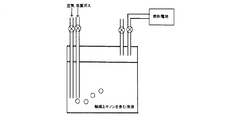
- FIG. 2 is a schematic diagram of an example of a carbon monoxide removal apparatus having a regeneration function for reducing quinones by electrolytic oxidation.
- the removal apparatus includes a sealed container containing a solution containing a metalloporphyrin complex and quinones, a gas inlet for introducing a gas containing carbon monoxide (for example, a reformed gas) into the solution, and a monoxide
- a gas discharge port for discharging the gas from which the carbon has been removed to the outside of the container, a working electrode, a counter electrode, and, if necessary, a reference electrode are provided.
- a gas containing carbon monoxide (reformed gas) is introduced from a gas inlet without applying a voltage between the working electrode and the counter electrode, and the solution containing the metal porphyrin complex and quinones is introduced into the solution.
- carbon monoxide contained in the gas can be oxidized and removed.
- the gas (reformed gas) that has passed through the solution may be discharged from the gas outlet to the outside of the container and supplied to, for example, a fuel cell as anode gas.
- quinones are formed by an anodic reaction by using the quinone reductant as a fuel.
- the formed quinones can be used again as a fuel by converting them into a reductant using the above method.
- the structure of the fuel cell that can be used in this method.
- a known fuel cell used in an ordinary solid polymer fuel cell is used except that a solution containing a reduced form of quinones is used as the fuel.
- Polymer electrolyte membranes, electrode catalysts, membrane-electrode assemblies and cell structures can be applied.
- the electrode catalyst conventionally known various metals and metal alloys can be used.
- anode and cathode catalysts include platinum, palladium, iridium, rhodium, ruthenium, and various metal catalysts including platinum-ruthenium, or supported catalysts in which these catalyst fine particles are dispersed on a carrier such as carbon. .
- the polymer electrolyte membrane a perfluorocarbon-based or styrene exchange resin membrane can be used.
- the joined body of the solid polymer electrolyte membrane and the electrode catalyst is generally produced in the same manner as a known joined body. For example, after a catalyst ink produced by mixing a catalyst powder and an electrolyte solution is thinned, a method such as hot pressing on an electrolyte membrane or direct application / drying on a polymer membrane is applied.
- the catalyst can be directly attached to the solid polymer film by a method such as adsorption reduction, electroless plating, sputtering, or CVD.
- the electrode may be produced by a method such as applying and drying the catalyst ink directly on a gas diffusion layer or current collector such as carbon paper or carbon cloth, or impregnating / reducing a metal complex as a precursor. Both sides of the obtained membrane-electrode assembly are sandwiched between current collectors such as carbon paper or carbon cloth and assembled into a cell to produce a fuel cell.
- the anode side may be supplied as an aqueous solution containing at least one quinone reductant of about 100 ⁇ mol / L to 5 mol / L as the fuel, and air or oxygen may be supplied or naturally diffused to the cathode side.
- the reduced form of quinones used as fuel is converted into quinones by an anodic reaction.
- a solution containing quinones formed by the anodic reaction is recovered and supplied to a sealed container, and the solution contains at least one metal porphyrin complex selected from the group consisting of a rhodium porphyrin complex and a cobalt porphyrin complex.
- carbon monoxide is introduced into carbon monoxide by using a metal porphyrin complex as a catalyst to form carbon dioxide, and at the same time, reduction reaction of quinones proceeds to reduce quinones.
- the body is formed.
- the metalloporphyrin complex may be previously placed in a container as an aqueous solution, or may be added to this solution after a solution containing quinones is recovered and placed in the container.
- the solvent of the solution containing quinones, the concentration of quinones in the solution, the concentration of the metal porphyrin complex, and the like may be the same as those of the carbon monoxide removal method described above.
- FIG. 3 is a schematic view of a fuel cell using a quinone reductant as a fuel, equipped with a device that converts quinones into a reductant and regenerates the fuel.
- a fuel containing a reduced form of quinones is supplied to the anode catalyst layer, and the reduced form of quinones in the fuel becomes quinones by the anode reaction, and this solution is a fuel that converts quinones into a reduced form.
- the regenerator includes a sealed container that contains a solution containing a metalloporphyrin complex, a supply port that supplies a solution containing quinones after an anode reaction in a fuel cell, and carbon monoxide in the solution.
- a gas inlet for introducing, a gas outlet for discharging a gas containing carbon dioxide from the container, and a fuel supply port for supplying a reduced form of quinones to the fuel cell are provided.
- the reduced form of quinones supplied to the anode catalyst layer as fuel is converted into quinones by an anode reaction, and the solution containing quinones is supplied to the fuel regeneration device.
- a mixed solution with a solution containing a metalloporphyrin complex supplied from the mouth into a sealed container and contained in the container is used.
- a gas containing carbon monoxide supplied from the gas inlet into the mixed solution, the carbon monoxide is oxidized, and at the same time, the quinones are converted into a reduced form.
- the solution containing the reduced form of quinones formed by this method is supplied from the fuel supply port of the fuel regeneration device to the anode catalyst layer of the fuel cell and reused as fuel.
- the fuel cell provided with the fuel regeneration device having such a structure it is possible to continuously generate power efficiently by using a quinone reductant as fuel.
- the carbon monoxide contained in the reformed gas or the like used as the anode gas of the fuel cell is oxidized to reduce the concentration of carbon monoxide contained in the reformed gas. be able to. Further, since the treatment liquid used for the carbon monoxide removal treatment can be regenerated by oxidation with oxygen or electrolytic oxidation, it can be used repeatedly.
- the carbon monoxide removal process is performed using the solution. Therefore, when the catalyst or the like deteriorates, the process can be continued by simply exchanging the solution. The removal of carbon oxide can be continued.
- a fuel cell equipped with a fuel regeneration device that converts quinones into reductants using the catalytic action of metalloporphyrin complexes enables continuous and efficient power generation using reductants of quinones as fuel. It becomes.
- regeneration function of the quinone reductant by oxygen The schematic of an example of the carbon monoxide removal apparatus provided with the reproduction
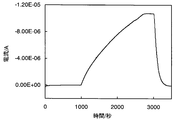
- Voltammogram determined in Example 31 (electrochemical regeneration of vitamin K 3 under acidic conditions).
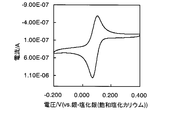
- Voltammogram determined in Example 32 (electrochemical regeneration of anthraquinone-2,6-disulfonic acid under acidic conditions).
- Voltammogram determined in Example 33 (electrochemical regeneration of vitamin K 3 under neutral conditions).
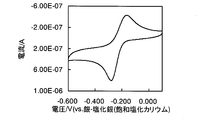
- Voltammogram determined in Example 34 (electrochemical regeneration of anthraquinone-2,6-disulfonic acid under neutral conditions
- Example 1 A mixed solvent consisting of 13.5 mL of acetone and 1.5 mL of 0.1 mol / L sulfuric acid has the following chemical formula
- vitamin K 3 2-methyl-1,4-naphthoquinone represented by the formula
- the amount of CO 2 in the gas phase was measured by gas chromatography. As a result, the amount of CO 2 in the gas phase was 3.65 ⁇ mol, confirming that carbon monoxide was oxidized and carbon dioxide was produced. It was.
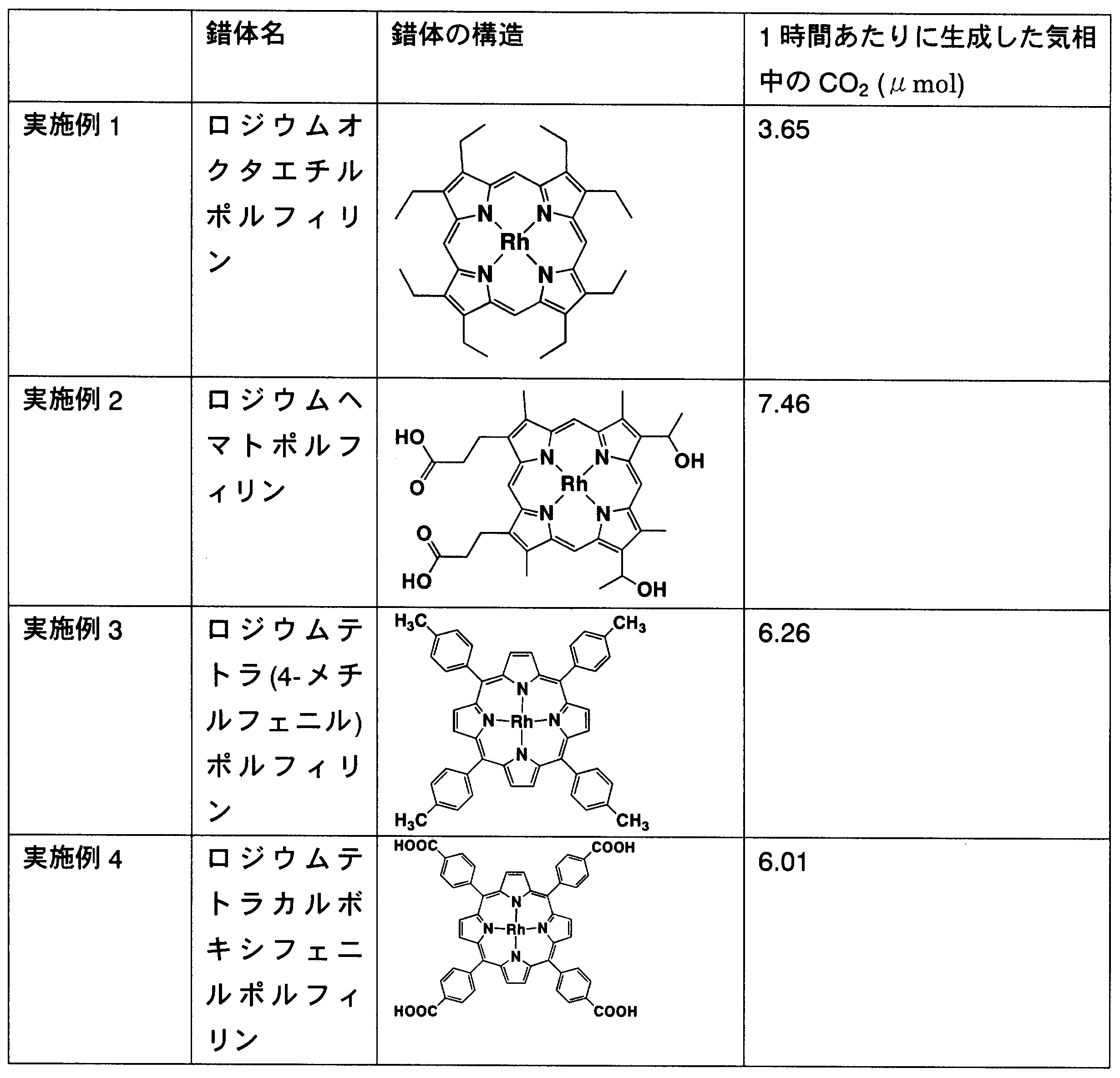
- Examples 2-8 As the rhodium porphyrin complex, the amount of carbon dioxide in the gas phase was measured in the same manner as in Example 1 except that each compound shown in Table 1 and Table 2 below was used. The results are shown in Tables 1 and 2 below.
- Examples 9-11 In the same manner as in Example 1, except that a mixed solvent consisting of 13.5 mL of ethanol and 1.5 mL of 0.1 mol / L sulfuric acid was used as the solvent, and each compound shown in Table 3 below was used as the rhodium porphyrin complex. The amount of carbon dioxide was measured. The results are shown in Table 3 below.
- Examples 12-14 The amount of carbon dioxide in the gas phase was measured in the same manner as in Example 1 except that the mixed solvent shown in Table 2 below was used. The results are shown in Table 4 below.
- Examples 15 and 16 Bubbling was performed by blowing carbon monoxide gas for 10 minutes in a solution obtained by dissolving quinones shown in Table 5 below at a concentration of 10 mmol / L in a mixed solvent consisting of 13.5 mL of ethanol and 1.5 mL of 0.1 mol / L sulfuric acid.
- the container containing this solution was sealed.
- the gas phase volume in the container is 6 mL.
- rhodium hematoporphyrin as a rhodium porphyrin complex was added to this solution to a concentration of 0.1 mmol / L, and the container was sealed again.
- Example 17 A vessel in which carbon monoxide gas was bubbled for 10 minutes in a solution of benzoquinone dissolved at a concentration of 10 mmol / L in a mixed solvent consisting of 13.5 mL of acetone and 1.5 mL of 0.1 mol / L sulfuric acid. was sealed. The gas phase volume in the container is 6 mL.
- rhodium hematoporphyrin as a rhodium porphyrin complex was added to this solution to a concentration of 0.1 mmol / L, and the container was sealed again.
- Example 18 A vessel in which carbon monoxide gas was bubbled for 10 minutes in a solution of alizarin dissolved at a concentration of 10 mmol / L in a mixed solvent consisting of 13.5 mL of ethanol and 1.5 mL of 0.1 mol / L sulfuric acid. was sealed. The gas phase volume in the container is 6 mL.
- Example 19 The amount of carbon dioxide in the gas phase was measured in the same manner as in Example 18 except that a mixed solvent consisting of 13.5 mL of dimethylformamide and 1.5 mL of 0.1 mol / L sulfuric acid was used. As a result, the amount of carbon dioxide in the gas phase was 0.63 ⁇ mol, and it was confirmed that carbon monoxide was oxidized to produce carbon dioxide.
- Example 20 Bubbling was performed by bubbling carbon monoxide gas for 10 minutes in a solution of anthraquinone disulfonic acid dissolved at a concentration of 10 mmol / L in a solvent obtained by adding 1.5 mL of 0.1 mol / L sulfuric acid to 13.5 mL of water. The container was sealed. The gas phase volume in the container is 6 mL.
- rhodium deuteroporphyrin 2.4-disulfonic acid as a rhodium porphyrin complex was added to this solution to a concentration of 0.1 mmol / L, and the container was sealed again.
- Example 21 The amount of carbon dioxide in the gas phase was measured in the same manner as in Example 20 except that rhodium tetra (4-trimethylammonium) phenylporphyrin was used as the rhodium porphyrin complex. As a result, the amount of carbon dioxide in the gas phase was 7.95 ⁇ mol, and it was confirmed that carbon monoxide was oxidized and carbon dioxide was produced.
- Example 22 The amount of carbon dioxide in the gas phase was measured in the same manner as in Example 20 except that water was used as the solvent. As a result, the amount of carbon dioxide in the gas phase was 2.76 ⁇ mol, and it was confirmed that carbon monoxide was oxidized to produce carbon dioxide.
- Example 23 Bubbling was performed by bubbling carbon monoxide gas for 10 minutes in a solution prepared by dissolving anthraquinone disulfonic acid at a concentration of 10 mmol / L in a solvent obtained by adding 1.5 mol of 0.1 mol / L sulfuric acid to 13.5 mL of water.
- the container was sealed.
- the gas phase volume in the container is 6 mL.
- rhodium porphyrin complex a support (supported amount: 100 ⁇ mol / g) in which rhodium hematoporphyrin is supported on carbon black (specific surface area 250 m 2 / g, trade name: Vulcan XC 72R, manufactured by Cabot) is used.
- the above support was added to the solution containing the above-mentioned anthraquinone disulfonic acid so as to be 0.1 mmol / l as rhodium hematoporphyrin, and the container was sealed again.
- Example 24 Except for using rhodium octaethylporphyrin as a rhodium porphyrin complex on carbon black (specific surface area 250 m 2 / g, trade name: Vulcan XC 72R, manufactured by Cabot) (supported amount: 20 ⁇ mol / g)
- the amount of carbon dioxide in the gas phase was measured.
- the amount of carbon dioxide in the gas phase was 0.99 ⁇ mol, and it was confirmed that carbon monoxide was oxidized to produce carbon dioxide.
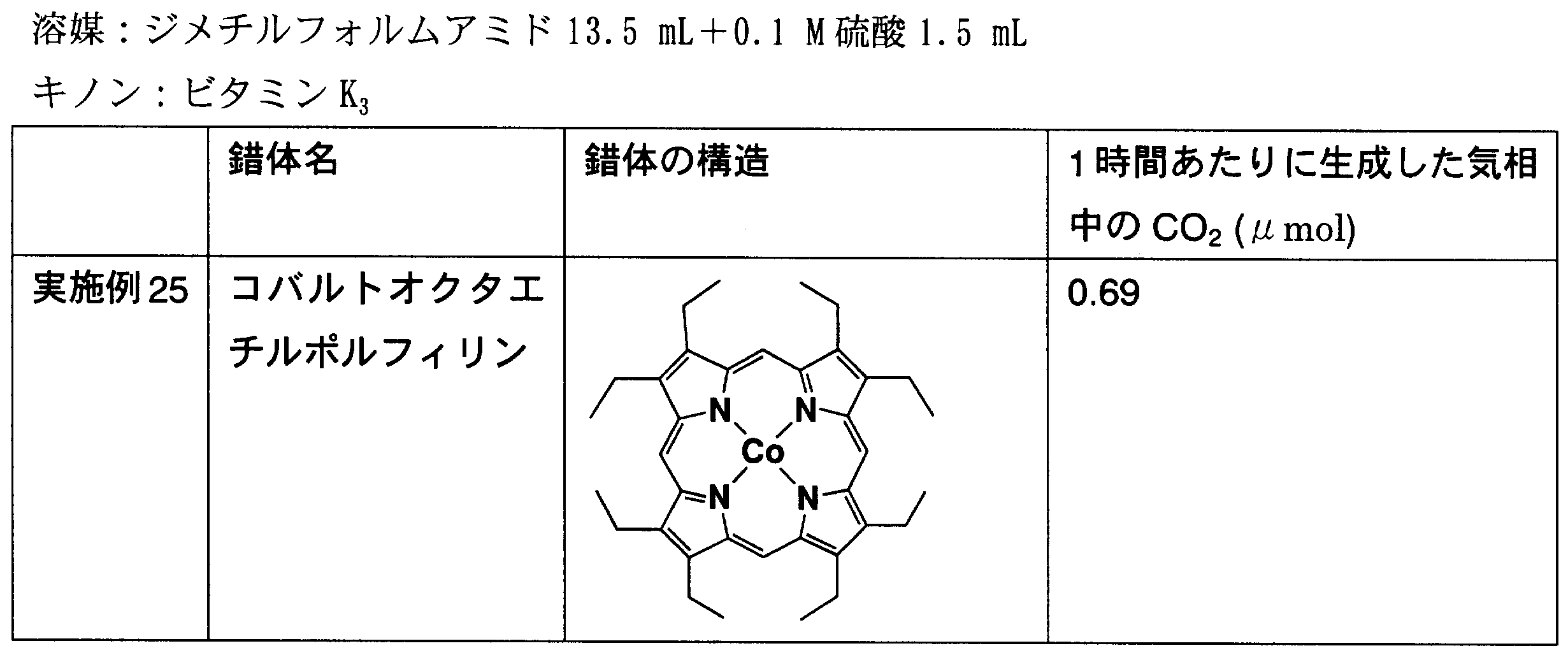
- Example 25 The amount of carbon dioxide in the gas phase was measured in the same manner as in Example 14 except that cobalt octaethylporphyrin was used as the metalloporphyrin complex. As a result, the amount of carbon dioxide in the gas phase was 0.69 ⁇ mol, and it was confirmed that carbon monoxide was oxidized and carbon dioxide was produced.
- Example 26 Add 0.1 mL of 0.1 M sulfuric acid and 4.7 mL of dimethylformamide to 9.9 mL of water, and bubbling carbon monoxide gas for 10 minutes in a solution of vitamin K 3 dissolved at a concentration of 10 mmol / L. The container containing was sealed. The gas phase volume in the vessel is 6 mL.
- anthraquinone-2,6-disulfonic acid was dissolved in a solvent prepared by mixing 1 mL of 0.1 M sulfuric acid in 9 mL of water.
- the glassy carbon electrode (electrode surface area 0.0707 cm 2 ) was the working electrode
- the platinum electrode was the counter electrode
- the silver-silver chloride (saturated potassium chloride) electrode was the reference electrode
- the working electrode was rotated while rotating at 3600 rpm. Perometric measurements were taken.
- the set potential was 0.2 V.
- the reduced form of anthraquinone-2,6-disulfonic acid was produced by reducing anthraquinone-2,6-disulfonic acid with hydrogen.
- the amperometry measurement results are shown in FIG. 4 is proportional to the concentration of the reduced form of quinone. Since the commercially available anthraquinone-2,6-disulfonic acid does not contain a reduced form of anthraquinone-2,6-disulfonic acid, no oxidation current flows. Here, when the gas is switched from argon to hydrogen (950 seconds after the start of measurement), the reduction of anthraquinone-2,6-disulfonic acid starts to occur and the oxidation current starts to increase.
- This oxidation current value is proportional to the reduced concentration of anthraquinone-2,6-disulfonic acid.
- Example 28 Except using vitamin K 3 as quinone reaction was performed in the same conditions as in Example 26. It was found that reduced vitamin K 3 formed by the introduction of hydrogen is oxidized by oxygen and vitamin K 3 is regenerated. The playback speed under this condition was 29 nM / s.
- Example 29 The reaction was carried out under the same conditions as in Example 26 except that a solvent in which 1 mL of pH 7.0 buffer (0.1 M phosphate buffer) was mixed with 9 mL of water was used as the electrolyte, and the set potential was 0.1 V. It was found that reduced anthraquinone-2,6-disulfonic acid formed by the introduction of hydrogen was oxidized by oxygen and anthraquinone-2,6-disulfonic acid was regenerated. The playback speed under this condition was 4970 nM / s.
- pH 7.0 buffer 0.1 M phosphate buffer
- Vitamin K 3 is used as quinone, except that the set potential and 0.15 V The reaction was performed in the same conditions as in Example 28. It was found that reduced vitamin K 3 formed by the introduction of hydrogen is oxidized by oxygen and vitamin K 3 is regenerated. The playback speed under these conditions was 970 nM / s.
- vitamin K 3 of 0.1M sulfuric acid in water 9 mL to 1 mL mixed with the solvent were 0.05 mM dissolved.
- cyclic voltammetry at a sweep rate of 10 mV / s using a glassy carbon electrode (electrode surface area 0.0707 cm 2 ) as a working electrode, a platinum electrode as a counter electrode, and silver-silver chloride (saturated potassium chloride) as a reference electrode Measurements were made. Before the measurement, oxygen was removed by bubbling argon gas for 5 minutes, and during the measurement, argon gas was blown onto the liquid surface to prevent oxygen from being mixed. The results are shown in FIG.
- a potential sweep from low potential to high potential corresponds to reoxidation of the reductant.
- the oxidation current starts to flow suddenly near 0 V, and at a positive potential from 0.105 V, the oxidation current decreases due to diffusion rate limiting. This means that the electrode reaction is extremely fast, and it can be seen that vitamin K 3 is regenerated when a voltage of about 0.2 V is applied.
- Example 32 Cyclic voltammetry measurement was performed under the same conditions as in Example 30 except that anthraquinone-2,6-disulfonic acid was used as the quinone. The results are shown in FIG. Oxidation current starts to flow suddenly around -0.18V, and at positive voltage from -0.06V, the oxidation current decreases due to diffusion rate control. This means that the electrode reaction is extremely fast, and it can be seen that when a voltage of about 0.05 V is applied, anthraquinone-2,6-disulfonic acid is regenerated by diffusion control.
- Example 33 Cyclic voltammetry measurement was performed under the same conditions as in Example 30 except that a solvent prepared by mixing 1 mL of pH 7.0 buffer with 9 mL of water was used as the electrolyte. The results are shown in FIG. The oxidation current starts to flow suddenly around -0.35V, and at a positive voltage from -0.16V, the oxidation current decreases due to diffusion rate control. This means that the electrode reaction is extremely fast, and it can be seen that when a voltage of -0.06 V is applied, vitamin K 3 is regenerated by diffusion-limited.
- Example 34 The cyclic voltammetry measurement was performed under the same conditions as in Example 32 except that anthraquinone-2,6-disulfonic acid was used as the quinone. The results are shown in FIG. Oxidation current starts to flow suddenly around -0.55V, and at positive potentials from -0.2V, the oxidation current decreases due to diffusion rate control. This means that the electrode reaction is faster than diffusion at a potential more positive than -0.2 V, and anthraquinone-2,6-disulfonic acid is regenerated at a diffusion rate if a voltage of about 0 V is applied. I understand that.
Landscapes
- Chemical & Material Sciences (AREA)
- Organic Chemistry (AREA)
- Engineering & Computer Science (AREA)
- Inorganic Chemistry (AREA)
- Chemical Kinetics & Catalysis (AREA)
- Sustainable Energy (AREA)
- Manufacturing & Machinery (AREA)
- Sustainable Development (AREA)
- Life Sciences & Earth Sciences (AREA)
- Combustion & Propulsion (AREA)
- Electrochemistry (AREA)
- General Chemical & Material Sciences (AREA)
- Materials Engineering (AREA)
- Catalysts (AREA)
- Hydrogen, Water And Hydrids (AREA)
- Carbon And Carbon Compounds (AREA)
Abstract
本発明は、ロジウムポルフィリン錯体及びコバルトポルフィリン錯体からなる群から選ばれた少なくとも一種の金属ポルフィリン錯体の存在下において、一酸化炭素を含む気体をキノン類を含む溶液に接触させることによる一酸化炭素の除去方法を提供するものである。本発明方法によれば、燃料電池用のアノードガスなどに含まれる一酸化炭素を、煩雑な装置を用いることなく、効率よく除去できる。
Description
本発明は、燃料電池用のアノードガスなどに含まれる一酸化炭素の除去方法、及びこの方法に用いる一酸化炭素の除去装置に関する。
定置用固体高分子形燃料電池のアノードガスに含まれている一酸化炭素は、燃料電池の白金系アノード触媒を被毒するという問題点がある。このため、一酸化炭素被毒を抑制するために、燃料電池の上流にシフト反応器を配置し、シフト反応(CO+H2O→CO2+H2)により一酸化炭素を二酸化炭素と水素に変換することが行われている。この場合、シフト反応だけでは一酸化炭素濃度を十分に低下させることができないことが多く、シフト反応の後段に選択酸化器を配置して、選択酸化反応(CO+1/2O2→CO2)によってさらに一酸化炭素濃度を減少させる方法が報告されている(下記特許文献1、2等参照)。
しかしながら、選択酸化器は酸素を連続的に吹き込む必要があり、酸素流量や温度の制御なども厳密に最適化する必要がある。このことはシステムの複雑化やコストの上昇に繋がる可能性がある。
本発明は、上記した従来技術の問題点に鑑みてなされたものであり、その主な目的は、燃料電池用のアノードガスなどに含まれる一酸化炭素を、煩雑な装置を用いることなく、効率よく除去できる方法、及びこの方法に用いる一酸化炭素除去装置を提供することである。
本発明者は、上記した目的を達成すべく、鋭意研究を重ねてきた。その結果、キノン類を含む溶液中に、ロジウムポルフィリン錯体又はコバルトポルフィリン錯体を存在させた状態において、該溶液に一酸化炭素を含む気体を吹き込むことにより、キノン類の酸化作用によって一酸化炭素を二酸化炭素に変換することができ、一酸化炭素の濃度を低減できることを見出した。さらに、この方法では、上記反応によってキノン類の還元体が形成され、反応を継続して行うとこれが溶液中に蓄積するが、これは酸素による酸化又は電解酸化によって、キノン類に戻すことができ、引き続き一酸化炭素の除去に利用できることを見出した。そして、これらの反応を利用した一酸化炭素の除去装置によれば、比較的簡単な構造の装置を用いてアノードガスなどに含まれる一酸化炭素を効率よく連続的に除去することが可能となることを見出した。更に、本発明者は、上記した一酸化炭素の除去方法と同様の方法を、キノン類をキノン類の還元体に変換する方法として利用することができ、この方法を利用することによって、キノン類の還元体を燃料とする燃料電池において、アノード反応により形成されたキノン類を還元体に変換して、燃料として再利用することが可能となることを見出した。本発明は、これらの知見に基づいて更に検討を重ねた結果、完成されたものである。
即ち、本発明は、下記の一酸化炭素の除去方法、一酸化炭素の除去装置、燃料再生型燃料電池、及び一酸化炭素の酸化用触媒を提供するものである。
項1. ロジウムポルフィリン錯体及びコバルトポルフィリン錯体からなる群から選ばれた少なくとも一種の金属ポルフィリン錯体の存在下において、一酸化炭素を含む気体を、キノン類を含む溶液に接触させることを特徴とする、一酸化炭素の除去方法。
項2. キノン類が、置換基を有することのあるベンゾキノン、置換基を有することのあるナフトキノン、及び置換基を有することのあるアンスラキノンからなる群から選ばれた少なくとも一種である、上記項1に記載の一酸化炭素の除去方法。
項3. 一酸化炭素を含む気体が、一酸化炭素を含む改質ガスである上記項1又は2に記載の一酸化炭素の除去方法。
項4. 導電性担体に担持された金属ポルフィリン錯体を用いる上記項1~3のいずれかに記載の方法。
項5. 上記項1~4のいずれかに記載の方法によって一酸化炭素を除去した後、溶液中に蓄積したキノン類の還元体を酸素による酸化又は電解酸化によってキノン類として再生する工程を含む、一酸化炭素の除去方法。
項6. ロジウムポルフィリン錯体及びコバルトポルフィリン錯体からなる群から選ばれた少なくとも一種の金属ポルフィリン錯体とキノン類を含む溶液を収容する密閉容器と、該溶液中に一酸化炭素を含む気体を導入するためのガス導入口と、該溶液中に酸素を含む気体を導入するための酸素含有気体導入口と、酸素含有気体排出口と、一酸化炭素を除去した気体を排出するためのガス排出口とを有する、上記項5に記載の方法に用いる一酸化炭素の除去装置。
項7. ロジウムポルフィリン錯体及びコバルトポルフィリン錯体からなる群から選ばれた少なくとも一種の金属ポルフィリン錯体とキノン類を含む溶液を収容する密閉容器と、該溶液中に一酸化炭素を含む気体を導入するためのガス導入口と、一酸化炭素を除去した気体を容器外に排出するためのガス排出口と、作用電極と、対極とを有する、上記項5に記載の方法に用いる一酸化炭素の除去装置。
項8. キノン類の還元体を燃料とする固体高分子形燃料電池と、キノン類を還元体に変換する燃料再生装置とを備えた燃料再生型燃料電池であって、
該燃料再生装置が、金属ポルフィリン錯体を含む溶液を収容する密閉容器と、燃料電池でのアノード反応後のキノン類を含む溶液を該容器中に供給する供給口と、該溶液中に一酸化炭素を導入するためのガス導入口と、二酸化炭素を含む気体を該容器から排出するガス出口と、キノン類の還元体を燃料電池に供給するための燃料供給口を備えていることを特徴とする、燃料電池。
項9.ロジウムポルフィリン錯体及びコバルトポルフィリン錯体からなる群から選ばれた少なくとも一種の金属ポルフィリン錯体を有効成分とする、キノン類を電子受容体とする一酸化炭素の酸化用触媒。
項1. ロジウムポルフィリン錯体及びコバルトポルフィリン錯体からなる群から選ばれた少なくとも一種の金属ポルフィリン錯体の存在下において、一酸化炭素を含む気体を、キノン類を含む溶液に接触させることを特徴とする、一酸化炭素の除去方法。
項2. キノン類が、置換基を有することのあるベンゾキノン、置換基を有することのあるナフトキノン、及び置換基を有することのあるアンスラキノンからなる群から選ばれた少なくとも一種である、上記項1に記載の一酸化炭素の除去方法。
項3. 一酸化炭素を含む気体が、一酸化炭素を含む改質ガスである上記項1又は2に記載の一酸化炭素の除去方法。
項4. 導電性担体に担持された金属ポルフィリン錯体を用いる上記項1~3のいずれかに記載の方法。
項5. 上記項1~4のいずれかに記載の方法によって一酸化炭素を除去した後、溶液中に蓄積したキノン類の還元体を酸素による酸化又は電解酸化によってキノン類として再生する工程を含む、一酸化炭素の除去方法。
項6. ロジウムポルフィリン錯体及びコバルトポルフィリン錯体からなる群から選ばれた少なくとも一種の金属ポルフィリン錯体とキノン類を含む溶液を収容する密閉容器と、該溶液中に一酸化炭素を含む気体を導入するためのガス導入口と、該溶液中に酸素を含む気体を導入するための酸素含有気体導入口と、酸素含有気体排出口と、一酸化炭素を除去した気体を排出するためのガス排出口とを有する、上記項5に記載の方法に用いる一酸化炭素の除去装置。
項7. ロジウムポルフィリン錯体及びコバルトポルフィリン錯体からなる群から選ばれた少なくとも一種の金属ポルフィリン錯体とキノン類を含む溶液を収容する密閉容器と、該溶液中に一酸化炭素を含む気体を導入するためのガス導入口と、一酸化炭素を除去した気体を容器外に排出するためのガス排出口と、作用電極と、対極とを有する、上記項5に記載の方法に用いる一酸化炭素の除去装置。
項8. キノン類の還元体を燃料とする固体高分子形燃料電池と、キノン類を還元体に変換する燃料再生装置とを備えた燃料再生型燃料電池であって、
該燃料再生装置が、金属ポルフィリン錯体を含む溶液を収容する密閉容器と、燃料電池でのアノード反応後のキノン類を含む溶液を該容器中に供給する供給口と、該溶液中に一酸化炭素を導入するためのガス導入口と、二酸化炭素を含む気体を該容器から排出するガス出口と、キノン類の還元体を燃料電池に供給するための燃料供給口を備えていることを特徴とする、燃料電池。
項9.ロジウムポルフィリン錯体及びコバルトポルフィリン錯体からなる群から選ばれた少なくとも一種の金属ポルフィリン錯体を有効成分とする、キノン類を電子受容体とする一酸化炭素の酸化用触媒。
以下、本発明の一酸化炭素の除去方法について具体的に説明する。
一酸化炭素の除去方法
本発明の一酸化炭素の除去方法は、ロジウムポルフィリン錯体及びコバルトポルフィリン錯体からなる群から選ばれた少なくとも一種の金属ポルフィリン錯体(以下、単に「金属ポルフィリン錯体」ということがある)の存在下において、一酸化炭素を含む気体を、キノン類を含む溶液に接触させる方法である。
本発明の一酸化炭素の除去方法は、ロジウムポルフィリン錯体及びコバルトポルフィリン錯体からなる群から選ばれた少なくとも一種の金属ポルフィリン錯体(以下、単に「金属ポルフィリン錯体」ということがある)の存在下において、一酸化炭素を含む気体を、キノン類を含む溶液に接触させる方法である。
この方法によれば、金属ポルフィリン錯体の触媒作用によって、下記の反応式に従って一酸化炭素の酸化反応が進行して、一酸化炭素を含む気体中の一酸化炭素濃度を低減することができる。
CO+H2O+Q→CO2+QH2
尚、上記化学式において、Qはキノン類を表し、QH2はキノン類の還元体を表す。
尚、上記化学式において、Qはキノン類を表し、QH2はキノン類の還元体を表す。
従って、ロジウムポルフィリン錯体及びコバルトポルフィリン錯体からなる群から選ばれた少なくとも一種の金属ポルフィリン錯体は、キノン類を電子受容体とする一酸化炭素の酸化用触媒として有用である。
以下、該金属ポルフィリンを触媒の存在下に、キノン類を電子受容体として一酸化炭素を酸化除去する方法について具体的に説明する。
(i)キノン類
本発明では、キノン類としては、使用する溶媒に可溶なキノン類であれば特に限定なく用いることができる。このようなキノン類としては、置換基を有することのあるベンゾキノン、置換基を有することのあるナフトキノン、置換基を有することのあるアンスラキノンなどを例示できる。これらのキノン類の内で、一酸化炭素の酸化反応の反応速度が高い点で置換基を有することのあるナフトキノン、置換基を有することのあるアンスラキノンなどが好ましい。また、還元体からの再生が容易な点で置換基を有することのあるアンスラキノンが好ましい。置換基の種類については特に限定はなく、例えば、炭素数1~5程度の直鎖状又は分岐鎖状の低級アルキル基、カルボキシル基又はその塩、水酸基、スルホン酸基又はその塩等を例示できる。これらの置換基の数、置換位置などについては特に限定はなく、置換基の種類に応じて、溶解性の良好な溶媒を適宜選択すればよい。これらのキノン類は、一種単独又は二種以上混合して用いることができる。
本発明では、キノン類としては、使用する溶媒に可溶なキノン類であれば特に限定なく用いることができる。このようなキノン類としては、置換基を有することのあるベンゾキノン、置換基を有することのあるナフトキノン、置換基を有することのあるアンスラキノンなどを例示できる。これらのキノン類の内で、一酸化炭素の酸化反応の反応速度が高い点で置換基を有することのあるナフトキノン、置換基を有することのあるアンスラキノンなどが好ましい。また、還元体からの再生が容易な点で置換基を有することのあるアンスラキノンが好ましい。置換基の種類については特に限定はなく、例えば、炭素数1~5程度の直鎖状又は分岐鎖状の低級アルキル基、カルボキシル基又はその塩、水酸基、スルホン酸基又はその塩等を例示できる。これらの置換基の数、置換位置などについては特に限定はなく、置換基の種類に応じて、溶解性の良好な溶媒を適宜選択すればよい。これらのキノン類は、一種単独又は二種以上混合して用いることができる。
(ii)金属ポルフィリン錯体
本発明方法では、触媒として用いる金属ポルフィリン錯体としては、金属成分としてロジウム又はコバルトを含み、配位子としてポルフィリン化合物を含む化合物であれば特に限定なく使用できる。この様な金属ポルフィリン錯体は、一種単独又は二種以上混合して用いることができる。金属ポルフィリン錯体の内で、好ましい化合物としては、下記化学式(1)で表される化合物、化学式(2)で表される化合物等を例示できる。
本発明方法では、触媒として用いる金属ポルフィリン錯体としては、金属成分としてロジウム又はコバルトを含み、配位子としてポルフィリン化合物を含む化合物であれば特に限定なく使用できる。この様な金属ポルフィリン錯体は、一種単独又は二種以上混合して用いることができる。金属ポルフィリン錯体の内で、好ましい化合物としては、下記化学式(1)で表される化合物、化学式(2)で表される化合物等を例示できる。
(1)化学式(1):

(式中、R1~R12は、同一又は異なって、それぞれ、アルキル基、置換基を有することのあるアリール基、水素原子又はハロゲン原子を示し、Mはロジウム又はコバルトを示す。)で表される金属ポルフィリン錯体。
上記化学式において、R1~R12は、同一又は異なって、それぞれ、アルキル基、置換基を有することのあるアリール基、水素原子、又はハロゲン原子を示す。これらの内で、アルキル基としては、メチル、エチル、イソプロピル、n-プロピル、t-ブチル、sec-ブチル、n-ブチル、イソブチル、n-ペンチルなどの炭素数1~5程度の直鎖状又は分岐鎖状の低級アルキル基が好ましい。また、ハロゲン原子としては、フッ素、塩素、臭素などが好ましい。置換基を有することのあるアリール基としては、フェニル基、置換基を有するフェニル基、ピリジル基、置換基を有するピリジル基等が好ましい。
これらの内で、R1、R4、R7及びR10が全て置換基を有することのあるアリール基、特に、置換基を有することのあるフェニル基である場合には、メソ位が化学的に保護されているために、酸化反応などに対する安定性が高くなる。
置換基を有するアリール基の内で、置換基を有するピリジル基としては、1-メチルピリジル基等を例示できる。置換基を有するフェニル基における置換基としては、低級アルコシキ基、低級アルキル基、ハロゲン原子、-SO3M1(式中、M1は水素原子、アルカリ金属又は-NH4である)、-COOM2(式中、M2は水素原子、アルカリ金属、-NH4又はアルキル基である)、-OCH2-COOM3(式中、M3は水素原子、アルカリ金属、-NH4又はアルキル基である)、アミノ基、アルキル化されたアミノ基等を例示できる。アルキル化されたアミノ基としてはトリメチルアミノ基などを例示できる。
これらの内で、置換基として低級アルコキシ基を有するフェニル基としてはパラ-メトキシフェニル基等、置換基として低級アルキル基を有するフェニル基としては、パラ-メチルフェニル基、2,4,6-トリメチルフェニル基等、置換基としてハロゲン原子を有するフェニル基としてはペンタフルオロフェニル基等を例示できる。
フェニル基の置換基の内で、-SO3M1では、M1は水素原子、アルカリ金属又は-NH4である。これらの内で、アルカリ金属としては、K、Na等を例示できる。フェニル基の置換基の内で、-COOM2では、M2は水素原子、アルカリ金属、-NH4又はアルキル基である。これらの内で、アルカリ金属としては、K、Na等を例示できる。アルキル基としては、上記した基と同様の基を例示できる。また、フェニル基の置換基の内で、-OCH2-COOM3では、M3は水素原子、アルカリ金属、-NH4又はアルキル基である。これらの内で、アルカリ金属としては、K、Na等を例示できる。アルキル基としては、上記した基と同様の基を例示できる。
-SO3M1、-COOM2、-OCH2-COOM3等の置換基は、例えばフェニル基の4位に置換することができるが、これに限定されるものではない。
上記化学式で表される金属ポルフィリン錯体の代表例として、R1, R4, R7及びR10が置換基を有することのあるフェニル基であって、R2, R3, R5, R6, R8, R9, R11及びR12が水素原子であるロジウムテトラフェニルポリフィリン錯体; R1, R4, R7及びR10が水素原子であって、R2, R3, R5, R6, R8, R9, R11及びR12が低級アルキル基であるロジウムオクタアルキルポリフィリン錯体等を挙げることができる。
(2)化学式

(式中、R1~R8は、同一又は異なって、それぞれ、水素原子、アルキル基、ヒドロキシアルキル基、アルケニル基、基:-SO3M1(式中、M1は、水素原子、アルカリ金属又は-NH4である)、又は基:-R9-COOM2(式中、R9は直鎖状又は分岐鎖状のアルキレン基であり、M2は水素原子、アルカリ金属又はアルキル基である)を示すか、或いは、R1とR2、R3とR4、R5とR6、R7とR8の各組み合わせの少なくとも一組は互いに結合して、これらの各基が結合する炭素原子と共に、置換基を有することのある芳香族環を形成してもよい。Mはロジウム又はコバルトを示す。但し、R1~R8の少なくとも一つは、基:-R9-COOM2である)で表される金属ポルフィリン錯体。
上記化学式において、アルキル基としては、メチル、エチル、イソプロピル、n-プロピル、t-ブチル、sec-ブチル、n-ブチル、イソブチル、n-ペンチルなどの炭素数1~5程度の直鎖状又は分岐鎖状の低級アルキル基が好ましい。
ヒドロキシアルキル基のアルキル基部分としては、メチル、エチル、イソプロピル、n-プロピル、t-ブチル、sec-ブチル、n-ブチル、イソブチル、n-ペンチルなどの炭素数1~5程度の直鎖状又は分枝鎖状の低級アルキル基を例示できる。ヒドロキシ基は、該アルキル基の任意の炭素原子に置換することができる。
アルケニル基としては、例えばビニル、アリル、2-ブテニル、3-ブテニル、1-メチルアリル、2-ペンテニル、2-ヘキセニル基等の炭素数2~6の直鎖又は分枝鎖状アルケニル基を挙げることができる。
基:-SO3M1において、M1は水素原子、アルカリ金属、又は-NH4である。これらの内で、アルカリ金属としては、K、Na等を例示できる。
基:-R9-COOM2において、R9で表されるアルキレン基としては、例えばメチレン、エチレン、トリメチレン、2-メチルトリメチレン、2,2-ジメチルトリメチレン、1-メチルトリメチレン、メチルメチレン、エチルメチレン、テトラメチレン、ペンタメチレン、ヘキサメチレン基等の炭素数1~6の直鎖又は分枝鎖状アルキレン基を例示できる。M2で表されるアルキル基とアルカリ金属は、上記したものと同様である。
上記化学式で表されるロジウムポルフィリン錯体において、R1~R8の内の2個以上が、基:-R9-COOM2である化合物は、キノン類による一酸化炭素の酸化反応に対して高い活性を有するものである。
(3)担持体
上記した金属ポルフィリン錯体は、導電性担体に担持させることにより、二量化反応や不均化反応等の分子間反応を抑制して、金属ポルフィリン錯体を安定化させることができ、キノン類による一酸化炭素の酸化反応に対して高い触媒活性を有するものとすることができる。これは、該金属ポルフィリン錯体が、導電性担体との相互作用によって該担体に強固に吸着担持されることによるものと思われる。
上記した金属ポルフィリン錯体は、導電性担体に担持させることにより、二量化反応や不均化反応等の分子間反応を抑制して、金属ポルフィリン錯体を安定化させることができ、キノン類による一酸化炭素の酸化反応に対して高い触媒活性を有するものとすることができる。これは、該金属ポルフィリン錯体が、導電性担体との相互作用によって該担体に強固に吸着担持されることによるものと思われる。
導電性担体としては、特に限定はなく、各種の導電性を有する担体を用いることができる。この様な担体の具体例としては、カーボンブラック、活性炭、黒鉛等の炭素質材料を挙げることができる。これらの内で、カーボンブラックは、上記化学式で表される金属ポルフィリン錯体との相互作用が大きく金属ポルフィリン錯体を安定化させる働きが強く、更に、導電性に優れ、比表面積も大きいために、導電性担体として特に好ましい物質である。
導電性担体の形状などについては特に限定はないが、例えば、平均粒径が0.1~100μm程度、好ましくは1~10μm程度のものを用いることができる。また、カーボンブラックを用いる場合には、例えば、BET法による比表面積が100~800m2/g程度の範囲内にあるものが好ましく、200~300 m2/g程度の範囲内にあるものがより好ましい。この様なカーボンブラックの具体例としては、Vulcan XC-72R(Cabot社製)の商標名で市販されているものを用いることができる。
導電性担体に担持させる方法としては、例えば、溶解乾燥法、気相法などの公知の方法を適用できる。
例えば、溶解乾燥法では、金属ポルフィリン錯体を有機溶媒に溶解させ、この溶液に導電性担体を加えて、例えば、数時間撹拌して、該担体に金属ポルフィリン錯体を吸着させた後、有機溶媒を乾燥させればよい。また、有機溶媒中に金属ポルフィリン錯体が多量に含まれる場合には、平衡に達するまで金属ポルフィリン錯体を導電性担体に吸着させた後、濾過することによって、導電性担体に吸着していない金属ポルフィリン錯体を除去して、該担体と相互作用している金属ポルフィリン錯体のみを該担体の表面に残すことができる。
この方法では、有機溶媒としては、金属ポルフィリン錯体を溶解できるものであれば、特に限定なく使用できる。例えば、エタノール等の低級アルコールを好適に用いることができる。
濾過によって得られた分散物を、さらに有機溶媒を用いて洗浄液が透明になるまで洗浄すれば、導電性担体との相互作用の弱い金属ポルフィリン錯体を洗い流すことができ、導電性担体に強固に吸着している金属ポルフィリン錯体のみを含む高活性な触媒を得ることができる。
気相法で担持させる場合には、例えば、プラズマ蒸着法、CVD法、加熱蒸着法などを公知の方法を採用できる。
導電性担体上に担持させる金属ポルフィリン錯体の量については、特に限定はないが、例えば、導電性担体1gに対して、金属ポルフィリン錯体を20μmol~80μmol程度担持させればよく、30μmol~70μmol程度担持させることが好ましい。
(iii)溶媒
一酸化炭素の酸化処理に用いる溶液の溶媒としては、使用する金属ポルフィリン錯体とキノン類を均一に溶解乃至分散できる溶媒であれば特に限定はない。このような溶媒は、上記した一酸化炭素の酸化反応を進行させるために、水を含有することが必要である。水の含有量は、全溶媒中5重量%程度以上であることが好ましい。また、水を単独で用いる場合、及び水と有機溶媒との混合溶媒を用いる場合のいずれについても、pH0~7程度の水を用いることが好ましく、これにより、上記した一酸化炭素の酸化反応を円滑に進行させることができる。純水のpHは 7付近であるので、純水を用いてもよいが、純水に緩衝能はないので、運転中にpHが望ましくない方向に動いてしまうおそれがある。この点で緩衝能を持つ水溶液を用いることが望ましい。
一酸化炭素の酸化処理に用いる溶液の溶媒としては、使用する金属ポルフィリン錯体とキノン類を均一に溶解乃至分散できる溶媒であれば特に限定はない。このような溶媒は、上記した一酸化炭素の酸化反応を進行させるために、水を含有することが必要である。水の含有量は、全溶媒中5重量%程度以上であることが好ましい。また、水を単独で用いる場合、及び水と有機溶媒との混合溶媒を用いる場合のいずれについても、pH0~7程度の水を用いることが好ましく、これにより、上記した一酸化炭素の酸化反応を円滑に進行させることができる。純水のpHは 7付近であるので、純水を用いてもよいが、純水に緩衝能はないので、運転中にpHが望ましくない方向に動いてしまうおそれがある。この点で緩衝能を持つ水溶液を用いることが望ましい。
有機溶媒としては、水との混和性が良好な溶媒であることが好ましい。このような有機溶媒としては、アセトン、ジメチルフォルムアミド、炭素数1~4程度の低級アルコール等を例示できる。これらの内で、アセトンは反応が進行し易い点で有利である。但し、キノン類の還元体を酸化させる際に、過酸化水素が生じることがあり、この過酸化水素がアセトンと反応して、爆発性の過酸化アセトンができることがあるので、注意が必要である。このような観点から反応溶媒としては水が好ましく、有機溶媒としては、不燃性の有機溶媒を用いることが好ましい。
一酸化炭素の酸化処理用の溶液中のキノン類の濃度については特に限定はないが、一酸化炭素の酸化反応を円滑に進行させるためには、できるだけ高濃度であることが好ましく、通常は、5mmol/L程度以上とすればよい。また、キノン類の濃度の上限は飽和濃度までとすることができる。具体的な上限濃度は、使用するキノン類と溶媒の組み合わせによって異なるが、通常は、20mmol/L程度が上限値となる。
また、処理液中の金属ポルフィリン錯体の濃度については特に限定はないが、通常、0.05mmol/L程度以上とすればよい。金属ポルフィリン錯体の濃度の上限については特に限定はなく、飽和濃度までの任意の濃度で用いることができるが、コストなどを考慮すると、例えば、0.3mmol/L程度以下とすればよい。
また、金属ポルフィリン錯体を導電性担体に担持させた担持体として用いる場合の使用量についても特に限定はないが、例えば、処理液1mLにつき、0.25mg程度以上とすることができる。
(iv)一酸化炭素の除去方法
本発明では、ロジウムポルフィリン錯体及びコバルトポルフィリン錯体からなる群から選ばれた少なくとも一種の金属ポルフィリン錯体の存在下において、上記したキノン類を含む溶液に処理対象である一酸化炭素を含む気体を接触させることによって、上記した反応式に従って、一酸化炭素の酸化反応が進行して、一酸化炭素濃度を低減することができる。具体的な処理方法としては、例えば、キノン類及び金属ポルフィリン錯体を含む溶液中に、一酸化炭素を含む気体を吹き込んでバブリングすればよい。
本発明では、ロジウムポルフィリン錯体及びコバルトポルフィリン錯体からなる群から選ばれた少なくとも一種の金属ポルフィリン錯体の存在下において、上記したキノン類を含む溶液に処理対象である一酸化炭素を含む気体を接触させることによって、上記した反応式に従って、一酸化炭素の酸化反応が進行して、一酸化炭素濃度を低減することができる。具体的な処理方法としては、例えば、キノン類及び金属ポルフィリン錯体を含む溶液中に、一酸化炭素を含む気体を吹き込んでバブリングすればよい。
一酸化炭素の除去処理時の処理液の液温については特に限定はなく、室温において反応を進行させることができるが、必要に応じて、処理液の沸点未満の温度まで加熱することによって反応を円滑に進行させることができる。
処理対象とする一酸化炭素を含む気体の種類については特に限定はないが、代表例として、天然ガスなどの燃料を水蒸気改質した後、シフト触媒により水素濃度を上げた、燃料電池用アノードガスとして利用される改質ガスを挙げることができる。この場合、一酸化炭素の濃度については、例えば、500ppm程度以上であってもよい。
(v)処理液の再生方法
上記した方法で一酸化炭素の除去処理を行うことにより、処理液中に含まれるキノン類は、還元体に変換される。このため、一酸化炭素の除去処理を継続して行うと、処理液中にキノン類の還元体が蓄積して一酸化炭素の除去性能が低下する。
上記した方法で一酸化炭素の除去処理を行うことにより、処理液中に含まれるキノン類は、還元体に変換される。このため、一酸化炭素の除去処理を継続して行うと、処理液中にキノン類の還元体が蓄積して一酸化炭素の除去性能が低下する。
この場合には、酸素による酸化又は電解酸化によって、処理液中に含まれるキノン類の還元体を酸化して、キノン類として再生することができる。これにより、再生されたキノン類を含む溶液を、引き続き一酸化炭素の除去に用いることができる。
酸素による酸化の方法としては、例えば、該処理液への一酸化炭素を含む気体の導入を停止した後、酸素を含む気体、例えば、空気を吹き込めばよい。空気の供給量については、キノン類の種類、濃度などによって異なるが、例えば、キノン類としてアントラキノンなどを用いる場合には、500 ccm程度以上の流量で空気を供給すると、用いる水が酸性のときは、溶液10mL程度について2~5分間程度の通気時間でキノン類の還元体を酸化して、キノン類を再生することができる。尚、酸素による再生反応は、酸性の水を用いたときより中性の水を用いたときの方が速く進行する。
図1は、酸素によるキノン類還元体の再生機能を備えた一酸化炭素除去装置の一例の概略図である。この除去装置は、金属ポルフィリン錯体とキノン類を含む溶液を収容する密閉容器と、該溶液中に一酸化炭素を含む気体(例えば、改質ガス)を導入するためのガス導入口と、該溶液中に酸素を含む気体(例えば、空気)を導入するための酸素含有気体導入口と、酸素含有気体排出口と、一酸化炭素を除去した気体を排出して、例えば、燃料電池に供給するためのガス排出口を備えたものである。この装置では、酸素含有気体導入口と酸素含有気体排出口を閉じた状態でガス導入口から一酸化炭素を含む気体(改質ガス)を導入し、金属ポルフィリン錯体とキノン類を含む溶液中に該気体を通過させることによって、該気体に含まれる一酸化炭素を酸化して除去することができる。溶液中を通過した気体(改質ガス)は、ガス排出口から容器外に排出して、例えば、アノードガスとして燃料電池に供給すればよい。
一方、該溶液中において、キノン類の還元体の量が増加した場合には、ガス導入口とガス排出口を閉じた状態で酸素含有気体導入口から酸素含有気体(例えば、空気)を導入することによって、酸素によるキノン類の還元体の酸化反応が進行して、キノン類が再生される。溶液中を通過した酸素含有気体については、酸素含有気体排出口より大気中に排出すればよい。この処理によりキノン類を再生した後、再度、酸素含有気体導入口と酸素含有気体排出口を閉じた状態でガス導入口から一酸化炭素を含む気体を導入することによって、該気体に含まれる一酸化炭素を除去することができる。
また、電解酸化(電気化学的酸化)方法によってキノン類を再生する場合には、処理液中に作用電極と対極を浸漬して、電解酸化を行えばよい。作用電極としては、導電性の材料であれば特に限定なく用いることができる。例えば、炭素電極、白金電極、金電極などを作用電極として用いることができる。対極としては、例えば、白金電極が好ましい。この際、対極に対する作用電極の電位については、キノン類の種類やポリフィリン錯体の種類によって異なるが、例えば、アンスラキノン類の還元体を酸化する場合には、通常、0.3V~0.5V程度とすればよい。また、電解酸化法では、参照電極を用いることが好ましく、例えば、銀|塩化銀|飽和塩化カリウム電極等を参照電極として用いることができる。この場合の参照電極に対する電位は、加える水溶液のpHに依存するが、例えば、アンスラキノン類の還元体を酸化する際に、0.1M硫酸を水溶液として加えるときは、参照電極に対して0V程度以上の電位を付与すればよい。
図2は、電解酸化によるキノン類還元体の再生機能を備えた一酸化炭素除去装置の一例の概略図である。この除去装置は、金属ポルフィリン錯体とキノン類を含む溶液を収容した密閉容器と、該溶液中に一酸化炭素を含む気体(例えば、改質ガス)を導入するためのガス導入口と、一酸化炭素を除去した気体を容器外に排出するためのガス排出口と、作用電極と、対極と、必要に応じて、参照電極とを備えたものである。この装置では、作用電極と対極との間に電圧を印加しない状態で、ガス導入口から一酸化炭素を含む気体(改質ガス)を導入し、金属ポルフィリン錯体とキノン類を含む溶液中に該気体を通過させることによって、該気体に含まれる一酸化炭素を酸化して除去することができる。溶液中を通過した気体(改質ガス)は、ガス排出口から容器外に排出して、例えば、アノードガスとして燃料電池等に供給すればよい。
一方、該溶液中において、キノン類の還元体の量が増加した場合には、ガス導入口とガス排出口を閉じた状態で、作用電極と対極の間に電圧を印加することによって、キノン類還元体の電気化学的酸化反応を進行させることができる。これにより、該溶液中のキノン類を再生することができる。この処理によりキノン類を再生した後、再度、電圧を印加しない状態でガス導入口から一酸化炭素を含む気体を導入することによって、該気体に含まれる一酸化炭素を除去することができる。
(vi)キノン類を還元体に変換する方法、及び該方法に用いる装置
本発明では、上記した一酸化炭素の除去方法と同様の方法を、キノン類をキノン類の還元体に変換する方法として利用できる。
本発明では、上記した一酸化炭素の除去方法と同様の方法を、キノン類をキノン類の還元体に変換する方法として利用できる。
例えば、キノン類の還元体を燃料とする燃料電池において、キノン類の還元体を燃料として用いることによって、アノード反応によりキノン類が形成される。この場合に、形成されたキノン類を、上記方法を利用して還元体に変換することによって、再度、燃料として利用することができる。
この方法で利用できる燃料電池の構造については、特に限定はなく、キノン類の還元体を含む溶液を燃料とする以外は、基本的には、通常の固体高分子形燃料電池に用いられる既知の高分子電解質膜、電極触媒、膜-電極接合体およびセル構造を適用することができる。例えば、電極触媒としては、従来から知られている種々の金属、および金属合金などを使用することができる。例えば、アノードおよびカソード触媒として、白金、パラジウム、イリジウム、ロジウム、ルテニウム、白金-ルテニウムをはじめとする各種金属触媒、またはこれらの触媒微粒子をカーボンなどの担体上に分散させた担持触媒などが挙げられる。高分子電解質膜としては、パーフルオロカーボン系、スチレン交換樹脂膜を使用することができる。固体高分子電解質膜と電極触媒との接合体は、一般に公知の接合体と同様にして、作製される。例えば、触媒粉末と電解質溶液とを混合して作製した触媒インクを薄膜化させた後、電解質膜上にホットプレスする、あるいは直接高分子膜上に塗布・乾燥するなどの方法が適用される。その他、吸着還元法、無電解めっき法やスパッター、CVDなどの方法で固体高分子膜に直接触媒を取り付けることもできる。また、カーボンペーパーやカーボンクロスなどのガス拡散層や集電体に直接触媒インクを塗布・乾燥する、あるいは前駆体となる金属錯体を含浸・還元するなどの方法によって電極を作製しても良い。得られた膜-電極接合体の両面をカーボンペーパーまたはカーボンクロスなどの集電体で挟んでセルに組み込み、燃料電池セルを作製する。アノード側には、燃料として、キノン類の還元体の少なくとも一種を100μmol/L~5mol/L程度含む水溶液として供給し、カソード側には、空気または酸素を供給あるいは自然拡散させればよい。
上記した燃料電池では、燃料として用いたキノン類の還元体がアノード反応によりキノン類に変換される。アノード反応によって形成されたキノン類を含む溶液は、回収して密閉容器に供給し、該溶液中にロジウムポルフィリン錯体及びコバルトポルフィリン錯体からなる群から選ばれた少なくとも一種の金属ポルフィリン錯体が存在する状態において、一酸化炭素を導入することによって、金属ポルフィリン錯体を触媒として、一酸化炭素の酸化反応が進行して二酸化炭素が形成され、同時に、キノン類の還元反応が進行して、キノン類の還元体が形成される。金属ポルフィリン錯体は、予め水溶液として容器中に入れておいてもよく、あるいは、キノン類を含む溶液を回収して容器に入れた後、この溶液に添加してもよい。この方法では、キノン類を含む溶液の溶媒、溶液中のキノン類の濃度、金属ポルフィリン錯体の濃度などは、前述した一酸化炭素の除去方法と同様とすればよい。
図3は、キノン類を還元体に変換して燃料として再生する装置を備えた、キノン類の還元体を燃料とする燃料電池の概略図である。この燃料電池では、キノン類の還元体を含む燃料がアノード触媒層に供給され、アノード反応により燃料中のキノン類の還元体はキノン類となり、この溶液は、キノン類を還元体に変換する燃料再生装置に導入される。該再生装置は、金属ポルフィリン錯体を含む溶液を収容する密閉容器と、燃料電池でのアノード反応後のキノン類を含む溶液を該容器中に供給する供給口と、該溶液中に一酸化炭素を導入するためのガス導入口と、二酸化炭素を含む気体を該容器から排出するガス出口と、キノン類の還元体を燃料電池に供給するための燃料供給口を備えたものである。
このような燃料再生装置を備えた燃料電池では、燃料としてアノード触媒層に供給されたキノン類の還元体は、アノード反応によってキノン類に変換され、キノン類を含む溶液は、燃料再生装置の供給口から密閉容器中に供給され、該容器中に収容されている金属ポルフィリン錯体を含む溶液との混合溶液とされる。この混合溶液中にガス導入口から一酸化炭素を含む気体を吹き込んでバブリングすることによって、一酸化炭素が酸化され、同時に、キノン類が還元体に変換される。この方法で形成されるキノン類の還元体を含む溶液は、燃料再生装置の燃料供給口から燃料電池のアノード触媒層に供給されて、燃料として再利用される。
このような構造の燃料再生装置を備えた燃料電池によれば、キノン類の還元体を燃料として、連続的に効率のよい発電が可能となる。
本発明の一酸化炭素除去方法によれば、燃料電池のアノードガスとして用いられる改質ガスなどに含まれる一酸化炭素を酸化除去して、改質ガス中に含まれる一酸化炭素濃度を低減することができる。また、一酸化炭素の除去処理に用いた処理液は、酸素による酸化又は電解酸化によって再生できるので、繰り返し利用が可能である。
更に、本発明では、溶液を用いて一酸化炭素の除去処理を行うので、触媒などが劣化した場合には、溶液を交換するだけで処理を継続することができ、非常に簡便な方法で一酸化炭素の除去を継続して行うことができる。
また、金属ポルフィリン錯体の触媒作用を利用してキノン類を還元体に変換する燃料再生装置を備えた燃料電池によれば、キノン類の還元体を燃料として、連続的に効率のよい発電が可能となる。
以下、実施例を挙げて本発明を更に詳細に説明する。
実施例1
アセトン13.5mLと0.1mol/L硫酸1.5mLからなる混合溶媒に下記化学式
アセトン13.5mLと0.1mol/L硫酸1.5mLからなる混合溶媒に下記化学式

で表される2-メチル-1,4-ナフトキノン(ビタミンK3)を10mmol/Lの濃度で溶解した溶液中に、一酸化炭素ガスを10分間吹き込んでバブリングを行い、この溶液入れた容器を密閉した。
その後、この溶液に、ロジウムポルフィリン錯体としてロジウムオクタエチルポルフィリンを濃度0.1mmol/Lとなるように加えて、再度容器を密閉した。
1時間放置後、気相のCO2量をガスクロマトグラフィーで測定した結果、気相中のCO2量は、3.65μmolであり、一酸化炭素が酸化されて二酸化炭素が生じたことが確認できた。
実施例2~8
ロジウムポルフィリン錯体として、下記表1及び表2に示す各化合物を用いたこと以外は、実施例1と同様にして、気相中の二酸化炭素量を測定した。結果を下記表1及び表2に示す。
ロジウムポルフィリン錯体として、下記表1及び表2に示す各化合物を用いたこと以外は、実施例1と同様にして、気相中の二酸化炭素量を測定した。結果を下記表1及び表2に示す。
実施例2~8のいずれにおいても気相中に二酸化炭素が検出されており、実施例2~8で用いた各ロジウムポルフィリン錯体が、キノン類による一酸化炭素の酸化反応の触媒として有効に作用することが確認できた。

実施例9~11
溶媒として、エタノール13.5mLと0.1mol/L硫酸1.5mLからなる混合溶媒を用い、ロジウムポルフィリン錯体として、下記表3に示す各化合物を用いること以外は、実施例1と同様にして、気相中の二酸化炭素量を測定した。結果を下記表3に示す。
溶媒として、エタノール13.5mLと0.1mol/L硫酸1.5mLからなる混合溶媒を用い、ロジウムポルフィリン錯体として、下記表3に示す各化合物を用いること以外は、実施例1と同様にして、気相中の二酸化炭素量を測定した。結果を下記表3に示す。
実施例9~11のいずれにおいても気相中に二酸化炭素が検出されており、エタノール13.5mLと0.1mol/L硫酸1.5mLからなる混合溶媒を用いた場合にもキノン類による一酸化炭素の酸化反応が進行することが確認できた。

実施例12~14
下記表2に示す混合溶媒を用いること以外は、実施例1と同様にして、気相中の二酸化炭素量を測定した。結果を下記表4に示す。
下記表2に示す混合溶媒を用いること以外は、実施例1と同様にして、気相中の二酸化炭素量を測定した。結果を下記表4に示す。
実施例12~14のいずれにおいても気相中に二酸化炭素が検出されており、実施12~14で用いた各混合溶媒を用いる場合にもキノン類による一酸化炭素の酸化反応が進行することが確認できた。

実施例15及び16
エタノール13.5mLと0.1mol/L硫酸1.5mLからなる混合溶媒に、下記表5に示すキノン類を10mmol/Lの濃度で溶解した溶液中に、一酸化炭素ガスを10分間吹き込んでバブリングを行い、この溶液を入れた容器を密閉した。容器中の気相体積は6mLである。
エタノール13.5mLと0.1mol/L硫酸1.5mLからなる混合溶媒に、下記表5に示すキノン類を10mmol/Lの濃度で溶解した溶液中に、一酸化炭素ガスを10分間吹き込んでバブリングを行い、この溶液を入れた容器を密閉した。容器中の気相体積は6mLである。
その後、この溶液に、ロジウムポルフィリン錯体としてロジウムヘマトポルフィリンを濃度0.1mmol/Lとなるように加えて、再度容器を密閉した。
1時間放置後、気相のCO2量をガスクロマトグラフィーで測定した。気相中のCO2量を下記表5に示す。この結果から、実施例15及び16で用いた各キノン類を用いた場合にも一酸化炭素が酸化されて二酸化炭素が生じたことが確認できた。

実施例17
アセトン13.5mLと0.1mol/L硫酸1.5mLからなる混合溶媒に、ベンゾキノンを10mmol/Lの濃度で溶解した溶液中に、一酸化炭素ガスを10分間吹き込んでバブリングを行い、この溶液を入れた容器を密閉した。容器中の気相体積は6mLである。
アセトン13.5mLと0.1mol/L硫酸1.5mLからなる混合溶媒に、ベンゾキノンを10mmol/Lの濃度で溶解した溶液中に、一酸化炭素ガスを10分間吹き込んでバブリングを行い、この溶液を入れた容器を密閉した。容器中の気相体積は6mLである。
その後、この溶液に、ロジウムポルフィリン錯体としてロジウムヘマトポルフィリンを濃度0.1mmol/Lとなるように加えて、再度容器を密閉した。
1時間放置後、気相のCO2量をガスクロマトグラフィーで測定した結果、1.36μmolであり、一酸化炭素が酸化されて二酸化炭素が生じたことが確認できた。

実施例18
エタノール13.5mLと0.1mol/L硫酸1.5mLからなる混合溶媒に、アリザリンを10mmol/Lの濃度で溶解した溶液中に、一酸化炭素ガスを10分間吹き込んでバブリングを行い、この溶液を入れた容器を密閉した。容器中の気相体積は6mLである。
エタノール13.5mLと0.1mol/L硫酸1.5mLからなる混合溶媒に、アリザリンを10mmol/Lの濃度で溶解した溶液中に、一酸化炭素ガスを10分間吹き込んでバブリングを行い、この溶液を入れた容器を密閉した。容器中の気相体積は6mLである。
その後、この溶液に、ロジウムポルフィリン錯体としてロジウムオクタエチルポルフィリンを濃度0.1mmol/Lとなるように加えて、再度容器を密閉した。
1時間放置後、気相のCO2量をガスクロマトグラフィーで測定した結果、0.27μmolであり、一酸化炭素が酸化されて二酸化炭素が生じたことが確認できた。

実施例19
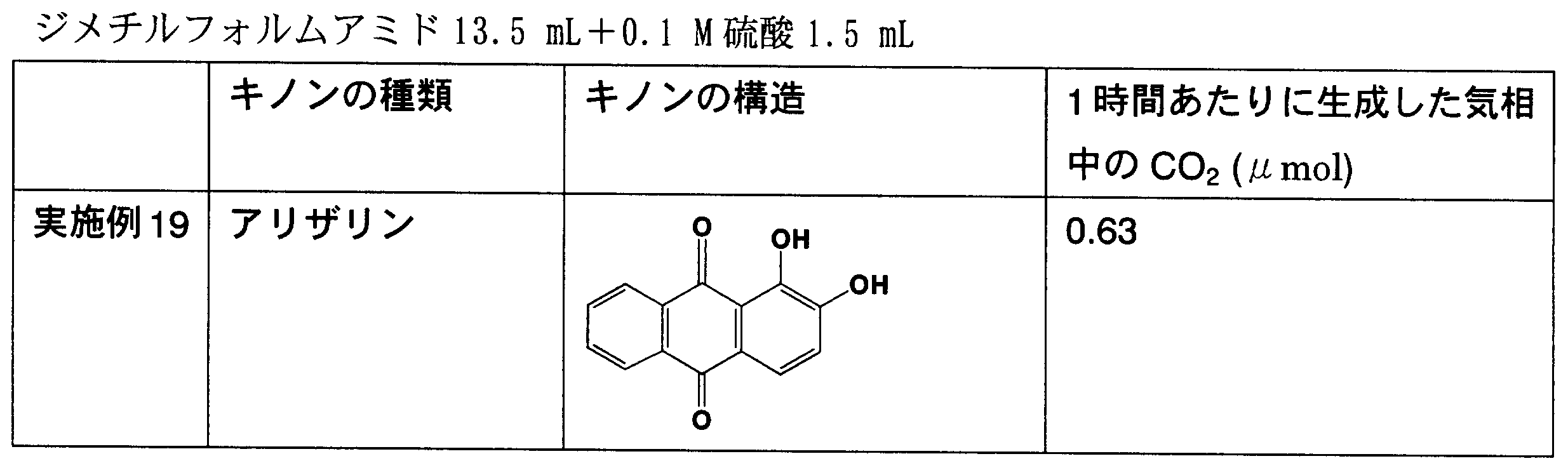
ジメチルフォルムアミド13.5mLと0.1mol/L硫酸1.5mLからなる混合溶媒を用いること以外は、実施例18と同様にして、気相中の二酸化炭素量を測定した。その結果、気相中の二酸化炭素量は0.63μmolであり、一酸化炭素が酸化されて二酸化炭素が生じたことが確認できた。
ジメチルフォルムアミド13.5mLと0.1mol/L硫酸1.5mLからなる混合溶媒を用いること以外は、実施例18と同様にして、気相中の二酸化炭素量を測定した。その結果、気相中の二酸化炭素量は0.63μmolであり、一酸化炭素が酸化されて二酸化炭素が生じたことが確認できた。
実施例20
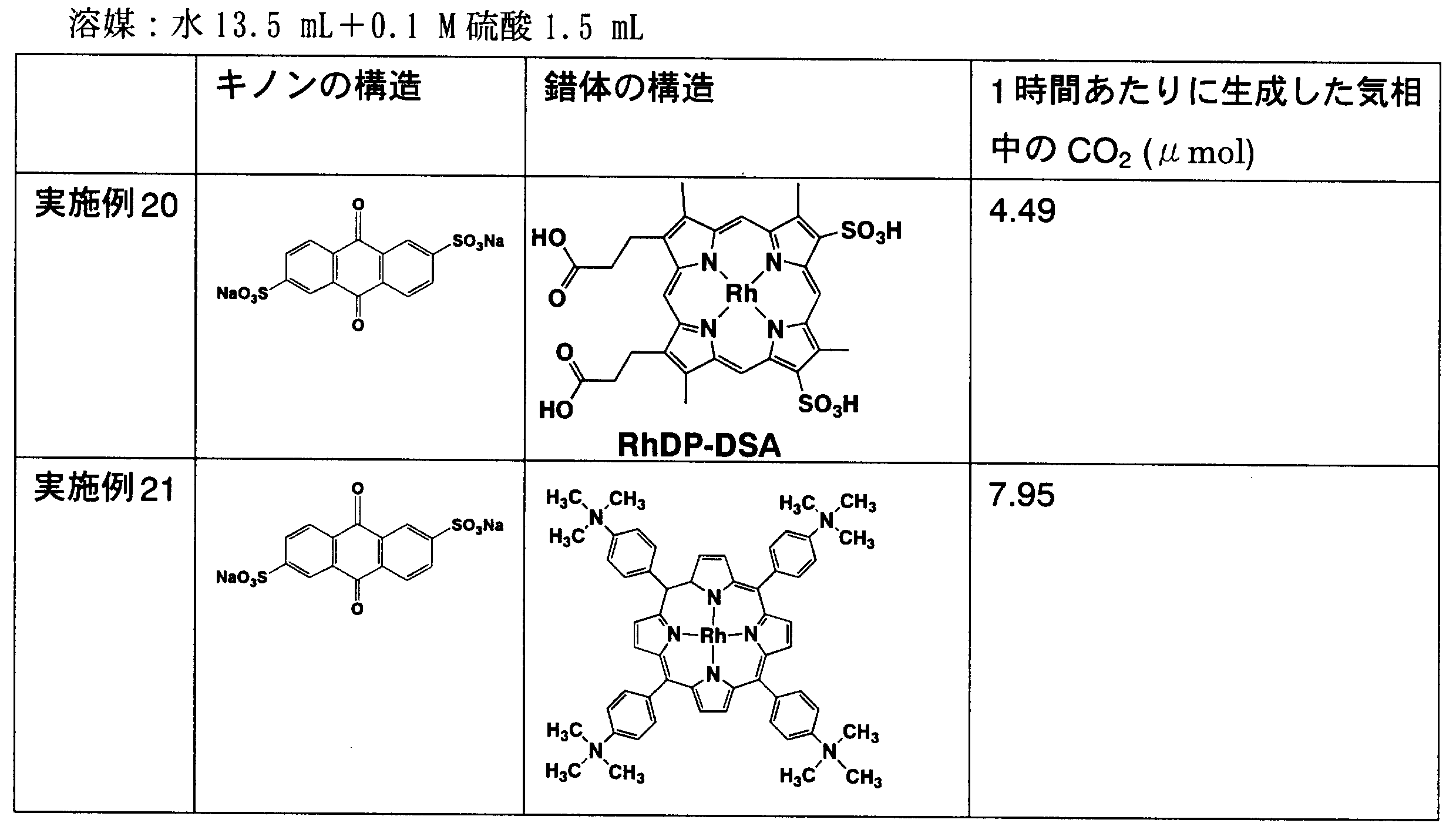
水13.5mLに0.1mol/L硫酸1.5mLを加えた溶媒に、アンスラキノンジスルホン酸を10mmol/Lの濃度で溶解した溶液中に、一酸化炭素ガスを10分間吹き込んでバブリングを行い、この溶液入れた容器を密閉した。容器中の気相体積は6mLである。
水13.5mLに0.1mol/L硫酸1.5mLを加えた溶媒に、アンスラキノンジスルホン酸を10mmol/Lの濃度で溶解した溶液中に、一酸化炭素ガスを10分間吹き込んでバブリングを行い、この溶液入れた容器を密閉した。容器中の気相体積は6mLである。
その後、この溶液に、ロジウムポルフィリン錯体としてロジウムジューテロポルフィリン2.4-ジスルホン酸を濃度0.1mmol/Lとなるように加えて、再度容器を密閉した。
1時間放置後、気相のCO2量をガスクロマトグラフィーで測定した結果、気相中のCO2量は、4.49μmolであり、一酸化炭素が酸化されて二酸化炭素が生じたことが確認できた。
実施例21
ロジウムポルフィリン錯体としてロジウムテトラ(4-トリメチルアンモニウム)フェニルポルフィリンを用いること以外は、実施例20と同様にして気相中の二酸化炭素量を測定した。その結果、気相中の二酸化炭素量は、7.95μmolであり、一酸化炭素が酸化されて二酸化炭素が生じたことが確認できた。
ロジウムポルフィリン錯体としてロジウムテトラ(4-トリメチルアンモニウム)フェニルポルフィリンを用いること以外は、実施例20と同様にして気相中の二酸化炭素量を測定した。その結果、気相中の二酸化炭素量は、7.95μmolであり、一酸化炭素が酸化されて二酸化炭素が生じたことが確認できた。
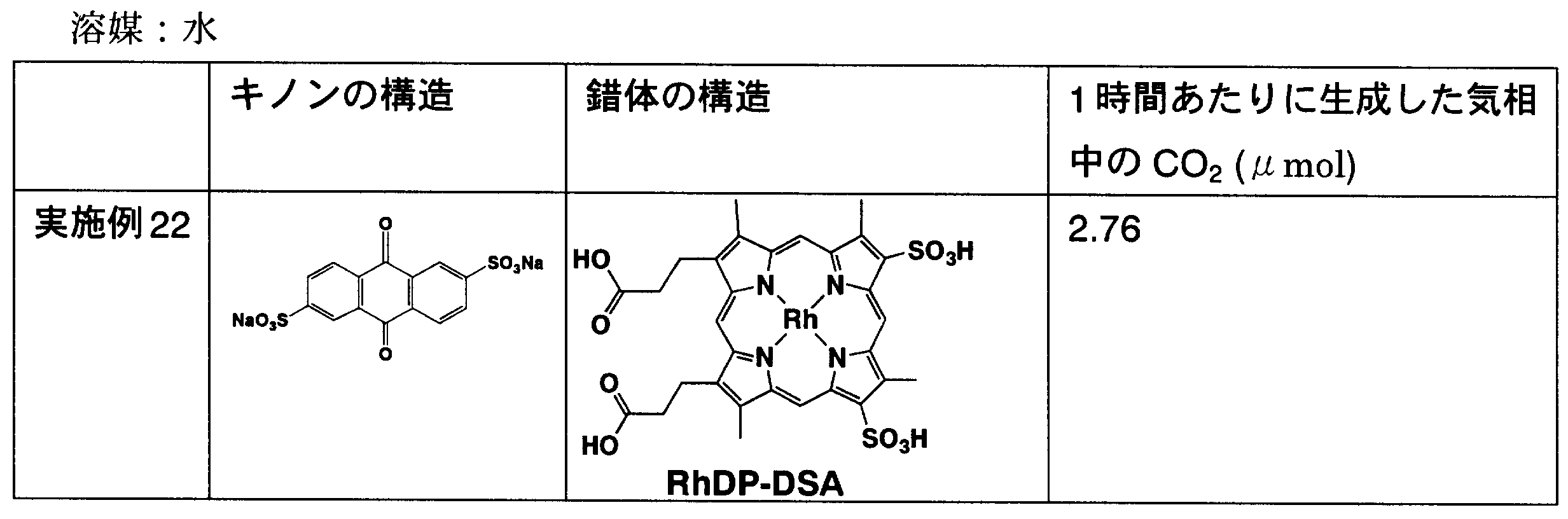
実施例22
溶媒として水を用いること以外は、実施例20と同様にして、気相中の二酸化炭素量を測定した。その結果、気相中の二酸化炭素量は2.76μmolであり、一酸化炭素が酸化されて二酸化炭素が生じたことが確認できた。
溶媒として水を用いること以外は、実施例20と同様にして、気相中の二酸化炭素量を測定した。その結果、気相中の二酸化炭素量は2.76μmolであり、一酸化炭素が酸化されて二酸化炭素が生じたことが確認できた。
実施例23
水13.5mLに0.1mol/L硫酸1.5mを加えた溶媒に、アンスラキノンジスルホン酸を10mmol/Lの濃度で溶解した溶液中に、一酸化炭素ガスを10分間吹き込んでバブリングを行い、この溶液入れた容器を密閉した。容器中の気相体積は6mLである。
水13.5mLに0.1mol/L硫酸1.5mを加えた溶媒に、アンスラキノンジスルホン酸を10mmol/Lの濃度で溶解した溶液中に、一酸化炭素ガスを10分間吹き込んでバブリングを行い、この溶液入れた容器を密閉した。容器中の気相体積は6mLである。
一方、ロジウムポルフィリン錯体としては、ロジウムヘマトポルフィリンをカーボンブラック(比表面積250m2/g、商標名:Vulcan XC 72R、 Cabot社製)に担持させた担持体(担持量:100μmol/g)を用い、上記したアンスラキノンジスルホン酸を含む溶液に、ロジウムヘマトポルフィリンとして0.1mmol/lとなるように上記担持体を加えて、再度容器を密閉した。
1時間放置後、気相のCO2量をガスクロマトグラフィーで測定した結果、気相中のCO2量は、17.09μmolであり、一酸化炭素が酸化されて二酸化炭素が生じたことが確認できた。
実施例24
ロジウムポルフィリン錯体として、ロジウムオクタエチルポルフィリンをカーボンブラック(比表面積250m2/g、商標名:Vulcan XC 72R、 Cabot社製)に担持させた担持体(担持量:20μmol/g)を用いること以外は、実施例23と同様にして、気相中の二酸化炭素量を測定した。その結果、気相中の二酸化炭素量は0.99μmolであり、一酸化炭素が酸化されて二酸化炭素が生じたことが確認できた。
ロジウムポルフィリン錯体として、ロジウムオクタエチルポルフィリンをカーボンブラック(比表面積250m2/g、商標名:Vulcan XC 72R、 Cabot社製)に担持させた担持体(担持量:20μmol/g)を用いること以外は、実施例23と同様にして、気相中の二酸化炭素量を測定した。その結果、気相中の二酸化炭素量は0.99μmolであり、一酸化炭素が酸化されて二酸化炭素が生じたことが確認できた。

実施例25
金属ポルフィリン錯体としてコバルトオクタエチルポルフィリンを用いること以外は、実施例14と同様にして、気相中の二酸化炭素量を測定した。その結果、気相中の二酸化炭素量は0.69μmolであり、一酸化炭素が酸化されて二酸化炭素が生じたことが確認できた。
金属ポルフィリン錯体としてコバルトオクタエチルポルフィリンを用いること以外は、実施例14と同様にして、気相中の二酸化炭素量を測定した。その結果、気相中の二酸化炭素量は0.69μmolであり、一酸化炭素が酸化されて二酸化炭素が生じたことが確認できた。
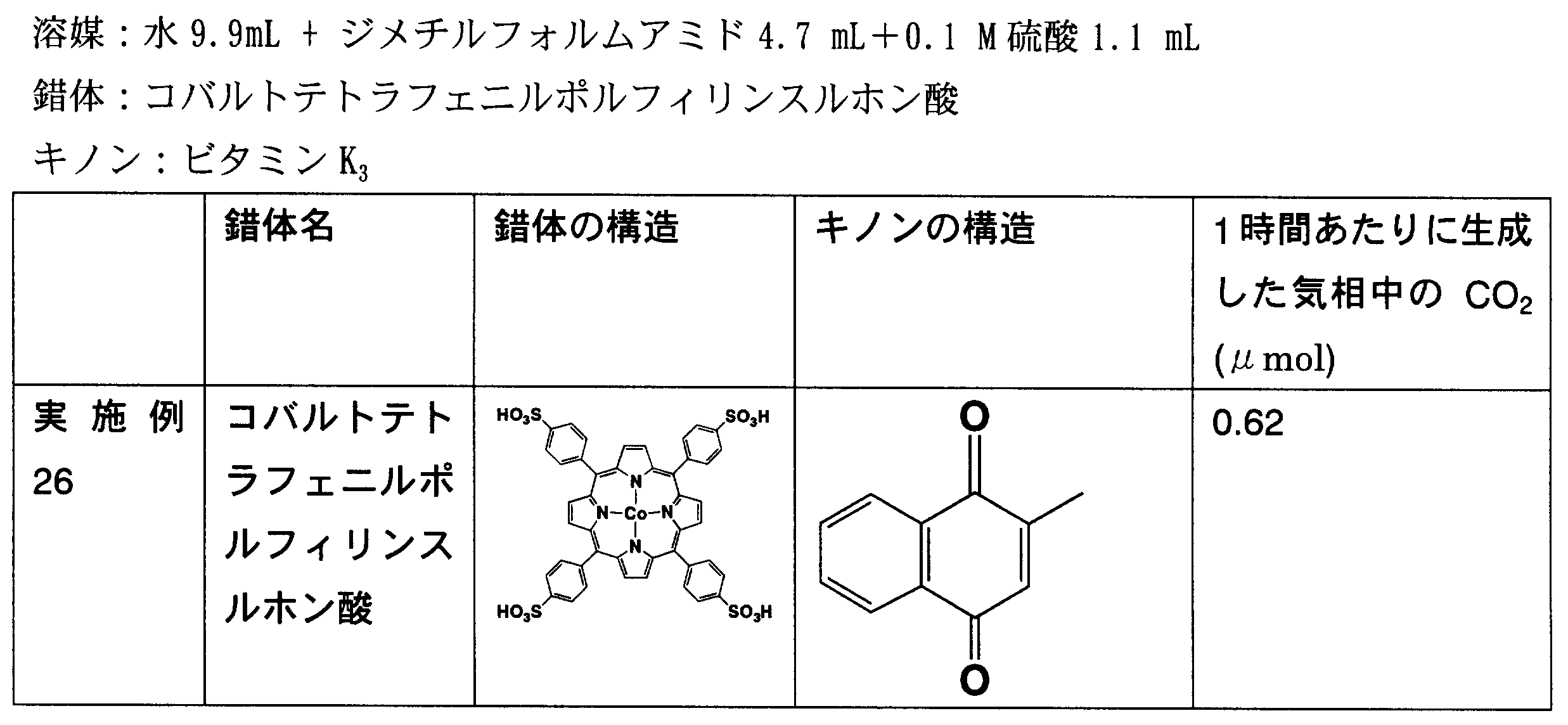
実施例26
水9.9 mLに0.1 Mの硫酸1.1 mLとジメチルフォルムアミド 4.7 mLを加え、ビタミンK3を10 mmol/Lの濃度で溶解した溶液中に一酸化炭素ガスを10分間吹き込んでバブリングを行い、この溶液を入れた容器を密閉した。容器中の気相体積は6 mLである。
水9.9 mLに0.1 Mの硫酸1.1 mLとジメチルフォルムアミド 4.7 mLを加え、ビタミンK3を10 mmol/Lの濃度で溶解した溶液中に一酸化炭素ガスを10分間吹き込んでバブリングを行い、この溶液を入れた容器を密閉した。容器中の気相体積は6 mLである。
その後、この溶液にコバルトテトラフェニルポルフィリンスルホン酸を0.064 mmol/Lとなるように加えて、再度容器を密閉した。この実施例では反応温度は60℃に制御した。1時間放置後、気相のCO2量をガスクロマトグラフィーで測定した結果、気相中のCO2量は0.62μmolであり、一酸化炭素が酸化されて二酸化炭素が生じたことが確認できた。
キノンの酸素による再生
実施例27
次の方法で、キノンの還元体を電気化学的にモニタリングすることにより、キノンの酸素による再生速度を調べた。
実施例27
次の方法で、キノンの還元体を電気化学的にモニタリングすることにより、キノンの酸素による再生速度を調べた。
まず、水9mLに0.1M 硫酸を1 mL混和した溶媒にアンスラキノン-2,6-ジスルホン酸を0.25 mM溶解させた。この溶液を電解液とし、グラッシーカーボン電極(電極表面積0.0707cm2)を作用電極、白金電極を対極、銀-塩化銀 (飽和塩化カリウム) 電極を参照電極として、作用電極を3600rpmで回転させながらアンペロメトリー測定を行った。設定電位は0.2 Vとした。アンスラキノン-2,6-ジスルホン酸の還元体はアンスラキノン-2,6-ジスルホン酸を水素で還元することにより作り出した。
電解前に、アルゴンで5分間バブリングすることにより、電解液中にとけ込んでいる酸素を除去した。次に、アルゴンをバブリングしながら酸素の混入を防ぎながらアンペロメトリー測定を行った。アンペロメトリーの測定結果を図4に示す。図4の電流値はキノンの還元体の濃度に比例する。市販のアンスラキノン-2,6-ジスルホン酸中にはアンスラキノン-2,6-ジスルホン酸の還元体は含まれていないので、酸化電流は流れない。ここでガスをアルゴンから水素に切り替えると(測定開始から950秒後)、アンスラキノン-2,6-ジスルホン酸の還元が起こり始め酸化電流が増え始める。この酸化電流値はアンスラキノン-2,6-ジスルホン酸の還元型の濃度に比例する。電流の上昇を確認した後、ガスをアルゴンに切り替えると(測定開始から2400秒後)、電流の上昇は止まった。さらにガスを酸素に切り替えると(測定開始から3000秒後)、アンスラキノン-2,6-ジスルホン酸の還元型の濃度が減少し始める。これはアンスラキノン-2,6-ジスルホン酸の還元型が酸素によって再酸化され、アンスラキノン-2,6-ジスルホン酸が再生されたことによる。この条件での再生速度は940 nM/sであった。
実施例28
キノンとしてビタミンK3を用いる以外は実施例26と同じ条件で反応を行った。水素の導入によって形成された還元型ビタミンK3は酸素によって酸化され、ビタミンK3が再生されることが分かった。この条件での再生速度は29 nM/sであった。
キノンとしてビタミンK3を用いる以外は実施例26と同じ条件で反応を行った。水素の導入によって形成された還元型ビタミンK3は酸素によって酸化され、ビタミンK3が再生されることが分かった。この条件での再生速度は29 nM/sであった。
実施例29
電解液として水9 mLにpH7.0緩衝液 (0.1 Mリン酸緩衝液)を1 mL混和した溶媒を用い、設定電位を0.1 Vとする以外は実施例26と同じ条件で反応を行った。水素の導入によって形成された還元型アンスラキノン-2,6-ジスルホン酸は酸素によって酸化され、アンスラキノン-2,6-ジスルホン酸が再生されることが分かった。この条件での再生速度は4970 nM/sであった。
電解液として水9 mLにpH7.0緩衝液 (0.1 Mリン酸緩衝液)を1 mL混和した溶媒を用い、設定電位を0.1 Vとする以外は実施例26と同じ条件で反応を行った。水素の導入によって形成された還元型アンスラキノン-2,6-ジスルホン酸は酸素によって酸化され、アンスラキノン-2,6-ジスルホン酸が再生されることが分かった。この条件での再生速度は4970 nM/sであった。
実施例30
キノンとしてビタミンK3を用い、設定電位を0.15 Vとする以外は実施例28と同じ条件で反応を行った。水素の導入によって形成された還元型ビタミンK3は酸素によって酸化され、ビタミンK3が再生されることが分かった。この条件での再生速度は970 nM/sであった。
キノンとしてビタミンK3を用い、設定電位を0.15 Vとする以外は実施例28と同じ条件で反応を行った。水素の導入によって形成された還元型ビタミンK3は酸素によって酸化され、ビタミンK3が再生されることが分かった。この条件での再生速度は970 nM/sであった。

キノンの電気化学的再生
実施例31
次の方法でキノンの還元体と電極との反応をサイクリックボルタンメトリーにより評価した。
実施例31
次の方法でキノンの還元体と電極との反応をサイクリックボルタンメトリーにより評価した。
まず、水9 mLに0.1M 硫酸を1 mL混和した溶媒にビタミンK3を0.05 mM溶解させた。この溶液を電解液とし、グラッシーカーボン電極(電極表面積0.0707 cm2)を作用電極、白金電極を対極、銀-塩化銀(飽和塩化カリウム)を参照電極として、掃引速度10 mV/sでサイクリックボルタンメトリー測定を行った。測定前にはアルゴンガスを5分間バブリングすることにより酸素を除去し、測定中はアルゴンガスを液面に吹き付けることにより、酸素の混入を防いだ。結果を図5に示す。低電位から高電位に向かっての電位掃引が、還元体の再酸化に対応する。0 V付近で急激に酸化電流が流れ始め、0.105 Vより正の電位では酸化電流が拡散律速のため減少する。このことは電極反応が極めて速いことを意味しており、約0.2 Vの電圧をかければビタミンK3が再生されることが分かる。
実施例32
キノンとしてアンスラキノン-2,6-ジスルホン酸を用いる以外は実施例30と同じ条件でサイクリックボルタンメトリー測定を行った。結果を図6に示す。-0.18V付近で急激に酸化電流が流れ始め、-0.06Vより正の電圧では酸化電流が拡散律速のため減少する。このことは電極反応が極めて速いことを意味しており、約0.05 Vの電圧をかければ拡散律速でアンスラキノン-2,6-ジスルホン酸が再生されることが分かる。
キノンとしてアンスラキノン-2,6-ジスルホン酸を用いる以外は実施例30と同じ条件でサイクリックボルタンメトリー測定を行った。結果を図6に示す。-0.18V付近で急激に酸化電流が流れ始め、-0.06Vより正の電圧では酸化電流が拡散律速のため減少する。このことは電極反応が極めて速いことを意味しており、約0.05 Vの電圧をかければ拡散律速でアンスラキノン-2,6-ジスルホン酸が再生されることが分かる。
実施例33
電解液として水9 mLにpH7.0緩衝液を1 mL混和した溶媒を用いる以外は実施例30と同じ条件でサイクリックボルタンメトリー測定を行った。結果を図7に示す。-0.35V付近で急激に酸化電流が流れ始め、-0.16Vより正の電圧では酸化電流が拡散律速のため減少する。このことは電極反応が極めて速いことを意味しており、-0.06 Vの電圧をかければ拡散律速でビタミンK3が再生されることが分かる。
電解液として水9 mLにpH7.0緩衝液を1 mL混和した溶媒を用いる以外は実施例30と同じ条件でサイクリックボルタンメトリー測定を行った。結果を図7に示す。-0.35V付近で急激に酸化電流が流れ始め、-0.16Vより正の電圧では酸化電流が拡散律速のため減少する。このことは電極反応が極めて速いことを意味しており、-0.06 Vの電圧をかければ拡散律速でビタミンK3が再生されることが分かる。
実施例34
キノンとしてアンスラキノン-2,6-ジスルホン酸を用いる以外は実施例32と同じ条件でイクリックボルタンメトリー測定を行った。結果を図8に示す。-0.55V付近で急激に酸化電流が流れ始め、-0.2Vより正の電位では酸化電流が拡散律速のため減少する。このことは-0.2 Vより正の電位では電極反応が拡散に比べて速いことを意味しており、約0 Vの電圧をかければ拡散律速でアンスラキノン-2,6-ジスルホン酸が再生されることが分かる。
キノンとしてアンスラキノン-2,6-ジスルホン酸を用いる以外は実施例32と同じ条件でイクリックボルタンメトリー測定を行った。結果を図8に示す。-0.55V付近で急激に酸化電流が流れ始め、-0.2Vより正の電位では酸化電流が拡散律速のため減少する。このことは-0.2 Vより正の電位では電極反応が拡散に比べて速いことを意味しており、約0 Vの電圧をかければ拡散律速でアンスラキノン-2,6-ジスルホン酸が再生されることが分かる。
Claims (9)
- ロジウムポルフィリン錯体及びコバルトポルフィリン錯体からなる群から選ばれた少なくとも一種の金属ポルフィリン錯体の存在下において、一酸化炭素を含む気体を、キノン類を含む溶液に接触させることを特徴とする、一酸化炭素の除去方法。
- キノン類が、置換基を有することのあるベンゾキノン、置換基を有することのあるナフトキノン、及び置換基を有することのあるアンスラキノンからなる群から選ばれた少なくとも一種である、請求項1に記載の一酸化炭素の除去方法。
- 一酸化炭素を含む気体が、一酸化炭素を含む改質ガスである請求項1又は2に記載の一酸化炭素の除去方法。
- 導電性担体に担持された金属ポルフィリン錯体を用いる請求項1~3のいずれかに記載の方法。
- 請求項1~4のいずれかに記載の方法によって一酸化炭素を除去した後、溶液中に蓄積したキノン類の還元体を酸素による酸化又は電解酸化によってキノン類として再生する工程を含む、一酸化炭素の除去方法。
- ロジウムポルフィリン錯体及びコバルトポルフィリン錯体からなる群から選ばれた少なくとも一種の金属ポルフィリン錯体とキノン類を含む溶液を収容する密閉容器と、該溶液中に一酸化炭素を含む気体を導入するためのガス導入口と、該溶液中に酸素を含む気体を導入するための酸素含有気体導入口と、酸素含有気体排出口と、一酸化炭素を除去した気体を排出するためのガス排出口とを有する、請求項5に記載の方法に用いる一酸化炭素の除去装置。
- ロジウムポルフィリン錯体及びコバルトポルフィリン錯体からなる群から選ばれた少なくとも一種の金属ポルフィリン錯体とキノン類を含む溶液を収容する密閉容器と、該溶液中に一酸化炭素を含む気体を導入するためのガス導入口と、一酸化炭素を除去した気体を容器外に排出するためのガス排出口と、作用電極と、対極とを有する、請求項5に記載の方法に用いる一酸化炭素の除去装置。
- キノン類の還元体を燃料とする固体高分子形燃料電池と、キノン類を還元体に変換する燃料再生装置とを備えた燃料再生型燃料電池であって、
該燃料再生装置が、金属ポルフィリン錯体を含む溶液を収容する密閉容器と、燃料電池でのアノード反応後のキノン類を含む溶液を該容器中に供給する供給口と、該溶液中に一酸化炭素を導入するためのガス導入口と、二酸化炭素を含む気体を該容器から排出するガス出口と、キノン類の還元体を燃料電池に供給するための燃料供給口を備えていることを特徴とする、燃料電池。 - ロジウムポルフィリン錯体及びコバルトポルフィリン錯体からなる群から選ばれた少なくとも一種の金属ポルフィリン錯体を有効成分とする、キノン類を電子受容体とする一酸化炭素の酸化用触媒。
Priority Applications (1)
| Application Number | Priority Date | Filing Date | Title |
|---|---|---|---|
| JP2013518115A JP5717155B2 (ja) | 2011-06-02 | 2012-05-30 | 一酸化炭素の除去方法及び除去装置 |
Applications Claiming Priority (2)
| Application Number | Priority Date | Filing Date | Title |
|---|---|---|---|
| JP2011-124116 | 2011-06-02 | ||
| JP2011124116 | 2011-06-02 |
Publications (1)
| Publication Number | Publication Date |
|---|---|
| WO2012165459A1 true WO2012165459A1 (ja) | 2012-12-06 |
Family
ID=47259312
Family Applications (1)
| Application Number | Title | Priority Date | Filing Date |
|---|---|---|---|
| PCT/JP2012/063876 Ceased WO2012165459A1 (ja) | 2011-06-02 | 2012-05-30 | 一酸化炭素の除去方法及び除去装置 |
Country Status (2)
| Country | Link |
|---|---|
| JP (1) | JP5717155B2 (ja) |
| WO (1) | WO2012165459A1 (ja) |
Cited By (1)
| Publication number | Priority date | Publication date | Assignee | Title |
|---|---|---|---|---|
| JP2016203134A (ja) * | 2015-04-28 | 2016-12-08 | 国立研究開発法人産業技術総合研究所 | 一酸化炭素の電気化学的酸化用触媒 |
Citations (7)
| Publication number | Priority date | Publication date | Assignee | Title |
|---|---|---|---|---|
| JP2006261086A (ja) * | 2005-02-21 | 2006-09-28 | National Institute Of Advanced Industrial & Technology | 一酸化炭素の電気化学的酸化用触媒 |
| JP2007042606A (ja) * | 2005-07-05 | 2007-02-15 | Toray Ind Inc | 液体供給型燃料電池による発電方法および液体供給型燃料電池 |
| JP2008036539A (ja) * | 2006-08-07 | 2008-02-21 | National Institute Of Advanced Industrial & Technology | 一酸化炭素の電気化学的酸化用触媒 |
| JP2009082780A (ja) * | 2007-09-28 | 2009-04-23 | National Institute Of Advanced Industrial & Technology | 一酸化炭素の化学的酸化用触媒 |
| JP2009214092A (ja) * | 2008-02-14 | 2009-09-24 | National Institute Of Advanced Industrial & Technology | 一酸化炭素の電気化学的酸化用触媒 |
| JP2010214313A (ja) * | 2009-03-18 | 2010-09-30 | National Institute Of Advanced Industrial Science & Technology | 一酸化炭素の化学的酸化用触媒 |
| JP2010284614A (ja) * | 2009-06-15 | 2010-12-24 | National Institute Of Advanced Industrial Science & Technology | 一酸化炭素の電気化学的酸化用触媒 |
-
2012
- 2012-05-30 WO PCT/JP2012/063876 patent/WO2012165459A1/ja not_active Ceased
- 2012-05-30 JP JP2013518115A patent/JP5717155B2/ja not_active Expired - Fee Related
Patent Citations (7)
| Publication number | Priority date | Publication date | Assignee | Title |
|---|---|---|---|---|
| JP2006261086A (ja) * | 2005-02-21 | 2006-09-28 | National Institute Of Advanced Industrial & Technology | 一酸化炭素の電気化学的酸化用触媒 |
| JP2007042606A (ja) * | 2005-07-05 | 2007-02-15 | Toray Ind Inc | 液体供給型燃料電池による発電方法および液体供給型燃料電池 |
| JP2008036539A (ja) * | 2006-08-07 | 2008-02-21 | National Institute Of Advanced Industrial & Technology | 一酸化炭素の電気化学的酸化用触媒 |
| JP2009082780A (ja) * | 2007-09-28 | 2009-04-23 | National Institute Of Advanced Industrial & Technology | 一酸化炭素の化学的酸化用触媒 |
| JP2009214092A (ja) * | 2008-02-14 | 2009-09-24 | National Institute Of Advanced Industrial & Technology | 一酸化炭素の電気化学的酸化用触媒 |
| JP2010214313A (ja) * | 2009-03-18 | 2010-09-30 | National Institute Of Advanced Industrial Science & Technology | 一酸化炭素の化学的酸化用触媒 |
| JP2010284614A (ja) * | 2009-06-15 | 2010-12-24 | National Institute Of Advanced Industrial Science & Technology | 一酸化炭素の電気化学的酸化用触媒 |
Cited By (1)
| Publication number | Priority date | Publication date | Assignee | Title |
|---|---|---|---|---|
| JP2016203134A (ja) * | 2015-04-28 | 2016-12-08 | 国立研究開発法人産業技術総合研究所 | 一酸化炭素の電気化学的酸化用触媒 |
Also Published As
| Publication number | Publication date |
|---|---|
| JP5717155B2 (ja) | 2015-05-13 |
| JPWO2012165459A1 (ja) | 2015-02-23 |
Similar Documents
| Publication | Publication Date | Title |
|---|---|---|
| Choi et al. | Minimizing operando demetallation of Fe-NC electrocatalysts in acidic medium | |
| JP5707773B2 (ja) | 複合光電極および光電気化学反応システム | |
| JP7687651B2 (ja) | 酸素還元用触媒及びその選定方法、酸素還元用触媒を含む液状組成物又は電極、電極を備える空気電池又は燃料電池 | |
| JP2011094194A (ja) | 光化学反応デバイス | |
| CN107075697A (zh) | 氢气生成 | |
| WO2017123289A2 (en) | Membraneless direct liquid fuel cells | |
| Wang et al. | Effect of inorganic ions on H2O2 production over illuminated Au/WO3 with visible light | |
| CN102380400B (zh) | 直接硼氢化物燃料电池核壳结构阳极催化剂及其制备方法 | |
| Popov et al. | Power source research at USC: Development of advanced electrocatalysts for polymer electrolyte membrane fuel cells | |
| Kar et al. | Investigation on the reduction of the oxides of Pd and graphite in alkaline medium and the simultaneous evolution of oxygen reduction reaction and peroxide generation features | |
| Chowdhury et al. | Synthesis of Cu2O NPs using bioanalytes present in Sechium edule: mechanistic insights and application in electrocatalytic CO2 reduction to formate | |
| JP5170702B2 (ja) | 水素化物の電気化学的酸化用触媒 | |
| Gao et al. | 2, 2′-bipyridine palladium (II) complexes derived N-doped carbon encapsulated palladium nanoparticles for formic acid oxidation | |
| JP5190965B2 (ja) | 一酸化炭素の電気化学的酸化用触媒 | |
| JP4568881B2 (ja) | 一酸化炭素の電気化学的酸化用触媒 | |
| JP5717155B2 (ja) | 一酸化炭素の除去方法及び除去装置 | |
| JP5158792B2 (ja) | 一酸化炭素の電気化学的酸化用触媒 | |
| JP5946038B2 (ja) | ヒドラジン化合物からの水素発生方法 | |
| EP4026614A1 (en) | Production method of catalyst, catalyst, production method of composition, composition, electrode, manufacturing method of electrode, fuel cell, and metal-air battery | |
| JP5692701B2 (ja) | 水素化物の電気化学的酸化用触媒 | |
| JP4613350B2 (ja) | 一酸化炭素の電気化学的酸化用触媒 | |
| US7825057B2 (en) | Method for preparing the mixed electrode catalyst materials for a PEM fuel cell | |
| Yamazaki et al. | Removal of CO from CO-contaminated hydrogen gas by carbon-supported rhodium porphyrins using water-soluble electron acceptors | |
| JP5828475B2 (ja) | ヒドラジン化合物の電気化学的酸化用触媒 | |
| JP6414979B2 (ja) | 一酸化炭素の電気化学的酸化用触媒 |
Legal Events
| Date | Code | Title | Description |
|---|---|---|---|
| 121 | Ep: the epo has been informed by wipo that ep was designated in this application |
Ref document number: 12792514 Country of ref document: EP Kind code of ref document: A1 |
|
| ENP | Entry into the national phase |
Ref document number: 2013518115 Country of ref document: JP Kind code of ref document: A |
|
| NENP | Non-entry into the national phase |
Ref country code: DE |
|
| 122 | Ep: pct application non-entry in european phase |
Ref document number: 12792514 Country of ref document: EP Kind code of ref document: A1 |