WO2012153155A1 - Process for the preparation of a rivaroxaban and intermediates formed in said process - Google Patents
Process for the preparation of a rivaroxaban and intermediates formed in said process Download PDFInfo
- Publication number
- WO2012153155A1 WO2012153155A1 PCT/HU2012/000033 HU2012000033W WO2012153155A1 WO 2012153155 A1 WO2012153155 A1 WO 2012153155A1 HU 2012000033 W HU2012000033 W HU 2012000033W WO 2012153155 A1 WO2012153155 A1 WO 2012153155A1
- Authority
- WO
- WIPO (PCT)
- Prior art keywords
- formula
- compound
- racemate
- general formula
- hydrogen
- Prior art date
- Legal status (The legal status is an assumption and is not a legal conclusion. Google has not performed a legal analysis and makes no representation as to the accuracy of the status listed.)
- Ceased
Links
- MNCJZOGVZLAJKX-AREMUKBSSA-N O[C@H](CNc(cc1)ccc1N(CCOC1)C1=O)CN(Cc1ccccc1)Cc1ccccc1 Chemical compound O[C@H](CNc(cc1)ccc1N(CCOC1)C1=O)CN(Cc1ccccc1)Cc1ccccc1 MNCJZOGVZLAJKX-AREMUKBSSA-N 0.000 description 1
Classifications
-
- C—CHEMISTRY; METALLURGY
- C07—ORGANIC CHEMISTRY
- C07D—HETEROCYCLIC COMPOUNDS
- C07D413/00—Heterocyclic compounds containing two or more hetero rings, at least one ring having nitrogen and oxygen atoms as the only ring hetero atoms
- C07D413/14—Heterocyclic compounds containing two or more hetero rings, at least one ring having nitrogen and oxygen atoms as the only ring hetero atoms containing three or more hetero rings
-
- A—HUMAN NECESSITIES
- A61—MEDICAL OR VETERINARY SCIENCE; HYGIENE
- A61P—SPECIFIC THERAPEUTIC ACTIVITY OF CHEMICAL COMPOUNDS OR MEDICINAL PREPARATIONS
- A61P7/00—Drugs for disorders of the blood or the extracellular fluid
- A61P7/02—Antithrombotic agents; Anticoagulants; Platelet aggregation inhibitors
-
- A—HUMAN NECESSITIES
- A61—MEDICAL OR VETERINARY SCIENCE; HYGIENE
- A61P—SPECIFIC THERAPEUTIC ACTIVITY OF CHEMICAL COMPOUNDS OR MEDICINAL PREPARATIONS
- A61P9/00—Drugs for disorders of the cardiovascular system
- A61P9/10—Drugs for disorders of the cardiovascular system for treating ischaemic or atherosclerotic diseases, e.g. antianginal drugs, coronary vasodilators, drugs for myocardial infarction, retinopathy, cerebrovascula insufficiency, renal arteriosclerosis
-
- C—CHEMISTRY; METALLURGY
- C07—ORGANIC CHEMISTRY
- C07D—HETEROCYCLIC COMPOUNDS
- C07D265/00—Heterocyclic compounds containing six-membered rings having one nitrogen atom and one oxygen atom as the only ring hetero atoms
- C07D265/28—1,4-Oxazines; Hydrogenated 1,4-oxazines
- C07D265/30—1,4-Oxazines; Hydrogenated 1,4-oxazines not condensed with other rings
- C07D265/32—1,4-Oxazines; Hydrogenated 1,4-oxazines not condensed with other rings with oxygen atoms directly attached to ring carbon atoms
-
- C—CHEMISTRY; METALLURGY
- C07—ORGANIC CHEMISTRY
- C07D—HETEROCYCLIC COMPOUNDS
- C07D303/00—Compounds containing three-membered rings having one oxygen atom as the only ring hetero atom
- C07D303/02—Compounds containing oxirane rings
- C07D303/36—Compounds containing oxirane rings with hydrocarbon radicals, substituted by nitrogen atoms
-
- C—CHEMISTRY; METALLURGY
- C07—ORGANIC CHEMISTRY
- C07D—HETEROCYCLIC COMPOUNDS
- C07D413/00—Heterocyclic compounds containing two or more hetero rings, at least one ring having nitrogen and oxygen atoms as the only ring hetero atoms
- C07D413/02—Heterocyclic compounds containing two or more hetero rings, at least one ring having nitrogen and oxygen atoms as the only ring hetero atoms containing two hetero rings
- C07D413/10—Heterocyclic compounds containing two or more hetero rings, at least one ring having nitrogen and oxygen atoms as the only ring hetero atoms containing two hetero rings linked by a carbon chain containing aromatic rings
Definitions
- the present invention is directed to a process for the preparation of a pharmaceutical active ingredient and intermediates formed in said process. More particularly the invention relates to a new process for the preparation of 5-chloro- N-( ⁇ (5S)-2-oxo-3-[4-(3-oxo-mo holine-4- l)-phen l]-l,3-oxazolidine-5- l ⁇ - methyl)-thiophen-2-carboxamide of the Formula
- the invention is also directed to intermediates formed in said process.
- 5-chloro-N-( ⁇ (5S)-2-oxo-3-[4-(3-oxo-morpholine-4-yl)-phenyl]- l,3-oxazolidine-5-yl ⁇ -methyl)-thiophen-2-carboxamide having the INN rivaroxaban is a pharmaceutical active ingredient of a Xa coagulation factor inhibitor mechanism suitable for the treatment of deep venous thrombosis nyocardial infarction, angina pectoris, arterial occlusion, arterial restenosis and pulmonary embolism.
- Rivaroxaban was first described by Straub et al in EP 1261606.
- European patent a broad group of substituted oxazolidines and a process for the preparation thereof was disclosed. Specifically neither the preparation of rivaroxaban nor the physico-chemical characteristics thereof were disclosed. The total yield of the synthesis was not set forth either.
- the preparation of rivaroxaban of the Formula 1 is carried out as shown on reaction scheme 1.
- the configuration corresponding to rivaroxaban is derived from (S)-glycidyl-phthalimide of the Formula
- 5-chloro-thiophen-2-carboxylic acid chloride is prepared from 5-chloro-thiophen-2-carboxylic acid with the aid of thionyl chloride: the latter reactant is also corrosive, has an unpleasant odor and is detrimental to health and the environment. At the end of the reaction the residual thionyl chloride is to be removed which necessitates a further distillation step. The hydrogen chloride and the sulphur dioxide by-products formed in course of the preparation of the acid chloride must be absorbed and handled which represents a further technological difficulty and causes health hazards.
- rivaroxaban is prepared by the synthesis route shown on reaction scheme 4. Said process is practically identical with the method disclosed in the basic patent and shown on reaction scheme 1 except that the yields of some steps were improved by optimization of the reaction conditions.
- the base is in situ set free, whereupon water and acetone are added and the about 30 weight % solution of 5-chloro-thiophen- 2-carboxylic acid chloride of the Formula 4 in toluene is added dropwise at 8- 12°C. Thereafter at 50°C acetone is added, the reaction is continued, the reaction mixture is cooled to 25°C and rivaroxaban is filtered off.
- the disadvantages of the 5-chloro-thiophen-2-carboxylic acid chloride reactant used in said process were discussed above.
- a further drawback of the process resides in the fact that the removal of the phthalyl protecting group with a large excess (4.4 equiv.) of methyl amine is performed only in a late stage of the process. Since a large excess of methyl amine and severe reaction conditions are used, the formation of contaminations is inevitable. The yields show that said process is uneconomical.
- WO 2005/068456 is silent in mentioning the HPLC purity of certain intermediates let alone that of the end product rivaroxaban of the Formula 1.
- the hydrochloride salt of the Formula 3a is obtained according to the international patent application with a yield of 82.7 %, while there is no disclosure relating to the purity thereof.
- complete removal of the protecting group requires at least 20 hours rather than 2 hours as taught by the international patent application.
- the quality of the intermediate of the Formula 3a is unsuitable for the preparation of a pharmaceutical grade end product. Therefore the intermediate of the Formula 3a must be subjected to recrystallization which decreases the overall yield of the process.
- a very good leaving group is the compound of the Formula 10 in which L stands for I
- said compound does not react with the amide of the Formula 8 by using an organic or inorganic base (KOBu ⁇ , pyridine) under very severe conditions (90°C, DMF).
- the object of the invention is to elaborate an industrial scale synthetic process for the preparation of rivaroxaban of the Formula 1 which process provides better yields and uses crystalline and easily purifiable intermediates.
- Z 1 and Z 2 stand for hydrogen or a conventional amino protecting group, e.g. benzyl, substituted benzyl, p-methoxy-benzyl, benzyloxycarbonyl or tert. butoxycarbonyl with the proviso that at least Z 1 is other than hydrogen and Z 1 and Z are preferably benzyl/ is prepared by reacting the compound of the Formula
- H n X is a mono- or bivalent organic or inorganic acid; n represents 1, 2 or 3 and X stands for an acid residue ion
- organic acid e.g. a sulfonic acid
- a carboxylic acid including monovalent carboxylic acids e.g. formic acid, acetic acid, propionic acid, butyric acid etc.
- inorganic acids e.g. sulfuric acid, sulfurous acid, nitric acid, phosphoric acid, hydrogen bromide, hydrogen iodide can be used.
- the base of the Formula 12 or a salt thereof of the general Formula 3 (wherein H n X is as stated above) is reacted with 5-chloro- thiophen-2-carboxylic acid to yield rivaroxaban of the Formula 1.
- the last acylation step of the preparation of rivaroxaban we use the acid of the Formula 15 which is considerably less reactive than 5-chloro-thiophen-2-carboxylic acid chloride of the Formula 4 previously applied in the last acylation step of the preparation of rivaroxaban of the Formula 1.
- Said reaction is carried out in the presence of a coupling agent and an organic or inorganic base, in an inert solvent: if desired the use of the acid binding agent can be omitted.
- reaction schema 7a, 7b, 8a and 8b are prepared by resolution.
- the compounds of the general Formula 14 can be surprisingly also prepared in a manner that in the first step from a compound of the general Formula 9 by reacting with an agent capable of introducing a carbonyl group a compound of the general Formula 10 is prepared (wherein L stands for chlorine, bromine, iodine, alkylsulfonyloxy or arylsulfonyloxy, e.g. methanesulfonyloxy, benzenesulfonyloxy or p-toluenesulfonyloxy, preferably chlorine, bromine or iodine).
- L stands for chlorine, bromine, iodine, alkylsulfonyloxy or arylsulfonyloxy, e.g. methanesulfonyloxy, benzenesulfonyloxy or p-toluenesulfonyloxy, preferably chlorine, bromine or iodine).
- Z and Z are hydrogen or a conventional amino protecting group, e.g. benzyl, substituted benzyl, p-methoxy- benzyl, benzyloxycarbonyl or tert. butoxycarbonyl with the proviso that at least
- one of symbols Z and Z is other than hydrogen, and Z and Z preferably stand for benzyl).
- the invention also relates to intermediates used in the above process corresponding to the indicated general Formulae and to intermediates formed in the preferable embodiments of the above process.
- the invention relates to a process for the preparation of 5-chloro-N-( ⁇ (5S)-2- oxo-3-[4-(3-oxo-morpholine-4-yl)-phenyl]-l,3-oxazolidine-5-yl ⁇ -methyl)- thiophen-2-carboxamide.
- n 1 and X stands for an acetate ion.
- Z 1 and Z 2 stand for benzyl;
- Z 1 and Z 2 stand for benzyl.
- the S-enantiomeric base of the Formula 12 or the racemate thereof or optionally a salt thereof is reacted with 5-chloro-thiophen-2-carboxylic acid of the Formula 15 in the presence of a chloro formiate, ⁇ , ⁇ '-diisopropyl-carbodiimide (DIC), N,N'-dicyclohexyl- carbodiimide (DCC), tripropyl phosphonic acid anhydride (T3P) or ⁇ , ⁇ '- carbonyl-diimidazole (CDI), preferably chloro ethyl formiate or CDI as coupling agent.
- DIC ⁇ , ⁇ '-diisopropyl-carbodiimide
- DCC N,N'-dicyclohexyl- carbodiimide
- T3P tripropyl phosphonic acid anhydride
- CDI ⁇ , ⁇ '- carbonyl-diimidazole
- the reaction is carried out preferably in the presence of an organic or inorganic base, advantageously triethyl amine, diisopropyl ethyl amine, sodium carbonate or sodium hydrogen carbonate, in an organic solvent, preferably acetonitrile, dichloro methane, acetone, toluene, tetrahydrofurane and mixtures thereof or mixtures of said solvents formed with water.
- an organic or inorganic base advantageously triethyl amine, diisopropyl ethyl amine, sodium carbonate or sodium hydrogen carbonate
- organic solvent preferably acetonitrile, dichloro methane, acetone, toluene, tetrahydrofurane and mixtures thereof or mixtures of said solvents formed with water.
- the reaction is performed at a temperature of 0-110°C, preferably 40-70°C.
- the protecting group(s) of he S-enantiomeric compound of the Formula is (are) removed by reduction and said reduction reaction is carried out in a C 1-4 aliphatic alcohol, glacial acetic acid, water or a mixture of said solvents formed with each other or other organic solvents.
- Catalytic hydrogenation or chemical reduction can be used.
- a R- enantiomeric compound of the general Formula 20 or a racemate thereof is converted into a S-enantiomeric compound of the general Formula 14 or a racemate thereof (wherein Z and Z are hydrogen or a protecting group with the proviso that at least Z 1 is other than hydrogen) by using as agent capable of introducing a carbonyl group ⁇ , ⁇ '-carbonyl-diimiazole, phosgene, diphosgene or triphosgene, advantageously ⁇ , ⁇ '-carbonyl-diimidazole.
- the reaction is carried out in a suitable solvent, preferably toluene.
- Z 2 are hydrogen or protecting group with the proviso that at least Z 1 is other than hydrogen) and the 4-(4-ammo-phenyl)-morpholine-3-one of the Formula 5 is carried out preferably in a mixture of a protic solvent and water, at a temperature of 0-150°C, preferably at 60-90°C, preferably for a period of 20-40 hours,
- the S-enantiomeric compound of the formula 11 is reacted with a compound of the general Formula Z 1 Z 2 NH (wherein Z 1 and Z 2 are hydrogen or a protecting group with the proviso that at least Z 1 is other than hydrogen), preferably the reaction with N-benzyl-1- phenyl-methaneamine of the Formula is performed in the absence of a solvent or in an organic solvent or water or a mixture thereof, preferably in the presence of an organic or inorganic acid binding agent.
- the conversion of the R- enantiomeric compound or the Formula 10a or the racemate thereof into the R- enantiomeric compound of the Formula 10b or racemate thereof is carried out by reacting with an alkali bromide, preferably sodium bromide.
- the conversion into the compound of the Formula 10c of a racemate thereof is carried out by reacting with an alkali iodide, preferably sodium iodide and said reaction is carried out in a suitable organic solvent or a mixture thereof formed with water at 0-150°C, preferably at 80-130°C.
- the reaction with a compound of the general Formula Z 1 Z2 NH (wherein Z 1 and Z2 stand for hydrogen or a protecting group with the proviso that at least Z 1 is other than hydrogen) - preferably with the N-benzyl-l-phenylmethaneamine of the Formula 16) is carried out in the presence or absence of a solvent, in the presence of an organic or inorganic acid binding agent, preferably cesium carbonate at 0-150°C, preferably at 60-100°C.
- a R-enantiomeric compound of the general Formula 9 or a racemate thereof is converted into a R- enantiomeric compound of the general Formula 10 or a racemate thereof by using as agent suitable for the introduction of the carbonyl group NN'-carbonyl- diimidazole, phosgene, diphosgene or triphosgene, preferably NN'-carbonyl- diimidazole.
- the reaction is carried out in a solvent or solvent mixture, preferably toluene, l.-methyl-2-pyrrolidone or a mixture thereof, at 0-150°C, preferably at the reflux temperature of the solvent or solvent mixture.
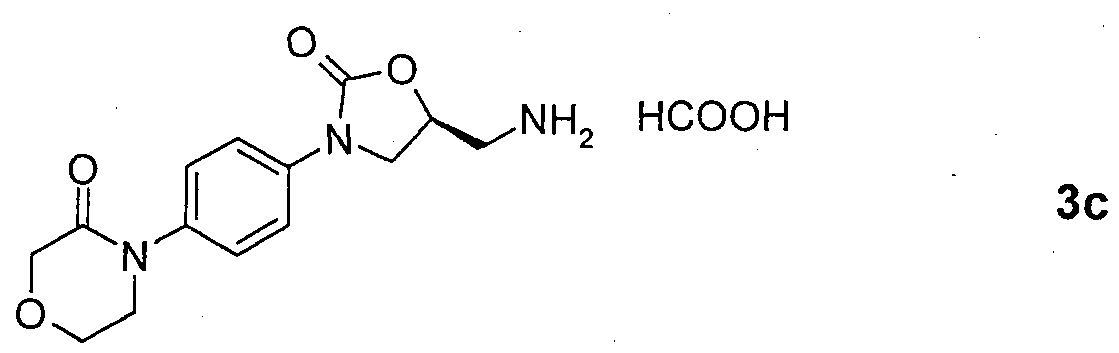
- the invention also relates to 4- ⁇ 4-[(5S)-5-(aminomethyl)-2-oxo-l,3-oxazolidine- 3 -yl] -phenyl ⁇ -morpholine-3 -one and racemate thereof of the Formula 12, and S- enantiomeric salts of the general Formula 3 thereof and racemic salts of same (wherein HnX is a mono- or polyvalent organic or inorganic acid, n represents 1, 2 or 3 and X stands for an acid residue ion with the proviso that if n represents 1, then X is other than chlorine).
- the invention also relates to the acetic acid salt of 4- ⁇ 4-[(5S)-5-(aminomethyl)- 2-oxo-l,3-oxazolidine-3-yl]-phenyl ⁇ -mo ⁇ holine-3-one of the Formula
- the invention also relates to a process for the preparation of the S-enantiomeric compound of the Formula 12 and the racemate thereof, or the S-enantiomeric salt of the general Formula 3 or a racemic salt thereof, preferably the acetic acid salt of the Formula 3b or racemic acetic acid salt thereof which comprises subjecting the S-enantiomeric compound of the general Formula 14 or a racemate thereof (wherein Z and Z stand for hydrogen or a protecting group with the proviso that at least Z 1 is other than hydrogen) to resolution, if a racemic starting material is used, preferably the S-enantiomeric compound of the Formula 13 or a
- racemate thereof in this case Z and Z are benzyl
- Z and Z are benzyl
- a racemic starting material is used, thereafter removing the protecting group 6(s) and isolating the S-enantiomeric base of the Formula 12 or the racemate thereof, or optionally a S-enantiomeric salt of the general Formula 3 or racemic salt thereof, preferably the acetic acid salt of the Formula 3b or the racemic acetic acid salt.
- S-enantiomeric compounds of the general Formula 14 and racemates thereof wherein Z 1 and Z 2 stand for hydrogen or a protecting group with the proviso that at least Z 1 is other than hydrogen and Z 1 and Z2 together represent a group other than phthalimido).
- the invention also relates to 4-(4- ⁇ (5S)-5-[(dibenzylamino)-methyl]-2-oxo-l,3- oxazolidine-3-yl ⁇ -phenyl)-mo ⁇ holine 3-one of the Formula 13 and the racemate thereof.
- the invention also relates to R-enantiomeric compounds of the general Formula 20 and racemates thereof (wherein Z and Z stand for hydrogen or a protecting group with the proviso that at least Z 1 is other than hydrogen and Z 1 and Z together can not represent phthalimido).
- the invention also relates to 4-(4- ⁇ [(2R)-33-(dibenzylamino)-2-hydroypropyl]- amino ⁇ -phenyl)-morpholine-3 -one of the Formula
- the invention also relates to a process for the preparation of R-enantiomeric compounds of the general Formula 20 and racemates thereof (wherein Z 1 and Z 2 stand for hydrogen or a protecting group with the proviso that at least Z 1 is other than hydrogen and preferably Z and Z are benzyl) which comprises subjecting a S-enantiomeric compound of the general Formula 19 or a racemate thereof
- the invention also relates to S-enantiomeric compounds of the general Formula
- the invention also relates to the preparation of S-enantiomeric compounds of the general Formula 14 and racemates thereof (wherein Z and Z stand for hydrogen or a protecting group with the proviso that at least Z 1 is other than hydrogen and Z and Z preferably stand for benzyl) which comprises subjecting a R-enantiomeric compound of the general Formula 10 or a racemate thereof (wherein L stands for chlorine, bromine, iodine, alkylsulfonyloxy or arylsulfonyloxy( to resolution, if a racemic starting material is used, and thereafter reacting the product with a compound of the general Formula Z 1 Z 2 NH (wherein Z 1 and Z 2 are as stated above).
- the invention also relates to R-enantiomeric compounds of the general Formula 10 and racemates thereof (wherein L is chlorine, bromine, iodine, alkylsulfonyloxy or arylsulfonyloxy, preferably chlorine, bromine or iodine).
- the invention also relates to a process for the preparation of the R-enantiomeric compounds of the Formula 10 and racemates thereof wherein L 2 is chlorine, bromine, iodine, alkylsulfonyloxy or arylsulfonyloxy, preferably chlorine, bromine or iodine which comprises subjecting a R-enantiomeric compound of the Formula 9 (wherein L 2 as stated above) or a racemate thereof to resolution, if a racemic starting material is used, and thereafter reacting with an agent capable of introducing a carbonyl group /wherein L is aas stated above/.
- the invention also relates to a process for the preparation of the R-enantiomeric compound of the Formula 10b or racemate of the Formula raclOb thereof or the R-enantiomeric compound of the Formula 10c or the racemate of the Formula raclOc thereof which comprises reacting the R-enantiomeric compound of the Formula 10a or the racemate of the Formula raclOa thereof with an alkali bromide, preferably sodium bromide or an alkali iodide preferably sodium iodide.
- an alkali bromide preferably sodium bromide or an alkali iodide preferably sodium iodide.
- the invention also relates to R-enantiomeric compounds of the general Formula 9 and racemates thereof wherein L is chlorine, bromine, iodine, alkylsulfonyloxy or arylsulfonyloxy, preferably chlorine, bromine or iodine.
- reaction schema 7a and 7b The most general forms of realization of the synthesis of rivaroxaban of the Formula 1 are shown on reaction schema 7a and 7b.
- HnX stands for a mono-or bivalent organic or inorganic acid (wherein n represents 1, 2 or 3 and X is an acid residue ion).
- organic acid e.g. sulfonic acids and carboxylic acids, preferably monovalent carboxylic acids, e.g. formic acid, acetic acid, propionic acid, butyric acid and as inorganic acids e.g. sulfuric acid, sulfous acid, nitric acid, phosphoric acid, hydrochloric acid, hydrogen bromide, or hydrogen iodide may be used;
- L is chlorine, bromine, iodine, alkylsulfonyloxy or arylsulfonyloxy, e.g. methanesulfonyloxy, benzenesulfonyloxy or p-toluenesulfonyloxy, preferably chlorine, bromine or iodine.
- reaction is carried out preferably in a protic solvent or solvent mixture or in a mixture of a protic solvent and water, at 0-150°C, preferably 60-90°C, for a period of 0.5-60 hours, preferably 20-40 hours.
- Formula 14 is prepared (wherein Z and Z are as stated above).
- the reaction is carried out by using an agent capable of introducing a carbonyl group, preferably N,N'-carbonyl-diimidazole, phosgene, diphosgene or triphosgene, preferably N ⁇ -carbonyl-diimidazole, in a suitable solvent or solvent mixture, preferably toluene.
- the base of the Formula 12 or a salt of the general Formula 3 thereof is prepared by removing the protecting group, preferably by means of reduction (wherein HnX is as stated above). Reduction is carried out in a CI -4 aliphatic alcohol, glacial acetic acid, water or a mixture of said solvents with each other or a further organic solvent. Catalytic hydrogenation or chemical reduction can be used.
- the compound of the Formula 3b is directly isolated, or from the acetic acid salt of the Formula 3b the base of the Formula 12 is set free in a known manner or optionally the acetic acid salt obtained is converted into a salt of the general Formula 3 in a known manner (wherein HnX is as stated above).
- a chloro formiate NN'-diisopropyl-carbodiimide (DIC), N,N -dicyclohexyl-carbodiimide (DCC), tripropyl-phosphonic acid anhydride (T3P) or NN'-acarbonyl-diimidazole, preferably chloro ethyl formiate or CDI can be used.
- solvent acetonitrile dichloro methane, acetone, toluene, tetrahydrofurane or a mixture formed with each other or with water can be applied.
- organic or inorganic base triethyl amine diisopropyl ethyl amine, sodium carbonate or sodium hydrogen carbonate can be used.
- the reaction is carried out at 0-100°C, preferably at 40-70°C.
- the use of the acid binding agent can be optionally omitted.
- a compound of the general Formula 10 prepared (wherein L 2 has the same meaning as stated above).
- the reaction as agent capable of introducing the carbonyl group preferably N.N'-carbonyl- diimidazole, phosgene, diphosgene or triphosgene, particularly N,N'-carbonyl- diimidazole can be used.
- the reaction is carried out in a suitable solvent or solvent mixture, preferably toluene, l-methyl-2-pyrrolidone or a mixture thereof, at 0-150°C, preferably at the reflux temperature of the solvent or solvent mixture.
- the preparation of the compounds of the general Formula 14 are prepared by reacting a compound of the general Formula 10 (wherein L 2 is as stated above) with a compound of the general Formula Z 1 Z 2 NH (wherein Z 1 and Z 2 are as stated above).
- the reaction is carried out in the absence or presence of a solvent, in the presence of an organic or inorganic acid binding agent, preferably cesium carbonate at a temperature of 0-150°C preferably 60-100°C.
- reaction steps - the two last steps - shown on reaction scheme 7b are identical with the two last steps shown on reaction scheme 7a.
- reaction scheme 8a A preferred embodiment of the invention process for the preparation of rivaroxaban of the Formula 1 is shown on reaction scheme 8a.
- reaction schema 7a and 8a we have indicated the chirality of the intermediates according to the Cahn- Ingold-Prelog nomenclature.
- the new synthesis route has also been performed by using the racemic forms of the compounds shown on reaction scheme 8a., starting from epichlorohydrine.
- N-benzyl-l-phenylmethyneamine well-known name dibenzyl amine, of the Formula 16
- the 4-(4-amino-phenyl)-morpholine-3-one of the Formula 5 is disclosed in EP 11261606, WO 2004/101556, WO 2005/026135, WO 2006/0632193 and the publication IPCOM0000195906D published in 2010 in IP.com Journal.
- the (S)- epichlorohydrine of the Formula 11 and racemic form thereof, the dibenzyl amine of the Formula 16 and 5-chloro-thiophen-2-carboxylic acid of the Formula 15 are commercially available.
- the (2S)-N,N-dibenzyl-oxirane-2-yl- methaneamine of the Formula 17 is described in CP 20032005282.
- the preparation of the racemic form of the compound of the Formula 17 is disclosed - among others - in US 4656180.
- the compounds of the Formulae 18 and 13 are susceptible to salt formation. Additionally the compounds of the Formulae 18 and 13 and the racemic equivalents thereof can exist in the form of solvates and can form co-crystals respectively.
- the invention also relates to the salts, solvates and hydrates of the compounds of the Formula 18 and 13 and racemates thereof and also to the co- crystals of said compounds.
- the invention also relates to 4-(4- ⁇ [(2R)-3-dibenzylamino-2-hydroxy-propyl]- amino ⁇ -phenyl-morfoline-3-one of the Formula 18 and the racemic form thereof.
- the invention also relates to the preparation of the compound of the Formula 18 starting from the compound of the Formula 17.
- the invention also relates to the preparation of the racemic form of the compound of the Formula 18 starting from the racemic from of the compound of the Formula 17.
- the invention also relates to compounds of the general Formula 20 and racemic forms thereof (wherein Z and Z stand for hydrogen or a protecting group with the proviso that at least Z 1 is other than hydrogen).
- the invention also relates to a process for the preparation of the compounds of the general Formula 20 and racemic forms thereof starting from a compound of the general Formula 19 or a racemic form thereof.
- the invention also relates to the compound 4-(4- ⁇ (5S)-5-[(dibenzylamino)- methyl]-2-oxo-1.3-oxazolidine-3-yl ⁇ -phenyl-morpholine-3-one of the Formula 13 and the racemic form thereof.
- the invention also relates to a process for the preparation of the compound of the Formula 13 starting from the compound of the Formula 18.
- the invention also relates to a process for the preparation of the racemic form of the compound of the Formula 13 starting from the racemic form of the compound of the Formula 18.
- the invention also relates to the compounds of the general Formula 14 and racemic forms thereof (wherein Z 1 and Z 2 stand for hydrogen or a protecting group with the proviso that at least Z 1 is other than hydrogen).
- the invention also relates to a process for the preparation of compounds of the general Formula 14 and racemic forms thereof, starting from compounds of the general Formula 20 and racemic forms thereof.
- the invention also relates to a process for the preparation of the compound of the Formula 12 and the racemic form thereof starting from the compound of the Formula 14 or the racemic form thereof.
- the invention also relates to the 4- ⁇ 4-[(5S)-5-aminomethyl-2-oxo-l,3- oxazolidine-3-yl] -phenyl ⁇ -morpholine-3 -one acetic acid salt of the Formula 3b and the racemic form thereof.
- the invention also relates to a process for the preparation of the 4- ⁇ 4-[(5S)-5- aminomethyl-2-oxo-l,3-oxazolidine-3- yl]-phenyl ⁇ -morpholine-3-one acetic acid salt of the Formula 3b and racemic form thereof starting from a compound of the Formula 13 or 14 or a racemic form thereof.
- the invention also relates to a process for the preparation of rivaroxaban of the Formula 1 by reacting a compound of the general Formula 3 (wherein HnX stands for a mono-or polyvalent organic or inorganic acid; n represents 1, 2 or 3 and X is an acid residue ion) or the compound of the Formula 12 and the 5- chloro-thiophen-2-carboxylic acid of the Formula 15.
- HnX stands for a mono-or polyvalent organic or inorganic acid; n represents 1, 2 or 3 and X is an acid residue ion
- the compound of the Formula 17 is prepared by reacting the compound of the Formula 11 with dibenzyl amine of the Formula 16 (in this case Z 1 and Z 2 stand for benzyl).
- the reaction is carried out in the absence of a solvent or in an organic solvent or water or a mixture thereof and preferably in the presence of an organic or inorganic acid binding agent.
- the compound of the Formula 18 is prepared by reacting 4-amino-phenyl-morpholinone of the Formula 5 with (2S)-N,N-dibenzyl-l-oxirane-2-yl-methaneamine of the Formula 17.
- the reaction is preferably carried out in a protic solvent or solvent mixture or in a mixture of a protic solvent and water, at 0-150 °C, preferably 60-90°C for a period of 0.5-60 hours, preferably 20-40 hours.
- the compound of the Formula 18 has a high melting point, crystallizes readily and is particularly suitable for use as an intermediate of industrial scale pharmaceutical manufacturing procedures. According to the process of the present invention said compound can be prepared without recrystallization in a chemical purity higher than 98 % and with an excellent high enantiomer purity of 99 %.
- the racemic form of the compound of the Formula 18 is prepared by reacting 4- amino-phenyl-morpholinone of the Formula 5 with the racemic form of N,N- dibenzyl-l-oxirane-2-yl-methaneamine of the Formula 17.
- the reaction is carried out preferably in a protic solvent or solvent mixture or a mixture of a protic solvent and water, at 0-150°C advantageously 40-80°C for a period of time of 0.5-60 hours, preferably 40-50 hours.
- the racemic form of the compound of the Formula 18 can be prepared with very good yield.
- the compound has a high melting point, can be readily crystallized and is excellently suitable as intermediate in manufacturing procedures of pharmaceutical industry.
- Said product when prepared according to the process of the present invention, can be used in the further steps of the synthesis without recrystallization.
- the non- desired regioisomer is only formed in a very small amount and the intermediate prepared (racemic form of the compound of the Formula 18) can be used in the further steps of the synthesis without recrystallization.
- the compound of the Formula 13 is prepared by reacting 4-(4- ⁇ [(2R)-3-dibenzylamino-2-hydroxy-propyl]-amino ⁇ -phenyl)-morfoline-3-one of the Formula 18 and an agent capable of introducing the carbonyl group, preferably N,N'-carbonyl-diimidazole, phosgene, diphosgene or triphosgene, particularly NN'-carbonyl-diimidazole in a suitable solvent, preferably toluene.
- the compound of the Formula 13 has a high melting point, can be easily crystallized and is highly suitable as an intermediate in the manufacturing procedure of pharmaceutical industry. According to the process of the present invention the compound of the Formula 13 can be prepared with an excellent yield, in a chemical purity of 99.9 % and practically in an enantiomeric purity of 99.9 %.
- reaction scheme 8b A preferred concrete embodiment of the invention process for the preparation of rivaroxaban of the Formula 1 is shown on reaction scheme 8b.
- reaction schema 7b and 8b the chirality of the intermediates according to the Cahn-Ingold-Prelog has been indicated.
- the starting material of the process is (2R(- chloromethyl-oxirane (well-known name (R(-epichlorohydrine( of the Formula 11 and from said compound in six steps rivaroxaban of the Formula 1 having the (S( configuration is obtained.
- the reaction step 10b (10c) - 13 the configuration is only apparently changed, however actually this is not an inversion step but the conversion of the (R) chirality into (S) chirality is only a change of nomenclature derived from the new group hierarchy following the introduction of a new structural unit.
- N-benzyl-l-phenylmethaneamine (well-known name dibenzyl amine) of the Formula 16
- the compounds of the Formulae rac9a, racl3 and rac3b contain a basic nitrogen and therefore by resolution potentially suitable enantiomers can be obtained which can be used for the preparation of rivaroxaban of the Formula 1 as shown on reaction scheme 8b by using methods known from prior art.
- Resolution can be carried out by conventional methods e.g. by using an enzyme, kinetic resolution, diastereomeric salt formation and subsequent separation of the diastereomeric derivatives by means of chromatography or fractional crystallization or by physical methods.
- the compounds of the Formulae 9a and 13 and enantiomers and racemic forms thereof can form salts. Additionally the compounds of the Formulae 9a, 10a, 10b, 10c and 13 and enantiomers and racemic forms thereof can also exist in the form of hydrates and other solvates and can also form co-crystals.
- the invention also relates to compounds of the Formulae 9a, 10a, 10b, 10c and 13 and enantiomers, and racemates thereof and salts, hydrates, solvates and co-crystals thereof.
- the invention also relates to 4- ⁇ 4-[((2R)-3-chloro-2-hydroxypropyl)-amino]- phenyl ⁇ -morpholine-3-one of the Formula 9a (compound of the Formula 9 wherein L is chlorine) and the racemic form thereof.
- the invention also relates to 4- ⁇ 4-[((2R)-3-bromo-2-hydroxypropyl)-amino]- phenyl ⁇ -morpholine-3-one of the Formula 9b (this is a compound f the Formula 9 wherein L is bromine) and the racemic form thereof.
- the invention also relates to 4- ⁇ 4-[((2R)-3-iodo-2- hydroxypropyl)-amino]- phenyl ⁇ -morpholine-3-one of the Formula 9c (compound of the general Formula 9 wherein L 2 is iodine) and the racemic form thereof.
- a process for the preparation of the compound of the Formula 13 and the racemic form thereof starting from a compound of the Formula 10a, 10b or 10c or a racemic form thereof there is also provided a process for the preparation of the compound of the Formula 14 and the racemic form thereof starting from a compound of the Formula 10a, 10b or 10c or a racemic form thereof.
- the compound of the Formula 9a is prepared by reacting 4- amino-phenyl-morpholine of the Formula 5 with epichlorohydrine of the Formula 11 in an organic solvent or a mixture of a water-mis proficient organic solvent and water at a temperature of 0-150°C, preferably at the reflux temperature of the solvent or solvent mixture for 0.5-60 hours.
- the compounds of the general Formula 9 have a high melting point, can be readily crystallized and are particularly suitable for use as intermediate of manufacturing procedures of pharmaceutical industry. According to the process of the present invention the compound of the Formula 9a can be prepared without recrystallization in a chemical purity higher than 95 % and an outstanding enantiomeric purity of above 99 %.
- the compound of the Formula 10a is prepared by reacting the compound of the Formula 9a with an agent capable of introducing the carbonyl group, preferably ⁇ , ⁇ '-carbonyl-diimidazole, phosgene, diphosgene or triphosgene, particularly ⁇ , ⁇ '-carbonyl-diimidazole in a suitable solvent or solvent mixture, preferably in toluene, l-methyl-2-pyrrolidone or a mixture thereof at 0-150°C, preferably at the reflux temperature of the solvent or solvent mixture.
- an agent capable of introducing the carbonyl group preferably ⁇ , ⁇ '-carbonyl-diimidazole, phosgene, diphosgene or triphosgene, particularly ⁇ , ⁇ '-carbonyl-diimidazole in a suitable solvent or solvent mixture, preferably in toluene, l-methyl-2-pyrrolidone or a mixture thereof at 0-150°C, preferably at the reflux temperature of the solvent or
- the compounds of the general Formula 10 have a high melting point, can be readily crystallized and are particularly suitable for use as intermediate of manufacturing procedures of pharmaceutical industry. According to the process of the present invention these compounds can be prepared in a chemical purity of 95 % and an enantiomeric purity higher than 99 % without recrystallization.
- the compound of the Formula 10c can be prepared from the compound of the Formula 10a with a high yield of 95.2 %.
- the compound of the Formula 10c is prepared from the compound of the Formula 10a by reacting said compound of the Formula 10a with an alkali iodide, preferably sodium iodide, in a suitable solvent or solvent mixture, preferably in a mixture of an organic solvent and water, at 0-150°C, preferably at 80-130°C.
- an alkali iodide preferably sodium iodide
- the compound of the Formula 10b is prepared from the compound of the Formula 10a by reacting said compound of the Formula 10a with an alkali bromide preferably sodium bromide, in a suitable organic solvent or solvent mixture, at 0- 150°C preferably at 80-130°C.
- an alkali bromide preferably sodium bromide
- the compound of the Formula 13 is prepared by reacting a compound of the Formula 10a, 10b or 10c of appropriate chirality, preferably the compound of the Formula 10c of appropriate chirality with dibenzyl amine of the Formula 16, in this case
- Z 1 and Z 2 stand for benzyl) in the presence or absence of a solvent ,in the presence of cesium carbonate, at 0-150°C, preferably at 60- 100°C, whereupon the reaction mixture is worked up and the product obtained is subjected to further purification if desired.
- the compound of the Formula 13 has a high melting point, can be readily crystallized and is particularly suitable for use as intermediate of manufacturing procedures of pharmaceutical industry. According to an other process of the present invention (reaction scheme 8b) this compound can be prepared after recrystallization in an outstanding chemical purity higher than 99.5 % and an enantiomeric purity of 99.9 %.
- reaction schema 8a and 8b are identical and for this reason the last two steps of the two preferred concrete embodiments of the present invention are discussed together.
- the compound of the Formula 3b is prepared by subjecting 4-(4- ⁇ (5S)- [dibenzy lamino-methyl]-2-oxo- 1.3 -oxazolidine-3 -y 1 ⁇ -phenyl)-morpholme-3 -one of the Formula 13 to catalytic hydrogenation or chemical reduction in a CI -4 aliphatic alcohol, glacial acetic acid, water or a mixture of said solvents formed with each other or with other organic solvents, working up the reaction mixture and separating the product by adding acetic acid in the form of the salt of the Formula 3b.
- the compound of the Formula 3b is prepared by converting 4-(4- ⁇ (5S)-5-aminomethyl— 2-oxo-l,3- oxazolidine-3-yl]-phenyl ⁇ -morpholine-3-one of the Formula 12 obtained by any synthesis route known from prior art or described in the present patent application into the salt of the Formula 3b by adding acetic acid.
- the compound of the Formula 3b has a high melting point, can be easily crystallized and is particularly suitable as intermediate of pharmaceutical manufacturing procedures. When prepared according to the process of the present invention said compound is obtained with a very high yield (98 %), in an outstanding chemical purity (99.5 %) and a high enantiomeric purity (99.9 %) without recrystallization..
- rivaroxaban of the Formula 1 is prepared by reacting the acetic acid salt of 4-(4-((5S(-5-aminomethyl-2-oxo- 1 ,3-oxazolidine-3-yl)-phenyl)- morpholine-3-one of the Formula 3b with 5-chloro-thiophen-2-carboxylic acid of the Formula 15 in the presence of a coupling agent and an organic or inorganic base, in an organic solvent.
- chloro ethyl formiate N,N- diisopropyl-carbodimide (DIC), N,N -dicyclohexyl-carbodiimide (DCC) tripropyl -phosphonic anhydride (T3P) or NN'-carbonyl-diimidazole , preferably chloro ethyl formiate or CDI can be used.
- solvent acetonitrile dichloro methyane, acetone, toluene, tetrahydrofurane or a mixture thereof or a mixture of said organic solvent formed with water can be applied.
- organic or inorganiv base triethyl amine diisopropyl ethyl amine, sodium carbonate or sodium hydrogen carbonate can be used.
- the reaction is carried out at a temperature between 0-110°C and 110°C, preferably at 40-70°C.
- the use of the acid binding agent can be optionally omitted.
- the advantage of the process of the present invention is that the intermediates have high melting point, can be readily crystallized and are excellently suitable as intermediates of pharmaceutical manufacturing procedures. Said compounds can be prepared according to the process of the present invention in outstandingly high chemical and enantiomeric purity without recrystallization.
- the compounds of the Formulae 13 and 3b can be prepared according to the process shown on reaction scheme 8b without recrystallization in a chemical purity above 95 % -for the compound of the Formula 13 preferably 99.4 % and in an enantiomeric purity higher than 99 % - for the compounds of the Formulae 13 and 3b preferably 99.9 %.
- a further advantage of the invention process resides in the high yields of the reaction steps.
- a further advantage of the invention process is that from the 4- ⁇ 4-[(5S)-5- (dibenzylamino-methyl)-2-oxo- 1.3 -oxazolidine3 -yl] -phenyl ⁇ -morpholine-3 -one intermediate of the Formula 13 the protecting group can be removed under much milder conditions than the phthalyl protecting group used according to WO 2005/068456 (see reaction scheme 4( and therefore the last intermediate of the Formula 3b of the synthesis route can be prepared in a higher purity than described in said prior art.
- a further advantage of the process of the present invention is that the reactant of the Formula 15 used in the last acylation step of the preparation of rivaroxaban of the Formula 1 of is more advantageous in several properties than the acid chloride of the Formula 4.
- the compound of the Formula 15 is solid and crystalline while the compound of the Formula 4 is a viscous substance difficult to handle
- the compound of the Formula 15 is stable while the compound of the Formula 4 easily hydrolyses, the effective amount content thereof decreases gradually on storage, even when stored at 0-5 °C,
- the compound of the Formula 15 is a significantly cheaper reactant than the compound of the Formula 4.
- a further advantage of the invention process is that from the acetic acid medium used by the catalytic debenzylation reaction (13 -> 3b) the acetic acid salt of the Formula 3b can be directly isolated with an extremely high yield (98 %), in a chemical purity of 99.91 % and an enantiomeric purity of 99.9 %.
- the process of the present invention is directly suitable for the preparation of the end- product of the Formula 1 which is pure and meets the purity requirements of pharmaceutical industry.
- a further advantage of the process shown on reaction scheme 8a is that under the optimalized reaction conditions used in the preparation of the compound of the Formula 18 the non-desired regioisomer is formed but to a very small extent and racemization did not practically take place.
- the compound of the Formula 18 is obtained in a chemical purity of 98.4 % and can be characterized by a 99 % e.e. value.
- reaction scheme 8a An additional advantage of the process shown on reaction scheme 8a is that under the optimalized reaction conditions used in the preparation of the compound of the Formula 13 the by-products are formed only to a very small extent and racemization does not take place at all.
- the compound of the Formula 18 is obtained in a chemical purity of 99.9 % and can be characterized by a 99 % e.e. value.
- reaction schema 7b and 8b A further advantage of the process shown on reaction schema 7b and 8b is that under optimalized reaction conditions used in the reaction of the compounds of the Formula 11 and 5 the formation of the non- desired regioisomer is very small and, and if optically active starting material is used, racemization does not practically take place.
- reaction schema 7b and 8b A further advantage of the process shown on reaction schema 7b and 8b is that under the optimalized reaction conditions used in the preparation of the compound of the Formula 10 by-products are formed only to a very small extent and racemization does not take place at all.
- reaction schema 7b and 8b A further advantage of the process shown on reaction schema 7b and 8b is that under the optimalized reaction conditions used in the preparation of the compound of the Formula 13 no detectable elimination side-reaction took place and, if optically active starting materials were used, racemization did not take place at all.
- reaction schema 7a, 7b, 8 a and 8b provides a synthesis route for the preparation of the rivaroxaban of the Formula 1 which is more efficient and more suitable for industrial scale manufacture than methods the for the preparation of rivaroxaban of the Formula 1 known from prior art.
- CNMR 165.89, 147.66, 139.42, 130.34, 128.82, 128.31, 126.98, 126.54, 111.98, 67.91, 67.10, 63.72, 58.57, 57.87, 49.76, 48.25, 39.70.
- the reaction mixture is stirred at 50°C for an hour and allowed to cool to room temperature.
- the solid substance is filtered and dried under an infrared lamp to constant weight.
- 3.65 g (86,5 %) of a crude product are obtained.
- the crude product is recrystallized from 22 ml of glacial acetic acid to yield 3.24 g (89 %) of the white end-product, HPLC purity 99.3 %, mp.: 230-231°C. II
- the filtrate is evaporated to dryness and from the residue four times 50 cm 3 of ethanol each are distilled off at a pressure of 75 mbar. To the residue thus obtained 30 cm of ethanol are added, the mixture is stirred in a cooling bath for 30 minutes. The precipitated solid substance is filtered off, washed with 25 cm of ethanol on the filter and dried under an infrared lamp to constant weight. Thus 3.80 g (99.2 %) of the white solid title compound are obtained, HPLC purity 99.7 %, mp.: 145-146°C.
- the crude product is crystallized from 14 ml of glacial acetic acid to yield 2.o4 g (70 %) of rivaroxaban, HPLC purity 99.85 %. Mp.: 230-231°C.
- reaction mixture is stirred at room temperature for an hour whereupon 1.64 g (5 millimoles) of 4- ⁇ 4-[(5S)-5-aminomethyl-2-oxo-l,3- oxazolidine-3-yl] -phenyl ⁇ -morpholine-3 -one hydrochloride (3a) are added.
- the reaction mixture is stirred for half an hour at room temperature.
- the triethyl amine hydrochloride salt formed is filtered and the filtrate evaporated to dryness.
- the residue is suspended in 10 ml of glacial acetic acid, the suspension is heated to boiling and stirred for 10 minutes.
- reaction mixture is stirred at room temperature for 30 minutes whereupon the solution is added dropwise to a mixture of 0.33 g (1 millimole) of 4- ⁇ 4-[(5S)-5-aminomethyl--2-oxo-l,3- oxazolidine-3-yl]-phen l ⁇ -mo ⁇ holine-3-one-hidrochloride (3a) and 0.10 g (1.25 millimoles) of sodium hydrogen carbonate in 4 cm of dried acetonitrile at room temperature.
- the reaction mixture is stirred at 50°C for 4.5 hours, then heated to the boiling point and stirred at this temperature for 6 hours.
- the reaction mixture is warmed to 50-55°C and stirred at this temperature for 19 hours.
- 20 cm of distilled water of a temperature of 2°C are added and the mixture is stirred in an ice-cold water-bath for an hour.
- the precipitated solid is filtered, washed three times with 1 ml of distilled water each and 1 ml of acetone and dried under an infrared lamp to constant weight.
- 0.01 g (23 %) of the title compound are obtained.
- the crude product is recrystallized from 260 ml of ethanol, filtered and dried under an infrared lamp. Thus 17.97 g (87 %) of the purified product are obtained, mp. 153-155°C, chemical purity 99.9 % and chiral purity (HPLC) 99.9 %.
- the solution is filtered, whereupon at a temperature between 8°C and 12°C 16.6 cm of a toluene solution of 5-chloro-thiophen-2-carboxylic acid chloride of a concentration of 36.1 g /100 ml are added (corresponding to 5.97 g, 0.033 mole of 5-chloro-thiophen-2- carboxylic acid chloride of the Formula 4).
- the reaction mixture is warmed to 50°C, whereupon 25 cm of acetone are added and the mixture is stirred for a further period of 30 minutes at 50-53°C.
- the crude product is suspended in 35 ml of hexane, the suspension is warmed and to the hot suspension 169 ml of acetone are added dropwise under stirring until the product is dissolved.
- the mixture is allowed to cool to 25 °C and crystallization is performed at 0-2 °C under stirring for an hour.
- the product is filtered and dried under an infrared lamp to constant weight.
- 8.16 g (82 %) of the title compound are obtained, mp.: 137-139°C, chemical purity 98 %, chiral purity (HPLC) 98.2 %.
- the reaction mixture is warmed to 50°C, 7.5 ml of acetone are added and the mixture is stirred at 50-55°C for a further period of 30 minutes.
- the reaction mixture is cooled to 25 °C, the precipitated product is filtered, washed three times with 15 ml of acetone each, three times with 15 ml of water each and again with three times with 15 ml of acetone each and dried under an infrared lamp to constant weight.
- the solution is filtered and at a temperature of 8-12°C 3 ml of a toluene solution of 5-chloro-thiophen-2- carboxylic acid chloride (compound of the Formula 4) having a concentration of 36.1 g/100 ml are added, (this corresponds to 1.07 g, 0.059 mole) of 5-chloro- thiophen-2-carboxylic acid chloride.
- the reaction mixture is warmed to 50°C, whereupon 5 ml of acetone are added and the mixture is stirred at 50-53°C for a further period of 30 minutes.
Landscapes
- Chemical & Material Sciences (AREA)
- Organic Chemistry (AREA)
- Health & Medical Sciences (AREA)
- Engineering & Computer Science (AREA)
- Bioinformatics & Cheminformatics (AREA)
- Life Sciences & Earth Sciences (AREA)
- Public Health (AREA)
- General Chemical & Material Sciences (AREA)
- Medicinal Chemistry (AREA)
- Nuclear Medicine, Radiotherapy & Molecular Imaging (AREA)
- Chemical Kinetics & Catalysis (AREA)
- Pharmacology & Pharmacy (AREA)
- Veterinary Medicine (AREA)
- Animal Behavior & Ethology (AREA)
- General Health & Medical Sciences (AREA)
- Hematology (AREA)
- Diabetes (AREA)
- Urology & Nephrology (AREA)
- Vascular Medicine (AREA)
- Cardiology (AREA)
- Heart & Thoracic Surgery (AREA)
- Heterocyclic Carbon Compounds Containing A Hetero Ring Having Nitrogen And Oxygen As The Only Ring Hetero Atoms (AREA)
- Pharmaceuticals Containing Other Organic And Inorganic Compounds (AREA)
- Plural Heterocyclic Compounds (AREA)
Abstract
Description


Claims


Priority Applications (6)
| Application Number | Priority Date | Filing Date | Title |
|---|---|---|---|
| EA201391647A EA024685B1 (en) | 2011-05-06 | 2012-05-04 | Process for the preparation of a rivaroxaban and intermediates formed in said process |
| US14/115,359 US9556163B2 (en) | 2011-05-06 | 2012-05-04 | Process for the preparation of a rivaroxaban and intermediates formed in said process |
| EP12731645.3A EP2705028B1 (en) | 2011-05-06 | 2012-05-04 | Process for the preparation of a rivaroxaban and intermediates formed in said process |
| JP2014508876A JP6325978B2 (en) | 2011-05-06 | 2012-05-04 | Process for the preparation of rivaroxaban and intermediates formed in the process |
| UAA201314292A UA114601C2 (en) | 2011-05-06 | 2012-05-04 | Process for the preparation of a rivaroxaban and intermediates formed in said process |
| MDA20130094A MD4557C1 (en) | 2011-05-06 | 2012-05-04 | Process for the preparation of rivaroxaban and an intermediate used in said process |
Applications Claiming Priority (6)
| Application Number | Priority Date | Filing Date | Title |
|---|---|---|---|
| HU1100239A HU230984B1 (en) | 2011-05-06 | 2011-05-06 | Novel process for the preparation of pharmaceutically active ingredient and the intermediates arose during the process |
| HUP1100240 | 2011-05-06 | ||
| HU1100240A HU230985B1 (en) | 2011-05-06 | 2011-05-06 | Novel coupling process for the preparation of pharmeceutically active ingredient |
| HU1100238A HU230961B1 (en) | 2011-05-06 | 2011-05-06 | Novel process for the preparation of pharmaceutically active ingredient and the intermediates arose during the process |
| HUP1100239 | 2011-05-06 | ||
| HUP1100238 | 2011-05-06 |
Publications (1)
| Publication Number | Publication Date |
|---|---|
| WO2012153155A1 true WO2012153155A1 (en) | 2012-11-15 |
Family
ID=89990276
Family Applications (1)
| Application Number | Title | Priority Date | Filing Date |
|---|---|---|---|
| PCT/HU2012/000033 Ceased WO2012153155A1 (en) | 2011-05-06 | 2012-05-04 | Process for the preparation of a rivaroxaban and intermediates formed in said process |
Country Status (8)
| Country | Link |
|---|---|
| US (1) | US9556163B2 (en) |
| EP (1) | EP2705028B1 (en) |
| JP (1) | JP6325978B2 (en) |
| EA (1) | EA024685B1 (en) |
| GE (1) | GEP20156397B (en) |
| MD (1) | MD4557C1 (en) |
| UA (1) | UA114601C2 (en) |
| WO (1) | WO2012153155A1 (en) |
Cited By (11)
| Publication number | Priority date | Publication date | Assignee | Title |
|---|---|---|---|---|
| WO2013152168A1 (en) * | 2012-04-06 | 2013-10-10 | Indiana University Research And Technology Corporation | Processes for preparing rivaroxaban |
| CN103360380A (en) * | 2013-03-13 | 2013-10-23 | 浙江天宇药业股份有限公司 | Synthesis method of rivaroxaban, and rivaroxaban intermediate and preparation thereof |
| EP2613787A4 (en) * | 2010-09-07 | 2014-04-16 | Symed Labs Ltd | Processes for the preparation of 4-{4-[5(s)-(aminomethyl)-2-oxo-1,3-oxazolidin-3-yl]phenyl} morpholin-3-one |
| CN104311545A (en) * | 2014-09-29 | 2015-01-28 | 哈药集团制药总厂 | Preparation method of rivaroxaban key intermediate |
| WO2014102820A3 (en) * | 2012-12-26 | 2015-02-19 | Wanbury Ltd. | Rivaroxaban intermediate and preparation thereof |
| WO2015104605A1 (en) | 2014-01-08 | 2015-07-16 | Wockhardt Limited | A process for preparing rivaroxaban or a pharmaceutically acceptable salt thereof |
| WO2016030669A1 (en) * | 2014-08-25 | 2016-03-03 | Cipla Limited | Process for the preparation of rivaroxaban |
| US9359341B2 (en) | 2012-12-26 | 2016-06-07 | Wanbury Ltd. | Aldehyde derivative of substitute oxazolidinones |
| KR101811123B1 (en) | 2016-02-19 | 2017-12-20 | 일동제약(주) | Novel morpholine diphosphate salt, and method for manufacturing high purity rivaroxaban using same |
| EP3309158A1 (en) | 2012-12-21 | 2018-04-18 | Farma GRS, d.o.o. | Crystalline form k of rivaroxaban and process for its preparation |
| WO2021118906A1 (en) | 2019-12-10 | 2021-06-17 | Eli Lilly And Company | Process and intermediate for the preparation of oxetan-2-ylmethanamine |
Citations (18)
| Publication number | Priority date | Publication date | Assignee | Title |
|---|---|---|---|---|
| US4656180A (en) | 1984-03-07 | 1987-04-07 | Ludwig Heumann & Co., Gmbh | Diamine derivatives and pharmaceutical preparations containing these compounds |
| WO1999052855A1 (en) * | 1998-04-14 | 1999-10-21 | Samsung Fine Chemicals Co., Ltd. | A process for preparing chiral (s)-2,3-disubstituted-1-propylamine derivatives |
| WO2002032857A1 (en) * | 2000-10-17 | 2002-04-25 | Pharmacia & Upjohn Company | Methods of producing oxazolidinone compounds |
| EP1261606A1 (en) | 1999-12-24 | 2002-12-04 | Bayer Aktiengesellschaft | Substituted oxazolidinones and their use in the field of blood coagulation |
| WO2003000256A1 (en) * | 2001-06-20 | 2003-01-03 | Bayer Healthcare Ag | Substituted oxazolidinones for combinational therapy |
| WO2004060887A1 (en) * | 2003-01-07 | 2004-07-22 | Bayer Healthcare Ag | Method for producing 5-chloro-n-({5s)-2-oxo-3-[4-(3-oxo-4-morpholinyl)-phenyl]-1,3-oxazolidin-5-yl}-methyl)-2-thiophene carboxamide |
| WO2004101556A1 (en) | 2003-05-19 | 2004-11-25 | Sanofi-Aventis Deutschland Gmbh | INDAZOLE-DERIVATIVES AS FACTOR Xa INHIBITORS |
| WO2005006845A2 (en) | 2003-07-14 | 2005-01-27 | Agrinomics Llc | Generation of plants with altered oil content |
| WO2005026135A1 (en) | 2003-09-15 | 2005-03-24 | Bayer Healthcare Ag | Method for the production of 4-(4-aminophenyl)-3-morpholinon |
| WO2005026133A1 (en) | 2003-09-12 | 2005-03-24 | Arpida A/S | Isoxazoles as peptide deformylase inhibitors |
| EP1553093A1 (en) * | 2002-06-28 | 2005-07-13 | Kaneka Corporation | Process for preparation of optically active 1-substituted amino-2,3-epoxypropanes, intermediates for the synthesis thereof and process for preparation of the intermediates |
| WO2005068456A1 (en) | 2004-01-15 | 2005-07-28 | Bayer Healthcare Ag | Production method |
| WO2006063219A2 (en) | 2004-12-09 | 2006-06-15 | Pro-Health, Inc. | Product and method for oral administration of nutraceuticals |
| WO2010002115A2 (en) * | 2008-07-03 | 2010-01-07 | Legochem Bioscience Ltd. | Fxa inhibitors with cyclic amidoxime or cyclic amidrazone as p4 subunit, processes for their preparations, and pharmaceutical compositions and derivatives thereof |
| WO2010081404A1 (en) * | 2009-01-13 | 2010-07-22 | 联化科技股份有限公司 | Method for preparing linezolid and intermediates thereof |
| WO2010124385A1 (en) | 2009-04-28 | 2010-11-04 | Apotex Pharmachem Inc. | Processes for the preparation of rivaroxaban and intermediates thereof |
| WO2011012321A1 (en) | 2009-07-31 | 2011-02-03 | Krka, D.D., Novo Mesto | Processes for crystallization of rivaroxaban |
| CN102408420A (en) * | 2011-10-19 | 2012-04-11 | 刘燕琼 | Preparation method of rivaroxaban and intermediate thereof and intermediate compound |
Family Cites Families (13)
| Publication number | Priority date | Publication date | Assignee | Title |
|---|---|---|---|---|
| HK1040707A1 (en) * | 1998-11-27 | 2002-06-21 | 法玛西雅厄普约翰美国公司 | Oxazolidinone antibacterial agents having a thiocarbonyl functionality |
| GB0016877D0 (en) * | 2000-07-11 | 2000-08-30 | Astrazeneca Ab | Chemical compounds |
| DE10105989A1 (en) * | 2001-02-09 | 2002-08-14 | Bayer Ag | Substituted oxazolidinones and their use |
| JP2003206282A (en) * | 2002-01-07 | 2003-07-22 | Daiso Co Ltd | Method for producing oxazolidin-2-one derivative |
| US8097708B2 (en) * | 2006-02-07 | 2012-01-17 | Taisho Pharmaceutical Co., Ltd. | 10a-Azalide compound |
| DE102006051625A1 (en) * | 2006-11-02 | 2008-05-08 | Bayer Materialscience Ag | Combination therapy of substituted oxazolidinones |
| EP2388260A1 (en) * | 2010-05-21 | 2011-11-23 | Archimica GmbH | Method for producing a blood coagulation factor inhibitor |
| CN107021932A (en) * | 2010-06-29 | 2017-08-08 | 欧美嘉股份有限公司 | Process for the preparation of 5-L-aminomethyl-3-aryl-2-oxazolidone |
| US20130253187A1 (en) | 2010-09-14 | 2013-09-26 | Medichem, S.A. | Process for Determining the Suitability for Distribution of a Batch of Thiophene-2-Carboxamide Derivative |
| CN102827154B (en) * | 2011-06-14 | 2015-04-22 | 上海科胜药物研发有限公司 | New method for synthesizing rivaroxaban intermediate 4-{4-[(5S)-5-(aminomethyl)-2-oxo-1,3-oxazolidine-3-yl]phenyl}morpholine-3-ketone |
| WO2013053739A1 (en) * | 2011-10-10 | 2013-04-18 | Laboratorios Lesvi, S. L. | Process for preparing factor xa inhibitors |
| CZ2012111A3 (en) * | 2012-02-16 | 2013-08-28 | Zentiva, K.S. | Process for preparing rivaroxaban based on the use of (S)-epichlorohydrin |
| CN103288814B (en) * | 2012-02-24 | 2016-07-06 | 国药集团国瑞药业有限公司 | A kind of preparation method of Rivaroxaban intermediate |
-
2012
- 2012-05-04 GE GEAP201213310A patent/GEP20156397B/en unknown
- 2012-05-04 UA UAA201314292A patent/UA114601C2/en unknown
- 2012-05-04 WO PCT/HU2012/000033 patent/WO2012153155A1/en not_active Ceased
- 2012-05-04 EA EA201391647A patent/EA024685B1/en not_active IP Right Cessation
- 2012-05-04 JP JP2014508876A patent/JP6325978B2/en not_active Expired - Fee Related
- 2012-05-04 EP EP12731645.3A patent/EP2705028B1/en active Active
- 2012-05-04 US US14/115,359 patent/US9556163B2/en not_active Expired - Fee Related
- 2012-05-04 MD MDA20130094A patent/MD4557C1/en not_active IP Right Cessation
Patent Citations (22)
| Publication number | Priority date | Publication date | Assignee | Title |
|---|---|---|---|---|
| US4656180A (en) | 1984-03-07 | 1987-04-07 | Ludwig Heumann & Co., Gmbh | Diamine derivatives and pharmaceutical preparations containing these compounds |
| WO1999052855A1 (en) * | 1998-04-14 | 1999-10-21 | Samsung Fine Chemicals Co., Ltd. | A process for preparing chiral (s)-2,3-disubstituted-1-propylamine derivatives |
| EP1261606A1 (en) | 1999-12-24 | 2002-12-04 | Bayer Aktiengesellschaft | Substituted oxazolidinones and their use in the field of blood coagulation |
| WO2002032857A1 (en) * | 2000-10-17 | 2002-04-25 | Pharmacia & Upjohn Company | Methods of producing oxazolidinone compounds |
| WO2003000256A1 (en) * | 2001-06-20 | 2003-01-03 | Bayer Healthcare Ag | Substituted oxazolidinones for combinational therapy |
| EP1553093A1 (en) * | 2002-06-28 | 2005-07-13 | Kaneka Corporation | Process for preparation of optically active 1-substituted amino-2,3-epoxypropanes, intermediates for the synthesis thereof and process for preparation of the intermediates |
| WO2004060887A1 (en) * | 2003-01-07 | 2004-07-22 | Bayer Healthcare Ag | Method for producing 5-chloro-n-({5s)-2-oxo-3-[4-(3-oxo-4-morpholinyl)-phenyl]-1,3-oxazolidin-5-yl}-methyl)-2-thiophene carboxamide |
| EP1583761A1 (en) | 2003-01-07 | 2005-10-12 | Bayer HealthCare AG | METHOD FOR PRODUCING 5-CHLORO- i N /i -({5 i S /i )-2-OXO-3- 4-(3-OXO-4-MORPHOLINYL)-PHENYL -1,3-OXAZOLIDIN-5-YL&rc ub;-METHYL)-2-THIOPHENE CARBOXAMIDE |
| WO2004101556A1 (en) | 2003-05-19 | 2004-11-25 | Sanofi-Aventis Deutschland Gmbh | INDAZOLE-DERIVATIVES AS FACTOR Xa INHIBITORS |
| WO2005006845A2 (en) | 2003-07-14 | 2005-01-27 | Agrinomics Llc | Generation of plants with altered oil content |
| WO2005026133A1 (en) | 2003-09-12 | 2005-03-24 | Arpida A/S | Isoxazoles as peptide deformylase inhibitors |
| WO2005026135A1 (en) | 2003-09-15 | 2005-03-24 | Bayer Healthcare Ag | Method for the production of 4-(4-aminophenyl)-3-morpholinon |
| US20050182055A1 (en) | 2004-01-15 | 2005-08-18 | Bayer Healthcare Ag | Preparation process |
| DE102004002044A1 (en) | 2004-01-15 | 2005-08-04 | Bayer Healthcare Ag | manufacturing |
| WO2005068456A1 (en) | 2004-01-15 | 2005-07-28 | Bayer Healthcare Ag | Production method |
| WO2006063219A2 (en) | 2004-12-09 | 2006-06-15 | Pro-Health, Inc. | Product and method for oral administration of nutraceuticals |
| WO2010002115A2 (en) * | 2008-07-03 | 2010-01-07 | Legochem Bioscience Ltd. | Fxa inhibitors with cyclic amidoxime or cyclic amidrazone as p4 subunit, processes for their preparations, and pharmaceutical compositions and derivatives thereof |
| WO2010081404A1 (en) * | 2009-01-13 | 2010-07-22 | 联化科技股份有限公司 | Method for preparing linezolid and intermediates thereof |
| EP2388251A1 (en) * | 2009-01-13 | 2011-11-23 | Lianhe Chemical Technology Co., Ltd. | Method for preparing linezolid and intermediates thereof |
| WO2010124385A1 (en) | 2009-04-28 | 2010-11-04 | Apotex Pharmachem Inc. | Processes for the preparation of rivaroxaban and intermediates thereof |
| WO2011012321A1 (en) | 2009-07-31 | 2011-02-03 | Krka, D.D., Novo Mesto | Processes for crystallization of rivaroxaban |
| CN102408420A (en) * | 2011-10-19 | 2012-04-11 | 刘燕琼 | Preparation method of rivaroxaban and intermediate thereof and intermediate compound |
Non-Patent Citations (5)
| Title |
|---|
| DATABASE IP.com Prior Art Database [O] IP.COM; DISCLOSED ANONYMOUSLY: "Improved process for the preparation of 2-Thiophenecarboxamide, 5-chloro-N-[[(5S)-2-oxo-3-[4-(3-oxo-4morpholinyl)phenyl]-5-oxazolidinyl]methyl] intermediate", XP055248222, Database accession no. IPCOM000180805D |
| IP.COM JOURNAL (IPCOM000199058D, 2009 |
| IP.COM JOURNAL., 2010 |
| IP.COM. JOURNAL, 2010 |
| See also references of EP2705028A1 |
Cited By (17)
| Publication number | Priority date | Publication date | Assignee | Title |
|---|---|---|---|---|
| EP2613787A4 (en) * | 2010-09-07 | 2014-04-16 | Symed Labs Ltd | Processes for the preparation of 4-{4-[5(s)-(aminomethyl)-2-oxo-1,3-oxazolidin-3-yl]phenyl} morpholin-3-one |
| WO2013152168A1 (en) * | 2012-04-06 | 2013-10-10 | Indiana University Research And Technology Corporation | Processes for preparing rivaroxaban |
| US9562040B2 (en) | 2012-04-06 | 2017-02-07 | Indiana University Research And Technology Corporation | Processes for preparing Rivaroxaban |
| EP3309158A1 (en) | 2012-12-21 | 2018-04-18 | Farma GRS, d.o.o. | Crystalline form k of rivaroxaban and process for its preparation |
| WO2014102820A3 (en) * | 2012-12-26 | 2015-02-19 | Wanbury Ltd. | Rivaroxaban intermediate and preparation thereof |
| US9359341B2 (en) | 2012-12-26 | 2016-06-07 | Wanbury Ltd. | Aldehyde derivative of substitute oxazolidinones |
| US9394292B2 (en) | 2012-12-26 | 2016-07-19 | Wanbury Ltd. | Rivaroxaban intermediate and preparation thereof |
| CN103360380A (en) * | 2013-03-13 | 2013-10-23 | 浙江天宇药业股份有限公司 | Synthesis method of rivaroxaban, and rivaroxaban intermediate and preparation thereof |
| WO2015104605A1 (en) | 2014-01-08 | 2015-07-16 | Wockhardt Limited | A process for preparing rivaroxaban or a pharmaceutically acceptable salt thereof |
| WO2016030669A1 (en) * | 2014-08-25 | 2016-03-03 | Cipla Limited | Process for the preparation of rivaroxaban |
| CN104311545A (en) * | 2014-09-29 | 2015-01-28 | 哈药集团制药总厂 | Preparation method of rivaroxaban key intermediate |
| CN104311545B (en) * | 2014-09-29 | 2017-03-22 | 哈药集团制药总厂 | Preparation method of rivaroxaban key intermediate |
| KR101811123B1 (en) | 2016-02-19 | 2017-12-20 | 일동제약(주) | Novel morpholine diphosphate salt, and method for manufacturing high purity rivaroxaban using same |
| WO2021118906A1 (en) | 2019-12-10 | 2021-06-17 | Eli Lilly And Company | Process and intermediate for the preparation of oxetan-2-ylmethanamine |
| CN114728923A (en) * | 2019-12-10 | 2022-07-08 | 伊莱利利公司 | Processes and intermediates for the preparation of oxetan-2-ylmethanamine |
| AU2020401539B2 (en) * | 2019-12-10 | 2023-06-01 | Eli Lilly And Company | Process and intermediate for the preparation of oxetan-2-ylmethanamine |
| US12473267B2 (en) | 2019-12-10 | 2025-11-18 | Eli Lilly And Company | Process and intermediate for the preparation of oxetan-2-yl-methanamine |
Also Published As
| Publication number | Publication date |
|---|---|
| EP2705028A1 (en) | 2014-03-12 |
| JP2014513115A (en) | 2014-05-29 |
| UA114601C2 (en) | 2017-07-10 |
| EP2705028B1 (en) | 2019-08-21 |
| MD4557B1 (en) | 2018-03-31 |
| US9556163B2 (en) | 2017-01-31 |
| EA024685B1 (en) | 2016-10-31 |
| GEP20156397B (en) | 2015-11-10 |
| JP6325978B2 (en) | 2018-05-16 |
| EA201391647A1 (en) | 2014-02-28 |
| US20140142303A1 (en) | 2014-05-22 |
| MD4557C1 (en) | 2018-10-31 |
| MD20130094A2 (en) | 2014-04-30 |
Similar Documents
| Publication | Publication Date | Title |
|---|---|---|
| EP2705028B1 (en) | Process for the preparation of a rivaroxaban and intermediates formed in said process | |
| US8106192B2 (en) | Method for producing 5-chloro-N-({(5S)-2-oxo-3-[4-(3-oxo-4-morpholinyl)phenyl]-1,3-oxazolidin-5-yl}methyl)-2-thiophenecarboxamide | |
| US20130172554A1 (en) | Processes for the preparation of 4-morpholin-3-one | |
| CN107021932A (en) | Process for the preparation of 5-L-aminomethyl-3-aryl-2-oxazolidone | |
| US7847095B2 (en) | Process for 5-[[2(r)-[1(r)-[3,5-bis(trifluoromethyl)phenyl]ethoxy]-3(s)-(4-fluorophenyl)-4-morpholinyl]methyl]-1,2-dihydro-3h-1.,2,4-triazol-3-one | |
| US9376427B2 (en) | Process for preparing rivaroxaban using intermediates | |
| KR19990077308A (en) | Quinolin-2- (1H) -one | |
| US6469011B2 (en) | Benzenesulfonamide compounds useful as TXA2 and 5-HT2 receptor antagonists | |
| EP3565552B1 (en) | An improved process for the preparation of rivaroxaban involving novel intermediate | |
| WO2012041263A2 (en) | A method of manufacturing 2-({(5s)-2-oxo-3-[4-(3-oxo-4-morpholinyl)phenyl]- l,3-oxazolidin-5-yl}methyl)-lh-isoindol-l,3(2h)-dione with a high optical purity | |
| AU2023211068B2 (en) | Benzoisothiazole and benzoisoxazole compounds for the treatment of mental disorders | |
| HU230961B1 (en) | Novel process for the preparation of pharmaceutically active ingredient and the intermediates arose during the process | |
| US8802860B2 (en) | Method for producing substituted pyridin-2-one | |
| HU230984B1 (en) | Novel process for the preparation of pharmaceutically active ingredient and the intermediates arose during the process | |
| HU230985B1 (en) | Novel coupling process for the preparation of pharmeceutically active ingredient | |
| JP2005047807A (en) | Method for producing carboxylic acid compound | |
| HK1181384B (en) | Method for producing substituted pyridin-2-one | |
| JP2003113170A (en) | Optically active alfa-aminoepoxide derivative and method of producing optically active oxazolidinone derivative using the same |
Legal Events
| Date | Code | Title | Description |
|---|---|---|---|
| 121 | Ep: the epo has been informed by wipo that ep was designated in this application |
Ref document number: 12731645 Country of ref document: EP Kind code of ref document: A1 |
|
| ENP | Entry into the national phase |
Ref document number: 2014508876 Country of ref document: JP Kind code of ref document: A |
|
| NENP | Non-entry into the national phase |
Ref country code: DE |
|
| WWE | Wipo information: entry into national phase |
Ref document number: 2012731645 Country of ref document: EP |
|
| ENP | Entry into the national phase |
Ref document number: 13310 Country of ref document: GE Kind code of ref document: P Ref document number: 20130094 Country of ref document: MD Kind code of ref document: A |
|
| WWE | Wipo information: entry into national phase |
Ref document number: A 2013 0094 Country of ref document: MD Ref document number: 201391647 Country of ref document: EA |
|
| WWE | Wipo information: entry into national phase |
Ref document number: A201314292 Country of ref document: UA |
|
| WWE | Wipo information: entry into national phase |
Ref document number: 14115359 Country of ref document: US |