WO2012114773A1 - プラント評価装置 - Google Patents
プラント評価装置 Download PDFInfo
- Publication number
- WO2012114773A1 WO2012114773A1 PCT/JP2012/001297 JP2012001297W WO2012114773A1 WO 2012114773 A1 WO2012114773 A1 WO 2012114773A1 JP 2012001297 W JP2012001297 W JP 2012001297W WO 2012114773 A1 WO2012114773 A1 WO 2012114773A1
- Authority
- WO
- WIPO (PCT)
- Prior art keywords
- plant
- reference data
- data
- process data
- evaluation
- Prior art date
- Legal status (The legal status is an assumption and is not a legal conclusion. Google has not performed a legal analysis and makes no representation as to the accuracy of the status listed.)
- Ceased
Links
Images



Classifications
-
- G—PHYSICS
- G05—CONTROLLING; REGULATING
- G05B—CONTROL OR REGULATING SYSTEMS IN GENERAL; FUNCTIONAL ELEMENTS OF SUCH SYSTEMS; MONITORING OR TESTING ARRANGEMENTS FOR SUCH SYSTEMS OR ELEMENTS
- G05B23/00—Testing or monitoring of control systems or parts thereof
- G05B23/02—Electric testing or monitoring
- G05B23/0205—Electric testing or monitoring by means of a monitoring system capable of detecting and responding to faults
- G05B23/0218—Electric testing or monitoring by means of a monitoring system capable of detecting and responding to faults characterised by the fault detection method dealing with either existing or incipient faults
- G05B23/0224—Process history based detection method, e.g. whereby history implies the availability of large amounts of data
Definitions
- the present invention relates to an apparatus for specifying an operation state (status) in a plant such as a chemical plant or a power plant.
- FIG. 9 schematically shows an ideal history of elapsed time and ability from start-up in each process.
- the capacity is set to 40% at the elapsed time t1 (hereinafter, the elapsed time is omitted), 80% at t2, and 100% at t3.
- the capacity is 80% at t3 and 100 at t4.
- the capacity is 80% at t5 and 100% at t6. When the capacity reaches 100%, each process becomes a steady operation.
- phase 1 a period of operation with a capacity of 40%
- Phase 2 a period of operation with a capacity of 80%
- the evaluation factors for specifying the status of the plant cover many items.
- the ability is shown as one scale (line), but this ability is a combination of factors such as pressure, temperature, and flow rate.
- factors such as temperature may be varied.
- this evaluation has been made by the operator who operates the plant by obtaining the current data of factors such as pressure and temperature and matching it with the operation manual, but the work is complicated and requires a considerable amount of time. Since the subjectivity of the worker may be reflected, it is not easy to quickly identify the status.
- Patent Document 1 whether or not the instruction performed by the trainer is effective in light of past data, for a training simulator device used for training the operation of a plant such as a power plant.
- a simulation evaluation apparatus has been proposed that can show the degree of influence on the final result to the trainer in real time and enhance the effect of the training.
- This evaluation device determines whether or not the command in the simulation is effective in light of past data, and does not give any suggestion about specifying the operating state of the plant in operation.
- This invention is made
- the plant is equipped with a control device (computer) that controls the operation, and sends an operation signal instructing the operation condition of the plant from the control device.
- This control device is given data (process data) relating to the current operating conditions in each process of the plant.
- the process data includes the pressure and temperature in step A, the pressure and temperature in step B, the pressure and temperature in step C, and so on.
- the plant evaluation apparatus of the present invention made therefor relates to a reference data storage unit that stores reference data serving as a reference in operating a plant in association with each of a plurality of statuses, and current operating conditions in the operating plant. And an evaluation unit that obtains process data and collates the obtained process data with reference data for each status to obtain a similarity between the process data for each status and the reference data.
- the process data after normalizing the reference data and the process data, the process data can be collated with the reference data. By doing so, it is possible to construct an evaluation system that does not depend on the plant.
- the driver can identify the current status by displaying the similarity obtained for each status, but the evaluation unit compares the similarity obtained for each status. By identifying the current status of the operating plant, the load on the driver can be reduced.
- the plant status can be quickly and accurately specified without depending on the driver's subjectivity. Can do.
- 2nd Embodiment it is a figure which visualizes and shows the case where normalization and evaluation are performed in two dimensions. It is a figure which shows an example of the ideal log
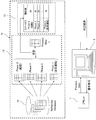
- the plant evaluation apparatus 10 specifies the status of the plant 1 that is operated in accordance with an operation signal sent from the central controller 2.
- the plant 1 is applied to various plants such as a plant for producing chemical substances and a thermal power / nuclear power plant.
- the central controller 2 is composed of a computer having a performance capable of controlling the operation of the plant 1.
- the central controller 2 acquires process data from the plant 1 in addition to sending an operation signal to the plant 1.
- the process data is sent continuously or intermittently at predetermined time intervals from each process constituting the plant 1.
- the central controller 2 transfers the acquired process data to the plant evaluation apparatus 10.
- the plant evaluation apparatus 10 includes a reference data storage unit 11, an evaluation unit 13, and a display unit 15, and may be incorporated in the central controller 2 or provided separately from the central controller 2. It can be configured by a computer. In the latter case, it may be provided adjacent to the central control device 2 or may be provided away from the central control device 2, and the installation location is not limited.
- the plant evaluation apparatus 10 includes a reference data storage unit 11.
- the reference data storage unit 11 stores reference data (Reference data) in association with each of a plurality of statuses.
- the reference data is a reference when the plant 1 is operated, and is determined based on, for example, the ideal operation history described above. If the operating conditions of the plant 1 are determined by controlling the pressure, temperature, and flow rate, for example, the reference data is specified for each of the pressure, temperature, and flow rate. Ideal value for driving.
- the reference data storage unit 11 divides a series of processes from starting up to reaching steady operation into a plurality of statuses for each process, and stores reference data in association with each of the divided statuses. .
- the plant 1 normally has a capacity that is gradually increased from the start to the steady operation, but a state in which the capacity is constant until the next capacity is increased is called a status.
- the status is divided into four phases: phase 0 (Phase 0), phase 1 (Phase 1), phase 2 (Phase (2), and phase 3 (Phase 3). Assuming that the plant 1 is divided into a plurality of processes such as A process, B process...
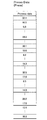
- each of these processes is also a plurality of processes such as phase 0, phase 1, phase 2,. Status. That is, process A is divided into phase 0, phase 1, phase 2,... Phase n, process B is divided into phase 0, phase 1, phase 2,... Phase n, process N is phase 0, phase 1, phase n. 2, ... are divided into phase n. Further, each phase is composed of a plurality of items (Items). An item specifically refers to a physical quantity that represents the state of the plant, such as pressure, temperature, and flow rate. The above relationship is organized and shown in FIG. In FIG. 2, the item is symbolized as A0-1.
- the plant evaluation apparatus 10 includes an evaluation unit 13.
- the evaluation unit 13 acquires process data from the central controller 2.
- This process data is data indicating the state of the plant with respect to pressure, temperature, flow rate, and the like.
- the evaluation unit 13 acquires process data from the plant 1 via the central controller 2 continuously or intermittently with a predetermined time interval.
- FIG. 3 shows an example of process data. This example shows process data about pressure (Press). However, when there is a physical quantity representing other plant state such as temperature and flow rate in addition to pressure, the evaluation unit 13 determines the central controller 2. Get process data about them via
- the evaluation unit 13 reads reference data from the reference data storage unit 11.
- This reference data is associated with processes, phases, and items.
- FIG. 4 shows an example of reference data associated with processes, phases, and items. This example shows reference data for the pressure in the A process (Press), but if there are other elements included in other operating conditions such as temperature and flow rate in addition to pressure, the reference data for them is Prepared.
- the evaluation unit 13 collates the acquired process data with reference data. This collation is performed by associating each reference data item having process data.
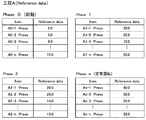
- FIG. 5 shows an example in which the reference data shown in FIG. 4 is collated with the process data shown in FIG.
- FIG. 5 shows a process A having n statuses from phase 0 to phase n.
- items (Items) are divided into A0-1 to A0-n, and reference data (Reference data) and process data (Process data) are associated with each item.
- items (Items) are divided into A2-1 to A2-n, and reference data (Reference data) and process data (Process data) are associated with each item.
- the evaluation unit 13 obtains a deviation of the reference data with respect to the process data for each item.
- the percentage of the reference data with respect to the process data is obtained as this deviation (Error column). That is, the closer the value shown in the Error column is to 100%, the closer the reference data is to the process data. On the other hand, the smaller or larger this value is, the more the reference data shifts from the process data. It is big.
- the means for obtaining the deviation is not limited to a percentage, and for example, the difference between the reference data and the process data can be the deviation.
- the evaluation unit 13 determines the matching degree of the reference data with respect to the process data for each item from the obtained deviation value.
- an acceptable range is set for the reference data, and the degree of coincidence is determined. If the deviation value (%) is in the range of 75 to 125%, it is within the acceptable range. If the deviation value (%) is in the range of 75 (less than)% or 125 (exceeding), it is determined that it is out of the allowable range and marked with x. Yes.
- the evaluation unit 13 obtains the similarity of the reference data to the process data for each phase by integrating the determination results of the degree of coincidence obtained for each item. Specifically, the degree of similarity is obtained from the number of ⁇ and ⁇ for each phase. Of course, the greater the number of circles, the higher the similarity. In the example of FIG. 5, phase 1 shows 90 and the highest similarity. In addition, although similarity is calculated
- the plant evaluation device 10 displays the similarity obtained by the evaluation unit 13 on the display unit 15 in a format corresponding to the status as shown in FIG. 1, for example.
- the operator of the plant 1 can recognize that the current status of the process A is phase 1, and can give a necessary operation signal to the plant 1 via the central controller 2.
- the status with the low similarity is also displayed on the display unit 15 in FIG. 1, only the status with the highest similarity can be displayed.
- the plant evaluation device 10 is placed separately from the central control device 2, the plant evaluation device 10 notifies the central control device 2 of the evaluation result of the similarity, and the central control device 2 further This evaluation result can be displayed on its own display unit. This is because it is beneficial for proper operation of the plant 1 to reflect the evaluation result when the operation signal is sent from the central controller 2.
- the similarities are similarly obtained for the other processes other than the A process, and the status is obtained. Identify.
- the plant evaluation apparatus 10 objectively determines the current status by inquiring process data with reference data, the status of the plant 1 can be determined without depending on the driver's subjectivity. It can be identified quickly and accurately. In particular, it is possible to identify the status with high accuracy by classifying the unsteady state from the start-up of the plant 1 to the steady operation into a plurality of phases and evaluating at once.
- the above plant evaluation apparatus 10 can also be applied to a plant operation training simulator in addition to being provided in association with the plant 1, and contributes to efficient operation training.
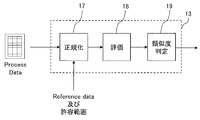
- the evaluation unit 13 includes a normalization unit 17, an allowable range determination unit 18, and a similarity determination unit 19.
- the normalization unit 17 sets the normalized tolerance range by normalizing the reference data (including the tolerance range) and the process data.
- the allowable range determination unit 18 determines whether or not the reference data is within the allowable range based on the normalized allowable range.
- the similarity determination unit 19 obtains the similarity based on the evaluation result obtained by the allowable range determination unit 18 as in the first embodiment.
- the allowable range is set to n dimensions (1 dimension in the first embodiment).
- n-dimensional space S where each point is represented by Expression 1, it is determined whether or not the evaluation target point (process data) Pa represented by Expression 2 is within the allowable range of the reference data.
- the allowable range is set as shown in Equation 3.
- the allowable range is a rectangular parallelepiped as shown in FIG.
- the process data is judged to be within the tolerance range, and otherwise, it is judged to be within the tolerance range.
- Equation 10 The result of determination based on the normalized tolerance is shown in Equation 10 for process data A and in Equation 11 for process data B. That is, for the process data A, all of the pressure and temperature are within the allowable range, while for the process data B, the pressure is within the allowable range, but the temperature exceeds the allowable range. Therefore, overall, the process data A is within the allowable range (the determination in FIG. 5 is ⁇ ), but the process data B is determined to be out of the allowable range (the determination in FIG. 5 is x).
- the process data is compared with the reference data after performing the normalization described above, it is possible to construct an evaluation system that does not depend on the plant.
- the evaluation element for each plant can be given as a parameter
- the program for executing the second embodiment it is necessary to reconfigure the program even if the evaluation element (for example, pressure, temperature) varies depending on the plant.
- the evaluation element for example, pressure, temperature
- evaluation accuracy can be improved by evaluating together a plurality of evaluation elements having a strong correlation such as pressure and temperature.
Landscapes
- Physics & Mathematics (AREA)
- General Physics & Mathematics (AREA)
- Engineering & Computer Science (AREA)
- Automation & Control Theory (AREA)
- Testing And Monitoring For Control Systems (AREA)
Abstract
ステータスを正確に特定することのできるプラント評価装置を提供することを目的とする。 プラント1を運転する際の基準となるリファレンスデータを複数のステータスの各々に対応付けて記憶するリファレンスデータ記憶部11と、運転中のプラント1における現況の運転条件に関するプロセスデータを取得するとともに、取得したプロセスデータをリファレンスデータとステータス毎に照合して、ステータス毎のプロセスデータのリファレンスデータに対する類似度を求める評価部13と、を備えるプラント評価装置10。類似度は、リファレンスデータとプロセスデータを正規化することにより求めることができる。また、評価部13は、求められる複数の類似度を比較することによりステータスを特定することができる。
Description
本発明は、化学プラント、発電プラントなどのプラントにおいて、運転状態(ステータス)を特定する装置に関する。
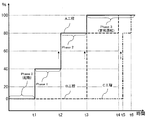
例えば、化学プラントがA工程、B工程及びC工程がこの順に区分されているものとする。各工程における起動からの経過時間と能力の理想的な履歴を図9に模式的に示す。図9において、A工程は、能力を、経過時間t1(以下、経過時間を省略)において40%とし、t2において80%とし、さらにt3において100%とする。B工程は、能力を、t3において80%とし、t4において100とする。C工程は、能力を、t5において80%とし、t6において100%とする。能力が100%になると、各工程は定常運転になる。また、A工程において、能力を40%として運転する期間をフェーズ1(Phase1)と、また、能力を80%として運転する期間をフェーズ2(Phase2)…とする。
以上の例において、各工程が図9に示す理想的な履歴に従った許容範囲で実際にプラントが運転されるべきであるが、現実には能力及び時間ともにずれが生じ得る。したがって、プラントを正常に運転するためには、ステータスを把握しながら、運転条件の変更などの操作を行なう必要がある。
以上の例において、各工程が図9に示す理想的な履歴に従った許容範囲で実際にプラントが運転されるべきであるが、現実には能力及び時間ともにずれが生じ得る。したがって、プラントを正常に運転するためには、ステータスを把握しながら、運転条件の変更などの操作を行なう必要がある。
ところが、プラントのステータスを特定するための評価要素は多項目にわたる。例えば、上記例において、能力を一つの尺度(線)として示しているが、この能力は圧力、温度、流量などの要素が複合化されたものである。また、同じフェーズ1の間に、温度などの要素を変動させることがある。
従来、この評価は圧力、温度などの要素の現況データを入手し、運転マニュアルと付き合わせるなどしてプラントを操作する運転者が判断していたが、作業が煩雑で相当の時間を要するとともに、作業員の主観が反映されることもあり、ステータスを迅速に特定するのは容易ではない。
従来、この評価は圧力、温度などの要素の現況データを入手し、運転マニュアルと付き合わせるなどしてプラントを操作する運転者が判断していたが、作業が煩雑で相当の時間を要するとともに、作業員の主観が反映されることもあり、ステータスを迅速に特定するのは容易ではない。
特許文献1には、発電プラント等のプラントの運転操作を訓練するために使用される訓練用シミュレータ装置について、訓練者が実施した指令が、過去のデータに照らして有効なものであるかどうか、また最終的な結果にどの程度影響するかをリアルタイムで訓練者に提示して、訓練の効果を高めることのできるシミュレーション評価装置が提案されている。この評価装置は、シミュレーションにおける指令が過去のデータに照らして有効なものか否か判定するものであって、運転中のプラントの運転状態を特定することについて、何ら示唆を与えるものでない。
本発明は、このような課題に基づいてなされたもので、プラントのステータスを迅速かつ正確に特定することのできるプラント評価装置を提供することを目的とする。
本発明は、このような課題に基づいてなされたもので、プラントのステータスを迅速かつ正確に特定することのできるプラント評価装置を提供することを目的とする。
プラントはその運転を司る制御装置(コンピュータ)を備えており、制御装置からプラントの運転条件を指示する操作信号を送る。この制御装置には、プラントの各工程における現況の運転条件に関するデータ(プロセスデータ)が与えられる。プロセスデータは、上述した例に従うと、A工程における圧力、温度…、B工程における圧力、温度…、C工程における圧力、温度…、である。一方で、当該プラントの運転実績に基づいて、各ステータスにおける理想的な運転条件に従うデータ(リファレンスデータ)を定めることは容易である。そこで、プロセスデータを各ステータスにおけるリファレンスデータに照合して、各ステータスに対するプロセスデータの類似度を得る。そして、得られた複数の類似度の中で最も高いものが現況のステータスに該当するものと判定して差し支えない。そこでなされた本発明のプラント評価装置は、プラントを運転する際の基準となるリファレンスデータを複数のステータスの各々に対応付けて記憶するリファレンスデータ記憶部と、運転中のプラントにおける現況の運転条件に関するプロセスデータを取得するとともに、取得したプロセスデータをリファレンスデータにステータス毎に照合して、ステータス毎のプロセスデータとリファレンスデータの類似度を求める評価部と、を備えることを特徴とする。
本発明のプラント評価装置において、リファレンスデータとプロセスデータを正規化した後に、プロセスデータをリファレンスデータに照合することができる。そうすることで、プラントに依存しない評価システムに構築することができる。
本発明のプラント評価装置において、ステータス毎に求められた類似度を表示させることで運転者が現況のステータスを特定することができるが、評価部がステータス毎に求められた類似度を比較して運転中のプラントにおける現況のステータスを特定するようにすれば、運転者の負荷を軽減できる。
本発明によれば、プロセスデータをリファレンスデータに照会することにより現況のステータスを客観的に判定するものであるから、運転者の主観に依存することなくプラントのステータスを迅速かつ正確に特定することができる。
[第1実施形態]
以下、添付図面に示す実施の形態に基づいてこの発明を詳細に説明する。
本実施形態によるプラント評価装置10は、図1に示すように、中央制御装置2から送られる操作信号に従って運転されるプラント1のステータスを特定するものである。プラント1は化学物質を製造するプラント、火力・原子力発電プラントなどの各種のプラントに適用される。中央制御装置2は、プラント1の運転を制御できる性能を有するコンピュータから構成される。
中央制御装置2は、プラント1に操作信号を送ることに加えて、プラント1からプロセスデータ(Process data)を取得する。プロセスデータは、プラント1を構成する各工程から連続的にまたは所定時間の間隔を空けて間欠的に送られる。中央制御装置2は取得したプロセスデータをプラント評価装置10に転送する。
プラント評価装置10は、リファレンスデータ記憶部11と、評価部13と、表示部15とを備えており、中央制御装置2に組み込まれていてもよいし、中央制御装置2とは個別に設けられるコンピュータにより構成することができる。後者の場合、中央制御装置2に隣接して設けられていてもよいし、中央制御装置2から離れて設けられていてもよく、設置場所は問わない。
以下、添付図面に示す実施の形態に基づいてこの発明を詳細に説明する。
本実施形態によるプラント評価装置10は、図1に示すように、中央制御装置2から送られる操作信号に従って運転されるプラント1のステータスを特定するものである。プラント1は化学物質を製造するプラント、火力・原子力発電プラントなどの各種のプラントに適用される。中央制御装置2は、プラント1の運転を制御できる性能を有するコンピュータから構成される。
中央制御装置2は、プラント1に操作信号を送ることに加えて、プラント1からプロセスデータ(Process data)を取得する。プロセスデータは、プラント1を構成する各工程から連続的にまたは所定時間の間隔を空けて間欠的に送られる。中央制御装置2は取得したプロセスデータをプラント評価装置10に転送する。
プラント評価装置10は、リファレンスデータ記憶部11と、評価部13と、表示部15とを備えており、中央制御装置2に組み込まれていてもよいし、中央制御装置2とは個別に設けられるコンピュータにより構成することができる。後者の場合、中央制御装置2に隣接して設けられていてもよいし、中央制御装置2から離れて設けられていてもよく、設置場所は問わない。
<リファレンスデータ記憶部11>
プラント評価装置10は、リファレンスデータ記憶部11を備えている。
リファレンスデータ記憶部11は、リファレンスデータ(Reference data)を複数のステータスの各々に対応付けて記憶している。
ここでリファレンスデータとは、プラント1を運転する際の基準となるものであり、例えば前述した理想的な運転履歴に基づいて定められる。
プラント1の運転条件が、例えば圧力、温度、流量を制御することにより定まるものとすると、リファレンスデータは圧力、温度、流量の各々について特定されるものであり、これら圧力、温度、流量はプラント1の運転にとって理想的な値となる。
プラント評価装置10は、リファレンスデータ記憶部11を備えている。
リファレンスデータ記憶部11は、リファレンスデータ(Reference data)を複数のステータスの各々に対応付けて記憶している。
ここでリファレンスデータとは、プラント1を運転する際の基準となるものであり、例えば前述した理想的な運転履歴に基づいて定められる。
プラント1の運転条件が、例えば圧力、温度、流量を制御することにより定まるものとすると、リファレンスデータは圧力、温度、流量の各々について特定されるものであり、これら圧力、温度、流量はプラント1の運転にとって理想的な値となる。
リファレンスデータ記憶部11は、工程毎に、起動してから定常運転に到るまでの一連の過程を複数のステータスに区分し、区分された複数のステータスの各々に対応付けてリファレンスデータを記憶する。プラント1は、通常、起動してから定常運転に到るまでの間に能力が段階的に引き上げられるが、次の能力に引き上げられるまでの能力が一定である状態をステータスという。例えば、図9の場合には、ステータスが、フェーズ0(Phase 0)、フェーズ1(Phase 1)、フェーズ2(Phase 2)、フェーズ3(Phase 3)の4つに区分されている。プラント1が、例えば、A工程、B工程…N工程というように複数の工程に区分されているものとすると、この各工程はまたフェーズ0、フェーズ1、フェーズ2、…フェーズnというように複数のステータスに区分される。つまり、A工程がフェーズ0、フェーズ1、フェーズ2、…フェーズnに区分され、B工程がフェーズ0、フェーズ1、フェーズ2、…フェーズnに区分され、N工程がフェーズ0、フェーズ1、フェーズ2、…フェーズnに区分されることになる。さらに、各フェーズは、複数のアイテム(Item)から構成される。アイテムとは具体的には、圧力、温度、流量など、プラントの状態を表す物理量をさす。以上の関係を整理して図2に示しておく。なお、図2において、アイテムはA0-1というように記号化されている。
<評価部13>
プラント評価装置10は、評価部13を備えている。
評価部13は、中央制御装置2からプロセスデータを取得する。
このプロセスデータは、圧力、温度、流量などについての、プラントの状態を示すデータである。評価部13は、中央制御装置2を介してプラント1から連続的にまたは所定時間の間隔を空けて間欠的にプロセスデータを取得する。
図3に、プロセスデータの一例を示しておく。この例は、圧力(Press)についてのプロセスデータを示すものであるが、圧力以外にも温度、流量など他のプラントの状態を表す物理量がある場合には、評価部13は、中央制御装置2を介してそれらについてのプロセスデータを取得する。
プラント評価装置10は、評価部13を備えている。
評価部13は、中央制御装置2からプロセスデータを取得する。
このプロセスデータは、圧力、温度、流量などについての、プラントの状態を示すデータである。評価部13は、中央制御装置2を介してプラント1から連続的にまたは所定時間の間隔を空けて間欠的にプロセスデータを取得する。
図3に、プロセスデータの一例を示しておく。この例は、圧力(Press)についてのプロセスデータを示すものであるが、圧力以外にも温度、流量など他のプラントの状態を表す物理量がある場合には、評価部13は、中央制御装置2を介してそれらについてのプロセスデータを取得する。
また、評価部13は、リファレンスデータ記憶部11からリファレンスデータを読み出す。このリファレンスデータは、工程、フェーズ及びアイテムに対応付けられたものである。
図4に工程、フェーズ及びアイテムに対応付けられたリファレンスデータの一例を示しておく。この例は、A工程の圧力(Press)についてのリファレンスデータを示すものであるが、圧力以外にも温度、流量など他の運転条件に含まれる要素がある場合には、それらについてのリファレンスデータが用意される。
図4に工程、フェーズ及びアイテムに対応付けられたリファレンスデータの一例を示しておく。この例は、A工程の圧力(Press)についてのリファレンスデータを示すものであるが、圧力以外にも温度、流量など他の運転条件に含まれる要素がある場合には、それらについてのリファレンスデータが用意される。
評価部13は、取得したプロセスデータをリファレンスデータに照合する。
この照合は、プロセスデータを保有するリファレンスデータのアイテムごとに付き合わせることで行われる。
図3に示したプロセスデータに図4に示したリファレンスデータを照合する例を図5に示す。
図5は、フェーズ(Phase)0からフェーズ(Phase)nまでのn個のステータスを有するA工程について示している。図5において、例えば、フェーズ0はA0-1~A0-nにアイテム(Item)が区分されており、アイテム毎にリファレンスデータ(Reference data)及びプロセスデータ(Process data)とが対応付けられている。また、フェーズ2はA2-1~A2-nにアイテム(Item)が区分されており、アイテム毎にリファレンスデータ(Reference data)及
びプロセスデータ(Process data)とが対応付けられている。
この照合は、プロセスデータを保有するリファレンスデータのアイテムごとに付き合わせることで行われる。
図3に示したプロセスデータに図4に示したリファレンスデータを照合する例を図5に示す。
図5は、フェーズ(Phase)0からフェーズ(Phase)nまでのn個のステータスを有するA工程について示している。図5において、例えば、フェーズ0はA0-1~A0-nにアイテム(Item)が区分されており、アイテム毎にリファレンスデータ(Reference data)及びプロセスデータ(Process data)とが対応付けられている。また、フェーズ2はA2-1~A2-nにアイテム(Item)が区分されており、アイテム毎にリファレンスデータ(Reference data)及
びプロセスデータ(Process data)とが対応付けられている。
評価部13は、プロセスデータに対するリファレンスデータのずれをアイテム毎に求める。図5の例はこのずれ(Errorの欄)として、プロセスデータに対するリファレンスデータの百分率を求めている。つまり、Errorの欄に示される値が100%に近いほどプロセスデータに対してリファレンスデータが近く、一方、この値が100%を境にして小さいほど又は大きいほど、プロセスデータに対するリファレンスデータのずれが大きいことを示している。なお、ずれを求める手段は百分率に限るものではなく、例えばプロセスデータに対するリファレンスデータの差分をずれとすることができる。
評価部13は、次に、求めたずれの値から、プロセスデータに対するリファレンスデータの一致度をアイテム毎に判定する。図5に示す例では、リファレンスデータに対して許容範囲を設定して一致度を判定しており、ずれの値(%)が75~125%の範囲にある場合には許容範囲内にあるものと判定して○を付しており、ずれの値(%)が75(未満)%又は125(超)の範囲にある場合には許容範囲外にあるものと判定して×を付している。
次に評価部13は、アイテム毎に求められた一致度の判定結果を総合して、フェーズ毎のプロセスデータに対するリファレンスデータの類似度を求める。具体的には、フェーズ毎に○、×の個数から類似度が求められる。もちろん○の数が多いほど類似度が高くなる。図5の例では、フェーズ1が90と最も高い類似度を示している。なお、○、×により類似度を求めているが、ずれの値自体から類似度を求めてもよい。
プラント評価装置10は、評価部13で求められた類似度を、例えば図1に示すようにステータスと対応させた形式で、表示部15に表示させる。プラント1の運転者は、工程Aの現時点のステータスがフェーズ(Phase)1であることを認識し、中央制御装置2を介してプラント1に対して必要な操作信号を与えることができる。
図1の表示部15には類似度の低いステータスも合せて表示されているが、類似度の最も高いステータスのみを表示の対象とすることもできる。また、プラント評価装置10が中央制御装置2とは個別に置かれている場合には、プラント評価装置10は中央制御装置2に対して類似度の評価結果を通知し、さらに中央制御装置2がこの評価結果を自己の表示部に表示させることができる。中央制御装置2から操作信号を送る際にこの評価結果を反映させることが、プラント1の適正な運転に有益だからである。
なお、以上ではA工程についてのみ説明したが、プラント1がB工程、…N工程など他の工程を有する場合には、A工程以外の他の各工程についても同様に類似度を求めてステータスを特定する。
図1の表示部15には類似度の低いステータスも合せて表示されているが、類似度の最も高いステータスのみを表示の対象とすることもできる。また、プラント評価装置10が中央制御装置2とは個別に置かれている場合には、プラント評価装置10は中央制御装置2に対して類似度の評価結果を通知し、さらに中央制御装置2がこの評価結果を自己の表示部に表示させることができる。中央制御装置2から操作信号を送る際にこの評価結果を反映させることが、プラント1の適正な運転に有益だからである。
なお、以上ではA工程についてのみ説明したが、プラント1がB工程、…N工程など他の工程を有する場合には、A工程以外の他の各工程についても同様に類似度を求めてステータスを特定する。
以上説明したように、プラント評価装置10は、プロセスデータをリファレンスデータに照会することにより現況のステータスを客観的に判定するものであるから、運転者の主観に依存せずにプラント1のステータスを迅速かつ正確に特定することができる。特に、プラント1の起動から定常運転に至るまでの非定常状態を複数フェーズに区分して一度に評価することで、高い精度でステータスを特定することができる。
なお、以上のプラント評価装置10は、プラント1に付随して設ける以外に、プラント運転の訓練シミュレータに適用することもでき、効率的な運転の訓練に資する。
なお、以上のプラント評価装置10は、プラント1に付随して設ける以外に、プラント運転の訓練シミュレータに適用することもでき、効率的な運転の訓練に資する。
[第2実施形態]
次に、本発明による第2実施形態を説明する。
第2実施形態は、リファレンスデータに対する許容範囲の設定の仕方及び判定方法の部分で第1実施形態と相違するが、他の部分は第1実施形態と共通であるので、以下では相違点を中心にして説明する。
第2実施形態は、図6に示すように、評価部13に正規化部17、許容範囲判定部18及び類似度判定部19を備えている。正規化部17は、リファレンスデータ(許容範囲を含む)及びプロセスデータを正規化することで正規化された許容範囲を設定する。許容範囲判定部18は、正規化された許容範囲に基づいて、リファレンスデータが許容範囲内にあるか否かを判定する。類似度判定部19は、許容範囲判定部18で得られた評価結果に基づいて、第1実施形態と同様にして類似度を求める。
次に、本発明による第2実施形態を説明する。
第2実施形態は、リファレンスデータに対する許容範囲の設定の仕方及び判定方法の部分で第1実施形態と相違するが、他の部分は第1実施形態と共通であるので、以下では相違点を中心にして説明する。
第2実施形態は、図6に示すように、評価部13に正規化部17、許容範囲判定部18及び類似度判定部19を備えている。正規化部17は、リファレンスデータ(許容範囲を含む)及びプロセスデータを正規化することで正規化された許容範囲を設定する。許容範囲判定部18は、正規化された許容範囲に基づいて、リファレンスデータが許容範囲内にあるか否かを判定する。類似度判定部19は、許容範囲判定部18で得られた評価結果に基づいて、第1実施形態と同様にして類似度を求める。
第2実施形態は、許容範囲をn次元に設定する(第1実施形態では1次元)。
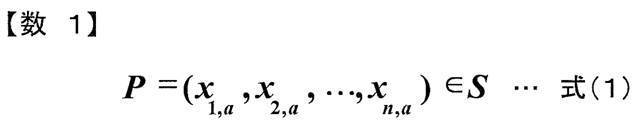
いま、各点が式1で表されるn次元空間Sにおいて、式2で示される評価対象点(プロセスデータ)Paがリファレンスデータの許容範囲内にあるか否かを判定するものとする。許容範囲は、式3の通り設定される。n=3、つまり3次元空間の場合、許容範囲は図7に示すように直方体となる。
いま、各点が式1で表されるn次元空間Sにおいて、式2で示される評価対象点(プロセスデータ)Paがリファレンスデータの許容範囲内にあるか否かを判定するものとする。許容範囲は、式3の通り設定される。n=3、つまり3次元空間の場合、許容範囲は図7に示すように直方体となる。
許容範囲を長さ1の超立方体Sで表すように評価対象点とともに正規化する。すなわち、i=1~nに対し、式4を算出する。
この正規化された許容範囲において、プロセスデータ(評価要素)の全てが式5に条件を満たせば当該プロセスデータは許容範囲内と判定され、そうでなければ許容範囲内と判定される。
この正規化された許容範囲において、プロセスデータ(評価要素)の全てが式5に条件を満たせば当該プロセスデータは許容範囲内と判定され、そうでなければ許容範囲内と判定される。


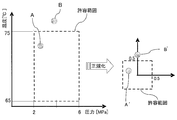
理解を深めるために、2次元の場合を例にして説明する。
評価要素(リファレンスデータ)として圧力と温度の2種類を対象とする。
仮に、圧力に対する許容範囲を、図8に示すように、2.5~6MPa、温度に対する許容範囲を65~75℃とする。このとき、2つのプロセスデータA(圧力=2.5MPa、温度=72℃)、プロセスデータB(圧力=4MPa、温度=76℃)が許容範囲内にあるか否かを判定する。
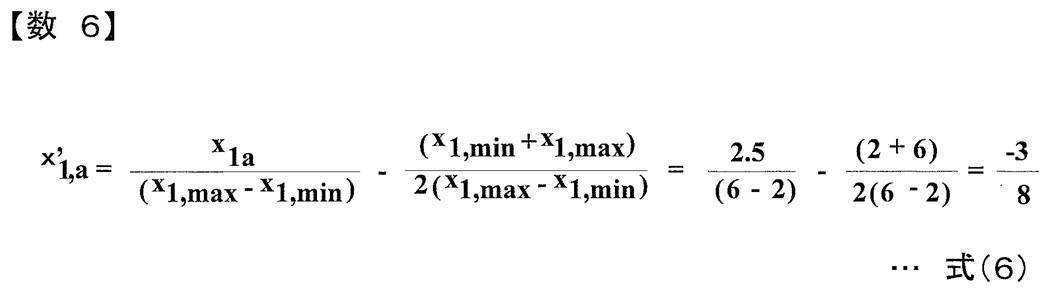
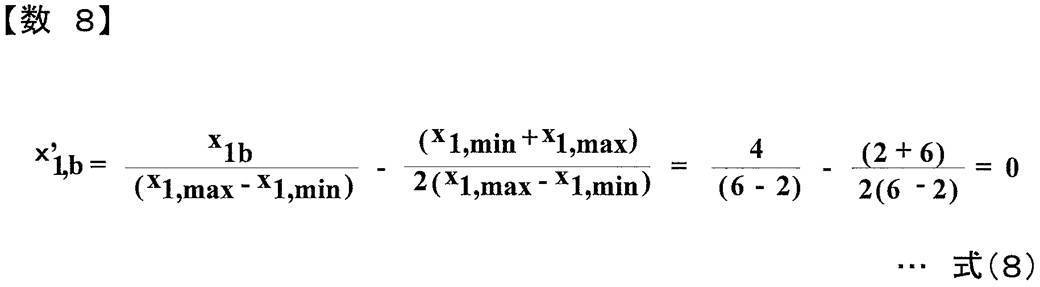
そのために、以下の式6~式9にしたがって正規化する。式6(圧力)、式7(温度)がプロセスデータAに関する正規化であり、式8(圧力)、式9(温度)がプロセスデータBに関する正規化である。
評価要素(リファレンスデータ)として圧力と温度の2種類を対象とする。
仮に、圧力に対する許容範囲を、図8に示すように、2.5~6MPa、温度に対する許容範囲を65~75℃とする。このとき、2つのプロセスデータA(圧力=2.5MPa、温度=72℃)、プロセスデータB(圧力=4MPa、温度=76℃)が許容範囲内にあるか否かを判定する。
そのために、以下の式6~式9にしたがって正規化する。式6(圧力)、式7(温度)がプロセスデータAに関する正規化であり、式8(圧力)、式9(温度)がプロセスデータBに関する正規化である。
正規化された許容範囲に基づく判定の結果は、プロセスデータAについては式10に示され、プロセスデータBについては式11に示されている。すなわち、プロセスデータAについては圧力、温度の全てが許容範囲内にあるのに対して、プロセスデータBについては圧力が許容範囲内にあるものの温度は許容範囲を超えている。したがって、総合的にプロセスデータAは許容範囲内(図5の判定が○)であるがプロセスデータBは許容範囲外(図5の判定が×)と判定される。




以上説明した正規化を行った上でプロセスデータをリファレンスデータに照合する第2実施形態によると、プラントに依存しない評価システムに構築することができる。つまり、プラント毎の評価要素をパラメータとして与えることができるので、第2実施形態を実行するプログラムを構築する際に、プラントによっての評価要素(例えば圧力、温度)が変わったとしてもプログラムを組み直す必要がなく、リファレンスデータのみをプラントに応じて設定すればよい。
また、圧力及び温度のように相関の強い複数の評価要素をあわせて評価することで、評価精度を向上することができる。
また、圧力及び温度のように相関の強い複数の評価要素をあわせて評価することで、評価精度を向上することができる。
1 プラント
2 中央制御装置
10 プラント評価装置
11 リファレンスデータ記憶部
13 評価部
15 表示部
17 正規化部
18 許容範囲判定部
19 類似度判定部
2 中央制御装置
10 プラント評価装置
11 リファレンスデータ記憶部
13 評価部
15 表示部
17 正規化部
18 許容範囲判定部
19 類似度判定部
Claims (3)
- プラントを運転する際の基準となるリファレンスデータを複数のステータスの各々に対応付けて記憶するリファレンスデータ記憶部と、
運転中の前記プラントにおける現況の運転条件に関するプロセスデータを取得するとともに、取得した前記プロセスデータを前記リファレンスデータと前記ステータス毎に照合して、前記ステータス毎の前記プロセスデータの前記リファレンスデータに対する類似度を求める評価部と、
を備えることを特徴とするプラント評価装置。 - 前記リファレンスデータと前記プロセスデータを正規化した後に、プロセスデータをリファレンスデータに照合する、
請求項1に記載のプラント評価装置。 - 前記評価部は、
求められる複数の類似度を比較することによりステータスを特定する、
請求項1又は2に記載のプラント評価装置。
Applications Claiming Priority (2)
| Application Number | Priority Date | Filing Date | Title |
|---|---|---|---|
| JP2011039433A JP2012177977A (ja) | 2011-02-25 | 2011-02-25 | プラント評価装置 |
| JP2011-039433 | 2011-02-25 |
Publications (1)
| Publication Number | Publication Date |
|---|---|
| WO2012114773A1 true WO2012114773A1 (ja) | 2012-08-30 |
Family
ID=46720563
Family Applications (1)
| Application Number | Title | Priority Date | Filing Date |
|---|---|---|---|
| PCT/JP2012/001297 Ceased WO2012114773A1 (ja) | 2011-02-25 | 2012-02-24 | プラント評価装置 |
Country Status (2)
| Country | Link |
|---|---|
| JP (1) | JP2012177977A (ja) |
| WO (1) | WO2012114773A1 (ja) |
Citations (3)
| Publication number | Priority date | Publication date | Assignee | Title |
|---|---|---|---|---|
| JP2004303007A (ja) * | 2003-03-31 | 2004-10-28 | Mitsubishi Chemicals Corp | プロセス監視方法 |
| JP2005063385A (ja) * | 2003-08-20 | 2005-03-10 | Kobe Steel Ltd | 監視方法及び監視装置、並びにプログラム |
| JP2009031655A (ja) * | 2007-07-30 | 2009-02-12 | Mitsubishi Electric Corp | シミュレーション評価装置 |
-
2011
- 2011-02-25 JP JP2011039433A patent/JP2012177977A/ja not_active Withdrawn
-
2012
- 2012-02-24 WO PCT/JP2012/001297 patent/WO2012114773A1/ja not_active Ceased
Patent Citations (3)
| Publication number | Priority date | Publication date | Assignee | Title |
|---|---|---|---|---|
| JP2004303007A (ja) * | 2003-03-31 | 2004-10-28 | Mitsubishi Chemicals Corp | プロセス監視方法 |
| JP2005063385A (ja) * | 2003-08-20 | 2005-03-10 | Kobe Steel Ltd | 監視方法及び監視装置、並びにプログラム |
| JP2009031655A (ja) * | 2007-07-30 | 2009-02-12 | Mitsubishi Electric Corp | シミュレーション評価装置 |
Also Published As
| Publication number | Publication date |
|---|---|
| JP2012177977A (ja) | 2012-09-13 |
Similar Documents
| Publication | Publication Date | Title |
|---|---|---|
| EP3029535A2 (en) | P&ID and control system synchronization | |
| US11467560B2 (en) | Engineering support system and engineering support method | |
| US10915419B2 (en) | Industrial control system, and assistance apparatus, control assist method, and program thereof | |
| EP3026613A1 (en) | Event analysis apparatus, event analysis method and computer program product | |
| US20170261403A1 (en) | Abnormality detection procedure development apparatus and abnormality detection procedure development method | |
| JP2014238819A5 (ja) | ||
| JPWO2020188696A1 (ja) | 異常検知装置および異常検知方法 | |
| EP3226092A1 (en) | Device management system and construction method using same | |
| WO2015122036A1 (en) | Field device commissioning system and field device commissioning method | |
| EP4309008A1 (en) | Chemical process modeling | |
| KR20130132276A (ko) | 밸브 정비 관리 장치 및 관리 방법 | |
| US20210294280A1 (en) | Setting support device | |
| CN112262354A (zh) | 诊断装置、诊断方法及程序 | |
| JP2012177977A (ja) | プラント評価装置 | |
| EP3015931A1 (en) | Plc system with a webserver and a partitioned memory | |
| JP6772488B2 (ja) | 支援装置、支援方法および支援プログラム | |
| JP5248238B2 (ja) | 鋼板製造実績データベース検索装置,鋼板製造実績データベース検索プログラム | |
| RU2017137227A (ru) | Способ обоснования стратегии долгосрочного планирования мероприятий по обеспечению требуемого состояния образцов вооружения и военной техники группировки противовоздушной обороны | |
| JP2010146137A (ja) | パラメータ調整支援装置 | |
| JP6745641B2 (ja) | 運転支援装置および方法 | |
| US11977366B2 (en) | Assist device, display device, assist method, and assist program | |
| US11934158B2 (en) | Providing operating parameters of an automation device | |
| JP5205305B2 (ja) | プラント制御監視装置 | |
| JP6316507B2 (ja) | データ分析情報処理装置 | |
| JP5278082B2 (ja) | シミュレーションシステム |
Legal Events
| Date | Code | Title | Description |
|---|---|---|---|
| 121 | Ep: the epo has been informed by wipo that ep was designated in this application |
Ref document number: 12749469 Country of ref document: EP Kind code of ref document: A1 |
|
| NENP | Non-entry into the national phase |
Ref country code: DE |
|
| 122 | Ep: pct application non-entry in european phase |
Ref document number: 12749469 Country of ref document: EP Kind code of ref document: A1 |