WO2012108548A1 - Gm1遺伝子とGPCR遺伝子とCRMP2遺伝子とが導入された形質転換体 - Google Patents
Gm1遺伝子とGPCR遺伝子とCRMP2遺伝子とが導入された形質転換体 Download PDFInfo
- Publication number
- WO2012108548A1 WO2012108548A1 PCT/JP2012/053585 JP2012053585W WO2012108548A1 WO 2012108548 A1 WO2012108548 A1 WO 2012108548A1 JP 2012053585 W JP2012053585 W JP 2012053585W WO 2012108548 A1 WO2012108548 A1 WO 2012108548A1
- Authority
- WO
- WIPO (PCT)
- Prior art keywords
- protein
- crmp2
- transformant
- amino acid
- acid sequence
- Prior art date
- Legal status (The legal status is an assumption and is not a legal conclusion. Google has not performed a legal analysis and makes no representation as to the accuracy of the status listed.)
- Ceased
Links
Images


Classifications
-
- C—CHEMISTRY; METALLURGY
- C07—ORGANIC CHEMISTRY
- C07K—PEPTIDES
- C07K14/00—Peptides having more than 20 amino acids; Gastrins; Somatostatins; Melanotropins; Derivatives thereof
- C07K14/435—Peptides having more than 20 amino acids; Gastrins; Somatostatins; Melanotropins; Derivatives thereof from animals; from humans
- C07K14/705—Receptors; Cell surface antigens; Cell surface determinants
-
- A—HUMAN NECESSITIES
- A61—MEDICAL OR VETERINARY SCIENCE; HYGIENE
- A61P—SPECIFIC THERAPEUTIC ACTIVITY OF CHEMICAL COMPOUNDS OR MEDICINAL PREPARATIONS
- A61P25/00—Drugs for disorders of the nervous system
-
- A—HUMAN NECESSITIES
- A61—MEDICAL OR VETERINARY SCIENCE; HYGIENE
- A61P—SPECIFIC THERAPEUTIC ACTIVITY OF CHEMICAL COMPOUNDS OR MEDICINAL PREPARATIONS
- A61P25/00—Drugs for disorders of the nervous system
- A61P25/18—Antipsychotics, i.e. neuroleptics; Drugs for mania or schizophrenia
-
- A—HUMAN NECESSITIES
- A61—MEDICAL OR VETERINARY SCIENCE; HYGIENE
- A61P—SPECIFIC THERAPEUTIC ACTIVITY OF CHEMICAL COMPOUNDS OR MEDICINAL PREPARATIONS
- A61P25/00—Drugs for disorders of the nervous system
- A61P25/28—Drugs for disorders of the nervous system for treating neurodegenerative disorders of the central nervous system, e.g. nootropic agents, cognition enhancers, drugs for treating Alzheimer's disease or other forms of dementia
-
- C—CHEMISTRY; METALLURGY
- C07—ORGANIC CHEMISTRY
- C07K—PEPTIDES
- C07K14/00—Peptides having more than 20 amino acids; Gastrins; Somatostatins; Melanotropins; Derivatives thereof
- C07K14/435—Peptides having more than 20 amino acids; Gastrins; Somatostatins; Melanotropins; Derivatives thereof from animals; from humans
- C07K14/46—Peptides having more than 20 amino acids; Gastrins; Somatostatins; Melanotropins; Derivatives thereof from animals; from humans from vertebrates
- C07K14/47—Peptides having more than 20 amino acids; Gastrins; Somatostatins; Melanotropins; Derivatives thereof from animals; from humans from vertebrates from mammals
- C07K14/4701—Peptides having more than 20 amino acids; Gastrins; Somatostatins; Melanotropins; Derivatives thereof from animals; from humans from vertebrates from mammals not used
- C07K14/4702—Regulators; Modulating activity
-
- G—PHYSICS
- G01—MEASURING; TESTING
- G01N—INVESTIGATING OR ANALYSING MATERIALS BY DETERMINING THEIR CHEMICAL OR PHYSICAL PROPERTIES
- G01N33/00—Investigating or analysing materials by specific methods not covered by groups G01N1/00 - G01N31/00
- G01N33/48—Biological material, e.g. blood, urine; Haemocytometers
- G01N33/50—Chemical analysis of biological material, e.g. blood, urine; Testing involving biospecific ligand binding methods; Immunological testing
- G01N33/5005—Chemical analysis of biological material, e.g. blood, urine; Testing involving biospecific ligand binding methods; Immunological testing involving human or animal cells
- G01N33/5008—Chemical analysis of biological material, e.g. blood, urine; Testing involving biospecific ligand binding methods; Immunological testing involving human or animal cells for testing or evaluating the effect of chemical or biological compounds, e.g. drugs, cosmetics
- G01N33/502—Chemical analysis of biological material, e.g. blood, urine; Testing involving biospecific ligand binding methods; Immunological testing involving human or animal cells for testing or evaluating the effect of chemical or biological compounds, e.g. drugs, cosmetics for testing non-proliferative effects
- G01N33/5041—Chemical analysis of biological material, e.g. blood, urine; Testing involving biospecific ligand binding methods; Immunological testing involving human or animal cells for testing or evaluating the effect of chemical or biological compounds, e.g. drugs, cosmetics for testing non-proliferative effects involving analysis of members of signalling pathways
Definitions
- the present invention relates to a transformant in which a Gm1 gene, a G-protein coupled receptor gene, and a CRMP2 gene are introduced, and use thereof.
- Gm1 protein is a kind of G-protein ⁇ subunit, and is known to be involved in intracellular signal transduction by G-protein coupled receptor (GPCR) stimulation.
- GPCR G-protein coupled receptor
- the Gm1 gene is a Splicing variant of the Golf gene, and has a unique base sequence only in the first exon region, and shares the base sequence with the Golf gene after the second exon region.
- the amino acid sequence of the Gm1 protein is represented by, for example, the registration number NM_182978 in the NCBI database.
- the Gm1 protein has a guanine nucleotide binding protein (G protein), an alpha activating activity polypeptide, an olfactory type (GNAL), or a trans-variant protein that is also referred to as an N-terminal amino acid.
- G protein guanine nucleotide binding protein
- GNAL olfactory type
- trans-variant protein that is also referred to as an N-terminal amino acid.
- the G-protein coupled receptor is a seven-transmembrane receptor and is known to be coupled to the G-protein (see, for example, protein nucleic acid enzyme 46: 1764-1717 (2001)).
- CRMP2 protein is collapsin response mediator protein 2, CRMP2 and is a protein identified as a factor that mediates information on semaphorin, which is a nerve guidance factor (eg, Nature, 376: 509-). 514 (1995)).
- CRMP2 protein has a function of extending axon by directly or indirectly binding to molecules such as tubulin, Numb, Sra-1, TrkB, and transporting these molecules to the axon tip.
- a kinase such as cdk5, GSK3 ⁇ , Rho kinase, etc.
- non-phosphorylated form has activity and is phosphorylated by kinase Is known to be inactivated (Cell, 120: 137-149 (2005); Mol. Cell. Biol., 25: 9973-9984 (2005)). It has also been reported that introduction of a non-phosphorylated mutant CRMP2 gene into neurons impairs the axon retraction, and inhibition of CRMP2 protein biological function in neurons inhibits axon elongation. (Cell, 120: 137-149 (2005); J. Biol. Chem., 275: 23973-23980 (2000)). Overexpression of CRMP2 protein after nerve injury promotes nerve axon regeneration (eg, J. Neurochem., 86: 1042-1050 (2003)), and CRMP2 protein mutations are a risk factor for schizophrenia (For example, Biol Psychiatry., 53: 571-576 (2003)) has been reported.
- the present invention is based on the finding that activation of the biological function of Gm1 protein suppresses phosphorylation of CRMP2 protein, that is, the biological function of CRMP2 protein is activated. That is, the present invention is 1.
- Transformants in which the following genes (1), (2) and (3) are introduced into host cells (hereinafter sometimes referred to as the transformants of the present invention): (1) a foreign gene having a base sequence encoding the amino acid sequence of Gm1 protein, (2) a foreign gene having a base sequence encoding the amino acid sequence of a G-protein coupled receptor protein, and (3) a foreign gene having a base sequence encoding the amino acid sequence of CRMP2 protein; 2. [2] The transformant according to [1] above, wherein the foreign gene is a nucleic acid in the form of a plasmid containing a base sequence encoding the amino acid sequence of the protein; 3.
- a method for screening a substance that regulates signal transduction via Gm1 protein, including a third step to be selected (hereinafter also referred to as the screening method of the present invention); 5. 4. The screening method according to item 4 above, wherein the control in the third step is the phosphorylation state of CRMP2 protein in the transformant according to any one of items 1 to 3 not contacted with the test substance or an index value correlated therewith; 6). 6. a substance that regulates signal transduction via Gm1 protein obtained by the screening method according to 4 or 5 above; A therapeutic or prophylactic agent for diseases caused by abnormal signaling via CRMP2 protein, which contains as an active ingredient a signal transduction regulator via Gm1 protein according to item 6 (hereinafter sometimes referred to as the drug of the present invention). ; Etc. are provided. According to the present invention, it is possible to provide a screening method for a signal transduction regulatory substance via Gm1 protein, a test tool including a transformant used therein, and the like.
- FIG. 1 is a view showing the results of Western blotting using an anti-CRMP2 antibody of a two-dimensional electrophoresis sample.
- the upper figure shows the results for the control (DMSO), and the lower figure shows the results using RS67333 as the test substance.
- Spot No. located on the alkaline side 1 is a spot of non-phosphorylated CRMP2 protein
- spot No. 1 located on the acidic side from it. 2 to No. 6 is a spot of phosphorylated CRMP2 protein.
- the spot located on the 6 side is a CRMP2 protein spot with a higher degree of phosphorylation.
- FIG. 1 is a view showing the results of Western blotting using an anti-CRMP2 antibody of a two-dimensional electrophoresis sample.
- the upper figure shows the results for the control (DMSO), and the lower figure shows the results using RS67333 as the test substance.
- FIG. 2 is a diagram showing the results of quantifying the signal intensity of each spot of the Western blot shown in FIG.
- the signal intensity of each phosphorylated CRMP2 protein spot when the signal intensity of the non-phosphorylated CRMP2 protein spot (No. 1) is “1” is shown.
- the black bar graph is the result for the control (DMSO), and the white bar graph is the result using RS67333 as the test substance.
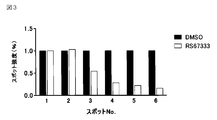
- FIG. 3 is a diagram showing a result of comparing the signal intensity of each spot shown in FIG. 2 between a control (solvent) and a test substance.
- the black bar graph is the result for the control (DMSO), and the white bar graph is the result using RS67333 as the test substance.
- the relative value (percentage) of the signal intensity of each spot in the cells contacted with RS67333 is shown when the signal intensity value of each spot in the cells contacted with only the control DMSO solvent is defined as 100%.
- Gm1 protein in the present invention is a G-protein known to be involved in intracellular signal transduction by G-protein coupled receptor (GPCR) stimulation as described in the background art. It is a kind of ⁇ subunit.
- GPCR G-protein coupled receptor
- the amino acid sequence shown by sequence number 1 is NCBI. It is indicated by registration NM_182978 in the database.
- the Gm1 protein has a guanine nucleotide binding protein (G protein), alpha activating activity polypeptide, or a long amino acid, which is also referred to as an amino acid, which has a length of about 80 amino acids. It has a characteristic structure.
- the Gm1 gene is a Splicing variant of the Golf gene, and has a unique base sequence only in the first exon region, and shares the base sequence with the Golf gene after the second exon region.
- the base sequence shown by sequence number 2, 27, or 28 described in US2005-0260595 gazette can be mentioned, for example.
- the amino acid sequence shown by SEQ ID NO: 1 is shown in SEQ ID NO: 1
- the base sequence shown by SEQ ID NO: 2 is shown in SEQ ID NO: 2.
- the “Gm1 protein” in the present invention includes a part thereof as long as the biological function of the protein is maintained.
- the amino acid sequence represented by SEQ ID NO: 1 has an amino acid sequence portion having high sequence identity with the amino acid sequences of “GTP binding site” and “GTPase activation site” conserved among G protein ⁇ subunits.
- amino acid regions are the amino acid sequences (NATURE, 349: 117-127 (1991) of “GTP binding site” and “GTPase activation site” in “Gs” and “Golf” that have already been identified as G protein ⁇ subunits. )).
- the amino acid sequence represented by SEQ ID NO: 1 is the same as the characteristic sequence highly conserved among “Gs” and “Golf” belonging to the Gs family among G protein ⁇ subunits (shown by SEQ ID NO: 1).
- This sequence has amino acid numbers 119 to 126) and can take an ⁇ -helical structure conserved between G protein ⁇ subunits.
- An index indicating how many amino acid residues of the Gm1 protein can be substituted, deleted or added without losing the biological function of the Gm1 protein should be found by the method described in US2005-0260595. Can do.
- the modification that does not lose the biological function may be performed, for example, on a portion having low sequence identity with the amino acid sequences of various G protein ⁇ subunits that have already been identified.
- “CRMP2 protein” in the present invention is collapsin response mediator protein 2, CRMP2, and is a factor that mediates information on semaphorin, which is a nerve guidance factor. The identified protein.
- CRMP2 protein is a known protein described in, for example, Nature, 376: 509-514 (1995).
- amino acid sequence which CRMP2 protein has, and a base sequence which codes the said amino acid sequence the amino acid sequence described in the said literature, and a base sequence can be mentioned, for example.
- the amino acid sequence of CRMP2 protein is represented by the accession number NP_001377 in the NCBI database.
- the CRMP2 protein is sometimes referred to as dihydropyrimidinase-like 2, dihydropyrimidinase-like 2, or DPYSL2.
- GPCR G-protein coupled receptor protein in the present invention is a seven-transmembrane receptor, and is known to couple with G-protein.
- G-protein coupled receptor protein examples include, for example, Steven Ms. 57, Ms. 57, provided by Computational Biology Research Center (CBRC), National Institute of Advanced Science and Technology (SIST. 2009)) homepage (http://sevens.cbrc.jp/index.php), and specific examples include dopamine receptor, serotonin receptor, histamine receptor and the like. Can be mentioned.
- the amino acid sequence of these GPCRs and the base sequence encoding the amino acid sequence can be obtained from, for example, the NCBI database.
- the dopamine D1 receptor for example, the amino acid sequence indicated by the registration number “NP — 000075.1” in the NCBI database, the base sequence indicated by the registration number “NM — 000074.3” in the NCBI database, etc.
- the serotonin 4 receptor for example, the amino acid sequence indicated by the registration number “NP_001035259.1” in the NCBI database, the base sequence indicated by the registration number “NM_001040169.2” in the NCBI database, etc.
- the amino acid sequence represented by the registration number “NP — 0000101683.1” in the NCBI database and the registration number “N” in the NCBI database It can be exemplified nucleotide sequence represented by _001098213.1 ".
- the transformant of the present invention is obtained by introducing the following genes (1), (2) and (3) into a host cell: (1) a foreign gene having a base sequence encoding the amino acid sequence of Gm1 protein, (2) a foreign gene having a base sequence encoding the amino acid sequence of a G-protein coupled receptor protein, and (2) a foreign gene having a base sequence encoding the amino acid sequence of CRMP2 protein.
- any known host cell can be used.
- bacteria such as Escherichia coli (for example, K12), Bacillus bacteria (for example, MI114), yeast (for example, AH22) Etc.), insect cells (eg, Sf cells, etc.), animal cells (eg, COS7 cells, etc.), and the like.
- cultured cells derived from mammals for example, COS7 cells, CHO cells, HEK293 cells, Hela cells, PC12 cells, etc.
- mammals for example, COS7 cells, CHO cells, HEK293 cells, Hela cells, PC12 cells, etc.
- the transformant of the present invention provides a nucleic acid in the form of a plasmid containing a base sequence encoding the amino acid sequence of Gm1 protein and the amino acid sequence of G-protein coupled receptor protein for such host cells.
- Performing an artificial manipulation to introduce exogenously all of a nucleic acid in the form of a plasmid containing the encoding base sequence and a nucleic acid in the form of a plasmid containing the base sequence encoding the amino acid sequence of CRMP2 protein Can be produced.
- the transformant of the present invention includes two of a base sequence encoding the amino acid sequence of Gm1 protein, a base sequence encoding the amino acid sequence of G-protein coupled receptor protein, and a base sequence encoding the amino acid sequence of CRMP2 protein. It can also be prepared by artificially introducing a nucleic acid in the form of a plasmid containing a base sequence and a nucleic acid in the form of a plasmid containing one remaining base sequence into a host cell.
- the transformant of the present invention contains all of the base sequence encoding the amino acid sequence of Gm1 protein, the base sequence encoding the amino acid sequence of G-protein coupled receptor protein, and the base sequence encoding the amino acid sequence of CRMP2 protein.
- It can also be produced by performing an artificial operation for exogenously introducing a nucleic acid in the form of a plasmid into a host cell.
- an artificial operation a normal genetic engineering technique corresponding to the host cell to be used may be used.
- a commercially available transfection reagent can be used according to the method described in the instructions attached to the reagent.
- the nucleic acid which is the form of a plasmid as a foreign gene the calcium phosphate method, the electroporation method, the lipofection method, the DEAE dextran method etc. can be mentioned.
- examples of the “plasmid” include a plasmid capable of co-expressing Gm1 protein, G-protein coupled receptor protein and CRMP2 protein in a host cell.
- a plasmid is a nucleic acid containing a base sequence encoding the amino acid sequence of the Gm1 protein, a nucleic acid containing a base sequence encoding the amino acid sequence of the G-protein coupled receptor protein, according to ordinary genetic engineering techniques,
- Each nucleic acid containing a nucleotide sequence encoding the amino acid sequence of CRMP2 protein can be prepared by ligating each of the known expression plasmids to an expressible position downstream of the promoter.
- examples of the “expression plasmid” include pBR322, pUC12, pUC119, pBluescript, etc. when Escherichia coli is used as a host cell, and pUB110, pC194, etc., when Bacillus bacterium is used as a host cell.
- Yip5 Yep24, etc.
- insect cells are used as host cells
- AcNPV AcNPV
- animal cells are used as host cells, pUC18, pcDNA3.1, etc. should be mentioned. Can do.
- a foreign gene having a base sequence encoding the amino acid sequence of Gm1 protein, a foreign gene having a base sequence encoding the amino acid sequence of G-protein coupled receptor protein, and the amino acid sequence of CRMP2 protein are encoded.
- the foreign gene having the nucleotide sequence to be retained in the host cell may be temporarily retained or may be stably retained.
- Transformants in which these foreign genes are stably retained are indicated by a selection marker such as a drug resistance marker (for example, a drug resistance marker contained in an expression plasmid) introduced into the host cell simultaneously with the foreign gene. You can make a selection.
- the transformant of the present invention is cultured in a culture solution. do it.
- the culture conditions for the transformant of the present invention may be appropriately selected according to the type of the transformant of the present invention.
- the transformant of the present invention when it is a microorganism, it may be cultured using a liquid medium or a plate medium usually used for culturing microorganisms.
- the culture temperature only needs to be within the temperature at which microorganisms can grow, and examples thereof include about 15 to 40 ° C.
- the pH of the medium may be within the range in which microorganisms can grow, and examples thereof include about pH 6 to 8.
- the culture time varies depending on other culture conditions, but is usually about 1 to 5 days, particularly about 1 to 2 days. When an induction type expression plasmid such as a temperature shift type or an IPTG induction type is used, the induction time may be within one day, particularly about several hours.
- the transformant is an insect cell
- culture conditions suitable for the type of insect cell may be used.
- the culture may be performed using an insect cell medium such as Grace's medium containing FBS and yeast.
- the culture temperature can be about 25 to 35 ° C.
- the pH of the medium may be within the range in which insect cells can grow, and examples thereof include about pH 6-8.
- the culture time varies depending on other culture conditions, it is usually about 1 to 5 days, particularly about 2 to 3 days.
- the culture time is preferably set until the cytoplasmic effect appears and the cells die (for example, about 3 to 7 days, particularly about 4 to 6 days).
- the transformant is a mammalian cell
- culture conditions suitable for the type of mammalian cell may be used.
- a DMEM medium (Nissui, etc.) supplemented with FBS may be used in the presence of 5% CO 2 while being replaced with a new medium every few days.
- the culture temperature can be about 36 to 38 ° C.
- the pH of the medium may be within the range in which mammalian cells can grow, and examples thereof include about pH 6-8.
- the culture time varies depending on other culture conditions, but is usually about 2 to 5 days, particularly about 2 to 3 days.
- an ordinary protein engineering method can be used. That's fine.
- the screening method of the present invention comprises (a) a first step in which a test substance is brought into contact with the transformant described in the preceding item 1, 2 or 3, and (b) phosphorylation of CRMP2 protein in the transformant after the first step.
- test substance in the screening method of the present invention is not particularly limited, and examples thereof include proteins (including antibodies), peptides, non-peptidic compounds (nucleotides, amines, carbohydrates, lipids, etc.), organic low molecular compounds, inorganic Examples thereof include low molecular weight compounds, fermentation products, cell extracts, plant extracts, animal tissue extracts and the like.
- the form of the test substance is not particularly limited, and examples thereof include a solid, a liquid, a mixture with a base, a suspension or a solution.
- a suspension or solution water, pH buffer solution, methylcellulose solution, physiological saline, organic solvent aqueous solution (ethanol or dimethyl sulfoxide is usually used as the organic solvent) and the like may be used.
- the contact amount, the number of times of contact, and the contact time of the test substance may be set within a range that does not seriously affect the transformant of the present invention, for example.
- the “contact” in the first step of the screening method of the present invention can be performed by a method widely used by those skilled in the art.
- the contact method is not particularly limited.
- the concentration is about 0.001 to 10 ⁇ M in a culture solution / agar medium containing the transformant of the present invention.
- the test substance may be added so that In the second step of the screening method of the present invention, the “measurement of the phosphorylation state of CRMP2 protein or an index value correlated therewith” comprises the preparation of a protein extract, electrophoresis, transcription onto a membrane, detection of CRMP2 protein A method or the like can be used.
- analysis may be performed using a normal biochemical technique, protein engineering technique, or the like. For example, it may be performed by combining two-dimensional electrophoresis and Western blotting.
- a protein extract is first prepared from the transformant of the present invention in contact with a test substance.
- the prepared protein extract is subjected to the first dimension electrophoresis and then the second dimension electrophoresis. Transfer the separated CRMP2 protein onto a suitable membrane.
- the CRMP2 protein transferred onto the membrane is detected with an anti-CRMP2 protein antibody or the like.
- CRMP2 protein is separated according to the degree of phosphorylation. Non-phosphorylated CRMP2 is detected on the more alkaline side, and phosphorylated CRMP2 is detected on the more acidic side as the degree of phosphorylation increases.
- Separation of CRMP2 based on the degree of phosphorylation can be performed according to a commonly used method known per se.
- a known quantification method may be used.
- a signal detected by Western blot may be quantified with an image analyzer or the like.
- the spot intensity of non-phosphorylated CRMP2 in the CRMP2 spot detected by Western blot after two-dimensional electrophoresis in the transformant of the present invention is “1”, and each spot of phosphorylated CRMP2 Calculate the intensity.
- the spot intensity of the non-phosphorylated CRMP2 is “1”, and the spot intensity of each phosphorylated CRMP2 is calculated.
- the phosphorylation state measured in the second step of CRMP2 protein in the transformant of the present invention contacted with the test substance or an index value correlated therewith, What is necessary is just to compare with the phosphorylation state measured at the 2nd process of CRMP2 protein in the transformant of this invention which is not contacting the test substance, or the index value correlated with it.
- the “transformant of the present invention not in contact with the test substance” may be, for example, the transformant of the present invention in which only the solvent is contacted.
- a control may be obtained by measuring the phosphorylation state of CRMP2 protein as a control or an index value correlated therewith in parallel with the phosphorylation state of CRMP2 protein in the transformant of the present invention or an index value correlated therewith.
- it may be determined by measuring separately.
- the measured value of the CRMP2 protein phosphorylation state in the transformant of the present invention brought into contact with the test substance or an index value correlated therewith correlates with the phosphorylation state of CRMP2 protein in the control transformant of the present invention.
- each spot in the control is defined as 100%, and the percentage of each spot of CRMP2 detected by the transformant of the present invention in contact with the test substance is calculated.
- a test substance in which one of the percentages of each spot of CRMP2 detected in the transformant of the present invention contacted with the test substance is, for example, 70% or less, preferably 60% or less, more preferably 50% or less May be selected as a candidate substance for a signal transduction regulator.
- a test substance in which the percentage of the spot is, for example, 70% or less, preferably 60% or less, more preferably 50% or less is selected as a candidate substance that activates signal transduction. You may choose as.
- a positive control or negative control that can be a “control substance” instead of the test substance, the above-mentioned control can be used as the case may be.
- positive control represents any substance having an effect of controlling the phosphorylation state of CRMP2 protein
- negative control includes a solvent contained in the test substance, a test system solution serving as a background, etc. Is mentioned.
- the “control substance” is a negative control
- the “effect of suppressing the phosphorylation state of CRMP2 protein” possessed by the test substance is greater than the “effect of suppressing the phosphorylation state of CRMP2 protein” possessed by the control substance, What is necessary is just to evaluate that the said test substance has "the effect which suppresses the phosphorylation state of CRMP2 protein.”
- the “effect of suppressing the phosphorylation state of CRMP2 protein” possessed by the test substance is similar to or smaller than the “effect of suppressing the phosphorylation state of CRMP2 protein” possessed by the control substance, “CRMP2 It can be evaluated that it does not have an “effect of suppressing the phosphorylation state of a protein”.
- the control substance When the control substance is used as a positive control, compare the “effect of suppressing the phosphorylation state of CRMP2 protein” possessed by the test substance with the “effect of suppressing the phosphorylation state of CRMP2 protein” possessed by the control substance. Thus, the “effect of suppressing the phosphorylation state of CRMP2 protein” possessed by the test substance may be evaluated. Thus, when it is evaluated that it has an effect, the said to-be-tested substance can be selected as a signal transduction regulator via Gm1.
- the drug of the present invention contains, for example, the “signal transduction modulator via Gm1 protein” selected as described above as an active ingredient.
- the agent of the present invention is useful as a therapeutic or prophylactic agent for diseases caused by abnormal signaling through the CRMP2 protein.
- Example 1 Screening method of the present invention: screening of a signal transduction modulator via Gm1 protein
- Part 1 (1) Acquisition of Gm1 gene Using a method according to the method described in the literature (US2005-0260595), using 20 ng of human brain-derived cDNA library (Takara Shuzo) as a template and 10 ⁇ M forward primer prGm1ATG ( 5′-ATGGGTCTGTGCTACAGTCTGGCGG: SEQ ID NO: 3) 10 ⁇ M reverse primer prGNAL 3 ′ (5′-TCACAAGAGCTCATACTGCTT; SEQ ID NO: 4) and TAKARA LA Taq polymerase (TAKARALA Taq with GC Buffer) were used.
- the PCR conditions were 95 ° C for 30 seconds, then 60 ° C for 30 seconds, and then 72 ° C for 2 minutes, with one cycle being 35 cycles.
- a band of about 1.5 kb detected on the gel was excised, DNA was recovered from the excised gel, and the DNA was pCR2.1-TOPO vector (Invitrogen) To pCR-Gm1.
- the plasmid pCR-Gm1 prepared in Example 1 was double digested with restriction enzymes XbaI and KpnI using a method according to the method described in the literature (US2005-0260595).
- a plasmid pcDNA-Gm1 was prepared by ligating pcDNA3.1 (manufactured by Invitrogen) with XbaI and KpnI as a vector and ligating the insert DNA with ligase.
- PCR was performed using polymerase (Toyobo). PCR was performed at 35 ° C. for 30 seconds at 95 ° C., then at 60 ° C. for 30 seconds, and then at 68 ° C. for 2 minutes.
- pDr-m5HT4 was prepared. Plasmid pDr-m5HT4 was double digested with restriction enzymes NheI and KpnI. After the obtained DNA fragment was subjected to agarose gel electrophoresis, a band of about 1.2 kb detected on the gel was cut out, DNA was recovered from the cut out gel, and the DNA was used as insert DNA.
- a plasmid pcDNA-m5HT4 was prepared by ligating pcDNA3.1 (manufactured by Invitrogen) with NheI and KpnI as a vector and ligating the insert DNA with ligase.
- pcDNA-CRMP2 Using 20 ng of human brain-derived cDNA library (Takara Shuzo) as a template and 10 ⁇ M forward primer hCRMP2 (ATG) (5′-CACCCATTCTTATCAGGGGGAAGAAAA; SEQ ID NO: 8), 10 ⁇ M reverse primer hCRMP2 (-STOP) PCR was performed using rev (5'-GCCCAGGCTGGTGATGTTGGCACGGCCA; SEQ ID NO: 9) and KOD DNA polymerase (manufactured by Toyobo).
- PCR was performed at 35 ° C. for 30 seconds at 95 ° C., then at 60 ° C. for 30 seconds, and then at 68 ° C. for 2 minutes. After the obtained DNA was subjected to agarose gel electrophoresis, a band of about 1.7 kb detected on the gel was cut out, DNA was recovered from the cut out gel, and the DNA was pENTR / D-TOPO vector (manufactured by Invitrogen). PENTR-CRMP2 was prepared.
- pcDNA3.1 a commercially available product sold by Invitrogen Corporation was purchased and used.
- COS7 cells (purchased from ATCC) are seeded in a 10 cm dish at 5 ⁇ 10 6 cells / dish and DMEM medium containing 10% FCS (Invitrogen) And cultured at 37 ° C. under 5% CO 2 for about 24 hours.
- the obtained cells were divided into “Gm1 expression plasmid (pcDNA-Gm1; 12 ⁇ g)” obtained in (2) above, “5HT4 expression plasmid (pcDNA-m5HT4; 6 ⁇ g)” obtained in (3) above and All of the “CRMP2 expression plasmid (pcDNA-CRMP2; 6 ⁇ g)” obtained in (4) was mixed with 60 ⁇ l of Lipofectamine 2000 (manufactured by Invitrogen) and transfected for 20 minutes. Three hours after transfection, the medium was completely replaced with DMEM medium containing 5% dialyzed FCS, and further cultured for about 21 hours.
- Test substance RS67333 (1- (4-Amino-5-chloro-2-methylphenyl) -3- [1-butyl-4-piperidinyl] -1-propanone hydrochloride; C 19 H 29 ClN 2 O 2 .HCl)
- the obtained culture was allowed to stand at 37 ° C. for 30 minutes.
- the obtained cells were lysed using PhosphoProtein Purification kit (Qiagen) to obtain a cell extract.
- a protein extract (purified protein) was prepared from the cell extract using 2-D Clean-Up kit (GE Health Science).
- DMSO solvent alone was added to the cell culture medium instead of RS67333 and cultured in the same manner, and a protein extract (purified protein) was similarly prepared from the obtained culture.
- the obtained protein extract 800 ⁇ g of purified protein
- second-dimensional electrophoresis was performed using 7.5% SDS-PAGE gel.
- the gel after two-dimensional electrophoresis was transferred to Hybond-P (GE Health Science).
- the CRMP2 protein transferred onto the membrane was detected by Western blotting using an anti-CRMP2 antibody (C4G) (Immuno-Biological Laboratories, Inc.) (see FIG. 1).
- C4G anti-CRMP2 antibody
- FIG. 1 is a spot of non-phosphorylated CRMP2 protein
- spot No. 1 located on the acidic side from it. 2-6 is a spot of phosphorylated CRMP2 protein.
- the spot located on the 6 side is a CRMP2 protein spot with a higher degree of phosphorylation.
- the signal intensity of each spot detected by the Western blot shown in FIG. 1 was measured using LAS-4000 (Fuji Film).
- the intensity of each phosphorylated CRMP2 protein spot was calculated when the intensity of the non-phosphorylated CRMP2 protein spot was “1” (see FIG. 2).
- the signal intensity of “higher phosphorylated spots spotspots No.
- PENTR-GPCR A plasmid pcDNA-GPCR is prepared by mixing 4 ⁇ l pENTR-GPCR, 1 ⁇ l pcDNA6.2 ⁇ V5-DEST and 2 ⁇ l LR clonase II (Invitrogen) and holding at room temperature for 1 hour.
- COS7 cells (purchased from ATCC) are seeded in a 6-well plate at 1 ⁇ 10 6 cells / dish and DMEM medium containing 10% FCS ( Invitrogen) and cultured at 37 ° C. under 5% CO 2 for about 24 hours.
- the obtained cells were divided into the “Gm1 expression plasmid (pcDNA-Gm1)” obtained in (2) above, the “GPCR expression plasmid (pcDNA-GPCR)” obtained in (7) and the above (4).
- CRMP2 expression plasmid (pcDNA-CRMP2) was mixed with Lipofectamine 2000 (manufactured by Invitrogen), and the mixture retained for 20 minutes was transfected. The medium is completely changed 3 hours after transfection, and further cultured for about 21 hours.
- Various test substances are added to the culture medium of the cells which are the transformants of the present invention prepared as described above so as to have a final concentration of 10 ⁇ M, and the obtained culture is allowed to stand at 37 ° C. for 30 minutes. After removing the medium containing the test substance from the obtained culture, a cell extract is obtained by lysing the obtained cells using a PhosphoProtein Purification kit (Qiagen).
- a protein extract (purified protein) is prepared from the cell extract using 2-D Clean-Up kit (GE Health Science).
- GE Health Science 2-D Clean-Up kit
- a protein extract (purified protein) is prepared in the same manner from the obtained culture.
- the obtained protein extract 800 ⁇ g of purified protein
- second-dimensional electrophoresis is performed using 7.5% SDS-PAGE gel. The gel after two-dimensional electrophoresis is transferred to Hybond-P (GE Health Science).
- the CRMP2 protein transferred onto the membrane is detected by Western blotting using an anti-CRMP2 antibody (C4G) (Immuno-Biological Laboratories).
- C4G anti-CRMP2 antibody
- the signal intensity of each spot detected by Western blot is measured using LAS-4000 (Fuji Film).
- the intensity of each phosphorylated CRMP2 protein spot is calculated when the intensity of the non-phosphorylated CRMP2 protein spot is “1”.
- each of the cells in contact with the test substance when the signal intensity value of each spot in the cells in contact with DMSO solvent alone is 100% The relative value (percentage) of the signal intensity of the spot is calculated.
- the test substance having a relative value (percentage) of the signal intensity of the spot of 50% or less is designated as “signal via Gm1 protein.
- a drug containing the selected “signal transduction modulator via Gm1 protein” as an active ingredient is prepared.
- the present invention it is possible to provide a screening method for a signal transduction regulator through Gm1 protein, a test tool including a transformant used for the screening method, and the like.
- Oligonucleotide primer designed for PCR SEQ ID NO: 3 Oligonucleotide primer designed for PCR SEQ ID NO: 4
- Oligonucleotide primer designed for PCR SEQ ID NO: 5 Oligonucleotide primer designed for RT-PCR SEQ ID NO: 6
- Oligonucleotide primer designed for PCR SEQ ID NO: 7 Oligonucleotide primer designed for PCR SEQ ID NO: 8
- Oligonucleotide primer designed for PCR SEQ ID NO: 9 Oligonucleotide primers designed for PCR
Landscapes
- Health & Medical Sciences (AREA)
- Life Sciences & Earth Sciences (AREA)
- Chemical & Material Sciences (AREA)
- Engineering & Computer Science (AREA)
- Biomedical Technology (AREA)
- Organic Chemistry (AREA)
- General Health & Medical Sciences (AREA)
- Bioinformatics & Cheminformatics (AREA)
- Medicinal Chemistry (AREA)
- Neurosurgery (AREA)
- Immunology (AREA)
- Neurology (AREA)
- Molecular Biology (AREA)
- Toxicology (AREA)
- Biochemistry (AREA)
- Nuclear Medicine, Radiotherapy & Molecular Imaging (AREA)
- Animal Behavior & Ethology (AREA)
- General Chemical & Material Sciences (AREA)
- Public Health (AREA)
- Veterinary Medicine (AREA)
- Pharmacology & Pharmacy (AREA)
- Chemical Kinetics & Catalysis (AREA)
- Psychiatry (AREA)
- Zoology (AREA)
- Gastroenterology & Hepatology (AREA)
- Hematology (AREA)
- Biophysics (AREA)
- Genetics & Genomics (AREA)
- Cell Biology (AREA)
- Proteomics, Peptides & Aminoacids (AREA)
- Urology & Nephrology (AREA)
- Hospice & Palliative Care (AREA)
- Biotechnology (AREA)
- Microbiology (AREA)
- Tropical Medicine & Parasitology (AREA)
- Food Science & Technology (AREA)
- Physics & Mathematics (AREA)
- Analytical Chemistry (AREA)
- General Physics & Mathematics (AREA)
- Pathology (AREA)
Abstract
本発明は、Gm1遺伝子とGPCR遺伝子とCRMP2遺伝子とが導入された形質転換体、及びそれを利用したGm1タンパク質を介したシグナル伝達調節物質のスクリーニング方法等を提供する。
Description
本発明は、Gm1遺伝子とG−タンパク質共役型受容体遺伝子とCRMP2遺伝子とが導入された形質転換体並びにその利用に関する。
Gm1タンパク質は、G−タンパク質αサブユニットの一種であり、G−タンパク質共役型受容体(GPCR)刺激による細胞内シグナル伝達に関与していることが知られている。Gm1遺伝子は、Golf遺伝子のスプライシングバリアントであり、第1エクソン領域のみ固有の塩基配列を有しており、第2エクソン領域以降はGolf遺伝子と塩基配列を共有している。Gm1タンパク質のアミノ酸配列は、例えば、NCBIデータベースにおいて登録番号NM_182978で示される。Gm1タンパク質は、guanine nucleotide binding protein(G protein)、alpha activating activity polypeptide、olfactory type(GNAL)、又はtranscript variant 1と呼ばれることもあり、他のGタンパク質と比較してN末端領域が約80アミノ酸長い特徴的な構造を有している(例えば、US2005−0260595号公報参照)。
G−タンパク質共役型受容体(GPCR)は、7回膜貫通型の受容体であり、G−タンパク質と共役することが知られている(例えば、蛋白質核酸酵素46:1764−1771(2001)参照)。
CRMP2タンパク質は、コラプシン応答メディエータタンパク質2(Collapsin Response Mediator Protein 2,CRMP2)であり、神経ガイダンス因子であるセマフォリンの情報を媒介する因子として同定されたタンパク質である(例えば、Nature,376:509−514(1995)参照)。CRMP2タンパク質は、チューブリン、Numb、Sra−1、TrkB等の分子と直接的又は間接的に結合し、これらの分子を軸策先端へ輸送することにより軸策を伸長させる機能を有することが知られている(Nat.Cell Biol.,4:583−591(2002);Nat.Cell Biol.,5:819−826(2003);Nat.Rev.Neurosci.,8:194−205(2007);Developmental Cell,16:675−686(2009))。CRMP2タンパク質は、cdk5、GSK3β、Rhoキナーゼ等のキナーゼによりリン酸化されることにより、その活性が調節されること、具体的には、非リン酸化型が活性を有し、キナーゼによりリン酸化されることにより不活化されること、が知られている(Cell,120:137−149(2005);Mol.Cell.Biol.,25:9973−9984(2005))。非リン酸化型変異CRMP2遺伝子を神経細胞に導入すると軸策先端の退縮が損なわれることや、神経細胞でCRMP2タンパク質の生物学的機能を阻害すると軸策の伸長が阻害されること等も報告されている(Cell,120:137−149(2005);J.Biol.Chem.,275:23973−23980(2000))。神経損傷後にCRMP2タンパク質を過剰発現させると神経軸索再生が促進されること(例えば、J.Neurochem.,86:1042−1050(2003))や、CRMP2タンパク質の変異が統合失調症のリスク要因になっていること(例えば、Biol Psychiatry.,53:571−576(2003))等も報告されている。
G−タンパク質共役型受容体(GPCR)は、7回膜貫通型の受容体であり、G−タンパク質と共役することが知られている(例えば、蛋白質核酸酵素46:1764−1771(2001)参照)。
CRMP2タンパク質は、コラプシン応答メディエータタンパク質2(Collapsin Response Mediator Protein 2,CRMP2)であり、神経ガイダンス因子であるセマフォリンの情報を媒介する因子として同定されたタンパク質である(例えば、Nature,376:509−514(1995)参照)。CRMP2タンパク質は、チューブリン、Numb、Sra−1、TrkB等の分子と直接的又は間接的に結合し、これらの分子を軸策先端へ輸送することにより軸策を伸長させる機能を有することが知られている(Nat.Cell Biol.,4:583−591(2002);Nat.Cell Biol.,5:819−826(2003);Nat.Rev.Neurosci.,8:194−205(2007);Developmental Cell,16:675−686(2009))。CRMP2タンパク質は、cdk5、GSK3β、Rhoキナーゼ等のキナーゼによりリン酸化されることにより、その活性が調節されること、具体的には、非リン酸化型が活性を有し、キナーゼによりリン酸化されることにより不活化されること、が知られている(Cell,120:137−149(2005);Mol.Cell.Biol.,25:9973−9984(2005))。非リン酸化型変異CRMP2遺伝子を神経細胞に導入すると軸策先端の退縮が損なわれることや、神経細胞でCRMP2タンパク質の生物学的機能を阻害すると軸策の伸長が阻害されること等も報告されている(Cell,120:137−149(2005);J.Biol.Chem.,275:23973−23980(2000))。神経損傷後にCRMP2タンパク質を過剰発現させると神経軸索再生が促進されること(例えば、J.Neurochem.,86:1042−1050(2003))や、CRMP2タンパク質の変異が統合失調症のリスク要因になっていること(例えば、Biol Psychiatry.,53:571−576(2003))等も報告されている。
CRMP2タンパク質を介したシグナル伝達異常に起因すると思われる疾患、例えば、アルツハイマー病、統合失調症及び軸策損傷等のような疾患症状を改善させるために有用な、知識の蓄積及び技術の開発が急務であり、これに関連する試験ツール等の開発が期待されている。
本発明は、Gm1タンパク質の生物学的機能の活性化によりCRMP2タンパク質のリン酸化が抑制される、即ち、CRMP2タンパク質の生物学的機能が活性化される、との知見に基づく。
即ち、本発明は
1.下記遺伝子(1)、(2)及び(3)が宿主細胞内に導入された形質転換体(以下、本発明形質転換体と記することもある。):
(1)Gm1タンパク質のアミノ酸配列をコードする塩基配列を有する外来遺伝子、
(2)G−タンパク質共役型受容体タンパク質のアミノ酸配列をコードする塩基配列を有する外来遺伝子、及び
(3)CRMP2タンパク質のアミノ酸配列をコードする塩基配列を有する外来遺伝子;
2.前記外来遺伝子が、前記タンパク質のアミノ酸配列をコードする塩基配列を含有するプラスミドの形態である核酸である前項1記載の形質転換体;
3.前記遺伝子(1)、(2)及び(3)にコードされるタンパク質をいずれもその細胞内で共発現している前項1又は2記載の形質転換体;
4.(a)被験物質と、前項1乃至3のいずれかに記載の形質転換体とを接触させる第一工程と、
(b)第一工程後の形質転換体におけるCRMP2タンパク質のリン酸化状態又はそれと相関する指標値を測定する第二工程と、
(c)第二工程で測定されたリン酸化状態又はそれと相関する指標値を、対照と比較して、前記形質転換体におけるCRMP2タンパク質のリン酸化状態又はそれと相関する指標値を変動させる被験物質を選択する第三工程と
を含む、Gm1タンパク質を介したシグナル伝達調節物質のスクリーニング方法(以下、本発明スクリーニング方法と記すこともある。);
5.第三工程における対照が、被験物質を接触させていない前項1乃至3のいずれかに記載の形質転換体におけるCRMP2タンパク質のリン酸化状態又はそれと相関する指標値である前項4記載のスクリーニング方法;
6.前項4又は5記載のスクリーニング方法により得られるGm1タンパク質を介したシグナル伝達調節物質;及び
7.前項6記載のGm1タンパク質を介したシグナル伝達調節物質を有効成分として含有する、CRMP2タンパク質を介したシグナル伝達異常に起因する疾患の治療又は予防剤(以下、本発明薬剤と記すこともある。);
等を提供するものである。
本発明により、Gm1タンパク質を介したシグナル伝達調節物質のスクリーニング方法及びそれに利用される形質転換体を含む試験ツール等を提供することが可能となる。
本発明は、Gm1タンパク質の生物学的機能の活性化によりCRMP2タンパク質のリン酸化が抑制される、即ち、CRMP2タンパク質の生物学的機能が活性化される、との知見に基づく。
即ち、本発明は
1.下記遺伝子(1)、(2)及び(3)が宿主細胞内に導入された形質転換体(以下、本発明形質転換体と記することもある。):
(1)Gm1タンパク質のアミノ酸配列をコードする塩基配列を有する外来遺伝子、
(2)G−タンパク質共役型受容体タンパク質のアミノ酸配列をコードする塩基配列を有する外来遺伝子、及び
(3)CRMP2タンパク質のアミノ酸配列をコードする塩基配列を有する外来遺伝子;
2.前記外来遺伝子が、前記タンパク質のアミノ酸配列をコードする塩基配列を含有するプラスミドの形態である核酸である前項1記載の形質転換体;
3.前記遺伝子(1)、(2)及び(3)にコードされるタンパク質をいずれもその細胞内で共発現している前項1又は2記載の形質転換体;
4.(a)被験物質と、前項1乃至3のいずれかに記載の形質転換体とを接触させる第一工程と、
(b)第一工程後の形質転換体におけるCRMP2タンパク質のリン酸化状態又はそれと相関する指標値を測定する第二工程と、
(c)第二工程で測定されたリン酸化状態又はそれと相関する指標値を、対照と比較して、前記形質転換体におけるCRMP2タンパク質のリン酸化状態又はそれと相関する指標値を変動させる被験物質を選択する第三工程と
を含む、Gm1タンパク質を介したシグナル伝達調節物質のスクリーニング方法(以下、本発明スクリーニング方法と記すこともある。);
5.第三工程における対照が、被験物質を接触させていない前項1乃至3のいずれかに記載の形質転換体におけるCRMP2タンパク質のリン酸化状態又はそれと相関する指標値である前項4記載のスクリーニング方法;
6.前項4又は5記載のスクリーニング方法により得られるGm1タンパク質を介したシグナル伝達調節物質;及び
7.前項6記載のGm1タンパク質を介したシグナル伝達調節物質を有効成分として含有する、CRMP2タンパク質を介したシグナル伝達異常に起因する疾患の治療又は予防剤(以下、本発明薬剤と記すこともある。);
等を提供するものである。
本発明により、Gm1タンパク質を介したシグナル伝達調節物質のスクリーニング方法及びそれに利用される形質転換体を含む試験ツール等を提供することが可能となる。
図1は、2次元電気泳動サンプルの抗CRMP2抗体を用いたウエスタンブロットの結果を示す図である。上段図は対照(DMSO)での結果、下段図は被験物質としてRS67333を用いた結果である。アルカリ性側に位置するスポットNo.1は非リン酸化型CRMP2タンパク質のスポットであり、それより酸性側に位置するスポットNo.2からNo.6は、リン酸化型CRMP2タンパク質のスポットである。より酸性側に位置するスポットほど、つまりNo.6側に位置するスポットほどリン酸化の程度が高いCRMP2タンパク質のスポットである。
図2は、図1に示すウエスタンブロットの各スポットのシグナル強度を定量した結果を示す図である。非リン酸化型CRMP2タンパク質のスポット(No.1)のシグナル強度を「1」とした時の、各リン酸化型CRMP2タンパク質のスポットのシグナル強度を示す。黒棒グラフは対照(DMSO)での結果、白棒グラフは被験物質としてRS67333を用いた結果である。
図3は、図2に示す各スポットのシグナル強度を、対照(溶媒)と被験物質との間で比較した結果を示す図である。黒棒グラフは対照(DMSO)での結果、白棒グラフは被験物質としてRS67333を用いた結果である。対照であるDMSO溶媒のみを接触させた細胞におけるそれぞれのスポットのシグナル強度の値を100%とした場合の、RS67333を接触させた細胞におけるそれぞれのスポットのシグナル強度の相対値(パーセンテージ)を示す。
図2は、図1に示すウエスタンブロットの各スポットのシグナル強度を定量した結果を示す図である。非リン酸化型CRMP2タンパク質のスポット(No.1)のシグナル強度を「1」とした時の、各リン酸化型CRMP2タンパク質のスポットのシグナル強度を示す。黒棒グラフは対照(DMSO)での結果、白棒グラフは被験物質としてRS67333を用いた結果である。
図3は、図2に示す各スポットのシグナル強度を、対照(溶媒)と被験物質との間で比較した結果を示す図である。黒棒グラフは対照(DMSO)での結果、白棒グラフは被験物質としてRS67333を用いた結果である。対照であるDMSO溶媒のみを接触させた細胞におけるそれぞれのスポットのシグナル強度の値を100%とした場合の、RS67333を接触させた細胞におけるそれぞれのスポットのシグナル強度の相対値(パーセンテージ)を示す。
本明細書において、DNAの調製やプラスミドの調製等の遺伝子工学的な手法、タンパク質の抽出やウエスタンブロッティング等のタンパク質工学的な手法は、特に明記しない限り、Molecular Cloning,A Laboratory Manual(T.Maniatis et al.,Cold Spring Harbor Laboratory(1982))、新生化学実験講座(日本生化学会編;東京化学同人)等の実験書に記載される方法又はそれに準じた方法により行うことができる。
本発明における「Gm1タンパク質」とは、背景技術に記載されるように、G−タンパク質共役型受容体(GPCR)刺激による細胞内シグナル伝達に関与していることが知られている、G−タンパク質αサブユニットの一種である。Gm1タンパク質は、例えば、US2005−0260595号公報等に記載された公知なタンパク質である。
Gm1タンパク質が有するアミノ酸配列としては、例えば、US2005−0260595号公報に記載される配列番号1、25又は26で示されるアミノ酸配列を挙げることができ、当該配列番号1で示されるアミノ酸配列は、NCBIデータベースにおいて登録NM_182978で示される。Gm1タンパク質は、guanine nucleotide binding protein(G protein)、alpha activating activity polypeptide、又はolfactory type(GNAL)、transcript variant 1と呼ばれることもあり、他のGタンパク質と比較してN末端領域が約80アミノ酸長い特徴的な構造を有している。
Gm1遺伝子は、Golf遺伝子のスプライシングバリアントであり、第1エクソン領域のみ固有の塩基配列を有しており、第2エクソン領域以降はGolf遺伝子と塩基配列を共有している。Gm1タンパク質が有するアミノ酸配列をコードする塩基配列としては、例えば、US2005−0260595号公報に記載される配列番号2、27又は28で示される塩基配列を挙げることができる。
US2005−0260595号公報において配列番号1で示されるアミノ酸配列を配列番号1に、US2005−0260595号公報において配列番号2で示される塩基配列を配列番号2に示す。
本発明における「Gm1タンパク質」は、当該タンパク質の生物学的機能を維持する限り、その一部からなるものを含む。例えば、配列番号1で示されるアミノ酸配列は、Gタンパク質αサブユニット間で保存されている「GTP結合部位」及び「GTPase活性化部位」のアミノ酸配列と配列同一性が高いアミノ酸配列部分を有する。これらの部分は、配列番号1で示されるアミノ酸配列におけるアミノ酸番号126~133、287~292、353~359、428~435の各領域である。これらのアミノ酸領域は、既にGタンパク質αサブユニットとして同定されている「Gs」及び「Golf」における「GTP結合部位」及び「GTPase活性化部位」のアミノ酸配列(NATURE,349:117−127(1991))と一致している。また、配列番号1で示されるアミノ酸配列は、Gタンパク質αサブユニット間で特にGsファミリーに属する「Gs」及び「Golf」で高く保存されている特徴的配列と同じ配列(配列番号1で示されるアミノ酸番号119~126)を有し、しかもGタンパク質αサブユニット間で保存されているαヘリックス構造をとりうる配列である。
Gm1タンパク質の生物学的機能を喪失すること無く、Gm1タンパク質が有する如何なるアミノ酸残基を何個置換、欠失又は付加できるかの指標は、US2005−0260595号公報に記載された方法等により見出すことができる。前記生物学的機能を喪失しない改変は、例えば、既に同定されている各種のGタンパク質αサブユニットのアミノ酸配列との配列同一性が低い部分について行えばよい。
本発明における「CRMP2タンパク質」とは、背景技術に記載されるように、コラプシン応答メディエータタンパク質2(Collapsin Response Mediator Protein 2,CRMP2)であり、神経ガイダンス因子であるセマフォリンの情報を媒介する因子として同定されたタンパク質である。CRMP2タンパク質は、例えば、Nature,376:509−514(1995)等に記載された公知なタンパク質である。
CRMP2タンパク質が有するアミノ酸配列、及び、当該アミノ酸配列をコードする塩基配列としては、例えば、前記文献に記載されるアミノ酸配列、及び、塩基配列を挙げることができる。CRMP2タンパク質のアミノ酸配列は、NCBIデータベースにおいて登録番号NP_001377で示される。CRMP2タンパク質は、dihydropyrimidinase−like 2、dihydropyrimidinase−like 2、又はDPYSL2と呼ばれることもある。
本発明における「G−タンパク質共役型受容体タンパク質」(GPCR)とは、7回膜貫通型の受容体であり、G−タンパク質と共役することが知られている。当該G−タンパク質共役型受容体タンパク質として、例えば、Computational Biology Research Center(CBRC),National Institute of Advanced Industrial Science and Technology(AIST)が提供するSevens database(Methods Mol.Biol.,577:41−54(2009))のホームページ(http://sevens.cbrc.jp/index.php)に登録されている受容体を挙げることができ、具体的には、ドーパミン受容体、セロトニン受容体及びヒスタミン受容体等を挙げることができる。これらGPCRが有するアミノ酸配列、及び、当該アミノ酸配列をコードする塩基配列は、例えば、NCBIデータベースから入手することができる。より具体的には、ドーパミンD1受容体の場合には、例えば、NCBIデータベースにおいて登録番号「NP_000785.1」で示されるアミノ酸配列、及びNCBIデータベースにおいて登録番号「NM_000794.3」で示される塩基配列等を挙げることができ、セロトニン4受容体の場合には、例えば、NCBIデータベースにおいて登録番号「NP_001035259.1」で示されるアミノ酸配列、及びNCBIデータベースにおいて登録番号「NM_001040169.2」で示される塩基配列等を挙げることができ、ヒスタミンH1受容体の場合には、例えば、NCBIデータベースにおいて登録番号「NP_001091683.1」で示されるアミノ酸配列、及びNCBIデータベースにおいて登録番号「NM_001098213.1」で示される塩基配列を挙げることができる。
本発明形質転換体は、下記遺伝子(1)、(2)及び(3)が宿主細胞内に導入されて得られる:
(1)Gm1タンパク質のアミノ酸配列をコードする塩基配列を有する外来遺伝子、
(2)G−タンパク質共役型受容体タンパク質のアミノ酸配列をコードする塩基配列を有する外来遺伝子、及び
(2)CRMP2タンパク質のアミノ酸配列をコードする塩基配列を有する外来遺伝子。
本発明形質転換体の宿主細胞としては、公知のいかなる宿主細胞でも用いることができ、例えば、大腸菌(例えば、K12等)、バチルス属細菌(例えば、MI114等)等の細菌、酵母(例えば、AH22等)、昆虫細胞(例えば、Sf細胞等)、動物細胞(例えば、COS7細胞等)等を挙げることができる。なかでも、哺乳動物由来の培養細胞(例えば、COS7細胞、CHO細胞、HEK293細胞、Hela細胞、PC12細胞等)を好ましく挙げることができる。
本発明形質転換体は、このような宿主細胞に対して、Gm1タンパク質のアミノ酸配列をコードする塩基配列を含有するプラスミドの形態である核酸、及び、G−タンパク質共役型受容体タンパク質のアミノ酸配列をコードする塩基配列を含有するプラスミドの形態である核酸、及び、CRMP2タンパク質のアミノ酸配列をコードする塩基配列を含有するプラスミドの形態である核酸、の全てを外来的に導入する人為的操作を施すことにより作製することができる。本発明形質転換体は、Gm1タンパク質のアミノ酸配列をコードする塩基配列、G−タンパク質共役型受容体タンパク質のアミノ酸配列をコードする塩基配列及びCRMP2タンパク質のアミノ酸配列をコードする塩基配列のうち、2つの塩基配列を含有するプラスミドの形態である核酸と、残る1つの塩基配列を含有するプラスミドの形態である核酸とを宿主細胞に外来的に導入する人為的操作を施すことにより作製することもできる。本発明形質転換体は、Gm1タンパク質のアミノ酸配列をコードする塩基配列、G−タンパク質共役型受容体タンパク質のアミノ酸配列をコードする塩基配列及びCRMP2タンパク質のアミノ酸配列をコードする塩基配列の全てを含有するプラスミドの形態である核酸を宿主細胞に外来的に導入する人為的操作を施すことにより作製することもできる。
前記人為的操作としては、用いられる宿主細胞に応じた通常の遺伝子工学的手法を利用すればよい。具体的には例えば、市販のトランスフェクション試薬を用いて、当該試薬に添付された説明書に記載される方法に従い行う方法を挙げることができる。また、外来遺伝子としてプラスミドの形態である核酸を利用する場合には、リン酸カルシウム法、エレクトロポレーション法、リポフェクション法、DEAEデキストラン法等を挙げることができる。
ここで「プラスミド」としては、Gm1タンパク質、G−タンパク質共役型受容体タンパク質及びCRMP2タンパク質をいずれも宿主細胞内で共発現させることが可能なプラスミドを挙げることができる。このようなプラスミドは、通常の遺伝子工学的手法に従い、Gm1タンパク質のアミノ酸配列をコードする塩基配列を含有する核酸、G−タンパク質共役型受容体タンパク質のアミノ酸配列をコードする塩基配列を含有する核酸、及び、CRMP2タンパク質のアミノ酸配列をコードする塩基配列を含有する核酸、をそれぞれ、公知の発現プラスミドのプロモーター下流の発現可能な位置に連結することにより作製することができる。
ここで「発現プラスミド」としては、例えば、大腸菌を宿主細胞とする場合には、pBR322、pUC12、pUC119、pBluescript等、バチルス属細菌を宿主細胞とする場合には、pUB110、pC194等、酵母を宿主細胞とする場合には、Yip5、Yep24等、昆虫細胞を宿主細胞とする場合には、AcNPV等、動物細胞を宿主細胞とする場合には、pUC18、pcDNA3.1等の公知のプラスミドを挙げることができる。
本発明形質転換体における、Gm1タンパク質のアミノ酸配列をコードする塩基配列を有する外来遺伝子、G−タンパク質共役型受容体タンパク質のアミノ酸配列をコードする塩基配列を有する外来遺伝子及びCRMP2タンパク質のアミノ酸配列をコードする塩基配列を有する外来遺伝子の宿主細胞内での保持は、一過的に保持されたものであってもよいし、また安定的に保持させたものであってもよい。これら外来遺伝子が安定的に保持された形質転換体は、当該外来遺伝子と同時に宿主細胞内に導入された薬剤耐性マーカー等の選択マーカー(例えば、発現プラスミドに含有された薬剤耐性マーカー等)を指標にして選択すればよい。
本発明形質転換体の細胞内で、Gm1タンパク質、G−タンパク質共役型受容体タンパク質及びCRMP2タンパク質の3種類のタンパク質を共発現させるには、例えば、本発明形質転換体を培養液の中で培養すればよい。
本発明形質転換体の培養条件は、本発明形質転換体の種類に応じた条件を適宜選択すればよい。
例えば、本発明形質転換体が微生物である場合には、微生物の培養に通常使用される液体培地又は平板培地を用いて培養すればよい。培養温度は、微生物の生育可能温度内であればよく、例えば、15~40℃程度を挙げることができる。培地のpHも、微生物の生育可能範囲であればよく、例えば、pH6~8程度を挙げることができる。培養時間は、その他の培養条件により異なるが、通常、1~5日間程度、特に1~2日間程度にすればよい。温度シフト型やIPTG誘導型等の誘導型の発現プラスミドを用いる場合には、誘導時間は1日間以内、特に数時間程度とすればよい。
形質転換体が昆虫細胞の場合には、昆虫細胞の種類に応じて適した培養条件とすればよい。例えば、FBS及びYeastlateを含むGrace’s medium等の昆虫細胞用培地を用いて培養すればよい。培養温度は、25~35℃程度を挙げることができる。培地のpHも、昆虫細胞の生育可能範囲であればよく、例えば、pH6~8程度を挙げることができる。培養時間は、その他の培養条件により異なるが、通常、1~5日間程度、特に2~3日間程度にすればよい。
発現プラスミドとしてBaculovirus等のウィルスを含む形質転換体の場合は、培養時間は細胞質効果が現れて細胞が死滅する前まで(例えば3~7日間程度、特に4~6日間程度)とするのが好ましい。
形質転換体が哺乳動物細胞の場合には、哺乳動物細胞の種類に応じて適した培養条件とすればよい。例えば、FBSを添加したDMEM培地(ニッスイ社製等)を用いて5%CO2存在下、数日毎に新しい培地に交換しながら培養すればよい。哺乳動物細胞がコンフルエントになるまで増殖したら、例えば、トリプシン溶液を加えて個々の細胞に分散させ、得られた細胞の懸濁液を数倍に希釈して新しいシャーレに播種し継代を続ければよい。
培養温度は、36~38℃程度を挙げることができる。培地のpHも、哺乳動物細胞の生育可能範囲であればよく、例えば、pH6~8程度を挙げることができる。培養時間は、その他の培養条件により異なるが、通常、2~5日間程度、特に2~3日間程度にすればよい。
本発明形質転換体の細胞内で、Gm1タンパク質、G−タンパク質共役型受容体タンパク質及びCRMP2タンパク質のいずれもが共発現していることを確認する方法としては、通常のタンパク質工学的方法を利用すればよい。具体的には例えば、本発明形質転換体より調製されたタンパク質抽出液を、抗Gm1タンパク質抗体、抗G−タンパク質共役型受容体タンパク質抗体及び抗CRMP2タンパク質抗体を用いてウエスタンブロットを行う方法等を挙げることができる。
本発明スクリーニング方法は、(a)被験物質と、前項1、2又は3記載の形質転換体とを接触させる第一工程と、(b)第一工程後の形質転換体におけるCRMP2タンパク質のリン酸化状態又はそれと相関する指標値を測定する第二工程と、(c)第二工程で測定されたリン酸化状態又はそれと相関する指標値を、対照と比較して、前記形質転換体におけるCRMP2タンパク質のリン酸化状態又はそれと相関する指標値を変動させる被験物質を選択する第三工程とを含む。
本発明スクリーニング方法において「被験物質」としては、特に限定は無く、例えば、タンパク質(抗体を含む)、ペプチド、非ペプチド性化合物(ヌクレオチド、アミン、糖質、脂質等)、有機低分子化合物、無機低分子化合物、醗酵生産物、細胞抽出液、植物抽出液、動物組織抽出液等を挙げることができる。被験物質の形態としては、特に限定は無く、固体、液体、基剤との混合物、縣濁液又は溶液等を挙げることができる。縣濁液若しくは溶液とする場合、水、pH緩衝液、メチルセルロース溶液、生理食塩水、有機溶媒水溶液(有機溶媒としては通常エタノールやジメチルスルホキシドが用いられる。)等を用いればよい。
被験物質の接触量、接触回数及び接触時間は、例えば、本発明形質転換体に重篤な影響を及ぼさない範囲内とすればよい。
本発明スクリーニング方法の第一工程における「接触」は、当業者に汎用されている方法で実施することができる。被験物質を本発明形質転換体に接触する場合、その接触方法には特に限定はなく、例えば、本発明形質転換体を含む培養液・寒天培地等の中に、0.001~10μM程度の濃度となるように被験物質を添加すればよい。
本発明スクリーニング方法の第二工程における「CRMP2タンパク質のリン酸化状態又はそれと相関する指標値を測定する」方法では、タンパク質抽出液の調製、電気泳動法、メンブレンの上への転写、CRMP2タンパク質の検出方法等を用いることができる。これらの方法では、通常の生化学的手法・タンパク質工学的手法等を用いて分析すればよい。例えば、2次元電気泳動法とウエスタンブロット法とを組み合わることにより行えばよい。具体的には例えば、まず被験物質を接触させた本発明形質転換体からタンパク質抽出液を調製する。調製されたタンパク質抽出液を1次元目の電気泳動を行ない、次いで2次元目の電気泳動を行う。分離されたCRMP2タンパク質を適当なメンブレンの上に転写する。次いで、当該メンブレンの上に転写されたCRMP2タンパク質を抗CRMP2タンパク質抗体等で検出する。これら操作の結果、CRMP2タンパク質はリン酸化の程度の違いによって分離される。
非リン酸化型CRMP2は、よりアルカリ性側に検出され、リン酸化型CRMP2は、リン酸化の程度が高くなるほど、より酸性側に検出される。リン酸化の程度に基づくCRMP2の分離は、それ自体公知の通常用いられる方法に従い行うことができる。
CRMP2のリン酸化状態を定量する方法としては、公知の定量化法を用いればよいが、例えば、ウエスタンブロットにより検出されたシグナルをイメージアナライザー等にて定量化すればよい。具体的には例えば、本発明形質転換体において2次元電気泳動後のウエスタンブロットにより検出されたCRMP2のスポットの非リン酸化型CRMP2のスポット強度を「1」とし、それぞれのリン酸化型CRMP2のスポット強度を算出する。同様に、対照におけるCRMP2のスポットの強度も、非リン酸化型CRMP2のスポット強度を「1」とし、それぞれのリン酸化型CRMP2のスポット強度を算出する。
本発明スクリーニング方法の第三工程における対照との比較では、例えば、被験物質を接触させた本発明形質転換体におけるCRMP2タンパク質の第二工程で測定されたリン酸化状態又はそれと相関する指標値を、被験物質を接触させていない本発明形質転換体におけるCRMP2タンパク質の第二工程で測定されたリン酸化状態又はそれと相関する指標値と比較すればよい。ここで「被験物質を接触させていない本発明形質転換体」とは、例えば、溶媒のみを接触させた本発明形質転換体であってもよい。
かかる対照は、対照とするCRMP2タンパク質のリン酸化状態又はそれと相関する指標値を、本発明形質転換体におけるCRMP2タンパク質のリン酸化状態又はそれと相関する指標値と併行して測定して求めてもよいし、別途測定して求めてもよい。
例えば、被験物質と接触させた本発明形質転換体におけるCRMP2タンパク質のリン酸化状態又はそれと相関する指標値の測定値が、対照とする本発明形質転換体におけるCRMP2タンパク質のリン酸化状態又はそれと相関する指標値の測定値よりも低ければ、前記被験物質との接触は、CRMP2タンパク質のリン酸化状態を抑制することによりCRMP2タンパク質を活性化させる効果を有することを意味し、当該被験物質はGm1を介したシグナル伝達調節物質として選択することができる。具体的には例えば、対照におけるそれぞれのスポットを100%とし、被検物質を接触させた本発明形質転換体で検出されたCRMP2のそれぞれのスポットのパーセンテージを算出する。被検物質を接触させた本発明形質転換体において検出されたCRMP2のそれぞれのスポットのパーセンテージのいずれかが、例えば70%以下、好ましくは60%以下、更に好ましくは50%以下になる被検物質を、シグナル伝達調節物質の候補物質として選択すればよい。好ましくは、より高度にリン酸化されたスポットにおいて、スポットのパーセンテージが、例えば70%以下、好ましくは60%以下、更に好ましくは50%以下になる被検物質を、シグナル伝達を活性化する候補物質として選択すればよい。
被験物質の代わりに「対照物質」となり得るポジティブコントロール又はネガティブコントロールを用いて本発明スクリーニング方法を実施することにより、場合に応じて上記の対照とすることもできる。
ここで「ポジティブコントロール」とは、CRMP2タンパク質のリン酸化状態を制御する効果を有する任意の物質を表し、また「ネガティブコントロール」としては、被験物質に含まれる溶媒、バックグランドとなる試験系溶液等が挙げられる。
「対照物質」をネガティブコントロールとする場合、被験物質が有する「CRMP2タンパク質のリン酸化状態を抑制する効果」が、対照物質が有する「CRMP2タンパク質のリン酸化状態を抑制する効果」よりも大きければ、当該被験物質は「CRMP2タンパク質のリン酸化状態を抑制する効果」を有すると評価すればよい。一方、被験物質が有する「CRMP2タンパク質のリン酸化状態を抑制する効果」が、対照物質が有する「CRMP2タンパク質のリン酸化状態を抑制する効果」と同程度若しくは小さければ、当該被験物質が有する「CRMP2タンパク質のリン酸化状態を抑制する効果」を有さないと評価することができる。
また、対照物質をポジティブコントロールとする場合、被験物質が有する「CRMP2タンパク質のリン酸化状態を抑制する効果」と、対照物質が有する「CRMP2タンパク質のリン酸化状態を抑制する効果」とを比較することにより、被験物質が有する「CRMP2タンパク質のリン酸化状態を抑制する効果」を評価すればよい。
このようにして効果を有すると評価された場合には、当該被験物質を、Gm1を介したシグナル伝達調節物質として選択することができる。
本発明薬剤は、例えば、上記のようにして選択された「Gm1タンパク質を介したシグナル伝達調節物質」を有効成分として含有する。本発明薬剤は、CRMP2タンパク質を介したシグナル伝達異常に起因する疾患の治療又は予防剤として有用である。
本発明における「Gm1タンパク質」とは、背景技術に記載されるように、G−タンパク質共役型受容体(GPCR)刺激による細胞内シグナル伝達に関与していることが知られている、G−タンパク質αサブユニットの一種である。Gm1タンパク質は、例えば、US2005−0260595号公報等に記載された公知なタンパク質である。
Gm1タンパク質が有するアミノ酸配列としては、例えば、US2005−0260595号公報に記載される配列番号1、25又は26で示されるアミノ酸配列を挙げることができ、当該配列番号1で示されるアミノ酸配列は、NCBIデータベースにおいて登録NM_182978で示される。Gm1タンパク質は、guanine nucleotide binding protein(G protein)、alpha activating activity polypeptide、又はolfactory type(GNAL)、transcript variant 1と呼ばれることもあり、他のGタンパク質と比較してN末端領域が約80アミノ酸長い特徴的な構造を有している。
Gm1遺伝子は、Golf遺伝子のスプライシングバリアントであり、第1エクソン領域のみ固有の塩基配列を有しており、第2エクソン領域以降はGolf遺伝子と塩基配列を共有している。Gm1タンパク質が有するアミノ酸配列をコードする塩基配列としては、例えば、US2005−0260595号公報に記載される配列番号2、27又は28で示される塩基配列を挙げることができる。
US2005−0260595号公報において配列番号1で示されるアミノ酸配列を配列番号1に、US2005−0260595号公報において配列番号2で示される塩基配列を配列番号2に示す。
本発明における「Gm1タンパク質」は、当該タンパク質の生物学的機能を維持する限り、その一部からなるものを含む。例えば、配列番号1で示されるアミノ酸配列は、Gタンパク質αサブユニット間で保存されている「GTP結合部位」及び「GTPase活性化部位」のアミノ酸配列と配列同一性が高いアミノ酸配列部分を有する。これらの部分は、配列番号1で示されるアミノ酸配列におけるアミノ酸番号126~133、287~292、353~359、428~435の各領域である。これらのアミノ酸領域は、既にGタンパク質αサブユニットとして同定されている「Gs」及び「Golf」における「GTP結合部位」及び「GTPase活性化部位」のアミノ酸配列(NATURE,349:117−127(1991))と一致している。また、配列番号1で示されるアミノ酸配列は、Gタンパク質αサブユニット間で特にGsファミリーに属する「Gs」及び「Golf」で高く保存されている特徴的配列と同じ配列(配列番号1で示されるアミノ酸番号119~126)を有し、しかもGタンパク質αサブユニット間で保存されているαヘリックス構造をとりうる配列である。
Gm1タンパク質の生物学的機能を喪失すること無く、Gm1タンパク質が有する如何なるアミノ酸残基を何個置換、欠失又は付加できるかの指標は、US2005−0260595号公報に記載された方法等により見出すことができる。前記生物学的機能を喪失しない改変は、例えば、既に同定されている各種のGタンパク質αサブユニットのアミノ酸配列との配列同一性が低い部分について行えばよい。
本発明における「CRMP2タンパク質」とは、背景技術に記載されるように、コラプシン応答メディエータタンパク質2(Collapsin Response Mediator Protein 2,CRMP2)であり、神経ガイダンス因子であるセマフォリンの情報を媒介する因子として同定されたタンパク質である。CRMP2タンパク質は、例えば、Nature,376:509−514(1995)等に記載された公知なタンパク質である。
CRMP2タンパク質が有するアミノ酸配列、及び、当該アミノ酸配列をコードする塩基配列としては、例えば、前記文献に記載されるアミノ酸配列、及び、塩基配列を挙げることができる。CRMP2タンパク質のアミノ酸配列は、NCBIデータベースにおいて登録番号NP_001377で示される。CRMP2タンパク質は、dihydropyrimidinase−like 2、dihydropyrimidinase−like 2、又はDPYSL2と呼ばれることもある。
本発明における「G−タンパク質共役型受容体タンパク質」(GPCR)とは、7回膜貫通型の受容体であり、G−タンパク質と共役することが知られている。当該G−タンパク質共役型受容体タンパク質として、例えば、Computational Biology Research Center(CBRC),National Institute of Advanced Industrial Science and Technology(AIST)が提供するSevens database(Methods Mol.Biol.,577:41−54(2009))のホームページ(http://sevens.cbrc.jp/index.php)に登録されている受容体を挙げることができ、具体的には、ドーパミン受容体、セロトニン受容体及びヒスタミン受容体等を挙げることができる。これらGPCRが有するアミノ酸配列、及び、当該アミノ酸配列をコードする塩基配列は、例えば、NCBIデータベースから入手することができる。より具体的には、ドーパミンD1受容体の場合には、例えば、NCBIデータベースにおいて登録番号「NP_000785.1」で示されるアミノ酸配列、及びNCBIデータベースにおいて登録番号「NM_000794.3」で示される塩基配列等を挙げることができ、セロトニン4受容体の場合には、例えば、NCBIデータベースにおいて登録番号「NP_001035259.1」で示されるアミノ酸配列、及びNCBIデータベースにおいて登録番号「NM_001040169.2」で示される塩基配列等を挙げることができ、ヒスタミンH1受容体の場合には、例えば、NCBIデータベースにおいて登録番号「NP_001091683.1」で示されるアミノ酸配列、及びNCBIデータベースにおいて登録番号「NM_001098213.1」で示される塩基配列を挙げることができる。
本発明形質転換体は、下記遺伝子(1)、(2)及び(3)が宿主細胞内に導入されて得られる:
(1)Gm1タンパク質のアミノ酸配列をコードする塩基配列を有する外来遺伝子、
(2)G−タンパク質共役型受容体タンパク質のアミノ酸配列をコードする塩基配列を有する外来遺伝子、及び
(2)CRMP2タンパク質のアミノ酸配列をコードする塩基配列を有する外来遺伝子。
本発明形質転換体の宿主細胞としては、公知のいかなる宿主細胞でも用いることができ、例えば、大腸菌(例えば、K12等)、バチルス属細菌(例えば、MI114等)等の細菌、酵母(例えば、AH22等)、昆虫細胞(例えば、Sf細胞等)、動物細胞(例えば、COS7細胞等)等を挙げることができる。なかでも、哺乳動物由来の培養細胞(例えば、COS7細胞、CHO細胞、HEK293細胞、Hela細胞、PC12細胞等)を好ましく挙げることができる。
本発明形質転換体は、このような宿主細胞に対して、Gm1タンパク質のアミノ酸配列をコードする塩基配列を含有するプラスミドの形態である核酸、及び、G−タンパク質共役型受容体タンパク質のアミノ酸配列をコードする塩基配列を含有するプラスミドの形態である核酸、及び、CRMP2タンパク質のアミノ酸配列をコードする塩基配列を含有するプラスミドの形態である核酸、の全てを外来的に導入する人為的操作を施すことにより作製することができる。本発明形質転換体は、Gm1タンパク質のアミノ酸配列をコードする塩基配列、G−タンパク質共役型受容体タンパク質のアミノ酸配列をコードする塩基配列及びCRMP2タンパク質のアミノ酸配列をコードする塩基配列のうち、2つの塩基配列を含有するプラスミドの形態である核酸と、残る1つの塩基配列を含有するプラスミドの形態である核酸とを宿主細胞に外来的に導入する人為的操作を施すことにより作製することもできる。本発明形質転換体は、Gm1タンパク質のアミノ酸配列をコードする塩基配列、G−タンパク質共役型受容体タンパク質のアミノ酸配列をコードする塩基配列及びCRMP2タンパク質のアミノ酸配列をコードする塩基配列の全てを含有するプラスミドの形態である核酸を宿主細胞に外来的に導入する人為的操作を施すことにより作製することもできる。
前記人為的操作としては、用いられる宿主細胞に応じた通常の遺伝子工学的手法を利用すればよい。具体的には例えば、市販のトランスフェクション試薬を用いて、当該試薬に添付された説明書に記載される方法に従い行う方法を挙げることができる。また、外来遺伝子としてプラスミドの形態である核酸を利用する場合には、リン酸カルシウム法、エレクトロポレーション法、リポフェクション法、DEAEデキストラン法等を挙げることができる。
ここで「プラスミド」としては、Gm1タンパク質、G−タンパク質共役型受容体タンパク質及びCRMP2タンパク質をいずれも宿主細胞内で共発現させることが可能なプラスミドを挙げることができる。このようなプラスミドは、通常の遺伝子工学的手法に従い、Gm1タンパク質のアミノ酸配列をコードする塩基配列を含有する核酸、G−タンパク質共役型受容体タンパク質のアミノ酸配列をコードする塩基配列を含有する核酸、及び、CRMP2タンパク質のアミノ酸配列をコードする塩基配列を含有する核酸、をそれぞれ、公知の発現プラスミドのプロモーター下流の発現可能な位置に連結することにより作製することができる。
ここで「発現プラスミド」としては、例えば、大腸菌を宿主細胞とする場合には、pBR322、pUC12、pUC119、pBluescript等、バチルス属細菌を宿主細胞とする場合には、pUB110、pC194等、酵母を宿主細胞とする場合には、Yip5、Yep24等、昆虫細胞を宿主細胞とする場合には、AcNPV等、動物細胞を宿主細胞とする場合には、pUC18、pcDNA3.1等の公知のプラスミドを挙げることができる。
本発明形質転換体における、Gm1タンパク質のアミノ酸配列をコードする塩基配列を有する外来遺伝子、G−タンパク質共役型受容体タンパク質のアミノ酸配列をコードする塩基配列を有する外来遺伝子及びCRMP2タンパク質のアミノ酸配列をコードする塩基配列を有する外来遺伝子の宿主細胞内での保持は、一過的に保持されたものであってもよいし、また安定的に保持させたものであってもよい。これら外来遺伝子が安定的に保持された形質転換体は、当該外来遺伝子と同時に宿主細胞内に導入された薬剤耐性マーカー等の選択マーカー(例えば、発現プラスミドに含有された薬剤耐性マーカー等)を指標にして選択すればよい。
本発明形質転換体の細胞内で、Gm1タンパク質、G−タンパク質共役型受容体タンパク質及びCRMP2タンパク質の3種類のタンパク質を共発現させるには、例えば、本発明形質転換体を培養液の中で培養すればよい。
本発明形質転換体の培養条件は、本発明形質転換体の種類に応じた条件を適宜選択すればよい。
例えば、本発明形質転換体が微生物である場合には、微生物の培養に通常使用される液体培地又は平板培地を用いて培養すればよい。培養温度は、微生物の生育可能温度内であればよく、例えば、15~40℃程度を挙げることができる。培地のpHも、微生物の生育可能範囲であればよく、例えば、pH6~8程度を挙げることができる。培養時間は、その他の培養条件により異なるが、通常、1~5日間程度、特に1~2日間程度にすればよい。温度シフト型やIPTG誘導型等の誘導型の発現プラスミドを用いる場合には、誘導時間は1日間以内、特に数時間程度とすればよい。
形質転換体が昆虫細胞の場合には、昆虫細胞の種類に応じて適した培養条件とすればよい。例えば、FBS及びYeastlateを含むGrace’s medium等の昆虫細胞用培地を用いて培養すればよい。培養温度は、25~35℃程度を挙げることができる。培地のpHも、昆虫細胞の生育可能範囲であればよく、例えば、pH6~8程度を挙げることができる。培養時間は、その他の培養条件により異なるが、通常、1~5日間程度、特に2~3日間程度にすればよい。
発現プラスミドとしてBaculovirus等のウィルスを含む形質転換体の場合は、培養時間は細胞質効果が現れて細胞が死滅する前まで(例えば3~7日間程度、特に4~6日間程度)とするのが好ましい。
形質転換体が哺乳動物細胞の場合には、哺乳動物細胞の種類に応じて適した培養条件とすればよい。例えば、FBSを添加したDMEM培地(ニッスイ社製等)を用いて5%CO2存在下、数日毎に新しい培地に交換しながら培養すればよい。哺乳動物細胞がコンフルエントになるまで増殖したら、例えば、トリプシン溶液を加えて個々の細胞に分散させ、得られた細胞の懸濁液を数倍に希釈して新しいシャーレに播種し継代を続ければよい。
培養温度は、36~38℃程度を挙げることができる。培地のpHも、哺乳動物細胞の生育可能範囲であればよく、例えば、pH6~8程度を挙げることができる。培養時間は、その他の培養条件により異なるが、通常、2~5日間程度、特に2~3日間程度にすればよい。
本発明形質転換体の細胞内で、Gm1タンパク質、G−タンパク質共役型受容体タンパク質及びCRMP2タンパク質のいずれもが共発現していることを確認する方法としては、通常のタンパク質工学的方法を利用すればよい。具体的には例えば、本発明形質転換体より調製されたタンパク質抽出液を、抗Gm1タンパク質抗体、抗G−タンパク質共役型受容体タンパク質抗体及び抗CRMP2タンパク質抗体を用いてウエスタンブロットを行う方法等を挙げることができる。
本発明スクリーニング方法は、(a)被験物質と、前項1、2又は3記載の形質転換体とを接触させる第一工程と、(b)第一工程後の形質転換体におけるCRMP2タンパク質のリン酸化状態又はそれと相関する指標値を測定する第二工程と、(c)第二工程で測定されたリン酸化状態又はそれと相関する指標値を、対照と比較して、前記形質転換体におけるCRMP2タンパク質のリン酸化状態又はそれと相関する指標値を変動させる被験物質を選択する第三工程とを含む。
本発明スクリーニング方法において「被験物質」としては、特に限定は無く、例えば、タンパク質(抗体を含む)、ペプチド、非ペプチド性化合物(ヌクレオチド、アミン、糖質、脂質等)、有機低分子化合物、無機低分子化合物、醗酵生産物、細胞抽出液、植物抽出液、動物組織抽出液等を挙げることができる。被験物質の形態としては、特に限定は無く、固体、液体、基剤との混合物、縣濁液又は溶液等を挙げることができる。縣濁液若しくは溶液とする場合、水、pH緩衝液、メチルセルロース溶液、生理食塩水、有機溶媒水溶液(有機溶媒としては通常エタノールやジメチルスルホキシドが用いられる。)等を用いればよい。
被験物質の接触量、接触回数及び接触時間は、例えば、本発明形質転換体に重篤な影響を及ぼさない範囲内とすればよい。
本発明スクリーニング方法の第一工程における「接触」は、当業者に汎用されている方法で実施することができる。被験物質を本発明形質転換体に接触する場合、その接触方法には特に限定はなく、例えば、本発明形質転換体を含む培養液・寒天培地等の中に、0.001~10μM程度の濃度となるように被験物質を添加すればよい。
本発明スクリーニング方法の第二工程における「CRMP2タンパク質のリン酸化状態又はそれと相関する指標値を測定する」方法では、タンパク質抽出液の調製、電気泳動法、メンブレンの上への転写、CRMP2タンパク質の検出方法等を用いることができる。これらの方法では、通常の生化学的手法・タンパク質工学的手法等を用いて分析すればよい。例えば、2次元電気泳動法とウエスタンブロット法とを組み合わることにより行えばよい。具体的には例えば、まず被験物質を接触させた本発明形質転換体からタンパク質抽出液を調製する。調製されたタンパク質抽出液を1次元目の電気泳動を行ない、次いで2次元目の電気泳動を行う。分離されたCRMP2タンパク質を適当なメンブレンの上に転写する。次いで、当該メンブレンの上に転写されたCRMP2タンパク質を抗CRMP2タンパク質抗体等で検出する。これら操作の結果、CRMP2タンパク質はリン酸化の程度の違いによって分離される。
非リン酸化型CRMP2は、よりアルカリ性側に検出され、リン酸化型CRMP2は、リン酸化の程度が高くなるほど、より酸性側に検出される。リン酸化の程度に基づくCRMP2の分離は、それ自体公知の通常用いられる方法に従い行うことができる。
CRMP2のリン酸化状態を定量する方法としては、公知の定量化法を用いればよいが、例えば、ウエスタンブロットにより検出されたシグナルをイメージアナライザー等にて定量化すればよい。具体的には例えば、本発明形質転換体において2次元電気泳動後のウエスタンブロットにより検出されたCRMP2のスポットの非リン酸化型CRMP2のスポット強度を「1」とし、それぞれのリン酸化型CRMP2のスポット強度を算出する。同様に、対照におけるCRMP2のスポットの強度も、非リン酸化型CRMP2のスポット強度を「1」とし、それぞれのリン酸化型CRMP2のスポット強度を算出する。
本発明スクリーニング方法の第三工程における対照との比較では、例えば、被験物質を接触させた本発明形質転換体におけるCRMP2タンパク質の第二工程で測定されたリン酸化状態又はそれと相関する指標値を、被験物質を接触させていない本発明形質転換体におけるCRMP2タンパク質の第二工程で測定されたリン酸化状態又はそれと相関する指標値と比較すればよい。ここで「被験物質を接触させていない本発明形質転換体」とは、例えば、溶媒のみを接触させた本発明形質転換体であってもよい。
かかる対照は、対照とするCRMP2タンパク質のリン酸化状態又はそれと相関する指標値を、本発明形質転換体におけるCRMP2タンパク質のリン酸化状態又はそれと相関する指標値と併行して測定して求めてもよいし、別途測定して求めてもよい。
例えば、被験物質と接触させた本発明形質転換体におけるCRMP2タンパク質のリン酸化状態又はそれと相関する指標値の測定値が、対照とする本発明形質転換体におけるCRMP2タンパク質のリン酸化状態又はそれと相関する指標値の測定値よりも低ければ、前記被験物質との接触は、CRMP2タンパク質のリン酸化状態を抑制することによりCRMP2タンパク質を活性化させる効果を有することを意味し、当該被験物質はGm1を介したシグナル伝達調節物質として選択することができる。具体的には例えば、対照におけるそれぞれのスポットを100%とし、被検物質を接触させた本発明形質転換体で検出されたCRMP2のそれぞれのスポットのパーセンテージを算出する。被検物質を接触させた本発明形質転換体において検出されたCRMP2のそれぞれのスポットのパーセンテージのいずれかが、例えば70%以下、好ましくは60%以下、更に好ましくは50%以下になる被検物質を、シグナル伝達調節物質の候補物質として選択すればよい。好ましくは、より高度にリン酸化されたスポットにおいて、スポットのパーセンテージが、例えば70%以下、好ましくは60%以下、更に好ましくは50%以下になる被検物質を、シグナル伝達を活性化する候補物質として選択すればよい。
被験物質の代わりに「対照物質」となり得るポジティブコントロール又はネガティブコントロールを用いて本発明スクリーニング方法を実施することにより、場合に応じて上記の対照とすることもできる。
ここで「ポジティブコントロール」とは、CRMP2タンパク質のリン酸化状態を制御する効果を有する任意の物質を表し、また「ネガティブコントロール」としては、被験物質に含まれる溶媒、バックグランドとなる試験系溶液等が挙げられる。
「対照物質」をネガティブコントロールとする場合、被験物質が有する「CRMP2タンパク質のリン酸化状態を抑制する効果」が、対照物質が有する「CRMP2タンパク質のリン酸化状態を抑制する効果」よりも大きければ、当該被験物質は「CRMP2タンパク質のリン酸化状態を抑制する効果」を有すると評価すればよい。一方、被験物質が有する「CRMP2タンパク質のリン酸化状態を抑制する効果」が、対照物質が有する「CRMP2タンパク質のリン酸化状態を抑制する効果」と同程度若しくは小さければ、当該被験物質が有する「CRMP2タンパク質のリン酸化状態を抑制する効果」を有さないと評価することができる。
また、対照物質をポジティブコントロールとする場合、被験物質が有する「CRMP2タンパク質のリン酸化状態を抑制する効果」と、対照物質が有する「CRMP2タンパク質のリン酸化状態を抑制する効果」とを比較することにより、被験物質が有する「CRMP2タンパク質のリン酸化状態を抑制する効果」を評価すればよい。
このようにして効果を有すると評価された場合には、当該被験物質を、Gm1を介したシグナル伝達調節物質として選択することができる。
本発明薬剤は、例えば、上記のようにして選択された「Gm1タンパク質を介したシグナル伝達調節物質」を有効成分として含有する。本発明薬剤は、CRMP2タンパク質を介したシグナル伝達異常に起因する疾患の治療又は予防剤として有用である。
以下、本発明の実施例を示してより詳細に説明するが、本発明はこれらの実施例に限定されるものではない。
実施例1(本発明スクリーニング方法:Gm1タンパク質を介したシグナル伝達調節物質のスクリーニング)(その1)
(1)Gm1遺伝子の取得
文献(US2005−0260595号公報)記載の方法に準じた方法を用いて、ヒト脳由来cDNAライブラリー(宝酒造社製)20ngを鋳型に用いて且つ10μMのフォワードプライマーprGm1ATG(5’−ATGGGTCTGTGCTACAGTCTGCGG;配列番号3)、10μMのリバースプライマーprGNAL3’(5’−TCACAAGAGCTCATACTGCTT;配列番号4)及びTAKARA LA Taqポリメラーゼ(TAKARALA Taq with GC Buffer,宝酒造社製)を用いてPCRを行った。PCR条件は、95℃で30秒間、次いで60℃で30秒間、次いで72℃で2分間の保温を1サイクルとしてこれを35サイクル行った。得られたDNA断片をアガロースゲル電気泳動後、当該ゲル上で検出された約1.5kbのバンドを切り出し、切り出されたゲルからDNAを回収して該DNAをpCR2.1−TOPOベクター(インビトロジェン社製)へクローニングしpCR−Gm1を作製した。
(2)pcDNA−Gm1の構築
文献(US2005−0260595号公報)記載の方法に準じた方法を用いて、実施例1で作製されたプラスミドpCR−Gm1を制限酵素XbaI及びKpnIで二重消化した。得られたDNA断片をアガロースゲル電気泳動した後、当該ゲル上で検出された約1.5kbのバンドを切り出し、切り出されたゲルからDNAを回収して該DNAをインサートDNAとした。pcDNA3.1(インビトロジェン社製)をXbaI及びKpnIで二重消化したものをベクターとして用い、これに前記インサートDNAをライゲースを用いて連結することにより、プラスミドpcDNA−Gm1を作製した。
(3)pcDNA−m5HT4の構築
マウス脳より調製したRNA200ngを鋳型に用いて且つ10μMのリバースプライマーm5HT4−3’(5’−CTAAGTATCACTGGGCTGAGCAGCCA;配列番号5)及びSuper Script III逆転写酵素(インビトロジェン社製)を用いて、55℃で50分間、次いで75℃で15分間保温し、逆転写を行った。得られたcDNA2μlを鋳型に用いて且つ10μMのフォワードプライマーm5HT4−5’(5’−ATGGACAAACTTGATGCTAATGTGAGTT;配列番号6)、10μMのリバースプライマーm5HT4−3’(5’−CTAAGTATCACTGGGCTGAGCAGCCA;配列番号7)及びKOD DNAポリメラーゼ(東洋紡製)を用いてPCRを行った。PCR条件は、95℃で30秒間、次いで60℃で30秒間、次いで68℃で2分間の保温を1サイクルとしてこれを35サイクル行った。得られたDNAをアガロースゲル電気泳動後、当該ゲル上で検出された約1.2kbのバンドを切り出し、切り出されたゲルからDNAを回収して該DNAをpDriveベクター(キアゲン社製)へクローニングしpDr−m5HT4を作製した。プラスミドpDr−m5HT4を制限酵素NheI及びKpnIで二重消化した。得られたDNA断片をアガロースゲル電気泳動した後、当該ゲル上で検出された約1.2kbのバンドを切り出し、切り出されたゲルからDNAを回収して該DNAをインサートDNAとした。pcDNA3.1(インビトロジェン社製)をNheI及びKpnIで二重消化したものをベクターとして用い、これに前記インサートDNAをライゲースを用いて連結することより、プラスミドpcDNA−m5HT4を作製した。
(4)pcDNA−CRMP2の構築
ヒト脳由来cDNAライブラリー(宝酒造社製)20ngを鋳型に用いて且つ10μMのフォワードプライマーhCRMP2(ATG)(5’−CACCATGTCTTATCAGGGGAAGAAAAA;配列番号8)、10μMのリバースプライマーhCRMP2(−STOP)rev(5’−GCCCAGGCTGGTGATGTTGGCACGGCCA;配列番号9)及びKOD DNAポリメラーゼ(東洋紡製)を用いてPCRを行った。PCR条件は、95℃で30秒間、次いで60℃で30秒間、次いで68℃で2分間の保温を1サイクルとしてこれを35サイクル行った。得られたDNAをアガロースゲル電気泳動後、当該ゲル上で検出された約1.7kbのバンドを切り出し、切り出されたゲルからDNAを回収して該DNAをpENTR/D−TOPOベクター(インビトロジェン社製)へクローニングしpENTR−CRMP2を作製した。次いで、4μl pENTR−CRMP2、1μl pcDNA6.2・V5−DEST及び2μl LRクロナーゼII(インビトロジェン社製)を混合し室温で1時間保持することにより、プラスミドpcDNA−CRMP2を作製した。
(5)pcDNA3.1の調製
pcDNA3.1は、インビトロジェン社から販売されている市販品を購入し、これを用いた。
(6)本発明形質転換体の作製およびシグナル伝達調節物質のスクリーニング
COS7細胞(ATCCからの購入品)を10cmシャーレに5×10⁶cells/シャーレで播種し、10%FCSを含むDMEM培地(インビトロジェン社製)中で、37℃、5%CO2条件下にて約24時間培養した。得られた細胞に、上記(2)で得られた「Gm1発現プラスミド(pcDNA−Gm1;12μg)」、上記(3)で得られた「5HT4発現プラスミド(pcDNA−m5HT4;6μg)」及び、上記(4)で得られた「CRMP2発現プラスミド(pcDNA−CRMP2;6μg)」の全てを60μlのリポフェクトアミン2000(インビトロジェン社製)と混合し20分間保持したものをトランスフェクションした。トランスフェクション3時間後に培地を5%透析FCSを含むDMEM培地に全交換し、更に約21時間培養した。
被験物質RS67333(1−(4−Amino−5−chloro−2−methoxyphenyl)−3−[1−butyl−4−piperidinyl]−1−propanone hydrochloride;C19H29ClN2O2.HCl)を、最終濃度が10μMになるように、前記で作製された本発明形質転換体である細胞の培養液中に添加した後、得られた培養物を37℃で30分間静置した。
得られた培養物から、RS67333を含む培地を除去した後、得られた細胞をPhosphoProtein Purification kit(キアゲン)を用いて溶解することにより細胞抽出液を得た。当該細胞抽出液から2−D Clean−Up kit(GEヘルスサイエンス)を用いてタンパク質抽出液(精製タンパク質)を調製した。対照として、RS67333の代わりにDMSO溶媒のみを上記細胞の培養液中に添加して同様に培養し、得られた培養物から同様にしてタンパク質抽出液(精製タンパク質)を調製した。
得られたタンパク質抽出液(精製タンパク質800μg)を、Immobiline DryStrip(GEヘルスサイエンス)を用いた一次元目の電気泳動に供した。次いで、7.5%SDS−PAGEゲルを用い2次元目の電気泳動を行った。2次元電気泳動後のゲルを、Hybond−P(GEヘルスサイエンス)へ転写した。当該メンブレンの上に転写されたCRMP2タンパク質を抗CRMP2抗体(C4G)(株式会社免疫生物研究所)を用いてウエスタンブロッティングにより検出した(図1参照)。図1でアルカリ性側に位置するスポットNo.1は、非リン酸化型CRMP2タンパク質のスポットであり、それより酸性側に位置するスポットNo.2−6は、リン酸化型CRMP2タンパク質のスポットである。また、より酸性側に位置するスポットほど、つまりNo.6側に位置するスポットほどリン酸化の程度が高いCRMP2タンパク質のスポットである。
図1に示したウエスタンブロットにより検出されたそれぞれのスポットのシグナル強度を、LAS−4000(富士フィルム)を用い測定した。非リン酸化型CRMP2タンパク質のスポットの強度を「1」とした時の、それぞれのリン酸化型CRMP2タンパク質のスポットの強度を算出した(図2参照)。図2に示された結果から明らかな通り、RS67333を接触させた細胞における「より高度にリン酸化されたスポット(スポットNo.3からNo.6)」のシグナル強度が、DMSO溶媒のみを接触させた細胞における「より高度にリン酸化されたスポット(スポットNo.3からNo.6)」のシグナル強度と比較して低下していた。
以上の結果より、RS67333を接触させた細胞において、リン酸化の程度が抑制された結果、より高度にリン酸化された状態のCRMP2タンパク質が減少したことが確認された。
次に、各スポットにおけるシグナルの変化の程度を定量化するために、DMSO溶媒のみを接触させた細胞におけるそれぞれのスポットのシグナル強度の値を100%とした場合の、RS67333を接触させた細胞におけるそれぞれのスポットのシグナル強度の相対値(パーセンテージ)を算出した(図3参照)。その結果、RS67333を接触させた細胞のより高度にリン酸化型されたCRMP2のスポット(スポットNo.3からNo.6)において、スポットのシグナル強度の相対値(パーセンテージ)がそれぞれ、54.1%、27.9%、22.4%及び16.4%であることが確認された。
以上の結果より、RS67333がGm1タンパク質を介するシグナル伝達調節物質であることが判明した。
実施例2(本発明スクリーニング方法:Gm1タンパク質を介したシグナル伝達調節物質のスクリーニング)(その2)
(7)pcDNA−GPCRの構築
cDNA2μlを鋳型に用いて且つ10μMのフォワードプライマー、10μMのリバースプライマー及びKOD DNAポリメラーゼ(東洋紡製)を用いてPCRを行う。PCRで得られたDNAをアガロースゲル電気泳動後、当該ゲル上で検出されたバンドを切り出し、切り出されたゲルからDNAを回収して該DNAをpENTR/D−TOPOベクター(インビトロジェン社製)へクローニングしpENTR−GPCRを作製する。4μl pENTR−GPCR、1μl pcDNA6.2・V5−DEST及び2μl LRクロナーゼII(インビトロジェン社製)を混合し室温で1時間保持することにより、プラスミドpcDNA−GPCRを作製する。
(8)本発明形質転換体の作製およびシグナル伝達調節物質のスクリーニング
COS7細胞(ATCCからの購入品)を6穴プレートに1×10⁶cells/シャーレで播種し、10%FCSを含むDMEM培地(インビトロジェン社製)中で、37℃、5%CO2条件下にて約24時間培養する。得られた細胞に、上記(2)で得られた「Gm1発現プラスミド(pcDNA−Gm1)」、(7)で得られる「GPCR発現プラスミド(pcDNA−GPCR)」及び、上記(4)で得られた「CRMP2発現プラスミド(pcDNA−CRMP2)」の全てをリポフェクトアミン2000(インビトロジェン社製)と混合し20分間保持したものをトランスフェクションする。トランスフェクション3時間後に培地を全交換し、更に約21時間培養する。
各種の被験物質を、最終濃度10μMになるように前記で作製された本発明形質転換体である細胞の培養液中に添加した後、得られた培養物を37℃で30分間静置する。
得られた培養物から、前記被験物質を含む培地を除去した後、得られた細胞をPhosphoProtein Purification kit(キアゲン)を用いて溶解することにより細胞抽出液を得る。当該細胞抽出液から2−D Clean−Up kit(GEヘルスサイエンス)を用いてタンパク質抽出液(精製タンパク質)を調製する。対照として、前記被験物質の代わりにDMSO溶媒のみを前記細胞の培養液中に添加して同様に培養し、得られた培養物から同様にしてタンパク質抽出液(精製タンパク質)を調製する。
得られたタンパク質抽出液(精製タンパク質800μg)を、Immobiline DryStrip(GEヘルスサイエンス)を用いた一次元目の電気泳動に供する。次いで、7.5%SDS−PAGEゲルを用い2次元目の電気泳動を行う。2次元電気泳動後のゲルを、Hybond−P(GEヘルスサイエンス)へ転写する。当該メンブレンの上に転写されたCRMP2タンパク質を抗CRMP2抗体(C4G)(株式会社免疫生物研究所)を用いてウエスタンブロッティングにより検出する。
ウエスタンブロットにより検出されたそれぞれのスポットのシグナル強度を、LAS−4000(富士フィルム)を用い測定する。非リン酸化型CRMP2タンパク質のスポットの強度を「1」とした時の、それぞれのリン酸化型CRMP2タンパク質のスポットの強度を算出する。
各スポットにおけるシグナルの変化の程度を定量化するために、DMSO溶媒のみを接触させた細胞におけるそれぞれのスポットのシグナル強度の値を100%とした場合の、前記被験物質を接触させた細胞におけるそれぞれのスポットのシグナル強度の相対値(パーセンテージ)を算出する。その結果、前記被験物質を接触させた細胞のいずれかのリン酸化型CRMP2タンパク質のスポットにおいて、スポットのシグナル強度の相対値(パーセンテージ)が50%以下になる被験物質を、「Gm1タンパク質を介するシグナル伝達調節物質」として選択する。選択された「Gm1タンパク質を介したシグナル伝達調節物質」を有効成分として含有する薬剤(即ち、CRMP2タンパク質を介したシグナル伝達異常に起因する疾患の治療又は予防剤)を調製する。
実施例1(本発明スクリーニング方法:Gm1タンパク質を介したシグナル伝達調節物質のスクリーニング)(その1)
(1)Gm1遺伝子の取得
文献(US2005−0260595号公報)記載の方法に準じた方法を用いて、ヒト脳由来cDNAライブラリー(宝酒造社製)20ngを鋳型に用いて且つ10μMのフォワードプライマーprGm1ATG(5’−ATGGGTCTGTGCTACAGTCTGCGG;配列番号3)、10μMのリバースプライマーprGNAL3’(5’−TCACAAGAGCTCATACTGCTT;配列番号4)及びTAKARA LA Taqポリメラーゼ(TAKARALA Taq with GC Buffer,宝酒造社製)を用いてPCRを行った。PCR条件は、95℃で30秒間、次いで60℃で30秒間、次いで72℃で2分間の保温を1サイクルとしてこれを35サイクル行った。得られたDNA断片をアガロースゲル電気泳動後、当該ゲル上で検出された約1.5kbのバンドを切り出し、切り出されたゲルからDNAを回収して該DNAをpCR2.1−TOPOベクター(インビトロジェン社製)へクローニングしpCR−Gm1を作製した。
(2)pcDNA−Gm1の構築
文献(US2005−0260595号公報)記載の方法に準じた方法を用いて、実施例1で作製されたプラスミドpCR−Gm1を制限酵素XbaI及びKpnIで二重消化した。得られたDNA断片をアガロースゲル電気泳動した後、当該ゲル上で検出された約1.5kbのバンドを切り出し、切り出されたゲルからDNAを回収して該DNAをインサートDNAとした。pcDNA3.1(インビトロジェン社製)をXbaI及びKpnIで二重消化したものをベクターとして用い、これに前記インサートDNAをライゲースを用いて連結することにより、プラスミドpcDNA−Gm1を作製した。
(3)pcDNA−m5HT4の構築
マウス脳より調製したRNA200ngを鋳型に用いて且つ10μMのリバースプライマーm5HT4−3’(5’−CTAAGTATCACTGGGCTGAGCAGCCA;配列番号5)及びSuper Script III逆転写酵素(インビトロジェン社製)を用いて、55℃で50分間、次いで75℃で15分間保温し、逆転写を行った。得られたcDNA2μlを鋳型に用いて且つ10μMのフォワードプライマーm5HT4−5’(5’−ATGGACAAACTTGATGCTAATGTGAGTT;配列番号6)、10μMのリバースプライマーm5HT4−3’(5’−CTAAGTATCACTGGGCTGAGCAGCCA;配列番号7)及びKOD DNAポリメラーゼ(東洋紡製)を用いてPCRを行った。PCR条件は、95℃で30秒間、次いで60℃で30秒間、次いで68℃で2分間の保温を1サイクルとしてこれを35サイクル行った。得られたDNAをアガロースゲル電気泳動後、当該ゲル上で検出された約1.2kbのバンドを切り出し、切り出されたゲルからDNAを回収して該DNAをpDriveベクター(キアゲン社製)へクローニングしpDr−m5HT4を作製した。プラスミドpDr−m5HT4を制限酵素NheI及びKpnIで二重消化した。得られたDNA断片をアガロースゲル電気泳動した後、当該ゲル上で検出された約1.2kbのバンドを切り出し、切り出されたゲルからDNAを回収して該DNAをインサートDNAとした。pcDNA3.1(インビトロジェン社製)をNheI及びKpnIで二重消化したものをベクターとして用い、これに前記インサートDNAをライゲースを用いて連結することより、プラスミドpcDNA−m5HT4を作製した。
(4)pcDNA−CRMP2の構築
ヒト脳由来cDNAライブラリー(宝酒造社製)20ngを鋳型に用いて且つ10μMのフォワードプライマーhCRMP2(ATG)(5’−CACCATGTCTTATCAGGGGAAGAAAAA;配列番号8)、10μMのリバースプライマーhCRMP2(−STOP)rev(5’−GCCCAGGCTGGTGATGTTGGCACGGCCA;配列番号9)及びKOD DNAポリメラーゼ(東洋紡製)を用いてPCRを行った。PCR条件は、95℃で30秒間、次いで60℃で30秒間、次いで68℃で2分間の保温を1サイクルとしてこれを35サイクル行った。得られたDNAをアガロースゲル電気泳動後、当該ゲル上で検出された約1.7kbのバンドを切り出し、切り出されたゲルからDNAを回収して該DNAをpENTR/D−TOPOベクター(インビトロジェン社製)へクローニングしpENTR−CRMP2を作製した。次いで、4μl pENTR−CRMP2、1μl pcDNA6.2・V5−DEST及び2μl LRクロナーゼII(インビトロジェン社製)を混合し室温で1時間保持することにより、プラスミドpcDNA−CRMP2を作製した。
(5)pcDNA3.1の調製
pcDNA3.1は、インビトロジェン社から販売されている市販品を購入し、これを用いた。
(6)本発明形質転換体の作製およびシグナル伝達調節物質のスクリーニング
COS7細胞(ATCCからの購入品)を10cmシャーレに5×10⁶cells/シャーレで播種し、10%FCSを含むDMEM培地(インビトロジェン社製)中で、37℃、5%CO2条件下にて約24時間培養した。得られた細胞に、上記(2)で得られた「Gm1発現プラスミド(pcDNA−Gm1;12μg)」、上記(3)で得られた「5HT4発現プラスミド(pcDNA−m5HT4;6μg)」及び、上記(4)で得られた「CRMP2発現プラスミド(pcDNA−CRMP2;6μg)」の全てを60μlのリポフェクトアミン2000(インビトロジェン社製)と混合し20分間保持したものをトランスフェクションした。トランスフェクション3時間後に培地を5%透析FCSを含むDMEM培地に全交換し、更に約21時間培養した。
被験物質RS67333(1−(4−Amino−5−chloro−2−methoxyphenyl)−3−[1−butyl−4−piperidinyl]−1−propanone hydrochloride;C19H29ClN2O2.HCl)を、最終濃度が10μMになるように、前記で作製された本発明形質転換体である細胞の培養液中に添加した後、得られた培養物を37℃で30分間静置した。
得られた培養物から、RS67333を含む培地を除去した後、得られた細胞をPhosphoProtein Purification kit(キアゲン)を用いて溶解することにより細胞抽出液を得た。当該細胞抽出液から2−D Clean−Up kit(GEヘルスサイエンス)を用いてタンパク質抽出液(精製タンパク質)を調製した。対照として、RS67333の代わりにDMSO溶媒のみを上記細胞の培養液中に添加して同様に培養し、得られた培養物から同様にしてタンパク質抽出液(精製タンパク質)を調製した。
得られたタンパク質抽出液(精製タンパク質800μg)を、Immobiline DryStrip(GEヘルスサイエンス)を用いた一次元目の電気泳動に供した。次いで、7.5%SDS−PAGEゲルを用い2次元目の電気泳動を行った。2次元電気泳動後のゲルを、Hybond−P(GEヘルスサイエンス)へ転写した。当該メンブレンの上に転写されたCRMP2タンパク質を抗CRMP2抗体(C4G)(株式会社免疫生物研究所)を用いてウエスタンブロッティングにより検出した(図1参照)。図1でアルカリ性側に位置するスポットNo.1は、非リン酸化型CRMP2タンパク質のスポットであり、それより酸性側に位置するスポットNo.2−6は、リン酸化型CRMP2タンパク質のスポットである。また、より酸性側に位置するスポットほど、つまりNo.6側に位置するスポットほどリン酸化の程度が高いCRMP2タンパク質のスポットである。
図1に示したウエスタンブロットにより検出されたそれぞれのスポットのシグナル強度を、LAS−4000(富士フィルム)を用い測定した。非リン酸化型CRMP2タンパク質のスポットの強度を「1」とした時の、それぞれのリン酸化型CRMP2タンパク質のスポットの強度を算出した(図2参照)。図2に示された結果から明らかな通り、RS67333を接触させた細胞における「より高度にリン酸化されたスポット(スポットNo.3からNo.6)」のシグナル強度が、DMSO溶媒のみを接触させた細胞における「より高度にリン酸化されたスポット(スポットNo.3からNo.6)」のシグナル強度と比較して低下していた。
以上の結果より、RS67333を接触させた細胞において、リン酸化の程度が抑制された結果、より高度にリン酸化された状態のCRMP2タンパク質が減少したことが確認された。
次に、各スポットにおけるシグナルの変化の程度を定量化するために、DMSO溶媒のみを接触させた細胞におけるそれぞれのスポットのシグナル強度の値を100%とした場合の、RS67333を接触させた細胞におけるそれぞれのスポットのシグナル強度の相対値(パーセンテージ)を算出した(図3参照)。その結果、RS67333を接触させた細胞のより高度にリン酸化型されたCRMP2のスポット(スポットNo.3からNo.6)において、スポットのシグナル強度の相対値(パーセンテージ)がそれぞれ、54.1%、27.9%、22.4%及び16.4%であることが確認された。
以上の結果より、RS67333がGm1タンパク質を介するシグナル伝達調節物質であることが判明した。
実施例2(本発明スクリーニング方法:Gm1タンパク質を介したシグナル伝達調節物質のスクリーニング)(その2)
(7)pcDNA−GPCRの構築
cDNA2μlを鋳型に用いて且つ10μMのフォワードプライマー、10μMのリバースプライマー及びKOD DNAポリメラーゼ(東洋紡製)を用いてPCRを行う。PCRで得られたDNAをアガロースゲル電気泳動後、当該ゲル上で検出されたバンドを切り出し、切り出されたゲルからDNAを回収して該DNAをpENTR/D−TOPOベクター(インビトロジェン社製)へクローニングしpENTR−GPCRを作製する。4μl pENTR−GPCR、1μl pcDNA6.2・V5−DEST及び2μl LRクロナーゼII(インビトロジェン社製)を混合し室温で1時間保持することにより、プラスミドpcDNA−GPCRを作製する。
(8)本発明形質転換体の作製およびシグナル伝達調節物質のスクリーニング
COS7細胞(ATCCからの購入品)を6穴プレートに1×10⁶cells/シャーレで播種し、10%FCSを含むDMEM培地(インビトロジェン社製)中で、37℃、5%CO2条件下にて約24時間培養する。得られた細胞に、上記(2)で得られた「Gm1発現プラスミド(pcDNA−Gm1)」、(7)で得られる「GPCR発現プラスミド(pcDNA−GPCR)」及び、上記(4)で得られた「CRMP2発現プラスミド(pcDNA−CRMP2)」の全てをリポフェクトアミン2000(インビトロジェン社製)と混合し20分間保持したものをトランスフェクションする。トランスフェクション3時間後に培地を全交換し、更に約21時間培養する。
各種の被験物質を、最終濃度10μMになるように前記で作製された本発明形質転換体である細胞の培養液中に添加した後、得られた培養物を37℃で30分間静置する。
得られた培養物から、前記被験物質を含む培地を除去した後、得られた細胞をPhosphoProtein Purification kit(キアゲン)を用いて溶解することにより細胞抽出液を得る。当該細胞抽出液から2−D Clean−Up kit(GEヘルスサイエンス)を用いてタンパク質抽出液(精製タンパク質)を調製する。対照として、前記被験物質の代わりにDMSO溶媒のみを前記細胞の培養液中に添加して同様に培養し、得られた培養物から同様にしてタンパク質抽出液(精製タンパク質)を調製する。
得られたタンパク質抽出液(精製タンパク質800μg)を、Immobiline DryStrip(GEヘルスサイエンス)を用いた一次元目の電気泳動に供する。次いで、7.5%SDS−PAGEゲルを用い2次元目の電気泳動を行う。2次元電気泳動後のゲルを、Hybond−P(GEヘルスサイエンス)へ転写する。当該メンブレンの上に転写されたCRMP2タンパク質を抗CRMP2抗体(C4G)(株式会社免疫生物研究所)を用いてウエスタンブロッティングにより検出する。
ウエスタンブロットにより検出されたそれぞれのスポットのシグナル強度を、LAS−4000(富士フィルム)を用い測定する。非リン酸化型CRMP2タンパク質のスポットの強度を「1」とした時の、それぞれのリン酸化型CRMP2タンパク質のスポットの強度を算出する。
各スポットにおけるシグナルの変化の程度を定量化するために、DMSO溶媒のみを接触させた細胞におけるそれぞれのスポットのシグナル強度の値を100%とした場合の、前記被験物質を接触させた細胞におけるそれぞれのスポットのシグナル強度の相対値(パーセンテージ)を算出する。その結果、前記被験物質を接触させた細胞のいずれかのリン酸化型CRMP2タンパク質のスポットにおいて、スポットのシグナル強度の相対値(パーセンテージ)が50%以下になる被験物質を、「Gm1タンパク質を介するシグナル伝達調節物質」として選択する。選択された「Gm1タンパク質を介したシグナル伝達調節物質」を有効成分として含有する薬剤(即ち、CRMP2タンパク質を介したシグナル伝達異常に起因する疾患の治療又は予防剤)を調製する。
本発明により、Gm1タンパク質を介したシグナル伝達調節物質のスクリーニング方法及びそれに利用する形質転換体を含む試験ツール等を提供することが可能となる。
配列番号3
PCRのために設計されたオリゴヌクレオチドプライマー
配列番号4
PCRのために設計されたオリゴヌクレオチドプライマー
配列番号5
RT−PCRのために設計されたオリゴヌクレオチドプライマー
配列番号6
PCRのために設計されたオリゴヌクレオチドプライマー
配列番号7
PCRのために設計されたオリゴヌクレオチドプライマー
配列番号8
PCRのために設計されたオリゴヌクレオチドプライマー
配列番号9
PCRのために設計されたオリゴヌクレオチドプライマー
PCRのために設計されたオリゴヌクレオチドプライマー
配列番号4
PCRのために設計されたオリゴヌクレオチドプライマー
配列番号5
RT−PCRのために設計されたオリゴヌクレオチドプライマー
配列番号6
PCRのために設計されたオリゴヌクレオチドプライマー
配列番号7
PCRのために設計されたオリゴヌクレオチドプライマー
配列番号8
PCRのために設計されたオリゴヌクレオチドプライマー
配列番号9
PCRのために設計されたオリゴヌクレオチドプライマー
Claims (7)
- 下記遺伝子(1)、(2)及び(3)が宿主細胞内に導入された形質転換体:
(1)Gm1タンパク質のアミノ酸配列をコードする塩基配列を有する外来遺伝子、
(2)G−タンパク質共役型受容体タンパク質のアミノ酸配列をコードする塩基配列を有する外来遺伝子、及び
(3)CRMP2タンパク質のアミノ酸配列をコードする塩基配列を有する外来遺伝子。 - 前記外来遺伝子が、前記タンパク質のアミノ酸配列をコードする塩基配列を含有するプラスミドの形態である核酸である請求項1記載の形質転換体。
- 前記遺伝子(1)、(2)及び(3)にコードされるタンパク質をいずれもその細胞内で共発現している請求項1又は2記載の形質転換体。
- (a)被験物質と、請求項1乃至3のいずれかに記載の形質転換体とを接触させる第一工程と、
(b)第一工程後の形質転換体におけるCRMP2タンパク質のリン酸化状態又はそれと相関する指標値を測定する第二工程と、
(c)第二工程で測定されたリン酸化状態又はそれと相関する指標値を、対照と比較して、前記形質転換体におけるCRMP2タンパク質のリン酸化状態又はそれと相関する指標値を変動させる被験物質を選択する第三工程と
を含む、Gm1タンパク質を介したシグナル伝達調節物質のスクリーニング方法。 - 第三工程における対照が、被験物質を接触させていない請求項1乃至3のいずれかに記載の形質転換体におけるCRMP2タンパク質のリン酸化状態又はそれと相関する指標値である請求項4記載のスクリーニング方法。
- 請求項4又は5記載のスクリーニング方法により得られるGm1タンパク質を介したシグナル伝達調節物質。
- 請求項6記載のGm1タンパク質を介したシグナル伝達調節物質を有効成分として含有する、CRMP2タンパク質を介したシグナル伝達異常に起因する疾患の治療又は予防剤。
Applications Claiming Priority (2)
| Application Number | Priority Date | Filing Date | Title |
|---|---|---|---|
| JP2011-026902 | 2011-02-10 | ||
| JP2011026902A JP2012165656A (ja) | 2011-02-10 | 2011-02-10 | Gm1遺伝子、G−タンパク質共役型受容体遺伝子及びCRMP2遺伝子が導入されて得られる形質転換体並びにその利用 |
Publications (1)
| Publication Number | Publication Date |
|---|---|
| WO2012108548A1 true WO2012108548A1 (ja) | 2012-08-16 |
Family
ID=46638757
Family Applications (1)
| Application Number | Title | Priority Date | Filing Date |
|---|---|---|---|
| PCT/JP2012/053585 Ceased WO2012108548A1 (ja) | 2011-02-10 | 2012-02-09 | Gm1遺伝子とGPCR遺伝子とCRMP2遺伝子とが導入された形質転換体 |
Country Status (2)
| Country | Link |
|---|---|
| JP (1) | JP2012165656A (ja) |
| WO (1) | WO2012108548A1 (ja) |
Cited By (1)
| Publication number | Priority date | Publication date | Assignee | Title |
|---|---|---|---|---|
| WO2022075243A1 (ja) * | 2020-10-06 | 2022-04-14 | 公立大学法人横浜市立大学 | 統合失調症バイオマーカー |
Citations (4)
| Publication number | Priority date | Publication date | Assignee | Title |
|---|---|---|---|---|
| JP2004350672A (ja) * | 2002-07-16 | 2004-12-16 | Sumitomo Chem Co Ltd | 新規g−タンパク質及びその利用 |
| JP2006288387A (ja) * | 2005-03-15 | 2006-10-26 | Sumitomo Chemical Co Ltd | 気分障害又は関連障害による疾患症状を改善させる方法 |
| JP2006320201A (ja) * | 2005-05-17 | 2006-11-30 | Sumitomo Chemical Co Ltd | 気分障害又は関連障害による疾患症状を改善させる方法 |
| WO2012005379A1 (ja) * | 2010-07-07 | 2012-01-12 | 住友化学株式会社 | Gm1遺伝子及びCRMP2遺伝子導入形質転換体 |
-
2011
- 2011-02-10 JP JP2011026902A patent/JP2012165656A/ja not_active Withdrawn
-
2012
- 2012-02-09 WO PCT/JP2012/053585 patent/WO2012108548A1/ja not_active Ceased
Patent Citations (4)
| Publication number | Priority date | Publication date | Assignee | Title |
|---|---|---|---|---|
| JP2004350672A (ja) * | 2002-07-16 | 2004-12-16 | Sumitomo Chem Co Ltd | 新規g−タンパク質及びその利用 |
| JP2006288387A (ja) * | 2005-03-15 | 2006-10-26 | Sumitomo Chemical Co Ltd | 気分障害又は関連障害による疾患症状を改善させる方法 |
| JP2006320201A (ja) * | 2005-05-17 | 2006-11-30 | Sumitomo Chemical Co Ltd | 気分障害又は関連障害による疾患症状を改善させる方法 |
| WO2012005379A1 (ja) * | 2010-07-07 | 2012-01-12 | 住友化学株式会社 | Gm1遺伝子及びCRMP2遺伝子導入形質転換体 |
Non-Patent Citations (2)
| Title |
|---|
| CORRADI J.P. ET AL.: "Alternative transcripts and evidence of imprinting of GNAL on 18p11.2", MOL. PSYCHIATRY, vol. 10, no. 11, November 2005 (2005-11-01), pages 1017 - 1025 * |
| HENSLEY K. ET AL.: "Collapsin response mediator protein-2: an emerging pathologic feature and therapeutic target for neurodisease indications", MOL. NEUROBIOL., vol. 43, no. 3, 28 January 2011 (2011-01-28), pages 180 - 191 * |
Cited By (1)
| Publication number | Priority date | Publication date | Assignee | Title |
|---|---|---|---|---|
| WO2022075243A1 (ja) * | 2020-10-06 | 2022-04-14 | 公立大学法人横浜市立大学 | 統合失調症バイオマーカー |
Also Published As
| Publication number | Publication date |
|---|---|
| JP2012165656A (ja) | 2012-09-06 |
Similar Documents
| Publication | Publication Date | Title |
|---|---|---|
| Bahe et al. | Rootletin forms centriole-associated filaments and functions in centrosome cohesion | |
| Kucenas et al. | Molecular characterization of the zebrafish P2X receptor subunit gene family | |
| Daniel et al. | Adenosine-to-inosine RNA editing affects trafficking of the γ-aminobutyric acid type A (GABAA) receptor | |
| CN116171108A (zh) | 突变型昆虫嗅觉受体蛋白 | |
| WO1998038217A1 (en) | Constitutively activated serotonin receptors | |
| Song et al. | Nucleocytoplasmic shuttling of valosin-containing protein (VCP/p97) regulated by its N domain and C-terminal region | |
| Linde et al. | Inhibitory interaction of the 14-3-3 proteins with ubiquitous (PMCA1) and tissue-specific (PMCA3) isoforms of the plasma membrane Ca2+ pump | |
| JP2019527229A (ja) | Gpr156変異体及びその使用 | |
| JP2019129772A (ja) | 2−ヘプタノンの匂いを抑制する物質のスクリーニング方法 | |
| JP5328190B2 (ja) | Trpa1の活性化物質の評価方法 | |
| Seo et al. | Alternatively spliced exon 5 of the FERM domain of protein 4.1 R encodes a novel binding site for erythrocyte p55 and is critical for membrane targeting in epithelial cells | |
| WO2012108548A1 (ja) | Gm1遺伝子とGPCR遺伝子とCRMP2遺伝子とが導入された形質転換体 | |
| JP2014054218A (ja) | 忌避剤候補物質のスクリーニング方法 | |
| WO2012005379A1 (ja) | Gm1遺伝子及びCRMP2遺伝子導入形質転換体 | |
| JP2019010058A (ja) | フェノリック香料素材のスクリーニング方法 | |
| US20090165151A1 (en) | Canine transient receptor potential v2 (ctrpv2) and methods of screening for trpv2 channel modulators | |
| KR20040010169A (ko) | 신규 g 단백질, 이를 코딩하는 폴리뉴클레오티드 및 이의이용 | |
| US6780600B2 (en) | Synaptic activation protein compositions and method | |
| Xu et al. | Identification of Rgl3 as a potential binding partner for Rap-family small G-proteins and profilin II | |
| Ly et al. | Identification of rat EMAP, a δ-glutamate receptor binding protein | |
| Lynex et al. | Identification and molecular characterization of a novel PDE4D11 cAMP-specific phosphodiesterase isoform | |
| JP2013068558A (ja) | Gm1遺伝子が導入されて得られる形質転換体の利用 | |
| JP2013066445A (ja) | Gm1遺伝子及びp27遺伝子が導入されて得られる形質転換体並びにその利用 | |
| Beitia | Regulation of Wnt signalling pathways by the Dishevelled DEP domain | |
| Li et al. | Identification and characterization of mouse GTPBP3 gene encoding a mitochondrial GTP-binding protein involved in tRNA modification |
Legal Events
| Date | Code | Title | Description |
|---|---|---|---|
| 121 | Ep: the epo has been informed by wipo that ep was designated in this application |
Ref document number: 12745164 Country of ref document: EP Kind code of ref document: A1 |
|
| NENP | Non-entry into the national phase |
Ref country code: DE |
|
| 122 | Ep: pct application non-entry in european phase |
Ref document number: 12745164 Country of ref document: EP Kind code of ref document: A1 |