WO2012098746A1 - ハロゲン化触媒及びハロゲン化合物の製造方法 - Google Patents
ハロゲン化触媒及びハロゲン化合物の製造方法 Download PDFInfo
- Publication number
- WO2012098746A1 WO2012098746A1 PCT/JP2011/074795 JP2011074795W WO2012098746A1 WO 2012098746 A1 WO2012098746 A1 WO 2012098746A1 JP 2011074795 W JP2011074795 W JP 2011074795W WO 2012098746 A1 WO2012098746 A1 WO 2012098746A1
- Authority
- WO
- WIPO (PCT)
- Prior art keywords
- manganese oxide
- reaction
- compound
- bmo
- catalyst according
- Prior art date
- Legal status (The legal status is an assumption and is not a legal conclusion. Google has not performed a legal analysis and makes no representation as to the accuracy of the status listed.)
- Ceased
Links
- 0 *C1CCCCC1 Chemical compound *C1CCCCC1 0.000 description 1
- XDTMQSROBMDMFD-UHFFFAOYSA-N C1CCCCC1 Chemical compound C1CCCCC1 XDTMQSROBMDMFD-UHFFFAOYSA-N 0.000 description 1
Images



Classifications
-
- C—CHEMISTRY; METALLURGY
- C07—ORGANIC CHEMISTRY
- C07C—ACYCLIC OR CARBOCYCLIC COMPOUNDS
- C07C17/00—Preparation of halogenated hydrocarbons
- C07C17/093—Preparation of halogenated hydrocarbons by replacement by halogens
- C07C17/10—Preparation of halogenated hydrocarbons by replacement by halogens of hydrogen atoms
-
- B—PERFORMING OPERATIONS; TRANSPORTING
- B01—PHYSICAL OR CHEMICAL PROCESSES OR APPARATUS IN GENERAL
- B01J—CHEMICAL OR PHYSICAL PROCESSES, e.g. CATALYSIS OR COLLOID CHEMISTRY; THEIR RELEVANT APPARATUS
- B01J23/00—Catalysts comprising metals or metal oxides or hydroxides, not provided for in group B01J21/00
- B01J23/16—Catalysts comprising metals or metal oxides or hydroxides, not provided for in group B01J21/00 of arsenic, antimony, bismuth, vanadium, niobium, tantalum, polonium, chromium, molybdenum, tungsten, manganese, technetium or rhenium
- B01J23/32—Manganese, technetium or rhenium
- B01J23/34—Manganese
-
- B—PERFORMING OPERATIONS; TRANSPORTING
- B01—PHYSICAL OR CHEMICAL PROCESSES OR APPARATUS IN GENERAL
- B01J—CHEMICAL OR PHYSICAL PROCESSES, e.g. CATALYSIS OR COLLOID CHEMISTRY; THEIR RELEVANT APPARATUS
- B01J35/00—Catalysts, in general, characterised by their form or physical properties
- B01J35/50—Catalysts, in general, characterised by their form or physical properties characterised by their shape or configuration
- B01J35/51—Spheres
- B01J35/52—Hollow spheres
-
- B—PERFORMING OPERATIONS; TRANSPORTING
- B01—PHYSICAL OR CHEMICAL PROCESSES OR APPARATUS IN GENERAL
- B01J—CHEMICAL OR PHYSICAL PROCESSES, e.g. CATALYSIS OR COLLOID CHEMISTRY; THEIR RELEVANT APPARATUS
- B01J35/00—Catalysts, in general, characterised by their form or physical properties
- B01J35/60—Catalysts, in general, characterised by their form or physical properties characterised by their surface properties or porosity
- B01J35/61—Surface area
- B01J35/615—100-500 m2/g
-
- B—PERFORMING OPERATIONS; TRANSPORTING
- B01—PHYSICAL OR CHEMICAL PROCESSES OR APPARATUS IN GENERAL
- B01J—CHEMICAL OR PHYSICAL PROCESSES, e.g. CATALYSIS OR COLLOID CHEMISTRY; THEIR RELEVANT APPARATUS
- B01J35/00—Catalysts, in general, characterised by their form or physical properties
- B01J35/70—Catalysts, in general, characterised by their form or physical properties characterised by their crystalline properties, e.g. semi-crystalline
-
- B—PERFORMING OPERATIONS; TRANSPORTING
- B01—PHYSICAL OR CHEMICAL PROCESSES OR APPARATUS IN GENERAL
- B01J—CHEMICAL OR PHYSICAL PROCESSES, e.g. CATALYSIS OR COLLOID CHEMISTRY; THEIR RELEVANT APPARATUS
- B01J35/00—Catalysts, in general, characterised by their form or physical properties
- B01J35/70—Catalysts, in general, characterised by their form or physical properties characterised by their crystalline properties, e.g. semi-crystalline
- B01J35/77—Compounds characterised by their crystallite size
-
- C—CHEMISTRY; METALLURGY
- C07—ORGANIC CHEMISTRY
- C07C—ACYCLIC OR CARBOCYCLIC COMPOUNDS
- C07C17/00—Preparation of halogenated hydrocarbons
- C07C17/093—Preparation of halogenated hydrocarbons by replacement by halogens
- C07C17/10—Preparation of halogenated hydrocarbons by replacement by halogens of hydrogen atoms
- C07C17/12—Preparation of halogenated hydrocarbons by replacement by halogens of hydrogen atoms in the ring of aromatic compounds
-
- C—CHEMISTRY; METALLURGY
- C07—ORGANIC CHEMISTRY
- C07C—ACYCLIC OR CARBOCYCLIC COMPOUNDS
- C07C17/00—Preparation of halogenated hydrocarbons
- C07C17/093—Preparation of halogenated hydrocarbons by replacement by halogens
- C07C17/10—Preparation of halogenated hydrocarbons by replacement by halogens of hydrogen atoms
- C07C17/14—Preparation of halogenated hydrocarbons by replacement by halogens of hydrogen atoms in the side-chain of aromatic compounds
-
- C—CHEMISTRY; METALLURGY
- C07—ORGANIC CHEMISTRY
- C07C—ACYCLIC OR CARBOCYCLIC COMPOUNDS
- C07C17/00—Preparation of halogenated hydrocarbons
- C07C17/093—Preparation of halogenated hydrocarbons by replacement by halogens
- C07C17/15—Preparation of halogenated hydrocarbons by replacement by halogens with oxygen as auxiliary reagent, e.g. oxychlorination
- C07C17/152—Preparation of halogenated hydrocarbons by replacement by halogens with oxygen as auxiliary reagent, e.g. oxychlorination of hydrocarbons
- C07C17/154—Preparation of halogenated hydrocarbons by replacement by halogens with oxygen as auxiliary reagent, e.g. oxychlorination of hydrocarbons of saturated hydrocarbons
-
- C—CHEMISTRY; METALLURGY
- C12—BIOCHEMISTRY; BEER; SPIRITS; WINE; VINEGAR; MICROBIOLOGY; ENZYMOLOGY; MUTATION OR GENETIC ENGINEERING
- C12P—FERMENTATION OR ENZYME-USING PROCESSES TO SYNTHESISE A DESIRED CHEMICAL COMPOUND OR COMPOSITION OR TO SEPARATE OPTICAL ISOMERS FROM A RACEMIC MIXTURE
- C12P3/00—Preparation of elements or inorganic compounds except carbon dioxide
-
- C—CHEMISTRY; METALLURGY
- C12—BIOCHEMISTRY; BEER; SPIRITS; WINE; VINEGAR; MICROBIOLOGY; ENZYMOLOGY; MUTATION OR GENETIC ENGINEERING
- C12P—FERMENTATION OR ENZYME-USING PROCESSES TO SYNTHESISE A DESIRED CHEMICAL COMPOUND OR COMPOSITION OR TO SEPARATE OPTICAL ISOMERS FROM A RACEMIC MIXTURE
- C12P39/00—Processes involving microorganisms of different genera in the same process, simultaneously
-
- B—PERFORMING OPERATIONS; TRANSPORTING
- B01—PHYSICAL OR CHEMICAL PROCESSES OR APPARATUS IN GENERAL
- B01J—CHEMICAL OR PHYSICAL PROCESSES, e.g. CATALYSIS OR COLLOID CHEMISTRY; THEIR RELEVANT APPARATUS
- B01J2235/00—Indexing scheme associated with group B01J35/00, related to the analysis techniques used to determine the catalysts form or properties
-
- B—PERFORMING OPERATIONS; TRANSPORTING
- B01—PHYSICAL OR CHEMICAL PROCESSES OR APPARATUS IN GENERAL
- B01J—CHEMICAL OR PHYSICAL PROCESSES, e.g. CATALYSIS OR COLLOID CHEMISTRY; THEIR RELEVANT APPARATUS
- B01J2235/00—Indexing scheme associated with group B01J35/00, related to the analysis techniques used to determine the catalysts form or properties
- B01J2235/15—X-ray diffraction
-
- B—PERFORMING OPERATIONS; TRANSPORTING
- B01—PHYSICAL OR CHEMICAL PROCESSES OR APPARATUS IN GENERAL
- B01J—CHEMICAL OR PHYSICAL PROCESSES, e.g. CATALYSIS OR COLLOID CHEMISTRY; THEIR RELEVANT APPARATUS
- B01J2235/00—Indexing scheme associated with group B01J35/00, related to the analysis techniques used to determine the catalysts form or properties
- B01J2235/30—Scanning electron microscopy; Transmission electron microscopy
-
- C—CHEMISTRY; METALLURGY
- C07—ORGANIC CHEMISTRY
- C07C—ACYCLIC OR CARBOCYCLIC COMPOUNDS
- C07C2601/00—Systems containing only non-condensed rings
- C07C2601/12—Systems containing only non-condensed rings with a six-membered ring
- C07C2601/14—The ring being saturated
-
- C—CHEMISTRY; METALLURGY
- C07—ORGANIC CHEMISTRY
- C07C—ACYCLIC OR CARBOCYCLIC COMPOUNDS
- C07C2601/00—Systems containing only non-condensed rings
- C07C2601/18—Systems containing only non-condensed rings with a ring being at least seven-membered
Definitions
- the present invention relates to a halogenation catalyst capable of efficiently producing a halogen compound such as a bromine compound in a high yield as compared with a conventional method, and a method for producing a halogen compound using the halogenation catalyst.
- bromide can be easily synthesized by reacting Br 2 or HBr with alcohol.
- the following are known as conventional techniques relating to bromination of alkanes.
- Non-Patent Document 1 reports a method of brominating cyclohexane in acetic acid (the following formula).
- Non-Patent Document 2 and Patent Document 1 report a method for brominating cyclohexane in the presence of manganese oxide (the following formula).
- Non-Patent Document 3 reports a method of brominating cyclohexane in the presence of sodium butoxide (the following formula).
- Patent Document 2 reports a method of brominating propane with heating (lower figure).
- this method requires a very high temperature of 350 ° C. and has a problem that separation is difficult because a plurality of products are produced.
- Non-Patent Document 4 reports a method of brominating cyclohexane and propane in the presence of CBr 4 ⁇ 2AlBr 3 .
- Non-Patent Document 5 reports a method of brominating propane in the presence of CH 2 Br 2 .SbF 5 .
- Non-Patent Document 6 describes a general bromination method using N-bromosuccinimide (NBS) (the following formula).
- Manganese oxide is a very attractive material for a wide range of applications such as its physicochemical properties and catalysts.
- a strong oxidizing agent is used or severe reaction conditions are required.
- the following are known as conventional techniques relating to the synthesis of such manganese oxides.
- Non-Patent Document 7 reports a method for preparing MnO 2 by hydrothermal treatment of an aqueous Mn (NO 3 ) 2 solution (the following formula).
- Non-Patent Document 8 reports a method for preparing MnO 2 by hydrothermal treatment of MnSO 4 in the presence of KClO 3 and sodium dodecyl sulfate (the following formula).
- Patent Document 3 it is reported that a manganese dioxide catalyst having high activity and high stability with respect to a nitrile hydration reaction, and that the catalyst can be produced by combining and reacting a permanganate and a reducing agent. Has been.
- Bromide has been used as an important intermediate in organic synthesis for more than 100 years (e.g., cross-coupling reaction (2010 Nobel Prize in Chemistry) and Grignard reaction (1912 Nobel Prize in Chemistry)). The method of use is widely deployed (pharmaceutical synthesis, functional material synthesis, etc.). However, no efficient method has been developed for the synthesis of bromide itself.
- an object of the present invention is to provide a halogenated catalyst and a method for producing a halogen compound, which can produce the halogen compound efficiently in a high yield without the above-mentioned problems.
- the present inventors have found that the above object can be achieved by using a manganese oxide produced by microorganisms (hereinafter sometimes referred to as BMO) as a halogenation catalyst.
- BMO microorganisms
- the present invention has been completed based on these findings and has been completed.
- the present invention provides the following halogenation catalyst and method for producing a halogen compound.
- Halogenated catalyst (1-1) A halogenated catalyst containing porous manganese oxide containing fine crystals of manganese oxide produced by microorganisms.
- 1-4 The halogenated catalyst according to any one of (1-1) to (1-3), wherein an average valence of Mn of the porous manganese oxide is 3.05 to 3.7.
- the halogenated catalyst according to (1-7), wherein the porous manganese oxide further contains aluminum, silicon, sulfur, chlorine and potassium.
- the halogenation catalyst of the present invention it is possible to achieve direct bromination under solvent-free conditions using inexpensive and readily available hydrocarbons as raw materials. Further, the halogenation reaction proceeds at room temperature to 100 ° C. where temperature control is easy, and it is not necessary to use a strong base, a strongly acidic catalyst and a brominating agent. Furthermore, a halogen compound can be produced in a high yield.
- the halogenated catalyst of the present invention is produced by microorganisms under mild conditions (normal temperature and normal pressure), and may be used in a catalytic amount (1 mol% with respect to bromine).
- the sec-butyl bromide and i-propyl bromide known as pharmaceutical / pesticidal intermediates and photosensitive material intermediates can be synthesized from inexpensive butane and propane by using the method of the present invention.
- BMO micrograph It is a BMO micrograph.
- the halogenation catalyst of the present invention is characterized by containing porous manganese oxide containing fine crystals of manganese oxide produced by microorganisms.
- the bromination reaction using the halogenation catalyst of the present invention does not have a problem as in the conventional bromination reaction, and the halogen compound can be efficiently produced in a high yield.
- the production of the halogenated catalyst of the present invention does not require a strong oxidizing agent or harsh reaction conditions, and microorganisms can be produced under mild conditions (normal temperature and normal pressure).
- Halogenation of the halogenated catalyst in the present invention means chlorination, bromination and fluorination, but the halogenation catalyst of the present invention is preferably used for chlorination and bromination, more preferably bromination. .
- the porous manganese oxide used in the present invention is not particularly limited as long as it is a manganese oxide that is produced by a microorganism and functions as a halogenation catalyst.
- the porous manganese oxide produced by microorganisms is advantageous when used as a catalyst because it has a nanosheet structure and a mixed valence of Mn 2+ , Mn 3+ and Mn 4+ .
- the term “porous” refers to a property having a large number of pores, and the shape and size of the pores are not particularly limited, and examples include mesopores having a radius of 50 nm or less.
- Examples of the shape of the porous manganese oxide include a spherical shape, a hollow sphere shape, and a tube shape.
- the size of the porous manganese oxide varies depending on the shape, but the spherical shape and the hollow sphere shape are about 0.1 to 20.0 ⁇ m.
- the tube shape is about 5.0 to 200 ⁇ m.
- microorganisms that produce porous manganese oxides include, for example, bacteria in the genus Siderocapsa, Hyphomicribium, Pseudomonas, Arthrobacter, Leptothrix, Metallogenium, Aeromonas, Citrobacter, Flavobacterium, Hyphomicrobium, Pseudomonas, Oceanospirillum genus, Marine genus, Streptomyces genus, Bacillus genus, etc.
- Porous manganese oxide is, for example, the microorganism (group) that produces porous manganese oxide by the method described in the examples (N. Miyata et al. J. Biosci. Bioeng. 103 (5), 432-439 ( 2007))).
- Manganese oxide microcrystals are usually crystal particles having a width of 1.0 to 10.0 nm, particularly about 2.0 to 5.0 nm, and a thickness of about 0.4 to 5.0 nm, particularly about 1.0 to 2.0 nm. It is desirable to have a layered structure with MnO 6 octahedral sheet as a basic unit. Further, the crystal particles serve as a basic unit, and they can be randomly connected two-dimensionally to constitute a BMO nanosheet.
- the porous manganese oxide is an aggregate of manganese oxide microcrystals, and is preferably composed of manganese oxide microcrystals.
- the specific surface area of the porous manganese oxide is preferably 100 m 2 / g or more, more preferably 120 to 200 m 2 / g.
- the average valence of Mn of the porous manganese oxide is preferably 3.05 to 3.7, more preferably 3.2 to 3.5.
- the porous manganese oxide is desirably an aggregate of hollow spherical particles, and the hollow spherical particles may have a hole (preferably two).
- the diameter of the hollow spherical particles is preferably 1.0 to 20.0 ⁇ m, particularly about 5.0 to 10.0 ⁇ m, and the diameter of the hole is preferably about 0.1 to 5.0 ⁇ m, particularly about 1.0 to 2.0 ⁇ m.
- the basic unit of the hollow spherical particles is, for example, a BMO nanosheet, and the thickness of the BMO nanosheet is usually about 0.4 to 5.0 nm, particularly about 1.0 to 2.0 nm.
- the porous manganese oxide preferably contains calcium, magnesium and phosphorus as constituent elements in addition to manganese, and more preferably contains aluminum, silicon, sulfur, chlorine and potassium in addition to these.
- the porous manganese oxide usually contains C, N, and H, and the contents thereof are about 12.0 to 17.0 wt%, 1.0 to 5.0 wt%, and 1.0 to 5.0 wt%, respectively.
- transition metal elements such as cobalt and nickel, and rare earth elements such as neodymium
- these elements can be included in the porous manganese oxide.
- Method for producing halogen compound comprises reacting a compound having at least one CH bond in the molecule with halogen in the presence of the halogenation catalyst. To do.
- the halogen used in the present invention includes chlorine, bromine and fluorine, with bromine being particularly preferred.
- the compound having at least one CH bond in the molecule used in the present invention is not particularly limited as long as it has a halogen-replaceable CH bond, and has various skeletons (chain structure, aromatic ring, heterocyclic ring).
- Etc. which may have substituents and include not only low molecular compounds but also polymers (oligomers, polymers).
- Examples of the compound having at least one CH bond in the molecule include, but are not limited to, at least one heteroatom selected from the group consisting of hydrocarbon, oxygen atom, nitrogen atom and sulfur atom.
- Examples thereof include at least one polymer selected from the group consisting of heterocyclic compounds, polyolefins, aromatic vinyl polymers, polyesters, polyamides and polycarbonates, and these compounds have a substituent. May be.
- hydrocarbons include, but are not limited to, aliphatic hydrocarbons, alicyclic hydrocarbons, aromatic hydrocarbons, and the like. These hydrocarbons may have a substituent inert to the halogenation reaction, and examples of the substituent inert to the halogenation reaction include halogens such as chlorine and bromine, carbonyl groups, and alkoxy groups (preferably having a carbon number). Examples thereof include 1 to 6 alkoxy groups), dimethylamino group, sulfonyl group and the like.
- a heterocyclic compound means a compound containing a 5- or 6-membered heterocyclic ring having 1 or 2 heteroatoms, but is not limited thereto, tetrahydrofuran, furan, benzofuran, chroman, chromene, etc.
- Heterocyclic compounds containing oxygen atoms, heterocyclic compounds containing nitrogen atoms such as tetrahydropyrrole, pyrrole, quinoline, acridine, heterocyclic compounds containing sulfur atoms such as tetrahydrothiophene, thiophene, benzothiophene, etc. Can be illustrated.
- These heterocyclic compounds may have a substituent inert to the halogenation reaction, and examples of the substituent inert to the halogenation reaction include halogens such as chlorine and bromine, carbonyl groups, and alkoxy groups (preferably Examples thereof include alkoxy groups having 1 to 6 carbon atoms, dimethylamino groups, sulfonyl groups, and alkoxy groups.
- substituent inert to the halogenation reaction include halogens such as chlorine and bromine, carbonyl groups, and alkoxy groups (preferably Examples thereof include alkoxy groups having 1 to 6 carbon atoms, dimethylamino groups, sulfonyl groups, and alkoxy groups.
- polystyrene examples include polyethylene, polypropylene, polybutene, poly-4-methyl-1-pentene, and synthetic rubber.
- aromatic vinyl polymer examples include polystyrene and poly ⁇ -methylstyrene.
- polyester examples include Examples of the polyamide include polyethylene terephthalate and polybutylene phthalate, and examples of the polyamide include 6-nylon and 66-nylon.
- the polyolefin, aromatic vinyl polymer, polyester, polyamide and polycarbonate may have a substituent inert to the halogenation reaction.
- substituent inert to the halogenation reaction examples include halogens such as chlorine and bromine.
- the halogen compound means a compound in which a compound having at least one C—H bond in the molecule is substituted with a halogen in at least one C—H bond by a halogenation reaction.
- the ratio of the halogenation catalyst to the compound having at least one C—H bond in the molecule when the reaction is disclosed is usually 0.1 to 30 mol%, preferably 0.5 to 5.0 mol%.
- the molar ratio of the halogen to the compound having at least one C—H bond in the molecule when the reaction is disclosed is preferably 0.001 to 1.0, more preferably 0.02 to 0.08.
- the reaction temperature in the present invention is usually 0 to 150 ° C., preferably 25 to 100 ° C. In order to proceed the halogenation reaction with high yield and efficiency, the reaction is preferably carried out in this temperature range.
- the reaction time in the present invention is appropriately set according to the raw materials of the reaction and the like, but is usually 5 to 3000 minutes, preferably 10 to 1800 minutes.
- the reaction of the present invention can be performed without light irradiation or under light irradiation.
- the reaction of the present invention is carried out under light irradiation, the halogen resulting from the by-produced hydrogen halide is utilized in the reaction, which is preferable because a halogen compound can be obtained in a high yield.
- the reaction of the present invention can be carried out in the absence of a solvent or in the presence of a solvent.
- a solvent inert to the halogenation reaction is used. Specific examples include dichloroethane, carbon tetrachloride, chloroform, dibromomethane, bromoform and the like.
- a known treatment method can be applied.
- the halogen compound is separated by distillation, crystallization, or the like.
- the halogenated catalyst recovered from the reaction mixture after completion of the halogenation reaction of the present invention can be recycled to the same or different reaction as it is or after being subjected to appropriate treatment.
- the microorganism group used in this example is a manganese oxidation mixed culture system prepared from a riverbed biofilm collected from the Kikugawa water system in Shizuoka Prefecture, and the culture was performed according to the method of Miyata et al. (N. Miyata et al. al. J. Biosci. Bioeng. 103 (5), 432-439 (2007)).
- the Mn 2+ pack test was used to monitor the Mn concentration, and when it reached 0 ppm, an MnSO 4 aqueous solution was added so that the Mn concentration again became 5 ppm. After culturing for 3 months, the produced black precipitate was collected, washed with 20 times the amount of distilled water, and dried. The obtained powder is hereinafter referred to as BMO powder. Below, it experimented using the said BMO.
- the present catalyst was more active than commercially synthesized manganese oxides (MnO 2 and Mn 2 O 3 ) (Wako Pure Chemicals, 99.5%).
- Figure 1a shows an optical micrograph of BMO. It was confirmed that a large number of hollow spherical particles having a diameter of about 10 ⁇ m that were brownish were agglomerated (FIG. 1 a), and it was also clear from the SEM image that the hollow spherical particles had small pores ( FIG. 1b). Further detailed SEM observation revealed that there were two holes in the hollow spherical particles per particle (FIG. 1c). Further, the outer surface shape was scaly with many irregularities (FIG. 1c), while the inner surface was relatively smooth (FIG. 1d).
- the hollow sphere particles are composed of a very thin sheet (BMO nanosheet), and the surface flake shape is the edge of the BMO nanosheet and the wrinkles formed on the BMO nanosheet (such as wrinkles on the Al foil). Image).
- the wall surface of the hollow spherical particles that appeared to be densely packed by SEM observation was rough, and the thickness of the BMO nanosheet was about 1.6 nm. It was also revealed that the surface of the nanosheet that appeared smooth had many irregularities of about 5 nm (FIG. 1g).
- a BMO having such a microstructure is expected to have a large surface area.
- the specific surface area was 120 to 160 m 2 / g (the specific surface area of a general Mn oxide was 10 to 120 m 2 / g), and many mesopores having a radius of 50 nm or less were confirmed.
- the mesopores are thought to be formed as a result of entanglement of the nanosheets or due to irregularities on the nanosheet surface.
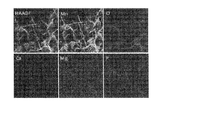
- FIG. 2 shows an element mapping image of the ultrathin section analyzed by STEM-EDX. It was revealed that Mn, O, Ca, and Mg are very uniformly distributed in the BMO nanosheet.
- FIG. 3 shows XANES spectra of BMO and standard samples MnO, Mn 2 O 3 and MnO 2 .
- the absorption edge energy of BMO is between MnO 2 and Mn 2 O 3 .
- a standard curve of Mn valence and absorption edge energy was drawn and the BMO Mn valence was estimated.
- the average valence was found to be 3.3. This value was lower than the BMO value (3.8) produced by Leptothrix discophora SP-6, a common manganese-oxidizing bacterium.
- the radial structure function obtained by extracting the EXAFS vibration from the XAFS spectrum and Fourier transform is similar to Birnessite (layered structure) and Todorokite (3 ⁇ 3 tunnel structure) with MnO 6 octahedron as the basic unit,
- the structure of BMO also revealed that the MnO 6 octahedron is the basic unit.
- FIG. 4 shows the XRD pattern of BMO.
- the crystal structure of the general BMO is, Mn oxides sheet MnO 6 octahedra led to two-dimensionally share edges (MnO 6 octahedra sheets) were formed the Mn oxide or tunnel which continuous layered Is known to be similar. Therefore, for comparison of crystal structures, Birnessite having a layered structure and Todorokite having a tunnel-like structure were prepared and compared with the XRD pattern of BMO.
- Birnessite was prepared according to the method of Q. Feng et al. (Birnessite: Q. feng, et al., Ceram. Soc. Jpn., 105, 564 (1997)). That is, 100 mL of a 0.3 mol / L Mn (NO 3 ) 2 aqueous solution was vigorously stirred, and 200 mL of a mixed solution of 3% H 2 O 2 and 0.6 mol / L NaOH was added thereto as quickly as possible. After stirring for 10 min, the mixture was aged at 60 ° C. for 1 day with the mother liquor, then filtered, washed with water, and dried.
- Todorokite was prepared according to the method of X. J. Yang and others (X. J. Yang, et al., Chem. Lett., 2000, 1192). That is, Birnessite prepared by the above method was added to a 0.5 mol / L MgCl 2 aqueous solution and stirred for 1 day. The precipitate was filtered, added again to the MgCl 2 aqueous solution, and hydrothermally treated at 150 ° C. for 2 days. Thereafter, the precipitate was filtered, washed with water and dried.
- d 9.6, 4.8 mm in the BMO of this example.
- the diffraction lines of d 2.5 and 1.4 mm indicate the (20l), (11l) plane and (02l), (31l) plane, which are in-plane diffraction lines of the MnO 6 octahedral sheet. It was clarified that it has a sheet structure of MnO 6 octahedron.
- the position of diffraction lines on the (001) and (002) planes shifts depending on the ion species and the amount of ions entering between the layers and between the tunnels, so in XRD, the MnO 6 octahedral sheet is formed in layers or forms a tunnel shape. It was not possible to judge whether it was.
- the (h00) plane due to the tunnel structure appears in the electron diffraction pattern, but it does not appear that most MnO 6 octahedral sheets are incident on the electron beam. It means that it is connected in layers along the direction. That is, it became clear that most of the BMO of this example had a layered structure like Birnessite.
- BMO is an agglomeration of a large number of hollow spherical particles having a diameter of about 7.09 ⁇ m with two holes having a diameter of about 1.5 ⁇ m.
- the basic unit of spherical particles is a 1.6 nm thick BMO nanosheet, and multiple sheets with folds are intertwined in a complex manner.
- the BMO nanosheet is composed of crystal particles having a width of about 3.8 nm and a thickness of about 1.6 nm as basic units, which are two-dimensionally connected randomly.
- the crystal particles have a layered structure with MnO 6 octahedral sheet as a basic unit, and the ab surface of the MnO 6 octahedral sheet corresponds to the in-plane of the BMO nanosheet, and the MnO 6 octahedron extends along the perpendicular direction. It has a structure in which sheets are stacked.
- reaction mixture (reaction product slurry) was allowed to flow out of the remaining openings.
- the spilled reaction product slurry was placed in a 20 mL beaker and aged at 90 ° C. for 1 hour with stirring. After aging, it was filtered and washed to obtain a cake. The cake was dried at 110 ° C. for 20 hours to obtain a manganese dioxide catalyst.
- Comparative Example 2 (1/1000 scale of Comparative Example 1 of JP-A-10-128113) An aqueous potassium permanganate solution was prepared by dissolving 2.2 mmol of potassium permanganate in 2.2 ml of water and heated to 55 ° C. Meanwhile, 3.3 mmol of manganese sulfate and 3.3 mmol of sulfuric acid were dissolved in 1.3 ml of water to prepare an aqueous manganese sulfate solution and heated to 55 ° C. The manganese sulfate aqueous solution was quickly poured into the potassium permanganate aqueous solution while stirring. An exotherm was observed when the manganese sulfate aqueous solution was added. The resulting reaction product slurry was aged at 90 ° C. with stirring. After aging for 1 hour, it was filtered and washed to obtain a cake. The cake was dried at 110 ° C. for 20 hours to obtain a manganese dioxide catalyst.
- the porous manganese oxide of the present invention has a significantly higher bromination reaction activity than conventionally known synthetic manganese oxide. Moreover, it turns out that a specific surface area does not have big influence on reaction.
Landscapes
- Chemical & Material Sciences (AREA)
- Organic Chemistry (AREA)
- Engineering & Computer Science (AREA)
- Chemical Kinetics & Catalysis (AREA)
- Materials Engineering (AREA)
- Zoology (AREA)
- Wood Science & Technology (AREA)
- Life Sciences & Earth Sciences (AREA)
- Biochemistry (AREA)
- Microbiology (AREA)
- General Chemical & Material Sciences (AREA)
- Health & Medical Sciences (AREA)
- Biotechnology (AREA)
- Bioinformatics & Cheminformatics (AREA)
- General Engineering & Computer Science (AREA)
- General Health & Medical Sciences (AREA)
- Genetics & Genomics (AREA)
- Catalysts (AREA)
- Organic Low-Molecular-Weight Compounds And Preparation Thereof (AREA)
- Low-Molecular Organic Synthesis Reactions Using Catalysts (AREA)
- Preparation Of Compounds By Using Micro-Organisms (AREA)
Abstract
開示されているのは、微生物により生成されたマンガン酸化物の微結晶を含む多孔質マンガン酸化物を含有するハロゲン化触媒、及び当該ハロゲン化触媒の存在下に、分子内に少なくとも1個のC-H結合を有する化合物とハロゲンとを反応させることを特徴とするハロゲン化合物の製造方法である。
Description
本発明は、従来の方法に比べて、臭素化合物などのハロゲン化合物を高収率で効率的に製造することができるハロゲン化触媒及び該ハロゲン化触媒を用いたハロゲン化合物の製造方法に関する。
従来、有機化学工業、石油化学工業、医薬工業又は農薬工業の分野において、有機ハロゲン化合物は重要な中間体となっており、その製造方法については多くの先行技術が知られている。
たとえば、有機臭素化合物を製造する方法としては、アルコールにBr2又はHBrを反応させると臭化物が容易に合成できる。しかし、アルコールより安価なアルカンを直接臭素化することは難しい。アルカンの臭素化に関する従来技術としては以下に示すものが知られている。
非特許文献1では、シクロヘキサンを酢酸中で臭素化する方法が報告されている(下式)。

しかし、この方法では、酢酸を溶媒量使用する必要があるにも関わらず収率が非常に低く、反応後の中和等に多量の塩基が必要であり、中和後に生成物の抽出作業が必要である。
非特許文献2及び特許文献1では、酸化マンガンの存在下に、シクロヘキサンを臭素化する方法が報告されている(下式)。

しかし、この方法では、臭素に対して2倍(200 mol%)の酸化マンガン(MnO2)が必要である。これは、反応後に副生するHBrとMnO2が反応し、MnO(OH)Brという不活性種を生じるためである。
非特許文献3では、ナトリウムブトキシドの存在下にシクロヘキサンを臭素化する方法が報告されている(下式)。

しかし、この方法には、化学量論量の強塩基(NaOBu-t)を加える必要があるとともに、反応時間が長いという問題がある。
特許文献2では、プロパンを加熱下に臭素化する方法が報告されている(下図)。

しかし、この方法には、350℃という極めて高い温度が必要であり、生成物が複数生成するため分離が困難という問題がある。
非特許文献4では、CBr4・2AlBr3の存在下にシクロヘキサン及びプロパンを臭素化する方法が報告されている。


しかし、この方法では、反応性の高い超強酸であるCBr4・2AlBr3を用いるため、シクロヘキサンについては低温(-40℃)で反応を行う必要がある。
非特許文献5では、CH2Br2・SbF5の存在下にプロパンを臭素化する方法が報告されている。

しかし、この方法では、反応性の高い超強酸であるCH2Br2・SbF5を用いるため、低温(-78℃)で反応を開始する必要がある。
非特許文献6では、N-ブロモコハク酸イミド(NBS)を用いる一般的な臭素化方法が記載されている(下式)。

しかし、この方法は、NBSを別途合成する必要がある点、及び反応後に廃棄物としてコハク酸イミドが副生する点が問題である。
マンガン酸化物は、その物理化学特性や触媒等の幅広い応用のために非常に魅力的な材料である。しかし、人工的に特異な構造を有するマンガン酸化物を合成するためには、強力な酸化剤を用いるか過酷な反応条件が必要である。このようなマンガン酸化物の合成に関する従来技術としては以下に示すものが知られている。
非特許文献7では、Mn(NO3)2水溶液を熱水処理することによりMnO2を調製する方法が報告されている(下式)。

しかし、この方法では、高次構造を有するマンガン酸化物が合成できるが(非特許文献7のFigure 2参照)、高い反応温度が必要である。
非特許文献8では、MnSO4をKClO3とドデシル硫酸ナトリウムの存在下に熱水処理することによりMnO2を調製する方法が報告されている(下式)。

しかし、この方法では、高次構造を有するマンガン酸化物が合成できるが(特許文献8のFigure 3参照)、高い反応温度が必要である。また、酸化剤としてKClO3、補助剤としてドデシル硫酸ナトリウムを加える必要がある。
特許文献3では、ニトリル水和反応に対して高活性でしかも安定性の高い二酸化マンガン触媒、及び当該触媒は、過マンガン酸塩と還元剤とを合流混合して反応させることにより製造できることが報告されている。
Tetrahedron Letters, 46(33), 5587-5590; 2005.
Tetrahedron Letters, 46(3), 487-489; 2005.
Synthesis, (9), 1473-1478; 2005.
Tetrahedron Letters, 36(51), 9365-8; 1995.
Journal of Organic Chemistry, 54(6), 1463-5; 1989.
Journal of Organic Chemistry, 48(16), 2743-7; 1983.
Inorganic Chemistry, 45, 2038-2044; 2006.
Crystal Growth & Design, 7, 159-162; 2007.
臭化物は100年以上も前から有機合成における重要な中間体として利用され続けており(例えばクロスカップリング反応(2010年ノーベル化学賞受賞)やグリニャール反応(1912年ノーベル化学賞)等)、臭化物の利用方法に関しては広く展開されている(医薬品合成、機能性材料合成等)。しかしながら、臭化物自体の合成に関しては効率のよい方法は開発されていない。
従来の臭素化反応には、上記のように、(a)酢酸を溶媒に用いる必要がある、(b)過剰量の酸化マンガンを使用する必要がある、(c)化学量論量の強塩基を使用する必要がある、(d)無触媒の場合、超高温で反応させる必要がある、(e)超強酸を用い、極低温で反応させる必要がある、(f)NBSのような臭素化剤を用いる必要がある等の問題があった。
また、従来のマンガン酸化物の調製法には、高温条件や酸化剤及び補助剤を添加する必要がある等の問題があった。
そこで、本発明は、上記のような問題が無く、ハロゲン化合物を高収率で効率的に製造することができるハロゲン化触媒及びハロゲン化合物の製造方法を提供することを目的とする。
本発明者らは、微生物が作るマンガン酸化物(以下、BMOと呼ぶこともある)をハロゲン化触媒として使用することによって上記目的を達成することができるという知見を得た。本発明は、これら知見に基づき、更に検討を重ねて完成されたものであり、次のハロゲン化触媒及びハロゲン化合物の製造方法を提供するものである。
(1)ハロゲン化触媒
(1-1) 微生物により生成されたマンガン酸化物の微結晶を含む多孔質マンガン酸化物を含有するハロゲン化触媒。
(1-2) 前記多孔質マンガン酸化物がマンガン酸化物の微結晶の集合体である、(1-1)に記載のハロゲン化触媒。
(1-3) 前記多孔質マンガン酸化物の比表面積が100 m2/g以上である、(1-1)又は(1-2)に記載のハロゲン化触媒。
(1-4) 前記多孔質マンガン酸化物のMnの平均価数が3.05~3.7である、(1-1)~(1-3)のいずれかに記載のハロゲン化触媒。
(1-5) 前記多孔質マンガン酸化物が中空球形粒子の凝集体である、(1-1)~(1-4)のいずれかに記載のハロゲン化触媒。
(1-6) 前記中空球形粒子がMnO6八面体ナノシートから形成されている、(1-5)に記載のハロゲン化触媒。
(1-7) 前記多孔質マンガン酸化物がマンガン以外の構成元素として、カルシウム、マグネシウム及びリンを含有する、(1-1)~(1-6)のいずれかに記載のハロゲン化触媒。
(1-8) 前記多孔質マンガン酸化物が、更にアルミニウム、ケイ素、硫黄、塩素及びカリウムを含有する、(1-7)に記載のハロゲン化触媒。
(1-1) 微生物により生成されたマンガン酸化物の微結晶を含む多孔質マンガン酸化物を含有するハロゲン化触媒。
(1-2) 前記多孔質マンガン酸化物がマンガン酸化物の微結晶の集合体である、(1-1)に記載のハロゲン化触媒。
(1-3) 前記多孔質マンガン酸化物の比表面積が100 m2/g以上である、(1-1)又は(1-2)に記載のハロゲン化触媒。
(1-4) 前記多孔質マンガン酸化物のMnの平均価数が3.05~3.7である、(1-1)~(1-3)のいずれかに記載のハロゲン化触媒。
(1-5) 前記多孔質マンガン酸化物が中空球形粒子の凝集体である、(1-1)~(1-4)のいずれかに記載のハロゲン化触媒。
(1-6) 前記中空球形粒子がMnO6八面体ナノシートから形成されている、(1-5)に記載のハロゲン化触媒。
(1-7) 前記多孔質マンガン酸化物がマンガン以外の構成元素として、カルシウム、マグネシウム及びリンを含有する、(1-1)~(1-6)のいずれかに記載のハロゲン化触媒。
(1-8) 前記多孔質マンガン酸化物が、更にアルミニウム、ケイ素、硫黄、塩素及びカリウムを含有する、(1-7)に記載のハロゲン化触媒。
(2)ハロゲン化触媒の製造方法
(2-1) (1-1)~(1-8)のいずれかに記載のハロゲン化触媒の存在下に、分子内に少なくとも1個のC-H結合を有する化合物とハロゲンとを反応させることを特徴とするハロゲン化合物の製造方法。
(2-2) 前記化合物に対するハロゲン化触媒の量が0.1~30モル%となる条件で反応を行う、(2-1)に記載の方法。
(2-3) 前記化合物に対するハロゲンのモル比が0.025~1.0となる条件で反応を行う、(2-1)又は(2-2)に記載の方法。
(2-4) 0~150℃の温度で反応を行う、(2-1)~(2-3)のいずれかに記載の方法。
(2-5) 光の照射下に反応を行う、(2-1)~(2-4)のいずれかに記載の方法。
(2-6) 溶媒の不存在下で反応を行う、(2-1)~(2-5)のいずれかに記載の方法。
(2-7) 不活性溶媒の存在下で反応を行う、(2-1)~(2-5)のいずれかに記載の方法。
(2-8) 反応終了後に、分離回収した前記ハロゲン化触媒をリサイクルする、(2-1)~(2-7)のいずれかに記載の方法。
(2-9) 前記化合物が置換基を有していても良い炭化水素である、(2-1)~(2-8)のいずれかに記載の方法。
(2-10) 前記炭化水素が、脂肪族炭化水素、脂環式炭化水素及び芳香族炭化水素からなる群から選ばれる少なくとも1種である、(2-9)に記載の方法。
(2-11) 前記化合物が、置換基を有していても良い、酸素原子、窒素原子及び硫黄原子からなる群から選ばれる少なくとも1種のヘテロ原子を有する複素環式化合物である、(2-1)~(2-8)のいずれかに記載の方法。
(2-12) 前記化合物が、置換基を有していても良い、ポリオレフィン、芳香族ビニル重合体、ポリエステル、ポリアミド及びポリカーボネートからなる群から選ばれる少なくとも1種の重合体である、(2-1)~(2-8)のいずれかに記載の方法。
(2-13) 前記ハロゲンが臭素である、(2-1)~(2-12)のいずれかに記載の方法。
(2-1) (1-1)~(1-8)のいずれかに記載のハロゲン化触媒の存在下に、分子内に少なくとも1個のC-H結合を有する化合物とハロゲンとを反応させることを特徴とするハロゲン化合物の製造方法。
(2-2) 前記化合物に対するハロゲン化触媒の量が0.1~30モル%となる条件で反応を行う、(2-1)に記載の方法。
(2-3) 前記化合物に対するハロゲンのモル比が0.025~1.0となる条件で反応を行う、(2-1)又は(2-2)に記載の方法。
(2-4) 0~150℃の温度で反応を行う、(2-1)~(2-3)のいずれかに記載の方法。
(2-5) 光の照射下に反応を行う、(2-1)~(2-4)のいずれかに記載の方法。
(2-6) 溶媒の不存在下で反応を行う、(2-1)~(2-5)のいずれかに記載の方法。
(2-7) 不活性溶媒の存在下で反応を行う、(2-1)~(2-5)のいずれかに記載の方法。
(2-8) 反応終了後に、分離回収した前記ハロゲン化触媒をリサイクルする、(2-1)~(2-7)のいずれかに記載の方法。
(2-9) 前記化合物が置換基を有していても良い炭化水素である、(2-1)~(2-8)のいずれかに記載の方法。
(2-10) 前記炭化水素が、脂肪族炭化水素、脂環式炭化水素及び芳香族炭化水素からなる群から選ばれる少なくとも1種である、(2-9)に記載の方法。
(2-11) 前記化合物が、置換基を有していても良い、酸素原子、窒素原子及び硫黄原子からなる群から選ばれる少なくとも1種のヘテロ原子を有する複素環式化合物である、(2-1)~(2-8)のいずれかに記載の方法。
(2-12) 前記化合物が、置換基を有していても良い、ポリオレフィン、芳香族ビニル重合体、ポリエステル、ポリアミド及びポリカーボネートからなる群から選ばれる少なくとも1種の重合体である、(2-1)~(2-8)のいずれかに記載の方法。
(2-13) 前記ハロゲンが臭素である、(2-1)~(2-12)のいずれかに記載の方法。
本発明のハロゲン化触媒によれば、安価で入手容易な炭化水素を原料に用い、無溶媒条件で直接臭素化を達成できる。また、温度制御が容易な室温~100℃でハロゲン化反応が進行し、強塩基、強酸性の触媒及び臭素化剤を使用する必要がない。更に、ハロゲン化合物を高収率で製造することができる。
本発明のハロゲン化触媒は、微生物が温和な条件(常温・常圧)で産出したものであり、使用量も触媒量(臭素に対して1 mol%)で良い。
医薬・農薬中間体、及び感光材中間体として知られるsec-ブチルブロミドやi-プロピルブロミドは、本発明の方法を用いれば安価なブタンやプロパンから合成することが可能である。
以下、本発明を詳細に説明する。
ハロゲン化触媒
本発明のハロゲン化触媒は、微生物により生成されたマンガン酸化物の微結晶を含む多孔質マンガン酸化物を含有することを特徴とする。
本発明のハロゲン化触媒は、微生物により生成されたマンガン酸化物の微結晶を含む多孔質マンガン酸化物を含有することを特徴とする。
本発明のハロゲン化触媒を用いた臭素化反応には、従来の臭素化反応のような問題が無く、ハロゲン化合物を高収率で効率的に製造することができる。また、本発明のハロゲン化触媒の製造には強力な酸化剤や過酷な反応条件が必要でなく、微生物が温和な条件(常温・常圧)で産出できる。
本発明におけるハロゲン化触媒のハロゲン化とは、塩素化、臭素化及びフッ素化を意味するが、本発明のハロゲン化触媒は、好ましくは塩素化及び臭素化、より好ましくは臭素化に使用される。
本発明で使用する多孔質マンガン酸化物は、微生物により生成され、且つハロゲン化触媒として機能するマンガン酸化物であれば、特に限定されない。微生物が生成する多孔質マンガン酸化物は、ナノシート構造やMn2+, Mn3+, Mn4+の混合原子価を有するため、触媒として使用する場合に有利である。ここで、多孔質とは多数の細孔を有する性質のことであり、細孔の形状及び大きさは特に限定されないが、例えば半径50 nm以下のメソ孔が挙げられる。多孔質マンガン酸化物の形状としては、球形、中空球形、チューブ状等が挙げられ、多孔質マンガン酸化物の大きさは、その形状によって様々であるが、球形及び中空球形では0.1~20.0μm程度、チューブ状では5.0~200μm程度である。
多孔質マンガン酸化物を生成する微生物としては、例として、バクテリアではSiderocapsa属、Hyphomicribium属、Pseudomonas属、Arthrobacter属、Leptothrix属、Metallogenium属、Aeromonas属、Citrobacter属、Flavobacterium属、Hyphomicrobium属、Pseudomonas属、Oceanospirillum属、Marine属、Streptomyces属、Bacillus属等に属するものが挙げられ(H.L. Ehrlich, D.K. Newman, Geomicrobiology, fifth ed., CRC Press Taylor & Francis Group, 2009, p.349)、菌類ではAcremonium属、Coniothyrium属、Cladosporium属、Penicillium属、Phoma属、Verticillium属(非特許文献:N. Miyata, et al., Appl. Environ. Microbiol., 72(10), 6467-6473 (2006))、Trametes属、Stropharia属、Phanerochaete属(非特許文献:N. Miyata, et al., FEMS Microbiol. Ecol., 47, 101-109(2004))等に属するものが挙げられる。多孔質マンガン酸化物の製造にはこれらの微生物を含む混合培養系も使用できる。
多孔質マンガン酸化物は、例えば、多孔質マンガン酸化物を生成する微生物(群)を実施例に記載の方法(N. Miyata et al. J. Biosci. Bioeng. 103(5), 432-439(2007)を参照)に従い培養することで製造することができる。
マンガン酸化物の微結晶とは、通常、幅1.0~10.0 nm、特に2.0~5.0 nm程度、厚さ0.4~5.0 nm、特に1.0~2.0 nm程度の大きさの結晶粒子であり、当該結晶粒子はMnO6八面体シートを基本単位とした層状構造を有していることが望ましい。また、当該結晶粒子が基本単位となり、それらが二次元的にランダムに繋がってBMOナノシートを構成することができる。
多孔質マンガン酸化物は、マンガン酸化物の微結晶の集合体であって、マンガン酸化物の微結晶により構成されていることが好ましい。
多孔質マンガン酸化物の比表面積は、好ましくは100 m2/g以上、より好ましくは120~200 m2/gである。
多孔質マンガン酸化物のMnの平均価数は、好ましくは3.05~3.7、より好ましくは3.2~3.5である。
また、多孔質マンガン酸化物は、中空球形粒子の凝集体であることが望ましく、当該中空球形粒子は口穴が(好ましくは2つ)開いたものであっても良い。当該中空球形粒子の直径は、1.0~20.0μm、特に5.0~10.0μm程度が望ましく、口穴の直径は、0.1~5.0μm、特に1.0~2.0μm程度が望ましい。中空球形粒子の基本単位は、例えばBMOナノシートであり、BMOナノシートの厚さは、通常0.4~5.0 nm、特に1.0~2.0 nm程度である。
多孔質マンガン酸化物は構成元素として、マンガンに加えて、カルシウム、マグネシウム及びリンを含有することが好ましく、これらに加えて更にアルミニウム、ケイ素、硫黄、塩素及びカリウムを含有することがより好ましい。これらの(酸素を除いた)元素の相対組成は、通常、原子数%で、Mn : Ca : Mg : P : Al : Si : S : Cl : K = 75.4~88.9 : 3.9~7.3 : 0.7~5.0 : 1.2~5.7 : 0.2~3.3 : 0.2~3.5 : 0.2~3.6 : 1.3~4.9 : 0.2~1.4である。また、多孔質マンガン酸化物には、通常C、N、Hも含まれており、これらの含有量は、それぞれ12.0~17.0 wt%、1.0~5.0 wt%、1.0~5.0 wt%程度である。
微生物をコバルト、ニッケル等の遷移金属元素やネオジウム等の希土類元素等が存在する環境下で培養することにより、多孔質マンガン酸化物にこれらの元素を含ませることもできる。
ハロゲン化合物の製造方法
本発明のハロゲン化合物の製造方法は、上記ハロゲン化触媒の存在下に、分子内に少なくとも1個のC-H結合を有する化合物とハロゲンとを反応させることを特徴とする。
本発明のハロゲン化合物の製造方法は、上記ハロゲン化触媒の存在下に、分子内に少なくとも1個のC-H結合を有する化合物とハロゲンとを反応させることを特徴とする。
本発明のハロゲン化合物の製造方法では、従来の臭素化反応のような問題が無く、ハロゲン化合物を高収率で効率的に製造することができる。
本発明において使用されるハロゲンとしては、塩素、臭素及びフッ素が挙げられるが、特に臭素が好ましい。
本発明において使用される分子内に少なくとも1個のC-H結合を有する化合物は、ハロゲン置換可能なC-H結合を有する化合物であれば特に限定されず、種々の骨格(鎖状構造、芳香環、複素環等)を有し得、これらは置換基を有しても良く、低分子化合物だけでなく重合体(オリゴマー、ポリマー)を含む。
分子内に少なくとも1個のC-H結合を有する化合物としては、これらに限定されるものではないが、炭化水素、酸素原子、窒素原子及び硫黄原子からなる群から選ばれた少なくとも1種のヘテロ原子を含有する複素環式化合物、ポリオレフィン、芳香族ビニル重合体、ポリエステル、ポリアミド及びポリカーボネートからなる群から選ばれた少なくとも1種の重合体等を例示することができ、これらの化合物は置換基を有していても良い。
上記炭化水素としては、これらに限定されるものではないが、脂肪族炭化水素、脂環式炭化水素、芳香族炭化水素等が挙げられる。これら炭化水素はハロゲン化反応に不活性な置換基を有していても良く、ハロゲン化反応に不活性な置換基としては、塩素、臭素などのハロゲン、カルボニル基、アルコキシ基(好ましくは炭素数1~6のアルコキシ基)、ジメチルアミノ基、スルホニル基等を例示することができる。
複素環式化合物とは、1又は2個のヘテロ原子を有する5又は6員の複素環を含む化合物を意味し、これらに限定されるものではないが、テトラヒドロフラン、フラン、ベンゾフラン、クロマン、クロメンなどの酸素原子を含有する複素環式化合物、テトラヒドロピロール、ピロール、キノリン、アクリジンなどの窒素原子を含有する複素環式化合物、テトラヒドロチオフェン、チオフェン、ベンゾチオフェンなどの硫黄原子を含有する複素環式化合物などを例示することができる。これら複素環式化合物はハロゲン化反応に不活性な置換基を有していても良く、ハロゲン化反応に不活性な置換基としては、塩素、臭素などのハロゲン、カルボニル基、アルコキシ基(好ましくは炭素数1~6のアルコキシ基)、ジメチルアミノ基、スルホニル基、アルコキシ基などを例示することができる。
上記ポリオレフィンとしては、ポリエチレン、ポリプロピレン、ポリブテン、ポリ-4-メチル-1-ペンテン、合成ゴムなどが、上記芳香族ビニル重合体としては、ポリスチレン、ポリα-メチルスチレンなどが、上記ポリエステルとしては、ポリエチレンテレフタレート、ポリブチレンフタレートなどが、上記ポリアミドとしては、6-ナイロン、66-ナイロンなどが挙げられる。上記ポリオレフィン、芳香族ビニル重合体、ポリエステル、ポリアミド及びポリカーボネートはハロゲン化反応に不活性な置換基を有していても良く、ハロゲン化反応に不活性な置換基としては、塩素、臭素などのハロゲン、カルボニル基、アルコキシ基(好ましくは炭素数1~6のアルコキシ基)、ジメチルアミノ基、スルホニル基、アルコキシ基などを例示することができる。
本発明においてハロゲン化合物とは、上記分子内に少なくとも1個のC-H結合を有する化合物がハロゲン化反応により、少なくとも1個のC-H結合において水素がハロゲンで置換された化合物のことを意味する。
本発明において、反応開示時における分子内に少なくとも1個のC-H結合を有する化合物に対するハロゲン化触媒の割合は、通常0.1~30モル%、好ましくは0.5~5.0モル%である。本発明において、反応開示時における分子内に少なくとも1個のC-H結合を有する化合物に対するハロゲンのモル比は、好ましくは0.001~1.0、より好ましくは0.02~0.08である。
本発明における反応の温度は通常0~150℃、好ましくは25~100℃である。ハロゲン化反応を高収率で且つ効率よく進めるにはこの温度範囲で反応を行うことが好ましい。本発明における反応の時間は、反応の原料等に応じて適宜設定されるが、通常5~3000分、好ましくは10~1800分である。
本発明の反応は、光の非照射下に行うこともできるし、光の照射下に行うこともできる。本発明の反応を光照射下に行うと、副生するハロゲン化水素に起因するハロゲンが反応に利用されるので、ハロゲン化合物が高収率で得られるので好適である。
本発明の反応は、溶媒の不存在下に行うこともできるし、溶媒の存在下に行うこともできる。溶媒としては、ハロゲン化反応に不活性な溶媒が使用され、具体的には、ジクロロエタン、四塩化炭素、クロロホルム、ジブロモメタン、ブロモホルムなどを例示することができる。
本発明の反応を終了した後の反応混合物の処理法としては、公知の処理法を適用することができる。例えば、最初に触媒を回収した後、ハロゲン化合物を蒸留、結晶化などにより分離する等である。
本発明のハロゲン化反応を終了した後の反応混合物から回収されたハロゲン化触媒は、そのまま又は適切な処理を施した後に、同じ又は異なる反応にリサイクルすることができる。
以下、本発明を更に詳しく説明するため実施例を挙げる。しかし、本発明はこれら実施例等になんら限定されるものではない。
[Mn酸化微生物の培養とBMOの合成]
本実施例で用いた微生物群は静岡県菊川水系から採取された河川床生物膜より調製されたマンガン酸化混合培養系であり、培養は宮田等の方法に即して行った(N. Miyata et al. J. Biosci. Bioeng. 103(5), 432-439 (2007))。35 Lのプラスチック製バケツに水道水20 L、NaCOOH・3H2O (ナカライテスク:純度99%)を1000 mg、ソイペプトン(ナカライテスク)を400 mg、KH2PO4 (ナカライテスク:純度99%)を100 mg加えたものを基礎培地として用いた。基礎培地にMnSO4水溶液(MnSO4・5H2O, ナカライテスク:純度99%)を添加し、培地中のMn濃度を5 ppmに調整した後に、上記の論文において培養されたバイオマット(培地及びマンガン酸化物)を1 L植菌した。酸素の供給にはエアーポンプ(4 L/min)を用いた。Mn2+のパックテストを用いてMn濃度をモニタリングし、0 ppmとなったところで再びMn濃度が5 ppmになるようにMnSO4水溶液を添加した。3ヶ月培養した後に、生成した黒色沈殿物を回収し、20倍量の蒸留水で洗浄し、乾燥した。得られた粉末を今後BMO粉末と呼ぶ。以下では当該BMOを使用し、実験を行った。
本実施例で用いた微生物群は静岡県菊川水系から採取された河川床生物膜より調製されたマンガン酸化混合培養系であり、培養は宮田等の方法に即して行った(N. Miyata et al. J. Biosci. Bioeng. 103(5), 432-439 (2007))。35 Lのプラスチック製バケツに水道水20 L、NaCOOH・3H2O (ナカライテスク:純度99%)を1000 mg、ソイペプトン(ナカライテスク)を400 mg、KH2PO4 (ナカライテスク:純度99%)を100 mg加えたものを基礎培地として用いた。基礎培地にMnSO4水溶液(MnSO4・5H2O, ナカライテスク:純度99%)を添加し、培地中のMn濃度を5 ppmに調整した後に、上記の論文において培養されたバイオマット(培地及びマンガン酸化物)を1 L植菌した。酸素の供給にはエアーポンプ(4 L/min)を用いた。Mn2+のパックテストを用いてMn濃度をモニタリングし、0 ppmとなったところで再びMn濃度が5 ppmになるようにMnSO4水溶液を添加した。3ヶ月培養した後に、生成した黒色沈殿物を回収し、20倍量の蒸留水で洗浄し、乾燥した。得られた粉末を今後BMO粉末と呼ぶ。以下では当該BMOを使用し、実験を行った。
[炭化水素の触媒的臭素化反応]
空気雰囲気下(1 atm)、バイオジナスマンガン酸化物(BMO、1 mg)、ヘキサン(1、1mL)、臭素(0.5 mmol)を試験管に加え、ねじ式のキャップを取り付けた。100℃で10分間加熱撹拌した後、未反応の臭素をチオ硫酸ナトリウム水溶液で処理し、ヘキサンで有機物を抽出した。蒸留により2-ブロモヘキサン(1′)及び3-ブロモヘキサン(1′′)を収率98%で得た(式(1))。
空気雰囲気下(1 atm)、バイオジナスマンガン酸化物(BMO、1 mg)、ヘキサン(1、1mL)、臭素(0.5 mmol)を試験管に加え、ねじ式のキャップを取り付けた。100℃で10分間加熱撹拌した後、未反応の臭素をチオ硫酸ナトリウム水溶液で処理し、ヘキサンで有機物を抽出した。蒸留により2-ブロモヘキサン(1′)及び3-ブロモヘキサン(1′′)を収率98%で得た(式(1))。

表1に示すように、本触媒は人工的に合成された市販の酸化マンガン(MnO2及びMn2O3)(和光純薬、99.5%)に比べて活性が高かった。
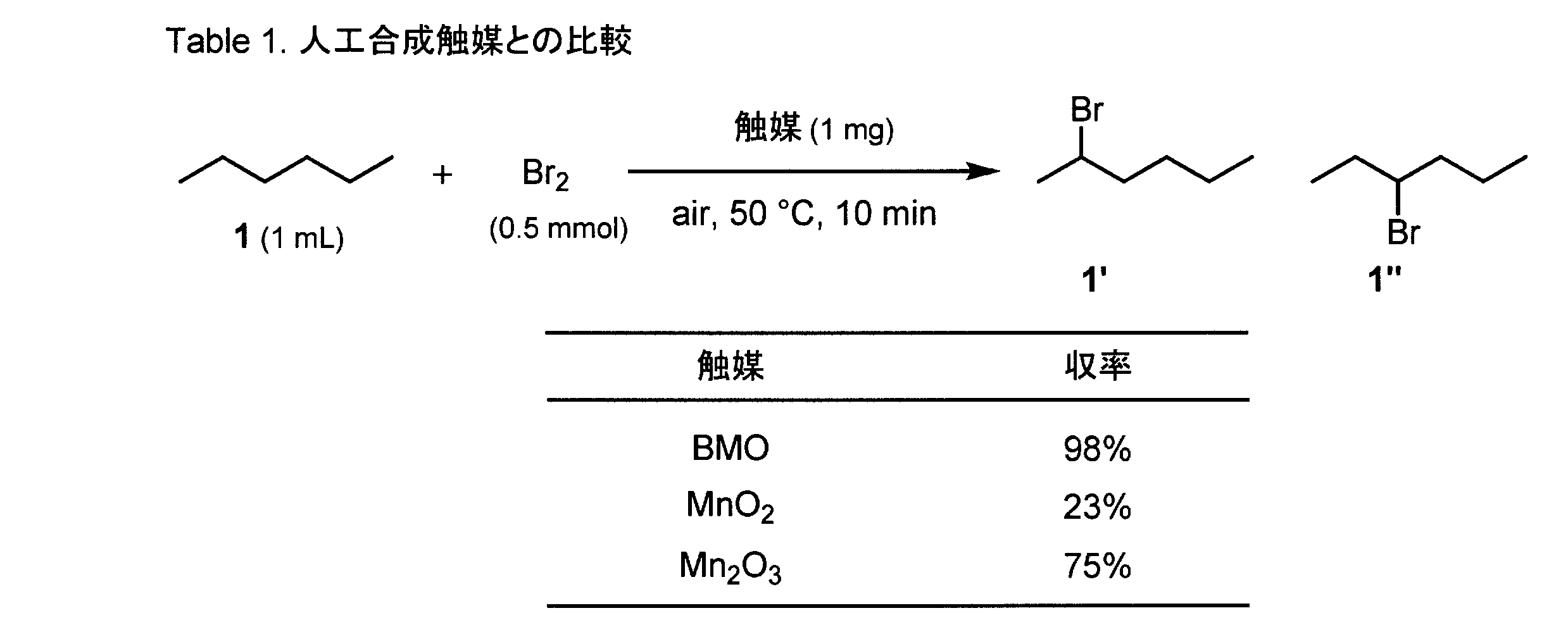
表2に示されているように基質の適用範囲を調査した結果、シクロヘキサン(2)を原料に用いると、ブロモシクロヘキサン(2′)が91%で得られた。シクロオクタン(3)を原料に用いるとブロモシクロオクタン(3′)が定量的に得られた。トルエン(4)のベンジル位は容易に臭素化された。これらの結果から、本反応はラジカル的に進行していると考えられる。そのため、ベンゼン(5)の臭素化には長時間が必要であった。また、末端C-H結合は変換されにくく、tert-ブチルベンゼン(6)は、ベンゼン環のp-位のみが選択的に臭素化された。

[BMOのキャラクタリゼーション]
BMOの形状観察を光学顕微鏡(OLYPUS BX-51)、走査型電子顕微鏡(Hitachi S-4300)及び透過型電子顕微鏡(JEOL JEM-2100F with CEOS Cs Corrector for STEM)、結晶構造解析をX線回折測定(Rigaku RINT-2000)及び電子回折測定(JEOL JEM-2100F)、組成分析をエネルギー分散型X線分析(JEOL JED-2300T)、化学状態をX線吸収分光法(PF BL9C)、比表面積を窒素吸着法(日本ベル(株)、BELSORP-mini II)により評価した。
BMOの形状観察を光学顕微鏡(OLYPUS BX-51)、走査型電子顕微鏡(Hitachi S-4300)及び透過型電子顕微鏡(JEOL JEM-2100F with CEOS Cs Corrector for STEM)、結晶構造解析をX線回折測定(Rigaku RINT-2000)及び電子回折測定(JEOL JEM-2100F)、組成分析をエネルギー分散型X線分析(JEOL JED-2300T)、化学状態をX線吸収分光法(PF BL9C)、比表面積を窒素吸着法(日本ベル(株)、BELSORP-mini II)により評価した。
図1aにBMOの光学顕微鏡写真を示す。茶色味を帯びた直径10μm程度の中空球形粒子が多数凝集している様子が確認され(図1a)、SEM画像からこの中空球形粒子には小さな口穴が空いていることも明らかとなった(図1b)。更に詳細にSEM観察を行ったところ、中空球形粒子の口穴は粒子一つ当たり2つ存在することが明らかとなった(図1c)。また、外側の表面形状は凹凸の多い鱗片状(図1c)である一方、内側の表面は比較的スムースであった(図1d)。観察された中空球形の構造物はSiderocapsa属の細菌が作ったMn酸化物に類似していることから、本実施例の培養系ではSiderocapsa属が優先種であると考えられる。中空球形粒子は細菌の周りにMn酸化物が形成された結果できた構造物であり、口穴は細菌が外に出るためにできた穴であると考えられるが、真偽の程は定かではない。BMO球形粒子及び口穴の直径は7.09±0.56μm (N = 57)、1.5±0.2μm (N = 57)であり、ばらつきの少ない数値であった。
図1eのTEM像から、中空球形粒子はきわめて薄いシート(BMOナノシート)からなっており、表面の燐片形状はBMOナノシートのエッジ部分及びBMOナノシートにできた皺(Alホイルに皺ができるようなイメージ)によるものであることが明らかとなった。図1fの超薄切片の観察から、SEM観察では密に詰まっているように見えた中空球形粒子の壁面は粗であり、BMOナノシートの厚さは約1.6 nmであることが明らかとなった。また、平滑に見えたナノシートの表面には5 nm程度の多数の凸凹が存在することも明らかとなった(図1g)。このような微細構造を有するBMOは大きな表面積を有すると予想される。そこで、窒素吸着法により、BMO粉末の細孔に関する情報を調査した。その結果、比表面積は120~160 m2/gである(一般的なMn酸化物の比表面積は10~120 m2/g)とともに半径50 nm以下のメソ孔が多数確認された。メソ孔はナノシートの絡まり合いの結果形成されたものや、ナノシート表面の凸凹に起因するものと考えられる。
次に、BMOの組成を調べるためにSEMに付属のEDXによりBMOの組成分析を行った。その結果、主成分はMnとOであり、微量のCa、Mg、Pを含み、更に微量のAl、Si、S、Cl、Kを含むことが明らかとなった。これらの元素(酸素を除いた)の相対組成(at %)は、Mn:Ca:Mg:P:Al:Si:S:Cl:K = 84.9:5.5:2.3:3.0:0.8:0.8:1.1:0.6:0.9であった。STEM-EDXで分析した超薄切片の元素マッピング像を図2に示す。Mn、O、Ca、MgはBMOナノシート中に極めて均一に分布していることが明らかとなった。測定時の電子線の径は0.3 nmでマッピング像の空間分解能は1.2 nmであることから、これらの元素がnmスケールで均一に分布していることが明らかとなった。燃焼法によってC、N、H量を調べたところそれぞれ14.0、2.7、2.8wt%であり、BMOには微生物由来の有機物成分が多量に含まれていることも明らかとなった。
BMOのMnの価数及びMn周りの局所構造解析を行うためにXAFS測定を行った。図3にBMO、標準試料であるMnO、Mn2O3、MnO2のXANESスペクトルを示す。BMOの吸収端エネルギーはMnO2とMn2O3の間であった。標準試料でMnの価数と吸収端エネルギーの検量線を引き、BMOのMnの価数を見積もったところ、平均価数は3.3であることが明らかとなった。この値は、一般的なマンガン酸化バクテリアであるLeptothrix discophora SP-6が作るBMOの値(3.8)よりも低価数であった。XAFSスペクトルからEXAFS振動を抽出してフーリエ変換により得られた動径構造関数は、MnO6八面体を基本ユニットとするBirnessite (層状構造)やTodorokite (3×3トンネル構造)と類似しており、BMOの構造もMnO6八面体が基本ユニットであることが明らかとなった。
次に、BMOの結晶構造解析を粉末XRD測定及びTEMのED測定により行った。図4にBMOのXRDパターンを示す。一般的にBMOの結晶構造は、MnO6八面体が辺を共有して二次元的につながったシート(MnO6八面体シート)が層状に連なったMn酸化物やトンネル状を形作ったMn酸化物に類似していることが知られている。そこで、結晶構造の比較のために、層状構造を有するBirnessite及びトンネル状構造を有するTodorokiteを作製し、BMOのXRDパターンと比較した。
BirnessiteはQ. Feng等の方法に即して作製した(Birnessite : Q. feng, et al., Ceram. Soc. Jpn., 105, 564 (1997))。即ち、0.3 mol/LのMn(NO3)2水溶液100 mLを激しく撹拌しつつ、そこに3%のH2O2と0.6 mol/LのNaOHの混合溶液200 mLをできるだけ素早く加えた。10 min撹拌後、母液と共に60℃で1日間熟成させ、その後、濾過、水洗、乾燥させた。
TodorokiteはX. J. Yang等の方法に即して作製した(X. J. Yang, et al., Chem. Lett., 2000, 1192)。即ち、上記の方法で作成したBirnessiteを0.5 mol/LのMgCl2水溶液に加え、1日間撹拌した。沈殿物を濾過し、再度MgCl2水溶液に加え、150℃で2日間水熱処理を行った。その後、沈殿物を濾過、水洗、乾燥させた。
Birnessite及びTodorokiteとBMOのXRDパターンと比較すると、本実施例のBMOはd = 9.6, 4.8Åに回折線が確認された。これは、層状やトンネル状構造の(001)及び(002)面に対応している。また、d = 2.5, 1.4Åの回折線はMnO6八面体シートの面内の回折線である(20l), (11l)面及び(02l), (31l)面を示していることから、BMOは確かにMnO6八面体のシート構造を有することが明らかとなった。しかし、層間やトンネル間に入るイオン種やその量によって(001)面及び(002)面の回折線の位置はシフトするため、XRDではMnO6八面体シートが層状に連なっているかトンネル状を形作っているかは判断できなかった。
BMOのナノシート部分の拡大像とEDパターンを図4右側の挿入図に示す。EDパターンにはd = 2.5, 1.4Åの回折線のみが確認された。これらは、面内を示す(20l), (11l)面及び(02l), (31l)面の回折線を示しており、(001)や(002)回折線は確認されなかった。これは、BMOナノシートはMnO6八面体シートに対応しており、面内がab面であり面直方向にMnO6八面体シートが層として連なっていることを示している。もし、BMOがトンネル状構造であれば、電子回折パターンにはトンネル構造に起因する(h00)面が現れるが、それが現れていないということは大部分のMnO6八面体シートが電子線の入射方向に沿って層状に連なっていることを意味している。つまり、本実施例のBMOは大部分がBirnessite様の層状構造を有することが明らかとなった。
しかしながら、XRDで確認された(001), (002)の回折線は非常にブロードであるため、実際にはトンネル状構造も混ざっていると考えられる。また、BMOナノシート上に確認された格子縞から、結晶のドメインサイズを計測したところ、3.8±1.5 nm (N = 40)であった。これはMnO6八面体シートのab面内の結晶子のサイズを反映しており、前述したBMOナノシートの厚さ(1.6 nm)はc軸方向の結晶の厚さを反映していると考えられる。
以上の結果から、本実施例で得られたBMOは以下の特徴を有することが明らかとなった。
(I) BMOは、直径1.5μm程度の口穴が2つ開いた直径7.09μm程度の中空球形粒子が多数凝集したものである。
(II) 球形粒子の基本単位は厚さ1.6 nmのBMOナノシートであり、皺の入ったシートが複数枚複雑に絡みあっている。
(III) BMOナノシートは、幅3.8 nm程度、厚さ1.6 nm程度の結晶粒子が基本単位となり、それらが二次元的にランダムに繋がって構成されている。
(IV) 結晶粒子はMnO6八面体シートを基本単位とした層状構造を有し、MnO6八面体シートのab面がBMOナノシートの面内に対応し、面直方向に沿ってMnO6八面体シートが積層した構造をとっている。
(I) BMOは、直径1.5μm程度の口穴が2つ開いた直径7.09μm程度の中空球形粒子が多数凝集したものである。
(II) 球形粒子の基本単位は厚さ1.6 nmのBMOナノシートであり、皺の入ったシートが複数枚複雑に絡みあっている。
(III) BMOナノシートは、幅3.8 nm程度、厚さ1.6 nm程度の結晶粒子が基本単位となり、それらが二次元的にランダムに繋がって構成されている。
(IV) 結晶粒子はMnO6八面体シートを基本単位とした層状構造を有し、MnO6八面体シートのab面がBMOナノシートの面内に対応し、面直方向に沿ってMnO6八面体シートが積層した構造をとっている。
比較例1(特開平10-128113号公報の実施例1の1/1000のスケール)
過マンガン酸カリウム2.486 mmolを水2.4 mlに溶解し、過マンガン酸カリウム水溶液を調製した。一方、硫酸マンガン1.657 mmolと硫酸5.427 mmolを水1.04 mlに溶解し、硫酸マンガン水溶液を調製した。55℃に加熱した前記過マンガン酸カリウム水溶液と硫酸マンガン水溶液とを、温水浴に浸して55℃に加熱したT字管(合流混合器)の左右の開口部から、それぞれ5分30秒かけて連続的に供給し、反応混合液(反応生成スラリー)を残りの開口部から流出させた。
過マンガン酸カリウム2.486 mmolを水2.4 mlに溶解し、過マンガン酸カリウム水溶液を調製した。一方、硫酸マンガン1.657 mmolと硫酸5.427 mmolを水1.04 mlに溶解し、硫酸マンガン水溶液を調製した。55℃に加熱した前記過マンガン酸カリウム水溶液と硫酸マンガン水溶液とを、温水浴に浸して55℃に加熱したT字管(合流混合器)の左右の開口部から、それぞれ5分30秒かけて連続的に供給し、反応混合液(反応生成スラリー)を残りの開口部から流出させた。
流出した反応生成スラリーを20 mLのビーカーに入れ、撹拌しながら90℃で1時間熟成した。熟成後、濾過、洗浄し、ケーキを得た。ケーキを110℃で20時間乾燥して二酸化マンガン触媒を得た。
この合成によって得られた前記酸化マンガン(比表面積75 m2 /g)を使用し、全く同じ条件で前記表2のシクロヘキサンの臭素化反応を行った。ブロモシクロヘキサンの収率は27%であった。
比較例2(特開平10-128113号公報の比較例1の1/1000のスケール)
過マンガン酸カリウム2.2 mmolを水2.2 mlに溶解して、過マンガン酸カリウム水溶液を調製し、55℃に加熱した。一方、硫酸マンガン3.3 mmolと硫酸3.3 mmolを水1.3 mlに溶解して、硫酸マンガン水溶液を調製し、55℃に加熱した。前記過マンガン酸カリウム水溶液中に、撹拌しながら、前記硫酸マンガン水溶液を速やかに注加した。なお、硫酸マンガン水溶液注加時に発熱が見られた。得られた反応生成スラリーを、撹拌しながら90℃で熟成した。1時間熟成後、濾過、洗浄し、ケーキを得た。ケーキを110℃で20時間乾燥して二酸化マンガン触媒を得た。
過マンガン酸カリウム2.2 mmolを水2.2 mlに溶解して、過マンガン酸カリウム水溶液を調製し、55℃に加熱した。一方、硫酸マンガン3.3 mmolと硫酸3.3 mmolを水1.3 mlに溶解して、硫酸マンガン水溶液を調製し、55℃に加熱した。前記過マンガン酸カリウム水溶液中に、撹拌しながら、前記硫酸マンガン水溶液を速やかに注加した。なお、硫酸マンガン水溶液注加時に発熱が見られた。得られた反応生成スラリーを、撹拌しながら90℃で熟成した。1時間熟成後、濾過、洗浄し、ケーキを得た。ケーキを110℃で20時間乾燥して二酸化マンガン触媒を得た。
この合成によって得られた前記酸化マンガン(比表面積115 m2 /g)を使用し、全く同じ条件で前記表2のシクロヘキサンの臭素化反応を行った。ブロモシクロヘキサンの収率は27%であった。
これらの比較実験の結果から、本発明の多孔質マンガン酸化物は従来公知の合成酸化マンガンに比べて顕著に臭素化反応活性が高いことがわかる。また、比表面積は反応に大きな影響を与えないことがわかる。
Claims (15)
- 微生物により生成されたマンガン酸化物の微結晶を含む多孔質マンガン酸化物を含有するハロゲン化触媒。
- 前記多孔質マンガン酸化物がマンガン酸化物の微結晶の集合体である、請求項1に記載のハロゲン化触媒。
- 前記多孔質マンガン酸化物の比表面積が100 m2/g以上である、請求項1に記載のハロゲン化触媒。
- 前記多孔質マンガン酸化物のMnの平均価数が3.05~3.7である、請求項1に記載のハロゲン化触媒。
- 前記多孔質マンガン酸化物が中空球形粒子の凝集体である、請求項1に記載のハロゲン化触媒。
- 前記中空球形粒子がMnO6八面体ナノシートから形成されている、請求項5に記載のハロゲン化触媒。
- 前記多孔質マンガン酸化物がマンガン以外の構成元素として、カルシウム、マグネシウム及びリンを含有する、請求項1に記載のハロゲン化触媒。
- 請求項1に記載のハロゲン化触媒の存在下に、分子内に少なくとも1個のC-H結合を有する化合物とハロゲンとを反応させることを特徴とするハロゲン化合物の製造方法。
- 光の照射下に反応を行う、請求項8に記載の方法。
- 溶媒の不存在下で反応を行う、請求項8に記載の方法。
- 不活性溶媒の存在下で反応を行う、請求項8に記載の方法。
- 前記化合物が置換基を有していても良い炭化水素である、請求項8に記載の方法。
- 前記炭化水素が、脂肪族炭化水素、脂環式炭化水素及び芳香族炭化水素からなる群から選ばれる少なくとも1種である、請求項12に記載の方法。
- 前記化合物が、置換基を有していても良い、酸素原子、窒素原子及び硫黄原子からなる群から選ばれる少なくとも1種のヘテロ原子を有する複素環式化合物である、請求項8に記載の方法。
- 前記化合物が、置換基を有していても良い、ポリオレフィン、芳香族ビニル重合体、ポリエステル、ポリアミド及びポリカーボネートからなる群から選ばれる少なくとも1種の重合体である、請求項8に記載の方法。
Priority Applications (1)
| Application Number | Priority Date | Filing Date | Title |
|---|---|---|---|
| JP2012553562A JP5863676B2 (ja) | 2011-01-18 | 2011-10-27 | ハロゲン化触媒及びハロゲン化合物の製造方法 |
Applications Claiming Priority (2)
| Application Number | Priority Date | Filing Date | Title |
|---|---|---|---|
| JP2011-008026 | 2011-01-18 | ||
| JP2011008026 | 2011-01-18 |
Publications (1)
| Publication Number | Publication Date |
|---|---|
| WO2012098746A1 true WO2012098746A1 (ja) | 2012-07-26 |
Family
ID=46515387
Family Applications (1)
| Application Number | Title | Priority Date | Filing Date |
|---|---|---|---|
| PCT/JP2011/074795 Ceased WO2012098746A1 (ja) | 2011-01-18 | 2011-10-27 | ハロゲン化触媒及びハロゲン化合物の製造方法 |
Country Status (2)
| Country | Link |
|---|---|
| JP (1) | JP5863676B2 (ja) |
| WO (1) | WO2012098746A1 (ja) |
Citations (3)
| Publication number | Priority date | Publication date | Assignee | Title |
|---|---|---|---|---|
| JPS643173B2 (ja) * | 1983-04-15 | 1989-01-19 | Asahi Chemical Ind | |
| JPH06277510A (ja) * | 1993-03-26 | 1994-10-04 | Asahi Glass Co Ltd | 塩化メチル合成触媒 |
| JPH08208220A (ja) * | 1994-11-07 | 1996-08-13 | Texaco Dev Corp | 酸化マンガン八面体モレキュラーシーブの製造方法 |
-
2011
- 2011-10-27 WO PCT/JP2011/074795 patent/WO2012098746A1/ja not_active Ceased
- 2011-10-27 JP JP2012553562A patent/JP5863676B2/ja not_active Expired - Fee Related
Patent Citations (3)
| Publication number | Priority date | Publication date | Assignee | Title |
|---|---|---|---|---|
| JPS643173B2 (ja) * | 1983-04-15 | 1989-01-19 | Asahi Chemical Ind | |
| JPH06277510A (ja) * | 1993-03-26 | 1994-10-04 | Asahi Glass Co Ltd | 塩化メチル合成触媒 |
| JPH08208220A (ja) * | 1994-11-07 | 1996-08-13 | Texaco Dev Corp | 酸化マンガン八面体モレキュラーシーブの製造方法 |
Non-Patent Citations (4)
| Title |
|---|
| ATSUYA MORITA ET AL.: "Manganese Oxide Shokubai o Mochiiru Tanka Suiso no Kannokika", DAI 106 KAI SHOKUBAI TORONKAI TORONKAI A YOKOSHU, 15 September 2010 (2010-09-15), pages 284 * |
| MIYATA NAOYUKI ET AL.: "Microbial Manganese Oxide Formation and Interaction with Toxic Metal Ions", J BIOSCI BIOENG, vol. 104, no. 1, 2007, pages 1 - 8, XP022196790, DOI: doi:10.1263/jbb.104.1 * |
| MIYATA NAOYUKI ET AL.: "Procuciton of Biogenic Manganese Oxides by Repeated-Batch Cultures of Laboratory Microcosms", J BIOSCI BIOENG, vol. 103, no. 5, 2007, pages 432 - 439, XP022136683, DOI: doi:10.1263/jbb.103.432 * |
| SPIRO THOMAS G. ET AL.: "Bacteriogenic Manganese Oxides", ACC CHEM RES, vol. 43, no. 1, January 2010 (2010-01-01), pages 2 - 9 * |
Also Published As
| Publication number | Publication date |
|---|---|
| JP5863676B2 (ja) | 2016-02-17 |
| JPWO2012098746A1 (ja) | 2014-06-09 |
Similar Documents
| Publication | Publication Date | Title |
|---|---|---|
| Bera et al. | Synthesis of α-β Bi2O3 heterojunction photocatalyst and evaluation of reaction mechanism for degradation of RhB dye under natural sunlight | |
| Tian et al. | Facile synthesis of porous manganese oxide K-OMS-2 materials and their catalytic activity for formaldehyde oxidation | |
| Sboui et al. | TiO2–PANI/Cork composite: A new floating photocatalyst for the treatment of organic pollutants under sunlight irradiation | |
| Lin et al. | Controlled hydrothermal synthesis of PbBiO2Br/BiOBr heterojunction with enhanced visible-driven-light photocatalytic activities | |
| Uma et al. | Electronic structure engineering of BaTiO3 cuboctahedrons by doping copper to enhance the photocatalytic activity for environmental remediation | |
| Maji et al. | Synthesis, characterization and photocatalytic activity of α-Fe2O3 nanoparticles | |
| Sandeep et al. | Photocatalytic degradation of 2, 4-dichlorophenoxyacetic acid-A comparative study in hydrothermal TiO2 and commercial TiO2 | |
| Tamiolakis et al. | Mesoporous CdS-sensitized TiO2 nanoparticle assemblies with enhanced photocatalytic properties: Selective aerobic oxidation of benzyl alcohols | |
| Imanipoor et al. | Porous aluminum-based metal–organic framework–aminoclay nanocomposite: sustainable synthesis and ultrahigh sorption of cephalosporin antibiotics | |
| Nagababu et al. | Graphene oxide-copper nanocomposite: An efficient material for rapid degradation of organic dyes | |
| Malik et al. | Multicore‒shell nanocomposite formed by encapsulation of WO3 in zeolitic imidazolate framework (ZIF-8): as an efficient photocatalyst | |
| Ivanova et al. | Synthesis and application of layered titanates in the photocatalytic degradation of phenol | |
| Hou et al. | A novel 3D-structured flower-like bismuth tungstate/mag-graphene nanoplates composite with excellent visible-light photocatalytic activity for ciprofloxacin degradation | |
| Miao et al. | Facile and new synthesis of cobalt doped mesoporous TiO2 with high visible-light performance | |
| KR101640988B1 (ko) | 그래핀-산화티타늄 나노복합체 제조방법 | |
| Chin et al. | Preparation of Nb2O5-decorated hierarchical porous ZnO microspheres with enhanced photocatalytic degradation of palm oil mill effluent | |
| Li et al. | Large-scale synthesis of hierarchical MnO2 for benzene catalytic oxidation | |
| Bhuyan et al. | Ternary 3D/2D/3D direct dual Z-scheme MOF-on-MOF-derived α-Fe 2 O 3/gC 3 N 4/Fe-MOF photocatalyst for boosted sunlight-driven removal of metronidazole: effect of coexisting ions, mechanistic insights, and water matrices | |
| Tang et al. | Hollow flower-like Cr2V4O13 hierarchical micro-nano architectures: Controlled self-assembly synthesis and the outstanding catalytic performances for ammoxidation of chlorotoluenes | |
| Jothiramalingam et al. | Synthesis and structural characterization of copper incorporated manganese oxide OMS-2 materials synthesized via potassium birnessite | |
| Zou et al. | Novel Sb-doped cobalt oxide as a catalyst on peroxymonosulfate activation to degrade organic pollutants efficiently | |
| Pisal et al. | Synthesis of salicylaldehyde through oxidation of o-cresol: Evaluation of activity and selectivity of different metals supported on OMS-2 nanorods and kinetics | |
| Ahmed et al. | Urchin-like cobalt incorporated manganese oxide OMS-2 hollow spheres: synthesis, characterization and catalytic degradation of RhB dye | |
| Touahri et al. | Exploring the influence of Sr concentration on the structural and catalytic properties of CuO/SrSO4 nanocomposites for organic dye degradation | |
| JP5863676B2 (ja) | ハロゲン化触媒及びハロゲン化合物の製造方法 |
Legal Events
| Date | Code | Title | Description |
|---|---|---|---|
| 121 | Ep: the epo has been informed by wipo that ep was designated in this application |
Ref document number: 11856040 Country of ref document: EP Kind code of ref document: A1 |
|
| ENP | Entry into the national phase |
Ref document number: 2012553562 Country of ref document: JP Kind code of ref document: A |
|
| NENP | Non-entry into the national phase |
Ref country code: DE |
|
| 122 | Ep: pct application non-entry in european phase |
Ref document number: 11856040 Country of ref document: EP Kind code of ref document: A1 |