WO2012094529A2 - Genes implicated in resistance to soybean cyst nematode infection and methods of their use - Google Patents
Genes implicated in resistance to soybean cyst nematode infection and methods of their use Download PDFInfo
- Publication number
- WO2012094529A2 WO2012094529A2 PCT/US2012/020375 US2012020375W WO2012094529A2 WO 2012094529 A2 WO2012094529 A2 WO 2012094529A2 US 2012020375 W US2012020375 W US 2012020375W WO 2012094529 A2 WO2012094529 A2 WO 2012094529A2
- Authority
- WO
- WIPO (PCT)
- Prior art keywords
- plant
- protein
- scn
- soybean
- genes
- Prior art date
- Legal status (The legal status is an assumption and is not a legal conclusion. Google has not performed a legal analysis and makes no representation as to the accuracy of the status listed.)
- Ceased
Links
Classifications
-
- C—CHEMISTRY; METALLURGY
- C12—BIOCHEMISTRY; BEER; SPIRITS; WINE; VINEGAR; MICROBIOLOGY; ENZYMOLOGY; MUTATION OR GENETIC ENGINEERING
- C12N—MICROORGANISMS OR ENZYMES; COMPOSITIONS THEREOF; PROPAGATING, PRESERVING, OR MAINTAINING MICROORGANISMS; MUTATION OR GENETIC ENGINEERING; CULTURE MEDIA
- C12N15/00—Mutation or genetic engineering; DNA or RNA concerning genetic engineering, vectors, e.g. plasmids, or their isolation, preparation or purification; Use of hosts therefor
- C12N15/09—Recombinant DNA-technology
- C12N15/63—Introduction of foreign genetic material using vectors; Vectors; Use of hosts therefor; Regulation of expression
- C12N15/79—Vectors or expression systems specially adapted for eukaryotic hosts
- C12N15/82—Vectors or expression systems specially adapted for eukaryotic hosts for plant cells, e.g. plant artificial chromosomes (PACs)
- C12N15/8241—Phenotypically and genetically modified plants via recombinant DNA technology
- C12N15/8261—Phenotypically and genetically modified plants via recombinant DNA technology with agronomic (input) traits, e.g. crop yield
- C12N15/8271—Phenotypically and genetically modified plants via recombinant DNA technology with agronomic (input) traits, e.g. crop yield for stress resistance, e.g. heavy metal resistance
- C12N15/8279—Phenotypically and genetically modified plants via recombinant DNA technology with agronomic (input) traits, e.g. crop yield for stress resistance, e.g. heavy metal resistance for biotic stress resistance, pathogen resistance, disease resistance
- C12N15/8285—Phenotypically and genetically modified plants via recombinant DNA technology with agronomic (input) traits, e.g. crop yield for stress resistance, e.g. heavy metal resistance for biotic stress resistance, pathogen resistance, disease resistance for nematode resistance
-
- C—CHEMISTRY; METALLURGY
- C07—ORGANIC CHEMISTRY
- C07K—PEPTIDES
- C07K14/00—Peptides having more than 20 amino acids; Gastrins; Somatostatins; Melanotropins; Derivatives thereof
- C07K14/415—Peptides having more than 20 amino acids; Gastrins; Somatostatins; Melanotropins; Derivatives thereof from plants
-
- Y—GENERAL TAGGING OF NEW TECHNOLOGICAL DEVELOPMENTS; GENERAL TAGGING OF CROSS-SECTIONAL TECHNOLOGIES SPANNING OVER SEVERAL SECTIONS OF THE IPC; TECHNICAL SUBJECTS COVERED BY FORMER USPC CROSS-REFERENCE ART COLLECTIONS [XRACs] AND DIGESTS
- Y02—TECHNOLOGIES OR APPLICATIONS FOR MITIGATION OR ADAPTATION AGAINST CLIMATE CHANGE
- Y02A—TECHNOLOGIES FOR ADAPTATION TO CLIMATE CHANGE
- Y02A40/00—Adaptation technologies in agriculture, forestry, livestock or agroalimentary production
- Y02A40/10—Adaptation technologies in agriculture, forestry, livestock or agroalimentary production in agriculture
- Y02A40/146—Genetically Modified [GMO] plants, e.g. transgenic plants
Definitions
- the present disclosure relates to proteins and genes responsible for plant defense against soybean cyst nematode (SCN) and the regulation of their expression in plant defense against SCN infection.
- SCN soybean cyst nematode
- Soybean cyst nematode (SCN; Heterodera glycines) is an obligate sedentary endoparasite, and is the most important pathogen for soybean.
- SCN Soybean cyst nematode
- the successful invasion of soybean by SCN depends upon SCN's ability to establish a permanent feeding cell (also known as "syncytium") within the roots of soybean. Infective juveniles penetrate into the root and migrate toward the vasculature.
- each juvenile selects a single cell, which is modified to allow for the incorporation of adjacent cells through progressive cell wall dissolution to form a multinucleate syncytium.
- the nematode derives nutrients from the syncytium for its growth and reproduction.
- the infective juveniles are capable of penetrating into roots and can induce the formation of syncytia, but the syncytia become necrotic soon after establishment and the nematodes starve to death.
- necrosis is a common theme, the timing of necrosis and degeneration of syncytia vary among resistant cultivars, depending on the source of resistance (Acedo et al, 1984).
- Rhgl exhibits incomplete dominance and contributes to a significant portion of SCN resistance in most Pis tested, including PI 88788, PI 90763, PI 209332, and Peking (Concibido et al, 2004). In addition, Rhgl is effective against a broad spectrum of SCN populations. Rhg4 is dominant and is required for full resistance to certain SCN populations in some (e.g., Peking, PI 437654), but not all (e.g., PI 209332, PI 88788), resistant sources (Brucker et al, 2005).
- NILs near-isogenic lines
- NILs can share up to 98% of their genome, differing only in a region
- NILs are powerful tools to study the effects of specific gene loci with reduced genetic background effects. Consequently, the use of NILs for molecular studies is becoming more popular. For instance, NILs have been used in a microarray analysis of iron efficient and inefficient cultivars of soybean (O'Rourke et ai, 2009) and a wheat leaf rust resistance gene LrlO (Manickavelu et ai, 2010). NILs have also been used recently to help identify the effects of the Arabidopsis gene FLC on seed germination (Chiang et ai, 2009). Despite intensive cytological and molecular genetic studies, the genes responsible for SCN resistance have not been identified (Melito et ai, 2010), and the mechanism for resistance on a molecular level has yet to be fully elucidated.
- the instrumentalities described herein overcome the problems outlined above and advance the art by providing genes and DNA regulatory elements in plant roots that may play an important role in plant defense against SCN infection. More specifically, gene expression levels in root tissues are compared between soybean lines that are resistant to SCN infection ("resistant lines) and lines that are susceptible to SCN infection ("susceptible lines"). The expression levels of a number of genes have been found to be significantly higher in the SCN resistant lines as compared to the expression levels of the same genes in the susceptible lines. Conversely, a number of genes have been found to be expressed at a significantly lower level in the SCN resistant lines as compared to the expression levels of the same genes in the susceptible lines.
- SCN responsive gene(s), or "SCNRG.”
- SCNRG genes whose levels are up- or down- regulated in the SCN resistant lines as compared to the expression levels of the same genes in the susceptible lines.
- SCNRG genes whose levels are up- or down- regulated in the SCN resistant lines as compared to the expression levels of the same genes in the susceptible lines.
- SCNRG genes whose levels are up- or down- regulated in the SCN resistant lines as compared to the expression levels of the same genes in the susceptible lines.
- SCNRG SCN responsive gene(s),” or "SCNRG.”
- a gene having a sequence that is substantially identical to an SCNRG is considered a member of the SCNRG family.
- a gene encoding a protein having an amino acid sequence that is substantially identical to the amino acid sequence of a protein encoded by an SCNRG is also considered a member of the SCNRG family.
- a gene from a different plant species or from the same species, which shares similar domain structure with a SCNRG disclosed herein and which performs similar cellular function as that of the SCNRG disclosed herein is also considered a member of the SCNRG family, and may be referred to as a homolog of the SCNRG for purpose of this disclosure.
- Rhgl a major resistance locus in almost all SCN-resistant germplasm, is required for resistance against multiple SCN Hg types (Concibido et al., 2004); however, the molecular nature of the resistance gene underlying Rhgl (Melito et al., 2010) is not known.
- Rhgl downstream signaling and response genes mediated by Rhgl have yet to be identified.
- the Rhgl gene has been mapped to chromosome 18 and is within 0.4 cm of SSR marker satt_309 (Cregan et al., 1999), enabling the generation of NILs differing only at this locus (Mudge, 1999). Due to the multigenic nature of SCN resistance, these NILs are very useful for dissecting the SCN-soybean incompatible interaction.
- NILs have been used for a comparative analysis of syncytial gene expression using LCM and microarrays. These NILs have been used previously to study the effects of Rhgl on root penetration and development of SCN (Li et al., 2004). Although root penetration by SCN juveniles is similar between NIL-R and NIL-S, the growth, development, and fecundity of nematode females is suppressed on NIL-R (Li et al., 2004), suggesting that Rhgl may have a negative impact on syncytium development and maintenance.
- genes induced in the NIL-R are soybean homologs of genes known to play important roles in disease resistance responses of other plant species to various pathogens, including canonical resistance genes (e.g., CC-NB-LRR class of receptors), genes associated with the hypersensitive-like response (HR), apoptotic cell death, the salicylic acid (SA)-mediated resistance pathway, and several transcription factors with defense-related roles.
- canonical resistance genes e.g., CC-NB-LRR class of receptors
- HR hypersensitive-like response
- SA salicylic acid
- Rhgl may mediate a complex defense response within syncytia formed in resistant soybean plants, ultimately limiting the growth and development of the nematode.
- NILs used in the present disclosure show a delayed type of resistance (Acedo et al., 1 84; Li et al., 2004) with notable histological changes to syncytia occurring by 8- 10 dpi ( Figure 1 ), 5 and 8 dpi time points are chosen for laser-capture of syncytia to reflect gene expression prior to the onset of syncytium collapse.
- the comparison of syncytia gene expression between NIL-R and NIL-S by microarray analysis identified 1,447
- a gene coding for a BAG (BCL2-associated athanogene) domain protein with highest homology to the Arabidopsis BAG6 protein is the most highly up-regulated gene in syncytia of the resistant line.
- BAG proteins are anti-apoptotic in animals; however, AtBAG6 causes programmed cell death in yeast and Arabidopsis in overexpression studies (Kang et al, 2006).
- AtBAG6 is up-regulated by heat stress, and the HSF A-2 (Probe set GmaAffx.71308.2.Al_at, 4.0 fold) is involved in its regulation (Nishizawa et al., 2006).
- Increased expression of BAG6 gene in the resistant line suggests that the syncytia may be undergoing an apoptotic-like cell death response.
- ER stress is a cellular condition in which unfolded proteins accumulate in the ER. Mis-folding of proteins may be the result of mutations, disturbances in calcium homeostasis, and the heightened need for protein folding. In order to maintain ER homeostasis under such conditions, signaling pathways are activated that are collectively known as the UPR. When ER stress is not relieved, apoptotic cell death may occur (Urade, 2009).
- the SA pathway has been shown to be activated in resistance against biotrophs and the JA pathway has been shown to be activated in resistance to necrotrophs and insects (Glazebrook, 2005; Bari and Jones, 2009).
- the SA pathway has also been implicated in resistance to the root-knot nematode in tomato (Branch et al, 2004).
- genes belonging to the SA-mediated defense signaling pathway have been identified to be up-regulated in SCN-induced syncytia of the NIL-R lines. These included soybean homologs of Arabidopsis NDR1 and NDR1/HIN1 -like (NHLs) genes, which are key signal transducers in SA-mediated signaling.
- NDR1 is a plasma membrane localized protein required for disease resistance to P. syringae pv. tomato DC3000 carrying avirulence genes avrRpml, avrRpt2, avrPph3, and avrB. It is also required for resistance against avirulent isolates of the fungal pathogen Peronospora parasitica (Century et al, 1995; Century et al, 1991). The requirement for resistance against a diverse group of pathogens suggests that this is a common downstream element in R-gene-mediated resistance in plants. Arabidopsis ndrl mutants have reduced ROS production and SA accumulation in response to avirulent bacteria (Shapiro and Zhang, 2001).
- NHL proteins have sequence homology to NDR1 of Arabidopsis and HIN1 of tobacco and are pathogen-induced in
- PBS3 is an acyl adenylase
- the Arabidopsis pbs3 mutant exhibits enhanced susceptibility to P. syringae pv. tomato carrying avrPphB (Nobuta et al., 2007).
- induced free and conjugated SA levels are reduced.
- a homolog of another Arabidopsis gene related to SA accumulation, fVINJ is down-regulated in syncytia of NIL-R.
- Overexpression of WIN1 delays SA accumulation in response to several effectors, including HopWl-1 (Lee et ai, 2008), which indicates WIN1 is a negative regulator.
- HopWl-1 Lee et ai, 2008
- Lipoxygenases have a role in basal resistance to the root-knot nematode in maize (Gao et al., 2008). Recently, mutations in AtLOXl and silencing of a homologous gene of Capsicum annuum (CaLOXl) have been shown to increase susceptibility to diverse microbial pathogens (Hwang and Hwang, 2010). CaLOXl -silenced plants show lowered SA and ROS levels. However, we also identified down-regulation of two soybean genes corresponding to homologs of allene oxide cyclases (AOCs) involved in JA biosynthesis and a homolog of JARl , a protein required to convert JA to the biologically active JA-isoleucine. These discrepancies emphasize the need for further studies directed at silencing the genes involved in SA and JA biosynthesis and quantifying hormone levels in nematode-infected roots to clarify the role of these small molecules in SCN-induced resistance in soybean.
- AOCs allen
- nematode-inducible soybean promoters have been identified. Some of these promoters have restricted expression in roots but are highly up- regulated in syncytia. These promoters may be used for targeted RNAi silencing of certain genes.
- the instant disclosure together with the newly developed functional analysis tools in soybean such as VIGS (Zhang et ai, 2009; Zhang et ai, 2010) and the recently completed soybean genome sequencing (Schmutz et al, 2010), may hasten research to understand this relatively unknown, but beautiful, below-ground incompatible plant-pathogen interaction and may ultimately lead to the development of novel strategies to enhance nematode resistance in crop plants.
- one or more of the SCNRGs or fragments thereof may be introduced into a host plant where they are expressed at a level that is higher than the normal expression levels of the same gene(s) in the host plant.
- the transgenic plant thus generated may be more resistant to soybean cyst nematode (SCN) infection when compared to the host plant.
- SCN soybean cyst nematode
- the SCNRG or fragment thereof may encode a protein that is capable of rendering the plant more resistant to SCN infection via a number of different mechanisms.
- the one or more SCNRGs may be endogenous to the host plant, or they many be exogenous to the host plant.
- the promoters regulating the up-regulation or down- regulation of these SCNRG may be used to control the expression of certain genes.
- chimeric construct may be built and introduced into a host plant where the promoter modulates the expression of certain proteins that help render the host plant resistant to SCN.
- Such construct may contain genes known to play a role in plant defense against SCN infection, or it may contain genes that play a role in an unknown pathway that contribute to SCN resistance.
- Some of these promoters may be constitutive, others may only be turned on upon detection of SCN invasion by the plant.
- the promoters may be tissue specific. For example, some promoters may only modulate gene expression in the root tissues. Other promoters may drive a more universal expression of genes in a number of different tissues. These promoters may be used to direct expression of a heterologous gene in a host plant where the heterologous gene encodes a protein that help fight or prevent SCN infection.
- a plant may be modified such that the expression levels of certain SCN responsive genes are altered in a way that render the plant more resistant to SCN infection.
- a breeding program may be implemented to select for lines that have elevated levels of one or more of such responsive genes.
- a method may be used for generating a transgenic plant that is more resistant to SCN infection from a host plant. This method may include a step of altering the expression levels of a protein encoded by an SCNRG or a fragment thereof, wherein the SCNRG is endogenous to the host plant.
- the expression level of the protein encoded by the SCNRG may be altered so that the level is higher in the transgenic plant than the expression level of the protein in the host plant.
- the level of the protein encoded by the SCNRG is at least two fold, three fold, or even five fold higher in the transgenic plant than the expression level of the protein in the host plant.
- the expression of the SCNRG may be placed under control of a nematode inducible promoter, such that expression of the SCNRG is induced when the plant is in contact with nematode.
- SCN responsive contribute positively to SCN resistance.
- certain genes may be down-regulated in response to SCN infection. Down-regulation of these genes may contribute to defense against SCN by the resistant lines.
- the expression level of certain proteins encoded by certain SCNRGs may be lower in the transgenic plant than the expression level of the protein in the host plant.
- the host plant is a soybean plant that is susceptible to soybean cyst nematode (SCN) infection.
- SCN soybean cyst nematode
- the expression levels of two more proteins encoded by two or more SCNRGs may be altered in the transgenic plant in order to obtain a transgenic plant that is less susceptible to nematode infection that the host plant.
- the SCNRG may be any of the disclosed genes that are either up- or down-regulated in the SCN resistant line as compared to the SCN sensitive line.
- the SCNRG may be GmBAG6, GmAP2, GmBAG6 homolog, GmAP2 homolog, or combination thereof.
- FIG. 1 shows nematode development and syncytia formation on near-isogenic lines (NIL) of soybean.
- FIG. 2 shows the functional classification of differentially expressed genes identified by microarray analysis.
- FIG. 3 shows qPCR analysis of up-regulated genes in excised infected whole root pieces of resistant (NIL-R) and susceptible (NIL-S) near-isogenic lines (NIL) at different days post inoculation (dpi) with avirulent (PA3) or virulent (TNI 9) soybean cyst nematodes (SCN).
- Fig. 4 shows description of promoter-GUS reporter constructs used for microarray validation, (a) Description of probe sets with soybean gene models used for promoter isolation and their putative function; (b) Schematic showing the lengths of promoter elements cloned and their coordinates with respect to the soybean gene model.
- Fig. 5 shows the result of promoter-GUS expression in transgenic soybean hairy root lines of resistant near-isogenic lines (NIL-R) infected with PA3 soybean cyst nematodes (SCN).
- Fig. 6 shows the result of promoter-GUS expression in transgenic soybean hairy root lines of resistant near-isogenic lines (NIL-R) infected with PA3 soybean cyst nematodes (SCN) using Glyma03g35930.1 (88182p) as the promoter.
- Fig. 7 shows the result of promoter-GUS expression in transgenic soybean hairy root lines of resistant near-isogenic lines (NIL-R) infected with PA3 soybean cyst nematodes (SCN) using Glyma03g35920.1(l 1004p) as the promoter.
- FIG. 8 shows longitudinal cross sections of promoter-GUS stained transgenic soybean hairy root lines in the resistant (NIL-R) background infected with PA3 soybean cyst nematodes (SCN).
- Fig. 9 shows cell death assay of soybean and Arabidopsis BAG proteins and IQ-BAG domains in yeast W303-1A cells.
- Fig. 10 shows the range of phenotypes associated with Ti generation of different independent, two week-old 35S lines overexpressing GmBag6A (A-F) and AtBag6 (G- K) in transgenic Arabidopsis, Col-0.
- Fig. 11 shows a table summarizing the distribution of phenotypes in
- Fig. 12 shows that BPMV overexpression of IQ-BAG domain of GmBAG6A (7923R and Glyma07g06750) leads to stunting and cell death phenotype in soybean plants.
- Fig. 13 shows that VIGS silencing of GmBAG6 (Glyma07g06750) leads to increased susceptibility of SCN resistant soybean plants to SCN.
- Fig. 14 shows that VIGS silencing of GmAP2 transcription factor
- Fig. 15 shows the sequences of the soybean BAG6 genes, GmBAG6A and GmBAG6B, including sequences of cDNA, genomic DNA and the encoded proteins.
- genetically altered plant or “genetically modified plant” refers to a plant whose genetic make-up has been altered or modified such that the modified plant expresses one or more protein that is not normally expressed by the unmodified plant or is expressed at different time or different tissue of the unmodified plant.
- transgenic plant refers to a host plant into which a gene construct has been introduced.
- a gene construct also referred to as a construct, an expression construct, or a DNA construct, generally contains as its components at least a coding sequence and a regulatory sequence.
- a gene construct typically contains at least one component that is foreign to the host plant.
- all components of a gene construct may be from the host plant, but these components are not arranged in the host in the same manner as they are in the gene construct.
- a regulatory sequence is a non-coding sequence that typically contribute to the regulation of gene expression, at the transcription or translation levels. It is to be understood that certain segments in the coding sequence may be translated but may be later removed from the functional protein.
- signal peptide An example of these segments is the so-called signal peptide, which may facilitate the maturation or localization of the translated protein, but is typically removed once the protein reaches its destination.
- a regulatory sequence include but are not limited to a promoter, an enhancer, and certain post-transcriptional regulatory elements.
- a gene construct may exist separately from ' the host chromosomes.
- the entire gene construct, or at least part of it, is integrated onto a host chromosome.
- the integration may be mediated by a recombination event, which may be homologous, or non-homologous recombination.
- expression refers to production of RNAs using DNAs as template through transcription or translation of proteins from RNAs or the combination of both transcription and translation.
- a “host cell,” as used herein, refers to a prokaryotic or eukaryotic cell that contains heterologous DNA which has been introduced into the cell by any means, e.g., electroporation, calcium phosphate precipitation, microinjection, transformation, viral infection, and/or the like.
- a “host plant” is a plant into which a transgene is to be introduced.
- a “parental plant” is the original plant into which genetic changes are to be introduced in order to create a genetically altered plant.
- a "vector” is a composition for facilitating introduction, replication and/or expression of a selected nucleic acid in a cell.
- Vectors include, for example, plasmids, cosmids, viruses, yeast artificial chromosomes (YACs), etc.
- a "vector nucleic acid” is a nucleic acid vector into which heterologous nucleic acid is optionally inserted and which can then be introduced into an appropriate host cell.
- Vectors preferably have one or more origins of replication, and one or more sites into which the recombinant DNA can be inserted.
- Vectors often have convenient markers by which cells with vectors can be selected from those without.
- a vector may encode a drug resistance gene to facilitate selection of cells that are transformed with the vector.
- Expression vectors are vectors that comprise elements that provide for or facilitate transcription of nucleic acids which are cloned into the vectors. Such elements may include, for example, promoters and/or enhancers operably coupled to a nucleic acid of interest.
- Plasmids generally are designated herein by a lower case “p” preceded and/or followed by capital letters and/or numbers, in accordance with standard nomenclatures that are familiar to those of skill in the art.
- Starting plasmids disclosed herein are either commercially available, publicly available on an unrestricted basis, or can be constructed from available plasmids by routine application of well known, published procedures.
- Many plasmids and other cloning and expression vectors are well known and readily available to those of skill in the art.
- those of skill readily may construct any number of other plasmids suitable for use as described below. The properties, construction and use of such plasmids, as well as other vectors, is readily apparent to those of ordinary skill upon reading the present disclosure.
- a molecule When a molecule is identified in or can be isolated from a organism, it can be said that such a molecule is derived from said organism. When two organisms have significant difference in the genetic materials in their respective genomes, these two organisms can be said to be genetically different.
- plant means a whole plant, a seed, or any organ or tissue of a plant that may potentially deveolop into a whole plant.
- isolated means that the material is removed from its original environment, such as the native or natural environment if the material is naturally occurring.
- a naturally-occurring nucleic acid, polypeptide, or cell present in a living animal is not isolated, but the same polynucleotide, polypeptide, or cell separated from some or all of the coexisting materials in the natural system, is isolated, even if subsequently reintroduced into the natural system.
- nucleic acids can be part of a vector and/or such nucleic acids or polypeptides could be part of a composition, and still be isolated in that such vector or composition is not part of its natural environment.
- a "recombinant nucleic acid” is one that is made by recombining nucleic acids, e.g., during cloning, DNA evolution or other procedures.
- a “recombinant polypeptide” is a polypeptide which is produced by expression of a recombinant nucleic acid.
- An “amino acid sequence” is a polymer of amino acid residues (a protein, polypeptide, etc.) or a character string representing an amino acid polymer, depending on context. Either the given nucleic acid or the complementary nucleic acid can be determined from any specified polynucleotide sequence.
- nucleic acid refers to a deoxyribonucleotide, in the case of DNA ,or ribonucleotide in the case of RNA polymer in either single- or double- stranded form, and unless otherwise specified, encompasses known analogues of natural nucleotides that can be incorporated into nucleic acids in a manner similar to naturally occurring nucleotides.
- a "polynucleotide sequence” is a nucleic acid which is a polymer of nucleotides (A,C,T,U,G, etc. or naturally occurring or artificial nucleotide analogues) or a character string representing a nucleic acid, depending on context. Either the given nucleic acid or the complementary nucleic acid can be determined from any specified polynucleotide sequence.
- a "subsequence” or “fragment” is any portion of an entire sequence of a DNA, RNA or polypeptide molecule, up to and including the complete sequence. Typically a subsequence or fragment comprises less than the full-length sequence, and is sometimes referred to as the "truncated version.”
- Nucleic acids and/or nucleic acid sequences are "homologous” when they are derived, naturally or artificially, from a common ancestral nucleic acid or nucleic acid sequence. Proteins and/or protein sequences are homologous when their encoding DNAs are derived, naturally or artificially, from a common ancestral nucleic acid or nucleic acid sequence.
- nucleic acids and/or nucleic acid sequences are homologous when they are derived, naturally or artificially, from a common ancestral nucleic acid or nucleic acid sequence.
- the homologous molecules can be termed homologs.
- Homology is generally inferred from sequence identity between two or more nucleic acids or proteins (or sequences thereof). The precise percentage of identity between sequences that is useful in establishing homology varies with the nucleic acid and protein at issue, but as little as 25% sequence identity is routinely used to establish homology. Higher levels of sequence identity, e.g., 30%, 40%, 50%, 60%, 70%, 80%, 90%, 95% or 99% or more can also be used to establish homology. Methods for determining sequence identity percentages (e.g., BLASTP and BLASTN using default parameters) are described herein and are generally available.
- sequence identity in the context of two nucleic acid sequences or amino acid sequences of polypeptides refers to the residues in the two sequences which are the same when aligned for maximum correspondence over a specified comparison window.
- Optimal alignment of sequences for comparison may be conducted by the local homology algorithm of Smith and Waterman ( ⁇ 98 ⁇ ) Adv. Appl. Math. 2:482; by the alignment algorithm of Needleman and Wunsch (1970) J. Mol. Biol. 48:443; by the search for similarity method of Pearson and Lipman (1988) Proc. Nat. Acad. Sci U.S.A.
- the polypeptides herein are at least 70%, generally at least 75%, optionally at least 80%, 85%, 90%, 98% or 99% or more identical to a reference polypeptide, e.g., those that are encoded by DNA sequences as set forth by any one of the SCNRGs disclosed herein or a fragment thereof, e.g., as measured by BLASTP (or
- nucleic acids can also be described with reference to a starting nucleic acid, e.g., they can be 50%, 60%, 70%, 75%, 80%, 85%, 90%, 98%, 99% or more identical to a reference nucleic acid, e.g., those that are set forth by any one of the SCNRGs disclosed herein or a fragment thereof, e.g., as measured by BLASTN (or CLUSTAL, or any other available alignment software) using default parameters.
- one molecule When one molecule is said to have certain percentage of sequence identity with a larger molecule, it means that when the two molecules are optimally aligned, said percentage of residues in the smaller molecule finds a match residue in the larger molecule in accordance with the order by which the two molecules are optimally aligned.
- nucleic acid or amino acid sequences comprises a sequence that has at least 90% sequence identity or more, preferably at least 95%, more preferably at least 98% and most preferably at least 99%, compared to a reference sequence using the programs described above (preferably BLAST) using standard parameters.
- the BLASTP program uses as defaults a word length (W) of 3, an expectation (E) of 10, and the BLOSUM62 scoring matrix (see Henikoff & Henikoff, Proc. Natl. Acad. Sci. USA 89:10915 (1989)). Percentage of sequence identity is determined by comparing two optimally aligned sequences over a comparison window, wherein the portion of the polynucleotide sequence in the comparison window may comprise additions or deletions (i.e., gaps) as compared to the reference sequence (which does not comprise additions or deletions) for optimal alignment of the two sequences.
- the percentage is calculated by determining the number of positions at which the identical nucleic acid base or amino acid residue occurs in both sequences to yield the number of matched positions, dividing the number of matched positions by the total number of positions in the window of comparison and multiplying the result by 100 to yield the percentage of sequence identity.
- the substantial identity exists over a region of the sequences that is at least about 50 residues in length, more preferably over a region of at least about 100 residues, and most preferably the sequences are substantially identical over at least about 150 residues. In a most preferred embodiment, the sequences are substantially identical over the entire length of the coding regions.
- polypeptide is used interchangeably with the terms “polypeptides” and “protein(s)”, and refers to a polymer of amino acid residues.
- a 'mature protein' is a protein which is full-length and which, optionally, includes glycosylation or other modifications typical for the protein in a given cellular environment.
- variants refers to an amino acid sequence that is altered by one or more amino acids with respect to a reference sequence.
- the variant may have "conservative" changes, wherein a substituted amino acid has similar structural or chemical properties, e.g., replacement of leucine with isoleucine.
- a variant may have "nonconservative" changes, e.g., replacement of a glycine with a tryptophan.
- Analogous minor variation can also include amino acid deletion or insertion, or both. Guidance in determining which amino acid residues can be substituted, inserted, or deleted without eliminating biological or immunological activity can be found using computer programs well known in the art, for example, DNASTAR software.
- kits may facilitate the purification of plasmids or other relevant nucleic acids from cells. See, for example, EasyPrepTM and
- FlexiPrepTM kits both from Pharmacia Biotech; StrataCleanTM from Stratagene; and,
- QIAprepTM from Qiagen. Any isolated and/or purified nucleic acid can be further manipulated to produce other nucleic acids, used to transfect cells, incorporated into related vectors to infect organisms, or the like.
- Typical cloning vectors contain transcription terminators, transcription initiation sequences, and promoters useful for regulation of the expression of the particular target nucleic acid.
- the vectors optionally comprise generic expression cassettes containing at least one independent terminator sequence, sequences permitting replication of the cassette in eukaryotes, or prokaryotes, or both, (e.g., shuttle vectors) and selection markers for both prokaryotic and eukaryotic systems. Vectors are suitable for replication and integration in prokaryotes, eukaryotes, or both.
- mutagenesis Various types are optionally used to modify a gene and their encoded polypeptides, as described herein, to produce conservative or non-conservative variants. Any available mutagenesis procedure can be used. Such mutagenesis procedures optionally include selection of mutant nucleic acids and polypeptides for one or more activity of interest.
- Procedures that can be used include, but are not limited to: site-directed point mutagenesis, random point mutagenesis, in vitro or in vivo homologous recombination (DNA shuffling), mutagenesis using uracil-containing templates, oligonucleotide-directed mutagenesis, phosphorothioate-modified DNA mutagenesis, mutagenesis using gapped duplex DNA, point mismatch repair, mutagenesis using repair-deficient host strains, restriction-selection and restriction-purification, deletion mutagenesis, mutagenesis by total gene synthesis, double-strand break repair, mutagenesis by chimeric constructs, and many others known to persons of skill in the art.
- mutagenesis can be guided by known information about the naturally occurring molecule or altered or mutated naturally occurring molecule.
- this known information may include sequence, sequence comparisons, physical properties, crystal structure and the like.
- modification is essentially random, e.g., as in classical DNA shuffling.
- Polypeptides may include variants, in which the amino acid sequence has at least 70% identity, preferably at least 80% identity, typically 90% identity, preferably at least 95% identity, more preferably at least 98% identity and most preferably at least 99% identity, to the amino acid sequences as encoded by the DNA sequences set forth in any one of the SCN responsive genes disclosed herein.
- polypeptides may be obtained by any of a variety of methods. Smaller peptides (less than 50 amino acids long) are conveniently synthesized by standard chemical techniques and can be chemically or enzymatically ligated to form larger polypeptides. Polypeptides can be purified from biological sources by methods well known in the art, for example, as described in Protein Purification, Principles and Practice, Second Edition Scopes, Springer Verlag, N.Y. (1987) Polypeptides are optionally but preferably produced in their naturally occurring, truncated, or fusion protein forms by recombinant DNA technology using techniques well known in the art.
- RNA encoding the proteins may also be chemically synthesized. See, for example, the techniques described in Oligonucleotide
- the nucleic acid molecules described herein may be expressed in a suitable host cell or an organism to produce proteins. Expression may be achieved by placing a nucleotide sequence encoding these proteins into an appropriate expression vector and introducing the expression vector into a suitable host cell, culturing the transformed host cell under conditions suitable for expression of the proteins described or variants thereof, or a polypeptide that comprises one or more domains of such proteins.
- the recombinant proteins from the host cell may be purified to obtain purified and, preferably, active protein.
- the expressed protein may be allowed to function in the intact host cell or host organism.
- Suitable host cells can be any cell capable of growth in a suitable media and allowing purification of the expressed protein.
- suitable host cells include bacterial cells, such as E. coli, Streptococci,
- Staphylococci Streptomyces and Bacillus subtilis cells
- fungal cells such as Saccharomyces and Aspergillus cells
- insect cells such as Drosophila S2 and Spodoptera Sf9 cells
- mammalian cells such as CHO, COS, HeLa, 293 cells
- plant cells include
- Culturing and growth of the transformed host cells can occur under conditions that are known in the art.
- the conditions will generally depend upon the host cell and the type of vector used. Suitable culturing conditions may be used such as temperature and chemicals and will depend on the type of promoter utilized.
- Purification of the proteins or domains of such proteins may be accomplished using known techniques without performing undue experimentation. Generally, the transformed cells expressing one of these proteins are broken, crude purification occurs to remove debris and some contaminating proteins, followed by chromatography to further purify the protein to the desired level of purity. Host cells may be broken by known techniques such as homogenization, sonication, detergent lysis and freeze-thaw techniques. Crude purification can occur using ammonium sulfate precipitation, centrifugation or other known techniques. Suitable chromatography includes anion exchange, cation exchange, high performance liquid chromatography (HPLC), gel filtration, affinity chromatography, hydrophobic interaction chromatography, etc. Well known techniques for refolding proteins can be used to obtain the active conformation of the protein when the protein is denatured during intracellular synthesis, isolation or purification.
- HPLC high performance liquid chromatography
- Sequence information of the SCN responsive genes may also be used to design oligonucleotides for detecting their mRNA levels in the cells or in plant tissues.
- the oligonucleotides can be used in a Northern blot analysis to quantify the levels of the mRNA.
- full-length or fragment of the SCN responsive genes may be used in preparing microarrays (or gene chips). Full-length or fragment of the SCN responsive genes may also be used in microarray experiments to study expression profile of the SCN responsive genes. High-throughput screening can be conducted to measure expression levels of the SCN responsive genes in different cells or tissues. Various compounds or other external factors may be screened for their effects expression of the SCN responsive gene expression.
- Sequences of the SCN responsive genes and proteins identified herein may also provide a tool for identification of other proteins that may be involved in plant defense against SCN.
- chimeric SCN resistant proteins can be used as a "bait" to identify other proteins that interact with SCN resistant proteins in a yeast two-hybrid screening.
- Recombinant SCN resistant proteins can also be used in pull-down experiment to identify their interacting proteins. These other proteins may be cofactors that enhance the function of the SCN resistant proteins, or they may be SCN resistant proteins themselves which have not been identified in the experiments disclosed herein.
- the SCN resistant polypeptides may possess structural features which can be recognized, for example, by using immunological assays.
- the generation of antisera which specifically bind the SCN resistant polypeptides, as well as the polypeptides which are bound by such antisera, are a feature of the disclosed embodiments.
- one or more of the immunogenic SCN resistant polypeptides or fragments thereof are produced and purified as described herein.
- recombinant protein may be produced in a host cell such as a bacterial or an insect cell.
- the resultant proteins can be used to immunize a host organism in combination with a standard adjuvant, such as Freund's adjuvant.
- a standard adjuvant such as Freund's adjuvant.
- Commonly used host organisms include rabbits, mice, rats, donkeys, chickens, goats, horses, etc.
- An inbred strain of mice may also be used to obtain more reproducible results due to the virtual genetic identity of the mice.
- mice are immunized with the immunogenic SCNRG polypeptides in combination with a standard adjuvant, such as Freund's adjuvant, and a standard mouse immunization protocol.
- a standard adjuvant such as Freund's adjuvant
- a standard mouse immunization protocol See, for example, Harlow and Lane, Antibodies, A Laboratory Manual, Cold Spring Harbor Publications, New York (1988), which provides comprehensive descriptions of antibody generation, immunoassay formats and conditions that can be used to determine specific immunoreactivity.
- one or more synthetic or recombinant SCN resistant polypeptides or fragments thereof derived from the sequences disclosed herein is conjugated to a carrier protein and used as an immunogen.
- Antisera that specifically bind the SCN resistant proteins may be used in a range of applications, including but not limited to immunofluorescence staining of cells for the expression level and localization of the SCN resistant proteins, cytological staining for the expression of SCN resistant proteins in tissues, as well as in Western blot analysis.
- potential modulators may include small molecules, organic molecules, inorganic molecules, proteins, hormones, transcription factors, or the like, which can be contacted to a cell or certain tissues that express the SCN resistant proteins to assess the effects, if any, of the candidate modulator upon SCN resistant protein activity.
- candidate modulators may be screened to modulate expression of SCN resistant proteins.
- potential modulators may include small molecules, organic molecules, inorganic molecules, proteins, hormones, transcription factors, or the like, which can be contacted to a cell or certain tissues that express the SCN resistant proteins, to assess the effects, if any, of the candidate modulator upon SCN resistant protein expression.
- Expression of a SCN responsive gene described herein may be detected, for example, via Northern blot analysis or quantitative (optionally real time) RT-PCR, before and after application of potential expression modulators.
- promoter regions of the various SCN responsive genes may be coupled to reporter constructs including, without limitation, CAT, beta-galactosidase, luciferase or any other available reporter, and may similarly be tested for expression activity modulation by the candidate modulator.
- Promoter regions of the various genes are generally sequences in the proximity upstream of the start site of transcription, typically within 1 Kb or less of the start site, such as within 500 bp, 250 bp or 100 bp of the start site. In certain cases, a promoter region may be located between 1 and 5 Kb from the start site.
- a plurality of assays may be performed in a high-throughput fashion, for example, using automated fluid handling and/or detection systems in serial or parallel fashion.
- candidate modulators can be tested by contacting a potential modulator to an appropriate cell using any of the activity detection methods herein, regardless of whether the activity that is . detected is the result of activity modulation, expression modulation or both.
- a method of modifying a plant may include introducing into a host plant one or more SCN responsive genes described above.
- the SCN responsive genes may be placed in an expression construct, which may be designed such that the SCN resistant protein(s) are expressed constitutively, or inducibly.
- the construct may also be designed such that the SCN resistant protein(s) are expressed in certain tissue(s), but not in other tissue(s).
- the SCN resistant protein(s) may enhance the ability of the host plant to defend SCN infection.
- the host plant may include any plants whose growth and/or yield may be enhanced by a modified SCN response. Methods for generating such transgenic plants is well known in the field. See e.g., Leandro Pena (Editor), Transgenic Plants: Methods and Protocols (Methods in Molecular Biology), Humana Press, 2004.
- gene inhibition technologies such as antisense RNA, antificial microRNA, or co-suppression or double stranded RNA interference is also within the scope of the present disclosure.
- the isolated gene sequence is operably linked to a suitable regulatory element.
- the construct contains a DNA expression cassette that contains, in addition to the DNA sequences required for transformation and selection in said cells, a DNA sequence that encodes a SCN resistant proteins or a SCN resistant modulator protein, with at least a portion of said DNA sequence in an antisense orientation relative to the normal presentation to the transcriptional regulatory region, operably linked to a suitable transcriptional regulatory region such that said recombinant DNA construct expresses an antisense RNA or portion thereof of an antisense RNA in the resultant transgenic plant.
- the polynucleotide encoding the SCN resistant proteins or a SCN resistant modulator proteins can be in the antisense (for inhibition by antisense RNA) or sense (for inhibition by co-suppression) orientation, relative to the transcriptional regulatory region.
- a combination of sense and antisense RNA expression can be utilized to induce double stranded RNA interference. See, e.g., Chuang and Meyerowitz, PNAS 97: 4985-4990, 2000; see also Smith et al., Nature 407: 319-320, 2000.
- These methods for generation of transgenic plants generally entail the use of transformation techniques to introduce the gene or construct encoding the SCN resistant proteins or a SCN resistant modulator proteins, or a part or a homolog thereof, into plant cells.
- Transformation of a plant cell can be accomplished by a variety of different methodology.
- Methods that have general utility include, for example, Agrobacterium based systems, using either binary and/or cointegrate plasmids of both A. tumifaciens and A. rhyzogenies, (See e.g., U.S. Pat. No. 4,940,838, U.S. Pat. No. 5,464,763), the biolistic approach (See e.g, U.S. Pat. No. 4,945,050, U.S. Pat. No. 5,015,580, U.S. Pat. No. 5,149,655), microinjection, (See e.g., U.S. Pat. No. 4,743,548), direct DNA uptake by protoplasts, (See e.g., U.S.
- Plants that are capable of being transformed encompass a wide range of species, including but not limited to soybean, corn, potato, rice, wheat and many other crops, fruit plants, vegetables and tobacco. See generally, Vain, P., Thirty years of plant transformation technology development, Plant Biotechnol J. 2007 Mar;5(2):221-9. Any plants that are capable of taking in foreign DNA and transcribing the DNA into RNA and/or further translating the RNA into a protein may be a suitable host.
- SCN resistant modulators may also be introduced into a host plant in the same or similar manner as described above.
- the SCN resistant modulators are primarily transcription factors that regulate the transcription of the SCN responsive genes.
- the SCN resistant proteins or the SCN resistant modulators may be used to modify a target plant by causing them to be assimilated by the plant.
- the SCN resistant proteins or the SCN resistant modulators may be applied to a target plant by causing them to be in contact with the plant, or with a specific organ or tissue of the plant.
- organic or inorganic molecules that can function as SCN resistant modulators may be caused to be in contact with a plant such that these chemicals may enhance defense against SCN by the target plant.
- a composition containing other ingredients may also be introduced, administered or delivered to the plant to be modified.
- a composition containing an agriculturally acceptable ingredient may be used in conjunction with the SCN resistant modulators to be administered or delivered to the plant.
- Bioinformatic systems are widely used in the art, and can be utilized to identify homology or similarity between different character strings, or can be used to perform other desirable functions such as to control output files, provide the basis for making presentations of information including the sequences and the like. Examples include BLAST, discussed supra.
- BLAST BLAST
- commercially available databases, computers, computer readable media and systems may contain character strings corresponding to the sequence information herein for the SCN resistant polypeptides and nucleic acids described herein. These sequences may include specifically the SCN resistant sequences listed herein and the various silent substitutions and conservative substitutions thereof.
- the bioinformatic systems contain a wide variety of information that includes, for example, a complete sequence listings for the entire genome of an individual organism representing a species.
- the bioinformatic systems may be used to compare different types of homology and similarity of various stringency and length on the basis of reported data. These comparisons are useful to identify homologs or orthologs where, for example, the basic SCNRG gene ortholog is shown to be conserved across different organisms.
- the bioinformatic systems may be used to detect or recognize the homologs or orthologs, and to predict the function of recognized homologs or orthologs.
- the software can also include output elements for controlling nucleic acid synthesis (e.g. , based upon a sequence or an alignment of a sequences herein) or other operations which occur downstream from an alignment or other operation performed using a character string corresponding to a sequence herein.
- PA3 and TN19-infected root pieces ( ⁇ 1cm) of the NIL-R and NIL-S were excised at 5 dpi or 8 dpi and immediately processed for laser capture microdissection according to Ithal et al. (2007b).
- RNA extraction, amplification, and labeling were performed according to Ithal et al. (2007b).
- the samples were sent to the Iowa State University GeneChip microarray core facility for fragmentation, hybridization, staining, and scanning of the GeneChip Soybean Genome Array (Affymetrix).
- the logarithms of the Affymetrix MAS 5.0 signals were normalized by computing the median of the log signals on each chip and then aligning these medians to a common value. These normalized expression data were analyzed on a gene-by- gene basis using SAS.
- FDR False Discovery Rate
- microarray data are deposited in the ArrayExpress database at the European Bioinformatics Institute under accession number X (submitted). qPCR validation studies were conducted according to Ithal et al (2007b).
- EXPRESSED IN 23 plant structures
- EXPRESSED DURING 13 growth stages
- CONTAINS InterPro DOMAIN/s Cellular retinaldehyde-binding/triple function, C-terminal (lnterPro:IPR001251), Cellular retinaldehyde- binding/triple function, N-terminal
- INVOLVED IN biological_process unknown
- LOCATED IN cytosol, nucleus, plasma membrane
- EXPRESSED IN 14 plant structures
- EXPRESSED DURING 9 growth stages
- BEST Arabidopsis thaliana protein match is: hydroxyproline-rich glycoprotein family protein
- TAIR AT5G57070.1
- INVOLVED IN lipid transport
- LOCATED IN anchored to membrane, membrane
- EXPRESSED IN 22 plant structures
- EXPRESSED DURING 13 growth stages
- CONTAINS InterPro DOMAIN/s Bifunctional inhibitor/plant lipid transfer protein/seed storage
- RING/FYVE/PHD-type (InterPro:IPR013083); BEST Arabidopsis thaliana protein match is: zinc finger (C3HC4- type RING finger) family protein (TAIR:AT2G 17730.1 ); Has 5941 Blast hits to 5924 proteins in 207 species:
- INVOLVED IN biological_process unknown
- LOCATED IN endomembrane system
- TAIR AT5G51260.1
- Fibronectin, type III (InterPro:IPR003961 ), Purple acid phosphatase-like, N-terminal (InterPro:IPR008963); BEST Arabidopsis thaliana protein match is: PAP27 (PURPLE ACID PHOSPHATASE 27); acid phosphatase/ protein serine/threonine phosphatase (TAIR:AT5G50400.1 ); Has 1 1 13 Blast hits to 1 105 proteins in 225 species: Archae - 0; Bacteria - 236; Metazoa - 176; Fungi - 60; Plants - 415; Viruses - 0; Other Eukaryotes - 226 (source: NCBI BLink).
- BTS 1 S Binds to ToMV genomic RNA and prevents viral miiltinliratinn
- EXPRESSED DURING 13 growth stages; CONTAINS InterPro DOMAIN/s: Protein phosphatase 2C, manganese/magnesium aspartate binding site
- chloroplast thylakoid membrane apoplast, chloroplast, membrane
- EXPRESSED IN 21 plant structures
- EXPRESSED DURING 13 growth stages; CONTAINS InterPro DOMAI /s: Bifunctional inhibitor/plant lipid transfer protein seed storage (InterPro:IPR016140), Plant lipid transfer protein/seed storage/trypsin-alpha amylase inhibitor (InterPro:lPR003612), Plant lipid transfer protein and hydrophobic protein, helical (InterPro:IPR013770); BEST Arabidopsis thaliana protein match is: protease inhibitor/seed storage/lipid transfer protein (LTP) family protein (TAIR:AT1G62500.1 ); Has 41695 Blast hits to 15869 proteins in 1031 species: Archae - 182; Bacteria - 8355; Metazoa - 15253; Fungi - 3374; Plants - 6727; Viruses - 1536; Other Eukaryotes - 6268 (source: NCBI BLink).
- EXPRESSED IN shoot apex, embryo, inflorescence meristem
- EXPRESSED DURING D bilateral stage
- CONTAINS InterPro DOMAIN/s Protein of unknown function DUF296 (InterPro:IPR005175), Predicted AT-hook DNA-binding (InterPro:IPR014476); BEST Arabidopsis thaliana protein match is: DNA-binding protein-related
- TAIR AT1 G 14490.1
- EXPRESSED IN 24 plant structures; EXPRESSED DURING: 13 growth stages; CONTAINS InterPro DOMAIN/s: Regulator of chromosome condensation/beta- lactamase-inhibitor protein II (InterPro:IPR009091 ), Regulator of chromosome condensation, RCC 1
- nucleotidyltransferase activity 3'-5'-exoribonuclease activity, RNA binding, nucleic acid binding
- INVOLVED ⁇ mRNA catabolic process, RNA processing
- EXPRESSED IN 16 plant structures
- EXPRESSED DURING 7 growth stages
- CONTAINS InterPro DOMAIN/s Nucleic acid-binding, OB-fold
- InterPro:IPR012340 Homology, type 1, subgroup (InterPro:IPR0181 1 1 ), Exoribonuclease, phosphorolytic domain 2 (InterPro:IPR015847), S I , RNA binding (InterPro: I PR003029), Polynucleotide phosphorylase, phosphorolytic RNA-binding, bacterial/organelle-type (InterPro:IPR015848), Nucleic acid-binding, OB-fold-like (InterPro:IPR016027), K Homology
- PB 1 octicosapeptide Phox/Bempl (PB 1) domain-containing protein
- EXPRESSED IN 24 plant structures
- EXPRESSED DURING 15 growth stages; CONTAINS InterPro DOMAIN/s: Octicosapeptide/Phox/Bem lp (InterPro:IPR000270), Cystathionine beta-synthase, core (InterPro:IPR000644); BEST Arabidopsis thaliana protein match is: CBS domain-containing protein /
- PB 1 octicosapeptide/Phox Bempl domain-containing protein
- TAIR has 5094 Blast hits to 4096 proteins in 849 species: Archae - 605; Bacteria - 3227; Metazoa - 2; Fungi - 80; Plants - 120; Viruses - 0; Other Eukaryotes - 1060 (source: NCBI BLink).
- ATPase activity activity
- INVOLVED IN cation transport, metabolic process, ATP biosynthetic process
- LOCATED IN plasma membrane, membrane
- EXPRESSED IN 26 plant structures
- EXPRESSED DURING 14 growth stages
- CONTAINS InterPro DOMAI /s ATPase, P-type, ATPase-associated region (InterPro:IPR008250), ATPase, P-type cation-transporter, N-terminal
- InterPro:IPR004014 Haloacid dehalogenase-like hydrolase (lnterPro:IPR005834), ATPase, P-type, H+ transporting proton pump (InterPro:IPR000695), ATPase, P-type, /Mg/Cd/Cu/Zn/Na/Ca/Na/H-transporter (InterPro:IPR001757), ATPase, P-type, plasma-membrane proton-efflux (InterPro:IPR006534), ATPase, P-type phosphorylation site (InterPro:IPRO 18303); BEST Arabidopsis thaliana protein match is: AHA4; ATPase/ hydrogen-exporting ATPase, phosphorylative mechanism (TAIR:AT3G47950.1 ); Has 20808 Blast hits to 18623 proteins in 1829 species: Archae - 405; Bacteria - 1 1444; Metazoa -
- AML4 is a member of two sister clades of mei2- like gene family, AML1 through AML5, and belongs to the clade named ALM 14. AML4 is expressed during embryo development (heart and torpedo stage) and in vegetative and floral apices.
- TAIR AT5G22370.2
- Glymal2g06860.1 AT3G46510.1 Encodes a protein containing a UND, a U-box, and an ARM at domain. This protein has E3 ubiquitin ligase activity based on in
- TAIR AT2G04160.1
- EXPRESSED IN stem, embryo, pedicel, stamen
- EXPRESSED DURING 4 anthesis, C globular stage, petal differentiation and expansion stage
- CONTAINS InterPro DOMAIN/s Peptidase aspartic, catalytic (lnterPro:IPR009007), Peptidase Al (lnterPro:IPR001461), Peptidase aspartic, active site (lnterPro:IPR001969); BEST Arabidopsis thaliana protein match is: nucellin protein, putative (TAIR:AT1G77480.2); Has 1109 Blast hits to 1105 proteins in 75 species: Archae - 0; Bacteria - 0; Metazoa - 30; Fungi - 22; Plants - 1004; Viruses - 0; Other Eukaryotes - 53 (source: NCBI BLink).
- TAIR:AT3G63220.2 Has 1405 Blast hits to 1314 proteins in 98 species: Archae - 0; Bacteria - 31; Metazoa - 962; Fungi - 4; Plants - 358; Viruses - 9; Other Eukaryotes - 41 (source: NCBI BLink).
- Glymallg35820.1 AT3G56190.1 Encodes one of two alpha-SNAPs (soluble NSF attachment at protein) in Arabidopsis
- GmaAffx.55671.2.Sl 0.095 -3.9231 Glymal6g24270.1 AT4G36195.1 serine carboxypeptidase S28 family protein; FUNCTIONS IN: at serine-type peptidase activity; INVOLVED IN: proteolysis;
- LOCATED IN plasma membrane, vacuole, plant-type cell wall
- EXPRESSED IN stem, guard cell, cultured cell
- CONTAINS InterPro DOMAIN/s Peptidase S28 (lnterPro:IPR008758); BEST Arabidopsis thaliana protein match is: serine-type peptidase (TAIR:AT4G36190.1); Has 912 Blast hits to 876 proteins in 118 species: Archae - 0; Bacteria - 16; Metazoa - 518; Fungi - 136; Plants - 101; Viruses - 0; Other Eukaryotes - 141 (source: NCBI BLink).
- EXPRESSED IN shoot apex, flower, root, stamen
- EXPRESSED DURING 4 anthesis, petal differentiation and expansion stage
- CONTAINS InterPro DOMAIN/s Peptidase S10, serine carboxypeptidase
- N3 (lnterPro:IPR001563), Peptidase S10, serine carboxypeptidase, active site (lnterPro:IPR018202); BEST Arabidopsis thaliana protein match is: SCPL34; serine-type carboxypeptidase (TAIR:AT5G23210.1); Has 2555 Blast hits to 2510 proteins in 313 species: Archae - 0; Bacteria - 191; Metazoa - 568; Fungi - 566; Plants - 899; Viruses - 0; Other Eukaryotes - 331 (source: NCBI BLink).
- INVOLVED IN proteolysis
- LOCATED IN endomembrane system, integral to membrane
- EXPRESSED IN 24 plant structures
- EXPRESSED DURING 13 growth stages
- CONTAINS InterPro DOMAIN/s Protease-associated PA (lnterPro:IPR003137), Peptidase A22, presenilin signal peptide (lnterPro:IPR006639), Peptidase A22B, signal peptide peptidase (lnterPro:IPR007369); BEST Arabidopsis thaliana protein match is: protease-associated (PA) domain-containing protein (TAIR:AT1G63690.1); Has 1108 Blast hits to 1084 proteins in 196 species: Archae - 0; Bacteria - 119; Metazoa - 534; Fungi - 104; Plants - 174; Viruses - 0; Other Eukaryotes - 177 (source: NCBI BLink
- EXPRESSED IN 18 plant structures; EXPRESSED DURING: 9 growth stages; CONTAINS InterPro DOMAIN/s: Regulator of chromosome condensation, RCC1 (lnterPro:IPR000408), Disease resistance/zinc finger/chromosome condensation-like region (lnterPro:IPR013591), Zinc finger, FYVE-type
- FUNCTIONS IN phospholipase C activity, phosphoinositide phospholipase C activity, phosphoric diester hydrolase activity
- INVOLVED IN signal transduction, intracellular signaling cascade, lipid metabolic process
- LOCATED IN phospholipase C activity, phosphoinositide phospholipase C activity, phosphoric diester hydrolase activity
- INVOLVED IN signal transduction, intracellular signaling cascade, lipid metabolic process
- LOCATED IN phospholipase C activity, phosphoinositide phospholipase C activity, phosphoric diester hydrolase activity
- INVOLVED IN signal transduction, intracellular signaling cascade, lipid metabolic process
- LOCATED IN phospholipase C activity, phosphoinositide phospholipase C activity, phosphoric diester hydrolase activity
- INVOLVED IN signal transduction, intracellular signaling cascade, lipid metabolic process
- LOCATED IN phospholipase
- CONTAINS InterPro DOMAIN/s Phospholipase C, phosphoinositol-specific, EF-hand-like (lnterPro:IPR015359), Phospholipase C, phosphatidylinositol- specific , X region (lnterPro:IPR000909), PLC-like
- CO match is: ATPLC2 (PHOSPHOLIPASE C 2); phospholipase C
- TAIR:AT3G08510.2 Has 2150 Blast hits to 1783 proteins in 218 species: Archae - 0; Bacteria - 0; Metazoa - 1549; Fungi - 2
- INVOLVED IN regulation ofO transcription
- LOCATED IN nucleus
- EXPRESSED IN stem, hypocotyl, flower, root, seed
- EXPRESSED DURING F mature embryo stage, petal differentiation and expansion stage
- NAC transcription factor-like 9 (NTL9); FUNCTIONS IN:
- LIGHT-REGULATED ZINC FINGER PROTEIN 1 (LZF1); FUNCTIONS IN: transcription factor activity, zinc ion binding; INVOLVED IN: chlorophyll biosynthetic process, chloroplast organization,
- TAIR:AT1G06040.2 Has 1252 Blast hits to 916 proteins in 83 species: Archae - 0; Bacteria - 0; Metazoa - 17; Fungi - 0; Plants -
- NTF2 nuclear transport factor 2
- RRM RNA recognition motif
- VHS domain-containing protein / GAT domain-containing protein VHS domain-containing protein / GAT domain-containing protein; FUNCTIONS IN: protein transporter activity;
- INVOLVED IN intracellular protein transport, intra-Golgi vesicle-mediated transport; LOCATED IN: Golgi stack, intracellular; EXPRESSED IN: 22 plant structures; EXPRESSED DURING: 13 growth stages; CONTAINS InterPro DO AIN/s: VHS (lnterPro:IPR002014), Target of Myb protein 1
- TAIR:AT4G09160.1 Has 3452 Blast hits to 2934 proteins in 279 species: Archae - 35; Bacteria - 208; Metazoa - 1309; Fungi - 627; Plants - 480; Viruses - 12; Other Eukaryotes - 781
- tonoplast intrinsic protein 4;1 TIP4;1; FUNCTIONS IN: water channel activity; INVOLVED IN: transport; LOCATED IN: integral to membrane, membrane; EXPRESSED IN: 11 plant structures; EXPRESSED DURING: 4 anthesis, F mature embryo stage, petal differentiation and expansion stage, D bilateral stage, E expanded cotyledon stage; CONTAINS InterPro DOMAIN/s: Aquaporin (lnterPro:IPR012269), Major intrinsic protein (lnterPro:IPR000425); BEST Arabidopsis thaliana protein match is: GAMMA-TIP (GAMMA TONOPLAST INTRINSIC PROTEIN); water channel (TAIR:AT2G36830.1); Has 6492 Blast hits to 6478 proteins in 1243 species: Archae - 59; Bacteria - 2501; Metazoa - 1276; Fungi - 254; Plants - 1459;
- TRANSPORTER4 (AtOCT4); FUNCTIONS IN: carbohydrate transmembrane transporter activity, sugar:hydrogen symporter activity; INVOLVED IN: transport; LOCATED IN: chloroplast thylakoid membrane, membrane; EXPRESSED IN: 13 plant structures; EXPRESSED DURING: 6 growth stages; CONTAINS InterPro DOMAIN/s: Sugar transporter, conserved site (lnterPro:IPR005829), Major facilitator superfamily MFS-1 (lnterPro:IPR011701), Major facilitator superfamily, general substrate transporter (lnterPro:IPR016196); BEST Arabidopsis thaliana protein match is: AtOCTl (Arabidopsis thaliana ORGANIC CATION/CARNITINE TRANSPORTER1); carbohydrate transmembrane transporter/ carnitine transporter/ transporter (TAIR:AT1G73220.1); Has 17732 Blast hits to
- Arabidopsis H(+)-ATPase 11 (AHAll); FUNCTIONS IN: ATPase activity; INVOLVED IN: cation transport, metabolic process, ATP biosynthetic process; LOCATED IN: plasma membrane, membrane; EXPRESSED IN: 26 plant structures; EXPRESSED DURING: 14 growth stages; CONTAINS InterPro DOMAIN/s: ATPase, P-type, ATPase-associated region
- INVOLVED IN tRNA processing, pseudouridine synthesis, RNA modification, tRNA pseudouridine synthesis; LOCATED IN: chloroplast; EXPRESSED IN: 23 plant structures; EXPRESSED DURING: 14 growth stages; CONTAINS InterPro DOMAIN/s: tRNA pseudouridine synthase B, N-terminal, bacterial-type (lnterPro:IPR014780), tRNA pseudouridine synthase B, N- terminal (lnterPro:IPR002501); BEST Arabidopsis thaliana protein match is: NAP57 (Arabidopsis thaliana homologue of NAP57); pseudouridine synthase (TAIR:AT3G57150.1); Has 5291 Blast hits to 5291 proteins in 1638 species: Archae - 188; Bacteria - 2754; Metazoa - 244; Fungi - 190; Plants - 55;
- Arabidopsis H(+)-ATPase 11 (AHAll); FUNCTIONS IN: ATPase activity; INVOLVED IN: cation transport, metabolic process, ATP biosynthetic process; LOCATED IN: plasma membrane, membrane; EXPRESSED IN: 26 plant structures; EXPRESSED DURING: 14 growth stages; CONTAINS InterPro DOMAIN/s: ATPase, P-type, ATPase-associated region
- 06732 0 06732 0
- Table 13 Gateway Cloning Primers for Promoter-GUS Constructs.
- the correct promoter fragments were then gateway cloned into a pYXTl vector (Xiao et al., 2005) upstream of a ⁇ -glucuronidase (GUS) gene as a transcriptional fusion.
- GUS ⁇ -glucuronidase
- Hairy roots transgenic for each promoter-GUS construct were generated using the method described by Wang et al. (2007) with the following modifications.
- the cotyledons were excised from 9-day-old aseptically grown soybean seedlings (NIL-R or cv. Williams 82) and vacuum infiltrated for 20 min with A. rhizogenes culture resuspended in 1 ⁇ 4 Gamborg's salt solution (Phytotechnology Lab, Shawnee Mission, KS, USA) carrying various reporter constructs. Cotyledons were co-cultivated with A. rhizogenes for 3 days.
- the cotyledons were later placed on MXB medium [lx MS basal nutrient salts (Gibco BRL), lx Gamborg's vitamins, 3% w/v sucrose, and 0.8% w/v Daishin agar, pH 5.7] supplemented with kanamycin (200 ⁇ g per ml) and timentin (238 g per ml) and incubated in a growth chamber at 26°C set to a long-day photoperiod (16h light/8h dark).
- MXB medium lx MS basal nutrient salts (Gibco BRL), lx Gamborg's vitamins, 3% w/v sucrose, and 0.8% w/v Daishin agar, pH 5.7
- Hairy roots that emerged after 14 days were root-tip propagated twice on MXB medium with kanamycin (200 ⁇ g per ml) and timentin (238 ⁇ g per ml), after which the roots were transferred to MXB medium with timentin (237 ⁇ g per ml). Hairy roots at this stage were either used immediately for nematode inoculation experiments or maintained by subculturing for later use.
- Infective second-stage juveniles were hatched from eggs as described in Wang et al. (2007). Nematodes were surface-sterilized with sterilizing solution (0.004% w/v mercuric chloride, 0.004% w/v sodium azide and 0.002 % v/v Triton X-100) for 8 min followed by 5 washes with sterile water and resuspended in 0.1% w/v agarose. Hairy roots (3-4 cm) grown on MXB medium were inoculated ⁇ 1 cm above the root tip with 200 ⁇ 25 J2s per root in a 25- ⁇ 1 volume. The roots were cut and stained for GUS expression at 5 dpi.
- GUS staining was done according to Jefferson et al. (1987). Briefly, hairy roots were cut 1-2 cm above the infection zone and placed in GUS staining solution (100 mM Tris pH 7.0, 50 mM NaCl, 1 mM X-Gluc, 1.5 mM potassium ferricyanide pH 7.0, 0.06% v/v Triton X-100). The root tissues were vacuum-infiltrated twice for 10 min each and incubated at 37°C overnight. The GUS staining reaction was stopped by replacing staining solution with 70% v/v ethanol. GUS stained roots were photographed under a Leica MZFLIII stereoscope (Leica Microsystems, Bannockburn, IL) fitted with an Optronics MagnaFire, version 2.0, camera (Optronics, Goleta, CA).
- Infected root tissues for time course qPCR analysis were prepared as described in Ithal et al. (2007a), except that samples were collected at 2, 4, 6, and 8 dpi. Excised root pieces from 12-15 different plants were pooled for each genotype/inoculum combination. Samples were quick frozen in liquid nitrogen and stored at -80oC until RNA isolation.
- Nematode penetration was verified by staining the nematodes in at least five sample roots for each treatment at 24 hours post-inoculation as described by Ithal et al. (2007a). Infected root tissues from three independent biological replicates were prepared.
- the soybean ubiquitin gene (Acc. No D28123) was used as an endogenous control. Expression was quantified using the AACT method in comparison to the endogenous control. Fold-changes were determined relative to the NIL-R mock-inoculated sample for each time point. There were no significant expression differences between mock-treated NIL-S and NIL-R roots.
- Soybean NILs derived from a cross between the susceptible cultivar Evans and the resistant PI 209332, were chosen for these studies. These NILs are predicted to share 98% of their genome, differing at the major SCN resistance locus, Rhgl (Mudge, 1999). NIL-S is susceptible and NIL-R is resistant to SCN inbred line PA3 (HG type 0). The Rltgl allele in PI 209332 is likely similar to the Rhgl allele in PI 88788, the source of SCN resistance found in greater than 90% of commercially available SCN-resistant soybean cultivars.
- Figures l(a)-(d) show penetration and development of soybean cyst nematode (SCN) PA3 on resistant (NIL-R) and susceptible (NIL-S) lines (a) NIL-S, 2 dpi; (b) NIL-S, 10 dpi; (c) NIL-R, 2 dpi; (d) NIL-R, 10 dpi.
- Figures l(e)-(h) show developmental differences between PA3-induced syncytia on NIL-S and NIL-R roots
- the GeneChip Soybean Genome Array (Affymetrix), which carries 37,593 probe sets representing 35,61 1 soybean transcripts, was used to compare the transcriptional profiles of SCN-induced syncytia in NIL-R and NIL-S.
- the microarray analysis was carried out using cRNA generated from LCM syncytia at 5 and 8 dpi with SCN from either the NIL-S or NIL-R. No significant evidence of interaction was found between NIL and dpi. Thus, the instant studies were focused on the main effects of NIL and the differences between NIL-S and NIL-R that are averaged over 5 and 8 dpi.
- Additional classifications include (in descending order) cellular signaling, transporters, proteolysis, transcription factors, protein sorting and transport, cell wall-related, and hormone- related genes. Probe sets that do not fit into any of these categories or fall into multiple categories are grouped as "miscellaneous" (223; 15.4%). A number of probe sets corresponding to different Glycine max gene models had the same Arabidopsis homologs; this is not surprising given the duplicated nature of the soybean genome (Schlueter et al., 2004; Schlueter el ah, 2007). These probe sets may represent homeologous genes with the same function, especially when their expression patterns fall within ⁇ one-fold difference of each other. qPCR validation of microarray data
- the microarray data were validated by qPCR analysis of selected genes using RNA isolated from syncytial cells laser microdissected from the roots of NIL-R and NIL-S at 5 dpi.
- the genes were selected to represent those that were either up- or down-regulated with fold changes ranging from 27.65 fold up-regulation to 17.63 fold down-regulation in the microarray analysis (Table 14).
- 38 genes 90.5%) showed differential expression in the same direction as that observed in the microarray experiment (Table 14).
- Only four probe sets, which showed a down-regulation in the microarray (Gma.2139.2.S l_S_at,
- Glyma.17843.1.S1_at Glyma04g02660.1 GASA ygibbereilin-responsive protein 1 16.98 2.62 2.75
- GASA2 Gibberellin-regulated protein 2
- C AII of the genes arc suppressed by the virulent TNI9 SCN population except for those whose fold changes are not tested or underlined; Underlining indicates thai those genes are not suppressed by the virulent TNI 9 SCN population.
- a comparative qPCR analysis for these genes was also carried out using RNA isolated from syncytial cells laser microdissected from soybean roots of the NIL-R infected with a virulent SCN population (T I 9; HG type 1 -7) at 5 dpi.
- a comparison between qPCR results of syncytia induced in the NIL-R by the virulent and avirulent ( A3; HG type 0) SCN populations showed that the extent of up-regulation or down-regulation of 35 (85.4%) of the 41 genes tested within syncytia induced by the virulent SCN was less than that attained by the avirulent population (Last column, Table 14).
- a qPCR analysis was conducted for three genes using RNA isolated from excised SCN-infected whole root pieces at different time points post inoculation.
- Fig. 3 shows the results of the qPCR analysis of up-regulated genes in excised infected whole root pieces of resistant (NIL-R) and susceptible (NIL-S) near-isogenic lines (NIL) at different days post inoculation (dpi) with avirulent (PA3) or virulent (TNI 9) soybean cyst nematodes (SCN).
- NIL-R excised infected whole root pieces of resistant
- NIL-S susceptible
- NIL near-isogenic lines
- dpi avirulent
- TNI 9 soybean cyst nematodes
- Gma.7623.1.Al_at (b) GmaAffx.68498.1.S l_at (c) GmaAffx.46603.1.Sl_at.
- the qPCR results are normalized to a soybean ubiquitin (Accession No D28123) endogenous control.
- the graph is representative of 3 independent experiments, and the bars represent confidence intervals in technical replicates as described in Wang et al. (2007).
- Promoter-GUS fusions were generated to provide further validation of the spatial expression pattern of the differentially expressed genes identified by microarray analysis and to isolate nematode-responsive soybean promoter sequences with high levels of expression within syncytia.
- primers corresponding to the 5' upstream sequences of 10 genes (Tables 1-1 1 ) were designed by using the recently released Williams 82 soybean genome sequence (Schmutz et al., 2010).
- Promoter fragments were amplified by PCR using Williams 82 genomic D A as a template and cloned upstream of a ⁇ -glucuronidase (GUS) reporter gene in the gateway binary vector pYXT 1 (Xiao et al. , 2005 ; Figure 4b).
- GUS ⁇ -glucuronidase
- Fig. 5 shows the result of promoter-GUS expression in transgenic soybean hairy root lines of resistant near-isogenic lines (NIL-R) infected with PA3 soybean cyst nematodes (SCN).
- Promoter-GUS constructs representing ten genes up-regulated in NIL-R identified from the microarray analysis and the nematode-inducible AtWRKY23 were infected with SCN and stained for GUS expression at 5 days post-inoculation (dpi), (a) AtWRKY23 (At2g47260); (b) Glymal 5g04570.1 ; (c) Glymal 5g06130.1 ; (d)
- Glymal g06080. l (e) Glyma09g341 10.1 ; (0 Glyma01g42500.2; (g) Glyma01 g42440.1 ; (h) Glymal 8g43750.1 ; (i) Glymal8gl 8060.1 ; (j) Glymal9g04410.1 ; (k) Glymal 3g35100.1.
- FIG. 8 shows longitudinal cross sections of promoter-GUS stained transgenic soybean hairy root lines in the resistant (NIL-R) background infected with PA3 soybean cyst nematodes (SCN).
- Promoter-GUS stained root pieces of 4 different promoters shown in Figure 5 were fixed in 4% paraformaldehydein phosphate-buffered saline overnight and then paraffin embedded. Serial sections of ⁇ ⁇ thickness were taken.
- A Glymal5g04570.1 ;
- B B
- Glymal 5g06130.1 (C) Glymal 4g06080.1 ; (D) Glymal 8g43750.1.
- Soybean orthologs of many known plant defense genes have not yet been identified; therefore, we relied on their similarity to Arabidopsis homologs.
- a total of 241 probe sets representing 16.8% of the total number of differentially expressed genes identified are classified in this group. These included genes involved in apoptosis and disease resistance.
- genes involved in oxidative, heat, drought, cold, osmotic, and salt stress responses are also differentially regulated.
- a natriuretic peptide with an expansin-like domain and many abscisic acid (ABA) induced genes are also among those differentially expressed (Tables 15-16).
- the gene up-regulated with the highest fold change is a probe set that corresponds to a soybean gene with similarity to Arabidopsis Bag6 ⁇ AtBag6).
- Bag6 encodes a stress-induced calmodulin-binding BAG (BCL2-associated athanogene) domain protein that is homologous to mammalian BAG proteins, which are regulators of BCL2 involved in apoptosis ( ang et al., 2006). Overcxpression of Bag6 in yeast and Arabidopsis causes cell death (Kang el al., 2006).
- HSPs heat shock proteins
- HSPs including an HSP70 homolog (Gma.1 1 115.2.Sl_at), HSP70B homolog (GmaAffx.30428.1.Sl_at), HSP90.1 homolog (GmaAffx.80951. l .Sl_at), and two heat shock transcription factors (HSFs), Hsf-A2 homolog (GmaAffx.71308.2.A l _at, 4.0 fold) and Hsf-A3 homolog (GmaAffx.l9934.1.S l_at, 2.6 fold), are up-regulated in syncytia of the NIL-R.
- HSFs heat shock transcription factors
- HSP90 is a highly conserved molecular chaperonc rapidly induced during pathogen challenge and a variety of environmental stresses. It interacts with the R protein, RPM1 (Hubert et al., 2003), and is required for RPS2-mediatcd resistance against Pseudomonas syringae pv. tomato DC 3000 (avrRpt2) (Takahashi el al., 2003).
- HSFs are involved in a variety of environmental stresses; HSF-A2, for example, is a key inducer of defense responses and is up-regulated during environmental stress and H2O2 treatment ( ishizawa et al., 2006).
- Several PR genes are also up-regulated.
- a soybean osmotin (Gma.2821.1.S I_at, Table 15), which is described as a salt stress-induced acidic isoform of PR- 5 (Onishi et al., 2006) and has similarity to Arabidopsis osmotin 34, is up-regulated 6.4 fold. Osmotins are components of incompatible reactions against bacterial pathogens (Jia and Martin, 1999).
- Another up-regulated PR-protein is a hevein-like protein belonging to the PR-4 family, which is up-regulated during salt stress, in response to viral infection, and in systemic acquired resistance (SAR) (Potter et al, 1993).
- AttyChlp Probeset ID O-value Fold-Change Gene Model AT ⁇ Description
- Peroxidases are involved in H202 catabolism, and their down- regulation may suggest a positive impact on ROS generation; although, they can also generate ROS species (Passardi et al., 2004).
- Other down-regulated oxidative stress genes include two NADPH quinone oxidoreductases (GmaAffx.65280.1.Al_at, -2.57 fold;
- GmaAffx.90444.1 S I _s_at, - 1.3 fold), glutathione peroxidase 2 and 3 homologs, and a protein disulphide isomerase-like 4 (PDI like-4) that belongs to the thioredoxin family.
- PDI like-4 protein disulphide isomerase-like 4
- NDRl Arabidopsis that play a role in incompatible responses to other plant pathogens were found to be differentially expressed in syncytia of the NIL-R in response to SCN (Tables 15-16).
- Two soybean genes with homology to Arabidopsis NDRl are up-regulated (GmaAffx.74588.1.Sl_at, 3.8 fold; Gma.4639.1.Al_at, 2.3 fold).
- NDRl is involved in SA-mediated disease resistance to biotrophic pathogens (Century et al., 1995).
- NDRl and harpin-like (NHL) genes are up-regulated (GmaAffx.88182.1.Sl_at, 8.4 fold; Gma. l 1004.1.SI _at, 8.1 fold;
- NHL3 and NHLJO are induced in response to avirulent viral infection, in senescing leaves, and by spermine in Arabidopsis (Zheng et al., 2004).
- WRKY transcription factors are known to take part in defense responses to viral, bacterial, and fungal pathogens (Eulgem and Somssich, 2007).
- Several WRKY transcription factor homologs are up-regulated in syncytia of the NIL-R (Table 15). Also up-regulated are a homolog of AtWRKY33, a known regulator of defense pathways mediating resistance to P.
- WRKYs (Table 16) include a homolog of AtWRKY 1 1 (GmaAffx.6478.1.Sl_s_at, -2.05 fold; Gma.3504.1.S l_at, -2 fold; Gma.3504.2.Sl_a_at, -1.9 fold), a negative regulator of basal defense responses against bacterial pathogens (Journot-Catalino et ai, 2006). Down-regulation of a negative regulator would lead to an enhanced defense response.
- Probe set GmaAffx.84566. l .Sl_x_at (Table 15) is up-regulated 3-fold; this probe set corresponds to a soybean MYB protein homologous to AtMYB30, an SA-dependent R2-R3 MYB that acts as a positive regulator of HR cell death and is a modulator of SA levels (Vailleau et al. y 2002; Raffaele et ai, 2006).
- Soybean homologs of Arabidopsis ACD1 1 (Gma.6474.1 .A l_s_at, 1.7 fold) and PBS3 (Gma.3755.1.Sl _at, 1.5 fold), which are involved in SA-mediated defense, are also up-regulated.
- a soybean homolog of Arabidopsis WIN 1 (Gma.2749.1.S l_at, -1.7 fold), a negative regulator of S A accumulation, is down-regulated (Table 16).
- a soybean LOX gene homologous to Arabidopsis LOX1 is up-regulated (Gma.8458.1.S l_at, 3.3 fold; Table 15). However, a JAR1 homolog (GmaAffx.92030.1.S l_at, -2.6 fold;
- AOC homologs (Gma.8020.3.Sl_at AOC3, -2.5 fold; Gma.8020.2.S l_a_at, -2.1 fold; Table 16) are down-regulated.
- CC-NB-LRR protein Gma.1622.1. A l_s_at, 5.2 fold
- BAX-I Bax inhibitor protein
- the most highly down-regulated probe set (Gma.5283.1.Sl_at, - 17.6 fold) corresponds to a gene encoding a predicted natriuretic peptide with an expansin-like domain sharing homology to AtPNP-A (Table 16), which is involved in plant growth and homeostasis (Morse et al., 2004). AtPNP-A is induced by SA and is expressed at higher levels in Arabidopsis mutants with increased SA levels (Meier et ai, 2008).
- CNGC nuclcotide-gated channel
- AP2/ERF AP2/ERF
- NAC domain transcription factors C2H2-type zinc finger transcription factors
- transcription factors involved in cell fate determination C2H2-type zinc finger transcription factors
- ALFs auxin response factors
- EIN3 GmaAf ⁇ x.65341.1.Al_at, 10 fold
- ETR1 histidine kinase ethylene receptor
- Gma.4526.1.S l_at 4.1 fold; GmaAffx.65885.1.Al_s_at, 1.9 fold).
- the role of these genes in defense or pathogenesis is currently unknown.
- a homolog of ZAT1 1 (Gma.4526.1.S l at) is known to be up-regulated by H2O2 (Gechev et al., 2005).
- ARF family genes play a central role in controlling sensitivity to the plant hormone auxin.
- a soybean homolog of ARF 19 implicated in root cap development was up-regulated
Landscapes
- Health & Medical Sciences (AREA)
- Genetics & Genomics (AREA)
- Life Sciences & Earth Sciences (AREA)
- Chemical & Material Sciences (AREA)
- Organic Chemistry (AREA)
- Engineering & Computer Science (AREA)
- Molecular Biology (AREA)
- Biophysics (AREA)
- Bioinformatics & Cheminformatics (AREA)
- Zoology (AREA)
- Biochemistry (AREA)
- Wood Science & Technology (AREA)
- General Health & Medical Sciences (AREA)
- General Engineering & Computer Science (AREA)
- Biotechnology (AREA)
- Biomedical Technology (AREA)
- Botany (AREA)
- Physics & Mathematics (AREA)
- Cell Biology (AREA)
- Plant Pathology (AREA)
- Gastroenterology & Hepatology (AREA)
- Microbiology (AREA)
- Proteomics, Peptides & Aminoacids (AREA)
- Medicinal Chemistry (AREA)
- Breeding Of Plants And Reproduction By Means Of Culturing (AREA)
Abstract
To gain new insights into the mechanism of soybean resistance to the soybean cyst nematode (Heterodera glycines), gene expression profiles of developing syncytia in soybean near-isogenic lines (NILs) differing at the at Rhg1 locus were compared. Gene expression profiling revealed that 1,447 genes were differentially expressed between the line that is resistant to SCN and the line that is sensitive to SCN infection. These results indicate that syncytia induced in the resistant line are undergoing severe oxidative stress and imbalanced endoplasmic reticulum homeostasis, both of which likely contribute to the resistance reaction. Defense-related genes up-regulated within syncytia of the resistant line included those predominantly involved in apoptotic cell death, the plant hypersensitive response, and salicylic acid (SA)-mediated defense signaling; many of these genes were partially suppressed by a virulent soybean cyst nematode population for successful nematode reproduction and development on the resistant line. Expression of these SCN responsive genes may be manipulated to obtain SCN resistant lines.
Description
GENES IMPLICATED IN RESISTANCE TO SOYBEAN CYST NEMATODE INFECTION AND METHODS OF THEIR USE
RELATED APPLICATIONS
This application claims benefit of priority to United States Provisional Patent
Application Serial No. 61/430,120 filed January 5, 2011, the contents of which are incorporated by reference into this application.
BACKGROUND
1. Field of the Invention
[0001] The present disclosure relates to proteins and genes responsible for plant defense against soybean cyst nematode (SCN) and the regulation of their expression in plant defense against SCN infection.
2. Description of the Related Art
[0002] Soybean cyst nematode (SCN; Heterodera glycines) is an obligate sedentary endoparasite, and is the most important pathogen for soybean. The average amount of soybean lost to SCN in the United States from 2006 to 2009 was 128.6 million bushels annually, which was valued at $1 ,286 billion annually (Koenning and Wrather, 2010). The successful invasion of soybean by SCN depends upon SCN's ability to establish a permanent feeding cell (also known as "syncytium") within the roots of soybean. Infective juveniles penetrate into the root and migrate toward the vasculature. Near the vasculature, each juvenile selects a single cell, which is modified to allow for the incorporation of adjacent cells through progressive cell wall dissolution to form a multinucleate syncytium. The nematode derives nutrients from the syncytium for its growth and reproduction.
[0003] The primary management practice for this pathogen is by developing resistant soybean cultivars. Resistant cultivars have been developed by identifying SCN-resistant soybean germplasm from collections of plant introductions (PI) and incorporating the trait through conventional breeding programs. Although several sources of resistance have been identified, only a few Pis have been used in breeding programs due to undesirable traits associated with other resistance sources. The most predominant sources of resistance found in commercially available cultivars are derived from PI 88788, PI 54840 (Peking), and PI 437654. In all resistant cultivars, the infective juveniles are capable of penetrating into roots and can induce the formation of syncytia, but the syncytia become necrotic soon after establishment and the nematodes starve to death. Although necrosis is a common theme, the timing of necrosis and degeneration of syncytia vary among resistant cultivars, depending on the source of resistance
(Acedo et al, 1984). For example in Peking, syncytial collapse is observed as early as 48 hours post infection (Mahalingam and Skorupska, 1996); whereas, the onset of the resistance response is much slower in PI 209332, with degeneration of the syncytia not occurring until 8-10 days post infection ("dpi") (Acedo et al, 1984).
[0004] Despite the extensive histological studies documenting the cellular changes associated with degenerating syncytia in soybean (Endo, 1965; Riggs et al, 1973; Acedo et al, 1984), very little is known about the molecular mechanisms underlying this hypersensitive-like resistance response. Research conducted in the past decade has identified a number of quantitative trait loci (QTLs) associated with SCN resistance (reviewed in Concibido et al, 2004) in different Pis that serve as sources of resistance in breeding programs. Among these, two major QTLs are Rhgl on soybean chromosome 18 (formerly linkage group G) and Rhg4 on chromosome 8 (formerly linkage group A2). Rhgl exhibits incomplete dominance and contributes to a significant portion of SCN resistance in most Pis tested, including PI 88788, PI 90763, PI 209332, and Peking (Concibido et al, 2004). In addition, Rhgl is effective against a broad spectrum of SCN populations. Rhg4 is dominant and is required for full resistance to certain SCN populations in some (e.g., Peking, PI 437654), but not all (e.g., PI 209332, PI 88788), resistant sources (Brucker et al, 2005).
[0005] Microarray analyses have been carried out to study this plant-nematode interaction. Initial studies used whole soybean roots infected with SCN to assess transcriptional changes during a compatible interaction (Khan et al, 2004; Alkharouf et al., 2006; Ithal et ai, 2007a; Klink et al, 2007a). However, due to the specialized nature of the interaction and the location of syncytia well within the root, it is very difficult to draw meaningful conclusions using whole roots to understand this pathosystem.
[0006] Laser capture microdissection (LCM) of syncytial cells coupled with microarray analysis has been particularly useful in extending our understanding of the SCN- soybean interaction, as indicated by recently published studies (Klink et ai, 2005; Ithal et al, 2007b). These studies have provided new insights into the underlying molecular events occurring during syncytium development. More recently, the same technology has been applied to study incompatible SCN-soybean interactions (Klink et al, 2007b; Klink et al, 2009; Klink et al, 2010). Two studies reported on a comparative microarray analysis of soybean genes induced in response to either a virulent or an avirulent SCN population on Peking (Klink et al, 2007b; Klink et al, 2009), demonstrating that soybean can differentiate between nematode populations prior to feeding cell establishment (Klink et al, 2007b). The same group also published a microarray study that examined the transcriptional changes occurring in syncytia
induced by an avirulent SCN population on PI 88788 at three time points after infection (Klink et ai, 2010).
[0007] There have been no reports of a direct comparative analysis of syncytia gene expression profiles using near-isogenic lines (NILs) to identify transcripts regulated by specific soybean resistance genes. NILs have several advantages over Pis for comparative analyses of plant gene expression between resistant and susceptible soybean in response to SCN.
Theoretically, NILs can share up to 98% of their genome, differing only in a region
encompassing a trait of interest (Li et ai, 2004); thus, NILs are powerful tools to study the effects of specific gene loci with reduced genetic background effects. Consequently, the use of NILs for molecular studies is becoming more popular. For instance, NILs have been used in a microarray analysis of iron efficient and inefficient cultivars of soybean (O'Rourke et ai, 2009) and a wheat leaf rust resistance gene LrlO (Manickavelu et ai, 2010). NILs have also been used recently to help identify the effects of the Arabidopsis gene FLC on seed germination (Chiang et ai, 2009). Despite intensive cytological and molecular genetic studies, the genes responsible for SCN resistance have not been identified (Melito et ai, 2010), and the mechanism for resistance on a molecular level has yet to be fully elucidated.
SUMMARY
[0008] The instrumentalities described herein overcome the problems outlined above and advance the art by providing genes and DNA regulatory elements in plant roots that may play an important role in plant defense against SCN infection. More specifically, gene expression levels in root tissues are compared between soybean lines that are resistant to SCN infection ("resistant lines) and lines that are susceptible to SCN infection ("susceptible lines"). The expression levels of a number of genes have been found to be significantly higher in the SCN resistant lines as compared to the expression levels of the same genes in the susceptible lines. Conversely, a number of genes have been found to be expressed at a significantly lower level in the SCN resistant lines as compared to the expression levels of the same genes in the susceptible lines. For purpose of this disclosure, all these genes whose levels are up- or down- regulated in the SCN resistant lines as compared to the expression levels of the same genes in the susceptible lines are termed "SCN responsive gene(s)," or "SCNRG." For purpose of this disclosure, a gene having a sequence that is substantially identical to an SCNRG is considered a member of the SCNRG family. A gene encoding a protein having an amino acid sequence that is substantially identical to the amino acid sequence of a protein encoded by an SCNRG is also considered a member of the SCNRG family. In another embodiment, a gene from a different
plant species or from the same species, which shares similar domain structure with a SCNRG disclosed herein and which performs similar cellular function as that of the SCNRG disclosed herein is also considered a member of the SCNRG family, and may be referred to as a homolog of the SCNRG for purpose of this disclosure.
[0009] Planting of resistant soybean cultivars has been the primary strategy for managing SCN population levels in the field. Despite widespread use of SCN-resistant soybean, SCN still causes an estimated $1 ,286 billion annually in yield losses. Lack of understanding of the molecular basis of resistance to this pathogen continues to hinder progress to enhance the effectiveness and durability of natural plant resistance. This lack of knowledge also hinders efforts to design novel strategies for resistance through biotechnological approaches. Rhgl, a major resistance locus in almost all SCN-resistant germplasm, is required for resistance against multiple SCN Hg types (Concibido et al., 2004); however, the molecular nature of the resistance gene underlying Rhgl (Melito et al., 2010) is not known. Moreover, the downstream signaling and response genes mediated by Rhgl have yet to be identified. The Rhgl gene has been mapped to chromosome 18 and is within 0.4 cm of SSR marker satt_309 (Cregan et al., 1999), enabling the generation of NILs differing only at this locus (Mudge, 1999). Due to the multigenic nature of SCN resistance, these NILs are very useful for dissecting the SCN-soybean incompatible interaction.
[0010] In order to better understand the molecular events associated with Rhgl- mediated resistance against SCN, NILs have been used for a comparative analysis of syncytial gene expression using LCM and microarrays. These NILs have been used previously to study the effects of Rhgl on root penetration and development of SCN (Li et al., 2004). Although root penetration by SCN juveniles is similar between NIL-R and NIL-S, the growth, development, and fecundity of nematode females is suppressed on NIL-R (Li et al., 2004), suggesting that Rhgl may have a negative impact on syncytium development and maintenance. The histological characteristics of syncytia in resistant soybean cultivars to SCN infection are well documented (Ross, 1958; Endo, 1965; Riggs et al, 1973; Acedo et al, 1984). Second-stage SCN juveniles (J2s) induce the formation of syncytia in all resistant cultivars, but syncytial collapse several days later leads to nematode starvation and death. In one type of resistance (PI 437654; Peking type), syncytial collapse is very rapid and begins to occur within 48 hours of induction of the syncytium (Mahalingam and Skorupska, 1996).
[0011] To gain new insight into the cause of the aberrant syncytia development that occurs in resistant soybean in response to SCN infection, gene expression is analyzed in syncytia induced in soybean NILs differing at the Rhgl locus (Mudge, 1999). Laser capture
microdissection (LCM) coupled with comparative microarray profiling of syncytia isolated from the resistant NIL (NIL-R) and susceptible NIL (NIL-S) results in the identification of 1,447 differentially expressed genes with the false discovery rate set at 10%. Many of the genes induced in the NIL-R are soybean homologs of genes known to play important roles in disease resistance responses of other plant species to various pathogens, including canonical resistance genes (e.g., CC-NB-LRR class of receptors), genes associated with the hypersensitive-like response (HR), apoptotic cell death, the salicylic acid (SA)-mediated resistance pathway, and several transcription factors with defense-related roles. These results have also been validated by syncytia-specific quantitative PCR (qPCR), time course qPCR on infected whole root pieces, and promoter-GUS reporter experiments. These results suggest that Rhgl may mediate a complex defense response within syncytia formed in resistant soybean plants, ultimately limiting the growth and development of the nematode.
[0012] Because the NILs used in the present disclosure show a delayed type of resistance (Acedo et al., 1 84; Li et al., 2004) with notable histological changes to syncytia occurring by 8- 10 dpi (Figure 1 ), 5 and 8 dpi time points are chosen for laser-capture of syncytia to reflect gene expression prior to the onset of syncytium collapse. The comparison of syncytia gene expression between NIL-R and NIL-S by microarray analysis identified 1,447
differentially expressed probe sets (Tables 1 -1 1). A relatively high representation of stress- and defense-related genes have been identified (241 probe sets representing 16.8% of the total; Figure 2; Table 8), including genes involved in oxidative, heat, cold, salt, and drought stress.
[0013] In one embodiment, a gene coding for a BAG (BCL2-associated athanogene) domain protein with highest homology to the Arabidopsis BAG6 protein (AtBAG6) is the most highly up-regulated gene in syncytia of the resistant line. BAG proteins are anti-apoptotic in animals; however, AtBAG6 causes programmed cell death in yeast and Arabidopsis in overexpression studies (Kang et al, 2006). AtBAG6 is up-regulated by heat stress, and the HSF A-2 (Probe set GmaAffx.71308.2.Al_at, 4.0 fold) is involved in its regulation (Nishizawa et al., 2006). Increased expression of BAG6 gene in the resistant line suggests that the syncytia may be undergoing an apoptotic-like cell death response.
[0014] Several genes related to ER stress were also found to be up-regulated (e.g., BZIP60 homolog, BIP2 homolog, Calnexin, Bax inhibitor genes, and several protein disulphide isomerases). ER stress is a cellular condition in which unfolded proteins accumulate in the ER. Mis-folding of proteins may be the result of mutations, disturbances in calcium homeostasis, and the heightened need for protein folding. In order to maintain ER homeostasis under such conditions, signaling pathways are activated that are collectively known as the UPR. When ER
stress is not relieved, apoptotic cell death may occur (Urade, 2009). It has recently been reported that water deficit or drought leads to programmed cell death mediated by the ER stress response pathway in Arabidopsis roots (Duan et al, 2010). Several drought and ABA-induced genes were found to be up-regulated in syncytia of the resistant NIL. Taken together, these data suggest that multiple stresses are induced by an upstream signaling event that ultimately leads to the activation of an HR-like programmed cell death (PCD) causing the pathogen to starve and die. It is also possible that pathogen death occurs before the syncytial HR-PCD. The HR may represent the final stages of the resistance response where a certain threshold of defense-related responses has been reached (Morel and Dangl, 1997). For example, the Arabidopsis dndl mutant expresses resistance to pathogens that otherwise induce HR on wild-type plants (Clough et al, 2000).
[0015] In general, the SA pathway has been shown to be activated in resistance against biotrophs and the JA pathway has been shown to be activated in resistance to necrotrophs and insects (Glazebrook, 2005; Bari and Jones, 2009). The SA pathway has also been implicated in resistance to the root-knot nematode in tomato (Branch et al, 2004). Here, several homologs of genes belonging to the SA-mediated defense signaling pathway have been identified to be up-regulated in SCN-induced syncytia of the NIL-R lines. These included soybean homologs of Arabidopsis NDR1 and NDR1/HIN1 -like (NHLs) genes, which are key signal transducers in SA-mediated signaling. NDR1 is a plasma membrane localized protein required for disease resistance to P. syringae pv. tomato DC3000 carrying avirulence genes avrRpml, avrRpt2, avrPph3, and avrB. It is also required for resistance against avirulent isolates of the fungal pathogen Peronospora parasitica (Century et al, 1995; Century et al, 1991). The requirement for resistance against a diverse group of pathogens suggests that this is a common downstream element in R-gene-mediated resistance in plants. Arabidopsis ndrl mutants have reduced ROS production and SA accumulation in response to avirulent bacteria (Shapiro and Zhang, 2001). Conversely, overexpression of NDRJ in Arabidopsis leads to enhanced resistance to virulent P. syringae pv. tomato (Coppinger et al, 2004). NHL proteins have sequence homology to NDR1 of Arabidopsis and HIN1 of tobacco and are pathogen-induced in
Arabidopsis (Varet et al, 2002). NHL3 overexpression in Arabidopsis is associated with enhanced resistance to virulent strains of P. syringae (Varet et al, 2003). A homolog of Arabidopsis PBS3 (WTN3) has also been identified, which interacts with the P. syringae effector protein HopWl-1 and is important for responses induced by several effectors in Arabidopsis. PBS3 is an important component of NDR1 -dependent RPS2-mediated resistance against P. syringae pv. tomato carrying awRpt2 and also plays a role in basal resistance (Lee et al, 2007).
PBS3 is an acyl adenylase, and the Arabidopsis pbs3 mutant exhibits enhanced susceptibility to P. syringae pv. tomato carrying avrPphB (Nobuta et al., 2007). In the pbs3 mutant, induced free and conjugated SA levels are reduced. A homolog of another Arabidopsis gene related to SA accumulation, fVINJ, is down-regulated in syncytia of NIL-R. Overexpression of WIN1 delays SA accumulation in response to several effectors, including HopWl-1 (Lee et ai, 2008), which indicates WIN1 is a negative regulator. Thus, down-regulation of this gene would be predicted to have a positive impact on SA levels.
[0016] It has been previously reported that the majority of JA pathway components are suppressed during a compatible soybean-SCN interaction (Ithal et al., 2007b). Here, a homolog of Arabidopsis lipoxygenase 1 (AtLOXl) has been found to be up-regulated in syncytia of the NIL-R, suggesting the involvement of lipid peroxides in the resistance response. The up- regulation of soybean LOX genes is also reported in syncytia induced on Peking and PI 88788 by an avirulent population of SCN (Klink et al., 2009; Klink et al, 2010). Lipoxygenases have a role in basal resistance to the root-knot nematode in maize (Gao et al., 2008). Recently, mutations in AtLOXl and silencing of a homologous gene of Capsicum annuum (CaLOXl) have been shown to increase susceptibility to diverse microbial pathogens (Hwang and Hwang, 2010). CaLOXl -silenced plants show lowered SA and ROS levels. However, we also identified down-regulation of two soybean genes corresponding to homologs of allene oxide cyclases (AOCs) involved in JA biosynthesis and a homolog of JARl , a protein required to convert JA to the biologically active JA-isoleucine. These discrepancies emphasize the need for further studies directed at silencing the genes involved in SA and JA biosynthesis and quantifying hormone levels in nematode-infected roots to clarify the role of these small molecules in SCN-induced resistance in soybean.
[0017] In another aspect, evidence is presented for the potential involvement of a complex stress and defense-related response, including increased expression of genes involved in the production of ROS, the unfolded protein response, SA-mediated signaling, and plant PCD in R ig7-mediated resistance to SCN. Involvement of almost all hormones shows an intricate network of cross-talk associated with this defense response. The instant disclosure also highlights the importance of conducting a direct comparison between syncytia transcriptomes in the resistant versus susceptible NILs using the same nematode population to identify genes potentially involved in resistance. Inadvertently, a large number of genes would be overlooked in a direct comparison of syncytia transcriptomes induced in the resistant line by an avirulent versus a virulent SCN population. It is shown here that the plant still mounts a defense response against the virulent nematode population, albeit somewhat attenuated compared to its response
against the avirulent nematode population. In contrast, the response of the susceptible line to the avirulent population is minimal.
[0018] Additionally, several nematode-inducible soybean promoters have been identified. Some of these promoters have restricted expression in roots but are highly up- regulated in syncytia. These promoters may be used for targeted RNAi silencing of certain genes. The instant disclosure, together with the newly developed functional analysis tools in soybean such as VIGS (Zhang et ai, 2009; Zhang et ai, 2010) and the recently completed soybean genome sequencing (Schmutz et al, 2010), may hasten research to understand this relatively unknown, but fascinating, below-ground incompatible plant-pathogen interaction and may ultimately lead to the development of novel strategies to enhance nematode resistance in crop plants.
[0019] In one embodiment, one or more of the SCNRGs or fragments thereof may be introduced into a host plant where they are expressed at a level that is higher than the normal expression levels of the same gene(s) in the host plant. The transgenic plant thus generated may be more resistant to soybean cyst nematode (SCN) infection when compared to the host plant. The SCNRG or fragment thereof may encode a protein that is capable of rendering the plant more resistant to SCN infection via a number of different mechanisms. The one or more SCNRGs may be endogenous to the host plant, or they many be exogenous to the host plant.
[0020] In another embodiment, the promoters regulating the up-regulation or down- regulation of these SCNRG may be used to control the expression of certain genes. For instance, chimeric construct may be built and introduced into a host plant where the promoter modulates the expression of certain proteins that help render the host plant resistant to SCN. Such construct may contain genes known to play a role in plant defense against SCN infection, or it may contain genes that play a role in an unknown pathway that contribute to SCN resistance. Some of these promoters may be constitutive, others may only be turned on upon detection of SCN invasion by the plant. In another aspect, the promoters may be tissue specific. For example, some promoters may only modulate gene expression in the root tissues. Other promoters may drive a more universal expression of genes in a number of different tissues. These promoters may be used to direct expression of a heterologous gene in a host plant where the heterologous gene encodes a protein that help fight or prevent SCN infection.
[0021] In another embodiment, a plant may be modified such that the expression levels of certain SCN responsive genes are altered in a way that render the plant more resistant to SCN infection. For instance, a breeding program may be implemented to select for lines that have elevated levels of one or more of such responsive genes. In one aspect, a method may be
used for generating a transgenic plant that is more resistant to SCN infection from a host plant. This method may include a step of altering the expression levels of a protein encoded by an SCNRG or a fragment thereof, wherein the SCNRG is endogenous to the host plant.
[0022] In another embodiment, the expression level of the protein encoded by the SCNRG may be altered so that the level is higher in the transgenic plant than the expression level of the protein in the host plant. In one aspect, the level of the protein encoded by the SCNRG is at least two fold, three fold, or even five fold higher in the transgenic plant than the expression level of the protein in the host plant.
[0023] In another embodiment, the expression of the SCNRG may be placed under control of a nematode inducible promoter, such that expression of the SCNRG is induced when the plant is in contact with nematode.
[0024] It is to be recognized that not all SCN responsive contribute positively to SCN resistance. As disclosed here, in a SCN resistant line, certain genes may be down-regulated in response to SCN infection. Down-regulation of these genes may contribute to defense against SCN by the resistant lines. In one embodiment, the expression level of certain proteins encoded by certain SCNRGs may be lower in the transgenic plant than the expression level of the protein in the host plant.
[0025] In another embodiment, the host plant is a soybean plant that is susceptible to soybean cyst nematode (SCN) infection.
[0026] In another embodiment, the expression levels of two more proteins encoded by two or more SCNRGs may be altered in the transgenic plant in order to obtain a transgenic plant that is less susceptible to nematode infection that the host plant. In one aspect, the SCNRG may be any of the disclosed genes that are either up- or down-regulated in the SCN resistant line as compared to the SCN sensitive line. In another aspect, the SCNRG may be GmBAG6, GmAP2, GmBAG6 homolog, GmAP2 homolog, or combination thereof.
BRIEF DESCRIPTION OF THE DRAWINGS
[0027] FIG. 1 shows nematode development and syncytia formation on near-isogenic lines (NIL) of soybean.
[0028] FIG. 2 shows the functional classification of differentially expressed genes identified by microarray analysis.
[0029] FIG. 3 shows qPCR analysis of up-regulated genes in excised infected whole root pieces of resistant (NIL-R) and susceptible (NIL-S) near-isogenic lines (NIL) at different
days post inoculation (dpi) with avirulent (PA3) or virulent (TNI 9) soybean cyst nematodes (SCN).
[0030] Fig. 4 shows description of promoter-GUS reporter constructs used for microarray validation, (a) Description of probe sets with soybean gene models used for promoter isolation and their putative function; (b) Schematic showing the lengths of promoter elements cloned and their coordinates with respect to the soybean gene model.
[0031] Fig. 5 shows the result of promoter-GUS expression in transgenic soybean hairy root lines of resistant near-isogenic lines (NIL-R) infected with PA3 soybean cyst nematodes (SCN).
[0032] Fig. 6 shows the result of promoter-GUS expression in transgenic soybean hairy root lines of resistant near-isogenic lines (NIL-R) infected with PA3 soybean cyst nematodes (SCN) using Glyma03g35930.1 (88182p) as the promoter.
[0033] Fig. 7 shows the result of promoter-GUS expression in transgenic soybean hairy root lines of resistant near-isogenic lines (NIL-R) infected with PA3 soybean cyst nematodes (SCN) using Glyma03g35920.1(l 1004p) as the promoter.
[0034] Fig. 8 shows longitudinal cross sections of promoter-GUS stained transgenic soybean hairy root lines in the resistant (NIL-R) background infected with PA3 soybean cyst nematodes (SCN).
[0035] Fig. 9 shows cell death assay of soybean and Arabidopsis BAG proteins and IQ-BAG domains in yeast W303-1A cells.
[0036] Fig. 10 shows the range of phenotypes associated with Ti generation of different independent, two week-old 35S lines overexpressing GmBag6A (A-F) and AtBag6 (G- K) in transgenic Arabidopsis, Col-0.
[0037] Fig. 11 shows a table summarizing the distribution of phenotypes in
Arabidopsis overexpressing BAG6 gene.
[0038] Fig. 12 shows that BPMV overexpression of IQ-BAG domain of GmBAG6A (7923R and Glyma07g06750) leads to stunting and cell death phenotype in soybean plants.
[0039] Fig. 13 shows that VIGS silencing of GmBAG6 (Glyma07g06750) leads to increased susceptibility of SCN resistant soybean plants to SCN.
[0040] Fig. 14 shows that VIGS silencing of GmAP2 transcription factor
(Glyma20g029410) leads to increased susceptibility of SCN resistant soybean plants to SCN.
[0041] Fig. 15 shows the sequences of the soybean BAG6 genes, GmBAG6A and GmBAG6B, including sequences of cDNA, genomic DNA and the encoded proteins.
DETAILED DESCRIPTION
[0042] Unless otherwise defined in this disclosure, all technical and scientific terms used herein have the same meaning as commonly understood by one of ordinary skill in the related art. The following terminology and grammatical variants are used in accordance with the definitions set out below.
[0043] The term "genetically altered plant" or "genetically modified plant" refers to a plant whose genetic make-up has been altered or modified such that the modified plant expresses one or more protein that is not normally expressed by the unmodified plant or is expressed at different time or different tissue of the unmodified plant.
[0044] The term "transgenic plant" refers to a host plant into which a gene construct has been introduced. A gene construct, also referred to as a construct, an expression construct, or a DNA construct, generally contains as its components at least a coding sequence and a regulatory sequence. A gene construct typically contains at least one component that is foreign to the host plant. For purpose of this disclosure, all components of a gene construct may be from the host plant, but these components are not arranged in the host in the same manner as they are in the gene construct. A regulatory sequence is a non-coding sequence that typically contribute to the regulation of gene expression, at the transcription or translation levels. It is to be understood that certain segments in the coding sequence may be translated but may be later removed from the functional protein. An example of these segments is the so-called signal peptide, which may facilitate the maturation or localization of the translated protein, but is typically removed once the protein reaches its destination. Examples of a regulatory sequence include but are not limited to a promoter, an enhancer, and certain post-transcriptional regulatory elements.
[0045] After its introduction into a host plant, a gene construct may exist separately from' the host chromosomes. Preferably, the entire gene construct, or at least part of it, is integrated onto a host chromosome. The integration may be mediated by a recombination event, which may be homologous, or non-homologous recombination. The term "express" or
"expression" refers to production of RNAs using DNAs as template through transcription or translation of proteins from RNAs or the combination of both transcription and translation.
[0046] A "host cell," as used herein, refers to a prokaryotic or eukaryotic cell that contains heterologous DNA which has been introduced into the cell by any means, e.g., electroporation, calcium phosphate precipitation, microinjection, transformation, viral infection, and/or the like. A "host plant" is a plant into which a transgene is to be introduced. A "parental
plant" is the original plant into which genetic changes are to be introduced in order to create a genetically altered plant.
[0047] A "vector" is a composition for facilitating introduction, replication and/or expression of a selected nucleic acid in a cell. Vectors include, for example, plasmids, cosmids, viruses, yeast artificial chromosomes (YACs), etc. A "vector nucleic acid" is a nucleic acid vector into which heterologous nucleic acid is optionally inserted and which can then be introduced into an appropriate host cell. Vectors preferably have one or more origins of replication, and one or more sites into which the recombinant DNA can be inserted. Vectors often have convenient markers by which cells with vectors can be selected from those without. By way of example, a vector may encode a drug resistance gene to facilitate selection of cells that are transformed with the vector. Common vectors include plasmids, phages and other viruses, and "artificial chromosomes." "Expression vectors" are vectors that comprise elements that provide for or facilitate transcription of nucleic acids which are cloned into the vectors. Such elements may include, for example, promoters and/or enhancers operably coupled to a nucleic acid of interest.
[0048] "Plasmids" generally are designated herein by a lower case "p" preceded and/or followed by capital letters and/or numbers, in accordance with standard nomenclatures that are familiar to those of skill in the art. Starting plasmids disclosed herein are either commercially available, publicly available on an unrestricted basis, or can be constructed from available plasmids by routine application of well known, published procedures. Many plasmids and other cloning and expression vectors are well known and readily available to those of skill in the art. Moreover, those of skill readily may construct any number of other plasmids suitable for use as described below. The properties, construction and use of such plasmids, as well as other vectors, is readily apparent to those of ordinary skill upon reading the present disclosure.
[0049] When a molecule is identified in or can be isolated from a organism, it can be said that such a molecule is derived from said organism. When two organisms have significant difference in the genetic materials in their respective genomes, these two organisms can be said to be genetically different. For purpose of this disclosure, the term "plant" means a whole plant, a seed, or any organ or tissue of a plant that may potentially deveolop into a whole plant.
[0050] The term "isolated" means that the material is removed from its original environment, such as the native or natural environment if the material is naturally occurring. For example, a naturally-occurring nucleic acid, polypeptide, or cell present in a living animal is not isolated, but the same polynucleotide, polypeptide, or cell separated from some or all of the coexisting materials in the natural system, is isolated, even if subsequently reintroduced into the
natural system. Such nucleic acids can be part of a vector and/or such nucleic acids or polypeptides could be part of a composition, and still be isolated in that such vector or composition is not part of its natural environment.
[0051] A "recombinant nucleic acid" is one that is made by recombining nucleic acids, e.g., during cloning, DNA evolution or other procedures. A "recombinant polypeptide" is a polypeptide which is produced by expression of a recombinant nucleic acid. An "amino acid sequence" is a polymer of amino acid residues (a protein, polypeptide, etc.) or a character string representing an amino acid polymer, depending on context. Either the given nucleic acid or the complementary nucleic acid can be determined from any specified polynucleotide sequence.
[0052] The terms "nucleic acid," or "polynucleotide" refer to a deoxyribonucleotide, in the case of DNA ,or ribonucleotide in the case of RNA polymer in either single- or double- stranded form, and unless otherwise specified, encompasses known analogues of natural nucleotides that can be incorporated into nucleic acids in a manner similar to naturally occurring nucleotides. A "polynucleotide sequence" is a nucleic acid which is a polymer of nucleotides (A,C,T,U,G, etc. or naturally occurring or artificial nucleotide analogues) or a character string representing a nucleic acid, depending on context. Either the given nucleic acid or the complementary nucleic acid can be determined from any specified polynucleotide sequence.
[0053] A "subsequence" or "fragment" is any portion of an entire sequence of a DNA, RNA or polypeptide molecule, up to and including the complete sequence. Typically a subsequence or fragment comprises less than the full-length sequence, and is sometimes referred to as the "truncated version."
[0054] Nucleic acids and/or nucleic acid sequences are "homologous" when they are derived, naturally or artificially, from a common ancestral nucleic acid or nucleic acid sequence. Proteins and/or protein sequences are homologous when their encoding DNAs are derived, naturally or artificially, from a common ancestral nucleic acid or nucleic acid sequence.
Similarly, nucleic acids and/or nucleic acid sequences are homologous when they are derived, naturally or artificially, from a common ancestral nucleic acid or nucleic acid sequence. The homologous molecules can be termed homologs. Homology is generally inferred from sequence identity between two or more nucleic acids or proteins (or sequences thereof). The precise percentage of identity between sequences that is useful in establishing homology varies with the nucleic acid and protein at issue, but as little as 25% sequence identity is routinely used to establish homology. Higher levels of sequence identity, e.g., 30%, 40%, 50%, 60%, 70%, 80%, 90%, 95% or 99% or more can also be used to establish homology. Methods for determining
sequence identity percentages (e.g., BLASTP and BLASTN using default parameters) are described herein and are generally available.
[0055J The terms "identical" or "sequence identity" in the context of two nucleic acid sequences or amino acid sequences of polypeptides refers to the residues in the two sequences which are the same when aligned for maximum correspondence over a specified comparison window. A "comparison window", as used herein, refers to a segment of at least about 20 contiguous positions, usually about 50 to about 200, more usually about 100 to about 150 in which a sequence may be compared to a reference sequence of the same number of contiguous positions after the two sequences are aligned optimally. Methods of alignment of sequences for comparison are well-known in the art. Optimal alignment of sequences for comparison may be conducted by the local homology algorithm of Smith and Waterman (\ 98\ ) Adv. Appl. Math. 2:482; by the alignment algorithm of Needleman and Wunsch (1970) J. Mol. Biol. 48:443; by the search for similarity method of Pearson and Lipman (1988) Proc. Nat. Acad. Sci U.S.A. 85:2444; by computerized implementations of these algorithms (including, but not limited to CLUSTAL in the PC/Gene program by Intelligentics, Mountain View Calif, GAP, BESTFIT, BLAST, FASTA, and TFASTA in the Wisconsin Genetics Software Package, Genetics Computer Group (GCG), 575 Science Dr., Madison, Wis., U.S.A.); the CLUSTAL program is well described by Higgins and Sharp (1988) Gene 73:237-244 and Higgins and Sharp (1989) CABIOS 5: 151 -153; Corpet et al. (1988) Nucleic Acids Res. 16: 10881-10890; Huang et al (1992) Computer Applications in the Biosciences 8:155-165; and Pearson et al. (1994) Methods in Molecular Biology 24:307-331. Alignment is also often performed by inspection and manual alignment.
[0056] In one class of embodiments, the polypeptides herein are at least 70%, generally at least 75%, optionally at least 80%, 85%, 90%, 98% or 99% or more identical to a reference polypeptide, e.g., those that are encoded by DNA sequences as set forth by any one of the SCNRGs disclosed herein or a fragment thereof, e.g., as measured by BLASTP (or
CLUSTAL, or any other available alignment software) using default parameters. Similarly, nucleic acids can also be described with reference to a starting nucleic acid, e.g., they can be 50%, 60%, 70%, 75%, 80%, 85%, 90%, 98%, 99% or more identical to a reference nucleic acid, e.g., those that are set forth by any one of the SCNRGs disclosed herein or a fragment thereof, e.g., as measured by BLASTN (or CLUSTAL, or any other available alignment software) using default parameters. When one molecule is said to have certain percentage of sequence identity with a larger molecule, it means that when the two molecules are optimally aligned, said
percentage of residues in the smaller molecule finds a match residue in the larger molecule in accordance with the order by which the two molecules are optimally aligned.
[0057] The term "substantially identical" as applied to nucleic acid or amino acid sequences means that a nucleic acid or amino acid sequence comprises a sequence that has at least 90% sequence identity or more, preferably at least 95%, more preferably at least 98% and most preferably at least 99%, compared to a reference sequence using the programs described above (preferably BLAST) using standard parameters. For example, the BLASTN program (for nucleotide sequences) uses as defaults a word length (W) of 1 1 , an expectation (E) of 10, M=5, N=-4, and a comparison of both strands. For amino acid sequences, the BLASTP program uses as defaults a word length (W) of 3, an expectation (E) of 10, and the BLOSUM62 scoring matrix (see Henikoff & Henikoff, Proc. Natl. Acad. Sci. USA 89:10915 (1989)). Percentage of sequence identity is determined by comparing two optimally aligned sequences over a comparison window, wherein the portion of the polynucleotide sequence in the comparison window may comprise additions or deletions (i.e., gaps) as compared to the reference sequence (which does not comprise additions or deletions) for optimal alignment of the two sequences. The percentage is calculated by determining the number of positions at which the identical nucleic acid base or amino acid residue occurs in both sequences to yield the number of matched positions, dividing the number of matched positions by the total number of positions in the window of comparison and multiplying the result by 100 to yield the percentage of sequence identity. Preferably, the substantial identity exists over a region of the sequences that is at least about 50 residues in length, more preferably over a region of at least about 100 residues, and most preferably the sequences are substantially identical over at least about 150 residues. In a most preferred embodiment, the sequences are substantially identical over the entire length of the coding regions.
[0058] The term "polypeptide" is used interchangeably with the terms "polypeptides" and "protein(s)", and refers to a polymer of amino acid residues. A 'mature protein' is a protein which is full-length and which, optionally, includes glycosylation or other modifications typical for the protein in a given cellular environment.
[0059] The term "variant" or "mutant" with respect to a polypeptide refers to an amino acid sequence that is altered by one or more amino acids with respect to a reference sequence. The variant may have "conservative" changes, wherein a substituted amino acid has similar structural or chemical properties, e.g., replacement of leucine with isoleucine.
Alternatively, a variant may have "nonconservative" changes, e.g., replacement of a glycine with a tryptophan. Analogous minor variation can also include amino acid deletion or insertion,
or both. Guidance in determining which amino acid residues can be substituted, inserted, or deleted without eliminating biological or immunological activity can be found using computer programs well known in the art, for example, DNASTAR software.
[0060] A variety of additional terms are defined or otherwise characterized herein. In practicing the instrumentalities described herein, many conventional techniques in molecular biology, microbiology, and recombinant DNA are optionally used. These techniques are well known to those of ordinary skill in the art. For example, one skilled in the art would be familiar with techniques for in vitro amplification methods, including the polymerase chain reaction (PCR), for the production of the homologous nucleic acids described herein.
[0061] In addition, commercially available kits may facilitate the purification of plasmids or other relevant nucleic acids from cells. See, for example, EasyPrep™ and
FlexiPrep™ kits, both from Pharmacia Biotech; StrataClean™ from Stratagene; and,
QIAprep™ from Qiagen. Any isolated and/or purified nucleic acid can be further manipulated to produce other nucleic acids, used to transfect cells, incorporated into related vectors to infect organisms, or the like. Typical cloning vectors contain transcription terminators, transcription initiation sequences, and promoters useful for regulation of the expression of the particular target nucleic acid. The vectors optionally comprise generic expression cassettes containing at least one independent terminator sequence, sequences permitting replication of the cassette in eukaryotes, or prokaryotes, or both, (e.g., shuttle vectors) and selection markers for both prokaryotic and eukaryotic systems. Vectors are suitable for replication and integration in prokaryotes, eukaryotes, or both.
[0062] Various types of mutagenesis are optionally used to modify a gene and their encoded polypeptides, as described herein, to produce conservative or non-conservative variants. Any available mutagenesis procedure can be used. Such mutagenesis procedures optionally include selection of mutant nucleic acids and polypeptides for one or more activity of interest. Procedures that can be used include, but are not limited to: site-directed point mutagenesis, random point mutagenesis, in vitro or in vivo homologous recombination (DNA shuffling), mutagenesis using uracil-containing templates, oligonucleotide-directed mutagenesis, phosphorothioate-modified DNA mutagenesis, mutagenesis using gapped duplex DNA, point mismatch repair, mutagenesis using repair-deficient host strains, restriction-selection and restriction-purification, deletion mutagenesis, mutagenesis by total gene synthesis, double-strand break repair, mutagenesis by chimeric constructs, and many others known to persons of skill in the art.
[0063] In one embodiment, mutagenesis can be guided by known information about the naturally occurring molecule or altered or mutated naturally occurring molecule. By way of example, this known information may include sequence, sequence comparisons, physical properties, crystal structure and the like. In another class of mutagenesis, modification is essentially random, e.g., as in classical DNA shuffling.
[0064] Polypeptides may include variants, in which the amino acid sequence has at least 70% identity, preferably at least 80% identity, typically 90% identity, preferably at least 95% identity, more preferably at least 98% identity and most preferably at least 99% identity, to the amino acid sequences as encoded by the DNA sequences set forth in any one of the SCN responsive genes disclosed herein.
[0065] The aforementioned polypeptides may be obtained by any of a variety of methods. Smaller peptides (less than 50 amino acids long) are conveniently synthesized by standard chemical techniques and can be chemically or enzymatically ligated to form larger polypeptides. Polypeptides can be purified from biological sources by methods well known in the art, for example, as described in Protein Purification, Principles and Practice, Second Edition Scopes, Springer Verlag, N.Y. (1987) Polypeptides are optionally but preferably produced in their naturally occurring, truncated, or fusion protein forms by recombinant DNA technology using techniques well known in the art. These methods include, for example, in vitro recombinant DNA techniques, synthetic techniques and in vivo genetic recombination. See, for example, the techniques described in Sambrook et al. (2001) Molecular Cloning, A Laboratory Manual, Third Edition, Cold Spring Harbor Press, N.Y.; and Ausubel et al., eds. ( 1997) Current Protocols in Molecular Biology, Green Publishing Associates, Inc., and John Wiley & Sons, Inc., N.Y (supplemented through 2002). RNA encoding the proteins may also be chemically synthesized. See, for example, the techniques described in Oligonucleotide
Synthesis, (1984) Gait ed., IRL Press, Oxford, which is incorporated by reference herein in its entirety.
[0066] The nucleic acid molecules described herein may be expressed in a suitable host cell or an organism to produce proteins. Expression may be achieved by placing a nucleotide sequence encoding these proteins into an appropriate expression vector and introducing the expression vector into a suitable host cell, culturing the transformed host cell under conditions suitable for expression of the proteins described or variants thereof, or a polypeptide that comprises one or more domains of such proteins. The recombinant proteins from the host cell may be purified to obtain purified and, preferably, active protein.
Alternatively, the expressed protein may be allowed to function in the intact host cell or host organism.
[0067] Appropriate expression vectors are known in the art, and may be purchased or applied for use according to the manufacturer's instructions to incorporate suitable genetic modifications. For example, pET-14b, pcDNAlAmp, and pVL1392 are available from
Novagen and Invitrogen, and are suitable vectors for expression in E. coli, mammalian cells and insect cells, respectively. These vectors are illustrative of those that are known in the art, and many other vectors can be used for the same purposes. Suitable host cells can be any cell capable of growth in a suitable media and allowing purification of the expressed protein.
Examples of suitable host cells include bacterial cells, such as E. coli, Streptococci,
Staphylococci, Streptomyces and Bacillus subtilis cells; fungal cells such as Saccharomyces and Aspergillus cells; insect cells such as Drosophila S2 and Spodoptera Sf9 cells, mammalian cells such as CHO, COS, HeLa, 293 cells; and plant cells.
[0068] Culturing and growth of the transformed host cells can occur under conditions that are known in the art. The conditions will generally depend upon the host cell and the type of vector used. Suitable culturing conditions may be used such as temperature and chemicals and will depend on the type of promoter utilized.
[0069] Purification of the proteins or domains of such proteins, if desired, may be accomplished using known techniques without performing undue experimentation. Generally, the transformed cells expressing one of these proteins are broken, crude purification occurs to remove debris and some contaminating proteins, followed by chromatography to further purify the protein to the desired level of purity. Host cells may be broken by known techniques such as homogenization, sonication, detergent lysis and freeze-thaw techniques. Crude purification can occur using ammonium sulfate precipitation, centrifugation or other known techniques. Suitable chromatography includes anion exchange, cation exchange, high performance liquid chromatography (HPLC), gel filtration, affinity chromatography, hydrophobic interaction chromatography, etc. Well known techniques for refolding proteins can be used to obtain the active conformation of the protein when the protein is denatured during intracellular synthesis, isolation or purification.
[0070] Sequence information of the SCN responsive genes may also be used to design oligonucleotides for detecting their mRNA levels in the cells or in plant tissues. For example, the oligonucleotides can be used in a Northern blot analysis to quantify the levels of the mRNA. Moreover, full-length or fragment of the SCN responsive genes may be used in preparing microarrays (or gene chips). Full-length or fragment of the SCN responsive genes
may also be used in microarray experiments to study expression profile of the SCN responsive genes. High-throughput screening can be conducted to measure expression levels of the SCN responsive genes in different cells or tissues. Various compounds or other external factors may be screened for their effects expression of the SCN responsive gene expression.
[0071] Sequences of the SCN responsive genes and proteins identified herein may also provide a tool for identification of other proteins that may be involved in plant defense against SCN. For example, chimeric SCN resistant proteins can be used as a "bait" to identify other proteins that interact with SCN resistant proteins in a yeast two-hybrid screening.
Recombinant SCN resistant proteins can also be used in pull-down experiment to identify their interacting proteins. These other proteins may be cofactors that enhance the function of the SCN resistant proteins, or they may be SCN resistant proteins themselves which have not been identified in the experiments disclosed herein.
[0072] The SCN resistant polypeptides may possess structural features which can be recognized, for example, by using immunological assays. The generation of antisera which specifically bind the SCN resistant polypeptides, as well as the polypeptides which are bound by such antisera, are a feature of the disclosed embodiments.
[0073] In order to produce antisera for use in an immunoassay, one or more of the immunogenic SCN resistant polypeptides or fragments thereof are produced and purified as described herein. For example, recombinant protein may be produced in a host cell such as a bacterial or an insect cell. The resultant proteins can be used to immunize a host organism in combination with a standard adjuvant, such as Freund's adjuvant. Commonly used host organisms include rabbits, mice, rats, donkeys, chickens, goats, horses, etc. An inbred strain of mice may also be used to obtain more reproducible results due to the virtual genetic identity of the mice. The mice are immunized with the immunogenic SCNRG polypeptides in combination with a standard adjuvant, such as Freund's adjuvant, and a standard mouse immunization protocol. See, for example, Harlow and Lane, Antibodies, A Laboratory Manual, Cold Spring Harbor Publications, New York (1988), which provides comprehensive descriptions of antibody generation, immunoassay formats and conditions that can be used to determine specific immunoreactivity. Alternatively, one or more synthetic or recombinant SCN resistant polypeptides or fragments thereof derived from the sequences disclosed herein is conjugated to a carrier protein and used as an immunogen.
[0074] Antisera that specifically bind the SCN resistant proteins may be used in a range of applications, including but not limited to immunofluorescence staining of cells for the
expression level and localization of the SCN resistant proteins, cytological staining for the expression of SCN resistant proteins in tissues, as well as in Western blot analysis.
(0075] Another aspect of the disclosure includes screening for potential or candidate modulators of SCN resistant protein activity. For example, potential modulators may include small molecules, organic molecules, inorganic molecules, proteins, hormones, transcription factors, or the like, which can be contacted to a cell or certain tissues that express the SCN resistant proteins to assess the effects, if any, of the candidate modulator upon SCN resistant protein activity.
[0076] Alternatively, candidate modulators may be screened to modulate expression of SCN resistant proteins. For example, potential modulators may include small molecules, organic molecules, inorganic molecules, proteins, hormones, transcription factors, or the like, which can be contacted to a cell or certain tissues that express the SCN resistant proteins, to assess the effects, if any, of the candidate modulator upon SCN resistant protein expression. Expression of a SCN responsive gene described herein may be detected, for example, via Northern blot analysis or quantitative (optionally real time) RT-PCR, before and after application of potential expression modulators. Alternatively, promoter regions of the various SCN responsive genes may be coupled to reporter constructs including, without limitation, CAT, beta-galactosidase, luciferase or any other available reporter, and may similarly be tested for expression activity modulation by the candidate modulator. Promoter regions of the various genes are generally sequences in the proximity upstream of the start site of transcription, typically within 1 Kb or less of the start site, such as within 500 bp, 250 bp or 100 bp of the start site. In certain cases, a promoter region may be located between 1 and 5 Kb from the start site.
[0077] In either case, whether the assay is to detect modulated activity or expression, a plurality of assays may be performed in a high-throughput fashion, for example, using automated fluid handling and/or detection systems in serial or parallel fashion. Similarly, candidate modulators can be tested by contacting a potential modulator to an appropriate cell using any of the activity detection methods herein, regardless of whether the activity that is . detected is the result of activity modulation, expression modulation or both.
[0078] A method of modifying a plant may include introducing into a host plant one or more SCN responsive genes described above. The SCN responsive genes may be placed in an expression construct, which may be designed such that the SCN resistant protein(s) are expressed constitutively, or inducibly. The construct may also be designed such that the SCN resistant protein(s) are expressed in certain tissue(s), but not in other tissue(s). The SCN resistant protein(s) may enhance the ability of the host plant to defend SCN infection. The host
plant may include any plants whose growth and/or yield may be enhanced by a modified SCN response. Methods for generating such transgenic plants is well known in the field. See e.g., Leandro Pena (Editor), Transgenic Plants: Methods and Protocols (Methods in Molecular Biology), Humana Press, 2004.
[0079] The use of gene inhibition technologies such as antisense RNA, antificial microRNA, or co-suppression or double stranded RNA interference is also within the scope of the present disclosure. In these approaches, the isolated gene sequence is operably linked to a suitable regulatory element. In one embodiment of the disclosure, the construct contains a DNA expression cassette that contains, in addition to the DNA sequences required for transformation and selection in said cells, a DNA sequence that encodes a SCN resistant proteins or a SCN resistant modulator protein, with at least a portion of said DNA sequence in an antisense orientation relative to the normal presentation to the transcriptional regulatory region, operably linked to a suitable transcriptional regulatory region such that said recombinant DNA construct expresses an antisense RNA or portion thereof of an antisense RNA in the resultant transgenic plant.
[0080] It is apparent to one of skill in the art that the polynucleotide encoding the SCN resistant proteins or a SCN resistant modulator proteins can be in the antisense (for inhibition by antisense RNA) or sense (for inhibition by co-suppression) orientation, relative to the transcriptional regulatory region. Alternatively a combination of sense and antisense RNA expression can be utilized to induce double stranded RNA interference. See, e.g., Chuang and Meyerowitz, PNAS 97: 4985-4990, 2000; see also Smith et al., Nature 407: 319-320, 2000.
[0081] These methods for generation of transgenic plants generally entail the use of transformation techniques to introduce the gene or construct encoding the SCN resistant proteins or a SCN resistant modulator proteins, or a part or a homolog thereof, into plant cells.
Transformation of a plant cell can be accomplished by a variety of different methodology.
Methods that have general utility include, for example, Agrobacterium based systems, using either binary and/or cointegrate plasmids of both A. tumifaciens and A. rhyzogenies, (See e.g., U.S. Pat. No. 4,940,838, U.S. Pat. No. 5,464,763), the biolistic approach (See e.g, U.S. Pat. No. 4,945,050, U.S. Pat. No. 5,015,580, U.S. Pat. No. 5,149,655), microinjection, (See e.g., U.S. Pat. No. 4,743,548), direct DNA uptake by protoplasts, (See e.g., U.S. Pat. No. 5,231,019, U.S. Pat. No. 5,453,367) or needle-like whiskers (See e.g., U.S. Pat. No. 5,302,523). Any method for the introduction of foreign DNA into a plant cell and for expression therein may be used within the context of the present disclosure.
[0082] Plants that are capable of being transformed encompass a wide range of species, including but not limited to soybean, corn, potato, rice, wheat and many other crops, fruit plants, vegetables and tobacco. See generally, Vain, P., Thirty years of plant transformation technology development, Plant Biotechnol J. 2007 Mar;5(2):221-9. Any plants that are capable of taking in foreign DNA and transcribing the DNA into RNA and/or further translating the RNA into a protein may be a suitable host.
[0083] The modulators described above that may alter the expression levels or the activity of the SCN resistant proteins (collectively called SCN resistant modulators) may also be introduced into a host plant in the same or similar manner as described above. In one embodiment, the SCN resistant modulators are primarily transcription factors that regulate the transcription of the SCN responsive genes.
[0084] The SCN resistant proteins or the SCN resistant modulators may be used to modify a target plant by causing them to be assimilated by the plant. Alternatively, the SCN resistant proteins or the SCN resistant modulators may be applied to a target plant by causing them to be in contact with the plant, or with a specific organ or tissue of the plant. In one embodiment, organic or inorganic molecules that can function as SCN resistant modulators may be caused to be in contact with a plant such that these chemicals may enhance defense against SCN by the target plant.
[0085] In addition to the SCN resistant modulators, SCN resistant polypeptides or SCN resistant nucleic acids, a composition containing other ingredients may also be introduced, administered or delivered to the plant to be modified. In one aspect, a composition containing an agriculturally acceptable ingredient may be used in conjunction with the SCN resistant modulators to be administered or delivered to the plant.
[0086] Bioinformatic systems are widely used in the art, and can be utilized to identify homology or similarity between different character strings, or can be used to perform other desirable functions such as to control output files, provide the basis for making presentations of information including the sequences and the like. Examples include BLAST, discussed supra. For example, commercially available databases, computers, computer readable media and systems may contain character strings corresponding to the sequence information herein for the SCN resistant polypeptides and nucleic acids described herein. These sequences may include specifically the SCN resistant sequences listed herein and the various silent substitutions and conservative substitutions thereof.
[0087] The bioinformatic systems contain a wide variety of information that includes, for example, a complete sequence listings for the entire genome of an individual organism
representing a species. Thus, for example, using the SCN resistant sequences as a basis for comparison, the bioinformatic systems may be used to compare different types of homology and similarity of various stringency and length on the basis of reported data. These comparisons are useful to identify homologs or orthologs where, for example, the basic SCNRG gene ortholog is shown to be conserved across different organisms. Thus, the bioinformatic systems may be used to detect or recognize the homologs or orthologs, and to predict the function of recognized homologs or orthologs. By way of example, many homology determination methods have been designed for comparative analysis of sequences of biopolymers including nucleic acids, proteins, etc.. With an understanding of hydrogen bonding between the principal bases in natural polynucleotides, models that simulate annealing of complementary homologous polynucleotide strings can also be used as a foundation of sequence alignment or other operations typically performed on the character strings corresponding to the sequences herein. One example of a software package for calculating sequence similarity is BLAST, which can be adapted to the present invention by inputting character strings corresponding to the sequences herein.
[0088] The software can also include output elements for controlling nucleic acid synthesis (e.g. , based upon a sequence or an alignment of a sequences herein) or other operations which occur downstream from an alignment or other operation performed using a character string corresponding to a sequence herein.
EXAMPLES
[0089] The following nonlimiting examples report general procedures, reagents and characterization methods that teach by way of example, and should not be construed in a narrowing manner that limits the disclosure to what is specifically disclosed. Those skilled in the art will understand that numerous modifications may be made and still the result will fall within the spirit and scope of the present invention.
Plant and nematode material
[0090] Seeds of soybean (Glycine max (L.) Merr) near-isogenic lines (NIL) differing at the Rhgl locus (NIL-R and NIL-S) were derived from a cross between the resistance source PI 209332 and the susceptible cultivar Evans (Mudge, 1999). The SCN (Heterodera glycines, Ichinohe) inbred populations PA3 and TNI 9 were obtained from a publicly available collection at the University of Illinois at Urbana-Champaign and mass-selected according to standard procedures (Niblack et al., 1993) on soybean cv. Williams 82 and PI 437654, respectively. HG-
type tests (Niblack et al., 2002) confirmed that the PA3 population was HG-type 0 and the TNI 9 population was HG-type 1-7.
Laser capture microdissection
[0091] PA3 and TN19-infected root pieces (~ 1cm) of the NIL-R and NIL-S were excised at 5 dpi or 8 dpi and immediately processed for laser capture microdissection according to Ithal et al. (2007b).
Microarray hybridization, statistical analysis, and qPCR validation
[0092] RNA extraction, amplification, and labeling were performed according to Ithal et al. (2007b). The samples were sent to the Iowa State University GeneChip microarray core facility for fragmentation, hybridization, staining, and scanning of the GeneChip Soybean Genome Array (Affymetrix). The logarithms of the Affymetrix MAS 5.0 signals were normalized by computing the median of the log signals on each chip and then aligning these medians to a common value. These normalized expression data were analyzed on a gene-by- gene basis using SAS. Each analysis was based on a randomized complete block design with three replications as blocks and the four combinations of genotype (resistant versus susceptible) and days post infection (5 dpi and 8 dpi) as treatments. Tests for genotype main effects, dpi main effects, and genotype by dpi interaction were conducted for each gene. The resulting p- values were converted to q-values as described by Storey and Tibshirani (2003). These q-values were used to control the estimated False Discovery Rate (FDR) at desired levels. For example, by declaring differential expression between resistant and susceptible genotypes for all genes with q-values less than or equal to 0.10, the proportion of false positives among all genes declared differentially expressed is expected to be approximately 10%. Annotations and classifications were based on SoyBase Affymetrix™ GeneChip® Soybean Genome Array Annotation, Version 2 (http://soybase.org AffyChip ). Arabidopsis unique gene identifiers (At- numbers) were downloaded from The Arabidopsis Information Resource (TAIR,
www.arabidopsis.org) for the top hits. The microarray data are deposited in the ArrayExpress database at the European Bioinformatics Institute under accession number X (submitted). qPCR validation studies were conducted according to Ithal et al (2007b).
[0093] All sequence in Tables 1-17 contain soybean genome database sequences that are publicly available and are identified by a unique sequence identifier in those databases, which are hereby incorporated by reference into this disclosure.
Table 1 Candidate enes related to the structure or function of the cell wall


Table 2 Candidate enes related to rotein sortin and trans ort


GmaAffx.8845.2.Sl at 0.0916528 -4.0956 Glyma20g00730.1 AT2G39970.1 peroxisomal membrane protein (PMP36); FUNCTIONS
IN: binding; INVOLVED IN; transport; LOCATED IN: peroxisomal membrane, mitochondrial inner membrane, plasma membrane; EXPRESSED IN: 23 plant structures; EXPRESSED DURING: 15 growth stages; CONTAINS InterPro DOMAIN/s: Mitochondrial substrate carrier (lnterPro:IPR001993), Mitochondrial substrate/solute carrier (lnterPro:IPR018108); BEST Arabidopsis thaliana protein match is: ATFOLT1 (ARABIDOPSIS THALIANA FOLATE TRANSPORTER 1); binding / folic acid transporter (TAIR:AT5G66380.1); Has 12085 Blast hits to 8258 proteins in 311 species: Archae - 0; Bacteria - 0; Metazoa - 6388; Fungi - 3049; Plants - 1606; Viruses - 0; Other Eukaryotes - 1042 (source: NCBI BLink).
Gma.8307.2.Al at 0.0862961 -2.2418 Glymal5gl2730.1 SEC14 cytosolic factor, putative /
polyphosphoinositide-binding protein, putative; FUNCTIONS IN: transporter activity, binding;
INVOLVED IN: transport; LOCATED IN:
cellular_component unknown; EXPRESSED IN: 23 plant structures; EXPRESSED DURING: 13 growth stages; CONTAINS InterPro DOMAIN/s: Cellular retinaldehyde-binding/triple function, C-terminal (lnterPro:IPR001251), Cellular retinaldehyde- binding/triple function, N-terminal
(lnterPro:IPR008273), Phosphatidylinositol transfer protein-like, N-terminal (lnterPro:IPR011074); BEST Arabidopsis thaliana protein match is: SEC14 cytosolic factor (SEC14) / phosphoglyceride transfer protein (TAIR:AT1G55840.1); Has 1254 Blast hits to 1254 proteins in 165 species: Archae - 0; Bacteria - 0; Metazoa - 467; Fungi - 271; Plants - 377; Viruses - 0; Other Eukaryotes - 139 (source: NCBI BLink).

Table 3 Candidate enes related to metabolism


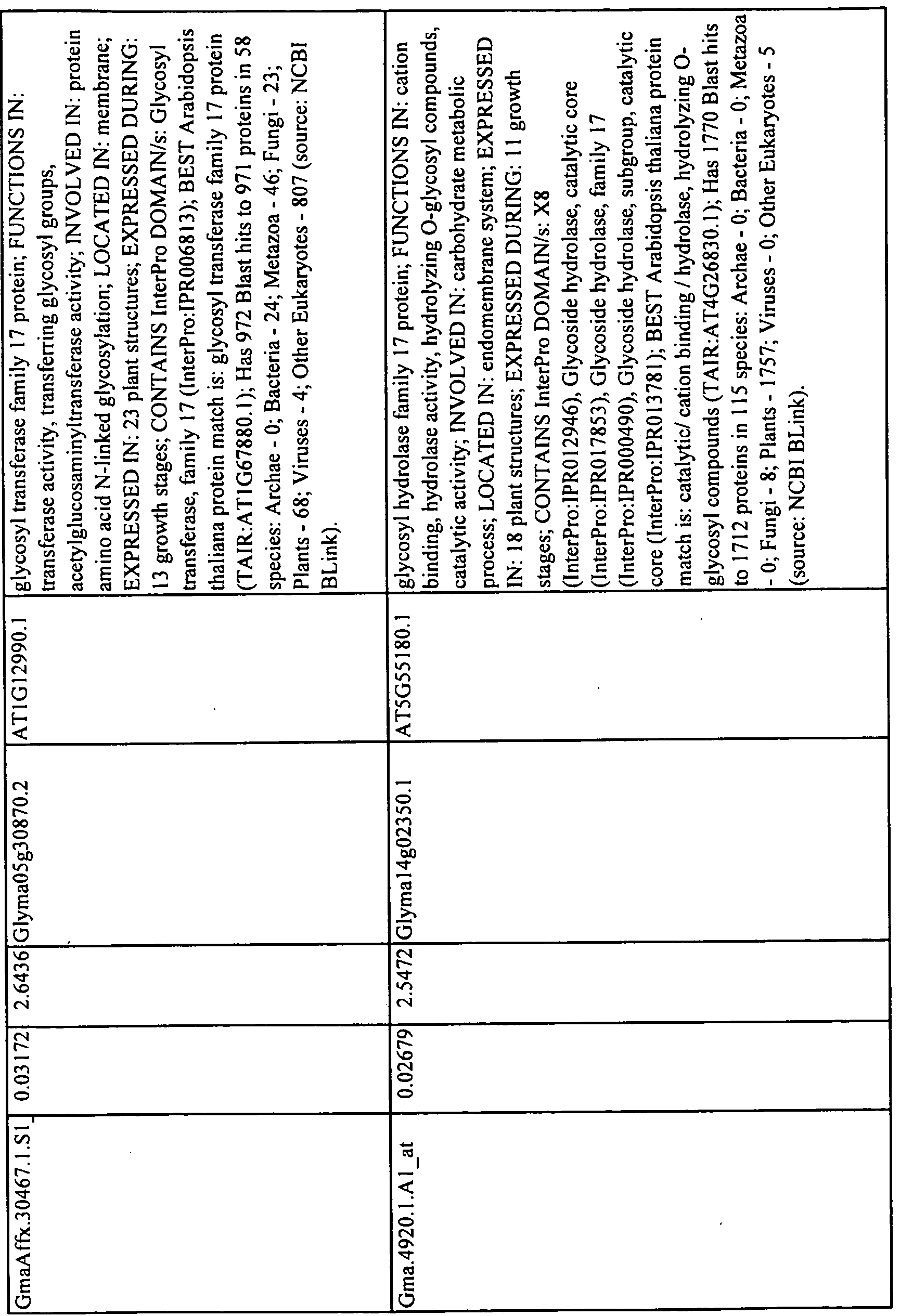


GmaAffx.87100. LS l 0.06613 -8.5106 Glymal2g02330.1 AT4G 10320.1 isoleucyl-tRNA synthetase, putative / isoleucine—tRNA ligase, putative; FUNCTIONS IN: isoleucine-tRNA ligase activity, nucleotide binding, aminoacyl-tRNA ligase activity, ATP binding; INVOLVED IN: response to cadmium ion, tRNA aminoacylation for protein translation; LOCATED IN: cytosol; EXPRESSED ΓΝ: male gametophyte, guard cell, epidermis, cultured cell, pollen tube; EXPRESSED DURING: L mature pollen stage, M germinated pollen stage; CONTAINS InterPro DOMAIN/s: Aminoacyl-tRNA synthetase, class I, conserved site (InterPro:IPR001412), Isoleucyl-tRNA synthetase
(InterPro:IPR018353), Isoleucyl-tRNA synthetase, class la (InterPro:IPR002301 ), Aminoacyl-tRNA synthetase, class l a, anticodon-binding (InterPro:IPR009080), Isoleucyl-tRNA synthetase, class la, N-terminal (InterPro: IPR015905), Rossmann- like alpha/beta/alpha sandwich fold (InterPro:IPR014729), Valyl/Leucyl Isoleucyl-tRNA synthetase, class la, editing (InterPro:IPR009008), Valyl/Leucyl/Isoleucyl-tRNA synthetase, class I, anticodon-binding (InterPro:IPR013155), Aminoacyl- tRNA synthetase, class la (InterPro:IPR002300); BEST Arabidop:


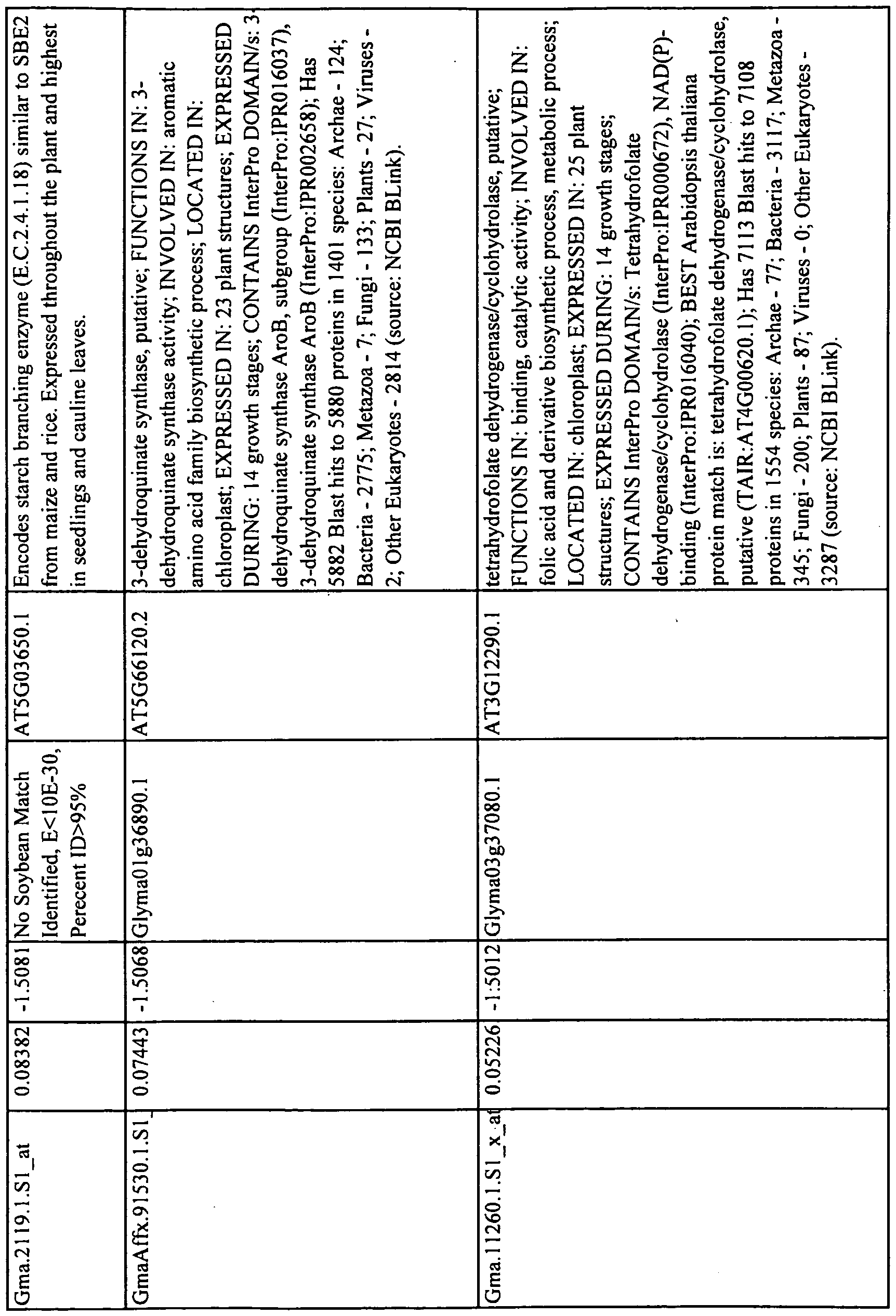


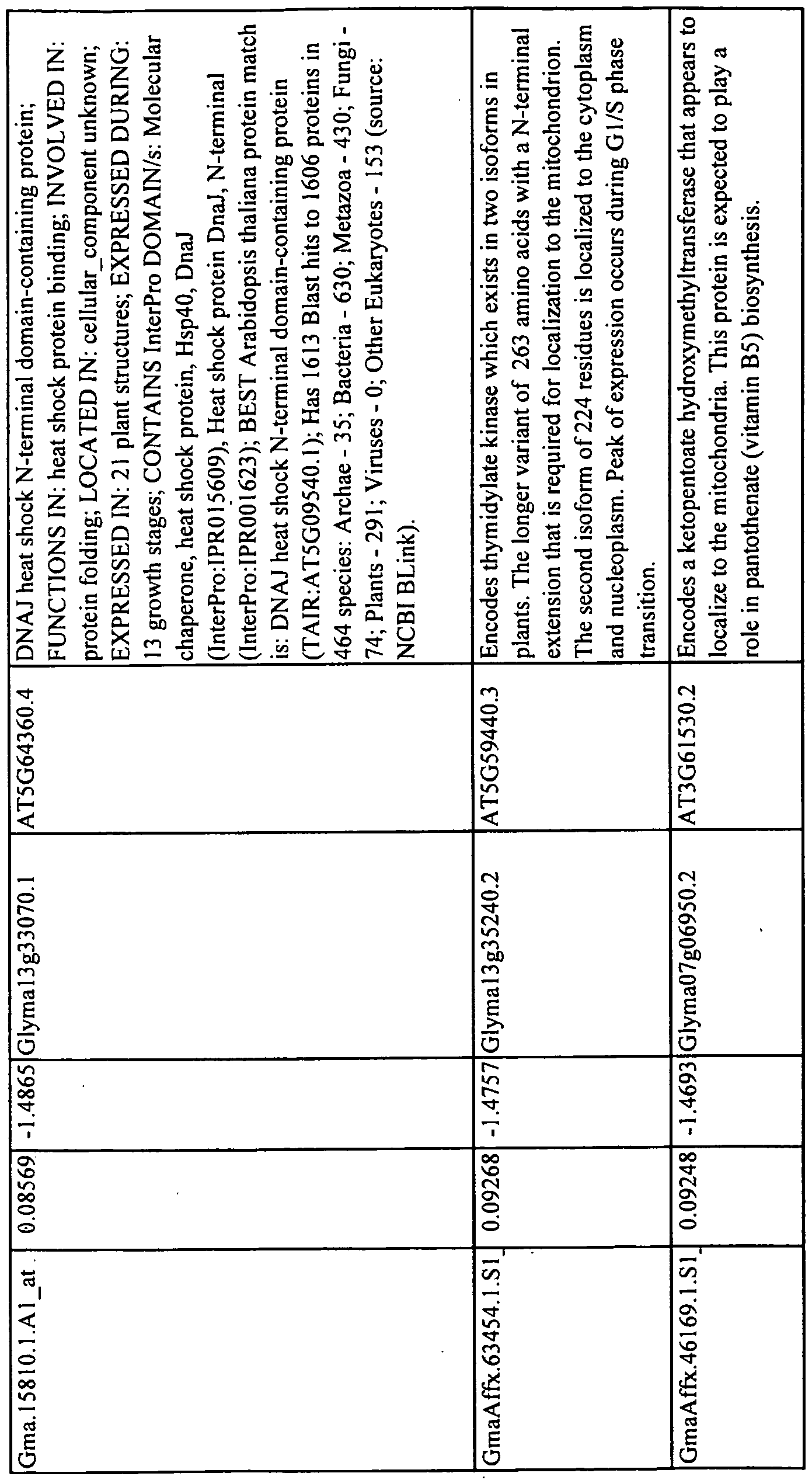

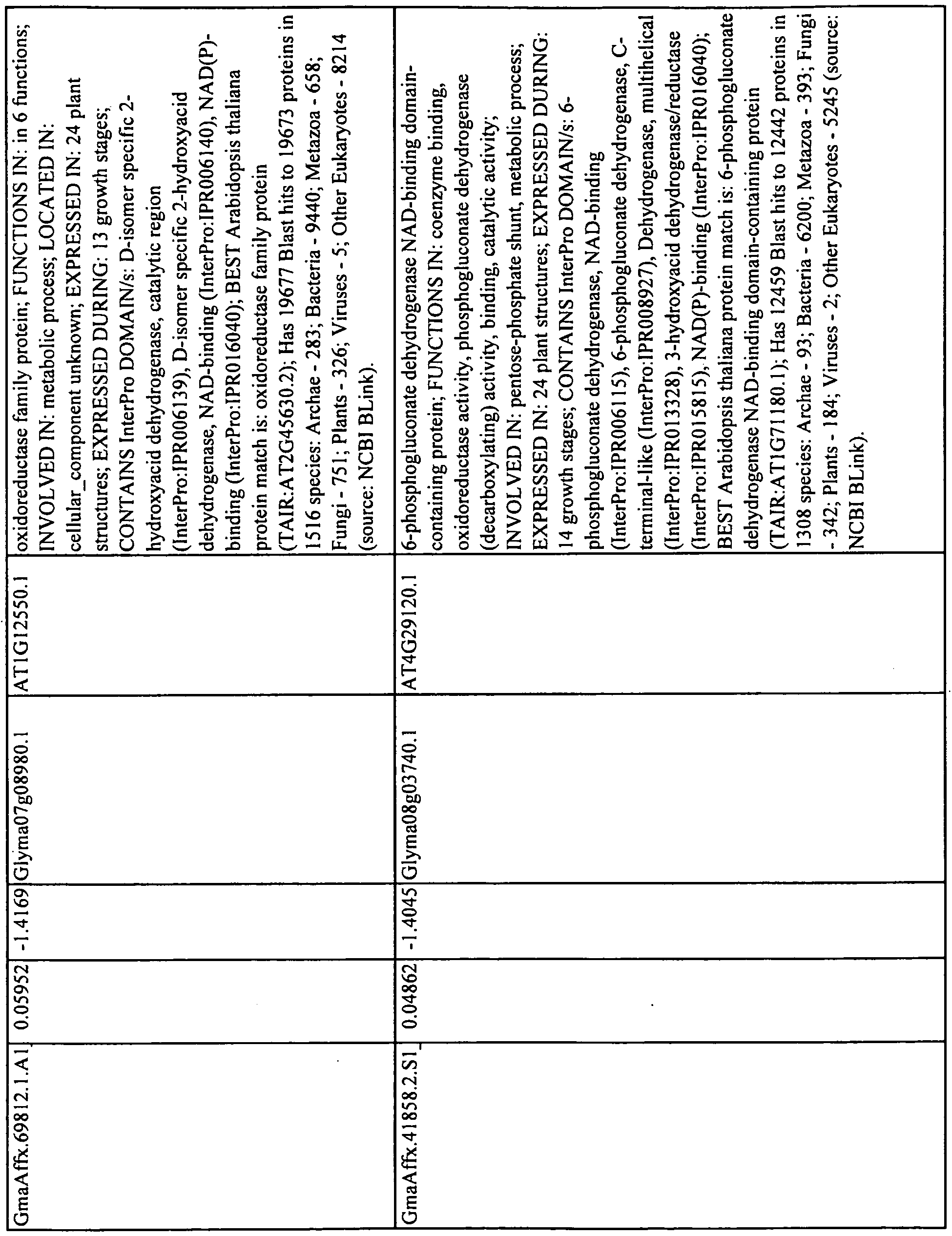


Table 4 Other Candidate enes


Gma.6778. ! .A l at 0.00857 5.5762 Glyma06g02900.1 AT1 G75620.1 glyoxal oxidase-related; FUNCTIONS IN:
molecular_function unknown; INVOLVED ΓΝ:
biological_process unknown; LOCATED IN:
endomembrane system; EXPRESSED IN: flower, root; EXPRESSED DURING: 4 anthesis; CONTAINS InterPro DO AIN/s: Galactose oxidase/kelch, beta-propeller (InterPro:IPR01 1043), Galactose oxidase, beta-propeller (InterPro:IPR015916), Immunoglobulin E-set
(InterPro:IPR014756), Glyoxal oxidase, N-terminal (InterPro:IPR009880), Region of unknown function DUF 1929 (InterPro:IPR015202); BEST Arabidopsis thaliana protein match is: glyoxal oxidase-related (TAIR:AT1G 19900.1 ); Has 563 Blast hits to 561 proteins in 1 14 species: Archae - 0; Bacteria - 228; Metazoa - 0; Fungi - 169; Plants - 152; Viruses - 0; Other Eukaryotes - 14 (source: NCBI BLink).
Gma.8859.1.A l at 0.03369 5.1687 Glymal 5g03 1 10.1 AT1G72790.1 hydroxyproline-rich glycoprotein family protein;
FUNCTIONS IN: molecular_function unknown;
INVOLVED IN: biological_process unknown; LOCATED IN: cytosol, nucleus, plasma membrane; EXPRESSED IN: 14 plant structures; EXPRESSED DURING: 9 growth stages; BEST Arabidopsis thaliana protein match is: hydroxyproline-rich glycoprotein family protein
(TAIR:AT5G57070.1 ); Has 15974 Blast hits to 9634 proteins in 554 species: Archae - 27; Bacteria - 1047; Metazoa - 6923; Fungi - 2241 ; Plants - 3444; Viruses - 1523; Other Eukaryotes - 1769 (source: NCBI BLink).


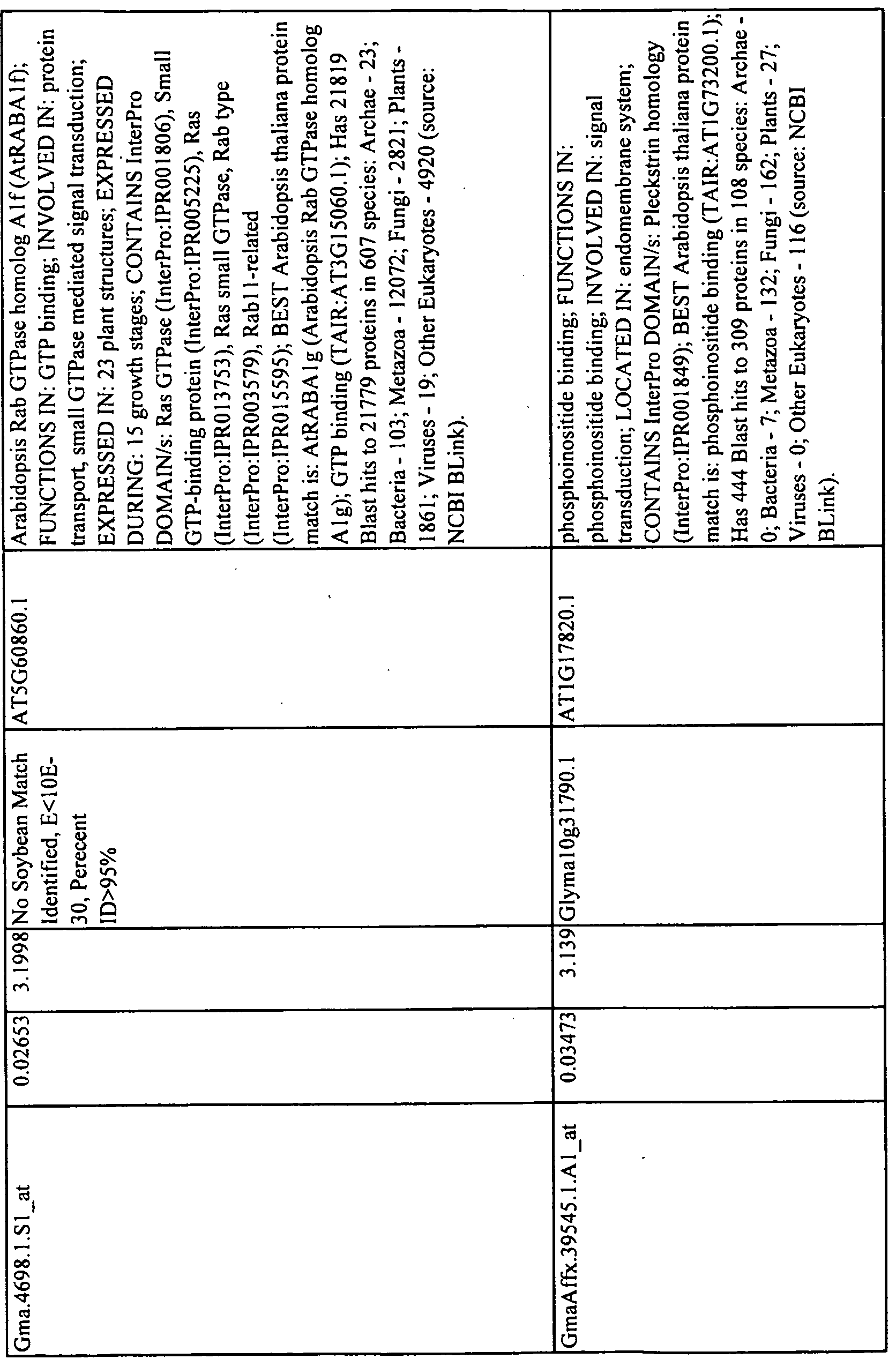


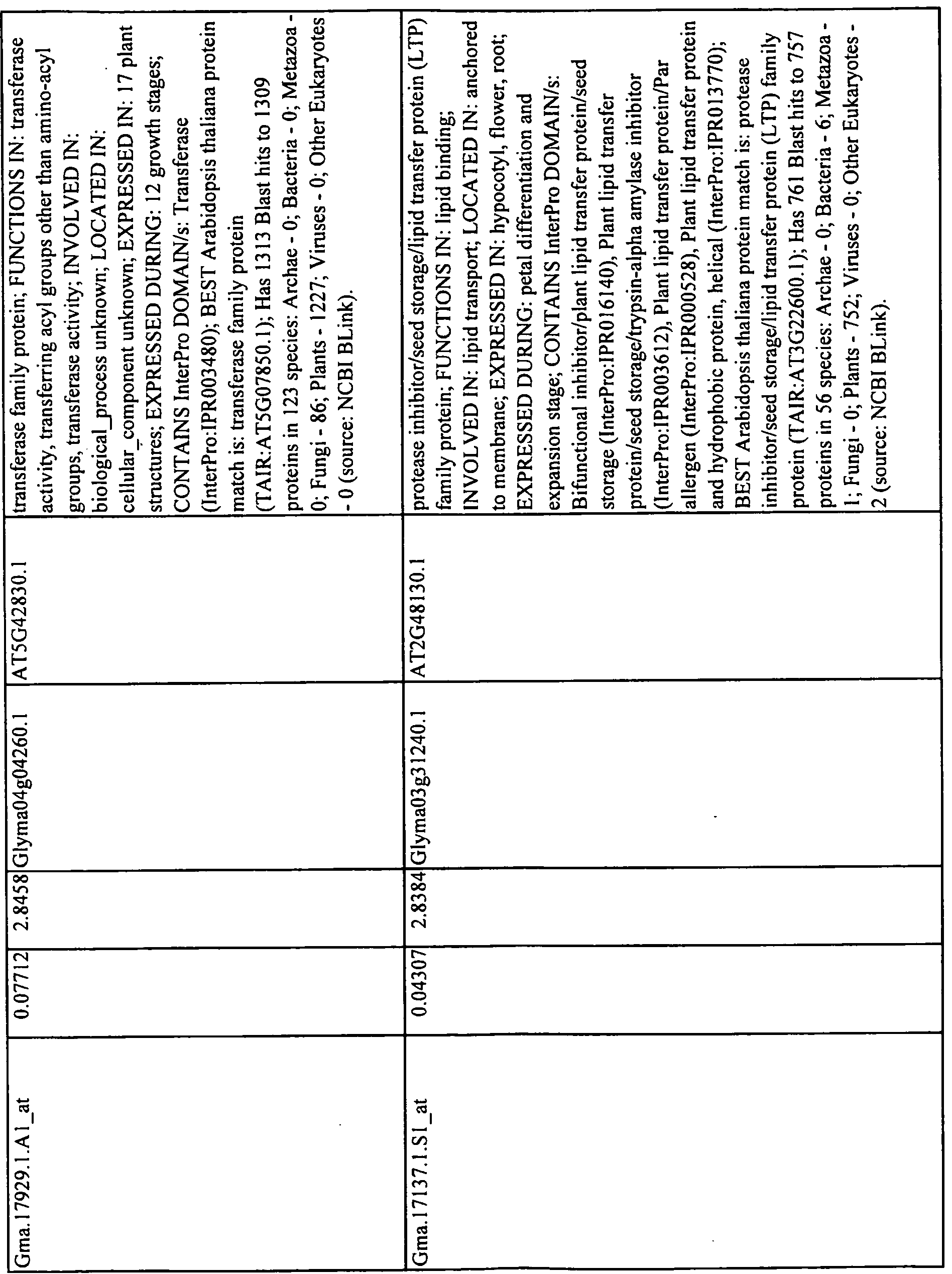

Gma.433 1.2.S l at 0.06925 2.668 Glyma20g 10310.1 AT3G43720.2 protease inhibitor/seed storage/Iipid transfer protein (LTP) family protein; FUNCTIONS IN: lipid binding;
INVOLVED IN: lipid transport; LOCATED IN: anchored to membrane, membrane; EXPRESSED IN: 22 plant structures; EXPRESSED DURING: 13 growth stages; CONTAINS InterPro DOMAIN/s: Bifunctional inhibitor/plant lipid transfer protein/seed storage
(InterPro:IPR016140), Plant lipid transfer protein/seed storage/trypsin-alpha amylase inhibitor
(InterPro:IPR003612); BEST Arabidopsis thaliana protein match is: protease inhibitor/seed storage/Iipid transfer protein (LTP) family protein (TAIR:AT2G27130.1 ); Has 404 Blast hits to 402 proteins in 17 species: Archae - 0; Bacteria - 0; Metazoa - 0; Fungi - 0; Plants - 404; Viruses - 0; Other Eukaryotes - 0 (source: NCBI BLink).
GmaAffx.57046.1.S l at 0.04759 2.6565 Glymal l g08540.1 AT4G35840.1 zinc finger (C3HC4-type RING finger) family protein;
FUNCTIONS IN: protein binding, zinc ion binding; CONTAINS InterPro DOMAIN/s: Zinc finger, RING- type, conserved site (InterPro.IPRO l 7907), Zinc finger, RING-type (InterPro:IPR001841), Zinc finger,
RING/FYVE/PHD-type (InterPro:IPR013083); BEST Arabidopsis thaliana protein match is: zinc finger (C3HC4- type RING finger) family protein (TAIR:AT2G 17730.1 ); Has 5941 Blast hits to 5924 proteins in 207 species:
Archae - 0; Bacteria - 2; Metazoa - 1867; Fungi - 423; Plants - 2717; Viruses - 21 ; Other Eukaryotes - 91 1 (source: NCBI BLink).


Gma.13245.1. S I at 0.09647 2.1448 Glymal 5g3 1290. AT4G25150.1 acid phosphatase, putative; FUNCTIONS IN: acid
phosphatase activity; INVOLVED IN: biological_process unknown; LOCATED IN: endomembrane system;
EXPRESSED IN: 21 plant structures; EXPRESSED DURING: 9 growth stages; CONTAINS InterPro DOMAIN/s: Acid phosphatase (Class B)
(InterPro:IPR005519), Vegetative storage protein/acid phosphatase (InterPro:IPR014403), Acid phosphatase, plant (InterPro:IPR010028); BEST Arabidopsis thaliana protein match is: acid phosphatase, putative
(TAIR:AT5G51260.1 ); Has 559 Blast hits to 559 proteins in 162 species: Archae - 0; Bacteria - 269; Metazoa - 2; Fungi - 0; Plants - 241 ; Viruses - 0; Other Eukaryotes - 47 (source: NCBI BLink).
Gma.15570.1. S I s at 0.07224 2.1342 Glymal 8gl 7580.1 AT1G 13750.1 calcineurin-like phosphoesterase family protein;
FUNCTIONS IN: hydrolase activity, protein serine/threonine phosphatase activity, metal ion binding, acid phosphatase activity; INVOLVED IN:
biological_process unknown; LOCATED IN:
endomembrane system; EXPRESSED IN: 21 plant structures; EXPRESSED DURING: 13 growth stages; CONTAINS InterPro DOMAIN/s: Purple acid phosphatase, N-terminal (InterPro: I PRO 15914),
Metallophosphoesterase (InterPro:IPR004843),
Fibronectin, type III (InterPro:IPR003961 ), Purple acid phosphatase-like, N-terminal (InterPro:IPR008963); BEST Arabidopsis thaliana protein match is: PAP27 (PURPLE ACID PHOSPHATASE 27); acid phosphatase/ protein serine/threonine phosphatase (TAIR:AT5G50400.1 ); Has 1 1 13 Blast hits to 1 105 proteins in 225 species: Archae - 0; Bacteria - 236; Metazoa - 176; Fungi - 60; Plants - 415; Viruses - 0; Other Eukaryotes - 226 (source: NCBI BLink).
Gma.7140.1.S l at 0.0687 2.1 158 Glymal 0g34220.2 AT5G04430.2 Gene model AT5G04430.1 produces active protein.
(BTS 1 S). Binds to ToMV genomic RNA and prevents viral miiltinliratinn


GmaAffx. l 692 I . l .S l at 0.0881 1.938 Glyma20g26770.1 AT4G33920.1 protein phosphatase 2C family protein / PP2C family protein; FUNCTIONS IN: protein serine/threonine phosphatase activity, catalytic activity; INVOLVED IN: protein amino acid dephosphorylation; LOCATED IN: mitochondrion, protein serine/threonine phosphatase complex; EXPRESSED IN: 23 plant structures;
EXPRESSED DURING: 13 growth stages; CONTAINS InterPro DOMAIN/s: Protein phosphatase 2C, manganese/magnesium aspartate binding site
(InterPro:IPR000222), Protein phosphatase 2C-related (InterPro:IPR001932), Protein phosphatase 2C
(InterPro.IPRO 15655), Protein phosphatase 2C, N-terminal (InterPro:IPR014045); BEST Arabidopsis thaliana protein match is: protein phosphatase 2C, putative / PP2C, putative (TAIR:AT3G51370.1 ); Has 3521 Blast hits to 3519 proteins in 216 species: Archae - 0; Bacteria - 7; Metazoa - 1 157; Fungi - 386; Plants - 1254; Viruses - 3; Other Eukaryotes - 714 (source: NCBI BLink).
Gma.1494.1. SI x at 0.09907 1.93 14 Glymal 7gl 1940.1 AT2G 10940.2 protease inhibitor/seed storage/lipid transfer protein (LTP) family protein; FUNCTIONS IN: lipid binding;
INVOLVED IN: lipid transport; LOCATED IN:
chloroplast thylakoid membrane, apoplast, chloroplast, membrane; EXPRESSED IN: 21 plant structures;
EXPRESSED DURING: 13 growth stages; CONTAINS InterPro DOMAI /s: Bifunctional inhibitor/plant lipid transfer protein seed storage (InterPro:IPR016140), Plant lipid transfer protein/seed storage/trypsin-alpha amylase inhibitor (InterPro:lPR003612), Plant lipid transfer protein and hydrophobic protein, helical (InterPro:IPR013770); BEST Arabidopsis thaliana protein match is: protease inhibitor/seed storage/lipid transfer protein (LTP) family protein (TAIR:AT1G62500.1 ); Has 41695 Blast hits to 15869 proteins in 1031 species: Archae - 182; Bacteria - 8355; Metazoa - 15253; Fungi - 3374; Plants - 6727; Viruses - 1536; Other Eukaryotes - 6268 (source: NCBI BLink).
Gma.2331.3.A l at 0.04783 1.9173 Glyma06g09810.1 AT5G49700.1 DNA-binding protein-related; INVOLVED ΓΝ:
biological_process unknown; EXPRESSED IN: shoot apex, embryo, inflorescence meristem; EXPRESSED DURING: D bilateral stage; CONTAINS InterPro DOMAIN/s: Protein of unknown function DUF296 (InterPro:IPR005175), Predicted AT-hook DNA-binding (InterPro:IPR014476); BEST Arabidopsis thaliana protein match is: DNA-binding protein-related
(TAIR:AT1 G 14490.1 ); Has 424 Blast hits to 423 proteins in 20 species: Archae - 0; Bacteria - 2; Metazoa - 3; Fungi 2; Plants - 417; Viruses - 0; Other Eukaryotes - 0 (source: NCBI BLink).


GmaAffx.16649. LS I s at 0.04759 1.6303 Glymal 8g01550.1 AT3G26100.2 regulator of chromosome condensation (RCC 1 ) family protein; FUNCTIONS IN: Ran GTPase binding;
INVOLVED IN: biological_process unknown;
EXPRESSED IN: 24 plant structures; EXPRESSED DURING: 13 growth stages; CONTAINS InterPro DOMAIN/s: Regulator of chromosome condensation/beta- lactamase-inhibitor protein II (InterPro:IPR009091 ), Regulator of chromosome condensation, RCC 1
(InterPro: IPR000408); BEST Arabidopsis thaliana protein match is: regulator of chromosome condensation (RCC1 ) family protein (TAIR:AT3G 15430.2); Has 13018 Blast hits to 3813 proteins in 266 species: Archae - 62; Bacteria 1274; Metazoa - 6169; Fungi - 625; Plants - 1234; Viruses 2; Other Eukaryotes - 3652 (source: NCBI BLink).
GmaAffx.88042. ] .A 1 at 0.07994 1.6301 Glyma05g08780.1 AT5G 14580.1 polyribonucleotide nucleotidyltransferase, putative;
FUNCTIONS IN: polyribonucleotide
nucleotidyltransferase activity, 3'-5'-exoribonuclease activity, RNA binding, nucleic acid binding; INVOLVED ΓΝ: mRNA catabolic process, RNA processing;
EXPRESSED IN: 16 plant structures; EXPRESSED DURING: 7 growth stages; CONTAINS InterPro DOMAIN/s: Nucleic acid-binding, OB-fold
(InterPro:IPR012340), Homology, type 1, subgroup (InterPro:IPR0181 1 1 ), Exoribonuclease, phosphorolytic domain 2 (InterPro:IPR015847), S I , RNA binding (InterPro: I PR003029), Polynucleotide phosphorylase, phosphorolytic RNA-binding, bacterial/organelle-type (InterPro:IPR015848), Nucleic acid-binding, OB-fold-like (InterPro:IPR016027), K Homology
(InterPro: IPR004087), Exoribonuclease, phosphorolytic domain 1 (InterPro:IPR001247), Polyribonucleotide nucleotidyltransferase (InterPro:IPR012162); BEST Arabidopsis thaliana protein match is: RIF 10 (resistant to
CO
inhibition with FSM 10); 3'-5'-exoribonuclease/ RNA binding / nucleic acid binding / polyribonucleotide nucleotidyltransferase (TAIR:AT3G03710.1 ); Has 19856 I

GmaAffx.77170.1. SI at 0.05138 .5572 Glymal 0g26240.3 AT2G34260.1 transducin family protein / WD-40 repeat family protein;
FUNCTIONS IN: nucleotide binding; LOCATED IN: CUL4 RING ubiquitin ligase complex, heterotrimeric G- protein complex; EXPRESSED ΓΝ: 23 plant structures; EXPRESSED DURING: 13 growth stages; CONTAINS InterPro DOMAI /s: WD40 repeat-like
(InterPro:IPR01 1046), WD40 repeat, region
(InterPro:IPR017986), WD40 YVTN repeat-like
(InterPro:IPR015943), WD40 repeat
(InterPro:IPR001680), WD repeat protein 55
(InterPro:IPR0 l7422); BEST Arabidopsis thaliana protein match is: transducin family protein / WD-40 repeat family protein (TAIR:AT2G43770.1 ); Has 16318 Blast hits to 9709 proteins in 465 species: Archae - 44; Bacteria - 3325; Metazoa - 6190; Fungi - 3093; Plants - 1 1 10; Viruses - 0; Other Eukaryotes - 2556 (source: NCBI BLink).
GmaAffx.93010.1.S l s at 0.07409 1.5558 Glyma04g37370.3 AT5G63490.1 CBS domain-containing protein /
octicosapeptide Phox/Bempl (PB 1) domain-containing protein; EXPRESSED IN: 24 plant structures;
EXPRESSED DURING: 15 growth stages; CONTAINS InterPro DOMAIN/s: Octicosapeptide/Phox/Bem lp (InterPro:IPR000270), Cystathionine beta-synthase, core (InterPro:IPR000644); BEST Arabidopsis thaliana protein match is: CBS domain-containing protein /
octicosapeptide/Phox Bempl (PB 1 ) domain-containing protein (TAIR:AT5G50640.1 ); Has 5094 Blast hits to 4096 proteins in 849 species: Archae - 605; Bacteria - 3227; Metazoa - 2; Fungi - 80; Plants - 120; Viruses - 0; Other Eukaryotes - 1060 (source: NCBI BLink).


Gma. l 3939.1.S1 at 0.0398 -2.161 1 Glymal 7gl 0420.1 AT5G62670.1 Arabidopsis H(+)-ATPase 1 1 (AHA 1 1 ); FUNCTIONS IN:
ATPase activity; INVOLVED IN: cation transport, metabolic process, ATP biosynthetic process; LOCATED IN: plasma membrane, membrane; EXPRESSED IN: 26 plant structures; EXPRESSED DURING: 14 growth stages; CONTAINS InterPro DOMAI /s: ATPase, P-type, ATPase-associated region (InterPro:IPR008250), ATPase, P-type cation-transporter, N-terminal
(InterPro:IPR004014), Haloacid dehalogenase-like hydrolase (lnterPro:IPR005834), ATPase, P-type, H+ transporting proton pump (InterPro:IPR000695), ATPase, P-type, /Mg/Cd/Cu/Zn/Na/Ca/Na/H-transporter (InterPro:IPR001757), ATPase, P-type, plasma-membrane proton-efflux (InterPro:IPR006534), ATPase, P-type phosphorylation site (InterPro:IPRO 18303); BEST Arabidopsis thaliana protein match is: AHA4; ATPase/ hydrogen-exporting ATPase, phosphorylative mechanism (TAIR:AT3G47950.1 ); Has 20808 Blast hits to 18623 proteins in 1829 species: Archae - 405; Bacteria - 1 1444; Metazoa - 3332; Fungi - 1581 ; Plants - 1 1 10; Viruses - 3; Other Eukaryotes - 2933 (source: NCBI BLink).


GmaAffx.41544. LS I at 0.09381 ■1.7587 Glyma03g22450.1 AT5G48460.1 fimbrin-like protein, putative; FUNCTIONS IN: actin binding; INVOLVED IN: biological_process unknown; EXPRESSED IN: 22 plant structures; EXPRESSED DURING: 13 growth stages; CONTAINS InterPro DOMAIN/s: Actinin-type, actin-binding, conserved site (InterPro:IPR001589), Calponin-homology
(InterPro:IPR016146), Calponin-like actin-binding (InterPro.IPROOl 715); BEST Arabidopsis thaliana protein match is: FIM2 (FIMBRIN-LIKE PROTEIN 2); actin binding (TAIR:AT5G35700.1 ); Has 2573 Blast hits to 1976 proteins in 141 species: Archae - 0; Bacteria - 0; Metazoa - 2069; Fungi - 216; Plants - 75; Viruses - 0; Other Eukaryotes - 213 (source: NCBI BLink).
Gma.6956.1.Al at 0.06877 -1.755 Glyma04g37810.2 AT5G07290.1 AML4 A member of mei2-like gene family,
predominantly plant-based family of genes encoding RNA binding proteins with characteristic presence of a highly conserved RNA binding motif first described in the mei2 gene of the fission yeast S. pombe. In silico analyses reveal nine mei2 -like genes in A. thaliana. They were grouped into four distinct clades, based on overall sequence similarity and subfamily-specific sequence elements. AML4 is a member of two sister clades of mei2- like gene family, AML1 through AML5, and belongs to the clade named ALM 14. AML4 is expressed during embryo development (heart and torpedo stage) and in vegetative and floral apices.


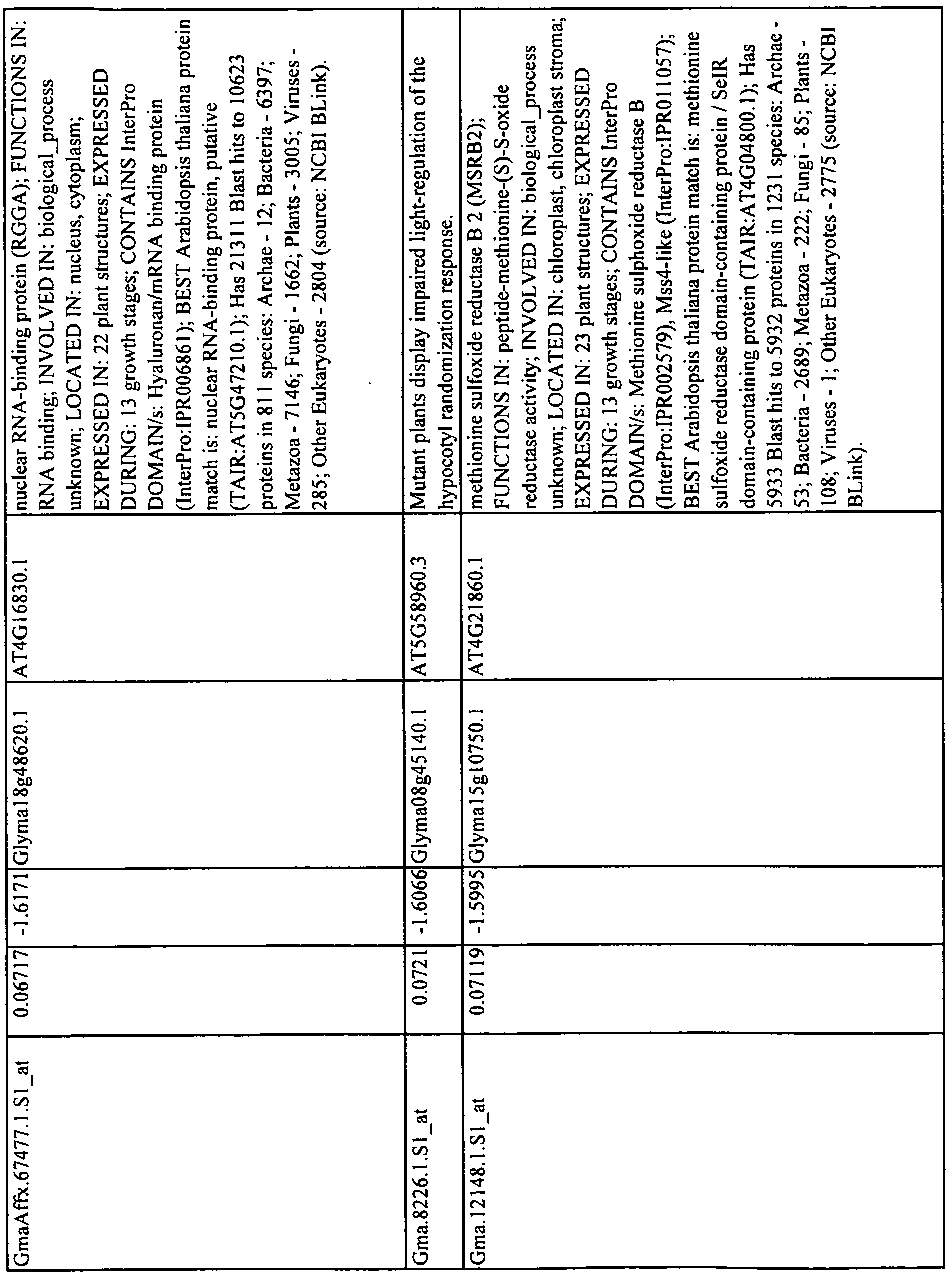


GmaAffx.91706.1. S I at 0.08056 ■1.1366 Glyma08g39880.2 AT4G 12790.4 ATP-binding family protein; FUNCTIONS IN: nucleotide binding, ATP binding; INVOLVED IN:
biological_process unknown; LOCATED IN:
cellular_component unknown; EXPRESSED IN: 23 plant structures; EXPRESSED DURING: 15 growth stages; CONTArNS InterPro DOMAIN/s: Protein of unknown function, ATP binding (InterPro:IPR004130); BEST Arabidopsis thaliana protein match is: QQT1 (QUATRE- QUART 1 ); ATP binding / nucleotide binding
(TAIR:AT5G22370.2); Has 1073 Blast hits to 1063 proteins in 199 species: Archae - 79; Bacteria - 0; Metazoa - 345; Fungi - 272; Plants - 80; Viruses - 0; Other Eukaryotes - 297 (source: NCBI BLink).
00
Table 5 Candidate enes related to hormones


Table 6 Candidate enes related to roteol sis

GmaAffx.69637.1.Sl 0.083 3.8723 Glymal2g06860.1 AT3G46510.1 Encodes a protein containing a UND, a U-box, and an ARM at domain. This protein has E3 ubiquitin ligase activity based on in
vitro assays.
Gma.7923.1.Al at 0.078 3.46428 Glymal7g09850.1 AT1G60190.1 armadillo/beta-catenin repeat family protein / U-box domain- containing protein; FUNCTIONS IN: ubiquitin-protein ligase activity, protein binding, binding, zinc ion binding; INVOLVED IN: protein ubiquitination; LOCATED IN: ubiquitin ligase complex; EXPRESSED IN: 6 plant structures; EXPRESSED DURING: 4 anthesis, petal differentiation and expansion stage; CONTAINS InterPro DOMAIN/s: Zinc finger, RING-type
(lnterPro:IPR001841), U box (lnterPro:IPR003613), Zinc finger, RING/FYVE/PHD-type (lnterPro:IPR013083), Armadillo-like helical (lnterPro:IPR011989), Armadillo (lnterPro:IPR000225), Armadillo-type fold (lnterPro:IPR016024); BEST Arabidopsis thaliana protein match is: PUB18 (PLANT U-BOX 18); ubiquitin- protein ligase (TAIR:AT1G10560.1); Has 1664 Blast hits to 1609 proteins in 143 species: Archae - 2; Bacteria - 20; Metazoa - 246; Fungi - 74; Plants - 1136; Viruses - 3; Other Eukaryotes - 183 (source: NCBI BLink).
Gma.l3446.1.Al at 0.048 2.95269 Glyma04g41060.1 AT2G46620.1 AAA-type ATPase family protein; FUNCTIONS IN: nucleoside- triphosphatase activity, ATPase activity, nucleotide binding, ATP binding; LOCATED IN: endomembrane system; EXPRESSED IN: 22 plant structures; EXPRESSED DURING: 13 growth stages; CONTAINS InterPro DOMAIN/s: ATPase, AAA-type, core (lnterPro:IPR003959), ATPase^ AAA+ type, core
(lnterPro:IPR003593); BEST Arabidopsis thaliana protein match is: AAA-type ATPase family protein (TAIR:AT3G28580.1); Has 9837 Blast hits to 9388 proteins in 1303 species: Archae - 597; Bacteria - 2959; Metazoa - 1717; Fungi - 1281; Plants - 860; Viruses - 16; Other Eukaryotes - 2407 (source: NCBI BLink).
GmaAffx.60513.1.Sl 0.06 2.89526 Glyma07g39990.1 AT5G59810.1 SBT5.4; FUNCTIONS IN: identical protein binding, serine-type at endopeptidase activity; INVOLVED IN: proteolysis, negative regulation of catalytic activity; EXPRESSED IN: 12 plant structures; EXPRESSED DURING: 4 anthesis, C globular stage, petal differentiation and expansion stage; CONTAINS InterPro DOMAIN/s: Protease-associated PA (lnterPro:IPR003137), Proteinase inhibitor, propeptide (lnterPro:IPR009020), Peptidase S8 and S53, subtilisin, kexin, sedolisin
(lnterPro:IPR000209), Peptidase S8, subtilisin-related
(lnterPro:IPR015500), Proteinase inhibitor 19, subtilisin propeptide (lnterPro:IPR010259); BEST Arabidopsis thaliana protein match is: AIR3; serine-type endopeptidase
(TAIR:AT2G04160.1); Has 3746 Blast hits to 3395 proteins in 608 species: Archae - 118; Bacteria - 2110; Metazoa - 79; Fungi - 147; Plants - 899; Viruses - 0; Other Eukaryotes - 393 (source: NCBI BLink).
Gma.5964.1.Sl at 0.048 2.61819 Ambiguous Hit AT3G13235.1 ubiquitin family protein; FUNCTIONS IN: aspartic-type
endopeptidase activity; INVOLVED IN: response to cadmium ion; LOCATED IN: cytosol, nucleus; EXPRESSED IN: 24 plant structures; EXPRESSED DURING: 13 growth stages; CONTAINS InterPro DOMAIN/s: Ubiquitin-associated/translation elongation factor EF1B, N-terminal, eukaryote (lnterPro:IPR015940), Ubiquitin-associated/translation elongation factor EF1B, N- terminal (lnterPro:IPR000449), Peptidase A2A, retrovirus, catalytic (lnterPro:IPR001995), Peptidase aspartic, catalytic (lnterPro:IPR009007), Ubiquitin (lnterPro:IPR000626), UBA-like (lnterPro:IPR009060); Has 6366 Blast hits to 3177 proteins in 509 species: Archae - 0; Bacteria - 2; Metazoa - 2716; Fungi - 819; Plants - 1543; Viruses - 81; Other Eukaryotes - 1205 (source: NCBI BLink).
GmaAffx.79762.1.Sl 0.062 2.51765 Glyma06gll990.1 AT1G44130.1 nucellin protein, putative; FUNCTIONS IN: aspartic-type at endopeptidase activity; INVOLVED IN: proteolysis; LOCATED IN:
plant-type cell wall; EXPRESSED IN: stem, embryo, pedicel, stamen; EXPRESSED DURING: 4 anthesis, C globular stage, petal differentiation and expansion stage; CONTAINS InterPro DOMAIN/s: Peptidase aspartic, catalytic (lnterPro:IPR009007), Peptidase Al (lnterPro:IPR001461), Peptidase aspartic, active site (lnterPro:IPR001969); BEST Arabidopsis thaliana protein match is: nucellin protein, putative (TAIR:AT1G77480.2); Has 1109 Blast hits to 1105 proteins in 75 species: Archae - 0; Bacteria - 0; Metazoa - 30; Fungi - 22; Plants - 1004; Viruses - 0; Other Eukaryotes - 53 (source: NCBI BLink).
GmaAffx.l5783.1.Al 0.027 2.41774 Glyma03g31740.1 AT4G03030.1 kelch repeat-containing F-box family protein; FUNCTIONS IN: at molecular_function unknown; INVOLVED IN: biological_process unknown; LOCATED IN: chloroplast; EXPRESSED IN: 24 plant structures; EXPRESSED DURING: 15 growth stages; CONTAINS InterPro DOMAIN/s: Cyclin-like F-box (lnterPro:IPR001810), Galactose oxidase/kelch, beta-propeller (lnterPro:IPR011043), Kelch repeat type 1 (lnterPro:IPR006652), Kelch related (lnterPro:IPR013089), Kelch-type beta propeller
(lnterPro:IPR015915); BEST Arabidopsis thaliana protein match is: kelch repeat-containing F-box family protein
(TAIR:AT3G63220.2); Has 1405 Blast hits to 1314 proteins in 98 species: Archae - 0; Bacteria - 31; Metazoa - 962; Fungi - 4; Plants - 358; Viruses - 9; Other Eukaryotes - 41 (source: NCBI BLink).
GmaAffx.93148.1.Sl 0.055 2.38703 Glymallg35820.1 AT3G56190.1 Encodes one of two alpha-SNAPs (soluble NSF attachment at protein) in Arabidopsis


GmaAffx.86415.1.Sl 0.06 1.3649 Glyma09g04090.1 AT3G17000.1 ubiquitin-conjugating enzyme 32 (UBC32); FUNCTIONS IN: at ubiquitin-protein ligase activity; INVOLVED IN: ubiquitin- dependent protein catabolic process; LOCATED IN:
cellular component unknown; EXPRESSED IN: 23 plant structures; EXPRESSED DURING: 15 growth stages; CONTAINS InterPro DOMAIN/s: Ubiquitin-conjugating enzyme/RWD-like (lnterPro:IPR016135), Ubiquitin-conjugating enzyme, E2 (lnterPro:IPR000608); BEST Arabidopsis thaliana protein match is: UBC34 (ubiquitin-conjugating enzyme 34); ubiquitin-protein ligase (TAIR:AT1G17280.2); Has 5810 Blast hits to 5810 proteins in 294 species: Archae - 0; Bacteria - 0; Metazoa - 2855; Fungi - 1053; Plants - 896; Viruses - 16; Other Eukaryotes - 990 (source: NCBI BLink).
GmaAffx.57400.1.Al 0.063 -6.3978 No Soybean Match AT1G28110.2 SERINE CARBOXYPEPTIDASE-LIKE 45 PRECURSOR (SCPL45); at Identified, E<10E-30, FUNCTIONS IN: serine-type carboxypeptidase activity;
Perecent ID>95% INVOLVED IN: proteolysis; LOCATED IN: plant-type cell wall;
EXPRESSED IN: 21 plant structures; EXPRESSED DURING: 13
CD growth stages; CONTAINS InterPro DOMAIN/s: Peptidase S10, serine carboxypeptidase (lnterPro:IPR001563), Peptidase S10, serine carboxypeptidase, active site (lnterPro:IPR018202); BEST Arabidopsis thaliana protein match is: scpl46 (serine carboxypeptidase-like 46); serine-type carboxypeptidase (TAIR:AT2G33530.1); Has 2581 Blast hits to 2531 proteins in 335 species: Archae - 0; Bacteria - 249; Metazoa - 573; Fungi - 560; Plants - 874; Viruses - 0; Other Eukaryotes - 325 (source: NCBI BLink).
GmaAffx.55671.2.Sl 0.095 -3.9231 Glymal6g24270.1 AT4G36195.1 serine carboxypeptidase S28 family protein; FUNCTIONS IN: at serine-type peptidase activity; INVOLVED IN: proteolysis;
LOCATED IN: plasma membrane, vacuole, plant-type cell wall; EXPRESSED IN: stem, guard cell, cultured cell; CONTAINS InterPro DOMAIN/s: Peptidase S28 (lnterPro:IPR008758); BEST Arabidopsis thaliana protein match is: serine-type peptidase (TAIR:AT4G36190.1); Has 912 Blast hits to 876 proteins in 118 species: Archae - 0; Bacteria - 16; Metazoa - 518; Fungi - 136; Plants - 101; Viruses - 0; Other Eukaryotes - 141 (source: NCBI BLink).
GmaAffx.20786.1.Al 0.045 -3.442 Glymal7g04120.2 AT3G17180.1 serine carboxypeptidase-like 33 (scpl33); FUNCTIONS IN: serine- at type carboxypeptidase activity; INVOLVED IN: proteolysis;
LOCATED IN: endomembrane system; EXPRESSED IN: shoot apex, flower, root, stamen; EXPRESSED DURING: 4 anthesis, petal differentiation and expansion stage; CONTAINS InterPro DOMAIN/s: Peptidase S10, serine carboxypeptidase
N3 (lnterPro:IPR001563), Peptidase S10, serine carboxypeptidase, active site (lnterPro:IPR018202); BEST Arabidopsis thaliana protein match is: SCPL34; serine-type carboxypeptidase (TAIR:AT5G23210.1); Has 2555 Blast hits to 2510 proteins in 313 species: Archae - 0; Bacteria - 191; Metazoa - 568; Fungi - 566; Plants - 899; Viruses - 0; Other Eukaryotes - 331 (source: NCBI BLink).


Gma.l6526.1.Sl at 0.066 -1.9568 Glymal3g03850.1 AT3G12203.1 serine carboxypeptidase-like 17 (scpll7); FUNCTIONS IN: serine- type carboxypeptidase activity; INVOLVED IN: proteolysis; LOCATED IN: endomembrane system; CONTAINS InterPro DOMAIN/s: Peptidase 510, serine carboxypeptidase
(lnterPro:IPR001563), Peptidase S10, serine carboxypeptidase, active site (lnterPro:IPR018202); BEST Arabidopsis thaliana protein match is: scpll6 (serine carboxypeptidase-like 16); serine-type carboxypeptidase (TAIR:AT3G12220.1); Has 2528 Blast hits to 2469 proteins in 280 species: Archae - 0; Bacteria - 129; Metazoa - 563; Fungi - 548; Plants - 983; Viruses - 0; Other Eukaryotes - 305 (source: NCBI BLink).
GmaAffx.56692.1.Sl 0.063 -1.7793 Glyma07g07610.1 AT1G01650.1 aspartic-type endopeptidase/ peptidase; FUNCTIONS IN:
at peptidase activity, aspartic-type endopeptidase activity;
INVOLVED IN: proteolysis; LOCATED IN: endomembrane system, integral to membrane; EXPRESSED IN: 24 plant structures; EXPRESSED DURING: 13 growth stages; CONTAINS InterPro DOMAIN/s: Protease-associated PA (lnterPro:IPR003137), Peptidase A22, presenilin signal peptide (lnterPro:IPR006639), Peptidase A22B, signal peptide peptidase (lnterPro:IPR007369); BEST Arabidopsis thaliana protein match is: protease-associated (PA) domain-containing protein (TAIR:AT1G63690.1); Has 1108 Blast hits to 1084 proteins in 196 species: Archae - 0; Bacteria - 119; Metazoa - 534; Fungi - 104; Plants - 174; Viruses - 0; Other Eukaryotes - 177 (source: NCBI BLink).


Table 7 Candidate enes related to si nalin


6ma.5550.1.Sl at 0.0587 2.08001 Glymal6g28640.1 AT5642140.1 zinc finger protein, putative / regulator of chromosome
condensation ( CC1) family protein; FUNCTIONS IN:
chromatin binding, phosphoinositide binding, zinc ion binding, Ran GTPase binding; INVOLVED IN: signal transduction;
EXPRESSED IN: 18 plant structures; EXPRESSED DURING: 9 growth stages; CONTAINS InterPro DOMAIN/s: Regulator of chromosome condensation, RCC1 (lnterPro:IPR000408), Disease resistance/zinc finger/chromosome condensation-like region (lnterPro:IPR013591), Zinc finger, FYVE-type
(lnterPro:IPR000306), Regulator of chromosome
condensation/beta-lactamase-inhibitor protein II
(lnterPro:IPR009091), Zinc finger, FYVE-related
(lnterPro:IPR017455), Pleckstrin homology-type
(lnterPro:IPR011993), Zinc finger, FYVE/PHD-type
(InterPro.lPROllOll); BEST Arabidopsis thaliana protein match is: PRAF1; Ran GTPase binding / chromatin binding / zinc ion binding (TAIR:AT1G76950.1); Has 16862 Blast hits to 6456 proteins in 315 species: Archae - 38; Bacteria - 1318; Metazoa - 8172; Fungi - 719; Plants - 1471; Viruses - 3; Other Eukaryotes - 5141 (source: NCBI BLink).


GmaAffx.91247.1.Sl at 0.0274 1.78081 Glymal5g09490.1 AT4G18950.1 ankyrin protein kinase, putative; FUNCTIONS IN: protein serine/threonine/tyrosine kinase activity, kinase activity; INVOLVED IN: regulation of signal transduction, protein amino acid phosphorylation; LOCATED IN: nucleus, cytoplasm; EXPRESSED IN: 25 plant structures; EXPRESSED DURING: 14 growth stages; CONTAINS InterPro DOMAIN/s: Protein kinase, core (lnterPro:IPR000719), Integrin-linked protein kinase (lnterPro:IPR016253), Tyrosine protein kinase
(lnterPro:IPR001245), Serine/threonine protein kinase-related (lnterPro:IPR017442), Protein kinase-like
(lnterPro:IPR011009), Ankyrin (lnterPro:IPR002110); BEST Arabidopsis thaliana protein match is: ankyrin protein kinase, putative (TAIR:AT3G58760.1); Has 116131 Blast hits to 99643 proteins in 3446 species: Archae - 96; Bacteria - 9447;
Metazoa - 52988; Fungi - 8496; Plants - 19258; Viruses - 634; Other Eukaryotes - 25212 (source: NCBI BLink).
N3
CD
Gma.l6954.2.Al at 0.056 1.74475 Glymal8g03100.1 AT2G40116.1 phosphoinositide-specific phospholipase C family protein;
FUNCTIONS IN: phospholipase C activity, phosphoinositide phospholipase C activity, phosphoric diester hydrolase activity; INVOLVED IN: signal transduction, intracellular signaling cascade, lipid metabolic process; LOCATED IN:
cellular_component unknown; CONTAINS InterPro DOMAIN/s: Phospholipase C, phosphoinositol-specific, EF-hand-like (lnterPro:IPR015359), Phospholipase C, phosphatidylinositol- specific , X region (lnterPro:IPR000909), PLC-like
phosphodiesterase, TIM beta/alpha-barrel domain
(lnterPro:IPR017946), C2 membrane targeting protein (lnterPro:IPR018029), C2 calcium/lipid-binding region, CaLB (lnterPro:IPR008973), Phospholipase C, phosphoinositol- specific, C-terminal (PLC) (lnterPro:IPR001192), C2 calcium- dependent membrane targeting (lnterPro:IPR000008), Phospholipase C, phosphatidylinositol-specific, Y domain (lnterPro:IPR001711); BEST Arabidopsis thaliana protein
CO match is: ATPLC2 (PHOSPHOLIPASE C 2); phospholipase C
(TAIR:AT3G08510.2); Has 2150 Blast hits to 1783 proteins in 218 species: Archae - 0; Bacteria - 0; Metazoa - 1549; Fungi - 2


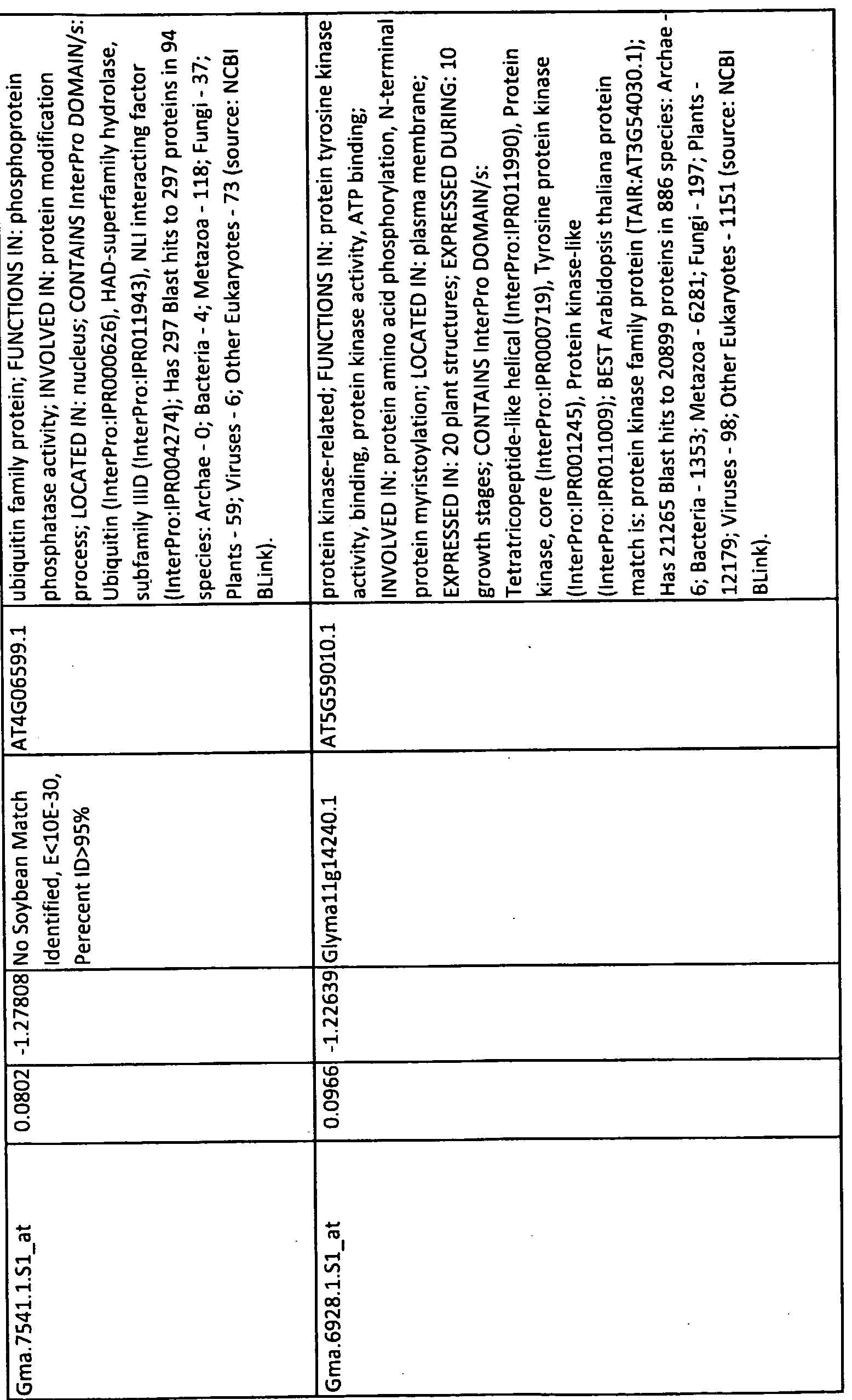


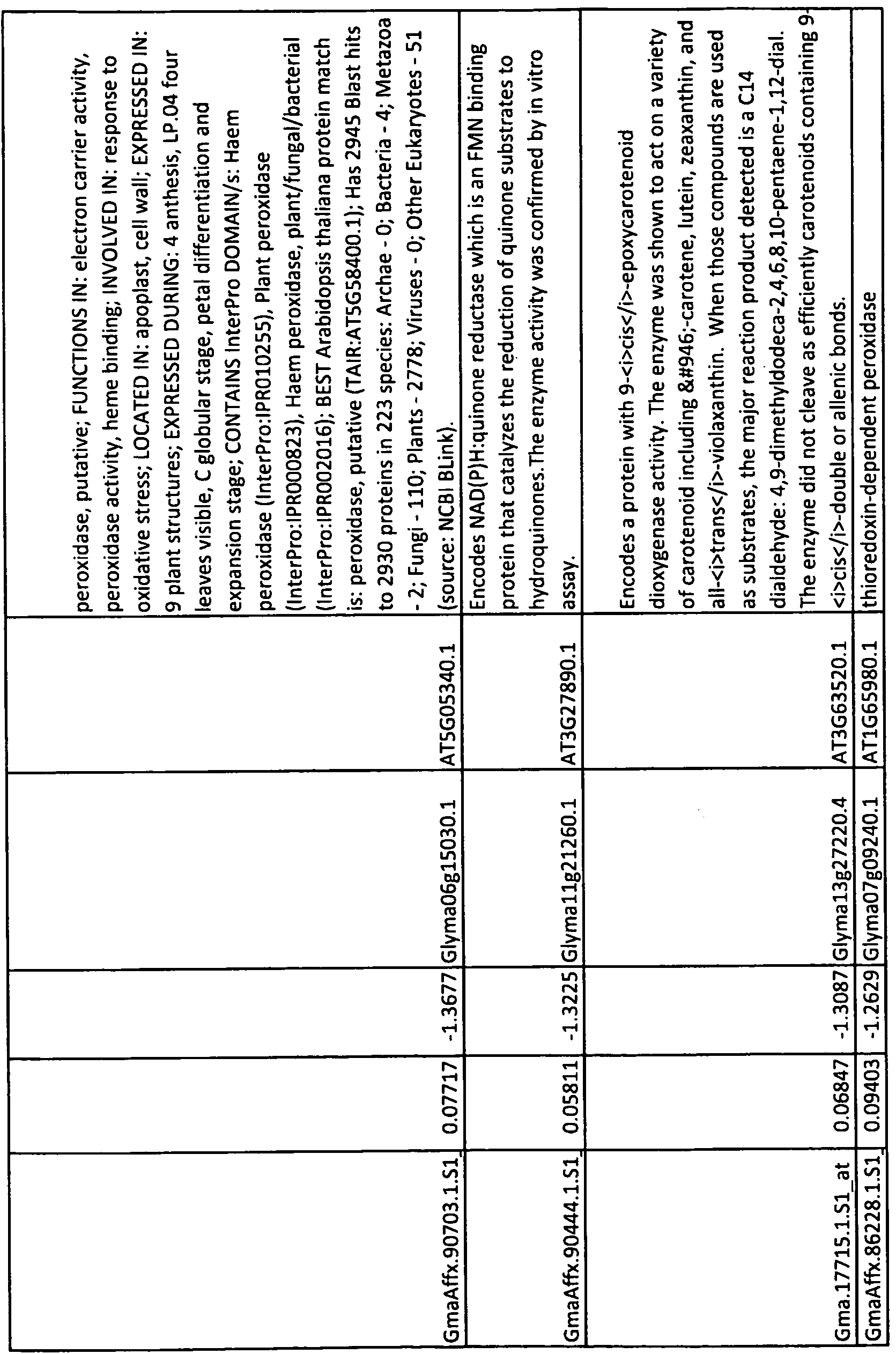

Table 9 Candidate enes related to transcri tion re ulation

zinc finger (C2H2 type) family protein; FUNCTIONS IN:
transcription factor activity, zinc ion binding, nucleic acid binding; INVOLVED IN: regulation of transcription; LOCATED IN: intracellular; EXPRESSED IN: 8 plant structures; EXPRESSED DURING: 4 anthesis; CONTAINS InterPro DOMAIN/s: Zinc finger, C2H2-like (lnterPro:IPR015880), Zinc finger, C2H2-type (lnterPro:IPR007087); BEST Arabidopsis thaliana protein match is: RHL41 (RESPONSIVE TO HIGH LIGHT 41); nucleic acid binding / transcription factor/ zinc ion binding (TAIR:AT5G59820.1); Has 907 Blast hits to 871 proteins in 97 species: Archae - 0; Bacteria 0; Metazoa - 429; Fungi - 0; Plants - 469; Viruses - 0; Other
Gma.986.1.Sl at 0.033752 11.08897 Glymal5g04570..lAT2G28710.1 Eukaryotes - 9 (source: NCBI BLink). ethylene insensitive 3 family protein; FUNCTIONS IN:
transcription factor activity; INVOLVED IN: regulation ofO transcription; LOCATED IN: nucleus; EXPRESSED IN: stem, hypocotyl, flower, root, seed; EXPRESSED DURING: F mature embryo stage, petal differentiation and expansion stage;
CONTAINS InterPro DOMAIN/s: Ethylene insensitive 3
(lnterPro:IPR006957); BEST Arabidopsis thaliana protein match is: ethylene insensitive 3 family protein (TAIR:AT5G65100.1); Has 248 Blast hits to 233 proteins in 35 species: Archae - 0; Bacteria - 0; Metazoa - 3; Fungi - 0; Plants - 237; Viruses - 0;
GmaAffx.65341.1.Al 0.079456 10.01211 Glyma08gl4630..|AT5G10120.1 Other Eukaryotes - 8 (source: NCBI BLink).


NAC transcription factor-like 9 (NTL9); FUNCTIONS IN:
transcription factor activity; INVOLVED IN: regulation of transcription; EXPRESSED IN: 22 plant structures; EXPRESSED DURING: 13 growth stages; CONTAINS InterPro DOMAIN/s: No apical meristem (NAM) protein (lnterPro:IPR003441); BEST Arabidopsis thaliana protein match is: no apical meristem (NAM) family protein (TAIR:AT1G33060.2); Has 1627 Blast hits to 1625 proteins in 54 species: Archae - 0; Bacteria - 0; Metazoa - 0; Fungi - 0; Plants - 1627; Viruses - 0; Other Eukaryotes - 0
Gma.l7786.1.Sl at 0.087286 2.886904 No Soybean Matq AT4G35580.2 (source: NCBI BLink).
LIGHT-REGULATED ZINC FINGER PROTEIN 1 (LZF1); FUNCTIONS IN: transcription factor activity, zinc ion binding; INVOLVED IN: chlorophyll biosynthetic process, chloroplast organization,
CO
anthocyanin biosynthetic process, regulation of
photomorphogenesis, regulation of transcription; LOCATED IN: nuclear speck; EXPRESSED IN: 22 plant structures; EXPRESSED DURING: 13 growth stages; CONTAINS InterPro DOMAIN/s: Zinc finger, B-box (lnterPro:IPR000315); BEST Arabidopsis thaliana protein match is: STO (SALT TOLERANCE); DNA binding / protein binding / transcription factor/ zinc ion binding
(TAIR:AT1G06040.2); Has 1252 Blast hits to 916 proteins in 83 species: Archae - 0; Bacteria - 0; Metazoa - 17; Fungi - 0; Plants -
Gma.l6807.1.Sl at 0.04032 2.684973 Glyma09gl4880.3|ATlG78600.1 1143; Viruses - 0; Other Eukaryotes - 92 (source: NCBI BLink).


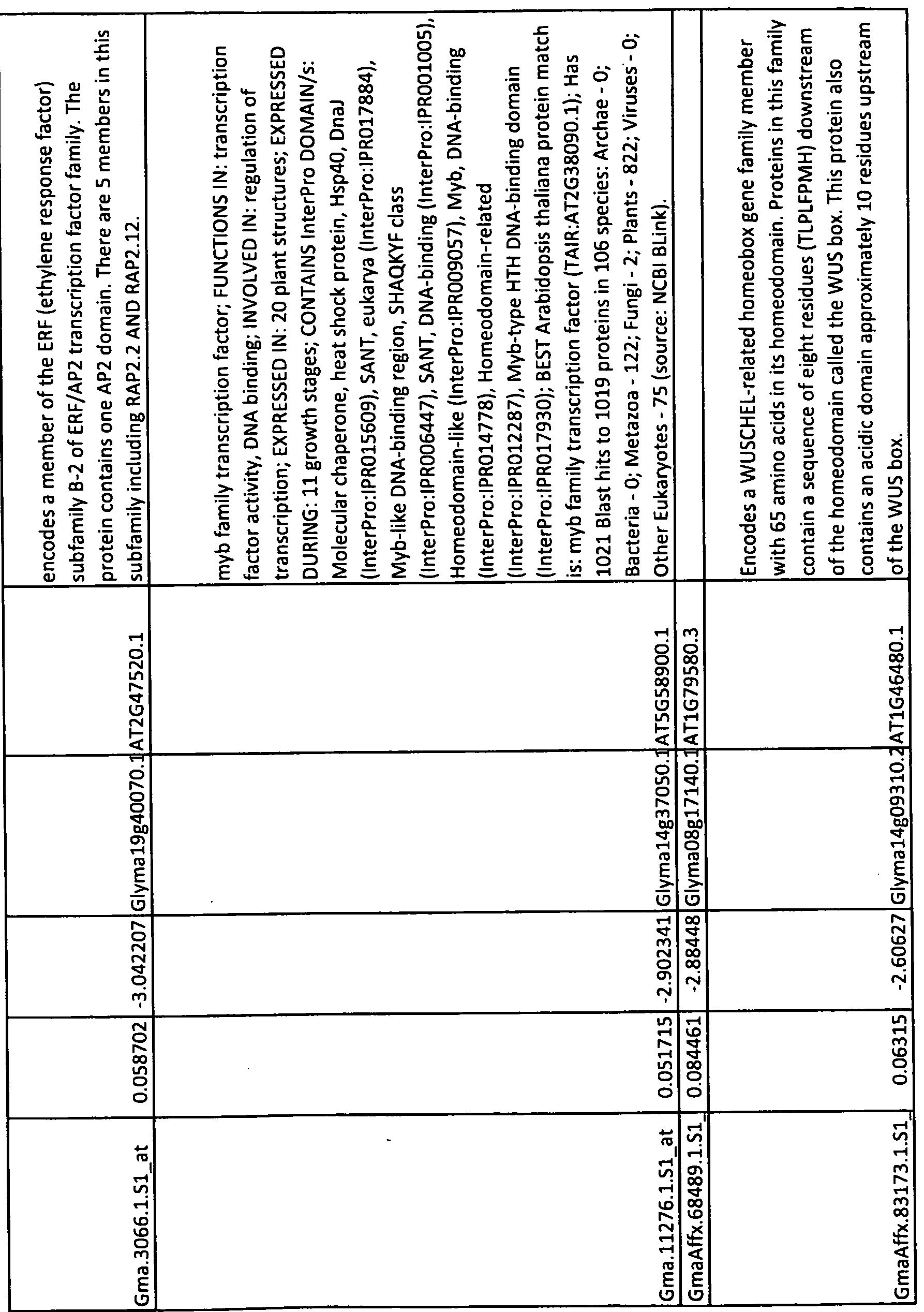


Table 10 Candidate enes with unknow functionalit


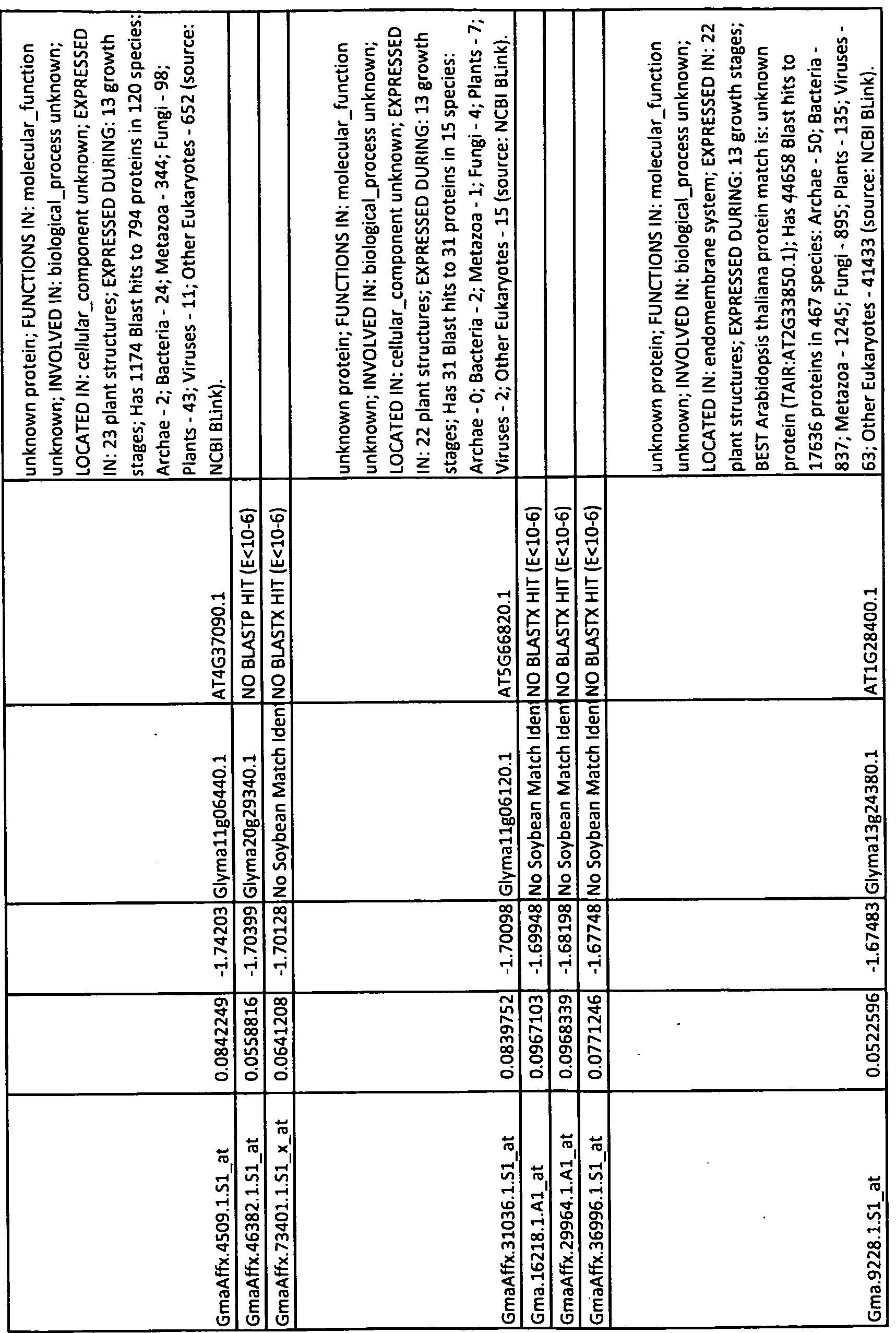


LOCATED IN: cellular_component unknown; EXPRESSED
IN: 23 plant structures; EXPRESSED DURING: 13 growth stages; CONTAINS InterPro DOMAIN/s: Protein of unknown function DUF1675 (lnterPro:IPR012463); BEST Arabidopsis thaliana protein match is: nuclear transport factor 2 (NTF2) family protein / RNA recognition motif (RRM)-containing protein (TAIR:AT3G07250.1); Has 223 Blast hits to 204 proteins in 56 species: Archae - 2; Bacteria - 11; Metazoa - 48; Fungi - 32; Plants - 89;
Gma.3520.1.Sl at 0.0862961 -1.11648 Glyma09g32660.3 Viruses - 3; Other Eukaryotes - 38 (source: NCBI BLink).
Table 11 Candidate enes related to trans orter


VHS domain-containing protein / GAT domain-containing protein; FUNCTIONS IN: protein transporter activity;
INVOLVED IN: intracellular protein transport, intra-Golgi vesicle-mediated transport; LOCATED IN: Golgi stack, intracellular; EXPRESSED IN: 22 plant structures; EXPRESSED DURING: 13 growth stages; CONTAINS InterPro DO AIN/s: VHS (lnterPro:IPR002014), Target of Myb protein 1
(lnterPro:IPR014645), GAT (lnterPro:IPR004152), VHS subgroup (lnterPro:IPR018205), ENTH/VHS
(lnterPro:IPR008942); BEST Arabidopsis thaliana protein match is: VHS domain-containing protein / GAT domain- containing protein (TAIR:AT1G76970.1); Has 1297 Blast hits to 1295 proteins in 140 species: Archae - 0; Bacteria - 6; Metazoa - 767; Fungi - 311; Plants - 152; Viruses - 0; Other Eukaryotes -
Gma. 431.1.Sl at 0.05603 1.98211 Glyma04g42250.1 AT1G21380.1 61 (source: NCBI BLink).


SEC14 cytosolic factor family protein / phosphoglyceride transfer family protein; FUNCTIONS IN: transporter activity; INVOLVED IN: transport; LOCATED IN: plasma membrane; EXPRESSED IN: 24 plant structures; EXPRESSED DURING: 13 growth stages; CONTAINS InterPro DOMAIN/s: Cellular retinaldehyde-binding/triple function, C-terminal
(lnterPro:IPR001251), Cellular retinaldehyde-binding/triple function, N-terminal (lnterPro:IPR008273), GOLD
(lnterPro:IPR009038), Phosphatidylinositoi transfer proteinlike, N-terminal (lnterPro:IPR011074); BEST Arabidopsis thaliana protein match is: SEC14 cytosolic factor family protein / phosphoglyceride transfer family protein
(TAIR:AT4G09160.1); Has 3452 Blast hits to 2934 proteins in 279 species: Archae - 35; Bacteria - 208; Metazoa - 1309; Fungi - 627; Plants - 480; Viruses - 12; Other Eukaryotes - 781
GmaAffx.90036.1.Sl s at 0.02679 1.43805 Glyma08g26150.3 AT1G72160.1 (source: NCBI BLink).


tonoplast intrinsic protein 4;1 (TIP4;1); FUNCTIONS IN: water channel activity; INVOLVED IN: transport; LOCATED IN: integral to membrane, membrane; EXPRESSED IN: 11 plant structures; EXPRESSED DURING: 4 anthesis, F mature embryo stage, petal differentiation and expansion stage, D bilateral stage, E expanded cotyledon stage; CONTAINS InterPro DOMAIN/s: Aquaporin (lnterPro:IPR012269), Major intrinsic protein (lnterPro:IPR000425); BEST Arabidopsis thaliana protein match is: GAMMA-TIP (GAMMA TONOPLAST INTRINSIC PROTEIN); water channel (TAIR:AT2G36830.1); Has 6492 Blast hits to 6478 proteins in 1243 species: Archae - 59; Bacteria - 2501; Metazoa - 1276; Fungi - 254; Plants - 1459;
Gma.l2965.1.Al at 0.05006| -2.64S12 |Glyma06g08910.2 AT2G25810.1 Viruses - 0; Other Eukaryotes - 943 (source: NCBI BLink).O
Arabidopsis thaliana ORGANIC CATION/CARNITINE
TRANSPORTER4 (AtOCT4); FUNCTIONS IN: carbohydrate transmembrane transporter activity, sugar:hydrogen symporter activity; INVOLVED IN: transport; LOCATED IN: chloroplast thylakoid membrane, membrane; EXPRESSED IN: 13 plant structures; EXPRESSED DURING: 6 growth stages; CONTAINS InterPro DOMAIN/s: Sugar transporter, conserved site (lnterPro:IPR005829), Major facilitator superfamily MFS-1 (lnterPro:IPR011701), Major facilitator superfamily, general substrate transporter (lnterPro:IPR016196); BEST Arabidopsis thaliana protein match is: AtOCTl (Arabidopsis thaliana ORGANIC CATION/CARNITINE TRANSPORTER1); carbohydrate transmembrane transporter/ carnitine transporter/ transporter (TAIR:AT1G73220.1); Has 17732 Blast hits to
GO 17562 proteins in 1146 species: Archae - 294; Bacteria - 8210; CO
Metazoa - 4427; Fungi - 3016; Plants - 991; Viruses - 0; Other
GmaAffx.2755.1.Al at 0.07811 -2.42444 Glymal2g34440.1 AT3G20660.1 Eukaryotes - 794 (source: NCBI BLink).
Arabidopsis H(+)-ATPase 11 (AHAll); FUNCTIONS IN: ATPase activity; INVOLVED IN: cation transport, metabolic process, ATP biosynthetic process; LOCATED IN: plasma membrane, membrane; EXPRESSED IN: 26 plant structures; EXPRESSED DURING: 14 growth stages; CONTAINS InterPro DOMAIN/s: ATPase, P-type, ATPase-associated region
(lnterPro:IPR008250), ATPase, P-type cation-transporter, N- terminal (lnterPro:IPR004014), Haloacid dehalogenase-like hydrolase (lnterPro:IPR005834), ATPase, P-type, H+ transporting proton pump (lnterPro:IPR000695), ATPase, P- type, K/Mg/Cd/Cu/Zn/Na/Ca/Na/H-transporter
(lnterPro:IPR001757), ATPase, P-type, plasma-membrane proton-efflux (lnterPro:IPR006534), ATPase, P-type phosphorylation site (lnterPro:IPR018303); BEST Arabidopsis thaliana protein match is: AHA4; ATPase/ hydrogen-exportingO ATPase, phosphorylative mechanism (TAIR:AT3G47950.1); Has
20808 Blast hits to 18623 proteins in 1829 species: Archae - 405; Bacteria - 11444; Metazoa - 3332; Fungi - 1581; Plants - 1110; Viruses - 3; Other Eukaryotes - 2933 (source: NCBI
Gma.3412.1.Sl at 0.07148 -2.18753 Glyma05g01460.1 BLink).


pseudouridine synthase/ transporter; FUNCTIONS IN:
pseudouridine synthase activity, transporter activity;
INVOLVED IN: tRNA processing, pseudouridine synthesis, RNA modification, tRNA pseudouridine synthesis; LOCATED IN: chloroplast; EXPRESSED IN: 23 plant structures; EXPRESSED DURING: 14 growth stages; CONTAINS InterPro DOMAIN/s: tRNA pseudouridine synthase B, N-terminal, bacterial-type (lnterPro:IPR014780), tRNA pseudouridine synthase B, N- terminal (lnterPro:IPR002501); BEST Arabidopsis thaliana protein match is: NAP57 (Arabidopsis thaliana homologue of NAP57); pseudouridine synthase (TAIR:AT3G57150.1); Has 5291 Blast hits to 5291 proteins in 1638 species: Archae - 188; Bacteria - 2754; Metazoa - 244; Fungi - 190; Plants - 55;
Gma.l2855.1.Sl at 0.06264| -1.89179[Glyma05g09150.1 AT5G14460.1 Viruses - 0; Other Eukaryotes - 1860 (source: NCBI BLink). o

Arabidopsis H(+)-ATPase 11 (AHAll); FUNCTIONS IN: ATPase activity; INVOLVED IN: cation transport, metabolic process, ATP biosynthetic process; LOCATED IN: plasma membrane, membrane; EXPRESSED IN: 26 plant structures; EXPRESSED DURING: 14 growth stages; CONTAINS InterPro DOMAIN/s: ATPase, P-type, ATPase-associated region
(lnterPro:IPR008250), ATPase, P-type cation-transporter, N- terminal (lnterPro:IPR004014), Haloacid dehalogenase-like hydrolase (lnterPro:IPR005834), ATPase, P-type, H+ transporting proton pump (lnterPro:IPR000695), ATPase, P- type, K/Mg/Cd/Cu/Zn/Na/Ca/Na/H-transporter
(lnterPro:IPR001757), ATPase, P-type, plasma-membrane proton-efflux (lnterPro:IPR006534), ATPase, P-type phosphorylation site (lnterPro:IPR018303); BEST Arabidopsis thaliana protein match is: AHA4; ATPase/ hydrogen-exporting ATPase, phosphorylative mechanism (TAIR:AT3G47950.1); Has 20808 Blast hits to 18623 proteins in 1829 species: Archae - 405; Bacteria - 11444; Metazoa - 3332; Fungi - 1581; Plants - 1110; Viruses - 3; Other Eukaryotes - 2933 (source: NCBI
Gma.4014.1.Sl at 0.05811 -1.81355 Glyma04g34370.1 AT5G62670.1 BLink).


Table 12: qPCR Primers Used for Microarray Validation and Time Course-qPCR
Affychip ID qPCR Primer Name Primer Sequence (5'-3')
004 1 0 004 1 0
004 1 0
2457 0 0 2457 0
2457 0
67310 0 67310 0
67310 0
737 7 0 737 7 0
737 7 0
78324 0 78324 0
78324 0
0 13 0 0_ 0 13 0
0 13 0
0 685 0 0_ 0 685 0
0 685 0
8442 0 0_ 8442 0
8442 0
6415 0 0_ 6415 0
6415 0
1710 0 0_ 1710 0
1710 0
3478 0 0_ 3478 0
3478 0
7475 0 0_ 7475 0
7475 0
057 6 0 0. 057 6 0
057 6 0
6270 0 0_ 6270 0
6270 0
06732 0 0. 06732 0
06732 0
0312 0 0_ 0312 0
0312 0
7748 0 0_ 7748 0
7748 0
0334 0 0_ 0334 0
0334 0
00223 0 0 00223 0
00223 0
1028 1 0_ 1028 1
1028 1
24 3 1 0_ 24 3 1
24 3 1
31 6 0 0 31 6 0
31 6 0
3454 0 0_ 3454 0
3454 0 4172 0 0_ 4172 0
4172 0 5 51 0 0_ 5 51 0
5 51 0 485 0 0_ 485 0
485 0 288 0 0_ 288 0
288 0 10 68 0 10 68 0
10 68 0 05502 0 0_ 05502 0
05502 0 04861 0 0_ 04861 0
04861 0 0 6 0 1 0_ 0 6 0 1
0 6 0 1 03161 0 0_ 03161 0
03161 0 63477 0 63477 0
63477 0 6 7 0 6 7 0
6 7 0 383 0 0 383 0
383 0 355 2 0 355 2 0
355 2 0 18818 0 18818 0
18818 0 1633 0 1633 0
1633 0 00 3 0 0. 00 3 0
00 3 0
77071 0 77071 0
77071 0 3 60 0 0_ 3 60 0
3 60 0 6626 0 0 6626 0
6626 0
Primers for Timecourse-qPCR
57387 0 0
6512 0 0
355 2 0 0
448
U 2012/020375
Table 13: Gateway Cloning Primers for Promoter-GUS Constructs.
AffyChip ID Primer Name Primer Sequence (5'-3')
04886 0 0_ 1 04886
1 04886
875 0 0_ 875
875
1358 0 0_ 1358
1358
376 0 0_ 376
376
34 25 0 0_ 34 25
34 25
7 160 0 0_ 7 160
7 160
6036 0 0_ 6036
6036
6276 0 0_ 6276
6276
8442 0 0_ 8442
8442
12 12
12
0 301 0 0_ 0 301
0 301
0 0
1 1
Promoter-reporter constructs
[0094] The promoter sequences for the genes used in the GUS reporter assays were identified and downloaded from the soybean genome database (Phytozome,
www.phytozome.net . Primers (Table 12) were designed to amplify approximately a 2-kb sequence immediately 5 ' of the ATG start site (Figure 4b). The promoter DNA fragments were PCR-amplified using soybean cv. Williams 82 genomic DNA as a template and cloned into the gateway cloning vector pDONR-Zeo (Invitrogen, Carlsbad, CA, USA). The cloned promoters were sequenced using vector-specific primers and internal sequencing primers. The correct promoter fragments were then gateway cloned into a pYXTl vector (Xiao et al., 2005) upstream of a β-glucuronidase (GUS) gene as a transcriptional fusion. The final plasmids were verified by PCR analysis and used for transformation of Agrobacterium rhizogenes (strain 599).
Hairy root transformation
[0095] Hairy roots transgenic for each promoter-GUS construct were generated using the method described by Wang et al. (2007) with the following modifications. The cotyledons were excised from 9-day-old aseptically grown soybean seedlings (NIL-R or cv. Williams 82) and vacuum infiltrated for 20 min with A. rhizogenes culture resuspended in ¼ Gamborg's salt solution (Phytotechnology Lab, Shawnee Mission, KS, USA) carrying various reporter constructs. Cotyledons were co-cultivated with A. rhizogenes for 3 days. The cotyledons were later placed on MXB medium [lx MS basal nutrient salts (Gibco BRL), lx Gamborg's vitamins, 3% w/v sucrose, and 0.8% w/v Daishin agar, pH 5.7] supplemented with kanamycin (200 μg per ml) and timentin (238 g per ml) and incubated in a growth chamber at 26°C set to a long-day photoperiod (16h light/8h dark). Hairy roots that emerged after 14 days were root-tip propagated twice on MXB medium with kanamycin (200μg per ml) and timentin (238μg per ml), after which the roots were transferred to MXB medium with timentin (237μg per ml). Hairy roots at this stage were either used immediately for nematode inoculation experiments or maintained by subculturing for later use.
Nematode infection of transgenic hairy roots and GUS staining
[0096] Infective second-stage juveniles (J2) were hatched from eggs as described in Wang et al. (2007). Nematodes were surface-sterilized with sterilizing solution (0.004% w/v mercuric chloride, 0.004% w/v sodium azide and 0.002 % v/v Triton X-100) for 8 min followed by 5 washes with sterile water and resuspended in 0.1% w/v agarose. Hairy roots (3-4 cm) grown on MXB medium were inoculated ~1 cm above the root tip with 200 ± 25 J2s per root in
a 25-μ1 volume. The roots were cut and stained for GUS expression at 5 dpi. GUS staining was done according to Jefferson et al. (1987). Briefly, hairy roots were cut 1-2 cm above the infection zone and placed in GUS staining solution (100 mM Tris pH 7.0, 50 mM NaCl, 1 mM X-Gluc, 1.5 mM potassium ferricyanide pH 7.0, 0.06% v/v Triton X-100). The root tissues were vacuum-infiltrated twice for 10 min each and incubated at 37°C overnight. The GUS staining reaction was stopped by replacing staining solution with 70% v/v ethanol. GUS stained roots were photographed under a Leica MZFLIII stereoscope (Leica Microsystems, Bannockburn, IL) fitted with an Optronics MagnaFire, version 2.0, camera (Optronics, Goleta, CA).
Sample preparation for time-course qPCR analysis
[0097] Infected root tissues for time course qPCR analysis were prepared as described in Ithal et al. (2007a), except that samples were collected at 2, 4, 6, and 8 dpi. Excised root pieces from 12-15 different plants were pooled for each genotype/inoculum combination. Samples were quick frozen in liquid nitrogen and stored at -80oC until RNA isolation.
Nematode penetration was verified by staining the nematodes in at least five sample roots for each treatment at 24 hours post-inoculation as described by Ithal et al. (2007a). Infected root tissues from three independent biological replicates were prepared.
RNA isolation and qPCR
[0098] Total RNA was isolated from root tissues using the RNeasy plant miniprep kit (Qiagen, Valencia, CA, USA), according to the manufacturer's instructions. First strand cDNA synthesis was carried out using a Superscript III first strand synthesis kit (Invitrogen, USA), according to the manufacturer's instructions. Real-time qPCR was carried out using an Applied Biosystems 7500 real-time PCR system. Gene-specific primers (Table 13) were designed using the primer express software (Applied Biosystems, CA, USA). All qRT-PCR reactions were carried out in triplicate. PCR was performed using the following cycling parameters: 50°C for 2 min, 95°C for 10 min, and 40 cycles of 95°C 15 s and 60°C for 1 min. The soybean ubiquitin gene (Acc. No D28123) was used as an endogenous control. Expression was quantified using the AACT method in comparison to the endogenous control. Fold-changes were determined relative to the NIL-R mock-inoculated sample for each time point. There were no significant expression differences between mock-treated NIL-S and NIL-R roots.
Response of NILs to SCN
[0099] Soybean NILs, derived from a cross between the susceptible cultivar Evans and the resistant PI 209332, were chosen for these studies. These NILs are predicted to share 98% of their genome, differing at the major SCN resistance locus, Rhgl (Mudge, 1999). NIL-S
is susceptible and NIL-R is resistant to SCN inbred line PA3 (HG type 0). The Rltgl allele in PI 209332 is likely similar to the Rhgl allele in PI 88788, the source of SCN resistance found in greater than 90% of commercially available SCN-resistant soybean cultivars. Field populations of SCN that can break PI 88788 resistance typically can break PI 209332 resistance, suggesting that these Pis share a similar type of resistance (Colgrove and Niblack, 2008). The delayed resistance response in PI 209332 and PI 88788 is thought to be due to the absence of the Rhg4 resistance allele which is present in Peking, a cultivar that exhibits a rapid resistance response to SCN. The experimental system disclosed herein takes advantage of this slow resistance response to characterize Rhgl -mediated differences in gene expression during syncytium formation.
[0100) In laboratory inoculation assays, the penetration and development of SCN and the formation of syncytia on the two NlLs were examined to identify appropriate time points for LCM analysis. Freshly hatched second-stage juveniles (J2s) were used for synchronized infection of soybean roots. Roots of two-day-old seedlings were infected with an equal number of SCN (P A3) juveniles, and the roots were acid fuschin-stained at different days post- inoculation (dpi). Infected roots were harvested at different time points and stained with acid fuchsin to monitor the infection process. The results are shown in Fig. 1. Figures l(a)-(d) show penetration and development of soybean cyst nematode (SCN) PA3 on resistant (NIL-R) and susceptible (NIL-S) lines (a) NIL-S, 2 dpi; (b) NIL-S, 10 dpi; (c) NIL-R, 2 dpi; (d) NIL-R, 10 dpi. Figures l(e)-(h) show developmental differences between PA3-induced syncytia on NIL-S and NIL-R roots (e) NIL-S syncytium at 5 dpi; (0 NIL-S syncytium at 8 dpi; (g) NIL-R syncytium at 5 dpi; and (h) NIL-R syncytium at 8 dpi. N- nematode, Syn- syncytia. Scale bar: (a)-(d) 250 um; (e)-(h) 50 pm.
f 0101] Similar numbers of nematodes were observed in both NIL-R and NIL-S at 2 days post inoculation (dpi) (Figures l a and lc) indicating that resistance controlled by Rhgl does not affect penetration and migration of nematodes in soybean roots. At 10 dpi significant differences in the development of nematodes were observed between NIL-S and NIL-R. Late fourth-stage juveniles (J4) and early adult females were observed in the NIL-S (Figure lb) by 10 dpi whereas the majority of the nematodes had only advanced to third-stage (J 3) and early J4 stages in the NIL-R (Figure Id). These results are consistent with results reported by Li et al., (2004) in greenhouse bioassays using these NILs.
|0102] To assess the differences in syncytium development at a more refined level, infected root samples at 5, 8, and 10 dpi were sectioned for microscopic examination. At 5 dpi, syncytia appeared normal in both the NIL-S (Figure le) and NIL-R (Figure lg). Normal syncytium development was observed at 8 dpi in NIL-S (Figure 1 f) whereas degenerating cells
both in and around developing syncytia were observed in NIL-R at 8 dpi (Figure l h). The majority of the syncytia were degenerated by 10 dpi in NIL-R. Based on these observations, gene expression changes were assayed within syncytia at 5 and 8 dpi in the NILs.
Transcript profiling of syncytia in NILs
[0103| The GeneChip Soybean Genome Array (Affymetrix), which carries 37,593 probe sets representing 35,61 1 soybean transcripts, was used to compare the transcriptional profiles of SCN-induced syncytia in NIL-R and NIL-S. The microarray analysis was carried out using cRNA generated from LCM syncytia at 5 and 8 dpi with SCN from either the NIL-S or NIL-R. No significant evidence of interaction was found between NIL and dpi. Thus, the instant studies were focused on the main effects of NIL and the differences between NIL-S and NIL-R that are averaged over 5 and 8 dpi. This comparison of expression profiles between genotypes resulted in the identification of 1 ,447 differentially expressed probe sets using a false discovery rate (FDR) set at 10%. Of the 1,447 probe sets, 828 were up-regulated, and 619 were down- regulated in the NIL-R compared to the NIL-S (Tables 1-1 1). The recently released SoyBase annotation (v.2) for the Affymetrix Soybean Genome Array was used to classify these genes into categories (Figure 2). Of the 1,447 probe sets, 355 (24.5%) correspond to genes coding for unknown proteins and/or those with no known homologs in Arabidopsis, with a high confidence value cut-off (E value <10-6). Two other major categories include cellular metabolism genes (306 probe sets; 21.1%) and stress- and defense-related genes (241 probe sets; 16.8%).
Additional classifications include (in descending order) cellular signaling, transporters, proteolysis, transcription factors, protein sorting and transport, cell wall-related, and hormone- related genes. Probe sets that do not fit into any of these categories or fall into multiple categories are grouped as "miscellaneous" (223; 15.4%). A number of probe sets corresponding to different Glycine max gene models had the same Arabidopsis homologs; this is not surprising given the duplicated nature of the soybean genome (Schlueter et al., 2004; Schlueter el ah, 2007). These probe sets may represent homeologous genes with the same function, especially when their expression patterns fall within ± one-fold difference of each other. qPCR validation of microarray data
10104] The microarray data were validated by qPCR analysis of selected genes using RNA isolated from syncytial cells laser microdissected from the roots of NIL-R and NIL-S at 5 dpi. The genes were selected to represent those that were either up- or down-regulated with fold changes ranging from 27.65 fold up-regulation to 17.63 fold down-regulation in the microarray
analysis (Table 14). Of the 42 genes tested, 38 genes (90.5%) showed differential expression in the same direction as that observed in the microarray experiment (Table 14). Only four probe sets, which showed a down-regulation in the microarray (Gma.2139.2.S l_S_at,
GmaAffx.78421.1.S l _at, GmaAffx 84808.1. S l_at, and Gma.3504.2.Sl_at, Table 14), were slightly up-regulated in the qPCR analysis. Thus, overall the qPCR results agreed with the microarray results.
Tabic 14 qPCR Validation of microarray results
qPCR Microarray
FC FC
SEQ ID "NIL- "NIL-
Gene Model/EST R/PA3 °NIL-R/PA3 R/T 19
FCaAffyChip Probeset ID Sequence Putative Function 5dpi 5dpi Sdpl
1 Gma.10240.1.A1_at BE057471 No predicted gene model -23.44 -2.05 -128.82
P450 pseudogene-fike. mandelate
2 Gma.10701.2 S1 at Gryma05g27030.1 racernase N-terrninal domain -1.86 -4.85 -2.63
3 Gma.10796.1.S1_a_at Glyma15g43040.1 Cellulose synthase, CEVHike 2.95 1.34 1.15
Heroin-induced family protein
4 Gma.11004.1.S1_at Giyma03g35920.1 (YLS9yHIN1 family proteinl 5.49 8.09 2.45
Caffeoyi-CoA 3-O-methyltransferase.
5 Gma.11334.1.S1_a_at B1967327 putative 1.82 -2.76 -2.63
Brassinosteroid signaling positive
6 Gma.1423.1.S1_a_at Glyma01g3B450.1 regulator-related 2.57 1.65 1.91
Hydrophobic protein (RCI2BVlow temp
7 Gma.14272.1.S1_at Glyma10g283O0.1 and salt responsive protein (LTI6B) 33.88 11.69 2.09
8 Gma.1445.1.S1 at Glyma13g44700.1 Cinnamoyl-CoA reductase, putative -1.58 -3.21 -1.20
Θ Gma.15972.1.A1_at Glyma04g17710.1 Calcium-binding EF hand family protein 16.60 27.65 not tested
10 Gma.16613.1.S1_s at Glyma10g40400.1 Zinc finger (C2H2 type) family protein g.55 4.67 2.00
11 Gma.16807.1.S1_at Gl ma09g14880.1 Zinc finger (B-box type) family protein 4.37 2.68 2.40
Gibberellin-regulated protein 1
12 Gma.17843.1.S1_at Glyma04g02660.1 (GASA ygibbereilin-responsive protein 1 16.98 2.62 2.75
PfkB-type carbohydrate kinase family
13 Gma.2139.2.S1 s at Glyma13g41960.1 protein 1.15 -1.62 US
14 Gma.2821.1.S1 ai Glyma01g42660.1 Osmotin-like protein (OS 34) 19.95 6.41 -2.09
15 Gma.3504.2.S1_at Glyma13g00380.1 WRKY family transcription factor 1.48 -2.59 1.95
Ethylene-responsive caimodulin-binding
16 Gma.3990.1.S1_s_at GlymaO8g14370.1 protein 2.09 1.Θ LZS
17 Gma.4071.1.S1_at Glyma17g10050.2 Gibberellin-regulated protein 2 (GASA2) -2.75 •5.26 -6.17
18 Gma.4207.1.S1 at GlymaC6gOO630.1 Myb family transcription factor (MYB32) -1.23 -2.15 ua
19 Gma.4565.1.s s at Glyma19g01590.2 Gibberellin-regulated protein 3 (GASA3) -1.38 -4.76 -20.89
20 Gma.4589.1.S1 s at Glyma11g35800.1 Senescence associated protein. SAG 204.07 2.46 1.45
21 Gma.5283.1.S1_at Glyma06g07300.1 Plant natriuretic peptide -2.19 -17.63 -724.44
22 Gma.596.1.S1_at Glyma13g3458Q.4 1 -3-3 protein (GRF9) -1.12 -2.96 -3.80
23 Gma.e062.1.sT at Glyma03g32130.1 Dehydration-responsive protein-related -1.26 -2.69
24 Gma.7381.1.S1_at Glyma20g33430.1 NAC domain containing protein 2.45 1.67 2.34
Senescence/dehydration-associated
25 Gma.7526.1-A1 G!yma11g11430.1 protein-related (E 07) 16.22 7.62 3.98
26 Gma.7737.1.S1 at BG650195MATE efflux family protein 467.74 14.73 10.96
27 Gma.8586.1.S1_at Glyma17g17330.2 Proline-rich family protein 6.92 3.39 6.61
Hydroxyproline-rich glycoprotein family
28 Gma.8859.1.A1_at Glyma15e03110.1 protein 21.38 5.17 3.55
DREB subfamily A-2 of ERF/A P2
29 Gma.9553.1.A1 at Glyma14g06080.1 transcription factor family 22.91 8.08 8.13
30 GmaAffx.1 l502.1.S1 at Glyma16g01640.1 Pectinesterase family protein 5.89 2.13 2.29
31 GmaAffx.21079.1.A1 at Glyma03g324 0.1 Plasmodesmal protein 2.95 2.15 2.04
32 GmaAffx.2744.1.S1_at Glyma04g40930.1 Auxin-responsive family protein 6.31 3.53 2.86
DREB subfamily A-1 of ERF/AP2
33 GmaAftx.29929.1.S1_at Glyma20g29410.1 transcription factor family (CBF3) 15.49 11.25 3.63 bZIP transcription factor family protein
34 GmaAffx.3568.l.S1_at Glyma02gl9870.i (bZIP60 ) 5.89 3.21 2.57
GRAM domain-containing protein ABA-
35 GmaAffx.46603.1.S1_at Glyma19g27260.1 responsive protein-related 15.14 5.55 2.29
36 GmaA«x.494.1.S1 at Glyma16g28970.2 Chitinase A (CHIA) 6.92 4.99 10,00
37 GmaAffx.70008.1.S 1 _at BU762337 Myb family transcription factor (MYB20) -131.83 -3.89 -630.96
Non-race specific disease resistance
38 GmaAffx.74588.1.S1_at Gl ma12g34210.1 protein, NDR1-tike 10.23 3.81 3.24
39 GmaAffx.78421. .S 1 _at Glyma08g15650.1 Pectinesterase family protein 1.45 -1.58 -1.66
40 GmaAffx.84808.1.S1_at Glyma13g20810.2 Ethylene-insensitjve 2 (EIN2) 1.91 -1.59 1.82
Harpin-lnduced family proteia'HINI
41 GmaAffx.88182.1.S1_at Gl ma03g35930.1 family protein 25.70 8.42 7.08
S-adenosylmethionine synthetase 2
42 GmaAffx.89435.1.A1 s at Glyma03g38190.2 (SAM2) 2.24 1.77 1.32
"Fold-change compared to NI1.-S/PA3/5 dpi
* "+" indicates genes upregulated; "-" indicates genes downrcgu!uted; Note that the fold-changes in expression for certain genes are opposite in
qPCR and microarray;
CAII of the genes arc suppressed by the virulent TNI9 SCN population except for those whose fold changes are not tested or underlined; Underlining indicates thai those genes are not suppressed by the virulent TNI 9 SCN population.
[0105] A comparative qPCR analysis for these genes was also carried out using RNA isolated from syncytial cells laser microdissected from soybean roots of the NIL-R infected with a virulent SCN population (T I 9; HG type 1 -7) at 5 dpi. Interestingly, a comparison between qPCR results of syncytia induced in the NIL-R by the virulent and avirulent ( A3; HG type 0) SCN populations showed that the extent of up-regulation or down-regulation of 35 (85.4%) of the 41 genes tested within syncytia induced by the virulent SCN was less than that attained by the avirulent population (Last column, Table 14). These data indicate that the expression of many of these genes is partially suppressed by the virulent SCN population for successful nematode reproduction and development on the NIL-R. qPCR analysis of infected whole root pieces
[0106] - For purposes of microarray validation and to obtain a detailed temporal expression pattern of select differentially expressed genes, a qPCR analysis was conducted for three genes using RNA isolated from excised SCN-infected whole root pieces at different time points post inoculation. Fig. 3 shows the results of the qPCR analysis of up-regulated genes in excised infected whole root pieces of resistant (NIL-R) and susceptible (NIL-S) near-isogenic lines (NIL) at different days post inoculation (dpi) with avirulent (PA3) or virulent (TNI 9) soybean cyst nematodes (SCN). Comparison of gene expression levels were made to the NIL-R mock-infected roots (taken as one) at the respective time points post-inoculation, (a)
Gma.7623.1.Al_at (b) GmaAffx.68498.1.S l_at (c) GmaAffx.46603.1.Sl_at. The qPCR results are normalized to a soybean ubiquitin (Accession No D28123) endogenous control. The graph is representative of 3 independent experiments, and the bars represent confidence intervals in technical replicates as described in Wang et al. (2007).
[0107] The NIL-R and NIL-S were mock-inoculated or infected with either the avirulent (PA3) or virulent (TN19) SCN population, and root pieces were excised from infection sites at 2, 4, 6, and 8 dpi. Total RNA was isolated from the bulked root pieces (n=10) for qPCR analysis. Time courses of expression were conducted for three different genes (represented by probe sets Gma.7623.1.Al_at, 87.9 fold; GmaAffx.68498.1.Sl_at, 13.1 fold; and
GmaAffx.46603.1.Sl at, 5.6 fold; Tables 1-1 1). The expression of mock-inoculated NIL-R at each time point was set as 1. At 2 dpi, the expression of all three genes was more or less equal between treatments (Figure 3). However, by 4 dpi differential expression was observed for all
three genes between the N1L-S and NIL-R. Up-regulation is very clear in the case of genes highly up-regulated in the microarray (Figure 3a, b) and barely detectable in the case of GmaAffx.46603. l.Sl_at (Figure 3c), which had the lowest fold up-regulation based on microarray analysis. This study illustrates the dilution effect attributed to using infected whole root pieces for gene expression analyses in this pathosystem. For Gma.7623.1.Al at, up- regulation in the NIL-R peaks at 6 dpi (Figure 3a). The pattern is similar for
GmaAffx.46603.1 .Sl at (Figure 3c). The expression pattern is slightly different for the gene represented by probe set GmaAffx.68498.1.Sl_at in that the maximum up-regulation is observed at 4 dpi. These peaks in expression levels are consistent with the timing of the resistance response observed in syncytia of the NIL-R (Figure 1 ). The observed trend in expression for each gene over the time course of infection was reproducible in three independent infection experiments; however, the level of up-regulation varied among experiments. This difference may be attributed to the biological variation inherent to nematode infection experiments, where it is impossible to achieve identical rates of infection. Similar to what was observed in qPCR analyses of RNA isolated from syncytia, infection by the virulent and avirulent SCN populations results in differential up-regulation of these genes. For all three genes tested, the level of up-regulation is lower in response to infection by the virulent nematode population (Figure 3a-c). Additionally, in contrast to infection of the NIL-R, infection of the NIL-S with the avirulent population shows only a slight up-regulation for all three genes tested.
Promotcr-GUS expression analysis
[0108| Promoter-GUS fusions were generated to provide further validation of the spatial expression pattern of the differentially expressed genes identified by microarray analysis and to isolate nematode-responsive soybean promoter sequences with high levels of expression within syncytia. For these experiments, primers corresponding to the 5' upstream sequences of 10 genes (Figure 4a) chosen from the differentially expressed microarray data set (Tables 1-1 1 ) were designed by using the recently released Williams 82 soybean genome sequence (Schmutz et al., 2010). Promoter fragments were amplified by PCR using Williams 82 genomic D A as a template and cloned upstream of a β-glucuronidase (GUS) reporter gene in the gateway binary vector pYXT 1 (Xiao et al. , 2005 ; Figure 4b).
[0109] Transgenic soybean hairy roots were generated in the NIL-R soybean background for each reporter construct. As a positive control, the Arabidopsis WRKY23 promoter (At2g47260) was tested in soybean; At2g47260 is induced within syncytia in
Arabidopsis upon infection with the beet cyst nematode, Heterodera schac tii (Grunewald et
ai, 2008). The transgenic hairy roots were infected with the avirulent (PA3) SCN population. The positive control and all 10 promoter-GUS lines show induced GUS gene expression at the nematode feeding sites at 5 dpi (Figure 5). Fig. 5 shows the result of promoter-GUS expression in transgenic soybean hairy root lines of resistant near-isogenic lines (NIL-R) infected with PA3 soybean cyst nematodes (SCN). Promoter-GUS constructs representing ten genes up-regulated in NIL-R identified from the microarray analysis and the nematode-inducible AtWRKY23 were infected with SCN and stained for GUS expression at 5 days post-inoculation (dpi), (a) AtWRKY23 (At2g47260); (b) Glymal 5g04570.1 ; (c) Glymal 5g06130.1 ; (d)
Glymal g06080. l ; (e) Glyma09g341 10.1 ; (0 Glyma01g42500.2; (g) Glyma01 g42440.1 ; (h) Glymal 8g43750.1 ; (i) Glymal8gl 8060.1 ; (j) Glymal9g04410.1 ; (k) Glymal 3g35100.1.
Pictures are representative of at least five independent hairy root lines for each promoter-GUS fusion construct. Syn - syncytia, N - nematode. Scale bar = 500 um.
[0110] For several promoter-GUS lines, GUS expression is observed throughout the root (Figure 4c, d, i, and j) but further induced at nematode feeding sites. Several promoters have an expression pattern that is very low or more restricted to specific cell types within roots and an up-regulation of GUS expression is clearly distinguishable at the nematode feeding sites (Figure 4a, b, e, f, g, h, and k). Figures 6-7 show similar results using two other promoters, namely, Glyma03g35930.1 (88182p) and Glyma03g35920.1(l 1004p).
[01111 Fig. 8 shows longitudinal cross sections of promoter-GUS stained transgenic soybean hairy root lines in the resistant (NIL-R) background infected with PA3 soybean cyst nematodes (SCN). Promoter-GUS stained root pieces of 4 different promoters shown in Figure 5 were fixed in 4% paraformaldehydein phosphate-buffered saline overnight and then paraffin embedded. Serial sections of Ι Ομηι thickness were taken. (A) Glymal5g04570.1 ; (B)
Glymal 5g06130.1 ; (C) Glymal 4g06080.1 ; (D) Glymal 8g43750.1. Pictures are representative of several syncytiafor each promoter-GUS fusion construct. Syn-syncytia, N -nematode. Scale bar = 50 μπι.

[0112) Special attention was paid to the stress- and defense-related genes to gain a better understanding of the HR that occurs within developing syncytia of the NIL-R in response to SCN. The differential expression of this class of genes varies from 87-fold up-regulated to 17-fold down-regulated (Tables 15- 16). In one embodiment, the expression of any of the genes
listed in Tables 14- 16 may be altered in order to obtain a nematode resistant plant. In another embodiment, the expression levels of up-regulated genes such as those listed in Table 15 may be increased in order to boost plant defense against nematode infection. In another embodiment, the expression levels of down-regulated genes such as those listed in Table 16 may be decreased in a host plant in order to boost plant defense against nematode infection.
[0113] Soybean orthologs of many known plant defense genes have not yet been identified; therefore, we relied on their similarity to Arabidopsis homologs. A total of 241 probe sets representing 16.8% of the total number of differentially expressed genes identified are classified in this group. These included genes involved in apoptosis and disease resistance. A large number of genes involved in oxidative, heat, drought, cold, osmotic, and salt stress responses are also differentially regulated. A natriuretic peptide with an expansin-like domain and many abscisic acid (ABA) induced genes are also among those differentially expressed (Tables 15-16).
[0114] The gene up-regulated with the highest fold change (87-fold, Table 15) is a probe set that corresponds to a soybean gene with similarity to Arabidopsis Bag6 {AtBag6). Bag6 encodes a stress-induced calmodulin-binding BAG (BCL2-associated athanogene) domain protein that is homologous to mammalian BAG proteins, which are regulators of BCL2 involved in apoptosis ( ang et al., 2006). Overcxpression of Bag6 in yeast and Arabidopsis causes cell death (Kang el al., 2006). Another highly up-regulated gene (62-fold) is a soybean calmodulin with similarity to calmodulin-like 38 (C L38) of Arabidopsis, which has been shown to respond to wounding (Vanderbeld and Sneddon, 2007). Several heat shock proteins (HSPs) of the small HSP superfamily are up-regulated as well (Table 15). HSPs are stress responsive proteins that have a protective function in promoting cellular stress tolerance (Wang et al., 2004). Small HSPs bind and stabilize denatured proteins to which other high molecular weight HSPs act as chaperones under stress conditions. Several other HSPs, including an HSP70 homolog (Gma.1 1 115.2.Sl_at), HSP70B homolog (GmaAffx.30428.1.Sl_at), HSP90.1 homolog (GmaAffx.80951. l .Sl_at), and two heat shock transcription factors (HSFs), Hsf-A2 homolog (GmaAffx.71308.2.A l _at, 4.0 fold) and Hsf-A3 homolog (GmaAffx.l9934.1.S l_at, 2.6 fold), are up-regulated in syncytia of the NIL-R. HSP90 is a highly conserved molecular chaperonc rapidly induced during pathogen challenge and a variety of environmental stresses. It interacts with the R protein, RPM1 (Hubert et al., 2003), and is required for RPS2-mediatcd resistance against Pseudomonas syringae pv. tomato DC 3000 (avrRpt2) (Takahashi el al., 2003). HSFs are involved in a variety of environmental stresses; HSF-A2, for example, is a key inducer of defense responses and is up-regulated during environmental stress and H2O2
treatment ( ishizawa et al., 2006). Several PR genes are also up-regulated. A soybean osmotin (Gma.2821.1.S I_at, Table 15), which is described as a salt stress-induced acidic isoform of PR- 5 (Onishi et al., 2006) and has similarity to Arabidopsis osmotin 34, is up-regulated 6.4 fold. Osmotins are components of incompatible reactions against bacterial pathogens (Jia and Martin, 1999). Another up-regulated PR-protein is a hevein-like protein belonging to the PR-4 family, which is up-regulated during salt stress, in response to viral infection, and in systemic acquired resistance (SAR) (Potter et al, 1993). We found a 3.5-fold up-regulation of a defensin homologous to Arabidopsis defensin PDF2.1 (GmaAffx.36259.1.Sl_s_at) but a down-3.5-fold down-regulation of another member of the same defensin family, PDF2.5 (Gma.4126.1.S l _at, Table 16).
Table 16 Down-regulated Stress and Defense-related genes
AttyChlp Probeset ID O-value Fold-Change Gene Model AT ~ Description
1 Gma.5283.1.S1_at 0.037 -17.624 Clyma06g0730Q.1 AT2O18660.1 Plant natriuretic peptide A (PNP-A)
2 Gma.S629.2.S l_a_at 0.081 -5.461 Glyma15g05820.1 AT2G41480.1 Peroxidase, response to oxidative stress
3 GmaAffx 84317~i.S1_at 0.054 -5.457 Glyma06g42310.1 AT5G54250.2 Similar 10 AtCNGC4, H
4 Gmn.5629.1.Sl_at 0 032 -5.021 No Soybean Match AT2G41480.1 Peroxidase, response to oxidative stress
5 Gma.S97l.l.Sl_at 0.047 -4.813 Glymal 1g07670.1 AT5G66390.1 Similar to Arabidopsis PER72, oxidative stress6 GmaA!tx.7-124.l.S1_at 0.083 -3.937 No Soybean Match AT5G67400.1 Similar to PER73(RHS19), oxidative stress
7 Gma. l539.t.S1_al 0.064 -3.677 Glyma11g05300.2 AT4G37520.1 Peroxidase similar to PER50. oxidative stress8 GmaArtx.73002.~t.S1_3t 0060 -3.570 Glyma02g09470.1 AT1G14790.1 Similar to RDRP
9 Gma.4l26.l.S I_at 0.058 -3.461 GlymaO6g16810.1 AT5G63660.1 Similar to defensin PDF2.5 defense response0 Gma -919 1 S1_at 0.027 -3.198 Glytra14g05840.1 AT5G05340.1 Peroxidase, response to oxidative stress
1 GmaAffx.92030 1 S1_at 0.095 -2.594 Gtyma19g44310.1 AT2G46370.2 Similar to JAR 1
2 Gma.3504.2.S)_at o asn -2 591 Glyma1.*¾00380 1 AT4G31550.1 Similar to WRKY 11
3 GmaATTx.65280.1.A1_at 0.078 -2.574 Glymal3g26640.2 AT3G27890.1 NADPH qulnone oxworeductase
4 Gma.8020.3.S1_at 0.074 -2.521 Glyma13g07490.1 AT3G2S780.1 Similar to AOC3
5 Gma.338.1.S1_at 0.027 -2.438 Glyma07939020.1 AT4G21960.1 Peroxidase, response to oxidative stress
6 Gma. l502.1.S1_at 0.087 -2.285 Glyma05g29400.1 AT2G29420.1 Similar to Arabidopsis glutathione S-transterase tau 77 Gma.2350.1.S1_at 0.054 -2.227 No Soybean Match AT5G60640.1 POIL-4 homoiog. oxidative stress
8 Gma.8020.2.Si_a_al 0.084 -2.1 12 No Soybean Match AT1G13280.1 Similar to AOC4. jasmonic acid Oiosynmesis9 Gma.4207.1.S1_at 0.027 -2.147 Glyma06g00630.1 AT4G34990.1 AIMYB32 homoiog
0 GmaAtTx 6478 1.S1_s_at 0.068 -2.051 Glymal3g00380.1 AT4G31550.1 Similar to WRKY 11
1 Gma.3504.1.S1_at 0.095 -1.965 Glyma17gO6450.1 AT4G31550.I Similar to WRKY 11
2 Gma.4189.1 ,S1_at 0.054 -1.942 Glyma17g01720.1 AT4G21960 1 PRXR 1. oxidative stress
3 Gma.3504.2.S1_a_at 0.079 -1.923 Glyma13g0O380.1 AT4G31550.1 Slmlla/ to WRKYH
4 GmaAf7x.54278.1.S1_at 0.078 -1.782 Glymal 3g03600.1 AT1G21750.1 Similar to PDIL1-1, regulation 01 PCD
5 Gma.2677.1.S1_s_at 0.064 -1.731 Glymal9g44310.1 AT2G46370.2 Similar to At AR1. production ot JA-lle
6 Gma.2749.l.S1_at 0.048 -1.699 GI Tna l0g40140.1 AT 1 G80600.1 Similar to WIN 1, fletense response
7 Gma.2350.1.S1_s_at 0.097 -1.645 Glyma13g40130.1 AT5G60640.1 PDI1-J, oxidative stress
8 Gma.43i2.i.si_at 0 098 -1.633 Glyma08g05200.1 AT2G31570. I Glutathione peroxidase 2 (GPX2)
g GmaAffx.89649. t.S1_s_at 0 052 -1.631 Glyma05g34490.4 AT2G43350 t ATGPX3
0 GmaAffx.84808.1.S1_at 0.039 - 1.S90 Glyma13g20810.2 AT5G03280.1 Ethylene Insensitive 2 (EIN2)
1 GmaAttx.85352.1.S1_at 0 091 - 1.542 Glyma03g33850.1 AT5G03280. I Ethylene Insensitive 2 (EIN2j
2 Gma .li7 1 si_x_at 0097 - 1.461 Glynia08g05200.1 AT2G3I570.1 G-jtatntone peroxidase 2 (GPX2)
3 Gma.330l .1.Si_at 0.093 -1.426 Glyma06g00440.1 AT4G02600.2 Homology to ML01 protein, cell death defense response4 GmaAftx.90444.1 ,S l_s_al 0.058 -1.323 Glymal ig21260.1 AT3G27890.1 NADPH quinone oxWoreductase
[0115] Several genes related to oxidative stress also were identified as differentially expressed, indicating that developing syncytia at 5 dpi arc undergoing severe oxidative stress (Table 15). The production of reactive oxygen species (ROS) is a key aspect of the HR during R-mediated resistance to other pathogens (Lamb and Dixon, 1997). An NADPH thioredoxin
reductase, similar to Arabidopsis NTRC, is up-regulated (5.8 fold, GmaAffx.92590.1.Sl_at). Alternative oxidase (Gma. l439.1.S l_at, 4.2 fold; Gma.8204.1.Al_at, 3.46 fold), glutathione S- transferase (Gma.620.1.Sl_at, 3.9 fold), and a gene similar to RCDl-5 involved in ROS regulation (Gma.7922.1.Al_a_at, 2.9 fold) are up-regulated. Several genes related-to oxidative stress and regulation of ROS are also down-regulated (Table 16) as are many peroxidases (Gma.5629.2.S l_a_at, Gma.5629.1.S l_at, Gma.5971.1.S l_at, GmaAffx.74124.1.Sl_at1 Gma. l 539.1.Sl_at, Gma.4919.1.Sl _at, Gma.338.1 .Sl_at, Gma.4189.1 .Sl_at, fold changes ranging from -5.4 to -1.9). Peroxidases are involved in H202 catabolism, and their down- regulation may suggest a positive impact on ROS generation; although, they can also generate ROS species (Passardi et al., 2004). Other down-regulated oxidative stress genes include two NADPH quinone oxidoreductases (GmaAffx.65280.1.Al_at, -2.57 fold;
GmaAffx.90444.1. S I _s_at, - 1.3 fold), glutathione peroxidase 2 and 3 homologs, and a protein disulphide isomerase-like 4 (PDI like-4) that belongs to the thioredoxin family.
[0116] Several soybean genes showing high similarity to defense genes of
Arabidopsis that play a role in incompatible responses to other plant pathogens were found to be differentially expressed in syncytia of the NIL-R in response to SCN (Tables 15-16). Two soybean genes with homology to Arabidopsis NDRl are up-regulated (GmaAffx.74588.1.Sl_at, 3.8 fold; Gma.4639.1.Al_at, 2.3 fold). NDRl is involved in SA-mediated disease resistance to biotrophic pathogens (Century et al., 1995). in addition, several NDRl and harpin-like (NHL) genes are up-regulated (GmaAffx.88182.1.Sl_at, 8.4 fold; Gma. l 1004.1.SI _at, 8.1 fold;
GmaAffx.1 1781 .1. SI _s_at, 2.1 fold; Table 15). NHL3 and NHLJO are induced in response to avirulent viral infection, in senescing leaves, and by spermine in Arabidopsis (Zheng et al., 2004). WRKY transcription factors are known to take part in defense responses to viral, bacterial, and fungal pathogens (Eulgem and Somssich, 2007). Several WRKY transcription factor homologs are up-regulated in syncytia of the NIL-R (Table 15). Also up-regulated are a homolog of AtWRKY33, a known regulator of defense pathways mediating resistance to P. syringae and fungal necrotrophic pathogens (Zheng et al., 2006) (GmaAffx.6438.1 .SI at, 5.9 fold); an AtWRKY48 homolog (GmaAffx.93596. l.Sl_at, 2.67 fold); and a homolog of AtWRKY18, which is involved in SA-mediated defenses against viruses, bacteria, and fungi (GmaAffx.19777.1. A l_at, 1.4 fold). Interestingly, a soybean homolog of AtWRKY23
(Gma.8336.1.Sl_at, 2.4 fold), which is involved in nematode feeding site establishment (Grunewald et al., 2008), is also up-regulated. Down-regulated WRKYs (Table 16) include a homolog of AtWRKY 1 1 (GmaAffx.6478.1.Sl_s_at, -2.05 fold; Gma.3504.1.S l_at, -2 fold; Gma.3504.2.Sl_a_at, -1.9 fold), a negative regulator of basal defense responses against bacterial
pathogens (Journot-Catalino et ai, 2006). Down-regulation of a negative regulator would lead to an enhanced defense response.
[0117] Several genes known to take part in SA-mediated defense responses were found to be either up-regulated or down-regulated. Probe set GmaAffx.84566. l .Sl_x_at (Table 15) is up-regulated 3-fold; this probe set corresponds to a soybean MYB protein homologous to AtMYB30, an SA-dependent R2-R3 MYB that acts as a positive regulator of HR cell death and is a modulator of SA levels (Vailleau et al.y 2002; Raffaele et ai, 2006). Soybean homologs of Arabidopsis ACD1 1 (Gma.6474.1 .A l_s_at, 1.7 fold) and PBS3 (Gma.3755.1.Sl _at, 1.5 fold), which are involved in SA-mediated defense, are also up-regulated. A soybean homolog of Arabidopsis WIN 1 (Gma.2749.1.S l_at, -1.7 fold), a negative regulator of S A accumulation, is down-regulated (Table 16).
(0118J Jasmonate-mediated response components are also differentially expressed. A soybean LOX gene homologous to Arabidopsis LOX1 is up-regulated (Gma.8458.1.S l_at, 3.3 fold; Table 15). However, a JAR1 homolog (GmaAffx.92030.1.S l_at, -2.6 fold;
Gma.2677.1.Sl_s_at, -1.7 fold) and AOC homologs (Gma.8020.3.Sl_at AOC3, -2.5 fold; Gma.8020.2.S l_a_at, -2.1 fold; Table 16) are down-regulated.
10119] Also up-regulated are a CC-NB-LRR protein (Gma.1622.1. A l_s_at, 5.2 fold); genes associated with endoplasmic reticulum (ER) stress and the unfolded protein response (UPR), including an AtbZIP60 homolog (GmaAffx.3568.1.Sl_at, 3.2 fold) and an AtBIP2 homolog (Gma.17631.1.S l_at, 2 fold) (Table 15); and a Bax inhibitor protein (BAX-I) homolog, an attenuator of apoptosis, (GmaAffx.1991.1.Sl_at; GmaAffx.34450.1 .Sl_at;
GmaAffx.92919.1.S l_at, 2.7- 1.7 fold). The up-regulation of a MAP3 homolog
(GmaAffx.48022.2.Al_at) implicates MAPK signaling in the regulation of resistance to SCN. A soybean gene encoding a protein with homology to Arabidopsis Syntaxin 121 (SYP 121), a secretory pathway protein with known roles in defense responses, is also induced
(GmaAffx.1338.1.S I _at, 2.6-fold GmaAffx.20155.1.S l_at 2-fold) as are several genes involved in cold, drought, dehydration, and ABA responses (Gma.14272.1. SI at, 1 1.7 fold;
Gma.2044.1.S l_at, 10.8 fold; GmaAffx.68621.1.Al_at, 9.4 fold; Gma.7526.1. A 1 at, 7.6 fold) and two transcription factors of the AP2/ERF family involved in drought responses
(GmaAffx.29929.1.Sl_at, 1 1.2 fold; Gma.9553.1.Al_at, 8.1 fold). The high up-rcgulation of these genes may suggest new roles in HR against a biotrophic pathogen, or they are secondary physiological responses that potentiate HR.
f0120] The most highly down-regulated probe set (Gma.5283.1.Sl_at, - 17.6 fold) corresponds to a gene encoding a predicted natriuretic peptide with an expansin-like domain
sharing homology to AtPNP-A (Table 16), which is involved in plant growth and homeostasis (Morse et al., 2004). AtPNP-A is induced by SA and is expressed at higher levels in Arabidopsis mutants with increased SA levels (Meier et ai, 2008). Another highly down-regulated gene is a cyclic nuclcotide-gated channel (CNGC) (GmaAffx.84317.1.Sl _at, -5.5 fold, Table 16), which shares homology with Arabidopsis CNGC4 HLM1. Arabidopsis mutants of CNGC4/HLM1 produce a lesion mimic phenotype and altered HR (Balague et ai, 2003).
[01211 Besides the defense-related transcription factors such as WRKYs and
AP2/ERF, several other classes of transcription factors were found to be differentially expressed (Table 17). Major classes represented were the NAC domain transcription factors, C2H2-type zinc finger transcription factors, transcription factors involved in cell fate determination, and auxin response factors (ARFs). EIN3 (GmaAf†x.65341.1.Al_at, 10 fold) which acts downstream of the histidine kinase ethylene receptor, ETR1 to regulate the ethylene signaling pathway (Chao et al., 1997) was upregulated. Several NAC domain factors were up-regulated. Two probe sets corresponding to soybean genes homologous to ANAC073 (Gma.81 13.1.Al_at, 15 fold; GmaAffx.5081 1.2.S i_at, 1 1 fold) were upregulated. AMAC073 is involved in the regulation of secondary wall thickening (Zhong et al., 2008). Other NACs included an
ANAC087 homolog (GmaAffx.64710.1.Sl_at, 4.6 fold; GmaAffx.5448. l .S l_at, 2.5 fold), an ANACOl 4 homolog (GmaAffx.9475.1.Al_s_at, 1.84 fold), ATAFl
(GmaAffx.90028.1.Sl _s_at, 1.9 fold), and an ANAC050 homolog (Gma.7381.1. S I _at, 1.7 fold). ATAFl has been shown to be induced by wounding and is a negative regulator of defense to bacterial and fungal pathogens (Wang et al., 2009). Four C2H2-type zinc finger transcription factors were up-regulated (Gma.986.1.Sl_at, 1 1 fold; Gma. l 7736.1.S l_at, 7.6 fold;
Gma.4526.1.S l_at, 4.1 fold; GmaAffx.65885.1.Al_s_at, 1.9 fold). The role of these genes in defense or pathogenesis is currently unknown. A homolog of ZAT1 1 (Gma.4526.1.S l at) is known to be up-regulated by H2O2 (Gechev et al., 2005). A MYB domain 20 homolog
(GmaAffx.70008. l .S l_at, -3.9 fold) involved in secondary wall thickening was down-regulated. ARF family genes play a central role in controlling sensitivity to the plant hormone auxin. A soybean homolog of ARF 19 implicated in root cap development was up-regulated
(Gma.9082.1.Sl_at, 1.5 fold). Soybean homologs of ARF 16 and ARF8 were down-regulated. In Arabidopsis, ARF16 is indispensible for root cap development and is regulated by miR160 (Wang et al., 2005). ARF8, along with ARF6 has been shown to affect jasmonatc production in flowers (Nagpal et al., 2005).
Table 17 Differentially Expressed Transcription Factors.
SEQ Q- Fold-
ID AffyChip Probeset ID value Change Gene Model AT # Description
135 GmaAffx.65341.1.A1_al 0.079 10.012 Glyma08g 14630.1 AT5G10120.1 EIN3 family protein
NAC domain similar to
136 Gma.8113.1.A1_at 0.027 15.780 Gtyma15g08480.2 AT4G28500.1 ANAC073
NAC domain similar to
137 GmaAffx.50811.2.S1_at 0.058 11.475 Glyma15g08480.2 AT4G28500.1 ANAC073
Zinc finger (C2H2)
138 Gma.986.1.S1_at 0.034 11.089 Glyma15g04570.1 AT2G28710.1 family protein
Zinc finger (C2H2)
139 Gma.17736.1.S1_at 0.054 7.533 Glyma03g33070.1 AT2G37430.1 family protein (ZAT11)
No Soybean Match
Identified. E<10E-30, Similar to PHABULOSA,
140 GmaAffx.41136.1.S1_at 0.063 5.735 Perecent ID>95% AT2G34 10.1 leaf pattern formation
ERF/AP2 transcription
141 Gma.16700.1.S1_at 0.067 5.225 Glyma20g16920.1 AT5G61590.1 factor
Similar to CAPRICE, tn'choblast fate
142 GmaAffx.15955.1.S1_at 0.054 5.082 Gtyma11g02060.1 AT2G46410.1 specification
NAC domain similar to
143 GmaAffx.64710.1.S1_at 0.073 4.641 Gtyma02g07760.1 AT5G18270.1 ANAC087
Zinc finger (C2H2)
144 Gma.4526.1.S1_at 0.093 4.137 Gfyma10g05210.1 AT2G37430.1 family protein {ZAT11)
Similar to LZF1, zinc
145 Gma.16807.1.S1_at 0.040 2.685 Glyma09g14880.1 AT1G78600.1 finger (C2H2 type)
NAC domain similar to
146 GmaAffx.5448.1.S1_at 0.086 2.520 Glyma16g04720.1 AT5G 18270.1 ANAC087
Zinc finger (C2H2 type)
147 GmaAffx.65885.1.A1_s_at 0.089 1.959 Glyma01g41780.1 AT2G45120.1 family protein
NAC domain similar to
148 GmaAffx.9475.1.A1_s_at 0.039 1.845 Glyma06g 14290.1 AT1G33060.1 ANAC014
NAC domain ATAF1, wound and ABA-
149 GmaAffx.90028.1.S1_s_at 0.089 1.880 Glyma04g38560.1 AT1G01720.1 Induced
NAC domain similar to
150 Gma.7381.1.S1_at 0.035 1.669 Glyma20g33430.1 AT3G10480.1 ANAC050
151 Gma.9082.1.S1_at 0.071 1.484 Glyma15g19980.1 AT1G19220.1 Similar to ARF19
Similar to AUX resistant
152 Gma.7454.1.S1_a_at 0.066 2.608 Glyma13g43800.1 AT1G04250.1 3
ARID/BRIGHT DNA- binding domain-
153 GmaAffx.39527.1.S1_at 0.032 -8.937 Glyma11g09370.2 AT2G17410.1 containing protein
Similar to DAG1, zinc
154 GmaAffx.4921.1.S1_at 0.076 -4.364 Glyma07g05950.1 AT3G61850.4 finger family protein
155 GmaAffx.70OO8.1.S1_at . 0.032 -3.889 Ambiguous Hit AT1G66230.1 Similar to YB20 5Θ GmaAffx.29616.1.A1_at 0.069 -3.371 Glyma 1g04440.2 AT4G18020.4 Similar to APRR2
157 Gma.8383.1.S1_at 0.042 -3.328 Glyma08g28220.1 AT3G30530.1 Similar to ATbZIP42
Similar to ERF2
158 Gma.3066.1.S1_at 0.059 -3.042 Glyma19g40070.1 AT2G47520.1 subfamily B-2
159 GmaAffx.83173.1.S1_at 0.063 -2.606 Glyma14g09310.2 AT1G46480.1 Similar to WOX4
Similar to ARF 16, root
160 GmaAffx.9569.2.S1_at 0.074 -2.207 Glyma13g20370.2 AT4G30080.1 cap development
No Soybean Match
Identified, E<10E-30,
161 GmaAffx.2721.1.S1_s_at 0.O42 -1.481 Perecent ID>95% AT5G37020.1 Similar to ARF8
(0122] Other down-regulated genes included an arid-bright domain protein
(GmaAffx.39527.1.Sl_at, -8.9 fold). These proteins have been implicated in diverse roles during cell growth and differentiation (Wilsker et al., 2002). A soybean homolog of
WUSCHEL-RELATED HOMEOBOX 4 (WOX4) implicated in procambium development was also down-regulated (Ji et al., 2010).
Example 1 Effects of altered expression of the GmBAG6 gene or GmAP2 in yeast and in plants
(0123| To determine the function of the GmBAG6 and GmAP2 transcription factor identified from the studies described above, Virus Induced Gene Silencing (V1GS) was used to down-regulate the expression of these genes in plants, respectively. VIGS was performed according to Mcenu Padmanabhan and Savithramma P. Dinesh-Kumar, "Virus-Induced Gene Silencing as a Tool for Delivery of dsRNA into Plants." Cold Spring Harb. Protoc. (2009), with modifications.
[0124] Soybean and Arabidopsis BAG proteins and IQ-BAG domains were expressed in yeast W303-IA cells under control of galactose-inducible promoter. The transformed yeast cells were assessed for growth. All yeast cells were cultured in SD-Uracil glucose-based medium to an OD600 o about 0.17. Equal numbers of cells were spotted on minimal SD-Uracil medium plates in the presence of glucose (non-inducing) or galactose (inducing). Photographs were taken after culturing at 30°C for 2 days. Fig. 9 shows the results of the these cell death assay, demonstrating that GmBAG6 full length and just its IQ-BAG domains induce cell death when overexpressed in yeast.
[0125| Fig. 10 shows range of phenotypes associated with T| generation of different independent, two week-old 35S lines overexpressing GmBag6A (A-F) and AtBag6 (G- ) in transgenic Arabidopsis, Col-0. (A) Represents wild-type (WT) looking transgenic
35S:GmBag6A Arabidopsis. (B) Close up image of WT looking transgenic 35S:GmBag6A Arabidopsis. (C-D) Represents intermediate phenotype associated with 35S:GmBag6A, sporadic lesions, smaller rosette and leaf malformations. (F) Represents a severe phenotype associated with transgenic 35S:GmBag6A, stunted plant growth and accumulation of anthocyanin. (G) Represents wild-type (WT) looking transgenic 35S:AtBag6 Arabidopsis. (H) Close up image of WT looking leaf in transgenic 35S:AtBag6 . (I-J) Represents intermediate phenotype associated with 35S:AtBag6, sporadic lesions, smaller rosette and leaf malformations. ( ) Represents a severe phenotype associated with transgenic 35S:AtBag6, stunted plant growth and
accumulation of anthocyanin.
[0126J Fig. 1 1 shows a table summarizing the results of the transgenic Arabidopsis overexpressing the AtBag6 or GmBag6 genes. The percentages of transgenic plants from two separate studies displaying different phenotypes are shown in the table.
[01271 BP V (bean pod mottle virus) was used to overexpress IQ-BAG domain of GmBAG6A (7923R and Glyma07g06750) in soybean plants. For general description of the methodology, see Zhang et al., Plant Physiol. 2010 May; 153(1): 52-65. The plants were
inoculated with either BPMV vector control or IQ-BAG BPMV overexprcssion construct. As shown in Fig. 12, and by contrast to the vector control, transgenic soybean plants overexpressing the IQ-BAG domain of GmBAG6A display stunting and cell death phenotype. The plants shown are 66-day old.
[0128] Fig. 13 shows that VIGS silencing of GmBAG6 (GIyma07g06750) (SEQ ID No. 43) (indicated as (a)) led to increased susceptibility of SCN resistant soybean plants to SCN. This result suggests that GmBAG6 may play a role in SCN resistance. Control plants (EXF67, resistant; EXF63, susceptible) were infected with BPMV with empty vector and arc indicated as (b) and (c).
[012 J Fig. 14 shows that VIGS silencing of GmAP2 transcription factor
(Glyma20g029410) (SEQ ID No. 33) (indicated as (a)) led to increased susceptibility of SCN resistant soybean plants to SCN. This result suggests that GmAP2 may play a role in SCN resistance. Control plants (EXF67, resistant;EXF63, susceptible) were infected with BPMV with empty vector and are indicated as (b) and (c).
[0130] In another example, one or more of the SCNRGs, such as GmBAG6 or GmAP2, or their homologs, are placed under a nematode inducible promoter and are introduced into a plant, such as soybean. Expression of the transgene(s) is triggered by the nematode which would confer upon the transgenic plants nematode resistance.
[0131 ] Fig. 15 shows the sequences of GmBAG6A and GmBAG6B as well as their encoded protein sequences. It is to be understood that the materials and methods are taught by way of example, and not by limitation. The disclosed instrumentalities may be broader than the particular methods and materials described herein, which may vary within the skill of the art. It is also to be understood that the terminology used herein is for the purpose of describing particular embodiments only, and is not intended to be limiting.
[0132] While the foregoing instrumentalities have been described in some detail for purposes of clarity and understanding, it will be clear to one skilled in the art from a reading of this disclosure that various changes in form and detail can be made without departing from the true scope of the invention. For example, all the techniques and apparatus described above may be used in various combinations. All publications, patents, patent applications, or other documents cited in this application are incorporated by reference in their entirety for all purposes to the same extent as if each individual publication, patent, patent application, or other document were individually indicated to be incorporated by reference for all purposes.
References
[0133] In addition to those references that are cited in full in the text, additional information for those abbreviated citations is listed below. The content of all patents, patent applications or other publications cited in this disclosure are incorporated by reference into this disclosure.
Acedo JR, Dropkin VH, Luedders VD (1984) Nematode population attrition and histopathology of Heterodera glycines-soybean associations. J Nematol 16: 48-56.
Alkharouf NW, link VP, Chouikha IB, Beard HS, MacDonald MH, Meyer S, Knap HT, Khan R, Matthews BF (2006) Time course microarray analyses reveal global changes in gene expression of susceptible Glycine max (soybean) roots during infection by Heterodera glycines (soybean cyst nematode). Planla 224: 838-852.
Balague C, Lin B, Alcon C, Flottes G, Malmstrom S, Kohler C, Neuhaus G, Pelletier G, Gaymard F, Roby D (2003) HLM1 , an essential signaling component in the hypersensitive response, is a member of the cyclic nucleotide-gated channel ion channel family. Plant Cell 15: 365-379.
Ban R, Jones JD (2009) Role of plant hormones in plant defence responses. Plant Mol Biol 69: 473- 488.
Branch C, Hwang CF, Navarre DA, Williamson VM (2004) Salicylic acid is part of the Mi- /-mediated defense response to root-knot nematode in tomato. Mol Plant Microbe Interact 17: 351-356.
Brucker E, Carlson S, Wright E, Niblack T, Diers B (2005) Rhgl alleles from soybean PI 437654 and PI 88788 respond differentially to isolates of Heterodera glycines in the greenhouse. Theor Appl Genet 11 1 : 44-49.
Century KS, Holub EB, Staskawicz BJ (1995) NDRl, a locus of Arahidopsis thaliana that is required for disease resistance to both a bacterial and a fungal pathogen. Proc Natl Acad Sci U S A 92: 6597-6601.
Century KS, Shapiro AD, Repetti PP, Dahlbeck D, Holub E, Staskawicz BJ (1997) NDRl , a
pathogen-induced component required for Arabidopsis disease resistance. Science 278: 1963- 1965.
Chiang GC, Barua D, Kramer EM, Amasino RM, Donohue K (2009) Major flowering time gene, flowering locus C, regulates seed germination in Arabidopsis thaliana. Proc Natl Acad Sci U S A 106: 1 1661 -1 1666.
Clough SJ, Fengler KA, Yu IC, Lippok B, Smith RK Jr, Bent AF (2000) The Arabidopsis dndl
"defense, no death" gene encodes a mutated cyclic nucleotide-gated ion channel. Proc Natl Acad Sci U S A 97: 9323-9328.
Colgrove AL, Niblack TL (2008) Correlation of female indices from virulence assays on inbred lines and Geld populations of Heterodera glycines. J Nematol 40: 39-45.
Concibido VC , Diers BW, Arclli PR (2004) A decade of QTL mapping for cyst nematode resistance in soybean. Crop Sci 44: 1 121 -1 131.
Coppinger P, Repetti PP, Day B, Dahlbeck D, Mchlert A, Staskawicz BJ (2004) Overexpression of the
plasma membrane-localized NDR1 protein results in enhanced bacterial disease resistance in Arabidopsis thaliana. Plant J 40: 225-237.
Cregan PB, Mudge J, Fickus EW, Danesh D, Denny R, Young ND (1 99) Two simple sequence repeat markers to select for soybean cyst nematode resistance conditioned by the rhgl locus. Theorl Appl Genet 99: 81 1-818.
Duan Y, Zhang W, Li B, Wang Y, Li , Sodmergen Han C, Zhang Y, Li X (2010) An endoplasmic reticulum response pathway mediates programmed cell death of root tip induced by water stress in Arabidopsis. New Phytol 186: 681 -695.
Endo BY (1965) Histological responses of resistant and susceptible soybean varieties, and backcross progeny to entry development of Heterodera glycines. Phytopathology 55: 375-381.
Eulgem T, Somssich IE (2007) Networks of WRKY transcription factors in defense signaling. Curr Opin Plant Biol 10: 366-371.
Gao X, Starr J, Gobel C, Engelberth J, Feussner I, Tumlinson J, Kolomiets M (2008) Maize 9- lipoxygenase ZmLOX3 controls development, root-specific expression of defense genes, and resistance to root-knot nematodes. Mol Plant Microbe Interact 21 : 98-109.
Gla/ebrook J (2005) Contrasting mechanisms of defense against biotrophic and necrotrophtc
pathogens. Annu Rev Phytopathol 43: 205-227.
Grunewald W, Karimi M, Wieczorek K, Van de Cappelle E, Wischnitzki E, Grundler F, Inze D,
Beeckman T, Gheysen G (2008) A role for AtWRKY23 in feeding site establishment of plant- parasitic nematodes. Plant Physiol 148: 358-368.
Hubert DA, Tornero P, Belkhadir Y, Krishna P, Takahashi A, Shirasu K, Dangl JL (2003) Cytosolic HSP90 associates with and modulates the Arabidopsis RPM1 disease resistance protein. EMBO J 22: 5679-5689.
Hwang IS, Hwang BK (2010) The pepper 9-lipoxygenase gene CaLOXl functions in defense and cell death responses to microbial pathogens. Plant Physiol 152: 948-967.
Ithal N, Recknor J, Nettleton D, Hearne L, Maier T, Baum TJ, Mitchum MG (2007a) Parallel genome- wide expression profiling of host and pathogen during soybean cyst nematode infection of soybean. Mol Plant Microbe Interact 20: 293-305.
Ithal N, Recknor J, Nettleton D, Maier T, Baum TJ, Mitchum MG (2007b) Developmental transcript profiling of cyst nematode feeding cells in soybean roots. Mol Plant Microbe Interact 20: 510- 525.
Jia Y, Martin GB (1999) Rapid transcript accumulation of pathogenesis-related genes during an
incompatible interaction in bacterial speck disease-resistant tomato plants. Plant Mol Biol 40: 455-465.
Jefferson RA (1987) Assaying chimeric genes in plants: the GUS gene fusion system. Plant Mol Biol Rep 5: 387-405.
Joumot-Catalino N, Somssich IE, Roby D, Kroj T (2006) The transcription factors WRKY1 1 and
WRKY 17 act as negative regulators of basal resistance in Arabidopsis thaliana. Plant Cell 18: 3289-3302.
Kang CH, Jung WY, Kang YH, Kim JY, Kim DG, Jeong JC, Baek DW, Jin JB, Lee JY, Kim MO, Chung WS, Mengiste T, Koiwa H, Kwak SS, Bahk JD, Lee SY, Nam JS, Yun DJ, Cho MJ
(2006) A1BAG6, a novel calmodulin-binding protein, induces programmed cell death in yeast and plants. Cell Death Differ 13: 84-95.
Khan R, Alkharouf N, Beard H, Macdonald M, Chouikha I, Meyer S, Grefenstette J, Knap H,
Matthews B (2004) Microarray analysis of gene expression in soybean roots susceptible to the soybean cyst nematode two days post invasion. J Nematol 36: 241-248.
Klink VP, Alkharouf N, MacDonald M, Matthews B (2005) Laser capture microdissection (LCM) and expression analyses of Glycine max (soybean) syncytium containing root regions formed by the plant pathogen Heterodera glycines (soybean cyst nematode). Plant Mol Biol 59: 965-979.
Klink VP, Overall CC, Alkharouf NW, MacDonald MH, Matthews BF (2007a) A time-course
comparative microarray analysis of an incompatible and compatible response by Glycine max (soybean) to Heterodera glycines (soybean cyst nematode) infection. Planta 226: 1423-1447.
Klink VP, Overall CC, Alkharouf NW, MacDonald MH, Matthews BF (2007b) Laser capture
microdissection (LCM) and comparative microarray expression analysis of syncytial cells isolated from incompatible and compatible soybean {Glycine max) roots infected by the soybean cyst nematode {Heterodera glycines). Planta 226: 1389-1409.
Klink VP, Hosseini P, Matsye P, Alkharouf NW, Matthews BF (2009) A gene expression analysis of syncytia laser microdissected from the roots of the Glycine max (soybean) genotype PI 548402 (Peking) undergoing a resistant reaction after infection by Heterodera glycines (soybean cyst nematode). Plant Mol Biol 71 : 525-567.
Klink VP, Hosseini P, Matsye PD, Alkharouf NW, Matthews BF (2010) Syncytium gene expression in Glycine max ([PI 88788]) roots undergoing a resistant reaction to the parasitic nematode Heterodera glycines. Plant Physiol Biochem 48: 176-193.
Koenning SR, Wrather JA (2010). Suppression of soybean yield potential in the continental United States from plant diseases estimated from 2006 to 2009. Plant Health Progress, in press.
Lamb C, Dixon RA (1997) The oxidative burst in plant disease resistance. Annu Rev Plant Physiol Plant Mol Biol 48: 251 -275.
Lee MW, Lu H, Jung HW, Greenbcrg JT (2007) A key role for the Arabidopsis WIN3 protein in
disease resistance triggered by Pseudomonas syringae that secrete AvrRpt2. Mol Plant Microbe Interact 20: 1 192- 1200.
Lee MW, Jelenska J, Greenberg JT (2008) Arabidopsis proteins important for modulating defense responses to Pseudomonas syringae that secrete HopWl -1 . Plant J 54: 452-465.
Li Y, Chen S, Young ND (2004) Effect of rhgl gene on penetration, development, and reproduction of Heterodera glycines race 3. Nematology 6: 727-734.
Mahalingam R, Skorupska HT (1996) Cytological expression of early response to infection by
Heterodera glycines Ichinohe in resistant PI 437654 soybean. Genome 39: 986-998.
Manickavelu A, Kawaura K, Oishi K, Shin IT, Kohara Y, Yahiaoui N, Keller B, Suzuki A, Yano K, Ogihara Y (2010) Comparative gene expression analysis of susceptible and resistant near- isogenic lines in common wheat infected by Puccinia triticina. DNA Res 17: 21 1 -222.
Meier S, Bastian R, Donaldson L, Murray S, Bajic V, Gehring C (2008) Co-expression and promoter content analyses assign a role in biotic and abiotic stress responses to plant natriuretic peptides. BMC Plant Biol 8: 24.
Melito S, Heuberger AL, Cook D, Diers BW, MacGuidwin AE, Bent AF (2010) A nematode demographics assay in transgenic roots reveals no significant impacts of the Rhgl locus LRR- Kinase on soybean cyst nematode resistance. BMC Plant Biol 10: 104.
Morel JB, Dangl JL (1997) The hypersensitive response and the induction of cell death in plants. Cell Death Differ 4: 671-683.
Morse M, Pironcheva G, Gehring C (2004) AtPNP-A is a systemically mobile natriuretic peptide immunoanalogue with a role in Arabidopsis thaliana cell volume regulation. FEBS Lett 556: 99-103.
Mudge J (1999) Marker assisted selection for soybean cyst nematode resistance and accompanying agronomic traits Ph.D. thesis University of Minnesota St. Paul, MN
Niblack TL, Arelli PR, Noel GR, Opperman CH, Orf JH, Schmitt DP, Shannon JG, Tylka GL (2002) A revised classification scheme for genetically diverse populations οί Heterodera glycines. J. Nematol 34: 279-288.
Niblack TL, Heinz RD, Smith GS, Donald PA (1993) Distribution, density, and diversity of
Heterodera glycines in Missouri. J. Nematol 25(4S): 880-886.
Nishizawa A, Yabuta Y, Yoshida E, Maruta T, Yoshimura , Shigeoka S (2006) Arabidopsis heat shock transcription factor A2 as a key regulator in response to several types of environmental stress. Plant J 48: 535-547.
Nobuta K, Okrent RA, Stoutemyer M, Rodibaugh N, Kempema L, Wildennuth MC, Innes RW (2007) The GH3 acyl adenylase family member PBS3 regulates salicylic acid-dependent defense responses in Arabidopsis. Plant Physiol 144: 1 144-1156.
O'Rourke JA, Nelson RT, Grant D, Schmutz J, Grimwood J, Cannon S, Vance CP, Graham MA,
Shoemaker RC (2009) Integrating microarray analysis and the soybean genome to understand the soybeans iron deficiency response. BMC Genomics 10: 376.
Onishi M, Tachi H, Kojima T, Shiraiwa M, Takahara H (2006) Molecular cloning and characterization of a novel salt-inducible gene encoding an acidic isoform of PR-5 protein in soybean {Glycine max [L.J Merr.). Plant Physiol Biochem 44: 574-580.
Passardi F, Penel C, Dunand C (2004) Performing the paradoxical: how plant peroxidases modify the cell wall. Trends Plant Sci 9: 534-540.
Potter S, Uknes S, Lawton K, Winter A-M, Chandler D, DiMaio J, Novitzky R, Ward E, Ryals J
(1993) Regulation of a hevein-like gene in Arabidopsis. Mol Plant-Microbe Interact 6: 680- 685.
Raffaele S, Rivas S, Roby D (2006) An essential role for salicylic acid in AtMYB30-mediated control of the hypersensitive cell death program in Arabidopsis. FEBS Lett 580: 3498-3504.
Riggs RD, Kim KS, Gipson I (1973) Ultrastructural changes in Peking soybeans infected with
Heterodera glycines. Phytopathology 63: 76-84.
Ross JP (1958) Host-parasite relationship of the soybean cyst nematode in resistant soybean roots.
Phytopathology 48: 578-579.
Schlueter JA, Dixon P, Granger C, Grant D, Clark L, Doyle JJ, Shoemaker RC (2004) Mining EST databases to resolve evolutionary events in major crop species. Genome 47: 868-876.
Schlueter J A, Lin JY, Schlueter SD, Vasylenko-Sanders IF, Deshpande S, Yi J, O'Bleness M, Roe BA, Nelson RT, Schcffler BE, Jackson SA, Shoemaker RC (2007) Gene duplication and paleopolyploidy in soybean and the implications for whole genome sequencing. BMC Genomics 8: 330.
Schmutz J, Cannon SB, Schlueter J, Ma J, Mitros T, Nelson W, Hyten DL, Song Q, Thelen JJ, Cheng J, Xu D, Heilsten U, May GD, Yu Y, Sakurai T, Umezawa T, Bhattacharyya MK, Sandhu D, Valliyodan B, Lindquist E, Peto M, Grant D, Shu S, Goodstein D, Barry K, Futrell-Griggs M, Abemathy B, Du J, Tian Z, Zhu L, Gill N, Joshi T, Libault M, Sethuraman A, Zhang XC, Shinozaki , Nguyen HT, Wing RA, Cregan P, Specht J, Grimwood J, Rokhsar D, Stacey G, Shoemaker RC, Jackson SA (2010) Genome sequence of the palaeopolyploid soybean. Nature 463: 178-183.
Shapiro AD, Zhang C (2001 ) The role of NDR1 in avirulencc gene-directed signaling and control of programmed cell death in Arabidopsis. Plant Physiol 127: 1089- 1 101.
Storey JD, Tibshirani R (2003) Statistical significance for genomewide studies. Proc Natl Acad Sci U S A 100: 9440-9445.
Takahashi A, Casais C, Ichimura K, Shirasu K (2003) HSP90 interacts with RAR1 and SGT1 and is essential for RPS2-mediated disease resistance in Arabidopsis. Proc Natl Acad Sci U S A 100: 1 1 777-1 1782.
Urade R (2009) The endoplasmic reticulum stress signaling pathways in plants. Biofactors 35: 326- 331 .
Vailleau F, Daniel X, Tronchet M, Montillet JL, Triantaphylides C, Roby D (2002) A R2R3-MYB gene, AtMYB30, acts as a positive regulator of the hypersensitive cell death program in plants in response to pathogen attack. Proc Natl Acad Sci U S A 99: 10179- 10184.
Vanderbeld B, Snedden WA (2007) Developmental and stimulus-induced expression patterns of
Arabidopsis calmodulin-like genes CML37, CML38 and CML39. Plant Mol Biol 64: 683-697.
Varet A, Parker J, Tornero P, Nass N, Numberger T, Dangl JL, Scheel D, Lee J (2002) NHL25 and NHL3, two NDRl/HIN l - l ike genes in Arabidopsis thaliana with potential role(s) in plant defense. Mol Plant Microbe Interact 15: 608-616.
Varet A, Hause B, Hause G, Scheel D, Lee J (2003) The Arabidopsis NHL3 gene encodes a plasma membrane protein and its overexpression correlates with increased resistance to Pseudomonas s ringae pv. tomato DC3000. Plant Physiol 132: 2023-2033.
Wang W, Vinocur B, Shoseyov O, Altraan A (2004) Role of plant heat-shock proteins and molecular chaperones in the abiotic stress response. Trends Plant Sci 9: 244-252.
Wang X, Replogle A, Davis EL, Mitchura MG (2007) The tobacco Cel7 gene promoter is auxin- responsive and locally induced in nematode feeding sites of heterologous plants. Mol Plant Pathol 8: 423-436.
Xiao YL, Smith SR, Ishmael N, Redman JC, Kumar N, Monaghan EL, Ayele M, Haas BJ, Wu HC,
Town CD (2005) Analysis of the cDNAs of hypothetical genes on Arabidopsis chromosome 2 reveals numerous transcript variants. Plant Physiol 139: 1323-1337.
Zhang C, Yang C, Whitham SA, Hill JH (2009) Development and use of an efficient DNA-based viral gene silencing vector for soybean. Mol Plant Microbe Interact 22: 123- 131 .
Zhang C, Bradshaw JD, Whitham SA, Hill JH (2010) The development of an efficient multipurpose
bean pod mottle virus viral vector set for foreign gene expression and RNA silencing. Plant Physiol 153: 52-65.
Zheng MS, Takahashi H, Miyazaki A, Hamamoto H, Shah J, Yamaguchi I, usano T (2004) Up- regulation of Arabidopsis thaliana NHLIO in the hypersensitive response to Cucumber mosaic virus infection and in scnescing leaves is controlled by signalling pathways that differ in salicylate involvement. Planta 218: 740-750.
Zheng Z, Qamar SA, Chen Z, Mengiste T (2006) Arabidopsis WR Y33 transcription factor is
required for resistance to necrotrophic fungal pathogens. Plant J 48: 592-605.
Chao, Q., Rothenbcrg, M., Solano, R., Roman, G., Terzaghi, W., Ecker, J.R. (1997) Activation of the ethylene gas response pathway in arabidopsis by the nuclear protein ETHYLENE- 1 SENSITIVE3 and related proteins Cell, 89 (7), pp. 1133-1 144
Gechev, T.S., Minkov, I.N., Hille, J. (2005) Hydrogen peroxide-induced cell death in arabidopsis:
Transcriptional and mutant analysis reveals a role of an oxoglutarate-dependent dioxygenase gene in the cell death process IUBMB Life 57 (3), pp. 181-188
Ji, J., Strable, J., Shimizu, R., Koenig, D., Sinha, N., Scanlon, M.J. (2010) Wox4 promotes procambial development Plant Physiology 152 (3), pp. 1346-1356
Nagpal, P., Ellis, CM., Weber, H., Ploense, S.E., Barkawi, L.S., Guilfoyle, T.J., Hagcn, G., (...), Reed, J.W. (2005) Auxin response factors ARF6 and ARF8 promote jasmonic acid production and flower maturation Development 132 (18), pp. 4107-41 18
Wang, X., Basnayake, B.M.V.S., Zhang, H., Li, G., Li, W., Virk, N., Mengiste, T., Song, F.(2009) The Arabidopsis ATAF1, a NAC transcription factor, is a negative regulator of defense responses against neurotrophic fungal and bacterial pathogens Molecular Plant-Microbe Interactions 22 (10), pp. 1227-1238
Wilsker, D., Patsialou, A., Dallas, P.B., Moran, E.(2002) ARID proteins: A diverse family of DN A binding proteins implicated in the control of cell growth, differentiation, and development Cell Growth and Differentiation 13 (3), pp. 95-106
Zhong, R., Lee, C, Zhou, J., McCarthy, R.L., Ye, Z.-H. (2008) A battery of transcription factors involved in the regulation of secondary cell wall biosynthesis in Arabidopsis Plant Cell 20 (10), pp. 2763-2782.
Claims
1. A transgenic plant generated from a host plant, said transgenic plant being generated by altering the expression levels of a protein encoded by a Soybean Cyst Nematode Resistant Gene (SCNRG) or a fragment thereof, wherein said transgenic plant is more resistant to nematode infection when compared to the host plant.
2. The transgenic plant of claim 1, wherein said SCNRG is endogenous to the host plant.
3. The transgenic plant of claim 1, wherein said SCNRG is exogenous to the host plant and said SCNRG is introduced into said host plant.
4. The transgenic plant of any one of the preceding claims, wherein said host plant is a soybean plant, and said host plant is susceptible to soybean cyst nematode (SCN) infection.
5. The transgenic plant of any one of the preceding claims, wherein the expression level of said protein encoded by said SCNRG is higher in said transgenic plant than the expression level of said protein in the host plant.
6. The transgenic plant of any one of the preceding claims, wherein the expression level of said protein is at least two fold higher in said transgenic plant than the expression level of said protein in the host plant.
7. The transgenic plant of any one of the preceding claims, wherein the expression of said SCNRG is under control of a nematode inducible promoter.
8. The transgenic plant of any one of the preceding claims, wherein the expression level of said protein encoded by said SCNRG is lower in said transgenic plant than the expression level of said protein in the host plant.
9. The transgenic plant of any one of the preceding claims, wherein the expression levels of two more proteins encoded by two or more SCNRGs are altered in the transgenic plant.
10. The transgenic plant of any one of the preceding claims, wherein the SCNRG is selected from the group consisting of GmBAG6, GmAP2, GmBAG6 homolog, GmAP2 homolog, and combination thereof.
11. A method for generating a transgenic plant using a host plant, said transgenic plant being more resistant to soybean cyst nematode (SCN) infection when compared to the host plant, said method comprising a step of altering the expression levels of a protein encoded by a Soybean Cyst Nematode Resistant Gene (SCNRG) or a fragment thereof, said SCNRG being endogenous to the host plant.
12. The method of any one of the preceding claims, wherein the expression level of said protein encoded by said SCNRG is higher in said transgenic plant than the expression level of said SCNRG in the host plant.
13. The method of any one of the preceding claims, wherein the expression level of said protein encoded by said SCNRG is lower in said transgenic plant than the expression level of said SCNRG in the host plant.
14. The method of any one of the preceding claims, wherein the level of said protein encoded by said SCNRG is altered by gene silencing.
15. A method for generating a transgenic plant using a host plant, said transgenic plant being more resistant to soybean cyst nematode (SCN) infection when compared to the host plant, said method comprising a step of introducing Soybean Cyst Nematode Resistant Gene (SCNRG) or a fragment thereof into said host plant, wherein the SCNRG causes the expression of a protein encoded by said SCNRG, said protein being capable of rendering said host plant more resistant to SCN infection.
16. The method of any one of the preceding claims, wherein said host plant is a soybean plant, and said host plant is susceptible to soybean cyst nematode (SCN) infection.
17. The method of claim any one of the preceding claims, wherein the expression of said SCNRG is under control of a nematode inducible promoter.
18. The method of any one of the preceding claims, wherein the expression levels of two more proteins encoded by two or more SCNRGs are altered in the transgenic plant.
19. The method of any one of the preceding claims, wherein the SCNRG is selected from the group consisting of GmBAG6, GmAP2, GmBAG6 homolog, GmAP2 homolog, and combination thereof.
20. The method of any one of the preceding claims, wherein the SCNRG is selected from the group consisting of SEQ ID Nos. 1-169, and their homologs.
21. The transgenic plant of any one of the preceding claims, wherein the SCNRG is selected from the group consisting of SEQ ID Nos. 1-169, and their homologs.
Applications Claiming Priority (2)
| Application Number | Priority Date | Filing Date | Title |
|---|---|---|---|
| US201161430120P | 2011-01-05 | 2011-01-05 | |
| US61/430,120 | 2011-01-05 |
Publications (2)
| Publication Number | Publication Date |
|---|---|
| WO2012094529A2 true WO2012094529A2 (en) | 2012-07-12 |
| WO2012094529A3 WO2012094529A3 (en) | 2012-11-22 |
Family
ID=45563516
Family Applications (1)
| Application Number | Title | Priority Date | Filing Date |
|---|---|---|---|
| PCT/US2012/020375 Ceased WO2012094529A2 (en) | 2011-01-05 | 2012-01-05 | Genes implicated in resistance to soybean cyst nematode infection and methods of their use |
Country Status (2)
| Country | Link |
|---|---|
| US (1) | US9371541B2 (en) |
| WO (1) | WO2012094529A2 (en) |
Cited By (4)
| Publication number | Priority date | Publication date | Assignee | Title |
|---|---|---|---|---|
| WO2014090765A1 (en) | 2012-12-12 | 2014-06-19 | Bayer Cropscience Ag | Use of 1-[2-fluoro-4-methyl-5-(2,2,2-trifluoroethylsulfinyl)phenyl]-5-amino-3-trifluoromethyl)-1 h-1,2,4 tfia zole for controlling nematodes in nematode-resistant crops |
| CN104560990A (en) * | 2013-10-09 | 2015-04-29 | 中国农业科学院作物科学研究所 | Root-specific promoter GmTIPp-1201 originated from glycine max(l.)merr. and application thereof |
| CN106455509A (en) * | 2014-05-20 | 2017-02-22 | 孟山都技术公司 | Methods and compositions for improving plant resistance to soybean cyst nematodes |
| CN110093364A (en) * | 2019-04-30 | 2019-08-06 | 贵州大学 | A kind of recombinant vector and expression of root-knot nematode effect protein HgGLAND59 gene |
Families Citing this family (7)
| Publication number | Priority date | Publication date | Assignee | Title |
|---|---|---|---|---|
| WO2013177376A2 (en) * | 2012-05-25 | 2013-11-28 | Evolutionary Genomics, Inc. | Dirigent gene eg261 and its orthologs and paralogs and their uses for pathogen resistance in plants |
| US9605274B2 (en) | 2012-05-25 | 2017-03-28 | Evolutionary Genomics, Inc. | Dirigent gene EG261 and its orthologs and paralogs and their uses for pathogen resistance in plants |
| US20140178866A1 (en) * | 2012-12-21 | 2014-06-26 | Pioneer Hi-Bred International, Inc. | Genetic loci associated with soybean cyst nematode resistance and methods of use |
| WO2016086142A1 (en) * | 2014-11-25 | 2016-06-02 | University Of Florida Research Foundation, Inc. | Methods and compositions for preventing or reducing infections of crop plants by bacterial and fungal pathogens |
| CN108795956B (en) * | 2018-05-04 | 2021-04-23 | 华南农业大学 | Application of GmMDH12 gene in promoting nitrogen fixation ability of soybean nodule |
| CN109022449B (en) * | 2018-07-25 | 2021-03-23 | 沈阳农业大学 | Construction method and application of cucumber CsMLO1 gene and its silencing expression vector |
| CN119662716B (en) * | 2025-01-13 | 2026-01-13 | 浙江大学 | Application of nematode mannitol dehydrogenase gene in improving crop resistance to diseases and pests |
Family Cites Families (5)
| Publication number | Priority date | Publication date | Assignee | Title |
|---|---|---|---|---|
| WO2008095972A1 (en) * | 2007-02-09 | 2008-08-14 | Basf Plant Science Gmbh | Compositions and methods using rna interference targeting mthfr - like genes for control of nematodes |
| BRPI0917140A2 (en) | 2008-08-25 | 2015-07-28 | Dow Agrosciences Llc | Modified cry6 bacillus thuringiensis proteins for nematode control |
| US20120110706A1 (en) | 2008-08-25 | 2012-05-03 | Dow Agrosciences Llc | Modified bacillus thuringiensis cry21 proteins for nematode control |
| US20110145945A1 (en) | 2008-08-27 | 2011-06-16 | Basf Plant Science Gmbh | Nematode-Resistant Transgenic Plants |
| WO2012018489A2 (en) | 2010-08-06 | 2012-02-09 | The Curators Of The University Of Missouri | Nematode resistant crops |
-
2012
- 2012-01-05 US US13/344,556 patent/US9371541B2/en not_active Expired - Fee Related
- 2012-01-05 WO PCT/US2012/020375 patent/WO2012094529A2/en not_active Ceased
Cited By (4)
| Publication number | Priority date | Publication date | Assignee | Title |
|---|---|---|---|---|
| WO2014090765A1 (en) | 2012-12-12 | 2014-06-19 | Bayer Cropscience Ag | Use of 1-[2-fluoro-4-methyl-5-(2,2,2-trifluoroethylsulfinyl)phenyl]-5-amino-3-trifluoromethyl)-1 h-1,2,4 tfia zole for controlling nematodes in nematode-resistant crops |
| CN104560990A (en) * | 2013-10-09 | 2015-04-29 | 中国农业科学院作物科学研究所 | Root-specific promoter GmTIPp-1201 originated from glycine max(l.)merr. and application thereof |
| CN106455509A (en) * | 2014-05-20 | 2017-02-22 | 孟山都技术公司 | Methods and compositions for improving plant resistance to soybean cyst nematodes |
| CN110093364A (en) * | 2019-04-30 | 2019-08-06 | 贵州大学 | A kind of recombinant vector and expression of root-knot nematode effect protein HgGLAND59 gene |
Also Published As
| Publication number | Publication date |
|---|---|
| WO2012094529A3 (en) | 2012-11-22 |
| US20120260368A1 (en) | 2012-10-11 |
| US9371541B2 (en) | 2016-06-21 |
Similar Documents
| Publication | Publication Date | Title |
|---|---|---|
| US9371541B2 (en) | Genes implicated in resistance to soybean cyst nematode infection and methods of their use | |
| Dunwell et al. | Germin and germin-like proteins: evolution, structure, and function | |
| Kandoth et al. | The soybean Rhg1 locus for resistance to the soybean cyst nematode Heterodera glycines regulates the expression of a large number of stress-and defense-related genes in degenerating feeding cells | |
| Evangelisti et al. | Time-resolved dual transcriptomics reveal early induced Nicotiana benthamiana root genes and conserved infection-promoting Phytophthora palmivora effectors | |
| US9896698B2 (en) | miRNA396 and growth regulating factors for cyst nematode tolerance in plants | |
| de Jong et al. | Attenuation of Cf-mediated defense responses at elevated temperatures correlates with a decrease in elicitor-binding sites | |
| CN104093842B (en) | Improve drought resistance in plants, nitrogen use efficiency and yield | |
| Himmelbach et al. | Promoters of the barley germin-like GER4 gene cluster enable strong transgene expression in response to pathogen attack | |
| AU2007272993B2 (en) | DNA encoding RING zinc-finger protein and the use of the DNA in vectors and bacteria and in plants | |
| WO2003000898A1 (en) | Plant genes involved in defense against pathogens | |
| Xi’ou et al. | Functional characterization of a putative bacterial wilt resistance gene (RE-bw) in eggplant | |
| CA2507868A1 (en) | Stress-related polypeptides and uses therefor | |
| Li et al. | A cotton gene encodes a tonoplast aquaporin that is involved in cell tolerance to cold stress | |
| CN110862996B (en) | Application of isolated soybean gene in improving soybean cyst nematode resistance | |
| Tessitori et al. | Differential display analysis of gene expression in Etrog citron leaves infected by Citrus viroid III | |
| Yang et al. | Reduction of Plasmodiophora brassicae infection on Brassica rapa through host-induced gene silencing of two secreted genes | |
| US9512440B2 (en) | Modulation of receptor-like kinases for promotion of plant growth | |
| US20140137277A1 (en) | Trait improvement in plants expressing ap2 proteins | |
| CN107105627B (en) | Methods for monocot plant improvement | |
| US11535859B1 (en) | Controlling stomatal density in plants | |
| Hua et al. | Analysis of rice genes induced by striped stemborer (Chilo suppressalis) attack identified a promoter fragment highly specifically responsive to insect feeding | |
| US20090258825A1 (en) | HOPM1 Mediated disease resistance to Pseudomonas syringae in Arabidopsis | |
| MX2011004216A (en) | NOVEL At1g67330 GENE INVOLVED IN ALTERED NITRATE UPTAKE EFFICIENCY. | |
| KR100796164B1 (en) | CCM1 gene encoding the cell membrane receptor-like protein of red pepper and environmental stress-resistant transgenic plant using the same | |
| Babitha | Development of multiple gene construct with regulatory genes and their functional validation |
Legal Events
| Date | Code | Title | Description |
|---|---|---|---|
| 121 | Ep: the epo has been informed by wipo that ep was designated in this application |
Ref document number: 12702633 Country of ref document: EP Kind code of ref document: A2 |
|
| NENP | Non-entry into the national phase |
Ref country code: DE |
|
| 122 | Ep: pct application non-entry in european phase |
Ref document number: 12702633 Country of ref document: EP Kind code of ref document: A2 |