WO2012090369A1 - Pyrolysis method for plant biomass - Google Patents
Pyrolysis method for plant biomass Download PDFInfo
- Publication number
- WO2012090369A1 WO2012090369A1 PCT/JP2011/006030 JP2011006030W WO2012090369A1 WO 2012090369 A1 WO2012090369 A1 WO 2012090369A1 JP 2011006030 W JP2011006030 W JP 2011006030W WO 2012090369 A1 WO2012090369 A1 WO 2012090369A1
- Authority
- WO
- WIPO (PCT)
- Prior art keywords
- degrees
- heating
- heating step
- biomass
- heated
- Prior art date
- Legal status (The legal status is an assumption and is not a legal conclusion. Google has not performed a legal analysis and makes no representation as to the accuracy of the status listed.)
- Ceased
Links
Images






Classifications
-
- C—CHEMISTRY; METALLURGY
- C10—PETROLEUM, GAS OR COKE INDUSTRIES; TECHNICAL GASES CONTAINING CARBON MONOXIDE; FUELS; LUBRICANTS; PEAT
- C10B—DESTRUCTIVE DISTILLATION OF CARBONACEOUS MATERIALS FOR PRODUCTION OF GAS, COKE, TAR, OR SIMILAR MATERIALS
- C10B53/00—Destructive distillation, specially adapted for particular solid raw materials or solid raw materials in special form
- C10B53/02—Destructive distillation, specially adapted for particular solid raw materials or solid raw materials in special form of cellulose-containing material
-
- C—CHEMISTRY; METALLURGY
- C10—PETROLEUM, GAS OR COKE INDUSTRIES; TECHNICAL GASES CONTAINING CARBON MONOXIDE; FUELS; LUBRICANTS; PEAT
- C10B—DESTRUCTIVE DISTILLATION OF CARBONACEOUS MATERIALS FOR PRODUCTION OF GAS, COKE, TAR, OR SIMILAR MATERIALS
- C10B57/00—Other carbonising or coking processes; Features of destructive distillation processes in general
- C10B57/02—Multi-step carbonising or coking processes
-
- Y—GENERAL TAGGING OF NEW TECHNOLOGICAL DEVELOPMENTS; GENERAL TAGGING OF CROSS-SECTIONAL TECHNOLOGIES SPANNING OVER SEVERAL SECTIONS OF THE IPC; TECHNICAL SUBJECTS COVERED BY FORMER USPC CROSS-REFERENCE ART COLLECTIONS [XRACs] AND DIGESTS
- Y02—TECHNOLOGIES OR APPLICATIONS FOR MITIGATION OR ADAPTATION AGAINST CLIMATE CHANGE
- Y02E—REDUCTION OF GREENHOUSE GAS [GHG] EMISSIONS, RELATED TO ENERGY GENERATION, TRANSMISSION OR DISTRIBUTION
- Y02E50/00—Technologies for the production of fuel of non-fossil origin
- Y02E50/10—Biofuels, e.g. bio-diesel
-
- Y—GENERAL TAGGING OF NEW TECHNOLOGICAL DEVELOPMENTS; GENERAL TAGGING OF CROSS-SECTIONAL TECHNOLOGIES SPANNING OVER SEVERAL SECTIONS OF THE IPC; TECHNICAL SUBJECTS COVERED BY FORMER USPC CROSS-REFERENCE ART COLLECTIONS [XRACs] AND DIGESTS
- Y02—TECHNOLOGIES OR APPLICATIONS FOR MITIGATION OR ADAPTATION AGAINST CLIMATE CHANGE
- Y02E—REDUCTION OF GREENHOUSE GAS [GHG] EMISSIONS, RELATED TO ENERGY GENERATION, TRANSMISSION OR DISTRIBUTION
- Y02E50/00—Technologies for the production of fuel of non-fossil origin
- Y02E50/30—Fuel from waste, e.g. synthetic alcohol or diesel
Definitions
- the present invention relates to a method for obtaining a useful organic compound by pyrolyzing plant biomass.
- Pyrolysis (thermal decomposition) of plant biomass results in the generation of many decomposition products originating from cellulose, hemicellulose, lignin, fats and oils, and the like contained in the plant biomass.
- Decomposition products contain useful organic compounds such as phenol, in addition to many other substances with poor usefulness. Extraction of a specific compound alone from such a miscellaneous mixture requires significant effort and thus is inappropriate for industrial applications.
- cellulose alone can be extracted through pretreatment of a raw plant biomass material and then subjected to pyrolysis, for example. However, such pretreatment itself requires much effort and thus is inappropriate for industrial applications.
- Non-patent literature 1 discloses compounds that are generated through pyrolysis of beechwood at 600K-900K and the fact that the resulting compounds differ depending on pyrolysis temperatures.
- Patent literature 1 discloses a process for extracting useful compounds through steps of separation, condensation, hydrogenation, and the like from pyrolyzed oil obtained from plant biomass.
- decomposition products of plant biomass contain many useful organic compounds, there is no known method for conveniently and effectively extracting a desired compound from the products.
- a convenient method that enables extraction of desired organic compounds from plant biomass and is appropriate for industrial applications is required for effective use of plant biomass.
- the gist of the present invention is as follows. (1) A method for obtaining a useful organic compound by pyrolyzing plant biomass, comprising: a 1st heating step wherein biomass is heated at a 1st heating temperature; and a 2nd heating step wherein either a gasified product or a biomass residue obtained in the 1st heating step is heated at a 2nd heating temperature higher than the 1st heating temperature.
- the 1st heating temperature is 400 degrees C or lower; the 2nd heating temperature ranges from 500 degrees C to 600 degrees C; and in the 3rd heating step, the biomass residue is heated at a 3rd heating temperature of 600 degrees C or higher to obtain a lignin-derived decomposition product.
- the lignin-derived decomposition product contains at least phenol or cresol.
- Fig. 1 is a flow chart showing the outline of the method of the present invention.
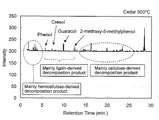
- Fig. 2 is a chart obtained by GC/MS measurement of volatile components resulting from pyrolysis of cedar at 500 degrees C.
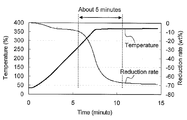
- Fig. 3 is a chart showing the change in the weight reduction rate of a cedar sample when the temperature was increased at 50 degrees C/minute and then held at 370 degrees C.
- Fig. 4 is a chart obtained by GC/MS measurement of volatile components resulting from pyrolysis of cedar at two temperature stages (370 degrees C and 500 degrees C).
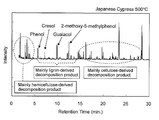
- Fig. 5 is a chart obtained by GC/MS measurement of volatile components resulting from pyrolysis of Japanese cypress at 500 degrees C.
- Fig. 1 is a flow chart showing the outline of the method of the present invention.
- Fig. 2 is a chart obtained by GC/MS measurement of volatile components resulting from pyrolysis of cedar at 500 degrees C.
- Fig. 3 is a chart showing the change in the weight reduction
- Fig. 6 is a chart obtained by GC/MS measurement of volatile components resulting from pyrolysis of Japanese cypress at the two temperature stages (370 degrees C and 500 degrees C).
- Fig. 7 is a chart obtained by GC/MS measurement of volatile components resulting from pyrolysis of Japanese cypress at 270 degrees C or 330 degrees C.
- Fig. 8 is a schematic view of an apparatus having two heating zones, which was used in Example 2-2.
- Fig. 9 is a chart obtained as a result of GPC analysis of decomposition products that were obtained by pyrolyzing Japanese cypress at 300 degrees C and then reheating the thus generated gasified product at 600 degrees C to 800 degrees C.
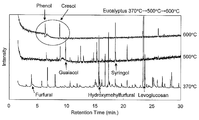
- Fig. 10 is a chart obtained by GC-MS measurement of volatile components resulting from pyrolysis of eucalyptus at the three temperature stages (370 degrees C, 500 degrees C and 600 degrees C).
- Fig. 11 is a chart obtained by GC-MS measurement of volatile components resulting from pyrolysis of palm kernel shells at the two temperature stages (500 degrees C and 600 degrees C).
- Fig. 12 is a chart obtained by GC-MS measurement of volatile components resulting from pyrolysis of palm kernel shells at the three temperature stages (350 degrees C, 500 degrees C and 600 degrees C).
- Fig. 1 is a flow chart showing the outline of the present invention. The method of the present invention will be described using this flow chart.
- the method of the present invention comprises a 1st heating step (A) of heating plant biomass at a 1st heating temperature and a 2nd heating step (B or C) of heating either a gasified product (a1) or a biomass residue (a2) obtained in the 1st heating step at a 2nd heating temperature higher than the 1st heating temperature.
- the method of the present invention may comprise a 3rd heating step (D), in which a biomass residue (c2) generated in the 2nd heating step (C) is heated at a 3rd heating temperature higher than the 2nd heating temperature.
- plant biomass refers to a plant-derived raw material containing cellulose, hemicellulose, lignin, and the like, including both woody biomass and herbaceous biomass.
- woody biomass include materials originating from plants having lignified stem tissues such as Japanese timbers, North American timbers, Russian timbers (North Pacific timbers), South Pacific timbers, African timbers, South American timbers, Oceanian timbers, Chinese timbers, and European timbers (e.g., cedar, cypress, pine, sawtooth oak, cherry, Japanese ash, zelkova, beech, oak (nara), maple, ginkgo, empress tree, oak (kashi), the trees of the genus Castanea of the family Fagaceae (kuri), eucalyptus, teak, mahogany, Hinoki cypress or Sawara cypress (hiba), poplar, acacia, Abies firma (momi), birch, la
- herbaceous biomass examples include materials originating from plants lacking lignified stem tissues, such as rice, the cereals of the family Gramineae including barley and wheat (mugi), sugarcane, corn, rapeseed, soybean, palm, reed, bamboo grass, bamboo, sugarbeet, potates, legumes (plants of the family Leguminosae), and algaes.
- plant biomass also include residues of the above woody biomass and herbaceous biomass, such as bagasse (sugarcane residue after squeezing) and residues obtained by oil squeezing of soybean, rapeseed, palm tree, and the like.
- bagasse sugarcane residue after squeezing
- residues obtained by oil squeezing of soybean, rapeseed, palm tree, and the like As plant biomass to be used in the method of the present invention, lignin-rich woody biomass is more preferable for the production of large amounts of phenols, as described later.
- useful organic compound in the method of the present invention refers to an organic compound useful as a raw material in chemical industry or as a fuel for engines or fuel cells, for example.
- a useful organic compound include monohydric phenols, dihydric phenols, trihydric phenols, furans, levoglucosan, and cellobiose.
- Examples of a useful organic compound that is obtained by pyrolyzing plant biomass include particularly phenol, cresol, and furan.
- a raw material to be heated biomass, a gasified product, or a biomass residue
- a raw material to be heated biomass, a gasified product, or a biomass residue
- Each heating step is preferably performed under conditions where an inert gas is present but water other than the one originally contained in the raw material is absent, for example. If necessary, a raw material may be dried before the heating step so as to remove water in advance.
- the method of the present invention comprises separating a gasified product resulting from pyrolysis from a residue that has remained ungasified, following each of the heating steps (A to D). Separation is performed by a general method known by persons skilled in the art such as a method that involves installing a condenser in an exhaust system of a furnace for heating, liquefying and collecting a gasified product contained in exhaust gas, and separately collecting residues remaining in the furnace after heating.
- plant biomass is preferably heated at a temperature of 400 degrees C or lower and particularly at a temperature of 380 degrees C or lower. This is based on the finding that cellulose and hemicellulose, among the components contained in plant biomass, are pyrolyzed even at relatively low temperatures. At such temperatures, among components composing plant biomass, lignin is almost never pyrolyzed, but rather, only cellulose and hemicellulose are pyrolyzed to be converted to gasified products (a1). If the temperature is too low, pyrolysis does not proceed. Hence, plant biomass is heated preferably at a temperature of 275 degrees C or higher and particularly preferably at temperatures of 280 degrees C or higher.
- Optimum heating temperature in the 1st heating step (A) differs depending on plant biomass type, and it is generally 400 degrees C or lower.
- the 1st heating temperature is preferably 380 degrees C or lower, more preferably 375 degrees C or lower, and particularly preferably 370 degrees C or lower.
- the 1st heating temperature preferably ranges from 275 degrees C to 325 degrees C and particularly preferably ranges from 280 degrees C to 320 degrees C, for example, since hemicellulose starts to be pyrolyzed at a lower temperature than cellulose.
- either a gasified product (a1) or a biomass residue (a2) generated in the 1st heating step is heated at a 2nd heating temperature that is higher than the 1st heating temperature.
- biomass residue refers to a residue remaining after liberation of the gasified product that has been generated via pyrolysis from a heated material.
- the 2nd heating temperature is preferably set at 450 degrees C or higher and particularly preferably set at 500 degrees C or higher.
- a lignin-derived decomposition product contains phenols such as phenol, cresol, guaiacol, hydroxy methoxy toluene, hydroxy methoxy ethyl benzene, hydroxy methoxyvinyl benzene, hydroxy methoxy propyl benzene, dimethoxy phenol, hydroxy dimethoxy toluene, hydroxy dimethoxy ethyl benzene, hydroxy dimethoxy propyl benzene, pyrocatechol, benzofuran, dibenzofuran, and vanillin.
- phenol and cresol are particularly industrially important compounds.
- the lignin-derived decomposition product to be obtained herein contains at least phenol or cresol.
- the phenol and/or cresol content in the lignin-derived decomposition product to be obtained herein is preferably 20% by weight or more with respect to the total weight of the obtained gasified product (c1) after condensation. More preferably, the lignin-derived decomposition product to be obtained herein substantially consists of phenol and/or cresol.
- the expression "substantially consist(s) of” means that impurities other than a target substance contained in a subject account for less than 5% by weight, preferably less than 3% by weight, and particularly preferably less than 1% by weight.
- a biomass residue (c2) further generated after heating of the biomass residue (a2) in the 2nd heating step (C) and the following liberation of the gasified product (c1) may be subjected to a 3rd heating step (D).
- the biomass residue (c2) is heated at a 3rd heating temperature that is higher than the 2nd heating temperature in the 2nd heating step (C).
- the 3rd heating temperature is preferably set at 550 degrees C or higher, and it is particularly preferably set at 600 degrees C or higher, for example. However, if the 3rd heating temperature is set at an excessively high temperature, the biomass residue (a2) becomes carbonized.
- the 3rd heating temperature is preferably set at 650 degrees C or lower.
- the biomass residue (a2) is heated at a 2nd heating temperature ranging from 500 degrees C to 600 degrees C (more preferably ranging from 500 degrees C to 550 degrees C) in the 2nd heating step (C), and subsequently the biomass residue (c2) is heated at a 3rd heating temperature of 600 degrees C or higher (more preferably 620 degrees C or higher) in the 3rd heating step (D), lignin that has remained undegraded is pyrolyzed and then a lignin-derived decomposition product can be obtained as a gasified product (d1).
- the lignin-derived decomposition product to be obtained herein is similar to the one described above and contains at least phenol or cresol.
- the phenol and/or cresol content in the lignin-derived decomposition product to be obtained herein is preferably 50% by weight or more with respect to the total weight of the thus obtained gasified product (d1) after condensation. More preferably, the lignin-derived decomposition product to be obtained herein substantially consists of phenol and/or cresol.
- a biomass residue (d2) generated in the 3rd heating step (D) contains no useful compounds anymore and thus is generally used as a raw material serving as a heat source.
- a hemicellulose-derived decomposition product is obtained as a product (b1).
- a hemicellulose-derived decomposition product contains furans such as furan and furfural.
- a hemicellulose-derived decomposition product to be obtained herein contains at least furan.
- the furan content in such a hemicellulose-derived decomposition product to be obtained herein is preferably 30% by weight or more with respect to the total weight of the thus obtained product (b1) after condensation. More preferably, a hemicellulose-derived decomposition product to be obtained herein substantially consists of furan alone.
- the 2nd heating temperature is preferably set at 700 degrees C or higher and particularly preferably 750 degrees C or higher.
- the furan content in a hemicellulose-derived decomposition product to be obtained herein is preferably 50% by weight or more with respect to the total weight of the thus obtained product (b1) after condensation.
- the 2nd heating temperature preferably ranges from 630 degrees C to 660 degrees C and particularly preferably ranges from 640 degrees C to 660 degrees C.
- the 1st heating temperature in the 1st heating step (A) may be 320 degrees C or higher and may range from 320 degrees C to 400 degrees C (more preferably may range from 350 degrees C to 380 degrees C), for example.
- a cellulose-derived decomposition product contains hydroxymethyl furfural, levoglucosan, and cellobiose.
- the expression “only one of these procedures is performed” means that only the procedure (i) above is performed, a gasified product (a1) generated in the 1st heating step (A) and a biomass residue (c2) generated in the 2nd heating step (C) are not further treated, but are used as fuels in the form of miscellaneous mixtures or discarded, for example.
- the expression “only two procedures are performed” means that only the procedures (i) and (iii) above are performed, and a biomass residue (c2) generated in the 2nd heating step (C) is not further treated, for example.
- Products to be obtained in each procedure may be further purified if necessary.
- the number of types of compound contained in these products is very few compared with decomposition products obtained when plant biomass is simply pyrolyzed in a single stage. Therefore, the resulting compounds can be purified without particular difficulties. Purification can be performed by a conventionally known method such as distillation.
- Fig. 3 shows the change in the weight reduction rate of a cedar sample when the temperature was increased at 50 degrees C/minute and then held at 370 degrees C.
- the weight of the cedar sample started to decrease at around about 280 degrees C.
- the weight reduction rate had decreased within about 2 minutes after the temperature had reached 370 degrees C.
- the weight of the residue at this time point accounted for about 30% of the initial weight. This suggested that most volatile components are volatilized within about 5 minutes when a cedar sample is pyrolyzed.
- Fig. 6 shows the thus obtained chart.
- components volatilized at 370 degrees C were found to include high levels of hemicellulose-derived and cellulose-derived decomposition products.
- components volatilized at 500 degrees C were found to include high levels of lignin-derived decomposition products (phenols).
- the indication "300-600” in the chart means that heating at the first stage portion was performed at 300 degrees C and heating at the second stage portion was performed at 600 degrees C (and the same applies to the other indications).
- the furan collection rate with respect to stoichiometric furan production is as shown in Table 2 below.
- Fig. 10 shows the thus obtained chart. It was demonstrated when pyrolysis was performed at three temperature stages (370 degrees C, 500 degrees C and 600 degrees C), a decomposition product containing phenol and cresol as major components was generated at 600 degrees C.
- Palm kernel shells were pyrolyzed at two temperature stages (500 degrees C and 600 degrees C) or three temperature stages (350 degrees C, 500 degrees C and 600 degrees C) and the thus generated volatile components were subjected to GC/MS measurement. Measuring apparatuses used herein are the same as those in 1-1 above. Procedures for pyrolysis at two temperature stages or three temperature stages were similar to those in 1-3 and 3-1 above. Fig. 11 and Fig. 12 show the thus obtained charts.
Landscapes
- Chemical & Material Sciences (AREA)
- Engineering & Computer Science (AREA)
- Oil, Petroleum & Natural Gas (AREA)
- Materials Engineering (AREA)
- Organic Chemistry (AREA)
- Organic Low-Molecular-Weight Compounds And Preparation Thereof (AREA)
- Processing Of Solid Wastes (AREA)
- Furan Compounds (AREA)
Applications Claiming Priority (2)
| Application Number | Priority Date | Filing Date | Title |
|---|---|---|---|
| JP2010292630A JP5668469B2 (ja) | 2010-12-28 | 2010-12-28 | 植物系バイオマスの熱分解方法 |
| JP2010-292630 | 2010-12-28 |
Publications (1)
| Publication Number | Publication Date |
|---|---|
| WO2012090369A1 true WO2012090369A1 (en) | 2012-07-05 |
Family
ID=45440610
Family Applications (1)
| Application Number | Title | Priority Date | Filing Date |
|---|---|---|---|
| PCT/JP2011/006030 Ceased WO2012090369A1 (en) | 2010-12-28 | 2011-10-28 | Pyrolysis method for plant biomass |
Country Status (3)
| Country | Link |
|---|---|
| JP (1) | JP5668469B2 (https=) |
| MY (1) | MY162947A (https=) |
| WO (1) | WO2012090369A1 (https=) |
Cited By (5)
| Publication number | Priority date | Publication date | Assignee | Title |
|---|---|---|---|---|
| JP2014015432A (ja) * | 2012-07-10 | 2014-01-30 | Toyota Motor Corp | バイオマス原料からフェノールを製造する方法 |
| CN104355968A (zh) * | 2014-10-20 | 2015-02-18 | 北京林业大学 | 一种纤维素催化热裂解转化制备酚类物质的方法 |
| US9505668B2 (en) | 2014-05-01 | 2016-11-29 | Iogen Corporation | Process for producing a fuel and byproduct from biomass or biomass derived material |
| WO2018161280A1 (zh) * | 2017-03-06 | 2018-09-13 | 华北电力大学 | 一种活性炭催化热解甘蔗渣制备4-乙基苯酚的方法 |
| CN111849526A (zh) * | 2020-07-22 | 2020-10-30 | 中国电力工程顾问集团西北电力设计院有限公司 | 一种热解生物质联产焦炭和苯酚的方法 |
Families Citing this family (1)
| Publication number | Priority date | Publication date | Assignee | Title |
|---|---|---|---|---|
| KR20200020518A (ko) * | 2018-08-17 | 2020-02-26 | 서울시립대학교 산학협력단 | 목재 또는 리그닌의 재활용 장치 및 이를 이용하여 목재 또는 리그닌으로부터 페놀을 생산하는 방법 |
Citations (4)
| Publication number | Priority date | Publication date | Assignee | Title |
|---|---|---|---|---|
| EP1277825A1 (fr) * | 2001-07-18 | 2003-01-22 | Institut Francais Du Petrole | Procédé et installation de production de gaz combustibles à partir de gaz issus de la conversion thermique d'une charge solide |
| WO2007128800A1 (en) | 2006-05-05 | 2007-11-15 | Bioecon International Holding N.V. | Process for the conversion of biomass to liquid fuels and specialty chemicals |
| WO2010102145A1 (en) * | 2009-03-04 | 2010-09-10 | Washington State University | Systems and processes for producing bio-fuels from lignocellulosic materials |
| WO2010130988A1 (en) * | 2009-05-11 | 2010-11-18 | Aston University | Staged biomass pyrolysis process and apparatus |
Family Cites Families (4)
| Publication number | Priority date | Publication date | Assignee | Title |
|---|---|---|---|---|
| AUPP729098A0 (en) * | 1998-11-24 | 1998-12-17 | University Of Melbourne, The | Process for the recovery of low molecular weight phenols and/or cellulose or cellulose-rich residue |
| JP2003212797A (ja) * | 2002-01-15 | 2003-07-30 | National Institute Of Advanced Industrial & Technology | バイオマス熱分解タールからの含酸素化合物の回収方法 |
| JP2004300419A (ja) * | 2003-03-19 | 2004-10-28 | Jgc Corp | 改質ろ液の製造方法および該製造方法で得られる改質ろ液 |
| JP4394989B2 (ja) * | 2004-03-24 | 2010-01-06 | 新日本製鐵株式会社 | 木質系バイオマスを用いた高炉用コークスの製造方法 |
-
2010
- 2010-12-28 JP JP2010292630A patent/JP5668469B2/ja not_active Expired - Fee Related
-
2011
- 2011-10-28 WO PCT/JP2011/006030 patent/WO2012090369A1/en not_active Ceased
- 2011-10-28 MY MYPI2013700862A patent/MY162947A/en unknown
Patent Citations (4)
| Publication number | Priority date | Publication date | Assignee | Title |
|---|---|---|---|---|
| EP1277825A1 (fr) * | 2001-07-18 | 2003-01-22 | Institut Francais Du Petrole | Procédé et installation de production de gaz combustibles à partir de gaz issus de la conversion thermique d'une charge solide |
| WO2007128800A1 (en) | 2006-05-05 | 2007-11-15 | Bioecon International Holding N.V. | Process for the conversion of biomass to liquid fuels and specialty chemicals |
| WO2010102145A1 (en) * | 2009-03-04 | 2010-09-10 | Washington State University | Systems and processes for producing bio-fuels from lignocellulosic materials |
| WO2010130988A1 (en) * | 2009-05-11 | 2010-11-18 | Aston University | Staged biomass pyrolysis process and apparatus |
Non-Patent Citations (3)
| Title |
|---|
| DE WILD P J ET AL: "Biomass valorisation by staged degasification. A new pyrolysis-based thermochemical conversion option to produce value-added chemicals from lignocellulosic biomass", JOURNAL OF ANALYTICAL AND APPLIED PYROLYSIS, ELSEVIER BV, NL, vol. 85, no. 1-2, 1 May 2009 (2009-05-01), pages 124 - 133, XP002603129, ISSN: 0165-2370, [retrieved on 20080826], DOI: 10.1016/J.JAAP.2008.08.008 * |
| IND. ENG. CHEM. RES., vol. 42, 2003, pages 3190 - 3202 |
| PRINS M J ET AL: "More efficient biomass gasification via torrefaction", ENERGY, PERGAMON PRESS, OXFORD, GB, vol. 31, no. 15, 1 December 2006 (2006-12-01), pages 3458 - 3470, XP024900326, ISSN: 0360-5442, [retrieved on 20061201], DOI: 10.1016/J.ENERGY.2006.03.008 * |
Cited By (5)
| Publication number | Priority date | Publication date | Assignee | Title |
|---|---|---|---|---|
| JP2014015432A (ja) * | 2012-07-10 | 2014-01-30 | Toyota Motor Corp | バイオマス原料からフェノールを製造する方法 |
| US9505668B2 (en) | 2014-05-01 | 2016-11-29 | Iogen Corporation | Process for producing a fuel and byproduct from biomass or biomass derived material |
| CN104355968A (zh) * | 2014-10-20 | 2015-02-18 | 北京林业大学 | 一种纤维素催化热裂解转化制备酚类物质的方法 |
| WO2018161280A1 (zh) * | 2017-03-06 | 2018-09-13 | 华北电力大学 | 一种活性炭催化热解甘蔗渣制备4-乙基苯酚的方法 |
| CN111849526A (zh) * | 2020-07-22 | 2020-10-30 | 中国电力工程顾问集团西北电力设计院有限公司 | 一种热解生物质联产焦炭和苯酚的方法 |
Also Published As
| Publication number | Publication date |
|---|---|
| JP5668469B2 (ja) | 2015-02-12 |
| JP2012140346A (ja) | 2012-07-26 |
| MY162947A (en) | 2017-07-31 |
Similar Documents
| Publication | Publication Date | Title |
|---|---|---|
| WO2012090369A1 (en) | Pyrolysis method for plant biomass | |
| Capunitan et al. | Characterization and separation of corn stover bio-oil by fractional distillation | |
| Alhumade et al. | Investigation of pyrolysis kinetics and thermal behavior of Invasive Reed Canary (Phalaris arundinacea) for bioenergy potential | |
| Şensöz et al. | Pyrolysis of safflower (Charthamus tinctorius L.) seed press cake in a fixed-bed reactor: Part 2. Structural characterization of pyrolysis bio-oils | |
| Wu et al. | Study on the preparation of wood vinegar from biomass residues by carbonization process | |
| Yin et al. | Characterization of bio-oil and bio-char obtained from sweet sorghum bagasse fast pyrolysis with fractional condensers | |
| Duman et al. | The slow and fast pyrolysis of cherry seed | |
| Das et al. | Bio-oil from pyrolysis of cashew nut shell—a near fuel | |
| Da Silva et al. | Bioenergetic potential of Ponkan peel waste (Citrus reticulata) pyrolysis by kinetic modelling and product characterization | |
| Pimenta et al. | Fast pyrolysis of trunk wood and stump wood from a Brazilian eucalyptus clone | |
| Boer et al. | Slow pyrolysis of sugarcane bagasse for the production of char and the potential of its by-product for wood protection | |
| Hassan et al. | Comparison study of rubber seed shell and kernel (Hevea brasiliensis) as raw material for bio-oil production | |
| Faisal et al. | Effects of pyrolysis temperature on the composition of liquid smoke derived from oil palm empty fruit bunches | |
| Canché-Escamilla et al. | Characterization of bio-oil and biochar obtained by pyrolysis at high temperatures from the lignocellulosic biomass of the henequen plant | |
| Santos et al. | Pyrolysis of the Caupi Bean Pod (Vigna unguiculata): Characterization of biomass and bio-oil | |
| Kim et al. | Recovery of resin acids from fast pyrolysis of pine | |
| Bertaud et al. | Volatile terpene extraction of spruce, fir and maritime pine wood: supercritical CO2 extraction compared to classical solvent extractions and steam distillation. | |
| Sampaio et al. | Evaluation of the influence of hydrophilic extractives on the formation of bio-oil from the micro-pyrolysis of biomass waste | |
| Brebu et al. | Thermal and catalytic degradation of grape seeds/polyethylene waste mixture | |
| Chen et al. | Influence of pyrolysis temperature on bio-oil produced from hazelnut shells: Physico-chemical properties and antioxidant activity of wood vinegar and tar fraction | |
| Özbay | Pyrolysis of firwood (Abies bornmülleriana Mattf.) sawdust: Characterization of bio-oil and bio-char | |
| Liu et al. | Characterization of thermo-chemical degradation and pyrolysis properties for three kinds of biomass residues | |
| Li et al. | Pretreatment of sweet sorghum stalk with aqueous hydrogen peroxide for enhancing methanolysis and property of the bio-oil | |
| Kim et al. | Effect of non-structural organics and inorganics constituents of switchgrass during pyrolysis | |
| Kato et al. | Chemical properties of bio-oils produced by fast pyrolysis of bamboo |
Legal Events
| Date | Code | Title | Description |
|---|---|---|---|
| 121 | Ep: the epo has been informed by wipo that ep was designated in this application |
Ref document number: 11802983 Country of ref document: EP Kind code of ref document: A1 |
|
| DPE1 | Request for preliminary examination filed after expiration of 19th month from priority date (pct application filed from 20040101) | ||
| NENP | Non-entry into the national phase |
Ref country code: DE |
|
| 122 | Ep: pct application non-entry in european phase |
Ref document number: 11802983 Country of ref document: EP Kind code of ref document: A1 |