WO2012086972A2 - 알루미늄 페이스트 조성물 및 이를 이용한 태양전지 소자 - Google Patents
알루미늄 페이스트 조성물 및 이를 이용한 태양전지 소자 Download PDFInfo
- Publication number
- WO2012086972A2 WO2012086972A2 PCT/KR2011/009761 KR2011009761W WO2012086972A2 WO 2012086972 A2 WO2012086972 A2 WO 2012086972A2 KR 2011009761 W KR2011009761 W KR 2011009761W WO 2012086972 A2 WO2012086972 A2 WO 2012086972A2
- Authority
- WO
- WIPO (PCT)
- Prior art keywords
- mol
- aluminum paste
- paste composition
- glass frit
- aluminum
- Prior art date
- Legal status (The legal status is an assumption and is not a legal conclusion. Google has not performed a legal analysis and makes no representation as to the accuracy of the status listed.)
- Ceased
Links
Images

Classifications
-
- H—ELECTRICITY
- H10—SEMICONDUCTOR DEVICES; ELECTRIC SOLID-STATE DEVICES NOT OTHERWISE PROVIDED FOR
- H10F—INORGANIC SEMICONDUCTOR DEVICES SENSITIVE TO INFRARED RADIATION, LIGHT, ELECTROMAGNETIC RADIATION OF SHORTER WAVELENGTH OR CORPUSCULAR RADIATION
- H10F77/00—Constructional details of devices covered by this subclass
- H10F77/20—Electrodes
- H10F77/206—Electrodes for devices having potential barriers
- H10F77/211—Electrodes for devices having potential barriers for photovoltaic cells
-
- C—CHEMISTRY; METALLURGY
- C03—GLASS; MINERAL OR SLAG WOOL
- C03C—CHEMICAL COMPOSITION OF GLASSES, GLAZES OR VITREOUS ENAMELS; SURFACE TREATMENT OF GLASS; SURFACE TREATMENT OF FIBRES OR FILAMENTS MADE FROM GLASS, MINERALS OR SLAGS; JOINING GLASS TO GLASS OR OTHER MATERIALS
- C03C8/00—Enamels; Glazes; Fusion seal compositions being frit compositions having non-frit additions
- C03C8/02—Frit compositions, i.e. in a powdered or comminuted form
- C03C8/04—Frit compositions, i.e. in a powdered or comminuted form containing zinc
-
- H—ELECTRICITY
- H01—ELECTRIC ELEMENTS
- H01B—CABLES; CONDUCTORS; INSULATORS; SELECTION OF MATERIALS FOR THEIR CONDUCTIVE, INSULATING OR DIELECTRIC PROPERTIES
- H01B1/00—Conductors or conductive bodies characterised by the conductive materials; Selection of materials as conductors
- H01B1/14—Conductive material dispersed in non-conductive inorganic material
- H01B1/16—Conductive material dispersed in non-conductive inorganic material the conductive material comprising metals or alloys
-
- H—ELECTRICITY
- H01—ELECTRIC ELEMENTS
- H01B—CABLES; CONDUCTORS; INSULATORS; SELECTION OF MATERIALS FOR THEIR CONDUCTIVE, INSULATING OR DIELECTRIC PROPERTIES
- H01B1/00—Conductors or conductive bodies characterised by the conductive materials; Selection of materials as conductors
- H01B1/20—Conductive material dispersed in non-conductive organic material
- H01B1/22—Conductive material dispersed in non-conductive organic material the conductive material comprising metals or alloys
-
- Y—GENERAL TAGGING OF NEW TECHNOLOGICAL DEVELOPMENTS; GENERAL TAGGING OF CROSS-SECTIONAL TECHNOLOGIES SPANNING OVER SEVERAL SECTIONS OF THE IPC; TECHNICAL SUBJECTS COVERED BY FORMER USPC CROSS-REFERENCE ART COLLECTIONS [XRACs] AND DIGESTS
- Y02—TECHNOLOGIES OR APPLICATIONS FOR MITIGATION OR ADAPTATION AGAINST CLIMATE CHANGE
- Y02E—REDUCTION OF GREENHOUSE GAS [GHG] EMISSIONS, RELATED TO ENERGY GENERATION, TRANSMISSION OR DISTRIBUTION
- Y02E10/00—Energy generation through renewable energy sources
- Y02E10/50—Photovoltaic [PV] energy
Definitions
- the present invention relates to an aluminum paste composition which does not contain PbO and Bi 2 O 3 components, which is environmentally friendly and can also improve durability, and a solar cell device using the same.
- Solar cells which are rapidly spreading in recent years, are electronic devices that directly convert solar energy, which is clean energy, into electricity as a next generation energy source.
- an N + layer 20, an antireflection film 30, and a front electrode 40 are formed on the light-receiving surface side of the silicon wafer substrate 10, and the substrate 10 is opposite to the substrate 10.
- P + layer 50 and the back electrode 60 is formed on the surface side.
- the back electrode 60 is formed by applying an aluminum paste composition by screen printing, drying, and then firing the aluminum paste composition.
- aluminum is diffused into the silicon wafer substrate 10 so that the back electrode 60 and the substrate 10 are baked.
- An Al—Si alloy layer is formed therebetween and a P + layer 50 is formed by diffusion of aluminum atoms.
- the P + layer 50 acts as a back surface field (BSF) that prevents recombination of electrons and improves the collection efficiency of product carriers, and also serves as a reflector reflecting long wavelength light of sunlight.
- BSF back surface field
- the aluminum paste composition for forming the back electrode 60 includes aluminum powder, glass frit, and an organic vehicle.
- glass frit is a component for further strengthening the bond with the silicon wafer substrate 10 and is usually composed of PbO-B 2 O 3 -SiO 2 based, PbO-B 2 O 3 -Al 2 O 3 based, and PbO- Those containing B 2 O 3 -ZnO-based oxides were mainly used.
- Bi 2 O 3 -based oxides having similar properties to the PbO-based oxides without containing PbO components, such as Bi 2 O 3 -B 2 O 3 -SiO 2 , Bi 2 O 3 -B 2 O 3 has been proposed to include -ZnO-based oxide.
- Korean Patent No. 0890866 discloses 0.5-35% by weight of SiO 2 , 0-5% by weight of Al 2 O 3 , 1-15% by weight of B 2 O 3 , 0-15% by weight of ZnO and 55-90 weight of Bi 2 O 3.
- a glass frit comprising% is disclosed.
- the glass frit containing the Bi 2 O 3 component heat-etches the oxide film on the surface of the aluminum powder of the aluminum layer to increase the moisture and reactivity, which has the disadvantage of lowering the durability of the solar cell device itself.
- Another object of the present invention is to provide an electrode formed from the aluminum paste composition.
- Another object of the present invention is to provide a solar cell device provided with the electrode.
- the glass frit is an aluminum paste composition further comprises one or more selected from the group consisting of Al 2 O 3 , B 2 O 3 , P 2 O 5 , SiO 2 , alkali metal oxides and alkaline earth metal oxides .
- Al 2 O 3 is 0.5-5 mol%
- B 2 O 3 is 0.5-5 mol%
- P 2 O 5 is 0-30 mol%
- SiO with respect to 100 mol% of the glass frit composition 2 is 0-15 mol%
- an alkali metal oxide is 1-10 mol%
- an alkaline earth metal oxide is contained in 0-30 mol%.
- the glass frit is V 2 O 5 50-70 mol%, ZnO 10-30 mol%, Al 2 O 3 0.5-5 mol%, B 2 O 3 0.5-5 mol% and alkali metal oxide Aluminum paste composition containing 1-10 mol%.
- the alkali metal oxide is at least one aluminum paste composition selected from the group consisting of K 2 O, Na 2 O and Li 2 O.
- the glass frit has a softening point of 300-600 °C aluminum paste composition.
- the aluminum powder is an aluminum paste composition of 60-95% by weight of the powder having an average particle size of 4-6 ⁇ m and 5-40% by weight of the powder having an average particle size of 2-4 ⁇ m.
- the aluminum paste composition according to the present invention is environmentally friendly because it does not contain PbO components that are restricted in use due to environmental problems, and at the same time does not contain Bi 2 O 3 components having strong thermal etching properties, thereby preventing reaction with moisture. Through this, it is possible to enhance the durability of the solar cell element itself.
- the aluminum paste composition of the present invention can suppress the warpage phenomenon of the silicon wafer substrate even with a relatively high coefficient of thermal expansion, can increase the maximum output current (Isc) of the solar cell device and improve the efficiency.
- FIG. 1 is a diagram schematically illustrating a cross-sectional view of a solar cell element.
- the present invention relates to an aluminum paste composition containing no PbO and Bi 2 O 3 components and a solar cell device using the same.
- the aluminum paste composition of the present invention is aluminum powder; Glass frit; And V 2 O 5 -ZnO-based oxides, including organic vehicles, but not containing both PbO and Bi 2 O 3 components at the same time as the glass frit.
- the glass frit is characterized by containing 50-80 mol% V 2 O 5 and 20-50 mol% ZnO.
- the aluminum powder is a conductive metal which is a main component of the paste composition for forming the back electrode, and it is preferable to use two kinds of mixed powders having different average particle sizes.
- the silicon wafer substrate for forming the back electrode has a structure in which fine pyramids are formed on the surface by texturing both surfaces to increase the light receiving area of sunlight. Normally formed fine pyramids have a height of 2-15 ⁇ m and a width of 2-20 ⁇ m, and have an irregular maze shape.
- the aluminum paste composition is printed by a method such as screen printing, gravure printing, or offset printing, dried, and then baked to form a back electrode.
- the particle size of the aluminum powder is too large, the contact between the aluminum paste composition and the silicon wafer substrate is not made well, and voids are formed between them after printing and drying. These voids pass through the aluminum paste layer and eject the surface during the firing process, resulting in aluminum bumps and bubbles. Therefore, it is desirable to minimize the size of the pores by mixing two kinds of aluminum powders having different average particle sizes.
- the aluminum powder is preferably a mixture of 60-95 wt% of the powder having an average particle size of 4-6 ⁇ m and 5-40 wt% of the powder having an average particle size of 2-4 ⁇ m.
- the powder having an average particle size of 4-6 ⁇ m suppresses shrinkage of the silicon wafer substrate after firing to form a high density low shrink electrode, and the powder having an average particle size of 2-4 ⁇ m acts as a binder between the aluminum powders.
- the paste penetrates deeply and evenly into the textured surface of the substrate. In this case, the porosity between the substrate and the paste is reduced, the back electric field (BSF) is uniformly formed, the resistance of the back electrode is lowered, and the bending of the substrate is also suppressed. Therefore, it is possible to increase the maximum output current Isc of the solar cell device and increase efficiency, and to prevent yellowing occurring at the rear electrode after the firing process.
- BSF back electric field
- the aluminum powder is preferably included at 65-75% by weight relative to 100% by weight of the total content of the aluminum paste composition. If the content is less than 65% by weight, the thickness of the printed aluminum rear electrode after firing becomes thin so that the back field (BSF) may not be sufficiently formed and the efficiency may be lowered. When the content is more than 75% by weight, the thickness of the silicon wafer substrate is too thick. May cause warpage.
- the glass frit is characterized by using a V 2 O 5 -ZnO-based oxide which does not contain a PbO component and a Bi 2 O 3 component at the same time.
- glass frit containing PbO component has advantages of easy melting point control and low coefficient of thermal expansion, but its use is limited due to environmental problems.
- Glass frit containing Bi 2 O 3 component has similar characteristics to PbO glass frit.
- the reactivity of thermal etching the aluminum oxide film is too large, the water resistance of the aluminum electrode is lowered, and as a result, the durability of the solar cell device is deteriorated.
- the present invention is characterized by using a glass frit containing 50-80 mol% of V 2 O 5 and 20-50 mol% of ZnO.
- the glass frit is Al 2 O 3 ; B 2 O 3 ; P 2 O 5 ; SiO 2 ; Alkali metal oxides such as K 2 O, Na 2 O, and Li 2 O; Alkaline earth metal oxides such as MgO, CaO, SrO, and BaO may be contained alone or in combination of two or more thereof.
- Al 2 O 3 is 0.5-5 mol%
- B 2 O 3 is 0.5-5 mol%
- P 2 O 5 is 0-30 mol%
- SiO 2 is 0-15 mol based on 100 mol% of the glass frit.
- Alkali metal oxide may be contained in 1-10 mol% and alkaline earth metal oxide in 0-30 mol%.
- the glass frit is 50-70 mol% V 2 O 5 , 10-30 mol% ZnO, 0.5-5 mol% Al 2 O 3, 0.5-5 mol% B 2 O 3 and alkali metal oxide 1-10 It is preferable to contain mol%.
- a glass frit has a softening point of 300-600 degreeC. If the softening point is higher than 600 ° C., the glass frit must be melted to impart adhesion between the aluminum paste layer and the silicon wafer substrate, but the glass frit may not be sufficiently applied in the firing process, thereby decreasing the adhesion.
- the glass frit is preferably included in an amount of 0.01-10% by weight, more preferably 0.05-7% by weight, and most preferably 0.1-5% by weight, based on 100% by weight of the total content of the aluminum paste composition. If the content is less than 0.01% by weight, the adhesion between the aluminum back electrode and the silicon wafer substrate may be lowered after firing. If the content is more than 10% by weight, the resistance may be increased, thereby reducing the efficiency of the solar cell device.
- the glass frit containing such a component does not contain a PbO component, which is environmentally friendly and does not contain a Bi 2 O 3 component, thereby preventing a decrease in water resistance due to thermal etching.
- glass frits that do not contain PbO components and Bi 2 O 3 components usually have a high melting point, so that a large amount of wood-based planting agent is used, which causes a relatively high coefficient of thermal expansion, which causes warpage of the silicon wafer substrate during solar cell device manufacturing. I could.
- the glass frit configured as in the present invention can be made to be negligible even if the thermal expansion coefficient is relatively high because each component is contained in the optimum molar ratio.
- the organic vehicle is a component for imparting consistency and rheological properties suitable for printing to the aluminum paste composition, and may be a solution in which a polymer resin and various additives are dissolved in an organic solvent as necessary.
- the organic vehicle may be a mixture of 75-99% by weight of the organic solvent and 1-25% by weight of the polymer resin, and may be a mixture of 1-10% by weight of the additive.
- the organic solvent a known one may be used, and a solvent having a boiling point of 150 to 300 ° C. may be used to prevent drying of the paste composition and to control fluidity during the printing process.
- a solvent having a boiling point of 150 to 300 ° C. may be used to prevent drying of the paste composition and to control fluidity during the printing process.
- the organic solvent is preferably included at 75-99% by weight based on 100% by weight of the total organic vehicle. In this content range, optimum fluidity can be imparted to the paste composition.
- polymer resin known ones can be used, for example, ethyl cellulose, nitrocellulose, phenol, acryl, rosin, polyvinyl alcohol, polyvinylpyrrolidone, polyethylene glycol, polyvinyl butyral, urea, xylene, alkyd, unsaturated Polyester, polyimide, furan, urethane, isocyanate, cyanate, polyethylene, polypropylene, polystyrene, acrylonitrile-butadiene-styrene (ABS), polymethyl methacrylate, polyvinyl chloride, polyvinylidene chloride, polyvinyl Resins such as acetate, polyacetal, polycarbonate, polyethylene terephthalate, polybutylene terephthalate, polyphenylene oxide, polysulfone, polyimide, polyether sulfone, polyarylate, polyether ether ketone and silicone Can be. These can be used individually or in mixture of 2 or more types
- the polymer resin may be included in an amount of 1-25 wt%, preferably 5-25 wt%, based on 100 wt% of the total organic vehicle content.
- the content is less than 1% by weight, the printability and dispersion stability of the paste composition may be lowered, and when the content is more than 25% by weight, the paste composition may not be printed.
- the organic vehicle may further comprise a dispersant as an additive together with the above components.
- a known surfactant can be used, for example, polyoxyethylene alkyl ether having 6 to 30 carbon atoms in the alkyl group, polyoxyethylene alkyl aryl ether having 6 to 30 carbon atoms in the alkyl group, and 6 to 30 carbon atoms in the alkyl group.
- Ethers such as polyoxyethylene-polyoxypropylene alkyl ether; Ester ethers such as glycerin ester addition polyoxyethylene ether, sorbitan ester addition polyoxyethylene ether, and sorbitol ester addition polyoxyethylene ether; Esters such as polyethylene glycol fatty acid ester, glycerin ester, sorbitan ester, propylene glycol ester, sugar ester and alkyl polyglucoside; Nitrogen-containing systems such as fatty acid alkanolamide, polyoxyethylene fatty acid amide, polyoxyethylene alkylamine having 6 to 30 carbon atoms of an alkyl group, and amine oxide; And high molecular compounds such as polyvinyl alcohol, polyvinylpyrrolidone, polyacrylic acid, polyacrylic acid-maleic acid copolymer, and poly12-hydroxystearic acid.
- Hypermer KD Uniqema
- AKM 0531 Japan Oil Holding Co., Ltd.
- KP Shin-Etsu Chemical Co., Ltd.
- POLYFLOW Kyoeisha Chemical Co., Ltd.
- EFTOP Tochem Products
- Asahi guard Asahi Glass, Inc.
- Suflon Asahi Glass, Inc.
- SOLSPERSE Genekka
- EFKA EFKA Chemicals, Inc.
- PB 821 Ajinomoto Co., Ltd.
- BYK-184, BYK-185 BYK-2160
- Anti-Terra U manufactured by BYK
- the dispersant may be included in an amount of 1-10% by weight, preferably 1-5% by weight, based on 100% by weight of the total amount of the organic vehicle.
- the organic vehicle may further include additives such as thixotropic agents, wetting agents, antioxidants, corrosion inhibitors, antifoaming agents, thickeners, dispersants, tackifiers, coupling agents, antistatic agents, polymerization inhibitors, and antisettling agents.
- additives such as thixotropic agents, wetting agents, antioxidants, corrosion inhibitors, antifoaming agents, thickeners, dispersants, tackifiers, coupling agents, antistatic agents, polymerization inhibitors, and antisettling agents.
- the organic vehicle is preferably included in 20-34.9% by weight relative to 100% by weight of the total content of the aluminum paste composition. If the content is less than 20% by weight, the viscosity of the aluminum paste composition may be too high, which may lower fluidity and reduce printability. If the content is more than 34.9% by weight, the aluminum powder content may be relatively small to ensure sufficient thickness of the paste layer. It is difficult.
- the aluminum paste composition containing the above components does not contain PbO, which is restricted in use due to environmental problems, and is not only environmentally friendly but also does not contain Bi 2 O 3 , which is highly thermally etchable, thereby preventing deterioration in water resistance. Can be.
- the present invention provides an electrode formed from the aluminum paste composition.
- the electrode is formed through a process of printing, drying and firing an aluminum paste composition on a substrate, such as a silicon wafer substrate on which an Ag front electrode is formed.
- the printing method is not particularly limited, and for example, screen printing, gravure printing, offset printing and the like can be used. Drying is carried out at 60-300 ° C. for several seconds-minutes, and firing can be carried out at 600-950 ° C. for several seconds.
- the electrode formed as described above may be applied to the rear electrode of the solar cell device, thereby improving durability of the solar cell device, increasing the maximum output current Isc of the solar cell device, and increasing efficiency.
- the present invention provides a solar cell device provided with an electrode formed from the aluminum paste composition.
- 250 mesh screen of aluminum paste composition prepared on the back side of a single crystal silicon wafer substrate having a size of 156 mm ⁇ 156 mm, a thickness of 200 ⁇ m, and a pyramid structure having a height of about 4-6 ⁇ m by a texturing process. It was applied using a printing plate. At this time, the coating amount was set to 1.4 ⁇ 0.1g before drying.
- the applied paste was dried at 200 ° C. and then fired for about 10 seconds in an infrared continuous kiln at a temperature of 720-900 ° C. The firing process is carried out by simultaneous firing front and back while passing the silicon wafer substrate into a belt furnace comprising a burn-out section of about 600 ° C. and a firing section of 800-950 ° C. After removing the organic material in the paste, the aluminum was melted to form an electrode, thereby manufacturing a solar cell device.
- the prepared solar cell device was placed in a thermostatic chamber filled with distilled water at 80 ° C. and left for 10 minutes. After visual observation of the generation of hydrogen gas (bubble) due to the reaction of the aluminum electrode formed in the thermostat and the moisture was evaluated based on the following criteria.
- the manufactured solar cell device was placed on a flat bottom and four corners were aligned with the bottom, and then the degree of lifting of the center part was measured.
- the efficiency of the manufactured solar cell device was evaluated using an evaluation device (SCM-1000, FitTech).
- the solar cell device using the aluminum paste composition of Examples 1 and 2 including a glass frit containing P 2 O 5 and ZnO as a main component without PbO and Bi 2 O 3 according to the present invention As it is environmentally friendly and prevents reaction with moisture, it has excellent water resistance, which can improve the durability of the solar cell device, and it can be confirmed that the curvature can be suppressed even with a relatively high coefficient of thermal expansion and high efficiency.
- an aluminum paste composition containing Al 2 O 3 , B 2 O 3 and alkali metal oxides with V 2 O 5 and ZnO in an optimum content it was most effective in securing water resistance while minimizing the amount of warpage.
Landscapes
- Chemical & Material Sciences (AREA)
- Dispersion Chemistry (AREA)
- Engineering & Computer Science (AREA)
- Spectroscopy & Molecular Physics (AREA)
- Inorganic Chemistry (AREA)
- Life Sciences & Earth Sciences (AREA)
- Physics & Mathematics (AREA)
- Chemical Kinetics & Catalysis (AREA)
- General Chemical & Material Sciences (AREA)
- Geochemistry & Mineralogy (AREA)
- Materials Engineering (AREA)
- Organic Chemistry (AREA)
- Glass Compositions (AREA)
- Photovoltaic Devices (AREA)
- Conductive Materials (AREA)
Abstract
본 발명은 알루미늄 페이스트 조성물 및 이를 이용한 태양전지 소자에 관한 것으로서, 보다 상세하게는 알루미늄 분말; V2O5 50-80몰% 및 ZnO 20-50몰%를 함유하는 유리 프릿; 및 유기 비히클을 포함함으로써, 환경 문제로 인하여 사용에 제약이 있는 PbO 성분을 함유하지 않아 친환경적인 동시에 열에칭성이 강한 Bi2O3 성분도 함유하지 않아 수분과의 반응을 방지하여 태양전지 소자 자체의 내구성도 증진시킬 수 있는 알루미늄 페이스트 조성물 및 이를 이용한 태양전지 소자에 관한 것이다.
Description
본 발명은 PbO 및 Bi2O3 성분을 함유하지 않아 친환경적이며 내구성도 증진시킬 수 있는 알루미늄 페이스트 조성물 및 이를 이용한 태양전지 소자에 관한 것이다.
최근 들어 급속하게 보급되고 있는 태양전지는 차세대 에너지원으로서 클린 에너지인 태양 에너지를 직접 전기로 변환하는 전자 소자이다.
태양전지 소자는, 도 1에 나타낸 바와 같이, 실리콘 웨이퍼 기판(10)의 수광면측에 N+층(20), 반사방지막(30)과 전면전극(40)이 형성되어 있고, 기판(10)의 반대면측에 P+층(50)과 후면전극(60)이 형성된 구조를 갖는다. 이러한 구조의 태양전지 소자에 태양광을 비추면 내부에서 전자(-)와 정공(+)이 발생하고, 발생된 전자(-)는 N+층(20)으로 정공(+)은 P+층(50)으로 각각 이동하게 된다. 이 현상에 의해 P+층(50)과 N+층(20) 사이에 전위차가 발생하며, 이때 부하를 연결하면 전류가 발생하게 되는 원리로 태양 에너지가 전기 에너지로 변환된다.
이 중 후면전극(60)은 알루미늄 페이스트 조성물을 스크린 인쇄 등에 의해 도포하고 건조한 후 소성함으로써 형성되는데, 소성 시 알루미늄이 실리콘 웨이퍼 기판(10)의 내부로 확산됨으로써 후면전극(60)과 기판(10) 사이에 Al-Si 합금층이 형성됨과 동시에 알루미늄 원자의 확산에 의한 P+층(50)이 형성된다. 이러한 P+층(50)은 전자의 재결합을 방지하고 생성 캐리어의 수집 효율을 향상시키는 후면전계(back surface field, BSF)의 작용을 할 뿐만 아니라 태양광의 장파장광을 반사하는 반사판의 역할도 한다.
이러한 후면전극(60)을 형성하기 위한 알루미늄 페이스트 조성물은 알루미늄 분말, 유리 프릿 및 유기 비히클(vehicle)을 포함하여 구성된다. 이 중 유리 프릿은 실리콘 웨이퍼 기판(10)과의 결합을 더욱 강화시키기 위한 성분으로서 통상 주성분으로 PbO-B2O3-SiO2계, PbO-B2O3-Al2O3계, PbO-B2O3-ZnO계 산화물을 포함하는 것이 주로 사용되었다.
최근에는 환경 문제로 인해 PbO 성분을 함유하지 않으면서도 상기 PbO계 산화물과 유사한 특성을 갖는 Bi2O3계 산화물, 예컨대 Bi2O3-B2O3-SiO2계, Bi2O3-B2O3-ZnO계 산화물을 포함하는 것이 제안되었다. 한국등록특허 제0890866호에는 SiO2 0.5-35중량%, Al2O3 0-5중량%, B2O3 1-15중량%, ZnO 0-15중량% 및 Bi2O3 55-90중량%를 포함하는 유리 프릿이 개시되어 있다. 그러나, Bi2O3 성분이 함유된 유리 프릿은 알루미늄층의 알루미늄 분말 표면의 산화막을 열에칭시켜 수분과 반응성을 증가시키며, 이로 인해 태양전지 소자 자체의 내구성이 저하되는 단점이 있다.
본 발명은 PbO 및 Bi2O3 성분을 함유하지 않아 친환경적인 동시에 열에칭에 의한 수분과의 반응도 방지할 수 있는 알루미늄 페이스트 조성물을 제공하는 것을 목적으로 한다.
또한, 본 발명은 상기 알루미늄 페이스트 조성물로부터 형성된 전극을 제공하는 것을 다른 목적으로 한다.
또한, 본 발명은 상기 전극이 구비된 태양전지 소자를 제공하는 것을 또 다른 목적으로 한다.
1. 알루미늄 분말; V2O5 50-80몰% 및 ZnO 20-50몰%를 함유하는 유리 프릿; 및 유기 비히클을 포함하는 알루미늄 페이스트 조성물.
2. 위 1에 있어서, 유리 프릿은 Al2O3, B2O3, P2O5, SiO2, 알칼리금속 산화물 및 알칼리토금속 산화물로 이루어진 군으로부터 선택된 1종 이상을 더 함유하는 알루미늄 페이스트 조성물.
3. 위 2에 있어서, 유리 프릿 조성물 총 100몰%에 대하여 Al2O3는 0.5-5몰%, B2O3는 0.5-5몰%, P2O5는 0-30몰%, SiO2는 0-15몰%, 알칼리금속 산화물은 1-10몰% 및 알칼리토금속 산화물은 0-30몰%로 함유되는 알루미늄 페이스트 조성물.
4. 위 3에 있어서, 유리 프릿은 V2O5 50-70몰%, ZnO 10-30몰%, Al2O3 0.5-5몰%, B2O3 0.5-5몰% 및 알칼리금속 산화물 1-10몰%를 함유하는 알루미늄 페이스트 조성물.
5. 위 4에 있어서, 알칼리금속 산화물은 K2O, Na2O 및 Li2O로 이루어진 군으로부터 선택된 1종 이상인 알루미늄 페이스트 조성물.
6. 위 1에 있어서, 유리 프릿은 연화점이 300-600℃인 알루미늄 페이스트 조성물.
7. 위 1에 있어서, 알루미늄 분말 65-75중량%; 유리 프릿 0.01-10중량%; 및 유기 비히클 20-34.9중량%를 포함하는 알루미늄 페이스트 조성물.
8. 위 1에 있어서, 알루미늄 분말은 평균 입자 크기가 4-6㎛인 분말 60-95중량%와 평균 입자 크기가 2-4㎛인 분말 5-40중량%가 혼합된 것인 알루미늄 페이스트 조성물.
9. 위 1에 있어서, 유기 비히클은 고분자 수지 1-25중량%와 유기 용매 75-99중량%가 혼합된 것인 알루미늄 페이스트 조성물.
10. 위 1 내지 9 중 어느 한 항에 따른 알루미늄 페이스트 조성물로 형성된 전극.
11. 위 10의 전극이 구비된 태양전지 소자.
본 발명에 따른 알루미늄 페이스트 조성물은 환경 문제로 인하여 사용에 제약이 있는 PbO 성분을 함유하지 않아 친환경적이며, 동시에 열에칭성이 강한 Bi2O3 성분도 함유하지 않아 수분과의 반응을 방지할 수 있다. 이를 통하여, 태양전지 소자 자체의 내구성을 증진시킬 수 있다.
또한, 본 발명의 알루미늄 페이스트 조성물은 상대적으로 높은 열팽창계수를 가짐에도 실리콘 웨이퍼 기판의 휨 현상을 억제할 수 있으며, 태양전지 소자의 최대출력전류(Isc)를 높이고 효율도 향상시킬 수 있다.
도 1은 태양전지 소자의 단면도를 모식적으로 나타낸 도면이다.
본 발명은 PbO 및 Bi2O3 성분을 함유하지 않는 알루미늄 페이스트 조성물 및 이를 이용한 태양전지 소자에 관한 것이다.
이하 본 발명을 상세히 설명한다.
본 발명의 알루미늄 페이스트 조성물은 알루미늄 분말; 유리 프릿; 및 유기 비히클을 포함하되, 특히 유리 프릿으로 PbO 성분과 Bi2O3 성분을 동시에 함유하지 않는 V2O5-ZnO계 산화물을 사용하는데 특징이 있다.
보다 상세하게, 유리 프릿은 V2O5 50-80몰% 및 ZnO 20-50몰%를 함유하는데 특징이 있다.
알루미늄 분말은 후면전극을 형성하기 위한 페이스트 조성물의 주성분인 전도성 금속으로서, 평균 입자 크기가 상이한 2종의 혼합 분말을 사용하는 것이 바람직하다.
후면전극을 형성하기 위한 실리콘 웨이퍼 기판은 태양광의 수광 면적을 증가시키기 위해 양 표면을 텍스쳐링하여 표면에 미세 피라미드가 형성된 구조를 갖는다. 통상 형성된 미세 피라미드의 높이는 2-15㎛이고 폭은 2-20㎛가 되며, 불규칙한 미로 형태를 나타낸다. 이러한 표면 구조를 갖는 실리콘 웨이퍼 기판 상에 알루미늄 페이스트 조성물을 스크린 인쇄, 그라비아 인쇄 또는 옵셋 인쇄 등의 방법으로 인쇄하고 건조한 후 소성하는 공정을 거쳐 후면전극을 형성하게 된다. 이때, 알루미늄 분말의 입자 크기가 너무 큰 경우 알루미늄 페이스트 조성물과 실리콘 웨이퍼 기판의 접촉이 잘 이루어지지 않으며 인쇄 및 건조 후에 이들의 사이에 공극이 형성되게 된다. 이러한 공극은 소성 공정을 진행하는 동안 알루미늄 페이스트층을 통과하여 표면을 분출되는데, 이로 인해 알루미늄 범프(bump)와 기포가 발생한다. 따라서, 평균 입자 크기가 상이한 2종의 알루미늄 분말을 혼합 사용함으로써 공극의 크기를 최소화하는 것이 바람직하다.
알루미늄 분말은 평균 입자 크기가 4-6㎛인 분말 60-95중량%와 평균 입자 크기가 2-4㎛인 분말 5-40중량%가 혼합된 것이 바람직하다. 평균 입자 크기가 4-6㎛인 분말은 소성 후 실리콘 웨이퍼 기판의 수축을 억제하여 고밀도 저수축 전극의 형성을 가능하게 하며, 평균 입자 크기가 2-4㎛인 분말은 알루미늄 분말 간의 결합제 역할을 하며 기판의 텍스쳐링된 표면에 페이스트가 깊숙하고 고르게 침투하게 한다. 이와 같이 혼합된 경우에는 기판과 페이스트 간의 공극률이 감소되며 후면전계(BSF)가 균일하게 형성되고 후면전극의 저항도 낮아지며 기판의 휨도 억제된다. 따라서, 태양전지 소자의 최대출력전류(Isc)를 높이고 효율도 증가시킬 수 있으며, 소성 공정 후 후면전극에서 발생하는 황변 현상도 방지할 수 있다.
알루미늄 분말은 알루미늄 페이스트 조성물 총 함량 100중량%에 대하여 65-75중량%로 포함되는 것이 바람직하다. 함량이 65중량% 미만인 경우 소성 후 인쇄된 알루미늄 후면전극의 두께가 얇아져 후면전계(BSF)가 충분히 형성되지 않고 효율이 저하될 수 있으며, 75중량% 초과인 경우 인쇄 두께가 너무 두꺼워져 실리콘 웨이퍼 기판의 휨을 초래할 수 있다.
본 발명에서는 유리 프릿으로 특히 PbO 성분과 Bi2O3 성분을 동시에 함유하지 않는 V2O5-ZnO계 산화물을 사용하는데 특징이 있다.
통상 PbO 성분을 함유하는 유리 프릿은 융점 제어가 용이하고 열팽창계수가 낮은 장점이 있으나 환경 문제로 인해 사용이 제한되고 있으며, Bi2O3 성분을 함유하는 유리 프릿은 상기 PbO계 유리 프릿과 유사한 특성을 갖는 반면 알루미늄 산화막을 열에칭하는 반응성이 너무 커서 알루미늄 전극의 내수성을 저하시키고 결과적으로 태양전지 소자의 내구성을 떨어뜨리는 단점이 있다.
이러한 점을 고려하여, 본 발명에서는 V2O5 50-80몰% 및 ZnO 20-50몰%를 함유하는 유리 프릿을 사용하는데 특징이 있다.
보다 바람직하게, 유리 프릿은 Al2O3; B2O3; P2O5; SiO2; K2O, Na2O, Li2O 등의 알칼리금속 산화물; MgO, CaO, SrO, BaO 등의 알칼리토금속 산화물을 단독 또는 2종 이상 혼합하여 더 함유하는 것이 좋다. 이때, 유리 프릿 총 100몰%에 대하여 Al2O3는 0.5-5몰%, B2O3는 0.5-5몰%, P2O5는 0-30몰%, SiO2는 0-15몰%, 알칼리금속 산화물은 1-10몰% 및 알칼리토금속 산화물은 0-30몰%로 함유될 수 있다.
가장 바람직하게, 유리 프릿은 V2O5 50-70몰%, ZnO 10-30몰%, Al2O3 0.5-5몰%, B2O3 0.5-5몰% 및 알칼리금속 산화물 1-10몰%를 함유하는 것이 좋다.
유리 프릿은 연화점이 300-600℃인 것이 바람직하다. 연화점이 600℃ 초과인 경우 유리 프릿이 용융되어 알루미늄 페이스트층과 실리콘 웨이퍼 기판 사이에서 밀착성을 부여해야 하는데 소성 공정에서 유리 프릿이 충분히 응용되지 않아 밀착성을 저하시킬 수 있다.
유리 프릿은 알루미늄 페이스트 조성물 총 함량 100중량%에 대하여 0.01-10중량%로 포함되는 것이 바람직하고, 보다 바람직하게는 0.05-7중량%, 가장 바람직하게는 0.1-5중량%인 것이 좋다. 함량이 0.01중량% 미만인 경우 소성 후 알루미늄 후면전극과 실리콘 웨이퍼 기재의 밀착력이 떨어질 수 있으며, 10중량% 초과인 경우 저항이 높아져 태양전지 소자의 효율이 저하될 수 있다.
이와 같은 성분이 함유된 유리 프릿은 PbO 성분을 함유하지 않아 친환경적인 동시에 Bi2O3 성분을 함유하지 않아 열에칭에 의한 내수성의 저하도 방지할 수 있다. 반면, 통상 PbO 성분과 Bi2O3 성분을 함유하지 않는 유리 프릿의 경우 융점이 높아 망목수식제가 상당량 사용되며, 이로 인해 열팽창계수가 상대적으로 높아져 태양전지 소자 제조 시 실리콘 웨이퍼 기판의 휨 현상을 야기할 수는 있었다. 그러나, 본 발명에서와 같이 구성된 유리 프릿은 각 성분이 최적의 몰비로 함유됨으로써 열팽창계수가 상대적으로 높을 경우에도 휨 현상이 작아 무시할 정도가 되도록 할 수 있다.
유기 비히클은 알루미늄 페이스트 조성물에 인쇄에 적합한 점조도 및 유변학적 특성을 부여하기 위한 성분으로서, 유기 용매에 고분자 수지와 필요에 따라 각종 첨가제를 용해시킨 용액일 수 있다.
유기 비히클은 유기 용매 75-99중량%와 고분자 수지 1-25중량%가 혼합된 것일 수 있으며, 여기에 첨가제 1-10중량%가 더 혼합된 것일 수도 있다.
유기 용매로는 공지된 것을 사용할 수 있으며, 인쇄 공정 중 페이스트 조성물의 건조를 방지하고 유동성을 조절할 수 있도록 끓는점이 150-300℃인 용매를 사용할 수 있다. 구체적으로, 트리프로필렌글리콜메틸에테르, 트리프로필렌글리콜n-부틸에테르, 디프로필렌글리콜n-프로필에테르, 디프로필렌글리콜n-부틸에테르, 프로필렌글리콜페닐에테르, 디에틸렌글리콜에틸에테르, 디에틸렌글리콜n-부틸에테르, 디에틸렌글리콜헥실에테르, 에틸렌글리콜헥실에테르, 트리에틸렌글리콜메틸에테르, 트리에틸렌글리콜에틸에테르, 트리에틸렌글리콜n-부틸에테르, 에틸렌글리콜페닐에테르, 에틸렌글리콜, 테르피네올, 부틸카비톨, 부틸카비톨아세테이트, 2,2,4-트리메틸-1,3-펜탄디올모노이소부티레이트(texanol) 등을 들 수 있으며, 이들은 단독 또는 2종 이상 혼합하여 사용할 수 있다.
유기 용매는 유기 비히클 총 함량 100중량%에 대하여 75-99중량%로 포함되는 것이 바람직하다. 이 함량 범위에서는 페이스트 조성물에 최적의 유동성을 부여할 수 있다.
고분자 수지로는 공지된 것을 사용할 수 있으며, 예컨대 에틸셀룰로오스, 니트로셀룰로오스, 페놀, 아크릴, 로진, 폴리비닐알코올, 폴리비닐피롤리돈, 폴리에틸렌글리콜, 폴리비닐부티랄, 우레아, 자일렌, 알키드, 불포화 폴리에스테르, 폴리이미드, 퓨란, 우레탄, 이소시아네이트, 시아네이트, 폴리에틸렌, 폴리프로필렌, 폴리스티렌, 아크릴로니트릴-부타디엔-스티렌(ABS), 폴리메틸메타크릴레이트, 폴리염화비닐, 폴리염화비닐리덴, 폴리비닐아세테에트, 폴리아세탈, 폴리카보네이트, 폴리에틸렌테레프탈레이트, 폴리부틸렌테레프탈레이트, 폴리페닐렌옥사이드, 폴리술폰, 폴리이미드, 폴리에테르술폰, 폴리아릴레이트, 폴리에테르에테르케톤, 실리콘 등의 수지를 들 수 있다. 이들은 단독 또는 2종 이상 혼합하여 사용할 수 있다.
고분자 수지는 유기 비히클 총 함량 100중량%에 대하여 1-25중량%, 바람직하게 5-25중량%로 포함되는 것이 좋다. 함량이 1중량% 미만인 경우 페이스트 조성물의 인쇄성과 분산 안정성이 저하될 수 있고, 25중량% 초과인 경우 페이스트 조성물이 인쇄되지 않을 수 있다.
유기 비히클은 상기 성분들과 함께 첨가제로 분산제를 더 포함할 수 있다.
분산제로는 공지된 계면활성제를 사용할 수 있으며, 예컨대 알킬기의 탄소수가 6-30인 폴리옥시에틸렌알킬에테르, 알킬기의 탄소수가 6-30인 폴리옥시에틸렌알킬아릴에테르, 알킬기의 탄소수가 6-30인 폴리옥시에틸렌-폴리옥시프로필렌 알킬에테르 등의 에테르계; 글리세린에스테르 부가형 폴리옥시에틸렌에테르, 소르비탄에스테르 부가형 폴리옥시에틸렌에테르, 소르비톨에스테르 부가형 폴리옥시에틸렌에테르 등의 에스테르에테르계; 폴리에틸렌글리콜지방산에스테르, 글리세린에스테르, 소르비탄에스테르, 프로필렌글리콜에스테르, 슈가에스테르, 알킬폴리글루코시드 등의 에스테르계; 지방산알카놀아미드, 폴리옥시에틸렌지방산아미드, 알킬기의 탄소수가 6-30인 폴리옥시에틸렌알킬아민, 아민옥사이드 등의 질소함유계; 폴리비닐알코올, 폴리비닐피롤리돈, 폴리아크릴산, 폴리아크릴산-말레인산 공중합체, 폴리12-히드록시스테아린산 등의 고분자계 화합물 등을 들 수 있다. 또한, 시판되고 있는 제품으로서 하이퍼머(hypermer) KD(Uniqema), AKM 0531(일본유지㈜), KP(신에쯔 가가꾸 고교㈜), 폴리플로우(POLYFLOW)(교에이샤 가가꾸㈜), 에프톱(EFTOP)(토켐 프로덕츠사), 아사히가드(Asahi guard)(아사히 글라스㈜), 서플론(Surflon)(아사히 글라스㈜), 솔스퍼스(SOLSPERSE)(제네까㈜), EFKA(EFKA 케미칼스사), PB 821(아지노모또㈜), BYK-184, BYK-185, BYK-2160, Anti-Terra U(BYK사 제조) 등을 사용할 수도 있다. 이들은 단독 또는 2종 이상 혼합하여 사용할 수 있다.
분산제는 유기 비히클 총 함량 100중량%에 대하여 1-10중량%, 바람직하게 1-5중량%로 포함되는 것이 좋다.
유기 비히클은 분산제 이외에도 요변성제, 습윤제, 산화방지제, 부식억제제, 소포제, 증점제, 분산제, 점착부여제, 커플링제, 대전방지제, 중합금지제, 침강방지제 등의 첨가제를 더 포함할 수 있다.
유기 비히클은 알루미늄 페이스트 조성물 총 함량 100중량%에 대하여 20-34.9중량%로 포함되는 것이 바람직하다. 함량이 20중량% 미만인 경우 알루미늄 페이스트 조성물의 점도가 너무 높아져 유동성이 저하되고 인쇄성을 떨어뜨릴 수 있으며, 34.9중량% 초과인 경우 알루미늄 분말의 함유량이 상대적으로 적어져 충분한 페이스트층의 두께를 확보하기 어렵다.
상기한 바와 같은 성분을 포함하는 알루미늄 페이스트 조성물은 환경 문제로 인하여 사용에 제약이 있는 PbO 성분을 함유하지 않아 친환경적일뿐만 아니라 열에칭성이 강한 Bi2O3 성분도 함유하지 않아 내수성의 저하도 방지할 수 있다.
본 발명은 상기 알루미늄 페이스트 조성물로부터 형성된 전극을 제공한다.
전극은 알루미늄 페이스트 조성물을 기재, 예컨대 Ag 전면전극이 형성된 실리콘 웨이퍼 기판 상에 인쇄하고 건조 및 소성하는 공정을 통하여 형성된다. 인쇄방법은 특별히 한정되지 않으며, 예컨대 스크린 인쇄, 그라비아 인쇄, 오프셋 인쇄 등을 이용할 수 있다. 건조는 60-300℃에서 수초-수분 동안 수행되며, 소성은 600-950℃에서 수초 동안 수행될 수 있다.
이와 같이 형성된 전극은 태양전지 소자의 후면전극으로 적용되어, 태양전지 소자의 내구성을 향상시키고 태양전지 소자의 최대출력전류(Isc)를 높이고 효율을 증가시킬 수 있다.
본 발명은 상기 알루미늄 페이스트 조성물로부터 형성된 전극이 구비된 태양전지 소자를 제공한다.
이하, 본 발명의 이해를 돕기 위하여 바람직한 실시예를 제시하나, 이들 실시예는 본 발명을 예시하는 것일 뿐 첨부된 특허청구범위를 제한하는 것이 아니며, 본 발명의 범주 및 기술사상 범위 내에서 실시예에 대한 다양한 변경 및 수정이 가능함은 당업자에게 있어서 명백한 것이며, 이러한 변형 및 수정이 첨부된 특허청구범위에 속하는 것도 당연한 것이다.
실시예
제조예 1-8. 유리 프릿Ⅰ- VⅢ
의 제조
하기 표 1에 나타낸 바와 같은 성분 및 함량으로 유리 프릿을 제조하였다.
[규칙 제26조에 의한 보정 06.02.2012]
표 1
표 1
실시예 1
평균 입자 크기가 4-6㎛인 알루미늄 분말과 평균 입자 크기가 2-4㎛인 알루미늄 분말이 90:10의 중량비로 혼합된 혼합 분말 74중량%; 제조예 1의 유리 프릿Ⅰ 0.5중량%; 트리프로필렌글리콜메틸에테르에 에틸셀룰로오스 수지가 용해된 유기 비히클 25.5중량%를 첨가한 후 자전 및 공전을 동시에 수행하는 믹서를 이용하여 1,000rpm으로 3분 동안 교반하여 알루미늄 페이스트 조성물을 제조하였다.
실시예 2
상기 실시예 1과 동일하게 실시하되, 제조예 2의 유리 프릿Ⅱ를 사용하였다.
비교예 1
상기 실시예 1과 동일하게 실시하되, 제조예 3의 유리 프릿Ⅲ을 사용하였다.
비교예 2
상기 실시예 1과 동일하게 실시하되, 제조예 4의 유리 프릿Ⅵ를 사용하였다.
비교예 3
상기 실시예 1과 동일하게 실시하되, 제조예 5의 유리 프릿Ⅴ를 사용하였다.
비교예 4
상기 실시예 1과 동일하게 실시하되, 제조예 6의 유리 프릿Ⅵ을 사용하였다.
비교예 5
상기 실시예 1과 동일하게 실시하되, 제조예 7의 유리 프릿Ⅶ을 사용하였다.
비교예 6
상기 실시예 1과 동일하게 실시하되, 제조예 8의 유리 프릿VⅢ을 사용하였다.
시험예
상기 실시예 및 비교예에서 제조된 알루미늄 페이스트 조성물의 물성을 하기 방법으로 측정하고, 그 결과를 하기 표 2에 나타내었다.
- 크기가 156㎜×156㎜이고 두께가 200㎛이며 텍스쳐링 공정에 의해 높이가 약 4-6㎛인 피라미드 구조가 형성된 단결정 실리콘 웨이퍼 기판의 후면에 제조된 알루미늄 페이스트 조성물을 250메쉬(mesh)의 스크린 인쇄판을 이용하여 도포하였다. 이때, 도포량은 건조 전 1.4±0.1g이 되도록 하였다. 도포된 페이스트를 200℃에서 건조시킨 후 온도가 720-900℃인 적외선 연속 소성로에서 약 10초 동안 소성하였다. 소성 공정은 실리콘 웨이퍼 기판을 약 600℃의 번-아웃(burn-out) 구간과 800-950℃의 소성(firing) 구간을 포함하는 벨트 로(belt furnace) 내로 통과시키면서 전후면 동시 소성으로 수행하여, 페이스트 내 유기물을 태워 없앤 후 알루미늄을 용융시켜 전극이 형성되도록 하여 태양전지 소자를 제조하였다.
(1) 내수성
제조된 태양전지 소자를 80℃의 증류수가 채워진 항온조에 넣고 10분 동안 방치하였다. 항온조 내에서 형성된 알루미늄 전극과 수분의 반응에 의한 수소 기체(기포)의 발생 여부를 육안으로 관찰한 후 하기 기준에 의거하여 평가하였다.
<평가기준>
○: 기포 발생 없음(양호).
×: 기포 발생 있음(불량).
(2) 휨(㎜)
제조된 태양전지 소자를 평평한 바닥에 놓고 네 모서리가 바닥과 일치되도록 한 후 중앙부의 들뜸 정도를 측정하였다.
(3) 효율(%)
제조된 태양전지 소자의 효율을 평가장치(SCM-1000, FitTech)를 이용하여 평가하였다.
[규칙 제26조에 의한 보정 06.02.2012]
표 2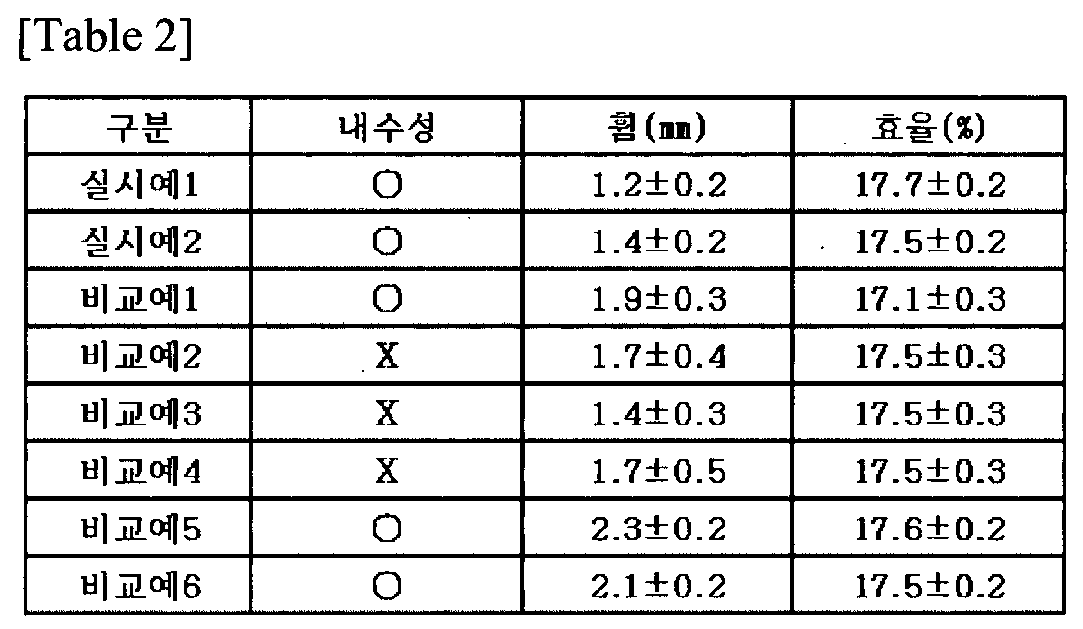
표 2
위 표 2와 같이, 본 발명에 따라 PbO 및 Bi2O3를 함유하지 않고 V2O5와 ZnO를 주성분으로 함유하는 유리 프릿을 포함하는 실시예 1 및 2의 알루미늄 페이스트 조성물을 이용한 태양전지 소자는 친환경적인 동시에 수분과의 반응이 방지되어 내수성이 우수하여 태양전지 소자의 내구성을 향상시킬 수 있고 상대적으로 열팽창계수가 높음에도 휨을 억제할 수 있으며 효율도 높은 것을 확인할 수 있었다. 특히, V2O5 및 ZnO와 함께 Al2O3, B2O3 및 알칼리금속 산화물을 최적의 함량으로 함유하는 알루미늄 페이스트 조성물을 이용하는 경우 휨 발생량을 최소화하면서도 내수성의 확보에 가장 효과적이었다.
반면, Bi2O3를 함유하는 유리 프릿을 포함하는 비교예 2 내지 4의 알루미늄 페이스트 조성물을 이용한 태양전지 소자는 수분과의 반응성으로 인한 내수성이 좋지 못하였으며, 특히 PbO 성분을 함유한 비교예 4는 환경 친화적이지도 못하다. 또한, Bi2O3를 함유하지 않더라도 V2O5와 ZnO의 함량이 최적화되지 않는 비교예 1, 5 및 6은 내수성은 개선할 수 있었으나 웨이퍼 기판의 휨이 커지거나 효율이 저하되었다.
[부호의 설명]
10: 실리콘 웨이퍼 기판 20: N+층
30: 반사방지막 40: 전면전극
50: P+층 60: 후면전극
Claims (11)
- 알루미늄 분말;V2O5 50-80몰% 및 ZnO 20-50몰%를 함유하는 유리 프릿; 및유기 비히클을 포함하는 알루미늄 페이스트 조성물.
- 청구항 1에 있어서, 유리 프릿은 Al2O3, B2O3, P2O5, SiO2, 알칼리금속 산화물 및 알칼리토금속 산화물로 이루어진 군으로부터 선택된 1종 이상을 더 함유하는 알루미늄 페이스트 조성물.
- 청구항 2에 있어서, 유리 프릿 조성물 총 100몰%에 대하여 Al2O3는 0.5-5몰%, B2O3는 0.5-5몰%, P2O5는 0-30몰%, SiO2는 0-15몰%, 알칼리금속 산화물은 1-10몰% 및 알칼리토금속 산화물은 0-30몰%로 함유되는 알루미늄 페이스트 조성물.
- 청구항 3에 있어서, 유리 프릿은 V2O5 50-70몰%, ZnO 10-30몰%, Al2O3 0.5-5몰%, B2O3 0.5-5몰% 및 알칼리금속 산화물 1-10몰%를 함유하는 알루미늄 페이스트 조성물.
- 청구항 4에 있어서, 알칼리금속 산화물은 K2O, Na2O 및 Li2O로 이루어진 군으로부터 선택된 1종 이상인 알루미늄 페이스트 조성물.
- 청구항 1에 있어서, 유리 프릿은 연화점이 300-600℃인 알루미늄 페이스트 조성물.
- 청구항 1에 있어서, 알루미늄 분말 65-75중량%; 유리 프릿 0.01-10중량%; 및 유기 비히클 20-34.9중량%를 포함하는 알루미늄 페이스트 조성물.
- 청구항 1에 있어서, 알루미늄 분말은 평균 입자 크기가 4-6㎛인 분말 60-95중량%와 평균 입자 크기가 2-4㎛인 분말 5-40중량%가 혼합된 것인 알루미늄 페이스트 조성물.
- 청구항 1에 있어서, 유기 비히클은 고분자 수지 1-25중량%와 유기 용매 75-99중량%가 혼합된 것인 알루미늄 페이스트 조성물.
- 청구항 1 내지 9 중 어느 한 항에 따른 알루미늄 페이스트 조성물로 형성된 전극.
- 청구항 10의 전극이 구비된 태양전지 소자.
Applications Claiming Priority (2)
| Application Number | Priority Date | Filing Date | Title |
|---|---|---|---|
| KR1020100130581A KR20120069159A (ko) | 2010-12-20 | 2010-12-20 | 알루미늄 페이스트 조성물 및 이를 이용한 태양전지 소자 |
| KR10-2010-0130581 | 2010-12-20 |
Publications (2)
| Publication Number | Publication Date |
|---|---|
| WO2012086972A2 true WO2012086972A2 (ko) | 2012-06-28 |
| WO2012086972A3 WO2012086972A3 (ko) | 2012-09-07 |
Family
ID=46314593
Family Applications (1)
| Application Number | Title | Priority Date | Filing Date |
|---|---|---|---|
| PCT/KR2011/009761 Ceased WO2012086972A2 (ko) | 2010-12-20 | 2011-12-19 | 알루미늄 페이스트 조성물 및 이를 이용한 태양전지 소자 |
Country Status (3)
| Country | Link |
|---|---|
| KR (1) | KR20120069159A (ko) |
| TW (1) | TW201231576A (ko) |
| WO (1) | WO2012086972A2 (ko) |
Cited By (1)
| Publication number | Priority date | Publication date | Assignee | Title |
|---|---|---|---|---|
| JP2022089460A (ja) * | 2020-12-04 | 2022-06-16 | 住友金属鉱山株式会社 | 厚膜導体及びその形成用組成物並びに該形成用組成物を含んだ厚膜導体ペースト |
Families Citing this family (1)
| Publication number | Priority date | Publication date | Assignee | Title |
|---|---|---|---|---|
| JP6954130B2 (ja) * | 2018-01-11 | 2021-10-27 | Agc株式会社 | ガラス、ガラス粉末、導電ペーストおよび太陽電池 |
Family Cites Families (4)
| Publication number | Priority date | Publication date | Assignee | Title |
|---|---|---|---|---|
| JP5041323B2 (ja) * | 2005-05-09 | 2012-10-03 | 日本電気硝子株式会社 | 粉末材料及びペースト材料 |
| US8093491B2 (en) * | 2005-06-03 | 2012-01-10 | Ferro Corporation | Lead free solar cell contacts |
| US8575474B2 (en) * | 2006-03-20 | 2013-11-05 | Heracus Precious Metals North America Conshohocken LLC | Solar cell contacts containing aluminum and at least one of boron, titanium, nickel, tin, silver, gallium, zinc, indium and copper |
| US8076570B2 (en) * | 2006-03-20 | 2011-12-13 | Ferro Corporation | Aluminum-boron solar cell contacts |
-
2010
- 2010-12-20 KR KR1020100130581A patent/KR20120069159A/ko not_active Withdrawn
-
2011
- 2011-12-16 TW TW100146786A patent/TW201231576A/zh unknown
- 2011-12-19 WO PCT/KR2011/009761 patent/WO2012086972A2/ko not_active Ceased
Cited By (2)
| Publication number | Priority date | Publication date | Assignee | Title |
|---|---|---|---|---|
| JP2022089460A (ja) * | 2020-12-04 | 2022-06-16 | 住友金属鉱山株式会社 | 厚膜導体及びその形成用組成物並びに該形成用組成物を含んだ厚膜導体ペースト |
| JP7622412B2 (ja) | 2020-12-04 | 2025-01-28 | 住友金属鉱山株式会社 | 厚膜導体及びその形成用組成物並びに該形成用組成物を含んだ厚膜導体ペースト |
Also Published As
| Publication number | Publication date |
|---|---|
| KR20120069159A (ko) | 2012-06-28 |
| TW201231576A (en) | 2012-08-01 |
| WO2012086972A3 (ko) | 2012-09-07 |
Similar Documents
| Publication | Publication Date | Title |
|---|---|---|
| WO2012067327A1 (en) | Back contact composition for solar cell | |
| WO2010071363A2 (ko) | 태양전지용 전극, 그 제조방법 및 태양전지 | |
| WO2011046360A2 (en) | Aluminum paste for back electrode of solar cell | |
| WO2012108290A1 (ja) | 導電性ペースト及び該導電性ペーストを用いた太陽電池素子 | |
| WO2016137059A1 (en) | Silver paste composition, front electrode for solar cell formed using it, and solar cell employing it | |
| WO2018097479A1 (ko) | 태양전지 전극용 도전성 페이스트 조성물 및 이를 사용하여 제조된 전극을 포함하는 태양전지 | |
| WO2011028058A2 (en) | Aluminum paste for a back electrode of solar cell | |
| WO2012148021A1 (ko) | 실리콘 태양전지의 저 휨 고특성 구현용 알루미늄 페이스트 조성물 | |
| KR101848009B1 (ko) | 은 페이스트 조성물 및 이를 이용한 전극 | |
| WO2011074888A2 (ko) | 태양전지 후면 전극용 은 페이스트 조성물 | |
| WO2012086971A2 (ko) | 알루미늄 페이스트 조성물 및 이를 이용한 태양전지 소자 | |
| WO2017074151A1 (ko) | 태양전지용 전극 페이스트 조성물 및 이를 사용하여 제조된 태양전지 | |
| KR20120069159A (ko) | 알루미늄 페이스트 조성물 및 이를 이용한 태양전지 소자 | |
| KR20110121428A (ko) | 태양전지 후면 전극용 은 페이스트 조성물 | |
| KR20140074415A (ko) | 태양전지 후면 전극의 제조 방법 및 이를 이용한 태양전지 소자 | |
| KR101711149B1 (ko) | 알루미늄 페이스트 조성물 및 이를 이용한 태양전지 소자 | |
| KR20130042392A (ko) | 알루미늄 페이스트 조성물 및 이를 이용한 태양전지 소자 | |
| WO2013058418A1 (ko) | 태양전지 후면 전극용 은 페이스트 조성물 (2) | |
| KR20150057457A (ko) | 알루미늄 페이스트 조성물 및 이를 이용한 태양전지 소자 | |
| KR20130042756A (ko) | 알루미늄 페이스트 조성물 및 이를 이용한 태양전지 소자 | |
| KR20130043263A (ko) | 알루미늄 페이스트 조성물 및 이를 이용한 태양전지 소자 | |
| KR20130071592A (ko) | 알루미늄 페이스트 조성물 및 이를 이용한 태양전지 소자 | |
| KR20150057453A (ko) | 알루미늄 페이스트 조성물 및 이를 이용한 태양전지 소자 | |
| KR101967164B1 (ko) | 은 페이스트 조성물 및 이를 이용한 전극 | |
| KR20130043805A (ko) | 알루미늄 페이스트 조성물 및 이를 이용한 태양전지 소자 |
Legal Events
| Date | Code | Title | Description |
|---|---|---|---|
| 121 | Ep: the epo has been informed by wipo that ep was designated in this application |
Ref document number: 11851272 Country of ref document: EP Kind code of ref document: A2 |
|
| NENP | Non-entry into the national phase |
Ref country code: DE |
|
| 122 | Ep: pct application non-entry in european phase |
Ref document number: 11851272 Country of ref document: EP Kind code of ref document: A2 |