WO2012086881A1 - 3-펜탄올을 유효성분으로 포함하는 식물병 방제용 조성물 - Google Patents
3-펜탄올을 유효성분으로 포함하는 식물병 방제용 조성물 Download PDFInfo
- Publication number
- WO2012086881A1 WO2012086881A1 PCT/KR2011/002886 KR2011002886W WO2012086881A1 WO 2012086881 A1 WO2012086881 A1 WO 2012086881A1 KR 2011002886 W KR2011002886 W KR 2011002886W WO 2012086881 A1 WO2012086881 A1 WO 2012086881A1
- Authority
- WO
- WIPO (PCT)
- Prior art keywords
- disease
- composition
- pentanol
- plant diseases
- controlling plant
- Prior art date
- Legal status (The legal status is an assumption and is not a legal conclusion. Google has not performed a legal analysis and makes no representation as to the accuracy of the status listed.)
- Ceased
Links
Images


Classifications
-
- A—HUMAN NECESSITIES
- A01—AGRICULTURE; FORESTRY; ANIMAL HUSBANDRY; HUNTING; TRAPPING; FISHING
- A01N—PRESERVATION OF BODIES OF HUMANS OR ANIMALS OR PLANTS OR PARTS THEREOF; BIOCIDES, e.g. AS DISINFECTANTS, AS PESTICIDES OR AS HERBICIDES; PEST REPELLANTS OR ATTRACTANTS; PLANT GROWTH REGULATORS
- A01N31/00—Biocides, pest repellants or attractants, or plant growth regulators containing organic oxygen or sulfur compounds
- A01N31/02—Acyclic compounds
-
- A—HUMAN NECESSITIES
- A01—AGRICULTURE; FORESTRY; ANIMAL HUSBANDRY; HUNTING; TRAPPING; FISHING
- A01N—PRESERVATION OF BODIES OF HUMANS OR ANIMALS OR PLANTS OR PARTS THEREOF; BIOCIDES, e.g. AS DISINFECTANTS, AS PESTICIDES OR AS HERBICIDES; PEST REPELLANTS OR ATTRACTANTS; PLANT GROWTH REGULATORS
- A01N63/00—Biocides, pest repellants or attractants, or plant growth regulators containing microorganisms, viruses, microbial fungi, animals or substances produced by, or obtained from, microorganisms, viruses, microbial fungi or animals, e.g. enzymes or fermentates
- A01N63/20—Bacteria; Substances produced thereby or obtained therefrom
- A01N63/22—Bacillus
Definitions
- the present invention relates to a composition for controlling plant diseases comprising 3-pentanol as an active ingredient, and more particularly, to a composition for controlling plant diseases comprising 3-pentanol as an active ingredient, 3-pentane Plant disease control method comprising the step of inducing systemic resisstance (3-pentanol) by treating the plant, plant disease control agent comprising the composition, Bacillus amyl to produce 3-pentanol It relates to a plant disease control composition comprising a Bacillus amyloliquefaciens IN937a strain as an active ingredient, and to a plant disease control method comprising the step of inducing systemic resistance by treating the plant with the composition.
- Plants exhibit resistance to pathogens by invading pathogens from the outside, through hypersensitivity reactions, oxidative bursts, cell wall structures, antagonistic phytoalexin accumulation, and defense-related protein production. When these resistance mechanisms occur throughout the plant, the plant can cope effectively with a variety of pathogens, including fungi, bacteria, and viruses, and this phenomenon is called induced systemic resistance (ISR).
- ISR induced systemic resistance
- Plant growth-promoting rhizobacteria (PGPR) in the roots of plants are known to cause ISR in plants, and various species of plant growth-promoting rhizobacteria are known for the development of eco-friendly biopesticides. It is used for.
- the present inventors collected 18 volatile organic compounds from Bacillus amyloliquefaciens IN937a strain known to cause ISR, and the volatile organic compounds were resistant to red pepper bacterial spot pathogen ( Xanthomonas axonopodis pv. Vesicatoria ) . It was investigated whether
- Korean Patent No. 10-0423121 discloses a microbial preparation comprising a Bacillus amyloliquefaciens CHO104 strain.
- the present invention is derived from the above requirements, and the present inventors screened 18 volatile organic compounds derived from Bacillus amyloliquefaciens IN937a strain, among which 3-pentanol was treated to plants.
- the present invention was completed by confirming that pepper bacterial spot disease and cucumber mosaic virus disease were suppressed.
- the present invention provides a composition for controlling plant diseases comprising 3-pentanol as an active ingredient.
- the present invention also provides a plant disease control method comprising the step of inducing induced systemic resistance by treating 3-pentanol (plant) to the plant.
- the present invention also provides a plant disease control agent comprising the composition.
- the present invention also provides a composition for controlling plant diseases comprising Bacillus amyloliquefaciens IN937a strain producing 3-pentanol as an active ingredient.
- the present invention also provides a plant disease control method comprising the step of inducing systemic resistance by treating the composition to the plant.
- the composition for controlling plant diseases comprising 3-pentanol of the present invention as an active ingredient is effective in controlling pepper bacterial spot pattern disease and cucumber mosaic virus disease, and thus may be useful for improving the productivity of red pepper. It is considered to be.
- the composition of the present invention is environmentally friendly, high safety because there is no human toxicity.
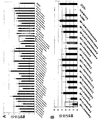
- Figure 1 shows the effect of 18 volatile organic compounds derived from Bacillus amyloliquefaciens IN937a strain under greenhouse conditions on the ISR of the plant against red pepper bacterial spot pathogen ( Xanthomonas axonopodis pv. Vesicatoria ).
- A 18 volatile organic compounds at two concentrations (10 uM and 100 nM) and
- B four selected volatile organic compounds with the highest ISR effect. Positive control plants were treated with 0.5 mM BTH. Incidence (0-5), a marker of ISR, was measured 7 days after pathogen inoculation (0: no symptoms, 5: severe necrosis). Data represent standard error of the mean.
- Figure 2 shows the effect of 3-pentanol on the ISR of the plant against red pepper bacterial spot pathogen under field conditions at different time points.
- ISR effects of 3-pentanol were measured 10, 20, 30 and 40 days after formulation. Positive control plants were treated with 0.5 mM BTH. Incidence (0-5), a marker of ISR, was measured 10 days after pathogen inoculation.
- A Pictures were taken 0-40 days after transplantation.
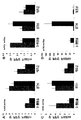
- Figure 3 shows the expression of defense-related genes by 3-pentanol after pathogen inoculation in red pepper.
- Expression of protective signaling related-genes PR1 and PR4 at A) 10 dpt, B) 20 dpt, C) 30 dpt and D) 40 dpt was examined by quantitative RT-PCR. The relative amount of expression normalizing CaActin expression to 100% was calculated. Samples were collected 6 hours after pathogen inoculation. Positive control plants were treated with BTH.
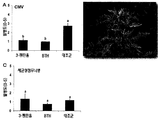
- Figure 5 shows the effect of 3-pentanol on ISR for naturally occurring plant diseases under field conditions.
- A Effect of 3-pentanol on viral disease (CMV, cucumber mosaic virus) three months after treatment
- B Viral disease symptoms (photo taken three months after natural disease outbreak)
- C Effect of 3-pentanol on bacterial spot disease 3 months after treatment.
- the present invention provides a composition for controlling plant diseases comprising 3-pentanol as an active ingredient.
- the 3-pentanol may be derived from Bacillus amyloliquefaciens IN937a strain, but is not limited thereto.
- the plant disease may be a bacterial disease or a viral disease, but is not limited thereto.
- the bacterial disease may be preferably pepper bacterial spot pattern disease, but is not limited thereto.
- the viral disease may preferably be cucumber mosaic virus disease, but is not limited thereto.
- Bacillus amyloliquefaciens IN937a strain according to the present invention is known to induce induced systemic resistance (IRS) (Ryu et al., J Microbiol Biotechnol 17 (2), 280 -286, 2007).
- IRS induced systemic resistance
- composition for controlling plant diseases according to the invention is prepared, for example, in the form of directly sprayable solutions, powders and suspensions or in highly concentrated aqueous, oily or other suspensions, dispersions, emulsions, oily dispersions, pastes, dusts, spraying substances or granules. It may be, but is not limited thereto.
- composition for controlling plant diseases can be used by spraying, spraying, spraying, spraying or pouring. The form of use depends on the intended purpose and in all cases the distribution of the composition according to the invention should be as fine and uniform as possible.
- composition for controlling plant diseases of the present invention can be formulated in various forms. Such formulations may be prepared, for example, by adding solvents and / or carriers. Often, inert additives and surface-active substances such as emulsifiers or dispersants are mixed in the formulation. Suitable surface-active substances include aromatic sulfonic acids (eg lignosulfonic acid, phenol-sulfonic acid, naphthalene- and dibutylnaphthalenesulfonic acid), fatty acids, alkyl- and alkylarylsulfonates, alkyl lauryl ethers, alkalis of fatty alcohol sulfates.
- aromatic sulfonic acids eg lignosulfonic acid, phenol-sulfonic acid, naphthalene- and dibutylnaphthalenesulfonic acid
- fatty acids alkyl- and alkylarylsulfonates, alkyl lauryl ethers, alkalis of fatty
- alkaline earth metals ammonium salts, sulfated hexa-, hepta- and octadecanols, salts of fatty alcohol glycol ethers, sulfonate naphthalenes and derivatives thereof, condensates of formaldehyde, naphthalene or naphthalenesulfonic acids, phenols and formaldehydes Condensates, polyoxyethyleneoctyl phenol ethers, ethoxylated isooctyl-, octyl- or nonylphenols, alkylphenyl or tributylphenyl polyglycol ethers, alkylarylpolyether alcohols, isotridecyl alcohols, fatty alcohol / ethylene oxide condensates , Ethoxylated castor oil, polyoxyethylene alkyl ether or polyoxypropylene, lauryl alcohol Polyglycol ether a
- Suitable solid carrier materials are in principle all porous and agriculturally acceptable carriers, for example mineral earth (such as silica, silica gel, silicates, talc, kaolin, limestone, lime, chalk, bowls, loess, clays, Dolomite, diatomaceous earth, calcium sulphate, magnesium sulfate, magnesium oxide, ground synthetics And nut shell powder) or cellulose powder, but is not limited thereto.
- mineral earth such as silica, silica gel, silicates, talc, kaolin, limestone, lime, chalk, bowls, loess, clays, Dolomite, diatomaceous earth, calcium sulphate, magnesium sulfate, magnesium oxide, ground synthetics And nut shell powder
- the said solid carrier can also be used 1 type or in mixture of 2 or more types.
- Plant disease control composition of the present invention can be used for irrigation, dipping, foliar spray, seed disinfection or farm equipment disinfection, but is not limited thereto.
- composition for controlling plant diseases of the present invention can be used alone or in combination with two or more other antibacterial or antiviral substances as an active ingredient.
- composition for controlling plant diseases of the present invention may be mixed with a diffusing agent, a penetrating agent, or a surfactant to enhance crop absorption and effect.
- the present invention also provides a plant disease control method comprising the step of inducing induced systemic resistance by treating 3-pentanol (plant) to the plant.
- the 3-pentanol may be derived from Bacillus amyloliquefaciens IN937a strain, but is not limited thereto.
- the plant disease may be a bacterial disease or a viral disease, but is not limited thereto.
- the bacterial disease may be pepper bacterial spot pattern disease, but is not limited thereto.
- the viral disease may be cucumber mosaic virus disease, but is not limited thereto.
- the present invention also provides a plant disease control agent comprising the composition.
- the present invention also provides a composition for controlling plant diseases comprising Bacillus amyloliquefaciens IN937a strain producing 3-pentanol as an active ingredient.
- the plant disease may be a bacterial disease or a viral disease, but is not limited thereto.
- the bacterial disease may be pepper bacterial spot pattern disease, but is not limited thereto.
- the viral disease may be cucumber mosaic virus disease, but is not limited thereto.
- Solvents, carriers, auxiliaries, etc. which are generally used in the formulation of the composition are as described above.
- the present invention provides a method for controlling plant diseases comprising the step of inducing systemic resisstance by treating the composition with a plant.
- the plant disease may be a bacterial disease or a viral disease, but is not limited thereto.
- the bacterial disease may be pepper bacterial spot pattern disease, but is not limited thereto.
- the viral disease may be cucumber mosaic virus disease, but is not limited thereto.
- red pepper seedlings grown 3-4 weeks after sowing were irrigated with 50 ml of volume of 10 ⁇ M and 100 nM, respectively.
- red pepper bacterium pathogen Xanthomonas axonopodis pv. Vesicatoria
- red pepper bacterium pathogen Xanthomonas axonopodis pv. Vesicatoria
- the four volatiles selected in the first screening were irrigated in the same manner as above in the concentrations of 1 mM, 10 uM, 0.1 uM and 1 nM, and then inoculated with pathogens, and then the symptoms were observed. .
- PR1 and PR4 genes related to pepper disease resistance was investigated by qRT-PCR (quantitative real time-polymerase chain reaction). Primer sequences used are as follows.
- PR1F 5'-ACTTGCAATTATGATCCACC-3 '(SEQ ID NO: 1)
- PR1R 5'-ACTCCAGTTACTGCACCATT-3 '(SEQ ID NO: 2)
- PR4F 5'-AACTGGGATTGAGAACTGCCAGC-3 '(SEQ ID NO: 3)
- PR4R 5'-ATCCAAGGTACATATAGAGCTTCC-3 '(SEQ ID NO: 4)
- RNA isolation After infiltrating the bacterium inoculum on the back of the pepper leaves, the pepper leaves were cut with scissors and stored in liquid nitrogen at 0 and 6 hours to store the plants, which were used for RNA isolation.
- Pepper leaves were pulverized with mortar and liquid nitrogen, and RNA was extracted from pepper leaves using TRIzol reagent (Invitrogen Life Technologies). The extracted RNA was subjected to RT reaction using M-MLV RT enzyme (Enzynomics). QRT-PCR was performed using RT-reacted cDNA. The conditions of the qRT-PCR were 10 minutes of initial denaturation at 95 ° C., detection of 40 cycles of DNA synthesis (30 seconds at 95 ° C., 60 seconds at 55 ° C. and 30 seconds at 72 ° C.), and one minute at 72 ° C. Expansion reactions were included.
- the expression of PR1 and PR4 genes was compared from 10 to 40 days after the establishment. After 10 days, the expression of the PR gene was lower in the 3-pentanol-treated group than the control group, but after 20 days, the expression of the PR gene was higher or similar to that of the 3-pentanol-treated group compared to the control group. (FIG. 3).
- Example 5 Bacillus amyloliquefaciens in greenhouse conditions ( Bacillus amyloliquefaciens (ISR Effect of IN937a Strain on Pepper Bacterial Pathogens
- vesicatoria pathogens were infiltrated on the back of pepper leaves using a 1 ml syringe to investigate the reaction after 7-10 days.
- Bacterial inoculum was incubated at 30 ° C. for 48 hours by adding Rifampicin 100 ⁇ g / ml antibiotic to Luria-Bertani (LB) solid medium.
Landscapes
- Life Sciences & Earth Sciences (AREA)
- Engineering & Computer Science (AREA)
- Zoology (AREA)
- General Health & Medical Sciences (AREA)
- Health & Medical Sciences (AREA)
- Plant Pathology (AREA)
- Dentistry (AREA)
- Pest Control & Pesticides (AREA)
- Wood Science & Technology (AREA)
- Agronomy & Crop Science (AREA)
- Environmental Sciences (AREA)
- Biotechnology (AREA)
- Microbiology (AREA)
- Virology (AREA)
- Agricultural Chemicals And Associated Chemicals (AREA)
Abstract
본 발명은 3-펜탄올(3-pentanol)을 유효성분으로 포함하는 식물병 방제용 조성물, 3-펜탄올(3-pentanol)을 식물체에 처리하여 유도전신저항성(induced systemic resisstance)을 유도하는 단계를 포함하는 식물병 방제 방법, 상기 조성물을 포함하는 식물병 방제제, 3-펜탄올을 생산하는 바실러스 아밀로리쿼파시엔스 (Bacillus amyloliquefaciens) IN937a 균주를 유효성분으로 포함하는 식물병 방제용 조성물 및 상기 조성물을 식물체에 처리하여 유도전신저항성을 유도하는 단계를 포함하는 식물병 방제 방법에 관한 것이다.
Description
본 발명은 3-펜탄올을 유효성분으로 포함하는 식물병 방제용 조성물에 관한 것으로서, 더욱 상세하게는 3-펜탄올(3-pentanol)을 유효성분으로 포함하는 식물병 방제용 조성물, 3-펜탄올(3-pentanol)을 식물체에 처리하여 유도전신저항성(induced systemic resisstance)을 유도하는 단계를 포함하는 식물병 방제 방법, 상기 조성물을 포함하는 식물병 방제제, 3-펜탄올을 생산하는 바실러스 아밀로리쿼파시엔스 (Bacillus amyloliquefaciens) IN937a 균주를 유효성분으로 포함하는 식물병 방제용 조성물 및 상기 조성물을 식물체에 처리하여 유도전신저항성을 유도하는 단계를 포함하는 식물병 방제 방법에 관한 것이다.
현재 식물 병원균의 발생 억제 및 방제를 위해 주로 이용하고 있는 방법은 화학적 합성 농약이다. 그러나 이러한 합성 농약은 생태계를 파괴하고, 잔류로 인한 인체 독성 문제를 야기하며, 발암, 기형 등의 각종 질환을 유발할 가능성이 매우 높아 그 사용이 제한되고 있다. 따라서, 합성 농약을 대체할 수 있는 환경친화성 생물농약의 개발에 대한 연구가 활발히 진행되고 있는 실정이다.
식물은 외부로부터 병원체가 침입하였을 때 초과민성반응, oxidative burst, 세포벽구조의 강화, 길항성 파이토알렉신 축적, 방어관련 단백질 생성 등을 통해 병원체에 대한 저항성을 나타낸다. 이러한 저항성 기작이 식물의 전신에서 나타나면 식물은 곰팡이, 세균, 바이러스 등을 포함한 다양한 병원체에 효과적으로 대처할 수 있으며 이런 현상을 ISR (induced systemic resistance, 유도전신저항성)이라고 부른다. 식물의 뿌리에 존재하는 식물 생장-촉진 근권세균(plant growth-promoting rhizobacteria, PGPR)은 식물에서 ISR을 야기하는 것으로 알려져 있으며, 다양한 종의 식물 생장-촉진 근권세균이 친환경적 생물농약의 개발을 위한 연구에 이용되고 있다.
본 발명자들은 ISR을 야기하는 것으로 알려진 바실러스 아밀로리쿼파시엔스(Bacillus amyloliquefaciens) IN937a 균주로부터 18가지 휘발성 유기화합물을 수집하였고, 상기 휘발성 유기화합물이 고추 세균점무늬병원균(Xanthomonas axonopodis pv. vesicatoria)에 대해 저항성을 나타내는지를 조사하였다.
한국등록특허 제10-0423121호에는 바실러스 아밀로리쿼파시엔스 CHO104 균주를 포함하는 미생물제제가 개시되어 있다.
본 발명은 상기와 같은 요구에 의해 도출된 것으로서, 본 발명자들은 바실러스 아밀로리쿼파시엔스(Bacillus amyloliquefaciens) IN937a 균주 유래 18가지 휘발성 유기화합물을 스크리닝하였고, 그 중 3-펜탄올을 식물체에 처리했을 때 고추 세균성 점무늬병 및 오이 모자이크 바이러스병이 억제된 것을 확인함으로써 본 발명을 완성하게 되었다.
상기 과제를 해결하기 위해, 본 발명은 3-펜탄올(3-pentanol)을 유효성분으로 포함하는 식물병 방제용 조성물을 제공한다.
또한, 본 발명은 3-펜탄올(3-pentanol)을 식물체에 처리하여 유도전신저항성(induced systemic resisstance)을 유도하는 단계를 포함하는 식물병 방제 방법을 제공한다.
또한, 본 발명은 상기 조성물을 포함하는 식물병 방제제를 제공한다.
또한, 본 발명은 3-펜탄올을 생산하는 바실러스 아밀로리쿼파시엔스 (Bacillus amyloliquefaciens) IN937a 균주를 유효성분으로 포함하는 식물병 방제용 조성물을 제공한다.
또한, 본 발명은 상기 조성물을 식물체에 처리하여 유도전신저항성을 유도하는 단계를 포함하는 식물병 방제 방법을 제공한다.
본 발명에 따르면, 본 발명의 3-펜탄올(3-pentanol)을 유효성분으로 포함하는 식물병 방제용 조성물은 고추 세균성 점무늬병 및 오이 모자이크 바이러스병을 방제하는데 효과적이므로, 고추의 생산력 향상에 유용할 것으로 사료된다. 또한, 본 발명의 조성물은 친환경적이며, 인체 독성이 없으므로 안전성이 높다.
도 1은 온실 조건에서 바실러스 아밀로리쿼파시엔스(Bacillus amyloliquefaciens) IN937a 균주 유래 18가지 휘발성 유기화합물이 고추 세균점무늬병원균(Xanthomonas axonopodis pv. vesicatoria)에 대한 식물의 ISR에 미치는 효과를 나타낸 것이다. (A) 2개 농도(10 uM 및 100 nM)의 18가지 휘발성 유기화합물 및 (B) 가장 높은 ISR 효과를 가지는 4가지 선택된 휘발성 유기화합물. 양성 대조군 식물은 0.5 mM BTH로 처리되었다. ISR의 표지자인 발병도(0 ~ 5)는 병원균 접종 후 7일째에 측정되었다(0: 증상 없음, 5: 심한 괴사 증상). 데이타는 평균의 표준오차를 나타낸다.
도 2는 다른 시점에서 필드 조건하에 3-펜탄올이 고추 세균점무늬병원균에 대한 식물의 ISR에 미치는 효과를 나타낸 것이다. 3-펜탄올의 ISR 효과는 정식 후 10, 20, 30 및 40일째에 측정되었다. 양성 대조군 식물은 0.5 mM BTH로 처리되었다. ISR의 표지자인 발병도(0 ~ 5)는 병원균 접종 후 10일째에 측정되었다. (A) 사진은 이식 후 0 내지 40일째에 촬영되었다. (B) 10 dpt, 20 dpt, 30 dpt 및 40 dpt에서 발병도를 비교한 결과(0: 증상 없음, 5: 심한 괴사 증상). 다른 문자는 통계적으로 유의적인 차이(P = 0.05)를 나타낸다. 데이타는 평균의 표준오차를 나타낸다.
도 3은 고추에서 병원균 접종 후 3-펜탄올에 의한 방어-관련 유전자의 발현을 나타낸 것이다. A) 10 dpt, B) 20 dpt, C) 30 dpt 및 D) 40 dpt에서 방어 신호전달 관련-유전자 PR1 및 PR4의 발현은 정량적 RT-PCR에 의해 조사되었다. CaActin 발현을 100%로 표준화한 상대적 발현 양이 계산되었다. 샘플은 병원균 접종 후 6시간째에 수집되었다. 양성 대조군 식물은 BTH로 처리되었다.
도 4는 필드 조건하에 3-펜탄올이 고추의 생장 및 수확량에 미치는 영향을 나타낸 것이다. 양성 대조군 식물은 0.5 mM BTH로 처리되었다. (A) 및 (B) 사진은 이식 후 3개월째에 촬영되었다. (C) 신초 길이 및 (D) 고추 수확량은 3-펜탄올 처리 후 3개월째에 측정되었다. a, b 및 c는 물-처리 대조군 식물과 비교했을 때 통계적으로 유의적인 차이를 나타낸다(P = 0.05). 데이타는 평균의 표준오차를 나타낸다.
도 5는 필드 조건하에 3-펜탄올이 자연적으로 발생한 식물병에 대한 ISR에 미치는 영향을 나타낸 것이다. (A) 처리 후 3개월째에 바이러스 질병(CMV, 오이 모자이크 바이러스)에 대한 3-펜탄올의 영향, (B) 바이러스 질병 증상(사진은 자연 질병 발생 후 3개월째에 촬영되었다), (C) 처리 후 3개월째에 세균 점무늬병에 대한 3-펜탄올의 영향. 양성 대조군 식물은 0.5 mM BTH로 처리되었다. ISR의 표지자인 발병도(0 ~ 5)는 이식 후 3개월째에 측정되었다(0: 증상 없음, 5: 심한 괴사 증상). 다른 문자는 통계적으로 유의적인 차이를 나타낸다(P = 0.05). 데이타는 평균의 표준오차를 나타낸다.
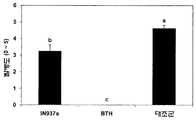
도 6은 온실 조건에서 바실러스 아밀로리쿼파시엔스 IN937a 균주가 고추 세균점무늬병원균에 대한 식물의 ISR에 미치는 영향을 나타낸다. 양성 대조군 식물은 0.5 mM BTH로 처리되었다. ISR의 표지자인 발병도(0 ~ 5)는 병원균 접종 후 7일째에 측정되었다(0: 증상 없음, 5: 심한 괴사 증상). 데이타는 평균의 표준오차를 나타낸다. 다른 문자는 통계적으로 유의적인 차이(P = 0.05)를 나타낸다.
본 발명의 목적을 달성하기 위하여, 본 발명은 3-펜탄올(3-pentanol)을 유효성분으로 포함하는 식물병 방제용 조성물을 제공한다. 바람직하게는, 상기 3-펜탄올은 바실러스 아밀로리쿼파시엔스 (Bacillus amyloliquefaciens) IN937a 균주 유래일 수 있으나, 이에 제한되지는 않는다.
본 발명의 조성물에서, 상기 식물병은 세균성 병 또는 바이러스성 병일 수 있으나, 이에 제한되지는 않는다. 상기 세균성 병은 바람직하게는 고추 세균성 점무늬병일 수 있으나, 이에 제한되지는 않는다. 상기 바이러스 병은 바람직하게는 오이 모자이크 바이러스병일 수 있으나, 이에 제한되지는 않는다.
본 발명에 따른 바실러스 아밀로리쿼파시엔스 (Bacillus amyloliquefaciens) IN937a 균주는 ISR (induced systemic resistance, 유도전신저항성)을 유도할 수 있는 것으로 알려져 있다(Ryu et al., J Microbiol Biotechnol 17(2), 280-286, 2007).
본 발명에 따른 식물병 방제용 조성물은 예를 들어 직접 분사가능한 용액, 분말 및 현탁액의 형태 또는 고농축 수성, 유성 또는 다른 현탁액, 분산액, 에멀젼, 유성 분산액, 페이스트, 분진, 흩뿌림 물질 또는 과립제로 제조할 수 있으나, 이에 제한되지는 않는다. 또한, 상기 식물병 방제용 조성물은 분사, 분무, 살포, 흩뿌림 또는 붓기에 의해 사용될 수 있다. 사용 형태는 의도한 목적에 의존하는데, 모든 경우에 본 발명에 따른 조성물의 분포가 가능한 한 미세하고 균일하도록 해야 한다.
본 발명의 식물병 방제용 조성물은 다양한 형태로 제제화할 수 있다. 상기 제제는 예를 들어 용매 및/또는 담체를 첨가함으로서 제조될 수 있다. 종종, 비활성 첨가제 및 표면-활성 물질, 예를 들어 유화제 또는 분산제를 제제에 혼합한다. 적합한 표면-활성 물질은 방향족 술폰산(예를 들어 리그노술폰산, 페놀-술폰산, 나프탈렌- 및 디부틸나프탈렌술폰산), 지방산, 알킬- 및 알킬아릴술포네이트, 알킬 라우릴 에테르, 지방 알코올 술페이트의 알칼리 금속, 알카라인 토금속, 암모늄염, 술페이트화 헥사-, 헵타- 및 옥타데칸올, 지방 알코올 글리콜 에테르의 염, 술포네이트 나프탈렌 및 이의 유도체, 포름알데히드의 축합물, 나프탈렌 또는 나프탈렌술폰산, 페놀 및 포름알데히드의 축합물, 폴리옥시에틸렌옥틸 페놀 에테르, 에톡실화 이소옥틸-, 옥틸- 또는 노닐페놀, 알킬페닐 또는 트리부틸페닐 폴리글리콜 에테르, 알킬아릴폴리에테르 알코올, 이소트리데실 알코올, 지방 알코올/에틸렌 옥사이드 축합물, 에톡실화 피마자유, 폴리옥시에틸렌 알킬에테르 또는 폴리옥시프로필렌, 라우릴 알코올 폴리글리콜 에테르 아세테이트, 소르비톨 에스테르, 리그닌-술파이트 폐액 또는 메틸셀룰로오스일 수 있으나, 이에 제한되지는 않는다.
적합한 고형 담체 물질은 원칙적으로, 모두 다공성이고, 농업적으로 허용가능한 담체, 예를 들어 광물토류(예컨대 실리카, 실리카 겔, 실리케이트, 활석, 고령토, 석회암, 석회, 초크, 보울, 황토, 점토류, 백운석, 규조 토류, 황산칼슘, 황산 마그네슘, 산화마그네슘, 분쇄 합성물질), 비료(예컨대 황산암모늄, 인산암모늄, 질산암모늄, 우레아), 식물성 제품(예컨대 곡물 가루, 나무 껍질 가루, 목분(wood meal) 및 견과 껍질 가루) 또는 셀룰로오스 분말일 수 있으나, 이에 제한되지는 않는다. 또한, 상기 고형 담체는 1종류 또는 2종류 이상을 혼합하여 사용할 수도 있다.
본 발명의 식물병 방제용 조성물은 관주용, 침지용, 엽면 살포용, 종자 소독용 또는 농기구 소독용으로 사용될 수 있으나, 이에 제한되지는 않는다.
본 발명의 식물병 방제용 조성물은 유효성분으로서 3-펜탄올을 단독으로, 또는 2종 이상의 다른 항균 또는 항바이러스성 물질 등과 혼합하여 사용할 수 있다.
본 발명의 식물병 방제용 조성물은 작물체 흡수 및 효과를 증진시키기 위하여 확산제 및 침투제, 또는 계면활성제와도 혼용이 가능하다.
또한, 본 발명은 3-펜탄올(3-pentanol)을 식물체에 처리하여 유도전신저항성(induced systemic resisstance)을 유도하는 단계를 포함하는 식물병 방제 방법을 제공한다. 바람직하게는, 상기 3-펜탄올은 바실러스 아밀로리쿼파시엔스 (Bacillus amyloliquefaciens) IN937a 균주 유래일 수 있으나, 이에 제한되지는 않는다. 상기 식물병은 세균성 병 또는 바이러스성 병일 수 있으나, 이에 제한되지는 않는다. 바람직하게는, 상기 세균성 병은 고추 세균성 점무늬병일 수 있으나, 이에 제한되지는 않는다. 바람직하게는, 상기 바이러스 병은 오이 모자이크 바이러스병일 수 있으나, 이에 제한되지는 않는다.
또한, 본 발명은 상기 조성물을 포함하는 식물병 방제제를 제공한다.
또한, 본 발명은 3-펜탄올을 생산하는 바실러스 아밀로리쿼파시엔스 (Bacillus amyloliquefaciens) IN937a 균주를 유효성분으로 포함하는 식물병 방제용 조성물을 제공한다. 상기 식물병은 세균성 병 또는 바이러스성 병일 수 있으나, 이에 제한되지는 않는다. 바람직하게는, 상기 세균성 병은 고추 세균성 점무늬병일 수 있으나, 이에 제한되지는 않는다. 바람직하게는, 상기 바이러스 병은 오이 모자이크 바이러스병일 수 있으나, 이에 제한되지는 않는다. 상기 조성물의 제제화에 일반적으로 사용되는 용매, 담체 또는 보조제 등은 전술한 바와 같다.
또한, 본 발명은 상기 조성물을 식물체에 처리하여 유도전신저항성(induced systemic resisstance)을 유도하는 단계를 포함하는 식물병 방제 방법을 제공한다. 상기 식물병은 세균성 병 또는 바이러스성 병일 수 있으나, 이에 제한되지는 않는다. 바람직하게는, 상기 세균성 병은 고추 세균성 점무늬병일 수 있으나, 이에 제한되지는 않는다. 바람직하게는, 상기 바이러스 병은 오이 모자이크 바이러스병일 수 있으나, 이에 제한되지는 않는다.
이하, 본 발명을 실시예에 의해 상세히 설명한다. 단, 하기 실시예는 본 발명을 예시하는 것일 뿐, 본 발명의 내용이 하기 실시예에 한정되는 것은 아니다.
재료 및 방법
온실 조건하에서 ISR 능력 검정
기 선발된 세균(Bacillus amyloliquefaciens strain IN937a) 유래 18개의 휘발성 물질로부터 ISR 능력을 검정하기 위하여, 파종 후 3-4주 자란 고추 유묘에 각 10 μM 및 100 nM 농도의 부피 50 ml로 관주처리 하였다. 관주처리 1주일 후, 고추 세균점무늬병원균(Xanthomonas axonopodis pv. vesicatoria)을 107 CFU/ml 농도로 잎에 주입하였다. 5 ~ 7일 후에 병징을 관찰하면서 병 정도를 1 ~ 5로 측정하였다. 2차 스크리닝의 경우 1차 스크리닝에서 선발된 4개의 휘발성 물질을 대상으로 1 mM, 10 uM, 0.1 uM 및 1 nM의 농도로 상기와 같은 방법으로 관주처리 후, 병원균을 접종한 다음 병징을 관찰하였다.
필드상에서 ISR 능력 검정
ISR 능력을 보이는 3-펜탄올(3-pentanol)을 농가에 직접 처리하여 실질적으로 실용가능한지 확인하였다. 고추 종자는 부강 품종으로 흥농 종묘에서 구입하여 사용하였다. 종자는 1% 차아염소산나트륨에 5분간 표면 살균하였고, 모든 성분이 제거될 때까지 5분간 살균수로 헹궈내었다. 표면 살균된 종자는 적당한 수분이 포함된 MS 배지에서 발아되었다. 오염되지 않고 잘 발아한 종자는 시판되는 원예용 상토(Punong Co., Ltd, Korea)를 채운 50공 포트(28 × 54 × 6 cm)로 옮겨 심어, 6주간 온실 내에서 20 ~ 30℃로 유지하며 재배하였다. 식물체는 파종 후 6주가 지난 후 본 옆이 7 ~ 8장 나왔을 때, 1 mM 3-펜탄올을 멸균수에 현탁하여 3L 정도 만들어서 50공 포트 받침( 28 × 54 × 6 cm)에 부어주었다. 포트 받침의 침지 용액이 포트 식물체의 뿌리에 완전히 스며들 수 있도록 24시간 정도 침지하였다. 24시간 침지 후, 고추 유묘를 실제 밭에 정식을 하였다. 밭은 충청북도 청원군 가덕면 청용리(36° 32′ 27. 28″ 북, 127° 33′ 07. 81″ 동)에 소재한 밭으로 골과 골 사이가 1.2 m이고, 12.5m 정도로 처리구획이 서로 고르게 섞이도록 했다. 정식 20일 후에 2차로 한번 더 1 mM 3-펜탄올을 멸균수에 현탁하여 100 ml씩 관주 처리하였다. 정식 후, 10일 간격으로 40일까지 107 CFU/ml 농도의 고추세균점무늬병원균(Xanthomonas axonopodis pv. vesicatoria)을 고추 잎 뒷면에 1 ml 주사기를 이용하여 침투시켜 7 ~ 10일 후 나타나는 반응을 조사하는 방법을 이용하였다. 세균 접종원은 LB (Luria-Bertani) 고체 배지에 리팜피신(Rifampicin) 100 ㎍/㎖ 항생제를 첨가하여 48시간 동안 30℃에서 배양하였다. 모든 처리군은 네 번의 반복수와 처리되지 않은 대조군이 포함되었다. 발병도는 10일 간격으로 40일까지 비교, 관찰하여 하기와 같이 조사되었다. 0 = 증상 없음, 1 = 약한 백화 증상, 2 = 백화 증상, 3 = 백화 증상과 약한 괴사, 4 = 괴사, 및 5 = 심한 괴사 증상 (Yang et al. 2009, Plant Pathol. J. 25(4): 389-399).
저항성 유전자의 발현 분석
고추의 병 저항성과 관련이 있는 PR1 및 PR4 유전자의 발현을 qRT-PCR (quantitative real time-polymerase chain reaction)을 통해 조사하였다. 사용된 프라이머 서열은 하기와 같다.
PR1F : 5'-ACTTGCAATTATGATCCACC-3'(서열번호 1)
PR1R : 5'-ACTCCAGTTACTGCACCATT-3'(서열번호 2)
PR4F : 5'-AACTGGGATTGAGAACTGCCAGC-3'(서열번호 3)
PR4R : 5'-ATCCAAGGTACATATAGAGCTTCC-3'(서열번호 4)
고추 잎 뒷면에 세균 접종원을 침투시킨 후 0 시간 및 6 시간째에 고추 잎을 가위로 잘라서 액체 질소에 넣어 식물을 보관하였고, 이것을 RNA 분리를 위해서 사용하였다. 고추 잎을 막자사발과 액체 질소를 이용해서 분쇄 후, TRIzol 시약 (Invitrogen Life Technologies)를 이용하여 고추 잎에서 RNA를 추출하였다. 상기 추출된 RNA는 M-MLV RT 효소(Enzynomics)를 이용하여 RT 반응을 하였다. RT 반응된 cDNA를 이용하여 qRT-PCR을 실시하였다. 상기 qRT-PCR의 조건은 95℃에서 10분의 초기 변성, 40 주기의 DNA 합성 검출(95℃에서 30초, 55℃에서 60초 및 72℃에서 30초), 그리고 최종 72℃에서 1분의 확장 반응을 포함하였다.
실시예 1: 온실 및 필드 조건하에서 ISR 능력 검정 결과
온실 내에서 세균(Bacillus amyloliquefaciens strain IN937a) 유래의 18 종류의 휘발성 물질을 이용한 2차에 걸친 스크리닝을 통하여, 고추 세균점무늬병에 대해 병 저항성을 나타내는 물질을 선발하였고, 최종적으로 1 mM 3-펜탄올이 선발되었다(도 1).
필드 조건하에 3-펜탄올의 고추 세균점무늬병에 대한 ISR 능력을 검정하였다. 정식 10일 후, 3-펜탄올 처리군의 경우 대조군과 차이가 없었다. 정식 20일 후에는 양성대조군인 BTH에 비해 효과는 낮지만 대조군에 비해서 병 정도가 심하지 않았다. 20일 후 2차로 한번 더 3-펜탄올을 처리하였고, 정식 30일 및 40일 이후에 병 정도를 측정한 결과, 대조군에 비해서 병 저항성이 증가된 것을 보였다(도 2).
실시예 2: 저항성 유전자의 발현 분석
병원균 접종 후 6시간째에 PR1과 PR4 유전자의 발현을 정식 후 10 ~ 40일까지 비교하였다. 정식 10일 후에 PR 유전자의 발현은 대조군에 비해서 3-펜탄올 처리군이 낮았지만, 정식 20일 이후부터 PR 유전자의 발현은 대조군에 비해 3-펜탄올 처리군이 더 높거나 비슷하게 발현되는 것을 확인할 수 있었다(도 3).
실시예 3: 고추의 생장 및 수확량에 대한 3-펜탄올의 영향
정식 후, 수확기에 각 처리별 식물의 생장과 수확량을 비교해 보았다. 식물의 생장에서는 대조군 및 3-펜탄올 처리군 사이에 차이가 없었다. 수확량에서는 대조군에 비해 3-펜탄올 처리군에서 수확량이 줄었으나, BTH에 비해서는 수확량이 증가한 것을 확인할 수 있었다(도 4).
실시예 4: 자연적으로 발생한 병에 대한 3-펜탄올의 영향
3-펜탄올의 식물병에 대한 유도저항성을 확인한 다음, 정식 3개월 후에 자연적으로 발생한 병에 대한 저항성 정도를 확인하였다. 정식 초기에 오이 모자이크 바이러스가 자연적으로 많이 발생하였다. 오이 모자이크 바이러스에 대한 병 저항성은 대조군에 비해 3-펜탄올 처리군에서 상당히 증가하였고, BTH와 비슷하게 저항성이 증가된 것을 확인할 수 있었다. 하지만, 세균 점무늬병에 대한 저항성은 3가지 처리군에서 차이가 없음을 확인하였다(도 5).
실시예 5: 온실 조건에서 바실러스 아밀로리쿼파시엔스 (
Bacillus amyloliquefaciens
) IN937a 균주의 고추 세균점무늬병원균에 대한 ISR 효과
107 CFU/ml 농도의 Xanthomonas axonopodis pv. vesicatoria 병원세균을 고추 잎 뒷면에 1 ml 주사기를 이용하여 침투시켜 7~10일 후 나타나는 반응을 조사하는 방법을 이용하였다. 세균 접종원은 Luria-Bertani (LB) 고체 배지에 Rifampicin 100 ㎍/㎖ 항생제를 첨가하여 48시간, 30℃에서 배양되었다.
병원균 접종 후 7일째에 바실러스 아밀로리쿼파시엔스 IN937a 균주의 ISR 효과를 조사하였다. 그 결과, 상기 균주 처리군에서 병 저항성이 BTH보다는 낮았지만, 대조군 보다는 높게 나타났다(도 6).
Claims (19)
- 3-펜탄올(3-pentanol)을 유효성분으로 포함하는 식물병 방제용 조성물.
- 제1항에 있어서, 상기 3-펜탄올은 바실러스 아밀로리쿼파시엔스 (Bacillus amyloliquefaciens) IN937a 균주 유래인 것을 특징으로 하는 식물병 방제용 조성물.
- 제1항에 있어서, 상기 식물병은 세균성 병 또는 바이러스성 병인 것을 특징으로 하는 식물병 방제용 조성물.
- 제3항에 있어서, 상기 세균성 병은 고추 세균성 점무늬병인 것을 특징으로 하는 식물병 방제용 조성물.
- 제3항에 있어서, 상기 바이러스 병은 오이 모자이크 바이러스병인 것을 특징으로 하는 식물병 방제용 조성물.
- 3-펜탄올(3-pentanol)을 식물체에 처리하여 유도전신저항성(induced systemic resisstance)을 유도하는 단계를 포함하는 식물병 방제 방법.
- 제6항에 있어서, 상기 3-펜탄올은 바실러스 아밀로리쿼파시엔스 (Bacillus amyloliquefaciens) IN937a 균주 유래인 것을 특징으로 하는 식물병 방제 방법.
- 제6항에 있어서, 상기 식물병은 세균성 병 또는 바이러스성 병인 것을 특징으로 하는 식물병 방제 방법.
- 제8항에 있어서, 상기 세균성 병은 고추 세균성 점무늬병인 것을 특징으로 하는 식물병 방제 방법.
- 제8항에 있어서, 상기 바이러스성 병은 오이 모자이크 바이러스병인 것을 특징으로 하는 식물병 방제 방법.
- 제1항의 조성물을 포함하는 식물병 방제제.
- 3-펜탄올을 생산하는 바실러스 아밀로리쿼파시엔스 (Bacillus amyloliquefaciens) IN937a 균주를 유효성분으로 포함하는 식물병 방제용 조성물.
- 제12항에 있어서, 상기 식물병은 세균성 병 또는 바이러스성 병인 것을 특징으로 하는 식물병 방제용 조성물.
- 제13항에 있어서, 상기 세균성 병은 고추 세균성 점무늬병인 것을 특징으로 하는 식물병 방제용 조성물.
- 제13항에 있어서, 상기 바이러스성 병은 오이 모자이크 바이러스병인 것을 특징으로 하는 식물병 방제용 조성물.
- 제12항의 조성물을 식물체에 처리하여 유도전신저항성(induced systemic resisstance)을 유도하는 단계를 포함하는 식물병 방제 방법.
- 제16항에 있어서, 상기 식물병은 세균성 병 또는 바이러스성 병인 것을 특징으로 하는 식물병 방제 방법.
- 제17항에 있어서, 상기 세균성 병은 고추 세균성 점무늬병인 것을 특징으로 하는 식물병 방제 방법.
- 제17항에 있어서, 상기 바이러스성 병은 오이 모자이크 바이러스병인 것을 특징으로 하는 식물병 방제 방법.
Priority Applications (1)
| Application Number | Priority Date | Filing Date | Title |
|---|---|---|---|
| US13/921,359 US20130267422A1 (en) | 2010-12-23 | 2013-06-19 | Composition for controlling plant diseases comprising 3-pentanol as effective component |
Applications Claiming Priority (2)
| Application Number | Priority Date | Filing Date | Title |
|---|---|---|---|
| KR1020100133116A KR101320428B1 (ko) | 2010-12-23 | 2010-12-23 | 3-펜탄올을 유효성분으로 포함하는 식물병 방제용 조성물 |
| KR10-2010-0133116 | 2010-12-23 |
Related Child Applications (1)
| Application Number | Title | Priority Date | Filing Date |
|---|---|---|---|
| US13/921,359 Continuation-In-Part US20130267422A1 (en) | 2010-12-23 | 2013-06-19 | Composition for controlling plant diseases comprising 3-pentanol as effective component |
Publications (1)
| Publication Number | Publication Date |
|---|---|
| WO2012086881A1 true WO2012086881A1 (ko) | 2012-06-28 |
Family
ID=46314129
Family Applications (1)
| Application Number | Title | Priority Date | Filing Date |
|---|---|---|---|
| PCT/KR2011/002886 Ceased WO2012086881A1 (ko) | 2010-12-23 | 2011-04-21 | 3-펜탄올을 유효성분으로 포함하는 식물병 방제용 조성물 |
Country Status (3)
| Country | Link |
|---|---|
| US (1) | US20130267422A1 (ko) |
| KR (1) | KR101320428B1 (ko) |
| WO (1) | WO2012086881A1 (ko) |
Cited By (1)
| Publication number | Priority date | Publication date | Assignee | Title |
|---|---|---|---|---|
| CN103539535A (zh) * | 2013-10-09 | 2014-01-29 | 南京农业大学 | 一种黄瓜育苗专用活性生物基质产品 |
Families Citing this family (1)
| Publication number | Priority date | Publication date | Assignee | Title |
|---|---|---|---|---|
| US9125419B2 (en) * | 2012-08-14 | 2015-09-08 | Marrone Bio Innovations, Inc. | Bacillus sp. strain with antifungal, antibacterial and growth promotion activity |
Citations (3)
| Publication number | Priority date | Publication date | Assignee | Title |
|---|---|---|---|---|
| US20050050587A1 (en) * | 2003-08-29 | 2005-03-03 | F. Paul Silverman | Inducers of plant disease resistance |
| US20090048312A1 (en) * | 2007-08-16 | 2009-02-19 | The University Of Chicago | Plant pathogen resistance |
| US20100255124A1 (en) * | 2009-04-03 | 2010-10-07 | Synthetic Genomics, Inc. | Compositions of volatile organic compounds and methods of use thereof |
Family Cites Families (3)
| Publication number | Priority date | Publication date | Assignee | Title |
|---|---|---|---|---|
| US6524998B1 (en) | 1999-03-01 | 2003-02-25 | Auburn University | Biological compositions and methods for enhancing plant growth and health and producing disease-suppressive plants |
| KR100868901B1 (ko) | 2007-04-25 | 2008-11-14 | 동아대학교 산학협력단 | 바실러스 아밀로리쿼파시엔스 균주 및 이를 함유하는 제제 |
| KR100946633B1 (ko) * | 2007-12-20 | 2010-03-09 | 한국생명공학연구원 | 미생물 유래 대사물질을 이용한 식물 생장 촉진과 식물보호 방법 |
-
2010
- 2010-12-23 KR KR1020100133116A patent/KR101320428B1/ko active Active
-
2011
- 2011-04-21 WO PCT/KR2011/002886 patent/WO2012086881A1/ko not_active Ceased
-
2013
- 2013-06-19 US US13/921,359 patent/US20130267422A1/en not_active Abandoned
Patent Citations (3)
| Publication number | Priority date | Publication date | Assignee | Title |
|---|---|---|---|---|
| US20050050587A1 (en) * | 2003-08-29 | 2005-03-03 | F. Paul Silverman | Inducers of plant disease resistance |
| US20090048312A1 (en) * | 2007-08-16 | 2009-02-19 | The University Of Chicago | Plant pathogen resistance |
| US20100255124A1 (en) * | 2009-04-03 | 2010-10-07 | Synthetic Genomics, Inc. | Compositions of volatile organic compounds and methods of use thereof |
Non-Patent Citations (1)
| Title |
|---|
| RYU, CHOONG-MIN ET AL.: "A two-strain mixture ofrhizobacteria elicits induction of systemic resistance against Pseudomonas syringae and Cucumber Mosaic Virus coupled to promotion of plant growth on Arabidopsis thaliana", J. MIC BOBIOL. BIOTECHNOL., vol. 17, no. 2, 2007, pages 280 - 286 * |
Cited By (2)
| Publication number | Priority date | Publication date | Assignee | Title |
|---|---|---|---|---|
| CN103539535A (zh) * | 2013-10-09 | 2014-01-29 | 南京农业大学 | 一种黄瓜育苗专用活性生物基质产品 |
| CN103539535B (zh) * | 2013-10-09 | 2015-05-06 | 南京农业大学 | 一种黄瓜育苗专用活性生物基质产品 |
Also Published As
| Publication number | Publication date |
|---|---|
| KR101320428B1 (ko) | 2013-10-23 |
| US20130267422A1 (en) | 2013-10-10 |
| KR20120071532A (ko) | 2012-07-03 |
Similar Documents
| Publication | Publication Date | Title |
|---|---|---|
| KR100946633B1 (ko) | 미생물 유래 대사물질을 이용한 식물 생장 촉진과 식물보호 방법 | |
| US20240240138A1 (en) | Anti-phytopathogenic compositions | |
| KR101620013B1 (ko) | 니클로사미드를 유효성분으로 포함하는 식물병 방제용 조성물 및 이의 용도 | |
| Horner et al. | Phosphorous acid for controlling Phytophthora taxon Agathis in kauri glasshouse trials | |
| KR102025403B1 (ko) | 과수 화상병 세균에 효과적인 신규한 박테리오파지 ΦEaP-8 및 이의 용도 | |
| KR101695918B1 (ko) | 딸기 화분으로부터 분리한 곤충병원균 또는 딸기 진균병 병원균에 대해 항균활성을 갖는 스트렙토마이세스 바디우스 sp6c4 균주 및 이의 용도 | |
| KR102814760B1 (ko) | 과수 화상병 및 가지검은마름병 원인균에 사멸능을 갖는 신규 박테리오파지 및 이의 용도 | |
| KR102025411B1 (ko) | 과수 화상병 세균에 효과적인 신규한 박테리오파지 ΦEaP-21 및 이의 용도 | |
| Dong et al. | Induced resistance in cotton seedlings against Fusarium wilt by dried biomass of Penicillium chrysogenum and its water extract | |
| WO2019059599A2 (ko) | 아시벤졸라-에스-메틸을 유효성분으로 함유하는 소나무재선충병 방제용 조성물 및 이를 이용한 소나무재선충 방제 방법 | |
| KR20120075936A (ko) | 토양 유래 바실러스 속 pb25 균주 및 이의 용도 | |
| TWI684408B (zh) | 用於控制植物病毒的組成物、殺蟲組成物及使用其控制植物病毒的方法 | |
| KR20170077997A (ko) | 뿌리혹선충에 대해 살선충 효과를 가지는 혼합 균주 및 이의 용도 | |
| KR101320428B1 (ko) | 3-펜탄올을 유효성분으로 포함하는 식물병 방제용 조성물 | |
| KR20230155980A (ko) | 과수 화상병 및 가지검은마름병 원인균에 사멸능을 갖는 신규 박테리오파지 및 이의 용도 | |
| WO2019059600A2 (ko) | 메틸살리실레이트 또는 이의 유도체를 유효성분으로 함유하는 소나무재선충병 방제용 조성물 및 이를 이용한 소나무재선충 방제 방법 | |
| JPS6328404B2 (ko) | ||
| WO2021187815A1 (ko) | 플라보박테리움 속 tch3-2 균주를 유효성분으로 함유하는 식물의 환경 스트레스 내성 증진용 미생물 제제 및 이의 용도 | |
| WO2021182885A1 (ko) | 플라보박테리움 속 tch3-2 균주를 유효성분으로 함유하는 식물병 방제용 조성물 및 이의 용도 | |
| KR20240098391A (ko) | 식물 병원균에 대해 항균 활성을 가지는 바실러스 서브틸리스 pccr1 균주 및 이의 용도 | |
| WO2024248221A1 (ko) | 식물의 환경 스트레스 내성을 증진시키고 식물 병원균에 대해 항진균 활성을 가지는 스트렙토마이세스 바실라리스 s8 균주 및 이의 용도 | |
| MOHAMED | ALTERNATIVE AGRICULTURAL MANAGEMENT OF CUCURBITS ROOT AND STEM ROT DISEASES | |
| KR20250001487A (ko) | 감귤 궤양병 세균 방제에 유용한 신규 박테리오파지 mk21 및 그것의 용도 | |
| WO2020130444A1 (ko) | 프리바이오틱스를 이용한 유용 균주의 생장 증진 및 식물병 방제용 조성물 및 이의 용도 | |
| WO2019054840A2 (ko) | 식물바이러스 방제용 조성물 및 이의 용도 |
Legal Events
| Date | Code | Title | Description |
|---|---|---|---|
| 121 | Ep: the epo has been informed by wipo that ep was designated in this application |
Ref document number: 11851364 Country of ref document: EP Kind code of ref document: A1 |
|
| NENP | Non-entry into the national phase |
Ref country code: DE |
|
| 122 | Ep: pct application non-entry in european phase |
Ref document number: 11851364 Country of ref document: EP Kind code of ref document: A1 |