WO2012028583A1 - Deltamethrin enthaltende formulierungen - Google Patents
Deltamethrin enthaltende formulierungen Download PDFInfo
- Publication number
- WO2012028583A1 WO2012028583A1 PCT/EP2011/064826 EP2011064826W WO2012028583A1 WO 2012028583 A1 WO2012028583 A1 WO 2012028583A1 EP 2011064826 W EP2011064826 W EP 2011064826W WO 2012028583 A1 WO2012028583 A1 WO 2012028583A1
- Authority
- WO
- WIPO (PCT)
- Prior art keywords
- spp
- microcapsules
- deltamethrin
- formulation
- composition according
- Prior art date
- Legal status (The legal status is an assumption and is not a legal conclusion. Google has not performed a legal analysis and makes no representation as to the accuracy of the status listed.)
- Ceased
Links
- FEXDVTRZRUHVJU-CIFJEQONSA-N C[C@@H](c(cn1)ccc1Cl)S(C)(=NC#N)=O Chemical compound C[C@@H](c(cn1)ccc1Cl)S(C)(=NC#N)=O FEXDVTRZRUHVJU-CIFJEQONSA-N 0.000 description 1
- FEXDVTRZRUHVJU-ZVHFFGPBSA-N C[C@H](c(cn1)ccc1Cl)S(C)(=NC#N)=O Chemical compound C[C@H](c(cn1)ccc1Cl)S(C)(=NC#N)=O FEXDVTRZRUHVJU-ZVHFFGPBSA-N 0.000 description 1
Classifications
-
- A—HUMAN NECESSITIES
- A01—AGRICULTURE; FORESTRY; ANIMAL HUSBANDRY; HUNTING; TRAPPING; FISHING
- A01N—PRESERVATION OF BODIES OF HUMANS OR ANIMALS OR PLANTS OR PARTS THEREOF; BIOCIDES, e.g. AS DISINFECTANTS, AS PESTICIDES OR AS HERBICIDES; PEST REPELLANTS OR ATTRACTANTS; PLANT GROWTH REGULATORS
- A01N25/00—Biocides, pest repellants or attractants, or plant growth regulators, characterised by their forms, or by their non-active ingredients or by their methods of application, e.g. seed treatment or sequential application; Substances for reducing the noxious effect of the active ingredients to organisms other than pests
- A01N25/02—Biocides, pest repellants or attractants, or plant growth regulators, characterised by their forms, or by their non-active ingredients or by their methods of application, e.g. seed treatment or sequential application; Substances for reducing the noxious effect of the active ingredients to organisms other than pests containing liquids as carriers, diluents or solvents
- A01N25/04—Dispersions, emulsions, suspoemulsions, suspension concentrates or gels
-
- A—HUMAN NECESSITIES
- A01—AGRICULTURE; FORESTRY; ANIMAL HUSBANDRY; HUNTING; TRAPPING; FISHING
- A01N—PRESERVATION OF BODIES OF HUMANS OR ANIMALS OR PLANTS OR PARTS THEREOF; BIOCIDES, e.g. AS DISINFECTANTS, AS PESTICIDES OR AS HERBICIDES; PEST REPELLANTS OR ATTRACTANTS; PLANT GROWTH REGULATORS
- A01N53/00—Biocides, pest repellants or attractants, or plant growth regulators containing cyclopropane carboxylic acids or derivatives thereof
Definitions
- Deltamethrin is a synthetic pyrethroid used for pest control for decades.
- Typical commercially available products are formulations as emulsifiable concentrate (EC) with a deltamethrin concentration of 10 to 180 g / L, as an aqueous emulsion (EW) with a deltamethrin concentration of 10 to 50 g / L, aqueous suspension concentrates (SC) with a Deltamethrin concentration of 10 to 250 g / L, suspensions in oil (OD) with a deltamethrin concentration of 7.5 to 40 g / L or water-dispersible granules (WG) with a deltamethrin concentration of, for example, 25 percent by mass.
- EW aqueous emulsion
- SC aqueous suspension concentrates
- WG water-dispersible granules
- the aforementioned products are usually diluted in water for application to plants, livestock or object surfaces, and the resulting emulsions or dispersions are then sprayed, for example, or the respective objects are immersed in or coated with the emulsions or dispersions.
- aqueous emulsions resulting from formulations of the EC or EW type after dilution with water show an excellent immediate effect after application, i. Onset of action within a few minutes or hours, while corresponding aqueous suspensions have a slower onset of action.
- EW formulations for pyrethroids are described in the prior art.
- WO-A-1990/009103 discloses the combination of an ether phosphate and a film-forming component for stabilizing a pyrethroids-containing emulsion in water.
- EP-A-1339281 discloses in detail formulations of EW formulations for deltamethrin.
- Formulations in which a pyrethroid is present as a microencapsulated suspension (CS) are also already known from the prior art, ie CS formulations are described in WO-A-1997/044125, WO-A-2000/013503 and WO-A -2000 / 013504 generally claimed with pyrethroids as an agrochemical active ingredient, but not demonstrated for deltamethrin as an example.
- CS microencapsulated suspension
- deltamethrin-containing microcapsules is therefore generally in that one emulsifies a solution of a water-immiscible solvent containing the pyrethroid and di- or polyisocyanates in water and then (optionally with the addition of a di - or polyamine) by a polymerization reaction at the phase interface with a polyurea coating.
- a water-immiscible solvent containing the pyrethroid and di- or polyisocyanates in water and then (optionally with the addition of a di - or polyamine) by a polymerization reaction at the phase interface with a polyurea coating.
- WO-A-2009/000545 provides a summary of how the rate of release of drugs from formulations containing drug in microcapsules and a solvent (but not the drug itself) in an aqueous emulsion surrounding the microcapsules can be modulated.
- WO-A-2009/000545 also mentions deltamethrin as a possible active ingredient in the microcapsules.
- Formulations in which the agrochemical active ingredient is present exclusively as an emulsion or exclusively as a microencapsulated suspension are mixtures of EW and CS formulations, so-called ZW formulations (according to the nomenclature in the Catalog of Pesticide Formulation Types and International Coding System, Technical Monograph no. 2, 5th Edition, March 2002, CropLife International, Brussels), known in principle.
- ZW formulations of pyrethroids are disclosed, for example, in EP-A-238184, although not exemplified for deltamethrin.
- WO-A-1997/006688 discloses ZW formulations for transfluthrin.
- WO-A-1997/006688 does not disclose which effect such a ZW formulation has on its stability, the acute (oral) mammalian toxicity or the knock-down effect, ie the lethal effect against harmful organisms within a few hours, and how they can be optimized. From the fact that ZW formulations exist for transfluthrin, one skilled in the art can not conclude that a ZW formulation of deltamethrin even has superior properties over corresponding EC, EW or CS formulations of deltamethrin.
- WO-A-2009/000545 also describes pyrethroids such as deltamethrin-containing mixtures of CS formulations with EW formulations, but the EW formulation portion contains no agrochemical active ingredient. Such mixtures may be referred to as "pseudo-ZW formulations" to distinguish them from the actual ZW formulations. To distinguish formulations containing agrochemical active substance in both EW and CS.
- the procedure is generally to first prepare separately a CS and an EW formulation and then mix the CS formulation with the EW formulation and optionally diluted with water or other additives to the desired target concentration ,
- a modified ZW formulation by mixing a CS formulation with an EC formulation and optionally diluting to the desired target concentration with water or other additives. It is also conceivable that you submit water or other additives and then mixes the CS formulation and a EC or EW formulation.
- CS formulations are microencapsulated suspensions in water
- EC formulations are water-emulsifiable concentrates (ie containing water at most in traces, ie ⁇ 1% by weight) and in EW formulations aqueous emulsions in which the aqueous phase is the continuous phase. It should be noted in these preparation paths that, during the mixing processes, the energy input must be controlled, for example by stirring or by mixing, in such a way that the microcapsules are not destroyed.
- an (exclusive) CS formulation has a generally slower onset of action than the EW formulation and, in the special case in which the release of the active ingredient from the capsules is very easy, shows a maximum equally rapid onset of action as an EW formulation
- ZW formulation is intended to include the mixed formulation of microcapsules (eg from a CS formulation) and an aqueous emulsion in which the aqueous phase is the continuous phase (EW formulation), both the microcapsules and the aqueous Emulsion (EW formulation) containing deltamethrin. Not included, however, are the so-called pseudo-ZW formulations in which the aqueous emulsion contains no active ingredient.
- mixed formulation of microcapsules and an aqueous emulsion is intended, on the one hand, to mean a formulation in which the microcapsules are suspended in the continuous aqueous phase of the emulsion.
- the term mixed formulation of microcapsules (eg from the CS formulation) and an aqueous emulsion should also include the combination formulation of the microcapsules (eg in the form of a CS formulation) and the aqueous emulsion (so-called "kit of parts") in which the microcapsules and the aqueous emulsion (eg EW formulation) are present side by side in a combination preparation intended for the preparation of a ZW formulation
- the compositions according to the invention are mixed formulations within the meaning of this definition.
- the object of the present invention is to provide ZW formulations for deltamethrin, which in comparison to the EC, EW or CS formulation underlying the ZW formulation and also in comparison with established deltamethrin commercial products (such as Decis®) have improved properties in terms of stability, pest control and / or acute oral toxicity in mammals.
- deltamethrin should fulfill the following tasks: They should contain at least 10 g / l deltamethrin and should be stable, ie their physico-chemical properties should be maintained both at a storage temperature of 54 ° C for 8 weeks and at a multiple temperature change storage of -15 ° C / + 30 ° C / -. 15 ° C for one week and for storage at 24 ° C, 10 ° C, 5 ° C, 0 ° C, -5 ° C and -10 ° C for several weeks only slightly change.
- the invention relates to a composition
- a composition comprising a) an aqueous emulsion comprising a continuous aqueous phase and a disperse organic phase, wherein the organic phase contains at least one organic solvent and deltamethrin and wherein the concentration of deltamethrin at least 2 g / L, based on the volume of aqueous emulsion, and b) microcapsules, the microcapsules consisting of a capsule shell and a capsule filling, wherein the capsule shell of polyurea and / or polyurethane is constructed and obtained by reaction of an isocyanate with one or more isocyanate-reactive compound, and wherein the capsule filling contains deltamethrin and at least one organic solvent, wherein the concentration of deltamethrin in the microcapsules is at least 5 g / kg, based on the mass of the microcapsules.
- the microcapsules b) consist of a capsule shell and a capsule filling, wherein the capsule shell is made of polyurea and / or polyurethane and is obtained by reaction of an isocyanate with one or more isocyanate-reactive compound, and wherein the capsule filling contains deltamethrin and an organic solvent from the group of aromatic hydrocarbons, wherein the concentration of deltamethrin in the microcapsules above 12 g per 100 g of solvent, preferably above 13.5 g per 100 g of solvent and most preferably between 15 and 25 g per 100 g of solvent.
- microcapsules c) are a preferred embodiment of the microcapsules b).
- the invention further relates to an aqueous suspension of the microcapsules c) (so-called CS formulation), which consist of a capsule shell and a capsule filling, wherein the capsule shell of polyurea and / or polyurethane is constructed and by reaction of an isocyanate with one or more isocyanate-reactive Compound, and wherein the capsule filling contains deltamethrin and an organic solvent from the group of aromatic hydrocarbons, wherein the concentration of deltamethrin in the microcapsules above 12 g per 100 g of solvent, preferably above 13.5 g per 100 g of solvent and more particularly preferably between 15 and 25 g per 100 g of solvent.
- CS formulation aqueous suspension of the microcapsules c)
- the deltamethrin concentration is well above the thermodynamic solubility of the deltamethrin in the aromatic hydrocarbons (e.g., at 20 ° C). From comparable supersaturated solutions of the same temperature (e.g., 20 ° C) in which aromatic hydrocarbons constitute the continuous phase, deltamethrin crystallizes within a few minutes. Apparently, at a given temperature, it is possible to keep deltamethrin in solution in significantly higher concentrations in the encapsulated droplets of aromatic hydrocarbons than in the equal but unencapsulated volume of aromatic hydrocarbons. This means that more concentrated solutions of deltamethrin can be provided and has z. B. the advantage that for a given deltamethrin application rate less solvent must be applied.
- the microcapsules c) contained in the aqueous suspension are a preferred embodiment of the microcapsules b) and are preferably used in the composition according to the invention (containing the aqueous emulsion and microcapsules).
- the aqueous suspension of the microcapsules c) is preferably used for the production of the composition according to the invention (containing the aqueous emulsion and microcapsules), but can also be used as the sole formulation-likewise preferred.
- the determination of the concentration of deltemethrin in the microcapsules b) and the microcapsules c) is preferably carried out as explained in the examples.
- the aqueous emulsion a) and the microcapsules b) are preferably mixed and the microcapsules b) are suspended in the aqueous phase of the aqueous emulsion a).
- the microcapsules c) are preferably used as microcapsules b).
- the microcapsules are preferably present in the aqueous carrier medium present in the CS formulation (generally consisting of water and optionally adjuncts).
- the invention thus also relates to a composition ("kit of parts") containing at least two containers, wherein
- AI a first container containing the aqueous emulsion a), and Bl) a second container containing the microcapsules b), wherein the microcapsules b) are present as granules or are preferably suspended in an aqueous carrier medium.
- composition according to the invention may also contain other auxiliaries, such as, for example, pH adjusters, biocides, defoamers, antifreeze agents, spreading agents, rainproofing agents, retention promoters, penetration promoters and the like.
- auxiliaries such as, for example, pH adjusters, biocides, defoamers, antifreeze agents, spreading agents, rainproofing agents, retention promoters, penetration promoters and the like.
- the deltamethrin-containing aqueous emulsion mentioned under a) contains, in addition to water, at least one organic solvent and deltmethrin, preferably one or more emulsifiers. If necessary, additional aids such as biocides, defoamers, antifreeze, spreading agents, rainfastness improvers, retention promoters, penetration promoters, etc. are also available.
- additional aids such as biocides, defoamers, antifreeze, spreading agents, rainfastness improvers, retention promoters, penetration promoters, etc. are also available.
- the solvents mentioned are from the group of aromatic hydrocarbons, carboxylic acid esters, dicarboxylic acid esters, ethers, carboxylic acid amides, dicarboxylic acid diamides, dicarboxylic acid ester amides, glycols, ketones, mineral oils and vegetable oils.
- Preferred solvents are selected from the group of aromatic hydrocarbons, carboxylic acid esters, dicarboxylic acid esters, aromatic ethers, ketones, mineral oils and vegetable oils, most preferably from the group of aromatic hydrocarbons
- Solvesso 100 (Solvesso 100 is a mixture of aromatic C8-C10 hydrocarbons)
- Solvesso 150 Solvesso 150 is a mixture of aromatic C10-C13 hydrocarbons
- Solvesso 150 ND Solvesso 150 ND is a mixture of aromatic C10-C13 hydrocarbons that are preferred Depleted of naphthalene
- Solvesso 200 Solvesso 200 is a mixture of C10-C14 aromatic hydrocarbons
- Solvesso 200 ND (Solvesso 200 ND is a mixture of C10-C14 aromatic hydrocarbons preferentially depleted in naphthalene)
- BVA XK3 (BVA XK3 is a mixture of diisopropylbipheny
- the emulsifiers mentioned for component a) are selected from the group of nonionic or ionic emulsifiers optionally with the addition of film-forming polymers.
- exemplary of emulsifiers are copolymers of ethylene oxide and propylene oxide, ethers and / or esters of copolymers of ethylene oxide and propylene oxide, ethoxylated tristyrylphenols, ethoxylated tributylphenols, ethoxylated tri (methylstyryl)] phenols, ethoxylated fatty acid esters, ethoxylated fatty acids, ethoxylated alcohols, ethoxylated fats, propoxylated and ethoxylated amines , Alkyl sulfates and their salts, alkyl phenyl sulfates and their salts, alkyl phosphates and their salts, alkylphenyl phosphates and their salts,
- film-forming polymers are polyvinyl acetate, polyvinyl pyrrolidone, polyvinyl ethers, polyacrylates, polymethacrylates and their copolymers.
- Preferred emulsifiers are ethoxylated tristyrylphenols, ethoxylated tributylphenols, ethoxylated tri (methylstyryl)] phenols, ethoxylated fatty acid esters, ethoxylated fatty acids, ethoxylated fatty alcohols, (optionally alkylated) copolymers of propylene oxide and ethylene oxide, ethoxylated fats, alkyl sulfates and their salts, alkylphenyl sulfates and their salts, Alkyl phosphates and their salts, alkylphenyl phosphates and their salts, sulfated or phosphated ethoxylated tristyrylphenols and their salts
- emulsifiers are ethoxylated tristyrylphenols, ethoxylated tributylphenols, ethoxylated tri (methylstyryl)] phenols, sulfated or phosphated ethoxylated fatty acid alcohols and salts thereof, optionally with addition of polyvinylpyrrolidone as the film-forming component.
- the size of the droplets of the dispersed organic phase of the aqueous emulsion a) is determined by laser diffraction [method according to CIPAC MT 187 described in CIPAC Handbook Volume K, Analysis of Technical and Formulated Pesticides, W. Dobrat, and A. Martijn, eds. (2003 ), ISBN 0 902951 15 7, page 153 ff .; Measuring device: Malvern Mastersizer S with dispersion unit QS, measuring medium water, 2000 measuring operations] and is typically between 0.2 ⁇ m and 20 ⁇ m.
- the capsule filling of the microcapsules mentioned under b), which are preferably suspended in the aqueous phase of the aqueous emulsion a), contains a solution of deltamethrin in an organic solvent and optionally adjuvants such as dispersants, biocides, defoamers, spreading agents, rainfastness improvers, retention promoters, Penetration promoter etc.
- solvents contained in the capsule filling are those from the group of aromatic hydrocarbons, carboxylic acid esters, dicarboxylic acid esters, ethers, carboxylic acid amides, dicarboxylic acid diamides, glycols, ketones, mineral oils and vegetable oils, preferably from the group of aromatic hydrocarbons, carboxylic acid esters, dicarboxylic acid esters, aromatic Ethers, carboxylic acid amides, ketones, mineral oils and vegetable oils, particularly preferably from the group of aromatic hydrocarbons [eg Solvesso 100, Solvesso 150, Solvesso 200, Solvesso 200 ND, BVA XK3], carboxylic acid amides [e.g.
- Octanoic acid or decanoic acid dimethylamide and mixtures thereof] acetophenone, cyclohexanone, benzoic acid esters, ethylhexyl lactate, phthalic acid esters, fatty acid esters, phenetole and very particularly preferably from the group Solvesso 100, Solvesso 150, Solvesso 150 ND, Solvesso 200, Solvesso 200 ND, phenetole, octanoic acid dimethylamide, Decanklaklad, cyclohexanone and rapeseed methyl ester.
- the capsule filling consists of a solution of deltamethrin in an organic solvent and one or more of said auxiliaries.
- Examples of substances for constructing the capsule shells of the microcapsules mentioned under b) and c) are isomer mixtures of toluene diisocyanate, isomeric mixtures of methylenediphenyl diisocyanate, isomeric mixtures of methylenediphenyl polyisocyanate, hexamethylene diisocyanate, dimer or trimer of hexamethylene diisocyanate, 2H-l, 3,5-Oxadiazine-2,4,6- (3H, 5H) -trione-3,5-bis- (6-isocyanato-hex-1-yl), the 4,4'-methylenebis (cyclohexyisocyanate), the Isophorone diisocyanate, the naphthalene diisocyanate and the mixtures of the aforementioned compounds.
- Isomer mixtures of toluene diisocyanate, isophorone diisocyanate and mixtures of methylene diphenyl diisocyanate and methylene diphenyl polyisocyanate are particularly preferred. Very particular preference is given to isophorone diisocyanate and mixtures of methylene diphenyl diisocyanate and methylene diphenyl polyisocyanate with a weight ratio of diisocyanate to polyisocyanate of 1: 1 (di / poly) to 1: 5 (di / poly).
- water or di- or polyamine or di- or polyhydroxy or aminohydroxyl compounds or mixtures of the abovementioned substance classes are used.
- examples are ethylenediamine, propylenediamine, butyldiamine, hexamethylenediamine, piperazine, phenylenediamine, isophoronediamine, diethylenetriamine, triethylenetetramine, glycol, ethoxylated glycols, propanediols, ethoxylated propanediols, glycerol, ethoxylated glycerol, diethanolamine, triethanolamine.
- the compounds are preferably ethylenediamine, diethylenetriamine and diethanolamine. Particularly preferred is diethylenetriamine. At this point it should be noted that in a likewise particularly preferred variant, no amine or polyol component is added.
- polyurea is formed via in situ hydrolyzed isocyanate.
- the capsule shell consists entirely of polyurea and / or polyurethane, but may also contain, for example, fillers or other foreign substances. Particularly preferably, the capsule shell consists of 80 to 100 wt .-%, more preferably 90 to 100 wt .-% and most preferably 98 to 100 wt .-% of polyurea and / or polyurethane.
- dispersants are copolymers of ethylene oxide and propylene oxide, ethers and / or esters of copolymers of ethylene oxide and propylene oxide, ethoxylated tristyrylphenols, ethoxylated tributylphenols, ethoxylated tri (methylstyryl)] phenols, ethoxylated fatty acid esters, ethoxylated fatty acids, ethoxylated alcohols, ethoxylated fats, propoxylated and ethoxylated amines, alkyl sulfates and their salts, alkylphenyl sulfates and their salts, alkyl phosphates and their salts, alkylphenyl phosphates and their salts, sulfated or phosphated ethoxylated tristyrylphenols and their salts,
- Preferred emulsifiers are ethoxylated tristyrylphenols, ethoxylated tributylphenols, ethoxylated tri (methylstyryl)] phenols, ethoxylated fatty acid esters, ethoxylated fatty acid alcohols, (optionally alkylated) copolymers of propylene oxide and ethylene oxide, ethoxylated fats, alkyl sulfates and their salts, Alkylphenylsulfates and their salts, alkyl phosphates and their salts, alkylphenyl phosphates and their salts, sulfated or phosphated ethoxylated tristyrylphenols and their salts, sulfated or phosphated ethoxylated tributylphenols and their salts, sulfated or phosphated ethoxylated tri (methylstyryl)] phenols and their salts
- the size of the microcapsules b) and c) is determined by laser diffraction [method according to CIPAC MT 187 described in CIPAC Handbook Volume K, Analysis of Technical and Formulated Pesticides, W. Dobrat and A. Martijn, Eds. (2003), ISBN 0902951 15 7, page 153 ff; Measuring device: Malvern Mastersizer S with dispersion unit QS, measuring medium water, 2000 measuring operations] and is typically between 1 D and 15 ⁇ .
- compositions according to the invention are generally prepared by first preparing separately the microcapsules b) or a CS formulation of the microcapsules b) and the aqueous emulsion a) (EW formulation) and then the microcapsules or the CS formulation the microcapsules mixed with the EW formulation and optionally diluted with water or other additives to the desired target concentration.
- EW formulation aqueous emulsion a
- a CS formulation of the microcapsules b) already containing water is mixed with an EC formulation and optionally diluted with water or other additives to the desired target concentration. It is also conceivable to submit water or other additives and then admix a CS formulation and an EC or EW formulation. If an EC formulation is used, it contains the same solvents and optionally auxiliaries as described above for the aqueous emulsion a). It should be noted in these preparation paths that, during the mixing processes, the energy input must be controlled, for example by stirring or by mixing, in such a way that the microcapsules are not destroyed.
- the formulations according to the invention are preferably prepared by mixing a CS formulation and an EW formulation, if appropriate with the addition of water or other additives.
- compositions according to the invention have an improved biological activity compared to the market standard Decis® EC 100.
- the Decis® Expert EC 100 formulation was used in the examples diluted with water in the spray mixture and was therefore present in the examples as EW formulation without CS formulation content.
- Examples AI, Bl, B2, Cl, Dl and D2 show that the ZW formulation shows an improved effect compared to the Decis® Expert EC 100 with the same application rate of deltamethrin.
- the ZW formulations of deltamethrin according to the invention also have an improved biological duration activity in comparison to the components a) and b) on which the ZW formulation is based.
- Example XI demonstrates that the ZW formulation with the same application rate of deltamethrin of 3.75 g deltamethrin / ha improved compared to the EW and the CS formulations effect (ZW: 40 - 50%, EW: 20%, CS: 0% effect) shows. While the "pure" CS - formulations after 3 days show no effect and apparently still no active ingredient released have the ZW formulations according to the invention clear effect, which are also significantly better than that of the EW formulations.
- the combination of the CS formulation with the EW formulation in the ZW formulation causes, compared to the exclusive CS formulation, a significantly faster release of the active ingredient from the CS formulation portion after or during the application.
- Such a finding is already described in principle in Examples 16A and 16B of WO-A-2009/000545 for "pseudo-ZW formulations" in which the EW content contains no active substance.
- the EW formulation components of the ZW formulations according to the invention contain the agrochemical active ingredient deltamethrin
- the effect of the ZW formulations according to the invention is 3 days This is true even though in both cases the application rate in g / ha or g / m2 is identical overall, ie the same amount of active substance per area has been applied, and thus, the total amount of deltamethrin in the EW formulation portion of the ZW formulation is lower than in the comparable EW exclusive formulation.
- the ZW formulations of deltamethrin according to the invention have an improved acute (ie already detectable a few hours after application) biological activity in comparison to the components a) and b) on which the ZW formulation is based, even in the case in which component a) is an EW formulation.
- component a) is an EW formulation.
- YI demonstrates that the ZW formulation has an improved effect with respect to the EW and CS formulations at the same dose rate of deltamethrin of 7.5 g deltamethrin / hectare (ZW: 35-55%, EW: 25%, CS : ⁇ 25% effect) shows.
- ZW 35-55%
- EW 25%
- CS CS : ⁇ 25% effect
- the EW formulation in its acute (ie already detectable a few hours after application) effect.
- the EW formulation is clearly superior to the CS formulation in terms of acute biological activity, which was to be expected.
- the result thus shows that the acute effect of the ZW formulations, which is improved in comparison with the EW formulation, can be attributed to the combination according to the invention of the EW formulation and the CS formulation in the ZW formulation.
- the inventive ZW formulations of deltamethrin thus show an improved effect both in comparison with the comparable exclusive CS formulation and in comparison with the comparable exclusive EW formulation.
- the prepared ZW formulations but also the prepared CS formulations (ie, the aqueous suspensions of the microcapsules b) or c)) at 24, 10, 5, 0, -5, -10 ° C and at 54 ° C can be stored for weeks, ie stable for a long time (see Experimental Part III, Table 2).
- the formulations according to the invention may contain, in addition to deltamethrin, further active compounds from the group of insecticides, acaricides, fungicides or herbicides. Suitable insecticides are listed below:
- acetylcholinesterase (AChE) inhibitors such as carbamates, eg alanycarb, aldicarb, bendocarb, benfuracarb, butocarboxime, butoxycarboxime, carbaryl, carbofuran, carbosulfan, ethiofencarb, fenobucarb, formetanate, furathiocarb, isoprocarb, methiocarb, Methomyl, metolcarb, oxamyl, pirimicarb, propoxur, thiodicarb, thiofanox, triazamates, trimethacarb, XMC and xylylcarb; or
- AChE acetylcholinesterase
- Organophosphates e.g. Acephates, azamethiphos, azinphos (-methyl, -ethyl), cadusafos, chloroethoxyfos, chlorfenvinphos, chlormephos, chlorpyrifos (-methyl), coumaphos, cyanophos, demeton-S-methyl, di-azinone, dichlorvos / DDVP, dicrotophos, dimethoates, dimethylvinphos , Disulfoton, EPN, Ethion, Ethoprophos, Famphur, Fenamiphos, Fenitrothion, Fenthion, Fosthiazate, Heptenophos, Isofenphos, Isopropyl O- (methoxyaminothio-phosphoryl) salicylate, Isoxathion, Malathion, Mecarbam, Methamidophos, Methidathione, Mevinphos, Monocrotophos, Naled ,
- Organochlorines e.g. Chlordane and endosulfan (alpha); or
- Fiproles phenylpyrazoles
- Ethiprole e.g. Ethiprole
- Fipronil e.g. Fipronil
- Pyrafluprole e.g. Pyrafluprole
- Pyriprole e.g. Ethiprole
- Sodium channel modulators / voltage dependent sodium channel blockers such as
- Pyrethroids e.g. Acrinathrin, allethrin (d-cis -trans, d-trans), bifenthrin, bioallethrin, bioallethrin-S-cyclopentenyl, bioresmethrin, cycloprothrin, cyfluthrin (beta), cyhalothrin (gamma, lambda), cypermethrin (alpha, beta , theta, ceta-), cyphenothrin [(IR) trans isomers], dimefluthrin, empenthrin [(EZ) - (IR) isomers], esfenvalerates, etofenprox, fenpropathrin, fenvalerates, flucythrinates, flumethrin, fluvalinates (tau -), Halfenprox, Imiprothrin, Metofluthrin, Permethrin, Ph
- nicotinergic acetylcholine receptor agonists such as Neonicotinoids, eg acetamiprid, clothianidin, dinotefuran, imidacloprid, nitenpyram, thiacloprid, thiamethoxam; or
- Allosteric acetylcholine receptor modulators such as spinosyns, e.g. Spinetoram and spinosad.
- Avermectins / milbemycins e.g. Abamectin, Emamectin benzoate, Lepimectin and Milbemectin.
- Juvenile hormone analogs e.g. Hydroprene, kinoprene, methoprene; or fenoxycarb; Pyriproxyfen.
- agents with unknown or nonspecific modes of action such as fumigants, e.g. Methyl bromide and other alkyl halides; or
- chloropicrin sulfuryl fluoride
- Borax Tartar emetic.
- mite growth inhibitors e.g. Clofentezine, diflovidazine, hexythiazox, etoxazole.
- Microbial disruptors of the insect gut membrane such as Bacillus thuringiensis subspecies israelensis, Bacillus sphaericus, Bacillus thuringiensis subspecies aizawai, Bacillus thuringiensis subspecies kurstaki, Bacillus thuringiensis subspecies tenebrionis, and BT plant proteins, e.g. CrylAb, CrylAc, CrylFa, Cry2Ab, mCry3A, Cry3Ab, Cry3Bb, Cry34 / 35Abl.
- inhibitors of oxidative phosphorylation such as diafenthiuron; or organotin compounds, eg azocyclotine, cyhexatin, fenbutatin oxide; or propargite; Tetradifon.
- (12) Decoupling of oxidative phosphorylation by interruption of the H proton gradient, such as chlorfenapyr and DNOC.
- Nicotinergic acetylcholine receptor antagonists such as Bensultap, Cartap (hydrochloride), thiocyclam, and thiosultap (-sodium).
- inhibitors of chitin biosynthesis, type 0, such as benzoylureas, e.g. Bistrifluron, chlorofluorazuron, diflubenzuron, flucycloxuron, flufenoxuron, hexaflumuron, lufenuron, novaluron, novilflumuron, teflubenzuron and triflumuron.
- inhibitors of chitin biosynthesis type 1, such as buprofezin.
- Diacylhydrazines e.g. Chromafenozide, Halofenozide, Methoxyfenozide and Tebufenozide.
- Octopaminergic agonists such as amitraz.
- complex III electron transport inhibitors such as hydramethylnone; acequinocyl; Fluacrypyrim.
- Complex I electron transport inhibitors for example from the group of the METI acaricides, e.g. Fenazaquin, Fenpyroximate, Pyrimidifen, Pyridaben, Tebufenpyrad, Tolfenpyrad; or
- (23) inhibitors of acetyl-CoA carboxylase such as tetronic acid derivatives, e.g. Spirodiclofen and spiromesifen; or tetramic acid derivatives, e.g. Spirotetramat.
- tetronic acid derivatives e.g. Spirodiclofen and spiromesifen
- tetramic acid derivatives e.g. Spirotetramat.
- complex IV electron transport inhibitors such as phosphines, eg, aluminum phosphide, calcium phosphide, phosphine, zinc phosphide; or cyanide.
- Complex II electron transport inhibitors such as cyenopyrafen.
- ryanodine receptor effectors such as diamides, e.g. Flubendiamide, chlorantraniliprole (Rynaxypyr), cyantraniliprole (Cyazypyr) and 3-bromo-N- ⁇ 2-bromo-4-chloro-6 - [(1-cyclopropylethyl) carbamoyl] phenyl ⁇ -1- (3-chloropyridin-2-yl ) - lH-pyrazole-5-c arb oxamide (b ek from WO2005 / 077934) or methyl 2- [3,5-dibromo-2 - ( ⁇ [3-bromo-l- (3-chloro-pyridine-2-yl) yl) -1-pyrazol-5-yl] carbonyl ⁇ amino) benzoyl] -1,2-dimethylhydrazinecarboxylate (known from WO2007 / 043677).
- diamides e.
- drugs with unknown mechanism of action such as azadirachtin, amidoflumet, benzoximate, bifenazate, quinomethionate, cryolites, cyflumetofen, dicofol, fluensulfone (5-chloro-2 - [(3,4,4-trifluorobut-3-en-l-yl) sulfonyl] -l, 3-thiazoles), flufenerim, pyridalyl and pyrifluquinazone; furthermore preparations based on Bacillus firmus (1-1582, BioNeem, Votivo) and the following known active compounds
- the treatment of the plants and plant parts with the compositions according to the invention is carried out directly or by acting on their environment, habitat or storage space by the usual treatment methods, for example by dipping, (spraying) spraying, spraying, sprinkling, evaporating, atomizing, misting , (Ver) spreading, foaming, brushing, spreading, injecting, pouring (drenchen), drip irrigation and propagating material, especially in seeds, further by dry pickling, wet pickling, slurry pickling, encrusting, single or multi-layer wrapping, etc. It is also possible to dispense the active ingredients according to the ultra-low-volume method or to inject the active ingredient preparation or the active ingredient itself into the soil.
- the active ingredient is generally applied in a surface concentration of 1 to 500 g / ha, preferably in a concentration of 1 to 250 g / ha, more preferably in a concentration of 2 to 100 g / ha and most preferably in one Concentration of 5 to 50 g / ha.
- a preferred direct treatment of the plants is foliar application, i. the compositions of the invention are applied to the foliage, wherein the treatment frequency and the application rate can be matched to the infestation pressure of the respective pest.
- plants and parts of plants can be treated.
- plants are understood as meaning all plants and plant populations, such as desired and undesired wild plants or crop plants (including naturally occurring crop plants).
- Crop plants can be plants which can be obtained by conventional breeding and optimization methods or by biotechnological and genetic engineering methods or combinations of these methods, including the transgenic plants and including the plant varieties which can or can not be protected by plant breeders' rights.
- Plant parts are to be understood as meaning all aboveground and subterranean parts and organs of the plants, such as shoot, leaf, flower and root, by way of example leaves, needles, stems, stems, flowers, bodies, fruits and seeds as well as roots, tubers and rhizomes.
- the plant parts also include crops and vegetative and generative propagation material, such as cuttings, tubers, rhizomes, offshoots and seeds.
- plants and their parts can be treated.
- wild-type or plant species obtained by conventional biological breeding methods such as crossing or protoplast fusion
- plant cultivars and their parts are treated.
- transgenic plants and plant cultivars obtained by genetic engineering if appropriate in combination with conventional methods (Genetically Modified Organisms), and parts thereof are treated.
- the term "parts” or “parts of plants” or “parts of plants” has been explained above.Propes of the respective commercially available or in use plant varieties are particularly preferably treated according to the invention.PV plants are understood as meaning plants with new properties ("traits”) Both have been bred by conventional breeding, by mutagenesis or by recombinant DNA techniques.
- the treatment according to the invention may also give rise to superadditive ("synergistic") effects.
- superadditive for example, reduced application rates and / or extensions of the spectrum of action and / or an increase in the effect of the substances and agents usable in the invention, better plant growth, increased tolerance to high or low temperatures, increased tolerance to drought or to water or soil salt content, increased flowering power facilitated harvest, acceleration of ripeness, higher crop yields, higher quality and / or higher nutritional value of the harvested products, higher shelf life and / or machinability of the harvested products, which exceed the actual expected effects.
- the preferred plants or plant varieties to be treated according to the invention to be treated include all plants which, as a result of the genetic engineering modification, obtained genetic material which gives these plants particularly advantageous valuable properties ("traits").
- traits are better plant growth, increased tolerance to high or low temperatures, increased tolerance to dryness or to bottoms salt, increased flowering, easier harvesting, acceleration of ripeness, higher crop yields, higher quality and / or higher nutritional value of the harvested products , higher shelf life and / or workability of the harvested products.
- Further and particularly emphasized examples of such properties are an increased defense of the plants against animal and microbial pests, as against insects, mites, phytopathogenic fungi, bacteria and / or viruses as well as an increased tolerance of the plants against certain herbicidal active substances.
- transgenic plants include the important crops such as cereals (wheat, rice), corn, soybean, potato, cotton, oilseed rape, beets, sugarcane and fruit plants (with the fruits apples, pears, citrus fruits and grapes), with corn, soybean Potato, cotton and oilseed rape are particularly emphasized.
- Traits which are particularly emphasized are the increased defense of the plants against insects by toxins which are formed in the plants, in particular those which are produced by the genetic material from Bacillus thuringiensis (for example by the genes CrylA (a), CrylA (b), CrylA (c), CryllA, CrylllA, CryIIIB2, Cry9c Cry2Ab, Cry3Bb and CrylF and combinations thereof) are produced in the plants (hereinafter "Bt plants”). Traits also highlight the increased resistance of plants to fungi, bacteria and viruses by systemic acquired resistance (SAR), systemin, phytoalexins, elicitors and resistance genes and correspondingly expressed proteins and toxins.
- SAR systemic acquired resistance
- Traits which are furthermore particularly emphasized are the increased tolerance of the plants to certain herbicidally active compounds, for example imidazolinones, sulfonylureas, glyphosate or phosphinotricin (eg "PAT" gene).
- the desired intrinsic Traits conferring genes may also be present in combinations with each other in the transgenic plants.
- “Bt plants” are maize varieties, cotton varieties, soybean varieties and potato varieties which are sold under the trade names YIELD GARD® (eg corn, cotton, soy), KnockOut® (eg corn), Star Link® (eg maize), Bollgard ® (cotton), Nucotn® (cotton) and NewLeaf® (potato).
- herbicide-tolerant plants are maize varieties, cotton varieties and soybean varieties, which are sold under the trade names Roundup Ready® (tolerance to glyphosate eg corn, cotton, soy), Liberty Link® (tolerance to phosphinotricin, eg rapeseed), IMI® (tolerance to Imidazolinone) and STS® (tolerance to sulfonylureas eg corn).
- Herbicide-resistant (conventionally grown on herbicide tolerance) plants are also the varieties marketed under the name Clearfield® (eg corn) mentioned. Of course, these statements also apply to future or future marketed plant varieties with these or future developed genetic traits.
- the forest stock includes trees for the production of wood, pulp, paper and products made from parts of the trees.
- crops refers to crops used as plants for the production of food, feed, fuel or for technical purposes.
- crops that can be treated with the compositions of the invention include, for.
- the following plant species turf, vines, cereals, for example wheat, barley, rye, oats, rice, maize and millet; Beets, for example sugar beets and fodder beets; Fruits, such as pome fruit, stone fruit and soft fruit, such as apples, pears, plums, peaches, almonds, cherries and berries, eg.
- Particularly suitable target crops are the following plants: cotton, eggplant, turf, pome fruit, stone fruit, berry fruit, corn, wheat, barley, cucumber, tobacco, vines, rice, cereals, pear, beans, soybeans, oilseed rape, tomatoes, peppers, melons , Cabbage, potato and apple.
- compositions according to the invention are suitable for plant tolerance, favorable warm-blood toxicity and good environmental compatibility for protecting plants and plant organs, for increasing crop yields, improving the quality of the crop and for controlling animal pests, in particular insects, arachnids, helminths, nematodes and molluscs that are found in agriculture, horticulture, livestock, forestry, gardens and recreational facilities, in supplies and materials, and in the hygiene sector.
- the invention also relates to the compositions according to the invention for use in the method for controlling undesired animal pests, in which the composition according to the invention is preferably applied to the undesired animal pests and / or their habitat.
- the above mentioned pests include:
- Pests from the strain Arthropoda, especially from the class Arachnida eg Acarus spp., Aceria sheldoni, Aculops spp., Aculus spp., Amblyomma spp., Amphitetranychus viennensis, Argas spp., Boophilus spp., Brevipalpus spp., Bryobia praetiosa , Centruroides spp., Chorioptes spp., Dermanyssus gallinae, Dermatophagoides pteronyssius, Dermatophagoides farinae, Dermacentor spp., Eotetranychus spp., Epitrimerus pyri, Eutetranychus spp., Eriophyes spp., Halotydeus destructor, Hemitarsonemus spp., Hyalomma spp., Ixodes spppp
- Anoplura eg Damalinia spp., Haematopinus spp., Linognathus spp., Pediculus spp., Ptirus pubis, Trichodectes spp.
- Attagenus spp. Bruchidius obtectus, Bruchus spp., Cassida spp., Cerotoma trifurcata, Ceutorrhynchus spp., Chaetocnema spp., Cleonus mendicus, Conoderus spp., Cosmopolites spp., Costelytra zealandica, Ctenicera spp., Curculio spp., Cryptorhynchus lapathi , Cylindrocopturus spp., Dermestes spp., Diabrotica spp., Dichocrocis spp., Diloboderus spp., Epilachna spp., Epitrix spp., Faustinus spp., Gibbium psylloides, Hellula and alis, Heteronychus arator, Heteronyx spp., Hylamorpha elegans, Hylot
- Lucilla spp. Lutzomia spp., Mansonia spp., Musca spp., Nezara spp., Oestrus spp., Oscinella frit, Pegomyia Spp., Phlebotomus spp., Phorbia spp., Phormia spp., Prodiplosis spp., Psila rosae, Rhagoletis spp., Sarcophaga spp., Simulium spp, Stomoxys spp., Tabanus spp., Tannia spp., Tetanops spp., Tipula spp ..
- Dysaphis spp. Dysmicoccus spp., Empoasca spp., Eriosome spp., Erythroneura spp., Euscelis bilobatus, Ferrisia spp., Geococcus coffeae, Hieroglyphus spp., Homalodisca coagulata, Hyalopterus arundinis, Icerya spp., Idiocerus spp., Idioscopus spp., Laodelphax striatellus, Lecanium spp., Lepidosaphes spp., Lipaphis erysimi, Macrosiphum spp., Mahanarva spp., Melanaphis sacchari, Metcalfiella spp., Metopolophium dirhodum, Monellia costalis, Monelliopsis pecanis, Myzus spp., Nasonovia ribisnigri
- Hymenoptera From the order of Hymenoptera, for example, Acromyrmex spp., Athalia spp., Atta spp., Diprion spp., Hoplocampa spp., Lasius spp., Monomorium pharaonis, Solenopsis invicta, Tapinoma spp., Vespa spp.
- Conopomorpha spp. Conotrachelus spp., Copitarsia spp., Cydia spp., Dalaca noctuides, Diaphania spp., Diatraea saccharalis, Earias spp., Ecdytolopha aurantium, Elasmopalpus lignosellus, Eidana saccharina, Ephestia spp., Epinotia spp., Epiphyas postvittana Etiella spp., Eulia spp., Eupoecilia ambiguella, Euproctis spp., Euxoa spp., Feltia spp., Galleria mellonella, Gracillaria spp., Grapholitha spp., Hedylepta spp., Helicoverpa spp., Heliothis spp., Hofmannophila pseudospretella
- Perileucoptera spp. Phtho rimaea spp., Phyllocnis citrella, Phyllonorycter spp., Pieris spp., Platynota stultana, Plodia interpunctella, Plusia spp., Plutella xylostella, Prays spp., Prodenia spp., Protoparce spp., Pseudaletia spp., Pseudoplusia includens, Pyrausta nubilalis, Rachiplusia nu, Schoenobius spp., Scirpophaga spp., Ontario segetum, Sesamia spp., Sparganothis spp., Spodoptera spp., Stathmopoda spp., Stomopteryx subsecivella, Synanthedon spp., Tecia solanivora, Thermesia gemmat
- Orthoptera for example, Acheta domesticus, Blatta orientalis, Blattella germanica, Dichroplus spp., Gryllotalpa spp., Leucophaea maderae, Locusta spp., Melanoplus spp., Periplaneta spp., Pulex irritans, Schistocerca gregaria, Supella longipalpa.
- Siphonaptera eg Ceratophyllus spp., Ctenocephalides spp., Tunga penetrans, Xenopsylla cheopis.
- Thysanoptera e.g. Anaphothrips obscurus, Baliothrips biformis, Drepanothris reuteri, Enneothrips hevens, Frankliniella spp., Heliothrips spp., Hercinothrips femoralis, Rhipiphorothrips cruentatus, Scirtothrips spp., Taeniothrips cardamoni, Thrips spp.
- Anaphothrips obscurus e.g. Anaphothrips obscurus, Baliothrips biformis, Drepanothris reuteri, Enneothrips hevens, Frankliniella spp., Heliothrips spp., Hercinothrips femoralis, Rhipiphorothrips cruentatus, Scirtothrips spp., Taeniothrips cardamoni, Thrips spp.
- Zygentoma for example, Lepisma saccharina, Thermobia domestica. e.g. Lepisma saccharina, Thermobia domestica.
- Pests from the strain Mollusca, especially from the bivalve class, e.g. Dreissena spp. From the class Gastropoda, e.g. Arion spp., Biomphalaria spp., Bulinus spp., Deroceras spp., Galba spp., Lymnaea spp., Oncomelania spp., Pomacea spp., Succinea spp.
- Gastropoda e.g. Arion spp., Biomphalaria spp., Bulinus spp., Deroceras spp., Galba spp., Lymnaea spp., Oncomelania spp., Pomacea spp., Succinea spp.
- Animal parasites from the strains Plathelminthes and Nematoda, in particular from the class of helminths e.g. Ancylostoma duodenale, Ancylostoma ceylanicum, Acylostoma braziliensis, Ancylostoma spp., Ascaris spp., Brugia malayi, Brugia timori, Bunostomum spp., Chabertia spp., Clonorchis spp., Cooperia spp., Dicrocoelium spp, Dictyocaulus filaria, Diphyllobothrium latum, Dracunculus medinensis , Echinococcus granulosus, Echinococcus multilocularis, Enterobius vermicularis, Faciola spp., Haemonchus spp., Heterakis spp., Hymenolepis nana, Hy
- Loa Loa Nematodirus spp. , Oesophagostomum spp., Opisthorchis spp., Onchocerca volvulus, Ostertagia spp., Paragonimus spp., Schistosomen spp, Strongyloides fuelleborni, Strongyloides stercoralis, Stronyloides spp., Taenia saginata, Taenia solium, Trichinella spiralis, Trichinella nativa, Trichinella britovi, Trichinella nelsoni Trichinella pseudopsiralis, Trichostrongulus spp., Trichuris trichuria, Wuchereria bancrofti.
- Plant pests from the strain Nematoda, ie plant parasitic nematodes, in particular Aphelenchoides spp., Bursaphelenchus spp., Ditylenchus spp., Globodera spp., Heterodera spp., Longidorus spp., Meloidogyne spp., Pratylenchus spp., Radopholus similis, Trichodorus spp. , Tylenchulus semipenetrans, Xiphinema spp .. Subphylum: protozoa
- protozoa such as Eimeria
- Eimeria protozoa
- Solvesso 200 ND is a mixture of aromatic C10-C14 hydrocarbons, which is preferably depleted in naphthalene
- 124.6 g of cyclohexanone are first 38.4 g of phospholane PE 169 (Phospholan PE 169 is an alcohol ethoxylate phosphate ester, CAS No. 216383-01-6, AkzoNobel) and 19.2 g of sapogenate T 30 (sapogenate T 30 is an ethoxylated tributylphenol, CAS No. 9046-09-7, from Clariant ) dissolved with stirring.
- Luvitec K 90 is a Polyvinylpyrrohdon, CAS No. 9003-39-8, from BASF
- methylparaben 0.1 g
- propylparaben 0.19 g
- Silfoam SRE is a defoamer based on polydimethylsiloxane from Wacker
- Rhodorsil 416 Rhodorsil 416 is also a defoamer based on polydimethylsiloxane from Rhodia
- 102.1 g of glycerol as antifreeze Add 394.0 g of water with vigorous stirring with a rotator.
- the result is an emulsion in water with a droplet size distribution D 90 ⁇ 2 ⁇ and D 50 ⁇ 1.5 ⁇ .
- the density at 20 ° C is 1.05 kg / L.
- the size of the emulsion droplets was determined by laser diffraction [method according to CIPAC MT 187 described in CIPAC Handbook Volume K, Analysis of Technical and Formulated Pesticides, W. Dobrat and A. Martijn, eds. (2003), ISBN 0 902951 15 7, page 153 ff .; Measuring instrument: Malvern Mastersizer S with dispersion unit QS, measuring medium water, 2000 measuring operations]. In this way, the following batches of the same formulation were prepared, which may differ in the droplet size distribution:
- Proxel GXL Proxel GXL is an approx. 20% solution of 1,2-benzisothiazolin-3-one as the sodium salt in aqueous dipropylene glycol instead of the biocides methyl- and propylparaben. Manufacturer for example Arch Chemicals
- Preventol D7 Preventol D7 is a 1.5% solution of a mixture of 5-chloro-2-methyl-4-isothiazolin-3-one and 2-methyl-4-isothiazolin-3-one in Ratio 3: 1, manufacturer for example Lanxess) use.
- deltamethrin EW 075 (batch number 2010-002529), which was tested in the examples below, was obtained according to this protocol, except that 71.4 g (instead of 95.4 g) of deltamethrin and 418.6 g of water (instead of 394.0 g) used.
- a defined amount of deltamethrin is dissolved in a defined amount of solvent with stirring and heating (50-70 ° C) and treated with a defined amount of isocyanate compound. Furthermore, an aqueous solution of a defined amount of Tanemul PS 1 6 (Tanemul PS 16 is a tristyrylphenol ethoxylate from Tanatex), Mowiol 26-88 (Mowiol 26-88 is a 1% aqueous solution of partially saponified polyvinyl acetate, manufacturer Clariant) and Silfoam SRE (Silfoam SRE is a defoamer based on polydimethylsiloxane from Wacker).
- Tanemul PS 1 6 Tanemul PS 16 is a tristyrylphenol ethoxylate from Tanatex
- Mowiol 26-88 Mowiol 26-88 is a 1% aqueous solution of partially saponified polyvinyl acetate, manufacturer Clariant
- the organic phase is then mixed with vigorous stirring with a rotator system into the aqueous phase and emulsified until the desired droplet size is reached.
- a rotator system into the aqueous phase and emulsified until the desired droplet size is reached.
- the defined amount of amine compound or aqueous ammonia solution is added and the mixture with gentle stirring (standard laboratory stirrer, about 200 revolutions / minute) within 60 minutes to 70 ° C heated.
- Baykanol SL is a condensation product of a 1.5-fold sulfonated ditolyl ether isomer mixture with 0.64 equivalents of formaldehyde and sodium sulfate, supplier Lanxess ) or alternatively with Morwet D 425 (Morwet D 425 is a condensate of naphthalenesulfonate sodium salt and formaldehyde, manufacturer AkzoNobel), an aqueous Kelzan pre-solution (Kelzan pre-solution is a 2% aqueous solution of xanthan gum, which is still about 0.15 % Proxel GXL, 0.08% Preventol D7 and 0.025% ammonia) as well as defined amounts of Proxel GXL (Proxel GXL is an approximately 20% solution of 1,2-benzisothiazolin
- Preventol D7 is a 1.5% solution of a mixture of 5-chloro-2-methyl-4-isothiazolin-3-one and 2-methyl-4-isothiazoline -3-on in the ratio 3: 1, manufacturer for example Lanxess).
- Table 1 summarizes the individual CS formulations as well as the respective average particle size and the calculated wall thickness.
- the size of the microcapsules suspended in water was determined by laser diffraction [method according to CIPAC MT 187 described in CIPAC Handbook Volume K, Analysis of Technical and Formulated Pesticides, W. Dobrat and A. Martijn, Ed. (2003), ISBN 0 902951 15 7 , Page 153 ff; Measuring device: Malvern Mastersizer S with dispersing unit QS, measuring medium water, 2000 measuring operations] and is typically between 1 D and 15 ⁇ .
- Table la Detailed formulations of various deltamethrin CS formulations (formulation component b) or aqueous suspension of the microcapsules c))
- Table lb Detailed formulations of various deltamethrin CS formulations (formulation component b) or aqueous suspension of microcapsules c))
- the CS formulations listed in Table Ia and Ib are stable for weeks at temperatures between -5 and +54 ° C.
- Genagen 4166 mixture of octanoic acid and decanoic acid dimethylamide, manufacturer Clariant
- IPDI isophorone diisocyanate, manufacturer Bayer MaterialScience
- MDI V20 diphenylmethane-4,4'-diisocyanate (MDI) with isomers and higher functional homologs,
- deltamethrin in Solvesso 200 ND at 20 ° C is about 11 g deltamethrin / 100 g Solvesso 200 ND, increases with increasing temperature and decreases with decreasing temperature. From supersaturated solutions, deltamethrin also crystallizes acicularly without the addition of seed crystals, i. For example, cooling the approximately 17% solution of deltamethrin in Solvesso 200 ND from 50 ° C. to room temperature called in the course of production of batch 2009-008323 CS 075 causes fine needles to precipitate within several minutes. In this context, it should be mentioned that the melting point of deltamethrin is about 100 ° C and thus the lattice energy is quite high.
- an aliquot i.e., a first part
- a very polar solvent mixture e.g., acetonitrile, 2-propanol, and tetrahydrofuran
- an aliquot (ie a second portion) of the microcapsules suspended in water is treated with n-heptane to leave the capsules intact and to dissolve only unencapsulated deltamethine present in the aqueous suspension (CS formulation) in the n-heptane phase Content of deltamethrin in the n-heptane phase with HPLC. From the thus determined deltamethrin content (total content / content of non-encapsulated deltamethrin present), the content of deltamethrin encapsulated in the microcapsules can be determined simply by calculation.
- deltamethrin was present only in traces, unencapsulated (ie "1% by weight of the total content), while the total content was the theoretical value in the aqueous suspension, ie aqueous phase + microcapsules , (100 or 75 g / L) corresponds.
- the proportion of encapsulated deltamethrin is> 99% by weight (about 100% by weight) of the total amount used.
- the concentration of deltamethrin in the microcapsules is calculated by dividing the amount of encapsulated deltamethrin found by the amount of solvent used (Solvesso 200). The values are given in the last line of Tables Ia and Ib.
- deltamethrin CS formulation (formulation component b)) and a defined amount of deltamethrin EW formulation (formulation component a)) are combined with water or Mowiol 26-88 (Mowiol 26-88 is a 1% aqueous Solution of partially saponified polyvinyl acetate, manufacturer eg Clariant) and then an aqueous Kelzan preliminary solution (Kelzan preliminary solution is a 2% aqueous solution of xanthan gum, which still contains about 0.15% Proxel GXL, 0.08% Preventol D7 and 0.025% ammonia contains) added. Finally, if appropriate, the desired pH is adjusted with aqueous ammonia.
- Kelzan 2% aqueous solution of xanthan gum containing about 0. 15% Proxel GXL, 0.08% Preventol D7 and 0.025%
- IPDI isophorone diisocyanate, manufacturer Bayer MaterialScience
- MDI V20 diphenylmethane-4,4'-diisocyanate with isomers and higher functional homologs
- the desired proportion of formulated product is mixed with water to the desired concentration.
- Barley plants (Hordeum vulgare), which are populated with a mixed population of the large cereal aphid (Sitobion avenae), are sprayed with the application solution in the desired concentration.
- the effect is determined in%. 100% means that all aphids have been killed; 0% means that no aphids have been killed.
- the deltamethrin commercial product Decis® Expert EC 100 used as a comparison differs from the deltamethrin ZW formulations according to the invention in that it contains no deltamethrin-containing microcapsules.
- the lack of water content in the Decis ® Expert EC 100 compared to the EW formulation (which is part of the ZW formulation according to the invention) is compensated by the addition of water during the production of the spray solution.
- the desired proportion of formulated product is mixed with water to the desired concentration.
- Maize plants (Zea maidis) are sprayed with the application solution in the desired concentration and, after the coating has dried on, are infested with the armyworm ⁇ Spodoptera frugiperda).
- the effect is determined in%. 100% means that all caterpillars have been killed; 0% means that no caterpillars have been killed.
- the desired proportion of formulated product is mixed with water to the desired concentration.
- Maize plants (Zea maidis) are sprayed with the application solution in the desired concentration and, after the coating has dried on, are infested with the armyworm ⁇ Spodoptera frugiperda).
- the milling rate is determined in%. 100% means that the plant was protected from frass; 0% means that the plant was not protected from frass.
- the desired proportion of formulated product is mixed with water to the desired concentration.
- Cabbage plants (Brassica oleracea) are sprayed with the application solution in the desired concentration and, after the coating has dried, are populated with larvae of the cabbage moth ⁇ Plutella xylostella).
- the effect is determined in%. 100% means that all caterpillars have been killed; 0% means that no caterpillars have been killed.
- the desired proportion of formulated product is mixed with water to the desired concentration.
- Paprika plants Capsicum annuum are sprayed with the application solution in the desired concentration and, after certain time intervals, are populated with larvae of the weevil (Spodoptera exigua).
- the effect is determined in%. 100% means that all caterpillars have been killed; 0% means that no caterpillars have been killed.
- Table D1 Spodoptera exigua on paprika
- the desired proportion of formulated product is mixed with water to the desired concentration.
- Capsicum plants (Capsicum annuum) are sprayed with the application solution in the desired concentration and irrigated after the coating has dried on with different amounts of water.
- the effect is determined in%. 100% means that all caterpillars have been killed; 0% means that no caterpillars have been killed.
- the desired proportion of formulated product is mixed with water to the desired concentration.
- Maize plants (Zea maidis) are sprayed with the application solution in the desired concentration and, after the coating has dried on, are infested with the armyworm ⁇ Spodoptera frugiperda).
- the effect is determined in%. 100% means that all caterpillars have been killed; 0% means that no caterpillars have been killed.
- the desired proportion of formulated product is mixed with water to the desired concentration.
- Barley plants (Hordeum vulgare), which are populated with a mixed population of the large cereal aphid (Sitobion avenae), are sprayed with the application solution in the desired concentration.
- the effect is determined in%. 100% means that all aphids have been killed; 0% means that no aphids have been killed.
Landscapes
- Life Sciences & Earth Sciences (AREA)
- General Health & Medical Sciences (AREA)
- Health & Medical Sciences (AREA)
- Zoology (AREA)
- Agronomy & Crop Science (AREA)
- Pest Control & Pesticides (AREA)
- Plant Pathology (AREA)
- Engineering & Computer Science (AREA)
- Dentistry (AREA)
- Wood Science & Technology (AREA)
- Environmental Sciences (AREA)
- Dispersion Chemistry (AREA)
- Toxicology (AREA)
- Chemical & Material Sciences (AREA)
- Agricultural Chemicals And Associated Chemicals (AREA)
- Manufacturing Of Micro-Capsules (AREA)
Abstract
Die Erfindung betrifft eine Formulierung von Deltamethrin, die eine wässrige Emulsion und / oder Mikrokapseln enthält, wobei sowohl die wässrige Emulsion als auch die Mikrokapseln Deltamethrin enthalten.
Description
Deltamethrin enthaltende Formulierungen
Deltamethrin ist ein seit Jahrzehnten zur Schädlingsbekämpfung eingesetztes synthetisches Pyrethroid. Typische handelsübliche Produkte sind Formulierungen als emulgierbares Konzentrat (EC) mit einer Deltamethrin-Konzentration von 10 bis 180 g/L, als wässrige Emulsion (EW) mit einer Deltamethrin- Konzentration von 10 bis 50 g/L, wässrige Suspensionskonzentrate (SC) mit einer Deltamethrin- Konzentration von 10 bis 250 g/L, Suspensionen in Öl (OD) mit einer Deltamethrin-Konzentration von 7,5 bis 40 g/L oder Wasser-dispergierbare Granulate (WG) mit einer Deltamethrin-Konzentration von beispielsweise 25 Massenprozent. Die vorgenannten Produkte werden zur Anwendung auf Pflanzen, Vieh oder Objektflächen üblicherweise in Wasser verdünnt und die resultierenden Emulsionen bzw. Dispersionen werden dann beispielsweise versprüht oder die jeweiligen Objekte werden in die Emulsionen bzw. Dispersionen getaucht oder mit diesen angestrichen.
Abhängig insbesondere vom Formuliertyp beobachtet man eine ausgeprägte sofortige Wirkung („Knockdown- Wirkung") und/oder eine Langzeitwirkung („Residualwirkung") gegen Insekten. Beispielsweise zeigen wässrige Emulsionen, die aus Formulierungen des Typs EC oder EW nach Verdünnen mit Wasser entstehen, nach Applikation eine ausgezeichnete Sofortwirkung, d.h. Wirkungseintritt innerhalb weniger Minuten beziehungsweise Stunden, während entsprechende wässrige Suspensionen einen langsameren Wirkungseintritt aufweisen.
Die Herstellung und die wesentlichen Bestandteile von EW-Formulierungen für Pyrethroide sind im Stand der Technik beschrieben. Beispielsweise offenbart WO-A- 1990/009103 die Kombination eines Etherphosphats und einer filmbildenden Komponente zur Stabilisierung einer Pyrethroide enthaltenden Emulsion in Wasser. EP-A-1339281 legt detailliert Rezepturen von EW-Formulierungen für Deltamethrin offen.
Formulierungen, in denen ein Pyrethroid als mikroverkapselte Suspension (CS) vorliegt, sind aus dem Stand der Technik ebenfalls bereits bekannt, d.h. es sind CS -Formulierungen in WO-A- 1997/044125, WO-A- 2000/013503 sowie WO-A-2000/013504 allgemein mit Pyrethroiden als agrochemischem Wirkstoff beansprucht, allerdings für Deltamethrin nicht als Beispiel belegt. Zur Herstellung von Pyrethroid und damit beispielsweise Deltamethrin enthaltenden Mikrokapseln geht man demnach allgemein so vor, dass man eine Lösung eines mit Wasser nicht mischbaren Lösemittels, die das Pyrethroid sowie Di- oder Polyisocyanate enthält, in Wasser emulgiert und diese dann (gegebenenfalls unter Zusatz eines Di- oder Polyamins) durch eine Polymerisationsreaktion an der Phasengrenzfläche mit einer Polyharnstoffschicht überzieht.
In Bezug auf den Wirkungseintritt bei CS -Formulierungen ist festzuhalten, dass dieser in entscheidendem Maße erst nach Freisetzung des Wirkstoffs aus der Kapsel einsetzt und dass die Kapselstabilität u.a. wesentlich von der Kapselwanddicke und dem Vernetzungsgrad in der Kapselhülle durch multifunktionelle Edukte abhängt. WO-A-2009/000545 liefert eine Zusammenfassung wie die Freisetzungsgeschwindigkeit von Wirkstoffen aus Formulierungen, die Wirkstoff in Mikrokapseln und ein Lösemittel (nicht jedoch den Wirkstoff selbst) in einer die Mikrokapseln umgebenden wässrigen Emulsion enthalten, beeinflusst bzw. moduliert werden kann. WO- A-2009/000545 nennt auch Deltamethrin als möglichen Wirkstoff in den Mikrokapseln.
Neben ausschließlichen EW- oder CS -Formulierungen, d.h. Formulierungen, in denen der agrochemische Wirkstoff ausschließlich als Emulsion oder ausschließlich als mikroverkapselte Suspension vorliegt, sind Mischungen von EW- und CS-Formulierungen, sogenannte ZW-Formulierungen (gemäß der Nomenklatur in Catalogue of Pesticide Formulation Types and International Coding System, Technical Monograph No. 2, 5th Edition, March 2002, CropLife International, Brüssels), prinzipiell bekannt. Beispielsweise sind in US-A- 5049182 solche EW-/CS -Mischungen prinzipiell beschrieben und darüber hinaus das Konzept veröffentlicht, dass solche EW-/CS -Mischungen bzw. ihre Verdünnungen aufgrund des EW-Teils eine sofortige Bereitstellung eines agrochemischen Wirkstoff und aufgrund des CS-Teils eine verzögerte Bereitstellung des agrochemischen Wirkstoffs aufweisen können und damit sowohl eine schnelle als auch eine verzögerte Wirkung hervorrufen sollten.
ZW-Formulierungen von Pyrethroiden sind beispielsweise in EP-A-238184 offenbart, wenn auch für Deltamethrin nicht als Beispiel belegt. WO-A- 1997/006688 offenbart ZW-Formulierungen für Transfluthrin. WO-A- 1997/006688 offenbart aber nicht, welche Wirkung eine solche ZW-Formulierung hinsichtlich ihrer Stabilität, der akuten (oralen) Säugertoxizität oder der Knock-down- Wirkung, d.h. der lethalen Wirkung innerhalb weniger Stunden gegen Schadorganismen, aufweist und wie sie optimiert werden kann. Aus der Tatsache, dass ZW-Formulierungrn für Transfluthrin existieren, kann der Fachmann nicht schließen, dass eine ZW-Formulierung von Deltamethrin gegenüber entsprechenden EC-, EW- oder CS-Formulierungen von Deltamethrin sogar überlegene Eigenschaften aufweist. Dies ergibt sich aber beispielsweise aus den in Beispiel Yl der vorliegenden Anmeldung gefundenen Ergebnissen. WO-A-2009/000545 beschreibt ebenfalls Pyrethroide wie beispielsweise Deltamethrin enthaltende Mischungen von CS-Formulierungen mit EW- Formulierungen, allerdings enthält der EW-Formulierungsanteil keinen agrochemischen Wirkstoff. Solche Mischungen können als„pseudo-ZW-Formulierungen" bezeichnet werden, um sie von den eigentlichen ZW-
Formulierungen zu unterscheiden, die sowohl im EW- als auch im CS-Teil agrochemischen Wirkstoff enthalten.
Zur Herstellung von ZW-Formulierungen geht man im Allgemeinen so vor, dass man zunächst separat eine CS- und eine EW-Formulierung herstellt und anschließend die CS-Formulierung mit der EW-Formulierung mischt und gegebenenfalls mit Wasser oder anderen Zusätzen auf die gewünschte Zielkonzentration verdünnt. In analoger Weise kann man auch eine modifizierte ZW-Formulierung herstellen, indem man eine CS- Formulierung mit einer EC-Formulierung mischt und gegebenenfalls mit Wasser oder anderen Zusätzen auf die gewünschte Zielkonzentration verdünnt. Ebenso ist denkbar, dass man Wasser oder andere Zusätze vorlegt und dann die CS-Formulierung und eine EC- oder EW-Formulierung zumischt. Dabei sei nochmals darauf hingewiesen, dass es sich bei CS -Formulierungen um mikroverkapselte Suspensionen in Wasser, bei EC-Formulierungen um in Wasser emulgierbare Konzentrate (die also Wasser höchstens in Spuren, d.h. < 1 Gew.-% enthalten) und bei EW-Formulierungen um wässrige Emulsionen, in denen die wässrige Phase die kontinuierliche Phase ist, handelt. Bei diesen Herstellwegen ist lediglich zu beachten, dass während der Mischungsvorgänge der Energieeintrag beispielsweise durch Rühren oder durch Mischen so kontrolliert werden muss, dass die Mikrokapseln nicht zerstört werden.
Im Vergleich der EW-, ZW-, pseudo-ZW- und CS-Formulierungen ist zu erwarten, dass bei gleicher Aufwandmenge wenige Stunden nach Anwendung
1) eine (ausschließliche) EW-Formulierung den schnellsten Wirkungseintritt, d.h. höchste Mortalitätsbzw. Lähmungsrate der Schädlinge, zeigt, während
2) eine (ausschließliche) CS-Formulierung einen in der Regel langsameren Wirkungseintritt als die EW- Formulierung aufweist und im Sonderfall, in dem eine Freisetzung des Wirkstoffs aus den Kapseln sehr leicht erfolgt, einen maximal gleich schnellen Wirkungseintritt wie eine EW-Formulierung zeigt,
3) eine ZW-Formulierung oder eine pseudo-ZW-Formulierung einen Wirkungseintritt, d.h. Mortalitätsbzw. Lähmungsrate der Schädlinge, zwischen dem der (ausschließlichen) EW-Formulierung und dem der (ausschließlichen) CS-Formulierung zeigen. In den Beispielen 16A und 16B der WO-A- 2009/000545 ist gezeigt, dass bei gleichen Aufwandmengen eine pseudo-ZW-Formulierung, die also den Wirkstoff nur in dem CS-Anteil der Formulierung enthält, innerhalb von 24 Stunden einen höheren Wirkungsgrad aufweist als die vergleichbare ausschließliche CS-Formulierung (bei der der EW-Formulierungsanteil, der keinen Wirkstoff enthält, fehlt). Ein Vergleich der Wirkung der pseudo-
ZW-Formulierungen mit der einer vergleichbaren (ausschließlichen) EW-Formulierung wird in WO- A-2009/000545 nicht gezeigt.
Insgesamt ist festzuhalten, dass Konzepte zur Herstellung und Zusammensetzung von Pyrethroid-enthaltenden CS -Formulierungen bzw. ZW-Formulierungen grundsätzlich theoretisch bekannt sind. Allerdings existieren für ZW-Formulierungen (CS/EW) des Deltamethrins keine praktischen Erfahrungen oder experimentellen Daten, so dass über die Eigenschaften solcher Formulierungen von Deltamethrin nichts bekannt ist. Aufgrund der Unterschiede in der Wirkung zwischen den verschiedenen Pyrethroiden sind Analogieschlüsse zudem mit erheblichen Unsicherheiten verbunden.
Im Folgenden soll der Begriff ZW-Formulierung die gemischte Formulierung von Mikrokapseln (z.B. aus einer CS -Formulierung) und einer wässrigen Emulsion, in der die wässrige Phase die kontinuierliche Phase ist (EW-Formulierung) umfassen, wobei sowohl die Mikrokapseln als auch die wässrige Emulsion (EW- Formulierung) Deltamethrin enthalten. Nicht dagegen umfasst sind die sogenannten pseudo-ZW- Formulierungen, bei denen die wässrige Emulsion keinen Wirkstoff enthält.
Unter dem Begriff der gemischten Formulierung von Mikrokapseln und einer wässrigen Emulsion soll zum einen eine Formulierung verstanden werden, bei der die Mikrokapseln suspendiert in der kontinuierlichen wässrigen Phase der Emulsion vorliegen. Der Begriff der gemischten Formulierung von Mikrokapseln (z.B. aus der CS -Formulierung) und einer wässrigen Emulsion soll aber zum anderen auch die Kombinationsformulierung der Mikrokapseln (z.B. in Form einer CS-Formulierung) und der wässrigen Emulsion (sogenannter„Kit of parts") umfassen, bei der die Mikrokapseln und die wässrige Emulsion (z.B. EW-Formulierung) nebeneinander in einem Kombinationspräparat vorliegen, das zur Herstellung einer ZW- Formulierung bestimmt ist. Die erfindungsgemäßen Zusammensetzungen sind gemischte Formulierungen im Sinne dieser Definition.
Die Aufgabe der vorliegenden Erfindung ist, ZW-Formulierungen für Deltamethrin zur Verfügung zu stellen, welche im Vergleich zu den der ZW-Formulierung zu Grunde liegenden EC-, EW- bzw. CS-Formulierung und auch im Vergleich zu etablierten Deltamethrin-Handelsprodukten (wie Decis®) verbesserte Eigenschaften hinsichtlich Stabilität, Wirksamkeit gegen Schädlinge und / oder akut oraler Toxizität bei Säugetieren aufweisen.
Insbesondere sollen die zur Verfügung gestellten ZW-Formulierungen von Deltamethrin die folgenden Aufgaben erfüllen:
Sie sollen mindestens 10 g/L Deltamethrin enthalten und stabil sein, d.h. ihre physikalisch-chemischen Eigenschaften sollten sich sowohl bei einer Lagerung bei 54 °C für 8 Wochen als auch bei einer mehrfachen Temperaturwechsellagerung von -15 °C / + 30 °C / - 15 °C über eine Woche als auch bei einer Lagerung bei 24 °C, 10 °C, 5 °C, 0 °C, -5 °C und -10 °C über mehrere Wochen nur geringfügig ändern.
Darüber hinaus sollen sie zusätzlich die Wirksamkeit der Deltamethrin-Handelsprodukte (wie Decis®) bei der Schädlingsbekämpfung mindestens erreichen.
Darüber hinaus sollen sie zusätzlich eine akut orale Toxizität oberhalb 300 mg/(kg Körpergewicht) bei Säugetieren aufweisen.
Es wurde gefunden, dass die erfindungsgemäßen Formulierungen die gestellten Aufgaben lösen und die entsprechenden Anforderungen erfüllen:
Die Erfindung betrifft eine Zusammensetzung enthaltend a) eine wässrige Emulsion enthaltend eine kontinuierliche wässrige Phase und eine disperse organische Phase, wobei die organische Phase mindestens ein organisches Lösemittel und Deltamethrin enthält und wobei die Konzentration an Deltamethrin mindestens 2 g/L, bezogen auf das Volumen der wässrigen Emulsion, beträgt, und b) Mikrokapseln, wobei die Mikrokapseln aus einer Kapselhülle und einer Kapselfüllung bestehen, wobei die Kapselhülle aus Polyharnstoff und / oder Polyurethan aufgebaut ist und durch Reaktion eines Isocyanats mit einer oder mehreren Isocyanat-reaktiven Verbindung erhalten wird, und wobei die Kapselfüllung Deltamethrin und mindestens ein organisches Lösemittel enthält, wobei die Konzentration von Deltamethrin in den Mikrokapseln mindestens 5 g/kg, bezogen auf die Masse der Mikrokapseln, beträgt.
Bevorzugt bestehen die Mikrokapseln b) dabei aus einer Kapselhülle und einer Kapselfüllung,
wobei die Kapselhülle aus Polyharnstoff und / oder Polyurethan aufgebaut ist und durch Reaktion eines Isocyanats mit einer oder mehreren Isocyanat-reaktiven Verbindung erhalten wird, und wobei die Kapselfüllung Deltamethrin sowie ein organisches Lösemittel aus der Gruppe der aromatischen Kohlenwasserstoffe enthält, wobei die Konzentration von Deltamethrin in den Mikrokapseln oberhalb von 12 g pro 100 g Lösemittel, bevorzugt oberhalb von 13,5 g pro 100 g Lösemittel und ganz besonders bevorzugt zwischen 15 und 25 g pro 100 g Lösemittel liegt.
Die so charakterisierten Mikrokapseln werden im folgenden als Mikrokapseln c) bezeichnet und sind eine bevorzugte Ausführungsform der Mikrokapseln b).
Die Erfindung betrifft weiterhin eine wässrige Suspension der Mikrokapseln c) (sogenannte CS- Formulierung), die aus einer Kapselhülle und einer Kapselfüllung bestehen, wobei die Kapselhülle aus Polyharnstoff und / oder Polyurethan aufgebaut ist und durch Reaktion eines Isocyanats mit einer oder mehreren Isocyanat-reaktiven Verbindung erhalten wird, und wobei die Kapselfüllung Deltamethrin sowie ein organisches Lösemittel aus der Gruppe der aromatischen Kohlenwasserstoffe enthält, wobei die Konzentration von Deltamethrin in den Mikrokapseln oberhalb von 12 g pro 100 g Lösemittel, bevorzugt oberhalb von 13.5 g pro 100 g Lösemittel und ganz besonders bevorzugt zwischen 15 und 25 g pro 100 g Lösemittel liegt.
In den Mikrokapseln c) der wässrigen Suspension liegt die Deltamethrinkonzentration deutlich oberhalb der thermodynamischen Löslichkeit des Deltamethrins in den aromatischen Kohlenwasserstoffen (z.B. bei 20 °C). Aus vergleichbaren übersättigten Lösungen gleicher Temperatur (z.B. 20 °C), in denen aromatische Kohlenwasserstoffe die kontinuierliche Phase darstellen, kristallisiert Deltamethrin innerhalb einiger Minuten aus. Offenbar gelingt es bei gegebener Temperatur, Deltamethrin in den verkapselten Tröpfchen aromatischer Kohlenwasserstoffe in signifikant höherer Konzentration in Lösung zu halten als im gleichgroßen aber unverkapselten Volumen aromatischer Kohlenwasserstoffe. Dies bedeutet, dass konzentriertere Lösungen von Deltamethrin bereitgestellt werden können und hat z. B. den Vorteil, dass bei gegebener Deltamethrin Aufwandmenge weniger Lösemittel ausgebracht werden muss.
Der Fachmann, der die Löslichkeit von Deltamethrin in aromatischen Kohlenwasserstoffen kennt, würde bei der Verkapselung der Lösung von Deltmethrin in den aromatischen Kohlenwasserstoffen somit darauf achten, dass die Löslichekit (bei 20 °C ca. 11 g Deltamethrin in 100g Solvesso 200 ND) nicht überschritten wird.
Denn bei Lagerung, die teiweise auch unter 20 °C erfolgt, war ansonsten Auskristallisation von Deltamethrin zu erwarten. Die Bildung von Deltamethrin-Kristallen in den Mikrokapseln führt aber zu einem Durchstechen und einer damit verbundenen Perforierung der Mikrokapseln. Darüber hinaus hat kristallines Deltamethrin ein ganz andere Bioverfügbarkeit als gelöstes Deltamethrin. Daher würde der Fachmann ein Auskristallisieren von Deltamethrin vermeiden und weniger als 11 g Deltamethrin / 100 g Lösemittel einsetzen.
Die in der wässrigen Suspension enthaltenen Mikrokapseln c) sind eine bevorzugte Ausführungsform der Mikrokapseln b) und werden bevorzugt in der erfindungsgemäßen Zusammensetzung (enthaltend die wässrige Emulsion und Mikrokapseln) eingesetzt. Die wässrige Suspension der Mikrokapseln c) wird bevorzugt für die Herstellung der erfindungsgemäßen Zusammensetzung (enthaltend die wässrige Emulsion und Mikrokapseln) eingesetzt, kann aber - ebenfalls bevorzugt - auch als alleinige Formulierung eingesetzt werden.
Die Bestimmung der Konzentration an Deltemethrin in den Mikrokapseln b) und den Mikrokapseln c) erfolgt dabei bevorzugt wie in den Beispielen erläutert.
Die wässrige Emulsion a) und die Mikrokapseln b) sind bevorzugt gemischt und die Mikrokapseln b) liegen suspendiert in der wässrigen Phase der wässrigen Emulsion a) vor. In der erfindungsgemäßen Zusammensetzung werden bevorzugt als Mikrokapseln b) die Mikrokapseln c) eingesetzt.
Im Falle eines Kombinationspräparats (sogenannter„Kit of Parts"), bei dem die wässrige Emulsion a) (EW- Formulierung) und die Komponente b) als Mikrokapseln oder als suspendierte Mikrokapseln (CS- Formulierung) getrennt nebeneinander als Kombinationspräparat (d.h. die Komponente a) und die Komponente b) liegen jeweils in ihrer eigenen Behältern wie beispielsweise Containern, Flaschen oder Tüten nebeneinander vor und bilden gemeinsam die erfindungsgemäße Zusammensetzung) vorliegen, sind die Mikrokapseln bevorzugt in dem in der CS -Formulierung vorliegenden wässrigen Trägermedium (im Allgemeinen bestehend aus Wasser und ggf. Hilfsmitteln) suspendiert.
Die Erfindung betrifft somit auch eine Zusammensetzung („Kit of Parts") enthaltend mindestens zwei Behälter, worin
AI) ein erster Behälter die wässrige Emulsion a) enthält, und Bl) ein zweiter Behälter die Mikrokapseln b) enthält,
wobei die Mikrokapseln b) als Granulat vorliegen oder bevorzugt in einem wässrigen Trägermedium suspendiert sind.
Darüber hinaus kann die erfindungsgemäße Zusammensetzung noch weitere Hilfsmittel wie beispielsweise Mittel zur Einstellung eines bestimmten pH, Biozide, Entschäumer, Frostschutzmittel, Spreitmittel, Verbesserer der Regenfestigkeit, Retentionsförderer, Penetrationsförderer usw. enthalten.
Die unter a) genannte, Deltamethrin enthaltende wässrige Emulsion enthält neben Wasser, mindestens einem organischen Lösemittel und Deltmethrin bevorzugt ein oder mehrere Emulgatoren. Gegebenenfalls sind zusätzlich weitere Hilfsmittel wie Biozide, Entschäumer, Frostschutzmittel, Spreitmittel, Verbesserer der Regenfestigkeit, Retentionsförderer, Penetrationsförderer usw. vorhanden. Beispiele für die genannten Lösemittel sind aus der Gruppe aromatischer Kohlenwasserstoffe, Carbonsäureester, Dicarbonsäureester, Ether, Carbonsäureamide, Dicarbonsäurediamide, Dicarbonsäureesteramide, Glycole, Ketone, Mineralöle und pflanzliche Öle. Bevorzugte Lösemittel sind aus der Gruppe aromatischer Kohlenwasserstoffe, Carbonsäureester, Dicarbonsäureester, aromatische Ether, Ketone, Mineralöle und pflanzliche Öle, insbesondere bevorzugt aus der Gruppe aromatischer Kohlenwasserstoffe [z.B. Solvesso 100 (Solvesso 100 ist eine Mischung aromatischer C8-C10 Kohlenwasserstoffe), Solvesso 150 (Solvesso 150 ist eine Mischung aromatischer C10-C13 Kohlenwasserstoffe), Solvesso 150 ND (Solvesso 150 ND ist eine Mischung aromatischer C10-C 13 Kohlenwasserstoffe, die bevorzugt an Naphthalin abgereichert ist), Solvesso 200 (Solvesso 200 ist eine Mischung aromatischer C10-C 14 Kohlenwasserstoffe), Solvesso 200 ND (Solvesso 200 ND ist eine Mischung aromatischer C10-C 14 Kohlenwasserstoffe, die bevorzugt an Naphthalin abgereichert ist), BVA XK3 (BVA XK3 ist eine Mischung aus Diisopropylbiphenyl und anderen Alkylbiphenylen), Acetophenon, Cyclohexanon, Benzoesäureester, Ethylhexyllactat, Phthalsäureester, Fettsäureester [z.B. Rapssäuremethylester], Phenetol und ganz besonders bevorzugt aus der Gruppe Solvesso 100, Solvesso 150, Solvesso 150 ND, Solvesso 200, Solvesso 200 ND, Rapssäuremethylester, Ethylhexyllactat, Phenetol und Cyclohexanon. Das Deltamethrin liegt dabei in dem organischen Lösemittel zumindest teilweise, bevorzugt vollständig, gelöst vor und bildet zusammen mit den organischen Lösemitteln die Hauptbestandteile (bevorzugt 80 bis 100 Gew.- %) der dispersen organischen Phase.
Die für die Komponente a) genannten Emulgatoren sind ausgewählt aus der Gruppe nichtionische oder ionische Emulgatoren gegebenenfalls unter Zugabe filmbildender Polymere. Beispielhaft für Emulgatoren
seien Copolymere des Ethylenoxids und Propylenoxids, Ether und/oder Ester von Copolymeren des Ethylenoxids und des Propylenoxids, ethoxylierte Tristyrylphenole, ethoxylierte Tributylphenole, ethoxylierte Tri(methylstyryl)]phenole, ethoxylierte Fettsäureester, ethoxylierte Fettsäuren, ethoxylierte Alkohole, ethoxylierte Fette, propoxylierte und ethoxylierte Amine, Alkylsulfate und deren Salze, Alkylphenylsulfate und deren Salze, Alkylphosphate und deren Salze, Alkylphenylphosphate und deren Salze, sulfatierte oder phosphatierte ethoxylierte Tristyrylphenole und deren Salze, sulfatierte oder phosphatierte ethoxylierte Tributylphenole und deren Salze, sulfatierte oder phosphatierte ethoxylierte Tri(methylstyryl)]phenole und deren Salze, sulfatierte oder phosphatierte ethoxylierte Fettsäureester und deren Salze, sulfatierte oder phosphatierte ethoxylierte Fettsäurealkohole und deren Salze, Alkylsulfonate und deren Salze, Alkylarylsulfonate und deren Salze, Sulfosuccinate und deren Salze, Kondensationsprodukte eines sulfonierten Ditolylether-Isomerengemisch mit Formaldehyd und mit Natriumsulfat oder Kondensationsprodukte aus Naphthalinsulfonat mit Formaldehyd genannt. Beispiele für filmbildende Polymere sind Polyvinylacetat, Polyvinylpyrrolidon, Polyvinylether, Polyacrylate, Polymethacrylate und deren Copolymere. Bevorzugte Emulgatoren sind ethoxylierte Tristyrylphenole, ethoxylierte Tributylphenole, ethoxylierte Tri(methylstyryl)]phenole, ethoxylierte Fettsäuree ster, ethoxylierte Fettsäuren , ethoxylierte Fettsäurealkohole, (gegebenenfalls alkylierte) Copolymere aus Propylenoxid und Ethylenoxid, ethoxylierte Fette, Alkylsulfate und deren Salze, Alkylphenylsulfate und deren Salze, Alkylphosphate und deren Salze, Alkylphenylphosphate und deren Salze, sulfatierte oder phosphatierte ethoxylierte Tristyrylphenole und deren Salze, sulfatierte oder phosphatierte ethoxylierte Tributylphenole und deren Salze, sulfatierte oder phosphatierte ethoxylierte Tri(methylstyryl)]phenole und deren Salze, sulfatierte oder phosphatierte ethoxylierte Fettsäureester und deren Salze, sulfatierte oder phosphatierte ethoxylierte Alkohole und deren Salze, Alkylarylsulfonate und deren Salze, gegebenenfalls unter Zugabe von Polyvinylpyrrolidon oder Polyvinylacetat als filmbildende Komponente. Besonders bevorzugte Emulgatoren sind ethoxylierte Tristyrylphenole, ethoxylierte Tributylphenole, ethoxylierte Tri(methylstyryl)]phenole, sulfatierte oder phosphatierte ethoxylierte Fettsäurealkohole und deren Salze, gegebenenfalls unter Zugabe von Polyvinylpyrrolidon als filmbildende Komponente.
Die Größe der Tröpfchen der dispersen organischen Phase der wässrigen Emulsion a) wird durch Laserdiffraktion [Methode gemäß CIPAC MT 187, beschrieben in CIPAC Handbook Volume K, Analysis of Technical and Formulated Pesticides, W. Dobrat, und A. Martijn, Hrsg. (2003), ISBN 0 902951 15 7, Seite
153 ff.; Messgerät: Malvern Mastersizer S mit Dispergiereinheit QS, Messmedium Wasser, 2000 Messvorgänge] bestimmt und liegt typischerweise zwischen 0.2 D um und 20 μιη.
Die Kapselfüllung der unter b) genannten Mikrokapseln, die bevorzugt in der wässrigen Phase der wässrigen Emulsion a) suspendiert vorliegen, enthält eine Lösung von Deltamethrin in einem organischen Lösemittel und gegebenenfalls Hilfsmitteln wie Dispergiermittel, Biozide, Entschäumer, Spreitmittel, Verbesserer der Regenfestigkeit, Retentionsförderer, Penetrationsförderer usw. Beispiele für die in der Kapselfüllung enthaltenen Lösemittel sind solche aus der Gruppe aromatischer Kohlenwasserstoffe, Carbonsäureester, Dicarbonsäureester, Ether, Carbonsäureamide, Dicarbonsäurediamide, Glycole, Ketone, Mineralöle und pflanzliche Öle, bevorzugt aus der Gruppe aromatischer Kohlenwasserstoffe, Carbonsäureester, Dicarbonsäureester, aromatische Ether, Carbonsäureamide, Ketone, Mineralöle und pflanzliche Öle, insbesondere bevorzugt aus der Gruppe aromatischer Kohlenwasserstoffe [z.B. Solvesso 100, Solvesso 150, Solvesso 200, Solvesso 200 ND, BVA XK3], Carbonsäureamide [z.B. Octansäure- oder Decansäuredimethylamid und deren Mischungen], Acetophenon, Cyclohexanon, Benzoesäureester, Ethylhexyllactat, Phthalsäureester, Fettsäureester, Phenetol und ganz besonders bevorzugt aus der Gruppe Solvesso 100, Solvesso 150, Solvesso 150 ND, Solvesso 200, Solvesso 200 ND, Phenetol, Octansäuredimethylamid, Decansäuredimethylamid, Cyclohexanon und Rapssäuremethylester.
Bevorzugt besteht die Kapselfüllung aus einer Lösung von Deltamethrin in einem organischen Lösemittel und einem oder mehreren der genannten Hilfsmittel.
Beispiele für Substanzen zum Aufbau der Kapselhüllen der unter b) und c) genannten Mikrokapseln sind zum einen Isomerenmischungen des Toluoldiisocyanats, Isomerenmischungen des Methylendiphenyl-diisocyanats, Isomerenmischungen des Methylendiphenyl-polyisocyanats, das Hexamethylendiisocyanat, das Dimer oder das Trimer von Hexamethylendiisocyanat, 2H-l,3,5-Oxadiazin-2,4,6-(3H,5H)-trion-3,5-bis-(6-isocyanato- hex-l-yl), das 4,4'-Methylenbis(cyclohexyisocyanat), das Isophorondiisocyanat, das Napthalindiisocyanat und die Mischungen der vorgenannten Verbindungen. Besonders bevorzugt sind Isomerenmischungen des Toluyldiisocyanats, das Isophorondiisocyanat sowie Mischungen des Methylendiphenyl-diisocyanats und des Methylendiphenyl-polyisocyanats. Ganz besonders bevorzugt sind das Isophorondiisocyanat sowie Mischungen des Methylendiphenyl-diisocyanats und des Methylendiphenyl-polyisocyanats mit einem Gewichtsverhältnis von Diisocyanat zu Polyisocyanat von 1 : 1 (Di / Poly) bis 1:5 (Di / Poly).
Zum Aufbau der Kapselwand der unter b) und c) genannten Mikrokapseln werden zum anderen Wasser oder Di- oder Polyamin- bzw. Di- oder Polyhydroxy- bzw. Aminohydroxyl-Verbindungen bzw. Mischungen der vorgenannten Substanzklassen eingesetzt. Beispiele sind Ethylendiamin, Propylendiamin, Butyldiamin, Hexamethylendiamin, Piperazin, Phenylendiamin, Isophorondiamin, Diethylentriamin, Triethylentetramin, Glycol, ethoxylierte Glycole, Propandiole, ethoxylierte Propandiole, Glycerin, ethoxyliertes Glycerin, Diethanolamin, Triethanolamin. Bevorzugt sind die Verbindungen Ethylendiamin, Diethylentriamin und Diethanolamin. Besonders bevorzugt ist das Diethylentriamin. An dieser Stelle sei daraufhingewiesen, dass in einer ebenfalls besonders bevorzugten Variante keine Amin- oder Polyolkomponente zugesetzt wird. In diesem Fall entsteht über in-situ hydrolysiertes Isocyanat Polyharnstoff. Bevorzugt besteht die Kapselhülle ganz überwiegend aus Polyharnstoff und / oder Polyurethan, kann aber auch beispielsweise Füllstoffe oder andere Fremdstoffe enthalten. Besonders bevorzugt besteht die Kapselhülle zu 80 bis 100 Gew.-%, besonders bevorzugt zu 90 bis 100 Gew.-% und ganz besonders bevorzugt zu 98 bis 100 Gew.-% aus Polyharnstoff und / oder Polyurethan.
Zur Stabilisierung der Suspension der Mikrokapseln in der wässrigen Phase werden üblicherweise Dispergiermittel eingesetzt. Beispielhaft für Dispergiermittel seien Copolymere des Ethylenoxids und Propylenoxids, Ether und/oder Ester von Copolymeren des Ethylenoxids und des Propylenoxids, ethoxylierte Tristyrylphenole, ethoxylierte Tributylphenole, ethoxylierte Tri(methylstyryl)]phenole, ethoxylierte Fettsäureester, ethoxylierte Fettsäuren, ethoxylierte Alkohole, ethoxylierte Fette, propoxylierte und ethoxylierte Amine, Alkylsulfate und deren Salze, Alkylphenylsulfate und deren Salze, Alkylphosphate und deren Salze, Alkylphenylphosphate und deren Salze, sulfatierte oder phosphatierte ethoxylierte Tristyrylphenole und deren Salze, sulfatierte oder phosphatierte ethoxylierte Tributylphenole und deren Salze, sulfatierte oder phosphatierte ethoxylierte Tri(methylstyryl)]phenole und deren Salze, sulfatierte oder phosphatierte ethoxylierte Fettsäureester und deren Salze, sulfatierte oder phosphatierte ethoxylierte Fettsäurealkohole und deren Salze, Alkylsulfonate und deren Salze, Alkylarylsulfonate und deren Salze, Sulfosuccinate und deren Salze, teilhydrolysiertes Polyvinylacetat, Kondensationsprodukte eines sulfonierten Ditolylether-Isomerengemisch mit Formaldehyd und mit Natriumsulfat oder Kondensationsprodukte aus Naphthalinsulfonat mit Formaldehyd genannt.
Bevorzugte Emulgatoren sind ethoxylierte Tristyrylphenole, ethoxylierte Tributylphenole, ethoxylierte Tri(methylstyryl)]phenole, ethoxylierte Fettsäureester, ethoxylierte Fettsäurealkohole, (gegebenenfalls alkylierte) Copolymere aus Propylenoxid und Ethylenoxid, ethoxylierte Fette, Alkylsulfate und deren Salze,
Alkylphenylsulfate und deren Salze, Alkylphosphate und deren Salze, Alkylphenylphosphate und deren Salze, sulfatierte oder phosphatierte ethoxylierte Tristyrylphenole und deren Salze, sulfatierte oder phosphatierte ethoxylierte Tributylphenole und deren S alze , sulfatierte oder phosphatierte ethoxylierte Tri(methylstyryl)]phenole und deren Salze, sulfatierte oder phosphatierte ethoxylierte Fettsäureester und deren Salze, sulfatierte oder phosphatierte ethoxylierte Alkohole und deren Salze, Alkylarylsulfonate und deren Salze, Kondensationsprodukte eines sulfonierten Ditolylether-Isomerengemisch mit Formaldehyd und Natriumsulfat („Baykanol SL" der Firma Lanxess), oder Kondensationsprodukte aus Naphthalinsulfonat und Formaldehyd („Morwet D 425" der Firma Akzo Nobel) sowie gegebenenfalls teilhydrolysiertes Polyvinylacetat („Mowiol" der Firma Clariant). Besonders bevorzugte Dispergiermittel sind ethoxylierte Tristyrylphenole, ethoxylierte Tributylphenole, ethoxylierte Tri(methylstyryl)]phenole, Kondensationsprodukte eines sulfonierten Ditolylether- Isomerengemisch mit Formaldehyd und Natriumsulfat, oder Kondensationsprodukte aus Naphthalinsulfonat und Formaldehyd sowie gegebenenfalls teilhydrolysiertes Polyvinylacetat (Polyvinylacetat-Polyvinyl- Copolymer). Die Größe der Mikrokapseln b) und c) wird durch Laserdiffraktion [Methode gemäß CIPAC MT 187, beschrieben in CIPAC Handbook Volume K, Analysis of Technical and Formulated Pesticides, W. Dobrat und A. Martijn, Hrsg. (2003), ISBN 0 902951 15 7, Seite 153 ff ; Messgerät: Malvern Mastersizer S mit Dispergiereinheit QS, Messmedium Wasser, 2000 Messvorgänge] bestimmt und liegt typischerweise zwischen 1 D um und 15 μιη. Die Wandstärke t der Kapselhüllen wird über die Formel t = [(WW WK+1)1/3 - 1] * ra aus der Masse des Wandmaterials Ww, der Masse des Kapselkerns WK und dem äußeren Radius ra der Mikrokapseln berechnet ["Untersuchungen von "Controlled Release"-Formulierungen und ihr Einfluß auf das Umweltverhalten von Fenamiphos anhand von Laborstudien und Modellrechnungen", Dissertation Björn L. Christensen (1997), dort Seite 29] und liegt typischerweise zwischen 2 und 30 nm.
Zur Herstellung der erfindungsgemäßen Zusammensetzungen geht man im Allgemeinen so vor, dass man zunächst separat die Mikrokapseln b) oder eine CS-Formulierung der Mikrokapseln b) und die wässrige Emulsion a) (EW-Formulierung) herstellt und anschließend die Mikrokapseln oder die CS-Formulierung der Mikrokapseln mit der EW-Formulierung mischt sowie gegebenenfalls mit Wasser oder anderen Zusätzen auf die gewünschte Zielkonzentration verdünnt.
In analoger Weise kann man auch eine erfindungsgemäße Zusammensetzung herstellen, indem man eine EC- Formulierung (emulgierbares Konzentrat enthaltend Deltamethrin und mindestens ein organisches Lösemittel) mit den Mikrokapseln b) und Wasser vermischt. Dies beinhaltet auch die Ausführungsform, in der man eine CS -Formulierung der Mikrokapseln b), die bereits Wasser enthält, mit einer EC-Formulierung mischt und gegebenenfalls mit Wasser oder anderen Zusätzen auf die gewünschte Zielkonzentration verdünnt. Ebenso ist denkbar, dass man Wasser oder andere Zusätze vorlegt und dann eine CS-Formulierung und eine EC- oder EW-Formulierung zumischt. Wird eine EC-Formulierung eingesetzt, so enthält sie die gleichen Lösemittel und ggf. Hilfsmittel wie oben für die wässrige Emulsion a) beschrieben. Bei diesen Herstellwegen ist lediglich zu beachten, dass während der Mischungsvorgänge der Energieeintrag beispielsweise durch Rühren oder durch Mischen so kontrolliert werden muss, dass die Mikrokapseln nicht zerstört werden. Bevorzugt werden die erfindungsgemäßen Formulierungen durch Mischen einer CS-Formulierung und einer EW-Formulierung, gegebenenfalls unter Zugabe von Wasser oder anderen Zusätzen, hergestellt.
Es wurde überraschenderweise gefunden, dass die erfindungsgemäßen Zusammensetzungen (ZW- Formulierungen) von Deltamethrin eine verbesserte biologische Aktivität im Vergleich zum Marktstandard Decis® EC 100 aufweisen. Dies wird deutlich aus den Beispielen, in denen die biologische Wirkung der erfindungsgemäßen ZW-Formulierung mit der biologischen Wirkung der Decis® Expert EC 100- Formulierung verglichen wird. Dabei wurde die Decis® Expert EC 100-Formulierung in den Beispielen mit Wasser verdünnt in der Spritzbrühe eingesetzt, lag also in den Beispielen als EW-Formulierung ohne CS- Formulierungsanteil vor. So belegen die Beispiele AI, Bl, B2, Cl, Dl und D2, dass die ZW-Formulierung bei jeweils gleicher Aufwandmenge an Deltamethrin eine gegenüber der Decis® Expert EC 100 verbesserte Wirkung zeigt.
Ebenfalls wurde überraschend gefunden, dass die erfindungsgemäßen ZW-Formulierungen von Deltamethrin auch eine verbesserte biologische Dauer-Aktivität im Vergleich zu den der ZW-Formulierung zugrunde liegenden Komponenten a) und b) aufweisen. Dies wird deutlich aus den Beispielen, in denen die biologische Wirkung der erfindungsgemäßen ZW-Formulierung mit der biologischen Wirkung der EW-Formulierung (Komponente a)) und der biologischen Wirkung der CS-Formulierung (Komponente b)) verglichen wird. So belegt beispielsweise das Beispiel XI, dass die ZW-Formulierung bei gleicher Aufwandmenge an Deltamethrin von 3,75 g Deltamethrin / Hektar eine gegenüber den EW- und der CS -Formulierungen verbesserte Wirkung (ZW: 40 - 50%, EW: 20%, CS: 0% Wirkung) zeigt. Während die„reinen" CS - Formulierungen nach 3 Tagen noch keine Wirkung zeigen und offenbar noch keinen Wirkstoff freigesetzt
haben, zeigen die erfindungsgemäßen ZW-Formulierungen deutliche Wirkung, die darüber hinaus deutlich besser sind als die der EW-Formulierungen ist.
Offenbar bewirkt die Kombination der CS-Formulierung mit der EW-Formulierung in der ZW-Formulierung zum einen im Vergleich zur ausschließlichen CS-Formulierung eine deutlich schnellere Freisetzung des Wirkstoffs aus dem CS-Formulierungsanteil nach bzw. während der Applikation. Ein solcher Befund ist in den Beispielen 16A und 16B der WO-A-2009/000545 für„pseudo-ZW-Formulierungen", in denen der EW- Anteil keinen Wirkstoff enthält, bereits prinzipiell beschrieben.
Im Unterschied zu den vorbeschriebenen „pseudo-ZW-Formulierungen" beinhalten die EW- Formulierungsanteile der erfindungsgemäßen ZW-Formulierungen hingegen den agrochemischen Wirkstoff Deltamethrin. Es wurde jetzt überraschend gefunden (beispielsweise in Beispiel XI), dass die Wirkung der erfindungsgemäßen ZW-Formulierungen 3 Tage nach Applikation deutlich besser ist als die der vergleichbaren ausschließlichen EW - Formulierung. Dies trifft zu, obwohl in beiden Fällen die Aufwandmenge in g/ha bzw. g/m2 insgesamt identisch ist, also die gleiche Menge an Wirkstoff pro Fläche ausgebracht worden ist, und somit die Gesamtmenge an Deltamethrin im EW-Formulierungsanteil der ZW- Formulierung niedriger ist als in der vergleichbaren ausschließlichen EW-Formulierung.
Weiterhin wurde höchst überraschend gefunden, dass die erfindungsgemäßen ZW-Formulierungen von Deltamethrin eine verbesserte akute (d.h. bereits wenige Stunden nach Applikation feststellbare) biologische Aktivität im Vergleich zu den der ZW-Formulierung zugrunde liegenden Komponenten a) und b) auch für den Fall aufweisen, in dem die Komponente a) eine EW-Formulierung ist. Dies wird deutlich aus den Beispielen, in denen die biologische Wirkung der erfindungsgemäßen ZW-Formulierung mit der biologischen Wirkung der EW-Formulierung (Komponente a)) und der biologischen Wirkung der CS-Formulierung (Komponente b)) verglichen wird. So belegt beispielsweise das Beispiel Yl, dass die ZW-Formulierung bei gleicher Aufwandmenge an Deltamethrin von 7,5 g Deltamethrin / Hektar eine gegenüber den EW- und CS- Formulierungen verbesserte Wirkung (ZW: 35 - 55%, EW: 25%, CS: < 25% Wirkung) zeigt. Dieses Ergebnis ist in höchstem Maße überraschend. Der Fachmann hätte erwartet, dass die EW- Formulierung bei gleicher Aufwandmenge akut (d.h. bereits wenige Stunden nach Applikation feststellbar) besser und schneller wirkt als die ZW-Formulierung, da letztere einen signifikanten Teil der applizierten Deltamethrin-Menge (z.B. 50 %) verkapselt enthält und der in verkapselter Form vorliegende Teil des Deltamethrins erst freigesetzt werden muss, um wirken zu können. Überraschenderweise übertrifft aber die
erfindungsgemäße ZW-Formulierung die EW- Formulierung in ihrer akuten (d.h. bereits wenige Stunden nach Applikation feststellbaren) Wirkung. Dies wird beispielsweise deutlich aus Beispiel Yl. Gleichzeitig ist die EW-Formulierung der CS -Formulierung hinsichtlich der akuten biologischen Aktivität deutlich überlegen, was zu erwarten war. Das Ergebnis zeigt somit, dass die im Vergleich zur EW-Formulierung verbesserte akute Wirkung der ZW-Formulierungen auf die erfindungsgemäße Kombination der EW-Formulierung und der CS -Formulierung in der ZW-Formulierung zurückzuführen ist.
Die erfindungsgemäßen ZW-Formulierungen von Deltamethrin zeigen also eine verbesserte Wirkung sowohl im Vergleich mit der vergleichbaren ausschließlichen CS-Formulierung als auch im Vergleich mit der vergleichbaren ausschließlichen EW-Formulierung. Darüber hinaus ist überraschend, dass die hergestellten ZW-Formulierungen aber auch die hergestellten CS- Formulierungen (d.h. die wässrigen Suspensionen der Mikrokapseln b) oder c) ) bei 24, 10, 5, 0, -5, - 10 °C sowie bei 54 °C über Wochen gelagert werden können, d.h. über lange Zeit stabil sind (s. Experimenteller Teil III, Tabelle 2). Dieser Befund ist umso überraschender, da in den Beispielen die Deltamethrinkonzentration in den verkapselten Tröpfchen aromatischer Kohlenwasserstoffe deutlich oberhalb der thermodynamischen Löslichkeit des Deltamethrins in den aromatischen Kohlenwasserstoffen liegt und Deltamethrin aus übersättigten Lösungen, in denen aromatische Kohlenwasserstoffe somit die kontinuierliche Phase darstellt, innerhalb einiger Minuten auskristallisiert (s. Anmerkung im Experimentellen Teil II).
Die erfindungsgemäßen Formulierungen können neben Deltamethrin noch weitere Wirkstoffe aus der Gruppe der Insektizide, Akarizide, Fungizide oder Herbizide enthalten. Geeignete Insektizide sind im Folgenden aufgeführt:
Die hier mit ihrem „common name" genannten Wirkstoffe sind bekannt und beispielsweise im Pestizidhandbuch („The Pesticide Manual" 14th Ed., British Crop Protection Council 2006) beschrieben oder im Internet recherchierbar (z.B. http://www.alanwood.net/pesticides).
(1) Acetylcholinesterase (AChE) Inhibitoren, wie beispielsweise Carbamate, z.B. Alanycarb, Aldicarb, Bendiocarb, Benfuracarb, Butocarboxim, Butoxycarboxim, Carbaryl, Carbofuran, Carbosulfan, Ethiofencarb, Fenobucarb, Formetanate, Furathiocarb, Isoprocarb, Methiocarb,
Methomyl, Metolcarb, Oxamyl, Pirimicarb, Propoxur, Thiodicarb, Thiofanox, Triazamate, Trimethacarb, XMC und Xylylcarb; oder
Organophosphate, z.B. Acephate, Azamethiphos, Azinphos (-methyl, -ethyl), Cadusafos, Chlorethoxyfos, Chlorfenvinphos, Chlormephos, Chlorpyrifos (-methyl), Coumaphos, Cyanophos, Demeton-S -methyl, Di- azinon, Dichlorvos/DDVP, Dicrotophos, Dimethoate, Dimethylvinphos, Disulfoton, EPN, Ethion, Etho- prophos, Famphur, Fenamiphos, Fenitrothion, Fenthion, Fosthiazate, Heptenophos, Isofenphos, Isopropyl O- (methoxyaminothio-phosphoryl) salicylat, Isoxathion, Malathion, Mecarbam, Methamidophos, Methidathion, Mevinphos, Monocrotophos, Naled, Omethoate, Oxydemeton-methyl, Parathion (-methyl), Phenthoate, Phorate, Phosalone, Phosmet, Phosphamidon, Phoxim, Pirimiphos (-methyl), Profenofos, Propetamphos, Prothiofos, Pyraclofos, Pyridaphenthion, Quinalphos, Sulfotep, Tebupirimfos, Temephos, Terbufos, Tetra- chlorvinphos, Thiometon, Triazophos, Triclorfon und Vamidothion.
(2) GABA-gesteuerte Chlorid-Kanal-Antagonisten, wie beispielsweise
Organochlorine, z.B. Chlordane und Endosulfan (alpha-); oder
Fiprole (Phenylpyrazole), z.B. Ethiprole, Fipronil, Pyrafluprole und Pyriprole. (3) Natrium-Kanal-Modulatoren / Spannungsabhängige Natrium-Kanal-Blocker, wie beispielsweise
Pyrethroide, z.B. Acrinathrin, Allethrin (d-cis-trans, d-trans), Bifenthrin, Bioallethrin, Bioallethrin-S- cyclopentenyl, Bioresmethrin, Cycloprothrin, Cyfluthrin (beta-), Cyhalothrin (gamma-, lambda-), Cypermethrin (alpha-, beta-, theta-, zeta-), Cyphenothrin [(lR)-trans-Isomere], Dimefluthrin, Empenthrin [(EZ)- (lR)-Isomere], Esfenvalerate, Etofenprox, Fenpropathrin, Fenvalerate, Flucythrinate, Flumethrin, Fluvalinate (tau-), Halfenprox, Imiprothrin, Metofluthrin, Permethrin, Phenothrin [(lR)-trans-Isomer], Prallethrin, Profluthrin, Pyrethrine (pyrethrum), Resmethrin, RU 15525, Silafluofen, Tefluthrin, Tetramethrin [(1R)- Isomere], Tralomethrin, Transfluthrin und ZXI 8901; oder
DDT; oder Methoxy chlor.
(4) Nikotinerge Acetylcholin-Rezeptor-Agonisten, wie beispielsweise
Neonikotinoide, z.B. Acetamiprid, Clothianidin, Dinotefuran, Imidacloprid, Nitenpyram, Thiacloprid, Thiamethoxam; oder
Nikotin.
(5) Allosterische Acetylcholin-Rezeptor-Modulatoren (Agonisten), wie beispielsweise Spinosyne, z.B. Spinetoram und Spinosad.
(6) Chlorid-Kanal-Aktivatoren, wie beispielsweise
Avermectine/Milbemycine, z.B. Abamectin, Emamectin-benzoate, Lepimectin und Milbemectin.
(7) Juvenilhormon-Analoge, z.B. Hydroprene, Kinoprene, Methoprene; oder Fenoxycarb; Pyriproxyfen.
(8) Wirkstoffe mit unbekannten oder nicht spezifischen Wirkmechanismen, wie beispielsweise Begasungsmittel, z.B. Methylbromid und andere Alkylhalogenide; oder
Chloropicrin; Sulfurylfluorid; Borax; Brechweinstein.
(9) Selektive Fraßhemmer, z.B. Pymetrozine; oder Flonicamid.
(10) Milbenwachstumsinhibitoren, z.B. Clofentezine, Diflovidazin, Hexythiazox, Etoxazole.
(11) Mikrobielle Disruptoren der Insektendarmmembran, wie beispielsweise Bacillus thuringiensis Subspezies israelensis, Bacillus sphaericus, Bacillus thuringiensis Subspezies aizawai, Bacillus thuringiensis Subspezies kurstaki, Bacillus thuringiensis Subspezies tenebrionis, und BT-Pflanzen-Proteine, z.B. CrylAb, CrylAc, CrylFa, Cry2Ab, mCry3A, Cry3Ab, Cry3Bb, Cry34/35Abl.
(12) Inhibitoren der oxidativen Phosphorylierung, ATP-Disruptoren, wie beispielsweise Diafenthiuron; oder Organozinnverbindungen, z.B. Azocyclotin, Cyhexatin, Fenbutatin oxide; oder Propargite; Tetradifon.
(13) Entkoppler der oxidativen Phoshorylierung durch Unterbrechung des H-Protongradienten, wie beispielsweise Chlorfenapyr und DNOC.
(14) Nikotinerge Acetylcholin-Rezeptor- Antagonisten, wie beispielsweise Bensultap, Cartap (-Hydrochlorid), Thiocyclam, und Thiosultap (-sodium). (15) Inhibitoren der Chitinbiosynthese, Typ 0, wie beispielsweise Benzoylharnstoffe, z.B. Bistrifluron, Chlorfluazuron, Diflubenzuron, Flucycloxuron, Flufenoxuron, Hexaflumuron, Lufenuron, Novaluron, Novi- flumuron, Teflubenzuron und Triflumuron.
(16) Inhibitoren der Chitinbiosynthese, Typ 1, wie beispielsweise Buprofezin.
(17) Häutungsstörende Wirkstoffe, wie beispielsweise Cyromazine. (18) Ecdy sonagonisten/ -disruptoren, wie beispielsweise
Diacylhydrazine, z.B. Chromafenozide, Halofenozide, Methoxyfenozide und Tebufenozide.
(19) Oktopaminerge Agonisten, wie beispielsweise Amitraz.
(20) Komplex-III-Elektronentransportinhibitoren, wie beispielsweise Hydramethylnon; Acequinocyl; Fluacrypyrim. (21) Komplex-I-Elektronentransportinhibitoren, beispielsweise aus der Gruppe der METI-Akarizide, z.B. Fenazaquin, Fenpyroximate, Pyrimidifen, Pyridaben, Tebufenpyrad, Tolfenpyrad; oder
Rotenone (Derris).
(22) Spannungsabhängige Natriumkanal-Blocker, z.B. Indoxacarb; Metaflumizone.
(23) Inhibitoren der Acetyl-CoA-Carboxylase, wie beispielsweise Tetronsäure-Derivate, z.B. Spirodiclofen und Spiromesifen; oder Tetramsäure-Derivate, z.B. Spirotetramat.
(24) Komplex-IV-Elektronentransportinhibitoren, wie beispielsweise Phosphine, z.B. Aluminiumphosphid, Kalziumphosphid, Phosphin, Zinkphosphid; oder Cyanid.
(25) Komplex-II-Elektronentransportinhibitoren, wie beispielsweise Cyenopyrafen.
(28) Ryanodinrezeptor-Effektoren, wie beispielsweise Diamide, z.B. Flubendiamide, Chlorantraniliprole (Rynaxypyr), Cyantraniliprole (Cyazypyr) sowie 3-Brom-N-{2-brom-4-chlor-6-[(l- cyclopropylethyl)carbamoyl]phenyl} - 1 -(3-chlorpyridin-2-yl)- lH-pyrazol-5-c arb oxamid (b ek annt aus WO2005/077934) oder Methyl-2-[3,5-dibrom-2-({[3-brom-l-(3-chlorpyridin-2-yl)-lH-pyrazol-5- yl]carbonyl}amino)benzoyl]-l,2-dimethylhydrazincarboxylat (bekannt aus WO2007/043677).
Weitere Wirkstoffe mit unbekanntem Wirkmechanismus, wie beispielsweise Azadirachtin, Amidoflumet, Benzoximate, Bifenazate, Chinomethionat, Cryolite, Cyflumetofen, Dicofol, Fluensulfone (5-chloro-2-[(3,4,4- trifluorobut-3-en-l-yl)sulfonyl]-l,3-thiazole), Flufenerim, Pyridalyl und Pyrifluquinazon; desweiteren Präparate auf Basis von Bacillus firmus (1-1582, BioNeem, Votivo) sowie folgende bekannte wirksame Verbindungen
4-{[(6-Brompyrid-3-yl)methyl](2-fluorethyl)amino}furan-2(5H)-on (bekannt aus WO 2007/115644), 4-{[(6- Fluorpyrid-3-yl)methyl](2,2-difluorethyl)amino}furan-2(5H)-on (bekannt aus WO 2007/115644), 4-{[(2- Cmor-l,3-tliiazol-5-yl)methyl](2-fluoremyl)ainino}furan-2(5H)-on (bekannt aus WO 2007/115644), 4-{[(6- Chlorpyrid-3-yl)methyl](2-fluorethyl)amino}furan-2(5H)-on (bekannt aus WO 2007/ 115644), 4-{[(6- Clüorpyrid-3-yl)methyl](2,2-difluorethyl)arnino}furan-2(5H)-on (bekannt aus WO 2007/115644), 4-{[(6- Cmor-5-fluorpyrid-3-yl)methyl](methyl)amino}furan-2(5H)-on (bekannt aus WO 2007/115643), 4-{[(5,6- Dicmorpyrid-3-yl)methyl](2-fluorethyl)arnino}furan-2(5H)-on (bekannt aus WO 2007/115646), 4-{[(6- Chlor-5-fluorpyrid-3-yl)methyl](cyclopropyl)amino}furan-2(5H)-on (bekannt aus WO 2007/115643), 4-{[(6- CUorpyrid-3-yl)methyl](cyclopropyl)amino}furan-2(5H)-on (bekannt aus EP-A-0 539 588), 4-{[(6- Chlorpyrid-3-yl)methyl](methyl)amino}furan-2(5H)-on (bekannt aus EP-A-0 539 588), [(6-Chlorpyridin-3- yl)methyl](methyl)oxido- 4-sulfanylidencyanamid (bekannt aus WO 2007/149134), [l-(6-Chlorpyridin-3- yl)ethyl](methyl)oxido- 4-sulfanylidencyanamid (bekannt aus WO 2007/149134) und seine Diastereomere (A) und (B)

(ebenfalls bekannt aus WO 2007/149134), [(6-Trifluormethylpyridin-3-yl)methyl](methyl)oxido- 4- sulfanylidencyanamid (bekannt aus WO 2007/095229), Sulfoxaflor
(ebenfalls bekannt aus WO 2007/149134), l l-(4-Chlor-2,6-dimethylphenyl)-12-hydroxy-l,4-dioxa-9- azadispiro[4.2.4.2]tetradec-l l-en-10-on (bekannt aus WO 2006/089633), 3-(4'-Fluor-2,4-dimethylbiphenyl- 3-yl)-4-hydroxy-8-oxa-l-azaspiro[4.5]dec-3-en-2-on (bekannt aus WO 2008/067911),
1 - [2-fluoro-4-methyl-5- [(2,2,2-trifluoroethyl)^
(bekannt aus WO 2006/043635),
[(3S,4aR, 12R, 12aS, 12bS)-3-[(Cyclopropylcarbonyl)oxy]-6, 12-dihydroxy-4, 12b-dimethyl- 1 l-oxo-9-(pyridin- 3-yl)- l,3,4,4a,5,6,6a, 12, 12a, 12b-decahydro-2H, 1 lH-benzo[fJpyrano[4,3-b]chromen-4- yl]methylcyclopropancarboxylat (bekannt aus WO 2006/129714),
2-Cyan-3-(difluormethoxy)-N,N-dimethylbenzolsulfonamid (bekannt aus WO2006/056433),
2-Cyan-3-(difluormethoxy)-N-methylbenzolsulfonamid (bekannt aus WO2006/100288), 2-Cyan-3- (difluormethoxy)-N-ethylbenzolsulfonamid (bekannt aus WO2005/035486), 4-(Difluormethoxy)-N-ethyl-N- methyl-l,2-benzothiazol-3-amin-l, l-dioxid (bekannt aus WO2007/057407) und N-[l-(2,3-Dimethylphenyl)-2-(3,5-dimethylphenyl)ethyl]-4,5-dihydro- l,3-thiazol-2-a m i n ( b e k ann t au s WO2008/104503).
Die Behandlung der Pflanzen und Pflanzenteile mit den erfindungsgemäßen Zusammensetzungen erfolgt direkt oder durch Einwirkung auf deren Umgebung, Lebensraum oder Lagerraum nach den üblichen Behandlungsmethoden, z.B. durch Tauchen, (Ver-) Spritzen, (Ver-) Sprühen, Berieseln, Verdampfen, Zerstäuben, Vernebeln, (Ver-)Streuen, Verschäumen, Bestreichen, Verstreichen, Injizieren, Gießen (drenchen), Tröpfchenbewässerung und bei Vermehrungsmaterial, insbesondere bei Saatgut, weiterhin durch Trockenbeizen, Nassbeizen, Schlämmbeizen, Inkrustieren, ein- oder mehrschichtiges Umhüllen usw. Es ist ferner möglich, die Wirkstoffe nach dem Ultra-Low- Volume-Verfahren auszubringen oder die Wirkstoffzubereitung oder den Wirkstoff selbst in den Boden zu injizieren.
Der Wirkstoff wird dabei im Allgemeinen in einer Flächen-Konzentration von 1 bis 500 g/ha ausgebracht, bevorzugt in einer Konzentration von 1 bis 250 g/ha, besonders bevorzugt in einer Konzentration von 2 bis 100 g/ha und ganz besonders bevorzugt in einer Konzentration von 5 bis 50 g/ha.
Eine bevorzugte direkte Behandlung der Pflanzen ist die Blattapplikation, d.h. die erfindungsgemäßen Zusammensetzungen werden auf das Blattwerk aufgebracht, wobei die Behandlungsfrequenz und die Aufwandmenge auf den Befallsdruck des jeweiligen Schädlings abgestimmt sein kann.
Erfindungsgemäß können alle Pflanzen und Pflanzenteile behandelt werden. Unter Pflanzen werden hierbei alle Pflanzen und Pflanzenpopulationen verstanden, wie erwünschte und unerwünschte Wildpflanzen oder Kulturpflanzen (einschließlich natürlich vorkommender Kulturpflanzen). Kulturpflanzen können Pflanzen sein, die durch konventionelle Züchtungs- und Optimierungsmethoden oder durch biotechnologische und gentechnologische Methoden oder Kombinationen dieser Methoden erhalten werden können, einschließlich der transgenen Pflanzen und einschließlich der durch Sortenschutzrechte schützbaren oder nicht schützbaren Pflanzensorten. Unter Pflanzenteilen sollen alle oberirdischen und unterirdischen Teile und Organe der Pflanzen, wie Spross, Blatt, Blüte und Wurzel verstanden werden, wobei beispielhaft Blätter, Nadeln, Stängel, Stämme, Blüten, Fmchtkörper, Früchte und Samen sowie Wurzeln, Knollen und Rhizome aufgeführt werden. Zu den Pflanzenteilen gehört auch Erntegut sowie vegetatives und generatives Vermehrungsmaterial, beispielsweise Stecklinge, Knollen, Rhizome, Ableger und Samen.
Wie bereits oben erwähnt, können erfindungsgemäß alle Pflanzen und deren Teile behandelt werden. In einer bevorzugten Ausführungsform werden wild vorkommende oder durch konventionelle biologische Zuchtmethoden, wie Kreuzung oder Protoplastenfusion erhaltenen Pflanzenarten und Pflanzensorten sowie deren Teile behandelt. In einer weiteren bevorzugten Ausführungsform werden transgene Pflanzen und Pflanzensorten, die durch gentechnologische Methoden gegebenenfalls in Kombination mit konventionellen Methoden erhalten wurden (Genetically Modified Organisms) und deren Teile behandelt. Der Begriff„Teile" bzw. „Teile von Pflanzen" oder „Pflanzenteile" wurde oben erläutert. Besonders bevorzugt werden erfindungsgemäß Pflanzen der jeweils handelsüblichen oder in Gebrauch befindlichen Pflanzensorten behandelt. Unter Pflanzensorten versteht man Pflanzen mit neuen Eigenschaften („Traits"), die sowohl durch konventionelle Züchtung, durch Mutagenese oder durch rekombinante DNA- Techniken gezüchtet worden sind. Dies können Sorten, Rassen, Bio- und Genotypen sein.
Je nach Pflanzenarten bzw. Pflanzensorten, deren Standort und Wachstumsbedingungen (Böden, Klima, Vegetationsperiode, Ernährung) können durch die erfindungsgemäße Behandlung auch überadditive ("synergistische") Effekte auftreten. So sind beispielsweise erniedrigte Aufwandmengen und/oder Erweiterungen des Wirkungsspektrums und/oder eine Verstärkung der Wirkung der erfindungsgemäß verwendbaren Stoffe und Mittel, besseres Pflanzenwachstum, erhöhte Toleranz gegenüber hohen oder niedrigen Temperaturen, erhöhte Toleranz gegen Trockenheit oder gegen Wasser- bzw. Bodensalzgehalt, erhöhte Blühleistung, erleichterte Ernte, Beschleunigung der Reife, höhere Ernteerträge, höhere Qualität und/oder höherer Ernährungswert der Ernteprodukte, höhere Lagerfähigkeit und/oder Bearbeitbarkeit der Ernteprodukte möglich, die über die eigentlich zu erwartenden Effekte hinausgehen. Zu den bevorzugten erfindungsgemäß zu behandelnden transgenen (gentechnologisch erhaltenen) Pflanzen bzw. Pflanzensorten gehören alle Pflanzen, die durch die gentechnologische Modifikation genetisches Material erhielten, welches diesen Pflanzen besondere vorteilhafte wertvolle Eigenschaften ("Traits") verleiht. Beispiele für solche Eigenschaften sind besseres Pflanzenwachstum, erhöhte Toleranz gegenüber hohen oder niedrigen Temperaturen, erhöhte Toleranz gegen Trockenheit oder gegen Wasser- bzw. Bodensalzgehalt, erhöhte Blühleistung, erleichterte Ernte, Beschleunigung der Reife, höhere Ernteerträge, höhere Qualität und/oder höherer Ernährungswert der Ernteprodukte, höhere Lagerfähigkeit und/oder Bearbeitbarkeit der Ernteprodukte. Weitere und besonders hervorgehobene Beispiele für solche Eigenschaften sind eine erhöhte Abwehr der Pflanzen gegen tierische und mikrobielle Schädlinge, wie gegenüber Insekten, Milben, pflanzenpathogenen Pilzen, Bakterien und/oder Viren sowie eine erhöhte Toleranz der Pflanzen gegen bestimmte herbizide Wirkstoffe. Als Beispiele transgener Pflanzen werden die wichtigen Kulturpflanzen, wie Getreide (Weizen, Reis), Mais, Soja, Kartoffel, Baumwolle, Raps, Rüben, Zuckerrohr sowie Obstpflanzen (mit den Früchten Äpfel, Birnen, Zitrusfrüchten und Weintrauben) erwähnt, wobei Mais, Soja, Kartoffel, Baumwolle und Raps besonders hervorgehoben werden. Als Eigenschaften ("Traits") werden besonders hervorgehoben die erhöhte Abwehr der Pflanzen gegen Insekten durch in den Pflanzen entstehende Toxine, insbesondere solche, die durch das genetische Material aus Bacillus Thuringiensis (z.B. durch die Gene CrylA(a), CrylA(b), CrylA(c), CryllA, CrylllA, CryIIIB2, Cry9c Cry2Ab, Cry3Bb und CrylF sowie deren Kombinationen) in den Pflanzen erzeugt werden (im Folgenden "Bt Pflanzen"). Als Eigenschaften ("Traits") werden auch besonders hervorgehoben die erhöhte Abwehr von Pflanzen gegen Pilze, Bakterien und Viren durch Systemische Akquirierte Resistenz (SAR), Systemin, Phytoalexine, Elicitoren sowie Resistenzgene und entsprechend exprimierte Proteine und Toxine. Als Eigenschaften ("Traits") werden weiterhin besonders hervorgehoben die erhöhte Toleranz der Pflanzen gegenüber bestimmten herbiziden Wirkstoffen, beispielsweise Imidazolinonen, Sulfonylharnstoffen, Glyphosate oder Phosphinotricin (z.B. "PAT"-Gen). Die jeweils die gewünschten Eigen-
Schäften ("Traits") verleihenden Gene können auch in Kombinationen miteinander in den transgenen Pflanzen vorkommen. Als Beispiele für "Bt Pflanzen" seien Maissorten, Baumwollsorten, Soj asorten und Kartoffelsorten genannt, die unter den Handelsbezeichnungen YIELD GARD® (z.B. Mais, Baumwolle, Soja), KnockOut® (z.B. Mais), Star Link® (z.B. Mais), Bollgard® (Baumwolle), Nucotn® (Baumwolle) und NewLeaf® (Kartoffel) vertrieben werden. Als Beispiele für Herbizid tolerante Pflanzen seien Maissorten, Baumwollsorten und Sojasorten genannt, die unter den Handelsbezeichnungen Roundup Ready® (Toleranz gegen Glyphosate z.B. Mais, Baumwolle, Soja), Liberty Link® (Toleranz gegen Phosphinotricin, z.B. Raps), IMI® (Toleranz gegen Imidazolinone) und STS® (Toleranz gegen Sulfonylharnstoffe z.B. Mais) vertrieben werden. Als Herbizid resistente (konventionell auf Herbizid-Toleranz gezüchtete) Pflanzen seien auch die unter der Bezeichnung Clearfield® vertriebenen Sorten (z.B. Mais) erwähnt. Selbstverständlich gelten diese Aussagen auch für in der Zukunft entwickelte bzw. zukünftig auf den Markt kommende Pflanzensorten mit diesen oder zukünftig entwickelten genetischen Eigenschaften ("Traits").
Bevorzugt sind Pflanzen aus der Gruppe der Nutzpflanzen, Zierpflanzen, Rasenarten, allgemein genutzte Bäume, die in öffentlichen und privaten Bereichen als Zierpflanzen Verwendungen finden, und Forstbestand. Der Forstbestand umfasst Bäume für die Herstellung von Holz, Zellstoff, Papier und Produkten die aus Teilen der Bäume hergestellt werden.
Der Begriff Nutzpflanzen, wie hier verwendet, bezeichnet Kulturpflanzen, die als Pflanzen für die Gewinnung von Nahrungsmitteln, Futtermitteln, Treibstoffen oder für technische Zwecke eingesetzt werden.
Zu den Nutzpflanzen, die mit den erfindungsgemäßen Zusammensetzungen behandelt werden können, zählen z. B. folgende Pflanzenarten: Turf, Reben, Getreide, beispielsweise Weizen, Gerste, Roggen, Hafer, Reis, Mais und Hirse; Rüben, beispielsweise Zuckerrüben und Futterrüben; Früchte, beispielsweise Kernobst, Steinobst und Beerenobst, beispielsweise Äpfel, Birnen, Pflaumen, Pfirsiche, Mandeln, Kirschen und Beeren, z. B. Erdbeeren, Himbeeren, Brombeeren; Hülsenfrüchte, beispielsweise Bohnen, Linsen, Erbsen und Sojabohnen; Ölkulturen, beispielsweise Raps, Senf, Mohn, Oliven, Sonnenblumen, Kokos, Castorölpflanzen, Kakaobohnen und Erdnüsse; Gurkengewächse, beispielsweise Kürbis, Gurken und Melonen; Fasergewächse, beispielsweise Baumwolle, Flachs, Hanf und Jute; Citrusfrüchte, beispielsweise Orangen, Zitronen, Pampelmusen und Mandarinen; Gemüsesorten, beispielsweise Spinat, (Kopf)-Salat, Spargel, Kohlarten, Möhren, Zwiebeln, Tomaten, Kartoffeln und Paprika; Lorbeergewächse, beispielsweise Avocado, Cinnamomum, Kampfer, oder ebenso Pflanzen wie Tabak, Nüsse, Kaffee, Aubergine, Zuckerrohr, Tee,
Pfeffer, Weinreben, Hopfen, Bananen, Naturkautschukgewächse sowie Zierpflanzen, beispielsweise Blumen, Sträucher, Laubbäume und Nadelbäume wie Koniferen. Diese Aufzählung stellt keine Limitierung dar.
Als besonders geeignete Zielkulturen sind folgende Pflanzen anzusehen: Baumwolle, Aubergine, Turf, Kernobst, Steinobst, Beerenobst, Mais, Weizen, Gerste, Gurke, Tabak, Reben, Reis, Getreide, Birne, Bohnen, Sojabohnen, Raps, Tomate, Paprika, Melonen, Kohl, Kartoffel und Apfel.
Die erfindungsgemäßen Zusammensetzungen eignen sich bei guter Pflanzenverträglichkeit, günstiger Warm- blütertoxizität und guter Umweltverträglichkeit zum Schutz von Pflanzen und Pflanzenorganen, zur Steigerung der Ernteerträge, Verbesserung der Qualität des Erntegutes und zur Bekämpfung von tierischen Schädlingen, insbesondere Insekten, Spinnentieren, Helminthen, Nematoden und Mollusken, die in der Land- Wirtschaft, im Gartenbau, bei der Tierzucht, in Forsten, in Gärten und Freizeiteinrichtungen, im Vorrats- und Materialschutz sowie auf dem Hygienesektor vorkommen.
Sie können vorzugsweise als Pflanzenschutzmittel eingesetzt werden. Sie sind gegen normal sensible und resistente Arten sowie gegen alle oder einzelne Entwicklungsstadien wirksam. Die bevorzugte Anwendung schließt die therapeutische Behandlung des menschlichen oder tierischen Körpers aus. Die Erfindung betrifft aber auch die erfindungsgemäßen Zusammensetzungen zur Verwendung in dem Verfahren zur Bekämpfung unerwünschter tierischer Schädlinge, bei dem man bevorzugt die erfindungsgemäße Zusammensetzung auf die unerwünschten tierischen Schädlinge und / oder deren Lebensraum ausbringt.
Zu den oben erwähnten Schädlingen gehören:
Schädlinge aus dem Stamm: Arthropoda, insbesondere aus der Klasse der Arachnida z.B. Acarus spp., Aceria sheldoni, Aculops spp., Aculus spp., Amblyomma spp., Amphitetranychus viennensis, Argas spp., Boophilus spp., Brevipalpus spp., Bryobia praetiosa, Centruroides spp., Chorioptes spp., Dermanyssus gallinae, Dermatophagoides pteronyssius, Dermatophagoides farinae, Dermacentor spp., Eotetranychus spp., Epitrimerus pyri, Eutetranychus spp., Eriophyes spp., Halotydeus destructor, Hemitarsonemus spp., Hyalomma spp., Ixodes spp., Latrodectus spp., Loxosceles spp., Metatetranychus spp., Nuphersa spp., Oligonychus spp., Ornithodorus spp., Ornithonyssus spp., Panonychus spp., Phyllocoptruta oleivora, Polyphagotarsonemus latus, Psoroptes spp., Rhipicephalus spp., Rhizoglyphus spp., Sarcoptes spp., Scorpio maurus, Stenotarsonemus spp., Tarsonemus spp., Tetranychus spp., Vaejovis spp., Vasates lycopersici.
Aus der Ordnung der Anoplura (Phthiraptera) z.B. Damalinia spp., Haematopinus spp., Linognathus spp., Pediculus spp., Ptirus pubis, Trichodectes spp..
Aus der Ordnung der Chilopoda z.B. Geophilus spp., Scutigera spp..
Aus der Ordnung der Coleoptera z.B. Acalymma vittatum, Acanthoscelides obtectus, Adoretus spp., Agelastica alni, Agriotes spp., Alphitobius diaperinus, Amphimallon solstitialis, Anobium punctatum, Anoplophora spp., Anthonomus spp., Anthrenus spp., Apion spp., Apogonia spp., Atomaria spp., Attagenus spp., Bruchidius obtectus, Bruchus spp., Cassida spp., Cerotoma trifurcata, Ceutorrhynchus spp., Chaetocnema spp., Cleonus mendicus, Conoderus spp., Cosmopolites spp., Costelytra zealandica, Ctenicera spp., Curculio spp., Cryptorhynchus lapathi, Cylindrocopturus spp., Dermestes spp., Diabrotica spp., Dichocrocis spp., Diloboderus spp., Epilachna spp., Epitrix spp., Faustinus spp., Gibbium psylloides, Hellula undalis, Heteronychus arator, Heteronyx spp., Hylamorpha elegans, Hylotrupes bajulus, Hypera postica, Hypothenemus spp., Lachnosterna consanguinea, Lema spp., Leptinotarsa decemlineata, Leucoptera spp., Lissorhoptrus oryzophilus, Lixus spp., Luperodes spp., Lyctus spp., Megascelis spp., Melanotus spp., Meli- gethes aeneus, Melolontha spp., Migdolus spp., Monochamus spp., Naupactus xanthographus, Niptus holo- leucus, Oryctes rhinoceros, Oryzaephilus surinamensis, Oryzaphagus oryzae, Otiorrhynchus spp., Oxycetonia jucunda, Phaedon cochleariae, Phyllophaga spp., Phyllotreta spp., Popillia japonica, Premnotrypes spp., Prostephanus truncatus, Psylliodes spp., Ptinus spp., Rhizobius ventralis, Rhizopertha dominica, Sitophilus spp., Sphenophorus spp., Stegobium paniceum, Sternechus spp., Symphyletes spp., Tanymecus spp., Tenebrio molitor, Tribolium spp., Trogoderma spp., Tychius spp., Xylotrechus spp., Zabrus spp.. Aus der Ordnung der Collembola z.B. Onychiurus armatus.
Aus der Ordnung der Diplopoda z.B. Blaniulus guttulatus.
Aus der Ordnung der Diptera z.B. Aedes spp. , Agromyza spp., Anastrepha spp., Anopheles spp., Asphondylia spp., Bactrocera spp., Bibio hortulanus, Calliphora erythrocephala, Ceratitis capitata, Chironomus spp., Chrysomyia spp., Chrysops spp., Cochliomyia spp., Contarinia spp., Cordylobia anthropo- phaga, Culex spp., Culicoides spp., Culiseta spp., Cuterebra spp., Dacus oleae, Dasyneura spp., Delia spp., Dermatobia hominis, Drosophila spp., Echinocnemus spp., Fannia spp., Gasterophilus spp., Glossina spp., Haematopota spp., Hydrellia spp., Hylemyia spp., Hyppobosca spp., Hypoderma spp., Liriomyza spp.. Lucilla spp., Lutzomia spp., Mansonia spp., Musca spp., Nezara spp., Oestrus spp., Oscinella frit, Pegomyia
spp., Phlebotomus spp., Phorbia spp., Phormia spp., Prodiplosis spp., Psila rosae, Rhagoletis spp., Sarcophaga spp., Simulium spp, Stomoxys spp., Tabanus spp., Tannia spp., Tetanops spp., Tipula spp..
Aus der Ordnung der Heteroptera z.B. Anasa tristis, Antestiopsis spp., Boisea spp., Blissus spp., Calocoris spp., Campylomma livida, Cavelerius spp., Cimex spp., Collaria spp., Creontiades dilutus, Dasynus piperis, Dichelops furcatus, Diconocoris hewetti, Dysdercus spp., Euschistus spp., Eurygaster spp., Heliopeltis spp., Horcias nobilellus, Leptocorisa spp., Leptoglossus phyllopus, Lygus spp., Macropes excavatus, Miridae, Monaionion atratum, Nezara spp., Oebalus spp., Pentomidae, Piesma quadrata, Piezodorus spp., Psallus spp., Pseudacysta persea, Rhodnius spp., Sahlbergella singularis, Scaptocoris castanea, Scotinophora spp., Stephanitis nashi, Tibraca spp., Triatoma spp. Aus der Ordnung der Homoptera z.B. Acyrthosipon spp., Acrogonia spp., Aeneolamia spp., Agonoscena spp., Aleurodes spp., Aleurolobus barodensis, Aleurothrixus spp., Amrasca spp., Anuraphis cardui, Aoni- diella spp., Aphanostigma piri, Aphis spp., Arboridia apicalis, Aspidiella spp., Aspidiotus spp., Atanus spp., Aulacorthum solani, Bemisia spp., Brachycaudus helichrysii, Brachycolus spp., Brevicoryne brassicae, Calli- gypona marginata, Carneocephala fulgida, Ceratovacuna lanigera, Cercopidae, Ceroplastes spp., Chaetosiphon fragaefolii, Chionaspis tegalensis, Chlorita onukii, Chromaphis juglandicola, Chrysomphalus ficus, Cicadulina mbila, Coccomytilus halli, Coccus spp., Cryptomyzus ribis, Dalbulus spp., Dialeurodes spp., Diaphorina spp., Diaspis spp., Drosicha spp., Dysaphis spp., Dysmicoccus spp., Empoasca spp., Erio- soma spp., Erythroneura spp., Euscelis bilobatus, Ferrisia spp., Geococcus coffeae, Hieroglyphus spp., Homalodisca coagulata, Hyalopterus arundinis, Icerya spp., Idiocerus spp., Idioscopus spp., Laodelphax striatellus, Lecanium spp., Lepidosaphes spp., Lipaphis erysimi, Macrosiphum spp., Mahanarva spp., Melanaphis sacchari, Metcalfiella spp., Metopolophium dirhodum, Monellia costalis, Monelliopsis pecanis, Myzus spp., Nasonovia ribisnigri, Nephotettix spp., Nilaparvata lugens, Oncometopia spp., Orthezia prae- longa, Parabemisia myricae, Paratrioza spp., Parlatoria spp., Pemphigus spp., Peregrinus maidis, Phenacoccus spp., Phloeomyzus passerinii, Phorodon humuli, Phylloxera spp., Pinnaspis aspidistrae, Planococcus spp., Protopulvinaria pyriformis, Pseudaulacaspis pentagona, Pseudococcus spp., Psylla spp., Pteromalus spp., Pyrilla spp., Quadraspidiotus spp., Quesada gigas, Rastrococcus spp., Rhopalosiphum spp., Saissetia spp., Scaphoides titanus, Schizaphis graminum, Selenaspidus articulatus, Sogata spp., Sogatella furcifera, Sogatodes spp., Stictocephala festina, Tenalaphara malayensis, Tinocallis caryaefoliae, Tomaspis spp., Toxoptera spp., Trialeurodes spp., Trioza spp., Typhlocyba spp., Unaspis spp., Viteus vitifolii, Zygina spp..
Aus der Ordnung der Hymenoptera z.B. Acromyrmex spp., Athalia spp., Atta spp., Diprion spp., Hop- locampa spp., Lasius spp., Monomorium pharaonis, Solenopsis invicta, Tapinoma spp., Vespa spp..
Aus der Ordnung der Isopoda z.B. Armadillidium vulgare, Oniscus asellus, Porcellio scaber.
Aus der Ordnung der Isoptera z.B. Coptotermes spp., Cornitermes cumulans, Cryptotermes spp., Incisitermes spp., Microtermes obesi, Odontotermes spp., Reticulitermes spp.,
Aus der Ordnung der Lepidoptera z.B. Acronicta major, Adoxophyes spp., Aedia leucomelas, Agrotis spp., Alabama spp., Amyelois transitella, Anarsia spp., Anticarsia spp., Argyroploce spp., Barathra brassicae, Borbo cinnara, Bucculatrix thurberiella, Bupalus piniarius, Busseola spp., Cacoecia spp., Caloptilia theivora, Capua reticulana, Carpocapsa pomonella, Carposina niponensis, Cheimatobia brumata, Chilo spp., Choristoneura spp., Clysia ambiguella, Cnaphalocerus spp., Cnephasia spp. , Conopomorpha spp., Conotrachelus spp., Copitarsia spp., Cydia spp., Dalaca noctuides, Diaphania spp., Diatraea saccharalis, Earias spp., Ecdytolopha aurantium, Elasmopalpus lignosellus, Eidana saccharina, Ephestia spp., Epinotia spp., Epiphyas postvittana, Etiella spp., Eulia spp., Eupoecilia ambiguella, Euproctis spp., Euxoa spp., Feltia spp., Galleria mellonella, Gracillaria spp., Grapholitha spp., Hedylepta spp., Helicoverpa spp., Heliothis spp., Hofmannophila pseudospretella, Homoeosoma spp., Homona spp., Hyponomeuta padella, Kakivoria flavofasciata, Laphygma spp., Laspeyresia molesta, Leucinodes orbonalis, Leucoptera spp., Lithocolletis spp., Lithophane antennata, Lobesia spp., Loxagrotis albicosta, Lymantria spp., Lyonetia spp., Malacosoma neustria, Maruca testulalis, Mamestra brassicae, Mocis spp., Mythimna separata, Nymphula spp., Oiketicus spp., Oria spp., Orthaga spp., Ostrinia spp., Oulema oryzae, Panolis flammea, Parnara spp., Pectinophora spp., Perileucoptera spp., Phthorimaea spp., Phyllocnistis citrella, Phyllonorycter spp., Pieris spp., Platynota stultana, Plodia interpunctella, Plusia spp., Plutella xylostella, Prays spp., Prodenia spp., Protoparce spp., Pseudaletia spp., Pseudoplusia includens, Pyrausta nubilalis, Rachiplusia nu, Schoenobius spp., Scirpophaga spp., Scotia segetum, Sesamia spp., Sparganothis spp., Spodoptera spp., Stathmopoda spp., Stomopteryx subsecivella, Synanthedon spp., Tecia solanivora, Thermesia gemmatalis, Tinea pellionella, Tineola bisselliella, Tortrix spp., Trichophaga tapetzella, Trichoplusia spp., Tuta absoluta, Virachola spp..
Aus der Ordnung der Orthoptera z.B. Acheta domesticus, Blatta orientalis, Blattella germanica, Dichroplus spp., Gryllotalpa spp., Leucophaea maderae, Locusta spp., Melanoplus spp., Periplaneta spp., Pulex irritans, Schistocerca gregaria, Supella longipalpa.
Aus der Ordnung der Siphonaptera z.B. Ceratophyllus spp., Ctenocephalides spp., Tunga penetrans, Xenopsylla cheopis.
Aus der Ordnung der Symphyla z.B. Scutigerella spp..
Aus der Ordnung der Thysanoptera z.B. Anaphothrips obscurus, Baliothrips biformis, Drepanothris reuteri, Enneothrips Hävens, Frankliniella spp., Heliothrips spp., Hercinothrips femoralis, Rhipiphorothrips cruentatus, Scirtothrips spp., Taeniothrips cardamoni, Thrips spp..
Aus der Ordnung der Zygentoma (= Thysanura), for example, Lepisma saccharina, Thermobia domestica. z.B. Lepisma saccharina, Thermobia domestica.
Schädlinge aus dem Stamm: Mollusca, insbesondere aus der Klasse der Bivalvia, z.B. Dreissena spp. Aus der Klasse der Gastropoda z.B. Arion spp., Biomphalaria spp., Bulinus spp., Deroceras spp., Galba spp., Lymnaea spp., Oncomelania spp., Pomacea spp., Succinea spp..
Tierparasiten aus den Stämmen: Plathelminthes und Nematoda, insbesondere aus der Klasse der Helminthen z.B. Ancylostoma duodenale, Ancylostoma ceylanicum, Acylostoma braziliensis, Ancylostoma spp., Ascaris spp., Brugia malayi, Brugia timori, Bunostomum spp., Chabertia spp., Clonorchis spp., Cooperia spp., Dicrocoelium spp, Dictyocaulus filaria, Diphyllobothrium latum, Dracunculus medinensis, Echinococcus granulosus, Echinococcus multilocularis, Enterobius vermicularis, Faciola spp., Haemonchus spp., Heterakis spp., Hymenolepis nana, Hyostrongulus spp. , Loa Loa, Nematodirus spp. , Oesophagostomum spp., Opisthorchis spp., Onchocerca volvulus, Ostertagia spp., Paragonimus spp., Schistosomen spp, Strongyloides fuelleborni, Strongyloides stercoralis, Stronyloides spp., Taenia saginata, Taenia solium, Trichinella spiralis, Trichinella nativa, Trichinella britovi, Trichinella nelsoni, Trichinella pseudopsiralis, Trichostrongulus spp., Trichuris trichuria, Wuchereria bancrofti.
Pflanzenschädlinge aus dem Stamm: Nematoda, d.h. pflanzenparasitäre Nematoden, insbesondere Aphelenchoides spp., Bursaphelenchus spp., Ditylenchus spp., Globodera spp., Heterodera spp., Longidorus spp., Meloidogyne spp., Pratylenchus spp., Radopholus similis, Trichodorus spp., Tylenchulus semipenetrans, Xiphinema spp..
Subphylum: Protozoa
Weiterhin lassen sich Protozoen, wie Eimeria, bekämpfen.
Experimenteller Teil I
Herstellung einer Deltamethrin EW 100 Formulierung (Formulierungsbestandteil a))
In einer Mischung aus 210,72 g Solvesso 200 ND (Solvesso 200 ND ist eine Mischung aromatischer C10- C14 Kohlenwasserstoffe, die bevorzugt an Naphthalin abgereichert ist) und 124,6 g Cyclohexanon werden zunächst 38,4 g Phospholan PE 169 (Phospholan PE 169 ist ein Alkoholethoxylat-Phosphatester, CAS-Nr. 216383-01-6, der Firma AkzoNobel) und 19,2 g Sapogenat T 30 (Sapogenat T 30 ist ein ethoxyliertes Tributylphenol, CAS-Nr. 9046-09-7, der Firma Clariant) unter Rühren gelöst. In dieser Mischung löst man anschließend 95,4 g Deltamethrin unter Rühren. Diese organische Phase trägt man in eine Lösung von 14,4 g Luvitec K 90 (Luvitec K 90 ist ein Polyvinylpyrrohdon, CAS-Nr. 9003-39-8, der Firma BASF), 0, 1 g Methylparaben, 0,1 g Propylparaben, 0,19 g Silfoam SRE (Silfoam SRE ist ein Entschäumer auf Basis Polydimethylsiloxan der Firma Wacker), 0,19 g Rhodorsil 416 (Rhodorsil 416 ist ebenfalls ein Entschäumer auf Basis Polydimethylsiloxan der Firma Rhodia) sowie 102, 1 g Glycerin als Frostschutzmittel in 394,0 g Wasser unter kräftigem Rühren mit einem Rotastator ein.
Es resultiert eine Emulsion in Wasser mit einer Tröpfchengrößenverteilung D90 < 2 μιη sowie D50 < 1,5 μιη. Die Dichte bei 20 °C ist 1,05 kg/L. Die Größe der Emulsionströpfchen wurde durch Laserdiffraktion [Methode gemäß CIPAC MT 187, beschrieben in CIPAC Handbook Volume K, Analysis of Technical and Formulated Pesticides, W. Dobrat und A. Martijn, Hrsg. (2003), ISBN 0 902951 15 7, Seite 153 ff.; Messgerät: Malvern Mastersizer S mit Dispergiereinheit QS, Messmedium Wasser, 2000 Messvorgänge] bestimmt. Auf diese Weise wurden folgende Partien der gleichen Formulierung hergestellt, die sich gegebenenfalls in der Tröpfchengrößenverteilung unterscheiden:
Partie-Nr. 2007-008777 (EW 100)
Partie-Nr. 2009-002711 (EW 100)
Partie-Nr. 2009-010292 (EW 100) Anstelle der Biozide Methyl- und Propylparaben lassen sich auch beispielsweise Proxel GXL (Proxel GXL ist eine etwa 20 %ige Lösung von l,2-Benzisothiazolin-3-on als Natriumsalz in wässrigem Dipropylenglycol,
Hersteller beispielsweise Arch Chemicals) und Preventol D7 (Preventol D7 ist eine 1,5 %ige Lösung einer Mischung aus 5-Chlor-2-methyl-4-isothiazolin-3-on und 2-Methyl-4-isothiazolin-3-on im Verhältnis 3 : 1, Hersteller beispielsweise Lanxess) verwenden.
Die in den nachfolgenden Beispielen geprüfte Formulierung Deltamethrin EW 075 (Partie-Nr. 2010-002529) wurde nach dieser Vorschrift erhalten, allerdings wurden 71,4 g (statt 95,4 g) Deltamethrin und 418,6 g Wasser (statt 394,0 g) eingesetzt.
Experimenteller Teil II
Herstellung der Deltamethrin CS-Formulierungen (Formulierungsbestandteil b) bzw. wässrige Suspension der Mikrokapseln c))
Eine definierte Menge Deltamethrin wird in einer definierten Menge Lösemittel unter Rühren und Erwärmen (50 - 70 °C) gelöst und mit einer definierten Menge Isocyanat-Verbindung versetzt. Weiterhin wird eine wäs srige Lö sung einer definierten Menge von Tanemul P S 1 6 (Tanemul P S 1 6 ist ein Tristyrylphenolethoxylat der Firma Tanatex), Mowiol 26-88 (Mowiol 26-88 ist eine 1 %ige wässrige Lösung von teilweise verseiftem Polyvinylacetat, Hersteller Clariant) und Silfoam SRE (Silfoam SRE ist ein Entschäumer auf Basis Polydimethylsiloxan der Firma Wacker) hergestellt. Anschließend mischt man unter starkem Rühren mit einem Rotastator-System die organische Phase in die wässrige Phase und emulgiert, bis die gewünschte Tröpfchengröße erreicht ist. Nun wird die definierte Menge an Amin- Verbindung bzw. wässriger Ammoniaklösung zugesetzt und die Mischung unter leichtem Rühren (Standard-Laborrührer, etwa 200 Umdrehungen / Minute) innerhalb 60 Minuten auf 70 °C aufgewärmt. Nach einer Reaktionszeit von 4 Stunden lässt man auf Raumtemperatur abkühlen und versetzt die Mischung mit einer definierten Menge Baykanol SL (Baykanol SL ist ein Kondensationsprodukt eines 1,5-fach sulfoniertem Ditolylether-Isomerengemisches mit 0,64 Äquivalenten Formaldehyd und Natriumsulfat, Lieferant Fa. Lanxess) oder alternativ mit Morwet D 425 (Morwet D 425 ist ein Kondensat aus Naphthalinsulfonat Natrium-Salz und Formaldehyd, Hersteller AkzoNobel), einer wässrigen Kelzan- Vorlösung (Kelzan- Vorlösung ist eine 2 %ige wässrige Lösung von Xanthan Gum, die noch etwa 0.15 % Proxel GXL, 0.08 % Preventol D7 und 0.025 % Ammoniak enthält) sowie definierten Mengen an Proxel GXL (Proxel GXL ist eine etwa 20 %ige Lösung von l,2-Benzisothiazolin-3-on als Natriumsalz in wässrigem Dipropylenglycol, Hersteller beispielsweise Fa. Arch Chemicals) und Preventol D7 (Preventol D7 ist eine 1.5 %ige Lösung einer Mischung aus 5-Chlor-2-methyl-4-isothiazolin-3-on und 2-Methyl-4-isothiazolin-3-on im Verhältnis 3 : 1, Hersteller beispielsweise Lanxess). In Tabelle 1 sind die einzelnen CS-Rezepturen sowie die jeweilige mittlere Teilchengröße und die berechnete Wanddicke zusammengefasst.
Die Größe der in Wasser suspendierten Mikrokapseln wurde durch Laserdiffraktion [Methode gemäß CIPAC MT 187, beschrieben in CIPAC Handbook Volume K, Analysis of Technical and Formulated Pesticides, W. Dobrat und A. Martijn, Hrsg. (2003), ISBN 0 902951 15 7, Seite 153 ff; Messgerät: Malvern Mastersizer S
mit Dispergiereinheit QS, Messmedium Wasser, 2000 Messvorgänge] bestimmt und liegt typischerweise zwischen 1 D um und 15 μιη. Die Wandstärke t der Kapselhüllen wurde über die Formel t = [(WW WK+1)1/3 - 1] * ra aus der Masse des Wandmaterials Ww, der Masse des Kapselkerns WK und dem äußeren Radius ra der Mikrokapseln berechnet ["Untersuchungen von "Controlled Release"-Formulierungen und ihr Einfluß auf das Umweltverhalten von Fenamiphos anhand von Laborstudien und Modellrechnungen", Dissertation Björn L. Christensen (1997), dort Seite 29] und liegt typischerweise zwischen 2 und 30 nm.
Die in den nachfolgenden Beispielen eingesetzten Formulierungen Deltamethrin CS 075 und CS 100 wurden nach dieser Herstellvorschrift erhalten. Im Einzelnen handelt es sich dabei um die folgenden Formulierungen:
Tabelle la: Detaillierte Rezepturen verschiedener Deltamethrin CS Formulierungen (Formulierungsbestandteil b) bzw. wässrige Suspension der Mikrokapseln c))


Tabelle lb: Detaillierte Rezepturen verschiedener Deltamethrin CS Formulierungen (Formulierungsbestandteil b) bzw. wässrige Suspension Mikrokapseln c))


Die in Tabelle Ia und Ib genannten CS -Formulierungen sind über Wochen bei Temperaturen zwischen -5 und +54 °C stabil.
Genagen 4166: Mischung von Octansäure- und Decansäuredimethylamid, Hersteller Clariant
TDI: Toluoldiisocyanat, Hersteller Bayer MaterialScience („Desmodur T 80")
IPDI: Isophorondiisocyanat, Hersteller Bayer MaterialScience
5 MDI V20, MDI V70 : Diphenylmethan-4,4 '-diisocyanat (MDI) mit Isomeren und höherfunktionellen Homologen,
Hersteller Bayer MaterialScience („Desmodur 44 V20 L",„Desmodur V70 L")
DETA50: 50 % Lösung von Diethylentriamin in Wasser
D 50: Teilchengröße, bei der 50 % aller Kapseln kleiner als dieser Wert sind
/ NH3 : 24 - 30 % w/w Ammoniaklösung in Wasser
Anmerkungen zur Löslichkeit von Deltamethrin:
Die Löslichkeit von Deltamethrin in Solvesso 200 ND bei 20 °C beträgt etwa 11 g Deltamethrin / 100 g Solvesso 200 ND, steigt mit steigender Temperatur und fällt mit sinkender Temperatur. Aus übersättigten Lösungen kristallisiert Deltamethrin auch ohne Zugabe von Impfkristallen nadeiförmig aus, d.h. lässt man beispielsweise die im Zuge der Herstellung der Partie 2009-008323 CS 075 genannte etwa 17 %ige Lösung von Deltamethrin in Solvesso 200 ND von 50 °C auf Raumtemperatur abkühlen, so scheiden sich innerhalb mehrerer Minuten feine Nadeln ab. In diesem Zusammenhang ist zu erwähnen, dass der Schmelzpunkt von Deltamethrin etwa 100 °C beträgt und damit die Gitterenergie recht hoch liegt.
Im Hinblick auf die vorgenannten Eigenschaften (Löslichkeit des Deltamethrins in Solvesso 200 ND, Neigung zur Kristallbildung, hoher Schmelzpunkt) ist es höchst bemerkenswert und unerwartet, dass die beschriebenen CS- bzw. ZW-Formulierungen physikalisch stabil sind und aus verkapselten Lösungen von Deltamethrin in Solvesso 200 ND beispielsweise bei Raumtemperatur und darunter trotz starker Übersättigung (Konzentration ca. 20 g / 100 g Solvesso 200 ND!) über Wochen kein Deltamethrin kristallisiert. Durch dieses Phänomen wird es möglich, Deltamethrin in den verkapselten Solvesso 200 ND Tröpfchen signifikant höher zu konzentrieren als im gleichgroßen aber unverkapselten Volumen von Solvesso 200 ND.
Die analytische Bestimmung der Deltametririnkonzentration in den Mikrokapseln b) oder c) der wässrigen Suspension (CS -Formulierung) erfolgt in 3 Schritten:
Zunächst behandelt man ein Aliquot (d.h. einen ersten Teil) der in Wasser suspendierten Mikrokapseln mit einem sehr polaren Lösemittelgemisch (z.B. bestehend aus Acetonitril, 2-Propanol und Tetrahydrofuran), wodurch die Kapseln zerstört werden, und bestimmt anschließend den Gesamtgehalt an Deltamethrin durch HPLC.
Anschließend behandelt man ein Aliqout (d.h. einen zweiten Teil) der in Wasser suspendierten Mikrokapseln mit n-Heptan, wodurch die Kapseln intakt bleiben und lediglich unverkapselt vorliegendes Deltamethin der wässrigen Suspension (CS -Formulierung) in der n-Heptanphase gelöst wird, und bestimmt den Gehalt an Deltamethrin in der n-Heptanphase mit HPLC. Aus den so bestimmten Deltamethringehalten (Gesamtgehalt / Gehalt an unverkapselt vorliegendem Deltamethrin) lässt sich der Gehalt an in den Mikrokapseln verkapselt vorliegendem Deltamethrin einfach rechnerisch ermitteln.
Für die beschriebenen wässrigen Suspensionen der Mikrokapseln (CS -Formulierungen) ergab sich, dass Deltamethrin nur in Spuren unverkapselt vorlag (d.h. « 1 Gew.-% des Gesamtgehalts), während der Gesamtgehalt dem theoretischen Wert in der wässrigen Suspension, d.h. wässrige Phase + Mikrokapseln, (100 bzw. 75 g/L) entspricht. Somit liegt der Anteil an verkapseltem Deltamethrin bei > 99 Gew.-% (ca. 100 Gew.- %) der eingesetzten Gesamtmenge.
Im dritten Schritt berechnet man die Konzentration des Deltamethrins in den Mikrokapseln, bezogen auf die Masse an Lösemittel, indem man die gefundene Menge an verkapseltem Deltamethrin durch die eingesetzte Menge an Lösemittel (Solvesso 200) dividiert. Die Werte sind in der letzten Zeile der Tabellen Ia und Ib angegeben.
Analog kann man auch die Konzentration von Deltamethrin in den Mikrokapseln, bezogen auf die Masse der Mikrokapseln, ermitteln, indem man die gefundene Menge an verkapseltem Deltamethrin durch die Masse der Mikrokapseln, d.h. die Masse an Lösemittel + die Masse der die Kapselhülle bildenden Rohstoffe, dividiert.
Experimenteller Teil III
Herstellung der Deltamethrin ZW-Formulierungen
Unter schwachem Rühren werden eine definierte Menge Deltamethrin CS -Formulierung (Formulierungsbestandteil b)) und eine definierte Menge Deltamethrin EW-Formulierung (Formulierungsbestandteil a)) vereinigt, mit Wasser bzw. Mowiol 26-88 (Mowiol 26-88 ist eine 1 %ige wässrige Lösung von teilweise verseiftem Polyvinylacetat, Hersteller z.B. Clariant) versetzt und anschließend wird eine wässrige Kelzan- Vorlösung (Kelzan- Vorlösung ist eine 2 %ige wässrige Lösung von Xanthan Gum, die noch etwa 0.15 % Proxel GXL, 0.08 % Preventol D7 und 0.025 % Ammoniak enthält) zugegeben. Abschließend stellt man gegebenenfalls mit wässrigem Ammoniak den gewünschten pH-Wert ein.
Die in den nachfolgenden Beispielen eingesetzten Formulierungen Deltamethrin ZW 075 wurden nach dieser Herstellvorschrift erhalten. Tabelle 2 gibt die einzelnen ZW-Rezepturen wieder. Zur Bestimmung der physikalisch-chemischen Stabilität wurden Proben bei den angegebenen Bedingungen (gegebenenfalls unter Zugabe von Impfkristallen) gelagert und anschließend durch optische Mikroskopie auf Veränderungen wie Kristallbildung, Teilchengröße etc. sowie analytisch auf den Deltamethringehalt untersucht.
Tabelle 2: Rezepturen verschiedener Deltamethrin ZW Formulierungen


Mowiol: 1 %ige wässrige Lösung von teilweise verseiftem Polyvinylacetat, Hersteller Clariant
Kelzan: 2 %ige wässrige Lösung von Xanthan Gum, die noch etwa 0. 15 % Proxel GXL, 0.08 % Preventol D7 und 0.025 %
Ammoniak enthält
TDI: Toluoldiisocyanat, Hersteller Bayer MaterialScience („Desmodur T 80")
IPDI: Isophorondiisocyanat, Hersteller Bayer MaterialScience
DETA: Diethylentriamin
MDI V20 : Diphenylmethan-4 ,4 ' -diisocy anat mit Isomeren und höherfunktionellen Homologen,
Hersteller Bayer MaterialScience („Desmodur 44 V20 L",„Desmodur V70 L")
/ NH3 : 24 - 30 % w/w Ammoniaklösung in Wasser
Experimenteller Teil IV - Biologische Beispiele
Beispiel Nr. AI
Wirkung gegen Sitobion avenae auf Gerste
Zur Herstellung einer zweckmäßigen Applikationslösung vermischt man den gewünschten Anteil formulierter Ware mit Wasser auf die gewünschte Konzentration.
Gerstenpflanzen (Hordeum vulgare), die mit einer gemischten Population der Großen Getreideblattlaus (Sitobion avenae) besetzt sind, werden mit der Applikationslösung in der gewünschten Konzentration gespritzt.
Nach der gewünschten Zeit wird die Wirkung in % bestimmt. Dabei bedeutet 100 %, dass alle Blattläuse abgetötet wurden; 0 % bedeutet, dass keine Blattläuse abgetötet wurden.
Bei diesem Test zeigten z. B. die folgenden Formulierungen der Herstellungsbeispiele überlegene Wirksamkeit gegenüber dem kommerziellen Stand der Technik:
Tabelle AI : Sitobion avenae auf Gerste

Das als Vergleich eingesetzte Deltamethrin Handelsprodukt Decis® Expert EC 100 unterscheidet sich dabei von den eingesetzten erfindungsgemäßen Deltamethrin ZW-Formulierungen darin, dass es keine Deltamethrin enthaltende Mikrokapseln enthält. Der im Vergleich zu der EW-Formulierung (die Bestandteil der erfindungsgemäßen ZW-Formulierung ist) fehlende Wassergehalt in der Decis ® Expert EC 100 wird durch die Wasserzugabe während der Herstellung der Spritzlösung ausgeglichen.
Beispiel Nr. B l
Wirkung gegen Spodoptera frugiperda auf Mais
Zur Herstellung einer zweckmäßigen Applikationslösung vermischt man den gewünschten Anteil formulierter Ware mit Wasser auf die gewünschte Konzentration.
Maispflanzen (Zea maidis) werden mit der Applikationslösung in der gewünschten Konzentration gespritzt und nach dem Antrocknen des Belages mit dem Heerwurm {Spodoptera frugiperda) besetzt.
Nach der gewünschten Zeit wird die Wirkung in % bestimmt. Dabei bedeutet 100 %, dass alle Raupen abgetötet wurden; 0 % bedeutet, dass keine Raupen abgetötet wurden.
Bei diesem Test zeigten z. B. die folgenden Formulierungen der Herstellungs-beispiele überlegene Wirksamkeit gegenüber dem kommerziellen Stand der Technik:
Tabelle Bl : Spodoptera frugiperda auf Mais

Schutz der Pflanze gegen Spodoptera frugiperda auf Mais
Zur Herstellung einer zweckmäßigen Applikationslösung vermischt man den gewünschten Anteil formulierter Ware mit Wasser auf die gewünschte Konzentration.
Maispflanzen (Zea maidis) werden mit der Applikationslösung in der gewünschten Konzentration gespritzt und nach dem Antrocknen des Belages mit dem Heerwurm {Spodoptera frugiperda) besetzt.
Nach der gewünschten Zeit wird die Frassrate in % bestimmt. Dabei bedeutet 100 %, dass die Pflanze vor Frass geschützt war; 0 % bedeutet, dass die Pflanze nicht vor Frass geschützt wurde.
Bei diesem Test zeigte z. B. die folgende Formulierung der Herstellungsbeispiele überlegene Wirksamkeit gegenüber dem kommerziellen Stand der Technik:
Tabelle B2: Spodoptera frugiperda auf Mais

Wirkung gegen Plutella xylostella auf Kohl
Zur Herstellung einer zweckmäßigen Applikationslösung vermischt man den gewünschten Anteil formulierter Ware mit Wasser auf die gewünschte Konzentration.
Kohlpflanzen {Brassica oleracea) werden mit der Applikationslösung in der gewünschten Konzentration gespritzt und nach dem Antrocknen des Belages mit Larven der Kohlmotte {Plutella xylostella) besetzt.
Nach der gewünschten Zeit wird die Wirkung in % bestimmt. Dabei bedeutet 100 %, dass alle Raupen abgetötet wurden; 0 % bedeutet, dass keine Raupen abgetötet wurden.
Bei diesem Test zeigten z. B. die folgenden Formulierungen der Herstellungs-beispiele überlegene Wirksamkeit gegenüber dem kommerziellen Stand der Technik:
Tabelle Cl: Plutella xylostella auf Kohl

Residualwirkung gegen Spodoptera exigua auf Paprika
Zur Herstellung einer zweckmäßigen Applikationslösung vermischt man den gewünschten Anteil formulierter Ware mit Wasser auf die gewünschte Konzentration.
Paprikapflanzen (Capsicum annuum) werden mit der Applikationslösung in der gewünschten Konzentration gespritzt und nach bestimmten Zeitabständen mit Larven der Rübeneule (Spodoptera exigua) besetzt.
Nach der gewünschten Zeit wird die Wirkung in % bestimmt. Dabei bedeutet 100 %, dass alle Raupen abgetötet wurden; 0 % bedeutet, dass keine Raupen abgetötet wurden.
Bei diesem Test zeigte z. B. die folgende Formulierung der Herstellungsbeispiele überlegene Wirksamkeit gegenüber dem kommerziellen Stand der Technik:
Tabelle Dl : Spodoptera exigua auf Paprika

Regenfestigkeit: Spodoptera exigua auf Paprika
Zur Herstellung einer zweckmäßigen Applikationslösung vermischt man den gewünschten Anteil formulierter Ware mit Wasser auf die gewünschte Konzentration.
Paprikapflanzen (Capsicum annuum) werden mit der Applikationslösung in der gewünschten Konzentration gespritzt und nach dem Antrocknen des Belages mit verschiedenen Wassermengen beregnet.
Nach dem Abtrocknen der Pflanzen werden die Blätter mit Larven der Rübeneule {Spodoptera exigua) besetzt.
Nach der gewünschten Zeit wird die Wirkung in % bestimmt. Dabei bedeutet 100 %, dass alle Raupen abgetötet wurden; 0 % bedeutet, dass keine Raupen abgetötet wurden.
Bei diesem Test zeigte z. B. die folgende Formulierung der Herstellungsbeispiele überlegene Wirksamkeit gegenüber dem Stand der Technik:
Tabelle D2: Spodoptera exigua auf Paprika
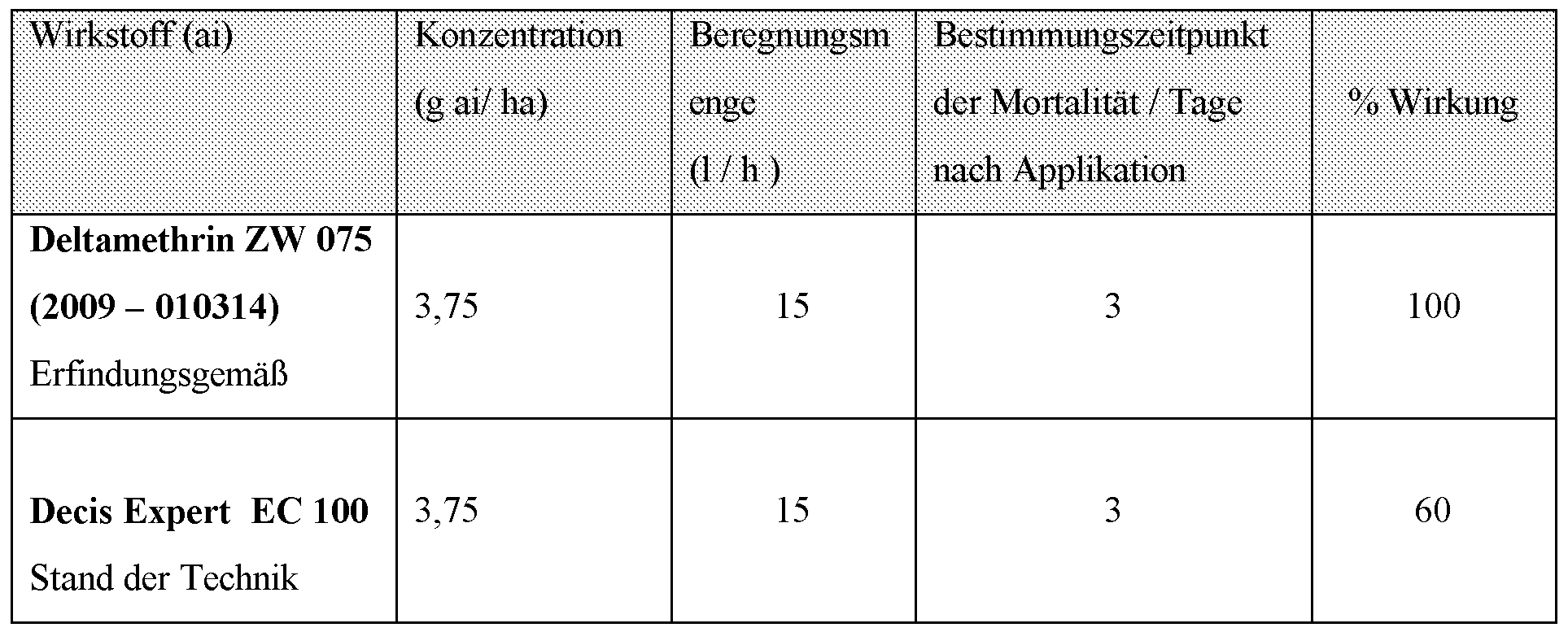
Akute Wirkung: Spodoptera frugiperda
Zur Herstellung einer zweckmäßigen Applikationslösung vermischt man den gewünschten Anteil formulierter Ware mit Wasser auf die gewünschte Konzentration.
Maispflanzen (Zea maidis) werden mit der Applikationslösung in der gewünschten Konzentration gespritzt und nach dem Antrocknen des Belages mit dem Heerwurm {Spodoptera frugiperda) besetzt.
Nach der gewünschten Zeit wird die Wirkung in % bestimmt. Dabei bedeutet 100 %, dass alle Raupen abgetötet wurden; 0 % bedeutet, dass keine Raupen abgetötet wurden.
Bei diesem Test zeigten z. B. die folgenden Formulierungen der Herstellungs-beispiele überlegene Wirksamkeit gegenüber dem Stand der Technik:
Tabelle XI : Spodoptera frugipera auf Mais

Beispiel Nr. Yl
Knockdown - Wirkung: Sitobion avenae auf Gerste
Zur Herstellung einer zweckmäßigen Applikationslösung vermischt man den gewünschten Anteil formulierter Ware mit Wasser auf die gewünschte Konzentration.
Gerstenpflanzen (Hordeum vulgare), die mit einer gemischten Population der Großen Getreideblattlaus (Sitobion avenae) besetzt sind, werden mit der Applikationslösung in der gewünschten Konzentration gespritzt.
Nach der gewünschten Zeit wird die Wirkung in % bestimmt. Dabei bedeutet 100 %, dass alle Blattläuse abgetötet wurden; 0 % bedeutet, dass keine Blattläuse abgetötet wurden.
Bei diesem Test zeigten z. B. die folgenden Formulierungen der Herstellungs-beispiele überlegene Wirksamkeit gegenüber dem Stand der Technik:
Tabelle Yl : Sitobion avenae auf Gerste

Für die prinzipiell beschriebenen ZW-Formulierungen der Partien 2010-0103 14 ZW 075 sowie 2010-010315 ZW 075 wurde die akut orale Toxizität an Ratten mit einem LD50 im Bereich 2000 mg/(kg Körpergewicht) > LD50 > 320 mg/(kg Körpergewicht) bestimmt.
Claims
1. Zusammensetzung enthaltend a) eine wässrige Emulsion enthaltend eine kontinuierliche wässrige Phase und eine disperse organische Phase, wobei die organische Phase mindestens ein organisches Lösemittel und Deltamethrin enthält und wobei die Konzentration an Deltamethrin mindestens 2 g/L, bezogen auf das Volumen der wässrigen Emulsion, beträgt, und b) Mikrokapseln, wobei die Mikrokapseln aus einer Kapselhülle und einer Kapselfüllung bestehen, wobei die Kapselhülle aus Polyharnstoff und / oder Polyurethan aufgebaut ist und durch Reaktion eines Isocyanats mit einer oder mehreren Isocyanat-reaktiven Verbindung erhalten wird, und wobei die Kapselfüllung Deltamethrin und mindestens ein organisches Lösemittel enthält, wobei die Konzentration von Deltamethrin in den Mikrokapseln mindestens 5 g/kg, bezogen auf die Masse der Mikrokapseln, beträgt.
2. Zusammensetzung gemäß Anspruch 1, bei der die wässrige Emulsion a) und die Mikrokapseln b) gemischt sind und die Mikrokapseln in der wässrigen Phase der wässrigen Emulsion a) suspendiert sind.
3. Zusammensetzung gemäß Anspruch 1, enthaltend mindestens zwei Behälter, worin AI) ein erster Behälter die wässrige Emulsion a) enthält, und
Bl) ein zweiter Behälter die Mikrokapseln b) enthält, wobei die Mikrokapseln b) als Granulat vorliegen oder in einem wässrigen Trägermedium suspendiert sind.
4. Zusammensetzung gemäß Anspruch 1, bei der das in der dispersen organischen Phase der wässrigen Emulsion a) enthaltene mindestens eine organische Lösemittel ausgewählt ist aus der Gruppe bestehend aus aromatischen Kohlenwasserstoffen, Carbonsäureester, D i carb on s äure e ste r, Ethe r, C arb o n s äure am i de , D i c arb on s äure d i am i de , Dicarbonsäureesteramide, Glycole, Ketone, Mineralöle und pflanzliche Öle.
5. Zusammensetzung gemäß Anspruch 1, bei der die Kapselhülle aus Polyharnstoff und / oder Polyurethan besteht, die durch Reaktion von Toluoldiisocyanat, Methylendiphenyl- diisocyanat, Methylendiphenyl-polyisocyanat, Hexamethylendiisocyanat, Dimer oder Trimer von Hexamethylendiisocyanat, 2H-l,3,5-Oxadiazin-2,4,6-(3H,5H)-trion-3,5-bis-(6- isocyanato-hex-l-yl), 4,4'-Methylenbis(cyclohexyisocyanat), Isophorondiisocyanat, Napthalendiisocyanat oder Mischungen daraus mit einer oder mehreren Isocyanat-reaktiven Verbindung erhalten werden.
6. Verfahren zur Herstellung einer Zusammensetzung gemäß Anspruch 1, bei dem man die wässrige Emulsion a) und die Mikrokapseln b) miteinander vermischt und gegebenenfalls mit Wasser verdünnt.
7. Verfahren zur Herstellung einer Zusammensetzung gemäß Anspruch 1, bei dem man Wasser vorlegt und die wässrige Emulsion a) und die Mikrokapseln b) gleichzeitig oder nacheinander zu dem Wasser hinzufügt und miteinander vermischt.
8. Verfahren zur Herstellung einer Zusammensetzung gemäß Anspruch 1 , bei dem man ein emulgierbares Konzentrat von Deltamethrin in mindestens einem organischen Lösemittel mit den Mikrokapseln b) und Wasser vermischt.
9. Verwendung einer Zusammensetzung gemäß Anspruch 1 zur Bekämpfung von Insekten und / oder Akarina.
10. Verwendung einer Zusammensetzung gemäß Anspruch 1 zur Herstellung einer Spritzbrühe zur Bekämpfung von Insekten und / oder Akarina.
11. Verfahren zur Bekämpfung von unerwünschten tierischen Schädlingen, bei dem man eine Zusammensetzung gemäß Anspruch 1 auf die unerwünschten tierischen Schädlinge und / oder deren Lebensraum ausbringt, wobei Verfahren zur therapeutischen Behandlung des menschlichen oder tierischen Körpers ausgeschlossen sind.
12. Zusammensetzung nach Anspruch 1 zur Verwendung in einem Verfahren zur Bekämpfung unerwünschter tierischer Schädlinge.
13. Wässrige Suspension von Mikrokapseln (c), die aus einer Kapselhülle und einer Kapselfüllung bestehen, wobei die Kapselhülle aus Polyharnstoff und / oder Polyurethan aufgebaut ist und durch
Reaktion eines Isocyanats mit einer oder mehreren Isocyanat-reaktiven Verbindung erhalten wird, und wobei die Kapselfüllung Deltamethrin sowie ein organisches Lösemittel aus der Gruppe der aromatischen Kohlenwasserstoffe enthält, wobei die Konzentration von Deltamethrin in den Mikrokapseln oberhalb von 12 g pro 100 g Lösemittel liegt.
14. Wässrige Suspension von Mikrokapseln nach Anspruch 13, bei denen die Konzentration von Deltamethrin in den Mikrokapseln zwischen 15 und 25 g pro 100 g Lösemittel liegt.
Applications Claiming Priority (4)
| Application Number | Priority Date | Filing Date | Title |
|---|---|---|---|
| US37985110P | 2010-09-03 | 2010-09-03 | |
| EP10175209 | 2010-09-03 | ||
| EP10175209.5 | 2010-09-03 | ||
| US61/379,851 | 2010-09-03 |
Publications (1)
| Publication Number | Publication Date |
|---|---|
| WO2012028583A1 true WO2012028583A1 (de) | 2012-03-08 |
Family
ID=43532900
Family Applications (1)
| Application Number | Title | Priority Date | Filing Date |
|---|---|---|---|
| PCT/EP2011/064826 Ceased WO2012028583A1 (de) | 2010-09-03 | 2011-08-29 | Deltamethrin enthaltende formulierungen |
Country Status (2)
| Country | Link |
|---|---|
| AR (1) | AR082830A1 (de) |
| WO (1) | WO2012028583A1 (de) |
Cited By (5)
| Publication number | Priority date | Publication date | Assignee | Title |
|---|---|---|---|---|
| CN103070166A (zh) * | 2012-12-26 | 2013-05-01 | 南通联农农药制剂研究开发有限公司 | 一种微囊悬浮-水乳剂zw及其制备方法 |
| CN103563892A (zh) * | 2013-10-14 | 2014-02-12 | 广东中迅农科股份有限公司 | 一种甲氨基阿维菌素苯甲酸盐的水基化新剂型 |
| CN109337032A (zh) * | 2018-09-28 | 2019-02-15 | 韶关市合众化工有限公司 | 一种聚醚醚酮低聚物改性聚氨酯固化剂 |
| WO2021094598A1 (de) * | 2019-11-13 | 2021-05-20 | Jesmond Holding Ag | Kombination von verkapseltem phenothrin und emulgiertem prallethrin |
| CN112841184A (zh) * | 2021-01-28 | 2021-05-28 | 常州大学 | 一种大黄素甲醚微囊缓释剂及其制备方法 |
Citations (28)
| Publication number | Priority date | Publication date | Assignee | Title |
|---|---|---|---|---|
| EP0238184A1 (de) | 1986-02-07 | 1987-09-23 | The Wellcome Foundation Limited | Pestizide Mischungen |
| WO1990009103A1 (fr) | 1989-02-17 | 1990-08-23 | Roussel-Uclaf | Nouvelles emulsions aqueuses concentrees, leur procede de preparation et leur application dans le domaine pesticide |
| US5049182A (en) | 1989-02-03 | 1991-09-17 | Ici Americas Inc. | Single-package agricultural formulations combining immediate and time-delayed delivery |
| EP0539588A1 (de) | 1990-07-05 | 1993-05-05 | Nippon Soda Co., Ltd. | Aminderivat |
| US5229122A (en) * | 1986-02-07 | 1993-07-20 | Burroughs Wellcome Co. | Pesticidal compositions |
| WO1997006688A1 (de) | 1995-08-16 | 1997-02-27 | Bayer Aktiengesellschaft | Zusammensetzung mit insektizider wirkung |
| WO1997044125A1 (en) | 1996-05-23 | 1997-11-27 | Zeneca Limited | Microencapsulated compositions |
| WO2000013504A1 (de) | 1998-09-05 | 2000-03-16 | Bayer Aktiengesellschaft | Mikrokapsel-formulierungen |
| WO2000013503A1 (de) | 1998-09-05 | 2000-03-16 | Bayer Aktiengesellschaft | Mikrokapsel-formulierungen |
| EP1339281A1 (de) | 2000-12-01 | 2003-09-03 | Bayer CropScience S.A. | Insektizide öl in wasser emulsionen |
| WO2003092378A1 (en) * | 2002-04-29 | 2003-11-13 | Rothamsted Research Ltd | Compositions and methods for preventing or reducing resistance ofinsects to insecticides |
| WO2005035486A1 (en) | 2003-10-02 | 2005-04-21 | Basf Aktiengesellschaft | 2-cyanobenzenesulfonamides for combating animal pests |
| WO2005077934A1 (ja) | 2004-02-18 | 2005-08-25 | Ishihara Sangyo Kaisha, Ltd. | アントラニルアミド系化合物、それらの製造方法及びそれらを含有する有害生物防除剤 |
| WO2006043635A1 (ja) | 2004-10-20 | 2006-04-27 | Kumiai Chemical Industry Co., Ltd. | 3-トリアゾリルフェニルスルフィド誘導体及びそれを有効成分として含有する殺虫・殺ダニ・殺線虫剤 |
| WO2006056433A2 (en) | 2004-11-26 | 2006-06-01 | Basf Aktiengesellschaft | Novel 2-cyano-3-(halo)alkoxy-benzenesulfonamide compounds for combating animal pests |
| WO2006089633A2 (de) | 2005-02-22 | 2006-08-31 | Bayer Cropscience Ag | Spiroketal-substituierte cyclische ketoenole |
| WO2006100288A2 (en) | 2005-03-24 | 2006-09-28 | Basf Aktiengesellschaft | 2-cyanobenzenesulfonamide compounds for seed treatment |
| WO2006129714A1 (ja) | 2005-06-01 | 2006-12-07 | Meiji Seika Kaisha, Ltd. | 害虫防除剤 |
| WO2007043677A1 (en) | 2005-10-14 | 2007-04-19 | Sumitomo Chemical Company, Limited | Hydrazide compound and pesticidal use of the same |
| WO2007057407A2 (en) | 2005-11-21 | 2007-05-24 | Basf Se | Insecticidal methods using 3-amino-1,2-benzisothiazole derivatives |
| WO2007095229A2 (en) | 2006-02-10 | 2007-08-23 | Dow Agrosciences Llc | Insecticidal n-substituted (6-haloalkylpyridin-3-yl)alkyl sulfoximines |
| WO2007115643A1 (de) | 2006-03-31 | 2007-10-18 | Bayer Cropscience Ag | Substituierte enaminocarbonylverbindungen |
| WO2007115646A1 (de) | 2006-03-31 | 2007-10-18 | Bayer Cropscience Ag | Substituierte enaminocarbonylverbindungen als insektizide |
| WO2007115644A1 (de) | 2006-03-31 | 2007-10-18 | Bayer Cropscience Ag | Substituierte enaminocarbonylverbindungen |
| WO2007149134A1 (en) | 2006-06-23 | 2007-12-27 | Dow Agrosciences Llc | A method to control insects resistant to common insecticides |
| WO2008067911A1 (de) | 2006-12-04 | 2008-06-12 | Bayer Cropscience Ag | Biphenylsubstituierte spirocyclische ketoenole |
| WO2008104503A1 (en) | 2007-03-01 | 2008-09-04 | Basf Se | Pesticidal active mixtures comprising aminothiazoline compounds |
| WO2009000545A2 (en) | 2007-06-28 | 2008-12-31 | Endura S.P.A. | A method for modulating the release rate of microencapsulated active ingredients |
-
2011
- 2011-08-29 WO PCT/EP2011/064826 patent/WO2012028583A1/de not_active Ceased
- 2011-08-31 AR ARP110103186 patent/AR082830A1/es unknown
Patent Citations (28)
| Publication number | Priority date | Publication date | Assignee | Title |
|---|---|---|---|---|
| EP0238184A1 (de) | 1986-02-07 | 1987-09-23 | The Wellcome Foundation Limited | Pestizide Mischungen |
| US5229122A (en) * | 1986-02-07 | 1993-07-20 | Burroughs Wellcome Co. | Pesticidal compositions |
| US5049182A (en) | 1989-02-03 | 1991-09-17 | Ici Americas Inc. | Single-package agricultural formulations combining immediate and time-delayed delivery |
| WO1990009103A1 (fr) | 1989-02-17 | 1990-08-23 | Roussel-Uclaf | Nouvelles emulsions aqueuses concentrees, leur procede de preparation et leur application dans le domaine pesticide |
| EP0539588A1 (de) | 1990-07-05 | 1993-05-05 | Nippon Soda Co., Ltd. | Aminderivat |
| WO1997006688A1 (de) | 1995-08-16 | 1997-02-27 | Bayer Aktiengesellschaft | Zusammensetzung mit insektizider wirkung |
| WO1997044125A1 (en) | 1996-05-23 | 1997-11-27 | Zeneca Limited | Microencapsulated compositions |
| WO2000013504A1 (de) | 1998-09-05 | 2000-03-16 | Bayer Aktiengesellschaft | Mikrokapsel-formulierungen |
| WO2000013503A1 (de) | 1998-09-05 | 2000-03-16 | Bayer Aktiengesellschaft | Mikrokapsel-formulierungen |
| EP1339281A1 (de) | 2000-12-01 | 2003-09-03 | Bayer CropScience S.A. | Insektizide öl in wasser emulsionen |
| WO2003092378A1 (en) * | 2002-04-29 | 2003-11-13 | Rothamsted Research Ltd | Compositions and methods for preventing or reducing resistance ofinsects to insecticides |
| WO2005035486A1 (en) | 2003-10-02 | 2005-04-21 | Basf Aktiengesellschaft | 2-cyanobenzenesulfonamides for combating animal pests |
| WO2005077934A1 (ja) | 2004-02-18 | 2005-08-25 | Ishihara Sangyo Kaisha, Ltd. | アントラニルアミド系化合物、それらの製造方法及びそれらを含有する有害生物防除剤 |
| WO2006043635A1 (ja) | 2004-10-20 | 2006-04-27 | Kumiai Chemical Industry Co., Ltd. | 3-トリアゾリルフェニルスルフィド誘導体及びそれを有効成分として含有する殺虫・殺ダニ・殺線虫剤 |
| WO2006056433A2 (en) | 2004-11-26 | 2006-06-01 | Basf Aktiengesellschaft | Novel 2-cyano-3-(halo)alkoxy-benzenesulfonamide compounds for combating animal pests |
| WO2006089633A2 (de) | 2005-02-22 | 2006-08-31 | Bayer Cropscience Ag | Spiroketal-substituierte cyclische ketoenole |
| WO2006100288A2 (en) | 2005-03-24 | 2006-09-28 | Basf Aktiengesellschaft | 2-cyanobenzenesulfonamide compounds for seed treatment |
| WO2006129714A1 (ja) | 2005-06-01 | 2006-12-07 | Meiji Seika Kaisha, Ltd. | 害虫防除剤 |
| WO2007043677A1 (en) | 2005-10-14 | 2007-04-19 | Sumitomo Chemical Company, Limited | Hydrazide compound and pesticidal use of the same |
| WO2007057407A2 (en) | 2005-11-21 | 2007-05-24 | Basf Se | Insecticidal methods using 3-amino-1,2-benzisothiazole derivatives |
| WO2007095229A2 (en) | 2006-02-10 | 2007-08-23 | Dow Agrosciences Llc | Insecticidal n-substituted (6-haloalkylpyridin-3-yl)alkyl sulfoximines |
| WO2007115643A1 (de) | 2006-03-31 | 2007-10-18 | Bayer Cropscience Ag | Substituierte enaminocarbonylverbindungen |
| WO2007115646A1 (de) | 2006-03-31 | 2007-10-18 | Bayer Cropscience Ag | Substituierte enaminocarbonylverbindungen als insektizide |
| WO2007115644A1 (de) | 2006-03-31 | 2007-10-18 | Bayer Cropscience Ag | Substituierte enaminocarbonylverbindungen |
| WO2007149134A1 (en) | 2006-06-23 | 2007-12-27 | Dow Agrosciences Llc | A method to control insects resistant to common insecticides |
| WO2008067911A1 (de) | 2006-12-04 | 2008-06-12 | Bayer Cropscience Ag | Biphenylsubstituierte spirocyclische ketoenole |
| WO2008104503A1 (en) | 2007-03-01 | 2008-09-04 | Basf Se | Pesticidal active mixtures comprising aminothiazoline compounds |
| WO2009000545A2 (en) | 2007-06-28 | 2008-12-31 | Endura S.P.A. | A method for modulating the release rate of microencapsulated active ingredients |
Non-Patent Citations (4)
| Title |
|---|
| "CIPAC Handbook", vol. K, 2003, article "Analysis of Technical and Formulated Pesticides", pages: 153 FF |
| "Nomenklatur in Catalogue of Pesticide Formulation Types and International Coding System, Technical Monograph No. 2", March 2002, CROPLIFE INTERNATIONAL |
| "The Pesticide Manual", 2006, BRITISH CROP PROTECTION COUNCIL |
| BJÖRN L. CHRISTENSEN: "Untersuchungen von ''Controlled Release''-Formulierungen und ihr Einfluß auf das Umweltverhalten von Fenamiphos anhand von Laborstudien und Modellrechnungen", DISSERTATION, 1997, pages 29 |
Cited By (8)
| Publication number | Priority date | Publication date | Assignee | Title |
|---|---|---|---|---|
| CN103070166A (zh) * | 2012-12-26 | 2013-05-01 | 南通联农农药制剂研究开发有限公司 | 一种微囊悬浮-水乳剂zw及其制备方法 |
| CN103070166B (zh) * | 2012-12-26 | 2015-03-04 | 南通联农农药制剂研究开发有限公司 | 一种微囊悬浮-水乳剂zw及其制备方法 |
| CN103563892A (zh) * | 2013-10-14 | 2014-02-12 | 广东中迅农科股份有限公司 | 一种甲氨基阿维菌素苯甲酸盐的水基化新剂型 |
| CN109337032A (zh) * | 2018-09-28 | 2019-02-15 | 韶关市合众化工有限公司 | 一种聚醚醚酮低聚物改性聚氨酯固化剂 |
| WO2021094598A1 (de) * | 2019-11-13 | 2021-05-20 | Jesmond Holding Ag | Kombination von verkapseltem phenothrin und emulgiertem prallethrin |
| CN114727605A (zh) * | 2019-11-13 | 2022-07-08 | 杰斯蒙德控股公司 | 胶囊化的苯醚菊酯和乳化的右旋丙炔菊酯的混合物 |
| CN114727605B (zh) * | 2019-11-13 | 2023-08-18 | 杰斯蒙德控股公司 | 胶囊化的苯醚菊酯和乳化的右旋丙炔菊酯的混合物 |
| CN112841184A (zh) * | 2021-01-28 | 2021-05-28 | 常州大学 | 一种大黄素甲醚微囊缓释剂及其制备方法 |
Also Published As
| Publication number | Publication date |
|---|---|
| AR082830A1 (es) | 2013-01-09 |
Similar Documents
| Publication | Publication Date | Title |
|---|---|---|
| EP2582242B1 (de) | Wirkstoffkombinationen mit insektiziden und akariziden eigenschaften | |
| US9451764B2 (en) | Composition comprising insecticide-wax particles | |
| WO2012004293A2 (de) | Insektizide und fungizide wirkstoffkombinationen | |
| WO2012076470A1 (en) | Pesticidal mixtures with improved properties | |
| EP2446742A1 (de) | Insektizide oder akarizide Zusammensetzungen enthaltend Mono- oder Disacchariden als Wirkungsverstärker | |
| WO2012028583A1 (de) | Deltamethrin enthaltende formulierungen | |
| CN103347388A (zh) | 具有改善的性能的杀虫剂混合物 | |
| EP2531030B1 (de) | Wirkstoffkombinationen enthaltend azadirachtin und eine substituierte enaminocarbonylverbindung | |
| WO2012045680A2 (de) | Insektizide und fungizide wirkstoffkombinationen | |
| US20120004268A1 (en) | Insecticidal compositions comprising cyclic carbonylamidines | |
| AU2015224451B2 (en) | Active substance combinations with insecticide and acaricide properties | |
| WO2020078839A1 (de) | Wirkstoffkombinationen | |
| US20120004325A1 (en) | Insecticidal or acaricidal formulations with improved availability on plant surfaces | |
| DE102009028001A1 (de) | Wirkstoffkombinationen mit insektiziden und akariziden Eigenschaften |
Legal Events
| Date | Code | Title | Description |
|---|---|---|---|
| 121 | Ep: the epo has been informed by wipo that ep was designated in this application |
Ref document number: 11748686 Country of ref document: EP Kind code of ref document: A1 |
|
| NENP | Non-entry into the national phase |
Ref country code: DE |
|
| 122 | Ep: pct application non-entry in european phase |
Ref document number: 11748686 Country of ref document: EP Kind code of ref document: A1 |