WO2011125792A1 - 微生物凝集膜の製造方法 - Google Patents
微生物凝集膜の製造方法 Download PDFInfo
- Publication number
- WO2011125792A1 WO2011125792A1 PCT/JP2011/058118 JP2011058118W WO2011125792A1 WO 2011125792 A1 WO2011125792 A1 WO 2011125792A1 JP 2011058118 W JP2011058118 W JP 2011058118W WO 2011125792 A1 WO2011125792 A1 WO 2011125792A1
- Authority
- WO
- WIPO (PCT)
- Prior art keywords
- microorganism
- microorganisms
- culture
- film
- aggregate
- Prior art date
- Legal status (The legal status is an assumption and is not a legal conclusion. Google has not performed a legal analysis and makes no representation as to the accuracy of the status listed.)
- Ceased
Links
Images



Classifications
-
- C—CHEMISTRY; METALLURGY
- C12—BIOCHEMISTRY; BEER; SPIRITS; WINE; VINEGAR; MICROBIOLOGY; ENZYMOLOGY; MUTATION OR GENETIC ENGINEERING
- C12N—MICROORGANISMS OR ENZYMES; COMPOSITIONS THEREOF; PROPAGATING, PRESERVING, OR MAINTAINING MICROORGANISMS; MUTATION OR GENETIC ENGINEERING; CULTURE MEDIA
- C12N1/00—Microorganisms; Compositions thereof; Processes of propagating, maintaining or preserving microorganisms or compositions thereof; Processes of preparing or isolating a composition containing a microorganism; Culture media therefor
- C12N1/12—Unicellular algae; Culture media therefor
-
- C—CHEMISTRY; METALLURGY
- C12—BIOCHEMISTRY; BEER; SPIRITS; WINE; VINEGAR; MICROBIOLOGY; ENZYMOLOGY; MUTATION OR GENETIC ENGINEERING
- C12N—MICROORGANISMS OR ENZYMES; COMPOSITIONS THEREOF; PROPAGATING, PRESERVING, OR MAINTAINING MICROORGANISMS; MUTATION OR GENETIC ENGINEERING; CULTURE MEDIA
- C12N13/00—Treatment of microorganisms or enzymes with electrical or wave energy, e.g. magnetism, sonic waves
Definitions
- the present invention relates to a method for producing a microorganism-aggregated membrane that can improve the growth rate of microorganisms and stabilize the productivity of biomass.
- microalgae are attracting attention as potential microorganisms that can replace petroleum in order to solve global warming.
- microalgae are problematic in that their growth rate is very slow compared to bacteria such as E. coli.
- Escherichia coli divides once in a few tens of minutes
- Botryococcus Braunii a kind of microalgae that accumulates oil, is known to take several days to several weeks. Yes.
- biomass fuels using microalgae have not reached commercial level production.
- the microorganisms forming the microbial aggregate film are mostly adherent microorganisms, and generally exist in an aggregated state (microorganism aggregates) in which the microorganisms adhere to each other. Therefore, when a microbial aggregate film is formed using such a microorganism, the microbial aggregate is likely to be present, and the microbial aggregate film formed by adhering the microbial aggregate as it is to the culture substrate becomes non-uniform. Inside the microbial aggregate, the growth is slow because various nutrients necessary for the growth of the microorganism and the space necessary for the growth are small. As a result, the production amount of biomass is not stable, and the production amount is reduced.
- microorganisms are very damaging and the microorganisms are crushed, and once microbial aggregates are formed by sonication, it is often difficult to redisperse, and the growth rate of the microorganisms is sufficiently satisfactory. It was a problem in that it was not a thing.
- the present invention provides a method for producing a microbial aggregate film that can form a uniform microbial aggregate film, thereby improving the growth rate of microorganisms and stabilizing the productivity of biomass. For the purpose.
- microorganisms are pre-cultured, and the pre-cultured microorganism aggregates are dispersed by vibrating at a constant frequency for a certain period of time, and a certain amount of the microorganisms in the dispersed microorganism aggregates are collected. Then, by culturing this on a culture substrate of a certain area, a uniform microbial aggregate film can be formed, thereby improving the growth rate of microorganisms and stabilizing the productivity of biomass. As a result, the present invention has been completed.
- a method for producing a microbial aggregate film that promotes the growth of microorganisms in the microbial aggregate film A pre-culture step of pre-culturing the microorganism; A dispersion step of dispersing the aggregates of the microorganisms pre-cultured in the pre-culture step by vibrating 100 times or more at a total frequency represented by the following formula: A collecting step of collecting a certain amount of the microorganism in the microbial aggregate dispersed in the dispersing step; A microorganism aggregated film forming step of culturing the fixed amount of microorganisms collected in the collecting step on a culture substrate of a constant area, and uniformly forming an aggregated film of the microorganisms on the culture substrate; It is a manufacturing method of the microorganisms aggregation film
- Total number of vibrations (times) number of vibrations per minute (times) x vibration time (minutes) ⁇ 2>
- the dispersion step is a step of vibrating the microbial aggregate film filled in the container, and the volume ratio of the microbial aggregate film to the internal volume of the container is 15% by volume to 75% by volume.
- ⁇ 4> The method for producing a microbial aggregate film according to any one of ⁇ 1> to ⁇ 3>, wherein the dispersion step is performed by adding an antifoaming agent to the microbial aggregate film.
- ⁇ 5> The method for producing a microorganism-aggregated membrane according to any one of ⁇ 1> to ⁇ 4>, wherein the dispersion step is performed a plurality of times.
- ⁇ 6> The method for producing a microbial aggregate film according to any one of ⁇ 1> to ⁇ 5>, wherein the microorganism is a microalgae.
- ⁇ 7> The method for producing a microorganism-aggregated film according to any one of ⁇ 1> to ⁇ 6>, wherein the microorganism is a microorganism that produces biomass.
- ⁇ 8> The method for producing a microorganism-aggregated membrane according to ⁇ 7>, wherein the microorganism that produces biomass is at least one of diatoms, yellow-green algae, and green algae.
- ⁇ 9> The method for producing a microorganism-aggregated membrane according to ⁇ 8>, wherein the yellow green algae belongs to the genus Botryococcus.
- ⁇ 10> The method for producing a microorganism-aggregated membrane according to ⁇ 8>, wherein the green algae belongs to the genus Haematococcus.
- the conventional problems can be solved, the object can be achieved, and a uniform microbial aggregate film can be formed, thereby improving the growth rate of microorganisms and productivity of biomass. It is possible to provide a method for producing a microorganism-aggregated membrane that can improve the stabilization of the microorganism.
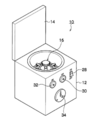
- FIG. 1 is a schematic view showing an example of an external view of a vibration device used in a dispersion step of the method for producing a microorganism-aggregated membrane of the present invention.
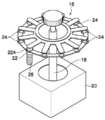
- FIG. 2 is a perspective view showing a container holder and a drive unit of the vibration device of FIG.
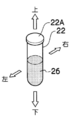
- FIG. 3 is a perspective view showing a state in which a closed container used in the vibration device is filled with microorganisms.
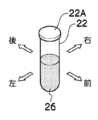
- FIG. 4A is a diagram showing an example of a vibration form in the dispersion step of the method for producing a microorganism-aggregated membrane of the present invention.
- FIG. 4B is a diagram showing another example of the vibration form in the dispersion step of the method for producing a microorganism-aggregated membrane of the present invention.
- FIG. 4C is a diagram showing still another example of the vibration mode in the dispersion step of the method for producing a microorganism-aggregated membrane of the present invention.
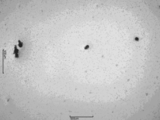
- FIG. 5 is a diagram of the diatom aggregate film of Example 3 observed with an optical microscope. The scale bar is 500 ⁇ m.
- FIG. 6 is a view of the diatom aggregate film of Comparative Example 1 observed with an optical microscope. The scale bar is 500 ⁇ m.
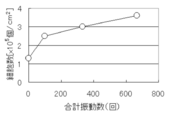
- FIG. 7 is a graph showing the relationship between the total vibration frequency in the dispersion process of Examples 1 to 3 and Comparative Example 1 and the number of cells after culturing the diatom aggregation membranes 1 to 4. Horizontal axis: total frequency (times), vertical axis: number of cells after culture ( ⁇ 10 5 cells / cm 2 )
- the method for producing a microbial aggregate film of the present invention includes at least a pre-culture process, a dispersion process, a collection process, and a microbial aggregate film formation process, and further includes other processes as necessary.
- the pre-culturing step is a step of pre-culturing microorganisms.
- the microorganism refers to a minute organism whose individual presence cannot be identified by the human eye, and is not particularly limited as long as it is a microorganism that forms a microbial aggregate film. Either may be sufficient.
- an aggregate of microorganisms can be identified with the naked eye by forming a microbial aggregate film, it cannot be identified with the naked eye by breaking the aggregate structure into individual microorganisms. In this case, the microorganism is used in the present invention.
- some cells can be identified by color change as the number of cells (for example, the number of microalgae) increases, but in such cases.
- individual microorganisms cannot be observed with the human eye, they are included in the microorganisms referred to in the present invention.
- the prokaryote is not particularly limited as long as it does not have a cell nucleus, and can be appropriately selected according to the purpose. Examples thereof include eubacteria and archaea.
- the eukaryote is not particularly limited and may be appropriately selected depending on the intended purpose. Examples thereof include algae, protists, fungi, slime molds, and rotifers. These may be used alone or in combination of two or more. Among these, as the microorganism, a microorganism that produces biomass is preferable, and microalgae is particularly preferable.
- microalgae is a general term for organisms that perform oxygen-generating photosynthesis, excluding moss plants, fern plants, and seed plants that mainly live on the ground.
- prokaryotes such as cyanobacteria
- single cells examples include eukaryotic organisms such as seaweeds of living organisms or multicellular organisms.
- the microalgae is not particularly limited and may be appropriately selected depending on the intended purpose.
- indigo plant gate gray plant gate, red plant gate, green plant gate, cryptophyte gate, haptophyte gate
- examples thereof include isophyllous plant gates, dinoflagellate plant gates, Euglena plant gates, and chloracarnion plant gates. These may be used alone or in combination of two or more.
- diatoms and green plant gates of unequal algae are preferable, and the genus Botryococcus and Haematococcus are more preferable in terms of producing biomass.
- biomass refers to renewable organic resources derived from living organisms excluding fossil resources, and examples include biological materials, foods, materials, fuels, and resources.
- the biomass includes oils such as polysaccharides, hydrocarbon compounds, and triglycerides produced by living organisms.
- the method for obtaining the microorganism is not particularly limited and may be appropriately selected depending on the purpose. Examples thereof include a method of collecting from the natural world, a method of using a commercially available product, a method of obtaining from a storage organization and a depository organization. Can be mentioned.
- microorganism aggregate means a structure in which a plurality of microorganisms are aggregated, and the structure of the microorganism may be composed of a plurality of types of microorganisms. It may be configured. Furthermore, the microorganisms may be directly adjacent to each other or may be aggregated via a certain substance, for example, a substance such as an intercellular matrix. Moreover, what is called a colony shall mean agglomeration in the present invention.
- a culture medium used for the said preculture of the microorganisms there is no restriction
- the medium used for the preculture include a medium composed of an inorganic substance and water.
- the culture medium etc. which are described in the Example mentioned later can be used.
- the medium may contain an organic substance.
- the pH of the medium used for the preculture is not particularly limited and may be appropriately selected depending on the type of microorganism, but is preferably 5 to 9, and more preferably 6 to 8. When the pH is less than 5 or exceeds 9, the microorganism may not grow.
- the culture temperature in the preculture is not particularly limited and may be appropriately selected depending on the type of microorganism, but is preferably 0 ° C to 100 ° C, more preferably 15 ° C to 40 ° C. When the culture temperature is less than 0 ° C. or exceeds 100 ° C., the microorganism may not grow.
- the period for carrying out the pre-culture is not particularly limited and may be appropriately selected depending on the type of microorganism, but is preferably 1 day to 300 days, more preferably 2 days to 30 days. If the culture period is less than one day, the number of the microorganism cells may not be obtained sufficiently, and if it exceeds 300 days, the microorganisms may die due to lack of nutrients.
- the period for performing the pre-culture is a period in which all or a part of the medium is not exchanged.
- the carbon dioxide concentration in the pre-culture is not particularly limited and may be appropriately selected depending on the type of microorganism, but is preferably 0.001% to 50%, more preferably 1% to 10%. If the carbon dioxide concentration is less than 0.001%, photosynthesis may not be performed sufficiently, and if it exceeds 50%, the microorganism may not be grown due to a decrease in pH.
- the method for measuring the carbon dioxide concentration is not particularly limited and may be appropriately selected depending on the intended purpose. Examples thereof include a method for measuring with a well-known sensor in a closed system in the culture environment, a gas chromatograph and a spectroscope. Examples include a method of measuring with an analytical instrument such as a vessel, a method of measuring by an alkali absorption method, and the like.
- the illuminance in the pre-culture is not particularly limited and may be appropriately selected depending on the type of microorganism, but is preferably 1 lux to 1 million lux, and more preferably 1,000 lux to 100,000 lux. If the illuminance is less than 1 lux, photosynthesis may not be sufficiently performed. If the illuminance exceeds 1 million lux, the growth rate of the microorganisms may be reduced or killed due to light damage. is there.
- the dispersion step is a step of vibrating and dispersing the aggregates of the microorganisms precultured in the preculture step.
- the vibration in the dispersion step is performed not for the purpose of culturing but simply for the purpose of dispersing the aggregates of the microorganisms.
- “dispersing” the microbial aggregates means that one microbial aggregate is roughly separated so as not to be visually observed.
- the microbial aggregate that has been pre-cultured in the pre-culture step may be used as it is, or the microbial aggregate that has been pre-cultured in the pre-culture step may be concentrated.
- the concentrated microbial aggregates may be used by appropriately diluting with a solution such as a new medium or water, but the concentrated microbial aggregates may be used after appropriately diluted with the solution. It is preferable in that it can be dispersed efficiently.
- a solution containing diluted microbial aggregates may be referred to as a “microbial aggregate diluted solution”.
- the concentration method is not particularly limited and may be appropriately selected depending on the intended purpose.
- the concentration method using a centrifuge, the precipitation method using an aluminum compound or a polymer electrolyte, Examples include a method of precipitating the microbial aggregate by allowing the culture solution after the pre-culture to stand, and collecting a medium containing the microbial aggregate concentrated by the precipitation with a pipette or the like.
- concentration of the said microorganisms aggregate in the said microorganisms aggregate dilution liquid According to the objective, it can select suitably.
- the microbial aggregate dilution liquid may be pipetted before being vibrated.
- the microbial aggregate in the microbial aggregate dilution liquid has a high concentration or releases various metabolites out of the cell.
- bubbles may be generated by vibration, and the dispersibility of the microorganism aggregates may be significantly reduced.
- an antifoaming agent to the microorganism aggregate dilution.
- the antifoaming agent include silicon-based antifoaming agents. These may be used alone or in combination of two or more. There is no restriction
- the method for vibrating is not particularly limited and may be appropriately selected depending on the intended purpose. Examples thereof include a bead-type cell crusher (for example, MS-100 manufactured by Tommy Seiko Co., Ltd.), a bead-type homogenizer (for example, And a method using a commercially available apparatus such as BSP-3110BX (BioSpec Product). When vibration is performed using these apparatuses, it is preferable not to use beads. However, depending on the type of the microorganism, beads may be appropriately used when the dispersibility of the microorganism is poor.
- a bead-type cell crusher for example, MS-100 manufactured by Tommy Seiko Co., Ltd.
- a bead-type homogenizer for example, And a method using a commercially available apparatus such as BSP-3110BX (BioSpec Product).
- BSP-3110BX BioSpec Product
- the condition for the vibration is 100 times or more in terms of the total frequency represented by the following formula combining the frequency and the vibration time, but is preferably 100 to 50,000 times, preferably 200 to 5, 000 times is more preferable, and 200 to 700 times is particularly preferable. If the total frequency is less than 100 times, the dispersibility may be reduced and the growth may not be improved. If the total frequency exceeds 50,000 times, the microorganism may be crushed or the temperature may increase. Microorganisms may be inactivated or killed. In the case where the vibration is a rotational motion, in the present invention, the vibration frequency of 1 represents one rotation, and the vibration frequency per minute can be expressed in rpm.
- the vibration means moving from one position to another position and returning to the one position. For example, when the vibration is in the left-right direction, moving from left to right and returning to the left. When the vibration is in the vertical direction, it moves from top to bottom and returns to the top, that is, one reciprocation is one vibration. When the vibration is rotation, one rotation is one vibration, and the vibration frequency per minute can be expressed in rpm. That is, the frequency and the rotation speed mean the same thing.
- the vibration frequency per minute is 2,000 to 5,500 times, preferably 3 seconds to 20 seconds, and the vibration frequency per minute is 2500 to 5 times. , 500 times, more preferably 5 seconds to 60 seconds.
- the number of times of performing the vibration is not particularly limited and can be appropriately selected according to the purpose. However, it is possible to prevent an increase in the temperature of the microbial aggregate and to prevent inactivation or death of the microorganism. It is preferable to carry out a plurality of times in view of possible. In addition, when performing a multiple times of vibration, it is preferable that one vibration becomes in the range of the said preferable total frequency. In addition, it is preferable to leave 1 second to 60 minutes between the times of vibration in a plurality of times, and more preferably 3 seconds to 1 minute. If each time is less than 1 second, the microorganism may be inactivated or killed, and if it exceeds 60 minutes, it is inefficient. It is preferable that the same conditions as the conditions for the pre-culture are used during each round.
- the vibration form of the vibration is not particularly limited and can be appropriately selected according to the purpose. Examples thereof include a vertical direction, a horizontal direction, and a front-rear direction. These may be performed singly or in combination of two or more. Among these, it is particularly preferable that all three forms are combined and vibrated into a figure 8 (see FIG. 4C).
- the culture solution or microbial aggregate diluted solution containing this microbial aggregate it is preferable to put into the airtight container the culture solution or microbial aggregate diluted solution containing this microbial aggregate.
- the airtight container According to the kind etc. of apparatus used for a vibration, it can select suitably.
- the volume ratio of the microbial aggregated membrane diluted solution to the inner volume of the sealed container (the volume of the microbial aggregated membrane diluted solution / the inner volume of the sealed container ⁇ 100%) is not particularly limited and should be appropriately selected according to the purpose. However, 15 volume% to 75 volume% is preferable, and 20 volume% to 60 volume% is more preferable. When the volume ratio is less than 15% by volume, the dispersibility may be significantly lowered. When the volume ratio is more than 75% by volume, the microbial aggregate may not vibrate sufficiently and the dispersibility may be lowered.
- the vibration device 10 of FIG. 1 is a schematic view of an example of a device used in the dispersion step, and includes a device main body 12 and a lid member 14.
- FIG. 2 is a schematic view showing an example of the inside of the apparatus main body 12, in which a disc-shaped hermetic container holder 16 that vibrates is disposed and supported by the vibration driving unit 20 via the drive shaft 18.
- a plurality of chuck portions 24 that detachably hold the sealed container 22 with the lid 22 ⁇ / b> A are provided on the peripheral portion of the sealed container holder 16.
- the sealed container 22 with the lid 22 ⁇ / b> A is formed in a test tube shape and filled with the microorganisms 27 and the other components 25 except the microorganisms 27 in the microorganism aggregate dilution liquid 26. It is comprised so that it can seal with 22A.
- a frequency dial 30 for setting a frequency when the sealed container 22 is vibrated via the ON-OFF switch 28 and the sealed container holder 16 and a vibration time are set on the front surface of the apparatus body 12.
- a timer dial 32 is provided.
- a changeover switch 34 and the like for setting the form of the vibration direction for vibrating the sealed container 22 are provided.
- the vibration mode for vibrating the hermetic container 22 filled with the microbial aggregation membrane diluent 26 is at least one mode in the vertical direction, the horizontal direction, and the front-rear direction.
- FIG. 4 it is preferable to adopt a combination of the vertical direction and the horizontal direction, and as shown in FIG. 4B, a combination of the horizontal direction and the front-back direction.
- the special vibration form which the airtight container 22 vibrates so that the figure of 8 may be drawn up and down is especially preferable.
- the method for producing a microbial aggregate film of the present invention does not vibrate the microorganism itself by ultrasonic vibration as in the prior art, so that the microorganism is not crushed and the microbial aggregate in the microorganism aggregate
- the microorganism can be dispersed in each cell.
- crush means that the ratio of the number of crushed microbial cells to the total number of microbial cells in the microbial aggregate (number of crushed microbial cells / total number of microbial cells ⁇ 100%) is 30%. Is less than 20%, preferably less than 20%, more preferably less than 10%. Whether or not the microorganism has been crushed can be confirmed, for example, by observing with a microscope.
- the collection step is a step of collecting a certain amount of the microorganism in the microorganism aggregate dispersed in the dispersion step.
- the method for collecting the fixed amount is not particularly limited and may be appropriately selected depending on the intended purpose. Examples thereof include a method for collecting the microorganism aggregated membrane diluted solution with a pipette.
- the method for measuring the number of the microorganisms is not particularly limited and may be appropriately selected depending on the purpose.
- the microorganism in which the microorganism aggregates are dispersed may be selected from an optical microscope, a polarizing microscope, and a differential interference microscope.
- Method of direct measurement by observing with various microscopes such as, method of measuring on blood cell counter, method of calculating using software from photograph taken with optical microscope, method of measuring with flow cytometer, absorbance and microorganism in advance
- the method of calculating from the measurement value measured with the absorptiometer by determining the correlation between the turbidity and the cell number in advance, the turbidity measured with the turbidimeter
- the method of calculating from the above, the method of calculating from the dry weight by obtaining the correlation between the dry weight and the cell number in advance, the fluorescence amount of chlorophyll by the fluorometer in advance By keeping the correlation between ⁇ , and a method of calculating the amount of fluorescence chlorophyll.
- the microorganism aggregated film forming step is a step of culturing the certain amount of microorganisms collected in the collecting step on a culture substrate of a certain area, and uniformly forming the microorganism aggregated film on the culture substrate. is there.
- the “culture substrate” refers to a substrate having a certain area to which the microorganism can adhere.
- a material of the said culture base material According to the objective, it can select suitably, For example, glass (soda lime glass, lead glass, borosilicate glass, etc.), nylon, polystyrene, polyester, polycarbonate , Cellulose, polypropylene, polyimide, fluororesin, acrylic resin, polyvinyl chloride and the like. These may be used alone or in combination of two or more.
- the shape of the culture substrate is not particularly limited and may be appropriately selected depending on the intended purpose.
- the thickness thereof is not particularly limited and can be appropriately selected depending on the purpose, but is preferably 0.001 mm to 1,000 mm, more preferably 0.01 mm to 10 mm.
- the particle size is not particularly limited and can be appropriately selected according to the purpose. For example, 0.001 mm to 1,000 mm is preferable, and 0.01 mm to 10 mm is more preferable.
- “on the culture substrate” refers to the surface of the culture substrate that is in contact with the medium containing the microorganism at the time of culturing and on which the microorganism can adhere to and grow on the culture substrate.
- the whole culture substrate surface is in contact with the culture medium
- the whole culture substrate surface is set on the culture substrate.
- the culture substrate is plate-shaped
- one surface of the plate-shaped culture substrate is, for example, placed on the bottom surface inside the culture container and is not in contact with the culture medium
- the other surface excluding one surface is referred to as the culture substrate.
- the entire surface of the plate-shaped culture substrate is in contact with the medium, the entire surface of the plate-shaped culture substrate is referred to as the culture substrate.
- the "constant area” refers to the area on the culture substrate, it can be appropriately selected depending on the shape and culture the form of the culture substrate is preferably 1mm 2 ⁇ 1m 2, 1cm 2 ⁇ 0.5 m 2 is more preferable, and 1 cm 2 to 0.1 m 2 is particularly preferable. When the area is less than 1 mm 2 , a sufficient amount of the microbial aggregate film may not be formed.
- the constant area may be an area exceeding 1 m 2 for the purpose of large-scale culture, but even in that case, it is preferably 10,000 m 2 or less, and 1,000 m 2 or less. It is more preferable. If the certain area exceeds 10,000 m 2 , handling may be difficult.
- the constant area refers to the surface area of each culture substrate when a plurality of the culture substrates are used simultaneously. There is no restriction
- the method for culturing the microorganism on the culture substrate is not particularly limited and may be appropriately selected according to the purpose.
- the medium containing the certain amount of microorganism collected in the collection step is filled.
- a method of culturing by immersing the culture substrate in a culture vessel hereinafter sometimes referred to as “first culture form”
- first culture form a culture vessel
- second culture form a method of culturing in a wet state
- the “fixed amount” is not particularly limited and can be appropriately selected according to the culture form, the area on the culture substrate, and the like.
- the certain amount is appropriately selected according to the type of the microorganism, the size of the culture vessel, the area on the culture substrate, and the like.
- the concentration of the microorganism collected in the collecting step in the medium in the culture vessel is preferably 1 ⁇ 10 3 cells / mL to 1 ⁇ 10 8 cells / mL, and 1 ⁇ 10 4 cells / mL to 1 More preferably, 10 6 cells / mL.
- the concentration of the microorganism is less than 1 ⁇ 10 3 cells / mL, the microorganism aggregation film may not be formed on the culture substrate.
- the concentration exceeds 1 ⁇ 10 8 cells / mL the microorganism aggregation film Is too thick, nutrients in the medium up to the microorganisms inside the microbial aggregation film, light is not sufficiently distributed in microorganisms that carry out photosynthesis, and there is little space necessary for growth, and the increase rate of the microorganisms is May decrease.
- the culture substrate is spherical, hemispherical, or indefinite
- the culture form is shake culture in the first culture form, which causes the microorganism to adhere to the entire surface of the culture substrate. In that it can be cultured.
- the method for replenishing the certain amount of microorganisms on the culture substrate is not particularly limited and may be appropriately selected depending on the purpose. For example, a method of dropping the culture medium containing a certain amount of microorganisms onto the culture substrate with a pipette, a method of pulling up the culture substrate after impregnating the culture medium containing the certain amount of microorganisms, the constant amount And a method of supplying a medium containing the microorganisms onto the culture substrate using a pump.
- the “wet state in the air” is not particularly limited as long as the microbial aggregate film on the culture substrate is not dried, and can be appropriately selected according to the purpose. If the humidity is such that the microorganism-aggregated membrane does not dry, the microorganisms replenished on the culture substrate can be cultured in the same environment. In addition, for example, in an environment where the microorganism-aggregated membrane dries, a method of appropriately supplementing a medium or the like that does not contain the microorganism as necessary may be used. A method for replenishing a solution such as a medium not containing the microorganism is not particularly limited and may be appropriately selected depending on the purpose.
- the solution not containing the microorganism is dropped onto the culture substrate with a pipette or the like.
- a method of culturing the culture substrate supplemented with the medium containing the microorganism in a wet box may be used.
- the fixed amount can be appropriately selected according to the type of the microorganism, the area on the culture substrate, etc., but in the collecting step in the medium used for replenishment on the culture substrate.
- the concentration of the collected microorganism is preferably 1 ⁇ 10 3 cells / mL to 1 ⁇ 10 8 cells / mL, more preferably 1 ⁇ 10 4 cells / mL to 1 ⁇ 10 6 cells / mL.
- the concentration of the microorganism is less than 1 ⁇ 10 3 cells / mL, the microorganism aggregation film may not be formed on the culture substrate.
- the concentration exceeds 1 ⁇ 10 8 cells / mL
- the microorganism aggregation film Is too thick, nutrients in the medium up to the microorganisms inside the microbial aggregation film, light is not sufficiently distributed in microorganisms that carry out photosynthesis, and there is little space necessary for growth, and the increase rate of the microorganisms is May decrease.
- the method for culturing the microorganism collected in the collection step on the culture substrate is not particularly limited and can be appropriately selected according to the type of microorganism, the culture form, and the like.
- stationary culture shaking Examples include culture.
- stationary culture is preferable when the culture substrate is a fragile material such as glass.
- the entire surface of the culture substrate is used on the culture substrate, it is preferable that the entire surface of the culture substrate can be suitably brought into contact with the medium containing the microorganisms by shaking culture.
- the culture substrate is spherical, hemispherical, or amorphous, it is difficult to determine which surface of the culture substrate is in contact with the culture vessel or the spheres after stationary culture. Culture is preferred.
- examples of the medium used for the preculture include a medium composed of an inorganic substance and water.
- the culture medium etc. which are described in the Example mentioned later can be used.
- the medium may contain an organic substance.
- the pH of the medium used for the culture is not particularly limited and may be appropriately selected depending on the type of microorganism, but is preferably 5 to 9, and more preferably 6 to 8. When the pH is less than 5 or exceeds 9, the microorganism may not grow.
- the culture temperature in the culture is not particularly limited and may be appropriately selected depending on the type of microorganism, but is preferably 0 ° C to 100 ° C, more preferably 15 ° C to 40 ° C. When the culture temperature is less than 0 ° C. or exceeds 100 ° C., the microorganism may not grow.
- the period during which the culture is performed is not particularly limited and may be appropriately selected depending on the type of microorganism, but is preferably 1 day to 300 days, more preferably 2 days to 30 days. If the culture period is less than one day, the number of cells of the microorganism may not be sufficiently obtained. If it exceeds 300 days, the microorganism may be killed due to lack of nutrients.
- the culture period is a period in which all or a part of the medium is not exchanged.
- the carbon dioxide concentration in the culture is not particularly limited and may be appropriately selected depending on the type of microorganism, etc., but is preferably 0.001% to 50%, more preferably 1% to 10%. If the carbon dioxide concentration is less than 0.001%, photosynthesis may not be performed sufficiently, and if it exceeds 50%, the microorganism may not be grown due to a decrease in pH.
- the method for measuring the carbon dioxide concentration is not particularly limited and may be appropriately selected depending on the intended purpose. Examples thereof include a method for measuring with a well-known sensor in a closed system in the culture environment, a gas chromatograph and a spectroscope. Examples include a method of measuring with an analytical instrument such as a vessel, a method of measuring by an alkali absorption method, and the like.
- the illuminance in the culture is not particularly limited and may be appropriately selected depending on the type of microorganism, but is preferably 1 lux to 1 million lux, and more preferably 1,000 lux to 100,000 lux. If the illuminance is less than 1 lux, photosynthesis may not be sufficiently performed. If the illuminance exceeds 1 million lux, the growth rate of the microorganisms may be reduced or killed due to light damage. is there.
- the microorganism-aggregated film is a film in which a plurality of microorganisms formed by uniformly adhering to the culture substrate are assembled, and the structure of the microorganism may be composed of a plurality of types of microorganisms, It may be composed of a single type of microorganism. Furthermore, microorganisms may be directly adjacent to each other, and a film may be formed via a certain substance, for example, a substance such as an intercellular matrix. Further, the microorganism aggregation film may be a single layer film formed by the microorganisms on the culture substrate, or may be a multilayer film.
- biofilm is also contained in the microorganisms aggregation film
- the biofilm generally refers to a film-like structure composed of microorganisms formed on interfaces having different substance states.
- the biofilm is formed on a solid-liquid or solid-gas interface. It refers to a film-like microorganism aggregate to be formed.
- the microorganism-aggregated membrane according to the present invention includes a biofilm described in “Basics and Control of Biofilm, NTS Corporation, Published February 2008”.
- the average film thickness of the microorganism-aggregated film is not particularly limited and may be appropriately selected depending on the intended purpose, but is preferably 1 ⁇ m to 10 cm, more preferably 10 ⁇ m to 1 cm, and particularly preferably 10 ⁇ m to 0.5 cm.
- the average film thickness is less than 1 ⁇ m, the microbial aggregate film may not be sufficiently formed.
- the average film thickness exceeds 10 cm, the microbial aggregate film becomes too thick, and the microorganisms inside the microbial aggregate film may reach.
- nutrients in the medium and microorganisms that carry out photosynthesis are not sufficiently spread with light, etc., and the space required for growth is small, and the growth rate of the microorganisms may be reduced.
- the average film thickness means an average film thickness of 10 points or more in the microorganism-aggregated film, preferably an average film thickness of 20 points or more, and more preferably an average film thickness of 30 points or more.
- the number of points at which the average value of the film thickness is taken is preferably as many points as the size of the certain area increases, from the viewpoint of increasing accuracy.
- the method for measuring the average film thickness of the microorganism-aggregated film is not particularly limited and may be appropriately selected depending on the intended purpose. For example, polarization diffraction (ellipsometry), scanning tunneling microscope (STM) And a method of measuring with a known film thickness measuring device.
- the “uniform microbial aggregate film” refers to a microbial aggregate film that satisfies the average film thickness.
- the other steps are not particularly limited and can be appropriately selected depending on the purpose.
- the purification step for purifying the microorganisms after being collected from the natural world the dispersion step Examples include a measurement step for measuring the number of microorganisms contained in the microorganism aggregation film later, a washing step for cleaning the microorganism aggregation film after the microorganism aggregation film formation step, and the like.
- microorganisms When microorganisms are collected from nature, the collected microorganisms are often a mixture of many types of microorganisms. In such a case, in order to obtain the target microorganism as a single type of microorganism, it is preferable to perform a purification step.
- the purification method is not particularly limited and may be appropriately selected depending on the type of microorganism. For example, microorganisms collected from the natural world are spread on an agar gel and cultured and grown in a conventional manner.
- agar medium examples include a method that is developed above and repeated until a single type of microorganism is obtained.
- microalgae and bacteria differ in size, so that purification can be made easier by separating them by using a porous membrane after the pretreatment step, or by separating them using a specific gravity difference by centrifugation. This is preferable.
- the microorganisms aggregation film formed in the said microorganisms aggregation film formation process is a solution, such as a culture medium and water, which does not contain this microorganisms
- the method of washing with is mentioned.
- the washing method is not particularly limited and may be appropriately selected depending on the purpose. For example, a method of immersing the culture substrate on which the microorganism aggregated film is formed in the solution, or the microorganism aggregated film is formed. Examples include a method of dropping the solution onto a culture substrate.
- the microbial aggregate film formed by the method for forming a microbial aggregate film is peeled off by washing as compared with a non-uniform microbial aggregate film formed by a conventional method because microorganisms form a uniform film. It is advantageous in that it is difficult.
- a uniform microorganism-aggregated film can be formed on the culture substrate, and thus, all of the microorganisms present on the culture substrate near the interface formed by the microorganism-aggregated film can be obtained.
- Culture environment suitable for the microorganisms that is, light and nutrients in the medium reach all the microorganisms on the culture substrate in the vicinity of the interface, and also ensure a space necessary for the growth of microorganisms existing in the vicinity of the interface. Therefore, the culture rate of microorganisms can be improved. Therefore, stabilization of productivity of biomass can also be improved, and it can be suitably used for production of biomass fuel using microorganisms.
- ⁇ Pre-culture process Diatoms collected from natural seawater are cultured on an agarose gel of IMK medium (Daigo IMK medium, Nippon Pharmaceutical Co., Ltd.) containing 38 g / L of artificial seawater (Marine Art Super Formula SF-1, manufactured by Iwata Pharmaceutical Co., Ltd.). Picked up colonies. When this was observed with an optical microscope, it was confirmed that microorganisms other than diatoms were not mixed, and diatoms could be purified. In addition, it was judged that it was a diatom by observing that the form of microorganisms and coloring were brown by microscopic observation.
- the purified diatom was placed in a 500 mL glass Erlenmeyer flask (6-017-05, manufactured by AS ONE Co., Ltd.) containing 200 mL of IMK medium containing 38 g / L of the sterilized artificial seawater at 20 ° C. and illuminance of 2,000 lux. Under the conditions described above, the cells were precultured at 100 rpm for 20 days using a shaking incubator (Incubator Shaker Model RGS-20RL, manufactured by Sanki Seiki Co., Ltd.). When diatoms grown by this preculture were observed with an optical microscope, it was confirmed that diatoms formed aggregates in the medium.
- the diatoms are utilized by utilizing that the specific gravity of diatoms is heavier than the IMK medium containing 38 g / L of the sterilized artificial seawater. It was allowed to settle naturally. Next, 5 mL of diatom naturally settled on the bottom of the Erlenmeyer flask was sucked up using a pipette, transferred to a new tube, and pipetting was performed 10 times to prepare a diatom aggregate dilution. When this was observed with an optical microscope, most of the diatom aggregates were not dispersed and remained in the form of aggregates.
- Example 1 ⁇ Dispersing process> The diatom agglomerate diluted solution was dispensed in 1 mL each into five 5 mL homogenizing tubes (with TM-655S sterilization, manufactured by Tommy Seiko Co., Ltd.). Next, it is set in a bead-type cell crusher Micro Smash MS-100 (manufactured by Tommy Seiko Co., Ltd.), and is vibrated in the vibration mode shown in FIG. 4C for 3 seconds at a vibration frequency of 2,000 times per minute. The diatom aggregate dispersion liquid 1 of Example 1 in which the aggregate was dispersed was obtained. About this diatom aggregate dispersion liquid 1, dispersibility evaluation and cell disruption were evaluated by the following evaluation methods. The results are shown in Table 1.
- this diatom aggregate dispersion 1 was “ ⁇ ” as shown in Table 1, and since it was not dispersed in individual cells, the number of cells could not be measured as it was. 1 was further vibrated. That is, it is set in a bead type cell disruption device Micro Smash MS-100 (manufactured by Tommy Seiko Co., Ltd.), and dispersed by vibrating for 20 seconds at a vibration frequency of 2,000 times per minute. 10 ⁇ L was used and dropped onto a hemocytometer (counting chamber, manufactured by As One Co., Ltd.), and the number of diatoms was measured under an optical microscope. The number of diatom cells in the diatom aggregate dispersion 1 was 1.62 ⁇ 10 7 cells / mL.
- the diatom aggregate dispersion 1 was observed with an optical microscope, and the dispersibility was evaluated based on the following evaluation criteria.
- Distribution evaluation criteria ⁇ : Individually dispersed ⁇ : Number of cells in aggregate ⁇ Number of individually dispersed cells ⁇ : Microbial cells are largely aggregated and not dispersed In addition, in the determination of “ ⁇ ” The number of cells was measured by measuring the number of aggregates, and then setting it on a bead-type cell crusher Micro Smash MS-100 (manufactured by Tommy Seiko Co., Ltd.). The number of cells dispersed by shaking was calculated.
- microbial aggregate film formation process 5.95 mL of IMK medium containing 38 g / L of artificial seawater was added to a 6-well plate made of polystyrene (microorganism culture plate, manufactured by AS ONE Co., Ltd.), and diatom aggregate dispersion 1 was added thereto at 50 ⁇ L / well. After being dispersed by pipetting, a glass piece (19 mm ⁇ 19 mm) produced by cutting a slide glass (white slide glass, manufactured by ASONE CORPORATION) was immersed. This was statically cultured for 10 days under the conditions of a temperature of 23 ° C. and an illuminance of 2,000 lux to produce a diatom aggregate film 1.
- the area defined as on the culture substrate is one side of a glass piece and is 361 mm 2 .
- the produced diatom aggregate film 1 when measuring the average film thickness of 10 points by comparing the distance between the focal point of the biofilm surface and the focal point of the substrate after peeling off the biofilm, It was 60 ⁇ m.
- Example 2 ⁇ Dispersing process> A diatom aggregate dispersion 2 of Example 2 was obtained in the same manner as in Example 1 except that the vibration time in the dispersion step of Example 1 was changed to 3 seconds to 10 seconds. The diatom aggregate dispersion 2 was evaluated for dispersibility and cell disruption in the same manner as in Example 1. The results are shown in Table 1. Moreover, when the number of diatom cells in the diatom aggregate dispersion 2 was measured by the same method as in Example 1, it was 1.62 ⁇ 10 7 cells / mL.
- Example 1 the diatom aggregate film 2 was produced in the same manner as in Example 1 except that the diatom aggregate dispersion liquid 2 was used instead of the diatom aggregate dispersion liquid 1.
- the diatom aggregate dispersion liquid 2 was used instead of the diatom aggregate dispersion liquid 1.
- the produced diatom aggregate film 2 when measuring the average film thickness of 10 points by comparing the distance between the focal point of the biofilm surface and the focal point of the substrate after peeling off the biofilm, It was 70 ⁇ m.
- Example 3 ⁇ Dispersing process>
- the diatom aggregate dispersion 3 of Example 3 was obtained in the same manner as in Example 1 except that the vibration time in the dispersing step was changed to 3 seconds and changed to 20 seconds.
- the diatom aggregate dispersion 2 was evaluated for dispersibility and cell disruption in the same manner as in Example 1. The results are shown in Table 1. Note that the number of diatom cells in the diatom aggregate dispersion 3 is the same as that in Example 2 since only the vibration time in Example 2 and the dispersion process was changed, and 1.62 ⁇ 10 7 cells. / ML.
- Example 1 the diatom aggregate film 3 was produced in the same manner as in Example 1 except that the diatom aggregate dispersion liquid 3 was used instead of the diatom aggregate dispersion liquid 1.
- cultivation with the optical microscope is shown in FIG.
- Example 1 ⁇ Collection process, microbial aggregate film formation process>
- a diatom aggregate film 4 was produced in the same manner as in Example 1 except that the dispersion step was not performed and the diatom aggregate dilution liquid 1 was used instead of the diatom aggregate dispersion liquid 1.
- cultivation with the optical microscope is shown in FIG.
- the produced diatom aggregate film 4 when measuring the average film thickness of 10 points by comparing the distance between the focal point of the biofilm surface and the focal point of the substrate after peeling off the biofilm, Since it was 40 ⁇ m and no dispersion treatment by vibration was performed, large diatom aggregates were observed on the surface of the slide glass.
- Example 2 Compared with Example 1, the average film thickness became thin because the film thickness was thick at the site where the non-dispersed aggregates adhered to the substrate surface, but almost no diatom was attached to the other parts. However, it is estimated that the average film thickness was reduced because the latter area was large.
- the 10-day cultured diatom agglomerated membranes 1 to 4 obtained in Examples 1 to 3 and Comparative Example 1 were peeled off from the slide glass using a cell scraper, and 2 mL each of IMK medium containing 38 g / L artificial seawater.
- the solution was placed in a 6-well polystyrene plate (microorganism culture plate, manufactured by AS ONE Co., Ltd.) and pipetted 10 times. Next, the total amount of this dispersion is put into a 5 mL homogenizing microtube (with TM-655S sterilized, Tommy Seiko Co., Ltd.), and set in a bead type cell crusher Micro Smash MS-100 (manufactured by Tommy Seiko Co., Ltd.).
- the vibration was performed in the vibration mode shown in FIG. 4C at a frequency of 5,500 times per minute for 20 seconds.
- the vibration operation was performed three times, and a non-vibration time of 1 minute was added between each vibration operation.
- 10 ⁇ L of each dispersion was used and dropped onto a blood cell counter (counting chamber, manufactured by AS ONE Co., Ltd.), and the number of diatoms was counted under an optical microscope.
- the results are shown in Table 2.
- FIG. 7 shows the relationship between the total vibration frequency in Examples 1 to 3 and Comparative Example 1 and the number of cells after culturing the diatom aggregation membranes 1 to 4.
- the horizontal axis represents the total frequency (times) shown in Table 1
- the vertical axis represents the number of cells after culture shown in Table 2 ( ⁇ 10 5 cells / cm 2 ).
- Comparative Example 1 since the dispersion process is not performed and the microbial aggregation film is not uniform, the light and nutrients in the medium are not sufficiently transmitted to the internal microorganisms in the large aggregated aggregate, and is necessary for growth.
- Example 3 since the number of aggregates as in Comparative Example 1 is small and the number of microorganisms contributing to growth is larger than that in Comparative Example 1, it is estimated that the number of cells grown has increased.
- a uniform microorganism-aggregated membrane can be formed on a culture substrate, and thus, a culture environment suitable for many microorganisms existing on the culture substrate, That is, light and nutrients in the medium reach all the microorganisms on the culture substrate, and a space necessary for growth can be secured, so that the culture speed of microorganisms can be improved. Therefore, stabilization of productivity of biomass can also be improved, and it can be suitably used for production of biomass fuel using microorganisms.
Landscapes
- Life Sciences & Earth Sciences (AREA)
- Engineering & Computer Science (AREA)
- Health & Medical Sciences (AREA)
- Chemical & Material Sciences (AREA)
- Biotechnology (AREA)
- Bioinformatics & Cheminformatics (AREA)
- Genetics & Genomics (AREA)
- Organic Chemistry (AREA)
- Wood Science & Technology (AREA)
- Zoology (AREA)
- General Health & Medical Sciences (AREA)
- Biochemistry (AREA)
- General Engineering & Computer Science (AREA)
- Biomedical Technology (AREA)
- Microbiology (AREA)
- Botany (AREA)
- Cell Biology (AREA)
- Medicinal Chemistry (AREA)
- Tropical Medicine & Parasitology (AREA)
- Virology (AREA)
- Micro-Organisms Or Cultivation Processes Thereof (AREA)
- Apparatus Associated With Microorganisms And Enzymes (AREA)
Abstract
微生物凝集膜(バイオフィルムを含む)中の微生物の増殖を促進する微生物凝集膜の製造方法であって、前記微生物を前培養する前培養工程と、前記前培養工程において前培養された前記微生物の凝集体を、次式で表される合計振動数で100回以上振動させて分散させる分散工程と、前記分散工程において分散された前記微生物凝集体中の前記微生物の一定量を採取する採取工程と、前記採取工程において採取した前記一定量の微生物を、一定面積の培養基材上で培養し、該培養基材上に前記微生物の凝集膜を均一に形成させる微生物凝集膜形成工程と、を含む微生物凝集膜の製造方法である。 合計振動数(回)=1分間当たりの振動数(回)×振動時間(分間)
Description
本発明は、微生物の増殖速度の向上及びバイオマスの生産性の安定化を向上させることができる微生物凝集膜の製造方法に関する。
微生物から産生されるバイオマスには有用なものが多く、盛んに研究が行われている。微生物の中でも微細藻類は、地球温暖化を解決するために石油の代替となる有力な微生物として注目されている。しかし、微細藻類は大腸菌等の細菌と比較して非常に増殖速度が遅い点で問題である。例えば、大腸菌は数十分で1回分裂するのに対し、オイルを蓄積する微細藻類の1種であるBotryococcus Brauniiは、1回の分裂に要する日数が数日から数週間かかることが知られている。このことが原因のひとつとなって、微細藻類を用いたバイオマス燃料は商業レベルの生産に至っていないのが現状である。
また、微生物凝集膜を形成する微生物は付着性の微生物が多く、一般に微生物同士が付着した凝集状態(微生物凝集体)で存在する。そのため、この様な微生物を用いて微生物凝集膜を形成した場合、微生物凝集体が存在しやすくなり、該微生物凝集体がそのまま培養基材に付着して形成した微生物凝集膜は不均一となり、この微生物凝集体内部では、微生物の増殖に必要な種々栄養素や増殖に必要な空間が少ないことから、増殖は遅くなる。その結果、バイオマスの生成量が安定しなくなり、生産量も少なくなる点で問題であった。
そこで、均一な微生物凝集膜を形成させることができれば、微生物の増殖速度の向上及びバイオマスの生産性の安定化、バイオマス生産量の向上、バイオフィルム(生物膜)を用いた廃水処理の効率化を行うことができると本発明者らは考えた。
微生物の培養速度を向上させるために、従来は、光量、CO2、種々栄養素等の微生物の培養条件を工夫することが検討されてきた。
しかし、これらの検討においても、微生物の培養速度は十分に満足できるものではなかった。
しかし、これらの検討においても、微生物の培養速度は十分に満足できるものではなかった。
また、微生物の分散性に着目した培養法も検討されており、培養中に微生物の凝集及び培養容器への微生物の付着を防止するために、培養槽に間欠的に超音波を印加しながら微生物を培養する方法が提案されている(特許文献1参照)。
しかし、この方法は微生物付着を抑制する方法であることから、微生物凝集膜の形成を目的とした培養には不向きであり、また、完結的とはいえ、培養期間全体にわたって超音波を印加し続けることは微生物にとってダメージが大きく微生物が破砕することや、超音波処理では一度微生物凝集体が形成されると再分散させることが困難である場合が多いことがあり、微生物の増殖速度は十分満足できるものではない点で問題であった。
しかし、この方法は微生物付着を抑制する方法であることから、微生物凝集膜の形成を目的とした培養には不向きであり、また、完結的とはいえ、培養期間全体にわたって超音波を印加し続けることは微生物にとってダメージが大きく微生物が破砕することや、超音波処理では一度微生物凝集体が形成されると再分散させることが困難である場合が多いことがあり、微生物の増殖速度は十分満足できるものではない点で問題であった。
本発明は、従来における前記諸問題を解決し、以下の目的を達成することを課題とする。即ち、本発明は、均一な微生物凝集膜を形成させることができ、これにより、微生物の増殖速度の向上及びバイオマスの生産性の安定化を向上させることができる微生物凝集膜の製造方法を提供することを目的とする。
前記課題を解決するため、本発明者らは鋭意検討した結果、以下のような知見を得た。即ち、微生物を前培養し、前記前培養された微生物の凝集体を、一定の振動数で、一定時間振動させて分散させ、前記分散された前記微生物凝集体中の前記微生物の一定量を採取し、これを一定面積の培養基材上で培養することにより、均一な微生物凝集膜を形成させることができ、これにより、微生物の増殖速度の向上及びバイオマスの生産性の安定化を向上させることができることを知見し、本発明の完成に至った。
本発明は、本発明者らによる前記知見に基づくものであり、前記課題を解決するための手段としては、以下の通りである。即ち、
<1> 微生物凝集膜中の微生物の増殖を促進する微生物凝集膜の製造方法であって、
前記微生物を前培養する前培養工程と、
前記前培養工程において前培養された前記微生物の凝集体を、次式で表される合計振動数で100回以上振動させて分散させる分散工程と、
前記分散工程において分散された前記微生物凝集体中の前記微生物の一定量を採取する採取工程と、
前記採取工程において採取した前記一定量の微生物を、一定面積の培養基材上で培養し、該培養基材上に前記微生物の凝集膜を均一に形成させる微生物凝集膜形成工程と、
を含むことを特徴とする微生物凝集膜の製造方法である。
合計振動数(回)=1分間当たりの振動数(回)×振動時間(分間)
<2> 分散工程における振動の振動形態が、上下方向、左右方向、及び前後方向の少なくとも1形態である前記<1>に記載の微生物凝集膜の製造方法である。
<3> 分散工程が、容器に充填した微生物凝集膜を振動させる工程であり、該容器の内容積に対する前記微生物凝集膜の容積比率が15容量%~75容積%である前記<1>から<2>のいずれかに記載の微生物凝集膜の製造方法である。
<4> 分散工程が、微生物凝集膜に消泡剤を添加して行われる前記<1>から<3>のいずれかに記載の微生物凝集膜の製造方法である。
<5> 分散工程が、複数回行われる前記<1>から<4>のいずれかに記載の微生物凝集膜の製造方法である。
<6> 微生物が微細藻類である前記<1>から<5>のいずれかに記載の微生物凝集膜の製造方法である。
<7> 微生物がバイオマスを産生する微生物である前記<1>から<6>のいずれかに記載の微生物凝集膜の製造方法である。
<8> バイオマスを産生する微生物が、珪藻類、黄緑藻類、及び緑藻類の少なくともいずれかである前記<7>に記載の微生物凝集膜の製造方法である。
<9> 黄緑藻類が、Botryococcus属である前記<8>に記載の微生物凝集膜の製造方法である。
<10> 緑藻類が、Haematococcus属である前記<8>に記載の微生物凝集膜の製造方法である。
<1> 微生物凝集膜中の微生物の増殖を促進する微生物凝集膜の製造方法であって、
前記微生物を前培養する前培養工程と、
前記前培養工程において前培養された前記微生物の凝集体を、次式で表される合計振動数で100回以上振動させて分散させる分散工程と、
前記分散工程において分散された前記微生物凝集体中の前記微生物の一定量を採取する採取工程と、
前記採取工程において採取した前記一定量の微生物を、一定面積の培養基材上で培養し、該培養基材上に前記微生物の凝集膜を均一に形成させる微生物凝集膜形成工程と、
を含むことを特徴とする微生物凝集膜の製造方法である。
合計振動数(回)=1分間当たりの振動数(回)×振動時間(分間)
<2> 分散工程における振動の振動形態が、上下方向、左右方向、及び前後方向の少なくとも1形態である前記<1>に記載の微生物凝集膜の製造方法である。
<3> 分散工程が、容器に充填した微生物凝集膜を振動させる工程であり、該容器の内容積に対する前記微生物凝集膜の容積比率が15容量%~75容積%である前記<1>から<2>のいずれかに記載の微生物凝集膜の製造方法である。
<4> 分散工程が、微生物凝集膜に消泡剤を添加して行われる前記<1>から<3>のいずれかに記載の微生物凝集膜の製造方法である。
<5> 分散工程が、複数回行われる前記<1>から<4>のいずれかに記載の微生物凝集膜の製造方法である。
<6> 微生物が微細藻類である前記<1>から<5>のいずれかに記載の微生物凝集膜の製造方法である。
<7> 微生物がバイオマスを産生する微生物である前記<1>から<6>のいずれかに記載の微生物凝集膜の製造方法である。
<8> バイオマスを産生する微生物が、珪藻類、黄緑藻類、及び緑藻類の少なくともいずれかである前記<7>に記載の微生物凝集膜の製造方法である。
<9> 黄緑藻類が、Botryococcus属である前記<8>に記載の微生物凝集膜の製造方法である。
<10> 緑藻類が、Haematococcus属である前記<8>に記載の微生物凝集膜の製造方法である。
本発明によれば、従来における前記諸問題を解決し、前記目的を達成することができ、均一な微生物凝集膜を形成させることができ、これにより、微生物の増殖速度の向上及びバイオマスの生産性の安定化を向上させることができる、微生物凝集膜の製造方法を提供することができる。
(微生物凝集膜の製造方法)
本発明の微生物凝集膜の製造方法は、前培養工程と、分散工程と、採取工程と、微生物凝集膜形成工程と、を少なくとも含み、必要に応じて、更にその他の工程を含む。
本発明の微生物凝集膜の製造方法は、前培養工程と、分散工程と、採取工程と、微生物凝集膜形成工程と、を少なくとも含み、必要に応じて、更にその他の工程を含む。
<前培養工程>
前記前培養工程は、微生物を前培養する工程である。
前記前培養工程は、微生物を前培養する工程である。
-微生物-
本発明において微生物とは、人の肉眼では、その個々の存在が識別できないような微小な生物を指し、微生物凝集膜を形成する微生物であれば、特に制限はなく、原核生物及び真核生物のいずれであってもよい。
なお、微生物凝集膜を形成することによって、人の肉眼で微生物の集合体が識別可能になる場合でも、集合体構造を崩して個々の微生物にすることによって、人の肉眼では識別することができない場合は、本発明における微生物とする。
また、個々の微生物の状態によるが、細胞数(例えば、微細藻類の藻体数)が増加することによって、色の変化でその存在を知ることが可能となるものもあるが、そのような場合でも、個々の微生物を人の肉眼によって観察することはできないことから、本発明でいうところの微生物に含むものとする。
本発明において微生物とは、人の肉眼では、その個々の存在が識別できないような微小な生物を指し、微生物凝集膜を形成する微生物であれば、特に制限はなく、原核生物及び真核生物のいずれであってもよい。
なお、微生物凝集膜を形成することによって、人の肉眼で微生物の集合体が識別可能になる場合でも、集合体構造を崩して個々の微生物にすることによって、人の肉眼では識別することができない場合は、本発明における微生物とする。
また、個々の微生物の状態によるが、細胞数(例えば、微細藻類の藻体数)が増加することによって、色の変化でその存在を知ることが可能となるものもあるが、そのような場合でも、個々の微生物を人の肉眼によって観察することはできないことから、本発明でいうところの微生物に含むものとする。
前記原核生物としては、細胞核を有さない生物であれば、特に制限はなく、目的に応じて適宜選択することができ、例えば、真性細菌、古細菌などが挙げられる。
前記真核生物としては、特に制限はなく、目的に応じて適宜選択することができ、例えば、藻類、原生生物、菌類、粘菌、ワムシなどが挙げられる。これらは、1種単独で使用してもよく、2種以上を併用してもよい。これらの中でも、前記微生物としてはバイオマスを産生する微生物が好ましく、微細藻類が特に好ましい。
前記真核生物としては、特に制限はなく、目的に応じて適宜選択することができ、例えば、藻類、原生生物、菌類、粘菌、ワムシなどが挙げられる。これらは、1種単独で使用してもよく、2種以上を併用してもよい。これらの中でも、前記微生物としてはバイオマスを産生する微生物が好ましく、微細藻類が特に好ましい。
前記「微細藻類」とは、酸素発生型光合成を行う生物のうち、主に地上で生息するコケ植物、シダ植物、種子植物を除いたものの総称であり、例えば、シアノバクテリア等の原核生物、単細胞生物又は多細胞生物の海藻類等の真核生物などが挙げられる。
前記微細藻類としては、特に制限はなく、目的に応じて適宜選択することができ、例えば、藍色植物門、灰色植物門、紅色植物門、緑色植物門、クリプト植物門、ハプト植物門、不等毛植物門、渦鞭毛植物門、ユーグレナ植物門、クロララクニオン植物門などが挙げられる。これらは、1種単独で使用してもよく、2種以上を併用してもよい。これらの中でも、前記微細藻類としては、不等藻植物門の珪藻、緑色植物門が好ましく、バイオマスを産生する点で、ボトリオコッカス(Botryococcus)属、ヘマトコッカス(Haematococcus)属がより好ましい。
本発明において、「バイオマス」とは、化石資源を除いた再生可能な生物由来の有機性資源をいい、例えば、生物由来の物質、食料、資材、燃料、資源などが挙げられる。また、前記バイオマスには、生物が産生する、多糖、炭化水素化合物、トリグリセリド等のオイルを含むものとする。
前記微生物を入手する方法としては、特に制限はなく、目的に応じて適宜選択することができ、例えば、自然界より採取する方法、市販品を用いる方法、保存機関や寄託機関から入手する方法などが挙げられる。
-前培養-
前記微生物を前培養する方法としては、特に制限はなく、微生物の種類などに応じて適宜選択することができ、例えば、静置培養法、振盪培養法、静置若しくは振盪しながら二酸化炭素や空気をバブリングさせて培養液を流動させながら培養する方法などが挙げられる。
なお、前記微生物は、基本的には凝集する性質を有するものであるため、液体培地で培養することにより微生物凝集体を形成することがある。本発明において、「微生物凝集体」とは、複数個の微生物が集合した構造体のことをいい、その微生物の構造体は、複数種の微生物から構成されていてもよく、単一種の微生物から構成されていてもよい。更に、微生物同士が直接隣接していてもよく、ある種の物質、例えば、細胞間マトリックスのような物質を介して凝集していてもよい。また、群体といわれているものも、本発明では、凝集のことを意味するものとする。
前記微生物を前培養する方法としては、特に制限はなく、微生物の種類などに応じて適宜選択することができ、例えば、静置培養法、振盪培養法、静置若しくは振盪しながら二酸化炭素や空気をバブリングさせて培養液を流動させながら培養する方法などが挙げられる。
なお、前記微生物は、基本的には凝集する性質を有するものであるため、液体培地で培養することにより微生物凝集体を形成することがある。本発明において、「微生物凝集体」とは、複数個の微生物が集合した構造体のことをいい、その微生物の構造体は、複数種の微生物から構成されていてもよく、単一種の微生物から構成されていてもよい。更に、微生物同士が直接隣接していてもよく、ある種の物質、例えば、細胞間マトリックスのような物質を介して凝集していてもよい。また、群体といわれているものも、本発明では、凝集のことを意味するものとする。
前記微生物の前培養に用いる培地としては、特に制限はなく、微生物の種類などに応じて適宜選択することができる。例えば、前記微生物が前記微細藻類である場合、その前培養に用いる培地としては、例えば、無機物及び水から構成される培地などが挙げられる。具体的な例としては、後述する実施例に記載の培地などを用いることができる。また、前記培地は、有機物を含んでいてもよい。
前記前培養に用いる培地のpHとしては、特に制限はなく、微生物の種類などに応じて適宜選択することができるが、5~9が好ましく、6~8がより好ましい。前記pHが、5未満又は9を超えると、前記微生物が生育できないことがある。
前記前培養に用いる培地のpHとしては、特に制限はなく、微生物の種類などに応じて適宜選択することができるが、5~9が好ましく、6~8がより好ましい。前記pHが、5未満又は9を超えると、前記微生物が生育できないことがある。
前記前培養における培養温度としては、特に制限はなく、微生物の種類などに応じて適宜選択することができるが、0℃~100℃が好ましく、15℃~40℃がより好ましい。前記培養温度が、0℃未満又は100℃を超えると、前記微生物が生育できないことがある。
前記前培養を行う期間としては、特に制限はなく、微生物の種類などに応じて適宜選択することができるが、1日間~300日間が好ましく、2日間~30日間がより好ましい。前記培養を行う期間が、1日間未満であると、前記微生物の細胞数を十分に得ることができないことがあり、300日間を超えると、栄養分の不足により、微生物が死滅することがある。前記前培養を行う期間としては、培地の全部又は一部を交換しない期間のことである。
前記前培養における二酸化炭素濃度としては、特に制限はなく、微生物の種類などに応じて適宜選択することができるが、0.001%~50%が好ましく、1%~10%がより好ましい。前記二酸化炭素濃度が、0.001%未満であると、光合成を十分に行うことができないことがあり、50%を超えると、pHの低下により、前記微生物が育成できないことがある。
前記二酸化炭素濃度を測定する方法としては、特に制限はなく、目的に応じて適宜選択することができ、例えば、前記培養環境中を密閉系にして公知のセンサーで測定する方法、ガスクロマトグラフや分光器等の分析機器で測定する方法、アルカリ吸収法により測定する方法などが挙げられる。
前記二酸化炭素濃度を測定する方法としては、特に制限はなく、目的に応じて適宜選択することができ、例えば、前記培養環境中を密閉系にして公知のセンサーで測定する方法、ガスクロマトグラフや分光器等の分析機器で測定する方法、アルカリ吸収法により測定する方法などが挙げられる。
前記前培養における照度としては、特に制限はなく、微生物の種類などに応じて適宜選択することができるが、1ルクス~100万ルクスが好ましく、1,000ルクス~10万ルクスがより好ましい。前記照度が、1ルクス未満であると、光合成を十分に行うことができないことがあり、100万ルクスを超えると、光障害により、前記微生物の増殖速度が低下したり、死滅したりすることがある。
前記照度を測定する方法としては、特に制限はなく、目的に応じて適宜選択することができ、例えば、公知の照度計を用いて測定する方法などが挙げられる。
前記照度を測定する方法としては、特に制限はなく、目的に応じて適宜選択することができ、例えば、公知の照度計を用いて測定する方法などが挙げられる。
<分散工程>
前記分散工程は、前記前培養工程において前培養された前記微生物の凝集体を振動させて分散させる工程である。前記分散工程における振動は、培養を行う目的ではなく単に前記微生物の凝集体を分散させる目的で行われる。
本発明において、前記微生物凝集体を「分散させる」とは、概ね一つの微生物凝集体を目視できない程度にバラバラにすることを言う。特に、凝集した細胞を、該細胞の数を数えられる程度に分散させることが好ましく、数細胞から数十細胞程度にバラバラにされることがより好ましく、個々の細胞にバラバラにすることが、均一な微生物凝集膜を形成しやすい点で特に好ましい。
前記分散工程は、前記前培養工程において前培養された前記微生物の凝集体を振動させて分散させる工程である。前記分散工程における振動は、培養を行う目的ではなく単に前記微生物の凝集体を分散させる目的で行われる。
本発明において、前記微生物凝集体を「分散させる」とは、概ね一つの微生物凝集体を目視できない程度にバラバラにすることを言う。特に、凝集した細胞を、該細胞の数を数えられる程度に分散させることが好ましく、数細胞から数十細胞程度にバラバラにされることがより好ましく、個々の細胞にバラバラにすることが、均一な微生物凝集膜を形成しやすい点で特に好ましい。
前記分散工程において、前記微生物凝集体は、前記前培養工程において前培養された前記微生物凝集体をそのまま用いてもよく、前記前培養工程において前培養させた前記微生物凝集体を濃縮してもよく、前記微生物凝集体を濃縮したものを新しい培地や水等の溶液で適宜希釈して用いられてもよいが、前記微生物凝集体を濃縮したものを前記溶液で適希釈して用いられることが、効率よく分散させることができる点で好ましい。以下、希釈した微生物凝集体を含む溶液を「微生物凝集体希釈液」と称することがある。
前記濃縮の方法としては、特に制限はなく、目的に応じて適宜選択することができ、例えば、遠心分離機を用いて濃縮する方法、アルミニウム化合物や高分子電解質を用いた沈殿法による方法、前記前培養後の培養液を静置することにより前記微生物凝集体を沈殿させ、該沈殿により濃縮された微生物凝集体を含む培地をピペットなどで採取する方法などが挙げられる。
前記微生物凝集体希釈液における前記微生物凝集体の濃度としては、特に制限はなく、目的に応じて適宜選択することができる。
また、前記微生物凝集体希釈液は、振動を行う前に、ピペッティングなどを行ってもよい。
前記濃縮の方法としては、特に制限はなく、目的に応じて適宜選択することができ、例えば、遠心分離機を用いて濃縮する方法、アルミニウム化合物や高分子電解質を用いた沈殿法による方法、前記前培養後の培養液を静置することにより前記微生物凝集体を沈殿させ、該沈殿により濃縮された微生物凝集体を含む培地をピペットなどで採取する方法などが挙げられる。
前記微生物凝集体希釈液における前記微生物凝集体の濃度としては、特に制限はなく、目的に応じて適宜選択することができる。
また、前記微生物凝集体希釈液は、振動を行う前に、ピペッティングなどを行ってもよい。
また、前記分散工程において、前記振動により前記微生物凝集体希釈液を振動させる際に、前記微生物凝集体希釈液中の前記微生物凝集体が高濃度の場合や、種々の代謝物を細胞外に放出する微生物の場合には、振動により気泡が発生し、前記微生物凝集体の分散性が著しく低下することがある。この様な場合には、前記微生物凝集体希釈液に消泡剤を添加することが好ましい。
前記消泡剤の具体例としては、シリコン系消泡剤などが挙げられる。これらは、1種単独で使用してもよく、2種以上を併用してもよい。
前記消泡剤の、前記微生物凝集体希釈液への添加量としては、特に制限はなく、目的に応じて適宜選択することができる。
前記消泡剤の具体例としては、シリコン系消泡剤などが挙げられる。これらは、1種単独で使用してもよく、2種以上を併用してもよい。
前記消泡剤の、前記微生物凝集体希釈液への添加量としては、特に制限はなく、目的に応じて適宜選択することができる。
前記振動させる方法としては、特に制限はなく、目的に応じて適宜選択することができ、例えば、ビーズ式細胞破砕装置(例えば、株式会社トミー精工製のMS-100)、ビーズ式ホモジナイザー(例えば、BioSpec Product社のBSP-3110BX)等の市販の装置を用いる方法などが挙げられる。
これらの装置を用いて振動を行う場合は、ビーズを用いないことが好ましいが、前記微生物の種類などに応じて、該微生物の分散性が悪い場合は、適宜ビーズを用いることもできる。
これらの装置を用いて振動を行う場合は、ビーズを用いないことが好ましいが、前記微生物の種類などに応じて、該微生物の分散性が悪い場合は、適宜ビーズを用いることもできる。
前記振動させる条件としては、前記振動数と振動時間とを組み合わせた、次式で表される合計振動数で100回以上であるが、100回~50,000回が好ましく、200回~5,000回がより好ましく、200回~700回が特に好ましい。
前記合計振動数が、100回未満であると、分散性が低下し、増殖性が向上しないことがあり、50,000回を超えると、前記微生物が破砕することや、温度が上昇して前記微生物が失活又は死滅することがある。
なお、前記振動が回転運動である場合、本発明において、前記振動数1回は、1回転を示し、1分間当たりの振動数はrpmで表すことができる。
合計振動数(回)=1分間当たりの振動数(回)×振動時間(分間)
本発明において、振動とは、一の位置から他の位置に移動し、前記一の位置に戻ることをいい、例えば、振動が左右方向である場合は、左から右へ移動し左に戻ること、振動が上下方向である場合は、上から下へ移動し上に戻ること、即ち、1往復を1振動とする。なお、振動が回転の場合は、1回転を1振動とし、1分間当たりの振動数はrpmで表すことができる。即ち、振動数と、回転数とは同じことを意味するものとする。
前記合計振動数が、100回未満であると、分散性が低下し、増殖性が向上しないことがあり、50,000回を超えると、前記微生物が破砕することや、温度が上昇して前記微生物が失活又は死滅することがある。
なお、前記振動が回転運動である場合、本発明において、前記振動数1回は、1回転を示し、1分間当たりの振動数はrpmで表すことができる。
合計振動数(回)=1分間当たりの振動数(回)×振動時間(分間)
本発明において、振動とは、一の位置から他の位置に移動し、前記一の位置に戻ることをいい、例えば、振動が左右方向である場合は、左から右へ移動し左に戻ること、振動が上下方向である場合は、上から下へ移動し上に戻ること、即ち、1往復を1振動とする。なお、振動が回転の場合は、1回転を1振動とし、1分間当たりの振動数はrpmで表すことができる。即ち、振動数と、回転数とは同じことを意味するものとする。
このような振動の条件としては、1分間当たりの振動数が2,000回~5,500回で、3秒間~20秒間行うことが好ましく、1分間当たりの振動数が2,500回~5,500回で、5秒間~60秒間行うことがより好ましい。
前記振動を行う回数としては、特に制限はなく、目的に応じて適宜選択することができるが、前記微生物凝集体の温度の上昇を防ぐことができ、前記微生物の失活又は死滅を防ぐことができる点で、複数回行うことが好ましい。
なお、複数回の振動を行う場合は、一回の振動が、前記好ましい合計振動数の範囲内となることが好ましい。
また、複数回振動させる場合の各回の間は、1秒間~60分間あけることが好ましく、3秒間~1分間がより好ましい。各回の間が、1秒間未満であると、前記微生物が失活又は死滅することがあり、60分間を超えると、非効率である。前記各回の間は、前記前培養の条件と同様の条件に置くことが好ましい。
なお、複数回の振動を行う場合は、一回の振動が、前記好ましい合計振動数の範囲内となることが好ましい。
また、複数回振動させる場合の各回の間は、1秒間~60分間あけることが好ましく、3秒間~1分間がより好ましい。各回の間が、1秒間未満であると、前記微生物が失活又は死滅することがあり、60分間を超えると、非効率である。前記各回の間は、前記前培養の条件と同様の条件に置くことが好ましい。
前記振動の振動形態としては、特に制限はなく、目的に応じて適宜選択することができ、例えば、上下方向、左右方向、前後方向などが挙げられる。これらは、1形態単独で行ってもよく、2形態以上を組み合わせて行ってもよい。これらの中でも、3形態全てを組み合わせて8の字に振動させることが特に好ましい(図4C参照)。
なお、前記微生物凝集体を振動させる場合は、該微生物凝集体を含む培養液又は微生物凝集体希釈液を密閉容器に入れて行うことが好ましい。前記密閉容器としては、特に制限はなく、振動に用いる装置の種類などに応じて適宜選択することができる。
前記密閉容器の内容積に対する前記微生物凝集膜希釈液の容積比率(微生物凝集膜希釈液の容積/密閉容器の内容積×100%)としては、特に制限はなく、目的に応じて適宜選択することができるが、15容量%~75容積%が好ましく、20容量%~60容量%がより好ましい。前記容積比率が、15容量%未満であると、分散性が大幅に低下することがあり、75容量%を超えると、前記微生物凝集体が十分に振動できず分散性が低下することがある。
以下に、図1~3を用いて、前記分散工程の一形態について説明するが、本発明の微生物凝集膜の製造方法における分散工程は、この形態に限られるものではない。
図1の振動装置10は、前記分散工程に用いられる装置の一例の概略図であり、装置本体12と蓋部材14とで構成される。
図2は、装置本体12の内部の一例を示す概略図であり、振動を行う円板状の密閉容器ホルダー16が配置され、駆動軸18を介して振動駆動部20に支持される。密閉容器ホルダー16の周縁部には、蓋22A付き密閉容器22(図3参照)を着脱自在に保持する複数のチャック部24が設けられる。
図1の振動装置10は、前記分散工程に用いられる装置の一例の概略図であり、装置本体12と蓋部材14とで構成される。
図2は、装置本体12の内部の一例を示す概略図であり、振動を行う円板状の密閉容器ホルダー16が配置され、駆動軸18を介して振動駆動部20に支持される。密閉容器ホルダー16の周縁部には、蓋22A付き密閉容器22(図3参照)を着脱自在に保持する複数のチャック部24が設けられる。
図3に示すように、蓋22A付き密閉容器22は、試験管形状に形成され、微生物27及び前記微生物凝集体希釈液26中の前記微生物27を除くその他の成分25が充填された後、蓋22Aにより密閉できるように構成されている。
図1に示すように、装置本体12の正面には、ON-OFFスイッチ28、密閉容器ホルダー16を介して密閉容器22を振動する際の振動数を設定する振動数ダイヤル30及び振動時間を設定するタイマーダイヤル32が設けられる。更には密閉容器22を振動させる振動方向の形態設定を行う切り換えスイッチ34等が設けられる。
図4A~Cに示すように、微生物凝集膜希釈液26が充填された密閉容器22を振動させる振動形態としては、上下方向、左右方向、前後方向の少なくとも1形態であるが、例えば、図4Aに示すように、上下方向と左右方向との組み合わせ、図4Bに示すように、左右方向と前後方向との組み合わせを採用することが好ましい。また、図4Cに示すように、上下しながら8の字を描くように密閉容器22が振動する特殊な振動形態が特に好ましい。
このように、本発明の微生物凝集膜の製造方法は、従来のように超音波振動で微生物自体を振動させることがないため、前記微生物を破砕させることがなく、かつ、前記微生物凝集体中の前記微生物を1つ1つの細胞に分散させることができる。
なお、本発明において、「破砕する」とは、前記微生物凝集体中の全微生物細胞数に対する破砕した微生物細胞数の割合(破砕した微生物細胞数/全微生物細胞数×100%)が、30%未満であることをいい、好ましくは、20%未満であり、より好ましくは10%未満である。
前記微生物が破砕したか否かの確認は、例えば、顕微鏡で観察することにより確認することができる。
前記微生物が破砕したか否かの確認は、例えば、顕微鏡で観察することにより確認することができる。
<採取工程>
前記採取工程は、前記分散工程において分散された前記微生物凝集体中の前記微生物の一定量を採取する工程である。
前記採取工程は、前記分散工程において分散された前記微生物凝集体中の前記微生物の一定量を採取する工程である。
前記一定量を採取する方法としては、特に制限はなく、目的に応じて適宜選択することができ、例えば、前記微生物凝集膜希釈液をピペットで採取する方法などが挙げられる。
前記微生物の数を計測する方法としては、特に制限はなく、目的に応じて適宜選択することができ、例えば、前記微生物凝集体を分散させた前記微生物を、光学顕微鏡、偏光顕微鏡、微分干渉顕微鏡等の各種顕微鏡で観察して直接計測する方法、血球計数盤上で計測する方法、光学顕微鏡で撮影した写真からソフトウエアを用いて算出する方法、フローサイトメーターで測定する方法、予め吸光度と微生物数との相関関係を求めておくことにより、吸光光度計で測定した測定値より算出する方法、予め濁度と細胞数との相関関係を求めておくことにより、濁度計で測定した濁度から算出する方法、予め乾燥重量と細胞数との相関関係を求めておくことにより、該乾燥重量から算出する方法、予め蛍光光度計によってクロロフィルの蛍光量と細胞数との相関を求めておくことにより、クロロフィルの蛍光量から算出する方法などが挙げられる。
<微生物凝集膜形成工程>
前記微生物凝集膜形成工程は、前記採取工程において採取した前記一定量の微生物を、一定面積の培養基材上で培養し、該培養基材上に前記微生物の凝集膜を均一に形成させる工程である。
前記微生物凝集膜形成工程は、前記採取工程において採取した前記一定量の微生物を、一定面積の培養基材上で培養し、該培養基材上に前記微生物の凝集膜を均一に形成させる工程である。
-培養基材-
本発明において、前記「培養基材」とは、前記微生物が付着でき、一定面積を有する基材をいう。
前記培養基材の材質としては、特に制限はなく、目的に応じて適宜選択することができ、例えば、ガラス(ソーダ石灰ガラス、鉛ガラス、ほうけい酸ガラスなど)、ナイロン、ポリスチレン、ポリエステル、ポリカーボネート、セルロース、ポリプロピレン、ポリイミド、フッ素樹脂、アクリル樹脂、ポリ塩化ビニルなどが挙げられる。これらは、1種単独で使用してもよく、2種以上を併用してもよい。
本発明において、前記「培養基材」とは、前記微生物が付着でき、一定面積を有する基材をいう。
前記培養基材の材質としては、特に制限はなく、目的に応じて適宜選択することができ、例えば、ガラス(ソーダ石灰ガラス、鉛ガラス、ほうけい酸ガラスなど)、ナイロン、ポリスチレン、ポリエステル、ポリカーボネート、セルロース、ポリプロピレン、ポリイミド、フッ素樹脂、アクリル樹脂、ポリ塩化ビニルなどが挙げられる。これらは、1種単独で使用してもよく、2種以上を併用してもよい。
前記培養基材の形状としては、特に制限はなく、目的に応じて適宜選択することができ、例えば、板状、球状、半球状、不定形、糸状、繊維状、不織布状、布状、織物状、編物状、寒天状などが挙げられる。
前記培養基材が板状の場合、その厚みとしては、特に制限はなく、目的に応じて適宜選択することができるが、0.001mm~1,000mmが好ましく、0.01mm~10mmがより好ましい。
前記培養基材が球状、半球状の場合、その粒径としては、特に制限はなく、目的に応じて適宜選択することができ、例えば、0.001mm~1,000mmが好ましく、0.01mm~10mmがより好ましい。
前記培養基材が板状の場合、その厚みとしては、特に制限はなく、目的に応じて適宜選択することができるが、0.001mm~1,000mmが好ましく、0.01mm~10mmがより好ましい。
前記培養基材が球状、半球状の場合、その粒径としては、特に制限はなく、目的に応じて適宜選択することができ、例えば、0.001mm~1,000mmが好ましく、0.01mm~10mmがより好ましい。
ここで、「培養基材上」とは、培養時に前記微生物を含む培地に接しており、前記微生物が前記培養基材に付着して増殖することができる前記培養基材表面をいう。
例えば、前記培養基材表面の全体が培地に接している場合は、前記培養基材表面の全体を培養基材上とする。
また、例えば、前記培養基材が板状の場合、該板状の培養基材の一方の面が、例えば、培養容器の内部の底面に積置され、培地と接触していない場合は、前記一方の面を除くその他の面を培養基材上といい、前記板状の培養基材の全面が培地に接している場合は、前記板状の培養基材表面の全面を培養基材上という。
例えば、前記培養基材表面の全体が培地に接している場合は、前記培養基材表面の全体を培養基材上とする。
また、例えば、前記培養基材が板状の場合、該板状の培養基材の一方の面が、例えば、培養容器の内部の底面に積置され、培地と接触していない場合は、前記一方の面を除くその他の面を培養基材上といい、前記板状の培養基材の全面が培地に接している場合は、前記板状の培養基材表面の全面を培養基材上という。
また、「一定面積」とは、前記培養基材上の面積をいい、前記培養基材の形状や培養形態などに応じて適宜選択することができるが、1mm2~1m2が好ましく、1cm2~0.5m2がより好ましく、1cm2~0.1m2が特に好ましい。前記面積は、1mm2未満であると、十分な量の前記微生物凝集膜を形成させることができないことがある。
なお、前記一定面積は、大規模培養を行う目的で1m2を超える面積であってもよいが、その場合であっても10,000m2以下であることが好ましく、1,000m2以下であることがより好ましい。前記一定面積が、10,000m2を超えると、ハンドリングが困難となることがある。
なお、前記一定面積は、前記培養基材が複数個同時に用いる場合は、各培養基材の表面積をいう。
前記培養基材の構造としては、特に制限はなく、目的に応じて適宜選択することができる。
なお、前記一定面積は、大規模培養を行う目的で1m2を超える面積であってもよいが、その場合であっても10,000m2以下であることが好ましく、1,000m2以下であることがより好ましい。前記一定面積が、10,000m2を超えると、ハンドリングが困難となることがある。
なお、前記一定面積は、前記培養基材が複数個同時に用いる場合は、各培養基材の表面積をいう。
前記培養基材の構造としては、特に制限はなく、目的に応じて適宜選択することができる。
-培養方法-
前記微生物を前記培養基材上で培養する方法としては、特に制限はなく、目的に応じて適宜選択することができ、例えば、前記採取工程において採取した前記一定量の微生物を含む培地を充填した培養容器内に前記培養基材を含浸して培養する方法(以下、「第1の培養形態」と称することがある。)、前記培養基材上に前記採取工程において採取した前記一定量の微生物を塗布して湿潤状態で培養する方法(以下、「第2の培養形態」と称することがある。)などが挙げられる。
前記微生物を前記培養基材上で培養する方法としては、特に制限はなく、目的に応じて適宜選択することができ、例えば、前記採取工程において採取した前記一定量の微生物を含む培地を充填した培養容器内に前記培養基材を含浸して培養する方法(以下、「第1の培養形態」と称することがある。)、前記培養基材上に前記採取工程において採取した前記一定量の微生物を塗布して湿潤状態で培養する方法(以下、「第2の培養形態」と称することがある。)などが挙げられる。
ここで、前記「一定量」とは、特に制限はなく、前記培養形態や前記培養基材上の面積などに応じて適宜選択することができる。
例えば、前記培養形態が、前記第1の培養形態である場合、前記一定量としては、前記微生物の種類、前記培養容器の大きさ、前記培養基材上の面積などに応じて適宜選択することができるが、前記培養容器中の培地における前記採取工程において採取した微生物の濃度としては、1×10³細胞/mL~1×108細胞/mLが好ましく、1×104細胞/mL~1×106細胞/mLがより好ましい。前記微生物の濃度が、1×103細胞/mL未満であると、前記培養基材上に前記微生物凝集膜を形成できないことがあり、1×108細胞/mLを超えると、前記微生物凝集膜が厚くなりすぎて、前記微生物凝集膜内部の微生物まで、培地中の栄養分や、光合成を行う微生物においては光などが十分に行き渡らず、また増殖に必要な空間が少なく、前記微生物の増力率が低下することがある。
なお、前記培養基材が球状、半球状、不定形である場合は、その培養形態は、前記第1の培養形態で振盪培養することが、前記培養基材表面の全面に前記微生物を付着させて培養することができる点で好ましい。
なお、前記培養基材が球状、半球状、不定形である場合は、その培養形態は、前記第1の培養形態で振盪培養することが、前記培養基材表面の全面に前記微生物を付着させて培養することができる点で好ましい。
また、例えば、前記培養形態が、前記第2の培養形態である場合、前記培養基材上に前記一定量の微生物を補充する方法としては、特に制限はなく、目的に応じて適宜選択することができ、例えば、前記一定量の微生物を含む培地をピペット等で前記培養基材に滴下する方法、前記一定量の微生物を含む培地に前記培養基材を含浸させてから引き上げる方法、前記一定量の微生物を含む培地を前記培養基材上にポンプを用いて供給する方法などが挙げられる。
ここで、「空気中湿潤状態」とは、前記培養基材上の微生物凝集膜が乾かない状態であれば、特に制限はなく、目的に応じて適宜選択することができ、例えば、空気中の湿度が、前記微生物凝集膜が乾かない程度であれば、前記培養基材上に補充した前記微生物をそのままの環境で培養することができる。また、例えば、前記微生物凝集膜が乾いてしまう環境である場合は、必要に応じて、前記微生物を含まない培地などを適宜補充する方法などが挙げられる。
前記微生物を含まない培地などの溶液を補充する方法としては、特に制限はなく、目的に応じて適宜選択することができ、例えば、前記微生物を含まない溶液をピペット等で前記培養基材に滴下する方法、前記微生物を含まない溶液に前記培養基材を含浸させてから引き上げる方法、前記培養基材上にポンプを用いて前記微生物を含まない溶液を少しずつ供給する方法などが挙げられる。また、湿潤箱内で前記微生物を含む培地を補充した前記培養基材を培養する方法を用いてもよい。
前記微生物を含まない培地などの溶液を補充する方法としては、特に制限はなく、目的に応じて適宜選択することができ、例えば、前記微生物を含まない溶液をピペット等で前記培養基材に滴下する方法、前記微生物を含まない溶液に前記培養基材を含浸させてから引き上げる方法、前記培養基材上にポンプを用いて前記微生物を含まない溶液を少しずつ供給する方法などが挙げられる。また、湿潤箱内で前記微生物を含む培地を補充した前記培養基材を培養する方法を用いてもよい。
このとき、前記一定量としては、前記微生物の種類、前記培養基材上の面積などに応じて適宜選択することができるが、前記培養基材上への補充に用いる培地における、前記採取工程において採取した微生物の濃度としては、1×10³細胞/mL~1×108細胞/mLが好ましく、1×104細胞/mL~1×106細胞/mLがより好ましい。前記微生物の濃度が、1×103細胞/mL未満であると、前記培養基材上に前記微生物凝集膜を形成できないことがあり、1×108細胞/mLを超えると、前記微生物凝集膜が厚くなりすぎて、前記微生物凝集膜内部の微生物まで、培地中の栄養分や、光合成を行う微生物においては光などが十分に行き渡らず、また増殖に必要な空間が少なく、前記微生物の増力率が低下することがある。
前記採取工程において採取した前記微生物を前記培養基材上で培養する方法としては、特に制限はなく、微生物の種類、培養形態などに応じて適宜選択することができ、例えば、静置培養、振盪培養などが挙げられる。
例えば、前記培養基材が、ガラス等の割れ易い材質である場合は、静置培養が好ましい。
また、例えば、前記培養基材上として該培養基材の全面を用いる場合は、振盪培養することにより前記培養基材の全面が好適に前記微生物を含む培地に接することができるため好ましい。特に、前記培養基材が球状、半球状、又は不定形である場合、静置培養すると、前記培養基板のいずれの面が培養容器や球同士で接触しているか判断することが難しいため、振盪培養が好ましい。
例えば、前記培養基材が、ガラス等の割れ易い材質である場合は、静置培養が好ましい。
また、例えば、前記培養基材上として該培養基材の全面を用いる場合は、振盪培養することにより前記培養基材の全面が好適に前記微生物を含む培地に接することができるため好ましい。特に、前記培養基材が球状、半球状、又は不定形である場合、静置培養すると、前記培養基板のいずれの面が培養容器や球同士で接触しているか判断することが難しいため、振盪培養が好ましい。
前記培養に用いる培地としては、特に制限はなく、微生物の種類などに応じて適宜選択することができる。例えば、前記微生物が前記微細藻類である場合、その前培養に用いる培地としては、例えば、無機物及び水から構成される培地などが挙げられる。具体的な例としては、後述する実施例に記載の培地などを用いることができる。また、前記培地は、有機物を含んでいてもよい。
前記培養に用いる培地のpHとしては、特に制限はなく、微生物の種類などに応じて適宜選択することができるが、5~9が好ましく、6~8がより好ましい。前記pHが、5未満又は9を超えると、前記微生物が生育できないことがある。
前記培養に用いる培地のpHとしては、特に制限はなく、微生物の種類などに応じて適宜選択することができるが、5~9が好ましく、6~8がより好ましい。前記pHが、5未満又は9を超えると、前記微生物が生育できないことがある。
前記培養における培養温度としては、特に制限はなく、微生物の種類などに応じて適宜選択することができるが、0℃~100℃が好ましく、15℃~40℃がより好ましい。前記培養温度が、0℃未満又は100℃を超えると、前記微生物が生育できないことがある。
前記培養を行う期間としては、特に制限はなく、微生物の種類などに応じて適宜選択することができるが、1日間~300日間が好ましく、2日間~30日間がより好ましい。前記培養を行う期間が、1日間未満であると、前記微生物の細胞数を十分に得ることができないことがあり、300日間を超えると、栄養分の不足により、微生物が死滅することがある。前記培養を行う期間としては、培地の全部又は一部を交換しない期間のことである。
前記培養における二酸化炭素濃度としては、特に制限はなく、微生物の種類などに応じて適宜選択することができるが、0.001%~50%が好ましく、1%~10%がより好ましい。前記二酸化炭素濃度が、0.001%未満であると、光合成を十分に行うことができないことがあり、50%を超えると、pHの低下により、前記微生物が育成できないことがある。
前記二酸化炭素濃度を測定する方法としては、特に制限はなく、目的に応じて適宜選択することができ、例えば、前記培養環境中を密閉系にして公知のセンサーで測定する方法、ガスクロマトグラフや分光器等の分析機器で測定する方法、アルカリ吸収法により測定する方法などが挙げられる。
前記二酸化炭素濃度を測定する方法としては、特に制限はなく、目的に応じて適宜選択することができ、例えば、前記培養環境中を密閉系にして公知のセンサーで測定する方法、ガスクロマトグラフや分光器等の分析機器で測定する方法、アルカリ吸収法により測定する方法などが挙げられる。
前記培養における照度としては、特に制限はなく、微生物の種類などに応じて適宜選択することができるが、1ルクス~100万ルクスが好ましく、1,000ルクス~10万ルクスがより好ましい。前記照度が、1ルクス未満であると、光合成を十分に行うことができないことがあり、100万ルクスを超えると、光障害により、前記微生物の増殖速度が低下したり、死滅したりすることがある。
前記照度を測定する方法としては、特に制限はなく、目的に応じて適宜選択することができ、例えば、公知の照度計を用いて測定する方法などが挙げられる。
前記照度を測定する方法としては、特に制限はなく、目的に応じて適宜選択することができ、例えば、公知の照度計を用いて測定する方法などが挙げられる。
-微生物凝集膜-
前記微生物凝集膜は、前記培養基材上に均一に付着して形成された複数個の微生物が集合した膜であり、その微生物の構造体は、複数種の微生物から構成されていてもよく、単一種の微生物から構成されていてもよい。更に、微生物同士が直接隣接していてもよく、ある種の物質、例えば、細胞間マトリックスのような物質を介して膜を形成していてもよい。更に、前記微生物凝集膜は、前記微生物が前記培養基材上に形成した一層の膜であってもよく、多層の膜であってもよい。また、本発明の微生物凝集膜とは、いわゆるバイオフィルムと呼ばれるものも含まれる。前記バイオフィルムとは、一般に、物質の状態が異なる界面上に形成される微生物から構成されたフィルム状の構造物のことをいい、本発明では、固体と液体、若しくは固体と気体の界面上に形成させるフィルム状の微生物集合体のことをいうものとする。また、本発明での前記微生物凝集膜には、“バイオフィルムの基礎と制御、株式会社エヌ・ティー・エス、2008年2月出版”に記載されているバイオフィルムを含むものとする。
前記微生物凝集膜は、前記培養基材上に均一に付着して形成された複数個の微生物が集合した膜であり、その微生物の構造体は、複数種の微生物から構成されていてもよく、単一種の微生物から構成されていてもよい。更に、微生物同士が直接隣接していてもよく、ある種の物質、例えば、細胞間マトリックスのような物質を介して膜を形成していてもよい。更に、前記微生物凝集膜は、前記微生物が前記培養基材上に形成した一層の膜であってもよく、多層の膜であってもよい。また、本発明の微生物凝集膜とは、いわゆるバイオフィルムと呼ばれるものも含まれる。前記バイオフィルムとは、一般に、物質の状態が異なる界面上に形成される微生物から構成されたフィルム状の構造物のことをいい、本発明では、固体と液体、若しくは固体と気体の界面上に形成させるフィルム状の微生物集合体のことをいうものとする。また、本発明での前記微生物凝集膜には、“バイオフィルムの基礎と制御、株式会社エヌ・ティー・エス、2008年2月出版”に記載されているバイオフィルムを含むものとする。
前記微生物凝集膜の平均膜厚としては、特に制限はなく、目的に応じて適宜選択することができるが、1μm~10cmが好ましく、10μm~1cmがより好ましく、10μm~0.5cmが特に好ましい。前記平均膜厚が、1μm未満であると、前記微生物凝集膜が十分に形成されていないことがあり、10cmを超えると、前記微生物凝集膜が厚くなりすぎて、前記微生物凝集膜内部の微生物まで、培地中の栄養分や、光合成を行う微生物においては光などが十分に行き渡らず、また増殖に必要な空間が少なく、前記微生物の増殖率が低下することがある。
前記平均膜厚とは、前記微生物凝集膜における10点以上の平均膜厚をいい、20点以上の平均膜厚であることが好ましく、30点以上の平均膜厚であることがより好ましい。前記膜厚の平均値をとる点の数は、前記一定面積の大きさが大きくなるほど、多くの点でとることが、精度が高くなる点で好ましい。
前記微生物凝集膜の平均膜厚を測定する方法としては、特に制限はなく、目的に応じて適宜選択することができ、例えば、偏光回析法(エリプソメトリー法)、走査型トンネル顕微鏡(STM)で測定する方法、公知の膜厚測定装置で測定する方法などが挙げられる。
なお、本発明において、「均一な微生物凝集膜」とは、前記平均膜厚を満たす微生物凝集膜をいう。
前記平均膜厚とは、前記微生物凝集膜における10点以上の平均膜厚をいい、20点以上の平均膜厚であることが好ましく、30点以上の平均膜厚であることがより好ましい。前記膜厚の平均値をとる点の数は、前記一定面積の大きさが大きくなるほど、多くの点でとることが、精度が高くなる点で好ましい。
前記微生物凝集膜の平均膜厚を測定する方法としては、特に制限はなく、目的に応じて適宜選択することができ、例えば、偏光回析法(エリプソメトリー法)、走査型トンネル顕微鏡(STM)で測定する方法、公知の膜厚測定装置で測定する方法などが挙げられる。
なお、本発明において、「均一な微生物凝集膜」とは、前記平均膜厚を満たす微生物凝集膜をいう。
<その他の工程>
前記その他の工程としては、特に制限はなく、目的に応じて適宜選択することができ、例えば、前記微生物を自然界より採取する場合、前記微生物を自然界から採取後に純化する純化工程、前記分散工程の後に前記微生物凝集膜中に含まれる微生物の数を計測する計測工程、前記微生物凝集膜形成工程の後に、該微生物凝集膜を洗浄する洗浄工程などが挙げられる。
前記その他の工程としては、特に制限はなく、目的に応じて適宜選択することができ、例えば、前記微生物を自然界より採取する場合、前記微生物を自然界から採取後に純化する純化工程、前記分散工程の後に前記微生物凝集膜中に含まれる微生物の数を計測する計測工程、前記微生物凝集膜形成工程の後に、該微生物凝集膜を洗浄する洗浄工程などが挙げられる。
-純化工程-
自然界から微生物を採取する場合、採取した微生物は多種類の微生物の混合物であることが多い。このような場合に、目的の微生物を単一種の微生物として得るためには、純化工程を行うことが好ましい。
前記純化する方法としては、特に制限はなく、微生物の種類などに応じて適宜選択することができ、例えば、自然界から採取してきた微生物を寒天ゲル上に展開し、常法で培養して増殖させた後、得られたコロニーを採取し、採取したコロニーが単一種の微生物から構成されているかどうかを確認し、得られたコロニーが複数種の微生物から構成されている場合には、もう一度寒天培地上で展開して、単一種の微生物が得られるまで繰り返す方法などが挙げられる。
また、前記寒天培地に塗布する前に、遠心分離処理や多孔質膜による濾過処理を行ってもよい。例えば、微細藻類とバクテリアとでは大きさが異なるため、前処理工程の後に多孔質膜の使用によって分離したり、遠心により比重差を利用して分離したりすることにより、純化がより簡便にできる点で好ましい。
自然界から微生物を採取する場合、採取した微生物は多種類の微生物の混合物であることが多い。このような場合に、目的の微生物を単一種の微生物として得るためには、純化工程を行うことが好ましい。
前記純化する方法としては、特に制限はなく、微生物の種類などに応じて適宜選択することができ、例えば、自然界から採取してきた微生物を寒天ゲル上に展開し、常法で培養して増殖させた後、得られたコロニーを採取し、採取したコロニーが単一種の微生物から構成されているかどうかを確認し、得られたコロニーが複数種の微生物から構成されている場合には、もう一度寒天培地上で展開して、単一種の微生物が得られるまで繰り返す方法などが挙げられる。
また、前記寒天培地に塗布する前に、遠心分離処理や多孔質膜による濾過処理を行ってもよい。例えば、微細藻類とバクテリアとでは大きさが異なるため、前処理工程の後に多孔質膜の使用によって分離したり、遠心により比重差を利用して分離したりすることにより、純化がより簡便にできる点で好ましい。
-計測工程-
前記微生物凝集膜中に含まれる微生物の数を計測する方法としては、特に制限はなく、目的に応じて適宜選択することができ、例えば、前記採取工程と同様の計測方法などが挙げられる。
前記微生物凝集膜中に含まれる微生物の数を計測する方法としては、特に制限はなく、目的に応じて適宜選択することができ、例えば、前記採取工程と同様の計測方法などが挙げられる。
-洗浄工程-
前記洗浄工程としては、特に制限はなく、目的に応じて適宜選択することができ、例えば、前記微生物凝集膜形成工程で形成された微生物凝集膜を、該微生物を含まない培地や水等の溶液で洗浄する方法などが挙げられる。
前記洗浄の方法としては特に制限はなく、目的に応じて適宜選択することができ、例えば、前記溶液に前記微生物凝集膜が形成された培養基板を浸漬する方法、前記微生物凝集膜が形成された培養基板に前記溶液を滴下する方法などが挙げられる。
前記微生物凝集膜形成方法で形成された微生物凝集膜は、微生物が均一な膜を形成しているため、従来の方法で形成された不均一な微生物凝集膜と比較して洗浄を施すことによりはがれにくい点で有利である。
前記洗浄工程としては、特に制限はなく、目的に応じて適宜選択することができ、例えば、前記微生物凝集膜形成工程で形成された微生物凝集膜を、該微生物を含まない培地や水等の溶液で洗浄する方法などが挙げられる。
前記洗浄の方法としては特に制限はなく、目的に応じて適宜選択することができ、例えば、前記溶液に前記微生物凝集膜が形成された培養基板を浸漬する方法、前記微生物凝集膜が形成された培養基板に前記溶液を滴下する方法などが挙げられる。
前記微生物凝集膜形成方法で形成された微生物凝集膜は、微生物が均一な膜を形成しているため、従来の方法で形成された不均一な微生物凝集膜と比較して洗浄を施すことによりはがれにくい点で有利である。
<用途>
前記微生物凝集膜の製造方法によれば、培養基材上に均一な微生物凝集膜を形成させることができるため、これにより、微生物凝集膜で形成される界面近傍の培養基材上に存在する全ての微生物に好適な培養環境、即ち、前記界面近傍の培養基材上の全ての微生物に光や培地中の栄養分が行き届き、また前記界面近傍に存在する微生物の増殖に必要な空間を確保させることができるため、微生物の培養速度を向上させることができる。そのため、バイオマスの生産性の安定化も向上させることができ、微生物を用いたバイオマス燃料の製造などに好適に利用可能である。
前記微生物凝集膜の製造方法によれば、培養基材上に均一な微生物凝集膜を形成させることができるため、これにより、微生物凝集膜で形成される界面近傍の培養基材上に存在する全ての微生物に好適な培養環境、即ち、前記界面近傍の培養基材上の全ての微生物に光や培地中の栄養分が行き届き、また前記界面近傍に存在する微生物の増殖に必要な空間を確保させることができるため、微生物の培養速度を向上させることができる。そのため、バイオマスの生産性の安定化も向上させることができ、微生物を用いたバイオマス燃料の製造などに好適に利用可能である。
以下に本発明の実施例を挙げて本発明を具体的に説明するが、本発明はこれらの実施例に何ら限定されるものではない。
<前培養工程>
自然海水から採取した珪藻を人工海水(マリンアート スーパーフォーミュラ SF-1、冨田製薬株式会社製)を38g/L含むIMK培地(ダイゴIMK培地、日本製薬株式会社)のアガロースゲル上で培養し、得られたコロニーをピックアップした。これを、光学顕微鏡で観察したところ、珪藻以外の微生物が混入してないことが確認でき、珪藻を純化することができた。なお、顕微鏡観察により、微生物の形態、及び着色が茶色であることを観察することにより、珪藻であると判断した。
自然海水から採取した珪藻を人工海水(マリンアート スーパーフォーミュラ SF-1、冨田製薬株式会社製)を38g/L含むIMK培地(ダイゴIMK培地、日本製薬株式会社)のアガロースゲル上で培養し、得られたコロニーをピックアップした。これを、光学顕微鏡で観察したところ、珪藻以外の微生物が混入してないことが確認でき、珪藻を純化することができた。なお、顕微鏡観察により、微生物の形態、及び着色が茶色であることを観察することにより、珪藻であると判断した。
純化した珪藻を、前記滅菌した人工海水を38g/L含むIMK培地200mLを入れた500mL容のガラス製三角フラスコ(6-017-05、アズワン株式会製)で、20℃、照度2,000ルクスの条件下で、振盪培養機(Incubator Shaker Model RGS-20RL、株式会社サンキ精機製)を用いて、100rpmにて20日間前培養した。この前培養により増殖した珪藻を光学顕微鏡で観察したところ、珪藻が培地中で凝集体を形成していることが確認された。
前記前培養後、珪藻を含む三角フラスコを0.5時間静置しながら放置することにより、珪藻の比重が前記滅菌した人工海水を38g/L含むIMK培地よりも重いことを利用して珪藻を自然沈降させた。次いで、三角フラスコ底部に自然沈降した珪藻を、ピペットを用いて5mL吸い取り、新しいチューブへ移してピペッティングを10回行い、珪藻凝集体希釈液を調製した。これを光学顕微鏡で観察したところ、珪藻の凝集体のほとんどは分散されておらず、凝集体の形態をとったままであった。
(実施例1)
<分散工程>
珪藻凝集体希釈液を、5本の5mL容のホモジナイズ用チューブ(TM-655S滅菌付、株式会社トミー精工製)に、それぞれ1mLずつ分注した。
次いで、ビーズ式細胞破砕装置 Micro Smash MS-100(株式会社トミー精工製)にセットし、1分間当たりの振動数2,000回にて3秒間、図4Cの振動形態で振動させ、珪藻の凝集体を分散させた実施例1の珪藻凝集体分散液1を得た。
この珪藻凝集体分散液1について、下記評価方法により、分散性の評価及び細胞破砕の評価を行った。結果を表1に示す。
この珪藻凝集体分散液1の分散性の評価は、表1に示すとおり「△」であり、個々の細胞に分散されていなかったため、このままでは細胞数を計測できなかったため、珪藻凝集体分散液1を更に振動させた。即ち、ビーズ式細胞破砕装置 Micro Smash MS-100(株式会社トミー精工製)にセットし、1分間当たりの振動数2,000回にて20秒間振動させて分散させ、個々に分散された細胞を10μL用い、血球計数盤(カウンティングチェンバー、アズワン株式会社製)上に滴下し、光学顕微鏡下で珪藻の数を計測した。珪藻凝集体分散液1における珪藻の細胞数は、1.62個×107個/mLであった。
<分散工程>
珪藻凝集体希釈液を、5本の5mL容のホモジナイズ用チューブ(TM-655S滅菌付、株式会社トミー精工製)に、それぞれ1mLずつ分注した。
次いで、ビーズ式細胞破砕装置 Micro Smash MS-100(株式会社トミー精工製)にセットし、1分間当たりの振動数2,000回にて3秒間、図4Cの振動形態で振動させ、珪藻の凝集体を分散させた実施例1の珪藻凝集体分散液1を得た。
この珪藻凝集体分散液1について、下記評価方法により、分散性の評価及び細胞破砕の評価を行った。結果を表1に示す。
この珪藻凝集体分散液1の分散性の評価は、表1に示すとおり「△」であり、個々の細胞に分散されていなかったため、このままでは細胞数を計測できなかったため、珪藻凝集体分散液1を更に振動させた。即ち、ビーズ式細胞破砕装置 Micro Smash MS-100(株式会社トミー精工製)にセットし、1分間当たりの振動数2,000回にて20秒間振動させて分散させ、個々に分散された細胞を10μL用い、血球計数盤(カウンティングチェンバー、アズワン株式会社製)上に滴下し、光学顕微鏡下で珪藻の数を計測した。珪藻凝集体分散液1における珪藻の細胞数は、1.62個×107個/mLであった。
-分散性の評価-
珪藻凝集体分散液1を光学顕微鏡にて観察し、分散性を下記評価基準に基づいて評価した。
[分散性の評価基準]
○ : 個々に分散されている
△ : 凝集体内の細胞数<個々に分散されている細胞の数
× : 微生物細胞が大きく凝集しており分散されていない
なお、「△」の判定において「凝集体内の細胞数」は、凝集体の数を計測した後、ビーズ式細胞破砕装置 Micro Smash MS-100(株式会社トミー精工製)にセットし、1分間当たりの振動数2,000回にて20秒間振動させて分散させ、個々に分散された細胞数より算出した。
珪藻凝集体分散液1を光学顕微鏡にて観察し、分散性を下記評価基準に基づいて評価した。
[分散性の評価基準]
○ : 個々に分散されている
△ : 凝集体内の細胞数<個々に分散されている細胞の数
× : 微生物細胞が大きく凝集しており分散されていない
なお、「△」の判定において「凝集体内の細胞数」は、凝集体の数を計測した後、ビーズ式細胞破砕装置 Micro Smash MS-100(株式会社トミー精工製)にセットし、1分間当たりの振動数2,000回にて20秒間振動させて分散させ、個々に分散された細胞数より算出した。
-細胞破砕の評価-
珪藻凝集体分散液1を光学顕微鏡にて観察し、破砕した珪藻細胞の割合を下記式により算出し、細胞破砕を下記評価基準に基づいて評価した。
破砕した珪藻細胞の割合(%)=破砕した珪藻細胞数/全珪藻細胞数×100%
[細胞破砕の評価]
◎ : 破砕した細胞が10%未満
○ : 破砕した細胞が20%未満
△ : 破砕した細胞が30%未満
× : 破砕した細胞が30%以上
珪藻凝集体分散液1を光学顕微鏡にて観察し、破砕した珪藻細胞の割合を下記式により算出し、細胞破砕を下記評価基準に基づいて評価した。
破砕した珪藻細胞の割合(%)=破砕した珪藻細胞数/全珪藻細胞数×100%
[細胞破砕の評価]
◎ : 破砕した細胞が10%未満
○ : 破砕した細胞が20%未満
△ : 破砕した細胞が30%未満
× : 破砕した細胞が30%以上
<採取工程、微生物凝集膜形成工程>
ポリスチレンからなる6穴プレート(微生物培養プレート、アズワン株式会社製)に人工海水を38g/L含むIMK培地をそれぞれ5.95mL添加し、ここへ珪藻凝集体分散液1を、50μL/ウエル添加し、ピペッティングにより分散させた後、スライドグラス(白スライドグラス、アズワン株式会社製)を切断して作製したガラス片(19mm×19mm)を浸漬した。これを、温度23℃、照度2,000ルクスの条件下で10日間静置培養し、珪藻凝集膜1を作製した。
なお、このとき培養基板上として定義される面積は、ガラス片の片面であり、361mm2である。
作製した珪藻凝集膜1について、10点の平均膜厚を光学顕微鏡を用い、バイオフィルム表面の焦点とバイオフィルムを剥ぎ取った後の基板の焦点との距離とを比較することで測定したところ、60μmであった。
ポリスチレンからなる6穴プレート(微生物培養プレート、アズワン株式会社製)に人工海水を38g/L含むIMK培地をそれぞれ5.95mL添加し、ここへ珪藻凝集体分散液1を、50μL/ウエル添加し、ピペッティングにより分散させた後、スライドグラス(白スライドグラス、アズワン株式会社製)を切断して作製したガラス片(19mm×19mm)を浸漬した。これを、温度23℃、照度2,000ルクスの条件下で10日間静置培養し、珪藻凝集膜1を作製した。
なお、このとき培養基板上として定義される面積は、ガラス片の片面であり、361mm2である。
作製した珪藻凝集膜1について、10点の平均膜厚を光学顕微鏡を用い、バイオフィルム表面の焦点とバイオフィルムを剥ぎ取った後の基板の焦点との距離とを比較することで測定したところ、60μmであった。
(実施例2)
<分散工程>
実施例1の分散工程における振動の時間を、3秒間に変えて、10秒間にしたこと以外は、実施例1と同様の方法で実施例2の珪藻凝集体分散液2を得た。
この珪藻凝集体分散液2について、実施例1と同様の方法で分散性の評価及び細胞破砕の評価を行った。結果を表1に示す。また、珪藻凝集体分散液2における珪藻の細胞数を、実施例1と同様の方法で計測したところ、1.62個×107個/mLであった。
<分散工程>
実施例1の分散工程における振動の時間を、3秒間に変えて、10秒間にしたこと以外は、実施例1と同様の方法で実施例2の珪藻凝集体分散液2を得た。
この珪藻凝集体分散液2について、実施例1と同様の方法で分散性の評価及び細胞破砕の評価を行った。結果を表1に示す。また、珪藻凝集体分散液2における珪藻の細胞数を、実施例1と同様の方法で計測したところ、1.62個×107個/mLであった。
<採取工程、微生物凝集膜形成工程>
実施例1において、珪藻凝集体分散液1に代えて、珪藻凝集体分散液2を用いたこと以外は、実施例1と同様の方法で、珪藻凝集膜2を作製した。
作製した珪藻凝集膜2について、10点の平均膜厚を光学顕微鏡を用い、バイオフィルム表面の焦点とバイオフィルムを剥ぎ取った後の基板の焦点との距離とを比較することで測定したところ、70μmであった。
実施例1において、珪藻凝集体分散液1に代えて、珪藻凝集体分散液2を用いたこと以外は、実施例1と同様の方法で、珪藻凝集膜2を作製した。
作製した珪藻凝集膜2について、10点の平均膜厚を光学顕微鏡を用い、バイオフィルム表面の焦点とバイオフィルムを剥ぎ取った後の基板の焦点との距離とを比較することで測定したところ、70μmであった。
(実施例3)
<分散工程>
実施例1において、分散工程での振動の時間を、3秒間に変えて、20秒間にしたこと以外は、実施例1と同様の方法で実施例3の珪藻凝集体分散液3を得た。
この珪藻凝集体分散液2について、実施例1と同様の方法で分散性の評価及び細胞破砕の評価を行った。結果を表1に示す。
なお、珪藻凝集体分散液3における珪藻の細胞数は、実施例2と分散工程における振動時間を変えただけであるため、実施例2と同じ細胞数であり、1.62個×107個/mLであった。
<分散工程>
実施例1において、分散工程での振動の時間を、3秒間に変えて、20秒間にしたこと以外は、実施例1と同様の方法で実施例3の珪藻凝集体分散液3を得た。
この珪藻凝集体分散液2について、実施例1と同様の方法で分散性の評価及び細胞破砕の評価を行った。結果を表1に示す。
なお、珪藻凝集体分散液3における珪藻の細胞数は、実施例2と分散工程における振動時間を変えただけであるため、実施例2と同じ細胞数であり、1.62個×107個/mLであった。
<採取工程、微生物凝集膜形成工程>
実施例1において、珪藻凝集体分散液1に代えて、珪藻凝集体分散液3を用いたこと以外は、実施例1と同様の方法で、珪藻凝集膜3を作製した。
培養後のスライドグラス表面の珪藻凝集膜3を光学顕微鏡で観察した結果を図5に示す。作製した珪藻凝集膜3について、10点の平均膜厚を光学顕微鏡を用い、バイオフィルム表面の焦点とバイオフィルムを剥ぎ取った後の基板の焦点との距離とを比較することで測定したところ、70μmであった。
実施例1において、珪藻凝集体分散液1に代えて、珪藻凝集体分散液3を用いたこと以外は、実施例1と同様の方法で、珪藻凝集膜3を作製した。
培養後のスライドグラス表面の珪藻凝集膜3を光学顕微鏡で観察した結果を図5に示す。作製した珪藻凝集膜3について、10点の平均膜厚を光学顕微鏡を用い、バイオフィルム表面の焦点とバイオフィルムを剥ぎ取った後の基板の焦点との距離とを比較することで測定したところ、70μmであった。
(比較例1)
<採取工程、微生物凝集膜形成工程>
実施例1において、分散工程を行わず、珪藻凝集体分散液1に代えて、珪藻凝集体希釈液を用いたこと以外は、実施例1と同様の方法で、珪藻凝集膜4を作製した。
培養後のスライドグラス表面の珪藻凝集膜4を光学顕微鏡で観察した結果を図6に示す。作製した珪藻凝集膜4について、10点の平均膜厚を光学顕微鏡を用い、バイオフィルム表面の焦点とバイオフィルムを剥ぎ取った後の基板の焦点との距離とを比較することで測定したところ、40μmであり、振動による分散処理を全く行っていないので、スライドグラスの表面には大きな珪藻の凝集体が観察された。なお、実施例1と比較して、平均膜厚が薄くなったのは、基板表面に未分散の凝集体が付着した部位では、膜厚が厚いが、それ以外の部分には珪藻はほとんど付いておらず、後者の面積が広いため、平均の膜厚が薄くなったと推定している。
<採取工程、微生物凝集膜形成工程>
実施例1において、分散工程を行わず、珪藻凝集体分散液1に代えて、珪藻凝集体希釈液を用いたこと以外は、実施例1と同様の方法で、珪藻凝集膜4を作製した。
培養後のスライドグラス表面の珪藻凝集膜4を光学顕微鏡で観察した結果を図6に示す。作製した珪藻凝集膜4について、10点の平均膜厚を光学顕微鏡を用い、バイオフィルム表面の焦点とバイオフィルムを剥ぎ取った後の基板の焦点との距離とを比較することで測定したところ、40μmであり、振動による分散処理を全く行っていないので、スライドグラスの表面には大きな珪藻の凝集体が観察された。なお、実施例1と比較して、平均膜厚が薄くなったのは、基板表面に未分散の凝集体が付着した部位では、膜厚が厚いが、それ以外の部分には珪藻はほとんど付いておらず、後者の面積が広いため、平均の膜厚が薄くなったと推定している。
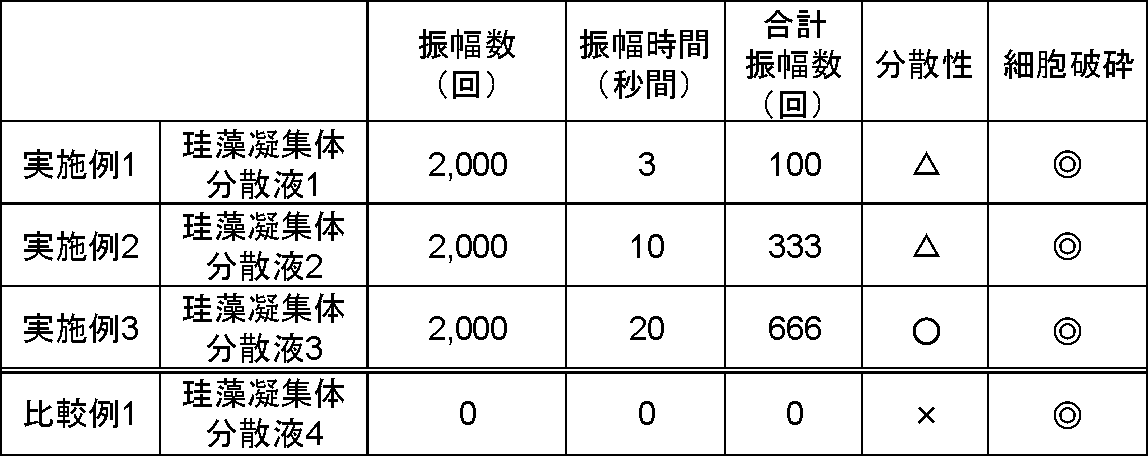
実施例1~3及び比較例1で得られた10日間培養後の珪藻凝集膜1~4を、スライドグラス上からセルスクレーバーを用いて剥離し、人工海水を38g/L含むIMK培地を2mLずつ入れたポリスチレン製の6穴プレート(微生物培養プレート、アズワン株式会社製)に入れ、10回ピペッティングした。次いで、この分散液全量を、5mL容のホモジナイズ用マイクロチューブ(TM-655S滅菌付、株式会社トミー精工)に入れ、ビーズ式細胞破砕装置Micro Smash MS-100(株式会社トミー精工製)にセットし、1分間当たりの振動数5,500回で20秒間、図4Cの振動形態で振動させた。なお、振動操作は3回行い、各回の振動操作間に1分間の非振動時間を入れた。この分散液をそれぞれ10μL用い、血球計数盤(カウンティングチェンバー、アズワン株式会社製)上に滴下し、光学顕微鏡下で珪藻の数を計測した。結果を表2に示す。また、播種時の細胞数と、培養後の細胞数とから、次式により増殖倍率を算出した。
増殖倍率=(培養後の細胞数-播種時の細胞数)/播種時の細胞数
増殖倍率=(培養後の細胞数-播種時の細胞数)/播種時の細胞数

表2の結果より、実施例1~3及び比較例1は、好適な増殖が認められた。特に、実施例3の増殖が良好であった。
図7に、実施例1~3及び比較例1における合計振動数と、珪藻凝集膜1~4の培養後の細胞数との関係を示す。図7において、横軸は、表1に示す合計振動数(回)を示し、縦軸は、表2に示す培養後の細胞数(×105個/cm2)を示す。
比較例1は、分散工程を行っておらず微生物凝集膜が均一でないため、大きく凝集した凝集体内では内部の微生物まで、光や培地中の栄養分などが十分に行き届かず、また増殖に必要な空間が少なかったためと考えられる。一方、実施例3は、比較例1の様な凝集体が少なく、増殖に寄与する微生物の数が比較例1に比べて多いため、細胞の増殖数が多くなったと推定される。
図7に、実施例1~3及び比較例1における合計振動数と、珪藻凝集膜1~4の培養後の細胞数との関係を示す。図7において、横軸は、表1に示す合計振動数(回)を示し、縦軸は、表2に示す培養後の細胞数(×105個/cm2)を示す。
比較例1は、分散工程を行っておらず微生物凝集膜が均一でないため、大きく凝集した凝集体内では内部の微生物まで、光や培地中の栄養分などが十分に行き届かず、また増殖に必要な空間が少なかったためと考えられる。一方、実施例3は、比較例1の様な凝集体が少なく、増殖に寄与する微生物の数が比較例1に比べて多いため、細胞の増殖数が多くなったと推定される。
本発明の微生物凝集膜の製造方法によれば、培養基材上に均一な微生物凝集膜を形成させることができるため、これにより、培養基材上に存在する多くの微生物に好適な培養環境、即ち、培養基材上の全ての微生物に光や培地中の栄養分が行き届き、また増殖に必要な空間を確保させることができるため、微生物の培養速度を向上させることができる。そのため、バイオマスの生産性の安定化も向上させることができ、微生物を用いたバイオマス燃料の製造などに好適に利用可能である。
10 振動装置
12 装置本体
14 蓋部材
16 密閉容器ホルダー
18 駆動軸
20 振動駆動部
22 密閉容器
22A 蓋
24 チャック部
25 その他の成分
26 試料液
27 微生物
28 ON-OFFスイッチ
30 振動数ダイヤル
32 タイマーダイヤル
34 切り換えスイッチ
12 装置本体
14 蓋部材
16 密閉容器ホルダー
18 駆動軸
20 振動駆動部
22 密閉容器
22A 蓋
24 チャック部
25 その他の成分
26 試料液
27 微生物
28 ON-OFFスイッチ
30 振動数ダイヤル
32 タイマーダイヤル
34 切り換えスイッチ
Claims (8)
- 微生物凝集膜中の微生物の増殖を促進する微生物凝集膜の製造方法であって、
前記微生物を前培養する前培養工程と、
前記前培養工程において前培養された前記微生物の凝集体を、次式で表される合計振動数で100回以上振動させて分散させる分散工程と、
前記分散工程において分散された前記微生物凝集体中の前記微生物の一定量を採取する採取工程と、
前記採取工程において採取した前記一定量の微生物を、一定面積の培養基材上で培養し、該培養基材上に前記微生物の凝集膜を均一に形成させる微生物凝集膜形成工程と、
を含むことを特徴とする微生物凝集膜の製造方法。
合計振動数(回)=1分間当たりの振動数(回)×振動時間(分間) - 分散工程における振動の振動形態が、上下方向、左右方向、及び前後方向の少なくとも1形態である請求項1に記載の微生物凝集膜の製造方法。
- 分散工程が、容器に充填した微生物凝集膜を振動させる工程であり、該容器の内容積に対する前記微生物凝集膜の容積比率が15容量%~75容積%である請求項1から2のいずれかに記載の微生物凝集膜の製造方法。
- 分散工程が、微生物凝集膜に消泡剤を添加して行われる請求項1から3のいずれかに記載の微生物凝集膜の製造方法。
- 分散工程が、複数回行われる請求項1から4のいずれかに記載の微生物凝集膜の製造方法。
- 微生物が微細藻類である請求項1から5のいずれかに記載の微生物凝集膜の製造方法。
- 微生物がバイオマスを産生する微生物である請求項1から6のいずれかに記載の微生物凝集膜の製造方法。
- バイオマスを産生する微生物が、珪藻類、黄緑藻類、及び緑藻類の少なくともいずれかである請求項7に記載の微生物凝集膜の製造方法。
Applications Claiming Priority (2)
| Application Number | Priority Date | Filing Date | Title |
|---|---|---|---|
| JP2010-090571 | 2010-04-09 | ||
| JP2010090571A JP5736118B2 (ja) | 2010-04-09 | 2010-04-09 | 珪藻凝集膜の製造方法 |
Publications (1)
| Publication Number | Publication Date |
|---|---|
| WO2011125792A1 true WO2011125792A1 (ja) | 2011-10-13 |
Family
ID=44762731
Family Applications (1)
| Application Number | Title | Priority Date | Filing Date |
|---|---|---|---|
| PCT/JP2011/058118 Ceased WO2011125792A1 (ja) | 2010-04-09 | 2011-03-30 | 微生物凝集膜の製造方法 |
Country Status (2)
| Country | Link |
|---|---|
| JP (1) | JP5736118B2 (ja) |
| WO (1) | WO2011125792A1 (ja) |
Cited By (1)
| Publication number | Priority date | Publication date | Assignee | Title |
|---|---|---|---|---|
| JP2015204815A (ja) * | 2014-04-23 | 2015-11-19 | 株式会社大林組 | 微細藻類の培養方法 |
Families Citing this family (1)
| Publication number | Priority date | Publication date | Assignee | Title |
|---|---|---|---|---|
| CN108929703A (zh) * | 2018-07-04 | 2018-12-04 | 内蒙古工业大学 | 一种沙漠原位微生物覆膜层的制备方法 |
Family Cites Families (3)
| Publication number | Priority date | Publication date | Assignee | Title |
|---|---|---|---|---|
| JPH05146791A (ja) * | 1991-11-26 | 1993-06-15 | Hitachi Ltd | 微生物認識装置 |
| JPH0994098A (ja) * | 1995-09-29 | 1997-04-08 | Unitika Ltd | 微生物の選択的濃縮方法およびこれを用いた微生物検査法 |
| JPH10151306A (ja) * | 1996-11-22 | 1998-06-09 | Sci Kk | 濾過装置 |
-
2010
- 2010-04-09 JP JP2010090571A patent/JP5736118B2/ja not_active Expired - Fee Related
-
2011
- 2011-03-30 WO PCT/JP2011/058118 patent/WO2011125792A1/ja not_active Ceased
Non-Patent Citations (7)
| Title |
|---|
| DE SWAAF, M.E. ET AL.: "High-cell-density fed- batch cultivation of the docosahexaenoic acid producing marine alga Crypthecodinium cohnii", BIOTECHNOL.BIOENG., vol. 81, 2003, pages 666 - 672 * |
| HU, W. ET AL.: "Growth inhibition of dinoflagellate algae in shake flasks: Not due to shear this time!", BIOTECHNOL.PROG., vol. 26, 21 October 2009 (2009-10-21), pages 79 - 87 * |
| MAKOTO WATANABE: "Norin Chikusangyo kara Mita Biomass Riyo no Kadai to Tenbo Sorui ni yoru Bio Nenryo Seisan no Tenbo", ENVIRONMENTAL CONSERVATION ENGINEERING, vol. 38, no. 3, 2009, pages 160 - 164 * |
| RAMUS, J.: "Productivity of seaweeds", PRIMARY PRODUCTIVITY AND BIOGEOCHEMICAL CYCLES IN THE SEA, ENVIRON.SCI.RES., vol. 43, 1992, pages 239 - 255 * |
| SCHUMACHER, J.T. ET AL.: "System development for generating homogeneous cell suspensions and transporting them in microfluidic devices", ENG.LIFE SCI., vol. 8, no. 1, 2008, pages 49 - 55 * |
| SHINJI MITSUHASHI ET AL.: "Oxygen Production in a Simple Shear Flow of Spirulina Suspension", THE JAPAN SOCIETY OF MECHANICAL ENGINEERS KANSAI SHIBU DAI 250 KAI KOENKAI KOEN RONBUNSHU, 1991, pages 4 - 6 * |
| VONSHAK, A: "Recent advances in microalgal biotechnology", BIOTECH.ADV., vol. 8, 1990, pages 709 - 727 * |
Cited By (1)
| Publication number | Priority date | Publication date | Assignee | Title |
|---|---|---|---|---|
| JP2015204815A (ja) * | 2014-04-23 | 2015-11-19 | 株式会社大林組 | 微細藻類の培養方法 |
Also Published As
| Publication number | Publication date |
|---|---|
| JP2011217677A (ja) | 2011-11-04 |
| JP5736118B2 (ja) | 2015-06-17 |
Similar Documents
| Publication | Publication Date | Title |
|---|---|---|
| Moreno Osorio et al. | A review of microalgal biofilm technologies: definition, applications, settings and analysis | |
| JP7219303B2 (ja) | 培養方法 | |
| Lee et al. | Basic culturing techniques | |
| Irving et al. | Species and material considerations in the formation and development of microalgal biofilms | |
| Shen et al. | Influence of algae species, substrata and culture conditions on attached microalgal culture | |
| Chang et al. | The impact of hydrodynamic shear force on adhesion morphology and biofilm conformation of Bacillus sp. | |
| Melo et al. | Chlorella vulgaris (SAG 211-12) biofilm formation capacity and proposal of a rotating flat plate photobioreactor for more sustainable biomass production | |
| Iasimone et al. | Bioflocculation and settling studies of native wastewater filamentous cyanobacteria using different cultivation systems for a low-cost and easy to control harvesting process | |
| JP2012157274A (ja) | 光合成微生物の付着培養方法 | |
| CN112961821B (zh) | 三维培养血管内皮细胞的方法 | |
| CN104232490A (zh) | 一种筛选处理油田污水微藻的方法 | |
| JP5736118B2 (ja) | 珪藻凝集膜の製造方法 | |
| WO2015041350A1 (ja) | 吸水性高分子ゲルと基板間で形成される領域での新規付着培養方法、バイオマスの製造方法、及び新規微細藻類 | |
| CN102706841A (zh) | 生物絮凝泥沙室内培养及观测方法 | |
| Shoumura et al. | Single cell analysis of sinking diatoms studied using a homemade ‘tumbled’optical microscope system | |
| JP2013226063A (ja) | 微細藻類の培養方法、該培養方法により液面上に形成されたバイオフィルム、該バイオフィルムから得られるバイオマス及びオイル、該バイオフィルムの回収方法、並びにバイオマス燃料の製造方法 | |
| JP5636207B2 (ja) | 微生物凝集膜中の微生物細胞数の計測方法 | |
| Jakob et al. | Phototaxis assays of Synechocystis sp. PCC 6803 at macroscopic and microscopic scales | |
| Putri et al. | Flocculants optimization in harvesting freshwater microalgae Haematococcus pluvialis | |
| JP6785465B2 (ja) | 微生物の分離培養方法及び凝集体含有溶液 | |
| US11230693B2 (en) | Methods for harvesting microalgae | |
| Cai et al. | Culture and motion analysis of diatom Bacillaria paradoxa on a microfluidic platform | |
| Béchet et al. | The colorimetric assay of viability for algae (CAVA): a fast and accurate technique | |
| US20110091933A1 (en) | Method of treating microorganism | |
| RU2426779C1 (ru) | Биосенсор на основе клеток микроводорослей для определения тяжелых металлов и гербицидов в водных системах |
Legal Events
| Date | Code | Title | Description |
|---|---|---|---|
| 121 | Ep: the epo has been informed by wipo that ep was designated in this application |
Ref document number: 11765692 Country of ref document: EP Kind code of ref document: A1 |
|
| NENP | Non-entry into the national phase |
Ref country code: DE |
|
| 122 | Ep: pct application non-entry in european phase |
Ref document number: 11765692 Country of ref document: EP Kind code of ref document: A1 |